Vitamin Bioavailability in Animal vs. Plant Foods: A Scientific Review for Biomedical Research and Development
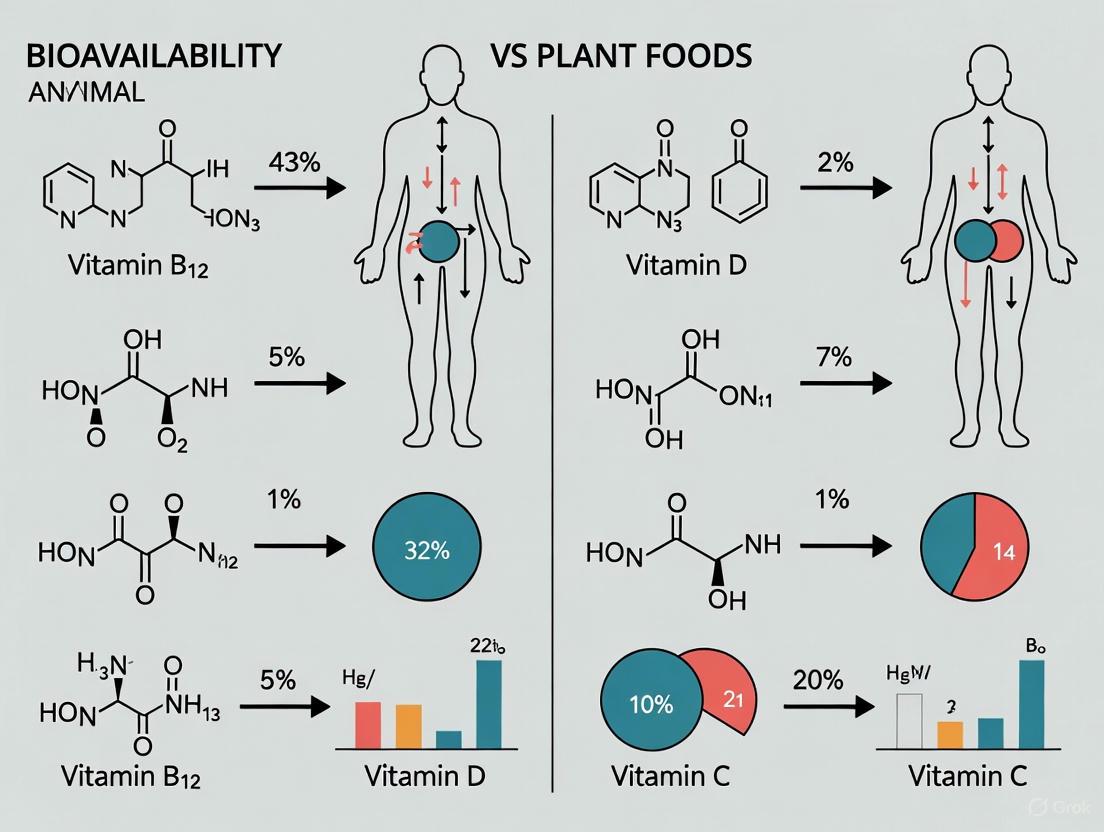
This article provides a comprehensive analysis of the bioavailability of vitamins from animal and plant food sources, tailored for researchers, scientists, and drug development professionals.
Vitamin Bioavailability in Animal vs. Plant Foods: A Scientific Review for Biomedical Research and Development
Abstract
This article provides a comprehensive analysis of the bioavailability of vitamins from animal and plant food sources, tailored for researchers, scientists, and drug development professionals. It establishes the foundational principles of nutrient bioavailability, explores the methodological approaches for its assessment, and details the factors causing bioavailability challenges, particularly in plant-based matrices. The content critically evaluates and compares the bioactivity of vitamin forms (vitamers) from different sources and discusses innovative strategies to enhance nutrient absorption. By synthesizing current research, this review aims to inform the development of fortified foods, pharmaceutical formulations, and personalized nutrition strategies to address global micronutrient deficiencies.
Fundamental Principles of Vitamin Bioavailability and Source-Dependent Variation
Bioavailability is a foundational concept in nutrition and pharmacology, representing the proportion of an ingested nutrient that is absorbed, becomes available for physiological functions, and is stored for future use [1]. The European Food Safety Authority (EFSA) describes it as the "availability of a nutrient to be used by the body," while more mechanistic definitions encompass the complete pathway from "the proportion of an ingested nutrient that is released during digestion, absorbed via the gastrointestinal tract, transported and distributed to target cells and tissues, in a form that is available for utilization in metabolic functions or for storage" [1]. Understanding bioavailability is particularly crucial when comparing vitamins from animal versus plant foods, as significant differences in food matrix, nutrient forms, and presence of inhibitors or enhancers can dramatically impact the ultimate nutritional value of these food sources.
The Bioavailability Pathway: From Consumption to Utilization
The journey of a vitamin from consumption to final utilization involves multiple sequential stages, each potentially influenced by factors specific to animal and plant food matrices.
The diagram below illustrates the complete pathway of vitamin bioavailability from ingestion to final physiological utilization:
Critical Stages in Vitamin Bioavailability
Digestion and Liberation
The initial stage involves mechanical and chemical breakdown of food, liberating vitamins from their food matrix. This process varies significantly between animal and plant tissues. Animal tissues typically have simpler cellular structures that break down more readily, while plant tissues contain complex cell walls and fibrous structures that can entrap nutrients [1]. Plant-based whole foods often contain anti-nutritional factors such as phytates and tannins that can bind vitamins and minerals, reducing their liberation during digestion [2] [1].
Absorption and Transport
Once liberated, vitamins must be absorbed through the intestinal epithelium. Water-soluble vitamins like vitamin C and B vitamins utilize specific transport mechanisms. Vitamin C absorption occurs primarily through sodium-dependent vitamin C transporters (SVCTs), while its oxidized form (dehydroascorbic acid) enters cells via glucose transporters (GLUTs) [3]. The absorption efficiency is dose-dependent; for vitamin C, absorption ranges from 70-90% at intakes between 30-180 mg/day but declines to below 50% when intake exceeds 1 g/day [3].
Tissue Uptake and Utilization
The final stage involves cellular uptake and metabolic utilization of vitamins. Different vitamin forms have varying metabolic efficacy. For instance, calcifediol (a vitamin D metabolite) is more bioavailable than cholecalciferol, and methylfolate is more bioavailable than folic acid [1]. Genetic variations in transport proteins and metabolic enzymes among individuals can further influence this stage, contributing to interindividual differences in vitamin status despite similar intakes [1].
Key Factors Influencing Vitamin Bioavailability
Food Matrix Effects
The food matrix significantly impacts vitamin bioavailability, with notable differences between animal and plant sources:
Plant Matrix Challenges: Plant foods contain cellular structures that entrap nutrients and anti-nutritional factors (phytates, oxalates, tannins) that bind vitamins and minerals, reducing their bioavailability [1]. For example, the presence of phytate in whole grains and legumes can inhibit zinc and iron absorption [4].
Animal Matrix Advantages: Animal-based foods typically have higher nutrient bioavailability due to the absence of these inhibitory compounds and the presence of enhancing factors. Heme iron from animal sources is more readily absorbed than non-heme iron from plant sources [4].
Nutrient Interactions and Transformations
Several critical interactions influence vitamin bioavailability in mixed diets:
Enhancing Interactions: Vitamin C significantly enhances non-heme iron absorption from plant foods [4] [5]. Fat improves the absorption of fat-soluble vitamins (A, D, E, K) [1]. The presence of certain amino acids from animal proteins can enhance mineral absorption.
Inhibitory Interactions: Calcium can inhibit iron and zinc absorption [1]. Fiber, particularly soluble fiber, can delay gastric emptying and potentially reduce the absorption of some vitamins [1]. Excessive zinc supplementation can interfere with copper absorption.
Host Factors
Individual physiological characteristics substantially affect vitamin bioavailability:
Life Stage: Pregnancy and lactation increase absorptive capacity for many nutrients, while aging reduces absorption efficiency for certain vitamins like B12 and vitamin D [1].
Gut Microbiome: A healthy gastrointestinal microbiota can increase absorption of certain B vitamins and vitamin K, while dysbiosis may reduce availability [1].
Genetic Variations: Polymorphisms in genes encoding transport proteins (e.g., SVCTs for vitamin C) and metabolic enzymes create interindividual differences in vitamin utilization [3] [1].
Experimental Approaches for Assessing Bioavailability
Methodological Framework
Research on vitamin bioavailability employs multiple experimental approaches, each with distinct advantages and limitations:
Table 1: Methods for Assessing Vitamin Bioavailability
| Method Type | Key Characteristics | Primary Applications | Limitations |
|---|---|---|---|
| Balance Studies | Measures difference between ingestion and excretion | Mineral bioavailability, overall absorption | Doesn't account for endogenous losses |
| Ileal Digestibility | Measures nutrient remaining in ileal contents | Apparent absorption of proteins, minerals | Requires invasive collection procedures |
| Plasma Kinetics | Tracks nutrient appearance in blood over time | Vitamin absorption rates, peak concentrations | Doesn't measure tissue uptake or utilization |
| Stable Isotopes | Uses traceable isotope-labeled nutrients | Mineral metabolism, absorption pathways | Technically complex and expensive |
| Urinary Metabolite Profiling | Measures excreted metabolites post-consumption | Vitamin utilization, metabolic fate | Indirect measure of absorption |
Detailed Experimental Protocol: Vitamin C Bioavailability Study
Recent research exemplifies comprehensive bioavailability assessment using multiple complementary methods [3]. The following workflow illustrates a standardized protocol for comparing vitamin C bioavailability from different sources:
Essential Research Reagents and Materials
Table 2: Key Research Reagents for Vitamin Bioavailability Studies
| Reagent/Material | Specification | Primary Function | Application Example |
|---|---|---|---|
| Vitamin C Standard | Ascorbic acid, ≥99%, food-grade [3] | Quantitative calibration | HPLC quantification in biological samples |
| Deuterated Solvents | D₂O, ≥99.9 atom % D, NMR grade [3] | NMR spectroscopy | Metabolite profiling in urine |
| Internal Standards | TSP (≥98%, NMR grade) [3] | Chemical shift reference | NMR spectral calibration |
| Antioxidant Preservatives | BHT (≥99%, HPLC grade) [3] | Prevent vitamin oxidation | Sample stabilization for analysis |
| Mass Spec Standards | Stable isotope-labeled vitamins | Quantitative precision | LC-MS/MS quantification |
| Chromatography Columns | Eclipse Plus C18 (4.6 mm × 100 mm) [3] | Compound separation | HPLC vitamin separation |
| Antioxidant Assay Kits | ORAC, TRAP assays [3] | Functional assessment | Antioxidant capacity measurement |
Evidence from Analytical Studies
Direct comparisons of vitamin bioavailability between animal and plant sources reveal significant differences:
Table 3: Vitamin Bioavailability Comparison: Animal vs. Plant Sources
| Vitamin/Nutrient | Animal Source Characteristics | Plant Source Characteristics | Key Bioavailability Differences |
|---|---|---|---|
| Vitamin B12 | Naturally occurring in meat, fish, eggs, dairy [6] [4] | Generally absent unless fortified [6] | Plant-based diets associated with lower B12 status without supplementation [4] |
| Iron | Hme iron (10-15% of total in omnivorous diets) [4] | Non-heme iron with lower bioavailability [4] | Heme iron absorption ~15-35% vs non-heme 2-20% [4] |
| Zinc | Higher bioavailability [4] | Lower bioavailability due to phytates [4] [1] | Plant-based diets often associated with lower zinc status [4] |
| Vitamin C | Limited sources (organ meats) | Abundant in fruits and vegetables [5] [3] | Juice form shows enhanced absorption vs raw produce [3] |
| Vitamin A | Pre-formed retinol from animal tissues | Provitamin A carotenoids from plants | Retinol more bioavailable than carotenoids (e.g., β-carotene) |
| Vitamin D | Natural form (D3) in fatty fish, eggs | Limited sources (mushrooms with D2) | D3 more effective at raising serum 25(OH)D than D2 |
Clinical Evidence from Intervention Studies
A 12-week randomized controlled trial provides compelling evidence for the practical implications of these bioavailability differences. The study assigned participants to diets with varying animal-to-plant protein ratios [4]:
- ANIMAL Diet: 70% animal-source protein/30% plant-source protein
- 50/50 Diet: Equal amounts of animal and plant proteins
- PLANT Diet: 30% animal/70% plant-source protein
Findings demonstrated that partial replacement of animal proteins with plant proteins led to marked decreases in vitamin B12 intake and status, with the PLANT group showing significantly lower B12 levels than both ANIMAL and 50/50 groups [4]. Similarly, iodine intake and status were lower in both 50/50 and PLANT groups compared to ANIMAL [4]. Interestingly, despite plant-based diets typically containing more iron, no significant differences in iron status biomarkers were observed between groups, highlighting the bioavailability challenge of non-heme iron from plant sources [4].
Implications for Research and Clinical Practice
Research Considerations
The complexity of vitamin bioavailability necessitates sophisticated research approaches:
Matrix Effects: Research must account for the complete food matrix rather than isolated nutrients. Plant-based meats, for example, have a nutrient density comparable to animal meat but different micronutrient profiles [6].
Long-Term Studies: Short-term bioavailability studies may not predict long-term nutritional status, particularly for nutrients with substantial storage pools (e.g., vitamin B12).
Individual Variability: Genetic polymorphisms in transport systems and metabolic enzymes contribute to significant interindividual differences in vitamin bioavailability [1].
Clinical and Public Health Applications
Understanding bioavailability differences informs practical dietary guidance:
Strategic Food Combining: Consuming vitamin C-rich foods with plant sources of iron can enhance iron absorption [4] [5].
Life Stage Considerations: The optimal balance of animal vs. plant proteins may vary with age, with evidence suggesting higher animal protein benefits in early life but plant protein advantages in later life [7] [8].
Fortification Strategies: Targeted fortification of plant-based foods with poorly bioavailable nutrients (iron, zinc, B12) can address potential deficiencies in plant-forward diets [6] [1].
The scientific understanding of vitamin bioavailability continues to evolve, with ongoing research illuminating the complex interactions between food matrices, nutrient forms, and individual physiology that ultimately determine the nutritional value of both animal and plant foods.
This technical guide provides an in-depth analysis of the core pharmacokinetic (PK) metrics essential for quantifying drug exposure and absorption: absolute and relative bioavailability, area under the curve (AUC), and time to maximum concentration (Tmax). While these principles are foundational in pharmaceutical development, they are equally critical in nutritional science for assessing the bioavailability of vitamins and other nutrients from different food matrices, such as in comparative studies of animal-based versus plant-based foods. This whitepaper details the definitions, calculations, underlying physiological factors, and experimental protocols for determining these metrics, providing researchers and drug development professionals with the methodologies to accurately characterize the systemic exposure of bioactive compounds.
In pharmacology, bioavailability is defined as the fraction of an administered substance that reaches the systemic circulation unaltered and becomes available at the site of action [9] [10]. It is a subcategory of absorption and a fundamental component of the pharmacokinetics paradigm, often summarized as ABCD (Administration, Bioavailability, Clearance, Distribution) [9].
The concept is crucial for determining the efficacy and safety of a substance. By definition, when a drug is administered via intravenous (IV) route, its bioavailability is considered to be 100% because the entire dose is delivered directly into the systemic circulation [11] [10]. For all other routes of administration—such as oral, subcutaneous, or transdermal—bioavailability is generally less than 100% due to physiological barriers that prevent a portion of the dose from reaching systemic circulation [9].
This framework is directly applicable to nutritional research. For dietary supplements, herbs, and nutrients, bioavailability typically designates the quantity or fraction of the ingested dose that is absorbed [10]. However, in nutritional science, bioavailability can be more complex due to the influence of the subject's nutritional status and physiological state, leading to greater inter-individual variation compared to pharmaceutical studies [10].
Core Pharmacokinetic Metrics
Area Under the Curve (AUC)
The Area Under the Curve (AUC) is a primary metric for quantifying the total exposure of a drug or nutrient in the bloodstream over time. It is derived from a plot of the plasma concentration of the substance on the y-axis versus time following administration on the x-axis [9] [12].
- Role in Bioavailability: The AUC is directly proportional to the total amount of the unaltered substance that has reached the systemic circulation [10]. It is the cornerstone for calculating both absolute and relative bioavailability, as it provides a robust measure of the "extent of absorption" [12] [13].
- Calculation: The AUC is typically calculated using numerical integration methods, such as the linear or logarithmic trapezoidal rule, from time zero to the last measured time point (AUC0–t). The area may be extrapolated to infinity (AUC0–∞) by adding the term Clast/λz, where Clast is the last observed concentration and λz is the terminal elimination rate constant [9].
Absolute Bioavailability (Fabs)
Absolute bioavailability compares the systemic availability of a substance after extravascular administration (e.g., oral) to that after intravenous administration [11] [13]. It quantifies how effectively a substance navigates the barriers of absorption and first-pass metabolism.
- Definition: The fraction of an administered dose that is delivered to the systemic circulation following a non-intravenous route [11].
- Calculation Formula:
Fabs = (AUCnon-IV * DIV) / (AUCIV * Dnon-IV) * 100% [13] [10]
Where:
AUCnon-IVis the area under the curve for the non-IV route.AUCIVis the area under the curve for the IV route.Dnon-IVandDIVare the administered doses for the non-IV and IV routes, respectively.
- Interpretation: An Fabs of 1 (or 100%) indicates complete systemic absorption relative to an IV dose. Values less than 1 indicate losses due to incomplete absorption, intestinal metabolism, or first-pass hepatic metabolism [9] [11].
Relative Bioavailability (Frel)
Relative bioavailability assesses the systemic exposure of a test formulation of a substance compared to a reference formulation, both administered via the same extravascular route [11] [13]. This is distinct from absolute bioavailability, as it does not require an IV reference.
- Definition: The bioavailability of a substance from a test formulation relative to a recognized standard or reference formulation [10].
- Application: This measure is critical for assessing bioequivalence between two formulations (e.g., a generic vs. a brand-name drug) or for evaluating the performance of new delivery systems [13]. In nutritional science, it is used to compare the bioavailability of a nutrient from different food sources or supplement formulations [10].
- Calculation Formula:
Frel = (AUCTest * DRef) / (AUCRef * DTest) * 100% [10]
Where:
AUCTestandAUCRefare the areas under the curve for the test and reference formulations.DTestandDRefare the administered doses for the test and reference formulations.
Table 1: Comparison of Absolute and Relative Bioavailability
| Feature | Absolute Bioavailability (Fabs) | Relative Bioavailability (Frel) |
|---|---|---|
| Definition | Fraction reaching systemic circulation vs. IV dose | Bioavailability of test formulation vs. reference formulation |
| Reference Standard | Intravenous (IV) administration | Any other non-IV formulation (e.g., oral solution) |
| Primary Purpose | Determine fundamental absorption efficiency | Formulation comparison & bioequivalence testing |
| Calculation | (AUC~non-IV~ * D~IV~) / (AUC~IV~ * D~non-IV~) | (AUC~Test~ * D~Ref~) / (AUC~Ref~ * D~Test~) |
| Ideal Value | 100% | 100% (indicates equivalent exposure) |
Maximum Concentration (Cmax) and Time to Cmax (Tmax)
Cmax is the maximum observed concentration of a substance in the plasma or blood after administration. Tmax is the time taken to reach that maximum concentration following administration [12].
- Cmax: This metric provides insight into the rate of absorption and is often associated with the intensity of a substance's pharmacodynamic effect or, in some cases, its side effects. The value of Cmax is influenced by both the extent and the rate of absorption [12].
- Tmax: This is a direct indicator of the absorption rate. A shorter Tmax generally suggests a faster rate of absorption. Unlike other metrics, Tmax is a categorical variable whose accuracy is highly dependent on the frequency of blood sampling during a study [12].
- Clinical Relevance: For drugs with a narrow therapeutic window, Cmax is critical for avoiding toxicity. In nutrition, Cmax and Tmax can help understand the postprandial kinetics of a vitamin, which may be relevant for tissues with high instantaneous demand.
Table 2: Key Pharmacokinetic Metrics for Assessing Absorption
| Metric | Description | Pharmacokinetic Insight | Impact of Increased Value |
|---|---|---|---|
| AUC | Total systemic exposure over time | Extent of Absorption | Indicates a larger total amount of substance absorbed |
| C~max~ | Peak plasma concentration | Combined effect of extent & rate of absorption | Higher peak effect potential; may increase risk of toxicity |
| T~max~ | Time to reach C~max~ | Rate of Absorption | A shorter T~max~ indicates faster absorption |
Factors Influencing Bioavailability
The journey of an orally administered substance from ingestion to systemic circulation is fraught with obstacles that reduce its bioavailability. The "first-pass effect" is a primary reason for the low bioavailability of many compounds [11].
Diagram 1: First-Pass Metabolism Pathway
As illustrated in Diagram 1, an oral dose must survive several sites of potential loss. The overall bioavailability (F) is the product of the fractions surviving each step [11]: F = fGI * fGutWall * fLiver
Other critical factors include:
- Physicochemical properties: Hydrophobicity, pKa, and solubility of the substance [10].
- Formulation factors: The design of the dosage form (immediate-release, extended-release, etc.) and the excipients used can significantly impact dissolution and absorption [10].
- Physiological and Dietary Factors:
- Food effects: Co-ingestion with food can alter gastric emptying time, solubility, and interactions with transporters [10].
- Drug/Nutrient interactions: Concurrent intake of other substances can induce or inhibit metabolic enzymes (e.g., Grapefruit juice inhibits CYP3A, increasing bioavailability of some drugs) or interact with efflux transporters like P-glycoprotein [9] [10].
- Health status: Diseases affecting the GI tract (e.g., inflammatory bowel disease) or liver (hepatic insufficiency) can dramatically alter absorption and metabolism [9] [10].
- Individual variation: Age, genetics, and gender contribute to inter- and intra-individual variability in bioavailability [10].
Experimental Protocols for Bioavailability Studies
Study Design for Absolute Bioavailability
Determining absolute bioavailability requires a crossover study comparing extravascular and intravenous administration.
- Reference Standard: An IV formulation is essential, as it provides a 100% bioavailability benchmark [13] [10]. If developing an IV formulation is not feasible, a stable-isotope method can be used, where a microdose of an isotopically labelled IV dose is co-administered with a therapeutic oral dose [10].
- Study Population: Healthy volunteers or relevant patient populations, with sample size determined by power analysis to account for inter-individual variability.
- Dosing and Sampling:
- Administer the IV dose and collect serial blood samples at predefined times from administration until the substance is fully eliminated.
- After a suitable washout period (≥5 half-lives), administer the extravascular (e.g., oral) dose and collect blood samples with the same frequency.
- Key Measurements: Plasma or serum concentrations of the substance are measured at each time point using a validated analytical method (e.g., LC-MS/MS).
- Data Analysis:
- Calculate AUCIV and AUCnon-IV for the IV and non-IV routes, respectively.
- Apply the formula for Fabs, ensuring appropriate dose normalization (DIV and Dnon-IV) [13].
Study Design for Relative Bioavailability and Bioequivalence
Relative bioavailability studies are fundamental for formulation development and generic drug approval.
- Reference Standard: A marketed formulation or an established solution, typically administered via the same extravascular route [13].
- Study Design: A randomized, crossover design is standard, where each subject receives both the test and reference formulation in random order, separated by a washout period.
- Dosing and Sampling: Administer the test and reference products and collect serial blood samples over a time period sufficient to fully characterize the concentration-time profile.
- Data Analysis and Bioequivalence Criteria:
- Calculate AUCTest and AUCRef for the test and reference products.
- Calculate Cmax,Test and Cmax,Ref.
- For bioequivalence, the 90% confidence interval for the ratio of the geometric means (Test/Reference) for both AUC and Cmax must fall within the 80-125% range [10].
Diagram 2: Crossover Study Design Workflow
Advanced Protocol: Determining Tmax and Cmax in Multicompartmental Models
For substances that exhibit multicompartmental distribution kinetics, the determination of the true Tmax and Cmax is not straightforward and cannot be solved with explicit analytical equations as in a one-compartment model [12].
- Challenge: In multicompartmental models, the concentration-time profile is described by multi-exponential equations, making simple observation (Tmax,obs, Cmax,obs) susceptible to error from sampling frequency and assay variability [12].
- Numerical Solution Method: A model-guided approach using the Newton-Raphson iteration method is recommended [12].
- Model Fitting: Fit the concentration-time data to a multicompartmental pharmacokinetic model to obtain the relevant parameters.
- First Derivative: The point of maximum concentration (Cmax) occurs when the first derivative of the concentration-time function (dC/dt) equals zero.
- Iteration: Use the Newton-Raphson method, which also utilizes the second derivative (d²C/dt²), to iteratively find the time (t) where dC/dt = 0. This time is the model-derived Tmax.
- Calculate Cmax: Substitute the derived Tmax back into the original concentration-time function to calculate the true Cmax.
- Advantage: This method reduces the bias introduced by sparse sampling schedules and provides a more accurate estimate of the absorption rate, which is particularly valuable for complex molecules or nutrients.
The Scientist's Toolkit: Essential Reagents and Materials
Table 3: Key Research Reagent Solutions for Bioavailability Studies
| Item | Function/Application |
|---|---|
| Validated Analytical Standard | High-purity reference compound for accurate quantification of the analyte in biological matrices. Essential for creating calibration curves. |
| Stable Isotope-Labeled Analogue | Serves as an internal standard in Mass Spectrometry to correct for sample preparation losses and matrix effects, improving data accuracy. |
| IV Formulation (for F~abs~) | A sterile, stable formulation suitable for intravenous injection, serving as the gold-standard reference for absolute bioavailability studies. |
| Blank Biological Matrix | Drug-free plasma or serum from the study species. Used to prepare calibration standards and quality control samples for assay validation. |
| Enzyme Inhibitors & Stabilizers | Added to blood collection tubes to prevent ex vivo degradation of the analyte (e.g., esterase inhibitors, antioxidants). |
| LC-MS/MS System | The gold-standard analytical platform for quantifying low concentrations of drugs and nutrients in complex biological fluids with high sensitivity and specificity. |
| Phoenix WinNonlin | Industry-standard software for performing non-compartmental analysis (NCA) and calculating PK parameters like AUC, C~max~, and T~max~ [14]. |
| Newton-Raphson Algorithm Script | Custom or built-in software function (e.g., fzero in MATLAB) for numerically determining T~max~ in complex multicompartmental models [12]. |
Application in Nutritional Science: Animal vs. Plant-Based Vitamin Research
The principles of bioavailability are pivotal for advancing nutritional science, particularly in the ongoing debate and research concerning the nutritional adequacy of animal-based versus plant-based diets.
- Beyond the Nutrition Label: The intrinsic nutrient content of a food, as listed on a label, does not reflect its bioavailability. For example, a plant-based meat product might have an analytical iron content comparable to animal meat, but its bioavailability can be significantly different due to the presence of inhibitors like phytates or promoters like vitamin C [6] [15].
- Study Design Implications: To accurately compare the bioavailability of a vitamin (e.g., Vitamin A as retinol from liver vs. beta-carotene from carrots) or a mineral (e.g., heme iron from meat vs. non-heme iron from spinach), researchers must employ the relative bioavailability (Frel) framework.
- The reference formulation could be a purified solution of the vitamin taken orally.
- Test formulations would be the whole foods (animal or plant) being studied.
- By measuring AUC, Cmax, and Tmax, researchers can quantify not just how much of the vitamin is absorbed, but also how quickly it becomes available to the body.
- Consideration of Food Matrix: The "formulation" effect is extreme in food. The complex matrix of a plant-based food can bind nutrients, while processing methods (e.g., cooking, blending) can enhance their release and bioavailability. These factors are analogous to the pharmaceutical excipients and manufacturing methods that influence drug product performance [10].
- Emerging Evidence: Recent comparative analyses of plant-based and traditional meat products highlight the relevance of these PK metrics. While plant-based meats often have a comparable nutrient density and can be sources of certain vitamins like E and K, they may have lower bioavailability of other critical nutrients such as Vitamin B12, which is naturally present in animal meat [6] [15]. This underscores the need for rigorous bioavailability studies, not just compositional analysis, to inform public health and dietary guidance.
The pharmacokinetic metrics of AUC, absolute/relative bioavailability, Cmax, and Tmax provide a powerful, quantitative framework for understanding the systemic journey of any bioactive compound. In drug development, they are non-negotiable for ensuring efficacy and safety. Their application in nutritional science, particularly in the comparative assessment of vitamins from animal and plant sources, is equally critical. It moves the scientific discourse beyond simple nutrient content on a label to a deeper understanding of how effectively these nutrients are delivered to the body's systems. Mastering the experimental protocols for determining these metrics—from classic study designs to advanced numerical methods for complex kinetics—empowers researchers to generate robust data that can guide product development, regulatory approval, and ultimately, nutritional recommendations for human health.
Pharmacokinetics, traditionally used to describe the journey of drugs through the body via the four processes of Absorption, Distribution, Metabolism, and Excretion (ADME), provides an equally critical framework for understanding nutrient bioavailability [16] [17]. Bioavailability, defined as the proportion of a nutrient that is absorbed, becomes available in the bloodstream, and is utilized by the body, is a central determinant of nutritional efficacy [18] [19]. For bioactive food compounds, whether derived from plant or animal sources, bioavailability represents a crucial step in ensuring their intended health benefits, as these compounds must withstand food processing, be released from the food matrix, and reach their target tissues to exert physiological effects [18].
The ADME framework, when applied to nutrients, must account for greater complexity than with pharmaceutical drugs. Nutraceuticals and bioactive food compounds are typically multicomponent, multi-ingredient complex systems, and their disposition patterns are consequently more complicated than those of single-chemical-entity drugs [20]. Furthermore, the absorption mechanisms for hydrophilic and lipophilic bioactive compounds differ significantly, creating distinct challenges for predicting nutrient behavior in vivo [18]. This technical guide explores how the ADME framework elucidates the fate of nutrients in the human body, with particular emphasis on its application to comparing vitamin bioavailability from animal versus plant food sources, a key consideration in nutritional science and food policy.
The ADME Framework: Core Concepts and Nutritional Adaptation
Absorption: The Gateway to Bioavailability
Absorption describes the process by which nutrients traverse from the site of administration (typically the gastrointestinal tract) into the systemic circulation [16] [21]. For orally consumed nutrients, this process begins with bioaccessibility—the fraction of a compound released from the food matrix into the gastrointestinal lumen, making it available for intestinal absorption [18]. Bioaccessibility is influenced by food composition, processing methods, and synergisms or antagonisms between different food components [18].
Key factors affecting nutrient absorption include:
- Route of administration: While most nutrients are consumed orally, alternative routes can bypass first-pass metabolism [16].
- Molecular characteristics: Size, lipophilicity, and ionization state significantly impact absorption efficiency [22].
- Food matrix effects: The surrounding food matrix can either enhance or inhibit nutrient release and absorption [18].
- Gastrointestinal environment: pH, motility, surface area, and transit time all influence absorption rates [22].
The first-pass effect presents a significant barrier to nutrient absorption, particularly for compounds administered orally. After absorption from the intestine into the bloodstream, nutrients pass through the liver, where they may be partially metabolized before reaching the systemic circulation, thereby reducing their bioavailability [16]. This process contributes to the observation that orally administered compounds typically have lower bioavailability than those delivered intravenously, which bypass this initial metabolic processing [21] [17].
Distribution: Nutrient Transport and Tissue Delivery
Distribution involves the reversible transfer of nutrients from systemic circulation to various tissues and organs throughout the body [16] [17]. The distribution phase determines how widely a nutrient is dispersed and which specific tissues it can reach to exert its physiological effects.
Critical factors governing nutrient distribution include:
- Blood flow: Highly perfused organs typically receive more nutrients [21].
- Plasma protein binding: Nutrients like vitamins and their metabolites can bind to proteins such as albumin and α1-acid glycoprotein, creating reservoirs of bound compounds that are not immediately available for tissue uptake [17].
- Membrane permeability: The ability to cross cellular barriers, including specialized barriers like the blood-brain barrier, depends on molecular size, lipophilicity, and the presence of specific transport mechanisms [22] [21].
- Tissue affinity: Specific nutrients may accumulate in particular tissues based on chemical affinity and functional requirements [21].
For nutrients, distribution patterns significantly impact their functional efficacy, as they must reach specific target tissues to exert their health-promoting effects. The concept of distribution volume helps quantify this spreading throughout the body and varies considerably between different types of nutrients [17].
Metabolism: Biotransformation of Nutrients
Metabolism encompasses the biochemical modification of nutrients within the body, typically through enzymatic conversion to various metabolites [16]. These processes can activate, inactivate, or alter the biological activity of nutritional compounds.
Several systems mediate nutrient metabolism:
- Hepatic enzymes: Cytochrome P450 enzymes and other hepatic enzyme systems metabolize many bioactive compounds [21].
- Gut wall metabolism: Enterocytes contain metabolic enzymes that can process nutrients before they enter systemic circulation [22].
- Microbial bioconversion: Gut microbiota significantly metabolize certain nutrients, particularly polyphenols, producing bioactive metabolites that may have distinct physiological effects [18].
Nutrient metabolism is influenced by multiple factors, including genetic polymorphisms in metabolic enzymes, age, drug-nutrient interactions, and the overall metabolic state of the individual [21]. Understanding metabolic pathways is particularly important for nutrients that function as prodrugs—compounds that require biotransformation to become active [21].
Excretion: Elimination Pathways
Excretion refers to the processes by which nutrients and their metabolites are eliminated from the body [16] [21]. The primary excretion routes include renal elimination through urine, biliary excretion into feces, and, to a lesser extent, excretion through sweat, breath, and other bodily fluids.
Key determinants of nutrient excretion include:
- Renal function: Kidney efficiency significantly impacts elimination rates for water-soluble nutrients and metabolites [21].
- Molecular characteristics: Size, polarity, and molecular weight influence whether a compound is preferentially excreted renally or through hepatobiliary pathways [22].
- Enterohepatic recirculation: Some nutrients are excreted in bile, reabsorbed from the intestine, and returned to the liver, extending their residence time in the body [22].
The elimination half-life represents the time required for the concentration of a nutrient in the bloodstream to decrease by half, providing a useful metric for understanding dosing intervals and steady-state accumulation [21].
Quantitative Bioavailability Assessment of Vitamins
Bioavailability Metrics and Analytical Approaches
The bioavailability of vitamins is quantitatively assessed using specific parameters derived from plasma concentration-time curves [17]. These metrics include:
- Absolute Bioavailability: The fraction of an orally administered nutrient that reaches systemic circulation compared to intravenous administration [17].
- Relative Bioavailability: The bioavailability of a nutrient from one source or formulation compared to another [17].
- Area Under the Curve (AUC): The integral of plasma concentration over time, representing total systemic exposure [17].
- Maximum Concentration (C~max~): The peak plasma concentration achieved after administration [17].
- Time to Maximum Concentration (T~max~): The time required to reach C~max~ [17].
Advanced analytical techniques enable precise measurement of vitamin biomarkers in biological samples. The most common methods include Enzyme-Linked Immunosorbent Assay (ELISA), Liquid Chromatography with Tandem Mass Spectrometry (LC-MS/MS), High-Performance Liquid Chromatography (HPLC), and Chemiluminescent Immunoassays (CLIA) [23] [24]. These methods provide the sensitivity and specificity required to detect vitamin concentrations in complex biological matrices like serum, plasma, and tissues.
Analytical studies reveal significant differences in vitamin bioavailability between animal and plant sources. The table below summarizes comparative bioavailability data for key vitamins from these distinct food sources.
Table 1: Comparative Bioavailability of Vitamins from Animal versus Plant Food Sources
| Vitamin | Animal Source Bioavailability | Plant Source Bioavailability | Key Comparative Findings |
|---|---|---|---|
| Vitamin A (as retinol) | 74% bioavailable [19] | 15.6% (as provitamin A β-carotene) [19] | Animal sources provide preformed retinol; plants provide carotenoids requiring conversion |
| Vitamin B-12 | 65% bioavailable [19] | Minimal natural occurrence [19] | Animal sources are the almost exclusive natural sources |
| Biotin | 89% bioavailable [19] | Data limited | Animal sources contain highly bioavailable forms |
| Folate | 67% bioavailable [19] | Variable | Bioavailability influenced by food matrix and processing |
| Niacin | 67% bioavailable [19] | Variable (some bound forms) | Plant sources may contain nutritionally unavailable bound forms |
| Pantothenic Acid | 80% bioavailable [19] | Data limited | Animal sources provide highly bioavailable forms |
| Riboflavin | 61% bioavailable [19] | 65% bioavailable [19] | Comparable bioavailability between sources |
| Thiamin | 82% bioavailable [19] | 81% bioavailable [19] | Comparable bioavailability between sources |
| Vitamin B-6 | 83% bioavailable [19] | Variable | Animal sources provide highly bioavailable forms |
| Vitamin C | Not significant | 76% bioavailable [19] | Primarily obtained from plant sources |
| Vitamin D | Variable | Variable | Bioavailability studies limited; animal sources provide preformed vitamin D |
| Vitamin E | Variable | Variable | Bioavailability studies limited; plant sources are primary providers |
| Vitamin K | Variable | 16.5% bioavailable [19] | Plant sources are main natural providers; bioavailability varies by form |
The data consistently demonstrate that vitamins from animal sources generally exhibit higher bioavailability than those from plant sources [19]. This pattern is particularly pronounced for vitamin A, where preformed retinol from animal sources shows substantially higher bioavailability (74%) compared to provitamin A carotenoids from plants (15.6%) [19]. Similarly, animal sources serve as the primary natural source of highly bioavailable vitamin B-12 (65%), a critical nutrient frequently lacking in plant-based diets [19].
Table 2: Vitamin Biomarkers and Analytical Methodologies
| Vitamin Biomarker | Primary Analytical Methods | Biological Matrix | Clinical Significance |
|---|---|---|---|
| Serum Retinol (Vitamin A) | HPLC, LC-MS/MS [23] | Serum | Assesses vitamin A status; crucial for vision, immune function |
| Serum 25(OH)D (Vitamin D) | ELISA, CLIA, LC-MS/MS [23] [24] | Serum | Gold standard for vitamin D status; indicates bone health status |
| Ascorbic Acid (Vitamin C) | HPLC, electrochemical detection | Plasma, serum | Measures antioxidant status; requires rapid processing |
| Serum Alpha-tocopherol (Vitamin E) | HPLC, LC-MS/MS | Serum | Assesses antioxidant capacity; correlates with lipid levels |
| Serum Prothrombin (Vitamin K) | HPLC, functional coagulation assays | Plasma | Functional indicator of vitamin K status |
| Serum Thiamine Diphosphate (Vitamin B1) | HPLC, erythrocyte transketolase activity | Whole blood, serum | Assesses thiamine status; coenzyme form measurement |
| Serum Riboflavin (Vitamin B2) | HPLC, erythrocyte glutathione reductase activation | Serum | Measures riboflavin status via functional enzyme assays |
| Serum Niacin (Vitamin B3) | LC-MS/MS, urinary metabolites | Serum | Evaluates niacin status; metabolites provide additional data |
| Serum Plasma PLP (Vitamin B6) | HPLC, LC-MS/MS | Plasma | Active coenzyme form; best indicator of B6 status |
Experimental Methodologies for Assessing Nutrient Bioavailability
In Vitro Digestion Models
In vitro digestion simulations provide controlled, reproducible systems for studying the initial phases of nutrient bioavailability. These models mimic human gastrointestinal conditions, allowing researchers to investigate bioaccessibility—the fraction of a nutrient released from the food matrix during digestion [18].
Protocol: Simulated Gastrointestinal Digestion
Oral Phase: Incubate food sample with simulated salivary fluid (α-amylase, mucin) at pH 6.8 for 2-5 minutes with constant agitation at 37°C.
Gastric Phase: Adjust to pH 3.0 with simulated gastric fluid (pepsin, gastric lipase, HCl). Incubate for 2 hours with slow rotation at 37°C.
Intestinal Phase: Neutralize to pH 7.0 with simulated intestinal fluid (pancreatin, bile salts, bicarbonate). Incubate for 2 hours with slow rotation at 37°C.
Bioaccessibility Assessment: Centrifuge to separate aqueous phase (containing bioaccessible compounds) from solid residue. Analyze nutrient concentration in aqueous fraction using appropriate analytical methods (HPLC, LC-MS/MS) [18].
These systems allow researchers to study the effects of food matrix composition, processing methods, and digestive conditions on nutrient release without the complexity and ethical considerations of human trials.
Cellular Absorption Models
Cellular models, particularly Caco-2 human intestinal cell lines, provide insights into intestinal absorption mechanisms and transport pathways for nutrients.
Protocol: Caco-2 Intestinal Permeability Assay
Cell Culture: Maintain Caco-2 cells in DMEM with 10% fetal bovine serum, 1% non-essential amino acids, and antibiotics at 37°C in 5% CO~2~.
Differentiation: Seed cells on Transwell inserts at high density (≥50,000 cells/cm²) and culture for 21-28 days to allow full differentiation into enterocyte-like cells.
Transepithelial Transport Study: Apply nutrient solution to apical compartment. Sample from basolateral compartment at timed intervals (30, 60, 120, 240 minutes).
Analysis: Quantify nutrient concentration in basolateral samples using HPLC or LC-MS/MS. Calculate apparent permeability coefficients (P~app~) using the formula: P~app~ = (dQ/dt) / (A × C~0~), where dQ/dt is the transport rate, A is the membrane surface area, and C~0~ is the initial concentration [18].
This model helps identify absorption mechanisms (paracellular vs. transcellular transport), carrier-mediated uptake, and the effects of efflux transporters on nutrient bioavailability.
In Vivo Human Studies
Human intervention studies represent the gold standard for determining nutrient bioavailability, providing direct evidence of absorption, distribution, and metabolism in the complete biological system.
Protocol: Stable Isotope Tracer Studies
Study Design: Implement crossover or parallel group designs with controlled diets before and during the study period.
Isotope Administration: Administer orally a stable isotope-labeled vitamin (e.g., ^13^C- or ^2^H-labeled) with a test meal representing the food matrix of interest.
Blood Sampling: Collect serial blood samples at baseline, 30min, 1h, 2h, 4h, 6h, 8h, 12h, 24h, and sometimes up to 72h post-administration.
Sample Analysis: Isolate plasma or serum. Analyze isotope enrichment in the target vitamin and its metabolites using LC-MS/MS.
Pharmacokinetic Analysis: Calculate AUC, C~max~, T~max~, and elimination half-life for the labeled compound. Compare relative bioavailability between different food sources or processing methods [19].
These comprehensive approaches enable researchers to construct complete ADME profiles for nutrients and evaluate how food matrix, processing, and individual physiological factors influence vitamin bioavailability.
Diagram 1: Nutrient ADME Pathway
Research Reagents and Methodological Tools
Table 3: Essential Research Reagents for Vitamin Bioavailability Studies
| Research Tool | Specification/Example | Experimental Application |
|---|---|---|
| Caco-2 Cell Line | HTB-37, human colorectal adenocarcinoma | In vitro intestinal absorption model [18] |
| Transwell Inserts | Polycarbonate membrane, 0.4-3.0 μm pore size | Permeability studies in cell culture models [18] |
| Simulated Digestive Fluids | Gastric juice (pepsin, HCl), intestinal fluid (pancreatin, bile salts) | In vitro digestion models [18] |
| Stable Isotope Tracers | ^13^C-, ^2^H-labeled vitamins | Metabolic tracing and quantitative bioavailability assessment [19] |
| LC-MS/MS Systems | Triple quadrupole mass spectrometers | Sensitive quantification of vitamins and metabolites [23] [24] |
| HPLC Systems | Reverse-phase C18 columns with UV/fluorescence detection | Vitamin separation and quantification [23] |
| ELISA Kits | Vitamin-specific antibody pairs | High-throughput vitamin biomarker quantification [23] [24] |
| Specific Vitamin Biomarkers | Serum 25(OH)D, serum retinol, plasma PLP | Nutritional status assessment [23] [19] [24] |
Diagram 2: Experimental Workflow
Implications for Nutritional Science and Research Applications
The application of the ADME framework to nutrients significantly advances nutritional science by providing mechanistic explanations for observed differences in vitamin bioavailability between animal and plant sources. Several key implications emerge from this approach:
Nutritional Bioefficacy and Dietary Recommendations
Understanding the ADME profiles of vitamins from different food sources enables more accurate assessments of nutritional bioefficacy, informing evidence-based dietary recommendations. The consistently higher bioavailability of many vitamins from animal sources highlights the importance of considering bioavailability—not just total nutrient content—when evaluating the nutritional quality of foods [19]. This perspective is particularly relevant for populations with increased nutrient requirements or reduced absorption capacity, such as children, elderly individuals, and those with gastrointestinal disorders.
Food Processing and Formulation Strategies
The ADME framework guides the development of processing methods and food formulations designed to enhance vitamin bioavailability. For plant-based foods, strategies such as mechanical processing, heating, fermentation, and the addition of bioavailability enhancers can improve nutrient release and absorption [18]. For example, fermentation of wheat before baking breaks ferulic acid ester links to fiber, releasing this bioactive compound and improving its bioavailability [18]. Similarly, the addition of fats can significantly enhance the bioavailability of fat-soluble vitamins from plant foods [18].
Personalized Nutrition Applications
The recognition that genetic factors significantly influence nutrient metabolism and absorption supports the development of personalized nutrition approaches [16] [21]. Genetic polymorphisms in digestive enzymes, transport proteins, and metabolic enzymes contribute to interindividual variability in vitamin bioavailability [21]. The growing vitamin biomarkers market, projected to reach USD 11.7 billion by 2035, reflects increasing recognition of the importance of assessing individual nutritional status [23]. These developments align with broader trends toward personalized medicine and nutrition, enabling more targeted dietary recommendations based on individual metabolic characteristics.
The application of the ADME framework to nutrients provides a powerful conceptual and methodological approach for understanding and quantifying vitamin bioavailability. The consistent finding that vitamins from animal sources generally exhibit higher bioavailability than those from plant sources has significant implications for dietary planning, nutritional policy, and food production. The experimental methodologies and analytical techniques described enable rigorous assessment of nutrient fate in the body, supporting evidence-based decisions in both clinical and public health nutrition. As research in this field advances, integration of ADME concepts with emerging fields such as nutrigenomics, gut microbiome science, and personalized nutrition will further enhance our ability to optimize vitamin bioavailability and translate this knowledge into improved health outcomes.
Vitamers represent chemically distinct forms of a vitamin that all exhibit biological activity capable of preventing that vitamin's deficiency disease [25]. Each vitamer of a particular vitamin performs the essential functions of that vitamin, though different vitamers often exhibit variations in potency, bioavailability, and metabolic effects [25]. Early nutrition research identified vitamins primarily by their ability to cure specific deficiency diseases; for example, vitamin B1 was first identified as a substance that prevented and treated beriberi [25]. Subsequent research has revealed that while all vitamers within a vitamin family display biological activity against their specific deficiency disease, they frequently demonstrate different potencies and metabolic fates within the body [25] [26].
The study of vitamers takes on critical importance in the context of comparative nutrition research, particularly when evaluating vitamin bioavailability from animal versus plant foods. As global dietary patterns shift toward more plant-based diets, understanding the distinct forms in which vitamins occur in different food sources becomes essential for assessing nutritional adequacy and health outcomes [8]. This technical guide explores the complex landscape of vitamer forms, their bioavailability, bioactivity, and the methodological considerations for their analysis within the framework of animal versus plant food research.
Vitamer Classifications and Properties Across Vitamin Families
Fundamental Vitamer Groupings
Vitamers are grouped together by a general name or generic descriptor that refers to similar compounds with the same vitamin function [25]. For example, "vitamin A" serves as the generic descriptor for the class of vitamin A vitamers that include retinol, retinal, retinoic acid, and provitamin A carotenoids such as beta-carotene [25]. The table below summarizes the major vitamers for each vitamin family:
Table 1: Vitamin Generic Descriptor Names and Their Major Vitamers
| Vitamin | Major Vitamers and Chemical Forms |
|---|---|
| Vitamin A | all-trans-Retinol, retinal, retinoic acid, retinoids and provitamin A carotenoids (alpha-carotene, beta-carotene, gamma-carotene); beta-cryptoxanthin [25] |
| Vitamin B1 | Thiamine, thiamine monophosphate, thiamine pyrophosphate [25] |
| Vitamin B2 | Riboflavin, flavin mononucleotide (FMN), flavin adenine dinucleotide (FAD) [25] |
| Vitamin B3 | Nicotinic acid, niacinamide, nicotinamide riboside [25] |
| Vitamin B6 | Pyridoxine, pyridoxine phosphate, pyridoxamine, pyridoxamine phosphate, pyridoxal, pyridoxal 5-phosphate [25] |
| Vitamin B9 | Folic acid (pteroylmononoglutamic acid), folinic acid, 5-methyltetrahydrofolate [25] |
| Vitamin B12 | Cyanocobalamin, hydroxocobalamin, methylcobalamin, adenosylcobalamin [25] |
| Vitamin C | Ascorbic acid, dehydroascorbic acid, calcium ascorbate, sodium ascorbate [25] |
| Vitamin D | Calcitriol, ergocalciferol (D2), cholecalciferol (D3) [25] |
| Vitamin E | Tocopherols (d-alpha, d-beta, d-gamma, d-delta-tocopherol), tocotrienols (alpha, beta, gamma, delta tocotrienols) [25] |
| Vitamin K | Phylloquinone (K1), menaquinones (K2), menadiones (K3) [25] |
Key Property Variations Among Vitamers
Vitamers of the same vitamin family often exhibit subtly different properties from their primary or most common form. These differences include abundance in typical diets, bioavailability, potential for toxicity, physiological activities, and metabolic pathways [25]. For instance, with vitamin B3, large pharmaceutical doses of nicotinic acid are used under medical supervision to treat hypercholesterolemia but are associated with niacin flush reactions, while the nicotinamide vitamer does not exhibit this therapeutic effect nor cause flushing [25].
In the case of vitamin A, hypervitaminosis A is a toxicity syndrome caused specifically by excess consumption of retinoid vitamers such as retinol, retinal, and retinoic acid, while provitamin A carotenoids like beta-carotene are not associated with these toxic effects [25]. Similarly, folic acid (a synthetic vitamer of vitamin B9) is 0.7–1.0 times more bioavailable than naturally occurring "food folate" vitamers found in minimally processed foods [25]. These differences in digestion and absorption account for the notable bioavailability variations between vitamers of vitamin B9 [25].
The bioavailability of vitamins varies significantly between animal and plant food sources, with vitamins in foods originating from animals generally being more bioavailable than those in foods sourced from plants [19]. The table below summarizes the comparative bioavailability data for vitamins from animal versus plant sources:
Table 2: Comparative Bioavailability of Vitamins from Animal vs Plant Food Sources
| Vitamin | Animal Source Bioavailability | Plant Source Bioavailability | Key Findings |
|---|---|---|---|
| Vitamin A | Retinol: 74% bioavailable [19] | β-carotene: 15.6% bioavailable [19] | Animal sources provide preformed vitamin A; plants provide provitamin A carotenoids with lower conversion efficiency |
| Vitamin B12 | 65% bioavailable [19] | Not naturally occurring in plants [19] | Animal-sourced foods are the almost exclusive natural sources of dietary vitamin B12 |
| Riboflavin (B2) | 61% bioavailable [19] | 65% bioavailable [19] | Plant-based foods are the main natural sources of riboflavin [19] |
| Thiamin (B1) | 82% bioavailable [19] | 81% bioavailable [19] | Similar bioavailability from both sources |
| Folate | 67% bioavailable [19] | Varies by form; food folates less bioavailable than folic acid [25] | Naturally occurring vitamers in minimally processed foods require enzymatic hydrolysis before absorption [25] |
| General Trend | Animal-sourced foods contain highly bioavailable biotin (89%), folate (67%), niacin (67%), pantothenic acid (80%), riboflavin (61%), thiamin (82%), and vitamin B-6 (83%) [19] | Plant-based foods are the main natural sources of vitamin C (76% bioavailable) and vitamin K (16.5% bioavailable) [19] | Bioavailability factors include food matrix effects, presence of inhibitors, and vitamer forms |
Figure 1: Vitamin Bioavailability Pathway from Dietary Sources to Biological Activity
Food Matrix and Vitamer Interactions
The food matrix significantly influences vitamer bioavailability. In minimally processed foods, vitamins naturally occur as multiple vitamers, whereas fortified foods and dietary supplements generally provide vitamins as a single vitamer [25]. For example, naturally occurring vitamers of vitamin E include eight different compounds: four tocopherols (α-, β-, γ-, and δ-) and four tocotrienols (α-, β-, γ-, and δ-) [25]. Many plant-based foods provide all eight naturally occurring vitamers in varying amounts, with tocopherols being more abundant in commonly consumed foods relative to tocotrienols [25]. In contrast, fortified foods and dietary supplements predominantly contain vitamin E as α-tocopherol salts, most frequently as tocopheryl acetate [25].
The different naturally occurring vitamers of vitamin E are not interconverted in the body and have different metabolic effects [25]. After absorption, vitamers of vitamin E are transported to the liver, which recognizes and preferentially re-secretes α-tocopherol into circulation, making it the most abundant vitamer in the blood [25]. Meanwhile, tocotrienols, though present in lower concentrations, demonstrate more potent antioxidant properties than α-tocopherol and can exert metabolic impacts at low concentrations [25].
Methodological Approaches for Vitamer Analysis
Analytical Techniques for Vitamer Separation and Quantification
Modern methods of vitamin analysis rely heavily on chromatographic techniques that allow measurement of individual chemical forms of vitamins [26]. This represents a significant advancement over traditional, less-specific methods that could only measure total vitamin content without distinguishing between different vitamers with potentially different bioactivities and bioavailabilities [26]. The selection of appropriate analytical methods must account for all nutritionally active forms of a vitamin, which complicates method development when vitamers have poor stability or when reliable reference standards are unavailable commercially [26].
The complexity of vitamer analysis is particularly evident with vitamins like folate (B9), which exists in numerous forms including folic acid (pteroylmonoglutamic acid), tetrahydrofolate (THF), 5-methyltetrahydrofolate, 5-formyltetrahydrofolate, 10-formyltetrahydrofolate, 5,10-methenyltetrahydrofolate, and 5,10-methylenetetrahydrofolate [26]. Each of these forms has different stability patterns and biological activities, necessitating careful analytical consideration.
Bioavailability Assessment Methods
Several experimental approaches are used to measure vitamin bioavailability, each with specific applications and limitations [1]. Balance studies measure the difference between ingestion of a nutrient and its excretion, while ileal digestibility measures the difference between the ingested amount and that remaining in ileal contents, representing a reliable indicator for apparent absorption [1]. Alternative approaches measure fecal content of the nutrient, though this method has limitations for vitamins that can be degraded or synthesized by colonic microbiota [1].
Interpretation of bioavailability assays is complicated by metabolic processes and transformations that nutrients undergo [1]. The nutrient form supplied is not always identical to the form transported or stored, and some nutrient forms can be short-lived and difficult to detect [1]. Studies in relevant human populations are considered most informative, as they can yield results that differ from animal models [1]. For example, while rodent studies generally found differences in bioavailability of synthetic versus natural vitamin C, human studies showed no significant differences between sources [1].
Figure 2: Experimental Workflow for Vitamer Analysis and Bioactivity Assessment
Vitamer Research in Animal vs Plant Food Context
Nutritional and Health Implications
The source of vitamers—whether from animal or plant foods—has significant implications for human health across the lifespan. Ecological analyses of global associations between age-specific mortality and protein sources have revealed that early-life survivorship improves with higher animal-based protein supplies, while later-life survival improves with increased plant-based protein supplies [8]. This suggests that the optimal balance of protein and associated vitamins and vitamers varies with age, indicating that reductions in dietary protein, especially from animal sources, may need age-specific management to balance health and environmental benefits [8].
Research on specific vitamers in cardiovascular health has revealed complex interactions. For example, serum vitamin A concentrations appear to modify the relationship between plasma B6 vitamers and cardiovascular disease risk [27]. Low concentrations of the biologically active B6 vitamer, pyridoxal 5'-phosphate (PLP), are associated with increased cardiovascular disease risk, and vitamin A may stimulate the intracellular transport of PLP [27]. This interaction exemplifies how the bioavailability and activity of one vitamin's vitamers can be influenced by the status of another vitamin.
Research Reagent Solutions for Vitamer Studies
Table 3: Essential Research Reagents for Vitamer Bioavailability Studies
| Reagent/Category | Function/Application | Examples/Specifications |
|---|---|---|
| Chromatographic Standards | Reference compounds for identification and quantification of individual vitamers | Certified reference materials for each vitamer (e.g., pyridoxal 5'-phosphate, 5-methyltetrahydrofolate, RRR-α-tocopherol) |
| Enzymatic Preparation | Simulated digestive fluids for bioaccessibility studies | Purified digestive enzymes (pepsin, pancreatin, bile extracts) for in vitro digestion models |
| Cell Culture Models | Assessment of intestinal absorption and metabolism | Caco-2 cell lines for transport studies; primary hepatocytes for metabolism investigation |
| Stable Isotope Tracers | Tracking vitamer absorption, distribution, and metabolism in human studies | ^13C-, ^2H-, or ^15N-labeled vitamers for metabolic tracing studies |
| Analytical Columns | Separation of complex vitamer mixtures | HPLC/UPLC columns with appropriate stationary phases (C18, phenyl, HILIC) for different vitamin classes |
| Detection Systems | Sensitive quantification of separated vitamers | Mass spectrometry detectors (MS/MS, HRMS), fluorescence detectors, electrochemical detectors |
The study of vitamers and their bioactivity represents a critical frontier in nutritional science, particularly within the context of comparing animal and plant food sources. Understanding the distinct chemical forms of vitamins, their varying bioavailability, and their specific metabolic fates is essential for developing evidence-based dietary recommendations and effective public health strategies. As global dietary patterns evolve toward more plant-based systems, accounting for vitamer differences becomes increasingly important for ensuring nutritional adequacy and optimizing health outcomes across diverse populations and life stages.
Future research should focus on expanding our understanding of how food matrices and processing methods affect vitamer bioavailability, clarifying the long-term health implications of consuming different vitamer patterns, and developing improved analytical methods that can more accurately reflect the nutritional activity of diverse vitamin forms in complex food systems. This knowledge will be instrumental in designing sustainable food systems that maximize both human and planetary health.
The bioavailability of vitamins and other essential nutrients is not merely a function of their dietary quantity but is profoundly governed by the intrinsic physical and chemical architecture of the food matrix. This whitepaper delineates the core mechanisms by which the cellular and molecular structures of dairy, meat, and plant-based foods dictate nutrient release. Drawing upon recent scientific advances, we explore how factors such as protein-ligand complexes, lipid emulsification, dietary fiber, and plant cell wall integrity directly influence metabolic accessibility. The discussion is framed within the critical context of animal versus plant food research, providing a technical guide for researchers and drug development professionals seeking to understand or manipulate bioavailability for therapeutic and nutritional applications.
The concept of the "food matrix" represents the intricate, three-dimensional organization of nutrients and non-nutrients within a food structure. This matrix includes a complex assembly of proteins, carbohydrates, lipids, and minerals, whose interactions and spatial arrangements ultimately determine the bioaccessibility (release from the food during digestion) and bioavailability (absorption and utilization by the body) of vitamins and other bioactive compounds. The structural fingerprints of foods, from the casein micelles in dairy to the fibrous networks in meat and the carbohydrate-rich cell walls in plants, create unique environments that can entrap, protect, or hinder nutrient release. Understanding these fundamental structures is a prerequisite for research aimed at comparing animal and plant-based diets, designing next-generation functional foods, or developing nutraceuticals with enhanced efficacy.
Structural Fingerprints of Major Food Groups
The physical microstructure of a food is a primary determinant of its nutritional behavior during digestion. Advanced scattering techniques are pivotal for characterizing these structures across multiple length scales.
Dairy Matrix
Dairy products like milk are classic examples of a complex, hierarchical food matrix. They are stable emulsions of fat globules dispersed in an aqueous continuum containing casein micelles, whey proteins, and colloidal calcium phosphate nanoparticles [28].
- Casein Micelles: These are colloidal aggregates of proteins and calcium phosphate, approximately 1000 Å in size, as identified by SAXS. They create a porous structure that can encapsulate nutrients [28].
- Fat Globules: Ranging from micrometers to sub-micrometer sizes, these globules are characterized by USAXS. Their membrane, composed of phospholipids and proteins, influences the bioavailability of fat-soluble vitamins [28].
- Crystalline Phases: WAXS analysis reveals internal crystalline structures of glycerides within fat globules, with correlations at a few Ångström. This crystalline packing is critical for the melting behavior and subsequent release of lipids during digestion [28].
Meat and Plant-Based Meat Analog (PBMA) Matrix
The texture and nutrient delivery of meat are defined by its highly organized, anisotropic fibrous structure of muscle proteins and intramuscular fat marbling.
- Animal Meat: The primary structure consists of aligned muscle fiber bundles and embedded fat deposits (marbling), which contribute to juiciness and the controlled release of lipids and fat-soluble vitamins during cooking and mastication.
- Plant-Based Meat Analogs (PBMAs): A significant technological challenge lies in replicating the fibrous structure of animal meat. High-moisture extrusion (HME) is a primary processing method used to denature and align plant proteins into anisotropic, meat-like fibers [29]. The interplay between equipment parameters (e.g., die design, screw speed, temperature) and ingredient properties (e.g., protein source, additives like hydrocolloids and oleogels) is critical to forming this structure [29]. However, PBMAs often show more inhomogeneous structures and large clusters of gelatinized starch and protein particles compared to the consistent microstructure of animal meat [28] [29].
Plant-Based Matrix
Plant-based foods are characterized by their rigid cell walls, which represent a major barrier to nutrient release.
- Cell Wall Integrity: The cell wall, composed of polysaccharides like cellulose, hemicellulose, and pectin, acts as a physical barrier that must be disrupted by processing or chewing to release intracellular nutrients.
- Macronutrient Distribution: The composition of plant-based dairy alternatives is highly diverse. Nut-based products (e.g., almond, coconut) derive most energy from fats, while cereal-based products (e.g., oat, rice) are carbohydrate-dominant [28]. Scattering techniques (USAXS/SAXS) reveal that these products often have multimodal size distributions, indicating a more complex and less uniform microstructure compared to the log-normal distribution and consistent median radius of ~1500 Å found in animal milk [28].
Table 1: Comparative Structural Features of Food Matrices Characterized by Scattering Techniques
| Food Group | Primary Structural Components | Key Scattering Technique | Typical Size Range / Observation |
|---|---|---|---|
| Dairy Milk | Casein micelles, Fat globules | SAXS, USAXS | Log-normal distribution; median radius ~1500 Å [28] |
| Animal Meat | Anisotropic muscle fibers, Marbling (fat) | N/A | Highly organized, fibrous network |
| Plant-Based Meat | Aligned plant proteins, Starch clusters, Additives | USAXS, SAXS | Inhomogeneous structures; broad, multimodal size distributions [28] [29] |
| Plant-Based Dairy Alternative | Protein particles, Starch, Emulsifiers | USAXS, SAXS, DLS | Varies by source; often large, complex clusters (100s - 10,000s Å) [28] |
Mechanisms of Nutrient-Matrix Interaction
Nutrients interact with the surrounding food matrix through various chemical and physical bonds, which directly impact their bioaccessibility.
Protein Interactions
Proteins can bind to micronutrients, affecting their release. A pivotal discovery illustrates how specific amino acids can directly regulate cellular energy metabolism. Research has shown that the amino acid leucine enhances mitochondrial efficiency by downregulating the protein SEL1L, which is part of the endoplasmic reticulum-associated degradation (ERAD) quality control system [30]. This inhibition prevents the unnecessary degradation of crucial proteins on the outer mitochondrial membrane, thereby stabilizing them and strengthening the cell's energy output [30]. This mechanism provides a direct molecular link between a dietary nutrient (leucine), protein stability, and cellular energy production.
Lipid and Carbohydrate Interactions
The food matrix can act as a physical barrier or a delivery vehicle for nutrients.
- Lipids as Solvents: The presence of lipid droplets in emulsions like dairy is critical for the absorption of fat-soluble vitamins (A, D, E, K). The digestibility of these droplets is influenced by their size, interfacial composition, and crystalline structure [28].
- Dietary Fiber as a Barrier: Dietary fiber, a key component of the plant matrix, can hinder the bioavailability of minerals and vitamins by entrapping them or increasing the viscosity of the digestive contents, which slows diffusion and absorption [31]. Conversely, some types of fiber can be fermented by the gut microbiome, potentially generating bioactive compounds like short-chain fatty acids.
Flavonoid Interactions as a Model for Bioavailability
The bioavailability of flavonoid compounds serves as an excellent model for understanding complex matrix interactions. Flavonoids, typically co-consumed within a food matrix, can bind to macronutrients via covalent or non-covalent bonds [31].
- Impact of Macronutrients on Flavonoids: Lipids, proteins, and carbohydrates from the food matrix can significantly influence the bioaccessibility and bioavailability of flavonoids. For instance, dietary lipids can stimulate biliary secretion, facilitating the solubilization of flavonoids, while proteins and carbohydrates may favorably affect flavonoid stability and transport [31].
- Role of the Gut Microbiome: The gut microbiome is now recognized as playing a crucial role in the metabolism of both flavonoids and food matrix substrates (e.g., fiber). This interaction can transform flavonoids into more bioavailable metabolites and modulate the overall nutritional impact of the food [31].
Table 2: Impact of Food Matrix Components on Flavonoid Bioavailability [31]
| Matrix Component | Type of Interaction | Effect on Flavonoid Bioavailability |
|---|---|---|
| Lipids | Solubilization, Stimulation of bile | Generally increases bioavailability via enhanced solubilization |
| Proteins | Covalent or non-covalent binding | May favorably affect stability and bioavailability; can hinder or delay release |
| Carbohydrates (Fiber) | Viscosity increase, Entrapment | Often decreases bioaccessibility by hindering release; fermentation can yield beneficial metabolites |
| Gut Microbiome | Metabolic transformation | Can improve bioavailability by converting flavonoids to more absorbable forms |
Experimental Protocols for Assessing Bioavailability
Understanding food matrix effects requires a multidisciplinary approach, combining advanced physical characterization with in vitro and in vivo models.
Structural Characterization via Scattering Techniques
A multi-scale scattering approach provides a non-destructive method to fingerprint food structures.
- Protocol Title: Hierarchical Structural Analysis of Food Matrices using X-ray Scattering.
- Methodology:
- Sample Preparation: Liquid samples (e.g., milk, plant-based drinks) are loaded into capillary tubes or between Kapton films. Semi-solid samples (e.g., yoghurt, meat analogs) are carefully mounted to avoid air bubbles and minimize structure disruption [28].
- Data Collection:
- USAXS: Performed to analyze large structures from micrometer-sized lipid droplets to aggregated materials. This covers the length scale relevant to emulsion stability and mouthfeel.
- SAXS: Conducted to investigate nanoscale structures, including protein particle size (e.g., casein micelles) and fractal structures.
- WAXS: Employed to examine molecular-level packing, such as glyceride crystalline phases within fats, which is important for melting behavior [28].
- Data Analysis: Scattering data is presented as fingerprint maps on a colour heat scale, visualizing both intensity and intensity gradient. This allows for easy comparison of multiple samples and identification of structural correlations with composition (e.g., intensity vs. fat content in USAXS) [28].
- Complementary Techniques: Dynamic Light Scattering (DLS) for hydrodynamic size distributions and Zeta Potential measurements for surface charge and stability assessment [28].
Investigating Nutrient-Regulated Pathways
Cell-based assays and model organisms are crucial for elucidating specific nutrient-induced signaling pathways.
- Protocol Title: Assessing the Role of Leucine in Mitochondrial Protein Stability.
- Methodology:
- Cell Culture/Model Organism: Utilize human cell lines (e.g., lung cancer cells with specific metabolic mutations) or the nematode C.. elegans [30].
- Treatment: Expose the model system to media or a diet with varying concentrations of leucine. Include controls with other amino acids for specificity.
- Genetic Manipulation: Use RNA interference (RNAi) or CRISPR/Cas9 to knock down or knock out the SEL1L gene to confirm its role in the pathway [30].
- Outcome Measures:
- Protein Analysis: Western blotting to quantify levels of SEL1L and outer mitochondrial membrane proteins.
- Mitochondrial Function: Measure oxygen consumption rate (OCR) to assess mitochondrial respiration.
- Phenotypic Readout: In C. elegans, assess fertility issues linked to mitochondrial dysfunction [30].
The Scientist's Toolkit: Research Reagent Solutions
Table 3: Essential Reagents and Materials for Food Matrix and Bioavailability Research
| Reagent / Material | Function / Application | Technical Notes |
|---|---|---|
| Leucine (Amino Acid) | To investigate nutrient-regulated signaling pathways impacting cellular energy metabolism [30]. | Use in cell culture media or animal diets at physiological and supra-physiological concentrations. |
| SEL1L siRNA/shRNA | To knock down the expression of the SEL1L protein and validate its role in mitochondrial protein degradation [30]. | Essential for establishing causality in the leucine-mitochondria pathway. |
| Antibodies for SEL1L & OMM Proteins | For detection and quantification of target proteins via Western Blotting or Immunofluorescence [30]. | Confirm protein stabilization or degradation in response to nutrient cues. |
| X-ray Scattering Capillaries/Cells | Sample holders for USAXS, SAXS, and WAXS analysis of liquid and semi-solid food matrices [28]. | Kapton film is often used for its low scattering background and compatibility with a wide range of samples. |
| Plant Proteins (e.g., Pea, Soy) | Raw materials for constructing plant-based meat analogs to study protein structuring and nutrient encapsulation [29]. | Purity and functional properties (e.g., solubility, gelling) vary by source and processing history. |
| Hydrocolloids (e.g., Gellan Gum, Xanthan Gum) | Used in food matrix design to modify texture, viscosity, and water-holding capacity in PBMAs and emulsions [29]. | Can significantly influence the rheology and bioaccessibility of nutrients during simulated digestion. |
| Oleogels | Structured lipid systems used to mimic animal fat marbling in PBMAs, influencing juiciness and lipid-soluble nutrient release [29]. | Provide a means to study solid fat content and melting behavior without high saturated fat. |
The intrinsic food matrix is a dominant, yet modifiable, factor determining the nutritional value of dairy, meat, and plant-based foods. The structural fingerprints of these foods, from the nanoscale packing of crystals to the microscale organization of fibers and emulsions, create unique environments that control the release and absorption of vitamins and other nutrients. The interaction between specific dietary nutrients, such as leucine, and cellular quality-control machinery further reveals that the biological impact of food extends beyond gross composition to the regulation of fundamental metabolic pathways. For researchers and drug development professionals, a deep understanding of these matrix effects is indispensable. It provides the foundation for designing targeted clinical studies on animal vs. plant-based diets, developing advanced in vitro digestion models, and engineering next-generation functional foods and nutraceuticals with optimized bioavailability. Future research must continue to integrate structural analysis with physiology to fully unravel the complex relationship between food structure and function.
Advanced Methodologies for Assessing Vitamin Bioavailability in Human Nutrition
The quantitative estimation of the proportion of dietary vitamins that is in a form available for utilization by the human body remains limited and fragmentary, despite the essential role vitamins play as components of enzyme systems involved in normal growth and function [19]. Bioavailability, broadly defined as the proportion of an ingested nutrient that is absorbed, transported to target tissues, and available for normal physiological processes or storage, represents a critical frontier in nutritional science [1]. This is particularly relevant in the context of ongoing debates regarding the nutritional adequacy of plant-based versus animal-sourced foods. Recent comprehensive reviews have demonstrated that in general, vitamins in foods originating from animals are more bioavailable than vitamins in foods sourced from plants [19]. This discrepancy underscores the necessity of precise in vivo assessment methodologies to move beyond simple nutrient content analysis toward understanding actual metabolic utilization.
The research landscape reveals striking differences in vitamin bioavailability. For instance, animal-sourced foods serve as the almost exclusive natural sources of dietary vitamin B-12 (65% bioavailable) and preformed vitamin A retinol (74% bioavailable), while also containing highly bioavailable forms of biotin (89%), folate (67%), niacin (67%), pantothenic acid (80%), riboflavin (61%), thiamin (82%), and vitamin B-6 (83%) [19]. In contrast, plant-based foods primarily provide vitamin C (76% bioavailable) and provitamin A carotenoid β-carotene (15.6% bioavailable), with the latter demonstrating significantly reduced bioavailability compared to its animal-derived counterpart [19]. These substantial variations highlight why sophisticated assessment methods are indispensable for accurate nutritional evaluation and recommendation development.
Core Methodological Principles in Bioavailability Assessment
Conceptual Framework and Definitions
Bioavailability represents a complex continuum from ingestion to physiological utilization. The European Food Safety Authority (EFSA) conceptually describes bioavailability as the "availability of a nutrient to be used by the body" [1]. More mechanistic definitions elaborate this as "the proportion of an ingested nutrient that is released during digestion, absorbed via the gastrointestinal tract, transported and distributed to target cells and tissues, in a form that is available for utilization in metabolic functions or for storage" [1]. This comprehensive conceptualization necessitates methodological approaches that can account for multiple physiological processes, including luminal digestion, mucosal absorption, systemic transport, tissue distribution, and metabolic incorporation.
The assessment challenge is further complicated by the fact that the nutrient form supplied is not always equivalent to the form transported or stored, and some nutrient forms can be short-lived and difficult to detect [1]. For example, various vitamin D forms (cholecalciferol, calcifediol) demonstrate different bioavailability profiles, with calcifediol being more bioavailable than cholecalciferol [1]. Similarly, methylfolate exhibits superior bioavailability compared to folic acid [1]. These nuances demand meticulous methodological design and appropriate biomarker selection to generate meaningful bioavailability data.
Factors Influencing Vitamin Bioavailability
Multiple dietary and host factors significantly impact vitamin bioavailability, necessitating careful control in experimental designs. Plant-based foods frequently exhibit reduced micronutrient bioavailability due to entrapment in cellular structures and binding by antagonists such as phytate and fiber [1]. Conversely, certain dietary factors enhance bioavailability; for instance, fat significantly increases the absorption of fat-soluble vitamins, and multiple vitamins support iron absorption and metabolism [1].
Host factors introduce additional complexity. A healthy gastrointestinal microbiota can increase vitamin absorption, while specific life stages (e.g., pregnancy and lactation) are characterized by heightened absorptive capacity [1]. In contrast, elderly populations frequently exhibit reduced ability to absorb certain vitamins, and bacterial overgrowth or dysbiosis can diminish the availability of several vitamins [1]. Numerous medications also reduce vitamin absorption and status. These variables must be accounted for in participant selection, study design, and data interpretation to ensure valid and generalizable results.
In Vivo Assessment Methodologies
Balance Studies
Balance studies represent one of the most traditional yet valuable approaches for assessing vitamin bioavailability. This method quantitatively measures the difference between vitamin ingestion and its excretion, providing a net retention value that reflects overall bioavailability [1]. The fundamental principle assumes that the difference between intake and excretion represents the amount absorbed and retained by the body.
The experimental protocol for vitamin balance studies involves multiple critical phases. First, researchers implement a controlled dietary regimen with precise documentation of vitamin intake from all sources. This requires meticulous dietary preparation, often using metabolic kitchens, and comprehensive nutrient composition analysis. Subsequently, investigators collect excreta (urine and feces) throughout the study period with complete recovery, typically employing metabolic beds or specialized collection systems for total separation of output. For specific vitamin assessments, researchers may also collect other biological samples including sweat, skin cells, hair, and nails to account all potential excretion routes. The analytical phase then quantifies vitamin content in both ingested materials and excreted samples using appropriate methodologies such as high-performance liquid chromatography (HPLC), mass spectrometry, or microbiological assays. Finally, data analysis calculates vitamin balance using the formula: Balance = Intake - (Fecal Excretion + Urinary Excretion + Other Losses), with results typically expressed as net retention or percentage of intake.
Table 1: Key Research Reagents for Vitamin Balance Studies
| Reagent/Category | Specific Examples | Research Function |
|---|---|---|
| Reference Standards | Certified vitamin standards (retinol, β-carotene, tocopherols, B vitamins) | HPLC and MS quantification calibration |
| Sample Collection Materials | Metabolic beds, nitrogen-free collection apparatus, dark urine containers | Complete separation and light-sensitive collection of excreta |
| Enzymatic Preparations | Lipase, protease, carbohydrate-degrading enzymes | Simulated digestion for bioavailability prediction |
| Analytical Columns | C18 reverse-phase, normal phase, HILIC columns | Chromatographic separation of vitamin forms |
| Internal Standards | Isotopically-labeled vitamin analogs | Quantification accuracy and recovery correction |
While balance studies provide valuable whole-body retention data, they possess inherent limitations. This approach cannot delineate specific metabolic pathways, tissue distribution, or biotransformation of vitamins. Additionally, the method requires extensive subject compliance, specialized facilities, and may not account for all excretion routes, particularly for volatile metabolites or dermal losses.
Ileal Digestibility
Ileal digestibility measurements represent a more precise approach for assessing the absorption phase of bioavailability. This method measures the difference between the ingested amount of a vitamin and that remaining in ileal contents, providing a reliable indicator for apparent absorption [1]. The technique is particularly valuable for distinguishing true absorption from colonic microbial interactions that can alter excretion measurements in fecal samples.
The experimental implementation of ileal digestibility assessment requires specialized approaches. For human studies, the primary methodology involves ileostomy participants who have undergone surgical diversion of the small intestine, allowing direct collection of ileal effluent. Researchers administer a test meal containing the vitamin of interest, often with a non-absorbable marker such as polyethylene glycol, chromium oxide, or titanium dioxide to normalize for transit time variations. Ileal effluent is then collected continuously over a predetermined period, typically 8-24 hours depending on the vitamin and meal composition. Samples are immediately processed to prevent vitamin degradation, often through flash-freezing, lyophilization, or chemical stabilization. Vitamin content in both the test meal and ileal effluent is quantified using appropriate analytical methods, with correction for recovery using the non-absorbable marker. The ileal digestibility is then calculated as: (1 - (Vitamin ileal content / Marker ileal content) / (Vitamin meal content / Marker meal content)) × 100.
Table 2: Essential Research Materials for Ileal Digestibility Studies
| Material Category | Specific Examples | Application Purpose |
|---|---|---|
| Non-Absorbable Markers | Polyethylene glycol (PEG), Chromium oxide, Titanium dioxide | Normalization for transit time and recovery variations |
| Collection Apparatus | Ileostomy bags, Portable collection systems, Cooling units | Continuous and stabilized ileal effluent collection |
| Stabilization Reagents | Antioxidants (BHT, BHA), Acidifiers, Nitrogen gas | Prevention of vitamin degradation post-collection |
| Analytical Standards | Vitamin metabolites, Degradation products | Comprehensive quantification of all relevant forms |
| Digestion Simulators | Dynamic gastrointestinal models (TIM-1) | Pre-screening for human studies |
The ileal digestibility method offers significant advantages for vitamin bioavailability assessment, particularly for vitamins that can be synthesized or degraded by colonic microbiota (e.g., B vitamins) [1]. By bypassing the colon, this approach provides a more accurate measurement of true absorption in the small intestine. However, the requirement for ileostomy participants presents limitations regarding participant availability and potential physiological differences from healthy populations.
Isotopic Tracer Methods
Isotopic tracer techniques represent the most sophisticated approach for studying vitamin bioavailability, bioconversion, and metabolic kinetics. These methods employ stable or radioactive isotopically-labeled vitamins to trace their metabolic fate within the body. Isotopic tracer techniques can meet the need for accurate and precise estimates of the bioavailability, bioconversion, and bioefficacy of dietary carotenoids, particularly beta-carotene, in humans [32]. This approach has been particularly valuable for elucidating the bioconversion of provitamin A carotenoids to retinol, a critical process with significant differences between plant and animal sources.
The experimental protocol for isotopic tracer vitamin studies involves multiple meticulous phases. Researchers first select and prepare an isotopically-labeled vitamin, with stable isotopes (^2H, ^13C, ^15N) generally preferred for human studies due to safety considerations. Study participants receive an oral dose of the labeled vitamin, typically administered with a test meal that reflects the dietary context of interest (e.g., high-fat vs. low-fat, plant-based vs. animal-based matrix). Blood samples are collected at predetermined time points to establish absorption kinetics, plasma response curves, and calculation of area under the curve (AUC). For certain vitamins, additional samples including urine, feces, or tissue biopsies may be collected to comprehensively track distribution and metabolism. Mass spectrometric analysis (LC-MS/MS, GC-MS) quantifies the isotopic enrichment in collected samples, providing data on absorption, conversion rates, and kinetics. Compartmental modeling then transforms this data into quantitative estimates of bioavailability, bioconversion efficiency, and metabolic clearance.
Table 3: Essential Research Reagents for Isotopic Tracer Studies
| Reagent Category | Specific Examples | Research Application |
|---|---|---|
| Isotopically-Labeled Vitamins | [^13C]-β-carotene, [^2H]-retinol, [^15N]-B vitamins | Tracing metabolic fate and conversion rates |
| Mass Spectrometry Consumables | LC columns, MS calibration standards, Ionization reagents | Precise quantification of isotopic enrichment |
| Sample Preparation Kits | Solid-phase extraction, Derivatization, Protein precipitation | Sample cleanup and preparation for MS analysis |
| Pharmacokinetic Software | WinSAAM, NONMEM, Phoenix WinNonlin | Compartmental modeling and kinetic parameter calculation |
| Certified Reference Materials | Natural abundance isotope standards, Quality control materials | Method validation and accuracy verification |
Isotopic methods provide unparalleled insights into vitamin metabolism, enabling researchers to distinguish between ingested vitamin forms, track specific metabolic pathways, and quantify conversion efficiencies between vitamin precursors and active forms. However, these approaches require sophisticated instrumentation, specialized expertise, and substantial financial resources, limiting their widespread application.
Application to Animal vs. Plant Vitamin Bioavailability Research
The application of these in vivo assessment methodologies has yielded critical insights into the fundamental differences between animal and plant-sourced vitamins. Balance studies have demonstrated that animal-sourced foods provide highly bioavailable forms of numerous vitamins, with bioavailability exceeding 80% for thiamin, biotin, pantothenic acid, and vitamin B-6 [19]. In contrast, plant-sourced vitamins frequently exhibit reduced bioavailability, exemplified by the stark contrast between preformed vitamin A retinol from animals (74% bioavailable) and provitamin A carotenoid β-carotene from plants (15.6% bioavailable) [19].
Ileal digestibility approaches have been particularly valuable for understanding the impact of plant matrix effects on vitamin bioavailability. Plant-based foods exhibit reduced micronutrient bioavailability due to entrapment in cellular structures and binding by antagonists such as phytate and fiber [1]. This methodological approach has quantified how food processing techniques that disrupt plant cell walls can significantly enhance vitamin liberation and absorption.
Isotopic tracer methods have provided groundbreaking insights into vitamin bioconversion processes, particularly for provitamin A carotenoids. These techniques have demonstrated that the provision of vegetable and fruit sources of β-carotene significantly increases vitamin A status in women and children in community settings in developing countries [32]. This evidence supports the inclusion of dietary interventions with plant sources of β-carotene as a strategy for increasing vitamin A status in populations at risk of deficiency, despite the lower bioavailability compared to animal sources.
Table 4: Comparative Bioavailability of Select Vitamins from Animal vs. Plant Sources
| Vitamin | Animal Source Bioavailability | Plant Source Bioavailability | Key Research Methods |
|---|---|---|---|
| Vitamin A (Retinol) | 74% (preformed retinol) | 15.6% (β-carotene provitamin A) | Isotopic tracers, Balance studies |
| Vitamin B-12 | 65% (animal sources only) | Not naturally present | Balance studies, Plasma response |
| Riboflavin | 61% | 65% | Ileal digestibility, Balance studies |
| Thiamin | 82% | 81% | Balance studies |
| Folate | 67% | Variable | Isotopic tracers, Bioavailability markers |
| Biotin | 89% | Not well characterized | Balance studies |
| Vitamin C | Not applicable | 76% | Plasma AUC, Balance studies |
Methodological Integration and Future Directions
The most comprehensive understanding of vitamin bioavailability emerges from the strategic integration of multiple assessment methodologies. Balance studies provide whole-body retention data, ileal digestibility measures true absorption, and isotopic tracers elucidate metabolic pathways and conversion efficiencies. Together, these approaches form a complementary toolkit for deconstructing the complex journey of vitamins from ingestion to physiological utilization.
Future methodological advancements will likely focus on several key areas. Non-invasive or minimally-invasive approaches using natural abundance isotope ratios or microdosing strategies could expand research possibilities in vulnerable populations. Enhanced computational modeling integrating genomic, proteomic, and metabolomic data with traditional bioavailability metrics may enable personalized nutrition recommendations. High-throughput screening methods using advanced in vitro systems could better predict in vivo bioavailability, reducing the need for extensive human trials.
The continued refinement and application of these in vivo assessment methodologies remains critical for addressing fundamental questions in human nutrition. As global dietary patterns evolve toward increased plant-based consumption [15] [33], understanding how to optimize vitamin bioavailability from these sources becomes increasingly important for public health. Similarly, developing accurate assessment methods for novel food products, including plant-based meat alternatives [15] [34] and fortified foods, will ensure that nutritional adequacy keeps pace with food innovation.
In conclusion, balance studies, ileal digestibility measurements, and isotopic tracer methods constitute the methodological foundation for in vivo vitamin bioavailability assessment. When applied to the comparative study of animal and plant food sources, these techniques have revealed substantial differences in bioavailability that transcend simple nutrient content analysis. The continued refinement and strategic application of these approaches will drive evidence-based dietary recommendations and nutritional policy in the coming decades.
In Vitro Digestion Models (IVDMs) are sophisticated laboratory systems designed to simulate the complex physiological and chemical processes of the human gastrointestinal tract, providing researchers with powerful tools to predict the bioavailability of nutrients, pharmaceuticals, and bioactive compounds. These models have gained significant importance in nutritional sciences, particularly in the context of ongoing research comparing vitamin bioavailability from animal versus plant-based food matrices. The fundamental premise underlying these models is their ability to provide reproducible, controlled, and ethically flexible systems for investigating how food components break down and release nutrients during digestion without the need for extensive human or animal trials [35].
The growing scientific interest in understanding how dietary intake impacts human health has positioned IVDMs as indispensable instruments for mechanistic investigations and hypothesis testing. As noted in a recent comprehensive review, "In-vitro models serve as valuable tools for conducting mechanistic investigations and testing hypotheses" due to their inherent "reproducibility, the flexibility to select a controlled environment, and the simplicity of sampling" [35]. This capability is particularly valuable when investigating the nuanced differences in vitamin bioavailability between animal and plant food sources, where matrix effects, inhibitory factors, and enhancing compounds interact in complex ways that are difficult to decipher through human trials alone.
Within the specific context of vitamin bioavailability research, IVDMs enable scientists to overcome the significant challenges associated with in vivo studies, which are often "expensive, complicated, and occasionally unethical" [35]. By simulating the digestive process under controlled conditions, researchers can isolate specific variables—such as pH, enzyme concentrations, transit times, and food matrix composition—that influence the liberation, transformation, and potential absorption of vitamins from different food sources. This systematic approach provides critical insights into the fundamental mechanisms governing nutrient bioaccessibility, defined as the fraction of a compound released from the food matrix into an assimilable form during digestion [36].
Classification and Fundamentals of In Vitro Digestion Models
Model Typologies: From Static to Dynamic Systems
In Vitro Digestion Models vary considerably in their complexity and physiological relevance, ranging from simple single-compartment systems to advanced multi-compartmental setups that dynamically simulate the changing conditions of the human gastrointestinal tract [35]. The selection of an appropriate model depends on the specific research questions, available resources, and the level of physiological accuracy required.
Static models represent the most fundamental approach, maintaining constant conditions throughout each simulated digestive phase (oral, gastric, intestinal). These models employ fixed parameters, including pH, enzyme concentrations, and digestion times, without accounting for the temporal changes that occur in vivo. The INFOGEST protocol, a widely adopted static model, has been standardized to enhance consistency across laboratories, specifying precise pH levels, enzyme activities, and incubation times for each digestive stage [35] [37]. This standardization has established INFOGEST as a "gold standard for gaining more accurate insights into digestion in food, nutrient bioavailability, and nutrient release across all food types" [35]. Static models are particularly valuable for initial screening studies, comparative analyses of different food matrices, and investigations where high throughput and reproducibility are prioritized over physiological accuracy.
Dynamic models incorporate the time-dependent changes that characterize human digestion, including gradual pH adjustments, continuous enzyme secretion, controlled gastric emptying, and peristaltic mixing. Examples of advanced dynamic systems include the TNO Gastro-Intestinal Model (TIM), the Dynamic Gastrointestinal Digestion System, and the Human Gastric Simulator [37]. These systems more accurately replicate the complex kinetics of digestion, providing superior predictions of in vivo behavior for challenging research questions, such as understanding how different food structures disintegrate or how processing methods affect nutrient release kinetics.
Semi-dynamic models occupy an intermediate position, incorporating some dynamic elements—typically gastric pH changes and controlled emptying—while maintaining simpler operation than fully dynamic systems [37]. This hybrid approach offers a practical compromise, delivering enhanced physiological relevance without the operational complexity and cost of fully dynamic systems.
Table 1: Classification and Characteristics of Major In Vitro Digestion Models
| Model Type | Key Characteristics | Examples | Applications in Vitamin Research |
|---|---|---|---|
| Static | Fixed parameters (pH, enzyme concentrations); Single or multi-compartment; Simplified sampling | INFOGEST protocol | Initial screening of vitamin bioaccessibility; Comparative studies of food matrices; High-throughput analysis |
| Dynamic | Time-varying parameters; Continuous fluid flow and mixing; Gradual pH changes; Realistic gastric emptying | TIM, Human Gastric Simulator, Dynamic Gastrointestinal Digestion System | Detailed kinetics of vitamin release; Studying matrix effects on absorption; Investigating dosage form performance |
| Semi-Dynamic | Combines static and dynamic elements; Typically includes pH changes and emptying | Various customized systems | Balance between physiological relevance and practical implementation; Food structure-digestion relationship studies |
Key Physiological Processes Simulated in Digestion Models
All in vitro digestion models attempt to replicate the fundamental processes of human digestion through sequential phases that correspond to different gastrointestinal segments. The oral phase involves mechanical breakdown and initial enzymatic activity, primarily through alpha-amylase, which begins carbohydrate digestion. While this phase is sometimes abbreviated or omitted for certain research applications, it can be critical for understanding the initial liberation of vitamins from specific food matrices [37].
The gastric phase simulates stomach conditions, typically employing pepsin and gastric lipase in an acidic environment (pH ~3). This phase is particularly important for investigating the stability of acid-labile vitamins and understanding how different food matrices protect or release micronutrients during gastric transit. As described in cheese digestion research, "In the stomach, protein in cheeses comprises long chains of amino acids that tend to be broken down into singular units under the action of the enzyme pepsin" [37]—a process that simultaneously affects the liberation of protein-bound vitamins.
The intestinal phase replicates small intestine conditions using pancreatin, bile salts, and other enzymes at neutral pH. This phase is crucial for assessing vitamin bioaccessibility, as it simulates the environment where most nutrient absorption occurs. The presence of bile salts enables the formation of mixed micelles, which are essential for the absorption of fat-soluble vitamins (A, D, E, K) from both animal and plant sources [36]. The effectiveness of this process can vary significantly based on the food matrix and its lipid composition.
Table 2: Standardized Conditions for Vitamin Bioavailability Studies Using the INFOGEST Protocol
| Digestive Phase | pH | Key Enzymes | Incubation Time | Physiological Relevance for Vitamin Research |
|---|---|---|---|---|
| Oral | 6.5-7.0 | Amylase (75 U/mL) | 2-5 minutes | Initial release of vitamins from carbohydrate-rich matrices; Impact of mastication |
| Gastric | 2.5-3.0 | Pepsin (2000 U/mL) | 1-2 hours | Stability of acid-labile vitamins (e.g., vitamin C, thiamine); Effect of gastric lipase on fat-soluble vitamin liberation |
| Intestinal | 6.5-7.0 | Pancreatin (100 U/mL trypsin); Bile salts (10 mM) | 1-2 hours | Micelle formation for fat-soluble vitamins; Determination of bioaccessible fraction; Interaction with intestinal transporters |
Methodological Framework for Vitamin Bioavailability Assessment
Experimental Workflow for Vitamin Bioavailability Studies
The following diagram illustrates the comprehensive experimental workflow for assessing vitamin bioavailability using in vitro digestion models, incorporating critical decision points and methodological considerations:
Diagram 1: Comprehensive workflow for assessing vitamin bioavailability using in vitro digestion models, highlighting key methodological stages from sample preparation through data validation.
The Scientist's Toolkit: Essential Reagents and Equipment
Successful implementation of in vitro digestion protocols requires carefully selected reagents and specialized equipment that collectively simulate gastrointestinal conditions. The following table details critical components of the research toolkit for vitamin bioavailability studies:
Table 3: Essential Research Reagents and Equipment for In Vitro Digestion Studies
| Category | Specific Examples | Function in Digestion Simulation | Application in Vitamin Research |
|---|---|---|---|
| Digestive Enzymes | Pepsin, Pancreatin, Trypsin, Gastric Lipase, Amylase | Catalyze macromolecular breakdown; Simulate physiological digestion | Liberate protein-bound vitamins; Facilitate lipid digestion for fat-soluble vitamin release |
| Bile Salts | Sodium taurocholate, Glycodeoxycholate | Emulsify lipids; Form mixed micelles | Critical for fat-soluble vitamin bioaccessibility (A, D, E, K); Enhance absorption potential |
| pH Adjustment | HCl, NaOH, KH₂PO₄, Bicarbonate buffers | Maintain phase-specific pH conditions | Preserve stability of pH-sensitive vitamins (e.g., vitamin C degradation in alkaline conditions) |
| Sampling Equipment | Centrifuges, Filters (0.22 µm), Solid-phase extraction | Separate bioaccessible fraction; Prepare samples for analysis | Isolate micellar fraction containing bioaccessible vitamins; Remove undigested material |
| Analytical Instruments | HPLC with UV/fluorescence detection, LC-MS/MS, Spectrophotometers | Identify and quantify vitamins and metabolites | Distinguish between different vitamin forms; Measure degradation products; Quantify bioaccessible fractions |
Advanced Methodological Considerations for Vitamin Studies
When applying in vitro digestion models specifically to vitamin bioavailability research, several methodological refinements enhance the physiological relevance and predictive power of the findings. For fat-soluble vitamin analysis, the inclusion of appropriate digestive co-factors is essential. As demonstrated in studies of cheese digestion, "high-fat content promotes faster disintegration and textural changes and more efficient fat release at the end of cheese digestion" [37]—a principle that similarly applies to the liberation of fat-soluble vitamins from various food matrices.
The analytical methodology must account for the chemical instability of certain vitamins during digestion. For example, vitamin C is particularly susceptible to degradation during the gastric phase when exposed to oxygen or elevated temperatures [38]. Appropriate stabilization methods—such as the addition of metal chelators, antioxidants, or immediate analysis—preserve sample integrity. Research on liposomal vitamin C formulations has demonstrated that "encapsulating it in a variety of micro- and nanocarriers" can significantly improve its stability during digestion and enhance ultimate bioavailability [38].
For studies comparing animal versus plant sources, the food matrix structure demands particular attention. Plant tissues often contain dietary fiber, phytates, and other compounds that can sequester vitamins or inhibit digestive enzymes, while animal matrices may embed vitamins within protein structures or lipid droplets that require complete digestion for vitamin liberation. As noted in research on plant-based foods, "the relationship between nutrition and health involves understanding the behavior of chemical components present in ingested food within the human digestive system" [37], emphasizing the importance of matrix effects on ultimate bioaccessibility.
Applications in Animal vs. Plant Food Vitamin Bioavailability Research
Comparative Bioavailability Assessment Across Food Matrices
In vitro digestion models have revealed critical differences in vitamin bioavailability between animal and plant food sources, providing mechanistic explanations for observed in vivo differences. The food matrix effect—how vitamins are embedded within and interact with other food components—significantly influences their liberation during digestion and subsequent absorption potential.
For fat-soluble vitamins, research has demonstrated that the lipid composition of the food matrix profoundly affects bioaccessibility. Animal-based sources typically contain vitamins within lipid-rich environments that readily form mixed micelles in the presence of bile salts. As described in studies of dairy products, "cheese composition correlates with macro and micronutrient digestion, particularly high-fat content, promoting faster disintegration and textural changes and more efficient fat release" [37]. Plant sources often present fat-soluble vitamins in chloroplast membranes or other structural components that may require more extensive disruption for complete liberation.
The chemical forms of vitamins differ between sources and impact their digestive stability and absorption. Plant-based sources often contain vitamin precursors, such as carotenoids that must be converted to active vitamin A, while animal sources typically provide pre-formed vitamins. As evidenced in spirulina research, "spirulina is one of the rich sources of carotenoids" [39], which require efficient liberation from the algal matrix and conversion to active forms. In vitro models facilitate the study of these conversion processes by simulating the digestive conditions that enable enzymatic transformation of provitamins to their active forms.
Table 4: Vitamin-Specific Considerations for Animal vs. Plant Source Evaluation Using In Vitro Models
| Vitamin | Animal Source Considerations | Plant Source Considerations | Key Methodological Parameters |
|---|---|---|---|
| Vitamin A (Retinol) | Pre-formed retinol esters; High bioavailability from liver, dairy; Protected in lipid droplets | Carotenoid precursors (β-carotene); Matrix encapsulation in chloroplasts; Conversion efficiency factors | Addition of bile salts for micelle formation; Antioxidant protection during digestion; Simulated intestinal uptake models |
| Vitamin D | D₃ (cholecalciferol) from animal fats; Enhanced by simultaneous fat digestion | D₂ (ergocalciferol) from mushrooms/yeast; Limited natural plant sources | Light protection during digestion; Assessment of binding protein effects; Lipid composition of meal |
| Vitamin E | α-tocopherol from animal fats; Mixed tocopherol profiles | Varied tocopherol/tocotrienol forms; High levels in plant oils; Matrix protection in seeds/nuts | Antioxidant preservation; Interaction with dietary fiber; Effect of food processing on liberation |
| Vitamin C | Limited animal sources (organ meats); Generally stable matrix | Abundant in fruits/vegetables; pH and heat sensitivity; Cellular structure impacts release | Acidic stabilization; Minimized oxygen exposure; Evaluation of processing effects on retention |
| B Vitamins | Protein-bound forms; Cobalamin (B₁₂) exclusively animal | Varying bioavailability; Potential inhibitory compounds (thiaminases, avidin) | Complete protein digestion; pH optimization for stability; Assessment of anti-nutrient effects |
Case Studies: Experimental Applications and Outcomes
Case Study 1: Spirulina-Infused Food Products - A 2025 investigation examined the bioaccessibility of carotenoids and phycocyanin from spirulina-infused food products using a dynamic digestion model. Researchers incorporated 4% (w/w) spirulina powder into cake, peanut balls, and biscuits, then subjected them to simulated oral, gastric, and intestinal phases. Analysis revealed that "spirulina-infused formulation exhibited increasing concentrations of carotenoids in cake (186.468 µg/g), peanut balls (164.596 µg/g), and biscuit (196.448 µg/g)" [39]. The study demonstrated that the food matrix significantly influenced carotenoid bioaccessibility, with the baked products (cake and biscuits) providing better protection for heat-stable carotenoids compared to the non-heat-treated peanut balls. This research highlights how in vitro models can optimize food formulations to enhance vitamin delivery from plant-based sources.
Case Study 2: Liposomal Vitamin C Bioavailability - A 2024 randomized cross-over trial compared the bioavailability of liposomal versus non-liposomal vitamin C using complementary in vitro and in vivo approaches. The in vitro component employed Caco-2 cell models to simulate intestinal absorption, while the clinical trial measured plasma concentrations in human volunteers. Results demonstrated that "oral administration of the liposomal formulation resulted in significantly better absorption of ascorbic acid into the bloodstream, which equated to a higher bioavailability of the liposomal product (30% increase in AUC)" [38]. This study illustrates how in vitro models can successfully predict in vivo outcomes and provide mechanistic explanations for enhanced bioavailability through specialized delivery systems.
Case Study 3: Plant-Based Meat Analogs vs. Animal Meat - Research comparing the nutritional composition of plant-based meat alternatives with animal meat has utilized in vitro approaches to understand potential differences in micronutrient bioavailability. While analytical data shows that "plant-based meat can be a source of alpha-linolenic acid, vitamins B1, B2, B3, folate, E, K, calcium, magnesium, manganese, copper, iron, potassium, phosphorus, selenium and zinc," it also notes that "unlike plant-based meat, animal meat can be a source of vitamins B5, B6, B12 and D" [6]. In vitro digestion studies help elucidate how the matrix effects, protein sources, and added ingredients in plant-based analogs influence the bioaccessibility of these inherent and fortified vitamins compared to their natural presence in animal tissues.
Validation and Correlation with In Vivo Findings
Establishing In Vitro-In Vivo Correlations (IVIVC)
The ultimate validation of in vitro digestion models rests on their ability to predict in vivo outcomes through established In Vitro-In Vivo Correlations (IVIVC). According to regulatory definitions, IVIVC represents "a predictive mathematical model describing the relationship between an in vitro property of a dosage form and a relevant in vivo response" [40]. For vitamin bioavailability research, this typically correlates the bioaccessible fraction measured in vitro with plasma concentrations or other absorption markers measured in human or animal studies.
The development of robust IVIVC presents particular challenges for nutrient bioavailability studies compared to pharmaceutical applications. As noted in lipid-based formulation research, "LBFs involve dynamic processes that are not easily captured by traditional in vitro dissolution tests or in silico pharmacokinetic models" [40]. This complexity similarly applies to food matrices, where nutrient release depends on multifaceted digestion processes rather than simple dissolution.
Different levels of IVIVC provide varying degrees of predictive power:
- Level A represents the most informative correlation, directly point-to-point relating in vitro bioaccessibility with in vivo absorption [40].
- Level B compares mean in vitro dissolution time with mean in vivo residence time, without point-to-point correspondence.
- Level C establishes single-point relationships between an in vitro parameter (e.g., bioaccessibility at 60 minutes) and an in vivo pharmacokinetic parameter (e.g., AUC, Cmax).
- Multiple Level C expands this approach to multiple time points, providing enhanced predictive capability.
- Level D represents qualitative rather than quantitative relationships, primarily useful for formulation ranking.
Limitations and Methodological Constraints
Despite their utility, in vitro digestion models present inherent limitations that researchers must acknowledge when interpreting results, particularly in the context of animal versus plant vitamin bioavailability comparisons. As comprehensively summarized, "the outcomes obtained from in-vitro models of digestion differ significantly from those of in-vivo models because it is difficult to accurately replicate the highly intricate physiological and physiochemical processes occurring in the human digestive tract" [35].
Key limitations include:
- Simplified Microenvironment: Most models inadequately replicate the complex mucus layer, cellular transport mechanisms, and vascular systems that influence absorption in vivo.
- Microbial Considerations: Standard models typically exclude the contribution of gut microbiota to vitamin bioavailability, despite evidence that "the intestinal microflora can also affect the process of transporting ingredients" [36].
- Individual Variability: In vitro systems cannot capture the person-to-person variations in digestive efficiency, enzyme production, transit times, and metabolic factors that influence vitamin bioavailability in free-living populations.
- Food Matrix Complexity: The extraordinary diversity of food structures and compositions challenges the ability of standardized protocols to accurately predict bioavailability across all matrix types.
These limitations necessitate cautious interpretation of in vitro results and highlight the importance of complementary in vivo validation when making definitive claims about comparative bioavailability between animal and plant vitamin sources.
Future Directions and Research Opportunities
The evolution of in vitro digestion models continues to enhance their predictive accuracy and physiological relevance. Future advancements likely to impact vitamin bioavailability research include:
Personalized Nutrition Applications: Emerging models that incorporate individual digestive variations, such as differences in enzyme levels, bile production, or transit times, may enable more personalized predictions of vitamin bioavailability from different food sources [35]. This approach aligns with the recognition that "the nutritional environment, encompassing factors such as the quality, quantity, and source of nutrients available for consumption, has been identified as a critical determinant of health and survivorship at different ages" [8].
Advanced Cellular Integration: The incorporation of epithelial cell cultures (Caco-2, HT29-MTX) and more complex gut-on-a-chip systems provides enhanced capability to study absorption mechanisms and cellular uptake in addition to digestive release [38]. These models enable investigation of specific transport mechanisms for different vitamin forms.
Microbiome Integration: Next-generation models that incorporate representative gut microbiota allow investigation of microbial vitamin synthesis (e.g., vitamin K, B vitamins) and transformation of dietary precursors into bioactive forms [36]. As research has shown, "biotransformation processes are particularly influenced by the intestinal microflora" [36], making this a critical frontier for comprehensive bioavailability assessment.
High-Throughput Screening: Automated, miniaturized digestion systems enable rapid screening of multiple food formulations and processing techniques, accelerating the development of optimized food products for enhanced vitamin delivery [39]. This approach is particularly valuable for comparing large numbers of animal and plant-based matrices under identical digestive conditions.
As these technological advancements continue, in vitro digestion models will provide increasingly sophisticated insights into the fundamental factors governing vitamin bioavailability from diverse food sources, ultimately supporting the development of evidence-based dietary recommendations and optimized food products that maximize the nutritional value of both animal and plant-based foods.
Biomarkers are defined as biological characteristics that can be objectively measured and evaluated as indicators of normal biological processes, pathogenic processes, or responses to nutritional interventions [41]. In the context of researching the bioavailability of vitamins from animal versus plant foods, biomarkers provide an essential tool for moving beyond simply measuring nutrient intake to understanding how effectively these nutrients are absorbed, transported, stored, and utilized in the body [42]. This objective measurement is particularly crucial when comparing nutrient sources with different matrices and compositions, such as the inherently different forms of iron, zinc, and vitamins found in animal and plant foods [43].
The selection of appropriate biomarkers allows researchers to quantify the functional consequences of nutrient intake from different sources, providing insights into the physiological impact of dietary patterns [41]. This technical guide outlines the core principles, methods, and applications of nutritional biomarker analysis with specific consideration for studies comparing the bioavailability of vitamins from animal and plant sources.
Classification and Selection of Nutritional Biomarkers
Nutritional biomarkers are broadly classified into three categories based on their relationship to nutrient intake and function [41]. Understanding these categories is fundamental to designing robust bioavailability studies.
Table 1: Classification of Nutritional Biomarkers
| Biomarker Category | Definition | Examples | Utility in Animal vs. Plant Research |
|---|---|---|---|
| Biomarkers of Exposure | Measure intakes of foods or nutrients; reflect dietary exposure. | Serum retinol (Vit A), Serum 25(OH)D (Vit D), Urinary iodine | Identifies baseline nutrient status and exposure from different food sources. |
| Biomarkers of Status | Measure nutrient concentration in biological fluids or tissues; reflect body stores. | Serum ferritin (iron stores), RBC folate, Plasma zinc | Compares the efficacy of animal vs. plant sources in maintaining or building nutrient reserves. |
| Biomarkers of Function | Measure the functional consequences of nutrient status. | Enzyme activity assays (e.g., PLP-dependent enzymes), Homocysteine (B-vitamin function), PIVKA-II (Vit K function) | Assesses whether nutrients from different sources are equally biologically active. |
Each category provides distinct information, and a combination of biomarkers often yields the most comprehensive picture. For instance, while a status biomarker like serum zinc indicates circulating levels, a functional biomarker like the activity of a zinc-dependent enzyme provides evidence of whether the nutrient is performing its biological role [41].
Several factors can confound the interpretation of nutritional biomarkers and must be considered during study design. These include technical issues (sample stability, analytical precision), biological factors (homeostatic regulation, diurnal variation), and health-related factors (inflammation, medication use) [41]. A key strategy is to measure and adjust for markers of inflammation (e.g., C-reactive protein and alpha-1-acid glycoprotein), as conditions like infection or obesity can independently alter the concentration of nutrients like iron and zinc in the blood, misleadingly reflecting status [41].
Biomarker Measurement for Key Vitamins and Minerals: Methodologies and Interpretation
This section details analytical methods for specific nutrients relevant to the animal-plant bioavailability comparison, focusing on established and emerging biomarkers.
Fat-Soluble Vitamins
Table 2: Biomarkers and Analytical Methods for Fat-Soluble Vitamins
| Nutrient | Primary Biomarker(s) | Recommended Analytical Method | Key Considerations & Functional Tests |
|---|---|---|---|
| Vitamin A | Serum Retinol | High-Performance Liquid Chromatography (HPLC) [44] | Homeostatically controlled; levels only drop once liver stores are depleted. Low specificity for marginal deficiency [45]. |
| Vitamin D | 25-Hydroxyvitamin D [25(OH)D] | Liquid Chromatography with Tandem Mass Spectrometry (LC-MS/MS) [44] [46] | The gold-standard status marker; reflects both dietary intake and skin synthesis. The hormonally active form (1,25-dihydroxyvitamin D) is not a good status indicator [45]. |
| Vitamin E | Serum Alpha-Tocopherol | HPLC [46] | Concentration is influenced by lipid levels; should be normalized to total lipids or cholesterol for accurate interpretation [45]. |
| Vitamin K | Undercarboxylated Osteocalcin or Protein Induced by Vitamin K Absence-II (PIVKA-II) | Immunoassays or LC-MS/MS | Functional markers that detect suboptimal status more sensitively than clotting time tests [45]. |
Water-Soluble Vitamins and One-Carbon Metabolism
The B-vitamins play a critical role in energy metabolism and one-carbon pathways, and their status can be assessed through a combination of direct and functional biomarkers.
Table 3: Biomarkers and Analytical Methods for B-Vitamins and Related Metabolites
| Nutrient | Primary Biomarker(s) | Recommended Analytical Method | Interpretation & Context |
|---|---|---|---|
| Vitamin B12 | Serum B12, Methylmalonic Acid (MMA) | Electrochemiluminescence Immunoassay (ECLIA) for B12; LC-MS/MS for MMA [45] [47] | MMA is a more specific functional marker of cellular B12 deficiency. Homocysteine is elevated in B12 deficiency but is less specific [45]. |
| Folate | Red Blood Cell (RBC) Folate | Microbiological assay or LC-MS/MS | Superior to serum folate as it reflects longer-term status (during RBC formation) and is less influenced by recent intake [45] [42]. |
| Vitamin B6 | Pyridoxal 5'-Phosphate (PLP) | HPLC or LC-MS/MS [46] | The active coenzyme form; levels can be suppressed by inflammation independent of intake [45]. |
| General B-Vitamin Status | Total Homocysteine (tHcy) | LC-MS/MS or enzymatic assays [46] [47] | An integrative functional marker of one-carbon metabolism; elevated in deficiencies of folate, B12, or B6 [45] [47]. |
Minerals of Interest in Bioavailability Research
The bioavailability of minerals, particularly iron and zinc, differs significantly between animal and plant sources, making biomarker selection critical [43].
Table 4: Biomarkers and Analytical Methods for Key Minerals
| Mineral | Biomarker Panel | Analytical Method | Confounding Factors |
|---|---|---|---|
| Iron | Ferritin, Transferrin Saturation (TSAT), Soluble Transferrin Receptor (sTfR), Hemoglobin | Immunoturbidimetric assay (ferritin), Spectrophotometry (TSAT, Hb) [47] | Ferritin is an acute-phase reactant; levels increase during inflammation, masking deficiency. Always pair with CRP [45] [41]. |
| Zinc | Plasma or Serum Zinc | Inductively Coupled Plasma Mass Spectrometry (ICP-MS) or Atomic Absorption Spectroscopy | Levels drop sharply during inflammation and infection. Requires strict fasting and morning collection to minimize diurnal variation [45] [42]. |
| Selenium | Serum Selenium, Selenoprotein P | ICP-MS | Status is highly dependent on soil content in food-growing regions [45]. |
Experimental Workflow for a Bioavailability Study
A robust experimental protocol for comparing vitamin bioavailability from animal and plant sources involves a structured multi-stage process, from cohort selection to integrated data analysis.
Detailed Experimental Protocols
Protocol 1: Assessment of Vitamin B12 Status and Functional Deficiency
- Objective: To distinguish between low serum B12 and functional B12 deficiency at the cellular level.
- Sample Collection: Collect fasting venous blood into an EDTA tube (for plasma) and a serum separator tube. Process within 2 hours of collection [45].
- Analytical Methods:
- Serum Vitamin B12: Quantify using an electrochemiluminescence immunoassay (ECLIA) on platforms like a Cobas e801 analyzer [47].
- Methylmalonic Acid (MMA): Analyze plasma MMA using Liquid Chromatography-Tandem Mass Spectrometry (LC-MS/MS). This method provides high specificity and sensitivity [45].
- Total Homocysteine (tHcy): Measure plasma tHcy using LC-MS/MS or enzymatic methods [46].
- Interpretation: A combination of low serum B12 with elevated MMA is indicative of a functional B12 deficiency. Elevated tHcy supports the finding but is not specific to B12, as it is also raised in folate and B6 deficiency [45].
Protocol 2: Evaluation of Iron Status in the Context of Inflammation
- Objective: To accurately determine iron store status while controlling for the confounding effects of inflammation.
- Sample Collection: Collect fasting blood into serum separator tubes. Avoid hemolysis.
- Analytical Methods:
- Ferritin: Measure via particle-enhanced immunoturbidimetric assay [47].
- C-Reactive Protein (CRP) and Alpha-1-Acid Glycoprotein (AGP): Quantify using immunoturbidimetric or nephelometric methods to detect inflammation [41].
- Complete Blood Count (CBC): Perform on a hematology analyzer to assess hemoglobin and red cell indices (MCV, MCH) [45].
- Interpretation: Use the "Biomarkers Reflecting Inflammation and Nutritional Determinants of Anemia" (BRINDA) approach to adjust ferritin values based on CRP and AGP levels. This corrects for the inflation of ferritin concentrations due to inflammation, providing a truer estimate of iron stores [41].
The Scientist's Toolkit: Research Reagent Solutions
Table 5: Essential Research Reagents and Materials for Nutritional Biomarker Analysis
| Reagent/Material | Function/Application | Technical Notes |
|---|---|---|
| EDTA Tubes & Serum Separator Tubes | Collection of plasma (EDTA) and serum for biomarker analysis. | Matrix suitability is analyte-specific. Serum is standard for most vitamins; plasma is required for MMA and tHcy [45]. |
| Liquid Chromatography-Tandem Mass Spectrometry (LC-MS/MS) | Gold-standard for quantifying specific biomarkers (e.g., 25(OH)D, MMA, PLP, hormones). | Provides high sensitivity and specificity. Requires stable isotope-labeled internal standards for optimal accuracy [44] [46]. |
| Electrochemiluminescence Immunoassay (ECLIA) | High-throughput quantitative analysis of biomarkers like vitamin B12 and folate. | Used on automated platforms (e.g., Roche Cobas e801). Good for large cohort studies but may have different reference ranges than MS-based methods [47]. |
| High-Performance Liquid Chromatography (HPLC) | Separation and quantification of compounds like vitamins A and E. | Often coupled with UV or fluorescence detection. Requires careful sample preparation to avoid degradation of light-sensitive analytes [44]. |
| Stable Isotope-Labeled Tracers | Direct assessment of nutrient absorption, distribution, and metabolism. | The most direct method for bioavailability studies. Involves administering a labeled nutrient and tracking its appearance in blood, urine, or stools [48]. |
| CRP and AGP Immunoassay Kits | Quantification of inflammatory markers to adjust status biomarkers (e.g., ferritin, zinc). | Essential for controlling for inflammation confounding, especially in studies of minerals and vitamins A and E [41]. |
Application in Animal vs. Plant Food Research
Biomarker analysis has revealed critical differences in nutrient status between populations and dietary patterns. Large cross-sectional studies, such as the Lung Cancer Cohort Consortium, have demonstrated that populations with different dietary habits exhibit distinct biomarker profiles. For example, circulating concentrations of B vitamins and fat-soluble vitamins were generally lower in Asian populations, who traditionally consume more plant-based proteins, compared to American populations, where multivitamin supplement use and animal-source food consumption are more common [46]. Furthermore, studies have shown that unlike animal meat, plant-based meat alternatives are not intrinsic sources of vitamins B12, B6, and D, necessitating fortification to match the nutritional profile of animal meats [6].
Functional biomarkers also provide insights into the long-term health implications of dietary choices. For instance, a study on pediatric ADHD found significantly altered levels of homocysteine (a functional marker of B-vitamin metabolism) and vitamin B12 in patients compared to healthy controls, highlighting the role of nutrient status in neurodevelopmental disorders [47]. Similarly, research on breast cancer has shown that serum concentrations of vitamins A, D, and E are significantly lower in patients compared to healthy controls, with vitamin D status being particularly poor in those with more aggressive cancer subtypes [44].
Ecological analyses of national food supplies suggest that the optimal balance of plant vs. animal protein for human health may be age-specific. Early-life survival improves with higher animal-based protein and fat supplies, while later-life survival improves with increased plant-based protein and lower fat supplies [7]. This underscores the importance of using biomarkers to tailor dietary recommendations for different demographic groups within the context of the ongoing transition toward more plant-based food systems.
Within the broader research on vitamin bioavailability in animal versus plant foods, a fundamental analytical challenge must first be addressed: the accurate quantification of individual vitamers in complex food matrices. Vitamers are distinct chemical forms of a vitamin that exhibit biological activity, and their distribution varies significantly between food sources. For instance, plant-based meats can be sources of vitamin E and folate, while animal meats provide vitamins B5, B6, and B12 [6]. The quantification of total vitamin activity is not merely a sum of these individual forms; it requires understanding their relative biological potencies and the influence of the food matrix on their release and absorption [49].
The core challenge lies in the diverse molecular species within each vitamin group, their differential stability, and the complex interactions with other food components that affect extraction and analysis. These factors, collectively referred to as the SLAMENGHI factors (Species, Linkage, Amount, Matrix, Effectors of absorption, Nutrition status, Genetics, Host-related factors, and Interactions), complicate the development of standardized analytical methods [49]. This technical guide details the methodologies and challenges in vitamer analysis, providing a foundation for subsequent bioavailability studies in plant- and animal-based food research.
Key Challenges in Vitamer Quantification
Diversity of Molecular Species and Matrices
The primary challenge in vitamer analysis stems from the chemical diversity within vitamin groups and the intricate nature of food matrices.
- Vitamin A: Analysis must distinguish between preformed retinoids (e.g., retinol, retinal, retinoic acid) from animal sources and provitamin A carotenoids (e.g., β-carotene, α-carotene, β-cryptoxanthin) from plant sources. These compounds have vastly different polarities and stabilities [49].
- Folate: This vitamin group exists in over 100 different forms, primarily as polyglutamyl derivatives in natural foods like legumes and leafy greens. The polyglutamate chain must be enzymatically deconjugated to monoglutamyl forms (e.g., 5-methyltetrahydrofolate) by pteroyl polyglutamate hydrolase (PPH) for accurate quantification, adding a critical sample preparation step [49].
- Vitamin D: The analysis must separate and quantify ergocalciferol (D2) from plant sources, cholecalciferol (D3) from animal sources, and their hydroxylated metabolites, such as 25-hydroxyvitamin D, which has higher biological activity [49].
The food matrix itself presents a major hurdle. Plant-based matrices often entrap nutrients within cellular structures and contain antagonists like phytate and fiber, which can bind vitamers and reduce their extractability. In contrast, animal-based matrices involve complexities from fat content and protein binding [1]. This directly impacts the bioaccessibility—the fraction released from the food matrix during digestion—which is a critical precursor to bioavailability.
Current Limitations and Standardization Gaps
A significant gap in the field is the lack of standardized methods for quantifying vitamers of key vitamins like A, D, and folate in foods [49]. International consensus is still lacking on the conversion factors for the biological activity of provitamin A carotenoids relative to retinol, and for 25-hydroxyvitamin D relative to vitamin D. Furthermore, for some vitamins like folate and β-carotene, a difference in vitamer activity between whole foods and supplements has been confirmed, whereas for vitamin D, no such difference has been observed. This inconsistency complicates the translation of analytical data into meaningful nutritional information [49].
Advanced Analytical Techniques
Chromatography and Mass Spectrometry
The gold standard for vitamer separation and quantification is liquid chromatography coupled with tandem mass spectrometry (LC-MS/MS).
- Liquid Chromatography (LC): Ultra-performance liquid chromatography (UPLC or UHPLC) provides high-resolution separation of chemically similar vitamers before they enter the mass spectrometer. This step is crucial for distinguishing between isomers like α- and β-carotene [50] [51].
- Tandem Mass Spectrometry (MS/MS): This technique offers high sensitivity and specificity. A common configuration is the triple quadrupole (QQQ) mass spectrometer operating in Multiple Reaction Monitoring (MRM) mode. The first quadrupole selects the intact vitamer ion (precursor ion), the second fragments it, and the third monitors a specific fragment (product ion). This two-stage mass filtering minimizes background noise and enables precise quantification even in complex samples [51].
Table 1: Key MS-Based Techniques for Vitamer Analysis
| Technique | Principle | Application in Vitamer Analysis | Example Instrumentation |
|---|---|---|---|
| LC-MS/MS (Triple Quadrupole) | High-pressure separation coupled with two-stage mass filtering for targeted quantification. | Highly sensitive and specific quantification of known vitamers (e.g., folates, vitamin D). | UPLC-MS/MS (Triple Quad) [51] |
| HRMS (Orbitrap, Q-TOF) | High-resolution separation and accurate mass measurement for untargeted analysis. | Profiling and identification of unknown vitamers and metabolites; high-confidence compound ID. | LC-MS/MS (Hybrid Quadrupole Orbitrap) [51] |
| GC-MS | Volatile compound separation followed by electron-impact ionization and mass analysis. | Analysis of volatile vitamins or vitamers derivatized to volatile forms (e.g., vitamin E tocopherols). | GC-MS, GC-MS/MS [51] |
Mass Spectrometry Imaging (MSI)
While traditional LC-MS/MS requires homogenization, Mass Spectrometry Imaging (MSI) is an emerging spatial histology tool that enables in situ visualization of the spatial distribution of bioactive compounds, including vitamers, directly within food tissue sections [52].
- Principle: A laser or ion beam systematically scans a tissue section, ionizing molecules at specific locations. The mass spectrometer collects a mass spectrum at each point, which is then reconstructed to create a molecular image [52].
- Application: MSI can visualize the heterogeneous distribution of vitamers and carotenoids within plant tissues (e.g., in grains or fruits) or animal organs. This is critical for understanding how food processing affects nutrient localization and for designing targeted nutrient delivery systems [52].
- Challenges: The technique faces hurdles including high hardware costs, signal interference from complex matrices, and limited sensitivity for trace-level analytes [52].
The following diagram illustrates the core workflow of a mass spectrometry imaging experiment.
Detailed Experimental Protocols
Protocol 1: Quantification of Folate Vitamers in Plant Matrices Using LC-MS/MS
This protocol is adapted from methodologies cited for analyzing complex bioactive components [52] [51].
1. Sample Preparation and Extraction:
- Homogenization: Freeze 2g of plant material (e.g., spinach, legume flour) in liquid nitrogen and homogenize to a fine powder.
- Extraction: Suspend the powder in 10 mL of extraction buffer (50 mM HEPES, 50 mM ASCorbic acid, 1% (w/v) sodium ascorbate, pH 7.0) pre-heated to 100°C to denature endogenous enzymes and prevent oxidation.
- Enzymatic Deconjugation: Cool the extract to 37°C. Add 100 µL of rat plasma pteroyl polyglutamate hydrolase (PPH, E.C. 3.4.19.9) and incubate for 3 hours to convert folate polyglutamates to monoglutamates.
- Purification: Centrifuge and filter the extract through a 0.22 µm membrane. Further clean up using solid-phase extraction (SPE) cartridges (e.g., Oasis MAX) to remove interfering compounds.
2. LC-MS/MS Analysis:
- Chromatography: Use a UPLC system with a C18 reversed-phase column (2.1 x 100 mm, 1.7 µm). The mobile phase consists of (A) 0.1% formic acid in water and (B) 0.1% formic acid in methanol. Employ a gradient elution from 5% to 60% B over 12 minutes.
- Mass Spectrometry: Utilize a triple quadrupole mass spectrometer with an electrospray ionization (ESI) source in positive ion mode. Monitor specific MRM transitions for key folate monoglutamates:
- 5-Methyltetrahydrofolate: 460 → 313
- Folic Acid: 442 → 295 Use stable isotope-labeled internal standards (e.g., 13C5-5-Methyltetrahydrofolate) for precise quantification via the stable isotope dilution assay (SIDA).
Protocol 2: Comparative Bioavailability Study of Vitamin C from Different Food Forms
This protocol is based on a recent randomized crossover study comparing vitamin C bioavailability [53].
1. Study Design:
- Interventions: A randomized, controlled, crossover trial where participants consume an equivalent dose of vitamin C (e.g., ~100 mg) in three different forms on separate days, with a 2-week washout period between interventions.
- Supplement: Ascorbic acid powder in water.
- Whole Food: Raw fruits and vegetables (e.g., mandarin oranges, cherry tomatoes, bell peppers).
- Juice: Juice extracted from the same raw fruits and vegetables.
2. Bioavailability Assessment:
- Blood Collection: Collect plasma samples at baseline (fasting) and at fixed intervals post-consumption (e.g., 1, 2, 4, 6, 8, 24 hours).
- Vitamin C Quantification: Analyze plasma samples for ascorbic acid content using HPLC with diode array detection (DAD) or LC-MS/MS. The primary outcome is the area under the plasma concentration-time curve (AUC).
- Urinary Metabolomics: Collect urine samples over 24 hours. Analyze using 1H NMR spectroscopy to identify changes in metabolites (e.g., mannitol, glycine) that may indicate microbiota-related modulation.
The Scientist's Toolkit: Essential Research Reagents and Materials
Successful vitamer analysis requires a suite of specialized reagents and materials to ensure accuracy and reproducibility.
Table 2: Key Research Reagent Solutions for Vitamer Analysis
| Reagent / Material | Function | Application Example |
|---|---|---|
| Stable Isotope-Labeled Internal Standards (SIDA) | Corrects for analyte loss during sample preparation and matrix effects during MS analysis, enabling highly accurate quantification. | 13C5-5-Methyltetrahydrofolate for folate analysis; d6-25-Hydroxyvitamin D3 for vitamin D analysis [49]. |
| Enzymes for Deconjugation | Hydrolyzes complex vitamer forms into simpler, quantifiable units. | Pteroyl Polyglutamate Hydrolase (PPH) for converting folate polyglutamates to monoglutamates [49]. |
| Solid-Phase Extraction (SPE) Cartridges | Purifies and pre-concentrates analytes from complex food extracts, reducing ion suppression in MS. | Oasis MAX Mixed-Mode AnExchange cartridges for selective cleanup of acidic folates from plant extracts [49]. |
| Isotope-Coded Derivatization Reagents | Chemically tags analytes to enhance MS sensitivity and enable multiplexed relative quantification. | DABA/d6-DABA for boosting sensitivity in free fatty acid analysis; analogous reagents can be developed for specific vitamers [50]. |
| Specialized Chromatography Columns | Provides high-resolution separation of complex vitamer mixtures. | UPLC C18 BEH Shield RP18 Column for resolving polar and non-polar vitamers in a single run [50] [51]. |
Analysis in the Context of Animal vs. Plant Food Research
The technical challenges of vitamer quantification directly inform the broader thesis of vitamin bioavailability from different food sources.
- Matrix Effects on Analysis and Bioavailability: The entrapment of nutrients in plant cellular structures and the presence of binding agents like phytate not only complicate analytical extraction but are also primary reasons for the reduced bioavailability of minerals and certain vitamins from plant-based foods [1]. Conversely, the lipid-rich matrix of animal-based foods can enhance the extraction and absorption of fat-soluble vitamers [49] [1].
- Vitamer Form and Potency: The different vitamer profiles in plant and animal foods have significant implications. For example, calcifediol (25(OH)D) is a more bioavailable form of vitamin D found in animal products compared to the parent vitamin D form found in plants (ergocalciferol) and animal skin (cholecalciferol) [1]. Similarly, the form of folate in fortified foods (folic acid) is more bioavailable than the natural folates found in leafy greens [1].
- Nutritional Implications: Advanced analytical techniques reveal that while plant-based meat alternatives can be a source of vitamins like E and folate, they typically lack vitamins B12, B6, and D, which are naturally present in animal meat [6] [15]. This compositional difference, validated through precise LC-MS/MS methods, is crucial for assessing the nutritional adequacy of plant-based diets and for guiding fortification strategies.
Future Perspectives
The future of vitamer analysis lies in developing more sophisticated models that bridge the gap between analytical quantification and physiological relevance. In vitro digestion models that simulate gastrointestinal conditions are evolving from static to dynamic systems, which more closely mimic in vivo digestion kinetics [49]. When combined with Caco-2 cell models for assessing intestinal absorption, these systems can provide predictive data on bioavailability, helping to prioritize which nutrient-source combinations warrant costly human trials.
Furthermore, the integration of high-resolution mass spectrometry with artificial intelligence and machine learning is expected to enhance data processing, enable the prediction of novel vitamer metabolites, and optimize analytical workflows [52]. These technological advances, coupled with ongoing efforts to standardize methods and conversion factors, will be pivotal in providing a clearer, more accurate understanding of the true nutritional value of both plant-based and animal-based foods.
The translation of in vitro data to predictable human health outcomes represents a central challenge in biomedical and nutritional science. Within research on the bioavailability of vitamins in animal versus plant foods, this challenge is particularly acute. While in vitro methods provide valuable, controlled insights into nutrient release and absorption, a significant gap often exists between these findings and the subsequent physiological outcomes in humans [54]. The translational failure of preclinical findings, a well-recognized issue in critical illness research, underscores the limitations of relying on non-human systems to understand complex human physiology [55]. This whitepaper examines the core limitations in translating in vitro bioavailability data and explores the emerging technologies and methodological frameworks that offer new opportunities to bridge this gap, with a specific focus on the context of comparative nutritional studies.
The Fundamental Limitations of In Vitro Bioavailability Models
The Bioaccessibility-Bioavailability Distinction
A primary limitation stems from the conflation of bioaccessibility and bioavailability. Bioaccessibility refers to the amount of an ingested nutrient that is released from the food matrix and is potentially available for absorption, a process dependent on digestion. Bioavailability, in contrast, is a broader term that encompasses the fraction of a nutrient that is absorbed, becomes available for physiological functions, and is influenced by digestion, absorption, distribution, metabolism, and excretion (ADME) [54]. Standard in vitro methods, such as solubility and dialyzability assays, are capable of measuring bioaccessibility but cannot fully replicate the complex, multi-step process of bioavailability that occurs in a living organism [54] [56].
Inadequacy of Simple In Vitro Systems
Traditional in vitro models often fail to capture the dynamic complexity of human physiology, leading to limitations in their predictive power.
- Simplified Digestion Parameters: Many conventional models utilize a two-step (gastric and intestinal) digestion simulation. While this provides a basic framework, it often fails to incorporate critical factors such as peristalsis, the role of the gut microbiota, or the specific physiological conditions of different human populations (e.g., variations in gastric pH) [54].
- Lack of Systemic Interaction: Isolated in vitro systems cannot account for systemic interactions. For example, the absorption of a vitamin from a plant-based food may be influenced by an individual's overall nutritional status, the presence of other dietary components, or host-related factors such as genotype and age, which are impossible to factor into standard in vitro assays [54] [8].
- The Protein Source Variable: In the context of animal versus plant-based foods, the nutrient composition and density are highly dependent on the protein source itself [6]. Simple in vitro models may not adequately simulate how different food matrices (e.g., meat versus legumes) affect the release and stability of vitamins during digestion.
Table 1: Key Limitations of Traditional In Vitro Models in Nutrient Bioavailability Studies
| Limitation Category | Specific Challenge | Impact on Translation |
|---|---|---|
| Physiological Complexity | Lack of hormonal/neural feedback, immune cell involvement, and multi-organ crosstalk. | Fails to predict systemic effects and nutrient distribution to tissues. |
| Host Factors | Inability to incorporate age, genotype, nutrient status, and health conditions. | Overlooks individual variability in nutrient absorption and metabolism. |
| Food Matrix Effects | Simplified digestion may not fully disrupt complex plant or animal tissue structures. | Can over- or under-estimate the bioaccessibility of embedded vitamins. |
| Absorption & Metabolism | Limited modeling of intestinal uptake, transport, and hepatic metabolism. | Provides an incomplete picture of the true bioactive fraction reaching circulation. |
Advanced Methodologies for Improved In Vitro Translation
Sophisticated In Vitro Digestion Models
To better simulate human gastrointestinal physiology, more advanced in vitro platforms have been developed.
Dynamic Gastrointestinal Models (TIM): The TNO Intestinal Model (TIM) is a sophisticated computer-controlled system that simulates body temperature, flow of digestive juices, peristalsis, and the regulation of GI pH [54]. Its key advantage is the ability to collect samples from different segments of the simulated GI tract, allowing for a more nuanced understanding of a nutrient's bioaccessibility throughout the digestion process [54].
Caco-2 Cell Models for Bioavailability: To move beyond bioaccessibility and assess absorption, the human epithelial colorectal adenocarcinoma (Caco-2) cell line is widely used. When cultured on Transwell inserts, these cells differentiate to form a polarized monolayer that mimics the intestinal epithelium. The transport of a nutrient from the apical (intestinal lumen) to the basolateral (bloodstream) side can be measured, providing a component of bioavailability data [54]. A critical methodological step involves inhibiting the enzymes from the intestinal digest (e.g., via heat treatment or a dialysis membrane) to prevent degradation of the cell monolayer [54].
Table 2: Key Research Reagent Solutions for Advanced Bioavailability Studies
| Reagent / Model | Function in Experimentation |
|---|---|
| Caco-2 cell line | A human colon carcinoma cell line that, upon culture, behaves like intestinal enterocytes, used to study nutrient uptake and transport. |
| Transwell inserts | Permeable supports for growing cell monolayers, allowing separate access to apical and basolateral compartments to measure transport. |
| TIM system | A dynamic, computer-controlled multi-chamber system that simulates the parameters of the human stomach and small intestine. |
| Pancreatin | A mixture of pancreatic enzymes (amylase, lipase, proteases) used in in vitro models to simulate intestinal digestion. |
| Pepsin | A gastric protease enzyme used in in vitro models to simulate the gastric phase of digestion at low pH. |
| Bile salts | Emulsifiers added during the intestinal digestion phase to simulate the role of bile in fat digestion and micelle formation. |
Protocol: Assessing Vitamin Bioaccessibility and Bioavailability
A detailed methodology for a combined bioaccessibility and bioavailability assay is outlined below.
Step 1: In Vitro Digestion Simulation
- Gastric Phase: The food sample (animal or plant-based) is subjected to digestion with pepsin (e.g., from porcine stomach) in a solution acidified to pH 2.0 (simulating adult gastric pH) for a predetermined time (e.g., 1-2 hours) with constant agitation [54].
- Intestinal Phase: The gastric chyme is neutralized to pH 5.5-6.0. Pancreatin (containing amylase, lipase, trypsin) and bile salts are added. The pH is then adjusted to 6.5-7.0 and incubation continues for a further 2-4 hours to simulate intestinal conditions [54].
Step 2: Bioaccessibility Measurement (Dialyzability)
- Following the gastric digestion, a dialysis tube or bag with a specific molecular weight cut-off is introduced into the mixture. The bag contains a buffer, such as sodium bicarbonate.
- During the intestinal phase, the buffer diffuses out, gradually neutralizing the mixture. Low molecular weight compounds, including solubilized vitamins, diffuse into the dialysis bag.
- The material inside the bag (the dialysate) is collected after incubation. The concentration of the vitamin of interest in the dialysate represents the bioaccessible fraction [54].
Step 3: Bioavailability Assessment (Caco-2 Uptake/Transport)
- The intestinal digest (or the dialyzable fraction) is prepared for application to Caco-2 cells. To protect the cells, the digestive enzymes are inactivated by heat treatment (e.g., 100°C for 4 minutes) or separated using a dialysis membrane [54].
- The treated digest is applied to the apical side of a differentiated Caco-2 monolayer cultured on a Transwell insert.
- After incubation, the appearance of the vitamin in the basolateral medium indicates transport. Alternatively, the vitamin content within the cells themselves can be measured to determine cellular uptake [54].
Diagram 1: Experimental workflow for assessing vitamin bioavailability.
Emerging Opportunities and Future Directions
Human-Relevant Microphysiological Systems
The emergence of advanced microfluidic platforms, such as organ-on-chip and body-on-chip models, offers a paradigm shift for improving translational predictivity.
- Organ-on-Chip Technology: These systems use human cells cultured in microfluidic devices to emulate the structure and function of human organs. For instance, a lung-on-a-chip model using human epithelial and endothelial cells has been used to visualize complex responses to injury and infection, revealing insights previously unrecognized in animal models [55]. Applied to nutrition, a gut-on-a-chip could provide a more physiologically realistic environment for studying nutrient absorption and gut barrier function than static Caco-2 models.
- Multi-Organ Crosstalk: Body-on-a-chip systems, which interconnect multiple organ chips via microfluidic channels, allow for the simulation of systemic interactions [55]. This is crucial for bioavailability studies, as the effect of a vitamin absorbed from the gut on a target organ (e.g., liver metabolism, brain function) can be investigated in a human-relevant system. This enables the study of complex biological interactions across organ systems, providing valuable insight into inter-organ communication [55].
- Patient-Specific Models: By incorporating primary or induced pluripotent stem cell (iPSC)-derived human cells from specific individuals, these platforms can capture patient heterogeneity [55]. This is a significant advancement for personalized nutrition, allowing research into how genetic, immunological, and metabolic differences between people affect the bioavailability of vitamins from different food sources.
Diagram 2: Multi-organ chip system for studying systemic nutrient effects.
The Role of AI and In Silico Modeling
Computational approaches are becoming increasingly powerful tools for enhancing translation.
- Foundational Models for Health: The development of AI models trained directly on large-scale biological data from human organ-on-chip experiments is anticipated to improve the prediction of drug safety and efficacy, capturing patient diversity and multi-organ responses [57]. Similar models could be trained to predict the bioavailability and physiological effects of nutrients.
- In Silico Pharmacokinetics: Quantitative systems pharmacology (QSP) modeling and other in silico tools can supplement in vitro data to better estimate parameters like first-in-human dose, reducing reliance on animal testing [57]. These models can integrate in vitro bioavailability data to simulate and predict the pharmacokinetic profile of vitamins in humans.
Regulatory Shifts and the 3Rs Principle
A significant driver for change is the evolving regulatory and funding landscape. The U.S. FDA Modernization Act 2.0 now permits the use of non-animal methods, including microphysiological systems, to help satisfy safety and efficacy requirements [55] [57]. Concurrently, the National Institutes of Health (NIH) has launched a new initiative to prioritize human-based research technologies and reduce the use of animals in funded research [58]. This top-down push, combined with bottom-up scientific innovation, creates a fertile environment for adopting New Approach Methodologies (NAMs) that can improve the translation of in vitro data in nutritional science [59].
The translation of in vitro bioavailability data to human health outcomes remains a complex endeavor, fraught with limitations rooted in the physiological simplicity of traditional models. This is particularly relevant in the nuanced field of comparing vitamins from animal and plant sources, where food matrix and host factors play a critical role. However, the convergence of sophisticated in vitro models like organ-on-chip, powerful AI-driven in silico tools, and a supportive regulatory shift presents unprecedented opportunities. By adopting these advanced, human-relevant approaches, researchers can bridge the translational gap, leading to more accurate, personalized, and reliable predictions of how the vitamins in our diet truly affect our health.
Addressing Bioavailability Challenges and Formulation Strategies
This technical review examines the mechanisms by which prominent antinutritional factors (ANFs)—namely phytates, oxalates, and dietary fiber—influence the bioavailability of essential minerals and vitamins within the context of plant-based diets. A critical analysis of the physicochemical interactions that underpin nutrient sequestration reveals that these compounds can significantly impair the absorption of iron, zinc, calcium, and other micronutrients by forming insoluble complexes, increasing viscosity of digesta, and altering gut physiology. Conversely, evidence also delineates potential beneficial roles, including antioxidant and anticarcinogenic effects. This whitepaper synthesizes current in vitro and in vivo experimental data, presents structured protocols for the analysis and mitigation of ANFs, and discusses the implications for nutritional science and the development of therapeutic agents aimed at enhancing nutrient bioavailability.
Antinutritional factors (ANFs) are naturally occurring plant compounds that can impair the digestion, absorption, and metabolic utilization of nutrients [60] [61]. Produced as part of the plant's secondary metabolism, these compounds primarily serve as defense mechanisms against pests, insects, and diseases [60]. In human and animal nutrition, their presence in staple foods like cereals, legumes, nuts, and vegetables presents a complex paradox: while these plant foods are rich sources of micronutrients, their concurrent ANF content can limit the bioavailability of these very nutrients [62] [63]. The core antinutritional mechanisms include the chelation of minerals, inhibition of digestive enzymes, and binding to dietary nutrients, rendering them unavailable for absorption in the gastrointestinal tract [64] [61].
The significance of ANFs extends to global health, particularly in developing regions where diets rely heavily on a few staple plant foods, potentially exacerbating risks of mineral deficiencies [62] [61]. However, contemporary research underscores that the impact of ANFs must be evaluated within the broader dietary matrix. Furthermore, many compounds traditionally labeled as "anti-nutrients," such as phytates and tannins, demonstrate significant health benefits—including antioxidant, anticancer, and cholesterol-lowering properties—when consumed at moderate levels [60] [62] [63]. This review focuses on phytates, oxalates, and dietary fiber, analyzing their dual nature and the critical balance between their beneficial and adverse effects on mineral and vitamin absorption.
Phytates (Phytic Acid)
Phytic acid (myo-inositol hexakisphosphate, IP6) is the primary storage form of phosphorus in seeds, grains, legumes, and nuts [62] [63]. Its structure confers a high density of phosphate groups, enabling a potent chelating capacity for positively charged minerals. The highest concentrations are found in the bran or hull layers of grains and in the cotyledons of legumes and oilseeds [62].
Mechanisms of Mineral Binding and Absorption Interference
The strong negative charge of the phytic acid molecule facilitates the formation of insoluble complexes with di- and trivalent cations, particularly iron, zinc, calcium, and magnesium, in the pH conditions of the gastrointestinal tract [62] [64] [61]. These phytate-mineral complexes are poorly soluble and thus unavailable for absorption by enterocytes in the small intestine [61]. The binding affinity varies with pH and the specific mineral, with zinc and iron being notably susceptible. Humans lack the endogenous enzyme phytase required to hydrolyze phytate; therefore, the degradation of these complexes relies primarily on microbial phytase from gut flora or food processing techniques [62].
Table 1: Impact of Phytic Acid on Mineral Bioavailability
| Mineral | Mechanism of Interference | Estimated Reduction in Absorption | Key Influencing Factors |
|---|---|---|---|
| Iron | Formation of insoluble ferric-phytate complex, inhibiting uptake by duodenal enterocytes. | 1-23% (non-heme iron) [62] | Iron status (greater effect in deficient individuals), presence of Vitamin C (ascorbic acid). |
| Zinc | Chelation, forming insoluble complexes that prevent absorption; can also inhibit intestinal brush-border zinc transporters. | Significant reduction, particularly in high-phytate diets [62] [64] | Dietary zinc:phytate molar ratio; body zinc status. |
| Calcium | Forms calcium-magnesium-phytate complexes at neutral pH, reducing soluble calcium. | Variable [65] | Gastrointestinal pH, presence of other minerals. |
| Magnesium | Chelation within the phytate complex. | Variable [64] | Overall mineral composition of the diet. |
Experimental Protocols for Phytate Analysis and Reduction
Protocol for Quantification of Phytic Acid
Principle: Phytic acid is extracted and quantified based on its ability to bind with Wade reagent, forming a colored complex measurable by spectrophotometry.
- Sample Preparation: Grind food sample to a fine powder. Defat, if necessary, using hexane or petroleum ether.
- Extraction: Weigh 0.5-1.0 g of sample into a centrifuge tube. Add 20 mL of 2.4% HCl and shake for 2 hours at room temperature.
- Centrifugation: Centrifuge at 10,000 × g for 15 minutes. Collect the clear supernatant.
- Colorimetric Assay: Piper suitable aliquots of the extract into test tubes. Add Wade reagent (a solution of FeCl₃ and sulfosalicylic acid) and mix. The absorbance of the resulting complex is measured at 500 nm against a reagent blank.
- Calculation: Phytic acid concentration is determined by comparison to a standard curve prepared with sodium phytate [61].
Protocol for In Vitro Assessment of Iron Bioavailability
Principle: This simulated gastrointestinal digestion model estimates the dialyzable (bioaccessible) fraction of iron.
- Gastric Phase: The test food (with known iron and phytate content) is homogenized in a saline solution. The pH is adjusted to 2.0 with HCl. Pepsin is added, and the mixture is incubated for 1-2 hours at 37°C with constant shaking.
- Intestinal Phase: The pH is raised to 7.0 using NaHCO₃. A pancreatin-bile extract mixture is added. The solution is immediately transferred into a dialysis tube (molecular weight cutoff 10 kDa) and incubated for 2 hours at 37°C.
- Analysis: The dialysate (representing bioaccessible iron) is collected. Iron content is analyzed using atomic absorption spectroscopy (AAS) or inductively coupled plasma mass spectrometry (ICP-MS). The percentage of dialyzable iron is calculated relative to the total iron content [65].
Diagram 1: In vitro iron bioavailability assay workflow.
Oxalates
Oxalates (oxalic acid and its salts) are dicarboxylic acids present in a wide range of plant foods. The highest concentrations are found in spinach, Swiss chard, sorrel, beetroot, rhubarb, nuts, and tea [62] [63]. When consumed, oxalate can bind with calcium in the gut to form insoluble calcium oxalate crystals, which are excreted in feces, thereby preventing the absorption of both calcium and oxalate [62] [66].
Mechanisms of Mineral Binding and Health Implications
The primary antinutritional effect of oxalate is its affinity for calcium. The formation of insoluble calcium oxalate in the digestive lumen directly reduces the pool of soluble calcium available for absorption [62] [64]. While this can marginally affect calcium balance, a more significant clinical concern is the role of oxalate in the pathogenesis of kidney stones. In individuals predisposed to hyperoxaluria, increased absorption of oxalate in the colon leads to elevated urinary oxalate excretion. In the urine, calcium can crystallize with oxalate to form the nidus for calcium oxalate kidney stones, the most common type of renal stone [62]. It is crucial to note that dietary calcium itself is protective against kidney stones, as it binds oxalate in the gut, reducing its absorption and subsequent urinary excretion [62].
Table 2: Impact of Oxalic Acid on Mineral Bioavailability and Health
| Aspect | Mechanism/Effect | Dietary Management Consideration |
|---|---|---|
| Calcium Absorption | Binds calcium in the gut to form insoluble, non-absorbable calcium oxalate. | Consuming oxalate-rich foods with calcium-rich foods can mitigate oxalate absorption. |
| Kidney Stone Risk | Increased urinary oxalate excretion promotes crystallization with calcium. | Adequate fluid intake and dietary calcium are key preventive measures [62]. |
| Effect of Processing | Boiling and soaking leaches water-soluble oxalates, significantly reducing content. | Boiling for 12 minutes reduced oxalate by 30-87%; steaming was less effective [62] [64]. |
Experimental Protocol for Oxalate Quantification
Principle: Oxalate is extracted from food and quantified using high-performance liquid chromatography (HPLC).
- Sample Extraction: Homogenize 1 g of fresh or dried food sample. Add 10 mL of 0.5 N HCl and heat in a water bath at 70°C for 15 minutes.
- Purification: Cool and centrifuge the mixture. Pass the supernatant through a solid-phase extraction (SPE) C18 cartridge to remove interfering pigments and compounds.
- Chromatographic Separation: Inject the purified extract into an HPLC system equipped with a reversed-phase C18 column. Use a mobile phase of 20 mM KH₂PO₄ buffer (pH 2.5) with an isocratic or gradient elution.
- Detection and Quantification: Detect oxalate using a UV/VIS detector at 210 nm. Identify and quantify the oxalate peak by comparing its retention time and area to those of an authentic oxalic acid standard [66].
Dietary Fiber
Composition and Classification
Dietary fiber comprises non-starch polysaccharides and lignin that are resistant to digestion by human endogenous enzymes [67]. It is broadly categorized based on its water solubility:
- Soluble Fiber: Includes pectins, gums, mucilages, and some hemicelluloses. Found in oats, barley, legumes, apples, and citrus fruits. It forms viscous gels in the gastrointestinal tract [68].
- Insoluble Fiber: Includes cellulose, lignin, and most hemicelluloses. Found in wheat bran, whole grains, and nuts. It primarily adds bulk to stool and accelerates intestinal transit [68].
Mechanisms of Nutrient Interaction
The impact of dietary fiber on nutrient absorption is multifaceted and depends on the fiber type:
- Viscosity and Gel Formation: Soluble fiber increases the viscosity of intestinal contents, which can slow gastric emptying and impede the diffusion of nutrients (e.g., glucose, lipids) to the absorptive mucosal surface, thereby flattening postprandial glycemic responses and potentially reducing cholesterol absorption [67] [68] [65].
- Water-Holding Capacity and Transit Time: Insoluble fiber increases stool bulk and can shorten intestinal transit time, potentially reducing the contact time available for nutrient absorption [67] [65].
- Bile Acid Sequestration: Some soluble fibers, such as oat bran and pectin, bind to bile acids, increasing their fecal excretion. This can lower serum cholesterol but may also affect the absorption of fat-soluble vitamins (A, D, E, K) if fiber intake is exceptionally high [67].
- Cation Exchange and Binding: The uronic acid components of some fibers (e.g., pectin) can act as weak cation exchangers, potentially binding minerals like calcium, zinc, and iron, though this effect is generally less pronounced than with phytate [65].
Table 3: Impact of Dietary Fiber on Nutrient Absorption and Health
| Fiber Type | Physiological Effects | Impact on Nutrient Bioavailability |
|---|---|---|
| Soluble Fiber | Increases digesta viscosity; delays gastric emptying; binds bile acids. | Can reduce absorption rates of glucose and lipids; may slightly impair absorption of fat-soluble vitamins and some minerals. |
| Insoluble Fiber | Increases fecal bulk; decreases intestinal transit time. | May reduce mineral absorption marginally due to reduced contact time; increases nitrogen loss in feces. |
| Fermentable Fiber | Serves as a substrate for colonic microbiota, producing short-chain fatty acids (SCFAs). | SCFAs lower colonic pH, which can enhance the solubility and absorption of minerals like calcium in the large intestine [65]. |
Mitigation Strategies and Experimental Reduction Protocols
The negative nutritional impacts of ANFs can be significantly attenuated through a variety of traditional and modern food processing techniques. The efficacy of these methods varies by the specific ANF and food matrix.
Soaking
Soaking legumes, grains, and seeds in water allows for the diffusion of water-soluble ANFs like phytates, oxalates, and tannins out of the food matrix and into the soak water, which is then discarded. A 12-hour soak was shown to reduce phytate in peas by up to 9% and oxalates in leafy greens by up to 77% [64] [66].
Thermal Processing (Boiling/Autoclaving)
The application of moist heat is highly effective at denaturing heat-labile ANFs such as lectins and protease inhibitors. Boiling red kidney beans for one hour eliminated lectin activity [63]. Boiling is also effective for oxalate reduction (30-87%) but less so for heat-stable phytate [64].
Sprouting (Germination)
During sprouting, endogenous enzymes, including phytase, are activated. This leads to the enzymatic degradation of phytate and other ANFs. Sprouting has been demonstrated to reduce phytate by 37-81% in various grains and legumes [64] [61].
Fermentation
Microbial fermentation, particularly with lactic acid bacteria, produces microbial phytases and other enzymes that degrade ANFs. Fermenting pre-soaked brown beans for 48 hours resulted in an 88% reduction in phytate [64]. Combining multiple methods (e.g., soaking, sprouting, and lactic acid fermentation) can reduce phytate in quinoa by up to 98% [64].
Diagram 2: Strategies for reducing antinutritional factors in foods.
The Scientist's Toolkit: Key Reagents and Materials
Table 4: Essential Reagents and Materials for ANF Research
| Reagent/Material | Function/Application | Example Use Case |
|---|---|---|
| Sodium Phytate Standard | Analytical standard for quantification and calibration. | Creating a standard curve for the colorimetric phytic acid assay. |
| Wade Reagent | Colorimetric developer for phytic acid detection. | Reacts with phytic acid to form a colored complex for spectrophotometric measurement. |
| Pepsin & Pancreatin | Enzymes for simulated gastrointestinal digestion. | Used in in vitro bioavailability assays (e.g., for iron or zinc) to mimic human digestion. |
| Atomic Absorption Spectroscopy (AAS) | Analytical instrument for precise quantification of mineral elements. | Measuring concentrations of iron, zinc, calcium in food digests or dialysates. |
| High-Performance Liquid Chromatography (HPLC) | Analytical instrument for separation and quantification of organic compounds. | Quantifying oxalate, specific phenolic compounds, or water-soluble vitamins. |
| Dialyzis Tubing | Physical barrier for separating bioaccessible nutrient fractions. | Used in in vitro models to isolate the fraction of a mineral available for absorption. |
| Phytase Enzyme (Microbial) | Enzyme for targeted degradation of phytic acid. | Studying the effect of enzymatic treatment on mineral bioavailability in food models. |
Phytates, oxalates, and dietary fiber represent a class of plant compounds with a profound capacity to modulate the nutritional value of foods by altering mineral and vitamin bioavailability. Their mechanisms—ranging from the formation of insoluble complexes to physicochemical modifications of the digestive environment—are well-elucidated. The experimental protocols outlined provide a framework for their analysis and for developing strategies to mitigate their effects. Critically, the narrative surrounding these compounds is evolving from one of purely adverse effects to a more nuanced understanding that acknowledges their potential health benefits within a balanced diet. Future research, particularly in vivo studies and clinical trials, is essential to fully quantify their net impact on human health and to refine dietary recommendations and processing technologies that optimize nutrient absorption from plant-based foods.
The bioavailability of vitamins and essential nutrients from human foods is not merely a function of their absolute dietary concentrations but is profoundly influenced by a complex interplay of synergistic and antagonistic factors. These interactions, which can occur during digestion, absorption, and metabolic assimilation, are critical determinants of nutritional status and efficacy. Within the context of comparative bioavailability from animal versus plant food matrices, this review synthesizes current evidence on the mechanisms governing these nutrient interactions. We provide a quantitative analysis of bioavailability data, detail standardized experimental protocols for its assessment, and visualize key metabolic pathways. The objective is to furnish researchers and drug development professionals with a technical framework for predicting nutrient uptake and designing enhanced nutritional solutions and therapeutics.
The concept of nutrient bioavailability extends beyond chemical composition to encompass the physiological utilization of a nutrient from a complete diet. A fundamental distinction exists between the inherent nutrient profiles of animal-source foods (ASF) and plant-source foods (PSF). ASF provide a dense source of highly bioavailable nutrients, including preformed vitamin A retinol, vitamin B12, and a complete amino acid profile, while PSF often contain nutrients in forms with lower bioavailability, such as provitamin A carotenoids and minerals bound by inhibitors like phytates [19] [69] [70]. The structure of the food matrix itself—such as the intact plant cell walls in whole legumes or the coagulated protein micelles in milk—acts as a primary governor of nutrient release kinetics during digestion [71]. Understanding the interactions within this matrix is paramount for accurately assessing the nutritional value of a food and for formulating diets or clinical nutrition products that maximize nutrient uptake. This review deconstructs these interactions, focusing on the synergies that enhance uptake and the antagonisms that inhibit it.
Quantitative Analysis of Vitamin Bioavailability
The bioavailability of vitamins varies significantly based on their dietary source. The following tables summarize the current state of knowledge on the bioavailability of vitamins from animal and plant sources, providing a quantitative basis for comparing their nutritional contribution.
Table 1: Bioavailability of Vitamins from Animal-Source Foods (ASF) [19]
| Vitamin | Average Bioavailability from ASF (%) | Key Food Examples |
|---|---|---|
| Vitamin A (Retinol) | 74% | Liver, Dairy, Eggs |
| Vitamin B12 (Cobalamin) | 65% | Meat, Fish, Eggs, Dairy |
| Biotin | 89% | Organ Meats, Egg Yolk |
| Folate | 67% | Liver, Eggs |
| Niacin | 67% | Meat, Poultry, Fish |
| Pantothenic Acid | 80% | Meat, Liver, Fish |
| Riboflavin (B2) | 61% | Milk, Meat, Eggs |
| Thiamin (B1) | 82% | Pork, Organ Meats |
| Vitamin B6 | 83% | Meat, Poultry, Fish |
Table 2: Bioavailability of Vitamins from Plant-Source Foods (PSF) [19]
| Vitamin | Average Bioavailability from PSF (%) | Key Food Examples | Notes |
|---|---|---|---|
| Vitamin C | 76% | Citrus Fruits, Bell Peppers, Broccoli | |
| Provitamin A (β-carotene) | 15.6% | Carrots, Sweet Potatoes, Leafy Greens | Conversion rate to Retinol |
| Vitamin K | 16.5% | Leafy Green Vegetables | Phylloquinone (K1) |
| Riboflavin (B2) | 65% | Almonds, Mushrooms, Legumes | |
| Thiamin (B1) | 81% | Whole Grains, Legumes, Nuts |
The data unequivocally demonstrates that, with exceptions such as vitamin C, vitamins in ASF are generally more bioavailable than those in PSF [19]. For instance, preformed vitamin A from liver is absorbed at nearly five times the efficiency of provitamin A β-carotene from carrots. This disparity underscores the critical importance of considering bioavailability, not just concentration, in nutritional planning and research.
Mechanisms of Synergistic and Antagonistic Interactions
Synergistic Interactions Enhancing Uptake
Synergistic interactions occur when the presence of one nutrient facilitates the absorption, transport, or metabolism of another.
- Fat-Soluble Vitamins and Dietary Lipids: The absorption of vitamins A, D, E, and K is strictly dependent on the presence of dietary fat. Lipids stimulate bile acid secretion from the gallbladder and support the formation of mixed micelles in the small intestine, which are essential for transporting these non-polar vitamins across the intestinal mucosa [69]. A fat-free meal will result in negligible absorption of fat-soluble vitamins.
- Vitamin C and Non-Heme Iron: In the intestine, Vitamin C (ascorbic acid) can reduce dietary iron from the less absorbable ferric (Fe³⁺) state to the more absorbable ferrous (Fe²⁺) state. It also chelates iron, forming a soluble complex that remains available for absorption in the gut lumen, effectively counteracting the inhibitory effects of phytates and polyphenols [69]. This interaction is crucial for iron status in plant-based diets.
- Animal Protein and Minerals: The "Meat-Factor" is a well-documented, though not fully characterized, phenomenon where the presence of animal muscle tissue in a meal enhances the absorption of non-heme iron and zinc from plant foods. Certain peptides or amino acids released from meat during digestion are thought to bind these minerals and keep them soluble and available for uptake by enterocytes [69].
Antagonistic Interactions Inhibiting Uptake
Antagonistic interactions occur when a dietary component binds to or otherwise interferes with a nutrient, rendering it less available for absorption.
- Phytates and Mineral Bioavailability: Phytic acid (myo-inositol hexaphosphate), abundant in whole grains, legumes, nuts, and seeds, is a potent inhibitor of mineral absorption. It strongly chelates positively charged minerals like zinc, iron, and calcium in the gut, forming insoluble complexes that the human body cannot absorb [69] [70]. This is a primary reason for the lower mineral bioavailability from many plant foods.
- Oxalates and Calcium: Oxalic acid, found in high concentrations in foods like spinach, rhubarb, and beet greens, binds to calcium to form calcium oxalate, an insoluble salt that precipitates and is excreted in feces, preventing calcium absorption [69].
- Polyphenols and Non-Heme Iron: Tannins (e.g., in tea, coffee, red wine) and other polyphenols can form complexes with non-heme iron in the gastrointestinal tract, significantly inhibiting its intestinal absorption [69].
- Dietary Fiber and Nutrient Trapping: The intact cell walls of plant foods, composed of dietary fiber, can physically encapsulate nutrients. If food processing or mastication does not rupture these cells, digestive enzymes are impeded, and the encapsulated nutrients may pass through the digestive tract without being absorbed, as demonstrated in studies with whole legumes [71].
The following diagram illustrates the primary sites and mechanisms of these interactions within the human digestive system.
Diagram 1: Nutrient Interactions in Digestion. This workflow visualizes key synergistic (green) and antagonistic (red) interactions that enhance or inhibit nutrient uptake, primarily occurring in the stomach and small intestine. Key processes include chelation, reduction, and physical trapping.
Experimental Protocols for Assessing Bioavailability
Accurate assessment of nutrient bioavailability requires robust and standardized methodologies. The following protocols are central to research in this field.
In Vivo Protein Digestibility Assay (PDCAAS & DIAAS)
The Protein Digestibility-Corrected Amino Acid Score (PDCAAS) and the more recent Digestible Indispensable Amino Acid Score (DIAAS) are recommended by the FAO for evaluating protein quality [70].
- Principle: These methods measure the true digestibility of protein and the profile of essential amino acids (EAAs) at the end of the small intestine (ileum), preventing overestimation by correcting for microbial fermentation in the large intestine.
- Procedure:
- Diet Formulation: The test protein is incorporated into a diet fed to laboratory rats or, in human studies, provided as part of a controlled meal.
- Ileal Digesta Collection: In animal studies, a surgical procedure (ileorectomy) is used to collect digesta from the terminal ileum. In human studies, this can be simulated using naso-ileal intubation.
- Analysis: The nitrogen and individual amino acid content of the ingested diet and the ileal digesta are analyzed.
- Calculation: True Ileal Digestibility (%) = [(Amino Acid ingested - Amino Acid in ileal digesta) / Amino Acid ingested] x 100. This value is used to correct the amino acid score, yielding PDCAAS or DIAAS.
- Application: This protocol reliably demonstrates the higher digestibility of animal proteins (e.g., whey, casein, egg) compared to plant proteins (e.g., from legumes or cereals), which can be limited by antinutritional factors and complex structures [70].
Stable Isotope Tracer Studies for Mineral and Vitamin Bioavailability
This technique is considered the "gold standard" for measuring mineral and vitamin absorption in humans.
- Principle: A stable, non-radioactive isotope of a mineral (e.g., ⁵⁸Fe, ⁶⁷Zn) or a isotopically-labeled vitamin is administered orally. Its appearance in the bloodstream, urine, or feces is tracked to calculate absorption.
- Procedure:
- Tracer Administration: The subject consumes a test meal containing the isotopically labeled nutrient.
- Biological Sample Collection: Blood samples are collected over a period of time (hours to days) to monitor the tracer's appearance in plasma. Alternatively, a complete fecal collection is performed over several days to measure excretion.
- Mass Spectrometry Analysis: The enrichment of the isotope in the biological samples is quantified using inductively coupled plasma mass spectrometry (ICP-MS) for minerals or liquid chromatography-mass spectrometry (LC-MS) for vitamins.
- Kinetic Modeling: The data is fitted to a pharmacokinetic model to calculate the fractional absorption and other kinetic parameters.
- Application: This method has been pivotal in quantifying the differential bioavailability of heme vs. non-heme iron and the effect of enhancers (e.g., vitamin C) and inhibitors (e.g., phytate) on mineral absorption [19].
In Vitro Gastrointestinal Digestion Models (INFOGEST)
The standardized INFOGEST static simulation of gastrointestinal digestion provides a reproducible and cost-effective screening tool [71].
- Principle: This protocol mimics the sequential physiological conditions of the mouth, stomach, and small intestine in a controlled laboratory setting.
- Procedure:
- Oral Phase: The food sample is mixed with simulated salivary fluid and amylase for a short duration.
- Gastric Phase: The oral bolus is mixed with simulated gastric fluid and pepsin, and incubated at pH 3.0 for 2 hours.
- Intestinal Phase: The gastric chyme is adjusted to pH 7.0 and mixed with simulated intestinal fluid, pancreatin, and bile salts, followed by a 2-hour incubation.
- Analysis: The digestate is centrifuged to separate the aqueous (bioaccessible) fraction. The nutrient of interest in this fraction is quantified and its bioaccessibility calculated. Further studies with Caco-2 cell cultures can model intestinal uptake.
- Application: This method is ideal for studying the impact of food matrix (e.g., whole vs. ruptured plant cells) and food processing on nutrient release rates [71].
The following diagram outlines the workflow for a comprehensive bioavailability study integrating in vitro and in vivo methods.
Diagram 2: Bioavailability Assessment Workflow. This chart outlines a sequential research approach, beginning with in vitro screening to determine bioaccessibility, which informs the design of more complex in vivo clinical trials using stable isotope tracers to quantify true absorption.
The Scientist's Toolkit: Key Research Reagent Solutions
The following table details essential reagents and materials required for conducting the experimental protocols described in this review.
Table 3: Essential Research Reagents for Bioavailability Studies
| Reagent / Material | Function / Application | Example Use Case |
|---|---|---|
| Stable Isotope Tracers (e.g., ⁵⁸Fe, ⁶⁷Zn, ¹³C-Vitamins) | Serve as metabolically identical, trackable versions of nutrients for precise absorption studies in humans without radiation risk. | Quantifying fractional absorption of zinc from a test meal using ⁶⁷Zn and monitoring enrichment in plasma via ICP-MS. |
| Simulated Digestive Fluids (Salivary, Gastric, Intestinal) | Chemically defined solutions containing key electrolytes and enzymes to replicate in vivo digestion conditions in the INFOGEST protocol. | Standardized in vitro digestion to measure the bioaccessibility of β-carotene from processed versus unprocessed carrots. |
| Caco-2 Cell Line | A human colon adenocarcinoma cell line that differentiates into enterocyte-like cells; used as an in vitro model of the intestinal epithelium for uptake studies. | Modeling the intestinal transport of peptides from digested animal vs. plant proteins after the in vitro digestion phase. |
| Enzymes (Pepsin, Pancreatin, Amylase) | Critical components of simulated digestive fluids for the sequential breakdown of macronutrients (proteins, carbohydrates) during in vitro digestion. | Digesting a legume protein isolate to study the effect of enzymatic hydrolysis on its solubility and amino acid release. |
| Mass Spectrometry Standards (Isotopically labeled internal standards) | Essential for accurate quantification of analytes in complex biological matrices during mass spectrometric analysis. | Using ¹³C-retinyl acetate as an internal standard to precisely quantify vitamin A levels in liver tissue extracts via LC-MS. |
The journey of a nutrient from plate to physiological utilization is governed by a complex network of interactions within the food matrix and the digestive system. The data and methodologies presented herein underscore a critical principle: the chemical quantity of a nutrient is a poor predictor of its biological impact. A holistic understanding of synergistic and antagonistic interactions is fundamental for advancing nutritional science. This knowledge is directly applicable for public health officials crafting dietary guidelines that account for local food systems, for food scientists developing next-generation fortified foods and plant-based analogues, and for drug development professionals seeking to enhance the bioavailability of nutraceuticals. Future research must continue to elucidate the precise mechanisms behind phenomena like the "meat factor" and to develop novel food processing strategies to mitigate the effects of antinutritional factors, thereby bridging the bioavailability gap between animal and plant foods.
Within nutritional science, the bioavailability of a vitamin—defined as the proportion of an ingested nutrient that is absorbed, transported to target tissues, and utilized in metabolic processes—is a critical determinant of its efficacy [72]. A consistent finding in comparative nutrition is that vitamins from animal-sourced foods generally demonstrate higher bioavailability than those from plant-based sources [19]. This disparity arises from the complex matrices of plant foods, which contain inherent barriers such as dietary fiber and antagonists like phytate, which can entrap nutrients and inhibit their absorption [72]. Furthermore, the chemical forms of certain vitamins differ between kingdoms; for instance, plant-sourced provitamin A carotenoids require conversion to retinol, with β-carotene having a bioavailability of approximately 15.6%, compared to the 74% bioavailability of preformed retinol from animal foods [19]. These challenges, coupled with global issues of micronutrient deficiency, have catalyzed the development of advanced delivery technologies designed to enhance the bioavailability of vitamins across all food sources [72] [73]. This whitepaper provides an in-depth technical examination of three pivotal innovation categories—permeation enhancers, lipid-based formulations, and encapsulation technologies—detailing their mechanisms, experimental validation, and application in overcoming the inherent limitations of plant-based vitamin sources.
The quantitative assessment of vitamin bioavailability reveals significant divergences between nutrient sources. The following table summarizes the comparative bioavailability of key vitamins from animal and plant origins, underscoring the performance gap that technological innovations aim to narrow.
Table 1: Comparative Bioavailability of Vitamins from Animal and Plant Sources
| Vitamin | Animal Source Bioavailability | Plant Source Bioavailability | Key Notes |
|---|---|---|---|
| Vitamin A (Retinol) | 74% (preformed retinol) [19] | 15.6% (provitamin A β-carotene) [19] | Plant provides provitamin A; conversion to retinol is inefficient. |
| Vitamin B-12 | ~65% [19] | Negligible (not a natural source) | Animal-sourced foods are the almost exclusive natural source. |
| Riboflavin (B2) | 61% [19] | 65% [19] | Bioavailability is relatively comparable. |
| Thiamin (B1) | 82% [19] | 81% [19] | Bioavailability is relatively comparable. |
| Vitamin C | - | 76% [19] | Primarily sourced from plants; form and matrix affect absorption [74]. |
The underlying factors for these disparities are multifaceted. In plant tissues, vitamins can be physically entrapped within cellular structures such as chloroplasts and vacuoles, requiring extensive mechanical and enzymatic breakdown for release [72]. Furthermore, plant-based diets are often high in antinutritional factors; phytic acid, concentrated in cereal bran and legumes, forms insoluble complexes with minerals and can also interfere with vitamin absorption [72] [75]. Polyphenols, present in tea, coffee, and many fruits and vegetables, can similarly inhibit absorption pathways [75]. The chemical form of the vitamin itself is also crucial, as evidenced by the superior bioavailability of calcifediol over cholecalciferol for vitamin D, and methylfolate over folic acid [72]. These factors collectively define the "bioavailability gap" that advanced delivery systems are engineered to address.
Technological Innovations to Enhance Bioavailability
Permeation Enhancers
Permeation enhancers are agents that temporarily and reversibly increase the permeability of the intestinal epithelium to facilitate the paracellular or transcellular transport of nutrients. Their primary mechanism involves disrupting the structural integrity of the mucosal layer or the tight junctions between epithelial cells, thereby creating pathways for enhanced nutrient uptake.
Experimental Protocol for Evaluating Permeation Enhancers: A standard methodology for in vitro assessment involves using Caco-2 cell monolayers, a well-established model of the human intestinal epithelium.
- Cell Culture: Caco-2 cells are cultured on semi-permeable membrane supports (e.g., Transwell inserts) until they form a fully differentiated and polarized monolayer with tight junctions, typically taking 21-28 days. Transepithelial Electrical Resistance (TEER) is measured regularly to confirm monolayer integrity.
- Dosing: The vitamin of interest, formulated with the permeation enhancer, is applied to the apical (donor) compartment. Common permeation enhancers tested include sodium caprate, chitosan, and medium-chain fatty acids.
- Incubation & Sampling: The system is incubated at 37°C. Samples are collected from the basolateral (receiver) compartment at predetermined time points (e.g., 0, 30, 60, 120, 240 minutes).
- Analysis: The concentration of the vitamin in the basolateral samples is quantified using High-Performance Liquid Chromatography (HPLC) or LC-MS/MS. The apparent permeability coefficient (Papp) is calculated.
- Viability Assessment: Cell viability is assessed post-experiment using assays like MTT or LDH to ensure the permeation enhancer does not induce cytotoxicity. A significant increase in Papp without a corresponding decrease in cell viability indicates effective and safe enhancement [72].
Lipid-Based Formulations
Lipid-based formulations leverage the natural process of fat digestion to enhance the absorption of lipophilic vitamins (A, D, E, K) and other compounds. These systems typically employ emulsification or liposomal encapsulation to present the vitamin in a readily absorbable form.
Liposomal Delivery Systems: Liposomes are spherical vesicles composed of one or more phospholipid bilayers enclosing an aqueous core. They can encapsulate both hydrophilic vitamins (in the core) and lipophilic vitamins (within the bilayer). A recent randomized, double-blind, crossover clinical trial demonstrated the superior performance of a liposomal multinutrient formulation compared to a non-liposomal comparator [76]. The study assessed pharmacokinetic parameters in healthy adults, with key findings summarized below.
Table 2: Pharmacokinetic Data for Liposomal vs. Non-Liposomal Formulations
| Nutrient | Key Pharmacokinetic Finding (Liposomal vs. Non-Liposomal) | Statistical Significance (p-value) |
|---|---|---|
| Vitamin C | Significantly higher plasma concentrations from 1 to 8 hours; higher C~max~ and iAUC~0-12h~ [76] | p < 0.05 |
| Zinc | Significantly higher plasma concentrations from 0 to 6 hours; higher C~max~ and iAUC~0-12h~ [76] | p < 0.05 |
| Iron | Elevated plasma concentrations at most measured time points; higher C~max~ and iAUC~0-12h~ [76] | p < 0.05 |
| Vitamin B3 | Higher exposure based on C~max~ and iAUC~0-12h~ [76] | p < 0.05 |
| Pooled iAUC | 2 to 3.5 times greater for the liposomal formulation across measured nutrients [76] | p < 0.05 |
Experimental Protocol for Liposome Preparation and Evaluation:
- Formulation: The lipid phase (e.g., phosphatidylcholine, cholesterol) is dissolved in an organic solvent and the vitamin is added. The solvent is evaporated to form a thin lipid film.
- Hydration & Size Reduction: The lipid film is hydrated with an aqueous buffer under agitation to form multilamellar vesicles. This crude suspension is then processed through techniques like high-pressure homogenization or sonication to achieve nanoscale, unilamellar vesicles.
- Characterization: The resulting liposomes are characterized for particle size and polydispersity index (PDI) using Dynamic Light Scattering (DLS), and for zeta potential using Laser Doppler Electrophoresis.
- In Vivo Pharmacokinetic Study: A randomized, double-blind, crossover trial in human subjects is the gold standard. After administration, blood samples are collected serially over 12-24 hours. Plasma concentrations of the vitamin are measured, and PK parameters (C~max~, T~max~, AUC) are calculated to compare bioavailability [76].
Encapsulation Technologies
Encapsulation involves entrapping a core material (the bioactive vitamin) within a wall material to protect it from degradation and control its release. This is a key strategy for stabilizing sensitive vitamins like vitamin A and vitamin C during processing, storage, and gastrointestinal transit [73] [77].
Spray Drying for Vitamin A Encapsulation: This is a widely used microencapsulation technique in the food industry.
- Solution/Suspension Preparation: The wall material (e.g., maltodextrin, gum arabic, modified starch) is dissolved in water. Vitamin A (as retinol or its esters) is dispersed or emulsified into this aqueous solution using high-shear mixing or homogenization.
- Atomization: The feed emulsion is pumped into a spray dryer and atomized into a fine mist of droplets within a hot air chamber (inlet temperatures typically 160-200°C).
- Drying & Formation: The hot air rapidly evaporates the water from the droplets, forming solid microcapsules with the vitamin A trapped within the matrix of the wall material. The outlet temperature is carefully controlled (e.g., 80-100°C) to prevent thermal degradation.
- Collection & Analysis: The dried powder is collected from the base of the chamber. The encapsulation efficiency is determined by quantifying surface oil (non-encapsulated vitamin) versus total oil, and stability is assessed by challenging the powder under accelerated storage conditions (e.g., 40°C, 75% relative humidity) and measuring vitamin retention over time [73] [77].
Oleogels for Fat-Soluble Vitamin Delivery in Alternative Proteins: Oleogels represent a novel encapsulation strategy for creating solid-like fat structures from liquid plant oils, which is crucial for replicating the functionality and mouthfeel of animal fats in plant-based meat analogs. They also serve as a vehicle for delivering fat-soluble vitamins.
- Gelator Dispersion: A low molecular weight organogelator (e.g., rice bran wax, candelilla wax, ethyl cellulose) is dispersed into the plant oil containing the dissolved vitamin (e.g., vitamin A or D) under heating until complete dissolution.
- Gelation: The hot mixture is then cooled to room temperature. During cooling, the gelator molecules self-assemble into a three-dimensional network that immobilizes the liquid oil, forming a semi-solid oleogel.
- Application: The oleogel can be integrated into plant-based meat products to simulate marbling (intramuscular fat). The gel structure protects the unsaturated plant oils from oxidation and prevents leaching of the oil and vitamins during cooking, thereby enhancing the delivery and bioavailability of the encapsulated vitamins [78].
Visualization of Experimental Workflows
Liposome Formulation and Testing Workflow
Vitamin Bioavailability Assessment Logic
The Scientist's Toolkit: Research Reagent Solutions
Table 3: Essential Research Reagents for Bioavailability Enhancement Studies
| Category | Item / Reagent | Function & Application Notes |
|---|---|---|
| In Vitro Models | Caco-2 cell line | Model of human intestinal epithelium for permeability and transport studies. |
| Lipid Components | Phosphatidylcholine (Soy/ Egg) | Primary phospholipid for constructing liposomal bilayers. |
| Cholesterol | Incorporated into liposomes to modify membrane fluidity and stability. | |
| Permeation Enhancers | Sodium Caprate (C10) | Medium-chain fatty acid salt that transiently opens tight junctions. |
| Chitosan | Cationic polysaccharide that enhances mucoadhesion and paracellular transport. | |
| Encapsulation Materials | Maltodextrin / Gum Arabic | Common carbohydrate-based wall materials for spray-drying encapsulation. |
| Organogelators (e.g., Rice Bran Wax) | Self-assemble into 3D networks to structure oils and create oleogels. | |
| Analytical Standards | Stable Isotope-Labeled Vitamins (e.g., 13C-Retinol) | Internal standards for precise LC-MS/MS quantification in complex biological matrices. |
| Characterization Instruments | Dynamic Light Scattering (DLS) Instrument | Measures particle size and size distribution (PDI) of nanoformulations. |
| Zeta Potential Analyzer | Measures surface charge, predicting colloidal stability. |
The comparative analysis of vitamin bioavailability from animal and plant sources reveals a significant challenge in human nutrition, particularly as global dietary patterns evolve. The technological innovations of permeation enhancers, lipid-based formulations, and encapsulation strategies represent a sophisticated, bio-mimetic approach to bridging this bioavailability gap. By protecting sensitive vitamins from degradation, enhancing their solubility, and actively facilitating their transport across the intestinal epithelium, these technologies can significantly improve the efficacy of vitamins from all sources, especially plant-based foods and fortificants. The experimental protocols and data presented provide a roadmap for researchers and drug development professionals to rigorously evaluate and implement these solutions. As these technologies advance, they hold the promise of closing widespread nutritional gaps, supporting the development of next-generation functional foods and pharmaceutical formulations, and ultimately contributing to improved global health outcomes.
In the comparative analysis of vitamin bioavailability from animal versus plant foods, processing is a critical, yet often underexplored, dimension. While intrinsic differences in bioavailability exist—with vitamins in animal-sourced foods generally being more bioavailable than those in plant-sourced foods [19]—the application of specific processing techniques can significantly modulate these values. Food processing, often mischaracterized as solely detrimental, encompasses a suite of technologies capable of enhancing the release, absorption, and utilization of essential micronutrients. This technical guide examines how targeted processing strategies—including thermal and non-thermal methods, fermentation, and encapsulation for fortification—can be leveraged to optimize the bioavailability of vitamins. The discussion is framed within the context of addressing the inherent bioavailability gap between animal and plant food matrices, providing researchers and food developers with evidence-based methodologies to improve the nutritional efficacy of food products, particularly those derived from plants.
Foundational Concepts: Vitamin Bioavailability
2.1 Definition and Measurement Bioavailability is defined as the proportion of an ingested nutrient that is absorbed, transported to the systemic circulation, and utilized in normal physiological functions or stored for future use [1]. This encompasses a multi-stage process including digestibility, absorption, and metabolic utilization. Accurate assessment requires robust experimental protocols. Common methodologies include:
- Balance Studies: Measuring the difference between nutrient intake and excretion to estimate absorption [1].
- Ileal Digestibility Assays: A more precise approach that measures the nutrient remaining in ileal contents, providing a reliable indicator of apparent absorption before colonic microbial interference [1].
- Stable Isotope Tracers: Using compounds like [¹³C]-cyanocobalamin to track the absorption and metabolism of specific vitamins, such as vitamin B12, in humans [79].
- In Vitro Digestion Models: Simulating human gastrointestinal conditions to assess nutrient release (bioaccessibility) as a precursor to bioavailability [79].
- Cellular Uptake Studies: Utilizing Caco-2 cell models to investigate intestinal transport of vitamins released during in vitro digestion [79].
2.2 The Animal vs. Plant Baseline A recent comprehensive review highlights a clear baseline disparity: vitamins in foods originating from animals are generally more bioavailable than those in foods sourced from plants [19]. For instance, preformed vitamin A (retinol) from animal sources exhibits a bioavailability of approximately 74%, whereas provitamin A carotenoids (e.g., β-carotene) from plants have a bioavailability of only 15.6% [19]. Similarly, vitamin B12 from animal sources shows a 65% bioavailability [19]. Plant foods often contain inherent factors like phytates, oxalates, and fiber that can entrap nutrients or form insoluble complexes, thereby inhibiting absorption [1]. The subsequent sections detail how processing can be strategically employed to mitigate these limitations.
Processing Methodologies and Their Impact on Vitamin Bioavailability
Thermal and Non-Thermal Processing
Conventional thermal processing can enhance bioavailability by disrupting plant cell walls and protein complexes, releasing bound nutrients. However, excessive heat can degrade heat-sensitive vitamins such as vitamin C and certain B vitamins [80]. Non-thermal technologies present alternatives that minimize such losses while improving bioaccessibility.
Table 1: Impact of Non-Thermal Processing Technologies on Nutrients
| Technology | Key Principle | Impacts on Vitamins & Bioavailability | Example Applications |
|---|---|---|---|
| High Hydrostatic Pressure (HHP) | Application of isostatic pressure (100-600 MPa) via fluid. | Disrupts cellular structures, improving release of bioactives; minimizes degradation of heat-labile vitamins. | Fruit juices, purees, guacamole. |
| Pulsed Electric Field (PEF) | Short, high-voltage pulses to create pores in cell membranes (electroporation). | Enhances extractability and bioaccessibility of intracellular compounds; reduces thermal degradation. | Liquid foods, plant tissue processing. |
| Ultrasonication (US) | Uses high-frequency sound waves to generate cavitation bubbles. | Disintegrates cell structures, improving nutrient diffusion and extraction efficiency. | Emulsification, extraction of bioactives. |
| Cold Plasma (CP) | Ionized gas containing reactive species (ions, electrons) at near-room temperature. | Effective surface decontamination; can oxidize sensitive vitamins on food surfaces. | Surface sterilization of seeds, spices, fresh-cut produce. |
| Ultraviolet Irradiation (UV-C) | Uses germicidal UV light (200-280 nm) to inactivate microbes. | Minimal impact on most vitamins; surface-only treatment. | Surface decontamination of liquids and solid foods. |
These technologies can preserve or even enhance the bioavailability of heat-sensitive nutrients by reducing thermal degradation and improving cellular release [80]. Their synergistic combinations offer added value by enhancing antioxidant retention and improving product stability beyond what individual methods achieve alone [80].
Fermentation
Fermentation, driven by microbial activity (e.g., lactic acid bacteria, yeasts), is a powerful biological process that can significantly enhance the nutritional profile and bioavailability of vitamins in food. The metabolic activities of microorganisms during fermentation can directly impact vitamin content and availability through several mechanisms [81]:
- Microbial Synthesis: Certain fermenting microorganisms are producers of B vitamins, thereby increasing the overall vitamin content of the food substrate.
- Bio-transformation: Microbes can convert vitamins into more bioactive or bioavailable forms.
- Degradation of Antinutritional Factors: Fermentation can reduce the levels of phytates and other absorption inhibitors prevalent in plant foods, thereby freeing up minerals and associated vitamins for absorption [81].
- Pre-digestion: Microbial enzymes can break down complex food matrices and plant cell walls, releasing bound nutrients and making them more accessible for intestinal absorption.
Table 2: Impact of Fermentation on Vitamin Bioavailability and Food Composition
| Aspect of Change | Mechanism of Action | Resulting Effect on Bioavailability |
|---|---|---|
| Enhancement of Micronutrients | Microbial synthesis of B vitamins (e.g., riboflavin, folate, B12). | Increased content and potentially higher absolute absorption of synthesized vitamins. |
| Reduction of Antinutrients | Microbial phytases and other enzymes degrade phytic acid and other inhibitors. | Improved absorption of minerals (iron, zinc) and fat-soluble vitamins. |
| Modification of Food Matrix | Microbial proteolysis and breakdown of dietary fiber. | Enhanced release of encapsulated vitamins and improved digestibility. |
| Production of Bioactives | Generation of bioactive peptides, organic acids, and other metabolites. | Improved gut health, which may indirectly support nutrient absorption. |
Advanced fermentation techniques, such as the use of defined microbial consortia, leverage metabolic specialization and division of labor among different strains to enhance process efficiency and the generation of flavor compounds and functional components [81]. Precision fermentation employs engineered microorganisms as "cell factories" to produce specific, high-value nutrients like animal-free proteins and vitamins, offering a sustainable approach to fortification [81].
Fortification and Encapsulation
Fortification addresses nutrient gaps by adding vitamins to food. A key challenge is ensuring the stability and bioavailability of these added nutrients. Encapsulation technologies have been developed to protect sensitive vitamins during processing, storage, and gastrointestinal transit, thereby enhancing their delivery and absorption [79].
- Delivery Systems: A variety of systems are employed, including liposomes, emulsions, oleogels, spray-dried microcapsules, and nano-delivery systems.
- Wall Materials: Commonly used materials include proteins (whey protein isolate, soybean protein isolate, gelatin), carbohydrates (Arabic gum, maltodextrin, modified starch, chitosan), and lipids (sunflower oil, wax, palmitic acid) [79]. These materials create a barrier against harsh environmental conditions.
- Impact on Bioavailability: Encapsulation can significantly improve the bioavailability of vitamins. For example, nano-delivery systems have been shown to enhance the cellular transport of vitamin D by up to five-fold, while spray-dried microcapsules can increase the bioavailability of vitamin B12 by up to 1.5-fold [79]. Emulsion-based systems can provide over 70% stability for vitamin A, and liposomes can offer over 80% stability for vitamin C [79].
The following diagram illustrates the workflow for developing and testing encapsulated vitamin formulations, from design to bioavailability assessment:
The Scientist's Toolkit: Key Reagents and Methodologies
Table 3: Essential Research Reagents and Materials for Bioavailability Studies
| Reagent / Material | Function in Research | Application Example |
|---|---|---|
| Stable Isotope Tracers (e.g., [¹³C]-cyanocobalamin) | To accurately track the absorption, distribution, and metabolism of a specific vitamin without confounding from endogenous stores. | Measuring true bioavailability of vitamin B12 from different food matrices or fortified products [79]. |
| Caco-2 Cell Line | A human colon adenocarcinoma cell line that differentiates to mimic the intestinal epithelium. Used to study intestinal transport and uptake of vitamins. | Assessing the permeability and cellular uptake of vitamins released during in vitro digestion [79]. |
| Gastrointestinal Enzymes (Pepsin, Pancreatin, Lipases) | To simulate the biochemical conditions of human digestion in a controlled in vitro setting. | In vitro digestion models to determine nutrient bioaccessibility [79]. |
| Phytase Enzymes | To hydrolyze phytic acid (phytate), a potent inhibitor of mineral and vitamin absorption in plant foods. | Pre-treatment of plant-based foods to enhance mineral and associated vitamin bioavailability [1]. |
| Encapsulation Wall Materials (Whey Protein Isolate, Maltodextrin, Arabic Gum) | To create protective delivery systems for sensitive vitamins, improving their stability and bioavailability. | Developing fortified foods with enhanced retention of vitamin C or D through processing and storage [79]. |
| Chromatography-Mass Spectrometry (LC-MS) | For precise identification and quantification of vitamins and their metabolites in complex biological or food samples. | Non-targeted metabolomics to profile phytochemical changes in processed plant-based foods [82]. |
Processing is not merely a culinary or preservation necessity; it is a powerful lever to modulate the nutritional quality of foods. While a bioavailability gap exists between native animal and plant vitamins, strategic application of processing technologies can effectively narrow this gap. Non-thermal processing preserves and improves the bioaccessibility of heat-labile vitamins. Fermentation degrades antinutrients and can enhance vitamin content. Sophisticated encapsulation technologies in fortification ensure that sensitive vitamins are delivered in a stable and highly bioavailable form to the target sites of absorption. For researchers and food developers, the integration of these processing strategies, guided by robust in vitro and in vivo methodologies, is paramount for designing next-generation foods that maximize health benefits. This is especially critical in the context of creating nutritious and sustainable plant-based food systems that can meet the nutritional demands of a global population.
The bioavailability of vitamins—defined as the proportion of an ingested nutrient that is absorbed, transported, and utilized in metabolic processes or stored—is a critical determinant of nutritional status and health outcomes [1]. While much research on bioavailability focuses on dietary factors such as food matrix and nutrient interactions, host factors constitute equally pivotal determinants of nutrient utilization. The extent to which vitamins from both animal and plant foods become biologically available is modulated by an individual's unique physiological context, including age, genetic makeup, gut microbiota composition, and overall health status [1]. Understanding these host factors is particularly crucial in the ongoing scientific discourse comparing vitamin bioavailability from animal versus plant sources, as the influence of host factors may vary significantly between these food matrices.
This technical guide provides a comprehensive examination of key host factors influencing vitamin bioavailability, with emphasis on mechanistic pathways, experimental approaches for investigation, and implications for nutritional science and therapeutic development. The complex interplay between these host factors and dietary vitamin sources represents a frontier in nutritional precision medicine, enabling researchers to better predict and optimize vitamin status across diverse populations.
Genetic Determinants of Vitamin Bioavailability
Genetic variation significantly influences an individual's ability to absorb, transport, and metabolize vitamins from dietary sources. Single nucleotide polymorphisms (SNPs) and rare mutations in genes encoding enzymes, transporters, and binding proteins can create substantial interindividual differences in vitamin status, even with identical vitamin intake [83] [84].
Key Genetic Pathways and Variants
Table 1: Genetic Variants Influencing Vitamin Bioavailability
| Vitamin | Gene | Protein Function | Impact of Variant | Relevant Food Matrix |
|---|---|---|---|---|
| Vitamin D | DHCR7 | Cholesterol/VD synthesis regulator | Altered cutaneous vitamin D synthesis | Endogenous production |
| Vitamin D | CYP2R1 | 25-hydroxylase | Reduced 25(OH)D production | Animal foods (D3) |
| Vitamin D | GC | Vitamin D binding protein | Altered transport and tissue availability | Both animal and plant |
| Vitamin D | CYP27B1 | 1α-hydroxylase | Impaired activation to calcitriol | Both animal and plant |
| Vitamin D | CYP24A1 | 24-hydroxylase | Enhanced catabolism | Both animal and plant |
| Vitamin D | CYP3A4 | Catabolic enzyme | Increased degradation | Both animal and plant |
| Vitamin A | BCO1 | Beta-carotene conversion | Reduced conversion of plant carotenoids | Plant foods (carotenoids) |
| Folate | MTHFR | Folate metabolism | Altered folate utilization | Both animal and plant |
Genetic studies have revealed that polymorphisms in vitamin D pathway genes significantly impact circulating 25-hydroxyvitamin D [25(OH)D] concentrations. For instance, SNPs in DHCR7, which encodes 7-dehydrocholesterol reductase, affect the balance between cholesterol and vitamin D synthesis in the skin [84]. The enzyme product of the CYP2R1 gene functions as the primary 25-hydroxylase responsible for converting vitamin D to 25(OH)D in the liver, and genetic variants in this gene are associated with reduced 25(OH)D levels [84]. Similarly, polymorphisms in the GC gene, which encodes the vitamin D binding protein, influence the transport and bioavailability of vitamin D metabolites [84].
For vitamin A, genetic variation in the BCO1 gene affects the conversion efficiency of plant-derived provitamin A carotenoids to active retinol, creating significant individual differences in the bioavailability of this vitamin from plant versus animal sources [83]. Similarly, common polymorphisms in the MTHFR gene (e.g., C677T) alter folate metabolism and utilization, impacting the relative benefit of different folate forms from various food matrices [83].
Experimental Approaches for Genetic Studies
Genome-Wide Association Studies (GWAS) have emerged as a powerful hypothesis-free method for identifying genetic variants associated with vitamin status biomarkers. The standard protocol involves:
- Participant Recruitment: Large cohorts (typically thousands of participants) with measured vitamin status biomarkers (e.g., circulating 25(OH)D for vitamin D, RBC folate for vitamin B9)
- Genotyping: Using high-density SNP arrays covering the entire genome
- Quality Control: Removing samples with low call rates, related individuals, and population outliers
- Association Analysis: Testing millions of SNPs for association with vitamin status using linear or logistic regression, adjusting for covariates (age, sex, population structure)
- Replication: Validating significant associations in independent cohorts
- Functional Follow-up: Investigating the biological mechanisms through which associated variants influence vitamin status
Mendelian Randomization (MR) studies leverage genetic variants as instrumental variables to assess causal relationships between vitamin status and health outcomes, overcoming limitations of observational studies such as confounding and reverse causality [85] [83]. The key assumptions for valid MR include:
- The genetic variant is robustly associated with the exposure (vitamin status)
- The genetic variant is independent of confounders
- The genetic variant affects the outcome only through the exposure
Dot language script for genetic regulation of vitamin D status:
Title: Genetic Regulation of Vitamin D Status
Age-Related Changes in Vitamin Bioavailability
Age significantly impacts nutrient absorption and utilization through multiple physiological mechanisms. The aging process alters gastrointestinal function, body composition, and metabolic efficiency, all of which influence vitamin bioavailability from both animal and plant sources [1].
Physiological Mechanisms of Age-Related Changes
Elderly individuals frequently exhibit reduced gastric acid secretion, which can impair the release of protein-bound vitamins from food matrices, particularly affecting vitamin B12 from animal sources [1]. Age-related alterations in gut mucosa, including decreased surface area and reduced expression of specific nutrient transporters, can diminish the absorption of both water-soluble and fat-soluble vitamins [1]. Additionally, changes in body composition with aging, particularly increased fat mass and decreased lean mass, can alter the distribution and storage of fat-soluble vitamins [1].
The elderly also demonstrate reduced hepatic and renal function, impacting the activation of vitamin D (hydroxylation in liver and kidney) and the conservation of water-soluble vitamins [1]. Furthermore, polypharmacy common in older populations can introduce multiple drug-nutrient interactions that further compromise vitamin bioavailability [1].
Experimental Assessment of Age-Related Bioavailability
Stable Isotope Tracer Methodologies represent the gold standard for assessing age-related changes in vitamin absorption and metabolism:
- Isotope Administration: Participants receive a precisely measured oral dose of stable isotope-labeled vitamin (e.g., deuterated vitamin D or 13C-labeled vitamin A)
- Serial Blood Sampling: Multiple blood samples collected over hours to days to measure tracer appearance and clearance
- Mass Spectrometric Analysis: LC-MS/MS quantification of labeled and unlabeled vitamin metabolites in plasma/serum
- Pharmacokinetic Modeling: Compartmental modeling to calculate absorption efficiency, conversion rates, and clearance parameters
Comparative studies across age groups employing these methodologies have demonstrated significantly lower absorption efficiencies for multiple vitamins in elderly populations compared to younger adults, even when controlling for dietary intake [1].
Gut Microbiota and Vitamin Bioavailability
The gastrointestinal microbiota plays a dual role in vitamin bioavailability, acting as both a source of certain vitamins and a modulator of their absorption and metabolism. The composition and function of gut microbial communities significantly influence the bioavailability of vitamins from both plant and animal food sources [1] [85].
Microbial Influences on Vitamin Metabolism
Table 2: Gut Microbiota Associations with Vitamin Status
| Vitamin | Microbial Taxa | Association | Proposed Mechanism |
|---|---|---|---|
| Vitamin B12 | Verrucomicrobiae | Negative | Competition for dietary B12 |
| Vitamin B12 | Lactococcus | Negative | Altered absorption |
| Vitamin B12 | Lachnospiraceae | Negative | Metabolic utilization |
| Vitamin A | Firmicutes | Positive | Enhanced conversion |
| Vitamin A | Fusicatenibacter | Positive | Retinoid production |
| Vitamin D | Allisonella | Negative | Unknown |
| Vitamin D | Eubacterium | Negative | Altered absorption |
| Vitamin D | Tyzzerella 3 | Negative | Unknown |
| Vitamin D | Lachnospiraceae | Negative | Metabolic interference |
| Vitamin D | Lactococcus | Negative | Altered metabolism |
Specific bacterial taxa contribute directly to vitamin synthesis. For instance, Bacteroides and Clostridium species enhance the absorption of fat-soluble vitamins, including vitamin A, while Lactobacillus species promote the bioavailability and conversion of beta-carotene to active retinoids [85]. Conversely, some microbial taxa compete with the host for dietary vitamins; Akkermansia muciniphila and other members of the Verrucomicrobia phylum have been associated with vitamin B12 deficiency, potentially through sequestration or altered metabolic pathways [85].
Mendelian randomization studies have provided evidence for causal relationships between specific gut microbiota characteristics and vitamin status. These studies have identified particular bacterial genera (e.g., Fusicatenibacter for vitamin A, Lactococcus for vitamin B12, and Eubacterium for vitamin D) that may directly influence vitamin bioavailability or metabolism [85].
Methodologies for Microbiome-Vitamin Interaction Studies
Mendelian Randomization Protocol for Microbiome-Vitamin Interactions:
- Data Sources: Genome-wide association study (GWAS) summary statistics for gut microbiota from the MiBioGen consortium (18,340 participants) and for vitamin deficiencies from the FinnGen biobank [85]
- Instrument Selection: Genetic variants associated with gut microbiota composition at genome-wide significance (P < 1 × 10⁻⁵), excluding those in linkage disequilibrium (R² < 0.001, clumping window size = 10,000 kb)
- MR Analysis: Applying inverse variance-weighted (IVW), MR-Egger, weighted median, and weighted mode methods to assess causal relationships
- Sensitivity Analyses: Cochran's Q test for heterogeneity, MR-Egger intercept test for horizontal pleiotropy, and "leave-one-out" analysis to verify robustness
- Reverse MR: Testing for reverse causality between vitamin status and microbiota composition
Dot language script for gut microbiota influence on vitamin status:
Title: Gut Microbiota Influence on Vitamin Status
Health Status and Physiological Conditions
Various health conditions and physiological states significantly modulate vitamin requirements and bioavailability. These include gastrointestinal disorders, inflammatory conditions, renal and hepatic diseases, and special physiological states such as pregnancy and lactation [1] [86].
Impact of Specific Health Conditions
Gastrointestinal disorders such as inflammatory bowel disease, celiac disease, and conditions leading to pancreatic insufficiency dramatically alter the intestinal environment and absorptive capacity, disproportionately affecting fat-soluble vitamin absorption [1]. Metabolic conditions including obesity, diabetes, and metabolic syndrome influence vitamin bioavailability through multiple mechanisms, including altered tissue distribution and increased inflammatory status [87] [86].
Inflammatory states generally reduce the bioavailability of certain vitamins by increasing metabolic demands and altering tissue partitioning [86]. Renal impairment reduces the activation of vitamin D by diminishing 1α-hydroxylation of 25(OH)D to the active 1,25(OH)₂D form [86]. Hepatic dysfunction impairs the synthesis of transport proteins and the initial hydroxylation steps for fat-soluble vitamins [86].
Pregnancy and lactation represent physiological states characterized by increased nutrient demands and enhanced absorptive efficiency for many vitamins, particularly iron, folate, and vitamin D [1]. Conversely, elderly individuals often exhibit reduced bioavailability of multiple vitamins due to age-related physiological changes, as previously discussed [1].
Methodologies for Assessing Health Status Effects
Nutrient Balance Studies provide comprehensive assessment of vitamin bioavailability under different health conditions:
- Controlled Diet Period: Participants consume a standardized diet containing precisely quantified vitamin levels for a stabilization period (typically 5-7 days)
- Complete Collection: All urine and feces are collected throughout the study period for quantitative analysis of vitamin and metabolite excretion
- Blood Sampling: Serial blood samples to measure changes in circulating vitamin concentrations
- Balance Calculation: Vitamin retention = (Vitamin intake) - (Fecal excretion + Urinary excretion)
- Comparative Analysis: Comparing balance data between healthy controls and specific patient populations or different physiological states
This approach has demonstrated significantly different vitamin absorption efficiencies in various disease states, informing nutritional recommendations for specific patient populations [1].
The Scientist's Toolkit: Research Reagent Solutions
Table 3: Essential Research Reagents for Bioavailability Studies
| Reagent/Category | Specific Examples | Research Application | Technical Considerations |
|---|---|---|---|
| Stable Isotope Tracers | Deuterated vitamin D, 13C-labeled vitamin A, 15N-labeled B vitamins | Kinetic studies, absorption measurements | Requires LC-MS/MS for detection; purity critical |
| LC-MS/MS Standards | Certified reference standards for vitamin metabolites | Quantification of vitamins and metabolites | Isotopically labeled internal standards recommended |
| Genotyping Arrays | Global Screening Array, UK Biobank Axiom Array | GWAS of vitamin status biomarkers | Sufficient density for imputation; population-specific content |
| Microbiota Profiling | 16S rRNA primers, shotgun metagenomic kits | Microbiome-vitamin interaction studies | Choice between 16S and shotgun depends on resolution needs |
| Cell Culture Models | Caco-2 intestinal cells, HepG2 hepatocytes, primary enteroids | In vitro absorption and metabolism studies | Requires validation with primary tissue |
| Enzymatic Assays | CYP activity assays, methyltransferase assays | Functional validation of genetic findings | Consider substrate specificity and inhibition patterns |
| Protein Binding Assays | VDR binding assays, DBP polymorphism detection | Transport and receptor function studies | Radioligand vs. fluorescence-based methods |
| Animal Models | Genetic knockout models, humanized microbiota mice | Mechanistic studies of host factors | Species differences in vitamin metabolism require consideration |
Implications for Animal vs. Plant Food Vitamin Bioavailability
The interplay between host factors and food matrix significantly influences the comparative bioavailability of vitamins from animal versus plant foods. Host factors can either mitigate or exacerbate the inherent differences in vitamin bioavailability between these food sources [1] [6] [15].
Genetic variations in conversion enzymes (e.g., BCO1 for carotenoid conversion) particularly impact the bioavailability of provitamin A from plant sources, with some individuals being "low responders" to plant-derived carotenoids [83]. Age-related reductions in digestive efficiency may disproportionately affect the bioavailability of protein-bound vitamins from animal sources, such as vitamin B12 [1]. Gut microbiota composition influences the bioavailability of both plant-derived vitamins (through conversion reactions) and animal-derived vitamins (through competition and modification) [85].
Inflammatory gastrointestinal conditions may differentially affect the absorption of vitamins from animal versus plant matrices, particularly for fat-soluble vitamins where plant matrices often require more complex digestive processes [1]. Genetic polymorphisms in vitamin D metabolism affect the utilization of both animal-derived vitamin D3 and plant-derived vitamin D2, though some evidence suggests potentially different kinetics [84].
These interactions highlight the importance of considering host factors when making dietary recommendations and when interpreting research on vitamin bioavailability from different food sources. Personalized nutrition approaches that account for genetic makeup, age, microbiota composition, and health status may optimize vitamin status more effectively than population-wide recommendations [83] [84].
Host factors—including genetics, age, gut microbiota, and health status—are integral determinants of vitamin bioavailability that interact with food matrix effects to determine ultimate vitamin status. Understanding these complex interactions requires sophisticated methodological approaches, including GWAS, Mendelian randomization, stable isotope tracer studies, and detailed balance experiments. The scientific toolkit for investigating these relationships continues to expand with advances in genomic technologies, metabolomic profiling, and microbial ecology.
Future research directions should focus on elucidating the precise mechanisms through which host factors influence the bioavailability of specific vitamins from different food matrices, developing integrated models that predict vitamin status based on both dietary intake and host factors, and translating this knowledge into personalized nutritional recommendations that optimize vitamin status across diverse populations. Such approaches will be essential for addressing the persistent global challenges of vitamin deficiencies and their associated health burdens.
Comparative Analysis of Vitamin Bioavailability from Animal and Plant Sources
The bioavailability of vitamins—the proportion of an ingested nutrient that is absorbed, transported, and utilized in normal physiological functions—varies significantly based on dietary source, chemical form, and food matrix interactions [1]. Within the context of a broader thesis on the bioavailability of vitamins in animal versus plant foods research, this review provides a critical technical examination of key fat-soluble and water-soluble vitamins. Understanding these differences is paramount for nutritional scientists, researchers, and drug development professionals working to address global micronutrient deficiencies and optimize therapeutic formulations.
This review synthesizes current evidence on the comparative bioavailability of vitamins A, B12, D, E, K, and folate from diverse food sources, with particular emphasis on the inherent advantages and limitations of animal versus plant-derived sources. We present quantitative bioavailability data, detail experimental methodologies for its determination, and elucidate the molecular pathways governing vitamin absorption and transport.
Quantitative Bioavailability Comparison
The inherent bioavailability of vitamins differs markedly between foods of animal and plant origin. The table below summarizes the current state of knowledge regarding the bioavailability of these essential nutrients.
Table 1: Comparative Bioavailability of Key Vitamins from Animal and Plant Sources
| Vitamin | Primary Animal Sources | Bioavailability from Animal Sources | Primary Plant Sources | Bioavailability from Plant Sources | Key Factors Influencing Bioavailability |
|---|---|---|---|---|---|
| Vitamin A (Retinol) | Liver, dairy, eggs, fish | ~74% (as preformed retinol) [19] | Orange/yellow vegetables & fruits (as β-carotene) | ~15.6% (from β-carotene) [19] | Chemical form (preformed vs. provitamin), food matrix, dietary fat [19]. |
| Vitamin B12 | Meat, liver, fish, eggs, dairy | ~65% [19] | Not naturally occurring in plants | N/A | Intrinsic factor-mediated absorption; highly efficient in animal foods [19] [88]. |
| Folate (Vitamin B9) | Liver, eggs, dairy | ~67% [19] | Leafy greens, legumes, nuts | Varies; generally lower bioavailability than from animal sources [19] | Food matrix; synthetic folic acid is highly bioavailable [1]. |
| Vitamin D | Oily fish, egg yolks, liver, fortified dairy | Varies; animal-sourced cholecalciferol (D3) is a primary source [88] | Mushrooms (exposed to UV light) | Varies; plant-sourced ergocalciferol (D2) is less potent [6] | Form (D3 vs. D2), dietary fat, sunlight exposure [1] [88]. |
| Vitamin E | Eggs, certain fish, liver | Varies; comparative bioavailability data is limited [88] | Plant oils, nuts, seeds | Varies; primary natural source, but comparative bioavailability data is limited [88] | Form (α- vs. γ-tocopherol), dietary fat, food matrix [1]. |
| Vitamin K | Liver, meat, dairy | Varies; animal sources provide MK-n (Menaquinones) [88] | Leafy green vegetables | ~16.5% (as phylloquinone, K1) [19] | Form (K1 vs. MK-n), food matrix, dietary fat [1] [19]. |
Overall, a consistent trend emerges from the literature: vitamins in foods originating from animals are generally more bioavailable than those in foods sourced from plants [19]. Animal-derived foods serve as the almost exclusive natural source of preformed Vitamin A (retinol) and Vitamin B12, and provide highly bioavailable forms of other B vitamins like folate [19] [88]. Conversely, plant-based foods are the main natural sources of provitamin A carotenoids, vitamin C, and vitamin K, though the body's ability to utilize these can be constrained by the food matrix and conversion efficiencies [6] [19] [88].
Experimental Protocols for Assessing Bioavailability
Determining the quantitative values for vitamin bioavailability requires rigorous experimental designs. The following methodologies are foundational to the field.
Balance Studies and Ileal Digestibility
One of the most common methods for measuring bioavailability is the balance study, which calculates the difference between the amount of a nutrient ingested and the amount excreted [1]. A more precise variant is ileal digestibility, which measures the difference between the ingested nutrient and the amount remaining in ileal contents, providing a reliable indicator for apparent absorption [1]. These methods are crucial for establishing baseline absorption rates for nutrients like Vitamin B12 and folate [19].
Pharmacokinetic Trials in Humans
Randomized, controlled crossover trials are the gold standard for comparing the bioavailability of different vitamin formulations or food sources [89] [53]. A typical protocol involves:
- Participant Selection: Recruiting healthy adults, often with a washout period to standardize baseline nutrient status [89] [53].
- Intervention: Administering a precise dose of the vitamin in different forms (e.g., liposomal vs. non-liposomal ascorbate, raw food vs. juice) [89] [53].
- Sample Collection: Collecting serial blood plasma samples over a defined period (e.g., 0–24 hours) to measure changes in vitamin concentration [89].
- Data Analysis: Calculating key pharmacokinetic parameters, including the maximum plasma concentration (Cmax) and the area under the plasma concentration-time curve (AUC), which reflects total absorption [89]. For example, studies have shown liposomal vitamin C can produce a 1.2–5.4-fold higher Cmax and a 1.3–7.2-fold higher AUC compared to non-liposomal forms [89].
In Vitro Digestion Models
These simulated human digestion systems are used to assess bioaccessibility—the fraction of a nutrient released from the food matrix during digestion and made available for intestinal absorption [79] [5]. They are particularly valuable for screening delivery systems (e.g., emulsions, liposomes) designed to enhance vitamin stability and absorption. For instance, nano-delivery systems have been shown to offer 75–88% bioaccessibility for vitamin D [79].
Molecular Pathways of Vitamin Absorption
The absorption and cellular uptake of vitamins are governed by specific transport mechanisms, which differ fundamentally between fat-soluble and water-soluble vitamins. The following pathway diagrams illustrate these critical processes.
Fat-Soluble Vitamin Absorption Pathway
Fat-soluble vitamins (A, D, E, K) share a common absorption pathway that is critically dependent on dietary fat and biliary secretion.
Diagram Title: Fat-Soluble Vitamin Absorption
This pathway highlights why the presence of dietary fat is crucial for the efficient absorption of vitamins A, D, E, and K. Any disruption in fat digestion or bile secretion can significantly impair their bioavailability [1].
Key Transport Pathways for Select Vitamins
In contrast, water-soluble vitamins and specific forms of fat-soluble vitamins utilize specialized transport proteins for cellular uptake.
Diagram Title: Specific Vitamin Transport Mechanisms
Vitamin C is primarily absorbed via Sodium-dependent Vitamin C Transporters (SVCT1 and SVCT2) [89] [90], while Vitamin B12 absorption is uniquely dependent on Intrinsic Factor and the Cubam receptor in the ileum [19]. The active metabolite of Vitamin A, retinoic acid, exerts its effects by binding to nuclear receptors (RAR/RXR) to regulate gene expression [90].
The Scientist's Toolkit: Research Reagent Solutions
The following table details key reagents and materials essential for conducting research on vitamin bioavailability, as referenced in the studies reviewed.
Table 2: Essential Research Reagents for Vitamin Bioavailability Studies
| Reagent / Material | Function / Application | Example Use Case |
|---|---|---|
| Sodium-dependent Vitamin C Transporters (SVCT1/SVCT2) | Critical for cellular uptake of ascorbic acid; target for absorption studies [89]. | Investigating bioavailability of different vitamin C formulations [89]. |
| Liposomal Encapsulation Systems | Lipid-based vesicles that protect vitamins from degradation and enhance absorption via endocytosis [89] [79]. | Formulating liposomal vitamin C for improved bioavailability trials [89]. |
| Cholecalciferol (Vitamin D3) & Ergocalciferol (Vitamin D2) | The two primary forms of vitamin D used in comparative bioavailability studies [1]. | Comparing the relative potency and absorption of D3 (animal) vs. D2 (plant) [88]. |
| Intrinsic Factor (IF) | Glycoprotein essential for the absorption of vitamin B12 in the terminal ileum [19]. | Studying B12 absorption mechanisms and diagnosing deficiency. |
| Retinoic Acid Receptors (RAR/RXR) | Nuclear receptors that mediate the genomic effects of vitamin A [90]. | Investigating the role of vitamin A in cell differentiation and gene regulation. |
| In Vitro Digestion Models (e.g., INFOGEST) | Simulated gastrointestinal systems to assess nutrient bioaccessibility [79]. | Pre-screening vitamin release from food matrices before human trials. |
| Deuterium-Labeled Vitamins | Stable isotopes used as tracers in human pharmacokinetic studies [79]. | Precisely tracking the absorption, distribution, and metabolism of vitamins. |
This head-to-head comparison elucidates the critical influence of dietary source and chemical form on the bioavailability of key vitamins. The data consistently demonstrate that animal-sourced foods provide several essential vitamins—notably, preformed Vitamin A and Vitamin B12—in highly bioavailable forms, while plant-sourced foods provide others, albeit often with lower efficiency of absorption or requiring conversion. For researchers and drug development professionals, these findings underscore the importance of considering the food matrix, delivery system, and underlying molecular transport pathways when designing nutritional interventions, functional foods, or therapeutic formulations. Advanced delivery systems like liposomes and emulsions present promising strategies to enhance the bioavailability of vitamins from all sources, potentially helping to bridge nutritional gaps and improve public health outcomes. Future research should prioritize filling data gaps for vitamins like D, E, and K, and further investigate the biological impact of enhanced bioavailability in diverse populations.
Within nutritional science, bioavailability—defined as the proportion of an ingested nutrient that is absorbed, transported, and utilized in physiological processes—is a critical determinant of a food's nutritional value [1]. Research consistently demonstrates that the bioavailability of vitamins is inherently linked to their dietary source. This whitepaper synthesizes current scientific evidence on the high bioavailability of key vitamins from animal-source foods (ASFs), focusing on retinol (Vitamin A) and Vitamin B12 (cobalamin), while providing a comparative analysis with plant-based sources. The core thesis is that the food matrix and chemical form of vitamins in ASFs result in superior absorption and metabolic utilization, a crucial consideration for researchers and professionals in drug development and nutritional science.
Quantitative Bioavailability Comparison
Extensive research has quantified the significant differences in vitamin bioavailability between animal and plant sources. The following table summarizes key findings for essential vitamins.
Table 1: Comparative Bioavailability of Vitamins from Animal vs. Plant Sources
| Vitamin | Primary Animal Source | Bioavailability from Animal Source | Primary Plant Source | Bioavailability from Plant Source |
|---|---|---|---|---|
| Vitamin A (Retinol) | Liver, Dairy, Eggs | ~74% (as pre-formed retinol) [19] | Carrots, Spinach (as β-carotene) | ~15.6% (as provitamin A carotenoid) [19] |
| Vitamin B12 (Cobalamin) | Meat, (Shell)fish, Eggs, Dairy | ~65% (highly bioavailable) [19] [91] | Not naturally present | Not applicable |
| Riboflavin (B2) | Dairy, Eggs, Meat | ~61% [19] | Leafy Greens, Legumes | ~65% [19] |
| Niacin (B3) | Meat, Poultry, Fish | ~67% [19] | Nuts, Seeds | Data not specified in search results |
| Thiamin (B1) | Pork, Organ Meats | ~82% [19] | Whole Grains, Legumes | ~81% [19] |
| Vitamin B6 | Meat, Fish, Poultry | ~83% [19] | Chickpeas, Potatoes | Data not specified in search results |
| Folate | Liver, Eggs | ~67% [19] | Leafy Greens, Legumes | Data not specified in search results |
| Biotin | Organ Meats, Eggs | ~89% [19] | Nuts, Seeds | Data not specified in search results |
| Pantothenic Acid | Meat, Organ Meats | ~80% [19] | Avocado, Broccoli | Data not specified in search results |
A recent comprehensive review concluded that, in general, vitamins in foods originating from animals are more bioavailable than vitamins in foods sourced from plants [19]. This is attributable to several factors, including the absence of inhibitory compounds like phytates and fibers in ASFs, and the presence of synergistic factors that enhance absorption.
Mechanisms and Experimental Analysis of Key Vitamins
Vitamin A: Retinol vs. Provitamin A Carotenoids
- Chemical Forms and Sources: ASFs provide pre-formed retinol (the physiologically active vitamin A), found in liver, dairy, and eggs. Plant sources provide provitamin A carotenoids, like β-carotene, which must be converted to retinol within the body [19].
- Bioavailability Disparity: The bioavailability of retinol from ASFs is approximately 74%, whereas the effective bioavailability of β-carotene from plants is only about 15.6% [19]. This low conversion efficiency is due to several limiting steps.
- Experimental Workflow: The classic methodology for determining Vitamin A bioavailability involves stable isotope techniques and postprandial chylomicron response.
- Pathway and Workflow Diagram:
Vitamin B12: An Exclusively Animal-Derived Micronutrient
- Exclusive Source and Critical Role: Vitamin B12 is an essential water-soluble micronutrient of microbial origin but is naturally found almost exclusively in animal food products such as meat, poultry, (shell)fish, eggs, and dairy [91]. It plays a vital role in one-carbon metabolism, DNA synthesis, and neurological function.
- Bioavailability and Absorption Pathway: The bioavailability of Vitamin B12 from animal foods is approximately 65% [19]. Its absorption is a complex process dependent on gastric and intestinal functions.
- Experimental Protocols: Assessing B12 status and bioavailability requires a multi-marker approach due to the limitations of individual biomarkers.
- B12 Absorption and Diagnostic Pathway:
The Scientist's Toolkit: Research Reagent Solutions
This section details essential reagents, biomarkers, and methodologies for investigating the bioavailability of animal-sourced vitamins.
Table 2: Key Research Reagents and Methodologies for Vitamin Bioavailability Studies
| Reagent/Method | Function/Application | Key Considerations |
|---|---|---|
| Stable Isotope-Labeled Vitamins (e.g., ¹³C-Retinol, ⁵⁷Fe) | Gold standard for tracing absorption, distribution, and metabolism in human studies [92]. | Allows for precise quantification of bioavailability from specific foods without radioactive exposure. |
| Intrinsic Factor (IF) | Essential reagent for in vitro assays mimicking B12 absorption [91]. | Critical for studying the active absorption pathway; defects lead to pernicious anemia. |
| Cobalamin (B12) & Retinol Analytical Standards | Quantification via HPLC-MS/MS or immunoassays in serum and tissue samples [91]. | Requires careful handling due to light sensitivity (retinol) and complex binding (B12). |
| Methylmalonic Acid (MMA) & Homocysteine (tHcy) Kits | Functional biomarkers of B12 status. Elevated levels indicate functional deficiency [91]. | More specific and sensitive than serum B12 alone, especially in marginal deficiency. |
| Simulated Gastrointestinal Fluids | In vitro models (e.g., INFOGEST) to predict nutrient release during digestion [1]. | Useful for high-throughput screening but requires validation with human studies. |
| Caco-2 Cell Lines | Human colon adenocarcinoma cell line; model for intestinal epithelial transport and absorption studies. | Well-established model for studying mechanisms of uptake and the effect of enhancers/inhibitors. |
| Holo-Transcobalamin (HoloTC) ELISA Kits | Measures "active B12" fraction bound to transcobalamin, considered an early marker of B12 status [91]. | Represents the fraction of B12 available for immediate cellular uptake. |
The scientific evidence unequivocally demonstrates the superior bioavailability of essential vitamins, particularly retinol and B12, from animal-source foods. The pre-formed, highly bioavailable nature of these micronutrients in ASFs, coupled with a food matrix devoid of common absorption inhibitors, makes these foods uniquely efficient for meeting human nutritional requirements. This has profound implications for dietary recommendations, public health strategies to combat micronutrient deficiencies, and the development of nutritional interventions. For researchers and drug development professionals, understanding these biochemical and physiological pathways is fundamental. Future work should focus on refining biomarkers of status and bioavailability, and developing novel food and supplement formulations that leverage the principles of high bioavailability exemplified by animal-source foods.
The shift toward plant-based diets is often motivated by health, environmental, and ethical considerations. While these diets are associated with reduced risks of several chronic diseases, a critical scientific question remains regarding the bioavailability of specific vitamins predominantly sourced from plants or whose metabolic pathways differ from their animal-derived counterparts. This whitepaper examines the variable bioavailability of carotenoids (provitamin A) and vitamin K, and the distinct challenge of ensuring adequate vitamin B12 status in plant-based dietary patterns. Framed within broader research on the bioavailability of vitamins from animal versus plant foods, this analysis provides researchers, scientists, and drug development professionals with a detailed technical overview of the underlying mechanisms, quantitative data, and advanced methodological approaches.
Carotenoids (Provitamin A)
Bioavailability and Conversion Mechanisms
Plant-based diets rely on provitamin A carotenoids, such as β-carotene, to meet vitamin A (retinol) requirements. The conversion efficiency of carotenoids to retinol is a critical determinant of their nutritional value and is influenced by dietary factors, food matrix, and host genetics [93].
The primary site of conversion is the intestine, mediated by the enzyme β-carotene monooxygenase 1 (BCMO1). This process exhibits significant interindividual variability, with a reported coefficient of variation as high as 221% [93]. Genetic polymorphisms in the BCMO1 gene can reduce conversion efficiency by 32% to 69%, and in rare cases, up to 90% [93].
The food matrix significantly impacts bioavailability. The bioavailability of β-carotene from purified sources or simple matrices can be an order of magnitude higher than from naturally occurring sources in whole vegetables [94]. For example, the mean bioavailability of β-carotene from vegetables is approximately 16%, compared to 74% for retinol from liver [93]. Mechanical homogenization and heat treatment can enhance bioavailability from vegetables by 18% to sixfold [94].
Table 1: Key Factors Influencing Carotenoid Bioavailability
| Factor | Impact on Bioavailability | Key Evidence |
|---|---|---|
| Food Matrix | Carotenoids in fibrous, cellular structures have lower bioavailability than those in purified oils or simple matrices. | Relative bioavailability of β-carotene from mixed vegetables is ~14% compared to purified form [94]. |
| Dietary Fat | Aids absorption of fat-soluble carotenoids. | As little as 3–5 g of fat per meal can facilitate absorption [94]. |
| Processing | Mechanical homogenization and heat disrupt cell walls, releasing carotenoids. | Can increase bioavailability from 18% to a sixfold increase [94]. |
| Genetic Variability (BCMO1) | Impacts the enzymatic conversion of carotenoids to active retinol. | Polymorphisms can reduce conversion efficiency by 32–69% [93]. |
Experimental Protocols for Assessing Bioavailability
1. Stable Isotope Tracer Studies: The gold-standard method for measuring carotenoid and retinol bioavailability in humans involves administering orally stable isotope-labeled carotenoids (e.g., ^13^C- or ^2^H-labeled β-carotene) and measuring the appearance of the isotope label in plasma retinol, chylomicrons, or total plasma over time using mass spectrometry [1] [92].
- Protocol Outline:
- Preparation: Synthesize or source highly purified ^13^C-β-carotene.
- Dosing: Administer a known dose of the labeled carotenoid within a controlled food matrix (e.g., a test meal with a defined fat content).
- Sample Collection: Collect serial blood samples (e.g., at 0, 3, 5, 7, 9, 12, 24 hours) post-consumption. Isolate plasma or the chylomicron fraction via ultracentrifugation.
- Analysis: Extract retinol and carotenoids from plasma. Quantify the isotopic enrichment of retinol using Liquid Chromatography-Tandem Mass Spectrometry (LC-MS/MS).
- Calculation: Calculate the conversion factor based on the dose of labeled β-carotene and the amount of labeled retinol detected, often expressed as a molar conversion ratio.
2. Postprandial Chylomicron Carotenoid Response: This method measures the acute appearance of carotenoids in the bloodstream after consumption.
- Protocol Outline:
- Design: A single-meal, cross-over design is typical.
- Test Meals: Subjects consume test meals containing a precise amount of the carotenoid source (e.g., pureed vegetables) with a standardized fat content.
- Blood Collection: Blood is drawn at baseline and periodically over 8-12 hours.
- Analysis: Plasma carotenoid concentrations are quantified using High-Performance Liquid Chromatography with a photodiode array detector (HPLC-PDA). The total area under the curve (AUC) for carotenoid concentration over time is the primary outcome, indicating absorption efficiency [93].
Diagram: Bioavailability and Metabolic Pathway of Dietary Carotenoids. The pathway illustrates key stages from ingestion to systemic distribution, highlighting the critical roles of food processing, dietary fat, and genetic factors in influencing retinol yield.
Vitamin K: K1 vs. K2
Bioavailability and Endogenous Synthesis
Vitamin K exists in two primary forms: vitamin K1 (phylloquinone), found in green leafy vegetables, and vitamin K2 (menaquinones, MK-n), found in fermented foods and animal products [93].
Bioavailability Differences: Vitamin K1 from plants demonstrates lower bioavailability and a shorter half-life than K2, particularly the MK-7 form from fermented plant foods like natto [93]. MK-7 remains biologically active for up to 144 hours compared to approximately 24 hours for the MK-4 form [93].
Endogenous Synthesis: A crucial consideration for plant-based diets is that MK-4 is primarily synthesized endogenously from vitamin K1 by the UBIAD1 enzyme in extrahepatic tissues [93]. This suggests that the body can produce this form of K2 without direct dietary intake. While animal modeling suggests interindividual variability in this synthesis, current evidence does not consistently demonstrate that dietary K2 provides additional benefits for bone or cardiovascular health beyond adequate K1 intake and endogenous conversion [93].
Table 2: Comparative Analysis of Vitamin K Forms
| Parameter | Vitamin K1 (Phylloquinone) | Vitamin K2 (Menaquinone-4) | Vitamin K2 (Menaquinone-7) |
|---|---|---|---|
| Primary Dietary Sources | Green leafy vegetables, photosynthetic tissues [93] | Animal products (meat, eggs, liver) [93] | Fermented plant foods (e.g., natto) [93] |
| Bioavailability | Lower, shorter half-life [93] | Does not reliably increase serum levels from dietary doses [93] | High, long half-life (up to 144 h) [93] |
| Role in Plant-Based Diets | Major direct dietary source. | Primarily derived from endogenous synthesis from K1 [93]. | Can be consumed via fermented plant foods. |
| Key Bioactivity | Cofactor for coagulation factors. | Activates osteocalcin (bone) and matrix Gla protein (vascular) [93]. | Activates osteocalcin and matrix Gla protein; potent and sustained activity [93]. |
Research Methodologies
1. Stable Isotope Kinetics for Vitamin K Absorption:
- Protocol: Administer a stable isotope-labeled form of vitamin K1 (e.g., ^2^H- or ^13^C-phylloquinone) or K2 orally.
- Measurement: Use LC-MS/MS to track the labeled compound's appearance, peak concentration, and clearance rate in serum over several days. This allows for precise measurement of absorption efficiency and half-life, clearly differentiating the pharmacokinetics of K1 versus MK-7 [1].
2. Functional Biomarker Assessment:
- Principle: Measure the degree of carboxylation of vitamin K-dependent proteins to assess functional vitamin K status.
- Markers:
- Undercarboxylated Osteocalcin (ucOC): A marker of bone vitamin K status. Higher ratios of ucOC to total osteocalcin indicate poorer status.
- Desphospho-uncarboxylated Matrix Gla Protein (dp-ucMGP): A marker of vascular vitamin K status. Higher circulating dp-ucMGP levels indicate insufficiency.
- Analysis: Serum levels are typically measured using enzyme-linked immunosorbent assay (ELISA) or other immunoassays.
The Vitamin B12 Challenge
A Unique Nutritional Constraint
Vitamin B12 (cobalamin) represents the most significant and well-documented nutritional challenge in strict plant-based diets. This is because B12 is not synthesized by plants; it is produced by certain bacteria and archaea and accumulates in the food chain through animal tissues [95]. Individuals adhering to vegetarian and vegan diets are identified as a high-risk group for deficiency [96] [95].
Clinical Evidence: A 2025 cross-sectional study in a multiethnic Asian population found that substituting fish with various plant protein foods was associated with significantly higher odds of vitamin B12 deficiency (Odds Ratios ranged from 1.62 to 2.23) [96]. This highlights the real-world risk associated with the elimination of key animal sources.
Strategies for Enhancement and Assessment
1. Microbial Fermentation for B12 Fortification: This is a promising bio-fortification strategy to enhance B12 in plant-based foods [95].
- Mechanisms: Utilizes B12-producing bacteria (e.g., Propionibacterium freudenreichii, Limosilactobacillus reuteri) during fermentation. These prokaryotes synthesize B12 via de novo or salvage pathways [95].
- Applications: Successfully applied in fermented soy milk, lupin tempeh, and plant-based yogurts [95].
2. Analytical Methods for B12 Quantification:
- Microbiological Assay: A traditional method using a B12-dependent microorganism (e.g., Lactobacillus leichmannii) to quantify B12 in food or serum. While cost-effective, it can lack specificity [96].
- Liquid Chromatography-Mass Spectrometry (LC-MS/MS): The gold-standard for specific and accurate quantification of B12 and its analogs in food and biological samples, though more expensive [95].
Diagram: Vitamin B12 Augmentation Pathways. The chart outlines microbial fermentation for food fortification and colonic synthesis, noting limited bioavailability from gut bacteria as a key challenge.
The Scientist's Toolkit: Key Research Reagents & Materials
Table 3: Essential Reagents and Materials for Bioavailability Research
| Reagent / Material | Function / Application | Specific Examples / Notes |
|---|---|---|
| Stable Isotope-Labeled Compounds | Gold-standard tracers for studying absorption, metabolism, and kinetics in humans. | ^13^C-β-carotene; ^2^H-Vitamin K1; ^13^C-Vitamin B12. Used with LC-MS/MS detection [1]. |
| BCMO1 Assay Kits | To assess enzymatic activity and genetic variants affecting carotenoid conversion efficiency. | Recombinant BCMO1 enzyme; cell-based reporter assays; genotyping kits for common SNPs (e.g., rs12934922, rs7501331) [93]. |
| Vitamin K-Dependent Protein Biomarker Assays | Functional assessment of vitamin K status in bone and vascular tissue. | ELISA kits for ucOC, total osteocalcin, and dp-ucMGP [93]. |
| B12-Producing Microbial Strains | For fermentation-based biofortification of plant foods. | Propionibacterium freudenreichii, Limosilactobacillus reuteri [95]. Standardized inoculum is critical for safety and yield. |
| In Vitro Digestion Models | Simulating human gastro-intestinal digestion to screen bioavailability. | INFOGEST static model; dynamic TIM systems. Allows controlled study of matrix effects, pH, and enzymes [1]. |
| LC-MS/MS Systems | Highly specific and sensitive quantification of vitamins, metabolites, and isotopic labels. | Essential for analyzing complex biological samples (serum, food, chylomicrons) and distinguishing between different vitamin forms (e.g., K1 vs. MK-7) [95]. |
The bioavailability of plant-sourced vitamins is a complex field defined by interactions between food matrix, host physiology, and nutrient form. For carotenoids, bioavailability is more a function of food processing and genetics than total dietary intake. For vitamin K, endogenous synthesis from plant-derived K1 may mitigate concerns about direct K2 intake, though the bioavailability of different forms varies significantly. Vitamin B12 remains a non-negotiable nutritional challenge for plant-based diets, requiring deliberate fortification or supplementation strategies. For researchers and product developers, addressing these nuances is paramount. Future work must focus on optimizing food processing techniques, personalizing nutritional recommendations based on genetic makeup, and advancing innovative fortification technologies, such as microbial fermentation, to ensure the nutritional adequacy of sustainable diets.
Calcium is a critical mineral for human health, essential for bone structure, nerve transmission, and muscle function. However, the physiological impact of dietary calcium is determined not merely by its gross content in food but by its bioavailability—the fraction that is absorbed, utilized, and retained by the body [54]. This case study examines the calcium bioavailability from dairy products compared to plant-based sources, specifically bok choy and spinach, within the broader research context of nutrient bioavailability from animal versus plant foods. Understanding these differences is crucial for developing accurate dietary recommendations and for the drug and nutraceutical industries in designing effective calcium supplements and fortified foods.
Quantitative Comparison of Calcium Bioavailability
The following table summarizes key quantitative data on calcium content and bioavailability from various dietary sources, illustrating the critical differences between dairy and plant foods.
Table 1: Calcium Content and Bioavailability from Selected Food Sources
| Food Source | Serving Size | Total Calcium (mg) | Absorption (%) | Bioavailable Calcium (mg) | Servings to Equal 1 Cup of Milk |
|---|---|---|---|---|---|
| Milk (whole, skim) | 1 cup (240 mL) | 300 | 32.1% [97] | 96.3 | 1.0 |
| Yogurt | 1 cup (240 mL) | 300 | ~30% [98] | ~90 | ~1.1 |
| Bok Choy | 1/2 cup, cooked (125 mL) | 79 [97] | 53.8% [97] | 42.5 | 2.3 |
| Broccoli | 1/2 cup, cooked (125 mL) | 35 | 61.3% | 21.5 | 4.5 |
| Kale | 1/2 cup, cooked (125 mL) | 61 | 49.3% | 30.1 | 3.2 |
| Spinach | 1/2 cup, cooked (125 mL) | 115 [97] | 5.1% [97] | 5.9 | 16.3 |
| Almonds | 1 oz (28 g) | 80 | 21.2% | 17.0 | 5.7 |
| Calcium-Set Tofu | 126 g | 258 | 31.0% | 80.0 | 1.2 |
| Fortified White Bread | 1 slice (varies) | ~300 (fortified) | ~43.0% | ~129 | 0.74 |
Despite spinach's high gross calcium content, its bioavailability is extremely low due to high oxalate concentrations, which bind calcium into insoluble complexes [97] [99]. In contrast, bok choy, while lower in total calcium, has high bioavailability due to its low oxalate content, making it a more efficient plant-based source. Dairy milk provides a consistent and high amount of bioavailable calcium, establishing it as a benchmark for comparison [97].
Experimental Protocols for Assessing Bioavailability
Research into calcium bioavailability relies on sophisticated in vitro and in vivo models that simulate human digestion and absorption.
In Vitro Digestion and Bioaccessibility (INFOGEST Protocol)
The INFOGEST static simulation of gastrointestinal digestion is a widely used standardized method to assess bioaccessibility—the fraction of a nutrient released from the food matrix during digestion and thus available for intestinal absorption [98] [100].
Table 2: Key Reagents and Equipment for the INFOGEST Protocol
| Research Reagent / Equipment | Function in the Experiment |
|---|---|
| Simulated Salivary/Gastric/Intestinal Fluids | Mimic the ionic composition and pH of human digestive secretions. |
| Porcine Pepsin (e.g., P7012, Sigma) | Gastric protease enzyme that initiates protein digestion in the stomach phase. |
| Pancreatin (e.g., P3292, Sigma) | A mixture of pancreatic enzymes (including trypsin, lipase, amylase) for intestinal digestion. |
| Bile Salts (e.g., B8631, Sigma) | Emulsifiers that facilitate the solubilization of lipids and hydrophobic compounds. |
| Isotopic Tracer 43Ca | A stable calcium isotope used to accurately trace and quantify reagent calcium during digestion, improving measurement accuracy [98]. |
| pH Stat Titrator | An automated system to maintain and adjust the pH to precise values throughout the digestion process. |
| Water Bath or Incubator | Maintains the reaction temperature at a constant 37°C to simulate human body temperature. |
The following diagram illustrates the workflow of a typical INFOGEST experiment.
Diagram 1: INFOGEST in vitro digestion workflow.
Assessing Absorption: Caco-2 Cell Model
To evaluate true bioavailability, which includes intestinal absorption, the Caco-2 human epithelial colorectal adenocarcinoma cell line is employed. When cultured on semi-permeable Transwell inserts, these cells spontaneously differentiate into enterocyte-like cells, forming a polarized monolayer that models the human intestinal epithelium [54].
The digest from the INFOGEST protocol is applied to the apical (luminal) side of the Caco-2 monolayer. Researchers then measure calcium uptake by the cells and its transport to the basolateral side, which represents delivery into the bloodstream [101] [100]. This model allows for the study of absorption mechanisms and the impact of dietary factors on calcium transport.
In Vivo Clinical Trials
Human trials provide the most definitive evidence of calcium bioavailability. A common design is a randomized, double-blind, crossover study. In such a study, healthy postmenopausal women were given a single dose of different calcium products (e.g., dairy milk, fortified plant beverage, or a supplement like calcium citrate) after an overnight fast [102]. Key metrics include:
- Serum Calcium: Area under the curve (AUC) and peak concentration (Cmax) of calcium in the blood over several hours.
- Urinary Calcium: Total calcium excreted in urine over 24 hours, which reflects the amount of calcium absorbed by the body [102].
Molecular Mechanisms of Calcium Absorption
Calcium absorption in the small intestine occurs via two primary pathways, which are influenced by the food matrix and other dietary components.
Diagram 2: Intestinal calcium absorption pathways.
- Transcellular Pathway: This is an active, saturable process that is regulated by vitamin D. It involves calcium entry through apical membrane channels (TRPV6), binding to the cytosolic transport protein calbindin-D9k, and active extrusion into the bloodstream via the plasma membrane calcium ATPase (PMCA1) pump [100] [103]. This pathway is crucial when calcium intake is low.
- Paracellular Pathway: This is a passive, concentration-dependent process where calcium moves between cells through tight junctions [103]. This pathway dominates when luminal calcium concentration is high.
Impact of Dietary Factors on Absorption
The efficiency of these pathways is significantly modulated by other food components:
- Inhibitors:
- Oxalates and Phytates: These plant compounds are chelators that bind calcium into insoluble complexes in the gut, dramatically reducing its absorption. Spinach is a prime example of a high-oxalate food [104] [97] [99].
- Tannins and Caffeine: Can also interfere with calcium absorption, though to a lesser extent [103].
- Enhancers:
Discussion and Research Implications
The disparity in calcium bioavailability between spinach and bok choy underscores a critical principle in nutritional science: the gross nutrient content of a food is an incomplete metric without considering bioavailability. This has direct implications for public health guidelines, clinical nutrition, and the development of functional foods.
For individuals following plant-based diets, selecting low-oxalate, high-bioavailability vegetables like bok choy, kale, and broccoli is essential for meeting calcium needs. Furthermore, the form of calcium used in fortification is critical. For instance, calcium carbonate in fortified bread shows high bioaccessibility, whereas tricalcium phosphate used in some plant-based beverages can settle and have low solubility, reducing its effective delivery [98] [97].
From a research and drug development perspective, understanding these dietary interactions is vital for:
- Designing Effective Supplements: New strategies like micro- and nano-encapsulation of calcium, or the use of calcium-enriched postbiotic systems (e.g., calcium-loaded Lactobacillus), are being explored to enhance absorption and avoid interactions with inhibitors [103] [102].
- Preclinical Modeling: Using accurate in vitro models like the INFOGEST/Caco-2 combination allows for high-throughput screening of calcium bioavailability from novel foods and supplements before conducting costly human trials [54].
This case study demonstrates that the source of dietary calcium is a primary determinant of its physiological utility. Dairy milk provides a reliable and high level of bioavailable calcium. Among plant foods, bioavailability varies drastically, with bok choy representing an efficient source due to its low oxalate content, while spinach is a poor source despite its high gross calcium content. These findings highlight the necessity of integrating bioavailability data into nutritional science and public health policy. Future research should continue to refine methods for assessing bioavailability and develop innovative strategies to enhance calcium absorption from diverse dietary sources, ensuring adequate intake across all populations.
Bioavailability, defined as the proportion of an ingested nutrient that is absorbed, transported, and utilized in normal physiological processes, serves as a critical determinant of nutritional efficacy [1]. This whitepaper examines the bioavailability of vitamins from fortified foods and supplements in direct comparison to their endogenous forms in animal and plant foods. Within the broader research context of animal versus plant foods, significant differences exist in nutrient matrices, the presence of enhancers and inhibitors, and the chemical forms of vitamins, all of which substantially influence the fraction of a consumed nutrient that becomes available for metabolic use [1]. A comprehensive understanding of these factors is essential for researchers, scientists, and drug development professionals working to optimize nutritional interventions, develop predictive models for nutrient absorption, and formulate next-generation fortified products and supplements.
The growing prevalence of micronutrient deficiencies globally has intensified the focus on effective delivery systems [1]. While endogenous food forms represent the natural delivery vehicle for vitamins, factors such as soil depletion, post-harvest losses, and dietary shifts have necessitated alternative strategies. Fortification and supplementation represent key public health tools, but their success hinges on the bioavailability of the nutrients they deliver. Recent evidence indicates that "vitamins and minerals added to foods or taken as supplements generally are at least as bioavailable as those endogenously in foods, and often more so" [1]. This document provides a technical analysis of the evidence underlying this assertion, detailing the experimental methodologies for assessing bioavailability, presenting quantitative comparative data, and outlining the advanced formulation technologies designed to enhance nutrient delivery.
Foundational Concepts and Influencing Factors
The bioavailability of a vitamin is not a fixed property but rather an outcome influenced by a complex interplay of food-matrix effects, host factors, and the chemical nature of the vitamin itself. The U.S. Institute of Medicine defines bioavailability as a nutrient's "accessibility to normal metabolic and physiologic processes" [1], while more mechanistic definitions describe it as "the proportion of an ingested nutrient that is released during digestion, absorbed via the gastrointestinal tract, transported and distributed to target cells and tissues, in a form that is available for utilization in metabolic functions or for storage" [1].
Key Factors Determining Vitamin Bioavailability
The following factors are critical in determining the ultimate bioavailability of a vitamin:
- Chemical Form: The specific vitamer profoundly influences absorption and metabolism. For instance, methylfolate (5-MTHF) is more bioavailable than folic acid, and calcifediol is more bioavailable than cholecalciferol [1]. Synthetic folic acid, being a fully oxidized and stable form, exhibits higher stability and bioavailability compared to many natural food folates [105].
- Food Matrix Effects: In plant-based foods, vitamins are often entrapped within cellular structures or bound by dietary antagonists such as phytate, fiber, and tannins, which can reduce their bioaccessibility [1]. Conversely, the presence of lipids enhances the absorption of fat-soluble vitamins, and certain nutrient interactions (e.g., vitamin C with non-heme iron) can augment bioavailability [1].
- Host Factors: Individual physiological status, including age, genetic polymorphisms, health of the gastrointestinal microbiota, and life stage (e.g., pregnancy), significantly modulates absorptive capacity [1]. For example, elderly individuals may exhibit a reduced ability to absorb certain vitamins, while a healthy gut microbiome can synthesize and enhance the availability of several B vitamins [105] [1].
Table 1: Key Factors Influencing Vitamin Bioavailability from Different Sources
| Factor | Endogenous Food Forms (Plant) | Endogenous Food Forms (Animal) | Fortified Foods & Supplements |
|---|---|---|---|
| Chemical Form | Variable; often reduced, natural forms (e.g., 5-MTHF) [105] | Variable; often coenzyme-bound forms (e.g., B12) | Defined, often synthetic forms (e.g., Folic Acid); can be engineered for stability [105] [1] |
| Matrix Interference | High (e.g., phytate, fiber, tannins) [1] | Low to Moderate | Low; can be formulated to minimize antagonists [1] |
| Enhancing Factors | Limited; dependent on meal composition | Fat-soluble vitamins aided by dietary lipids [1] | Can be co-formulated with enhancers (e.g., lipids, permeation enhancers) [1] |
| Impact of Processing | Often negative (degradation by heat, light) [105] | Variable (can degrade heat-sensitive vitamins) | Can be controlled via technologies like encapsulation [105] [1] |
| Host Factor Susceptibility | High (e.g., gut health affects plant matrix breakdown) [1] | Moderate | Lower for many synthetic forms; can be tailored (e.g., 5-MTHF for genetic polymorphisms) [105] [1] |
Quantitative Comparison of Bioavailability
Direct comparisons of bioavailability reveal significant differences between vitamins from endogenous food sources and those from fortified products. The data indicate that fortified and supplemental forms are not only equivalent but often superior in their absorption efficiency due to their controlled chemical form and the absence of certain inhibitory food-matrix components.
Bioavailability of Folate and Folic Acid
Folate presents a compelling case study. Natural food folates, primarily as 5-Methyl-tetrahydrofolate (5-MTHF), are prone to degradation during processing and have variable bioaccessibility [105]. In contrast, synthetic folic acid used in fortification is highly stable and exhibits greater bioavailability. As noted in research, "Folic Acid (FA) is the fully oxidized form of folate commonly used in dietary supplements and fortified foods with higher stability, bioaccessibility, and bioavailability" [105]. This higher bioavailability is the reason Dietary Folate Equivalents (DFEs) are used, where 1 µg of folic acid from supplements or fortification is considered equal to 1.7 µg of dietary folate from natural food sources [105].
Table 2: Comparative Bioavailability of Select Vitamins from Different Sources
| Vitamin | Representative Endogenous Food Source | Representative Bioavailable Form | Comparative Bioavailability Notes |
|---|---|---|---|
| Folate / Folic Acid | Goose liver (738 µg/100g), Legumes (240-557 µg/100g) [105] | Synthetic Folic Acid in fortified foods/supplements [105] | Synthetic Folic Acid has higher stability and bioavailability than natural food folates; 1 µg Folic Acid = 1.7 µg dietary folate [105]. |
| Vitamin D | Fatty fish, Egg yolk | Calcifediol (25-hydroxyvitamin D) supplements [1] | Calcifediol is significantly more bioavailable than cholecalciferol (from food or synthesis) [1]. |
| B Vitamins (General) | Animal meats (B12, B6, B5), Plant-based meats (B1, B2, B3, Folate) [6] | Supplements and fortified foods | Unlike animal meat, plant-based meat can be a source of vitamins E, Mg, Ca, and folate. Unlike plant-based meat, animal meat can be a source of vitamins B5, B6, B12, and D [6]. |
| Multiple Vitamins & Minerals | Plant-based foods (often with inhibitors) | Supplements and fortified foods | Vitamins and minerals from supplements are generally at least as bioavailable, often more so, than those from endogenous foods, lacking inhibitory compounds [1]. |
Experimental Protocols for Assessing Bioavailability
Accurate assessment of nutrient bioavailability requires a multifaceted approach, ranging from simulated digestion to controlled human trials. No single method provides a complete picture, and each has distinct applications and limitations.
Hierarchy of Methodologies
The following experimental approaches are employed, often in a complementary manner:
- In Vitro Digestion Models: These simulated human digestion systems measure the extent and kinetics of nutrient release from a food matrix. They are valuable for initial screening, as they provide "evidence to what extent and with what kinetics a nutrient can be released from a source and enter cells that are intended to mimic the intestinal epithelium" [1]. They cannot, however, fully replicate the complexity of in vivo absorption and metabolism.
- Balance Studies: A classic and common method, balance studies "measure the difference between ingestion of a nutrient and its excretion" [1]. This provides an measure of apparent absorption, though it can be confounded by endogenous secretion and microbial activity in the colon.
- Ileal Digestibility Studies: Considered a more reliable indicator of apparent absorption than fecal balance for some nutrients, this method involves measuring the nutrient content in ileal contents (from ileostomists or via intubation) to determine the amount remaining after passage through the small intestine [1] [106].
- Stable Isotope Tracers: This sophisticated technique involves labeling a nutrient or food with a non-radioactive stable isotope (e.g., ^2H, ^13C). The tracer's appearance in the blood, urine, or feces can be monitored to precisely track the absorption, distribution, and metabolism of the specific nutrient from its source, without interference from body pools or endogenous production [106].
- Dose-Response (Nutrient Depletion/Repletion) Studies: In these controlled human trials, subjects are first depleted of a specific nutrient and then repleted with measured doses from different food or supplement sources. The rate of recovery of biochemical or functional status markers (e.g., serum nutrient levels, enzyme activity) is used to compare the relative bioavailability of the different sources.
Framework for Developing Predictive Equations
A structured, four-step framework has been proposed to guide researchers in developing predictive equations for nutrient absorption and bioavailability [106]. This approach is critical for translating experimental data into practical tools for nutrition recommendations and food labeling.
- Identify Key Influencing Factors: Systematically determine the food-, host-, and nutrient-specific factors that influence the bioavailability of the target nutrient (e.g., phytate level for minerals, genetic polymorphisms for folate) [106].
- Conduct Comprehensive Literature Review: Perform a rigorous review of high-quality human studies, particularly those employing stable isotope tracers and dose-response designs, to gather quantitative data on absorption parameters [106].
- Construct Predictive Equations: Use statistical modeling to integrate the identified factors and literature data into algorithms that can estimate bioavailability based on the composition of the food or diet [106].
- Validate the Equation: Test the predictive performance of the equation against new, independent experimental data to assess its accuracy and robustness, thereby facilitating translation into policy and practice [106].
Advanced Formulation Technologies
To overcome inherent limitations of stability and absorption, advanced technologies are being deployed to enhance the bioavailability of vitamins in fortified foods and supplements.
Encapsulation
Encapsulation technology has emerged as a highly effective solution. It involves "trapping folate within a protective coating," which can "protect folate from gastric juice and deliver folate to the target site of absorption in the body in a controlled manner" [105]. This approach significantly "reduces the degradation and liberation of folate by heat and/or UV radiation during processing and storage," thereby ensuring a higher effective dose reaches the systemic circulation [105]. This principle applies to a wide range of sensitive micronutrients.
Other Bioavailability Enhancement Strategies
- Lipid-Based Formulations: Utilizing emulsions, liposomes, or simply co-ingesting with lipids to improve the absorption of fat-soluble vitamins [1].
- Permeation Enhancers: Incorporating compounds that temporarily and reversibly improve intestinal permeability to facilitate nutrient uptake [1].
- Enzyme Application: Using enzymes like phytase during food processing or in supplement formulations to break down phytic acid, an antinutrient that chelates minerals like iron and zinc, thereby freeing them for absorption [1].
The Scientist's Toolkit: Research Reagent Solutions
The following table details key reagents and materials essential for conducting research on vitamin bioavailability.
Table 3: Essential Research Reagents for Bioavailability Studies
| Research Reagent / Material | Function and Application in Bioavailability Research |
|---|---|
| Stable Isotope Tracers | Enable precise, non-radioactive tracking of nutrient absorption, distribution, and metabolism in human subjects. Critical for developing predictive equations [106]. |
| In Vitro Gastrointestinal Simulation Models | Provide a controlled, high-throughput system for initial screening of nutrient bioaccessibility from different food matrices and formulations. |
| Cell Culture Models | Utilize human intestinal epithelial cell lines to study specific mechanisms of nutrient transport and uptake across the gut barrier [1]. |
| Specific Vitamin Vitamers | High-purity reference standards of different chemical forms of a vitamin for use in assays, as fortificants, and to create dose-response curves. |
| Encapsulation Materials | Polymers, lipids, and other coating materials used to develop and test novel delivery systems for protecting nutrients and enhancing their bioavailability [105] [1]. |
| Phytase Enzymes | Used in experiments to degrade phytic acid in plant-based foods, allowing quantification of the resulting increase in mineral bioavailability [1]. |
| Validated Biomarker Assays | Reliable analytical methods for measuring specific nutrient forms in biological samples, which is fundamental for all human trials [1]. |
The scientific evidence demonstrates that vitamins delivered via fortified foods and supplements are not only bioavailable but often exhibit superior bioavailability compared to their endogenous counterparts in animal and plant foods. This advantage stems from the use of highly absorbable chemical forms, the reduction or elimination of dietary antagonists through formulation, and the application of advanced technologies like encapsulation. The choice between endogenous food sources and fortified products is not merely a matter of nutrient quantity but must carefully consider the complex interplay of chemical form, food matrix, and host factors. For researchers and product developers, a deep understanding of bioavailability principles is paramount. The continued refinement of predictive models, coupled with innovative formulation technologies, promises to further enhance the efficacy of fortified foods and supplements, enabling more precise and effective strategies to combat global micronutrient deficiencies.
Conclusion
The scientific evidence conclusively demonstrates that the source of vitamins—animal or plant—profoundly impacts their bioavailability, largely due to differences in food matrix, the presence of absorption inhibitors, and the specific chemical forms of vitamers. While animal-sourced foods generally provide highly bioavailable forms of several critical vitamins like B12, A, and D, strategic formulation and processing can significantly enhance the bioavailability of nutrients from plant-based sources. For researchers and drug development professionals, this underscores the necessity of considering bioavailability at the outset of nutritional product development. Future research must focus on refining in vitro-in vivo correlations, exploring the role of the gut microbiome in nutrient synthesis and absorption, and developing personalized nutrition solutions based on genetic and physiological factors. Closing the gap between nutrient intake and bioavailability is essential for addressing global micronutrient deficiencies and advancing public health through targeted biomedical and clinical interventions.
References
- 1. Micronutrient bioavailability: concepts, influencing factors, ... [https://www.frontiersin.org/journals/nutrition/articles/10.3389/fnut.2025.1646750/full]
- 2. -based proteins to support muscle conditioning... Plant versus animal [https://www.gssiweb.org/sports-science-exchange/article/plant-versus-animal-based-proteins-to-support-muscle-conditioning]
- 3. Comparative Bioavailability of Vitamin C After Short-Term ... [https://pmc.ncbi.nlm.nih.gov/articles/PMC12608462/]
- 4. Replacing dietary animal-source proteins with plant-source ... [https://pmc.ncbi.nlm.nih.gov/articles/PMC8921037/]
- 5. Bioavailability of vitamins C, B2 and B9 (Folate) in nutrition ... [https://fppn.biomedcentral.com/articles/10.1186/s43014-025-00330-3]
- 6. Comparing the nutrient composition of plant-based meat ... [https://www.sciencedirect.com/science/article/pii/S0889157525006568]
- 7. Associations between national plant-based vs animal-based ... [https://pmc.ncbi.nlm.nih.gov/articles/PMC11986065/]
- 8. Associations between national plant-based vs animal ... [https://www.nature.com/articles/s41467-025-58475-1]
- 9. Drug Bioavailability - StatPearls - NCBI Bookshelf - NIH [https://www.ncbi.nlm.nih.gov/books/NBK557852/]
- 10. Bioavailability [https://en.wikipedia.org/wiki/Bioavailability]
- 11. Understanding Bioavailability in Pharmacokinetics [https://www.certara.com/blog/bioavailability/]
- 12. Finding Tmax and Cmax in Multicompartmental Models [https://www.sciencedirect.com/science/article/abs/pii/S0090955624056137]
- 13. 9.3: Bioavailability Study Design: Absolute Versus Relative ... [https://www.jove.com/science-education/v/17144/bioavailability-study-design-absolute-versus-relative-bioavailability]
- 14. Accumulation: What It Means and How to Calculate It [https://www.certara.com/knowledge-base/accumulation-what-it-means-and-how-to-calculate-it/]
- 15. Comparative analysis of the nutritional quality of plant ... [https://www.frontiersin.org/journals/nutrition/articles/10.3389/fnut.2025.1603600/full]
- 16. Chapter 1 Pharmacokinetics & Pharmacodynamics - NCBI - NIH [https://www.ncbi.nlm.nih.gov/books/NBK595006/]
- 17. The Bioavailability of Drugs—The Current State ... [https://www.mdpi.com/1420-3049/28/24/8038]
- 18. Bioavailability of bioactive food compounds: a challenging ... [https://pmc.ncbi.nlm.nih.gov/articles/PMC3575927/]
- 19. Comparative bioavailability of vitamins in human foods ... [https://pubmed.ncbi.nlm.nih.gov/37522617/]
- 20. Pharmacokinetics and bioavailability of nutraceuticals [https://www.sciencedirect.com/science/article/abs/pii/B9780128243121000212]
- 21. Introduction to Pharmacokinetics: Four Steps in a Drug's ... [https://genomind.com/providers/introduction-to-pharmacokinetics-four-steps-in-a-drugs-journey-through-the-body/]
- 22. Disposition and Fate of Drugs - Pharmacology [https://www.merckvetmanual.com/pharmacology/pharmacology-introduction/disposition-and-fate-of-drugs]
- 23. Market | Global Market Vitamin Report - 2035 Biomarkers Analysis [https://www.futuremarketinsights.com/reports/vitamin-biomarkers-market]
- 24. Global Market Report Vitamin Biomarkers 2025 [https://www.giiresearch.com/report/tbrc1717355-vitamin-biomarkers-global-market-report.html]
- 25. Vitamer [https://en.wikipedia.org/wiki/Vitamer]
- 26. Vitamer forms, bioavailability, and bioactivity [https://foodandnutritionresearch.net/index.php/fnr/article/download/502/753?inline=1]
- 27. Serum vitamin A is associated with variations in ... [https://pubmed.ncbi.nlm.nih.gov/41176280/]
- 28. From dairy to plant products: Understanding their structural ... [https://www.nature.com/articles/s41538-025-00493-w]
- 29. Engineering Processes for Plant‐Based Meat Analogs [https://pmc.ncbi.nlm.nih.gov/articles/PMC12576308/]
- 30. Scientists discover the nutrient that supercharges cellular ... [https://www.sciencedaily.com/releases/2025/11/251102205014.htm]
- 31. Food matrix-flavonoid interactions and their effect on ... [https://pubmed.ncbi.nlm.nih.gov/37427580/]
- 32. Comparative bioavailability of vitamins in human foods ... [https://www.semanticscholar.org/paper/04cd0f09397b0859d43bfbe7c37bdbedad2cfe81]
- 33. A comparative analysis of nutritional quality, amino acid ... [https://www.sciencedirect.com/science/article/pii/S0308814624007088]
- 34. Replacing Animal Meat with Plant-Based Meat Alternatives [https://pmc.ncbi.nlm.nih.gov/articles/PMC11928959/]
- 35. A review of in-vitro digestibility models on diverse foods ... [https://link.springer.com/article/10.1007/s44187-025-00454-y]
- 36. Application of In Vitro Digestion Models in the Evaluation ... [https://www.mdpi.com/2304-8158/13/13/2135]
- 37. A review of In vitro digestion models and studies for soft ... [https://www.sciencedirect.com/science/article/abs/pii/S0958694625001542]
- 38. Bioavailability of Liposomal Vitamin C in Powder Form [https://www.mdpi.com/2076-3417/14/17/7718]
- 39. In vitro digestion of cake, biscuit and peanut balls infused ... [https://www.nature.com/articles/s41598-025-05595-9]
- 40. Improving In Vitro–In Vivo Correlation (IVIVC) for Lipid ... [https://pmc.ncbi.nlm.nih.gov/articles/PMC12567226/]
- 41. Nutritional assessment - Biomarkers [https://nutritionalassessment.org/biomarkers/]
- 42. Biomarkers of Micronutrients and Phytonutrients and Their ... [https://pmc.ncbi.nlm.nih.gov/articles/PMC9959711/]
- 43. Nutritional importance of animal-sourced foods in a healthy ... [https://www.frontiersin.org/journals/nutrition/articles/10.3389/fnut.2024.1424912/full]
- 44. Serum Vitamin Levels and Their Relationships with Other ... [https://pmc.ncbi.nlm.nih.gov/articles/PMC7550996/]
- 45. Best Biomarkers To Monitor Nutrient Status And Deficiencies [https://superpower.com/best-biomarkers/nutrient-status-deficiencies?srsltid=AfmBOoo_X8v8r_5eFa00oiKjBtaIMkVuSudcP1YMWfgZGUqtjZ9UbW0r]
- 46. Circulating concentrations of biomarkers and metabolites ... [https://www.sciencedirect.com/science/article/pii/S0002916522049048]
- 47. Serum Biomarker Analysis in Pediatric ADHD: Implications ... [https://www.mdpi.com/2227-9067/11/4/497]
- 48. Developing Suitable Methods of Nutritional Status ... [https://www.sciencedirect.com/science/article/pii/S2161831322008912]
- 49. Challenges to Quantify Total Vitamin Activity [https://www.sciencedirect.com/science/article/pii/S2475299122130647]
- 50. An ultra-performance liquid chromatography–high ... [https://www.sciencedirect.com/science/article/pii/S0023643825010370]
- 51. Chromatography and Mass Spectrometry: Evolving ... [https://pmc.ncbi.nlm.nih.gov/articles/PMC12345980/]
- 52. Mass spectrometry imaging: Applications and advances in ... [https://www.sciencedirect.com/science/article/abs/pii/S0889157525011718]
- 53. Comparative Bioavailability of Vitamin C After Short-Term ... [https://www.mdpi.com/2072-6643/17/21/3331]
- 54. Application of in vitro bioaccessibility and bioavailability ... [https://pmc.ncbi.nlm.nih.gov/articles/PMC3429087/]
- 55. Can patient-derived in vitro models improve clinical ... [https://pmc.ncbi.nlm.nih.gov/articles/PMC12528567/]
- 56. The Bioavailability of Drugs—The Current State ... [https://pmc.ncbi.nlm.nih.gov/articles/PMC10745386/]
- 57. AI in Life Sciences Finds an Early Success and Will ... [https://www.healthitanswers.net/ai-in-life-sciences-finds-an-early-success-and-will-continue-in-2025/]
- 58. NIH to prioritize human-based research technologies [https://www.nih.gov/news-events/news-releases/nih-prioritize-human-based-research-technologies]
- 59. New approach methodologies in human health risk ... [https://www.sciencedirect.com/science/article/pii/S0160412025000303]
- 60. A review on anti-nutritional factors: unraveling the natural ... [https://pmc.ncbi.nlm.nih.gov/articles/PMC10501406/]
- 61. Plant food anti-nutritional factors and their reduction strategies [https://fppn.biomedcentral.com/articles/10.1186/s43014-020-0020-5]
- 62. Are Anti-Nutrients Harmful? - The Nutrition Source [https://nutritionsource.hsph.harvard.edu/anti-nutrients/]
- 63. Is There Such a Thing as “Anti-Nutrients”? A Narrative Review ... [https://pmc.ncbi.nlm.nih.gov/articles/PMC7600777/]
- 64. How to Reduce Antinutrients in Foods [https://www.healthline.com/nutrition/how-to-reduce-antinutrients]
- 65. Does Dietary Fiber Affect the Levels of Nutritional ... [https://www.mdpi.com/2079-6439/6/2/29]
- 66. Oxalates, Phytates & Lectins: Myth vs Reality [https://everydaynutrition.com.au/2025/06/18/oxalates-phytates-lectins-myth-vs-reality/]
- 67. Dietary Fiber - Diet and Health - NCBI Bookshelf [https://www.ncbi.nlm.nih.gov/books/NBK218764/]
- 68. Dietary fiber: Essential for a healthy diet [https://www.mayoclinic.org/healthy-lifestyle/nutrition-and-healthy-eating/in-depth/fiber/art-20043983]
- 69. Synergies and trade-offs between nutritional ... [https://nutrition.org/synergies-and-trade-offs-between-nutritional-and-environmental-aspects-of-animal-source-foods/]
- 70. Food proteins from animals and plants: Differences in the ... [https://www.sciencedirect.com/science/article/abs/pii/S0924224421006774]
- 71. Future protein foods: plant versus animal sources, nutrient ... [https://www.frontiersin.org/journals/science/articles/10.3389/fsci.2025.1671189/full]
- 72. Micronutrient Bioavailability: Concepts, Influencing Factors, ... [https://www.frontiersin.org/journals/nutrition/articles/10.3389/fnut.2025.1646750/abstract]
- 73. Emerging encapsulation strategies for vitamin A fortification ... [https://pmc.ncbi.nlm.nih.gov/articles/PMC11364737/]
- 74. Comparative Bioavailability of Vitamin C After Short-Term ... [https://pubmed.ncbi.nlm.nih.gov/41228404/]
- 75. Bioavailability of Nutrients [https://nutritionalassessment.org/bioavailability/]
- 76. Pharmacokinetics of liposomal multinutrients versus non- ... [https://www.sciencedirect.com/science/article/pii/S1756464625004451]
- 77. The application of encapsulation technology in the food ... [https://www.sciencedirect.com/science/article/pii/S2590157524001275]
- 78. Fat and moisture encapsulation for alternative protein ... [https://gfi.org/solutions/fat-and-moisture-encapsulation-techniques-for-alternative-protein-applications/]
- 79. Stability, bioaccessibility and bioavailability of vitamins in ... [https://www.sciencedirect.com/science/article/abs/pii/S0308814625027037]
- 80. Advances in non-thermal food processing [https://pubs.rsc.org/en/content/articlelanding/2025/fb/d5fb00136f]
- 81. Novel Fermentation Techniques for Improving Food ... [https://www.mdpi.com/2311-5637/11/9/509]
- 82. Existing food processing classifications overlook the ... [https://www.nature.com/articles/s43016-025-01148-5]
- 83. Understanding the Genetic Architecture of Vitamin Status ... [https://www.sciencedirect.com/science/article/pii/S2161831324001789]
- 84. Genetic Variants Influencing Individual Vitamin D Status [https://www.mdpi.com/2072-6643/17/16/2673]
- 85. Causal Links Between Gut Microbiota and Vitamin ... [https://pmc.ncbi.nlm.nih.gov/articles/PMC12053135/]
- 86. Vitamin D: recent advances, associated factors, and its role in ... [https://pmc.ncbi.nlm.nih.gov/articles/PMC12166060/]
- 87. Vitamin Status and Risk of Age-Related Diseases Among ... [https://pmc.ncbi.nlm.nih.gov/articles/PMC12114280/]
- 88. Essential vitamins at stake if meat and dairy consumption ... [https://www.massey.ac.nz/about/news/essential-vitamins-at-stake-if-meat-and-dairy-consumption-drop/]
- 89. Do Liposomal Vitamin C Formulations Have Improved ... [https://pmc.ncbi.nlm.nih.gov/articles/PMC12163105/]
- 90. Harnessing nutrients and natural products for sustainable ... [https://www.frontiersin.org/journals/pharmacology/articles/10.3389/fphar.2025.1579266/full]
- 91. Vitamin B12 Intake From Animal Foods, Biomarkers, and ... [https://pmc.ncbi.nlm.nih.gov/articles/PMC6611390/]
- 92. Bioavailability of Micronutrients From Nutrient-Dense ... [https://www.frontiersin.org/journals/nutrition/articles/10.3389/fnut.2020.00101/full]
- 93. Assessing the Roles of Retinol, Vitamin K2, Carnitine, and ... [https://pmc.ncbi.nlm.nih.gov/articles/PMC11820685/]
- 94. Dietary Factors That Affect the Bioavailability of Carotenoids [https://www.sciencedirect.com/science/article/pii/S0022316622139428]
- 95. Enhancement of vitamin B12 in plant-based food through ... [https://www.sciencedirect.com/science/article/abs/pii/S0308814625016887]
- 96. Substituting animal protein foods with plant ... [https://pubmed.ncbi.nlm.nih.gov/41081943/]
- 97. Calcium's Bioavailability in Milk [https://dairynutrition.ca/en/nutrients-milk-products/calcium/calcium-and-bioavailability]
- 98. A comparison of the bioaccessible calcium supplies ... [https://www.sciencedirect.com/science/article/pii/S0963996923013431]
- 99. Calcium - The Nutrition Source [https://nutritionsource.hsph.harvard.edu/calcium/]
- 100. Calcium bioavailability of yogurt acid whey: a comparison ... [https://resolve.cambridge.org/core/journals/journal-of-dairy-research/article/calcium-bioavailability-of-yogurt-acid-whey-a-comparison-study-with-milk/F3B1ADFD3D586FD9152C4EE1FEBE3BE8]
- 101. Calcium bioavailability of yogurt acid whey: a comparison ... [https://pubmed.ncbi.nlm.nih.gov/41054309/]
- 102. Bioavailability of calcium in an enriched postbiotic system ... [https://www.frontiersin.org/journals/nutrition/articles/10.3389/fnut.2023.1073622/full]
- 103. Improving calcium Bioavailability: Strategies, challenges, ... [https://www.sciencedirect.com/science/article/abs/pii/S2212429225008946]
- 104. Getting Plant-Based Calcium in the Diet [https://www.todaysdietitian.com/getting-plant-based-calcium-in-the-diet/]
- 105. A Comprehensive Review of Fortification, Bioavailability, and ... [https://pmc.ncbi.nlm.nih.gov/articles/PMC12386915/]
- 106. Framework for Developing Prediction Equations ... [https://www.sciencedirect.com/science/article/pii/S2161831325001176]