The Sample Matrix Effect: From Foundational Principles to Advanced Troubleshooting in Chromatographic Analysis
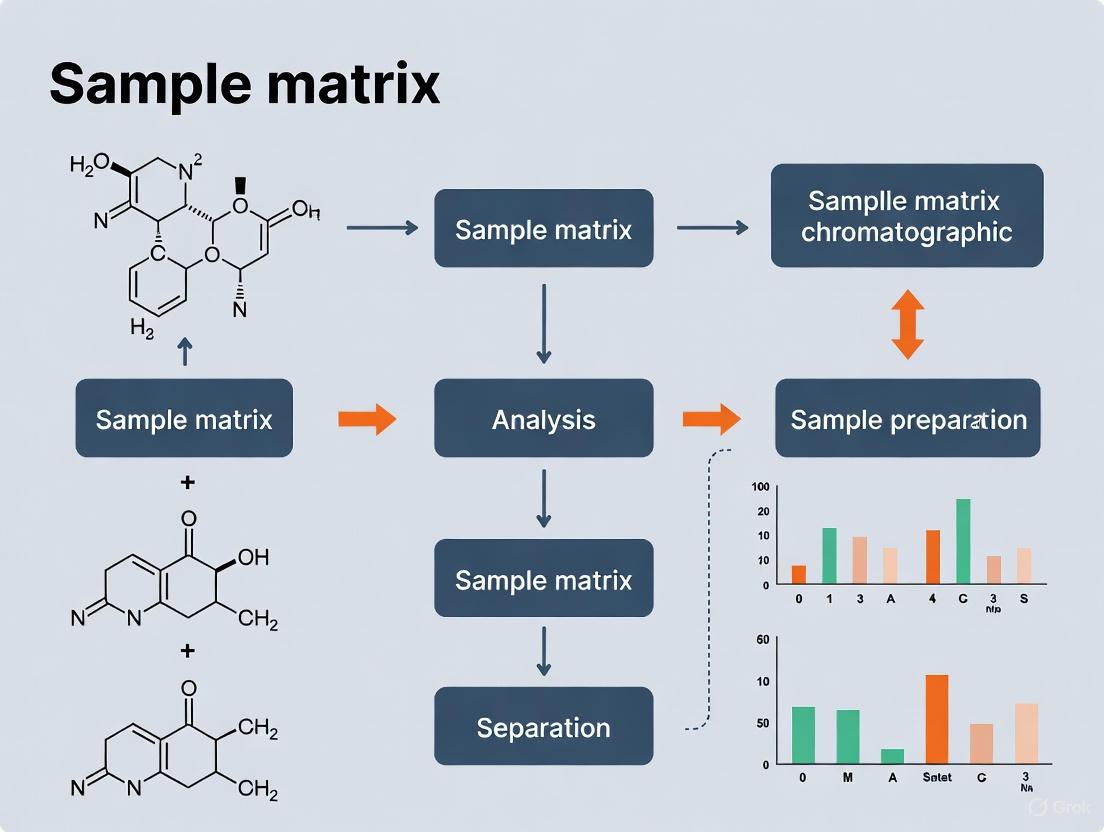
This article provides a comprehensive examination of the critical role the sample matrix plays in chromatographic analysis, with a focus on applications in biomedical and pharmaceutical research.
The Sample Matrix Effect: From Foundational Principles to Advanced Troubleshooting in Chromatographic Analysis
Abstract
This article provides a comprehensive examination of the critical role the sample matrix plays in chromatographic analysis, with a focus on applications in biomedical and pharmaceutical research. It explores the foundational principles of matrix effects, detailing how biological components can interfere with analytical accuracy. The content covers strategic methodological approaches for sample preparation, from simple 'dilute-and-shoot' to advanced extraction techniques, and offers systematic, symptom-based troubleshooting strategies for common issues like peak distortion and signal suppression. Furthermore, it outlines rigorous validation protocols and comparison of methods experiments essential for demonstrating analytical reliability in regulated environments. This guide synthesizes current best practices and emerging trends to empower scientists in developing robust, high-performance chromatographic methods.
Understanding the Sample Matrix: Composition, Challenges, and Analytical Interference
In chromatographic analysis, the sample matrix—defined as all components of a sample except the target analytes—plays a critical role in determining the accuracy, precision, and reliability of analytical results. For researchers and drug development professionals, understanding biological matrix components and their interference potential is fundamental to developing robust analytical methods. This technical guide examines the composition of common biological matrices, classifies their interference mechanisms, and provides detailed methodologies for detecting and mitigating matrix effects, with a specific focus on liquid chromatography-mass spectrometry (LC-MS) applications. Framed within the broader context of chromatographic analysis research, this whitepaper establishes that comprehensive matrix characterization is not merely a procedural requirement but a cornerstone of analytical validity in pharmaceutical development and bioanalysis.
The conventional definition of the sample matrix encompasses everything present in a typical sample except the analytes of interest [1]. In bioanalysis, this includes proteins, lipids, salts, metabolites, and other endogenous compounds that constitute biological fluids such as plasma, urine, or tissue homogenates. The matrix is not an inert background but an active participant in the analytical process, capable of influencing every stage from sample preparation to final detection.
Regulatory authorities emphasize the critical importance of matrix characterization. The International Conference on Harmonization (ICH) defines specificity as the "ability to assess unequivocally the analyte in the presence of components which may be expected to be present," explicitly including matrix components in this definition [1]. Similarly, the U.S. Food and Drug Administration (FDA) highlights selectivity requirements for bioanalytical methods, mandating that interference testing be conducted using blank matrix from at least six sources to ensure reliability across population variations [1].
The fundamental challenge presented by matrix effects stems from their capacity to either enhance or suppress detector response to target analytes. This phenomenon is particularly pronounced in complex biological samples where matrix components may co-elute with analytes of interest, leading to inaccurate quantification that can compromise drug development studies and clinical trials if not properly addressed.
Composition of Biological Matrices
Biological matrices vary significantly in their composition, with each matrix type presenting unique analytical challenges. The table below summarizes key biological matrices and their characteristic interfering components.
Table 1: Composition of Common Biological Matrices and Their Interfering Components
| Matrix Type | Characteristic Components | Primary Interference Concerns |
|---|---|---|
| Plasma/Serum | Proteins (albumin, immunoglobulins), lipids, phospholipids, electrolytes, hormones, metabolites | Ion suppression in MS, protein binding, column fouling, phospholipid-mediated effects |
| Urine | Urea, creatinine, salts, organic acids, metabolic byproducts | High salt content, variable pH, diverse metabolite profile |
| Tissue Homogenates | Cellular debris, membrane lipids, organelles, intracellular metabolites | Complex particulate matter, high lipid content, enzymatic activity |
| Saliva | Mucus, enzymes (amylase), electrolytes, bacteria, food residues | Viscosity, bacterial contamination, pH fluctuations |
Plasma represents one of the most complex and commonly used matrices in bioanalysis. Its composition includes proteins that can bind to analytes or column surfaces, phospholipids that cause severe ion suppression in mass spectrometry, and electrolytes that can affect ionization efficiency. The lot-to-lot variability of plasma, influenced by donor genetics, diet, and health status, further complicates method development [1]. As noted in regulatory guidelines, this variability necessitates testing blank matrix from multiple sources (at least six) to adequately characterize potential interferences.
Mechanisms of Matrix Interference
Matrix components can interfere with chromatographic analysis through multiple mechanisms, each requiring specific detection and mitigation strategies.
Chromatographic Interferences
Chromatographic interferences occur when matrix components co-elute with target analytes, leading to inaccurate integration and quantification. As demonstrated in simulated chromatograms, even minor overlaps (resolution Rs = 1.43) can compromise accurate peak area measurement, with greater overlaps (Rs = 0.35) making it impossible to distinguish between analyte and interference [1]. The situation worsens with realistic chromatographic challenges including peak tailing, baseline drift, and noise.
Ionization Effects in Mass Spectrometry
In LC-MS analysis, ionization suppression or enhancement represents the most significant matrix effect. Matrix components compete with analytes for available charge during the ionization process, particularly in electrospray ionization (ESI) [2]. The extent of suppression or enhancement depends on the relative concentration and ionization efficiency of interferents compared to the analyte. Phospholipids are particularly problematic in ESI-based methods due to their high ionization efficiency and ubiquitous presence in biological samples.
Other Detection Interferences
Other detection principles are similarly vulnerable to matrix effects. Fluorescence quenching occurs when matrix components affect the quantum yield of fluorescent analytes. Solvatochromism in UV/Vis detection refers to changes in absorptivity caused by the solvent environment [2]. Evaporative light scattering (ELSD) and charged aerosol detection (CAD) can be affected by matrix influences on aerosol formation processes.
Detection and Assessment of Matrix Effects
Experimental Protocol for Matrix Effect Assessment
Materials and Equipment:
- LC-MS system with infusion capability
- Blank biological matrix from at least six sources [1]
- Analytical standards of target compounds
- Appropriate solvents and mobile phases
Procedure:
- Post-column Infusion Method: Connect a syringe pump containing a dilute solution of the analyte to a tee-fitting between the column outlet and MS inlet. Infuse the analyte at a constant rate while injecting blank matrix extracts [2].
- Chromatographic Analysis: Perform LC-MS analysis of the infused system with blank matrix injection. Monitor the analyte signal across the chromatographic run time.
- Data Interpretation: Regions of signal suppression or enhancement appear as dips or elevations in the otherwise constant analyte signal. These regions indicate where co-eluting matrix components interfere with analyte ionization.
- Quantitative Assessment: Compare detector responses for standards prepared in mobile phase versus matrix extracts. A significant difference indicates matrix effects.
Diagram: Workflow for Detecting Matrix Effects via Post-Column Infusion
Advanced Assessment Techniques
Beyond the infusion method, several advanced techniques provide quantitative assessment of matrix effects:
Ion Ratio (IR) Monitoring: Clinical laboratories widely use ion ratio monitoring to identify interferences by comparing the ratio of product ions in samples versus standards [3].
Detuning Ratio (DR) Method: This emerging approach assesses differential influences of MS instrument settings on ion yield. Isomeric or isobaric interferences lead to shifts in the DR for affected samples. Experimental confirmation in test systems (Cortisone/Prednisolone and O-Desmethylvenlafaxine/cis-Tramadol HCl) demonstrates DR's utility in detecting isomeric interferences [3].
Quality Control-Based Correction: For long-term studies, periodic analysis of quality control (QC) samples establishes normalization algorithms. Recent research demonstrates successful application of Random Forest algorithms to correct for long-term instrumental drift in GC-MS data, outperforming spline interpolation and support vector regression methods [4].
Mitigation Strategies for Matrix Interferences
Sample Preparation Techniques
Effective sample preparation is the first line of defense against matrix effects. The table below compares common techniques for matrix removal.
Table 2: Sample Preparation Techniques for Matrix Mitigation
| Technique | Mechanism | Effective Against | Limitations |
|---|---|---|---|
| Protein Precipitation | Denatures and removes proteins | Proteins, cellular debris | Incomplete removal of phospholipids |
| Liquid-Liquid Extraction | Partitioning based on solubility | Lipids, non-polar interferents | Variable recovery for polar analytes |
| Solid-Phase Extraction | Selective retention based on chemistry | Multiple matrix components | Requires method development, cost |
| Phospholipid Removal Plates | Selective binding of phospholipids | Phospholipids (primary LC-MS interferents) | May retain some analytes |
Chromatographic Solutions
Enhanced Separation: Improving chromatographic resolution represents the most direct approach to mitigating matrix effects. Comprehensive two-dimensional liquid chromatography (LC×LC) significantly increases peak capacity, with recent advancements like multi-2D LC×LC combining different separation mechanisms (e.g., reversed-phase and HILIC) to optimize separation of complex samples [5].
Ultra-High-Pressure Liquid Chromatography (UHPLC): UHPLC utilizing sub-2 µm particle size columns provides superior separation efficiency and resolution, enabling better discrimination between analytes and matrix components [6]. The technology's reduced analysis time and enhanced sensitivity further benefit bioanalytical applications.
Internal Standardization
The internal standard method represents one of the most potent approaches to mitigating matrix effects on quantification [2]. The protocol involves:
- Selection: Choose an internal standard (preferably a stable isotope-labeled version of the analyte) that behaves similarly to the analyte throughout sample preparation and analysis.
- Addition: Add a known amount of internal standard to every sample, including calibrators and QCs.
- Quantification: Plot the ratio of analyte signal to internal standard signal versus the ratio of analyte concentration to internal standard concentration for calibration.
This approach compensates for both sample-to-sample matrix variability and instrument fluctuation, making it particularly valuable for complex biological matrices.
Diagram: Internal Standard Method Workflow
The Scientist's Toolkit: Essential Research Reagents and Materials
Table 3: Essential Materials for Matrix Effect Assessment and Mitigation
| Item | Function | Application Notes |
|---|---|---|
| Blank Matrix from ≥6 Sources | Assessment of inter-individual variability | Essential for specificity testing per regulatory guidelines [1] |
| Stable Isotope-Labeled Internal Standards | Normalization of matrix effects | Should be added prior to sample preparation to correct for recovery |
| Phospholipid Removal Plates | Selective removal of phospholipids | Critical for LC-MS methods vulnerable to phospholipid-mediated suppression |
| Quality Control Materials | Monitoring long-term method performance | Pooled matrix QC samples enable drift correction algorithms [4] |
| Post-column Infusion Setup | Mapping ionization suppression regions | Tee-fitting, infusion pump, and analyte solution required [2] |
| UHPLC with Sub-2µm Columns | Enhanced separation efficiency | Provides superior resolution of analytes from matrix components [6] |
| Multi-dimensional LC Systems | Comprehensive separation of complex samples | LC×LC significantly increases peak capacity for complex matrices [5] |
The biological sample matrix represents a critical variable in chromatographic analysis that demands systematic characterization and mitigation. Understanding the composition of relevant matrices, their potential interference mechanisms, and available detection methodologies provides the foundation for robust bioanalytical methods. As chromatographic technologies advance—with improvements in UHPLC, multi-dimensional separations, and data processing algorithms—so too does our capacity to overcome matrix challenges. For drug development professionals, implementing comprehensive matrix assessment protocols including post-column infusion experiments, multi-lot matrix testing, and appropriate internal standardization is essential for generating reliable data that meets regulatory standards and advances therapeutic development.
1. Introduction
In liquid chromatography-mass spectrometry (LC-MS), the sample matrix is far more than a simple vessel for the target analyte; it is an active and often disruptive participant in the analytical process. The term "matrix effect" refers to the alteration of an analyte's signal by co-eluting components from the sample, a phenomenon that critically challenges the accuracy, precision, and sensitivity of quantitative analyses [7] [8] [2]. Within this domain, ion suppression and its less frequent counterpart, ion enhancement, represent particularly insidious forms of matrix effect specific to MS detection. These effects can lead to false negatives, inaccurate quantification, and compromised data reliability, presenting a significant hurdle in fields ranging from drug development and biomonitoring to environmental and food safety analysis [7] [9]. This whitepaper delves into the mechanisms behind these effects, provides validated experimental protocols for their detection, and synthesizes current strategies for their mitigation, framing this discussion within the critical context of managing the sample matrix in modern chromatographic science.
2. Fundamental Mechanisms and Origins
Matrix effects in LC-MS originate from the complex interplay of chemical and physical processes that occur during the ionization of the analyte. The primary mechanism depends heavily on the ionization technique employed, most commonly electrospray ionization (ESI) or atmospheric-pressure chemical ionization (APCI).
2.1 Mechanisms in Electrospray Ionization (ESI)
ESI is highly susceptible to matrix effects due to its ionization mechanism occurring in the condensed phase before droplets enter the mass spectrometer. Several interconnected processes contribute to ion suppression or enhancement [7] [8]:
- Competition for Charge: In ESI, the number of excess charges available on the surface of the electrospray droplet is limited. In a multicomponent mixture, analytes and matrix components compete for this finite charge. Compounds with higher surface activity or gas-phase basicity can out-compete the target analyte for available protons, thereby suppressing the analyte's ionization efficiency [8].
- Altered Droplet Properties: High concentrations of non-volatile or less volatile matrix components can increase the viscosity and surface tension of the electrospray droplets. This impedes solvent evaporation and can prevent the droplet from reaching the critical radius required for the emission of gas-phase ions, effectively trapping the analyte and suppressing its signal [8].
- Co-precipitation with Non-Volatile Material: Non-volatile substances, such as salts or phospholipids, can coprecipitate with the analyte during droplet desolvation. This physical entrapment prevents the analyte from being released as a free ion into the gas phase [8].
2.2 Mechanisms in Atmospheric-Pressure Chemical Ionization (APCI)
APCI is generally less prone to matrix effects than ESI because the ionization process occurs in the gas phase after the liquid stream is vaporized [8]. However, suppression can still occur through different mechanisms:
- Gas-Phase Proton Transfer: The analyte, once vaporized, is ionized by reagent ions generated by a corona discharge. If a matrix component with a higher gas-phase basicity (in positive mode) or acidity (in negative mode) co-elutes with the analyte, it can scavenge protons from or donate protons to the analyte, leading to its suppression [8].
- Interference with Vaporization: Solid formation or co-precipitation of the analyte with non-volatile matrix components in the hot vaporization region can prevent the analyte from successfully entering the gas phase, where ionization occurs [8].
The following diagram illustrates the core mechanisms leading to ion suppression in the two most common LC-MS interfaces.
Diagram 1: Mechanisms of Ion Suppression in ESI and APCI.
3. Experimental Protocols for Detecting Matrix Effects
Before mitigation can begin, robust experimental protocols are required to detect and quantify the presence and extent of matrix effects. Two established methods are widely used.
3.1 Post-Extraction Spiking Method
This method quantitatively assesses the absolute matrix effect by comparing the analyte response in a clean matrix to that in a pure solvent [10] [8].
- Procedure:
- Prepare a blank sample matrix (e.g., plasma, urine, food extract) and subject it to the entire sample preparation procedure.
- After extraction and reconstitution, spike a known concentration of the analyte into the purified blank matrix extract (the "post-extraction" sample).
- Prepare a standard solution at the same concentration in neat reconstitution solvent (e.g., mobile phase).
- Inject both solutions into the LC-MS system and compare the peak areas (A).
- Calculation and Interpretation: The matrix effect (ME) is calculated as: ME (%) = (Apost-extraction / Aneat solvent) × 100% An ME of 100% indicates no matrix effect. Values <100% indicate ion suppression, and values >100% indicate ion enhancement. A significant deviation from 100% signals a problematic matrix effect [10].
3.2 Post-Column Infusion Method
This qualitative method is excellent for mapping the chromatographic regions where ion suppression occurs, providing a visual profile of the problem [11] [8] [2].
- Procedure:
- Prepare a solution of the analyte of interest and connect a syringe pump to infuse it directly into the LC effluent post-column and before the MS interface.
- While continuously infusing the analyte to create a stable baseline signal, inject a blank matrix extract onto the LC column.
- As the blank matrix components elute from the column, monitor the signal of the infused analyte.
- Interpretation: A constant baseline indicates no matrix effect. A dip or reduction in the baseline signal indicates ion suppression at that specific retention time, revealing the "danger zones" in the chromatogram where your analyte's signal would be compromised if it co-eluted with those matrix components [8] [2]. The setup for this experiment is shown below.
Diagram 2: Post-column infusion experiment setup for visualizing ion suppression.
4. Quantitative Assessment and Data
The magnitude of matrix effects can vary dramatically depending on the analyte, sample origin, and instrument conditions. The following table summarizes quantitative data on ion suppression across different biological matrices and analytical platforms.
Table 1: Documented Magnitude of Ion Suppression Across Different Conditions
| Matrix / Condition | Analytical System | Observed Ion Suppression | Key Finding | Source |
|---|---|---|---|---|
| 32 Food Commodities | LC-MS/MS (MRM) | Median suppression: 0-67% (at 50x enrichment) | "Dirty" samples (e.g., after dry periods) caused >50% suppression. "Clean" samples showed <30% suppression. | [9] |
| Plasma Extract | RPLC-MS (Pos. Mode, clean source) | 8.3% for Phenylalanine | Demonstrated variability; even with optimized systems, suppression occurs. | [12] |
| Plasma Extract | IC-MS (Neg. Mode) | Up to 97% for Pyroglutamylglycine | Highlights that ion suppression can be near-total for some metabolites. | [12] |
| Urban Runoff | NTS LC-HRMS | High variability across 21 samples | Led to the development of an Individual Sample-Matched IS strategy for correction. | [13] |
The data underscores that ion suppression is a pervasive and highly variable issue. To systematically evaluate it during method validation, a comprehensive approach integrating the assessment of matrix effect (ME), recovery (RE), and process efficiency (PE) is recommended, as outlined in the table below [10].
Table 2: Key Parameters for Assessing Matrix Effects in Method Validation
| Parameter | Definition | Assessment Method | Acceptance Criteria (Example) | |
|---|---|---|---|---|
| Matrix Effect (ME) | Alteration of ionization efficiency due to co-eluting compounds. | Compare analyte response in post-extraction spiked matrix vs. neat solvent. | CV of ME across different matrix lots should be <15%. | [10] |
| Recovery (RE) | The efficiency of extracting the analyte from the sample matrix. | Compare analyte response in pre-extraction spiked sample vs. post-extraction spiked sample. | Should be consistent and high; specific targets depend on the method. | [10] |
| Process Efficiency (PE) | The overall efficiency of the entire method, combining ME and RE. | Compare analyte response in pre-extraction spiked sample vs. neat solvent. | Reflects the combined impact of ME and RE on the final result. | [10] |
5. Advanced Strategies for Mitigation and Correction
Overcoming matrix effects requires a multi-faceted strategy. While improving sample cleanup and chromatographic separation are foundational, advanced technical solutions have emerged.
5.1 The Scientist's Toolkit: Key Reagent Solutions
Table 3: Research Reagent Solutions for Mitigating Matrix Effects
| Reagent / Material | Function in Mitigating Matrix Effects | Technical Context |
|---|---|---|
| Stable Isotope-Labeled Internal Standards (SIL-IS) | The gold standard for compensation. The SIL-IS co-elutes with the analyte, experiences identical ion suppression, and its signal loss is used to correct the analyte's signal. | Ideal for targeted analysis. Must be added before sample preparation to correct for both recovery and matrix effects [10] [2]. |
| IROA Internal Standard (IROA-IS) | A library of 13C-labeled standards used in non-targeted workflows. The known, constant concentration of the 13C-labeled standard allows for precise calculation and correction of ion suppression for a wide range of metabolites. | Enables ion suppression correction across diverse analytical conditions in metabolomics, as the 12C and 13C channels experience equal suppression [12]. |
| Post-Column Infusion of Standards (PCIS) | A set of standards is infused post-column to monitor matrix effects in real-time. The signal variations of these standards are used to create a correction factor for co-eluting analytes. | Particularly promising for untargeted metabolomics, where selecting a suitable PCIS for each feature is key to effective correction [11] [14]. |
| Individual Sample-Matched IS (IS-MIS) | A novel strategy where internal standard matching is performed for each individual sample at multiple concentrations, rather than using a pooled sample. | Outperformed established methods in heterogeneous samples like urban runoff, achieving <20% RSD for 80% of features, despite requiring more analysis time [13]. |
5.2 Innovative Workflows: The IROA Example
For non-targeted analyses, the IROA (Isotopic Ratio Outlier Analysis) workflow represents a significant advancement. It uses a 95% 13C-labeled internal standard (IROA-IS) spiked into the sample and a 1:1 mixture of 95% 13C and natural abundance standards as a long-term reference (IROA-LTRS) [12]. The workflow's logic is as follows:
Diagram 3: Logic flow of the IROA Workflow for ion suppression correction in non-targeted metabolomics.
6. Conclusion
Ion suppression and enhancement are not merely nuisances but fundamental challenges in LC-MS analysis, rooted in the physicochemical interplay between the analyte, the matrix, and the ionization process. A deep understanding of these mechanisms is the first step toward solving them. As demonstrated, a combination of rigorous experimental protocols for detection and a strategic toolkit for mitigation—ranging from optimized sample preparation and chromatographic separation to the sophisticated use of stable isotope-labeled internal standards and advanced computational workflows—is essential. For the researcher in drug development or related fields, a systematic approach to evaluating matrix effects during method validation is non-negotiable for generating reliable, high-quality data. The ongoing innovation in correction strategies, particularly for untargeted "omics" applications, promises to further strengthen the role of LC-MS as a cornerstone of analytical science, ultimately enabling more accurate measurements from even the most complex sample matrices.
In chromatographic analysis, the sample matrix—defined as all components of a sample other than the analyte of interest—wields a profound and often detrimental influence on the key figures of merit that define an analytical method's quality [2]. During liquid chromatography-mass spectrometry (LC-MS) analysis, matrix components that co-elute with the target analyte can alter ionization efficiency in the source, leading to either suppression or enhancement of the analyte signal [15]. This phenomenon, known as the matrix effect (ME), fundamentally compromises the reliability of quantitative results. For researchers and drug development professionals, understanding and mitigating these effects is not merely an academic exercise but a critical prerequisite for generating accurate, reproducible, and defensible data. The presence of matrix effects can skew results, leading to inaccurate potency assessments, incorrect pharmacokinetic profiles, and ultimately, poor decisions in both research and development pipelines. This guide examines the specific impact of matrix effects on sensitivity, selectivity, and accuracy, and provides a detailed framework for their systematic evaluation and control within the context of chromatographic method development and validation.
How Matrix Effects Impact Key Analytical Figures of Merit
Sensitivity
Sensitivity refers to the ability of a method to detect small differences in analyte concentration, often practically observed as a change in the lower limit of detection (LOD) or quantification (LOQ). Matrix effects directly impair sensitivity through ion suppression in the mass spectrometer source [15]. Co-eluting matrix components compete with the analyte for charge and access to the droplet surface during the ionization process, particularly in electrospray ionization (ESI). This competition reduces the number of analyte ions reaching the detector, effectively raising the lowest detectable concentration and diminishing the method's ability to quantify low-abundance analytes accurately. The extent of suppression can be severe; one study noted that matrix effects "can lead to some key flavor components remaining undetected due to their low levels" [16].
Selectivity
Selectivity is the ability of a method to accurately measure the analyte in the presence of other components, such as impurities, degradants, or matrix. Matrix effects undermine selectivity not by causing co-elution, but by inducing chromatographic and spectral interferences. In complex samples, inadequate chromatographic separation leads to mixed spectra in mass spectrometry, complicating identification [5]. Furthermore, matrix components can cause shifting retention times or distorted peak shapes, which can challenge the correct integration of the analyte peak and the reliable identification of the analyte itself [16]. In gas chromatography with electron impact ionization (EI), for instance, inadequate separation results in "unevaluable mixed spectra, so that the otherwise very useful spectral databases cannot make a contribution to the identification of the analytes" [5].
Accuracy
Accuracy represents the closeness of agreement between a measured value and its accepted true value. Matrix effects are a primary source of inaccuracy in quantitative LC-MS and GC-MS analyses. The core problem is that the signal intensity no longer reliably reflects the analyte concentration. When calibration standards are prepared in a pure solvent, but samples contain a complex matrix, the resulting ionization suppression or enhancement leads to a systematic under- or over-estimation of the true concentration [15]. This effect was quantitatively demonstrated in a study of flavor components, where the absence of matrix-effect compensation led to poor recovery rates, which were then corrected to an acceptable 89.3–120.5% range after implementing appropriate mitigation strategies [16]. The fundamental relationship between quantity and signal is broken, rendering measurements differential rather than truly quantitative unless properly calibrated [17].
Table 1: Impact of Matrix Effects on Analytical Figures of Merit
| Figure of Merit | Definition | Impact of Matrix Effect | Consequence |
|---|---|---|---|
| Sensitivity | Ability to detect low analyte concentrations | Ion suppression reduces analyte signal | Increased LOD/LOQ; potential failure to detect trace analytes |
| Selectivity | Ability to distinguish analyte from interferents | Co-eluting compounds cause mixed spectra & peak distortion | Erroneous peak identification and integration |
| Accuracy | Closeness of measured value to true value | Signal suppression/enhibition vs. calibration standards | Systematic under- or over-estimation of concentration |
Experimental Protocols for Assessing Matrix Effects
A robust assessment of matrix effects is a critical step in method development and validation. The following protocols, widely cited in the literature, provide both qualitative and quantitative evaluation.
Post-Column Infusion for Qualitative Assessment
This method, pioneered by Bonfiglio et al., provides a qualitative map of ionization suppression or enhancement across the entire chromatographic run [15].
Detailed Methodology:
- Setup: A syringe pump is used to infuse a solution of the pure analyte at a constant rate into the mobile phase flow post-column, via a T-piece, directly before the mass spectrometer inlet.
- Chromatographic Run: A blank sample extract—a sample of the matrix processed through the entire sample preparation procedure but without the analyte—is injected onto the LC column and separated using the developed method.
- Data Acquisition: The mass spectrometer monitors the signal of the infused analyte throughout the chromatographic run.
- Interpretation: A stable signal indicates no matrix effect. A dip in the signal indicates ion suppression at that specific retention time, while a signal increase indicates ion enhancement. This identifies "danger zones" in the chromatogram where the analyte's retention time should ideally not reside [15].
Post-Extraction Spike Method for Quantitative Assessment
This method, as described by Matuszewski et al., provides a numerical value for the matrix effect at a specific concentration [15].
Detailed Methodology:
- Prepare Samples:
- Set A (Pure Solvent): Prepare analyte standards in a pure, matrix-free solvent at a known concentration.
- Set B (Matrix Sample): Take multiple aliquots of a blank matrix extract (after sample preparation) and spike them with the same known concentration of analyte.
- Analysis: Analyze all samples (Set A and Set B) using the developed LC-MS/MS method.
- Calculation: Calculate the matrix effect (ME) for each analyte using the formula:
- ME (%) = (Mean Peak Area of Set B / Mean Peak Area of Set A) × 100
- An ME of 100% indicates no matrix effect. <100% indicates ion suppression, and >100% indicates ion enhancement. A deviation of ±15% is often used as an acceptability threshold [15].
Slope Ratio Analysis for Calibration-Level Assessment
A modification of the post-extraction spike method, this approach evaluates the matrix effect across the entire calibration range rather than at a single concentration level [15].
Detailed Methodology:
- Prepare Calibration Curves: Prepare two full calibration curves. One is prepared in a pure solvent, and the other is prepared by spiking the analyte into a blank matrix extract at the same concentration levels.
- Analysis and Calculation: Analyze both sets of standards and perform linear regression to obtain the slope of each calibration curve.
- Calculation: Calculate the matrix effect as the ratio of the slopes:
- ME (%) = (Slope of Matrix-Matched Curve / Slope of Solvent-Based Curve) × 100 This provides a more comprehensive view of how the matrix effect behaves across the method's dynamic range [15].
The workflow for selecting and executing these assessment strategies is summarized in the diagram below.
Strategies for Mitigating Matrix Effects
Once assessed, matrix effects must be controlled to ensure data quality. The following table summarizes the most effective strategies, supported by recent research.
Table 2: Strategies for Mitigating Matrix Effects
| Strategy | Description | Effectiveness & Best Use Case | Limitations |
|---|---|---|---|
| Internal Standards [18] [2] | Use of stable isotope-labeled (SIL) internal standards that co-elute with the analyte. | Highly effective. Best for targeted quantification. Corrects for both suppression and variability. SIL-IS experiences identical ME as the analyte. | Cost-prohibitive for large panels of analytes. Requires synthesis of labeled compounds. |
| Improved Chromatography [5] | Extending run times, optimizing mobile phase, or using 2D-LC (LC×LC) to separate analyte from interferents. | Highly effective for both targeted and untargeted work. LC×LC greatly increases peak capacity, reducing co-elution. | Method complexity increases. Requires more time and expertise for development and optimization. |
| Sample Clean-up [15] | Using Solid-Phase Extraction (SPE), Liquid-Liquid Extraction (LLE), or other techniques to remove matrix components. | Very effective when a selective extraction is possible. Can be combined with other strategies. | Can be time-consuming. Risk of losing analyte if not optimized. May not remove all interferents. |
| Matrix-Matched Calibration [17] [16] | Preparing calibration standards in a blank matrix that matches the sample. | Effectively compensates for consistent ME. Common in GC analysis for pesticides and flavors. | Blank matrix can be difficult or impossible to obtain (e.g., for endogenous compounds). |
| Analyte Protectants (GC) [16] | Adding compounds (e.g., sugars) to samples and standards to mask active sites in the GC system. | Effective for compensating "matrix-induced enhancement" in GC. Improves sensitivity and peak shape for susceptible analytes. | Requires careful selection of protectants to avoid new interference or solubility issues. Primarily for GC. |
| Sample Dilution [15] [19] | Simply diluting the sample to reduce the concentration of interfering components. | Fast and simple. Best when the method has sufficient sensitivity to spare. | Not suitable for trace analysis. Can dilute the analyte below the LOQ. |
Recent studies reinforce the superiority of certain techniques. A 2024 study on trace organic contaminants in sediments concluded that "Using internal standards showed the best results for effectively correcting matrix effects without affecting method sensitivity" [18]. Furthermore, advanced separation techniques like comprehensive two-dimensional liquid chromatography (LC×LC) are gaining traction for highly complex samples, as they "improve separation by using different stationary phases for enhanced resolution," thereby minimizing the co-elution that causes ion suppression [5].
The Scientist's Toolkit: Essential Reagents & Materials
Successful management of matrix effects relies on a set of key reagents and materials.
Table 3: Key Research Reagent Solutions for Matrix Effect Management
| Reagent / Material | Function | Specific Examples |
|---|---|---|
| Stable Isotope-Labeled Internal Standards | Corrects for ionization suppression/enhibition; essential for achieving high accuracy in quantitative MS. | 13C- or 15N-labeled versions of the target analyte [2]. |
| Analyte Protectants | Masks active sites in the GC inlet/column, improving peak shape and response for late-eluting/polar compounds. | Mixtures of compounds like ethyl glycerol, gulonolactone, and sorbitol [16]; malic acid + 1,2-tetradecanediol [16]. |
| High-Purity Solvents & Additives | Reduces chemical noise and background interference that can contribute to matrix effects. | LC-MS grade water, acetonitrile, methanol; high-purity formic acid, ammonium acetate. |
| Specialized SPE Sorbents | Selectively removes matrix components (e.g., phospholipids, salts) while retaining the analyte during sample clean-up. | Mixed-mode (MCX, WCX), C18, and polymeric sorbents [18] [17]. |
| Quality Control Materials | Monitors instrument performance and the consistency of matrix effects over time. | In-house or commercial quality control (QC) samples; system suitability test mixtures [20]. |
The sample matrix is an undeniable and influential factor in chromatographic analysis, with the capacity to significantly degrade the sensitivity, selectivity, and accuracy of a method. Ignoring matrix effects jeopardizes the integrity of analytical data, leading to potentially flawed scientific and regulatory decisions. A systematic approach—beginning with a thorough assessment via post-column infusion or post-extraction spiking, followed by the strategic implementation of mitigation techniques such as stable isotope-labeled internal standards, enhanced chromatographic separation, and selective sample clean-up—is fundamental to robust method development. For researchers in drug development and related fields, mastering the identification and control of matrix effects is not optional; it is a core competency essential for producing reliable, high-quality analytical results that can withstand rigorous scientific scrutiny.
The accurate quantification of drugs and metabolites in biological matrices is a cornerstone of pharmaceutical development and preclinical research. The composition of the sample matrix itself is a critical, yet often underestimated, variable that can profoundly impact the reliability of analytical results. This phenomenon, known as the matrix effect, refers to the alteration of an analytical signal caused by all components of the sample other than the analyte of interest [19]. These effects can lead to signal suppression or enhancement, resulting in the overestimation or underestimation of true analyte concentrations and thereby compromising data integrity [21].
This technical guide examines the matrix effect through a comparative lens, focusing on three fundamental biological matrices: plasma, urine, and tissue homogenates. The inherent complexity of these matrices varies significantly; tissue homogenates, for instance, are widely recognized as the most challenging due to their high concentration of proteins, phospholipids, and other cellular debris [22]. The practical implications of these differences are substantial, influencing critical decisions from initial assay development to final data interpretation in drug discovery and development.
Within this framework, the following sections will dissect the specific challenges posed by each matrix, supported by quantitative data from recent case studies. We will detail robust experimental protocols designed to manage matrix-related interference and provide visual workflows to guide researchers in selecting appropriate strategies for their analytical projects.
Matrix-Specific Challenges and Quantitative Comparisons
The composition of a biological sample introduces a host of interfering components that can co-elute with the target analyte during chromatographic analysis. In mass spectrometry, these components compete for ionization, leading to signal suppression or, less commonly, enhancement [21] [19]. The nature and severity of this interference are highly dependent on the matrix type.
Plasma and Serum contain proteins, salts, lipids, and ionizable elements, which can cause significant non-spectral interferences [23] [24]. Although proteins can be removed by precipitation, phospholipids are a major cause of ion suppression in mass spectrometry because they co-elute with many analytes.
Urine presents a different set of challenges. It is a complex matrix containing high concentrations of urea, creatinine, salts, and organic acids. Studies using techniques like microwave-induced plasma optical emission spectrometry (MIP-OES) have shown that the urine matrix can cause either suppression or enhancement of signals for different elements, necessitating careful selection of internal standards and dilution factors to achieve accurate results [23].
Tissue Homogenates are arguably the most complex matrices for bioanalysis. Solid organs like the liver, kidney, and lung contain abundant endogenous compounds, which can introduce severe interference and markedly impair ionization efficiency [22]. The homogenization process itself liberates a high concentration of intracellular components, including phospholipids and membrane fragments, making sample clean-up particularly challenging. It is widely recognized that simple protein precipitation is often insufficient for LC-MS/MS analysis of such complex matrices [22].
The table below summarizes key characteristics and challenges associated with each matrix, along with data from recent case studies.
Table 1: Quantitative Comparison of Matrix Complexities and Analytical Performance
| Matrix | Key Interfering Components | Impact on Analysis | Case Study Example | Reported Recovery & Matrix Effect |
|---|---|---|---|---|
| Plasma | Proteins, phospholipids, lipids, salts [21] [24] | Ion suppression/enhancement in MS; protein binding [21] | Sertraline analysis [25] | Recovery: 93.5% to 98.0% (with SPE) [25] |
| Urine | Urea, creatinine, salts, easily ionizable elements (EIEs) [23] | Signal suppression or enhancement depending on analyte [23] | Multi-element analysis by MIP-OES [23] | Accuracy: Best with 20-200 fold dilution & IS (Deviations <11%) [23] |
| Tissue Homogenates | Phospholipids, cellular debris, membrane fragments, intracellular metabolites [22] | Severe ion suppression in MS; requires extensive sample clean-up [22] | Isorhapontigenin (ISO) in liver homogenate [22] | LLOQ: 15 ng/mL (90 ng/g tissue) with HPLC-UV vs. LC-MS/MS failure due to matrix effects [22] |
Experimental Protocols for Managing Matrix Effects
Solid-Phase Extraction (SPE) for Plasma and Tissue Homogenates
A developed protocol for analyzing a sertraline-methylpropyphenazone (SER-MP) prodrug in rat plasma and brain tissue exemplifies a robust approach to managing matrix effects in complex samples [25].
- Materials: Chromabond C8-100 mg solid-phase extraction columns; sertraline (SER), 3-hydroxymethylpropyphenazone (3-OHMP), and SER-MP as analytes; sildenafil as internal standard (IS) [25].
- Procedure:
- Sample Preparation: Plasma or brain tissue homogenate is mixed with the internal standard.
- SPE Conditioning: The C8 SPE column is conditioned with methanol and equilibrated with water.
- Sample Loading: The prepared sample is loaded onto the column.
- Washing: Interfering matrix components are removed by washing with a water-methanol mixture.
- Elution: Target analytes are eluted with a pure organic solvent like methanol or acetonitrile.
- Analysis: The eluent is evaporated, reconstituted in the mobile phase, and analyzed by LC-MS/MS [25].
- Rationale: This SPE protocol selectively retains analytes and washes away many phospholipids and salts, significantly reducing matrix effects. The extraction efficiency for targeted analytes was improved to a range of 93.5% to 98.0% using this method [25].
Liquid-Liquid Extraction (LLE) for Complex Multi-Matrix Analysis
A multi-matrix LC-MS/MS method for quantifying 20(S)-protopanaxadiol (PPD) in rat plasma, various tissues, bile, urine, and feces successfully employed LLE [26].
- Materials: PPD and ginsenoside Rh2 (IS); ether-dichloromethane (3:2, v/v) as extraction solvent; sodium hydroxide solution (0.3 mol/L) [26].
- Procedure:
- A 50 μL aliquot of biological sample (e.g., plasma) is mixed with 100 μL of a methanol-water mixture (1:1, v/v), 100 μL of internal standard, and 50 μL of sodium hydroxide solution to create alkaline conditions.
- 3 mL of the ether-dichloromethane mixture is added for extraction.
- The mixture is vortexed for 1 minute and shaken for 15 minutes.
- It is then centrifuged at 3000 rpm for 5 minutes to separate the phases.
- The clear organic top layer is transferred and evaporated to dryness under a stream of warm air (40°C).
- The residue is reconstituted in the LC mobile phase and injected for analysis [26].
- Rationale: LLE effectively transfers the analyte from the aqueous biological matrix into an immiscible organic solvent, leaving many water-soluble interferents (like salts and polar metabolites) behind. The alkaline condition facilitates the extraction of the target compound.
Dilution as a Strategy for Urine Analysis
For matrices like urine, where high concentrations of interferents are present, dilution can be a simple yet effective strategy, as demonstrated in an MIP-OES study [23].
- Materials: High-purity diluent; suitable internal standards (e.g., Ge, Rh, Sc for MIP-OES) [23].
- Procedure:
- The urine sample is subjected to a 20-fold or 200-fold dilution with an appropriate diluent.
- A carefully selected internal standard is added to the diluted sample.
- The sample is then directly analyzed by the instrumental method [23].
- Rationale: Dilution reduces the absolute concentration of the matrix components below a level where they significantly interfere with the analyte signal. The internal standard corrects for any residual effects or instrument drift. The success of this approach depends on having a sufficiently sensitive analytical method [23] [19].
HPLC-UV as an Alternative for Challenging Tissue Matrices
When matrix effects in LC-MS/MS are insurmountable with available clean-up techniques, switching to a less susceptible detection method like HPLC-UV can be a reliable solution [22].
- Materials: Reversed-phase C18 column; mobile phase of acetonitrile and 0.1% formic acid; UV detector [22].
- Procedure:
- Tissue homogenates are prepared and subjected to a suitable extraction.
- The extract is injected into the HPLC system.
- Separation is achieved using a 17-minute gradient elution of acetonitrile and 0.1% formic acid at a flow rate of 1.5 mL/min and a column temperature of 50°C.
- Quantification is performed using ultraviolet detection at 325 nm [22].
- Rationale: HPLC-UV is relatively insensitive to the ion suppression effects that plague ESI-MS. While it may offer lower sensitivity, it provides a more robust and cost-effective option for quantifying analytes in highly complex matrices like tissue homogenates where LC-MS/MS fails due to severe matrix effects [22].
Visual Workflows for Matrix Effect Management
Matrix Selection and Strategy Workflow
The following diagram outlines a decision-making process for selecting and handling different biological matrices in bioanalysis.
Sample Preparation Techniques Workflow
This diagram illustrates the procedural flow for three key sample preparation techniques discussed in this guide.
The Scientist's Toolkit: Essential Reagents and Materials
Successful management of matrix effects relies on the use of specific reagents and materials. The following table lists key solutions used in the protocols cited in this guide.
Table 2: Key Research Reagent Solutions for Managing Matrix Effects
| Reagent / Material | Function | Example Application |
|---|---|---|
| C8 Solid-Phase Extraction (SPE) Columns | Selective retention of moderately hydrophobic analytes; removes hydrophilic salts and some phospholipids. | Extraction of sertraline and its metabolites from plasma and brain tissue [25]. |
| Ether-Dichloromethane Mixture | Organic solvent for Liquid-Liquid Extraction (LLE); efficiently partitions analytes from aqueous biological matrix. | Extraction of 20(S)-protopanaxadiol (PPD) from plasma, tissues, bile, and feces [26]. |
| Stable Isotope-Labeled (SIL) Internal Standard | Ideal internal standard; co-elutes with analyte and experiences identical matrix effect, enabling compensation. | Recommended best practice for LC-MS/MS to correct for variability and matrix effects [21]. |
| Chromatographic Solvents (MeCN, MeOH) | Mobile phase components; choice and proportion control analyte retention and separation from interferents. | Used in gradient elution for separating isorhapontigenin from matrix components in HPLC-UV [22]. |
| Alkaline Solution (e.g., NaOH) | Adjusts sample pH to suppress ionization of acidic analytes, improving their partitioning into organic solvent during LLE. | Used in the LLE protocol for 20(S)-protopanaxadiol to enhance extraction efficiency [26]. |
The biological matrix is a dominant factor in the design, development, and validation of any robust bioanalytical method. As this guide has detailed, matrices like plasma, urine, and tissue homogenates present a spectrum of challenges, with tissue homogenates often representing the pinnacle of complexity. Ignoring matrix effects is a perilous approach that can invalidate otherwise sophisticated analytical data.
The strategic application of sample preparation techniques—such as SPE for plasma, LLE for tissues, and dilution for urine—is fundamental to mitigating these effects. Furthermore, the choice of analytical detection mode must be pragmatic; in cases where matrix effects render LC-MS/MS data unreliable, well-optimized HPLC-UV methods can provide a more accurate and precise quantification. A thorough assessment of matrix effect, as mandated by regulatory guidelines, is not a mere formality but an essential step in demonstrating method reliability. By systematically understanding and addressing matrix complexities, researchers can ensure the generation of high-quality, trustworthy data that accelerates drug development and advances scientific discovery.
Strategic Sample Preparation: Selecting and Optimizing Clean-up Techniques
In chromatographic analysis, the biological matrix is not merely a container for the target analyte but a complex, dynamic system that actively influences every stage of the analytical process. The sample matrix—whether plasma, urine, brain tissue, or cerebrospinal fluid—contains numerous endogenous compounds that can co-elute with analytes, causing ion suppression or enhancement during mass spectrometric detection [27]. This matrix effect represents one of the most significant challenges in modern bioanalysis, particularly when measuring sensitive biomarkers like catecholamines at low concentrations [28] [27]. The selectivity of sample preparation—ranging from non-selective protein precipitation to highly selective solid-phase extraction—directly determines the extent to which these matrix effects can be mitigated, ultimately governing the accuracy, sensitivity, and reliability of the final analytical results.
The analysis of catecholamines exemplifies these challenges perfectly. These neurotransmitters and hormones, including dopamine, norepinephrine, and epinephrine, are present in biological matrices at low concentrations alongside numerous interfering compounds and are susceptible to oxidation and degradation without proper handling [28]. This technical guide examines the selectivity spectrum of sample preparation techniques within the context of a broader thesis on the role of sample matrix in chromatographic analysis research, providing researchers with the theoretical foundation and practical methodologies needed to select and optimize sample preparation strategies for their specific analytical challenges.
Fundamental Principles of Sample Cleanup
Understanding Matrix Effects
Matrix effects manifest primarily as ion suppression in LC-MS/MS analysis, where co-eluting compounds interfere with the ionization efficiency of target analytes. Phospholipids are particularly problematic in plasma and tissue samples, while salts, metabolites, and residual proteins can cause similar issues across biological matrices [27]. The post-column infusion method and post-extraction spike method represent two established approaches for assessing these effects, with the latter providing quantitative data on matrix impact [27].
The biological origin of the sample dictates the specific matrix challenges. Catecholamines in urine, for instance, benefit from the matrix's relatively low protein content, yet still require careful handling to prevent oxidation and manage diverse metabolite profiles [28]. In contrast, brain tissue and plasma present more complex matrices with higher phospholipid content and protein binding, necessitating more selective cleanup approaches [28] [27].
The Selectivity Spectrum Concept
Sample preparation techniques exist along a continuum of selectivity, broadly categorized into three levels:
- Non-selective techniques like protein precipitation remove proteins efficiently but leave most small molecules and phospholipids in the sample, providing minimal cleanup from matrix effects [27] [29].
- Moderately selective techniques including liquid-liquid extraction offer intermediate selectivity based on the differential solubility of compounds between immiscible solvents [27] [30].
- Highly selective techniques such as solid-phase extraction provide the highest degree of cleanup through multiple interaction mechanisms, effectively removing phospholipids and other interferences [27] [31].
Table 1: Comparison of Fundamental Sample Preparation Techniques
| Technique | Selectivity Level | Mechanism of Action | Primary Applications | Key Limitations |
|---|---|---|---|---|
| Protein Precipitation | Non-selective | Protein denaturation via organic solvents, acids, or salts | Rapid cleanup of high-protein matrices; high-throughput screening | Limited matrix removal; high phospholipid content in supernatant |
| Liquid-Liquid Extraction | Moderate | Partitioning between immiscible solvents based on polarity | Extraction of non-polar to moderately polar analytes; medium-throughput applications | Limited application for highly polar compounds; emulsion formation |
| Solid-Phase Extraction | High | Multiple interaction mechanisms (reversed-phase, ion-exchange, mixed-mode) | Selective isolation of target analytes; complex matrices; trace analysis | Method development complexity; higher cost per sample |
Protein Precipitation: Principles and Protocols
Mechanisms and Methodologies
Protein precipitation operates on the principle of disturbing protein-solvent interactions, leading to protein denaturation and aggregation. The three primary mechanisms include:
- Solvation Layer Disruption: Organic solvents like acetonitrile and methanol disrupt the hydration shell surrounding proteins, reducing their solubility and causing precipitation [29].
- Charge Neutralization: Acids such as trichloroacetic acid (TCA) and perchloric acid alter the sample pH to reach the isoelectric point of proteins, where their net charge becomes neutral and solubility is minimized [29].
- Salting Out: High concentrations of salts like ammonium sulfate compete with proteins for water molecules, reducing protein solubility through a phenomenon described by the Hofmeister series [29].
The efficiency of protein precipitants follows a established order: acetonitrile > acetone > ethanol > methanol for organic solvents, while acids like TCA (5-15%) and perchloric acid (6%) provide alternative mechanisms [27]. For catecholamine analysis, adding antioxidants to precipitants can help prevent oxidative degradation during the precipitation process [28].
Standardized Protein Precipitation Protocol
Materials:
- Precipitant: HPLC-grade acetonitrile (recommended) or methanol
- Internal standard solution
- Vortex mixer
- Centrifuge capable of ≥10,000 × g
- Microplates or tubes (compatible with available volumes)
Procedure:
- Transfer 100 μL of biological sample (plasma, serum, or tissue homogenate) to a microcentrifuge tube.
- Add 10 μL of internal standard solution (stable isotope-labeled standards recommended for catecholamines) [28] [27].
- Add 300 μL of ice-cold acetonitrile (3:1 precipitant-to-sample ratio).
- Vortex vigorously for 30-60 seconds to ensure complete mixing.
- Centrifuge at 10,000 × g for 10 minutes at 4°C to pellet precipitated proteins.
- Carefully transfer the supernatant to a clean tube or 96-well plate for direct analysis or further processing.
- For reduced matrix effects, dilute the supernatant 40-fold with mobile phase before LC-MS analysis [27].
Variations: For specific applications, alternative precipitants include:
- Trichloroacetic acid (5-15% final concentration)
- Perchloric acid (6% final concentration)
- Ammonium sulfate saturation (for salting-out approaches) [29]
Diagram 1: Protein precipitation workflow showing high-throughput 96-well format with optional dilution step to reduce phospholipid content.
Advancements in Protein Precipitation Technology
Modern advancements have addressed traditional limitations of protein precipitation through several innovations:
- 96-well protein precipitation filter plates enable high-throughput processing while eliminating the transfer step after centrifugation [27].
- Zirconia-coated silica plates specifically retain phospholipids during precipitation, significantly reducing this major source of matrix effects [27].
- Dilution approaches where the supernatant is diluted 40-fold with mobile phase before injection effectively reduce matrix effects when sensitivity requirements permit [27].
Liquid-Liquid Extraction: Principles and Protocols
Mechanisms and Solvent Selection
Liquid-liquid extraction (LLE) separates analytes based on their differential solubility between two immiscible liquids. The fundamental principle governing this distribution is the partition coefficient, which describes how an analyte distributes itself between the aqueous and organic phases. For ionizable compounds like catecholamines, the pH-controlled extraction approach is essential, where the aqueous phase pH is adjusted to suppress ionization, facilitating transfer to the organic phase [27].
For basic analytes such as catecholamines, the aqueous matrix should be adjusted to two pH units higher than the pKa to ensure >99% of the analyte remains uncharged. Conversely, for acidic compounds, the pH should be set two units lower than the pKa [27]. This pH manipulation is particularly important for catecholamines, which contain both basic amine groups and acidic phenol groups in their molecular structure [28].
Table 2: LLE Solvent Systems for Different Analyte Classes
| Analyte Polarity | Recommended Solvent Systems | Extraction Efficiency | Matrix Effect Reduction | Suitability for Catecholamines |
|---|---|---|---|---|
| Non-polar | Hexane, Heptane, Methyl tert-butyl ether | High for lipophilic compounds | Excellent | Poor |
| Moderate polarity | Ethyl acetate, Dichloromethane | Moderate to high | Good | Moderate |
| Polar | 1-Butanol, 1-Propanol, or solvent mixtures with ACN | Low to moderate | Moderate | Good |
| Ionizable compounds | pH-adjusted solvents with alcohols | High when properly pH-controlled | Good to excellent | Excellent |
Standardized LLE Protocol
Materials:
- Organic solvent: Ethyl acetate or methyl tert-butyl ether (for moderate polarity compounds)
- Buffer solutions for pH adjustment
- Vortex mixer
- Centrifuge
- Transfer pipettes
Procedure:
- Transfer 100 μL of biological sample to a glass tube (plastic may interact with certain organic solvents).
- Add 10 μL of internal standard solution.
- Adjust pH appropriately: for catecholamines, use basic pH (e.g., pH 10-11 ammonium bicarbonate buffer) to suppress amine ionization [28] [27].
- Add 500 μL of organic solvent (5:1 solvent-to-sample ratio).
- Vortex vigorously for 2-5 minutes to maximize surface contact.
- Centrifuge at 5,000 × g for 5 minutes to achieve complete phase separation.
- Carefully transfer the organic (upper) layer to a clean tube.
- Evaporate to dryness under a gentle nitrogen stream at 30-40°C.
- Reconstitute the residue in an appropriate volume of mobile phase compatible with the LC method.
- Vortex and transfer to injection vials for analysis.
Advanced Variations:
- Double LLE: Initial extraction with hexane to remove hydrophobic interferences, followed by extraction with a more polar solvent for the target analytes [27].
- Salting-out Assisted LLE (SALLE): Addition of salts like ammonium sulfate to increase ionic strength and enhance partitioning of analytes into the organic phase [27].
Solid-Phase Extraction: Principles and Protocols
SPE Sorbent Chemistry and Selection
Solid-phase extraction provides the highest selectivity among conventional sample preparation techniques through multiple interaction mechanisms between analytes and functionalized sorbents. The major sorbent classes include:
- Reversed-phase sorbents (C8, C18) retain analytes through hydrophobic interactions, suitable for non-polar to moderately polar compounds [31].
- Ion-exchange sorbents (cation-exchange for bases like catecholamines, anion-exchange for acids) utilize electrostatic interactions for selective retention [28].
- Mixed-mode sorbents combine reversed-phase and ion-exchange mechanisms, offering exceptional selectivity for ionizable compounds [27] [31].
- Specialized sorbents including molecularly imprinted polymers (MIPs) and immunosorbents provide molecular recognition for specific compounds or classes [27].
For catecholamine analysis, mixed-mode strong cation exchange (MCX) sorbents have demonstrated superior performance by combining hydrophobic retention of the aromatic ring with ionic retention of the amine group, effectively separating them from matrix interferences [28] [27].
Standardized SPE Protocol
Materials:
- Mixed-mode cation exchange SPE cartridges or 96-well plates (30-60 mg sorbent)
- Vacuum manifold or positive pressure processor
- Solvents: methanol, water, ammonium hydroxide, acetic acid
- Vortex mixer
Procedure:
- Conditioning: Sequentially pass 1 mL methanol and 1 mL water through the sorbent bed under gentle vacuum (1-2 mL/min).
- Sample Loading: Adjust sample pH to 2-3 for catecholamines to ensure protonation of amine groups, then load sample slowly (1 mL/min).
- Washing:
- 1 mL water or low-percentage organic solvent (5% methanol) to remove polar interferences
- 1 mL methanol to remove non-polar interferences
- Optional: 1 mL organic solvent with weak acid to remove weakly retained compounds
- Elution: Pass 1-2 mL of elution solvent (e.g., 5% ammonium hydroxide in methanol) to disrupt ionic interactions and recover catecholamines.
- Evaporation: Evaporate eluate to dryness under nitrogen at 30-40°C.
- Reconstitution: Redissolve in mobile phase compatible with subsequent LC-MS analysis.
Diagram 2: SPE selectivity decision framework for catecholamine analysis, showing sorbent selection based on sample complexity and sensitivity requirements.
Advanced SPE Formats and Applications
Modern SPE has evolved significantly from traditional cartridge formats:
- 96-well SPE plates enable high-throughput processing with reduced solvent consumption and improved reproducibility [31].
- Restricted Access Media (RAM) sorbents exclude large molecules like proteins while retaining small analytes, combining aspects of protein precipitation and SPE in a single step [27].
- Magnetic Solid-Phase Extraction (MSPE) utilizes magnetic sorbents that can be easily separated from solution without centrifugation or filtration [32].
- Online SPE systems couple extraction directly with LC-MS, automating the entire process and reducing manual handling [27].
For catecholamine analysis in brain tissue, one effective approach involves initial protein precipitation with NaOH-ZnSO4 followed by SPE on Oasis HLB plates, providing both protein removal and selective cleanup for challenging matrices [31].
Comparative Analysis and Technique Selection
Performance Metrics Across the Selectivity Spectrum
The choice between protein precipitation, LLE, and SPE involves balancing selectivity, recovery, matrix effect reduction, and practical considerations like throughput and cost.
Table 3: Comprehensive Comparison of Sample Preparation Techniques
| Performance Characteristic | Protein Precipitation | Liquid-Liquid Extraction | Solid-Phase Extraction |
|---|---|---|---|
| Typical Recovery (%) | >95 | 70-90 | 80-95 |
| Matrix Effect (Ion Suppression) | High (>50%) | Moderate (20-40%) | Low (<15% with mixed-mode) |
| Phospholipid Removal | Poor | Good to Excellent | Excellent |
| Sample Volume Requirement | Low (50-100 μL) | Medium (100-500 μL) | Flexible (10 μL to mL range) |
| Solvent Consumption | Low to Medium | Medium to High | Low |
| Throughput Potential | High (96-well) | Medium | High (96-well, online) |
| Method Development Complexity | Low | Medium | High |
| Cost per Sample | Low | Low to Medium | Medium to High |
| Automation Compatibility | Excellent | Good | Excellent |
| Suitability for Catecholamines | Limited (oxidation concerns) | Good with pH control | Excellent (mixed-mode recommended) |
Technique Selection Framework
Selecting the appropriate sample preparation strategy requires systematic consideration of multiple factors:
- Analyte Properties: Chemical stability, polarity, pKa values, and concentration range. Catecholamines require pH control and antioxidant protection throughout processing [28].
- Matrix Complexity: Plasma and brain tissues demand more selective techniques than urine or microdialysates [28].
- Required Sensitivity: Low-level quantification necessitates techniques with superior matrix cleanup like mixed-mode SPE.
- Throughput Requirements: High-throughput applications benefit from 96-well formatted PPT or SPE.
- Available Resources: Equipment, expertise, and budget constraints may favor simpler techniques.
For catecholamine analysis specifically, mixed-mode SPE generally provides the optimal balance of selectivity and recovery for most applications, though LLE with pH control may suffice for less complex matrices or when resources are limited [28].
Emerging Trends and Future Perspectives
Miniaturization and Microextraction Techniques
The field of sample preparation is increasingly focused on miniaturization to reduce solvent consumption, sample requirements, and environmental impact:
- Solid-Phase Microextraction (SPME) utilizes fiber-based extraction with minimal solvent consumption, increasingly coupled to capillary LC and nanoLC systems [27] [33].
- Liquid-Phase Microextraction techniques including single-drop microextraction (SDME) and dispersive liquid-liquid microextraction (DLLME) achieve high enrichment factors with microliter-scale solvent volumes [32].
- In-tube SPME enables online coupling with LC-MS for completely automated sample preparation and analysis [27].
These microextraction approaches align with the principles of green analytical chemistry, reducing the environmental impact of bioanalytical methods while maintaining or enhancing performance characteristics [33] [32].
Automation and High-Throughput Strategies
Automation represents perhaps the most significant trend in sample preparation, addressing multiple challenges simultaneously:
- Laboratory Robotics systems automate traditional manual workflows, improving reproducibility while freeing skilled staff for more complex tasks [33].
- Integrated Software Solutions streamline the entire analytical process from sample login to data reporting, with user-friendly interfaces that reduce training requirements [33].
- Turnkey Application Solutions provide complete packages including devices, consumables, and validated methods for specific analytical challenges [33].
The current shortage of qualified laboratory staff further accelerates automation adoption, ensuring consistent results regardless of operator experience [33].
Advanced Materials and Selective Sorbents
Sorbent development continues to enhance selectivity and efficiency:
- Molecularly Imprinted Polymers (MIPs) create synthetic receptors with specific molecular recognition capabilities, offering antibody-like specificity with greater stability [27].
- Hybrid Materials such as zirconia-coated silica and restricted access molecularly imprinted polymers (RAM-MIPs) combine multiple selectivity mechanisms [27].
- Nanomaterials including magnetic nanoparticles, carbon nanotubes, and metal-organic frameworks (MOFs) provide high surface area and tunable selectivity [32].
For catecholamine analysis specifically, these advancements promise improved selectivity for specific metabolites and better discrimination against matrix components in complex samples like brain tissue and plasma [28].
The Scientist's Toolkit: Essential Research Reagent Solutions
Table 4: Key Research Reagent Solutions for Sample Preparation
| Reagent/Category | Primary Function | Application Notes | Representative Examples |
|---|---|---|---|
| Mixed-mode Cation Exchange Sorbents | Simultaneous hydrophobic and ionic retention | Ideal for basic compounds like catecholamines; excellent phospholipid removal | Oasis MCX, Bond Elut PLEXA PCX |
| Hydrophilic-Lipophilic Balanced (HLB) Sorbents | Reversed-phase retention of broad polarity range | Water-wettable; stable at extreme pH; no conditioning required | Oasis HLB, Strata-X |
| Phospholipid Removal Plates | Selective phospholipid depletion | Used after protein precipitation; significantly reduces matrix effects | HybridSPE-PPT, Phree |
| Stable Isotope-Labeled Internal Standards | Compensation for matrix effects and recovery losses | Essential for quantitative LC-MS/MS; should elute identically to analytes | d3-Dopamine, d6-Norepinephrine |
| Ion-Pairing Reagents | Modify retention of highly polar analytes | Enables reversed-phase retention of catecholamines; can cause ion suppression | Heptafluorobutyric acid (HFBA), Perfluorooctanoic acid (PFOA) |
| Antioxidant Preservative Solutions | Prevent catecholamine oxidation | Critical for sample stability; often combined with acidification | Glutathione, Metabisulfite, EDTA |
| 96-Well Format Plates | High-throughput processing | Available for PPT, LLE, and SPE; compatible with automation | Empore, Oasis, Strata plates |
The selectivity spectrum in sample preparation represents a fundamental continuum from non-selective to highly selective techniques, each with distinct advantages and limitations. Protein precipitation offers simplicity and speed but limited matrix cleanup, while LLE provides intermediate selectivity based on differential solubility, and SPE delivers the highest selectivity through multiple interaction mechanisms. For challenging analytes like catecholamines in complex biological matrices, the trend toward mixed-mode SPE with its combined reversed-phase and ion-exchange mechanisms currently represents the optimal balance of selectivity, recovery, and practicality.
The future of sample preparation lies in miniaturization, automation, and increasingly selective materials that reduce solvent consumption, increase throughput, and enhance analytical performance. As the role of sample matrix in chromatographic analysis becomes more fully understood, sample preparation will continue to evolve from a necessary preliminary step to an integrated component of comprehensive analytical systems, ultimately enabling more accurate, sensitive, and reliable quantification of target analytes in even the most complex biological matrices.
In modern bioanalytical chemistry, the sample matrix is not merely a background component but a central factor that dictates the success of quantitative analysis. The presence of endogenous compounds—including proteins, phospholipids, salts, and metabolites—can significantly alter the analytical signal of target analytes through phenomena collectively known as matrix effects [34] [27]. These effects, which manifest as ion suppression or enhancement during mass spectrometric detection, ultimately compromise analytical accuracy, precision, and sensitivity [34]. Consequently, the selection of an appropriate sample preparation technique is paramount for isolating analytes from these complex matrices. The prevailing paradigm, supported by both theoretical principles and empirical evidence, recommends liquid-liquid extraction (LLE) and supported-liquid extraction (SLE) for small molecules, while reserving solid-phase extraction (SPE) for biologics [35]. This technical guide examines the scientific foundation for this distinction, provides detailed experimental protocols, and explores advanced methodologies for minimizing matrix effects in chromatographic analysis.
Fundamental Principles: Extraction Techniques and Matrix Effects
Mechanism and Workflow of Key Extraction Techniques
The core function of any sample preparation is to achieve maximum analyte recovery while minimizing co-extraction of interfering matrix components. The following diagram illustrates the fundamental decision pathway and mechanisms for the three primary extraction techniques discussed in this guide.
Understanding Matrix Effects in Bioanalysis
Matrix effects represent a significant challenge in liquid chromatography-mass spectrometry (LC-MS) bioanalysis, particularly when using electrospray ionization (ESI) [27]. These effects occur when co-eluting compounds from the sample matrix alter the ionization efficiency of the target analyte. The primary culprits in biological samples include phospholipids, salts, metabolites, and proteins [34] [27].
Two established methods exist for assessing matrix effects:
- Qualitative Post-Column Infusion: A continuous infusion of analyte is introduced post-column while a blank matrix extract is injected chromatographically. Ionization suppression or enhancement appears as a depression or elevation in the baseline signal throughout the chromatographic run [27].
- Quantitative Post-Extraction Spiking (Matuszewski's Method): This approach involves comparing the peak areas of analytes spiked into a blank matrix extract versus those in pure solution [34] [27]. The matrix effect (ME) is calculated as: ME (%) = (Peak Area in Matrix Extract / Peak Area in Pure Solution) × 100 A value <100% indicates ion suppression, >100% indicates enhancement, and 100% signifies no effect [34].
The choice of calibration model significantly impacts the perceived magnitude of matrix effects. Research demonstrates that models employing logarithmic transformation or 1/x² weighting provide lower percentage errors and better fits compared to unweighted least-square models, which can overestimate matrix effects by up to 92% in some cases [34].
Methodologies and Experimental Protocols
Liquid-Liquid Extraction (LLE) for Small Molecules
Principle: LLE separates analytes based on their differential solubility between two immiscible liquids, typically an aqueous sample and an organic solvent [36] [37]. The efficiency is governed by the partition coefficient and is optimal when analytes are in their uncharged state [27].
Detailed Protocol for Plasma Samples:
- Aliquoting: Transfer 100-500 µL of plasma or serum to a glass tube.
- Internal Standard Addition: Add an appropriate stable isotopically-labeled internal standard (SIL-IS).
- pH Adjustment: Adjust the pH of the aqueous phase to ensure analytes are un-ionized. For basic compounds, use a basic buffer (e.g., phosphate buffer, pH 9-10); for acidic compounds, use an acidic buffer (e.g., phosphate buffer, pH 2-3). The pH should be at least 2 units above or below the pKa of the analyte [27].
- Extraction: Add 2-3 volumes of an appropriate organic solvent (e.g., methyl tert-butyl ether (MTBE), ethyl acetate, or hexane for hydrophobic interferences). Mix vigorously for 5-10 minutes.
- Centrifugation: Centrifuge at 3,000-5,000 × g for 5-10 minutes to achieve complete phase separation.
- Collection: Transfer the organic (upper) layer to a new tube.
- Evaporation: Evaporate the organic layer to dryness under a gentle stream of nitrogen or argon in a water bath (30-40°C).
- Reconstitution: Reconstitute the dry residue in an appropriate volume of mobile phase compatible with the LC-MS system (e.g., 100-200 µL of water/methanol or water/acetonitrile mixture). Vortex mix and centrifuge before injection.
Advanced Technique: Double LLE: To improve selectivity, a two-step LLE can be performed. First, extract with a highly non-polar solvent (e.g., hexane) to remove hydrophobic endogenous interferences (discard this layer). Then, perform a second extraction on the aqueous phase with a moderately polar solvent (e.g., MTBE or ethyl acetate) to recover the target analytes [27].
Supported Liquid Extraction (SLE) for Small Molecules
Principle: SLE operates on the same partitioning principle as LLE but uses an inert, high-surface-area diatomaceous earth support material to hold the aqueous sample. This provides a larger interface for partitioning, often leading to higher and more consistent recoveries than traditional LLE [35].
- Detailed Protocol for Plasma Samples:
- Preparation: Mix the plasma sample (100-500 µL) with an SIL-IS.
- Dilution: Dilute the sample with an equal volume of aqueous solvent or a buffer to ensure proper wetting of the SLE support bed. Acidic or basic buffers can be used for pH control as in LLE.
- Loading: Slowly load the diluted sample onto the SLE cartridge or plate. A wait time of 5-10 minutes allows the sample to be absorbed uniformly throughout the sorbent.
- Elution: Once the sample has fully absorbed, pass 2-3 column volumes of a water-immiscible organic solvent (e.g., MTBE, ethyl acetate, or dichloromethane) through the bed. The analytes partition into the organic solvent as it flows through the support.
- Collection: Collect the eluent in a deep-well plate or tube.
- Evaporation and Reconstitution: Evaporate the collected organic solvent to dryness and reconstitute in the LC-MS mobile phase, as described in the LLE protocol.
Solid-Phase Extraction (SPE) for Biologics
Principle: SPE isolates analytes through selective retention on a solid sorbent, followed by washing away impurities and eluting the purified analytes [35] [37]. Its tunable selectivity via diverse sorbent chemistries (e.g., ion-exchange, mixed-mode, immunoaffinity) makes it uniquely suited for biologics like peptides, proteins, and oligonucleotides [35] [27].
Detailed Protocol for Peptide Extraction from Plasma:
- Conditioning: Pass 1-2 column volumes of a strong solvent (e.g., acetonitrile or methanol) through the sorbent bed (e.g., a mixed-mode cation exchange or C18 cartridge), followed by 1-2 column volumes of a weak solvent (e.g., water or a mild aqueous buffer). Do not let the bed run dry.
- Equilibration: Pass 1-2 column volumes of an equilibration buffer (e.g., 0.1% formic acid in water) to prepare the sorbent for sample loading.
- Loading: Dilute the plasma sample with an equal volume of a loading buffer (e.g., 0.1% trifluoroacetic acid (TFA) in water). Slowly load the diluted sample onto the conditioned SPE cartridge.
- Washing: Wash the cartridge with 2-3 column volumes of a wash buffer to remove weakly retained interferences. A common wash is 5-95% organic solvent in water containing 0.1% formic acid or TFA. For enhanced phospholipid removal, a partially aqueous elution solvent can be used in this step [27].
- Elution: Elute the retained peptides with 1-2 column volumes of a strong elution solvent (e.g., 30-70% acetonitrile in water containing 0.1-1.0% formic acid or ammonium hydroxide, depending on the sorbent and analyte properties).
- Concentration: Evaporate the eluate to dryness or reduce the volume under vacuum or nitrogen, as needed.
- Reconstitution: Reconstitute the sample in a compatible LC-MS mobile phase for analysis.
Advanced SPE Techniques:
- Restricted Access Materials (RAM): These sorbents have a hydrophilic external surface that excludes large molecules like proteins, while the internal porous structure retains small analytes. This is ideal for direct injection of biological fluids [27].
- Immunoaffinity SPE (IASPE): Uses immobilized antibodies to capture specific target biologics with exceptional selectivity [38].
- Molecularly Imprinted Polymer SPE (MISPE): Employs synthetic polymers with cavities complementary to the target molecule, offering antibody-like specificity with greater robustness [27].
Comparative Analysis and Data Presentation
Quantitative Comparison of Extraction Techniques
The following table synthesizes performance data for LLE, SLE, and SPE across critical parameters, highlighting their suitability for different analyte classes.
Table 1: Comprehensive Comparison of Liquid-Liquid Extraction (LLE), Supported Liquid Extraction (SLE), and Solid-Phase Extraction (SPE)
| Parameter | Liquid-Liquid Extraction (LLE) | Supported Liquid Extraction (SLE) | Solid-Phase Extraction (SPE) |
|---|---|---|---|
| Primary Mechanism | Partitioning between immiscible liquids [36] [37] | Partitioning on an inert solid support [35] | Selective adsorption/desorption from a solid sorbent [37] |
| Ideal Analyte Class | Small, non-polar to semi-polar molecules [35] [37] | Small, non-polar to semi-polar molecules [35] | Biologics (peptides, proteins), polar, and ionic compounds [35] |
| Typical Recovery | Variable, can be high with optimization [36] | High and consistent [35] | High and tunable based on sorbent [37] |
| Matrix Effect Reduction | Good (especially with pH control and double LLE) [27] | Good to Very Good [35] | Excellent (with selective sorbents and washes) [35] [27] |
| Solvent Consumption | High [37] | Moderate | Low to Moderate [37] |
| Automation Potential | Low [37] | High (via 96-well plates) [35] | High (via cartridges and 96-well plates) [37] |
| Risk of Emulsion | High [37] | Very Low | Not Applicable |
| Relative Cost | Low (solvents only) | Moderate | Moderate to High (consumables) |
| Key Advantage | Simplicity, well-understood | High recovery, no emulsions, easily automated | Superior selectivity and cleanliness, best for complex biologics [35] |
Essential Research Reagent Solutions
The following table catalogues key reagents and materials critical for implementing the described extraction protocols effectively.
Table 2: Key Research Reagent Solutions for Sample Preparation
| Reagent/Material | Function/Application | Technical Notes |
|---|---|---|
| Stable Isotopically-Labelled Internal Standard (SIL-IS) | Compensates for analyte loss during preparation and matrix effects during MS detection [34]. | Should have nearly identical physicochemical properties to the target analyte. Crucial for reliable quantification [34]. |
| Methyl tert-butyl ether (MTBE) | Organic solvent for LLE and SLE. Effective for a broad range of non-polar analytes with low emulsion formation. | Preferred over ethyl acetate for its lower tendency to form emulsions and better evaporation properties. |
| Mixed-Mode SPE Sorbents (e.g., MCX, WCX) | Combine reversed-phase and ion-exchange mechanisms for highly selective retention of ionic analytes from complex matrices [27]. | Ideal for isolating charged biologics and small molecules. Provide cleaner extracts than single-mode sorbents. |
| Phospholipid Removal Plates | Specialized SPE plates packed with zirconia-coated silica that selectively binds and removes phospholipids from sample extracts [27]. | Significantly reduces a major cause of ion suppression in plasma analysis. Can be used after protein precipitation. |
| Diatomaceous Earth SLE Plates | The solid support medium in SLE that holds the aqueous sample, providing a large surface area for efficient partitioning into the organic eluent [35]. | Available in 96-well format for high-throughput applications. Requires careful sample dilution and load-time control. |
| Molecularly Imprinted Polymers (MIPs) | Synthetic sorbents with high affinity for a specific target molecule or class, mimicking immunoaffinity [27]. | Offer exceptional selectivity for challenging biologics and small molecules in complex matrices. More robust than antibodies. |
Advanced Strategies and Future Perspectives
Integrated and Miniaturized Approaches
The convergence of sample preparation with chromatographic analysis represents the cutting edge of bioanalytical science. Online coupling of miniaturized sample preparation techniques (like in-tube SPME) with capillary or nano-LC systems minimizes manual handling, reduces sample losses, and enhances overall sensitivity and reproducibility [27] [39]. This approach is particularly powerful for the analysis of limited-volume samples, such as those in biomarker discovery and personalized medicine [40].
The field is also driven by the principles of Green Analytical Chemistry (GAC). Techniques like SLE and SPE already reduce solvent consumption compared to traditional LLE [37]. Further innovation involves using alternative green solvents (e.g., deep eutectic solvents) in micro-extraction techniques and developing new, selective sorbent materials to minimize waste and environmental impact [38] [41].
Strategic Selection for Minimizing Matrix Effects
The following diagram synthesizes the experimental and data processing strategies discussed in this guide into a unified workflow for combating matrix effects, from sample preparation to final quantification.
Within the framework of chromatographic analysis, the sample matrix is an active determinant of analytical outcomes, making strategic sample preparation not merely a preliminary step but a cornerstone of method validity. The guidance to employ LLE and SLE for small molecules and SPE for biologics is rooted in the fundamental physicochemical interactions these techniques exploit. LLE and SLE effectively leverage partitioning coefficients ideal for small, often neutral, molecules, while SPE's tunable selectivity through diverse sorbent chemistries is indispensable for handling the complex structure and polarity of biologics. As the field advances, the integration of miniaturized, online, and green methodologies will further refine our ability to isolate analytes with exquisite precision. Ultimately, a rigorous, scientifically-grounded selection of the extraction technique—coupled with appropriate internal standards and data processing—is paramount for generating robust, reproducible, and reliable quantitative data in drug research and development.
In modern chromatographic analysis, the sample matrix is not merely a background component; it is a dominant factor dictating the accuracy, sensitivity, and reproducibility of analytical results. Matrix effects (MEs)—the alteration of an analyte's response due to co-eluting compounds from the sample—represent a critical challenge, particularly in complex matrices such as biological fluids, food, and environmental samples [10]. These effects can cause significant ion suppression or enhancement in techniques like LC-MS/MS, leading to inaccurate quantification [10]. The drive to mitigate these effects, coupled with demands for higher throughput and improved cost-efficiency, is fundamentally reshaping laboratory practices. The global laboratory automation market, valued at $5.2 billion in 2022, is projected to grow to $8.4 billion by 2027, propelled by sectors including pharmaceuticals, biotech, and environmental monitoring [42].
This growth underscores a strategic shift towards automating the most error-prone and variable stage of the analytical workflow: sample preparation. Automation is transforming this stage from a manual, artisanal process into an integrated, standardized, and data-driven operation. This article explores the rise of integrated online cleanup and workflow standardization, framing it within the broader thesis that effective management of the sample matrix is paramount for the future of reliable chromatographic analysis.
The Challenge of Matrix Effects in Chromatography
Matrix effects arise from the presence of non-analyte components in a sample that can interfere with the detection and quantification of the target analyte. In mass spectrometry, these are typically observed as ion suppression or enhancement in the ion source [10]. In GC systems, MEs are often attributed to active sites (e.g., metal ions, silanols) in the inlet or column, which can lead to the adsorption or degradation of susceptible analytes, resulting in poor peak shapes and low response [16].
The impact of the matrix is not uniform. As shown in Table 1, the characteristics of the analyte and the matrix composition play a significant role in the magnitude of the effect.
Table 1: Factors Influencing Susceptibility to Matrix Effects
| Factor | Impact on Matrix Effect | Example |
|---|---|---|
| Analyte Physicochemical Properties | Analytes with high boiling points, low concentrations, or polar functional groups (e.g., -OH, -NH₂) are more susceptible [16]. | In GC-MS analysis of flavors, components with polar groups are more affected by active sites [16]. |
| Matrix Composition | Complex matrices with high levels of proteins, lipids, or salts exacerbate MEs. The lot-to-lot variability of a matrix (relative matrix effect) is a key concern [10]. | Endogenous compounds in cerebrospinal fluid can affect the quantification of glucosylceramides in LC-MS/MS [10]. |
| Sample Preparation Procedure | The efficiency of the sample clean-up directly influences the amount of matrix components introduced into the instrument [43]. | A magnetic adsorbent (MAA@Fe₃O₄) was used to remove matrix interferences from skin moisturizers prior to amine analysis [43]. |
International guidelines from bodies like the EMA, FDA, and ICH recognize the importance of evaluating MEs during method validation [10]. However, these guidelines are not fully harmonized, leading to varied approaches. A systematic assessment is essential, often involving the evaluation of multiple matrix lots to understand the precision and accuracy impacts on the method [10].
Automated Solutions for Integrated Workflows
Automation in sample preparation addresses the challenges of matrix effects and variability head-on. The evolution has moved beyond simple robotic liquid handling to fully integrated systems that combine cleanup, extraction, and derivatization into seamless online processes.
Online Cleanup and Integration
A major trend is the move toward online sample preparation, where extraction, cleanup, and separation are merged into a single, uninterrupted process [44]. This integration minimizes manual intervention, thereby reducing human error and enhancing reproducibility. A key advantage is the alignment with green chemistry principles, as these systems are often designed to significantly reduce or even eliminate solvent use [44]. This is especially beneficial in high-throughput environments like pharmaceutical R&D, where consistency and speed are critical [44].
Vendors are developing standardized, ready-made kits that package these automated solutions for specific application challenges. For instance:
- PFAS Analysis: Stacked cartridges combining graphitized carbon with weak anion exchange are provided in kits that include standards, workflows, and optimized LC-MS protocols to effectively isolate "forever chemicals" while minimizing background interference [44].
- Biopharmaceuticals: For oligonucleotide-based therapeutics, kits utilizing weak anion exchange solid-phase extraction (SPE) enable precise dosing and metabolite tracking. These kits include SPE plates, traceable reagents, and protocols that allow for direct LC-MS injection with minimal processing [44].
- Peptide Mapping: Kits have been developed to streamline protein characterization workflows, cutting digestion time from overnight to under 2.5 hours, thereby boosting throughput and consistency [44].
As one industry expert notes, "Sample preparation is often the most intimidating part of chromatography because it's manual and introduces variability before analysis even begins. Customers want simpler solutions to complex problems, making standardized, streamlined workflows essential" [44].
The Role of AI and Advanced Software
Advanced software solutions are a critical enabler of modern automation, particularly when paired with artificial intelligence (AI) and machine learning (ML) tools [44]. These technologies are moving systems from simple automation towards autonomy.
For example, AI-powered liquid chromatography systems can now autonomously optimize method gradients, enhancing reproducibility and data quality [42]. In one demonstrated application, a machine learning-based approach to peptide method development used intelligent gradient optimization and flow-selection automation to streamline impurity resolution and significantly reduce manual input [42]. These systems are designed to integrate seamlessly with digital lab environments, where the quality of the generated data is essential for training effective AI/ML models [42].
Experimental Protocols for Assessing and Mitigating Matrix Effects
To ensure analytical method reliability, rigorous experimental protocols for assessing and mitigating matrix effects must be implemented. The following methodologies, which can be largely automated, are considered best practice.
Comprehensive Matrix Effect Assessment for LC-MS/MS
A systematic approach for evaluating matrix effect (ME), recovery (RE), and process efficiency (PE) in a single experiment is recommended for LC-MS/MS bioanalytical methods [10]. This protocol is based on pre- and post-extraction spiking methods and aligns with international guidelines.
Table 2: Sample Sets for Comprehensive Matrix Effect Assessment [10]
| Set | Description | Preparation | Measures |
|---|---|---|---|
| Set 1 | Neat Standard | Spiked in mobile phase or neat solvent. | Represents 100% response for calculations. |
| Set 2 | Post-extraction Spiked | Blank matrix extracted, then spiked with analyte. | Absolute Matrix Effect (ME). |
| Set 3 | Pre-extraction Spiked | Analyte spiked into blank matrix before extraction. | Recovery (RE) and Process Efficiency (PE). |
Protocol Steps:
- Sample Preparation: Prepare at least six different lots of the matrix of interest. For each lot, prepare the three sets described in Table 2 at a minimum of two concentration levels (e.g., low and high QC), in triplicate. A fixed concentration of internal standard (IS) should be added appropriately to all sets.
- Data Analysis:
- Absolute Matrix Effect (ME): Calculate by comparing the peak area of the analyte in Set 2 (post-extraction spiked) to the peak area in Set 1 (neat standard). ME (%) = (Peak Area Set 2 / Peak Area Set 1) × 100.
- Recovery (RE): Calculate by comparing the peak area of the analyte in Set 3 (pre-extraction spiked) to the peak area in Set 2 (post-extraction spiked). RE (%) = (Peak Area Set 3 / Peak Area Set 2) × 100.
- Process Efficiency (PE): Calculate by comparing the peak area of the analyte in Set 3 (pre-extraction spiked) to the peak area in Set 1 (neat standard). PE (%) = (Peak Area Set 3 / Peak Area Set 1) × 100. This represents the combined effect of ME and RE.
- IS-Normalization: Repeat all calculations using analyte-to-IS peak area ratios to determine the extent to which the IS compensates for variability.
- Assessment: Evaluate the precision (CV%) of the ME, RE, and PE across the different matrix lots. A CV of less than 15% is generally acceptable, indicating minimal relative matrix effect.
This integrated strategy provides a comprehensive understanding of the factors influencing method performance and is crucial for method validation [10].
Automated Matrix Cleanup using Functionalized Adsorbents
For certain applications, a targeted cleanup using functionalized magnetic adsorbents can be highly effective. The following protocol outlines a dispersive micro solid-phase extraction (D-μ-SPE) method for removing matrix interferences from complex samples like skin moisturizers prior to the analysis of primary aliphatic amines (PAAs) [43].
Protocol Steps:
- Synthesis of Mercaptoacetic Acid-modified Magnetic Adsorbent (MAA@Fe₃O₄):
- Synthesize Fe₃O₄ magnetic nanoparticles via co-precipitation of FeCl₃·6H₂O and FeSO₄·7H₂O under an N₂ atmosphere and alkaline conditions.
- Modify the nanoparticles by adding mercaptoacetic acid (MAA) to the suspension and stirring for 12 hours. The MAA binds to the surface of the Fe₃O₄ via its thiol group.
- Separate the resulting MAA@Fe₃O₄ adsorbent using an external magnet, wash with water and ethanol, and dry in an oven.
- Matrix Cleanup Procedure (D-μ-SPE):
- Weigh a specific amount of the synthesized MAA@Fe₃O₄ adsorbent (e.g., 20 mg) and add it to a known volume of the sample solution (e.g., 5 mL).
- Vortex the mixture vigorously for a optimized period (e.g., 2 minutes) to ensure thorough dispersion and contact between the adsorbent and the matrix components.
- Use an external magnet to immobilize the adsorbent particles at the bottom of the tube.
- Collect the cleaned supernatant for subsequent analysis. The adsorbent, designed with appropriate functional groups, selectively retains interfering matrix components while leaving the target PAAs in solution [43].
This approach is eco-friendly, has a short extraction time, and the adsorbent can be reused for multiple cycles [43].
Visualization of Automated Workflows
The following diagrams illustrate the logical flow of the automated workflows discussed in this article, highlighting the integration of cleanup and analysis.
Diagram 1: Integrated Online LC-MS Workflow. This flowchart depicts a fully automated sequence from sample loading to data processing, incorporating both automated sample preparation and integrated online cleanup within the instrumental system [44].
Diagram 2: Matrix Effect Assessment Protocol. This workflow outlines the experimental design for the systematic assessment of matrix effect (ME), recovery (RE), and process efficiency (PE) using multiple matrix lots, as required by regulatory guidelines [10].
The Scientist's Toolkit: Key Reagent Solutions
The move towards workflow standardization is supported by the commercial availability of specialized reagent kits and consumables. These solutions reduce method development time and improve inter-laboratory reproducibility.
Table 3: Key Research Reagent Solutions for Automated Workflows
| Reagent Solution | Function | Application Example |
|---|---|---|
| Stacked SPE Cartridges | Combines multiple sorbents (e.g., graphitized carbon + weak anion exchange) for selective capture of diverse interferents. | PFAS analysis in environmental samples per EPA methods 533 and 1633 [44]. |
| Weak Anion Exchange (WAX) SPE Plates | Selectively binds acidic compounds for purification and concentration. | Purification of oligonucleotides and their metabolites in biopharmaceutical analysis [44]. |
| Rapid Peptide Digestion Kits | Provides optimized enzymes and buffers to accelerate protein digestion from hours to minutes. | High-throughput peptide mapping for protein characterization in biopharma [44]. |
| Analyte Protectants (APs) | Compounds added to standards and samples to mask active sites in the GC system, equalizing response between matrix and solvent. | Compensation for matrix-induced enhancement in GC-MS flavor analysis (e.g., malic acid +1,2-tetradecanediol) [16]. |
| Functionalized Magnetic Adsorbents | Nanoparticles (e.g., MAA@Fe₃O₄) used in dispersive µ-SPE to remove matrix components without retaining the analyte. | Matrix cleanup in complex samples like cosmetics prior to analysis of small molecules [43]. |
The integration of automated online cleanup and workflow standardization represents a paradigm shift in chromatographic analysis, directly addressing the central role of the sample matrix. This transition from manual, variable-prone methods to streamlined, reliable, and data-rich processes is critical for meeting the evolving demands of modern laboratories. By leveraging integrated systems, standardized kits, and intelligent software, scientists can effectively mitigate matrix effects, enhance reproducibility, and accelerate discovery. As the industry moves towards the concept of the "dark lab" and self-driving laboratories, the robust and automated management of the sample matrix will undoubtedly remain a cornerstone of analytical science, ensuring that data quality keeps pace with technological innovation.
The "matrix effect" represents a fundamental challenge in liquid chromatography (LC), profoundly influencing the accuracy and reliability of quantitative results. The sample matrix is conventionally defined as the portion of the sample that is not the analyte—effectively, most of the sample [2]. In practice, for detection, this definition expands to include both endogenous sample components and the mobile phase constituents [2]. The core problem is that this matrix can either enhance or suppress the detector's response to the analyte, leading to overestimated or underestimated concentrations [19]. This effect arises from a myriad of factors, including competition for ionization in mass spectrometry (MS), chemical interactions, and disparities in physical properties between the matrix and the analyte [19]. In bioprocessing, the presence of salts, lipids, detergents, buffer components, and co-eluting compounds can mask or distort the detection of target molecules, making the matrix effect a critical consideration for researchers, scientists, and drug development professionals [19]. This guide explores application-focused, kit-based solutions designed to mitigate these challenges in three critical analytical areas: PFAS, oligonucleotides, and peptide mapping.
Matrix Effects in LC-MS and General Mitigation Strategies
Mass spectrometric detection, particularly with electrospray ionization (ESI), is highly susceptible to matrix effects. Here, analytes compete with matrix components for available charge during the desolvation process, leading to ion suppression or enhancement [2]. Other detection principles, such as fluorescence or evaporative light scattering, are also vulnerable through phenomena like quenching or effects on aerosol formation [2].
Strategies for Mitigating Matrix Effects
Several core strategies are employed to manage and mitigate matrix effects:
- Internal Standard Method of Quantitation: This is a potent approach, particularly when stable isotope-labelled internal standards are used. A known amount of an internal standard compound is added to every sample. Quantitation is then based on the ratio of the analyte signal to the internal standard signal, which corrects for variability caused by the matrix [2].
- Sample Purification and Clean-up: Techniques like solid-phase extraction (SPE) and liquid-liquid extraction (LLE) are deployed to remove interfering matrix components from the sample before analysis [19].
- Matrix Minimization (Dilution): Simply diluting the sample can reduce the concentration of interfering substances to a level where their effect becomes negligible. This approach requires that the analytical method has sufficient sensitivity to spare [19].
- Chromatographic Optimization: Tweaking chromatographic parameters to achieve baseline separation of the analyte from interfering, co-eluting substances is a fundamental way to prevent matrix effects at the source [19].
Evaluating the Matrix Effect
Determining the presence and extent of a matrix effect is the first step toward its control. Common quantitative evaluation methods include [19]:
Table 1: Methods for Quantitatively Evaluating Matrix Effects
| Method | Description | Calculation |
|---|---|---|
| Signal-Based | Measures the effect at a single, relevant concentration. | %ME = (Signal_in_Matrix / Signal_in_Solvent) * 100 |
| Concentration-Based | Measures the matrix effect across a range of analyte concentrations to show it is not concentration-dependent. | %ME is calculated at multiple concentrations. |
| Calibration-Based | Particularly useful when a blank matrix is unavailable; compares calibration slopes. | %ME = (Slope_in_Matrix / Slope_in_Solvent) * 100 |
Another common technique, especially in bioanalysis, is the post-extraction spike, which compares the analyte response in a processed sample matrix to its response in a pure solvent [19]. Furthermore, the order of sample analysis (interleaved vs. block schemes) can influence the perceived variability of the matrix effect, with the interleaved scheme generally being more sensitive in detecting it [45].
Streamlined Workflow for PFAS Analysis
Per- and polyfluoroalkyl substances (PFAS) are persistent environmental contaminants with complex analytical challenges. Their analysis is critical due to rising regulatory scrutiny of their presence in pharmaceutical packaging and the environment [46].
Sample Matrix Considerations in PFAS Analysis
The sample matrix for PFAS is particularly challenging due to the ubiquitous nature of these compounds, leading to potential background contamination. Common sources of interference include Teflon components in lab equipment, lipids, and other organic compounds in environmental and biological samples that can co-elute and cause ion suppression in LC-MS.
Experimental Protocol for PFAS LC-HRAM MS Analysis
Sample Preparation (Solid-Phase Extraction):
- Pre-conditioning: Condition a dedicated PFAS-approved WAX SPE cartridge with 4 mL of 0.1% ammonium hydroxide in methanol, followed by 4 mL of methanol and 4 mL of reagent water.
- Loading: Load the aqueous sample (e.g., 100-250 mL of water) at a flow rate of 5-10 mL/min.
- Washing: Wash the cartridge with 4 mL of 25 mM ammonium acetate buffer (pH 4) to remove interfering anions.
- Drying: Centrifuge the cartridge at 3000 rpm for 5 minutes or apply vacuum for 10 minutes to remove residual water.
- Elution: Elute PFAS analytes into a polypropylene tube using 4 mL of 0.1% ammonium hydroxide in methanol.
- Concentration: Evaporate the eluent to dryness under a gentle stream of nitrogen at 40°C. Reconstitute the dry residue in 200 µL of a 50:50 (v/v) mixture of methanol and 10 mM ammonium acetate in water.
LC-MS Analysis:
- Chromatography: Use a reversed-phase C18 column (e.g., 2.1 x 100 mm, 1.7 µm) maintained at 40°C. The mobile phase consists of (A) 10 mM ammonium acetate in water and (B) 10 mM ammonium acetate in methanol. Employ a gradient from 20% B to 100% B over 12 minutes, with a flow rate of 0.3 mL/min.
- Mass Spectrometry: Acquire data using a High-Resolution Accurate-Mass (HRAM) mass spectrometer equipped with an ESI source in negative ionization mode. Use data-independent acquisition (DIA) for broad screening or parallel reaction monitoring (PRM) for targeted quantification.
Essential Research Reagent Solutions for PFAS Analysis
Table 2: Key Reagents and Materials for PFAS Analysis
| Item | Function |
|---|---|
| WAX SPE Cartridge | Specifically designed to retain anionic PFAS compounds from aqueous matrices. |
| Ammonium Hydroxide (LC-MS Grade) | Used in the SPE elution solvent to effectively displace PFAS analytes from the sorbent. |
| Ammonium Acetate (LC-MS Grade) | A volatile mobile phase additive that promotes ionization and improves chromatographic peak shape. |
| Methanol (LC-MS Grade) | A high-purity solvent for mobile phase and sample preparation to minimize background contamination. |
| Polypropylene Labware | Used throughout the process to prevent adsorption and background contamination from PFAS leaching. |
PFAS Analysis Workflow
Streamlined Workflow for Oligonucleotide Bioanalysis
Bioanalysis is crucial for oligonucleotide therapeutic drug development, enabling the precise measurement of drug concentrations and metabolites in biological matrices for understanding pharmacokinetics and safety profiles [46].
Sample Matrix Considerations in Oligonucleotide Analysis
The primary challenge is the complex biological matrix (e.g., plasma, serum) which contains a high abundance of proteins, lipids, and salts that can severely suppress the ionization of oligonucleotides. Phospholipids are a major source of ion suppression and can co-elute with analytes. Nucleases present in plasma can also rapidly degrade the target oligonucleotide.
Experimental Protocol for Oligonucleotide LC-MS Bioanalysis
Sample Preparation (Protein Precipitation + SPE):
- Internal Standard Addition: Add a stable isotope-labeled (SIL) internal standard oligonucleotide to 50 µL of plasma.
- Protein Precipitation: Add 200 µL of acetonitrile with 1% formic acid, vortex mix for 30 seconds, and centrifuge at 15,000 x g for 10 minutes.
- Solid-Phase Extraction: Transfer the supernatant to a conditioned mixed-mode anion-exchange (MAX) SPE plate.
- Washing: Wash sequentially with 1 mL of water and 1 mL of methanol to remove impurities.
- Elution: Elute the oligonucleotides with 500 µL of a solvent containing 60% acetonitrile, 30% water, and 10% ammonium hydroxide.
- Concentration and Reconstitution: Evaporate the eluent to dryness under nitrogen at 50°C. Reconstitute the dry residue in 50 µL of water for analysis.
LC-MS Analysis:
- Chromatography: Use an ion-pairing reversed-phase column (e.g., 2.1 x 50 mm, 1.7 µm). The mobile phase consists of (A) 15 mM hexafluoroisopropanol (HFIP) with 0.5% triethylamine (TEA) in water and (B) methanol. Use a gradient from 10% B to 90% B over 5 minutes, with a flow rate of 0.4 mL/min.
- Mass Spectrometry: Use a triple quadrupole mass spectrometer with an ESI source in negative ionization mode. Monitor multiple reaction monitoring (MRM) transitions for the parent ion to a specific product ion for high sensitivity and selectivity.
Essential Research Reagent Solutions for Oligonucleotide Analysis
Table 3: Key Reagents and Materials for Oligonucleotide Analysis
| Item | Function |
|---|---|
| Ion-Pairing Reagents (HFIP/TEA) | Volatile ion-pairing agents that enable the chromatographic separation of oligonucleotides on reversed-phase columns. |
| Mixed-Mode Anion Exchange (MAX) SPE | Selectively binds and purifies anionic oligonucleotides from complex biological matrices. |
| Stable Isotope-Labeled (SIL) Internal Standard | Corrects for losses during sample preparation and matrix effects during ionization, ensuring accurate quantification. |
| Nuclease-Free Water & Labware | Prevents enzymatic degradation of the oligonucleotide analyte prior to analysis. |
Oligonucleotide Bioanalysis Workflow
Streamlined Workflow for Peptide Mapping
Peptide mapping is a foundational technique for the characterization of protein therapeutics, such as monoclonal antibodies (mAbs), used to define critical quality attributes (CQAs) like post-translational modifications (PTMs) including deamidation and glycosylation [47].
Sample Matrix Considerations in Peptide Mapping
The matrix in peptide mapping includes denaturants, reducing agents, and enzymes from the sample preparation process, as well as buffer salts and any residual process-related impurities from the biotherapeutic production. These components can interfere with the enzymatic digestion efficiency, alter chromatographic performance, and cause ion suppression for specific peptides, potentially masking low-abundance PTMs.
Experimental Protocol for In-Depth Peptide Mapping and PTM Identification
Sample Preparation (Protein Digestion):
- Denaturation and Reduction: Dilute the protein to 1 mg/mL in a solution containing 6 M guanidine hydrochloride and 5 mM dithiothreitol (DTT). Incubate at 37°C for 30 minutes.
- Alkylation: Add iodoacetamide to a final concentration of 15 mM. Incubate in the dark at room temperature for 30 minutes.
- Desalting: Use a centrifugal desalting column to exchange the buffer into 50 mM Tris-HCl, pH 8.0.
- Enzymatic Digestion: Add trypsin at a 1:20 (w/w) enzyme-to-substrate ratio. Incubate at 37°C for 4-16 hours.
- Reaction Quenching: Acidify the digest with 1% formic acid to stop the enzymatic reaction.
LC-MS Analysis:
- Chromatography: Use a reversed-phase C18 column (e.g., 0.3 x 150 mm, 1.7 µm) maintained at 50°C. The mobile phase consists of (A) 0.1% formic acid in water and (B) 0.1% formic acid in acetonitrile. Use a shallow gradient from 2% B to 35% B over 90 minutes, with a flow rate of 5 µL/min.
- Mass Spectrometry: Acquire data using a high-resolution mass spectrometry system (e.g., ZenoTOF 7600) combining powerful MS/MS sensitivity and advanced fragmentation technologies like electron-activated dissociation (EAD). Use data-independent acquisition (DIA) for comprehensive PTM identification [47].
Essential Research Reagent Solutions for Peptide Mapping
Table 4: Key Reagents and Materials for Peptide Mapping
| Item | Function |
|---|---|
| Sequencing Grade Trypsin | High-purity protease for reproducible and specific protein digestion into peptides for mapping. |
| MS-Compatible Denaturant (Guanidine HCl) | Unfolds the protein structure to make all cleavage sites accessible to the enzyme. |
| Reducing & Alkylating Agents (DTT/IAA) | Breaks disulfide bonds and alkylates cysteine residues to prevent reformation, stabilizing the protein for digestion. |
| Trifluoroacetic Acid (TFA) / Formic Acid (FA) | Ion-pairing agents and mobile phase modifiers that improve peptide separation and ionization efficiency. |
Peptide Mapping Workflow
The sample matrix is an ever-present factor in chromatographic analysis that must be actively managed to ensure data integrity. For the critical application areas of PFAS, oligonucleotides, and peptide mapping, streamlined kit-based solutions provide a powerful strategy. These integrated workflows combine optimized sample preparation reagents, chromatographic columns, and MS methodologies specifically designed to overcome the unique matrix challenges in each field. By leveraging these application-focused solutions—which incorporate fundamental mitigation strategies like stable isotope internal standards, selective sample clean-up, and chromatographic optimization—researchers can achieve the accurate and reliable quantitation and characterization necessary for confident decision-making in drug development and environmental analysis.
In regulated bioanalysis, the production of rugged and reliable quantitative methods is paramount. A complete analytical method is a marriage of three core elements: the sample preparation, the chromatography, and the subsequent mass spectrometric detection [35]. The initial sample preparation step, always involving some means of extracting analytes from the biological matrix, represents a potent avenue for attaining great selectivity [35]. The prevailing mindset in many laboratories has often favored rapid, non-selective sample preparation techniques, sometimes referred to as "quick and dirty" approaches, such as protein precipitation or dilute-and-shoot [35]. While these methods may suffice for certain analytical domains where sensitivity is abundant and an ideal internal standard is available, they can be a misnomer in regulated bioanalytical LC-MS. The inescapable running cost implications of "dirty" samples include instrumental fouling, increased downtime, batch failures due to signal drift, and repeat analyses—a very expensive and unattractive scenario [35]. This article frames the role of the sample matrix within chromatographic analysis as a central factor that must be managed through a strategic balance between the selectivity achieved during sample preparation and that delivered by the LC-MS conditions. The ultimate goal is to achieve high-performance data capable of seamlessly passing through a full method validation [35].
The Critical Role of Sample Preparation in Managing Matrix Effects
The biological matrix is a complex soup of phospholipids, salts, and other endogenous compounds that can severely compromise the accuracy and precision of an LC-MS/MS assay. One of the most critical issues is the matrix effect (ME), defined as an alteration in the ionization efficiency of the target analyte due to co-eluted compounds from the matrix, resulting in either ion suppression or ion enhancement [10]. Matrix effects impact assay sensitivity, accuracy, and precision and are influenced by ionization mechanisms, analyte physicochemical properties, fluid composition, pretreatment procedures, and chromatographic conditions [10].
Consequently, the evaluation of the matrix effect, along with recovery and process efficiency, is a mandatory part of bioanalytical method validation according to regulatory guidelines [10]. Recovery (RE) refers to the fraction of the analyte recovered after a chemical procedure, while process efficiency (PE) reflects the combined effects of the matrix and recovery on the overall quantification [10]. A systematic assessment of these parameters is essential for understanding the status of an analytical system and supporting risk assessments [10].
A Framework for Assessing Matrix Effect, Recovery, and Process Efficiency
A comprehensive strategy for assessing these key parameters can be integrated into a single experiment based on pre- and post-extraction spiking methods, as outlined in international guidelines and pioneering works [10]. This involves preparing and analyzing three distinct sample sets, typically using at least six different lots of biological matrix to account for variability [10].
- Set 1 (Neat Solution): Standards are spiked into a neat solution of mobile phase. This set represents the ideal scenario with no matrix or extraction process and is used as the baseline for comparison.
- Set 2 (Post-Extraction Spiked Matrix): A blank matrix is taken through the entire sample preparation procedure. After extraction, the analyte and internal standard (IS) are spiked into the cleaned-up matrix extract. Comparing this set to Set 1 quantifies the absolute matrix effect (ion suppression/enhancement).
- Set 3 (Pre-Extraction Spiked Matrix): The analyte and IS are spiked into the blank matrix before the extraction procedure begins and are then taken through the entire sample preparation process. Comparing this set to Set 2 determines the recovery of the extraction method, while comparing it to Set 1 reveals the overall process efficiency.
The following workflow diagram illustrates this systematic assessment strategy.
Sample Preparation Techniques: A Spectrum of Selectivity
The choice of sample preparation technique dictates the initial level of selectivity and cleanliness of the sample extract. The options form a spectrum from fast, non-selective methods to more involved, highly selective techniques.
- Protein Precipitation (PPT): This is a rapid, non-selective technique that removes proteins but leaves behind most phospholipids and other endogenous compounds that can cause matrix effects [48]. It is considered a minimal cleanup approach.
- Protein Precipitation with Phospholipid Removal (PPT-PLR): This technique builds upon PPT by adding a sorbent that specifically removes phospholipids, a major class of compounds responsible for ion suppression in ESI-MS [48]. This simple extraction workflow requires little method development and can be applied to whole blood, serum, and plasma, offering a cleaner extract than PPT alone [48].
- Liquid-Liquid Extraction (LLE): This technique exploits the differential solubility of analytes between an aqueous matrix and a water-immiscible organic solvent. It is highly tunable based on solvent choice and pH adjustment and is well-suited for small, non-polar molecules. Supported-liquid extraction (SLE) is an easily automatable analogue of LLE [35].
- Solid-Phase Extraction (SPE): This is generally the most selective and tunable sample preparation option [35]. SPE retains and elutes analytes based on mechanisms such as hydrophobic, ionic, or mixed-mode interactions. Because each step (loading, washing, eluting) can be optimized for maximum retention of target analytes and removal of endogenous interferences, SPE provides the cleanest extracted samples for LC-MS/MS analysis [48]. It is also the most applicable technique for biologics [35]. Method development can be streamlined using method development plates that screen multiple SPE chemistries simultaneously [48].
- Microelution SPE: A modern evolution of SPE that uses a much smaller sorbent bed mass (e.g., 2 mg) and lower solvent volumes. This format is ideal for limited sample volumes, is more sustainable, and often eliminates the need for evaporation and reconstitution, thereby concentrating the sample for increased sensitivity [48].
Table 1: Comparison of Common Sample Preparation Techniques for LC-MS
| Technique | Principle | Selectivity | Best For | Key Considerations |
|---|---|---|---|---|
| Protein Precipitation (PPT) | Protein denaturation using organic solvent | Low | High-throughput analysis where sensitivity is not a limiting factor. | Phospholipids and other interferences remain; significant matrix effects possible [35] [48]. |
| PPT with Phospholipid Removal | PPT combined with selective phospholipid binding | Medium | Applications where phospholipids are a primary concern for matrix effects. | Simpler method development than SPE; provides cleaner extract than PPT alone [48]. |
| Liquid-Liquid Extraction (LLE) | Partitioning between immiscible solvents | Medium-High | Small, non-polar to moderately polar molecules. | Easily automatable via Supported-Liquid Extraction (SLE); requires optimization of solvent and pH [35]. |
| Solid-Phase Extraction (SPE) | Retention on a functionalized sorbent | High (Tunable) | Complex matrices, low-concentration analytes, and biologics; when the cleanest extract is required [35] [48]. | More method development and labor required; can be streamlined with development plates [48]. |
Optimizing the LC-MS Arm of the Selectivity Equation
When selectivity in the chosen sample extraction is less comprehensive, there is accordingly more emphasis on the liquid chromatography and mass spectrometry to provide the necessary discriminating power [35]. A good marriage of selectivity between extraction and LC-MS is essential.
Liquid Chromatography Selectivity
Chromatographic separation is the first line of defense against matrix effects in the instrumental part of the analysis.
- Stationary Phase Chemistry: While C18 columns are the "go-to" in most laboratories, they might not be the best choice for all drug analyses. Stationary phases that incorporate aromatic ligands (e.g., biphenyl or phenyl-hexyl) can offer enhanced selectivity for aromatic compounds through pi-pi interactions between the analytes and the LC column, providing complementary and often improved separation [48].
- Column Technology: Superficially porous "core-shell" particles offer increased efficiency compared to fully porous particles, yielding faster and highly efficient separations, which is particularly beneficial for large drug panels [48].
Mass Spectrometric Selectivity
The mass spectrometer provides the final layer of selectivity.
- Tandem Mass Spectrometry (MS/MS): The use of multiple reaction monitoring (MRM) on a triple quadrupole instrument is the gold standard for quantitative bioanalysis. It offers superb specificity by isolating the precursor ion of the analyte, fragmenting it, and then monitoring a specific product ion.
- High-Resolution Mass Spectrometry (HRMS): Platforms offering high resolution and accurate mass measurement can provide an additional dimension of selectivity by distinguishing analytes from isobaric interferences with very similar masses.
Strategic Method Development: Finding the Optimal Balance
Achieving the optimal balance between sample preparation and LC-MS conditions is a strategic process that depends on the specific analytical challenge. The following diagram outlines a logical decision workflow for method development.
For example, if a method developed with a simple PPT demonstrates unacceptable matrix effects or poor process efficiency during validation, the developer has a clear choice: either increase the selectivity of the sample preparation (e.g., by moving to a PPT-PLR or SPE method) or enhance the selectivity of the LC-MS step (e.g., by improving the chromatographic separation to move the analyte away from the region of ion suppression) [35] [10]. The use of automated optimization strategies, such as Design of Experiments (DoE) with Response Surface Methodology (RSM), can be highly effective for complex methods. For instance, RSM has been successfully used to optimize SPE conditions (sample pH, volume, and eluent composition) for the multi-residue analysis of micropollutants in water, simultaneously maximizing extraction efficiency while minimizing the matrix effect [49].
The Scientist's Toolkit: Essential Reagents and Materials
The following table details key reagents and materials essential for developing and executing a balanced LC-MS method with robust sample preparation.
Table 2: Essential Research Reagent Solutions for Sample Preparation and LC-MS Analysis
| Item | Function / Description |
|---|---|
| Phospholipid Removal (PLR) Plates | Specialized solid-phase extraction sorbents designed to selectively remove phospholipids from biological samples (e.g., serum, plasma), thereby reducing a major source of matrix effect [48]. |
| Mixed-Mode SPE Sorbents | Polymeric sorbents (e.g., Strata-X) that incorporate both hydrophobic (reversed-phase) and ion-exchange moieties. They allow for retention and elution based on both non-polar and ionic mechanisms, providing high selectivity and clean extracts [48]. |
| Microelution SPE Plates | SPE format with a very low sorbent bed mass (e.g., 2 mg). Ideal for low sample volumes, it uses minimal organic solvent and often eliminates the need for evaporation and reconstitution, simplifying the workflow and increasing sensitivity [48]. |
| Core-Shell HPLC Columns | Columns packed with superficially porous particles (e.g., Kinetex). They offer high efficiency and fast separations compared to fully porous particles, improving chromatographic resolution and speed for complex drug panels [48]. |
| Biphenyl/Phenyl-Hexyl HPLC Columns | Reversed-phase LC columns with aromatic ligands in their stationary phase. They provide complementary selectivity to C18 columns, particularly for aromatic analytes, via pi-pi interactions, aiding in the resolution of challenging separations [48]. |
| Stable Isotope-Labeled Internal Standards (SIL-IS) | Analytically identical compounds where atoms have been replaced with stable isotopes (e.g., ^2^H, ^13^C). They are crucial for correcting for losses during sample preparation and for compensating for matrix effects in mass spectrometry [10] [50]. |
The pursuit of robust and reliable quantitative data in bioanalysis hinges on the strategic marriage of selectivity from sample preparation and LC-MS conditions. Viewing these elements as an integrated system is paramount. A "quick and dirty" sample preparation approach often merely shifts the burden of selectivity onto the instrumentation, potentially leading to increased costs from instrument maintenance and batch failures [35]. A thoughtful, systematic approach—involving a careful assessment of matrix effects, recovery, and process efficiency, followed by the strategic selection and optimization of sample preparation and chromatographic parameters—ensures that the final method is not only valid but also robust and high-performing. This balanced methodology ultimately delivers the data quality required for critical decision-making in drug development and clinical research.
Symptom-Based Troubleshooting: Diagnosing and Resolving Matrix-Related Issues
In chromatographic analysis, the ideal peak is a sharp, symmetrical Gaussian shape, prized for its superior resolution and accurate quantitation. [51] However, in practical research and drug development, the perfect Gaussian peak is not the norm. Analysts frequently encounter peak shape anomalies—primarily tailing, fronting, and splitting—which often serve as the first indicator of underlying issues. Among the various contributing factors, the sample matrix plays a pivotal and complex role. The matrix can induce secondary interactions, compete for active sites, and alter the physicochemical environment within the chromatographic system, leading to significant deviations in peak shape. These deviations are not merely cosmetic; they directly impact critical method performance characteristics including sensitivity, accuracy, and reproducibility. Therefore, a deep understanding of how the sample matrix influences peak morphology is not just a troubleshooting exercise but a fundamental aspect of robust analytical method development. This guide provides an in-depth examination of matrix-induced peak shape anomalies, offering a systematic framework for their interpretation and resolution within the broader context of ensuring data integrity in pharmaceutical and chemical analysis.
Fundamental Peak Shape Anomalies and Their Metrics
The first step in diagnosing matrix-related issues is a clear understanding of the common peak shape anomalies and how they are quantitatively measured. Visual inspection, while useful, must be supplemented with standardized metrics to objectively assess peak shape and track changes over time or across different method conditions.
Tailing is the most frequently observed abnormality, characterized by an asymmetrical peak where the second half is broader than the front half. [51] Fronting is the inverse, occurring when the peak is broader in the first half and sharper in the second. [51] Splitting manifests as a shoulder or a distinct "twin" peak on what should be a single Gaussian profile. [51] These shapes are quantified using several established factors, as defined in the table below.
Table 1: Key Metrics for Quantifying Peak Shape
| Metric Name | Calculation | Interpretation | Ideal Value |
|---|---|---|---|
| USP Tailing Factor (Tf) | ( Tf = \frac{(a + b)}{2a} ) where a is the width of the front half and b is the width of the back half, both measured at 5% of peak height. [51] | A value >1 indicates tailing; <1 indicates fronting. | 1.0 |
| Asymmetry Factor (As) | ( As = \frac{b}{a} ) measured at 10% of peak height. [51] | A value >1 indicates tailing; <1 indicates fronting. | 1.0 |
| Theoretical Plates (N) | ( N = 16 \times (tR / W)^2 ) where ( tR ) is retention time and ( W ) is peak width at baseline. [52] | Indicates column efficiency. Lower values suggest band broadening, often from poor peak shape. | Higher is better; column-specific. |
It is critical to note that these single-value descriptors, while useful for system suitability tests, can sometimes mask complex peak distortions, such as concurrent fronting and tailing that create an "Eiffel Tower" shape. [52] [53] For a more thorough investigation, advanced techniques like moment analysis or derivative tests are recommended to deconvolute these superimposed effects. [53]
The Matrix Effect: Mechanisms and Impact on Peak Shape
The "matrix effect" refers to the phenomenon where components in the sample, other than the analyte of interest, influence the analytical measurement. In chromatography, these co-extracted matrix components can interact with the analyte, the stationary phase, or the mobile phase, leading to the peak anomalies previously described. The matrix is not an inert bystander but an active participant that can alter the fundamental chromatographic process.
Mechanisms of Matrix-Induced Anomalies
Matrix effects operate through several distinct mechanisms, often simultaneously:
- Active Site Interaction: This is a primary cause of peak tailing. Acidic silanol groups on the silica-based stationary phase can strongly interact with basic functional groups on the analyte. [51] Matrix components can either exacerbate this by introducing new active sites or mitigate it by masking existing ones. For instance, in GC systems, active sites in the inlet or column can adsorb analytes, leading to peak tailing or loss of response; the presence of a matrix can block these sites, creating a "matrix-induced enhancement" effect. [16]
- Column Overload / Saturation: When the mass of the sample—either the analyte itself or co-eluting matrix components—exceeds the capacity of the stationary phase, the column becomes overloaded. [51] This disrupts the linearity of the adsorption isotherm, typically causing peak fronting as molecules elute faster due to a lack of available sites for partitioning. [51]
- Solvent Strength Mismatch: The sample solvent can be considered part of the initial matrix environment. If the injection solvent is stronger than the mobile phase, it can cause peak splitting or fronting as the analyte is poorly focused at the head of the column. [54]
- Ionization Competition: In LC-MS, matrix effects are predominantly observed as ion suppression or enhancement. Less volatile matrix components co-eluting with the analyte can alter the efficiency of droplet formation and evaporation in the electrospray source, affecting the transfer of ions to the gas phase. [55] This can reduce or enhance the analyte signal, impacting quantitative accuracy.
Susceptible Analyte and Matrix Profiles
Not all analytes and matrices are equally susceptible. Research on flavor component analysis using GC-MS has demonstrated that compounds with high boiling points, polar groups (such as -OH, -NH₂), or those present at low concentrations are particularly vulnerable to matrix effects. [16] This is because they are more likely to interact with active sites in the chromatographic system. Furthermore, complex biological matrices like plasma, urine, or tissue extracts present a higher risk due to the vast number and diversity of potential interfering compounds.
The following diagram illustrates the logical decision pathway for diagnosing the root cause of matrix-related peak shape issues.
Experimental Protocols for Investigating Matrix Effects
A systematic experimental approach is essential to confirm, quantify, and resolve matrix-related peak shape issues. The following protocols are standard in the field for detecting and diagnosing these effects.
Protocol 1: Post-Extraction Addition Method for LC-MS
This method quantitatively assesses the extent of ionization suppression or enhancement in LC-MS analysis. [55]
- Prepare Samples:
- Neat Solution: Prepare the analyte at a known concentration in pure mobile phase or a compatible solvent.
- Post-Extraction Spiked Sample: Take a blank matrix extract (e.g., extracted plasma or urine), and spike it with the same concentration of analyte as the neat solution.
- Chromatographic Analysis: Inject both samples into the LC-MS system under identical analytical conditions.
- Calculate Matrix Effect (ME):
- Compare the peak areas (or heights) of the analyte in the two samples.
- ( ME (\%) = \left( \frac{\text{Peak Area in Spiked Matrix Extract}}{\text{Peak Area in Neat Solution}} - 1 \right) \times 100 )
- An ME value significantly different from 0% indicates a matrix effect (suppression if negative, enhancement if positive).
Protocol 2: Post-Column Infusion for LC-MS
This method provides a qualitative, real-time visualization of ionization suppression/enhancement regions throughout the chromatographic run. [55]
- Setup: Continuously infuse a solution of the analyte directly into the MS detector via a T-connector, post-column.
- Establish Baseline: While infusing, inject a pure solvent. This produces a steady analyte signal baseline.
- Inject Blank Matrix: Inject a blank, extracted sample matrix.
- Observe Signal: Any dip (suppression) or rise (enhancement) in the infused analyte signal as matrix components elute from the column indicates regions of matrix effects. This helps in developing methods where the analyte elutes in a "clean" region.
Protocol 3: Assessing Secondary Interactions in HPLC/GC
This protocol investigates thermodynamic causes of tailing, such as silanol interactions in HPLC.
- Prepare Samples: Analyze the analyte dissolved in a simple solvent.
- Analyze with and without Buffer: Perform the separation using a mobile phase without a buffer, then repeat with a properly buffered mobile phase (e.g., phosphate buffer) that controls pH and masks silanols.
- Compare Peak Shapes: A significant improvement in tailing factor with the buffered mobile phase confirms secondary ionic interactions as a major cause. [51]
- Vary Injection Volume/Mass: Inject increasing amounts of the analyte. A corresponding increase in tailing or the onset of fronting indicates column overload, which can be exacerbated by matrix components occupying stationary phase sites. [51]
Advanced Compensation Strategies: Beyond Basic Troubleshooting
When standard troubleshooting (e.g., column cleaning, mobile phase pH adjustment) is insufficient, advanced strategies are required to compensate for persistent matrix effects.
The Use of Analyte Protectants in GC-MS
Analyte protectants (APs) are compounds added to the sample and standard solutions that strongly interact with active sites in the GC system, thereby protecting the analytes from adsorption and degradation. [16] A recent systematic study investigated 23 potential APs for analyzing flavor components.
Table 2: Key Findings from a Systematic Study on Analyte Protectants (APs) in GC-MS [16]
| Investigated Factor | Impact on Protective Effect | Potential Negative Effects |
|---|---|---|
| AP Retention Time (tR) Coverage | A broader tR coverage rate of APs led to better enhancement across a wider range of analytes. | APs with similar tR to the analyte can cause interference. |
| Hydrogen Bonding Capability | APs with stronger hydrogen bonding capability provided better protection, especially for polar analytes. | Very strong hydrogen bond capability could lead to issues like peak distortion. |
| AP Concentration | Increasing AP concentration generally improved analyte peak intensity. | High concentration could cause insolubility, retention time shifts, or peak distortion. |
The study concluded that an AP combination of malic acid and 1,2-tetradecanediol (both at 1 mg/mL) was effective in compensating for matrix effects across a wide range of flavor components, significantly improving method linearity, limit of quantitation, and recovery rates. [16] [56]
The Scientist's Toolkit: Key Reagents for Mitigating Matrix Effects
Table 3: Essential Research Reagents and Materials for Matrix Effect Investigation and Compensation
| Reagent / Material | Function / Purpose | Application Context |
|---|---|---|
| End-capped C18 Columns | Reduces the number of exposed, acidic silanol groups on the silica surface, minimizing secondary interactions that cause tailing. [51] | HPLC/UHPLC |
| Stable Isotope-Labeled Internal Standards (SIL-IS) | Co-elutes with the analyte, experiences nearly identical matrix effects, and allows for precise correction of ionization suppression/enhancement. [55] | LC-MS (Gold Standard) |
| Analyte Protectants (e.g., Malic acid, 1,2-Tetradecanediol) | Mask active sites in the GC system, reducing adsorption and degradation of susceptible analytes, thereby improving peak shape and intensity. [16] | GC-MS |
| In-line Filters & Guard Columns | Protect the analytical column from particulate matter and contaminants in the sample matrix that can cause peak splitting and broadening. [51] | HPLC/GC |
| High Purity Buffers (e.g., Ammonium Formate/Acetate) | Control mobile phase pH to suppress ionization of silanols or analytes, and mask secondary interactions. Compatible with MS detection. [51] | LC-MS |
Comprehensive Workflow for Matrix Effect Management
The following diagram outlines an integrated workflow for addressing matrix effects, from detection to resolution.
Matrix-induced peak shape anomalies represent a significant challenge in quantitative chromatographic analysis, directly impacting the accuracy and reliability of data in drug development and research. Effectively managing these effects requires a dual approach: a solid foundational knowledge of the mechanisms behind tailing, fronting, and splitting, and a rigorous, systematic experimental methodology for their detection and diagnosis. While fundamental steps like improved sample cleanup and chromatographic optimization are the first line of defense, advanced strategies such as the use of stable isotope-labeled internal standards for LC-MS and analyte protectants for GC-MS are powerful tools for compensation. By integrating these principles and protocols into analytical method development and validation, scientists can ensure their methods are not only accurate and precise but also robust against the complex influences of the sample matrix, thereby upholding the highest standards of data quality and integrity.
In the realm of chromatographic analysis, the sample matrix constitutes a critical, yet often underestimated, component that profoundly influences analytical outcomes. Within the context of a broader thesis on the role of the sample matrix, this guide addresses a pervasive challenge: systematic sensitivity loss. Such loss, manifesting as diminished instrument response to target analytes, directly compromises data quality, leading to elevated detection limits and reduced quantification accuracy. The root causes predominantly reside in two interconnected domains: sample adsorption to surfaces within the analytical system and matrix effects that alter instrument response [55] [15]. Matrix effects occur when co-eluting compounds from the sample interfere with the ionization process in detectors such as those in liquid chromatography-mass spectrometry (LC-MS), leading to ion suppression or, less frequently, ion enhancement [55] [57]. This whitepaper provides researchers and drug development professionals with a structured framework for diagnosing the source of sensitivity loss and implementing robust, corrective protocols.
Systematic Diagnostic Workflow
A methodical approach is essential for isolating the root cause of sensitivity loss. The following workflow diagrams the logical progression from problem identification to targeted intervention.
Diagnostic Flowchart
Experimental Protocols for Diagnosis
Detecting and Quantifying Matrix Effects
Matrix effects (ME) are a major concern in quantitative LC-MS, detrimentally affecting accuracy, reproducibility, and sensitivity [55]. The following experiments are foundational for their detection and evaluation.
Post-Column Infusion for Qualitative Assessment
This method provides a qualitative profile of ionization suppression or enhancement across the chromatographic run [15] [57].
- Principle: A constant infusion of the analyte is introduced post-column while a blank matrix extract is injected. Co-eluting matrix components cause deviations in the steady analyte signal.
- Procedure:
- Prepare a solution of the target analyte in a suitable solvent at a concentration that produces a stable, strong signal.
- Using a T-piece or a dedicated infusion module, mix this solution with the effluent from the HPLC column just before it enters the mass spectrometer's ion source.
- Inject a processed blank sample matrix (e.g., blank plasma extract) onto the chromatographic system.
- Monitor the signal of the infused analyte. A dip in the signal indicates ion suppression, while a peak indicates ion enhancement, at specific retention times [15].
- Data Interpretation: The output is a chromatogram where a stable flat line indicates no matrix effects. Signal drops or rises pinpoint the retention time windows where matrix interferences co-elute, guiding chromatographic method adjustments to move the analyte away from these regions [55] [15].
Post-Extraction Spike Method for Quantitative Assessment
This method provides a quantitative measure of matrix effects for a given sample preparation protocol [15] [57].
- Principle: The signal response of an analyte in a pure solution is compared to the response of the same analyte spiked into a blank matrix that has already been processed.
- Procedure:
- Prepare a standard solution of the analyte in the mobile phase or a neat solvent (Solution A).
- Process a blank biological matrix (e.g., plasma, urine) through the entire sample preparation workflow (e.g., protein precipitation, extraction).
- Spike the same amount of analyte as in Solution A into the processed blank matrix (Solution B).
- Analyze both solutions by LC-MS and compare the peak areas.
- Calculation: The matrix effect (ME) is calculated as:
ME (%) = (Peak Area of Solution B / Peak Area of Solution A) × 100%A value of 100% indicates no matrix effect, <100% indicates suppression, and >100% indicates enhancement [15] [57]. Matuszewski et al. suggest that a deviation beyond 85-115% may be problematic for bioanalytical methods [15].
Table 1: Methods for Assessing Matrix Effects
| Method Name | Type of Data | Key Advantage | Primary Limitation |
|---|---|---|---|
| Post-Column Infusion [15] [57] | Qualitative | Identifies problematic retention time zones across the entire run. | Does not provide a numerical value for correction; requires additional hardware. |
| Post-Extraction Spike [15] [57] | Quantitative | Provides a numerical value for the extent of ion suppression/enhancement. | Requires a true blank matrix, which is not available for endogenous analytes. |
| Slope Ratio Analysis [15] | Semi-Quantitative | Evaluates matrix effect over a range of concentrations, not just a single level. | Does not provide a single, definitive quantitative value for ME. |
Investigating Sample Adsorption
Sample adsorption, the non-specific binding of analytes to surfaces like vials, tubing, and column frits, leads to low recovery and is a direct cause of sensitivity loss.
- Protocol: Recovery Experiment
- Prepare a standard solution of the analyte at a known concentration in the intended sample solvent (Solution C).
- Prepare an identical solution in the actual sample matrix (e.g., plasma, urine) that has been processed to remove the analyte, if possible (Solution D).
- Analyze both solutions and calculate the peak areas.
- Calculation and Interpretation:
Recovery (%) = (Peak Area from Solution D / Peak Area from Solution C) × 100%Recovery significantly below 100% (e.g., <85%) suggests substantial adsorption or incomplete extraction [15]. This is particularly problematic for hydrophobic or protein-binding compounds.
Mitigation Strategies and Solutions
Once the cause is diagnosed, targeted strategies can be implemented.
Strategies to Minimize Matrix Effects
- Improve Sample Cleanup: Optimizing sample preparation is a primary defense. Techniques like solid-phase extraction (SPE) or liquid-liquid extraction (LLE) can remove interfering phospholipids and salts before analysis [55] [15].
- Enhance Chromatographic Separation: The core solution is to prevent co-elution. This can be achieved by:
- Optimizing the Mobile Phase: Changing pH, gradient profile, or organic modifier can shift analyte retention [55].
- Using Alternative Stationary Phases: Hydrophilic interaction liquid chromatography (HILIC) can be a valuable orthogonal separation mechanism to reversed-phase LC, moving analytes away from early-eluting polar interferences [5].
- Employing Comprehensive 2D-LC (LC×LC): For highly complex samples, LC×LC dramatically increases peak capacity, significantly reducing the probability of co-elution and the resulting matrix effects [5].
- Adjust MS Parameters: While not a complete solution, optimizing source conditions (e.g., gas flows, temperatures) can sometimes mitigate the impact of less-volatile matrix components [15]. Switching from electrospray ionization (ESI) to atmospheric pressure chemical ionization (APCI) can also reduce matrix effects, as APCI ionization occurs in the gas phase and is less susceptible to liquid-phase interferences [15].
Strategies to Compensate for Matrix Effects and Adsorption
When elimination is impossible, compensation through calibration is the most reliable approach.
- Stable Isotope-Labeled Internal Standard (SIL-IS): This is the gold standard. The SIL-IS is chemically identical to the analyte and behaves nearly identically during sample preparation, chromatography, and ionization. Any matrix-induced suppression affects the analyte and SIL-IS equally, allowing for perfect compensation [55] [15]. The main limitation is cost and commercial availability.
- Standard Addition Method: This technique is ideal for endogenous compounds or when a blank matrix is unavailable. Known amounts of the analyte are spiked into separate aliquots of the sample. The concentration of the original analyte is determined by extrapolating the calibration curve back to the x-axis [55]. It is, however, sample-intensive and time-consuming.
- Structural Analog as Internal Standard: If a SIL-IS is unavailable, a co-eluting structural analogue can be used, though it is less ideal as its behavior may not perfectly mirror the analyte [55].
- Use of Anti-Adsorption Additives: To combat adsorption, additives can be introduced to the sample or mobile phase. These include surfactants, organic modifiers, or competing agents (e.g., alkylamines for basic compounds) that block binding sites on system surfaces.
Table 2: Calibration Methods to Compensate for Matrix Effects
| Calibration Method | Mechanism | Best For | Key Considerations |
|---|---|---|---|
| Stable Isotope-Labeled IS [55] [15] | Co-eluting IS experiences identical ME. | Gold standard for all quantitative assays, especially bioanalysis. | Expensive; not always commercially available. |
| Standard Addition [55] | Analyte is calibrated within the actual sample matrix. | Endogenous analytes; situations where a blank matrix is unavailable. | Labor-intensive; requires more sample material. |
| Matrix-Matched Calibration [15] | Calibrators are prepared in a blank matrix to mimic the sample. | Applications where a consistent, representative blank matrix is available. | Difficult to obtain a true blank; cannot account for lot-to-lot matrix variability. |
Advanced Chromatographic Solutions
The field is evolving to better handle complex matrices. Comprehensive two-dimensional liquid chromatography (LC×LC) couples two independent separation mechanisms, leading to a massive increase in peak capacity and drastically reducing co-elution, thereby minimizing matrix effects [5]. Recent innovations like multi-2D LC×LC, which allows switching between different secondary column chemistries mid-run, further optimize separation for analytes of widely differing polarities [5]. Furthermore, AI and multi-task Bayesian optimization are being developed to simplify the complex method development required for these advanced techniques, making them more accessible [5] [58].
The Scientist's Toolkit: Essential Research Reagents and Materials
The following table details key materials and solutions required for the experiments and mitigation strategies described in this guide.
Table 3: Research Reagent Solutions for Diagnosing and Mitigating Sensitivity Loss
| Item | Function / Application | Technical Notes |
|---|---|---|
| Stable Isotope-Labeled Internal Standard (SIL-IS) | Compensates for analyte loss during sample prep and for matrix effects during ionization; ensures quantification accuracy. | Should be added to the sample at the earliest possible step [55] [15]. |
| Structural Analog Internal Standard | An alternative to SIL-IS for signal normalization when a labeled standard is unavailable. | Must be carefully selected to have similar physicochemical properties and co-elute with the analyte [55]. |
| Blank Matrix | Essential for post-extraction spike experiments and for preparing matrix-matched calibration standards. | Can be challenging to obtain for endogenous compounds; surrogate matrices may be validated as substitutes [15]. |
| SPE Cartridges (e.g., C18, Mixed-Mode) | For selective sample cleanup to remove phospholipids, salts, and other interferents that cause matrix effects. | Selection of sorbent and elution solvent is critical for high analyte recovery and effective cleanup [15]. |
| HILIC and RP(U)HPLC Columns | Provides orthogonal separation mechanisms to shift analyte retention away from zones of ion suppression identified by post-column infusion. | HILIC is particularly useful for retaining polar analytes that elute in the void volume in RP-LC [5]. |
| Formic Acid / Ammonium Acetate | Common mobile phase additives for pH control and to promote ionization in positive or negative MS mode. | Quality is critical; impurities can contribute to chemical noise and background suppression [55]. |
| Anti-Adsorption Additives (e.g., TFA, BSA) | Added to sample or standard solutions to block active binding sites on vials and tubing, reducing sample adsorption. | Must be compatible with the analytical technique and not cause source contamination or ion suppression. |
Successfully addressing sensitivity loss requires a systematic journey from symptom to solution. The following diagram synthesizes the complete diagnostic and mitigation workflow into a single, actionable visual guide.
Managing System Backpressure and Contamination from Complex Matrices
In chromatographic analysis, the sample matrix—the portion of the sample that is not the target analyte—plays a decisive role in determining the accuracy, reliability, and longevity of analytical systems. The matrix comprises various components, including proteins, phospholipids, salts, and particulate matter, which can directly interfere with analysis [2] [59]. These interferences manifest primarily as two interconnected challenges: system backpressure and column contamination, both of which compromise data integrity and increase operational costs.
This technical guide examines the mechanisms through which complex matrices affect liquid chromatography systems, particularly when coupled with mass spectrometry (LC-MS/MS). It provides evidence-based strategies for mitigating these effects, framed within the broader research context that effective sample preparation is not merely a preliminary step but a fundamental component of robust analytical method development [60] [61]. For researchers in drug development and related fields, mastering these principles is essential for generating valid, reproducible data in compliance with modern regulatory standards [59] [61].
Fundamental Challenges: Backpressure and Contamination
Understanding System Backpressure
System backpressure arises when resistance to mobile phase flow increases within the chromatography system. Complex sample matrices contribute to this through two primary mechanisms:
- Particulate Clogging: Insoluble particles present in crude samples can accumulate in the instrument's tubing, frits, and the column itself, creating physical barriers to flow [62]. This is a common issue with environmental, food, and biological samples.
- Viscosity Changes: Matrix components dissolved in the sample solvent can alter the overall viscosity of the mobile phase, leading to increased pressure, particularly at the interface between the sample solvent and the mobile phase [59].
Elevated backpressure directly impacts analytical performance by causing retention time shifts, peak broadening, and in severe cases, complete system blockage requiring costly repairs and downtime.
Matrix-Induced Contamination and Its Consequences
Contamination from matrix components extends beyond the column to affect the entire LC-MS/MS system. The most significant consequences include:
- Column Fouling: Proteins and other macromolecules can irreversibly bind to the stationary phase, degrading column performance by reducing efficiency, altering selectivity, and ultimately shortening the column's usable lifespan [60] [62].
- Ion Suppression in MS Detection: Phospholipids and ionizable matrix components co-eluting with analytes can suppress or enhance ionization in the MS source, leading to inaccurate quantification [2] [61]. This matrix effect is a major constraint of LC-MS/MS methods [59].
- Instrument Contamination: Residual matrix materials gradually accumulate on MS source components and other system parts, degrading ion transmission and reducing sensitivity over time. This increases instrument downtime for cleaning and maintenance [59].
Quantitative Assessment of Matrix Effects
Evaluating Matrix Effects in LC-MS/MS
Matrix effects (ME) are quantitatively assessed to validate analytical methods. The most common approach involves comparing the analyte response in a purified solution to the response in a post-extraction sample matrix spiked with the analyte [61]. The matrix factor (MF) is calculated as:
MF = Peak area of analyte in spiked matrix / Peak area of analyte in neat solution
An MF of 1 indicates no matrix effect, <1 indicates suppression, and >1 indicates enhancement. Regulatory guidelines often require that the average matrix effect from at least 10 different matrix sources be less than 25%, with a coefficient of variation (CV) due to matrix effects of less than 15% [59].
Greenness Assessment of Sample Preparation Methods
Modern method development incorporates environmental impact assessment using validated metrics. The following table summarizes the performance and greenness profiles of common sample preparation techniques:
Table 1: Comparison of Sample Preparation Methods for Complex Matrices
| Method | Relative Matrix Depletion | Analyte Concentration | Relative Cost | Greenness Profile | Best Applications |
|---|---|---|---|---|---|
| Dilution | Less [59] | No [59] | Low [59] | Moderate (low solvent use) [63] | Low-protein matrices (urine, CSF) [59] |
| Protein Precipitation | Least (proteins only) [59] | No [59] | Low [59] | Low (high solvent waste) [63] | High-protein biological samples [60] [59] |
| Solid Phase Extraction | More [59] | Yes [59] | High [59] | Variable (depends on solvents) [63] | Broad applicability, trace analysis [60] [62] |
| Liquid-Liquid Extraction | More [59] | Yes [59] | Low [59] | Low (high solvent consumption) [63] | Non-polar to moderately polar compounds [60] |
| Supported Liquid Extraction | More [59] | Yes [59] | High [59] | Moderate (reduced solvent vs. LLE) [63] | Automated high-throughput workflows [59] |
Table 2: Greenness Assessment Tools for Analytical Methods
| Assessment Tool | Output Format | Key Assessment Criteria | Primary Application |
|---|---|---|---|
| Analytical Eco-Scale | Penalty point score [63] | Solvent toxicity, energy consumption, waste generation [63] | Routine food and environmental analysis [63] |
| GAPI | Color-coded pictogram [63] | Entire analytical workflow from sample collection to final determination [63] | Visual comparison of method environmental impact [63] |
| AGREE | Single score (0-1) with graphic output [63] | All 12 GAC principles, including sample preparation and analytical throughput [63] | Comprehensive benchmarking and method optimization [63] |
| BAGI | Numerical score and "asterisk" pictogram [63] | Practical applicability, throughput, automation, cost [63] | Evaluating practical viability in routine laboratories [63] |
Experimental Protocols for Mitigation
Solid Phase Extraction for Comprehensive Sample Cleanup
SPE effectively removes interfering matrix components while concentrating analytes. The following protocol is adapted from environmental pharmaceutical analysis [64] and general SPE principles [60] [62]:
Materials: SPE cartridges (select sorbent based on analyte properties: C18 for non-polar, silica for polar, ion-exchange for charged analytes), conditioning solvent (typically methanol), washing solvent (water or mild buffer), elution solvent (e.g., methanol, acetonitrile, possibly with modifiers) [60].
Procedure:
- Conditioning: Pass 3-5 mL of methanol through the SPE cartridge, followed by 3-5 mL of water or buffer to activate the sorbent and create an optimal environment for analyte retention [60] [62].
- Loading: Load the prepared sample onto the cartridge at a controlled flow rate (1-5 mL/min) to allow efficient analyte binding to the sorbent [60].
- Washing: Pass 3-5 mL of a washing solution (e.g., 5% methanol in water) through the cartridge to remove weakly retained interfering compounds without eluting the target analytes [60] [62].
- Elution: Apply 2-4 mL of strong elution solvent (e.g., pure methanol or acetonitrile) to release the purified analytes from the sorbent. Collect the eluate for analysis [60].
- Concentration (if needed): Evaporate the eluate under a gentle stream of nitrogen and reconstitute in a solvent compatible with the LC mobile phase [60] [64].
Protein Precipitation for Biological Samples
Protein precipitation is a straightforward method for removing proteins from biological matrices [60] [59]:
Materials: Precipitating agent (acetonitrile, methanol, or trichloroacetic acid), centrifuge, vortex mixer [60] [59].
Procedure:
- Precipitant Addition: Add a precipitating agent to the biological sample (e.g., plasma or serum) in a specific ratio (typically 2:1 or 3:1 precipitant to sample) [60] [59].
- Mixing and Incubation: Vortex the mixture vigorously for 30-60 seconds, then allow it to incubate for 5-10 minutes to ensure complete protein denaturation and aggregation [60].
- Centrifugation: Centrifuge the sample at 10,000 × g for 10 minutes to pellet the precipitated proteins [60] [59].
- Supernatant Collection: Carefully collect the supernatant containing the analytes of interest, now free from protein interference [60].
- Optional phospholipid removal: For enhanced clean-up, pass the supernatant through a phospholipid removal plate [59].
Internal Standardization for Compensation of Residual Matrix Effects
Even with extensive sample clean-up, residual matrix effects may persist. The internal standard method is a powerful approach to compensate for these effects [2]:
Materials: Stable isotope-labeled internal standards (SIL-IS) of the target analytes, which have nearly identical chemical properties but are distinguishable by mass spectrometry [59].
Procedure:
- Internal Standard Addition: Add a known, constant amount of SIL-IS to every sample, including calibrators and quality control samples, at the earliest possible stage of sample preparation [2] [59].
- Sample Processing: Process all samples according to the established sample preparation protocol.
- Calibration Curve Preparation: Prepare a calibration curve by plotting the ratio of the target analyte peak area to the internal standard peak area (y-axis) versus the ratio of the target analyte concentration to the internal standard concentration (x-axis) [2].
- Quantitation: Calculate analyte concentrations in unknown samples based on the established calibration curve [2].
This method effectively corrects for variability in sample preparation, injection volume, and ion suppression/enhancement, as both the analyte and internal standard are affected similarly by matrix effects [2] [59].
The Scientist's Toolkit: Essential Research Reagents and Materials
Table 3: Essential Materials for Sample Preparation and Matrix Effect Management
| Item | Function/Application | Key Specifications |
|---|---|---|
| SPE Cartridges | Selective extraction and cleanup of analytes from complex matrices [60] [62] | Various sorbents (C18, silica, ion-exchange); different bed weights for capacity [60] |
| Syringe Filters | Removal of particulate matter to prevent system clogging [60] | Hydrophilic (aqueous) or hydrophobic (organic) membranes; 0.45 µm or 0.22 µm pore size [60] |
| Phospholipid Removal Plates | Selective depletion of phospholipids from biological samples [59] | Zirconia-coated silica or other specialized chemistries [59] |
| Stable Isotope-Labeled Internal Standards | Compensation for matrix effects and preparation variability [2] [59] | Isotopic labeling (e.g., ¹³C, ²H) that doesn't alter chemical properties [59] |
| Nitrogen Evaporators | Gentle concentration of samples after extraction [60] | Controlled temperature and gas flow to prevent analyte degradation [60] |
Effective management of system backpressure and contamination stemming from complex matrices is fundamental to successful chromatographic analysis in research and drug development. A systematic approach that combines appropriate sample preparation techniques with rigorous assessment of matrix effects is essential for generating reliable data, maintaining instrument performance, and ensuring regulatory compliance. The ongoing integration of green chemistry principles with advanced sample preparation methodologies represents the future direction of sustainable analytical science, balancing analytical excellence with environmental responsibility [63] [64]. As matrix complexity continues to challenge analytical systems, the strategic implementation of these evidence-based practices will remain crucial for advancing chromatographic research and applications.
Correcting for Retention Time Shifts and Baseline Instability
In chromatographic analysis, the pursuit of accurate and reliable data is perpetually challenged by two persistent technical issues: retention time shifts and baseline instability. These phenomena are not merely instrumental quirks; they are profoundly influenced by the sample matrix—the complex ensemble of all sample components other than the target analytes. The sample matrix is far from an inert medium. Its components can interact with the analyte, the stationary phase, and the mobile phase, thereby altering the fundamental parameters of the separation and detection process. Within the context of advanced research, such as drug development, where methods must be robust, reproducible, and validated, understanding and correcting for matrix-induced effects is not optional but a fundamental requirement. This guide provides an in-depth examination of the sources of these disturbances and details systematic, practical protocols for their correction, framing them within the essential understanding of matrix effects.
Understanding and Correcting Retention Time Shifts
Retention time shifts, the unintended variations in the time an analyte takes to travel through the chromatographic system, directly compromise the reliability of compound identification, which is often based on comparison with reference standards.
Matrix-induced retention time shifts primarily occur through two mechanisms:
- Competitive Binding: Matrix components compete with analytes for binding sites on the stationary phase, effectively changing the partitioning equilibrium and leading to earlier or later elution.
- Mobile Phase Modification: The sample matrix itself can alter the pH, ionic strength, or organic solvent strength of the mobile phase, particularly at the point of injection, modifying the elution power.
A specific and critical source of shift in comprehensive two-dimensional gas chromatography (GC×GC) is the modulation timing deviation (DMT). Even minuscule DMTs, as small as 0.000017 seconds per second, can cause a discrepancy between the set and actual modulation period (Pm). Over a long analysis (e.g., 40 minutes), this accumulates, causing significant shifts in the second-dimensional retention time (2tR) and resulting in errors in the second-dimensional retention index (2I) calculation. One study found that such a minor DMT could lead to substantial errors, with approximately 10% of 2I errors exceeding 20 index units [65] [66].
Protocol: Correcting GC×GC Retention Time Shifts via Line Detection Technology
The following protocol, based on recent research, uses Hough Transform-based line detection technology (LDT) to correct for DMT-induced 2tR shifts by accurately determining the actual Pm [65].
Principle: The method leverages the fact that in an isothermal section of a GC×GC chromatogram, the peaks of column bleeding (CB) compounds should ideally form a horizontal line. A DMT causes this line to tilt. The correction algorithm automatically adjusts candidate Pm values until the slope of the line formed by these CB peaks approaches zero, thereby identifying the true Pm and enabling accurate 2tR recalculation.
Materials & Instrumentation:
- GC×GC system coupled with a mass spectrometer (e.g., Agilent 7890A GC with 7200 QTOFMS).
- A modulator susceptible to timing deviations (e.g., a thermal modulator).
- Data processing software capable of implementing the Hough Transform.
Step-by-Step Procedure:
- Data Acquisition: Perform a GC×GC run of a sample that generates a stable and detectable column bleeding signal in an isothermal segment of the chromatogram. A Grobmix test sample or a complex biological sample like a Liquiritia extract can be used [65].
- Contour Plot Generation: Generate a contour plot of the chromatographic data.
- Isolation of CB Peaks: Identify and isolate the peaks corresponding to column bleeding compounds within the isothermal section of the run.
- Line Detection via Hough Transform: Apply the Hough Transform algorithm to the CB peaks. This transform detects the straight-line pattern formed by these peaks in the 2D retention time space.
- Slope Calculation & Pm Adjustment: The algorithm calculates the slope of the detected line (CBline). It then iteratively adjusts the candidate Pm value and reapplies the transform until the slope of the CBline is minimized (approaches zero).
- Data Recalculation: Using the newly determined, actual Pm value, recalculate the 2tR values for all analytes in the chromatogram.
Critical Factors for Success:
- CBline Length: The isothermal segment used must produce a CBline of at least 5 minutes in length to ensure sufficient data points for accurate line detection [65].
- Sampling Frequency: The data acquisition sampling frequency should be ≥ 20 Hz to provide the necessary temporal resolution [65].
- Applicability: This method is widely applicable to most GC×GC analyses, provided the above conditions are met, and significantly enhances the accuracy of 2I calculation for identifying structurally similar compounds [65].
The workflow for this correction process is outlined in the diagram below.
Understanding and Correcting Baseline Instability
Baseline instability—comprising drift, noise, and rise—obscures peaks, complicates integration, and threatens the accuracy of both qualitative and quantitative analysis.
The sources of baseline instability are diverse and often interconnected with the sample matrix [67] [68]:
- Solvent & Mobile Phase: UV-absorbing additives (e.g., trifluoroacetic acid, TFA) or degraded solvents (e.g., tetrahydrofuran, THF) can cause a rising or noisy baseline, especially in gradient elution methods where the solvent composition changes [67].
- System Contamination & Bubbles: Accumulated contaminants in the system or air bubbles in the mobile phase or detector flow cell can cause a gradual upward drift and increased noise [67].
- Temperature Fluctuations: The baseline of temperature-sensitive detectors (e.g., refractive index detectors) is highly susceptible to minor temperature changes in the lab environment or between the column and detector [67].
- Column Bleed: The continuous degradation of the chromatographic column's stationary phase, especially at high temperatures, contributes to a rising baseline [68].
Protocol: A Systematic Approach to Stabilizing the HPLC Baseline
This protocol provides a step-by-step troubleshooting guide to identify and resolve common causes of baseline drift in HPLC [67].
Materials:
- Fresh, high-quality HPLC-grade solvents and additives.
- In-line degasser or helium sparging equipment.
- Static mixer (for gradient methods).
- HPLC system with check valves, column, and detector.
Step-by-Step Procedure:
- Mobile Phase Preparation:
- Prepare fresh mobile phase daily using high-quality solvents.
- For TFA-based methods, handle TFA carefully and consider using a detection wavelength of 214 nm to minimize interference [67].
- For buffer-containing phases, ensure the buffer concentration is appropriate to prevent precipitation at high organic concentrations [67].
- System Purification:
- Thoroughly degas the mobile phase using an in-line degasser or helium sparging.
- Add a flow restrictor at the detector outlet to increase backpressure and prevent bubble formation in the flow cell [67].
- Perform regular system cleaning, including flushing mobile phase containers, tubing, and filters to remove contaminants.
- Blank Gradient Run:
- Execute a blank gradient (injection of pure solvent) without a sample.
- Observe the baseline. A stable blank run indicates issues lie with the sample or its preparation, while an unstable blank points to mobile phase or instrumental problems.
- Environmental & Hardware Check:
- Shield the system from drafts and maintain a stable room temperature.
- For RI detectors, ensure the detector temperature is the same or slightly higher than the column temperature [67].
- Clean or replace worn check valves, which are a common source of noise, particularly in methods with ion-pairing reagents [67].
- Mobile Phase Preparation:
Software-Assisted Correction: For persistent, complex baseline drift that cannot be eliminated at the source, algorithmic correction can be applied post-acquisition. A powerful method is wavelet-based baseline correction [68].
- The raw chromatographic data is processed using a wavelet function (e.g., Daubechies D6) at an optimum resolution level.
- The high-frequency components (noise and chromatographic peaks) and low-frequency components (baseline drift) are separated.
- The coefficients corresponding to the peak regions are set to zero.
- An inverse wavelet transform is applied to the remaining coefficients to reconstruct the estimated baseline.
- This estimated baseline is subtracted from the original chromatogram to yield a baseline-corrected signal [68].
The Pervasive Matrix Effect: Evaluation and Mitigation
The matrix effect (ME) is a comprehensive term for the alteration of analyte response due to the presence of all other sample components. It is a critical validation parameter, especially in mass spectrometry, where it typically manifests as ion suppression or enhancement [19] [10] [69].
Quantitative Evaluation of Matrix Effects
A systematic evaluation of MEs is mandatory for developing robust bioanalytical methods. The following table summarizes the primary quantitative methods used, many of which are recommended by international guidelines like those from the FDA and EMA [10] [61].
Table 1: Methods for the Quantitative Evaluation of Matrix Effects
| Method | Principle | Calculation | Interpretation |
|---|---|---|---|
| Signal-Based [19] | Compares analyte signal in matrix vs. pure solvent at a single concentration. | %ME = (Signal_in_Matrix / Signal_in_Solvent) × 100 |
%ME < 100%: Ion suppression. %ME > 100%: Ion enhancement. |
| Calibration-Based [19] | Compares the slopes of calibration curves prepared in matrix and in solvent. | %ME = (Slope_in_Matrix / Slope_in_Solvent) × 100 |
Indicates the extent of signal suppression/enhancement across a concentration range. |
| Post-Extraction Spiking [10] | Compares the response of an analyte spiked into an extracted blank matrix to the response in a pure solvent. | %ME = (Peak Area_Post-Spike / Peak Area_Neat Standard) × 100 |
Directly measures the impact of co-eluting, non-removed matrix components on ionization. |
A "significant" matrix effect is often considered to be present if the absolute value of the %ME is > 50%, while an effect is > 20% but ≤ 50% is considered medium. Effects ≤ 20% are typically deemed negligible [61].
Strategies to Overcome Matrix Effects
Since MEs cannot always be completely eliminated, a combination of strategies is often required to mitigate them to an acceptable level [19] [61].
- Sample Cleanup and Purification: Techniques like solid-phase extraction (SPE) or liquid-liquid extraction (LLE) are designed to remove interfering matrix components before analysis [69] [70].
- Matrix Minimization (Dilution): Diluting the sample reduces the concentration of interfering matrix components. This is a simple and effective strategy, provided the method has sufficient sensitivity to spare [19] [71].
- Improved Chromatographic Separation: Optimizing the LC method to achieve better separation of the analyte from co-eluting matrix components is a fundamental way to reduce MEs at the source [69].
- Internal Standardization: Using a stable, isotopically labeled internal standard (IS) is considered the gold standard for compensating for MEs. The IS experiences nearly identical suppression/enhancement as the analyte, allowing for accurate correction [10] [69]. For non-targeted analysis, novel strategies like Individual Sample-Matched Internal Standard (IS-MIS) normalization, which matches features and internal standards across multiple sample dilutions, have shown superior performance in correcting for sample-specific MEs [71].
- Matrix-Matched Calibration: Using calibration standards prepared in a blank matrix that matches the sample matrix can correct for MEs, though finding an appropriate blank matrix can be challenging [69].
The following diagram illustrates a comprehensive strategy for assessing and correcting for matrix effects.
Essential Research Reagent Solutions
The following table details key reagents and materials referenced in the featured protocols and essential for work in this field.
Table 2: Key Research Reagents and Materials for Mitigating Chromatographic Issues
| Item | Function/Application | Example from Research |
|---|---|---|
| Isotopically Labeled Internal Standards [10] [69] | Compensates for analyte loss during sample preparation and matrix effects during ionization in MS. | Glucosylceramide C22:0-d4 for quantifying endogenous glucosylceramides in CSF [10]. |
| Column Bleeding Compounds [65] | Serves as an endogenous reference in GC×GC for detecting and correcting modulation timing deviations via line detection technology. | Naturally occurring column bleed peaks in an isothermal section [65]. |
| High-Purity Solvents & Additives [67] [10] | Minimizes baseline noise and drift caused by UV-absorbing or degraded impurities in the mobile phase. | LC-MS grade methanol, acetonitrile; formic acid for LC-ESI-MS/MS [10]. |
| Standard Mixtures for QC [65] [71] | Validates system performance, monitors retention time stability, and detects excessive matrix effects. | Grobmix for GC×GC [65]; custom mixes of pesticides/pharmaceuticals for LC-MS [71]. |
| Solid-Phase Extraction (SPE) Sorbents [71] [70] | Selectively removes interfering matrix components during sample cleanup to reduce matrix effects. | Multilayer SPE with Supelclean ENVI-Carb, Oasis HLB, and Isolute ENV+ for urban runoff [71]. |
Retention time shifts and baseline instability are not isolated problems but are deeply intertwined with the sample matrix. A systematic approach that begins with a thorough evaluation, followed by the strategic application of corrective protocols—such as LDT for GC×GC, wavelet-based baseline correction, and rigorous ME mitigation using internal standards—is fundamental to generating reliable chromatographic data. For researchers in drug development and other regulated fields, integrating these assessments and corrections into method development and validation is not just a best practice but a prerequisite for ensuring data integrity, compliance, and the success of downstream research.
In chromatographic analysis, the sample matrix is far from an inert medium; it is a dynamic and often disruptive component that can significantly compromise analytical accuracy, precision, and sensitivity. Matrix effects, defined as the alteration of analyte ionization efficiency due to co-eluting compounds, represent one of the most critical challenges in modern bioanalysis, particularly in Liquid Chromatography-Tandem Mass Spectrometry (LC-MS/MS) [10]. These effects can cause either ion suppression or ion enhancement, directly impacting assay performance [10]. The complexity of real-world samples—whether biological fluids, environmental extracts, or formulated products—introduces a host of interfering substances, including proteins, lipids, salts, and particulate matter. Without proactive management, these matrix components can foul the analytical column, alter retention times, cause peak tailing, and generate inaccurate quantitative results [72] [73]. This whitepaper frames guard column usage, mobile phase buffering, and system suitability tests within a strategic framework designed to anticipate, mitigate, and control the confounding influence of the sample matrix, thereby ensuring data integrity throughout the analytical workflow.
Guard Columns: A Primary Defense Against Matrix Effects
A guard column is a short, replaceable column installed between the injector and the analytical column. It serves as a sacrificial component, designed to intercept and retain contaminants from the sample matrix that would otherwise degrade the performance and longevity of the more expensive analytical column [74] [72].
Mechanisms of Protection and Key Benefits
Guard columns provide a dual mechanism of protection, safeguarding the analytical system from both physical and chemical threats [72]:
- Interception of Physical Contaminants: Particulate matter such as undissolved particles, precipitates, or disintegrated seal fragments can clog the frit at the inlet of an analytical column, leading to increased backpressure and potential void formation. Guard columns act as a high-capacity frit, trapping these particulates before they reach the main column [72].
- Adsorption of Chemical Contaminants: Strongly retained chemical compounds—including proteins from biological fluids, lipids from food extracts, pigments from natural products, and high-molecular-weight polymers—can bind irreversibly to the stationary phase of the analytical column. This binding causes changes in retention time, selectivity shifts, reduced plate count, and peak tailing. The guard column acts as a chemical "filter," adsorbing these contaminants [72]. The core benefits of this protection are substantial. Guard columns can extend analytical column life by 3–10 times, significantly reducing operating costs and instrument downtime [72]. By maintaining consistent chromatographic performance, they also enhance method reproducibility and data reliability [75].
Selection Criteria for Optimal Performance
Selecting the appropriate guard column is critical to ensuring protection without compromising chromatographic integrity. The key criteria are detailed in the table below.
Table 1: Guard Column Selection Criteria for Optimal Performance
| Criterion | Recommendation | Rationale |
|---|---|---|
| Packing Material | Identical to the analytical column (e.g., C18, C8, phenyl) [72]. | Ensures consistent retention characteristics and selectivity, preventing chromatographic distortion. |
| Particle Size | Same particle size as the analytical column [74]. | Maintains the efficiency and backpressure profile of the analytical system. |
| Inner Diameter (I.D.) | Matched to the I.D. of the analytical column (e.g., 2.1 mm for a 2.1 mm column) [74] [72]. | Minimizes dead volume and prevents peak broadening. |
| Length | As short as possible, typically 5–20 mm [74] [72]. | Balances sufficient protection with minimizing dead volume. |
| Hardware Material | PEEK for metal-sensitive analyses; stainless steel otherwise [74]. | Prevents adsorption of metal-chelating analytes and ensures pressure compatibility. |
Applications in Challenging Matrices
Guard columns deliver maximum value in applications with complex, unpredictable, or "dirty" sample matrices. Essential applications include [72]:
- Biological Sample Testing: For samples containing proteins, peptides, lipids, and polysaccharides.
- Traditional Chinese Medicine & Natural Product Analysis: For samples with pigments, insoluble plant fibers, and essential oils.
- Food and Environmental Analysis: For matrices containing oils, surfactants, and environmental pollutants.
- Methods Using High-Salt Mobile Phases: To prevent salt crystallization from damaging the analytical column.
Maintenance and Replacement Protocol
A guard column is a consumable item and requires regular replacement. The following protocol ensures optimal performance:
- Replacement Trigger: Replace the guard cartridge immediately upon observing a >10% increase in backpressure, a >10% decrease in plate count, a >10% decrease in resolution, or the appearance of ghost peaks [72].
- Cleaning Procedure: When performance degrades, the guard column can be cleaned by backflushing (if the design allows). Flush with methanol:water = 20:80 to remove hydrophilic contaminants, followed by pure methanol to remove organic contaminants. Avoid forward flushing, as it can push loosened contaminants into the analytical column [72].
- Installation: Always follow the flow direction marking on the guard column housing. Ensure tight, zero-dead-volume connections to the analytical column to maintain chromatographic efficiency [72].
Mobile Phase Buffering: Controlling Selectivity and Reproducibility
The mobile phase is not merely a carrier; it is a critical parameter that governs retention, selectivity, and the successful mitigation of matrix-related interferences, especially for ionizable analytes. Proper buffering is essential for achieving robust and reproducible methods [76].
The Role of Buffers in Managing Matrix Interactions
For ionizable analytes, the pH of the mobile phase determines the degree of ionization, which dramatically affects retention in reversed-phase chromatography. Uncontrolled pH leads to shifting retention times, poor peak shape, and irreproducible results [77] [76]. A buffer resists these pH changes, ensuring that analytes and the stationary phase remain in a consistent state throughout the analysis. Furthermore, in LC-MS, the matrix can cause severe ion suppression or enhancement. A well-chosen buffer can help separate analytes from matrix components that co-elute and interfere at the ionization source [10] [77].
Buffer Selection and Preparation Guidelines
The selection and preparation of a buffer are method-critical decisions. The following table summarizes the key properties of common mobile phase additives.
Table 2: Common Mobile Phase Additives and Buffers for HPLC
| Additive/Buffer | pKa (at 25°C) | Effective pH Range | UV Cutoff (approx.) | MS Compatibility |
|---|---|---|---|---|
| Trifluoroacetic Acid (TFA) | ~1.1 (for CF3COOH) | 1.5 - 2.5 [77] | <220 nm [76] | Low/Moderate (can cause ion pairing) |
| Phosphoric Acid | 2.1, 7.2, 12.3 | 1.1-3.1, 6.2-8.2, 11.3-13.3 | <200 nm [77] | No |
| Formic Acid | 3.75 | 2.8 - 4.8 [77] | <240 nm [76] | Yes |
| Acetic Acid | 4.76 | 3.8 - 5.8 [77] | <240 nm [76] | Yes |
| Ammonium Acetate | 4.76 (acetic acid) 9.25 (ammonium ion) | 3.8-5.8, 8.3-10.3 | <240 nm | Yes [76] |
| Ammonium Formate | 3.75 (formic acid) | 2.8-4.8 | <240 nm | Yes [76] |
| Phosphate Buffer | 2.1, 7.2, 12.3 | 1.1-3.1, 6.2-8.2, 11.3-13.3 | <200 nm [77] | No |
The following best practices should be adhered to for buffer preparation and use:
- Buffer Selection: Choose a buffer with a pKa within ±1.0 unit of the desired mobile phase pH for maximum buffering capacity [77] [76]. For analytes with multiple pKa values, select a pH at which all analytes are in a consistent state of ionization [76].
- Buffer Concentration: Use a concentration between 5 mM and 100 mM. Concentrations below 5 mM may provide insufficient buffering capacity, while those above 100 mM increase viscosity, backpressure, and the risk of precipitation when mixed with organic solvent [76].
- Preparation: Always add the organic solvent to the aqueous buffer to reduce the risk of salt precipitation. Prepare buffers fresh daily when possible, particularly those prone to microbial growth (e.g., acetate, phosphate). Never "top off" existing mobile phase; always replace the entire volume [78].
- Filtration and Degassing: Filter all mobile phases through a 0.45 µm or 0.22 µm membrane and degas by sonication, helium sparging, or vacuum application to prevent bubble formation in the system [78].
System Suitability Tests: Monitoring System Performance and Matrix Impact
System Suitability Tests (SSTs) are a set of predefined acceptance criteria that verify the integrity of the entire chromatographic system—from the instrument and column to the reagents and sample—at the time of analysis. They are the final, essential checkpoint for ensuring that data generated is reliable and that the system is adequately controlled against matrix effects [75].
Key SST Parameters and Acceptance Criteria
SSTs are typically performed using a standard solution and evaluate parameters critical for assessing matrix impact and overall system health. Key parameters and their significance are listed below.
Table 3: Key System Suitability Test Parameters and Their Significance
| SST Parameter | Description & Measurement | Significance in Mitigating Matrix Effects |
|---|---|---|
| Peak Tailing Factor (Tf) | Measured at 5% of peak height: Tf = W5% / 2f [73]. | Increased tailing can indicate active sites on the column caused by irreversible binding of matrix components. Acceptance is often Tf ≤ 2.0 [73]. |
| Theoretical Plates (N) | A measure of column efficiency. | A significant drop in plate count suggests column degradation, potentially from accumulated matrix contaminants. |
| Retention Time (tR) | The time from injection to the apex of the peak. | Drift in tR can signal a change in the stationary phase's chemistry due to matrix fouling or inconsistent mobile phase pH. |
| Resolution (Rs) | The separation between two adjacent peaks. | SSTs verify that matrix components do not co-elute with or disrupt the separation of critical analyte pairs. |
| Signal-to-Noise Ratio | The ratio of the analyte response to the background noise. | A drop in S/N can indicate a buildup of UV-absorbing contaminants on the column or ion suppression in MS, directly linking to matrix effects. |
Proactive Monitoring and Troubleshooting with SSTs
SSTs serve as an early warning system. A well-designed SST protocol should include the assessment of the matrix factor (MF) as recommended by guidelines like ICH M10, especially for quantitative bioanalytical methods. This involves comparing the analyte response in a neat solution to the response in a post-extraction spiked matrix to quantify ion suppression/enhancement [10]. Furthermore, tracking SST parameters like peak tailing and pressure over time using instrument logbooks allows for predictive maintenance. A gradual increase in pressure or tailing indicates guard column saturation or column fouling, prompting preemptive replacement or cleaning before a system failure occurs [75].
The Scientist's Toolkit: Essential Research Reagent Solutions
The following table details key reagents and materials essential for implementing the proactive practices discussed in this guide.
Table 4: Essential Research Reagent Solutions for Robust Chromatography
| Item | Function / Application | Key Considerations |
|---|---|---|
| Cartridge Guard Column | A replaceable cartridge for routine protection of analytical columns [74]. | Select based on matching packing material and I.D. to the analytical column. Ideal for high-throughput labs. |
| MAA@Fe3O4 Magnetic Adsorbent | A specialized adsorbent for dispersive micro-solid phase extraction (DµSPE) to remove matrix components from samples prior to injection [43]. | Used in sample prep to selectively remove matrix interferences without adsorbing target analytes (e.g., primary aliphatic amines). |
| Volatile Buffers (Ammonium Formate/Acetate) | MS-compatible buffers for controlling mobile phase pH and ionic strength [77] [76]. | Prevents salt precipitation in the MS source and instrument. Concentration must be optimized to avoid precipitation in high-organic mobile phases. |
| PEEK Guard Column Hardware | Hardware with a polyether ether ketone (PEEK) wetted surface [74]. | Essential for analyzing metal-sensitive compounds or when using corrosive mobile phases to prevent adsorption and corrosion. |
| Pre-column Couplers | Zero-dead-volume fittings for connecting the guard column to the analytical column [74]. | Critical for maintaining chromatographic efficiency. Material (e.g., PEEK, PCTFE, stainless steel) must be compatible with the mobile phase. |
Integrated Workflow for Mitigating Matrix Effects
The following diagram illustrates a proactive, integrated workflow that combines guard columns, mobile phase buffering, and system suitability testing to manage the sample matrix throughout the analytical process.
The sample matrix is an active and influential component of chromatographic analysis that demands a proactive, integrated defense strategy. As demonstrated, the combination of guard columns as a physical and chemical barrier, prudent mobile phase buffering to control analyte-state and separation reproducibility, and rigorous system suitability tests as a final performance verification creates a robust system resilient to matrix-induced variations. By adopting these practices, researchers and drug development professionals can significantly enhance data integrity, reduce operational costs associated with column replacement and system downtime, and ensure that their analytical methods meet the stringent requirements of modern regulatory standards.
Demonstrating Method Robustness: Validation, Comparison, and Regulatory Compliance
In chromatographic analysis, the sample matrix—the complex set of components in a sample other than the analyte of interest—is a critical but often underestimated factor that directly challenges the fundamental validation parameters of an analytical method. Specificity, accuracy, and precision form the cornerstone of method validity, ensuring that results are reliable, reproducible, and truly representative of the analyte concentration [2] [79]. However, when matrix effects remain unaccounted for, they can compromise these parameters, leading to erroneous data and flawed scientific conclusions [80] [81]. Matrix effects manifest as the alteration of an analytical signal due to the presence of co-eluting matrix components, primarily causing ion suppression or enhancement in mass spectrometric detection, but also affecting retention times and peak shapes [80] [2] [82]. This whitepaper explores the profound influence of the sample matrix on these core validation parameters, providing a technical guide for researchers and drug development professionals to identify, quantify, and mitigate these effects within the framework of method validation.
The Impact of Matrix Effects on Core Parameters
Matrix effects can systematically undermine each of the three core validation parameters, challenging the very reliability of bioanalytical data.
Specificity
Specificity is the ability of a method to unequivocally assess the analyte in the presence of other components. Matrix effects directly challenge specificity by introducing interferences that co-elute with the target analyte [2]. A striking demonstration comes from a study on bile acids, where matrix components not only altered retention times but also caused a single compound to yield two distinct LC-peaks, fundamentally breaking the rule of one-LC-peak-per-compound [80]. This phenomenon can lead to misidentification and inaccurate reporting. Furthermore, in LC-MS, phospholipids from plasma or serum are notorious for co-eluting with analytes, suppressing or enhancing ionization and preventing the specific detection of the target compound [83] [82].
Accuracy
Accuracy expresses the closeness of agreement between the measured value and the true value. Matrix effects can severely distort accuracy by altering detector response [2] [79]. For instance, in GC-MS profiling of metabolites, the presence of compounds like oxalic acid in high concentrations (5 mM) was shown to suppress the signal of other organic acids, leading to an underestimation of their true concentration [81]. Similarly, phospholipids in plasma samples have been shown to reduce analyte response by up to 75% in LC-MS analysis when only protein precipitation is used for sample clean-up [83]. This ion suppression occurs because matrix components compete for available charge during the ionization process, effectively reducing the number of ions from the analyte that reach the detector [82].
Precision
Precision describes the closeness of agreement between a series of measurements from multiple sampling of the same homogeneous sample. Matrix effects can degrade precision by introducing variability that is not related to the analyte concentration itself [79]. If matrix components vary between individual samples—for example, phospholipid levels in plasma from different subjects—the degree of ion suppression will also vary. This leads to inconsistent analyte responses and increased coefficients of variation, even for replicate injections of the same nominal concentration, thereby compromising the method's reproducibility [83].
Experimental Protocols for Assessing Matrix Effects
A robust validation framework must include specific experiments to quantify the impact of the matrix. The following protocols are standard in the field.
Post-Extraction Addition and Post-Column Infusion
The two most common experimental setups for investigating matrix effects in LC-MS are post-extraction addition and post-column infusion.
Protocol 1: Post-Extraction Addition (Bracketing Calibration) This method quantifies matrix effects by comparing the analytical response in a clean matrix to that in a biological matrix [50].
- Prepare a calibration curve in a pristine solution (e.g., water/organic solvent).
- Prepare a second calibration curve by spiking the analyte into several different lots of the biological matrix (e.g., plasma from at least 6 different donors) that have been extracted.
- Analyze both sets of samples and plot the peak areas (or peak heights) against the nominal concentration.
- Calculate the matrix effect (ME) for each concentration level by comparing the slopes of the two calibration curves:
- ME (%) = (Slope of matrix-matched curve / Slope of pure standard curve) × 100%
- An ME of 100% indicates no matrix effect, <100% indicates suppression, and >100% indicates enhancement.
Protocol 2: Post-Column Infusion This qualitative method identifies chromatographic regions where matrix effects occur [2].
- Connect a syringe pump containing a solution of the analyte of interest to a T-union placed between the LC column outlet and the MS inlet.
- Continuously infuse the analyte at a constant rate while injecting a blank, extracted matrix sample onto the LC column.
- As the blank matrix elutes from the column, monitor the signal of the infused analyte. A stable signal indicates no matrix effect. A dip in the signal indicates ion suppression, while a peak indicates ion enhancement, revealing the retention time windows affected by co-eluting matrix components.
The logical relationship and workflow for these assessment methods are outlined in the diagram below.
Assessment in GC-MS Using Isotopologs
A novel approach for GC-MS involves using stable isotopologs to assess matrix effects within the same analytical run [50].
Protocol: Isotopolog-based Matrix Effect Assessment
- Spike a known amount of a stable isotope-labeled internal standard (e.g., deuterated analog) into both the biological sample and a simple solvent.
- Subject both samples to the entire analytical protocol, including derivatization.
- Analyze the samples by GC-MS.
- Compare the peak area of the isotopolog in the biological matrix to its peak area in the simple solvent. A significant difference directly indicates the presence and magnitude of the matrix effect on that specific compound.
Quantitative Data on Matrix Effects
The impact of matrix effects can be substantial, as demonstrated by quantitative data from published studies. The table below summarizes key findings on the degree of signal alteration caused by various matrix components.
Table 1: Quantitative Data on Matrix Effects in Chromatographic Analysis
| Matrix Component | Analytical Technique | Target Analyte(s) | Observed Effect | Magnitude of Effect | Citation |
|---|---|---|---|---|---|
| Urine from formula-fed pigs | LC-MS/MS | Bile Acids (CDCA, DCA, GCA) | Reduced retention time & peak area; one compound yielding two peaks | Significant; qualitative rule broken | [80] |
| Phospholipids (Plasma) | LC-ESI/MS | Propranolol | Ion suppression | 75% response reduction | [83] |
| Oxalic Acid (5 mM) | GC-MS | Organic Acids | Signal suppression | Variable recovery of other organic acids | [81] |
| Phosphate (>1 mM) | GC-MS | Glucose | Signal suppression | Factor of ~2 decrease | [81] |
| Gluconic Acid | GC-MS | Glucose | Signal suppression | Most pronounced suppression | [81] |
Mitigation Strategies and the Scientist's Toolkit
Effectively mitigating matrix effects requires a multi-pronged approach, combining advanced sample preparation, method optimization, and intelligent quantification strategies. The following diagram illustrates the primary mitigation pathways.
The successful implementation of these strategies relies on specific research reagents and materials. The following table details essential components of the scientist's toolkit for overcoming matrix effects.
Table 2: Research Reagent Solutions for Mitigating Matrix Effects
| Tool / Reagent | Function / Purpose | Key Characteristics | Citation |
|---|---|---|---|
| HybridSPE-Phospholipid | Selective depletion of phospholipids from plasma/serum. | Zirconia-silica particles that bind phospholipids via Lewis acid/base interaction; used in 96-well plate or cartridge format. | [83] |
| Biocompatible SPME (BioSPME) Fibers | Equilibrium-based extraction of analytes while excluding large matrix biomolecules. | C18-modified silica in a biocompatible binder; concentrates analytes without co-extracting most matrix. | [83] |
| Stable Isotope-Labeled Internal Standards (SIL-IS) | Compensates for ionization suppression/enhancement during MS quantification. | Deuterated (^2H) or ^13C-labeled analogs of the target analyte; co-elute with analyte and experience identical matrix effects. | [50] [82] |
| Matrix-Matched Calibration Standards | Calibration curve prepared in the same biological matrix as samples to account for matrix effects. | Standards are spiked into the same type of blank matrix (e.g., human plasma) to mimic the sample environment. | [84] |
| Liquid/Liquid and Solid-Phase Extraction (SPE) | General sample clean-up to remove interfering matrix components. | Versatile techniques to separate analytes from proteins, salts, and other interferences prior to analysis. | [82] |
In chromatographic analysis, the sample matrix is not a passive background but an active participant that can fundamentally alter the analytical outcome. A method validation process that fails to rigorously assess the impact of the matrix on specificity, accuracy, and precision is incomplete and risks generating misleading data. By employing the experimental protocols for assessment—such as post-extraction addition and post-column infusion—and implementing robust mitigation strategies—including advanced sample preparation techniques and the mandatory use of stable isotope-labeled internal standards for LC-MS/MS and GC-MS quantification—researchers can ensure their methods are truly robust, reliable, and fit-for-purpose. This rigorous, matrix-aware approach to validation is indispensable for generating high-quality data in drug development, clinical research, and metabolomics.
Within chromatographic analysis, the sample matrix—all components of a sample other than the analyte of interest—is a critical but often underestimated factor that can fundamentally compromise the reliability of analytical results [1]. In method comparison studies, which are performed to ensure that a new analytical method provides results comparable to a current method, ignoring the matrix effect can lead to erroneous conclusions about method acceptability, with significant implications for patient diagnosis, treatment monitoring, and drug development [80] [85]. A robust method comparison experiment must therefore be designed not merely to correlate two sets of numbers, but to conclusively demonstrate that methods agree within clinically or analytically acceptable limits, even in the presence of complex and variable sample matrices. This guide provides a structured framework for designing, executing, and interpreting such experiments, firmly rooted in the context of overcoming matrix-related challenges.
Core Principles and The Impact of Sample Matrix
The primary goal of a method comparison study is to detect and quantify any systematic bias (a constant or proportional difference) between two measurement methods [85]. This bias must be evaluated against pre-defined, clinically relevant acceptance criteria.
The sample matrix can induce bias through several mechanisms:
- Ionization Interference: In LC-MS/MS, matrix components co-eluting with the analyte can suppress or enhance ionization, directly impacting the detected signal [80] [19].
- Chromatographic Effects: Matrix components can interact with the analyte or the stationary phase, altering retention times and peak shapes. In extreme cases, a single compound can even yield two distinct peaks, breaking the fundamental rule of chromatography [80].
- Physical and Chemical Interferences: Components like salts, lipids, proteins, and phospholipids can cause interferences through various pathways, affecting both detection and quantification [86] [19].
Table 1: Common Matrix Effects and Their Consequences
| Matrix Effect | Description | Potential Impact on Analysis |
|---|---|---|
| Ion Suppression/Enhancement | Co-eluting matrix components interfere with analyte ionization in the mass spectrometer. | Over- or under-estimation of analyte concentration; reduced sensitivity [80] [19]. |
| Retention Time Shift | Matrix components change the analyte's interaction with the chromatographic column. | Misidentification of analytes; inaccurate integration [80]. |
| Altered Peak Shape | Matrix components cause peak broadening, tailing, or fronting. | Reduced resolution, inaccurate quantification [80]. |
| Background Interference | Endogenous compounds produce a signal at or near the analyte's detection channel. | False positives; elevated baseline noise [1]. |
Experimental Design and Protocol
A meticulously planned experimental design is the cornerstone of a meaningful method comparison study.
Sample Selection and Preparation
- Sample Number and Range: A minimum of 40, and preferably 100 or more, patient specimens should be analyzed to ensure adequate statistical power and to cover the entire clinically meaningful measurement range [85]. The samples should be fresh and analyzed within their stability window, ideally within 2 hours of collection and on the same day as blood draw [85].
- Matrix Considerations: The experiment must use the actual patient specimens of interest (e.g., plasma, urine). If using a blank matrix for spiking experiments, it is critical to source it from at least six different lots to account for natural biological variability [1]. Furthermore, lots with specific characteristics, such as lipemic or hemolyzed plasma, should be intentionally included as they are most prone to causing matrix effects [45] [86].
- Experimental Execution: Samples should be measured over several days (at least 5) and multiple analytical runs to mimic real-world conditions. The sample sequence should be randomized to avoid carry-over effects and systematic bias [85]. For the matrix effect evaluation, an interleaved analysis order (where neat standards and post-extraction spiked samples are analyzed in sequence) has been shown to be more sensitive in detecting matrix effect variability compared to a blocked design [86].
Data Collection
To minimize the impact of random variation, duplicate measurements for both the current (reference) and new (test) method are recommended [85]. The mean of the duplicates should be used for subsequent data analysis.
Statistical Analysis and Data Interpretation
The statistical analysis phase moves from raw data to meaningful interpretation, focusing on quantifying agreement and bias.
Inappropriate Statistical Methods
Common statistical missteps can invalidate the conclusions of a method comparison study.
- Correlation Analysis (e.g., Pearson's r) measures the strength of a linear relationship between two variables but cannot detect constant or proportional bias [85]. Two methods can be perfectly correlated yet produce vastly different results.
- t-test (paired or independent) assesses whether the means of two groups are statistically different. However, with a large sample size, a t-test may detect a statistically significant but clinically irrelevant bias. Conversely, with a small sample size, it may fail to detect a large, clinically important bias [85].
Recommended Statistical Methods
The following statistical approaches are recommended for a comprehensive assessment of method comparability.
- Graphical Analysis: Difference Plots (Bland-Altman): This is a crucial first step. The difference between the two methods (test - reference) is plotted against the average of the two methods for each sample [85]. This plot readily reveals the magnitude and pattern of bias across the measurement range, identifies outliers, and helps assess whether the bias is constant or proportional.
- Regression Analysis: While not the sole method, regression models like Deming or Passing-Bablok are more appropriate than ordinary least squares (OLS) regression because they account for measurement error in both methods [85]. The regression parameters help quantify proportional and constant bias.
Table 2: Key Statistical Methods for Method Comparison
| Method | Primary Use | Interpretation | Considerations |
|---|---|---|---|
| Bland-Altman Plot | Visualize agreement and bias across the measurement range. | The mean difference indicates constant bias. Trends indicate proportional bias. | Excellent for initial data exploration and identifying heteroscedasticity [85]. |
| Deming Regression | Quantify constant and proportional bias when both methods have measurable error. | The y-intercept indicates constant bias; the slope indicates proportional bias. | Requires an reliable estimate of the ratio of the variances of the errors of the two methods [85]. |
| Passing-Bablok Regression | Quantify constant and proportional bias without assumptions about error distribution. | The y-intercept indicates constant bias; the slope indicates proportional bias. | Non-parametric method; robust against outliers [85]. |
| Equivalence Test | Statistically demonstrate that the difference between methods is less than a pre-defined margin. | If the confidence interval for the bias lies entirely within the equivalence margin, methods are considered comparable. | The most statistically rigorous approach for claiming comparability [87]. |
Acceptance Criteria
Acceptance criteria for bias must be defined a priori and should be based on clinically or analytically relevant goals. Three established models can be used to set these specifications [85]:
- Clinical Outcomes: Based on the effect of analytical performance on clinical decisions.
- Biological Variation: Based on the known within-subject and between-subject biological variation of the measurand.
- State-of-the-Art: Based on the performance achievable by the best available methods.
For bioanalytical methods, regulatory guidelines often provide specific criteria. For instance, for small molecule LC-MS/MS assays, the variability of the matrix factor (%RSD) should typically be ≤ 15% [86].
The Scientist's Toolkit: Essential Research Reagents and Materials
Table 3: Key Reagents and Materials for Method Comparison Studies
| Item | Function in the Experiment |
|---|---|
| Authentic Analyte Standards | High-purity reference material used for preparing calibration standards and for spiking experiments to assess recovery and matrix effects [80]. |
| Blank Matrix | The analyte-free biological fluid (e.g., plasma, urine) from multiple donors (≥6), used to prepare calibration standards and quality control samples and to test for specificity [1]. |
| Characterized Patient Specimens | Actual patient samples covering the entire analytical measurement range, which are the core samples for the method comparison [85]. |
| Internal Standards | Especially for MS-based methods, a stable isotope-labeled analog of the analyte is used to correct for variability in sample preparation and ionization suppression/enhancement [19]. |
| Quality Control (QC) Samples | Samples with known concentrations of the analyte prepared in the matrix, used to monitor the performance and stability of the analytical method throughout the validation and comparison process. |
Visualizing the Experimental Workflow
The following diagram outlines the key stages of a robust method comparison study, integrating matrix effect assessment as a critical component.
Method Comparison Workflow
A well-designed method comparison study is a multifaceted exercise that transcends simple correlation. It is a rigorous investigation into the agreement between two methods, deliberately challenged by the complexities of real-world patient specimens. By giving the sample matrix a central role in the experimental design, employing appropriate statistical tools like difference plots and regression analysis instead of inadequate methods like correlation coefficients, and judging the results against clinically grounded acceptance criteria, scientists can generate defensible evidence of method comparability. This rigorous approach is indispensable for ensuring that new analytical methods introduced into the laboratory or submitted for regulatory approval will deliver reliable, actionable data that ultimately safeguards patient health and supports drug development.
In chromatographic analysis, the sample matrix—the complex background substances in a sample—can significantly influence analytical accuracy by introducing systematic errors. This technical guide explores the application of linear regression analysis for quantifying these systematic errors, specifically focusing on bias estimation at critical medical decision concentrations. Within the context of chromatographic method validation, we present methodologies to identify constant and proportional systematic errors using regression statistics, demonstrate how to estimate total analytical error at clinically relevant decision levels, and provide experimental protocols for conducting robust method comparison studies. The approaches outlined enable researchers to characterize matrix-induced biases that compromise analytical accuracy, particularly in pharmaceutical development where reliable measurements at specific clinical decision thresholds are paramount for patient safety and therapeutic efficacy.
In chromatographic science, the sample matrix constitutes all components of a sample other than the analyte of interest. For pharmaceutical researchers analyzing drug compounds in biological fluids, the matrix—comprising proteins, lipids, electrolytes, and metabolic byproducts—represents a significant source of potential systematic error. These matrix effects can alter chromatographic behavior through mechanisms such as ionization suppression/enhancement in mass spectrometry, column fouling, or changes in retention time, ultimately introducing analytical bias that compromises measurement accuracy [88].
The clinical impact of such biases becomes most critical at established medical decision levels—specific analyte concentrations at which clinical interpretation directs diagnostic or therapeutic actions. For instance, a glucose method must provide accurate results at multiple decision points: approximately 50 mg/dL for hypoglycemia, 110 mg/dL for impaired fasting glucose, and 150 mg/dL for glucose tolerance testing [89]. Systematic errors at these thresholds could lead to misdiagnosis or inappropriate treatment adjustments. Linear regression analysis of method comparison data provides a powerful statistical framework for quantifying these systematic errors across the analytical measurement range, enabling scientists to identify, characterize, and correct for matrix-induced biases that threaten the validity of chromatographic methods in pharmaceutical research and development.
Theoretical Foundations: Systematic Error in Analytical Chemistry
Defining Systematic Error and its Relationship to Accuracy
In analytical chemistry, systematic error (or bias) refers to consistent, reproducible inaccuracies in measurement results due to identifiable causes. Unlike random errors that scatter measurements around the true value, systematic errors shift results in a specific direction, thus limiting measurement accuracy—the closeness of agreement between a measured value and the true value [88] [90]. Systematic errors in chromatographic analysis may manifest as consistent overestimation or underestimation of analyte concentration due to factors such as improper calibration, matrix interference, or inadequate method specificity.
The relationship between systematic error, random error, and overall accuracy is formally expressed through the error model: [ \text{Total Error} = \text{Systematic Error} + \text{Random Error} ] where accuracy encompasses both components [90]. Trueness describes the agreement between the average of an infinite number of replicate measured values and the true value, primarily affected by systematic error, while precision describes the closeness of agreement between independent measurement results obtained under specified conditions, primarily affected by random error [90].
Classification of Systematic Errors in Regression Analysis
In linear regression analysis of method comparison data, systematic errors are categorized based on their mathematical behavior across the concentration range:
Constant Systematic Error (CE): Represents a fixed bias that remains constant regardless of analyte concentration. In regression terms, this manifests as a y-intercept that significantly deviates from zero [89]. Such errors may stem from inadequate blank correction, sample matrix interference causing consistent baseline shifts, or spectral overlaps in detection.
Proportional Systematic Error (PE): Represents a bias whose magnitude changes in proportion to analyte concentration. This manifests as a regression slope that significantly deviates from 1.00 [89]. Common sources include incorrect calibration standards, nonlinear detector response misinterpreted as linear, or matrix-induced suppression/enhancement of detector response.
Table 1: Characteristics of Systematic Error Types in Regression Analysis
| Error Type | Regression Manifestation | Potential Sources in Chromatography |
|---|---|---|
| Constant Error | Y-intercept ≠ 0 | Inadequate blanking, matrix interference, detector offset |
| Proportional Error | Slope ≠ 1.00 | Improper calibration, nonlinearity, matrix effects |
| Overall Systematic Error | Combination of both | Method-specific biases, incorrect reference materials |
Linear Regression Framework for Error Estimation
Regression Model Fundamentals
Linear regression applied to method comparison data establishes a mathematical relationship between measurements obtained by a reference method (X variable) and a test method (Y variable). The fundamental regression equation takes the form: [ Y = bX + a ] where (b) represents the slope, (a) represents the y-intercept, and the relationship enables prediction of Y-values from X-values [89].
The standard error of the estimate (S_y/x) quantifies the random scatter of data points around the regression line and provides an estimate of random error between methods. This statistic incorporates the random error of both methods plus any systematic error that varies from sample to sample [89]. Importantly, the strength of the linear relationship is quantified by the coefficient of determination (R²), which expresses the proportion of variance in Y explained by the regression model [89].
Estimating Constant and Proportional Systematic Errors
The regression intercept and slope provide direct estimates of constant and proportional systematic errors, respectively. For the y-intercept ((a)), a statistically significant deviation from zero indicates the presence of constant systematic error. Similarly, for the slope ((b)), a statistically significant deviation from 1.00 indicates proportional systematic error [89].
The significance of these deviations is evaluated using their respective standard errors:
- Standard error of the intercept (S_a)
- Standard error of the slope (S_b)
Confidence intervals for both parameters can be calculated as: [ \text{Parameter} \pm t{\alpha/2, n-2} \times S{\text{parameter}} ] where (t) represents the critical t-value for the desired confidence level with (n-2) degrees of freedom. If the confidence interval for the intercept contains zero, constant error is not statistically significant. Similarly, if the confidence interval for the slope contains 1.00, proportional error is not statistically significant [89].
Estimating Total Systematic Error at Medical Decision Levels
A particular advantage of regression analysis is the ability to estimate total systematic error at specific medical decision concentrations ((XC)) rather than merely at the mean of the data. The systematic error at concentration (XC) is calculated as: [ \text{Systematic Error} = YC - XC = (bXC + a) - XC ] where (YC) represents the value predicted by the regression equation at the medical decision concentration (XC) [89].
This approach reveals that systematic error may vary across the measurement range—potentially being positive at low concentrations, negative at high concentrations, and negligible in the middle range. This differential bias would remain undetected in statistical approaches that only estimate average bias across all concentrations [89].
Diagram 1: Systematic Error Estimation Workflow
Experimental Design and Methodologies
Method Comparison Protocol
A rigorous method comparison experiment forms the foundation for reliable systematic error assessment using regression analysis. The following protocol ensures scientifically valid results:
Sample Selection and Preparation: Select 40-100 clinical samples spanning the entire analytical measurement range, with uniform distribution across concentrations rather than clustering around the mean. For chromatographic methods, include samples with varying matrix compositions to evaluate matrix effects [89].
Analysis Sequence: Analyze all samples in duplicate using both test and reference methods, with analysis order randomized to minimize run-order effects. Complete all measurements within a time frame that ensures sample stability (typically within 2-4 hours for unstable analytes) [89].
Data Collection: Record paired results (test method, reference method) for statistical analysis. Include quality control samples at low, medium, and high concentrations to monitor analytical performance throughout the experiment.
Statistical Analysis Procedures
Initial Data Review: Create a scatter plot of test method results (Y) versus reference method results (X) to visually assess linearity, identify potential outliers, and detect obvious systematic patterns.
Regression Calculations: Perform ordinary least squares (OLS) regression analysis. While OLS assumes X-values are error-free, this assumption holds reasonably well when the reference method demonstrates significantly better precision than the test method and the correlation coefficient (r) exceeds 0.99 [89].
Error Estimation: Calculate the standard error of the estimate (S_y/x) for random error, and compute confidence intervals for slope and intercept to evaluate constant and proportional systematic errors.
Bias at Decision Levels: Calculate systematic errors at established medical decision levels using the regression equation, as previously described [89].
Table 2: Key Statistical Parameters in Regression Error Analysis
| Parameter | Calculation/Interpretation | Acceptance Criteria |
|---|---|---|
| Slope (b) | Proportional systematic error | CI includes 1.00 |
| Intercept (a) | Constant systematic error | CI includes 0 |
| S_y/x | Random error | Method-specific limits |
| R² | Strength of relationship | >0.95 for good agreement |
| Systematic Error at X_C | (bXC + a) - XC | < allowable total error |
Advanced Considerations in Regression Analysis
Challenges and Assumptions in Regression Applications
Regression analysis of method comparison data relies on several key assumptions that may be violated in practical laboratory settings:
Linearity Assumption: The relationship between methods must be linear across the measurement range. Non-linear relationships require transformation or alternative statistical approaches [89].
Error in X-Variables: The ordinary least squares model assumes X-values (reference method) contain no error, which is rarely true in practice. However, when the correlation coefficient exceeds 0.99, the effect of X-error becomes negligible for most practical purposes [89].
Uniform Variance (Homoscedasticity): The variance of Y-values should be constant across the measurement range. Heteroscedasticity (changing variance with concentration) violates this assumption and may require weighted regression approaches [89].
Outlier Effects: Individual data points that deviate significantly from the overall pattern can disproportionately influence slope and intercept estimates, potentially invalidating conclusions about systematic error [89].
Addressing Matrix Effects in Chromatographic Analysis
In chromatographic methods, the sample matrix can introduce specific systematic errors that manifest in regression analysis:
Matrix-Induced Signal Suppression/Enhancement: Particularly in LC-MS/MS, co-eluting matrix components can alter ionization efficiency, creating proportional systematic error. Use of stable isotope-labeled internal standards can mitigate but not always eliminate these effects [88].
Chromatographic Interference: Matrix components with similar retention times to the analyte can cause constant systematic error through peak area inflation. Method specificity studies are essential to identify such interferences.
Calibration Bias: Using calibration standards prepared in simple solutions (rather than matrix-matched) when analyzing complex samples can introduce proportional systematic error due to differential matrix effects [88].
Diagram 2: Matrix Effects on Systematic Error
The Scientist's Toolkit: Essential Reagents and Materials
Table 3: Essential Research Reagents and Materials for Systematic Error Studies
| Item | Function/Application | Considerations for Chromatographic Analysis |
|---|---|---|
| Certified Reference Standards | Calibration curve preparation | Purity >99%; verify stability and storage conditions |
| Stable Isotope-Labeled Internal Standards | Correction for matrix effects and recovery | Select with minimal isotopic contribution to analyte channel |
| Matrix Blank Sources | Evaluation of matrix effects | Source from multiple donors/lots for representative assessment |
| Quality Control Materials | Monitoring analytical performance | Prepare at low, medium, and high concentrations spanning medical decision levels |
| Mobile Phase Components | Chromatographic separation | HPLC-grade solvents; freshly prepared to avoid degradation |
| Sample Preparation Reagents | Extraction and clean-up | Optimized for recovery and selectivity; minimal matrix interference |
Linear regression analysis provides a powerful statistical framework for quantifying systematic error in chromatographic methods, with particular utility for estimating bias at clinically relevant decision levels. Through rigorous application of the methodologies described—including proper experimental design, appropriate statistical analysis, and thorough interpretation of slope, intercept, and point-specific systematic errors—researchers can accurately characterize the impact of sample matrix on analytical results. This approach enables evidence-based decisions regarding method suitability for clinical applications, ultimately supporting the development of robust chromatographic methods that deliver reliable results at critical medical decision concentrations. As regulatory expectations for method validation continue to evolve, systematic assessment of matrix-induced bias through regression analysis will remain an essential component of chromatographic science in pharmaceutical research and development.
Determining Matrix-Specific Detection Limits (LOD) and Quantification Limits (LOQ)
In chemical analysis, the term "matrix" refers to all components of a sample other than the analyte of interest [91]. The sample matrix is not merely an inert backdrop for analysis; it actively influences the analytical process and can profoundly impact the accuracy, sensitivity, and reliability of results—phenomena collectively termed "matrix effects" [91] [1]. When developing a chromatographic method, the primary focus is often on the analyte. However, failing to account for the matrix's influence is a frequent precursor to analytical troubleshooting and unreliable data [1]. Matrix effects can alter chromatographic performance, detector response, and ultimately, the calculated values for the Limits of Detection (LOD) and Quantification (LOQ) [92] [93].
Determining matrix-specific LOD and LOQ is therefore not an academic exercise but a fundamental requirement for method validation, especially within regulated environments like pharmaceutical development [1]. These matrix-adjusted metrics ensure that reported sensitivity values reflect the realistic performance of the method when applied to real-world samples, from biological fluids to environmental waters [94]. This guide provides an in-depth technical framework for accurately establishing LOD and LOQ within the context of the sample matrix, a core competency for researchers and drug development professionals aiming to generate robust and defensible analytical data.
Theoretical Foundation: Matrix Effects and Analytical Figures of Merit
Mechanisms of Matrix Interference
Matrix effects manifest through various physical and chemical mechanisms that interfere with the analytical process. In liquid chromatography-mass spectrometry (LC-MS), the most documented effect is ion suppression or enhancement at the ionization source [92] [69]. Co-eluting matrix components compete with the analyte for charge or disrupt the droplet formation and evaporation processes in electrospray ionization, leading to a diminished or enhanced analyte signal [92]. The matrix can also increase the viscosity of the sample, affecting injection precision, or cause non-specific adsorption to surfaces, reducing recovery [69].
The severity of matrix effects is directly dependent upon chromatographic performance [93]. Inadequate separation of the analyte from matrix components guarantees co-elution and increases the potential for interference. This is why comprehensive sample preparation and high-resolution chromatography are the first lines of defense against matrix effects [92].
Quantifying the Matrix Effect
The matrix effect (ME) can be quantitatively assessed using a post-extraction spiking technique. The following formula is widely used to calculate its magnitude [91] [95]:
ME = [ (A(extract) / A(standard) ) ] × 100
Where:
- A(extract) is the peak area of the analyte spiked into a blank matrix extract.
- A(standard) is the peak area of the same concentration of analyte in a pure solvent (neat standard).
An alternative formula provides a more intuitive result where zero indicates no effect [91]: ME = { [ (A(extract) / A(standard) ) ] × 100 } - 100
Interpretation:
- ME ≈ 100% (or 0 in the alternative formula): No significant matrix effect.
- ME < 100% (or negative value): Signal suppression.
- ME > 100% (or positive value): Signal enhancement.
A signal loss of 30%, for example, means the instrumental recovery is only 70% due to the matrix, directly impacting the method's perceived sensitivity and thus the LOD and LOQ [95].
Defining LOD and LOQ in a Matrix Context
The Limit of Detection (LOD) is the lowest concentration of an analyte that can be reliably detected, but not necessarily quantified, under the stated experimental conditions. The Limit of Quantification (LOQ) is the lowest concentration that can be quantified with acceptable accuracy and precision [1].
When defined without matrix consideration, these are "solvent LOD/LOQ." The matrix-specific LOD/LOQ are the values determined in the presence of the sample matrix, which account for all sources of noise, interference, and signal alteration introduced by the matrix. They represent the true operational sensitivity of the method for a given sample type.
Methodologies for Determining Matrix-Specific LOD and LOQ
Experimental Design and Workflow
A rigorous approach to determining matrix-specific LOD and LOQ begins with sourcing a representative blank matrix. For bioanalytical methods, regulatory guidelines suggest testing blank matrix from at least six different sources to account for natural variability [1]. The experimental workflow, outlined below, integrates sample preparation, chromatographic analysis, and data processing to yield validated metrics.
Standard Protocols for Calculation
Matrix-specific LOD and LOQ can be determined through several established protocols. The table below summarizes the most common approaches.
Table 1: Standard Protocols for Determining Matrix-Specific LOD and LOQ
| Protocol Name | Core Principle | Detailed Methodology | Key Advantages | Key Limitations |
|---|---|---|---|---|
| Signal-to-Noise (S/N) Ratio [1] [95] | Measures the analyte response relative to the background noise from the matrix. | 1. Prepare and analyze blank matrix samples to establish the baseline noise level.\n2. Analyze samples spiked with low levels of analyte.\n3. For LOD, identify the concentration where S/N ≥ 3. For LOQ, use S/N ≥ 10. | - Simple, intuitive, and widely accepted.- Directly integrated into most chromatography software. | - Noise can be subjective to measure (peak-to-peak vs. RMS).- Requires a very clean baseline in the blank matrix. |
| Standard Deviation of the Blank / Slope of the Calibration Curve | Uses the statistical variability of the blank response to define detection capability. | 1. Analyze multiple (n≥10) independent preparations of the blank matrix.\n2. Measure the standard deviation (σ) of the response in the blank at the analyte's retention time.\n3. Generate a matrix-matched calibration curve at low concentrations and obtain the slope (S).LOD = 3.3σ / SLOQ = 10σ / S | - Based on statistical rigor.- Does not rely on visual assessment of noise. | - Requires a large number of blank replicates.- Challenging if the blank has interferences at the analyte's retention time. |
| Precision (RSD) and Accuracy Profile [1] | Defines LOQ as the lowest concentration that can be measured with acceptable precision and accuracy. | 1. Prepare and analyze multiple (n≥6) replicates of matrix samples spiked at several low concentration levels.\n2. For each level, calculate the mean accuracy (% of nominal value) and relative standard deviation (RSD%).\n3. The LOQ is the lowest concentration where accuracy is within 80-120% and RSD ≤ 20% (or stricter criteria per guidelines). | - Provides a performance-based, practical definition.- Directly validates the usability of the LOQ for quantification. | - Labor-intensive, requiring many replicates at multiple levels.- Criteria for acceptance (e.g., RSD%) may vary by application. |
Advanced Techniques for Complex Matrices
For exceptionally complex samples where one-dimensional chromatography is insufficient, advanced techniques can mitigate matrix effects and improve detection limits.
- Multidimensional Chromatography (LC×LC or GC×GC): These techniques significantly increase peak capacity by separating analytes using two different separation mechanisms. This greatly reduces the likelihood of co-elution with matrix interferents, thereby minimizing ion suppression in LC-MS and yielding cleaner spectra in GC-MS [5].
- Stable Isotope-Labeled Internal Standards (SIL-IS): Considered the gold standard for correcting matrix effects in quantitative LC-MS, SIL-IS are chemically identical to the analyte but differ in mass. They co-elute with the analyte and experience nearly identical ionization suppression/enhancement, allowing for perfect compensation and yielding more accurate and precise quantification, which directly refines the LOQ [92].
- Standard Addition Method: This technique involves spiking the sample itself with known amounts of analyte. It is particularly useful for matrices where a true blank is unavailable (e.g., endogenous metabolites) or when the matrix is highly variable and difficult to match [91] [92].
The Scientist's Toolkit: Essential Reagents and Materials
Table 2: Key Research Reagent Solutions for Matrix-Specific LOD/LOQ Studies
| Item | Function in the Workflow | Technical Specification & Considerations |
|---|---|---|
| Blank Matrix | Serves as the foundation for preparing calibration standards and QC samples. It defines the "specific" context of the analysis. | Must be authentic and representative. For bioanalysis, source from ≥6 donors [1]. For environmental, match the water type (e.g., surface, groundwater) [94]. |
| Stable Isotope-Labeled Internal Standard (SIL-IS) | Corrects for analyte loss during sample preparation and for matrix effects during ionization, ensuring accuracy and precision [92]. | Should be added at the beginning of sample preparation. Must be chromatographically resolved from the native analyte but have identical chemical properties. |
| High-Purity Analytical Standards | Used for spiking the blank matrix to create calibration curves and quality control samples. | Purity should be well-characterized (≥95%). Stock solutions should be prepared in appropriate solvents and stored to ensure stability. |
| Sample Preparation Consumables | Remove the matrix to a degree compatible with the analytical instrument and sufficient to achieve the required LOD. | Includes solid-phase extraction (SPE) cartridges, filtration units, and liquid-liquid extraction solvents. Select sorbent chemistry based on the analyte and matrix complexity [92]. |
| Chromatography Columns | Provide the critical separation of the analyte from matrix interferences. | The choice of stationary phase (e.g., C18, HILIC) and particle size is key. Newer micropillar array columns offer high reproducibility for thousands of samples [58]. |
Emerging Trends and Future Directions
The field of chromatographic analysis is continuously evolving to better handle matrix complexity and provide more sensitive and reliable data.
- AI-Optimized Method Development: Artificial intelligence and multi-task Bayesian optimization are being applied to streamline the development of complex separations, such as those in LC×LC, making these powerful techniques more accessible and reducing the time required to develop a robust, matrix-resistant method [58] [5].
- Miniaturization and Sustainability: A strong trend exists toward developing smaller, more efficient instrumentation that consumes less solvent and power. This pairs sustainability goals with performance, as reduced solvent volumes can sometimes lead to enhanced ionization efficiency in MS [58].
- Advanced Data Analysis: The high-dimensional data generated by techniques like LC×LC coupled with ion mobility spectrometry (effectively 4D data) requires sophisticated feature clustering and data reduction tools to fully interpret and extract meaningful biological or environmental insights [5].
- Focus on Standardization: As demonstrated by the UKAS accreditation system, there is a growing emphasis on defining matrix types with high specificity (e.g., "Healthcare Water" vs. "Surface Water") and requiring laboratories to validate methods for each specific matrix. This ensures that the reported data, including LOD/LOQ, are fit-for-purpose [94].
Accurately determining matrix-specific LOD and LOQ is a non-negotiable component of a rigorous chromatographic method validation framework. It moves the assessment of method sensitivity from an idealized scenario in pure solvent to the practical reality of analyzing complex samples. By understanding the mechanisms of matrix effects, employing a structured experimental workflow, and utilizing advanced techniques and materials, scientists can establish defensible detection and quantification limits. This approach ensures that data generated in drug development, environmental monitoring, and clinical research truly reflects the analyte's concentration, leading to safer, more effective, and more reliable scientific outcomes.
In chromatographic analysis, the biological sample matrix (e.g., plasma, urine, tissue) is not merely a container for the analyte but an active component that significantly influences method accuracy, sensitivity, and regulatory acceptance. Matrix effects—the alteration of ionization efficiency by coeluting substances—represent the "Achilles heel" of quantitative high-performance liquid chromatography–electrospray–tandem mass spectrometry (HPLC–ESI–MS/MS) [96]. These effects occur when molecules coeluting with the compound of interest alter the ionization efficiency of the electrospray interface, potentially suppressing or enhancing the analyte signal [96]. The clinical scientist's challenge lies not only in detecting and minimizing these effects but also in thoroughly documenting the strategies employed to meet evolving global regulatory standards such as the ICH M10 guideline, which established a harmonized framework for bioanalytical method validation in 2022 [97].
This technical guide examines regulatory standards through the lens of matrix-related challenges, providing a structured approach to documentation and compliance that acknowledges the sample matrix as a critical variable in bioanalytical research.
Regulatory Framework: ICH M10 and Matrix Considerations
The implementation of ICH M10 represents a significant evolution in technical expectations and regulatory alignment for bioanalytical work supporting preclinical and clinical drug development [97]. This guideline formalizes method development as a defined phase where scientists must demonstrate understanding of the analyte's characteristics and interactions within biological matrices [97].
Key Matrix-Related Requirements in ICH M10
- Selectivity assessments: Must include multiple sources of biological matrix—six for chromatographic methods and ten for ligand-binding assays. Testing in lipemic and hemolyzed matrices is also recommended when relevant to patient populations [97].
- Stability testing: Must confirm that sample processing, storage, and autosampler conditions do not alter analyte concentration, including stress testing at various timepoints and concentrations [97].
- Incurred sample reanalysis (ISR): Expanded beyond bioequivalence studies to include first-in-human trials, pivotal early-phase patient studies, and special population trials [97].
- Dilutional linearity: Must demonstrate that high-concentration samples can be accurately measured after dilution through at least three independent dilution series [97].
- Endogenous analytes: Outlines four acceptable strategies: surrogate matrix approach, surrogate analyte approach, standard addition, and background subtraction [97].
Quantitative Validation Parameters for Regulatory Compliance
Regulatory guidelines require specific quantitative parameters to be established and documented during method validation. The following table summarizes these essential parameters and their acceptance criteria for bioanalytical methods supporting pharmacokinetic studies.
Table 1: Key Validation Parameters and Acceptance Criteria for Bioanalytical Methods
| Parameter | Description | Typical Acceptance Criteria | Matrix Consideration |
|---|---|---|---|
| Accuracy | Closeness between measured value and true value | ±15% bias (±20% at LLOQ) | Assess in at least 6 matrix lots [97] |
| Precision | Degree of scatter in measurements | ≤15% RSD (≤20% at LLOQ) | Include lipemic/hemolyzed if relevant [97] |
| Selectivity | Ability to measure analyte despite matrix | ≤20% interference at LLOQ | Test from multiple individual sources [97] |
| Linearity | Relationship between response and concentration | R² ≥ 0.995 | Document range covering expected levels |
| LLOQ | Lowest quantifiable concentration | ≤20% bias and precision | Signal-to-noise ≥5:1 [98] |
| Matrix Effect | Ionization suppression/enhancement | IS-normalized MF 85-115% | Assess in at least 6 matrix lots [96] |
| Recovery | Extraction efficiency | Consistent and reproducible | Not necessarily 100% but reproducible |
| Stability | Analyte integrity under various conditions | ±15% of nominal | Include freeze-thaw, benchtop, autosampler [97] |
Experimental Protocols for Assessing Matrix Effects
Post-Extraction Addition Method
This quantitative approach evaluates matrix effects by comparing the signal response of an analyte in neat mobile phase with the signal response of an equivalent amount of the analyte in blank matrix sample spiked post-extraction [96].
Procedure:
- Prepare blank matrix samples from at least six different sources [97]
- Extract samples using the validated sample preparation method
- Spike with analyte at low and high QC concentrations post-extraction
- Prepare equivalent standards in neat mobile phase
- Inject and analyze all samples
- Calculate matrix factor (MF) using the formula: MF = Peak response in post-spiked matrix / Peak response in neat solution
- Calculate IS-normalized MF: MF (analyte) / MF (IS)
Acceptance Criterion: IS-normalized MF should be between 85-115% with precision ≤15% [96].
Post-Column Infusion Method
This qualitative method assesses matrix effects across the chromatographic run time and identifies regions of ionization suppression or enhancement [96].
Procedure:
- Set up LC-MS/MS system with analytical column
- Connect a second pump post-column via a T-connector
- Infuse a constant flow of analyte solution (typically at mid-QC concentration)
- Inject blank matrix extract while monitoring multiple reaction monitoring (MRM) channels
- Observe signal baseline for deviations
- Document regions of ionization suppression/enhancement
Application: Method development to adjust chromatographic conditions to elute analytes in regions free of matrix interference [55].
Advanced Technical Approaches for Matrix Effect Mitigation
Sample Preparation Techniques for Different Matrices
The choice of sample preparation method significantly impacts the ability to remove matrix interferents while maintaining adequate analyte recovery.
Table 2: Sample Preparation Methods for Various Biological Matrices
| Matrix Type | Recommended Preparation | Key Considerations | Reference |
|---|---|---|---|
| Plasma/Serum | Protein precipitation, SPE, SLE | Phospholipids are major source of matrix effects; selective SPE can remove | [99] |
| Urine | Dilution and shoot, LLE | Low protein content but high salts; may require pH adjustment | [99] [55] |
| Brain Tissue | Homogenization, SPE, LLE | Complex matrix; requires extensive cleanup; antioxidant addition for catecholamines | [99] |
| Microdialysates | Direct injection, minimal cleanup | Low protein content but low analyte levels; may require online concentration | [99] |
| CSF | Protein precipitation, dilution | Low lipid content but may have proteins; minimal sample volume often limits options | [99] |
Chromatographic Strategies to Minimize Matrix Effects
- Extended chromatography: Increasing retention time to separate analytes from early-eluting matrix components [96]
- Column chemistry selection: Using different stationary phases (e.g., HILIC vs. reversed-phase) to alter selectivity [55]
- Mobile phase optimization: Modifying pH, buffer concentration, or organic modifier to shift analyte retention [55]
- 2D-LC implementation: Utilizing heart-cutting or comprehensive 2D-LC for complex matrices [100]
Documentation Standards for Matrix-Related Methodologies
Proper documentation of matrix-related procedures is essential for regulatory compliance:
- Matrix sourcing: Document source, collection methods, and storage conditions for all matrix lots used in validation [97]
- Selectivity experiments: Record individual results for each matrix lot tested, not just summary statistics [97]
- ISR protocols: Document selection criteria, analysis procedures, and comparison methods for incurred sample reanalysis [97]
- Stability data: Include evidence supporting stability in matrix under all handling and storage conditions [97]
Visualization of Method Validation Pathways
The following diagram illustrates the comprehensive method validation pathway with emphasis on matrix-related assessments:
Diagram 1: Bioanalytical Method Validation Pathway
The Scientist's Toolkit: Essential Research Reagent Solutions
Table 3: Essential Materials and Reagents for Compliant Bioanalysis
| Reagent/Material | Function | Regulatory Considerations |
|---|---|---|
| Stable Isotope-Labeled Internal Standards | Corrects for matrix effects and recovery variations; gold standard for LC-MS/MS | Document source, purity, and stability; perform cross-validation if changing lot [97] |
| Quality Control Materials | Monitor assay performance during validation and study samples | Prepare from independent weighing; use different biological matrix lots than calibration standards [97] |
| Blank Matrix Lots | Assess selectivity and matrix effects | Source from at least 6 individuals; document collection and storage conditions [97] |
| Specialty Matrices (hemolyzed, lipemic) | Evaluate method robustness for real-world samples | Prepare according to documented procedures; include in selectivity testing [97] |
| Critical Reagents (antibodies for LBAs) | Determine assay performance for large molecules | Document identity, batch history, storage, and stability throughout lifecycle [97] |
| Mobile Phase Additives | Impact ionization efficiency and chromatography | Use high-purity reagents; document source and preparation procedures [96] |
| Extraction Sorbents (SPE, SLE plates) | Remove matrix interferents while maintaining recovery | Document lot numbers and perform comparison studies if changing supplier [99] |
Meeting regulatory standards for bioanalytical methods requires a fundamental understanding of sample matrix effects and their implications throughout the method lifecycle. The ICH M10 guideline provides a harmonized framework that emphasizes rigorous assessment of matrix-related parameters, from selectivity testing using multiple matrix lots to incurred sample reanalysis in study samples [97]. Successful compliance hinges on comprehensive documentation that demonstrates analytical methods are robust to matrix variability and can produce reliable results across the diverse biological samples encountered in drug development. By treating the sample matrix as a central consideration rather than an afterthought, scientists can develop methods that not only pass regulatory scrutiny but also generate data worthy of scientific confidence.
Conclusion
The sample matrix is not a mere backdrop but a dynamic and defining factor in the success of any chromatographic analysis. Mastering its influence requires a holistic strategy that integrates foundational knowledge, strategic sample preparation, proactive troubleshooting, and rigorous validation. The future points toward greater automation and intelligent software to minimize variability, alongside continued innovation in selective extraction chemistries to handle increasingly complex biologics. For biomedical research, this comprehensive understanding is paramount. It directly translates to more reliable pharmacokinetic data, robust therapeutic drug monitoring, and trustworthy biomarker measurements, ultimately accelerating drug development and enhancing patient care through precise and accurate analytical science.
References
- 1. The Importance of the Sample Matrix | LCGC International [https://www.chromatographyonline.com/view/importance-sample-matrix-0]
- 2. Matrix Effects on Quantitation in Liquid Chromatography [https://www.chromatographyonline.com/view/matrix-effects-on-quantitation-in-liquid-chromatography-sources-and-solutions]
- 3. Evaluation of the detuning ratio as a tool to detect potential ... [https://pubmed.ncbi.nlm.nih.gov/40734973/]
- 4. Correction of gas chromatography–mass spectrometry long ... [https://www.nature.com/articles/s41598-025-24794-y]
- 5. HPLC 2025 Preview: Boosting the Separation Power of LC ... [https://www.chromatographyonline.com/view/boosting-the-separation-power-of-lc-lc]
- 6. UHPLC: Advancements and Challenges [https://lifesciences.danaher.com/us/en/products/chromatography-columns/topics/ultra-high-performance-liquid-chromatography-developments.html]
- 7. The ion suppression phenomenon in liquid ... [https://www.sciencedirect.com/science/article/abs/pii/S0003267004011158]
- 8. Ion Suppression: A Major Concern in Mass Spectrometry [https://www.chromatographyonline.com/view/ion-suppression-major-concern-mass-spectrometry]
- 9. Impact of Matrix Species and Mass Spectrometry on ... [https://www.mdpi.com/2304-8158/12/6/1226]
- 10. Systematic Assessment of Matrix Effect, Recovery, and ... [https://pmc.ncbi.nlm.nih.gov/articles/PMC12613129/]
- 11. Matrix Effects in Untargeted LC-MS Metabolomics [https://www.sciencedirect.com/science/article/pii/S0021967325008520]
- 12. Ion suppression correction and normalization for non-targeted ... [https://pmc.ncbi.nlm.nih.gov/articles/PMC11794426/]
- 13. A Novel Strategy for Urban Runoff Analysis [https://pubmed.ncbi.nlm.nih.gov/40525274/]
- 14. Matrix effects in untargeted LC-MS metabolomics [https://pubmed.ncbi.nlm.nih.gov/41205486/]
- 15. Compensate for or Minimize Matrix Effects? Strategies ... [https://pmc.ncbi.nlm.nih.gov/articles/PMC7412464/]
- 16. Systematic investigation into matrix effect compensation in ... [https://www.sciencedirect.com/science/article/abs/pii/S003991402500308X]
- 17. Matrix-Matched Calibration Curves for Assessing Analytical ... [https://pmc.ncbi.nlm.nih.gov/articles/PMC7175947/]
- 18. Method development and comprehensive study of matrix ... [https://www.sciencedirect.com/science/article/pii/S0021967324008781]
- 19. Understanding The Matrix Effect in Bioprocessing [https://bataviabiosciences.com/matrix-effect/]
- 20. Long-Term System Suitability Evaluation for Mass ... [https://pmc.ncbi.nlm.nih.gov/articles/PMC12412142/]
- 21. Assessment of matrix effect in quantitative LC-MS bioanalysis [https://pmc.ncbi.nlm.nih.gov/articles/PMC11352789/]
- 22. A Simple and Reliable Method for the Determination of ... [https://pmc.ncbi.nlm.nih.gov/articles/PMC12430278/]
- 23. Analysis of urine by MIP-OES: challenges and strategies to ... [https://pubs.rsc.org/en/content/articlehtml/2023/ay/d2ay01613c]
- 24. Matrix Effects—A Challenge toward Automation of ... [https://www.sciencedirect.com/science/article/pii/S1535553510000158]
- 25. Preparation and pharmacokinetic evaluation of a sertraline ... [https://pubs.rsc.org/en/content/articlehtml/2025/ra/d4ra08357a]
- 26. LC–MS/MS quantification of 20(S)-protopanaxadiol in ... [https://www.nature.com/articles/s41598-025-01432-1]
- 27. Innovations and Strategies of Sample Preparation ... [https://www.chromatographyonline.com/view/innovations-and-strategies-of-sample-preparation-techniques-to-reduce-matrix-effects-during-lc-ms-ms-bioanalysis]
- 28. Mass Spectrometry Analysis of Catecholamines and Their ... [https://www.sciencedirect.com/science/article/pii/S0039914025013281]
- 29. Protein precipitation: A comprehensive guide [https://www.abcam.com/en-us/knowledge-center/proteins-and-protein-analysis/protein-precipitation]
- 30. Optimizing sample preparation workflow for bioanalysis of ... [https://www.sciencedirect.com/science/article/abs/pii/S0021967320307494]
- 31. Practice of solid-phase extraction and protein precipitation ... [https://www.sciencedirect.com/science/article/abs/pii/S0378434700005764]
- 32. Research Advances in Sample Pretreatment Techniques ... [https://www.sciencedirect.com/science/article/pii/S277239172500057X]
- 33. Recent Trends and Developments in Sample Preparation [https://www.chromatographyonline.com/view/recent-trends-and-developments-in-sample-preparation]
- 34. The effect of sample preparation and data processing [https://www.sciencedirect.com/science/article/abs/pii/S0039914024010373]
- 35. The Importance of Sample Preparation in Quantitative ... [https://www.chromatographyonline.com/view/the-importance-of-sample-preparation-in-quantitative-bioanalytical-liquid-chromatography-mass-spectrometry]
- 36. Liquid-Liquid Extraction vs. Solid-Phase Extraction Methods [https://kjhil.com/liquid-liquid-extraction-vs-solid-phase-extraction/]
- 37. Solid Phase Extraction vs Liquid-Liquid ... [https://www.labmanager.com/solid-phase-extraction-vs-liquid-liquid-extraction-vs-filtration-which-extraction-method-is-more-efficient-33687]
- 38. Miniaturized solid-phase extraction techniques in sample ... [https://www.sciencedirect.com/science/article/pii/S0026265X25011488]
- 39. Recent advances and applications of miniaturized analytical [https://www.sciencedirect.com/science/article/pii/S2772391725000453]
- 40. Innovative applications and future perspectives of ... [https://www.frontiersin.org/journals/pharmacology/articles/10.3389/fphar.2025.1529468/full]
- 41. What is next? the greener future of solid liquid extraction ... [https://www.sciencedirect.com/science/article/pii/S1383586623010559]
- 42. HPLC 2025 Day 1: Automating The Analytical Laboratory [https://www.chromatographyonline.com/view/hplc-2025-day-1-automation]
- 43. Decreasing matrix effects for accurate analysis of primary ... [https://www.nature.com/articles/s41598-025-92919-4]
- 44. Chromatography 2025: Sample Preparation Goes Automated [https://www.sepscience.com/chromatography-2025-sample-preparation-goes-automated-11259]
- 45. How does the order of sample analysis influence the matrix ... [https://pubmed.ncbi.nlm.nih.gov/37473600/]
- 46. Bio/Pharma Analytical Solutions [https://www.thermofisher.com/us/en/home/industrial/pharma-biopharma/biopharma-analytical-solutions.html]
- 47. Peptide mapping analysis [https://sciex.com/applications/pharma-and-biopharma/protein-therapeutics/peptide-mapping-analysis]
- 48. LC Column and Sample Preparation Considerations [https://myadlm.org/cln/cln-industry-insights/2025/lc-column-and-sample-preparation-considerations]
- 49. SPE-LC-MS/MS optimisation using response surface ... [https://www.sciencedirect.com/science/article/pii/S0021967325004005]
- 50. Assessment of matrix effects in quantitative GC-MS by ... [https://www.sciencedirect.com/science/article/pii/S0003269725001678]
- 51. An Introduction to Peak Tailing, Fronting and Splitting in ... [https://www.acdlabs.com/blog/an-introduction-to-peak-tailing-fronting-and-splitting-in-chromatography/]
- 52. Peak Shapes and Their Measurements: The Need and ... [https://www.chromatographyonline.com/view/peak-shapes-and-their-measurements-need-and-concept-behind-total-peak-shape-analysis-0]
- 53. Total peak shape analysis: detection and quantitation of ... [https://www.sciencedirect.com/science/article/abs/pii/S0021967317308610]
- 54. Abnormal Peak Shapes [https://www.shimadzu.com/an/service-support/technical-support/analysis-basics/tips/abnormalpeakshapes.html]
- 55. Strategies for the Detection and Elimination of Matrix ... [https://www.chromatographyonline.com/view/strategies-detection-and-elimination-matrix-effects-quantitative-lc-ms-analysis]
- 56. Systematic investigation into matrix effect compensation in ... [https://pubmed.ncbi.nlm.nih.gov/40037160/]
- 57. An overview of matrix effects in liquid chromatography-mass spectrometry - PubMed [https://pubmed.ncbi.nlm.nih.gov/21500246/]
- 58. Chromatography 2025: The Trends Transforming ... [https://www.sepscience.com/chromatography-2025-the-trends-transforming-laboratories-11149]
- 59. A practical guide to sample preparation for liquid ... [https://www.spectroscopyeurope.com/article/practical-guide-sample-preparation-liquid-chromatography-tandem-mass-spectrometry-clinical]
- 60. HPLC Sample Preparation [https://www.organomation.com/hplc-sample-preparation]
- 61. Challenges and strategies of matrix effects using ... [https://www.sciencedirect.com/science/article/abs/pii/S0165993620302971]
- 62. Sample Preparation for HPLC Analysis: Step Guides and ... [https://www.drawellanalytical.com/sample-preparation-for-hplc-analysis-step-guides-and-common-techniques/]
- 63. Green Approaches in High-Performance Liquid ... [https://www.mdpi.com/1420-3049/30/17/3573]
- 64. Development and validation of a green/blue UHPLC-MS/MS ... [https://pmc.ncbi.nlm.nih.gov/articles/PMC12373956/]
- 65. Correcting 2D Retention Time Shifts in GC×GC due to ... [https://www.sciencedirect.com/science/article/abs/pii/S0003267025008694]
- 66. Correcting 2D retention time shifts in GC×GC due to ... [https://pubmed.ncbi.nlm.nih.gov/40915720/]
- 67. Why Your HPLC Baseline Drifts—And How to Stop It [https://www.sepscience.com/why-your-hplc-baseline-drifts-and-how-to-stop-it-11018]
- 68. Baseline Drift - an overview [https://www.sciencedirect.com/topics/computer-science/baseline-drift]
- 69. Matrix Effect - an overview [https://www.sciencedirect.com/topics/engineering/matrix-effect]
- 70. Sample Preparation Development and Matrix Effects ... [https://pubmed.ncbi.nlm.nih.gov/19157744/]
- 71. Overcoming Matrix Effects in Non-Target Screening [https://pmc.ncbi.nlm.nih.gov/articles/PMC12224152/]
- 72. A Complete Guide to Guard Columns, Benefits ... [https://uhplcs.com/a-complete-guide-to-guard-columns-benefits-applications-and-best-practices/]
- 73. Troubleshooting Basics, Part IV: Peak Shape Problems [https://www.chromatographyonline.com/view/troubleshooting-basics-part-iv-peak-shape-problems]
- 74. How to Select the Right Guard Column - GL Sciences [https://www.glsciencesinc.com/blog/how-to-select-the-right-guard-column?srsltid=AfmBOoqD7tnFyG9dd932wJDHregt_7zO3WEOo-7ZBJENHlNEPnBOpWdo]
- 75. Meeting Industry Standards Good Chromatography Practices [https://gmpinsiders.com/good-chromatography-practices/]
- 76. HPLC Tips & Tricks: Mobile Phase Preparation Part 2 [https://www.sigmaaldrich.com/US/en/technical-documents/technical-article/analytical-chemistry/small-molecule-hplc/hplc-tips-tricks-mobile-phase-preparation?srsltid=AfmBOoobD-cS_T6I3rgTbuNFAbS-Yy33CJwEi0QOf4n9AP_C2N96pVfI]
- 77. Modern Trends and Best Practices in Mobile-Phase ... [https://www.chromatographyonline.com/view/modern-trends-and-best-practices-mobile-phase-selection-reversed-phase-chromatography-0]
- 78. Best Practices for Mobile Phases in HPLC: Preparation, ... [https://www.welch-us.com/blogs/knowleage-base/best-practices-for-mobile-phases-in-hplc-preparation-use-and-storage]
- 79. in Instrumental Matrix Effects Analysis [https://www.numberanalytics.com/blog/ultimate-guide-to-matrix-effects-in-instrumental-analysis]
- 80. Matrix effects break the LC behavior rule for analytes in LC ... [https://pmc.ncbi.nlm.nih.gov/articles/PMC4935370/]
- 81. Matrix Effects in GC–MS Profiling of Common Metabolites ... [https://pmc.ncbi.nlm.nih.gov/articles/PMC10053008/]
- 82. What are Matrix Effect in Liquid Chromatography Mass ... [https://www.nebiolab.com/what-are-matrix-effect-in-liquid-chromatography-mass-spectrometry/]
- 83. Two Distinct Sample Prep Approaches to Overcome Matrix ... [https://www.sigmaaldrich.com/US/en/technical-documents/technical-article/analytical-chemistry/solid-phase-extraction/sample-prep-overcome-matrix-effect?srsltid=AfmBOopQReexPUuykAEDJHCgSZMBh6g3CYS1MsSCCMgK6NaEHSrwgMVO]
- 84. What is Matrix Interference and How Does It Affect Testing? [https://www.arborassays.com/what-is-matrix-interference/?srsltid=AfmBOor_w3yriznvHcI29aR4-Hkht15v9AaQBIkdRfcObyFxMDvqbkin]
- 85. Statistical analysis in method comparison studies part one [https://acutecaretesting.org/en/articles/statistical-analysis-in-method-comparison-studies-part-one]
- 86. How does the order of sample analysis influence the matrix ... [https://www.sciencedirect.com/science/article/abs/pii/S1570023223002106]
- 87. Determination of acceptance criteria and sample sizes for ... [https://www.sciencedirect.com/science/article/abs/pii/S1045105617300891]
- 88. Tips & Tricks GPC/SEC: Systematic in GPC/SEC/GFC Errors [https://www.chromatographyonline.com/view/tips-tricks-gpcsec-systematic-errors-gpcsecgfc]
- 89. Z-14: Estimating Analytical Errors Using Regression Statistics ... [https://www.westgard.com/lesson44.htm]
- 90. 4. Precision – Validation of liquid chromatography mass... [https://sisu.ut.ee/lcms_method_validation/4-precision/]
- 91. Matrix (chemical analysis) [https://en.wikipedia.org/wiki/Matrix_(chemical_analysis)]
- 92. Strategies for the Detection and Elimination of Matrix ... [https://www.chromatographyonline.com/view/strategies-detection-and-elimination-matrix-effects-quantitative-lc-ms-analysis-0]
- 93. Evaluation of Matrix Effect and Chromatography Efficiency [https://www.sciencedirect.com/science/article/pii/S104403050500615X]
- 94. Sample Matrix Types: why does it matter to me? [https://www.legionellacontrol.org.uk/news/82/]
- 95. What is matrix effect and how is it quantified? [https://sciex.com/support/knowledge-base-articles/what-is-matrix-effect-how-to-quantify-it_en_us]
- 96. Review matrix effects: the Achilles heel of quantitative high ... [https://www.sciencedirect.com/science/article/pii/S0009912004003364]
- 97. ICH M10 Guidelines for Bioanalysts [https://labtesting.wuxiapptec.com/2025/07/30/ich-m10-what-the-finalized-guideline-means-for-bioanalytical-scientists/]
- 98. High-Performance Liquid Chromatography Analytical ... [https://finance.yahoo.com/news/high-performance-liquid-chromatography-analytical-154500236.html]
- 99. Mass Spectrometry Analysis of Catecholamines and Their ... [https://www.sciencedirect.com/science/article/abs/pii/S0039914025013281]
- 100. New HPLC, MS, and CDS Products from 2024–2025 [https://www.chromatographyonline.com/view/new-hplc-ms-and-cds-products-from-2024-2025-a-brief-review]