The INFOGEST Protocol: A Comprehensive Guide to Standardized In Vitro Digestion for Biomedical Research
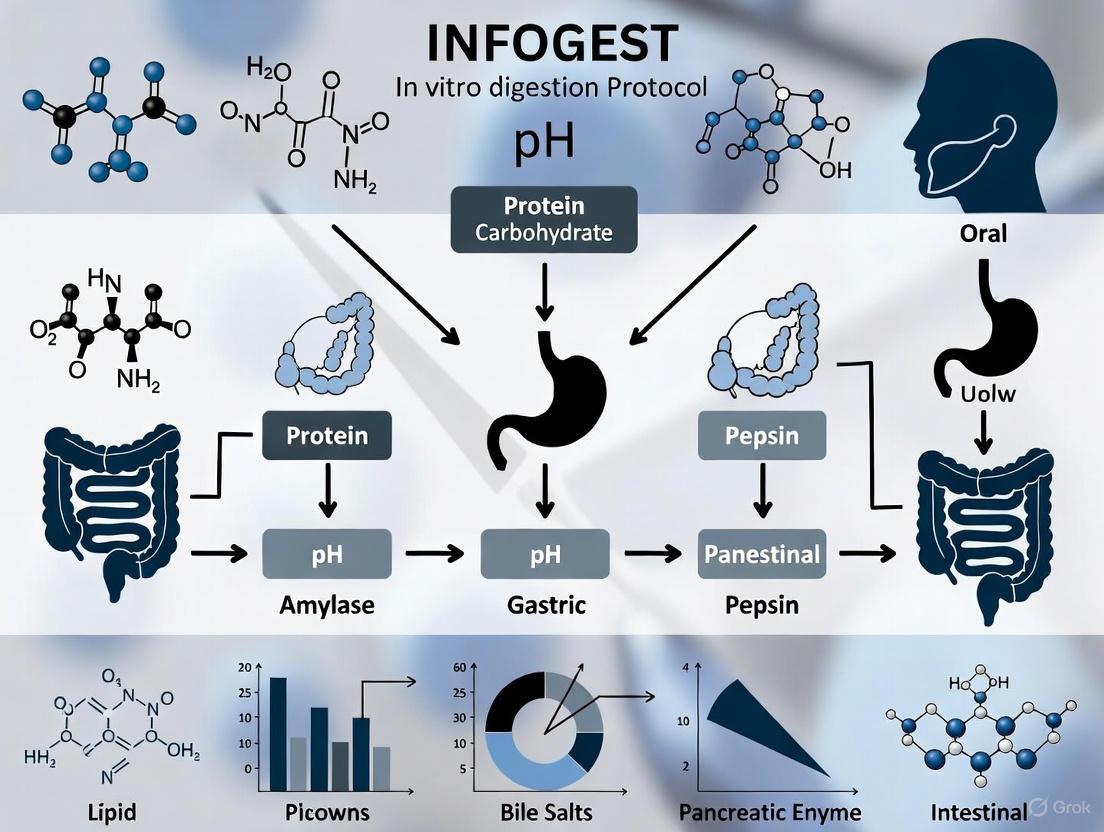
This article provides a complete resource for researchers and drug development professionals on the INFOGEST standardized in vitro digestion protocol.
The INFOGEST Protocol: A Comprehensive Guide to Standardized In Vitro Digestion for Biomedical Research
Abstract
This article provides a complete resource for researchers and drug development professionals on the INFOGEST standardized in vitro digestion protocol. It covers the foundational principles and physiological rationale behind the method, detailed step-by-step application guidelines for various food and drug matrices, troubleshooting for common optimization challenges, and validation data comparing static and dynamic models. By synthesizing the latest research and inter-laboratory studies, this guide aims to enhance experimental reproducibility, data comparability, and physiological relevance in digestion studies for improved nutritional and pharmaceutical development.
Understanding INFOGEST: The Foundation for Reproducible Digestion Science
Before 2014, research in the field of in vitro digestion simulation was characterized by significant methodological heterogeneity. The absence of a unified protocol led to widespread incomparability of data across different laboratories, impeding progress in understanding food digestion and nutrient bioaccessibility [1] [2]. This article delineates the specific sources of pre-2014 variability and establishes how the INFOGEST consortium's standardized static method provided a critical framework for generating reproducible and physiologically relevant data, with a particular focus on contemporary applications and validation.
The Pre-2014 Landscape: A "Wild West" of Methodological Variability
The lack of harmonization in static in vitro digestion methods prior to the INFOGEST consensus manifested in critical parameters that varied extensively between research teams. A comprehensive review of the literature reveals that these discrepancies were systemic [3].
Table 1: Major Sources of Pre-2014 Protocol Variability in Static In Vitro Digestion Models
| Variable Parameter | Examples of Pre-2014 Variability | Impact on Data Comparability |
|---|---|---|
| Digestive Enzymes | Use of enzymes from different sources (porcine, rabbit, human), with varying activity levels and purity [2] [4]. | Altered hydrolysis rates and digestibility outcomes due to differences in enzyme specificity and activity. |
| Chemical Conditions | pH, ionic strength, mineral composition (e.g., Ca²⁺ concentration), and bile salt concentration [2]. | Significant effects on enzyme activity, micelle formation, and precipitation of nutrients, altering bioaccessibility. |
| Digestion Time | Gastric and intestinal phase durations differed significantly between studies [2]. | Incomplete digestion or over-estimation of digestibility for some food components. |
| Food-to-Fluid Ratio | Wide variation in the ratio of food bolus to digestive fluids [2]. | Affected enzyme-to-substrate ratios and dilution of digestion products, influencing reaction kinetics. |
| Enzyme Mixtures | Use of individual enzymes (e.g., gastric lipase) versus complex mixtures (e.g., pancreatin) [2]. | Differing digestive comprehensiveness and potential for missing key enzymatic activities. |
A salient example of the lingering effects of this variability is the choice of amylase in the oral phase. Even post-2014, some studies used porcine pancreatic amylase (PPA) as a cost-effective substitute for human salivary amylase (HSA). Recent research has demonstrated that PPA exhibits unintended proteolytic "side activity", which can lead to a significant overestimation of protein digestibility compared to using HSA [4]. This underscores the critical importance of enzyme specificity, a principle central to the INFOGEST harmonization effort.
The INFOGEST Solution: A Standardized Static Protocol
In response to these challenges, the international INFOGEST network developed a standardized static in vitro simulation protocol for food digestion, grounded in physiologically relevant conditions [2]. The primary goal was to enhance the reproducibility and comparability of results across different laboratories [5]. The method outlines sequential oral, gastric, and intestinal digestion phases, with carefully defined parameters for electrolytes, enzymes, bile salts, pH, and digestion times, all based on a comprehensive review of physiological data [2] [6].
Table 2: Core Conditions of the INFOGEST 2.0 Static Digestion Protocol for Adults
| Digestion Phase | pH | Key Enzymes | Time | Critical Additives |
|---|---|---|---|---|
| Oral | 7.0 | Human Salivary Amylase (HSA) [4] | 2 min | Simulated Salivary Fluid (SSF) |
| Gastric | 3.0 | Pepsin | 2 hours | Simulated Gastric Fluid (SGF); CaCl₂ |
| Intestinal | 7.0 | Pancreatin (trypsin, chymotrypsin, amylase, lipase), Bile salts | 2 hours | Simulated Intestinal Fluid (SIF); CaCl₂; Bile |
The protocol's robustness is demonstrated by its successful implementation in automated digestion systems like the BioXplorer 100. Studies have confirmed no significant differences in protein and lipid digestion outcomes between the manual tube method and the automated system, highlighting the protocol's transferability and its capacity to minimize human error through automation [5].
Experimental Protocol: Application to Protein Digestibility & DIAAS Analysis
The INFOGEST method has been successfully adapted for specific nutritional endpoints, such as determining protein digestibility and calculating the in vitro digestible indispensable amino acid score (IVDIAAS), a predictive measure of protein quality [7] [8].
Detailed Workflow for Protein Digestibility and IVDIAAS
Materials: Food sample, simulated salivary/gastric/intestinal fluids (SSF, SGF, SIF), enzymes (pepsin, pancreatin), bile salts, CaCl₂ solution, NaOH and HCl for pH adjustment, inhibition solutions (e.g., 4-bromophenylboronic acid for lipase, heating block for proteases) [5] [7].
Procedure:
- Oral Phase: Commence with a defined food-to-fluid ratio. Mix the food sample with SSF (pH 7.0) containing human salivary amylase. Incubate for 2 minutes at 37°C with constant agitation [7].
- Gastric Phase: Lower the pH of the oral bolus to 3.0 using HCl. Add SGF and a standardized activity of porcine pepsin. Incubate for 2 hours at 37°C with agitation [7] [8].
- Intestinal Phase: Raise the pH to 7.0 using NaOH. Add SIF, bile salts, and pancreatin solution. Incubate for 2 hours at 37°C with agitation [7] [8].
- Sampling & Inhibition: Collect aliquots at the end of the gastric and intestinal phases. Immediately inhibit enzymatic activity using appropriate methods (e.g., pH shift, chemical inhibitors, heat) to halt further digestion [5] [7].
- Analysis:
- Degree of Hydrolysis: Quantify primary amines using o-phthalaldehyde (OPA) or free amino groups via TNBS.
- Amino Acid Analysis: Use liquid chromatography-mass spectrometry (LC-MS) to profile amino acids in the original sample and intestinal digesta.
- IVDIAAS Calculation: Calculate the digestible indispensable amino acid ratio (DIAAR) for each essential amino acid. The IVDIAAS is the lowest DIAAR value, multiplied by 100 [7] [8].
Validation: This in vitro workflow has been validated against in vivo data (true ileal digestibility in pigs or humans), showing a high correlation for both total protein digestibility (r = 0.6, P < 0.02) and individual amino acid digestibility (r = 0.6, P < 0.0001). The in vitro DIAAS also showed excellent agreement with in vivo values (r = 0.96, R² = 0.89, P < 0.0001) [7].
The Scientist's Toolkit: Key Research Reagent Solutions
Successful implementation of the INFOGEST protocol relies on the use of well-characterized reagents. The following table details essential materials and their critical functions within the simulated digestive environment.
Table 3: Essential Research Reagents for INFOGEST Protocol Implementation
| Reagent / Material | Function in Simulated Digestion | Key Consideration |
|---|---|---|
| Pepsin (from porcine gastric mucosa) | Primary protease of the gastric phase; hydrolyzes proteins into peptides [6]. | Activity must be standardized (e.g., 2000 U/mL in final digest) for reproducibility [7]. |
| Pancreatin (from porcine pancreas) | Enzyme mixture for intestinal phase; contains trypsin, chymotrypsin, amylase, lipase [5]. | Use a validated preparation; activity of individual enzymes (e.g., lipase) should be quantified [5] [8]. |
| Bile Salts (porcine bile extract) | Emulsifies lipids, facilitating lipolysis; helps form mixed micelles for solubilizing lipophilic compounds [6]. | Final concentration (e.g., 10 mM) is critical for physiologically relevant lipid digestion [5]. |
| Human Salivary Amylase (HSA) | Initiates starch hydrolysis in the oral phase [4]. | Preferred over porcine pancreatic amylase (PPA) to avoid unintended proteolytic activity that confounds protein analysis [4]. |
| Simulated Electrolyte Solutions (SSF, SGF, SIF) | Provide physiologically relevant ionic strength, pH, and mineral composition (e.g., K⁺, Na⁺, Ca²⁺) for enzyme function [5] [2]. | CaCl₂ concentration is crucial for regulating enzyme activity and precipitation phenomena [2]. |
The methodological variability that plagued pre-2014 in vitro digestion research presented a significant barrier to scientific advancement. The INFOGEST standardized protocol successfully addressed this by establishing a common, physiologically grounded framework. Its efficacy is proven not only by its widespread adoption but also by its robust validation against in vivo data and its successful application in automated systems. The protocol has become an indispensable tool, enabling reliable, reproducible, and comparable assessment of food digestibility and nutrient bioaccessibility for researchers and drug development professionals worldwide.
The INFOGEST static in vitro digestion method is an international consensus protocol designed to simulate human gastrointestinal digestion in a standardized and physiologically relevant manner [9] [10]. Developed by the COST Action INFOGEST network, this method addresses the critical need for harmonization across laboratories, which previously used widely varying conditions that impeded meaningful comparison of results [9] [11]. The protocol replicates the three sequential phases of upper GI tract digestion—oral, gastric, and intestinal—using constant ratios of meal to digestive fluids and fixed pH values for each step [10]. This static approach makes the method straightforward to implement with standard laboratory equipment, though it does not simulate digestion kinetics [10]. By providing a framework based on available physiological data, INFOGEST has become the gold standard for evaluating food digestion, bioaccessibility of nutrients, and the performance of alternative proteins [8] [1].
Core Physiological Principles and Phases
The INFOGEST protocol deconstructs the complex process of digestion into three distinct yet continuous phases, each mimicking the biochemical and physical conditions of the human gastrointestinal tract.
The Oral Phase
The oral phase simulates the initial processing of food in the mouth, where solid foods are physically broken down and mixed with saliva [9]. The primary objectives of this phase are to reduce food particle size and begin starch hydrolysis.
Physiological Basis: In vivo, chewing reduces solid food particles to approximately 2 mm or smaller before swallowing [9]. Saliva contributes electrolytes, proteins, and the enzyme α-amylase, though mucin is not included in the simulated salivary fluid due to its low concentration and limited availability [9]. The protocol uses a simulated salivary fluid (SSF) containing a specific ion composition at pH 7.0 [9].
Standardized Protocol Parameters: The oral phase involves mixing the food sample with simulated salivary fluid containing α-amylase [12]. For solid foods, a mechanical mincer is recommended to standardize the chewing process [9]. The sample is exposed to SSF for 2 minutes at 37°C to ensure consistent mixing and enzymatic action [9]. A typical preparation involves mixing 5 g of solid food or 5 mL of liquid food with 3.5 mL of SSF electrolyte stock solution, 0.5 mL of salivary α-amylase solution (1,500 U/mL), 25 μL of 0.3 M CaCl₂, and 975 μL of water [9].
The Gastric Phase
The gastric phase mimics the environment of the stomach, where pepsin begins protein hydrolysis and the pH decreases significantly compared to the oral phase.
Physiological Basis: Contrary to common belief, gastric pH is dynamic and highly dependent on food buffering capacity [9]. In the fasted state, pH is very low (1-2), but after meal ingestion, it rises and gradually decreases again [1]. The INFOGEST protocol uses a static pH of 3.0 for a 2-hour gastric phase, representing a mean value for a general semi-solid meal [9]. Gastric mixing in the antrum is simulated by shaking or stirring the sample at 37°C [9].
Standardized Protocol Parameters: The gastric phase employs simulated gastric fluid (SGF) with pepsin as the primary proteolytic enzyme [12]. The recommended activity of porcine pepsin is 2,000 U per mL of gastric contents [9]. Although the importance of human gastric lipase is acknowledged, it is typically not included due to limited availability and affordability [9]. Phosphatidylcholine at 0.17 mM in vesicular form may be included [9]. A typical gastric phase preparation involves mixing 10 mL of oral bolus with 7.5 mL of SGF electrolyte stock solution, 2.0 mL of porcine pepsin solution (20,000 U/mL), 5 μL of 0.3 M CaCl₂, and 0.2 mL of 1 M HCl to achieve pH 3.0 [9].
The Intestinal Phase
The intestinal phase replicates the environment of the small intestine, where the majority of nutrient digestion and absorption occurs through the action of pancreatic enzymes and bile salts.
Physiological Basis: In the small intestine, pancreatic enzymes (including trypsin, chymotrypsin, lipase, and amylase) and bile salts work together to break down macronutrients into absorbable units [1]. Physical digestion involves peristalsis and segmentation to mix contents and transport them through the intestinal lumen [1]. The pH in the small intestine is generally neutral to slightly basic.
Standardized Protocol Parameters: The intestinal phase utilizes simulated intestinal fluid (SIF) containing porcine pancreatin and bile salts at a starting pH of 7.0 [12]. The mixture is agitated at 37°C for 2 hours [12]. This phase is particularly important for evaluating protein quality, as the generation of free amino acids occurs mainly during intestinal digestion [11].
Table 1: Key Parameters for INFOGEST Digestion Phases
| Parameter | Oral Phase | Gastric Phase | Intestinal Phase |
|---|---|---|---|
| Duration | 2 minutes | 2 hours | 2 hours |
| pH | 7.0 | 3.0 | 7.0 |
| Primary Enzymes | α-Amylase (150 U/mL SSF) | Pepsin (2,000 U/mL gastric contents) | Pancreatin & Bile Salts |
| Temperature | 37°C | 37°C | 37°C |
| Physical Processing | Mincing (solid foods) | Shaking or stirring | Shaking or stirring |
| Key Electrolytes | SSF ion composition | SGF ion composition | SIF ion composition |
Experimental Workflow
The following diagram illustrates the sequential workflow of the INFOGEST static in vitro digestion protocol.
Diagram 1: INFOGEST Static Digestion Workflow. The protocol sequentially simulates the oral, gastric, and intestinal phases of human digestion with specific biochemical conditions at each stage. Enzyme solutions are added at their respective phases as indicated.
Research Reagent Solutions
Successful implementation of the INFOGEST protocol requires careful preparation of simulated digestive fluids and sourcing of quality enzymes. The table below details the essential reagents and their functions.
Table 2: Essential Research Reagents for INFOGEST Protocol
| Reagent Solution | Composition & Key Characteristics | Physiological Function |
|---|---|---|
| Simulated Salivary Fluid (SSF) | Electrolyte stock solution (specific ion composition) at pH 7.0 [9] | Provides ionic environment mimicking saliva; optimizes α-amylase activity |
| α-Amylase Solution | 150 units per mL of SSF; porcine or human salivary origin (1 unit liberates 1.0 mg maltose from starch in 3 min at pH 6.9, 20°C) [9] | Initiates starch hydrolysis during oral phase |
| Simulated Gastric Fluid (SGF) | Electrolyte stock solution with specific ion composition; may include phosphatidylcholine (0.17 mM) [9] | Creates acidic environment of stomach; supports pepsin activity and lipid interaction |
| Pepsin Solution | Porcine pepsin at 2,000 U/mL of gastric contents; activity measured using hemoglobin substrate at pH 2.0, 37°C [9] | Primary proteolytic enzyme for gastric protein hydrolysis |
| Simulated Intestinal Fluid (SIF) | Electrolyte stock solution at pH 7.0 [9] | Provides neutral pH environment for pancreatic enzymes and bile salts |
| Pancreatin & Bile Salts | Porcine pancreatin extract and bile salts [12] | Provides suite of pancreatic enzymes (proteases, lipase, amylase) and emulsifies lipids |
Applications in Food and Nutritional Research
The INFOGEST protocol has become an invaluable tool across multiple research domains, particularly in the evaluation of protein digestibility and nutrient bioaccessibility.
Protein Digestibility Studies
Research using the INFOGEST method has revealed significant variations in protein digestibility based on food matrix characteristics. A 2025 study investigating a blend of pea protein isolate and wheat flour (75:25) found that protein digestion depended strongly on food hydration levels, composition, and structure [13]. High-moisture foods like plant-based milk achieved the highest digestibility scores (approximately 83%), followed by pudding (81%), burger (71%), and breadstick (69%) as a low-moisture food [13]. This demonstrates how the same protein ingredient mixture can yield different nutritional outcomes depending on the food formulation.
Evaluation of Alternative Proteins
The protocol has been extensively applied to assess sustainable alternative protein sources. One comprehensive study examined protein concentrates from whey, potato, blood plasma, yeast, pea, corn, and lesser meal worms using the harmonized INFOGEST method [8]. Results showed that whey, blood plasma concentrate, and yeast protein concentrate had high mean true ileal indispensable amino acid in vitro digestibility (91.1–85.8%), followed by corn, pea, potato, and lesser meal worm proteins (82.5–77.9%) [8]. The study also developed an in vitro digestible indispensable amino acid score (IVDIAAS), with whey, potato, blood plasma, and yeast protein concentrates ranking highest (119–97.2) [8].
Method Validation and Harmonization
Inter-laboratory trials have validated the INFOGEST protocol's consistency across different research settings. Studies using skim milk powder as a model food demonstrated that caseins were mainly hydrolyzed during the gastric phase, while β-lactoglobulin was resistant to pepsin [11]. The generation of free amino acids occurred primarily during the intestinal phase [11]. These trials identified pepsin activity determination as a critical step responsible for inter-laboratory variability, leading to further clarification and harmonization of this aspect of the protocol [11].
Critical Technical Considerations
Successful implementation of the INFOGEST method requires attention to several technical aspects that significantly impact results.
Enzyme Activity Determination
Accurate measurement and standardization of enzyme activities, particularly pepsin, is crucial for reproducible results across laboratories [11]. The original inter-laboratory studies revealed that the largest deviations arose from pepsin activity determination, leading to further harmonization of this step [11]. Researchers must use standardized activity assays and units as defined in the protocol to ensure comparability of results.
pH Control and Stability
Maintaining precise pH values at each digestion phase is essential for physiological relevance and enzyme performance. The gastric phase pH of 3.0 represents a compromise based on average postprandial conditions [9]. For specific research questions, the pH may be adjusted to 2.0 for an additional 30 minutes to model incremental postprandial acidification [12]. Proper pH adjustment and stabilization throughout the digestion process is critical for generating reliable data.
Physical Processing Parameters
While the standard INFOGEST protocol focuses on chemical digestion, physical processing parameters including mixing intensity, vessel geometry, and for solid foods—initial particle size reduction—can influence digestion kinetics and endpoints [1]. Researchers should standardize and report these parameters to enhance result comparability.
The INFOGEST static in vitro simulation of gastrointestinal food digestion provides a standardized, reproducible method for assessing food digestion and nutrient bioaccessibility. This protocol, developed by an international consortium, addresses historical challenges of non-comparable results across different laboratories by harmonizing key biochemical and temporal parameters [14]. For researchers in food science and drug development, adherence to this detailed protocol is crucial for generating reliable data on the digestibility of nutrients, the release of bioactive compounds, and the behavior of pharmaceutical formulations in the gastrointestinal tract. This application note delineates the core parameters—pH, enzymes, electrolytes, and digestion timings—as defined by the INFOGEST 2.0 consensus, providing a foundational framework for in vitro digestion studies [1].
Core INFOGEST Parameters
The physiological relevance of the INFOGEST protocol is anchored in its careful simulation of the chemical environment within the human gut. The following tables summarize the critical parameters for each phase of digestion.
Table 1: Key Parameters for Each Digestion Phase
| Digestion Phase | pH | Key Enzymes | Electrolyte Solution | Duration |
|---|---|---|---|---|
| Oral | 7.0 | α-Amylase (human salivary) | Simulated Salivary Fluid (SSF) | 2 min |
| Gastric | 3.0 | Pepsin (porcine gastric mucosa) | Simulated Gastric Fluid (SGF) | 2 hours |
| Intestinal | 7.0 | Pancreatin (porcine), Bile salts (bovine) | Simulated Intestinal Fluid (SIF) | 2 hours |
Table 2: Electrolyte Stock Solution Compositions
| Electrolyte | Simulated Salivary Fluid (SSF) | Simulated Gastric Fluid (SGF) | Simulated Intestinal Fluid (SIF) |
|---|---|---|---|
| KCl | 15.1 mM | 6.9 mM | 6.8 mM |
| KH₂PO₄ | 3.7 mM | 0.9 mM | 0.8 mM |
| NaHCO₃ | 13.6 mM | 12.5 mM | 42.5 mM |
| NaCl | - | 45.2 mM | 72.4 mM |
| MgCl₂(H₂O)₆ | 0.15 mM | 0.12 mM | 0.33 mM |
| (NH₄)₂CO₃ | 0.06 mM | 0.05 mM | - |
| HCl | - | 15.6 mM (for pH adjustment) | - |
| CaCl₂(H₂O)₂ | 0.3 mM (added last) | 0.15 mM (added last) | 0.6 mM (added last) |
Note: The values for electrolyte stock solutions are based on established protocols [14].
Experimental Protocol
Materials and Reagent Preparation
Research Reagent Solutions
The following reagents are essential for executing the INFOGEST protocol. All solutions should be prepared fresh daily or aliquoted and stored at recommended conditions to preserve enzyme activity.
Table 3: Essential Research Reagents and Materials
| Reagent/Material | Function / Application | Example / Specification |
|---|---|---|
| Porcine Pepsin | Protein hydrolysis in the gastric phase [14] | Activity: ≈ 3344 U/mg [14] |
| Pancreatin from Porcine Pancreas | Provides key intestinal enzymes (amylase, lipase, proteases) [14] | ≥ 4xUSP specification [14] |
| Bile Salts | Emulsification of lipids, formation of micelles [14] | Bovine bile, e.g., 10 mM final concentration [14] |
| Electrolyte Stock Solutions | Provide physiologically relevant ionic environment [14] | See Table 2 for compositions |
| Calcium Chloride (CaCl₂) | Critical co-factor for numerous enzyme activities [1] | Added separately last to prevent precipitation (e.g., 0.3 M stock) [14] |
| Acid/Base (HCl, NaOH) | pH adjustment and control during phase transitions [14] | e.g., 1M and 2M solutions [14] |
| Enzyme Inhibition Reagents | Halt digestion at specific timepoints for accurate analysis [15] | e.g., 4-bromophenylboronic acid (for lipase), thermal inactivation [15] |
Step-by-Step Workflow
The INFOGEST protocol can be executed manually in test tubes or automated using systems like the BioXplorer 100, which enhances reproducibility by minimizing human error through precise control of temperature, pH, and fluid additions [14].
Figure 1: INFOGEST static digestion protocol workflow. This diagram outlines the sequential phases of the standardized in vitro digestion process.
Oral Phase Simulation:
- Mix the food sample with Simulated Salivary Fluid (SSF) in a 1:1 ratio (v/w).
- Add human salivary α-amylase (final activity typically 75 U/mL in the final mixture).
- Incubate the mixture for 2 minutes at 37°C under constant agitation.
Gastric Phase Simulation:
- Mix the oral bolus with Simulated Gastric Fluid (SGF) in a 1:1 ratio (v/v).
- Lower the pH to 3.0 using 1M HCl.
- Add porcine pepsin (final activity typically 2000 U/mL in the final mixture).
- Incubate for 2 hours at 37°C under constant agitation.
Intestinal Phase Simulation:
- Mix the gastric chyme with Simulated Intestinal Fluid (SIF) in a 1:1 ratio (v/v).
- Raise the pH to 7.0 using 1M NaOH.
- Add porcine pancreatin (final trypsin activity typically 100 U/mL in the final mixture) and bile salts (final concentration typically 10 mM).
- Incubate for 2 hours at 37°C under constant agitation.
Sampling and Post-Digestion Analysis
For kinetic studies, samples are drawn at predetermined time points (e.g., 5, 10, 20, 30, 45, 60, 90, and 120 minutes after enzyme addition in the gastric or intestinal phase) [14]. To halt the digestive process at these points, effective enzyme inactivation is critical. A comparative study on post-digestion methods recommends thermal inactivation (e.g., placing aliquots in a water bath at 98°C for 5 minutes) combined with storage of samples at -20°C as an effective, low-cost approach to preserve macronutrient integrity for subsequent analysis [15].
Applications and Data Output
The INFOGEST protocol enables the quantitative assessment of nutrient digestibility and bioaccessibility. A key application is evaluating protein digestion, as demonstrated in a 2025 study on plant-based foods [13].
Table 4: Example Data Output: Protein Digestibility of Plant-Based Foods
| Food Matrix | Moisture Content | Final Protein Digestibility (%) |
|---|---|---|
| Plant-Based Milk | High | ≈ 83% |
| Plant-Based Pudding | High | ≈ 81% |
| Plant-Based Burger | Medium | ≈ 71% |
| Breadstick | Low | ≈ 69% |
Note: Data adapted from a study using a pea protein-wheat flour blend, demonstrating how food matrix and moisture content impact protein digestibility [13].
Analytical techniques like Size Exclusion Chromatography (SEC) are particularly valuable for post-digestion analysis, as they allow for the separation and quantification of small, bioaccessible peptides, which is crucial for determining true protein digestibility [16].
The INFOGEST standardized in vitro digestion method represents a landmark achievement in food science, providing a unified framework for predicting the fate of food in the human gastrointestinal tract. Developed by an international consortium of researchers, this harmonized static protocol was created to address the critical issue of data comparability across different laboratories [11]. Its evolution from a validation tool for simple model foods like skim milk to a robust method for analyzing complex, multi-component matrices mirrors the growing need for reliable nutritional assessment of novel food products, particularly plant-based alternatives.
This document details the experimental protocols, key findings, and methodological considerations for employing the INFOGEST method, framed within broader thesis research on food digestion. It provides application notes essential for researchers, scientists, and drug development professionals working in nutritional science and bioactive compound bioaccessibility.
The Foundation: Validation with a Simple Matrix
The initial development and inter-laboratory validation of the INFOGEST protocol relied on skim milk powder (SMP) as a standardized model food [11]. This simple, well-characterized matrix was ideal for harmonizing experimental conditions and ensuring consistency across laboratories.
Key Findings from Skim Milk Validation
- Consistent Protein Hydrolysis Patterns: Inter-laboratory trials demonstrated that caseins were predominantly hydrolyzed during the gastric phase, while β-lactoglobulin showed resistance to pepsin, consistent with known in vivo behavior [11].
- Free Amino Acid Generation: The production of free amino acids occurred primarily during the intestinal phase of digestion [11].
- Correlation with In Vivo Data: Peptide patterns at the gastric and intestinal endpoints showed a good approximation to in vivo results from pigs and human jejunal effluents, confirming the protocol's physiological relevance [17].
Advanced Applications: Transition to Complex Matrices
As the method gained acceptance, researchers applied it to more complex food systems to investigate how food matrix effects influence nutrient digestibility and bioactive compound stability.
Plant-Based Protein Foods
A 2025 study investigated the in vitro protein digestibility of a blend of pea protein isolate and wheat flour (75:25) used in various model foods [13]. The research aimed to understand how food formulation and processing impact protein utilization.
Table 1: Protein Digestibility of Plant-Based Foods with Identical Protein Ingredient [13]
| Food Model | Moisture Category | Protein Digestibility (%) | Key Influencing Factors |
|---|---|---|---|
| Plant-Based Milk | High | ~83% | High hydration level, composition |
| Pudding | High | ~81% | Gelled texture, composition |
| Burger | Medium | ~71% | Food structure, nutrient interactions |
| Breadstick | Low | ~69% | Low hydration, food structure |
The study concluded that protein digestion depended significantly on the level of food hydration, overall composition, and internal structure, highlighting the importance of testing final food products rather than just raw ingredients [13].
Bioactive Compounds in Extra-Virgin Olive Oil
The INFOGEST method was applied to evaluate the digestive stability and bioaccessibility of phenolic compounds in a Galician extra-virgin olive oil (EVOO) [6]. This research showcased the protocol's utility beyond macronutrients.
- Phenolic Transformation: Secoiridoids, the most abundant phenolic family in the EVOO, underwent extensive hydrolysis during gastric digestion, releasing simple phenols like free tyrosol and hydroxytyrosol [6].
- Compartmentalization: After intestinal digestion, simple phenols and flavonoids were mainly recovered in the aqueous phase, while lignans remained stable and partitioned into the oily phase [6].
- Bioaccessibility Assessment: The incorporation of a dialysis membrane during the intestinal phase provided a reliable estimation of the fraction of phenolics available for absorption [6].
Experimental Protocols
The Harmonized INFOGEST Static Digestion Protocol
The standard protocol involves a three-step sequential simulation of oral, gastric, and intestinal digestion under controlled parameters [6] [1]. Key physiological conditions are summarized in Table 2.
Table 2: Key Parameters in the INFOGEST Static In Vitro Digestion Protocol
| Digestion Phase | pH | Key Enzymes | Typical Incubation Time | Key Functions |
|---|---|---|---|---|
| Oral | 5-7 | Amylase, Lingual Lipase | < 2 minutes | Mastication, initial starch/lipid hydrolysis |
| Gastric | 3.0 (after feeding) | Pepsin, Gastric Lipase | 0.5 - 2 hours | Protein hydrolysis, disintegration of food matrix |
| Intestinal | 4-7 | Trypsin, Chymotrypsin, Pancreatic Lipase, Amylase, Bile | 1.5 - 2 hours | Final nutrient hydrolysis, micelle formation |
Food Matrix Preparation:
- Master Mixture: Create a homogenous 75:25 (w:w) blend of pea protein isolate and wheat flour.
- Model Foods: Prepare plant-based milk (liquid suspension), pudding (gelled), burger (grilled patty), and breadstick (baked) using the standardized master mixture and other ingredients (e.g., sunflower oil, lecithin, starch).
- Protein-Free Controls: Prepare protein-free versions of each food model to account for digestive enzyme autolysis.
In Vitro Digestion (INFOGEST):
- Subject each food model to the standardized three-step INFOGEST digestion (oral, gastric, intestinal).
- Analysis: Determine protein digestibility by quantifying nitrogen in the digested fractions, often using Kjeldahl analysis (AOAC 984.13) with appropriate nitrogen-to-protein conversion factors.
In Vitro Digestion:
- Subject the EVOO sample to the harmonized INFOGEST three-phase digestion.
- Fractionation: After each phase, separate the digest into an aqueous fraction (Wp) and an oily fraction (Op) for analysis.
- Dialysis (Optional): Incorporate a dialysis membrane system (12,000–14,000 Da MWCO) during the intestinal phase to isolate the bioaccessible fraction (Bf).
Analysis of Phenolic Compounds:
- Extraction: Solid-phase extraction (SPE) using OASIS HLB cartridges.
- Quantification: Analyze phenolic composition and transformations using Liquid Chromatography coupled with Diode Array Detection (LC-DAD), Fluorescence Detection (FLD), and Mass Spectrometry (LC-MS/MS).
- Antioxidant Capacity: Assess stability and bioaccessibility of antioxidant properties using Folin-Ciocalteu and DPPH assays.
Methodological Considerations & Enhancements
Integrated Sample Preparation for Macronutrient Analysis
A unified sample preparation method has been proposed to boost the throughput of INFOGEST studies. This method, based on the selective isolation of the Bligh and Dyer extraction, allows for the simultaneous determination of endpoint digestibility and release kinetics for proteins, carbohydrates, and lipids [18]. Recovery experiments for bioaccessible analytes have shown yields of 70–120%, validating its use [18].
Addressing Physical Digestion
While the static INFOGEST protocol standardizes chemical conditions, physical digestion from mastication and gastric peristalsis significantly influences disintegration and nutrient release [1]. Recent research utilizes:
- Dynamic Digestion Models: Devices like the DIDGI system simulate gastric peristalsis, providing a closer approximation to the gradual hydrolysis and nutrient release observed in vivo [17] [1].
- Food Characterization: Textural and mechanical properties (e.g., hardness) of foods, especially hydrogels, are analyzed to understand their role in controlling digestive behavior [1].
The Scientist's Toolkit: Key Research Reagent Solutions
Table 3: Essential Reagents and Materials for INFOGEST Experiments
| Reagent/Material | Function in the Protocol | Example Source / Specification |
|---|---|---|
| Pepsin (from porcine gastric mucosa) | Primary enzyme for gastric protein hydrolysis | Sigma-Aldrich |
| Pancreatin (from porcine pancreas) | Provides key intestinal enzymes (trypsin, chymotrypsin, lipase, amylase) | Sigma-Aldrich |
| Bile Extract (porcine) | Emulsifies lipids, facilitating fat digestion and absorption | Sigma-Aldrich |
| Simulated Electrolyte Solutions | Creates physiologically realistic ionic strength and osmolarity | Prepared from salts (KCl, KH₂PO₄, NaHCO₃, NaCl, MgCl₂, CaCl₂) [6] |
| Dialysis Membrane Tubing | Isolates the bioaccessible fraction during intestinal digestion | 12,000–14,000 Da MWCO [6] |
| Solid-Phase Extraction (SPE) Cartridges | Purifies and concentrates analytes (e.g., phenolics) from complex digesta | OASIS HLB [6] |
Visualizing the Workflow
The following diagram illustrates the logical workflow for applying the INFOGEST method to a complex food matrix, from sample preparation to data analysis.
Implementing INFOGEST: A Step-by-Step Protocol for Diverse Applications
Preparation of Simulated Digestive Fluids and Electrolyte Stocks
Within the framework of INFOGEST in vitro digestion protocol research, the preparation of simulated digestive fluids with precise electrolyte composition is a critical foundational step. The international consensus INFOGEST static in vitro simulation method was established to harmonize diverse digestion protocols, enabling the production of comparable and reproducible data across research teams investigating food digestion and drug bioavailability [19] [20]. This protocol outlines the standardized preparation of Simulated Salivary Fluid (SSF), Simulated Gastric Fluid (SGF), and Simulated Intestinal Fluid (SIF) electrolyte stock solutions, which are essential for creating physiologically relevant environments during each phase of digestion [21].
The accuracy of these stocks is paramount, as minor deviations in ionic composition can significantly alter enzyme activities and digestion outcomes [20] [21]. This application note provides a detailed, actionable guide for researchers and drug development professionals to prepare these essential solutions.
Composition of Electrolyte Stock Solutions
The following tables detail the precise compositions of the concentrated stock solutions and their final concentrations in the digestion mixture, as defined by the INFOGEST consensus [22] [21].
Table 1: Composition of 1.25x Concentrated Simulated Digestive Fluids [22]
| Reagent | Molecular Weight (g/mol) | Simulated Salivary Fluid (SSF) | Simulated Gastric Fluid (SGF) | Simulated Intestinal Fluid (SIF) |
|---|---|---|---|---|
| Amount for 1L of 1.25x Stock | Amount for 1L of 1.25x Stock | Amount for 1L of 1.25x Stock | ||
| KCl | 74.55 | 9.80 g | 7.30 g | 3.30 g |
| KH₂PO₄ | 136.09 | 6.90 g | - | 1.30 g |
| NaHCO₃ | 84.01 | 6.43 g | 8.96 g | 31.25 g |
| NaCl | 58.44 | - | 5.01 g | 1.90 g |
| MgCl₂(H₂O)₆ | 203.30 | 0.14 g | 0.23 g | 0.18 g |
| (NH₄)₂CO₃ | 96.09 | 0.13 g | - | - |
| HCl (1M) | 36.46 | 2.10 mL | 17.70 mL | 3.50 mL |
Table 2: Final Concentrations of Electrolytes in the Digestion Mixture [21]
| Electrolyte | Oral Phase (SSF) | Gastric Phase (SGF) | Intestinal Phase (SIF) |
|---|---|---|---|
| K⁺ (mmol/L) | 25.4 | 11.8 | 6.8 |
| Na⁺ (mmol/L) | 21.6 | 45.2 | 80.3 |
| Cl⁻ (mmol/L) | 20.5 | 85.7 | 44.0 |
| HCO₃⁻ (mmol/L) | 3.6 | 12.7 | 37.0 |
| HPO₄²⁻ (mmol/L) | 0.4 | - | 0.1 |
| Ca²⁺ (mmol/L) | 0.15* | 0.08* | 0.15* |
| Mg²⁺ (mmol/L) | 0.08 | 0.10 | 0.10 |
| NH₄⁺ (mmol/L) | 0.06 | - | - |
Note: Calcium is added separately as a 0.3 M CaCl₂ solution to prevent precipitation in the stock solutions [22] [21].
Experimental Workflow
The diagram below outlines the logical sequence for preparing the electrolyte stock solutions and executing a static in vitro digestion experiment.
Detailed Preparation Protocol
Materials and Reagents
Research Reagent Solutions: The following table lists the essential materials required for preparing the simulated digestive fluids.
Table 3: Essential Reagents and Materials
| Item | Specification/Function | Example Source (Non-exhaustive) |
|---|---|---|
| Salivary α-Amylase | Enzyme for oral phase starch digestion; use 150 U/mL in final SSF. | Human saliva Type IX-A, Sigma [21] |
| Porcine Pepsin | Proteolytic enzyme for gastric phase; use 2000 U/mL in final gastric chyme. | Porcine gastric mucosa, Sigma [20] [21] |
| Pancreatin / Trypsin | Key enzymes for intestinal digestion of proteins, lipids, and carbs. | Porcine pancreatin extract [19] |
| Bile Salts | Emulsifies lipids for intestinal digestion; final concentration 10 mM. | Porcine bile extract [19] [20] |
| Calcium Chloride (CaCl₂) | Critical cofactor for enzyme activity; added separately as 0.3 M solution. | Sigma-Aldrich [22] |
| Inorganic Salts | KCl, KH₂PO₄, etc., to create physiologically relevant ionic strength and pH. | Analytical grade, e.g., Sigma-Aldrich [23] |
Step-by-Step Preparation Procedure
Solution Preparation:
- For each digestive fluid (SSF, SGF, SIF), weigh the salts listed in Table 1 accurately and dissolve them in approximately 800 mL of high-purity water (e.g., Milli-Q water) in a 1 L volumetric flask.
- Add the specified volume of 1M HCl while stirring.
- Make up the volume to 1 L with water and mix thoroughly until all components are completely dissolved. The solutions are now 1.25x concentrated stocks.
- Separately, prepare a 0.3 M CaCl₂ solution in water.
pH Adjustment:
Storage:
- The 1.25x electrolyte stock solutions can be stored refrigerated (at 4°C) for up to one month to ensure stability [22]. The 0.3 M CaCl₂ solution is stable for longer periods when stored at 4°C.
Application in INFOGEST Static Digestion Protocol
The prepared stock solutions are used in a sequential three-phase digestion process. A typical gastric phase is executed as follows [22] [21]:
- Combine 10 mL of oral bolus with 7.5 mL of SGF stock solution.
- Add 1.6 mL of porcine pepsin solution (25,000 U/mL prepared in SGF).
- Add 5 µL of 0.3 M CaCl₂.
- Adjust the pH to 3.0 using 1 M HCl.
- Add water to a final volume of 20 mL.
- Incubate for 2 hours at 37°C with constant agitation.
This structured approach to preparing simulated digestive fluids ensures the physiological relevance and reproducibility of in vitro digestion studies, aligning with the core objectives of the INFOGEST network [20] [21].
Enzyme Sourcing and Critical Activity Determination (Pepsin, Amylase, Lipases)
The INFOGEST static in vitro simulation is an internationally harmonized method designed to simulate the physiological conditions of the human gastrointestinal tract for food and pharmaceutical digestion studies [10]. Its reliability hinges on the precise activity of digestive enzymes, including pepsin, amylase, and lipases. Inaccurate activity estimation leads to experimental variations, consumes costly reagents, and compromises the validity of bioaccessibility data [24]. This application note details critical parameters for sourcing these enzymes and provides validated, miniaturized protocols for determining their activity, thereby supporting robust and reproducible INFOGEST research.
Critical Parameters for Enzyme Sourcing
Selecting a qualified enzyme supplier is a foundational step for protocol success. Key factors to evaluate are summarized in the table below.
Table 1: Key Criteria for Sourcing Enzymes for Research Use
| Criterion | Importance for INFOGEST Protocol | Documentation to Request |
|---|---|---|
| Technical Specifications | Ensures enzyme formulation (liquid, powder) and stated activity (U/g or U/mg) are suitable for preparing stock solutions of known concentration [25]. | Detailed Technical Data Sheet including specific activity, pH/temperature stability, and form. |
| Assay Validation | Guarantees that the reported activity is measured using a standardized, reproducible method, which is critical for cross-study comparisons [24] [25]. | Information on the assay method (e.g., colorimetric, titrimetric) and its validation status. |
| Quality Certifications | Indicates the supplier adheres to standardized manufacturing and quality control processes, ensuring batch-to-batch consistency [25]. | Certificates of Analysis (COA), ISO or GMP certifications, and Safety Data Sheets (SDS) [25] [26]. |
| Batch Documentation | Provides traceability and confirms the specific activity and purity of the received enzyme lot, which is essential for accurate dosing in the digestion simulation [25]. | Batch-specific COA and consistency data. |
Experimental Protocols for Activity Determination
Miniaturized Pepsin Activity Assay
The traditional UV-spectrophotometric method for pepsin, while established, lacks formal validation, requires quartz cuvettes, and uses large reagent volumes [24]. The following miniaturized colorimetric method offers a validated, high-throughput alternative.
Principle: Pepsin digests acidified hemoglobin, producing Trichloroacetic Acid (TCA)-soluble peptides. These peptides react with the Folin-Ciocalteu (FC) reagent under alkaline conditions to produce a blue chromophore measurable at 760 nm [24].
Materials and Reagents:
- Pepsin from porcine gastric mucosa (e.g., Sigma-Aldrich, ≥2500 U/mg)
- Hemoglobin from bovine blood
- Trichloroacetic acid (TCA), 5% (w/v) solution
- Folin-Ciocalteu Reagent
- Sodium carbonate (Na₂CO₃), 6% (w/v) solution
- Hydrochloric acid (HCl), 10 mM and 300 mM solutions
- Sodium hydroxide (NaOH), 1 M solution
- Sodium chloride (NaCl), 150 mM
- Tris-HCl, 10 mM
- 96-well clear polystyrene microplates
- Multi-mode microplate reader capable of reading at 760 nm
- Thermonixer or water bath (37°C)
- Centrifuge
Procedure:
- Enzyme Solution Preparation: Prepare a 500 µg/mL pepsin stock solution in an ice-cold solution of 150 mM NaCl and 10 mM Tris-HCl. From this, prepare working solutions at six concentrations (e.g., 5, 10, 15, 20, 25, and 30 µg/mL) in 10 mM HCl. Keep on ice.
- Substrate Preparation: Prepare a 2% (w/v) hemoglobin stock solution. Acidify the solution to pH 2.00 (±0.01) using 300 mM HCl and 1 M NaOH, and bring to final volume with ultra-pure water.
- Digestion Reaction:
- Dispense 500 µL of pre-incubated (37°C, 3 min) hemoglobin solution into microcentrifuge tubes.
- Add 100 µL of each pepsin working solution to the respective "test" tubes. For "blank" tubes, add 100 µL of 10 mM HCl.
- Incubate all tubes for 10 minutes at 37°C with constant shaking (e.g., 650 RPM).
- Reaction Termination: Rapidly add 1 mL of ice-cold 5% TCA to each tube to stop the reaction. Then, add 100 µL of the corresponding pepsin solution to the matching blank tubes.
- Precipitation and Clarification: Centrifuge the solutions at 6000× g for 30 minutes at 19°C.
- Colorimetric Detection:
- In a 96-well plate, combine 50 µL of the clarified supernatant with 50 µL of 20% Folin-Ciocalteu reagent and 100 µL of 6% sodium carbonate.
- Incubate the plate for 10 minutes in darkness at 37°C.
- Measure the absorbance at 760 nm.
Activity Calculation:
- Generate a standard curve using L-Tyrosine (e.g., 0.014 - 0.31 mM).
- One unit (U) of pepsin activity is defined as the amount of enzyme that produces TCA-soluble peptides equivalent to 1 µmol of L-tyrosine per minute under the assay conditions (37°C, pH 2.0).
- Plot the net absorbance (Test - Blank) against the pepsin concentration for the linear range. The slope of this line is used to calculate the activity of the stock solution [24].
Workflow for Enzyme Activity Determination
The following diagram illustrates the complete experimental workflow for the pepsin activity assay, from reagent preparation to data analysis.
Data Analysis and Validation
Statistical Analysis and Method Comparison
The miniaturized VIS method should be validated against the traditional UV method to ensure reliability.
Table 2: Figures of Merit for L-Tyrosine Calibration Curves in UV and VIS Methods [24]
| Figure of Merit | UV Method (280 nm) | VIS (Microplate) Method (760 nm) |
|---|---|---|
| Linear Range | 0.11 - 1.10 mM | 0.014 - 0.31 mM |
| Sensitivity | Higher | Slightly Lower |
| Reproducibility (Inter-day CV) | Comparable | ~8% |
| Statistical Difference | No significant difference (p > 0.05) | No significant difference (p > 0.05) |
Statistical Comparison: Use a two-tailed t-test (α = 0.95) to compare the inter-day means of enzyme activity obtained from both methods. The validated miniaturized method shows no statistical difference from the traditional UV method, confirming its accuracy [24].
Multivariate Data Analysis for Bioprocessing
For complex datasets, especially from multiple enzyme batches or process optimization studies, Multivariate Data Analysis (MVDA) is a powerful tool. Techniques like Principal Component Analysis (PCA) can reveal batch deviations and correlations between process parameters (e.g., pH, temperature) and enzyme activity [27] [28]. Partial Least Squares (PLS) regression is the most applied algorithm in the biopharmaceutical sector for modeling the relationship between process variables and critical quality attributes, such as specific enzyme activity [28].
The Scientist's Toolkit: Essential Research Reagent Solutions
Table 3: Key Reagents and Materials for INFOGEST Enzyme Assays
| Item | Function / Role in Protocol | Example Specification / Notes |
|---|---|---|
| Pepsin (Porcine Gastric Mucosa) | Primary protease for the gastric phase simulation. | Activity ≥2500 U/mg protein; requires activity verification upon receipt [24]. |
| Hemoglobin (Bovine Blood) | Substrate for the pepsin activity assay. | Must be acidified to pH 2.0 for the reaction [24]. |
| Folin-Ciocalteu Reagent | Colorimetric agent that reacts with peptides and tyrosine to produce a measurable signal. | Used for the miniaturized VIS assay in microplates [24]. |
| Trichloroacetic Acid (TCA) | Precipitates undigested protein and large peptides, terminating the reaction. | Typically used as a 5% (w/v) solution [24]. |
| L-Tyrosine | Standard for generating the calibration curve to quantify peptide release. | Purity >98%, HPLC grade [24]. |
| 96-Well Microplates | Platform for the miniaturized, high-throughput colorimetric assay. | Clear polystyrene for absorbance measurement [24]. |
The integrity of the INFOGEST in vitro digestion protocol is fundamentally dependent on the quality of its enzymatic components. By adhering to stringent enzyme sourcing criteria and implementing validated, miniaturized activity assays—such as the Folin-Ciocalteu-based method for pepsin detailed here—researchers can significantly enhance the reliability, efficiency, and reproducibility of their studies. Embracing advanced data analysis tools like MVDA further deepens process understanding and control, driving robust scientific outcomes in food and pharmaceutical research.
The transition towards sustainable alternative food proteins and the need for reliable drug absorption models necessitate a mechanistic understanding of digestion in the upper gastrointestinal tract. Prior to 2014, the field of in vitro digestion was hampered by a wide range of non-physiological conditions used in different laboratories, impeding the meaningful comparison of results across research teams [9]. To address this, the COST Action INFOGEST network developed an international consensus on a standardized static in vitro digestion protocol [9] [10]. This method provides a physiologically relevant framework based on available data on human digestion, simulating the oral, gastric, and intestinal phases under controlled conditions [1] [10]. The protocol is designed to be used with standard laboratory equipment and requires limited experience, encouraging broad adoption [10]. Its primary application is in assessing the bioaccessibility of nutrients and bioactive compounds, defined as the proportion that becomes available for absorption by the small intestine [1]. This document details the phase-by-phase protocol within the context of INFOGEST research, providing the quantitative parameters and methodologies essential for researchers and drug development professionals.
Phase-by-Phase Digestion Protocol
The static digestion method comprises three sequential phases that mimic the biochemical environment of the human upper GI tract. The following sections provide detailed methodologies and parameters for each phase.
Oral Phase
The oral phase simulates the short period where food is processed in the mouth to form a bolus. For solid foods, this involves physical size reduction and mixing with simulated salivary fluid (SSF).
Protocol Workflow:
- Food Preparation: For solid foods, mince or comminute approximately 5 g of sample to simulate chewing, aiming for particle sizes of ≤ 2 mm [9].
- Simulated Salivary Fluid (SSF): Prepare the SSF with the ionic composition specified in [9].
- Mixing: Combine 5 g of solid food or 5 mL of liquid food with 3.5 mL of SSF electrolyte stock solution.
- Enzyme Addition: Add 0.5 mL of a salivary α-amylase solution (1,500 U/mL, made in SSF stock). Use α-amylase from human saliva (e.g., Type IX-A, 1,000–3,000 U/mg protein) [9].
- Calcium and Water: Add 25 μL of 0.3 M CaCl₂ and 975 μL of water.
- Incubation: Thoroughly mix the entire sample and incubate for 2 minutes at 37°C [9].
Key Physical & Chemical Parameters:
Gastric Phase
The gastric phase simulates the environment of the stomach, where pepsin begins the hydrolysis of proteins. The pH is dynamically controlled but held static at a representative value in this protocol.
Protocol Workflow:
- Sample Transfer: Use the entire oral bolus (approximately 10 mL) from the previous phase.
- Simulated Gastric Fluid (SGF): Mix the oral bolus with 7.5 mL of SGF electrolyte stock solution.
- Enzyme Addition: Add 2.0 mL of a porcine pepsin solution (20,000 U/mL, made in SGF stock). Use pepsin from porcine gastric mucosa (e.g., 3,200–4,500 U/mg protein) [9].
- Calcium Addition: Add 5 μL of 0.3 M CaCl₂.
- pH Adjustment: Lower the pH to 3.0 using 1 M HCl [9].
- Incubation: Mix the contents and incubate for 2 hours at 37°C with continuous shaking or stirring [9].
Key Physical & Chemical Parameters:
Intestinal Phase
The intestinal phase mimics the small intestine, where the majority of nutrient absorption occurs, driven by pancreatic enzymes and bile.
Protocol Workflow:
- Sample Transfer: Use the entire gastric chyme (approximately 20 mL) from the previous phase.
- Simulated Intestinal Fluid (SIF): Mix the gastric chyme with 11 mL of SIF electrolyte stock solution.
- Enzyme Addition: Add 5.0 mL of a pancreatin solution. The pancreatin solution should provide a final activity of trypsin at 100 U/mL in the final intestinal mixture [10].
- Bile Addition: Add 2.5 mL of a bile salts solution (e.g., porcine bile extract). The final concentration in the intestinal mixture is typically 10 mM [10].
- Calcium Addition: Add 40 μL of 0.3 M CaCl₂.
- pH Adjustment: Raise the pH to 7.0 using 1 M NaOH [10].
- Incubation: Mix the contents and incubate for 2 hours at 37°C with continuous shaking or stirring [10].
Key Physical & Chemical Parameters:
Table 1: Summary of Key Parameters in the INFOGEST Static Digestion Protocol
| Parameter | Oral Phase | Gastric Phase | Intestinal Phase |
|---|---|---|---|
| Duration | 2 min | 2 h | 2 h |
| pH | 7.0 | 3.0 | 7.0 |
| Key Enzyme | α-amylase | Pepsin | Pancreatin (Trypsin) |
| Enzyme Activity | 150 U/mL | 2,000 U/mL | 100 U/mL (Trypsin) |
| [CaCl₂] (final) | ~1.5 mM | ~0.15 mM | ~0.6 mM |
Experimental Workflow and Data Analysis
The following diagram illustrates the logical workflow of the entire INFOGEST static digestion protocol.
Endpoint Analysis
Following the in vitro digestion, the intestinal digesta can be analyzed for various endpoints to determine bioaccessibility. Common analyses include:
- Protein Digestion: Quantification of peptides and free amino acids, often via HPLC or OPA assays, to calculate digestibility scores [13].
- Lipid Digestion: Measurement of free fatty acids released, typically by titration or colorimetric methods.
- Carbohydrate Digestion: Analysis of simple sugars released from starch or other complex carbohydrates.
- Micronutrient Bioaccessibility: Quantification of released vitamins or minerals, often requiring centrifugation to separate the aqueous phase containing solubilized compounds [10].
The Scientist's Toolkit: Key Research Reagents and Materials
Successful implementation of the INFOGEST protocol requires careful preparation and sourcing of key reagents. The table below details the essential materials and their functions.
Table 2: Essential Reagents for the INFOGEST Static Digestion Protocol
| Reagent / Material | Function / Role in Digestion | Key Specifications / Examples |
|---|---|---|
| Salivary α-Amylase | Initiates starch hydrolysis in the oral phase. | Human salivary α-amylase (Type IX-A). Activity: 150 U/mL final in oral phase [9]. |
| Porcine Pepsin | Primary protease in the stomach; breaks down proteins into peptides. | From porcine gastric mucosa. Activity: 2,000 U/mL final in gastric phase [9]. |
| Pancreatin | A mixture of digestive enzymes (proteases, lipase, amylase) for the intestinal phase. | Must be standardized for trypsin activity: 100 U/mL final in intestinal phase [10]. |
| Bile Salts | Emulsifies lipids, facilitating lipolysis and formation of mixed micelles for absorption. | Porcine bile extract. Final concentration: 10 mM in intestinal phase [10]. |
| Simulated Fluids (SSF, SGF, SIF) | Provide a physiologically relevant ionic environment for enzymatic reactions and stability. | Contain specific concentrations of KCl, KH₂PO₄, NaHCO₃, NaCl, MgCl₂, and (NH₄)₂CO₃ [9]. |
| Calcium Chloride (CaCl₂) | Cofactor essential for the activity of several enzymes, including α-amylase and gastric lipase. | Added separately to each phase to achieve final concentrations of ~1.5 mM (oral), ~0.15 mM (gastric), and ~0.6 mM (intestinal) [9] [10]. |
The INFOGEST static in vitro digestion protocol provides a robust, standardized, and physiologically relevant method for investigating the fate of foods and drugs in the upper gastrointestinal tract. By adhering to the detailed phase-by-phase protocols, reagent specifications, and quantitative parameters outlined in this document, researchers can generate comparable and reliable data on bioaccessibility. This methodology serves as a critical tool for advancing research in food science, nutritional assessment, and drug development, enabling a deeper understanding of how food matrices and formulations impact digestive outcomes.
The INFOGEST static in vitro simulation of gastrointestinal food digestion represents an internationally harmonized protocol developed to standardize digestion studies across laboratories. This consensus method, established by the COST Action INFOGEST network, provides a robust framework for investigating the bioaccessibility of nutrients and bioactive compounds, addressing previous challenges related to the comparability and reproducibility of in vitro digestion data [29] [1]. The protocol meticulously defines key parameters including digestive fluid composition, enzyme activities, pH, incubation times, and meal-to-fluid ratios to closely mimic human physiological conditions [1]. This standardization is particularly valuable for nutritional assessment, food development, and regulatory purposes, enabling reliable evaluation of how food matrices and compositions influence digestibility and nutrient release. Within broader thesis research on INFOGEST methodologies, this application note provides detailed protocols and data analysis approaches for three critical research areas: protein digestibility of plant-based foods, polyphenol bioaccessibility from fruit matrices, and lipid hydrolysis kinetics in emulsion systems.
Protein Digestibility in Plant-Based Food Models
Experimental Protocol for Protein Digestibility Assessment
Materials and Food Models:
- Protein Source: Prepare a master mixture of pea protein isolate and wheat flour in a 75:25 (w/w) ratio to simulate a common plant-protein blend [13].
- Food Models: Process the protein mixture into four distinct food formats with varying moisture content:
- Plant-based milk: High-moisture food (liquid emulsion)
- Pudding: High-moisture food (gelled system)
- Burger: Medium-moisture food (structured solid)
- Breadstick: Low-moisture food (baked solid)
- Digestive Reagents: Prepare simulated salivary fluid (SSF), simulated gastric fluid (SGF), and simulated intestinal fluid (SIF) according to INFOGEST 2.0 formulations. Use porcine pepsin (≥3200 U/mg) for gastric phase and pancreatin from porcine pancreas (8× USP) for intestinal phase [13].
Digestion Procedure:
- Oral Phase: Mix 5 g of food sample with equal volume of SSF and incubate for 2 min at 37°C [13].
- Gastric Phase: Combine oral bolus with equal volume of SGF containing pepsin (2000 U/mL final activity). Adjust pH to 3.0 and incubate for 2 h at 37°C with continuous agitation [13].
- Intestinal Phase: Mix gastric chyme with equal volume of SIF containing pancreatin (100 U/mL trypsin activity final) and bile salts (10 mM final). Adjust pH to 7.0 and incubate for 2 h at 37°C with continuous agitation [13].
- Enzyme Inactivation: After intestinal digestion, immediately heat-inactivate enzymes at 85°C for 10 min or use specific protease inhibitors [15].
Analytical Methods:
- Determine protein content via Kjeldahl method (AOAC 984.13) using appropriate nitrogen-to-protein conversion factors (5.44 for pea protein, 5.52 for wheat flour) [13].
- Quantify protein hydrolysis by O-phthalaldehyde (OPA) assay or amino acid analysis via HPLC [30].
- Calculate protein digestibility as percentage of total protein released as peptides and free amino acids after intestinal digestion [13].
Key Research Findings and Data Analysis
The moisture content and matrix structure significantly impact protein digestibility in plant-based foods. Research demonstrates that high-moisture systems exhibit superior protein accessibility to digestive enzymes compared to low-moisture matrices.
Table 1: Protein Digestibility of Plant-Based Foods with Identical Protein Composition
| Food Matrix | Moisture Content | Protein Digestibility (%) | Key Structural Features |
|---|---|---|---|
| Plant-based milk | High | 83 ± 2 | Liquid emulsion, minimal structural barriers |
| Pudding | High | 81 ± 3 | Soft gel, uniform protein distribution |
| Burger | Medium | 71 ± 2 | Heterogeneous matrix, partial protein denaturation |
| Breadstick | Low | 69 ± 2 | Porous solid, compact protein structure |
Data adapted from Ferrara et al. (2025) Food & Function [13]
The data reveals a clear correlation between food hydration level and protein digestibility, with high-moisture foods (milk and pudding) achieving approximately 80% digestibility, while low-moisture breadsticks show significantly reduced digestibility (69%) despite identical protein composition [13]. This underscores the critical role of food processing and matrix effects in determining nutritional quality beyond mere ingredient formulation.
Research Reagent Solutions
Table 2: Essential Reagents for Protein Digestibility Studies
| Reagent | Specification | Function in Protocol |
|---|---|---|
| Porcine Pepsin | ≥3200 U/mg protein | Gastric proteolysis, protein denaturation |
| Pancreatin | 8× USP specification | Intestinal enzyme complex for peptide hydrolysis |
| Pea Protein Isolate | 80% protein content | Model plant protein source |
| Wheat Flour | 12.5% protein content | Complementary cereal protein source |
| Simulated Gastric Fluid | pH 3.0, with electrolytes | Gastric environment simulation |
| Simulated Intestinal Fluid | pH 7.0, with electrolytes | Intestinal environment simulation |
| 4-Bromophenylboronic Acid | 1 M in methanol | Specific pancreatic lipase inhibitor [29] |
Polyphenol Bioaccessibility in Apple Fractions
Experimental Protocol for Polyphenol Assessment
Materials and Sample Preparation:
- Apple Fractions: Obtain cold-pressed apple juice, pomace, and whole apple puree as model systems with varying matrix complexity [31].
- Polyphenol Extraction: For comparative analysis, prepare a matrix-devoid apple polyphenol extract using methanol-water (70:30 v/v) extraction.
- Digestive Reagents: Prepare SSF, SGF, and SIF according to INFOGEST standards. Use α-amylase from human saliva (42.51 U/mg) for oral phase, porcine pepsin for gastric phase, and pancreatin with bile salts for intestinal phase [31].
Digestion Procedure:
- Static Digestion Model:
- Semi-Dynamic Digestion Model:
- Implement gradual gastric emptying using peristaltic pumps set to 2 kcal/min emptying rate [31].
- For apple pomace (low-calorie matrix), adjust emptying rate to prevent artificially rapid transit [31].
- Maintain magnetic stirring to preserve physiological bolus stratification and minimize oxidative degradation [31].
Sample Processing and Analysis:
- Post-Digestion Handling: Centrifuge intestinal digesta at 12,000 × g for 15 min at 4°C to obtain soluble fraction representing bioaccessible compounds [31].
- Polyphenol Analysis:
- Bioaccessibility Calculation: Express results as percentage of initial polyphenol content recovered in soluble fraction after digestion.
Key Research Findings and Data Analysis
The choice of digestion model significantly influences measured polyphenol bioaccessibility, with matrix complexity determining the extent of this effect.
Table 3: Polyphenol Bioaccessibility in Apple Fractions Under Different Digestion Models
| Apple Fraction | Polyphenol Class | Static Model Bioaccessibility (%) | Semi-Dynamic Model Bioaccessibility (%) | Matrix Effect Notes |
|---|---|---|---|---|
| Whole Apple | Hydroxybenzoic acids | 42 ± 5 | 58 ± 6 | Enhanced extraction in semi-dynamic model |
| Apple Pomace | Hydroxycinnamic acids | 35 ± 4 | 51 ± 5 | Fiber-bound phenolics better released |
| Apple Juice | Flavanols | 68 ± 3 | 55 ± 4 | Greater degradation in semi-dynamic model |
| Polyphenol Extract | All classes | 85 ± 2 | 84 ± 3 | Minimal matrix effect observed |
Data adapted from comparative assessment of static and semi-dynamic models [31]
The semi-dynamic model demonstrated greater extraction efficiency for phenolic acids from complex matrices (whole apple and pomace), likely due to more physiological gastric emptying kinetics that enhance compound release from fiber-rich structures [31]. Conversely, flavanols in juice degraded more extensively under semi-dynamic conditions, possibly due to prolonged exposure to oxygen and alkaline pH transitions [31]. For matrix-devoid extracts, both models yielded equivalent results, confirming that matrix effects primarily drive differential bioaccessibility outcomes.
Workflow Diagram for Polyphenol Bioaccessibility Determination
Lipid Hydrolysis in High-Lipid Emulsions
Experimental Protocol for Lipid Digestion Kinetics
Materials and Emulsion Preparation:
- Lipid Systems: Use commercial mayonnaise (76% lipid content) as a high-lipid model system. Prepare dilutions (φ 0.025-0.76) in distilled water to study lipid concentration effects [32].
- Digestive Reagents: Prepare SGF and SIF according to INFOGEST 2.0. Include rabbit gastric extract (RGE, >15 U/mg) as human gastric lipase surrogate at 15 U/mL final activity [32]. Use porcine pancreatin (8× USP) for intestinal phase with lipase activity standardized to 177 U/mL for lipid digestion [32].
pH-stat Digestion Procedure:
- Gastric Phase:
- Mix 5 g emulsion sample with equal volume SGF containing RGE and pepsin
- Adjust pH to 3.0 with 1M HCl and incubate 1 h at 37°C with continuous stirring [32]
- Monitor potential gastric lipolysis by periodic sampling
Intestinal Phase with pH-stat:
- Transfer entire gastric chyme to pH-stat vessel maintained at 37°C
- Add equal volume SIF containing bile salts (10 mM final) and CaCl₂ (0.3 mM final) [32]
- Initiate reaction by adding pancreatin solution (177 U/mL lipase activity final)
- Maintain pH at 7.0 by automatic titration with 0.2M NaOH
- Record NaOH consumption every minute for 2 h to monitor lipolysis kinetics [32]
Parallel Experiments for Product Analysis:
- Conduct separate digestions without pH-stat for detailed lipid analysis
- Terminate reactions at specific timepoints using 4-bromophenylboronic acid (lipase inhibitor) [32]
Analytical Methods:
- Lipid Extraction: Extract lipids from digesta using chloroform:methanol (2:1 v/v) mixture
- Lipid Class Analysis: Separate and quantify lipid classes (TAG, DAG, MAG, FFA) by thin-layer chromatography or HPLC-ELSD [32]
- Fatty Acid Analysis: Determine fatty acid composition by GC-FID after transmethylation
- Calculations:
- Degree of lipolysis from pH-stat: DHₗᵢₚ(%) = (VₙₐOₕ × MₙₐOₕ × MWₗᵢₚ) / (2 × mₗᵢₚ × Wₛ) × 100 [32]
- Where VₙₐOₕ = NaOH volume, MₙₐOₕ = molarity, MWₗᵢₚ = molecular weight of lipids, mₗᵢₚ = mass of lipids, Wₛ = mass of sample
Key Research Findings and Data Analysis
Lipid concentration dramatically influences the kinetics and extent of in vitro lipolysis, with high lipid fractions showing markedly reduced digestibility due to enzyme limitation effects.
Table 4: Lipid Digestion Parameters in Mayonnaise Dilutions Using pH-stat Method
| Lipid Fraction (φ) | Gastric Lipolysis (% after 1h) | Initial Lipolysis Rate (μmol FFA/min) | Final Intestinal Lipolysis (% after 2h) | Enzyme-to-Lipid Ratio (U/μmol) |
|---|---|---|---|---|
| 0.025 | 20 ± 3 | 45 ± 4 | 85 ± 3 | 565.1 |
| 0.05 | 18 ± 2 | 42 ± 3 | 82 ± 2 | 282.6 |
| 0.10 | 15 ± 2 | 38 ± 3 | 78 ± 3 | 141.3 |
| 0.15 | 12 ± 2 | 32 ± 2 | 72 ± 2 | 94.2 |
| 0.25 | 8 ± 1 | 25 ± 2 | 65 ± 3 | 56.5 |
| 0.40 | 5 ± 1 | 18 ± 2 | 55 ± 2 | 35.3 |
| 0.76 | 3 ± 1 | 8 ± 1 | 35 ± 3 | 18.6 |
Data compiled from Okuro et al. (2023) Food & Function [32]
The results demonstrate a logarithmic relationship between lipid concentration and digestibility, with substantially reduced lipolysis extent at high lipid fractions (φ 0.76) compared to diluted systems [32]. This highlights the critical importance of enzyme-to-substrate ratios in interpreting in vitro digestion data, particularly for energy-dense foods. Gastric lipolysis contributed significantly to overall digestion (up to 20% at low lipid fractions), supporting the INFOGEST 2.0 recommendation to include gastric lipase in digestion protocols [32].
Research Reagent Solutions
Table 5: Essential Reagents for Lipid Hydrolysis Studies
| Reagent | Specification | Function in Protocol |
|---|---|---|
| Rabbit Gastric Extract (RGE) | >15 U/mg, Lipolytech | Human gastric lipase surrogate for gastric lipolysis |
| Pancreatin | 8× USP specification | Source of pancreatic lipase for intestinal hydrolysis |
| Sodium Taurocholate | ≥95% purity | Primary bile salt for micelle formation |
| 4-Bromophenylboronic Acid | 1 M in methanol | Specific pancreatic lipase inhibitor [29] |
| Chloroform:MeOH Mixture | 2:1 v/v, HPLC grade | Lipid extraction from digest samples |
| NaOH Titrant | 0.2M, carbonate-free | pH-stat titration for lipolysis monitoring |
Critical Methodological Considerations
Post-Digestion Processing and Sample Storage
The choice of enzymatic inactivation method and storage conditions following INFOGEST digestion significantly impacts analytical outcomes, particularly for labile compounds:
- Enzyme Inactivation Methods: Thermal inactivation (85°C for 10 min) effectively preserves most macromolecules without significant degradation, while pH-based methods and specific inhibitors may adversely affect certain analyte groups [15].
- Storage Conditions: Freezing (-20°C to -80°C) generally maintains integrity of proteins, peptides, and carbohydrates better than freeze-drying, which may promote phenolic degradation and reduce antioxidant potential [15].
- Sample Homogenization: For solid-containing digesta, mechanical homogenization improves sample representativity but may introduce oxidative stress for sensitive polyphenols [31].
Automation and Protocol Transferability
Recent advancements demonstrate successful transfer of the INFOGEST protocol to automated digestion systems:
- BioXplorer 100 Implementation: Automated systems can replicate manual tube digestion results for both protein hydrolysis (44-51% final digestibility) and lipolysis kinetics, while reducing human error through precise parameter control [29].
- Continuous Monitoring: Automated pH-stat systems enable real-time kinetic analysis without manual sampling, improving data resolution for digestion rate calculations [33] [29].
The INFOGEST protocol provides a robust, standardized framework for assessing macronutrient digestibility and bioactive compound bioaccessibility across diverse food systems. Key application examples demonstrate that:
- Food matrix and structure significantly influence protein digestibility, with high-moisture systems exhibiting superior proteolysis compared to low-moisture formats despite identical protein composition [13].
- Digestion model selection critically impacts polyphenol bioaccessibility measurements, with semi-dynamic conditions enhancing release from complex matrices but potentially increasing degradation in simple systems [31].
- Substrate concentration dramatically affects lipid hydrolysis kinetics, with high-lipid systems showing reduced digestibility due to enzyme limitation effects [32].
- Post-digestion processing methods must be carefully selected based on target analytes to avoid artificial over- or underestimation of bioaccessibility [15].
These application notes provide detailed methodologies for implementing the INFOGEST protocol in specific research contexts, supporting the generation of comparable, physiologically relevant data on food digestion behavior. Standardized application of these protocols will enhance reliability in nutritional assessment and facilitate the development of foods with targeted digestive functionalities.
Sample Collection and Enzyme Inhibition Techniques
Within the framework of INFOGEST in vitro digestion protocol research, the collection of representative samples and the precise analysis of enzyme inhibition are critical for obtaining physiologically relevant data on nutrient bioaccessibility, compound release, and compound stability during gastrointestinal transit. The standardized static in vitro digestion method developed by the international INFOGEST network provides a harmonized foundation for simulating the oral, gastric, and intestinal phases of human digestion under physiologically inferred conditions [34] [9]. This protocol is specifically designed to overcome the challenges of non-comparable results arising from the use of disparate digestion conditions, enzyme sources, and pH values across different laboratories [9] [11]. By adopting this consensus method, researchers in drug development and food science can generate reliable and reproducible data on the digestive fate of bioactive compounds, including the extent of enzyme inhibition, which is essential for predicting potential drug-nutrient interactions and designing targeted delivery systems.
The following sections detail the procedural workflow for the INFOGEST method, specify the techniques for sampling and enzyme activity measurement during digestion, and present a focused protocol for conducting enzyme inhibition studies. Accompanying tables and diagrams provide a consolidated reference for key parameters and experimental workflows.
The INFOGEST Digestion Workflow and Sampling Protocol
The INFOGEST static simulation is a sequential process comprising oral, gastric, and intestinal phases. The following workflow and subsequent sampling guidance are adapted from the core methodology [34] [9] [35].
Digestion Workflow
The diagram below illustrates the sequential phases of the INFOGEST protocol and key decision points for sample collection.
Sample Collection and Processing
Sample collection at the end of the gastric and/or intestinal phase is required to analyze digestion endpoints. The following table outlines the key parameters for sample collection and subsequent enzyme inhibition analysis.
Table 1: Sample Collection and Processing in the INFOGEST Protocol
| Parameter | Gastric Phase Sampling | Intestinal Phase Sampling |
|---|---|---|
| Standard Digestion Duration | 2 hours at 37°C [34] | 2 hours at 37°C [34] |
| Sample Collection Timepoint | End of the 2-hour phase (or kinetically at earlier times) [36] | End of the 2-hour phase (or kinetically at earlier times) [36] |
| Immediate Post-Collection Treatment | Enzyme Inactivation is critical. Raise pH to ~7-8 to denature pepsin, or use specific protease inhibitors [36]. | Enzyme Inactivation is critical. Use heat (e.g., 98°C for 5 min) for proteases/amylase, and specific inhibitors like 4-bromophenylboronic acid for lipase [36]. |
| Centrifugation & Filtration | Often centrifuged to separate soluble fractions (e.g., aqueous phase) from undigested particles [6]. | Often centrifuged to separate soluble fractions. Dialysis membranes (e.g., 12-14 kDa MWCO) can be used to simulate bioaccessible fraction [6]. |
| Compatible Analyses for Enzyme Inhibition | Analysis of released peptides, micronutrients, or test compounds that may inhibit pepsin. | Analysis of free amino acids, fatty acids, simple sugars, and bioaccessible bioactive compounds for inhibition studies against pancreatic enzymes [34] [11]. |
Enzyme Inhibition Analysis Techniques
Evaluating enzyme inhibition is a fundamental pharmacodynamic measurement in drug development. The half-maximal inhibitory concentration (IC₅₀) is a pivotal parameter for quantifying inhibitor potency [37] [38].
Fundamentals of Enzyme Inhibition
Enzyme-catalyzed reactions can be suppressed by inhibitors (I) binding to the free enzyme (E) and/or the enzyme-substrate complex (C). The dissociation constants Kᵢc (inhibitor binding to E) and Kᵢᵤ (inhibitor binding to C) characterize the potency and mechanism of inhibition [38]. The initial reaction velocity (V₀) in the presence of a mixed inhibitor is described by:
V₀ = (Vₘₐₓ × Sₜ) / [ Kₘ(1 + Iₜ/Kᵢc) + Sₜ(1 + Iₜ/Kᵢᵤ) ]
Where Sₜ and Iₜ are the total substrate and inhibitor concentrations, Vₘₐₓ is the maximal velocity, and Kₘ is the Michaelis-Menten constant [38]. The relationship between the IC₅₀ (the inhibitor concentration that gives 50% inhibition) and the true inhibition constants (Kᵢ) depends on the inhibition mechanism and substrate concentration [37]. The following diagram illustrates the binding and velocity relationships for the main types of reversible inhibition.
Protocol for Enzyme Inhibition Studies
This protocol provides a generalized procedure for determining IC₅₀ values, adaptable for studying inhibitors of digestive enzymes like pepsin, pancreatic lipase, or α-amylase.
A. Determination of IC₅₀ Using a Multi-Concentration Assay
This is the canonical method for establishing a full dose-response curve.
- Prepare Reaction Mixtures: In a multi-well plate or cuvettes, prepare a series of reactions with a constant, physiologically relevant substrate concentration (often near the Kₘ value for the enzyme). Include a range of inhibitor concentrations, typically spaced logarithmically (e.g., 0, 0.1×, 0.3×, 1×, 3×, 10× of an estimated IC₅₀) [37] [38].
- Initiate Reaction: Start the enzymatic reaction by adding the enzyme preparation. Ensure conditions (pH, temperature, ionic strength) are optimal and consistent with the INFOGEST protocol where applicable.
- Measure Initial Velocity: Monitor the formation of product or disappearance of substrate continuously (e.g., spectrophotometrically) over a linear time course to determine the initial velocity (V₀) for each reaction.
- Calculate % Inhibition: For each inhibitor concentration [I], calculate the percentage of control activity:
- % Control Activity = (V₀ in presence of [I] / V₀ in absence of [I]) × 100
- Plot and Calculate IC₅₀: Fit the % control activity vs. log₁₀[I] data to a four-parameter logistic/sigmoidal model (e.g., using GraphPad Prism or similar). The IC₅₀ is the inhibitor concentration at the curve's inflection point (50% control activity).
B. Advanced Estimation with a Single Inhibitor Concentration (50-BOA)
A recent, resource-efficient method demonstrates that precise estimation of inhibition constants is possible using a single inhibitor concentration greater than the IC₅₀, provided the relationship between IC₅₀ and the inhibition constants is incorporated into the fitting process. This IC₅₀-Based Optimal Approach (50-BOA) can reduce the number of experiments required by over 75% while maintaining precision [38].
Key Considerations for Reliable Inhibition Data
- Enzyme Activity Validation: Prior to inhibition studies, accurately determine the activity of enzyme stocks using validated assays (e.g., the Bernfeld method for amylase or using hemoglobin for pepsin) [34] [9].
- Positive Controls: Use known, well-characterized inhibitors (e.g., Orlistat for lipase, Acarbose for α-amylase) as positive controls to validate the assay system.
- Solvent Effects: Ensure the solvent used to dissolve the inhibitor (e.g., DMSO) is at a constant, low concentration (typically ≤1%) across all samples, including the no-inhibitor control.
- Data Interpretation: Be aware that the IC₅₀ value is not an absolute constant but can vary with experimental conditions, particularly the substrate concentration and pH. The true measure of inhibitory potency is the inhibition constant (Kᵢ), which can be derived from IC₅₀ using the Cheng-Prusoff equation for competitive inhibition, though the relationship is more complex for other mechanisms [37].
Research Reagent Solutions
The following table catalogs essential reagents and materials required for implementing the INFOGEST digestion protocol and subsequent enzyme inhibition studies.
Table 2: Essential Reagents and Materials for INFOGEST and Inhibition Studies
| Reagent/Material | Specification / Function | Example from Protocol |
|---|---|---|
| Simulated Fluids | Electrolyte stock solutions (SSF, SGF, SIF) that mimic the ionic composition and osmolarity of saliva, gastric, and intestinal juices [9] [35]. | SSF: K⁺, Na⁺, Cl⁻, HCO₃⁻, etc., at pH 7.0 [9]. |
| Digestive Enzymes | Porcine enzymes are commonly used as physiologically relevant analogs to human enzymes. Activities must be standardized [34] [9]. | α-Amylase (150 U/mL in SSF), Pepsin (2000 U/mL in gastric digest), Pancreatin (e.g., 100 U/mL trypsin in intestinal digest) [34] [9] [36]. |
| Bile Salts | A mixture of bile salts, crucial for emulsifying lipids and forming mixed micelles in the intestinal phase [9]. | Porcine bile extract at a final concentration of 10 mM in the intestinal phase [36]. |
| Calcium Chloride (CaCl₂) | Essential divalent cation that influences enzyme activity (e.g., amylase) and simulates physiological conditions [9]. | 0.3 M stock solution added in small volumes to each phase to achieve final concentrations of 0.15-1.5 mM [9] [36]. |
| Enzyme Inhibitors (Post-Digestion) | Used to immediately halt enzymatic activity upon sample collection to "freeze" the digestion endpoint for analysis [36]. | 4-Bromophenylboronic acid (for lipase), heat treatment (98°C for 5 min for proteases), or pH adjustment [36]. |
| Test Inhibitors | Compounds being investigated for their ability to inhibit specific digestive enzymes. | A novel drug candidate being tested for its potential to inhibit pancreatic lipase to reduce fat absorption. |
| Synthetic Substrates | For measuring enzyme activity/inhibition in analytical assays. These are often chromogenic or fluorogenic [37]. | 4-Nitrophenyl α-D-glucopyranoside (PNP-G) for α-glucosidase activity assays [6]. |
Optimizing INFOGEST: Troubleshooting Common Pitfalls and Protocol Adaptations
Addressing Inter-laboratory Variability in Enzyme Activity Assays
Accurate measurement of enzyme activities is a fundamental prerequisite for investigating and understanding digestive processes in human, animal, and in vitro studies [39]. Within the INFOGEST international research network, harmonized protocols for the study of food digestion have been developed to ensure physiological relevance and reproducibility across laboratories [39]. However, the measurement of α-amylase activity, a key enzyme in starch digestion, has historically been plagued by significant interlaboratory variation when using traditional single-point assays at 20°C, with reproducibility coefficients of variation (CVR) reported as high as 87% [39]. This technical note presents an optimized, validated protocol for measuring α-amylase activity that substantially reduces interlaboratory variability, thereby facilitating more reliable comparisons across different studies within the INFOGEST framework.
Optimized Protocol for α-Amylase Activity Measurement
Principle of the Assay
The assay measures α-amylase activity by quantifying the reducing sugars liberated from potato starch. The reaction is stopped at multiple time points, and the reducing sugars are determined colorimetrically as maltose equivalents using dinitrosalicylic acid (DNS) [39].
Key Modifications from Original Protocol
The newly optimized protocol incorporates several critical modifications from the original Bernfeld method [39]:
- Incubation Temperature: Increased from 20°C to 37°C for physiological relevance
- Sampling Points: Implementation of four time-point measurements instead of single-point determination
- Standardized Solutions: Detailed recommendations for preparation of all assay solutions
Reagents and Materials
Table 1: Essential Research Reagent Solutions
| Reagent/Material | Specification | Function in Protocol |
|---|---|---|
| Potato Starch Solution | 0.5% (w/v) in phosphate buffer (pH 6.9) | Enzyme substrate |
| Maltose Standard Solution | 2% (w/v) stock for calibration curve (0-3 mg/mL) | Quantification standard |
| Dinitrosalicylic Acid (DNS) | Colorimetric reagent in alkaline tartrate solution | Detection of reducing sugars |
| Human Saliva | Pooled from healthy adults (n=10) | Enzyme source - salivary α-amylase |
| Porcine Pancreatic α-Amylase | Commercial preparations from different suppliers | Enzyme source - pancreatic α-amylase |
| Porcine Pancreatin | Commercial preparation | Complex enzyme source |
Step-by-Step Procedure
Calibration Curve Preparation:
- Prepare ten maltose calibrator solutions (concentration range: 0-3 mg/mL)
- Add 1 mL of each calibrator to 1 mL of DNS reagent
- Heat mixture at 100°C for 10-15 minutes
- Cool and dilute with 10 mL distilled water
- Measure absorbance at 540 nm
- Establish calibration curve through linear regression (expected r²: 0.98-1.00) [39]
Enzyme Solution Preparation:
- Prepare three different concentrations of each enzyme source (human saliva, porcine pancreatin, and pancreatic α-amylases)
- Use recommended concentrations as detailed in supplementary materials of the validation study [39]
Incubation and Sampling:
- Incubate enzyme solutions with starch substrate at 37°C
- Withdraw aliquots at four predetermined time points (e.g., 1, 2, 3, and 5 minutes)
- Immediately mix withdrawn aliquot with DNS reagent to stop reaction
Measurement and Calculation:
- Process samples as described for calibration curve
- Measure absorbance at 540 nm
- Calculate enzyme activity from the rate of maltose production
Unit Definitions
The optimized protocol provides two definitions for α-amylase activity units [39]:
- Based on Bernfeld definition: One unit liberates 1.0 mg of maltose equivalents from potato starch in 3 minutes at pH 6.9 at 37°C
- Based on international enzyme unit (IU) standards: One unit liberates 1.0 μmol of maltose equivalents from potato starch in 1 minute at pH 6.9 at 37°C
Conversion factor: 1 Bernfeld unit = 0.97 IU [39]
Protocol Validation and Performance Data
Interlaboratory Validation Study Design
The optimized protocol was validated in a ring trial involving 13 laboratories across 12 countries and 3 continents. Each laboratory tested four enzyme preparations [39] [40]:
- Human saliva (pool from ten healthy adults)
- Two different porcine pancreatic α-amylase preparations (from different suppliers)
- Porcine pancreatin
All laboratories analyzed the test products at three different concentrations using their own equipment, with variations in incubation instruments (water baths with/without shaking vs. thermal shakers) and detection systems (spectrophotometers vs. microplate readers) [39].
Quantitative Performance Metrics
Table 2: Performance Metrics of Optimized α-Amylase Activity Assay
| Performance Parameter | Human Saliva | Porcine Pancreatin | α-Amylase M | α-Amylase S |
|---|---|---|---|---|
| Mean Activity | 877.4 ± 142.7 U/mL | 206.5 ± 33.8 U/mg | 389.0 ± 58.9 U/mg | 22.3 ± 4.8 U/mg |
| Repeatability (CVr) | 8-13% (Overall <15%) | 8-13% (Overall <15%) | 8-13% (Overall <15%) | 8-13% (Overall <15%) |
| Reproducibility (CVR) | 16-21% | 16-21% | 16-21% | 16-21% |
| Improvement vs. Original | Up to 4-fold improvement | Up to 4-fold improvement | Up to 4-fold improvement | Up to 4-fold improvement |
Table 3: Temperature Effect on Amylolytic Activity
| Condition | Activity Ratio (37°C vs. 20°C) |
|---|---|
| All Tested Enzyme Preparations | 3.3-fold (± 0.3) increase |
The scatter plots from the validation study showed that only 5.8% of data points (3 out of 52) were identified as outliers, and the data were normally distributed, reflected in the good agreement between median and mean activities for each test product [39].
Experimental Workflow
The following diagram illustrates the optimized experimental workflow for measuring α-amylase activity:
Comparative Performance Visualization
The following diagram compares the performance of the original and optimized protocols:
Implementation Considerations
Equipment Flexibility
The protocol was successfully implemented across participating laboratories using different equipment configurations [39]:
- Incubation systems: Water baths (with or without shaking) and thermal shakers
- Detection systems: Conventional spectrophotometers (cuvette format) and microplate readers
- Statistical analysis confirmed no significant effect of incubation conditions on results (p > 0.05) [39]
Critical Factors for Success
- Temperature Control: Precise maintenance of 37°C during incubation is essential
- Timing Accuracy: Exact timing for multiple sampling points must be strictly observed
- Solution Preparation: Adherence to recommended procedures for preparing all assay solutions
- Enzyme Concentration: Use of appropriate enzyme concentrations as specified in the protocol
The optimized protocol for measuring α-amylase activity presented herein demonstrates substantially improved reproducibility compared to the original method, with interlaboratory coefficients of variation reduced from up to 87% to 16-21% [39]. This protocol is now recommended for precise determination of α-amylase activity levels in INFOGEST in vitro digestion studies and will facilitate more reliable comparisons across different laboratories and research initiatives. The successful validation across multiple continents with different equipment configurations confirms its robustness and practical implementation potential for the international research community.
The INFOGEST static in vitro digestion protocol provides a standardized framework for simulating human gastrointestinal conditions, enabling reproducible research across laboratories [1] [15]. However, applying this protocol to complex food matrices—specifically those high in lipids, rich in dietary fiber, or with solid structures—presents unique methodological challenges and requires specific adaptations to accurately reflect their digestive behaviors. These matrices are prevalent in modern food products and nutritional studies, making their proper investigation crucial for understanding nutrient bioaccessibility and bioavailability. This document outlines evidence-based strategies and detailed protocols for adapting the INFOGEST method to these challenging systems, providing researchers with practical tools to enhance the reliability of their in vitro digestion studies.
Challenges and Adaptations for High-Lipid Matrices
Lipids significantly influence digestive processes due to their hydrophobic nature and complex interaction with digestive enzymes. Research on milk protein matrices has demonstrated that calcium content plays a critical role in lipid digestion, affecting the structure of casein micelles and their breakdown [41].
Key Adaptation for Lipid-Rich Systems: A primary adaptation involves modulating the calcium concentration in the digestive fluids. Reducing calcium content can mimic the conditions of certain processed matrices (e.g., calcium-depleted milk protein concentrates) and has been shown to alter the kinetics of proteolysis and lipolysis [41]. Furthermore, the enzymatic activity of pancreatin, which contains lipases, must be carefully calibrated and potentially optimized for specific lipid loads to prevent enzyme saturation and ensure complete digestion.
Quantitative Impact of Calcium on Digestion:
Table 1: Impact of Calcium Content on Protein Digestion in Milk Matrices
| Matrix Type | Native Micellar Casein (%) | Calcium Content (%) | Observed Effect on Digestion |
|---|---|---|---|
| C1 [41] | 92 | 2.6 | Standard digestion profile |
| C2 [41] | 92 | 2.1 | Altered proteolysis kinetics |
| C2 low Ca²⁺ [41] | 92 | 1.6 | Looser curd structure, modified peptide release |
Detailed Protocol: Digestion of High-Lipid Matrices
Materials:
- Porcine pancreatin (source of lipase) [41]
- Bile salts [41] [15]
- Calcium chloride solution (CaCl₂)
- Simulated Intestinal Fluid (SIF)
- pH meter and temperature-controlled incubator
Workflow:
- Preparation: Weigh the lipid-rich food sample. Prepare simulated digestive fluids according to the INFOGEST 2.0 protocol.
- Oral & Gastric Phases: Conduct these phases as per the standard protocol.
- Intestinal Phase Adaptation:
- Adjust the calcium concentration in the intestinal phase based on the matrix characteristics, using Table 1 as a guide.
- Add porcine pancreatin to the intestinal chyme. The trypsin activity should be optimized for the matrix; studies have successfully used activities as low as 27.3 U/mL for milk matrices instead of the standard 100 U/mL [41].
- Add a sufficient concentration of bile salts to facilitate lipid emulsification.
- Incubate at 37°C for 2 hours with constant agitation.
- Termination: Stop the reaction using a suitable enzyme inactivation method. Thermal inactivation (e.g., heating at 85°C for 10-15 minutes) or rapid freezing is recommended to preserve lipid and peptide integrity for analysis [15].
Challenges and Adaptations for High-Fiber Matrices
Dietary fibers (DF) profoundly impact digestion through several mechanisms, including increasing the viscosity of the digestive bolus, binding to enzymes and nutrients, and undergoing fermentation in the colon [42]. These properties can significantly reduce the bioaccessibility of macronutrients.
Key Adaptation for Fiber-Rich Systems: The primary challenge is mitigating the viscosity and enzyme-binding effects of fiber. From a practical standpoint, this can be addressed by:
- Particle Size Reduction: Grinding the food matrix to a finer particle size increases the surface area available for enzymatic action, which can partially counter the hindering effects of fiber [13].
- Enzyme-to-Substrate Ratio: Ensuring an adequate concentration of digestive enzymes relative to the fiber content is crucial to overcome potential enzyme sequestration.
- Blank Corrections: Using protein-free versions of high-fiber matrices as blanks is essential to account for the autolytic activity of digestive enzymes and their potential non-specific binding to fiber, ensuring accurate measurement of protein digestibility [13].
Quantitative Impact of Food Matrix and Hydration:
Table 2: Protein Digestibility of a Pea-Wheat Blend in Different Food Models
| Food Model | Moisture Content Classification | Protein Digestibility (%) |
|---|---|---|
| Plant-based milk [13] | High | ~83 |
| Pudding [13] | High | ~81 |
| Burger [13] | Medium | ~71 |
| Breadstick [13] | Low | ~69 |
Detailed Protocol: Digestion of High-Fiber Matrices
Materials:
- Dietary fiber-rich sample (e.g., mushroom biomass, whole grains)
- Digestive enzymes (Pepsin, Pancreatin)
- Protein-free control matrix (e.g., protein-free burger or breadstick mix) [13]
- Laboratory mill or grinder
Workflow:
- Sample Preparation: Mill or grind the high-fiber food sample to a fine, homogeneous powder to maximize surface area.
- Oral & Gastric Phases: Conduct these phases as per the standard INFOGEST protocol.
- Intestinal Phase Consideration:
- For viscous matrices, ensure vigorous and continuous agitation to promote mixing and enzyme diffusion.
- Run a parallel digestion using a protein-free control matrix that matches the fiber content of the sample. This blank will be used to correct for autolysis and enzyme binding during final calculation of digestibility [13].
- Termination and Storage: Inactivate enzymes post-digestion. For fiber-rich matrices analyzed for carbohydrate composition (e.g., glucans), freezing is the recommended storage method as it preserves these macromolecules without significant degradation [15].
Challenges and Adaptations for Solid Food Matrices
The digestion of solid foods involves both chemical digestion (enzymatic hydrolysis) and physical digestion (disintegration by mechanical forces) [1]. The standard INFOGEST protocol primarily addresses chemical digestion, so incorporating physical aspects is critical for accurate simulation.
Key Adaptation for Solid Foods: The main strategy is to simulate the physical disintegration that occurs in the stomach via gastric peristalsis. This can be achieved using specialized gastrointestinal devices that mimic antral contraction waves, which apply forces of several Newtons at a frequency of 2.5–3.0 waves per minute [1]. Furthermore, the initial moisture content and structure of the solid food have been identified as major factors controlling the rate and extent of protein and starch digestion [13].
Detailed Protocol: Addressing Physical Digestion of Solids
Materials:
- Solid food sample (e.g., hydrogel models, cooked grains, processed meats)
- Dynamic Gastric Simulator (e.g., human gastric simulator) or other mechanical mixer that can simulate shear forces.
- Sieves or filters (e.g., 2 mm mesh) to simulate gastric emptying of particles.
Workflow:
- Oral Phase Simulation: Commensurate with the standard protocol, include mechanical size reduction if simulating mastication.
- Adapted Gastric Phase:
- Option A (Static with Agitation): Use the standard INFOGEST vessel with agitation that is sufficient to simulate some mixing, but acknowledge this limitation.
- Option B (Dynamic Model): Transfer the bolus to a dynamic gastric simulator that applies rhythmic shear forces to mimic antral contractions, as described in the literature [1].
- Simulated Gastric Emptying: After the gastric phase, pass the chyme through a 2 mm sieve to separate particles small enough for duodenal emptying from larger, undigested residues [1].
- Intestinal Phase: Subject the sieved chyme (and the liquid fraction) to the standard intestinal digestion phase.
- Termination: Apply thermal inactivation or rapid freezing based on the target analytes.
The Scientist's Toolkit: Key Reagents and Materials
Successful application of the INFOGEST protocol to complex matrices requires careful selection of reagents and materials. The following table details essential items and their specific functions in this context.
Table 3: Research Reagent Solutions for Complex Matrices
| Reagent / Material | Function in Protocol | Application Notes for Complex Matrices |
|---|---|---|
| Porcine Pancreatin [41] [15] | Source of key intestinal enzymes (proteases, amylase, lipase). | Activity may require optimization/validation for high-lipid or high-fiber matrices (e.g., lower trypsin activity of 27.3 U/mL used for milk) [41]. |
| Bile Salts [41] [15] | Emulsify lipids, facilitating lipolysis. | Critical for high-lipid systems. Concentration should be sufficient to emulsify the fat load present. |
| Calcium Chloride (CaCl₂) | Cofactor for several enzymes and influences protein aggregation. | Concentration is a key variable; modulating it can mimic different matrix properties (e.g., low calcium in milk) [41]. |
| Protein-Free Control Matrices [13] | Account for enzyme autolysis and non-specific binding in digestibility calculations. | Essential for high-fiber matrices where fiber may bind enzymes, preventing them from acting on other substrates. |
| Dynamic Gastric Simulator [1] | Applies mechanical shear to simulate the physical forces of gastric peristalsis. | Crucial for realistic digestion modeling of solid foods, beyond the capabilities of static models. |
| Thermal Inactivation & Freezing [15] | Halts enzymatic activity post-digestion to preserve analyte profiles. | Recommended over pH-based methods or specific inhibitors for better preservation of peptides and glucans [15]. |
The standardized INFOGEST protocol provides a robust foundation for in vitro digestion studies, but its application to complex matrices requires strategic adaptations. For high-lipid matrices, careful modulation of calcium and bile salt concentrations is paramount. For high-fiber systems, particle size reduction and the use of appropriate blanks are critical to account for viscosity and enzyme-binding effects. For solid foods, incorporating physical digestion forces is necessary to accurately mimic gastric processing. By implementing these tailored strategies, researchers can significantly enhance the predictive value and physiological relevance of in vitro digestion models, thereby advancing the development of healthier and more effective food products.
The adoption of harmonized, standardized protocols is a critical step toward ensuring the comparability and reproducibility of scientific data across different laboratories. The international INFOGEST network, established to address significant inconsistencies in in vitro digestion studies, has developed widely accepted static and semi-dynamic protocols [43]. However, the manual implementation of these protocols remains susceptible to human error, leading to variations in critical parameters such as temperature, pH, and agitation. This application note demonstrates how the automation of the INFOGEST static protocol using the BioXplorer 100 parallel bioreactor system enhances experimental robustness, minimizes human intervention, and ensures the generation of highly reproducible and reliable data, thereby supporting the core objectives of the INFOGEST harmonization effort [43].
Material and Methods
The Automated Bioreactor System: BioXplorer 100
The BioXplorer 100 is a benchtop, multi-bioreactor system designed for the optimization of aerobic fermentations and other bioprocesses. Its key features for automating digestion simulation include [44]:
- Parallel Reactors: Eight individually configurable bioreactors with working volumes from 50-150 ml, allowing for simultaneous experimentation and kinetic studies.
- Precise Parameter Control: Independent control of temperature and agitation for each reactor.
- Automated Fluid Addition: Peristaltic pumps (up to four sets of eight) connected to each reactor enable automated, software-controlled additions of digestive fluids, enzymes, and pH-regulating solutions.
- Real-Time Monitoring and Feedback: Integrated pH and temperature probes allow for continuous monitoring. The system is controlled by WinISO software, which can execute feedback loops to maintain set parameters automatically [43] [44].
Automated vs. Manual INFOGEST Protocol Implementation
The following section details the application of the static INFOGEST protocol for the digestion of a liquid food model (Ensure Plus Vanilla) in both manual (test tube) and automated (BioXplorer 100) setups [43].
Table 1: Key Differences Between Manual and Automated Protocol Execution
| Parameter | Manual Protocol (Test Tube) | Automated Protocol (BioXplorer 100) |
|---|---|---|
| Volume Scale | 10 ml total volume [43] | 80 ml total volume [43] |
| Agitation | Rotating wheels in a 37°C incubator [43] | Marine propellers at constant, software-defined RPM (e.g., 250 rpm gastric, 500 rpm intestinal) [43] |
| Temperature Control | Incubator setting [43] | Direct in-reactorme temperature control with continuous monitoring and correction [43] |
| pH Adjustment | Manual addition of acids/bases [43] | Automated pumping of NaOH/HCl based on real-time pH probe readings [43] |
| Fluid/Enzyme Addition | Manual pipetting [43] | Automated, timed additions via peristaltic pumps; enzymatic solutions kept cold via cooled syringe pumps [43] |
| Human Intervention | High at every step | Minimal, primarily for initial setup and final sampling [43] |
Experimental Workflow for Automated Digestion
The logical sequence of the automated digestion protocol, from system setup to data acquisition, is visualized below.
The Scientist's Toolkit: Key Research Reagent Solutions
The following table lists the essential reagents and enzymes required to execute the INFOGEST static protocol, based on the standardized method [43].
Table 2: Essential Reagents for the INFOGEST Static Protocol
| Reagent/Enzyme | Function in the Protocol |
|---|---|
| Simulated Salivary Fluid (eSSF) | Provides the ionic environment for the oral phase [43]. |
| Simulated Gastric Fluid (eSGF) | Provides the ionic environment and acidic pH (∼3) for the gastric phase [43]. |
| Simulated Intestinal Fluid (eSIF) | Provides the ionic environment for the intestinal phase [43]. |
| Porcine Pepsin | Gastric protease for protein breakdown [43]. |
| Porcine Pancreatin | Source of pancreatic enzymes (amylase, lipase, proteases) for intestinal digestion [43]. |
| Bile Salts | Emulsifies lipids, facilitating lipolysis [43]. |
| Calcium Chloride (CaCl₂) | Cofactor essential for the activity of several digestive enzymes [43]. |
| Sodium Hydroxide (NaOH) | Used to raise pH during the transition from gastric to intestinal phase [43]. |
Results and Discussion
Quantitative Comparison of Protein and Lipid Digestibility
The efficacy of the automated system was validated by comparing the digestibility of protein and lipids from Ensure Plus Vanilla against the manual tube method. The results demonstrated that automation does not alter the biochemical outcome of the digestion process.
Table 3: Comparison of Protein and Lipid Digestibility Kinetics
| Digestion Phase | Time Point | Readily Accessible Protein (Tube) | Readily Accessible Protein (BioXplorer 100) | Lipid Hydrolysis (Tube) | Lipid Hydrolysis (BioXplorer 100) |
|---|---|---|---|---|---|
| End of Gastric | 120 min | ~12% [43] | ~12% [43] | - | - |
| Start of Intestinal | 5 min | - | - | >60% [43] | >60% [43] |
| End of Intestinal | 120 min | ~44-51% [43] | ~44-51% [43] | - | - |
The data shows no significant differences in the extent of protein or lipid digestion between the manual and automated methods [43]. This confirms that the BioXplorer 100 faithfully replicates the standardized biochemical conditions of the INFOGEST protocol.
Error Reduction via Automated Parameter Control
The primary advantage of automation is the elimination of variability introduced by manual handling. The BioXplorer 100 system directly addresses key sources of error:
- Temperature and Agitation: The system maintains a stable temperature (35°C/37°C) and constant agitation (250/500 rpm) through direct reactor control, unlike an incubator which controls the air temperature [43].
- pH Regulation: The automated titration system maintains pH setpoints with high precision, avoiding the step-wise fluctuations typical of manual base addition [43].
- Timing and Additions: Automated pumps ensure highly reproducible timing and volumes for the addition of enzymes and digestive fluids. The use of a cooled syringe pump for pancreatic enzymes preserves their activity throughout the experiment, a factor difficult to control manually [43].
This enhanced control is crucial for reproducibility, as demonstrated by interlaboratory studies. For instance, the INFOGEST network's optimization of an α-amylase activity protocol reduced the interlaboratory coefficient of variation from up to 87% to a range of 16–21%, highlighting the impact of standardized and precise method execution [39].
This application note establishes that the BioXplorer 100 system is a reliable and effective platform for the automated execution of the INFOGEST static digestion protocol. It successfully replicates the biochemical results of manual methods while introducing a higher level of precision and robustness. By automating critical process parameters and fluid handling, the system significantly reduces human error and operational variability. The integration of such automated platforms is a vital step forward for the digestion research community, enabling the generation of highly reproducible, comparable, and reliable data in line with the core mission of the INFOGEST harmonization initiative.
The physiological processes of digestion are not uniform across the human lifespan. Significant differences in gastrointestinal function exist between healthy adults and specific population groups, particularly infants and older adults. The internationally recognized INFOGEST static in vitro simulation of gastrointestinal food digestion provides a standardized baseline protocol for healthy adults [12]. However, applying this adult-centric model to special populations yields physiologically irrelevant results due to fundamental differences in their digestive capacities. Consequently, researchers have developed adapted in vitro models that specifically simulate the distinct gastrointestinal environments of infants and older adults [45] [46].
For infants, key differentiating factors include higher gastric pH, reduced levels of digestive enzymes, and lower bile salt concentrations [45] [47]. In older adults, age-related physiological decline manifests as reduced gastric acid secretion, decreased digestive enzyme activity, slowed gastric emptying, and lower bile salt production [46] [1]. These physiological variations significantly impact nutrient bioaccessibility—the proportion of a nutrient released from the food matrix and made available for intestinal absorption [1]. Using standardized, population-adapted models is therefore crucial for accurately evaluating the digestibility of infant formulas, foods for the elderly, and clinical nutrition products, ultimately supporting the development of foods tailored to specific nutritional needs.
Physiological Parameters and Model Specifications
The adaptation of in vitro digestion models for infants and older adults requires systematic modification of key physiological parameters based on comprehensive literature reviews and international consensus. The following table summarizes the critical differences between the standard adult model and the models for these special populations.
Table 1: Key Parameters in Population-Specific In Vitro Digestion Models
| Physiological Parameter | Healthy Adult (INFOGEST) | Infant Model | Older Adult Model |
|---|---|---|---|
| Gastric pH | Starts at ~pH 3.0 [12] | Higher postprandial pH [47] | Higher gastric content pH [46] |
| Gastric Enzyme Activity | Porcine pepsin [12] | Reduced level of enzymes [45] | Reduced hydrolytic activities [46] |
| Pancreatic Enzyme & Bile Salt Concentration | Porcine pancreatin & bile salts [12] | Reduced enzymes and bile salts [45] | Reduced enzymes and lower bile salts [46] |
| Gastric Emptying Rate | Standard 2-hour gastric phase [12] | Not specified in results | Slower rate [46] |
| Primary Application | General food digestion [12] | Infant formula digestion [45] [47] | Foods for preventing undernutrition [46] [48] |
The Infant Digestion Model
The static in vitro model for full-term infants, typically aged 28 days, was developed through an extensive review of in vivo infant digestive conditions [45]. The model is characterized by a higher gastric pH beneficial for lipolysis but less favorable for proteolysis, the presence of non-specific intestinal lipases, and lower overall levels of lipase activity and bile salt concentration compared to adults [47]. These conditions make the model particularly suitable for studying the digestibility of human milk, infant formula, and early weaning foods.
Experimental Workflow and Application
The following diagram illustrates a dynamic infant digestion model, which provides a more sophisticated simulation than static models by incorporating fluid transport and pH changes over time.
A practical application of this model compared the gastrointestinal lipolysis and proteolysis of human breast milk under infant conditions versus cow milk under adult conditions [47]. Key findings included a significantly higher gastric lipolysis degree for human milk at 120 minutes under infant digestion (18.72%) compared to cow milk under adult digestion (10.76%), although final lipolysis values were not significantly different. Proteolysis of human milk under infant digestion was slower than that of cow milk in the adult model, despite human milk having a nearly 2% lower protein content [47]. Furthermore, microstructural analysis revealed that flocculation of human milk fat globules occurs in the small intestine, whereas for cow milk, it happens in the stomach [47].
The Older Adult Digestion Model
An international consensus within the INFOGEST network has defined the parameters for an in vitro digestion model adapted to the general older adult population (>65 years) [46]. Age-related changes significantly alter digestive performance, including decreased gastric acid secretion leading to higher gastric pH, reduced production and activity of digestive enzymes, lower bile salt concentration, and slowed gastric emptying rates [46] [1]. These physiological declines necessitate food products designed for enhanced digestibility and nutrient bioavailability to help prevent undernutrition in this demographic [48].
Experimental Workflow and Application
The typical workflow for the older adult digestion model modifies the standard INFOGEST protocol to account for age-related physiological changes, as shown below.
Initiatives like the EAT4AGE project utilize such models to develop palatable, nutritious, and digestible foods for preventing undernutrition in active aging [48]. The project has developed innovative, nutrient-dense food prototypes (e.g., soft cheese, protein-enriched desserts, cereal pillows, and tenderized meat) and screens them using semi-dynamic in vitro digestion models to evaluate their suitability for older adults [48]. This research provides crucial knowledge on how different protein sources and processing techniques affect protein digestibility and utilization in older adults, informing the design of next-generation functional foods for this population.
Research Reagent Solutions
Successfully implementing these specialized digestion models requires careful selection of enzymes and chemicals that reflect the physiological conditions of the target population. The following table details essential reagents and their functions.
Table 2: Key Research Reagents for Special Population Digestion Models
| Reagent / Enzyme | Physiological Function | Application in Model | Considerations for Special Populations |
|---|---|---|---|
| Pepsin | Gastric protease for protein hydrolysis | Simulates gastric proteolysis [47] | Use reduced activity/amount for infant and elderly models [45] [46] |
| Pancreatin | Source of pancreatic enzymes (proteases, lipase, amylase) | Simulates intestinal digestion [47] [15] | Use reduced activity/amount for infant and elderly models [45] [46] |
| Bile Salts | Emulsify lipids, activate lipase | Critical for simulating intestinal lipolysis [47] [15] | Concentration should be lowered for both infant and elderly models [45] [46] |
| Gastric Lipase | Initiates lipid digestion in the stomach | Added to simulate infant gastric lipolysis [47] | Particularly important for infant models (e.g., Rabbit Gastric Extract) [47] |
| Electrolyte Stock Solutions (KCl, KH₂PO₄, NaHCO₃, etc.) | Maintain ionic strength and pH | Form the base of simulated digestive fluids [49] | Composition may be adjusted to reflect population-specific physiology |
The development and standardization of population-specific in vitro digestion models represent a significant advancement in food science and nutritional research. The infant and older adult digestion models, built upon a foundation of physiological evidence and international consensus, provide invaluable tools for deciphering the complex fate of food in these vulnerable populations. By enabling more accurate predictions of nutrient bioaccessibility and digestibility, these models are instrumental in driving the development of next-generation functional foods, specialized infant formulas, and tailored nutritional solutions for healthy aging, ultimately contributing to improved health outcomes across the human lifespan.
Validating INFOGEST: Comparative Analysis and Method Correlations
Inter-laboratory Validation Studies and Reproducibility Metrics
Within the field of in vitro digestion research, the INFOGEST international network has developed harmonized protocols to simulate human gastrointestinal digestion under physiologically relevant conditions [10] [50]. A fundamental challenge in this domain, and scientific research broadly, is ensuring that experimental results are reliable and comparable across different laboratories. Inter-laboratory validation studies are critical for assessing method robustness, while reproducibility metrics provide quantitative measures of reliability [39] [51].
The INFOGEST static digestion method represents a significant achievement in standardization, enabling more meaningful comparisons of research outcomes related to food digestion [10] [50]. This application note examines the role of inter-laboratory studies in validating such protocols, with a specific focus on the recently optimized assay for measuring α-amylase activity [39]. We present detailed experimental protocols, quantitative performance data, and essential resources to support implementation in research and development settings, particularly for pharmaceutical and food science applications.
Theoretical Framework of Reproducibility
Defining Reproducibility and Related Concepts
Reproducibility is a multidimensional concept with varying interpretations across scientific disciplines. For methodological validation, precision is categorized based on the conditions under which measurements are obtained [52]:
- Repeatability refers to the closeness of agreement between independent measurement results obtained under the same conditions (same operator, same instrument, short time interval)
- Intermediate precision represents closeness of agreement under varying conditions within the same laboratory (different days, different operators, different instruments)
- Reproducibility describes closeness of agreement between results obtained under different conditions (different laboratories, different methods)
The International Vocabulary of Metrology (VIM) and ISO standards provide formal definitions for these terms, though terminology usage varies considerably in scientific literature [52] [51].
Statistical Perspectives on Reproducibility
From a statistical viewpoint, reproducibility can be classified into five distinct types based on what elements are varied when attempting to reproduce results [51]:
- Type A: Same data, same method, different analyst
- Type B: Same data, different method of statistical analysis
- Type C: New data, same laboratory, same method
- Type D: New data, different laboratory, same method
- Type E: New data, different method of experiment design or analysis
This framework helps clarify the specific reproducibility context being evaluated in validation studies, with Type D reproducibility being most relevant for inter-laboratory method validation.
Figure 1: Reproducibility Types Framework. This diagram illustrates the different types of reproducibility (A-E) based on variations in data, method, and laboratory conditions when validating scientific conclusions [51].
INFOGEST α-Amylase Activity Assay Validation
Background and Rationale for Optimization
The original INFOGEST protocol for measuring α-amylase activity was based on the Bernfeld method, employing a single-point measurement at 20°C with 3-minute incubation [39]. While widely used across biochemistry, molecular biology, and food science research, preliminary investigations by INFOGEST "Working Group 5 - Starch digestion and amylases" revealed substantial interlaboratory variation with coefficients of variation (CV) for reproducibility (CVR) as high as 87% [39]. This level of variability impeded meaningful comparisons of results across different studies and laboratories.
To address these limitations, an optimized protocol was developed with several key modifications:
- Incubation temperature increased from 20°C to 37°C for physiological relevance
- Implementation of four time-point measurements instead of single-point assessment
- Standardized preparation procedures for assay solutions
- Clear specification of enzyme activity unit definitions
Interlaboratory Study Design
The validation study involved 13 laboratories across 12 countries and 3 continents, ensuring broad representation of different equipment and technical expertise [39]. Each participating laboratory tested the same set of enzyme samples:
- Human saliva (pooled from ten healthy adults)
- Two porcine pancreatic α-amylase preparations from different suppliers (designated α-amylase M and α-amylase S)
- Porcine pancreatin preparation
All laboratories followed the identical optimized protocol while using their own equipment, representing real-world implementation conditions. The main variations in protocol implementation included:
- Incubation equipment (water bath with/without shaking vs. thermal shaker)
- Spectrophotometry equipment (cuvette spectrophotometer vs. microplate reader)
Table 1: Interlaboratory Study Design for α-Amylase Protocol Validation
| Aspect | Original Protocol | Optimized Protocol | Validation Approach |
|---|---|---|---|
| Temperature | 20°C | 37°C | Physiological relevance |
| Time Points | Single measurement | Four time points | Kinetic assessment |
| Sample Types | Not specified | Human saliva, porcine pancreatic α-amylases, pancreatin | Multiple matrix validation |
| Laboratories | Not validated | 13 labs, 12 countries, 3 continents | Global representation |
| Equipment | Assumed standardized | Various water baths, thermal shakers, spectrophotometers, microplate readers | Real-world conditions |
Experimental Protocol for α-Amylase Activity Measurement
Reagent Preparation
- Phosphate Buffer (20 mM, pH 6.9): Prepare 20 mM sodium phosphate buffer containing 6.7 mM sodium chloride. Adjust to pH 6.9 using HCl or NaOH as needed.
- Starch Substrate Solution (2%, w/v): Dissolve 2 g of potato starch in 100 mL of phosphate buffer. Heat gently with continuous stirring until completely dissolved. Prepare fresh daily.
- Color Reagent (DNS Solution): Prepare dinitrosalicylic acid solution according to Bernfeld (1955) with modifications [39]. Dissolve 1 g of dinitrosalicylic acid, 30 g of sodium potassium tartrate, and 20 mL of 2 N NaOH in 100 mL of distilled water. Store in amber bottle at 4°C.
- Maltose Standard Solutions: Prepare maltose standards in concentration range of 0-3 mg/mL using serial dilution from 2% (w/v) stock solution.
Enzyme Sample Preparation
- Human Saliva: Collect unstimulated saliva from healthy volunteers. Centrifuge at 10,000 × g for 10 minutes at 4°C. Use supernatant immediately or aliquot and store at -80°C.
- Pancreatic Enzyme Preparations: Dissolve porcine pancreatic α-amylase and pancreatin powders in phosphate buffer to achieve three different working concentrations (C1, C2, C3) as determined by preliminary optimization.
Assay Procedure
- Calibration Curve: Set up maltose standard solutions in concentration range 0-3 mg/mL. Mix 0.5 mL of each standard with 0.5 mL of DNS reagent. Heat at 95-100°C for 5-10 minutes. Cool to room temperature. Dilute with 4-5 mL of distilled water. Measure absorbance at 540 nm.
- Enzyme Reaction:
- Pre-incubate starch solution and enzyme samples separately at 37°C for 5 minutes
- Initiate reaction by mixing 0.5 mL enzyme solution with 0.5 mL starch solution
- Incubate at 37°C for appropriate time intervals (multiple time points)
- Stop reaction by adding 1.0 mL DNS reagent
- Color Development:
- Heat samples at 95-100°C for 5-10 minutes
- Cool to room temperature
- Add 4-5 mL distilled water
- Measure absorbance at 540 nm against blank
- Activity Calculation:
- Determine maltose equivalents from calibration curve
- Calculate enzyme activity using the formula:
- One unit defined as amount liberating 1.0 mg maltose in 3 minutes at pH 6.9 at 37°C
- For international units (IU): 1 Bernfeld unit = 0.97 IU
Figure 2: α-Amylase Activity Assay Workflow. The optimized protocol involves precise reagent preparation, controlled incubation at 37°C, multiple time-point sampling, and spectrophotometric detection of reducing sugars [39].
Results and Performance Metrics
Quantitative Assessment of Protocol Performance
The interlaboratory validation study demonstrated substantially improved performance metrics for the optimized protocol compared to the original method [39]. Quantitative results are summarized in Table 2.
Table 2: Performance Metrics of Original vs. Optimized α-Amylase Activity Assay
| Performance Metric | Original Protocol | Optimized Protocol | Improvement Factor |
|---|---|---|---|
| Repeatability (CVr) | Not reported | 8-13% (all products) <15% (overall) | Baseline established |
| Reproducibility (CVR) | Up to 87% | 16-21% | Up to 4-fold improvement |
| Temperature Effect | 20°C reference | 37°C physiological | 3.3-fold (±0.3) activity increase |
| Calibration Linearity | Not reported | r² = 0.98-1.00 | High linearity maintained |
| Outlier Rate | Not reported | 5.8% (3/52 data points) | Acceptable range |
Specific Activity Measurements Across Laboratories
The validated protocol generated consistent activity measurements across diverse sample types when implemented in multiple laboratories:
- Human saliva: 877.4 ± 142.7 U/mL (mean ± SD)
- Porcine pancreatin: 206.5 ± 33.8 U/mg
- α-Amylase M: 389 ± 58.9 U/mg
- α-Amylase S: 22.3 ± 4.8 U/mg
Statistical analysis confirmed significant differences between all tested products (p < 0.0001), demonstrating the method's discriminative power [39]. No significant effects were observed based on incubation equipment variations (water bath vs. thermal shaker) or spectrophotometry format (cuvette vs. microplate reader), indicating method robustness across different laboratory setups.
Impact of Enzyme Concentration
The optimized protocol was validated across three different enzyme concentrations for each test product. Statistical analysis revealed:
- No significant differences (p > 0.05) between results obtained at different concentrations for pancreatin, α-amylase M, and α-amylase S
- Statistically significant difference (p = 0.01) between lowest and highest concentrations for saliva, though this difference was small in practical terms
These results demonstrate the method's reliability across a range of enzyme concentrations that might be encountered in practical applications.
The Researcher's Toolkit
Essential Research Reagents and Equipment
Successful implementation of the INFOGEST validated protocols requires specific reagents, equipment, and quality control measures. Table 3 summarizes key components of the research toolkit.
Table 3: Research Reagent Solutions for INFOGEST α-Amylase Activity Assay
| Category | Item | Specification/Function | Critical Quality Parameters |
|---|---|---|---|
| Enzyme Sources | Human saliva | Biological relevance, pooled samples | Collect from healthy volunteers, centrifuge, aliquot |
| Porcine pancreatic α-amylase | Commercial enzyme preparations | Specify supplier, lot consistency | |
| Porcine pancreatin | Complex enzyme mixture | Standardize activity units | |
| Chemical Reagents | Potato starch | Enzyme substrate | Consistent polymer composition, fresh preparation |
| Maltose monohydrate | Calibration standard | ≥95% purity, prepare fresh solutions | |
| Dinitrosalicylic acid | Colorimetric detection | Store in amber bottles at 4°C | |
| Sodium potassium tartrate | Color stabilization | Component of DNS reagent | |
| Sodium phosphate salts | Buffer system, pH 6.9 | Analytical grade, precise pH adjustment | |
| Equipment | Precision pipettes | Accurate liquid handling | Regular calibration |
| Incubation system | Temperature control at 37°C | Water bath, thermal shaker, or heating block | |
| Spectrophotometer | Absorbance measurement at 540 nm | Cuvette or microplate reader format | |
| Centrifuge | Sample clarification | 10,000 × g capability, temperature control | |
| QC Materials | Maltose standards | Calibration curve | 0-3 mg/mL range, linearity r² > 0.98 |
| Enzyme controls | Inter-assay precision | Aliquot and store at -80°C |
Implementation Considerations
Successful implementation of the validated protocol requires attention to several critical factors:
- Enzyme Characterization: Precisely determine optimal dilution factors for each enzyme preparation to ensure measurements fall within the linear range of the assay
- Temperature Control: Maintain strict temperature control at 37°C during incubation, as temperature variations significantly impact reaction rates
- Time Points: Implement multiple sampling time points to establish reaction linearity with time
- Substrate Concentration: Ensure substrate saturation conditions throughout the reaction period
- Sample Handling: Process biological samples consistently, particularly for labile enzymes in saliva
Applications in Pharmaceutical and Food Research
The validated α-amylase activity assay supports diverse research applications:
Drug Development Applications
In pharmaceutical research, the protocol enables:
- Excipient testing for effects on digestive enzyme activity
- Formulation development for enzyme replacement therapies
- Drug-nutrient interaction studies affecting carbohydrate digestion
- Quality control of enzyme-based therapeutics
Food and Nutritional Sciences
The method provides standardized assessment of:
- Starch digestibility in novel food products
- Effects of processing on carbohydrate bioavailability
- Functional ingredient interactions with digestive enzymes
- Personalized nutrition approaches based on enzymatic capacity
Clinical Research Applications
Beyond in vitro applications, the principles of standardized enzyme assays support:
- Biomarker development using salivary α-amylase as a non-invasive stress indicator
- Pancreatic function assessment in digestive disorders
- Glycemic control studies in diabetes research
The interlaboratory validation of the INFOGEST optimized α-amylase activity protocol demonstrates the critical importance of method harmonization for achieving reproducible research outcomes across different laboratories. The substantial improvement in reproducibility coefficients from up to 87% to 16-21% represents a significant advancement in methodological reliability for digestion studies [39].
The detailed protocol, performance metrics, and implementation guidelines presented in this application note provide researchers with a robust framework for measuring α-amylase activity in both basic and applied research contexts. Adoption of this validated method will enhance data comparability across studies and support more reliable conclusions in pharmaceutical development, food science, and clinical research.
As research methodologies continue to evolve, the principles of interlaboratory validation and clear reproducibility metrics remain fundamental to scientific progress. The INFOGEST network's systematic approach to method optimization and validation serves as a model for other fields seeking to enhance research reproducibility [39] [50].
Within the framework of INFOGEST in vitro digestion protocol research, selecting an appropriate simulation model is a critical initial step for any investigation into nutrient bioaccessibility. The INFOGEST network has provided pivotal harmonization to this field through its standardized static method, creating a common language and methodology that enables cross-laboratory comparison of results [34]. This international consensus protocol defines specific parameters for electrolytes, enzymes, bile, dilution, pH, and digestion time based on comprehensive physiological data [34] [12].
Despite this standardization, researchers must still choose between static, semi-dynamic, and dynamic simulation approaches, each offering different levels of physiological relevance and experimental complexity. Static models maintain constant conditions throughout each digestion phase, while semi-dynamic and dynamic models incorporate gradual changes that more closely mimic the human gastrointestinal tract [53] [54]. This application note provides a detailed comparison of these methodologies, with particular emphasis on the practical implications for bioaccessibility assessment of cereal-based nutraceutical ingredients and other complex matrices.
Comparative Analysis of Digestion Models
Model Characteristics and Applications
Table 1: Fundamental Characteristics of In Vitro Digestion Models
| Parameter | Static Model | Semi-Dynamic Model | Dynamic Model |
|---|---|---|---|
| Complexity | Low | Moderate | High |
| Equipment Requirements | Standard lab equipment | pH probes, dosing units, syringe pumps | Multi-compartmental, computer-controlled systems |
| Physiological Relevance | Limited | Intermediate | High |
| Sample/Reagent Volume | Conventional | Reduced volumes possible | Large volumes typically required |
| Cost | Low | Moderate | High |
| Throughput | High | Moderate | Low |
| Kinetic Data | End-point only | Time-resolved in gastric phase | Comprehensive time-resolved data |
| Gastric Acidification | Constant pH | Gradual pH decrease | Gradual pH decrease |
| Gastric Enzyme Addition | Single addition | Gradual addition | Continuous/gradual addition |
| Gastric Emptying | Single transfer | Multiple controlled transfers | Continuous controlled emptying |
Bioaccessibility Outcome Comparisons
Recent comparative studies have demonstrated significant differences in bioaccessibility assessments between these methodological approaches. A 2024 investigation examining cereal-based nutraceutical ingredients produced through enzymatic hydrolysis and sprouting processes revealed substantially different outcomes depending on the digestion model employed [53].
Table 2: Comparative Bioaccessibility Outcomes from Cereal-Based Ingredients (Adapted from López-Parra et al., 2024)
| Digestion Model | Total Phenols (μmol GAE 100 g⁻¹) | ORAC (μmol TE 100 g⁻¹) | ABTS•+ (μmol TE 100 g⁻¹) | FRAP (mmol Fe reduced 100 g⁻¹) |
|---|---|---|---|---|
| Static | 794.45 - 1120.85 | 5210.34 - 9845.72 | 5980.15 - 8720.45 | 1250.18 - 1845.67 |
| Semi-Dynamic | 895.65 - 1245.50 | 6450.25 - 11520.65 | 7240.85 - 9650.35 | 1680.45 - 2145.85 |
| Dynamic | 1068.22 - 1456.65 | 7944.62 - 15641.90 | 8454.08 - 11002.64 | 2103.32 - 2679.78 |
The data clearly indicates that samples digested with the dynamic method showed higher antioxidant and reducing capacities than those digested with static and semi-dynamic protocols [53]. This trend was consistent across all measured parameters, suggesting that the increased physiological relevance of dynamic systems significantly impacts the estimated bioaccessibility of bioactive compounds.
Experimental Protocols
Standardized INFOGEST Static Digestion Protocol
The harmonized INFOGEST static method involves three sequential phases conducted at 37°C with constant agitation [34] [12]:
Oral Phase
- Duration: 2 minutes
- Conditions: Neutral pH
- Simulated Salivary Fluid (SSF): Contains electrolytes and α-amylase (75 U/mL for cereal substrates)
- Sample Preparation: Mix food sample with SSF in 1:1 ratio (w/v)
Gastric Phase
- Duration: 2 hours
- Initial pH: 3.0
- Simulated Gastric Fluid (SGF): Contains electrolytes and porcine pepsin (2000 U/mL)
- Acidification: Optional adjustment to pH 2.0 for additional 30 minutes to model postprandial acidification
- Procedure: Combine oral bolus with SGF, adjust pH, incubate with continuous agitation
Intestinal Phase
- Duration: 2 hours
- pH: 7.0
- Simulated Intestinal Fluid (SIF): Contains electrolytes, porcine pancreatin (100 U/mL trypsin activity), and bile salts (10 mM)
- Procedure: Combine gastric chyme with SIF, adjust pH to 7.0, incubate with continuous agitation
Semi-Dynamic Gastric Protocol
The semi-dynamic approach maintains a static oral and intestinal phase while incorporating key dynamic features during gastric digestion [53] [54]:
Key Dynamic Parameters:
- Gradual Acidification: pH decreases from 5.0 to 2.0 over 2 hours
- Continuous Enzyme Secretion: Simulated gastric fluid added gradually
- Controlled Gastric Emptying: Multiple transfers of gastric chyme to intestinal phase
- Real-time Monitoring: Automated control of pH (±0.2 points) and temperature (±0.1°C)
Miniaturized Semi-Dynamic System Implementation
Recent advancements have enabled the development of miniaturized digestion systems that maintain dynamic features while reducing reagent consumption [54]. The digestion-chip design incorporates:
- Device Architecture: Three interconnected circular compartments (17 mm diameter, 20 mm height) fabricated from PMMA
- Volume Reduction: Significantly reduced sample and reagent requirements compared to conventional systems
- Automated Control: Integrated peristaltic micropumps (50 μL per pumping cycle) and magnetic stirring
- Real-time Monitoring: Continuous pH and temperature sensors with closed-loop control
The Scientist's Toolkit: Essential Research Reagents
Table 3: Key Reagent Solutions for INFOGEST Digestion Studies
| Reagent/Equipment | Specification | Function in Protocol | Example Source |
|---|---|---|---|
| Porcine Pepsin | ≥250 U/mg | Gastric protease for protein hydrolysis | Sigma-Aldrich |
| Porcine Pancreatin | 4x USP specification | Intestinal enzyme mix for nutrient breakdown | Sigma-Aldrich |
| Bile Extract | Porcine | Emulsification of lipids | Sigma-Aldrich |
| α-Amylase | Bacterial or porcine | Oral starch digestion | Sigma-Aldrich |
| Simulated Fluids | SSF, SGF, SIF | Electrolyte solutions mimicking physiological conditions | Prepared in-lab per INFOGEST |
| pH Control System | Auto-titrator or manual | Maintaining physiological pH progression | Metrohm, Hanna Instruments |
| Temperature Control | Water bath or incubator | Maintaining 37°C throughout digestion | Standard laboratory equipment |
Discussion: Practical Implications for Bioaccessibility Assessment
The choice between static and semi-dynamic models carries significant implications for bioaccessibility predictions. The observed higher bioaccessibility values in dynamic systems suggest that static models may underestimate potential bioavailability in vivo [53]. This discrepancy likely stems from several factors:
Physiological Relevance Considerations
Semi-dynamic and dynamic models better replicate the transient nature of human digestion, including:
- Gradual acidification in the stomach postprandially
- Continuous enzyme secretion rather than bolus addition
- Controlled gastric emptying kinetics
- More realistic fluid-to-solid ratios throughout digestion
Practical Research Considerations
Despite their lower physiological relevance, static models remain valuable for:
- High-throughput screening of multiple samples
- Standardized comparative studies between laboratories
- Preliminary investigations with limited sample availability
- Research settings with equipment or budget constraints
Application-Specific Recommendations
- Cereal-based nutraceuticals: Semi-dynamic or dynamic models recommended due to matrix effects
- Preliminary formulation screening: Static models provide adequate initial data
- Regulatory submissions: Dynamic models may provide more predictive data for bioavailability claims
- Expensive or limited samples: Miniaturized semi-dynamic systems offer optimal balance
The selection between static and semi-dynamic digestion models represents a balance between practical considerations and physiological accuracy. While the INFOGEST static protocol provides an invaluable standardized foundation for comparative studies, incorporating dynamic elements significantly impacts bioaccessibility outcomes, particularly for complex matrices like cereal-based nutraceuticals.
For researchers operating within the INFOGEST framework, understanding these methodological trade-offs is essential for appropriate experimental design and data interpretation. The continued development of accessible, miniaturized systems bridging the gap between static and dynamic approaches promises to enhance the predictive power of in vitro digestion studies while maintaining practical implementation across diverse research settings.
Within the framework of research on the INFOGEST static in vitro digestion protocol, a critical area of investigation is the assessment of its predictive correlation with in vivo physiological outcomes. The primary objective of the INFOGEST protocol is to provide a standardized, reproducible, and physiologically relevant method for simulating human gastrointestinal digestion, thereby reducing the reliance on complex and ethically challenging animal or human studies [10]. This application note systematically examines the documented strengths and limitations of the INFOGEST method in correlating with in vivo data, providing researchers and drug development professionals with evidence-based guidance for its application in nutritional and pharmaceutical sciences.
The validation of any in vitro model rests upon its ability to generate data that accurately reflects biological phenomena observed in living organisms. For the INFOGEST protocol, this translates to how well parameters such as nutrient digestibility, bioaccessibility of bioactive compounds, and structural changes in food matrices during in vitro simulation align with data obtained from human or animal studies [55] [56]. Understanding the degree of this correlation is essential for determining the appropriate contexts in which the INFOGEST protocol can be confidently applied as a predictive tool.
Quantitative Correlation: Evidence from Protein Digestibility Studies
The most compelling evidence for the correlation between the INFOGEST protocol and in vivo data comes from studies on protein digestibility. A significant body of research has demonstrated strong statistical agreement when comparing in vitro results with established in vivo benchmarks, particularly for the calculation of protein quality indices.
Table 1: Correlation between INFOGEST In Vitro Data and In Vivo References for Protein Digestibility
| Parameter Assessed | Correlation Metric with In Vivo Data | Significance Level | Reference In Vivo Method |
|---|---|---|---|
| Total Protein Digestibility (via Total Nitrogen) | r = 0.7 | P < 0.05 | True ileal digestibility in humans or animals [7] |
| Total Protein Digestibility (via Primary Amines, OPA) | r = 0.6 | P < 0.02 | True ileal digestibility in humans or animals [7] |
| Total Protein Digestibility (via Total Amino Acids) | r = 0.6 | P < 0.02 | True ileal digestibility in humans or animals [7] |
| Digestibility of Individual Amino Acids | r = 0.6 | P < 0.0001 | True ileal digestibility in humans or animals [7] |
| DIAAS (Digestible Indispensable Amino Acid Score) | r = 0.96, R² = 0.89 | P < 0.0001 | True ileal digestibility values [7] |
The data in Table 1 underscores a major strength of the INFOGEST method. The high correlation (r = 0.96) for DIAAS is particularly noteworthy, as this index is the FAO-recommended method for evaluating protein quality in human nutrition [7] [56]. This strong agreement indicates that the INFOGEST protocol can reliably rank the protein quality of different foods in a manner consistent with in vivo outcomes. The workflow for this validated application is detailed in the diagram below.
Key Strengths of the INFOGEST Protocol
High Standardization and Reproducibility
A fundamental strength of the INFOGEST protocol is its high degree of standardization, which directly addresses the historical issue of non-comparable and inconsistent results across different laboratories [57] [58]. By establishing consensus conditions for pH, digestion times, electrolyte concentrations, and enzyme activities, the protocol ensures that data generated from different studies can be meaningfully compared and reproduced [10]. This harmonization is a prerequisite for establishing reliable correlations with in vivo data.
Strong Predictive Power for Key Nutritional Metrics
As evidenced in Section 2, the protocol demonstrates a significant capacity to predict in vivo outcomes for critical nutritional parameters. Beyond protein digestibility, the method is extensively applied to study the bioaccessibility of other compounds, including phenolic substances [59], vitamins, and minerals [60] [55]. The systematic application of the protocol allows researchers to reliably track the stability and release of these bioactives throughout the gastrointestinal journey, providing valuable insights that correlate with their potential bioavailability in humans [61] [59].
Practical and Ethical Advantages
From a practical standpoint, the INFOGEST protocol offers substantial benefits. It is free from the ethical constraints and high costs associated with animal and human trials [1] [56]. Furthermore, it allows for a level of experimental control and detailed sampling that is often impossible in vivo, enabling researchers to dissect complex digestion phenomena, such as the disintegration of hydrogel foods or the release of nutrients from specific matrices, in a controlled and mechanistic way [1].
Documented Limitations and Challenges
Incomplete Simulation of Physiological Complexity
The static nature of the INFOGEST protocol is its primary limitation. The method uses constant ratios of meal to digestive fluids and a constant pH for each digestive phase, which does not fully capture the dynamic, responsive, and kinetic nature of human digestion [10]. Key physiological elements are absent or simplified:
- Limited Mechanical Forces: The protocol does not fully replicate the complex shear forces and grinding peristalsis of the stomach, which are crucial for the physical breakdown of solid foods [1] [56].
- Absence of Hormonal Feedback: In vivo digestion is regulated by feedback mechanisms involving gastrointestinal hormones that modulate secretion and motility. These are not incorporated into the static model [56].
- No Active Absorption: The protocol simulates digestion only up to the point of bioaccessibility, halting at the end of the small intestinal phase. It does not model the critical process of absorption across the intestinal epithelium, which is a key determinant of ultimate bioavailability [55] [56].
- Simplified Microbiome Role: The influence of the gut microbiota on digestion and biotransformation, which is significant in the colon, is not accounted for in the standard protocol [55].
Analytical and Methodological Challenges
The accurate measurement of digestion endpoints presents its own set of challenges. The quantification of amino acids requires acidic hydrolysis prior to analysis, a process that can itself lead to an erroneous estimate of the amino acid composition for certain residues [56]. Furthermore, the use of different analytical techniques for protein quantification can generate discrepancies, and the application of an incorrect nitrogen-to-protein conversion factor can result in a systematic overestimation of protein content and a consequent underestimation of protein digestibility [56].
Variable Predictive Capacity Across Food Matrices
The correlation with in vivo data may not be uniform across all types of food matrices. The protocol has shown excellent inter-laboratory reproducibility for dairy products [56], but its performance with more complex, fibrous, or heterogeneous plant-based matrices requires further validation [60] [56]. The presence of anti-nutritional factors or unique cellular structures in plant foods may necessitate adaptations to the standard protocol to achieve accurate predictive power.
Experimental Protocol for Assessing Protein Digestibility
The following section details a standardized methodology for evaluating protein digestibility and estimating DIAAS using the INFOGEST protocol, based on the workflow validated with in vivo data [7].
1. Sample Preparation: Commence with comminuted or homogenized food samples. For solid foods, a particle size of <2 mm is recommended to simulate a bolus.
2. Oral Phase Simulation: Mix the food sample with Simulated Salivary Fluid (SSF) containing electrolytes and amylase. Maintain a constant pH of 7.0 and incubate for 2 minutes at 37°C under continuous agitation.
3. Gastric Phase Simulation: Combine the oral bolus with Simulated Gastric Fluid (SGF). Adjust the pH to 3.0 using HCl and add porcine pepsin (activity: 3344 U mg⁻¹) to a final concentration of 2000 U mL⁻¹. Incubate the mixture for 2 hours at 37°C with agitation.
4. Intestinal Phase Simulation: Transition the gastric chyme to the intestinal phase by adding Simulated Intestinal Fluid (SIF) and a bile salts solution (10 mM final concentration). Neutralize the pH to 7.0 using NaOH. Add a pancreatin enzyme solution, providing trypsin, chymotrypsin, amylase, and lipase. Incubate for a further 2 hours at 37°C with agitation.
5. Enzyme Inhibition and Sampling: Upon completion of the intestinal phase, inhibit enzymatic activity immediately. This is achieved by heating aliquots in a water bath (5 min, 98°C) to denature proteases and amylase, and by adding a specific lipase inhibitor for lipid analysis.
6. Analytical Workflow:
- Total Nitrogen: Analyze the digest using the Kjeldahl or Dumas method.
- Amino Acids: Perform acidic hydrolysis (6N HCl, 110°C, 18-24 h) on the digest, followed by quantification of amino acids via HPLC or GC.
- Protein Digestibility: Calculate as the difference between ingested nitrogen/amino acids and the non-digestible fraction.
- In vitro DIAAS: Calculate the digestible indispensable amino acid ratio (DIAAR) for each essential amino acid. The DIAAS is the lowest DIAAR value, multiplied by 100 [7].
The Scientist's Toolkit: Research Reagent Solutions
Successful implementation of the INFOGEST protocol relies on the use of standardized, high-quality reagents. The following table details the essential materials required for the simulation.
Table 2: Key Research Reagents for the INFOGEST In Vitro Digestion Protocol
| Reagent / Material | Function in the Protocol | Key Specification / Example |
|---|---|---|
| Porcine Pepsin | Gastric protease for protein hydrolysis in the stomach phase. | Activity: 3344 U mg⁻¹ [58] |
| Pancreatic Pancreatin | Enzyme mixture for intestinal digestion of proteins, starch, and lipids. | 4xUSP specification; provides amylase, lipase, proteases [58] |
| Trypsin & Chymotrypsin | Specific pancreatic proteases added to supplement pancreatin. | Trypsin: 3.2 U mg⁻¹; Chymotrypsin: 50.6 U mg⁻¹ [58] |
| Bile Salts | Biological emulsifier critical for lipid solubilization and lipase activity. | Final concentration of 10 mM in intestinal phase [10] [58] |
| Simulated Fluids (SSF, SGF, SIF) | Electrolyte stock solutions that provide a physiologically relevant ionic environment. | Contain KCl, KH₂PO₄, NaHCO₃, NaCl, MgCl₂, (NH₄)₂CO₃ [10] |
| Calcium Chloride (CaCl₂) | Cofactor essential for the activity of several enzymes, including gastric lipase and pancreatic lipase. | Added from a 0.3 M stock solution [10] [58] |
The INFOGEST static in vitro digestion protocol represents a significant advancement in the field of food and nutritional sciences, offering a well-standardized and reproducible method for simulating human digestion. The evidence demonstrates a strong correlation between in vitro results generated by this protocol and in vivo data, particularly for the assessment of protein digestibility and the calculation of the DIAAS, with correlations as high as r = 0.96 [7]. This high predictive power for key nutritional metrics, coupled with its practical and ethical advantages, constitutes its principal strength.
However, researchers must apply the protocol with a clear understanding of its inherent limitations. Its static nature means it does not fully capture the dynamic kinetics, mechanical forces, and complex regulatory feedback of the living gastrointestinal tract. Therefore, the INFOGEST protocol is best positioned as a powerful and reliable tool for screening and comparative studies, capable of reducing the number of required animal or human trials. It is a complementary tool, not a wholesale replacement, for in vivo tests. Future developments, including integration with more dynamic systems and absorption models, will further enhance its predictive validity and expand its applications in research and drug development.
Within the broader research on the INFOGEST in vitro digestion protocol, a significant methodological gap exists for assessing the digestion of carbohydrates beyond starch. The standardized INFOGEST method, while providing a harmonized framework for simulating human digestion, primarily focuses on gastric digestion and starch hydrolysis [1] [62]. This protocol does not fully account for the complex enzymatic environment of the human small intestine, particularly the brush border enzymes essential for digesting a wider range of carbohydrates [62] [63]. To address this limitation, the Rat Small Intestinal Extract (RSIE) method has been developed as a complementary approach, offering a more comprehensive simulation of carbohydrate digestion [62] [63]. This analysis directly compares the RSIE method against the INFOGEST protocol, highlighting its specific advantages for carbohydrate digestion studies within food and pharmaceutical research.
The INFOGEST Protocol
The harmonized INFOGEST static in vitro digestion method was established to improve the comparability of experimental results across different laboratories [11]. It is a three-stage model (oral, gastric, intestinal) that simulates enzymatic, electrolyte, pH, temperature, and bile salt conditions based on physiologically inferred data for healthy adults [1] [62]. A key contribution of INFOGEST is the use of digestive enzymes based on their activity rather than concentration alone [62]. However, its primary focus for the intestinal phase is on starch hydrolysis by pancreatic α-amylase [62]. It does not incorporate the full spectrum of disaccharidases present in the human small intestine, which can lead to an overestimation of "non-digestible" carbohydrates, as some digestible saccharides may not be fully hydrolyzed [62] [63].
The RSIE Method
The RSIE method utilizes an enzymatic extract from the entire rat small intestine. This extract contains a complex mixture of enzymes, including the crucial brush border enzymes such as glucoamylase, sucrase, trehalase, and lactase, which are often missing in other in vitro methods [62] [63]. The rationale for using RSIE is based on the known similarity between rat and human disaccharidase activities [62]. This method has demonstrated a high correlation with in-vivo digestion data and has been used to show that certain carbohydrates previously considered fully non-digestible, like some fructooligosaccharides (FOS) and galactooligosaccharides (GOS), can undergo partial hydrolysis in the small intestine [62] [63].
Table 1: Key Characteristics of INFOGEST and RSIE Methods
| Feature | INFOGEST Protocol | RSIE Method |
|---|---|---|
| Enzyme Source | Primarily porcine pancreatic enzymes (α-amylase) [62] | Whole rat small intestinal extract [62] [63] |
| Key Enzymes for Carbohydrates | Pancreatic α-amylase (focus on starch) [62] | Glucoamylase, sucrase, trehalase, lactase, and other disaccharidases [62] |
| Brush Border Enzyme Activity | Not included [63] | Included, providing a more complete intestinal environment [62] [63] |
| Primary Application | General macronutrient digestion; starch hydrolysis [62] [8] | Detailed carbohydrate digestion, including disaccharides and oligosaccharides [62] [63] |
| Validation | Harmonized against human physiological data [11] | Validated against in-vivo data, showing high correlation [62] |
Experimental Protocol: RSIE Digestion Assay
The following section provides a detailed methodology for conducting in vitro digestibility studies of carbohydrates using the Rat Small Intestinal Extract, based on established procedures [62] [63].
Research Reagent Solutions
Table 2: Essential Materials for RSIE Digestion Experiment
| Item | Function/Description | Source Example |
|---|---|---|
| Rat Small Intestinal Extract (RSIE) | Crude enzyme extract containing brush border disaccharidases. The key component. | Sigma-Aldrich [63] |
| Prebiotic Carbohydrate Substrate | The carbohydrate to be tested (e.g., inulin, FOS, GOS, etc.) [63] | Commercial suppliers (e.g., Orafti, Olygose) [63] |
| Carbohydrate Standards | Pure compounds (e.g., fructose, glucose, sucrose, melibiose) for chromatography calibration. | Various chemical suppliers (Fluka, Thermo Fisher, etc.) [63] |
| Bradford Reagent | For protein quantification in the RSIE preparation [63] | Bio-Rad [63] |
| Orbital Thermonixer | Provides controlled temperature (37°C) and continuous agitation during digestion. | Eppendorf [63] |
| HPSEC-ELSD/GC-FID System | For analyzing molecular weight distribution of substrates and products of digestion. | Agilent Technologies [63] |
Step-by-Step Procedure
- Substrate Preparation: Prepare a solution of the test carbohydrate (e.g., 0.5 mg/mL) in distilled water [63].
- Reaction Mixture Setup: In a reaction vial, mix 1 mL of the carbohydrate solution with 40 mg of Rat Small Intestinal Extract (RSIE) powder [63].
- Digestion Incubation: Incubate the mixture in an orbital thermomixer at 37°C for 3 hours with continuous agitation (e.g., 750 rpm) [63].
- Reaction Termination: At the end of the incubation period, inactivate the enzymes by placing the reaction vials in a boiling water bath for 5 minutes [63].
- Sample Analysis:
- Molecular Weight Profiling: Use High Performance Size Exclusion Chromatography with an Evaporative Light Scattering Detector (HPSEC-ELSD) to analyze changes in the molecular weight distribution of the digested carbohydrates [63].
- Monosaccharide/Saccharide Analysis: Employ Gas Chromatography with a Flame Ionization Detector (GC-FID) to quantify the release of specific monosaccharides (e.g., glucose, fructose, galactose) resulting from enzymatic hydrolysis [63]. This allows for the calculation of specific enzymatic activities and the degree of digestion.
The workflow for the RSIE digestion protocol is summarized in the following diagram:
Quantitative Comparative Data
The RSIE method provides quantitative evidence that challenges the classification of some functional fibers as entirely non-digestible. A study investigating the digestion of various functional fibers with RSIE revealed significant hydrolysis for certain substrates [63].
Table 3: Digestibility of Functional Fibers Using RSIE
| Carbohydrate Substrate | Description | Digestion with RSIE (%) |
|---|---|---|
| α-GOS from Peas | Mixture of melibiose, manninotriose, verbascotetraose (DP 2-4) [63] | 61.2% [63] |
| Melibiose (alone) | Disaccharide (α-D-Gal(1 → 6)-D-Glc) [63] | 67.7% [63] |
| Inulin-type Fructans & FOS | e.g., Orafti GR, Raftilose P95 [63] | "Most resistant" to enzymatic digestion [63] |
| Fructosyl-fructose bonds | Characteristic bond in inulin [63] | Highly resistant [63] |
The data shows that α-galactooligosaccharides (α-GOS) are highly digested by RSIE, whereas inulin-type fructans and fructooligosaccharides (FOS) demonstrate much higher resistance, fitting their known prebiotic functionality [63]. This highlights the method's ability to differentiate digestibility between carbohydrate types.
The RSIE method serves as a powerful and physiologically relevant complement to the standardized INFOGEST protocol, specifically for the detailed study of carbohydrate digestion. While INFOGEST provides an essential harmonized framework for general digestion studies, its limitation lies in the incomplete simulation of the small intestinal carbohydrase environment [62]. The incorporation of RSIE, with its complex mix of brush border enzymes, allows researchers to more accurately assess the digestibility of a wider spectrum of carbohydrates, including disaccharides and oligosaccharides like GOS and FOS [62] [63]. The quantitative data generated by RSIE can refine classifications of "digestible" and "non-digestible" carbohydrates, with significant implications for predicting glycemic response, designing prebiotics, and developing functional foods and pharmaceutical formulations aimed at targeted nutrient delivery in the gastrointestinal tract. For researchers focusing on carbohydrate digestion within the context of INFOGEST research, employing the RSIE method in the intestinal phase offers a validated and highly informative approach.
Conclusion
The INFOGEST protocol represents a paradigm shift in digestion research, providing a much-needed standardized framework that enhances data comparability across laboratories worldwide. By adhering to its physiologically relevant conditions, researchers in drug development and food science can generate more reliable and reproducible data on nutrient bioaccessibility and compound release. Future directions include further protocol refinements for specific populations, increased automation for higher throughput, and stronger in vitro-in vivo correlation studies. The continued adoption and refinement of INFOGEST will undoubtedly accelerate innovations in functional foods, pharmaceutical formulations, and our fundamental understanding of digestive processes.
References
- 1. A Review on In Vitro Evaluation of Chemical and Physical ... [https://pmc.ncbi.nlm.nih.gov/articles/PMC12027026/]
- 2. A standardised static in vitro digestion method suitable for ... [https://pubs.rsc.org/en/content/articlelanding/2014/fo/c3fo60702j]
- 3. A review of in-vitro digestibility models on diverse foods ... [https://link.springer.com/article/10.1007/s44187-025-00454-y]
- 4. Comparative evaluation of amylases in the oral phase ... [https://www.sciencedirect.com/science/article/pii/S0963996925002248]
- 5. Application of the INFOGEST Protocol Using the BioXplorer ... [https://helgroup.com/application-notes/application-of-the-infogest-protocol-for-automated-digestion-simulation/?srsltid=AfmBOoqmN2RO1lmjXdZbVY6GUdBQpvISjJi-JIlbcAMphSzXMkJlKhIK]
- 6. Application of the INFOGEST Standardized Method to ... [https://pmc.ncbi.nlm.nih.gov/articles/PMC8929668/]
- 7. In vitro digestibility of dietary proteins and in vitro DIAAS ... [https://www.sciencedirect.com/science/article/pii/S0308814622026826]
- 8. Comparing nutritional and digestibility aspects of ... [https://www.sciencedirect.com/science/article/pii/S1756464621003972]
- 9. InfoGest Consensus Method - The Impact of Food ... - NCBI [https://www.ncbi.nlm.nih.gov/books/NBK500165/]
- 10. INFOGEST static in vitro simulation of gastrointestinal food ... [https://pubmed.ncbi.nlm.nih.gov/30886367/]
- 11. The harmonized INFOGEST in vitro digestion method [https://www.sciencedirect.com/science/article/pii/S0963996915302751]
- 12. INFOGEST [https://www.bio-cat.com/infogest/]
- 13. INFOGEST in vitro digestion: protein breakdown in relation to ... [https://pubs.rsc.org/en/content/articlehtml/2025/fo/d5fo00764j]
- 14. Application of the INFOGEST Protocol Using the BioXplorer ... [https://helgroup.com/application-notes/application-of-the-infogest-protocol-for-automated-digestion-simulation/?srsltid=AfmBOoqZ8ktYbnvneoVacCVQO99kOO9eMJEc2T9SptT7CsHNxnKKPwI2]
- 15. A case study of Pleurotus ostreatus mushroom biomass [https://www.sciencedirect.com/science/article/abs/pii/S0963996925007707]
- 16. Comparing methods for the analysis of peptides from in ... [https://www.sciencedirect.com/science/article/pii/S235236462500029X]
- 17. Digestion of milk proteins: Comparing static and dynamic in ... [https://www.sciencedirect.com/science/article/pii/S0963996917309031]
- 18. Simultaneous determination of macronutrient digestibility ... [https://www.sciencedirect.com/science/article/pii/S0963996925016357]
- 19. Application of the INFOGEST Protocol Using the BioXplorer ... [https://helgroup.com/application-notes/application-of-the-infogest-protocol-for-automated-digestion-simulation/?srsltid=AfmBOoo_Qe05F3c7FBpLOTLioN4TMu-PAmY-46rH-QiEsVJ0Ez3W8gQu]
- 20. static INFOGEST simulation of... | Nature in vitro Protocols [https://www.nature.com/articles/s41596-018-0119-1?error=cookies_not_supported&code=39130a7c-dbd1-4d72-8794-dec206591274]
- 21. InfoGest Consensus Method [https://link.springer.com/chapter/10.1007/978-3-319-16104-4_2]
- 22. 2.2. Simulated In Vitro Gastrointestinal Digestion [https://bio-protocol.org/exchange/minidetail?id=18048241&type=30]
- 23. Effect of Different Microwave Times on the Nutritional ... [https://pmc.ncbi.nlm.nih.gov/articles/PMC12610049/]
- 24. A Simple Validated Method for the Estimation of Pepsin in... Activity [https://pmc.ncbi.nlm.nih.gov/articles/PMC10606326/]
- 25. Choosing the Right Enzyme Supplier | Key Factors for Buyers [https://antozyme.com/choosing-the-right-enzyme-supplier/]
- 26. Enzyme Quality Certification [https://www.creative-enzymes.com/service/enzyme-quality-certification_344.html]
- 27. Use of Multivariate Data Analysis in Bioprocessing [https://www.biopharminternational.com/view/use-multivariate-data-analysis-bioprocessing]
- 28. use of data analytics within the biopharmaceutical sector [https://pmc.ncbi.nlm.nih.gov/articles/PMC8665905/]
- 29. Application of the INFOGEST Protocol Using the BioXplorer ... [https://helgroup.com/application-notes/application-of-the-infogest-protocol-for-automated-digestion-simulation/?srsltid=AfmBOopbW_Cnhfu4Lo2zs5nTFRhASkvQQ2QrDSQhG0u5px8LGrkZFrMH]
- 30. Protein digestion of different protein sources using the ... [https://www.sciencedirect.com/science/article/pii/S0963996920300211]
- 31. Comparative assessment of polyphenol bioaccessibility in ... [https://www.sciencedirect.com/science/article/pii/S0963996925000808]
- 32. In vitro digestion of high-lipid emulsions - RSC Publishing [https://pubs.rsc.org/en/content/articlehtml/2023/fo/d3fo03816e]
- 33. In vitro digestion of foods using pH-stat and the INFOGEST ... [https://www.sciencedirect.com/science/article/abs/pii/S0963996915302738]
- 34. INFOGEST static in vitro simulation of gastrointestinal food ... [https://www.nature.com/articles/s41596-018-0119-1]
- 35. Infogest harmonized IVD [http://www.proteomics.ch/IVD/]
- 36. Application of the INFOGEST Protocol Using the BioXplorer ... [https://helgroup.com/application-notes/application-of-the-infogest-protocol-for-automated-digestion-simulation/?srsltid=AfmBOopBwGv6QHNO0v856hPi4YoyAPH1JBUwWivOOMZmXEtQG5rfaa6J]
- 37. Assessment of Enzyme Inhibition: A Review with Examples ... [https://pmc.ncbi.nlm.nih.gov/articles/PMC6152246/]
- 38. Optimizing enzyme inhibition analysis: precise estimation ... [https://www.nature.com/articles/s41467-025-60468-z]
- 39. Interlaboratory validation of an optimized protocol for ... [https://www.nature.com/articles/s41598-025-12561-y]
- 40. Interlaboratory validation of an optimized protocol for ... [https://pubmed.ncbi.nlm.nih.gov/40846714/]
- 41. In Vitro Assessment of the Impact of Industrial Processes on the... [https://pmc.ncbi.nlm.nih.gov/articles/PMC7693224/]
- 42. Dietary Fiber: An Opportunity for a Global Control of ... [https://pmc.ncbi.nlm.nih.gov/articles/PMC8052145/]
- 43. Application of the INFOGEST Protocol Using the BioXplorer ... [https://helgroup.com/application-notes/application-of-the-infogest-protocol-for-automated-digestion-simulation/?srsltid=AfmBOor4rw6-503K4bfJ3r3zQTGwCqdupNa3QjtoPqc_O6M-GyH_OfPL]
- 44. BioXplorer 100 | bench-top, parallel 8 bioreactor platform [https://helgroup.com/products/bioreactors/bioxplorer-100/?srsltid=AfmBOooWGOItB-otmPE9LqwWG3psmtLdiH20wvAshyqQKBi4rBX-VcrZ]
- 45. A first step towards a consensus static in vitro model for ... [https://pubmed.ncbi.nlm.nih.gov/28946281/]
- 46. Static in vitro digestion model adapted to the general older ... [https://pubmed.ncbi.nlm.nih.gov/37099034/]
- 47. Comparison of infant model digestion of breast milk and ... [https://www.sciencedirect.com/science/article/abs/pii/S0268005X23004058]
- 48. EAT4AGE [https://www.healthydietforhealthylife.eu/project/eat4age]
- 49. In vitro dynamic model simulating the digestive tract of 6 ... [https://pmc.ncbi.nlm.nih.gov/articles/PMC5738106/]
- 50. The harmonized INFOGEST method: From... in vitro digestion [https://research.wur.nl/en/publications/the-harmonized-infogest-in-vitro-digestion-method-from-knowledge-]
- 51. Statistical Perspectives on Reproducibility: Definitions and ... [https://link.springer.com/article/10.1007/s42519-025-00459-x]
- 52. Are Your Laboratory Data Reproducible? The Critical Role of ... [https://pmc.ncbi.nlm.nih.gov/articles/PMC11996692/]
- 53. Comparative Bioaccesibility Study of Cereal-Based ... [https://www.mdpi.com/2076-3921/13/10/1244]
- 54. A miniaturised semi-dynamic in-vitro model of human ... [https://www.nature.com/articles/s41598-024-54612-w]
- 55. Application of In Vitro Digestion Models in the Evaluation ... [https://www.mdpi.com/2304-8158/13/13/2135]
- 56. Current advances for in vitro protein digestibility [https://www.frontiersin.org/journals/nutrition/articles/10.3389/fnut.2024.1404538/full]
- 57. Advances in static in vitro digestion models after the COST ... [https://pubs.rsc.org/en/content/articlelanding/2021/fo/d1fo01089a]
- 58. Application of the INFOGEST Protocol Using the BioXplorer ... [https://helgroup.com/application-notes/application-of-the-infogest-protocol-for-automated-digestion-simulation/?srsltid=AfmBOoq4dhDAz4zOmCvCLLYK1CurNHgCLmtcqFHikHcbd6o_d5rr-8Bu]
- 59. Application of the INFOGEST 2.0 standardized method to ... [https://pubmed.ncbi.nlm.nih.gov/40675074/]
- 60. Applications of the INFOGEST In Vitro Digestion Model to ... [https://pubmed.ncbi.nlm.nih.gov/36446138/]
- 61. Application of an in vitro digestion model to study the ... [https://www.sciencedirect.com/science/article/pii/S0944711320300532]
- 62. In vitro gastrointestinal digestion methods of carbohydrate‐ ... [https://pmc.ncbi.nlm.nih.gov/articles/PMC10867469/]
- 63. Evaluation of the impact of a rat small intestinal extract on the ... [https://pubs.rsc.org/en/content/articlehtml/2020/fo/d0fo00236d]