Single-Lab vs. Multi-Laboratory Validation: Ensuring Robustness in Food Safety Methods
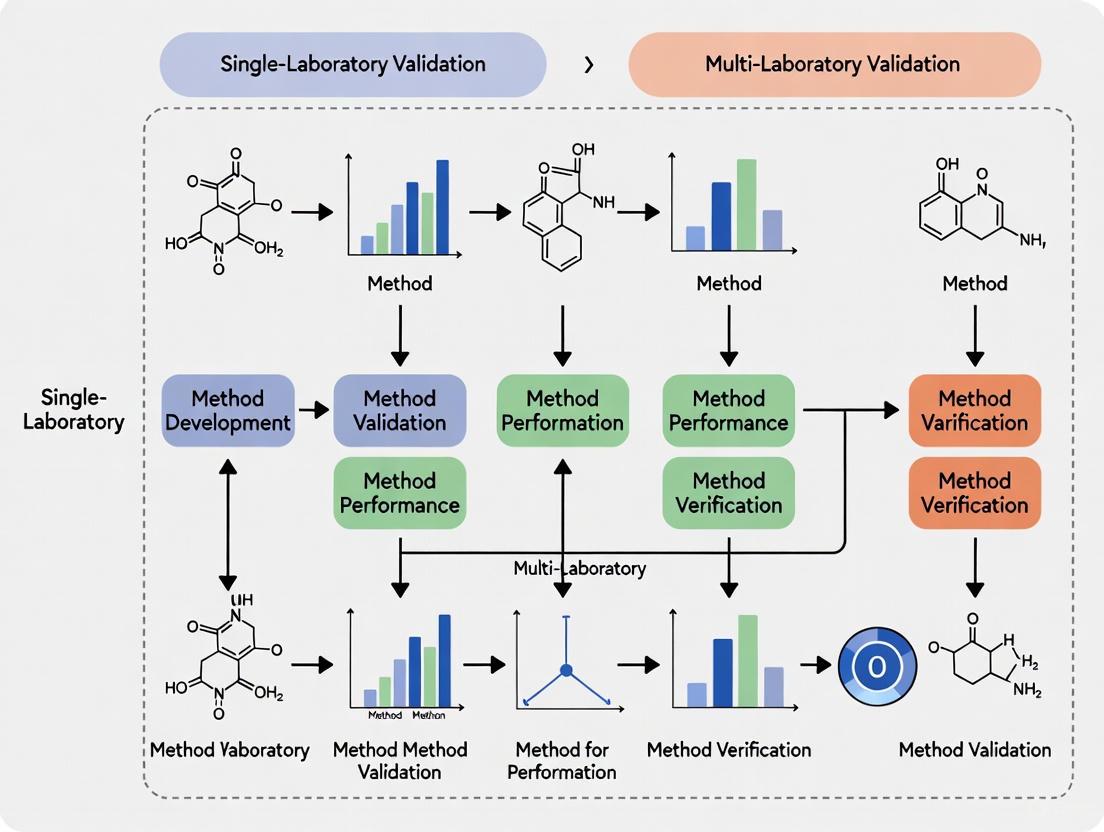
This article provides a comprehensive analysis for researchers and scientists on the critical roles of single-lab and multi-laboratory validation in food safety methods.
Single-Lab vs. Multi-Laboratory Validation: Ensuring Robustness in Food Safety Methods
Abstract
This article provides a comprehensive analysis for researchers and scientists on the critical roles of single-lab and multi-laboratory validation in food safety methods. It explores the foundational principles of method validation as outlined by regulatory bodies like the FDA, detailing the hierarchical validation levels from emergency use to full collaborative studies. The content covers practical applications across chemical and microbiological analyses, addresses common troubleshooting and optimization strategies, and presents a comparative analysis of effect sizes and methodological rigor between single and multi-laboratory studies. By synthesizing current validation guidelines, empirical research, and industry trends, this resource offers a strategic framework for selecting the appropriate validation pathway to ensure method reliability, regulatory compliance, and robust food safety outcomes.
The Validation Hierarchy: From Single-Lab to Multi-Laboratory Standards
Understanding FDA's Method Validation Guidelines and the MDVIP Framework
The Food and Drug Administration (FDA) Foods Program employs a rigorous, structured approach to analytical method validation governed by the Methods Development, Validation, and Implementation Program (MDVIP) Standard Operating Procedures. This framework ensures that FDA laboratories use properly validated methods to support the regulatory mission for food safety and public health protection. The MDVIP commits its members to collaborate on the development, validation, and implementation of analytical methods, with one of its main goals being to ensure the use of properly validated methods, and where feasible, methods that have undergone multi-laboratory validation (MLV) [1].
The MDVIP operates under the oversight of the FDA Foods Program Regulatory Science Steering Committee (RSSC), which includes members from FDA's Center for Food Safety and Applied Nutrition (CFSAN), Office of Regulatory Affairs (ORA), Center for Veterinary Medicine (CVM), and National Center for Toxicological Research (NCTR). The process of generating, validating, and approving methods is managed separately for chemistry and microbiology disciplines through Research Coordination Groups (RCGs) and Method Validation Subcommittees (MVS). The RCGs provide overall leadership and coordination in developing and updating guidelines, while MVSs are responsible for approving validation plans and evaluating validation results [1].
Single-Lab vs. Multi-Laboratory Validation: Key Concepts
Within the MDVIP framework, method validation can proceed through two primary pathways: single laboratory validation (SLV) and multi-laboratory validation (MLV). Each approach serves distinct purposes in the method development and implementation continuum.
Single laboratory validation represents the initial phase where a method is developed and validated within a single laboratory setting. This establishes the foundational performance characteristics of the method before proceeding to broader validation. In contrast, multi-laboratory validation involves multiple laboratories following standardized protocols to evaluate method performance across different environments, equipment, and personnel. The MLV approach provides a more comprehensive assessment of method robustness, transferability, and real-world applicability [1] [2].
The MDVIP explicitly prioritizes multi-laboratory validation where feasible, recognizing that MLV provides superior evidence of method robustness and inter-laboratory reproducibility. This preference stems from the understanding that methods must perform consistently across the FDA's network of laboratories and those of its regulatory partners [1].
Comparative Performance Data: SLV vs. MLV
Case Study: Cyclospora cayetanensis Detection in Fresh Produce
A recent multi-laboratory validation study demonstrates the rigorous evaluation process for methods transitioning from SLV to MLV. Researchers validated a modified real-time PCR assay (Mit1C) for detecting Cyclospora cayetanensis in fresh produce, comparing it against the existing reference method (18S qPCR) across 13 laboratories [2].
Table 1: Performance Comparison of Mit1C qPCR vs. Reference Method in MLV Study
| Sample Type | Detection Rate (Mit1C qPCR) | Detection Rate (18S qPCR) | Relative Level of Detection (RLOD) |
|---|---|---|---|
| Samples with 200 oocysts | 100% (78/78) | 100% (78/78) | 1.00 (reference) |
| Samples with 5 oocysts | 69.23% (99/143) | 61.54% (88/143) | 0.81 (95% CI: 0.600, 1.095) |
| Un-inoculated samples | 1.1% (1/91) | 0% (0/91) | Not applicable |
The MLV study demonstrated that the new Mit1C qPCR method showed statistically equivalent performance to the reference method (since the confidence interval for RLOD included 1), with high specificity (98.9%) and nearly zero between-laboratory variance, confirming its suitability as an effective alternative analytical tool [2].
Case Study: hERG Block Potency Assays
Beyond food safety applications, the principle of multi-laboratory validation extends to pharmaceutical development. A HESI-coordinated study evaluating hERG channel block potency—a critical cardiac safety assessment—across five laboratories revealed important insights about inter-laboratory variability [3].
Table 2: Inter-laboratory Variability in hERG Assay Performance
| Validation Metric | Findings | Implications for Method Validation |
|---|---|---|
| Systematic Differences | One laboratory showed systematic potency differences for first 21 drugs | Highlights need for standardized protocols and cross-lab calibration |
| Within-laboratory Variability | Most retests within 1.6X of initial testing | Establishes baseline for expected variability in validated methods |
| Data Distribution | Natural variability estimated at ~5X | Suggests potency values within 5X should not be considered different |
| Impact of Best Practices | Standardized protocols reduced inter-lab differences | Supports FDA emphasis on standardized approaches in MDVIP |
This study demonstrated that even when following best practices and standardized protocols, systematic differences between laboratories can emerge, emphasizing the importance of MLV studies in understanding methodological limitations and establishing appropriate acceptance criteria [3].
Experimental Protocols for Method Validation Studies
Protocol Design for Multi-Laboratory Validation
Well-designed experimental protocols are essential for generating meaningful validation data. The MLV study for Cyclospora detection employed a rigorous approach where each participating laboratory analyzed twenty-four blind-coded Romaine lettuce DNA test samples. The sample set included unseeded samples, samples seeded with five oocysts, and samples seeded with 200 oocysts, distributed across two testing rounds. This design allowed researchers to assess method sensitivity, specificity, and reproducibility across different contamination levels and laboratory environments [2].
For the hERG assay study, laboratories followed a standardized protocol using the same voltage waveform and solutions to record hERG current at near-physiological temperature. However, certain elements—including cell lines, drug sources, stock preparation procedures, and specific test concentrations—were not standardized, reflecting real-world variations that exist across laboratories. This approach provided valuable insights into how such variables might affect method performance in practice [3].
Statistical Analysis and Acceptance Criteria
Both studies employed robust statistical approaches to evaluate method performance. The Cyclospora detection study calculated relative levels of detection with confidence intervals to determine statistical equivalence between methods. The hERG study used descriptive statistics and meta-analysis to estimate natural data distributions and establish appropriate variability thresholds for considering results statistically different [2] [3].
Establishing predefined acceptance criteria is essential for objective method validation. The finding that hERG block potency values within 5X of each other should not be considered different (as they fall within natural data distribution) provides a scientifically-grounded benchmark for regulatory decision-making [3].
The Research Toolkit: Essential Materials and Reagents
Table 3: Key Research Reagent Solutions for Method Validation Studies
| Reagent/Material | Function in Validation Studies | Application Examples |
|---|---|---|
| Blind-coded test samples | Eliminates testing bias; assesses method accuracy and precision | Cyclospora detection study used 24 blind-coded samples per lab [2] |
| Standardized DNA extracts | Ensures consistency in molecular target availability across laboratories | Romaine lettuce DNA extracts spiked with known oocyst concentrations [2] |
| Reference standards and controls | Provides benchmarks for method comparison and quality control | hERG study used reference drugs with known block potency [3] |
| Cell lines with stable expression | Ensures consistent biological response across test systems | HEK 293 cells expressing hERG1a subunit used in 4 of 5 labs [3] |
| Standardized buffer solutions | Maintains consistent experimental conditions across laboratories | All hERG labs used identical internal/external solutions [3] |
| System suitability standards | Verifies instrument performance meets predefined criteria | PRTC synthetic peptide mixture for LC-MS system checks [4] |
Regulatory Implications and Future Directions
The MDVIP framework continues to evolve with advancements in analytical technologies. Regulatory agencies are increasingly recognizing that advanced analytical methods can sometimes provide more sensitive detection of differences between products than traditional clinical endpoints. For instance, recent FDA draft guidance on biosimilars proposes that comparative efficacy studies "may not be necessary" for certain therapeutic protein products when advanced analytical technologies can structurally characterize products with high specificity and sensitivity [5].
This evolving regulatory landscape emphasizes the growing importance of robust method validation frameworks like the MDVIP. As analytical technologies continue to advance—including increased automation and artificial intelligence in laboratories—the principles of single-lab and multi-laboratory validation will remain foundational for establishing method reliability and ensuring regulatory acceptance [6].
In the field of food science and analytical chemistry, the reliability of analytical methods is paramount for ensuring food safety, quality, and regulatory compliance. Method validation demonstrates that an analytical procedure is suitable for its intended purpose and generates reliable results. Within this framework, validation activities occur across distinct tiers, each with varying levels of rigor, scope, and applicability. These tiers can be conceptualized as single-laboratory validation, multi-laboratory validation, and scenarios resembling emergency validation, each addressing different needs within the research and regulatory landscape.
Single-laboratory validation, often referred to as in-house validation, represents the foundational tier where a laboratory establishes the performance characteristics of a method within its own environment. This process involves rigorous testing of parameters such as accuracy, precision, specificity, and sensitivity to ensure the method produces trustworthy results for its intended application. In contrast, multi-laboratory validation, also known as collaborative study, represents a more comprehensive tier where multiple independent laboratories evaluate the same method using standardized protocols to establish its reproducibility across different environments, operators, and equipment. This tier provides a higher level of confidence in the method's robustness and transferability. In specific circumstances, such as responding to emerging food safety threats or analyzing unique sample matrices, modified validation approaches may be necessary, creating a tier that functions similarly to an emergency validation level, though this terminology is not formally standardized in the literature.
Comparative Analysis of Validation Tiers
Performance and Scope Comparison
The choice between single-lab and multi-laboratory validation strategies involves clear trade-offs between practicality, resource allocation, and the required level of evidence for method acceptability. The table below summarizes the core characteristics of each tier, illustrating their distinct roles within method validation.
Table 1: Comparative Analysis of Single-Lab and Multi-Laboratory Validation Tiers
| Comparison Factor | Single-Laboratory Validation | Multi-Laboratory Validation |
|---|---|---|
| Primary Objective | To confirm a method performs as expected under specific laboratory conditions [7]. | To establish the method's reproducibility and ruggedness across different environments [8] [9]. |
| Typical Scope | Limited testing of critical parameters like accuracy, precision, and detection limits [7]. | Comprehensive assessment of reproducibility (often reported as relative reproducibility standard deviation) and trueness (bias) across a defined dynamic range [8]. |
| Resource Requirements | Lower cost and time requirements; can be completed in days to weeks [7]. | High resource intensity; requires significant coordination, time, and financial investment [10]. |
| Regulatory Standing | Often sufficient for in-house use and when adopting standard methods; required for ISO/IEC 17025 accreditation [7]. | Frequently required for official standard methods and regulatory acceptance; provides higher confidence for method standardization [8] [10]. |
| Key Performance Metrics | Accuracy, precision, limit of detection, linearity, robustness [7] [10]. | Reproducibility precision, trueness (bias), collaborative study success rates [8]. |
| Example Performance Data | (Varies by method and laboratory) | Relative reproducibility standard deviation of 2.1% to 16.5% for a digital PCR method; bias well below 25% across the dynamic range [8]. |
Experimental Data from Validation Studies
Quantitative data from published studies highlights the performance achievable through rigorous multi-laboratory validation. A study on a droplet digital PCR (ddPCR) method for analyzing genetically modified organisms (GMO) in food and feed demonstrated the high reproducibility attainable through collaborative studies. The method showed relative repeatability standard deviations from 1.8% to 15.7%, while the relative reproducibility standard deviation between different labs was found to be between 2.1% and 16.5% over the dynamic range studied. Furthermore, the relative bias of the ddPCR methods was well below 25% across the entire dynamic range, satisfying the acceptance criteria set by EU and international guidelines like the Codex Committee on Methods of Analysis and Sampling (CCMAS) [8].
Another multi-laboratory assessment in proteomics using SWATH-mass spectrometry demonstrated that this method could consistently detect and reproducibly quantify over 4000 proteins from cell line samples across 11 participating laboratories worldwide. The study concluded that the sensitivity, dynamic range, and reproducibility established with the method were uniformly achieved across all sites, proving that acquiring reproducible quantitative data by multiple labs is achievable with this technology [9]. These examples underscore the level of confidence that multi-laboratory validation provides.
Experimental Protocols for Key Validation Tiers
Single-Laboratory (In-House) Validation Protocol
Single-laboratory validation is a systematic process that evaluates critical method performance parameters to ensure fitness for purpose. The protocol involves a sequence of experiments designed to characterize the method's behavior under the laboratory's specific conditions.
Table 2: Core Experimental Protocol for Single-Laboratory Validation
| Validation Parameter | Experimental Methodology | Data Analysis & Output |
|---|---|---|
| Accuracy/Trueness | Analysis of certified reference materials (CRMs) or spiked samples with known analyte concentrations [10]. | Calculation of recovery percentage (%) or bias between measured and known values [10]. |
| Precision | Repeated analysis (n≥6) of homogeneous samples at multiple concentration levels within the same day (repeatability) and over different days (intermediate precision) [10]. | Calculation of relative standard deviation (RSD, %) for repeatability and intermediate precision [10]. |
| Linearity & Range | Analysis of a series of standard solutions or spiked samples across the claimed analytical range (e.g., 5-7 concentration levels) [10]. | Linear regression analysis; calculation of correlation coefficient (R²) and residual plots [10]. |
| Limit of Detection (LOD) / Limit of Quantification (LOQ) | Analysis of low-level analyte samples and blank matrices [7]. | LOD: 3.3 × (Standard Deviation of blank / Slope of calibration curve). LOQ: 10 × (Standard Deviation of blank / Slope of calibration curve) [7]. |
| Robustness | Deliberate, small variations of key method parameters (e.g., temperature, pH, flow rate) to assess method resilience [10]. | Observation of the impact on results; establishes acceptable operating ranges for each parameter [10]. |
The following workflow diagram illustrates the sequential process of a single-laboratory validation, from planning to final report.
Multi-Laboratory (Collaborative) Validation Protocol
Multi-laboratory validation is a complex, highly structured process designed to quantify a method's inter-laboratory reproducibility. The protocol is typically organized by a coordinating laboratory and follows international standards.
- Study Organization and Material Preparation: A coordinating laboratory designs the study, recruits participating laboratories (typically 8-15), and prepares homogeneous, stable test samples with known or assigned values. These samples should cover the method's specified concentration range and represent relevant sample matrices [8] [10].
- Distribution and Standardization: The sample sets, along with a detailed, standardized experimental protocol, are distributed to all participants. The protocol must be unambiguous, specifying every detail from sample preparation to data reporting format to minimize variability from procedural differences [8].
- Blinded Analysis: Participating laboratories analyze the samples in a randomized order under typical laboratory conditions (within the protocol's constraints), often including replicates. The analyses are performed over different days to capture realistic inter-laboratory variation [9].
- Data Collection and Statistical Analysis: The coordinating laboratory collects all raw data and results. Statistical analysis is performed according to established international standards (e.g., ISO 5725), typically involving the calculation of:
- Repeatability Standard Deviation (sr): Variability within a single laboratory.
- Reproducibility Standard Deviation (sR): Variability between different laboratories.
- Trueness (Bias): Difference between the overall mean and the accepted reference value [8].
- Reporting and Evaluation: The final report includes all statistical outcomes, an assessment of the method's performance against pre-defined fitness-for-purpose criteria, and a statement on the method's suitability for standardization [10].
The logical relationship and workflow of a multi-laboratory study are summarized in the diagram below.
The Scientist's Toolkit: Essential Research Reagent Solutions
The execution of robust validation studies, particularly in food analysis, relies on a set of essential reagents and materials. The following table details key components of the research toolkit for methods like digital PCR in GMO analysis.
Table 3: Key Research Reagent Solutions for Food Method Validation
| Reagent/Material | Function in Validation | Application Example |
|---|---|---|
| Certified Reference Materials (CRMs) | Provide a known, traceable analyte concentration to establish method accuracy (trueness) and evaluate bias [10]. | Quantification of GMO content in food samples; calibration of analytical instruments [8]. |
| DNA Extraction Kits | Isolate and purify target nucleic acids from complex food matrices. The efficiency and purity of extraction directly impact method accuracy and precision [8]. | Preparation of template DNA from processed food products for ddPCR or qPCR analysis of GMOs [8]. |
| Stable Isotope-Labeled Standards | Act as internal standards to correct for analyte loss during sample preparation and matrix effects, improving quantification accuracy [9]. | Used in proteomics (e.g., SWATH-MS) and increasingly in LC-MS/MS for small molecule analysis in food [9]. |
| Synthetic Oligonucleotides | Serve as positive controls, calibration standards, and for constructing dilution series to determine limits of detection and quantification [8]. | In ddPCR validation, used to create a defined dynamic range from 0.012 to 10,000 fmol on column [8]. |
| Proficiency Test Materials | Allow a laboratory to assess its performance by comparing its results with assigned values or results from other laboratories. | Used for ongoing verification of laboratory competency after a method has been validated [10]. |
The structured tiers of method validation—single-lab and multi-laboratory—serve complementary yet distinct roles in advancing reliable food methods research. Single-laboratory validation provides a time-efficient and cost-effective path for establishing method fitness in a specific setting, making it ideal for method development, transfer, and routine laboratory accreditation [7]. In contrast, multi-laboratory validation delivers a comprehensive assessment of reproducibility, generating robust statistical data on inter-laboratory performance that is essential for formal method standardization and widespread regulatory acceptance [8] [10].
The choice between these tiers is not a matter of superiority but of strategic alignment with the method's intended application. For novel methods or those intended for use in a single facility, a full single-laboratory validation is both necessary and sufficient. However, for methods destined to become official standards or for use in widespread market control, the resource investment of a multi-laboratory collaborative study is indispensable. As demonstrated by validation studies in digital PCR and proteomics, this top tier of validation provides the highest level of confidence that a method will perform reliably, wherever it is applied, ensuring the integrity and reproducibility of data critical to food safety and public health.
In the rigorously controlled realms of food safety and analytical science, the validity of a test method is paramount. Regulatory standards established by bodies like AOAC INTERNATIONAL and the U.S. Food and Drug Administration (FDA) provide the critical framework for ensuring that analytical methods are reliable, reproducible, and fit for purpose. A central and evolving debate in this field concerns the level of validation necessary to prove this reliability, pitching the expediency of single-laboratory validation against the comprehensive generalizability of multi-laboratory validation. This guide objectively compares these two validation pathways within the context of global compliance requirements, providing researchers and scientists with the data and protocols needed to navigate this complex landscape.
Understanding the Regulatory Landscape
The ecosystem of food testing method validation is supported by prominent organizations that set and enforce standards accepted by regulatory bodies worldwide.
AOAC INTERNATIONAL: An independent, non-profit scientific association that develops validated test methods through its Official Methods of AnalysisSM (OMA) and Performance Tested MethodsSM (PTM) programs [11]. AOAC methods are often adopted by regulatory agencies. A key function is the administration of Proficiency Testing (PT) Programs, which allow laboratories to prove their competency by analyzing provided samples for parameters like pathogens, nutrients, or pesticides and submitting results for evaluation [12].
U.S. Food and Drug Administration (FDA): A federal agency that protects public health by ensuring the safety of the food supply. The FDA's Bacteriological Analytical Manual (BAM) is a key resource, presenting the agency's preferred laboratory procedures for the microbiological analysis of foods and cosmetics [13]. The FDA also provides guidelines for the validation of analytical methods for the detection of microbial pathogens [13].
Collaboration between these entities strengthens the overall system. For instance, AOAC and the USDA Food Safety and Inspection Service (FSIS) have a Memorandum of Understanding to collaborate on method validation, ensuring regulatory testing is "backed by science, vigilance, and trusted methods" [11].
Single-Lab vs. Multi-Laboratory Validation: A Conceptual Framework
The choice between single-lab and multi-laboratory validation strategies has profound implications for the perceived rigor and applicability of a method's results.
Table 1: Core Concepts of Validation Approaches
| Feature | Single-Laboratory Validation | Multi-Laboratory Validation |
|---|---|---|
| Definition | Method validation is conducted within a single laboratory, using its equipment, personnel, and protocols. | Method validation is conducted concurrently across multiple, independent laboratories. |
| Primary Goal | To demonstrate that a method is fit for a specific purpose under controlled, internal conditions. | To demonstrate the method's ruggedness and reproducibility across different environments, operators, and equipment. |
| Key Advantage | Efficiency in terms of cost, time, and resource allocation; ideal for initial method development. | Generalizability; provides robust evidence that the method will perform reliably in other laboratories, a key requirement for regulatory acceptance. |
| Limitation | Results may be less transferable; the method's performance may be dependent on lab-specific conditions. | More resource-intensive, complex to organize, and time-consuming. |
A systematic assessment of preclinical studies highlights these differences, noting that multilaboratory studies "adhered to practices that reduce the risk of bias significantly more often than single lab studies" [14]. Furthermore, this rigor impacts outcomes, with multi-laboratory studies demonstrating significantly smaller effect sizes than single-lab studies, a trend well-recognized in clinical research where multicenter trials provide more conservative and reliable effect estimates [14].
Experimental Data and Performance Comparison
Quantitative data from validation studies provides clear evidence of the performance characteristics of each approach.
The following diagram illustrates the typical workflow for a multi-laboratory validation study, highlighting the phases that ensure robustness and reproducibility.
Diagram 1: Multi-Laboratory Validation Workflow
Case Study: Validation of a Digital PCR Method
A collaborative study validated a droplet digital PCR (dPCR) method for quantifying genetically modified organisms (GMOs) in food and feed [8]. The study assessed key performance parameters, including trueness (bias) and precision (repeatability and reproducibility), across its dynamic range.
Table 2: Performance Data from dPCR Multi-Laboratory Validation [8]
| Target & Format | Concentration Level | Relative Bias (%) | Repeatability Standard Deviation (SR, %) | Reproducibility Standard Deviation (SR, %) |
|---|---|---|---|---|
| MON810 (Duplex) | Across Dynamic Range | Well below 25% | 1.8% to 15.7% | 2.1% to 16.5% |
The data demonstrated that the dPCR method met the strict acceptance criteria set by EU and international guidance, such as the Codex Alimentarius [8]. The study also investigated factors influencing variability, finding that the DNA extraction step added only a limited contribution, while lower target ingredient content decreased precision, though it remained within acceptable limits [8].
Detailed Experimental Protocols
For scientists designing validation studies, understanding the core protocols is essential.
Protocol for a Multi-Laboratory Validation Study
The following steps outline a standardized protocol based on international standards [8] [14]:
- Protocol Development: A detailed, standardized experimental protocol is developed, specifying every aspect of the analysis, including sample preparation, DNA extraction methods (if applicable), equipment settings, and data analysis procedures.
- Participant Selection: Multiple independent laboratories (a median of four, according to one review [14]) are selected to participate.
- Sample Distribution: Identical sets of blinded samples, often including controls and samples at various concentration levels across the dynamic range, are distributed to all participating laboratories.
- Concurrent Analysis: Each laboratory performs the analysis according to the shared protocol within a defined timeframe.
- Data Submission: Laboratories submit their raw and processed data to a central coordinating body for statistical analysis.
- Statistical Evaluation: The centralized team calculates performance metrics like repeatability standard deviation (within-lab precision) and reproducibility standard deviation (between-lab precision), and assesses trueness (bias).
Protocol for a Single-Laboratory Validation
A robust single-laboratory validation should assess the same core performance characteristics as a collaborative study, using the following approach:
- Specificity: Demonstrate the method's ability to measure the analyte accurately in the presence of other components.
- Linearity and Dynamic Range: Establish the method's response across a range of analyte concentrations.
- Accuracy (Trueness): Assess via spike-recovery experiments, where a known amount of the analyte is added to the sample matrix and the percentage recovery is calculated.
- Precision: Determine repeatability by analyzing multiple replicates of the same sample within the same run, on the same day, with the same analyst and equipment.
- Limit of Detection (LOD) and Quantification (LOQ): Determine the lowest amount of analyte that can be detected and reliably quantified.
The Scientist's Toolkit: Essential Research Reagent Solutions
The following table details key materials and reagents essential for conducting method validation studies, particularly in food and microbiological analysis.
Table 3: Essential Reagents and Materials for Validation Studies
| Item | Function in Validation | Example Use Cases |
|---|---|---|
| Proficiency Testing (PT) Samples | Commercially available samples with known or assigned values used to objectively assess a laboratory's analytical performance and comparability to other labs [12]. | AOAC's PT programs provide samples for pathogens, nutrients, pesticides, and more. Labs analyze them and report results for external evaluation [12]. |
| Certified Reference Materials (CRMs) | Matrix-based materials with certified values for specific analytes, used to establish method accuracy and for calibration. | Used in spike-recovery experiments to determine trueness in both single and multi-laboratory studies. |
| Selective Culture Media & Agar Plates | Used to isolate, identify, and enumerate specific microorganisms in food samples. | Essential for cultural methods described in the FDA's BAM for pathogens like Salmonella, Listeria, and E. coli [13]. |
| PCR Reagents & Kits | Kits containing enzymes, primers, and probes for the detection and quantification of specific DNA targets. | Used in modern methods like the dPCR validation for GMOs [8] and real-time PCR for Cyclospora in the BAM [13]. |
| DNA Extraction Kits | Standardized kits for isolating high-quality DNA from complex food matrices, critical for molecular methods. | The performance of these kits can be a variable tested in validation studies, as noted in the dPCR study [8]. |
Pathways to Regulatory Compliance and Adoption
The journey of a method from development to regulatory acceptance follows a logical pathway, influenced heavily by the type of validation it undergoes.
Diagram 2: Pathway from Method Development to Regulatory Acceptance
As shown in Diagram 2, multi-laboratory validation is the critical step for methods seeking broad regulatory acceptance. Once methods are validated through programs like the AOAC OMA or PTM, they are recognized as "fit for purpose" and can be adopted by agencies like the USDA FSIS for regulatory testing [11]. The FDA's BAM also directs users to AOAC Official Methods for analyzing organisms or toxins not covered in its manual [13].
The choice between single-lab and multi-laboratory validation is not a matter of which is inherently superior, but which is fit for purpose. Single-lab validation offers a vital and efficient first step for method development and internal verification. However, the empirical evidence is clear: multi-laboratory validation produces more generalizable, robust, and conservative estimates of a method's performance, making it the undisputed gold standard for methods seeking global regulatory compliance. For researchers and drug development professionals, designing a validation strategy that culminates in a successful multi-laboratory study is the most reliable pathway to demonstrating scientific rigor and ensuring public health protection.
Method validation serves as the cornerstone of reliable food safety testing, public health protection, and sound regulatory decisions. It provides the critical evidence that analytical methods perform as intended for their specific purpose, ensuring that measurements of contaminants, pathogens, nutrients, and genetically modified organisms (GMOs) can be trusted for decision-making. In food safety and public health contexts, the choice between single-laboratory and multi-laboratory validation approaches carries significant implications for method reliability, reproducibility, and ultimate regulatory acceptance. Single-laboratory validation (SLV) represents the essential first step where a method is developed and characterized within one laboratory, while multi-laboratory validation (MLV) rigorously tests the method across multiple independent facilities to establish its generalizability and robustness under different conditions, operators, and equipment [8] [1].
The validation paradigm in food science directly impacts public health outcomes. Regulatory agencies such as the FDA Foods Program explicitly emphasize that "properly validated methods" are fundamental to their regulatory mission, with a preference for methods that have undergone multi-laboratory validation where feasible [1]. This preference stems from the demonstrated capacity of MLV to identify limitations and biases that may not be apparent in single-laboratory studies, thereby providing greater confidence in methods used to detect foodborne pathogens, allergens, chemical contaminants, and other public health risks. The rigorous evaluation of trueness, precision, selectivity, and robustness through systematic validation protocols ensures that food safety testing produces consistent, reliable results across the diverse laboratory landscape responsible for protecting the food supply [8].
Single vs. Multi-Laboratory Validation: A Systematic Comparison
Performance Metrics and Experimental Evidence
Table 1: Quantitative Comparison of Single vs. Multi-Laboratory Validation Performance
| Performance Characteristic | Single-Laboratory Validation | Multi-Laboratory Validation | Regulatory Acceptance Criteria |
|---|---|---|---|
| Trueness (Relative Bias) | Variable; lab-dependent | Consistently <25% for dPCR GMO methods [8] | Below 25% threshold [8] |
| Repeatability Precision | Optimized under ideal conditions | RSD: 1.8%-15.7% (dPCR for MON810) [8] | Meets international guidelines [8] |
| Reproducibility Precision | Not assessed | RSD: 2.1%-16.5% (dPCR for MON810) [8] | Meets EU/Codex requirements [8] |
| Risk of Bias | Higher risk of methodological shortcomings [14] | Significantly lower risk of bias [14] | Reduced bias per SYRCLE tool [14] |
| Effect Size Estimation | Often overestimates effects [14] | More accurate, realistic effect sizes [14] | Closer to true biological effect |
| Generalizability | Limited to specific conditions | Tested across diverse environments [14] | Required for broad implementation |
Table 2: Practical Considerations for Validation Approaches
| Consideration | Single-Laboratory Validation | Multi-Laboratory Validation |
|---|---|---|
| Time Requirements | Shorter implementation timeline | Extended timeline for coordination |
| Financial Cost | Lower direct costs | Higher costs but reduced long-term waste [14] |
| Infrastructure Needs | Minimal coordination requirements | Significant coordination infrastructure |
| Sample Size | Median: 19 animals (preclinical) [14] | Median: 111 animals (preclinical) [14] |
| Regulatory Standing | Preliminary assessment | Preferred for definitive regulatory decisions [1] |
| Error Detection | Limited to internal error sources | Identifies inter-laboratory variation [8] |
Empirical evidence demonstrates systematic differences between single and multi-laboratory study outcomes. A comprehensive systematic assessment of preclinical multilaboratory studies revealed that MLV demonstrates significantly smaller effect sizes than single lab studies (Difference in Standardized Mean Differences: 0.72 [95% CI: 0.43-1.0]), reflecting more realistic treatment effect estimates [14]. This trend mirrors well-established patterns in clinical research, where multicenter trials typically produce more conservative and generalizable effect estimates than single-center studies.
The methodological rigor in MLV also appears superior. The same systematic review found that multilaboratory studies "adhered to practices that reduce the risk of bias significantly more often than single lab studies," including more robust blinding procedures, allocation concealment, and statistical planning [14]. This enhanced rigor directly addresses recognized reproducibility challenges in laboratory science and provides regulatory agencies with higher confidence in the resulting data.
Experimental Protocols for Validation Studies
Single-Laboratory Validation Protocol typically follows a structured approach assessing fundamental performance parameters:
- Precision Evaluation: Repeated analysis of homogeneous samples to determine method repeatability under stable conditions [8]
- Trueness Assessment: Analysis of certified reference materials or comparison with reference methods to establish accuracy [15]
- Selectivity/Specificity: Demonstration that the method accurately measures the analyte in the presence of potential interferents
- Linearity and Dynamic Range: Establishment of the concentration interval over which the method provides proportional results [8]
- Limit of Detection/Quantification: Determination of the lowest analyte concentration that can be reliably detected and quantified [15]
- Robustness Testing: Deliberate variations of method parameters to evaluate method resilience to minor changes [15]
Multi-Laboratory Validation Protocol expands upon SLV through collaborative study:
- Protocol Harmonization: Development of standardized experimental protocols, measurement procedures, and data reporting formats across participating laboratories [8] [14]
- Sample Homogenization and Distribution: Preparation of identical, homogeneous test materials with centralized distribution to all participants [8]
- Blinded Analysis: Independent analysis of coded samples without knowledge of expected values to prevent conscious or unconscious bias [14]
- Data Collection and Statistical Analysis: Centralized collection of raw data with statistical analysis using internationally accepted methods (e.g., ISO 5725) [8]
- Outlier Assessment: Application of standardized statistical tests (e.g., Cochran's test, Grubbs' test) to identify between-laboratory outliers [8]
- Precision Calculation: Separate calculation of repeatability standard deviation (within-laboratory precision) and reproducibility standard deviation (between-laboratory precision) [8]
Impact on Food Safety and Public Health
Enhanced Detection Capabilities
The rigorous evaluation of methods through multi-laboratory validation directly strengthens food safety systems by ensuring reliable detection of hazards. For instance, validated droplet digital PCR (dPCR) methods for detecting genetically modified organisms (GMOs) have demonstrated exceptional precision in collaborative trials, with relative repeatability standard deviations from 1.8% to 15.7% and relative reproducibility standard deviation between 2.1% and 16.5% over the dynamic range studied [8]. This level of confirmed performance gives regulatory agencies confidence in enforcement testing for GMO labeling requirements and environmental safety assessments.
Similarly, validation protocols for kinetic models in food science ensure accurate prediction of microbial growth, toxin formation, and nutrient degradation – critical factors in determining food shelf life and safety. Proper validation must assess both residual analysis (differences between observed and predicted values) and parameter uncertainty relative to data uncertainty, as the latter directly influences model predictions for food safety decisions [15]. Without appropriate validation, models may provide misleading conclusions that compromise public health protection.
Regulatory Compliance and Harmonization
Table 3: Regulatory Validation Requirements Across Jurisdictions
| Regulatory Body | Validation Approach | Key Performance Criteria | Reference Method |
|---|---|---|---|
| European Union (GMO Analysis) | SLV + MLV preferred | Trueness, precision, dynamic range, compliance with EU performance requirements [8] | Real-time PCR/dPCR methods |
| FDA Foods Program | MLV preferred where feasible | Properly validated methods supporting regulatory mission [1] | Chemistry, microbiology, DNA-based methods |
| Codex Alimentarius | International harmonization | Method performance parameters across collaborative studies [8] | Internationally recognized standards |
| Academic Research | Increasing MLV emphasis | Reduced risk of bias, generalizability of findings [14] | Systematic assessment guidelines |
Validation serves as the bridge between scientific innovation and regulatory implementation. The FDA Foods Program operates under a Methods Development, Validation, and Implementation Program (MDVIP) that commits its members "to collaborate on the development, validation, and implementation of analytical methods to support the Foods Program regulatory mission" [1]. This structured approach ensures that methods used for enforcement activities have demonstrated reliability through proper validation, with separate validation guidelines established for chemical, microbiological, and DNA-based methods.
Internationally, validation against recognized standards enables harmonization of food safety measures and trade facilitation. Methods that demonstrate compliance with EU and Codex Committee on Methods of Analysis and Sampling (CCMAS) performance requirements through multi-laboratory validation [8] gain broader international acceptance, reducing technical barriers to trade while maintaining high levels of consumer protection.
Visualization of Validation Pathways and Methodological Rigor
Validation Decision Pathway
Methodological Rigor Comparison
The Scientist's Toolkit: Essential Research Reagent Solutions
Table 4: Essential Research Reagents and Materials for Validation Studies
| Reagent/Material | Function in Validation | Application Examples | Critical Quality Parameters |
|---|---|---|---|
| Certified Reference Materials (CRMs) | Establish trueness and accuracy through analysis of materials with known analyte concentrations | GMO quantification, nutrient analysis, contaminant testing [8] | Certified uncertainty, stability, commutability with test samples |
| DNA Extraction Kits | Isolate high-quality DNA for molecular methods; minimal variation between laboratories affects final results | dPCR for GMO detection, pathogen identification [8] | Yield, purity, inhibition removal, consistency across batches |
| Digital PCR Reagents | Enable absolute quantification of nucleic acid targets without standard curves | GMO quantification in food and feed [8] | Polymerase fidelity, probe specificity, minimal batch-to-batch variation |
| Enzyme Immunoassay Kits | Detect and quantify proteins, allergens, or contaminants through antibody-based methods | Allergen testing, mycotoxin detection, pathogen identification | Antibody specificity, minimal cross-reactivity, consistent calibration |
| Microbiological Media | Support growth of target microorganisms for cultural methods | Pathogen detection, spoilage organism enumeration, probiotic quantification | Selectivity, productivity, stability, composition consistency |
| Kinetic Model Calibrants | Provide reference points for validating predictive models of microbial growth or chemical degradation | Shelf-life prediction, safety assessment, quality optimization [15] | Purity, stability, relevance to food matrix |
The evidence clearly demonstrates that validation approach selection has profound implications for food safety, public health protection, and regulatory decision-making. While single-laboratory validation provides essential preliminary method characterization, multi-laboratory validation offers superior assessment of method robustness, generalizability, and real-world performance. The demonstrated tendency of MLV to produce more realistic effect estimates and adhere more rigorously to bias-reduction practices makes it particularly valuable for high-stakes applications where erroneous results could compromise public health or economic interests.
The future of food safety testing will likely see increased emphasis on multi-laboratory validation approaches, particularly as global harmonization of analytical methods facilitates trade while protecting consumers. Emerging technologies, including digital PCR and sophisticated kinetic modeling, will require robust validation protocols to establish their reliability for regulatory applications. By embracing rigorous validation frameworks that include multi-laboratory assessment where appropriate, the scientific community can strengthen the foundation upon which food safety systems and public health protections are built.
Practical Applications: Implementing Validation in Chemical and Microbiological Testing
{ article }
Chemical Method Validation: LC-MS/MS for Veterinary Drugs, Mycotoxins, and PFAS
The accurate measurement of chemical contaminants in food, such as veterinary drugs (VDs), mycotoxins, and per- and polyfluoroalkyl substances (PFAS), is a cornerstone of food safety and public health protection. Liquid chromatography-tandem mass spectrometry (LC-MS/MS) has emerged as a powerful technique for the simultaneous analysis of these diverse compounds. However, the reliability of any analytical method hinges on the rigor of its validation. A pivotal, yet often overlooked, distinction in validation practices is the approach between single-laboratory validation (SLV) and multi-laboratory validation (MLV). This guide objectively compares the performance of analytical methods for VDs, mycotoxins, and PFAS within the context of this broader thesis, synthesizing current experimental data to illustrate how validation design impacts the robustness and generalizability of results for researchers and drug development professionals.
The choice between SLV and MLV represents a fundamental trade-off between practicality and generalizability. SLV involves the assessment of method performance parameters within a single facility. While more accessible and cost-effective, its findings may be influenced by laboratory-specific conditions, reagents, and equipment. In contrast, MLV, or collaborative study, formally evaluates the method across multiple independent laboratories. This design inherently tests the method's robustness against variations in operators, instruments, and environments, providing a more realistic estimate of its real-world performance [8] [14].
A systematic assessment of preclinical studies has quantitatively demonstrated that multilaboratory studies consistently demonstrate smaller effect sizes and adhere to practices that reduce the risk of bias significantly more often than single-lab studies [14]. This trend mirrors long-standing observations in clinical research, where multicenter trials are valued for their methodological rigor and more conservative effect estimates. For food safety methods, which form the basis for regulatory compliance and public health decisions, the enhanced credibility and transferability offered by MLV are of paramount importance.
Comparative Performance Data for Contaminant Classes
The following tables summarize key validation parameters from recent studies for multi-residue LC-MS/MS methods, illustrating the performance achievable for each class of contaminant.
Table 1: Validation Data for a Multi-Residue LC-MS/MS Method for Veterinary Drugs and Pesticides in Urine
| Parameter | Veterinary Drugs & Pesticides (72 analytes) [16] | Expanded Exposome Method (120+ analytes) [17] |
|---|---|---|
| Matrix | Bovine Urine | Human Urine |
| Linearity (R²) | 0.991 – 0.999 | Not Specified |
| LOD Range | 0.01 – 2.71 µg/L | Median: 0.10 ng/mL |
| LOQ Range | 0.05 – 7.52 µg/L | Median: 0.31 ng/mL |
| Accuracy (Recovery %) | 71.0 – 117.0% | 81 – 120% |
| Precision (CV %) | < 21.38% | < 20% |
Table 2: Validation Data for an LC-MS/MS Method for PFAS in Food
| Parameter | PFAS in Salmon (16 analytes) [18] |
|---|---|
| Matrix | Salmon |
| Method Basis | FDA Method C-010.02 |
| Linearity (R²) | ≥ 0.99 (for 15/16 analytes) |
| LOQ | 0.02 ng/g (in food) |
| Accuracy (Recovery %) | Within 40-120% (FDA acceptable range) |
| Precision (RSD %) | < 22% |
The data in Table 1 demonstrates that well-optimized SLV methods can achieve excellent performance for complex mixtures. The study on bovine urine, validating 72 analytes, met the stringent criteria of Regulation 2021/808/EC [16]. Similarly, the "exposome" method for human urine shows that SLV can be successfully scaled to cover over 120 diverse xenobiotics with high sensitivity and accuracy [17]. Table 2 shows the application of a validated SLV method for PFAS in a challenging food matrix, salmon, achieving the low detection limits required for modern food safety monitoring [18].
However, these single-lab performance characteristics, while impressive, do not guarantee the same results in other laboratories. As highlighted in a collaborative study on digital PCR methods, MLV assesses trueness and precision across different sites, providing metrics like reproducibility standard deviation that are crucial for understanding method transferability [8].
Detailed Experimental Protocols
Multi-Residue Analysis of Veterinary Drugs and Pesticides
A 2023 study developed a quantitative LC-MS/MS method for 72 residues (42 VDs, 28 pesticides, 2 mycotoxins) in bovine urine, following Regulation 2021/808/EC [16].
- Sample Preparation: The optimal protocol involved enzymatic hydrolysis using β-glucuronidase to free conjugated analytes, followed by a solid-phase extraction (SPE) clean-up using OASIS HLB cartridges.
- LC-MS/MS Analysis: Analysis was performed in both positive and negative ionization modes with multiple reaction monitoring (MRM). The total run time was 12 minutes.
- Validation Protocol: The method was validated for linearity, LOD, LOQ, decision limit (CCα), detection capability (CCβ), accuracy, and precision. The use of stable isotopically labelled internal standards for each analyte was critical for achieving accurate quantification and compensating for matrix effects [16].
Expanding the Exposome with Veterinary Drugs and Pesticides
A 2024 study scaled up a targeted human biomonitoring method by incorporating over 40 VDs/antibiotics and pesticides into an existing method for >80 xenobiotics [17].
- Sample Preparation: A generic sample preparation workflow was investigated to determine its suitability for the new analytes.
- LC-MS/MS Analysis: The expanded method was designed to detect and quantify more than 120 analytes in a single analytical run.
- Validation Protocol: The method underwent in-house SLV, evaluating specificity, matrix effects, linearity, intra-/inter-day precision, accuracy, and limits of quantification. Most added analytes showed satisfactory recovery (81–120%) and acceptable precision (RSD < 20%). Matrix effects for most new analytes were within 50–140% [17].
PFAS Analysis in Food Using QuEChERS
An application note based on FDA Method C-010.02 detailed the analysis of 16 PFAS in salmon [18].
- Sample Preparation: The method used a modified QuEChERS (Quick, Easy, Cheap, Effective, Rugged, and Safe) procedure. A 5 g homogenized salmon sample was spiked with internal standards, extracted with acidified acetonitrile, and partitioned using salts. A dual clean-up step was employed: first with a dispersive SPE (dSPE) tube (PSA/ENVI-Carb), followed by a more specific weak anion exchange (WAX) SPE cartridge.
- LC-MS/MS Analysis: To prevent background contamination, a delay column was installed in the LC system. Analysis used a C-18 analytical column and a triple quadrupole mass spectrometer.
- Validation Protocol: The method was validated at three fortification levels (0.05, 0.5, and 2.0 ng/g). Recovery and precision (%RSD) were calculated and shown to meet FDA guidelines [18].
Visualizing the Validation Workflow
The following diagram illustrates the critical steps in developing and validating a multi-residue LC-MS/MS method, from initial setup to the pivotal decision between single and multi-laboratory validation.
The Scientist's Toolkit: Essential Research Reagents and Materials
Table 3: Key Reagents and Materials for Multi-Residue LC-MS/MS Analysis
| Item | Function / Application | Example from Literature |
|---|---|---|
| Stable Isotopically Labelled Internal Standards (SIL-IS) | Correct for analyte loss during preparation and quantify accurately by compensating for matrix effects and signal suppression. | Used for all 72 analytes in the bovine urine method [16]. |
| Solid-Phase Extraction (SPE) Cartridges | Clean-up and concentrate samples to remove interfering matrix components and enhance sensitivity. | OASIS HLB cartridges for veterinary drugs [16]; ENVI-WAX for PFAS clean-up [18]. |
| QuEChERS Kits | Provide a streamlined, efficient protocol for extracting a wide range of analytes from food matrices. | Used with salt mixtures and dSPE clean-up for PFAS in salmon [18]. |
| LC Delay Column | Placed before the autosampler to trap PFAS background contamination leaching from the LC system itself. | Critical for achieving low LODs in PFAS analysis [18]. |
| β-Glucuronidase Enzyme | Hydrolyze conjugated metabolites (e.g., glucuronides) in urine back to the parent compound for accurate measurement of total burden. | Used in the sample preparation for veterinary drugs in urine [16]. |
The development of robust LC-MS/MS methods for monitoring veterinary drugs, mycotoxins, and PFAS is critically important for ensuring food safety. While single-laboratory validation can demonstrate excellent performance characteristics for increasingly complex multi-residue methods, the evidence strongly indicates that multi-laboratory validation provides a superior assessment of a method's trueness, precision, and real-world robustness. The choice between SLV and MLV should be guided by the intended use of the method. For internal monitoring and initial development, SLV is a powerful tool. However, for methods intended for regulatory compliance, standardization across laboratories, or to inform high-stakes public health decisions, the investment in multi-laboratory validation is indispensable for establishing credibility and ensuring reliable results across the wider scientific and regulatory community.
{ /article }
Method validation is a critical gateway for any new microbiological detection technique seeking acceptance in food safety and pharmaceutical development. It provides the scientific and regulatory evidence that an alternative method is at least as reliable as the traditional, compendial methods it aims to replace. This process is governed by a fundamental question: will the new method yield results equivalent to, or better than, the results generated by the conventional method? [19] In the context of pathogen detection and allergen screening, this ensures the safety of products and protects public health.
A central thesis in this field contrasts the single-laboratory validation (SLV) with the more comprehensive multi-laboratory validation (MLV). While an SLV can provide initial performance data, regulatory guidelines often require an MLV to fully demonstrate a method's robustness, reproducibility, and transferability across different laboratory environments, instruments, and analysts. [20] [21] This guide objectively compares the performance of different validation approaches and the methods they evaluate, providing researchers with a clear framework for selecting and implementing validated microbiological techniques.
Core Principles and Regulatory Frameworks
Defining Validation Parameters
The validation of microbiological methods is distinctly different from chemical assay validation due to the inherent variability of working with biological systems. Parameters are tailored to the type of test—qualitative or quantitative. [21]
Table 1: Validation Parameters for Qualitative vs. Quantitative Microbiological Tests
| Validation Parameter | Qualitative Tests | Quantitative Tests |
|---|---|---|
| Accuracy | Not Required | Required |
| Precision | Not Required | Required |
| Specificity | Required | Required |
| Limit of Detection (LOD) | Required | Required |
| Limit of Quantification (LOQ) | Not Required | Required |
| Linearity | Not Required | Required |
| Range | Not Required | Required |
| Robustness | Required | Required |
| Equivalence | Required | Required |
For qualitative tests, such as those detecting the presence or absence of Salmonella, specificity ensures the method can detect the target microorganism and not give false positives from non-target material. The limit of detection is the lowest number of microorganisms that can be reliably detected in a sample. [19] For quantitative tests, which enumerate microorganisms, additional parameters like precision (the agreement between repeated measurements) and accuracy (the closeness to the true value) are critical. [21]
The Role of Multi-Laboratory Validation
An MLV study, as exemplified by a recent investigation of a Salmonella qPCR method, is designed to demonstrate that a method's performance is consistent and reproducible across multiple, independent laboratories. These studies follow strict international protocols, such as ISO 16140-2:2016, and assess key statistical measures of agreement between the new and reference methods [20]:
- Negative Deviation (ND) and Positive Deviation (PD): Measure the rate of false negatives and false positives compared to the reference method.
- Relative Level of Detection (RLOD): Compares the sensitivity of the new method to the reference method. An RLOD of approximately 1 indicates equivalent performance. [20]
- Fractional Positive Rate: The percentage of positive results should fall within a specified range (e.g., 25–75%) to ensure a valid challenge level. [20]
Performance Comparison of Validated Methods
Validated Pathogen Detection Methods
Regulatory bodies like AFNOR Certification periodically award NF VALIDATION marks to methods that successfully complete the validation process according to international standards. The following table summarizes a selection of recently validated or renewed methods for pathogen detection.
Table 2: Comparison of Select Validated Pathogen Detection Methods (2025)
| Method Name | Technology | Target | Key Validation Updates / Scope |
|---|---|---|---|
| EZ-Check Salmonella spp. (BIO-RAD) | PCR | Salmonella spp. | New enrichment protocol for chocolates; addition of automated instrument (iQ-Check Prep System v5) [22] |
| Thermo Scientific SureTect (OXOID) | PCR | Listeria monocytogenes, Listeria species | Scope extended to 125g samples for dairy and multi-composite foods [23] |
| REBECCA (bioMérieux) | Chromogenic Media | E. coli, Coliforms | Extension to allow colony counting on a single plate [22] |
| Assurance GDS (Millipore Sigma) | Molecular / Immunoassay | STEC, E. coli O157:H7 | Extended application to raw meats, poultry, dairy, and environmental samples [23] |
| FDA Salmonella qPCR Method | qPCR | Salmonella | Validated for frozen fish; high reproducibility, specificity, and sensitivity [20] |
Comparative Experimental Data: qPCR vs. Culture Method
A multi-laboratory validation study provides robust, quantitative data for a direct comparison between an alternative method and the reference culture method. The study design and results for an FDA qPCR method for detecting Salmonella in frozen fish are summarized below.
Table 3: Experimental Data from MLV Study of FDA qPCR Method for Salmonella in Frozen Fish
| Performance Metric | qPCR Method | BAM Culture Method | Acceptance Criterion |
|---|---|---|---|
| Positive Rate | ~39% | ~40% | Within 25%-75% (Met) |
| Relative Level of Detection (RLOD) | ~1 | (Reference) | Approx. 1 (Met) |
| Negative Deviation (ND) | Statistically insignificant | -- | Below acceptability limit (Met) |
| Positive Deviation (PD) | Statistically insignificant | -- | Below acceptability limit (Met) |
| Time to Result | ~24 hours | 4-5 days | -- |
| DNA Extraction Impact | Automatic extraction improved sensitivity and DNA quality | -- | -- |
Experimental Protocol Summary [20]:
- Participating Laboratories: 14 (7 FDA labs, 7 state regulatory labs)
- Sample Matrix: 24 blind-coded test portions of frozen fish per lab.
- Challenge Strains: Inoculated with low (0.58 MPN/25g) and high (4.27 MPN/25g) levels of Salmonella.
- Reference Method: FDA BAM culture method.
- Test Method: FDA qPCR method targeting the invA gene.
- Statistical Analysis: Performance was assessed against FDA and ISO 16140-2:2016 guidelines for ND, PD, and RLOD.
The conclusion was that the qPCR and BAM culture methods "performed equally well" for detection, with the qPCR offering a significant advantage in speed. [20]
The Validation Workflow: From Single-Lab to Multi-Lab
The path from method development to regulatory acceptance follows a logical sequence, moving from internal verification to external, multi-laboratory assessment. The following diagram illustrates this workflow and the key questions answered at each stage.
The Scientist's Toolkit: Essential Reagents and Materials
Successful method validation relies on a suite of critical reagents and materials. The following table details key components used in the validation of rapid methods, such as the qPCR method featured in the MLV study.
Table 4: Key Research Reagent Solutions for Microbiological Method Validation
| Item / Solution | Function in Validation | Example from MLV Study |
|---|---|---|
| Enrichment Broths | Supports the recovery and growth of target pathogens from the sample matrix, crucial for detection sensitivity. | Buffered Peptone Water used for pre-enrichment. [20] |
| DNA Extraction Kits | Isolates high-quality DNA for PCR-based methods; automated systems enhance throughput and reproducibility. | Automatic DNA extraction methods were compared with manual kits and shown to improve qPCR sensitivity. [20] |
| Primers & Probes | Specifically amplifies and detects the target organism's genetic material in qPCR assays. | Custom-designed primers and a TaqMan probe targeting the Salmonella invA gene. [20] |
| Chromogenic Media | Allows visual enumeration and presumptive identification based on enzyme-specific color reactions. | Used in reference culture methods and alternative methods like REBECCA and COMPASS. [22] [23] |
| Reference Strains | Provides a known, traceable positive control to challenge the method's accuracy and LOD. | ATCC strains used for inoculation in the MLV study. [20] |
| Neutralizing Agents | Critical for testing antimicrobial products; inactivates preservatives to allow microbial recovery. | Chemical agents, dilution, or filtration used per USP <1227>. [21] |
The rigorous, data-driven process of microbiological method validation ensures that new, faster technologies like qPCR can be trusted to perform as reliably as traditional culture methods. The evidence from multi-laboratory validation studies provides the strongest foundation for this trust, demonstrating that a method is not only effective in a single, controlled environment but is also reproducible and rugged across the wider scientific community.
The continuous cycle of validation and renewal, as seen with the NF VALIDATION updates, drives innovation in food safety and pharmaceutical development. By adhering to structured protocols and international standards, researchers and industry professionals can confidently adopt advanced methods, enhancing our ability to rapidly and accurately screen for pathogens and allergens, thereby safeguarding public health.
The global food industry requires robust analytical methods to ensure that animal-derived products are free from harmful levels of veterinary drug residues. This case study examines the rigorous multi-laboratory validation of a comprehensive screening method for 152 veterinary drug residues in diverse food matrices, officially designated as AOAC Official Method 2020.04 [24] [25]. The method represents a significant advancement in food safety testing, providing a harmonized approach for regulatory and commercial laboratories worldwide.
This analysis places particular emphasis on the critical distinction between single-laboratory validation (SLV) and multi-laboratory validation (MLV), demonstrating how collaborative studies establish superior method reliability, reproducibility, and fitness-for-purpose across different laboratory environments, instruments, and personnel.
Method Scope and Configuration
The screening method was designed to address the complex challenge of detecting a wide spectrum of veterinary drug residues across various food commodities. To achieve optimal performance for different drug classes, the method employs a streamlined approach divided into four analytical streams [25]:
- Stream A: Targets 105 veterinary drugs, including antibiotics, anti-inflammatory drugs, and antiparasitic agents, using a generic QuEChERS procedure.
- Stream B: Focuses on 23 beta-lactam antibiotics with a modified QuEChERS procedure using basic buffer extraction.
- Stream C: Optimized for 14 aminoglycoside antibiotics employing molecularly imprinted polymers for selective clean-up.
- Stream D: Designed for 10 tetracycline antibiotics with protocols to reduce chelation during analysis.
This division allows for tailored extraction and analysis procedures specific to each drug class's chemical properties, maximizing detection sensitivity while accounting for complex matrix effects present in different food commodities [25].
Sample Preparation and Analysis
The method utilizes a distinctive "unspiked-spiked" approach where each sample is prepared in two test portions [25]:
- Test Portion 1: Unspiked portion to check for native residues
- Test Portion 2: Spiked with target veterinary drugs at the Screening Target Concentration (STC)
This paired approach compensates for losses during extraction and matrix effects during mass spectrometry analysis. Sample preparation employs QuEChERS-based extraction with variations tailored to different drug classes, followed by LC-MS/MS analysis using SCIEX triple quadrupole instruments (5500, 6500, and 6500+ systems) [25]. Data processing utilizes MultiQuant software (v3.0) with side-by-side peak review to efficiently compare unspiked versus spiked samples.
Single-Laboratory Validation Findings
Initial single-laboratory validation demonstrated the method's capability to reliably detect veterinary drug residues across a wide range of food products, including dairy, meat, fish, egg-based foods, animal fat, and byproducts [25]. The SLV established foundational performance characteristics, confirming that the method was sufficiently robust to proceed to multi-laboratory validation.
Multi-Laboratory Validation Study Design
Experimental Protocol
The multi-laboratory validation study was conducted following AOAC Standard Method Performance Requirement (SMPR) 2018.010 [24] [26]. Five independent laboratories located across Europe, Asia, and America participated in the validation, applying the method to various food matrices under reproducibility conditions [25]. This geographical diversity helped ensure the method's performance across different operational environments.
The core validation metric was the Probability of Detection (POD), calculated for both blank test samples and samples spiked at the Screening Target Concentration (STC). Acceptance criteria required PODs ≤10% in blank samples and ≥90% in spiked samples [24]. The STC was defined as the lowest concentration for which a compound can be detected in at least 95% of samples, typically set at or below the Maximum Residue Limits (MRLs) established by regulatory bodies [25] [27].
Food Matrices and Veterinary Drugs Covered
The validation encompassed a wide variety of food commodities to demonstrate method robustness across different matrix types [24]:
- Milk-based ingredients and related products (milk fractions, infant formula, infant cereals, and baby foods)
- Meat- and fish-based ingredients and related products (fresh, powdered, cooked, infant cereals, and baby foods)
- Other ingredients based on eggs, animal fat, and animal byproducts
The 152 veterinary drugs covered included antibiotics, anti-inflammatory agents, antiparasitics, and tranquilizers from multiple therapeutic classes, making it one of the most extensive multi-residue detection platforms available [25].
Validation Results and Performance Data
Multi-Laboratory Validation Outcomes
The collaborative validation study yielded exemplary results, confirming the method's robustness and transferability across different laboratory settings:
- POD at STC: ≥94% across all participating laboratories, significantly exceeding the target of ≥90% [24] [25]
- POD in blank samples: ≤9%, meeting the acceptance criterion of ≤10% [24] [25]
- Proficiency testing: Method effectiveness was further evaluated through participation in 92 proficiency tests, yielding >99% satisfactory submitted results (n=784) [24]
These results demonstrated that the method consistently met acceptance criteria under reproducibility conditions, with significantly lower false-positive and false-negative rates than typically observed with single-laboratory validated methods.
Comparative Performance: Single vs. Multi-Laboratory Validation
Table 1: Comparison of Single-Lab vs. Multi-Lab Validation Metrics
| Performance Parameter | Single-Lab Validation | Multi-Lab Validation | Significance |
|---|---|---|---|
| False Compliant Rates | Not fully established | <5% confirmed | Critical for regulatory decisions |
| Matrix Effects Understanding | Limited to one lab's experience | Comprehensive across multiple matrices | Reveals method robustness |
| Reproducibility Assessment | Not measurable | Quantified across 5 labs | Confirms transferability |
| Operational Variability | Not assessed | Accounted for different operators, equipment, environments | Demonstrates real-world applicability |
| Regulatory Acceptance | Preliminary | AOAC Final Action Status [24] | Gold standard for compliance |
The multi-laboratory approach provided a more comprehensive assessment of method robustness, accounting for variables that cannot be captured in single-laboratory studies, including different operators, equipment, reagents, and environmental conditions [24] [25]. This comprehensive validation directly supported the method's approval for AOAC Final Action status, representing the highest level of methodological recognition [24].
Method Workflow and Application
The following diagram illustrates the comprehensive workflow for veterinary drug residue screening, from sample preparation to final analysis:
The Scientist's Toolkit: Essential Research Reagents and Equipment
Successful implementation of the multi-residue screening method requires specific analytical technologies and reagents optimized for veterinary drug analysis.
Table 2: Essential Research Tools for Veterinary Drug Residue Analysis
| Tool/Category | Specific Examples/Formats | Function in Analysis |
|---|---|---|
| LC-MS/MS Instrumentation | SCIEX 5500, 6500, 7500+ systems [25] [28] | High-sensitivity detection and quantification of target analytes |
| Liquid Chromatography Columns | HSS T3 Column (1.8 µm, 2.1 × 100 mm) [27] | Separation of complex mixtures with excellent retention and peak shape |
| Sample Preparation Sorbents | EMR-Lipid, dSPE, MIP [27] [29] | Removal of matrix interferents (lipids, pigments) while retaining target analytes |
| Extraction Solvents | Oxalic acid in acetonitrile, Basic buffers [27] | Efficient analyte extraction while minimizing chelation (tetracyclines) |
| Data Processing Software | MultiQuant, SCIEX OS [25] | Automated peak integration, comparison of unspiked vs. spiked samples |
| Quality Control Materials | Matrix-matched standards, Spiked samples [25] [27] | Method performance verification, calibration, and quality assurance |
Impact on Food Safety and Public Health
The validated screening method addresses significant public health concerns associated with veterinary drug residues in food, including:
- Antimicrobial Resistance (AMR): Comprehensive monitoring helps combat the emergence and spread of AMR by ensuring food products are free from excessive antibiotic levels [25] [30].
- Allergic Reactions and Toxicity: Detection of residues at or below MRLs protects consumers from potential allergic reactions, carcinogenic, and teratogenic effects [30].
- Regulatory Compliance: The method supports compliance with diverse international standards, facilitating global trade and ensuring consistent food safety monitoring [25] [27].
The method's validation across multiple laboratories makes it particularly valuable for establishing harmonized monitoring programs that yield comparable results across different jurisdictions and testing facilities.
The multi-laboratory validation of AOAC Official Method 2020.04 represents a paradigm shift in veterinary drug residue screening, establishing a new standard for methodological robustness in food safety testing. The collaborative validation approach demonstrated unequivocally that the method delivers:
- Consistent Performance: With PODs ≥94% at STC and ≤9% in blanks across five independent laboratories [24] [25]
- Broad Applicability: Across diverse food matrices and veterinary drug classes [24]
- Regulatory Readiness: As evidenced by AOAC Final Action status [24]
This case study underscores the critical importance of multi-laboratory validation over single-laboratory studies for methods intended for widespread regulatory and commercial use. The comprehensive data generated through collaborative validation provides greater confidence in method performance under real-world conditions, ultimately strengthening the global food safety system and protecting consumer health.
For researchers and laboratories implementing veterinary drug residue testing programs, the validated multi-laboratory approach offers a proven framework for ensuring result reliability, regulatory acceptance, and meaningful public health protection.
In the evolving landscape of analytical science, the transition from single-laboratory development to multi-laboratory validation represents a critical juncture for establishing method reliability and reproducibility. This guide objectively compares three advanced analytical techniques—non-targeted analysis (NTA), digital PCR (dPCR), and multiplex assays—within the context of food safety and clinical diagnostics, where validation across multiple laboratories is essential for method adoption. While single-laboratory studies demonstrate initial proof-of-concept, multi-laboratory validation provides the rigorous statistical evidence required for standardized implementation in regulatory and clinical settings. The comparative performance data presented herein, drawn from recent validation studies, offers researchers a foundation for selecting appropriate methodologies based on sensitivity, reproducibility, and application-specific requirements.
Fundamental Principles and Applications
- Non-Targeted Analysis (NTA): Utilizing high-resolution mass spectrometry (HRMS), NTA enables comprehensive chemical screening without predefined targets, ideal for identifying unknown contaminants in environmental and food samples [31]. Machine learning (ML) is increasingly integrated to enhance structure identification and toxicity prediction from complex HRMS datasets [31] [32].
- Digital PCR (dPCR): This third-generation PCR technology partitions a sample into thousands of nanoreactions, allowing absolute quantification of nucleic acids without standard curves by applying Poisson statistics to end-point measurements [33] [34]. Its superior sensitivity and precision are particularly valuable for detecting low-abundance targets in complex matrices [33].
- Multiplex Assays: These assays enable simultaneous amplification and detection of multiple DNA/RNA targets in a single reaction, significantly improving throughput and efficiency for pathogen detection and genetic screening [35]. They are widely used in clinical diagnostics for comprehensive respiratory pathogen panels [36].
Comparative Performance Data
Table 1: Comparative Analytical Performance of dPCR and Multiplex Assays
| Technology | Application Context | Sensitivity | Specificity | Key Performance Findings | Reference |
|---|---|---|---|---|---|
| Digital PCR (dPCR) | Detection of influenza A, B, RSV, & SARS-CoV-2 | Superior accuracy for high viral loads | High consistency & precision | Demonstrated superior accuracy vs. RT-PCR, particularly for medium/high viral loads; absolute quantification without standard curves. | [33] |
| Multiplex PCR (Anyplex II RV16) | Detection of 16 respiratory viruses | 96.6% | 99.8% | High overall sensitivity and specificity in a comparative study of three commercial multiplex panels. | [36] |
| Multiplex PCR (FilmArray RP2.1+) | Detection of 23 respiratory pathogens | 98.2% | 99.0% | Excellent sensitivity, though lower specificity (88.4%) for rhinovirus/enterovirus target. | [36] |
| Multiplex PCR (QIAstat-Dx) | Detection of 22 respiratory pathogens | 80.7% | 99.7% | Lower overall sensitivity; failed to detect some coronaviruses and parainfluenza viruses. | [36] |
| qPCR (FDA Method) | Salmonella detection in frozen fish | ~39% positive rate (vs. ~40% for culture) | High reproducibility | Equally performed to the culture method in a 14-laboratory validation study, with results in 24h vs. 4-5 days for culture. | [20] |
Table 2: Performance Metrics for Quantitative Non-Targeted Analysis (qNTA) of PFAS
| Quantitative Approach | Description | Relative Accuracy (vs. Targeted) | Relative Uncertainty (vs. Targeted) | Reliability | Reference |
|---|---|---|---|---|---|
| Targeted Analysis (A1) | Chemical-specific calibration with internal standard | Benchmark (1x) | Benchmark (1x) | Benchmark | [37] |
| qNTA (Expert Surrogates) | Uses 3 expert-selected surrogate chemicals for calibration | ~1.5x worse | ~70x higher | ~5% lower | [37] |
| qNTA (Global Surrogates) | Uses 25 surrogate chemicals for calibration | ~4x worse | ~1000x higher | ~5% lower | [37] |
Experimental Protocols and Workflows
Multi-Laboratory Validation of a qPCR Method forSalmonellaDetection
A recent multi-laboratory validation (MLV) study exemplifies the rigorous process for establishing a standardized food safety method [20].
- Objective: To validate an FDA-developed quantitative PCR (qPCR) method for detecting Salmonella in frozen fish across 14 independent laboratories [20].
- Sample Preparation: Twenty-four blind-coded test portions of frozen fish were analyzed by each collaborator. Samples were inoculated with Salmonella at low and high levels (0.58 and 4.27 MPN/25g, respectively) and aged for two weeks to simulate real-world conditions [20].
- DNA Extraction: Both manual and four different automated DNA extraction procedures (e.g., on the KingFisher Flex system) were compared to evaluate effects on qPCR performance and enable high-throughput processing [20].
- qPCR Analysis: The FDA qPCR method targeting the Salmonella invA gene was performed using a TaqMan probe. The reaction amplified a 262-bp fragment, and results were obtained within 24 hours [20].
- Reference Method: The BAM culture method, requiring 4-5 days for completion, was used as the reference standard [20].
- Data Analysis: The study calculated the positive deviation (PD), negative deviation (ND), and relative level of detection (RLOD) to quantify agreement between the qPCR and culture methods, following FDA and ISO 16140-2:2016 guidelines [20].
Performance Comparison of Respiratory Virus Detection Assays
A clinical study compared three commercial multiplex molecular assays for respiratory virus detection, highlighting key experimental considerations [36].
- Sample Collection: Forty-eight respiratory specimens (nasopharyngeal aspirates and swabs) were collected from symptomatic patients and stored at -80°C [36].
- Assay Platforms: Each specimen was tested using three platforms: Seegene Anyplex II RV16 (ARV), BioFire FilmArray Respiratory Panel 2.1 plus (FARP), and QIAstat-Dx Respiratory SARS-CoV-2 Panel (QRP) [36].
- Nucleic Acid Extraction: For the ARV assay, extraction was performed using the bioMérieux NucliSENS easyMAG system. The FARP and QRP systems integrated extraction within their automated platforms [36].
- Analysis and Validation: Results based on overlapping targets across the assays were analyzed. A composite reference standard (CRS) was applied to provide a robust benchmark for calculating sensitivity and specificity, mitigating the absence of a perfect gold standard [36].
Workflow and Relationship Visualizations
Digital PCR Workflow
Multi-Laboratory Validation Process
Essential Research Reagent Solutions
Table 3: Key Research Reagents and Materials
| Item | Function | Application Examples |
|---|---|---|
| High-Resolution Mass Spectrometer | Provides accurate mass measurements for unknown compound identification. | Non-targeted analysis of environmental contaminants [31] [32]. |
| Digital PCR System | Partitions samples for absolute nucleic acid quantification. | Rare mutation detection, viral load monitoring, liquid biopsy [33] [34] [38]. |
| Multiplex PCR Kits | Enables simultaneous amplification of multiple targets in a single reaction. | Respiratory pathogen panels, genetic screening [35] [36]. |
| Automated Nucleic Acid Extractor | Standardizes and accelerates DNA/RNA purification from complex matrices. | High-throughput sample processing for food safety and clinical diagnostics [20]. |
| Stable Isotope-Labeled Internal Standards | Corrects for experimental variance in mass spectrometry. | Improving accuracy and precision in quantitative targeted and non-targeted analysis [37]. |
| Reference Material & Standard Mixtures | Quality control, method calibration, and inter-laboratory comparison. | Ensuring data quality and comparability in non-targeted analysis [32]. |
The choice between non-targeted analysis, digital PCR, and multiplex assays is fundamentally guided by the analytical question, required performance, and validation context. Digital PCR provides superior quantification for low-abundance targets, while multiplex assays offer unparalleled throughput for defined multi-target panels. Non-targeted analysis remains the only option for comprehensive unknown chemical discovery. The presented data underscores that single-laboratory development must be followed by multi-laboratory validation to establish the reproducibility and ruggedness required for methods to transition from research tools to standardized protocols in food safety monitoring and clinical diagnostics.
Navigating Challenges: Strategies for Robust Method Validation
In food analysis, the term "matrix" refers to all components of a sample other than the analyte. When using sophisticated techniques like liquid or gas chromatography coupled with mass spectrometry (LC-MS/MS or GC-MS/MS), these matrix components can cause significant matrix effects, leading to either suppression or enhancement of the analyte signal. This phenomenon poses a substantial challenge for the reliable quantification of trace-level contaminants such as pesticides, mycotoxins, and other chemical residues in complex food commodities [39] [40]. Matrix effects can adversely impact the accuracy, precision, and sensitivity of an analytical method, potentially resulting in misreporting of residue concentrations and compromising food safety assessments [39].
The severity of matrix effects is highly dependent on the specific food commodity being analyzed. For instance, acidic tomatoes, fatty edible oils, pigmented vegetables, and protein-rich eggs all present unique matrix compositions that interact differently with analytes and instrumentation [39] [41]. Consequently, the selection and optimization of sample preparation and extraction techniques become paramount to mitigating these effects. This guide objectively compares various sample preparation strategies and examines the critical role of method validation, contrasting single-laboratory validation with the more rigorous multi-laboratory validation approach, to ensure the reliability of analytical data in food testing.
Quantifying Matrix Effects: Experimental Protocols and Calculations
Before selecting a mitigation strategy, analysts must first determine the presence and magnitude of matrix effects. The commonly accepted protocol involves a comparison of analyte response in a pure solvent versus the sample matrix [39].
Post-Extraction Addition Protocol
This widely used approach involves preparing a set of samples where a known concentration of analyte is added to the extracted sample matrix after the extraction process. This is compared against a standard prepared in solvent at the same concentration [39]. The basic experimental protocol is as follows:
- Extract a representative food sample using an appropriate method (e.g., QuEChERS, SPE).
- Prepare a solvent-based standard (A) at a specific concentration.
- Spike the same concentration of analyte into the extracted matrix (B) post-extraction.
- Analyze both sets (at least n=5 replicates) under identical chromatographic and mass spectrometric conditions.
- Compare the peak areas to calculate the Matrix Effect (ME) factor.
Calculation of Matrix Effects
The matrix effect can be calculated using one of two common formulas, depending on the experimental design.
Equation 1: Using Replicate Measurements
ME (%) = [(B - A) / A] × 100
Where A is the peak response of the analyte in the solvent standard, and B is the peak response of the analyte in the matrix-matched standard spiked post-extraction [39]. A result less than zero indicates signal suppression, while a result greater than zero indicates signal enhancement. Best practice guidelines, such as the SANTE guidelines, recommend that action be taken to compensate for effects exceeding ±20% [39].
Equation 2: Using Calibration Curve Slopes
For a broader assessment, calibration series in both solvent and matrix are constructed.
ME (%) = [(mB - mA) / mA] × 100
Where mA is the slope of the solvent-based calibration curve, and mB is the slope of the matrix-based calibration curve [39].
Table 1: Practical Examples of Matrix Effects in Food Analysis
| Analyte | Food Matrix | Observed Effect | Magnitude | Citation |
|---|---|---|---|---|
| Fipronil | Raw Egg | Signal Suppression | -30% | [39] |
| Picolinafen | Soybean | Signal Enhancement | +40% | [39] |
| Various PFAS | Food Packaging | Ion Suppression (minimized by SPE) | Corrected to 78.0–127.3% | [42] |
The following workflow diagram illustrates the key steps for determining matrix effects using the post-extraction addition protocol.
Comparative Analysis of Sample Preparation Techniques
Several sample preparation techniques are employed to manage matrix complexity, each with distinct advantages, limitations, and suitability for different food types.
Table 2: Comparison of Modern Sample Preparation Methods
| Technique | Mechanism | Best For | Advantages | Limitations |
|---|---|---|---|---|
| QuEChERS | Dispersive SPE (dSPE) with salts and sorbents | Fruits, vegetables, grains; multiresidue analysis [43] [41] | Quick, easy, cost-effective, minimal solvent use [43] | May be less effective for very fatty or complex matrices without modification |
| Solid-Phase Extraction (SPE) | Selective binding to cartridge sorbents | Trace analysis in biofluids, lipid-rich matrices; customizable cleanup [43] [41] | Highly selective, effective cleanup, customizable [43] | Can be time-consuming; requires method development expertise [41] |
| Supported Liquid Extraction (SLE) | Liquid-liquid partitioning on a diatomaceous earth support | Aqueous matrices (coffee, tea, water) [41] | No emulsions, high-throughput, easy method development [41] | Limited to certain sample types |
| Automated SPE | SPE performed by robotic liquid handlers | High-throughput labs; PFAS in food packaging [42] | Superior reproducibility, frees analyst time, consistent recoveries [42] | High initial equipment cost |
Performance Data in Multi-Residue Analysis
The effectiveness of these techniques is demonstrated through experimental data. For instance, in the analysis of Per- and Polyfluoroalkyl Substances (PFAS) in food packaging, an automated SPE workflow using Oasis WAX cartridges demonstrated its robustness. The method showed good linearity (r² > 0.995) for 27 PFAS analytes and was able to achieve recoveries of spiked labeled standards ranging from 93.6% to 126.6%, with matrix effects minimized to a range of 78.0% to 127.3% after the automated SPE cleanup [42]. The chromatographic data clearly showed significant improvement in sensitivity for key compounds like 13C8-PFOS and 13C8-PFOA after the SPE clean-up, underscoring the technique's utility in reducing ion suppression [42].
The Validation Paradigm: Single-Lab vs. Multi-Laboratory Studies
The reliability of an analytical method, including its effectiveness in controlling matrix effects, must be demonstrated through validation. The choice between single-laboratory and multi-laboratory validation has significant implications for the perceived robustness and applicability of a method.
Single-Laboratory Validation (SLV)
An SLV is the first critical step where a laboratory demonstrates that a method is fit for its intended purpose under its specific conditions. It typically assesses parameters like recovery, repeatability, and matrix effects for a defined set of matrices [44] [2]. For example, the US FDA's mitochondrial target gene (Mit1C) qPCR method for detecting Cyclospora cayetanensis was first validated through SLV studies in romaine lettuce, cilantro, and raspberries [44] [2]. Similarly, the QuEChERS method for fipronil in eggs is typically validated within a single lab before wider adoption [39]. While SLV is essential, its scope is limited, and its results are not necessarily transferable to other laboratories with different equipment, reagents, and analysts.
Multi-Laboratory Validation (MLV)
An MLV, or collaborative study, provides a higher level of confidence by evaluating a method's performance across multiple independent laboratories. This process rigorously tests the reproducibility of the method, which is the degree of agreement between results obtained in different labs [20] [44].
Recent MLV studies highlight this rigor:
- Cyclospora in Fresh Produce: An MLV study with 13 laboratories compared the new Mit1C qPCR method against the established 18S qPCR reference method. The study demonstrated statistically similar levels of detection (RLOD confidence interval included 1), with the Mit1C method showing a 69.23% detection rate for low-level (5 oocyst) samples and a high specificity of 98.9%, proving its effectiveness as a reproducible screening tool [44] [2].
- Salmonella in Frozen Fish: An MLV with 14 laboratories validated a qPCR method for detecting Salmonella in frozen fish against the traditional culture method. The study found a ~39% positive rate for qPCR vs. ~40% for the culture method, and the relative level of detection (RLOD) was approximately 1, demonstrating equivalent performance and high reproducibility among laboratories [20].
Table 3: Key Outcomes from Recent Multi-Laboratory Validation Studies
| Validation Parameter | Cyclospora (Mit1C) qPCR [44] [2] | Salmonella qPCR [20] |
|---|---|---|
| Number of Laboratories | 13 | 14 |
| Food Matrix | Romaine Lettuce | Frozen Fish |
| Detection Rate (Low Level) | 69.23% (5 oocysts) | ~39% (vs. culture method ~40%) |
| Detection Rate (High Level) | 100% (200 oocysts) | N/A |
| Specificity | 98.9% | Sufficiently specific |
| Relative Level of Detection | 0.81 (CI: 0.600-1.095) | ~1 |
| Between-Lab Variance | Nearly zero | High reproducibility |
Advanced Strategies for Mitigating Matrix Effects
Beyond basic sample cleanup, several advanced strategies can be employed to compensate for matrix effects.
Stable Isotope Dilution Assay (SIDA)
This technique is considered a "gold standard" for compensation. It involves adding a stable isotopically labeled version of the analyte (e.g., 13C-, 15N-, or 2H-labeled) to the sample at the beginning of extraction [40]. Because the labeled analog has nearly identical chemical and physical properties as the native analyte, it co-elutes chromatographically and experiences the same matrix effects during ionization. The mass spectrometer can easily differentiate them by mass, and the response of the native analyte is normalized to that of the labeled internal standard, effectively correcting for suppression or enhancement [40].
Successful Applications of SIDA:
- Mycotoxins: SIDA-LC-MS/MS was successfully used in a multi-laboratory study for 12 mycotoxins in corn, peanut butter, and wheat flour, with >90% of recoveries between 90-110% and reproducibility RSDs <15% [40].
- Polar Herbicides: Direct determination of glyphosate and glufosinate in soybeans and corn using 13C15N-labeled internal standards effectively countered matrix suppression, achieving a linear range of 10–1000 ng/mL [40].
- Melamine and Cyanuric Acid: The use of 13C315N3-labeled internal standards for each compound corrected for matrix effects in tissue and infant formula, with recoveries within 75-125% [40].
- Perchlorate: 18O4-labeled perchlorate internal standard was used for accurate quantification of inorganic perchlorate in various foods via IC-MS/MS [40].
The Scientist's Toolkit: Essential Research Reagents and Materials
The following table details key reagents and materials essential for implementing the sample preparation and mitigation strategies discussed.
Table 4: Essential Research Reagent Solutions for Food Analysis
| Item | Function/Application | Example Use Case |
|---|---|---|
| QuEChERS Kits | Rapid extraction and clean-up for multiresidue analysis. | Extraction of pesticides from fruits and vegetables [43] [41]. |
| Oasis WAX SPE Cartridge | Selective clean-up of acidic compounds. | PFAS analysis in food packaging materials [42]. |
| Stable Isotopically Labeled Internal Standards | Gold standard for compensating for matrix effects during quantification. | SIDA for mycotoxins, glyphosate, melamine, and perchlorate [40]. |
| Graphitized Carbon Black (GCB) | Sorbent for removal of pigments and planar molecules. | dSPE clean-up in QuEChERS for pigmented samples [41]. |
| Primary/Secondary Amine (PSA) | Sorbent for removal of organic acids, fatty acids, and sugars. | dSPE clean-up in QuEChERS for various food matrices [41]. |
| Andrew+ Pipetting Robot with Extraction+ | Automation of liquid handling and SPE protocols. | Automated calibration curve preparation and SPE for PFAS analysis [42]. |
Addressing matrix effects is a non-negotiable aspect of developing reliable analytical methods for food safety. This guide has demonstrated that effective management requires a combination of matrix-specific sample preparation techniques, such as QuEChERS or SPE, and advanced compensation strategies like Stable Isotope Dilution. The data clearly shows that while Single-Laboratory Validation is a necessary first step, Multi-Laboratory Validation provides the ultimate proof of a method's robustness and reproducibility across different laboratory environments. As the field advances, the integration of automation and the continued use of isotope-labeled standards will be critical in enhancing throughput, improving accuracy, and ensuring the safety of the global food supply.
In the realm of diagnostic medicine and food safety testing, the reliability of analytical results across different laboratories is paramount for clinical decision-making and regulatory enforcement. Inter-laboratory variance—the variation in results when the same sample is tested across different facilities—represents a significant challenge in achieving truly comparable measurements. This variation stems from multiple factors including differences in instrumentation, reagents, calibration materials, operator technique, and environmental conditions. Simultaneously, intra-laboratory variance (variation within a single laboratory over time) must be controlled to ensure consistent performance. The management of these variances through standardization and quality control processes forms the foundation of reliable laboratory testing networks.
The fundamental principles of traceability provide the theoretical framework for harmonizing results across different platforms and locations. As Siekmann and Röhle explain, standardization should always be based on the concept of traceability, which describes a hierarchical structure of measurement procedures and calibrators from the patient sample up to the highest level represented by the definition of the measurand in SI units [45]. This chain of traceability, monitored globally by the Joint Committee for Traceability in Laboratory Medicine (JCTLM), ensures that results can be compared regardless of where or when testing occurs [45].
Single-Lab vs. Multi-Laboratory Validation Approaches
Fundamental Methodological Differences
The choice between single-laboratory validation (SLV) and multi-laboratory validation (MLV) represents a critical decision point in method development and implementation, each with distinct advantages and limitations.
Single-laboratory validation typically serves as the initial assessment of a method's performance characteristics, establishing baseline metrics for precision, accuracy, sensitivity, and specificity under controlled conditions. For instance, the xMAP Food Allergen Detection Assay first underwent extensive single-lab validation examining its performance to detect targeted food allergens individually or as mixtures in various food matrices [46]. This approach provides preliminary data with controlled variables but may not capture the full spectrum of real-world variability.
Multi-laboratory validation expands this assessment across multiple sites with different operators, equipment, and environmental conditions. The MLV of the xMAP Food Allergen Detection Assay involved 11 participants of different proficiency levels who analyzed incurred food samples in challenging matrices like meat sausage, orange juice, baked muffins, and dark chocolate [46]. Similarly, a modified real-time PCR assay for detecting Cyclospora cayetanensis was validated across 13 laboratories analyzing blind-coded Romaine lettuce samples [2]. This approach provides a more realistic estimation of how a method will perform when deployed across diverse laboratory environments.
Comparative Performance Metrics
Table 1: Comparison of Single-Lab vs. Multi-Laboratory Validation Approaches
| Characteristic | Single-Lab Validation | Multi-Laboratory Validation |
|---|---|---|
| Scope | Preliminary performance assessment | Comprehensive real-world performance |
| Variables Controlled | High - single environment, operator, equipment | Low - multiple environments, operators, equipment |
| Cost & Duration | Lower cost, shorter duration | Higher cost, longer duration |
| Precision Assessment | Intra-laboratory precision only | Both intra- and inter-laboratory precision |
| Real-world Relevance | Limited - may not detect all variance sources | High - captures multiple variance sources |
| Regulatory Acceptance | Often preliminary | Typically required for standardized methods |
Decision Workflow: SLV to MLV Transition
The following diagram illustrates the relationship between single-lab and multi-laboratory validation approaches within a method development framework:
Quantitative Assessment of Inter-Laboratory Variance
Case Study: HbA1c Testing in Clinical Laboratories
A comprehensive study analyzing HbA1c measurements across 326 laboratories from 2020 to 2023 provides compelling data on inter-laboratory performance trends. This evaluation utilized External Quality Assessment (EQA) data to assess variation across different manufacturers and platforms [47].
Table 2: Inter-Laboratory Variation in HbA1c Testing (2020-2023)
| Year | Overall Inter-Laboratory CV | Acceptance Rate Based on EQA Criterion | Median Intra-Laboratory CV (Low QC Level) | Median Intra-Laboratory CV (High QC Level) |
|---|---|---|---|---|
| 2020 | 2.6%-3.1% | 91.8% | 1.6% | 1.2% |
| 2021 | 2.4%-2.9% | 93.5% | 1.5% | 1.1% |
| 2022 | 2.2%-2.7% | 95.2% | 1.4% | 1.0% |
| 2023 | 2.1%-2.6% | 96.9% | 1.4% | 1.0% |
The data demonstrates consistent improvement in both inter- and intra-laboratory variation over the four-year period, reflecting the effectiveness of ongoing quality improvement initiatives. By 2023, 58.9% of laboratories achieved an intra-laboratory CV <1.5% for low QC levels, while 79.8% achieved this benchmark for high QC levels [47]. Despite this progress, manufacturer-specific bias remained a concern, varying from 0.02% to 4.1% across different platforms [47].
Performance Against Biological Variation Criteria
The HbA1c study evaluated laboratory performance against quality specifications derived from biological variation data, which established three performance tiers:
- Optimum criteria: CVa <0.3%, TEa <1.2%
- Desirable criteria: CVa <0.6%, TEa <2.4%
- Minimum criteria: CVa <0.9%, TEa <3.6%
The mean acceptance rates for 20 EQA samples across these criteria were 48.5% within optimum, 77.8% within desirable, and 86.7% within minimum biological variation criteria [47]. This tiered approach allows laboratories to gauge their performance against increasingly stringent quality goals.
Food Safety Testing Case Studies
In food safety testing, multi-laboratory validation studies provide critical data on method robustness. The MLV of the Mit1C qPCR method for detecting Cyclospora cayetanensis involved 13 laboratories analyzing Romaine lettuce samples with various spike levels [2]. The overall detection rates across laboratories were 100% for samples inoculated with 200 oocysts, 69.23% for samples with 5 oocysts, and only 1.1% for un-inoculated samples (specificity) [2].
Similarly, the xMAP Food Allergen Detection Assay MLV demonstrated that despite high levels of inter-lab variance in the absolute intensities of responses, the intra-laboratory reproducibility was sufficient to support reliable analyses when calibration standards and direct comparison controls were analyzed alongside samples [46]. Ratio analyses in this study displayed inter-laboratory %CV values <20%, suggesting that ratios based on inherent properties of antigenic elements may be more robust than absolute measurements across different laboratories [46].
Experimental Protocols for Variance Assessment
Protocol for Inter-Laboratory CV Calculation
The assessment of inter-laboratory variation follows standardized statistical approaches. The coefficient of variation (CV) is calculated as the standard deviation of results across multiple laboratories divided by the mean of those results, expressed as a percentage [48].
Step-by-Step Protocol:
- Sample Distribution: Homogeneous samples with demonstrated stability are distributed to all participating laboratories
- Testing Procedure: Each laboratory performs the analysis using their standard operating procedures
- Data Collection: Results are collected centrally with information on methods, instruments, and reagents
- Statistical Analysis:
- Calculate the overall mean across all laboratories
- Determine the standard deviation of all results
- Compute CV = (Standard Deviation / Mean) × 100
- Performance Evaluation: Compare calculated CVs against established quality specifications
For the HbA1c study, the robust algorithm A according to ISO 13528 guidelines was used for EQA data analysis, with the overall robust average calculated utilizing results from all participants as the target value for each EQA sample [47].
Protocol for Intra-Laboratory CV Calculation
Intra-laboratory precision is typically assessed through repeated measurements of quality control materials under specified conditions [48].
Step-by-Step Protocol:
- QC Material Preparation: Two levels of quality control materials (low and high) are analyzed repeatedly
- Testing Schedule: QC materials are analyzed according to the laboratory's standard protocol (typically daily)
- Data Collection: Results are collected over a defined period (e.g., 20-30 days)
- Statistical Analysis:
- Calculate the mean for each QC level
- Determine the standard deviation for each QC level
- Compute CV = (Standard Deviation / Mean) × 100
- Performance Tracking: Monitor CVs over time to detect trends or shifts in performance
In the HbA1c study, monthly IQC data were collected voluntarily each March, including quality control material at two QC levels, method information, and the mean and standard deviation of monthly IQC data for each QC level [47].
The Scientist's Toolkit: Essential Research Reagents and Materials
Table 3: Essential Materials for Inter-Laboratory Variance Studies
| Item | Function | Specification Requirements |
|---|---|---|
| EQA/PT Samples | Assess inter-laboratory performance | Homogeneous, stable, commutable with patient samples |
| Quality Control Materials | Monitor intra-laboratory precision | Multiple concentration levels, well-characterized |
| Calibrators | Establish measurement traceability | Value-assigned with stated measurement uncertainty |
| Reference Materials | Method verification and validation | Certified values with metrological traceability |
| Stable Testing Platforms | Consistent analytical performance | Standardized instruments with regular maintenance |
The HbA1c study utilized five liquid control samples based on human whole blood obtained from Bio-Rad Laboratories, with homogeneity and stability tested per ISO 13528:2022 [47]. Similarly, the Cyclospora MLV used twenty-four blind-coded Romaine lettuce DNA test samples with specified spike levels [2]. These materials must demonstrate commutability - meaning they behave similarly to native patient samples across different measurement procedures [45].
Quality Control Framework and Signaling Pathways
An effective quality control system integrates both internal and external components, creating a feedback loop that drives continuous improvement. The following diagram illustrates this integrated framework:
Internal Quality Control Processes
Internal quality control procedures monitor the ongoing validity of examination results against specified criteria, ensuring the achievement of intended quality pertinent to clinical decision making [47]. The main aim of IQC is to evaluate the imprecision of the analytical process and detect clinically important errors [47]. Laboratories employ control samples that are analyzed alongside patient samples, with results tracked using statistical process control methods.
External Quality Assessment Programs
EQA programs serve as a widely accepted tool for monitoring and improving method performance across multiple laboratories, playing a key role in achieving harmonization [47]. These programs provide participants with unknown samples for analysis, with results compared against reference values or peer group means. The HbA1c EQA program conducted by Zhejiang Center for Clinical Laboratories exemplifies this approach, utilizing five liquid control samples based on human whole blood obtained from Bio-Rad Laboratories [47].
The management of inter-laboratory variance requires a systematic approach integrating standardized methods, traceable calibration, and robust quality control systems. The data from both clinical and food safety testing demonstrates that while significant variation exists across different testing platforms and laboratories, consistent improvement is achievable through ongoing quality initiatives. Multi-laboratory validation provides essential data on real-world method performance, highlighting sources of variation that may not be apparent in single-laboratory studies.
The progressive decrease in both inter-laboratory and intra-laboratory variations for HbA1c measurements from 2020 to 2023 evidences the effectiveness of coordinated quality improvement efforts [47]. However, persistent manufacturer-specific biases indicate that further standardization of reagents, instruments, and calibration processes remains necessary. Future directions should include enhanced reference measurement systems, improved commutability of quality control materials, and more sophisticated data analysis approaches to identify and address sources of variation across the total testing process.
Leveraging Automation and AI to Overcome Workforce and Workflow Challenges
Science laboratories are on the verge of a sweeping transformation as robotic automation and artificial intelligence lead to faster, more precise experiments that unlock breakthroughs across research disciplines [49]. This shift addresses fundamental challenges: the reliance on low-cost academic labor that creates efficiency problems, workforce shortages affecting operational continuity, and the increasing complexity of modern scientific workflows [6] [50]. Unlike industry and clinical research that have embraced automation, academic bench science has traditionally depended on manual processes, leaving laboratories empty nights and weekends while facing perpetual knowledge loss from trainee turnover [50].
The integration of AI with laboratory automation represents a paradigm shift beyond simple task automation. These "self-driving labs" can design experiments, execute repetitive steps, analyze resulting data, and then tweak the next experimental cycle to build on previous results [50]. This closed-loop operation transforms the traditional scientific method into a continuous, optimized process. As laboratories implement these technologies, they must also navigate the critical framework of method validation—particularly the distinction between single-laboratory and multi-laboratory validation approaches that ensure scientific reproducibility across different environments and operators.
Single-Lab vs. Multi-Laboratory Validation: A Foundational Framework
In analytical science, the validation of methods follows a rigorous pathway from initial development to widespread adoption. This pathway is crucial for establishing the reliability, precision, and transferability of analytical methods, including those enhanced or enabled by automation and AI.
Single-Laboratory Validation (SLV) represents the initial phase where a method is developed and evaluated within a single research facility. SLV establishes baseline performance characteristics but cannot account for inter-laboratory variability. Multi-Laboratory Validation (MLV), also known as collaborative study, assesses method performance across multiple independent laboratories, providing statistically robust evidence of a method's reproducibility—the degree to which consistent results can be obtained when the method is applied to the same sample across different laboratories, operators, and equipment [8] [20].
The distinction between these validation approaches has profound implications for method adoption in regulated environments and across the scientific community. While SLV may demonstrate a method's potential, MLV provides the evidence base required for standardization and regulatory acceptance.
Table 1: Comparison of Single-Lab vs. Multi-Laboratory Validation
| Aspect | Single-Laboratory Validation (SLV) | Multi-Laboratory Validation (MLV) |
|---|---|---|
| Primary Objective | Establish initial method performance characteristics | Demonstrate reproducibility across environments |
| Scope of Assessment | Single facility, equipment, and operator team | Multiple independent laboratories with different operators |
| Key Metrics | Precision, accuracy, specificity, limit of detection | Reproducibility standard deviation, relative bias, inter-laboratory consistency |
| Resource Requirements | Moderate (single site) | High (coordination across multiple sites, statistical analysis) |
| Regulatory Acceptance | Preliminary evidence | Required for standardized and regulatory methods |
| Example Performance Criteria | Method precision and specificity established | Relative reproducibility standard deviation ≤16.5% for digital PCR methods [8] |
AI and Automation Solutions for Workforce Challenges
Laboratories face significant workforce pressures, with 28% of laboratory professionals aged 50 or older planning to retire within three to five years [6]. This demographic cliff exacerbates existing staffing shortages, with 5% of laboratories reporting temporary closures due to understaffing, delaying test results and losing revenue [6]. Automation and AI directly address these challenges through multiple mechanisms:
Staff Augmentation and Error Reduction
Automation systems handle manual, repetitive tasks such as aliquoting and pre-analytical steps, reducing reliance on scarce technical staff while improving quality metrics [6]. Survey data reveals that 14% of laboratory professionals admit making high-risk errors, including biohazard exposure or reporting incorrect test results, while 22% report low-risk errors [6]. Automated systems provide more robust, reproducible, and dependable processing of reagents and samples, directly addressing these quality concerns.
Remote Operation Capabilities
AI-powered digital pathology systems enable pathologists to work remotely, creating efficiencies that help ease burdens in a field experiencing significant shortages of highly trained professionals [6]. This remote capability provides operational resilience and expands the potential workforce pool beyond geographic constraints.
Knowledge Preservation
In academic settings, where short contracts and high turnover of junior staff lead to valuable knowledge loss, automated systems capture and standardize protocols, preserving institutional knowledge despite personnel changes [50].
Transforming Scientific Workflows Through Automation
The transformation of laboratory workflows follows an evolutionary path that can be categorized into distinct levels of automation maturity:
Table 2: Five Levels of Laboratory Automation
| Level | Name | Description | Human Role |
|---|---|---|---|
| A1 | Assistive Automation | Individual tasks (e.g., liquid handling) are automated | Handles majority of work |
| A2 | Partial Automation | Robots perform multiple sequential steps | Responsible for setup and supervision |
| A3 | Conditional Automation | Robots manage entire experimental processes | Intervention required for unexpected events |
| A4 | High Automation | Robots execute experiments independently | Limited to oversight and exceptional cases |
| A5 | Full Automation | Complete autonomy, including self-maintenance and safety management | Strategic direction only |
The Self-Driving Laboratory Concept
At the most advanced levels, laboratories evolve into fully autonomous systems. The A-Lab at Lawrence Berkeley National Laboratory exemplifies this concept, where AI algorithms propose new compounds and robots prepare and test them [51] [50]. In one demonstration, this closed-loop system produced 41 new inorganic materials in just over two weeks, with nine materials synthesized using methods invented by the "active learning" algorithm that went beyond its original training data [50].
The fundamental transformation occurs in the Design-Make-Test-Analyze (DMTA) cycle, which can become fully autonomous in AI-driven labs. AI determines which experiments to conduct, makes real-time adjustments, and continuously improves the research process [49]. This represents a shift from automation as a tool for executing human-designed experiments to AI as a collaborative partner in the scientific process itself.
Validation in Practice: Case Studies from Food Safety
The validation pathway for analytical methods demonstrates the critical importance of both SLV and MLV approaches, particularly as methods incorporate more automated and AI-driven components.
Digital PCR Method Validation
A multi-laboratory validation study of a droplet digital PCR (dPCR) method for genetically modified organisms (GMO) analysis demonstrated the rigorous statistical assessment required for method standardization [8]. The study evaluated both simplex and duplex formats across multiple laboratories, with results satisfying acceptance criteria stipulated in EU and international guidance.
Key Experimental Protocol:
- Objective: Validate dPCR method performance for GMO quantification according to international standards
- Participating Laboratories: Multiple independent laboratories
- Methodology: Statistical analysis of trueness, repeatability, and reproducibility precision across the dynamic range
- Performance Metrics: Relative repeatability standard deviation (1.8% to 15.7%), relative reproducibility standard deviation (2.1% to 16.5%), relative bias (<25% across dynamic range)
- Additional Assessments: DNA extraction variability, ingredient content effects, conversion of copy number ratios to mass fractions
The study found that the DNA extraction step added only limited contribution to measurement variability, supporting the robustness of the method across different laboratory environments [8].
Salmonella Detection Method Validation
An MLV study validating a real-time PCR (qPCR) method for Salmonella detection in frozen fish demonstrated how automated methods can equal or exceed traditional culture methods while providing significant time savings [20].
Key Experimental Protocol:
- Participating Laboratories: 14 laboratories (7 FDA, 7 state regulatory)
- Sample Material: 24 blind-coded frozen fish test portions per laboratory
- Comparison Method: BAM Salmonella culture method (reference method)
- Statistical Analysis: Positive rates, negative/positive deviation, relative level of detection
- Automation Component: Comparison of manual vs. automatic DNA extraction methods
The study demonstrated equivalent performance between the qPCR and culture methods, with the qPCR method providing results within 24 hours compared to 4-5 days for the culture method [20]. This significant time reduction, combined with maintained accuracy and precision, highlights the transformative potential of automated molecular methods.
Implementation Challenges and Strategic Solutions
Despite the demonstrated benefits, implementing AI and automation faces significant challenges that require strategic approaches:
Technical and Integration Barriers
Integration complexity represents a fundamental obstacle, particularly with legacy systems never designed to interface with modern automation tools [52]. This "patchy, tangled" enterprise architecture creates situations where even advanced AI technologies struggle to gain a foothold. Modular, API-friendly solutions that sit alongside existing infrastructure rather than replacing it wholesale can reduce implementation pain and allow gradual scaling [52].
Workforce and Cultural Resistance
Cultural resistance manifests as skepticism about AI, fear of job displacement, and mistrust of opaque algorithms [52]. These concerns are particularly pronounced in scientific environments where methodological understanding is paramount. Successful organizations address this through human-in-the-loop designs where researchers remain part of the process and are empowered rather than sidelined [52]. Clear communication, reskilling pathways, and gradual rollout strategies maintain confidence during transition periods.
Data Quality and AI Training
Machine learning requires automated workflows to produce the reliable, well-annotated data streams that AI systems feed on [50]. As noted by Curtis Berlinguette, a chemistry researcher at the University of British Columbia, "Machine learning really requires automated workflows. When done properly, they allow you to catalog and process data far more effectively than you could through manual experiments" [50]. This creates a virtuous cycle where automation generates better data for AI training, which in turn optimizes experimental processes.
The Scientist's Toolkit: Essential Research Reagent Solutions
Table 3: Key Research Reagents and Materials for Automated Laboratory Systems
| Reagent/Material | Function | Application Examples |
|---|---|---|
| Nucleic Acid Extraction Kits | Isolation and purification of DNA/RNA from complex matrices | Food safety testing (Salmonella detection), GMO analysis [20] |
| PCR Master Mixes | Amplification of target DNA sequences with minimal manual preparation | Real-time PCR detection of pathogens, digital PCR quantification [8] [20] |
| Quality Control Materials | Verification of method precision, accuracy, and reproducibility | Validation studies, ongoing quality assurance [53] [8] |
| Sample Preparation Reagents | Lysis, digestion, or clarification of complex sample matrices | Processing food, environmental, or clinical samples [53] |
| Reference Standards | Calibration and quantification of target analytes | GMO quantification, method validation [8] |
The integration of AI and automation represents a fundamental shift in how scientific research is conducted, moving from manual, labor-intensive processes toward continuous, optimized discovery systems. This transformation addresses pressing workforce challenges while accelerating the pace of discovery through autonomous experimentation and data analysis.
The validation framework—from single-laboratory development to multi-laboratory verification—ensures that these advanced methods maintain scientific rigor and reproducibility across different environments. As laboratories continue to adopt these technologies, the distinction between human and machine roles in science will continue to evolve, creating new opportunities for breakthrough discoveries.
The future laboratory will increasingly operate as an integrated discovery engine where AI systems not only execute experiments but also formulate hypotheses, design research strategies, and interpret results—all while maintaining the rigorous validation standards that underpin scientific progress. This transformation promises to unlock new levels of efficiency, reproducibility, and innovation across the scientific enterprise.
Food fraud, the intentional adulteration or misrepresentation of food products for economic gain, presents a formidable and evolving challenge to global food supply chains. This challenge intensifies when analyzing processed foods, where complex matrices and industrial processing can alter food components, potentially creating neoallergens and complicating detection through antibody cross-reactivity [54]. The proliferation of ultra-processed foods (UPFs) is of particular concern, as they are more likely to contain multiple allergens and are more prone to cross-contamination than their unprocessed counterparts [55]. These complexities necessitate advanced, reliable detection methods whose validation—whether through single-laboratory validation (SLV) or multi-laboratory validation (MLV)—is critical for ensuring method reliability and regulatory acceptance. This guide objectively compares the performance of leading analytical technologies and frameworks for detecting food fraud in these challenging contexts, providing researchers with the experimental data and protocols needed to navigate this complex landscape.
Analytical Methodologies: Performance Comparison and Workflows
Key Analytical Technologies for Food Fraud Detection
Advanced analytical techniques for food fraud detection can be broadly categorized into spectroscopic, chromatographic, DNA-based, and sensor-based methods. Their performance varies significantly when applied to complex scenarios involving processed foods and potential cross-reactivity.
Table 1: Performance Comparison of Key Analytical Methods for Complex Food Fraud Scenarios
| Method Category | Example Techniques | Resolution/ Sensitivity | Speed | Cost | Effectiveness on Processed Foods | Cross-Reactivity Assessment |
|---|---|---|---|---|---|---|
| Spectroscopic | FTIR, NIR, Raman | Moderate | Seconds-Minutes | Low-Moderate | Moderate (Matrix interference) | Limited |
| Chromatographic | GC-MS, HPLC | High | Minutes-Hours | High | Good (Targeted analysis) | Good with MS detection |
| DNA-Based | PCR, qPCR, DNA Barcoding | Very High (Species ID) | Hours | Moderate | Variable (DNA degradation in processing) | Not applicable |
| Immunoassays | ELISA, Lateral Flow | High (for specific proteins) | Minutes-Hours | Low-Moderate | Poor (Affected by protein denaturation) | High risk of cross-reactivity |
| Sensor & Imaging | E-nose, Hyperspectral Imaging | Low-Moderate | Seconds-Minutes | Variable | Moderate | Limited |
Detailed Experimental Protocols
Protocol 1: DNA Barcoding for Species Authentication in Processed Products
DNA barcoding has emerged as a powerful tool for species identification, even in processed foods, though its effectiveness can be limited by DNA degradation [56].
- DNA Extraction: Use automated DNA extraction systems (e.g., QIACube, KingFisher) for high-throughput and consistent yields. For processed foods with potentially degraded DNA, kits specifically designed for challenging samples (e.g., DNeasy Plant Pro for plant-based proteins) are recommended. Manual boiling methods are less consistent for complex matrices [20].
- PCR Amplification: Amplify standardized gene regions using primer sets specific to the food matrix.
- Sequencing and Analysis: Sequence PCR amplicons and compare resulting sequences to reference databases (e.g., BOLD, GenBank) for species identification. A match of ≥98-99% to a reference sequence generally confirms species identity [56].
Protocol 2: FTIR Spectroscopy Coupled with Chemometrics for Adulteration Detection
Fourier-Transform Infrared (FTIR) spectroscopy, combined with chemometrics, is a rapid, non-destructive method ideal for high-throughput screening [57].
- Sample Preparation: For solid or semi-solid processed foods, homogenize samples. For liquids, analysis can often be performed directly. Use a consistent sample thickness for reproducible results.
- Spectral Acquisition: Acquire spectra in the mid-IR region (4000-400 cm⁻¹). Collect multiple scans per sample (e.g., 32-64 scans) and average them to improve the signal-to-noise ratio.
- Data Preprocessing and Chemometric Analysis: Process spectral data using techniques like Standard Normal Variate (SNV) or multiplicative scatter correction (MSC) to remove physical light scattering effects. Then, apply machine learning algorithms such as Principal Component Analysis (PCA) for exploratory data analysis or Partial Least Squares-Discriminant Analysis (PLS-DA) to build classification models for adulterant detection [57] [58].
Workflow Visualization
The following diagram illustrates a generalized, integrated workflow for food fraud detection in complex matrices, incorporating multiple analytical techniques and the critical validation step.
The Critical Role of Method Validation: SLV vs. MLV
The reliability of any analytical method is proven through rigorous validation. Within food fraud research, the choice between single-laboratory and multi-laboratory validation is a fundamental consideration that impacts the credibility and applicability of findings.
Single-Laboratory Validation (SLV)
SLV is an essential first step where a single lab performs an in-depth assessment of an analytical procedure's performance characteristics. It is optimal for determining measurement uncertainty (MU) by capturing the entire analytical process [59].
- Key Performance Parameters: SLV typically assesses repeatability (under same conditions), reproducibility (within-lab, incorporating changes in operator, days, reagent batches), and bias (deviation from true value) [59].
- Data Sources: Data is accumulated from Internal Quality Control (IQC), external quality assessment (EQA) schemes, and the analysis of certified reference materials (CRMs) when available [59].
- Uncertainty Calculation: The combined uncertainty (UC) is calculated from random and systematic uncertainties: UC = √(random uncertainty² + systematic uncertainty²) [59].
Multi-Laboratory Validation (MLV)
MLV studies are required to demonstrate a method's robustness, transferability, and reproducibility across different laboratory environments, instruments, and personnel. They are often a prerequisite for regulatory acceptance.
A prime example is the MLV study for a FDA qPCR method to detect Salmonella in frozen fish, which involved 14 independent laboratories [20]. The study design and outcomes provide a template for MLV in food safety.
Table 2: Key Metrics from a Multi-Laboratory Validation Study of a Salmonella qPCR Method [20]
| Validation Metric | Study Result | Acceptance Criterion | Outcome |
|---|---|---|---|
| Positive Rate (qPCR) | ~39% | Within 25%-75% fractional range | Accepted |
| Positive Rate (Culture) | ~40% | Within 25%-75% fractional range | Accepted |
| Disagreement (ND-PD) | Did not exceed limit | ISO 16140-2:2016 Acceptability Limit | Accepted |
| Relative Level of Detection (RLOD) | ~1 | Approximates 1 | Methods equivalent |
| Sensitivity & Specificity | High | Method requirements met | Accepted |
SLV vs. MLV Decision Pathway
The following diagram outlines the logical relationship and decision-making process between SLV and MLV in method development.
The Scientist's Toolkit: Essential Research Reagent Solutions
Successful detection and validation in food fraud analysis rely on a suite of specialized reagents and materials.
Table 3: Essential Research Reagents and Materials for Food Fraud Analysis
| Reagent/Material | Function/Application | Example Use-Case |
|---|---|---|
| DNA Extraction Kits (Automated) | High-quality, consistent genomic DNA isolation | Automated systems (e.g., used in [20]) provide higher quality DNA for qPCR and DNA barcoding in processed foods. |
| TaqMan Probes & Primers | Sequence-specific detection in real-time PCR | Targets specific genes (e.g., invA for Salmonella [20]) for highly sensitive and specific pathogen detection. |
| Certified Reference Materials (CRMs) | Calibration and determination of method accuracy and bias | Used in SLV to assess systematic uncertainty and validate quantitative methods for adulterant detection [59]. |
| Disaggregating Agents | Break down protein aggregates in processed foods | Improves extraction of proteins like gliadin from foods processed at high temperatures (>200°C), increasing extraction yield from 14.4% to 95.5% [54]. |
| Chemometric Software | Multivariate data analysis and machine learning | Essential for interpreting complex datasets from spectroscopy (FTIR, NIR) and building classification models for adulteration [57] [58]. |
| Immunoassay Reagents | Detection of specific proteins or allergens | Critical for assessing immune reactivity, though effectiveness is limited by protein denaturation in processed foods [54]. |
Navigating the complexities of food fraud in processed foods—with challenges like neoallergen formation, antibody cross-reactivity, and intricate food matrices—requires a sophisticated and multi-faceted analytical strategy. No single technology provides a universal solution; rather, a synergistic approach combining rapid spectroscopic screening, definitive DNA-based authentication, and precise chromatographic confirmation is most effective. Underpinning all these techniques is the non-negotiable requirement for rigorous validation, through either SLV or MLV, to ensure that methods are fit-for-purpose, reproducible, and reliable. As the field evolves, the integration of these advanced analytical tools with AI-based predictive analytics and blockchain for traceability promises a more transparent and secure global food supply chain, demanding continued interdisciplinary collaboration from researchers and professionals in the field [58].
Empirical Comparison: Rigor, Reproducibility, and Effect Sizes
Within food methods research and broader scientific validation, a fundamental question persists: how does the design of a study—conducted in a single laboratory or across multiple ones—influence the reported size of an effect? This comparison is critical for researchers, scientists, and drug development professionals who rely on accurate effect size estimates to make decisions about future experiments, resource allocation, and policy. A growing body of meta-scientific evidence indicates that the choice between single-lab and multi-laboratory designs has a profound and systematic impact on research outcomes [60]. This guide objectively compares these two approaches, providing supporting experimental data to illuminate their distinct performance characteristics.
The core thesis is that multi-laboratory studies, while more complex to execute, provide more realistic and generalizable estimates of effect sizes, thereby enhancing the reproducibility and rigor of scientific research, including food methods validation [14] [61].
Theoretical Framework: Why Study Design Matters
The discrepancy between single-lab and multi-laboratory findings stems from several key factors inherent to their design. Single-laboratory studies are conducted within a single, controlled environment with a specific set of technicians, equipment, and localized protocols. While this control is beneficial, it can also introduce "lab-specific effects" that inflate effect sizes and limit the generalizability of the results [62].
Multi-laboratory studies, in contrast, are explicitly designed to account for this variability. By distributing the experimental work across several independent research sites, they inherently test the reproducibility and robustness of a finding. This approach directly assesses whether a result holds true under different conditions, technicians, and equipment, which is a closer analogue to real-world application [14] [61]. Evidence from psychology suggests that multi-laboratory replications (MLRs) often yield smaller, but more reliable, effect size estimates compared to meta-analyses of single-lab studies [60].
Quantitative Comparison of Effect Sizes
A systematic assessment of preclinical studies provides direct, quantitative evidence of the difference between these two approaches. The study matched 16 multilaboratory studies to 100 single-lab studies investigating the same interventions and diseases, including stroke, traumatic brain injury, and diabetes [61].
Table 1: Comparative Analysis of Single-Lab vs. Multi-Lab Studies
| Characteristic | Single-Lab Studies | Multi-Laboratory Studies | Reference |
|---|---|---|---|
| Median Sample Size | 19 | 111 | [61] |
| Median Number of Centers | 1 | 4 (range 2-6) | [61] |
| Typical Effect Size | Larger | Significantly Smaller | [61] |
| Risk of Bias | Higher | Significantly Lower | [61] |
| Methodological Rigor | Variable | Consistently Higher | [61] |
| Generalizability | Limited | High | [14] |
The analysis calculated the Difference in Standardized Mean Differences (DSMD), finding a value of 0.72 (95% CI: 0.43 - 1.00) [61]. A DSMD greater than 0 indicates that single-lab studies report larger effect sizes. This result means that, on average, the effect sizes reported in single-lab studies were substantially larger than those from multi-laboratory studies for the same phenomena.
Experimental Protocols in Food Methods Research
The principles of multi-laboratory validation are extensively applied in food safety and quality control. The following protocols illustrate how these studies are conducted to ensure method robustness.
Multi-Laboratory Validation (MLV) of a qPCR Method forSalmonella
A key application in food microbiology is the validation of rapid detection methods for pathogens like Salmonella.
- Objective: To validate a FDA-developed quantitative PCR (qPCR) method for detecting Salmonella in frozen fish across multiple laboratories [20].
- Participating Laboratories: 14 laboratories (7 FDA and 7 state regulatory labs) [20].
- Sample Preparation: Collaborators analyzed 24 blind-coded frozen fish test portions. These included samples inoculated with Salmonella at different levels and uninoculated controls to assess specificity and sensitivity [20].
- Methodology: Each laboratory tested all samples using both the new qPCR method and the standard culture-based reference method (FDA BAM). The study design included measures to prevent temperature abuse during shipment and used virtual training to ensure protocol harmonization [20].
- Data Analysis: Key metrics included the positive detection rate, negative and positive deviation (ND-PD) between methods, and the relative level of detection (RLOD). The RLOD, which compares the sensitivity of the two methods, was approximately 1, demonstrating equivalent performance between the qPCR and culture methods [20].
Within-Laboratory Comparability Verification
Another critical practice in large testing facilities is ensuring consistency across multiple internal instruments.
- Objective: To maintain comparability of clinical chemistry test results across five different instruments from different manufacturers over a five-year period [63].
- Methodology:
- Initial Comparison: Over 40 patient samples were used to establish a baseline comparison between all instruments and a designated "comparative instrument" (AU5800) [63].
- Weekly Verification: Pooled residual patient sera were used to run tests on all instruments weekly. The percent bias (%BIAS) from the comparative instrument was calculated [63].
- Conversion Action: If the %BIAS exceeded acceptance criteria for several weeks, a "simplified comparison" with 10-20 samples was performed. A linear regression equation was derived and used as a conversion factor to harmonize results from the non-conforming instrument before reporting to clinicians [63].
- Outcome: Over 432 weekly verifications, approximately 58% of results required conversion. This process successfully maintained low inter-instrument variation, ensuring consistent and harmonized patient results [63].
The Scientist's Toolkit: Key Reagents and Materials
The following table details essential components used in the multi-laboratory validations cited, which are critical for ensuring success in inter-laboratory studies.
Table 2: Essential Research Reagent Solutions for Method Validation Studies
| Item Name | Function / Description | Application Example |
|---|---|---|
| Blind-Coded Samples | Test samples prepared and coded by a central organizer to prevent bias during analysis. | Used in MLV for Salmonella and Cyclospora to ensure objective results across labs [20] [44]. |
| Reference Method | A standardized, accepted method against which the new method is compared. | The FDA BAM culture method was the reference for validating the new qPCR methods [20] [44]. |
| Commutable Reference Materials | Certified materials with known properties that behave similarly to real patient/sample matrices. | Used for standardizing tests like cholesterol and creatinine in clinical chemistry harmonization [63]. |
| Validated Primers/Probes | Specific oligonucleotides designed to target a unique gene sequence of the analyte. | The invA gene primers/probe for Salmonella detection and the Mit1C target for Cyclospora [20] [44]. |
| Automated Nucleic Acid Extractors | Instruments that standardize and streamline DNA/RNA extraction, reducing labor and variability. | Compared to manual methods in the Salmonella MLV to improve throughput and sensitivity [20]. |
| Linear Regression Model | A statistical tool for modeling the relationship between two variables to derive a conversion factor. | Used to harmonize results between non-comparable instruments in clinical chemistry verification [63]. |
The body of evidence consistently demonstrates that multi-laboratory studies produce effect size estimates that are more conservative and exhibit greater methodological rigor compared to single-lab studies. The quantitative data shows a clear and significant reduction in effect sizes in multi-lab designs (DSMD 0.72), underscoring the tendency for single-lab studies to overestimate effects [61]. This pattern holds true across diverse fields, from preclinical animal research [14] [61] to food safety method validation [20] [8] [44].
For researchers and professionals in drug development and food methods research, the implication is clear: multi-laboratory validation should be the gold standard for confirming the robustness and generalizability of a method or finding. While single-lab studies remain vital for discovery and initial proof-of-concept, reliance on their effect sizes for decision-making can be risky. Investing in multi-laboratory collaborations, though resource-intensive, ultimately strengthens scientific inference, reduces research waste, and builds a more reproducible and reliable evidence base.
Assessing Methodological Rigor and Risk of Bias Across Study Designs
In the scientific disciplines of food safety, microbiology, and pharmaceutical development, the reliability of analytical methods is paramount. The process of establishing this reliability—method validation—can be conducted through fundamentally different study designs, primarily categorized as single-laboratory and multi-laboratory approaches. These designs differ significantly in their methodological rigor, susceptibility to bias, and ultimately, the confidence they instill in the resulting data. Within the framework of food methods research, the International Standard ISO 16140 series provides specific definitions that distinguish between method validation (proving a method is fit for purpose) and method verification (demonstrating a laboratory can properly perform a validated method) [64].
The fundamental distinction between these approaches lies in their operational scope and collaborative nature. Single-laboratory validation (SLV) occurs within one laboratory, where a method's performance characteristics are established typically against a reference method [64]. In contrast, multi-laboratory validation (MLV) involves cooperative research formally conducted between multiple independent research centers that share not only general study objectives but also specific hypotheses, a priori protocols, standardized methods, and primary endpoints [14] [61]. This critical difference in design fundamentally influences methodological rigor, generalizability of findings, and risk of bias—factors that directly impact the translation of research into regulatory and clinical applications.
Conceptual Framework: Validation Standards and Terminology
The ISO 16140 series establishes a structured framework for method validation in microbiology, delineating specific pathways for different validation scenarios. This standard recognizes seven distinct parts covering various aspects of validation, from vocabulary and protocol development to specialized applications [64]. According to this framework, two distinct stages are required before a method can be routinely used in a laboratory: "first, to prove that the method is fit for purpose and secondly, to demonstrate that the laboratory can properly perform the method" [64]. The first stage constitutes method validation, while the second stage represents method verification.
The ISO framework further specifies that multi-laboratory studies can follow different protocols depending on the context. ISO 16140-2 serves as the base standard for alternative methods validation, encompassing both method comparison and interlaboratory studies [64]. ISO 16140-4 addresses validation within a single laboratory, with the important caveat that results are only valid for the laboratory that conducted the study [64]. This distinction highlights the fundamental limitation of SLV compared to MLV—the restricted generalizability of findings.
Table 1: Key ISO 16140 Standards Relevant to Method Validation
| Standard | Focus Area | Application Context | Key Characteristics |
|---|---|---|---|
| ISO 16140-2 | Validation of alternative methods against reference methods | Multi-laboratory | Base standard for alternative methods validation; includes method comparison and interlaboratory study |
| ISO 16140-3 | Verification of reference methods and validated alternative methods | Single laboratory | Demonstration that a laboratory can satisfactorily perform a validated method |
| ISO 16140-4 | Protocol for method validation in a single laboratory | Single laboratory | Results only valid for the laboratory that conducted the study |
| ISO 16140-5 | Factorial interlaboratory validation for non-proprietary methods | Multi-laboratory | Used for rapid validation or when participant numbers are limited |
| ISO 16140-6 | Validation of alternative methods for confirmation and typing | Specialized application | Restricted to confirmation procedures of a method to be validated |
| ISO 16140-7 | Validation of identification methods of microorganisms | Specialized application | Intended for microbial identification where no reference method exists |
Empirical Evidence: Comparative Analysis of Single vs. Multi-Laboratory Designs
A systematic assessment of preclinical multilaboratory studies provides compelling empirical evidence regarding the methodological differences between study designs. This research, which synthesized characteristics of multilaboratory studies and quantitatively compared their outcomes to matched single laboratory studies, revealed significant disparities in both methodological rigor and effect estimates [14] [61].
The analysis encompassed sixteen multilaboratory studies matched to 100 single lab studies across diverse disease areas including stroke, traumatic brain injury, myocardial infarction, and diabetes. The median number of centers in multilaboratory studies was four (range 2-6) with a median sample size of 111 (range 23-384), predominantly using rodent models [14] [61]. The systematic assessment demonstrated that "multilaboratory studies adhered to practices that reduce the risk of bias significantly more often than single lab studies" [14] [61].
Perhaps most notably, the research identified a significant difference in effect sizes between study designs. Multilaboratory studies demonstrated "significantly smaller effect sizes than single lab studies (DSMD 0.72 [95% confidence interval 0.43-1])" [14] [61]. This finding aligns with trends well-recognized in clinical research, where multicenter trials typically show more modest treatment effects compared to single-center studies [14] [61]. The consistency of this pattern across both clinical and preclinical domains suggests that single-laboratory designs may be susceptible to effect size inflation due to unidentified biases or limited generalizability.
Table 2: Comparative Analysis of Single vs. Multi-Laboratory Study Characteristics
| Characteristic | Single-Laboratory Studies | Multi-Laboratory Studies | Implications for Methodological Rigor |
|---|---|---|---|
| Risk of Bias | Higher probability of methodological shortcomings | Significantly more frequent adherence to bias-reducing practices | MLV designs inherently reduce specific biases through standardized protocols |
| Effect Sizes | Larger treatment effects (DSMD 0.72 higher) | Smaller, more conservative effect estimates | MLV results may more accurately reflect true effect magnitudes |
| Generalizability | Limited to specific laboratory conditions | inherently tests reproducibility across institutions | MLV directly assesses method transferability and robustness |
| Sample Sizes | Generally smaller | Larger (median 111 in analyzed studies) | MLV provides greater statistical power and precision |
| Protocol Standardization | Variable, lab-specific | Shared design, specific hypothesis, a priori protocol | Standardized protocols in MLV reduce operational variability |
Case Studies in Food Methods Research
Detection of Salmonella in Frozen Fish
A multi-laboratory validation study conducted in 2025 validated a quantitative PCR (qPCR) method developed by the FDA for detecting Salmonella in frozen fish [20]. This study involved fourteen laboratories that each analyzed twenty-four blind-coded frozen fish test portions using both the qPCR method and the traditional BAM culture reference method. The experimental protocol involved sample preparation representative of foods that use blending procedures in the BAM Salmonella method, with automatic DNA extraction methods compared alongside manual extraction [20].
The study demonstrated that both methods performed equally well, with the qPCR method showing high reproducibility, specificity, and sensitivity across participating laboratories. The relative level of detection (RLOD), which compares detection levels between methods, was approximately 1, indicating statistical equivalence [20]. This MLV provided robust evidence that the qPCR method could serve as a reliable screening tool for Salmonella in complex food matrices, generating confidence that would be difficult to establish through single-laboratory studies alone.
Detection of Cyclospora cayetanensis in Fresh Produce
Another 2025 MLV study focused on validating a modified real-time PCR assay (Mit1C) for detecting Cyclospora cayetanensis in fresh produce [2]. This study involved thirteen laboratories analyzing twenty-four blind-coded Romaine lettuce DNA test samples with varying oocyst concentrations. The experimental protocol compared the new Mit1C qPCR method against the current BAM Chapter 19b qPCR as a reference method [2].
Results demonstrated that the overall detection rates across laboratories for samples inoculated with 200 and 5 oocysts were 100% (78/78) and 69.23% (99/143) respectively for Mit1C qPCR. The relative level of detection (RLOD) was 0.81 with a 95% confidence interval (0.600, 1.095), which included 1, indicating statistically similar levels of detection between methods [2]. The between-laboratory variance in test results was nearly zero, indicating high reproducibility, while specificity reached 98.9% [2].
GMO Quantification Using Digital PCR
Research published in 2022 documented both single and multi-laboratory validation of droplet digital PCR (dPCR) methods for quantifying genetically modified organisms (GMO) in food and feed [65]. The validation study assessed whether performance parameters set by EU and international guidelines for GMO analysis could be met with dPCR-based methods. The collaborative study estimated "trueness and precision by means of repeated measurements on test samples within a concentration range under both repeatability and reproducibility conditions" [65].
The multi-laboratory validation demonstrated that "relative bias of the dPCR methods was well below 25% across the entire dynamic range," satisfying acceptance criteria stipulated in EU and international guidance [65]. For the duplex dPCR method for MON810, "relative repeatability standard deviations ranged from 1.8% to 15.7%, while the relative reproducibility standard deviation was between 2.1% and 16.5% over the dynamic range studied" [65]. This study highlighted how MLV can provide comprehensive evidence regarding method robustness across different laboratory environments.
Methodological Protocols and Experimental Design
The experimental protocols for multi-laboratory validation studies follow standardized approaches that incorporate specific design elements to ensure rigor and minimize bias. These typically include blind-coded samples, standardized reagents and protocols, statistical power calculations, and centralized data analysis [20] [2] [65].
A typical MLV workflow for food method validation involves several critical stages, from initial study design through data analysis and interpretation. The diagram below illustrates this structured approach:
Key components of multi-laboratory validation protocols include:
Sample Preparation and Blind-Coding: Test samples are typically prepared centrally and blind-coded to prevent analytical bias. For example, in the Salmonella detection study, "twenty-four blind-coded frozen fish test portions" were distributed to participating laboratories [20].
Parallel Method Testing: Participating laboratories typically test both the alternative method and the reference method concurrently. In the Cyclospora study, this involved comparing "the new real-time Mit1C method with the current BAM Chapter 19b qPCR as the reference method" [2].
Statistical Parameters: MLV studies employ specific statistical measures to evaluate method performance. These often include calculation of relative level of detection (RLOD), sensitivity, specificity, repeatability standard deviation, and reproducibility standard deviation [20] [2] [65].
Centralized Training: To ensure consistency across sites, MLV studies typically include "virtual training and conference calls in preparation for the study" to standardize procedures across participating laboratories [20].
The Scientist's Toolkit: Essential Research Reagents and Materials
The implementation of robust validation studies requires specific reagents, materials, and instrumentation. The following table details key research solutions used in the featured validation studies:
Table 3: Essential Research Reagents and Materials for Method Validation Studies
| Item | Function | Application Example | Performance Consideration |
|---|---|---|---|
| Quantitative PCR Reagents | Amplification and detection of target DNA sequences | Salmonella and Cyclospora detection in foods [20] [2] | Must demonstrate sensitivity, specificity, and reproducibility across laboratories |
| DNA Extraction Kits | Isolation of high-quality DNA from complex matrices | Foodproof Sample Preparation Kit III used in GMO study [65] | Extraction efficiency impacts method sensitivity and precision |
| Certified Reference Materials | Provides matrix-matched quality control materials | ERM-BF413 series for GMO quantification [65] | Essential for establishing method accuracy and traceability |
| Automated DNA Extraction Systems | High-throughput, standardized nucleic acid purification | Compared with manual extraction in Salmonella study [20] | Reduces labor, increases throughput, and improves reproducibility |
| Multiplex Antibody Bead Sets | Simultaneous detection of multiple analytes | xMAP Food Allergen Detection Assay [46] | Built-in redundancy lowers false positives/negatives through complementary detection |
| Temperature Monitoring Devices | Verification of proper sample shipment conditions | Used in Salmonella study to confirm no temperature abuse [20] | Critical for maintaining sample integrity during multi-site studies |
The comprehensive comparison of single versus multi-laboratory validation approaches reveals consistent patterns with significant implications for research practice and policy. Multi-laboratory studies demonstrate superior methodological rigor through more frequent adherence to bias-reducing practices, enhanced generalizability of findings, and more conservative, realistic effect size estimates [14] [61]. These advantages come with increased complexity, cost, and coordination requirements that must be balanced against the intended use of the validated method.
For regulatory applications and methods intended for widespread use, the evidence strongly supports the implementation of multi-laboratory validation designs. As demonstrated across diverse applications—from pathogen detection in foods to GMO quantification—MLV provides comprehensive evidence regarding method performance under real-world conditions of use [20] [2] [65]. The ISO 16140 framework appropriately recognizes the complementary roles of both validation approaches while establishing rigorous pathways for establishing method competence [64].
Research institutions, funding agencies, and journal editors should consider these findings when evaluating methodological quality. The demonstrated differences in risk of bias and effect estimates suggest that single-laboratory studies should be interpreted with appropriate caution, particularly when considering translational applications. Future methodological research should continue to refine validation protocols, address emerging technologies, and develop more efficient approaches to establishing method reliability across the spectrum of scientific disciplines dependent on analytical method performance.
Digital PCR (dPCR) and xMAP technology represent two advanced platforms for the precise detection and quantification of biological analytes, playing increasingly vital roles in molecular diagnostics, food safety, and pharmaceutical development. dPCR is a nucleic acid quantification technique that provides absolute measurement without requiring a standard curve by partitioning a sample into thousands of individual reactions and applying Poisson statistics to count target molecules [66] [65]. The technology demonstrates particular strength in applications requiring high precision, including viral load monitoring, validation of biomarkers, and genetically modified organism (GMO) quantification in food and feed [66] [65] [67]. xMAP (Multiple Analyte Profiling) technology utilizes microsphere-based multiplexing to simultaneously detect multiple targets in a single reaction vessel, significantly enhancing throughput for applications like pathogen detection, drug resistance testing, and serotyping [68] [69] [70].
Within the framework of analytical method validation, precision (closeness of agreement between independent measurement results obtained under stipulated conditions) and trueness (closeness of agreement between the average value obtained from a large series of test results and an accepted reference value) represent critical performance parameters [71] [72]. For food safety methods, particularly in the European Union regulatory context, these parameters must be rigorously assessed through both single-laboratory validation and multi-laboratory collaborative studies to ensure method reliability across different environments and operators [65] [73]. The European Network of GMO Laboratories (ENGL) has established minimum performance requirements that are aligned with international standards from organizations such as the Codex Committee on Methods of Analysis and Sampling (CCMAS) [65]. This article objectively compares the precision and trueness performance of dPCR and xMAP technologies based on published validation data, providing researchers with experimental evidence to inform technology selection for specific applications.
Performance Comparison: Precision and Trueness Data
Digital PCR Validation Metrics
Table 1: Digital PCR performance data from validation studies
| Application Context | Precision (Repeatability) | Precision (Reproducibility) | Trueness (Relative Bias) | Dynamic Range | Reference |
|---|---|---|---|---|---|
| GMO analysis (MON810 duplex dPCR) | Relative repeatability standard deviation: 1.8% to 15.7% | Relative reproducibility standard deviation: 2.1% to 16.5% | Well below 25% across entire dynamic range | 1.0 to 99 g/kg | [65] |
| GMO analysis (MON-04032-6 & MON89788) | Meeting acceptance criteria for validation parameters | Equivalent performance to singleplex real-time PCR | Compliance with JRC Guidance acceptance criteria | 0.05% to 100% GM mass fraction | [67] |
| Respiratory virus detection | Superior consistency and precision compared to Real-Time RT-PCR | Greater accuracy for high viral loads (Influenza A/B, SARS-CoV-2) | Improved quantification of intermediate viral levels | High (Ct≤25), medium (Ct25.1-30), low (Ct>30) viral loads | [74] |
dPCR demonstrates exceptional precision across multiple application domains. In a multi-laboratory validation study for GMO quantification, duplex dPCR methods showed relative repeatability standard deviations ranging from 1.8% to 15.7%, while relative reproducibility standard deviations ranged from 2.1% to 16.5% across the dynamic range studied [65]. The trueness of these methods, expressed as relative bias, remained well below 25% across the entire dynamic range, satisfying acceptance criteria established by EU and international guidelines [65]. Comparative studies between dPCR platforms (Bio-Rad QX200 and Qiagen QIAcuity) have demonstrated equivalent performance for GMO detection methods, with all validated parameters agreeing with acceptance criteria set by the Joint Research Centre (JRC) guidance documents [67].
In clinical virology, dPCR has shown superior accuracy for quantifying respiratory viruses compared to Real-Time RT-PCR, particularly for high viral loads of influenza A, influenza B, and SARS-CoV-2, and for medium loads of respiratory syncytial virus (RSV) [74]. This enhanced performance is attributed to dPCR's absolute quantification approach, which eliminates variability associated with standard curves in Real-Time RT-PCR and provides greater resistance to PCR inhibitors commonly found in complex sample matrices [74].
xMAP Technology Validation Metrics
Table 2: xMAP technology performance data from validation studies
| Application Context | Analytical Sensitivity (LOD) | Analytical Specificity | Multiplexing Capacity | Reference Standard | Reference |
|---|---|---|---|---|---|
| AHSV serotype detection | 1 to 277 genome copies/μL (depending on serotype) | 88% diagnostic sensitivity, 100% diagnostic specificity | 9 serotypes in 2 multiplex reactions | Virus neutralization test, sequencing | [68] |
| Tuberculosis drug resistance | RIF: 94.9% sens, 98.9% spec; INH: 89.1% sens, 100% spec; EMB: 82.1% sens, 99.7% spec | RIF: 95.0% sens, 99.6% spec; INH: 96.9% sens, 100% spec; EMB: 86.1% sens, 100% spec | 17 specific mutations at 10 sites for first-line TB drugs | Broth microdilution and DNA sequencing | [70] |
| Food/waterborne virus detection | 5 × 10^0 to 5 × 10^1 genome equivalents per reaction | Detection of adenoviruses, rotavirus, norovirus, HEV, HAV | 6 targets simultaneously in one reaction | Quantitative PCR as reference method | [69] |
xMAP technology demonstrates robust multiplexing capabilities with consistent performance across diverse applications. In African horse sickness virus (AHSV) serotyping, a novel PCR-xMAP methodology detected all nine serotypes with limits of detection ranging from 1 to 277 genome copies/μL depending on the specific serotype [68]. The assay demonstrated 88% diagnostic sensitivity and 100% diagnostic specificity when evaluated against traditional serotyping methods, providing a powerful tool for generating epidemiological data during outbreaks [68].
For tuberculosis diagnosis, the xMAP TIER assay showed excellent agreement with reference methods for detecting resistance to first-line drugs. Compared to phenotypic broth microdilution testing, the assay demonstrated 94.9% sensitivity and 98.9% specificity for rifampicin resistance, 89.1% sensitivity and 100% specificity for isoniazid resistance, and 82.1% sensitivity and 99.7% specificity for ethambutol resistance [70]. When compared to DNA sequencing, the performance further improved to 95.0% sensitivity and 99.6% specificity for rifampicin, and 96.9% sensitivity and 100% specificity for isoniazid [70].
Experimental Protocols and Methodologies
Digital PCR Validation Workflows
dPCR validation follows standardized protocols that assess critical performance parameters including specificity, dynamic range, linearity, limit of quantification, and accuracy (encompassing both trueness and precision) [67]. The validation process typically incorporates in-house verification followed by multi-laboratory collaborative trials for methods intended for regulatory compliance [65] [67].
For GMO analysis, the dPCR workflow involves several key steps: First, DNA extraction from certified reference materials using validated kits such as the RSC PureFood GMO kit with Maxwell RSC Instrument [67]. The quality of DNA extracts is assessed against minimum acceptance criteria, including purity assessments and inhibition testing [65]. Reaction mixtures are prepared with identical primer-probe sets optimized for each platform (e.g., Bio-Rad QX200 or Qiagen QIAcuity) [67]. Following partitioning and amplification, data analysis employs Poisson statistics to calculate target concentration based on the fraction of positive partitions [65] [67].
Multi-laboratory validation studies for dPCR methods are conducted according to international standards, typically involving at least eight independent laboratories [65] [73]. These studies estimate trueness and precision through repeated measurements on test samples across the dynamic range under both repeatability (same laboratory, same operator, short time period) and reproducibility (different laboratories, different operators) conditions [65] [71] [72]. The resulting data must satisfy acceptance criteria stipulated in EU and international guidance documents, with performance requirements originally established for real-time PCR methods now being successfully applied to dPCR-based methods [65].
Figure 1: Digital PCR method development and validation workflow
xMAP Technology Validation Workflows
xMAP assay development and validation involves a multi-stage process beginning with in silico design and optimization of primers and probes [68]. For AHSV serotyping, researchers conducted comprehensive analysis of available sequence data using specialized software (SCREENED) to evaluate primer and probe binding efficiency, then designed a multiplex PCR-xMAP methodology capable of detecting all nine serotypes using just two multiplex reactions [68].
The xMAP workflow typically includes: Nucleic acid extraction from samples; Multiplex PCR amplification using biotinylated primers; Hybridization of PCR products to microspheres conjugated with specific probes; Detection using a flow cytometry-based system that identifies microspheres by their fluorescent signature and detects bound analyte through a reporter dye [68] [70]. For the xMAP TIER assay for tuberculosis, the process incorporates internal controls (16S, λ bacteriophages) for quality control throughout nucleic acid extraction, amplification, and hybridization steps [70].
Validation of xMAP assays includes assessment of analytical sensitivity (limit of detection), analytical specificity, and diagnostic performance (sensitivity and specificity) compared to reference methods [68] [69] [70]. For the AHSV xMAP assay, diagnostic sensitivity reached 88% with 100% specificity when evaluated against virus neutralization tests and existing molecular assays [68]. The tuberculosis xMAP TIER assay demonstrated even higher performance metrics, with sensitivity up to 96.9% and specificity of 100% for certain drugs when compared to DNA sequencing [70].
Figure 2: xMAP assay development and validation workflow
Essential Research Reagent Solutions
Table 3: Key research reagents and materials for dPCR and xMAP workflows
| Reagent/Material | Function/Purpose | Application Context | Reference |
|---|---|---|---|
| Certified Reference Materials (CRMs) | Provide known reference values for trueness assessment | GMO quantification in food/feed | [65] [67] |
| Biotinylated primers | Enable detection of amplified products in xMAP system | Multiplex PCR-xMAP assays | [68] |
| MagPlex microspheres | Solid support for multiplexed detection | xMAP platform (up to 500 targets) | [70] |
| Foodproof sample preparation kit | Standardized DNA extraction | GMO analysis in food matrices | [65] |
| RSC PureFood GMO kit | Automated DNA extraction | GMO testing on Maxwell RSC systems | [67] |
| Sensititre MYCOTB plate | Phenotypic drug susceptibility testing | Reference method for xMAP TIER assay | [70] |
| Multiplex primer-probe mixes | Target-specific amplification | dPCR and xMAP detection | [68] [74] |
The selection of appropriate research reagents and reference materials is critical for ensuring the validity of both dPCR and xMAP technologies. Certified Reference Materials (CRMs) with known target concentrations are particularly essential for assessing method trueness in quantitative applications like GMO analysis [65] [67]. For xMAP assays, biotinylated primers facilitate detection of amplified products, while MagPlex microspheres provide the platform for multiplexed detection [68] [70].
Standardized DNA extraction kits, such as the Foodproof sample preparation kit and RSC PureFood GMO kit, help minimize variability introduced during sample preparation, thereby improving both precision and trueness [65] [67]. For tuberculosis drug resistance testing, reference materials like the Sensititre MYCOTB plate provide benchmark phenotypic data for validating genotypic xMAP assays [70]. Additionally, optimized multiplex primer-probe mixes are essential for maintaining sensitivity and specificity when detecting multiple targets simultaneously in both dPCR and xMAP formats [68] [74].
Both dPCR and xMAP technologies demonstrate exceptional performance in their respective domains of application, with validation data supporting their utility for precise and accurate detection and quantification. dPCR provides superior quantification capabilities for nucleic acid targets, with multi-laboratory studies confirming that dPCR methods can satisfy rigorous international performance requirements for applications like GMO testing [65] [67]. The technology's absolute quantification approach, without requirement for standard curves, offers distinct advantages for applications demanding high precision [74].
xMAP technology excels in multiplexing capacity, enabling simultaneous detection of numerous targets in a single reaction with maintained sensitivity and specificity [68] [70]. This makes it particularly valuable for applications requiring comprehensive profiling, such as pathogen serotyping or drug resistance detection [68] [70]. The validation data from both technologies demonstrates that properly optimized methods can achieve performance metrics compatible with regulatory requirements, providing researchers with robust tools for food safety monitoring, clinical diagnostics, and pharmaceutical development.
The choice between these technologies ultimately depends on specific application requirements: dPCR for absolute quantification needs with superior precision, and xMAP for multiplexed detection applications requiring comprehensive target profiling. Both technologies, when properly validated according to international standards, provide reliable data capable of supporting critical decisions in food safety and public health.
In food safety and authenticity research, the choice between single-laboratory validation (SLV) and multi-laboratory validation (MLV) represents a critical decision point with significant implications for resource allocation, method reliability, and regulatory acceptance. This comprehensive analysis examines the cost-benefit considerations of these validation tiers within the framework of modern food testing methodologies. The validation hierarchy in analytical science establishes MLV as the gold standard for regulatory acceptance, yet SLV serves as an indispensable precursor that ensures method viability before committing to substantial collaborative investments. International standards such as ISO 11781:2025 specifically outline requirements for SLV of qualitative PCR methods for detecting specific DNA sequences in foods, providing structured frameworks for initial validation stages [75]. Similarly, organizations like AFNOR Certification maintain ongoing validation programs that regularly approve methods according to established international protocols [22] [23]. Understanding the strategic allocation of resources across these validation tiers enables researchers to optimize methodological development while ensuring scientific rigor and regulatory compliance.
Theoretical Framework: Validation Tiers and Their Purposes
Defining the Validation Tiers
The analytical method validation pathway consists of structured tiers with distinct purposes and requirements. Single-laboratory validation represents the initial stage where a method undergoes comprehensive characterization within a single facility to establish fundamental performance parameters. As noted in harmonized guidelines from international organizations, SLV provides "minimum recommendations on procedures that should be employed to ensure adequate validation of analytical methods" when full multi-laboratory validation is not practicable [76]. In contrast, multi-laboratory validation involves multiple independent laboratories testing identical methods and materials under standardized conditions to establish inter-laboratory reproducibility and method robustness. The U.S. FDA's Vet-LIRN project exemplifies MLV, describing it as essential to ensure that "analytical methods used and results reported by different laboratories must be comparable to guide sound decision-making by regulatory officials" [77].
Regulatory Context and Acceptance Criteria
The validation requirements for regulatory acceptance vary significantly across sectors and applications. For genetically modified organism (GMO) analysis in the European Union, legislation requires "assessing the accuracy of a quantitative method in a multi-laboratory validation study conducted in accordance to international standards involving at least 8 laboratories" [65]. Similarly, in food microbiology, methods validated according to the EN ISO 16140-2:2016 protocol gain recognized certification status through programs like NF VALIDATION [22] [23]. The hierarchy of acceptance often follows a progression from SLV to MLV, with the understanding that "the use of a collaboratively studied method considerably reduces the efforts which a laboratory, before taking a method into routine use, must invest in extensive validation work" [76].
Table: Comparison of Single-Laboratory vs. Multi-Laboratory Validation Characteristics
| Characteristic | Single-Laboratory Validation | Multi-Laboratory Validation |
|---|---|---|
| Primary Purpose | Establish basic method performance; prove viability before collaborative study | Demonstrate inter-laboratory reproducibility; regulatory acceptance |
| Regulatory Status | Often preliminary; may be sufficient for in-house methods | Typically required for official method status |
| Cost Level | Low to moderate | High |
| Time Investment | Weeks to months | Months to years |
| Number of Participants | Single laboratory | Typically 8+ laboratories |
| Key Performance Metrics | Selectivity, linearity, precision, accuracy, detection limit | Reproducibility, relative level of detection, concordance |
| Examples from Literature | ISO 11781:2025 methods [75] | FDA Salmonella qPCR [20], Vet-LIRN cereulide project [77] |
Quantitative Comparison: Resource Investment Across Validation Tiers
Cost Structures and Components
The financial implications of validation tiers differ substantially in both magnitude and composition. SLV costs are predominantly internal, encompassing analyst time, reference materials, and instrument usage. MLV introduces significant coordination expenses, including sample preparation and distribution, data management, statistical analysis, and participant compensation. The recently announced Vet-LIRN project on LC-MS/MS analysis of cereulide exemplifies the extended timeline of MLV, with a performance period from September 2025 to July 2027 [77]. This nearly two-year project duration highlights the substantial time investment required for comprehensive multi-laboratory studies compared to SLV, which typically requires weeks to months.
Performance Metrics and Technical Outcomes
The technical rigor and acceptable performance criteria evolve through the validation hierarchy. SLV typically establishes core method parameters including applicability, selectivity, calibration, trueness, precision, recovery, operating range, limit of quantification, limit of detection, sensitivity, and ruggedness [76]. MLV focuses predominantly on reproducibility metrics and method transferability. A recent MLV study of a Salmonella qPCR method across 14 laboratories demonstrated a relative level of detection (RLOD) of approximately 1, indicating equivalent performance between the proposed and reference methods [20]. Similarly, an MLV of digital PCR methods for GMO analysis showed "relative repeatability standard deviations from 1.8% to 15.7%, while the relative reproducibility standard deviation was found to be between 2.1% and 16.5% over the dynamic range studied" [65].
Table: Validation Performance Metrics Across Method Types
| Performance Metric | Single-Laboratory Validation Requirements | Multi-Laboratory Validation Acceptance Criteria | Exemplary Values from Literature |
|---|---|---|---|
| Trueness/Recovery | 70-120% for chemical methods | Consistent across laboratories | SDHI fungicide method: 70-120% recovery [78] |
| Precision (RSD) | Typically <20% for chemical methods | Reproducibility RSD <25% for GMO methods | dPCR GMO method: 1.8-16.5% RSD [65] |
| Specificity | Demonstrated for target analytes in matrix | Consistent across laboratories and conditions | Salmonella qPCR: high specificity in frozen fish [20] |
| Limit of Detection | Established for each matrix | Verified across participating laboratories | SDHI fungicides: 0.003-0.3 ng/g depending on matrix [78] |
| Comparability to Reference Method | Not required | No significant difference (p>0.05) | Salmonella qPCR vs culture: equivalent performance [20] |
Case Studies: Experimental Protocols and Outcomes
Single-Laboratory Validation: SDHI Fungicide Analysis
A recent SLV study demonstrated the development and validation of a highly sensitive method for analyzing succinate dehydrogenase inhibitors (SDHIs) in plant-based foods and beverages [78]. The experimental protocol employed a QuEChERS extraction approach followed by UHPLC-MS/MS analysis for 12 SDHIs and 7 metabolites. Method validation included establishing linearity over three orders of magnitude, precision with RSD <20%, and recoveries between 70-120% for all compounds. The method achieved impressive limits of quantification ranging from 0.003-0.3 ng/g depending on the matrix and analytes. This SLV required approximately 3-6 months of dedicated analyst time and instrument access, representing a moderate resource investment that established method viability before potential MLV.
Multi-Laboratory Validation: Salmonella qPCR Method
An extensive MLV study evaluated a real-time PCR method for detecting Salmonella in frozen fish across 14 laboratories [20]. The experimental design involved each laboratory analyzing 24 blind-coded test portions using both the qPCR method and the BAM culture reference method. The study incorporated rigorous statistical analysis including negative and positive deviation measurements between methods and determination of the relative level of detection. The protocol required extensive coordination, with virtual training for all collaborators, standardized reagents and equipment, and centralized data analysis. The resource investment included approximately 18-24 months of project timeline with substantial personnel costs across 14 laboratories, but resulted in a method with demonstrated reproducibility and acceptance for regulatory testing.
Emerging Methodology: Digital PCR Validation
A comprehensive validation of droplet digital PCR methods for GMO analysis provides insights into the evolution from SLV to MLV for novel technologies [65]. The validation pathway began with single-laboratory validation assessing whether dPCR performance could meet international guidance requirements for GMO analysis. This successfully led to an MLV study organized according to international standards, assessing trueness and precision for both simplex and duplex formats. The study demonstrated that "the data on trueness, repeatability and reproducibility precision resulting from the collaborative study are satisfying the acceptance criteria for the respective parameters as stipulated in the EU and other international guidance" [65]. This stepwise approach from SLV to MLV effectively managed resource allocation by de-risking the method before substantial MLV investment.
Decision Framework: Strategic Resource Allocation
Factors Influencing Validation Tier Selection
The decision to pursue SLV alone or progress to MLV involves careful consideration of multiple factors. Method applicability represents a primary consideration - methods intended for routine use in a single laboratory may not justify MLV investment, while those proposed for regulatory enforcement or widespread commercial use typically require MLV. The analytical technique similarly influences this decision; novel methods or technologies often benefit from preliminary SLV before committing to resource-intensive MLV. The nature of the target analyte and required precision also guides this decision, with methods detecting hazardous contaminants or requiring strict quantitative accuracy typically demanding MLV. International standards explicitly note that SLV is appropriate "to ensure the viability of the method before the costly exercise of a formal collaborative trial" [76].
Cost-Benefit Optimization Strategies
Strategic resource allocation across validation tiers can optimize outcomes while managing constraints. The staged investment approach begins with SLV to establish core method performance, followed by progressive resource commitment as method potential is demonstrated. The collaborative resource pooling model distributes MLV costs across multiple institutions or through funded networks like the FDA's Vet-LIRN [77]. Modular validation approaches extend validation incrementally across matrices or conditions rather than simultaneously, managing initial investment while building comprehensive method characterization. Evidence suggests that "the total cost to the Analytical Community of validating a specific method through a collaborative trial and then verifying its performance attributes in the laboratories wishing to use it is frequently less than when many laboratories all independently undertake single laboratory validation of the same method" [76].
Diagram Title: Validation Pathway Decision Tree
Essential Research Reagent Solutions
The execution of robust validation studies requires specific research reagents and materials tailored to each validation tier and analytical methodology.
Table: Essential Research Reagents for Validation Studies
| Reagent/Material | Application in Validation | Specific Examples |
|---|---|---|
| Certified Reference Materials (CRMs) | Trueness assessment, calibration, quality control | ERM-BF413 series for GMO analysis [65] |
| DNA Extraction and Purification Kits | Nucleic acid isolation for molecular methods | Foodproof sample preparation kit III [65] |
| PCR Reagents and Master Mixes | DNA amplification in detection methods | TaqMan probes for Salmonella invA gene [20] |
| QuEChERS Extraction Kits | Multi-residue analysis in chemical methods | SDHI fungicide extraction [78] |
| Selective Culture Media | Microbiological method comparison | Various media for Salmonella, Listeria [22] [23] |
| Internal Standards | Quantification in mass spectrometric methods | Isotopically labelled SDHIs [78] |
The strategic allocation of resources across validation tiers represents a critical consideration in method development that balances scientific rigor with practical constraints. Single-laboratory validation provides a cost-effective approach for establishing initial method performance and viability, with moderate resource requirements and faster implementation. Multi-laboratory validation delivers superior technical evidence and regulatory acceptance but demands substantially greater investments of time, funding, and coordination. The evolving landscape of food analysis, with increasing emphasis on method transparency as noted in critical assessments of validation reporting [79], underscores the importance of appropriate validation tier selection. Future directions likely include continued refinement of validation requirements for emerging technologies like digital PCR [65], development of more efficient validation designs, and potential harmonization of requirements across regulatory jurisdictions to optimize resource utilization while ensuring method reliability.
Conclusion
The choice between single-lab and multi-laboratory validation is not merely procedural but fundamental to scientific integrity and public health protection. Empirical evidence consistently shows that multi-laboratory studies demonstrate greater methodological rigor, significantly smaller effect sizes, and enhanced reproducibility—trends well-recognized in clinical research. While single-lab validation remains invaluable for rapid method development and emergency response, multi-laboratory validation represents the gold standard for establishing definitive method reliability and generalizability. As food analysis confronts emerging challenges from PFAS and food fraud to personalized nutrition, the field must increasingly adopt collaborative validation models. Future directions will likely involve greater integration of automation, artificial intelligence, and international harmonization of standards to enhance efficiency and global food safety. For researchers and regulatory professionals, a strategic approach that leverages both validation tiers appropriately will be crucial for developing robust methods that withstand scientific scrutiny and protect consumer health.
References
- 1. Foods Program Methods Validation Processes and ... [https://www.fda.gov/food/laboratory-methods-food/foods-program-methods-validation-processes-and-guidelines]
- 2. Multi-laboratory validation of a modified real-time PCR ... [https://www.sciencedirect.com/science/article/pii/S0740002025000073]
- 3. Multi-laboratory comparisons of manual patch clamp hERG ... [https://www.nature.com/articles/s41598-025-15761-8]
- 4. A Multi-Laboratory, Multi-Platform Analysis of the Multi- ... [https://pmc.ncbi.nlm.nih.gov/articles/PMC12655225/]
- 5. FDA rethinks need for comparative efficacy studies ... [https://www.jdsupra.com/legalnews/fda-rethinks-need-for-comparative-8509505/]
- 6. Experts See 17 Laboratory Trends Dominating 2025 [https://clpmag.com/diagnostic-technologies/experts-see-17-laboratory-trends-dominating-2025/]
- 7. Method Validation vs Method Verification: Which is Better ... [https://www.labmanager.com/method-validation-vs-method-verification-which-is-better-for-use-in-laboratories-33982]
- 8. Single and multi-laboratory validation of a droplet digital ... [https://www.sciencedirect.com/science/article/pii/S0956713522003103]
- 9. Multi-laboratory assessment of reproducibility, qualitative and ... [https://pmc.ncbi.nlm.nih.gov/articles/PMC5566333/]
- 10. Is it really necessary to validate an analytical method or not ... [https://www.sciencedirect.com/science/article/abs/pii/S0021967311015743]
- 11. AOAC INTERNATIONAL and USDA Food Safety and ... [https://www.aoac.org/news/aoac-international-and-usda-food-safety-and-inspection-service-establish-mou-for-food-test-methods/]
- 12. Food & Environmental PT Program [https://www.aoac.org/scientific-solutions/food-environmental-pt-program/]
- 13. Bacteriological Analytical Manual (BAM) [https://www.fda.gov/food/laboratory-methods-food/bacteriological-analytical-manual-bam]
- 14. A systematic assessment of preclinical multilaboratory studies ... [https://pmc.ncbi.nlm.nih.gov/articles/PMC10168693/]
- 15. Evaluation and validation criteria for kinetic models in food ... [https://www.sciencedirect.com/science/article/abs/pii/S0924224424005338]
- 16. Multi-class/residue method for determination of veterinary ... drug [https://bmcvetres.biomedcentral.com/articles/10.1186/s12917-023-03720-2]
- 17. Scaling up a targeted exposome LC - MS / MS biomonitoring method by... [https://link.springer.com/article/10.1007/s00216-024-05374-x]
- 18. - LC / MS Analysis of 16 MS in Salmon Using QuEChERS Based... PFAS [https://www.sigmaaldrich.com/AS/en/technical-documents/technical-article/food-and-beverage-testing-and-manufacturing/chemical-analysis-for-food-and-beverage/lc-ms-ms-analysis-of-16-pfas-in-salmon-using-quechers]
- 19. <1223> validation of alternative microbiological methods [https://www.drugfuture.com/Pharmacopoeia/USP32/pub/data/v32270/usp32nf27s0_c1223.html]
- 20. Multi-laboratory validation study of a real-time PCR method ... [https://www.sciencedirect.com/science/article/abs/pii/S0740002025000930]
- 21. of Validation microbiological methods [https://mpl.loesungsfabrik.de/en/english-blog/method-validation/validation-of-microbiological-methods]
- 22. NF VALIDATION (Food): what's new for October 2025! [https://nf-validation.afnor.org/en/food-industry/nf-validation-food-whats-new-for-october-2025/]
- 23. NF VALIDATION (Food): what's new for April 2025! [https://nf-validation.afnor.org/en/food-industry/nf-validation-food-whats-new-for-april-2025/]
- 24. Screening of 152 Veterinary Drug Residues in Animal ... [https://pubmed.ncbi.nlm.nih.gov/38627236/]
- 25. Advancing food safety and regulatory compliance [https://sciex.com/tech-notes/food-beverage/food-and-beverage/vet-drug-food-nestle]
- 26. Screening of 152 Veterinary Drug Residues in Animal ... [https://www.semanticscholar.org/paper/a64c60e826a762b97c8c23e47a79c222a4c3bb8d]
- 27. The Analysis of Veterinary Drug Residues in Animal ... [https://www.waters.com/nextgen/us/en/library/application-notes/2021/the-analysis-of-veterinary-drug-residues-in-animal-muscle-tissue-using-multi-residue-screening-based-upon-liquid-chromatography-tandem-quadrupole-mass-spectrometry.html?srsltid=AfmBOoo6U0ES6ze0OdFTwo5hNYWvWdKLEnZfBl2vOlPKJMnLXu1zAPNf]
- 28. Veterinary drug residue testing [https://sciex.com/applications/food-and-beverage-testing/food-safety-testing/veterinary-drug-residue-testing]
- 29. Identification and quantification of multi-class veterinary ... [https://www.sciencedirect.com/science/article/pii/S0308814622002758]
- 30. Veterinary Drug Residues in the Food Chain as an ... [https://www.mdpi.com/2304-8158/13/11/1629]
- 31. Advancing non-target analysis of emerging environmental ... [https://www.sciencedirect.com/science/article/pii/S0160412025001552]
- 32. Publications [https://nontargetedanalysis.org/category/news/publications/]
- 33. Comparative Performance of Digital PCR and Real-Time RT ... [https://pmc.ncbi.nlm.nih.gov/articles/PMC12474457/]
- 34. Digital PCR: from early developments to its future application ... [https://pubs.rsc.org/en/content/articlehtml/2025/lc/d5lc00055f]
- 35. Multiplex PCR Assay Market CAGR, Segments and ... [https://www.towardshealthcare.com/insights/multiplex-pcr-assay-market-sizing]
- 36. Performance comparison of three commercial multiplex ... [https://pmc.ncbi.nlm.nih.gov/articles/PMC11369576/]
- 37. Establishing performance metrics for quantitative non ... [https://link.springer.com/article/10.1007/s00216-023-05117-4]
- 38. Comparative Performance of a Targeted Next-Generation ... [https://pubmed.ncbi.nlm.nih.gov/41072730/]
- 39. Determining Matrix Effects in Complex Food Samples [https://www.waters.com/blog/understanding-sample-complexity-determining-matrix-effects-in-complex-food-samples/]
- 40. Important Considerations Regarding Matrix Effects When Developing Reliable Analytical Residue Methods Using Mass Spectrometry | LCGC International [https://www.chromatographyonline.com/view/important-considerations-regarding-matrix-effects-when-developing-reliable-analytical-residue-method]
- 41. Modern Sample Preparation Methods for Food and ... [https://www.chromatographyonline.com/view/modern-sample-preparation-methods-food-and-environmental-laboratories]
- 42. Automated Sample Preparation Using Andrew+™ Pipetting Robot Configured with Extraction+ for Solid Phase Extraction (SPE) of Per- and Polyfluoroalkyl Substances (PFAS) in Food Packaging Material Analysis | Waters [https://www.waters.com/nextgen/us/en/library/application-notes/2025/automated-sample-preparation-using-andrew-pipetting-robot-configured-with-extraction-for-solid-phase-extraction-spe-of-per-and-polyfluoroalkyl-substances-pfas-in-food-packaging-material-analysis.html]
- 43. Advanced Sample Preparation Techniques for Multi ... [https://www.sciltp.com/journals/fm/articles/2510001759]
- 44. Multi-laboratory validation of a modified real-time PCR ... [https://pubmed.ncbi.nlm.nih.gov/39952748/]
- 45. 50 Standardization and quality assurance of quantitative ... [https://clinical-laboratory-diagnostics.com/k50.html]
- 46. Multi-laboratory validation of the xMAP—Food Allergen ... [https://journals.plos.org/plosone/article?id=10.1371/journal.pone.0234899]
- 47. Intra‐Laboratory and Inter‐Laboratory Variations Analysis ... [https://pmc.ncbi.nlm.nih.gov/articles/PMC12019688/]
- 48. Calculating Inter- and Intra-Assay Coefficients of Variability [https://salimetrics.com/calculating-inter-and-intra-assay-coefficients-of-variability/]
- 49. Study: Robotic Automation, AI Will Accelerate Progress in ... [https://chem.unc.edu/news/study-robotic-automation-ai-will-speed-up-scientific-progress-in-science-laboratories/]
- 50. The automated lab of tomorrow - PMC [https://pmc.ncbi.nlm.nih.gov/articles/PMC11046582/]
- 51. How AI and Automation are Speeding Up Science and ... [https://newscenter.lbl.gov/2025/09/04/how-berkeley-lab-is-using-ai-and-automation-to-speed-up-science-and-discovery/]
- 52. The Hidden AI Automation Challenges and How to ... [https://www.capably.ai/resources/ai-automation-challenges]
- 53. Frequent Questions about PFAS Methods for NPDES Permits [https://www.epa.gov/cwa-methods/frequent-questions-about-pfas-methods-npdes-permits]
- 54. Immune Reactivity to Raw and Processed Foods and Their ... [https://pmc.ncbi.nlm.nih.gov/articles/PMC12027194/]
- 55. Food Allergens in Ultra-Processed Foods According to the ... [https://www.mdpi.com/2072-6643/15/12/2767]
- 56. Innovative approaches to food traceability with DNA ... [https://www.sciencedirect.com/science/article/abs/pii/S2405985424001010]
- 57. Advanced detection tools in food fraud: A systematic review ... [https://www.sciencedirect.com/science/article/pii/S0308814624005429]
- 58. Emerging technologies for detecting food fraud: A review of ... [https://www.sciencedirect.com/science/article/pii/S0924224425004492]
- 59. Single Laboratory Validation [https://pathologyuncertainty.com/single-laboratory-validation/]
- 60. The puzzling relationship between multi-laboratory ... [https://pmc.ncbi.nlm.nih.gov/articles/PMC8864345/]
- 61. A systematic assessment of preclinical multilaboratory studies and... [https://elifesciences.org/articles/76300]
- 62. Attachment 2. Comparison of Microarray Data from Multiple and... Labs [https://nap.nationalacademies.org/read/11804/chapter/4]
- 63. Periodic Comparability Verification and Within-Laboratory ... [https://pmc.ncbi.nlm.nih.gov/articles/PMC8548239/]
- 64. Method validation and method verification - Introduction - ISO [https://committee.iso.org/sites/tc34sc9/home/essential-information/content-left-area/validation-of-methods/method-validation-and-method-ver.html]
- 65. Single and multi-laboratory validation of a droplet digital ... [https://pmc.ncbi.nlm.nih.gov/articles/PMC9231119/]
- 66. Benchmarking digital PCR partition classification methods ... [https://pmc.ncbi.nlm.nih.gov/articles/PMC10981767/]
- 67. Comparison of two digital PCR platforms for quantification ... [https://pmc.ncbi.nlm.nih.gov/articles/PMC12622311/]
- 68. Designing a Multiplex PCR-xMAP Assay for the Detection and ... [https://pmc.ncbi.nlm.nih.gov/articles/PMC11124020/]
- 69. MOL-PCR and xMAP Technology: A Multiplex System for ... [https://www.sciencedirect.com/science/article/pii/S1525157821000866]
- 70. Evaluation Study of xMAP TIER Assay on a Microsphere ... [https://www.mdpi.com/1660-4601/19/24/17068]
- 71. 4.1. Repeatability, intermediate precision and reproducibility [https://sisu.ut.ee/lcms_method_validation/41-precision-trueness-accuracy/]
- 72. Evaluating Assay Precision - PMC - PubMed Central - NIH [https://pmc.ncbi.nlm.nih.gov/articles/PMC2556577/]
- 73. Single and multi-laboratory validation of a droplet digital PCR ... [https://publications.jrc.ec.europa.eu/repository/handle/JRC128706]
- 74. Comparative Performance of Digital PCR and Real-Time ... [https://www.mdpi.com/1999-4915/17/9/1259]
- 75. ISO 11781:2025 - Molecular biomarker analysis [https://www.iso.org/standard/83912.html]
- 76. Harmonised guidelines for single-laboratory validation [https://www.oiv.int/standards/compendium-of-international-methods-of-wine-and-must-analysis/annex-e/annex-e-laboratory-quality-assurance/harmonised-guidelines-for-single-laboratory-validation]
- 77. Award Information | HHS TAGGS [https://taggs.hhs.gov/Detail/AwardDetail?arg_AwardNum=U18FD008567&arg_ProgOfficeCode=1]
- 78. Food Chemistry [https://www.sciencedirect.com/science/article/abs/pii/S0308814625017832]
- 79. the need for more rigorous reporting of food frequency ... [https://pubmed.ncbi.nlm.nih.gov/40810819/]