Overcoming Analytical Hurdles: Advanced Strategies for Allergen Detection in Fermented and Hydrolyzed Foods
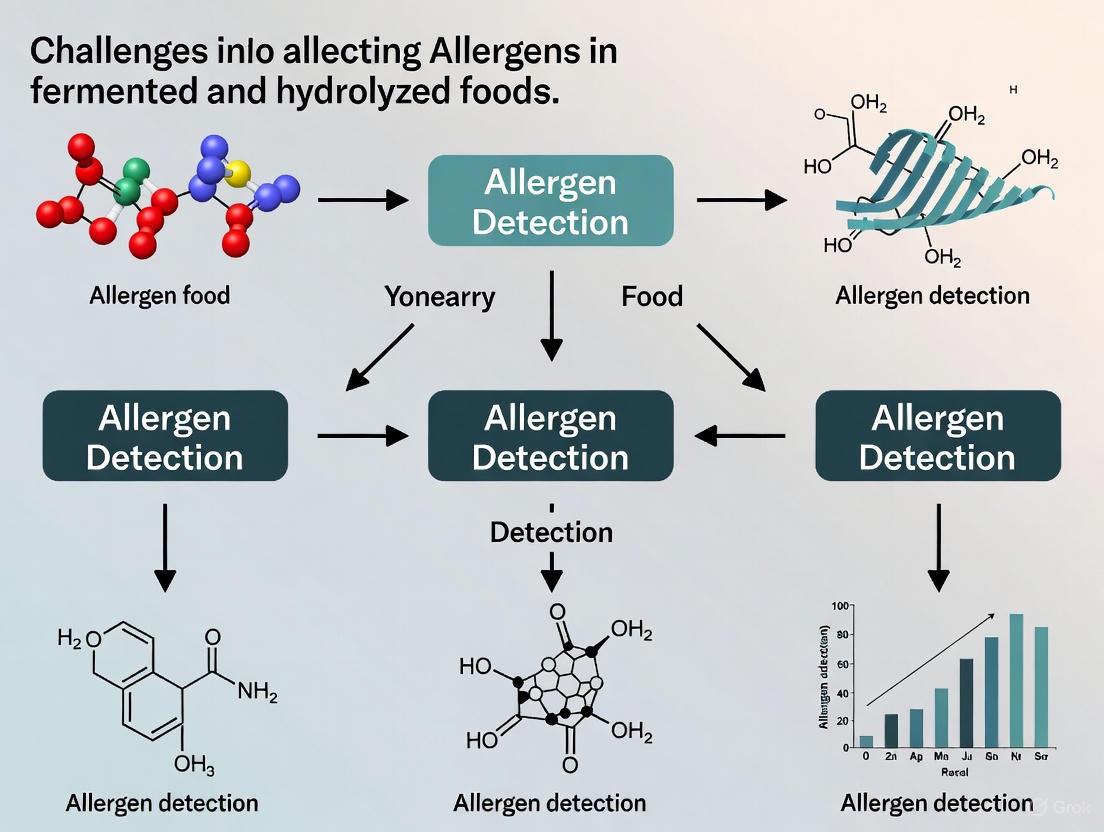
This article addresses the significant challenges faced by researchers and scientists in accurately detecting allergenic proteins in fermented and hydrolyzed food products.
Overcoming Analytical Hurdles: Advanced Strategies for Allergen Detection in Fermented and Hydrolyzed Foods
Abstract
This article addresses the significant challenges faced by researchers and scientists in accurately detecting allergenic proteins in fermented and hydrolyzed food products. Conventional methods like ELISA can fail as processing fragments and denatures proteins, masking the epitopes recognized by antibodies. We explore the foundational science behind these challenges, evaluate emerging methodological solutions including mass spectrometry and competitive ELISA, and provide troubleshooting strategies for complex matrices. A comparative analysis of validation techniques and a forward-looking perspective on innovations such as AI and multiplexed assays are included to guide future biomedical research and clinical application development.
The Core Challenge: How Fermentation and Hydrolysis Alter Protein Allergenicity and Complicate Detection
For researchers investigating allergens in fermented and hydrolyzed foods, the core challenge lies in detecting proteins that have been deliberately and extensively modified. Food processing techniques intentionally alter the native structure of proteins to reduce their allergenic potential. While beneficial for food safety, these processes create significant obstacles for detection and analysis. This technical support center provides a foundational overview of the major structural modifications induced by processing and offers targeted guidance for navigating the associated analytical challenges.
Core Concepts: How Processing Modifies Allergenic Proteins
Food processing techniques aim to reduce allergenicity by disrupting the structure of allergenic proteins, thereby limiting their ability to bind IgE antibodies [1]. The effectiveness of these methods is highly variable and depends on both the specific protein and the process conditions used [1]. The table below summarizes the primary mechanisms of modification.
Table 1: Primary Structural Modifications Induced by Food Processing
| Modification Type | Processing Methods Commonly Involved | Impact on Protein Structure | Effect on Allergen Detection |
|---|---|---|---|
| Denaturation | Thermal treatment, high-pressure processing, cold plasma [1] | Unfolding of tertiary and secondary structure; loss of 3D conformation [1] | Loss of conformational epitopes; potential unmasking of linear epitopes. |
| Fragmentation | Enzymatic hydrolysis, fermentation [1] [2] | Cleavage of peptide bonds, breaking proteins into smaller peptides [2] | Destruction of both conformational and linear epitopes; target analytes are smaller and harder to detect. |
| Epitope Masking | Fermentation, Maillard reaction (glycation) [1] | Chemical or physical obstruction of epitopes without destroying them. | Reduced antibody binding in immunoassays, leading to potential false negatives. |
The Relationship Between Processing and Epitopes
Understanding epitopes is critical for troubleshooting detection issues. Most B-cell epitopes are conformational, meaning they are defined by the protein's 3D shape [3]. Conversely, T-cell epitopes are typically linear, consisting of short, continuous amino acid sequences [3].
- Denaturation primarily destroys conformational epitopes.
- Fragmentation (hydrolysis) can destroy both linear and conformational epitopes.
- Epitope Masking can occur when polysaccharides or other molecules bind to the protein, physically blocking antibody access, even if the epitope itself remains intact [1].
The following diagram illustrates the pathways through which common food processing techniques lead to these structural modifications.
Troubleshooting Guide: Detection Challenges and Solutions
This section addresses specific issues researchers might encounter during experiments.
FAQ 1: Why does my ELISA kit fail to detect allergens in a hydrolyzed protein sample?
- Problem: The hydrolyzed protein sample is not detected by a commercial ELISA kit, yielding a false negative.
- Root Cause: Enzymatic hydrolysis fragments proteins into short peptides. Most ELISA kits rely on antibodies that recognize specific conformational epitopes or longer linear sequences that are destroyed during fragmentation [2] [4]. The target analyte the kit was designed to detect may no longer exist.
- Solution:
- Method Switch: Employ detection methods that target smaller, more stable analytes. Liquid chromatography-tandem mass spectrometry (LC-MS/MS) is ideal for identifying and quantifying specific peptide markers that survive hydrolysis [1].
- Kit Re-evaluation: If you must use immunoassays, seek out kits specifically validated for hydrolyzed matrices. These are often designed to target shorter, stable peptide sequences.
- Antibody Selection: In-house methods should utilize antibodies raised against known hydrolysate-stable peptide sequences.
FAQ 2: How does fermentation impact the accuracy of allergen testing?
- Problem: Inconsistent or unexpectedly low allergen recovery in fermented products (e.g., soy sauce, certain dairy products).
- Root Cause: Fermentation is a complex process that can induce all three modification types: denaturation (from microbial activity), fragmentation (via proteolytic enzymes), and epitope masking (through microbial growth or metabolic byproducts) [1] [2].
- Solution:
- Comprehensive Analysis: Use orthogonal methods. Combine immunoassays (e.g., ELISA) to assess residual immunoreactivity with LC-MS/MS to confirm the presence and quantity of specific protein fragments [1].
- Sample Preparation: Optimize extraction buffers to dissociate potential complexes that may be masking epitopes.
- Consider Cross-Reactivity: Be aware that fermentation may introduce new, cross-reactive proteins from microbial sources, which could interfere with some assays [2].
FAQ 3: What are the best methods to confirm the presence of allergens when processing has destroyed conventional epitopes?
- Problem: A processed food is suspected of containing allergenic material, but standard antibody-based tests are negative.
- Root Cause: The processing conditions have denatured or fragmented the protein, destroying the epitopes recognized by your current detection methods.
- Solution:
- Primary Method: LC-MS/MS. This is the most powerful tool for this scenario. It detects signature peptides rather than intact proteins or epitopes, making it highly suitable for processed foods [1].
- Alternative Method: PCR. If the allergenic ingredient is from a biological source (e.g., peanut, almond), PCR can detect its DNA, which is often more stable than the protein through processing. Note: PCR does not directly measure the allergenic protein itself [4].
- Immunoassay with Caution: If using ELISA, select one that has been rigorously validated for the specific processing conditions you are studying.
Table 2: Comparison of Key Allergen Detection Methods for Processed Foods
| Method | Principle | Advantages for Processed Foods | Limitations for Processed Foods |
|---|---|---|---|
| ELISA | Antibody-antigen binding [4] | High throughput; cost-effective; quantitative. | Highly susceptible to false negatives from denaturation/fragmentation [2]. |
| Lateral Flow Devices (LFDs) | Antibody-antigen binding on a strip [4] | Rapid; user-friendly; good for on-site screening. | Same susceptibility as ELISA; generally qualitative or semi-quantitative. |
| LC-MS/MS | Detection of signature peptide masses [1] | Targets stable peptide sequences; highly specific and reliable for processed samples. | High cost; requires specialized expertise and equipment. |
| PCR | Amplification of species-specific DNA [4] | DNA is stable under many processing conditions; highly specific. | Does not detect the allergenic protein itself; cannot quantify protein amount. |
Method Selection Workflow
Choosing the correct analytical method is the most critical step in successfully detecting allergens in processed foods. The following workflow provides a logical path for method selection based on the sample and research goal.
The Scientist's Toolkit: Key Research Reagents and Materials
Table 3: Essential Reagents and Materials for Allergen Detection Research
| Item | Function/Application | Key Considerations |
|---|---|---|
| Reference Materials | Certified and well-characterized protein/peptide standards for calibration and method validation. | Essential for both immunoassays and LC-MS/MS to ensure accurate quantification [4]. |
| Monoclonal Antibodies | Highly specific antibodies that recognize a single epitope. | Ideal for detecting intact proteins but vulnerable to processing-induced epitope loss [4]. |
| Polyclonal Antibodies | A mixture of antibodies that recognize multiple epitopes on a target protein. | May have a higher chance of detecting some remaining epitopes in mildly processed foods. |
| Signature Peptides | Unique peptide sequences from an allergenic protein, used as targets in LC-MS/MS. | Must be stable, proteotypic, and unique to the allergen of interest; not affected by denaturation [1]. |
| Stable Isotope-Labeled Peptides | Internal standards for LC-MS/MS, chemically identical to target peptides but heavier. | Allow for highly precise and accurate quantification by correcting for sample preparation losses and ion suppression [1]. |
| Extraction Buffers | Solutions designed to solubilize proteins and peptides from a complex food matrix. | Composition is critical; must be optimized to recover allergens that may be masked or bound to other components [2]. |
FAQ: Core Challenges and Principles
Why do standard Sandwich ELISA kits fail to detect hydrolyzed allergens? Standard Sandwich ELISA formats require intact protein structures with at least two epitope binding sites—one for the capture antibody and one for the detection antibody [5]. Food processing techniques, such as fermentation and enzymatic hydrolysis, break proteins into smaller peptides [6] [7]. These fragmented peptides often possess only a single epitope or have their conformational epitopes destroyed, preventing the dual-antibody binding essential for sandwich assay detection [8] [7].
What is the difference between a 'Sandwich' and a 'Competitive' ELISA in this context? The key difference lies in the antibody requirement and the nature of the target analyte, as summarized in the table below:
| Feature | Sandwich ELISA | Competitive ELISA |
|---|---|---|
| Target Requirement | Two distinct epitopes on an intact protein [5]. | A single epitope on a protein or peptide fragment [9]. |
| Mechanism | Target is "sandwiched" between capture and detection antibodies [8]. | Sample analyte competes with a labeled reference for limited antibody binding sites [9]. |
| Ideal For | Native, intact proteins in raw or lightly processed materials [8]. | Hydrolyzed, fermented, or thermally processed samples where proteins are fragmented [7]. |
| Result Interpretation | Signal intensity is directly proportional to analyte concentration [8]. | Signal intensity is inversely proportional to analyte concentration [9]. |
How does food matrix interference complicate allergen detection? Complex food matrices like chocolate, spices, or baked goods contain interfering compounds such as polyphenols, fats, and tannins [10] [7]. These compounds can bind to allergenic proteins or assay antibodies, effectively "masking" the allergen and leading to significantly reduced protein recovery and potential false negatives [10]. Thermal processing can also denature proteins, burying or altering antibody recognition sites [11].
Troubleshooting Guide: Experimental Issues and Solutions
| Problem | Possible Cause | Recommended Solution |
|---|---|---|
| Unexpected Negative Result | Protein hydrolysis has destroyed the sandwich assay's target epitopes [7]. | Switch from a Sandwich to a Competitive ELISA format [7]. |
| Low Antigen Recovery | Matrix effects (e.g., polyphenols in chocolate) or inefficient protein extraction [10]. | Use an optimized extraction buffer (see Protocol 1 below) and include a protein-based additive like fish gelatine to block interfering substances [10]. |
| High Background / False Positives | Cross-reactivity of antibodies with similar protein structures from non-target sources [7]. | Review kit validation data for cross-reactivity profiles. Use monoclonal antibodies for higher specificity, and ensure thorough plate washing [7] [12]. |
| Inconsistent Replicates | Heterogeneous distribution of allergenic residues in the sample or pipetting errors [9]. | Ensure thorough sample homogenization. Use proper pipetting technique and check that reagents are homogeneous and at room temperature before use [9]. |
Detailed Experimental Protocols
Protocol 1: Optimized Allergen Extraction from Challenging Matrices
This protocol, adapted from current research, is designed to maximize the recovery of specific allergens from complex, processed foods for subsequent immunoassay quantification [10].
Key Research Reagent Solutions:
- PBS with Additives: A base for extraction, often containing 2% Tween-20 and 1 M NaCl to disrupt matrix interactions and solubilize allergens [10].
- Fish Gelatine (10%): A protein-based blocking additive used to prevent non-specific binding and mitigate interference from polyphenols in matrices like chocolate [10].
- Polyvinylpyrrolidone (PVP, 1%): An additive that binds and removes polyphenolic interfering compounds [10].
- Carbonate/Bicarbonate Buffer (50 mM, pH 9.6): An alkaline buffer that can improve the extraction efficiency of certain allergens [10].
Method:
- Prepare Sample: Weigh 1 g of homogenized food sample into a sterile tube.
- Add Extraction Buffer: Add 10 mL of a pre-selected extraction buffer (e.g., PBS with 2% Tween-20, 1 M NaCl, 10% fish gelatine, and 1% PVP, pH 7.4) [10].
- Extract: Vortex the mixture for 30 seconds to ensure thorough mixing.
- Incubate: Place the tube in an orbital incubator at 60°C for 15 minutes, shaking at 175 rpm [10].
- Clarify: Centrifuge at 1,250 rcf for 20 minutes at 4°C.
- Recover Supernatant: Carefully collect the clarified middle layer of the supernatant, avoiding the insoluble pellet and any separated fat, for analysis [10].
Protocol 2: Monitoring Allergen Reduction in Hydrolyzed Products
This protocol uses a competitive ELISA to monitor the reduction of β-lactoglobulin (BLG) antigenicity in whey protein hydrolysates, relevant for producing hypoallergenic infant formula [6].
Method:
- Treatment: Subject a 1% whey protein solution to enzymatic hydrolysis (e.g., with bromelain). For increased efficacy, combine hydrolysis with High Hydrostatic Pressure (HHP) treatment (e.g., 300-400 MPa) to expose buried cleavage sites [6].
- Quench Reaction: Heat-inactivate the enzyme according to its optimal temperature and duration.
- Analyze: Test the hydrolysate using a competitive ELISA specific for BLG [6].
- Calculate Reduction: Compare the BLG signal in the hydrolysate to an untreated control to determine the percentage reduction in antigenicity.
The following diagram illustrates the logical workflow for selecting the appropriate ELISA method based on the nature of your sample:
The Scientist's Toolkit: Key Research Reagent Solutions
The following table details essential reagents used to overcome the challenges discussed in this guide, based on featured experiments and commercial solutions.
| Reagent / Material | Function in Allergen Detection | Key Consideration |
|---|---|---|
| Competitive ELISA Kit | Detects fragmented proteins/peptides with a single epitope, essential for hydrolyzed samples [7] [6]. | Confirm the kit is validated for your specific allergen (e.g., β-lactoglobulin for milk) [6]. |
| Monoclonal Antibodies | Provide high specificity to a single epitope, reducing cross-reactivity with related species [7]. | May be less effective if the target epitope is destroyed by processing. |
| Extraction Buffer Additives (Fish Gelatine, PVP) | Fish gelatine blocks non-specific binding; PVP sequesters polyphenols in chocolate, wine, etc., reducing interference [10] [7]. | Concentration (e.g., 10% fish gelatine, 1% PVP) is critical for optimal recovery [10]. |
| Protein Stabilizers & Blockers | Stabilize assay reagents for longer shelf-life and block leftover binding sites on the plate to minimize background noise [9]. | Use a fresh, effective blocking buffer (e.g., based on fish gelatine or proprietary commercial blends) in every assay [12]. |
| Reference Materials / Spiked Controls | Used for method validation and as positive controls to ensure assay performance and accuracy [7]. | Create in-house controls if commercial reference materials are limited for your allergen [7]. |
Frequently Asked Questions
What causes false negatives in allergen testing for fermented and hydrolyzed foods? Fermentation and hydrolysis processes break down the structure of intact gluten proteins into smaller peptides and fragments [13] [14]. Most commercial antibody-based tests, like Sandwich ELISA, are designed to recognize and bind to specific three-dimensional structures (epitopes) on the intact protein [13]. When these structures are destroyed during processing, the antibodies can no longer bind effectively, leading to a false negative result even if immunopathogenic peptides are present [13] [14].
What is the difference between a Sandwich ELISA and a Competitive ELISA for gluten detection? The choice of ELISA format is critical for analyzing processed foods.
| Feature | Sandwich ELISA | Competitive ELISA |
|---|---|---|
| Principle | Two antibodies bind to different parts of an intact protein [13] | A single antibody competes for binding between a reference and small protein fragments in a sample [13] |
| Suitable For | Quantifying intact gluten in non-processed or lightly processed foods [13] | Detecting and quantifying hydrolyzed gluten in fermented or hydrolyzed foods [13] |
| Limitation | Not suitable for fermented-hydrolyzed gluten; will likely yield false negatives [13] | Requires appropriate calibrants for accurate quantitation; can be less sensitive and robust than Sandwich ELISA [13] |
Besides ELISA, what other methods can detect allergens in complex foods? Other techniques exist, but they also have strengths and limitations, as summarized below [13]:
| Method | Key Principle | Applicability to Fermented/Hydrolyzed Foods |
|---|---|---|
| Lateral Flow Devices (LFDs) | Immunoassay on a strip; rapid, on-site use [13] | Variable accuracy; changes in food viscosity can strongly influence results [15]. Often qualitative/semi-quantitative [13]. |
| Mass Spectrometry (MS) | Detects proteins/peptides based on mass-to-charge ratio [13] | Highly sensitive and can detect peptides not found by antibodies [13]. Requires expertise, expensive equipment, and validated reference materials [13]. |
| DNA-based Methods (e.g., PCR) | Detects DNA from allergenic species [13] | Unsuitable as protein and DNA degradation are not correlated; cannot confirm the presence of the allergenic protein itself after intense processing [13]. |
| Electrochemical Sensors (e.g., MIP-based) | Synthetic polymers mimic antibody binding sites to detect specific molecules [15] | Emerging technology; shown to detect soy allergen tracers in complex, processed foods with minimal cross-interference [15]. |
What are the regulatory requirements for labeling fermented or hydrolyzed foods as "gluten-free"? The FDA requires that for a fermented or hydrolyzed food to be labeled "gluten-free," the manufacturer must maintain records demonstrating that the food or its ingredients were gluten-free (<20 ppm gluten) before the fermentation or hydrolysis process occurs [14]. This is because testing the final product is currently unreliable. Appropriate documentation can include Certificates of Analysis (CoAs) from ingredient suppliers or test results from validated methods [14].
Experimental Protocols and Troubleshooting
Protocol 1: Validating Gluten Detection in a Fermented Product Using Competitive ELISA
This protocol is designed to overcome the limitations of Sandwich ELISAs when testing hydrolyzed samples, such as beer or soy sauce [13].
1. Sample Preparation:
- Solid Foods: Homogenize 1 g of food into a fine powder. Mix with 10 mL of a suitable extraction buffer and stir for 15 minutes [15].
- Liquid Foods: Mix 1 g of food directly with 10 mL of extraction buffer [15].
2. Competitive ELISA Procedure:
- Follow the manufacturer's instructions for your specific commercial Competitive ELISA kit (e.g., R5 or G12 antibody-based).
- Ensure the use of a hydrolyzed gluten calibrant that matches the type of hydrolysis expected in your samples (e.g., beer vs. soy sauce) for accurate quantitation [13].
- Run all samples and standards in triplicate.
3. Confirmatory Analysis (Optional but Recommended):
- Western Blot: Use gluten-specific antibodies to separate and detect residual protein fragments by molecular weight. This provides insight into the extent of proteolysis and can confirm ELISA results [13].
- Mass Spectrometry: If available, use MS to identify specific immunopathogenic peptides (e.g., the 33-mer from α2-gliadin) that may persist after fermentation [13].
Protocol 2: Assessing Cross-Contamination in a Production Facility
This guide aligns with FDA expectations for documenting preventative measures [14].
1. Define the Scope:
- Identify all points in the production process where cross-contact with gluten-containing ingredients could occur (e.g., shared equipment, airborne dust, rework).
2. Implement and Document Controls:
- Scheduling: Produce gluten-free products first in a production cycle.
- Dedicated Equipment: Use separate or meticulously cleaned equipment.
- Sanitation Procedures: Validate and document cleaning protocols for shared equipment. Use test kits to verify surface cleanliness.
3. Analytical Verification:
- Test incoming inherently gluten-free ingredients (e.g., spices, oats) for gluten content before use in "gluten-free" production [14].
- Maintain Certificates of Analysis (CoAs) from suppliers for at least two years [14].
The Scientist's Toolkit: Key Research Reagent Solutions
| Research Reagent / Material | Function in Allergen Detection |
|---|---|
| R5 Monoclonal Antibody | Recognizes the QQPFP, QQQFP, and LQPFP epitopes common in gliadins; used in many commercial ELISA kits and for Western blot analysis [13]. |
| G12 Monoclonal Antibody | Binds to the immunopathogenic 33-mer peptide (QPQLPY epitope) from α2-gliadin; specific for detecting peptides relevant to celiac disease [13]. |
| Competitive ELISA Kit | The primary commercial method for quantifying gluten in fermented-hydrolyzed foods where proteins are broken down [13]. |
| Molecularly Imprinted Polymer (MIP) | A synthetic polymer with specific cavities for a target molecule (e.g., soy allergen genistein). An emerging, stable alternative to antibodies for sensors [15]. |
| Hydrolyzed Gluten Calibrant | A critical reference material for Competitive ELISAs; must be appropriately matched to the hydrolysis process of the sample for accurate quantitation [13]. |
| Proline Endopeptidase (PEP) | An enzyme used in some processes to specifically hydrolyze immunopathogenic sequences in gluten, complicating their detection [13]. |
Experimental Workflow: From Sample to Result
The following diagram illustrates the logical workflow and decision points for accurately detecting allergens in fermented and hydrolyzed foods, helping to prevent unreliable results.
Pathways to Reliable Detection and Prevention of False Negatives
This diagram maps the technical challenges and the corresponding pathways that researchers can take to overcome them and achieve reliable detection.
For researchers and scientists developing detection methods for allergens in food, fermented and hydrolyzed foods represent a significant analytical challenge. These products—which include items like yogurt, cheese, soy sauce, beer, and hydrolyzed plant proteins—undergo processes that break down intact proteins into smaller peptides and fragments [16] [13]. This proteolysis is fundamental to the challenge: the very molecules that need to be detected and quantified are altered, often making them unrecognizable to conventional antibody-based detection methods [13]. Consequently, the global regulatory landscape for labeling these foods is complex and, in many jurisdictions, relies on alternative compliance pathways rather than direct analytical testing of the final product.
A primary illustration of this challenge is the U.S. Food and Drug Administration (FDA)'s approach to "gluten-free" labeling for fermented or hydrolyzed foods. The FDA acknowledges that "currently, [they] know of no scientifically valid analytical method effective in detecting and quantifying with precision the gluten protein content in fermented or hydrolyzed foods in terms of equivalent amounts of intact gluten proteins" [16]. This regulatory stance directly impacts method development and validation in research settings.
FAQs: Navigating Regulatory and Analytical Complexities
What are the specific regulatory requirements for "gluten-free" labeling of fermented foods in the U.S.?
Since direct testing of the final product is not currently considered reliable, the FDA evaluates compliance based on manufacturer recordkeeping [17] [16]. The final rule, effective from 2021, mandates that manufacturers must maintain records demonstrating that:
- The food or its ingredients were "gluten-free" before the fermentation or hydrolysis process began.
- The manufacturer has assessed and implemented measures to prevent gluten cross-contact during manufacturing [16].
This means that for a fermented product like soy sauce or yogurt to bear a "gluten-free" claim, the manufacturer must provide documentation, such as test results or certificates of analysis, showing that the starting materials (e.g., wheat, milk) complied with the gluten-free definition (<20 ppm intact gluten) prior to processing [16].
Why is it so difficult to detect allergens in fermented and hydrolyzed foods using standard methods?
The core of the problem lies in the fundamental incompatibility between processing-induced protein changes and the principles of widely used immunoassays.
- Protein Degradation: Fermentation and hydrolysis processes, often involving microbes or enzymes, extensively break down the structure of intact allergenic proteins [13].
- Epitope Destruction or Alteration: Antibodies used in ELISA (Enzyme-Linked Immunosorbent Assay) and lateral flow devices recognize specific three-dimensional structures on proteins known as epitopes. The proteolysis that occurs during fermentation can destroy or alter these epitopes, leading to false-negative results because the antibody can no longer bind to its target [13].
- Lack of Reference Materials: There is a scarcity of appropriate reference materials (calibrants) that accurately represent the complex mixture of hydrolyzed peptides found in these processed foods, making accurate quantitation extremely difficult [13].
The following table summarizes the primary analytical methods and their limitations in this context:
Table: Strengths and Limitations of Key Allergen Detection Methods for Fermented/Hydrolyzed Foods
| Method | Principle | Strengths | Limitations for Fermented/Hydrolyzed Foods |
|---|---|---|---|
| Sandwich ELISA [18] [13] | Two antibodies bind to different sites on an intact protein | High specificity and sensitivity for intact proteins; quantitative | Not suitable for quantitation of hydrolyzed gluten/allergens as it requires an intact protein with at least two binding sites [13]. |
| Competitive ELISA [13] | A single epitope competes with a labeled reference | More appropriate for detecting small peptides and hydrolyzed proteins | Less sensitive and robust than Sandwich ELISA; requires an appropriate calibrant for accurate analysis [13]. |
| Lateral Flow Devices (LFD) [18] [13] | Antibody-based rapid test on a strip | User-friendly, rapid, useful for on-site analysis | Typically qualitative/semi-quantitative; may suffer from the same epitope recognition issues as ELISA [13]. |
| Mass Spectrometry (MS) [19] [13] | Detection and quantification of protein-specific peptides | Highly sensitive; can detect peptides not recognized by antibodies; can be quantitative | Requires expensive equipment and expertise; depends on incomplete or poorly curated protein databases [13]. |
| DNA-based Methods (e.g., PCR) [13] | Detection of allergen source DNA | Stable analyte; highly sensitive for screening | Unsuitable for highly processed or fermented foods where DNA may be degraded, and does not directly measure the allergenic protein [13]. |
What is the current status of defined thresholds for major food allergens?
In the United States, the FDA has not established a threshold level for any allergens [20]. A threshold is defined as a value below which it is unlikely that a food-allergic individual would experience an adverse effect. This absence of defined thresholds extends to the nine major food allergens recognized by law: milk, eggs, fish, Crustacean shellfish, tree nuts, peanuts, wheat, soybeans, and sesame [20].
However, for gluten, a defined threshold of <20 parts per million (ppm) is in place for foods bearing a "gluten-free" claim. This specific threshold was established considering factors like available analytical methods and the needs of individuals with celiac disease [16]. This creates a distinct regulatory paradigm where a threshold exists for a specific condition (celiac disease) but not for immunological food allergies.
How does the "gluten-free" rule for fermented foods apply to distilled products like vinegar?
The FDA's rule states that compliance for distilled foods (like vinegar) will be evaluated by "verifying the absence of protein using scientifically valid analytical methods that can reliably detect the presence of protein or protein fragments" [16]. This is a different approach from fermented/hydrolyzed foods because the distillation process is theoretically designed to separate and remove proteins, which are non-volatile, from the final distillate. Testing for the absence of protein is therefore considered a valid verification step.
Troubleshooting Guides for Experimental Detection
Guide: Overcoming Negative Results in ELISA for Hydrolyzed Samples
Problem: You are obtaining negative or low results with a Sandwich ELISA kit on a sample that is suspected to contain an allergen, but which has undergone fermentation or hydrolysis.
Investigation and Resolution:
- Confirm Method Compatibility: Your first step should be to verify that you are not using a Sandwich ELISA, as it is ineffective for degraded proteins [13]. Check the kit's manufacturer specifications.
- Switch to a Competitive ELISA: If protein hydrolysis is confirmed or suspected, the more appropriate method is a Competitive ELISA, which is designed to detect smaller protein fragments and peptides [13].
- Utilize Complementary Techniques:
- Western Blot: Use this as a confirmatory technique. It can separate proteins and peptides by size, providing visual confirmation of the extent of proteolysis and verifying the presence of allergen-derived fragments that ELISA might miss [13].
- Mass Spectrometry (LC-MS/MS): Employ liquid chromatography with tandem mass spectrometry. This technique can identify multiple allergenic peptides in a single analysis without relying on antibodies, thereby avoiding the epitope recognition issue and providing fewer false negatives [19] [13]. It is particularly useful for developing and validating new detection methods.
Diagram: Troubleshooting Workflow for Negative ELISA Results in Processed Samples
Guide: Selecting and Validating a Detection Method
Problem: Your lab is developing a new protocol to detect an allergen in a complex fermented food matrix and needs to select the most appropriate analytical method.
Investigation and Resolution:
- Define the Analytical Question:
- Target: Are you detecting intact protein or protein fragments?
- Goal: Is the need for rapid, on-site screening (qualitative) or precise quantification?
- Matrix: How complex is the food? How might it interfere?
- Match the Method to the Target and Goal: Use the table below to align your analytical requirements with the appropriate technology.
- Plan for Validation: Especially for novel methods or matrices, use a multi-technique approach. For instance, use Mass Spectrometry to characterize the hydrolyzed peptide profile and validate the targets detected by an antibody-based method [19] [13].
Table: Method Selection Guide for Allergen Detection in Challenging Matrices
| Research Need | Recommended Primary Method | Supporting or Confirmatory Methods | Key Considerations |
|---|---|---|---|
| Routine, high-throughput\nquantitation of intact allergens | Sandwich ELISA [18] [13] | - | Ensure the food matrix is not hydrolyzed. |
| Detection of allergens in\nfermented/hydrolyzed foods | Competitive ELISA [13] | Western Blot, LC-MS/MS [13] | Requires appropriate hydrolyzed calibrants. |
| Rapid on-site screening\nfor production lines | Lateral Flow Devices (LFD) [18] | ELISA on positive samples | Risk of false negatives in hydrolyzed products. |
| Unbiased detection &\nnovel method development | LC-MS/MS [19] [13] | Competitive ELISA | Does not rely on antibodies; can screen for multiple allergens simultaneously. |
The Scientist's Toolkit: Key Research Reagent Solutions
Table: Essential Reagents and Materials for Allergen Detection Research
| Reagent / Material | Function / Application in Research |
|---|---|
| Monoclonal Antibodies (e.g., R5, G12) [13] | Key reagents for ELISA and LFDs; specific for certain gluten epitopes (e.g., R5 binds QQPFP motifs). Critical for understanding assay specificity and cross-reactivity. |
| Hydrolyzed Reference Materials | Calibrants and controls specifically designed for competitive ELISA and MS methods to enable accurate quantitation in fermented/hydrolyzed systems [13]. |
| Protein Extraction Buffers | Designed to efficiently solubilize both intact and denatured proteins from complex food matrices, which is a critical first step for any detection protocol [18]. |
| LC-MS/MS HRAM Instrumentation | High-Resolution Accurate Mass instrumentation enables sensitive, multi-allergen screening and identification of marker peptides in a single analysis, bypassing antibody limitations [19]. |
| Tryptic Digestion Kits | Used in sample preparation for LC-MS/MS to enzymatically cleave proteins into predictable peptides for identification and quantitation [19]. |
Advanced Detection Methodologies: From Mass Spectrometry to Next-Generation Immunoassays
FAQs: Addressing Common Experimental Challenges
Q1: Why is my LC-MS/MS signal for gluten peptides in fermented soy sauce decreasing over time, and how can I address this?
Signal loss is commonly caused by the accumulation of non-volatile components from complex food matrices, which contaminate the ion source. Fermented and hydrolyzed foods like soy sauce contain high salt and other non-volatile compounds [13]. To overcome this:
- Sample Cleanup: Rigorously use Solid Phase Extraction (SPE) with C-18 cartridges or polymer-based phases for acidic samples to remove salts and interfering compounds [21].
- Mobile Phase: Always use the highest purity solvents and volatile buffers (e.g., ammonium acetate, formic acid) to prevent background noise and contamination [21] [22].
- Maintenance: Implement a regular cleaning and maintenance schedule for the LC-MS/MS system, including the ion source. Tracking system suitability test (SST) results over time helps identify performance decline early [23].
Q2: My data shows high background noise, making it difficult to quantify low-abundance peptides. What steps should I take?
High background noise often stems from mobile phase contamination or insufficient sample cleanup.
- Check Solvents: Ensure all mobile phases are prepared fresh from LC-MS grade solvents and filtered to remove particulates [21].
- Enhance Extraction: For complex food matrices, combine SPE with additional techniques like protein precipitation to remove more interfering substances. Using hydrophobic or hydrophilic PTFE filters during sample preparation can remove fine particles [21].
- Review Preparation: Contamination can be introduced from plastic containers or parafilm; use glass where possible and track all reagent lot changes [23].
Q3: How can I be sure my detected peptides uniquely identify the target allergen protein in a complex food sample?
This requires selecting proteotypic peptides.
- Uniqueness: A proteotypic peptide must have a sequence that is unique to the target protein within the proteome of interest, preventing false positives from other proteins [24].
- Detectability: The peptide must also have good detectability via LC-MS/MS, influenced by its physicochemical properties [24].
- Bioinformatics Tools: Use software tools like PeptideManager to select peptides that are unique to your target protein (e.g., a specific gluten protein) and are not present in the background proteome of the food matrix [24].
Q4: What are the major challenges in using LC-MS/MS for allergen detection in fermented and hydrolyzed foods, and how does this method overcome limitations of ELISA?
Fermentation and hydrolysis break intact gluten proteins into smaller peptides, which are often missed by traditional sandwich ELISA kits that rely on detecting intact proteins [13] [7]. LC-MS/MS overcomes this by:
- Direct Detection: It directly detects and quantifies specific peptide sequences, regardless of whether the parent protein is intact or hydrolyzed [13].
- Specificity: It can distinguish between hydrolyzed gluten peptides that may still be immunopathogenic and other non-reactive protein fragments [13]. This is crucial for accurate risk assessment, as some harmful peptides, like the 33-mer of α2-gliadin, can survive fermentation in beers [13].
Troubleshooting Guide: Common LC-MS/MS Issues and Solutions
The following table outlines specific problems, their potential causes, and corrective actions.
| Problem | Possible Cause | Corrective Action |
|---|---|---|
| Low or No Signal | 1. MS/MS ion source contamination2. LC leak or pump failure3. Incorrect mass calibration or detector voltage | 1. Clean or replace ion source components; verify clean solvent flow with a divert valve [22].2. Check all tubing connections for leaks or buffer deposits; review pressure traces [23].3. Recalibrate mass spectrometer; confirm detector voltage settings [23]. |
| High Background Noise | 1. Contaminated mobile phases or reagents2. Non-volatile buffers in mobile phase3. Insufficient sample cleanup | 1. Prepare fresh, LC-MS grade mobile phases [21] [23].2. Replace with volatile buffers (e.g., ammonium formate) [21] [22].3. Optimize SPE protocol or add a protein precipitation step [21]. |
| Unstable Retention Times | 1. Degraded LC column2. Mobile phase pH or composition inconsistency3. Column temperature fluctuations | 1. Replace the LC column [23].2. Ensure mobile phase is freshly prepared and properly mixed.3. Verify column oven temperature is stable. |
| Poor Peak Shape | 1. Matrix effects from sample2. Column overloading3. Inappropriate LC method | 1. Improve sample cleanup; consider a different SPE sorbent [21].2. Dilute sample or inject a smaller volume.3. Optimize the LC gradient and mobile phase composition. |
Experimental Protocol: Sample Preparation for Detecting Gluten Peptides in Fermented Beer
This protocol is designed for the extraction and cleanup of gluten peptides from a fermented beverage like beer prior to targeted LC-MS/MS analysis.
Principle: To isolate and concentrate gluten-derived peptides from beer while removing interfering compounds like sugars, organic acids, and non-volatile salts that can suppress ionization and contaminate the instrument [13] [21].
Materials:
- Beer sample (barley or wheat-based)
- C-18 Solid Phase Extraction (SPE) cartridges (e.g., silica-based or polymer-based)
- LC-MS grade water, methanol, and acetonitrile
- Volatile buffer: 0.1% formic acid in water, 0.1% formic acid in acetonitrile
- Centrifuge, vacuum manifold for SPE, vortex mixer
- Hydrophilic PTFE filters (e.g., 0.2 µm)
Procedure:
- Pre-treatment: Degas the beer sample by sonication or stirring. For highly complex samples, a pre-cleaning step via protein precipitation (PPE) with cold acetone or methanol can be used. Centrifuge and collect the supernatant [21].
- SPE Conditioning: Condition the C-18 SPE cartridge by passing 3-5 mL of methanol through the bed. Equilibrate the cartridge with 3-5 mL of 0.1% formic acid in water [21].
- Sample Loading: Slowly load a known volume (e.g., 1-10 mL) of the degassed beer or the pre-cleaned supernatant onto the conditioned SPE cartridge.
- Washing: Wash the cartridge with 3-5 mL of 0.1% formic acid in water to remove salts and polar contaminants. Optionally, wash with a small volume of 5% methanol in water with 0.1% formic acid.
- Elution: Elute the bound peptides into a clean collection tube using 1-2 mL of 0.1% formic acid in acetonitrile or a mixture of acetonitrile and water (e.g., 50:50 or 70:30) [21].
- Concentration and Reconstitution: Evaporate the eluent to dryness under a gentle stream of nitrogen or in a vacuum concentrator. Reconstitute the dried residue in 100 µL of a 50:50 methanol/water solution containing 0.1% formic acid for MS analysis [21].
- Filtration: Filter the reconstituted sample through a 0.2 µm hydrophilic PTFE filter into an LC-MS vial to remove any particulates [21].
Workflow Diagram: Troubleshooting LC-MS/MS Signal Loss
The diagram below outlines a logical, step-by-step procedure to diagnose and resolve issues related to signal loss.
Research Reagent Solutions for Targeted Peptide Detection
The table below lists key materials and reagents essential for successful LC-MS/MS analysis of proteotypic peptides.
| Item | Function/Benefit |
|---|---|
| C-18 SPE Cartridges | Reversible adsorption of peptides based on hydrophobicity; cleans up samples and concentrates analytes [21]. |
| LC-MS Grade Solvents | High-purity water, methanol, and acetonitrile minimize chemical background noise, improving sensitivity [21] [23]. |
| Volatile Buffers | Buffers like ammonium formate or formic acid are compatible with MS as they evaporate easily, preventing ion source contamination [21] [22]. |
| Proteotypic Peptides | Synthesized peptide standards uniquely representing a target protein; used for assay development and absolute quantification [25] [24]. |
| UHPLC Column (e.g., Core-Shell) | Provides high-resolution separation of complex peptide mixtures with high efficiency and speed, improving peak capacity and detection [21]. |
Technical Support Center
Troubleshooting Guide: Common Competitive ELISA Issues
The table below summarizes frequent problems, their potential causes, and solutions for Competitive ELISA experiments, particularly in the context of allergen detection in processed foods.
| Problem | Possible Cause | Solution |
|---|---|---|
| Weak or No Signal | Reagents not at room temperature [12] | Allow all reagents to sit for 15-20 minutes at room temperature before starting the assay [12]. |
| Incorrect storage or expired reagents [12] | Double-check storage conditions (typically 2-8°C); confirm all reagents are within expiration dates [12]. | |
| Target analyte concentration too high (outcompetes labeled antigen) [26] [27] | Dilute the sample and re-run the assay [28]. | |
| Enzyme conjugate concentration too low [12] | Ensure the conjugate is prepared to the correct dilution per protocol. | |
| High Background Signal | Insufficient washing [12] [28] | Follow recommended washing procedure; ensure complete aspiration of fluid between steps [12]. Increase soak time during washes [28]. |
| Non-specific binding [9] | Use an effective blocking buffer (e.g., 5-10% serum, BSA) [28]. Ensure wells are properly blocked. | |
| Substrate exposure to light [12] | Store substrate in the dark and limit light exposure during the assay [12]. | |
| High Variation Between Replicates | Inconsistent pipetting [28] | Calibrate pipettes; ensure proper technique and that tips are tightly sealed [28]. |
| Inadequate mixing of reagents or samples [28] | Thoroughly mix all reagents and samples before pipetting onto the plate [28]. | |
| Wells allowed to dry out [28] | Use plate sealers during incubations and ensure a humid environment if needed [28]. | |
| Bubbles in wells [28] | Ensure no bubbles are present before reading the plate [28]. | |
| Poor Standard Curve | Incorrect serial dilution preparation [12] [28] | Check pipetting technique and double-check dilution calculations [12]. |
| Degraded standard [9] | Prepare fresh standard solutions; ensure proper storage. | |
| Use of wrong plate type [12] | Use an ELISA plate (not a tissue culture plate) for proper antibody binding [12]. | |
| Edge Effects | Uneven temperature across the plate [12] | Avoid stacking plates during incubation; ensure a uniform temperature environment [12] [28]. |
| Evaporation [12] | Seal the plate completely with a new, effective plate sealer during all incubations [12]. |
Frequently Asked Questions (FAQs)
Q1: Why is Competitive ELISA particularly suitable for detecting fragmented or hydrolyzed allergens?
Competitive ELISA is ideal for detecting small, fragmented proteins because it does not require the analyte to have multiple antibody-binding sites. In sandwich ELISA, the target protein must be large enough to be "captured" by one antibody and "detected" by another. Processing methods like fermentation or hydrolysis can break proteins into small peptides, destroying these binding sites. Competitive ELISA relies on a single epitope for the competition between the sample analyte and a labeled reference, making it robust for detecting these modified allergens [29] [27].
Q2: We are researching the reduction of allergenicity in fermented soy. Our Competitive ELISA results are inconsistent. What could be wrong?
Inconsistency in results, especially with complex matrices like fermented food, can arise from several factors:
- Matrix Interference: Components in the fermented product (e.g., acids, enzymes, other metabolites) can interfere with antibody binding. Using a specialized sample/assay diluent can help reduce this interference and lower false positives [9].
- Inconsistent Sample Preparation: The extraction efficiency of allergenic proteins can vary greatly with buffer composition (e.g., high-salt or high-pH buffers may recover more protein) [29]. Standardize your extraction protocol rigorously.
- Pipeline Errors: This is a common source of variation. Ensure your pipettes are calibrated and that you are using correct technique [28].
Q3: What does a "high signal" mean in a Competitive ELISA, and how can I fix it?
In Competitive ELISA, a high signal indicates that less of the enzyme-labeled antigen was displaced by the analyte in your sample, suggesting a lower concentration of the target allergen [27]. However, if the signal is unexpectedly high across all samples, it could be due to:
- Insufficient Washing: Leaving unbound conjugate in the well [12] [28].
- Over-incubation: Extending incubation times beyond the protocol's recommendation can increase signal non-specifically [12].
- Conjugate Oversaturation: Using too much conjugate reagent [9]. Solutions include strictly adhering to wash steps, following recommended incubation times, and ensuring reagents are correctly diluted [12] [9].
The Scientist's Toolkit: Key Research Reagent Solutions
The following reagents are critical for developing and optimizing a reliable Competitive ELISA.
| Reagent / Material | Function | Key Considerations |
|---|---|---|
| ELISA Microplate | Solid-phase matrix for antibody coating [26]. | Use plates designed for ELISA, not tissue culture. Polystyrene is common [26] [12]. |
| Capture Antibody or Antigen | Binds to the target or competes with it. The immobilization point for the assay [26] [27]. | For competitive formats, a known antigen is often coated to compete with the sample antigen [26] [27]. |
| Enzyme-Labeled Antigen | The competitor that generates the detectable signal. | Must be highly pure and have the enzyme (e.g., HRP) properly conjugated without affecting the epitope. |
| Blocking Buffer | Covers unsaturated binding sites on the plate to prevent non-specific binding of other proteins [28] [9]. | BSA, serum, or proprietary blockers (e.g., StabilGuard) [9]. Optimization may be needed for complex food matrices. |
| Wash Buffer | Removes unbound reagents and sample components between steps [26]. | Typically phosphate-buffered saline (PBS) with a mild detergent like Tween-20. |
| Substrate | Reacts with the enzyme to produce a measurable (e.g., colored) signal [26]. | For HRP, TMB is common, producing a blue color that turns yellow when stopped with acid [26]. |
| Stop Solution | Halts the enzyme-substrate reaction at a defined time [26]. | Typically an acidic solution (e.g., HCl or H₂SO₄) [26]. |
| Protein Stabilizers | Extends the shelf-life of coated plates and liquid reagents [9]. | Critical for assay consistency; can provide stability for up to 2 years [9]. |
Experimental Workflow: Competitive ELISA for Allergen Detection
The following diagram illustrates the basic principle and workflow of a typical Competitive ELISA.
Competitive ELISA Principle - In this assay, allergens from the sample and enzyme-labeled reference allergens compete for binding to a limited amount of immobilized antigen. More sample allergen leads to less labeled antigen binding and a weaker signal [26] [27].
Detailed Protocol: Competitive ELISA for Detecting Hydrolyzed Allergens
Title: Quantification of Fragmented β-Lactoglobulin in Hydrolyzed Whey Protein
Objective: To accurately measure the concentration of residual β-Lactoglobulin peptides in a hydrolyzed whey protein sample using a Competitive ELISA.
Principle: Peptides from hydrolyzed β-Lactoglobulin in the sample compete with a known, enzyme-labeled β-Lactoglobulin for binding sites on anti-β-Lactoglobulin antibodies coated on the microplate. The signal produced is inversely proportional to the concentration of the hydrolyzed allergen in the sample.
Materials:
- 96-well ELISA plates pre-coated with anti-β-Lactoglobulin antibody (or materials for coating).
- Hydrolyzed whey protein samples and unhydrolyzed control.
- β-Lactoglobulin standard (for generating a standard curve).
- Enzyme-labeled β-Lactoglobulin conjugate.
- Blocking buffer (e.g., 5% BSA in PBS).
- Wash buffer (PBS with 0.05% Tween-20).
- TMB substrate solution.
- Stop solution (1M H₂SO₄).
- Microplate reader.
Methodology:
- Plate Coating (if not pre-coated): Coat wells with capture antibody diluted in PBS. Incubate overnight at 4°C. Wash three times with wash buffer [26] [12].
- Blocking: Add blocking buffer to all wells (e.g., 300 µL). Incubate for 1-2 hours at room temperature. Wash three times [28].
- Competition and Incubation:
- Prepare a serial dilution of the β-Lactoglobulin standard.
- Prepare appropriate dilutions of your hydrolyzed and control samples.
- To each well, add a fixed, optimal concentration of the enzyme-labeled β-Lactoglobulin conjugate.
- Immediately add the standard or sample dilutions to their respective wells. Each analyte will compete with the labeled conjugate for antibody binding sites.
- Incubate for the recommended time (e.g., 1-2 hours) at room temperature [26] [27].
- Washing: Wash the plate thoroughly 3-5 times to remove all unbound conjugate and sample components [12] [28].
- Signal Detection: Add TMB substrate to all wells. Incubate in the dark for 15-30 minutes. The enzyme-conjugate will catalyze a color change to blue [26].
- Stop Reaction: Add stop solution to each well. The color will change from blue to yellow [26].
- Reading: Measure the absorbance of each well at 450 nm using a microplate reader within 30 minutes of stopping the reaction [26].
- Data Analysis:
- Generate a standard curve by plotting the absorbance of the standards (y-axis) against their concentration (x-axis, log scale).
- The concentration of β-Lactoglobulin in the unknown samples is determined by interpolation from the standard curve. Remember that higher sample allergen concentration results in lower absorbance [26] [27].
Troubleshooting Guide: Common Challenges in Multiplex Allergen Detection
1. Issue: Low Allergen Recovery from Complex Matrices (e.g., Chocolate or Thermally Processed Foods)
- Problem: Chocolate desserts and baked goods (like biscuits) consistently show lower allergen recovery rates, risking false negatives [10].
- Solution:
- Buffer Optimization: Use an extraction buffer containing 1 M NaCl and 2% Tween-20 to increase ionic strength and disrupt matrix interactions [10]. For particularly challenging matrices, add 10% fish gelatine (a protein-blocking agent) and 1% Polyvinylpyrrolidone (PVP), which helps sequester polyphenols found in cocoa [10].
- Protocol Adjustment: Increase extraction temperature to 60°C with constant orbital shaking (e.g., 175 rpm) to enhance protein solubilization [10].
2. Issue: Inconsistent Results Between Different Food Matrices
- Problem: An extraction buffer that works for a raw biscuit dough may fail for the same dough after baking, due to processing-induced structural changes in proteins [10] [1].
- Solution:
- Buffer Selection: Identify and validate two primary extraction buffers for routine use:
- Matrix-Specific Validation: Always perform recovery experiments (e.g., 50-150% is optimal) for each new matrix type, especially when thermal processing is involved [10].
3. Issue: High Background or Non-Specific Signal in Multiplex Immunoassay
- Problem: Non-specific binding in the multiplex array leads to high background noise, obscuring true positive signals [10].
- Solution:
- Add Blocking Agents: Incorporate blocking additives like fish gelatine (10%) or non-fat dry milk (NFDM, 2.5%) into your extraction buffer to minimize non-specific protein binding to the solid phase [10].
- Include PVP: Add 1% PVP to the extraction buffer to bind interfering compounds like tannins, which are common in plant-based matrices [10].
4. Issue: Inability to Detect Specific, Clinically Relevant Allergens
- Problem: Traditional "total protein" ELISAs may not accurately quantify the specific proteins (e.g., Ara h 2 in peanut, Bos d 5 in milk) responsible for eliciting allergic reactions [10].
- Solution:
Frequently Asked Questions (FAQs)
Q1: What is the key advantage of a multiplex array over traditional ELISA for allergen detection? Multiplex technology allows for the simultaneous quantification of multiple specific allergens from a single sample extract. This dramatically increases sample throughput, conserves precious sample material, and provides a comprehensive contamination profile, which is crucial for assessing foods associated with oral food challenges or immunotherapy [10].
Q2: Why is a "universal" extraction buffer so difficult to achieve, and what is the recommended approach? Different allergenic proteins have unique physicochemical properties, and various food matrices (e.g., high-fat, high-polyphenol, thermally processed) interact with these proteins in distinct ways, making a single buffer ineffective for all scenarios [10]. The recommended approach is to use a set of shared, optimized buffers—specifically the PBS-based and Carbonate-based buffers outlined in the troubleshooting guide—that provide adequate recovery for a wide range of allergens and matrices [10].
Q3: How does food processing like baking or fermentation affect allergen detection? Thermal processing can cause structural changes (denaturation, aggregation) or chemical modifications (glycation) in allergenic proteins. This can mask the epitopes recognized by antibodies, reducing detectability in immunoassays [1]. Fermentation can hydrolyze proteins, potentially destroying conformational epitopes and leading to an underestimation of allergen content if the assay is not designed to detect the resulting peptides [1] [2].
Q4: My multiplex assay works well with simple matrices but fails with fermented food products. What could be wrong? Fermentation and hydrolysis processes can break down intact allergenic proteins into smaller peptides [1]. Your multiplex assay's antibodies may be targeting conformational epitopes present only on the intact protein. To address this, consider using detection methods like liquid chromatography-tandem mass spectrometry (LC-MS/MS) that can detect proteotypic peptides, offering a more precise quantification of hydrolyzed allergens [30] [2].
Q5: What are the critical parameters to validate when adapting a multiplex method for a new matrix? The most critical parameter is the percentage recovery of incurred allergens. This involves:
- Spiking Experiment: Using the new matrix incurred with a known amount of allergen source material [10].
- Extraction and Analysis: Processing the sample with your optimized protocol and quantifying the recovered allergen [10].
- Calculation: (Measured Concentration / Incurred Concentration) x 100%. Optimal recovery generally falls within 50-150% [10]. Additionally, determine the Limit of Detection (LOD) and Limit of Quantification (LOQ) specific to that matrix [4].
Experimental Protocols & Data Presentation
Detailed Protocol: Optimized Allergen Extraction from Complex Matrices
This protocol is designed for the simultaneous extraction of multiple allergens from challenging, processed foods for subsequent analysis by multiplex immunoassay or ELISA [10].
1. Reagent Preparation: Prepare one or both of the following extraction buffers as determined by your matrix optimization [10]:
- Buffer D (Carbonate/Bicarbonate with FG): 50 mM sodium carbonate/sodium bicarbonate, 10% fish gelatine, pH 9.6.
- Buffer J (PBS with Tween, NaCl, FG, and PVP): PBS, 2% Tween-20, 1 M NaCl, 10% fish gelatine, 1% PVP, pH 7.4.
2. Sample Extraction:
- Weigh 1.0 g of homogenized food sample into a 50 mL centrifuge tube.
- Add 10 mL of the chosen pre-warmed extraction buffer (1:10 sample-to-buffer ratio) [10].
- Vortex mix vigorously for 30 seconds to ensure complete suspension.
- Incubate the mixture for 15 minutes in an orbital incubator (e.g., Stuart SI500) set to 60°C and 175 rpm [10].
3. Clarification:
- Centrifuge the extract at 1250 rcf for 20 minutes at 4°C [10].
- Carefully collect the clarified supernatant from the middle of the tube, avoiding the pellet and any surface lipid layer.
- The extract is now ready for analysis via multiplex array or ELISA.
Table 1: Allergen Recovery Performance of Optimized Extraction Buffers across Different Matrices [10]
| Matrix Type | Processing Condition | Target Recovery Range | Key Challenge | Recommended Buffer |
|---|---|---|---|---|
| Chocolate Dessert | Non-baked | 50-150% (often lower) | Polyphenol interference | Buffer J (with PVP) [10] |
| Biscuit Dough | Raw | 50-150% | Native protein state | Buffer D or Buffer J [10] |
| Biscuit | Baked (185°C, 15 min) | 50-150% (often lower) | Protein aggregation, Maillard reaction | Buffer J (with FG and PVP) [10] |
Table 2: Comparison of Allergen Detection Methodologies
| Method | Principle | Key Advantage | Key Limitation | Suitability for Multiplexing |
|---|---|---|---|---|
| ELISA [4] | Antibody-Antigen binding | Robust, quantitative, widely established | Typically single-analyte; can miss hydrolyzed allergens | Low (unless multiplex platforms used) |
| Lateral Flow Device (LFD) [4] | Antibody-Antigen binding | Rapid, on-site use | Qualitative/Semi-quantitative; single-analyte | No |
| Multiplex Immunoassay (e.g., MARIA) [10] | Antibody-Antigen binding on bead array | Simultaneous multi-allergen detection; high throughput | Limited by extraction efficiency | Yes (inherently multiplex) |
| Liquid Chromatography-Mass Spectrometry (LC-MS/MS) [30] | Detection of proteotypic peptides | High specificity; can detect hydrolyzed allergens | High cost, requires expertise | Yes (can be targeted for multiple allergens) |
Experimental Workflow Diagram
Allergen Extraction Workflow
Multiplex Detection Principle
Multiplex Bead-Based Detection
The Scientist's Toolkit: Research Reagent Solutions
Table 3: Essential Reagents for Multiplex Allergen Extraction and Detection
| Reagent / Material | Function / Purpose | Example from Literature |
|---|---|---|
| Fish Gelatine | Protein-blocking agent; reduces non-specific binding to surfaces and matrix components [10]. | Used at 10% concentration in multiple optimized buffers [10]. |
| Polyvinylpyrrolidone (PVP) | Binds and sequesters phenolic compounds (e.g., in chocolate, nuts), preventing interference with protein extraction and detection [10]. | Used at 1% concentration in PBS-based buffer for challenging matrices [10]. |
| Tween-20 (Detergent) | Disrupts hydrophobic interactions, helping to solubilize allergens from the food matrix and prevent aggregation [10]. | Used at 2% concentration in PBS-based buffers [10]. |
| High Ionic Strength Salts (e.g., 1 M NaCl) | Disrupts electrostatic protein-matrix interactions, enhancing protein release and recovery [10]. | A key component of PBS-based extraction buffers [10]. |
| Carbonate/Bicarbonate Buffer (pH 9.6) | Alkaline buffer condition that can help solubilize certain proteins and disrupt matrix interactions [10]. | Base for Buffer D, effective for several allergens [10]. |
| Allergen-Specific Antibodies | Critical for specific capture and detection of clinically relevant proteins (e.g., Ara h 2, Gal d 1) in multiplex arrays or ELISAs [10] [30]. | Enable movement from "total protein" to specific allergen quantification [10]. |
| Purified Allergen Calibrants | Provide a standardized reference for accurate quantification of specific allergens in food extracts [10]. | Essential for calibration of allergen-specific immunoassays [10]. |
Detecting allergens in fermented and hydrolyzed foods presents unique analytical hurdles. During processing, proteins are fragmented and their structures are altered, which can destroy the epitopes recognized by conventional immunoassays like ELISA, leading to false negatives [7]. This creates significant risks for allergic consumers, as the allergenic potential may remain even when tests cannot detect intact proteins [1]. Hyperspectral Imaging (HSI) and FTIR spectroscopy, enhanced by AI-driven predictive models, are emerging as powerful, non-destructive solutions to these challenges. These techniques analyze the fundamental molecular composition of a sample, allowing them to detect the spectral signatures of allergenic proteins and their fragments without relying on intact protein structures [30] [31].
Frequently Asked Questions (FAQs)
FAQ 1: Why do traditional ELISA kits often fail to detect allergens in fermented or hydrolyzed products? Traditional ELISA kits use antibodies designed to bind to specific, three-dimensional structures (epitopes) on intact allergenic proteins. Fermentation and hydrolysis processes break these proteins into smaller peptides, destroying the conformational epitopes. This renders the antibodies incapable of recognition, causing false-negative results [7].
FAQ 2: How do FTIR and HSI overcome the limitation of detecting processed allergens? FTIR and HSI do not rely on antibody-antigen binding. Instead, they probe the intrinsic molecular vibrations and chemical bonds within a sample. Even when a protein is broken into peptides, the core chemical components (like amide bonds) remain and produce a detectable spectral fingerprint. AI models can be trained to recognize the specific spectral patterns associated with these hydrolyzed allergenic components [30] [31].
FAQ 3: What is the key advantage of combining HSI with AI-driven predictive models? HSI generates a vast, high-dimensional dataset (a hypercube) that combines spatial and spectral information. Manually analyzing this data is impractical. Machine learning (ML) and deep learning (DL) models can automatically process these complex datasets to identify subtle patterns and correlations that are invisible to the human eye, enabling precise qualitative and quantitative analysis of allergens, even in complex food matrices [32] [33].
FAQ 4: My HSI data is complex and high-dimensional. What are the best AI models for analyzing it? The choice of model depends on your goal and dataset size. For many applications, traditional machine learning models like Principal Component Analysis (PCA) for exploration, Partial Least Squares Regression (PLSR) for quantification, and Support Vector Machines (SVM) for classification are highly effective [32] [33]. For very large datasets or highly complex patterns, Convolutional Neural Networks (CNNs), a class of deep learning models, can achieve state-of-the-art accuracy by automatically learning the most relevant spatial and spectral features [31].
FAQ 5: What are the most common spectral ranges used in HSI for food analysis, and which is relevant for allergens? The most common spectral ranges are Visible-Near Infrared (Vis-NIR, ~400-1000 nm), Near Infrared (NIR, ~900-1700 nm), and Short-Wave Infrared (SWIR, ~900-2500 nm). The SWIR range is particularly powerful for food chemistry because it contains fundamental absorption bands for key chemical bonds, including O-H in water (e.g., at 1925 nm) and C-H in fats, which are critical for analyzing food composition and structure [34] [31].
Troubleshooting Guides
Table 1: Troubleshooting Hyperspectral Imaging (HSI) Analysis
| Problem | Possible Cause | Solution |
|---|---|---|
| Poor Model Accuracy | High dimensionality and data redundancy ("curse of dimensionality") [31]. | Apply feature wavelength selection algorithms (e.g., CARS, BOSS) to reduce data dimensions and retain only the most informative bands [33]. |
| Low Signal-to-Noise Ratio | Insufficient illumination, camera sensor noise, or dark current [35]. | Optimize camera integration time, use high-quality illumination sources, and apply spectral pre-processing (e.g., Savitzky-Golay smoothing, Standard Normal Variate) [33] [34]. |
| Model Overfitting | The model learns noise instead of generalizable patterns, often due to a small dataset [31]. | Increase your sample size, use data augmentation techniques, and employ regularization methods or simpler, more interpretable models like PLSR [33]. |
| Inability to Quantify Allergen | Using only qualitative classification models [34]. | Develop a quantitative calibration model (e.g., PLSR) by pairing HSI data with reference values from a validated method (e.g., LC-MS/MS) for a set of training samples [34]. |
Table 2: Troubleshooting FTIR Spectroscopy for Allergen Detection
| Problem | Possible Cause | Solution |
|---|---|---|
| Spectral Interference from Matrix | Strong background signals from the food matrix (e.g., fats, water) overshadowing the allergen's spectral signature [7]. | Use a background subtraction routine for the pure matrix and apply advanced pre-processing (e.g., derivative spectroscopy) to enhance subtle peptide peaks [31]. |
| Low Sensitivity for Trace Allergens | The concentration of the allergenic peptide is below the detection limit of the standard instrument [36]. | Concentrate the sample if possible and utilize advanced techniques like Surface-Enhanced Raman Spectroscopy (SERS), which can detect trace biological materials [31]. |
| Poor Reproducibility | Inconsistent sample preparation (e.g., particle size, thickness) and environmental factors [7]. | Standardize the sample preparation protocol rigorously. Control ambient temperature and humidity during data acquisition [7]. |
Experimental Protocols
Protocol 1: Detecting Hydrolyzed Milk Allergens Using HSI and Machine Learning
This protocol outlines a methodology for creating a quantitative map of hydrolyzed milk protein distribution in a model baked good.
1. Sample Preparation:
- Create Calibration Set: Prepare a set of incurred samples (e.g., biscuit dough) with known, graded concentrations of hydrolyzed milk protein (e.g., 0, 100, 500, 1000, 5000 mg/kg). Use hydrolyzed milk protein reference material if available.
- Reference Analysis: Determine the exact protein content in each calibration sample using a reference method such as Liquid Chromatography tandem Mass Spectrometry (LC-MS/MS) targeting stable peptide markers [1]. This creates the ground truth data for model training.
- Prepare Test Samples: Bake the biscuits and prepare unknown/test samples with a similar matrix.
2. HSI Data Acquisition:
- Instrument: Use a push-broom SWIR hyperspectral camera (e.g., 900-2500 nm range) [34].
- Settings: Place samples on a motorized stage. Set appropriate illumination and camera integration time to avoid over- or under-exposure. Scan each sample to acquire the hypercube.
- Calibration: Perform white and dark reference calibration before scanning samples to correct for sensor and lighting irregularities.
3. Data Pre-processing:
- Convert raw digital numbers to absorbance (A = log(1/R)) or reflectance values.
- Apply pre-processing algorithms to minimize scatter and noise:
- Standard Normal Variate (SNV)
- Detrending
- Savitzky-Golay Smoothing and Derivatives [33]
4. Model Development and Validation:
- Feature Selection: Use algorithms like Competitive Adaptive Reweighted Sampling (CARS) to identify the most informative wavelengths related to milk protein peptides [33].
- Model Training: Train a Partial Least Squares Regression (PLSR) model using the pre-processed spectral data from the calibration set and the corresponding LC-MS/MS reference values [32] [33].
- Validation: Validate the model's performance using a separate set of test samples. Key metrics include Root Mean Square Error of Cross-Validation (RMSECV) and correlation coefficient (R²).
5. Visualization:
- Apply the trained PLSR model to the hypercube of unknown samples. This will generate a prediction image where the color of each pixel represents the predicted concentration of hydrolyzed milk protein, creating a spatial distribution map [34].
Protocol 2: Assessing Allergenicity Reduction in Fermented Soy Using FTIR and AI
This protocol uses FTIR to monitor structural changes in soy proteins (e.g., Gly m 4, Gly m 5) during fermentation and correlate them with a reduction in immunoreactivity.
1. Sample Preparation:
- Fermentation: Ferment soy milk (e.g., using Lactobacillus strains) over a controlled time course (e.g., 0, 12, 24, 48 hours). Collect samples at each time point.
- Protein Extraction: Centrifuge samples to obtain a protein extract.
- Reference Analysis (Parallel): Assess the immunoreactivity of each time-point sample using a Western blot or IgE-binding ELISA with serum from soy-allergic individuals [1]. This provides the target variable for the AI model.
2. FTIR Data Acquisition:
- Instrument: Use an FTIR spectrometer with an ATR (Attenuated Total Reflectance) accessory.
- Settings: Place a droplet of the protein extract on the ATR crystal. Acquire spectra in the mid-infrared range (e.g., 4000-400 cm⁻¹) with a resolution of 4 cm⁻¹. Accumulate 64 scans per spectrum to ensure a high signal-to-noise ratio.
3. Spectral Analysis and AI Integration:
- Focus on Amide Bands: Concentrate analysis on the Amide I (1600-1700 cm⁻¹, mainly C=O stretch) and Amide II (1480-1575 cm⁻¹, C-N stretch and N-H bend) regions, which are sensitive to protein secondary structure.
- Model Development: Use the FTIR spectral data (particularly in the Amide I/II regions) as the input features (X). Use the corresponding immunoreactivity data (e.g., IgE-binding capacity from ELISA) as the target variable (Y).
- AI Training: Train a Support Vector Machine (SVM) or Artificial Neural Network (ANN) model to predict the immunoreactivity score based solely on the FTIR spectral features [31]. This creates a rapid, non-destructive proxy for assessing allergenicity reduction.
Data Presentation
Table 1: Eliciting Doses (ED) for Common Food Allergens
This table provides the estimated doses at which 1% (ED01) and 5% (ED05) of the allergic population would be expected to experience a reaction. This data is critical for risk assessment and setting threshold levels for detection [1].
| Food Product | Discrete ED01 (mg of protein) | Discrete ED05 (mg of protein) | Number of Patients in Study |
|---|---|---|---|
| Walnut | 0.03 | 0.08 | 74 |
| Cashew | 0.05 | 0.80 | 245 |
| Mustard | 0.07 | 0.40 | 33 |
| Celery | 0.07 | 1.50 | 82 |
| Sesame | 0.10 | 0.20 | 40 |
| Hazelnut | 0.10 | 3.50 | 411 |
| Peanut | 0.20 | 2.10 | 1306 |
| Egg | 0.20 | 2.30 | 431 |
| Milk | 0.20 | 2.40 | 431 |
Table 2: Comparison of Machine Learning Models for HSI Data Analysis
| Model Type | Example Algorithms | Best Use Case | Key Considerations |
|---|---|---|---|
| Traditional ML | PCA, PLSR, SVM [32] [33] | Smaller datasets, quantitative analysis (PLSR), interpretability [31]. | Highly interpretable, less computationally intensive, but may require manual feature engineering [31]. |
| Deep Learning (DL) | Convolutional Neural Networks (CNNs) [33] [31] | Large, complex datasets (e.g., full hypercubes), superior pattern recognition [31]. | Handles complex patterns automatically but is a "black box," requires large data, and is computationally demanding [33] [31]. |
Visualization: Experimental Workflows
Diagram 1: HSI Allergen Detection Workflow
This diagram illustrates the end-to-end process for developing a hyperspectral imaging model to detect and quantify allergens in food products.
Diagram 2: AI-Driven Allergenicity Assessment Workflow
This diagram shows how AI models can integrate FTIR spectral data to predict the reduction of protein allergenicity during food processing.
The Scientist's Toolkit: Key Research Reagent Solutions
Table 3: Essential Materials for Advanced Allergen Detection
| Item | Function / Relevance | Example & Notes |
|---|---|---|
| Hyperspectral Imaging System (SWIR) | Captures spatial and spectral data to map chemical composition. Critical for detecting distribution of allergens in complex matrices [34]. | Example: Specim SWIR camera (1000-2500 nm). Note: Push-broom type is suited for inline production inspection [34]. |
| FTIR Spectrometer with ATR | Provides rapid, non-destructive fingerprint of protein secondary structure. Used to monitor structural changes during processing that affect allergenicity [1] [31]. | Standard laboratory FTIR with a diamond ATR crystal. Allows for direct analysis of liquid and solid samples with minimal preparation. |
| LC-MS/MS System | Gold-standard reference method for quantifying specific allergenic peptides. Essential for validating and training HSI and FTIR models [1] [30]. | Used for targeted proteomics to detect and quantify marker peptides for allergens like Ara h 2 in peanut or casein in milk, even in hydrolyzed forms [30]. |
| Hydrolyzed/Processed Allergen Reference Materials | Provides a known quantity of fragmented protein for creating accurate calibration curves in incurred samples. | Availability is limited [7]. Check with NIST or other reference material providers. As an alternative, some kit manufacturers provide spiking solutions [7]. |
| Programming Environment & ML Libraries | For developing custom AI models to analyze spectral data. | Python with libraries like Scikit-learn (for PCA, PLSR, SVM) and TensorFlow/PyTorch (for building CNNs and other deep learning models) [33] [31]. |
Optimizing Workflows: Strategies for Overcoming Matrix Effects and Ensuring Reproducibility
For researchers in allergen detection, fermented and hydrolyzed foods represent a significant analytical challenge. In these products, food processing breaks down intact protein allergens into peptide fragments, rendering them undetectable by standard immunoassays while their potential to provoke an allergic reaction may remain [37]. This problem is compounded by the complex food matrix, where components like fats, sugars, and polyphenols can interfere with analytical techniques, leading to potentially false-negative results and risking public health [38]. This technical guide provides targeted strategies to overcome these interferences, ensuring the accuracy and reliability of your research.
Troubleshooting Guides
FAQ 1: How do I mitigate the masking of allergen epitopes by polyphenols?
- Problem: Polyphenols readily form complexes with proteins, which can block or alter antibody-binding epitopes, thereby reducing immunoassay signal and leading to an underestimation of allergen content [38].
- Solution: Incorporate polyphenol-complexing agents or use extraction solvents designed to disrupt polyphenol-protein interactions.
- Detailed Protocol:
- Sample Preparation: Homogenize the food sample in a 1:10 (w/v) ratio with the extraction buffer.
- Extraction Buffer: Use a buffer containing 1% Polyvinylpolypyrrolidone (PVPP) or 2% Bovine Serum Albumin (BSA). These agents compete with the allergen for polyphenol binding [39].
- Solvent Choice: Alternatively, a slightly acidic acetone solution (70% acetone, 0.5% acetic acid) can effectively precipitate proteins while leaving interfering polyphenols in the supernatant [39].
- Extraction Process: Agitate the mixture on a rotary shaker for 1 hour at room temperature.
- Clarification: Centrifuge at 10,000 × g for 15 minutes. Collect the supernatant for allergen analysis.
- Validation: Spike a known quantity of the purified allergen into a polyphenol-rich matrix and measure recovery to validate the efficacy of your extraction method.
FAQ 2: What methods reduce lipid-induced assay interference and improve protein recovery?
- Problem: High-fat matrices can encapsulate proteins, reducing their extraction efficiency. Furthermore, lipids can cause emulsion formation, interfere with spectroscopy, and non-specifically bind to assay components, increasing background noise [38].
- Solution: Employ a defatting step and use detergents in the extraction buffer to solubilize proteins.
- Detailed Protocol:
- Defatting: For solid or semi-solid matrices, perform a preliminary wash with 3-5 volumes of cold n-hexane or diethyl ether. Vortex and centrifuge to remove the organic solvent layer [39].
- Extraction Buffer: Use a phosphate-buffered saline (PBS) solution containing 1% SDS (sodium dodecyl sulfate) or 0.5% Tween-20 to solubilize lipid-bound proteins and prevent non-specific binding.
- Extraction: Extract the defatted sample with the detergent-based buffer in a 1:5 (w/v) ratio for 30 minutes with constant mixing.
- Clean-up: For complex liquid matrices (e.g., milk-based products), a precipitation step using acetone or chloroform/methanol can be used to concentrate and purify proteins before analysis [38].
- Assay Adjustment: If using ELISA, consider increasing the concentration of blocking agents (e.g., to 5% BSA or non-fat dry milk) to mitigate any residual non-specific interference.
FAQ 3: How can I overcome the challenges of detecting allergens in fermented/hydrolyzed foods?
- Problem: Fermentation and hydrolysis processes degrade intact allergen proteins into smaller peptides. These fragments are often invisible to antibodies used in ELISA kits, which are typically raised against conformational epitopes of the intact protein [37].
- Solution: Shift from immunoassay-based methods to mass spectrometry (MS)-based targeted proteomics, which can detect specific peptide markers from the degraded allergen [40].
- Detailed Protocol:
- Protein Extraction: Use a denaturing buffer (e.g., containing urea or guanidine hydrochloride) to extract all proteinaceous material, including peptides.
- Digestion: Subject the extract to enzymatic digestion (typically with trypsin) to generate a consistent set of peptides suitable for MS analysis.
- LC-MS/MS Analysis: Use a targeted method like Multiple Reaction Monitoring (MRM) to monitor specific "signature peptides" that are unique, stable, and reproducibly generated from the target allergen.
- Key Consideration: Signature peptides must be selected from stable regions of the protein sequence that are not cleaved during the food's hydrolysis process. As stated by the FDA, manufacturers must demonstrate the food was gluten-free before hydrolysis, as detection post-processing is not reliable with traditional methods [37].
- Quantification: Use stable isotope-labeled versions of the signature peptides as internal standards for precise and accurate quantification [40].
The following workflow visualizes the core strategy for selecting the appropriate analytical method based on the nature of the food matrix and the allergen.
Experimental Protocols & Data
Quantitative Comparison of Extraction Solvent Efficacy
The choice of extraction solvent is critical for optimal allergen recovery. The table below summarizes data on the performance of different solvents in recovering proteins from challenging matrices [39].
Table 1: Evaluation of Extraction Solvents for Allergen Recovery from Complex Matrices
| Solvent System | Target Interference | Reported Protein Recovery (%) | Key Applications |
|---|---|---|---|
| PBS + 1% PVPP | Polyphenols | 89 - 95% | Fruit-based spreads, chocolate, wine |
| PBS + 1% SDS | Fats / Lipids | 85 - 92% | Peanut butter, high-fat dairy, processed meats |
| Urea (6-8 M) | General / Denatured Proteins | >90% | Hydrolyzed plant proteins, fermented sauces |
| Acetone (70%) | Polyphenols & Sugars | 75 - 85%* | Dried fruits, sugar-rich snacks |
| NaCl (2 M) + 0.5% Tween-20 | Hydrophobic Interactions | 80 - 88% | Baked goods, cooked meats |
Note: Recovery can be lower with acetone as it may precipitate some proteins; used for purification and concentration.
The Scientist's Toolkit: Key Research Reagent Solutions
This table details essential reagents and their specific functions in mitigating food matrix interference during allergen detection experiments [38] [39] [40].
Table 2: Essential Reagents for Mitigating Matrix Interference in Allergen Detection
| Research Reagent | Function / Purpose | Example Application |
|---|---|---|
| Polyvinylpolypyrrolidone (PVPP) | Binds and precipitates polyphenols via hydrogen bonding, preventing them from complexing with target proteins. | Added to extraction buffer for analyzing allergens in berry fruits, tea-infused products, or spices. |
| Sodium Dodecyl Sulfate (SDS) | Ionic detergent that denatures proteins and solubilizes lipid-bound allergens, breaking down fat matrices. | Key component in extraction buffers for high-fat matrices like chocolate, sausages, and nut pastes. |
| Urea / Guanidine HCl | Chaotropic agents that denature proteins and disrupt hydrogen bonding, solubilizing aggregated or hydrolyzed peptides. | Extracting proteins and peptides from fermented sauces (soy, Worcestershire) and hydrolyzed plant proteins. |
| Signature Peptides (for MS) | Unique, stable amino acid sequences used as analytical targets for mass spectrometry to detect degraded allergens. | Synthesized purified peptides used as internal standards for quantifying allergens in hydrolyzed foods. |
| Specific IgG Antibodies | Used in immunoaffinity columns to purify and concentrate target allergens from complex extracts before analysis. | Pre-analytical clean-up of food samples to reduce matrix effects prior to ELISA or LC-MS/MS. |
Detailed Workflow: Protocol for Fat and Polyphenol Interference Mitigation
For a complex matrix rich in both fats and polyphenols, a sequential cleanup protocol is required. The following diagram and steps outline this integrated method.
Procedure:
- Homogenization: Weigh 1g of the sample and homogenize it in 5 mL of cold n-hexane.
- Defatting: Vortex the mixture vigorously for 2 minutes. Centrifuge at 5,000 × g for 10 minutes at 4°C. Carefully aspirate and discard the upper organic (lipid) layer.
- Protein/Polyphenol Extraction: To the defatted pellet, add 10 mL of extraction buffer (PBS, pH 7.4, containing 1% PVPP and 0.5% SDS). Vortex until the pellet is fully resuspended.
- Agitation and Clarification: Place the tube on a rocking platform or rotary shaker and agitate for 1-2 hours at room temperature. Centrifuge the mixture at 12,000 × g for 20 minutes.
- Analysis: Collect the clear supernatant. This extract is now suitable for downstream allergen detection via ELISA (ensure SDS is compatible with your kit) or for further processing for LC-MS/MS analysis. Always include a matrix-matched control spiked with a known allergen concentration to calculate the percentage recovery and validate the protocol's effectiveness.
The accurate detection of allergens in fermented and hydrolyzed foods presents a significant challenge for researchers and food scientists. These processes drastically alter the native structure of allergenic proteins. Fermentation can lead to the enzymatic breakdown of proteins, while hydrolysis intentionally fragments them into smaller peptides. Consequently, the target analytes for detection are no longer intact proteins but smaller, fragmented, or structurally modified peptides, which may be missed by immunoassays designed for intact proteins. This technical brief outlines optimized sample preparation protocols to overcome these challenges, ensuring reliable and reproducible results in your research on fermented and hydrolyzed food matrices.
Frequently Asked Questions (FAQs) and Troubleshooting Guides
FAQ 1: Why are standard extraction buffers often ineffective for fermented or hydrolyzed samples?
Answer: Standard aqueous buffers are designed to extract soluble, intact proteins. However, in fermented and hydrolyzed samples:
- Protein Fragmentation: The target allergenic peptides may be more hydrophobic or have different solubility profiles than the parent protein [7].
- Matrix Complexity: The food matrix itself (e.g., high fat, acidity, or the presence of polyphenols in chocolate or wine) can interfere with extraction efficiency by binding to or masking the target peptides [7].
- Altered Epitopes: The three-dimensional conformational epitopes recognized by antibodies in ELISA kits can be destroyed, while linear epitopes on smaller peptides might be buried or inaccessible [1] [41].
Troubleshooting Guide: If extraction efficiency is low, consider these adjustments:
- Adjust pH: Shift the extraction buffer pH to the optimal range for the target peptide or antibody (typically pH 6.5–7.5) to improve solubility and immuno-reactivity [7].
- Use Chaotropic Agents: Incorporate urea or guanidinium hydrochloride in your lysis buffer to denature proteins and improve the extraction of hydrophobic peptides or those trapped in complex matrices [42].
- Add Detergents: Use surfactants like SDS to solubilize fragmented proteins, but ensure they are compatible with your downstream detection method (e.g., some ELISAs are sensitive to detergents) [42].
FAQ 2: How does the choice of detection method impact the analysis of processed allergens?
Answer: The detection method is critical. Competitive ELISA formats are often more suitable than sandwich ELISA for detecting small, fragmented peptides.
- Sandwich ELISA: Requires that a single protein fragment contain two antibody-binding sites. This is unlikely after extensive hydrolysis or fermentation, leading to false negatives [7].
- Competitive ELISA: Involves a single antibody-binding event and is ideally suited for detecting small peptides, haptens, and fragmented proteins, as it does not require two distinct epitopes [7].
- Mass Spectrometry (LC-MS/MS): This technique identifies proteins based on their amino acid sequence rather than antibody recognition, making it a powerful tool for detecting and characterizing hydrolyzed and fermented allergens, regardless of epitope integrity [1] [41].
Troubleshooting Guide: If you suspect your detection method is failing:
- Validate with Spiked Samples: Confirm the method's capability by spiking the matrix with a known amount of the hydrolyzed protein or a representative peptide.
- Check Antibody Specificity: Review the validation data for your immunoassay to understand if the antibodies are raised against linear or conformational epitopes and their known cross-reactivity profiles [7] [43].
FAQ 3: What are the best practices for sampling to ensure representative results?
Answer: Allergen contamination is often heterogeneous. A robust sampling plan is essential to avoid false negatives.
- Sample Size: Use a representative sample of at least 5 grams and homogenize it thoroughly [7].
- Follow Structured Schemes: Adopt risk-based sampling schemes such as those outlined in HACCP, Codex CXC 80-2020, or FSIS 7000.6 [7].
- Critical Control Points: Sample at key stages: raw materials, in-process samples, finished products, and equipment surfaces [7] [44].
FAQ 4: How should results for allergenic content be expressed and interpreted?
Answer: For accurate risk assessment, it is recommended to express results as parts per million (ppm) of allergenic protein, rather than ppm of the source material (e.g., "ppm milk protein" vs. "ppm milk") [7]. This is because the protein content in a source material can vary. This approach aligns with reference doses, such as those in the VITAL 4.0 program, which are based on mg of protein (e.g., 0.2 mg peanut protein) [7]. This provides a more consistent and transparent basis for assessing potential risks to consumers.
Experimental Protocols for Key Scenarios
Protocol 1: Standardized Workflow for Allergen Extraction from Complex Matrices
The following diagram illustrates a generalized, robust workflow for extracting allergens, incorporating decision points for challenging fermented and hydrolyzed samples.
Detailed Methodology:
- Sample Homogenization: Weigh 1-5 g of a thoroughly homogenized sample. For solid foods, use a laboratory blender to achieve a fine, consistent powder or paste.
- Cell Lysis and Protein Extraction:
- Use a lysis buffer suitable for your sample. Guanidinium HCl (GndHCl) or Tris-buffered SDS have been shown to provide broad proteoform coverage and efficient extraction, including for hydrophobic proteins [42].
- The typical buffer-to-sample ratio is 10:1 (v/w). Vortex vigorously and incubate with shaking for 30-60 minutes at room temperature.
- Reduction and Alkylation (Critical for Processed Samples): For fermented/hydrolyzed samples where disulfide bonds may be the only structural feature holding peptides together, this step is essential.
- Add a reducing agent (e.g., Dithiothreitol (DTT) to 5-10 mM) and incubate at 56°C for 30-45 minutes.
- Cool, then add an alkylating agent (e.g., Iodoacetamide (IAA) to 15-20 mM) and incubate in the dark for 30 minutes.
- Sample Cleanup and Enrichment:
- Remove detergents, salts, and other interfering substances using methods like Solid-Phase Extraction (SPE), Molecular Weight Cutoff (MWCO) filters, or Size-Exclusion Chromatography (SEC) [42].
- This step is crucial for compatibility with downstream LC-MS/MS and to mitigate matrix effects in ELISA [7] [45].
- Analysis: Proceed with your chosen detection method (see FAQ 2).
Protocol 2: Validation of Cleaning Efficacy for Allergen Cross-Contact
Objective: To validate that a cleaning procedure effectively removes allergenic residues from food contact surfaces, preventing cross-contamination [44].
Methodology:
- Create a Worst-Case Soiling Scenario: Use the product with the strongest adhering soil or the highest allergen level. Process it under the most challenging conditions (e.g., highest temperature, longest time) [44].
- Swab Sampling Post-Cleaning: Use validated swabs to sample the equipment's hardest-to-clean areas (determined by hygienic design review). Include a visual inspection for any visible debris [44].
- Analyze with Complementary Methods:
- For Validation: Use a sensitive method like ELISA on product samples (first product run after cleaning) and surface swabs to establish a baseline [44].
- For Verification: Use Lateral Flow Devices (LFDs) on surface swabs for routine, rapid verification. Run LFDs and ELISA in parallel during validation to establish a correlation [44].
- Interpretation: A successful validation shows no detectable allergens in the product and on surfaces. If allergens are detected on surfaces but not in the product, a risk assessment is required, considering the transfer coefficient from surface to food [44].
Data Presentation: Key Research Reagents and Analytical Performance
Table 1: Essential Research Reagent Solutions for Allergen Analysis
| Reagent / Solution | Function in Protocol | Key Considerations for Fermented/Hydrolyzed Samples |
|---|---|---|
| Guanidinium HCl (GndHCl) | Chaotropic lysis agent; denatures proteins and improves extraction efficiency. | Effective for solubilizing aggregated or hydrophobic fragments. May cause chemical hydrolysis; use buffered solutions if needed [42]. |
| SDS-Tris Buffer | Lysis buffer with detergent; solubilizes membrane and fragmented proteins. | Excellent for broad proteoform coverage. Must be removed (e.g., via cleanup kits) before LC-MS/MS or ELISA to avoid interference [42]. |
| Competitive ELISA Kit | Immunoassay for quantification of small proteins and peptides. | Mandatory for hydrolyzed/fermented samples as it detects single-epitope fragments [7]. |
| LC-MS/MS System | Analytical platform for protein identification and quantification via mass spectrometry. | Gold standard for detecting sequence fragments regardless of structure; requires specialized equipment and expertise [1] [41]. |
| Lateral Flow Devices (LFDs) | Rapid, on-site qualitative tests for allergen detection on surfaces. | Ideal for cleaning verification. Can suffer from "hook effect" at very high concentrations; dilute samples if suspected [7] [44]. |
Table 2: Comparison of Analytical Methods for Allergen Detection
| Method | Principle | Suitability for Fermented/Hydrolyzed Samples | Key Limitations |
|---|---|---|---|
| Sandwich ELISA | Two antibodies bind to different epitopes on an intact protein. | Poor. Likely to yield false negatives as fragmentation destroys dual-epitope binding [7] [1]. | Requires intact protein with two epitopes. Antibody cross-reactivity can cause false positives. |
| Competitive ELISA | A single antibody competes between sample analyte and a labeled reference. | Excellent. Designed for small molecules and fragmented proteins with single epitopes [7]. | May have a narrower dynamic range. Cannot distinguish between intact and fragmented protein. |
| Lateral Flow (LFD) | Immuno-chromatographic rapid test. | Variable. Depends on the antibody used. Competitive formats are suitable. | Qualitative/semi-quantitative. Potential for hook effect at high concentrations [7]. |
| LC-MS/MS | Mass spectrometry identifies protein-specific peptide sequences. | Excellent. Identifies proteins based on primary structure, ideal for detecting hydrolyzed peptides [1] [41]. | High cost, requires skilled operators. Complex data analysis. May miss low-abundance allergens. |
Frequently Asked Questions
What is cross-reactivity and why is it a problem in immunoassays? Cross-reactivity occurs when an antibody designed to bind to a specific target antigen also binds to a different, non-target antigen because the two share similar structural regions [46]. In the context of detecting allergens in fermented and hydrolyzed foods, this can lead to false positives or an overestimation of allergen concentration, compromising the accuracy and reliability of your data [47].
What is the fundamental difference in specificity between monoclonal and polyclonal antibodies? Monoclonal antibodies (mAbs) are derived from a single B-cell clone and bind to one specific epitope on an antigen, which makes them highly specific. In contrast, polyclonal antibodies (pAbs) are derived from multiple B-cell clones and recognize multiple epitopes on the same antigen, resulting in broader specificity but a higher inherent risk of cross-reactivity [48] [49].
How can I proactively check if my antibody is likely to cross-react? Before starting an experiment, you can perform an in silico check by assessing the percentage homology between your target immunogen sequence and other similar proteins using a tool like NCBI-BLAST. A homology of 75% or higher almost guarantees cross-reactivity, while anything over 60% has a strong likelihood and should be verified experimentally [46].
Which antibody type is better for my specific application? The choice depends on your experimental goal. For assays requiring high precision and low cross-reactivity, such as a diagnostic ELISA for a specific allergen, a monoclonal antibody is often superior [48] [49]. For techniques like immunohistochemistry, where detecting a native protein with high sensitivity is key, or when you want to capture a potentially degraded allergen from a complex food matrix, a polyclonal antibody may be more effective [49].
Troubleshooting Guides
High Background Staining or False Positives
Problem: Your assay results show high background signal or false positives, suggesting potential antibody cross-reactivity or non-specific binding.
Investigation & Solutions:
Confirm the Source: First, determine if the interference is from your primary antibody or other assay components.
- Action: Run a control without the primary antibody. A persistent high background suggests issues with your detection system (e.g., secondary antibody) or the sample matrix itself [50].
- Solution: If the secondary antibody is the cause, use cross-adsorbed secondary antibodies, which have been purified to remove antibodies that bind to off-target species [46]. Increase the concentration of normal serum from the secondary antibody host species in your blocking buffer (up to 10%) [50].
Titrate Your Primary Antibody:
- Problem: Using a concentration that is too high can increase non-specific binding [50].
- Action: Perform a checkerboard titration of your primary antibody to find the optimal concentration that gives the strongest specific signal with the lowest background.
Adjust Buffer Conditions:
- Solution: Add NaCl to your antibody diluent or blocking buffer to a final concentration between 0.15 M and 0.6 M. This can reduce ionic, non-specific interactions [50].
Switch Antibody Type:
Weak or No Target Signal
Problem: The expected signal from your target allergen is weak or absent.
Investigation & Solutions:
Verify Antibody Potency:
- Action: Always include a known positive control sample. If the positive control fails, your primary antibody may have lost potency due to improper storage or repeated freeze-thaw cycles [50].
- Solution: Aliquot antibodies for single use and store according to the manufacturer's instructions.
Check the Assay Chemistry:
- Action: Perform a simple test to verify that your enzyme-substrate system (e.g., HRP) is working correctly. Apply a drop of the enzyme to a piece of nitrocellulose and dip it into the prepared substrate. A colored spot should form immediately [50].
- Solution: Ensure your substrate buffer is at the correct pH and avoid using buffers containing sodium azide, which inhibits HRP [50].
Consider Epitope Integrity:
- Problem (Context: Fermented/Hydrolyzed Foods): The fermentation or hydrolysis process may degrade or alter the protein structure, destroying the specific epitope recognized by your monoclonal antibody.
- Solution: In this scenario, a polyclonal antibody, which recognizes multiple epitopes, may be more robust and capable of detecting protein fragments that still contain some of its recognized epitopes [49].
Monoclonal vs. Polyclonal Antibodies: A Direct Comparison
The table below summarizes the core differences to guide your selection.
| Feature | Monoclonal Antibodies (mAbs) | Polyclonal Antibodies (pAbs) |
|---|---|---|
| Origin & Specificity | Single B-cell clone; binds a single epitope [48] [49] | Multiple B-cell clones; bind multiple epitopes [48] [49] |
| Cross-Reactivity Risk | Low (high specificity) [49] | High (broader specificity) [49] |
| Production Time & Cost | Time-consuming and costly [48] | Quicker and cost-effective [48] |
| Batch-to-Batch Variability | Low (high homogeneity) [49] | High [49] |
| Best For | Applications requiring high precision (therapeutics, diagnostics) [48] | Detecting native proteins, capturing target proteins (e.g., in sandwich ELISA) [49] |
Experimental Protocol: Validating Antibody Specificity
This protocol outlines key steps to validate an antibody for detecting a specific allergen, minimizing cross-reactive false positives.
1. In Silico Homology Analysis (Pre-Experimental Check)
- Objective: Predict the likelihood of cross-reactivity with related proteins.
- Method: a. Obtain the immunogen sequence from the antibody datasheet [46]. b. Use NCBI BLAST to perform a pair-wise sequence alignment against the proteome of the species in your food sample or against known homologous proteins [46]. c. Interpretation: A sequence homology >60% indicates a strong likelihood of cross-reactivity and warrants careful experimental design [46].
2. Tissue Cross-Reactivity (TCR) Assay
- Objective: Empirically identify on-target and off-target binding in a complex biological context. This is a gold standard for therapeutic mAb development but can be adapted for food allergen research model validation [51].
- Method (Immunohistochemistry on frozen sections): a. Tissue Selection: Use a panel of relevant frozen tissues. For food allergen research, this could include gastrointestinal tract tissues. Use high-quality, snap-frozen tissues to preserve antigen integrity [51]. b. Staining: Perform IHC staining with your antibody under optimized conditions [51]. c. Analysis: Have the results interpreted by an experienced scientist to distinguish specific from non-specific binding [51].
3. Western Blot Analysis
- Objective: Confirm the antibody binds only to the target protein of the expected molecular weight.
- Method: a. Separate food extract proteins and homologous proteins via SDS-PAGE. b. Perform a standard western blot. c. Interpretation: A specific antibody will produce a single band at the expected molecular weight. Multiple bands suggest cross-reactivity with other proteins, as noted in a study where 95% of antibodies tested bound to non-target proteins [47].
The Scientist's Toolkit: Essential Reagent Solutions
| Reagent / Solution | Function in Combating Cross-Reactivity |
|---|---|
| Monoclonal Antibodies | Provides high specificity to a single epitope; ideal for the capture antibody in sandwich ELISA to minimize cross-reactivity [47] [49]. |
| Cross-Adsorbed Secondary Antibodies | Polyclonal secondary antibodies that undergo additional purification to remove antibodies that bind to off-target species, drastically reducing background [46]. |
| Blocking Sera | Normal serum from the host species of the secondary antibody used to block non-specific binding sites on the tissue or membrane [50]. |
| NaCl-Enhanced Buffers | Blocking or antibody dilution buffers with 0.15-0.6 M NaCl can reduce non-specific ionic interactions [50]. |
| Recombinant Antibodies | The next generation of monoclonals; produced in vitro for superior lot-to-lot consistency and minimal cross-reactivity risk [49]. |
Antibody Selection and Validation Workflow
The following diagram outlines a logical workflow for selecting and validating the appropriate antibody to combat cross-reactivity in your experiments.
Frequently Asked Questions
1. What are incurred materials and why are they critical for validating allergen methods in fermented products? Incurred materials are samples where the allergen is incorporated into the food matrix and undergoes the entire manufacturing process, including processing steps like fermentation [52]. They are critical because they accurately replicate the complex protein/peptide profiles and matrix effects found in finished goods, unlike simpler spiked samples. For fermented and hydrolyzed foods, the protein structure changes during processing, and incurred materials are the only way to ensure your method can detect the allergenic peptides that are actually present [13] [52].
2. Our lab uses ELISA for gluten in fermented foods. Why do we get different results from another lab using a similar method? Discrepancies can arise from several factors specific to hydrolyzed matrices:
- Different Calibrants: The choice of calibrant is a major source of variation. If the calibrant's protein/peptide profile does not match that of your incurred material, quantitation will be inaccurate [13] [52].
- Antibody Specificity: Different ELISA kits (e.g., R5, G12) recognize different epitopes. The fermentation process may destroy or alter these epitopes to varying degrees, leading to different recovery rates [13] [53].
- Extraction Efficiency: The extraction solution and protocol must be optimized to recover allergenic peptides from your specific fermented matrix, which can be more challenging than for intact proteins [13].
3. What are the minimum requirements for selecting a proficiency testing (PT) scheme for allergen analysis? When selecting a PT scheme, you should ensure it meets the following criteria [54]:
- The provider's scheme is accredited to ISO/IEC 17043.
- The test materials are relevant to your scope of testing (e.g., include fermented/hydrolyzed matrices if you test them).
- The assigned values are established with appropriate uncertainty.
- The participating laboratories are competent peers.
4. How do we validate that our sample preparation effectively extracts hydrolyzed allergens from a fermented matrix? Validation should include:
- Spike Recovery with Hydrolyzed Reference Material: Spike a known quantity of a partially hydrolyzed gluten or other allergenic protein standard into your test matrix and measure the recovery [54] [53].
- Standard Addition: Use the method of standard addition to your incurred sample to account for matrix effects.
- Comparison with LC-MS/MS: If available, compare your ELISA results with those from a mass spectrometry method, which can detect a wider range of peptides [13] [53].
5. The VITAL Reference Doses are for intact proteins. Can they be applied to risk assessment for fermented/hydrolyzed foods? This is an area of active research. The VITAL Program's reference doses are based on clinical data for intact proteins [54]. For hydrolyzed proteins, the immunogenicity may be reduced, but it is not eliminated. Until specific reference doses for hydrolyzed allergens are established, a conservative approach using the existing VITAL doses is recommended for precautionary allergen labeling (PAL) and risk assessment [54].
Troubleshooting Guides
Problem: Low and Inconsistent Recovery of Gluten from Beer Using Competitive ELISA
| Symptom | Possible Cause | Investigation & Solution |
|---|---|---|
| Low recovery compared to another lab or LC-MS/MS data. | The calibrant used does not match the peptide profile of the beer. | Investigation: Perform a western blot to visualize the protein/peptide profiles of both your calibrant and the beer sample. Solution: Source or prepare a calibrant that better matches the hydrolysis profile of your test material, such as a hydrolyzed gluten reference material or a consistently prepared incurred control [52] [53]. |
| High variation between replicate samples. | Inefficient or inconsistent extraction of peptides from the matrix. | Investigation: Spike a hydrolyzed gluten standard into a similar beer matrix and measure recovery and precision. Solution: Optimize the extraction buffer (e.g., consider using a cocktail of reducing agents and chaotropes) and ensure consistent mixing and incubation times [13]. |
| Recovery outside the acceptable range (e.g., 80-130%). | Matrix interference from components like polyphenols or tannins. | Investigation: Perform a standard addition experiment to identify and correct for matrix effects. Solution: Dilute the sample to reduce interference, ensure the laboratory includes a quality control sample with each run, and require spike recovery data for new matrices [54]. |
Problem: Poor Performance in a Proficiency Test (PT) for Allergens in a Fermented Food
| Step | Action |
|---|---|
| 1. Review the PT Report | Carefully analyze the report for your z-score, the assigned value, and the standard deviation for proficiency assessment. Note the summary of methods used by other participants. |
| 2. Investigate Methodological Differences | Determine if the discrepancy is method-related. Did labs using a different antibody (e.g., R5 vs. G12) or technique (ELISA vs. MS) get a better score? This may indicate an issue with your kit's suitability for that specific matrix [13] [53]. |
| 3. Audit Internal Controls | Check the results of your internal quality control (QC) samples that were run alongside the PT sample. If your QC samples were in control, the issue may be isolated to the PT matrix. If not, a broader method issue is likely. |
| 4. Verify Calibration and Sample Prep | Review records for calibration curve performance and any deviations from the standard sample preparation procedure. |
| 5. Conduct a Root Cause Analysis | If no obvious error is found, initiate a root cause investigation. This may involve re-extracting and testing any leftover PT material, testing for matrix effects via standard addition, and comparing your results with those from a reference method if available. |
Experimental Protocols
Protocol 1: Development of an Incurred Material for Fermented Food Allergen Research
This protocol outlines the creation of a gluten-incurred yogurt model, as used in FDA research, to study the impact of fermentation on allergen detection [52].
1. Materials
- Gluten source (e.g., wheat flour, vital wheat gluten)
- Milk base for yogurt production
- Yogurt starter cultures (e.g., Lactobacillus bulgaricus and Streptococcus thermophilus)
- Laboratory-scale yogurt fermentation equipment.
2. Methodology
- Incurring: Incorporate gluten into the milk base at multiple target concentrations (e.g., 0, 20, 100, and 500 µg/g) prior to fermentation [52].
- Fermentation: Inoculate with starter culture.
- Variable Manipulation: To study the impact of process variables, create batches where you systematically alter:
- Fermentation time (e.g., 24 hrs vs. 48 hrs)
- Starter culture type and concentration [52].
- Sample Collection: Asceptically collect samples post-fermentation. Homogenize and store at -80°C until analysis.
3. Analysis and Characterization
- Multiplex Competitive ELISA: Analyze samples to generate an apparent gluten concentration and epitope-specific response data [52].
- Western Blot: Use gluten-specific antibodies to visualize the protein/peptide profiles and confirm the extent of proteolysis caused by different fermentation conditions [52].
- Cluster Analysis: Perform hierarchical clustering on the ELISA data to group samples with similar protein/peptide profiles and identify which process variables (e.g., fermentation time) cause significant profile shifts [52].
Protocol 2: Validation of an Analytical Method Using Incurred Materials
This protocol describes how to use the incurred materials from Protocol 1 to validate an analytical method.
1. Experimental Design
- Test a minimum of 3 batches of incurred material at each of 3 clinically relevant concentration levels (e.g., near the limit of quantification, mid-range, and high) [54].
- Include appropriate negative control batches.
- Analyze each sample with a minimum of 6 replicates across multiple independent test runs to assess both within-laboratory precision and recovery [54].
2. Key Performance Parameters to Calculate
- Accuracy (Recverage):
(Mean measured concentration / Incurred reference concentration) * 100. Acceptable range is typically 80-120% [54]. - Precision (Repeatability & Reproducibility): Calculate the relative standard deviation (RSD) under repeatability and within-laboratory reproducibility conditions. An RSD of <20-25% is often acceptable for complex food matrices.
The workflow for developing and using incurred materials for method validation is summarized in the following diagram:
The Scientist's Toolkit: Research Reagent Solutions
| Item | Function & Rationale |
|---|---|
| R5 Competitive ELISA Kit | The current state-of-the-art immunoassay for quantitating partially hydrolyzed gluten in fermented foods like beer and soy sauce. It targets specific repetitive peptide sequences (e.g., QQPFP) that are resistant to proteolysis [13] [53]. |
| Hydrolyzed Gluten Reference Materials | Used as calibrants to improve quantitative accuracy. Their peptide profile should closely match that of the test samples to compensate for the different antibody reactivities between intact and hydrolyzed proteins [52] [53]. |
| Proline-Specific Peptidases | Enzymes used in research to further hydrolyze gluten. Studying their effect helps understand which peptides are detected by current antibodies and assess the potential for immunogenicity in hydrolyzed products [13]. |
| ISO 17025 Accredited Laboratory Services | External labs providing proficiency testing (PT) schemes and confirmatory testing. Accreditation ensures the lab operates under a quality management system with demonstrated technical competence, which is crucial for reliable PT results and method verification [54]. |
| LC-MS/MS System with Curated Databases | Used as a confirmatory technique to detect and characterize specific gluten-derived peptides. It is highly sensitive but requires expensive equipment, expertise, and well-curated protein databases for accurate quantitation [13] [53]. |
The relationship between key analytical techniques and the information they provide is illustrated below:
Key Data and Thresholds for Method Validation
Table 1: Acceptable Performance Criteria for Allergen Method Validation [54]
| Parameter | Typical Acceptance Criterion | Notes / Rationale |
|---|---|---|
| Spike Recovery | 80% - 120% | Must be demonstrated for each new food matrix to account for extraction efficiency and matrix interference. |
| Precision (RSD) | < 20 - 25% | The Relative Standard Deviation measures repeatability. More complex matrices may allow for higher RSD. |
| Limit of Quantitation (LOQ) | Meets regulatory needs (e.g., < 2.5 ppm) | The LOQ must be low enough to verify compliance with thresholds like the 20 ppm gluten-free claim. Labs should verify the kit's stated LOQ on their specific matrices [54]. |
| Proficiency Testing (PT) Z-score | A z-score ≤ 2.0 is considered satisfactory. Scores between 2.0 and 3.0 are often flagged as questionable, and scores > 3.0 are unsatisfactory [54]. |
Table 2: Comparison of Gluten Detection Techniques [13]
| Technique | Key Strength | Key Limitation for Fermented Foods |
|---|---|---|
| Sandwich ELISA | Robust and sensitive for intact proteins. | Not suitable for quantitation of hydrolyzed gluten due to loss of larger antibody-binding epitopes. |
| Competitive ELISA | Appropriate for hydrolyzed gluten. | Requires an appropriate hydrolyzed calibrant for accurate results; may not detect all immunogenic peptides. |
| Lateral Flow Devices (LFDs) | Rapid and useful for on-site screening. | Usually qualitative/semi-quantitative; can suffer from matrix interference (e.g., in chocolate). |
| Mass Spectrometry (LC-MS/MS) | Highly sensitive; can detect specific peptides. | Expensive, requires expertise; no fully validated routine method for absolute gluten quantitation exists. |
| DNA-based Methods (PCR) | Highly sensitive screening for gluten-containing cereals. | Unsuitable for highly processed or fermented foods where protein and DNA are degraded. |
Method Validation and Comparative Analysis: Establishing Reliability and Clinical Relevance
Detecting food allergens in processed products, particularly those that have undergone fermentation or hydrolysis, presents significant challenges for researchers and food safety professionals. These processes can degrade or modify the very molecules that traditional detection methods target—proteins and DNA—leading to potentially unreliable results. This technical support guide examines the performance of the three primary analytical platforms: Enzyme-Linked Immunosorbent Assay (ELISA), Polymerase Chain Reaction (PCR), and Liquid Chromatography with Tandem Mass Spectrometry (LC-MS/MS). Each method offers distinct advantages and suffers from specific limitations in the context of processed food analysis. The following sections provide troubleshooting guidance, experimental protocols, and data interpretation advice to assist in selecting and optimizing the most appropriate methodology for your research on fermented and hydrolyzed allergens, framed within the broader thesis of addressing detection challenges in these complex matrices.
Troubleshooting Guides & FAQs
Method Selection Guide
Q: My laboratory needs to detect potential allergen cross-contamination in a fermented soy sauce. Which method is most reliable, and why do others fail?
A: For fermented products, LC-MS/MS is generally the most reliable choice, while ELISA and PCR face significant challenges.
- ELISA Failure Reason: Fermentation microorganisms partially break down allergenic proteins, potentially destroying the epitopes that antibodies recognize, rendering the proteins undetectable by standard ELISA methods [55]. However, residual allergenic potential may still remain.
- PCR Failure Reason: While DNA is more stable than proteins, PCR only indirectly indicates the presence of an allergen by detecting DNA. It cannot confirm whether the allergenic protein itself is present, which is a critical limitation for risk assessment [56].
- LC-MS/MS Advantage: LC-MS/MS targets specific peptide sequences from allergenic proteins. Even if the protein is partially broken down, it can detect stable peptide fragments that survive fermentation, providing a more direct measure of the allergenic component [57] [58].
Q: I am getting false negatives with my ELISA kit when testing hydrolyzed protein ingredients. What is the cause and what alternative method should I use?
A: False negatives with ELISA in hydrolyzed samples are a well-documented limitation.
- Root Cause: Hydrolysis, whether enzymatic or chemical, fragments proteins into peptides. These small peptides may no longer contain the intact three-dimensional conformational epitopes or even the linear epitopes required for antibody binding in ELISA kits [55].
- Recommended Solution: Switch to an LC-MS/MS method. LC-MS/MS is ideally suited for detecting small, specific peptide markers that are released or survive hydrolysis. By targeting stable, signature peptides unique to the allergen, LC-MS/MS can successfully quantify allergenic residues in hydrolyzed ingredients where ELISA fails [59] [58].
Q: Can I use real-time PCR to confirm the presence of milk or egg allergens in a baked product?
A: No, PCR is not suitable for detecting milk or egg allergens. The analysis would target cow or chicken DNA, respectively. The presence of this DNA does not directly correlate with the presence of the primary allergenic proteins (e.g., casein in milk or ovalbumin in egg). It is possible for a product to contain allergenic milk or egg proteins without significant amounts of the source DNA, and vice versa, making PCR an unreliable method for these specific allergens [56].
Q: My PCR assay for nut allergens shows high sensitivity in raw materials but fails in highly processed foods like oils. What is the problem?
A: This is a common limitation of DNA-based methods. Highly processed foods, including oils, gelatin, lecithin, and refined starch, undergo extensive physical and chemical refinement that can fragment and degrade DNA to a point where it is no longer amplifiable by PCR. Even though DNA is generally stable, these extreme processing conditions destroy the integrity of the DNA template, leading to false negatives [56].
Performance Comparison and Data Interpretation
Q: How do the sensitivities of ELISA, PCR, and LC-MS/MS compare for nut allergen detection?
A: Sensitivity is matrix- and analyte-dependent, but all three methods can achieve high sensitivity. The key difference lies in what they detect.
- PCR: Can be extremely sensitive for detecting DNA, with some real-time PCR systems for nuts reporting detection limits as low as 0.1 mg/kg (0.1 ppm) in food products [60].
- LC-MS/MS: Also offers high sensitivity. A recent study for pistachio allergen detection reported a Screening Detection Limit (SDL) of 1 mg/kg (1 ppm) in various complex matrices [58]. Methods for meat allergens have achieved Limits of Detection (LOD) in the range of 2.0–5.0 mg/kg [61].
- ELISA: While many ELISA kits are also highly sensitive (often detecting low ppm levels), their performance can be severely compromised in processed or complex matrices due to the issues described above (epitope destruction, matrix interference) [62].
The choice should not be based on sensitivity alone but on the specificity of detection and the nature of your sample.
Q: My ELISA and PCR results for a sample are contradictory. How should I resolve this discrepancy?
A: Discrepancies between ELISA and PCR are not uncommon. Follow this troubleshooting flowchart to resolve the conflict.
Experimental Protocols & Workflows
Detailed Protocol: LC-MS/MS for Allergen Detection in a Chocolate Matrix
The following protocol, adapted from rigorous in-house validation studies, is designed for the multiplex detection of allergenic ingredients (e.g., milk, egg, peanut, hazelnut, almond, soybean) in a complex chocolate matrix [59].
1. Sample Preparation and Protein Extraction:
- Grinding: Carefully grind three chocolate bars (∼15 g total) using a laboratory blender under refrigerated conditions to prevent melting.
- Sieving: Sieve the ground sample through a 1 mm mesh.
- Extraction: Weigh a 2 g aliquot of the ground sample into a centrifuge tube. Add 20 mL of Tris HCl extraction buffer (200 mM Tris·HCl, pH 8.0). Mix thoroughly via vortexing and then shake for 1 hour at room temperature.
- Defatting (Optional): For high-fat matrices, a defatting step with n-hexane may be included prior to extraction [57].
- Clarification: Centrifuge the extract (e.g., 10,000 × g, 15 min, 4°C). Filter the supernatant through a 5 μm cellulose acetate syringe filter.
2. Protein Purification, Reduction, Alkylation, and Digestion:
- Purification: Desalt the protein extract using disposable desalting cartridges (e.g., PD-10) according to the manufacturer's instructions. Elute proteins in a suitable buffer like 50 mM ammonium bicarbonate.
- Protein Quantification: Determine protein concentration using a BCA assay.
- Reduction: Add dithiothreitol (DTT) to a final concentration of 10 mM. Incubate at 56°C for 45 minutes.
- Alkylation: Add iodoacetamide (IAA) to a final concentration of 25 mM. Incubate in the dark at room temperature for 30 minutes.
- Digestion: Add sequencing-grade trypsin at an enzyme-to-substrate ratio of 1:50 (w/w). Incubate at 37°C for 4–16 hours.
- Reaction Stop: Terminate the digestion by acidifying with formic acid (final concentration ∼1%).
3. Peptide Clean-up:
- Pass the digested peptide mixture through a reversed-phase solid-phase extraction (SPE) cartridge (e.g., Strata-X).
- Wash with 0.1% formic acid in water and elute peptides with 0.1% formic acid in acetonitrile. Evaporate the eluent to dryness under a gentle nitrogen stream.
4. LC-MS/MS Analysis:
- Reconstitution: Reconstitute the dried peptides in 5% (v/v) acetonitrile in water with 0.1% formic acid.
- LC Separation: Inject onto the LC-MS/MS system. Use a reversed-phase C18 column with a gradient elution from mobile phase A (0.1% DMBA, 10 μM EDTA, 0.5% HFIP in water) to mobile phase B (0.1% DMBA, 10 μM EDTA, 0.5% HFIP in methanol) [59].
- MS Detection: Use a triple quadrupole mass spectrometer operating in Multiple Reaction Monitoring (MRM) mode. Monitor specific precursor ion → product ion transitions for the signature peptides of each allergen. Use synthetically produced, isotopically labelled versions of each target peptide as internal standards for precise quantification.
The entire sample preparation and analysis workflow is summarized below.
Detailed Protocol: Real-Time PCR for Silkworm Detection
This protocol is based on a study that developed a highly specific real-time PCR assay for the detection of silkworm (Bombyx mori) in processed foods [57].
1. DNA Extraction:
- Homogenize a representative 200 mg sample of the food matrix.
- Extract genomic DNA using a commercial kit designed for complex food matrices (e.g., DNeasy Mericon Food Kit, Qiagen), following the manufacturer's instructions. This typically involves lysis, binding of DNA to a silica membrane, washing, and elution.
- Quantify the extracted DNA using a spectrophotometer (e.g., Nanodrop) and assess purity (A260/A280 ratio ∼1.8).
2. Real-Time PCR Assay:
- Primers and Probe: Design species-specific primers and a dual-labeled hydrolysis probe (e.g., TaqMan) targeting a unique sequence of the Bombyx mori mitochondrial gene.
- Reaction Mix: Prepare a 20 μL reaction mixture containing:
- 1X TaqMan Universal PCR Master Mix
- 900 nM forward primer
- 900 nM reverse primer
- 250 nM hydrolysis probe (FAM-labeled, BBQ quencher)
- 2 μL template DNA (or nuclease-free water for no-template control)
- Amplification Protocol: Run the reaction on a real-time PCR instrument with the following cycling conditions:
- Initial Denaturation: 95°C for 10 minutes
- 45 cycles of:
- Denaturation: 95°C for 15 seconds
- Annealing/Extension: 60°C for 1 minute (with fluorescence acquisition)
3. Data Analysis:
- Determine the Cycle Threshold (Ct) value for each sample.
- Generate a standard curve using serial dilutions of known quantities of silkworm DNA to enable quantitative analysis.
- A sample is considered positive if it produces a Ct value below a predetermined threshold (e.g., Ct < 40).
Comparative Performance Data
Table 1: Comparison of Key Features of Allergen Detection Methods [57] [56] [58]
| Feature | ELISA | PCR | LC-MS/MS |
|---|---|---|---|
| Target Molecule | Protein (antigenic epitope) | DNA | Protein (signature peptide) |
| Specificity | Medium; cross-reactions possible | Very High | Very High |
| Quantification | Directly quantitative | Quantitative (indirect) | Directly quantitative |
| Throughput | High (simple, 0.5-2 hours) | Medium-High (2-3 hours) | Medium (can be automated) |
| Multiplexing | Not possible | Possible (e.g., 3-plex) | Highly multiplexable |
| Sensitivity | High to very high | High to very high | High to very high |
| Impact of Food Processing | Protein denaturation destroys epitopes | DNA degradation prevents amplification | Stable peptides often survive |
| Best For | Raw ingredients, simple matrices | Species identification, high specificity | Processed foods, multi-allergen detection |
Table 2: Reported Sensitivity Levels for Various Allergens and Methods
| Allergen | Method | Reported Sensitivity | Matrix | Citation |
|---|---|---|---|---|
| Silkworm | LC-MS/MS | 0.0005% (5 ppm) | Model cookies | [57] |
| Silkworm | Real-time PCR | 0.001% (10 ppm) | Model cookies | [57] |
| Multiple Nuts | Real-time PCR | 0.1 mg/kg | Commercial foods | [60] |
| Multiple Allergens | LC-MS/MS | 0.08 - 1.2 µgTAFP/g food | Incurred chocolate | [59] |
| Meat Allergens | LC-MS/MS | LOD: 2.0–5.0 mg/kg | Various foods | [61] |
| Pistachio | LC-MS/MS | SDL: 1 mg/kg | Multiple matrices | [58] |
The Scientist's Toolkit: Essential Research Reagents
Table 3: Key Reagents and Materials for Allergen Detection Experiments
| Reagent / Material | Function | Example Use Case |
|---|---|---|
| Sequencing-Grade Trypsin | Proteolytic enzyme for digesting proteins into peptides for LC-MS/MS analysis. | Protein digestion in the LC-MS/MS protocol for chocolate [59]. |
| Stable Isotope-Labeled Peptides (AQUA) | Internal standards for absolute quantification in LC-MS/MS; correct for sample loss and ion suppression. | Used as internal standards in the quantitative LC-MS/MS method for six allergenic ingredients [59]. |
| TaqMan Probes (LNA) | Hydrolysis probes for real-time PCR that increase specificity and sensitivity. | Used in real-time PCR for silkworm detection and siRNA analysis [57] [63]. |
| Specific Monoclonal Antibodies | Recognition elements in ELISA that bind to specific allergenic protein epitopes. | Critical component of commercial ELISA kits used for milk detection in cheese [62]. |
| Magnetic Streptavidin Beads | Solid phase for capture and purification of biotin-labeled molecules in hybrid LC-MS or HELISA. | Used in hybrid LC-MS workflows for oligonucleotide/siRNA analysis [63]. |
| Matrix-Matched Calibrants | Calibration standards prepared in a blank matrix identical to the sample to correct for matrix effects. | Essential for accurate quantification in LC-MS/MS analysis of complex matrices like chocolate [59] [61]. |
Technical Support Center
Frequently Asked Questions (FAQs)
Q1: Why is LC-MS/MS superior to ELISA for detecting cashew and pistachio allergens in hydrolyzed or fermented products? A1: ELISA relies on intact protein epitopes and antibody recognition, which are often destroyed or altered during food processing (e.g., fermentation, hydrolysis). LC-MS/MS directly detects and quantifies specific, stable peptide markers that are resistant to these processes, providing unambiguous identification even in heavily degraded matrices.
Q2: What are the key marker peptides for distinguishing cashew and pistachio? A2: The following marker peptides, derived from the 2S albumin and 11S legumin families, provide high specificity. Their unique sequences allow for discrimination even with high sequence homology.
Table 1: Signature Marker Peptides for Cashew and Pistachio
| Nut Source | Protein Origin | Marker Peptide Sequence | Precursor Ion (m/z) | Quantifier Transition (CE) | Qualifier Transition (CE) |
|---|---|---|---|---|---|
| Cashew | Ana o 3 (2S Albumin) | C[+57]QQLPQCEQR | 659.31 (2+) | 921.44 > 1202.56 (25) | 921.44 > 1089.50 (22) |
| Pistachio | Pis v 1 (2S Albumin) | C[+57]EQSYQQAQGR | 683.30 (2+) | 950.43 > 1399.63 (28) | 950.43 > 1230.55 (25) |
| Cashew | Ana o 2 (11S Legumin) | LLEPEC[+57]NLPQCR | 825.89 (2+) | 1100.52 > 1461.69 (30) | 1100.52 > 1273.59 (28) |
Q3: My sample preparation recovery is low for processed samples. How can I improve it? A3: Fermented and hydrolyzed samples often have complex matrices. Implement a clean-up step using solid-phase extraction (SPE) with a C18 cartridge after protein extraction and digestion. This effectively removes salts, lipids, and other interfering compounds that can suppress the ion signal and reduce recovery.
Q4: I am observing high background noise and ion suppression. What are the primary causes? A4: This is common in complex food matrices.
- Cause 1: Incomplete removal of particulates. Ensure samples are properly centrifuged and filtered (0.22 µm) post-digestion.
- Cause 2: Co-eluting matrix components. Optimize the LC gradient to increase the separation of your target peptides from the chemical noise. A longer, shallower gradient often helps.
- Cause 3: Buffer salts. Use mass spectrometry-grade reagents and volatile buffers (e.g., ammonium bicarbonate) instead of phosphates.
Q5: How do I validate my method for quantitative accuracy? A5: Spike known concentrations of stable isotope-labeled (SIL) versions of your marker peptides into your sample matrix before digestion. The SIL peptides experience the same sample preparation and ion suppression as the native peptides, allowing for highly accurate correction and quantification.
Troubleshooting Guide
Table 2: Common LC-MS/MS Issues and Solutions
| Problem | Potential Cause | Solution |
|---|---|---|
| Low or No Signal for Target Peptides | Inefficient protein extraction | Add a reducing agent (DTT) and alkylating agent (IAA) to the extraction buffer. Use a buffer containing SDS or urea. |
| Incomplete digestion | Check trypsin activity and ratio to protein. Ensure digestion buffer is at optimal pH (8.0). Extend digestion time (e.g., to 18 hours). | |
| Severe ion suppression | Dilute the sample and re-inject. Improve sample clean-up with SPE. Optimize the LC method. | |
| Poor Chromatographic Peak Shape | Column degradation | Flush and regenerate or replace the analytical column. |
| Sample overload | Inject a lower sample volume or dilute the extract. | |
| Mobile phase pH issues | Prepare fresh mobile phases with correctly pH-adjusted buffers. | |
| Inconsistent Retention Times | Unstable mobile phase pH or composition | Prepare fresh mobile phases daily. Ensure the LC system is well-primed and free of air bubbles. |
| Column temperature fluctuations | Verify that the column oven is maintaining a stable, set temperature. | |
| High Background Noise | Contaminated ion source | Clean the ion source and spray needle according to the manufacturer's instructions. |
| Contaminated solvent or reagents | Use fresh, MS-grade solvents and high-purity water. |
Experimental Protocol: Sample Preparation and Analysis for Processed Foods
1. Protein Extraction from Fermented/Hydrolyzed Matrices
- Weigh 0.5 g of homogenized sample.
- Add 5 mL of extraction buffer (6 M Guanidine-HCl, 100 mM Tris-HCl, 1 mM DTT, pH 8.0).
- Vortex vigorously for 1 minute and shake for 60 minutes at 60°C.
- Centrifuge at 10,000 x g for 15 minutes.
- Transfer the supernatant to a new tube.
2. Protein Reduction, Alkylation, and Digestion
- Add DTT to a final concentration of 5 mM and incubate at 60°C for 30 minutes.
- Cool to room temperature. Add IAA to a final concentration of 15 mM and incubate in the dark for 30 minutes.
- Quench excess IAA by adding DTT to 5 mM.
- Dilute the sample 1:10 with 50 mM ammonium bicarbonate (pH 8.0) to reduce denaturant concentration.
- Add trypsin (sequencing grade) at a 1:20 (w/w) enzyme-to-protein ratio.
- Incubate at 37°C for 18 hours.
- Stop the digestion by adding formic acid to a final concentration of 1%.
3. Sample Clean-up (SPE)
- Condition a C18 SPE cartridge with 3 mL methanol, then 3 mL 0.1% formic acid.
- Load the acidified digest.
- Wash with 3 mL of 5% methanol in 0.1% formic acid.
- Elute peptides with 2 mL of 80% acetonitrile in 0.1% formic acid.
- Dry the eluent under a gentle stream of nitrogen and reconstitute in 100 µL of 2% acetonitrile / 0.1% formic acid for LC-MS/MS analysis.
4. LC-MS/MS Analysis
- LC System: Nano-flow or UHPLC system.
- Column: C18 reversed-phase column (e.g., 75 µm x 150 mm, 2.7 µm).
- Mobile Phase A: 0.1% Formic acid in water.
- Mobile Phase B: 0.1% Formic acid in acetonitrile.
- Gradient: 2% B to 35% B over 30 minutes, then to 95% B in 2 minutes, hold for 3 minutes.
- MS System: Triple quadrupole mass spectrometer.
- Ionization: Positive electrospray ionization (ESI+).
- Detection: Multiple Reaction Monitoring (MRM) using transitions listed in Table 1.
Experimental Workflow Diagram
Title: Allergen Detection Workflow
Marker Peptide Selection Logic
Title: Peptide Selection Strategy
The Scientist's Toolkit
Table 3: Essential Research Reagents and Materials
| Item | Function / Rationale |
|---|---|
| Guanidine-HCl (6M Extraction Buffer) | Powerful chaotrope that denatures proteins, improving extraction efficiency from complex, processed matrices. |
| Dithiothreitol (DTT) | Reducing agent that breaks disulfide bonds, unfolding proteins for complete digestion and peptide mapping. |
| Iodoacetamide (IAA) | Alkylating agent that caps cysteine residues, preventing reformation of disulfide bonds and ensuring consistent digestion. |
| Sequencing Grade Trypsin | High-purity protease that specifically cleaves at lysine and arginine residues, generating predictable peptides for MRM. |
| Stable Isotope-Labeled (SIL) Peptides | Internal standards for absolute quantification; correct for sample loss and ion suppression. |
| C18 Solid-Phase Extraction (SPE) Cartridges | Purifies the peptide digest by removing salts, lipids, and other non-volatile interferences that suppress ionization. |
| C18 UHPLC/Nano-LC Column | Provides high-resolution separation of peptides prior to MS, critical for analyzing complex mixtures. |
| Triple Quadrupole Mass Spectrometer | The core instrument for MRM analysis, offering high sensitivity, specificity, and robust quantitative performance. |
For researchers and scientists working in food safety and drug development, accurately correlating analytical results with the IgE binding capacity of allergenic proteins is a critical challenge. This correlation is the cornerstone of assessing the clinical relevance of any allergenic risk, especially when evaluating the effectiveness of processing techniques designed to reduce allergenicity. The task becomes particularly complex when dealing with fermented and hydrolyzed foods, where proteins are broken down, potentially masking their detectability while not always abolishing their immunoreactivity. This technical support center provides targeted guidance to navigate these specific experimental challenges.
# Frequently Asked Questions (FAQs) & Troubleshooting
FAQ 1: Our ELISA results show a significant reduction in protein concentration after fermentation, but patient serum IgE still shows strong binding. Why is there a discrepancy?
- A: This is a common issue when working with fermented products. Traditional sandwich ELISA methods rely on recognizing intact, three-dimensional protein structures by two antibodies. Fermentation and hydrolysis can break proteins into smaller peptides, destroying the conformational epitopes that the ELISA antibodies target, leading to a false-negative or low quantitative result. However, many IgE epitopes are linear (sequential amino acid sequences) and remain intact even after the protein is fragmented, explaining the continued IgE reactivity [7].
- Troubleshooting Guide:
- Use a Competitive ELISA: Switch to a competitive ELISA format. This method uses a single antibody and is better suited for detecting small, fragmented proteins or peptides, as it can recognize a single epitope [7].
- Combine Methods: Corroborate your ELISA data with immunoblotting (Western blot). Western blotting can help you visualize and identify the specific protein fragments or peptides that patient IgE is binding to, providing a more complete picture [1] [41].
- Report in ppm of Protein: Ensure you are expressing results as ppm of allergenic protein rather than ppm of source material (e.g., "ppm peanut protein") for a more accurate risk assessment [7].
- Troubleshooting Guide:
FAQ 2: When testing a hydrolyzed milk sample, we suspect we are getting a false negative due to the "hook effect." What is this and how can we prevent it?
- A: The "hook effect" (or high-dose hook effect) occurs in lateral flow devices (LFDs) and some ELISAs when the concentration of the target allergen is extremely high, far exceeding the upper detection limit of the assay. This oversaturation can prevent the proper formation of the antibody-analyte complex, paradoxically leading to a weak or negative signal [7].
- Troubleshooting Guide:
- Dilute Your Sample: If you suspect the hook effect, a simple 1:10 or greater dilution of the sample extract can often resolve the issue and bring the analyte concentration back into the assay's linear range [7].
- Know Your Assay: Be aware of the upper limit of your detection method. The hook effect typically occurs at concentrations orders of magnitude above regulatory thresholds (often >1000 ppm) [7].
- Check Control Lines: Always check that the assay's control line is present. A missing control line indicates an invalid test, not a negative result [7].
- Troubleshooting Guide:
FAQ 3: How does the complex matrix of a fermented food product interfere with allergen detection, and how can we mitigate this?
- A: Fermented and hydrolyzed foods can have challenging matrices with high acidity, salt, polyphenols, or fats. These components can interfere with antibody binding in immunological assays, leading to reduced extraction efficiency, protein denaturation, or masking of epitopes [7].
- Troubleshooting Guide:
- Use Validated Kits: Always use test kits that have been specifically validated for use with processed and complex matrices.
- Adjust Extraction pH: Optimize your extraction protocol by adjusting the buffer pH to the optimal range for your assay (typically pH 6.5–7.5) to improve protein solubility and antibody binding [7].
- Add Binding Agents: For matrices like chocolate or wine that are rich in polyphenols, adding a protein-based binding agent like fish gelatin to the extraction buffer can prevent polyphenols from interfering with the assay [7].
- Use Incurred Materials: Whenever possible, validate your method using incurred materials (samples where the allergen is incorporated and processed) rather than just spiked samples, as this better represents real-world conditions [7].
- Troubleshooting Guide:
# Quantitative Data for Risk Assessment
Understanding the minimal doses required to trigger an allergic reaction is fundamental for assessing the clinical relevance of your analytical findings. The following table summarizes threshold data for common food allergens, which can be used as a reference when evaluating the potential risk posed by detected allergen levels [1].
Table 1: Threshold Doses for Objective Allergic Reactions
| Food Allergen | ED01 (mg of protein) | ED05 (mg of protein) |
|---|---|---|
| Walnut | 0.03 | 0.08 |
| Cashew | 0.05 | 0.80 |
| Mustard | 0.07 | 0.40 |
| Celery | 0.07 | 1.50 |
| Sesame | 0.10 | 0.20 |
| Hazelnut | 0.10 | 3.50 |
| Peanut | 0.20 | 2.10 |
| Egg | 0.20 | 2.30 |
| Milk | 0.20 | 2.40 |
ED01 / ED05: The estimated dose at which 1% or 5% of the allergic population would experience an objective reaction. Data sourced from Remington et al. [1].
# Experimental Protocols for IgE Binding Assessment
Protocol 1: Immunoblotting (Western Blot) for Detecting IgE-Reactive Protein Fragments
This protocol is essential for identifying which specific protein fragments in a processed food retain IgE-binding capacity.
- Sample Preparation: Extract proteins from your fermented/hydrolyzed sample using an appropriate buffer (e.g., Laemmli buffer under reducing or non-reducing conditions).
- Gel Electrophoresis: Separate the extracted proteins by molecular weight using SDS-PAGE (Sodium Dodecyl Sulfate–Polyacrylamide Gel Electrophoresis).
- Protein Transfer: Electrophoretically transfer the separated proteins from the gel onto a nitrocellulose or PVDF membrane.
- Blocking: Incubate the membrane with a blocking solution (e.g., 5% skim milk or BSA in TBST) to prevent non-specific antibody binding.
- Incubation with Human Serum: Probe the membrane with serum pooled from individuals allergic to the target food. A negative control serum should be used in parallel.
- Incubation with Detection Antibody: Add a mouse anti-human IgE antibody.
- Incubation with Secondary Antibody: Add an enzyme-conjugated (e.g., horseradish peroxidase - HRP) antibody against the mouse antibody.
- Detection: Develop the blot using a chemiluminescent substrate and visualize the signal using a digital imager. The bands that appear indicate the specific protein fragments that IgE antibodies recognize [1] [41].
Protocol 2: Competitive ELISA for Detecting Hydrolyzed Allergens
This protocol is optimized for quantifying fragmented allergens that may be missed by sandwich ELISA.
- Coat Plate: Coat the wells of a microtiter plate with a purified native allergen extract.
- Prepare Samples/Standards: Pre-mix a constant amount of the primary antibody (specific to the allergen) with a dilution series of your hydrolyzed sample or standard.
- Competitive Reaction: Add the mixture from step 2 to the coated wells. The allergen in your sample and the allergen coated on the plate will compete for binding to the limited number of antibody binding sites.
- Incubation and Washing: Incubate and wash to remove unbound components.
- Add Detection Antibody: Add an enzyme-conjugated secondary antibody that recognizes the primary antibody.
- Add Substrate and Measure: Add an enzyme substrate to produce a colorimetric or fluorescent signal. The signal intensity is inversely proportional to the concentration of the allergen in the sample. Higher allergen concentration in the sample leads to less antibody available to bind the plate, resulting in a weaker signal [7].
# Experimental Workflow Visualization
The following diagram illustrates the logical decision-making process for selecting the appropriate analytical method based on the nature of the food sample.
# Research Reagent Solutions
Table 2: Essential Reagents for Allergenicity Assessment Experiments
| Reagent / Material | Function in Experiment |
|---|---|
| Human Sera Pool (From allergic individuals) | The gold standard for assessing the functional, clinical IgE binding capacity of allergenic proteins. Critical for Western blot and ELISA-based inhibition assays [1] [41]. |
| Monoclonal Antibodies | Provide high specificity for individual allergenic epitopes, reducing cross-reactivity issues in immunological assays like ELISA [7]. |
| Competitive ELISA Kits | Specifically designed for the quantitative detection of degraded, denatured, or fragmented proteins common in processed foods [7]. |
| Reference Materials (e.g., purified allergen extracts) | Essential for method validation, creating standard curves in quantitative assays, and ensuring reproducibility and accuracy across experiments [7]. |
| Matrix-Matched Control Materials | In-house prepared controls (e.g., allergen-spiked and processed samples) are crucial for validating methods against complex food matrices and ruling out interference [7]. |
Validating analytical methods for allergen detection in fermented and hydrolyzed foods presents a significant challenge for researchers and food safety professionals. The very processes of fermentation and hydrolysis break down intact proteins into smaller peptides and fragments [13]. This degradation directly impacts the analytical targets, as many immunochemical methods rely on the recognition of specific protein structures that may be altered or destroyed [7]. Consequently, standard validation frameworks must be rigorously applied and often adapted to ensure methods are fit-for-purpose in these complex matrices. This guide addresses specific troubleshooting issues within this critical research context.
Core Validation Parameters: FAQs and Troubleshooting
Specificity and Selectivity
Q: My method shows no interference from the food matrix in simple systems, but I get unexpected positive results in fermented products. What could be causing this?
A cross-reactivity is a common issue. Antibodies in ELISA kits may recognize protein sequences (epitopes) shared between the target allergen and other, non-target proteins generated during fermentation [7].
- Troubleshooting Guide:
- Review Validation Data: Check the cross-reactivity profile of your antibody with related species. For instance, an assay for crustacean allergen might cross-react with insect proteins due to shared tropomyosin [1] [2].
- Use Monoclonal Antibodies: Where possible, employ monoclonal antibody-based assays, which typically offer higher specificity than polyclonal ones [7].
- Confirm with Orthogonal Methods: Use a non-immunological technique, such as LC-MS/MS, to confirm the identity of the detected analyte. Mass spectrometry can directly detect specific peptides, providing conclusive identification [1] [13].
Sensitivity: Limit of Detection (LOD) and Limit of Quantitation (LOQ)
Q: How do I establish meaningful LOD and LOQ values for hydrolyzed allergens where proteins are fragmented?
The standard formulas for LOD and LOQ remain applicable, but their determination must be performed in a representative matrix. The fragmentation can affect antibody binding, potentially reducing sensitivity [13].
- Experimental Protocol:
- Preparation: Prepare a series of samples with the allergenic ingredient incurred into a representative fermented or hydrolyzed food matrix, covering a range of low concentrations.
- Analysis: Analyze these samples and determine the standard deviation (ϭ) of the response and the slope (S) of the calibration curve at the low end.
- Calculation:
- Verification: The lowest concentration giving a signal distinguishable from the matrix blank with acceptable precision and accuracy should be verified experimentally.
Ruggedness and Robustness
Q: What is the critical difference between robustness and ruggedness, and why does it matter for multi-site studies?
- Robustness is a measure of a method's capacity to remain unaffected by small, deliberate variations in internal method parameters (e.g., mobile phase pH, temperature, flow rate) and provides an indication of its reliability during normal usage [65] [66] [67].
- Ruggedness (also referred to as intermediate precision by ICH guidelines) measures the reproducibility of test results under external variations, such as different laboratories, analysts, instruments, or reagent lots [66] [67].
This distinction is crucial for method transfer. A method must be robust to minor in-lab fluctuations and rugged enough to perform consistently across different testing environments.
Q: How should I design a robustness study for a chromatographic method detecting allergen peptides?
A multivariate experimental design is the most efficient approach [67].
- Experimental Protocol (Screening Design):
- Identify Factors: Select critical method parameters (e.g., mobile phase pH, buffer concentration, column temperature, gradient time).
- Define Ranges: Set a high (+) and low (-) value for each factor, representing small but realistic variations from the method's specified conditions.
- Execute Design: Use a fractional factorial or Plackett-Burman design to simultaneously vary all factors in a structured set of experimental runs. This efficiently identifies which factors have a significant effect on the results [67].
- Statistical Analysis: Perform analysis of variance (ANOVA) to quantify the impact of each parameter and their interactions on method performance, such as retention time or peak area of the target analyte.
The Scientist's Toolkit: Research Reagent Solutions
The table below details key reagents and their challenges, particularly for complex matrices.
Table 1: Essential Research Reagents for Allergen Detection
| Item | Function | Key Considerations for Fermented/Hydrolyzed Foods |
|---|---|---|
| ELISA Kit | Immunoassay for detecting and quantifying allergenic proteins. | Use competitive ELISA formats for fragmented proteins, as they can detect small peptides. Sandwich ELISAs often fail as they require two intact epitopes [13] [7]. |
| Reference Material | Calibrant for quantitative analysis; positive control. | Limited availability for many allergens. For hydrolyzed foods, the ideal calibrant is a characterized hydrolysate, not intact protein [13] [7]. |
| Extraction Buffer | To solubilize and extract the target analyte from the food matrix. | Matrix effects are pronounced. Adjust pH (typically 6.5-7.5) and consider additives (e.g., fish gelatin) to mitigate interference from polyphenols in foods like chocolate or wine [7]. |
| Antibodies (mAb vs pAb) | The core recognition element for immunoassays. | Monoclonal Antibodies (mAb) offer higher specificity, reducing cross-reactivity. Polyclonal Antibodies (pAb) may be more sensitive but can give false positives [7]. |
| LC-MS/MS System | Orthogonal method for definitive identification and quantification via specific peptide markers. | Essential for validating immunological methods and for detection when antibodies are unavailable or ineffective due to protein modification [1] [13]. |
Data Presentation: Method Comparison and Thresholds
Table 2: Comparison of Common Gluten Detection Techniques [13]
| Method | Strengths | Limitations for Fermented/Hydrolyzed Foods |
|---|---|---|
| Sandwich ELISA | Sensitive and robust for intact proteins; quantitative. | Not suitable for quantitation of fermented/hydrolyzed gluten, as it requires two intact antibody binding sites. |
| Competitive ELISA | Appropriate for detecting small protein fragments and peptides. | Usually less sensitive and robust than sandwich ELISA; requires an appropriate hydrolyzed calibrant for accurate results. |
| Lateral Flow Devices (LFDs) | Rapid, on-site screening. | Risk of false negatives from the "hook effect" at very high concentrations; typically qualitative/semi-quantitative [7]. |
| Mass Spectrometry (MS) | Highly sensitive; detects specific peptides directly; can be quantitative. | Requires expertise and expensive equipment; relies on well-curated protein databases. |
| DNA-based Methods (PCR) | Highly sensitive for screening gluten-containing cereals. | Unsuitable for highly processed or fermented foods where DNA is degraded. |
Table 3: Example Minimum Eliciting Doses for Selected Allergens [1]
| Food Product | Discrete ED01 (mg of protein) | Discrete ED05 (mg of protein) |
|---|---|---|
| Peanut | 0.2 | 2.1 |
| Milk | 0.2 | 2.4 |
| Egg | 0.2 | 2.3 |
| Hazelnut | 0.1 | 3.5 |
| Sesame | 0.1 | 0.2 |
| ED01/ED05: Dose predicted to elicit a reaction in 1%/5% of the allergic population. |
Experimental Workflow and Decision Pathway
The following diagram illustrates a logical workflow for selecting and validating an appropriate detection method based on the nature of the food sample.
Conclusion
Accurate allergen detection in fermented and hydrolyzed foods demands an integrated approach that combines sophisticated analytical techniques with a deep understanding of protein chemistry. While methods like competitive ELISA and LC-MS/MS offer powerful solutions, no single method is universally applicable. The future lies in the development of harmonized, multi-allergen platforms, validated against clinically relevant thresholds. For biomedical research, this translates to a pressing need for standardized reference materials, robust clinical correlation studies, and investment in technologies like AI and non-destructive diagnostics. Success in this field is paramount for protecting public health, ensuring regulatory compliance, and fostering innovation in the development of novel and hypoallergenic food products.
References
- 1. Advances in Food Processing Techniques for Allergenicity ... [https://pmc.ncbi.nlm.nih.gov/articles/PMC12651889/]
- 2. Review of Methods for the Detection of Allergens in Novel ... [https://science.food.gov.uk/article/125903-review-of-methods-for-the-detection-of-allergens-in-novel-food-alternative-proteins]
- 3. Advancements in the conservation of the conformational ... [https://pmc.ncbi.nlm.nih.gov/articles/PMC11906443/]
- 4. Have Questions About Food Allergen Testing? [https://www.romerlabs.com/en/food-allergens-frequently-asked-questions]
- 5. Enzyme-Linked Immunosorbent Assay - an overview [https://www.sciencedirect.com/topics/food-science/enzyme-linked-immunosorbent-assay]
- 6. Assessment of the Efficiency of Technological Processes to ... [https://pmc.ncbi.nlm.nih.gov/articles/PMC10528868/]
- 7. Challenges in Allergen Testing and How to Overcome Them [https://www.romerlabs.com/en/library/webinars/detail/main-challenges-in-allergen-testing-and-how-to-overcome-them]
- 8. PCR & ELISA Allergen Testing: How Manufacturers Detect ... [https://certified-laboratories.com/blog/pcr-elisa-allergen-testing-how-manufacturers-detect-hidden-risks/]
- 9. What are Some Potential Errors that can Occur in an ELISA? [https://shop.surmodics.com/elisa-test-results-troubleshooting]
- 10. Optimising Extraction of Specific Food Allergens from ... [https://pmc.ncbi.nlm.nih.gov/articles/PMC12563046/]
- 11. Effects of Food Processing on Food Allergens - Assessment ... [https://www.nal.usda.gov/research-tools/food-safety-research-projects/effects-food-processing-food-allergens-assessment-and]
- 12. ELISA Troubleshooting Guide [https://www.thermofisher.com/us/en/home/life-science/protein-biology/protein-biology-learning-center/protein-biology-resource-library/pierce-protein-methods/overview-elisa/elisa-troubleshooting-guide.html]
- 13. Detection and Quantitation of Gluten in Fermented ... [https://pmc.ncbi.nlm.nih.gov/articles/PMC6611335/]
- 14. FDA final ruling for labeling fermented or hydrolized products. [https://emportllc.com/fda-finalizes-gluten-free-labeling-laws-for-beer-soy-sauce-vinegar-etc/]
- 15. Rapid and accurate electrochemical sensor for food ... [https://www.nature.com/articles/s41598-021-00241-6]
- 16. Gluten-Free Labeling of Fermented or Hydrolyzed Foods [https://www.federalregister.gov/documents/2020/08/13/2020-17088/food-labeling-gluten-free-labeling-of-fermented-or-hydrolyzed-foods]
- 17. Final Rule on Gluten-Free Labeling of Fermented and ... [https://www.fda.gov/food/hfp-constituent-updates/fda-issues-final-rule-gluten-free-labeling-fermented-and-hydrolyzed-foods]
- 18. The Science of Allergen Detection: Lateral Flow and ELISA ... [https://www.prognosis-biotech.com/news-events/the-science-of-allergen-detection-lateral-flow-and-elisa-explained/]
- 19. Food Allergens Testing Information [https://www.thermofisher.com/us/en/home/industrial/food-beverage/food-beverage-learning-center/food-analytical-testing-information/food-allergens-testing-information.html]
- 20. Food Allergies [https://www.fda.gov/food/nutrition-food-labeling-and-critical-foods/food-allergies]
- 21. LC-MS Sample Preparation [https://www.thermofisher.com/us/en/home/industrial/mass-spectrometry/mass-spectrometry-learning-center/liquid-chromatography-mass-spectrometry-lc-ms-information/lc-ms-sample-preparation.html]
- 22. Q Exactive BioPharma Platform Mass Spectrometer Support [https://www.thermofisher.com/us/en/home/technical-resources/technical-reference-library/mass-spectrometry-support-center/liquid-chromatography-mass-spectrometry-instruments-support/q-exactive-biopharma-platform-mass-spectrometer-support/q-exactive-biopharma-platform-mass-spectrometer-support-troubleshooting.html]
- 23. Troubleshooting Liquid Chromatography-Tandem Mass ... [https://myadlm.org/cln/articles/2015/august/troubleshooting-liquid-chromatography-tandem-mass-spectrometry-in-the-clinical-laboratory]
- 24. PeptideManager: a peptide selection tool for targeted ... [https://www.frontiersin.org/journals/genetics/articles/10.3389/fgene.2014.00305/full]
- 25. Proteotypic Peptides and Their Applications [https://pubmed.ncbi.nlm.nih.gov/27975286/]
- 26. An overview of ELISA: a review and update on best laboratory ... [https://pmc.ncbi.nlm.nih.gov/articles/PMC11808753/]
- 27. ELISA Advantages and Disadvantages [https://www.creative-diagnostics.com/ivd-materials/support/elisa-advantages-and-disadvantages.html]
- 28. 101 ELISA Troubleshooting Tips for Research in 2024 [https://www.assaygenie.com/101-elisa-troubleshooting-tips?srsltid=AfmBOoo1cJEiOj9LsIFXa5VNPG7gn6ZBbZc2_TP1i7SOBZHcjmomaETq]
- 29. Detection of Allergenic Proteins in Foodstuffs [https://www.mdpi.com/2304-8158/11/6/878]
- 30. Innovations shaping the future of food allergen testing [https://allergenbureau.net/innovations-shaping-the-future-of-food-allergen-testing/]
- 31. Deep Learning-Enhanced Spectroscopic Technologies for ... [https://pmc.ncbi.nlm.nih.gov/articles/PMC12248972/]
- 32. Strategies for analysing hyperspectral imaging data ... [https://www.sciencedirect.com/science/article/pii/S0026265X25013487]
- 33. A review of machine learning in hyperspectral imaging for ... [https://www.sciencedirect.com/science/article/pii/S0924203125000621]
- 34. Food quality and composition analysis with hyperspectral ... [https://www.specim.com/food-quality-and-composition-analysis-with-hyperspectral-imaging/]
- 35. Advancing hyperspectral imaging and machine learning ... [https://pmc.ncbi.nlm.nih.gov/articles/PMC11629177/]
- 36. The Magnitude and Impact of Food Allergens ... [https://pmc.ncbi.nlm.nih.gov/articles/PMC11011628/]
- 37. FDA issues final rule on hydrolyzed and fermented ... [https://www.beyondceliac.org/blog/final-rule-hydrolyzed-fermented-products/]
- 38. Impact of food matrix components on nutritional and ... [https://www.sciencedirect.com/science/article/abs/pii/S2214799318300298]
- 39. Techniques and modeling of polyphenol extraction from food [https://pmc.ncbi.nlm.nih.gov/articles/PMC7968578/]
- 40. FARRP Publications | Food Allergy Research & Resource ... [https://farrp.unl.edu/farrp-resources/farrp-publications/]
- 41. Advances in Food Processing Techniques for Allergenicity ... [https://www.mdpi.com/2304-8158/14/22/3933]
- 42. Influence of different sample preparation approaches on ... [https://www.nature.com/articles/s41592-024-02481-6]
- 43. FAQs [https://www.elisa-tek.com/faqs/]
- 44. 10 Steps to Validating and Verifying Allergen Cleaning ... [https://www.romerlabs.com/en/library/knowledge/detail/10-steps-to-validating-and-verifying-allergen-cleaning-procedures]
- 45. Innovative sample preparation techniques in food analysis [https://www.sciencedirect.com/science/article/pii/S2772582025000440]
- 46. How do I know if the antibody will cross-react? [https://www.ptglab.com/news/blog/how-do-i-know-if-the-antibody-will-cross-react/?srsltid=AfmBOooGQVi9lq6mFDu8nV5GzwKUEzs10Q-hZwKWoWlRTJlE9nrCiQS9]
- 47. Solutions to immunoassay interference, cross reactivity and ... [https://www.gyrosproteintechnologies.com/spinblog/immunoassay-interference-crossreactivity-challenges]
- 48. Monoclonal vs. Polyclonal Antibodies [https://www.thermofisher.com/us/en/home/life-science/antibodies/primary-antibodies/monoclonal-vs-polyclonal-antibodies.html]
- 49. Polyclonal vs. monoclonal antibodies [https://www.ptglab.com/news/blog/polyclonal-vs-monoclonal-antibodies/?srsltid=AfmBOoq6vgWAX1CDG1396zeskQ8pC2AlkuC_2c14v-uQerjLMas35V7j]
- 50. IHC Troubleshooting Guide [https://www.thermofisher.com/us/en/home/life-science/protein-biology/protein-biology-learning-center/protein-biology-resource-library/pierce-protein-methods/ihc-troubleshooting-guide.html]
- 51. How do I check if my monoclonal antibodies will cross-react? [https://www.histologix.com/insights-news/how-do-i-check-if-my-monoclonal-antibodies-will-cross-react/]
- 52. Effect of Changes in Fermentation Conditions on the ... [https://www.fda.gov/science-research/fda-science-forum/effect-changes-fermentation-conditions-selection-appropriate-calibrants-quantitation-gluten]
- 53. Statement of the Prolamin Working Group on the ... [https://www.frontiersin.org/journals/nutrition/articles/10.3389/fnut.2020.626712/full]
- 54. Review of allergen analytical testing methodologies [https://www.food.gov.uk/research/review-of-allergen-analytical-testing-methodologies-stakeholder-engagement]
- 55. Special Considerations for Sample Analysis - FARRP [https://farrp.unl.edu/special-considerations-sample-analysis/]
- 56. PCR in allergen analysis: a controversial issue - R-Biopharm [https://food.r-biopharm.com/news/pcr-in-allergen-analysis-a-controversial-issue/]
- 57. Comparative analysis of LC-MS/MS and real-time PCR ... [https://www.sciencedirect.com/science/article/abs/pii/S0308814624004102]
- 58. Allergens in Food: Analytical LC-MS/MS Method for the ... [https://pmc.ncbi.nlm.nih.gov/articles/PMC12428185/]
- 59. In-house validation of an LC–MS method ... [https://pmc.ncbi.nlm.nih.gov/articles/PMC10766722/]
- 60. Detection of Food Allergens by Taqman Real-Time PCR ... [https://pubmed.ncbi.nlm.nih.gov/28315214/]
- 61. Development and validation of an LC-MS/MS method for a ... [https://www.sciencedirect.com/science/article/pii/S0308814625032169]
- 62. The Effect of Different Methods of Fermentation on ... [https://pubmed.ncbi.nlm.nih.gov/29069538/]
- 63. Comparison of multiple bioanalytical assay platforms for ... [https://pmc.ncbi.nlm.nih.gov/articles/PMC11389733/]
- 64. A review on specific and sensitive analytical method ... [https://ijpca.org/archive/volume/10/issue/1/article/22024]
- 65. The 6 Key Aspects of Analytical Method Validation [https://www.elementlabsolutions.com/uk/chromatography-blog/post/6-key-aspects-of-analytical-method-validation]
- 66. What Is Analytical Method Ruggedness and Its Importance? [https://altabrisagroup.com/analytical-method-ruggedness/]
- 67. Method Validation and Robustness | LCGC International [https://www.chromatographyonline.com/view/method-validation-and-robustness]