Matrix Matters: A Strategic Framework for Validating Analytical Methods Across Diverse Food Matrices
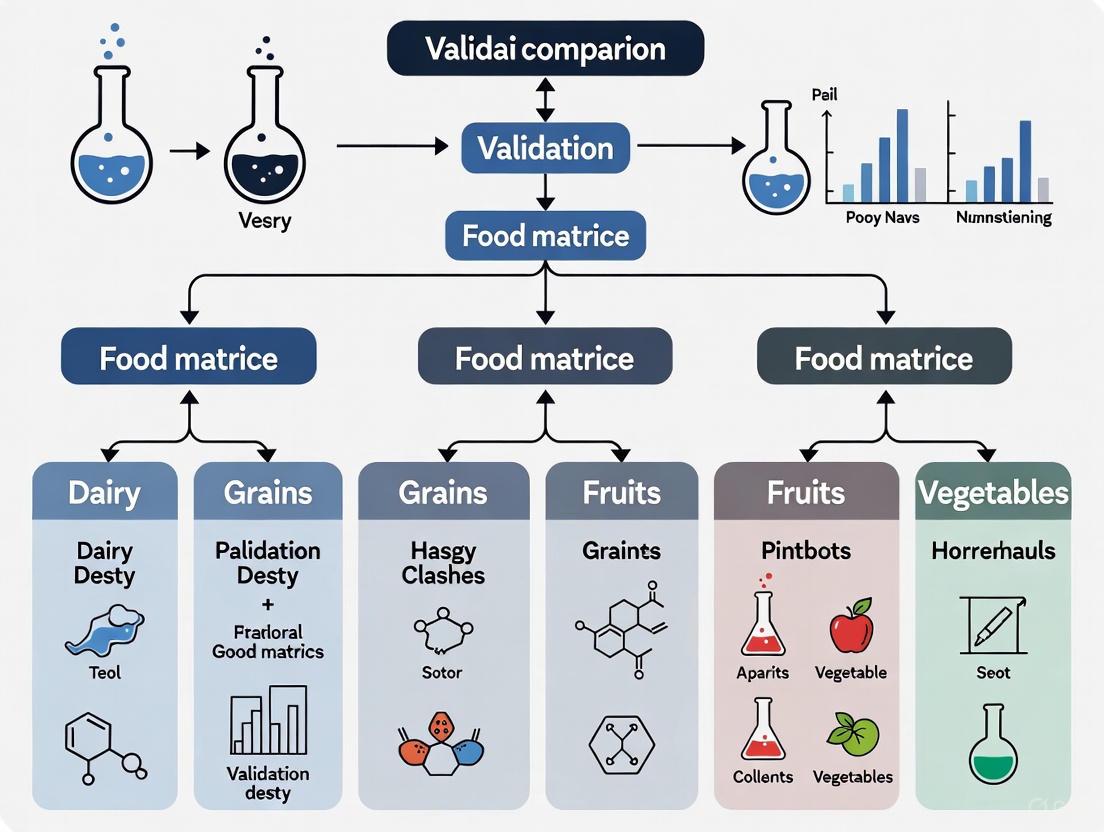
This article provides a comprehensive framework for the validation of analytical methods tailored to the unique challenges posed by diverse food matrices.
Matrix Matters: A Strategic Framework for Validating Analytical Methods Across Diverse Food Matrices
Abstract
This article provides a comprehensive framework for the validation of analytical methods tailored to the unique challenges posed by diverse food matrices. Aimed at researchers, scientists, and drug development professionals, it synthesizes foundational principles, methodological applications, and optimization strategies to ensure data reliability and regulatory compliance. Covering topics from ICH/FDA guidelines and matrix-effects to novel foods and AI-based assessment, the content bridges the gap between theoretical validation parameters and practical implementation. It concludes with a forward-looking perspective on harmonization and emerging technologies, offering a actionable roadmap for robust analytical practices in food and biomedical research.
The Pillars of Validation: Core Principles and the Critical Impact of Food Matrices
In scientific research and quality control, particularly within food safety and pharmaceutical development, the processes of verification and validation are fundamental to ensuring data integrity, regulatory compliance, and product safety. Though often used interchangeably, these terms represent distinct concepts with different objectives, timelines, and regulatory implications. Verification answers the question "Are we building the product right?" by checking whether a product, system, or method is being developed in accordance with specified requirements and design specifications [1] [2]. In contrast, Validation answers the question "Are we building the right product?" by ensuring the final output meets the user's actual needs and intended uses under real-world conditions [3] [4].
Understanding this distinction is particularly critical for researchers, scientists, and drug development professionals working with complex food matrices and regulatory frameworks. The choice between verification and validation, or their sequential application, directly impacts methodological rigor, resource allocation, and regulatory acceptance. This guide provides a structured comparison of these approaches, with specific application to food testing methodologies and compliance requirements.
Core Definitions and Conceptual Frameworks
What is Verification?
Verification is a static process of checking documents, designs, and code without executing the software or method [2]. It focuses on confirming that development artifacts adhere to predefined standards, specifications, and regulations [3]. In laboratory settings, method verification confirms that a previously validated method performs as expected under specific laboratory conditions with defined performance characteristics [5] [6].
Key Characteristics of Verification:
- Primarily a documentation-based review process [2]
- Occurs during the development phase [3]
- Typically finds 50-60% of system defects [2]
- Performed by quality assurance teams through reviews, walkthroughs, and inspections [2]
- Prevents errors through early detection of specification non-conformities [2]
What is Validation?
Validation is a dynamic process that involves executing code or testing methods to evaluate functionality under real-world conditions [2]. It ensures that the final product, system, or analytical method meets the stakeholder's actual needs and intended uses [3]. In regulated laboratories, method validation proves through extensive testing that an analytical method is acceptable for its intended purpose [6].
Key Characteristics of Validation:
- Involves actual testing and execution [2]
- Occurs after development completion or at specific project milestones [1]
- Typically finds 20-30% of system defects [2]
- Performed by testing teams through functional, system, and user acceptance testing [2]
- Detects errors through empirical evaluation of performance [2]
Comparative Framework: Verification vs. Validation
Table 1: Fundamental Differences Between Verification and Validation
| Aspect | Verification | Validation |
|---|---|---|
| Fundamental Question | Are we building the product right? [1] | Are we building the right product? [1] |
| Focus | Process adherence, documentation, specifications [3] | Actual product performance, user needs [3] |
| Testing Type | Static testing (without code execution) [2] | Dynamic testing (with code execution) [2] |
| Methods | Reviews, walkthroughs, inspections, desk-checking [2] | Black box testing, white box testing, non-functional testing [2] |
| Timing | During development [3] | After development or at specific milestones [1] |
| Error Focus | Prevention of errors [2] | Detection of errors [2] |
| Output | Set of verified documents, designs, and plans | Validated system, product, or method ready for use |
Regulatory Frameworks and Standards
ISO Standards for Method Validation and Verification
The ISO 16140 series provides comprehensive international standards for the validation and verification of microbiological methods in food and feed testing [5]. This framework is particularly relevant for researchers working with diverse food matrices, as it establishes protocols for both method validation and laboratory-specific verification.
Key Components of ISO 16140:
- Part 2: Protocol for validation of alternative methods against reference methods [5]
- Part 3: Protocol for verification of reference methods in single laboratories [5]
- Part 4: Protocol for method validation within a single laboratory [5]
- Part 5: Protocol for factorial interlaboratory validation [5]
The standard recognizes that "two stages are needed before a method can be used in a laboratory: first, to prove that the method is fit for purpose and secondly, to demonstrate that the laboratory can properly perform the method" [5]. This distinction between method validation (fitness for purpose) and method verification (laboratory competency) is fundamental to regulatory compliance.
Food Categories and Scope Considerations
ISO 16140 defines categories in the food chain as "a group of sample types of the same origin, e.g. heat-processed milk and dairy products" [5]. For validation studies, testing five out of fifteen defined food categories is considered sufficient to claim validation for a "broad range of foods" [5]. This approach acknowledges the practical limitations of comprehensive validation across all possible food matrices while ensuring methodological robustness.
Table 2: Regulatory Requirements for Validation and Verification
| Regulatory Context | Validation Requirements | Verification Requirements |
|---|---|---|
| ISO/IEC 17025 Accreditation | Required for novel methods or significant modifications [6] | Required for standardized methods to demonstrate laboratory competency [6] |
| Pharmaceutical Development | Essential for new drug applications, clinical trials, and novel assays [6] | Acceptable for compendial methods (USP, EP) with demonstrated performance [6] |
| Food Safety (EU Regulation 2073/2005) | Required for alternative proprietary methods [5] | Required for laboratory implementation of validated methods [5] |
| Clinical Diagnostics | Mandatory for novel diagnostic tests and biomarkers [6] | Applicable for established methods transferred between laboratories [6] |
Application in Food Matrix Research
Method Validation for Diverse Food Matrices
Food matrices present unique challenges for analytical methods due to their complex biochemical composition, physical structure, and potential interferents. Method validation in food research must account for this diversity through matrix-specific validation protocols.
Critical Validation Parameters for Food Methods:
- Accuracy: Degree of agreement between measured and true values
- Precision: Repeatability and reproducibility across multiple tests
- Specificity: Ability to detect target analyte despite matrix interferents
- Detection Limit: Lowest detectable concentration of the analyte
- Quantitation Limit: Lowest reliably quantifiable concentration
- Linearity: Method's ability to produce proportional results to analyte concentration
- Robustness: Method reliability under varying operational conditions [6]
For food matrices, specificity and robustness are particularly crucial due to the potential for matrix effects that can alter analytical performance. The ISO 16140 framework addresses this through category-based validation, where methods validated across representative food categories are considered applicable to similar matrices [5].
Verification in Food Testing Laboratories
Once a method is validated, individual laboratories must verify their ability to successfully implement it. The ISO 16140-3 standard outlines two verification stages:
- Implementation Verification: Demonstrating the laboratory can correctly perform the method using the same items evaluated in the validation study [5]
- Item Verification: Demonstrating capability with challenging food items specific to the laboratory's scope using defined performance characteristics [5]
This two-tier approach ensures that laboratories can reproduce validation study results while also confirming methodological performance with their specific sample types and testing conditions.
Emerging Technologies and Applications
Advanced detection technologies are transforming verification and validation approaches in food safety research:
- PCR Testing: Dominates rapid food safety testing with 38% market share in 2025 due to exceptional sensitivity and specificity in pathogen detection [7]
- Hyperspectral Imaging & FTIR Spectroscopy: Enable non-destructive, real-time allergen detection without altering food integrity [8]
- Mass Spectrometry: Provides high-sensitivity detection of proteotypic peptides across complex food matrices [8]
- AI and Machine Learning: Enhance pattern recognition for fraud detection and predictive analytics [9]
These technologies enable more comprehensive validation across diverse food matrices while facilitating faster verification through automated data analysis and interpretation.
Experimental Design and Protocols
Method Validation Protocol
A robust validation protocol for food testing methods should include the following experimental components:
1. Scope Definition
- Clearly define the method's intended purpose and application
- Identify target food matrices and relevant categories
- Establish acceptance criteria based on regulatory requirements
2. Experimental Design
- Select representative food matrices spanning relevant categories
- Include certified reference materials when available
- Design spike-recovery experiments for accuracy determination
- Plan interday and intraday experiments for precision assessment
3. Parameter Assessment
- Linearity: Test at least 5 concentrations across the method's range
- Accuracy: Compare results to reference methods or spike-recovery studies
- Precision: Perform repeated measurements under varying conditions
- Specificity: Challenge the method with potentially interfering compounds
- LOD/LOQ: Determine through serial dilution of spiked samples
4. Data Analysis and Reporting
- Apply appropriate statistical methods for each parameter
- Document all deviations from the protocol
- Compare results against predefined acceptance criteria
- Prepare comprehensive validation report
Method Verification Protocol
For laboratories implementing previously validated methods, a streamlined verification protocol includes:
1. Performance Characteristics Assessment
- Confirm key parameters: accuracy, precision, LOD/LOQ
- Test with representative samples from the laboratory's scope
- Demonstrate comparability to validation study results
2. Implementation Testing
- Use the same items evaluated in the validation study
- Ensure personnel competency through training records
- Verify instrument calibration and suitability
3. Documentation Requirements
- Record all verification experiments and results
- Document any modifications to the original method
- Prepare verification summary for audit purposes
The Scientist's Toolkit: Essential Research Reagents and Materials
Table 3: Essential Research Reagents and Materials for Method Validation/Verification
| Category | Specific Items | Application in V&V Studies |
|---|---|---|
| Reference Materials | Certified Reference Materials (CRMs), Standard Reference Materials (SRMs) | Establishing method accuracy through comparison with known values [6] |
| Quality Controls | Positive controls, Negative controls, Internal standards | Monitoring assay performance, detecting contamination, normalizing results [6] |
| Sample Preparation | Extraction buffers, Solid-phase extraction cartridges, Filtration devices | Isolating analytes from complex food matrices, reducing interferents [10] |
| Detection Reagents | Antibodies (immunoassays), Primers/probes (PCR), Enzyme substrates | Enabling specific detection of target analytes or pathogens [7] [8] |
| Calibration Standards | Pure analyte standards, Calibrators with matrix matching | Establishing quantitative relationship between signal and concentration [6] |
| Culture Media | Selective agars, Enrichment broths, Chromogenic substrates | Microorganism isolation and identification in validation studies [5] |
Data Presentation and Analysis
Quantitative Comparison of Validation and Verification
Table 4: Performance Metrics for Validation vs. Verification in Food Testing
| Performance Metric | Method Validation | Method Verification |
|---|---|---|
| Time Investment | Weeks to months depending on complexity [6] | Typically days to complete [6] |
| Resource Requirements | High (specialized personnel, multiple instruments, statistical expertise) [6] | Moderate (focuses on critical parameters only) [6] |
| Parameter Coverage | Comprehensive (accuracy, precision, specificity, LOD, LOQ, linearity, robustness) [6] | Focused (accuracy, precision, LOD/LOQ typically sufficient) [6] |
| Regulatory Acceptance | Required for novel methods and regulatory submissions [6] | Acceptable for standardized methods in quality control [6] |
| Cost Impact | Significant investment in development and characterization [6] | Economical for routine implementation [6] |
| Defect Detection Capability | 50-60% of total system defects [2] | 20-30% of total system defects [2] |
Market Data and Industry Adoption
The rapid food safety testing market, projected to grow from $19.7 billion in 2025 to $39.5 billion by 2035, reflects increasing emphasis on validated testing methodologies [7]. Key technology segments include:
- PCR Testing: 38% market share in 2025, valued for sensitivity and specificity in pathogen detection [7]
- Pathogen Testing: 42% of rapid food safety testing demand in 2025, highlighting focus on validation for critical safety parameters [7]
- Food Manufacturer Segment: 50% end-user share in 2025, demonstrating industry investment in validated testing protocols [7]
Verification and validation represent complementary but distinct approaches to ensuring methodological rigor in food matrix research and pharmaceutical development. The strategic choice between these approaches depends on multiple factors:
When to Choose Method Validation:
- Developing novel analytical methods
- Establishing performance characteristics for regulatory submissions
- Transferring methods between laboratories with significantly different conditions
- Working with new analytes or sample matrices
When to Choose Method Verification:
- Implementing previously validated compendial methods
- Demonstrating laboratory competency with standardized procedures
- Routine quality assurance in established testing workflows
- Limited resource environments requiring efficient implementation
For researchers working with diverse food matrices, a thorough understanding of both processes enables appropriate experimental design, regulatory compliance, and scientifically defensible results. The framework provided by standards such as ISO 16140 offers structured approaches for both validation and verification, while emerging technologies continue to enhance capabilities for comprehensive methodological assessment across complex sample types.
In the globalized landscape of pharmaceutical development and food safety research, navigating the complex web of analytical guidelines is paramount for ensuring product quality, safety, and efficacy. Three pivotal frameworks govern this space: the International Council for Harmonisation (ICH) guidelines, particularly the recently updated Q2(R2) on analytical procedure validation; the U.S. Food and Drug Administration (FDA) regulations and guidance documents; and the international standard ISO/IEC 17025 for laboratory competence. These frameworks collectively establish the benchmarks for generating reliable, defensible analytical data that supports regulatory submissions and commercial distribution across international markets.
The ICH Q2(R2) guideline provides the foundational principles for validating analytical procedures, ensuring they are suitable for their intended purpose across the pharmaceutical industry. As a key ICH member, the FDA adopts and implements these harmonized guidelines, making compliance with ICH standards a direct path to meeting U.S. regulatory requirements for submissions such as New Drug Applications (NDAs) and Abbreviated New Drug Applications (ANDAs) [11]. Meanwhile, ISO/IEC 17025 serves as the international benchmark for testing and calibration laboratories, demonstrating their technical competence and operational reliability through a comprehensive framework that integrates both quality management and technical requirements [12] [13].
Understanding the interrelationships, distinct focuses, and complementary applications of these three frameworks is essential for researchers, scientists, and drug development professionals working with diverse food matrices and pharmaceutical products. This guide provides a detailed comparison of their requirements, implementation approaches, and specific applications within food and pharmaceutical research contexts.
Detailed Framework Analysis
ICH Q2(R2): Validation of Analytical Procedures
Scope and Purpose
ICH Q2(R2) provides a harmonized framework for the validation of analytical procedures used in pharmaceutical development and quality control. The guideline outlines the fundamental validation characteristics required to demonstrate that an analytical method is suitable for its intended purpose, ensuring the reliability, consistency, and quality of analytical data submitted to regulatory authorities [14] [11]. The March 2024 revision modernizes the previous Q2(R1) guideline by expanding its scope to include contemporary analytical technologies and emphasizing a more scientific, risk-based approach to validation.
The primary objective of ICH Q2(R2) is to establish uniform standards for method validation that facilitate regulatory evaluations and promote flexibility in post-approval change management when scientifically justified [14]. This guideline is particularly crucial for multinational companies seeking global market authorization, as it ensures that analytical methods validated in one region are recognized and trusted worldwide, thereby streamlining the drug development and registration process across multiple regulatory jurisdictions.
Core Validation Parameters
ICH Q2(R2) defines specific validation characteristics that must be evaluated based on the type of analytical procedure (identification, testing for impurities, assay content/potency). The core parameters include:
- Accuracy: The closeness of agreement between the conventional true value or an accepted reference value and the value found. This demonstrates the exactness of the analytical method [11].
- Precision: The closeness of agreement between a series of measurements obtained from multiple sampling of the same homogeneous sample under prescribed conditions. This includes repeatability (intra-assay precision), intermediate precision (variation within laboratories), and reproducibility (inter-laboratory precision) [11].
- Specificity: The ability to assess unequivocally the analyte in the presence of components that may be expected to be present, such as impurities, degradation products, and matrix components [11].
- Linearity: The ability of the method to obtain test results that are directly proportional to the concentration (amount) of analyte in the sample within a given range [11].
- Range: The interval between the upper and lower concentrations (amounts) of analyte in the sample for which the method has suitable levels of precision, accuracy, and linearity [11].
- Limit of Detection (LOD): The lowest amount of analyte in a sample that can be detected, but not necessarily quantitated, under the stated experimental conditions [11].
- Limit of Quantitation (LOQ): The lowest amount of analyte in a sample that can be quantitatively determined with suitable precision and accuracy [11].
- Robustness: A measure of the method's capacity to remain unaffected by small, deliberate variations in method parameters, providing an indication of its reliability during normal usage [11].
Table 1: ICH Q2(R2) Validation Parameters and Their Applications
| Validation Parameter | Objective | Typical Assessment Approach |
|---|---|---|
| Accuracy | Measure closeness to true value | Comparison with reference standard; spike recovery studies |
| Precision | Evaluate measurement reproducibility | Repeated analysis of homogeneous samples; statistical analysis of variance |
| Specificity | Demonstrate selective analyte detection | Analysis of samples with and without potential interferents |
| Linearity | Establish proportional response | Analysis of analyte across specified range with statistical correlation |
| Range | Define valid analyte concentration interval | Verification that precision, accuracy, linearity meet specifications across interval |
| LOD/LOQ | Determine detection and quantification limits | Signal-to-noise ratio or standard deviation of response and slope |
| Robustness | Assess method resilience to parameter variations | Deliberate variation of parameters (pH, temperature, mobile phase) |
FDA Analytical Requirements
Regulatory Framework and Guidance
The U.S. Food and Drug Administration (FDA) provides the regulatory framework for analytical methods supporting pharmaceutical products, foods, dietary supplements, and medical devices in the United States. While the FDA issues its own specific guidance documents, as a key regulatory member of ICH, it has adopted the ICH Q2(R2) guideline, making it the standard for analytical method validation for drug submissions [11]. The FDA's approach to analytical method validation is embedded within its broader mandate to protect public health by ensuring the safety, efficacy, and security of regulated products.
The FDA's current thinking on analytical methodologies is communicated through guidance documents that represent the Agency's interpretation of, or policy on, regulatory issues. These documents do not legally bind the FDA or the public but provide recommendations that, when followed, facilitate efficient regulatory evaluations [15]. For the food industry specifically, the FDA's Foods Program is developing several guidance documents expected to be published by the end of December 2025, including "Action Levels for Cadmium in Food Intended for Babies and Young Children" and "Action Levels for Inorganic Arsenic in Food Intended for Babies and Young Children" [16].
Compliance and Enforcement Mechanisms
The FDA ensures compliance with analytical requirements through various regulatory mechanisms, including:
- Compliance Programs: The FDA issues compliance programs that provide instructions to FDA personnel for conducting activities to evaluate industry compliance with the Federal Food, Drug, and Cosmetic Act. These include specific programs for different product categories such as the "Preventive Controls and Sanitary Human Food Operations" (implementation date: 5/7/2025) and "Dietary Supplements - Foreign and Domestic Inspections, Sampling, and Imports" (implementation date: 9/30/2024) [17].
- Inspection Authorities: FDA investigators conduct inspections of manufacturing facilities, quality control laboratories, and clinical research sites to verify compliance with Current Good Manufacturing Practices (cGMP), Good Laboratory Practices (GLP), and other regulatory standards.
- Laboratory Accreditation: For food testing, the FDA has established the Laboratory Accreditation for Analyses of Foods (LAAF) program, which is complemented by ISO/IEC 17025 accreditation with supplemental requirements (SR 2440) for laboratories performing FDA-regulated food analyses [18].
Table 2: FDA Compliance Programs Relevant to Analytical Methodologies
| Compliance Program Number | Title | Implementation Date | Relevance to Analytical Methods |
|---|---|---|---|
| 7303.040 | Preventive Controls and Sanitary Human Food Operations | 5/7/2025 | Verifies preventive controls validation, including analytical methods for hazard analysis |
| 7304.004 | Pesticides and Industrial Chemicals in Domestic and Imported Foods | 6/27/2011 | Governs analytical methods for contaminant testing in foods |
| 7321.005 | Food Labeling and Nutrient Analysis | 5/9/2025 | Ensures accuracy of nutritional labeling through validated analytical methods |
| 7321.006 | Infant Formula Program - Inspection, Sample Collection, and Examination | Upon Receipt | Specific method requirements for infant formula nutrient and contaminant analysis |
| 7321.008 | Dietary Supplements - Foreign and Domestic Inspections, Sampling, and Imports | 9/30/2024 | Validates analytical methods for dietary supplement ingredient and contaminant testing |
ISO/IEC 17025: Laboratory Competence
Scope and Purpose
ISO/IEC 17025 is the international standard specifying the general requirements for the competence, impartiality, and consistent operation of testing and calibration laboratories [12]. The standard enables laboratories to demonstrate they operate competently and generate valid results, thereby promoting confidence in their work both nationally and internationally. A key benefit of ISO/IEC 17025 accreditation is the facilitation of cooperation between laboratories and other bodies by generating wider acceptance of results between countries, which improves international trade by reducing technical barriers [12] [13].
The standard applies to all organizations performing testing, sampling, or calibration, including government, industry, university, and research laboratories [12]. The 2017 revision of ISO/IEC 17025 introduced significant changes, including adoption of a risk-based approach, alignment with modern management system concepts (particularly ISO 9001:2015), and updated requirements for information technologies, data integrity, and cybersecurity concerns in laboratory operations [13].
Key Requirements and Accreditation Process
ISO/IEC 17025 structures its requirements into five main sections:
- General Requirements: Address impartiality, confidentiality, and structural obligations [13].
- Structural Requirements: Define organizational hierarchy, responsibilities, and authority [13].
- Resource Requirements: Cover personnel competence, facilities, equipment, and environmental conditions [13].
- Process Requirements: Encompass review of requests, method selection, sampling, handling of test items, technical records, measurement uncertainty, and reporting of results [13].
- Management System Requirements: Include options for management system documentation, control of records, actions to address risks and opportunities, and improvement processes [13].
The path to ISO/IEC 17025 accreditation typically follows a structured process involving understanding accreditation requirements, comprehensive documentation, implementation of systems, internal auditing, management review, and formal assessment by an accreditation body [19]. Accreditation bodies such as A2LA and ANAB provide specific requirements and guidance documents to assist laboratories in achieving and maintaining accreditation [19] [18].
Comparative Analysis of Framework Requirements
Structural and Focus Comparison
The three frameworks, while complementary, have distinct structural approaches and primary focuses:
ICH Q2(R2) is specifically focused on the validation of analytical procedures, primarily in the pharmaceutical context. It provides detailed, prescriptive guidance on the specific parameters that must be evaluated to demonstrate a method is suitable for its intended use. The guideline is technically focused, with an emphasis on the scientific rigor of the analytical method itself rather than the overall laboratory system [11].
FDA requirements encompass a broader regulatory framework that includes method validation as one component. The FDA's approach extends beyond technical validation to include compliance and enforcement mechanisms, with specific programs for different product categories. FDA guidance documents represent the Agency's current thinking on regulatory issues but allow for alternative approaches that satisfy statutory and regulatory requirements [15].
ISO/IEC 17025 takes a comprehensive systems approach, addressing both management system requirements and technical competencies of the entire laboratory operation. Rather than focusing solely on method validation, it encompasses personnel competence, equipment calibration, environmental conditions, sampling procedures, and quality assurance processes that collectively ensure the validity of all results produced by the laboratory [12] [13].
Table 3: Comparative Analysis of Framework Focus and Application
| Aspect | ICH Q2(R2) | FDA Regulatory Framework | ISO/IEC 17025 |
|---|---|---|---|
| Primary Focus | Analytical procedure validation | Regulatory compliance and public health protection | Laboratory competence and quality management |
| Scope | Pharmaceutical analysis methods | All regulated products (drugs, food, devices, etc.) | All testing and calibration laboratories |
| Technical Emphasis | Specific validation parameters for each method type | Method suitability for regulatory decisions | Overall technical competence and validity of results |
| Management System | Not addressed (focus is on method performance) | Implied through cGMP and other regulations | Comprehensive management system requirements included |
| Geographic Applicability | International (through ICH regions) | United States | International |
| Enforcement Mechanism | Regulatory acceptance of submissions | Inspectional authority and legal enforcement | Accreditation process and surveillance assessments |
Method Validation Requirements Comparison
While all three frameworks emphasize the importance of validated analytical methods, their specific requirements and approaches differ:
ICH Q2(R2) provides the most detailed and prescriptive guidance on method validation parameters, specifying exactly which characteristics must be validated for different types of analytical procedures (identification, impurity testing, assay). The guideline establishes standardized acceptance criteria and experimental approaches for demonstrating method validity [11].
FDA requirements for method validation generally align with ICH Q2(R2) for pharmaceutical applications, but may include additional product-specific considerations. For food and dietary supplement analysis, the FDA may recognize alternative validation approaches, such as single-laboratory validation for Official Methods of Analysis, while still requiring demonstration of similar performance characteristics [16].
ISO/IEC 17025 takes a broader perspective on method validation, requiring laboratories to validate non-standard, laboratory-developed, and standardized methods used outside their intended scope. The standard emphasizes that methods must be "verified" to ensure the laboratory can properly implement them, with particular attention to measurement uncertainty estimation, which is a more prominent requirement in ISO/IEC 17025 compared to ICH Q2(R2) [13].
The following workflow diagram illustrates the relationship between these frameworks in the context of analytical method lifecycle management:
Figure 1: Analytical Method Lifecycle Management Across Frameworks
Documentation and Record-Keeping Requirements
Documentation practices represent another area of differentiation among the frameworks:
ICH Q2(R2) focuses primarily on the documentation of validation studies, requiring comprehensive protocols and reports that demonstrate each validation parameter has been adequately addressed with appropriate acceptance criteria. The emphasis is on the scientific justification for the method's suitability [11].
FDA requirements extend beyond technical documentation to include comprehensive record-keeping of all laboratory activities, with particular emphasis on data integrity principles (ALCOA+: Attributable, Legible, Contemporaneous, Original, Accurate, plus Complete, Consistent, Enduring, Available). FDA expectations include rigorous change control, audit trails, and raw data preservation [17].
ISO/IEC 17025 mandates a complete quality management system documentation, including quality manual, procedures, work instructions, and technical records. The standard specifically requires control of records, management reviews, and internal audits to ensure the continued suitability and effectiveness of the management system [19] [13].
Implementation in Food and Pharmaceutical Research
Application to Different Food Matrices
The selection and application of appropriate analytical guidelines depend significantly on the food matrix being analyzed and the specific analytical question being addressed. Different food matrices present unique challenges for analytical methods, including varying complexity, interference compounds, analyte distribution, and stability concerns.
Complex Matrices (e.g., dairy products, meat, spices) require special consideration for specificity in method validation to ensure accurate quantification of analytes amidst potentially interfering compounds. ICH Q2(R2) provides guidance on establishing specificity through forced degradation studies and analysis of placebo matrices, while ISO/IEC 17025 emphasizes the need for method validation specific to each matrix type [11] [13].
Low-Moisture Matrices (e.g., cereals, powders, nuts) present challenges for homogeneous sampling and extraction efficiency. The FDA's compliance programs address sampling approaches for such matrices, while ISO/IEC 17025 includes specific requirements for sampling methodologies to ensure representative samples [17] [13].
Infant and Medical Foods are subject to particularly stringent regulatory oversight, as reflected in the FDA's specific compliance programs and upcoming guidance on action levels for contaminants. Method validation for these products must demonstrate exceptional accuracy, precision, and sensitivity, especially for potentially harmful contaminants like heavy metals [16].
Complementary Implementation Strategies
Successful implementation of analytical quality systems typically involves integrating elements from all three frameworks in a complementary manner:
Pharmaceutical Quality Control Laboratories often implement a comprehensive system where ICH Q2(R2) provides the methodology for specific method validation, FDA requirements dictate the regulatory compliance framework, and ISO/IEC 17025 accreditation demonstrates overall laboratory competence to international standards.
Food Testing Laboratories serving global markets may implement ISO/IEC 17025 as their foundational quality system, while applying ICH Q2(R2) principles for method validation and adhering to FDA-specific requirements for products entering the U.S. market. The FDA's LAAF program specifically recognizes ISO/IEC 17025 accreditation with supplemental requirements for food testing laboratories [18].
Research and Development Laboratories often adopt a hybrid approach, implementing ICH Q2(R2) validation principles for methods intended for regulatory submissions while building ISO/IEC 17025-compliant quality systems to support general research quality and facilitate future laboratory accreditation.
Essential Research Reagent Solutions
Implementation of these analytical guidelines requires specific reagents, materials, and quality assurance tools. The following table details essential research reagent solutions and their functions in meeting guideline requirements:
Table 4: Essential Research Reagent Solutions for Analytical Guidelines Compliance
| Reagent/Material Category | Specific Examples | Function in Guideline Compliance | Relevant Framework Requirements |
|---|---|---|---|
| Certified Reference Materials | NIST Standard Reference Materials, ERM Certified Reference Materials | Establish method accuracy and traceability to SI units | ICH Q2(R2) Accuracy, ISO/IEC 17025 Traceability |
| System Suitability Standards | USP System Suitability Standards, Chromatographic Performance Standards | Verify instrument performance before and during analysis | ICH Q2(R2) Precision, FDA Data Integrity |
| High-Purity Solvents and Reagents | HPLC-grade solvents, LC-MS grade solvents, Trace metal-grade acids | Minimize background interference and contamination | ICH Q2(R2) Specificity, ISO/IEC 17025 Resource Requirements |
| Stable Isotope-Labeled Internal Standards | 13C-, 15N-, 2H-labeled analogs of target analytes | Improve quantification accuracy and compensate for matrix effects | ICH Q2(R2) Accuracy and Precision, FDA Guidance on LC-MS/MS |
| Quality Control Materials | In-house quality control pools, Third-party proficiency testing materials | Monitor method performance over time and demonstrate continued validity | ISO/IEC 17025 Quality Assurance, FDA cGMP |
| Stability Study Materials | Forced degradation reagents (acids, bases, oxidants, light sources) | Establish method stability-indicating properties and specificity | ICH Q2(R2) Specificity and Robustness |
| Filter and Purification Media | Solid-phase extraction cartridges, Membrane filters, Immunoaffinity columns | Sample cleanup to improve method sensitivity and specificity | ICH Q2(R2) LOD/LOQ, Specificity |
The landscape of international analytical guidelines is complex yet increasingly harmonized. ICH Q2(R2) provides the technical foundation for analytical method validation, particularly in pharmaceutical applications. The FDA regulatory framework establishes the compliance requirements for products marketed in the United States, with increasing alignment to international standards. ISO/IEC 17025 offers a comprehensive system for demonstrating overall laboratory competence that is recognized globally.
For researchers and laboratories working with diverse food matrices, understanding the complementary nature of these frameworks is essential for designing efficient quality systems that meet multiple regulatory needs simultaneously. The trend toward further harmonization and mutual recognition continues, with the FDA actively participating in international standardization efforts while maintaining its specific public health protection mandate.
Successful navigation of these guidelines requires a strategic approach that integrates the technical rigor of ICH Q2(R2), the regulatory compliance focus of FDA requirements, and the systematic quality management of ISO/IEC 17025. This integrated approach ensures the generation of reliable, defensible analytical data that supports product quality, safety, and efficacy across international markets.
In the field of food analysis, the reliability of data is paramount. Whether for ensuring nutritional quality, verifying safety, or complying with regulations, analytical results must be trustworthy. This trust is established through method validation, a process that confirms an analytical procedure is suitable for its intended purpose by evaluating key performance parameters [20]. For researchers and drug development professionals working with diverse food matrices, understanding these core parameters—Accuracy, Precision, Specificity, LOD, and LOQ—is fundamental to producing credible, reproducible scientific data.
The complexity of food matrices, which can contain varying levels of fats, proteins, carbohydrates, and other compounds, poses significant challenges to analytical accuracy [21] [22]. These matrix components can interfere with the detection and quantification of target analytes, making rigorous method validation not just beneficial but essential. This guide provides a detailed comparison of these core validation parameters, supported by experimental data and practical protocols, to aid in the development and critical assessment of robust analytical methods.
Core Validation Parameters Explained
The validation of an analytical method provides documented evidence that the procedure is fit for its intended purpose, ensuring the reliability and accuracy of results with an acceptable degree of certainty [23]. The following parameters form the foundation of this process.
Accuracy
Accuracy expresses the closeness of agreement between a measured value and its accepted reference or true value [20] [24]. It is a measure of correctness.
- Definition and Significance: In practical terms for natural products, accuracy is most commonly determined via the spike recovery method [20]. This involves adding a known amount of the target analyte to the sample matrix and then performing the analysis. The percentage of the theoretical amount that is recovered provides a direct estimate of the method's accuracy. Regulatory bodies like the FDA suggest that for drugs, matrices should be spiked at 80, 100, and 120% of the expected value to demonstrate accuracy across a relevant concentration range [20].
- Impact of Matrix Effects: The food matrix itself is a major source of inaccuracy. Components like fats and sugars can suppress or enhance the analytical signal, leading to underestimated or overestimated results. For instance, high-fat matrices can retain lipophilic analytes, reducing extraction efficiency, while sugars can interfere with chromatographic separation [22]. Therefore, accuracy must be established within the specific food matrix being analyzed.
Precision
Precision refers to the closeness of agreement between a series of measurements obtained from multiple sampling of the same homogeneous sample under prescribed conditions [20] [24]. It describes the random error and is a measure of repeatability.
- Definition and Hierarchical Levels: Precision is typically investigated at three levels:
- Repeatability: Precision under the same operating conditions over a short interval of time (intra-assay precision).
- Intermediate Precision: Precision within-laboratory variations (e.g., different days, different analysts, different equipment).
- Reproducibility: Precision between laboratories (collaborative studies) [25].
- Relationship with Accuracy: It is crucial to note that a method can be precise but not accurate. However, an accurate method must be precise. Table 1 illustrates this relationship and the core differences between accuracy and precision.
Table 1: Comparison of Accuracy and Precision
| Parameter | Definition | What it Measures | Key Evaluation Method |
|---|---|---|---|
| Accuracy | Closeness to the true value | Correctness | Spike recovery experiments, analysis of Certified Reference Materials (CRMs) |
| Precision | Closeness of results to each other | Repeatability / Reproducibility | Repeated measurements, calculation of standard deviation or relative standard deviation |
Specificity and Selectivity
Specificity and selectivity are related terms that assess a method's ability to measure the analyte unequivocally in the presence of other components.
- Specificity: The ability to assess unequivocally the analyte in the presence of components that may be expected to be present, such as impurities, degradation products, and matrix components. A specific method can distinguish the analyte from all other substances [25].
- Selectivity: The ability of the method to measure and differentiate the analyte in the presence of other interferences. While sometimes used interchangeably with specificity, selectivity often implies that the method can quantify several analytes simultaneously despite potential interferences [23].
- Demonstration in Complex Matrices: In food testing, this parameter is critical. For example, in a validated ICP-MS method for quantifying minerals and toxic elements in various foods, specificity was confirmed, ensuring that other matrix components did not produce a signal that could be mistaken for or interfere with the target elements [26].
Limit of Detection (LOD) and Limit of Quantification (LOQ)
The LOD and LOQ define the lowest levels at which an analyte can be reliably detected or quantified, respectively.
- LOD (Limit of Detection): The lowest amount of analyte in a sample that can be detected, but not necessarily quantified, under the stated experimental conditions. It represents the point where the analyte signal is distinguishable from the background noise [27].
- LOQ (Limit of Quantification): The lowest amount of analyte in a sample that can be quantitatively determined with acceptable precision and accuracy [27].
- Calculation Methods: Multiple approaches exist for calculating LOD and LOQ, which can lead to dissimilar results if not properly reported [27]. Common methods include:
- Signal-to-Noise Ratio: Typically, a S/N of 3:1 for LOD and 10:1 for LOQ.
- Standard Deviation of the Blank and Slope: LOD = (3.3 × σ) / S and LOQ = (10 × σ) / S, where σ is the standard deviation of the blank response and S is the slope of the calibration curve.
- From Calibration Curve: Using the standard error of the regression.
Table 2: Common Approaches for LOD and LOQ Determination
| Approach | Basis | Typical Formula | Considerations |
|---|---|---|---|
| Signal-to-Noise (S/N) | Instrumental noise | LOD: S/N = 3, LOQ: S/N = 10 | Simple, but can be subjective. Best for initial estimation [27]. |
| Standard Deviation of Blank | Variability of blank measurements | LOD = 3.3σ/S, LOQ = 10σ/S | Requires a representative, analyte-free blank matrix, which can be challenging [27]. |
| Calibration Curve | Statistical parameters of the regression | Based on standard error / sensitivity | Recommended by IUPAC, FDA, and other bodies. More robust for complex systems [27]. |
Comparative Experimental Data Across Food Matrices
The performance of these validation parameters is highly dependent on the food matrix. The following examples illustrate this variability with real experimental data.
Validation in a Multi-Laboratory Study: Pathogen Detection
A 2025 multi-laboratory validation (MLV) study evaluated a real-time PCR (qPCR) method for detecting Salmonella in frozen fish, a matrix requiring blending during preparation [28]. The study involved 14 laboratories each analyzing 24 blind-coded samples.
- Accuracy and Precision: The study demonstrated equivalent performance between the qPCR method and the traditional culture reference method (BAM). The positive rates were ~39% (qPCR) and ~40% (culture), within the acceptable FDA fractional range of 25–75%. The results showed high reproducibility among the different laboratories [28].
- Sensitivity and Specificity: The qPCR method, which targets the Salmonella invA gene, was found to be both sufficiently sensitive and specific for detecting Salmonella in the frozen fish matrix. Furthermore, the study showed that automated DNA extraction methods improved qPCR sensitivity by yielding higher-quality DNA extracts compared to manual methods [28].
Validation for Elemental Analysis in Diverse Foods
A 2023 study developed and validated a single method using Inductively Coupled Plasma Mass Spectrometry (ICP-MS) to quantify nine macro, micro, and potentially toxic elements in various food matrices, including chicken, mussels, fish, rice, and seaweed [26].
Table 3: Validation Data for ICP-MS Method in Multiple Food Matrices [26]
| Validated Parameter | Result & Methodology | Outcome |
|---|---|---|
| Working Range & Linearity | Established for all nine elements. | Met the criteria of the Portuguese Association of Accredited Laboratories. |
| LOD & LOQ | Calculated for each element-matrix combination. | Successfully determined, allowing detection at required levels. |
| Selectivity | Method ensured no interferences for target elements. | Criteria met, confirming method specificity. |
| Repeatability (Precision) | Assessed through replicate analyses. | Found to be within acceptable limits. |
| Trueness (Accuracy) | Evaluated using Certified Reference Materials (CRMs). | Recovery and trueness met validation criteria. |
This validated method was successfully applied to compare raw and cooked foods, showing significant changes in most element levels and providing data to assess compliance with EU maximum permissible levels for toxic elements [26].
The Challenge of Complex Matrices: Fats and Sugars
The analysis of foods with high fat or sugar content presents particular validation challenges that must be addressed.
- High-Fat Matrices: Fats can trap lipophilic analytes, reducing extraction efficiency, and can cause issues like column fouling in gas chromatography or ion suppression in LC-MS [22].
- High-Sugar Matrices: Sugars can interfere with chromatographic separations and their polarity can lead to inaccurate quantification. They can also participate in reactions like Maillard degradation during analysis, altering the target analytes [22].
- Mitigation Strategies: To ensure accuracy and precision in such matrices, analysts employ strategies such as:
- Robust Sample Preparation: Modified QuEChERS (Quick, Easy, Cheap, Effective, Rugged, and Safe) protocols for high-fat foods [22].
- Matrix-Matched Calibration: Preparing calibration standards in a blank matrix similar to the sample to correct for matrix-induced effects [22].
- Internal Standards: Using isotope-labeled internal standards, which mimic the analyte's behavior, to compensate for matrix-induced signal suppression or enhancement, especially in mass spectrometry [22].
Essential Research Reagent Solutions
The following reagents and materials are critical for successfully validating analytical methods for food matrices.
Table 4: Key Research Reagents and Materials for Method Validation
| Reagent / Material | Function in Validation | Application Example |
|---|---|---|
| Certified Reference Materials (CRMs) | To establish method accuracy (trueness) by providing a material with a known, certified analyte concentration. | Used in the ICP-MS study to validate the quantification of elements in chicken, mussels, and fish [26]. |
| High-Purity Analytical Standards | To prepare calibration standards for constructing curves for LOD/LOQ, linearity, and to serve as spiking material for recovery (accuracy) experiments. | Essential for the HPLC analysis of anthocyanins in cranberry, where purity assumptions impact accuracy [20]. |
| Isotope-Labeled Internal Standards | To correct for analyte loss during sample preparation and matrix effects during analysis, improving both accuracy and precision. | Critical in LC-MS/MS to compensate for ion suppression from matrix components, a common issue in fatty foods [25] [22]. |
| Blank Matrix Materials | To prepare matrix-matched calibration standards and to evaluate specificity by ensuring no interferences co-elute with the analyte. | A blank egg matrix was used to build calibration curves for determining enrofloxacin, an exogenous compound [27]. |
| Quality Control (QC) Materials | To continuously monitor method performance (precision and accuracy) during routine analysis after validation. | Used in regulated environments to ensure ongoing compliance with validation criteria [24] [23]. |
Experimental Workflow for Method Validation
The following diagram illustrates a generalized workflow for validating an analytical method, integrating the core parameters discussed.
Validation Workflow for Analytical Methods
The core validation parameters—Accuracy, Precision, Specificity, LOD, and LOQ—are non-negotiable pillars for ensuring the reliability of analytical data in food analysis [25]. As demonstrated through comparative examples, the food matrix itself is a critical variable that directly impacts these parameters. A method validated for one matrix (e.g., baby spinach) cannot be assumed to perform equally well for another (e.g., frozen fish) without rigorous testing, as highlighted in the multi-laboratory Salmonella study [28].
Successful validation requires a strategic, fit-for-purpose approach that incorporates well-defined protocols, appropriate reagent solutions like CRMs and internal standards, and a clear understanding of the computational basis for parameters like LOD and LOQ [27]. As the field evolves with novel foods and advanced technologies, a steadfast commitment to these fundamental validation principles will continue to be the cornerstone of scientific integrity, regulatory compliance, and consumer safety in food research and development.
In food analysis, the food matrix refers to the intricate organization of nutrients, bioactive components, and the physical structure of a food, which collectively influence how components are released, detected, and measured [29]. This complex interplay between a food's chemical composition and its physical structure presents a significant challenge for analytical accuracy, as it can shield target analytes, cause unpredictable interactions, and alter extraction efficiency and detector response [30]. Understanding these matrix effects is crucial for developing robust analytical methods that deliver accurate results across diverse food products, from simple liquids to complex solid matrices.
The concept has evolved from merely observing food microstructure to recognizing the dynamic functional behavior of chemical components confined in discrete domains [30]. This paradigm shift has profound implications for analytical chemistry, where the traditional "one-size-fits-all" extraction and detection protocols often fail when confronted with vastly different food matrices. For instance, analyzing a nutrient in a homogeneous liquid like milk requires dramatically different approaches than extracting the same nutrient from a fibrous plant tissue or a protein-rich cheese matrix [30] [29].
Fundamental Matrix Effects on Analytical Accuracy
Physical Barrier Effects
The physical architecture of food matrices creates significant barriers to analytical accuracy by trapping target analytes within cellular structures or molecular complexes. Plant cells walls, for instance, can encapsulate starch granules and various bioactive compounds, making complete extraction challenging without disruptive processing methods [29]. Research demonstrates that the grinding of almonds disrupts plant cell walls, significantly increasing metabolizable energy measurements compared to whole almonds—a vivid illustration of how matrix structure affects analyte availability [29].
In dairy products, the transformation from liquid milk to gel-structured yogurt and solid cheese creates progressively complex matrices that sequester nutrients differently. Casein micelles in cheese, for example, can bind to certain analytes, requiring more aggressive extraction techniques than those needed for milk analysis [30]. These physical barrier effects necessitate matrix-specific sample preparation protocols to ensure accurate quantification of target compounds.
Molecular Interactions and Interferences
Beyond physical barriers, molecular interactions within food matrices introduce significant analytical challenges. Components such as proteins, lipids, and carbohydrates can form complexes with analytes or with reagents used in analytical methods, leading to underestimated concentrations or false negatives [30]. For example, calcium in dairy matrices can bind to certain analytes, affecting their extraction efficiency and detection [29].
The food processing further complicates these molecular interactions. Heating, fermentation, and mechanical processing alter molecular arrangements and create new binding sites or interference compounds [30] [29]. In dairy products, the fermentation process transforms the matrix from a simple liquid to a complex gel, creating new molecular interactions that can interfere with analytical accuracy [29]. These interactions underscore the necessity of using matrix-matched standards and calibration curves in food analysis.
Table 1: Common Food Matrix Effects on Analytical Accuracy
| Matrix Type | Primary Interference Mechanisms | Impact on Analytical Accuracy |
|---|---|---|
| Plant Tissues | Cellular encapsulation, fiber binding, phenolic interactions | Reduced analyte extraction, formation of degradation products |
| Dairy Gels (Yogurt) | Protein-analyte complexes, calcium binding, pH effects | Altered detector response, incomplete release during extraction |
| Fat-Rich Matrices | Lipid partitioning, emulsion effects, oxidative protection | Overestimation of lipid-soluble analytes, underestimation of hydrophilic compounds |
| Cereal Products | Starch-protein interactions, milling-dependent surface area | Variable extraction efficiency, method-dependent recovery rates |
| Fermented Foods | Microbial metabolites, modified pH, enzymatic activity | False positives/negatives, analyte transformation during analysis |
Comparative Analysis of Analytical Techniques for Different Matrices
Traditional vs. Advanced Analytical Approaches
The limitations of conventional analytical methods in dealing with complex food matrices have driven the development of advanced techniques specifically designed to overcome matrix effects. Traditional methods like chromatography (HPLC, GC) and mass spectrometry provide excellent sensitivity but remain vulnerable to matrix-induced enhancement or suppression effects, particularly in complex samples [31]. These techniques often require extensive sample cleanup to minimize matrix interferences, adding time and complexity to the analytical process.
Advanced vibrational spectroscopy techniques including mid-infrared (MIR), near-infrared (NIR), and Raman spectroscopy have emerged as powerful alternatives for matrix-challenged analyses [31]. These methods offer rapid, non-destructive measurement capabilities with minimal sample preparation, effectively bypassing many extraction-related matrix effects. The integration of chemometrics and machine learning with these spectroscopic techniques has further enhanced their ability to extract meaningful information from complex spectral data affected by matrix variations [31].
Table 2: Technique Comparison for Different Food Matrices
| Analytical Technique | Matrix Applications | Limitations with Complex Matrices | Solutions for Matrix Effects |
|---|---|---|---|
| High-Performance Liquid Chromatography (HPLC) | Universal application | Matrix-induced enhancement/suppression, co-elution | Matrix-matched calibration, solid-phase extraction cleanup |
| Mass Spectrometry (MS) | Targeted compound analysis | Ion suppression, requires extensive sample prep | Stable isotope internal standards, improved sample extraction |
| Near-Infrared Spectroscopy (NIR) | Intact solids, powders, liquids | Scattering effects, moisture interference | Multiplicative scatter correction, derivative preprocessing |
| Raman Spectroscopy | Aqueous systems, transparent packaging | Fluorescence background, weak signals | Surface-enhanced Raman, shifted excitation methods |
| Laser-Induced Breakdown Spectroscopy (LIBS) | Olive oil, milk, honey authentication | Limited sensitivity for trace elements | Double-pulse LIBS, plasma imaging enhancements |
Emerging Approaches for Matrix Complexity
Artificial intelligence (AI) and machine learning approaches are increasingly applied to overcome food matrix challenges in analytical chemistry [32]. These technologies can model complex relationships between matrix components and analytical signals, potentially correcting for interference effects without physical sample cleanup. Studies validating AI-based dietary assessment methods have reported correlation coefficients exceeding 0.7 for calorie and macronutrient estimation compared to traditional methods, demonstrating their potential for handling matrix-related inaccuracies [32].
Hyperspectral imaging represents another advanced approach combining spectroscopy and digital imaging to address spatial heterogeneity in complex matrices [31]. This technique is particularly valuable for non-homogeneous foods where analyte distribution varies significantly within a single sample. The integration of portable spectroscopic devices with cloud-based data processing enables real-time analysis while accounting for matrix effects through large shared calibration databases [31].
Experimental Approaches for Matrix Effect Characterization
Standard Methodologies for Matrix Effect Quantification
Robust characterization of matrix effects requires systematic experimental approaches. The standard addition method remains a foundational technique, where known quantities of the analyte are added to the sample matrix, enabling detection and correction of matrix-induced signal enhancement or suppression [31]. This approach is particularly valuable for quantifying extraction efficiency and detector response alterations caused by matrix components.
* recovery studies* using isotopically labeled internal standards provide crucial data on how matrices affect analytical accuracy [29]. By spiking samples with known quantities of labeled analogs of target analytes before extraction, researchers can precisely measure matrix-induced losses throughout the analytical process. Studies comparing full-fat versus low-fat dairy matrices have demonstrated significantly different recovery profiles for fat-soluble vitamins and carotenoids, highlighting the profound influence of matrix composition on analytical accuracy [29].
Validation Protocols for Matrix-Specific Methods
Comprehensive method validation must include matrix-specific performance characteristics to ensure analytical accuracy. The Minimum Reporting Standard for Dietary Networks (MRS-DN) checklist, developed to address inconsistencies in dietary pattern research, offers valuable guidance for standardizing matrix effect reporting [33]. Key validation parameters should include matrix-matched calibration, limit of detection in specific matrices, and robustness testing across matrix variations.
International organizations like the International Network of Food Data Systems (INFOODS) and the European Food Information Resource (EuroFIR) have established protocols for harmonizing food composition data across different matrices [34]. These protocols address critical matrix-related challenges including standardized analytical methods, mandatory metadata requirements, and food component nomenclature to improve comparability across studies and matrices [34].
The Scientist's Toolkit: Essential Reagents and Materials
Successfully navigating food matrix complexity requires specialized reagents and materials designed to overcome analytical challenges. The following toolkit highlights essential solutions for matrix-effect management:
Table 3: Research Reagent Solutions for Food Matrix Challenges
| Reagent/Material | Function in Matrix Management | Specific Applications |
|---|---|---|
| Isotopically Labeled Internal Standards | Correct for matrix-induced ionization effects in MS | Protein, metabolite, contaminant quantification |
| Matrix-Matched Calibration Standards | Account for extraction efficiency variations | All quantitative analyses in complex foods |
| Enzymatic Extraction Cocktails | Gentle release of matrix-bound analytes | Plant tissues, fermented products, protein-rich matrices |
| Milk Fat Globule Membrane (MFGM) Standards | Dairy matrix-specific reference materials | Bioactive compound analysis in dairy products |
| Solid-Phase Extraction (SPE) Sorbents | Selective cleanup to remove matrix interferents | Pesticide residue analysis, biomarker quantification |
| Stable Isotope Ratio Reference Materials | Authentication and origin tracing | Honey, olive oil, dairy product authentication |
Future Directions in Food Matrix Research
The future of food matrix research points toward increasingly sophisticated modeling approaches and analytical technologies. Network analysis techniques, including Gaussian graphical models (GGMs) and mutual information networks, are being adapted to model complex relationships between matrix components and analytical outcomes [33]. These approaches can identify critical interference pathways and guide method development to mitigate matrix effects.
The Periodic Table of Food Initiative represents another significant advancement, aiming to comprehensively characterize food components across diverse matrices using standardized analytical protocols [34]. This effort addresses the current limitation where food composition databases typically report data on fewer than 100-250 components, leaving much of the food matrix chemically uncharacterized and creating "dark matter" that can interfere with analytical accuracy [34]. As these initiatives progress, they will provide the foundational data needed to develop more robust analytical methods capable of delivering accurate results across the full spectrum of food matrix complexity.
The complex interplay between food composition and analytical accuracy presents both challenges and opportunities for method development. Understanding specific matrix effects—from physical encapsulation to molecular interactions—enables researchers to select appropriate techniques, implement effective cleanup strategies, and apply necessary corrections. The continuing advancement of analytical technologies, coupled with standardized validation approaches and comprehensive food composition data, promises enhanced accuracy in characterizing even the most complex food matrices. This progress is essential for developing reliable food composition databases, ensuring food authenticity, and accurately assessing diet-health relationships.
The International Council for Harmonisation (ICH) Q14 guideline, in conjunction with the revised ICH Q2(R2), represents a fundamental modernization of the framework governing analytical procedures in the pharmaceutical and life sciences industries [11]. This evolution moves the analytical community from a prescriptive, "check-the-box" validation model to a scientific, risk-based approach that encompasses the entire lifecycle of an analytical method [11]. A cornerstone of this modernized approach is the Analytical Target Profile (ATP), a prospective summary that defines the intended purpose of an analytical procedure and its required performance characteristics [35]. For researchers and scientists engaged in the comparison of validation approaches for different food matrices, these guidelines provide a structured, science-driven framework to ensure methods are not only validated but truly robust, reliable, and fit-for-purpose across diverse and complex sample types [36]. This guide objectively compares this enhanced approach against traditional practices, providing the experimental data and protocols necessary for informed implementation.
Core Concepts: ICH Q14, ATP, and the Enhanced Approach
Understanding the Guidelines: ICH Q14 and Q2(R2)
The ICH provides a harmonized framework that, once adopted by member regulatory bodies like the U.S. Food and Drug Administration (FDA), becomes the global standard for analytical method guidelines [11]. The recent simultaneous release of ICH Q14 ("Analytical Procedure Development") and ICH Q2(R2) ("Validation of Analytical Procedures") signifies a collaborative shift in regulatory expectation [11].
- ICH Q2(R2): This is the core global reference defining what constitutes a valid analytical procedure. The recent revision, Q2(R2), modernizes previous principles by expanding its scope to include modern technologies and formally emphasizing a science- and risk-based approach to validation [11].
- ICH Q14: This new, complementary guideline provides a systematic framework for analytical procedure development. It introduces foundational concepts like the ATP, which proactively defines a method's desired performance, ensuring it is designed to be fit-for-purpose from the outset [11] [35].
For drug development professionals, complying with these ICH standards is a direct path to meeting FDA requirements for regulatory submissions such as New Drug Applications (NDAs) and Abbreviated New Drug Applications (ANDAs) [11].
The Analytical Target Profile (ATP): Defining "Fitness-for-Purpose"
The ATP is a critical tool introduced in ICH Q14. It is defined as a prospective summary of the quality characteristics of an analytical procedure [35]. In practice, the ATP describes what the method needs to achieve (its performance criteria) without initially prescribing how to achieve it (the specific technique) [36].
A well-constructed ATP captures the measuring needs for Critical Quality Attributes (CQAs) and includes the required analytical performance characteristics such as accuracy, precision, specificity, and range [35]. According to ICH Q14, the ATP should be independent of specific techniques or analytical capabilities, being based instead on the quality attribute or characteristics of the process or product [36]. Implementing the ATP early in development facilitates monitoring and continual improvement throughout the analytical procedure's lifecycle [35].
ICH Q14 describes two distinct pathways for analytical procedure development: the minimal approach and the enhanced approach.
- The Minimal Approach: This represents the more traditional, empirical methodology. It is often linear and may rely on one-factor-at-a-time (OFAT) experimentation. While it can lead to a validated method, it may provide a less comprehensive understanding of the method's robustness and its operable design space, making post-approval changes more rigid [11] [35].
- The Enhanced Approach: This is a systematic, science- and risk-based approach that incorporates the principles of Analytical Quality by Design (AQbD) [36] [35]. It uses tools like the ATP, risk assessment, multivariate Design of Experiments (DoE), and the definition of a Method Operable Design Region (MODR) to build quality and understanding into the method from the very beginning [35]. This deep understanding allows for greater flexibility in the method's lifecycle, facilitating more streamlined post-approval changes [11].
Table 1: Comparison of Traditional and Enhanced Analytical Approaches
| Feature | Traditional/Minimal Approach | Enhanced (AQbD) Approach |
|---|---|---|
| Philosophy | Empirical, linear, "check-the-box" | Systematic, proactive, science- and risk-based |
| Development Basis | Often relies on one-factor-at-a-time (OFAT) | Uses Design of Experiments (DoE) and modeling |
| Primary Output | A validated method with fixed parameters | A robust method with a understood MODR and Control Strategy |
| Lifecycle Management | Changes often require regulatory submission | More flexible; changes within MODR are easier to justify |
| Knowledge Management | Limited understanding of parameter interactions | Comprehensive knowledge space documenting causal relationships |
| Regulatory Flexibility | Less flexibility for post-approval changes | Enhanced flexibility based on demonstrated understanding and control |
The following diagram illustrates the structured workflow of the enhanced approach, from defining requirements to lifecycle management, as outlined in ICH Q14 and AQbD principles [36].
Implementing the Enhanced Approach: A Step-by-Step Guide with Experimental Protocols
Step 1: Defining the Analytical Target Profile (ATP)
The entire process begins with a clearly formulated analytical need, which is captured in the ATP [36]. An effective ATP should not only list performance requirements from ICH Q2(R2) but also consider business needs and prioritize requirements to support technology selection [36].
Table 2: Example Structure of an Analytical Target Profile (ATP)
| ATP Component | Description | Example Entry |
|---|---|---|
| Intended Purpose | Description of what the procedure measures. | "Quantitation of active ingredient X in presence of degradants Y and Z." |
| Technology Selection | Rationale for the chosen analytical technique. | "HPLC-UV selected based on resolution, sensitivity, and widespread availability." |
| Link to CQAs | How the method provides reliable results on a Critical Quality Attribute. | "Ensures impurity levels are reliably reported for patient safety." |
| Performance Characteristics | Key validation parameters (Accuracy, Precision, etc.). | "Accuracy: 98-102%; Precision: RSD ≤ 2.0%" |
| Acceptance Criteria | The predefined criteria for each performance characteristic. | "Recovery of 98-102% across the reportable range." |
| Rationale | Justification for the acceptance criteria. | "Based on ICH guidance and product specification limits." |
Protocol 1: ATP Definition Workshop
- Gather Stakeholders: Assemble a cross-functional team including the method requester, developer, and end-user [36].
- Define the Question: Clearly articulate the scientific or quality question the analysis must answer.
- Draft ATP Components: Collaboratively complete the components outlined in Table 2.
- Prioritize Requirements: Rank the ATP requirements (e.g., specificity over speed) to guide technology selection and development efforts [36].
Step 2: Risk Assessment and Knowledge Management
Following ATP definition, a risk assessment is conducted to identify method parameters that could significantly impact the performance characteristics listed in the ATP [36]. Tools such as Failure Mode and Effects Analysis (FMEA) are commonly used.
Protocol 2: Risk Assessment via FMEA
- Identify Parameters: List all potential method parameters (e.g., pH of mobile phase, column temperature, injection volume).
- Evaluate Severity (S): Score (e.g., 1-10) the severity of the failure effect on the ATP if a parameter is not controlled.
- Evaluate Occurrence (O): Score the likelihood of the failure occurring.
- Evaluate Detectability (D): Score the ability to detect the failure before it affects the result.
- Calculate RPN: Calculate the Risk Priority Number (RPN = S × O × D). Parameters with high RPNs are prioritized for systematic experimentation.
Step 3: Systematic Experimentation and Design Space Development
This step moves away from OFAT and uses multivariate DoE to efficiently understand the relationship between method parameters (Critical Method Parameters, CMPs) and performance outcomes [36]. This leads to the establishment of a Method Operable Design Region (MODR).
Protocol 3: Central Composite Design (CCD) for Robustness Testing
- Select Factors: Choose 3-4 high-risk CMPs identified in Protocol 2 (e.g., pH, %Organic, Flow Rate).
- Define Ranges: Set high and low levels for each factor based on preliminary data.
- Design Experiment: Use a CCD, which includes factorial points, axial points, and center points, to model quadratic relationships. A face-centered CCD (FCCD) is a common choice.
- Execute Runs: Perform the analytical runs in randomized order to avoid bias.
- Measure Responses: For each run, measure critical responses from the ATP (e.g., resolution, tailing factor, area count).
- Model and Analyze: Use Response Surface Methodology (RSM) to build a mathematical model and identify the MODR—the combination of factor ranges where the method meets all ATP criteria [36].
Table 3: Example DoE (CCD) Results for an HPLC Method
| Run | pH (Factor 1) | %Organic (Factor 2) | Resolution (Response) | Tailing Factor (Response) |
|---|---|---|---|---|
| 1 | -1 (3.8) | -1 (38) | 4.5 | 1.2 |
| 2 | +1 (4.2) | -1 (38) | 3.8 | 1.1 |
| 3 | -1 (3.8) | +1 (42) | 5.1 | 1.4 |
| 4 | +1 (4.2) | +1 (42) | 4.2 | 1.3 |
| 5 | -1.68 (3.6) | 0 (40) | 5.5 | 1.5 |
| 6 | +1.68 (4.4) | 0 (40) | 3.5 | 1.0 |
| 7 | 0 (4.0) | 0 (40) | 4.8 | 1.2 |
| 8 | 0 (4.0) | 0 (40) | 4.7 | 1.2 |
| MODR | 3.9 - 4.1 | 39 - 41 | >4.0 | 1.0 - 1.3 |
The Scientist's Toolkit: Essential Research Reagent Solutions
The successful implementation of ICH Q14 and AQbD relies on specific tools and reagents. The following table details key materials used in the featured experiments for developing a robust analytical method.
Table 4: Key Research Reagent Solutions for AQbD Implementation
| Item | Function / Rationale |
|---|---|
| Chromatographic Columns | Different stationary phases (C18, C8, phenyl) are screened to achieve selectivity and resolution required by the ATP. |
| Buffer Solutions | High-purity salts and buffers are used to control mobile phase pH, a critical method parameter often identified in risk assessment. |
| Chemical Reference Standards (CRS) | Highly purified analytes are essential for accurately determining method performance characteristics like linearity, accuracy, and LOD/LOQ. |
| Design of Experiments (DoE) Software | Statistical software is critical for designing efficient experiments and modeling the data to establish the Method Operable Design Region (MODR). |
| System Suitability Test (SST) Kits | Standardized mixtures are used to verify that the analytical system is performing adequately before and during routine use, a key part of the control strategy. |
Comparative Analysis: Performance Data and Application to Food Matrices
Quantitative Comparison of Validation Outcomes
Adopting the enhanced approach leads to tangibly different, and often superior, method outcomes compared to the traditional approach. The data below summarizes these differences based on case studies and regulatory expectations [11] [36].
Table 5: Comparative Performance Data of Traditional vs. Enhanced Approaches
| Performance Metric | Traditional Approach | Enhanced (AQbD) Approach | Implication |
|---|---|---|---|
| Method Robustness | May fail with slight parameter variation | High tolerance to parameter variation within MODR | Reduced operational failure in routine use |
| Validation Effort (Initial) | Standard | Higher (due to DoE) | Front-loaded investment |
| Lifecycle Cost | Higher (frequent troubleshooting, re-validation) | Lower (predictive models, flexible changes) | Long-term efficiency and cost savings |
| Time to Implement Post-Approval Changes | Longer regulatory pathway | Shorter, more streamlined reporting within MODR | Increased agility and continuous improvement |
| Understanding of Method Limitations | Limited | Comprehensive, scientifically documented | Better risk management and decision-making |
Application to Complex Food Matrices Research
For researchers comparing validation approaches for different food matrices, the enhanced approach under ICH Q14 offers significant advantages. Food matrices (e.g., meat, cereals, dairy) are highly complex and variable, containing numerous compounds that can interfere with analysis [37].
- Enhanced Specificity and Robustness: The systematic, risk-based development and DoE studies are ideally suited to identify and control for matrix effects. By explicitly studying parameters like sample clean-up, extraction efficiency, and chromatographic separation as part of the MODR, methods become more resilient to matrix variations [36].
- The ATP in Foodomics: In fields like Foodomics, which uses advanced omics technologies (proteomics, metabolomics) to study food, the ATP is invaluable [37]. It forces a clear definition of what the method must achieve—for example, "simultaneously quantify 50 key metabolites in a meat sample with precision <15% RSD"—guiding the selection of appropriate high-resolution platforms like LC-MS and ensuring the data generated is fit-for-purpose to answer complex biological questions [37].
- Managing Variability: The MODR explicitly defines the operating boundaries where the method consistently meets its performance criteria despite expected variations in food matrix composition. This provides confidence in analytical results across different batches, suppliers, or processing conditions.
The introduction of ICH Q14 and the Analytical Target Profile, together with ICH Q2(R2), marks a decisive shift toward a more scientific and robust foundation for analytical science. The enhanced, lifecycle-based approach moves beyond the one-time validation event of the traditional model, building quality and understanding directly into the method from its inception [11]. For professionals in drug development and food matrix research, adopting this framework, centered on a clearly defined ATP and systematic experimentation, leads to methods that are not only compliant but also more resilient, manageable, and adaptable [36]. While the initial investment in resources and expertise is greater, the long-term benefits of reduced operational failure, easier method transfer, and more flexible lifecycle management present a compelling case for embracing this modernized paradigm [35].
From Theory to Practice: Implementing Validation for Specific Food Categories
In nutritional epidemiology and food science research, the analytical validity of a method is paramount. The choice between analyzing data as categorical or continuous is a fundamental statistical decision that directly impacts a study's reproducibility, validity, and ability to predict health outcomes [38]. This guide objectively compares these analytical approaches within the context of validating methods for different food matrices, a core challenge in diet-related research. The selection of an appropriate data type and its corresponding statistical method influences the precision of dietary intake assessment, the robustness of dietary pattern derivation, and the accuracy of nutrient profiling systems [39] [38] [40]. This comparison provides researchers, scientists, and drug development professionals with the experimental data and protocols needed to make informed methodological choices.
Theoretical Foundations: Categorical and Continuous Data
Definitions and Key Characteristics
Understanding the inherent nature of the data is the first step in selecting an appropriate analytical method.
- Continuous Data: This quantitative data type can assume an infinite number of values within a specified range. The differences between values are meaningful, and the data can be represented with decimals or fractions for greater precision [41] [42]. It is often measured on an interval scale (equal intervals, no true zero) or a ratio scale (equal intervals with a true zero) [42].
- Categorical Data: This qualitative data type consists of discrete values that fall into distinct, mutually exclusive categories or groups. The differences between values are not numerically meaningful [41] [42].
- Subtypes:
- Nominal Data: Categories with no inherent order (e.g., food types: fruit, vegetable, grain; blood type: A, B, AB, O) [42].
- Ordinal Data: Categories with a logical order or ranking, though the intervals between ranks are not quantifiable (e.g., survey responses: "Strongly Agree," "Agree," "Neutral"; Likert scales; disease severity stages) [42].
- Subtypes:
Analytical Workflow and Method Selection
The decision to treat data as categorical or continuous sets the stage for the entire analytical pathway. The following diagram outlines the logical workflow for method selection based on data type and research goals.
Comparative Experimental Data and Performance Statistics
The performance of statistical methods varies significantly based on the data type. The table below summarizes the core analytical approaches and their documented performance in food and nutrition research contexts.
Table 1: Comparative Analysis of Statistical Methods for Categorical vs. Continuous Data
| Aspect | Continuous Data Methods | Categorical Data Methods |
|---|---|---|
| Common Statistical Methods | Descriptive (Mean, Standard Deviation) [42]; Inferential (T-tests, ANOVA, Linear Regression, Correlation Analysis) [41] [42] | Descriptive (Frequency Distribution) [41] [42]; Inferential (Chi-square Test, Cramer's V) [42] |
| Application in Food Research | Used in dietary pattern analysis (Principal Component Analysis, Factor Analysis, Reduced Rank Regression) [38] and validation of dietary intake apps [39]. | Used to analyze survey responses, food groups, and dietary quality scores (e.g., Healthy Eating Index) [38]. |
| Performance & Validation Evidence | In dietary app validation, continuous methods revealed a significant underestimation of energy intake (pooled mean difference: -202 kcal/day, 95% CI: -319, -85) [39]. | Criterion validation of categorical nutrient profiling systems (NPS): Higher Nutri-Score diet quality showed significantly lower disease risk (e.g., Cardiovascular Disease HR: 0.74, 95% CI: 0.59, 0.93) [40]. |
| Data Presentation | Precise graphical representations like linear regression models and correlation analysis [41]. | Easily digestible formats like frequency distribution tables and bar charts for layperson understanding [41]. |
| Key Advantages | High accuracy and precision for quantitative measurement; ability to model complex relationships and make predictions [41] [42]. | Useful for quick trend recognition and pattern identification when quantitative measurement is impractical; simplifies data for clarity [41] [42]. |
| Key Limitations | Can be overly complex for some research questions; may not be suitable for qualitative characteristics [41]. | Loss of information due to grouping; subjective category definition can introduce bias [42] [38]. |
Detailed Experimental Protocols
Protocol for Validating Continuous Dietary Data Collection
This protocol is adapted from methodologies used in validation studies for mobile dietary record apps, which rely on continuous data input and analysis [39].
- Objective: To validate the accuracy of a new dietary assessment method (e.g., a mobile app) against a reference method for estimating continuous energy and nutrient intakes.
- Study Design: A cross-sectional or comparative study where participants use both the test method and the reference method concurrently.
- Participants:
- Recruitment: Community-dwelling adults.
- Sample Size: Determined by power calculation; typical validation studies range from approximately 40 to over 200 participants [39].
- Inclusion Criteria: Participants must be able to record all foods and beverages consumed on one or more test days.
- Data Collection:
- Test Method: Participants record dietary intake for a specified period (e.g., 1-4 days) using the mobile dietary app. The app should use textual food input and automatic nutrient estimation [39].
- Reference Method: The same participants' intake is assessed using a traditional method, such as a weighed food record or 24-hour dietary recall, conducted by a trained researcher [39]. To minimize correlated errors, the reference method should, ideally, use a different food-composition database [39].
- Statistical Analysis (Continuous):
- Calculate mean energy and macronutrient intakes (in kcal and grams) from both methods.
- Perform a paired T-test or use a random-effects model to compute the pooled mean difference between the test and reference methods [39].
- Assess agreement using correlation coefficients (Pearson's r or Spearman's ρ) and Limits of Agreement (LOA) [39].
Protocol for Categorical Food Reinforcement Analysis
This protocol details an experiment to derive categorical factors (amplitude and persistence) from continuous purchasing data, based on research into the reinforcing value of food [43].
- Objective: To assess the latent factor structure of food reinforcement and its relationship with Body Mass Index (BMI) using a behavioral economic purchasing task.
- Study Design: Cross-sectional analysis using data from food purchasing tasks.
- Participants: Hundreds of adults are typically recruited from multiple study sites to ensure a sufficient sample size for factor analysis [43].
- Experimental Procedure - Food Purchasing Task:
- Participants complete a task where they indicate how much of a specific food (e.g., high-energy dense snack) they would purchase across a series of increasing prices [43].
- The following measures of Relative Reinforcing Efficacy (RRE) are calculated from the resulting demand curve:
- Intensity (Q₀): Purchases made when the food is free.
- Omax: Maximum expenditure.
- Pmax: Price point where maximum expenditure occurs.
- Breakpoint: First price where zero purchases are made.
- Elasticity (α): Quantitative relationship between purchasing and price [43].
- Statistical Analysis (Categorical Factor Derivation):
- Principal Components Analysis (PCA): Apply PCA to the five RRE measures (Q₀, Omax, Pmax, breakpoint, α) to examine the underlying factor structure [43].
- Factor Interpretation: The analysis typically reveals a two-factor solution:
- Factor 1 (Persistence): Comprises Pmax, breakpoint, Omax, and α. This factor reflects price sensitivity and the motivation to continue working for a food as cost increases [43].
- Factor 2 (Amplitude): Comprises intensity (Q₀). This factor reflects the preferred volume of consumption when there is no barrier to access [43].
- Validation: Calculate correlation coefficients (e.g., Pearson's r) between the factor scores and objective measures like BMI to validate the biological relevance of the constructs [43].
Research Reagent Solutions and Key Materials
Table 2: Essential Materials for Dietary Pattern and Validation Research
| Item | Function in Research |
|---|---|
| Food Frequency Questionnaire (FFQ) / 24-Hour Recall | Standardized tools for collecting self-reported dietary intake data, serving as the basis for deriving dietary patterns or as a comparator in validation studies [38]. |
| Food-Composition Table/Database | A comprehensive nutrient database used to convert reported food consumption into estimated nutrient intakes (continuous data). Essential for both test and reference methods [39]. |
| Dietary Assessment Mobile App | A digital tool for prospective dietary recording. Serves as the test method in validation studies, with data often treated as continuous for analysis [39]. |
| Nutrient Profiling System (NPS) | An algorithm (e.g., Nutri-Score, Health Star Rating) that categorizes foods based on their nutritional quality. The output is often used as a categorical variable in analyses linking diet to health outcomes [40]. |
| Anthropometric Tools (Digital Scale, Stadiometer) | Used to collect objective, continuous health outcome data such as body weight and height, which are used to calculate Body Mass Index (BMI) [43]. |
| Statistical Software (SAS, R, STATA) | Essential platforms for performing both basic and advanced statistical analyses (e.g., PCA, factor analysis, T-tests, chi-square tests, meta-analysis) on both continuous and categorical data [39] [38]. |
The selection between categorical and continuous analytical methods is not a matter of one being superior to the other, but rather a strategic decision dictated by the research question, the nature of the data, and the intended application. As demonstrated in food matrix validation research, continuous methods provide the precision needed for quantifying exact dietary intake and modeling complex relationships, while categorical methods are powerful for identifying trends, creating dietary patterns, and translating complex nutritional data into actionable categories for policy and public health. A robust research strategy often involves understanding both paradigms and, as shown in the food reinforcement protocol, can even involve deriving meaningful categorical constructs from underlying continuous data to provide deeper insights into health and behavior.
Orthogonal authentication represents a paradigm shift in quality control for botanical materials, moving beyond reliance on any single technique. This approach integrates multiple, independent analytical methods to provide complementary data, thereby creating a robust and defensible identification system. The core strength of this strategy lies in its ability to cross-validate results, significantly reducing the occurrence of both false positives and false negatives that can arise from the limitations of any single method [44]. This is particularly critical in the herbal industry, where issues of adulteration and substitution are prevalent and can compromise product safety, efficacy, and consumer trust [45] [44].
The framework for validating these sophisticated identification protocols is provided by AOAC Appendix K, titled "Guidelines for Dietary Supplements and Botanicals" [46] [47]. Developed under a contract with the National Institutes of Health-Office of Dietary Supplements and the U.S. Food and Drug Administration, these guidelines offer a structured pathway for the validation of botanical identification methods [47]. Appendix K formally endorses the orthogonal approach, with its "Part II" being specifically dedicated to the "Validation of Botanical Identification Methods" [46] [47]. This official recognition provides scientists and regulators with a standardized model for developing and assessing methods that combine morphological, chemical, and genetic techniques to ensure the correct identity of plant-based products.
Comparative Performance of Orthogonal Techniques
The following table summarizes the core techniques that constitute an orthogonal approach, detailing their fundamental principles, key advantages, and inherent limitations.
Table 1: Core Techniques in an Orthogonal Botanical Identification System
| Technique | Principle | Key Advantages | Inherent Limitations |
|---|---|---|---|
| Macro/Microscopy | Analysis of morphological and anatomical features (e.g., trichomes, crystals, stomata) [45] [48]. | Direct, cost-effective; can detect unexpected adulterants; essential for powdered material [45] [44]. | Requires expert knowledge; limited for highly processed extracts [45] [44]. |
| HPTLC | Separation of chemical constituents on a plate to create a unique fingerprint [48] [49] [50]. | Visual, cost-effective; provides semi-quantitative data on multiple compounds simultaneously [49] [50]. | Subject to environmental variation; requires reference standards for definitive compound ID [49]. |
| DNA Barcoding | Sequencing of a short, standardized genomic region for species identification [45] [44]. | High specificity and accuracy; unaffected by plant growth stage or environmental conditions [45] [44]. | Challenging for degraded DNA in highly processed samples; requires specialized equipment [45] [49]. |
| Bar-HRM | Analysis of melting behavior of DNA amplicons to detect sequence differences [48] [49]. | Fast, closed-tube method; high sensitivity; does not require sequencing [48] [49]. | Sensitive to PCR inhibitors; requires careful primer design and optimization [49]. |
Quantitative Performance Comparison in Case Studies
The practical application and performance of these orthogonal methods are best illustrated by real-world case studies. The data below demonstrate how the techniques perform when confronted with the challenge of differentiating closely related species or verifying the identity of commercial samples.
Table 2: Quantitative Performance of Orthogonal Methods in Published Case Studies
| Botanical(s) Analyzed | Challenge | Methods Applied | Key Quantitative Findings | Reference |
|---|---|---|---|---|
| Centella asiatica, Bacopa monnieri, Hydrocotyle umbellata | Differentiation of species known by the name "Brahmi" or "Bua Bok" [48]. | Microscopy, HPTLC, DNA HRM [48]. | HRM analysis yielded distinct Tm: C. asiatica (80.05°C), B. monnieri (80.93°C), H. umbellata (82.03°C). HPTLC and microscopy provided confirmatory distinguishing markers [48]. | [48] |
| Berberis aristata (Daruharidra) | Adulteration with other Berberis species and Coscinium fenestratum [45]. | Macro-microscopy, DNA Barcoding (ITS2), HPTLC [45]. | Macroscopy found ~80% of market samples adulterated. DNA barcoding identified genuine/adulterated samples. HPTLC showed berberine content varied widely (1.12% - 26.33%) [45]. | [45] |
| Mallotus repandus ("Kho-Khlan") | Differentiation from toxic adulterants (Anamirta cocculus, Croton caudatus) [49]. | HPTLC, DNA Barcoding & Bar-HRM (rbcL) [49]. | Bar-HRM showed distinct Tm: A. cocculus (82.03°C), C. caudatus (80.93°C), M. repandus (80.05°C). HPTLC provided a distinct chemical profile for M. repandus [49]. | [49] |
| Celosia argentea vs. C. cristata | Morphologically similar seeds; C. cristata is not an official medicinal herb [50]. | Digital Image Analysis, HPTLC-MS [50]. | ImageJ analysis showed CCS seed projection area was >2x that of CAS (167.18 mm² vs. 71.12 mm²). HPTLC-MS identified unique markers (e.g., Celosin F in CAS only) [50]. | [50] |
Experimental Protocols for Key Orthogonal Methods
Integrated Macro-Microscopy and HPTLC Protocol for Wood Differentiation
This protocol, adapted from studies on Berberis aristata and Centella asiatica, is designed for the analysis of dried stem or root materials [45] [48].
- Sample Preparation: For macroscopic analysis, examine the physical characteristics of the whole or cut raw material. For microscopic analysis, reduce the dried sample to a fine powder and sieve through a 250 μm mesh [45] [48].
- Microscopic Analysis (Slide Preparation):
- Sectioning (for structured material): Preserve wooden samples in formalin acetic acid for 48 hours. Cut thin transverse sections using a sharp blade, stain with 1% safranin solution, and mount in 10% glycerine [45].
- Powder Mounting (for powdered material): Mount a small amount of the powdered sample on a glass slide with a drop of 50% glycerol. Clear the sample beforehand with a saturated chloral hydrate solution [45] [48].
- Microscopic Analysis (Imaging): Observe the prepared slides under a compound light microscope (e.g., Nikon Eclipse E200) under bright field light. Capture photomicrographs of diagnostic characters like trichomes, crystals, and stomatal types at various magnifications [45] [48].
- HPTLC Analysis (Extraction): Accurately weigh 1.0 g of the powdered sample. Add 10 mL of methanol and extract in an ultrasonic bath at room temperature for 10 minutes. Centrifuge the mixture at 5,000 rpm for 5 minutes and collect the supernatant for analysis [48] [50].
- HPTLC Analysis (Chromatography):
- Application: Using a semi-automated applicator (e.g., CAMAG Linomat 5), spot 2 μL of the sample extract and appropriate reference standards (e.g., berberine, asiaticoside) onto an HPTLC plate (Silica gel 60 F254) [48] [50].
- Development: Develop the plate in a twin-trough chamber pre-saturated for 5-20 minutes with a mobile phase. A typical phase for alkaloids or saponins is dichloromethane: methanol: water in varying ratios (e.g., 14:6:1 v/v/v). Develop to a distance of 80 mm [48] [50].
- Derivatization & Documentation: Dry the plate and derivatize with an appropriate reagent (e.g., 10% sulfuric acid in methanol, followed by heating). Document the chromatographic results under UV 254 nm, UV 366 nm, and white light using a TLC imaging device (e.g., CAMAG TLC Visualizer 2) [48] [50].
DNA Barcoding and Bar-HRM Protocol for Powdered Botanicals
This protocol is suitable for identifying species from powdered raw materials or simple extracts where DNA is still recoverable [45] [49].
- DNA Extraction:
- Grind 0.5 g of dried sample to a fine powder using a mortar and pestle with liquid nitrogen.
- Use a modified CTAB (Cetyl trimethyl ammonium bromide) method for extraction. Add 2 mL of pre-warmed 2% CTAB buffer and 30 μL of β-mercaptoethanol to the powder.
- Incubate the suspension at 65°C for 20-30 minutes, mixing intermittently.
- Centrifuge at 12,000 rpm for 12 minutes. Collect the supernatant and add an equal volume of chloroform:isoamyl alcohol (24:1). Mix and centrifuge again.
- Transfer the aqueous phase and add an equal volume of ice-cold isopropanol. Incubate at -20°C overnight to precipitate DNA.
- Centrifuge, discard the supernatant, wash the pellet with 70% ethanol, and resuspend the DNA in TE buffer or nuclease-free water [45].
- DNA Barcoding (PCR & Sequencing):
- Primer Selection: Amplify standard barcode regions such as ITS2 (internal transcribed spacer) or
rbcL(ribulose-1,5-bisphosphate carboxylase/oxygenase) using established universal primers [45] [44]. - PCR Amplification: Set up a standard PCR reaction mixture and run with cycling conditions optimized for the selected primers and plant material.
- Sequencing and Analysis: Purify the PCR products and sequence them. Compare the resulting sequences against curated databases like GenBank using tools like BLAST for species identification [45].
- Primer Selection: Amplify standard barcode regions such as ITS2 (internal transcribed spacer) or
- Bar-HRM Analysis (Primer Design & Execution):
- Primer Design: Design primers to amplify a short, species-specific region (e.g., 99-102 bp) of a conserved gene like
matKorrbcL. The amplicon should contain a sufficient number of polymorphic nucleotides (e.g., 9-26 variable sites) to differentiate species [48] [49]. - HRM Amplification: Perform real-time PCR in the presence of a saturating DNA intercalating dye. After amplification, run a high-resolution melt program by gradually increasing the temperature and continuously monitoring fluorescence.
- Analysis: Analyze the resulting melting curves. The melting temperature (
Tm) and curve shape are unique to each sequence and thus to each species. Compare theTm and curve profiles of unknown samples against those of authenticated reference standards [48] [49].
- Primer Design: Design primers to amplify a short, species-specific region (e.g., 99-102 bp) of a conserved gene like
Workflow Visualization of an Orthogonal Authentication System
The following diagram illustrates the logical workflow of an integrated orthogonal authentication system, showing how different methods complement each other to ensure a conclusive identification.
Diagram 1: Integrated Orthogonal Authentication Workflow. This workflow demonstrates how independent analytical streams converge to provide a definitive identification.
Essential Research Reagent Solutions for Orthogonal Testing
Successful implementation of orthogonal methods relies on the use of specific, high-quality reagents and materials. The following table lists key solutions required for the protocols described in this guide.
Table 3: Essential Research Reagent Solutions for Orthogonal Botanical Identification
| Reagent/Material | Function/Application | Key Details & Examples |
|---|---|---|
| CTAB Extraction Buffer | DNA extraction from polysaccharide-rich and phenolic-rich plant tissues [45]. | Contains Cetyl trimethyl ammonium bromide (CTAB) to lyse cells and precipitate DNA; often includes β-mercaptoethanol to reduce oxidation [45]. |
| Chloral Hydrate Solution | Microscopic slide clearing agent [45] [48]. | Clears plant cell cytoplasm, making anatomical features like cell walls and crystals more visible [45]. |
| HPTLC Reference Standards | Chemical identification and method calibration [48] [50]. | Pure compounds for target analysis (e.g., berberine, asiaticoside) or marker compounds (e.g., celosins) [45] [48] [50]. |
| DNA Barcode Primers | Amplification of standardized genomic regions [45] [49] [44]. | Primers for regions like ITS2, rbcL, matK, psbA-trnH; can be universal or species-specific for HRM [45] [49]. |
| HPTLC Derivatization Reagents | Visualizing separated chemical compounds on HPTLC plates [48] [50]. | e.g., 10% Sulfuric acid in methanol, used with heating to char and visualize a wide range of metabolites [48]. |
The orthogonal approach to botanical identification, which integrates morphology, chemical profiling, and genetic analysis under the validation framework of AOAC Appendix K, represents the current scientific benchmark for ensuring authenticity. As demonstrated by multiple case studies, no single method is infallible. HPTLC can be confounded by chemical variation, microscopy by morphological similarities, and DNA techniques by processing-induced degradation. However, when used in concert, these methods create a powerful and redundant system where the weakness of one is compensated by the strength of another. This multi-layered strategy is essential for protecting consumer safety, verifying regulatory compliance, and fostering trust in the global botanical products industry.
Effective allergen management is a critical component of food safety programs, particularly as food allergies affect approximately 2-5% of adults and 4-10% of children globally [51]. Traditional approaches to quantifying allergen residues have expressed results as concentrations of the source material, such as "ppm peanut" or "ppm milk" [51]. However, allergic reactions are fundamentally triggered by specific proteins within these matrices, not the whole food substance [52]. This recognition has driven a significant paradigm shift in allergen risk assessment toward quantifying and reporting results in terms of "ppm protein" [51].
This shift, championed by global initiatives like the Voluntary Incidental Trace Allergen Labelling (VITAL) program and international standardization bodies, reflects a more scientifically-grounded understanding of allergenicity [51]. It acknowledges that basing safety decisions on the immunologically active components—proteins—rather than the highly variable total matrix mass, enables more accurate risk assessments and better protects allergic consumers [51]. This article compares these two quantification approaches within the broader context of validating analytical methods across diverse food matrices, providing researchers and industry professionals with the evidence needed to advance food safety protocols.
Comparative Analysis: Matrix-Based vs. Protein-Based Quantification
Fundamental Limitations of Matrix-Based Quantification
The conventional "ppm matrix" approach quantifies allergens by comparing a sample's response to a standard made from the known ground commodity (e.g., whole milk or almonds) [51]. While historically prevalent, this method presents significant shortcomings for modern, precise risk assessment.
- Indirect Allergen Assessment: Since allergic reactions are triggered by specific proteins, reporting results as "ppm milk" obscures the actual concentration of the causative agents, such as casein and whey proteins [51]. This fails to provide data on the critical fraction responsible for immunological responses.
- Variable Protein Content: The protein content within a given allergenic matrix is not constant. Factors such as cultivar, geographical origin, agricultural practices, and—crucially—processing methods (like roasting, blanching, or defatting) can cause substantial fluctuations. For instance, almond protein content can vary by 20-30% due to these variables, and roasting can denature proteins, altering their detectability and potentially their allergenicity [51].
- Comparability Challenges: The inherent variability in raw materials and processing conditions makes it difficult to directly compare "ppm almond" results across different products, production facilities, or studies. This inconsistency complicates the establishment of universal safety thresholds and hinders accurate, standardized risk assessments [51].
Scientific and Regulatory Drivers for Protein-Based Reporting
The transition to "ppm protein" is driven by a more nuanced scientific understanding of allergy mechanisms and is being operationalized through international regulatory and industry frameworks.
The VITAL program, managed by the Allergen Bureau, is a key driver of this change. VITAL's risk assessment framework directly links labelling decisions to the amount of allergenic protein, using reference doses (RfD) derived from clinical data [53]. These reference doses, typically based on eliciting doses (e.g., the ED05, or dose predicted to cause a reaction in 5% of the allergic population), provide a scientifically-validated foundation for establishing action levels [53]. For example, the ED05 for peanut is 2.1 mg of peanut protein [53].
Simultaneously, organizations like the Codex Alimentarius Commission and the European Committee for Standardization (CEN) are shaping standards that increasingly focus on the detection and quantification of immunologically reactive proteins, thereby influencing global regulatory practices [51].
Table 1: Core Comparison of Quantification Approaches
| Feature | 'ppm matrix' (Traditional Approach) | 'ppm protein' (Evolving Approach) |
|---|---|---|
| Basis of Measurement | Total mass of allergenic food source | Mass of specific allergenic proteins |
| Link to Allergenicity | Indirect; assumes consistent protein content | Direct; measures immunologically active component |
| Impact of Matrix Variability | High; results are highly variable and less comparable | Low; provides a standardized measurement unit |
| Regulatory Alignment | Becoming outdated | Aligned with VITAL, Codex, and emerging global standards |
| Suitability for Risk Assessment | Limited; poorly correlates with clinical response | High; directly informs thresholds based on clinical data |
Advantages of Protein-Based Quantification for Research and Industry
Adopting a protein-based system offers several distinct advantages that enhance the accuracy and reliability of allergen management.
- Direct Link to Allergenicity: The core advantage is that safety thresholds (Reference Doses) are directly tied to the component that actually triggers the allergic reaction—the protein. This creates a more biologically relevant and predictive risk assessment model [51] [53].
- Consistency Across Formats: The protein fraction of an allergen remains consistent even when the physical form of the commodity changes (e.g., from whole nuts to powder or paste). This allows for a standardized measurement across diverse ingredient formats and complex food products [51].
- Enhanced Risk Assessment: Setting action levels based on allergenic protein aligns with the body's physiological response. This leads to more accurate labelling decisions, particularly for highly processed foods or those with multiple ingredients, and ultimately provides superior consumer protection [51].
- Clarity in Communication: Using "ppm milk protein" eliminates ambiguity about whether a result refers to whole milk, skim milk, milk powder, or other derivatives. This clarity is vital for regulatory bodies, production managers, and quality assurance teams [51].
Featured Experimental Protocol: Comparative Assessment of Detection Methods
A critical aspect of validating any quantification approach is understanding how different analytical methods perform across various food matrices. The following protocol, based on a study evaluating DNA-based kits for celery allergen detection, exemplifies a rigorous comparative validation framework [54].
Experimental Objective and Design
The study aimed to evaluate and compare the performance of three commercially available DNA-based test kits (qPCR) for detecting celery in five distinct food matrix groups: (plant-based) meat products, snacks, sauces, dried herbs and spices, and smoothies [54]. These groups were selected to represent different segments of the AOAC food-matrix triangle, ensuring a wide range of analytical challenges. For each group, both blank products and products labelled to contain celery ("incurred") were selected. The blank products were subsequently spiked with low levels of celery protein prior to qPCR analysis [54].
Methodology and Workflow
Table 2: Key Research Reagent Solutions for DNA-Based Allergen Detection
| Reagent / Material | Function in the Experimental Protocol |
|---|---|
| Maxwell RSC PureFood GMO and Authentication Kit | Automated nucleic acid extraction and purification from complex food matrices. |
| CTAB Buffer, Proteinase K, RNase | Components for lysing cells, digesting proteins, and removing RNA to isolate high-purity DNA. |
| Primers & Probe (Cel-MDH-iF, Cel-MDH-iR, Cel-MDH-probe) | Sequence-specific reagents that bind to and amplify a target celery gene (Malate Dehydrogenase) for detection and quantification. |
| Taqman Universal Master Mix | A ready-to-use solution containing enzymes, dNTPs, and buffers necessary for the qPCR amplification process. |
| Certified Reference Materials (when available) | Standardized materials used to validate the accuracy and trueness of the analytical method. |
1. Spiking Material Characterization: As no certified celery reference material was available, four edible parts of celery (stem, root, greens, and seeds) were characterized to determine the optimal spiking material. This involved: - Protein Content Determination: The protein content of each freeze-dried and ground celery part was determined in duplicate using the Kjeldahl method [54]. - DNA Characterization: DNA was extracted from each part in five-fold. The quantity and quality were assessed via spectrophotometry, and amplifiability was determined by duplicate qPCR analysis targeting a celery-specific gene (Malate Dehydrogenase) [54].
2. Sample Preparation and DNA Extraction: Blank food products from each matrix group were spiked with the characterized celery material. DNA was then extracted from the samples using the Maxwell RSC instrument and the specified kit [54].
3. Quantitative PCR (qPCR): Extracted DNA samples were diluted to a standard concentration, and 5 µL was added to a reaction mix containing Taqman Master Mix and celery-specific primers and probe. Amplification was run on a CFX-96 instrument with the following cycling protocol: 2 min at 50°C, 10 min at 95°C, followed by 45 cycles of 15 s at 95°C and 1 min at 60°C [54].
Key Findings and Data Comparison
The study demonstrated that all assessed DNA-based test kits could detect celery DNA down to a spiked protein level of 1 ppm across the five product groups, performing according to their specifications [54]. However, two critical challenges were identified:
- Pronounced Matrix Effect: A clear influence of the food matrix on the ability to detect celery was observed. The complex composition of different foods (e.g., fats in sauces, inhibitors in spices) directly impacted DNA extraction efficiency and qPCR amplification [54].
- Quantification Challenges: While detection was successful, the quantitative performance of the kits was challenging in all food product groups. The study noted that converting DNA results to an estimated amount of celery can lead to overestimation, indicating that quantification for precise risk management decisions requires further optimization and careful interpretation [54].
Table 3: Performance Summary of DNA Kits for Celery Detection
| Performance Metric | Result | Implication for Allergen Management |
|---|---|---|
| Sensitivity (LOD) | Achieved 1 ppm celery protein in spiked samples | Sufficient for detecting low-level cross-contact in various matrices. |
| Matrix Effect | Clearly observed across all five food groups | Highlights necessity to validate methods for each specific matrix. |
| Quantitative Accuracy | Challenging; potential for overestimation | Suggests DNA kits are more reliable for presence/absence screening than precise quantification for risk assessment. |
| Applicability | Performed according to specifications | Validates DNA-based methods as a complementary tool to protein-based methods like ELISA. |
Implications for Research and Validation Approaches
Operational and Methodological Considerations
The shift to protein-based quantification and the insights from comparative method studies have profound implications for research and industry practices.
- Method Selection and Validation: Laboratories must carefully select and validate methods that specifically quantify proteins, such as allergen-specific ELISAs or LC-MS methods, rather than those that infer protein from DNA or other indirect measures [51] [54]. Validation must be performed across a representative range of food matrices to account for matrix effects [54].
- Reference Materials and Standards: There is a growing need for standardized reference materials calibrated against purified protein standards. This is essential for harmonizing results across different laboratories and proficiency testing schemes [51].
- Training and Competency: Quality teams and analysts require training to understand the critical distinction between matrix-based and protein-based results and to interpret the latter correctly within the context of regulatory and clinical thresholds [51].
Strategic Risk Management and Future Directions
Adopting a protein-centric approach fundamentally improves strategic risk management.
- Informed Precautionary Allergen Labelling (PAL): Protein-based data, when compared against VITAL's Reference Doses, allows for a risk-based approach to PAL. If the amount of unintended allergen protein in a serving is below the RfD, PAL may be unnecessary, reducing over-use of warnings and increasing consumer trust [53].
- Enhanced Control Programs: Verification activities, such as cleaning validation and environmental monitoring through swabbing, become more precise when measured against protein-based action levels, strengthening the entire allergen control plan [51].
- Future Outlook: The future of allergen management lies in the continued refinement of protein-based thresholds, the development of more robust and matrix-resistant analytical methods, and the global harmonization of regulations based on the ppm protein principle [51] [53].
The transition from "ppm matrix" to "ppm protein" represents a critical evolution in allergen management, moving the field toward a more scientifically accurate, clinically relevant, and standardized risk assessment framework. While this shift may require initial adjustments in testing protocols, validation strategies, and staff training, the long-term benefits are substantial. By focusing measurement and reporting on the immunologically active proteins, researchers, food manufacturers, and regulators can establish more reliable safety thresholds, make more consistent labelling decisions, and ultimately achieve a higher level of precision in protecting the health of allergic consumers globally.
The rapid expansion of the plant-based food market and functional ingredient sector represents a significant shift in global consumption patterns, driven by environmental sustainability, health, and ethical considerations [55] [56]. This transformation introduces substantial analytical challenges for researchers and food developers, particularly regarding the accurate characterization of novel food matrices. Method validation—the process of demonstrating that analytical procedures are suitable for their intended purpose—becomes paramount when traditional techniques developed for animal-based products are applied to plant-based alternatives [57] [58]. The fundamental differences in protein structure, composition, and behavior between animal and plant sources necessitate rigorous validation to ensure accurate nutritional labeling, credible health claims, and consistent product quality [56] [58].
For plant-based proteins, analytical challenges begin with basic quantification. The inherent structural differences between animal and plant proteins, including molecular organization, amino acid profiles, and presence of non-protein components, mean that methods standardized for dairy or meat may produce misleading results when applied to pea, soy, or lentil proteins without appropriate validation [55] [58]. Furthermore, the processing techniques used to create meat analogs—such as extrusion, shear-cell technology, and enzymatic treatment—significantly alter protein structures, creating additional complexities for accurate analysis [56]. These challenges extend beyond basic protein quantification to encompass functionality assessments like solubility, emulsification, gelation, and water-holding capacity, all crucial for developing consumer-acceptable products [55] [56].
The regulatory landscape further compounds these challenges. Food safety regulations, such as the FDA's Food Safety Modernization Act (FSMA), mandate that preventive controls must be verified, meaning that analytical methods used to assess potential hazards must be formally validated for each new food matrix and sample size [57]. This requirement is particularly relevant for plant-based products that may contain inhibitory substances causing false negatives or cross-reactive compounds leading to false positives in pathogen detection [57]. Without proper validation, nutritional labeling may be inaccurate, health claims unsupportable, and food safety assurances compromised, ultimately undermining consumer trust and regulatory compliance.
Comparative Analysis of Protein Quantification Methods
Fundamental Methodological Approaches
Accurate protein quantification forms the foundation of nutritional labeling and quality assessment for plant-based foods. Currently, four principal methodological approaches dominate protein analysis: the Dumas (combustion) method, the Kjeldahl method, colorimetric assays, and amino acid profiling [55] [56]. Each method possesses distinct advantages, limitations, and appropriate applications, with optimal selection dependent on factors including required accuracy, equipment availability, analysis time, and specific protein characteristics.
The Dumas and Kjeldahl methods both operate on the principle of nitrogen quantification followed by conversion to protein content using specific conversion factors [55] [56]. The Dumas method utilizes high-temperature combustion (900-1300°C) in an oxygen-rich atmosphere, converting nitrogen-containing compounds to nitrogen gas, which is quantified using a thermal conductivity detector [56]. In contrast, the Kjeldahl method employs a three-step process involving sulfuric acid digestion, distillation, and titration to determine nitrogen content [56]. While both methods are officially recognized by AOAC International for protein determination in foods, their application to plant-based matrices introduces specific challenges, particularly regarding appropriate nitrogen-to-protein conversion factors that vary between protein sources due to differences in amino acid composition [55].
Colorimetric methods, including Bradford, Lowry, bicinchoninic acid (BCA), and biuret assays, provide alternative protein quantification approaches based on chemical reactions between specific reagents and protein components [55]. These methods detect different protein features: the Bradford method responds to aromatic amino acids through binding of Coomassie Brilliant Blue G-250 dye; the Lowry method combines the biuret reaction with reduction of the Folin-Ciocalteu phenol reagent by tyrosine and tryptophan residues; the BCA method relies on peptide bond reduction of cupric ions to cuprous ions that then complex with bicinchoninic acid; while the biuret method detects peptide bonds through violet complex formation with cupric ions [55]. Each method demonstrates varying sensitivity to different plant proteins and exhibits distinct interference profiles from non-protein compounds commonly present in plant extracts.
Performance Comparison Across Plant Protein Matrices
Recent comparative studies have revealed significant performance variations when these analytical methods are applied to different plant protein sources. The table below summarizes key findings from a systematic comparison of colorimetric methods for measuring solubility of pulse and legume proteins:
Table 1: Comparison of Colorimetric Method Performance for Plant Protein Solubility Measurement
| Method | Mechanistic Basis | Detection Wavelength | Relative Performance for Unhydrolyzed Proteins | Performance for Protein Hydrolysates | Key Limitations |
|---|---|---|---|---|---|
| Bradford | Binding to aromatic residues (Coomassie dye) | 595 nm | Closely matches expected results | 0% solubility at isoelectric point (inability to interact with soluble peptides) | Underestimates soluble small peptides; sensitive to non-protein interferents |
| Lowry | Peptide bonds + tyrosine/tryptophan reduction | 500-750 nm | Closely matches expected results | Preferred method for hydrolysates | Complex mechanism; susceptible to more interfering substances |
| BCA | Peptide bond reduction of Cu²⁺ | 562 nm | Underestimates solubility by ~30% | Intermediate performance | Varies with protein type; underestimates solubility |
| Biuret | Peptide bond complexation with Cu²⁺ | 540 nm | Underestimates solubility by ~30% | Intermediate performance | Less sensitive; significant underestimation |
This comparative data demonstrates that method selection critically influences analytical outcomes. For unhydrolyzed plant proteins, the Bradford and Lowry methods most accurately reflect expected solubility profiles, while the BCA and biuret methods systematically underestimate solubility by approximately 30% [55]. However, for hydrolyzed proteins—increasingly common in functional foods to improve technological properties—the Lowry method emerges as superior, while the Bradford method fails completely at the isoelectric point due to its inability to detect small soluble peptides [55]. These findings underscore the necessity of matrix-specific method validation, as no single method performs optimally across all plant protein types and processing states.
The challenges extend beyond solubility measurement to total protein quantification. Plant proteins frequently contain varying levels of non-protein nitrogen from nucleic acids, alkaloids, chlorophyll, and other nitrogen-containing compounds that inflate protein estimates in nitrogen-based methods [56]. This necessitates development of matrix-specific conversion factors rather than reliance on the standard factor of 6.25 commonly used for animal proteins [56]. Additionally, the choice of reference standard significantly influences accuracy, with bovine serum albumin (BSA) potentially yielding different calibration curves than plant-specific proteins like ribulose-1,5-bisphosphate carboxylase-oxygenase (RuBisCO) [55].
Analytical Challenges in Assessing Protein Quality and Functionality
Nutritional Quality Assessment
Beyond mere quantification, assessing the nutritional quality of plant proteins presents distinct methodological challenges. Protein quality encompasses amino acid adequacy, digestibility, and bioavailability of amino acids for metabolic functions [59] [58]. The Protein Digestibility-Corrected Amino Acid Score (PDCAAS) and the more recent Digestible Indispensable Amino Acid Score (DIAAS) represent the current standards for evaluating protein quality, but both require specific methodological adaptations for accurate application to plant-based matrices [59].
Plant proteins frequently exhibit amino acid imbalances not typically encountered with animal proteins. Cereal proteins are often limiting in lysine, while legume proteins tend to be deficient in sulfur-containing amino acids (methionine and cysteine) [59] [58]. The table below illustrates these differences through PDCAAS values and limiting amino acids across common protein sources:
Table 2: Protein Quality Metrics for Selected Animal and Plant Proteins
| Protein Source | PDCAAS | Limiting Amino Acid(s) | Key Characteristics |
|---|---|---|---|
| Milk | 1.00 | None | Complete protein; high digestibility |
| Whey | 1.00 | None (Histidine in some forms) | Rapid digestion; high leucine content |
| Soy | 0.93-1.00 | Sulfur-amino acids | Most complete plant protein; functional versatility |
| Pea | 0.78-0.91 | Sulfur-amino acids, Tryptophan | Moderate solubility; emerging applications |
| Chickpea | 0.71-0.85 | Multiple (Leu, Lys, SAA, Thr, Trp, Val) | Multiple limitations; requires blending |
| Lentils | 0.68-0.80 | Multiple (Leu, SAA, Thr, Trp, Val) | Multiple limitations; high fiber content |
Methodologically, plant proteins introduce additional complications in digestibility assessments. The fiber content, enzyme inhibitors, and phenolic compounds present in many plant matrices can interfere with digestibility measurements, potentially leading to underestimation of protein quality [59] [58]. Furthermore, processing methods designed to improve functionality—such as heating, extrusion, or enzymatic hydrolysis—can simultaneously improve digestibility while creating modifications that reduce bioavailability of specific amino acids [58]. These complex interactions necessitate careful experimental design and method validation to ensure accurate quality assessments.
Functional Property Characterization
The technological functionality of plant proteins—including solubility, emulsification, gelation, water-binding, and foaming capacity—presents additional analytical challenges. These functional properties critically influence sensory characteristics and consumer acceptance of plant-based foods but are notoriously difficult to measure consistently across different matrices [56] [58].
Protein solubility, a fundamental property influencing many other functionalities, demonstrates method-dependent variation in plant proteins. As shown in Table 1, different colorimetric methods yield substantially different solubility values for the same protein sample, with differences exceeding 30% in some cases [55]. This methodological disparity creates significant challenges for comparing results across studies and establishing standardized formulation protocols. Furthermore, plant proteins typically exhibit pH-dependent solubility profiles with minimal solubility near their isoelectric points (generally pH 4-5 for legume proteins), requiring standardized pH control during analysis [55].
Emulsification and gelation measurements face similar standardization challenges. Plant proteins are generally more hydrophobic, aggregated, and structurally inflexible than their animal counterparts, resulting in different interfacial behaviors and gelation mechanisms [58]. These inherent differences mean that methods developed for animal proteins may not accurately capture the functional potential of plant proteins. For example, the surface hydrophobicity measurement, crucial for predicting emulsification capacity, varies significantly depending on the fluorescent probe used (e.g., ANS vs. PRODAN), with each probe interacting differently with plant-specific protein structures [58]. Such methodological variabilities complicate direct comparison between animal and plant proteins and highlight the need for matrix-appropriate validation.
Figure 1: Methodological Workflow for Plant-Based Protein Characterization with Key Analytical Challenges
Experimental Protocols for Method Validation
Protein Solubility Measurement Protocol
Based on comparative studies of colorimetric methods, the following protocol is recommended for determining plant protein solubility across a pH range:
Materials and Reagents:
- Plant protein isolate (soy, pea, chickpea, lentil, etc.)
- Standard protein for calibration (BSA or ideally RuBisCO for plant proteins)
- Appropriate buffers covering pH 2-8 (e.g., citrate-phosphate for pH 2-7, phosphate for pH 8)
- Colorimetric assay reagents (Bradford, Lowry, BCA, or biuret)
- Centrifuge capable of 10,000 × g
- Spectrophotometer or microplate reader
Procedure:
- Prepare protein dispersions (0.5-1.0 mg/mL) in buffers across the pH range (e.g., pH 2, 4, 5, 6, 8).
- Stir solutions for 30-60 minutes at room temperature to ensure complete hydration.
- Centrifuge at 10,000 × g for 15 minutes to separate soluble and insoluble fractions.
- Collect supernatant for soluble protein quantification.
- Perform selected colorimetric assay according to standardized protocol:
- Bradford: Mix 100 μL supernatant with 5 mL Bradford reagent, incubate 5-10 minutes, measure absorbance at 595 nm.
- Lowry: Mix 100 μL supernatant with 1 mL alkaline copper reagent, incubate 10 minutes, add 100 μL Folin-Ciocalteu reagent, incubate 30 minutes, measure absorbance at 750 nm.
- BCA: Mix 100 μL supernatant with 2 mL BCA working reagent, incubate 30 minutes at 37°C, measure absorbance at 562 nm.
- Biuret: Mix 500 μL supernatant with 2 mL biuret reagent, incubate 20-30 minutes, measure absorbance at 540 nm.
- Calculate solubility as percentage of total protein content determined separately.
Validation Parameters:
- Establish standard curve with appropriate reference protein (linear range: 0.1-2.0 mg/mL)
- Determine intra- and inter-assay precision (CV < 10%)
- Assess accuracy through spike recovery experiments (85-115% recovery)
- Verify specificity by comparing multiple methods for same samples [55]
Matrix Validation for Rapid Analytical Methods
For food safety testing, FSMA-mandated preventive controls require verification that analytical methods perform reliably with specific matrices. The following validation protocol applies when implementing rapid methods for pathogen detection in plant-based products:
Experimental Design:
- Matrix Selection: Identify representative plant-based matrices (e.g., textured plant proteins, high-moisture meat analogs, fermented plant products).
- Sample Size Determination: Validate appropriate sample sizes (e.g., 25g, 125g) not included in original method validation.
- Inclusivity/Exclusivity Testing: Verify detection of target pathogens and absence of cross-reactivity with non-target organisms.
- Interference Testing: Assess potential for false positives/negatives due to matrix components.
Procedure:
- Inoculation Study: Artificially inoculate plant-based matrices with low levels (1-10 CFU) of target pathogens (e.g., Salmonella, Listeria, E. coli).
- Sample Preparation: Prepare samples according to manufacturer's instructions, noting any matrix-specific modifications needed.
- Method Comparison: Compare results with reference culture methods for identical samples.
- Robustness Testing: Evaluate method performance across expected operational variations (pH, temperature, incubation time).
Acceptance Criteria:
- No inhibition of target pathogen detection
- Equivalent or superior performance to reference methods
- Consistent results across multiple production batches
- Documentation of any matrix-specific processing requirements [57]
Essential Research Reagents and Methodologies
The accurate characterization of plant-based proteins and functional ingredients requires specific research tools and methodologies. The following table outlines key solutions and their applications in novel food analysis:
Table 3: Essential Research Reagent Solutions for Plant-Based Protein Analysis
| Reagent/Method | Function/Application | Considerations for Plant Matrices |
|---|---|---|
| RuBisCO Protein Standard | Calibration standard for colorimetric assays | More appropriate than BSA for plant proteins due to structural similarity [55] |
| Polyvinylpyrrolidone (PVP) | Polyphenol binding during extraction | Reduces interference from phenolic compounds in plant extracts [55] |
| AOAC Official Methods 992.15/981.10 | Total protein quantification (Dumas/Kjeldahl) | Requires matrix-specific nitrogen conversion factors [56] |
| SDS-PAGE with Laemmli Buffer | Protein profile characterization | Detects processing-induced protein crosslinking/degradation [56] |
| Size Exclusion Chromatography | Molecular weight distribution analysis | Reveals protein aggregation state in plant proteins [56] |
| ICP-MS with Microwave Digestion | Mineral and toxic element quantification | Validated for multiple food matrices; detects contaminants in plant ingredients [26] |
These specialized reagents and methods address plant-specific analytical challenges, including interference from secondary metabolites, inappropriate reference standards, and matrix-specific extraction difficulties. Their implementation requires careful validation to ensure accurate and reproducible results across diverse plant protein sources and processing conditions.
The methodological landscape for analyzing plant-based proteins and functional ingredients remains fragmented, with significant variations in accuracy and reliability across different matrices. The comparative data presented in this review demonstrates that method selection critically influences analytical outcomes, with colorimetric assays showing up to 30% variation in solubility measurements for identical protein samples [55]. These discrepancies highlight the urgent need for standardized, validated approaches specifically designed for plant-based matrices rather than simply adapting methods developed for animal products.
Future methodological development should prioritize several key areas: First, establishment of matrix-specific reference materials would improve calibration accuracy and inter-laboratory comparability. Second, multi-method validation protocols should be implemented, particularly for functionality assessments where no single method adequately captures performance. Third, correlation studies linking analytical measurements with sensory properties and consumer acceptance would bridge the gap between technical specifications and product quality. Finally, rapid screening methods compatible with quality-by-design approaches would support more efficient product development cycles.
As the plant-based food sector continues to evolve, methodological rigor must keep pace. The challenges in validating methods for plant-based proteins and functional ingredients represent not merely technical obstacles but fundamental requirements for building consumer trust, ensuring regulatory compliance, and delivering nutritious, appealing, and sustainable food choices. Through continued method development, validation, and standardization, the scientific community can support the responsible growth of this transformative sector.
Ensuring food safety requires proactive monitoring of chemical contaminants, a challenge compounded by expanding compound lists and complex global supply chains. This guide focuses on three critical contaminant classes—Per- and Polyfluoroalkyl Substances (PFAS), mycotoxins, and veterinary drug residues—that present distinct analytical challenges requiring specialized strategic approaches. The field is rapidly evolving from targeted analysis of known compounds toward non-targeted screening methodologies capable of identifying novel and unexpected contaminants, driven by advances in high-resolution mass spectrometry and data processing technologies [60] [61]. Effective monitoring requires understanding not only the analytical techniques but also the regulatory landscape, which varies globally and influences method selection and validation requirements. This article compares current testing methodologies, validation approaches, and technological innovations within the context of food matrix effects, providing researchers with frameworks for selecting appropriate analytical strategies based on specific contaminant-matrix combinations.
PFAS Testing Strategies
Analytical Challenges and Workflows
Per- and polyfluoroalkyl substances (PFAS) represent a particularly challenging class of persistent organic pollutants characterized by their environmental persistence and bioaccumulation potential. Food contamination occurs through multiple pathways: crop uptake from contaminated soil and water, migration from food packaging materials, and bioaccumulation in livestock leading to contaminated meat, dairy, and eggs [62]. The diversity of PFAS compounds, including legacy long-chain substances and newer short-chain alternatives, creates significant analytical challenges requiring comprehensive testing approaches.
Sample preparation for PFAS analysis must address complex food matrices while minimizing background contamination and preventing analyte loss. The QuEChERSER (Quick, Easy, Cheap, Effective, Rugged, and Safe, Efficient, and Robust) approach has emerged as a valuable sample preparation technique, successfully validated for the simultaneous analysis of 74 PFAS compounds spanning 15 different groups in various animal-origin foods [63]. This method demonstrated acceptable recoveries for 72%-93% of analytes using reagent-only calibration curves across multiple matrices including beef, chicken, pork, catfish, and eggs, increasing to 84%-97% with matrix-matched calibration [63].
Advanced Detection Methods and Regulatory Evolution
Liquid chromatography coupled with tandem mass spectrometry (LC-MS/MS) remains the gold standard for PFAS detection due to its sensitivity, selectivity, and ability to quantify multiple analytes simultaneously. Method sensitivity has improved dramatically, with detection limits now reaching 0.01–0.04 µg/kg, essential for protecting consumers from chronic, low-level exposure [62]. The evolution of standardized methods reflects this progress, with the FDA's methodology expanding from 16 PFAS compounds in 2019 (Method C-010.01) to 30 compounds in the 2024 version (C-010.03), covering a wider range of food and feed matrices [62].
Regulatory frameworks have similarly advanced. The European Commission implemented Regulation (EU) 2023/915, setting maximum levels for the sum of four specific PFAS compounds (PFOA, PFOS, PFNA, and PFHxS) in food categories including fish, meat, eggs, and dairy [62]. This regulatory alignment has driven harmonization of testing protocols across international boundaries, with validated methods now applied to diverse food matrices like milk powder, eggs, infant formula, and fish in accordance with ISO/IEC 17025 standards [62].
Table 1: Evolution of FDA PFAS Testing Methods (2019-2024)
| Year | Method | Targets | Key Matrices | Significant Improvements |
|---|---|---|---|---|
| 2019 | C-010.01 | 16 PFAS | Bread, Lettuce, Milk, Salmon | First validated method for food testing |
| 2021 | C-010.02 | 16 PFAS | Expanded to processed foods: infant formula, strawberry gelatin, pancake syrup | Optimization for complex processed food matrices |
| 2024 | C-010.03 | 30 PFAS | Further expanded to eggs, clams, blueberries, animal feed | Incorporation of newly available standards, better understanding of PFAS uptake |
Mycotoxins Testing Approaches
Regulatory Framework and Multi-Toxin Methods
Mycotoxins—toxic metabolites produced by certain molds—represent a significant and persistent challenge in food safety, particularly in grains, nuts, and other susceptible crops. Regulatory activity has intensified globally, with the European Union's implementation of Regulation 2023/915 establishing comprehensive contaminant thresholds, while the FDA's updated mycotoxin monitoring program now includes T-2/HT-2 toxins and zearalenone using multi-mycotoxin analytical methods [64]. This regulatory trend toward broader surveillance is reflected in testing methodologies that have evolved from single-analyte approaches to comprehensive multi-toxin screens.
The economic and health impacts of mycotoxin contamination drive continued method innovation. High-profile incidents, including a Listeria outbreak linked to Rizo Lopez Foods' queso fresco that resulted in 26 illnesses, 23 hospitalizations, and 2 deaths, demonstrate the severe consequences of inadequate contamination control [64]. Such incidents create regulatory pressure for enhanced testing frequency and scope, particularly for high-risk products, making preventive testing investments increasingly attractive compared to post-incident costs including legal liabilities and brand damage [64].
Technology Transitions and Method Validation
While immunoassay platforms like ELISA remain widely used for routine mycotoxin screening due to their rapid turnaround and cost-effectiveness, LC-MS/MS is increasingly the preferred technology for confirmatory analysis. This transition is driven by the need for multi-analyte capabilities, improved accuracy, and lower detection limits [65]. The technology's superior sensitivity and specificity make it particularly valuable for regulatory compliance testing where precise quantification is essential.
Method validation for mycotoxin analysis must address matrix effects that vary significantly across different food commodities. For example, Taiwan's introduction of tolerance levels for five additional mycotoxins in pet food, including 2 ppm vomitoxin for dog food and 5 ppm for cat food, demonstrates the expanding regulatory scope and need for validated methods across diverse products [64]. Quality assurance protocols require rigorous method validation including demonstration of sensitivity, linearity, accuracy, and precision, complemented by proficiency testing and use of certified reference materials to ensure result reliability [65].
Table 2: Comparison of Primary Mycotoxin Testing Technologies
| Technology | Best Application | Throughput | Detection Limits | Multi-analyte Capability | Regulatory Acceptance |
|---|---|---|---|---|---|
| ELISA | High-volume screening | High | Moderate | Limited | Screening only |
| LC-MS/MS | Confirmatory analysis | Moderate | Excellent (ppt-ppb) | Extensive (50+ compounds) | Full |
| HPLC-UV/FLD | Routine quantification | Moderate | Good (ppb) | Moderate | Limited |
| Biosensors | Rapid field screening | Very High | Variable | Limited | Emerging |
Veterinary Drug Residues Analysis
Paradigm Shift to Non-Targeted Screening
The analysis of veterinary drug residues (VDRs) is undergoing a fundamental transformation from targeted methods to non-targeted screening (NTS) approaches. This paradigm shift is driven by the rapid introduction of new veterinary pharmaceuticals—with 147 new veterinary drugs approved by the U.S. FDA between 2018 and 2024, and 70+ approvals annually in China since 2018 [61]. Traditional targeted methods, which rely on reference standards and known masses, are increasingly inadequate for comprehensive monitoring in this dynamic landscape.
Non-targeted screening based on liquid chromatography-high resolution mass spectrometry (LC-HRMS) enables proactive detection of novel and unexpected residues without prior knowledge of their identity. However, NTS implementation faces significant challenges in accurately identifying novel/unknown veterinary drug residues from complex mass spectrometry data, requiring sophisticated data processing and interpretation strategies [61]. The integration of machine learning, multidimensional data analysis, and complex algorithms helps compensate for limitations of traditional NTS approaches that relied primarily on database comparisons and simple statistical methods [61].
Sample Preparation and Data Processing Innovations
Sample preparation for veterinary drug residue analysis has evolved toward streamlined, efficient approaches that accommodate the diverse chemical properties of modern pharmaceuticals. Simplified extraction methods that eliminate extensive matrix purification have emerged as attractive alternatives to traditional multi-step approaches, significantly improving analytical efficiency while maintaining comprehensive coverage across a wide polarity range [61]. These high-throughput quantitative methods enable laboratories to process larger sample volumes with reduced turnaround times, essential for effective monitoring programs.
Data processing represents the most computationally intensive aspect of non-targeted screening, requiring sophisticated algorithms for peak detection, molecular formula prediction, and structure elucidation. Advanced computational techniques including continuous wavelet transform and genetic algorithm-based Otsu methods have been developed for efficient mass spectrometry peak detection, while multiscale orthogonal matching pursuit algorithms combined with peak models aid in interpreting complex ion mobility spectra [61]. Retention time validation models provide a crucial confirmation step, improving identification accuracy and efficiency when reference standards are unavailable or cost-prohibitive [61].
Comparative Analysis and Future Perspectives
Method Performance Across Contaminant Classes
Understanding the relative performance of analytical approaches across different contaminant-matrix combinations is essential for method selection in food testing laboratories. The following table summarizes key validation parameters for the three contaminant classes discussed, highlighting their distinct analytical characteristics and requirements.
Table 3: Comparative Method Performance Across Contaminant Classes
| Parameter | PFAS | Mycotoxins | Veterinary Drugs |
|---|---|---|---|
| Primary Technique | LC-MS/MS | LC-MS/MS/ELISA | LC-HRMS (NTS) |
| Typical LOD | 0.01-0.04 µg/kg | 0.1-5 µg/kg | 0.1-10 µg/kg |
| Key Sample Prep | QuEChERSER | Immunoaffinity/SPE | Simplified extraction |
| Matrix Effects | High (lipids) | High (variable) | Very High |
| Multiplex Capacity | ~30 compounds | 50+ compounds | 100+ compounds |
| Regulatory Trend | Expanding lists | Lowering limits | Non-targeted shift |
Emerging Technologies and Future Directions
The future of contaminant testing is being shaped by several converging technological trends. Lab automation solutions are having a measurable impact by transferring labor-intensive manual tasks to robotic systems, with benefits particularly evident in routine workflows like PFAS analysis in seafood [60]. These automated systems integrate sample preparation and instrumental analysis, enabling parallel processing that significantly increases laboratory throughput while reducing human error.
Non-targeted screening approaches will continue to gain prominence, particularly for veterinary drug residues and other emerging contaminants. The fundamental limitation of current NTS methods—reliance on reference standards for confirmation—is being addressed through innovative solutions including quantitative structure-retention relationship models that predict retention times based on chemical structure, reducing false positives when standards are unavailable [61]. Meanwhile, sustainability considerations are driving development of greener analytical methods that reduce solvent consumption and waste generation while maintaining analytical performance [60].
The field is also witnessing the emergence of novel screening technologies that may complement traditional mass spectrometry-based approaches. CRISPR-Cas12a biosensors integrated with G-quadruplex structures have demonstrated detection limits of 101 CFU/mL for foodborne pathogens while eliminating fluorescent labeling requirements [64]. Similarly, 3D-printed microfluidic chips integrated with nanointerferometers enable simultaneous detection of multiple foodborne pathogens at 10 CFU/mL sensitivity, offering cost-effective alternatives to traditional methods [64]. While currently focused on microbiological contaminants, these technologies represent promising avenues for future chemical contaminant screening applications.
The Scientist's Toolkit: Essential Research Reagents and Materials
Table 4: Key Research Reagent Solutions for Contaminant Testing
| Reagent/Material | Primary Function | Application Notes |
|---|---|---|
| QuEChERS Kits | Sample extraction & cleanup | Matrix-specific formulations available for PFAS, veterinary drugs |
| Enhanced Matrix Removal (EMR) | Selective removal of matrix interferents | Achieved ~80% time savings in PFAS analysis [60] |
| Certified Reference Materials | Method validation & quality control | Essential for accurate quantification and proficiency testing |
| LC-MS/MS Systems | Separation, detection & quantification | High sensitivity and selectivity for multi-residue analysis |
| High-Resolution MS | Non-targeted screening & identification | Enables detection of unknown compounds without standards |
| Molecularly Imprinted Polymers | Selective extraction | Synthetic antibodies for specific analyte classes |
| Biosensors | Rapid screening | Field-deployable platforms for preliminary analysis |
The evolving landscape of food contaminant testing reflects a continuous adaptation to emerging analytical challenges and regulatory requirements. While PFAS, mycotoxin, and veterinary drug testing share common technological foundations in mass spectrometry, each demands specialized approaches tailored to their unique chemical properties, occurrence patterns, and matrix effects. The field is progressing toward more comprehensive monitoring strategies that combine targeted quantification with non-targeted screening capabilities, enabled by advances in instrumentation, sample preparation, and data processing. Future developments will likely focus on increased automation, miniaturization of analytical platforms, and enhanced computational methods for data interpretation, all while addressing the growing imperative for sustainable laboratory practices. This comparative analysis provides researchers with a framework for selecting and validating appropriate methodologies based on specific analytical needs within the broader context of food safety monitoring.
Overcoming Matrix Interference: Strategies for Robust and Reliable Methods
Matrix effects represent a significant challenge in analytical chemistry, particularly in the analysis of complex samples such as foods, biological fluids, and environmental materials. These effects, caused by co-extracted sample components that interfere with the detection of target analytes, can compromise the accuracy, sensitivity, and reliability of quantitative methods. This guide examines established and emerging techniques for evaluating and mitigating matrix effects, providing researchers with a structured approach to enhance method selectivity and specificity.
Understanding and Quantifying Matrix Effects
Matrix effects refer to the alteration of an analyte's signal due to the presence of non-analyte components in the sample [66]. In mass spectrometry, this primarily occurs when matrix components interfere with the ionization process of the target analyte, leading to either signal suppression or enhancement [67]. The complex composition of food matrices—comprising proteins, lipids, carbohydrates, salts, and other metabolites—makes them particularly susceptible to these effects [68] [69].
Quantitative Evaluation Methods
Two principal experimental protocols are used to quantify matrix effects:
Post-Extraction Addition Method: This approach compares the analytical response of an analyte in a clean solvent versus the same analyte spiked into an extracted sample matrix after extraction [66]. The calculation is as follows:
Matrix Effect (ME) = (B/A - 1) × 100%
Where
Ais the peak response of the analyte in solvent standard, andBis the peak response of the analyte in the matrix-matched standard (spiked post-extraction) [66]. A value less than zero indicates suppression, while a value greater than zero indicates enhancement. Best practice guidelines recommend implementing compensation measures when effects exceed ±20% [66].Calibration Curve Slope Comparison: This method involves preparing calibration series in both solvent and matrix, then comparing the slopes of the resulting curves [66]:
ME = (mB/mA - 1) × 100%
Where
mAis the slope of the solvent-based calibration curve, andmBis the slope of the matrix-based calibration curve.
It is crucial to distinguish matrix effects from extraction efficiency. Extraction recovery is determined by spiking the analyte into the sample before extraction and comparing the response to that of a post-extraction spiked sample [66]:
Recovery = (C/A) × 100%
Where C is the peak response of the analyte spiked into the sample before extraction [66].
Table 1: Interpretation of Matrix Effect Calculations
| Matrix Effect Value | Interpretation | Recommended Action |
|---|---|---|
| < -20% | Significant Signal Suppression | Implement compensation strategies |
| -20% to +20% | Acceptable Range | No action typically needed |
| > +20% | Significant Signal Enhancement | Implement compensation strategies |
Systematic Approaches to Mitigate Matrix Effects
Sample Preparation and Cleanup
Advanced sample preparation techniques play a crucial role in reducing matrix interference:
Magnetic Adsorbent-Based Cleanup: A recent study demonstrated the effectiveness of mercaptoacetic acid-modified magnetic adsorbent (MAA@Fe3O4) in eliminating matrix effects for analyzing primary aliphatic amines in skin moisturizers. The method achieved high matrix removal efficiency while maintaining 92-97% of the target analytes in solution [70].
Dispersive Micro Solid-Phase Extraction (DμSPE): This technique utilizes finely dispersed adsorbent particles to remove matrix interferences while preserving target analytes. When combined with vortex-assisted liquid-liquid microextraction (VALLME), it enables simultaneous derivatization and extraction of analytes while significantly reducing matrix effects [70].
Analytical Techniques and Recognition Elements
Aptamer Structural Optimization: Research on tetrodotoxin detection in seafood revealed that the structural stability of aptamers significantly influences their susceptibility to matrix effects. Aptamer AI-52, with its three compact mini-hairpin structure, demonstrated higher resistance to matrix interference compared to the less stable A36 aptamer. The stable structure reduced non-specific interactions with matrix proteins, which was identified as a key interference mechanism [68].
NMR-Based Non-Targeted Protocols: NMR spectroscopy offers high reproducibility and robustness for analyzing complex food metabolomes. Its key advantage lies in the comparability of spectra across different instruments and laboratories, which facilitates the establishment of large, community-built datasets for reliable classification models [71].
Alternative Compensation Strategies
Matrix-Matched Calibration: Preparing calibration standards in a matrix that is free of the analyte but contains the same background components as the sample [66] [69].
Stable Isotope-Labeled Internal Standards: Using deuterated or carbon-13 labeled versions of the analytes as internal standards, which experience nearly identical matrix effects as the native compounds [72].
Experimental Protocols for Method Validation
Protocol for Determining Matrix Effects in LC-MS/MS
This standardized protocol is adapted from current guidelines [66] [69]:
Sample Preparation:
- Select representative blank matrix samples (e.g., organically grown strawberries for pesticide analysis).
- Prepare matrix extract by homogenizing and extracting the blank matrix using your standard extraction protocol.
- Prepare a post-extraction spiked sample by adding 100 µL of analyte spiking solution to 900 µL of matrix extract.
- Prepare a solvent standard by adding 100 µL of the same spiking solution to 900 µL of pure solvent [67].
Instrumental Analysis:
- Analyze both samples using the same LC-MS/MS conditions.
- Maintain consistent injection volumes and solvent composition.
Calculation:
- Compare peak areas of the post-extraction spiked sample (B) and solvent standard (A).
- Apply the matrix effect formula: ME = (B/A - 1) × 100% [66].
Interpretation:
- Values between -20% and +20% generally indicate acceptable matrix effects.
- Values outside this range require implementation of mitigation strategies.
Workflow for NMR-Based Non-Targeted Analysis
For food authentication and metabolomic studies, NMR offers a robust alternative with reduced matrix susceptibility [71]:
Sample Selection: Collect authentic reference samples that represent the expected variability in the target population.
Sample Preparation: Implement standardized extraction and preparation protocols to ensure reproducibility.
Spectral Acquisition: Use optimized, consistent acquisition parameters across all samples.
Data Processing: Apply standardized processing algorithms to convert raw spectra into analyzable data.
Multivariate Analysis: Utilize statistical models (PCA, PLS-DA) to identify patterns and classify unknown samples.
The following diagram illustrates the strategic decision pathway for selecting appropriate matrix effect mitigation techniques based on analytical requirements:
Comparative Performance Data
Table 2: Comparison of Matrix Effect Mitigation Techniques Across Different Food Matrices
| Technique | Mechanism of Action | Applicable Matrices | Performance Data | Limitations |
|---|---|---|---|---|
| Magnetic Adsorbent (MAA@Fe3O4) [70] | Selective adsorption of matrix interferents | Skin moisturizers, aqueous samples | Matrix removal efficiency: >90%Analyte retention: 92-97% | Requires optimization for different matrices |
| Stable Structure Aptamers [68] | Reduced non-specific binding to matrix proteins | Seafood (pufferfish, clams, mussels) | LOD increase in matrix: 2.3-6.6x (vs 2.8-29.7x for less stable aptamers) | Limited availability for all targets |
| Dilution and Cleanup [66] [69] | Physical separation or reduction of interferents | Complex feed, multiclass contaminants | Apparent recovery: 60-140% for 51-89% of analytes | May reduce sensitivity |
| Stable Isotope Internal Standards [72] | Compensation during ionization | Human plasma, pharmaceutical compounds | Accuracy improvements: >20% for problematic analytes | High cost, limited availability |
Research Reagent Solutions for Matrix Management
Table 3: Essential Reagents and Materials for Matrix Effect Studies
| Reagent/Material | Function | Application Example |
|---|---|---|
| MAA@Fe3O4 Magnetic Adsorbent [70] | Selective matrix component removal | Cleanup of complex cosmetic and environmental samples |
| Stable Isotope-Labeled Internal Standards ([13C6]-IS) [72] | Compensation for ionization effects | LC-MS/MS quantification of pharmaceuticals in plasma |
| Butyl Chloroformate (BCF) [70] | Derivatization agent for amine compounds | GC analysis of primary aliphatic amines |
| Model Compound Feed Formulas [69] | Simulates complex matrix composition | Validation of feed analysis methods without true blank materials |
| QuEChERS Extraction Kits [69] | Standardized sample preparation | Multiclass residue analysis in diverse food matrices |
Effectively addressing matrix effects requires a systematic approach that begins with proper quantification and continues through implementation of targeted mitigation strategies. The choice of technique depends on the specific analytical application, with stable isotope internal standards offering broad applicability in LC-MS/MS, structural aptamer optimization providing advantages in biosensing, and magnetic adsorbents presenting innovative solutions for sample cleanup. As analytical challenges evolve with increasingly complex sample matrices, continued development and validation of these techniques remains essential for generating reliable, accurate data in both research and regulatory contexts.
The Quick, Easy, Cheap, Effective, Rugged, and Safe (QuEChERS) method has revolutionized sample preparation in analytical chemistry since its introduction in 2003. This two-step approach involving microscale extraction with acetonitrile and dispersive solid-phase extraction (d-SPE) clean-up has become the reference method for multiresidue analysis in various matrices [73] [74]. However, traditional QuEChERS methodologies face significant challenges when dealing with fatty food matrices such as oils, fish, and animal tissues. These complex matrices contain high levels of triglycerides, fatty acids, and other lipophilic compounds that can co-extract with target analytes, leading to ion suppression/enhancement in mass spectrometry, reduced method sensitivity, and compromised instrument performance [74] [75].
To address these limitations, Enhanced Matrix Removal (EMR) technology has been developed as a next-generation clean-up sorbent specifically designed for selective lipid removal without retaining target pesticides and other contaminants. This guide provides a comprehensive comparison of EMR-Lipid performance against alternative d-SPE sorbents across various food matrices, supported by experimental data from recent validation studies.
Experimental Protocols: Methodologies for Performance Comparison
Standard QuEChERS Workflow with EMR-Lipid
The fundamental QuEChERS protocol remains consistent across applications, with modifications primarily in the clean-up step. The general workflow proceeds as follows [73] [75]:
- Sample Preparation: Homogenize representative sample material
- Extraction: Weigh 3-5 g of sample into a 50 mL centrifuge tube
- Hydration: Add 7-10 mL of water to dry samples (optional for high-moisture samples)
- Solvent Addition: Add 10 mL of acetonitrile (with 1% acetic acid for acid-sensitive compounds)
- Buffering: Add salt mixture (4 g MgSO₄, 1 g NaCl, 1 g Na₃Citrate·2H₂O, 0.5 g Na₂HCitrate·1.5H₂O)
- Shaking and Centrifugation: Vortex vigorously for 1 minute, then centrifuge at ≥4000 rpm for 5 minutes
- Clean-up: Transfer supernatant to d-SPE tube containing EMR-Lipid and MgSO₄
- Second Shaking and Centrifugation: Vortex for 1 minute, centrifuge at ≥4000 rpm for 5 minutes
- Analysis: Transfer purified extract for concentration or direct instrumental analysis
Comparison Study Designs
Recent studies have systematically compared EMR-Lipid performance against alternative sorbents using consistent experimental parameters. The key comparative approaches include:
- Sorbent Efficiency Evaluation: Researchers tested multiple d-SPE sorbents (PSA/C18, Z-Sep, Z-Sep+, EMR-Lipid) with the same spiked samples to compare recovery rates, matrix effects, and clean-up efficiency [74] [75]
- Validation Parameters: Studies assessed linearity, accuracy (recovery %), precision (RSD), matrix effects, limits of detection (LOD), and quantification (LOQ) according to international guidelines (SANTE/12682/2019, EU 2021/808) [76] [74]
- Matrix Complexity Assessment: Methods were applied to various challenging matrices including rapeseed (40% fat), olive oil, fish tissue, and pet feed to evaluate broad applicability [77] [76] [74]
Figure 1: QuEChERS-EMR workflow for analysis of contaminants in complex fatty matrices. The EMR-Lipid clean-up step selectively retains lipids while allowing target analytes to remain in solution for analysis.
Comparative Performance Data Across Food Matrices
Pesticide Analysis in Rapeseed
Rapeseed represents a particularly challenging matrix due to its high fat content (approximately 40%) and complex composition of fatty acids, triglycerides, and pigments. A comprehensive study comparing four d-SPE sorbents for 179 pesticide residues demonstrated clear advantages for EMR-Lipid [74].
Table 1: Comparison of d-SPE Sorbents for Pesticide Analysis in Rapeseed [74]
| Sorbent | Average Recovery (%) | Pesticides with Recoveries 70-120% | Pesticides with Recoveries 30-70% | Matrix Effect Range | LOQ Range (μg/kg) |
|---|---|---|---|---|---|
| EMR-Lipid | 103 | 70/179 | 70/179 | -50% to 50% for 169 pesticides | 1.72-6.39 |
| Z-Sep+ | 92 | 58/179 | 85/179 | -60% to 60% for 142 pesticides | 2.15-8.92 |
| Z-Sep | 87 | 52/179 | 89/179 | -60% to 60% for 135 pesticides | 2.98-9.74 |
| PSA/C18 | 81 | 45/179 | 94/179 | -70% to 70% for 121 pesticides | 3.56-12.83 |
The study found that EMR-Lipid not only provided superior recoveries for the largest number of pesticides but also achieved the lowest LOQs, with 173 of the 179 target analytes exhibiting LOQs below 6.39 μg/kg. This sensitivity is particularly important for monitoring compliance with strict maximum residue limits (MRLs), such as the 0.01 mg/kg MRL established for diflufenican in rapeseeds [74].
Antibiotic and Pharmaceutical Analysis in Fish and Fish Feed
Aquaculture products present unique challenges due to their high protein and fat content. A 2025 study compared QuEChERS methodologies for determining 14 antibiotics and ethoxyquin antioxidant in sea bream tissue and fish feed, evaluating both the AOAC 2007.01 method (using Z-Sep+) and the original QuEChERS method (using EMR-Lipid) [76].
Table 2: Method Performance for Pharmaceutical Compounds in Fish and Fish Feed [76]
| Parameter | EMR-Lipid (Method B) | Z-Sep+ (Method A) |
|---|---|---|
| Recovery in Fish Tissue | 70-110% for most analytes | 65-95% for most analytes |
| Recovery in Fish Feed | 69-119% | 60-105% |
| Precision (RSD) | <19.7% | <22.5% |
| Uncertainty (%U) | <18.4% | <24.6% |
| Linearity (R²) | >0.9899 | >0.9850 |
The research concluded that EMR-Lipid provided "superior recoveries for most analytes in both fish tissue (70-110%) and feed (69-119%), with lower uncertainties (<18.4%) compared to Method A" [76]. This demonstrates the broad applicability of EMR-Lipid beyond pesticide analysis to other contaminant classes in complex matrices.
Pesticide Analysis in Olive Oil
Olive oil's high triglyceride content makes it one of the most challenging matrices for pesticide residue analysis. A 2023 validation study compared two QuEChERS clean-up approaches for 39 multiclass pesticides in olive oil: Protocol I using Z-Sep+/PSA/MgSO₄ and Protocol II using EMR-Lipid [75].
Table 3: Method Comparison for Pesticide Analysis in Olive Oil [75]
| Validation Parameter | Z-Sep+/PSA/MgSO₄ | EMR-Lipid |
|---|---|---|
| Analytes with Recoveries 70-120% | 92% (36/39) | 95% (37/39) |
| Precision (RSD) | <18% | <14% |
| Matrix Effects | Low suppression for 77% of analytes | Low suppression for 85% of analytes |
| Clean-up Efficiency | Moderate | High |
Both methodologies fulfilled validation criteria, but the study noted that "the EMR-lipid sorbent showed better clean-up capacity (i.e., less matrix effects and lower variability in extraction recoveries) and validation parameter values for more analytes" [75]. The reduced matrix effects are particularly valuable for maintaining instrument performance and achieving reliable quantification at trace levels.
The Scientist's Toolkit: Essential Research Reagent Solutions
Successful implementation of QuEChERS with EMR-Lipid requires specific materials and reagents optimized for different matrix types. The following toolkit summarizes essential components and their functions based on the cited research:
Table 4: Essential Research Reagent Solutions for QuEChERS with EMR-Lipid
| Reagent/Sorbent | Function/Purpose | Application Notes |
|---|---|---|
| EMR-Lipid | Selective removal of long-chain fatty acids and triglycerides | Most effective for high-fat matrices; works through size exclusion and hydrophobic interactions |
| Z-Sep+ | Zirconia-coated sorbent for fatty acid removal | Alternative for medium-fat matrices; utilizes Lewis acid-base interactions |
| PSA (Primary Secondary Amine) | Removal of fatty acids, sugars, and organic acids | Often combined with other sorbents; less effective alone for high-fat matrices |
| C18 | Hydrophobic interaction-based clean-up | Removes non-polar interferents; can co-remove lipophilic analytes |
| MgSO₄ | Water removal, salting-out effect | Essential for phase separation; must be anhydrous |
| Acetonitrile (ACN) | Primary extraction solvent | Optimal balance of polarity, extraction efficiency, and phase separation |
Mechanism of Action: How EMR-Lipid Technology Works
EMR-Lipid represents a significant advancement in clean-up technology through its unique mechanistic approach. Unlike traditional sorbents that rely on chemical interactions with interferents, EMR-Lipid utilizes a size-exclusion mechanism combined with hydrophobic interactions to selectively retain lipid molecules [74]. The porous structure of the sorbent is designed with specific pore sizes that allow large lipid molecules to be trapped while smaller analyte molecules pass through unaffected.
This mechanism explains several key advantages observed in the comparative studies:
- Minimal Analyte Loss: Since target pesticides and pharmaceuticals are generally smaller than lipid molecules, they experience little to no retention on the sorbent, resulting in higher recovery rates [74] [75]
- Reduced Matrix Effects: By effectively removing co-extracted lipids, EMR-Lipid minimizes ion suppression/enhancement in mass spectrometry, improving analytical accuracy [75]
- Broad Applicability: The physical size-exclusion mechanism works across diverse analyte classes, making EMR-Lipid suitable for multiresidue methods [76] [74]
Figure 2: EMR-Lipid selective retention mechanism. The sorbent's porous structure traps large lipid molecules through size exclusion while allowing smaller target analyte molecules to pass through unaffected, minimizing analyte loss while effectively removing matrix interferents.
The comprehensive comparison of QuEChERS clean-up methodologies demonstrates that EMR-Lipid technology consistently outperforms traditional sorbents across various challenging food matrices. The experimental data from multiple studies reveals several key advantages:
- Higher Recovery Rates: EMR-Lipid achieves recoveries within the ideal 70-120% range for more analytes compared to alternative sorbents [74] [75]
- Improved Sensitivity: Lower LOQs enable detection at levels sufficient to monitor compliance with strict regulatory limits [74]
- Reduced Matrix Effects: Superior lipid removal minimizes ion suppression/enhancement in mass spectrometry, improving analytical accuracy [75]
- Broader Applicability: Effective performance across diverse analyte classes including pesticides, pharmaceuticals, and other contaminants [76]
For researchers and analytical laboratories dealing with complex, high-fat matrices, EMR-Lipid represents a significant advancement in sample preparation technology. The method validation data supports its adoption as a robust, reliable approach for monitoring contaminants at trace levels, ultimately contributing to enhanced food safety and regulatory compliance.
The consistent performance advantages observed across multiple studies suggest that EMR-Lipid should be considered the first-choice clean-up sorbent for fatty matrices in analytical methods requiring high sensitivity and accuracy. Future developments in this field will likely focus on further optimizing sorbent compositions for specific matrix-analyte combinations and expanding applications to emerging contaminant classes.
The foundational pillars of reproducible food analysis—reliable sampling and characterized reference materials—face significant challenges in an era of increasingly complex and globalized food supply chains. This review objectively compares validation approaches for different food matrices, focusing on experimental data that highlight the profound impact of matrix composition and processing on analytical accuracy. We synthesize data on recovery rates, extraction efficiencies, and method performance across diverse food types, from processed baked goods to challenging chocolate matrices. The findings underscore that the representativeness of sampling and the availability of matrix-matched reference materials directly determine the validity of food authenticity, safety, and nutritional labeling data. Without addressing these fundamental challenges, advances in analytical instrumentation alone cannot ensure the reliability of food testing results for researchers, regulatory agencies, and drug development professionals.
Food authenticity and safety testing rely on a fundamental principle: analytical results must accurately reflect the true composition of the food product being tested. This principle faces substantial challenges at two critical points: the initial sampling process and the availability of appropriate reference materials for method validation. Economic adulteration and counterfeiting of food products are estimated to cost the global industry US$30–40 billion annually [78], creating an urgent need for robust analytical methods capable of detecting sophisticated fraud.
The complexity of modern food supply chains, which often span multiple countries and involve numerous intermediaries, makes them particularly vulnerable to fraud [78]. Longer and more complex supply chains increase the difficulty of tracing and verifying product authenticity, compounding challenges in obtaining representative samples. Furthermore, the intentional deception inherent in food fraud means that fraudulent activities are designed to avoid detection, making representative sampling and validated methods even more critical for protection of public health.
This review examines the technical challenges in sourcing representative samples and appropriate reference materials across different food matrices, comparing validation approaches and providing experimental data to guide researchers in selecting appropriate methodologies for their specific analytical needs.
Experimental Challenges in Food Sampling and Sample Preparation
The Impact of Matrix Composition and Processing on Analytical Recovery
Extracting target analytes from complex food matrices presents significant methodological challenges, particularly for processed foods where the matrix components and processing conditions can dramatically impact analytical recovery. Experimental data demonstrates that matrix effects are not uniform across different food types or processing conditions, necessitating matrix-specific validation approaches.
Table 1: Allergen Recovery Rates from Different Food Matrices Using Optimized Extraction Buffers
| Food Matrix | Processing Condition | Target Allergen | Recovery Range | Optimal Extraction Buffer |
|---|---|---|---|---|
| Chocolate dessert | Non-baked | 14 various allergens | 50-150% | Carbonate bicarbonate with 10% fish gelatine [79] |
| Biscuit dough | Raw | 14 various allergens | 50-150% | PBS with 2% Tween, 1 M NaCl with 10% fish gelatine and 1% PVP [79] |
| Biscuit | Baked at 185°C for 15 min | 14 various allergens | 50-150% (lower for some allergens) | Combination of above buffers [79] |
| Sports drink | Liquid, low pH | FOS and inulin | ~25% (high degradation) | Not specified [80] |
| Nutritional bar | Mixed matrix | GOS | ~100% (high stability) | Not specified [80] |
| Muffin | Baked | Allergens | ≤60% | Not specified [79] |
Experimental data reveals that matrices containing chocolate or subject to thermal processing consistently demonstrate lower analyte recoveries [79]. The complex composition of chocolate, containing interfering compounds such as polyphenols, and the protein denaturation and modification that occurs during thermal processing create significant challenges for efficient extraction of target analytes. Similarly, the stability of prebiotic carbohydrates varies dramatically under different processing conditions, with fructooligosaccharides (FOS) and inulin showing particular sensitivity to low pH environments [80].
Extraction Method Optimization for Complex Matrices
Method optimization for challenging matrices requires systematic evaluation of buffer composition, pH, and additives. Recent research has identified two extraction buffers that provide optimized recovery of 14 different food allergens from complex, incurred matrices: 50 mM carbonate bicarbonate with 10% fish gelatine, and PBS with 2%-Tween, 1 M NaCl with 10% fish gelatine and 1% PVP [79]. These formulations address multiple challenges simultaneously - the detergents help disrupt matrix interactions, high ionic strength increases solution ionic strength, and protein-blocking additives like fish gelatine prevent non-specific binding.
The experimental protocol for optimizing extraction typically involves:
- Preparing incurred food matrices with defined levels of target analytes
- Testing multiple extraction buffers varying in base, pH, and additive content
- Using a 1:10 sample/buffer ratio with vortex mixing for 30 seconds
- Incubation for 15 minutes at 60°C in an orbital incubator at 175 rpm
- Centrifugation at 1250 rcf for 20 minutes at 4°C to obtain clarified supernatant [79]
This systematic approach allows researchers to identify optimal extraction conditions for specific matrix-analyte combinations, though the lack of a universal extraction method remains a significant challenge for laboratories analyzing multiple analyte-matrix combinations.
Figure 1: Experimental workflow for optimizing allergen extraction from complex food matrices, based on published methodologies [79]
Reference Materials: Classification, Applications, and Limitations
Types and Metrological Roles of Reference Materials
Reference materials (RMs) and certified reference materials (CRMs) play distinct but complementary roles in food analysis. According to international standards, a reference material is "a material, sufficiently homogeneous and stable with respect to one or more specified properties, which has been established to be fit for its intended use in a measurement process" [78]. A certified reference material adds additional requirements: characterization by a metrologically valid procedure, accompanied by a certificate providing the value of the specified property, its associated uncertainty, and a statement of metrological traceability [78] [81].
Table 2: Types of Reference Materials and Their Applications in Food Authentication
| Material Type | Key Characteristics | Primary Applications | Examples | Limitations |
|---|---|---|---|---|
| Certified Reference Materials (CRMs) | Metrologically traceable property values with stated uncertainty | Method validation, calibration, quality control | St. John's Wort CRM with certified hypericin content [81] | Limited availability for many food matrices, high cost |
| Reference Materials (RMs) | Sufficiently homogeneous and stable, fit for intended use | Quality control, method development | In-house prepared homogenized food materials | Lack of formal certification, limited comparability between labs |
| Research Grade Test Materials | Documented origin and processing conditions | Untargeted analysis, method development | Materials of known geographical origin for authenticity studies [78] | Limited homogeneity and stability testing |
| Representative Test Materials | Representative of a class of materials | Harmonization of untargeted methods, database development | Materials for developing spectral libraries [78] | May not match specific analytical challenges |
The applications of reference materials in food authentication extend across multiple domains, including targeted adulterant detection, compositional analysis for food authentication, isotopic measurements, untargeted food authenticity testing methods, and detection and quantification of genetically modified organisms (GMOs) [78]. Each application places different demands on the reference materials, with targeted analyses typically requiring CRMs with well-characterized property values, while untargeted analyses more often utilize research grade test materials with documented provenance.
Current Limitations in Reference Material Availability
A significant challenge in food authenticity testing is the limited availability of appropriate reference materials, particularly for assessing geographical origin, production methods, or variety. A 2019 workshop organized by the National Institute of Standards and Technology (NIST) highlighted the "limited availability of test materials of known origin and growth conditions for many commodities as a bottleneck to the collection of data and development of data repositories for evaluation of food authenticity" [78]. Similarly, the AOAC-Sponsored Workshop Series Related to the Global Understanding of Food Fraud (GUFF) identified an urgent need to develop reference materials for food commodities prioritized for standardization [78].
This shortage is particularly acute for materials needed to calibrate multivariate statistical models used in untargeted analysis and fingerprinting approaches. These methods require a large number of authentic samples with documented provenance to establish the natural variation in compositional parameters and develop robust classification models [78]. Without such materials, the development and validation of methods for determining geographical origin, production system (e.g., organic, wild-caught), or variety is severely constrained.
Comparative Analysis of Validation Approaches for Different Food Matrices
Method Validation Parameters and Performance Criteria
Robust method validation is essential for generating reliable analytical data, particularly for complex food matrices. Validation parameters must demonstrate that measurements are reproducible and appropriate for the specific sample matrix, whether plant material, phytochemical extract, or formulated product [81]. Key validation parameters for quantitative methods include selectivity, accuracy, precision, recovery, limit of detection, limit of quantification, repeatability, and reproducibility.
Experimental data from method validation studies reveals how matrix complexity impacts analytical performance. In the validation of product-specific analytical methods for prebiotic carbohydrates, method precision determined by calculating the percent relative standard deviation (% RSD) of spiked samples ranged from 1-39% depending on the food matrix [80]. The complexity of the ingredients was directly reflected in method accuracy and precision, with more complex matrices (e.g., nutritional bars, cookies) typically showing higher variability and lower accuracy compared to simpler matrices (e.g., sports drinks).
The degree of method validation required depends on the analytical question and the intended use of the results. For research purposes, where the focus is on comparative analyses rather than regulatory compliance, a limited validation establishing precision, accuracy, and recovery may be sufficient. However, for regulatory testing or quality control in manufacturing, more comprehensive validation following established guidelines from organizations like AOAC International, USP, or ISO is necessary.
Comparative Performance Across Analytical Techniques
Different analytical techniques offer distinct advantages and limitations for various food matrices and analytical questions. Comprehensive two-dimensional chromatography (C2DC) methodologies, particularly when coupled with mass spectrometry, provide exceptional resolving power for complex food samples [82]. The theoretical peak capacity of comprehensive two-dimensional approaches is the product of the peak capacities of each dimension, potentially reaching 15,000 for GC × GC systems [82]. However, this separation power comes with increased method complexity and operational challenges.
In contrast, immunoassays like ELISA offer practical advantages for routine analysis, including relatively low cost, ease of use, and high throughput [79]. However, they face challenges in complex matrices due to interference and cross-reactivity issues. The development of allergen-specific immunoassays that utilize purified component allergens for standards and antibody generation addresses some limitations of traditional ELISA methods by providing improved specificity, standardisation, and reporting clarity [79].
Figure 2: Decision framework for selecting appropriate reference materials based on analytical needs and availability [78] [81]
The Scientist's Toolkit: Essential Research Reagent Solutions
Table 3: Key Research Reagents for Food Allergen Extraction and Analysis
| Reagent Category | Specific Examples | Function in Analysis | Application Notes |
|---|---|---|---|
| Extraction Buffers | PBS with 2% Tween-20, 1 M NaCl [79] | Disrupts matrix interactions, solubilizes allergens | Optimal for raw and baked biscuit matrices |
| Carbonate bicarbonate with fish gelatine [79] | Alkaline buffer with protein blocking agent | Effective for chocolate dessert matrices | |
| Protein Blocking Additives | Fish gelatine (10%) [79] | Reduces non-specific binding | Critical for improving recovery in complex matrices |
| Non-fat dry milk (2.5%) [79] | Alternative blocking agent | May vary in effectiveness by matrix | |
| Polyvinylpyrrolidone (1%) [79] | Binds polyphenols | Particularly useful in chocolate/cocoa matrices | |
| Detergents/Surfactants | Tween-20 (2%) [79] | Improves protein solubilization | Standard component in many extraction buffers |
| SDS (1%) with sodium sulphite [79] | Denaturing conditions for tightly bound proteins | Can interfere with some immunoassays | |
| Salt Solutions | NaCl (1 M) [79] | Increases ionic strength | Helps disrupt protein-matrix interactions |
| Immunoassay Components | Allergen-specific monoclonal/polyclonal antibodies [79] | Selective recognition of target allergens | Specificity must be validated for each matrix |
| Purified allergen calibrants [79] | Quantification standards | Essential for accurate, standardized measurement |
The challenges in sourcing representative samples and appropriate reference materials for food analysis are not merely technical inconveniences but fundamental limitations that directly impact the validity and reproducibility of analytical results. Experimental data consistently demonstrates that matrix effects and processing conditions significantly influence analytical recovery, necessitating matrix-specific method validation and optimization.
The limited availability of matrix-matched certified reference materials, particularly for authenticity testing and novel food matrices, remains a critical gap in the field. This shortage impedes method development, validation, and harmonization across laboratories. Future efforts should focus on developing well-characterized reference materials for priority food commodities, particularly those vulnerable to fraud or with complex matrices that present significant analytical challenges.
Addressing these challenges requires collaborative efforts between academic researchers, regulatory agencies, reference material producers, and food industry stakeholders. Only through such collaborations can we develop the robust, fit-for-purpose analytical methods needed to ensure food authenticity, safety, and quality in an increasingly complex global food supply chain.
Within method validation, robustness stands as a critical measure of a method's reliability under the expected variations of routine laboratory use. This guide objectively compares the application and assessment of robustness across different food matrices, providing a structured framework for evaluating a method's capacity to remain unaffected by small, deliberate changes in its parameters. By synthesizing experimental design principles with practical examples from food chemistry, we demonstrate that a rigorously tested robust method is fundamental to ensuring data integrity, facilitating successful method transfer, and upholding compliance in regulated environments.
In the sphere of analytical science, the validation of a method is a comprehensive process to establish that its performance characteristics are fit for its intended purpose. Among these characteristics, robustness holds a unique position. Defined as the measure of an analytical procedure's capacity to remain unaffected by small but deliberate variations in method parameters, robustness provides an indication of its reliability during normal use [83]. In practical terms, a robust method is one that will yield consistent and accurate results even when subjected to the minor, inevitable fluctuations of a working laboratory, such as slight temperature changes, different reagent batches, or minimal variations in mobile phase pH [84]. This concept is distinct from ruggedness, which refers to a method's reproducibility under external conditions like different laboratories, analysts, or instruments [83].
For researchers and scientists, particularly in fields like pharmaceutical development and food safety, evaluating robustness is not merely a regulatory checkbox but a crucial risk mitigation strategy. A method that performs perfectly under idealized, controlled conditions but fails with minor operational changes can lead to costly delays, erroneous results, and compromised decision-making. As such, a systematic investigation of robustness is integral to the method validation protocol, often beginning during the later stages of method development to identify and control critical parameters before formal validation [83] [85]. This proactive approach ensures the method is dependable, transferable, and suitable for its routine application.
Theoretical Framework and Key Concepts
Defining Robustness in a Regulatory Context
The formal definitions and guidance for robustness are primarily outlined by two major regulatory bodies: the International Conference on Harmonisation (ICH) and the United States Pharmacopeia (USP). Both guidelines converge on a core principle: robustness is an internal measure of a method's resilience to deliberate variations in its documented parameters [83].
- ICH Q2(R1): This guideline defines the robustness of an analytical procedure as "a measure of its capacity to remain unaffected by small, but deliberate variations in method parameters and provides an indication of its reliability during normal usage." It is worth noting that while robustness is a recognized characteristic, it is not listed among the typical validation parameters that must be routinely reported [83].
- USP Chapter 1225: Similarly, the USP defines robustness with the same emphasis on deliberate variations. However, recent proposed revisions to this chapter have sought to harmonize terminology more closely with ICH, notably removing references to "ruggedness" and using "intermediate precision" instead to describe within-laboratory variations [83].
A simple rule of thumb distinguishes these concepts: if a factor is written into the method (e.g., pH, flow rate, wavelength), its impact is a robustness issue. If a factor is not specified (e.g., which analyst runs the method or on which specific instrument), it is a ruggedness (or intermediate precision) issue [83]. This distinction is vital for designing appropriate validation studies.
The Role of Robustness in Method Validation
Robustness serves as the bridge between a method's performance in development and its reliability in routine application. It is one of the six key aspects of analytical method validation, often remembered by the mnemonic "Silly - Analysts - Produce - Simply - Lame - Results," which corresponds to Specificity, Accuracy, Precision, Sensitivity, Linearity, and Robustness [85].
Investigating robustness late in the validation process confirms that the method is capable of coping with variability in key parameters. If significant issues are discovered at this stage, rectifying them can be a major undertaking. Therefore, a modern, proactive approach, such as Quality by Design (QbD), encourages varying key parameters during method development. This allows potential robustness issues to be identified and designed out early, saving time and resources later [85]. Ultimately, a robustness study helps establish definitive system suitability parameters, which act as daily checks to ensure the validity of both the instrument and the method is maintained throughout its implementation and use [83].
Experimental Design for Robustness Testing
A robustness study is not an exercise in random changes but a structured, statistically sound evaluation. Moving away from the traditional "one-variable-at-a-time" (OFAT) approach, which can be inefficient and miss interaction effects, modern practices employ multivariate experimental designs [83] [84]. These designs allow for the simultaneous study of multiple variables (factors) on the method's performance, providing a more efficient and informative assessment.
Table 1: Common Multivariate Screening Designs for Robustness Studies
| Design Type | Description | Key Advantage | Ideal Use Case |
|---|---|---|---|
| Full Factorial | Measures all possible combinations of factors at their high and low levels. | No confounding of effects; detects all interactions. | A small number of factors (typically ≤5) due to the high number of runs (2k). [83] |
| Fractional Factorial | A carefully chosen subset (e.g., 1/2, 1/4) of the full factorial combinations. | High efficiency; significantly reduces the number of runs. | Investigating a larger number of factors where some interaction effects can be sacrificed for efficiency. [83] |
| Plackett-Burman | An economical screening design where the number of runs is a multiple of 4. | Highly efficient for identifying only the main effects of many factors. | Screening a large number of factors to quickly identify the few that are critically important to method performance. [83] |
The choice of design depends on the objective and the number of factors. For robustness testing, where the goal is often to screen many parameters to identify critical ones, screening designs like fractional factorial and Plackett-Burman are most appropriate [83]. These designs operate on the "scarcity of effects principle," which posits that while many factors may be investigated, only a few are likely to have a significant impact on the method's performance.
A Generic Workflow for a Robustness Study
The following diagram illustrates the logical workflow for planning, executing, and interpreting a robustness study.
Detailed Experimental Protocol
The following protocol provides a general framework for a robustness study using a screening design, adaptable to various analytical techniques.
1. Parameter and Range Selection:
- Identify Factors: List all method parameters that could reasonably vary during routine use. In chromatography, this typically includes mobile phase pH (±0.2 units), buffer concentration (±5%), column temperature (±2°C), flow rate (±10%), and detection wavelength (±3 nm) [83] [84].
- Define Ranges: Establish realistic "high" and "low" levels for each factor. These ranges should reflect the expected operational variability in a laboratory, not the extremes of what the instrument can achieve.
2. Experimental Execution:
- Design Selection: Based on the number of factors, choose an appropriate design (e.g., a Plackett-Burman design for 5-11 factors) [83].
- Prepare Solutions: Prepare all mobile phases, standards, and samples according to the method specifications.
- Perform Runs: Execute the experimental runs as dictated by the design matrix. Each run represents a unique combination of the factors at their high or low levels. It is critical to randomize the run order to avoid systematic bias.
- Data Collection: For each run, record key performance indicators (responses) such as retention time, peak area, resolution, tailing factor, and theoretical plates.
3. Data Analysis:
- Statistical Evaluation: Input the data into statistical software. The analysis will calculate the main effect of each factor—the average change in the response when the factor moves from its low to high level.
- Significance Testing: Use Analysis of Variance (ANOVA) to determine if the effects observed are statistically significant (typically at p < 0.05) [84].
- Interpretation: A factor with a large, statistically significant effect is deemed critical. The method's robustness is confirmed if all measured responses (e.g., resolution, accuracy) remain within pre-defined acceptance criteria despite these variations.
Comparative Evaluation Across Food Matrices
The complexity and composition of a food matrix can significantly influence the robustness of an analytical method. A parameter that is non-critical for a simple matrix like refined sugar may become critical for a complex matrix like meat or seafood. The following table summarizes how different food matrices can impact the criticality of common analytical parameters, drawing from a validated method for elemental analysis in food [26].
Table 2: Impact of Food Matrix on Robustness Parameter Criticality
| Method Parameter | Simple Matrix (e.g., Rice) | Complex Matrix (e.g., Mussel, Chicken) | Rationale Based on Matrix Composition |
|---|---|---|---|
| Digestion Temperature & Time | Low Criticality | High Criticality | Complex matrices (high protein/fat) require complete digestion to release analytes and avoid interferences. Incomplete digestion variably affects recovery. [26] |
| Acid Composition (HNO₃/H₂O₂) | Low Criticality | High Criticality | Matrices with high organic content require optimized, robust acid ratios for complete oxidation and clear final solutions. Variations can lead to undigested residue. [26] |
| ICP-MS RF Power | Medium Criticality | High Criticality | Complex matrices produce more complex plasma and potential polyatomic interferences. Slight variations in power can significantly affect ionization and signal. |
| Internal Standard Selection | Low Criticality | High Criticality | A robust choice of internal standard is vital to correct for signal drift and matrix suppression/enhancement effects in complex samples. |
| Sample Homogenization Time | Low Criticality | High Criticality | Ensuring a representative sub-sample is more challenging and sensitive to procedural variations in heterogeneous matrices like muscle tissue. |
The experimental data from the validation of a method to quantify minerals and toxic elements in various food matrices underscores this point. The study, which validated performance criteria including robustness across matrices like chicken, mussels, fish, rice, and seaweed, highlights that sample preparation (digestion) is a paramount step where robustness must be thoroughly evaluated [26]. The method's ability to handle the transition from raw to cooked food, which significantly alters element levels and matrix structure, further demonstrates its ruggedness and, by extension, the importance of a well-designed robustness study [26].
The Scientist's Toolkit: Essential Research Reagent Solutions
The execution of a robust analytical method relies on high-quality, consistent materials and reagents. The following table details key solutions and their functions, with a focus on techniques like ICP-MS and chromatography in food analysis.
Table 3: Key Research Reagent Solutions for Robust Method Development and Validation
| Item / Reagent | Function in Analysis | Importance for Robustness |
|---|---|---|
| Certified Reference Materials (CRMs) | Used to establish method accuracy (trueness) and for ongoing verification during robustness testing and routine use. | Essential for proving the method yields correct results under varied conditions. Inconsistent CRM quality invalidates the study. [26] |
| High-Purity Acids & Solvents | Primary components for sample digestion (e.g., HNO₃, H₂O₂) or mobile phase preparation (e.g., HPLC-grade acetonitrile). | Purity and lot-to-lot consistency are critical. Impurities can cause high background noise, interferences, and variable baseline, affecting detection limits and precision. [26] |
| Internal Standard Mix | Added to all samples, standards, and blanks in ICP-MS to correct for instrument drift and matrix effects. | A robust, well-chosen internal standard is vital for method reliability. Its stability and behavior under parameter variations must be confirmed. [26] |
| Chromatographic Columns | The heart of the separation process in HPLC/UPLC. Different lots and brands can have varying performance. | Testing columns from different lots and/or manufacturers is a core part of robustness. It establishes acceptable performance boundaries for this critical component. [83] |
| Buffer Salts & pH Standards | Used to prepare mobile phases with precise pH, a parameter often sensitive to variation. | The buffering capacity and pH accuracy directly impact retention time and peak shape. High-quality salts ensure consistent pH across preparations. [83] |
The rigorous evaluation of a method's robustness through structured experimental design is not an optional extra but a fundamental component of a sound validation strategy. As demonstrated, the application of screening designs like Plackett-Burman provides an efficient and scientifically rigorous path to identifying critical method parameters. Furthermore, the comparative analysis across food matrices reveals that robustness is not an intrinsic property of a method but is contextual, heavily influenced by the sample's complexity. A method validated with a simple matrix may fail when applied to a complex one if robustness studies have not adequately accounted for matrix-driven sensitivities.
For researchers in drug development and food safety, this underscores the necessity of tailoring robustness studies to the specific challenges posed by their target matrices. By investing in a systematic "pay me now" approach to robustness during method development and validation, laboratories can avoid the far greater costs—financial and reputational—of "paying me later" through method failure, erroneous results, and non-compliance. A robust method is, therefore, the bedrock of reliable, defensible, and transferable analytical science.
The Role of Automation and Digital Tools in Improving Reproducibility and Reducing Error
Within food matrix research, the validation of analytical approaches presents a significant challenge due to the complex, variable, and often heterogeneous nature of food samples. Traditional manual methods are not only time-consuming but are highly susceptible to human error and subjective bias, which in turn compromises the reproducibility and reliability of scientific data [86] [87]. This article explores the transformative impact of automation and digital tools on the analytical workflow. By objectively comparing the performance of modern technological solutions against conventional methods, we will demonstrate how these tools are essential for enhancing precision, ensuring traceability, and standardizing protocols across different food matrices, thereby solidifying the foundation of food science research.
Comparative Analysis of Manual vs. Automated Approaches
The transition from manual to automated processes fundamentally improves key performance indicators in the analytical workflow. The following tables provide a quantitative and qualitative comparison based on published data and experimental findings.
Table 1: Quantitative Performance Metrics for Analytical Approaches in Food Research
| Performance Metric | Traditional Manual Methods | Automated & Digital Tools | Data Source / Context |
|---|---|---|---|
| Error Rate | ~20% (data entry); 1% industry standard for manual data entry [88] | As low as 2%; AI-driven platforms achieve 99.9% accuracy [89] [88] | Claims processing & data handling [88] |
| Processing Time | Standard (e.g., weeks for claims) [88] | Up to 3x faster; reduced from weeks to minutes in some cases [88] | Workflow automation [88] |
| Process Efficiency | ~100 claims/rep/day [88] | ~300 claims/rep/day (200% increase) [88] | Workflow automation [88] |
| Operational Cost | Higher (e.g., $12-$19/claim) [88] | Up to 30-50% reduction [88] [90] | Insurance & finance automation [88] [90] |
| Defect Detection | Lower, prone to human oversight | Up to 90% boost compared to manual methods [91] | Software test automation [91] |
| Data Management Errors | High in manual entry | 50-80% fewer errors [90] | Patient record management [90] |
Table 2: Qualitative Comparison of Method Characteristics
| Characteristic | Traditional Manual Methods | Automated & Digital Tools |
|---|---|---|
| Reproducibility | Low; highly dependent on individual skill and consistency [86] | High; ensured by programmed, consistent protocols [86] |
| Subjectivity | High; prone to human interpretation and bias [87] | Low; objective data collection and analysis [87] |
| Scalability | Limited by human resources and time | Highly scalable; handles large datasets and sample volumes [86] [92] |
| Traceability | Low; manual record-keeping is vulnerable to error | High; end-to-end digital traceability (e.g., via Blockchain) [92] |
| Skill Requirement | Requires extensive trained expert time [87] | Shifts focus to tool operation, data analysis, and oversight [93] |
| Bias in Sensory Analysis | High due to psychological and environmental factors [87] | Reduced via biometrics and intelligent sensors (e-nose, e-tongue) [87] |
Experimental Protocols for Key Digital Tool Evaluations
To generate the comparative data presented, rigorous experimental protocols are followed. Below are detailed methodologies for evaluating three key categories of digital tools.
Protocol for Intelligent Sensory Instrument Evaluation
This protocol assesses the performance of electronic noses (E-noses) and tongues (E-tongues) against a human sensory panel for specific food attributes.
1. Objective: To compare the accuracy, reproducibility, and sensitivity of an E-nose/E-tongue versus a trained human panel in profiling the aroma and taste of different honey varieties.
2. Materials:
- Samples: Set of 10 commercially available honey samples (e.g., Manuka, Acacia, Wildflower).
- Digital Tools: Commercial E-nose with metal-oxide semiconductor sensors; E-tongue with lipid polymer membrane sensors.
- Reference Method: Panel of 10 trained human assessors.
- Additional: Standardized sample preparation equipment (e.g., agitators, precise pipettes).
3. Procedure:
- Sample Preparation: Each honey sample is prepared under controlled conditions (specific temperature, dilution) in triplicate.
- E-nose Analysis: A 2 mL aliquot of the headspace from each prepared sample is injected into the E-nose. The sensor response is recorded until a stable signal is achieved. The system is cleaned with purified air between samples to prevent carryover.
- E-tongue Analysis: A 50 mL aliquot of the diluted honey sample is presented to the E-tongue. The tasting sequence follows a randomized design, and sensors are rinsed meticulously between analyses.
- Human Panel Analysis: The same diluted samples are presented to human assessors in a randomized, blind fashion in sensory booths. Assessors score for key attributes (e.g., sweetness, sourness, floral notes, intensity) on a standardized scale.
- Data Analysis: Sensor data from the E-nose and E-tongue is processed using multivariate statistical analysis (e.g., Principal Component Analysis - PCA). The results are compared to the human panel's average scores using correlation analysis (e.g., Pearson correlation coefficient) to determine the level of agreement.
Protocol for AI-Powered Image Analysis for Food Morphology
This protocol evaluates the use of a convolutional neural network (CNN) for automating the classification of grain types versus manual classification.
1. Objective: To determine the classification accuracy and time efficiency of a CNN model compared to manual expert identification for different rice grain varieties.
2. Materials:
- Samples: 1000 images of five distinct rice varieties (200 images each).
- Digital Tools: A pre-trained CNN (e.g., ResNet) adapted for grain classification using a framework like TensorFlow or PyTorch.
- Reference Method: Three expert food scientists.
- Additional: High-resolution scanner for standardized image capture, computer with GPU for model training/execution.
3. Procedure:
- Dataset Preparation: Images are randomly split into a training set (70%), a validation set (15%), and a test set (15%). All images are labeled with the correct variety.
- Model Training: The CNN is trained on the training set, using the validation set to tune hyperparameters and prevent overfitting.
- Model Testing: The final model is used to classify the images in the test set. Predictions are recorded, and a confusion matrix is generated.
- Manual Classification: The three experts are given the same test set of images and asked to identify the rice variety for each. They are timed, and their results are compiled.
- Data Analysis: The overall accuracy, precision, and recall of the CNN model are calculated from the confusion matrix. The average accuracy and average time taken per image by the human experts are computed. A t-test is used to determine if the difference in accuracy is statistically significant.
Protocol for Blockchain-Enabled Traceability System
This protocol tests the robustness and error-reduction capability of a blockchain system for tracking a food product through a simulated supply chain.
1. Objective: To measure the time, error rate, and data immutability of a blockchain-based traceability system versus a traditional paper-based ledger system.
2. Materials:
- Digital Tools: A permissioned blockchain platform (e.g., Hyperledger Fabric) with smart contracts for recording transactions.
- Reference Method: Paper ledger forms.
- Scenario: A simulated supply chain with 5 nodes (Farm, Processor, Distributor, Warehouse, Retailer).
3. Procedure:
- System Setup: The blockchain network is established with a node for each participant. Paper ledgers are prepared for the manual team.
- Simulation Run: A batch of a fictional product is "created" at the farm. At each node, data (e.g., timestamp, temperature, handler ID) must be recorded.
- Blockchain Group: Participants input data via a web interface, which is recorded as a transaction on the blockchain.
- Manual Group: Participants fill out paper forms at each step.
- Error Introduction: A deliberate, minor data alteration (e.g., changing a temperature reading) is attempted at the distributor node to simulate fraud or error.
- Data Analysis:
- Time: The total time for the product's data to travel through the entire chain is measured for both systems.
- Error Rate: The paper forms are audited for legibility, completeness, and transcription errors.
- Immutability: The ability of each system to detect and reject the deliberately introduced error is assessed.
Visualizing Workflows and System Integration
The integration of digital tools creates robust, reproducible analytical workflows. The following diagrams, generated with Graphviz, illustrate two key paradigms.
Automated Food Analysis Workflow
This diagram outlines the end-to-end process for analyzing a food sample using automated and intelligent tools, minimizing human intervention from sample to report.
System Integration for Proactive Food Fraud Detection
This diagram shows how various digital technologies connect to form a systems-level framework for the real-time, proactive detection of food fraud.
The Scientist's Toolkit: Essential Research Reagent Solutions
The effective implementation of the protocols and systems described above relies on a suite of core digital and analytical "reagents." The following table details these essential tools and their functions in the modern food research laboratory.
Table 3: Key Digital and Analytical Research Reagent Solutions
| Tool Category | Specific Examples | Primary Function in Food Matrix Research |
|---|---|---|
| Intelligent Sensory Instruments | Electronic Nose (E-nose), Electronic Tongue (E-tongue), Electronic Eye (E-eye) | Objectively replicates human sensory evaluation for aroma, taste, and visual attributes, eliminating human subjectivity and fatigue [87]. |
| Molecular Diagnostics & Spectroscopy | DNA Barcoding, Next-Generation Sequencing (NGS), Raman Spectroscopy, Mass Spectrometry | Provides high-resolution data for authenticating species, identifying adulterants, and profiling chemical composition at a molecular level [92]. |
| AI/ML Models | Convolutional Neural Networks (CNNs), Random Forest, Support Vector Machines (SVMs) | Analyzes complex datasets (e.g., images, spectral data) to predict sensory attributes, classify products, and detect subtle patterns indicative of fraud or quality issues [87]. |
| Digital Traceability Platforms | Blockchain, Internet of Things (IoT) Sensors | Creates an immutable, transparent record of a food product's journey through the supply chain, enabling real-time tracking and verification of provenance [92]. |
| Process Automation Tools | Robotic Process Automation (RPA), Automated Liquid Handlers | Automates repetitive laboratory tasks such as sample preparation, dilution, and plating, drastically improving throughput and reducing manual error [86] [90]. |
| Lab-on-a-Chip (LOC) Devices | Microfluidic Biosensors | Miniaturizes and integrates laboratory processes onto a single chip, enabling rapid, on-site analysis with minimal sample and reagent volume [92]. |
Benchmarking Success: Comparative Case Studies and Harmonization Efforts
The validation of microbiological methods is a critical foundation for food safety, ensuring detection methods for pathogens and contaminants are reliable, accurate, and fit for their intended purpose. The landscape of food safety testing is continuously reshaped by technological innovation, necessitating parallel evolution in the standards and guidelines that govern method validation. The ongoing revision of AOAC Official Methods of Analysis (OMA) Appendix J, a key guideline for the validation of microbiological methods for foods and environmental surfaces, represents a significant response to this need [46] [94]. This revision aims to address emerging challenges, from novel technologies to non-culturable organisms, ensuring validation frameworks remain robust and relevant.
Framed within a broader thesis on comparing validation approaches for different food matrices, this case study examines the drivers, proposed changes, and implications of the Appendix J revision. It objectively compares how new validation paradigms perform against traditional models, supported by experimental data and detailed protocols, providing researchers and scientists with a clear understanding of the evolving validation landscape.
The Imperative for Revision: Why Update Appendix J?
The current version of AOAC Appendix J was approved in 2011 and aligned with the U.S. Food and Drug Administration (FDA) requirements of that time [94]. Despite its foundational role and reference in global standards like ISO 16140-2:2016, the rapid pace of technological advancement has exposed several gaps [46] [94].
Key drivers for the revision include:
- Advanced Technologies: New tools and systems for pathogen detection, traceability, and prevention have outpaced the standardized protocols used to validate them [46].
- Evolving User Needs: The original guidelines no longer fully address the diverse use cases and applications required by modern food safety systems [46].
- Regulatory Cohesion: Discrepancies between current methods and certification standards complicate regulatory oversight and global trade [46].
The revision project, a multi-year, stakeholder-funded initiative, seeks to close these gaps and create a more agile, comprehensive, and science-driven validation framework [94] [95].
Comparative Analysis of Validation Approaches
A core challenge in method validation is applying techniques across diverse food matrices. The table below summarizes key performance criteria and how traditional and revised approaches address them.
Table 1: Key Performance Criteria in Microbiological Method Validation
| Performance Criterion | Traditional Validation Approach | Revised Appendix J Considerations |
|---|---|---|
| Statistical Analysis | Established but potentially outdated statistical recommendations [46] | Evaluation of more effective statistical analyses [46] |
| Reference Standard | Culture-based methods as the default "gold standard" for confirmation [46] | Re-evaluation of culture's status as the universal gold standard [46] |
| Scope of Target Organisms | Primarily focused on culturable bacteria [46] | Guidance for handling non-culturable entities (viruses, parasites, damaged bacteria) [46] |
| Fitness for Purpose | Validation for specific matrix categories and subcategories [96] | Deeper exploration of how validation needs change with different use cases [46] |
| Verification Guidance | Limited explicit guidance on verification [46] | Development of more robust guidance on verification pathways [46] |
Matrix-Specific Validation and Fitness for Purpose
A method validated for one matrix may not be reliable for another due to interfering substances or physical properties. The concept of "fitness for purpose" is critical here, defined as a demonstration that the method delivers accurate results in a previously unvalidated matrix [96].
Table 2: Matrix-Related Interference Challenges and Examples
| Interference Type | Underlying Cause | Food Matrix Example |
|---|---|---|
| Chemical Inhibition | Substances that impede detection chemistry | Pectin in fruits inhibiting PCR detection [96] |
| Growth Impediment | Properties that reduce microbial growth or obscure results | High acidity affecting growth medium color change [96] |
| Physical Impediment | Sample properties that hinder sample preparation or analysis | High-fat content in butter requiring special preparation [96] |
Decision-making for fitness for purpose involves analyzing public health risk and detection risk. For example, adapting a Listeria monocytogenes test from raw meat to cooked chicken requires a matrix extension study due to the high public health risk, despite both being meat products [96].
Experimental Protocols for Validation and Comparison
Protocol 1: Matrix Extension Study for Fitness for Purpose
This protocol is used to validate a method for a new matrix when a validated method exists for a similar matrix [96].
- Sample Selection: Obtain control samples of the new food matrix (e.g., cooked chicken).
- Sample Spiking: Spike samples with the target organism (Listeria monocytogenes) at relevant contamination levels.
- Parallel Testing: Analyze both spiked and unspiked control samples using the alternative method in question and the reference method.
- Data Analysis: Compare the rate of successful detection and the false positive/negative rates between the methods. The alternative method is considered fit-for-purpose if it demonstrates statistically equivalent or superior performance to the reference method for the new matrix [96].
Protocol 2: Validation for Larger Test Portion Sizes
The trend toward sample pooling (or composite testing) to improve efficiency and risk assessment requires validation of methods for larger sample sizes [97].
- Define Test Portion: Determine the new, larger test portion size for validation.
- Follow Standardized Protocol: Conduct the validation according to ISO 16140-4, which outlines procedures for single-laboratory validation of larger test portion sizes for both alternative and cultural reference methods [97].
- Performance Comparison: The key is to evaluate if the method's performance characteristics (sensitivity, specificity) are maintained with the larger sample size, ensuring no loss of accuracy from dilution effects or physical impediments.
Data Presentation: Quantitative Comparisons
Validation studies generate quantitative data to compare method performance. The following table summarizes results from a study comparing an automated Most Probable Number (MPN) system to a traditional film plate method across different milk matrices.
Table 3: Matrix-Specific Method Validation Data for an Automated MPN System in Grade "A" Milk Products [98]
| Milk Matrix | Target Organism | Mean Bias (log CFU/ml) | Confidence Interval (log CFU/ml) | Matrix Standard Deviation (log CFU/ml) | Conclusion |
|---|---|---|---|---|---|
| Various Types | Total Aerobic Count | +0.013 | -0.066 to +0.009 | 0.077 | No significant difference; low matrix effect |
| Various Types | Coliform Count | -0.160 | -0.210 to -0.100 | 0.033 | Significant difference, but consistent across matrices |
Data Interpretation: The data shows that for total aerobic count, the automated MPN method performed equivalently to the reference method across all milk types, with minimal bias and low sample-to-sample variation. For coliforms, a consistent, statistically significant bias was observed, but the low matrix standard deviation indicates this bias was uniform and not dependent on the milk type, allowing for reliable calibration and correction [98].
Visualizing the Validation Workflow
The following diagram illustrates the decision-making workflow for selecting the appropriate validation or verification pathway for a microbiological method, based on the matrix and intended use.
The Scientist's Toolkit: Key Research Reagent Solutions
Successful method validation relies on specific, high-quality materials and reagents. The following table details essential components for developing and validating microbiological methods.
Table 4: Essential Research Reagents and Materials for Microbiological Method Validation
| Reagent/Material | Function in Validation | Application Example |
|---|---|---|
| Botanical Reference Materials (BRMs) | Provides authenticated standard for identity comparison; critical for assessing phenotypic and genetic variation [46]. | Botanical identification in dietary supplements using orthogonal methods [46]. |
| Reference Strains & Spiked Samples | Serves as positive control to demonstrate method recovery and accuracy for target organisms in specific matrices [96] [98]. | Conducting matrix extension studies for pathogen detection in new food types [96]. |
| Selective & Non-Selective Culture Media | Serves as the reference "gold standard" for cultural methods and is used in enrichment steps for alternative methods [46]. | Comparing performance of alternative methods against traditional culture in validation studies [46]. |
| Genetic Markers (SSRs, SNPs, Barcoding Genes) | Enables ultra-specific identification of organisms or ingredients; marker choice is critical for fitness-for-purpose [46]. | Food authentication and speciation of botanical materials [46]. |
| Inhibitor-Removal Kits | Mitigates matrix-derived chemicals (e.g., pectin, fats) that can interfere with molecular detection methods like PCR [96]. | Preparing high-fat food samples (e.g., butter) for accurate pathogen testing [96]. |
The revision of AOAC Appendix J is a pivotal development in food safety analytics, moving validation guidelines from a static checklist to a dynamic framework suited for technological progress. This case study demonstrates that modern validation, as envisioned by the revision, requires a nuanced approach that considers statistical rigor, matrix effects, and fitness-for-purpose over a one-size-fits-all model.
For researchers and drug development professionals, this evolution underscores the importance of robust, matrix-aware experimental design. The future of method validation lies in flexible, data-driven frameworks capable of accommodating new technologies like genetic testing and non-culturable entity detection, ultimately strengthening the global food safety system and protecting public health.
The incorporation of functional ingredients into staple foods represents a key strategy for enhancing the nutritional profile of diets. Beetroot (Beta vulgaris L.), a vegetable rich in bioactive compounds like betalains, dietary fiber, and phenolic compounds, has emerged as a promising candidate for food fortification [99]. This case study provides a comparative assessment of beetroot incorporation in various bakery matrices, including cupcakes, steamed bread, and biscuits. It objectively evaluates the performance of different beetroot forms—primarily powder and paste—against key quality parameters, framing the analysis within a broader thesis on validation approaches for complex food matrices. The study synthesizes experimental data from recent research to guide food scientists, researchers, and product development professionals in formulating nutritionally enhanced, sensorially acceptable baked goods.
Comparative Performance in Different Bakery Matrices
The functional performance of beetroot varies significantly depending on the bakery product matrix, the form of incorporation (powder or paste), and the substitution level. The following sections and comparative tables summarize the experimental findings across different product categories.
Cupcakes
A 2025 study investigated the incorporation of beetroot in powder and paste forms at five concentration levels (10%–50% w/w) as a partial substitute for wheat flour in cupcakes [100]. The results demonstrated strong linear relationships between beetroot concentration and physical properties.
Table 1: Effect of Beetroot Incorporation on Cupcake Physical Properties (10-50% Substitution) [100]
| Physical Property | Change with 50% Beetroot Powder | Change with 50% Beetroot Paste | Relationship to Concentration |
|---|---|---|---|
| Hardness | +72.5% | +54.3% | Strong linear increase |
| Springiness | -19.6% | -14.4% | Strong linear decrease |
| Cohesiveness | -29.5% | -23.4% | Strong linear decrease |
| Volume | -20.3% | -22.4% | Strong linear decrease |
| Redness (a* value) | +26.7-fold | +29.0-fold | Strong linear increase |
| Lightness (L* value) | -42.6% | -45.8% | Strong linear decrease |
Sensory evaluation revealed that formulations containing 20% (w/w) beetroot powder and 30% beetroot paste received the highest acceptance scores (8.2 and 8.3 out of 9, respectively), slightly surpassing the control sample (8.0) [100]. Principal Component Analysis confirmed that beetroot concentration was the primary factor influencing physical properties (82.4% variance), with the form type being a significant secondary factor (12.7% variance) [100].
Steamed Bread
A 2022 study on Chinese steamed bread (CSB) fortified with red beetroot powder (RBP) at levels up to 70% revealed significant changes in functional and nutritional properties [101].
Table 2: Effect of Red Beetroot Powder (RBP) on Steamed Bread Properties [101]
| Property Category | Specific Parameter | Change with RBP Incorporation |
|---|---|---|
| Physical Properties | Specific Volume | Decreased from 1.39 mL/g (0%) to 0.53 mL/g (70%) |
| Hardness | Increased from 2882 g (0%) to 15056 g (70%) | |
| Chewiness | Increased from 1923 g (0%) to 3174 g (70%) | |
| Staling Rate | Decreased from 4.14% (0%) to 2.59% (70%) | |
| Nutritional Properties | Estimated Glycemic Index | Decreased from 70.8 (0%) to 60.7 (70%) |
| In vitro Antioxidant Potential | Significantly increased | |
| Sensory Quality | Overall Acceptability | Up to 10% substitution had little negative effect |
The study noted that RBP diluted the gluten network and decreased dough strength, leading to a denser structure. The betalain content was affected during processing, with betanin isomerizing to isobetanin during steaming [101].
Biscuits
Research on biscuits with 15%, 20%, and 25% beetroot powder (BP) replacing spelt flour demonstrated enhanced functional properties and shelf stability over six months [99] [102].
Table 3: Functional and Nutritional Properties of Beetroot Biscuits [99] [102]
| Parameter | Control Biscuit | Biscuit with 25% BP |
|---|---|---|
| Dietary Fiber (%) | ~6.1 | ~7.6 |
| Protein (%) | ~9.2 | ~8.9 |
| Sugar (%) | ~30.6 | ~35.9 |
| Betalain Content | - | Significantly increased |
| Total Polyphenols | - | Significantly increased |
| Antioxidant Activity (DPPH, FRAP) | - | Significantly increased |
| Water Activity (aw) | 0.35-0.56 (across all samples) | 0.35-0.56 (across all samples) |
| Prevalent Phenolics | - | Gallic & Protocatechuic acid (22.2-32.0 & 21.1-24.9 mg/100 g in fresh biscuits) |
The water activity values between 0.35 and 0.56 indicated appropriate storability. A slight decrease in bioactive compounds was observed during storage, but retention was satisfactory [99].
Experimental Protocols and Methodologies
Material Preparation and Formulation
Beetroot Paste Preparation: Fresh beetroots were washed, peeled, and diced into uniform pieces (8–10 mm³). The pieces were blended using a mixer grinder without water addition. The grinding process was conducted at 15,000 ± 500 rpm for 10.0 ± 0.5 minutes, with temperature maintained at 25°C ± 3°C using intermittent intervals to prevent overheating. The resulting paste had a moisture content of 87.2% ± 1.5% and was refrigerated at 4°C ± 1°C for a maximum of 24 hours before use [100].
Beetroot Powder Preparation: For biscuit studies, beetroots of the Detroit variety were washed, peeled, and sliced into 1 mm slices. The slices were arranged on dehydrator trays and dried at 52°C for 24 hours to achieve a constant mass. After cooling for 3 hours, the dried slices were ground in a laboratory blender designed for grinding grains. The powder was stored in sealed containers away from light and moisture [99] [102]. Another protocol for cupcakes involved lyophilizing fresh beetroot slices, powdering them with a laboratory blender, and passing through a 500 μm mesh sieve [100].
Dough and Batter Preparation: Standard formulations for each bakery product (cupcakes, steamed bread, biscuits) were used, with beetroot incorporated as a partial substitute for wheat flour. In cupcake studies, beetroot was incorporated in two forms (powder and paste) at five concentration levels (10%–50% w/w) [100]. For steamed bread, RBP was blended into wheat flour at substitution levels from 0% to 70% [101]. Biscuit formulations replaced spelt flour with 15%, 20%, and 25% BP [99].
Analytical Techniques and Quality Assessment
Physical Properties Analysis:
- Texture Profile Analysis (TPA): A texture analyzer (e.g., TA-XT plus Model) was used to measure hardness, springiness, and cohesiveness. Measurements were typically performed at room temperature with a compression platen [100].
- Color Measurement: A colorimeter (e.g., Konica Minolta CR-400 series) was used to measure L* (lightness), a* (redness/greenness), and b* (yellowness/blueness) values in the CIE color space [100].
- Specific Volume: Determined using the rapeseed displacement method [101].
Nutritional and Phytochemical Analysis:
- Betalain Content: Quantified using spectrophotometric methods based on molar extinction coefficients [99].
- Total Polyphenolic Content: Determined using the Folin-Ciocalteu method with gallic acid as a standard [99].
- Antioxidant Activity: Assessed using DPPH (2,2-diphenyl-1-picrylhydrazyl) and FRAP (Ferric Reducing Antioxidant Power) assays [99] [102].
- In Vitro Starch Digestibility: Analyzed to estimate glycemic index using methods involving enzymatic digestion [101].
- Dietary Fiber, Protein, and Sugar Content: Determined using standard AOAC methods [99].
Sensory Evaluation: Sensory acceptance tests were conducted using trained panels or consumers with structured hedonic scales (typically 9-point scales) to evaluate appearance, color, taste, texture, and overall acceptability [100].
The Scientist's Toolkit: Key Research Reagent Solutions
Table 4: Essential Materials and Analytical Tools for Beetroot-Bakery Research
| Item | Function/Application | Specific Examples from Literature |
|---|---|---|
| Texture Analyzer | Quantifies textural properties (hardness, springiness, cohesiveness) | Stable Micro Systems TA-XT plus [100] |
| Colorimeter | Measures color coordinates in CIE Lab* space | Konica Minolta CR-400 series [100] |
| Spectrophotometer | Quantifies betalain content, total polyphenols, antioxidant activity | Used for DPPH, FRAP assays [99] |
| HPLC System | Identifies and quantifies individual phenolic compounds | Used for gallic and protocatechuic acid analysis [99] |
| Mixograph/Rheometer | Analyzes dough mixing properties and rheological behavior | Used to assess gluten network strength [101] |
| Lyophilizer/Dehydrator | Produces beetroot powder with minimal bioactive degradation | Apex convection dryer; freeze-drying [100] [99] |
| High-Performance Blender | Homogenizes beetroot into paste or powder | Panasonic mixer grinder; VITA-MIX blender [100] [99] |
Validation Approaches for Complex Food Matrices
Validating the incorporation and effects of functional ingredients like beetroot in complex bakery matrices requires sophisticated analytical approaches. Nuclear Magnetic Resonance (NMR)-based non-targeted methods have emerged as powerful tools for characterizing complex food systems, offering a highly discriminative approach for verifying authenticity, assessing quality, and ensuring safety [71]. This technique provides a complete spectral signature of a sample, capturing everything from minor compounds to major constituents, which is crucial for validating the presence and stability of beetroot's bioactive compounds within a processed food matrix [71].
The reproducibility and robustness of NMR spectroscopy allow comparison of spectra across different instruments and laboratories, fostering collaborative efforts and the establishment of large, community-built datasets essential for reliable classification models [71]. For quantitative analysis of specific bioactive compounds or their metabolites, validated HPLC-MS/MS methods are employed. A 2025 study detailed the development and validation of a method for the simultaneous quantification of 80 biomarkers of food intake in urine, reflecting the consumption of 27 foods, which exemplifies the rigorous validation required for nutritional biomarkers [103].
Diagram 1: Relationship map of factors and validation in beetroot-bakery matrix research. This diagram illustrates the interaction between key formulation variables, the resulting product qualities, and the analytical methods used for validation.
Diagram 2: Workflow for NMR-based non-targeted validation of food matrices. This workflow outlines the standardized protocol for obtaining reproducible metabolomic data, crucial for validating compositional changes in fortified bakery products.
This comparative assessment demonstrates that beetroot can be successfully incorporated into various bakery matrices to enhance their nutritional value, primarily through increased dietary fiber, antioxidant activity, and reduced glycemic index. The optimal level of incorporation involves a balance between nutritional enhancement and sensory acceptance, identified as 20% for powder and 30% for paste in cupcakes, up to 10% in steamed bread, and 15-25% in biscuits. The form of beetroot (powder vs. paste) significantly influences the final product's textural properties, color development, and sensory acceptability, with paste formulations generally outperforming powder at equivalent concentrations. Validation of these functional improvements requires a combination of targeted analytical methods for specific nutrients and non-targeted approaches like NMR metabolomics to capture the full spectrum of compositional changes. This research provides a framework for the evidence-based development of beetroot-fortified bakery products, contributing to the broader field of food matrix research and functional food development.
The field of nutritional epidemiology has long been challenged by the need for highly accurate and valid dietary data to establish reliable links between dietary exposure and health outcomes [32]. Traditional dietary assessment methods, including food records, 24-hour recalls, and food frequency questionnaires (FFQs), are often susceptible to measurement errors, recall bias, and researcher bias, limiting their reliability [32]. The emergence of artificial intelligence (AI) has introduced advanced statistical models and techniques for nutrient and food analysis, offering promising alternatives to overcome these limitations [32]. AI-based dietary intake assessment (AI-DIA) methods leverage technologies such as deep learning (DL) and machine learning (ML) to improve the accuracy and objectivity of dietary monitoring [32] [104]. This guide provides a comparative analysis of the validity and accuracy of emerging AI-DIA tools, contextualized within the broader research on validation approaches for different food matrices, to inform researchers, scientists, and drug development professionals.
Comparative Performance of AI-DIA Methods
A systematic review of 13 studies evaluating AI-DIA methods reported promising correlation coefficients with traditional assessment methods, though performance varied across dietary components [32]. The following table summarizes the key validity findings.
Table 1: Validity Correlations of AI-DIA Methods for Different Dietary Components
| Dietary Component | Number of Studies with Correlation > 0.7 | Reported Correlation Coefficients | Notable AI Technologies |
|---|---|---|---|
| Energy (Calories) | 6 out of 13 studies | Over 0.7 | Deep Learning, Machine Learning |
| Macronutrients | 6 out of 13 studies | Over 0.7 | Deep Learning, Machine Learning |
| Micronutrients | 4 out of 13 studies | Over 0.7 | Deep Learning, Machine Learning |
The majority of the identified studies (61.5%, n=8) were conducted in preclinical settings, and 46.2% utilized deep learning techniques, while 15.3% employed machine learning [32]. A moderate risk of bias was observed in 61.5% of the analyzed articles, with confounding bias being the most frequently observed issue [32].
AI vs. Human Expert Performance
A specific study developing an AI application for assessing a 2:1:1 dietary proportion model demonstrated the superior accuracy of AI compared to human experts for certain food matrices [104]. The study used Mean Absolute Error (MAE) to compare the AI's performance against nutrition and dietetics students (ND) and registered dietitians (RD).
Table 2: Performance Comparison: AI vs. Human Experts in Dietary Proportion Assessment
| Food Dish | AI Performance (MAE) | Nutrition Students (MAE) | Registered Dietitians (MAE) | Statistical Significance (p-value) |
|---|---|---|---|---|
| Hainanese Chicken Rice | Significantly Lower | Higher | Higher | < 0.05 |
| Shrimp Paste Fried Rice | Significantly Lower | Higher | Higher | < 0.05 |
| Egg Noodle | Not Significant | Not Significant | Not Significant | > 0.05 |
This study highlights that AI can not only match but exceed the accuracy of trained professionals in estimating dietary proportions for specific complex dishes, showcasing its potential as a reliable tool for dietary assessment [104].
Experimental Protocols and Methodologies
Systematic Review Methodology for Validity Assessment
The foundational evidence for AI-DIA validity stems from a systematic review conducted in accordance with PRISMA guidelines [32]. The protocol was detailed as follows:
- Search Strategy: Exhaustive searches were performed in EMBASE, PubMed, Scopus, and Web of Science databases from their inception to December 1, 2024 [32].
- Eligibility Criteria: The PECOS framework was used. Studies were included if they involved human population data, assessed AI-based dietary intake methods (e.g., 24-h recalls, FFQ, image-based apps), and reported reliability or validity metrics. Studies on animal models or non-AI methods were excluded [32].
- Selection and Data Extraction: Two independent reviewers screened titles, abstracts, and full-text articles. Data on study characteristics, AI techniques, statistical methods, and outcomes were extracted [32].
- Quality Assessment: The risk of bias was assessed using the Risk of Bias in Non-randomised Studies of Interventions (ROBINS-I) tool [32].
Protocol for AI-Based Dietary Proportion Assessment
A representative experimental protocol from the search results involved the development and validation of an AI application for a balanced meal plate model [104]:
- AI Training: The AI system was trained using images of three popular Thai dishes (Hainanese Chicken Rice, Shrimp Paste Fried Rice, and Egg Noodle), each prepared in three different portion variations [104].
- Performance Comparison: The accuracy of the AI application was compared against estimates made by nutrition and dietetics students and registered dietitians [104].
- Outcome Measures: The primary outcome was the Mean Absolute Error (MAE) in proportion estimation. User satisfaction and attitudes towards the AI tool were also assessed via surveys [104].
- Statistical Analysis: Statistical significance of the differences in MAE between the AI and human groups was determined, with a p-value of less than 0.05 considered significant [104].
Visualization of AI-DIA Workflows and Relationships
AI-DIA Validation Methodology Workflow
The following diagram illustrates the logical workflow for conducting a systematic validation of AI-based dietary assessment tools, as derived from the described experimental protocols.
Relationship of AI-DIA System Components
This diagram maps the core components and technological relationships within a typical AI-based dietary assessment system, from data input to final output.
The Scientist's Toolkit: Research Reagent Solutions
For researchers aiming to develop or validate AI-DIA tools, the following table details essential "research reagents" or core components required in this field.
Table 3: Essential Research Components for AI-DIA Development and Validation
| Tool/Component | Function in AI-DIA Research | Examples from Literature |
|---|---|---|
| Deep Learning (DL) Models | Used for complex pattern recognition in food images; enables automatic feature extraction for food identification and portion size estimation. | Convolutional Neural Networks (CNNs) like NutriNet [32]. |
| Machine Learning (ML) Algorithms | Applies statistical models to learn from dietary data; can be used for predicting nutrient content from input features. | Used in 15.3% of analyzed studies for nutrient estimation [32]. |
| Spectral Libraries | In proteomics, provides reference spectra for peptide identification; serves as a ground truth for validating AI-based quantification. | DIA pan-human library (DPHL) used in DIA-BERT validation [105]. |
| Validated Reference Methods | Serves as the gold standard against which the AI-DIA method is validated; critical for establishing accuracy and reliability. | 3-day food diaries, weighed food records [32] [104]. |
| Image Datasets | A curated set of food images with associated nutrient information; used for training and testing AI image recognition models. | Datasets of common dishes with portion variations (e.g., Thai food study) [104]. |
In the rigorous field of food science, the reliability of analytical data and predictive models is paramount. For researchers and drug development professionals, the validity of experimental outcomes hinges on the robustness of the methods employed. However, the field currently grapples with a significant challenge: a lack of harmonization in validation criteria and statistical models across different analytical techniques and food matrices. Inconsistencies in methodological frameworks can lead to variable results, hindering the comparability of data between laboratories and obstructing scientific and regulatory progress. This guide objectively compares the performance of distinct validation approaches—spanning spectroscopic, elemental, and statistical forecasting methods—by examining their foundational protocols, performance metrics, and applicability. By synthesizing experimental data and methodologies, this article aims to illuminate the path toward greater consistency and reliability in food analysis, a critical endeavor for ensuring public health, safety, and economic stability.
Comparative Analysis of Validation Approaches
The table below summarizes the core methodologies, key performance metrics, and primary challenges associated with three prominent approaches in food analysis and forecasting.
Table 1: Comparison of Analytical and Statistical Validation Approaches
| Approach | Core Methodology | Key Performance / Validation Metrics | Primary Challenges & Inconsistencies |
|---|---|---|---|
| NMR-based Non-targeted Analysis [71] | Statistical models (e.g., PCA, PLS-DA) for spectral fingerprinting and classification. | Reproducibility across instruments/labs, correct classification rates, robustness of protocols, data coverage [71]. | Lack of a universally accepted validation framework; complexity of factors (sample prep, instrumentation) affecting standardization [71]. |
| Elemental Quantification (ICP-MS) [106] | Microwave acid digestion followed by ICP-MS analysis. | Working range, linearity, LOD, LOQ, selectivity, repeatability, trueness against certified reference materials [106]. | Method must be validated for each unique food matrix; significant changes in element levels between raw and cooked states [106]. |
| Adaptive Food Price Forecasting [107] [108] | SARIMAX models with exogenous variables (e.g., core CPI, money supply); machine learning model selection. | Forecast error reduction, statistically significant prediction intervals, out-of-sample performance, Granger causality [108]. | Structural changes in markets (e.g., pandemics, war); historical reliance on expert opinion over statistical models [108]. |
Detailed Experimental Protocols and Workflows
Protocol for NMR-Based Non-Targeted Food Analysis
Non-targeted NMR (Nuclear Magnetic Resonance) metabolomics provides a holistic fingerprint of a food sample, crucial for authentication and fraud detection. The following validated protocol ensures reproducibility and robustness [71].
- Step 1: Selection of Authentic Reference Samples. A critical first step is assembling a representative set of authentic samples that encompass the expected biological and technical variations (e.g., different cultivars, geographical origins, harvest years). The size and diversity of this sample population directly determine the relevance and accuracy of the final model.
- Step 2: Standardized Sample Preparation. Samples are prepared using a strict, harmonized protocol to minimize technical variance. This often involves:
- Extraction: Using a standardized solvent system (e.g., buffer in D₂O for hydrophilic metabolites, chloroform for lipophilic ones) to extract the metabolome.
- Additives: Adding internal standards for chemical shift referencing and quantification.
- Aliquoting: Precisely transferring the same volume of sample into NMR tubes.
- Step 3: Optimized NMR Measurement. NMR spectra are acquired using carefully optimized and agreed-upon parameters.
- Pulse Sequences: Typically, one-dimensional (1D) experiments like ¹H NMR with water suppression are used for high-throughput fingerprinting.
- Standardization: Key acquisition parameters—including temperature, pulse angles, relaxation delays, and number of scans—are fixed across all samples and, ideally, across collaborating laboratories to ensure spectral comparability.
- Step 4: Data Processing and Analysis. The raw free induction decay (FID) data is processed and analyzed through a unified workflow.
- Processing: Includes Fourier transformation, phase and baseline correction, and chemical shift referencing.
- Data Reduction: Spectral data is segmented into bins or buckets, or alternatively, subjected to adaptive intelligent binning (AI-binning) to reduce dimensionality while preserving metabolic information.
- Statistical Modeling: Processed data is imported into multivariate statistical models, such as Principal Component Analysis (PCA) for unsupervised pattern recognition or Partial Least Squares-Discriminant Analysis (PLS-DA) for supervised classification, to identify metabolites responsible for sample differentiation.
The workflow for this protocol, from sample selection to model interpretation, is designed to be reproducible and is visualized in the following diagram.
Protocol for Multi-element Analysis in Food Matrices via ICP-MS
This protocol, validated according to the requirements of the Portuguese Association of Accredited Laboratories, details the quantification of macro, micro, and potentially toxic elements in diverse food matrices using Inductively Coupled Plasma Mass Spectrometry (ICP-MS) [106].
- Step 1: Sample Digestion. Precisely weighed portions of homogenized food samples (e.g., chicken, mussels, rice) are digested using a high-purity closed-vessel microwave system.
- Reagents: A mixture of 68% HNO₃ and 30% H₂O₂ is used to achieve complete dissolution of organic material.
- Program: The microwave digestion program is optimized to reach appropriate temperature and pressure for complete digestion without loss of volatile elements.
- Step 2: ICP-MS Analysis and Quantification. The digested and diluted samples are analyzed by ICP-MS.
- Calibration: A multi-point calibration curve is prepared using certified standard solutions for all target elements (e.g., Al, Cd, Pb, Fe, Zn).
- Internal Standards: Elements like Scandium (Sc), Germanium (Ge), and Rhodium (Rh) are added online to all samples, blanks, and standards to correct for instrument drift and matrix suppression/enhancement effects.
- Analysis: Samples are introduced via a peristaltic pump, nebulized, and the resulting aerosol is transported to the argon plasma for ionization. The ions are then separated and detected by the mass spectrometer.
- Step 3: Validation and Quality Control. The method's performance is rigorously assessed against predefined validation criteria.
- Linearity & Working Range: Assessed via the coefficient of determination (r²) of the calibration curve.
- Sensitivity: Limit of Detection (LOD) and Limit of Quantification (LOQ) are determined based on the standard deviation of the blank response.
- Precision: Repeatability is evaluated through the relative standard deviation (RSD) of replicate measurements.
- Trueness: Determined by analyzing certified reference materials (CRMs) and calculating recovery percentages.
Protocol for Adaptive Forecasting of Food Prices
The United States Department of Agriculture (USDA) has transitioned from expert-opinion-based projections to an adaptive, statistical learning framework for forecasting food prices, significantly enhancing precision and objectivity [108].
- Step 1: Data Collection and Feature Inclusion. Historical time-series data is gathered, and exogenous variables with predictive power are identified.
- Endogenous Data: Past values of the food price series itself (e.g., monthly CPI for food-at-home).
- Exogenous Variables: Leading indicators such as the all-items-less-food-and-energy ("core") Consumer Price Index, money supply (M2), and wage data, which have demonstrated a strong Granger-causal relationship with food prices.
- Step 2: Dynamic Model Selection. An algorithm is deployed to select the optimal forecasting model each month from a large candidate set.
- Model Class: The candidate models are primarily Seasonal Autoregressive Integrated Moving Average with Exogenous Variables (SARIMAX) models.
- Selection Criterion: The algorithm evaluates up to ~150,000 model configurations, selecting the one with the best statistical fit based on the most recent window of data. This allows the model to adapt to structural changes in the market, such as those caused by a pandemic or geopolitical conflict.
- Step 3: Forecast Generation and Uncertainty Quantification. The selected model is used to generate the price forecast.
- Point Forecast: The model outputs the expected annual percent change in food prices.
- Prediction Intervals: Monte Carlo simulations are used to generate probabilistic prediction intervals around the point forecast, conveying the degree of uncertainty. These intervals are more informative than the previously used ad-hoc ranges.
The following diagram illustrates this adaptive, data-driven forecasting cycle.
The Scientist's Toolkit: Essential Research Reagents and Materials
Table 2: Key Reagents and Solutions for Featured Methodologies
| Item | Function / Application |
|---|---|
| Deuterated Solvents (e.g., D₂O, CD₃OD) | Provides a magnetic field frequency lock for NMR spectrometers and serves as the solvent for sample preparation in NMR metabolomics [71]. |
| Internal Standards (e.g., DSS, TSP for NMR) | Used as a chemical shift reference in NMR spectroscopy to calibrate the spectral scale and enable metabolite identification [71]. |
| Certified Reference Materials (CRMs) | Certified matrix-matched materials with known element concentrations; essential for validating the trueness and accuracy of quantitative methods like ICP-MS [106]. |
| High-Purity Acids (e.g., 68% HNO₃) | Used for the microwave-assisted digestion of organic food matrices in ICP-MS analysis to completely dissolve the sample into a liquid form for introduction to the plasma [106]. |
| ICP-MS Tuning Solution | A solution containing known elements at specific masses (e.g., Li, Y, Ce, Tl) used to optimize instrument performance, ensuring sensitivity, stability, and oxide formation is minimized before sample analysis. |
| Statistical Software (R, Python) | Platforms containing libraries for time-series analysis (e.g., forecast in R) and machine learning; essential for implementing adaptive forecasting models and multivariate statistics for NMR data [108]. |
The journey toward harmonization in food analysis and forecasting is complex, yet the comparative data presented reveals a clear trajectory. The adoption of rigorous, community-vetted protocols for NMR, the adherence to standardized performance criteria for elemental analysis, and the implementation of adaptive, data-driven statistical models for forecasting all represent significant strides in reducing methodological inconsistencies. For researchers and professionals, the key takeaway is that the performance and reliability of any single method are intrinsically linked to the robustness of its validation framework. Future progress hinges on the continued development of collaborative networks, open-access data repositories, and consensus-based guidelines. By embracing these principles, the scientific community can overcome the challenges of matrix diversity and dynamic market forces, ultimately fostering greater confidence in the data that underpins public health and economic policy.
The detection and identification of unknown or unexpected contaminants in complex food matrices represents a significant challenge in modern food safety and authenticity control. Non-targeted analysis (NTA) has emerged as a powerful approach to address this challenge, utilizing advanced analytical techniques such as high-resolution mass spectrometry (HRMS) and nuclear magnetic resonance (NMR) spectroscopy to comprehensively characterize food samples without prior knowledge of their chemical composition [71] [109]. Unlike traditional targeted methods that focus on predefined analytes, NTA employs a holistic analytical strategy that captures the complete spectral signature of a sample, reducing it to manageable variables for subsequent statistical evaluation [110] [71]. This fingerprinting approach enables the detection of subtle variations in food metabolomes that may indicate authenticity issues, adulteration, or contamination that would otherwise remain undetected by conventional methods.
The true power of non-targeted screening is unlocked through integration with multivariate statistical methods, which enable researchers to extract meaningful information from the complex, high-dimensional datasets generated by NTA. As Riedl et al. emphasize, the combination of "non-targeted spectrometric or spectroscopic chemical analysis with a subsequent (multivariate) statistical evaluation of acquired data" allows food matrices to be thoroughly investigated for geographical origin, species variety, and potential adulteration [110]. This integration represents a paradigm shift in food authentication, moving from the detection of specific known compounds to the comprehensive characterization of complex food systems. However, the uptake and implementation of these approaches into routine analysis and food surveillance remain limited, primarily due to challenges in validation and standardization across different laboratories and platforms [110].
Comparative Analysis of Analytical Platforms for Food Authentication
LC-HRMS versus NMR-Based Approaches
The selection of an appropriate analytical platform is fundamental to establishing robust non-targeted methods for food authentication. Two primary platforms dominate the field: liquid chromatography-high-resolution mass spectrometry (LC-HRMS) and nuclear magnetic resonance (NMR) spectroscopy. Each platform offers distinct advantages and limitations that must be considered in the context of specific application requirements, available resources, and desired outcomes.
LC-HRMS platforms provide exceptional sensitivity, capable of detecting compounds at trace levels, making them particularly valuable for identifying contaminants and adulterants present in low concentrations within complex food matrices [111] [112]. The hyphenation with liquid chromatography adds a powerful separation dimension that effectively reduces sample complexity before mass spectrometric analysis. The technology demonstrates strong performance in detecting isobaric compounds—different chemicals with the same nominal mass—such as quinalphos and phoxim, which would be challenging to distinguish with less advanced instrumentation [112]. This capability was confirmed through validation studies that reported no false positives or false negatives in samples spiked with 55 pesticides at concentrations of 0.010 and 0.10 mg kg−1 [112]. However, LC-HRMS methods face challenges related to instrument variability and the need for extensive data processing, with studies showing significant discrepancies in feature detection across different software tools [111].
In contrast, NMR spectroscopy offers high reproducibility and robustness, allowing direct comparison of spectra across different instruments and laboratories [71]. This platform provides a truly holistic view of the food metabolome, capturing information from both major constituents and minor compounds without analytical bias. NMR requires minimal sample preparation and is inherently quantitative, eliminating the need for compound-specific calibration [71]. The technique has proven particularly valuable for establishing the geographical and varietal origins of wines and verifying the authenticity of Protected Designation of Origin (PDO) products like olives and wine vinegar [71]. However, NMR generally offers lower sensitivity compared to HRMS, potentially limiting its application for trace-level analysis.
Performance Metrics Across Food Matrices
Table 1: Comparison of Analytical Platform Performance Across Food Matrices
| Performance Metric | LC-HRMS | NMR Spectroscopy |
|---|---|---|
| Sensitivity | Excellent (detection limits as low as 0.01 ng/mL for allergens) [8] | Moderate (suitable for major and minor metabolites) [71] |
| Reproducibility | Variable (depends on instrumentation and data processing) [111] | Excellent (spectra comparable across instruments and laboratories) [71] |
| Sample Throughput | Moderate (chromatographic separation required) | High (minimal sample preparation) |
| Metabolite Coverage | Broad (especially with complementary ionization techniques) | Comprehensive (captures entire metabolic fingerprint) |
| Quantitative Capability | Requires compound-specific calibration | Inherently quantitative |
| Software Dependence | High (significant variability across processing tools) [111] | Moderate (standardized processing protocols available) |
The performance of these analytical platforms varies significantly across different food matrices, influenced by factors such as complexity, water content, and the presence of interfering compounds. LC-HRMS has demonstrated particular efficacy in analyzing stone fruits and tomatoes, successfully identifying and quantifying numerous pesticide residues through non-targeted approaches [112]. The technology's versatility allows for adaptation to various extraction protocols, including QuEChERS (Quick, Easy, Cheap, Effective, Rugged, and Safe) and dilute-and-shoot methodologies, providing flexibility in method development for different matrix types [112].
NMR, meanwhile, has established strong capabilities in analyzing liquid food matrices such as wine, vinegar, and oils, where its non-destructive nature and comprehensive profiling capabilities provide distinct advantages for authentication purposes [71]. The technique's ability to detect subtle compositional changes resulting from factors like geographical origin, processing methods, and storage conditions makes it particularly valuable for high-value food products where authenticity claims significantly impact economic value and consumer trust.
Validation Approaches for Different Food Matrices
Current Challenges in Validation
The implementation of non-targeted fingerprinting approaches in routine food analysis has been hampered by the absence of universally accepted validation frameworks. As noted in a comprehensive review by Riedl et al., "thorough validation strategies that guarantee reliability of the respective data basis and that allow conclusion on the applicability of the respective approaches for its fit-for-purpose have not yet been proposed" [110]. This validation gap is particularly problematic given that many proof-of-principle studies explore prediction ability using only one dataset measured within a limited period with a single instrument within one laboratory, raising questions about method transferability and robustness [110].
The complexity and variability of food matrices present additional validation challenges, with composition influenced by numerous factors including cultivation conditions (pedoclimatic conditions, agronomic practices, geographical area), processing methods, storage conditions, and inherent product characteristics such as phenotype and genotype [71]. This natural variability must be adequately captured in validation studies through the selection of representative authentic samples that encompass the expected diversity within a food product category. Furthermore, differences in data processing workflows, particularly for LC-HRMS data, introduce another source of variability that complicates method validation and comparison [111].
Emerging Validation Strategies
Recent research has begun to address these validation challenges through the development of more structured approaches to method validation. A proposed "good practice" scheme for multivariate model validation aims to guide users through the critical steps of validation and reporting for non-targeted fingerprinting results [110]. This scheme emphasizes measures of statistical model validation, analytical method validation, and quality assurance as essential components of a comprehensive validation framework.
For LC-HRMS methods, compound identification confidence represents a crucial validation metric, with verification studies demonstrating the capability to distinguish isobaric compounds such as quinalphos and phoxim through accurate mass measurement and fragmentation pattern analysis [112]. Method performance has been validated through spike-and-recovery experiments, with studies reporting successful detection of pesticides spiked at concentrations of 0.010 and 0.10 mg kg−1 in stone fruits and tomatoes with no false positives or false negatives [112]. Further validation through participation in proficiency testing (e.g., EUPT-FV-SM08) has confirmed method reliability, with laboratories employing these approaches successfully detecting over 70% of pesticides in test samples [112].
NMR methods benefit from higher intrinsic reproducibility, facilitating method transfer across laboratories [71]. Validation approaches for NMR-based non-targeted methods focus on protocol standardization across multiple laboratories, ensuring consistent results regardless of the specific instrument or laboratory conducting the analysis. The establishment of large, community-built datasets through collaborative efforts further enhances method validation by providing robust reference data for comparison and classification model development [71].
Experimental Protocols and Workflows
Standardized Workflow for Non-Targeted Analysis
The implementation of robust non-targeted analysis requires standardized workflows that ensure data quality and reproducibility while accommodating the specific requirements of different analytical platforms and food matrices. A generalized workflow for non-targeted food analysis encompasses several critical steps: (a) selection of authentic reference samples, (b) sample preparation, (c) instrumental analysis, (d) data processing, and (e) statistical evaluation and interpretation [71].
The sample selection phase is particularly critical, as the representativeness of the sample population directly impacts the relevance and applicability of the analytical results. For authentication studies, authentic reference samples with verified provenance and processing history are essential for establishing reliable classification models [71]. Sample preparation must balance comprehensive metabolite extraction with minimization of matrix effects, with specific protocols tailored to different food matrices. For LC-HRMS analysis of fruits and vegetables, QuEChERS-based extraction protocols have demonstrated effectiveness, while dilute-and-shoot approaches offer simpler alternatives for less complex matrices [112].
Table 2: Key Research Reagent Solutions for Non-Targeted Analysis
| Reagent/Material | Function | Application Examples |
|---|---|---|
| QuEChERS Extraction Packets | Standardized extraction salts for pesticide residue analysis | Fruit and vegetable matrices [112] |
| Dispersive SPE | Clean-up to remove interfering compounds | Complex matrices with high pigment or lipid content [112] |
| LC-MS Grade Solvents | Minimize background contamination and ion suppression | Mobile phase preparation and sample extraction |
| Deuterated Solvents | Lock signal for NMR spectroscopy | All NMR-based applications [71] |
| Internal Standards | Quality control and signal normalization | Quantification and instrument performance monitoring |
| Chemical Standards | Method validation and compound identification | Reference databases for suspect screening |
Platform-Specific Methodologies
LC-HRMS methodologies typically employ chromatographic separation coupled to high-resolution mass analyzers such as Orbitrap instruments, with data acquisition in both full-scan and data-dependent MS/MS modes to enable compound identification [112]. Method development requires optimization of numerous parameters including chromatographic conditions, ionization settings, and collision energies. For food contaminant analysis, a stepped collision energy approach (e.g., 20, 35, and 60 eV) has proven effective for generating comprehensive fragmentation data across compounds with different stability characteristics [112].
NMR methodologies focus on reproducible sample preparation and standardized acquisition parameters to ensure spectrum comparability across laboratories [71]. Sample preparation often involves extraction, concentration, or purification steps to reduce matrix complexity while maintaining metabolic representation. Acquisition parameters including pulse sequences, relaxation delays, and temperature control must be carefully optimized and standardized to generate reproducible data suitable for multivariate analysis and database building.
The following workflow diagram illustrates the core non-targeted analysis process and its multivariate data integration:
Advanced Data Processing and Prioritization Strategies
Multivariate Statistical Approaches
The analysis of complex non-targeted screening data requires advanced multivariate statistical methods to extract meaningful patterns and identify chemically relevant features. Principal component analysis (PCA) represents one of the most widely employed techniques for exploratory data analysis, reducing dimensionality while highlighting variance patterns within the dataset [111]. However, standard PCA has significant limitations for NTS data, as it does not differentiate between unique and shared variances, and components represent linear combinations of all variables simultaneously, complicating interpretation of high-dimensional LC-HRMS data [111].
To address these limitations, sparse PCA (SPCA) methods have been developed that incorporate regularization terms to produce sparse loadings, focusing the model on a smaller subset of informative features [111]. This approach enhances interpretability and suppresses noise from irrelevant or redundant variables, particularly beneficial for time-series data where clear linking between specific features and latent spaces is crucial. Studies comparing SPCA with standard PCA have demonstrated improved feature prioritization and more reliable trend detection in industrial wastewater time-series data, with five out of nine markers robustly detected across software tools under optimized conditions [111].
For the integration of multiple data blocks, methods such as SLIDE-ASCA (Structural Learning and Integrative Decomposition with ANOVA Simultaneous Component Analysis) enable the decomposition of global and partial common, as well as distinct variation sources arising from experimental factors and their interactions [113]. This approach has been applied to integrated LC-HRMS and biological data sets, revealing that temporal variability explains a much larger portion of variance (74.6%) than treatment effects in mesocosm experiments simulating wastewater-impacted aquatic ecosystems [113].
Feature Prioritization Frameworks
The immense number of features detected in non-targeted screening—often thousands per sample—creates a significant bottleneck at the identification stage. Effective prioritization strategies are essential to focus resources on the most relevant features from a food safety or authenticity perspective. Zweigle et al. have identified seven complementary prioritization strategies that can be integrated into a comprehensive workflow [114]:
- Target and suspect screening based on predefined databases of known or suspected contaminants
- Data quality filtering to remove artifacts and unreliable signals
- Chemistry-driven prioritization using compound-specific properties
- Process-driven prioritization guided by spatial, temporal, or technical processes
- Effect-directed prioritization integrating biological response data
- Prediction-based prioritization using predicted concentrations and toxicities
- Pixel- and tile-based approaches for complex chromatographic data
The integration of these strategies enables stepwise reduction from thousands of features to a focused shortlist of compounds warranting further investigation. For example, target and suspect screening might initially flag 300 suspects, which data quality and chemistry-driven prioritization reduce to 100 by removing low-quality and chemically irrelevant features. Process-driven prioritization might then identify 20 features linked to poor removal in a treatment process, with effect-directed and prediction-based approaches further prioritizing 5-10 features based on toxicity and predicted risk [114].
Future Perspectives and Implementation Challenges
Emerging Technologies and Approaches
The future of non-targeted analysis for food authentication is being shaped by several emerging technologies and methodological advancements. Machine learning (ML) and artificial intelligence (AI) are playing an increasingly important role in enhancing NTA applications, particularly through optimized workflows, improved chemical structure identification, advanced quantification methods, and enhanced toxicity prediction capabilities [109]. AI-enhanced approaches are also being applied to non-destructive diagnostic methods such as hyperspectral imaging (HSI) and Fourier Transform Infrared (FTIR) spectroscopy, enabling real-time allergen detection without altering food integrity [8].
The integration of blockchain technology with NMR-based molecular fingerprints represents another promising development, creating immutable records of food product chemical signatures that can be verified throughout the supply chain [71]. This synergy addresses safety and authenticity needs by making metabolite information instantly verifiable, countering potential adulteration, and offering a transparent record of chemical and physical characteristics for each product [71].
Multi-platform integration approaches are also advancing, with methods like SLIDE-ASCA enabling the combined analysis of chemical (LC-HRMS) and biological (metabarcoding) data sets to provide more comprehensive ecosystem assessments [113]. While demonstrated in environmental monitoring, these approaches show significant promise for complex food authentication challenges where chemical composition and biological activity must be considered simultaneously.
Implementation Barriers and Solutions
Despite the demonstrated potential of non-targeted approaches, significant barriers to implementation remain. Validation and standardization represent the most pressing challenges, with insufficient harmonization of workflows, data processing, and reporting standards limiting method transferability and regulatory acceptance [110]. The lack of universally accepted validation frameworks for non-targeted methods necessitates continued development of "good practice" guidelines and community-wide standardization efforts [110] [71].
Data processing variability introduces another significant challenge, with studies demonstrating that different feature extraction software tools can produce substantially different results. Research comparing five peak picking tools (MarkerView, MZmine3, XCMS, OpenMS, and SIRIUS) found that tools like XCMS, MZmine3, and OpenMS showed higher consistency, but overall variability remains a concern [111]. This highlights the importance of software selection and parameter optimization in ensuring reproducible results.
To address these challenges, the field is moving toward collaborative networks and open-access data repositories that facilitate method harmonization and knowledge sharing [71]. The establishment of large, community-built datasets enables more robust classification models and provides reference data for method validation. Additionally, the development of reporting standards and validation criteria specific to non-targeted approaches will enhance method reliability and acceptance by both the scientific community and regulatory bodies [110].
As these efforts progress, non-targeted analysis coupled with multivariate approaches is poised to transform food authentication practices, providing more comprehensive protection against emerging fraud patterns and contamination events while enhancing consumer confidence in the global food supply chain.
Conclusion
The validation of analytical methods for diverse food matrices is not a one-time checklist but a dynamic, science- and risk-based lifecycle. Success hinges on a deep understanding of matrix-specific interferences, the strategic application of orthogonal and protein-based methods, and adherence to evolving guidelines like ICH Q2(R2) and Q14. The future of food analysis points toward greater harmonization of validation criteria, increased reliance on AI and automation for accuracy, and the continuous adaptation of methods to novel food formats and emerging contaminants. For biomedical and clinical research, these robust validation frameworks are paramount. They ensure the reliability of data linking diet to health outcomes, support the safety of food-based drug delivery systems, and underpin the development of functional foods and nutraceuticals, ultimately bridging the critical gap between food science and human health.
References
- 1. Verification vs Validation: What are the Differences [https://dev.to/kevinwalker/verification-vs-validation-what-are-the-differences-41m7]
- 2. Verification Vs Validation [https://www.geeksforgeeks.org/software-engineering/differences-between-verification-and-validation/]
- 3. Verification vs Validation: A Complete Guide for Testers [https://www.accelq.com/blog/verification-vs-validation/]
- 4. Verification vs. Validation in Software Testing [https://www.testresults.io/articles/verification-vs-validation-in-software-testing]
- 5. Method validation and method verification - Introduction - ISO [https://committee.iso.org/sites/tc34sc9/home/essential-information/content-left-area/validation-of-methods/method-validation-and-method-ver.html]
- 6. Method Validation vs Method Verification: Which is Better ... [https://www.labmanager.com/method-validation-vs-method-verification-which-is-better-for-use-in-laboratories-33982]
- 7. Rapid Food Safety Testing Market Analysis [https://www.factmr.com/report/rapid-food-safety-testing-market]
- 8. Innovations shaping the future of food allergen testing [https://allergenbureau.net/innovations-shaping-the-future-of-food-allergen-testing/]
- 9. Emerging technologies for detecting food fraud: A review of ... [https://www.sciencedirect.com/science/article/pii/S0924224425004492]
- 10. Food Testing in the Real World: 5 Uses You'll Actually See ... [https://www.linkedin.com/pulse/food-testing-real-world-5-uses-youll-actually-see-2025-cbs-insights-jmwgc/]
- 11. ICH and FDA Guidelines for Analytical Method Validation [https://www.labmanager.com/ich-and-fda-guidelines-for-analytical-method-validation-34252]
- 12. ISO - ISO/IEC 17025 — Testing and calibration laboratories [https://www.iso.org/ISO-IEC-17025-testing-and-calibration-laboratories.html]
- 13. ISO/IEC 17025: A Complete Guide to Lab Accreditation [https://intuitionlabs.ai/articles/iso-17025-laboratory-accreditation]
- 14. Q2(R2) Validation of Analytical Procedures March 2024 [https://www.fda.gov/regulatory-information/search-fda-guidance-documents/q2r2-validation-analytical-procedures]
- 15. Guidances [https://www.fda.gov/regulatory-information/search-fda-guidance-documents/guidances]
- 16. Foods Program Guidance Under Development [https://www.fda.gov/food/guidance-documents-regulatory-information-topic-food-and-dietary-supplements/foods-program-guidance-under-development]
- 17. Food Compliance Programs [https://www.fda.gov/food/compliance-enforcement-food/food-compliance-programs]
- 18. ISO/IEC 17025 Accreditation Documents - ANAB [https://anab.ansi.org/resource/iso-iec-17025-documents-and-resources/?srsltid=AfmBOoqgBKZAoTWLVtdjRgPdq_8ZDRTe9Azz06SvOrK1bw6Qq5cSY-Kz]
- 19. 10 Steps Toward Achieving ISO/IEC 17025 Accreditation [https://a2la.org/10-steps-toward-achieving-iso-iec-17025-accreditation/]
- 20. Accuracy, Precision, and Reliability of Chemical ... [https://pmc.ncbi.nlm.nih.gov/articles/PMC3026088/]
- 21. How can you choose the best analytical methods for food ... [https://www.linkedin.com/advice/0/how-can-you-choose-best-analytical-methods-food-matrices]
- 22. Matrix Effects In Food Testing: Fats/Sugars, Emulsions And ... [https://eureka.patsnap.com/report-matrix-effects-in-food-testing-fats-sugars-emulsions-and-method-robustness]
- 23. Insights Powered by Artificial Intelligence - PubMed Central [https://pmc.ncbi.nlm.nih.gov/articles/PMC12186521/]
- 24. Chapter 8 Assuring the quality of analytical data [https://www.fao.org/4/y4705e/y4705e13.htm]
- 25. The Hidden Risks in Analytical Method Validation - [https://pharmuni.com/2025/05/16/the-hidden-risks-in-analytical-method-validation/]
- 26. Validation of a methodology to quantify macro, micro, and ... [https://www.sciencedirect.com/science/article/pii/S0308814622026310]
- 27. A tutorial for computing limits of detection and ... [https://www.sciencedirect.com/science/article/abs/pii/S0003267021011685]
- 28. Multi-laboratory validation study of a real-time PCR method ... [https://www.sciencedirect.com/science/article/abs/pii/S0740002025000930]
- 29. Harnessing the Magic of the Dairy Matrix for Next-Level Health ... [https://pmc.ncbi.nlm.nih.gov/articles/PMC10310465/]
- 30. Food structure revisited [https://www.sciencedirect.com/science/article/abs/pii/S0924224424001353]
- 31. Non-Invasive Food Authentication Using Vibrational ... [https://www.mdpi.com/2076-3417/15/11/5948]
- 32. Validity and accuracy of artificial intelligence-based dietary ... [https://pmc.ncbi.nlm.nih.gov/articles/PMC12229984/]
- 33. Unveiling Dietary Complexity: A Scoping Review and ... [https://www.mdpi.com/2072-6643/17/20/3261]
- 34. The state of food composition databases: data attributes ... [https://www.frontiersin.org/journals/nutrition/articles/10.3389/fnut.2025.1552367/full]
- 35. Applying ICH Q14 in Pharmaceuticals Part 1 [https://premier-research.com/perspectives/applying-ich-q14-in-pharmaceuticals-part-1-the-application-of-analytical-target-profile-in-analytical-method-development/]
- 36. A Practical Approach to Implementing ICH Q14 [https://pmc.ncbi.nlm.nih.gov/articles/PMC12449753/]
- 37. Foodomics: Analytical Opportunities and Challenges - PMC [https://pmc.ncbi.nlm.nih.gov/articles/PMC8756396/]
- 38. A review of statistical methods for dietary pattern analysis [https://nutritionj.biomedcentral.com/articles/10.1186/s12937-021-00692-7]
- 39. A Systematic Review and Meta-Analysis of Validation ... [https://pmc.ncbi.nlm.nih.gov/articles/PMC8634532/]
- 40. Criterion validation of nutrient profiling systems [https://www.sciencedirect.com/science/article/pii/S0002916523661878]
- 41. Categorical vs. Continuous Data: What's the Difference? [https://www.isixsigma.com/methodology/categorical-vs-continuous-data-whats-the-difference/]
- 42. Mastering Data Analysis: A Comprehensive Look at ... [https://dataaspirant.com/continuous-and-categorical-data-types/]
- 43. Binary Components of Food Reinforcement: Amplitude and ... [https://pmc.ncbi.nlm.nih.gov/articles/PMC6529198/]
- 44. Integrating DNA Barcoding Within an Orthogonal Approach for ... [https://pmc.ncbi.nlm.nih.gov/articles/PMC11743069/]
- 45. Integrating macro-microscopy, DNA barcoding and HPTLC for ... [https://pmc.ncbi.nlm.nih.gov/articles/PMC12540061/]
- 46. 2025 Annual Meeting Accepted Roundtables [https://www.aoac.org/2025-annual-meeting-exposition/2025-annual-meeting-accepted-roundtables/]
- 47. Appendix K: Guidelines For Dietary Supplements and ... [https://pdfcoffee.com/appendix-k-guidelines-for-dietary-supplements-and-botanicals-pdf-free.html]
- 48. Integrated microscopic, HPTLC, and HRM analyses for ... [https://www.nature.com/articles/s41598-025-06188-2]
- 49. Combining DNA and HPTLC profiles to differentiate a pain ... [https://journals.plos.org/plosone/article?id=10.1371/journal.pone.0268680]
- 50. Celosia argentea Versus C. cristata [https://www.mdpi.com/1420-3049/30/13/2786]
- 51. From Matrix to Protein: The Evolving Approach to Allergen ... [https://www.romerlabs.com/en/library/knowledge/detail/from-matrix-to-protein-the-evolving-approach-to-allergen-quantification-in-food]
- 52. Trends in Food Allergy Research, Regulations and Patient Care [https://pmc.ncbi.nlm.nih.gov/articles/PMC8946589/]
- 53. Taking a risk-based approach to PAL: the role of allergen ... [https://foodallergycanada.ca/taking-a-risk-based-approach-to-pal-the-role-of-allergen-thresholds-by-dr-sebastien-la-vieille-health-canada/]
- 54. Comparison of commercial DNA kits for allergen detection ... [https://pmc.ncbi.nlm.nih.gov/articles/PMC11419853/]
- 55. Comparison of Colorimetric Methods for Measuring the ... [https://pmc.ncbi.nlm.nih.gov/articles/PMC11440109/]
- 56. Methods for Testing the Quality Attributes of Plant-Based ... [https://www.mdpi.com/2304-8158/10/2/260]
- 57. METHOD/ MATRIX VALIDATION [https://deibellabs.com/services/method-validation/]
- 58. Food proteins from animals and plants: Differences in the ... [https://www.sciencedirect.com/science/article/abs/pii/S0924224421006774]
- 59. Plant Proteins: Assessing Their Nutritional Quality and Effects ... [https://pmc.ncbi.nlm.nih.gov/articles/PMC7760812/]
- 60. Key Trends and Technologies in Food Analysis [https://www.technologynetworks.com/tn/blog/key-trends-and-technologies-in-food-analysis-406855]
- 61. Recent developments and workflows of non-targeted LC ... [https://www.sciencedirect.com/science/article/abs/pii/S0165993625001827]
- 62. The evolution of PFAS testing methods for food and animal ... [https://www.biotage.com/blog/evolution-pfas-testing-methods]
- 63. Method development and validation for analysis of 74 per [https://pubmed.ncbi.nlm.nih.gov/40480692/]
- 64. Residue Testing Market Size & Share Analysis [https://www.mordorintelligence.com/industry-reports/residue-testing-market]
- 65. Chemical Residue Testing: Pesticides, Heavy Metals, and ... [https://www.labmanager.com/chemical-residue-testing-pesticides-heavy-metals-and-contaminants-34287]
- 66. Determining Matrix Effects in Complex Food Samples [https://www.waters.com/blog/understanding-sample-complexity-determining-matrix-effects-in-complex-food-samples/?srsltid=AfmBOoqNIMXNZtSINsxOXaYBTbJOPLaaoJKmETOOJfrZ9sR_Z8dG3w0q]
- 67. What is matrix effect and how is it quantified? [https://sciex.com/support/knowledge-base-articles/what-is-matrix-effect-how-to-quantify-it_en_us]
- 68. Investigation of the matrix effects on structural stability and ... [https://www.sciencedirect.com/science/article/abs/pii/S0308814625024999]
- 69. Evaluation of Matrix Effects and Extraction Efficiencies ... [https://pmc.ncbi.nlm.nih.gov/articles/PMC7205385/]
- 70. Decreasing matrix effects for accurate analysis of primary ... [https://www.nature.com/articles/s41598-025-92919-4]
- 71. Validating NMR-based non-targeted methods and fostering ... [https://www.sciencedirect.com/science/article/abs/pii/S0079656525000068]
- 72. Development and validation of a LC-MS/MS method for ... [https://www.medrxiv.org/content/10.1101/2025.04.03.25325083v1.full-text]
- 73. Pesticide-Residue Analysis in Soils by the QuEChERS Method [https://pmc.ncbi.nlm.nih.gov/articles/PMC9268078/]
- 74. Comparison of Different d-SPE Sorbent Performances ... [https://pmc.ncbi.nlm.nih.gov/articles/PMC8588138/]
- 75. Determination of Pesticide Residues in Olive Oil Using ... [https://www.mdpi.com/2071-1050/15/11/8714]
- 76. Comparison and Validation of QuEChERS Extraction ... [https://www.mdpi.com/2297-8739/12/11/321]
- 77. Optimization and validation of a QuEChERS-based method ... [https://www.sciencedirect.com/science/article/pii/S0021967325004388]
- 78. Reference materials for food authentication - PMC [https://pmc.ncbi.nlm.nih.gov/articles/PMC12003434/]
- 79. Optimising Extraction of Specific Food Allergens from ... [https://pmc.ncbi.nlm.nih.gov/articles/PMC12563046/]
- 80. "Adaptation and Validation of Food Product Specific Analytical ... [https://digitalcommons.unl.edu/foodscidiss/21/]
- 81. The Importance of Reference Materials and Method ... [https://www.frontiersin.org/journals/nutrition/articles/10.3389/fnut.2021.786261/full]
- 82. Potential of comprehensive chromatography in food analysis [https://www.sciencedirect.com/science/article/abs/pii/S0165993613001933]
- 83. Method Validation and Robustness | LCGC International [https://www.chromatographyonline.com/view/method-validation-and-robustness]
- 84. Analytical Method Robustness → Term [https://fashion.sustainability-directory.com/term/analytical-method-robustness/]
- 85. The 6 Key Aspects of Analytical Method Validation [https://www.elementlabsolutions.com/uk/chromatography-blog/post/6-key-aspects-of-analytical-method-validation]
- 86. Automation and Reproducibility | Virgilio [https://virgili0.github.io/Virgilio/purgatorio/launch-and-mantain-the-system/automation-and-reproducibility.html]
- 87. Innovative Approaches in Sensory Food Science [https://www.mdpi.com/2076-3417/15/8/4538]
- 88. Manual vs. Automated Claims: Which Reduces Errors? [https://www.nemtrepreneur.com/blog/manual-vs-automated-claims-which-reduces-errors]
- 89. How AI Reduces Human Error in Digital Workflows [https://leadhero.ai/how-ai-reduces-human-error-in-digital-workflows/]
- 90. Workflow Automation Statistics (2025) [https://www.feathery.io/blog/workflow-automation-statistics]
- 91. Top 30+ Test Automation Statistics in 2025 [https://testlio.com/blog/test-automation-statistics/]
- 92. Advanced analytical and digital approaches for proactive ... [https://www.sciencedirect.com/science/article/pii/S2666831925001018]
- 93. 8 Automation Testing Trends for 2025 (Agentic AI) [https://testguild.com/automation-testing-trends/]
- 94. Microbial Methods Validation Guidance Revision [https://www.aoac.org/news/appendix-j-oma-update/]
- 95. July/August Issue of ILM Now Available Online [https://www.aoac.org/news/july-august-issue-of-ilm-now-available-online-2/]
- 96. Food Safety Testing: Understanding Microbiological ... [https://www.eurofinsus.com/food-testing/resources/food-safety-testing-understanding-microbiological-method-validation-verification-and-fitness-for-purpose/]
- 97. Validation of Alternative Methods for Larger Test Portion ... [https://www.qlaboratories.com/validation-of-alternative-methods-for-larger-test-portion-sizes-the-bigger-the-better/]
- 98. Matrix-Specific Method Validation of an Automated Most ... [https://pubmed.ncbi.nlm.nih.gov/28221923/]
- 99. Effect of Beetroot Powder Incorporation on Functional ... [https://pmc.ncbi.nlm.nih.gov/articles/PMC9858528/]
- 100. Comparative Assessment of Matrix Integration Dynamics ... [https://pmc.ncbi.nlm.nih.gov/articles/PMC12414807/]
- 101. Physicochemical, structural and nutritional properties of ... [https://www.sciencedirect.com/science/article/abs/pii/S030881462200509X]
- 102. Effect of Beetroot Powder Incorporation on Functional ... [https://www.mdpi.com/2304-8158/12/2/322]
- 103. Method development and validation for quantitative ... [https://pubmed.ncbi.nlm.nih.gov/41175511/]
- 104. AI powered dietary proportion assessment for improving ... [https://www.nature.com/articles/s41598-025-29631-w]
- 105. DIA-BERT: pre-trained end-to-end transformer models for ... [https://www.nature.com/articles/s41467-025-58866-4]
- 106. of a methodology to quantify macro, micro, and potentially... Validation [https://pubmed.ncbi.nlm.nih.gov/36323022/]
- 107. Food Price Outlook - Summary Findings - ERS.USDA.gov [http://www.ers.usda.gov/data-products/food-price-outlook/summary-findings]
- 108. Adaptive food price forecasting improves public information ... [https://www.nature.com/articles/s41467-025-61660-x]
- 109. Advancing non-target analysis of emerging environmental ... [https://www.sciencedirect.com/science/article/pii/S0160412025001552]
- 110. Review of validation and reporting of non - targeted fingerprinting... [https://pubmed.ncbi.nlm.nih.gov/26231890/]
- 111. Exploring non-target screening variability in unsupervised ... [https://link.springer.com/article/10.1007/s00216-025-06225-z]
- 112. Preliminary Study to Develop an Alternative Method for the... [https://link.springer.com/article/10.1007/s12161-020-01727-1]
- 113. Integrative Analysis of Nontargeted LC-HRMS and High ... [https://pmc.ncbi.nlm.nih.gov/articles/PMC12163877/]
- 114. HPLC 2025 Preview: Prioritization Strategies in Non-Target ... [https://www.chromatographyonline.com/view/hplc-2025-preview-prioritization-strategies-in-non-target-screening-of-environmental-samples-by-chromatography-with-high-resolution-mass-spectrometry]