Matrix Effects in Multi-Class Contaminant Analysis: Strategies for Accurate LC-MS/MS Quantification
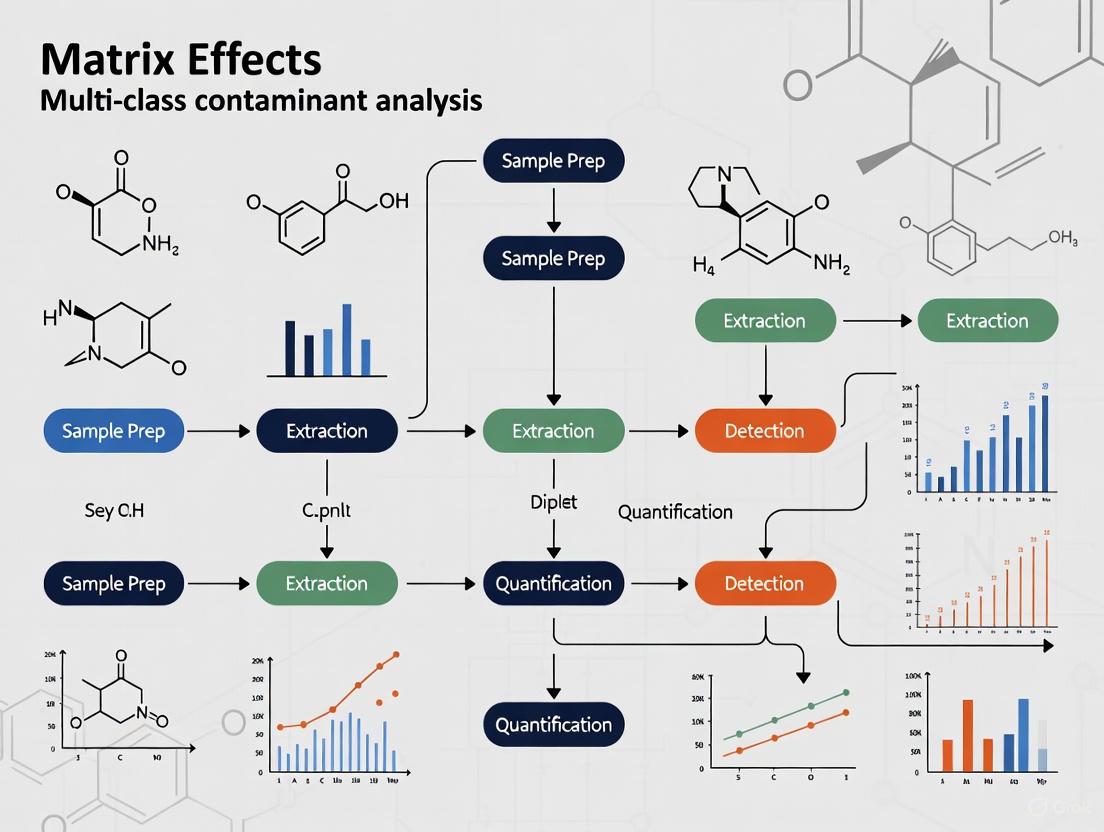
This article provides a comprehensive overview of matrix effects, a critical challenge in the liquid chromatography-tandem mass spectrometry (LC-MS/MS) analysis of multi-class contaminants.
Matrix Effects in Multi-Class Contaminant Analysis: Strategies for Accurate LC-MS/MS Quantification
Abstract
This article provides a comprehensive overview of matrix effects, a critical challenge in the liquid chromatography-tandem mass spectrometry (LC-MS/MS) analysis of multi-class contaminants. Aimed at researchers, scientists, and drug development professionals, it covers the fundamental causes and consequences of ion suppression/enhancement, explores established and emerging methodologies for their evaluation and compensation, offers systematic troubleshooting and optimization strategies, and discusses validation requirements from both research and regulatory viewpoints. The content synthesizes current scientific literature to deliver a practical guide for developing robust, reliable analytical methods in complex matrices, which is essential for advancing exposomics, environmental monitoring, and biomedical research.
Understanding Matrix Effects: The Foundational Challenge in Multi-Class Analysis
Matrix effects represent a significant challenge in liquid chromatography-tandem mass spectrometry (LC-MS/MS), critically impacting the reliability of quantitative analyses for multi-class contaminant research. Defined as the suppression or enhancement of an analyte's signal caused by co-eluting components from the sample matrix, these effects constitute a major source of inaccuracy in analytical measurements [1] [2]. In the context of multi-class contaminant analysis—which involves simultaneously quantifying diverse compounds such as pesticides, pharmaceuticals, and environmental contaminants from complex samples—matrix effects become particularly problematic due to the vast differences in physicochemical properties among analytes and the increased likelihood of co-elution with matrix interferents [3] [4].
The clinical and regulatory implications of unchecked matrix effects are substantial. They can lead to false negatives in environmental monitoring, inaccurate pharmacokinetic profiles in drug development, and erroneous exposure assessments in biomonitoring studies [1] [2]. The U.S. Food and Drug Administration's Guidance for Industry on Bioanalytical Method Validation explicitly emphasizes the need to investigate matrix effects to ensure data quality and reliability, highlighting their critical importance in regulated analytical environments [1].
Mechanisms and Origins of Matrix Effects
Fundamental Ionization Interference
Matrix effects occur when co-eluting compounds alter the ionization efficiency of target analytes in the LC-MS/MS interface. These interfering components can originate from endogenous sources (such as salts, phospholipids, metabolites, and carbohydrates in biological samples) or exogenous sources (including plasticizers from tubes, mobile phase additives, and sample preparation reagents) [2] [5]. The core issue stems from the competition between analyte molecules and matrix components for access to charged droplets or available charges during the ionization process, ultimately affecting the transfer of ions into the gas phase [6].
The two primary atmospheric pressure ionization (API) techniques used in LC-MS—electrospray ionization (ESI) and atmospheric pressure chemical ionization (APCI)—exhibit different susceptibilities to matrix effects due to their distinct ionization mechanisms [1].
Ion Suppression in Electrospray Ionization (ESI)
ESI is particularly susceptible to ion suppression through multiple proposed mechanisms. The charge competition theory suggests that in multicomponent samples, analytes compete for limited excess charge available on ESI droplets, with matrix components potentially outcompeting target analytes for this charge based on their surface activity and basicity [1]. This competition is especially pronounced when the total concentration of ions exceeds approximately 10⁻⁵ M, a threshold readily exceeded in complex biological matrices [1].
Additional mechanisms include:
- Droplet Effects: High concentrations of interfering compounds can increase the viscosity and surface tension of droplets, reducing solvent evaporation rates and the efficiency of gas-phase ion release [1] [6].
- Nonvolatile Material Interference: Nonvolatile substances can coprecipitate with analytes or prevent droplets from reaching the critical radius required for gas-phase ion emission [1].
- Gas-Phase Neutralization: Analyte ions can be neutralized in the gas phase through deprotonation reactions with compounds possessing high gas-phase basicity [1].
Ion Suppression in Atmospheric Pressure Chemical Ionization (APCI)
While APCI generally demonstrates less susceptibility to matrix effects compared to ESI, it is not immune [1] [2]. The primary mechanism differs significantly because neutral analytes are transferred into the gas phase through vaporization in a heated gas stream, eliminating competition for charge in the liquid phase [1]. However, ion suppression can still occur through:
- Gas-Phase Charge Competition: The presence of numerous chargeable species in the gas phase increases competition for charge reception from the corona discharge needle [1].
- Solid Formation: Analytes may coprecipitate with nonvolatile sample components, limiting their transfer into the gas phase [1] [2].
- Proton Affinity Competition: In positive ion mode, protonated ions form only if the proton affinity of the compound exceeds that of the reagent gas, creating potential competition [2].
Table 1: Comparative Mechanisms of Matrix Effects in ESI vs. APCI
| Mechanism | Electrospray Ionization (ESI) | Atmospheric Pressure Chemical Ionization (APCI) |
|---|---|---|
| Primary Phase of Interference | Liquid phase and droplet formation | Mainly gas phase |
| Charge Competition | For limited charge on droplet surfaces | For charge from corona discharge in gas phase |
| Key Suppression Factors | Surface activity, basicity, concentration | Proton affinity, gas-phase acidity, volatility |
| Effect of Nonvolatiles | Coprecipitation, reduced droplet formation | Coprecipitation, limited vaporization |
| Relative Susceptibility | High | Moderate |
Visualization of Matrix Effect Mechanisms
The following diagram illustrates the key mechanisms of matrix effects in Electrospray Ionization (ESI):
Detection and Assessment Methods
Experimental Protocols for Matrix Effect Evaluation
3.1.1 Post-Extraction Spiking Method
This quantitative approach assesses the extent of ion suppression or enhancement by comparing analyte responses in clean solvent versus sample matrix [1] [7].
Procedure:
- Prepare a blank matrix sample (e.g., plasma, urine, environmental water) and subject it to the standard sample preparation and extraction protocol.
- Spike the analyte of interest at a known concentration into the prepared blank matrix extract post-extraction.
- Prepare an equivalent concentration of the analyte in neat mobile phase or solvent.
- Inject both samples into the LC-MS/MS system and compare the peak areas or heights.
- Calculate the matrix effect (ME) using the formula: ME (%) = (B/A) × 100 where A = peak response in neat solvent, and B = peak response in spiked matrix extract [1] [7].
A value of 100% indicates no matrix effect, values <100% indicate ion suppression, and values >100% indicate ion enhancement. This method is particularly useful for determining the overall magnitude of matrix effects but provides no information about their chromatographic location [7].
3.1.2 Post-Column Infusion Method
This qualitative technique identifies regions of ionization suppression or enhancement throughout the chromatographic run [1] [4].
Procedure:
- Prepare a solution containing the analyte of interest at a constant concentration in a syringe pump.
- Connect the syringe pump to the LC system via a T-connector installed between the chromatographic column outlet and the MS ion source.
- Inject a blank matrix extract into the LC system while continuously infusing the analyte solution post-column.
- Monitor the MRM transition for the infused analyte throughout the chromatographic run.
- Observe the baseline signal: a stable baseline indicates no matrix effects, while dips indicate ion suppression and peaks indicate ion enhancement at specific retention times [1].
This method is invaluable during method development for identifying regions of ionization interference and adjusting chromatographic conditions to elute analytes in "clean" regions [1].
3.1.3 Slope Ratio Analysis
This approach uses calibration curves to quantitatively assess matrix effects and is particularly useful for multi-analyte methods [4].
Procedure:
- Prepare matrix-matched calibration standards in at least five different concentrations using blank matrix extracts.
- Prepare equivalent calibration standards in neat solvent at the same concentration levels.
- Analyze both calibration sets using the LC-MS/MS method.
- Plot peak area versus concentration for each calibration set and determine the slope of each line.
- Calculate the matrix factor (MF) using: MF = Slopematrix / Slopesolvent [4]
A matrix factor of 1 indicates no matrix effects, values <1 indicate suppression, and values >1 indicate enhancement. This method provides quantitative data on matrix effects across the analytical range and is widely used in method validation [4].
Table 2: Comparison of Matrix Effect Assessment Methods
| Method | Type of Information | Advantages | Limitations | Application in Method Development |
|---|---|---|---|---|
| Post-Extraction Spiking | Quantitative extent of ME | Simple calculation, provides numerical ME value | Doesn't locate chromatographic regions of ME | Best for final ME quantification during validation |
| Post-Column Infusion | Qualitative location of ME | Identifies problematic retention times | Doesn't quantify ME magnitude, requires additional hardware | Ideal for early method development to optimize separation |
| Slope Ratio Analysis | Quantitative across linear range | Provides ME information at different concentrations, statistical robustness | Time-consuming, requires multiple concentration levels | Essential for complete method validation, especially for regulated environments |
Consequences in Multi-Class Analysis
Impact on Analytical Figures of Merit
Matrix effects detrimentally affect key analytical parameters essential for reliable quantification. Detection capability is compromised as ion suppression reduces signal-to-noise ratios, potentially elevating limits of detection and quantification beyond required thresholds [1]. Accuracy and precision suffer due to unpredictable fluctuations in matrix composition between samples, introducing both systematic and random errors [2]. This variability is particularly problematic in multi-class analysis where different compound classes experience varying degrees of suppression or enhancement [3] [4].
The linear dynamic range of calibration curves can be truncated, with saturation occurring at lower concentrations than in clean solvent due to competition effects [8]. Furthermore, selectivity and specificity are undermined as matrix components may cause unexpected ion transitions or interfere with characteristic fragmentation patterns used for compound identification [5].
Practical Consequences in Research and Regulation
In practical applications, matrix effects can lead to false negative results when suppression reduces analyte signals below detection limits, particularly problematic in environmental monitoring and residue analysis [1]. Conversely, false positives may occur in regulated environments when internal standards experience greater suppression than analytes, leading to inaccurate ratio calculations [2] [5].
The challenges are amplified in multi-class contaminant analysis where diverse physicochemical properties among analytes preclude a unified approach to mitigating matrix effects [3] [4]. For instance, a study analyzing 46 pesticides, pharmaceuticals, and perfluoroalkyl substances in groundwater found widely varying matrix effects across compound classes, with sulfamethoxazole, sulfadiazine, metamitron, chloridazon, and caffeine being particularly affected [4]. This variability complicates the selection of appropriate internal standards and calibration approaches, necessitating class-specific mitigation strategies.
Strategies for Overcoming Matrix Effects
Sample Preparation and Cleanup
Effective sample preparation represents the first line of defense against matrix effects. Solid-phase extraction (SPE) selectively retains target analytes while removing interfering phospholipids, salts, and other matrix components [3] [6]. Advanced materials such as phospholipid depletion plates specifically target removal of phosphatidylcholines and lysophosphatidylcholines, major contributors to ion suppression in biological samples [8].
Protein precipitation followed by careful supernatant collection can eliminate macromolecular interferents, though it may leave smaller molecules unaffected [1]. Liquid-liquid extraction partitions analytes into organic solvents while leaving polar matrix components in the aqueous phase, particularly effective for non-polar compounds [2]. For sufficiently sensitive methods, simple sample dilution can reduce concentrations of interfering substances below threshold levels for observable matrix effects [7].
Chromatographic Optimization
Chromatographic separation directly addresses the root cause of matrix effects by physically separating analytes from interfering compounds. Extended chromatographic run times with optimized gradients improve resolution at the cost of throughput [1]. Ultra-high-performance liquid chromatography (UHPLC) utilizes sub-2μm particles to achieve superior separation efficiency with sharper peaks and reduced co-elution [5].
Alternative stationary phases such as hydrophilic interaction liquid chromatography (HILIC) can provide different selectivity compared to reversed-phase C18 columns, potentially resolving analytes from matrix components that co-elute in standard systems [5]. Column chemistry selection should be guided by the specific analytes and expected matrix interferences, with specialized phases available for challenging separations.
Mass Spectrometric Approaches
The choice of ionization source significantly impacts susceptibility to matrix effects, with APCI generally exhibiting less suppression than ESI, though this varies by application [1] [2]. Switching between positive and negative ionization modes can reduce effects, as negative mode typically demonstrates higher specificity and fewer interfering compounds [1].
Ion source parameter optimization including drying gas temperature and flow, nebulizer pressure, and source position can improve desolvation efficiency and reduce matrix-related interference [7]. Reduced flow rates and nanoflow systems produce smaller initial droplets with less concentration of nonvolatile salts, potentially minimizing suppression [5].
Calibration and Standardization Strategies
Stable isotope-labeled internal standards (SIL-IS) represent the gold standard for compensating matrix effects, as they co-elute with target analytes and experience nearly identical ionization effects [6] [7]. Their structural and chemical similarity ensures proportional response changes during ionization suppression or enhancement.
Matrix-matched calibration involves preparing calibration standards in blank matrix that closely resembles sample composition, though finding appropriate blank matrices can be challenging [7]. The standard addition method, where known quantities of analyte are spiked into individual samples, directly accounts for sample-specific matrix effects but substantially increases analytical workload [7] [5].
Structural analogue internal standards can serve as alternatives when stable isotope-labeled versions are unavailable or cost-prohibitive, though they must be carefully selected for similar chromatographic behavior and ionization characteristics [7].
The Scientist's Toolkit: Essential Reagents and Materials
Table 3: Key Research Reagent Solutions for Managing Matrix Effects
| Reagent/Material | Function | Application Context |
|---|---|---|
| Stable Isotope-Labeled Internal Standards | Compensates for matrix effects by co-eluting with analytes and experiencing identical ionization conditions | Essential for quantitative accuracy in complex matrices; 13C-labeled preferred over deuterated for better retention time matching |
| Phospholipid Depletion Plates | Selectively removes phospholipids, major contributors to ion suppression in biological samples | Particularly valuable for plasma/serum analysis; significantly reduces matrix effects from phosphatidylcholines |
| Solid Phase Extraction (SPE) Cartridges | Clean-up step to remove interfering matrix components while retaining target analytes | Available with various sorbents (C18, mixed-mode, HLB) for selective matrix component removal |
| Volatile Mobile Phase Additives | Replace non-volatile buffers to prevent source contamination and signal suppression | Ammonium formate/acetate preferred over phosphate buffers; formic/acetic acid instead of TFA |
| Globally 13C-Labeled Biological Extracts | Provides comprehensive internal standardization for untargeted metabolomics and exposomics | Enables matrix effect compensation across entire metabolome; ideal for untargeted workflows |
Matrix effects in the form of ion suppression and enhancement represent a fundamental challenge in LC-MS/MS analysis, particularly in multi-class contaminant research where diverse analytes and complex matrices interact unpredictably. Understanding the mechanisms underlying these effects—from charge competition in ESI to gas-phase processes in APCI—enables researchers to select appropriate detection and mitigation strategies.
A multifaceted approach combining effective sample clean-up, optimized chromatographic separation, judicious ionization source selection, and appropriate internal standardization provides the most robust defense against matrix-related inaccuracies. As analytical demands evolve toward increasingly complex multi-class methods and lower detection limits, continued innovation in matrix effect management remains essential for generating reliable, reproducible quantitative data in pharmaceutical, environmental, and biological research.
The comprehensive strategies outlined in this technical guide provide researchers with a systematic framework for addressing matrix effects throughout method development, validation, and implementation, ultimately ensuring the accuracy and credibility of LC-MS/MS-based quantitative analyses.
The exposome is defined as the cumulative measure of environmental influences and associated biological responses throughout the lifespan, including exposures from the environment, diet, behavior, and endogenous processes [9]. This concept represents a transformative approach in environmental health research, encompassing the totality of environmental exposures experienced by an individual over their lifetime and their significant influence on human health and disease [3]. The chemical exposome specifically covers the totality of environmental chemical exposures, incorporating both natural and anthropogenic chemicals from external sources—such as inhalation of polluted air, intake of food compounds and medications, and consumption of contaminated food and water—as well as internal exposure sources including metabolic byproducts from gut microbiota [3].
Traditional environmental health studies have typically employed hypothesis-driven methods focusing on one or a single class of environmental exposures at a limited number of time points [9]. These conventional methods for environmental chemical analysis have generally concentrated on individual representatives or specific substance classes, requiring separate analytical workflows for each chemical class [3]. While this targeted approach has yielded valuable insights, it fails to account for the complex interactions of exposures across the lifespan on human health and creates significant bottlenecks in large-scale studies [9]. Most targeted analytical methods quantify fewer than 15 biomarkers of exposure from a singular chemical class within each biospecimen, employing class-specific extractions and instrumental analyses [3]. This piecemeal approach is impractical for extensive epidemiological studies that require the analysis of thousands of samples, as anticipated for forthcoming exposome-wide association studies (EWAS) [3].
The limitations of single-analyte approaches have become increasingly apparent. As noted by researchers, a focus on individual chemicals may lead to the banning of specific compounds, only to be replaced by less studied analogs that could potentially exhibit similar or even more severe toxicological effects [3]. Furthermore, environmental factors significantly influence health status, surpassing the previously acknowledged impact of the intrinsic genome, with factors such as individual food, smoking, and air pollution accounting for approximately 46% of global mortality [3]. This recognition has driven the need for more sophisticated analytical approaches capable of capturing the true complexity of human chemical exposures.
The Analytical Shift to Multi-Class Approaches
Fundamental Advantages of Multi-Class Methodologies
Multi-class analytical techniques represent a paradigm shift in exposure science, enabling the simultaneous quantification of diverse chemical classes without the need for separate conventional workflows [3]. These methodologies leverage extractions that enhance various classes of chemicals in human specimens, allowing for the measurement of multiple classes of chemicals in a single analytical run [3]. This approach provides substantial reductions in analysis time, cost, and required sample volumes while maintaining comprehensive chemical coverage [3].
The fundamental advantage of multi-class assays lies in their ability to address the inherent complexity of the exposome, where food-derived metabolites and endogenous compounds typically exist in the millimolar to picomolar concentration range, while pollutants may be detected at levels three orders of magnitude lower [3]. By capturing a more comprehensive picture of exposure profiles, these methods facilitate the concurrent identification of the endogenous metabolome, food-associated metabolites, medicines, home chemicals, environmental contaminants, and microbiota derivatives, including over 1,000 chemicals and metabolites in total [3].
Performance Metrics of Multi-Class Assays
The analytical robustness of well-designed multi-class methods demonstrates appropriate extraction recovery and matrix effects between 60-130%, inter-/intra-day precision under 30%, and remarkable sensitivity with detection limits from 0.015 to 50 pg/mL for 60-80% of analytes in examined human matrices [3]. This performance makes these thorough analytical methods capable of delivering the requisite performance for extensive exposome-wide association studies, yielding quantitative results and uncovering unforeseen exposures [3].
Table 1: Performance Metrics of Modern Multi-Class Assays for Exposure Studies
| Performance Parameter | Typical Range | Significance |
|---|---|---|
| Extraction Recovery | 60-130% | Indicates efficiency of compound extraction from biological matrix |
| Matrix Effects | 60-130% | Measures ionization suppression/enhancement in MS detection |
| Inter-/Intra-day Precision | <30% RSD | Demonstrates method reproducibility |
| Sensitivity (LOD) | 0.015-50 pg/mL | Enables detection of trace-level contaminants |
| Chemical Coverage | >1,000 compounds | Provides comprehensive exposure assessment |
Recent technological advancements have accelerated the detection of trace amounts of xenobiotics in human tissues and biofluids, enabling a more accurate quantitative evaluation of an individual's chemical burden [3]. The implementation of multi-class approaches has been particularly valuable for capturing exposure mixtures that better reflect real-world exposure scenarios, where individuals encounter complex combinations of chemicals simultaneously rather than in isolation.
Analytical Frameworks and Methodologies
Core Technical Workflows
The development of robust multi-class analytical methods for exposomics requires the integration of advanced sample preparation, separation science, and detection technologies. The core workflow typically involves sample preparation techniques such as solid-phase extraction (SPE) or pressurized liquid extraction (PLE), followed by comprehensive chromatographic separation using liquid chromatography (LC) or gas chromatography (GC), and finally high-resolution mass spectrometric detection [3] [10].
A key methodological framework in exposomics research involves the distinction between targeted and non-targeted approaches. Targeted methods focus on the quantitative analysis of a predefined set of analytes with known chemical identities, while non-targeted approaches aim to comprehensively capture all measurable analytes in a sample, including unknown compounds [3]. Multi-class methods often bridge these approaches by incorporating targeted quantification of specific biomarker classes while maintaining the capability to detect unexpected or novel exposures.
Table 2: Core Analytical Platforms for Multi-Class Exposure Analysis
| Analytical Platform | Application in Multi-Class Analysis | Key Advantages |
|---|---|---|
| LC-MS/MS (Triple Quadrupole) | Targeted quantification of known contaminants | High sensitivity and selectivity for predefined transitions |
| LC-HRMS (High-Resolution MS) | Untargeted screening and identification | Accurate mass measurement for compound identification |
| GC-MS | Volatile and semi-volatile organic compounds | Complementary separation to LC methods |
| SPE and PLE | Sample preparation and extraction | Broad chemical coverage with minimal matrix interference |
The method development process for multi-class analysis requires careful optimization of extraction conditions, chromatographic separation, and mass spectrometric parameters to accommodate the diverse physicochemical properties of the target analytes. For instance, method optimization for sediment analysis demonstrated that diatomaceous earth served as the optimal dispersant for pressurized liquid extraction, with two successive extractions using methanol and a methanol-water mixture providing the best recoveries across multiple contaminant classes [10].
Workflow Visualization
Matrix Effects: A Central Challenge in Multi-Class Analysis
Understanding and Characterizing Matrix Effects
Matrix effects represent a significant challenge in quantitative LC-MS/MS analysis, particularly in multi-class methods analyzing complex biological and environmental samples [4]. Matrix effects are defined as the complex effect of components present in the sample other than the analyte of interest on the final quantitative analysis [4]. These interfering components—including different salts, organic matter, humic acids, and other co-extracted compounds—can have different chemical structures and physical properties, potentially co-eluting with analytes or interacting in a non-specific manner during chromatographic analysis and the ionization step in mass spectrometric detection [4].
In environmental and biological samples, which represent complex matrices, matrix effects primarily manifest as ionization suppression or enhancement when using electrospray ionization (ESI) techniques in liquid chromatography-mass spectrometry [4]. Matrix components can compete with target analytes for ionization, leading to significant suppression or enhancement of analytical signals [4]. A more common problem is the suppression of analyte signals due to matrix components [4], though signal enhancement can also occur and similarly compromise quantitative accuracy.
Research on multi-class analysis of pesticides, pharmaceuticals, and perfluoroalkyl substances in groundwater demonstrated that most studied analytes showed negative matrix effects, with some compounds showing weak negative or positive matrix effects [4]. The study found that average matrix factors obtained from different sampling sites are not a reliable tool, and matrix effects need to be monitored depending on the specific sampling location [4]. Furthermore, only weak or no correlation was observed between matrix factors and determined inorganic parameters, highlighting the complexity of predicting matrix effects in environmental samples [4].
Assessment and Quantification of Matrix Effects
The evaluation of matrix effects can be performed by several methodological approaches, including post-column infusion/addition methods, post-extraction addition of standards, and slope ratio analysis [4]. The slope ratio technique involves spiking matrix-matched calibration standards in real samples and in solvent or mobile phase at different concentration levels, then comparing the slopes of the resulting calibration curves [4].
In sediment analysis, comprehensive study of matrix effects revealed that they increased with organic matter content and were highly correlated with retention time (r = -0.9146, p < 0.0001) [10]. This strong correlation suggests that earlier-eluting compounds generally experience more severe matrix effects, likely due to co-elution with highly polar matrix components.
Mitigation Strategies for Matrix Effects in Multi-Class Analysis
Methodological Approaches to Minimize Matrix Interference
Several strategic approaches have been developed to minimize and correct for matrix effects in multi-class analysis. These include:
Sample preparation optimization: Removing potential interferences during sample preparation through additional pre-treatment steps, clean-up procedures, dilution of sample extracts, or using smaller injection volumes [4]. The choice of extraction sorbent and solvents can selectively retain target analytes while excluding matrix interferents.
Chromatographic separation enhancement: Optimizing chromatographic conditions to achieve better separation of target analytes from matrix components that co-elute and cause ionization effects [4]. This may involve adjusting mobile phase composition, gradient profiles, column chemistry, or temperature.
Internal standardization: Using stable isotope-labeled internal standards (SIL-IS) for each analyte represents the most effective approach for correcting matrix effects without affecting method sensitivity [10] [4]. The internal standard should be a compound similar in chemical structure and characteristics to the analyte of interest, providing a similar but distinguishable signal [4].
Research on trace organic contaminants in lake sediments demonstrated that the addition of internal standards was the most efficient technique for correcting matrix effects, with corrected matrix effects ranging between -13.3% and 17.8% after proper internal standard application [10]. The study emphasized that using isotopically labelled internal standards is strongly recommended, particularly when utilizing electrospray ionization [4].
Advanced Correction Techniques
For complex multi-class analyses where isotopically labeled standards are not available for all analytes, alternative correction strategies include:
Matrix-matched calibration: Preparing calibration standards in a matrix that closely resembles the sample matrix to compensate for matrix effects [4]. This approach is particularly useful for environmental samples with consistent matrix composition.
Standard addition method: Adding known amounts of analyte to the sample matrix and extrapolating to determine the original concentration [4]. This method is resource-intensive but can provide accurate quantification when other methods fail.
Post-column infusion techniques: Continuously infusing analytes during chromatographic separation to monitor ionization suppression/enhancement throughout the chromatographic run, helping to identify regions of significant matrix effects [4].
The implementation of these mitigation strategies enables accurate quantification in multi-class analysis despite the challenges posed by complex sample matrices. As noted in groundwater analysis, "the usage of isotopically labelled internal standards is strongly recommended" for reliable quantification in multi-class methods [4].
Experimental Protocols for Robust Multi-Class Analysis
Sample Preparation and Extraction Methods
Comprehensive multi-class analysis requires optimized extraction protocols that provide high recovery across diverse chemical classes while minimizing matrix interferences. A validated approach for human biomatrices involves solid-phase extraction (SPE) in 96-well plates for high-throughput processing, with recoveries exceeding 60% for the majority of analytes [3]. For solid samples such as sediments, pressurized liquid extraction (PLE) with diatomaceous earth as a dispersant has proven effective, employing successive extractions with methanol and methanol-water mixtures [10].
The extraction protocol for human biofluids typically follows these steps:
- Protein precipitation using organic solvents (e.g., methanol, acetonitrile) to remove proteins and macromolecules
- Solid-phase extraction using mixed-mode sorbents that provide both reversed-phase and ion-exchange interactions to capture acidic, basic, and neutral compounds
- Fractionation or clean-up to remove major interferents while retaining target analytes
- Concentration and reconstitution in injection solvent compatible with LC-MS analysis
For complex matrices, the incorporation of comprehensive quality control measures is essential, including method blanks, matrix spikes, and continuous calibration verification to monitor extraction efficiency and potential contamination throughout the analytical process.
Instrumental Analysis and Data Acquisition
Advanced liquid chromatography-tandem mass spectrometry (LC-MS/MS) systems form the core of modern multi-class analytical methods. The instrumental configuration typically includes:
- UHPLC separation with reversed-phase C18 columns (e.g., 100 × 2.1 mm, 1.7-1.8 μm particle size) maintained at 40-50°C
- Binary mobile phase system consisting of (A) water and (B) methanol or acetonitrile, both with 0.1% formic acid or ammonium acetate buffer for pH control
- Gradient elution programmed from 5-95% organic modifier over 10-20 minutes to separate compounds across a wide polarity range
- Mass spectrometric detection using triple quadrupole instruments for targeted analysis or high-resolution instruments (Q-TOF, Orbitrap) for untargeted screening
For targeted multi-class methods, multiple reaction monitoring (MRM) transitions are optimized for each compound, with appropriate collision energies and cone voltages specific to each analyte class. For untargeted approaches, full-scan data acquisition at high resolution (>25,000 resolution) enables retrospective data mining and identification of unexpected exposures.
Table 3: Essential Research Reagents and Materials for Multi-Class Exposomics
| Reagent/Material | Specification | Application Purpose |
|---|---|---|
| Mixed-mode SPE cartridges | 60 mg, 96-well plates | Simultaneous extraction of acidic, basic, and neutral compounds |
| Isotopically labeled internal standards | 13C or 2H labeled analogs | Correction of matrix effects and quantification accuracy |
| LC-MS grade solvents | Methanol, acetonitrile, water | Mobile phase preparation and sample reconstitution |
| Analytical standards | Pharmaceutical, pesticide, industrial chemical purity | Target analyte quantification and method calibration |
| UHPLC columns | C18, 100 × 2.1 mm, 1.7 μm | High-resolution separation of complex mixtures |
| Formic acid/ammonium buffers | LC-MS grade, 0.1% in mobile phase | Modulation of ionization efficiency and chromatographic separation |
Applications and Implications for Environmental Health
Advancing Exposome-Wide Association Studies
The implementation of robust multi-class analytical methods has enabled the emergence of exposome-wide association studies (EWAS), which systematically assess the relationship between multiple environmental exposures and health outcomes [3] [11]. These studies represent the environmental equivalent of genome-wide association studies (GWAS) and have the potential to identify novel environmental risk factors for complex diseases.
EWAS approaches leverage the comprehensive exposure data generated by multi-class methods to test hundreds of environmental exposures simultaneously for association with health outcomes, using statistical methods that account for multiple testing [11]. This agnostic, data-driven approach can uncover unexpected exposure-disease relationships that would not be identified through hypothesis-driven studies of single exposures.
The translational potential of exposomics is particularly significant for precision medicine and public health. As noted by researchers, "Exposomics can assist with molecular medicine by furthering our understanding of how the exposome influences cellular and molecular processes such as gene expression, epigenetic modifications, metabolic pathways, and immune responses" [9]. These molecular alterations can serve as biomarkers for diagnosis, disease prediction, early detection, and treatment, offering new avenues for personalized medicine [9].
Integrating the Exposome into Risk Assessment
The comprehensive exposure data generated through multi-class analysis presents both opportunities and challenges for chemical risk assessment. Traditional risk assessment frameworks have typically evaluated chemicals individually, but real-world exposures occur as complex mixtures that may interact additively, synergistically, or antagonistically [12]. Multi-class analytical methods provide the exposure data needed to advance mixture risk assessment and cumulative risk assessment approaches.
Health safety agencies have begun developing strategies to integrate the exposome concept into risk assessment processes. A working group constituted by Anses identified eight key themes for integrating exposome concepts into risk assessment, including "risk assessment of chemical mixtures; aggregation of multiple sources and routes of exposure; dynamics of the exposure in the context of time, space, and social factors" [12]. The group proposed practical recommendations with short-, medium-, and long-term time scales to progressively operationalize the exposome into risk assessments implemented by health safety agencies [12].
This integration can enhance risk assessment and management by better reflecting the complexity of real-life exposures, potentially leading to more protective and relevant public health policies [12]. As analytical methods continue to advance and our understanding of exposure-disease relationships deepens, multi-class analysis will play an increasingly indispensable role in shaping environmental health policy and protection.
Matrix effects represent a critical challenge in quantitative liquid chromatography–tandem mass spectrometry (LC–MS/MS), defined as the alteration of ionization efficiency by the presence of co-eluting substances from the sample matrix. These effects, which manifest as either ion suppression or enhancement, compromise analytical accuracy, precision, and sensitivity by affecting the detected signal of target analytes. The phenomenon was first documented when researchers observed that electrospray responses of organic bases decreased as concentrations of other organic bases increased, revealing a fundamental limitation in what would otherwise be a highly selective and sensitive analytical technique. In environmental, pharmaceutical, and clinical analysis—particularly in emerging applications such as multi-class contaminant analysis and exposome research—matrix effects have been termed the "Achilles heel" of quantitative HPLC–ESI–MS/MS due to their pervasive impact on method reliability [13]. The complex nature of biological and environmental samples ensures that matrix components will invariably co-elute with target analytes, making understanding these mechanisms essential for developing robust analytical methods.
Fundamental Mechanisms of Ionization Disruption
Electrospray Ionization (ESI) Processes and Vulnerability
Electrospray ionization operates through a mechanism that is inherently susceptible to matrix interference. The process begins with the formation of a Taylor cone at the capillary tip, from which a fine spray of highly charged droplets emerges. As solvent evaporation occurs, the charge density on the droplet surface increases until Coulomb fission occurs, creating smaller offspring droplets. This process repeats until gas-phase ions are ultimately released for mass analysis [13]. The vulnerability of ESI stems from its ionization mechanism occurring in the liquid phase before ions enter the mass spectrometer. In the presence of co-eluting matrix components, this carefully orchestrated process can be significantly disrupted. The competition for charge and access to the droplet surface between analytes and matrix components fundamentally alters ionization efficiency. Unlike atmospheric pressure chemical ionization (APCI), where ionization occurs in the gas phase and is generally less susceptible to matrix effects, ESI's liquid-phase ionization process makes it particularly vulnerable to suppression or enhancement from even minute quantities of co-eluting compounds [14] [13].
Primary Mechanisms of Ion Suppression
Research has revealed several specific mechanisms through which matrix components disrupt analyte ionization, with the relative importance of each mechanism depending on analyte properties, matrix composition, and interface design.
Competition for Charge at the Droplet Surface: This represents the most prevalent mechanism of ion suppression in ESI. Matrix components with superior surface activity or lower ionization potential can monopolize the limited number of charges available on the electrospray droplet surface. When these matrix compounds dominate the droplet interface, they physically block analyte molecules from accessing the necessary charges for successful ionization. This competition effect is particularly pronounced when analyzing compounds at low concentrations in the presence of even modest amounts of matrix components with high surface affinity [13] [14].
Alteration of Droplet Physical Properties: Matrix components can significantly modify the physical properties of electrospray droplets, including surface tension, viscosity, and evaporation rate. These changes disrupt the delicate balance required for efficient droplet fission and ion emission. For example, non-volatile matrix components such as salts and phospholipids can increase droplet viscosity and decrease solvent evaporation rates, potentially preventing the droplet from reaching the critical charge density required for Coulomb fission. This mechanism effectively inhibits the complete ion release process, leading to suppressed analyte signals [13].
Gas-Phase Proton Transfer Reactions: After ions have been successfully transferred to the gas phase, matrix components can continue to interfere through gas-phase proton transfer reactions. Matrix molecules with higher gas-phase basicity than the target analyte can "steal" protons from pre-formed analyte ions, effectively neutralizing them before they reach the detector. This mechanism is particularly relevant for compounds ionized through protonation in positive ion mode, where gas-phase basicity dictates the direction of proton transfer reactions [13].
Precipitation or Co-precipitation with Non-Volatile Compounds: Matrix components with low volatility can precipitate or co-precipitate with target analytes as solvent evaporation occurs. This physical encapsulation or sequestration of analyte molecules prevents their successful entry into the gas phase. Phospholipids, proteins, and salts are common culprits in this suppression mechanism, which can affect both ESI and APCI interfaces, though the effect is typically more pronounced in ESI [14].
Less Common Mechanisms: Ion Enhancement
While ion suppression occurs more frequently, matrix effects can occasionally result in signal enhancement through several mechanisms:
Improved Charge Carrier Efficiency: Certain matrix components can enhance droplet charge carrier efficiency, facilitating more effective ion emission for particular analyte classes.
Surface Tension Reduction: Compounds that reduce surface tension can improve droplet formation and fission efficiency, potentially increasing analyte signal.
Gas-Phase Charge Transfer: In some cases, matrix ions can transfer charge to analyte molecules in the gas phase, increasing ionization efficiency [13].
It is crucial to note that enhancement effects are typically more unpredictable and method-dependent than suppression, making them particularly challenging for quantitative method development.
Table 1: Mechanisms of Matrix Effects in Electrospray Ionization
| Mechanism | Primary Cause | Affected Stage | Common Matrix Components |
|---|---|---|---|
| Charge Competition | Competition for limited charges | Liquid phase | Surfactants, phospholipids |
| Droplet Property Alteration | Changed viscosity/surface tension | Droplet formation & fission | Salts, polymers, phospholipids |
| Gas-Phase Proton Transfer | Difference in gas-phase basicity | Gas phase after ion release | Amines, basic compounds |
| Precipitation/Co-precipitation | Physical encapsulation | Solvent evaporation | Non-volatile compounds, proteins |
Experimental Assessment and Quantification of Matrix Effects
Standardized Methodologies for Matrix Effect Evaluation
Robust assessment of matrix effects is essential during method development and validation. Regulatory guidelines from EMA, FDA, ICH, and CLSI provide frameworks for evaluation, though approaches vary in their specific requirements [15].
Post-Extraction Addition Method: This widely adopted approach involves comparing the analytical response of standards prepared in neat solvent versus those spiked into pre-processed sample matrix extracts. The matrix effect (ME%) is calculated as: ME% = (Response in matrix / Response in neat solution) × 100% Values below 100% indicate ion suppression, while values above 100% signify ion enhancement. This method directly quantifies the absolute matrix effect but requires careful preparation of post-extraction spiked samples [15] [13].
Post-Column Infusion Method: This qualitative approach involves continuous infusion of a standard solution into the LC effluent post-column while injecting a blank matrix extract. The resulting chromatogram reveals regions of ion suppression or enhancement throughout the separation, providing a visual map of problematic retention times. While this method doesn't provide quantitative ME% values, it is invaluable for identifying regions of chromatographic vulnerability and guiding method optimization [13] [16].
Systematic Integrated Approach: Recent methodologies integrate assessment of matrix effects, recovery, and process efficiency within a single experiment. This comprehensive approach employs pre- and post-extraction spiking across multiple matrix lots to evaluate both absolute effects and IS-normalized factors, providing a complete picture of matrix impact on method performance [15].
Quantitative Assessment of Matrix Effects
The systematic evaluation of matrix effects requires careful experimental design and data interpretation. Matuszewski et al. established a foundational approach that calculates matrix factor (MF) as follows [15]:
MF = Peak area in presence of matrix / Peak area in absence of matrix
The IS-normalized MF is particularly informative:
IS-normalized MF = MF(analyte) / MF(IS)
Acceptance criteria typically require that the coefficient of variation (CV%) for the MF across different matrix lots remains below 15%, ensuring consistent method performance despite biological variability [15].
Table 2: Matrix Effect Assessment Methods and Acceptance Criteria
| Assessment Method | Measurement Type | Key Parameters | Acceptance Criteria | Guideline References |
|---|---|---|---|---|
| Post-Extraction Addition | Quantitative | Matrix Factor (MF), CV of MF | CV <15% across 6 matrix lots | EMA, ICH M10 [15] |
| Post-Column Infusion | Qualitative | Suppression/Enhancement regions | Identification of vulnerable retention times | Clinical Laboratory Applications [13] |
| Systematic Integrated Approach | Quantitative & Qualitative | Absolute ME%, Recovery, Process Efficiency | Comprehensive understanding of method performance | CLSI C62A [15] |
Analytical Strategies to Minimize Matrix Effects
Sample Preparation and Cleanup
Effective sample preparation represents the first line of defense against matrix effects, with the primary goal of removing interfering compounds while maintaining target analyte recovery.
Solid-Phase Extraction (SPE): Selective SPE protocols can significantly reduce matrix components through tailored retention and washing steps. Recent advances in high-throughput SPE formats, such as 96-well plates, maintain cleanup efficiency while increasing throughput for large-scale studies, an essential development for exposome-wide association studies requiring thousands of analyses [3] [17].
Selective Precipitation Methods: Protein precipitation using organic solvents or acids effectively removes proteins but may leave other matrix components. Centrifugal-assisted sample treatment has emerged as an efficient strategy that streamlines key steps, including protein precipitation, particularly in high-throughput applications [17].
Enhanced Chromatographic Separation: Optimizing chromatographic conditions to increase separation between analytes and matrix components directly addresses the root cause of matrix effects. Longer run times, optimized gradient profiles, and improved stationary phases can achieve superior resolution of analytes from early-eluting matrix interferences [13] [14].
Chemical and Instrumental Approaches
Beyond sample preparation, several chemical and instrumental strategies can mitigate matrix effects:
Mobile Phase Optimization: The composition of mobile phases significantly influences ionization efficiency and matrix effects. Studies have demonstrated that mobile-phase additives dramatically impact matrix susceptibility. For example, addition of acids can cause severe signal suppression (average ME%: <65%), while 1 mM ammonium formate increased the average ME% to 84% in environmental water analysis [14].
Alternative Ionization Sources: While ESI remains predominant, alternative ionization techniques offer reduced matrix effects for certain applications. Recent research on flexible microtube plasma (FμTP) ionization demonstrated negligible matrix effects for 76-86% of pesticides tested, compared to 35-67% for ESI across different matrices. This miniaturized plasma source expands the chemical space amenable to LC-MS analysis while providing superior robustness against matrix interference [18].
Innovative Compensation Techniques: Post-column infusion of standards (PCIS) has emerged as a promising strategy to monitor and correct matrix effects in real-time, even in untargeted metabolomics applications. This approach uses a continuous infusion of reference standards to compensate for ionization fluctuations caused by matrix components, with recent methods introducing artificial matrix effect (ME~art~) creation to select optimal correction standards [16].
Diagram 1: Matrix effects mitigation strategies
The Scientist's Toolkit: Essential Reagents and Materials
Successful management of matrix effects requires strategic selection of reagents, materials, and instrumentation. The following toolkit summarizes critical components for effective method development:
Table 3: Research Reagent Solutions for Matrix Effect Management
| Tool/Reagent | Function/Purpose | Application Notes | Key References |
|---|---|---|---|
| Stable Isotope-Labeled Internal Standards | Compensation of matrix effects through identical chemical properties | Essential for accurate quantification; demonstrates improved CV% (2.6% vs 4.2% without IS) | [14] [15] |
| Ammonium Formate Buffer | Mobile phase additive to reduce ionization suppression | Preferred over acids; improves average ME% from <65% to 84% in environmental analysis | [14] |
| Mixed-Mode SPE Sorbents | Selective removal of phospholipids and interfering compounds | Enable multi-class contaminant analysis with reduced matrix effects | [3] |
| FμTP (Flexible Microtube Plasma) Source | Alternative ionization with reduced matrix susceptibility | Provides negligible matrix effects for 76-86% of pesticides vs 35-67% for ESI | [18] |
| TD-ESI Source | High-throughput analysis with controlled matrix effects | Achieves analysis time of 1 min/sample with matrix effects <19.6% | [19] |
Implications for Multi-Class Contaminant Analysis Research
The fundamental mechanisms of ionization disruption present particular challenges for emerging analytical fields, especially multi-class contaminant analysis in exposomics and environmental research. The breadth of chemical properties encompassed by multi-class methods increases vulnerability to matrix effects, as optimal conditions for one analyte class may exacerbate effects for another [3]. Multiclass methodologies designed for chemical exposome characterization must contend with compound concentrations spanning multiple orders of magnitude, from millimolar to picomolar range, while maintaining robustness against matrix interference [3].
The evolution of multi-class analytical approaches represents a paradigm shift from traditional single-analyte methods, requiring careful balancing of extraction efficiency across diverse compound classes. Successful methods demonstrate appropriate extraction recovery and matrix effects between 60 and 130%, inter-/intra-day precision under 30%, and remarkable sensitivity with detection limits from 0.015 to 50 pg/mL for 60–80% of analytes in complex human matrices [3]. These methodological advances enable the concurrent identification of endogenous metabolomes, food-associated metabolites, pharmaceuticals, household chemicals, and environmental contaminants—comprising over 1,000 chemicals and metabolites in total—despite the fundamental challenges posed by ionization disruption mechanisms [3].
Diagram 2: Multi-class analytical workflow challenges
The fundamental mechanisms through which co-eluting matrix components disrupt ionization efficiency present persistent challenges in LC–MS/MS analysis, particularly as applications expand toward comprehensive multi-class contaminant characterization. Understanding these mechanisms—from competition for charge at the droplet surface to gas-phase proton transfer reactions—provides the foundation for developing effective mitigation strategies. Through optimized sample preparation, chromatographic separation, chemical additives, and innovative ionization sources, researchers can successfully manage matrix effects to achieve reliable quantification. As analytical science continues to advance toward increasingly comprehensive characterization of complex samples, the systematic assessment and control of matrix effects will remain essential for generating accurate, reproducible data in environmental, clinical, and exposomics research.
Matrix effects represent a fundamental challenge in the quantitative analysis of chemical contaminants, particularly within the advancing field of multi-class contaminant analysis. These effects are defined as the unintended impact of co-eluting components from a sample matrix on the measurement of an analyte's signal, leading to either signal suppression or enhancement [20]. In the context of multi-residue methods, which are designed to quantify hundreds of analytes from diverse chemical classes in a single run, the problem is exacerbated. The variety of physicochemical properties among analytes and the complex composition of sample matrices create a high risk for differential matrix effects, which systematically compromise data quality [3] [20].
This technical guide examines the consequences of matrix effects on three pillars of analytical science: quantification, accuracy, and reproducibility. For researchers and drug development professionals, understanding and mitigating these impacts is not merely a methodological refinement but a prerequisite for generating reliable, defensible data in environmental monitoring, food safety, and pharmaceutical analysis [10] [20].
Understanding Matrix Effects in Multi-Class Analysis
Origins and Mechanisms
Matrix effects primarily occur in the ion source of mass spectrometers, most notably in electrospray ionization (ESI). Co-extracted matrix components can compete with analytes for access to the droplet surface or for charge, thereby altering ionization efficiency [20]. The mechanisms involve various interactions, including van der Waals forces, dipolar-dipolar interactions, and electrostatic forces [20].
The severity of matrix effects is influenced by several factors:
- Sample Matrix Complexity: Biological tissues, sediments, and food commodities contain myriad compounds like lipids, salts, and humic acids that co-extract with target analytes [10].
- Analyte Properties: The physicochemical characteristics of analytes, particularly their polarity and retention time, influence susceptibility. Effects often show a significant correlation with chromatographic retention time [10].
- Sample Preparation Selectivity: The degree of sample clean-up directly determines the quantity of interfering matrix components entering the instrumental system [21].
The Specific Challenge for Multi-Class Methods
Traditional single-analyte or single-class methods can optimize conditions for a narrow range of compounds. In contrast, multi-class methodologies aim for simultaneous quantification of dozens to hundreds of analytes spanning pesticides, pharmaceuticals, personal care products, and industrial chemicals [3]. This broad scope necessitates compromises in sample preparation and chromatographic conditions, increasing vulnerability to matrix effects that impact different chemical classes in varying ways [3] [20]. The fundamental challenge is that a sample preparation procedure that effectively cleans up the matrix for one class of analytes might inadvertently remove another [3].
Consequences for Data Quality
Impact on Quantification
Matrix effects directly undermine the foundation of reliable quantification. Signal suppression can lead to false negatives or underestimation of contaminant concentrations, while signal enhancement can cause overestimation [20]. The practical consequence is that calibration curves prepared in pure solvent do not accurately reflect analyte behavior in the sample matrix, resulting in biased concentration estimates [22] [20].
The quantitative impact can be substantial. In multi-residue pesticide analysis using LC-MS/MS, matrix effects can cause signal deviations of -50% to +200% or more compared to pure standards, making results without appropriate correction virtually meaningless [20]. In complex matrices like sediments, matrix effects have been shown to be highly correlated with retention time (( r = -0.9146, p < 0.0001 )), with earlier-eluting, more polar compounds typically experiencing more severe suppression [10].
Table 1: Documented Impacts of Matrix Effects on Quantification Across Different Matrices
| Matrix Type | Analytical Technique | Reported Impact on Quantification | Primary Correction Strategy |
|---|---|---|---|
| Food Commodities [20] | LC-MS/MS (Multi-pesticide) | Signal suppression/enhancement up to ±200% | Matrix-matched calibration, isotope standards |
| Lake Sediments [10] | LC-QqQMS (44 TrOCs) | Strong correlation with retention time (r = -0.9146) | Internal standards |
| Human Serum/Urine [22] | GC-MS (Amino acids) | Significant variation between matrices | Isotopolog comparison |
| Brain Tissue [23] | MALDI-MSI (Neurotransmitters) | Spatial variation due to tissue heterogeneity | Standard addition with spraying |
| Passive Samplers (Seawater) [21] | RPLC-MS/MS (38 CECs) | Matrix effects range: 40-130% | Optimized dry-transfer protocol |
Impact on Accuracy and Trueness
Accuracy reflects the closeness of measured values to the true value. Matrix effects compromise accuracy through nonspecific binding of analytes to matrix components, reduced extraction recovery, and the aforementioned ionization effects [10]. Even with extensive sample clean-up, accuracy can be affected when matrix components alter the chromatographic behavior of analytes or cause peak broadening and tailing [20].
In multi-class analysis, achieving consistent accuracy across all analyte classes is particularly challenging. For example, a method validated for 44 trace organic contaminants in sediments demonstrated that organic matter content significantly influenced accuracy, with bias percentages varying substantially without proper correction [10]. The presence of matrix components can also lead to false positive identifications when compounds with similar mass transitions co-elute, further compromising analytical accuracy [20].
Impact on Reproducibility and Precision
Reproducibility refers to the closeness of results when the same method is applied to the same sample under different conditions (different laboratories, analysts, instruments). Matrix effects introduce additional sources of variation that undermine reproducibility [21]. The primary issue is that matrix composition can vary between samples, batches, and sources, leading to inconsistent matrix effects that are difficult to control [20].
Method precision, expressed as relative standard deviation (RSD), is directly affected. In multi-residue analysis, acceptable precision (RSD < 20%) can be difficult to achieve without effective compensation for matrix effects [10]. The problem is particularly acute in large-scale studies where thousands of samples are analyzed over extended periods, as even slight variations in matrix composition between samples can propagate into significant analytical variability [3].
Table 2: Method Performance Metrics Demonstrating Reproducibility Challenges
| Performance Metric | Target Value | Impact of Uncorrected Matrix Effects | With Effective Mitigation |
|---|---|---|---|
| Extraction Recovery [10] | >60% for most compounds | Highly variable, compound-dependent | Consistent for 34/44 compounds |
| Precision (RSD) [10] | <20% | Often exceeds 20-30% | Remains <20% for validated compounds |
| Matrix Effects Magnitude [21] | Ideally 0% (no effect) | Range of -60% to +200% suppression/enhancement | Controlled to -13.3% to +17.8% |
| Inter-day Precision [3] | <30% for exposomics | Can exceed 30% without normalization | Maintained under 30% threshold |
Methodologies for Assessment and Mitigation
Protocols for Assessing Matrix Effects
Post-extraction Spiking Protocol
This established method quantifies ionization efficiency changes caused by the matrix [20].
Experimental Procedure:
- Extract a representative blank matrix using the validated method
- Prepare analyte standards in pure solvent
- Spike the extracted blank matrix with analytes at known concentrations
- Prepare identical concentration standards in pure solvent
- Analyze both sets and compare peak areas
Calculation: Matrix Effect (ME %) = [(Peak Area post-extraction spike - Peak Area neat standard) / Peak Area neat standard] × 100
A value of 0% indicates no matrix effect, negative values indicate suppression, and positive values indicate enhancement.
Isotopolog Method for GC-MS (Novel Approach)
A recently developed approach uses isotopologs for simultaneous determination of analyte concentration and matrix effects quantification in GC-MS [22].
Experimental Procedure:
- Spike the sample with stable isotope-labeled analogs of target analytes before extraction
- Process samples through entire analytical workflow
- Compare the peak areas of native analytes and their isotopologs
- Use the specific peak area differences to quantify matrix effects directly in the sample
This method provides per-sample assessment of matrix effects without additional experiments, offering advantages for high-throughput environments [22].
Mitigation Strategies and Experimental Protocols
Sample Preparation Optimization
Enhanced Cleanup Procedures: For POCIS (Polar Organic Chemical Integrative Samplers) in seawater, a dry-transfer procedure significantly improved recoveries, especially for polar compounds, without exacerbating matrix effects (maintained at 40-130%) [21].
Protocol: Transfer the sorbent dried overnight into a fritted glass cartridge using a spatula. Wash with 5 mL of ultrapure water before elution with 20 mL of methanol and 5 mL of DCM:IPA (8:2 v/v) [21].
Pressurized Liquid Extraction (PLE) Optimization: For sediment analysis, method optimization involved testing dispersants, temperature, and extraction solvents. Diatomaceous earth as dispersant with successive extractions using methanol and methanol:water mixtures provided optimal recoveries for multi-class contaminants [10].
Chromatographic Separation Improvement
Experimental Approach:
- Extended Gradient Programs: Increase separation between analytes and matrix components
- Alternative Stationary Phases: Use specialized columns (HILIC, phenyl, etc.) for better resolution of problematic compounds
- Retention Time Shift: Adjust mobile phase pH or composition to move analytes away from regions of high matrix interference
The effectiveness of improved separation is demonstrated by the strong correlation between retention time and matrix effects, where better resolved compounds typically show reduced effects [10].
Quantitative Correction Techniques
Stable Isotope-Labeled Internal Standards (SIL-IS) Protocol:
Procedure:
- Select isotopologs (deuterated, 13C, or 15N-labeled) for each analyte or representative compounds across chemical classes
- Add SIL-IS to samples before extraction at a consistent concentration
- Process samples through entire workflow
- Calculate response ratios (analyte/SIL-IS) for quantification
Advantages: Corrects for both extraction efficiency and matrix effects during ionization [10] [20]. This approach has been shown to effectively correct matrix effects without affecting method sensitivity, making it particularly valuable for trace analysis [10].
Matrix-Matched Calibration Protocol:
Procedure:
- Obtain or prepare matrix free of target analytes
- Prepare calibration standards in the processed blank matrix across the concentration range
- Construct calibration curve using these matrix-matched standards
- Process unknown samples alongside these curves
Limitations: Finding truly blank matrices is challenging, and matrix-matched standards may not fully replicate analyte-matrix interactions in real samples, especially for complex matrices like botanical samples [20].
Standard Addition Method with Homogeneous Spraying for MSI:
For quantitative mass spectrometry imaging (MSI), a novel standard addition approach addresses spatial heterogeneity in tissues [23].
Procedure:
- Prepare consecutive tissue sections (e.g., 12 μm thickness sagittal brain sections)
- Homogeneously spray stable isotope-labeled internal standards across all sections using a robotic sprayer with quantitative parameters (nozzle temperature: 90°C, flow rate: 70 μL/min, velocity: 1100 mm/min)
- Spray varying concentrations of calibration standards on consecutive sections
- Analyze by MALDI-MSI and plot signal intensity against added amount
- Determine endogenous concentration from x-intercept of the calibration line
This method has demonstrated strong linearity (R² > 0.99) and values comparable to reference methods like HPLC-ECD [23].
The Scientist's Toolkit: Essential Research Reagents and Materials
Table 3: Key Research Reagent Solutions for Mitigating Matrix Effects
| Reagent/Material | Function/Purpose | Application Context |
|---|---|---|
| Stable Isotope-Labeled Internal Standards (SIL-IS) [22] | Corrects for losses during extraction and matrix effects during ionization; enables precise quantification | Multi-class contaminant analysis in complex matrices |
| Diatomaceous Earth [10] | Dispersant for pressurized liquid extraction; improves extraction efficiency and reduces co-extraction of interferents | Sediment and solid sample analysis |
| Polyethersulfone (PES) Membranes [21] | Diffusion-limiting membranes in passive samplers; selective accumulation of target analytes | Polar Organic Chemical Integrative Samplers (POCIS) for water monitoring |
| FMP-10 Derivatizing Matrix [23] | Enhances ionization efficiency for MALDI-MSI; enables spatial quantitation of neurotransmitters | Mass spectrometry imaging of small molecules in tissue |
| Solid Phase Extraction (SPE) Sorbents [3] [21] | Sample clean-up and pre-concentration; reduces matrix components through selective retention | Multi-class analysis in biological and environmental samples |
| HILIC Stationary Phases [21] | Retention of polar compounds; shifts analytes away from matrix interference region at solvent front | Liquid chromatography of polar contaminants |
| Robotic Sample Sprayer [23] | Homogeneous application of standards for calibration; eliminates spotting variability | Quantitative mass spectrometry imaging |
Visualization of Key Concepts and Workflows
Matrix Effects in the Analytical Workflow
Standard Addition Protocol for Spatial Quantitation
Matrix effects present a formidable challenge to data quality in multi-class contaminant analysis, directly impacting the reliability of quantification, accuracy, and reproducibility. The consequences extend beyond individual measurements to affect the validity of scientific conclusions, regulatory decisions, and risk assessments based on the analytical data.
The strategies outlined in this guide—from fundamental sample preparation improvements to advanced standardization techniques—provide a systematic approach to managing these effects. The continued development of multi-class methodologies [3], innovative assessment protocols [22], and standardized processing methods [21] represents the analytical community's response to these challenges. For researchers and drug development professionals, implementing these mitigation strategies is essential for producing data of the highest quality in an increasingly complex analytical landscape.
In the realm of liquid chromatography–tandem mass spectrometry (LC–MS/MS), matrix effects represent a significant challenge for the accurate quantification of analytes in complex samples. These effects, caused by co-eluting matrix components that alter the ionization efficiency of the target analyte, can lead to severe signal suppression or enhancement, compromising analytical accuracy, reproducibility, and sensitivity [24] [25] [26]. The selection of an appropriate ionization technique is a critical strategic decision in method development to mitigate these detrimental effects. Within the context of multi-class contaminant analysis—encompassing environmental samples, food matrices, and biological fluids—this whitepaper provides an in-depth technical comparison of the two predominant atmospheric pressure ionization techniques: Electrospray Ionization (ESI) and Atmospheric Pressure Chemical Ionization (APCI). Understanding their fundamental mechanisms and relative susceptibilities to matrix effects is essential for researchers, scientists, and drug development professionals seeking to develop robust, reliable analytical methods [24] [27] [26].
Fundamental Ionization Mechanisms and Their Impact on Matrix Effect Susceptibility
The divergent susceptibility of ESI and APCI to matrix effects is a direct consequence of their fundamentally different ionization mechanisms. Grasping these underlying processes is key to predicting and managing analytical performance in complex matrices.
Electrospray Ionization (ESI) Mechanism
ESI is a liquid-phase ionization process. It operates by pumping the sample solution through a narrow capillary (needle) maintained at a high voltage (typically 2.5 – 6.0 kV) [28]. This creates a fine spray of charged droplets at atmospheric pressure. A concurrent nebulizing gas (e.g., nitrogen) is often used to assist droplet formation. As these charged droplets travel towards the mass spectrometer inlet, a drying gas and heat facilitate solvent evaporation, causing the droplets to shrink and increase their surface charge density. Upon reaching the Rayleigh limit, the droplets undergo Coulomb fission, disintegrating into smaller droplets. This cycle of evaporation and fission continues until the electric field strength is sufficient to desorb fully desolvated, charged analyte ions from the droplet surface into the gas phase for mass analysis [29] [28]. A key feature of ESI is that ionization occurs prior to the entry of ions into the gas phase, making the process highly susceptible to the chemical composition of the liquid sample.
Atmospheric Pressure Chemical Ionization (APCI) Mechanism
In contrast, APCI is primarily a gas-phase ionization process. The sample solution is first vaporized entirely into the gas phase within a heated nebulizer chamber (which can reach temperatures of 350–500 °C). The resulting vapor is then directed towards a corona discharge needle, which applies a high voltage (typically around 3 kV) to generate a plasma of reactive reagent species, including electrons, photons, and primary ions like N₂⁺ and O₂⁺ [30] [31]. These primary ions collide with the nebulizer gas and solvent vapor (e.g., H₂O, CH₃OH) in a series of ion-molecule reactions to form stable reagent ions, most notably hydronium ion clusters (H₃O⁺)(H₂O)ₙ. Analyte molecules (M), now in the gas phase, are ionized upon collision with these reagent ions through mechanisms such as proton transfer (forming [M+H]⁺), charge transfer, or hydride abstraction [30] [32]. The fact that the analyte is neutral during vaporization and ionized in the gas phase is the principal reason for APCI's generally lower susceptibility to certain matrix effects that plague ESI.
The following diagram illustrates the core mechanistic differences between these two ionization techniques.
Quantitative Comparison of ESI and APCI Performance
The fundamental differences in ionization mechanism translate directly into distinct practical performances, particularly regarding matrix effects, sensitivity, and applicable compound scope. The following tables synthesize quantitative and qualitative data from comparative studies to guide ionization source selection.
Table 1: Comparative Analytical Performance in Different Sample Matrices
| Matrix Type | Study Focus / Analytes | Key Finding on Matrix Effects | Performance Summary & Reference |
|---|---|---|---|
| Aqueous Environmental Matrices (Wastewater, Sludge) | 36 Emerging Pollutants (Biocides, UV-filters, Benzothiazoles) | ESI: Exhibited strong ion suppression for most analytes.APCI: Generally less susceptible to ion suppression, but led to ion enhancement for some (up to 10x). | Matrix effects were compensatable with isotope-labeled standards (70-130% recovery). APCI was less affected by suppression [24]. |
| Food Matrix (Cabbage) | 22 Pesticide Residues (Organophosphates, Triazoles, etc.) | Matrix effect was more intense when using the APCI source. | ESI was more appropriate: Lower LOQs (0.5-1.0 μg/kg vs 1.0-2.0 μg/kg for APCI) and better overall efficiency [27]. |
| Food Matrices (Tea) | Multiclass Pesticides | The APCI source was less affected by ionization suppression from matrix components. | Despite better robustness to matrix, ESI showed lower LODs for most pesticides [27]. |
| Fruit Matrices (Apple, Grape, Avocado) | Multiclass Pesticides (incl. ESI-amenable & Organochlorines) | Negligible Matrix Effects: FμTP (a plasma source): 76-86% of pesticides.APCI: 55-75% of pesticides.ESI: 35-67% of pesticides. | APCI demonstrated intermediate tolerance to matrix effects compared to ESI and emerging plasma techniques [33]. |
Table 2: Inherent Characteristics and Applicability of ESI vs. APCI
| Parameter | Electrospray Ionization (ESI) | Atmospheric Pressure Chemical Ionization (APCI) |
|---|---|---|
| Ionization Phase | Liquid phase [28] | Gas phase [30] [31] |
| Ionization Process | Charge emission at capillary, droplet desolvation, ion ejection [28] | Thermal vaporization, corona discharge, gas-phase chemical ionization [30] |
| Optimal Compound Polarity | Polar to highly polar compounds [31] [27] | Low to moderately polar, semi-volatile compounds [30] [31] |
| Typical Mass Range | Small molecules to very large biomolecules (proteins, DNA) [29] | Small to medium-sized molecules (< 1500 Da) [30] |
| Primary Vulnerability | Suppression from ionic species and surface-active compounds in liquid phase [24] [26] | Enhancement/suppression from compounds affecting gas-phase ion chemistry; thermal degradation [24] [30] |
| Advantages | - Can ionize large, non-volatile biomolecules- Can generate multiply charged ions- High sensitivity for amenable compounds [29] [28] | - Generally less susceptible to ion suppression from salts and phospholipids- Tolerates higher buffer concentrations- Better for non-polar compounds [24] [30] [31] |
| Limitations | - Highly susceptible to matrix effects (salts, detergents)- Can have issues with adduct formation- Low efficiency for non-polar compounds [24] [33] [26] | - Requires thermal stability of the analyte- Lower sensitivity for highly polar compounds- Risk of oxidation or thermal decomposition [30] |
Experimental Protocols for Assessing Matrix Effects
A critical step in method development is the empirical evaluation of matrix effects. The following established protocols allow researchers to quantify and visualize the impact of the sample matrix on their specific analysis.
Post-Extraction Spike Method (Quantitative)
This method provides a quantitative assessment of matrix effects and is widely used in validation studies [25] [26].
- Sample Preparation: Prepare a blank sample (devoid of the target analytes) and subject it to the entire sample preparation and extraction procedure.
- Spiking:
- Set A (Matrix Spike): Spike the target analytes at a known concentration into the final extract of the blank sample after extraction.
- Set B (Neat Standard): Prepare a standard solution of the analytes at the same concentration in a pure solvent (e.g., methanol, acetonitrile, or the initial mobile phase).
- Analysis: Analyze both sets (A and B) using the identical LC-MS/MS method.
- Calculation: Calculate the Matrix Effect (ME) for each analyte using the formula:
Post-Column Infusion Method (Qualitative)
This technique offers a qualitative, panoramic view of ion suppression/enhancement across the entire chromatographic run time [26].
- Setup: A T-piece is connected post-column, but before the ionization source. A syringe pump is used to constantly infuse a standard solution of the analytes through this T-piece, providing a steady background signal.
- Analysis: A blank matrix extract is injected into the LC system and undergoes chromatographic separation as usual.
- Detection: The mass spectrometer monitors the signal for the infused analytes. As matrix components elute from the column and enter the ion source, they cause a deviation in the steady baseline of the infused analytes.
- Output: The result is a chromatogram where a dip in the baseline indicates ion suppression, and a peak indicates ion enhancement at that specific retention time. This helps identify "danger zones" where analyte elution should be avoided, if possible [26].
The workflow for developing a method that accounts for matrix effects is summarized below.
The Scientist's Toolkit: Key Reagents and Materials for Mitigation
Successfully managing matrix effects requires a strategic combination of chemical reagents and analytical materials. The following table lists essential components of the "Scientist's Toolkit" for developing robust ESI- or APCI-based methods.
Table 3: Essential Research Reagents and Materials for Managing Matrix Effects
| Item / Solution | Function & Application | Relevant Context |
|---|---|---|
| Stable Isotope-Labeled Internal Standards (SIL-IS) | Gold Standard for Compensation: Co-elutes with the analyte, experiences nearly identical matrix effects, and allows for perfect compensation during quantification. Essential for high-quality quantitative results [24] [26]. | Used in both ESI and APCI methods. Crucial when matrix effects cannot be eliminated. |
| Solid-Phase Extraction (SPE) Cartridges (e.g., Oasis HLB) | Selective Clean-up: Removes matrix interferences (e.g., salts, phospholipids, humic acids) from the sample extract prior to LC-MS analysis, thereby reducing the overall matrix load [24]. | A key step in sample preparation for multi-residue analysis in environmental and food matrices [24]. |
| Primary-Secondary Amine (PSA) | QuEChERS Clean-up Sorbent: Effectively removes various polar organic acids, polar pigments, and sugars from food extracts, reducing matrix effects in food analysis [33] [27]. | Commonly used in pesticide residue analysis in food matrices. |
| Matrix-Matched Calibration Standards | Compensation by Mimicry: Calibration standards are prepared in a blank matrix extract to mimic the matrix effects present in the real samples. This provides a calibration curve that experiences the same suppression/enhancement [25] [26]. | Used when SIL-IS are unavailable or too costly. Requires a source of analyte-free blank matrix. |
| Enhanced Matrix Removal (EMR) Sorbents | Advanced Lipid Removal: Designed for selective removal of lipids and other non-polar matrix components from complex samples, significantly reducing matrix effects in analyses of fatty foods and biological fluids [33]. | Particularly useful for avocados, animal feed, and plasma samples. |
| Pressurized Liquid Extraction (PLE) | Efficient Extraction from Solids: Automated technique for extracting analytes from solid matrices (e.g., activated sludge, soil) using high temperature and pressure, which can be coupled with in-cell clean-up [24]. | Used for the preparation of solid samples prior to SPE and LC-MS analysis. |
The comparative analysis of ESI and APCI reveals that neither ionization source is universally superior; rather, their susceptibility to matrix effects is intrinsically linked to their ionization mechanism, the physicochemical properties of the target analytes, and the complexity of the sample matrix. ESI, while exceptionally powerful for polar and large biomolecules and often providing superior sensitivity for amenable compounds, is inherently more vulnerable to ion suppression from co-eluting, surface-active matrix components in the liquid phase. APCI, with its gas-phase ionization mechanism, generally demonstrates greater resilience to these specific interferences, making it a robust choice for low-to-moderate polarity, thermally stable compounds such as those found in many environmental, food, and pharmaceutical applications [24] [30] [27].
For the researcher engaged in multi-class contaminant analysis, the strategic approach is clear. Initial source selection should be guided by analyte polarity and stability. However, this decision must be empirically validated through rigorous assessment of matrix effects using protocols like the post-extraction spike or post-column infusion methods. When significant effects are identified, a comprehensive toolkit is available—ranging from optimized sample clean-up and chromatographic separation to the gold-standard use of stable isotope-labeled internal standards—to compensate for or minimize these challenges, ensuring the generation of accurate, reliable, and reproducible quantitative data [24] [26].
Methodologies for Assessing and Quantifying Matrix Effects in Complex Matrices
Matrix effects represent a significant challenge in liquid chromatography-mass spectrometry (LC-MS) analysis, particularly in the realm of multi-class contaminant research. These effects, where co-eluting compounds cause ionization suppression or enhancement, compromise data accuracy and reproducibility. Within this context, the post-column infusion (PCI) method has emerged as a powerful qualitative diagnostic tool for researchers to identify specific retention times plagued by severe matrix effects. By enabling real-time visualization of ionization disturbances throughout the chromatographic run, PCI provides critical insights that guide method development and optimization without requiring extensive quantitative validation. This technical guide explores the fundamental principles, implementation methodologies, and practical applications of PCI as an essential technique for identifying problematic retention times in complex multi-class analyses.
Theoretical Foundations of Post-Column Infusion
Core Principles and Mechanism
The post-column infusion technique operates on a straightforward yet powerful principle: a constant stream of reference standards is introduced into the LC effluent after chromatographic separation but before the mass spectrometer ionization source. This setup creates a continuous background signal against which matrix effects become visibly apparent [16] [34]. When a blank matrix sample is injected and analyzed, co-eluting matrix components that reach the ion source simultaneously with the infused standard will cause detectable perturbations—either suppression or enhancement—in the otherwise stable baseline [35]. These perturbations create a "matrix effect profile" that maps ionization interference across the entire chromatographic timeline, directly revealing problematic retention times where analytes would experience similar effects [4].
The fundamental value of PCI as a qualitative tool lies in its ability to provide a real-time visualization of matrix effects without requiring pre-knowledge of specific analyte-matrix interactions. This makes it particularly valuable in untargeted analyses and method development phases where the full spectrum of potential interferences is unknown [16]. The resulting profile serves as a chromatographic map highlighting regions of potential quantitative inaccuracy, guiding researchers to optimize separation conditions or implement additional clean-up procedures specifically for affected time windows [35].
Relationship to Matrix Effects in Multi-Class Analysis
In multi-class contaminant analysis, where methods simultaneously quantify dozens to hundreds of analytes with diverse physicochemical properties, matrix effects present a particularly complex challenge [3] [4]. Different chemical classes experience varying degrees of ionization suppression or enhancement based on their structural characteristics and the composition of the co-eluting matrix [3]. PCI addresses this complexity by providing a comprehensive overview of how matrix effects fluctuate throughout the separation, enabling researchers to identify whether specific regions of the chromatogram are particularly prone to ionization interference [16].
Recent studies have demonstrated that PCI can effectively evaluate matrix effects across diverse analytical contexts, from pharmaceuticals and pesticides in groundwater [4] to endogenous metabolites in biological samples [16] [35]. This breadth of application underscores its utility as a universal diagnostic approach for method development in multi-class analysis. By identifying problematic retention times early in method development, researchers can strategically adjust chromatographic parameters to shift vulnerable analytes away from high-interference regions or implement targeted solutions such as modified extraction protocols or alternative ionization techniques [3].
Experimental Implementation
Instrumentation Setup
Implementing post-column infusion requires specific instrumental configurations that allow for the continuous introduction of standards while maintaining chromatographic integrity and detection sensitivity. The core setup involves a standard LC-MS system with the addition of an infusion pump—typically a syringe pump or a second LC pump—connected via a low-dead-volume tee-piece positioned between the chromatographic column outlet and the mass spectrometer ionization source [36] [34]. This configuration ensures thorough mixing of the column effluent with the infused standard before reaching the ion source.
Table 1: Essential Instrumentation Components for PCI Analysis
| Component | Specification | Function |
|---|---|---|
| LC System | Standard binary or quaternary pump | Delivers mobile phase and sample through chromatographic column |
| Infusion Pump | Syringe pump or secondary LC pump | Provides constant flow of standard solution post-column |
| Mixing Tee | Low-dead-volume (e.g., 20 µL) | Combines column effluent with infused standard |
| Transfer Line | Minimized length and diameter | Reduces band broadening and peak dispersion |
| MS Detector | ESI source preferred | Detects signal perturbations from infused standard |
Critical to the success of PCI is the selection of appropriate infusion flow rates, which typically range from 5-20 µL/min, representing approximately 5-15% of the total flow entering the MS source [34]. This balance ensures detectable signal intensity without excessive dilution of the matrix components or compromising ionization efficiency. The infusion solvent composition should closely match the mobile phase to prevent precipitation or baseline disturbances due to solvent mismatches [36].
Selection of Infusion Standards
The choice of compounds for post-column infusion depends on the specific analytical goals and the nature of the investigation. For qualitative assessment of problematic retention times, researchers typically employ one of two approaches: single-component infusion of a representative compound or multi-component infusion of several standards covering different chemical classes [35].
Single-component infusion uses a compound with known ionization characteristics to generate a universal matrix effect profile. This approach is particularly useful for initial method scouting and provides a general overview of problematic regions in the chromatogram [34]. In contrast, multi-component infusion employs a mixture of standards selected to represent various analyte classes, which can reveal how matrix effects differ based on compound properties [35]. This approach is especially valuable in multi-class analysis where diverse compounds experience varying degrees of ionization interference [3].
Table 2: Common PCI Standard Types and Their Applications
| Standard Type | Examples | Application Context | Advantages |
|---|---|---|---|
| Stable Isotope-Labeled (SIL) | Deuterated or 13C-labeled analogs of target analytes | Targeted quantification methods | Near-identical behavior to analytes |
| Structural Analogues | Arachidonoyl-2'-fluoroethylamide for endocannabinoids [37] | When SIL standards unavailable | Similar ionization characteristics |
| Multi-Component Mix | Combination of acidic, basic, and neutral compounds [35] | Untargeted screening and multi-class methods | Broad assessment across compound classes |
| Target Analyte | Tacrolimus for therapeutic drug monitoring [34] | When no other standards available | Direct assessment for specific analytes |
Recent research has introduced the concept of artificial matrix effect (MEart) evaluation, where post-column infusion of compounds known to disrupt the electrospray ionization process helps identify suitable correction standards for untargeted metabolomics [16]. This innovative approach expands PCI applications from mere problem identification to active method optimization.
Detailed Experimental Protocol
The following protocol outlines the standard procedure for conducting PCI analysis to identify problematic retention times:
System Setup: Connect the infusion pump to a low-dead-volume tee positioned between the column outlet and MS source. Use minimal length connection tubing to reduce band broadening [36] [34].
Standard Preparation: Prepare a solution of the selected standard(s) in a solvent compatible with the mobile phase. For multi-component infusion, ensure all compounds are compatible and detectable at similar concentrations [35].
Infusion Conditions: Set the infusion pump to deliver the standard solution at a flow rate of 5-20 µL/min, typically 10% of the total flow rate reaching the ion source [34].
Blank Matrix Injection: Inject a processed blank matrix sample (e.g., mobile phase for baseline reference, then blank plasma extract, urine, or environmental sample extract) while infusing the standard and acquiring MS data in full scan or selected ion monitoring mode [4].
Data Acquisition: Monitor the signal response of the infused standard(s) throughout the chromatographic run. A stable baseline indicates minimal matrix effects, while signal suppression or enhancement indicates co-eluting matrix components [16] [35].
Profile Generation: Plot the signal response of the infused standard against retention time to generate a matrix effect profile that visually identifies problematic regions [35] [4].
This protocol generates a characteristic matrix effect profile that serves as a qualitative map of ionization interference across the chromatographic separation, directly highlighting retention times where analytical accuracy may be compromised.
Visualization of Matrix Effects
The data generated through PCI analysis provides a direct visualization of how matrix effects vary throughout the chromatographic run, offering critical insights for method optimization. The following diagram illustrates the experimental workflow and the resulting matrix effect profile:
This experimental setup produces a characteristic matrix effect profile that visualizes ionization interference across the separation. The profile reveals critical retention time regions where severe signal suppression or enhancement occurs, guiding subsequent method optimization efforts.
Research Reagent Solutions
Successful implementation of PCI methodology requires specific reagents and materials tailored to the analytical context. The following table details essential components for establishing an effective PCI workflow:
Table 3: Essential Research Reagents and Materials for PCI Experiments
| Reagent/Material | Specification | Function in PCI |
|---|---|---|
| Infusion Standards | Stable isotope-labeled compounds, structural analogues, or target analytes [16] [37] | Creates continuous signal for detecting matrix perturbations |
| Mobile Phase Additives | LC-MS grade ammonium acetate, formic acid, ammonium formate [35] [38] | Maintains chromatographic separation and ionization efficiency |
| Matrix Samples | Blank plasma, urine, feces, environmental water samples [16] [4] | Source of co-eluting compounds causing matrix effects |
| Syringe Pump Solvents | LC-MS grade methanol, acetonitrile, isopropanol [34] [38] | Dissolves and delivers infusion standards consistently |
| Chromatographic Columns | BEH-Z-HILIC, CSH C18, or other appropriate chemistry [35] [38] | Separates matrix components before detection |
The selection of appropriate infusion standards deserves particular attention. Recent research demonstrates that using multiple standards representing different chemical classes provides the most comprehensive assessment of matrix effects in multi-class analysis [35]. For instance, one study effectively employed a mixture of four PCI standards to evaluate matrix effects across different HILIC columns and mobile phase conditions, revealing significant differences in matrix effect profiles based on chromatographic parameters [35].
Data Interpretation and Troubleshooting
Analyzing Matrix Effect Profiles
Interpreting PCI data requires understanding the relationship between signal perturbations and their chromatographic context. The matrix effect profile generated through PCI analysis typically displays the following features:
Baseline Regions: Portions of the chromatogram where the infused standard signal remains stable indicate minimal matrix interference, representing optimal retention times for analyte quantification [35] [4].
Suppression Zones: Sections where the signal decreases significantly (often appearing as negative peaks or valleys in the profile) indicate co-elution of matrix components that suppress ionization. These regions should be avoided for target analytes through chromatographic optimization [16] [4].
Enhancement Zones: Less common but equally problematic, signal increases suggest matrix components that enhance ionization, potentially leading to overestimation of analyte concentrations [4].
The magnitude of these perturbations provides qualitative information about the severity of matrix effects at specific retention times. In multi-class analysis, comparing profiles from different infusion standards can reveal whether certain compound classes experience disproportionately severe effects, guiding selective optimization approaches [3] [35].
Troubleshooting Common PCI Challenges
Several technical challenges may arise during PCI implementation, each with specific solutions:
High Baseline Noise: Excessive noise in the infusion signal can mask subtle matrix effects. This can often be resolved by optimizing infusion concentration, ensuring solvent compatibility with the mobile phase, and verifying the stability of the infusion pump flow rate [34].
Inconsistent Signal Response: Drifting baseline or irregular signal intensity may indicate precipitation of the infused standard, insufficient mixing with column effluent, or infusion pump inconsistencies. Using a well-matched infusion solvent and verifying tee-piece performance typically resolves these issues [36].
Unrepresentative Profiles: When the matrix effect profile doesn't align with observed analyte behavior, the infusion standard may not adequately represent target compounds. Selecting a more appropriate standard or using a multi-component mixture improves accuracy [16] [35].
Recent advances in PCI methodology include scoring systems that balance relative and absolute matrix effects, enhancing the qualitative assessment of problematic regions [16]. Such approaches facilitate more systematic interpretation of PCI data and its translation into effective method improvements.
Application in Method Development and Optimization
Guiding Chromatographic Separation
The primary application of PCI as a qualitative tool lies in guiding the development and optimization of chromatographic methods for multi-class analysis. By identifying problematic retention times early in method development, researchers can make informed decisions to improve analytical performance [35]. For example, a study examining HILIC-MS method development utilized PCI to evaluate three different columns and three mobile phase pH conditions, finding that the BEH-Z-HILIC column operated at pH 4 with 10 mM ammonium formate exhibited minimal matrix effects and superior performance [35]. This direct comparison of chromatographic conditions highlights how PCI profiles can objectively guide selection of separation parameters.
PCI data enables strategic retention time shifting by adjusting gradient profiles, mobile phase composition, or column temperature to move target analytes away from regions of severe matrix effects [35]. This approach is particularly valuable in multi-class analysis, where the diverse physicochemical properties of analytes make universal optimization challenging without systematic guidance [3]. The visual nature of PCI profiles facilitates collaborative troubleshooting and method refinement among research teams.
Complementary Qualitative Applications
Beyond identifying problematic retention times, PCI serves several complementary roles in analytical method development:
Extraction Protocol Evaluation: By comparing matrix effect profiles from samples prepared using different extraction techniques, researchers can qualitatively assess the effectiveness of clean-up procedures in removing interfering compounds [3] [4].
Column Performance Monitoring: Regular PCI analysis throughout a column's lifetime can detect deterioration in separation efficiency or the development of active sites that contribute to matrix effects [35].
System Suitability Testing: Incorporating PCI as part of system qualification protocols provides verification that the analytical system remains free of significant matrix interference before sample analysis [38].
Troubleshooting Quantitative Errors: When anomalous results occur in quantitative analysis, PCI can quickly determine whether matrix effects at specific retention times are the underlying cause [16] [4].
The qualitative nature of these applications makes PCI an accessible yet powerful tool that requires minimal validation compared to quantitative methods, while providing maximum diagnostic value for method development and troubleshooting.
Post-column infusion stands as an indispensable qualitative technique for identifying problematic retention times in LC-MS analysis, particularly within the challenging context of multi-class contaminant research. By providing a direct visual representation of matrix effects across the chromatographic separation, PCI enables researchers to make informed decisions during method development and optimization. The technique's strength lies in its simplicity, versatility, and immediate diagnostic value, requiring minimal validation while delivering maximum insight into ionization interference patterns. As analytical challenges grow increasingly complex with expanding multi-class panels and stricter regulatory requirements, PCI methodology continues to evolve, offering enhanced capabilities for visualizing and addressing matrix effects. Its ongoing development and adoption will remain crucial for advancing the accuracy and reliability of LC-MS analyses across diverse fields of research.
The pursuit of comprehensive chemical profiling in complex matrices, a cornerstone of exposomics and environmental research, is perpetually challenged by the phenomenon of matrix effects (ME) [3] [39]. In liquid chromatography-tandem mass spectrometry (LC-MS/MS), matrix effects are defined as the unintended influence of co-eluting matrix components on the ionization efficiency of target analytes, leading to either ion suppression or enhancement [4] [40]. These effects detrimentally impact the key pillars of analytical method performance: accuracy, sensitivity, and reproducibility [7] [40]. The challenge is particularly acute in multi-class contaminant analysis, where a single method aims to quantify hundreds of chemically diverse compounds—from pesticides and pharmaceuticals to perfluoroalkyl substances (PFAS) and industrial chemicals—in a single run [41] [3] [39]. The co-extracted matrix components, which can include salts, organic matter, lipids, and pigments, interact with analytes in the ion source through mechanisms that are not fully understood but often involve competition for charge and droplet surface space during the electrospray ionization (ESI) process [4] [7] [40]. Consequently, robust quantification demands systematic assessment and correction of these effects, for which the Post-Extraction Spike Method has emerged as a foundational quantitative technique.
The Post-Extraction Spike Method: Principle and Calculation
The Post-Extraction Spike Method, also referred to as the post-extraction addition method, is a widely used technique for the quantitative evaluation of matrix effects [4] [7]. Its core principle involves comparing the analytical signal of an analyte in a pure solvent to its signal when introduced into a matrix sample from which the endogenous analytes have been removed, thereby isolating the impact of the matrix on ionization efficiency.
The experimental workflow for implementing this method is systematic. First, a blank matrix sample (e.g., urine, plasma, groundwater, or sediment extract) is subjected to the complete sample preparation procedure. Following preparation, the processed blank sample is divided into two aliquots. One aliquot is spiked with a known concentration of the target analyte(s), while the other is left unspiked. A third sample, consisting of the same concentration of analytes in pure solvent (e.g., mobile phase), is also prepared. All three samples—the spiked matrix, the unspiked matrix, and the neat solvent standard—are then analyzed by LC-MS/MS [4] [7].
The degree of matrix effect, expressed as the Signal Suppression/Enhancement (SSE), is calculated using the following formula: SSE (%) = (A - B) / C × 100 Where:
- A is the peak area of the analyte in the spiked matrix extract.
- B is the peak area of any residual analyte in the unspiked matrix extract (typically negligible for a true blank).
- C is the peak area of the analyte in the neat solvent standard.
An SSE value of 100% indicates the absence of matrix effects. Values below 100% signal ion suppression, while values above 100% indicate ion enhancement [4]. For multi-class methods, acceptance criteria for SSE are often established based on method objectives; for instance, one broad-scale biomonitoring method accepted SSE values between 60% and 130% for its analytes [41].
The following diagram illustrates the core logical relationship and workflow of the Post-Extraction Spike Method.
Experimental Protocol for Multi-Class Analysis
Implementing the post-extraction spike method in a multi-class context requires careful planning and execution. The following provides a detailed, step-by-step protocol.
Materials and Reagents
The requisite materials and reagents are foundational to the method's success. Key items are detailed in the table below.
Table 1: Essential Research Reagents and Materials for Post-Extraction Spike Experiments
| Item | Function/Description | Application Example |
|---|---|---|
| Blank Matrix | A sample of the biological or environmental matrix being studied that is free of the target analytes. Serves as the baseline for ME assessment. | Pooled human urine from volunteers following a restricted diet [41]; groundwater from specific boreholes [4]. |
| Analyte Standards | High-purity certified reference standards of the target compounds for spiking. | Pesticides, pharmaceuticals, PFAS, and other contaminants relevant to the study [41] [4] [10]. |
| Internal Standards | Especially isotopically labelled internal standards (SIL-IS), added to correct for variability and losses. Ideal for compensating ME. | 13C18-zearalenone, 13C12-bisphenol A, etc., added before or after sample preparation [41] [7]. |
| LC-MS/MS System | The core analytical platform, typically with an electrospray ionization (ESI) source and multiple reaction monitoring (MRM) capability. | Triple quadrupole mass spectrometer for targeted, sensitive quantification of multiple analytes [41] [3] [10]. |
| Solid Phase Extraction (SPE) | A common sample preparation technique for clean-up and pre-concentration, which can help reduce but not eliminate ME. | Oasis PRiME HLB 96-well plates for high-throughput processing of urine, plasma, or serum [41]. |
Step-by-Step Procedure
Source and Prepare Blank Matrix: Procure a matrix representative of the study samples that is confirmed to be free of the target analytes. This may involve pooling samples from controlled sources or using commercially available characterized matrices [41]. This blank matrix is the cornerstone of the experiment.
Extract the Blank Matrix: Subject the blank matrix to the identical sample preparation and extraction protocol intended for the real study samples. This could be a simple dilution, solid-phase extraction (SPE), pressurized liquid extraction (for sediments), or a dispersive-SPE cleanup (for complex matrices like chili powder) [41] [10] [42].
Prepare Sample Aliquots: Divide the resulting processed blank extract into at least two aliquots.
- Aliquot A (Spiked Matrix): Spike with a known, relevant concentration of the target analyte(s).
- Aliquot B (Unspiked Matrix): Leave unspiked to account for any background signal.
- In parallel, prepare Aliquot C (Neat Solvent): Create a standard solution at the same concentration as the spiked aliquot, but using pure mobile phase or solvent [4] [7].
LC-MS/MS Analysis: Inject the spiked matrix (A), unspiked matrix (B), and neat solvent (C) samples into the LC-MS/MS system using the identical chromatographic and mass spectrometric conditions planned for the analytical run.
Data Analysis and Calculation: For each analyte, measure the peak areas in the three chromatograms (A, B, C). Use the formula
SSE (%) = (A - B) / C × 100to calculate the signal suppression/enhancement.
Data Interpretation and Analytical Validation
Interpreting SSE data is critical for determining the reliability of an analytical method. The calculated SSE values provide a direct measure of the matrix's impact.
Table 2: Interpretation of SSE Values and Common Acceptance Criteria
| SSE Value Range | Interpretation | Impact on Quantification | Common Acceptance Criteria in Multi-Class Methods |
|---|---|---|---|
| ~85-115% | Negligible Matrix Effect | Minimal impact; quantification with solvent standards may be acceptable. | Ideal performance, though often not achievable for all analytes in complex matrices. |
| ~60-85% or 115-130% | Moderate Suppression/Enhancement | Significant impact; requires correction via internal standardization or matrix-matched calibration. | Often used as a validation acceptance threshold (e.g., 60-130% for a broad HBM method) [41]. |
| <60% or >130% | Severe Suppression/Enhancement | Profound impact; data may be unreliable even with correction. Mandates method re-optimization. | Typically fails validation; requires remedial action such as improved sample cleanup, chromatographic separation, or sample dilution. |
The tabulated SSE data forms a crucial part of the method validation. For instance, a scalable human biomonitoring workflow for over 230 biomarkers in urine, plasma, and serum reported SSE values (as matrix effects) within the 60-130% range for a majority of the analytes across the investigated biological matrices, demonstrating its fitness-for-purpose for large-scale exposomic studies [41]. Beyond individual analyte assessment, SSE data can reveal broader trends. Research has shown that matrix effects can be correlated with retention time and the organic matter content of the sample, with early-eluting compounds often being more susceptible to severe suppression [10].
Comparison with Other Matrix Effect Assessment Methods
While the post-extraction spike method is a quantitative tool, it is one of several techniques available for characterizing matrix effects. The choice of method depends on the analytical goals.
Table 3: Comparison of Primary Methods for Assessing Matrix Effects in LC-MS/MS
| Method | Principle | Key Advantage | Key Disadvantage | Primary Use |
|---|---|---|---|---|
| Post-Extraction Spike | Compares analyte response in spiked matrix extract vs. pure solvent [4] [7]. | Provides a quantitative measure (SSE %) for each analyte. | Requires a true blank matrix, which can be difficult to obtain for some analytes/matrices [7]. | Quantitative assessment for method validation and establishing correction strategies. |
| Post-Column Infusion | A constant flow of analyte is infused into the LC eluent while a blank matrix extract is injected [7]. | Provides a continuous, qualitative profile of ionization suppression/enhancement across the chromatogram. | Does not provide quantitative SSE data; requires additional hardware; time-consuming [7]. | Method development to identify regions of high ME and optimize chromatographic separation. |
| Slope Ratio Analysis | Compares the slope of the calibration curve in the matrix to the slope in solvent [4]. | Directly shows the overall effect of the matrix on the method's calibration sensitivity. | Labor-intensive, as it requires preparing multiple calibration levels in both matrix and solvent. | Comprehensive validation to understand the net effect of ME on the calibration function. |
Application in Multi-Class Contaminant Analysis Research
The post-extraction spike method is indispensable in contemporary environmental and biomonitoring research, where the analysis of complex mixtures is paramount. Its application ensures data quality in exposome-wide association studies (ExWAS), which seek to link the totality of environmental exposures to health outcomes [41] [3]. For example, in a study of groundwater containing a multi-class mixture of 46 pesticides, pharmaceuticals, and perfluoroalkyl substances, the post-extraction method was used to reveal that most analytes exhibited negative matrix effects, with compounds like sulfamethoxazole and caffeine being particularly affected [4].
The method's value is further demonstrated in method development and optimization. When developing an LC-MS/MS method for 135 pesticides in chili powder—a matrix notorious for pigments and capsinoids—researchers used assessments akin to the post-extraction spike method to optimize a dispersive-SPE cleanup. This process was critical for minimizing matrix effects and ensuring reproducible results across diverse samples [42]. Ultimately, the quantitative output of the post-extraction spike method (the SSE value) directly informs the choice of calibration strategy. For methods where SSE is significant but consistent, matrix-matched calibration or the use of isotope-labelled internal standards is the preferred approach for accurate quantification, as these methods can effectively compensate for the observed suppression or enhancement [10] [7] [40].
Slope ratio analysis is a powerful semi-quantitative technique used to assess matrix effects and estimate analyte potency by comparing the slopes of calibration curves. This method plays a critical role in modern environmental and bioanalytical chemistry, particularly in the context of multi-class contaminant analysis, where researchers must simultaneously quantify diverse chemical compounds in complex samples. The fundamental principle involves preparing calibration standards in both a pure solvent and a sample matrix, then comparing the slope of the matrix-matched calibration curve to that of the solvent-based curve to determine the extent of matrix effects [4]. This comparison provides a matrix factor that quantifies the degree of signal suppression or enhancement caused by the sample matrix.
In the expanding field of exposomics and environmental health research, comprehensive assessment of chemical exposures requires analyzing thousands of samples for numerous contaminants spanning multiple chemical classes [3]. Slope ratio analysis has emerged as a vital tool for validating these multi-class methods, ensuring that matrix effects do not compromise the accuracy and reliability of quantitative results. The technique is especially valuable when developing high-throughput screening methods for chemical contaminants in complex matrices such as foods, aquaculture products, and human biomatrices, where matrix-induced signal variations can significantly impact analytical results [43]. By providing a standardized approach to quantify and compensate for these effects, slope ratio analysis enables more accurate determination of contaminants present in samples at trace levels.
Theoretical Foundations of Slope Ratio Analysis
Core Principles and Mathematical Formulation
Slope ratio analysis operates on the principle that the calibration curve slope reflects the analytical response per unit concentration of an analyte. When matrix components affect this response, the slope changes proportionally. The matrix factor (MF), calculated as the ratio of the slope of the matrix-matched calibration curve to the slope of the solvent-based calibration curve, quantifies this effect mathematically [4]:
MF = Slopematrix / Slopesolvent
Where:
- MF = Matrix factor
- Slope_matrix = Slope of calibration curve in matrix
- Slope_solvent = Slope of calibration curve in pure solvent
The interpretation of the matrix factor follows specific guidelines:
- MF ≈ 1.0: Indicates no significant matrix effect
- MF < 1.0: Signifies signal suppression (negative matrix effect)
- MF > 1.0: Indicates signal enhancement (positive matrix effect)
In practice, matrix factors between 0.8-1.2 are generally considered acceptable, though this range may vary based on analytical requirements [3]. For multi-class analyses, where numerous analytes are measured simultaneously, slope ratio analysis provides individual matrix factors for each compound, revealing how different chemical classes respond to the same matrix environment.
Comparison with Alternative Matrix Effect Assessment Methods
Slope ratio analysis offers distinct advantages and limitations compared to other common techniques for assessing matrix effects:
Table 1: Comparison of Matrix Effect Assessment Methods
| Method | Principle | Advantages | Limitations |
|---|---|---|---|
| Slope Ratio Analysis | Compares slopes of calibration curves in matrix vs. solvent [4] | Provides quantitative matrix factors; High precision; Valid for multi-analyte applications | Requires multiple concentration levels; More time-consuming |
| Post-extraction Spiking | Compares analyte response in matrix vs. solvent at single concentration [4] | Rapid assessment; Simple implementation | Less precise; Single concentration may not represent full calibration range |
| Post-column Infusion | Continuous infusion of analyte during chromatography of blank matrix [4] | Identifies chromatographic regions affected by matrix effects | Qualitative rather than quantitative; Specialized equipment required |
The slope ratio method is particularly valued for its quantitative precision and ability to assess matrix effects across the entire calibration range, not just at a single concentration level. This comprehensive assessment is crucial for methods requiring accurate quantification over broad concentration ranges.
Experimental Design and Protocol for Slope Ratio Analysis
Sample Preparation and Calibration Standards
Proper sample preparation is fundamental to reliable slope ratio analysis. The following protocol outlines the key steps for assessing matrix effects in multi-class contaminant analysis:
Sample Extraction and Cleanup:
- Homogenization: Representative sample portions (typically 2.0±0.01 g) are homogenized to ensure consistency [43].
- Extraction: Utilize appropriate extraction solvents based on analyte polarity. Acetonitrile with 0.1% formic acid is common for multi-class methods [43].
- Cleanup: Apply dispersive solid-phase extraction (d-SPE) with sorbents like C18 (500 mg) to remove interfering matrix components [43].
- Concentration: Evaporate extracts under nitrogen flow and reconstitute in injection solvent compatible with LC-MS analysis [43].
Calibration Standard Preparation:
- Stock Solutions: Prepare individual analyte stock solutions (typically 1 mg/mL) in appropriate solvents (acetonitrile or methanol) [43].
- Working Solutions: Create mixed working solutions by appropriate dilution of stock solutions.
- Matrix-Matched Standards: Fortify blank matrix extracts with working solutions at multiple concentration levels.
- Solvent Standards: Prepare identical concentration levels in pure solvent.
- Quality Control: Include internal standards, preferably isotopically labeled analogs, to monitor analytical performance [4].
Instrumental Analysis and Data Collection
Liquid Chromatography-Tandem Mass Spectrometry (LC-MS/MS) Parameters:
- Chromatography: Employ reversed-phase LC with C18 columns (100×2.1 mm, 1.8-2.7 μm) for separation [3].
- Mobile Phase: Use binary gradients with water and methanol or acetonitrile, modified with 0.1% formic acid or ammonium acetate [4].
- Injection Volume: Typically 5-10 μL using partial loop or full loop injection mode [4].
- Mass Spectrometry: Operate in multiple reaction monitoring (MRM) mode with electrospray ionization (ESI) in positive and negative switching modes [3].
- Source Parameters: Optimize desolvation temperature, gas flows, and collision energies for each analyte [4].
Diagram 1: Experimental workflow for slope ratio analysis in multi-class contaminant analysis
Data Processing and Matrix Factor Calculation
Calibration Curve Generation:
- Plot analyte response (peak area or height) against concentration for both matrix-matched and solvent standards.
- Apply linear regression to obtain slope, intercept, and correlation coefficient for each curve.
- Ensure correlation coefficients (R²) exceed 0.99 for quantitative methods.
Matrix Factor Calculation:
- Calculate matrix factor (MF) for each analyte using the slope ratio formula.
- Determine precision by analyzing multiple replicates (typically n≥5).
- Assess accuracy through recovery studies at multiple concentration levels.
Acceptance Criteria:
- Linearity: R² ≥ 0.990 for calibration curves [3]
- Precision: Relative standard deviation (RSD) ≤ 15-20% for replicates [3]
- Accuracy: Recovery rates of 70-120% for most analytes [3]
- Matrix Effects: MF of 0.8-1.2 generally acceptable [4]
Applications in Multi-Class Contaminant Analysis
Case Studies Demonstrating Slope Ratio Analysis
Pharmaceuticals and Pesticides in Groundwater: A comprehensive study analyzed 46 analytes including pesticides, pharmaceuticals, and perfluoroalkyl substances in different types of natural groundwater. Slope ratio analysis revealed that most analytes showed negative matrix effects, with particularly strong effects observed for sulfamethoxazole, sulfadiazine, metamitron, chloridazon, and caffeine. The research demonstrated that average matrix factors from different sampling sites were not reliable, highlighting the need for location-specific matrix effect monitoring [4].
Multi-class Chemical Contaminants in Aquaculture Products: A high-throughput screening method for 756 chemical contaminants in aquaculture products utilized slope ratio analysis to evaluate matrix effects across different species. The study found that fish muscle samples showed stronger matrix effects than shellfish samples, emphasizing the importance of matrix-specific calibration approaches. The method successfully achieved screening detection limits below 0.01 mg/kg for over 90% of the analytes, demonstrating the effectiveness of slope ratio analysis in method validation [43].
Flavor Components in Complex Matrices: Research on GC-MS analysis of flavor components demonstrated that compounds with high boiling points, polar groups, or analyzed at low concentrations were particularly susceptible to matrix effects. Slope ratio analysis helped identify appropriate analyte protectants to compensate for these effects, significantly improving method linearity, limits of quantification (5.0-96.0 ng/mL), and recovery rates (89.3-120.5%) [44].
Performance Characteristics in Multi-Class Methods
Table 2: Analytical Performance of Multi-class Methods Using Slope Ratio Analysis
| Parameter | Performance Characteristics | Application Examples |
|---|---|---|
| Linear Range | 3-5 orders of magnitude | Pharmaceuticals, pesticides, environmental contaminants [4] [3] |
| Recovery Rates | 70-120% (typically 80-110%) | Veterinary drugs in foods, pesticides in water [43] [45] |
| Precision (RSD) | <15% intra-day, <20% inter-day | Multi-class contaminants in human matrices [3] |
| Matrix Effect Range | MF: 0.1-2.5 (typically 0.8-1.2) | Groundwater analysis, exposomics studies [4] [3] |
| Sensitivity (LOD) | 0.015-50 pg/mL for 60-80% of analytes | Human biomonitoring, chemical exposome [3] |
Mitigation Strategies for Matrix Effects
Compensation Techniques Based on Slope Ratio Findings
Slope ratio analysis not only identifies matrix effects but also guides the selection of appropriate compensation strategies:
Sample Preparation Approaches:
- Enhanced Cleanup: Utilize additional clean-up steps such as dispersive solid-phase extraction (d-SPE) with primary secondary amine (PSA), C18, or graphitized carbon black (GCB) sorbents [43].
- Dilution: Dilute sample extracts to reduce matrix component concentrations while maintaining adequate sensitivity [4].
- Alternative Extraction: Employ modified QuEChERS (Quick, Easy, Cheap, Effective, Rugged, and Safe) methods tailored to specific matrices [43].
Analytical Compensation Methods:
- Matrix-Matched Calibration: Prepare calibration standards in blank matrix extracts to mimic sample composition [4] [44].
- Isotope-Labeled Internal Standards: Use deuterated or ¹³C-labeled analogs for each analyte, considered the gold standard for compensation [4].
- Analyte Protectants: Add compounds that interact with active sites in the analytical system, such as malic acid + 1,2-tetradecanediol combination for flavor analysis [44].
- Standard Addition: Apply the method of standard addition to samples when blank matrix is unavailable [4].
Diagram 2: Matrix effect mitigation strategies guided by slope ratio analysis
The Scientist's Toolkit: Essential Research Reagent Solutions
Table 3: Key Research Reagents for Slope Ratio Analysis in Multi-Class Contaminant Analysis
| Reagent Category | Specific Examples | Function in Slope Ratio Analysis |
|---|---|---|
| Internal Standards | Isotopically labeled analogs (deuterated, ¹³C) | Compensation for matrix effects; Quality control [4] |
| Extraction Solvents | Acetonitrile (with 0.1% formic acid), Methanol | Multi-class analyte extraction; Protein precipitation [43] |
| Cleanup Sorbents | C18, PSA, GCB, Z-Sep+ | Removal of matrix interferents (lipids, pigments, acids) [43] |
| Analyte Protectants | Malic acid, 1,2-tetradecanediol, ethyl glycerol | Mask active sites in GC systems; Reduce adsorption [44] |
| Mobile Phase Additives | Formic acid, Ammonium acetate, Ammonium formate | Enhance ionization efficiency; Control chromatographic retention [4] |
| Matrix-Matching Materials | Blank matrix extracts, Artificial matrices | Preparation of calibrated standards reflecting sample composition [4] [44] |
Slope ratio analysis represents a robust, semi-quantitative approach for assessing and compensating matrix effects in multi-class contaminant analysis. By providing quantitative matrix factors through comparison of calibration curve slopes, this technique enables researchers to validate analytical methods across diverse matrices and analyte classes. The growing importance of exposomics and comprehensive environmental monitoring necessitates reliable multi-class methods, with slope ratio analysis serving as a critical component of method development and validation protocols.
As analytical chemistry continues to advance toward increasingly complex multi-class determinations, the principles of slope ratio analysis will remain fundamental to ensuring data quality and reliability. Future developments may include automated slope ratio calculation in instrument software, standardized acceptance criteria for different application areas, and integration with high-throughput screening platforms to further enhance the efficiency and reliability of multi-class contaminant analysis.
The accurate measurement of trace-level environmental contaminants, pesticides, and endocrine-disrupting chemicals across diverse sample types represents one of the most significant challenges in modern analytical chemistry. Matrix effects—where co-extracted components interfere with analyte detection and quantification—stand as a fundamental obstacle that can compromise data accuracy, method reliability, and ultimately, scientific conclusions drawn from exposure studies [3] [46]. These effects manifest differently across analytical platforms, with gas chromatography-tandem mass spectrometry (GC-MS/MS) typically exhibiting matrix-induced enhancement and liquid chromatography-tandem mass spectrometry (LC-MS/MS) more often showing suppression effects [46]. The complexity of these interference phenomena increases substantially in multi-class contaminant analysis, where methodologies simultaneously quantify compounds spanning diverse chemical classes with varying physicochemical properties [3].
Understanding and mitigating matrix effects is not merely a technical consideration but a prerequisite for generating meaningful data in exposure science, environmental monitoring, and food safety. This whitepaper examines matrix effect challenges and solutions through three detailed case studies spanning environmental, food safety, and human biomonitoring applications, providing researchers with practical strategies for implementing robust multi-class analytical methods.
Case Study 1: Environmental Sediment Analysis for Trace Organic Contaminants
Experimental Protocol for Sediment Analysis
A comprehensive method for analyzing 44 trace organic contaminants (TrOCs) in lake sediments demonstrates a systematic approach to matrix effect management in complex environmental matrices [10]. The protocol employs pressurized liquid extraction (PLE) using diatomaceous earth as a dispersant, with optimal recovery achieved through two successive extractions using methanol followed by a methanol-water mixture. The extraction is followed by purification and pre-concentration via solid phase extraction (SPE) before analysis by LC-QqQMS [10].
Method validation confirmed excellent performance across key figures of merit: linearity (R² > 0.990), extraction recoveries (>60% for 34 compounds), trueness (bias <15%), precision (RSD <20%), and controlled matrix effects (range of -13.3% to 17.8%) [10]. The method successfully quantified 17 compounds in lake sediments from Québec, Canada, with concentrations ranging from 0.07 to 1531 ng g⁻¹, providing crucial data on chemical stressors in anthropogenically impacted ecosystems [10].
Matrix Effect Investigation and Mitigation
A key finding from this study revealed that matrix effects were highly correlated with analyte retention time (r = -0.9146, p < 0.0001), with earlier-eluting compounds experiencing more substantial effects [10]. This relationship underscores the influence of matrix components that interact with polar compounds during chromatographic separation. Among various correction strategies evaluated, the use of internal standards proved most effective for compensating matrix effects without compromising method sensitivity [10].
Table 1: Method Performance Metrics for Environmental Sediment Analysis
| Parameter | Performance Criteria | Achieved Results |
|---|---|---|
| Linearity | R² > 0.990 | All 44 compounds |
| Extraction Recovery | > 60% | 34 of 44 compounds |
| Trueness (Bias) | < 15% | All validated compounds |
| Precision (RSD) | < 20% | All validated compounds |
| Matrix Effects | -13.3% to 17.8% | Controlled range |
| Environmental Application | 10 lakes surveyed | 17 compounds detected |
Figure 1: Experimental workflow for trace organic contaminant analysis in sediment samples, highlighting key steps for matrix effect control.
Case Study 2: Multi-Pesticide Residue Analysis in Diverse Vegetable Matrices
Comprehensive Matrix Effect Assessment
A systematic investigation of matrix effects across 17 vegetable types and 200 pesticides provides critical insights for food safety testing [46]. Using the QuEChERS sample preparation method coupled with both GC-MS/MS and UPLC-MS/MS analysis, researchers documented substantial differences in matrix effects based on both vegetable type and analytical platform [46].
In GC-MS/MS analysis, most of the 150 pesticides evaluated exhibited matrix enhancement effects, with particularly strong interference observed in allium vegetables (green onion, ginger, and garlic) [46]. Radish demonstrated the weakest matrix effects. For UPLC-MS/MS, the majority of 105 pesticides showed matrix suppression effects, with pronounced interference from ginger, garlic, green onion, leek, celery, and spinach [46]. Zucchini exhibited the least suppression among tested vegetables.
Representative Matrix Approach for Routine Testing
To overcome practical limitations of analyzing every possible matrix, the study identified representative vegetable matrices that effectively correct for matrix effects across multiple vegetable types [46]. For GC-MS/MS, a combination of spinach, celery, cowpea, and lettuce satisfactorily compensated for matrix effects in most other vegetables [46]. For UPLC-MS/MS, cucumber, Chinese cabbage, tomato, and lettuce provided adequate—though slightly less effective—correction across diverse vegetable types [46].
Table 2: Matrix Effects Across Vegetable Types and Analytical Platforms
| Analytical Platform | Matrix Effect Trend | Strongest Matrix Effects | Weakest Matrix Effects | Representative Matrices |
|---|---|---|---|---|
| GC-MS/MS | Predominantly enhancement | Green onion, ginger, garlic | Radish | Spinach, celery, cowpea, lettuce |
| UPLC-MS/MS | Predominantly suppression | Ginger, garlic, green onion, leek, celery, spinach | Zucchini | Cucumber, Chinese cabbage, tomato, lettuce |
Research Reagent Solutions for Pesticide Analysis
Table 3: Essential Materials for Multi-Pesticide Analysis in Food Matrices
| Reagent/Material | Function | Application Context |
|---|---|---|
| QuEChERS Extraction Salt Packets (4 g MgSO₄, 1 g NaCl, 1 g Na₃Citrate, 0.5 g Na₂HCitrate) | Salting-out extraction, phase separation | Standardized sample preparation for diverse matrices [46] |
| Dispersive SPE Adsorbents (PSA, C18, GCB) | Removal of matrix interferents (fatty acids, pigments, sugars) | Clean-up step to minimize matrix effects [46] |
| Matrix-Matched Standard Solutions | Compensation for matrix-induced enhancement/suppression | Calibration for accurate quantification [46] |
| Isotope-Labeled Internal Standards | Correction for analyte loss and matrix effects | High-accuracy quantification despite variable recovery [47] |
Case Study 3: Multiclass Exposome Analysis in Human Biomonitoring
Advanced Analytical Workflows for Human Matrices
Multiclass analytical methodologies represent a transformative approach for comprehensive chemical exposome assessment in human matrices, simultaneously quantifying compounds from numerous chemical classes without requiring separate analytical workflows [3]. These methods leverage liquid chromatography-high resolution mass spectrometry (LC-HRMS) platforms to measure diverse analytes including environmental contaminants, food-associated metabolites, pharmaceuticals, household chemicals, and microbiota derivatives—in some cases encompassing over 1000 distinct chemicals and metabolites [3].
Method validation demonstrates robust performance with appropriate extraction recovery and matrix effects (60-130%), inter-/intra-day precision under 30%, and remarkable sensitivity with detection limits from 0.015 to 50 pg/mL for 60-80% of analytes in human matrices [3]. This performance enables the application of these methodologies in large-scale exposome-wide association studies (EWAS) that require analysis of thousands of samples [3].
Strategic Management of Matrix Effects in Complex Biofluids
In human biomonitoring, matrix effect management requires specialized approaches tailored to specific biofluids and analyte classes. For endocrine-disrupting chemicals (EDCs) including bisphenols, phthalates, parabens, triclosan, and per- and polyfluoroalkyl substances (PFAS), researchers employ both LC-MS and GC-MS platforms with careful consideration of matrix complexities [48].
For hydrophilic species that undergo extensive metabolism (e.g., bisphenols, parabens), enzymatic hydrolysis of conjugates followed by measurement of total free species addresses matrix complexity while simplifying the target analyte list [48]. For lipophilic compounds with minimal biotransformation (e.g., PFAS), which accumulate in blood and bind to serum proteins, analysis targets the total unconjugated form in serum/plasma [48].
Figure 2: Comprehensive workflow for multiclass exposome analysis in human biomonitoring.
Research Reagent Solutions for Human Biomonitoring
Table 4: Essential Materials for Multiclass Exposome Analysis
| Reagent/Material | Function | Application Context |
|---|---|---|
| Enzymatic Hydrolysis Reagents (β-glucuronidase/sulfatase) | Deconjugation of phase II metabolites | Measurement of total analyte concentrations in urine [48] |
| Mixed-Mode SPE Cartridges | Broad-spectrum extraction of diverse analyte classes | Simultaneous extraction of multiple chemical classes from biological matrices [3] |
| Isotope-Labeled Internal Standards | Correction for matrix effects and variability | Quantification accuracy in complex biological matrices [3] [48] |
| Matrix-Matched Calibrators | Compensation for ionization suppression/enhancement | Calibration for accurate quantification in blood, urine [3] |
Cross-Cutting Strategies for Matrix Effect Mitigation
Across environmental, food, and biomonitoring applications, several strategic approaches consistently demonstrate effectiveness for managing matrix effects in multi-class analysis:
Internal Standardization: Isotope-labeled internal standards represent the gold standard for matrix effect compensation, particularly when matched closely to target analytes in chemical structure and retention behavior [47] [10].
Matrix-Matched Calibration: This approach provides practical compensation for matrix effects, though it requires careful selection of representative matrices that adequately reflect the interference potential of sample types [46].
Sample Cleanup Optimization: Advanced sorbents including PSA, C18, GCB in d-SPE [46], and molecularly imprinted polymers [49] selectively remove interfering matrix components while maintaining target analyte recovery.
Chromatographic Method Development: Adjusting separation conditions to shift target analyte retention away from regions of high matrix interference significantly reduces matrix effects, as demonstrated by the correlation between retention time and matrix effect magnitude [10].
The continuing evolution of multiclass analytical methodologies provides unprecedented capability for comprehensive exposure assessment across diverse fields, enabling more accurate understanding of environmental and human health impacts associated with complex chemical mixtures. Through strategic implementation of matrix effect mitigation strategies tailored to specific analytical challenges, researchers can generate robust, reproducible data essential for advancing public health protection and regulatory decision-making.
Inter-lot variability in matrix effects represents a critical challenge in multi-class contaminant analysis, significantly impacting the accuracy, precision, and reliability of liquid chromatography–mass spectrometry (LC–MS) results. This variability arises from differences in the biological composition between sample batches, leading to inconsistent signal suppression or enhancement that compromises quantitative accuracy. This technical guide examines the sources and implications of inter-lot variability and synthesizes current methodologies for its assessment and correction, with a focus on applications in environmental, food safety, and biomedical analysis. Advanced strategies such as the Individual Sample-Matched Internal Standard (IS-MIS) approach and matrix-matched calibration are explored as robust solutions for achieving precise quantification in complex, multi-class analytical workflows.
In mass spectrometry, matrix effects (MEs) occur when co-eluting substances from the sample matrix alter the ionization efficiency of target analytes, leading to signal suppression or enhancement [50]. The chemical exposome encompasses a vast array of environmental exposures throughout an individual's lifetime, requiring analytical methods capable of detecting diverse chemical classes from both natural and anthropogenic sources [3]. Multiclass analytical methods have evolved to address this complexity, enabling simultaneous quantification of numerous compounds without separate conventional workflows, thereby reducing time, cost, and sample volume requirements [3].
Inter-lot variability refers to differences in matrix effects between different batches of samples, which poses a significant challenge for large-scale studies such as exposome-wide association studies that require analysis of thousands of samples [3]. This variability is particularly problematic in multi-class contaminant analysis where target compounds span wide concentration ranges and diverse physicochemical properties [3] [51]. In environmental monitoring, urban runoff exemplifies this challenge, where sample composition varies significantly based on catchment area, rainfall patterns, and dry period duration, leading to substantial differences in matrix effects between sample batches [50].
Experimental Methodologies for Assessing Inter-lot Variability
Sample Preparation and Extraction Considerations
Effective sample preparation is crucial for managing inter-lot variability. Solid-phase extraction (SPE) methods, particularly in 96-well plate formats, provide scalable workflows for analyzing biomarkers in urine, plasma, and serum [3]. For complex matrices like biosolids, simplified extraction and cleanup protocols must be validated for numerous organic contaminants with wide-ranging physicochemical properties (e.g., log Kow values from -1.4 to 8.9) [51].
Ionic liquid-based dispersive liquid–liquid microextraction (IL–DLLME) has emerged as a miniaturized, eco-friendly approach for multiclass determination of veterinary drugs, pesticides, and mycotoxins in complex food matrices like beef muscle [52]. This technique combines the advantages of ionic liquids (low water solubility, high extraction efficiency, low vapor pressure) with the benefits of DLLME (low reagent consumption, high pre-concentration factors, and speed), potentially reducing matrix-induced variability [52].
Analytical Instrumentation and Platform Selection
Liquid chromatography–tandem mass spectrometry (LC-MS/MS) platforms, particularly when coupled with ultra-high-performance liquid chromatography (UPLC-MS2), provide the sensitivity, selectivity, and resolution needed for multiclass analysis of complex contaminant mixtures [51] [52]. High-resolution mass spectrometry (LC-HRMS) instruments, including quadrupole time-of-flight (qTOF) and Orbitrap systems, offer enhanced capabilities for suspect and non-target screening with resolving powers from 10,000–500,000 and high mass accuracy [3] [50].
For methodological consistency, LC–MS/MS system performance should be monitored using quality control samples injected at regular intervals throughout analytical sequences [50]. The selection of ionization technique is also critical, with electrospray ionization (ESI) being particularly susceptible to matrix effects compared to alternative techniques like atmospheric pressure chemical ionization (APCI) [50].
Quantifying Matrix Effects and Inter-lot Variability
A novel approach for quantifying matrix effects in GC-MS utilizes isotopologs and their specific peak area, providing a method to assess variability in human serum and urine matrices [22]. For LC-MS/MS applications, the standard approach involves comparing analyte response in a biological sample to response in pure solvent [22].
The enrichment factor strategy involves analyzing samples at multiple relative enrichment factors (REFs) to characterize matrix effects specific to individual samples [50]. This approach reveals that "dirty" samples collected after prolonged dry periods may require lower enrichment factors to avoid excessive suppression (>50%), while "clean" samples may maintain acceptable matrix effects (<30% suppression) even at higher enrichment factors [50].
Table 1: Experimental Parameters for Matrix Effect Assessment
| Parameter | Assessment Method | Acceptance Criteria |
|---|---|---|
| Extraction Recovery | Comparison of extracted vs. non-extracted standards | 60-130% [3] |
| Matrix Effects | Comparison of slope values in biological sample vs. pure solvent [22] | Signal suppression/enhancement <50% [50] |
| Precision | Inter-/intra-day precision | <30% RSD [3] |
| Sensitivity | Limit of detection (LOD) and quantification (LOQ) | LOD: 0.015-50 pg/mL for 60-80% of analytes [3] |
Data Analysis and Normalization Strategies
Internal Standard Correction Approaches
The use of internal standards (IS) is fundamental for correcting matrix effects, with isotopically labeled analogues representing the gold standard [50]. However, in multiclass analysis, internal standards alone may not fully negate biosolids matrix effects, necessitating complementary approaches such as the standard addition method for accurate residue quantification [51].
The Individual Sample-Matched Internal Standard (IS-MIS) normalization strategy has demonstrated superior performance for heterogeneous samples, consistently outperforming established matrix effect correction methods [50]. This approach involves analyzing individual samples at multiple dilution levels to match features and internal standards specifically for each sample, achieving <20% RSD for 80% of features compared to only 70% of features meeting this threshold with pooled sample matching [50].
Advanced Data Processing Techniques
Feature detection and extraction for non-targeted analysis can be performed using software platforms like MSDial, with parameters set for minimum peak height, MS/MS cutoff, and accurate mass tolerances (e.g., 0.01 Da for MS1) [50]. For targeted analysis, peak integration should be manually inspected to ensure accurate integration, using appropriate mass windows (10-20 mDa) and retention time windows (0.2 min) [50].
Diagram 1: Experimental workflow for assessing inter-lot variability in matrix effects
Case Studies and Applications
Environmental and Exposome Applications
Multiclass assays for measuring environmental chemical exposures demonstrate the challenges of inter-lot variability in exposome research. Method validation parameters for these assays include extraction recovery and matrix effects between 60-130%, inter-/intra-day precision under 30%, and remarkable sensitivity with detection limits from 0.015 to 50 pg/mL for 60-80% of analytes in human matrices [3]. These methods facilitate concurrent identification of endogenous metabolomes, food-associated metabolites, pharmaceuticals, household chemicals, environmental contaminants, and microbiota derivatives, encompassing over 1,000 chemicals and metabolites total [3].
In urban runoff analysis, substantial variability in matrix effects has been observed across different catchment areas, with median signal suppression ranging from 0-67% at 50× relative enrichment factor [50]. This variability complicates the use of pooled quality control samples, as sample heterogeneity makes pooled samples inadequate for method development, validation, and matrix effect corrections [50].
Food Safety and Agricultural Applications
Analysis of biosolids applied to agricultural land presents significant challenges for multi-residue methods due to the complex matrix and diverse contaminant properties. A validated method for 44 endocrine disrupting compounds with wide-ranging physiochemical properties (log Kow values from -1.4 to 8.9) demonstrated that 86% of targeted contaminants were detected at concentrations ranging from 0.036 to 10,226 μg/kg dry weight [51]. This study highlighted that internal standards alone could not fully negate biosolids matrix effects, requiring complementary correction approaches [51].
For food safety monitoring, a multiclass method for 87 veterinary drugs, pesticides, and mycotoxins in beef muscle achieved acceptable validation parameters, with recoveries ranging from 80.0 to 109.8% and decision limit (CCα) values ranging from 13.0 to 523.0 μg kg−1 [52]. The method incorporated green analytical chemistry principles through ionic liquid-based dispersive liquid–liquid microextraction, addressing both analytical and environmental considerations [52].
Table 2: Method Performance Across Different Sample Matrices
| Matrix Type | Analytical Challenge | Recommended Approach | Performance Metrics |
|---|---|---|---|
| Human Biofluids (plasma, serum, urine) | Wide concentration ranges (millimolar to picomolar) [3] | Mixed-mode SPE with LC-HRMS | LOD: 0.015-50 pg/mL for 60-80% of analytes [3] |
| Urban Runoff Water | High variability based on rainfall and catchment [50] | IS-MIS normalization with multiple REF | <20% RSD for 80% of features [50] |
| Biosolids | Complex matrix with high organic content [51] | Standard addition with internal standards | 86% detection frequency at 0.036-10,226 μg/kg [51] |
| Beef Muscle | Protein and fat interference [52] | IL-DLLME with LC-MS/MS | Recovery: 80.0-109.8%; Repeatability: 1.55-12.91% [52] |
The Researcher's Toolkit: Essential Reagents and Materials
Table 3: Key Research Reagent Solutions for Matrix Effect Management
| Reagent/Material | Function | Application Example |
|---|---|---|
| Isotopically Labeled Internal Standards | Correct for analyte-specific matrix effects and instrument drift [50] | Quantification of target analytes in urban runoff [50] |
| Ionic Liquids ([C₄MIm][PF₆], [C₆MIm][PF₆]) | Green extraction solvents for multi-class contaminant isolation [52] | IL-DLLME for veterinary drugs in beef muscle [52] |
| Mixed-mode SPE Sorbents (Oasis HLB, Isolute ENV+) | Broad-spectrum extraction of diverse chemical classes [50] | Multiclass contaminant analysis in human biomonitoring [3] |
| Matrix-matched Calibration Standards | Compensate for consistent matrix-induced signal changes | Quantitative analysis in biosolids [51] |
| Stable Isotope Isotopologs | Quantify matrix effects in GC-MS analysis [22] | Amino acid analysis in human serum and urine [22] |
Diagram 2: IS-MIS normalization workflow for matrix effect correction
Inter-lot variability in matrix effects presents a substantial methodological challenge in multi-class contaminant analysis, particularly for large-scale studies requiring consistent quantification across diverse sample batches. The implementation of robust assessment protocols and advanced correction strategies like the IS-MIS approach is essential for producing reliable data in exposome-wide association studies, environmental monitoring, and food safety applications. As analytical methods continue to evolve toward increasingly comprehensive multiclass assays, addressing inter-lot variability through standardized validation procedures, appropriate internal standardization, and sample-specific correction factors will be paramount for advancing our understanding of complex chemical mixtures in environmental and biological systems. Future methodological developments should prioritize harmonized approaches to matrix effect assessment that enable direct comparison across studies and laboratories while maintaining the sensitivity required for trace-level contaminant detection.
Systematic Strategies to Minimize and Compensate for Matrix Effects
In the realm of analytical chemistry, particularly within environmental monitoring, pharmaceutical development, and biomonitoring, the quantitative analysis of trace compounds in complex matrices presents a formidable challenge. The matrix effect—defined as the combined influence of all sample components other than the analyte on the measurement of quantity—represents a critical methodological hurdle that can compromise data accuracy, reproducibility, and ultimately, scientific conclusions [26] [53]. This phenomenon is particularly pronounced in liquid chromatography-mass spectrometry (LC-MS) and LC-tandem mass spectrometry (LC-MS/MS) applications, where co-eluting substances can alter ionization efficiency, leading to signal suppression or enhancement [26] [4]. Within the evolving paradigm of exposome research and multi-class contaminant analysis, where methods simultaneously quantify hundreds of chemically diverse compounds from pesticides to pharmaceuticals, addressing matrix effects transitions from a technical consideration to a fundamental methodological imperative [3] [4].
The strategic decision between minimizing matrix effects through methodological optimization versus compensating for them through calibration approaches represents a critical juncture in analytical method development. This guide establishes a comprehensive framework for navigating this decision, providing researchers with evidence-based strategies to enhance analytical accuracy in complex multi-analyte determinations. By anchoring this framework within the context of multi-class contaminant analysis, we address the unique challenges posed by the simultaneous quantification of compounds with divergent physicochemical properties and concentration ranges spanning several orders of magnitude [3].
Understanding Matrix Effects: Fundamentals and Evaluation
Origins and Manifestations in Chromatographic Analysis
Matrix effects arise from the complex interplay between sample constituents, chromatographic separation, and detection systems. In LC-MS with electrospray ionization (ESI), the primary mechanism involves competition for available charge and access to the droplet surface during the ionization process, where co-eluting matrix components can suppress or enhance analyte ionization [26] [53]. These effects are matrix-dependent and can vary significantly even between lots of the same nominal matrix, necessitating careful evaluation during method validation [26] [4]. The fundamental problem stems from the fact that the matrix the analyte is detected in can either enhance or suppress the detector response to the presence of the analyte, thus impacting the accuracy of quantitation [53].
The severity of matrix effects is influenced by multiple factors, including:
- Sample origin: Biological fluids, environmental waters, and sediments contain different interfering compounds (e.g., salts, phospholipids, humic acids) [26] [10] [4].
- Sample preparation: Extraction efficiency and selectivity determine which matrix components are introduced into the analytical instrument [26].
- Chromatographic separation: The degree of resolution between analytes and matrix interferences [53].
- Ionization technique: ESI is generally more susceptible than APCI due to differences in ionization mechanisms [26].
Experimental Protocols for Assessing Matrix Effects
Robust assessment of matrix effects is prerequisite to selecting appropriate mitigation strategies. Several established experimental approaches provide complementary data on the presence and magnitude of these effects.
Post-column infusion provides a qualitative assessment of matrix effects throughout the chromatographic run [26]. The protocol involves:
- Injecting a blank sample extract onto the LC column
- Infusing a constant flow of analyte standard post-column via a T-piece
- Monitoring the signal for suppression or enhancement regions This method identifies retention time zones susceptible to ionization interference, informing chromatographic method development [26] [53]. An ideal outcome shows a constant analyte signal across the entire chromatogram, indicating no significant matrix effects [53].
Post-extraction spike method offers quantitative assessment by comparing analyte response in neat solution to response when spiked into a blank matrix extract at the same concentration [26]. The matrix factor (MF) is calculated as: [ MF = \frac{Peak\ area\ in\ presence\ of\ matrix}{Peak\ area\ in\ neat\ solution} ] where MF < 1 indicates suppression, MF > 1 indicates enhancement, and MF = 1 indicates no matrix effect [26]. This method requires access to blank matrix, which may not always be available [26].
Slope ratio analysis extends this approach across a concentration range, comparing the slopes of calibration curves prepared in solvent versus matrix [26] [4]. This semi-quantitative method evaluates matrix effects over the entire analytical range rather than at a single concentration level, providing more comprehensive assessment of concentration-dependent effects [26].
Table 1: Comparison of Matrix Effect Evaluation Methods
| Method | Type of Information | Blank Matrix Required | Key Applications | Primary Limitations |
|---|---|---|---|---|
| Post-column Infusion | Qualitative identification of affected chromatographic regions | No | Initial method development; troubleshooting | Does not provide quantitative data; labor-intensive for multiple analytes |
| Post-extraction Spike | Quantitative matrix factor at specific concentration | Yes | Method validation; comparison of sample preparation techniques | Single concentration assessment; requires blank matrix |
| Slope Ratio Analysis | Semi-quantitative across concentration range | Yes | Comprehensive method validation; assessment of linearity | Requires multiple calibration levels; more resource-intensive |
The Strategic Decision Framework: Minimize vs. Compensate
The core strategic decision in managing matrix effects revolves around whether to minimize the effects through methodological improvements or compensate for them through calibration approaches. This decision should be guided by methodological requirements, available resources, and analytical objectives as summarized in the following decision framework.
Figure 1: Strategic Decision Framework for Addressing Matrix Effects in Analytical Methods
When to Minimize Matrix Effects
The minimization approach focuses on reducing the presence or impact of interfering matrix components through methodological optimization. This strategy is particularly appropriate when:
Sensitivity is crucial: When analyzing trace-level contaminants, minimization strategies often prove superior as they preserve method sensitivity that might be compromised through dilution-based compensation approaches [26]. In multi-class contaminant analysis for exposome research, where pollutant concentrations may be three orders of magnitude lower than food-derived metabolites, maintaining sensitivity is paramount [3].
Blank matrix is unavailable: For certain matrices, obtaining a true blank (free of target analytes and structurally similar interferences) may be impossible, necessitating minimization through instrumental and chromatographic optimization [26]. This challenge frequently arises in biological monitoring where endogenous compounds create inherent matrix effects.
Resource constraints limit standard availability: When isotopically labeled internal standards for all target analytes are cost-prohibitive or commercially unavailable, minimization may represent the most feasible approach [4].
When to Compensate for Matrix Effects
Compensation strategies acknowledge the presence of matrix effects and employ mathematical or calibration approaches to account for them. This approach is favored when:
High sample throughput is required: Compensation approaches, particularly those employing stable isotope-labeled internal standards, can provide robust correction while maintaining analytical efficiency [3] [26]. This makes them particularly valuable in large-scale epidemiological studies analyzing thousands of samples [3].
Method ruggedness is prioritized: Compensation using internal standards can account for variations in matrix composition between different sample batches, enhancing method robustness [26] [10]. A study analyzing contaminants in lake sediments found that "addition of internal standards was the most efficient technique to correct matrix effects" across samples with varying organic matter content [10].
Complex matrices with unpredictable effects: When analyzing highly variable matrices such as groundwater from different boreholes, where matrix effects show significant location-specific variation and weak correlation with measurable inorganic parameters, compensation strategies may offer more reliable quantification than minimization alone [4].
Table 2: Strategic Application Scenarios with Corresponding Techniques
| Analytical Scenario | Recommended Strategy | Primary Techniques | Key Considerations |
|---|---|---|---|
| Trace-level multi-class analysis | Minimize | Improved sample clean-up; APCI ionization; chromatographic optimization | Preserves sensitivity; reduces ion suppression in ESI |
| High-throughput biomonitoring | Compensate | Isotope-labeled internal standards; automated sample preparation | Maintains throughput while ensuring accuracy |
| Variable environmental matrices | Combined approach | Selective extraction + internal standardization | Addresses matrix variability; enhances method ruggedness |
| Limited internal standard availability | Minimize | Matrix-matched calibration; standard addition | Manages resource constraints while maintaining accuracy |
| Complex biological samples | Compensate | Isotope dilution; post-column infusion assessment | Accounts for endogenous interferences |
Implementation Strategies: Methodological Approaches
Techniques for Minimizing Matrix Effects
Sample Preparation Optimization: Selective sample clean-up procedures effectively remove interfering matrix components while preserving analyte recovery. Solid-phase extraction (SPE) with selective sorbents can significantly reduce matrix effects while maintaining good analyte recovery [3] [26]. Recent advances in molecularly imprinted polymers (MIPs) offer highly selective extraction, though commercial availability remains limited [26]. In multi-class methods, balancing selectivity with broad analyte coverage presents particular challenges, as class-specific extraction procedures become impractical [3].
Chromatographic Method Development: Enhancing separation selectivity to resolve analytes from matrix interferences represents a fundamental minimization approach. This includes optimizing mobile phase composition, gradient profiles, and column chemistry to shift analyte retention away from regions of ionization suppression identified through post-column infusion [26] [53]. Longer chromatographic runs with improved separation may trade off against throughput but significantly reduce matrix effects [53].
MS Instrumentation and Source Parameters: Technical adjustments to MS operation can mitigate matrix effects. Source design modifications, temperature optimization, and divert valve usage to eliminate early-eluting matrix components can reduce source contamination and subsequent ionization effects [26] [53]. Alternative ionization techniques such as atmospheric pressure chemical ionization (APCI) may demonstrate reduced susceptibility to certain matrix effects compared to ESI, though with potential selectivity trade-offs [26].
Techniques for Compensating Matrix Effects
Internal Standardization: The internal standard method of quantitation represents one of the most potent approaches to compensate for matrix effects [53]. Isotope-labeled internal standards (e.g., deuterated, 13C-labeled analogs) ideally mirror analyte behavior throughout extraction, chromatography, and ionization, effectively correcting for suppression/enhancement [26] [10] [4]. For multi-class analyses, the challenge lies in the limited availability and high cost of labeled standards for all target compounds, often necessitating careful selection based on analyte susceptibility to matrix effects [4].
Matrix-Matched Calibration: Preparing calibration standards in blank matrix identical to the sample matrix compensates for consistent matrix effects across the calibration range [26] [4]. This approach requires access to analyte-free matrix, which may be difficult to obtain for certain biological or environmental samples [26]. The approach demonstrated effectiveness in sediment analysis, where "matrix effects increased with organic matter content" but were effectively corrected through appropriate calibration approaches [10].
Standard Addition Method: For particularly complex matrices where blank matrix is unavailable, standard addition involves spiking samples with increasing analyte concentrations and extrapolating to determine original content [4]. While effective, this approach significantly increases analytical workload and may prove impractical for high-throughput applications [26] [4].
The Scientist's Toolkit: Essential Research Reagents and Materials
Successful implementation of matrix effect management strategies requires specific research reagents and materials selected based on analytical objectives and matrix characteristics.
Table 3: Essential Research Reagents and Materials for Matrix Effect Management
| Reagent/Material | Function | Application Context | Strategic Consideration |
|---|---|---|---|
| Isotope-labeled Internal Standards | Compensation for analyte-specific matrix effects; correction of extraction efficiency | Quantitative bioanalysis; multi-class methods | Gold standard but limited availability/cost for all analytes; prioritize problematic compounds |
| Molecularly Imprinted Polymers | Selective extraction of target analytes; matrix interference removal | Sample preparation for complex matrices | High selectivity but limited commercial availability; promising emerging technology |
| SPE Sorbents (various chemistries) | Matrix component removal; analyte pre-concentration | Sample clean-up; multi-class methods | Balance between selective matrix removal and comprehensive analyte recovery |
| UHPLC Columns (sub-2μm particles) | Enhanced chromatographic resolution; separation from interferences | Method development for complex separations | Improved resolution reduces co-elution but may increase pressure and require system modifications |
| Matrix-Matched Calibration Standards | Compensation for consistent matrix effects | Environmental analysis; biological monitoring | Requires well-characterized blank matrix; effective for reproducible matrices |
| Post-column Infusion Setup | Qualitative assessment of matrix effects | Method development and troubleshooting | Identifies problematic retention regions; informs chromatographic optimization |
Advanced Applications in Multi-class Contaminant Analysis
The strategic management of matrix effects proves particularly critical in multi-class contaminant analysis, where methods simultaneously quantify hundreds of chemically diverse compounds. Exposome-wide association studies exemplify this challenge, requiring "the analysis of thousands of samples" for compounds ranging from "endogenous metabolome, food-associated metabolites, medicines, home chemicals, [to] environmental contaminants" [3]. In this context, the impracticality of "single analyte/class techniques" necessitates robust approaches to matrix effects that maintain analytical efficiency while ensuring data quality [3].
Advanced methodologies in exposomics have demonstrated that "multi-class techniques provide the concurrent quantification of compounds from many classes without the necessity for distinct conventional procedures, thus minimizing time, expense, and sample volume" [3]. The strategic framework outlined in this guide enables researchers to implement such comprehensive methods while managing the complex matrix effects inherent to these applications. Research indicates that well-optimized multiclass assays can achieve "appropriate extraction recovery and matrix effects between 60 and 130%, inter-/intra-day precision under 30%, and remarkable sensitivity with detection limits from 0.015 to 50 pg/mL" across diverse compound classes [3].
The strategic decision between minimizing and compensating for matrix effects represents a fundamental consideration in analytical method development, particularly for multi-class contaminant analysis in complex matrices. This framework provides a structured approach to this decision, guided by analytical requirements, matrix characteristics, and available resources. The most effective approaches often combine elements of both strategies—employing selective sample preparation to reduce matrix effects while implementing internal standardization to compensate for residual effects. As analytical challenges evolve with increasing demand for comprehensive multi-class methods in exposomics and environmental monitoring, the thoughtful application of this decision framework will ensure the production of reliable, reproducible, and accurate quantitative data essential for advancing public health and environmental protection.
In multi-class contaminant analysis, sample preparation is not merely a preliminary step but a critical line of defense against matrix effects—the suppressive or enhancing influence of co-extracted compounds on analytical signal accuracy. These effects represent a significant challenge in liquid chromatography-tandem mass spectrometry (LC-MS/MS) workflows, particularly when simultaneously quantifying diverse chemical classes with varying physicochemical properties [4]. The strategic optimization of Solid-Phase Extraction (SPE) and dilution factors constitutes a fundamental methodology for achieving the requisite sensitivity, specificity, and reliability in complex matrices.
Matrix effects occur when components in a sample alter the ionization efficiency of target analytes in the mass spectrometer source, leading to inaccurate quantification. As noted in research on groundwater analysis, "Matrix effects can cause the significant enhancement or suppression of the analytical signal for studied compounds" [4]. In multi-class analyses—which aim to concurrently quantify pesticides, pharmaceuticals, and various environmental contaminants—these effects become particularly pronounced due to the chemical diversity of both analytes and matrix components [3]. Consequently, effective sample clean-up transitions from an optional refinement to an analytical necessity for generating credible data in exposome-wide association studies and related research domains [3] [54].
Fundamentals of Solid-Phase Extraction (SPE) Optimization
SPE Phase Selection and Mechanism
The selection of an appropriate SPE sorbent is paramount for achieving high recovery rates across multiple chemical classes. The optimization process aims to identify a sorbent and solvent combination that balances efficient extraction of target analytes with sufficient removal of matrix interferents.
Table 1: SPE Sorbent Selection Guidelines for Multi-Class Analysis
| Sorbent Chemistry | Optimal Application | Mechanism | Considerations for Multi-Class Analysis |
|---|---|---|---|
| Reversed-Phase (C18, HLB) | Broad-spectrum extraction of non-polar to moderately polar compounds | Hydrophobic interactions | Waters Oasis HLB commonly used for its balanced retention of acidic, basic, and neutral compounds [3] |
| Mixed-Mode | Compounds with ionizable functional groups | Combined reverse-phase and ion-exchange | Allows pH manipulation to selectively elute different compound classes |
| Specific Functionalized Polymers | Targeted compound classes | Molecular recognition | Higher specificity but potentially narrower application range |
Method Development and Optimization Protocol
A systematic approach to SPE method development ensures optimal recovery while minimizing matrix effects:
Sorbent Conditioning: Activate the sorbent with methanol or acetonitrile (typically 3-5 mL), followed by equilibrium with water or buffer (3-5 mL) at neutral pH. This process ensures proper stationary phase solvation and reproducible interaction with analytes [3].
Sample Loading: Adjust sample pH to optimize analyte retention. For broad-spectrum analysis, loading at neutral pH often provides the best compromise for retaining compounds with varied pKa values. Sample volume typically ranges from 100-500 mL for environmental waters, concentrated to 0.5-1 mL final extract [4].
Washing: Remove weakly retained matrix components with aqueous solutions (e.g., 5-10% methanol in water). The optimal wash strength balances matrix removal with analyte retention.
Elution: Select solvents with sufficient strength to quantitatively recover target analytes. Common elution solvents include methanol, acetonitrile, and their mixtures, sometimes with modifiers like ammonium hydroxide or formic acid (typically 2-5% v/v). The required volume is generally 3-10 mL [3] [10].
The comprehensive nature of this optimization process is visualized in the following workflow:
Advanced SPE Methodologies for Multi-Class Analysis
High-Throughput Approaches
Modern exposomics research demands high-throughput methodologies capable of processing thousands of samples. Implementation of 96-well plate SPE formats significantly increases processing efficiency while maintaining reproducibility [3]. One validated methodology demonstrating this approach achieved analysis of ">230" analytes in urine, plasma, and serum samples from pregnant women, showcasing the scalability of optimized SPE protocols [3].
Method Validation and Performance Metrics
Robust SPE methods for multi-class analysis must meet stringent validation criteria. According to recent exposomics research, well-optimized methods demonstrate:
- Extraction Recovery: Between 60% and 130% for most analytes [3] [10]
- Precision: Inter-/intra-day precision under 30% RSD [3]
- Matrix Effects: Ideally controlled between -13.3% and 17.8% after optimization [10]
- Sensitivity: Remarkable sensitivity with detection limits from 0.015 to 50 pg/mL for 60-80% of analytes in human matrices [3]
One comprehensive methodology facilitated "the concurrent identification of the endogenous metabolome, food-associated metabolites, medicines, home chemicals, environmental contaminants, and microbiota derivatives, including over 1000 chemicals and metabolites in total" [3] – a testament to properly optimized sample preparation.
Dilution Factors: Optimization and Strategic Implementation
The Role of Dilution in Mitigating Matrix Effects
Dilution represents a straightforward yet effective strategy for reducing matrix effects by decreasing the concentration of interfering compounds in the final extract. The fundamental principle involves balancing the need to minimize matrix interference with maintaining adequate analytical sensitivity for trace-level contaminants.
The optimal dilution factor is matrix- and analyte-dependent. As noted in environmental analysis research, "dilution of the sample extract" is among the effective techniques for reducing matrix effects, alongside using smaller injection volumes [4]. The implementation strategy involves:
Initial Method Scouting: Analyze samples at multiple dilution factors (e.g., 1:1, 1:2, 1:5, 1:10) to establish the relationship between dilution and matrix effects.
Signal-to-Interference Assessment: Determine the point where further dilution yields diminishing returns in matrix effect reduction while compromising sensitivity below required detection limits.
Validation Across Matrices: Verify optimal dilution factors across different sample types (e.g., urine, plasma, surface water) as matrix composition significantly influences effectiveness.
Integration with Sample Preparation Workflow
Dilution strategies are most effective when integrated with the overall sample preparation scheme, either pre- or post-extraction:
- Pre-Extraction Dilution: Particularly useful for viscous samples or those with high organic content, reducing column loading and potential clogging.
- Post-Extraction Dilution: Applied to the final extract before LC-MS/MS analysis, directly addressing ionization suppression/enhancement in the mass spectrometer source.
In multi-class methods, a one-size-fits-all dilution approach may be suboptimal; some analytes might require different dilution factors than others, necessitating compromise or segmented analytical approaches.
Comprehensive Method Validation and Matrix Effect Quantification
Experimental Protocols for Matrix Effect Assessment
Robust method validation requires precise quantification of matrix effects. The following experimental protocols are standard in multi-class analytical chemistry:
Slope Ratio Analysis Technique [4]:
- Prepare calibration standards in both pure solvent (mobile phase) and matrix-matched extracts at identical concentration levels (typically 5-7 points).
- Analyze both sets using the optimized LC-MS/MS method.
- Calculate the slope of each calibration curve.
- Determine matrix effect (ME) using the formula: ME (%) = [(Slopematrix / Slopesolvent) - 1] × 100
- Interpret results: ME < 0 indicates suppression; ME > 0 indicates enhancement.
Post-Extraction Addition Method [4]:
- Extract blank matrix samples using the optimized SPE protocol.
- Divide each blank extract into two aliquots.
- Spike known concentrations of target analytes into one aliquot.
- Prepare identical standard concentrations in pure solvent.
- Compare peak areas: ME (%) = [(Areaspikedmatrix / Areasolventstandard) - 1] × 100
These protocols enable systematic evaluation of matrix effects across different sample types, guiding further optimization of SPE and dilution approaches.
Quantitative Performance Metrics
The effectiveness of SPE and dilution optimization is reflected in key analytical figures of merit. The following table summarizes typical performance metrics achieved with optimized methods:
Table 2: Analytical Performance Metrics for Optimized Multi-Class Methods
| Performance Parameter | Acceptance Criteria | Achieved Performance in Validated Methods | Key Influencing Factors |
|---|---|---|---|
| Extraction Recovery | >60% for most analytes | 60-130% for 34+ compounds [10] | Sorbent chemistry, elution solvent, sample pH |
| Matrix Effects | Minimal suppression/enhancement | -13.3% to +17.8% after optimization [10] | Sample dilution, clean-up efficiency, matrix composition |
| Precision (RSD) | <20-30% | Inter-/intra-day precision under 30% [3] | Extraction reproducibility, internal standard use |
| Linearity (R²) | >0.990 | R² > 0.990 [10] | Calibration range, matrix-matched standards |
| Sensitivity (LOD) | Compound-dependent | 0.015 to 50 pg/mL for 60-80% of analytes [3] | Extraction efficiency, matrix interference, instrument sensitivity |
The Researcher's Toolkit: Essential Materials and Reagents
Table 3: Essential Research Reagent Solutions for SPE Optimization
| Reagent/Material | Function/Purpose | Application Notes |
|---|---|---|
| Oasis HLB Cartridges | Broad-spectrum extraction of diverse chemical classes | Balanced retention of acidic, basic, and neutral compounds; commonly used in exposomics [3] |
| C18 Sorbents | Reversed-phase extraction for non-polar compounds | Standard for many environmental contaminants; may exhibit variable performance for polar compounds |
| Mixed-Mode Sorbents | Combined reversed-phase and ion-exchange mechanisms | Effective for analytes with ionizable groups; enables selective elution through pH control |
| Methanol (LC-MS Grade) | SPE conditioning and elution | High-purity solvent for mass spectrometry applications; effective elution solvent for many compound classes |
| Acetonitrile (LC-MS Grade) | Alternative elution solvent | Different selectivity compared to methanol; useful for challenging separations |
| Formic Acid | Mobile phase modifier | Improves chromatographic peak shape and ionization efficiency in positive ESI mode [4] |
| Ammonium Hydroxide | pH adjustment for basic compounds | Enhances retention and elution of basic analytes in mixed-mode SPE |
| Isotopically Labeled Internal Standards | Correction for matrix effects and recovery losses | "Strongly recommended" for accurate quantification; should elute similarly to target analytes [4] |
The optimization of Solid-Phase Extraction and dilution factors represents a critical methodology for reliable multi-class contaminant analysis in the face of challenging matrix effects. Through strategic sorbent selection, systematic method development, and appropriate dilution strategies, researchers can achieve the robust performance required for exposome-wide association studies and comprehensive environmental monitoring. The integration of these sample preparation approaches with effective matrix effect assessment protocols enables accurate quantification of trace-level contaminants across diverse chemical classes and sample matrices, advancing our understanding of complex environmental exposures and their health implications.
In the analysis of complex samples for multi-class contaminants, chromatographic resolution is a cornerstone for achieving accurate and reliable results. The challenge of co-elution, where two or more analytes exit the chromatography column simultaneously, is not merely a separation failure; it is a primary source of the matrix effects that plague liquid chromatography-mass spectrometry (LC-MS) analyses [55] [53]. In multi-residue methods targeting hundreds of contaminants—from pesticides and veterinary drugs to pharmaceuticals and perfluorinated compounds—incredibly complex matrices are introduced into the system [55] [56]. When co-elution occurs, analytes compete for ionization capacity in the electrospray source, leading to signal suppression or enhancement. This compromises quantitative accuracy, as the measured peak area no longer reliably reflects the analyte concentration [53] [57]. Therefore, within the broader thesis of mitigating matrix effects in multi-class contaminant analysis, enhancing chromatographic resolution is not just an optimization step—it is a fundamental strategy to ensure data integrity.
This technical guide provides researchers and drug development professionals with a foundational understanding of resolution and a practical toolkit for improving LC separations. By systematically addressing the kinetic and thermodynamic factors that govern a separation, scientists can significantly reduce co-elution and its detrimental consequences on analytical performance.
Foundational Concepts of Chromatographic Resolution
The Definition and Calculation of Resolution
Chromatographic resolution ((R_S)) is a holistic metric that quantifies the degree of separation between two adjacent peaks [58]. It takes into account both the difference in their retention times and their peak widths. The fundamental formula for resolution is:
$$ RS = \frac{2(t{R,B} - t{R,A})}{wA + w_B} $$
where (t{R,A}) and (t{R,B}) are the retention times of the first and second peak, respectively, and (wA) and (wB) are their corresponding baseline peak widths [58].
A resolution value of 1.0 indicates that the two peaks are separated with about 94% valley clearance—often considered the baseline for quantitation. A value of 1.5 represents baseline separation, with a valley clearance of approximately 99.7% [58]. The relationship between calculated resolution values and the visual appearance of a chromatographic separation is critical for troubleshooting and method development. The table below summarizes this relationship.
Table 1: Interpretation of Chromatographic Resolution Values
| Resolution (R_S) | Degree of Separation | Visual Description |
|---|---|---|
| 0.6 | Poor | Peaks are fused; clear valley is not visible. |
| 1.0 | Acceptable | Approximate baseline separation (≈94% valley clear). |
| 1.5 | Good | Baseline separation (≈99.7% valley clear). |
| >1.5 | Excellent | Peaks are well resolved with significant space between them. |
The "Three-Legged Stool" of Resolution
The Purnell equation provides a more detailed view by expressing resolution as a function of three key chromatographic parameters: efficiency ((N)), retention factor ((k)), and selectivity ((\alpha)) [58].
$$ R_S = \frac{\sqrt{N}}{4} \times \frac{k}{1 + k} \times \frac{\alpha - 1}{\alpha} $$
This equation can be conceptualized as a "three-legged stool," where all three parameters are essential for a successful separation [58]. The relationship between these variables and the resulting resolution can be visualized as a synergistic system.
The impact of each parameter on resolution is not equal. The following foundational tenets guide effective method development [58]:
- Some retention is essential. If there is no retention ((k = 0)), resolution is impossible ((R_S = 0)), regardless of how good the efficiency or selectivity might be.
- Some selectivity is mandatory. If the selectivity is unity ((\alpha = 1)), the retention factors of the two peaks are identical, and resolution is again zero.
- Some chromatographic efficiency is required. If the plate number is very low, peaks will be broad, making it difficult to resolve them even if they are retained and have some selectivity.
A Systematic Approach to Enhancing Separation
When seeking to improve an existing separation, a systematic approach that considers both kinetic and thermodynamic adjustments is most effective. The modern HPLC user has a wide array of technological options, which can be broadly categorized as follows [58]:
Table 2: Menu of Options for Improving LC Separations
| Category | Objective | Specific Options |
|---|---|---|
| Kinetic Adjustments | Reduce peak width relative to analysis time. | - Decrease particle size of stationary phase.- Use superficially porous particles (SPP).- Increase operating pressure (move to UHPLC).- Optimize flow rate and column length.- Operate at a higher temperature. |
| Thermodynamic Adjustments | Improve peak spacing (relative retention). | - Change stationary phase chemistry (e.g., C18, phenyl, pentafluorophenyl).- Adjust mobile phase chemistry (pH, organic modifier, buffer).- Utilize column temperature to influence selectivity. |
Kinetic Adjustments for Narrower Peaks
Kinetic adjustments focus on the efficiency of the separation system, which is quantified by the plate number ((N)). Higher efficiency yields narrower peaks, making it easier to resolve closely eluting compounds [58]. The dependence of resolution on efficiency follows a square root relationship; doubling the plate number only increases resolution by a factor of about 1.4 [58]. Key strategies include:
- Reducing Stationary Phase Particle Size: Smaller particles (e.g., sub-2 μm) provide higher efficiency and lower plate height, allowing for faster separations or improved resolution in the same time [58] [59]. This often requires instrumentation capable of handling higher operating pressures (UHPLC).
- Utilizing Superficially Porous Particles (SPP): These particles, with a solid core and porous shell, can provide efficiency similar to smaller fully porous particles but with lower backpressure, making them a versatile option [58].
- Optimizing Flow Rate and Column Length: The optimal flow rate for maximum efficiency is often lower than what is used in routine methods. While reducing flow rate can increase efficiency, it also extends analysis time. A balanced approach involves using a longer column packed with smaller particles, enabled by high-pressure systems [58].
Thermodynamic Adjustments for Better Peak Spacing
Thermodynamic adjustments aim to alter the fundamental interactions between the analytes, the stationary phase, and the mobile phase to change the selectivity ((\alpha)). As shown in the Purnell equation, changes in selectivity have the most powerful and persistent effect on resolution [58]. Even a small increase in (\alpha) can lead to a dramatic improvement in resolution.
- Modifying Mobile Phase Chemistry: This is one of the most powerful tools. Changing the organic modifier (e.g., from methanol to acetonitrile or a mixture) can significantly alter selectivity for different compound classes [59] [57]. Adjusting pH is critical for ionizable compounds, as it controls their hydrophobicity and retention in reversed-phase LC [60] [57]. The use of mobile phase additives, such as ammonium formate or formic acid, is also common in LC-MS to control ionization and improve peak shape [55] [57].
- Changing Stationary Phase Chemistry: While C18 columns are the workhorse of reversed-phase LC, alternative phases can offer unique selectivities. For example, phenyl or pentafluorophenyl (PFP) phases can provide different π-π interactions beneficial for separating aromatic compounds [58]. In multi-class contaminant analysis, a biphenyl cartridge has been successfully used for the rapid separation of over 135 contaminants of emerging concern [56].
- Leveraging Temperature: Column temperature influences retention and, to a lesser extent, selectivity. Increasing temperature typically reduces retention but can also improve efficiency by lowering mobile phase viscosity, allowing for higher flow rates [58].
The Critical Link Between Resolution and Matrix Effects
In the context of multi-class contaminant analysis, the pursuit of high resolution is directly tied to the mitigation of matrix effects. Matrix effects occur when co-eluting compounds from the sample matrix interfere with the ionization of the target analyte in the MS source, leading to signal suppression or enhancement [53]. This is a well-known issue that compromises accuracy and repeatability, especially in complex samples like food, wastewater, and biological fluids [55] [53] [16].
Co-elution is the primary trigger for ionization suppression in electrospray ionization (ESI) [53]. When a target analyte co-elutes with a high concentration of matrix components, they compete for the available charge and for access to the droplet surface during the desolvation process. The result is that the signal for the target analyte is not proportional to its concentration, leading to inaccurate quantitation [53] [57]. Therefore, the primary goal of enhancing chromatographic resolution in LC-MS methods is to temporally separate the analytes from these matrix interferents.
The following experimental workflow outlines a standard approach for diagnosing matrix effects and verifying that resolution improvements have been successful.
A common technique to assess matrix effects is the post-column infusion experiment [53] [16]. In this setup, a standard solution of the analyte is infused into the mobile flow post-column, providing a constant signal. A blank matrix extract is then injected and analyzed. If matrix components elute that cause ionization suppression, a dip in the otherwise constant signal of the infused analyte will be observed [53]. This experiment visually maps the regions of the chromatogram where matrix effects occur, providing a direct target for method improvement through enhanced resolution.
Experimental Protocols for Method Optimization
Protocol for a Multi-Objective LC Optimization
This protocol, adapted from work in Green Analytical Chemistry, demonstrates how to simultaneously optimize for resolution, analysis time, and environmental impact [60].
- Objectives: Maximize resolution between critical peak pairs, minimize total chromatographic separation time, and minimize the environmental impact of the mobile phase.
- Technique: Employ a Design of Experiment (DoE) approach to systematically vary critical method parameters. A typical experimental design would include factors such as:
- Mobile phase flow rate (e.g., 0.8 - 1.2 mL/min)
- Percentage of organic modifier (e.g., 60 - 80% MeOH)
- Column temperature (e.g., 25 - 40 °C)
- Mobile phase pH (e.g., 3.0 - 5.0)
- Data Analysis: Use a Derringer's Desirability Function to combine the multiple objectives (resolution, time, greenness) into a single, overarching metric. The software then identifies the parameter set that provides the optimal compromise between all goals [60]. An application of this method achieved the separation of five non-steroid anti-inflammatory drugs in less than 9 minutes under optimal conditions [60].
Protocol for a High-Throughput Multi-Residue Method
This protocol is designed for the rapid quantification of hundreds of contaminants in complex matrices, such as wastewater, with minimal sample preparation [56].
- Sample Preparation: Filter the sample through a 0.2 μm membrane. The "dilute and shoot" approach is enabled by the high selectivity of MS/MS detection [55] [56].
- Chromatography:
- Column: Use a short, fast column (e.g., a biphenyl cartridge, 50-100 mm length) packed with small particles (e.g., sub-2 μm) [56].
- Gradient: Employ a fast, steep gradient of water and acetonitrile, both modified with volatile buffers (e.g., 0.1% formic acid or ammonium acetate) [56] [57].
- Flow Rate: Use a high flow rate compatible with the column backpressure limits to achieve a very short run time (e.g., 5-10 minutes) [56].
- Mass Spectrometry Detection: Operate the triple-quadrupole mass spectrometer in Multiple Reaction Monitoring (MRM) mode. Monitor two transitions per compound for quantitation and confirmation [56] [57]. This method has been demonstrated to analyze 135 contaminants in 5 minutes, achieving median limits of detection of 9 ng L⁻¹ [56].
The Scientist's Toolkit: Key Research Reagent Solutions
The following table details essential materials and reagents used in the development of robust, high-resolution LC methods for contaminant analysis.
Table 3: Essential Reagents and Materials for LC Method Development
| Item | Function & Rationale | Example Applications |
|---|---|---|
| C18 Stationary Phase | The standard reversed-phase material; provides hydrophobic interactions for a wide range of analytes. | General-purpose method development for semi-polar to non-polar compounds [55] [57]. |
| Biphenyl Stationary Phase | Offers π-π interactions in addition to hydrophobicity; can provide unique selectivity for aromatic compounds. | Separation of multi-class contaminants like pesticides, pharmaceuticals, and flame retardants [56]. |
| Superficially Porous Particles | Particles with a solid core and porous shell; offer high efficiency with lower backpressure than fully porous particles. | Fast, high-resolution separations without the need for ultra-high-pressure systems [58]. |
| Ammonium Formate/Formic Acid | Volatile mobile phase additives for LC-MS; formic acid promotes protonation in ESI+, while ammonium formate provides buffering capacity. | Standard additive for the analysis of pharmaceuticals, pesticides, and metabolites in positive ion mode [55] [57]. |
| Stable Isotope-Labeled Internal Standards | Chemically identical to analytes but with a different mass; correct for sample prep losses and matrix effects via the internal standard method. | Essential for accurate quantitation in complex matrices like plasma, wastewater, and food extracts [53] [16]. |
Enhancing chromatographic resolution is a powerful and often essential strategy for reducing the impact of matrix effects in the LC-MS analysis of multi-class contaminants. By understanding and manipulating the three fundamental parameters of resolution—efficiency, retention, and selectivity—scientists can systematically develop methods that minimize co-elution. This, in turn, reduces ionization competition in the mass spectrometer source, leading to more accurate and reliable quantification.
The journey toward a robust method involves a balanced application of kinetic adjustments to sharpen peaks and thermodynamic adjustments to space them apart. The use of modern column technologies, thoughtful mobile phase selection, and systematic optimization protocols enables the development of methods that are not only highly resolving but also fast, sensitive, and compatible with the demanding requirements of multi-residue analysis. In doing so, researchers can confidently address the challenges posed by ever-more-complex samples and ensure the integrity of data used in environmental monitoring, food safety, and drug development.
In the pursuit of accurate quantification of chemical contaminants and pharmaceuticals, matrix effects represent a significant analytical challenge, particularly in multi-class contaminant analysis. These effects occur when co-eluting substances from a sample matrix alter the ionization efficiency of target analytes, leading to signal suppression or enhancement and consequently, inaccurate quantification [25]. The problem is especially pronounced in complex biological matrices such as plasma, urine, and tissue, where thousands of compounds may interfere with analysis [3]. Within the broader context of exposomics and multi-class contaminant research, where methods simultaneously quantify diverse chemical classes from pesticides to pharmaceuticals, the need for robust compensation techniques becomes paramount [3]. While several strategies exist to mitigate these effects, the use of stable isotope-labeled internal standards (SIL-IS) has emerged as the gold standard for effective compensation, outperforming alternative approaches, particularly when dealing with interindividual matrix variability [61].
The Scientific Basis of Stable Isotope-Labeled Internal Standards
Fundamental Principles and Mechanism of Action
Stable isotope-labeled internal standards are chemically identical to the target analytes but are enriched with stable isotopes such as Deuterium (²H), Carbon-13 (¹³C), or Nitrogen-¹⁵ (¹⁵N). This minor modification creates a distinct mass difference detectable by mass spectrometry while maintaining nearly identical chemical and physical properties [61]. The fundamental mechanism of compensation operates on the principle that SIL-IS experience nearly identical extraction efficiencies, chromatographic behavior, and ionization suppression/enhancement as their native counterparts through all stages of the analytical process [62]. When added to the sample at the beginning of preparation, any variability introduced during sample processing, injection, chromatography, or ionization affects both the native compound and its SIL-IS equally. By normalizing the analyte response to the SIL-IS response, these variations are effectively compensated, resulting in more accurate and precise quantification [61].
Comparative Advantages Over Alternative Internal Standards
The superiority of SIL-IS becomes evident when compared to other internal standard types, particularly structural analogs or non-isotope-labeled compounds. While the latter may partially correct for some procedural variations, they often fail to adequately compensate for matrix effects due to potentially different retention times, extraction efficiencies, or ionization characteristics [61]. Structural analogs may not co-elute precisely with the target analyte, meaning they encounter different matrix interferences at the point of ionization. In contrast, SIL-IS typically co-elute with their native counterparts, ensuring they experience identical matrix effects at the crucial ionization stage, thereby providing more accurate correction [62].
Table 1: Comparison of Internal Standard Types for Compensation of Matrix Effects
| Internal Standard Type | Compensation for Extraction Efficiency | Compensation for Matrix Effects | Suitability for Complex Matrices |
|---|---|---|---|
| Stable Isotope-Labeled | Excellent | Excellent | Excellent |
| Structural Analog | Good to Moderate | Moderate to Poor | Moderate |
| Non-Isotope-Labeled | Variable | Poor | Poor to Moderate |
Experimental Evidence: A Case Study with Lapatinib
Study Design and Methodology
A compelling demonstration of the necessity for SIL-IS comes from quantitative LC-MS/MS analysis of lapatinib, a tyrosine kinase inhibitor used in cancer therapy [61]. The experimental design compared the performance of a deuterated internal standard (lapatinib-d3) with a non-isotope-labeled internal standard (zileuton) in both pooled human plasma and individual donor/patient plasma samples [61]. The methodology involved:
- Sample Preparation: 250 µL of plasma was acidified with 20 µL of concentrated formic acid (90%) followed by liquid-liquid extraction with 1 mL of ethyl acetate [61].
- Chromatography: Separation was achieved on a Waters XBridge C18 column (3.5 µm, 50 × 2.1 mm i.d.) with an isocratic mobile phase of methanol and 0.45% formic acid in water (50:50, v/v) at a flow rate of 0.2 mL/min [61].
- Mass Spectrometry: Detection was performed using a Waters Quattro Micromass triple quadrupole mass spectrometer with electrospray ionization in positive multiple reaction monitoring (MRM) mode [61].
- Calibration: Calibration curves were constructed in the range of 5–5000 ng/mL of lapatinib in plasma [61].
Key Findings and Quantitative Results
The study revealed substantial interindividual variability in the recovery of lapatinib from different plasma sources. After exhaustive extraction with organic solvent, the recovery of lapatinib varied up to 2.4-fold (range: 29-70%) in 6 different healthy donor plasma samples and up to 3.5-fold (range: 16-56%) in pretreatment plasma samples from 6 cancer patients [61]. Both internal standard methods showed acceptable specificity, accuracy (within 100 ± 10%), and precision (<11%) in pooled human plasma. However, only the isotope-labeled internal standard (lapatinib-d3) could effectively correct for the substantial interindividual variability in recovery observed in patient plasma samples [61].
Table 2: Quantitative Performance Comparison of Internal Standards for Lapatinib Analysis
| Performance Metric | Non-Isotope-Labeled IS (Zileuton) | Stable Isotope-Labeled IS (Lapatinib-d3) |
|---|---|---|
| Accuracy in Pooled Plasma | Within 100 ± 10% | Within 100 ± 10% |
| Precision in Pooled Plasma | <11% RSD | <11% RSD |
| Correction for Variable Recovery | Inadequate | Excellent |
| Interindividual Variability Compensation | Poor | Excellent |
Diagram 1: IS Performance Comparison
Implementation in Multi-Class Analytical Methods
Application in Exposome-Wide Association Studies
The emergence of exposome research has intensified the need for robust multi-class analytical methods capable of simultaneously quantifying hundreds of diverse environmental chemicals, food contaminants, pharmaceutical substances, and endogenous metabolites [3]. Multiclass assays represent an advanced approach that provides concurrent quantification of compounds from many classes without requiring distinct conventional procedures, thereby minimizing time, expense, and sample volume requirements [3]. Recent methodological advances have demonstrated the capability to simultaneously identify endogenous metabolomes, food-associated metabolites, medicines, household chemicals, environmental contaminants, and microbiota derivatives, encompassing over 1000 chemicals and metabolites in total [3]. In these comprehensive analyses, the implementation of SIL-IS becomes crucial for maintaining data quality across diverse compound classes with varying physicochemical properties.
Addressing Matrix Complexity in Diverse Sample Types
Matrix effects manifest differently across various sample types, necessitating tailored approaches to SIL-IS implementation:
- Human Plasma/Serum: As demonstrated in the lapatinib case study, interindividual variability in plasma composition, particularly protein content and binding, significantly impacts analyte recovery [61].
- Urine: Variations in urinary composition, including salt content, pH, and creatinine levels, can induce substantial matrix effects that require compensation [3].
- Sediments and Environmental Samples: Organic matter content significantly influences matrix effects, with studies showing high correlation (r = -0.9146, p < 0.0001) between retention time and matrix effects in sediment analysis [10].
- Complex Feedstuffs: Apparent recoveries ranging from 60-140% for 52-89% of all compounds in single feed materials highlight the substantial matrix effects in these samples [25].
Practical Methodologies and Workflow Integration
Experimental Protocol for SIL-IS Implementation
The successful integration of SIL-IS into quantitative analytical methods requires careful planning and execution:
- Selection of SIL-IS: Choose isotopologs with sufficient mass difference (typically ≥3 Da) to avoid cross-talk between native and labeled compound MRM channels [22].
- Optimal Addition Point: Add SIL-IS at the earliest possible stage of sample preparation, ideally before any extraction steps, to compensate for recovery variations [61].
- Quantity Optimization: Determine the appropriate amount of SIL-IS to add, typically in the mid-range of the expected analyte concentration, to ensure adequate signal without detector saturation [61].
- Chromatographic Verification: Confirm co-elution of native analyte and SIL-IS to ensure they experience identical matrix effects at the point of ionization [62].
- Method Validation: Conduct comprehensive validation including assessment of precision, accuracy, linearity, and stability using matrices from multiple sources to confirm effective compensation [61].
Diagram 2: SIL-IS Workflow
The Scientist's Toolkit: Essential Research Reagent Solutions
Table 3: Key Research Reagents for Effective Matrix Compensation
| Research Reagent | Function/Purpose | Application Context |
|---|---|---|
| Stable Isotope-Labeled Analytes | Gold standard internal standards for compensation of matrix effects and recovery variations | Quantitative LC-MS/MS analysis of drugs, metabolites, and contaminants [61] |
| Structural Analog Internal Standards | Alternative internal standards when SIL-IS are unavailable; provide partial compensation | Method development phases prior to SIL-IS acquisition [61] |
| Dispersants (e.g., Diatomaceous Earth) | Enhance extraction efficiency from complex matrices during pressurized liquid extraction | Environmental sample analysis (sediments, soils) [10] |
| Matrix-Mimicking Calibrants | Model matrices that simulate compositional uncertainties in complex samples | Compound feed analysis; method validation [25] |
Advanced Applications and Future Perspectives
Expanding Role in Emerging Analytical Fields
The application of SIL-IS continues to expand into new and demanding analytical fields:
- Exposome-Wide Association Studies (EWAS): As researchers attempt to characterize the totality of environmental exposures throughout a lifetime, multiclass methods capable of simultaneously quantifying hundreds of chemicals with high accuracy are essential [3].
- Therapeutic Drug Monitoring: The need for precise quantification of drugs with narrow therapeutic windows, such as lapatinib, in diverse patient populations necessitates robust compensation for interindividual matrix variability [61].
- Environmental Biomonitoring: Analysis of trace organic contaminants in complex environmental matrices like sediments benefits from isotope dilution approaches to account for matrix-dependent quantification errors [10].
Methodological Innovations and Integration
Future directions in SIL-IS methodology include the development of:
- Multiplexed SIL-IS Panels: Comprehensive sets of isotope-labeled standards for simultaneous multi-analyte quantification in exposomics applications [3].
- Isotopolog-Based ME Quantification: Novel approaches using isotopologs to simultaneously determine analyte concentration and quantify matrix effects in GC-MS analyses [22].
- Integrated Quality Control Frameworks: Implementation of model matrices that simulate compositional uncertainties for more realistic estimation of method performance in complex samples [25].
The comprehensive evidence from methodological studies and application cases unequivocally establishes stable isotope-labeled internal standards as the gold standard for compensating matrix effects in multi-class contaminant analysis. The lapatinib case study demonstrates that while non-isotope-labeled internal standards may perform adequately in controlled, pooled matrices, only SIL-IS can effectively correct for the substantial interindividual variability encountered in real-world samples [61]. As analytical methodologies advance toward increasingly comprehensive multi-class approaches in exposomics research, the implementation of SIL-IS becomes not merely advantageous but essential for generating accurate, reliable quantitative data. The additional costs associated with acquiring stable isotope-labeled standards are justified by the substantial improvement in data quality, particularly when analyzing complex biological and environmental matrices with significant inter-sample variability. For researchers pursuing precise quantification in multi-class contaminant analysis, stable isotope-labeled internal standards represent an indispensable tool for effective compensation of matrix effects and recovery variations.
The accuracy of quantitative analysis, particularly in complex matrices, is fundamentally challenged by matrix effects—a phenomenon where co-eluting components from the sample matrix alter the analytical signal of the target analyte. These effects are especially pronounced in multi-class contaminant analysis, where diverse chemical compounds coexist in samples such as biological fluids, food products, and environmental extracts [63]. Matrix effects can cause significant ion suppression or enhancement in techniques like liquid chromatography-tandem mass spectrometry (LC-MS/MS), leading to biased results and inaccurate quantification [63] [64]. Without proper compensation, these effects can generate errors exceeding 20-30%, potentially jeopardizing scientific conclusions and regulatory decisions [64].
Within this context, alternative calibration strategies have been developed to overcome the limitations of traditional external calibration. Two particularly effective approaches are matrix-matched calibration and the standard addition method. Both techniques strategically incorporate the sample matrix into the calibration process to compensate for matrix-induced signal variations, though they employ different philosophical and practical frameworks [63] [65]. Matrix-matched calibration constructs the calibration curve in a matrix representative of the sample, while standard addition introduces known quantities of analyte directly into the sample itself [65]. This whitepaper provides an in-depth technical examination of these two strategies, detailing their theoretical foundations, methodological workflows, applications, and comparative performance within the broader challenge of mitigating matrix effects in multi-class analysis.
Theoretical Foundations of Matrix Effects
Matrix effects represent a major challenge in mass spectrometry, fundamentally stemming from competition between the analyte and co-eluting matrix components during the ionization process. In electrospray ionization (ESI), these effects can cause ion suppression or, less commonly, enhancement, leading to underestimated or overestimated concentrations [63] [64]. The soft nature of ESI, which allows for the generation of intact molecular ions, also makes it particularly susceptible to these interference phenomena [64].
The severity of matrix effects is influenced by several factors:
- Sample Complexity: Matrices rich in pigments, oils, lipids, and other organic materials (e.g., chili powder, biological fluids, sediments) present significant challenges [42] [10].
- Chromatographic Separation: Inadequate separation fails to resolve analytes from regions of ion suppression/enhancement caused by matrix components [63].
- Chemical Properties of Analytes: The extent of matrix effects can vary significantly even among structurally similar compounds [63].
In multi-class contaminant analysis, where methods simultaneously quantify dozens to hundreds of analytes from different chemical classes, matrix effects become particularly problematic because a single cleanup protocol may not equally mitigate interferences for all target compounds [3]. Understanding these foundational aspects is crucial for selecting and implementing appropriate calibration strategies.
Matrix-Matched Calibration
Principle and Rationale
Matrix-matched calibration operates on a straightforward principle: the calibration curve is prepared using standards dissolved in a matrix that is free of the target analytes but otherwise chemically and physically similar to the sample matrix [63]. This approach ensures that any matrix-induced alterations to the analytical signal affect both the calibrators and real samples equally, thereby canceling out the bias during quantification [63] [42]. The key assumption is that the signal-to-concentration relationship remains consistent between the calibration materials and the clinical/environmental samples [63].
Method Development and Workflow
The successful implementation of matrix-matched calibration requires careful method development, with particular attention to the calibration matrix.
1. Selection and Preparation of the Blank Matrix:
- For exogenous analytes (e.g., pesticides, pharmaceuticals), blank matrices can often be obtained from commercial sources or prepared in-house [63].
- For endogenous analytes, preparing a blank matrix is challenging. Common approaches include:
- The commutability between the calibrator matrix and native patient samples must be verified [63].
2. Calibrator Preparation:
- Prepare a series of calibrators by spiking the blank matrix with known concentrations of target analytes.
- Use a sufficient number of calibration levels (often 6-8 points) to adequately define the concentration-response relationship [63].
- The calibrator concentration range should bracket the expected concentrations in real samples [63].
3. Integration with Internal Standards:
- The effectiveness of matrix-matched calibration is significantly enhanced when combined with stable isotope-labeled internal standards (SIL-IS) [63].
- SIL-IS should ideally be added before sample preparation to correct for both matrix effects and losses during extraction [63] [66].
- The SIL-IS must closely mimic the target analyte's chemical behavior throughout sample preparation and analysis [63].
The following workflow diagram illustrates the complete matrix-matched calibration process:
Applications and Performance
Matrix-matched calibration has demonstrated excellent performance across various application domains:
- Food Safety: Analysis of 135 pesticides in chili powder, where matrix-matched calibration effectively compensated for severe matrix effects caused by pigments and capsinoids [42].
- Clinical Chemistry: Quantification of endogenous biomarkers in serum and plasma, using stripped or synthetic matrices as calibrator diluents [63].
- Environmental Monitoring: Determination of trace organic contaminants in sediments, where matrix-matched calibration corrected retention-time-dependent matrix effects [10].
A case study on pesticide analysis in chili powder demonstrated that optimized matrix-matched calibration, combined with effective sample cleanup using dispersive solid-phase extraction (d-SPE), achieved satisfactory recoveries (70-120%) and precision (RSD < 15%) for most of the 135 target pesticides, despite the complex matrix [42].
Table 1: Key Research Reagent Solutions for Matrix-Matched Calibration
| Reagent/Material | Function | Application Examples |
|---|---|---|
| Stable Isotope-Labeled Internal Standards (SIL-IS) | Corrects for matrix effects and extraction losses; ideal for quantification [63] [66] | Clinical biomarkers, pesticide residues, pharmaceutical compounds [63] [64] |
| Primary Secondary Amine (PSA) | d-SPE sorbent; removes organic acids and sugars during sample cleanup [42] | Food matrices (e.g., chili powder, fruits, vegetables) [42] |
| C18 Sorbent | d-SPE sorbent; removes non-polar interferents like lipids [42] | Biological fluids, fatty food extracts, environmental samples [42] |
| Graphitized Carbon Black (GCB) | d-SPE sorbent; removes pigments (e.g., chlorophyll, carotenoids) [42] | Pigmented matrices (spinach, chili powder, herbs) [42] |
| Stripped Matrix (e.g., charcoal-stripped serum) | Provides analyte-free matrix for preparing calibrators [63] | Endogenous compound analysis in clinical chemistry [63] |
Standard Addition Method
Principle and Rationale
The standard addition method operates on a fundamentally different principle from matrix-matched calibration. Rather than preparing calibrators in a separate but matched matrix, this technique adds known amounts of the target analyte directly to aliquots of the sample itself [65]. This elegant approach ensures that every measurement experiences the exact same matrix composition, thereby perfectly compensating for matrix effects [65].
The mathematical foundation relies on the linear relationship between instrument response and analyte concentration in the sample. By measuring the response increase after each standard addition and extrapolating the calibration line to zero response, the original analyte concentration in the sample can be determined [65].
Method Development and Workflow
Implementing the standard addition method requires careful experimental design:
1. Sample Aliquots Preparation:
- Prepare multiple aliquots (typically 4-6) of the sample with identical volumes.
- To all but one aliquot (the blank), add increasing known amounts of analyte standard.
- The sample aliquot volumes should be large enough to minimize pipetting errors [65].
2. Analysis and Calculation:
- Analyze all sample aliquots and record the instrument responses.
- Plot the response versus the amount (or concentration) of added standard.
- Perform linear regression and calculate the x-intercept (negative value), which corresponds to the analyte concentration in the original sample [65].
The concentration of the unknown sample (Cx) can be calculated using the equation: Cx = (Cs × b) / (m × Vx) Where Cs is the standard concentration, b is the y-intercept, m is the slope of the calibration curve, and Vx is the sample volume [65].
The following workflow illustrates the standard addition process:
Applications and Performance
Standard addition is particularly valuable in scenarios where obtaining a blank matrix is impossible or impractical:
- Complex and Unique Matrices: Analysis of specific lots of industrial products, unique biological samples, or irreproducible environmental samples [65].
- Pharmaceutical Analysis: Quantification of drugs in biological fluids where matrix composition varies significantly between individuals [65].
- Food Safety: Detection of contaminants in processed foods with complex and variable compositions [65].
- Reference Method Validation: Used to validate other calibration methods, as demonstrated in the ochratoxin A case study [64].
A rigorous comparison of calibration methods for ochratoxin A in flour demonstrated the superior accuracy of standard addition and related isotope dilution methods over external calibration. While external calibration underestimated concentrations by 18-38% due to matrix suppression, standard addition provided accurate results consistent with certified values [64].
Comparative Analysis and Strategic Implementation
Quantitative Performance Comparison
The table below summarizes the key characteristics and performance metrics of both calibration strategies, based on experimental data from the literature:
Table 2: Comparison of Alternative Calibration Strategies
| Parameter | Matrix-Matched Calibration | Standard Addition Method |
|---|---|---|
| Principle | Calibrators in simulated sample matrix [63] | Standard added to actual sample [65] |
| Matrix Effect Correction | Good to excellent (depends on matrix commutability) [63] | Excellent (perfect matrix matching) [65] |
| Accuracy (vs. External Calibration) | Significant improvement (bias <15%) [63] [42] | Highest accuracy (bias <10%) [64] [65] |
| Sample Throughput | High (once calibrators are prepared) [63] | Low (multiple analyses per sample) [65] |
| Sample Consumption | Low to moderate | High (multiple aliquots required) |
| Applicability | Suitable for high-volume routine analysis [42] | Ideal for unique samples or method validation [64] [65] |
| Cost and Labor | Moderate initial setup, low per-sample cost | High per-sample cost and labor [65] |
| Limitations | Requires commutable blank matrix [63] | Time-consuming; not practical for large batches [65] |
Implementation Guidelines and Decision Framework
Selecting the appropriate calibration strategy depends on multiple factors, including analytical requirements, sample characteristics, and available resources:
Choose Matrix-Matched Calibration When:
- Analyzing large sample batches with similar matrices [42]
- A commutable blank matrix is available or can be prepared [63]
- High throughput is essential for routine monitoring [42]
- Stable isotope-labeled internal standards are available for critical analytes [63]
Choose Standard Addition When:
- Analyzing unique or irreplaceable samples with unknown matrix composition [65]
- Validating reference methods or certifying reference materials [64]
- Obtaining a commutable blank matrix is impossible [65]
- Maximum accuracy is required for a limited number of samples [64]
Hybrid Approach: For multi-class contaminant analysis in complex matrices, a hybrid approach often delivers optimal results. This involves using matrix-matched calibration as the primary method, supplemented with periodic standard addition analyses for quality control or for specific analytes where isotope-labeled standards are unavailable [42].
The following decision framework illustrates the strategic selection process:
Matrix-matched calibration and standard addition represent two powerful strategies for overcoming the pervasive challenge of matrix effects in multi-class contaminant analysis. While matrix-matched calibration offers a practical balance between accuracy and throughput for routine analysis of large sample batches, standard addition provides uncompromising accuracy for method validation and analysis of unique samples. The strategic implementation of these approaches, often enhanced with stable isotope-labeled internal standards, enables researchers to achieve the accuracy and precision required for reliable exposure assessment, regulatory compliance, and advanced exposomics research. As analytical challenges continue to evolve with increasing demands for sensitivity and chemical coverage, these alternative calibration strategies will remain essential tools in the analytical chemist's arsenal.
The simultaneous analysis of multiple classes of environmental contaminants, such as pesticides, pharmaceuticals, and per- and polyfluoroalkyl substances (PFAS), using liquid chromatography-tandem mass spectrometry (LC-MS/MS) is a powerful approach for comprehensive exposure assessment [3] [4]. However, a significant challenge in such multi-class methods is the occurrence of matrix effects (ME), which can severely compromise the accuracy and reliability of quantitative results [4]. Matrix effects are defined as the complex influence of components present in the sample other than the analyte of interest on the final quantitative analysis [4]. In environmental samples, these interfering components can include different salts, organic matter, humic acids, and other co-extracted compounds that may co-elute with target analytes [10] [4].
The chemical composition of groundwater changes depending on the amount of dissolved solids and gas content, leading to variations in matrix effects across different sampling locations [4]. These interferences can significantly affect ionization efficiency in electrospray ionization (ESI) sources, potentially causing either suppression or enhancement of analytical signals [4]. The impact is particularly pronounced in multi-class analyses where compounds with diverse chemical properties are measured simultaneously, making it difficult to find conditions that optimize response for all analytes [3]. Understanding and mitigating these effects through instrumental adjustments is therefore crucial for developing robust analytical methods for contaminant monitoring.
Fundamentals of MS Instrument Parameters
Key Parameters and Their Functions
Optimal performance in LC-MS/MS analysis depends on the careful tuning of several critical instrument parameters that control the ionization and transmission of target analytes. For ESI sources, parameters such as cone voltage (CV) and collision energy (CE) significantly impact signal intensity and method sensitivity [67]. The cone voltage influences the declustering of solvent molecules and ions in the initial stage of the ionization process, while the collision energy controls the fragmentation of precursor ions into product ions in the collision cell [67].
Although generalized equations and default values exist for these parameters, they often fail to produce the maximum signal response across the diverse range of compounds analyzed in multi-class methods [67]. The optimal values for collision energy can vary significantly depending on the chemical structure of the analyte, with peptides containing particular residues or residue combinations often requiring non-standard conditions [67]. Similarly, the presence of matrix components can alter the optimal instrument settings, necessitating customized optimization approaches for different sample types [4].
Consequences of Suboptimal Parameter Settings
Using suboptimal instrument parameters can lead to several analytical challenges, including reduced sensitivity, poor precision, and inaccurate quantification [67] [4]. When collision energy is not properly optimized, several issues may arise: insufficient fragmentation can lead to weak product ion signals, while excessive energy may cause over-fragmentation or the formation of secondary fragments, reducing the abundance of the target product ion [67]. Similarly, improper cone voltage settings can result in inadequate desolvation or declustering, leading to reduced ion transmission efficiency and increased chemical noise [67].
In the context of matrix effects, suboptimal parameters can exacerbate the suppressive or enhancing effects of co-eluting matrix components. Studies have shown that matrix effects can cause signal suppression of up to 50% in complex samples containing high levels of sodium, significantly impacting method detection limits [68]. This underscores the importance of thorough parameter optimization as a fundamental step in method development for multi-class contaminant analysis.
Optimization Strategies for MS Parameters
Systematic Optimization Approaches
A strategic workflow for optimizing mass spectrometry parameters enables researchers to maximize sensitivity and minimize matrix effects efficiently. This systematic approach avoids the limitations of one-factor-at-a-time optimization by addressing the significant interaction effects that often exist between key parameters [68].
Table 1: Key Instrument Parameters for Optimization in LC-MS/MS Analysis
| Parameter | Function | Impact on Analysis | Optimization Approach |
|---|---|---|---|
| Collision Energy (CE) | Controls fragmentation of precursor ions in the collision cell | Affects abundance of product ions; insufficient or excessive energy reduces target signal [67] | Incremental variation (±6 V) from calculated value; use of predictive equations as starting point [67] |
| Cone Voltage (CV) | Influences declustering of solvent molecules and ions in the source | Affects ion transmission efficiency; suboptimal settings increase chemical noise [67] | Variation around default values (e.g., ±6 V from 36 V); assessment of signal response [67] |
| Nebulizer Gas Flow | Controls aerosol formation in the ionization source | Impacts ionization efficiency and desolvation; affects overall sensitivity [68] | Joint optimization with RF power and sampling depth for maximum signal [68] |
| RF Power | Governs plasma stability and ionization in ICP-MS | Influences signal intensity and background; critical for nanoparticle analysis [68] | Factor interaction studies to determine optimal conditions [68] |
Practical Workflow for Parameter Optimization
A highly efficient strategy for optimizing instrument parameters involves programming multiple values for a single MRM transition within a single analysis, thereby eliminating run-to-run variability [67]. This approach can be implemented through the following steps:
- Create a series of MRM targets for each transition by subtly adjusting the precursor and product m/z values at the hundredth decimal place while programming the corresponding instrument parameter value (e.g., collision energy) for each target.
- Cycle through these MRM targets in rapid succession within a single run, typically testing a range of ±6 V in 2 V steps around the theoretical optimal value.
- Analyze the resulting data using specialized MRM software to quickly determine the parameter value that generates the maximum signal intensity for each transition [67].
This workflow, applicable to both Waters Quattro Premier and ABI 4000 QTRAP triple quadrupole instruments, has demonstrated that optimal collision energies for specific peptides can deviate significantly from equation-derived values [67]. By implementing this approach, researchers can achieve up to 70% enhancement in instrument sensitivity and a 15% decrease in particle size detection limit for single-particle ICP-MS analysis [68].
Figure 1: Workflow for Rapid MS Parameter Optimization. This diagram illustrates the systematic approach to optimizing mass spectrometry parameters using a single-run strategy that eliminates run-to-run variability [67].
Assessment and Mitigation of Matrix Effects
Methodologies for Matrix Effect Evaluation
Accurate assessment of matrix effects is essential for developing reliable quantitative methods in multi-class analysis. Three primary approaches are commonly employed to evaluate the extent and impact of matrix effects:
Post-column Infusion/Addition Method: Involves injecting a blank sample extract into the LC-MS/MS system while simultaneously infusing the target analyte standard post-column. This technique provides a continuous monitoring of ionization efficiency across the entire chromatographic run, identifying regions where matrix effects occur [4].
Post-extraction Spiking Method: Compares the response of an analyte standard prepared in pure solvent with the same amount of analyte spiked into a blank matrix extract after extraction. This method provides quantitative information on matrix effects by calculating the matrix factor (MF) as the ratio of the response in matrix to the response in solvent [4].
Slope Ratio Analysis: Involves preparing calibration standards in both solvent and matrix-matched samples at multiple concentration levels. The ratio of the slopes of the matrix-matched and solvent-based calibration curves provides a quantitative measure of matrix effects [10] [4]. This approach is particularly valuable for multi-class analyses as it assesses matrix effects across the quantitative range.
Studies applying these methods have revealed that matrix effects in groundwater samples are highly variable between locations, with most analytes showing signal suppression, though some compounds may experience signal enhancement [4]. The extent of matrix effects has been shown to correlate with retention time in reversed-phase chromatography, with earlier-eluting compounds typically experiencing more significant effects [10].
Techniques for Compensating Matrix Effects
Several effective strategies exist to compensate for or minimize matrix effects in quantitative LC-MS/MS analysis:
Table 2: Strategies for Mitigating Matrix Effects in Multi-class Analysis
| Strategy | Methodology | Advantages | Limitations |
|---|---|---|---|
| Internal Standardization | Use of isotope-labeled internal standards for each analyte | Effectively corrects for both suppression/enhancement; high accuracy [4] | Expensive; not always commercially available [4] |
| Matrix-Matched Calibration | Preparation of calibration standards in blank matrix | Compensates for constant matrix effects; improved accuracy [4] | Requires blank matrix; may not account for sample-to-sample variation [4] |
| Standard Addition | Addition of known analyte amounts to sample aliquots | Accounts for sample-specific matrix effects; no need for blank matrix [4] | Labor-intensive; not practical for large sample sets [4] |
| Sample Dilution | Dilution of sample extract to reduce matrix concentration | Simple implementation; reduces matrix concentration [10] | May compromise sensitivity for trace-level analytes [10] |
| Improved Chromatography | Optimization of separation to resolve analytes from interferences | Reduces co-elution of matrix components [10] | May not eliminate all matrix effects; limited by separation power [10] |
Research has demonstrated that the use of isotopically labeled internal standards represents the most effective approach for correcting matrix effects without affecting method sensitivity, particularly for multi-class analyses where compounds exhibit diverse chemical properties [10] [4]. When such standards are unavailable or cost-prohibitive, careful method validation using matrix-matched calibration or standard addition methods is recommended to ensure quantitative accuracy [4].
Figure 2: Decision Workflow for Addressing Matrix Effects. This diagram outlines a systematic approach for selecting the most appropriate strategy to compensate for matrix effects based on available resources and analytical requirements [10] [4].
Experimental Protocols for Method Validation
Protocol for Evaluation of Matrix Effects
A standardized protocol for evaluating matrix effects in multi-class contaminant analysis ensures consistent and reliable assessment across different sample matrices:
Sample Collection and Preparation: Collect representative blank matrix samples from multiple locations (e.g., different groundwater boreholes). If no true blank matrix is available, use samples with the lowest detectable levels of target analytes [4].
Post-extraction Spiking: Prepare two sets of samples:
- Set A: Spike target analytes at low, medium, and high concentrations into the pure mobile phase or solvent (n=5 each).
- Set B: Spike the same concentrations into the blank matrix extracts after the extraction procedure (n=5 each) [4].
LC-MS/MS Analysis: Analyze all samples using the developed chromatographic and mass spectrometric method. Ensure instrument performance is stable throughout the sequence.
Calculation of Matrix Factors: For each analyte and concentration level, calculate the matrix factor (MF) using the formula:
- MF = (Peak area in spiked matrix extract) / (Peak area in pure solvent standard)
- An MF < 1 indicates signal suppression; MF > 1 indicates signal enhancement [4].
Interpretation of Results: Matrix effects are typically considered insignificant if MF values range between 0.8-1.2 (20% suppression/enhancement). More stringent criteria (0.9-1.1) may be required for regulated analyses [4].
This protocol should be applied to all relevant sample matrices encountered in the analytical scope, as matrix effects can vary significantly between different water sources, sediment types, or biological matrices [10] [4].
Protocol for Optimization of MS Parameters
A systematic approach to optimizing mass spectrometry parameters ensures maximum sensitivity and minimal matrix interference:
Initial Parameter Estimation: Begin with manufacturer-recommended settings or calculated values using established equations (e.g., CE = 0.034 × (precursor m/z) + 1.314 for doubly charged peptides) [67].
MRM List Modification: Using a script or manual adjustment, create a modified MRM transition list that incorporates multiple parameter values for each transition by subtly adjusting the precursor and product m/z values at the hundredth decimal place [67].
Single-Run Analysis: Program the instrument to analyze all modified MRM transitions in a single run, cycling through the different parameter values (e.g., collision energies from -6 V to +6 V of the calculated value in 2 V steps) [67].
Data Analysis: Process the resulting data using MRM analysis software to determine the parameter value that yields the maximum signal intensity for each transition.
Verification: Confirm the optimized parameters by analyzing quality control samples and comparing signal-to-noise ratios with those obtained using default parameters.
This workflow has been successfully implemented for optimizing collision energy and cone voltage on triple quadrupole instruments, resulting in significantly improved sensitivity for targeted analyses [67].
The Scientist's Toolkit: Essential Research Reagents and Materials
Table 3: Essential Reagents and Materials for Multi-class Contaminant Analysis
| Item | Specification/Purpose | Application Note |
|---|---|---|
| Isotope-Labeled Internal Standards | Deuterated or 13C-labeled analogs of target analytes | Correct for matrix effects and recovery losses; essential for quantitative accuracy [4] |
| LC-MS Grade Solvents | High-purity acetonitrile and methanol | Minimize background contamination and signal interference [4] |
| Formic Acid | LC-MS grade additive for mobile phase | Promotes protonation in positive ESI mode; improves chromatographic peak shape [4] |
| Solid Phase Extraction (SPE) Cartridges | Mixed-mode or reversed-phase sorbents | Pre-concentration and clean-up of samples; reduce matrix components [3] [10] |
| Diatomaceous Earth | Dispersant for pressurized liquid extraction | Optimal recovery for trace organic contaminants from solid samples [10] |
| Reference Standards | Certified analyte standards for quantification | Establish calibration curves; ensure method accuracy and traceability [4] |
Instrumental adjustments of MS parameters and source conditions represent a critical aspect of method development for multi-class contaminant analysis. Through systematic optimization of collision energy, cone voltage, and other source parameters, analysts can significantly enhance method sensitivity and robustness while minimizing the adverse effects of matrix interference. The comprehensive strategies outlined in this technical guide, including rigorous assessment protocols and effective mitigation approaches, provide a solid foundation for developing reliable quantitative methods. As the field continues to evolve toward analyzing increasingly complex mixtures at lower detection limits, the fundamental principles of parameter optimization and matrix effect management will remain essential components of robust analytical workflows in environmental and biomedical research.
Validation, Regulatory Perspectives, and Comparative Analysis of Correction Strategies
Incorporating Matrix Effect Evaluation into Analytical Method Validation Protocols
Matrix effects (ME) represent a significant challenge in quantitative liquid chromatography-tandem mass spectrometry (LC-MS/MS) analysis, defined as the impact of co-eluting components from the sample matrix on the ionization efficiency of target analytes [4]. In multi-class contaminant analysis, which simultaneously quantifies diverse chemical classes—from pesticides and pharmaceuticals to perfluoroalkyl substances (PFAS)—in a single run, MEs are particularly pronounced due to the vast physicochemical diversity of both analytes and matrix components [3] [4]. The strategic evaluation of MEs is therefore not an optional supplementary test but an essential component of method validation protocols, directly influencing critical performance parameters including accuracy, precision, sensitivity, and reliability of quantitative results [25] [69] [4].
The complexity of modern environmental and biological analysis demands methods capable of measuring hundreds of analytes simultaneously across diverse sample types. Multi-class analytical approaches have emerged to address this need, enabling the concurrent quantification of compounds from many classes without requiring separate analytical procedures, thereby saving time, cost, and sample volume [3]. However, this analytical efficiency comes with the challenge of managing MEs that vary considerably across different analyte-matrix combinations [69] [70]. In multi-residue analysis, co-extracted matrix components can cause either signal suppression or enhancement, with the direction and magnitude being highly dependent on the specific analyte, matrix type, sample preparation method, and instrumentation [69] [4] [70]. Consequently, proper ME evaluation has become indispensable for developing robust multi-class methods that produce reliable data for environmental monitoring, food safety assessment, and public health protection [25] [4].
The Impact and Significance of Matrix Effects
Consequences on Analytical Data Quality
Matrix effects exert their influence primarily through interference with the ionization process in the mass spectrometer source, leading to compromised data quality with real-world consequences [4]. When co-eluting matrix components compete with target analytes for charge or droplet space during electrospray ionization, signal suppression typically occurs, potentially leading to underestimation of analyte concentrations and false negatives [4]. Less frequently, signal enhancement can also occur, resulting in overestimation of concentrations [70]. The impact of MEs extends beyond simple accuracy concerns, affecting method detection limits (MDL), limits of quantification (LOQ), linearity, and precision [69].
The magnitude of MEs is highly matrix-dependent. Studies examining multiple pesticide residues in various food matrices found considerable variation: in commodities with high water content like apples and grapes, strong signal enhancement was observed for 73.9-77.7% of analytes, whereas in matrices with high starch/protein content like spelt kernels, strong signal suppression occurred for 82.1% of analytes [70]. Similarly, in groundwater analysis, most studied analytes (pesticides, pharmaceuticals, PFAS) showed negative matrix effects, with compounds like sulfamethoxazole, sulfadiazine, metamitron, chloridazon, and caffeine being particularly affected [4]. This matrix-specific behavior underscores why ME evaluation must be performed for each sample type analyzed.
Implications for Multi-class Analytical Methods
In multi-class analysis, where methods simultaneously quantify dozens to hundreds of analytes spanning different chemical classes, MEs present particularly complex challenges [3] [69]. Different analytes within the same method can experience dramatically different MEs—some may undergo severe suppression, others mild enhancement, while others remain relatively unaffected [69]. This variability stems from differences in analyte physicochemical properties, retention times, and ionization mechanisms [4].
The complexity of chemical exposomics exemplifies this challenge, where methods aim to simultaneously quantify endogenous metabolites, food-associated compounds, pharmaceuticals, household chemicals, environmental contaminants, and microbiota derivatives—sometimes totaling over 1,000 distinct chemicals—all present in concentration ranges spanning several orders of magnitude [3]. In such comprehensive methods, MEs become increasingly difficult to predict and manage, necessitating systematic evaluation protocols [3] [69]. Furthermore, the trend toward simpler, more generic sample preparation approaches (like QuEChERS) to accommodate multi-class analysis often results in higher matrix load in extracts, potentially exacerbating ME-related issues [70] [71].
Experimental Methodologies for Matrix Effect Assessment
Standard Protocols for Matrix Effect Quantification
Several established experimental approaches exist for quantifying MEs, each with distinct advantages and applications in method validation. The most commonly used protocols include:
3.1.1 Post-extraction Spiking Method This approach compares the analytical response of an analyte spiked into a pre-extracted blank matrix extract with the response of the same analyte in pure solvent [4]. The matrix effect (ME) is calculated as: [ ME (\%) = \left( \frac{\text{Peak area in matrix extract}}{\text{Peak area in solvent}} - 1 \right) \times 100 ] Negative values indicate signal suppression, while positive values indicate enhancement. This method provides direct quantitative assessment of MEs but requires careful preparation of matrix-matched samples [4].
3.1.2 Slope Ratio Method (Matrix-matched Calibration) This technique compares the slope of the calibration curve prepared in matrix extract with that prepared in pure solvent [4]. The matrix effect is expressed as: [ ME (\%) = \left( \frac{\text{Slope of matrix-matched calibration}}{\text{Slope of solvent calibration}} - 1 \right) \times 100 ] This approach provides a more comprehensive assessment across the calibration range and is particularly valuable for evaluating the overall impact of MEs on quantitative performance [4].
3.1.3 Post-column Infusion This qualitative method involves continuous infusion of a standard solution into the MS detector while injecting a blank matrix extract [4]. Fluctuations in the baseline signal indicate regions of ionization suppression or enhancement throughout the chromatographic run, helping to identify critical retention time windows affected by MEs [4].
Table 1: Comparison of Matrix Effect Evaluation Methods
| Method | Principle | Advantages | Limitations | Common Applications |
|---|---|---|---|---|
| Post-extraction Spiking | Compare analyte response in matrix vs. solvent | Direct quantitative results; simple calculation | Single concentration point; requires blank matrix | Initial method development; single-analyte ME assessment |
| Slope Ratio Method | Compare calibration curve slopes in matrix vs. solvent | Assesses ME across concentration range; more comprehensive | More labor-intensive; requires multiple calibration levels | Full method validation; quantitative accuracy assessment |
| Post-column Infusion | Monitor signal during blank matrix injection | Identifies chromatographic regions affected by ME | Qualitative only; no quantitative data | Method troubleshooting; optimization of chromatographic separation |
Advanced Approaches for Multi-class Analysis
For multi-class methods dealing with complex matrices and numerous analytes, more sophisticated ME evaluation strategies have emerged:
3.2.1 Metabolomics-Inspired ME Analysis Recent approaches adapt tools from metabolomics to handle the multidimensional data generated from ME assessment of dozens to hundreds of analytes [69]. Principal component analysis (PCA) can distinguish ME patterns induced by different matrix species, while orthogonal partial least squares discriminant analysis (OPLS-DA) identifies which specific analytes contribute most to these variations [69]. This multivariate approach enables systematic characterization of "ME types" across different sample matrices, facilitating matrix grouping strategies for more efficient calibration [69].
3.2.2 Compound Feed Modeling For particularly complex and variable matrices like animal feed, conventional ME assessment using individual matrix types may not adequately represent real-world variability [25] [72]. In such cases, model compound feed formulas simulating typical compositions can provide more realistic ME estimation [25]. This approach involves preparing in-house model matrices that mimic the compositional uncertainty of real samples, enabling more comprehensive method performance evaluation [25].
Matrix Effect Evaluation in Method Validation
Integration into Validation Protocols
Proper integration of ME assessment into analytical method validation requires a systematic approach with defined acceptance criteria. Based on current guidelines and research practices, the following protocol is recommended:
4.1.1 Experimental Design
- Evaluate MEs for each analyte of interest across all relevant sample matrices
- Use a minimum of three concentration levels (low, medium, high) across the calibration range to assess concentration-dependent MEs [73]
- Include a minimum of six replicates per concentration level to assess variability [25]
- For multi-class methods, include representative analytes from each chemical class to ensure comprehensive assessment [3]
4.1.2 Acceptance Criteria Establishment of scientifically justified acceptance criteria is essential for method validation. While criteria may vary based on application, common benchmarks include:
- Apparent recovery should typically range between 60-140% for the majority of analytes, with more stringent criteria (e.g., 70-120%) for validated quantitative methods [25]
- Inter-/intra-day precision (expressed as relative standard deviation) should generally be below 20% for most analytes, with ≤30% acceptable at lower concentration levels near the LOQ [3] [73]
- Matrix effects classified as soft (|ME| < 20%), medium (20% ≤ |ME| < 50%), or strong (|ME| ≥ 50%) [71]
Table 2: Matrix Effect and Method Performance Data from Multiclass Method Validations
| Study | Analytes | Matrix | Analytical Platform | Matrix Effect Range | Recovery Range | Precision (RSD%) | ||
|---|---|---|---|---|---|---|---|---|
| Braun et al. [3] | >400 chemicals | Human plasma | LC-HRMS and GC-HRMS | Not specified | Appropriate extraction recovery between 60-130% | Inter-/intra-day precision under 30% | ||
| Green UHPLC-MS/MS [74] | 3 pharmaceuticals | Water, wastewater | UHPLC-MS/MS | Not specified | 77-160% | <5.0% | ||
| Natamycin analysis [71] | Natamycin | 5 agricultural commodities | LC-MS/MS | Soft to medium ( | ME | <20% to <50%) | 82.2-115.4% | 1.1-4.6% |
| Pesticides in corn [75] | 112 pesticides | Corn products | LC×LC-MS/MS | 13% to 161% | 70-120% for >70% of analytes | Intra-day: ≤12.9%, Inter-day: ≤15.1% | ||
| Multiclass contaminants [73] | 103 contaminants | Animal-derived foods | UPLC-MS/MS | Not specified | 60.0-119% | 0.042-19.8% |
Case Studies in ME Evaluation
4.2.1 Multiclass Contaminant Analysis in Groundwater A comprehensive study evaluating MEs for 46 analytes (pesticides, pharmaceuticals, PFAS) in different groundwater samples demonstrated that most analytes exhibited signal suppression, with particularly strong effects observed for sulfamethoxazole, sulfadiazine, metamitron, chloridazon, and caffeine [4]. The research highlighted that average matrix factors from different sampling sites were not reliable, and MEs needed to be monitored specifically for each location [4]. This finding has significant implications for environmental monitoring programs, suggesting that site-specific ME assessment may be necessary for accurate quantification.
4.2.2 Pesticide Residue Analysis in Food Matrices Research on pesticide multi-residue analysis in four food matrices (apples, grapes, spelt kernels, sunflower seeds) revealed dramatic differences in ME patterns based on matrix composition [70]. High-water content matrices (apples, grapes) showed strong signal enhancement for 73-78% of analytes, while high-starch/protein matrices (spelt kernels) exhibited strong suppression for 82% of analytes [70]. This demonstrates how matrix composition directly influences the direction and magnitude of MEs, necessitating matrix-specific evaluation and mitigation strategies.
Mitigation Strategies for Matrix Effects
Sample Preparation and Clean-up Approaches
Effective sample preparation represents the first line of defense against MEs in multi-class analysis:
5.1.1 Selective Extraction and Clean-up
- Enhanced Matrix Removal-Lipid (EMR-Lipid): This selective sorbent effectively removes lipid components from samples, significantly reducing MEs in animal-derived foods [73]. In the analysis of 103 contaminants, EMR-Lipid cleanup enabled mean recoveries of 60.0-119% with RSDs ≤19.8% [73].
- QuEChERS with d-SPE modifications: Adjusting dispersive solid-phase extraction (d-SPE) sorbent compositions can optimize matrix removal for specific sample types. For natamycin analysis in agricultural commodities, clean-up with MgSO₄ and C₁₈ effectively reduced matrix interferences to <50% [71].
5.1.2 Dilution and Minimal Sample Injection Simple extract dilution can effectively reduce MEs by decreasing the absolute amount of matrix components entering the LC-MS system, though this approach may compromise sensitivity for trace-level analytes [4]. Similarly, reducing injection volumes minimizes matrix load while maintaining adequate sensitivity for more abundant analytes [4].
Chromatographic and Mass Spectrometric Solutions
5.2.1 Chromatographic Optimization Improving chromatographic separation to separate analytes from co-eluting matrix components is a highly effective ME reduction strategy [4]. Techniques include:
- Extended chromatographic run times to spread out matrix interferences
- Comprehensive two-dimensional liquid chromatography (LC×LC) to enhance separation capacity [75]
- Gradient optimization to shift analyte retention times away from regions of high matrix interference
5.2.2 Mass Spectrometric Advances Instrumental developments also offer ME mitigation:
- High-resolution mass spectrometry (HRMS): QTOF-MS in information-dependent acquisition (IDA) mode has demonstrated reduced MEs compared to MRM scanning on triple quadrupole instruments for certain pesticide classes [69].
- Alternative ionization sources: Switching between electrospray ionization (ESI) and atmospheric pressure chemical ionization (APCI) can reduce MEs for specific analyte classes [4].
Calibration and Data Analysis Approaches
When MEs cannot be sufficiently eliminated, compensation through calibration strategies becomes essential:
5.3.1 Matrix-Matched Calibration This widely used approach involves preparing calibration standards in blank matrix extracts to mimic the ME experienced by samples [70]. While effective, it requires access to appropriate blank matrices and increases preparation time [70].
5.3.2 Isotope-Labeled Internal Standards The use of isotope-labeled analogs for each analyte represents the gold standard for ME compensation, as these compounds experience nearly identical MEs as their native counterparts while being distinguishable mass spectrometrically [4]. However, this approach can be prohibitively expensive for multi-class methods analyzing hundreds of contaminants [4].
5.3.3 Alternative Calibration Strategies When labeled standards are unavailable, other approaches include:
- Surrogate internal standards selected from compounds with similar chemical structure and retention behavior [4]
- Standard addition method where samples are spiked with increasing analyte concentrations [4]
- Matrix grouping based on similar ME profiles to reduce the number of required calibration curves [69]
Workflow for Comprehensive Matrix Effect Evaluation
The following workflow diagram illustrates a systematic approach to matrix effect evaluation and management in analytical method validation:
Essential Research Reagents and Materials
Table 3: Key Research Reagents and Materials for Matrix Effect Evaluation
| Reagent/Material | Function in ME Evaluation | Application Examples | Considerations |
|---|---|---|---|
| Blank Matrix Samples | Preparation of matrix-matched standards for ME assessment | All matrix types under investigation [25] [70] | Must be verified analyte-free; may require custom preparation |
| Isotope-Labeled Internal Standards | Optimal ME compensation through identical behavior during ionization | Multi-class contaminant analysis when available [4] | Cost-prohibitive for comprehensive multi-class methods; surrogate standards often used |
| QuEChERS Extraction Kits | Standardized sample preparation for consistent matrix extraction | Food, environmental, and biological samples [69] [70] [71] | Different formulations (AOAC, EN, Original) optimized for various matrix types |
| d-SPE Clean-up Sorbents | Selective removal of matrix interferents (lipids, pigments, acids) | Complex matrices requiring additional clean-up [71] | Sorbent combinations (C18, PSA, GCB, EMR-Lipid) target different interferences |
| Matrix Effect Evaluation Standards | Representative analytes for ME assessment across chemical classes | Multi-class method development [69] [4] | Should include compounds with varied physicochemical properties |
| Mobile Phase Additives | Modify chromatography to separate analytes from matrix interferents | LC-MS/MS methods using ESI ionization [4] [71] | Formic acid, ammonium acetate, ammonium formate commonly used |
The systematic evaluation of matrix effects is no longer optional but constitutes an essential component of analytical method validation, particularly for multi-class contaminant analysis. The complex interplay between diverse analytes and matrix components necessitates rigorous, comprehensive assessment protocols that span the entire method development and validation lifecycle. By implementing the standardized approaches outlined in this guide—including appropriate experimental designs, quantitative ME measurement techniques, scientifically justified acceptance criteria, and effective mitigation strategies—analysts can ensure the generation of reliable, accurate data capable of supporting critical decisions in food safety, environmental monitoring, and public health protection. As analytical methods continue to evolve toward even more comprehensive multi-class approaches, the principles of robust ME evaluation will remain fundamental to method credibility and analytical quality.
The quantitative analysis of trace-level multiclass contaminants—such as pesticides, pharmaceuticals, and mycotoxins—in complex matrices represents a significant challenge for researchers and drug development professionals. A thorough understanding of global regulatory validation requirements is essential for generating reliable, reproducible, and legally defensible analytical data. The core thesis of this guide is that matrix effects are not merely a technical nuisance but a central methodological parameter that must be proactively investigated and managed throughout method development and validation to ensure regulatory compliance across different jurisdictions. Modern analytical techniques, particularly liquid chromatography coupled to tandem mass spectrometry (LC-MS/MS), while powerful, are highly susceptible to matrix-induced signal suppression or enhancement, which can critically compromise the accuracy of quantitative results [25] [4]. This in-depth technical guide provides a comparative analysis of global validation frameworks, detailed experimental protocols for matrix effect evaluation, and practical strategies for navigating the evolving regulatory landscape.
Global Regulatory Landscape for Analytical Method Validation
Regulatory bodies worldwide share the common goal of ensuring data reliability but differ in their specific requirements, review processes, and emphasis. A comparative overview of two major agencies, the U.S. Food and Drug Administration (FDA) and the European Medicines Agency (EMA), reveals key distinctions that scientists must account for when planning global submissions.
Table 1: Key Regulatory Differences Between FDA and EMA
| Aspect | U.S. Food and Drug Administration (FDA) | European Medicines Agency (EMA) |
|---|---|---|
| Review Timelines | Standard Review: ~10 monthsPriority Review: ~6 months [76] | Standard Review: ~210 daysAccelerated Assessment: ~150 days [76] |
| Approval Model | Centralized approval for the entire US market [76] | Centralized procedure covers 27 EU member states; some products follow national pathways [76] |
| Accelerated Programs | Fast Track: Designed to speed the review of drugs for serious conditions, allowing for rolling submission [76] | PRIME: Offers early guidance and coordinated EU input for promising medicines [76] |
| Post-Marketing Surveillance | Sets detailed US labeling rules; requires safety findings to be reported and package inserts adjusted with new data [76] | Coordinates EU labeling through central opinions and shared safety updates via the PRAC committee [76] |
Beyond these structural differences, there is a growing emphasis on data integrity and robust quality systems. Regulatory guidelines increasingly require demonstrating that analytical methods are unaffected by matrix-related biases, especially for complex samples like animal feed, biological fluids, or environmental sediments [25] [10]. A significant challenge noted in current research is the potential disconnect between validation data obtained in simplified matrices and the performance in real-world, complex samples. For instance, one study highlighted that while current guidelines from bodies like the German accreditation body (DAkkS) may focus on single feed materials, the analysis of complex compound feed reveals much greater variance in apparent recoveries and matrix effects, necessitating a more realistic validation approach [25].
Matrix Effects: The Central Challenge in Multiclass Analysis
Matrix effects (ME) in LC-MS/MS refer to the alteration of an analyte's ionization efficiency by co-eluting substances from the sample matrix. This can lead to either signal suppression or enhancement, thereby affecting the accuracy, precision, and sensitivity of the method [4]. These effects are caused by non-specific interference from compounds such as salts, organic matter, humic acids, phospholipids, and undigested proteins. These interferents compete with the analyte for charge or access to the droplet surface during the electrospray ionization (ESI) process, which is particularly vulnerable to such effects [10] [4]. The complexity of the sample matrix directly influences the severity of matrix effects; for example, compound animal feed, which is a mixture of multiple ingredients, presents a greater analytical challenge than single feed materials [25].
Quantitative Evaluation of Matrix Effects
A critical part of method validation is the quantitative assessment of matrix effects. Several established experimental approaches exist, each with specific applications.
Table 2: Experimental Methods for Quantifying Matrix Effects
| Method | Procedure | Calculation | Advantages & Limitations |
|---|---|---|---|
| Post-Extraction Spiking | A blank sample is extracted. The analyte is spiked into the final extract and into a pure solvent at the same concentration. Both are analyzed by LC-MS/MS [4]. | ( ME (\%) = \frac{Peak Area{post-extraction spike}}{Peak Area{neat solvent}} \times 100 ) | Pros: Isolates the ionization effect.Cons: Does not account for extraction efficiency. |
| Slope Ratio Analysis | Calibration curves are prepared in the blank matrix (matrix-matched calibration) and in pure solvent. The slopes of the curves are compared [10] [4]. | ( ME (\%) = \frac{Slope{matrix-matched calibration}}{Slope{solvent calibration}} \times 100 ) | Pros: Provides an average ME across a concentration range; highly representative.Cons: Requires a blank matrix. |
| Internal Standard Method | An isotopically labelled internal standard (IS) is added to the sample. The response of the analyte is normalized to the IS, which is presumed to experience similar MEs [10]. | Correction is inherent in the quantitation. The ME on the IS is used to monitor and correct for MEs on the analyte. | Pros: The most effective correction technique if a suitable IS is available.Cons: Cost and availability of labelled standards for every analyte; may not perfectly mirror all analytes in multiclass methods. |
A comprehensive study on groundwater analysis found that most of the 46 studied analytes (pesticides, pharmaceuticals, and perfluoroalkyl substances) exhibited negative matrix effects (signal suppression), with compounds like sulfamethoxazole, sulfadiazine, and caffeine being particularly affected [4]. Furthermore, research on complex feedstuff demonstrated that while extraction efficiencies were generally high (84–97% of analytes within 70–120%), apparent recoveries were often outside the ideal range, indicating that signal suppression was the primary source of deviation from the expected result when using external calibration [25] [77]. This underscores the necessity of evaluating matrix effects as a distinct validation parameter.
Experimental Protocols for Assessing Matrix Effects and Extraction Efficiency
A robust validation protocol must decouple the recovery of the extraction process from the ionization effects in the mass spectrometer. The following detailed methodology, adapted from studies on complex feed and environmental samples, provides a framework for this essential characterization [25] [10].
Materials and Instrumentation
- Analytical Instrumentation: LC-MS/MS system equipped with an electrospray ionization (ESI) source. The system should be capable of scheduled multiple reaction monitoring (sMRM) for optimal performance in multiclass analysis [25].
- Chromatography Column: A reversed-phase C18 column (e.g., 150 mm × 4.6 mm, 5 µm) is standard [25].
- Chemicals: LC-MS grade solvents (methanol, acetonitrile), high-purity water, ammonium acetate, and acetic acid [25].
- Standard Solutions: Stock and working solutions of all target analytes, preferably also including isotopically labelled internal standards [10].
Sample Preparation and Workflow
The evaluation requires the preparation of three distinct sets of samples for each matrix under investigation. Using seven individual samples per matrix type is recommended for a reliable statistical evaluation [25].
- Set A (Pre-Extraction Spiked): The sample is fortified with the target analytes before the extraction process. This set is used to determine the apparent recovery (RA), which reflects the combined impact of extraction efficiency and matrix effects.
- Set B (Post-Extraction Spiked): A blank sample is carried through the entire extraction process. The final extract is then fortified with the target analytes. This set is used to isolate and calculate the Matrix Effect (ME or SSE).
- Set C (Neat Solvent Standards): The target analytes are prepared in pure solvent at the same concentration levels. This serves as the baseline for comparison.
The workflow for preparing these sample sets and interpreting the results is summarized in the following diagram.
Calculations and Data Interpretation
The peak areas obtained from Sets A, B, and C are used to calculate the key performance parameters:
Matrix Effect (ME) or Signal Suppression/Enhancement (SSE): ( ME (\%) = \frac{B}{C} \times 100 ) Where ( B ) is the peak area from the post-extraction spiked sample (Set B) and ( C ) is the peak area from the neat solvent standard (Set C). An ME of 100% indicates no matrix effect, <100% indicates suppression, and >100% indicates enhancement [25].
Extraction Recovery (RE): ( RE (\%) = \frac{A}{B} \times 100 ) Where ( A ) is the peak area from the pre-extraction spiked sample (Set A) and ( B ) is the peak area from the post-extraction spiked sample (Set B). This measures the efficiency of the extraction process itself [25].
Apparent Recovery (RA): ( RA (\%) = \frac{A}{C} \times 100 ) This represents the overall recovery, which is the product of the extraction recovery and the matrix effect (( RA = RE \times ME )) [25].
Interpreting these values together allows the scientist to diagnose the primary source of inaccuracy. For instance, a low RA coupled with a high RE points to significant matrix effects as the dominant issue, whereas a low RA and a low RE indicate an inefficient extraction procedure.
The Scientist's Toolkit: Key Reagents and Materials
The following table details essential materials for developing and validating methods for multiclass contaminant analysis, based on protocols cited in the research.
Table 3: Essential Research Reagents and Materials for Multiclass Analysis
| Item | Function / Application | Example from Literature |
|---|---|---|
| LC-MS/MS Grade Solvents | Used for mobile phase preparation, sample reconstitution, and standard solutions to minimize background noise and contamination. | Acetonitrile and methanol were used for mobile phases and standard preparation in feed analysis [25]. |
| Isotopically Labelled Internal Standards | Added to samples prior to extraction to correct for losses during sample preparation and for matrix effects during ionization; considered the gold standard for correction [10]. | Advocated for in sediment and groundwater analysis to effectively correct matrix effects without sacrificing sensitivity [10] [4]. |
| Dispersants for Solid Extraction | Used in pressurized liquid extraction (PLE) to improve contact and extraction efficiency from solid matrices. | Diatomaceous earth was identified as the optimal dispersant for PLE of organic contaminants from lake sediments [10]. |
| SPE Sorbents for Clean-up | Used in solid-phase extraction to purify sample extracts, removing interfering matrix components and potentially reducing matrix effects. | Used in sediment analysis following PLE for purification and pre-concentration of trace organic contaminants [10]. |
| QuEChERS Kits | Provide a standardized, efficient protocol for extracting multiple pesticide residues and other contaminants from food and complex matrices. | Applied for the determination of pesticides, PCBs, and flame retardants in kiwano fruit [78]. |
| High-Purity Additives | Mobile phase additives (e.g., ammonium salts, formic acid) are critical for controlling chromatographic separation and ionization efficiency in MS. | Ammonium acetate and acetic acid were used in mobile phases for the separation of 100 analytes in feed [25]. |
Strategies for Mitigating Matrix Effects and Ensuring Compliance
Successfully navigating regulatory guidelines requires a proactive strategy that integrates technical mitigation techniques with a robust quality system.
Sample Preparation and Clean-up: While generic extraction protocols based on simple "dilute-and-shoot" are efficient, incorporating a clean-up step (e.g., dispersive-SPE, cartridge-based SPE) can significantly reduce matrix components [10] [78]. The QuEChERS method is a widely adopted, effective approach for this purpose in food and environmental analysis [78].
Chromatographic Optimization: Improving the separation of analytes from matrix interferences is a fundamental strategy. This can be achieved by optimizing the LC gradient, using different stationary phases (e.g., HILIC), or utilizing longer columns to increase resolution, thereby reducing the number of co-eluting compounds that reach the ion source simultaneously [4].
The Internal Standard Approach: As highlighted in the toolkit, the use of isotopically labelled internal standards for each analyte is the most effective way to correct for matrix effects [10]. For multiclass methods where this is cost-prohibitive, selecting one or two IS per compound class that co-elute with the analytes of interest can provide a viable compromise.
Matrix-Matched Calibration and Standard Addition: Preparing calibration standards in a blank matrix that matches the sample can compensate for matrix effects. When a true blank is unavailable, the method of standard addition, where the sample itself is spiked with increasing levels of analyte, can be used to achieve accurate quantification [4]. Furthermore, for highly variable matrices like animal feed, research suggests preparing in-house model compound feeds (e.g., for cattle, pig, and chicken) to simulate compositional uncertainties and provide a more realistic estimation of method performance during validation [25].
Leverage Predictive Tools and Centralized Knowledge Management: To maintain compliance in a dynamic regulatory environment, companies should adopt predictive AI tools to monitor regulatory updates from agencies like the FDA and EMA [79]. Furthermore, centralizing compliance knowledge—including SOPs, validation reports, and training records—in a single system ensures version control and facilitates audit readiness, directly supporting GxP requirements for data integrity [79].
The strategic integration of these technical and operational approaches is key to developing robust, compliant analytical methods.
Navigating the complex landscape of global validation requirements demands a scientific approach where the understanding and control of matrix effects are paramount. As regulatory frameworks continue to evolve, the harmonization of robust methodological practices—such as the systematic evaluation of matrix effects and extraction efficiencies—with proactive regulatory intelligence will define success in quantitative multiclass analysis. By adopting the detailed experimental protocols, mitigation strategies, and compliance-focused tools outlined in this guide, researchers and drug development professionals can ensure their analytical methods are not only scientifically sound but also meet the stringent demands of regulators worldwide, thereby safeguarding public health and ensuring the reliability of data submitted for market approval.
In the field of multi-class contaminant analysis, the reliability of quantitative data generated by liquid chromatography-tandem mass spectrometry (LC-MS/MS) is paramount. The co-extraction of matrix components with target analytes can significantly influence data quality by altering the instrumental response, a phenomenon known as the matrix effect [25] [80]. This technical guide provides an in-depth examination of the three critical performance parameters—apparent recovery, extraction recovery, and matrix effects—that researchers must benchmark to ensure method validity. Within the broader thesis of multi-class analysis, where methods simultaneously quantify dozens to hundreds of analytes from diverse chemical classes in complex matrices, understanding the interrelationship of these parameters is not merely optional but fundamental to producing credible scientific results [25] [3] [81]. This document outlines their theoretical basis, provides standardized experimental protocols for their assessment, and presents benchmark data to aid scientists in validating their analytical methods.
Theoretical Foundations and Definitions
The quantitative accuracy of an LC-MS/MS method is described by three distinct but interconnected parameters. A deep understanding of their individual definitions and relationships is the first step in robust method validation.
Matrix Effect (ME), expressed as Signal Suppression/Enhancement (SSE), quantifies the alteration of the analyte signal caused by co-eluting matrix components. It is calculated by comparing the analyte response in a post-extraction spiked matrix sample to the response in a pure solvent standard [25] [80]. An ME/SSE value of 100% indicates no matrix effect, values below 100% indicate signal suppression, and values above 100% indicate signal enhancement.
Extraction Recovery (RE) measures the efficiency of the sample preparation process in extracting the analyte from the sample matrix. It assesses the effectiveness of the extraction technique itself, independent of instrumental analysis. RE is calculated from the peak areas of samples spiked before the extraction compared to samples spiked after the extraction [25].
Apparent Recovery (RA), also known as the total recovery, represents the overall efficiency of the entire method, from sample preparation to instrumental analysis. It is the parameter most directly indicative of the method's quantitative accuracy and is calculated from the peak areas of samples spiked before extraction compared to neat solvent standards [25].
The logical relationship between these three parameters is direct and fundamental: the Apparent Recovery is a function of both the Extraction Recovery and the Matrix Effect [25]. This relationship can be conceptualized as follows: the overall measured signal (RA) depends on how much analyte was successfully extracted from the matrix (RE) and how much that extracted signal is suppressed or enhanced during LC-MS/MS analysis (ME).
Diagram 1: The relationship between key performance parameters in analytical method validation.
Experimental Protocols for Determination
A rigorous experimental design is required to accurately determine these parameters. The following section details the standard protocols.
Sample Set Preparation
To evaluate method robustness, experiments should be performed using at least five to seven individual samples per matrix type [25]. This helps account for natural biological variability and assesses the relative matrix effect—the variation of matrix effects between different lots of the same biofluid or matrix, which is critical for ensuring method ruggedness [80]. The use of in-house model compound matrices is highly recommended when a true blank material is unavailable, as it provides a more realistic estimation of method performance in complex, real-world samples [25].
Standard Spiking Protocols
Three distinct sample sets must be prepared for a complete assessment:
- Set A (Pre-extraction Spiked): The blank matrix is fortified with the target analytes before the sample preparation and extraction process.
- Set B (Post-extraction Spiked): The blank matrix is taken through the entire extraction process. After extraction, the final extract is fortified with the analytes at the same concentration as Set A.
- Set C (Neat Solvent Standards): The analytes are prepared in pure solvent (e.g., acetonitrile/water mixtures) at the same concentration, bypassing any matrix or extraction process [25] [80].
All sets are then analyzed by LC-MS/MS, and the peak areas of the target analytes are used for calculation.
Calculations
The parameters are calculated using the following formulas, derived from the peak areas (A) of the different sample sets:
Matrix Effect (ME) or Signal Suppression/Enhancement (SSE):
ME (%) = (Area of Set B / Area of Set C) × 100[25] [80]Extraction Recovery (RE):
RE (%) = (Area of Set A / Area of Set B) × 100[25]Apparent Recovery (RA):
RA (%) = (Area of Set A / Area of Set C) × 100[25]
It is mathematically deducible that RA ≈ (RE × ME) / 100, confirming that the apparent recovery is the product of the extraction efficiency and the matrix effect.
Performance Benchmarking Data
Acceptable ranges for these parameters are established in various validation guidelines. The following table consolidates performance data from recent multi-class analytical studies, providing a benchmark for scientists.
Table 1: Performance benchmarks for recovery and matrix effects in multi-class analysis
| Study Focus | Matrix | Apparent Recovery (RA) | Extraction Recovery (RE) | Matrix Effect (ME) | Key Findings |
|---|---|---|---|---|---|
| Multiclass Contaminants in Feed [25] | Compound Feed | 60-140% for 51-72% of analytes | 70-120% for 84-97% of analytes | Significant signal suppression | Matrix effects were the primary source of deviation from ideal apparent recovery. |
| Multiclass Contaminants in Feed [25] | Single Feed Materials | 60-140% for 52-89% of analytes | 70-120% for 84-97% of analytes | Less severe than compound feed | Higher variance in RA and ME compared to single ingredients. |
| Organic Contaminants in Environment [81] | Biosolids, Sediment, Benthic Organisms | Average Overall Recovery: ~91% | Not specified | Average ionic suppression: -16% | Method achieved high accuracy and sensitivity with minimal matrix effects. |
| PPCPs & Pesticides in Water [82] | Surface Water | 57-131% (Avg. 92%) at 10-125 ng/L | Not specified | Minimal matrix effects reported | Direct injection method demonstrated high trueness and precision for most analytes. |
| Atazanavir in Human Plasma [80] | Human Plasma | Not specified | Mean Recovery: 84.9% | Absolute ME: 93.2% | SPE successfully minimized ion suppression compared to PP and LLE. |
The data reveals that matrix effects are a major driver for non-ideal apparent recovery [25]. For instance, in complex compound feed, while extraction efficiencies (RE) were largely within the 70-120% range for the vast majority of analytes, the apparent recoveries (RA) showed much wider variability. This indicates that signal suppression, rather than poor extraction, was the dominant factor causing deviation from the expected target [25]. Furthermore, matrix complexity plays a critical role, with compound feed exhibiting greater variances in ME and RA compared to simpler, single-ingredient feeds [25].
Table 2: Comparison of extraction techniques and their impact on matrix effects
| Extraction Technique | Theoretical Basis | Impact on Matrix Effects | Best Suited For |
|---|---|---|---|
| Protein Precipitation (PP) | Denatures and removes proteins using organic solvent. | Severe ion suppression due to co-precipitation of interfering compounds [80]. | High-throughput screening where sensitivity is not critical. |
| Liquid-Liquid Extraction (LLE) | Partitioning of analytes between immiscible solvents. | Moderate to low matrix effects, depending on solvent selectivity [80]. | Less polar analytes; methods requiring clean extracts. |
| Solid Phase Extraction (SPE) | Selective retention and elution from a solid sorbent. | Can be optimized for minimal matrix effect; most effective at removing phospholipids [80]. | Complex matrices (e.g., plasma, feed); trace-level, multi-residue analysis [25] [80]. |
| Dispersive SPE (dSPE) | Sorbent is dispersed in the extract to remove impurities. | Effective clean-up for many applications; used in QuEChERS [81]. | Multi-class pesticide analysis; quick and effective clean-up. |
| Direct Injection | Sample is injected after minimal preparation (e.g., filtration). | Matrix effects are possible but minimal in clean matrices like water [82]. | Relatively clean aqueous matrices (e.g., drinking water, surface water). |
The Scientist's Toolkit: Research Reagent Solutions
The following table lists key materials and reagents commonly employed in the development and validation of multi-class LC-MS/MS methods.
Table 3: Essential reagents and materials for multi-class method development
| Item | Function / Purpose | Example from Literature |
|---|---|---|
| C18 Reverse-Phase LC Column | Chromatographic separation of analytes based on hydrophobicity. | Gemini C18-column, 150 × 4.6 mm, 5 µm [25]; ACQUITY Premier HSS T3 Column [82]. |
| LC-MS Grade Solvents | Mobile phase and sample preparation; high purity minimizes background noise and contamination. | Methanol, acetonitrile, water [25] [80] [82]. |
| Ammonium Acetate / Formate | Mobile phase additives that promote ionization and improve chromatographic peak shape. | 5 mM Ammonium acetate in mobile phase [25]; Ammonium formate [80]. |
| Acetic Acid / Formic Acid | Mobile phase modifiers to control pH and improve ionization, especially in positive ESI mode. | 0.01% acetic acid in mobile phase [82]; Acetic acid in sample to improve peak shape [82]. |
| SPE Cartridges / dSPE Sorbents | Selective clean-up of sample extracts to remove interfering matrix components and reduce matrix effects. | LiChrosep Sequence cartridge for plasma [80]; C18/Na₂SO₄ for environmental samples [81]. |
| Stable Isotope-Labeled Internal Standards (SIL-IS) | Correct for variability in sample preparation and ionization efficiency; ideal for compensating for matrix effects. | Although not used in [82], their importance is widely recognized for accurate quantification [80]. |
Method Optimization and Workflow
Choosing the right sample preparation technique is one of the most effective strategies for mitigating matrix effects. The experimental workflow for selecting an optimal method can be summarized as follows:
Diagram 2: A strategic workflow for the selection and optimization of sample preparation methods to control recovery and matrix effects.
Advanced optimization tools like factorial design coupled with a desirability function can quantitatively select optimal conditions when multiple parameters (recovery, matrix effect, sensitivity) need to be balanced simultaneously [81]. This approach is particularly valuable in multi-class analysis, where a single set of conditions must be suitable for a wide range of analytes with differing physicochemical properties.
In the context of multi-class contaminant analysis, performance benchmarking of apparent recovery, extraction recovery, and matrix effects is a non-negotiable component of method validation. The data clearly demonstrates that matrix effects are a predominant factor compromising quantitative accuracy, often more so than the extraction efficiency itself. A systematic approach involving careful sample set preparation, calculation of all three parameters, and strategic selection of sample preparation techniques (with SPE often providing the cleanest extracts) is critical for developing reliable, rugged, and accurate LC-MS/MS methods. By adhering to the protocols and benchmarks outlined in this guide, researchers and drug development professionals can ensure their analytical data is of the highest quality, ultimately supporting sound scientific conclusions and decision-making.
The analysis of organic micropollutants in groundwater presents a significant challenge for environmental chemists due to the diverse physicochemical properties of these compounds and the complexity of the groundwater matrix. This case study details the validation of a comprehensive multiclass method for the simultaneous determination of pesticides, pharmaceuticals, and per- and polyfluoroalkyl substances (PFAS) in groundwater samples. The research is framed within a broader thesis on matrix effects in multi-class contaminant analysis, addressing a critical knowledge gap in environmental monitoring. Contaminants from these classes frequently co-occur in groundwater systems due to varied anthropogenic sources, including agricultural runoff, wastewater discharge, and industrial emissions [83] [84]. A robust, validated method for their simultaneous quantification is therefore essential for accurate risk assessment and regulatory compliance.
Literature Review and Methodological Foundations
Current Analytical Approaches
Recent advancements in environmental analytical chemistry have progressively moved toward multiclass methods that increase laboratory efficiency. Traditional approaches often analyzed different contaminant classes separately, requiring multiple sample preparations and instrumental analyses [84] [85]. Solid-phase extraction (SPE) using C18 cartridges has been widely adopted as a pre-concentration technique for multiclass organic pollutants in water matrices, providing excellent recovery for a broad range of compounds [85]. For pesticides specifically, solid-phase microextraction (SPME) has emerged as a solvent-minimized alternative, though it requires careful management of matrix effects through strategies like correction factors and matrix-matched calibration [84].
The analysis of PFAS presents unique challenges due to the thousands of possible structures. The EPA Method 1633A, published in December 2024, represents the current state-of-the-art for analyzing 40 PFAS compounds in aqueous, solid, and tissue samples using LC-MS/MS [86]. For broader screening, EPA Method 1621 measures adsorbable organic fluorine (AOF) as a surrogate parameter for total organofluorine content [86].
Addressing Matrix Effects in Complex Samples
Matrix effects represent a fundamental challenge in multiclass analysis, particularly when transitioning between different water matrices. As demonstrated in research on aptamer-based sensors, complex sample components can impair molecular recognition elements and interfere with analytical signals [87]. In mass spectrometry, matrix components can cause ion suppression or enhancement, significantly impacting quantification accuracy. These effects are particularly pronounced in groundwater samples with varying levels of dissolved organic carbon, ionic strength, and other constituents [87] [84]. The use of stable isotope-labeled internal standards has become a critical strategy for compensating for these matrix effects, as these analogs experience nearly identical suppression/enhancement effects as their native counterparts [85].
Experimental Design and Protocols
Chemicals and Reagents
A total of 126 analytes were targeted in this validation study, including 66 pesticides and transformation products, 40 pharmaceuticals and personal care products, and 20 PFAS compounds. Analytical standards were purchased from reputable suppliers. Stable isotope-labeled internal standards (¹³C or ²H-labeled) were acquired for each analyte class, including those recommended by EPA Method 1633A for PFAS analysis [86]. HPLC-grade solvents were used for all extractions and mobile phase preparation.
Table 1: Key Research Reagent Solutions
| Reagent/Material | Function/Application | Technical Specifications |
|---|---|---|
| C18 Solid-Phase Extraction Cartridges | Pre-concentration of diverse organic micropollutants | 500 mg sorbent mass; conditioned with methanol and reagent water [85] |
| Ionic Liquids (e.g., [C₆H₁₁N₂][PF₆]) | Green extraction solvents in microextraction techniques | 1-Hexyl-3-methylimidazolium hexafluorophosphate; non-volatile, tunable properties [88] |
| Mass-Labeled Internal Standards | Compensation of matrix effects and quantification | ¹³C₁₂-D4, D5, D6 for siloxanes; isotope-labeled pesticides, pharmaceuticals, PFAS [89] [85] |
| Sodium Azide Pretreatment | Preservation of water samples | Prevents microbial degradation of target analytes during storage [83] |
| Methanol/Acetone Combination | Extraction of pharmaceuticals from solid samples | Optimal extraction efficiency for soil/groundwater pharmaceuticals [83] |
Sample Collection and Preservation
Groundwater samples were collected from monitoring wells using established protocols to ensure representativeness. Samples (1L) were collected in amber glass containers to prevent photodegradation and pretreated with sodium azide (0.1% w/v) to inhibit microbial activity [83]. Samples were maintained at 4°C during transport and stored in the dark at -20°C until extraction, typically within 48 hours of collection. Field blanks and replicates were collected at a frequency of 5% to monitor potential contamination and assess sampling precision.
Sample Preparation and Extraction
The optimized sample preparation protocol integrated approaches for the different contaminant classes:
Sample Pre-concentration: 500mL of groundwater was passed through C18 solid-phase extraction cartridges after conditioning with 5mL methanol and 5mL reagent water. Cartridges were loaded under vacuum at a flow rate of 5-10mL/min [85].
Analyte Elution: Retained analytes were eluted with 2×5mL of methanol, followed by 2×5mL of a methanol:acetone (1:1, v/v) mixture, which has been shown to provide better recovery for pharmaceuticals [83].
Extract Concentration: Combined eluates were gently evaporated under a nitrogen stream at 35°C to near dryness and reconstituted in 500μL of initial mobile phase for LC-MS/MS analysis.
For comparative purposes, an alternative ionic liquid-based dispersive liquid-liquid microextraction (IL-DLLME) procedure was also evaluated for a subset of pesticides, following recently published methodologies [88].
Instrumental Analysis
Analysis was performed using an LC-MS/MS system equipped with an electrospray ionization (ESI) source, operating in both positive and negative ionization modes. Chromatographic separation was achieved using a reversed-phase C18 column (100 × 2.1mm, 1.8μm) with a binary mobile phase system consisting of (A) water and (B) methanol, both containing 5mM ammonium acetate.
The MS/MS was operated in multiple reaction monitoring (MRM) mode with two transitions monitored for each analyte: one for quantification and one for confirmation. Instrumental parameters were optimized for each compound class using direct infusion of individual standard solutions (100μg/L) at a flow rate of 10μL/min.
For a subset of pesticides, analysis was also performed by fast gas chromatography-mass spectrometry (GC-MS) in selected ion monitoring (SIM) mode, monitoring the three most abundant ions for each compound to provide confirmatory data [85].
Method Validation
The method was validated according to international guidelines by assessing the following parameters:
- Linearity: Calibration curves were constructed using matrix-matched standards at 8 concentration levels (0.1-500μg/L).
- Accuracy and Precision: Evaluated through recovery experiments at three fortification levels (10, 50, and 100ng/L) with six replicates at each level.
- Sensitivity: Limits of detection (LOD) and quantification (LOQ) were determined as the concentration yielding signal-to-noise ratios of 3:1 and 10:1, respectively.
- Matrix Effects: Calculated as the ratio of the slope of the matrix-matched calibration curve to the slope of the solvent-based calibration curve, expressed as a percentage.
Results and Discussion
Analytical Performance
The validated method demonstrated excellent performance characteristics across all three contaminant classes. The results summarized in Table 2 highlight the method's robustness for multiclass analysis.
Table 2: Summary of Method Performance Data for Multiclass Contaminant Analysis
| Parameter | Pesticides (n=66) | Pharmaceuticals (n=40) | PFAS (n=20) |
|---|---|---|---|
| Linear Range (μg/L) | 0.5-500 | 0.5-500 | 0.1-500 |
| Average Recovery (%) | 85-105 | 80-110 | 85-115 |
| Precision (RSD, %) | <15 | <15 | <15 |
| LOD (μg/L) | 0.1-1.3 | 0.1-2.0 | 0.01-0.1 |
| LOQ (μg/L) | 0.3-3.9 | 0.3-6.0 | 0.03-0.3 |
| Matrix Effect (%) | -25 to +15 | -30 to +20 | -40 to +10 |
The data show that acceptable recoveries (70-120%) were achieved for most compounds across all classes, meeting regulatory standards [88] [85]. Precision, expressed as relative standard deviation (RSD), was consistently below 15% for all analytes at all fortification levels. The observed matrix effects were significant for certain compounds, particularly ionic PFAS, underscoring the necessity of matrix-matched calibration or isotope dilution for accurate quantification.
Analysis of Matrix Effects
Matrix effects manifested differently across contaminant classes and groundwater samples. As illustrated in Figure 1, the mechanisms of matrix interference are multifaceted and can significantly impact analytical results.
Figure 1: Matrix Effect Mechanisms and Mitigation. This diagram illustrates how various groundwater components cause analytical interference and strategies to compensate for these effects.
The observed matrix effects aligned with recent findings on aptamer-based detection, where cation strength and matrix proteins were identified as key factors influencing molecular recognition elements [87]. In mass spectrometry, PFAS compounds exhibited the most pronounced ion suppression, particularly in groundwater samples with elevated dissolved organic carbon content. This suppression was effectively compensated using the isotope dilution method with ¹³C-labeled PFAS standards as recommended in EPA Method 1633A [86].
Application to Environmental Monitoring
The validated method was applied to 25 groundwater samples collected from a region with known agricultural and wastewater impacts. The results confirmed the co-occurrence of multiple contaminant classes in 80% of the samples, with 15 different compounds detected across all classes. The most frequently detected compounds included the pesticide atrazine (68% of samples), the pharmaceutical carbamazepine (52% of samples), and PFOS (40% of samples). Concentration ranges for detected compounds spanned from nanograms per liter to low micrograms per liter.
These findings highlight the utility of multiclass methods for comprehensive groundwater quality assessment and the importance of considering contaminant mixtures in risk assessment frameworks. The ability to simultaneously monitor diverse contaminants provides a more realistic picture of environmental exposure profiles.
This case study presents a validated multiclass method for the simultaneous determination of pesticides, pharmaceuticals, and PFAS in groundwater. The method demonstrates that through careful optimization of sample preparation and instrumental analysis, coupled with effective mitigation of matrix effects, it is possible to achieve robust performance across diverse chemical classes. The research contributes significantly to the broader thesis on matrix effects by systematically characterizing these interferences and demonstrating effective compensation strategies.
The study confirms that IL-DLLME combined with HPLC-DAD [88] and SPE combined with LC-MS/MS [85] provide complementary approaches for multiclass analysis, with the latter offering superior sensitivity and specificity for trace-level determination. The incorporation of procedures from EPA Method 1633A [86] ensures that PFAS analysis meets current regulatory standards.
Future work should focus on expanding the analytical scope to include additional emerging contaminants, developing more efficient sample preparation techniques, and establishing a more comprehensive framework for interpreting complex contaminant mixture data. The integration of high-resolution mass spectrometry would further enhance the method's capability for suspect and non-target screening.
The analysis of multi-class contaminants in complex matrices represents a significant challenge in environmental and food safety research. Compound feeds and biological specimens exhibit unparalleled complexity, creating substantial analytical hurdles related to matrix effects (ME), extraction efficiency, and method validation. This whitepaper examines the unique compositional nature of compound feeds compared to single-ingredient matrices and biological specimens, demonstrating significantly greater variability in analytical performance. Within the broader thesis of matrix effects in multi-class contaminant analysis, we present comprehensive experimental protocols and quantitative data showing that signal suppression due to matrix effects constitutes the primary source of deviation in quantitative analysis, rather than insufficient extraction efficiency. The findings highlight the critical need for advanced matrix management strategies, including inline sample preparation and refined standardization approaches, to achieve accurate contaminant monitoring in these challenging matrices.
Matrix effects present a fundamental challenge in the accurate quantification of trace organic contaminants, particularly within the framework of multi-class analysis where diverse physicochemical properties must be accommodated within a single analytical method [55]. The evolution of liquid chromatography coupled to tandem mass spectrometry (LC-MS/MS) has enabled simultaneous monitoring of hundreds of analytes from different contaminant classes, including pesticides, veterinary drugs, pharmaceuticals, and personal care products [55] [10]. However, the increasing demand for comprehensive contaminant screening has revealed significant limitations when dealing with highly complex matrices such as compound feed and biological specimens.
Compound feed, defined as a mixture of at least two feed materials for oral animal feeding, presents unique analytical challenges due to its heterogeneous composition and variable ingredient ratios [25]. Unlike single-origin matrices, compound feeds incorporate multiple ingredient categories—cereal grains, oil seeds, legume seeds, tubers, forages, milk products, and animal by-products—each contributing distinct interferents that compound matrix effects [25]. Similarly, biological specimens including whole blood, urine, and saliva contain endogenous components that significantly influence analytical results, affecting both assay sensitivity and reproducibility [90]. The growing production of compound feed (+58% in EU28 between 1989 and 2018) underscores the urgent need for robust analytical methods capable of addressing these matrix challenges [25].
This technical guide examines the specific hurdles associated with these complex matrices within the broader context of matrix effects research, providing detailed methodologies, comprehensive quantitative data, and practical solutions for researchers and scientists engaged in method development for multi-class contaminant analysis.
Methodological Foundations for Complex Matrix Analysis
Legislative Framework and Performance Requirements
The European Union's regulatory framework establishes maximum levels (MLs) and maximum residue limits (MRLs) for various contaminants in food and feed, creating stringent performance requirements for analytical methods [55]. As outlined in Table 1, these regulations span multiple contaminant classes with dramatically varying concentration thresholds, from 0.025 μg/kg for aflatoxin M1 in infant formulae to 20,000 μg/kg for certain veterinary drugs [55]. This regulatory landscape necessitates methods capable of exceptional sensitivity alongside a broad dynamic range, presenting dual challenges for method development in complex matrices.
Table 1: EU Regulatory Limits for Food and Feed Contaminants
| Contaminant Class | MRLs/MLs Range | Matrices | Governing Regulations |
|---|---|---|---|
| Mycotoxins | 0.025–2000 μg/kg | Foodstuff and animal feed | Commission Regulation (EC) 1881/2006, 32/2002 |
| Pesticides | 10 μg/kg (default value) | Food and feed of plant and animal origin | Commission Regulation (EC) 396/2005 |
| Veterinary Drugs | 0.05–20,000 μg/kg | Foodstuffs of animal origin | Commission Regulation (EC) 37/2010 |
Core Analytical Instrumentation and Platforms
Liquid chromatography coupled to mass spectrometry has emerged as the predominant platform for multi-class contaminant analysis due to its versatility, sensitivity, and specificity [55] [25]. The selection between tandem mass spectrometry (MS/MS) and high-resolution mass spectrometry (HRMS) involves strategic trade-offs: while MS/MS operated in multiple reaction monitoring (MRM) mode typically offers superior sensitivity for targeted quantification, HRMS instruments like Orbitrap and QTOF provide full-scan data acquisition capabilities valuable for non-targeted screening and retrospective analysis [55]. Recent technological improvements in HRMS, including higher resolution power and advances in detection technology, have narrowed the sensitivity gap, making these platforms increasingly viable for quantitative multi-class methods [55].
Chromatographic separation typically employs reversed-phase C18 columns with dimensions ranging from 50-150 mm in length and 1.8-5 μm particle sizes [55]. Mobile phases commonly consist of methanol or acetonitrile with water, modified with acidic additives (formic acid, acetic acid) and volatile salts (ammonium acetate) to enhance ionization efficiency [25]. The analysis of compounds with diverse polarities often requires sequential chromatographic runs in positive and negative electrospray ionization (ESI) modes to achieve comprehensive contaminant coverage [25].
The Compound Feed Challenge: Compositional Complexity and Analytical Consequences
Defining the Matrix: Compound Feed versus Single Ingredients
Compound feed differs fundamentally from single-ingredient feed materials in both composition and analytical behavior. While single feed materials represent products of vegetable or animal origin in their natural state (e.g., barley, maize, soy), compound feed comprises mixtures of at least two feed materials, with or without additives, formulated as complete or complementary feed for specific animal physiological requirements [25]. This compositional complexity introduces substantial variability that directly impacts analytical performance, as demonstrated by the comparative validation data presented in Section 3.2.
The standardized classification of feed materials encompasses numerous categories: cereal grains, oil seeds and oil fruits, legume seeds, tubers and roots, other seeds and fruits, forages and roughage, other plants, milk products, land animal products, fish products, minerals, and products obtained by fermentation [25]. The specific formulation of compound feeds varies significantly based on animal species and growth status, creating a moving target for analytical method development and validation.
Quantitative Assessment of Matrix Effects in Compound Feed
A comprehensive evaluation of matrix effects compared apparent recovery (RA), extraction efficiency (RE), and signal suppression/enhancement (SSE) for 100 analytes (80 fungal metabolites, 11 pesticides, and 9 pharmaceuticals) across three compound feed matrices and twelve single feed ingredients [25]. The results, summarized in Table 2, reveal substantially greater variability in compound feeds compared to single-ingredient materials.
Table 2: Comparative Method Performance in Single vs. Compound Feed Matrices
| Performance Parameter | Single Feed Materials | Compound Feed | Acceptance Criteria |
|---|---|---|---|
| Apparent Recovery (RA) | 52-89% of analytes within 60-140% | 51-72% of analytes within 60-140% | 60-140% |
| Extraction Efficiency (RE) | 84-97% of analytes within 70-120% | 84-97% of analytes within 70-120% | 70-120% |
| Signal Suppression/Enhancement | Primary source of deviation from 100% recovery | More pronounced suppression effects | Minimal suppression/enhancement |
The data demonstrates that extraction efficiency remains satisfactory across both matrix types, with 84-97% of analytes falling within the 70-120% acceptance range in all tested feed materials [25]. This finding indicates that generic extraction protocols based on simple solid-liquid extraction with acetonitrile/water/formic acid (79:20:1, v/v/v) provide adequate extraction efficiency for most analytes [25]. The primary source of quantitative deviation stems from matrix-induced signal suppression rather than insufficient extraction, highlighting the critical importance of matrix effect management in quantitative method development.
Model Compound Feed Formulations for Realistic Validation
The significant compositional variability in commercial compound feeds complicates method validation and quality assurance. To address this challenge, researchers have developed model compound feed formulas simulating cattle, pig, and chicken feed to circumvent the lack of true blank material and simulate compositional uncertainties [25]. This approach provides a more realistic estimation of method performance compared to validation using single ingredients alone and should be implemented in future validation guidelines for complex matrices [25].
Model Feed Validation Workflow
Experimental Protocols for Comprehensive Method Validation
Sample Preparation and Extraction Methodology
The following protocol has been validated for the determination of multiple contaminant classes in complex feed matrices [25]:
Sample Homogenization: Grind representative feed samples to pass through a 1 mm sieve to ensure particle size uniformity.
Solid-Liquid Extraction: Weigh 5 g ± 0.05 g of test material into a 50 mL centrifuge tube. Add 20 mL of extraction solvent (acetonitrile/water/formic acid, 79:20:1, v/v/v). Shake vigorously for 60 minutes on a horizontal shaker.
Centrifugation and Dilution: Centrifuge at 4,000 × g for 10 minutes. Transfer 800 μL of supernatant to an autosampler vial and add 200 μL of water. Alternatively, employ a "dilute and shoot" approach with acetonitrile/water/formic acid (49.5:49.5:1, v/v/v) for final dilution [25].
For complex biological specimens and environmental samples such as lake sediments, more intensive extraction techniques may be required. Pressurized liquid extraction (PLE) with diatomaceous earth as a dispersant, followed by two successive extractions with methanol and a methanol-water mixture, has demonstrated optimal recoveries for trace organic contaminants in sediments [10].
LC-MS/MS Instrumental Parameters
The instrumental conditions below have been applied successfully for multiclass contaminant analysis in complex matrices [25]:
- Chromatography System: UHPLC system with Gemini C18 column (150 × 4.6 mm, 5 μm particle size) maintained at 25°C
- Mobile Phase:
- A: methanol/water/acetic acid (10:89:1, v/v/v) with 5 mM ammonium acetate
- B: methanol/water/acetic acid (97:2:1, v/v/v) with 5 mM ammonium acetate
- Gradient Program:
- 0-2 min: 100% A
- 2-3 min: linear increase to 50% B
- 3-12 min: linear increase to 100% B
- 12-16 min: hold at 100% B
- 16-19.5 min: re-equilibrate at 100% A
- Flow Rate: 1 mL/min
Injection Volume: 5 μL
Mass Spectrometry: QTrap 5500 MS/MS system with electrospray ionization (ESI)
- Acquisition Mode: Scheduled Multiple Reaction Monitoring (sMRM) with two transitions per analyte
- Polarity Switching: Two successive chromatographic runs in positive and negative mode (21 min each)
Quantification and Matrix Effect Assessment
Prepare external neat solvent calibration standards in acetonitrile/water/formic acid (49.5:49.5:1, v/v/v) at six concentration levels (e.g., 1:3, 1:10, 1:30, 1:100, 1:300, 1:1000 dilution series). Use linear 1/x weighted calibration curves for quantification [25].
To comprehensively evaluate matrix effects, prepare three sample sets for each matrix type:
- Set A: Samples spiked before extraction
- Set B: Samples spiked after extraction
- Set C: Neat solvent standards
Calculate critical performance parameters as follows:
- Apparent Recovery (RA) = (Peak Area Set A / Peak Area Set C) × 100
- Extraction Efficiency (RE) = (Peak Area Set A / Peak Area Set B) × 100
- Signal Suppression/Enhancement (SSE) = (Peak Area Set B / Peak Area Set C) × 100
Advanced Solutions for Matrix Effect Management
Internal Standardization Strategies
The use of internal standards represents the most effective approach for correcting matrix effects without compromising method sensitivity [10]. In the analysis of trace organic contaminants in lake sediments, internal standardization demonstrated superior performance compared to alternative matrix effect compensation techniques, effectively correcting matrix effects within the range of -13.3% to 17.8% [10]. The selection of appropriate internal standards should consider structural similarity to target analytes, retention time proximity, and comparable ionization behavior. Stable isotope-labeled internal standards (SIL-IS) represent the gold standard when available, though structural analogs with similar physicochemical properties can provide satisfactory correction in multi-class methods.
Correlation Between Matrix Effects and Chromatographic Retention
A strong correlation exists between matrix effects and analyte retention time in reversed-phase chromatography. In sediment analysis, matrix effects demonstrated a highly significant negative correlation with retention time (r = -0.9146, p < 0.0001) [10]. This relationship, illustrated in the following workflow, enables predictive modeling of matrix effects and informed selection of internal standards for different retention time windows.
Matrix Effect Management Workflow
The Scientist's Toolkit: Essential Research Reagents and Materials
Table 3: Essential Research Reagents for Complex Matrix Analysis
| Reagent/Material | Function/Purpose | Application Notes |
|---|---|---|
| Diatomaceous Earth | Dispersant for pressurized liquid extraction | Optimizes recovery from solid matrices like sediments; improves extraction efficiency [10] |
| Stable Isotope-Labeled Internal Standards | Matrix effect correction and quantification accuracy | Select based on structural similarity and retention time proximity to target analytes [10] |
| Acetonitrile with Acid Modifiers | Primary extraction solvent | Acetonitrile/water/formic acid (79:20:1, v/v/v) provides broad-spectrum extraction for multi-class compounds [25] |
| C18 Chromatography Columns | Reversed-phase separation | Gemini C18 (150 × 4.6 mm, 5 μm) provides robust separation for diverse contaminants [25] |
| Ammonium Acetate with Acidic Modifiers | Mobile phase additive | Enhances ionization efficiency and chromatographic performance (5 mM concentration) [25] |
| Model Compound Feed Formulations | Method validation reference materials | Simulates real-world complexity; enables realistic estimation of method performance [25] |
The analysis of multi-class contaminants in compound feeds and biological specimens presents distinct challenges that extend beyond those encountered with simple matrices. The compositional complexity and inherent variability of these matrices induce significant matrix effects that primarily manifest as signal suppression rather than compromised extraction efficiency. The data presented demonstrates that while extraction efficiencies remain satisfactory (84-97% of analytes within 70-120% range), apparent recoveries show substantially greater variability in compound feeds (51-72% within 60-140%) compared to single-ingredient materials [25].
The correlation between matrix effects and chromatographic retention provides a valuable predictive tool for method development, enabling researchers to anticipate and mitigate quantitative biases [10]. Internal standardization emerges as the most effective strategy for correcting these effects, particularly when implemented with consideration for retention time windows [10]. Future advancements in matrix management should focus on inline sample preparation techniques integrated with analytical systems, reducing processing time and costs while maintaining the reproducibility and sensitivity required for regulatory compliance [90]. The development of standardized model matrices for method validation represents another critical direction, ensuring that performance characteristics reflect real-world analytical challenges [25].
As the field progresses toward increasingly automated and high-throughput analysis, effective matrix management will remain paramount for accurate contaminant monitoring in complex matrices. The methodologies and insights presented in this whitepaper provide a foundation for addressing these challenges within the broader context of matrix effects research, advancing the capabilities of multi-class contaminant analysis in even the most complex sample types.
Conclusion
Matrix effects represent a significant, yet manageable, hurdle in multi-class contaminant analysis that cannot be ignored. A systematic approach—combining a foundational understanding of the causes, rigorous methodological assessment, strategic troubleshooting, and thorough validation—is paramount for generating reliable quantitative data. The choice of strategy, whether to minimize effects through improved sample clean-up and chromatography or to compensate using isotope-labeled internal standards, must be guided by the required sensitivity, analyte scope, and matrix complexity. Future directions point toward the increased use of high-resolution mass spectrometry, the development of more selective sample preparation materials like molecularly imprinted polymers, and the urgent need for harmonized regulatory guidelines that adequately address the challenges of multi-class analysis. Successfully overcoming these challenges is critical for progressing exposome-wide association studies (EWAS), accurate risk assessment of chemical mixtures, and the development of effective public health and personalized medicine strategies.
References
- 1. Ion Suppression: A Major Concern in Mass Spectrometry [https://www.chromatographyonline.com/view/ion-suppression-major-concern-mass-spectrometry]
- 2. Biological Matrix Effects in Quantitative Tandem Mass ... [https://pmc.ncbi.nlm.nih.gov/articles/PMC4695332/]
- 3. Multiclass Assays for Measuring Environmental Chemical ... [https://pmc.ncbi.nlm.nih.gov/articles/PMC12654386/]
- 4. Occurrence and Consequences of Matrix Effects in ... [https://link.springer.com/article/10.1007/s11270-024-07221-2]
- 5. Signal suppression/enhancement in high-performance ... [https://www.sciencedirect.com/science/article/abs/pii/S0021967309017397]
- 6. What are Matrix Effect in Liquid Chromatography Mass ... [https://www.nebiolab.com/what-are-matrix-effect-in-liquid-chromatography-mass-spectrometry/]
- 7. Strategies for the Detection and Elimination of Matrix ... [https://www.chromatographyonline.com/view/strategies-detection-and-elimination-matrix-effects-quantitative-lc-ms-analysis]
- 8. Matrix Effects in Metabolomics [https://www.linkedin.com/pulse/matrix-effects-metabolomics-philip-lorenzi-]
- 9. Exposomics: a review of methodologies, applications, and ... [https://pmc.ncbi.nlm.nih.gov/articles/PMC11982546/]
- 10. Method development and comprehensive study of matrix ... [https://www.sciencedirect.com/science/article/pii/S0021967324008781]
- 11. Advancing translational exposomics: bridging genome ... [https://humgenomics.biomedcentral.com/articles/10.1186/s40246-025-00761-6]
- 12. Integration of the exposome concept into health risk ... [https://www.sciencedirect.com/science/article/pii/S0013935125022893]
- 13. Review Matrix effects: the Achilles heel of quantitative high ... [https://www.sciencedirect.com/science/article/abs/pii/S0009912004003364]
- 14. Countering matrix effects in environmental liquid ... [https://www.sciencedirect.com/science/article/abs/pii/S0021967303023148]
- 15. Systematic Assessment of Matrix Effect, Recovery, and ... [https://pmc.ncbi.nlm.nih.gov/articles/PMC12613129/]
- 16. Matrix Effects in Untargeted LC-MS Metabolomics [https://www.sciencedirect.com/science/article/pii/S0021967325008520]
- 17. Mass spectrometry-based high-throughput sample ... [https://www.sciencedirect.com/science/article/pii/S2772582025000361]
- 18. Efficient and Wide Chemical-Space Ionization of Organic ... [https://pubmed.ncbi.nlm.nih.gov/40954966/]
- 19. TD-ESI-MS/MS for High-Throughput Screening of 13 ... [https://pmc.ncbi.nlm.nih.gov/articles/PMC12116117/]
- 20. Matrix Effects in Multi-Residue Pesticide Analysis When ... [https://www.restek.com/articles/matrix-effects-in-multi-residue-pesticide-analysis-when-using-liquid-chromatography-tandem-mass-spectrometry?srsltid=AfmBOoq2eWkGIGp7JwXAKNEQSkwFzA60cuu0aTxiNIO6LAbvvb7-29iw]
- 21. Increasing chemical coverage, accuracy, and ... [https://link.springer.com/article/10.1007/s00216-025-05746-x]
- 22. Assessment of matrix effects in quantitative GC-MS by ... [https://www.sciencedirect.com/science/article/pii/S0003269725001678]
- 23. Quantitative Mass Spectrometry Imaging Protocols for ... [https://pmc.ncbi.nlm.nih.gov/articles/PMC12138873/]
- 24. Comparison of electrospray ionization and atmospheric ... [https://www.sciencedirect.com/science/article/abs/pii/S002196731000155X]
- 25. Evaluation of Matrix Effects and Extraction Efficiencies ... [https://pmc.ncbi.nlm.nih.gov/articles/PMC7205385/]
- 26. Compensate for or Minimize Matrix Effects? Strategies ... [https://pmc.ncbi.nlm.nih.gov/articles/PMC7412464/]
- 27. Efficiency of ESI and APCI ionization sources in LC-MS ... [https://www.sciencedirect.com/science/article/abs/pii/S0308814619310295]
- 28. Electrospray Ionisation Mass Spectrometry: Principles and ... [https://pmc.ncbi.nlm.nih.gov/articles/PMC1853331/]
- 29. Mass Spectrometry Ionization Methods - Chemistry at Emory [https://chemistry.emory.edu/msc/tutorial/mass-spectrometry-ionization.html]
- 30. Atmospheric Pressure Chemical Ionization (APCI) [https://www.metwarebio.com/apci-mass-spectrometry-principles-applications/]
- 31. Top 6 Ion Sources in Mass Spectrometry: EI, CI, ESI, APCI, ... [https://www.metwarebio.com/top-6-ion-sources-mass-spectrometry/]
- 32. First Novel Workflow for Semiquantification of Emerging ... [https://pmc.ncbi.nlm.nih.gov/articles/PMC9280717/]
- 33. Efficient and Wide Chemical-Space Ionization of Organic ... [https://pmc.ncbi.nlm.nih.gov/articles/PMC12489893/]
- 34. Standardization via Post Column Infusion—A Novel and ... [https://www.mdpi.com/1420-3049/29/16/3829]
- 35. Matrix effect evaluation using multi-component post- ... [https://www.sciencedirect.com/science/article/pii/S0021967324009531]
- 36. Strategies for using post-column infusion of standards to ... [https://chemrxiv.org/engage/chemrxiv/article-details/6694cabe01103d79c50cc9e9]
- 37. Strategies for Using Postcolumn Infusion of Standards to ... [https://pubmed.ncbi.nlm.nih.gov/?term=Bo%20van%20Wieringen%5BAuthor%5D&cauthor=true&cauthor_uid=39546343]
- 38. Quantitative Analysis of Four Long-Chain ... [https://www.waters.com/nextgen/kr/ko/library/application-notes/2025/quantitative-analysis-of-four-long-chain-lysophosphatidylcholines-lpcs-in-dried-blood-spot-using-liquid-chromatography-tandem-mass-spectrometry-for-clinical-research.html?srsltid=AfmBOooxYTAK2UHavn7Mezto67FdEbcFd-1pxifi8YtkEEWvA-FGtvhX]
- 39. Multiclass Assays for Measuring Environmental Chemical ... [https://www.mdpi.com/2218-1989/15/11/742]
- 40. Matrix Effects in Multi-Residue Pesticide Analysis When ... [https://www.restek.com/articles/matrix-effects-in-multi-residue-pesticide-analysis-when-using-liquid-chromatography-tandem-mass-spectrometry?srsltid=AfmBOoo6m0MMb7zMy30k8_Uxf_knH__VChpKavQsDPGLhot0hJ7urFDj]
- 41. Quantitative Exposomics Targeting over 200 Toxicants and ... [https://pmc.ncbi.nlm.nih.gov/articles/PMC12550810/]
- 42. Overcoming Matrix Challenges in Pesticide Residue ... [https://www.chromatographyonline.com/view/tackling-the-heat-overcoming-matrix-challenges-in-pesticide-residue-analysis-of-chili-powder-using-lc-ms-ms]
- 43. High-throughput screening of 756 chemical contaminants ... [https://pmc.ncbi.nlm.nih.gov/articles/PMC9532709/]
- 44. Systematic investigation into matrix effect compensation in ... [https://www.sciencedirect.com/science/article/abs/pii/S003991402500308X]
- 45. Rapid screening and quantification of multi-class antibiotic ... [https://pubs.rsc.org/en/content/articlehtml/2019/ra/c9ra06796e]
- 46. 农药残留检测中不同蔬菜的基质效应 [https://html.rhhz.net/nyxxb/20190309.htm]
- 47. 串联质谱法测定动物源性食品中植物生长调节剂类农药残留 ... [https://pmc.ncbi.nlm.nih.gov/articles/PMC9404141/]
- 48. Biomonitoring of Environmental Phenols, Phthalate ... [https://www.mdpi.com/2305-6304/13/12/1029]
- 49. 新型样品前处理材料在环境污染物分析检测中的研究进展 [https://pmc.ncbi.nlm.nih.gov/articles/PMC9404022/]
- 50. Overcoming Matrix Effects in Non-Target Screening [https://pmc.ncbi.nlm.nih.gov/articles/PMC12224152/]
- 51. A high-throughput analytical method for complex ... [https://www.sciencedirect.com/science/article/pii/S0269749124002318]
- 52. Multiclass Determination of 87 Mixed Veterinary Drugs ... [https://www.mdpi.com/2304-8158/14/5/720]
- 53. Matrix Effects on Quantitation in Liquid Chromatography [https://www.chromatographyonline.com/view/matrix-effects-on-quantitation-in-liquid-chromatography-sources-and-solutions]
- 54. Multiclass Assays for Measuring Environmental Chemical ... [https://pubmed.ncbi.nlm.nih.gov/41295327/?utm_source=FeedFetcher&utm_medium=rss&utm_campaign=None&utm_content=1JGmIQAFk1rxWC3KXIbgg6SYKM5vdgNLGiT-QU5JPXSd2sSA-L&fc=None&ff=20251126230948&v=2.18.0.post22+67771e2]
- 55. Challenges and future directions in LC-MS-based ... [https://pmc.ncbi.nlm.nih.gov/articles/PMC7801304/]
- 56. High-throughput multi-residue quantification of ... [https://www.sciencedirect.com/science/article/pii/S0304389420309225]
- 57. The Use of Liquid Chromatography with Tandem Mass ... [https://www.chromatographyonline.com/view/use-liquid-chromatography-tandem-mass-spectrometry-analysis-emerging-environmental-contaminants]
- 58. What Are My Options to Improve My Separation? Part I [https://www.chromatographyonline.com/view/what-are-my-options-to-improve-my-separation-part-i-foundational-concepts]
- 59. High-performance liquid chromatography [https://en.wikipedia.org/wiki/High-performance_liquid_chromatography]
- 60. Optimization of liquid chromatographic separation ... [https://www.sciencedirect.com/science/article/pii/S0026265X19324191]
- 61. A stable isotope-labeled internal standard is essential for ... [https://pmc.ncbi.nlm.nih.gov/articles/PMC3848027/]
- 62. A stable isotope-labeled internal standard is essential for ... [https://www.sciencedirect.com/science/article/abs/pii/S1570023213005497]
- 63. Calibration Practices in Clinical Mass Spectrometry [https://pmc.ncbi.nlm.nih.gov/articles/PMC9467832/]
- 64. a case study of ochratoxin A in flour [https://pmc.ncbi.nlm.nih.gov/articles/PMC10761375/]
- 65. Standard Addition Procedure in Analytical Chemistry [https://alpha-measure.com/standard-addition-method/]
- 66. Than You Ever Wanted to Know About Calibrations, Part 1 [https://www.restek.com/chromablography/more-than-you-ever-wanted-to-know-about-calibrations-part-1--types-of-calibrations?srsltid=AfmBOoouae0JhP7OoAySdUg1Mj92mmiO-upyQ4uPIlANZD1b_guqazQi]
- 67. Rapid Optimization of MRM-MS Instrument Parameters by ... [https://pmc.ncbi.nlm.nih.gov/articles/PMC2811718/]
- 68. Optimization of instrumental parameters for improving ... [https://www.sciencedirect.com/science/article/pii/S0584854721000483]
- 69. Impact of Matrix Species and Mass Spectrometry on ... [https://www.mdpi.com/2304-8158/12/6/1226]
- 70. Matrix Effect Evaluation in GC/MS-MS Analysis of Multiple ... [https://www.mdpi.com/2304-8158/12/21/3991]
- 71. Development and Validation of a QuEChERS-Based LC ... [https://pmc.ncbi.nlm.nih.gov/articles/PMC12609117/]
- 72. Evaluation of Matrix Effects and Extraction Efficiencies ... [https://www.semanticscholar.org/paper/Evaluation-of-Matrix-Effects-and-Extraction-of-MS-Steiner-Krska/21398d3fe19da3e4a4ad640f217e6aa0479420ec]
- 73. Development and validation of simultaneous quantitative ... [https://www.sciencedirect.com/science/article/pii/S187220402500101X]
- 74. Development and validation of a green/blue UHPLC-MS ... [https://www.nature.com/articles/s41598-025-15614-4]
- 75. Development and validation of a multi-class analysis ... [https://www.sciencedirect.com/science/article/pii/S002196732300290X]
- 76. FDA vs EMA: Key Regulatory Differences in 2025 [https://pharmuni.com/2024/08/12/from-fda-to-ema-navigating-global-regulatory-requirements/]
- 77. Evaluation of Matrix Effects and Extraction Efficiencies ... [https://pubmed.ncbi.nlm.nih.gov/32125845/]
- 78. Multiple Organic Contaminants Determination Including ... [https://www.mdpi.com/2304-8158/12/5/993]
- 79. How Life Sciences Companies Can Simplify Regulatory ... [https://www.sokolservices.com/post/life-sciences-regulatory-compliance-2025]
- 80. Comparison of extraction procedures for assessment of ... [https://www.sciencedirect.com/science/article/abs/pii/S1570023212000189]
- 81. Development and application of a quantitative Liquid ... [https://www.sciencedirect.com/science/article/abs/pii/S0021967325006399]
- 82. Multi-Residue Analysis of Pharmaceuticals, Personal Care ... [https://www.waters.com/nextgen/ee/en/library/application-notes/2025/multi-residue-analysis-of-pharmaceuticals-personal-care-products-ppcps-and-pesticides-in-water-by-direct-injection-using-lc-msms.html?srsltid=AfmBOopUnVjm4ScPX45VDzUhlyepibHDr38RebBC0-I7fz7a-63BgGBW]
- 83. Review Pharmaceuticals in soil and groundwater [https://www.sciencedirect.com/science/article/pii/S0048969725019576?dgcid=rss_sd_all]
- 84. Pesticide residues in groundwater and surface water ... [https://www.sciencedirect.com/science/article/pii/S0026265X21004434]
- 85. Multiclass determination of 66 organic micropollutants in ... [https://pubmed.ncbi.nlm.nih.gov/21956264/]
- 86. CWA Analytical Methods for Per- and Polyfluorinated Alkyl ... [https://www.epa.gov/cwa-methods/cwa-analytical-methods-and-polyfluorinated-alkyl-substances-pfas]
- 87. Investigation of the matrix effects on structural stability and ... [https://www.sciencedirect.com/science/article/abs/pii/S0308814625024999]
- 88. Microextraction and HPLC-DAD Technique Targets ... [https://www.chromatographyonline.com/view/microextraction-and-hplc-dad-technique-targets-multiclass-pesticides-in-water]
- 89. Multi-matrix contamination by cyclic and linear siloxanes in ... [https://www.frontiersin.org/journals/marine-science/articles/10.3389/fmars.2025.1621429/full]
- 90. Matrix Effects—A Challenge toward Automation of ... [https://www.sciencedirect.com/science/article/pii/S1535553510000158]