Matrix Effects in LC-MS Analysis: A Comprehensive Guide from Fundamentals to Advanced Correction Strategies
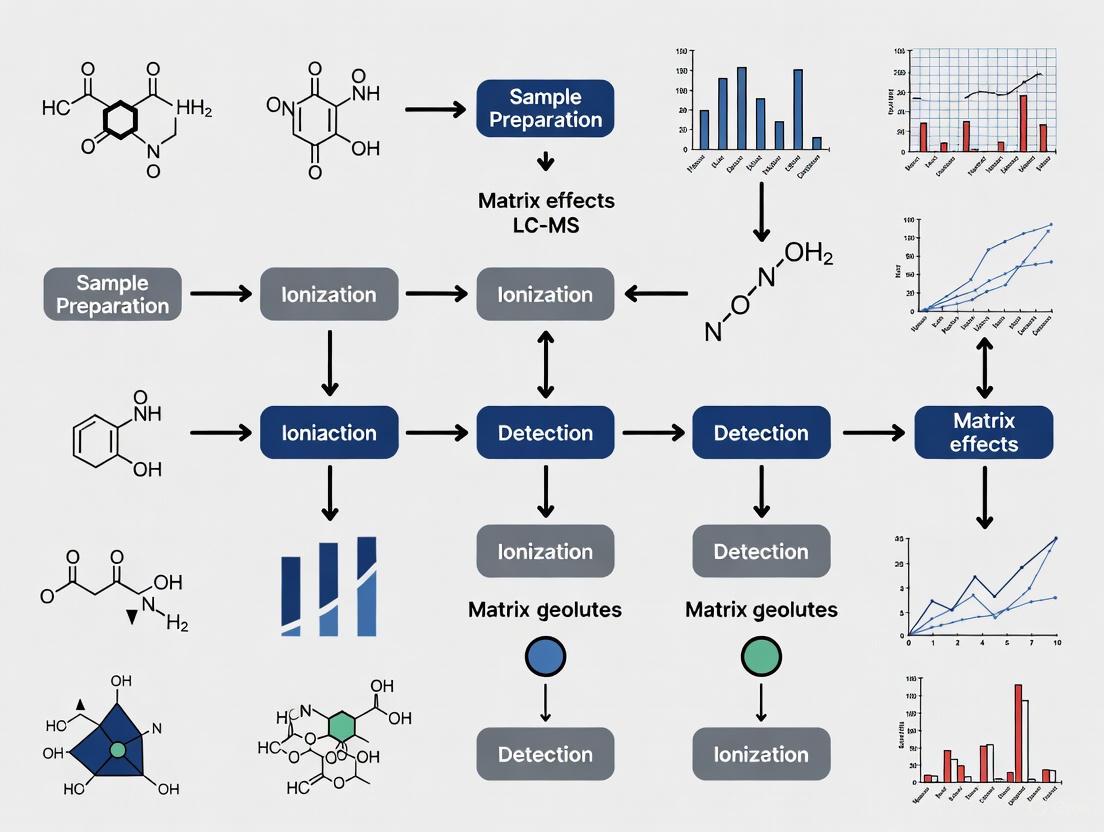
Matrix effects represent a significant challenge in Liquid Chromatography-Mass Spectrometry (LC-MS), particularly in electrospray ionization (ESI), where co-eluting compounds can suppress or enhance analyte ionization, compromising the accuracy, reproducibility, and...
Matrix Effects in LC-MS Analysis: A Comprehensive Guide from Fundamentals to Advanced Correction Strategies
Abstract
Matrix effects represent a significant challenge in Liquid Chromatography-Mass Spectrometry (LC-MS), particularly in electrospray ionization (ESI), where co-eluting compounds can suppress or enhance analyte ionization, compromising the accuracy, reproducibility, and sensitivity of quantitative bioanalysis. This article provides a complete resource for researchers and drug development professionals, addressing the fundamental mechanisms of matrix effects, established and emerging methodologies for their detection and compensation, practical troubleshooting and optimization strategies for robust method development, and rigorous validation protocols as per regulatory guidelines. By synthesizing current best practices and innovative approaches like post-column infusion of standards (PCIS), this guide aims to empower scientists to effectively manage matrix effects, thereby ensuring the generation of reliable and high-quality data in pharmaceutical, clinical, and metabolomics studies.
What Are Matrix Effects? Understanding the Fundamental Challenge in LC-MS
Matrix effects represent a critical challenge in liquid chromatography-mass spectrometry (LC-MS) analysis, fundamentally defined as the suppression or enhancement of a target analyte's signal caused by co-eluting compounds originating from the sample matrix [1] [2]. These phenomena are a major source of concern in quantitative bioanalysis, pharmaceutical, environmental, and food testing because they can severely compromise accuracy, precision, and sensitivity [3] [4]. When the mass spectrometric response for an analyte in a purified standard solution differs from its response in a biological matrix such as plasma, urine, or serum, a matrix effect is in play [2]. In essence, the "matrix"—the complex background of endogenous and exogenous substances in a sample—directly interferes with the ionization efficiency of the target analyte, leading to potentially erroneous data [5]. Understanding, detecting, and mitigating these effects is therefore not merely a procedural step but a foundational requirement for ensuring the reliability of any LC-MS assay, particularly when it informs critical decisions in drug development and biomonitoring [2].
Mechanisms of Ionization Suppression and Enhancement
The core of matrix effects lies in the ionization process itself, primarily within the ion source of the mass spectrometer. The two most common atmospheric pressure ionization techniques, electrospray ionization (ESI) and atmospheric pressure chemical ionization (APCI), are susceptible to these interferences, though to different degrees and through different mechanistic pathways [2] [5].
Mechanisms in Electrospray Ionization (ESI)
ESI is particularly prone to ion suppression. Its mechanism involves the formation of charged droplets at the needle tip, solvent evaporation, and the eventual release of gas-phase analyte ions. Co-eluting matrix components can disrupt this process at several stages, leading to signal loss [1] [2].
- Competition for Charge: In the liquid phase, a limited number of excess charges (e.g., protons) are available. Highly basic or surface-active matrix components can out-compete analyte molecules for these available charges, leading to a reduced number of protonated (or deprotonated) analyte ions [2] [5].
- Impact on Droplet Physics: Less volatile or high-viscosity matrix compounds, such as phospholipids, can increase the surface tension and viscosity of the sprayed droplets. This alters the efficiency of droplet formation and reduces the rate of solvent evaporation, ultimately impairing the transfer of analyte ions from the liquid to the gas phase [1] [4].
- Co-precipitation with Non-Volatile Material: Analytes can co-precipitate with non-volatile matrix components, effectively trapping them and preventing their entry into the gas phase [1].
- Gas-Phase Neutralization: After the formation of gas-phase ions, matrix compounds with high gas-phase basicity can neutralize the charged analyte ions through proton transfer reactions, thereby suppressing the detected signal [2] [5].
Mechanisms in Atmospheric Pressure Chemical Ionization (APCI)
APCI is generally considered less susceptible to matrix effects than ESI because ionization occurs in the gas phase after the liquid stream is vaporized in a heated nebulizer [2] [5]. This bypasses some of the liquid-phase competition issues inherent to ESI. However, suppression can still occur through different mechanisms:
- Competition in the Gas Phase: The chemical ionization process involves a reagent gas (often a solvent vapor) that is ionized by a corona discharge needle. These reagent ions then transfer charge to the analyte molecules. The presence of a high concentration of co-eluting, ionizable matrix components can compete with the analyte for the available reagent ions, leading to suppression [2].
- Solid Formation and Co-precipitation: Non-volatile matrix components can coprecipitate with the analyte during the rapid vaporization process, preventing the analyte from reaching the gas phase where ionization occurs [5].
The following diagram illustrates the key mechanisms leading to ion suppression in the widely used ESI source.
Matrix effects are compound- and system-specific, meaning their severity depends on the unique combination of analyte, sample matrix, and instrumental parameters [2]. The interfering substances can be broadly categorized as endogenous or exogenous.
- Endogenous Substances: These are inherent to the biological sample and include a wide range of compounds such as phospholipids, salts, urea, carbohydrates, amines, lipids, peptides, and metabolites [2]. Phospholipids are frequently cited as major contributors to matrix effects in plasma and serum analysis [1] [2].
- Exogenous Substances: These are introduced during sample collection, storage, or preparation. They can include mobile phase additives (e.g., trifluoroacetic acid), anticoagulants (e.g., Li-heparin), and plasticizers (e.g., phthalates) leached from labware [2] [5].
The table below summarizes the primary sources of matrix effects in biological samples.
Table 1: Primary Sources of Matrix Effects in Biological Samples
| Source Category | Specific Examples | Typical Matrices Affected |
|---|---|---|
| Endogenous | Phospholipids, lipids, cholesterol | Plasma, Serum, Breast Milk [2] |
| Salts (Na+, K+, Cl-), urea, creatinine | Urine, Plasma, Serum [2] | |
| Proteins (albumins, globulins) | Plasma, Serum, Breast Milk [2] | |
| Metabolites, bile acids | Feces, Urine [6] | |
| Exogenous | Mobile phase additives (TFA, buffer salts) | All matrices [2] |
| Anticoagulants (Li-heparin, EDTA) | Plasma, Serum [2] | |
| Polymers & plasticizers (phthalates) | All matrices (from tubes/vials) [5] |
Experimental Protocols for Detecting Matrix Effects
Before matrix effects can be mitigated, their presence and magnitude must be reliably detected. The U.S. Food and Drug Administration's guidance on bioanalytical method validation emphasizes the need to investigate matrix effects [2]. Two established experimental protocols are widely used.
Post-Extraction Spiking Method
This is a quantitative approach used to assess the extent of ion suppression or enhancement for a specific analyte [4] [5].
- Procedure:
- Prepare a neat standard solution of the analyte in mobile phase (A).
- Obtain a blank matrix (e.g., plasma) from at least six different sources [2].
- Process these blank samples through the entire sample preparation protocol (e.g., protein precipitation, liquid-liquid extraction).
- Spike a known concentration of the analyte into the resulting purified blank extracts (B).
- Also, spike the same concentration into pure mobile phase (A).
- Analyze all samples (A and B) by LC-MS and compare the peak areas (or heights).
- Calculation: The matrix effect (ME) is calculated as: ME (%) = (B / A) × 100. A value of 100% indicates no matrix effect. Values <100% indicate ion suppression, and values >100% indicate ion enhancement [5].
- Advantages and Limitations:
- Advantage: Provides a direct, quantitative measure of the matrix effect.
- Limitation: Requires a true "blank" matrix, which is not available for endogenous analytes like metabolites [4].
Post-Column Infusion Method
This method provides a qualitative, real-time profile of ionization suppression/enhancement across the entire chromatographic run [4] [5].
- Procedure:
- A solution containing the analyte(s) of interest is continuously infused into the LC eluent via a T-connector between the HPLC column and the MS ion source, using a syringe pump.
- A blank matrix sample (after extraction) is injected into the LC system and the chromatographic method is executed as normal.
- The mass spectrometer monitors the signal of the infused analyte throughout the run.
- Data Interpretation: A steady signal baseline indicates no matrix interference. A dip or depression in the baseline indicates a region of ion suppression caused by co-eluting matrix components. A peak or elevation indicates ion enhancement [5].
- Advantages and Limitations:
- Advantage: Visually identifies the chromatographic regions where matrix effects occur, allowing for method optimization (e.g., shifting analyte retention time) to avoid these regions.
- Limitation: Does not provide a direct quantitative measure of the effect on the analyte; requires additional hardware (syringe pump, connector) [4].
The following workflow diagram outlines the steps for the post-column infusion experiment.
Quantitative Data and Strategic Mitigation
The impact of matrix effects can be quantified, and based on this understanding, systematic strategies can be deployed to manage them. The following table compiles key quantitative findings and the corresponding mitigation approaches documented in the literature.
Table 2: Matrix Effect Magnitude and Corresponding Mitigation Strategies
| Observed Effect / Metric | Quantitative Finding | Recommended Mitigation Strategy |
|---|---|---|
| Ion Suppression in ESI vs APCI | ESI is "more susceptible" to ion suppression than APCI [2]. A direct comparison showed APCI experienced less signal loss for a post-column infused analyte [5]. | Switch ionization mode from ESI to APCI where feasible for the analyte [5]. |
| Impact of Sample Cleanup | Phospholipids in plasma are a "significant source" of matrix effects [1]. | Use "cleaner sample preparation" such as solid-phase extraction (SPE) or liquid-liquid extraction to remove phospholipids [1] [4]. |
| Internal Standard Correction | Stable isotope-labeled internal standards (SIL-IS) are the "best available option" [4]. Theoretically, they experience the "same degree of ion suppression or enhancement" as the analyte [1]. | Use a stable isotope-labeled internal standard (SIL-IS) for quantitative compensation [1] [4]. |
| Sample Dilution | Dilution can be "feasible when the sensitivity of the assay is very high" [4]. | Dilute the sample to reduce the concentration of interfering components [4]. |
| Chromatographic Optimization | N/A | Adjust HPLC conditions (column, gradient) to shift analyte retention away from suppression regions identified by post-column infusion [1] [4]. |
Advanced Compensation: Post-Column Infusion of Standards (PCIS)
A promising advanced strategy for untargeted metabolomics is the use of Post-Column Infusion of Standards (PCIS) [6] [7]. This method moves beyond detection to active correction.
- Principle: Multiple stable-isotope-labeled (SIL) standards are infused post-column alongside the chromatographic separation. The variation in their signals is used to create a correction model for the matrix effect experienced by unknown analytes [6] [7].
- Challenge and Innovation: The major challenge is selecting the most appropriate PCIS for each detected feature. A 2025 study by Zhu et al. proposed using an artificial matrix effect (MEart), created by infusing known disruptive compounds, to select the optimal PCIS [6] [7].
- Efficacy: This approach showed a high level of agreement, with 17 out of 19 SIL standards (89%) demonstrating consistent PCIS selection when comparing the artificial matrix method with the biological matrix effect, leading to improved data accuracy [7].
The Scientist's Toolkit: Essential Reagents and Materials
Successful management of matrix effects requires careful selection of reagents and materials during method development and implementation.
Table 3: Research Reagent Solutions for Managing Matrix Effects
| Item | Function / Purpose in Managing Matrix Effects |
|---|---|
| Stable Isotope-Labeled Internal Standards (SIL-IS) | The gold standard for compensation; co-elutes with the native analyte, undergoing an identical matrix effect, thus correcting for signal suppression/enhancement in quantification [1] [4]. |
| Structural Analogue Internal Standards | A less ideal but sometimes necessary alternative to SIL-IS; a compound with similar structure and chromatographic behavior to the analyte can provide partial compensation for matrix effects [4]. |
| Solid-Phase Extraction (SPE) Cartridges | For selective sample cleanup; removes phospholipids and other endogenous interferents prior to LC-MS analysis, thereby reducing the source of matrix effects [1] [4]. |
| Phospholipid Removal Plates (e.g., HybridSPE) | Specialized SPE products designed specifically for the efficient removal of phospholipids from plasma and serum samples [1]. |
| Post-Column Infusion Setup (Syringe Pump, T-connector) | Hardware required to perform the post-column infusion experiment, which is critical for identifying chromatographic regions affected by matrix effects [5]. |
| UPLC/HPLC Columns (e.g., Cogent Diamond-Hydride) | Advanced chromatographic columns that provide superior separation, helping to resolve the analyte from co-eluting matrix components and minimize ion suppression [4]. |
Matrix effects, specifically ionization suppression and enhancement, are inherent and formidable challenges in LC-MS analysis. They originate from a complex interplay between the sample matrix and the ionization process, with ESI being particularly vulnerable. Ignoring these effects jeopardizes the integrity of analytical data, which is unacceptable in fields like drug development and biomonitoring. Robust analytical workflows must therefore incorporate systematic detection methods, such as post-extraction spiking or post-column infusion, to diagnose the issue. Fortunately, a multi-pronged mitigation strategy exists, encompassing extensive sample cleanup, chromatographic optimization, and, most critically, the use of stable isotope-labeled internal standards for accurate quantification. Emerging techniques like post-column infusion of standards with artificial matrix effect assessment further promise to enhance the accuracy of untargeted analyses. Ultimately, a thorough understanding and proactive management of matrix effects are not optional but fundamental to generating reliable, high-quality LC-MS data.
The Electrospray Ionization (ESI) Process and Its Vulnerability
Electrospray Ionization (ESI) is a soft ionization technique that has become a cornerstone of modern liquid chromatography-mass spectrometry (LC-MS), enabling the analysis of non-volatile, thermally labile, and large biomolecules directly from a liquid phase [8] [9]. Its capacity to generate multiply charged ions has been instrumental in extending the mass range of analyzers, thus facilitating the study of proteins, peptides, and other macromolecules [10]. Within the context of LC-MS analysis research, the performance of ESI is critically dependent on the sample composition. The phenomenon where co-eluting substances alter the ionization efficiency of the target analyte is universally known as the matrix effect [11] [5] [1]. These effects, primarily manifesting as ion suppression or enhancement, represent a significant vulnerability in the ESI process, potentially compromising the accuracy, precision, and sensitivity of quantitative bioanalytical methods [12] [5]. This whitepaper provides an in-depth examination of the ESI process, the fundamental mechanisms behind its susceptibility to matrix effects, and the systematic experimental approaches used to detect and mitigate these interferences.
The Step-by-Step ESI Process
The transformation of analyte molecules from solution into gas-phase ions in ESI is a multi-stage process driven by electrical energy and solvent evaporation [8] [10]. The following diagram illustrates the core mechanism and its key vulnerability point.
The ESI process can be broken down into three distinct, sequential stages [8] [10] [13]:
- Droplet Formation: The sample solution is pumped through a capillary (nebulizer) held at a high voltage (typically 2.5–6.0 kV). This strong electrical field induces a charge on the liquid, forming a Taylor cone at the capillary tip, from which a fine mist of highly charged droplets is emitted [8].
- Desolvation and Droplet Fission: The charged droplets travel towards the mass spectrometer inlet against a counter-current flow of heated drying gas (e.g., nitrogen). Solvent evaporation continuously reduces the droplet size, increasing the surface charge density. When the electrostatic repulsion surpasses the liquid's surface tension (the Rayleigh limit), the droplet undergoes Coulomb fission, violently disintegrating into smaller, progeny droplets [8] [9]. This cycle of evaporation and fission repeats rapidly [10].
- Gas Phase Ion Formation: Two primary models explain the final release of ions from the nanometer-scaled droplets [9]:
- Ion Evaporation Model (IEM): Predominant for smaller ions. The intense electric field on the droplet's surface enables the direct desorption of solvated ions into the gas phase [9].
- Charge Residue Model (CRM): More applicable to large macromolecules like proteins. The droplet undergoes fission cycles until only a single analyte molecule remains, carrying the droplet's residual charge [9].
It is during the desolvation and fission stages that the process is most vulnerable. The presence of co-eluting matrix components can disrupt the delicate balance of charge competition and solvent evaporation, leading to matrix effects [5].
Mechanisms of Matrix Effects and Ion Suppression
Matrix effects are a critical vulnerability in ESI, defined as the suppression or enhancement of an analyte's signal caused by co-eluting compounds that interfere with the ionization process [5] [1]. These effects are a predominant form of interference in LC-ESI-MS and can severely impact key analytical figures of merit, including detection capability, precision, and accuracy [5]. The mechanisms behind ion suppression are multifaceted and can occur in both the condensed and gas phases.
Table 1: Mechanisms of Ion Suppression in ESI
| Phase | Mechanism | Description |
|---|---|---|
| Condensed Phase (Droplet) | Charge Competition | Co-eluting compounds with high surface activity or basicity compete with the analyte for the limited available charge on the droplet's surface, reducing the analyte's ionization efficiency [5]. |
| Altered Droplet Properties | Matrix components can increase the viscosity or surface tension of the droplets, hindering solvent evaporation and the Coulomb fission process, thus preventing the analyte from reaching the gas phase [5] [1]. | |
| Precipitation/Co-precipitation | Non-volatile materials (e.g., salts, phospholipids) can coprecipitate with the analyte or form solids that prevent the ejection of ions from the droplets [5] [1]. | |
| Gas Phase | Gas-Phase Proton Transfer | Highly basic interfering compounds in the gas phase can deprotonate the already-ionized analyte ions, leading to their neutralization and signal loss [5]. |
The susceptibility of ESI to these effects is inherently linked to its ionization mechanism. ESI is a concentration-sensitive process, and the number of charges available for ionization is finite [5]. In complex mixtures, analytes must compete for access to the droplet surface and the limited charge. This makes ESI particularly prone to signal suppression from even low concentrations of interfering compounds that are highly efficient at acquiring charge [12] [5]. Common sources of matrix effects in biological analysis include phospholipids, salts, metabolites, and even polymers leached from plasticware [5]. A specific and often overlooked form of interference is the ionization interference between a drug and its own metabolites, which, due to structural similarity, often co-elute and suppress each other's signals, leading to systematic quantitative errors [12].
Experimental Protocols for Detecting Matrix Effects
Robust bioanalytical method validation requires rigorous assessment of matrix effects. The U.S. Food and Drug Administration (FDA) guidance mandates their evaluation to ensure data quality [5]. Two established experimental protocols are widely used to detect and characterize these effects.
Post-Extraction Addition Method
This method quantitatively assesses the absolute magnitude of ion suppression or enhancement for a given analyte [5].
Procedure:
- Prepare Matrix Sample: A blank biological matrix (e.g., plasma, urine) is processed through the standard sample preparation and extraction protocol.
- Spike with Analyte: After extraction, the purified blank matrix extract is fortified (spiked) with a known concentration of the target analyte.
- Prepare Neat Solution: An equivalent concentration of the analyte is prepared in a neat mobile phase or reconstitution solution.
- LC-MS Analysis and Calculation: Both the spiked matrix extract and the neat solution are analyzed by LC-MS. The matrix effect (ME) is calculated as follows:
- ME (%) = (Peak Area of Analyte in Spiked Matrix Extract / Peak Area of Analyte in Neat Solution) × 100%
- A value of 100% indicates no matrix effect. Values <100% indicate ion suppression, and values >100% indicate ion enhancement [5].
This method is excellent for quantifying the extent of suppression but does not provide information on when during the chromatographic run the interference occurs.
Post-Column Infusion Experiment
This qualitative experiment maps the chromatographic regions where ion suppression occurs, providing a visual profile of matrix interference [5] [7].
Procedure:
- Setup Infusion: A solution containing the analyte of interest is continuously infused into the LC effluent post-column using a syringe pump at a constant rate.
- Inject Blank: A processed blank matrix sample is injected onto the LC column and the chromatographic run is started.
- Monitor Signal: The mass spectrometer monitors the signal of the infused analyte throughout the LC run time.
- Interpretation: A stable signal indicates no interference. Any dip or suppression in the baseline signal indicates the elution of matrix components that are suppressing the ionization of the infused analyte. Conversely, a signal increase indicates ion enhancement [5].
Table 2: Comparison of Matrix Effect Detection Protocols
| Protocol Parameter | Post-Extraction Addition | Post-Column Infusion |
|---|---|---|
| Primary Output | Quantitative measure of suppression/enhancement | Qualitative map of suppression regions in chromatographic time |
| Information Gained | Extent of matrix effect | Location of matrix effect |
| Throughput | Lower; requires preparation and analysis of multiple samples | Higher for method development; one run maps entire chromatogram |
| Best Use Case | Final quantitative validation of a method | Initial method development to identify problematic elution windows |
The following workflow diagram integrates these two key experiments into a systematic approach for diagnosing matrix effects.
The Scientist's Toolkit: Key Reagents and Materials
Successful experimentation in ESI-MS, particularly for mitigating matrix effects, relies on a set of essential reagents and materials. The following table details key components of the research toolkit.
Table 3: Essential Research Reagent Solutions for ESI-MS Analysis
| Reagent/Material | Function in ESI-MS Analysis | Key Considerations |
|---|---|---|
| Stable Isotope-Labeled Internal Standards (SIL-IS) | Compensates for matrix effects; corrects for variability in sample prep and ionization by behaving identically to the analyte [12] [1]. | The gold standard for quantitative compensation. Must be added to the sample prior to any preparation steps [1]. |
| High-Purity Solvents (HPLC/MS Grade) | Serve as the mobile phase and sample solvent. Minimize chemical noise and background interference. | Volatile solvents (MeOH, ACN) aid desolvation. Avoid non-volatile buffers and additives where possible [9]. |
| Volatile Mobile Phase Additives (e.g., Formic Acid, Ammonium Formate) | Modify pH and ionic strength to optimize chromatography and ionization efficiency. | Provides a source of protons (H+) to facilitate analyte protonation in positive ion mode [9]. |
| Solid-Phase Extraction (SPE) Cartridges | A sample preparation tool for selective extraction and cleanup of analytes, removing phospholipids and other matrix interferents [1]. | Critical for reducing the mass of co-eluting matrix components entering the ESI source. |
| Reference Standard Compounds | Used for instrument calibration, method development, and as spikes in matrix effect experiments. | High-purity characterized materials are essential for accurate quantification. |
Strategies for Mitigating Matrix Effects
Addressing the vulnerability of ESI to matrix effects requires a multi-faceted approach. No single strategy is universally applicable, but a combination of the following methods can significantly reduce interference and improve data reliability.
- Improved Sample Preparation: The most effective approach is often to remove the interfering substances before analysis. Techniques such as liquid-liquid extraction (LLE) and solid-phase extraction (SPE) can selectively isolate the analyte from problematic matrix components like phospholipids and proteins, dramatically reducing the matrix load entering the LC-MS system [5] [1].
- Chromatographic Resolution: Optimizing the LC method to achieve baseline separation of the analyte from interfering compounds is a powerful strategy. By shifting the analyte's retention time away from the elution window of the matrix interferents, the ionization competition in the ESI source is minimized [5]. This may involve optimizing gradient profiles, mobile phase pH, or using alternative stationary phases.
- Use of Stable Isotope-Labeled Internal Standards (SIL-IS): This is considered the gold standard for compensating for matrix effects in quantitative analysis [12] [1]. A SIL-IS has nearly identical chemical and chromatographic properties to the analyte, so it will experience the same degree of ion suppression or enhancement. By normalizing the analyte response to the IS response, the quantitative accuracy is preserved despite the presence of matrix effects [1].
- Sample Dilution: If the method sensitivity allows, simply diluting the sample can reduce the concentration of matrix interferents below the threshold where they cause significant suppression. This approach is straightforward but must be validated to ensure the analyte signal remains sufficient for detection [12].
- Alternative Ionization Sources: In some cases, switching from ESI to Atmospheric Pressure Chemical Ionization (APCI) can reduce matrix effects. APCI involves thermal vaporization of the analyte before chemical ionization, which is generally less susceptible to interference from non-volatile matrix components that severely impact ESI [5]. However, APCI is not suitable for large, thermally labile molecules.
Matrix effects (MEs) represent a significant challenge in liquid chromatography-mass spectrometry (LC-MS) and LC-tandem mass spectrometry (LC-MS/MS), which are cornerstone techniques in modern bioanalysis, metabolomics, and drug development. A matrix effect is defined as the combined effect of all components of the sample other than the analyte on the measurement of the quantity [14]. In LC-MS, this manifests primarily as ionization suppression or enhancement when co-eluting compounds interfere with the ionization process of the target analyte in the mass spectrometer interface [15] [16] [4]. These effects critically impact the reliability of results, adversely affecting accuracy, precision, sensitivity, and linearity, potentially leading to erroneous data interpretation during method validation and application [16] [14].
The susceptibility to matrix effects varies based on the ionization technique. Electrospray Ionization (ESI) is particularly prone to ion suppression compared to Atmospheric Pressure Chemical Ionization (APCI) because ionization in ESI occurs in the liquid phase, where co-eluting compounds can compete for charge and affect droplet desolvation, whereas APCI occurs primarily in the gas phase [15] [14] [17]. The sources of interference are diverse and originate from the biological or sample matrix itself. This guide focuses on the three most common and impactful classes of interferents: phospholipids, salts, and metabolites, providing a technical overview of their origins, mechanisms, and strategies for their detection and mitigation.
Phospholipids as a Major Source of Interference
Origin and Chemical Nature
Phospholipids are fundamental structural components of all cell membranes and are consequently abundant in biological matrices like plasma, serum, and tissue homogenates [18]. Although not stored in large quantities, their constant presence makes them a pervasive interferent [18]. Their molecular structure features two distinct functional regions: a polar head group containing an ionizable organic phosphate moiety and other polar substituents, and one or two long-chain hydrophobic fatty acid esters [18]. This amphipathic nature contributes to their significant interference potential in LC-MS analysis.
The most prevalent phospholipids in plasma include glycerophosphocholines (GPCho's or PCs) and lysophosphatidylcholine (LPC) [19] [17]. Under in-source collision-induced dissociation (CID), LPCs produce dominant fragments at m/z 104 and 184, while diradyl PCs primarily yield a fragment at m/z 184 [19]. This characteristic is exploited for their detection and monitoring during method development.
Mechanisms of Interference
Phospholipids cause ion suppression through several mechanisms, primarily by interfering with the efficiency of droplet formation and desolvation in the ESI source [4] [18]. As less-volatile compounds, they can increase the viscosity and surface tension of charged droplets, thereby reducing the efficiency of solvent evaporation and the subsequent release of gas-phase analyte ions [4]. Their highly ionic nature allows them to readily ionize and compete for the available charge in the ESI droplet, effectively "suppressing" the ionization of the target analyte [18]. The interference is most pronounced when the analyte co-elutes with phospholipids, which often occurs in the early to mid-phases of a chromatographic run, particularly when using fast gradients or simplified sample preparation like protein precipitation [19] [17].
Quantitative Impact and Detection
The impact of phospholipids is quantifiable. The absolute matrix effect describes the difference in analyte response between a neat solution and a post-extraction spiked sample, while the relative matrix effect refers to the variation in response across different lots of matrix [18]. A relative matrix effect can be particularly detrimental to precision [18].
Table 1: Quantitative Impact of Phospholipid Removal Techniques
| Sample Preparation Technique | Impact on Phospholipids | Resulting Matrix Effect |
|---|---|---|
| Protein Precipitation (PPT) | Inefficient removal; phospholipids remain in supernatant [18] [17] | Significant ion suppression; highly variable results [18] [17] |
| Liquid-Liquid Extraction (LLE) | Phospholipids often co-extract due to their hydrophobic tails [18] [17] | Can be moderate to high, depending on solvent choice [17] |
| Solid-Phase Extraction (SPE) | Better removal with selective sorbents (e.g., mixed-mode, zirconia-coated) [20] [18] [17] | Significantly reduced matrix effects [20] [18] |
| HybridSPE-PPT | Specifically designed to selectively retain phospholipids during PPT [18] | Dramatic reduction of phospholipid-based matrix effects [18] |
The most effective way to qualitatively detect phospholipid-related matrix effects is the post-column infusion method [19] [18]. In this setup, a constant flow of analyte is introduced into the LC eluent post-column while a blank matrix extract is injected. A dip in the baseline signal indicates the retention time zones where ion suppression occurs, which can be correlated with the elution profile of phospholipids [14] [18]. Phospholipids can be specifically monitored using "in-source MRM" transitions, such as m/z 184 → 184 for PCs and LPCs, and m/z 104 → 104 for LPCs, creating a "visualized matrix effect" chromatogram that guides method optimization [19].
Figure 1: Workflow for Post-Column Infusion to Detect Phospholipid Matrix Effects. This method helps identify chromatographic regions affected by ion suppression.
Salts and Ionizable Compounds
Origin and Types
Salts and ionizable endogenous compounds are ubiquitous in biological fluids. Urine, for example, contains high concentrations of inorganic salts, which can cause significant matrix effects [14]. Other sources include buffer salts from sample preparation, anticoagulants (e.g., heparin, EDTA) in plasma, and naturally occurring amino acids and small organic acids [16] [14].
Mechanisms of Interference
The interference mechanism depends on the ionization mode. In ESI, these ionic compounds can directly compete with the analyte for the limited charge available on the ESI droplet surface [4] [14]. Basic compounds, for instance, may deprotonate and neutralize analyte ions, reducing the formation of protonated analyte ions [4]. Furthermore, non-volatile salts can deposit in the ion source, leading to long-term signal instability and increased maintenance needs. The presence of salts can also alter the viscosity and surface tension of the ESI droplets, similar to phospholipids, thereby affecting the efficiency of ion release [4].
Metabolites and Co-Administered Drugs
Origin and Complexity
The "metabolome" of a biological sample is highly complex and variable. In addition to endogenous metabolites, samples from dosed subjects contain the parent drug, its metabolites, and potentially co-administered drugs and their metabolites [16] [14]. This complexity is amplified in untargeted metabolomics studies, where the goal is to profile as many metabolites as possible, inevitably increasing the risk of co-elution and matrix effects [7].
Mechanisms of Interference
Metabolites and drugs cause interference primarily through co-elution with the target analyte. When these compounds elute at the same time as the analyte, they can:
- Compete for ionization in the ESI source, leading to signal suppression [15] [14].
- Cause ion enhancement if they facilitate droplet desolvation or charge transfer in a way that benefits the analyte—though suppression is more common [14].
- Introduce isobaric interference or cross-talk if they share identical or similar MRM transitions, leading to falsely elevated results [16].
A striking example of metabolite interference was reported where matrix components in urine caused significant shifts in the retention time and shape of LC peaks for bile acids, even breaking the fundamental rule that one compound should yield one peak. For some bile acids like chenodeoxycholic acid, the matrix effect resulted in a single compound yielding two distinct LC peaks [15].
Comprehensive Strategies for Detection and Mitigation
Detection and Assessment Protocols
A robust bioanalytical method requires thorough assessment of matrix effects. The following table summarizes the key experimental protocols.
Table 2: Experimental Protocols for Assessing Matrix Effects
| Method Name | Protocol Description | Key Outcome | Limitations |
|---|---|---|---|
| Post-Column Infusion [16] [14] [18] | A constant flow of analyte is infused post-column into the MS while a blank matrix extract is injected. The chromatogram of the infused analyte is monitored for signal disruptions. | Qualitative identification of ion suppression/enhancement zones throughout the chromatographic run. | Does not provide quantitative data; laborious for multi-analyte methods [14]. |
| Post-Extraction Spiking [16] [14] | The response of an analyte spiked into a blank matrix extract is compared to the response of the same analyte in a pure solvent at the same concentration. The ratio is the Matrix Factor (MF). | Quantitative assessment (MF < 1 indicates suppression; MF > 1 indicates enhancement). | Requires a blank matrix, which is not available for endogenous analytes [4] [14]. |
| Pre-Extraction Spiking (as per ICH M10) [16] | Quality Control (QC) samples at low and high concentrations are prepared in at least six different lots of blank matrix, including hemolyzed/lipemic lots. Accuracy and precision are evaluated. | Confirms that matrix effect, if any, is consistent and compensated (bias within ±15%, CV ≤15%). | Does not quantify the scale of suppression/enhancement, only its consistency [16]. |
| Slope Ratio Analysis [14] | Calibration curves are prepared in a neat solution and in a matrix extract. The ratio of the slopes of the two curves provides a semi-quantitative measure of the matrix effect across a concentration range. | Semi-quantitative screening of matrix effect over the entire calibration range. | Only provides semi-quantitative results [14]. |
Mitigation and Compensation Techniques
Successfully addressing matrix effects often requires a multi-faceted approach.
1. Advanced Sample Preparation: The choice of sample cleanup is the most effective way to minimize matrix effects.
- Protein Precipitation (PPT) is simple but ineffective, often concentrating phospholipids in the supernatant. Using Zirconia-coated PPT plates can selectively retain phospholipids, providing much cleaner extracts [17].
- Solid-Phase Extraction (SPE) with selective sorbents, such as mixed-mode cation-exchange or zirconia-coated phases, can effectively separate phospholipids from analytes [17]. HybridSPE is a specific technique designed to combine the simplicity of PPT with the selectivity of SPE to remove phospholipids [18].
- Liquid-Liquid Extraction (LLE) can be effective, especially with pH control. A double LLE procedure can first remove hydrophobic interferences with a non-polar solvent like hexane before extracting the analyte with a more polar solvent [17].
2. Chromatographic Optimization: The goal is to separate the analyte from interfering compounds.
- Chromatographic selectivity can be altered by changing the column chemistry (e.g., from C18 to a polar-embedded phase) or the mobile phase composition. Using methanol vs. acetonitrile as organic modifier can significantly shift the elution profile of both the analyte and phospholipids, potentially resolving co-elution [19].
- Smaller particle size columns (e.g., sub-2µm) can improve chromatographic resolution and help separate analytes from matrix components [20].
3. Internal Standardization: This is a key strategy to compensate for matrix effects.
- Stable Isotope-Labeled Internal Standards (SIL-IS) are the gold standard. They have virtually identical chemical and chromatographic properties to the analyte, co-elute with it, and experience the same matrix effect, perfectly compensating for it in the quantification ratio [16] [14].
- Structural Analogues can be used if a SIL-IS is unavailable, but they must be chosen carefully to ensure their behavior closely matches that of the analyte [4].
4. Alternative Ionization and Calibration:
- Switching from ESI to APCI can reduce susceptibility to matrix effects, as ionization occurs in the gas phase rather than the liquid phase [16] [14].
- The Standard Addition Method is a viable option, especially for endogenous compounds where a blank matrix is unavailable. Known amounts of the analyte are added to the sample, and the response is extrapolated to determine the original concentration [4].
Figure 2: Decision Workflow for Addressing Matrix Effects in LC-MS. This outlines the two primary strategic paths: compensating for effects or minimizing them.
The Scientist's Toolkit: Essential Research Reagents and Materials
Table 3: Key Reagents and Materials for Matrix Effect Management
| Tool Category | Specific Examples | Function & Rationale |
|---|---|---|
| Sample Preparation | Zirconia-coated SPE/PPT plates (e.g., HybridSPE, Ostro) [20] [18] [17] | Selectively binds and removes phospholipids from samples, dramatically reducing phospholipid-based matrix effects. |
| Mixed-mode SPE sorbents (Cation/Anion Exchange + RP) [17] | Provides orthogonal selectivity for retaining analytes while washing away ionic and non-ionic interferences. | |
| Chromatography | HPLC columns with sub-2µm or 2.5µm particles [20] | Provides higher chromatographic resolution to separate analytes from co-eluting matrix components. |
| High-purity mobile phase additives (e.g., LC-MS grade formic acid, ammonium salts) [21] | Minimizes introduction of exogenous contaminants that can cause background noise and ion suppression. | |
| Internal Standards | Stable Isotope-Labeled (SIL) Internal Standards [16] [7] [14] | Co-elutes with analyte and undergoes identical matrix effects, providing ideal compensation during quantification. |
| Mass Spectrometry | High-purity nitrogen gas (from generators with NMHC filtration) [21] | Prevents non-methane hydrocarbons (NMHC) from ambient air from causing ion suppression and signal instability. |
| Post-column infusion setup (T-connector, syringe pump) [14] [18] | Enables qualitative assessment of matrix effects across the chromatogram to guide method development. |
Matrix effects stemming from phospholipids, salts, and metabolites are an inherent challenge in LC-MS analysis of complex matrices. A comprehensive understanding of their origins and mechanisms is the first step toward developing robust analytical methods. A systematic approach involving thorough assessment (using post-column infusion and post-extraction spiking), strategic mitigation (through selective sample cleanup and chromatographic optimization), and effective compensation (primarily via stable isotope-labeled internal standards) is essential to ensure the generation of accurate, precise, and reliable data. As LC-MS applications continue to push the boundaries of sensitivity and throughput, vigilance against matrix effects remains a cornerstone of quality in scientific research and drug development.
Matrix effects represent a significant challenge in Liquid Chromatography-Mass Spectrometry (LC-MS) analysis, fundamentally impacting the reliability of quantitative bioanalytical data. These effects occur when co-eluting compounds from the sample matrix interfere with the ionization process of target analytes, leading to signal suppression or enhancement [4] [1]. For researchers and drug development professionals, understanding and mitigating matrix effects is crucial for generating accurate, precise, and sensitive data that meets regulatory standards. The complexity of biological matrices—including plasma, urine, and tissues—introduces numerous components that can co-elute with analytes and adversely affect ionization efficiency in the mass spectrometer source [15] [22]. This technical guide examines the multifaceted impact of matrix effects on key data quality parameters and provides evidence-based strategies for their detection and elimination.
Mechanisms of Matrix Effects in LC-MS
Fundamental Principles
In LC-MS analysis, the "matrix" encompasses all sample components other than the target analyte, including endogenous compounds, metabolites, and mobile phase constituents [23]. Matrix effects manifest primarily in the ion source, where co-eluting compounds compete with analytes for charge and interfere with the ionization process. Electrospray Ionization (ESI) is particularly vulnerable to these effects due to its reliance on charged droplet formation and desolvation processes [15] [22].
The prevailing mechanisms include:
- Charge Competition: Matrix components deprotonate and neutralize analyte ions in the liquid phase [1]
- Droplet Interference: Less-volatile compounds affect droplet formation efficiency and reduce conversion of charged droplets to gas-phase ions [4]
- Surface Tension Effects: High-viscosity interfering compounds increase surface tension of charged droplets, preventing efficient evaporation [1]
- Gas-Phase Neutralization: Matrix compounds reduce stability of analyte ions in the gas phase [1]
Unconventional Matrix Effects
Beyond ionization suppression/enhancement, matrix effects can manifest in unexpected ways. Research demonstrates that matrix components can significantly alter liquid chromatography behavior itself. In studies analyzing bile acids in urine samples from pigs fed different diets, matrix components not only suppressed ionization but also substantially reduced LC-peak retention times and areas [15]. Remarkably, for three specific bile acid standards (chenodeoxycholic acid, deoxycholic acid, and glycocholic acid), matrix effects resulted in a single compound yielding two distinct LC-peaks—directly challenging the fundamental rule that one compound should produce one LC-peak under consistent conditions [15]. This suggests that some matrix components may form loose bonds with analytes, changing their chromatographic retention properties and complicating identification based solely on retention time.
Impact on Data Quality Parameters
Effects on Analytical Accuracy
Matrix effects directly impact analytical accuracy by causing deviations between measured and true analyte concentrations. Signal suppression leads to underestimation, while enhancement produces overestimation. The extent of inaccuracy varies significantly across different matrices and analytes. In a comprehensive study evaluating 100 analytes across diverse feed matrices, apparent recoveries ranged dramatically from 60-140% for 52-89% of compounds in single feed materials and 51-72% in complex compound feed [24]. These findings highlight that signal suppression from matrix effects constitutes the primary source of deviation from expected values when using external calibration [24].
Effects on Method Precision
Matrix effects introduce additional variability into analytical measurements, adversely affecting precision. This occurs because matrix composition can vary between individual samples, leading to inconsistent ionization suppression or enhancement. Consequently, precision metrics (repeatability and reproducibility) deteriorate as the coefficient of variation increases. The impact is particularly pronounced in complex matrices like compound feed, where high compositional differences between samples create challenging environments for maintaining precision [24]. Current validation guidelines focusing solely on single feed materials may not adequately address the precision challenges encountered with real-world samples exhibiting greater heterogeneity [24].
Effects on Method Sensitivity
Sensitivity suffers substantially from matrix effects due to ion suppression, effectively raising method detection and quantification limits. When matrix components suppress analyte ionization, the signal-to-noise ratio decreases, potentially rendering low-concentration analytes undetectable. Sensitivity losses are especially problematic in pharmaceutical and biomonitoring applications where target analytes often exist at trace levels [22] [25]. For large molecules like proteins and peptides, sensitivity challenges compound because these analytes naturally distribute their signal across multiple charge states, further reducing intensity in any single channel [25].
Table 1: Quantitative Impacts of Matrix Effects on Data Quality
| Data Quality Parameter | Impact of Matrix Effects | Experimental Evidence |
|---|---|---|
| Accuracy | Apparent recoveries of 60-140% for majority of analytes [24] | Study of 100 analytes in compound feed and single feed ingredients |
| Precision | Increased variability due to sample-dependent matrix composition [24] | High compositional differences in compound feed matrices |
| Sensitivity | Signal suppression raising detection limits; critical for large molecules [25] | Summation of MRM transitions needed to boost sensitivity for multiply-charged ions |
| Retention Time Reliability | Significant Rt. shifts and abnormal peak splitting observed [15] | Bile acid analysis in urine from differently-fed pigs |
Detection and Assessment Methodologies
Post-Extraction Spike Method
This widely used approach involves comparing the signal response of an analyte in neat mobile phase versus a blank matrix sample spiked with an equivalent amount of analyte after extraction [4]. The difference in response indicates the extent of matrix effects. While effective for many applications, this method faces limitations with endogenous analytes where blank matrix is unavailable [4].
Post-Column Infusion
A constant flow of analyte is infused into the HPLC eluent while injecting blank sample extract [4] [7]. Variation in the infused analyte's signal response indicates regions of ionization suppression or enhancement throughout the chromatogram. This method provides qualitative assessment of matrix effects but requires additional hardware and isn't ideal for multi-analyte samples [4]. Recent advances have adapted this approach for untargeted metabolomics through post-column infusion of standards (PCIS) [7].
Isotopolog-Based Assessment
A novel approach for GC-MS analysis uses isotopologs to quantify matrix effects by comparing their specific peak areas in biological samples versus pure solutions [26]. This method has been successfully applied to amino acid analysis in human serum and urine, providing a means to simultaneously determine analyte concentration and quantify matrix effects [26].
The following workflow diagram illustrates the relationship between different matrix effect detection methods:
Experimental Protocols for Matrix Effect Evaluation
Comprehensive Matrix Effect Assessment Protocol
Based on methodologies from published studies, the following protocol provides a systematic approach for evaluating matrix effects:
Sample Preparation:
- Matrix Extraction: Lyophilize urine samples (1.0 mL) at -80°C. Add methanol (1 mL) to powdered urine, vortex vigorously for 2 minutes, and sonicate in ice water for 5 minutes [15].
- Centrifugation and Filtration: Centrifuge at high speed (RCF 153,393 g) for 5 minutes, filter supernatant through a 0.2 µm filter [15].
- Standard Preparation: Prepare analyte standards at multiple concentration levels (e.g., 30, 100, 300, 1000, 3000 pmol/mL) in both pure solvent and matrix extracts [15].
LC-MS/MS Analysis:
- Chromatographic Conditions: Use a C18 column (150 × 2 mm) with gradient elution. Mobile phase A: water; B: acetonitrile/methanol mixture. Run gradient from 45-50% B in 10 min, 50-70% B from 10-12 min, 70-85% B from 12-21 min, 85-100% B from 21-22 min, hold at 100% B from 22-25 min, return to 45% B at 29 min [15].
- MS Detection: Operate in Multiple Reaction Monitoring (MRM) mode with optimized collision energies for each analyte [15].
Data Analysis:
- Matrix Effect Calculation: Calculate matrix effects (ME) using the formula: ME (%) = (B/A - 1) × 100, where A is the peak area of analyte in pure solvent and B is the peak area of analyte in matrix extract [24].
- Extraction Efficiency: Determine extraction efficiency (RE) by comparing samples spiked before and after extraction [24].
- Apparent Recovery: Calculate apparent recovery (RA) from the product of ME and RE [24].
Post-Column Infusion Protocol
For qualitative assessment of matrix effects throughout the chromatographic run:
- Infusion Solution: Prepare a dilute solution of the analyte of interest [4].
- Instrument Setup: Connect infusion pump or tee the analyte solution into the HPLC eluent between the column outlet and MS inlet [4] [23].
- Chromatographic Run: Inject blank sample extract while infusing analyte and monitoring signal [23].
- Data Interpretation: Identify regions of signal suppression or enhancement in the chromatogram [23].
Table 2: Research Reagent Solutions for Matrix Effect Evaluation
| Reagent/Standard | Function in Matrix Effect Studies | Example Application |
|---|---|---|
| Bile Acid Standards (CDCA, DCA, GCA) | Demonstrate unusual matrix effects including retention time shifts and peak splitting [15] | Investigating unconventional LC behavior in urine matrices |
| Stable Isotope-Labeled Standards | Internal standards for quantitative compensation of matrix effects [4] [7] | Correction of ionization suppression in biological samples |
| Authentic Analyte Standards | Preparation of calibration standards in matrix and solvent for comparison [15] [24] | Quantification of matrix effect magnitude |
| Phospholipid-Rich Materials | Evaluation of common matrix effect sources in plasma samples [1] | Assessing extraction efficiency for phospholipid removal |
| Compound Feed Models | Simulation of compositional uncertainties in complex feed matrices [24] | Realistic estimation of method performance with heterogeneous samples |
Mitigation Strategies and Solutions
Sample Preparation Techniques
Effective sample cleanup represents the first line of defense against matrix effects. For plasma samples, where phospholipids constitute a major source of matrix effects, solid-phase extraction (SPE) provides superior cleanup compared to protein precipitation [1]. For complex feed matrices, modified QuEChERS (quick, easy, cheap, effective, rugged, and safe) approaches offer a balance between cleanup efficiency and throughput [24]. For urinary metabolites, simple filtration and dilution may suffice for less complex matrices [22].
Chromatographic Optimization
Adjusting chromatographic conditions can separate analytes from interfering matrix components. Strategies include:
- Retention Time Shift: Modifying gradient profiles to elute analytes in regions with minimal matrix interference [4]
- Column Chemistry Selection: Using alternative stationary phases to improve separation from matrix components [22]
- Mobile Phase Optimization: Employing different buffers or additives that improve separation without suppressing ionization [4]
MS Instrumentation and Source Adjustment
Source parameter optimization can significantly impact matrix effect susceptibility:
- Source Type Selection: Atmospheric Pressure Chemical Ionization (APCI) often exhibits less susceptibility to matrix effects compared to ESI for moderately polar, thermally stable compounds [22]
- Parameter Optimization: Adjusting desolvation temperature, nebulizer gas flow, and source positioning can improve ionization efficiency [22]
- Flow Rate Reduction: Lower flow rates produce smaller droplets that desolvate more easily, potentially improving ionization efficiency and reducing matrix effects [22]
Data Correction Approaches
When matrix effects cannot be eliminated, several correction methods are available:
Stable Isotope-Labeled Internal Standards (SIL-IS) This "gold standard" approach uses deuterated or other isotopically-labeled versions of analytes as internal standards [4] [1]. These compounds experience nearly identical matrix effects as their native counterparts but are distinguishable by mass. Theoretically, both analyte and SIL-IS undergo the same degree of ion suppression/enhancement, enabling accurate quantification [1].
Standard Addition Method Particularly useful for endogenous compounds where blank matrix is unavailable, this method involves spiking additional known amounts of analyte into samples and extrapolating to determine original concentration [4]. While accurate, this approach increases analytical time and may not be practical for high-throughput applications.
Summation of MRM (SMRM) For large molecules that form multiply-charged ions, SMRM sums signals from multiple charge states to improve sensitivity compromised by matrix effects [25]. This approach counters the natural distribution of signal across multiple charge states, effectively boosting sensitivity while maintaining specificity through chromatographic separation of background noise [25].
The comprehensive strategy for addressing matrix effects involves multiple interconnected approaches:
Matrix effects present a multifaceted challenge in LC-MS analysis, significantly impacting data quality parameters including accuracy, precision, and sensitivity. These effects extend beyond simple ionization suppression to include unexpected phenomena such as retention time shifts and abnormal peak behaviors [15]. Effective management requires a comprehensive strategy incorporating appropriate sample preparation, chromatographic optimization, MS source adjustment, and intelligent data correction methods. For researchers and drug development professionals, a thorough investigation of matrix effects should be an integral component of method development and validation [27]. As LC-MS applications continue to expand into increasingly complex matrices and lower analyte concentrations, understanding and addressing matrix effects remains fundamental to generating reliable, high-quality analytical data that meets rigorous scientific and regulatory standards.
In the realm of liquid chromatography-mass spectrometry (LC-MS), particularly when coupled with electrospray ionization (ESI), the reliability of quantitative results is paramount. The core challenge in achieving this reliability lies in managing interference effects that can compromise data accuracy. Within this context, two distinct but often conflated phenomena are recognized: the matrix effect, caused by co-eluting endogenous substances from the sample, and the analyte effect, caused by co-eluting analytes themselves [28]. Both can lead to significant ion suppression or, less commonly, ion enhancement, but they originate from different sources within the sample and require different diagnostic and mitigation strategies. A comprehensive understanding of these effects is critical for researchers, scientists, and drug development professionals who depend on LC-MS for pharmacokinetic studies, metabolomics, and clinical assay validation. This guide provides an in-depth technical examination of both interference types, offering a structured framework for their identification and resolution.
Theoretical Foundations of Interference
Defining the Core Concepts
In any analytical procedure, the analyte is the specific substance or chemical constituent of interest that is being measured. Everything else in the sample is considered the matrix [29] [30]. The matrix can include a vast array of components, such as proteins, lipids, salts, and phospholipids in biological samples, or other organic compounds and buffer components in processed samples [31] [28].
- Matrix Effect: This is the effect on an analytical assay caused by all other sample components except the specific analyte to be analyzed [31]. In LC-ESI-MS, it manifests as the alteration of an analyte's ionization efficiency due to co-eluting endogenous substances from the sample matrix [28] [30]. These matrix components compete for charge and access to the droplet surface during the ESI process, leading to signal suppression or enhancement.
- Analyte Effect: This is a less commonly discussed but equally disruptive phenomenon. It is defined as signal suppression or enhancement caused by a co-eluting analyte, as opposed to a matrix component [28]. This effect is particularly pertinent in multi-analyte methods where short run times are prioritized, sometimes at the expense of complete chromatographic separation.
The Ionization Competition Mechanism
The primary origin of both effects in ESI-MS lies in the ionization mechanism itself. The electrospray process generates a limited number of charged surface sites on the droplets. When multiple compounds elute from the chromatography column simultaneously, they compete for these limited charges [28]. Whether the competing compound is an endogenous phospholipid (matrix effect) or another drug molecule (analyte effect), the result is the same: the ionization efficiency of the target analyte is altered. This competition can lead to a reduced (suppression) or increased (enhancement) signal, adversely affecting the accuracy and precision of quantification [31] [28]. It is noteworthy that ESI is generally more susceptible to these effects than other ionization techniques like APCI (Atmospheric Pressure Chemical Ionization) [28].
Comparative Analysis: Matrix vs. Analyte Effects
The following table summarizes the key characteristics that distinguish matrix effects from analyte effects.
Table 1: A comparative summary of matrix effect and analyte effect characteristics.
| Characteristic | Matrix Effect | Analyte Effect |
|---|---|---|
| Source of Interference | Endogenous sample components (e.g., phospholipids, salts, lipids, proteins) [28] [30] | Co-eluting analyte(s), often from the same analytical method [28] |
| Impact on Signal | Suppression or enhancement of ionization [31] [30] | Suppression of ionization [28] |
| Primary Occurrence | Bioanalysis of complex matrices (plasma, urine, food extracts) [15] [30] | Multi-analyte LC-MS/MS methods with compromised chromatography [28] |
| Dependence | Sample matrix type and preparation method [31] | Analytical method conditions and analyte panel composition [28] |
| Unexpected LC Behavior | Can cause significant shifts in retention time (Rt) and even one compound yielding two LC-peaks [15] | Primarily affects signal intensity of co-eluting analytes |
A critical finding from recent research is that matrix effects are not limited to influencing just ionization efficiency. They can also fundamentally break the established rules of liquid chromatography behavior. One study demonstrated that matrix components in urine could significantly alter the retention time and shape of LC-peaks for bile acids [15]. In an extreme case, the matrix effect resulted in one single bile acid compound yielding two distinct LC-peaks, a phenomenon that directly challenges the foundational rule of "one compound, one peak" in chromatography [15]. This underscores the profound and unpredictable impact of the sample matrix.
Experimental Protocols for Investigation
Methods for Determining Matrix Effects
Several established protocols can be used to quantify the extent of matrix effects. A common approach is the post-extraction addition method [30].
- Procedure: A blank sample matrix (e.g., plasma, urine) is put through the entire sample preparation and extraction process. The final extract is then split into two parts.
- One part is spiked with a known concentration of the analyte(s) of interest. This represents the "matrix-matched" standard.
- The other part is not spiked and is used as a blank.
- A third sample, a pure solvent standard, is prepared at the same concentration as the spike.
- Calculation: The peak responses of the matrix-matched standard (B) and the solvent standard (A) are compared. The matrix effect (ME) is calculated as follows [30]: ME (%) = (B / A) × 100% A result of 100% indicates no matrix effect. Values below 100% indicate signal suppression, while values above 100% indicate signal enhancement. Best practice guidelines, such as those from the US FDA and EURL, often recommend taking corrective action when matrix effects exceed ±20% [30].
Another quantitative method is the calibration-based approach, which is useful when a blank matrix is unavailable. Here, calibration curves are prepared both in solvent and in the matrix. The matrix effect is calculated from the ratio of the slopes of these two curves [31]: %ME = (Slope_matrix / Slope_solvent) × 100
Diagnosing Analyte Effects
Diagnosing an analyte effect requires a systematic investigation during method development.
- Chromatographic Resolution Test: Inject individual analytes and then in combination. A significant drop in the signal for one analyte when co-injected with another is a strong indicator of an analyte effect.
- Internal Standard Response: An unusual suppression of the internal standard signal, which is typically stable, can indicate it is being affected by a co-eluting analyte from the sample [28].
- Retention Time Shift Analysis: Deliberately modifying the chromatographic method to shift the retention time of the suspected interfering analyte can resolve the issue. If the suppression disappears after achieving baseline separation, an analyte effect is confirmed [28].
The diagram below illustrates the decision pathway for diagnosing the source of interference in an LC-MS method.
The Scientist's Toolkit: Key Reagents and Materials
Successful investigation and mitigation of interference effects require the use of specific reagents and materials. The following table details essential items for related experimental work.
Table 2: Essential research reagents and materials for studying interference effects in LC-MS.
| Item | Function/Explanation |
|---|---|
| Stable-Isotope Labeled (SIL) Internal Standards | Ideal for correcting matrix effects as they co-elute with the analyte, experience nearly identical ionization suppression/enhancement, and are distinguishable by MS [6] [7]. |
| Authentic Analyte Standards | Pure chemical standards are essential for preparing calibration curves in both solvent and matrix, and for spiking experiments to determine recovery and matrix effect [15] [28]. |
| Blank Matrix | A sample of plasma, urine, or other biological fluid that is confirmed to be free of the target analytes. It is crucial for post-extraction spiking experiments and preparing matrix-matched calibration standards [28] [30]. |
| LC-MS Grade Solvents | High-purity solvents (water, methanol, acetonitrile) are critical for minimizing background noise and preventing the introduction of exogenous interferers that can complicate results [15] [28]. |
| Solid-Phase Extraction (SPE) Cartridges | Used for sample clean-up to remove phospholipids and other interfering matrix components, thereby reducing the overall matrix effect [31]. |
| Post-column Infusion System | A setup for continuously infusing an analyte into the MS post-column while injecting a blank matrix extract. This allows for real-time visualization of ionization suppression/enhancement regions throughout the chromatographic run [6] [7] [30]. |
Mitigation Strategies and Best Practices
Overcoming Matrix Effects
- Sample Clean-up and Purification: Techniques like Solid-Phase Extraction (SPE) or Liquid-Liquid Extraction (LLE) can effectively remove phospholipids and other interfering matrix components before LC-MS analysis [31].
- Matrix Minimization (Dilution): Simply diluting the sample can lower the concentration of interfering matrix components to a level where their effect becomes negligible. This strategy is only feasible when the analytical method has sufficient sensitivity to spare [31] [32].
- Chromatographic Optimization: The most effective approach is often to improve the chromatographic separation to prevent the interferers from co-eluting with the analyte. This can involve changing the column chemistry, adjusting the mobile phase gradient, or altering the pH [31] [28].
- Use of Internal Standards: As noted in the toolkit, Stable-Isotope Labeled (SIL) internal standards are considered the gold standard for compensating for matrix effects because they mimic the analyte perfectly and are added at the first step of sample preparation [6] [7].
Resolving Analyte Effects
- Chromatographic Re-optimization: Since analyte effects are caused by co-elution, the primary solution is to achieve baseline separation of the interfering analytes. This may require lengthening the run time or optimizing the mobile phase composition [28].
- Method Sensitivity Assessment: If chromatographic separation cannot be fully achieved, it is critical to demonstrate that the suppression caused by the analyte effect is consistent and does not impact the accuracy, precision, and sensitivity of the assay across the calibration range [28].
Emerging Trends and Future Directions
The field of interference management in LC-MS is evolving, with research focusing on more sophisticated correction techniques. One promising strategy is post-column infusion of standards (PCIS) for matrix effect correction in untargeted metabolomics [6] [7]. The major challenge has been selecting the most appropriate standard to correct for each detected feature. Recent work proposes using an artificial matrix effect (MEart), created by infusing known disruptive compounds, to identify the optimal PCIS for correction. This approach has shown 89% agreement with selections made using a biological matrix effect (MEbio), demonstrating significant potential for improving data accuracy in complex untargeted analyses [6] [7].
How to Detect and Assess Matrix Effects: Qualitative and Quantitative Methods
The combination of liquid chromatography with mass spectrometry (LC-MS) is a cornerstone technique for quantitative analysis in fields ranging from drug development to metabolomics. However, the reliability of this powerful tool can be severely compromised by the matrix effect, a phenomenon where co-eluting compounds from the sample matrix alter the ionization efficiency of the target analytes. This effect, manifesting as either ion suppression or ion enhancement, represents a significant threat to the accuracy and precision of quantitative results [23] [33]. In biological fluids, these interfering compounds can include salts, phospholipids, metabolites, and proteins [23]. The matrix effect can lead to erroneous data, potentially masking the true concentration of an analyte and resulting in flawed scientific or diagnostic conclusions [15] [34].
A foundational principle of LC-MS is that one compound yields one peak at a reliable retention time. However, matrix effects can fundamentally break this rule. [15] documented that matrix components can significantly alter retention times and even cause a single compound to yield two distinct LC-peaks, severely challenging automated identification. While several techniques exist to manage matrix effects, post-column infusion (PCI) has emerged as a powerful qualitative tool specifically designed to map the chromatographic regions where these ionization disturbances occur [23] [33].
What is Post-Column Infusion?
Core Principle and Setup
Post-column infusion is a technique used to visualize and identify the chromatographic regions affected by ion suppression or enhancement. The core principle involves the continuous introduction of a standard compound into the LC effluent after the analytical column and just before the mass spectrometer's ion source [23] [33]. A typical setup involves a syringe pump containing a solution of the standard, which is connected via a T-fitting to the effluent stream from the column outlet [23].
When a blank sample extract is injected and analyzed under these conditions, the signal of the infused standard is monitored throughout the chromatographic run. In a pure mobile phase, this signal remains relatively constant. However, when matrix components co-elute with the infused standard, they cause a detectable change—a suppression or enhancement—in its signal [33]. This creates a "matrix effect profile," a visual map that pinpoints the retention times where the sample matrix interferes with ionization [23] [33].
Historical Context and Development
The innovative PCI technique for matrix effect correction was first proposed by Choi et al. in 1999 [35] [36]. Despite its great potential to overcome practical issues in quantitation, the technique has only been sparsely adopted over the years [35]. This limited use might be explained by an underappreciation of the problem, a reluctance to move away from the established gold standard of stable isotope-labeled internal standards (SIL-IS), or a lack of guidance on its implementation [35]. Recently, however, its utility has been more widely recognized, not only as a method development tool but also as a quality control measure during routine analysis [33].
The Scientist's Toolkit: Essential Materials for PCI Experiments
The following table details key reagents and materials required to perform a post-column infusion experiment effectively.
Table 1: Key Research Reagent Solutions and Materials for Post-Column Infusion
| Item | Function & Importance | Examples & Specifications |
|---|---|---|
| Infusion Standard | Serves as the reporter molecule for detecting ionization disturbances; its signal variation maps the matrix effect [33]. | - Structural analogues of target analytes [35].- Stable isotope-labeled (SIL) analogues [33].- The target analyte itself for novel quantification approaches [36] [37]. |
| Syringe Pump | Provides a constant, pulse-free flow of the infusion standard into the LC effluent [33]. | - Integrated instrument systems (e.g., IntelliStart on Waters MS) [33].- Stand-alone, high-precision pumps. |
| T-Union/Mixing Tee | The physical interface where the post-column infused standard is combined with the LC eluent [23]. | - Low-dead-volume fittings to maintain chromatographic integrity. |
| Blank Matrix | The source of matrix effects; used to create the matrix effect profile [33]. | - Plasma, urine, or tissue extracts from control subjects [15] [33].- Should be free of the target analytes if possible. |
| LC-MS System | The core analytical platform for separation and detection. | - UPLC or HPLC system [38].- Mass spectrometer with an ESI source (more vulnerable to matrix effects) [15] [23]. |
Experimental Protocol for Mapping Ion Suppression
Implementing post-column infusion requires careful setup and execution. The following workflow and detailed protocol outline the key steps.
Diagram 1: PCI Experimental Workflow
Equipment Setup and Configuration
- Fluidic Connection: Connect the syringe pump containing your infusion standard solution to the LC effluent line using a low-dead-volume T-union or mixing tee. The connection must be made after the column outlet and before the inlet of the mass spectrometer [23] [33].
- Pump Calibration: Start the infusion pump and set it to a constant, low flow rate. A typical flow rate is 10-20 µL/min, which is a small fraction (e.g., 2-5%) of the total LC flow rate to avoid diluting the chromatographic separation [33]. Ensure the flow is stable and pulse-free.
- Mass Spectrometer Method: Create an MS method that monitors the ion(s) of the infused standard(s). For multiple standards, use Multiple Reaction Monitoring (MRM) or simply monitor the precursor ion. The method should run for the entire duration of the chromatographic method [33].
Preparation of Infusion Standard and Sample
Selecting and Preparing the Infusion Standard:
- Choice of Standard: The ideal standard should have physicochemical properties similar to your target analytes to ensure it experiences similar matrix effects [35] [33]. Isotopically labeled analogues are excellent choices as they are chemically identical but spectrally distinct [33]. Structural analogues or the target analytes themselves can also be used [36].
- Optimizing Concentration: The concentration of the standard in the infusion solution must be optimized. It should be high enough to produce a stable, clear signal above the background noise, but not so high that it causes ion suppression itself or saturates the detector [33]. [33] used concentrations ranging from 0.025 mg/L to 0.25 mg/L for various labeled pharmaceuticals.
Preparing the Blank Sample:
- Obtain a blank matrix that is representative of your actual samples (e.g., control plasma, urine).
- Process this blank matrix using your standard sample preparation protocol (e.g., protein precipitation, solid-phase extraction) [33]. This ensures that the matrix effect profile reflects the interferences present in prepared samples.
Data Acquisition and Generation of Matrix Effect Profile
- Establish Baseline: First, inject a pure solvent sample (e.g., mobile phase) while infusing the standard. This will produce a flat, stable baseline signal for the standard, representing the "unaffected" response [23].
- Analyze Blank Matrix: Inject the prepared blank matrix sample. As the LC run proceeds, matrix components will elute from the column and enter the ion source alongside the infused standard.
- Data Recording: The MS will record the signal of the infused standard throughout the run. In regions where co-eluting matrix components suppress ionization, the standard's signal will dip. Conversely, signal enhancement will appear as a peak [23] [33].
Data Interpretation and Analysis
Visualizing and Interpreting the Matrix Effect Profile
The primary output of a PCI experiment is a chromatogram of the infused standard's signal over time. The figure below illustrates the logical process of interpreting this profile to guide method development.
Diagram 2: Logic of PCI Data Interpretation
- Flat Profile: A constant signal indicates no significant matrix effect, which is the ideal outcome [23].
- Signal Dips: A decrease in the standard's signal indicates ion suppression. The retention time of the dip corresponds to the elution time of the interfering matrix components [33].
- Signal Peaks: An increase in the standard's signal indicates ion enhancement [23].
The matrix effect profile allows analysts to align the retention times of their target analytes with "quiet" regions of the chromatogram, free from significant suppression or enhancement [23]. [34] demonstrated this powerfully, showing that by increasing analyte retention from minimal (k' ~1.5) to high (k' ~13.25), they could separate analytes from "unseen" interferences and practically eliminate ion suppression.
Quantitative Insights from PCI Data
While PCI is primarily qualitative, the data it provides can be used to guide quantitative corrections. The following table summarizes key performance data from recent studies that utilized PCI for evaluation and correction.
Table 2: Quantitative Performance of LC-MS Methods Using PCI for Evaluation/Correction
| Application Context | PCI Standard Used | Key Performance Findings with PCI | Reference |
|---|---|---|---|
| 8 Endocannabinoids in Plasma | Structural analogue (2F-AEA) | PCI correction improved matrix effect, precision, and dilutional linearity for ≥6 analytes. Calibration curves in plasma and neat solution were parallelized for 6/8 analytes. [35] | [35] |
| Tacrolimus in Whole Blood | Target analyte (Tacrolimus) | Method met EMA validation criteria. Imprecision (CV) and inaccuracy (bias) were <15%. Strong correlation (r=0.9532) with conventional IS quantification. [36] [37] | [36] [37] |
| >80 Drugs & Metabolomics | 8 Isotopically labelled compounds | PCI effectively visualized ion suppression from phospholipids (Rt 2.75-3.25 min) and evaluated the efficiency of phospholipid removal cartridges. [33] | [33] |
Applications of PCI in Analytical Science
A Tool for Method Development and Optimization
The primary application of PCI is during the development and optimization of LC-MS methods. By visually identifying problematic elution times, analysts can proactively adjust chromatographic conditions—such as mobile phase composition, gradient profile, or column type—to shift the retention of target analytes away from major suppression zones [23] [34]. Furthermore, PCI can be used to compare different sample preparation protocols and select the one that most effectively removes matrix interferences [33].
A Quality Control Tool for Routine Analysis
Beyond method development, PCI can be employed as a continuous quality control tool. [33] demonstrated its use in detecting unexpected sources of matrix effect and monitoring chromatographic buildup of phospholipids over time. By routinely infusing standards and comparing the matrix effect profiles to a reference, laboratories can detect changes in system performance or sample matrix that might otherwise go unnoticed and compromise quantitative results.
Enabling Absolute Quantification
A novel and advanced application of PCI is its use as a quantification technique itself, particularly when stable isotope-labeled standards are unavailable or too expensive [36]. In this approach, the target analyte is continuously infused post-column and serves as its own internal standard. The area of the infused analyte signal during the elution window of the injected analyte is used to create a response ratio for quantification [36] [37]. This innovative approach has been validated for drugs like tacrolimus in whole blood, showing strong agreement with conventional methods [37].
Post-column infusion stands as a powerful, yet underutilized, qualitative technique that provides an unambiguous visual map of ion suppression and enhancement in LC-MS analyses. Its integration into method development workflows is crucial for diagnosing and mitigating the detrimental effects of the sample matrix, thereby enhancing the reliability of quantitative data. As the field continues to push toward absolute quantification and the analysis of ever more complex matrices, the role of PCI as both a diagnostic and a novel quantification tool is poised to expand, solidifying its place in the modern mass spectrometrist's toolkit.
The Post-Extraction Spiking Method and Matrix Factor (MF) Calculation
In the realm of bioanalysis, liquid chromatography-mass spectrometry (LC-MS) has emerged as the predominant analytical technique for the quantitative determination of analytes in biological matrices due to its high specificity, sensitivity, and throughput [4]. Despite its widespread application, LC-MS is susceptible to a significant phenomenon known as matrix effects (MEs), which can detrimentally affect the accuracy, reproducibility, and sensitivity of analytical results [39] [4]. Matrix effects occur when compounds co-eluting with the analyte of interest interfere with the ionization process in the mass spectrometer, leading to either ion suppression or ion enhancement [39] [40] [4]. This interference can exert a deleterious impact on ionization efficacy, subsequently compromising critical method performance parameters [39].
The mechanisms underlying matrix effects are multifaceted. Co-eluting compounds, particularly those with high mass, polarity, and basicity, may deprotonate and neutralize analyte ions, reducing the formation of stable gas-phase ions available for detection [4] [1]. Alternatively, less-volatile compounds can affect the efficiency of droplet formation and evaporation in the electrospray ionization (ESI) source, while high-viscosity interferents can increase the surface tension of charged droplets, further impeding the liberation of gas-phase ions [4] [1]. The electrospray ionization (ESI) source is recognized as being particularly vulnerable to these effects compared to other ionization techniques [15]. Consequently, the evaluation and mitigation of matrix effects have become a critical component of bioanalytical method validation [39] [40].
Among the various strategies employed to detect and quantify matrix effects, the post-extraction spiking method stands as one of the two primary approaches (the other being post-column infusion) and serves as a fundamental tool for assessing the quantitative impact of matrix components on analyte signal [39]. This guide provides an in-depth examination of the post-extraction spiking method and the calculation of the Matrix Factor (MF), framing them within essential strategies for ensuring data reliability in LC-MS analysis.
Understanding the Post-Extraction Spiking Method
Principle and Definition
The post-extraction spiking method is a systematic experimental approach designed to quantitatively evaluate the extent of matrix effects by comparing the analytical response of an analyte in a clean solution to its response in the presence of extracted matrix components [39] [4]. The fundamental principle involves assessing how co-extracted substances from a biological sample influence the ionization efficiency of the target analyte in the mass spectrometer interface [40].
In practice, this method entails spiking a known concentration of the analyte into a blank matrix extract after the sample preparation process is complete [4]. The signal response of this post-extracted spiked sample is then compared to the response of an equivalent concentration of the analyte prepared in a pure, matrix-free solvent [39] [4]. A discrepancy between these two responses provides a direct measurement of the ion suppression or enhancement caused by the matrix. This approach is particularly valuable because it directly reflects the impact of matrix components that have survived the sample clean-up process and co-elute with the analyte during chromatographic separation [40].
Experimental Workflow
The execution of the post-extraction spiking method requires a carefully designed experimental workflow encompassing three distinct sample sets, each serving a specific purpose in the determination of matrix effects and extraction recovery. The complete workflow is illustrated in the following diagram:
This systematic approach enables the simultaneous assessment of both matrix effects and recovery from a single experiment [40]. The workflow should be performed using multiple lots of matrix (typically at least 6 for biological fluids) and at least two analyte concentration levels to adequately capture variability, as recommended by international guidelines [40].
Matrix Factor (MF) Calculation and Interpretation
Fundamental Calculations
The Matrix Factor (MF) serves as a quantitative measure of matrix effects. The fundamental calculation compares the analytical response of an analyte in the presence of matrix to its response in a pure solution [40]. According to international guidelines, including those from the Clinical and Laboratory Standards Institute (CLSI), the MF can be determined using the following approaches:
Absolute Matrix Factor is calculated by comparing the peak areas of the analyte in post-extraction spiked samples to those in neat solutions [40]:
[ MF{absolute} = \frac{Peak\ Area{Post-Spike}}{Peak\ Area_{Neat}} ]
Where:
- Peak Area_Post-Spike is the peak area of the analyte spiked into the blank matrix extract after extraction (Set 1)
- Peak Area_Neat is the peak area of the analyte prepared in pure solvent (Set 3)
The interpretation of the absolute MF value is straightforward:
- MF = 1: Indicates no matrix effect
- MF < 1: Signifies ion suppression
- MF > 1: Signifies ion enhancement
The degree of matrix effect is often expressed as a percentage: [ \%ME = (1 - MF) \times 100 ]
A negative %ME value indicates ion enhancement, while a positive value indicates ion suppression [40].
IS-Normalized Matrix Factor is used to evaluate the effectiveness of the internal standard in compensating for matrix effects and is calculated as [40]:
[ MF{IS-normalized} = \frac{MF{analyte}}{MF_{IS}} ]
Where:
- MF_analyte is the absolute matrix factor of the analyte
- MF_IS is the absolute matrix factor of the internal standard
Comprehensive Parameter Assessment
The post-extraction spiking method enables the simultaneous determination of three critical method parameters: matrix effect, recovery, and process efficiency. The calculations for these parameters are inter-related, as shown in the following table:
Table 1: Comprehensive Calculations for Matrix Effect, Recovery, and Process Efficiency
| Parameter | Calculation Formula | Interpretation | Acceptance Criteria |
|---|---|---|---|
| Matrix Effect (ME) | ME = (Area_Post-Spike / Area_Neat) × 100 [41] |
Quantifies ion suppression/enhancement | CV <15% for MF across matrix lots [40] |
| Recovery (RE) | RE = (Area_Pre-Spike / Area_Post-Spike) × 100 [41] |
Measures extraction efficiency | Consistency across concentrations; no fixed criteria but should be optimized |
| Process Efficiency (PE) | PE = (Area_Pre-Spike / Area_Neat) × 100 [40] |
Reflects overall method efficiency | Represents combined effect of ME and RE |
The data variability between different matrix lots is typically assessed using the coefficient of variation (CV%) of the matrix factors, with international guidelines generally recommending a CV of less than 15% to demonstrate acceptable consistency [40]. This variability assessment is crucial for evaluating relative matrix effects, which can significantly impact method reliability even when absolute matrix effects appear consistent [40].
Experimental Protocols and Guidelines
Detailed Experimental Design
A robust post-extraction spiking experiment requires careful planning and execution. The following protocol outlines the key steps based on established methodologies [40]:
Matrix Lot Selection: Select at least 6 independent lots of the biological matrix relevant to the analysis (e.g., plasma, urine, feces). Include matrices with potentially different compositions, such as lipemic or hemolyzed plasma, if they represent the intended study population [42] [40].
Sample Set Preparation:
- Set 1 (Post-extraction spike): Extract blank matrix from each lot using the validated sample preparation method. After extraction, spike with analyte at appropriate concentrations.
- Set 2 (Pre-extraction spike): Spike blank matrix with analyte before extraction, then process through the entire sample preparation procedure.
- Set 3 (Neat solution): Prepare analyte in pure reconstitution solvent or mobile phase at equivalent concentrations.
Replication and Concentration Levels: Prepare each set in triplicate (n=3) at a minimum of two concentration levels (typically low and high QC levels) to assess concentration-dependent effects [40] [41].
Internal Standard Incorporation: Include the internal standard in all samples at a fixed concentration to evaluate IS-normalized matrix effects [40].
Analysis Sequence: Analyze samples in an interleaved manner rather than in blocked sequences to minimize the impact of analytical system variability and more accurately detect matrix effect variability between sources [42].
Regulatory Guidelines and Compliance
International guidelines provide specific recommendations for assessing matrix effects, though approaches vary somewhat between organizations:
Table 2: Matrix Effect Assessment Recommendations in International Guidelines
| Guideline | Matrix Lots | Concentration Levels | Key Recommendations | Acceptance Criteria |
|---|---|---|---|---|
| EMA (2011) | 6 | 2 | Evaluation of standard and IS absolute and relative matrix effects: post-extraction spiked matrix vs neat solvent | CV <15% for MF [40] |
| ICH M10 (2022) | 6 | 2 | Evaluation of matrix effect (precision and accuracy); should include relevant patient populations, hemolyzed or lipemic matrices | Accuracy <15% of nominal concentration; precision <15% [40] |
| CLSI C62A (2022) | 5 | 7 | Evaluation of absolute matrix effect (%ME): post-extraction spiked matrix vs neat solvent | CV <15% for peak areas; evaluate IS-normalized %ME against established requirements [40] |
While these guidelines differ in specific requirements, they collectively emphasize the importance of assessing matrix effects across multiple matrix lots and concentration levels to ensure method reliability [40]. The ICH M10 guideline currently represents the most updated harmonized position adopted by both EMA and FDA [40].
Advanced Applications and Methodologies
Integration with Complementary Approaches
While the post-extraction spiking method provides quantitative assessment of matrix effects, its integration with complementary approaches offers a more comprehensive understanding of method performance:
Systematic Combined Assessment: Recent approaches integrate the evaluation of matrix effect, recovery, and process efficiency within a single experiment, providing a complete picture of the factors influencing overall method performance [40]. This integrated strategy facilitates identification of the underlying causes of effects, allowing for their minimization or control.
Post-Column Infusion of Standards (PCIS): This technique involves continuously infusing a standard compound post-column while injecting blank matrix extracts to monitor ionization suppression/enhancement throughout the chromatographic run [7]. While primarily qualitative, PCIS can identify regions of significant matrix effects, guiding method development to shift analyte retention away from problematic regions [7] [4].
Artificial Matrix Effect (MEart): An innovative approach uses post-column infusion of compounds that disrupt the ESI process to create artificial matrix effects for selecting optimal compensation standards [7]. This method has demonstrated 89% agreement with biological matrix effect in selecting appropriate post-column infusion standards, expanding utility to untargeted metabolomics [7].
Addressing Specialized Challenges
The post-extraction spiking method can be adapted to address specific analytical challenges:
Endogenous Analytes: For compounds naturally present in biological matrices, where true blank matrix is unavailable, the standard addition method may be employed as an alternative approach [4].
Limited Sample Volume: When sample volume is restricted (e.g., pediatric studies or cerebrospinal fluid analysis), miniaturized extraction techniques and careful experimental design can conserve material while maintaining assessment reliability [40].
Multianalyte Methods: In untargeted metabolomics or multianalyte panels, where comprehensive assessment of all analytes is impractical, a strategic selection of representative compounds across different chemical classes and retention times can provide a meaningful evaluation of method-wide matrix effects [7].
Practical Considerations and Troubleshooting
Essential Research Reagent Solutions
Successful implementation of the post-extraction spiking method requires appropriate selection of reagents and materials:
Table 3: Essential Research Reagents and Materials for Post-Extraction Spiking Experiments
| Reagent/Material | Function/Application | Technical Considerations |
|---|---|---|
| Stable Isotope-Labeled Internal Standards | Compensate for matrix effects; normalize variability [4] [1] | Ideally should co-elute with analyte; may not be available for all compounds |
| LC-MS Grade Solvents | Mobile phase preparation; sample reconstitution | Minimize background interference and signal suppression [40] |
| Multiple Matrix Lots | Assess variability of matrix effects [40] | Should represent study population; include special populations if relevant |
| Phospholipid Removal Plates | Sample clean-up to reduce matrix effects [1] | Particularly important for plasma/serum matrices |
| Well-Characterized Reference Standards | Method development and validation | Ensure purity and accurate concentration preparation |
Common Pitfalls and Mitigation Strategies
Inadequate Matrix Diversity: Using insufficient matrix lots or types may fail to capture the true variability of matrix effects. Solution: Include matrices from diverse sources, including pathological samples when relevant to the study population [42] [40].
Order of Analysis Effects: The sequence of sample analysis (interleaved vs. blocked) can influence matrix effect detection. Solution: Use an interleaved analysis scheme, which is more sensitive in detecting matrix effect variability between sources [42].
Internal Standard Co-elution Issues: When the internal standard does not experience the same matrix effects as the analyte, compensation may be incomplete. Solution: Use stable isotope-labeled internal standards that co-elute precisely with the target analyte [4] [1].
Chromatographic Changes: Matrix components can unexpectedly alter retention times, potentially leading to misidentification. Solution: Verify retention time stability in the presence of matrix and investigate unexpected retention time shifts [15].
The post-extraction spiking method represents a cornerstone technique in the rigorous validation of LC-MS bioanalytical methods, providing essential quantitative data on matrix effects through the calculation of the Matrix Factor. When properly executed within the framework of international guidelines, this approach enables scientists to accurately assess the impact of matrix components on analyte ionization, thereby supporting the development of reliable and robust analytical methods. As LC-MS applications continue to expand into increasingly complex matrices and challenging analytes, the fundamental principles outlined in this guide – systematic experimental design, appropriate calculations, and comprehensive interpretation – remain critical for generating high-quality data that meets the exacting standards of modern drug development and clinical research. The integration of this methodology with complementary assessment strategies further enhances method understanding and contributes to the ongoing harmonization of bioanalytical practices across the scientific community.
Slope Ratio Analysis for Semi-Quantitative Screening
Slope ratio analysis provides a practical framework for semi-quantitative estimation of analyte concentrations in non-targeted liquid chromatography-mass spectrometry (LC-MS) screening when authentic analytical standards are unavailable. This approach leverages the response factors of known compounds to estimate concentrations of unknown compounds, operating within the challenging context of matrix effects that significantly influence ionization efficiency and analytical accuracy in LC-MS analysis. The methodology enables researchers to prioritize peaks, perform risk assessments, and make informed decisions in drug development, environmental monitoring, and metabolomics studies where comprehensive quantification remains impractical.
Non-targeted screening (NTS) with reversed-phase liquid chromatography electrospray ionization high resolution mass spectrometry (LC/ESI/HRMS) has emerged as a powerful alternative to targeted analysis, enabling the detection of hundreds to thousands of compounds in a single sample [43]. However, a significant bottleneck persists: the impossibility of quantifying all detected compounds with analytical standards. Semi-quantification strategies address this limitation by providing concentration estimates for unknown compounds to support final decision-making processes [43].
The core challenge in LC-MS analysis stems from matrix effects - phenomena where co-eluting compounds interfere with the ionization efficiency of target analytes in the electrospray ionization (ESI) source. These effects cause signal suppression or enhancement, leading to inaccurate quantification [44]. Matrix effects increase with organic matter content and demonstrate strong correlation with chromatographic retention time, making their correction essential for reliable analysis [44].
Slope ratio analysis represents a key semi-quantification approach that transforms relative instrument responses into actionable concentration estimates, providing a crucial bridge between purely qualitative detection and fully quantitative analysis in complex matrices.
Theoretical Foundation of Slope Ratio Analysis
Fundamental Principles
Slope ratio analysis operates on the relationship between instrument response and analyte concentration, utilizing the response factor (RF) as a fundamental parameter. The response factor is defined as the ratio of the detected peak area to the concentration of the compound [43]:
RF = peak area / concentration
For semi-quantification of unknown compounds, this relationship is rearranged to estimate concentration based on observed peak area and an estimated response factor:
cunknown = peak areaunknown / RF_estimated
The accuracy of this approach depends heavily on the method used to estimate an appropriate response factor for the unknown compound, with the central assumption that compounds with similar physicochemical properties or chromatographic behavior will exhibit similar ionization efficiencies and response factors.
The Matrix Effects Challenge
Matrix effects in LC-MS analysis profoundly impact slope ratio analysis through several mechanisms:
- Ion suppression/enhancement: Co-eluting matrix components compete for charge or surface activity in the ESI droplet, altering ionization efficiency
- Signal variability: Matrix effects correlate with retention time and increase with sample complexity and organic matter content [44]
- Concentration dependence: The extent of matrix effects often varies with analyte concentration, complicating extrapolation
These effects necessitate careful experimental design and appropriate correction strategies to ensure reliable semi-quantitative estimates.
Experimental Methodologies
Core Approaches for Response Factor Estimation
Table 1: Semi-Quantification Strategies Using Slope Ratio Principles
| Method | Theoretical Basis | Calculation | Advantages | Limitations |
|---|---|---|---|---|
| Structurally Similar Compounds | Structurally similar compounds exhibit similar ionization efficiencies | csuspect = peak areasuspect / RF_similar [43] | Direct structural relationship; applicable to suspect screening | Accuracy decreases with structural dissimilarity; requires tentative identification |
| Transformation Products (TPs) with Parent Compound | TPs maintain sufficient structural similarity to parent compounds | cTP = peak areaTP / RF_parent [43] | Practical for environmental analysis; known TP relationships | Potential functional group changes drastically alter IE; different ionization modes may be required |
| Close-Eluting Compounds | Compounds with similar retention in reversed-phase LC share chromatographic properties influencing IE | cunknown = peak areaunknown / RF_closest [43] | Does not require structural information; utilizes readily available chromatographic data | Assumes retention time correlates with ionization efficiency; may be compromised by co-elution |
| Relative Ionization Efficiency (Machine Learning) | Quantitative Structure-Property Relationship (QSPR) models predict ionization efficiency | logIEpredicted → RFestimated [45] | Broad applicability across diverse compounds; continuous improvement potential | Requires extensive training data; model transferability between instruments must be validated |
Comprehensive Protocol for Method Validation
A rigorous validation protocol ensures the reliability of semi-quantitative methods based on slope ratio analysis:
Calibration Study: Perform triple calibration curves across three different days (nine total replicates) to evaluate heteroscedasticity, compare weighting schemes, and test linear/quadratic calibration models [46]
Precision and Accuracy Assessment: Calculate intra-day and inter-day accuracy and precision from the same calibration experiments to establish method reliability [46]
Matrix Effect Evaluation:
Extraction Recovery Determination:
- Spike samples pre-extraction and post-extraction
- Calculate recovery as: Recovery (%) = (pre-extraction spike response / post-extraction spike response) × 100 [46]
Method Application: Analyze actual samples using the validated method with appropriate quality controls and internal standards for continuous performance verification [44]
Visualization of Workflows and Relationships
Slope Ratio Analysis Workflow
Matrix Effects in LC-MS Analysis
Research Reagent Solutions
Table 2: Essential Materials for Slope Ratio Analysis Experiments
| Reagent/ Material | Function/Purpose | Application Notes |
|---|---|---|
| Internal Standards | Correct for matrix effects and instrument variability; most efficient technique for matrix effect correction [44] | Use stable isotope-labeled analogs when available; otherwise select structurally similar compounds with similar retention behavior |
| LC-MS Grade Solvents | Minimize background interference and maintain ionization source cleanliness | Acetonitrile, methanol, water with 0.1% formic acid or ammonium additives to modulate pH for target analytes [43] |
| Solid Phase Extraction (SPE) Cartridges | Sample cleanup and preconcentration; reduce matrix complexity | Select stationary phase appropriate for target analyte properties [43]; optimize to prevent loss of compounds of interest |
| Reference Standard Compounds | Establish response factors for similar compounds or close-eluting compounds | Prioritize availability for structurally diverse representatives of expected compound classes |
| Diatomaceous Earth | Dispersant for pressurized liquid extraction (PLE) of solid samples | Optimal dispersant for efficient extraction of trace organic contaminants from complex matrices like sediments [44] |
Performance Characteristics and Validation
Table 3: Typical Performance Characteristics of Semi-Quantitative Methods
| Performance Parameter | Acceptance Criteria | Experimental Approach |
|---|---|---|
| Quantification Error | Average error of 5.4x achievable for diverse compounds [45] | Comparison with known concentrations across multiple matrices |
| Linearity | R² > 0.990 for calibration curves [44] | Multi-point calibration across expected concentration range |
| Precision | Relative standard deviation (RSD) < 20% [44] | Intra-day and inter-day replicate analyses |
| Trueness (Bias) | Bias < 15% for validation samples [44] | Analysis of spiked samples with known concentrations |
| Matrix Effects Range | -13.3% to +17.8% achievable with correction [44] | Comparison of slopes between matrix-matched and solvent standards |
Application in Pharmaceutical and Environmental Analysis
Slope ratio analysis enables critical applications across multiple domains:
Pharmaceutical Drug Development: Semi-quantitative assessment of drug metabolites, degradation products, and impurities when reference standards are unavailable, supporting safety and stability assessments [47].
Environmental Monitoring: Estimation of transformation product concentrations using parent compound response factors, despite potential structural changes that alter ionization efficiency [43]. This approach has successfully quantified trace organic contaminants in complex environmental matrices like lake sediments at concentrations from 0.07 to 1531 ng g⁻¹ [44].
Food Safety and Forensics: Screening for unexpected contaminants, adulterants, or prohibited substances where targeted methods may miss novel compounds, with quantification errors compatible with toxicological prediction accuracy [45].
The integration of machine learning approaches for response prediction continues to expand these applications, with random forest regression achieving mean response prediction errors of 2.0-2.2 times in ESI positive and negative modes, respectively [45].
Matrix effects represent a significant challenge in liquid chromatography-mass spectrometry (LC-MS), particularly in untargeted metabolomics where the goal is to comprehensively profile hundreds to thousands of unknown metabolites in complex biological samples. These effects occur when co-eluting compounds from the sample matrix interfere with the ionization efficiency of target analytes in the mass spectrometer's ion source, leading to either ion suppression or enhancement [4] [1]. In electrospray ionization (ESI), the most common ionization technique in metabolomics, matrix effects primarily arise through competition for charge and access to the droplet surface during the ionization process [48]. The consequences are profound: inaccurate quantification, reduced analytical sensitivity, and compromised data quality that can lead to erroneous biological interpretations [40] [49].
Traditional approaches for assessing matrix effects, such as the post-extraction spike method or post-column infusion, face significant limitations in untargeted metabolomics. The post-extraction spike method requires blank matrix, which is unavailable for endogenous metabolites, while post-column infusion is time-consuming, requires additional hardware, and is not practical for multianalyte samples [4]. More importantly, these methods primarily identify the presence of matrix effects but lack robust mechanisms for systematic correction across the entire metabolome [6].
The artificial matrix effect (MEart) approach represents a paradigm shift in addressing this fundamental analytical challenge. By creating controlled matrix effects through post-column infusion of specific compounds, researchers can develop effective correction strategies applicable to the complex landscape of untargeted metabolomics [6].
The MEart Concept: Fundamentals and Principles
Theoretical Foundation
The artificial matrix effect (MEart) is founded on a key hypothesis: suitable standards for correcting biological matrix effects (MEbio) can be identified by assessing their performance in compensating for artificially created matrix effects [6]. This innovative approach involves intentionally generating matrix effects through post-column infusion of compounds known to disrupt the ESI process, thereby creating a controlled environment for evaluating correction strategies.
Unlike biological matrix effects which arise from countless unknown compounds in a sample, MEart is induced by specific, known disruptors. This controlled nature enables systematic testing of how different stable isotope-labeled (SIL) standards perform in compensating for ionization suppression or enhancement. The core premise is that a standard's effectiveness in correcting for MEart will correlate with its ability to correct for MEbio experienced by co-eluting metabolites with similar physicochemical properties [6].
Comparative Advantage Over Traditional Methods
The MEart approach addresses critical limitations of conventional matrix effect assessment methods:
- Comprehensive Applicability: Unlike post-extraction methods that require blank matrix [4], MEart can be applied to any detected feature, making it particularly valuable for endogenous metabolites in untargeted workflows [6].
- Systematic Correction: Where traditional post-column infusion only identifies suppression regions [4] [23], MEart provides a mechanism for selecting optimal correction standards for each metabolic feature.
- Predictive Power: By emulating the ionization competition mechanisms of biological matrices, MEart enables predictive matching of analytes with their ideal correction standards before extensive biological testing [6].
This methodology is particularly powerful in untargeted metabolomics where each co-eluting metabolite can be both an analyte and a source of matrix effects for other compounds, creating a complex network of ionization interference that varies across sample types and experimental conditions [48].
Experimental Design and Workflow
MEart Generation and PCIS Selection
The implementation of MEart begins with the strategic generation of artificial matrix effects and selection of appropriate post-column infusion standards (PCIS):
Table 1: Key Components for MEart Experimental Implementation
| Component Type | Specific Examples | Function/Role in MEart Workflow |
|---|---|---|
| SIL Standards | 19 stable isotope-labeled metabolite standards [6] | Serve as candidate PCIS; used to evaluate correction capability for artificially created matrix effects |
| Matrix Disruptors | Compounds known to interfere with ESI process [6] | Intentionally create controlled matrix effects (MEart) to simulate ionization suppression/enhancement |
| Chromatography System | LC system with post-column infusion tee [6] | Enables continuous infusion of standards into column effluent post-separation |
| Biological Matrices | Plasma, urine, feces samples [6] | Provide source of biological matrix effects (MEbio) for validation studies |
| MS Platform | High-resolution mass spectrometer [6] | Detects both endogenous metabolites and SIL standards with high mass accuracy |
The experimental workflow involves infusing a mixture of SIL standards post-column while introducing compounds that disrupt the ESI process. The selection of optimal PCIS for specific analytes is based on their demonstrated ability to compensate for these artificial matrix effects, with validation showing that 17 of 19 SIL standards (89%) showed consistent PCIS selection between MEart and traditional MEbio approaches [6].
Detailed MEart Methodology
The step-by-step protocol for implementing the MEart approach is as follows:
Standard Preparation: Prepare a mixture of diverse stable isotope-labeled standards covering various chemical classes relevant to the metabolome under investigation.
MEart Induction Setup: Configure the LC-MS system for post-column infusion using a low-dead-volume tee connector. The standard mixture is infused at a constant flow rate (typically 5-20 μL/min) while the LC gradient runs.
Disruptor Compound Infusion: Introduce ESI-disrupting compounds either via the autosampler or through a second infusion line. These compounds are selected based on their known ability to cause ionization suppression.
Data Acquisition: Acquire LC-MS data in full-scan or data-dependent acquisition mode, monitoring both the SIL standards and endogenous metabolites.
PCIS Selection Analysis: For each metabolic feature, identify the SIL standard that shows the best correlation in response patterns and effective compensation of the artificial matrix effects.
Validation: Apply selected PCIS to correct biological matrix effects and verify improvement in data quality.
This methodology successfully demonstrated improved MEbio correction for most SIL standards affected by matrix effects, while maintaining data quality for those not experiencing significant ionization interference [6].
MEart Workflow Visualization
The following diagram illustrates the complete MEart experimental workflow, from sample preparation to data correction:
Diagram 1: MEart Experimental Workflow. The process integrates artificial matrix effect induction with post-column infusion of standards for systematic matrix effect correction.
Comparative Analysis of Matrix Effect Assessment Methods
The MEart approach must be understood within the context of existing methodologies for matrix effect assessment. The following table provides a comparative analysis of major techniques:
Table 2: Comparison of Matrix Effect Assessment Methods in LC-MS Metabolomics
| Method | Principle | Applications | Advantages | Limitations |
|---|---|---|---|---|
| Post-Extraction Spike [4] | Compare analyte response in neat solvent vs. post-extraction spiked matrix | Targeted analysis; method validation | Simple calculation; quantitative assessment | Requires blank matrix; not for endogenous compounds |
| Post-Column Infusion [4] [23] | Infuse analyte continuously while injecting blank matrix extract | Qualitative mapping of suppression/enhancement regions | Identifies problematic retention times; guides method development | Time-consuming; requires extra hardware; not quantitative |
| Stable Isotope-Labeled IS [4] [1] | Use deuterated or 13C-labeled analogs as internal standards | Targeted quantification; precision improvement | Effective compensation; co-elutes with analyte | Expensive; not available for all metabolites |
| Globally Labeled Extracts [48] | Use 13C-labeled biological extracts as comprehensive internal standard | Untargeted metabolomics; systems biology | Covers many metabolites; ideal for comparative studies | Requires cultivation of labeled organisms; complex preparation |
| MEart Approach [6] | Create artificial matrix effects to select optimal correction standards | Untargeted metabolomics; method development | Applicable to any feature; systematic standard selection | Requires multiple infusion steps; method development intensive |
Integration with Broader Matrix Effect Research
Connection to Stable Isotope Approaches
The MEart methodology builds upon established stable isotope-assisted (SIA) approaches in metabolomics. Techniques such as MetExtract, MIRACLE (Mass Isotopomer Ratio Analysis of U-13C-Labeled Extracts), and IROA (Isotope Ratio Outlier Analysis) utilize 13C-labeled biological extracts to distinguish true biological metabolites from contaminants and provide internal standardization across the metabolome [48]. These approaches recognize that comprehensive correction of matrix effects requires co-eluting internal standards for each metabolite, as matrix effects vary considerably throughout the chromatogram and affect compounds differently based on their physicochemical properties [48].
The MEart innovation addresses a critical gap in these established methods: the systematic selection of which standard is most appropriate for correcting each specific metabolic feature. Where globally labeled extracts provide comprehensive coverage, MEart provides the selection logic for optimal standard-analyte matching.
Regulatory and Method Validation Context
Matrix effect assessment is embedded within broader bioanalytical method validation frameworks. Regulatory guidelines from EMA (2011), FDA (2018), ICH M10 (2022), and CLSI C62A (2022) provide varying recommendations for matrix effect evaluation, though these primarily focus on targeted analysis [40]. The systematic approach of MEart aligns with the growing emphasis on rigorous assessment methodologies, particularly as interest in untargeted metabolomics expands in clinical and pharmaceutical applications.
Recent integrated approaches assess matrix effects through multiple complementary strategies in a single experiment, evaluating variability across matrix lots, recovery efficiency, and process efficiency [40]. The MEart methodology contributes to this trend by providing a standardized approach for selecting correction standards in these comprehensive assessments.
Advanced Technical Considerations
Beyond Ionization Suppression: Retention Time Effects
While MEart primarily addresses ionization efficiency, comprehensive matrix effect management must consider additional chromatographic impacts. Research demonstrates that matrix components can significantly alter retention times of analytes, challenging the fundamental LC principle that one compound produces one peak at a consistent retention time [49]. In studies of bile acids, matrix components from urine samples of differently fed animals reduced retention times and peak areas, with some compounds even producing two peaks for a single standard [49].
These findings suggest that effective matrix effect correction must account for both ionization and chromatographic impacts. The MEart approach, while focused on ionization effects, provides a framework that could be extended to address these additional dimensions of matrix interference.
Miniaturization and Green Analytical Chemistry
The evolution of sample preparation toward microsampling approaches intersects with matrix effect management. Techniques such as Solid-Phase Microextraction (SPME) and Volumetric Absorptive Microsampling (VAMS) enable analysis of smaller sample volumes while potentially reducing matrix complexity [50]. These green analytical chemistry approaches align with the goals of matrix effect mitigation by reducing solvent consumption and sample requirements while potentially simplifying the matrix background.
The integration of MEart with these emerging sample preparation techniques represents a promising direction for future method development, potentially enabling more effective matrix effect correction in resource-limited or high-throughput scenarios.
Future Perspectives and Applications
The MEart approach emerges at a time of significant transformation in chromatographic science, with trends including AI-assisted method optimization, cloud-based data sharing, and miniaturized instrumentation shaping the future landscape [51]. These developments create opportunities for enhanced implementation of MEart methodologies through:
- AI Integration: Machine learning algorithms could potentially predict optimal PCIS selection based on molecular descriptors, reducing experimental optimization time.
- High-Throughput Implementation: Advances in microfluidic chip-based columns and automated systems [51] could make the MEart approach more accessible for large-scale metabolomic studies.
- Standardized Workflows: As regulatory acceptance of untargeted metabolomics grows in pharmaceutical and clinical applications [40], standardized approaches for matrix effect correction like MEart could become integral to method validation.
The application of MEart extends beyond traditional metabolomics to emerging fields including traditional Chinese medicine research [52], exposomics, and clinical biomarker discovery, where comprehensive characterization of complex mixtures is essential.
The artificial matrix effect (MEart) methodology represents a significant advancement in addressing the persistent challenge of matrix effects in untargeted LC-MS metabolomics. By providing a systematic approach for selecting optimal correction standards through controlled simulation of ionization phenomena, MEart enables more accurate quantification and improved data quality across the metabolome. As the field moves toward increasingly comprehensive metabolic profiling and larger-scale studies, robust approaches for matrix effect management like MEart will be essential for generating biologically meaningful and analytically valid results. The integration of this methodology with emerging trends in AI, miniaturization, and standardized validation frameworks points toward a future with more reliable and reproducible metabolomic data across diverse application domains.
In liquid chromatography-mass spectrometry (LC-MS) analysis, a matrix effect is the suppressing or enhancing impact that co-eluting compounds from a biological sample have on the ionization and signal response of the target analyte [1]. These effects arise when matrix components, often with high mass, polarity, or basicity, interfere with the ionization process in the mass spectrometer. Mechanisms include co-eluting compounds deprotonating and neutralizing analyte ions, less-volatile compounds affecting droplet formation efficiency, and high-viscosity interferents increasing droplet surface tension and reducing evaporation efficiency [1] [53]. Matrix effects can severely impact analytical accuracy, lead to erroneous quantification, and are a major concern in quantitative bioanalysis supporting drug development and clinical research [53].
The use of an internal standard (IS) is a critical strategy to correct for these effects, as well as for variations in sample preparation and instrument response. An ideal internal standard should experience nearly identical physical and chemical behavior as the analyte throughout the entire analytical process, thereby correcting for any losses or variations [54]. The two primary categories of internal standards are structural analogues (compounds with a similar chemical structure to the analyte) and stable isotope-labeled (SIL) versions of the analyte (where one or more atoms are replaced with stable isotopes like deuterium (D), 13C, or 15N) [55]. The fundamental challenge in selection lies in how well each type can compensate for the analyte's specific journey through sample preparation, chromatography, and ionization in the presence of a variable matrix.
Stable Isotope-Labeled Internal Standards (SIL-IS)
Theoretical Advantages and Mechanism of Action
Stable isotope-labeled internal standards are often considered the gold standard for quantitative LC-MS/MS bioanalysis. Their primary advantage stems from their near-identical physicochemical properties to the native analyte. Since the chemical structure is essentially unchanged except for the mass difference from the isotopic labels, SIL-IS co-elute with the analyte during chromatography and undergo identical extraction recovery and ionization processes [1]. This co-elution means that any ion suppression or enhancement from the matrix will affect both the analyte and the SIL-IS to the same degree. Consequently, the ratio of their signal responses remains constant, allowing for accurate correction [38].
The application of SIL-IS extends across various domains. They are indispensable for correcting recovery and ionization variability in the analysis of small molecules like pharmaceuticals in complex matrices [56]. Furthermore, they play a critical role in the quantification of large biomolecules, such as protein biopharmaceuticals. In this case, SIL versions of the intact protein or the signature peptide released after digestion can be used to correct for variability throughout the complex analytical procedure [54]. In emerging fields like metabolomics and lipidomics, the use of biologically generated 13C-labelled internal standard mixtures has been shown to significantly reduce technical and analytical variations, providing more accurate and reliable data [57] [58].
Limitations and Practical Challenges of SIL-IS
Despite their theoretical perfection, SIL-IS are not without limitations. A significant practical challenge is their cost and commercial availability. Purchasing or custom-synthesizing SIL-IS can be prohibitively expensive, and they are not always available for every analyte, especially novel chemical entities [53].
Furthermore, research has revealed that the use of SIL-IS does not automatically guarantee immunity to analytical issues. In some cases, a slight change in retention time between the analyte and the deuterated IS can lead to different ion suppression effects, thereby affecting the accuracy of the method [55]. This can occur if the isotopic label is insufficient or if the chromatographic system is highly sensitive to minor differences. Another documented phenomenon is mutual ion suppression or enhancement, where the co-eluting analyte and its labeled IS influence each other's ionization, potentially affecting sensitivity, linearity, and accuracy [55]. Finally, for large molecules like proteins, the extent and location of the isotopic labeling must be carefully considered to ensure the labeled internal standard behaves identically to the native protein through digestion and analysis [54].
Table 1: Advantages and Limitations of Stable Isotope-Labeled Internal Standards
| Aspect | Advantages | Limitations and Challenges |
|---|---|---|
| Chemical Behavior | Near-identical physicochemical properties and co-elution with the analyte [1]. | Deuterated standards may exhibit slightly different retention times [55]. |
| Correction Capability | Corrects for matrix effects, recovery, and ionization variability [56]. | Mutual ion suppression/enhanceance between analyte and IS can occur [55]. |
| Analytical Performance | Improves accuracy and precision; considered the gold standard [55] [56]. | --- |
| Availability & Cost | --- | Expensive; not always commercially available [53]. |
| Application Scope | Wide, from small molecules to proteins and metabolomics [55] [54]. | For proteins, labeling location must be chosen carefully [54]. |
Structural Analogue Internal Standards
Appropriate Use Cases and Advantages
Structural analogue internal standards are compounds that are chemically similar to the analyte but are distinguishable by the mass spectrometer. Their primary advantage is practicality and cost-effectiveness. They are often more readily available and less expensive than custom-synthesized SIL-IS, making them an attractive option, particularly in the early stages of method development or when resources are limited [53].
These analogues can provide adequate correction when they closely mimic the analyte's behavior in sample preparation, such as liquid-liquid or solid-phase extraction. If the structural analogue and the analyte have similar extraction recoveries, they can effectively correct for losses during this pre-analytical step. Furthermore, in cases where the chromatographic method is highly optimized and matrix effects are minimal or well-characterized, a structural analogue may provide sufficient precision and accuracy.
Inherent Limitations and Risks
The fundamental limitation of a structural analogue is its inability to perfectly mirror the analyte throughout the entire analytical process. Even slight structural differences can lead to different retention times, which is a critical flaw when compensating for matrix effects. Matrix effects are highly retention-time-specific; if the internal standard elutes at a slightly different time than the analyte, it will be exposed to a different set of matrix interferents and will not correctly reflect the ionization suppression or enhancement experienced by the analyte [53].
This can lead to erroneous quantification, as the area ratio used for calibration does not accurately represent the true matrix effect on the analyte. A study on the analysis of nine basic pharmaceuticals found that when using HPLC-MS/MS, matrix effects were so substantial that they could not be compensated for with analogue internal standards, necessitating the use of the standard addition method for accurate quantification [38]. Another study on fatty acid analysis demonstrated that the degree of structural difference between the analyte and the internal standard was directly related to the magnitude of bias and uncertainty in the measurement [59].
Table 2: Advantages and Limitations of Structural Analogue Internal Standards
| Aspect | Advantages | Limitations and Risks |
|---|---|---|
| Cost & Availability | More readily available and less expensive [53]. | --- |
| Chemical Behavior | Can mimic analyte behavior in extraction [53]. | Different retention times from the analyte [53]. |
| Correction Capability | Can correct for sample preparation losses. | Fails to correct for matrix effects if it does not co-elute [38]. |
| Analytical Performance | May be sufficient in methods with minimal matrix effects. | Introduces bias and uncertainty; generally less accurate [59]. |
| Application Scope | Useful when SIL-IS is unavailable or too costly. | Not suitable for complex matrices or high-accuracy requirements. |
Direct Comparative Studies and Experimental Data
Quantitative Comparisons of Analytical Performance
Head-to-head comparisons in the literature consistently demonstrate the superiority of SIL-IS for achieving the highest accuracy and precision, especially in challenging matrices. A pivotal study on the quantification of the drug lapatinib provided a clear example. Researchers found that while both a non-isotope-labeled analogue (zileuton) and a SIL-IS (lapatinib-d3) showed acceptable performance in pooled human plasma, a different picture emerged with individual patient plasma samples. The recovery of lapatinib varied up to 3.5-fold (range, 16–56%) across different cancer patients. Crucially, only the isotope-labeled internal standard could correct for this significant interindividual variability in recovery, which the structural analogue failed to do [56]. This underscores that method validation in pooled plasma may mask problems that become apparent with real-world, variable samples.
Further evidence comes from a GC-MS study on fatty acid quantification, which found that using an alternative internal standard (not the ideal match for the analyte) led to a median increase in variance of 141%, despite a relatively stable median bias [59]. This highlights that precision is often more severely impacted than accuracy by a suboptimal IS. The study concluded that the choice of internal standard directly affects the reliability of measurement results.
The Impact of Chromatographic Advancements
The evolution of chromatographic technology can influence the choice of internal standard. Research comparing HPLC-MS/MS and UPLC-MS/MS for pharmaceutical analysis revealed that the superior resolution and narrower peaks of UPLC reduced co-elution with interferents, thereby diminishing matrix effects [38]. In this improved chromatographic environment, the study found that matrix effects were almost eliminated when internal standards (structural analogues) were used. This allowed for the use of internal standardization over the more labor-intensive standard addition method. This indicates that with advanced chromatography, the performance gap between structural analogues and SIL-IS may narrow for some applications, though SIL-IS remains the more robust choice.
A Practical Guide for Selection and Application
Decision Framework and Best Practices
Choosing the right internal standard requires a systematic approach based on the analytical goals and constraints. The following workflow outlines the key decision points:
The fundamental rule is to prioritize a stable isotope-labeled internal standard whenever possible, particularly for methods supporting clinical studies, pharmacokinetics, or any application where high accuracy and precision in complex biological matrices are paramount [56]. If a SIL-IS is unavailable or too costly, a structural analogue can be considered, but it must be rigorously validated. The critical test for any internal standard is its ability to co-elute chromatographically with the native analyte. This can be assessed using post-column infusion experiments to map ionization suppression/enhancement across the chromatographic run and verify that the analyte and IS signals are affected identically [53].
Essential Experimental Protocols for Evaluation
To ensure the chosen internal standard is fit for purpose, the following experimental protocols are essential during method development and validation:
Assessment of Matrix Effects and Co-elution:
- Procedure: Use the post-extraction addition method. Prepare samples in at least 6 different lots of the blank biological matrix (e.g., plasma from individual donors). Spike the analyte and internal standard at relevant concentrations into the prepared matrix extracts. Compare the peak areas to those from neat solutions in mobile phase. Calculate the matrix factor (MF) as
(Area in matrix / Area in neat solution)and the IS-normalized MF as(MF_analyte / MF_IS)[56]. - Acceptance Criteria: The IS-normalized matrix factor should be close to 1.0 with low variability (e.g., %CV < 15%), demonstrating that the IS is correctly compensating for matrix effects.
- Procedure: Use the post-extraction addition method. Prepare samples in at least 6 different lots of the blank biological matrix (e.g., plasma from individual donors). Spike the analyte and internal standard at relevant concentrations into the prepared matrix extracts. Compare the peak areas to those from neat solutions in mobile phase. Calculate the matrix factor (MF) as
Evaluation of Extraction Recovery:
- Procedure: Spike the analyte and internal standard into blank matrix before sample preparation (pre-extraction spikes). Spike the same amounts into blank matrix extract after sample preparation (post-extraction spikes). Process the pre-extraction samples through the entire sample preparation protocol. Analyze all samples and calculate the recovery as
(Area of pre-extraction spike / Area of post-extraction spike) * 100[56]. - Acceptance Criteria: The recovery of the analyte and IS should be high, consistent, and similar to one another. Large differences indicate the IS is not adequately correcting for sample preparation losses.
- Procedure: Spike the analyte and internal standard into blank matrix before sample preparation (pre-extraction spikes). Spike the same amounts into blank matrix extract after sample preparation (post-extraction spikes). Process the pre-extraction samples through the entire sample preparation protocol. Analyze all samples and calculate the recovery as
The Scientist's Toolkit: Key Reagents and Materials
Table 3: Essential Research Reagents for Internal Standard Applications
| Reagent / Material | Function and Application in IS Methods |
|---|---|
| Stable Isotope-Labeled Analytes | Gold-standard internal standards for correcting matrix effects and recovery; available with labels like ²H (Deuterium), ¹³C, ¹⁵N [55]. |
| Structural Analogue Compounds | More readily available alternatives to SIL-IS; must be chosen for structural similarity and, critically, co-elution with the analyte [53]. |
| Formic Acid / Acidic Buffers | Used to acidify plasma samples during preparation to improve recovery of protein-bound or hydrophobic analytes (e.g., lapatinib) [56]. |
| Organic Extraction Solvents | Solvents like ethyl acetate, t-butyl methyl ether, and acetonitrile are used in liquid-liquid extraction for sample clean-up and analyte recovery [56]. |
| Solid-Phase Extraction (SPE) Cartridges | Provide a cleaner sample preparation than protein precipitation, helping to remove phospholipids—a major source of matrix effects [1]. |
| UPLC/HPLC Columns | High-resolution columns (e.g., UPLC) are critical for separating analytes from matrix interferents, thereby reducing matrix effects [38]. |
The selection between a stable isotope-labeled internal standard and a structural analogue is a critical decision that fundamentally impacts the quality of quantitative LC-MS data. The evidence consistently shows that SIL-IS are the superior choice for achieving reliable accuracy and precision, as their nearly identical chemical nature allows them to perfectly correct for matrix effects and variability in sample preparation and ionization [56]. While structural analogues offer a practical and cost-effective alternative, their use comes with the inherent risk of inadequate correction, leading to potentially erroneous results, especially when they fail to co-elute with the analyte [38] [53].
The ongoing advancements in chromatographic resolution (UPLC) and the development of innovative techniques like chemical isotope labeling (CIL) for metabolomics are creating environments where the limitations of both types of standards can be mitigated [38] [58]. However, the foundational principle remains: the internal standard must experience the entire analytical process identically to the analyte. Therefore, for any rigorous quantitative LC-MS application, particularly in drug development and clinical research, the use of a well-characterized, stable isotope-labeled internal standard is not just recommended, but essential for generating data of the highest integrity.
Strategies to Minimize and Correct for Matrix Effects in Method Development
In Liquid Chromatography-Mass Spectrometry (LC-MS) analysis, a "matrix effect" refers to the suppression or enhancement of an analyte's ionization by co-eluting compounds present in the sample matrix [60] [1]. These interfering substances, which can include phospholipids, proteins, salts, and lipids, compete with target analytes for charge during the ionization process, particularly in electrospray ionization (ESI) sources [60] [15] [1]. The consequences are profound: matrix effects can lead to erroneous quantification, reduced analytical sensitivity, poor method precision, and accelerated instrumentation deterioration [60] [15] [61].
Sample preparation is, therefore, not merely a preliminary step but a critical defensive strategy to preserve the integrity, accuracy, and reproducibility of LC-MS data. This guide provides an in-depth examination of cleanup techniques designed to remove interferents, offering a structured approach to selecting and optimizing methods that protect your investment in LC-MS technology and ensure the reliability of your analytical results.
Understanding Matrix Effects and Their Impact
Matrix effects fundamentally disrupt the core principle of LC-MS: that the signal response is directly proportional to the analyte concentration. Endogenous compounds from biological matrices (e.g., plasma, serum, urine) or exogenous substances can co-elute with analytes and alter their ionization efficiency [15] [1]. The primary mechanism in ESI is charge competition in the liquid phase, where more easily ionized matrix components capture a disproportionate share of the available charge, leaving the target analytes under-represented [60] [61].
The manifestations of matrix effects extend beyond simple ion suppression [15]:
- Retention Time Shifts: Matrix components can loosely bond to analytes, altering their chromatographic behavior and leading to unexpected retention time shifts [15].
- Peak Shape Distortion: Severe interference can result in peak splitting or broadening, complicating integration and quantification [15].
- Increased System Maintenance: Phospholipids, in particular, foul the MS ion source and accumulate on HPLC columns, reducing column lifetime and increasing downtime [61] [62].
Table 1: Common Matrix Interferents in Biological Samples and Their Impacts
| Interferent Type | Primary Source | Major Impact on LC-MS Analysis |
|---|---|---|
| Phospholipids | Cell membranes | Significant ion suppression; fouling of MS source and HPLC column [61] [62] |
| Proteins | Serum, plasma | Column clogging; non-specific binding; source contamination [63] |
| Ion-Pairing Agents | Salts, buffers | Ion suppression by neutralizing analyte charge [60] [1] |
| Lipids | Serum, tissue extracts | Increased surface tension of charged droplets; ion suppression [60] [1] |
| Endogenous Metabolites | Urine, bile | Co-elution and direct competition for ionization [15] |
A Continuum of Cleanup Techniques
Sample cleanup methods exist on a continuum, balancing speed against cleanliness [63]. The choice of technique depends on the sample's complexity, the required sensitivity, and the desired throughput.
Figure 1: The Sample Cleanup Continuum. Techniques range from fast but less clean (yellow) to highly effective and automatable (green).
Conventional and Solid-Phase Extraction Techniques
Protein Precipitation (PPT)
A rapid, straightforward method where an organic solvent (e.g., acetonitrile or methanol) is added to the sample to denature and precipitate proteins, which are then removed by centrifugation.
- Protocol: Mix plasma/serum with a 2-3 volume of cold acetonitrile. Vortex vigorously, then centrifuge at >10,000 × g for 10 minutes. Collect the supernatant for analysis [62].
- Effectiveness: Effectively removes proteins but is ineffective at removing phospholipids, which remain solubilized in the supernatant and are a major cause of subsequent ion suppression [61] [62].
Solid-Phase Extraction (SPE)
SPE uses a cartridge or well plate packed with a solid sorbent to selectively retain analytes or interferents. It is highly versatile and can be automated.
- Protocol (Generic for Reverse-Phase SPE):
- Conditioning: Pass methanol followed by water or buffer through the sorbent.
- Loading: Apply the sample to the cartridge.
- Washing: Use a mild solvent (e.g., 5% methanol in water) to remove weakly retained interferents.
- Elution: Apply a strong solvent (e.g., pure methanol or acetonitrile) to release the retained analytes [60] [63].
- Effectiveness: Provides excellent cleanup, removes a broad range of interferents including many phospholipids, and allows for analyte concentration [63].
Specialized Techniques for Phospholipid Removal
HybridSPE-Phospholipid Technology: This technique uses zirconia-coated sorbents that selectively bind phospholipids via Lewis acid/base interactions between the zirconia atoms and the phosphate groups of the phospholipids.
- Protocol:
- Add plasma/serum to the HybridSPE well plate or cartridge.
- Add a 3:1 ratio of precipitation solvent (e.g., acetonitrile with 1% formic acid).
- Mix via vortex agitation to precipitate proteins and simultaneously bind phospholipids.
- Apply positive pressure or vacuum to collect the filtrate, which is now depleted of proteins and phospholipids [61].
- Effectiveness: Dramatically reduces phospholipid content and associated ion suppression, leading to increased sensitivity and better reproducibility [61] [62].
Biocompatible Solid-Phase Microextraction (BioSPME): This technique uses fibers coated with a C18-modified silica phase in a biocompatible binder. The binder shields the sorbent from large biomolecules, allowing for the extraction of small molecule analytes without co-extraction of proteins or phospholipids.
- Protocol:
- Immerse the bioSPME fiber into the biological sample (e.g., plasma) and incubate with agitation to allow analytes to partition into the coating.
- Remove the fiber and rinse briefly in water to remove loosely adhered matrix.
- Desorb the analytes in a suitable LC-MS compatible solvent [61].
- Effectiveness: Concentrates analytes while excluding most matrix components, offering a unique combination of cleanup and enrichment with minimal solvent consumption [61].
Advanced and Automated Online Techniques
Online SPE and Turbulent Flow Chromatography (TurboFlow)
Online SPE integrates the extraction process directly with the LC system, automating the cleanup and transfer of analytes to the analytical column [60].
Turbulent Flow Chromatography (TurboFlow) is a sophisticated form of online cleanup that combines aspects of chemical affinity and size exclusion [60].
How It Works:
- The sample is injected into a TurboFlow column with large, macroporous particles (>50 µm) and pumped at a high linear velocity, creating turbulent flow.
- Low molecular weight analytes diffuse into the pores and interact with the stationary phase, while high molecular weight matrix components (like proteins) are flushed to waste due to their limited diffusion.
- A change in the mobile phase composition then elutes the purified analytes from the TurboFlow column and transfers them to the analytical column for separation [60].
Benefits:
- High Level of Automation: Significantly reduces manual labor and human error.
- Excellent Cleanup: Effectively removes proteins and phospholipids.
- Improved Data Quality: Reduces ion suppression, increases sensitivity, and extends the lifespan of the analytical column and MS source [60].
Table 2: Comparison of Key Sample Cleanup Techniques for LC-MS
| Technique | Mechanism of Action | Removes Proteins? | Removes Phospholipids? | Throughput | Best For |
|---|---|---|---|---|---|
| Protein Precipitation | Solvent-induced denaturation | Yes | No | High | Rapid, high-throughput screening [63] [62] |
| Liquid-Liquid Extraction | Partitioning between immiscible solvents | Yes | Partial | Medium | Lipophilic analytes [60] [63] |
| Solid-Phase Extraction | Selective adsorption/desorption | Yes | Yes | Medium-High | Targeted analysis requiring high purity [60] [63] |
| HybridSPE-Phospholipid | Selective binding to zirconia | Yes | Yes | High | Phospholipid-rich samples (plasma/serum) [61] |
| Turbulent Flow Chromatography | Size exclusion + chemical affinity | Yes | Yes | Very High | Complex matrices; full automation [60] |
Optimizing Throughput and Reproducibility
Manual High-Throughput Processing
For labs processing many samples, 96-well plate formats are standard. The choice of manifold for processing these plates is critical for reproducibility.
- Vacuum Manifolds: Traditionally used but can cause inconsistent flow rates across the plate due to variable vacuum strength or clogged wells, leading to poor reproducibility in analyte recovery [63].
- Positive Pressure Manifolds: Apply regulated gas pressure equally to all wells, pushing liquid through consistently. This results in more uniform flow rates and improved consistency in recoveries between samples and runs [63].
The Internal Standard Method for Compensation
Even with optimal cleanup, residual matrix effects may persist. The most effective way to compensate for these is through the use of internal standards.
- Stable Isotope-Labeled Internal Standards (SIL-IS): These are chemically identical to the analyte but contain heavier isotopes (e.g., ²H, ¹³C). They co-elute with the analyte and experience the same degree of ion suppression or enhancement, allowing for accurate quantitative correction [1] [4]. They are considered the gold standard but can be expensive or unavailable for some analytes.
- Structural Analogues: A co-eluting structural analogue can sometimes be used as an internal standard, though it is less ideal than a SIL-IS as it may not perfectly mimic the analyte's behavior in the MS source [4].
The Scientist's Toolkit: Essential Research Reagent Solutions
Table 3: Key Reagent Solutions for Sample Cleanup Optimization
| Research Reagent / Tool | Function in Cleanup | Technical Notes |
|---|---|---|
| HybridSPE-Phospholipid 96-Well Plate | Selective depletion of phospholipids from plasma/serum | Utilizes zirconia-based chemistry for highly specific binding; compatible with PPT protocols [61]. |
| BioSPME Fibers | Equilibrium-based extraction and concentration of small molecule analytes | Binder chemistry excludes large biomolecules; enables clean-up from minimal sample volume [61]. |
| Positive Pressure Manifold (e.g., ASPEC) | Processing of SPE 96-well plates or cartridges | Ensures consistent, regulated flow across all samples, improving reproducibility over vacuum [63]. |
| Turbulent Flow Chromatography System | Automated online sample cleanup and injection | Combines size exclusion and chemical affinity; requires dedicated LC hardware [60]. |
| Stable Isotope-Labeled Internal Standards | Compensation for residual matrix effects during quantification | Must be added to the sample prior to any preparation steps to correct for recovery and ion suppression [1] [4]. |
Optimizing sample preparation is a non-negotiable prerequisite for generating robust, reliable, and reproducible quantitative data in LC-MS analysis. The selection of a cleanup technique is a strategic decision that must align with the specific analytical challenge, balancing the required level of purity with operational efficiency. As this guide illustrates, the landscape of available methods is broad, ranging from simple protein precipitation to highly specific phospholipid removal technologies and fully automated online systems. By understanding the principles, protocols, and comparative advantages of these techniques, researchers can effectively combat the pervasive challenge of matrix effects, safeguard their instrumentation, and ensure the highest quality in their analytical results.
In Liquid Chromatography-Mass Spectrometry (LC-MS) analysis, co-elution occurs when two or more compounds with similar chromatographic properties fail to separate and reach the mass spectrometer detector simultaneously [64]. This phenomenon presents a critical challenge because co-eluting compounds, particularly those originating from the sample matrix, can directly interfere with the ionization of target analytes, leading to matrix effects [1] [15]. Matrix effects are defined as the suppression or enhancement of the analyte signal caused by co-eluting compounds [1] [4]. These effects severely compromise the reliability of LC-MS data, leading to inaccurate quantification, reduced method sensitivity, and poor reproducibility [1] [15] [4]. The core problem is that co-elution breaks a fundamental rule of LC-MS: the presumption that one chemical compound yields one LC peak with a consistent retention time [15]. This article provides an in-depth technical guide to chromatographic strategies for overcoming co-elution, thereby ensuring data integrity in quantitative LC-MS methods.
The Fundamental Challenge: How Co-elution Drives Matrix Effects
Matrix effects originate from the competition between an analyte and co-eluting matrix components during the ionization process in the mass spectrometer interface [1] [4]. In Electrospray Ionization (ESI), which is particularly vulnerable, this interference can manifest through several mechanisms. Matrix components can deprotonate and neutralize analyte ions in the liquid phase, compete for the available charge, or affect the efficiency of droplet formation and evaporation due to high viscosity or low volatility [1].
The consequences are not limited to simple signal suppression or enhancement. Research has demonstrated that matrix effects can significantly alter the retention time (Rt) and shape of LC peaks and, in extreme cases, cause a single compound to yield two distinct LC peaks, fundamentally breaking the expected LC behavior [15]. One study on bile acids found that matrix components from urine samples could reduce the LC-peak Rt and areas of analytes, and for three specific bile acids, caused the appearance of two peaks for a single compound [15]. This proves that matrix effects are a chromatographic problem as much as they are a mass spectrometric one.
Chromatographic Strategy 1: Sample Preparation and Cleanup
A primary defense against co-elution is to remove potential interfering compounds from the sample before injection.
- Principle: Reducing the concentration of matrix components in the final extract minimizes the likelihood of them co-eluting with the target analyte and causing ionization interference in the MS source [1] [4].
- Protocol: Techniques like solid-phase extraction (SPE) and liquid-liquid extraction are commonly employed. For instance, one can use a reversed-phase SPE cartridge to selectively isolate analytes from a biological fluid like plasma or urine. The general protocol involves conditioning the cartridge, loading the sample, washing with a weak solvent to remove impurities, and finally eluting the analytes with a strong solvent [1] [4].
- Limitations: It is crucial to understand that sample cleanup cannot remove all interferents. Compounds with physicochemical properties very similar to the analyte are likely to remain in the sample and still co-elute [65]. Therefore, sample preparation is often the first, but not the only, step in mitigating matrix effects.
Chromatographic Strategy 2: Optimizing Chromatographic Conditions
Optimizing the liquid chromatography method itself is the most direct way to achieve physical separation of the analyte from interfering compounds.
Method Scouting and Column Selection
Initiating method development with a scouting gradient is a powerful strategy to "fail fast" and efficiently identify promising starting conditions [66].
- Scouting Gradient Design: A typical first scouting gradient for reversed-phase separation of small molecules (<500 Da) on a 50 mm x 2.1 mm i.d. column might run from 5% to 80% organic solvent (e.g., acetonitrile) over 4 minutes at a flow rate of 0.5 mL/min [66].
- Data Interpretation: The resulting chromatogram informs the choice between gradient and isocratic elution. Dolan's "25/40% rule" suggests that if the analyte peaks elute over a span greater than 40% of the gradient time, gradient elution is more suitable. If they elute in a narrower window (<25% of the gradient time), isocratic elution can be optimized for faster analysis [66].
- Column Chemistry: Switching the stationary phase is a highly effective way to alter selectivity. If a C18 column does not resolve a critical pair, trying a phenyl, pentafluorophenyl (PFPP), or cyano column can dramatically change the interaction and achieve separation.
Detailed Optimization Protocol
The following workflow provides a structured approach to chromatographic optimization.
Diagram 1: Chromatographic Method Optimization Workflow
Once a preliminary method is established, fine-tuning is critical:
- Adjust Mobile Phase pH: For ionizable analytes, modifying the pH of the aqueous buffer (within the stable range of the column, typically pH 2-8 for silica) can significantly shift the retention of acids and bases. A pH near the analyte's pKa can be most effective [67].
- Modify Temperature: Increasing the column temperature can improve efficiency and reduce backpressure, potentially improving resolution. It can also selectively alter the retention of different compounds.
- Optimize Gradient Slope: Flattening the gradient slope around the elution window of the critical pair can provide more time for separation. The gradient time (
t_g) can be calculated to achieve an optimal retention factork*[66]. - Change Flow Rate: Adjusting the flow rate can sometimes resolve late-eluting peaks, though its effect on resolution is complex and intertwined with gradient parameters.
Chromatographic Strategy 3: Internal Standards and Calibration
When co-elution and its associated matrix effects cannot be fully eliminated, the use of internal standards becomes indispensable for accurate quantification.
- Stable Isotope-Labeled Internal Standards (SIL-IS): These are the gold standard. A SIL-IS has an identical chemical structure and chromatographic behavior to the analyte but is distinguished by mass. When added to every sample before processing, it corrects for variable analyte recovery during sample preparation and for ion suppression/enhancement during MS analysis [65] [68].
- Critical Requirement - Complete Co-elution: For the internal standard to accurately correct for matrix effects, it must co-elute perfectly with the analyte. Even a slight difference in retention time can cause the analyte and its standard to experience different matrix environments, leading to inaccurate correction and data scatter [65]. In one case, resolving this issue required switching to a column with lower resolution to ensure complete peak overlap [65].
- Alternative Calibration Methods: If a SIL-IS is unavailable, the standard addition method can be used. This involves spiking the sample with known concentrations of the native analyte and plotting the response to determine the original concentration. This method is matrix-matched by definition and can effectively correct for matrix effects, though it is more labor-intensive [4].
Advanced and Computational Solutions
For persistently challenging separations, advanced techniques can be employed.
- Computational Peak Deconvolution: In cases where physical separation is unattainable, computational methods can mathematically resolve overlapping peaks. Functional Principal Component Analysis (FPCA) and clustering algorithms have been successfully applied to large chromatographic datasets to separate co-eluted compounds, which is especially useful for complex biological mixtures like metabolomics samples [64].
- Multivariate Curve Resolution-Alternating Least Squares (MCR-ALS): This chemometric technique is a powerful tool for resolving co-elution problems in LC-MS. It decomposes the data from a chromatographic run to extract the pure chromatographic and mass spectral profiles of individual compounds, even when they are not fully separated [69]. This method has been validated for the quantitative analysis of biocides in complex environmental samples [69].
The Scientist's Toolkit: Essential Research Reagents and Materials
Table 1: Key Reagents and Materials for Mitigating Co-elution and Matrix Effects
| Item | Function & Rationale |
|---|---|
| Stable Isotope-Labeled Internal Standard (SIL-IS) | Corrects for analyte loss during preparation and matrix effects during ionization; must co-elute with analyte [65] [68]. |
| Solid-Phase Extraction (SPE) Cartridges | Selectively purifies and concentrates analytes, removing many matrix interferents prior to LC-MS analysis [1]. |
| Volatile Mobile Phase Additives | Enables compatibility with MS detection; non-volatile additives (e.g., phosphate buffers) can precipitate and suppress ionization [67]. |
| Columns with Alternative Chemistries | Changing from C18 to phenyl, pentafluorophenyl, or HILIC phases alters selectivity to resolve co-eluting compounds [66]. |
| LC-MS Grade Solvents | Minimizes background noise and signal suppression caused by trace impurities in lower-grade solvents [65]. |
Co-elution is a primary source of matrix effects that undermine the accuracy and precision of quantitative LC-MS. A systematic, multi-faceted approach is required for robust analytical methods. This begins with effective sample cleanup, proceeds through rigorous optimization of chromatographic conditions to achieve physical separation, and culminates in the strategic use of internal standards to correct for any residual matrix effects. For the most complex samples, advanced computational deconvolution techniques can extract quantitative data from seemingly inseparable peaks. By implementing these chromatographic solutions, researchers and drug development professionals can ensure their LC-MS methods deliver reliable, high-quality data.
Liquid Chromatography-Mass Spectrometry (LC-MS) is a cornerstone technique in modern analytical science, but its quantitative accuracy is perpetually challenged by matrix effects. These effects are defined as the alteration of the mass spectrometry signal caused by all components in a sample other than the target analyte [1]. In practice, co-eluting compounds from complex biological or environmental matrices can suppress or enhance the ionization of the analyte, leading to erroneous quantification, reduced sensitivity, and poor reproducibility [15] [70]. The choice of ionization source is a critical, and often decisive, factor in mitigating these detrimental effects. While Electrospray Ionization (ESI) is the most prevalent ionization technique, particularly for polar and large biomolecules, its ionization mechanism occurs in the liquid phase, making it highly susceptible to matrix interference [70] [1]. Atmospheric Pressure Chemical Ionization (APCI), which ionizes analytes in the gas phase after vaporization, presents a powerful alternative that is often more resilient to matrix effects [70] [71]. This guide provides an in-depth examination of the scenarios in which switching from ESI to APCI is not just beneficial, but essential for obtaining robust, reliable, and quantitative LC-MS data.
Fundamental Principles: ESI vs. APCI
Understanding the fundamental differences in how ESI and APCI generate ions is key to comprehending their relative susceptibilities to matrix effects.
Electrospray Ionization (ESI) Mechanism
ESI is a liquid-phase ionization process. The sample solution is pumped through a charged capillary, creating a fine spray of charged droplets. As the solvent evaporates, the charge concentration on the droplets increases until Coulombic forces lead to the desorption of analyte ions into the gas phase [72]. This mechanism is exceptionally soft and efficient for molecules that are already pre-charged in solution or can be easily protonated/deprotonated, such as proteins, peptides, and most pharmaceuticals. However, this very process makes ESI highly vulnerable. Co-eluting matrix components can compete with the analyte for charge at the droplet surface or in the solution, suppress ionization by altering droplet formation or evaporation kinetics, and neutralize analyte ions [1]. Because ionization occurs in the condensed phase, the physical properties of the liquid matrix and the chemical nature of all co-eluting species directly and profoundly impact the analyte signal.
Atmospheric Pressure Chemical Ionization (APCI) Mechanism
APCI is a gas-phase ionization process. The entire LC effluent is first nebulized and completely vaporized in a heated tube (typically 350–550 °C) [73] [71]. The resulting gas mixture of solvent and analyte vapor is then directed past a corona discharge needle. This discharge creates a plasma of primary ions (e.g., from N₂ and O₂ in the air), which then undergo a series of ion-molecule reactions with the vaporized solvent to form stable reagent ions (e.g., H₃O⁺ from water) [74]. These reagent ions finally protonate or deprotonate the neutral analyte molecules in the gas phase via chemical ionization [74] [73]. The fact that the analyte is ionized after it has been vaporized is the source of APCI's robustness. Matrix components that are not volatile under the source temperature will not reach the ionization region, and the gas-phase ion-molecule reactions are generally less susceptible to competition than the charge-sharing process in ESI droplets [70] [71].
The diagram below illustrates the contrasting workflows and critical differences between these two ionization techniques.
Quantitative Comparison: ESI vs. APCI Performance
The theoretical robustness of APCI against matrix effects is consistently borne out in experimental data. The following table summarizes key performance metrics from comparative studies, providing a quantitative basis for source selection.
Table 1: Quantitative Comparison of ESI and APCI Performance Characteristics
| Performance Metric | Electrospray Ionization (ESI) | Atmospheric Pressure Chemical Ionization (APCI) | Key Findings & Context |
|---|---|---|---|
| Susceptibility to Matrix Effects | High [70] [1] | Significantly Lower [70] | In a study of methadone in plasma, APCI was consistently less susceptible to matrix effects across various sample prep methods (LLE, SPE, PP) [70]. |
| % of Pesticides with Negligible Matrix Effects | 35–67% [75] | 55–75% [75] | Evaluation across different food matrices (apple, grape, avocado) showed APCI consistently provided a higher proportion of pesticides free from matrix interference [75]. |
| Ionization Mechanism & Phase | Liquid phase; charge competition in droplets [72] [1] | Gas phase; ion-molecule reactions [74] [73] | The gas-phase mechanism of APCI avoids many issues related to liquid-phase properties (viscosity, surface tension) that plague ESI [1]. |
| Analyte Polarity Suitability | Ideal for polar and ionic compounds, large biomolecules [72] [76] | Ideal for low to medium polarity, thermally stable compounds [74] [71] | APCI excels for nonpolar compounds (e.g., lipids, steroids, some pesticides) that ionize poorly by ESI [76] [71]. |
| Typical Flow Rate Compatibility | Low to medium (often requires flow splitting) [72] | Medium to high (up to 2 mL/min) [74] [71] | APCI more readily accommodates standard-bore HPLC without modification. |
| Thermal Requirement | Ambient temperature [72] | High temperature (350–550°C) [73] [71] | The high vaporization temperature makes APCI unsuitable for thermally labile compounds [71]. |
Beyond matrix effects, the chemical nature of the analyte is the most critical factor. A case study involving the analysis of hydrophobic drug candidates demonstrated that ESI produced weak and inconsistent signals. A switch to APCI, which is better matched to less polar compounds, immediately yielded robust peaks and consistent data [76]. This highlights that APCI is not merely a backup for problematic matrices, but the primary choice for entire classes of molecules.
Decision Framework and Experimental Protocol for Source Comparison
Making an informed decision on whether to switch from ESI to APCI requires a structured approach. The following workflow provides a step-by-step guide for evaluating ionization sources for a specific analytical method.
Experimental Protocol: Post-Column Infusion for Matrix Effect Assessment
A definitive way to diagnose matrix effects and compare source robustness is the post-column infusion experiment [70]. This protocol allows for the visualization of ion suppression/enhancement zones throughout the chromatographic run.
Objective: To identify regions of ion suppression or enhancement in a chromatographic method and directly compare the susceptibility of ESI and APCI sources.
Materials & Reagents:
- LC-MS system equipped with both ESI and APCI sources.
- Syringe pump for post-column infusion.
- Blank matrix (e.g., plasma, urine, extracted sample).
- Pure analyte standard solution.
- Mobile phase solvents.
Procedure:
- Infusion Setup: Connect a syringe pump containing a solution of the target analyte (e.g., 100-500 ng/mL) directly to the LC effluent via a low-dead-volume T-connector, positioned after the analytical column and before the ionization source.
- Chromatographic Run: Inject the blank matrix extract onto the LC system and start the chromatographic method using the intended gradient.
- Data Acquisition: With the analyte being infused at a constant rate, perform MRM or SIM acquisition for the analyte. A stable signal should be observed in the absence of matrix.
- Signal Analysis: Analyze the resulting chromatogram. Any deviation from the stable baseline (a dip or a peak) indicates a region where co-eluting matrix components are suppressing or enhancing the ionization of the continuously infused analyte.
- Source Comparison: Repeat the exact same experiment using the APCI source. Compare the magnitude and duration of the signal deviations between the two sources.
Data Interpretation: A significantly flatter baseline in the APCI trace compared to the ESI trace indicates that APCI is less affected by the sample matrix and is the more appropriate choice for quantitative analysis [70].
The Scientist's Toolkit: Essential Reagents and Materials
Successful implementation of an APCI-based LC-MS method requires specific materials. The following table details key reagents and their functions in the context of developing robust methods to combat matrix effects.
Table 2: Essential Research Reagent Solutions for APCI Method Development
| Reagent / Material | Function / Purpose | Application Note |
|---|---|---|
| HPLC-Grade Solvents (MeOH, ACN, Water) | Mobile phase preparation; ensures low chemical background and consistent APCI ionization efficiency. | The volatility of the solvent is critical for efficient vaporization in the APCI source [71]. |
| Ammonium Formate / Formic Acid | Common mobile phase additives for pH control and influencing ionization in positive/negative mode. | APCI is generally more tolerant of volatile buffers than ESI, but high concentrations should still be avoided [71]. |
| Blank Matrix | Used for preparing calibration standards and quality controls; essential for assessing matrix effects. | Sources: control plasma, urine, homogenized tissue, or extracted sample matrices (e.g., food extracts) [75] [15]. |
| Analyte Standards | For method development, calibration, and determining recovery and matrix effects. | Purity ≥ 98% is recommended to ensure accurate quantification [75]. |
| Isotopically Labeled Internal Standards | Compensates for matrix effects and losses during sample preparation. | The ideal IS is an isotopolog of the analyte, which co-elutes and experiences nearly identical matrix effects [1]. |
| QuEChERS Extraction Kits | Efficient sample preparation for food, environmental, and biological matrices; reduces phospholipids (a major source of matrix effects). | Contains MgSO₄ for salting-out, PSA for removal of fatty acids, and other sorbents like EMR-Lipid [75]. |
Matrix effects are an inescapable challenge in quantitative LC-MS, but they are not insurmountable. While ESI remains a powerful and versatile ionization technique, its vulnerability to matrix interference in complex samples is a significant limitation. APCI offers a robust alternative, with a gas-phase ionization mechanism that inherently reduces susceptibility to these effects, particularly for low-to-medium polarity, thermally stable analytes. The decision to switch from ESI to APCI should be guided by a systematic evaluation of the analyte's chemical properties, the complexity of the sample matrix, and empirical data from experiments like post-column infusion. By strategically leveraging APCI, researchers and drug development professionals can significantly improve the accuracy, reliability, and sensitivity of their quantitative analyses, ensuring that data quality is never compromised by matrix interference.
Advanced Correction with Post-Column Infusion of Standards (PCIS)
Matrix effects represent a fundamental challenge in liquid chromatography-mass spectrometry (LC-MS), often described as the Achilles' heel of this otherwise powerful analytical technique [77]. These effects occur when molecules co-eluting with the analytes of interest alter the ionization efficiency in the mass spectrometer's ion source, leading to either ion suppression or enhancement [39] [77]. In practice, this means that the same concentration of an analyte can yield different signal intensities depending on the sample matrix, thereby compromising the accuracy, sensitivity, and reproducibility of quantitative analyses [39] [4]. The electrospray ionization (ESI) source is particularly vulnerable to these effects because the acquisition of charge occurs in the solution phase before transitioning to the gas phase [15].
The consequences of unaddressed matrix effects are far-reaching across various application domains. In pharmaceutical development, they can lead to inaccurate pharmacokinetic profiles and compromised drug quantification [77]. In clinical metabolomics, they hinder the accurate quantification of biomarkers, affecting diagnostic and prognostic evaluations [35]. Perhaps most strikingly, research has demonstrated that matrix components can fundamentally break established LC behavior rules, sometimes causing a single compound to yield two separate LC-peaks, thereby challenging the core principle that one compound should produce one peak with a consistent retention time [15]. This phenomenon was observed with bile acid standards where urine matrix components significantly altered retention times and peak areas [15].
The Fundamentals of Post-Column Infusion of Standards
Basic Principle and Setup
Post-column infusion of standards is an innovative technique designed to monitor and correct for matrix effects in real-time during LC-MS analysis. The core principle involves the continuous infusion of a standard compound into the HPLC eluent after chromatographic separation but before the stream enters the mass spectrometer ion source [35] [78]. This setup creates a constant background signal of the reference standard throughout the chromatographic run. When matrix components that cause ionization suppression or enhancement elute from the column, they simultaneously affect both the target analytes and the infused standard. The variation in the standard's signal provides a direct, real-time measurement of matrix effects across the entire chromatogram [7] [35].
The experimental setup requires a standard infusion pump, a tee-union to mix the column effluent with the standard solution, and appropriate tubing to direct the combined flow to the MS ion source [35]. This configuration allows the PCIS signal to serve as a diagnostic tool for identifying regions of ionization suppression/enhancement and, more importantly, as a correction factor for quantitative analysis. The signal of each target analyte is normalized against the PCIS signal at its specific retention time, effectively canceling out the matrix-induced ionization variance [35] [78].
PCIS Workflow
The following diagram illustrates the typical PCIS setup and workflow for matrix effect correction:
Implementing PCIS: Methodologies and Protocols
Selection of Optimal PCIS Compounds
Choosing an appropriate standard for post-column infusion is critical for successful matrix effect correction. The ideal PCIS candidate should meet specific criteria to ensure it responds to matrix effects similarly to the target analytes. Based on recent research, the following characteristics define an optimal PCIS [35]:
Structural Similarity: The PCIS should share core structural features with the target analytes, particularly in the ionizable moieties and hydrophobic regions [35]. In a study on endocannabinoids, the structural analogue arachidonoyl-2'-fluoroethylamide was successfully used as a PCIS because it mirrored the chemical properties of the analytes [35].
Ionization Characteristics: The PCIS should ionize via the same mechanism (ESI+ or ESI-) and have similar ionization efficiency as the target analytes [35].
Chromatographic Behavior: While the PCIS is infused post-column, its chemical properties should ensure it would co-elute with the analytes if injected normally, guaranteeing that it experiences the same matrix environment [35].
Absence in Samples: The PCIS must not be present endogenously in the biological samples being analyzed to avoid background interference [35].
Commercial Availability: Readily available compounds are preferred, though custom synthesis may be necessary for specialized applications [35].
MS Compatibility: The PCIS should produce a strong, stable signal in the mass spectrometer and not interfere with the detection of target analytes [35].
A systematic approach for PCIS selection involves creating an artificial matrix effect by post-column infusion of compounds known to disrupt the ESI process, then evaluating candidate PCIS compounds based on their ability to compensate for these effects [7] [6]. This method has demonstrated 89% agreement in PCIS selection when compared to selection based on biological matrix effects, validating its effectiveness [7].
Experimental Protocol for PCIS Implementation
The following table outlines the key steps for implementing PCIS in an LC-MS method:
Table 1: Protocol for PCIS Implementation in LC-MS Analysis
| Step | Procedure | Critical Parameters |
|---|---|---|
| 1. PCIS Selection | Screen candidate compounds based on structural similarity, ionization characteristics, and MS compatibility [35]. | Select PCIS that shows high correlation with analyte matrix effects. |
| 2. Concentration Optimization | Determine optimal infusion concentration that provides strong signal without detector saturation [35]. | Typical working concentrations: 0.1-1 µM in appropriate solvent. |
| 3. System Configuration | Connect infusion pump via tee-union between LC column and MS source; ensure minimal dead volume [35]. | Use low-dead-volume fittings; maintain proper flow rate ratios. |
| 4. Signal Monitoring | Acquire PCIS signal continuously throughout chromatographic run using selected reaction monitoring [35]. | Monitor specific MRM transition for PCIS. |
| 5. Data Processing | Normalize analyte peak areas against PCIS signal at corresponding retention times [35] [78]. | Use custom scripts or software for ratio calculation. |
Quantitative Assessment of PCIS Performance
Evaluating the effectiveness of PCIS correction is essential for method validation. Recent research has demonstrated significant improvements in analytical performance when using PCIS compared to uncorrected data [35]. The following table summarizes quantitative performance metrics from a study on endocannabinoid analysis:
Table 2: Performance Metrics of PCIS Correction in Endocannabinoid Analysis [35]
| Analytical Parameter | Without PCIS | With PCIS Correction | Acceptance Criteria |
|---|---|---|---|
| Matrix Effect (%) | -64 to +42 | -15 to +14 | ±20% |
| Precision (RSD%) | Up to 35% | <15% for 6/8 analytes | ≤15% |
| Dilutional Linearity | Non-linear for most analytes | Linear for 6/8 analytes | R² > 0.99 |
| Accuracy vs SIL-IS | N/A | Better than SIL-IS for 6/8 analytes | Within 15% of true value |
The data demonstrates that PCIS correction improved values for matrix effect, precision, and dilutional linearity for at least six of the eight analytes to within acceptable ranges [35]. Notably, PCIS correction resulted in parallelization of calibration curves in plasma and neat solution, enabling quantification based on neat solutions—a significant step toward absolute quantification [35].
Research Reagent Solutions for PCIS
Successful implementation of PCIS requires specific reagents and materials. The following table details essential research reagent solutions for PCIS experiments:
Table 3: Essential Research Reagents for PCIS Implementation
| Reagent/Material | Function | Application Example |
|---|---|---|
| Structural Analogues | Serve as PCIS candidates; should mimic analyte properties [35]. | Arachidonoyl-2'-fluoroethylamide for endocannabinoid analysis [35]. |
| Stable Isotope-Labeled Standards | Used for method comparison and validation [35]. | Deuterated endocannabinoids (e.g., d8-AEA, d4-PEA) [35]. |
| LC-MS Grade Solvents | Prepare mobile phases and standard solutions; minimize background interference [35]. | Methanol, acetonitrile, water with 0.1% formic acid [4]. |
| Artificial Matrix Compounds | Evaluate PCIS selection through created matrix effects [7] [6]. | Compounds known to disrupt ESI process (e.g., phospholipids, salts) [7]. |
| Sample Preparation Reagents | Extract and clean up samples; reduce matrix components [35]. | Liquid-liquid extraction solvents (e.g., BuOH:MTBE 1:1 v:v) [35]. |
Comparative Analysis: PCIS vs Traditional Methods
Advantages Over Stable Isotope-Labeled Internal Standards
The conventional approach for compensating matrix effects uses stable isotope-labeled internal standards, where each analyte is quantified based on the peak area ratio with its corresponding SIL-IS [4] [35]. While this method is considered the gold standard, it faces practical limitations. SIL standards are often prohibitively expensive, especially for methods targeting numerous analytes, and their commercial availability is limited [35] [78]. Furthermore, SIL-IS must co-elute precisely with their target analytes to provide accurate correction, as matrix effects can vary significantly with minor retention time shifts [35].
PCIS offers distinct advantages in this context. A single PCIS can potentially correct for matrix effects across multiple analytes, significantly reducing costs and simplifying method development [35] [78]. Research has demonstrated that PCIS correction can achieve comparable or even superior accuracy to SIL-IS correction for certain applications [35]. Specifically, in the analysis of endocannabinoids, PCIS correction resulted in parallel calibration curves in plasma and neat solution for six of eight analytes with higher accuracy than their corresponding SIL-IS [35].
Relationship to Other Correction Methods
The following diagram illustrates how PCIS compares and integrates with other strategies for managing matrix effects:
Applications in Untargeted Metabolomics and Specialized Analyses
Expanding to Untargeted Metabolomics
While initially applied to targeted analyses, PCIS shows significant promise for untargeted metabolomics, where comprehensive matrix effect correction has been particularly challenging [7] [6]. The major obstacle in untargeted studies lies in selecting appropriate correction standards for the vast array of unknown compounds. Recent research addresses this through a novel strategy using artificial matrix effects created by post-column infusion of compounds that disrupt the ESI process [7].
This approach involves selecting optimal PCIS compounds based on their ability to compensate for these artificial matrix effects, then applying them to correct biological matrix effects [7] [6]. The method demonstrated 89% agreement (17 of 19 standards) between PCIS selection based on artificial versus biological matrix effects, confirming its utility for untargeted studies where biological matrix effects cannot be predetermined for all features [7]. This breakthrough significantly expands the application of PCIS to discovery-phase metabolomics, where maintaining data accuracy across thousands of detected features is essential for valid biological conclusions.
Application in Complex Matrices
PCIS has proven valuable in analyzing challenging sample matrices beyond plasma and urine. In environmental analysis, where complex samples like oil and gas wastewater cause severe ion suppression due to high salinity and organic content, PCIS principles can be integrated with other mitigation strategies [79]. Similarly, in biological studies involving feces or tissue extracts, which contain abundant interfering compounds, PCIS offers a potential solution for obtaining reliable quantitative data [7]. The flexibility of the PCIS approach to adapt to various matrix types underscores its utility across diverse application domains.
Post-column infusion of standards represents a powerful, yet underutilized strategy for overcoming the persistent challenge of matrix effects in LC-MS analysis. By providing real-time monitoring and correction of ionization suppression/enhancement, PCIS addresses a fundamental limitation in quantitative MS-based methods. The technique offers distinct advantages over traditional approaches, particularly through its cost-effectiveness and ability to correct multiple analytes with a single standard.
Recent methodological advances, including systematic approaches for PCIS selection and application to untargeted metabolomics, have significantly enhanced its practicality and expanded its potential applications. As LC-MS continues to be the cornerstone technique in pharmaceutical development, clinical research, and metabolomics, PCIS stands poised to play an increasingly important role in elevating these analyses from semiquantitative to truly quantitative platforms. The research community would benefit from broader adoption and continued refinement of this promising technology to unlock its full potential for accurate quantification in complex matrices.
The Role of Sample Dilution and Mobile Phase Modifiers
In liquid chromatography-mass spectrometry (LC-MS), the presence of non-analyte components in a sample—collectively known as the matrix—can significantly interfere with the ionization of target compounds, leading to a phenomenon known as matrix effects [1]. These effects manifest primarily as ion suppression or ion enhancement, adversely affecting the accuracy, precision, and sensitivity of quantitative analyses [4] [39]. Matrix effects occur when compounds co-eluting with the analyte influence the signal response of the target analyte, potentially leading to erroneous quantification [1]. In biological and environmental samples, which contain complex mixtures of endogenous compounds, matrix effects represent a major challenge, often described as the "Achilles' heel" of LC-MS techniques [39]. This technical guide examines two fundamental strategies for mitigating these effects: sample dilution and the strategic use of mobile phase modifiers, framing them within a comprehensive approach to achieving reliable analytical results.
Understanding Matrix Effects: Mechanisms and Consequences
Fundamental Mechanisms
Matrix effects in electrospray ionization (ESI) arise through several physical and chemical mechanisms. Co-eluting matrix components can compete with analytes for charge availability at the droplet surface during the ionization process, leading to ion suppression [4] [22]. Less-volatile compounds can also affect droplet formation efficiency and reduce the ability of charged droplets to convert into gas-phase ions [4]. Additionally, matrix components with high viscosity may increase the surface tension of charged droplets, thereby hindering efficient droplet evaporation and ion release [4] [1]. In some cases, matrix components can form stable complexes with analytes or dynamically modify the stationary phase, leading to unexpected chromatographic behaviors such as peak splitting and retention time shifts [15] [80].
Documented Consequences in Experimental Systems
Research has demonstrated that matrix effects can cause dramatic alterations in LC-MS results. A pivotal study on bile acid analysis revealed that urine matrix components from pigs fed different diets significantly reduced the retention times and peak areas of bile acid standards [15]. Remarkably, this matrix effect resulted in a single compound generating two distinct LC-peaks, directly challenging the fundamental chromatographic principle that one compound should yield one peak under consistent conditions [15]. Another investigation documented peak splitting and significant retention time shifts for veterinary drug analytes in sheep liver extracts, with taurocholic acid identified as the causative agent [80]. These effects not only compromise quantitative accuracy but also threaten the fundamental reliability of compound identification, particularly in automated systems where identification depends on exact molecular weight and retention time matching [15].
Sample Dilution as a Strategy for Mitigating Matrix Effects
Principles and Implementation
Sample dilution represents a straightforward, cost-effective approach to reducing matrix effects by simply decreasing the concentration of interfering compounds relative to the analyte. This strategy is particularly effective when the analytical method demonstrates sufficient sensitivity to tolerate dilution while maintaining adequate detection capability [4]. The dilution process reduces the absolute amount of matrix components entering the ionization source, thereby minimizing competitive ionization and other interference mechanisms [22].
Table 1: Sample Dilution Protocols for Different Matrix Types
| Matrix Type | Recommended Dilution Factor | Diluent Composition | Key Considerations |
|---|---|---|---|
| Human Urine [4] | 1000-fold | Acetonitrile/Water mixtures | Sequential dilution recommended (initial 10-fold followed by 100-fold) |
| Plasma/Serum [22] | 2- to 10-fold | Organic solvent (methanol, acetonitrile) or buffer | Protein precipitation often combined with dilution |
| Animal Tissues [80] | Matrix-dependent | Organic solvent compatible with extraction | Requires homogenization prior to dilution |
| General Screening [22] | 5- to 50-fold | Mobile phase solvent | Balance between matrix reduction and sensitivity |
Experimental Protocol for Urine Sample Dilution
The following protocol, adapted from creatinine analysis in human urine, demonstrates an effective dilution approach for complex matrices [4]:
Initial Preparation: Filter a small volume of urine through a 0.22-μm polytetrafluoroethylene (PTFE) filter to remove particulate matter.
Primary Dilution: Mix 30 μL of filtered urine with 270 μL of deionized water to achieve a 10-fold dilution.
Secondary Dilution: Further dilute 10 μL of the primary dilution with 900 μL of acetonitrile and 90 μL of deionized water to achieve a final 1000-fold overall dilution.
Analysis: Inject the final diluted sample into the LC-MS system using appropriate chromatographic conditions.
This protocol successfully reduces matrix effects while maintaining adequate sensitivity for compounds like creatinine, and can be adapted for other analytes of interest [4].
Mobile Phase Modifiers: Enhancing Chromatographic Performance
Selection of Volatile Modifiers
Mobile phase modifiers play a crucial role in controlling ionization efficiency, chromatographic separation, and matrix effect manifestation. For LC-MS compatibility, all modifiers must be volatile to prevent accumulation in the ion source and signal deterioration [81]. Involatile salts such as phosphate buffers are unsuitable as they form precipitates at the LC-MS interface, causing sensitivity drops and potential physical damage to the instrument [81].
Table 2: Mobile Phase Modifiers Compatible with LC-MS Analysis
| Modifier Type | Specific Examples | Recommended Concentration | Primary Function |
|---|---|---|---|
| Acids [81] | Formic acid, Acetic acid, Trifluoroacetate (TFA) | 0.1% - 1.0% [80] | pH adjustment, ion pair formation |
| Bases [81] | Aqueous ammonia | 1-10 mM | pH adjustment for basic analytes |
| Buffers [81] | Ammonium formate, Ammonium acetate | 5-20 mM [82] [83] | Ionic strength adjustment, pH control |
| Ion Pair Reagents [81] | Perfluorocarbonate, Dibutylamine, Triethylamine | Minimal necessary concentration | Modify retention of ionic analytes |
Optimizing Modifier Composition for Robust Analysis
Research indicates that increasing the concentration of acidic modifiers can significantly improve method robustness. One study demonstrated that raising formic acid concentration from 0.1% to 1.0% in the mobile phase eliminated peak splitting caused by taurocholic acid in sheep liver extracts and improved the peak shape of many analytes [80]. Although higher modifier concentrations may sometimes reduce absolute signal intensity due to increased ionic strength, the resulting improvement in peak shape and reproducibility often leads to better overall method performance and lower detection limits [80].
The combination of formic acid with ammonium formate has emerged as a particularly effective strategy. This combination provides improved peak capacity and sample load tolerance compared to formic acid alone, approaching the separation efficiency of TFA without its strong ion-suppression effects [82]. A standard protocol for proteomic analysis utilizes mobile phase A containing 0.1% formic acid and 10 mM ammonium formate in water, with mobile phase B consisting of 0.1% formic acid in acetonitrile [83].
Experimental Protocol: Evaluating Mobile Phase Modifiers
To systematically assess the impact of mobile phase modifiers on matrix effects:
Standard Solution Preparation: Prepare analyte standards in a pure solvent (e.g., methanol) at known concentrations [15].
Matrix-Enhanced Solutions: Prepare equivalent concentrations of analytes in matrix extracts (e.g., urine, tissue extracts) containing the same modifier composition [15].
Chromatographic Analysis: Analyze all solutions under identical LC-MS conditions, using columns such as a 150 mm × 2 mm i.d. Synergi 4 μ Fusion-RP 80 Å column [15].
Comparison Metrics: Calculate the matrix effect (ME) using the formula: ME (%) = [(Peak area in matrix - Peak area in pure solvent) / Peak area in pure solvent] × 100 A value of 0% indicates no matrix effect, negative values indicate suppression, and positive values indicate enhancement [39].
Retention Time Monitoring: Document any shifts in retention time between pure standards and matrix-enhanced samples, as these indicate chromatographic matrix effects [15] [80].
Integrated Workflows and Advanced Strategies
Complementary Approaches to Matrix Effect Management
While sample dilution and mobile phase optimization are powerful tools, they are most effective when integrated with other strategies:
Sample Cleanup: Solid-phase extraction (SPE) and liquid-liquid extraction can selectively remove phospholipids and other interfering compounds, particularly from biological matrices [1] [22].
Chromatographic Optimization: Adjusting gradient profiles, flow rates, and column temperature can sometimes separate analytes from matrix interferences, thereby reducing co-elution [4].
Internal Standardization: Stable isotope-labeled internal standards (SIL-IS) ideally compensate for matrix effects because they experience nearly identical ionization suppression/enhancement as their target analytes [4] [1].
Matrix Effect Mitigation Workflow
Detection and Quantification of Matrix Effects
The post-extraction spike method is widely used for evaluating matrix effects:
Neat Solution Preparation: Prepare analyte standards in pure mobile phase.
Matrix-Enhanced Preparation: Spike equivalent analyte concentrations into blank matrix extracts that have undergone sample preparation.
Comparison: Compare the peak responses between the two preparations. Matrix Effect (%) = (Peak area in matrix / Peak area in neat solution - 1) × 100 [4] [39].
For a more comprehensive monitoring approach, post-column infusion of standards (PCIS) can be employed. This technique involves continuously infusing a standard compound into the LC eluent post-separation while injecting a blank matrix extract. Fluctuations in the baseline signal indicate regions of ionization suppression or enhancement throughout the chromatographic run [39] [7].
Post-Column Infusion of Standards Workflow
The Scientist's Toolkit: Essential Research Reagents
Table 3: Key Reagents for Matrix Effect Investigation and Mitigation
| Reagent Category | Specific Examples | Function | Usage Notes |
|---|---|---|---|
| Acidic Modifiers [81] [83] | Formic Acid, Acetic Acid | Lowers pH, promotes protonation in positive ion mode | Use 0.1-1.0%; higher concentrations improve robustness [80] |
| Volatile Buffers [81] [82] | Ammonium Formate, Ammonium Acetate | Provides ionic strength, improves peak shape | 5-20 mM concentration; improves separation efficiency [82] |
| Isotope-Labeled Standards [4] [83] | Creatinine-d3, l-Phenylalanine-d8, l-Valine-d8 | Internal standards for quantification correction | Ideal for compensating matrix effects; co-elute with analytes |
| Extraction Solvents [15] [83] | Methanol, Acetonitrile, Methanol:Acetonitrile:Formic Acid (74.9:24.9:0.2) | Protein precipitation, metabolite extraction | Organic solvents remove proteins and phospholipids |
| Ion Pair Reagents [81] | Perfluorocarbonate, Triethylamine | Modifies retention of ionic analytes | Use minimally; can suppress ionization and contaminate system |
Matrix effects present a significant challenge in LC-MS analysis, particularly for complex biological matrices. Sample dilution and mobile phase optimization represent two fundamental strategies within a comprehensive approach to mitigating these effects. Dilution reduces the absolute amount of interfering compounds entering the ionization source, while properly selected mobile phase modifiers enhance chromatographic separation and ionization efficiency. The combination of 0.1% formic acid with 10 mM ammonium formate has demonstrated particular effectiveness for peptide separations, while higher concentrations of formic acid (up to 1.0%) can improve method robustness for problematic matrices [82] [80] [83]. When implementing these strategies, analysts should consider the specific characteristics of their sample matrix, target analytes, and required sensitivity levels. Through systematic application of these techniques, along with appropriate sample preparation and internal standardization, researchers can develop robust LC-MS methods capable of producing reliable quantitative results even in the presence of challenging matrix components.
Ensuring Data Reliability: Validation, Compensation, and Regulatory Perspectives
Assessing Absolute and IS-Normalized Matrix Factor (MF)
In liquid chromatography-mass spectrometry (LC-MS) analysis, particularly in bioanalytical methods supporting drug development, the matrix effect (ME) is a critical phenomenon that can compromise data reliability. Matrix effects are the suppression or enhancement properties of co-eluting compounds from a biological matrix on the primary signal response of the target analyte [1]. In LC-MS biological studies, these effects can suppress ion intensity by interfering with target analyte ionization, primarily within the electrospray ionization (ESI) source [1] [39]. Compounds with high molecular mass, polarity, and basicity are typical candidates for triggering matrix effects [1]. The clinical consequences are significant, as matrix effects can lead to erroneous results, affecting critical parameters such as accuracy, precision, sensitivity, and linearity, thereby jeopardizing decision-making during preclinical and clinical drug development [16].
The sources of matrix interference are diverse. Endogenous components present in the biological matrix, such as phospholipids, proteins, and salts, are frequent contributors [16] [84]. Exogenous compounds introduced into study samples, including anticoagulants, dosing vehicles, stabilizers, and co-medications, can also cause matrix effects [16]. A key challenge is that the matrix components in incurred samples are far more complex than in the blank matrix used for preparing calibration standards and quality controls (QCs), due to the presence of subject-specific endogenous components, drug metabolites, and co-administered drugs [16]. Understanding, assessing, and mitigating matrix effects is therefore not just a regulatory formality but a fundamental requirement for ensuring the robustness of any LC-MS bioanalytical method [16] [39].
Understanding Absolute and IS-Normalized Matrix Factor
The Matrix Factor (MF) is a quantitative measure used to assess the extent of matrix effect. Two primary calculations are employed: the Absolute Matrix Factor and the Internal Standard-Normalized Matrix Factor.
The Absolute Matrix Factor is defined as the ratio of the analyte response in the presence of matrix ions to the analyte response in the absence of matrix ions [16]. It is calculated using the following formula, typically from post-extraction spiked samples and corresponding neat solutions [16] [85]:
Absolute MF = (Analyte Response in Spiked Matrix Extract) / (Analyte Response in Neat Solution)
An Absolute MF of less than 1.0 indicates ion suppression, while a value greater than 1.0 indicates ion enhancement [16]. The ideal value is 1.0, signifying no matrix effect.
The Internal Standard-Normalized Matrix Factor is considered the gold standard for quantitative assessment in regulated bioanalysis [16] [85]. It accounts for the performance of the internal standard (IS) in compensating for the matrix effect and is calculated as follows:
IS-Normalized MF = (Absolute MF of Analyte) / (Absolute MF of IS)
The purpose of normalization is to verify that the internal standard experiences the same matrix effect as the target analyte. When the IS-normalized MF is close to 1.0, it demonstrates that the internal standard effectively compensates for the matrix effect, ensuring the reliability of the analyte-to-IS response ratio used for quantification [16] [85]. Stable isotope-labeled (SIL) internal standards, such as ¹³C- or ¹⁵N-labeled analogs, are considered the best choice because they are chemically virtually identical to the analyte and co-elute with it, thereby experiencing the same matrix effect [1] [16].
Table 1: Interpretation of Matrix Factor Values
| Matrix Factor Type | Formula | Value = 1 | Value < 1 | Value > 1 |
|---|---|---|---|---|
| Absolute MF | Response in Matrix / Response in Neat Solution |
No matrix effect | Ion Suppression | Ion Enhancement |
| IS-Normalized MF | Absolute MF Analyte / Absolute MF IS |
Ideal compensation by IS | Potential under-reporting of concentration | Potential over-reporting of concentration |
Experimental Protocols for Matrix Factor Assessment
A robust assessment of matrix effect involves both qualitative and quantitative methods. The following section details the standard experimental protocols.
Post-Column Infusion (Qualitative Assessment)
The post-column infusion method is a powerful qualitative tool used during method development and troubleshooting to identify regions of ion suppression or enhancement throughout the chromatographic run [16].
Procedure:
- A solution of the analyte is continuously infused at a constant rate into the mobile flow using a syringe pump, introduced post-column and before the eluent enters the mass spectrometer.
- A blank matrix extract (e.g., processed plasma sample without analyte) is injected into the LC system and the chromatographic method is run.
- The ion chromatogram for the infused analyte is monitored in real-time.
Interpretation: A stable signal indicates no matrix effect. Any significant disruption—a dip or a peak—in the baseline of the analyte ion chromatogram indicates the time region where co-eluting matrix components are causing ion suppression or enhancement, respectively [16]. This method allows researchers to visually pinpoint problematic retention times and modify chromatographic conditions or sample clean-up procedures to shift the analyte's elution away from these regions.
Post-Extraction Spiking (Quantitative Assessment)
This method, introduced by Matuszewski et al., is the established "golden standard" for the quantitative determination of the Matrix Factor [16] [85].
Procedure:
- Prepare Matrix Samples: At least six different lots of blank biological matrix are processed using the intended sample preparation procedure.
- Spike Post-Extraction: After extraction and clean-up, the analyte and internal standard are spiked into the resulting blank matrix extracts at low and high QC concentrations.
- Prepare Neat Solutions: Prepare corresponding neat solutions of the analyte and IS at the same concentrations in mobile phase or reconstitution solvent (no matrix).
- Analyze and Calculate: Analyze all samples and calculate the Absolute MF and IS-Normalized MF for each individual matrix lot.
Data Interpretation: The consistency of the IS-normalized MF across the different matrix lots is critical. Regulatory guidance recommends using a minimum of six different matrix lots to adequately assess variability [16]. The precision of the IS-normalized MF, expressed as the percentage coefficient of variation (%CV), should typically be within ±15% to demonstrate that the matrix effect is consistent and adequately compensated for by the internal standard [16].
Table 2: Summary of Matrix Effect Assessment Methods
| Assessment Method | Primary Use | Key Outcome | Regulatory Status |
|---|---|---|---|
| Post-Column Infusion | Method Development & Troubleshooting | Identifies chromatographic regions of ion suppression/enhancement | Qualitative, informal |
| Post-Extraction Spiking | Method Validation | Quantifies Absolute and IS-Normalized Matrix Factor (MF) | Quantitative, required |
| Pre-Extraction Spiking | Method Validation | Evaluates accuracy/precision in different matrix lots; checks consistency | Quantitative, required [16] |
The workflow for selecting and applying these assessment methods is illustrated below.
Figure 1: Experimental Workflow for Matrix Effect Assessment
The Scientist's Toolkit: Key Reagents and Materials
Successful assessment and mitigation of matrix effects rely on the use of specific reagents and materials. The following table details the essential components of the researcher's toolkit.
Table 3: Essential Research Reagent Solutions and Materials
| Item | Function / Purpose | Technical Notes |
|---|---|---|
| Different Matrix Lots | To assess lot-to-lot variability of the matrix effect. | Use at least 6 individual sources of blank biological matrix (e.g., human plasma) [16]. |
| Stable Isotope-Labeled (SIL) IS | The ideal internal standard to compensate for matrix effects. | Co-elutes with analyte, experiences identical ME; e.g., ¹³C-, ¹⁵N-labeled analogs [1] [16]. |
| Phospholipid Standards | To monitor and identify a major source of endogenous matrix effects. | Helps correlate ion suppression regions with phospholipid elution profiles [16] [84]. |
| High-Purity Solvents & Water | To prepare mobile phases and reconstitution solutions. | Minimizes background noise and prevents introduction of exogenous interferents [86]. |
| Solid Phase Extraction (SPE) | A sample preparation technique for cleaner extracts. | Removes phospholipids and other interferents; C18 silica-based phases are common [1] [86]. |
| Liquid-Liquid Extraction (LLE) | An alternative sample clean-up technique. | Effectively removes non-polar phospholipids and proteins [86]. |
| Syringe Pump | For post-column infusion of analyte during qualitative ME assessment. | Enables constant introduction of analyte solution into the MS post-column [16]. |
Best Practices and Data Interpretation
Acceptance Criteria and Data Interpretation
For a robust LC-MS bioanalytical method, the absolute Matrix Factors for the target analyte should ideally be between 0.75 and 1.25 and show no concentration dependency [16] [84]. More importantly, the IS-normalized MF should be close to 1.0, demonstrating effective compensation [16]. During method validation, matrix effect is confirmatively evaluated by analyzing QC samples at low and high concentrations prepared in at least six different matrix lots [16]. The accuracy (bias within ±15%) and precision (CV ≤15%) of these QC results confirm that any matrix effect has no practical impact on method performance [16].
It is critical to monitor internal standard responses during the analysis of incurred study samples. Abnormal IS responses can signal a subject-specific matrix effect not observed in spiked QCs [16]. In such cases, repeat analysis with dilution is recommended. If IS responses normalize upon dilution and the redetermined analyte concentration is within ±20% of the original value, the matrix effect is considered to have no impact [16].
Strategic Mitigation of Matrix Effects
When matrix effects are identified, several strategies can be employed to remove or mitigate their impact:
- Optimize Sample Preparation: Implementing cleaner sample preparation techniques is the most effective approach. Methods like solid-phase extraction (SPE) and liquid-liquid extraction (LLE) can selectively remove phospholipids and other interfering compounds more effectively than protein precipitation [1] [16] [86].
- Improve Chromatographic Separation: Adjusting the LC method to increase the retention time of the analyte can separate it from early-eluting matrix interferents, particularly phospholipids [1] [16]. This may involve using longer columns, different stationary phases, or optimizing the gradient.
- Use Stable Isotope-Labeled Internal Standard: This is the most reliable way to compensate for matrix effects, even if they cannot be fully eliminated. The SIL-IS tracks the analyte perfectly through extraction, chromatography, and ionization, canceling out the impact of suppression or enhancement [1] [16] [85].
- Change Ionization Source: Switching from electrospray ionization (ESI), which is highly susceptible to matrix effects, to atmospheric-pressure chemical ionization (APCI) can often reduce or eliminate the problem, as APCI is less affected by non-volatile matrix components in the droplet phase [16]. However, APCI is not suitable for all analytes, particularly those that are non-volatile or thermally labile [16].
The relationship between these strategies and their impact is summarized in the following diagram.
Figure 2: Strategies for Overcoming Matrix Effects
The assessment of Absolute and IS-Normalized Matrix Factor is a non-negotiable component of developing and validating a reliable LC-MS bioanalytical method. A systematic approach—beginning with qualitative post-column infusion during development, followed by rigorous quantitative evaluation via post-extraction spiking during validation—is essential for understanding the impact of the biological matrix [16]. While the ideal scenario is the complete elimination of matrix effects through optimized sample preparation and chromatography, the reality is that matrix effects can be persistent [1]. Therefore, the use of a stable isotope-labeled internal standard to compensate for any residual effect is considered the most critical strategy for ensuring accurate quantification [16] [85]. By adhering to these practices and maintaining vigilance through monitoring IS responses in incurred samples, scientists can generate high-quality, trustworthy data crucial for informed decision-making in drug development.
Within the context of matrix effects research in Liquid Chromatography-Mass Spectrometry (LC-MS) analysis, the validation of method performance across different reagent and consumable lots represents a fundamental yet often underestimated requirement. Matrix effects—the suppression or enhancement of analyte ionization by co-eluting compounds from the sample matrix—are well-documented challenges in LC-MS that compromise quantitative accuracy [15] [1]. However, the impact of lot-to-lot variation in reagents, columns, and other materials on these matrix effects has historically received less attention, creating a hidden source of measurement uncertainty in analytical results [87] [88].
This technical guide establishes why lot-to-lot validation must be considered an integral component of a broader matrix effects management strategy in LC-MS. We explore the theoretical foundations, provide detailed experimental protocols for assessment, and propose scientifically rigorous acceptance criteria to ensure data reliability in research and drug development applications.
Theoretical Foundations: Linking Lot-to-Lot Variation to Matrix Effects
Understanding Matrix Effects in LC-MS
Matrix effects in LC-MS occur when components co-eluting with the analyte interfere with the ionization process in the mass spectrometer interface, primarily in electrospray ionization (ESI) sources [1]. The conventional understanding focuses on ionization suppression or enhancement, where matrix components may deprotonate and neutralize analyte ions, affect charged droplet formation efficiency, or increase surface tension to prevent efficient droplet evaporation [4]. These phenomena directly impact detector response, leading to inaccurate quantification.
Recent research has revealed that matrix effects extend beyond ionization interference to fundamentally alter LC behavior itself. Studies demonstrate that matrix components can significantly change analyte retention times (Rt) and even cause single compounds to yield multiple LC peaks—directly challenging the fundamental rule that one compound produces one peak at a consistent Rt under standardized conditions [15]. This expanded understanding underscores why lot-to-lot variation in materials that affect matrix composition or chromatographic separation must be systematically evaluated.
The Mechanism of Lot-to-Lot Variation
Lot-to-lot variation introduces measurement uncertainty through two primary mechanisms:
Differences in Relative Matrix Effects: The same matrix from different lots (e.g., plasma from different donor pools, varying food commodity batches) can exhibit significantly different signal suppression/enhancement (SSE) properties [87] [88]. This "relative matrix effect" means that matrix-matched calibration or recovery corrections determined from a single lot may not apply to other lots of the same nominal matrix.
Variation in Analytical Consumables: Different lots of solid-phase extraction cartridges, LC columns, mobile phase additives, and internal standards can exhibit subtle chemical differences that alter extraction recovery, chromatographic separation, or ionization efficiency—potentially magnifying or modifying matrix effects [89] [90].
This variation contributes directly to the uncertainty of the apparent recovery (RA), which encompasses both recovery during sample preparation and signal suppression/enhancement during analysis [88]. When RA is determined using only a single matrix lot during validation, the measurement uncertainty is underestimated, compromising the reliability of quantitative results across diverse sample sets [87].
The relationship between matrix effects, lot-to-lot variation, and their combined impact on analytical accuracy is illustrated below.
Quantitative Assessment of Lot-to-Lot Variation Impact
Experimental Evidence from Multi-Mycotoxin Assays
Substantial research in multi-mycotoxin LC-MS assays has quantified the contribution of lot-to-lot variation to overall measurement uncertainty. One comprehensive study evaluated 66 analytes across seven different lots of two matrices (figs and maize), comparing the results against seven replicates of a single lot [87] [88]. The findings demonstrate that lot-to-lot variation is not an isolated concern but systematically affects analytical performance.
Table 1: Impact of Lot-to-Lot Variation on Measurement Uncertainty in Multi-Mycotoxin LC-MS Analysis
| Metric | Figs Matrix | Maize Matrix | Overall Implication |
|---|---|---|---|
| Analytes Affected by Lot-to-Lot Variation | Majority of 66 evaluated analytes | Majority of 66 evaluated analytes | Variation affects most compounds, not just specific analytes |
| Primary Contribution Source | Differences in analyte recovery | Relative matrix effects (SSE differences) | Different matrices exhibit different variation mechanisms |
| Estimated Relative Expanded Measurement Uncertainty (Ur) | Not separately quantified | Not separately quantified | 58% based on long-term proficiency testing data |
| Proposed Fit-for-Purpose Ur | 50% for all concentrations | 50% for all concentrations | Traditional single-lot validation underestimates true uncertainty by ~14% |
Regulatory Perspectives and Recommendations
Current regulatory guidelines acknowledge the importance of lot-to-lot variation assessment, though specific requirements vary:
- US FDA for bioanalytical assays: Recommends evaluation using replicates of at least five different lots of the same matrix [88]
- US FDA for mycotoxin assays: Recommends evaluation using at least three different lots [88]
- EU regulations for mycotoxin determination: Recognize matrix-mismatch as a potential uncertainty component but do not mandate multi-lot validation [88]
The discrepancy between regulatory recognition and practical implementation underscores why laboratories must establish their own comprehensive validation protocols that address this gap.
Experimental Protocols for Assessing Lot-to-Lot Variation
Protocol 1: Assessment of Matrix Lot-to-Lot Variation
Purpose: To evaluate the impact of different matrix lots on method bias (apparent recovery RA) and measurement uncertainty.
Materials and Reagents:
- Minimum of 5 different lots of the biological matrix (e.g., plasma from different donors, urine from different subjects, varying batches of tissue homogenate)
- Authentic analyte standards at minimum of 5 concentration levels across the analytical measurement range
- Stable isotope-labeled internal standards (where available)
- LC-MS/MS system with appropriate chromatographic column
Experimental Procedure:
- For each matrix lot, prepare a minimum of 5 replicates at each concentration level by spiking with analyte standards.
- Include blank samples (unspiked matrix) for each lot to account for endogenous compounds.
- Process all samples through the entire analytical procedure, including sample preparation, extraction, and LC-MS/MS analysis.
- Analyze samples in randomized order to avoid sequence bias.
- Calculate the apparent recovery (RA) for each concentration in each matrix lot using the formula: RA = (Measured Concentration / Spiked Concentration) × 100%
- Calculate the intermediate precision (within-laboratory reproducibility) across all lots and replicates.
Data Analysis:
- Determine the relative standard deviation (RSD) of RA across different matrix lots
- Compare the RSD obtained from multiple lots versus the RSD from a single lot
- Quantify the contribution of lot-to-lot variation to the overall measurement uncertainty using appropriate statistical methods [87]
Protocol 2: Reagent and Consumable Lot Verification
Purpose: To verify consistent method performance across different lots of critical reagents, columns, and consumables.
Materials and Reagents:
- Minimum of 3 lots of each critical reagent (extraction solvents, derivatization agents, mobile phase additives)
- Minimum of 3 lots of LC columns from the same manufacturer and specification
- Stable QC material (in-house prepared or commercial) with low, mid, and high analyte concentrations
- Reference standard solutions
Experimental Procedure:
- Prepare a set of calibration standards and QC samples using the current (validated) reagent/column lot.
- Analyze the full set of standards and QCs following established methodology.
- Repeat the exact same analysis using the new reagent/column lots.
- Maintain all other analytical conditions constant.
- For column lot verification, additionally monitor chromatographic parameters (retention time, peak symmetry, resolution, pressure).
Data Analysis and Acceptance Criteria:
- Calculate the percent difference between the current and new lots for each QC level
- Establish acceptance criteria based on the historical performance of the assay and clinical/analytical requirements
- For chromatographic columns, verify that retention times fall within ±0.1 min and resolution meets predefined specifications
- Apply statistical tests (e.g., t-tests) to determine if observed differences are statistically significant
Protocol 3: Standard Addition Method for Endogenous Compounds
Purpose: To account for matrix effects and lot-to-lot variation when analyzing endogenous compounds where blank matrix is unavailable.
Materials and Reagents:
- Patient samples or test matrix of interest
- Authentic analyte standards at multiple concentration levels
- LC-MS/MS system with appropriate chromatographic conditions
Experimental Procedure:
- Divide each sample into 5 aliquots.
- Leave one aliquot unspiked.
- Spike the remaining aliquots with increasing known concentrations of the analyte.
- Analyze all aliquots following the standard analytical procedure.
- Plot the detector response against the added analyte concentration.
- Extrapolate the x-intercept to determine the original analyte concentration in the unspiked sample.
Data Analysis:
- Use the standard addition method to compensate for matrix effects that vary between sample lots [4]
- Compare results obtained by standard addition with those from conventional calibration to assess the magnitude of matrix effects
- This approach is particularly valuable for method validation when stable isotope-labeled internal standards are unavailable or cost-prohibitive
Establishing Scientifically Rigorous Acceptance Criteria
Defining Acceptance Limits for Lot Verification
Establishing appropriate acceptance criteria for new reagent or consumable lots requires a balance between statistical rigor and practical feasibility. The Clinical and Laboratory Standards Institute (CLSI) EP26-A guideline provides a structured framework [90]:
Table 2: Acceptance Criteria Framework for Lot-to-Lot Verification
| Parameter | Recommended Assessment | Proposed Acceptance Criteria |
|---|---|---|
| Statistical Power | Probability of detecting clinically significant differences | Typically set at 80-90% power |
| Critical Difference | Maximum acceptable difference between lots without clinical impact | Based on biological variability and clinical use of the analyte |
| Sample Size | Number of patient samples for comparison | Determined by statistical parameters; typically 5-20 samples |
| Comparison Method | Testing protocol between current and new lots | Analysis of the same patient samples with both lots |
| Rejection Limit | Decision point for accepting/rejecting a new lot | Based on established critical difference and statistical power |
Implementation in Clinical Laboratory Practice
Survey data from clinical laboratories reveals significant variability in current lot verification practices [91]:
- 74% of laboratories verify all tests for reagent lot changes
- Only 39% verify calibrator lot changes
- 23% do not include patient-derived materials in reagent lot verification
- 58% do not include patient-derived materials in calibrator lot verification
- For failed lots, 98% of laboratories investigate further and take corrective actions
This variability underscores the need for standardized approaches that adequately address the contribution of lot-to-lot variation to measurement uncertainty, particularly in the context of matrix effects in LC-MS analyses.
The Scientist's Toolkit: Essential Research Reagent Solutions
Successful management of lot-to-lot variation requires specific materials and approaches designed to detect and compensate for matrix effects.
Table 3: Essential Research Reagents and Materials for Managing Lot-to-Lot Variation
| Reagent/Material | Function in Managing Variation | Implementation Considerations |
|---|---|---|
| Stable Isotope-Labeled Internal Standards (SIL-IS) | Compensates for both extraction recovery and ionization suppression/enhancement; ideal for correcting matrix effects that vary between lots [1] [4] | Theoretically experiences same degree of ion suppression as native analyte; may not be available for all analytes and can be costly |
| Matrix-Matched Calibrators | Compensates for relative matrix effects by preparing calibrators in the same matrix as samples [87] | Requires access to appropriate blank matrix; difficult to match every sample type exactly |
| 13C-Labeled Internal Standards | Specifically designed for mass spectrometric detection; elute chromatographically identical to native analytes [4] | Provides optimal correction but availability is limited and cost is high for multiple analytes |
| Structural Analog Internal Standards | Alternative to SIL-IS; co-eluting compounds with similar chemical properties and ionization characteristics [4] | More readily available and cost-effective; may not perfectly match analyte behavior |
| Multi-Lot QC Materials | Quality control materials prepared from different matrix lots to monitor performance across expected variation [90] | Should represent the range of matrix types encountered in routine analysis |
Integration with Broader Matrix Effects Management Strategy
Effective management of lot-to-lot variation should be integrated into a comprehensive matrix effects strategy:
- Initial Method Development: Assess relative matrix effects using samples from at least 5 different matrix lots during validation [88]
- Sample Preparation Optimization: Implement cleaner extraction techniques (SPE, LLE) to remove phospholipids and other interference compounds that contribute to matrix effects [1]
- Chromatographic Method Development: Adjust separation conditions to shift analyte retention away from regions of ionization suppression identified by post-column infusion [4]
- Internal Standard Selection: Prioritize stable isotope-labeled internal standards over structural analogs for superior compensation of matrix effects [4]
- Ongoring Monitoring: Incorporate samples from different matrix lots in quality control protocols to continuously monitor performance
By addressing lot-to-lot variation as an integral component of matrix effects management, laboratories can significantly improve the reliability and accuracy of LC-MS quantitative results, ultimately enhancing data quality in research and drug development applications.
Matrix effects are a critical challenge in quantitative liquid chromatography-mass spectrometry (LC-MS), particularly when using electrospray ionization (ESI). These effects are defined as the alteration of an analyte's ionization efficiency by co-eluting compounds from the sample matrix, leading to either ion suppression or enhancement [92] [40] [1]. This phenomenon detrimentally impacts key analytical figures of merit, including accuracy, precision, sensitivity, and reproducibility [4] [40]. The mechanisms behind matrix effects are multifaceted; they can include competition for available charge at the droplet surface, changes in droplet viscosity or surface tension affecting evaporation efficiency, and coprecipitation with non-volatile compounds [35] [1]. In complex biological matrices like plasma, urine, or feces, phospholipids, proteins, salts, and metabolic by-products are common culprits [7] [1]. Given that matrix effects can be highly variable and difficult to predict, robust strategies for their detection and compensation are indispensable for reliable bioanalytical method development, especially in regulated fields like pharmaceutical and clinical research [92] [40] [56].
Stable Isotope-Labeled Internal Standards: The Established Gold Standard
Principle and Application
The use of stable isotope-labeled internal standards is widely regarded as the gold standard for compensating for matrix effects in quantitative LC-MS/MS analysis [35] [14]. The principle is straightforward: a SIL internal standard is a chemically identical version of the target analyte where some atoms (e.g., ^1H, ^12C, ^14N) have been replaced by their stable isotopes (e.g., ^2H, ^13C, ^15N) [92]. This isotopologue is added to all samples—calibrators, quality controls, and unknowns—at a fixed concentration. Because the SIL standard possesses nearly identical chemical and physical properties as the native analyte, it co-elutes chromatographically and experiences nearly the same matrix effects and extraction recovery during sample preparation [92]. Quantification is then performed using the peak area ratio of the analyte to its SIL internal standard, which effectively normalizes out the variability caused by matrix effects and sample preparation losses [35].
Limitations and Practical Challenges
Despite their established status, SIL internal standards are not a perfect solution and present several significant challenges, as detailed in the table below.
Table 1: Limitations of Stable Isotope-Labeled Internal Standards
| Limitation | Description | Impact on Quantitation |
|---|---|---|
| Deuterium Isotope Effect | Substitution of H with deuterium (^2H) can cause a slight but measurable decrease in lipophilicity, leading to shorter retention times in reversed-phase chromatography [92]. | The analyte and its SIL standard may not co-elute perfectly, causing them to experience different degrees of ion suppression/enhancement from co-eluting matrix components, resulting in inaccurate correction [92]. |
| Cost and Availability | SIL standards, particularly for novel or proprietary compounds, are expensive and may not be commercially available [4] [35]. | This can prohibit their use in methods with high metabolite coverage or in resource-limited settings, forcing researchers to seek alternatives [35]. |
| Non-Identical Behavior | Studies have documented differences in extraction recovery (up to 35%) and matrix effects (differing by 26% or more) between an analyte and its SIL analog [92] [56]. | The fundamental assumption of identical behavior is violated, compromising the accuracy of the correction, especially with high matrix effects [92]. |
| Purity and Stability | SIL standards can contain non-labeled impurities, which can lead to artificially high analyte concentrations. Deuterium labels may also exchange with hydrogen in protic solvents [92]. | Requires careful verification of standard purity and stability to ensure method integrity is not compromised [92]. |
Post-Column Infusion of Standards: An Emerging Alternative
Fundamental Concept and Workflow
Post-column infusion of standards is a promising alternative strategy that corrects for matrix effects without the need to add a unique internal standard to every sample [7] [35]. In this setup, a standard compound is continuously infused into the LC effluent after chromatographic separation but before the mass spectrometer inlet [7] [14]. As a blank sample extract is injected and separated, the co-eluting matrix components cause fluctuations in the signal of the infused standard. These fluctuations—seen as dips or rises in the baseline—create a real-time map of ionization suppression or enhancement across the entire chromatographic run [23] [14]. This map can then be used to correct the signals of detected analytes. A key advancement is the use of an artificial matrix effect created by infusing compounds that disrupt the ESI process to select the most suitable PCIS for a given analyte, a strategy shown to have 89% agreement with selection based on biological matrix effects [7].
Diagram: Workflow for Post-Column Infusion of Standards (PCIS)
Advantages and Current Limitations
The PCIS approach offers several distinct advantages, particularly for untargeted analyses. Its most significant benefit is that a single infused standard can theoretically correct for matrix effects on multiple analytes, making it highly efficient and cost-effective for metabolomics studies where SIL standards for every feature are unavailable or prohibitively expensive [7] [35]. Furthermore, since the standard is added post-column, it is unaffected by variability in sample preparation recovery, allowing it to focus purely on correcting ionization variability in the MS source [35]. Research has demonstrated that PCIS correction can improve matrix effect values, precision, and dilutional linearity, and even enable accurate quantification using calibration curves prepared in neat solution instead of matrix for some analytes [35].
However, PCIS is not without its limitations. It is primarily considered a qualitative technique for mapping ionization suppression zones, though recent studies are advancing its quantitative applications [4] [14]. The method requires additional hardware (an infusion pump and a T-piece) and can be more complex to set up and optimize than traditional internal standard methods [4]. Crucially, a PCIS cannot correct for losses during sample preparation, as it is introduced after these steps [35]. Finally, selecting the optimal compound to use as the PCIS is non-trivial and requires a strategic approach to ensure it responds to matrix effects in a manner representative of the target analytes [7] [35].
Direct Comparison and Strategic Application
Side-by-Side Technical Comparison
Choosing between SIL internal standards and PCIS requires a clear understanding of their operational differences. The following table provides a consolidated comparison to guide this decision.
Table 2: Comparative Analysis: PCIS vs. SIL Internal Standards
| Parameter | Stable Isotope-Labeled (SIL) Internal Standard | Post-Column Infusion of Standards (PCIS) |
|---|---|---|
| Principle of Correction | Ratio of analyte to co-eluting internal standard signal. | Real-time signal monitoring of an infused standard to map and correct for ionization variability. |
| Scope of Correction | Corrects for both matrix effects and sample preparation losses/recovery. | Corrects for matrix effects only (ionization variability in the MS). |
| Analytical Scope | Ideal for targeted quantification of specific analytes. | Potentially powerful for untargeted metabolomics and multi-analyte methods [7]. |
| Hardware Requirements | Standard LC-MS setup. | Requires additional infusion pump and T-piece [4]. |
| Cost & Logistics | High cost per analyte; may be unavailable. | Potentially lower cost; one standard for multiple corrections [35]. |
| Key Strength | Robust, well-understood, and accepted for regulated bioanalysis. | Unlocks absolute quantification in neat solvent for some methods; efficient for complex mixtures [35]. |
| Key Weakness | Potential for non-identical behavior (e.g., deuterium effect); cost [92]. | Does not correct for sample prep variability; more complex setup [35]. |
Selection Framework and Integrated Use
The choice between these two techniques is not merely binary but should be guided by the specific analytical goals. The following workflow diagram outlines a strategic decision-making process.
Diagram: Strategy for Selecting a Matrix Effect Compensation Method
For the most demanding applications, an integrated approach can be considered. While not yet commonplace, it is theoretically possible to use a SIL internal standard to correct for recovery and a PCIS to provide an additional layer of correction for complex or variable matrix effects, potentially achieving a new level of quantitative accuracy.
The Scientist's Toolkit: Essential Research Reagents and Materials
Successful implementation of either strategy requires specific reagents and materials. The following table lists key items referenced in the studies discussed.
Table 3: Essential Research Reagents and Materials for Matrix Effect Compensation
| Reagent / Material | Function / Application | Example Context |
|---|---|---|
| Stable Isotope-Labeled Analogs | Co-eluting internal standard for compensating matrix effects and recovery; the gold standard for targeted quantitation [92] [56]. | Lapatinib-d3 for quantifying lapatinib in patient plasma [56] [93]. |
| Structural Analogue Standards | Alternative internal standard or PCIS candidate when a SIL is unavailable; must be carefully selected for similar physicochemical properties [4] [35]. | Arachidonoyl-2′-fluoroethylamide (2F-AEA) as a PCIS for endocannabinoid analysis [35]. |
| Post-Column Infusion System | Hardware setup for PCIS, typically consisting of a secondary pump and a low-dead-volume T-piece [7] [14]. | Setup for infusing standards to create an artificial matrix effect or correct biological matrix effect in untargeted metabolomics [7]. |
| Phospholipid-Removal SPE Sorbents | Sample preparation material to remove a major class of matrix effect-causing compounds from biological samples like plasma [1]. | Cleaner sample preparation to minimize the source of ion suppression prior to LC-MS analysis. |
| Matrix-Matched Calibration Standards | Calibrators prepared in a blank matrix identical to the sample to "match" the matrix effect; requires a true blank matrix [4] [14]. | Used when a blank matrix is available and the number of analytes makes SIL standards impractical. |
Both stable isotope-labeled internal standards and post-column infusion of standards are powerful tools in the analytical chemist's arsenal for combating matrix effects in LC-MS. The SIL approach remains the robust, established choice for targeted quantification, offering comprehensive correction for both recovery and ionization. In contrast, PCIS presents an innovative and efficient alternative, particularly for untargeted metabolomics and situations where SIL standards are inaccessible. Its ability to enable accurate quantification using neat solvent calibration curves represents a significant step toward absolute quantification. The choice between them is not one of superiority but of strategic fit, dependent on the analytical scope, available resources, and required level of precision. As LC-MS applications continue to evolve toward more complex analyses, the development and refinement of both techniques, and potentially their integrated use, will be crucial for advancing the field of quantitative bioanalysis.
Monitoring Internal Standard Responses in Incurred Sample Analysis
In liquid chromatography-mass spectrometry (LC-MS) bioanalysis, the accuracy and reliability of quantitative results are perpetually challenged by matrix effects—a phenomenon where co-eluting compounds from the sample matrix alter the ionization efficiency of the target analyte, leading to signal suppression or enhancement [14]. This effect is particularly pronounced in complex biological matrices such as plasma, urine, and feces, where countless compounds compete for charge during the electrospray ionization (ESI) process [7] [4]. For incurred samples—those collected from dosed subjects—the challenge is magnified by the presence of metabolites, prodrugs, and other biotransformation products that may not be present in calibrated standards [40].
Within this context, internal standards (IS) serve as a critical corrective tool. The fundamental premise of IS compensation rests on the expectation that the IS experiences matrix effects quantitatively similar to the target analyte. When an IS response deviates significantly from its expected behavior in incurred samples, it flags potential quantitative inaccuracies that could compromise study integrity. This technical guide details systematic approaches for monitoring IS responses, interpreting deviation patterns, and implementing corrective strategies to ensure data quality within the broader framework of matrix effect management in LC-MS research.
Matrix Effects: Fundamental Concepts and Impact on Quantitation
Matrix effects in LC-ESI-MS originate from the competition between the analyte and co-eluting matrix components during the ionization process [4]. The primary mechanisms include:
- Ion Suppression/Enhancement: Co-eluting compounds can reduce or increase the efficiency with which an analyte is ionized in the ESI source. Less-volatile compounds may affect droplet formation and reduce the conversion of charged droplets into gas-phase ions [4].
- Source Competition: In the electrospray plume, matrix components compete with the analyte for available charge and droplet surface area, potentially leading to signal distortion [14].
The complexity of incurred samples introduces additional variables, as metabolites and other drug-related compounds can themselves become sources of matrix effects, creating a dynamic interference landscape that static calibration standards may not fully replicate [40].
Detection and Assessment Strategies
Several established methodologies enable the detection and quantification of matrix effects:
- Post-Column Infusion: This qualitative method involves continuously infusing the analyte into the column effluent while injecting a blank sample extract. Regions of ion suppression or enhancement appear as dips or peaks in the baseline signal, identifying problematic retention time windows [4] [23].
- Post-Extraction Spiking: This quantitative approach compares the analyte response in neat solvent to its response when spiked into a blank matrix extract. The difference indicates the absolute matrix effect [4] [14].
- Slope Ratio Analysis: A semi-quantitative method that compares the calibration curve slopes between matrix-matched standards and neat solutions to assess matrix effects across a concentration range [14].
Table 1: Methods for Assessing Matrix Effects
| Method | Type of Data | Key Principle | Advantages | Limitations |
|---|---|---|---|---|
| Post-Column Infusion [4] [14] | Qualitative | Infusion of analyte during blank matrix injection | Identifies problematic retention time zones | Does not provide quantitative data; requires specialized setup |
| Post-Extraction Spiking [4] [14] | Quantitative | Comparison of response in neat solvent vs. spiked matrix | Provides quantitative matrix effect magnitude | Requires blank matrix; single concentration level |
| Slope Ratio Analysis [14] | Semi-Quantitative | Comparison of calibration curve slopes in matrix vs. neat solvent | Assesses effect across concentration range | Semi-quantitative only |
Monitoring Internal Standard Responses: A Practical Framework
Establishing Baseline IS Performance
Before analyzing incurred samples, establish expected IS response characteristics using quality control (QC) samples. This includes determining the typical IS peak area range, retention time consistency, and signal-to-noise ratios across multiple batches and matrix lots [40]. This baseline becomes the reference point for identifying anomalies in incurred samples.
Key Monitoring Parameters
For each incurred sample, track these critical IS parameters:
- Peak Area and Shape: Significant deviation from the established baseline may indicate co-eluting interference or source contamination [40].
- Retention Time Stability: Shifts beyond typical method variation (±0.1 min for most methods) can suggest chromatographic issues or matrix-mediated column interactions [40].
- Internal Standard Normalized Response: Calculate the analyte-to-IS response ratio and monitor for outliers that may indicate selective matrix effects affecting one component more than the other [40].
The following workflow outlines a systematic procedure for monitoring internal standard responses:
Advanced Monitoring: Post-Column Infusion of Standards (PCIS)
For sophisticated applications, the Post-Column Infusion of Standards (PCIS) method provides a powerful approach to matrix effect characterization and compensation [7] [6]. This technique involves:
Experimental Protocol:
- Connect a secondary pump and infusion syringe containing the IS to a T-piece between the column outlet and MS inlet [23].
- Inject a blank incurred sample extract using the standard chromatographic method.
- Monitor the IS signal throughout the chromatographic run.
- Identify regions of signal suppression or enhancement where the IS response deviates from baseline [7].
PCIS is particularly valuable in untargeted metabolomics and multianalyte methods, where selecting the most appropriate IS for each analyte is challenging. Recent research demonstrates that artificial matrix effects (MEart) created by post-column infusion of disruptive compounds can effectively predict biological matrix effect (MEbio) compensation with 89% agreement, enabling more intelligent IS selection [7] [6].
Table 2: Troubleshooting Internal Standard Response Anomalies
| Observed Anomaly | Potential Root Causes | Investigative Actions | Corrective Strategies |
|---|---|---|---|
| Consistent IS suppression/enhancement | Co-eluting matrix component; Source contamination | Check for endogenous compounds at same m/z; Perform PCIS | Improve chromatographic separation; Optimize sample cleanup |
| Variable IS response across samples | Differential matrix effects from metabolites; Sample processing inconsistencies | Compare IS response vs. matrix lot; Check sample preparation steps | Use stable isotope-labeled IS; Standardize extraction protocol |
| Progressive IS response change | Column aging; Source contamination; Mobile phase degradation | Monitor system suitability trends; Check retention time stability | Perform source cleaning; Replace guard column; Prepare fresh mobile phase |
The Scientist's Toolkit: Essential Research Reagent Solutions
Table 3: Key Research Reagents and Materials for IS Response Monitoring
| Reagent/Material | Function in IS Monitoring | Application Notes |
|---|---|---|
| Stable Isotope-Labeled Internal Standards (SIL-IS) | Gold standard for compensation; Chemically nearly identical to analyte but mass-distinguishable [4] [40] | Ideally 13C or 15N labeled; Minimum of 3 Da mass shift recommended to avoid cross-talk |
| Artificial Matrix Compounds | Create controlled matrix effects (MEart) for IS selection and system assessment [7] [6] | Compounds like phospholipids can be used to simulate biological matrix effects |
| Matrix-Matched Calibration Standards | Calibrate in same matrix as incurred samples to account for absolute matrix effects [14] | Requires access to appropriate blank matrix; May use surrogate matrix if justified |
| Post-Column Infusion Setup | Qualitative assessment of matrix effect regions in chromatographic run [7] [23] | Requires T-connector, infusion pump, and standard solution |
| Multiple Internal Standard Cocktails | Monitor different regions of chromatogram; Cover diverse compound classes [7] | Particularly valuable in untargeted analyses; PCIS helps select optimal IS for each feature |
Vigilant monitoring of internal standard responses in incurred sample analysis represents a critical quality assurance measure in modern LC-MS bioanalysis. By establishing robust baseline performance characteristics, systematically tracking key response parameters, and understanding the relationship between IS behavior and matrix effects, scientists can identify potential quantitative inaccuracies before they compromise study conclusions. The integration of advanced techniques like post-column infusion of standards provides researchers with powerful tools to deconvolute the complex matrix interactions present in incurred samples, ultimately strengthening the reliability of quantitative results in drug development research. As LC-MS applications continue to evolve toward increasingly complex matrices and lower quantification limits, the principles and practices outlined in this guide will remain fundamental to generating data of the highest quality and integrity.
Navigating Regulatory Guidelines (e.g., ICH M10) for Bioanalytical Method Validation
In the realm of bioanalytical chemistry, liquid chromatography-mass spectrometry (LC-MS) has become the predominant technique for quantitative determination of analytes in biological matrices due to its high specificity, sensitivity, and throughput [53]. However, the accuracy and reliability of LC-MS methods can be significantly compromised by matrix effects, a phenomenon where co-eluting compounds interfere with the ionization process of the target analyte, leading to signal suppression or enhancement [1] [28]. These effects represent a critical methodological challenge that must be systematically addressed to ensure data integrity, particularly for studies supporting regulatory submissions.
The International Council for Harmonisation (ICH) M10 guideline on bioanalytical method validation provides a harmonized framework for validating assays used in nonclinical and clinical studies [94] [95]. This guideline emphasizes the need to demonstrate that bioanalytical methods are suitable for their intended purpose, with matrix effects representing a key parameter requiring thorough investigation [16]. Regulatory compliance necessitates not only understanding the mechanisms of matrix effects but also implementing robust detection, assessment, and mitigation strategies throughout method development and validation.
This technical guide examines matrix effects within the context of ICH M10 requirements, providing detailed protocols for assessment and mitigation to ensure regulatory compliance and data reliability.
Understanding Matrix Effects in LC-MS Analysis
Matrix effects in LC-MS analysis occur when compounds co-eluting with the analyte interfere with the ionization process in the MS detector [53]. The electrospray ionization (ESI) source is particularly vulnerable to these effects due to its charge competition mechanism in the liquid phase before droplet formation [1] [28]. Several mechanisms contribute to matrix effects:
- Ionization Competition: Co-eluting compounds, especially those with high mass, polarity, and basicity, compete with the analyte for available charges, leading to reduced protonation or deprotonation of target analytes [1] [53].
- Droplet Formation Interference: Less-volatile matrix compounds can affect the efficiency of charged droplet formation and reduce the ability of these droplets to convert into gas-phase ions [1] [53].
- Surface Tension Alteration: High viscosity interfering compounds may increase the surface tension of charged droplets, preventing efficient evaporation and ultimately reducing ion yield [1] [53].
- Charging Issues: The accumulation of charged matrix components in front of a quadrupole mass analyzer entrance can create charging issues, preventing analyte ions from moving into the mass analyzer [1].
Consequences for Bioanalytical Data
Matrix effects can significantly impact the quality and reliability of bioanalytical data, potentially leading to:
- Erroneous quantification results due to ion suppression or enhancement [28]
- Reduced method sensitivity and higher limits of quantification [16]
- Poor accuracy and precision in analyte measurement [16]
- Altered chromatographic behavior, including retention time shifts and peak shape distortions [15]
- Compromised method robustness and transferability between laboratories
ICH M10 Regulatory Framework for Matrix Effect Assessment
Key Regulatory Principles
The ICH M10 guideline establishes that bioanalytical methods must be well characterized, appropriately validated, and thoroughly documented to ensure reliable data supporting regulatory decisions [94] [95]. While the specific methodology for matrix effect assessment is not prescribed, the guideline mandates that any matrix effect must be investigated and should not compromise the method's accuracy, precision, and sensitivity [16].
For regulatory compliance, methods must demonstrate consistency in matrix effects across different matrix lots, including special populations with potentially altered matrix composition (e.g., hemolyzed or lipemic samples) [16]. The guideline emphasizes that the use of internal standards should effectively compensate for any observed matrix effects, with stable isotope-labeled internal standards representing the gold standard for quantitative compensation [1] [16].
Matrix Effect Assessment Requirements
ICH M10 outlines specific requirements for matrix effect assessment during method validation:
- Evaluation across different matrix lots (at least six individual sources) to assess consistency [16]
- Inclusion of special matrices including hemolyzed and lipemic samples where relevant [16]
- Assessment at multiple concentration levels to identify potential concentration-dependent effects [16]
- Demonstration of accuracy and precision within acceptable limits (±15% bias and ≤15% CV) despite matrix effects [16]
- Documentation of mitigation strategies implemented to address identified matrix effects
Experimental Protocols for Matrix Effect Assessment
Post-Column Infusion for Qualitative Assessment
The post-column infusion method provides a qualitative assessment of matrix effects throughout the chromatographic run, helping identify regions of ion suppression or enhancement [53] [16].
Detailed Protocol:
- System Setup: Connect a syringe pump containing a neat solution of the analyte to a tee-fitting placed between the HPLC column outlet and the MS inlet.
- Infusion Parameters: Infuse the analyte at a constant rate (typically 5-20 μL/min) to maintain a consistent signal response.
- Chromatographic Separation: Inject a blank matrix extract (prepared using the same extraction procedure as study samples) and perform chromatographic separation using the intended method.
- Signal Monitoring: Monitor the signal response of the infused analyte throughout the chromatographic run.
- Data Interpretation: Identify regions where the analyte signal shows significant deviation (suppression or enhancement), indicating the presence of co-eluting matrix interferences.
This method allows for visualization of matrix effect "hotspots" in the chromatogram, enabling method optimization to shift analyte retention away from problematic regions [16].
Post-Extraction Spiking for Quantitative Assessment
The post-extraction spiking method, introduced by Matuszewski et al., provides quantitative measurement of matrix effects through calculation of the matrix factor (MF) [16].
Detailed Protocol:
- Sample Preparation:
- Prepare at least six individual lots of blank matrix from different sources.
- Extract each blank matrix lot using the intended sample preparation procedure.
- Prepare neat solution standards in mobile phase or reconstitution solution at low and high concentrations.
Post-Extraction Spiking:
- Spike the analyte into the extracted blank matrices at low and high concentrations (typically at LQC and HQC levels).
- Prepare equivalent neat solutions at the same concentrations.
Analysis and Calculation:
- Analyze all samples and calculate the peak responses.
- Calculate the absolute matrix factor (MF) using the formula: MF = Peak response in post-extracted spiked sample / Peak response in neat solution
- Calculate the IS-normalized MF using the formula: IS-normalized MF = MF analyte / MF IS
Interpretation:
- MF < 1 indicates ion suppression; MF > 1 indicates ion enhancement.
- The CV of IS-normalized MF across the different matrix lots should be ≤15% to demonstrate consistency.
- For a robust method, absolute MFs should ideally be between 0.75 and 1.25 and non-concentration dependent [16].
Pre-Extraction Spiking for Recovery and Process Efficiency
The pre-extraction spiking method evaluates the combined impact of matrix effects and extraction efficiency, providing information on process efficiency [16].
Detailed Protocol:
- Sample Preparation:
- Prepare at least six individual lots of blank matrix from different sources.
- Spike the analyte into the blank matrix at low and high concentrations prior to extraction (pre-extraction spikes).
- Prepare post-extraction spikes and neat solutions as described in section 4.2.
Analysis and Calculation:
- Analyze all samples and calculate the peak responses.
- Calculate the recovery (RE) using the formula: RE = Peak response in pre-extraction spike / Peak response in post-extraction spike
- Calculate the process efficiency (PE) using the formula: PE = Peak response in pre-extraction spike / Peak response in neat solution
Data Interpretation:
- Recovery values indicate the efficiency of the extraction process.
- Process efficiency reflects the combined impact of extraction efficiency and matrix effects.
- Acceptance criteria: Accuracy and precision of QC results should be within ±15% bias and ≤15% CV for each individual source of matrix [16].
Figure 1: Matrix Effect Assessment Workflow. This diagram illustrates the integrated approach to matrix effect assessment, combining qualitative and quantitative methods as recommended by regulatory guidelines.
Matrix Effect Mitigation Strategies
Sample Preparation Techniques
Enhanced sample cleanup represents the most direct approach to reducing matrix effects by physically removing interfering compounds [1] [53].
- Solid Phase Extraction (SPE): Provides selective retention of analytes and effective removal of phospholipids and other endogenous interferents [1].
- Liquid-Liquid Extraction (LLE): Offers effective removal of non-polar interferents and can be optimized for specific analyte properties.
- Protein Precipitation Limitations: While simple and high-throughput, protein precipitation often provides insufficient cleanup and may not effectively remove phospholipids, a major source of matrix effects in plasma/serum analyses [28].
- Phospholipid Removal Products: Specialized SPE cartridges and plates designed specifically for phospholipid removal can significantly reduce this major source of matrix effects.
Chromatographic Optimization
Chromatographic method development represents a crucial strategy for mitigating matrix effects by separating analytes from interfering compounds [53].
- Retention Time Shifting: Adjusting chromatographic conditions to shift analyte retention away from regions of significant ionization suppression or enhancement identified by post-column infusion [16].
- Improved Peak Separation: Extending run times or optimizing mobile phase composition to achieve better separation of analytes from matrix interferences [53] [28].
- Column Chemistry Selection: Choosing appropriate stationary phases that provide different selectivity to separate analytes from matrix components.
- Gradient Optimization: Modifying gradient profiles to elute analytes in cleaner regions of the chromatogram, away from matrix-related ionization effects.
Internal Standard Selection
Appropriate internal standard selection is critical for compensating matrix effects that cannot be completely eliminated [1] [53].
- Stable Isotope-Labeled Internal Standards (SIL-IS): Represent the gold standard as they exhibit nearly identical chemical properties and retention times as the analytes, experiencing the same matrix effects and effectively compensating for them [1] [16].
- Structural Analogs: Can serve as alternatives when SIL-IS are unavailable, though they must be carefully selected to ensure similar chromatographic behavior and ionization response [53].
- IS Normalized Matrix Factor: Should be close to 1.0, indicating that the internal standard effectively compensates for matrix effects on the analyte [16].
Alternative Ionization Techniques
Switching ionization sources can significantly reduce susceptibility to matrix effects in some applications.
- Atmospheric Pressure Chemical Ionization (APCI): Less susceptible to matrix effects compared to ESI because ionization occurs in the gas phase rather than in solution [28] [16].
- Atmospheric Pressure Photoionization (APPI): Another alternative ionization source that may demonstrate reduced matrix effects for certain compound classes.
- Ionization Mode Considerations: The decision to switch ionization techniques must balance matrix effect reduction with potential sensitivity loss for the target analytes.
Table 1: Comparison of Matrix Effect Mitigation Strategies
| Strategy | Mechanism | Effectiveness | Limitations | Regulatory Considerations |
|---|---|---|---|---|
| Sample Cleanup (SPE) | Physical removal of interfering compounds | High | Increased method complexity, cost | Documentation of selectivity and recovery |
| Chromatographic Optimization | Temporal separation from interferences | Moderate to High | May increase run time | Demonstration of selectivity and specificity |
| Stable Isotope-Labeled IS | Compensation via identical behavior | Very High | Cost, availability | IS-normalized MF close to 1.0 |
| Ion Source Switching (APCI) | Gas-phase ionization less affected | Variable | Not suitable for all analytes | Re-validation of sensitivity and linearity |
| Sample Dilution | Reduction of interferent concentration | Moderate | Requires sufficient sensitivity | Demonstration of dilution integrity |
Research Reagent Solutions for Matrix Effect Management
Table 2: Essential Research Reagents for Matrix Effect Assessment and Mitigation
| Reagent / Material | Function in Matrix Effect Management | Application Notes |
|---|---|---|
| Stable Isotope-Labeled Standards | Ideal internal standards for compensating matrix effects | Should co-elute with analyte; demonstrate similar MF [1] |
| Phospholipid Removal SPE Cartridges | Selective removal of phospholipids from samples | Particularly important for plasma/serum analysis [1] |
| Matrix-Matched Calibrators | Account for matrix effects during calibration | Prepared in same matrix as study samples [96] |
| Mobile Phase Additives | Modify selectivity and improve separation | Formic acid, ammonium acetate, etc. [53] |
| Quality Control Materials | Monitor method performance across batches | Should include lipemic and hemolyzed matrices [16] |
Case Studies and Practical Applications
Clinical Application with Antibiotic Analysis
A clinical study analyzing multiple antibiotics (cefazolin, ampicillin, sulbactam) encountered significant matrix effects from co-eluting endogenous compounds [28]. The initial method showed unacceptable matrix effects, requiring:
- Chromatographic re-development: Increasing run time from 6.0 to 7.5 minutes and modifying the gradient profile to achieve better separation of analytes from matrix interferences [28].
- Flow rate adjustment: Optimizing from 0.3 mL/min to 0.35 mL/min to improve separation efficiency [28].
- Retention time shifts: Successfully moving analyte retention away from regions of high ionization suppression, as confirmed by post-column infusion [28].
This case highlights the importance of thorough method development and matrix effect assessment even for seemingly straightforward analytical methods.
Bile Acid Analysis with Unexpected Chromatographic Effects
An investigation of bile acids in urine samples revealed unexpected matrix effects that altered fundamental chromatographic behavior [15]:
- Retention time shifts: Significant differences in retention times for the same analytes in urine from animals fed different diets [15].
- Peak shape abnormalities: Unconventional LC behavior where single compounds exhibited two LC-peaks under matrix influence [15].
- Potential mechanism: Matrix components loosely bonding to analytes, changing their chromatographic retention and ionization characteristics [15].
This case demonstrates that matrix effects can extend beyond simple ionization suppression/enhancement to affect core chromatographic parameters, potentially leading to misidentification or inaccurate quantification.
Matrix effects represent a significant challenge in LC-MS bioanalysis that must be systematically addressed to ensure regulatory compliance and data reliability. The ICH M10 guideline provides a framework for assessing and documenting matrix effects, but requires analysts to implement appropriate experimental protocols for detection and mitigation.
A comprehensive approach combining sample cleanup, chromatographic optimization, and appropriate internal standardization represents the most effective strategy for managing matrix effects. Regular monitoring of internal standard responses during study sample analysis provides an ongoing control measure to detect subject-specific matrix effects that may not be apparent during method validation [16].
As bioanalytical methods continue to evolve with increasing sensitivity requirements and more complex sample matrices, vigilance toward matrix effects remains essential for generating high-quality data that supports critical regulatory decisions regarding drug safety and efficacy.
Conclusion
Matrix effects are an inherent and manageable challenge in LC-MS analysis, not an insurmountable obstacle. A systematic approach—combining a deep understanding of the underlying mechanisms, rigorous assessment using both qualitative and quantitative tools, proactive method optimization, and robust validation—is paramount for ensuring data integrity. The emergence of innovative strategies like Post-Column Infusion of Standards (PCIS) offers promising avenues for accurate correction, especially in untargeted metabolomics and situations where stable isotope-labeled standards are unavailable. As the field advances, the continued development and adoption of these sophisticated compensation techniques will be crucial for elevating LC-MS from a semi-quantitative tool to a platform for absolute quantification, thereby strengthening its impact in drug development, clinical diagnostics, and biomarker discovery.
References
- 1. What are Matrix Effect in Liquid Chromatography Mass ... [https://www.nebiolab.com/what-are-matrix-effect-in-liquid-chromatography-mass-spectrometry/]
- 2. Biological Matrix Effects in Quantitative Tandem Mass ... [https://pmc.ncbi.nlm.nih.gov/articles/PMC4695332/]
- 3. An overview of matrix effects in liquid chromatography ... [https://pubmed.ncbi.nlm.nih.gov/21500246/]
- 4. Strategies for the Detection and Elimination of Matrix ... [https://www.chromatographyonline.com/view/strategies-detection-and-elimination-matrix-effects-quantitative-lc-ms-analysis]
- 5. Ion Suppression: A Major Concern in Mass Spectrometry [https://www.chromatographyonline.com/view/ion-suppression-major-concern-mass-spectrometry]
- 6. Matrix effects in untargeted LC-MS metabolomics [https://pubmed.ncbi.nlm.nih.gov/41205486/]
- 7. Matrix Effects in Untargeted LC-MS Metabolomics [https://www.sciencedirect.com/science/article/pii/S0021967325008520]
- 8. Electrospray Ionisation Mass Spectrometry: Principles and ... [https://pmc.ncbi.nlm.nih.gov/articles/PMC1853331/]
- 9. Electrospray ionization [https://en.wikipedia.org/wiki/Electrospray_ionization]
- 10. Electrospray Ionization [https://www.creative-proteomics.com/support/electrospray-ionization.htm]
- 11. Matrix effect in liquid chromatography-electrospray ... [https://pubmed.ncbi.nlm.nih.gov/17507023/]
- 12. Signal interference between drugs and metabolites in LC ... [https://pmc.ncbi.nlm.nih.gov/articles/PMC11340582/]
- 13. Electrospray Ionization (ESI) in LC-MS [https://www.metwarebio.com/electrospray-ionization-esi-lc-ms-analysis/]
- 14. Compensate for or Minimize Matrix Effects? Strategies ... [https://pmc.ncbi.nlm.nih.gov/articles/PMC7412464/]
- 15. Matrix effects break the LC behavior rule for analytes in LC ... [https://pmc.ncbi.nlm.nih.gov/articles/PMC4935370/]
- 16. Assessment of matrix effect in quantitative LC-MS bioanalysis [https://pmc.ncbi.nlm.nih.gov/articles/PMC11352789/]
- 17. Innovations and Strategies of Sample Preparation ... [https://www.chromatographyonline.com/view/innovations-and-strategies-of-sample-preparation-techniques-to-reduce-matrix-effects-during-lc-ms-ms-bioanalysis]
- 18. HybridSPE: A novel technique to reduce phospholipid ... [https://pmc.ncbi.nlm.nih.gov/articles/PMC3523520/]
- 19. Using Visualized Matrix Effects to Develop and Improve LC ... [https://journals.plos.org/plosone/article?id=10.1371/journal.pone.0118818]
- 20. Matrix effects in metabolite quantification for MIST ... [https://www.ovid.com/journals/bioana/pdf/10.4155/bio.13.330~matrix-effects-in-metabolite-quantification-for-mist]
- 21. Achieving High Quality Results takes more than a Top of ... [https://www.peakscientific.com/discover/articles/theres-more-to-achieving-high-quality-results-than-a-top-of-the-line-lc-ms/]
- 22. LC–MS Sensitivity: Practical Strategies to Boost Your ... [https://www.chromatographyonline.com/view/lc-ms-sensitivity-practical-strategies-boost-your-signal-and-lower-your-noise]
- 23. Matrix Effects on Quantitation in Liquid Chromatography [https://www.chromatographyonline.com/view/matrix-effects-on-quantitation-in-liquid-chromatography-sources-and-solutions]
- 24. Evaluation of Matrix Effects and Extraction Efficiencies ... [https://pmc.ncbi.nlm.nih.gov/articles/PMC7205385/]
- 25. Enhancement of Sensitivity and Quantification Quality in ... [https://pmc.ncbi.nlm.nih.gov/articles/PMC8804067/]
- 26. Assessment of matrix effects in quantitative GC-MS by ... [https://www.sciencedirect.com/science/article/pii/S0003269725001678]
- 27. Importance of matrix effects in LC-MS/MS bioanalysis [https://www.bioanalysis-zone.com/importance-of-matrix-effects-in-lc-msms-bioanalysis/]
- 28. Aspects of Matrix and Analyte Effects in Clinical ... [https://pmc.ncbi.nlm.nih.gov/articles/PMC7216566/]
- 29. Analyte [https://en.wikipedia.org/wiki/Analyte]
- 30. Determining Matrix Effects in Complex Food Samples [https://www.waters.com/blog/understanding-sample-complexity-determining-matrix-effects-in-complex-food-samples/?srsltid=AfmBOoopq15PS4_nvPryBV9s9mSPlsHFvPQZScUhjglmhFjkYgh7lhEH]
- 31. Understanding The Matrix Effect in Bioprocessing [https://bataviabiosciences.com/matrix-effect/]
- 32. What is Matrix Interference and How Does It Affect Testing? [https://www.arborassays.com/what-is-matrix-interference/?srsltid=AfmBOoozGwBeaAshPQ8uaca5m1pturaQFOBga2Lfq8iEyH0Q0idY9YHi]
- 33. Postcolumn Infusion as a Quality Control Tool for LC-MS- ... [https://pmc.ncbi.nlm.nih.gov/articles/PMC10443037/]
- 34. Matrix effect in quantitative LC/MS/MS analyses of ... [https://pubmed.ncbi.nlm.nih.gov/9511465/]
- 35. Strategies for Using Postcolumn Infusion of Standards to ... [https://pmc.ncbi.nlm.nih.gov/articles/PMC11622366/]
- 36. Standardization via Post Column Infusion—A Novel and ... [https://pmc.ncbi.nlm.nih.gov/articles/PMC11357597/]
- 37. Standardization via Post Column Infusion—A Novel and ... [https://www.mdpi.com/1420-3049/29/16/3829]
- 38. Comparison of Matrix Effects in HPLC-MS/MS and UPLC ... [https://www.sciencedirect.com/science/article/pii/S1044030508000585]
- 39. Overview, consequences, and strategies for overcoming ... [https://pubmed.ncbi.nlm.nih.gov/34546235/]
- 40. Systematic Assessment of Matrix Effect, Recovery, and ... [https://pmc.ncbi.nlm.nih.gov/articles/PMC12613129/]
- 41. How to determine recovery and matrix effects for your ... [https://www.biotage.com/blog/how-to-determine-recovery-and-matrix-effects-for-your-analytical-assay]
- 42. How does the order of sample analysis influence the matrix ... [https://pubmed.ncbi.nlm.nih.gov/37473600/]
- 43. Guide to Semi-Quantitative Non-Targeted Screening Using ... [https://pmc.ncbi.nlm.nih.gov/articles/PMC8228683/]
- 44. Method development and comprehensive study of matrix ... [https://www.sciencedirect.com/science/article/pii/S0021967324008781]
- 45. Quantification for non-targeted LC/MS screening without ... [https://www.nature.com/articles/s41598-020-62573-z]
- 46. Experimental and statistical protocol for the effective ... [https://www.sciencedirect.com/science/article/pii/S2215016120301382]
- 47. Recent Advances in Liquid Chromatography–Mass ... [https://pmc.ncbi.nlm.nih.gov/articles/PMC12204688/]
- 48. Enhanced Metabolome Coverage and Evaluation of Matrix ... [https://pmc.ncbi.nlm.nih.gov/articles/PMC7692853/]
- 49. Matrix effects break the LC behavior rule for analytes in LC-MS/MS analysis of biological samples - PMC [https://www.ncbi.nlm.nih.gov/pmc/articles/PMC4935370/]
- 50. Recent trends in microsampling and reduced-volume ... [https://www.sciencedirect.com/science/article/pii/S277258202500035X]
- 51. Chromatography 2025: The Trends Transforming ... [https://www.sepscience.com/chromatography-2025-the-trends-transforming-laboratories-11149]
- 52. Mass spectrometry-based metabolomic as a powerful tool to ... [https://cmjournal.biomedcentral.com/articles/10.1186/s13020-025-01112-2]
- 53. Strategies for the Detection and Elimination of Matrix ... [https://www.chromatographyonline.com/view/strategies-detection-and-elimination-matrix-effects-quantitative-lc-ms-analysis-0]
- 54. Internal standards in the quantitative determination of ... [https://www.sciencedirect.com/science/article/abs/pii/S1570023212001092]
- 55. Stable Labeled Isotopes as Internal Standards [https://crimsonpublishers.com/mapp/fulltext/MAPP.000508.php]
- 56. A stable isotope-labeled internal standard is essential for ... [https://pmc.ncbi.nlm.nih.gov/articles/PMC3848027/]
- 57. Advantages of using biologically generated 13 C-labelled ... [https://pubmed.ncbi.nlm.nih.gov/37309212/]
- 58. Advances and perspectives in chemical isotope labeling ... [https://www.sciencedirect.com/science/article/abs/pii/S0165993623001097]
- 59. Impact of internal standard selection on measurement ... [https://pmc.ncbi.nlm.nih.gov/articles/PMC11365363/]
- 60. Automated LC-MS Sample Cleanup Using Turbulent Flow ... [https://www.thermofisher.com/blog/analyteguru/automated-lc-ms-sample-cleanup-using-turbulent-flow-chromatography/]
- 61. Two distinct sample prep approaches to overcome matrix ... [https://www.bioanalysis-zone.com/two-distinct-sample-prep-approaches-to-overcome-matrix-effect-in-lcms-of-serum-or-plasma-samples_sigma-aldrich/]
- 62. An Improved Method for Eliminating Ion Suppression and ... [https://www.spectroscopyonline.com/view/improved-method-eliminating-ion-suppression-and-other-phospholipid-induced-interferences-bioanalytic]
- 63. Maximize Your Workflow by Improving the Cleanup of ... [https://www.selectscience.net/article/maximize-your-workflow-by-improving-the-cleanup-of-biological-samples-for-lc-ms]
- 64. Separation of Chromatographic Co-Eluted Compounds by ... [https://pmc.ncbi.nlm.nih.gov/articles/PMC8065729/]
- 65. The Importance of Complete Overlapping of Analyte and ... [https://www.chromatographyonline.com/view/the-importance-of-complete-overlapping-of-analyte-and-internal-standard-peaks-in-eliminating-matrix-effects-with-liquid-chromatography-mass-spectrometry-lc-ms-]
- 66. Initiating Method Development with Scouting Gradients— ... [https://www.chromatographyonline.com/view/initiating-method-development-with-scouting-gradients-where-to-begin-and-how-to-proceed-]
- 67. Optimizing LC–MS and LC–MS-MS Methods [https://www.chromatographyonline.com/view/optimizing-lc-ms-and-lc-ms-ms-methods]
- 68. LC-MS/MS Quantitative Assays [https://mscore.web.unc.edu/lc-ms-ms-quantitative-assays/]
- 69. Solving liquid chromatography mass spectrometry ... [https://www.sciencedirect.com/science/article/abs/pii/S0021967305008125]
- 70. Matrix effect in LC-ESI-MS and LC-APCI-MS with off-line ... [https://www.sciencedirect.com/science/article/abs/pii/S0021967304014773]
- 71. Atmospheric-Pressure Chemical Ionization - an overview [https://www.sciencedirect.com/topics/pharmacology-toxicology-and-pharmaceutical-science/atmospheric-pressure-chemical-ionization]
- 72. Top 6 Ion Sources in Mass Spectrometry: EI, CI, ESI, APCI, ... [https://www.metwarebio.com/top-6-ion-sources-mass-spectrometry/]
- 73. Atmospheric Pressure Chemical Ionization (APCI) [https://nationalmaglab.org/user-facilities/icr/techniques/ionization-techniques/apci/]
- 74. Atmospheric-pressure chemical ionization [https://en.wikipedia.org/wiki/Atmospheric-pressure_chemical_ionization]
- 75. Efficient and Wide Chemical-Space Ionization of Organic ... [https://pmc.ncbi.nlm.nih.gov/articles/PMC12489893/]
- 76. Expert insights from Professor John Langley on how ESI ... [https://www.sepscience.com/executive-summary-choosing-the-right-ionization-technique-in-mass-spectrometry-12104]
- 77. Review Matrix effects: the Achilles heel of quantitative high ... [https://www.sciencedirect.com/science/article/abs/pii/S0009912004003364]
- 78. Strategies for using post-column infusion of standards to ... [https://chemrxiv.org/engage/chemrxiv/article-details/6694cabe01103d79c50cc9e9]
- 79. Mitigating matrix effects in oil and gas wastewater analysis [https://pubs.rsc.org/en/content/articlelanding/2025/em/d4em00716f]
- 80. Improved method robustness and ruggedness in liquid ... [https://www.sciencedirect.com/science/article/abs/pii/S0021967324000670]
- 81. Mobile phases compatible for LCMS [https://www.shimadzu.com/an/service-support/technical-support/analysis-basics/basics_of_lcms/compatible_for_lcms.html]
- 82. The Use of Ammonium Formate as a Mobile-Phase ... [https://pmc.ncbi.nlm.nih.gov/articles/PMC3825588/]
- 83. A Protocol for Untargeted Metabolomic Analysis: From Sample ... [https://pmc.ncbi.nlm.nih.gov/articles/PMC9284939/]
- 84. Matrix effects - more than just phospholipids [https://www.bioanalysis-zone.com/spotlight-matrix-effects-more-than-just-phospholipids/]
- 85. Quantitative evaluation of the matrix effect in bioanalytical ... [https://www.sciencedirect.com/science/article/abs/pii/S073170851733193X]
- 86. LC-MS Sample Preparation [https://www.thermofisher.com/us/en/home/industrial/mass-spectrometry/mass-spectrometry-learning-center/liquid-chromatography-mass-spectrometry-lc-ms-information/lc-ms-sample-preparation.html]
- 87. The contribution of lot-to-lot variation to the measurement ... [https://pubmed.ncbi.nlm.nih.gov/29713754/]
- 88. The contribution of lot-to-lot variation to the measurement ... [https://link.springer.com/article/10.1007/s00216-018-1096-5]
- 89. A suggested standard for validation of LC-MS/MS based ... [https://pmc.ncbi.nlm.nih.gov/articles/PMC8600988/]
- 90. Tackling Reagent Lot-to-Lot Verification in the Clinical ... [https://myadlm.org/cln/articles/2014/july/bench-matters]
- 91. Lot verification practices in Ontario clinical chemistry ... [https://www.sciencedirect.com/science/article/pii/S2352551722000397]
- 92. The Use of Stable-Isotope-Labeled (SIL) Internal ... [https://www.waters.com/nextgen/us/en/library/application-notes/2007/the-use-of-stable-isotope-labeled-sil-internal-standards-to-compensate-for-matrix-effects-key-considerations.html?srsltid=AfmBOopEY814_52NYHmZq7rN3SdSBhvDYC09f6_VNg1IviHljU189fBs]
- 93. A stable isotope-labeled internal standard is essential for ... [https://www.sciencedirect.com/science/article/abs/pii/S1570023213005497]
- 94. ICH M10 on bioanalytical method validation - Scientific guideline [https://www.ema.europa.eu/en/ich-m10-bioanalytical-method-validation-scientific-guideline]
- 95. M10 Bioanalytical Method Validation and Study Sample ... [https://www.fda.gov/regulatory-information/search-fda-guidance-documents/m10-bioanalytical-method-validation-and-study-sample-analysis]
- 96. What is Matrix Interference and How Does It Affect Testing? [https://www.arborassays.com/what-is-matrix-interference/?srsltid=AfmBOopmw-5ahxWbAYcwELRdaXU2s36BDgCuLFRvmVQ-pvZXyPg58sbB]