Ion Suppression in LC-MS: Mechanisms, Detection, and Mitigation of Co-elution Effects
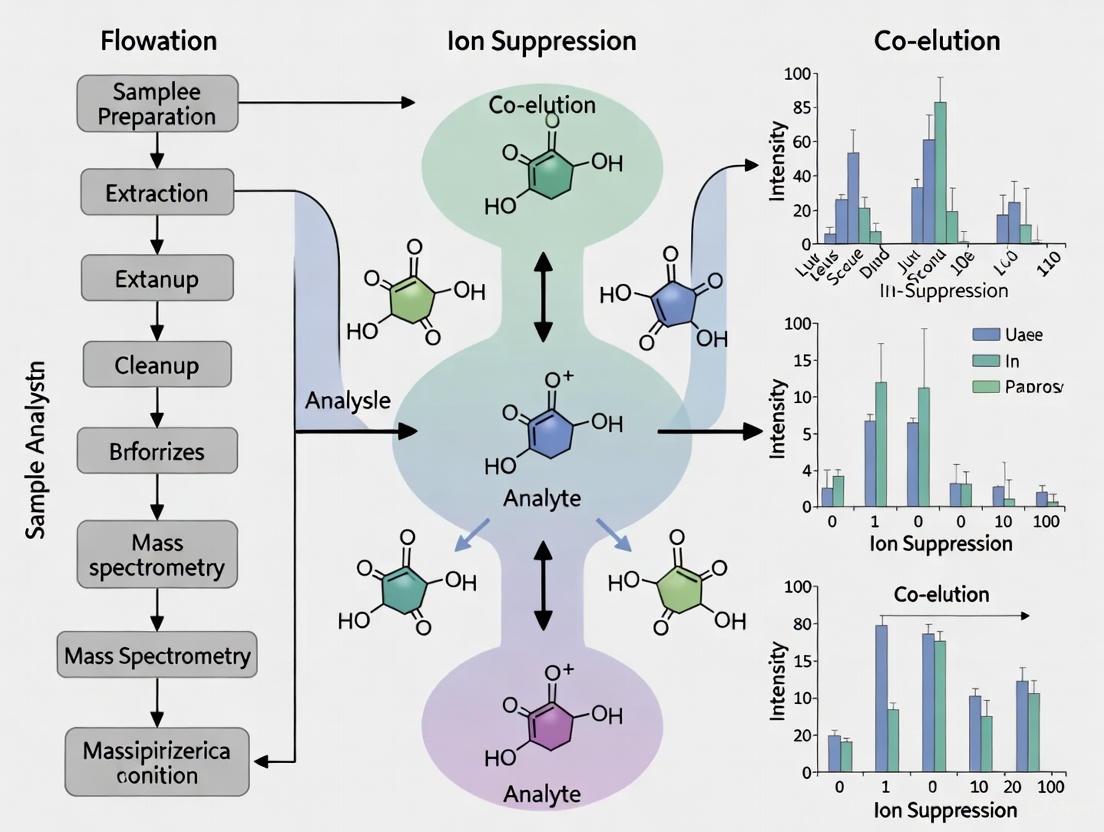
Ion suppression caused by co-eluting compounds is a critical challenge in liquid chromatography-mass spectrometry (LC-MS), adversely affecting sensitivity, accuracy, and precision in bioanalysis.
Ion Suppression in LC-MS: Mechanisms, Detection, and Mitigation of Co-elution Effects
Abstract
Ion suppression caused by co-eluting compounds is a critical challenge in liquid chromatography-mass spectrometry (LC-MS), adversely affecting sensitivity, accuracy, and precision in bioanalysis. This article provides a comprehensive examination of the fundamental mechanisms through which co-eluted matrix components and drugs compete for ionization capacity, particularly in electrospray ionization (ESI). It further explores established and emerging methodologies for detecting and quantifying these effects, outlines systematic troubleshooting and optimization strategies for robust method development, and discusses validation protocols and comparative assessments of compensation techniques. Designed for researchers, scientists, and drug development professionals, this resource offers practical guidance to overcome this 'Achilles heel' of quantitative LC-MS, ensuring reliable data in pharmaceutical, clinical, and forensic applications.
The Core Problem: Unraveling How Co-elution Triggers Ion Suppression
Ion suppression is a specific type of matrix effect prevalent in liquid chromatography-mass spectrometry (LC-MS) and LC-tandem mass spectrometry (LC-MS/MS), where the presence of co-eluting substances in the sample matrix interferes with the ionization process of the target analyte, leading to a reduction in signal intensity [1]. This phenomenon is a critical concern in fields such as untargeted metabolomics and drug development, as it compromises key analytical figures of merit, including detection capability, precision, and accuracy [2] [3] [1].
The core of the issue lies in the competition between the analyte and matrix components during ionization. In complex mixtures, co-eluted compounds can out-compete the analyte for available charge or space within the ionization source, thereby suppressing the signal for the analyte of interest [1]. Understanding and mitigating ion suppression is therefore not merely a technical exercise but a fundamental requirement for ensuring the reliability of data in research and regulated environments, such as pharmaceutical development where adherence to regulatory guidelines like the FDA's Bioanalytical Method Validation is mandatory [1].
Mechanisms of Ion Suppression
The mechanisms of ion suppression are intrinsically linked to the type of atmospheric-pressure ionization (API) technique employed, with electrospray ionization (ESI) being particularly susceptible [1].
Mechanisms in Electrospray Ionization (ESI)
ESI, a widely used technique for analyzing polar molecules, operates under principles that make it vulnerable to competitive processes in complex matrices. Several interconnected mechanisms contribute to ion suppression in ESI [1]:
- Competition for Charge: In ESI, the number of excess charges available on the surface of the electrospray droplets is finite. In a multicomponent sample, analytes and matrix components compete for this limited charge. Compounds with higher surface activity or basicity can out-compete the target analyte for the available charge, leading to a suppressed signal for the less competitive analyte [1].
- Droplet Properties: The presence of high concentrations of interfering compounds can increase the viscosity and surface tension of the ESI droplets. This reduces the efficiency of solvent evaporation and can inhibit the analyte's ability to be released as a gas-phase ion [1].
- Nonvolatile Material: Nonvolatile materials, such as salts and proteins, can coprecipitate with the analyte or prevent droplets from reaching the critical radius required for the emission of gas-phase ions. This physical interference effectively traps the analyte and prevents its detection [1].
Mechanisms in Atmospheric-Pressure Chemical Ionization (APCI)
APCI generally exhibits less ion suppression than ESI due to its different ionization mechanism. In APCI, the sample is vaporized in a heated gas stream before ions are generated through chemical reactions with a reagent gas [1]. However, ion suppression is still possible through mechanisms such as:
- Gas-Phase Proton Transfer: Even after vaporization, an analyte ion can be neutralized in the gas phase via deprotonation reactions if it encounters a compound with a higher gas-phase basicity [1].
- Solid Formation: The analyte can form a pure solid or a coprecipitate with other nonvolatile sample components during the vaporization process, preventing its entry into the gas phase for ionization [1].
The following diagram illustrates the core competitive process underlying ion suppression in the ESI source, which is the most commonly affected interface.
Detecting and Quantifying Ion Suppression
Before compensation strategies can be applied, the presence and extent of ion suppression must be reliably detected and quantified. Two primary experimental protocols are commonly used for this purpose [1].
Post-Extraction Spike Method
This method involves comparing the MS response of an analyte spiked into a blank biological matrix extract (e.g., plasma after protein precipitation) to its response when injected in a pure mobile phase or a neat solution [1].
- Procedure:
- Prepare a blank sample (devoid of the analyte) and subject it to the standard sample preparation procedure.
- Spike a known concentration of the analyte into this prepared blank matrix after extraction is complete.
- Inject and analyze this post-extraction spiked sample via LC-MS.
- Inject and analyze the same concentration of the analyte in a pure solvent.
- Interpretation: A lower peak area or height in the post-extraction spiked sample compared to the neat solution indicates ion suppression caused by residual matrix components. The extent of suppression can be calculated quantitatively as [1]:
- Ion Suppression (%) = [1 - (Signalpost-spike / Signalneat solution)] × 100
Post-Column Infusion Method
This method is used to map the chromatographic regions where ion suppression occurs, providing a visual profile of matrix effects over time [1].
- Procedure:
- A solution containing the analyte of interest is continuously infused into the MS via a syringe pump, introduced post-column into the LC effluent.
- This setup generates a steady, constant baseline signal for the analyte.
- A blank matrix extract is then injected into the LC system and chromatographically separated.
- As matrix components elute from the column, they mix with the infused analyte and enter the ionization source together.
- Interpretation: A drop in the otherwise constant baseline signal indicates the elution of matrix components that cause ion suppression. The chromatogram reveals the specific retention times at which suppression occurs, which is invaluable for method development [1]. Diagram 2 illustrates this workflow.
Advanced Strategies for Compensation and Correction
While modifying sample preparation or chromatographic conditions can reduce ion suppression, advanced methods have been developed to actively compensate for it, especially in complex applications like untargeted metabolomics.
Post-Column Infusion of Standards (PCIS)
This strategy evolves from the detection method into an active compensation technique. It involves continuously infusing a cocktail of standards post-column to monitor and correct for matrix effects in real-time [2].
- Selection of PCIS: A key challenge is selecting the most appropriate standard to correct for each analyte. A recent innovation uses an artificial matrix effect (MEart) created by post-column infusion of compounds that deliberately disrupt the ESI process. A scoring system balances relative and absolute matrix effects to identify the optimal PCIS for a given analyte [2].
- Efficacy: This approach has demonstrated 89% agreement in PCIS selection when comparing artificial matrix effects to biological matrix effects (MEbio). Applying the MEart-selected PCISs improved MEbio for most affected analytes in plasma, urine, and feces samples [2].
The IROA TruQuant Workflow
This workflow uses a library of stable isotope-labeled internal standards (IROA-IS) and sophisticated algorithms to measure and correct ion suppression across all detected metabolites in non-targeted studies [3].
- Core Principle: A known amount of IROA-IS, with a distinctive isotopic pattern (e.g., 95% ¹³C), is spiked into every sample. Any ion suppression affecting the endogenous analyte (¹²C channel) will equally affect the IROA-IS (¹³C channel). The loss of the ¹³C signal is used to calculate a correction factor for the ¹²C signal [3].
- Performance: The workflow has been validated across multiple chromatographic systems (IC, HILIC, RPLC) and ionization modes. It effectively corrects for ion suppression ranging from 1% to >90%, restoring the expected linear increase in signal with increasing sample input, even for severely suppressed metabolites like pyroglutamylglycine (97% suppression) [3].
Table 1: Quantitative Comparison of Ion Suppression Compensation Methods
| Method | Core Principle | Key Performance Metric | Applicable Scope |
|---|---|---|---|
| Post-Column Infusion of Standards (PCIS) [2] | Real-time monitoring & correction using infused standards selected via artificial matrix effects. | 89% agreement (17/19 standards) between artificial and biological matrix effect correction. | Untargeted metabolomics; complex biological matrices (plasma, urine, feces). |
| IROA TruQuant Workflow [3] | Correction using a stable isotope-labeled internal standard (IROA-IS) library and algorithms. | Corrects ion suppression from 1% to >90%; e.g., restored linearity for phenylalanine (8.3% suppression) and pyroglutamylglycine (97% suppression). | Non-targeted metabolomics; multiple LC-MS systems (IC, HILIC, RPLC) and ionization modes. |
The Scientist's Toolkit: Essential Reagents and Materials
Successful implementation of ion suppression compensation strategies requires specific reagents and materials. The following table details key components used in the advanced methods discussed.
Table 2: Key Research Reagent Solutions for Ion Suppression Compensation
| Item | Function in Experiment |
|---|---|
| Stable-Isotope Labeled (SIL) Standards [2] | Used as PCIS candidates or as internal standards; their known chemical behavior and distinct mass allow for monitoring and correcting matrix effects on co-eluting endogenous analytes. |
| IROA Internal Standard (IROA-IS) Library [3] | A comprehensive set of standards with a unique isotopic pattern (e.g., 95% ¹³C). Spiked at a constant concentration in all samples to measure and correct ion suppression for each detected metabolite. |
| IROA Long-Term Reference Standard (IROA-LTRS) [3] | A 1:1 mixture of IROA-IS standards at 95% ¹³C and 5% ¹³C. Provides a reference isotopic pattern to distinguish real metabolites from artifacts and ensure quantification accuracy. |
| Artificial Matrix Compounds [2] | Compounds used in post-column infusion to deliberately create a controlled artificial matrix effect (MEart), enabling the systematic selection of optimal PCIS without consuming valuable biological samples. |
| RFIC Eluent Generator [4] | Reagent-Free Ion Chromatography (RFIC) system that generates high-purity eluent automatically using only water. Simplifies method transfer and enhances reproducibility in manufacturing environments. |
Ion suppression, fundamentally defined as signal reduction from matrix competition, remains a central challenge in LC-MS analyses. Its impact on data accuracy and precision is significant in both research and regulated industries. While its manifestation depends on the ionization mechanism, its root cause—competition in the ion source—is universal.
Moving forward, the field is advancing from simply detecting and avoiding ion suppression to actively compensating and correcting for it. Innovative strategies like PCIS and the IROA TruQuant Workflow represent a paradigm shift, enabling researchers to achieve reliable quantification even in the presence of severe matrix effects. The integration of these advanced methodologies, supported by robust experimental protocols and specialized reagents, is crucial for enhancing the quality of data in complex fields like untargeted metabolomics and accelerating the development of new therapeutic agents.
Electrospray Ionization (ESI) has established itself as a cornerstone technique in mass spectrometry, particularly for the analysis of biological macromolecules and pharmaceuticals due to its soft ionization capabilities [5]. Despite its widespread adoption and sensitivity, ESI suffers from a fundamental vulnerability: it is a capacity-limited process highly susceptible to ion suppression [1] [6]. This phenomenon manifests as a reduced detector response for an analyte of interest when other compounds co-elute and interfere with the ionization efficiency in the LC–MS interface [1] [6]. Ion suppression is not merely an inconvenience; it negatively impacts key analytical figures of merit, including detection capability, precision, and accuracy, potentially leading to false negatives or inaccurate quantification [1]. The core of this vulnerability lies in the very mechanism of ESI, where competition for limited resources—either charge or space in the evaporating droplets—governs the eventual ion yield [1] [6]. Understanding this capacity-limited nature is crucial for researchers, scientists, and drug development professionals who rely on LC-MS and LC-MS/MS for robust and reliable bioanalysis.
Mechanisms of Ion Suppression in ESI
The susceptibility of ESI to ion suppression stems directly from its ionization mechanism, which is fundamentally more complex and prone to interference than other techniques like Atmospheric-Pressure Chemical Ionization (APCI) [1] [6]. The process of converting analytes from a liquid solution to gas-phase ions in ESI involves the formation of charged droplets, solvent evaporation, and the eventual release of ions [7] [5]. It is during these early stages that ion suppression occurs.
Several interconnected mechanisms, all related to the capacity limitations of the ESI process, have been proposed:
Competition for Charge or Droplet Space: At high analyte concentrations (>10⁻⁵ M), the linearity of the ESI response is often lost [1]. This is attributed to a limited amount of excess charge available on ESI droplets or the saturation of droplet surfaces with analyte, which inhibits the ejection of ions from inside the droplet [1] [6]. In multi-component samples, compounds compete for this limited charge or space. An analyte's ionization efficiency in this competitive environment is determined by its physicochemical properties, such as surface activity and basicity [1]. Biological matrices are rich in endogenous compounds with high basicity and surface activity, making the ionization system highly susceptible to saturation and subsequent suppression [1].
Altered Droplet Physics: The presence of high concentrations of interfering compounds can increase the viscosity and surface tension of the ESI droplets [1] [6]. This increased stability reduces the rate of solvent evaporation and impedes the droplet's progression to the critical radius required for the efficient release of gas-phase ions, thereby suppressing signal [1].
Interference from Non-Volatile Species: Non-volatile materials in the sample matrix can coprecipitate with the analyte or prevent droplets from reaching their critical radius for ion emission [1] [6]. This physically blocks the analyte from entering the gas phase.
Gas-Phase Neutralization: Although more common in APCI, analyte ions can be neutralized in the gas phase via proton-transfer reactions with compounds possessing higher gas-phase basicity, leading to signal suppression [1].
It is critical to note that because ion suppression occurs during the initial ion formation, tandem mass spectrometry (MS-MS) is just as vulnerable as single-stage MS. The advantages of MS-MS begin only after the ions have been formed, offering no protection against suppression occurring at the source [1].
The following diagram illustrates the core ESI process and where these suppression mechanisms disrupt the pathway to successful ion detection.
Figure 1: The Electrospray Ionization Process and Points of Ion Suppression. The diagram traces the pathway from sample solution to detection, highlighting key points where capacity-limited competition and matrix effects can cause ion suppression.
Quantitative Data on ESI Vulnerability
The capacity-limited nature of ESI can be quantified through key experiments and parameters. The following tables summarize critical quantitative data related to ion suppression, including the quantitative definition of suppression, its impact on linearity, and a comparison with other ionization techniques.
Table 1: Quantitative Definitions and Thresholds in ESI Ion Suppression
| Parameter | Value / Description | Context & Significance | Source |
|---|---|---|---|
| Ion Suppression Formula | (100 - B) / (A × 100) | A = unsuppressed signal; B = suppressed signal. Provides a quantitative measure of the suppression effect. | [1] |
| Linearity Loss Threshold | > ~10⁻⁵ M | Approximate concentration at which ESI response loses linearity due to competition for charge/droplet space. | [1] |
| SESI Signal Reduction | ~50% decrease | Intensity of volatile compounds in condensate decreased by about 50% with 10 ppm gas-phase acetone. | [8] |
Table 2: Comparative Ion Suppression in ESI vs. APCI
| Factor | Electrospray Ionization (ESI) | Atmospheric-Pressure Chemical Ionization (APCI) |
|---|---|---|
| General Suppression Proneness | More pronounced [1] [6] [8] | Less prone [1] [6] [8] |
| Primary Ionization Mechanism | Ion evaporation from charged droplets [1] [7] | Gas-phase chemical ionization after thermal vaporization [1] |
| Root Cause of Suppression | Competition for limited charge/droplet space; altered droplet physics [1] [6] | Change in colligative properties during evaporation; gas-phase reactions [1] [6] |
| Impact of Non-Volatiles | High (can coprecipitate with analyte) [1] [6] | Lower (analytes are vaporized) [1] |
Experimental Protocols for Detecting Ion Suppression
Given the detrimental effects of ion suppression, regulatory bodies like the U.S. FDA require its investigation during bioanalytical method validation [1]. Two primary experimental protocols are widely used to detect and characterize ion suppression.
Post-Column Infusion Experiment
This protocol is designed to map the chromatographic regions where ion suppression occurs, providing a spatial profile of the effect [1] [6].
Detailed Methodology:
- Standard Solution Preparation: A solution containing the analyte of interest (and its internal standard, if used) is prepared in a suitable solvent [1].
- Continuous Infusion: This standard solution is continuously introduced into the system post-column using a syringe pump. The flow is typically mixed with the column effluent via a T-connector before entering the MS ion source [1].
- Chromatographic Injection: A blank sample extract (e.g., processed plasma without the analyte) is injected into the LC system and the chromatographic method is run as usual [1].
- Data Acquisition and Analysis: The mass spectrometer is set to monitor the signal of the infused analyte(s) in multiple reaction monitoring (MRM) or single ion monitoring mode. Instead of peaks, the result is a constant baseline signal when a pure mobile phase is being delivered. When matrix components from the blank extract elute from the column, they cause a temporary dip or depression in this baseline [1]. The location and extent of these dips directly indicate the retention time windows affected by ion suppression for that specific matrix.
Post-Extraction Spiking Experiment
This method is used to quantify the extent of ion suppression for a particular analyte in a specific matrix [1].
Detailed Methodology:
- Prepare Blank Matrix Extracts: Process at least six lots of the blank biological matrix (e.g., plasma, urine) through the entire sample preparation procedure (e.g., protein precipitation, solid-phase extraction).
- Prepare Neat Solutions: Prepare standard solutions of the analyte at relevant concentrations in the neat mobile phase or a compatible solvent.
- Spike the Samples:
- Set A (Post-Extraction Spiked): Spike the analyte into the prepared blank matrix extracts after the extraction process is complete.
- Set B (Neat Solutions): These are the pure standard solutions without any matrix.
- Analysis and Calculation: Analyze both sets (A and B) under the same LC-MS/MS conditions. Compare the peak areas (or heights) of the analyte between the two sets [1].
- The ratio of the response in the post-extraction spiked sample (Set A) to the response in the neat solution (Set B) indicates the absolute matrix effect.
- A value significantly lower than 1 indicates ion suppression, while a value greater than 1 could indicate ion enhancement.
The Scientist's Toolkit: Research Reagent Solutions
Effectively managing ion suppression requires a strategic combination of sample preparation, chromatography, and instrumental techniques. The following toolkit outlines key materials and strategies for mitigating this vulnerability.
Table 3: Research Reagent and Strategic Toolkit for Mitigating Ion Suppression
| Tool / Reagent | Function / Purpose in Mitigating Ion Suppression |
|---|---|
| Solid Phase Extraction (SPE) | Selectively retains the analyte or interfering matrix components, providing a cleaner sample extract and removing many ion-suppressing species [6]. |
| Liquid-Liquid Extraction (LLE) | Uses partitioning between immiscible solvents to separate the analyte from hydrophilic, often ion-suppressing, matrix components [6]. |
| Stable-Labeled Internal Standard (IS) | Compensates for variability in ion suppression by experiencing the same matrix effects as the analyte, thereby improving accuracy and precision [1]. |
| HPLC with Optimized Gradient | Modifies the chromatographic separation to shift the retention time of the analyte away from the elution window of major ion-suppressing compounds [1] [6]. |
| APCI Ion Source | An alternative ionization source that is generally less prone to the ion suppression effects that plague ESI, due to its different mechanism [1] [6]. |
Electrospray Ionization remains a powerful yet intrinsically vulnerable technique. Its operation as a capacity-limited process, where ionization efficiency is governed by competition for finite charge and droplet resources, makes it highly susceptible to ion suppression from co-eluting matrix compounds. A deep understanding of the mechanisms—including charge competition, altered droplet physics, and non-volatile interference—is fundamental for developing robust LC-MS methods. By employing standardized experimental protocols like the post-column infusion and post-extraction spiking experiments, scientists can diagnose and quantify this issue. Ultimately, leveraging a comprehensive toolkit encompassing sophisticated sample preparation, optimized chromatography, and the strategic use of internal standards is essential to circumvent or compensate for ion suppression. For the drug development professional, this rigorous approach is not optional but a necessary prerequisite for generating reliable, high-quality analytical data that underpins critical decisions in the research and development pipeline.
Ion suppression represents a fundamental challenge in mass spectrometry (MS), particularly within high-throughput drug discovery and bioanalysis. This phenomenon occurs when co-eluted compounds from complex biological matrices compete for available charge during the ionization process, leading to diminished signal intensity, reduced sensitivity, and compromised quantitative accuracy for target analytes [9] [10]. The "competition for charge" is especially pronounced within confined droplet environments, where the limited surface area and volume intensify interactions between analytes and matrix components [11] [12]. As analytical techniques evolve toward miniaturization and increased throughput—exemplified by acoustic ejection mass spectrometry (AEMS) and droplet-based microfluidics—understanding and mitigating ion suppression becomes increasingly critical for generating reliable data in pharmaceutical research and development [11] [13]. This technical guide examines the core mechanisms of ion suppression, presents systematic experimental approaches for its investigation, and provides evidence-based strategies to overcome this pervasive analytical challenge.
Fundamental Mechanisms: The Physics and Chemistry of Charge Competition
Ion suppression stems from interrelated physical and chemical processes that occur during droplet formation, transport, and ionization. Three primary mechanisms drive this phenomenon:
Electrospray Ionization Dynamics
In electrospray ionization (ESI), the process begins with droplet formation at the emitter tip, where an electrical potential induces Taylor cone formation and generates charged droplets. As these droplets travel toward the mass spectrometer inlet, they undergo solvent evaporation and Coulombic fission, eventually producing gas-phase ions [9] [14]. Ion suppression occurs when matrix components with higher surface activity or proton affinity dominate these processes, effectively outcompeting target analytes for both droplet charge and access to the droplet surface [9]. This competition is particularly pronounced in the final stages of droplet disintegration, where the number of available charges becomes severely limited relative to the number of analyte molecules [10].
Matrix Component Interference
Biological matrices introduce numerous compounds that can interfere with analyte ionization. Phospholipids, salts, proteins, and metabolic byproducts can co-elute with target analytes, either reducing ionization efficiency through direct competition or altering droplet physicochemical properties [9] [10]. In AEMS applications, despite substantial dilution factors (approximately 1000-fold), signal suppression varies significantly across different sample matrices, indicating that dilution alone cannot universally resolve ionization competition issues [11].
Droplet Microenvironment Effects
In droplet-based microfluidic systems and AEMS platforms, the confined volume of nanoliter droplets intensifies molecular interactions. The surface-to-volume ratio increases dramatically at these scales, amplifying the influence of surface-active compounds [13] [12]. This effect is particularly evident in systems combining chromatography with droplet microfluidics, where post-column effluent is segmented into droplets—while this approach prevents peak dispersion, it also creates isolated microenvironments where competition phenomena are magnified before MS detection [14].
Quantitative Landscape: Experimental Measurements of Ion Suppression
Systematic studies across different analytical platforms and matrix conditions have quantified the substantial impact of ion suppression on measurement reliability. The following table summarizes key findings from recent investigations:
Table 1: Quantified Ion Suppression Effects Across Analytical Platforms
| Analytical Platform | Matrix Conditions | Suppression Range | Key Observation | Citation |
|---|---|---|---|---|
| IC-MS (Negative Mode) | Uncleaned Ion Source | Up to >90% for metabolites | Pyroglutamylglycine showed 97% suppression | [15] |
| RPLC-MS (Positive Mode) | Cleaned Ion Source | 1-20% variation | Phenylalanine showed 8.3% suppression | [15] |
| AEMS with OPSI | Biochemical Assay Matrix | Variable despite ~1000x dilution | Signal suppression varied by sample matrix | [11] |
| HILIC-MS | Plasma Extract | 15-85% across metabolites | Greater suppression with unclean ion sources | [15] |
| Droplet Microextraction-ESI | Single Cell Analysis | Significant without cleanup | Culture medium components suppressed ATP, ADP, AMP signals | [12] |
The data reveal that ion suppression affects nearly all MS-based analyses to varying degrees, with particularly severe impacts (exceeding 90% signal loss) observed for certain metabolites in complex matrices [15]. Even with extensive dilution, as implemented in AEMS workflows, matrix-dependent suppression persists, underscoring the need for more sophisticated mitigation approaches [11].
Methodological Framework: Experimental Protocols for Ion Suppression Assessment
Researchers can employ several established experimental protocols to systematically evaluate ion suppression in their analytical workflows. The following section details two complementary approaches that provide comprehensive assessment of ionization interference.
Post-Column Infusion Method for Real-Time Suppression Mapping
This protocol enables visualization of ion suppression zones throughout the chromatographic separation, providing a comprehensive map of matrix effects [9].
Materials and Reagents:
- Analytical LC system with post-column tee connector
- Syringe pump for constant analyte infusion
- Mass spectrometer with electrospray ionization
- Mobile phase components (HPLC-grade)
- Test analyte solution (1-5 μg/mL in mobile phase)
- Blank matrix extracts (plasma, urine, tissue homogenate)
Experimental Procedure:
- Connect the syringe pump containing test analyte solution to a post-column tee between the LC system and MS source
- Initiate constant infusion of the test analyte at a flow rate of 5-10 μL/min
- Inject a blank matrix extract onto the LC column and run the chromatographic method
- Monitor the MRM transition or selected ion for the test analyte throughout the chromatographic run
- Document regions where the analyte signal decreases significantly compared to baseline
Data Interpretation: Signal suppression manifests as downward deviations from the steady-state baseline. These suppression zones correspond to retention times where matrix components elute and interfere with ionization. The magnitude of suppression is calculated as: % Suppression = [1 - (Signal in matrix zone/Baseline signal)] × 100 [9].
IROA TruQuant Workflow for Comprehensive Metabolomic Correction
The Isotopic Ratio Outlier Analysis (IROA) TruQuant workflow represents an advanced approach that simultaneously measures and corrects for ion suppression across all detected metabolites in non-targeted studies [15].
Table 2: Key Reagents for IROA TruQuant Suppression Correction
| Reagent | Composition | Function in Workflow | Preparation Specifications |
|---|---|---|---|
| IROA Internal Standard (IROA-IS) | 95% (^{13})C-labeled metabolite library | Provides reference signals for suppression calculation | Spiked at constant concentration into all samples |
| IROA Long-Term Reference Standard (IROA-LTRS) | 1:1 mixture of 95% (^{13})C and 5% (^{13})C standards | Enables pattern recognition and artifact removal | Prepared in methanol at defined concentration |
| ClusterFinder Software | Algorithmic suite | Automates suppression calculation and correction | Version 4.2.21 or later with appropriate licensing |
Experimental Workflow:
- Spike IROA-IS into all samples prior to extraction at constant concentration
- Prepare IROA-LTRS quality control samples for system suitability testing
- Process samples through LC-MS analysis under standardized conditions
- Acquire data in full-scan high-resolution mode to capture isotopic patterns
- Process raw data through ClusterFinder software to identify IROA signature patterns
- Apply suppression correction algorithm: AUC-12Ccorrected = AUC-12Cobserved × (AUC-13Cexpected/AUC-13Cobserved)
This equation corrects the observed endogenous metabolite signal (12C) based on the suppression experienced by the internal standard (13C), effectively normalizing for matrix effects [15].
Strategic Mitigation: A Multi-Dimensional Approach to Minimize Ion Suppression
Successful management of ion suppression requires a layered strategy addressing sample preparation, chromatographic separation, and instrumental optimization. The following approaches, when implemented in combination, significantly reduce ionization interference.
Sample Preparation Techniques
Solid-Phase Extraction (SPE): Selective SPE cartridges (C18, mixed-mode, HLB) effectively remove phospholipids and proteins that contribute to ion suppression. The 96-well plate format enables high-throughput processing while maintaining recovery and reproducibility [10].
Protein Precipitation Optimization: While simple dilution and protein precipitation are common in high-throughput workflows, the choice of solvent significantly impacts clean-up efficiency. Acetonitrile precipitation generally provides superior phospholipid removal compared to methanol, though method compatibility should be verified [10].
Selective Microextraction: In droplet-based microfluidics for single-cell analysis, using water or 25% methanol aqueous solution as extraction solvent selectively extracts polar metabolites (GSH, AMP, ADP, ATP) while excluding non-polar lipids that cause suppression [12].
Chromatographic Resolution Enhancement
Chromatographic Mode Selection: Different separation mechanisms offer complementary advantages for reducing co-elution:
- Reversed-Phase (RPLC): Effective for non-polar to moderately polar compounds; provides robust separation with high reproducibility [16]
- Hydrophilic Interaction (HILIC): Ideal for polar compounds that show poor retention in RPLC; reduces ion suppression by separating target analytes from non-polar matrix interferents [15]
- Ion Chromatography (IC): Specialized for ionic compounds; can separate analytes from complex biological matrices that suppress signals in other modes [15]
Microflow LC Systems: Reducing LC flow rates from conventional ~0.3-0.5 mL/min to microflow rates (1-50 μL/min) significantly improves sensitivity and reduces ion suppression by increasing analyte concentration entering the ion source and improving ionization efficiency [9].
Ion Source and Interface Optimization
Source Condition Maintenance: Regular cleaning of ion source components is critical. Studies demonstrate that unclean ion sources exhibit significantly greater ion suppression (up to 2-3 times higher) compared to properly maintained sources [15].
Interface Parameter Tuning: Careful optimization of ESI parameters—including nebulizer gas flow, desolvation temperature, capillary voltage, and source positioning—can significantly reduce susceptibility to matrix effects. Gas flow rates and temperatures should be balanced to ensure efficient desolvation without premature droplet ejection [9] [14].
AEMS-Specific Considerations: In acoustic ejection systems, the open port interface (OPSI) creates a venturi effect that initiates flow toward the MS. The OPSI flowpath—comprising the capture interface, transport tubing, and electrode protrusion—requires careful optimization to maintain stable aerosol generation while minimizing cross-contamination and suppression effects [11].
Visualization: Experimental Workflows for Ion Suppression Investigation
The following diagram illustrates the integrated experimental approach for investigating and mitigating ion suppression in droplet-based MS systems:
Advanced Applications: Droplet Microfluidics and Emerging Technologies
The integration of droplet-based microfluidics with mass spectrometry represents a promising frontier for addressing ion suppression while enabling high-throughput analysis.
Droplet Microextraction for Single-Cell MS Analysis
A novel approach integrates droplet-based microextraction with ESI-MS for single-cell metabolomics. This method uses a 2 nL droplet extruded from a glass capillary to wrap individual cells and extract specific intracellular components. Following extraction, the droplet is retracted, evaporated, and redissolved in a minimal volume (20-100 pL) for MS analysis. This technique enables selective metabolite extraction while eliminating matrix interference from culture medium and non-targeted cellular components [12].
Microfluidic ESI Interface Design
The coupling of droplet microfluidics with ESI-MS presents unique technical challenges, particularly regarding electrical contacting without disrupting droplet stability. Integrated metal electrodes in glass chips can cause electrowetting effects that destabilize droplets. Effective solutions include electrical shielding through grounded electrodes and strategic chip layouts that position droplet generators at sufficient distance from the emitter to minimize field effects [14].
Chromatography-Droplet-MS Integration
The combination of chip-based HPLC with droplet microfluidics and ESI-MS enables new analytical capabilities. This approach functions as a microfluidic analogue to traditional fraction collection, where column eluate is segmented into nanoliter droplets by an immiscible carrier fluid. The oil spacing between droplets prevents post-column peak dispersion while promoting efficient mixing within each droplet, facilitating post-column reactions before MS analysis [14].
Ion suppression caused by co-eluted compounds represents a fundamental challenge in mass spectrometry-based analysis, particularly within confined droplet environments where competitive charge dynamics are intensified. Through systematic investigation using post-column infusion, IROA methodologies, and droplet microfluidics approaches, researchers can precisely characterize and quantify these suppression effects. The strategic integration of optimized sample preparation, enhanced chromatographic separation, and careful ion source management provides a multi-layered defense against ionization interference. As analytical systems continue to evolve toward miniaturization and increased throughput, the principles and methodologies outlined in this technical guide will remain essential for maintaining data quality and reliability in pharmaceutical research and development.
Atmospheric Pressure Chemical Ionization (APCI) is a pivotal soft ionization technique in mass spectrometry that utilizes gas-phase ion-molecule reactions at atmospheric pressure (105 Pa). This method is predominantly coupled with High-Performance Liquid Chromatography (HPLC) for the analysis of thermally stable compounds with low to medium polarity and molecular weights typically less than 1500 Da [17]. The fundamental distinction of APCI lies in its ionization mechanism, which occurs entirely in the gas phase after the solvent and analyte are vaporized, unlike electrospray ionization (ESI) where ionization occurs in the liquid phase [18]. This core difference renders APCI particularly valuable for analyzing semi-volatile and relatively non-polar compounds that are challenging to ionize via ESI, establishing its critical role in pharmaceutical, environmental, and petrochemical analyses [19] [20].
Within the context of ion suppression research, APCI occupies a unique position. Ion suppression, a manifestation of matrix effects, refers to the reduced detector response caused by competition for ionization efficiency between the analyte of interest and co-eluting interfering substances from complex sample matrices [1] [6]. A thorough comparative understanding of APCI's mechanism is not merely an academic exercise but a practical necessity for developing robust, accurate, and precise bioanalytical methods, especially when navigating the challenges posed by co-eluted compounds in liquid chromatography-tandem mass spectrometry (LC-MS/MS) [21].
Fundamental Mechanisms of APCI
The APCI process is a multi-stage event that transforms sample molecules in solution into gas-phase ions ready for mass analysis. The mechanism can be systematically broken down into the following sequential stages:
Nebulization and Vaporization
The liquid effluent from the HPLC, containing the solvent and dissolved analytes, is pumped through a capillary into a pneumatic nebulizer. Assisted by nitrogen gas, the nebulizer creates a fine spray of droplets. This aerosol is then directed into a heated chamber, maintained at temperatures between 350°C and 550°C [17] [18]. This intense, rapid heating serves to completely desolvate and vaporize the droplets, creating a gas-phase mixture of solvent and analyte molecules. This step is critical and presupposes that the analyte is thermally stable; otherwise, decomposition can occur.
Primary Ionization via Corona Discharge
The heart of the APCI source is a corona discharge needle, maintained at a constant current of 2–5 microamps and a potential of several kilovolts [17]. This creates a strong electric field that ionizes the nebulizer gas (typically N2) and solvent vapor in the immediate vicinity. The primary reaction involves the ionization of nitrogen molecules: N2 + e⁻ → N₂⁺• + 2e⁻ [17] [18].
Reagent Ion Formation (Ion-Molecule Reactions)
The primary ions (N₂⁺•) do not directly ionize the analyte. Instead, they undergo a series of ion-molecule collisions with the abundant solvent vapor (e.g., H2O, CH3OH) to form stable, secondary reagent ions. In a system containing water, the sequence proceeds as follows [17]:
- N₂⁺• + 2 N₂ → N₄⁺• + N₂
- N₄⁺• + H2O → H2O⁺• + 2 N2
- H2O⁺• + H2O → H3O⁺ + OH•
- H3O⁺ + H2O + N2 → H⁺(H2O)₂ + N2 This process continues, forming a population of protonated water cluster ions, denoted as H⁺(H2O)ₙ. If a solvent with a higher proton affinity than water (e.g., methanol) is present, the clusters will involve that solvent (e.g., CH3OH2⁺(H2O)ₙ(CH3OH)ₘ) [17].
Analyte Ionization (Charge Transfer)
The reagent ions (H⁺(H2O)ₙ) then collide with the gaseous analyte molecules (M). In the positive ion mode, the most common mechanism is proton transfer, which is highly exothermic [17] [19]: H⁺(H2O)ₙ + M → MH⁺(H2O)ₘ + (n-m)H2O Following ionization, these newly formed, solvated analyte ions (MH⁺(H2O)ₘ) travel into the high-vacuum region of the mass spectrometer. During this transition, the remaining solvent molecules are stripped away in a process called declustering, yielding the bare protonated molecule [M+H]⁺ [17]: MH⁺(H2O)ₘ → MH⁺ + mH2O
For certain compound classes, alternative ionization pathways exist. Saturated hydrocarbons, for instance, are protonated and then undergo elimination of a hydrogen molecule, resulting in the formation of [M-H]⁺ ions rather than [M+H]⁺ [19]. Aromatic hydrocarbons, due to their stability, typically form stable [M+H]⁺ ions [19].
The following diagram illustrates this complete ionization pathway:
APCI in the Context of Ion Suppression
The Nature of Ion Suppression
Ion suppression is a critical matrix effect in LC-MS where the presence of co-eluting substances reduces the ionization efficiency of the target analyte, leading to diminished detector response and compromised analytical figures of merit such as detection capability, precision, and accuracy [1] [6]. The origin of this phenomenon is intrinsically linked to the specific ionization mechanism of the interface being used.
Mechanism of Ion Suppression in APCI
The mechanism of ion suppression in APCI is distinct from that in ESI due to its gas-phase ionization process. In APCI, suppression is not related to charge saturation or competition for droplet space, as in ESI. Instead, the primary proposed mechanisms are [1] [6]:
- Competition for Charge and Reagent Ions: Co-eluting compounds, especially those at high concentration or with high gas-phase basicity, can compete more effectively with the analyte for the limited number of reagent ions (e.g., H⁺(H₂O)ₙ). This competition reduces the probability of analyte-protonating collisions.
- Alteration of Colligative Properties: High concentrations of co-eluted matrix components can change the physical properties of the solute during the vaporization process, potentially affecting the efficiency of proton transfer reactions [6].
- Solid Formation and Precipitate Co-precipitation: Non-volatile or semi-volatile matrix components can form solids or co-precipitate with the analyte in the heated vaporizer, physically preventing the analyte from entering the gas phase to be ionized [1].
Comparative Susceptibility: APCI vs. ESI
A key advantage of APCI in ion suppression research is its generally lower susceptibility to this effect compared to ESI. This resilience stems from fundamental differences in their ionization mechanics, as summarized in the table below.
Table 1: Mechanism-Based Comparison of Ion Suppression in APCI and ESI
| Feature | Atmospheric Pressure Chemical Ionization (APCI) | Electrospray Ionization (ESI) |
|---|---|---|
| Ionization Phase | Gas phase [18] | Liquid phase (within charged droplets) [1] |
| Primary Suppression Mechanism | Competition for reagent ions in the gas phase; solid formation [1] [6] | Competition for charge and space on the droplet surface; increased droplet viscosity/surface tension [1] [6] |
| Typical Severity | Less prone to pronounced ion suppression [1] [6] | More susceptible to severe ion suppression [1] |
| Key Reason | No competition for space in a liquid droplet; gas-phase ionization is more tolerant [1] | Limited excess charge available on ESI droplets; saturation of droplet surface [1] |
Experimental evidence consistently supports this comparative advantage. One study noted that APCI provided lower matrix effects and higher recoveries for cardiovascular drugs in plasma, with matrix factors often closer to 100% (indicating no suppression) compared to more variable results in ESI [21]. Another study involving post-column infusion demonstrated a markedly flatter baseline with APCI, indicating fewer regions of ionization suppression throughout the chromatographic run compared to ESI [1].
Experimental Protocols for Investigating Ion Suppression in APCI
To ensure the validity of an LC-APCI-MS method, it is mandatory to evaluate the presence and impact of ion suppression during method validation [1] [21]. The following are two key experimental protocols.
The Post-Extraction Spiking Method
This experiment quantitatively assesses the absolute extent of ion suppression or enhancement for a specific analyte.
- Objective: To compare the detector response of an analyte in the absence and presence of the sample matrix.
- Procedure:
- Prepare Neat Solution: Dissolve the analyte in the neat mobile phase or a representative solvent and inject into the LC-APCI-MS system. Record the peak area (Response A).
- Prepare Matrix-Blank Sample: Process the biological matrix (e.g., plasma, urine) using the intended sample preparation protocol (e.g., protein precipitation, liquid-liquid extraction) but without spiking the analyte.
- Spike Post-Extraction: After the extraction is complete, add the same amount of analyte to the matrix-blank extract. Inject and analyze this sample, recording the peak area (Response B).
- Calculation and Interpretation:
The Matrix Factor (MF) is calculated as: MF = (Response B) / (Response A).
The Ion Suppression/Enhancement is expressed as a percentage: % ME = (MF - 1) × 100% [21].
- % ME ≈ 0%: No matrix effect.
- % ME < 0%: Ion suppression.
- % ME > 0%: Ion enhancement.
The Continuous Post-Column Infusion Experiment
This qualitative experiment is highly effective for mapping the chromatographic regions where ion suppression occurs.
- Objective: To identify the retention time windows in a chromatographic run where ion suppression is caused by co-eluting matrix components.
- Procedure:
- Infuse Analyte: A solution of the analyte of interest is continuously infused via a syringe pump directly into the column effluent post-column, before it enters the APCI source.
- Inject Blank: A blank, processed sample matrix (devoid of the analyte) is injected into the LC system and the chromatographic gradient is run.
- Monitor Signal: The MS detector, set to a specific ion for the infused analyte, records the signal throughout the LC run.
- Interpretation: A stable signal indicates no matrix effects. A drop in the baseline signal at specific retention times reveals the elution of ion-suppressing compounds from the blank matrix. This provides a "suppression profile" of the chromatogram, allowing method developers to adjust the separation to move the analyte's retention time away from these suppression zones [1].
The workflow for this critical diagnostic experiment is as follows:
Quantitative Data and Research Findings
Empirical data from various studies highlights the behavior of APCI in the presence of complex matrices and its performance relative to other techniques.
Table 2: Experimental Findings on APCI Performance and Ion Suppression
| Study Focus | Key Findings Related to APCI | Analytical Implication |
|---|---|---|
| Analysis of Cholesteryl Esters (CEs) [22] | - ESI generated strong [M+Na]⁺ and [M+NH₄]⁺ ions.- APCI selectively produced weaker [M+H]⁺ ions for CEs with unsaturated fatty acids.- ESI was more effective for ionizing a wider range of CE types. | APCI's ionization efficiency can be compound-class specific. Ionization technique should be matched to the target analytes. |
| Analysis of Cardiovascular Drugs in Plasma [21] | - Average recoveries for 15 drugs were >90%.- Matrix Effects (% ME) showed ionization enhancement (e.g., Metformin: ~150%, Aspirin: ~147%), not suppression.- Drugs with higher m/z and longer retention had MFs closer to 100%. | APCI can exhibit ionization enhancement in biological matrices. Retention time and analyte properties significantly influence matrix effects. |
| Hydrocarbon Analysis in Heavy Base Oils [19] | - APCI effectively ionized polycycloalkanes, generating [M-H]⁺ ions.- No aromatic compounds were detected by APCI under the conditions used.- Demonstrated better repeatability and a wider dynamic range than FI MS. | APCI is robust for specific hydrocarbon classes but may not be universal. It is well-suited for saturated hydrocarbons in complex mixtures. |
| General Ion Suppression Comparison [1] [6] | - APCI frequently gives rise to less ion suppression than ESI.- The corona discharge needle creates reagent ions redundantly, avoiding the charge saturation limit of ESI droplets. | APCI is a preferred choice for analyzing complex samples where matrix effects are a primary concern for ESI. |
The Scientist's Toolkit: Essential Reagents and Materials
Successful implementation of APCI-based methods, particularly those aimed at mitigating ion suppression, requires careful selection of reagents and materials.
Table 3: Key Research Reagent Solutions for APCI-MS
| Item | Function in APCI-MS | Typical Specification / Example |
|---|---|---|
| HPLC-Grade Solvents | Forms the mobile phase and the chemical environment for reagent ion formation. Solvent proton affinity dictates ionization pathway. | Acetonitrile, Methanol, Water; often with additives [22] [21]. |
| Volatile Additives | Enables/modifies chromatographic separation without interfering with ionization or causing source contamination. | Ammonium formate, Ammonium acetate, Formic acid (e.g., 5 mM aqueous ammonium formate) [22] [21]. |
| High-Purity Gases | Sheath/Auxiliary Gas: Nebulization and vaporization of the LC effluent.Drying Gas: Facilitates desolvation.Reagent Gas: Source of primary ions (N₂⁺•). | Nitrogen is most common for all purposes [22] [19]. |
| Stable Isotope-Labeled Internal Standards (SIL-IS) | Accounts for variability in sample preparation and ionization efficiency during quantitative analysis, correcting for ion suppression. | e.g., D₅-Propranolol, ¹³C₆-Glimepiride. Should be added to all samples and calibrators [21]. |
| Solid Phase Extraction (SPE) Cartridges | Sample preparation workhorse for removing phospholipids and other endogenous compounds that are major sources of ion suppression. | C18, Mixed-Mode Cation/Anion Exchange phases are common for biological samples [6]. |
Mitigation Strategies and Method Optimization
When ion suppression is detected in an APCI method, a systematic approach involving both sample preparation and chromatographic separation is required for mitigation.
- Optimized Sample Preparation: The most effective strategy is to remove the interfering compounds before they reach the LC-MS system. Solid Phase Extraction (SPE) and Liquid-Liquid Extraction (LLE) are highly effective in removing phospholipids and other endogenous materials responsible for suppression, offering a cleaner extract than simple protein precipitation [6] [21].
- Improved Chromatographic Separation: Adjusting the chromatographic method to increase the retention factor (k) of the analyte can dramatically reduce matrix effects. Research has shown that drugs with retention factors larger than three experience significantly lower matrix effects and can be analyzed at lower concentrations [21]. Modifying the gradient to shift the analyte's retention time away from the established suppression zones (identified via the post-column infusion experiment) is a highly targeted approach.
- Source of Ionization: If ion suppression persists with an ESI source, a primary strategic response is to switch to an APCI source if the analyte's thermal stability and volatility permit. APCI's different ionization mechanism often circumvents the suppression effects encountered in ESI [1] [6].
- Effective Use of Internal Standards: For quantitative work, the use of a stable isotope-labeled internal standard (SIL-IS) is paramount. Because the SIL-IS is nearly identical to the analyte and co-elutes with it, it experiences the same degree of ion suppression. By normalizing the analyte response to the IS response, the quantitative accuracy is maintained even in the presence of suppression [21].
Atmospheric Pressure Chemical Ionization possesses a distinct gas-phase ionization mechanism that inherently provides a buffer against the detrimental effects of ion suppression compared to ESI. Its operation, relying on gas-phase chemical reactions initiated by a corona discharge, avoids the pitfalls of charge competition in liquid droplets. However, it is not immune to matrix effects, which can manifest as both suppression and, notably, enhancement. A deep understanding of the APCI process—from nebulization and vaporization to reagent ion formation and proton transfer—is fundamental for researchers aiming to develop resilient LC-MS methods. By employing systematic experimental protocols to diagnose matrix effects, coupled with strategic mitigation through sample clean-up, chromatographic optimization, and the judicious use of internal standards, scientists can harness the full potential of APCI for reliable and precise analysis of complex samples in drug development and beyond.
Ion suppression represents a significant challenge in liquid chromatography–mass spectrometry (LC–MS), particularly in the analysis of complex biological samples in drug development. This phenomenon manifests as reduced detector response for analytes of interest due to competition for ionization efficiency in the ion source between the target analytes and other components present in the sample matrix [6]. The consequences of ion suppression extend to critical analytical parameters including precision, accuracy, and detection limits, potentially compromising the validity of assay results in pharmaceutical research and development [6] [23]. Within the broader context of co-elution research, understanding the fundamental chemical properties that drive ion suppression—specifically concentration, basicity, and surface activity—provides the foundation for developing effective mitigation strategies and robust analytical methods.
The Core Mechanisms of Ion Suppression
Ion suppression occurs in the early stages of the ionization process within the LC–MS interface when matrix components co-eluting with analytes adversely affect ionization efficiency [1]. The two most prevalent atmospheric pressure ionization techniques, electrospray ionization (ESI) and atmospheric pressure chemical ionization (APCI), exhibit different susceptibilities to ion suppression, with APCI generally less prone to pronounced effects due to fundamental differences in their ionization mechanisms [6] [1].
In ESI, ionization relies on droplet charge excess, and the physical process of transferring ions from solution to the gas phase creates multiple opportunities for competition and interference [6]. Three primary mechanisms have been proposed for ion suppression in ESI. First, competition for limited charge availability or droplet surface area occurs in multicomponent samples, where analytes with superior surface activity or basicity can dominate the ionization process at the expense of others [1]. Second, high concentrations of interfering components can increase droplet surface tension and viscosity, reducing desolvation efficiency and the subsequent liberation of gas-phase ions [6] [1]. Third, the presence of non-volatile species may cause co-precipitation of analyte or prevent droplets from reaching the critical radius required for efficient ion emission via ion evaporation or charge residue mechanisms [6].
In contrast, APCI experiences less severe ion suppression because neutral analytes are transferred to the gas phase through vaporization in a heated stream, eliminating competition for droplet space [1]. The primary mechanism of suppression in APCI involves changes in colligative properties during evaporation or solid formation through coprecipitation with non-volatile matrix components [6] [1].
Key Contributing Factors to Ion Suppression
Concentration Effects
The concentration of both analytes and matrix components plays a pivotal role in ion suppression phenomena. At high concentrations exceeding approximately 10⁻⁵ M, electrospray ionization typically loses response linearity due to limited excess charge available on ESI droplets or saturation at droplet surfaces [6] [1]. This saturation effect inhibits the ejection of ions trapped inside droplets, creating competitive conditions in multicomponent samples.
The effect of concentration is further complicated by the analyte-to-matrix ratio, where a higher ratio can reduce the observable ion suppression effects [6]. This relationship underscores the competitive nature of the ionization process under saturated conditions. The practical implication for method development is that sample dilution can sometimes mitigate suppression effects, though this approach simultaneously reduces analyte signal, making it undesirable for trace analysis [6].
Table 1: Concentration-Related Ion Suppression Effects in ESI
| Concentration Level | ESI Behavior | Underlying Mechanism |
|---|---|---|
| Low (<10⁻⁵ M) | Approximate linearity of response | Sufficient charge excess and droplet surface area |
| High (>10⁻⁵ M) | Loss of response linearity, signal suppression | Limited charge availability, droplet surface saturation |
| Multicomponent Samples | Competition-induced suppression | Analytes compete for limited ionization resources |
Basicity Influence
Basicity, particularly in the context of gas-phase proton affinity, significantly influences a compound's ionization efficiency and potential to cause or experience suppression. Compounds with high gas-phase basicity can effectively compete for protons during ionization, leading to suppressed signals for less basic co-eluting compounds [6] [1]. In biological sample matrices, numerous endogenous compounds possess high basicity, quickly reaching concentration thresholds where ion suppression occurs [1].
The role of basicity extends beyond simple proton competition. Highly basic compounds can neutralize analyte ions in the gas phase through proton transfer reactions, effectively reducing the detected signal for target compounds [1]. This mechanism operates in both ESI and APCI, though the latter is generally less susceptible due to its different ionization pathway. For method developers, recognizing that biological matrices naturally contain many endogenous species with high basicity is crucial for anticipating and addressing potential suppression issues.
Surface Activity
Surface activity determines a compound's ability to occupy preferential positions at the droplet surface in electrospray ionization, directly impacting ionization efficiency. Compounds with high surface activity will preferentially accumulate at the droplet-air interface, gaining advantageous access to the ionization process while excluding less surface-active compounds [6]. This spatial competition represents a physical rather than chemical suppression mechanism unique to ESI.
The practical consequence is that biological matrices containing surfactants, phospholipids, or other amphipathic compounds with high surface activity can cause significant ion suppression even at relatively low concentrations [1]. These surface-active components dominate the droplet interface despite potentially lower absolute concentrations, exemplifying how chemical properties can outweigh concentration effects in determining ionization efficiency. This factor is particularly relevant in drug development when analyzing samples rich in phospholipids or other endogenous surfactants.
Table 2: Comparative Analysis of Key Contributing Factors
| Factor | Primary Mechanism | Impact on ESI | Impact on APCI | Relevant Matrix Components |
|---|---|---|---|---|
| Concentration | Charge/droplet saturation | High | Moderate | Salts, ionic species, carbohydrates |
| Basicity | Proton competition | High | Moderate | Amines, urea, peptides |
| Surface Activity | Spatial competition at interface | High | Minimal | Phospholipids, surfactants, lipids |
Experimental Protocols for Detection and Evaluation
Post-Column Infusion Method
The post-column infusion experiment provides a chromatographic profile of ionization suppression, identifying specific regions where matrix effects occur [1].
Detailed Protocol:
- Standard Solution Preparation: Prepare a solution containing the analyte of interest at a concentration that provides a consistent baseline signal when infused directly into the mass spectrometer.
- Infusion Setup: Connect a syringe pump containing the standard solution to the column effluent via a low-dead-volume T-connector, establishing continuous post-column infusion.
- Chromatographic Conditions: Inject a blank matrix extract (processed sample without analyte) using the intended chromatographic method.
- Data Acquisition: Monitor the multiple reaction monitoring (MRM) transition or selected ion for the infused analyte throughout the chromatographic run.
- Data Interpretation: Observe the baseline signal for deviations. A drop in the constant baseline indicates regions where co-eluting matrix components suppress the ionization of the analyte.
This method effectively maps suppression zones but does not quantify the absolute magnitude of suppression for pre-existing analytes [1].
Post-Extraction Spiking Method
This approach quantifies the extent of ion suppression by comparing detector response between matrix-containing and matrix-free samples [1].
Detailed Protocol:
- Sample Preparation: Prepare at least five replicates of blank matrix extracts using the intended sample preparation procedure.
- Control Samples: Prepare neat standard solutions in mobile phase at equivalent concentrations.
- Spiking Procedure: Spike the analyte of interest into the processed blank matrix extracts post-extraction at the same concentration level used in the neat solutions.
- Analysis: Analyze all samples using the developed LC-MS method.
- Calculation: Calculate the ion suppression effect using the formula:
Ion Suppression (%) = [1 - (Mean Peak Area of Post-Spiked Extract / Mean Peak Area of Neat Solution)] × 100.
This method provides quantitative data on suppression magnitude but does not identify the chromatographic location of interfering compounds [1].
Diagram 1: Ion suppression assessment workflow for robust LC-MS method development.
Advanced Mitigation Strategies
Chromatographic Solutions
Modifying chromatographic separation to prevent co-elution of suppressing species with target analytes represents one of the most effective approaches to mitigating ion suppression [6]. Several chromatographic parameters can be optimized to achieve this separation. Improving column efficiency by using columns packed with smaller particles (e.g., sub-2μm or fused-core particles) produces sharper peaks and better resolution of closely eluting compounds [24]. Increasing column length can enhance separation efficiency and peak capacity, particularly for complex mixtures like protein digests [24]. Elevated column temperature reduces mobile phase viscosity and increases diffusion rates, potentially improving efficiency and altering selectivity for ionic compounds [24]. Changing the organic modifier (e.g., from acetonitrile to methanol or tetrahydrofuran) can significantly alter relative retention (α) and separate co-eluting compounds [24].
Sample Preparation Techniques
Effective sample preparation remains crucial for removing ion-suppressing species from complex matrices, particularly in biological samples [6]. Liquid-liquid extraction (LLE) effectively removes many phospholipids and other endogenous compounds that contribute to ion suppression [6]. Solid-phase extraction (SPE) provides selective retention of analytes or interfering compounds, with various stationary phases available to target specific interference classes [6]. While simple and fast, protein precipitation often fails to remove many non-protein ion suppressors and may require subsequent extraction or derivatization for comprehensive cleanup [6].
Ionization Source Considerations
The choice of ionization source significantly impacts susceptibility to ion suppression. Switching from ESI to APCI can substantially reduce ion suppression because APCI's mechanism involves vaporization of the liquid stream before chemical ionization, minimizing competition effects [6] [1]. Changing ionization mode from positive to negative (when analytically feasible) can also mitigate suppression since fewer matrix components ionize efficiently in negative mode [6]. For ESI, reducing flow rates to the nanoliter-per-minute range produces smaller droplets more tolerant to non-volatile components and improves desolvation efficiency [6].
Table 3: The Scientist's Toolkit: Essential Reagents and Materials
| Tool/Reagent | Function in Ion Suppression Mitigation | Application Context |
|---|---|---|
| Stable Isotope-Labeled Internal Standards | Corrects for variability in ionization efficiency; quantifies suppression [15] | Targeted quantification |
| IROA Internal Standard Library | Measures and corrects for ion suppression in non-targeted workflows [15] | Non-targeted metabolomics |
| LLE Extraction Solvents | Removes phospholipids and other endogenous suppressors [6] | Biological sample preparation |
| SPE Cartridges (various phases) | Selective retention of analytes or interfering compounds [6] | Sample cleanup |
| APCI Ionization Source | Alternative to ESI with reduced susceptibility to suppression [6] [1] | Method development |
| Columns with Smaller Particles | Improves chromatographic resolution to prevent co-elution [24] | Chromatographic separation |
Diagram 2: Relationship between matrix components, contributing factors, mechanisms, and mitigation strategies for ion suppression.
Emerging Technologies and Future Directions
Recent advances in ion suppression management include innovative approaches that fundamentally address quantification challenges in complex matrices. The IROA TruQuant Workflow utilizes a stable isotope-labeled internal standard library with companion algorithms to measure and correct for ion suppression across all detected metabolites in non-targeted studies [15]. This method uses a unique isotopolog ladder pattern to distinguish biological signals from artifacts and mathematically correct for suppression effects, demonstrating effectiveness across various chromatographic systems and biological matrices [15].
Computational approaches to peak separation are also emerging as valuable tools for addressing co-elution problems, particularly in large chromatographic datasets. Functional Principal Component Analysis (FPCA) and clustering methods can mathematically resolve overlapping peaks, providing an alternative strategy when complete chromatographic separation proves challenging [25]. These computational techniques are especially valuable in untargeted metabolomics where the number of sample components often exceeds practical chromatographic resolution capabilities [25].
The factors of concentration, basicity, and surface activity collectively govern the ion suppression phenomenon in LC-MS analyses, with particular significance in pharmaceutical research involving complex biological matrices. Understanding how these properties influence competition during the ionization process provides a rational foundation for developing effective analytical methods. Through strategic chromatographic optimization, selective sample preparation, appropriate ionization source selection, and emerging technologies like IROA and computational peak deconvolution, researchers can mitigate the adverse effects of ion suppression. The experimental protocols outlined provide systematic approaches for evaluating and quantifying matrix effects, enabling the development of robust LC-MS methods that maintain precision, accuracy, and sensitivity essential for drug development applications.
Detecting the Invisible: Proven Methods to Identify Ion Suppression
In liquid chromatography coupled to mass spectrometry (LC-MS), ion suppression stands as a fundamental obstacle to accurate quantification, particularly in the analysis of complex biological matrices. This phenomenon manifests as the reduction of an analyte's detector response due to competition for ionization efficiency between the analyte of interest and co-eluting compounds from the sample matrix [1] [6]. The consequences extend beyond mere signal reduction—ion suppression negatively impacts key analytical figures of merit including detection capability, precision, and accuracy, potentially leading to erroneous quantitative results [1] [26]. Within the context of broader research on how co-eluted compounds cause ion suppression, the post-column infusion experiment has emerged as an indispensable qualitative tool for visualizing and identifying these chromatographic suppression zones in both method development and routine quality control [27] [28].
Unlike quantitative approaches that measure matrix effect at specific retention times, post-column infusion provides a continuous profile of ionization efficiency across the entire chromatographic run, offering researchers a comprehensive view of regions affected by matrix components [27]. This technique is especially valuable in fields like environmental research, toxicology, and metabolomics, where analyzing numerous analytes in complex matrices is common [27]. The experimental paradigm, first introduced by Bonfiglio et al., has evolved from a method development tool to a continuous quality control mechanism that can detect unexpected sources of matrix effect and evaluate sample treatment efficiency [27] [29].
Fundamentals of Ion Suppression in LC-MS
Mechanisms and Origins
The physical-chemical mechanisms underlying ion suppression differ between the two most common atmospheric pressure ionization techniques: electrospray ionization (ESI) and atmospheric pressure chemical ionization (APCI) [1] [6]. In ESI, which is generally more susceptible to suppression effects, several mechanisms have been proposed. The charge competition theory suggests that in multicomponent samples at high concentrations, compounds compete for limited excess charge available on ESI droplets or for space at the droplet surfaces, thereby inhibiting the ejection of ions trapped inside [1] [6]. The surface activity and basicity of a compound determine its efficiency in this competition, with biological matrices containing numerous endogenous compounds possessing high basicity and surface activity [1]. Alternative theories propose that high concentrations of interfering components increase droplet viscosity and surface tension, reducing solvent evaporation and the ability of analytes to reach the gas phase [1]. Additionally, the presence of non-volatile materials can decrease droplet formation efficiency through coprecipitation with analytes or by preventing droplets from reaching the critical radius required for gas-phase ion emission [1] [6].
In contrast, APCI typically exhibits less pronounced ion suppression because the ionization mechanism differs fundamentally [1] [6]. Neutral analytes are transferred to the gas phase by vaporizing the liquid in a heated gas stream, eliminating competition to enter the gas phase [1]. The maximum number of ions formed by gas-phase ionization is also much higher as reagent ions are redundantly formed [1]. However, APCI is not immune to suppression effects, which have been attributed to changes in colligative properties during evaporation or the effect of sample composition on charge transfer efficiency from the corona discharge needle [6].
Biological samples contain numerous compounds that can induce ion suppression. Phospholipids, particularly phosphatidylcholines and lyso-phosphatidylcholines, are major contributors and produce characteristic late-eluting suppression regions in reversed-phase chromatography [27] [28]. Salts cause early-eluting suppression around the void volume (t0), while proteins and peptides can create additional suppression zones [28]. Perhaps more insidiously, concomitant medications—drugs administered together—can co-elute and suppress each other's signals, as demonstrated by metformin suppressing glyburide response by approximately 30% in one study [26]. Exogenous substances such as polymers extracted from plastic tubes during sample preparation can also contribute to suppression effects [1] [6].
The Post-Column Infusion Methodology
Experimental Principle and Setup
The fundamental principle of post-column infusion involves continuously introducing a standard solution of target analytes into the column effluent while injecting a blank matrix sample, thereby enabling real-time monitoring of how matrix components eluting at different retention times affect ionization efficiency [27] [1] [28]. When matrix components that cause suppression elute from the column, a characteristic dip appears in the otherwise stable baseline of the infused compounds, directly visualizing the suppression zone [1] [28].
The experimental setup modifies a standard LC-MS configuration through the addition of three key components: a syringe pump containing the standard solution of target analytes, a tee-connector or mixer installed between the column outlet and the MS ion source, and appropriate tubing to connect these elements [28]. The syringe pump delivers a constant flow of the standard solution, which mixes with the column effluent immediately before entering the ionization source [27] [28]. This configuration allows researchers to distinguish ionization effects from chromatographic separation effects, providing direct insight into ionization suppression patterns throughout the chromatographic run [27].
Figure 1: Post-Column Infusion Experimental Setup. A standard LC-MS configuration is modified with a syringe pump and tee-connector to enable continuous infusion of analytes during chromatographic separation of blank matrix.
Critical Protocol Parameters
Successful implementation of post-column infusion requires careful optimization of several parameters. The choice of infusion standards should cover a broad polarity range and represent different MS ionization behaviors, forming protonated molecular ions, Na+ and K+ adducts, or in-source fragments [27]. Isotopically labeled analogues are ideal candidates since they have physicochemical properties similar to the analytes but produce easily distinguishable signals [27]. The concentration of infusion standards must be optimized to avoid self-suppression at high concentrations or background noise issues at low concentrations [27]. For example, one study used concentrations ranging from 0.025 mg/L for atenolol-d7 to 0.25 mg/L for diclofenac-13C6 and acetaminophen-d4 [27]. The infusion flow rate must be balanced with the chromatographic flow rate; a common approach uses 10 μL/min infusion combined with a 0.4 mL/min LC flow [27]. The chromatographic method should be representative of the actual analytical method, with sufficient runtime to elute strongly retained matrix components that could accumulate and cause carryover effects [28].
Data Interpretation
The data generated from post-column infusion experiments are visualized as matrix effect profiles, created by extracting ion chromatograms for the protonated molecular ions (and/or adducts and in-source fragments) of the infused standards [27]. These profiles are then overlaid and compared between samples or against a reference profile such as a solvent sample [27]. Regions of ion suppression appear as dips or deviations from the baseline response, while ion enhancement manifests as response increases [1]. Figure 2 provides a representative example of how these suppression zones appear in actual chromatographic data.
Figure 2: Post-Column Infusion Data Interpretation Workflow. Comparison of solvent and matrix injection profiles reveals suppression zones, while phospholipid monitoring helps identify specific interfering species.
Research Reagent Solutions and Essential Materials
Table 1: Essential Research Reagents and Materials for Post-Column Infusion Experiments
| Item | Function/Role | Example Specifications |
|---|---|---|
| Infusion Standards | Model compounds to visualize suppression; isotopically labeled analogues ideal | Atenolol-d7 (0.025 mg/L), Caffeine-d3 (0.125 mg/L), Diclofenac-13C6 (0.25 mg/L) [27] |
| Blank Matrix | Source of matrix effects; should be representative of actual samples | Plasma, serum, urine, tissue homogenates from untreated subjects [28] |
| Syringe Pump | Delivers constant flow of standard solution post-column | IntelliStart system or equivalent; capable of μL/min flow rates [27] |
| Tee-Connector/Mixer | Combines column effluent with infusion solution | Low-dead-volume mixing tee compatible with LC flow rates [28] |
| Mobile Phase Additives | Volatile buffers for compatibility with MS detection | 0.1% formic acid, 10 mM ammonium formate, 2 mM ammonium acetate [27] [26] |
| Phospholipid Monitor | Specific marker for lipid-related suppression | MRM transition 184→184 for phosphocholine fragment [27] [28] |
Advanced Applications and Case Studies
Evaluating Sample Preparation Efficiency
Post-column infusion provides a powerful approach for comparing the effectiveness of different sample preparation methodologies in removing matrix components that cause ion suppression. In one demonstrated application, researchers used this technique to evaluate phospholipid removal cartridges (Ostro, Waters) for plasma sample cleanup [27]. When comparing protein precipitation alone versus protein precipitation followed by phospholipid removal, the post-column infusion profiles revealed a significant ion suppression area between 2.75 to 3.25 minutes in samples without the phospholipid removal step [27]. This suppression region was attributed to phospholipids, as confirmed by extracting the characteristic ion fragment of phosphocholine (184.075 m/z) [27]. The quantitative matrix effect values aligned with the visual suppression zones in the post-column infusion profiles, demonstrating how this technique can guide selection of optimal sample preparation strategies [27].
The continuous monitoring capability of post-column infusion makes it particularly valuable for identifying unforeseen sources of matrix effect that might otherwise compromise analytical results. In one investigation, researchers analyzed urine samples spiked with simvastatin, expecting minimal matrix effects due to the scarcity of very nonpolar metabolites in urine [27]. Surprisingly, poor intragroup precision was observed, leading to the discovery of chromatographic buildup of phospholipids that created variable suppression effects [27]. This finding underscores how post-column infusion can reveal method flaws or sample-specific issues that targeted matrix effect evaluations might miss, especially when unexpected compounds accumulate in the chromatographic system over multiple injections [27] [28].
Application in Untargeted Analyses
Recent advances have extended post-column infusion to untargeted analytical approaches such as metabolomics. A 2024 study developed an untargeted HILIC-MS method using four PCI standards for matrix effect evaluation in plasma metabolomics [29]. The research demonstrated that PCI provides a compelling approach for matrix effect assessment compared to stable isotope-labeled internal standards (SIL-IS) in untargeted analysis, particularly during method development [29]. Through evaluation of 18 stable isotope-labeled standards across three columns and different mobile phase pH conditions, the study identified that a BEH-Z-HILIC column operated at pH 4 with 10 mM ammonium formate exhibited minimal matrix effects and superior performance [29]. This application highlights how post-column infusion can guide chromatographic selection and optimization in untargeted workflows.
Quantitative Data from Post-Column Infusion Studies
Table 2: Quantitative Matrix Effect Data from Post-Column Infusion Applications
| Application Context | Key Findings | Impact/Outcome |
|---|---|---|
| Sample Prep Evaluation [27] | Late-eluting compounds (~3 min) showed high matrix effect without phospholipid removal; significant ion suppression from 2.75-3.25 min | Demonstration of phospholipid removal cartridge efficiency; informed sample prep selection |
| Concomitant Medication [26] | Glyburide signal suppressed by ~30% in presence of co-eluting metformin; suppression dependent on matrix concentration | Revealed potential for inaccurate pharmacokinetic data; highlighted need for separation or SIL-IS correction |
| HILIC Method Development [29] | BEH-Z-HILIC column at pH 4 with 10 mM ammonium formate showed minimal ME; 50 endogenous compounds evaluated in 40 plasma samples | Identified optimal chromatographic conditions; confirmed PCI reliability for untargeted analysis |
| Ion Suppression Correction [15] | Metabolites exhibited 1% to >90% ion suppression across IC, HILIC, RPLC; CVs ranged from 1% to 20% | IROA Workflow effectively corrected suppression across diverse analytical conditions |
Integration with Complementary Approaches
Comparison with Alternative Matrix Effect Assessment Methods
While post-column infusion excels at visualizing suppression zones throughout the chromatogram, it is one of several approaches for evaluating matrix effects. The post-extraction spiking method compares the MRM response of an analyte in blank matrix spiked post-extraction to that of the analyte injected directly into neat mobile phase [1]. This approach quantitatively measures the extent of ion suppression but provides no information about the chromatographic location of interference [1]. The stable isotope-labeled internal standard (SIL-IS) method uses isotope-labeled analogues to correct for matrix effects but requires identification and quantification of specific analytes [29]. Recently, advanced approaches like the IROA TruQuant Workflow use stable isotope-labeled internal standard libraries with companion algorithms to measure and correct for ion suppression across diverse analytical conditions [15]. Each method offers distinct advantages, with post-column infusion providing unique qualitative insights into the chromatographic distribution of suppression zones.
Strategic Combination of Chromatographic Platforms
Given that no single chromatographic method provides comprehensive coverage of all analytes, particularly across diverse polarity ranges, post-column infusion can help optimize platform selection and combination strategies. A comprehensive comparison of 12 chromatographic methods across four platforms (RP-LC, IC, SFC, and HILIC) demonstrated that reversed-phase LC covered approximately 90% of compounds with logD > 0, but coverage dropped for very polar compounds (logD < 0) [30]. The study found that combining RP-LC with either SFC or HILIC increased coverage to 94%, highlighting the value of complementary approaches [30]. Post-column infusion can guide such platform selection by identifying specific suppression patterns unique to each chromatographic mode and matrix combination, enabling more informed method development decisions.
Troubleshooting and Method Optimization Guidelines
Successful implementation of post-column infusion requires attention to potential technical challenges. Signal instability may result from air bubbles in the infusion line, requiring proper degassing of solutions and ensuring airtight connections [28]. Insufficient sensitivity can often be addressed by optimizing standard concentrations or using a more sensitive MS detection mode [27]. Carryover effects between injections, particularly of lipophilic matrix components, may necessitate extended wash cycles with high organic content [28]. System contamination over time can be monitored through regular post-column infusion of blank solvents and addressed through systematic cleaning of the ionization source and LC flow path components [28] [9].
For method optimization, researchers should focus on extended chromatographic profiling to ensure strongly retained matrix components are fully eluted between injections, preventing buildup that causes variable suppression [28]. Phospholipid monitoring using the 184→184 MRM transition provides specific identification of lipid-related suppression zones [27] [28]. Multi-component infusion cocktails covering diverse physicochemical properties offer more comprehensive suppression mapping than single-compound infusion [27] [29]. Finally, regular monitoring throughout a study's duration can detect changes in matrix effect profiles resulting from column aging or source contamination [27] [28].
The post-column infusion experiment remains an essential technique for mapping chromatographic suppression zones and addressing the critical challenge of ion suppression in LC-MS analyses. By providing visual, real-time profiles of ionization efficiency across the entire separation, this method offers unique insights that complement quantitative matrix effect assessment approaches. As demonstrated through applications in sample preparation evaluation, unexpected effect identification, and untargeted analysis optimization, post-column infusion serves as both a development tool and ongoing quality control mechanism. When integrated with complementary strategies including effective sample cleanup, chromatographic optimization, and appropriate internal standardization, this technique significantly enhances the reliability of quantitative LC-MS analyses in complex matrices. For drug development professionals and researchers facing the persistent challenge of co-eluted matrix effects, post-column infusion provides an indispensable approach for ensuring data quality and methodological robustness.
In liquid chromatography-mass spectrometry (LC-MS) and LC-tandem mass spectrometry (LC-MS/MS), the phenomenon of ion suppression represents a significant challenge to analytical accuracy and reliability. Ion suppression occurs when co-eluting compounds from complex matrices interfere with the ionization efficiency of target analytes in the mass spectrometer source, leading to reduced or enhanced detector response and potentially compromising quantitative results [1] [6]. This form of matrix effect poses particular problems in pharmaceutical, bioanalytical, environmental, and food science applications where precise quantification is essential [31].
Within this context, post-extraction spike analysis has emerged as a fundamental methodology for quantitatively assessing the magnitude of matrix effects. This technique provides researchers with a reliable means to validate analytical methods, ensuring that ion suppression does not undermine the accuracy, precision, and sensitivity of their results [31]. As regulatory bodies like the U.S. Food and Drug Administration emphasize the need to evaluate matrix effects during method validation [1], post-extraction spike analysis represents an essential tool for any rigorous bioanalytical workflow.
Theoretical Foundations: How Co-eluted Compounds Cause Ion Suppression
Mechanisms of Ion Suppression in Mass Spectrometry
Ion suppression manifests through several physical and chemical mechanisms in the ionization source, with specific processes varying between the two primary atmospheric pressure ionization techniques: electrospray ionization (ESI) and atmospheric pressure chemical ionization (APCI) [1].
In electrospray ionization (ESI), the leading mechanisms include:
- Charge Competition: In ESI, ionization occurs in the liquid phase before charged droplets are transferred to the gas phase. When high concentrations of analytes (>10⁻⁵ M) and matrix components are present, they compete for limited excess charge available on ESI droplets, with more surface-active or basic compounds dominating this competition [1].
- Droplet Properties Alteration: Interfering compounds can increase the viscosity and surface tension of ESI droplets, thereby reducing solvent evaporation rates and impairing the transfer of gas-phase ions [1] [6].
- Non-volatile Material Interference: Non-volatile substances may coprecipitate with analytes or prevent droplets from reaching the critical radius required for gas-phase ion emission [1].
In atmospheric pressure chemical ionization (APCI), the mechanisms differ:
- Gas-Phase Ionization Interference: APCI transfers neutral analytes into the gas phase through vaporization before chemical ionization. Matrix components can affect charge transfer efficiency from the corona discharge needle [1].
- Solid Formation: Non-volatile matrix components may form solids that coprecipitate with analytes, preventing their vaporization and subsequent ionization [1].
The different mechanisms explain why APCI typically experiences less pronounced ion suppression than ESI, though both techniques remain susceptible to matrix effects [1] [31].
Impact of Co-eluting Compounds
The core problem arises when matrix components co-elute chromatographically with target analytes. Phospholipids, proteins, peptides, salts, and metabolites present in biological samples can all contribute to ion suppression when they enter the ionization source simultaneously with analytes of interest [28]. The extent of suppression depends on factors such as the chemical properties of the interfering compounds, their concentrations, and their retention time alignment with target analytes [1] [6].
The Post-Extraction Spike Methodology: A Detailed Protocol
Core Principle and Experimental Design
The post-extraction spike method, initially formalized by Matuszewski et al. [31], operates on a fundamental comparative principle: it measures the difference in detector response for an analyte spiked into a blank matrix extract after extraction versus the same analyte dissolved in neat mobile phase or solvent [31] [32]. This comparison directly quantifies how matrix components affect ionization efficiency.
The essential experimental workflow involves parallel preparation and analysis of two sets of samples:
- Neat Solution Standards: Analyte standards prepared in pure mobile phase or solvent at known concentrations.
- Post-Extraction Spiked Samples: Blank matrix samples taken through the entire extraction and preparation process, then spiked with the same analyte standards after extraction.
The quantitative comparison between these two sets reveals the extent of ion suppression or enhancement caused by the matrix [31].
Step-by-Step Experimental Protocol
Blank Matrix Collection and Preparation:
- Obtain blank matrix (e.g., drug-free plasma, urine, tissue homogenate) from appropriate sources.
- Process blank matrix using the identical extraction method intended for actual samples (protein precipitation, solid-phase extraction, liquid-liquid extraction, etc.).
Standard Solution Preparation:
- Prepare analyte stock solutions at appropriate concentrations in compatible solvents.
- Create calibration standards in neat solvent (mobile phase) at multiple concentration levels covering the expected analytical range.
Post-Extraction Spiking:
- Aliquot processed blank matrix extracts.
- Spike with analyte standards at identical concentration levels to the neat standards.
- Ensure equivalent solvent composition and volumes between neat standards and post-extraction spiked samples.
LC-MS/MS Analysis:
- Analyze both sample sets (neat standards and post-extraction spiked samples) using identical chromatographic and mass spectrometric conditions.
- Maintain the same injection volume, LC gradient, and MS parameters across all analyses.
Data Collection and Calculation:
- Record peak areas (or peak heights) for the analyte in both neat standards and post-extraction spiked samples.
Calculate the matrix effect (ME) using the formula:
ME (%) = (Peak Area Post-extraction Spike / Peak Area Neat Standard) × 100 [31] [32]
Interpret results: ME < 100% indicates ion suppression; ME > 100% indicates ion enhancement; ME ≈ 100% indicates no significant matrix effect.
Table 1: Interpretation of Matrix Effect Values
| ME Value (%) | Interpretation | Impact on Analysis |
|---|---|---|
| <85% | Significant suppression | Reduced sensitivity, potential false negatives |
| 85-115% | Acceptable range | Minimal analytical impact |
| >115% | Significant enhancement | Potential overestimation of concentration |
Comparative Analysis of Matrix Effect Assessment Methods
While post-extraction spike analysis provides quantitative assessment of matrix effects, researchers should be aware of complementary approaches that offer different insights into ion suppression phenomena.
Table 2: Comparison of Matrix Effect Assessment Methods
| Method | Key Principle | Output | Advantages | Limitations |
|---|---|---|---|---|
| Post-Extraction Spike [31] | Compare analyte response in matrix vs. neat solution | Quantitative ME percentage | Direct numerical assessment of ME magnitude; validated approach | Requires blank matrix; single concentration assessment |
| Post-Column Infusion [1] [28] | Continuous analyte infusion during blank matrix injection | Qualitative chromatographic profile of ME regions | Identifies retention time zones affected by ME; no blank matrix needed | Does not provide quantitative ME values; requires specialized setup |
| Slope Ratio Analysis [31] | Compare calibration curve slopes in matrix vs. neat solution | Semi-quantitative ME assessment across concentration range | Evaluates ME over entire calibration range | More resource-intensive; requires multiple concentration levels |
The post-column infusion method, while qualitative, provides valuable complementary information by identifying specific regions in the chromatogram where ion suppression occurs [28]. This technique involves continuous infusion of analyte standard into the column effluent while injecting a blank matrix extract. The resulting chromatogram shows suppression zones as dips in the baseline signal, allowing researchers to modify chromatographic conditions to avoid co-elution of analytes with matrix interferences [1] [28].
Advanced Applications and Methodological Refinements
Extension to Multi-analyte and Untargeted Applications
Recent advancements have expanded post-extraction spike principles to more complex analytical scenarios. In multi-analyte methods, the approach can be applied to each target compound individually, recognizing that different analytes may experience varying degrees of matrix effects even within the same sample [31]. For untargeted analyses, such as metabolomics, researchers have developed modified approaches using multiple representative standards or stable isotope-labeled internal standards to assess matrix effects across different chemical classes [29].
One innovative approach uses multi-component post-column infusion in untargeted hydrophilic interaction liquid chromatography-mass spectrometry (HILIC-MS) plasma metabolomics. This method enables matrix effect evaluation across diverse metabolite classes, providing a comprehensive view of ion suppression patterns in complex biological samples [29].
Internal Standard-Based Normalization
The integration of stable isotope-labeled internal standards (SIL-IS) represents a powerful enhancement to post-extraction spike methodology. These standards, chemically identical to analytes but with different isotopic composition, experience nearly identical matrix effects as their native counterparts [3]. By spiking SIL-IS into samples before extraction, researchers can correct for both recovery losses and matrix effects, significantly improving quantitative accuracy [31] [3].
Advanced workflows like the IROA TruQuant method use stable isotope-labeled internal standard libraries with companion algorithms to measure and correct for ion suppression across diverse analytical conditions [3]. This approach has demonstrated effectiveness across different chromatographic systems (reversed-phase, HILIC, ion chromatography) and ionization modes, correcting ion suppression ranging from 1% to over 90% [3].
Strategic Approaches to Mitigate Matrix Effects
When post-extraction spike analysis reveals significant matrix effects, several strategic interventions can minimize their impact:
Sample Preparation Optimization:
- Implement selective extraction techniques such as solid-phase extraction (SPE) or liquid-liquid extraction (LLE) to remove interfering compounds [28].
- Avoid simplistic approaches like protein precipitation or "dilute-and-shoot" when analyzing complex matrices, as these methods often leave phospholipids and other interferents in the sample [28].
Chromatographic Method Development:
MS Parameter Adjustments:
Calibration Strategies:
The Scientist's Toolkit: Essential Research Reagents and Materials
Table 3: Essential Research Reagents and Materials for Post-Extraction Spike Analysis
| Item | Function/Application | Technical Considerations |
|---|---|---|
| Blank Matrix | Baseline for ME assessment; used to prepare post-extraction spikes | Must be free of target analytes; should match study matrix as closely as possible |
| Stable Isotope-Labeled Internal Standards | Normalization for recovery and ME correction; ideally deuterated or ¹³C-labeled analogs | Should elute chromatographically at same time as native analyte; commercially available for many pharmaceuticals |
| Matrix-Matched Calibration Standards | Quantitative calibration accounting for matrix effects | Prepared in blank matrix; should cover entire analytical range |
| Solid Phase Extraction Cartridges | Selective cleanup to remove phospholipids and other interferents | Various chemistries available (C18, mixed-mode, etc.); selection depends on analyte properties |
| Phospholipid Monitoring Solution | Detection of residual phospholipids in sample extracts | MRM transition 184→184; identifies phospholipid-rich chromatographic regions |
Workflow Visualization: Post-Extraction Spike Analysis
Post-extraction spike analysis remains an indispensable tool for quantifying matrix effects in LC-MS based bioanalysis. By providing a straightforward, quantitative assessment of ion suppression, this methodology enables researchers to validate analytical methods, troubleshoot performance issues, and ensure the reliability of quantitative results. When combined with complementary techniques like post-column infusion and supported by appropriate mitigation strategies, post-extraction spike analysis forms the foundation of robust bioanalytical method development and validation in pharmaceutical research, clinical chemistry, and environmental analysis.
As LC-MS technology continues to advance toward higher sensitivity and throughput, the fundamental challenge of ion suppression persists. The ongoing development of more sophisticated internal standard approaches and computational correction methods will further enhance our ability to account for matrix effects, but the post-extraction spike technique will undoubtedly remain a cornerstone of rigorous bioanalytical science.
Slope ratio analysis serves as a critical semi-quantitative screening method for evaluating matrix effects (ME) in liquid chromatography-mass spectrometry (LC-MS) and LC-tandem mass spectrometry (LC-MS-MS). Within the broader context of ion suppression research, this technique provides systematic assessment of how co-eluted compounds from complex matrices alter analyte ionization efficiency, ultimately compromising detection capability, precision, and accuracy in bioanalytical methods. As chromatographic techniques increasingly face challenges from endogenous phospholipids, salts, and metabolites that co-elute with target analytes, slope ratio analysis offers researchers a practical approach to quantify these detrimental effects across a concentration range, enabling more robust method development and validation for pharmaceutical, clinical, and environmental applications.
Ion suppression represents a particular manifestation of matrix effects in LC-MS techniques, characterized by the alteration of analyte ionization efficiency due to the presence of co-eluting compounds [1]. This phenomenon occurs in the early stages of the ionization process in the LC-MS interface when matrix components eluting from the HPLC column influence the ionization of co-eluted analytes [1]. The consequences of ion suppression include reduced detection capability, potentially leading to false negatives, and variability in signal response that compromises precision and accuracy [1] [31].
The mechanism of ion suppression differs between electrospray ionization (ESI) and atmospheric-pressure chemical ionization (APCI) sources. In ESI, ionization occurs in the liquid phase before charged analytes transfer to the gas phase. Here, ion suppression may result from competition for limited charge or space on droplet surfaces, increased solution viscosity or surface tension, or the presence of nonvolatile materials [1]. In contrast, APCI typically experiences less ion suppression as analytes are transferred as neutral molecules into the gas phase before ionization, though suppression can still occur through effects on charge transfer efficiency or solid formation [1] [31].
The limited knowledge of the exact origins and mechanisms of ion suppression makes this problem particularly challenging in analytical method development [1]. This tutorial explores how slope ratio analysis provides a systematic approach to screen for these effects semi-quantitatively, enabling researchers to develop effective strategies for overcoming matrix-related challenges in LC-MS applications.
Slope Ratio Analysis: Theoretical Foundation
Principle and Mathematical Basis
Slope ratio analysis is a semi-quantitative screening method for evaluating matrix effects across a selected range of concentrations rather than at a single level [31]. The method exploits spiked samples and matrix-matched calibration standards at different concentration levels to compare the slope of the response curve in the presence and absence of matrix components [31].
The fundamental principle relies on the concept that the extent of ion suppression or enhancement can be quantified by comparing the slope of the calibration curve prepared in pure solvent to that prepared in matrix. When a blank matrix is unavailable, the method can be adapted using surrogate matrices, though demonstration of similar MS response between original and surrogate matrix is essential [31]. The slope ratio (SR) can be expressed as:
SR = Slopematrix / Slopesolvent
Where a ratio of 1 indicates no matrix effects, values <1 indicate ion suppression, and values >1 indicate ion enhancement. The percentage matrix effect can be calculated as [21]:
ME (%) = 100 × MF
where MF represents the matrix factor, defined as the ratio of the analyte peak response in the presence of matrix ions to the analyte response in the absence of matrix ions [21].
Relationship to Other Matrix Effect Assessment Methods
Slope ratio analysis complements other established techniques for matrix effect assessment, particularly the post-column infusion method and post-extraction spike approach [31]. The following table compares these primary methods:
Table 1: Comparison of Matrix Effect Assessment Methods
| Method | Type of Assessment | Information Provided | Limitations |
|---|---|---|---|
| Post-Column Infusion [1] [31] | Qualitative | Identifies retention time zones affected by ion suppression/enhancement | Does not provide quantitative data; laborious for multi-analyte methods |
| Post-Extraction Spike [1] [31] | Quantitative | Provides quantitative ME assessment at a single concentration level | Requires blank matrix; single concentration assessment |
| Slope Ratio Analysis [31] | Semi-quantitative | Evaluates ME across a concentration range; reveals concentration-dependent effects | Semi-quantitative; requires multiple concentration levels |
Experimental Protocol for Slope Ratio Analysis
Materials and Reagents
The following research reagent solutions are essential for implementing slope ratio analysis:
Table 2: Essential Research Reagents and Materials
| Reagent/Material | Function | Specification Considerations |
|---|---|---|
| Analyte Standards | Preparation of calibration curves | High purity; certified reference materials when available |
| Blank Matrix | Preparation of matrix-matched standards | Should be representative of actual samples; from multiple lots if possible |
| Surrogate Matrix | Alternative when blank matrix is unavailable | Must demonstrate similar MS response to original matrix [31] |
| Internal Standards | Normalization of analytical response | Isotope-labeled analogs preferred for optimal compensation [31] |
| Extraction Solvents | Sample preparation and clean-up | HPLC-grade; appropriate for target analyte properties |
| Mobile Phase Components | Chromatographic separation | LC-MS grade; with volatile additives |
Step-by-Step Procedure
Standard Solution Preparation: Prepare a series of standard solutions in pure solvent (e.g., mobile phase) across the expected concentration range, typically at least five concentration levels.
Matrix-Matched Standard Preparation: Spike the same concentration series into blank matrix or surrogate matrix. If using extracted matrix, ensure consistent extraction efficiency across concentrations.
Sample Analysis: Analyze all standards using the optimized LC-MS/MS method, maintaining identical instrumental parameters.
Data Collection: Record peak areas (or heights) for each analyte in both pure solvent and matrix-matched standards.
Calibration Curve Construction: Plot analyte response against concentration for both pure solvent and matrix-matched standards.
Slope Calculation: Determine the slope of each calibration curve using linear regression analysis.
Slope Ratio Determination: Calculate the slope ratio (SR) as SR = Slopematrix / Slopesolvent.
Matrix Effect Assessment: Interpret results where SR = 1 indicates no matrix effects, SR < 1 indicates ion suppression, and SR > 1 indicates ion enhancement.
The following workflow diagram illustrates the experimental procedure:
Data Interpretation Guidelines
The matrix effect magnitude can be categorized based on the slope ratio value:
Table 3: Matrix Effect Interpretation Based on Slope Ratio
| Slope Ratio Value | Matrix Effect Category | Impact on Method Performance |
|---|---|---|
| 0.85 - 1.15 | Insignificant | Minimal effect on accuracy and precision |
| 0.70 - 0.85 or 1.15 - 1.30 | Moderate | May require internal standard compensation |
| <0.70 or >1.30 | Significant | Requires method modification to mitigate effects |
For comprehensive assessment, evaluate matrix effects across multiple lots of matrix (at least six from different sources) to account for natural variation in endogenous compounds [31]. This is particularly important for biological matrices like plasma, where phospholipid content can vary significantly between individuals.
Applications in Ion Suppression Research
Case Study: Cardiovascular Drug Analysis
Research on 15 cardiovascular drugs in plasma demonstrates the practical application of slope ratio analysis in ion suppression research [21]. The study revealed significant variation in matrix effects depending on the drug's physicochemical properties and retention factors. Drugs with lower molecular masses (m/z < 250) and retention factors less than 2 showed more pronounced matrix effects, with percentage matrix factors ranging from 96.3% to 150.1% [21].
Table 4: Matrix Effects for Selected Cardiovascular Drugs [21]
| Drug | Molecular Ion (m/z) | Retention Time (min) | Matrix Effect (%) |
|---|---|---|---|
| Metformin | 130.1 | 0.28 | 150.1 ± 6.8 |
| Aspirin | 181.2 | 0.32 | 147.6 ± 9.8 |
| Propranolol | 260.3 | 3.99 | 96.3 ± 5.6 |
| Trimethoprim | 267.2 | 0.32 | 132.3 ± 9.8 |
| Gliclazide | 324.3 | 5.07 | 118.2 ± 6.7 |
| Enalapril | 377.2 | 4.01 | 98.6 ± 5.7 |
The data clearly demonstrates that early-eluting compounds (retention time < 1 minute) experience more significant matrix effects, which aligns with the elution profile of endogenous phospholipids and other plasma components that typically cause ion suppression [21].
Complementary Use with Other Assessment Methods
Slope ratio analysis provides maximum benefit when used complementarily with other matrix effect assessment methods. A comprehensive approach might include:
Initial Screening: Use post-column infusion to identify regions of the chromatogram most susceptible to matrix effects [1] [31].
Semi-Quantitative Assessment: Implement slope ratio analysis to evaluate the magnitude of effects across the calibration range [31].
Quantitative Confirmation: Apply post-extraction spike method for precise quantification of matrix effects at critical concentrations [1].
Method Improvement: Utilize this information to optimize chromatography, sample preparation, or ionization parameters to minimize identified matrix effects.
This multi-tiered approach provides both spatial (chromatographic) and quantitative information about matrix effects, enabling more targeted mitigation strategies.
Mitigation Strategies Based on Slope Ratio Analysis Results
When slope ratio analysis indicates significant matrix effects (typically SR < 0.70 or > 1.30), several mitigation strategies can be employed:
Chromatographic Optimization
Modifying chromatographic conditions represents one of the most effective approaches to minimize matrix effects. Key strategies include:
Increasing Retention Factors: Methods should be optimized to achieve retention factors (k) greater than 3, as drugs with k > 3 demonstrate significantly reduced matrix effects [21].
Improved Separation: Extending run times or modifying gradient profiles to separate analytes from early-eluting matrix components, particularly phospholipids that typically elute between 3.6-4.6 minutes in reversed-phase chromatography [21].
Column Selection: Switching to alternative stationary phases that provide different selectivity to separate analytes from interfering matrix components.
Sample Preparation Modifications
Enhanced sample clean-up procedures can significantly reduce matrix effects:
Selective Extraction: Implementing more selective extraction techniques such as solid-phase extraction (SPE) with optimized sorbents to remove phospholipids and other interfering compounds [31].
Phospholipid Removal: Incorporating specific phospholipid removal products or techniques when analyzing biological matrices [1].
Protein Precipitation Optimization: If using protein precipitation, ensuring sufficient solvent-to-sample ratios and careful selection of precipitating solvent to maximize matrix component removal [1].
Instrumental and Calibration Approaches
When matrix effects cannot be sufficiently minimized through chromatographic or sample preparation improvements:
Ionization Source Selection: Switching from ESI to APCI, as APCI typically demonstrates less pronounced matrix effects due to different ionization mechanisms [1] [31].
Internal Standardization: Using stable isotope-labeled internal standards (SIL-IS) which experience nearly identical matrix effects as the analytes, effectively compensating for suppression or enhancement [31].
Matrix-Matched Calibration: Preparing calibration standards in blank matrix that closely matches the composition of actual samples [31].
Standard Addition Method: Implementing standard addition quantification when blank matrix is unavailable and surrogate matrices cannot be validated [31].
Slope ratio analysis provides researchers with a valuable semi-quantitative screening tool for comprehensive assessment of matrix effects in LC-MS methods. By enabling evaluation across a concentration range rather than at single points, this approach reveals concentration-dependent effects that might be missed with other techniques. When applied within the broader context of ion suppression research, slope ratio analysis helps identify the specific challenges posed by co-eluted compounds in complex matrices, particularly endogenous phospholipids, salts, and metabolites that interfere with analyte ionization.
The experimental protocol outlined in this guide, complemented by the provided case study data and mitigation strategies, offers a practical framework for implementing slope ratio analysis in method development and validation. By integrating this approach with other assessment techniques and following structured troubleshooting workflows, researchers can develop more robust, accurate, and reliable LC-MS methods capable of producing valid results even in challenging matrix environments.
As LC-MS applications continue to expand into increasingly complex matrices and lower detection limits, the importance of thorough matrix effect assessment through methods like slope ratio analysis will only grow. Embracing this systematic approach to understanding and mitigating ion suppression ensures the continued generation of high-quality analytical data across pharmaceutical, clinical, environmental, and food safety applications.
Leveraging Stable Isotope-Labeled Internal Standards (SIL-IS) for Accurate Assessment
Liquid chromatography-tandem mass spectrometry (LC-MS/MS) is a cornerstone technique in modern bioanalysis, essential for drug development, metabolomics, and proteomics. A significant challenge compromising data accuracy in LC-MS is the matrix effect, particularly ion suppression or enhancement, caused by co-eluting compounds [33]. These interfering substances, which can originate from the sample matrix or the analytical procedure itself, co-elute with the target analytes and alter ionization efficiency in the mass spectrometer source [34]. This leads to signal fluctuations that are not representative of the true analyte concentration, thereby reducing the accuracy, precision, and reliability of quantitative results.
Stable Isotope-Labeled Internal Standards (SIL-IS) are the gold standard for correcting these variability factors. A SIL-IS is a version of the target analyte where one or several atoms are replaced by stable isotopes (e.g., ^2^H, ^13^C, ^15^N) [34]. Because SIL-IS possess nearly identical chemical and physical properties to the native analyte, they experience nearly identical extraction recovery, chromatographic behavior, and—crucially—ion suppression/enhancement from co-eluting matrix components [34] [33]. By monitoring the analyte-to-SIL-IS response ratio, researchers can effectively normalize and correct for the detrimental impacts of ion suppression, ensuring highly accurate and precise quantification even in complex biological matrices.
The Fundamental Role of SIL-IS in Correcting Ion Suppression
Ion suppression occurs when co-eluting compounds compete for charge or disrupt the droplet desolvation process during ionization, leading to a reduced signal for the target analyte [34] [33]. This matrix effect is unpredictable and can vary significantly between individual samples. The core strength of a SIL-IS lies in its ability to track the analyte's experience perfectly through the entire LC-MS process.
As illustrated in the workflow below, the SIL-IS is added to the sample at the earliest possible stage. Any ion suppression affecting the native analyte will affect the SIL-IS to the same degree because they co-elute chromatographically. The mass spectrometer, however, can distinguish them based on their slight mass difference. The final quantitative result is based on the ratio of their signals, which effectively cancels out the fluctuation caused by the matrix effect [34]. This correction is vital for achieving reliable data in the analysis of complex samples like plasma, where compounds released from hemolyzed red blood cells can cause significant ion suppression [33].
A Detailed Experimental Protocol for Implementing SIL-IS
The following section provides a detailed methodology for developing and applying a SIL-IS to ensure accurate quantification, drawing from established practices in the field.
Protocol: Using Metabolically Produced SIL-IS for RNA Nucleoside Quantification
This protocol, adapted from research on RNA modification analysis, details the production of SIL-IS via metabolic labeling of microorganisms to obtain a comprehensive standard for absolute quantification [35].
Step 1: SIL-IS Production via Metabolic Labeling
- For Bacterial SIL-IS (E. coli): Inoculate a culture in M9 minimal media containing ^13^C~6~-glucose (0.4% final concentration) and ^15^N-NH~4~Cl as the sole nitrogen source. Grow the culture overnight at 37°C with shaking until it reaches the early stationary phase (OD~600~ ≈ 2.2) [35].
- For Eukaryotic SIL-IS (S. cerevisiae): Inoculate a culture in Silantes ^13^C media supplemented with ^13^C~6~-glucose (1% final) and CD~3~ methionine (0.1 g/L). Incubate overnight at 30°C with shaking to late exponential/early stationary phase (OD~600~ ≈ 3.5) [35].
Step 2: Isolation of Labeled RNA
- Pellet cells by centrifugation at 1,200 × g for 5 minutes.
- Resuspend the pellet in TRI-Reagent (1 mL per 5-10 mL of original culture). For yeast, augment lysis with acid-washed glass beads.
- Add chloroform (200 µL per 1 mL of TRI-Reagent), vortex, and let the mixture rest at room temperature for 5 minutes.
- Centrifuge at 12,000 × g for 10 minutes at room temperature to separate phases.
- Precipitate the RNA from the clear upper aqueous phase by adding an equal volume of isopropanol and incubating at -20°C overnight.
- Pellet the RNA by centrifugation (12,000 × g, 20 min, 4°C), wash twice with 70% ethanol, and dissolve the final pellet in nuclease-free water [35].
Step 3: Sample Preparation and LC-MS/MS Analysis
- Digest the RNA sample of interest (e.g., purified tRNA or mRNA) completely to its nucleosides.
- Spike a known amount of the heavy labeled RNA (SIL-IS) into the sample digest. This combines the isotopically labeled nucleosides with the native ones.
- Analyze the mixture by LC-MS/MS. The heavy and light forms of each nucleoside are separated by the mass spectrometer and quantified based on their unique mass-to-charge ratios.
- Quantification: The absolute quantity of the native nucleoside is calculated using the response ratio of the light (native) to heavy (SIL-IS) signal, which corrects for any ion suppression or variability [35].
Protocol: Mitigating Analyte to SIL-IS Cross-Signal Contribution
A critical technical pitfall in SIL-IS use is cross-signal contribution, where the natural isotopic abundance of the analyte contributes to the SIL-IS signal (or vice-versa), causing non-linearity in calibration curves, especially at low SIL-IS concentrations [36]. The following method provides a solution.
Step 1: Identify Potential Cross-Interference
Step 2: Select an Alternative, Less Abundant SIL-IS Isotope
- Instead of using the most abundant isotope of the SIL-IS, select a heavier, less abundant isotope for monitoring. For example, in the analysis of flucloxacillin, monitoring the SIL-IS transition for m/z 460 → 160 instead of m/z 458 → 160 significantly reduced bias caused by the natural isotope contribution from the analyte [36].
Step 3: Optimize SIL-IS Concentration
- The concentration of the SIL-IS is crucial. Use the following formulas, guided by ICH M10 guidelines, to set minimum and maximum concentrations and minimize cross-talk:
- C~IS-min~ = m × ULOQ / 5 (to control analyte-to-IS contribution)
- C~IS-max~ = 20 × LLOQ / n (to control IS-to-analyte contribution)
- Here,
mandnrepresent the percentages of cross-signal contributions [34].
- A general recommendation is to set the SIL-IS concentration such that its signal response is approximately one-third to one-half of the response at the ULOQ, as this range typically encompasses the average peak concentration (C~max~) of most drugs [34].
- The concentration of the SIL-IS is crucial. Use the following formulas, guided by ICH M10 guidelines, to set minimum and maximum concentrations and minimize cross-talk:
Quantitative Data and Method Validation
Table: Impact of SIL-IS Selection and Concentration on Analytical Bias
The following table summarizes experimental data demonstrating how the strategic selection of a SIL-IS isotope and its concentration can mitigate quantitative bias [36].
| SIL-IS Isotope Tracked | SIL-IS Concentration (mg/L) | Observed Bias (%) | Key Finding |
|---|---|---|---|
| m/z 458 → 160 | 0.7 | Up to 36.9% | High bias due to significant cross-signal contribution from analyte. |
| m/z 458 → 160 | 14.0 | Reduced to 5.8% | Increasing SIL-IS concentration dilutes the cross-contribution effect. |
| m/z 460 → 160 | 0.7 | 13.9% | Using a less abundant isotope reduces bias even at low concentrations. |
Table: Research Reagent Solutions for SIL-IS Workflows
A successful SIL-IS experiment relies on key reagents and materials. The table below details essential components and their functions.
| Reagent / Material | Function & Application |
|---|---|
| ^13^C~6~-Glucose | A stable isotope-labeled carbon source used in metabolic labeling of E. coli and S. cerevisiae for the production of uniformly ^13^C-labeled SIL-IS [35]. |
| ^15^N-NH~4~Cl | A stable isotope-labeled nitrogen source used in M9 minimal media to produce uniformly ^15^N-labeled biomass for SIL-IS generation in bacteria [35]. |
| l-Methionine-methyl-D~3~ | A deuterated amino acid used in labeling eukaryotic organisms like S. cerevisiae to incorporate deuterium into methylated nucleosides and other metabolites [35]. |
| Stable Isotope-Labeled Peptides/Proteins | Produced via cell-free protein synthesis (CFPS) systems for targeted quantitative proteomics, serving as internal standards for absolute protein quantification [37]. |
| Stable Isotope-Labeled Analogues of Drugs/Metabolites | Synthetically produced SIL-IS (e.g., deuterated, ^13^C-labeled) that are spiked directly into samples to normalize for variability in drug bioanalysis [34] [33]. |
Advanced Applications and Strategic Implementation
Risk Assessment in Regulated Bioanalysis
The SIL-IS response itself can be leveraged as a quantitative surrogate marker to assess the risk of reporting inaccurate data from compromised samples. In hemolyzed plasma samples, for instance, the released intracellular components can cause severe ion suppression. By monitoring the SIL-IS peak area in each sample, analysts can flag samples where the IS response falls outside a pre-defined range (e.g., less than 50% or more than 150% of the average IS response in the batch). This objective parameter helps identify samples where matrix effects are so severe that the quantitative results may be unreliable, prompting further investigation or re-analysis [33].
Selection Criteria for Optimal SIL-IS Performance
Choosing the right SIL-IS is fundamental. The following diagram and criteria outline the decision process:
- Isotope Choice: Prefer ^13^C, ^15^N, or ^17^O over deuterium (^2^H). While deuterated standards are common, increased deuteration can cause slight but significant retention time shifts in reversed-phase chromatography, leading to differential matrix effects for the analyte and SIL-IS. ^13^C- and ^15^N-labeled standards do not suffer from this issue [34].
- Mass Difference: The mass difference between the analyte and the SIL-IS should ideally be at least 4-5 Da to minimize mass spectrometric cross-talk in the MS1 scanning stage [34].
- Purity: The isotopic purity of the SIL-IS must be verified to ensure that the unlabeled ("light") form of the analyte in the SIL-IS preparation does not contribute to the native analyte's signal [34].
Stable Isotope-Labeled Internal Standards are an indispensable tool for achieving accurate and reliable quantification in mass spectrometry-based applications. By perfectly tracking the analyte through extraction, chromatography, and ionization, SIL-IS provide a robust mechanism to correct for the variable and detrimental effects of ion suppression caused by co-eluting compounds. Their strategic implementation—through careful selection, optimal concentration setting, and proactive risk assessment—is fundamental to generating high-quality data in drug development, clinical research, and systems biology. As analytical challenges grow with the complexity of samples and the demand for lower detection limits, the role of the SIL-IS will only become more critical in ensuring data integrity.
Liquid chromatography-mass spectrometry (LC-MS) has become one of the most widely used platforms for metabolome analysis due to its broad metabolite coverage [38]. However, a fundamental limitation plagues this technique: ion suppression effects dramatically reduce metabolite detectability, quantification accuracy, precision, and sensitivity [15]. This phenomenon occurs when co-eluting compounds compete for charge during the ionization process, effectively suppressing the signal of analytes of interest [15]. The consequences are substantial - reduced sensitivity leads to missed metabolite detections, while impaired quantification accuracy undermines the reliability of biological interpretations.
Chemical Isotope Labeling (CIL) LC-MS has emerged as a powerful strategy to counter these challenges while simultaneously enhancing analytical performance [38] [39]. This approach involves chemically tagging metabolites with optimized isotope-labeled reagents prior to LC-MS analysis, which significantly increases signal-to-noise ratios and improves metabolite detection [38]. More importantly, the unique properties of CIL create a built-in mechanism to recognize and correct for the varying degrees of ion suppression that affect different metabolites across samples [15]. By providing a stable isotope-labeled internal standard for every detectable metabolite, CIL enables correction of ion suppression effects that conventional internal standard methods cannot address [15].
Core Principles: How CIL Counters Analytical Challenges
The Ion Suppression Problem in Untargeted Metabolomics
Ion suppression represents a major bottleneck in mass spectrometry-based metabolomics [15]. The mechanisms are well-understood: co-eluting compounds, whether metabolites, matrix components, impurities, or degradation products, interfere with the ionization efficiency of target analytes [15]. The severity of suppression depends on multiple factors including the type of ionization source, mobile phase composition, gas temperature, and physicochemical properties of both analytes and matrix components [15].
The impact is not uniform across the metabolome. Research demonstrates that all detected metabolites exhibit ion suppression ranging from 1% to >90%, with coefficients of variation ranging from 1% to 20% under various analytical conditions [15]. This variability creates substantial challenges for data quality, particularly in large-scale studies where consistency across thousands of analyses is crucial.
Fundamental Mechanisms of CIL
Chemical Isotope Labeling addresses these limitations through several interconnected mechanisms:
Enhanced Ionization Efficiency: Labeling reagents such as dansyl chloride are specifically designed to improve ionization characteristics, increasing signal-to-noise ratios for labeled metabolites [38]. This is particularly valuable for metabolites with naturally low ionization efficiency.
Chromatographic Performance Improvement: CIL increases metabolite hydrophobicity, thereby enhancing retention in reversed-phase (RP) LC even for very polar and ionic metabolites that typically exhibit poor retention [38].
Built-in Internal Standardization: The pairing of light (¹²C) and heavy (¹³C) labeled forms provides an internal reference for each metabolite, enabling precise relative quantification [38] [40]. Since light and heavy isotopologs co-elute chromatographically and experience identical ion suppression effects, their ratio remains accurate despite matrix effects [15].
Pattern Recognition for Metabolite Identification: The predictable mass differences between light and heavy labeled peaks (depending on the reagent used) facilitate distinction of true metabolites from background noise or artifacts [15].
Comprehensive Metabolome Coverage Through Submetabolome Profiling
Given the exceptional chemical diversity of the metabolome, a single CIL approach cannot cover all metabolite classes. The strategic solution involves targeting multiple submetabolomes using different labeling reagents [38]. A well-developed workflow targets four chemical classes of metabolites: amine-/phenol-, hydroxyl-, carbonyl-, and carboxyl-containing metabolites [38]. Each class utilizes specific labeling reagents under optimized reaction conditions:
- Amine-/Phenol-containing metabolites: Labeled with dansyl chloride (DnsCl) [38]
- Hydroxyl-containing metabolites: Labeled using a base-activated dansylation reaction with DnsCl [38]
- Carboxyl-containing metabolites: Labeled with p-dimethylaminophenacyl (DmPA) bromide [38]
- Carbonyl-containing metabolites: Labeled with dansylhydrazine (DnsHz) [38]
This comprehensive approach enables extensive metabolome coverage, making it possible to profile complex biological samples in unprecedented detail [38].
Quantitative Performance: Data and Comparative Analysis
The performance advantages of CIL-LC-MS can be quantified across multiple metrics, as summarized in the table below.
Table 1: Quantitative Performance Metrics of CIL-LC-MS in Metabolomics Studies
| Performance Metric | Value/Result | Study Context | Significance |
|---|---|---|---|
| Metabolite Detectability | 3,893 peak pairs detected | Rat plasma analysis [40] | High coverage enables comprehensive profiling |
| Detection Consistency | 2,923 metabolites (75%) detected in >50% of runs [40] | Large-scale study (468 runs) [40] | High reproducibility essential for reliable biomarker discovery |
| Ion Suppression Correction | Effective correction for 1% to >90% suppression [15] | Multiple LC methods & matrices [15] | Addresses the primary source of quantitative error in LC-MS |
| Throughput Enhancement | 2-fold increase via channel mixing [38] | Simultamine/phenol & hydroxyl profiling [38] | Enables large-scale studies without sacrificing data quality |
The data demonstrate that CIL-LC-MS achieves exceptional metabolite coverage while maintaining high analytical consistency. The ability to detect thousands of metabolites across hundreds of samples positions this technology as ideal for large-scale biomarker discovery and validation studies [40].
Table 2: Comparison of Stable Isotope Labeling Strategies in Metabolomics
| Labeling Strategy | Key Features | Advantages | Limitations |
|---|---|---|---|
| Chemical Isotope Labeling (CIL) | Uses tagging reagents (e.g., DnsCl) for specific metabolite classes [38] | Enhanced ionization, improved chromatography, built-in suppression correction [38] | Limited to metabolites with specific functional groups |
| Isotopic Ratio Outlier Analysis (IROA) | Uses 95% ¹³C and 5% ¹³C internal standard mixture [15] | Global internal standardization, distinguishes biological from artifact signals [15] | Requires specialized isotope mixtures and algorithms |
| Biological Incorporation (SILAC) | Metabolic labeling during cell culture with heavy amino acids [41] | Minimal technical variability, ideal for cell culture studies [41] | Limited to cell culture applications, amino acid conversion issues |
| ¹³C vs ²H Labels | Elemental isotope comparison [42] | ¹³C labels co-elute with analytes, ²H labels may separate [42] | ¹³C standards less commercially available [42] |
The comparative analysis reveals that CIL occupies a unique niche by combining targeted chemical modification with comprehensive isotopic internal standardization, making it particularly valuable for complex biological samples where matrix effects are pronounced.
Experimental Workflows: From Sample Preparation to Data Analysis
Core CIL-LC-MS Workflow
The following diagram illustrates the comprehensive workflow for chemical isotope labeling LC-MS, covering the entire process from sample preparation to data analysis:
Detailed Protocol: Dansylation Labeling for Amine/Phenol Submetabolome
Sample Pretreatment [38]:
- Serum/Plasma: Mix 30 μL sample with 90 μL pre-cooled methanol, vortex, and centrifuge at 10,000× g for 10 min to remove proteins. Freeze supernatant at -20°C for 1 h, re-centrifuge, and vacuum-dry. Reconstitute with 25 μL H₂O for amine/phenol labeling.
- Urine: Thaw pre-filtered urine (12.5 μL) at 4°C and centrifuge at 10,000× g for 10 min. For amine/phenol labeling, dilute 4× with 37.5 μL H₂O. Use 25 μL aliquot for labeling.
Chemical Isotope Labeling [38]:
- Prepare individual samples labeled with ¹²C-Dansyl Chloride (light labeling)
- Create a pooled sample by combining equal aliquots of all individual samples
- Label the pooled sample with ¹³C-Dansyl Chloride (heavy labeling)
- Use the heavy-labeled pooled sample as an internal standard by adding equal amounts to each light-labeled sample, forming a ¹²C/¹³C mixture for LC-MS analysis
Sample Quantification and Normalization [38]:
- Quantify metabolome concentrations using LC-UV with a validated method
- Mobile phase A: 0.1% formic acid in 5% ACN/H₂O
- Mobile phase B: 0.1% formic acid in ACN
- Gradient: 0 min, 0% B; 0.01 min, 95% B; 2.5 min, 95% B; 3 min, 0% B; 6 min, 0% B
- Flow rate: 0.45 mL/min
- Detect metabolites by UV absorption at 338 nm
- Normalize samples based on concentration measurements to ensure uniform metabolome concentration
LC-MS Analysis [38]:
- System: UHPLC coupled to QTOF mass spectrometer
- Column: Eclipse Plus C18 (2.1 × 100 mm, 1.8 μm)
- Mobile phase: A: 0.1% formic acid in water; B: 0.1% formic acid in ACN
- Gradient: 0 min, 25% B; 10 min, 99% B; 15 min, 99% B; 15.1 min, 25% B; 18 min, 25% B
- Flow rate: 400 μL/min
- Column temperature: 40°C
- Ionization mode: Positive ESI
Two-Channel Mixing Strategy for Enhanced Throughput
A significant innovation in CIL methodology addresses the throughput limitation of sequential submetabolome analysis. The two-channel mixing strategy combines amine/phenol and hydroxyl submetabolomes after labeling but prior to LC-MS analysis [38]. Since both submetabolomes utilize DnsCl as the labeling reagent, this approach enables simultaneous detection of amine-, phenol-, and hydroxyl-containing metabolites in a single LC-MS run [38]. This combination reduces analysis time by half while maintaining essential metabolite coverage, making it particularly suitable for large-scale and time-sensitive studies [38].
Ion Suppression Correction Mechanism
The following diagram illustrates how stable isotope labeling enables precise measurement and correction of ion suppression effects in mass spectrometry:
The fundamental principle is that light and heavy isotopologs co-elute chromatographically and therefore experience identical ion suppression effects [15]. While absolute signal intensities may be reduced for both forms, their ratio remains accurate and can be used for precise relative quantification [15]. Advanced workflows like IROA (Isotopic Ratio Outlier Analysis) implement this concept systematically by using a stable isotope-labeled internal standard library and companion algorithms to measure and correct for ion suppression across all detected metabolites [15].
Research Reagent Solutions: Essential Materials for CIL Implementation
Table 3: Essential Research Reagents for Chemical Isotope Labeling Metabolomics
| Reagent/Resource | Function & Application | Key Characteristics |
|---|---|---|
| Dansyl Chloride (DnsCl) | Labels amine/phenol metabolites [38] | Enhances hydrophobicity & ionization; ¹²C/¹³C versions enable quantification |
| p-Dimethylaminophenacyl (DmPA) bromide | Labels carboxyl-containing metabolites [38] | Specific for carboxyl groups; enables comprehensive coverage |
| Dansylhydrazine (DnsHz) | Labels carbonyl-containing metabolites [38] | Targets carbonyl functional groups; complements other submetabolomes |
| CIL Labeling Kits | Standardized reagent kits [38] | Provides optimized protocols & reagents (e.g., CIL-4101-KT, CIL-4145-KT) |
| IROA Internal Standard (IROA-IS) | Global internal standard mixture [15] | 95% ¹³C labeled extract for ion suppression correction & normalization |
| IROA Long-Term Reference Standard (IROA-LTRS) | Cross-study reference standard [15] | 1:1 mixture of 95% ¹³C and 5% ¹³C standards for longitudinal studies |
Applications in Disease Research and Biomarker Discovery
The enhanced analytical performance of CIL-LC-MS makes it particularly valuable for monitoring disease progression and treatment response, where subtle metabolomic changes must be detected reliably against complex biological backgrounds.
In a comprehensive study of osteoarthritis (OA) progression and treatment in a rat model, dansylation labeling LC-MS enabled detection of 3,893 metabolites from 234 plasma samples collected at multiple time points [40]. Through this high-coverage submetabolome dataset, researchers identified 11 potential biomarkers of OA progression and treatment, including 2-aminoadipic acid, saccharopine, and GABA [40]. The method demonstrated sufficient precision and accuracy to track incremental metabolomic changes throughout disease development and therapeutic intervention.
Similarly, in studies of actinomycete natural products, IROA-based metabolomics facilitated recognition of novel metabolites and evaluation of production mediators by providing isotopic MS peak pairs that revealed the number of carbon atoms and relative concentrations of metabolites while distinguishing biosynthetic products from artifacts [43]. The approach supported the discovery of broad metabolic consequences of an iron chelator treatment, demonstrating the utility of stable isotope labeling for mechanistic studies [43].
Chemical Isotope Labeling represents a paradigm shift in metabolomics by transforming the fundamental approach to quantitative analysis. Rather than merely attempting to minimize ion suppression through sample cleanup or chromatographic optimization, CIL incorporates a built-in correction mechanism that recognizes and compensates for these effects metabolite-by-metabolite. The strategic implementation of CIL, particularly through submetabolome-specific labeling and integrated data analysis workflows, enables researchers to achieve unprecedented metabolome coverage, quantification accuracy, and analytical reproducibility.
For the field of metabolomics to advance toward truly quantitative and reproducible science, the integration of stable isotope-based correction methods will be essential. CIL-LC-MS provides a robust framework for biomarker discovery, drug development, and clinical translation by delivering the data quality necessary for confident biological interpretation. As the technology continues to evolve with improved reagents, automated workflows, and enhanced computational tools, its adoption will likely become standard practice in laboratories pursuing rigorous metabolomic investigations.
Practical Strategies to Mitigate and Overcome Ion Suppression
Chromatographic resolution serves as the fundamental defense in mass spectrometry (MS)-based analyses, particularly in drug development, where it is the primary strategy for preventing the detrimental effects of ion suppression. Ion suppression is a pervasive matrix effect in liquid chromatography-mass spectrometry (LC-MS) that occurs when co-eluting compounds compete for charge during ionization, leading to reduced detector response for target analytes and compromising the accuracy, precision, and sensitivity of quantitative analyses [44] [6]. In the context of drug research—spanning discovery, metabolism and excretion studies, and purity testing—the inability to accurately quantify drug compounds and metabolites due to ion suppression can derail development timelines and lead to inaccurate conclusions about drug safety and efficacy [45] [46].
The underlying mechanism linking chromatographic co-elution to ion suppression is straightforward: when the chromatographic system fails to fully resolve compounds, they arrive simultaneously at the ionization source. In electrospray ionization (ESI), which is particularly prone to this effect, these compounds then compete for the limited available charge and interfere with droplet formation and desolvation processes [6]. Even with advanced MS detection, the presence of unresolved matrix components can severely suppress the ionization of target compounds, yielding falsely low concentrations and potentially masking critical findings [47]. Consequently, achieving high chromatographic resolution is not merely an ideal but an essential prerequisite for reliable MS-based quantification in complex biological and pharmaceutical matrices.
The Direct Link Between Co-elution and Ion Suppression
Chromatographic co-elution occurs when two or more compounds possess such similar chromatographic properties that they do not separate, resulting in overlapping or indistinguishable peaks [48]. This phenomenon becomes the primary pathway to ion suppression when these co-eluting species include the target analyte and matrix components from the sample. These interfering compounds, which can be endogenous molecules, metabolites, or formulation excipients, directly compete with the analyte for ionization efficiency in the MS source [44] [6].
The physical and chemical mechanisms of ion suppression in ESI are complex. Three primary theories explain the phenomenon:
- Charge Competition: Co-eluting compounds compete for the limited charge available at the droplet surface, reducing the ionization efficiency of the target analyte [6].
- Altered Droplet Properties: High concentrations of interfering components can increase droplet surface tension and viscosity, thereby reducing the efficiency of solvent evaporation (desolvation) which is critical for gas-phase ion formation [6].
- Non-Volatile Species Interference: The presence of non-volatile salts or compounds can cause co-precipitation of the analyte or prevent the droplet from reaching the critical radius required for the release of gas-phase ions [6].
The analytical consequences of ion suppression are severe and multifaceted, leading to:
- Underestimation of analyte concentration and loss of sensitivity, potentially resulting in false negatives in quantitative analysis [44].
- Poor reproducibility of results, undermining the reliability of analytical data [44].
- Compromised accuracy at the limit of detection, critical for trace analysis in bioanalytical studies and metabolite identification [6] [47].
The following diagram illustrates the direct relationship between co-elution and its negative downstream effects on mass spectrometric analysis.
Chromatographic Strategies for Enhanced Resolution and Ion Suppression Mitigation
A robust first line of defense against ion suppression is achieved by optimizing the chromatographic separation to physically separate the target analyte from potential interferents before they reach the mass spectrometer. Several core strategies can be employed, each with distinct mechanisms and applications.
Mobile Phase and Stationary Phase Optimization
The most powerful approach for increasing resolution (Rₛ) involves manipulating the relative retention (α, selectivity) of co-eluting peaks by changing the chemical nature of the mobile phase or stationary phase [24].
- Changing Organic Modifier: Altering the type of organic solvent (e.g., acetonitrile, methanol, or tetrahydrofuran) in a reversed-phase system can significantly change peak spacing due to different interaction mechanisms with analytes. For instance, a separation initially developed with acetonitrile can be re-optimized using methanol or tetrahydrofuran at an empirically determined concentration to resolve critical peak pairs [24].
- Mobile Phase pH and Buffer Selection: For ionizable compounds, adjusting the mobile phase pH can dramatically shift retention times by altering the analyte's charge state. Using a buffer to control pH is often essential for achieving reproducible separations of acids and bases [24].
- Stationary Phase Chemistry: Changing the bonded ligand on the column packing material (e.g., switching from a C18 to a phenyl, cyano, or polar-embedded phase) alters the chemical interactions available to analytes and is one of the most effective ways to resolve challenging co-elutions [24].
Maximizing Column Efficiency
Peaks that are moderately overlapped can often be resolved by increasing column efficiency (the plate number, N), which sharpens peaks and reduces their volume [24]. This can be achieved through several parameters:
- Particle Size: Columns packed with smaller particles (e.g., sub-2μm) generate higher plate numbers, providing sharper peaks and better resolution of closely eluting compounds [24].
- Column Length: Increasing column length directly increases the number of theoretical plates (N), enhancing separation power. This is particularly effective for very complex mixtures, such as protein digests, though it requires higher operating pressures [24].
- Column Temperature: Elevating the column temperature reduces mobile phase viscosity and increases analyte diffusion rates, leading to higher efficiency. It can also selectively change peak spacing for ionic or ionizable compounds [24].
Advanced Chromatographic Modes
For particularly challenging separations of ionic or highly polar compounds, which are often poorly retained in standard reversed-phase chromatography, alternative modes are available:
- Ion-Exchange Chromatography (IEC): IEC separates ions and ionizable molecules based on electrostatic interactions with an oppositely charged stationary phase. Coupled with MS via ion-suppression technology, it is uniquely capable of separating complex mixtures of ionic species like nucleotides and sugar phosphates [49].
- Two-Dimensional Liquid Chromatography (2D-LC): 2D-LC combines two orthogonal separation mechanisms (e.g., ion-exchange followed by reversed-phase) to achieve a peak capacity that is the product of the two individual dimensions. This is a powerful solution for samples of extreme complexity, as it drastically reduces the likelihood of co-elution [46] [49].
Table 1: Chromatographic Parameters for Optimizing Resolution to Mitigate Ion Suppression
| Parameter | Objective | Mechanism of Action | Typical Optimization Range |
|---|---|---|---|
| Organic Modifier | Alter selectivity (α) | Changes solvent strength & interaction with analytes | Acetonitrile, Methanol, Tetrahydrofuran |
| Mobile Phase pH | Adjust retention of ionizable compounds | Changes analyte charge state & interaction with stationary phase | pH 2-8 for silica-based columns |
| Stationary Phase | Change separation selectivity | Alters chemical functionality (C18, phenyl, cyano, etc.) | Various bonded phases |
| Particle Size | Increase efficiency (N) | Reduces band broadening by Eddy diffusion | 1.7 - 5 μm |
| Column Length | Increase efficiency (N) | Provides more theoretical plates for separation | 50 - 150 mm (or longer) |
| Column Temperature | Increase efficiency (N) & alter α | Reduces viscosity, increases diffusion | 30°C - 90°C |
Experimental Protocols for Assessing and Overcoming Co-elution
Protocol: Method Scouting for Selectivity
Purpose: To identify the optimal combination of stationary phase and mobile phase for resolving a specific co-elution problem [24].
- Preparation: Prepare a stock solution of the target analyte in the presence of the expected matrix (e.g., plasma extract, formulation mixture).
- Column Screening: Perform an initial gradient separation on a standard C18 column. Note the retention time of the target and the region where co-elution/interference is suspected.
- Mobile Phase Scouting: Switch to a different organic modifier (e.g., from acetonitrile to methanol), using a solvent strength chart to approximate the correct starting %B. Re-run the analysis and evaluate the resolution of the critical pair.
- pH Scouting: If the analyte is ionizable, adjust the mobile phase pH (e.g., pH 3.0 vs. pH 6.0) using a volatile buffer like ammonium formate or ammonium acetate. Re-run and evaluate.
- Stationary Phase Scouting: Repeat steps 2-4 using columns with different chemistries (e.g., phenyl-hexyl, cyano, polar-embedded).
- Evaluation: The optimal condition is the one that provides baseline resolution (Rₛ > 1.5) between the analyte and the nearest interfering peak, confirmed by the absence of ion suppression.
Protocol: Evaluating Ion Suppression Using a Post-Column Infusion Test
Purpose: To empirically identify regions of ion suppression in a chromatographic method without the need for stable isotope-labeled standards [6].
- Setup: Infuse a constant stream of the purified target analyte directly into the MS source via a T-connector placed post-column.
- Background Signal: Acquire a stable baseline signal for the infused analyte in the mass spectrometer.
- Matrix Injection: Inject the sample matrix (e.g., blank plasma extract) onto the chromatographic system and run the method as normal. The mobile phase from the column is mixed with the continuously infused analyte.
- Data Analysis: Observe the signal for the infused analyte. A dip or decrease in the otherwise stable signal indicates a region where matrix components eluting from the column are causing ion suppression.
- Method Iteration: Modify the chromatographic method (using strategies from Section 3) to shift the analyte's retention time away from the identified suppression zones.
Protocol: Computational Peak Deconvolution for Complex Co-elutions
Purpose: To numerically resolve co-eluting peaks in large datasets where complete chromatographic separation is impractical, using algorithms to extract quantitative information for individual components [25].
- Data Pre-processing: Normalize raw chromatographic data by sample mass, perform baseline correction, and align retention times across multiple runs.
- Peak Detection: Identify regions of interest (ROIs) corresponding to peaks or overlapping peaks in the chromatogram.
- Model Selection & Fitting: Apply a mathematical model to the ROI. The Exponentially Modified Gaussian (EMG) function is often used as it effectively describes tailed chromatographic peaks [25].
- Deconvolution:
- Clustering Method: Use hierarchical clustering to group similar peak shapes across many chromatograms, effectively separating the contributions of overlapping compounds [25].
- Functional PCA Method: Apply Functional Principal Component Analysis (FPCA) to detect sub-peaks with the greatest variability, providing a multidimensional representation that separates the overlapping signals [25].
- Validation: Validate the deconvoluted peak areas against known standards or by comparison with results from a fully resolved chromatographic method.
The Scientist's Toolkit: Essential Reagents and Materials
Successful implementation of high-resolution chromatographic methods requires specific, high-quality materials. The following table details key reagents and components.
Table 2: Essential Research Reagent Solutions for High-Resolution Chromatography
| Item | Function / Purpose | Application Notes |
|---|---|---|
| High-Purity Solvents | Mobile phase constituents (water, acetonitrile, methanol). | Minimize background noise and prevent system contamination. Essential for LC-MS. |
| Volatile Buffers (Ammonium formate/acetate) | Control mobile phase pH for separation of ionizable compounds. | MS-compatible; do not leave residue that clogs the ion source. |
| Stationary Phase Columns (C18, Phenyl, Cyano, HILIC, Ion-Exchange) | The solid support for separation; choice dictates selectivity. | Keep a library of columns with different chemistries to solve selectivity issues. |
| Solid Phase Extraction (SPE) Cartridges | Sample clean-up to remove proteins and phospholipids prior to LC-MS. | A crucial sample prep step to reduce matrix burden and potential ion suppressors. |
| Stable Isotope-Labeled Internal Standards (SIL-IS) | Correct for variable analyte recovery and ion suppression. | Chemically identical to analyte; corrects for suppression if not co-eluting with unlabeled form [47]. |
| IROA Internal Standard (IROA-IS) | A universal standard for non-targeted workflows to measure and correct for ion suppression across all detected metabolites [47]. | Used in the IROA TruQuant Workflow; contains a library of metabolites in a unique isotopolog pattern for suppression correction. |
Chromatographic resolution is undeniably the most critical and proactive defense against the analytical pitfalls of ion suppression in mass spectrometry. While techniques like sample cleanup and stable isotope correction can mitigate effects post-separation, a robust, well-resolved chromatographic method prevents the problem at its source. The strategies outlined—from fundamental mobile/stationary phase optimization to advanced computational deconvolution—provide a comprehensive toolkit for researchers to ensure the accuracy, sensitivity, and reliability of their quantitative analyses. As drug development continues to tackle increasingly complex molecules and matrices, a foundational commitment to separation science remains the bedrock upon which trustworthy mass spectrometric data is built.
Ion suppression remains one of the most significant challenges in liquid chromatography-mass spectrometry (LC-MS) and LC-MS/MS bioanalysis, directly impacting the sensitivity, accuracy, and precision of analytical methods. This phenomenon occurs when co-eluting matrix components interfere with the ionization efficiency of target analytes in the ion source, leading to reduced detector response [1] [6]. The mechanisms behind ion suppression vary by ionization technique but fundamentally involve competition for available charge, changes in droplet formation properties, and the presence of non-volatile compounds that affect ionization efficiency [1] [6].
The biological matrices commonly analyzed in drug development, such as plasma, serum, and urine, contain numerous endogenous compounds that can cause ion suppression. These include phospholipids, salts, carbohydrates, lipids, peptides, and metabolites [50]. Exogenous compounds introduced during sample handling, such as polymers from plastic materials, anticoagulants, and buffer salts, further contribute to this problem [50]. The selection of appropriate sample preparation techniques is therefore paramount to effectively remove these interfering compounds and ensure data reliability.
This technical guide examines three fundamental sample preparation techniques—Solid Phase Extraction (SPE), Liquid-Liquid Extraction (LLE), and Protein Precipitation (PPT)—within the context of mitigating ion suppression caused by co-eluted compounds. We present quantitative comparisons, detailed methodologies, and strategic frameworks to enable researchers to select and optimize sample preparation protocols for robust bioanalytical results.
Ion Suppression Fundamentals
Mechanisms and Impact on Bioanalysis
Ion suppression manifests differently in the two most common atmospheric pressure ionization techniques: electrospray ionization (ESI) and atmospheric pressure chemical ionization (APCI). In ESI, which is more susceptible to ion suppression, the primary mechanisms include:
- Charge Competition: Co-eluting compounds compete for the limited available charge on ESI droplets, particularly problematic at high concentrations (>10⁻⁵ M) where response linearity is often lost [1].
- Surface Activity Interference: Compounds with high surface activity can dominate droplet surfaces, preventing efficient emission of target analyte ions [1] [6].
- Physicochemical Changes: Matrix components can increase droplet viscosity and surface tension, reducing solvent evaporation efficiency and ion release [1].
- Non-Volatile Material Effects: Non-volatile compounds can coprecipitate with analytes or prevent droplets from reaching the critical radius required for ion emission [6].
APCI generally exhibits less pronounced ion suppression because ionization occurs in the gas phase rather than in the liquid phase, eliminating some condensed-phase competition mechanisms [1] [51]. However, ion suppression still occurs in APCI through different mechanisms, primarily related to interference with charge transfer from the corona discharge needle or solid formation [1].
The consequences of unaddressed ion suppression include reduced detection capability (potential false negatives), impaired precision and accuracy, and in extreme cases, complete signal loss for low-abundance analytes [1] [9]. The variability of endogenous compounds in biological samples means ion suppression can vary between samples, introducing both systematic and random errors [1].
Detection and Evaluation Methods
Two primary experimental approaches are used to detect and evaluate ion suppression:
Post-Extraction Spiking: Comparing the MRM response of an analyte spiked into a blank matrix extract after preparation to the response of the same analyte in pure solvent [1]. Signal reduction indicates ion suppression.
Post-Column Infusion: Continuously infusing a standard solution while injecting a blank matrix extract [1]. A drop in the baseline indicates regions of ion suppression throughout the chromatographic run, providing a spatial profile of suppression zones.
For quantification, the approach described by Matuszewski et al. calculates matrix effect as the ratio of the analyte peak area in the matrix sample spiked after extraction to the analyte peak area in the standard solution, multiplied by 100 [50]. Values <100% indicate ion suppression, while >100% indicate ion enhancement. The International Council for Harmonisation (ICH) M10 guideline recommends evaluating matrix effects at least at two concentration levels (low and high) within the calibration range [50].
Sample Preparation Techniques: Comparative Analysis
Performance Comparison
Recent studies provide quantitative comparisons of SPE, LLE, and PPT performance in mitigating matrix effects. A 2024 study analyzing vitamin E forms in plasma offers particularly insightful data [50].
Table 1: Comparison of Sample Preparation Techniques for Vitamin E Analysis in Plasma [50]
| Technique | Matrix Effects Range | Recovery Performance | Key Advantages | Key Limitations |
|---|---|---|---|---|
| Solid Phase Extraction (SPE) | Least affected (especially in interferent removal mode) | High | Effective removal of phospholipids and endogenous interferences | Method development complexity |
| Liquid-Liquid Extraction (LLE) | Moderate reduction | Variable (depends on partitioning) | Broad applicability, no column conditioning | Emulsion formation risk |
| Supported Liquid Extraction (SLE) | Moderate reduction | Highest among methods | High recovery with minimal emulsion issues | Similar to LLE but with specialized equipment |
| Protein Precipitation (PPT) | High matrix effects | Moderate | Extreme simplicity and high throughput | Limited removal of phospholipids and other interferences |
A 2025 study on exposomics further validates these findings, reporting that optimized SPE protocols achieved acceptable signal suppression and enhancement (SSE) values (60-140%) for 90% of analytes in plasma and 86% in urine across 94 diverse environmental contaminants [52]. The same study noted that PPT, while offering wider chemical coverage, preserved more matrix interferences that hampered method performance [52].
Technique-Specific Protocols
Solid Phase Extraction (SPE)
SPE provides superior cleanup efficiency through multiple interaction mechanisms between analytes, interferences, and the sorbent material. A 2025 high-throughput SPE protocol for human urine and plasma demonstrates modern optimization approaches [52]:
- Sorbent Selection: Hydrophilic-Lipophilic Balanced (HLB) sorbents provided the broadest coverage for diverse analyte polarities (LogP range: -0.7 to 6.8) compared to mixed-mode sorbents [52].
- Sample Pretreatment: Dilution with appropriate buffers (PBS pH 7.4 or NH₄AC pH 6.0) before loading improved reproducibility for urine samples [52].
- Washing Optimization: 2% methanol in water effectively removed polar matrix interferences without significant analyte loss [52].
- Elution Efficiency: 3% formic acid in methanol provided optimal elution recovery for most analytes compared to basic or neutral eluents [52].
- High-Throughput Adaptation: Transfer to 96-well plate format increased throughput approximately 10× compared to routine metabolomics-based PPT approaches [52].
For specialized applications like ethanolamine analysis in high-salinity oil and gas wastewater, mixed-mode SPE with cation exchange capabilities combined with stable isotope standards effectively corrected for severe ion suppression caused by salts and organic matter [53].
Liquid-Liquid Extraction (LLE)
LLE separates analytes based on differential solubility between immiscible solvents. Key methodological considerations include:
- Solvent Selection: Choose solvents with appropriate polarity for target analytes. Butyl chloride or methyl tert-butyl ether often provide clean extracts for many drug compounds [50].
- pH Adjustment: Manipulate pH to ensure analytes are in neutral form for efficient partitioning into organic phase [50].
- Phase Ratio Optimization: Balance recovery and concentration factors by adjusting aqueous-to-organic phase ratios [50].
- Supported Liquid Extraction (SLE): A modern variant where the aqueous sample is absorbed on a diatomaceous earth support, followed by elution with water-immiscible organic solvent. This approach provides the principles of LLE with easier automation and reduced emulsion formation [50].
Protein Precipitation (PPT)
PPT is the simplest and fastest technique, primarily removing proteins but offering limited cleanup of other matrix components:
- Precipitant Selection: Acetonitrile, methanol, and acetone are common precipitants, with acetonitrile generally providing the most complete protein removal [50].
- Sample-to-Precipitant Ratio: Typical ratios range from 1:2 to 1:4 (sample:precipitant) [50].
- Phospholipid Concerns: PPT is ineffective at removing phospholipids, which are major contributors to ion suppression in plasma analysis [50] [51].
- Limited Applications: Suitable primarily for high-abundance analytes or when followed by additional cleanup steps [50].
Integrated Strategies and Workflow Optimization
Complementary Approaches
Effective ion suppression management extends beyond sample preparation alone. Integrated strategies include:
- Stable Isotopically Labelled Internal Standards (SIL-IS): SIL-IS compensate for variable ionization efficiency because they experience nearly identical ion suppression as their native analogs while being distinguishable by mass [50] [3]. A 2025 IROA TruQuant Workflow demonstrated exceptional correction of ion suppression (1% to >90%) across diverse chromatographic systems and biological matrices [3].
- Chromatographic Optimization: Modifying separation conditions to shift analyte retention away from suppression zones identified by post-column infusion [1] [9]. Ultra-high performance supercritical fluid chromatography (UHPSFC) can provide different selectivity than reversed-phase LC, potentially separating analytes from different matrix interferences [50].
- Ion Source Selection: APCI often exhibits less ion suppression than ESI for many small molecules and may be preferable when analyte properties permit [1] [51].
- Calibration Model Selection: The calibration model significantly impacts perceived matrix effects. Logarithmic transformation provided the lowest %-errors and best fits for vitamin E analysis compared to least square models with no transformation [50].
Experimental Workflow Design
The following diagram illustrates a systematic workflow for developing and evaluating sample preparation methods to overcome ion suppression:
Systematic workflow for sample preparation development and evaluation
The Scientist's Toolkit: Essential Research Reagents and Materials
Table 2: Key Research Reagent Solutions for Ion Suppression Mitigation
| Reagent/Material | Function | Application Notes |
|---|---|---|
| HLB SPE Sorbents | Hydrophilic-lipophilic balanced extraction | Broad-spectrum retention of analytes across polarity range [52] |
| Mixed-Mode SPE Sorbents | Combined reversed-phase and ion-exchange mechanisms | Enhanced selectivity for ionizable compounds [52] |
| Stable Isotope Internal Standards | Compensation of matrix effects and preparation losses | Essential for accurate quantification; should be added early in workflow [50] [3] |
| Phospholipid Removal Plates | Selective removal of phospholipids from biological samples | Targeted approach for major source of ion suppression in plasma [50] |
| Supported Liquid Extraction Plates | High-throughput liquid-liquid extraction | Minimizes emulsion formation; amenable to automation [50] |
The strategic selection and optimization of sample preparation techniques is fundamental to overcoming the analytical challenges posed by ion suppression in LC-MS bioanalysis. As demonstrated by contemporary research, SPE generally provides the most effective comprehensive cleanup, particularly for complex matrices and trace-level quantification. LLE offers a robust balance of effectiveness and simplicity, while PPT remains suitable for high-throughput applications involving higher analyte concentrations.
The evolving landscape of bioanalysis emphasizes integrated approaches, combining optimized sample preparation with stable isotope internal standards, chromatographic method refinement, and appropriate calibration models. The development of high-throughput workflows, particularly in 96-well plate formats, enables the application of robust sample cleanup to large-scale studies without compromising efficiency.
Future directions will likely focus on further automation, development of even more selective sorbents, and improved computational tools for predicting and correcting matrix effects. By adopting a systematic approach to sample preparation—characterized by evidence-based technique selection, thorough optimization, and comprehensive evaluation—researchers can significantly enhance the reliability, sensitivity, and regulatory acceptance of their bioanalytical methods.
Electrospray Ionization (ESI) is a pivotal technique in liquid chromatography–mass spectrometry (LC–MS), enabling the analysis of a vast array of compounds from small molecules to large biological macromolecules [7]. Its robustness, however, is perpetually challenged by the phenomenon of ion suppression, a matrix effect where co-eluting compounds interfere with the ionization efficiency of the analyte, leading to reduced signal intensity, poor precision, and inaccurate quantification [1]. This guide details a systematic approach to optimizing ESI parameters to mitigate these effects and ensure analytical method robustness.
Understanding Ion Suppression and Its Impact
Ion suppression occurs in the initial stages of the ESI process within the LC–MS interface. When an analyte co-elutes with other matrix components, these interferents can disrupt the droplet formation, charge transfer, or ion evaporation processes essential for efficient ionization [1]. The consequences are severe: diminished detection capability, increased risk of false negatives or positives, and compromised data accuracy and precision [1]. In non-targeted analyses, such as in biogeochemical studies, ion suppression can lead to the complete undetection of more than half of the expected analytes, with average signal recovery potentially as low as 50% [54].
The mechanism differs between ESI and Atmospheric-Pressure Chemical Ionization (APCI). In ESI, suppression is often due to competition for limited charge or space on the surface of the electrospray droplet, especially by compounds with high surface activity or basicity [1]. APCI, which often experiences less suppression, involves gas-phase ionization where neutral analytes are vaporized; suppression here can be related to the efficiency of charge transfer from the corona discharge needle [1].
Key ESI Parameters and Optimization Strategies
A systematic optimization of ESI source parameters is fundamental to achieving robustness. The following table summarizes the core parameters and strategies for their tuning.
Table 1: Key ESI Parameters for Optimization
| Parameter | Function & Impact | Optimization Strategy |
|---|---|---|
| Sprayer Voltage (Capillary Voltage) | Creates the electric field for nebulization and droplet charging. Too high: can cause electrical discharge (esp. in negative mode) and unstable spray. Too low: poor ionization efficiency [55]. | Start low and increase gradually. For highly aqueous mobile phases, a higher voltage may be needed. Add 1-2% organic solvent (e.g., methanol) to aqueous eluents to lower surface tension and stabilize the spray [55]. |
| Sprayer Position | Affects the time for analyte desolvation. Influences relative response of different analytes [55]. | Smaller, polar analytes: position sprayer farther from sampling cone. Larger, hydrophobic analytes: position sprayer closer [55]. Optimize for a compromise setting that works for multiple analytes. |
| Nebulizer Gas Pressure/Sheath Gas | Pneumatically assists droplet formation, enabling higher flow rates and producing smaller, more uniform droplets [55] [7]. | Optimize flow rate for a given eluent flow. Higher flows generally aid nebulization but must be balanced with desolvation efficiency [55]. |
| Drying Gas Temperature & Flow Rate | Evaporates solvent from charged droplets, facilitating the release of gas-phase ions [55] [7]. | Set to ensure complete desolvation without degrading heat-labile analytes. Typically around 100-300°C [7]. Optimize alongside gas flow rates. |
| Cone Voltage (Nozzle Voltage/Declustering Potential) | (1) Extracts ions into high vacuum, (2) Declusters heavily hydrated ions, (3) Can induce in-source fragmentation for structural info [55]. | Typical range: 10-60 V. Lower voltages preserve molecular ions; higher voltages induce fragmentation and declustering. Has a high influence on signal intensity [56]. |
| Source Temperature | Aids in droplet desolvation. | Often set around 100°C [55]. Optimize in conjunction with drying gas parameters. |
Figure 1: A systematic workflow for diagnosing ion suppression and optimizing ESI parameters to achieve a robust method.
Experimental Protocols for Detecting and Quantifying Ion Suppression
Before and during optimization, it is critical to validate the presence and extent of ion suppression.
Post-Extraction Spike-In Experiment
This protocol quantifies the extent of ion suppression [1].
- Prepare a blank matrix sample (e.g., plasma, environmental extract) and process it through the entire sample preparation protocol.
- Spike the analyte of interest into the processed blank sample after extraction (post-extraction).
- Analyze this sample and compare the analyte's response (peak area/height) to that of the same amount of analyte dissolved in pure mobile phase.
- Calculation: A significant reduction in the response from the matrix sample indicates ion suppression. The suppression can be quantitatively expressed as
(100 - B)/(A * 100), where A is the signal in pure solvent and B is the signal in the post-extracted matrix [1].
Continuous Post-Column Infusion Experiment
This protocol identifies the chromatographic regions where ion suppression occurs [1] [54].
- Connect a syringe pump containing a standard solution of the analyte to the column effluent via a tee-union, enabling continuous post-column infusion.
- Inject a blank, processed sample extract into the LC system.
- As the blank runs, the matrix components elute and mix with the continuously infused analyte.
- The resulting MRM chromatogram will show a stable baseline that drops whenever a co-eluting matrix component causes ion suppression. This creates a "suppression profile" of the chromatographic run, pinpointing the problematic retention times [1].
Advanced Strategy: Design of Experiments (DoE) for Systematic Optimization
A one-factor-at-a-time (OFAT) approach is inefficient and fails to capture interactions between parameters. Design of Experiments (DoE) is a superior, statistically driven method for navigating complex multi-parameter systems like ESI [56].
A demonstrated DoE strategy for ESI optimization involves three stages [56]:
- Screening: Use a geometric experimental design (e.g., Rechtschaffner) to evaluate the influence of all factors (e.g., gas temperatures/flows, voltages, nebulizer pressure) over their full adjustable ranges. This identifies which parameters have the most significant impact.
- Optimization: Using the reduced, relevant parameter ranges from the screening stage, a more comprehensive design (e.g., D-optimal) is employed to find the optimal factor settings that provide a robust ionization for all analytes of interest.
- Robustness Testing: The final derived setting point is tested to ensure it provides consistent performance with sufficient signal (e.g., >1000 counts) for all compounds, even in the presence of matrix [56].
Table 2: Example Factors and Ranges for a DoE ESI Optimization Based on an SFC-MS study optimizing 8 factors for 32 compounds [56].
| Factor | Role in ESI |
|---|---|
| Drying Gas Temperature & Flow Rate | Solvent evaporation and droplet desolvation. |
| Sheath Gas Temperature & Flow Rate | Spray shaping and enhanced desolvation. |
| Nebulizer Pressure | Pneumatic assistance for droplet formation. |
| Nozzle Voltage | Ion guidance and focusing. |
| Capillary Voltage | Main sprayer potential for electrospray. |
| Fragmentor Voltage | Declustering and in-source fragmentation. |
The Scientist's Toolkit: Essential Reagents and Materials
The selection of reagents and materials is critical to minimizing exogenous sources of ion suppression.
Table 3: Essential Research Reagent Solutions and Materials
| Item | Function & Importance |
|---|---|
| LC-MS Grade Solvents | High-purity water, methanol, and acetonitrile are essential. Lower-grade solvents can contain metal ions (e.g., Na+) that promote adduct formation ([M+Na]+), leading to signal splitting and suppression [55]. |
| Volatile Buffers & Additives | Buffers like ammonium acetate or formate are volatile and MS-compatible. Non-volatile salts (e.g., phosphate) and ion-pairing agents cause persistent ion suppression and source contamination [55]. |
| Plastic vs. Glass Vials | Plastic vials are often preferred as glass can leach metal ions. However, plasticizers from certain plastics can also leach, creating background interference [55]. |
| Sample Preparation Kits | Solid-phase extraction (SPE) and liquid-liquid extraction kits designed for LC-MS are crucial for removing biological salts, phospholipids, and other endogenous compounds that are prime causes of ion suppression in complex matrices [1]. |
Figure 2: Primary mechanisms through which co-eluted compounds cause ion suppression in the ESI process.
Achieving robustness in ESI-MS methods is an attainable goal through a rigorous, systematic approach. It requires a foundational understanding of ion suppression mechanisms, coupled with strategic optimization of key source parameters. Employing advanced statistical methods like Design of Experiments provides a comprehensive and efficient path to a robust setting point. By integrating these strategies with appropriate sample preparation and chromatographic separation, scientists can significantly mitigate the detrimental effects of co-eluted compounds, ensuring the generation of reliable, high-quality data for drug development and other critical applications.
Liquid Chromatography-Mass Spectrometry (LC-MS) and tandem mass spectrometry (LC-MS/MS) have been established as the most sensitive and selective analytical techniques for biological samples [1]. However, a significant challenge compromising this sensitivity and selectivity is ion suppression, a manifestation of matrix effects where co-eluting compounds reduce analyte ionization efficiency [1] [6]. This phenomenon occurs in the ion source and negatively impacts key analytical figures of merit, including detection capability, precision, and accuracy [1]. Ion suppression is particularly problematic in the analysis of complex matrices like biological fluids, where endogenous compounds compete with the analyte for ionization [21] [57].
The two most common atmospheric pressure ionization (API) techniques, Electrospray Ionization (ESI) and Atmospheric Pressure Chemical Ionization (APCI), exhibit fundamentally different susceptibilities to ion suppression [6] [57]. This technical guide provides an in-depth evaluation of switching from ESI to APCI to mitigate ion suppression, framed within ongoing research on how co-eluted compounds cause ion suppression. We present quantitative comparisons, detailed experimental protocols for assessment, and strategic recommendations for researchers and drug development professionals.
Fundamental Ionization Mechanisms and Their Relation to Suppression
Electrospray Ionization (ESI) Mechanism
ESI is a "soft" ionization technique ideal for polar, thermally labile, and high molecular weight compounds, including proteins and peptides [58]. The process involves several stages [59] [58]:
- Nebulization and Charging: The sample solution is sprayed through a capillary tube at high voltage (±3-5 kV), producing a fine mist of charged droplets with the same polarity as the applied voltage.
- Solvent Evaporation: Droplets shrink as solvent evaporates, assisted by nebulizing and heating gases, increasing the charge density on the droplet surface.
- Coulombic Fission: When the droplet's surface charge exceeds the Rayleigh limit (its surface tension), it undergoes Coulombic fission, exploding into smaller, daughter droplets.
- Ion Formation: Two primary models explain final ion release:
- Ion Evaporation Model (Dominant for masses < 3,000 Da): As droplets become very small, the electric field strength is high enough to desorb solvated ions directly into the gas phase [59].
- Charge Residue Model (Dominant for masses > 3,000 Da): The cycle of evaporation and fission continues until a droplet containing a single analyte ion remains. Evaporation of the final droplet of solvent leaves a charged analyte molecule [59] [58].
Atmospheric Pressure Chemical Ionization (APCI) Mechanism
APCI is better suited for low- to medium-polarity, thermally stable, and less volatile compounds (e.g., polyaromatic hydrocarbons, triglycerides) [58]. The process is distinct from ESI [59] [58]:
- Nebulization and Vaporization: The sample solution is sprayed into a heated tube (typically ~400°C) using a nebulizer gas. The heat rapidly vaporizes the solvent and the neutral analyte molecules.
- Corona Discharge: A corona discharge needle, maintained at a high voltage (e.g., 2-3 kV), is used to create a plasma of reagent ions from the solvent vapor.
- Chemical Ionization: The primary reagent ions (e.g.,
N₂⁺,H₂O⁺) undergo a series of ion-molecule reactions with the vaporized solvent molecules to form stable secondary reagent ions (e.g.,H₃O⁺,CH₃OH₂⁺in positive mode). - Proton Transfer: These secondary reagent ions then transfer a proton (or another charged species) to the neutral analyte molecules (
M) in the gas phase via ion-molecule reactions, forming protonated molecules[M+H]⁺[58].
Diagram 1: Comparative mechanisms of Electrospray Ionization (ESI) and Atmospheric Pressure Chemical Ionization (APCI), highlighting the condensed-phase versus gas-phase ionization processes.
Origins of Ion Suppression in ESI and APCI
The fundamental difference in ionization location—condensed phase for ESI versus gas phase for APCI—underlies their different susceptibilities to ion suppression [1] [6].
In ESI, suppression arises primarily from competition in the charged droplets [1] [6]:
- Competition for Charge: The droplet has a finite amount of excess charge. Co-eluting compounds with higher surface activity or gas-phase basicity can "capture" this charge, leaving less available for the analyte.
- Competition for Droplet Surface: The droplet surface has limited space. Analytes must be at the surface to be emitted. Surface-active interferents can displace the analyte, trapping it inside the droplet.
- Altered Droplet Properties: High concentrations of non-volatile salts or phospholipids can increase droplet viscosity and surface tension, hindering solvent evaporation and Coulombic fissions, thus preventing the droplet from reaching the critical size for ion emission.
In APCI, suppression is less pronounced because the analyte is already vaporized before ionization [1]. The primary mechanisms involve:
- Gas-Phase Proton Transfer Interference: A co-eluting compound with a higher gas-phase proton affinity than the analyte can "scavenge" protons from the reagent ions, reducing the efficiency of proton transfer to the analyte.
- Solid Formation: Non-volatile materials can cause the analyte to coprecipitate or form solids, preventing it from vaporizing and entering the gas phase [1].
Quantitative Comparison of ESI and APCI Performance
Empirical studies consistently demonstrate that APCI is generally less susceptible to ion suppression from biological matrices than ESI.
Key Experimental Findings
Table 1: Summary of Quantitative Comparisons Between ESI and APCI
| Performance Metric | ESI Performance | APCI Performance | Experimental Context & Citation |
|---|---|---|---|
| Matrix Effect (ME) | Significant signal suppression observed [57]. Mean %MF for some drugs >100% (signal enhancement) [21]. | Less susceptible to ME; appears slightly less liable [60] [57]. | Analysis of methadone in human plasma using post-column infusion [57]. Analysis of 15 cardiovascular drugs in plasma; %MF >100 indicates ionization enhancement [21]. |
| Sensitivity (LLOQ) | 0.25 ng/mL for Levonorgestrel [60]. | 1.0 ng/mL for Levonorgestrel [60]. | Comparison of LC-MS/MS methods for Levonorgestrel in human plasma [60]. |
| Ionization Interaction | Mutual suppression between drugs and their co-eluting stable-isotope-labeled Internal Standards [61]. | Mutual ionization enhancement between drugs and their co-eluting stable-isotope-labeled Internal Standards [61]. | Investigation of nine drugs and their internal standards [61]. |
| Impact of Sample Prep | Signal suppression from polar interferences post-SPE and Protein Precipitation [57]. LLE most efficient [57]. | Less signal suppression across all sample prep methods (LLE, SPE, PP) [57]. | Evaluation of off-line extraction procedures for plasma [57]. |
A direct comparison of ionization sources for the determination of levonorgestrel in human plasma found that while ESI provided superior sensitivity (LLOQ of 0.25 ng/mL vs. 1 ng/mL for APCI), the "APCI source appeared to be slightly less liable to matrix effect than ESI source" [60]. Furthermore, a study investigating ionization interactions revealed a fundamental behavioral difference: ESI typically causes mutual suppression between a drug and its co-eluting stable-isotope-labeled internal standard, whereas APCI often results in mutual ionization enhancement, which can positively influence reproducibility and accuracy [61].
Visualizing Relative Susceptibility to Ion Suppression
The following diagram synthesizes experimental data to illustrate the relative impact of co-eluting compounds on ESI and APCI sources.
Diagram 2: The impact of co-eluting compounds on ESI versus APCI ionization processes, based on experimental findings from method comparisons [60] [57] [61].
Experimental Protocols for Evaluating Ion Suppression and Source Comparison
Rigorous experimental validation is essential when developing a bioanalytical method or considering an ionization source switch. The following protocols are standard for assessing matrix effects.
Post-Extraction Spiking Method
This method, aligned with FDA guidance on bioanalytical method validation, quantitatively measures the Matrix Factor (MF) [1] [21].
Preparation:
- Prepare three sets of samples:
- Set A (Neat Solution): Analyze the analyte dissolved in the mobile phase or reconstitution solvent at low, mid, and high concentrations.
- Set B (Post-Extracted Spiked): Extract drug-free blank plasma from at least six different sources using your intended sample preparation protocol (e.g., LLE, SPE). After extraction and evaporation, spike the analyte into the resulting extract at the same concentrations as Set A.
- Set C (Pre-Extracted Spiked): Spike the analyte into drug-free blank plasma before extraction, then process through the entire sample preparation protocol. This set is used for calculating extraction recovery.
- Prepare three sets of samples:
Analysis and Calculation:
- Analyze all sets by LC-MS/MS.
- Matrix Factor (MF):
MF = (Peak Response of Set B) / (Peak Response of Set A) - Ionization Effect (%):
%ME = 100 × MF - An %ME of 100% indicates no matrix effect. <100% indicates suppression, and >100% indicates enhancement [21].
- Recovery (RE):
%RE = (Peak Response of Set C) / (Peak Response of Set B) × 100
Post-Column Infusion Method
This qualitative method is excellent for identifying the chromatographic regions where ion suppression occurs [1] [57].
Setup:
- Connect a syringe pump containing a solution of the analyte to a T-union between the LC column outlet and the ion source.
- Initiate a constant infusion of the analyte at a fixed rate, producing a stable baseline signal.
Analysis:
- Inject a blank, extracted plasma sample (without analyte) into the LC system running the intended chromatographic method.
- As the LC gradient runs, co-eluting endogenous compounds from the blank plasma will enter the source simultaneously with the continuously infused analyte.
Interpretation:
- Monitor the analyte signal. A dip or trough in the otherwise stable baseline indicates a region where co-eluting matrix components are causing ion suppression. The chromatogram provides a "map" of suppression zones [1].
Diagram 3: Workflow for the post-column infusion experiment, a key qualitative method for identifying chromatographic regions affected by ion suppression [1].
The Scientist's Toolkit: Essential Reagents and Materials for Source Comparison
Table 2: Key Research Reagents and Materials for Ion Suppression Studies
| Item | Function in Experiment | Example from Literature |
|---|---|---|
| Drug-Free Human Plasma | Source of endogenous matrix components (phospholipids, salts, metabolites) to evaluate biological matrix effects. Should be sourced from at least 6 different donors [21]. | Six different batches from healthy volunteers (3 males and 3 females) used to study cardiovascular drugs [21]. |
| Stable-Isotope-Labeled Internal Standard (IS) | Corrects for variability in sample preparation and ionization. Ideally, should co-elute with the analyte. Note: In ESI, mutual suppression with the analyte can occur [61]. | Canrenone used as IS for Levonorgestrel determination [60]. |
| LC-MS Grade Solvents & Additives | High-purity solvents and additives (e.g., formic acid, ammonium acetate/formate) minimize chemical noise and background interference. | Methanol, formic acid (HPLC-grade) used for levonorgestrel method comparison [60]. Ammonium acetate used in makeup solvent for SFC-MS [62]. |
| Liquid-Liquid Extraction (LLE) Solvents | For efficient sample clean-up. Cyclohexane used for levonorgestrel to extract analyte while leaving polar interferents in plasma [60]. | Cyclohexane for LLE of levonorgestrel from plasma [60]. |
| Solid-Phase Extraction (SPE) Cartridges | Provide selective sample clean-up. Different sorbents (e.g., C18, mixed-mode) can be evaluated to minimize matrix effects. | Large particle supports (LPS) and restricted access material (RAM) columns tested in on-line SPE [57]. |
| Post-Column Infusion Syringe Pump | Essential equipment for performing the qualitative post-column infusion experiment to map ion suppression [1]. | Standard laboratory syringe pump. |
When to Consider Switching from ESI to APCI
The decision to switch from ESI to APCI should be guided by the specific analytical challenge. APCI is a strategic alternative in the following scenarios:
- High Susceptibility to Matrix Effects: When extensive method development in ESI (e.g., optimizing sample clean-up, chromatography) fails to mitigate significant and variable ion suppression from the biological matrix [57].
- Analysis of Non-Polar to Medium-Polarity Compounds: APCI is ideal for molecules that are less polar and sufficiently thermally stable to withstand the vaporization step (typically < 600°C) [58].
- Use of Normal-Phase Chromatography: APCI is generally more compatible with normal-phase LC conditions, which often use non-polar organic solvents that are difficult to ionize via ESI [58].
- High Flow Rate Methods: While ESI sensitivity is often flow-dependent, APCI can perform well at standard HPLC flow rates (e.g., ~1 mL/min) [60] [58].
Ion suppression caused by co-eluted matrix compounds remains a critical challenge in quantitative LC-MS. While ESI often provides superior sensitivity for polar and ionic analytes, its condensed-phase ionization mechanism makes it inherently more vulnerable to suppression. APCI, with its gas-phase ionization process, consistently demonstrates reduced susceptibility to these effects, making it a powerful orthogonal ionization source for method development.
The choice between ESI and APCI is not a simple substitution but a strategic decision based on the physicochemical properties of the analyte, the complexity of the sample matrix, and the chromatographic conditions. A thorough evaluation using the described experimental protocols—the post-extraction spiking and post-column infusion methods—is crucial for making an evidence-based decision. For researchers struggling with irreproducible results, poor accuracy, or insufficient sensitivity in ESI due to matrix effects, switching to APCI can provide the robustness required for reliable bioanalytical method validation and application in drug development.
Ion suppression is a manifestation of matrix effects in liquid chromatography–mass spectrometry (LC–MS) and LC-tandem MS (LC-MS/MS) that results in reduced detector response for analytes of interest. This phenomenon occurs when compounds co-eluting from the chromatographic system compete for or inhibit ionization efficiency in the ion source, adversely affecting key analytical parameters including precision, accuracy, and limit of detection [1] [6]. The fundamental problem arises from the composition of the sample matrix, which includes both endogenous components from the biological sample and exogenous substances that may be introduced during sample preparation or formulation [63] [6].
In modern bioanalysis, particularly in drug discovery and development, the challenge of ion suppression has grown due to several factors: the prevalence of complex biological matrices, the use of fast generic analytical methods with limited chromatographic separation, and the increasing combination therapies involving multiple active pharmaceutical ingredients [26]. Sample design considerations, specifically dilution and reduced injection volume, represent crucial strategic approaches to mitigate these ion suppression effects by reducing the absolute amount of potential interfering substances introduced into the analytical system [64] [6].
Mechanisms of Ion Suppression in LC-MS
Fundamental Ionization Processes
The susceptibility to ion suppression varies significantly between the two primary atmospheric pressure ionization techniques: electrospray ionization (ESI) and atmospheric pressure chemical ionization (APCI). In electrospray ionization, the mechanism relies heavily on droplet charge excess and surface activity. Ion suppression occurs through several potential mechanisms: (1) competition for limited charge available on ESI droplets, particularly at high analyte concentrations (>10⁻⁵ M); (2) competition for space at the droplet surface, where surface-active compounds preferentially position themselves; (3) increased solution viscosity and surface tension from high concentrations of interfering compounds, reducing solvent evaporation rates; and (4) the presence of non-volatile materials that can coprecipitate with analyte or prevent droplets from reaching the critical radius required for ion emission [1] [6].
In contrast, atmospheric pressure chemical ionization generally demonstrates less pronounced ion suppression effects because neutral analytes are transferred into the gas phase by vaporizing the liquid in a heated gas stream prior to chemical ionization. The maximum number of ions formed by gas-phase ionization is much higher as reagent ions are redundantly formed. However, APCI is not immune to suppression, which can occur through changes in colligative properties during evaporation or through solid formation of analytes or coprecipitates with non-volatile components [1].
Impact of Co-eluting Compounds
The primary trigger for ion suppression occurs when interfering compounds elute chromatographically at the same time as the analyte of interest [6]. These interfering species can originate from various sources:
- Endogenous compounds from biological matrices (plasma, urine, tissue)
- Exogenous substances including formulation agents, polymers extracted from plastic tubes, or mobile phase additives [63]
- Concomitant medications in clinical samples, which pose particular challenges in quantitative therapeutic drug monitoring [26]
The effect is concentration-dependent, with higher concentrations of interfering compounds typically causing more severe suppression. Basic compounds with high surface activity are particularly potent causes of ion suppression [1] [6].
Sample Design Strategies: Dilution and Reduced Injection Volume
Theoretical Basis for Sample Dilution
Dilution of samples represents a straightforward physical approach to mitigate ion suppression by reducing the absolute quantity of both interfering substances and analytes introduced into the LC-MS system. The fundamental principle is that by decreasing the overall sample concentration, the competition for ionization resources (charge or space) in the ion source is reduced [26]. As demonstrated in a case study investigating signal suppression between metformin and glyburide, dilution effectively alleviated the suppression effect, though with the expected trade-off of reduced sensitivity [26].
The effectiveness of dilution depends on several factors:
- The initial concentration of suppressing agents: Higher initial concentrations may require more significant dilution factors
- The relative concentration ratio between analyte and interferents: Samples with high matrix-to-analyte ratios benefit most from dilution
- The detection sensitivity requirements: Sufficient analyte must remain after dilution to meet detection limits
Practical Implementation of Reduced Injection Volume
Reducing the injection volume provides an alternative approach to limit the introduction of matrix components without altering the sample composition itself. This strategy directly controls the absolute mass of potential interferents entering the chromatographic system [6]. The relationship between injection volume and ion suppression is generally proportional—smaller volumes introduce fewer matrix components, thereby reducing suppression effects.
Key considerations for implementing reduced injection volumes include:
- System suitability: The LC-MS system must maintain performance and reproducibility at lower injection volumes
- Detection capability: The analyte must still be detectable at the lower amounts injected
- Technical limitations: Practical lower limits exist based on autosampler performance and carryover risks
Quantitative Comparison of Mitigation Strategies
Table 1: Comparison of Sample Design and Other Approaches for Managing Ion Suppression
| Strategy | Mechanism of Action | Advantages | Limitations | Effectiveness |
|---|---|---|---|---|
| Sample Dilution | Reduces absolute amount of interferents | Simple to implement; No specialized equipment | Reduces analyte concentration; Limited by detection sensitivity | Moderate to High [26] |
| Reduced Injection Volume | Limits mass of interferents introduced | Maintains sample integrity; Easily adjustable | Limited by instrument detection limits; May affect reproducibility | Moderate [6] |
| Chromatographic Separation | Separates analyte from interferents temporally | Addresses root cause; Can be highly effective | May increase analysis time; Method redevelopment needed | High [1] [6] |
| Sample Preparation (SPE/LLE) | Physically removes interferents | Can significantly reduce matrix effects; Can concentrate analyte | Time-consuming; Additional cost; Method development needed | High [6] |
| Stable Isotope-Labeled IS | Corrects for suppression effects | Compensates for suppression; Gold standard for quantitation | Expensive; Not available for all analytes | High [26] |
Experimental Protocols for Evaluating Ion Suppression
Post-Extraction Addition Method
This protocol evaluates the extent of ion suppression by comparing detector response between samples prepared in clean solution versus biological matrix [1].
Materials and Reagents:
- Blank biological matrix (plasma, urine, etc.)
- Stock solutions of analytes and internal standards
- Appropriate solvents for reconstitution
- Sample preparation materials (if applicable)
Procedure:
- Prepare blank matrix samples using the standard sample preparation protocol (e.g., protein precipitation, SPE)
- Spike analytes of interest into the prepared blank matrix at relevant concentrations
- Prepare equivalent concentrations of analytes in neat solvent (mobile phase or reconstitution solution)
- Inject both sets of samples using identical LC-MS/MS conditions
- Calculate the matrix effect (ME) using the formula: ME (%) = (Peak Area in Matrix / Peak Area in Neat Solvent) × 100% Values significantly <100% indicate ion suppression; >100% indicate ion enhancement
Interpretation: Significant suppression (<85%) or enhancement (>115%) indicates potential matrix effects that may compromise quantitative accuracy [26].
Continuous Infusion Method
This experiment identifies chromatographic regions affected by ion suppression and is particularly valuable during method development [1] [64].
Materials and Reagents:
- Syringe pump capable of stable flow rates
- T-union for connecting infusion stream to column effluent
- Solution of analyte at appropriate concentration for continuous infusion
- Blank matrix extracts for injection
Procedure:
- Set up the infusion system by connecting a syringe pump containing analyte solution to a T-union between the column outlet and MS inlet
- Establish a continuous infusion flow rate (typically 5-20 μL/min) to maintain a stable baseline signal
- Inject a blank prepared sample (matrix without analyte) using the chromatographic method under evaluation
- Monitor the detector response throughout the chromatographic run time
Interpretation: Regions of decreased signal intensity in the chromatogram indicate the elution times of ion-suppressing compounds. An ideal method should position analyte peaks in regions without significant suppression [64].
Dilution Linearity Assessment
This protocol specifically evaluates the effectiveness of dilution for mitigating ion suppression.
Materials and Reagents:
- Study samples with known ion suppression issues
- Appropriate diluent (typically matrix-free solution)
Procedure:
- Prepare a series of sample dilutions (e.g., 2-fold, 5-fold, 10-fold) using appropriate diluent
- Analyze all diluted samples alongside the original undiluted sample
- Plot measured concentration versus expected concentration (accounting for dilution factor)
- Calculate accuracy and precision at each dilution level
Interpretation: Improved accuracy and precision with increasing dilution factors confirm ion suppression as a source of quantitative bias. The optimal dilution factor provides sufficient suppression reduction while maintaining adequate sensitivity [26].
Workflow for Implementing Sample Design Strategies
The following diagram illustrates a systematic approach to addressing ion suppression through sample design and related strategies:
Systematic Approach to Ion Suppression Mitigation
Research Reagent Solutions for Ion Suppression Studies
Table 2: Essential Research Reagents and Materials for Ion Suppression Investigations
| Reagent/Material | Function/Purpose | Application Notes |
|---|---|---|
| Stable Isotope-Labeled Internal Standards | Corrects for variability in ionization efficiency and ion suppression; considered gold standard for quantitation [26] | Ideally (^{13}\text{C}) or (^{15}\text{N}) labeled analogs of analytes; should elute chromatographically identical to native analyte |
| IROA Internal Standard (IROA-IS) | Measures and corrects for ion suppression using distinctive isotopolog patterns [3] | Enables calculation of suppression-corrected values for each metabolite; requires specialized algorithms and libraries |
| Matrix Matched Calibrators | Compensates for matrix effects by preparing standards in same matrix as samples | Use analyte-free matrix from multiple sources to account for biological variability |
| Polymer-Free Collection Tubes | Prevents introduction of exogenous ion suppressors from plasticizers [63] | Critical for avoiding contamination from sample collection materials |
| High Purity Mobile Phase Additives | Reduces chemical noise and potential ion suppression from impurities | Volatile buffers (ammonium acetate/formate) preferred; avoid non-volatile salts |
| Quality Control Materials | Monitors method performance and detects ion suppression issues | Should include at least three concentrations (low, medium, high) covering calibration range |
Integration with Comprehensive Mitigation Approaches
While dilution and reduced injection volume represent valuable tools, they function most effectively as part of an integrated approach to ion suppression management. The IROA TruQuant Workflow demonstrates how advanced standardization methods can systematically address ion suppression across diverse analytical conditions [3]. This approach uses stable isotope-labeled internal standards with companion algorithms to measure and correct for ion suppression while performing Dual MSTUS normalization of MS metabolomic data.
Chromatographic optimization remains a cornerstone strategy, with the fundamental goal of separating analytes from interfering compounds [1] [6]. When developing methods for complex matrices, appropriate sample preparation techniques—including solid-phase extraction (SPE) and liquid-liquid extraction (LLE)—can significantly reduce matrix components responsible for ion suppression [6].
The selection of ionization technique also presents strategic considerations. As noted in multiple studies, APCI typically exhibits less ion suppression than ESI due to fundamental differences in ionization mechanisms [1] [6]. Similarly, switching between positive and negative ionization modes may reduce suppression by changing the population of ionizable interferents [6].
Sample design strategies, particularly dilution and reduced injection volume, provide practical, accessible approaches to mitigate ion suppression effects in LC-MS analyses. These techniques function by reducing the absolute amount of interfering substances introduced into the analytical system, thereby decreasing competition for ionization resources. While particularly valuable when chromatographic separation or sample preparation options are limited, these approaches work most effectively as part of a comprehensive strategy that may include stable isotope-labeled internal standards, optimized chromatography, and selective sample preparation.
The implementation of these sample design considerations requires careful validation to ensure that sufficient analytical sensitivity is maintained while achieving meaningful reduction of ion suppression effects. Through systematic assessment and application of these principles, researchers can significantly improve the accuracy, precision, and reliability of quantitative LC-MS analyses in complex matrices, thereby enhancing the quality of data generated in drug development and other scientific applications.
Ensuring Data Integrity: Validation, Normalization, and Future Directions
Matrix effects (ME) represent a critical challenge in the development and validation of robust bioanalytical methods, particularly in liquid chromatography-mass spectrometry (LC-MS and LC-MS/MS). Within regulatory frameworks, matrix effects are defined as the direct or indirect alteration or interference in response due to the presence of unintended analytes or other interfering substances in the sample [21]. In practice, this most commonly manifests as ion suppression or enhancement, where co-eluting compounds from the biological matrix affect the ionization efficiency of the target analyte [1]. The presence of these effects can severely compromise key analytical figures of merit, including detection capability, precision, and accuracy, potentially leading to false negatives or false positives in critical studies [1].
The regulatory imperative for thoroughly evaluating and controlling matrix effects is unequivocal. The U.S. Food and Drug Administration's (FDA) Guidance for Industry on Bioanalytical Method Validation explicitly indicates the need for such consideration to ensure that the quality of analysis is not compromised [1]. Similarly, the International Council for Harmonisation (ICH) guideline Q2(R2) on the validation of analytical procedures emphasizes parameters like specificity which directly relate to a method's ability to measure the analyte accurately in the presence of potentially interfering components [65] [66]. This technical guide examines the regulatory expectations for incorporating matrix effect evaluation into method validation protocols, providing a detailed framework for scientists engaged in drug development.
Regulatory Framework and Core Definitions
The validation of bioanalytical methods is governed by a harmonized framework designed to ensure data integrity and reliability. The ICH provides the foundational global standards through its Q-series guidelines, which are subsequently adopted by regulatory bodies like the FDA [65]. The recent simultaneous issuance of ICH Q2(R2) on validation and ICH Q14 on analytical procedure development marks a significant modernization, shifting the paradigm from a one-time validation event to a more scientific, risk-based lifecycle management of analytical procedures [65].
Key Regulatory Definitions
Within this framework, specific terminology is used to quantify and control matrix effects:
- Matrix Effect (ME): The direct or indirect alteration or interference in response due to the presence of unintended analytes or other interfering substances in the sample [21].
- Matrix Factor (MF): A quantitative measure of ionization matrix effect, defined as the ratio of the analyte peak response in the presence of matrix ions (from a post-spiked blank extract) to the analyte peak response in the absence of matrix ions (from a neat standard solution) [21]. An MF of 1.0 (or 100%) implies no suppression or enhancement.
- Recovery: Relates to the non-ionization matrix effect, typically representing the extraction efficiency. It is calculated as the percentage ratio of the detector response for an analyte spiked into the matrix before extraction (pre-spiked) versus the response for the same analyte spiked into the matrix extract after extraction (post-spiked) [21].
The Crystal City conference report and the European Medicines Agency's bioanalytical method validation guidance have formally adapted the Matrix Factor for the quantitative measurement of ionization matrix effects [21]. A value below 100% suggests ionization suppression, while a value above 100% indicates ionization enhancement.
Chromatographic Behavior of Co-Eluted Compounds
Understanding the source of matrix effects is paramount to their control. Research into the chromatographic behavior of co-eluted compounds from un-extracted drug-free plasma reveals distinct patterns. Under a soft gradient, the total ion chromatogram typically consists of two major peaks separated by a constant lower intensity region [21]:
- An early peak (0.15–0.4 minutes) comprising polar plasma compounds with smaller mass ions (m/z < 250).
- A late peak (3.6–4.6 minutes) consisting of thermally unstable phospholipids, which appear as fragments with m/z < 300 [21].
This late peak, attributed to phospholipids, has been shown to be more sensitive to variations in chromatographic and MS parameters and is a major contributor to ion suppression in positive ionization modes [21]. The impact of these co-eluting compounds is not uniform; it is highly dependent on the physicochemical properties of the analyte. Studies demonstrate that analytes with lower mass (m/z < 250) and lower retention factors (k < 2) experience more significant matrix effects and larger associated uncertainties [21]. Conversely, drugs with retention factors larger than three could be screened at levels lower than 50 ng/mL with minimal interference, underscoring the importance of chromatographic separation in mitigating ME [21].
Figure 1: Plasma co-elution profile in LC-MS.
Experimental Protocols for Matrix Effect Evaluation
Regulatory guidance mandates the experimental demonstration that a method is free from significant matrix effects. Two primary protocols have been established for this purpose.
The Post-Extraction Spike Method
This method is used to quantify the extent of ion suppression or enhancement [1].
- Procedure: Prepare two sets of samples:
- Neat Standard: Analyze the analyte dissolved in a neat mobile phase or reconstitution solvent.
- Post-Extracted Spike: Analyze the analyte spiked into a blank, extracted biological matrix (e.g., plasma) from at least six different sources.
- Calculation: For each source, calculate the Matrix Factor (MF) as
[Peak Response of Post-Extracted Spike] / [Peak Response of Neat Standard]. - Data Interpretation: The mean MF and its precision (CV%) across the different matrix lots are reported. A CV% for the MF that is within acceptable limits (e.g., 15-20%) indicates consistent matrix effects, even if some suppression or enhancement is present.
The Post-Column Infusion Experiment
This qualitative experiment is designed to map the chromatographic regions where ion suppression occurs, providing critical information for method development [1].
- Procedure:
- A solution containing the analyte of interest is continuously infused via a syringe pump into the column effluent post-separation and prior to the mass spectrometer inlet.
- A blank matrix extract is injected into the LC system and chromatographically separated.
- Data Interpretation: The resulting MRM chromatogram shows a stable baseline that drops whenever a co-eluting matrix component suppresses the ionization of the infused analyte. This creates a "suppression profile" of the chromatographic run, visually indicating which retention times to avoid for the analyte and internal standard [1].
Figure 2: ME evaluation method selection.
Quantitative Data on Matrix Effects in Bioanalysis
Systematic studies provide quantitative evidence of how molecular properties influence matrix effects. The following tables summarize key findings from research on cardiovascular drugs, illustrating the correlation between analyte characteristics, recovery, and matrix effects.
Table 1: Matrix Effect and Recovery Data for Cardiovascular Drugs by LC-MS/MS (APCI) [21]
| Drug | MRM Transition | Conc. (ng/mL) | Retention Time (min) | Matrix Effect (%) (Mean ± SD) | Recovery (%) (Mean ± SD) |
|---|---|---|---|---|---|
| Metformin | 130.1→71.1 | 20 | 0.28 | 150.1 ± 6.8 | 78.5 ± 10.8 |
| 200 | 145.6 ± 3.4 | 93.2 ± 6.5 | |||
| Aspirin | 181.2→91.2 | 20 | 0.32 | 147.6 ± 9.8 | 86.7 ± 9.5 |
| 200 | 145.6 ± 6.7 | 93.6 ± 4.5 | |||
| Propranolol | 260.3→155.2 | 20 | 3.99 | 96.3 ± 5.6 | 95.3 ± 5.9 |
| 200 | 95.7 ± 2.3 | 94.3 ± 4.9 | |||
| Trimethoprim | 267.2→166.1 | 20 | 0.32 | 132.3 ± 9.8 | 89.6 ± 6.5 |
| 200 | 128.6 ± 6.7 | 91.3 ± 3.8 | |||
| Gliclazide | 324.3→127.2 | 20 | 5.07 | 118.2 ± 6.7 | 87.6 ± 7.5 |
| 200 | 113.5 ± 5.2 | 91.3 ± 4.5 | |||
| Enalapril | 377.2→234.2 | 20 | 4.01 | 98.6 ± 5.7 | 110.2 ± 11.3 |
| 200 | 103.2 ± 2.5 | 106.7 ± 9.5 |
The data in Table 1 reveals a clear trend: drugs with lower molecular mass and early retention times (e.g., Metformin, Aspirin) exhibit significant ionization enhancement (~145-150%) and more variable recovery at low concentrations. In contrast, drugs with later retention times and higher masses (e.g., Propranolol, Enalapril) show minimal matrix effects (~96-103%) and consistently high, precise recovery [21].
Table 2: Impact of Analyte Properties on Screening and Quantitation [21]
| Drug | Molecular Ion (M+H)+ | Retention Time (min) | LOQ (ng/mL) |
|---|---|---|---|
| Propranolol | 260.3 | 4.16 | 6.2 |
| Gliclazide | 324.2 | 5.25 | 8.3 |
| Enalapril | 377.2 | 4.23 | 10.8 |
| Ramipril | 417.2 | 4.60 | 7.1 |
| Rosuvastatin | 482.1 | 4.98 | 7.7 |
| Glimepiride | 491.2 | 5.65 | 17.5 |
| Atorvastatin | 559.6 | 5.54 | 7.2 |
This data reinforces that screening of drugs at levels below 50 ng/mL is readily achievable for compounds with retention factors larger than three, which helps them escape the most intense regions of matrix interference [21].
The Scientist's Toolkit: Key Reagents and Materials
The experimental evaluation and mitigation of matrix effects require specific materials and strategies.
Table 3: Essential Research Reagent Solutions for ME Evaluation
| Item | Function in ME Evaluation |
|---|---|
| Drug-Free Plasma | Sourced from at least 6 individual donors (e.g., 3 male, 3 female) to assess variability in endogenous compounds that cause ME [21]. |
| Stable Isotope-Labeled Internal Standard (IS) | Ideal IS corrects for variability in both extraction recovery and ionization suppression/enhancement by behaving identically to the analyte [1]. |
| HPLC-Grade Solvents & Volatile Additives | Acetonitrile, methanol, and volatile buffers (e.g., ammonium formate, formic acid) are essential for LC-MS compatibility and maintaining ionization efficiency [21]. |
| Phospholipid Removal SPE/PPT Plates | Specialized solid-phase extraction or protein precipitation plates designed to selectively remove phospholipids, the primary cause of the late-eluting suppression peak [1]. |
Strategies for Mitigation of Matrix Effects
When method validation reveals unacceptable matrix effects, several strategies can be employed to mitigate them.
- Improved Sample Cleanup: Optimizing sample preparation is the most effective approach. Techniques such as liquid-liquid extraction (LLE) or solid-phase extraction (SPE), including phases designed for phospholipid removal, can significantly reduce the burden of interfering compounds before they reach the instrument [1].
- Chromatographic Optimization: The primary goal is to separate the analyte from the regions of ion suppression identified by the post-column infusion experiment. This can be achieved by adjusting the gradient profile, using a different stationary phase (e.g., smaller particle size, longer column), or optimizing the mobile phase composition to shift the analyte's retention time away from the early or late plasma peaks [21] [1].
- Ionization Source Selection: In many cases, Atmospheric Pressure Chemical Ionization (APCI) is less susceptible to ion suppression than Electrospray Ionization (ESI). This is attributed to APCI's different mechanism, where the analyte is vaporized before ionization, reducing the competitive charge saturation phenomena common in ESI [21] [1]. Switching ionization modes (positive to negative, or vice versa) can also be explored.
- Effective Internal Standardization: The use of a stable isotope-labeled internal standard (SIL-IS) is considered the gold standard. Because a SIL-IS co-elutes with the analyte and experiences nearly identical matrix effects, it can effectively correct for ionization suppression or enhancement, ensuring assay accuracy and precision [1].
Figure 3: Matrix effects mitigation strategies.
Stable isotope-labeled internal standards (SIL-IS) have become the cornerstone of modern bioanalysis, particularly in liquid chromatography-mass spectrometry (LC-MS) and LC-tandem MS (LC-MS/MS). These standards, which incorporate non-radioactive isotopes such as deuterium (²H or D), carbon-13 (¹³C), or nitrogen-15 (¹⁵N), are structurally identical to their target analytes yet distinguishable by mass spectrometry. Within the context of ion suppression research—a phenomenon where co-eluted matrix components competitively interfere with analyte ionization—SIL-IS provide a powerful mechanism for correction and normalization. This whitepaper explores the theoretical foundations, practical applications, and methodological considerations for leveraging SIL-IS to compensate for matrix effects, thereby enhancing the accuracy, precision, and reliability of quantitative analyses in drug development and complex biological matrices.
Ion suppression represents a significant challenge in mass spectrometry, particularly in the analysis of complex samples such as biological fluids. This form of matrix effect occurs when co-eluting compounds competitively interfere with the ionization efficiency of the target analyte in the LC-MS interface [67] [1]. The consequences include diminished detector response, reduced analytical sensitivity, and compromised accuracy and precision, potentially leading to both false negatives and false positives in quantitative analysis [1].
The fundamental strength of SIL-IS lies in their near-identical chemical and physical properties to the target analytes. They co-elute chromatographically, undergo similar extraction recoveries, and perhaps most critically, experience virtually identical matrix effects from co-eluting compounds [68] [69]. When ion suppression occurs, both the native analyte and its SIL-IS are affected similarly, allowing the internal standard to correct for the suppressed response and maintain accurate quantification.
Table 1: Comparison of Ionization Techniques and Their Susceptibility to Ion Suppression
| Ionization Technique | Mechanism of Ion Suppression | Degree of Suppression | Primary Contributing Factors |
|---|---|---|---|
| Electrospray Ionization (ESI) | Competition for limited charge or space on droplet surfaces; increased surface tension/viscosity reducing desolvation efficiency | High | Analyte concentration, surface activity, basicity of co-eluting compounds |
| Atmospheric Pressure Chemical Ionization (APCI) | Change in colligative properties during evaporization; gas-phase proton transfer reactions | Moderate | Gas-phase basicity, concentration of non-volatile materials |
Mechanisms of Ion Suppression in Mass Spectrometry
Fundamental Principles
Ion suppression manifests as reduced detector response resulting from competition between the analyte of interest and co-eluting matrix components during the ionization process [67]. This competition can occur through multiple mechanisms depending on the ionization technique employed. In ESI, which is particularly susceptible, the primary mechanism involves competition for the limited available charge or for space at the surface of the electrospray droplets [1]. When the concentration of ionizable species exceeds approximately 10⁻⁵ M, the linearity of the ESI response is often lost due to this saturation effect [1].
The chromatographic profile of ion suppression can be visualized through post-column infusion experiments, where a constant flow of analyte is introduced while a blank matrix extract is injected [1]. The resulting chromatogram shows regions of suppressed response corresponding to the elution of matrix components that interfere with ionization, providing a "map" of ion suppression throughout the separation [1].
Impact on Bioanalytical Data
The consequences of uncorrected ion suppression extend throughout the analytical process. Detection capability is compromised as signal-to-noise ratios deteriorate, potentially resulting in false negatives for trace-level analytes [1]. Perhaps more insidiously, the variable composition of biological matrices means that ion suppression effects can differ between samples, introducing both systematic and random errors that affect precision and accuracy [1]. This variability poses particular challenges for regulated bioanalysis, where the U.S. Food and Drug Administration's Guidance for Industry on Bioanalytical Method Validation explicitly requires evaluation of matrix effects [1].
Stable Isotope-Labeled Internal Standards: Design and Selection
Optimal Design Characteristics
Effective SIL-IS must balance ideal chemical behavior with practical considerations of cost and availability. Several key factors determine the suitability of a SIL-IS for correcting ion suppression:
Stable isotopic labeling: Deuterium labels should be positioned at non-exchangeable sites, as labels on heteroatoms (O, N) or alpha to carbonyl groups may undergo exchange with protons from solvent or matrix components, compromising their integrity [70]. For this reason, ¹³C and ¹⁵N labeling are often preferred despite higher cost [70].
Adequate mass difference: A minimum of three mass units difference is generally recommended for small molecules to avoid overlap between the natural isotopic distribution of the analyte and the SIL-IS [70]. This prevents spectral interference that could compromise accurate quantification.
High isotopic purity: The SIL-IS must be free of unlabeled species that would contribute to the analyte signal and introduce bias [70]. This is particularly critical at the upper end of the calibration range where the relative contribution of impurity is greatest.
Incorporation Strategies
The method of isotope incorporation significantly influences the performance and cost of SIL-IS. Hydrogen/deuterium exchange offers a simpler and more cost-effective approach but is limited to deuterium labeling and may result in less stable labels at exchangeable positions [70]. In contrast, complete synthesis using isotope-containing building blocks provides greater flexibility in the position, type, and number of isotopic substitutions, typically yielding more stable labels with higher purity, though at greater expense [70].
Experimental Protocols for Assessing and Correcting Matrix Effects
Detection and Quantification of Ion Suppression
Two primary experimental approaches are employed to evaluate the presence and extent of ion suppression:
Post-extraction spike method: This protocol compares the MRM response of an analyte spiked into a blank matrix extract after extraction to the response of the same analyte in pure solvent [1]. A reduced signal in the matrix indicates ion suppression. While this approach quantifies the degree of suppression, it does not identify its chromatographic location.
Post-column infusion method: This technique involves continuous introduction of the analyte via a syringe pump into the column effluent while injecting a blank matrix extract [1]. The resulting chromatogram reveals regions of suppressed response as dips in the baseline, providing a temporal map of ion suppression throughout the separation that is invaluable for method development.
SIL-IS Implementation Protocol
The following step-by-step methodology outlines a robust approach for implementing SIL-IS to correct for ion suppression in quantitative LC-MS/MS assays:
SIL-IS Selection: Choose a SIL-IS with optimal characteristics as described in Section 3.1, giving preference to ¹³C or ¹⁵N-labeled standards over deuterated ones when possible to minimize chromatographic isotopic effects [68] [70].
Chromatographic Optimization: Develop separation conditions that ensure complete co-elution of the analyte and SIL-IS. Even minor retention time differences can result in differential ion suppression, as demonstrated in the analysis of carvedilol enantiomers where a slight shift led to different ion suppression between analyte and deuterated internal standard [68] [71]. Using columns with lower resolution may sometimes be beneficial to ensure complete peak overlap [71].
Sample Preparation: Incorporate the SIL-IS at the earliest possible stage of sample preparation, ideally before any extraction steps, to correct for variability in recovery [69]. The concentration of SIL-IS should be optimized to match the mid-range of the calibration curve while considering potential cross-signal contributions [36].
Method Validation: Conduct comprehensive matrix effect evaluations using the post-column infusion and post-extraction spike methods across multiple lots of matrix (e.g., plasma from different donors) to verify consistent performance of the SIL-IS across expected sample variations [1] [69].
Advanced Applications and Innovative Approaches
Isotopic Ratio Outlier Analysis (IROA)
For non-targeted metabolomics, where comprehensive SIL-IS coverage is impractical, the IROA TruQuant Workflow provides an innovative solution [3]. This approach uses a library of stable isotope-labeled internal standards with a distinctive isotopic pattern created by mixing standards with natural ¹³C abundance (approximately 1.1%) and highly enriched ¹³C standards (95%) [3]. The resulting "isotopolog ladder" enables both identification of true metabolites and correction for ion suppression across all detected analytes simultaneously.
The IROA workflow effectively measures and corrects ion suppression by comparing the signals of the ¹²C and ¹³C channels, which experience equal degrees of suppression [3]. This approach has demonstrated success across multiple chromatographic systems (ion chromatography, HILIC, and reversed-phase) and ionization modes, correcting suppression ranging from 1% to over 90% [3].
Mitigating Cross-Signal Contribution
In some cases, naturally occurring heavy isotopes of the analyte can contribute to the SIL-IS signal, particularly for compounds containing sulfur, chlorine, or bromine [36]. This "cross-signal contribution" can lead to nonlinear calibration curves and quantification bias. A novel approach to this problem involves monitoring a less abundant SIL-IS isotope that has minimal contribution from the analyte isotopes [36]. For example, in the analysis of flucloxacillin, using a less abundant isotope transition (m/z 460 → 160) instead of the more abundant one (m/z 458 → 160) reduced biases from 36.9% to 13.9% at low SIL-IS concentrations [36].
Table 2: Troubleshooting Common SIL-IS Implementation Challenges
| Challenge | Impact on Analysis | Recommended Solution |
|---|---|---|
| Incomplete Co-elution | Differential matrix effects between analyte and SIL-IS | Use lower resolution column; optimize chromatographic conditions [71] |
| Deuterium Exchange | Instability of internal standard concentration | Use ¹³C/¹⁵N-labeled IS; avoid labile deuterium positions [70] |
| Cross-Signal Contribution | Non-linear calibration curves | Monitor less abundant SIL-IS isotope; increase SIL-IS concentration [36] |
| SIL-IS Impurities | Overestimation of analyte concentration | Verify SIL-IS purity; source from reputable suppliers [69] |
The Scientist's Toolkit: Essential Research Reagents
Table 3: Key Research Reagent Solutions for SIL-IS Applications
| Reagent/Resource | Function | Application Notes |
|---|---|---|
| Stable Isotope-Labeled Analytes | Internal standards for quantification | Preferably ¹³C/¹⁵N-labeled with ≥3 amu mass difference [70] |
| IROA Internal Standard Library | Global standard for non-targeted metabolomics | Enables ion suppression correction across all detected metabolites [3] |
| Deuterium-Labeled Analytes | Cost-effective internal standards | Avoid positions prone to exchange; verify chromatographic behavior [68] [70] |
| U-¹³C-labeled Metabolites | Internal standards for metabolomics | Biosynthetically generated from ¹³C-labeled precursors [72] |
| Matrix-Matched Calibration Solutions | Compensation for residual matrix effects | Required even with SIL-IS for some applications [72] |
Stable isotope-labeled internal standards represent an indispensable tool for modern bioanalysis, providing a robust mechanism to correct for the detrimental effects of ion suppression in LC-MS-based quantification. When properly designed and implemented, SIL-IS correct not only for matrix effects but also for variability in sample preparation, injection, and ionization efficiency. The critical considerations for optimal performance include ensuring complete chromatographic co-elution, selecting appropriate labeling strategies, and accounting for potential pitfalls such as deuterium exchange and cross-signal contribution. As analytical challenges evolve with increasing demands for sensitivity and precision in complex matrices, advanced approaches such as IROA workflows and innovative solutions to isotopic interference continue to enhance the power of SIL-IS-based correction. For researchers and drug development professionals, a thorough understanding of these principles and methodologies is essential for generating reliable, accurate, and reproducible quantitative data.
Ion suppression represents a fundamental limitation in mass spectrometry (MS)-based metabolomics, dramatically decreasing measurement accuracy, precision, and sensitivity across diverse analytical applications [3]. This phenomenon occurs when co-eluted compounds in liquid chromatography-mass spectrometry (LC-MS) systems interfere with the ionization efficiency of target analytes, leading to compromised data quality and unreliable results [1]. The mechanisms of ion suppression are multifaceted, originating from factors including ionization source characteristics, mobile phase composition, gas temperature, and physicochemical properties of both analytes and matrix components [3]. In electrospray ionization (ESI), which is particularly susceptible to these effects, ion suppression arises from competition for limited charge available on ESI droplets or saturation of droplet surfaces at high analyte concentrations [1]. The consequences extend to reduced detection capability, potential false negatives, and both systematic and random errors in signal response [1].
Until recently, the metabolomics field lacked a universal solution for correcting ion suppression effects across all analytes in non-targeted profiling studies [3]. Traditional approaches including sample dilution, chromatographic condition modifications, sample cleanup procedures, or addition of stable isotope-labeled internal standards for limited numbers of analytes have provided partial solutions but failed to address the comprehensive challenge across all detected metabolites [3] [1]. The introduction of Isotopic Ratio Outlier Analysis (IROA) combined with Dual MSTUS (MS Total Useful Signal) normalization represents a transformative workflow that effectively corrects for ion suppression while enabling robust normalization of non-targeted metabolomic data [3] [73]. This technical guide examines the principles, methodologies, and applications of these innovative approaches within the context of how co-eluted compounds cause ion suppression and how these effects can be systematically corrected.
IROA Technology Fundamentals
Core Principles and Isotopic Labeling Strategy
The IROA TruQuant workflow employs a stable isotope-labeled internal standard (IROA-IS) library with companion algorithms specifically designed to measure, correct for ion suppression, and perform Dual MSTUS normalization of MS metabolomic data [3]. The foundational innovation lies in using a chemically identical but isotopically distinct Long-Term Reference Standard (IROA-LTRS) that creates a unique, formula-specific isotopolog ladder for each molecule [3]. This labeling strategy generates:
- A low 13C (natural abundance or 5%) signal from isotopologs at the low mass end of the ladder (12C channel)
- A 95% 13C signal for isotopologs at the high mass end of the ladder (13C channel) [3]
The IROA-LTRS consists of a 1:1 mixture of chemically equivalent IROA-IS standards at 95% 13C and 5% 13C, producing a distinctive isotopic pattern that enables discrimination between biological metabolites and analytical artifacts [3]. Since metabolites in the Internal Standard are spiked into samples at constant concentrations, the loss of 13C signals due to ion suppression in each sample can be quantitatively determined and used to correct for the loss of corresponding 12C signals [3]. This approach transforms the challenge of ion suppression from an uncontrollable variable into a measurable and correctable parameter.
The Ion Suppression Correction Mechanism
The IROA workflow leverages the consistent ratio between 12C and 13C isotopolog channels, which remains unaffected by suppression even though both channels may experience significant signal loss [74]. The correction algorithm determines the true ratio of the total number of molecules in their respective C12 and C13 envelopes and multiplies this ratio with an "unsuppressed value" for each molecule [74]. The implementation offers four methodological approaches for establishing this unsuppressed value:
- Using the largest C13 value observed within an experiment for each compound
- Employing the largest C13 value from a blank sample containing no biological matrix
- Determining through serial dilution of the internal standard in absence of sample
- Utilizing quantitatively accurate concentration determinations of the internal standard [74]
This correction mechanism effectively restores the expected linear increase in signal with increasing sample input, even for metabolites experiencing severe suppression exceeding 90% [3]. The approach enables researchers to inject larger sample volumes to enhance sensitivity for low-abundance analytes while simultaneously performing rigorous ion suppression correction, thereby overcoming the traditional tradeoff between sensitivity and matrix effects [3].
Dual MSTUS Normalization Methodology
Algorithm Foundation and Modifications
The Dual MSTUS normalization strategy builds upon the established MS Total Usable Signal (MSTUS) algorithm, which operates on the principle that the overall chemical composition of comparable samples is sufficiently similar that the sum of all verifiable compounds should be reasonably constant across samples [73] [74]. Traditional MSTUS develops a Normalization Factor (NF) for each sample that, when multiplied by all peak AUCs, causes them to sum to an arbitrarily determined "common value" [74]. The IROA workflow introduces key modifications that significantly strengthen this normalization approach:
- Verification Rigor: All verified peaks must appear in both the IS and the sample, demonstrating presence in both C12 and C13 envelopes of a compound's isotopolog ladder in both LTRS and experimental samples [73]
- Constant Reference: All C13 peaks for each compound represent identical amounts of material across samples due to addition of equal aliquots of internal standard [73]
- Parallel Correction: The amplitudes of both C12 and C13 envelopes are corrected for suppression losses using the same correction factor [73]
- Dual Measurement: Each sample is represented by two equally important MSTUS values - C12 MSTUS (sum of all C12 envelopes) and C13 MSTUS (sum of all C13 envelopes) [73]
- Objective Normalization: The NF is developed to make C12 MSTUS equal to C13 MSTUS, which is known to be constant across samples [73]
Implementation Advantages
This Dual MSTUS approach eliminates the arbitrary determination of "common value" inherent in traditional MSTUS, establishing instead an objective normalization standard based on the known constant concentration of the internal standard [73] [74]. Since the C13 MSTUS is always present at identical concentrations, this normalization enables direct comparison between any suppression-corrected and normalized samples, as each contains the same amount of internal standard [74]. The algorithm effectively removes sample-to-sample variances arising from differences in physical sample size, concentration, or dilution effects, making it particularly valuable for diverse sample types including urine, blood, tissues, and cell cultures [73] [74]. An important consideration in implementation is that direct comparisons between samples should utilize only those compounds common to all samples being compared, though the IROA software algorithms effectively create non-sparse datasets that minimize this limitation [74].
Experimental Protocols and Validation
Systematic Ion Suppression Quantification
The validation of IROA and Dual-MSTUS workflows involved comprehensive characterization of ion suppression across multiple chromatographic systems and conditions [3]. The experimental design incorporated:
- Chromatographic Systems: Ion chromatography (IC), hydrophilic interaction liquid chromatography (HILIC), and reversed-phase liquid chromatography (RPLC)-MS systems
- Ionization Modes: Both positive and negative ionization modes
- Source Conditions: Clean versus unclean electrospray ionization sources
- Biological Matrices: Multiple biological matrices including plasma, urine, and cell culture [3]
To model ion suppression, researchers created a single methanol extract of plasma, divided it into aliquots ranging from 50 to 1500 µL, dried the aliquots, and reconstituted them with a fixed volume and concentration of IROA-IS [3]. This experimental design enabled precise quantification of suppression effects across concentration gradients while maintaining consistent biological composition.
Algorithmic Processing via ClusterFinder
The ClusterFinder software (version 4.2.21, 64-bit, IROA Technologies) serves as the computational engine for implementing suppression correction and normalization algorithms [3] [74]. The software processing workflow encompasses:
- Isotopic Pattern Recognition: Identification of IROA signature isotopolog ladders with regular M+1 spacing, decreasing amplitude in 12C channel, and increasing amplitude in 13C channel [3]
- Artifact Discrimination: Exclusion of non-biological signals lacking the characteristic IROA pattern [3] [74]
- Suppression Calculation: Automatic computation of ion suppression using the established equation for correction [3]
- Dual MSTUS Normalization: Implementation of the enhanced normalization algorithm [73] [74]
ClusterFinder generates three distinct data outputs for comprehensive analysis: raw (suppressed) values observed experimentally, suppression-corrected values, and fully normalized (suppression-corrected and normalized) values [74]. This multi-layered output enables researchers to assess the impact of each processing step on data quality and biological interpretation.
Table 1: Ion Suppression Across Chromatographic Systems and Correction Efficacy
| Chromatographic System | Ionization Mode | Source Condition | Ion Suppression Range | Correction Efficacy |
|---|---|---|---|---|
| ICMS | Negative | Unclean | Up to >97% | Effective correction restoring linearity [3] |
| RPLC (C18) | Positive | Cleaned | 8.3% (phenylalanine) | Complete correction [3] |
| HILIC | Positive | Unclean | Extensive suppression | Effective correction [3] |
| RPLC | Negative | Cleaned | Wide variability | Effective correction [3] |
| All systems | Both modes | Both conditions | 1% to >90% | Consistently effective across conditions [3] |
Quantitative Performance Metrics
Across the broad range of conditions tested, all detected metabolites exhibited ion suppression ranging from 1% to greater than 90%, with coefficients of variation ranging from 1% to 20% [3]. The IROA workflow and companion algorithms demonstrated consistent effectiveness in nulling out this suppression and associated error [3]. In specific applications, the methodology revealed significant alterations in peptide metabolism in ovarian cancer cells responding to L-asparaginase treatment - findings that had not been reported previously with conventional approaches [3]. Additional validation studies demonstrated that the IROA protocol improved regression coefficients in partial least squares (PLS) analysis models, increasing values from 0.819 to 0.876 in positive ionization mode and from 0.849 to 0.879 in negative ionization mode compared to non-IROA processing [43].
Table 2: Research Reagent Solutions for IROA Workflow Implementation
| Reagent/Component | Function | Specifications |
|---|---|---|
| IROA Internal Standard (IROA-IS) | Provides stable isotope-labeled reference for suppression correction and normalization | 95% 13C and 5% 13C abundance; spiked at constant concentration [3] [74] |
| IROA Long-Term Reference Standard (IROA-LTRS) | Creates distinctive isotopic pattern for biological signal discrimination | 1:1 mixture of chemically equivalent standards at 95% 13C and 5% 13C [3] |
| ClusterFinder Software | Processes isotopically enriched metabolomics data; implements suppression correction and normalization algorithms | Version 4.2.21, 64-bit; identifies IROA patterns, corrects suppression, performs Dual MSTUS normalization [3] [74] |
| Dual MSTUS R-Code Program | Normalizes sample-to-sample variances post-suppression-correction | Uses ClusterFinder output; prepares data for statistical analysis [73] |
Implementation Workflow and Technical Considerations
Integrated Experimental Protocol
Successful implementation of the IROA and Dual-MSTUS workflow requires careful attention to specific procedural steps:
- Sample Preparation: Biological samples are spiked with IROA-IS at constant concentrations before extraction, ensuring equivalent standard representation across all samples [3] [74]
- LC-MS Analysis: Samples are analyzed using appropriate chromatographic separation (IC, HILIC, or RPLC) with mass spectrometry detection in positive or negative ionization mode [3]
- Data Processing: Raw LC-MS data is processed through ClusterFinder software for isotopic pattern recognition, artifact removal, and metabolite identification [74]
- Suppression Correction: The algorithm applies ion suppression correction using established equations based on the ratio between 12C and 13C channels [3] [74]
- Dual MSTUS Normalization: Corrected data undergoes Dual MSTUS normalization to remove sample-to-sample variances [73] [74]
- Statistical Analysis and Interpretation: Normalized data is analyzed using appropriate statistical methods and interpreted in biological context [73]
Critical Technical Considerations
Several technical aspects require particular attention during implementation:
- Detection Limitations: The workflow currently includes only metabolites detected in both 12C and 13C channels (at most 99% suppressed). Metabolites experiencing 100% suppression in either channel would not yield the IROA ladder pattern and thus cannot be corrected with current implementation [3]
- Chromatographic Compatibility: The method has been validated across IC, HILIC, and RPLC systems, providing flexibility in separation chemistry based on analyte characteristics [3]
- Sample Type Applicability: The approach has been demonstrated across different biological matrices including plasma, urine, cell culture, and tumor tissues [3]
- Quality Control: The integration of IROA-LTRS enables continuous quality control for instrument performance and analytical reproducibility [74]
Future developments aim to address current limitations, particularly the identification and potential correction of fully suppressed analytes not detected in either isotopic channel [3].
The integration of IROA technology with Dual MSTUS normalization represents a significant advancement in addressing the persistent challenge of ion suppression in mass spectrometry-based metabolomics. By leveraging stable isotope labeling strategies with sophisticated algorithms, this workflow transforms ion suppression from an uncontrollable variable into a measurable and correctable parameter. The systematic approach enables researchers to confidently analyze complex biological samples across diverse analytical conditions while maintaining data accuracy, precision, and sensitivity. As metabolomics continues to expand its applications in biomarker discovery, drug development, and systems biology, robust normalization workflows such as IROA and Dual MSTUS will play an increasingly critical role in ensuring data quality and biological relevance.
In mass spectrometry (MS)-based analyses, particularly within non-targeted metabolomics and lipidomics, ion suppression represents a fundamental challenge that severely compromises data accuracy, precision, and sensitivity [15] [1]. This phenomenon, a manifestation of matrix effects, occurs when co-eluted compounds from the sample matrix interfere with the ionization efficiency of target analytes in the liquid chromatography-mass spectrometry (LC-MS) interface [1] [67]. The presence of these co-eluting species, which can include endogenous compounds, exogenous contaminants, or even mobile phase additives, leads to competition for charge and space during the ionization process, resulting in a suppressed detector response for the analytes of interest [15] [67]. Given the complexity of biological samples in drug development, such as plasma, urine, and cell cultures, ion suppression is a pervasive issue that can obfuscate true metabolite concentrations, lead to false negatives, and generate unreliable quantitative data [15] [75]. Consequently, developing and applying robust compensation techniques to correct for these suppression effects is paramount for ensuring the rigor and reproducibility of research in biomarker discovery, drug mechanism elucidation, and therapeutic response monitoring [15]. This review provides a comparative analysis of the primary compensation methodologies, evaluating their pros, cons, and specific applications within modern pharmaceutical and clinical research environments.
Mechanisms and Impact of Ion Suppression
Ion suppression arises from the co-elution of interfering compounds with the target analyte, affecting the initial ionization process before mass analysis [1] [67]. The mechanism, while not fully understood, varies based on the ionization technique.
In electrospray ionization (ESI), the most common interface for LC-MS, several mechanisms are proposed. One central theory involves charge competition in the electrospray droplets; at high concentrations of analytes and matrix components, the limited excess charge available leads to competition, wherein compounds with higher surface activity or basicity suppress the ionization of others [1] [67]. Another theory suggests that high concentrations of interfering components increase the viscosity and surface tension of the droplets, reducing solvent evaporation and the efficiency of gas-phase ion emission [1] [67]. Finally, the presence of non-volatile salts and compounds can prevent droplets from reaching the critical radius required for ion emission or cause co-precipitation of the analyte, thereby suppressing the signal [67].
In contrast, atmospheric pressure chemical ionization (APCI) generally exhibits less pronounced ion suppression than ESI due to its different mechanism, where the analyte is vaporized in a heated gas stream before gas-phase chemical ionization [1] [67]. The primary source of suppression in APCI is attributed to changes in colligative properties during evaporation or solid formation [67].
The impact of ion suppression on analytical figures of merit is profound [1]. It can:
- Dramatically decrease sensitivity and increase the limits of detection, potentially leading to false negatives for low-abundance analytes [15] [1].
- Adversely affect precision and accuracy, introducing both systematic and random errors due to the natural variation of endogenous compounds in biological matrices [15] [1].
- Compromise data integrity in quantitative analyses, as the measured signal no longer accurately reflects the true concentration of the analyte in the sample [15] [75].
The following workflow outlines the core problem of ion suppression and the general principle of compensation using internal standards:
Diagram 1: Ion Suppression Problem and Compensation Workflow.
Compensation Techniques: A Comparative Analysis
Several strategies have been developed to detect, circumvent, and correct for ion suppression. The following table summarizes the primary approaches, their principles, advantages, and limitations.
Table 1: Comparative Analysis of Common Compensation Techniques for Ion Suppression.
| Technique | Principle & Methodology | Pros | Cons | Primary Applications |
|---|---|---|---|---|
| Stable Isotope-Labeled Internal Standards (IS) [15] [75] | Uses a deuterated or 13C-labeled analog of the analyte, spiked into the sample. The IS co-elutes with the analyte, experiences identical ion suppression, and its signal is used for correction. | - Gold standard for correction.- Compensates for both ion suppression and recovery losses.- High accuracy and precision. | - Costly to synthesize for every analyte.- Not feasible for non-targeted studies of thousands of unknowns.- Chemically similar, but not perfect, IS may have slight retention time shifts. | Targeted quantitation of known metabolites or lipids; Pharmacokinetic studies. |
| IROA TruQuant Workflow [15] | Uses a library of IROA Internal Standards (IROA-IS) at 95% 13C and a Long-Term Reference Standard (IROA-LTRS) in a 1:1 mix of 95% 13C and 5% 13C. The unique isotopolog ladder identifies real metabolites and measures/corrects suppression. | - Universal solution for non-targeted studies.- Corrects ion suppression across all detected metabolites.- Automatically distinguishes biological signals from artifacts. | - Requires a specific, comprehensive standard library.- Output limited to metabolites detected in both 12C and 13C channels (cannot detect 100% suppressed analytes).- Complex data analysis requiring companion algorithms. | Non-targeted metabolomics; Pathway analysis; Biomarker discovery. |
| Chromatographic Separation [1] [67] | Modifies the LC method (column chemistry, gradient) to increase resolution and temporally separate the analyte from co-eluting, ion-suppressing compounds. | - Prevents the problem at its source.- No additional reagents or complex data analysis needed.- Improves specificity for all detected analytes. | - Method development can be time-consuming.- May increase run times, reducing throughput.- Complete separation of all interferences is often impossible in complex matrices. | General LC-MS method development; Analysis of known problematic interferences. |
| Sample Preparation [1] [67] | Employs techniques like Solid-Phase Extraction (SPE), Liquid-Liquid Extraction (LLE), or protein precipitation to remove the matrix components responsible for ion suppression prior to LC-MS analysis. | - Significantly reduces overall matrix load.- Can improve sensitivity and prolong instrument cleanliness.- Well-established protocols for many matrices. | - Adds time and complexity to the workflow.- Risk of losing the analyte of interest or introducing variability.- May not remove all classes of interfering compounds. | Bioanalysis of drugs in plasma; Removal of proteins and phospholipids. |
| Alternative Ionization Source [1] [67] | Switching from Electrospray Ionization (ESI), which is highly susceptible to ion suppression, to Atmospheric Pressure Chemical Ionization (APCI), which is generally less prone. | - Can dramatically reduce suppression for certain analytes without changing the chromatography.- Useful for less polar, thermally stable compounds. | - Not suitable for all compound classes (e.g., large, thermally labile molecules).- Requires hardware changeover and re-optimization.- Does not eliminate suppression entirely. | Analysis of small molecules, lipids; Follow-up when ESI shows strong suppression. |
The quantitative performance of different analytical methods, even with compensation, can vary significantly. A recent study compared four mass spectrometry-based methods for lipidomics, highlighting the impact of method selection [75].
Table 2: Quantitative Performance of Lipidomics Methods with Internal Standard Compensation [75].
| Analytical Method | Linear Range (nM) | Key Performance Findings |
|---|---|---|
| Flow Injection (FI)-MS/MS | 0.1 – 4000 | Rapid analysis but suffers from inability to distinguish isomers and significant ion suppression obscuring trace lipids. |
| Reversed-Phase (RP)-LC-MS/MS | 0.4 – 1000 | Effective separation by hydrophobic interactions; chain length affects retention time. Widely used. |
| Hydrophilic Interaction (HILIC)-MS/MS | 0.1 – 1000 | Effective for polar lipids and class separation; poor for nonpolar lipids; long equilibration times. |
| Supercritical Fluid (SFC)-MS/MS | 0.2 – 4000 | Superior separation of hydrophobic and structural isomers; minimal solvent use; enhanced desolvation and ionization efficiency. |
Note: The study [75] concluded that while all methods are applicable, SFC-MS/MS outperformed HILIC-MS/MS in key chromatographic parameters including theoretical plate height, resolution, and isomer separation performance. Quantification was consistent across methods for 6 out of 14 lipid classes (e.g., PC, SM), while other classes showed method-specific variations.
Detailed Experimental Protocols
Protocol: IROA TruQuant Workflow for Ion Suppression Correction
The IROA TruQuant workflow represents a significant advancement for non-targeted metabolomics, providing a universal method to correct for ion suppression [15].
1. Reagent and Standard Preparation:
- IROA Internal Standard (IROA-IS): Prepare a library of metabolites in a 95% 13C-labeled form.
- IROA Long-Term Reference Standard (IROA-LTRS): Create a 1:1 mixture of chemically equivalent IROA-IS standards at 95% 13C and 5% 13C. This combination produces a signature isotopic pattern used for identification and normalization.
- Sample Extraction: Perform a standard metabolite extraction (e.g., using methanol) from the biological matrix (plasma, urine, cell culture).
2. Sample Processing:
- Spike a fixed volume and concentration of the IROA-IS into each experimental sample aliquot immediately after extraction.
- Similarly, prepare the IROA-LTRS for quality control and pattern recognition.
- Dry the spiked samples and reconstitute them in a solvent compatible with the subsequent chromatographic system.
3. LC-MS Analysis:
- Analyze samples using standard LC-MS conditions (e.g., IC-MS, HILIC-MS, RPLC-MS) in both positive and negative ionization modes.
- The IROA-IS and endogenous metabolites will co-elute, with the IROA-IS providing a 13C channel and the endogenous metabolites constituting the 12C channel.
4. Data Processing and Ion Suppression Correction:
- Use specialized software (e.g., ClusterFinder from IROA Technologies) to identify metabolites based on their unique IROA isotopolog ladder.
- The algorithm applies a specific equation to calculate and correct for ion suppression for each metabolite. The core concept is that the loss of the 13C IROA-IS signal in each sample quantitatively measures the ion suppression, which is then used to correct the corresponding 12C endogenous metabolite signal [15].
- The software performs Dual MSTUS (MS Total Useful Signal) normalization on the suppression-corrected data to produce robust, quantitative results.
Protocol: Post-Column Infusion for Detecting Ion Suppression
This classic experiment is used to map the chromatographic regions where ion suppression occurs [1] [67].
1. Setup:
- Connect a syringe pump containing a solution of the analyte(s) of interest to a T-union located between the HPLC column outlet and the MS ion source.
- Set the pump to infuse the analyte at a constant rate, providing a stable background signal.
2. Analysis:
- Inject a blank, prepared sample extract (e.g., plasma after protein precipitation) into the LC system.
- Run the chromatographic method as usual while the analyte is being continuously infused.
3. Data Interpretation:
- The resulting chromatogram will show a stable baseline where no ion-suppressing compounds are eluting.
- A drop in the baseline signal corresponds to the retention time window where co-eluting matrix components are suppressing the ionization of the infused analyte.
- This "suppression profile" guides method development by identifying regions where analytes should not elute and indicating where chromatographic separation needs improvement.
The Scientist's Toolkit: Essential Research Reagents and Materials
Table 3: Key Reagent Solutions for Ion Suppression Compensation Experiments.
| Reagent/Material | Function & Application | Example Use Case |
|---|---|---|
| Stable Isotope-Labeled Internal Standards (e.g., Deuterated, 13C, 15N) | Serves as a reliable internal reference for quantification; corrects for analyte-specific ion suppression and losses during sample preparation. | Added to every sample and calibration standard in a targeted LC-MS/MS assay for a pharmaceutical drug to ensure accuracy and precision [75]. |
| IROA Internal Standard (IROA-IS) Library | A comprehensive mixture of 95% 13C-labeled metabolites used to measure and correct for ion suppression across the entire metabolome in a non-targeted study. | Spiked into a plasma sample extract prior to LC-MS analysis for global metabolomic profiling using the IROA TruQuant workflow [15]. |
| IROA Long-Term Reference Standard (IROA-LTRS) | A 1:1 mix of 95% 13C and 5% 13C IROA standards that produces a unique isotopolog pattern; used for peak alignment, metabolite identification, and as a system suitability check. | Run at the beginning and throughout an analytical batch to ensure LC-MS system stability and for pattern recognition in data processing software [15]. |
| Solid-Phase Extraction (SPE) Cartridges (e.g., C18, Mixed-Mode) | Selectively retains target analytes or interfering matrix components to clean up complex samples, thereby reducing the overall matrix load and potential for ion suppression. | Used to isolate drugs and metabolites from biological fluids like urine or plasma, removing salts, proteins, and phospholipids that cause suppression [1] [67]. |
| Chromatography Columns (e.g., C18, HILIC, PFP) | Provides the physical medium for separating analytes from matrix interferences; the choice of stationary phase is critical for resolving co-eluting compounds. | A specialized PFP column is employed to separate a problematic isobaric interference from the target analyte that co-eluted on a standard C18 column. |
The logical relationship between the core problem, the compensation strategies, and the resulting data quality is summarized below:
Diagram 2: Compensation Strategy Logic Map.
The comparative analysis presented herein underscores that there is no single panacea for the challenge of ion suppression in mass spectrometry. The selection of an appropriate compensation technique is contingent upon the specific analytical goals, the scope of the study (targeted vs. non-targeted), and available resources. For targeted quantification of known entities, stable isotope-labeled internal standards remain the gold standard for accuracy. For broad-scale non-targeted metabolomics, advanced workflows like the IROA TruQuant method offer a paradigm shift by systematically correcting for ion suppression across the entire metabolome, thereby unlocking a new level of quantitative rigor [15]. Fundamental approaches, such as robust chromatographic separation and effective sample preparation, remain critically important as first-line defenses to minimize matrix effects. As drug development research continues to demand higher levels of precision and reliability in measuring complex biological systems, the strategic implementation of these compensation techniques will be indispensable for generating valid, reproducible, and impactful scientific data.
Ion suppression remains a significant challenge in mass spectrometry (MS), particularly in the analysis of complex samples such as biological fluids, environmental pollutants, and pharmaceutical compounds. This phenomenon occurs when co-eluted compounds interfere with the ionization efficiency of target analytes, leading to reduced signal intensity, poor detection capability, and compromised analytical accuracy [1]. The detrimental effects of ion suppression are pervasive across various MS-based applications, from targeted drug analysis to non-targeted metabolomics [15].
The fundamental mechanism of ion suppression involves competition between analyte and matrix components during the ionization process. In electrospray ionization (ESI), which is particularly susceptible, suppression arises from factors including limited charge availability on droplet surfaces, increased solution viscosity, and the presence of non-volatile materials [1]. The resulting analytical inaccuracies can lead to false negatives in detection or erroneous quantification, especially when internal standards experience varying levels of suppression across samples.
This technical guide explores two advanced approaches for mitigating ion suppression: dual-column chromatography for enhanced separation of co-eluting compounds, and innovative methods for monitoring and controlling in-source fragmentation. By addressing the core problem of co-elution through improved separation chemistry and understanding fragmentation behaviors, researchers can significantly improve data quality and analytical reliability in mass spectrometry applications.
Dual-Column Chromatography: Principles and Applications
Fundamental Concepts and Technological Advancements
Dual-column chromatography represents a significant advancement in separation science, employing two distinct stationary phases to achieve superior resolution of complex mixtures. This approach specifically addresses the challenge of co-elution, a primary contributor to ion suppression in mass spectrometry [76]. By combining complementary separation mechanisms, dual-column systems can separate compounds that would otherwise co-elute in single-dimension chromatography, thereby reducing competitive ionization effects in the MS source.
The core principle involves utilizing two different chromatographic columns with orthogonal separation mechanisms. Common combinations include reversed-phase (RP) paired with hydrophilic interaction liquid chromatography (HILIC), or pentafluorophenyl (PFP) combined with porous graphitic carbon (PGC) phases [76]. This orthogonality ensures that compounds with similar chemical properties in one separation dimension are likely to exhibit different behaviors in the second dimension, dramatically increasing peak capacity and resolution.
Recent innovations have further enhanced this technology's capabilities. Multi-2D LC×LC systems now incorporate switching valves that enable selection between different secondary columns (e.g., HILIC or RP) based on elution time in the first dimension [77]. This intelligent column selection optimizes separation across a wide polarity range, addressing a fundamental limitation of single-column approaches. Additionally, active solvent modulation (ASM) technology has been developed to overcome the eluent strength mismatch between dimensions by adding modifying solvents to reduce elution power before the second separation [77].
Experimental Protocol and Implementation
Implementing a comprehensive dual-column chromatography method requires careful planning and optimization. The following protocol outlines a representative approach for analyzing plant root exudates, as described in recent literature [76]:
Sample Preparation: Begin with pre-extraction removal of high ionic strength nutrient solutions from rhizosphere samples to enhance signal strength and analytical stability. Perform initial extraction with water, followed by a 24-hour regeneration period and subsequent extraction using methanol.
System Configuration:
- Utilize an LC system capable of two-dimensional separations with appropriate switching valves.
- Install a pentafluorophenyl column (first dimension) and a porous graphitic carbon column (second dimension) with complementary selectivity.
- Employ a high-resolution mass spectrometer for detection.
Chromatographic Conditions:
- For the first dimension (PFP column): Use a water-acetonitrile gradient with 0.1% formic acid over 30 minutes.
- For the second dimension (PGC column): Implement a separate water-acetonitrile gradient optimized for polar compounds.
- Maintain a constant flow rate of 0.2 mL/min and column temperature of 40°C.
Quality Control: Include pooled quality control samples to monitor system stability and identify retention time shifts.
This methodology has demonstrated superior performance compared to single-column approaches, correctly identifying 43 mock root exudate compounds versus 34 with a single PFP column [76]. The dual-column approach particularly enhanced coverage of small polar metabolites, which are often challenging to retain and separate in conventional reversed-phase systems.
Quantitative Performance Assessment
Table 1: Performance Comparison of Single vs. Dual-Column Chromatography
| Parameter | Single Column (PFP) | Dual Column (PFP + PGC) |
|---|---|---|
| Number of Mock Compounds Identified | 34 | 43 |
| Total Compounds Detected in QC Sample | 1,444 | 1,050 |
| Coverage of Small Polar Compounds | Limited | Significantly Enhanced |
| Retention Time Shifting | Moderate | Reduced |
| Ion Suppression Effects | Noticeable | Less Pronounced |
In-Source Fragmentation: Monitoring and Control
Mechanisms and Analytical Implications
In-source fragmentation (ISF) refers to the dissociation of analytes during the ionization process prior to mass analysis, a phenomenon observed in both electrospray ionization (ESI) and atmospheric pressure chemical ionization (APCI) sources [78]. While sometimes beneficial for structural elucidation, ISF presents significant challenges for quantitative analysis by reducing precursor ion abundance, compromising sensitivity, and introducing variability [78].
The mechanism of in-source fragmentation involves the cleavage of chemical bonds driven by internal energy accumulation during ionization. Studies on dicofol demonstrated that the release of internal energy from high to low states serves as the key driving force for fragmentation [78]. Solution conditions, particularly H+ content and conductivity, significantly influence this process, highlighting the importance of mobile phase optimization.
In MALDI mass spectrometry imaging (MSI), in-source fragmentation of phospholipids presents specific challenges for fatty acid analysis [79]. The extent of fragmentation varies by phospholipid headgroup (e.g., phosphatidylethanolamine, phosphatidylglycerol) and the saturation level of fatty acid tails, necessitating careful standardization and monitoring approaches.
Experimental Protocol for Fragmentation Monitoring
A robust protocol for monitoring phospholipid fragmentation during MALDI imaging has been developed using odd-chain phospholipid standards [79]:
Standard Selection:
- Select exogenous odd-chain phospholipid standards (e.g., PE 17:0-17:0) that do not naturally occur in biological samples.
- Choose standards with fragmentation behavior representative of endogenous lipids of interest.
Standard Application:
- Compare application techniques: manual spotting versus automated spraying.
- Evaluate pre-deposition beneath tissue sections versus direct application onto tissue surfaces.
- Use optimal concentrations determined through preliminary experiments.
Matrix Selection and Application:
- Test multiple MALDI matrices: norharmane (NRM), 9-aminoacridine (9AA), 1,5-diaminonaphthalene (DAN), and 1,6-diphenyl-1,3,5-hexatriene (DPH).
- Apply matrix uniformly using automated spraying systems.
Mass Spectrometry Analysis:
- Perform analyses in negative ion mode.
- Conduct laser energy optimization experiments while monitoring fragmentation of standards.
- Identify optimal laser energies that enhance endogenous signals while minimizing in-source fragmentation.
Data Interpretation:
- Monitor fragment ions from standards (e.g., m/z 267.3 for FA 17:0) across tissue regions.
- Compare fragmentation trends across different matrices and tissue types.
- Use fragmentation data to normalize and validate endogenous fatty acid signals.
This approach enables researchers to optimize analytical conditions to minimize undesirable fragmentation while maintaining sensitivity for target analytes.
Advanced Correction Techniques
For comprehensive correction of ionization effects, the IROA TruQuant Workflow represents a significant advancement [15]. This method uses a stable isotope-labeled internal standard (IROA-IS) library and companion algorithms to measure and correct for ion suppression across all detected metabolites. The workflow involves:
Standard Preparation: Creating a 1:1 mixture of chemically equivalent IROA standards at 95% 13C and 5% 13C to produce a distinctive isotopic pattern.
Sample Processing: Spiking IROA-IS into all samples at constant concentrations before analysis.
Data Analysis: Using ClusterFinder software to automatically calculate and correct ion suppression based on the ratio of 12C and 13C isotopolog signals.
This approach has demonstrated effectiveness across multiple chromatographic systems (IC, HILIC, RPLC) and ionization modes, correcting ion suppression ranging from 1% to >90% and producing linear signal responses even with highly concentrated samples [15].
Table 2: In-Source Fragmentation Monitoring Approaches Across Techniques
| Technique | Monitoring Approach | Key Reagents/Standards | Corrective Actions |
|---|---|---|---|
| MALDI-MSI | Odd-chain phospholipid standards | PE 17:0-17:0, various matrices | Laser energy optimization, matrix selection |
| ESI-MS | Post-column infusion, standard addition | Dicofol, sodium chloride solutions | Source parameter optimization, mobile phase modification |
| LC-MS Metabolomics | IROA isotopic standards | 13C-labeled metabolite library | Computational correction, normalized quantification |
Integrated Workflow and Signaling Pathways
The relationship between co-eluted compounds, ion suppression, and in-source fragmentation represents a complex analytical challenge that requires an integrated approach. The following diagram illustrates the interconnected nature of these phenomena and the technological solutions addressed in this guide:
Diagram 1: Integrated workflow for addressing ion suppression and in-source fragmentation. Red elements indicate problem areas, while green elements represent technological solutions.
The Scientist's Toolkit: Essential Research Reagents and Materials
Table 3: Key Research Reagents and Materials for Advanced Chromatography and Fragmentation Control
| Category | Specific Items | Function/Purpose |
|---|---|---|
| Chromatography Columns | Pentafluorophenyl (PFP), Porous Graphitic Carbon (PGC), HILIC, C18 | Provide orthogonal separation mechanisms for dual-column systems |
| MALDI Matrices | Norharmane (NRM), 9-Aminoacridine (9AA), 1,5-Diaminonaphthalene (DAN), 1,6-Diphenyl-1,3,5-hexatriene (DPH) | Facilitate ionization in MALDI-MS with varying fragmentation propensities |
| ISF Standards | Odd-chain phospholipids (PE 17:0-17:0), Dicofol, IROA Isotopic Standards | Monitor and quantify in-source fragmentation; correct for ion suppression |
| Mobile Phase Additives | Calcium chloride, Ammonium salts, Formic acid, Volatile buffers | Modify selectivity and influence fragmentation behavior |
| Sample Preparation | Ultrafiltration devices, Solid-phase extraction cartridges, Solvent selection systems | Remove interfering matrix components to reduce ion suppression |
| Quality Control | Mock root exudate mixtures, Pooled QC samples, Long-term reference standards | Monitor system performance and normalize data across batches |
The intertwined challenges of ion suppression and in-source fragmentation represent significant obstacles in mass spectrometric analysis of complex samples. Dual-column chromatography and advanced fragmentation control methodologies provide powerful approaches to address these issues at their fundamental origins.
Dual-column chromatography, particularly in comprehensive two-dimensional configurations, directly attacks the problem of co-elution by dramatically enhancing separation power through orthogonal separation mechanisms. When properly implemented with complementary stationary phases and appropriate modulation, this approach can separate compounds that would otherwise co-elute and compete during ionization, thereby reducing ion suppression effects.
Simultaneously, standardized protocols for monitoring in-source fragmentation using odd-chain phospholipid standards in MALDI imaging, combined with advanced correction techniques like the IROA TruQuant Workflow for LC-MS applications, enable researchers to account for and correct ionization anomalies that compromise data quality. These approaches facilitate more reliable identification and quantification of analytes in complex matrices.
As mass spectrometry continues to evolve as a cornerstone technology in pharmaceutical research, environmental monitoring, and omics sciences, the integration of these advanced separation and standardization approaches will be essential for generating high-quality, reproducible data. The methodologies outlined in this technical guide provide a foundation for researchers seeking to overcome the persistent challenges of ion suppression and in-source fragmentation in their analytical workflows.
Conclusion
Ion suppression stemming from co-eluting compounds is an inherent challenge in LC-MS that cannot be ignored, but it can be systematically managed. A thorough understanding of the foundational competition mechanisms in ESI provides the basis for effective action. By employing rigorous methodological detection, implementing strategic troubleshooting via chromatography and sample clean-up, and validating methods with robust compensation techniques like stable isotope-labeled standards, analysts can secure the accuracy and reliability of their quantitative results. Future directions point towards greater automation in suppression correction, advanced normalization algorithms for omics-scale studies, and the continued development of novel ionization sources and column chemistries designed to minimize matrix interferences. Embracing this comprehensive approach is paramount for generating trustworthy data that drives decision-making in drug development, clinical diagnostics, and biomedical research.
References
- 1. Ion Suppression: A Major Concern in Mass Spectrometry [https://www.chromatographyonline.com/view/ion-suppression-major-concern-mass-spectrometry]
- 2. Matrix Effects in Untargeted LC-MS Metabolomics [https://www.sciencedirect.com/science/article/pii/S0021967325008520]
- 3. Ion suppression correction and normalization for non-targeted ... [https://pmc.ncbi.nlm.nih.gov/articles/PMC11794426/]
- 4. Drug Development: How Ion Chromatography Plays a Vital ... [https://www.thermofisher.com/blog/analyteguru/how-ion-chromatography-plays-a-vital-role-in-drug-development/]
- 5. Electrospray Ionization Mass Spectrometry: A Technique to ... [https://pmc.ncbi.nlm.nih.gov/articles/PMC3348530/]
- 6. Ion suppression (mass spectrometry) [https://en.wikipedia.org/wiki/Ion_suppression_in_liquid_chromatography%E2%80%93mass_spectrometry]
- 7. 6.3: Electrospray Ionization (ESI) Mass Spectrometry [https://phys.libretexts.org/Courses/University_of_California_Davis/Biophysics_241%3A_Membrane_Biology/06%3A_Experimental_Characterization_-_Mass_Spectrometry_and_Atomic_Force_Microscopy/6.03%3A_Electrospray_Ionization_(ESI)_Mass_Spectrometry]
- 8. Ion Suppression and its Role in Secondary Electrospray ... [https://www.chromatographyonline.com/view/ion-suppression-role-secondary-electrospray-ionization]
- 9. Optimizing LC‑MS/MS Sensitivity: Strategies to Overcome ... [https://biotech-spain.com/en/articles/optimizing-lc-ms-ms-sensitivity-strategies-to-overcome-ion-suppression-and-boost-robustness-in-bioanalysis/]
- 10. Matrix Effects—A Challenge toward Automation of ... [https://www.sciencedirect.com/science/article/pii/S1535553510000158]
- 11. Notes on AEMS Methods Development for High Throughput ... [https://pmc.ncbi.nlm.nih.gov/articles/PMC12551195/]
- 12. Integrated Droplet-Based Microextraction with ESI-MS for ... [https://www.nature.com/articles/srep24730]
- 13. Innovative Advances in Droplet Microfluidics - PMC [https://pmc.ncbi.nlm.nih.gov/articles/PMC12384975/]
- 14. How electrospray potentials can disrupt droplet microfluidics ... [https://pubs.rsc.org/en/content/articlehtml/2020/lc/d0lc00936a]
- 15. Ion suppression correction and normalization for non- ... [https://www.nature.com/articles/s41467-025-56646-8]
- 16. Mass spectrometry-based metabolomic as a powerful tool to ... [https://pmc.ncbi.nlm.nih.gov/articles/PMC12067679/]
- 17. Atmospheric-pressure chemical ionization [https://en.wikipedia.org/wiki/Atmospheric-pressure_chemical_ionization]
- 18. Atmospheric Pressure Chemical Ionization (APCI) [https://nationalmaglab.org/user-facilities/icr/techniques/ionization-techniques/apci/]
- 19. Comparison of APCI orbitrap MS and GCxGC/EI TOF ... [https://www.sciencedirect.com/science/article/abs/pii/S0016236123006063]
- 20. Top 6 Ion Sources in Mass Spectrometry: EI, CI, ESI, APCI, ... [https://www.metwarebio.com/top-6-ion-sources-mass-spectrometry/]
- 21. Chromatographic behavior of co-eluted plasma ... [https://pmc.ncbi.nlm.nih.gov/articles/PMC5761359/]
- 22. Comparison of Electrospray Ionization and Atmospheric ... [https://pmc.ncbi.nlm.nih.gov/articles/PMC4383307/]
- 23. The ion suppression phenomenon in liquid ... [https://www.sciencedirect.com/science/article/abs/pii/S0003267004011158]
- 24. Methods for Changing Peak Resolution in HPLC [https://www.chromatographyonline.com/view/methods-changing-peak-resolution-hplc-advantages-and-limitations]
- 25. Separation of Chromatographic Co-Eluted Compounds by ... [https://pmc.ncbi.nlm.nih.gov/articles/PMC8065729/]
- 26. Signal Suppression in LC-ESI-MS/MS from Concomitant ... [https://pmc.ncbi.nlm.nih.gov/articles/PMC9862991/]
- 27. Postcolumn Infusion as a Quality Control Tool for LC-MS- ... [https://pmc.ncbi.nlm.nih.gov/articles/PMC10443037/]
- 28. Ion suppression in Biological Sample Analysis: You May or ... [https://www.sepscience.com/sample-prep-solutions-7-ion-suppression-in-biological-sample-analysis-you-may-or-may-not-see-it-but-its-there-6905]
- 29. Matrix effect evaluation using multi-component post- ... [https://www.sciencedirect.com/science/article/pii/S0021967324009531]
- 30. Not One Method to Rule Them All: A Comparative ... [https://pmc.ncbi.nlm.nih.gov/articles/PMC12631722/]
- 31. Compensate for or Minimize Matrix Effects? Strategies ... [https://pmc.ncbi.nlm.nih.gov/articles/PMC7412464/]
- 32. Strategies for the Detection and Elimination of Matrix ... [https://www.chromatographyonline.com/view/strategies-detection-and-elimination-matrix-effects-quantitative-lc-ms-analysis]
- 33. Utilizing Internal Standard Responses to Assess Risk on ... [https://pmc.ncbi.nlm.nih.gov/articles/PMC4540727/]
- 34. Internal Standards in LC−MS Bioanalysis [https://dmpkservice.wuxiapptec.com/articles/404-internal-standards-in-lc-ms-bioanalysis-which-when-and-how/]
- 35. Production and Application of Stable Isotope-Labeled Internal ... [https://pmc.ncbi.nlm.nih.gov/articles/PMC6356711/]
- 36. Mitigating analyte to stable isotope labelled internal ... [https://www.sciencedirect.com/science/article/pii/S2667145X22000104]
- 37. Cell-free synthesis of stable isotope-labeled internal ... [https://www.sciencedirect.com/science/article/pii/S2405805X17301278]
- 38. Study of Metabolite Detectability in Simultaneous Profiling ... [https://pmc.ncbi.nlm.nih.gov/articles/PMC12388855/]
- 39. Chemical Isotope Labeling LC-MS for Metabolomics [https://pubmed.ncbi.nlm.nih.gov/33791971/]
- 40. Chemical Isotope Labeling LC-MS for Monitoring Disease ... [https://www.nature.com/articles/srep40543]
- 41. Isotope Labeling-Based Quantitative Service [https://www.mtoz-biolabs.com/isotope-labeling-based-quantitative-service.html]
- 42. 13 C labelled internal standards—A solution to minimize ... [https://www.sciencedirect.com/science/article/abs/pii/S0021967311016232]
- 43. IROA Publications [https://www.iroatech.com/iroa-publications/]
- 44. in Mass Spectrometry: Challenges and Solutions.pptx Ion Suppression [https://www.slideshare.net/slideshow/ion-suppression-in-mass-spectrometry-challenges-and-solutions-pptx/271550799]
- 45. Chromatography in Drug Development - ILT [https://www.iltusa.com/chromatography-in-drug-development/]
- 46. Innovative applications and future perspectives of ... [https://pmc.ncbi.nlm.nih.gov/articles/PMC11979114/]
- 47. correction and... | Nature Communications Ion suppression [https://www.nature.com/articles/s41467-025-56646-8?error=cookies_not_supported&code=ee261f90-feee-4d5f-9c13-c87b96d22cea]
- 48. Chromatographic Co-elution [https://link.springer.com/rwe/10.1007/978-3-642-11274-4_289]
- 49. -Exchange Ion Coupled to Mass Spectrometry in Life... Chromatography [https://pmc.ncbi.nlm.nih.gov/articles/PMC9835059/]
- 50. The effect of sample preparation and data processing [https://www.sciencedirect.com/science/article/abs/pii/S0039914024010373]
- 51. Chromatographic behavior of co-eluted plasma ... [https://www.sciencedirect.com/science/article/pii/S2095177914000665]
- 52. High-Throughput Solid Phase Extraction for Targeted and ... [https://pmc.ncbi.nlm.nih.gov/articles/PMC11948174/]
- 53. Mitigating matrix effects in oil and gas wastewater analysis [https://pubs.rsc.org/en/content/articlelanding/2025/em/d4em00716f]
- 54. Investigation via liquid chromatography–mass spectrometry [https://www.sciencedirect.com/science/article/pii/S0146638024001177]
- 55. The LCGC Blog: 10 Great Tips for Electrospray Ionization LC–MS | LCGC International [https://www.chromatographyonline.com/view/the-lcgc-blog-10-great-tips-for-electrospray-ionization-lc-ms]
- 56. Design of Experiment Strategy for an Electrospray Ionization Optimization in Supercritical Fluid Chromatography–Mass Spectrometry Coupling [https://www.chromatographyonline.com/view/design-experiment-strategy-electrospray-ionization-optimization-supercritical-fluid-chromatography-m]
- 57. Matrix effect in LC-ESI-MS and LC-APCI-MS with off-line ... [https://www.sciencedirect.com/science/article/abs/pii/S0021967304014773]
- 58. Interfaces for LC-MS [https://www.shimadzu.com/an/service-support/technical-support/analysis-basics/basics_of_lcms/interfaces_for_lcms.html]
- 59. Ionization Revisited [https://www.chromatographyonline.com/view/ionization-revisited-0]
- 60. Comparison of ESI– and APCI–LC–MS/MS methods [https://pmc.ncbi.nlm.nih.gov/articles/PMC5762935/]
- 61. Ionization enhancement in atmospheric pressure chemical ... [https://pubmed.ncbi.nlm.nih.gov/14673832/]
- 62. Artificial Neural Networks: An Innovative Approach Used ... [https://pmc.ncbi.nlm.nih.gov/articles/PMC12096348/]
- 63. Ion-suppression effects in liquid chromatography-tandem ... [https://pubmed.ncbi.nlm.nih.gov/15871916/]
- 64. Matrix Effects on Quantitation in Liquid Chromatography [https://www.chromatographyonline.com/view/matrix-effects-on-quantitation-in-liquid-chromatography-sources-and-solutions]
- 65. ICH and FDA Guidelines for Analytical Method Validation [https://www.labmanager.com/ich-and-fda-guidelines-for-analytical-method-validation-34252]
- 66. ICH Q2(R2) Validation of analytical procedures [https://www.ema.europa.eu/en/ich-q2r2-validation-analytical-procedures-scientific-guideline]
- 67. Ion suppression (mass spectrometry) [https://en.wikipedia.org/wiki/Ion_suppression_(mass_spectrometry)]
- 68. Stable Labeled Isotopes as Internal Standards [https://crimsonpublishers.com/mapp/fulltext/MAPP.000508.php]
- 69. The Use of Stable-Isotope-Labeled (SIL) Internal Standards to Compensate for Matrix Effects: Key Considerations | Waters [https://www.waters.com/nextgen/us/en/library/application-notes/2007/the-use-of-stable-isotope-labeled-sil-internal-standards-to-compensate-for-matrix-effects-key-considerations.html]
- 70. Designing Stable Isotope Labeled Internal Standards [https://acanthusresearch.com/generalblog/designing-stable-isotope-labeled-internal-standards/]
- 71. The Importance of Complete Overlapping of Analyte and Internal Standard Peaks in Eliminating Matrix Effects with Liquid Chromatography–Mass Spectrometry (LC–MS) | LCGC International [https://www.chromatographyonline.com/view/the-importance-of-complete-overlapping-of-analyte-and-internal-standard-peaks-in-eliminating-matrix-effects-with-liquid-chromatography-mass-spectrometry-lc-ms-]
- 72. isotope-labeled internal standards: Topics by Science.gov [https://www.science.gov/topicpages/i/isotope-labeled+internal+standards.html]
- 73. Data Analysis: Dual MSTUS software [https://www.iroatech.com/data-analysis-dual-mstus/]
- 74. Data analysis: ClusterFinder Suppression correction and ... [https://www.iroatech.com/data-analysis-variance-correction-and-dual-mstus-normalization/]
- 75. Evaluation of separation performance and quantification ... [https://www.sciencedirect.com/science/article/abs/pii/S0021967325005114]
- 76. Dual column chromatography combined with high-resolution mass spectrometry improves coverage of non-targeted analysis of plant root exudates - ScienceDirect [https://www.sciencedirect.com/science/article/pii/S0003267024009279]
- 77. HPLC 2025 Preview: Boosting the Separation Power of LC×LC | LCGC International [https://www.chromatographyonline.com/view/boosting-the-separation-power-of-lc-lc]
- 78. Spontaneous In-Source Fragmentation Reaction ... [https://www.mdpi.com/1420-3049/28/9/3765]
- 79. Monitoring the degree of in-source phospholipid ... [https://www.sciencedirect.com/science/article/pii/S0003267025006919]