Heme vs. Non-Heme Iron Bioavailability: Mechanisms, Clinical Implications, and Future Directions for Biomedical Research
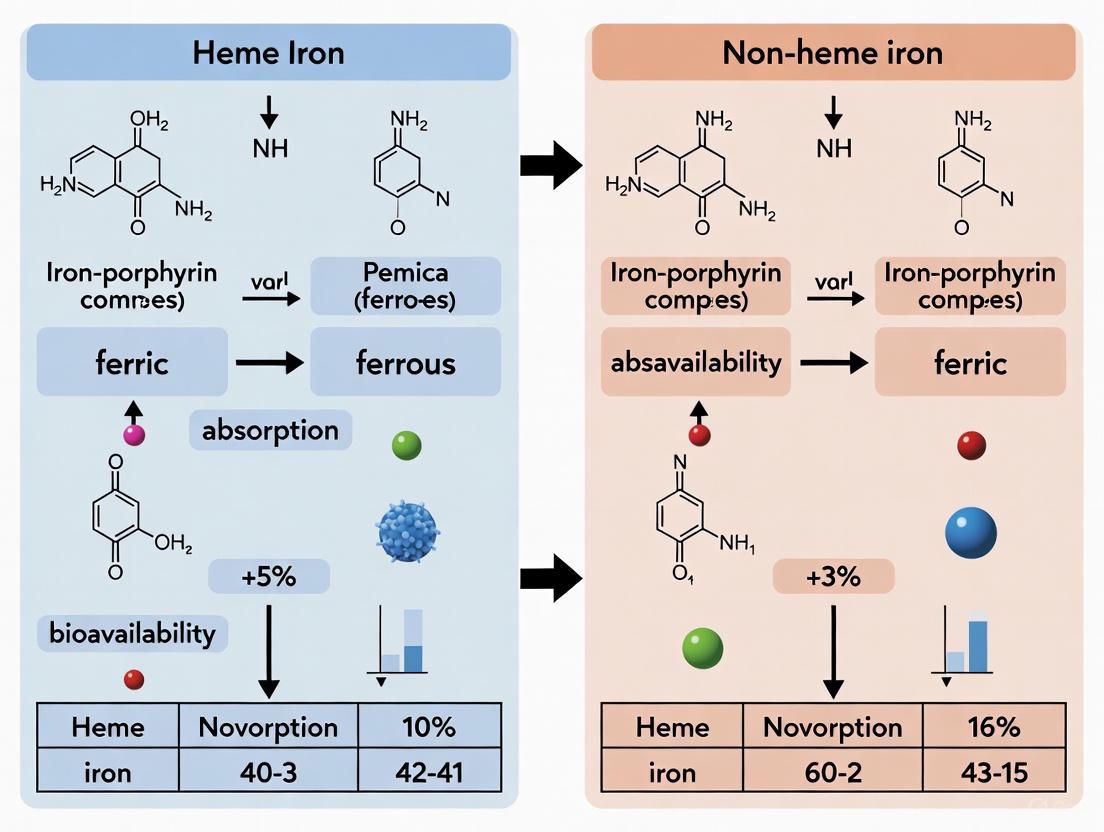
This article provides a comprehensive analysis of the relative bioavailability of heme and non-heme iron, a critical consideration for researchers and drug development professionals addressing global iron deficiency.
Heme vs. Non-Heme Iron Bioavailability: Mechanisms, Clinical Implications, and Future Directions for Biomedical Research
Abstract
This article provides a comprehensive analysis of the relative bioavailability of heme and non-heme iron, a critical consideration for researchers and drug development professionals addressing global iron deficiency. We explore the distinct absorption mechanisms, with heme iron demonstrating 25-30% bioavailability via specific transport pathways, compared to the highly variable 1-10% absorption of non-heme iron, which is strongly influenced by dietary factors. The scope includes an examination of the 'meat factor' phenomenon, methodological approaches for assessing iron status and absorption, strategies to overcome the inhibitory effects of phytates and polyphenols, and a comparative validation of supplementation strategies. Recent clinical evidence and emerging trends in supplement formulation, including plant-based nutraceuticals and novel delivery systems, are evaluated for their potential to enhance treatment efficacy and patient adherence in iron deficiency management.
Fundamental Mechanisms of Iron Absorption: From Chemistry to Physiology
Chemical Definitions and Key Characteristics
Iron in the human diet is categorized into two distinct chemical forms, which dictate its absorption and metabolism.
Heme iron is an integral component of hemoglobin and myoglobin, the oxygen-carrying proteins found in animal tissues. This form consists of an iron ion (Fe²⁺) situated at the center of a heterocyclic organic compound known as a porphyrin ring, specifically protoporphyrin IX [1] [2]. This complex is referred to as a heme group. Its presence in animal-based foods and its unique absorption pathway contribute to its high bioavailability, with estimated absorption rates ranging from 15% to 35% [3] [4].
Non-heme iron, in contrast, is the inorganic form of iron found predominantly in plant-based foods, such as grains, legumes, nuts, and vegetables [2] [5]. It is also present in animal products (e.g., eggs and dairy) and is the form used in most iron-fortified foods and supplements [2] [3]. Common chemical forms include iron salts like ferrous sulfate and ferrous fumarate [2]. Its absorption is generally lower than that of heme iron, typically ranging from 2% to 20%, and is highly susceptible to influence by other dietary components [3].
Table 1: Fundamental Characteristics of Heme and Non-Heme Iron
| Characteristic | Heme Iron | Non-Heme Iron |
|---|---|---|
| Primary Chemical Form | Iron (Fe²⁺) within protoporphyrin IX ring [1] | Inorganic iron salts (e.g., FeSO₄, Fe fumarate) [2] |
| Bioavailability | High (15% - 35% absorption) [3] [4] | Variable, generally lower (2% - 20% absorption) [3] |
| Absorption Regulation | Less tightly regulated by body iron stores [6] | Tightly regulated via the hepcidin-ferroportin axis [7] [6] |
| Primary Dietary Sources | Hemoglobin/myoglobin in meat, poultry, seafood [1] [8] | Plants, fortified foods, supplements, eggs, dairy [2] [8] |
The following tables catalog prominent dietary sources of heme and non-heme iron, with data compiled from the USDA FoodData Central database to provide standardized portion comparisons [8].
Table 2: Dietary Sources of Heme Iron (from Animal Proteins)
| Food Source | Standard Portion | Iron (mg) |
|---|---|---|
| Oysters | 3 oysters | 6.9 |
| Mussels | 3 ounces | 5.7 |
| Duck, breast | 3 ounces | 3.8 |
| Turkey Egg | 1 egg | 3.2 |
| Bison | 3 ounces | 2.9 |
| Beef | 3 ounces | 2.5 |
| Sardines, canned | 3 ounces | 2.5 |
| Clams | 3 ounces | 2.4 |
| Lamb | 3 ounces | 2.0 |
| Shrimp | 3 ounces | 1.8 |
Table 3: Dietary Sources of Non-Heme Iron (from Plants and Fortified Foods)
| Food Source | Standard Portion | Iron (mg) |
|---|---|---|
| Ready-to-eat cereal, fortified | 1/2 cup | 16.2 |
| Hot Wheat Cereal, fortified | 1 cup | 12.8 |
| Spinach, cooked | 1 cup | 6.4 |
| White Lima Beans, cooked | 1 cup | 4.9 |
| Soybeans, cooked | 1/2 cup | 4.4 |
| Lentils, cooked | 1/2 cup | 3.3 |
| Sesame Seeds | 1/2 ounce | 2.1 |
| Cashews | 1 ounce | 1.9 |
| Prune Juice, 100% | 1 cup | 3.0 |
Absorption Pathways and Regulatory Mechanisms
The absorption of heme and non-heme iron involves distinct transport systems and is subject to different levels of physiological regulation, primarily governed by the hormone hepcidin.
Diagram 1: Iron Absorption Pathways in the Duodenum. Heme iron is absorbed intact via HCP1, while non-heme iron requires reduction before DMT1 transport. Systemic iron levels regulate both pathways via hepcidin control of ferroportin.
The "meat factor" represents a significant interaction between the two iron forms. Heme iron not only is absorbed efficiently itself but also enhances the absorption of co-consumed non-heme iron. Studies have demonstrated that adding meat to a plant-based meal can increase non-heme iron absorption by 40% or more [2]. The exact mechanisms are still being elucidated but are thought to involve peptides from the partial digestion of muscle tissue that chelate non-heme iron, keeping it soluble and available for absorption in the intestine [9].
Comparative Bioavailability: Experimental Data and Clinical Evidence
Meta-Analysis of Supplementation Studies
A 2024 systematic review and meta-analysis provides direct comparative evidence on the efficacy of heme versus non-heme iron administration. The analysis, which included 13 randomized controlled trials, concluded that in children with anemia or low iron stores, heme iron interventions led to a significantly greater increase in hemoglobin (Mean Difference: 1.06 g/dL; 95% CI: 0.34 to 1.78) compared to non-heme iron [1]. Furthermore, a key finding was that participants receiving heme iron had a 38% relative risk reduction for total side effects (RR 0.62; 95% CI 0.40 to 0.96), suggesting superior tolerability [1]. The authors noted, however, that the overall certainty of the evidence was "very low," highlighting a need for more high-quality trials [1].
The "Meat Factor" in Long-Term Supplementation
A key randomized, double-blinded study investigated whether the "meat factor" provides a long-term benefit when an iron supplement is consumed. Women of reproductive age with iron deficiency were assigned to consume a 32 mg ferrous sulfate supplement with a lunch containing either beef (Animal group) or a plant-based meat alternative (Plant group) for 8 weeks [9].
Table 4: Changes in Iron Status from an 8-Week Supplementation Study [9]
| Iron Status Indicator | Animal Group (Beef Meal) | Plant Group (Plant-Based Meal) | Statistical Significance (Treatment-by-Time) |
|---|---|---|---|
| Serum Ferritin (μg/L) | +10.7 ± 9.6 (Main time effect) | +10.7 ± 9.6 (Main time effect) | Not Significant (P > 0.05) |
| Transferrin Saturation (%) | +5.1% ± 18.7% (Main time effect) | +5.1% ± 18.7% (Main time effect) | Not Significant (P > 0.05) |
| Hemoglobin (g/dL) | +0.5 ± 0.9 (Main time effect) | +0.5 ± 0.9 (Main time effect) | Not Significant (P > 0.05) |
| Body Iron Stores (mg/kg) | +2.8 ± 3.1 (Main time effect) | +2.8 ± 3.1 (Main time effect) | Not Significant (P > 0.05) |
The results demonstrated that all iron status indicators improved significantly from baseline in both groups. However, there were no statistically significant differences in the improvements between the group consuming the supplement with beef and the group consuming it with the plant-based meat [9]. This suggests that while the "meat factor" is potent in single-meal absorption studies, its contribution may not be substantial when combined with a high-dose iron supplement over a longer period, likely because the pharmacological dose of iron overwhelms the subtle enhancing effect [9].
Physiological Adaptation to Low-Bioavailability Diets
Research indicates that the body can adapt to lower dietary iron bioavailability. A 2025 study investigated non-heme iron absorption in vegans compared to omnivores. Following consumption of 150g of pistachios (a non-heme source providing ~5.7 mg iron), the area under the curve (AUC) for serum iron was significantly higher in vegans (1002.8 ± 143.9 µmol/L/h) than in omnivores (853 ± 268.2 µmol/L/h) [7]. This enhanced absorption was associated with lower baseline hepcidin levels in the vegan group, indicating a physiological adaptation to a diet reliant on non-heme iron by upregulating the absorption machinery [7].
Experimental Protocols for Iron Absorption Studies
Stable Isotope Technique for Non-Heme Iron Absorption
The stable isotope method is a gold-standard technique for precisely measuring non-heme iron absorption in humans. A detailed protocol from a large cross-sectional study is outlined below [6].
Objective: To compare nonheme iron absorption and its regulation between healthy adults of East Asian (EA) and Northern European (NE) ancestry [6].
Population: The study enrolled 504 participants (253 EA, 251 NE), males and premenopausal females aged 18-50, without obesity or conditions affecting iron status [6].
Intervention and Dosing:
- Participants fasted overnight.
- They ingested a stable 57Fe isotope in the form of an aqueous FeSO₄ solution mixed with a syrup vehicle.
- The solution was consumed under supervision to ensure complete dosing.
Sample Collection and Analysis:
- Baseline Blood Draw: Fasting blood samples were collected before isotope administration to measure baseline iron status (serum ferritin, soluble transferrin receptor), hormones (hepcidin, erythropoietin), and inflammatory markers.
- Post-Dosing Blood Draw: A second blood sample was collected 14 days after isotope ingestion. This interval allows for the incorporation of the absorbed isotope into circulating erythrocytes.
- Erythrocyte 57Fe Enrichment Measurement: The enrichment of 57Fe in erythrocytes was quantified using magnetic sector thermal ionization mass spectrometry, a highly precise method for isotope ratio analysis.
- Calculation of Absorption: Percent iron absorption was calculated based on the measured erythrocyte 57Fe enrichment, the estimated blood volume, and the amount of 57Fe administered. The values were often normalized to a standard serum ferritin level to facilitate comparison between individuals with different iron stores [6].
Diagram 2: Stable Isotope Absorption Study Workflow. This protocol measures non-heme iron absorption by tracking a safe, measurable 57Fe isotope through incorporation into red blood cells.
Key Findings: The study found that EA individuals had significantly higher serum ferritin-corrected iron absorption than NE individuals (e.g., 27.4% vs. 14.8% in females), suggesting a physiological predisposition that may increase the risk of iron overload-related diseases [6].
Randomized Controlled Trial (RCT) for Long-Term Efficacy
For comparing the long-term efficacy of different iron forms or dietary enhancers, a well-controlled RCT is the standard design.
Objective: To determine whether consuming an iron supplement with a meal containing animal meat leads to greater improvements in iron status than with a plant-based meat over 8 weeks [9].
Study Design:
- Design: Randomized, double-blinded, parallel-arm.
- Participants: Non-pregnant females of reproductive age (18-40 years) with low iron stores (serum ferritin <25 μg/L). Subjects with conditions affecting iron absorption were excluded.
- Intervention: Participants were randomly assigned to one of two groups:
- Animal Group: Consumed a 32 mg elemental iron (as ferrous sulfate) supplement with a lunch meal containing 4 oz (113 g) of beef.
- Plant Group: Consumed the same iron supplement with a lunch meal containing 4 oz (113 g) of a plant-based meat alternative (Beyond Meat).
- Blinding: The study meals were prepared and provided to be identical in appearance, ensuring participant and personnel blinding.
- Duration: 8 weeks of daily supplementation with the test meal.
Data Collection:
- Primary Outcomes: Biochemical indicators of iron status and anemia.
- Measurements: Serum ferritin, transferrin saturation, soluble transferrin receptor, total body iron, and hemoglobin were measured at baseline and after the 8-week intervention.
Key Outcomes: As summarized in Table 4, both groups showed significant improvements in all iron status indicators, with no statistically significant difference between the Animal and Plant groups [9].
The Scientist's Toolkit: Key Research Reagents and Materials
Table 5: Essential Reagents and Materials for Iron Absorption Research
| Reagent / Material | Function / Application in Research |
|---|---|
| Stable Iron Isotopes (e.g., 57Fe, 58Fe) | Safe, tracable labels for precise measurement of iron absorption and kinetics in human studies [6]. |
| Ferrous Sulfate (FeSO₄) | The most common non-heme iron salt used as a reference compound in comparative bioavailability and supplementation trials [1] [9]. |
| Heme Iron Concentrate | A standardized preparation of heme iron from animal sources (e.g., hemoglobin) used in interventions comparing heme vs. non-heme iron efficacy [1]. |
| Enzyme-Linked Immunosorbent Assay (ELISA) Kits | For quantifying key regulatory hormones and biomarkers, such as hepcidin, serum ferritin, and soluble transferrin receptor (sTfR) [7] [6]. |
| Magnetic Sector Thermal Ionization Mass Spectrometry (TIMS) | High-precision analytical instrument for measuring minute enrichments of stable iron isotopes in biological samples like blood [6]. |
| Phytic Acid / Polyphenol Standards | Used to quantify levels of these dietary inhibitors in test meals or to create standardized meals for absorption studies [7]. |
| Ascorbic Acid (Vitamin C) | Used as a reference enhancer to study the maximum potential absorption of non-heme iron and to control for its effect in experimental diets [3]. |
Iron is a critical micronutrient for fundamental biological processes, including oxygen transport, DNA synthesis, and cellular energy metabolism [10] [11]. Its absorption in the duodenum is a highly regulated process, pivotal to systemic iron homeostasis due to the absence of active excretory pathways [12] [13]. Dietary iron is primarily presented to enterocytes in two distinct forms: heme iron, derived from hemoglobin and myoglobin in animal products, and non-heme iron, the inorganic form found in both plant and animal-based foods [13]. The central thesis of heme versus non-heme iron bioavailability is unequivocally demonstrated by their differential absorption; heme iron constitutes only one-third of dietary iron intake in a typical Western diet yet contributes up to two-thirds of the total iron absorbed, explaining the higher prevalence of iron deficiency in vegetarian populations [10] [14]. This disparity in absorption efficiency is governed by two principal transmembrane transporters: Heme Carrier Protein 1 (HCP1) and Divalent Metal Transporter 1 (DMT1). This guide provides a structured, evidence-based comparison of HCP1 and DMT1 for researchers and drug development professionals, detailing their distinct mechanisms, regulation, and roles in iron homeostasis.
Transporter Profiles at a Glance
The following table summarizes the core characteristics of HCP1 and DMT1, highlighting their distinct roles in iron acquisition.
Table 1: Comparative Profile of HCP1 and DMT1
| Feature | Heme Carrier Protein 1 (HCP1) | Divalent Metal Transporter 1 (DMT1) |
|---|---|---|
| Primary Substrate | Heme (Intact Fe²⁺-protoporphyrin IX complex) [14] [13] | Divalent metal ions (Fe²⁺, Zn²⁺, Mn²⁺, Cu²⁺, Pb²⁺) [13] [15] |
| Dietary Iron Source | Heme Iron [14] | Non-Heme Iron [13] |
| Subcellular Localization | Apical membrane of duodenal enterocytes [16] | Apical membrane of enterocytes; endosomal membranes [16] [17] |
| Transport Mechanism | Proton-coupled import of intact heme [16] | Proton-coupled symport [13] [15] |
| Bioavailability Context | Accounts for high bioavailability of heme iron (~20-30%, up to 50%) [14] | Uptake efficiency influenced by dietary enhancers/inhibitors; generally lower bioavailability [14] [13] |
| Regulation by Iron Status | Post-translational shuttling (membrane to cytoplasm) [14] | Transcriptional and post-translational regulation [18] [17] |
Structural and Functional Mechanisms
Protein Structure and Transport Mechanism
HCP1 is a highly hydrophobic protein composed of 446 amino acids, belonging to the major facilitator superfamily (MFS) of proton-coupled transporters [14] [16]. Its proposed function is to facilitate the uptake of the intact heme molecule across the apical brush-border membrane of the duodenal enterocyte.
DMT1, also known as Nramp2 or SLC11A2, is a member of the natural resistance-associated macrophage protein (Nramp) family [17]. It functions as a proton symporter, co-transporting H⁺ and Fe²⁺ ions, a mechanism that is optimal in the acidic microclimate of the duodenum [17] [15]. DMT1 is not iron-specific and also transports other divalent cations, which can lead to competitive inhibition [13].
Intracellular Handling of Iron
The pathways diverge significantly after the initial uptake. Heme iron, transported intracellularly by HCP1, is catabolized in the cytoplasm or endosomes by the microsomal enzyme heme oxygenase (HO-1 or HO-2) [14] [16]. This reaction releases ferrous iron (Fe²⁺), carbon monoxide, and biliverdin. The liberated iron then joins the labile iron pool within the enterocyte, merging with the pathway of non-heme iron [14] [13].
In contrast, non-heme iron enters the cell directly as Fe²⁺ via DMT1. Prior to this uptake, dietary ferric iron (Fe³⁺) must be reduced to the ferrous form on the apical membrane surface. This critical reduction step is mediated by enzymes such as duodenal cytochrome B (Dcytb) [14] [13].
From the shared labile iron pool, iron's fate depends on the body's needs. It can be stored as ferritin or exported out of the enterocyte into the systemic circulation via ferroportin (FPN1), the sole known cellular iron exporter [13] [11]. The ferroxidase hephaestin, associated with ferroportin, oxidizes Fe²⁺ back to Fe³⁺ for loading onto transferrin in the plasma [13].
The diagram below illustrates these coordinated pathways.
Diagram Title: HCP1 and DMT1 Iron Absorption Pathways in Duodenal Enterocyte
Regulation of Absorption Pathways
Systemic and Cellular Regulation
Iron absorption is tightly regulated at both systemic and cellular levels to maintain homeostasis, with the liver-derived peptide hormone hepcidin being the central systemic regulator [14] [18]. Hepcidin binds to ferroportin, inducing its internalization and degradation, thereby reducing iron efflux from enterocytes (and macrophages) into the circulation [14] [11]. This provides a master switch for iron absorption.
Recent ex vivo studies on human duodenal biopsies have revealed that hepcidin's effect is more complex than just post-translational regulation of ferroportin. It also induces transcriptional downregulation of key genes involved in iron absorption. Treatment with hepcidin-25 significantly reduced mRNA levels of FPN1, DMT1, Dcytb, hephaestin, and HCP1 [18]. This demonstrates a coordinated suppression of both heme and non-heme iron uptake pathways in response to high iron status or inflammation.
At the cellular level, the iron-responsive element/iron-regulatory protein (IRE/IRP) system post-transcriptionally regulates the expression of proteins like DMT1 and ferritin in response to cytosolic iron levels [11] [17]. Furthermore, DMT1 activity is rapidly modulated by a "mucosal block" mechanism, where an initial dose of iron triggers the endocytosis of DMT1 from the apical membrane, reducing subsequent uptake [15].
Differential Response to Body Iron Status
A key functional difference between the two pathways is their regulatory response. Non-heme iron absorption via DMT1 is highly responsive to the body's iron status, significantly upregulating during deficiency and downregulating during overload [10] [13]. In contrast, heme iron absorption, while more efficient, demonstrates a more limited capacity for upregulation during iron deficiency [10]. This suggests potential rate-limiting steps at the level of heme catabolism or the handling of the liberated iron within the enterocyte.
Experimental Analysis and Methodologies
Key Experimental Models and Protocols
Research into HCP1 and DMT1 function employs a range of in vitro, ex vivo, and in vivo models.
In Vitro Transport Assays: A common methodology involves expressing HCP1 or DMT1 in heterologous systems like Xenopus laevis oocytes or mammalian cell lines (e.g., HeLa, CHO cells). Functional uptake is quantified using radioisotopic (⁵⁹Fe) or fluorescently labeled substrates (heme for HCP1; Fe²⁺ for DMT1). For instance, HCP1-transfected HeLa cells demonstrated a 2- to 3-fold increase in heme uptake compared to controls, which was temperature-sensitive and competitive with unlabelled heme [10]. Specificity for DMT1 is often confirmed using competitive inhibitors or non-transportable substrates.
Ex Vivo Human Organ Culture: This model uses endoscopically collected duodenal biopsies from human subjects, cultured for several hours with or without experimental treatments like hepcidin-25. Subsequent qPCR and immunoblotting analysis quantify changes in mRNA and protein levels of HCP1, DMT1, and other iron-related genes, providing direct insight into human regulatory physiology [18].
In Vivo Animal Studies: Closed duodenal loop experiments in rodents involve administering heme or iron doses into isolated intestinal segments. Tissue samples are collected over time to analyze iron uptake morphologically (e.g., using DAB staining for electron microscopy) or to measure the effect of antibodies (e.g., anti-HCP1) or genetic knockdown on tracer absorption [10].
The Scientist's Toolkit: Essential Research Reagents
Table 2: Key Reagents for Studying HCP1 and DMT1 Function
| Research Reagent | Function & Application |
|---|---|
| ⁵⁹Fe-Labeled Heme | Radioisotopic tracer for quantifying heme iron uptake via HCP1 in transport assays [10]. |
| ⁵⁹FeCl₂ / ⁵⁹FeCl₃ | Radioisotopic tracer for quantifying non-heme iron uptake (requires reduction of Fe³⁺ to Fe²⁺ for DMT1) [13]. |
| Hepcidin-25 | The bioactive peptide hormone used to investigate transcriptional and post-translational regulation of HCP1, DMT1, and FPN1 in cell culture or ex vivo systems [18]. |
| siRNA/shRNA | For targeted knockdown of HCP1 or DMT1 gene expression in cell cultures to study loss-of-function phenotypes and validate transporter specificity [10] [18]. |
| Caco-2 Cell Line | A human intestinal epithelial cell model that undergoes enterocyte differentiation upon confluence; widely used for in vitro iron absorption and transport studies [18]. |
HCP1 and DMT1 are specialized transporters that mediate the absorption of heme and non-heme iron, respectively. HCP1 provides a highly efficient pathway for heme iron uptake, which explains its significant contribution to body iron stores. DMT1 handles the more abundant but less bioavailable non-heme iron, and its activity is more dynamically regulated to match bodily demands. The recent discovery that hepcidin transcriptionally represses both HCP1 and DMT1 underscores a sophisticated, coordinated regulatory mechanism that controls total dietary iron acquisition [18].
Future research should aim to further elucidate the precise protein structure and transport cycle of HCP1, given its dual role in folate transport. The development of specific, high-affinity inhibitors for both transporters would be invaluable for basic research and potential therapeutic applications. Furthermore, understanding how these pathways adapt throughout the human life cycle, from infancy to old age, and in various disease states, remains a critical area for investigation [12]. A deeper molecular understanding of HCP1 and DMT1 will continue to inform strategies for correcting iron deficiency and treating iron overload disorders.
Iron is an essential micronutrient critical for fundamental physiological processes including oxygen transport, cellular energy metabolism, DNA synthesis, and immune function [19] [20]. In humans, iron balance is uniquely regulated at the point of intestinal absorption rather than through active excretion, making bioavailability a crucial determinant of iron status [20] [21]. Dietary iron exists in two distinct forms with markedly different absorption characteristics: heme iron, derived from hemoglobin and myoglobin in animal tissues, and non-heme iron, obtained from plant-based foods, iron-fortified products, and supplements [19] [20]. This review systematically compares the bioavailability of these iron forms, examining the molecular mechanisms underlying their absorption differences, methodological approaches for assessing iron bioavailability, and the implications for public health and therapeutic development.
The profound disparity in absorption efficiency between heme and non-heme iron represents a critical focus for nutritional science and clinical practice. While heme iron typically demonstrates absorption rates of 15-35%, non-heme iron absorption ranges from 2-20% depending on dietary composition and individual iron status [22] [2]. This differential absorption has significant consequences for global iron deficiency prevention strategies and understanding the pathophysiology of iron overload disorders. The following sections provide a comprehensive evidence-based analysis of the factors governing iron bioavailability, with particular emphasis on the experimental approaches used to quantify absorption differences and the molecular pathways that regulate iron uptake.
Quantitative Bioavailability Comparison
The absorption efficiency of heme and non-heme iron has been quantified through multiple methodological approaches including isotopic studies, metabolic balance trials, and algorithm-based predictive models. The consistent finding across these diverse methodologies is the superior bioavailability of heme iron compared to its non-heme counterpart.
Table 1: Comparative Absorption Rates of Heme and Non-Heme Iron
| Iron Form | Typical Absorption Range | Primary Dietary Sources | Key Influencing Factors |
|---|---|---|---|
| Heme Iron | 15-35% [22] [2] | Meat, poultry, fish, seafood [19] [20] | Relatively unaffected by dietary composition [23] |
| Non-Heme Iron | 2-20% [22] [23] | Legumes, grains, fortified foods, vegetables [19] [20] | Strongly influenced by enhancers/inhibitors and individual iron status [19] [21] |
In Western populations, heme iron typically constitutes only 10-15% of total dietary iron intake but may contribute up to 40% of the total iron absorbed due to its enhanced bioavailability [20] [2]. This disproportionate contribution highlights its significant role in maintaining iron homeostasis. The absorption of non-heme iron demonstrates considerably greater variability, with studies reporting bioavailability from mixed diets ranging from 14-18%, while vegetarian diets typically yield only 5-12% absorption due to higher concentrations of inhibitory compounds [21].
Table 2: Population-Level Iron Bioavailability from Different Dietary Patterns
| Dietary Pattern | Mean Bioavailability | Key Determinants |
|---|---|---|
| Mixed Diet | 14-18% [21] | Balance of meat content and inhibitory compounds |
| Vegetarian Diet | 5-12% [21] | High phytate and polyphenol content reduces absorption |
| Heme Iron Supplementation | 25-30% [2] | Minimal interaction with dietary inhibitors |
A 2024 systematic review and meta-analysis of randomized controlled trials further substantiated the bioavailability disparity, demonstrating that heme iron interventions produced significantly greater hemoglobin increases in children with anemia or low iron stores compared to non-heme iron (mean difference 1.06 g/dL) [1]. This evidence confirms the clinical significance of the absorption differences between these iron forms, particularly in populations with elevated iron requirements.
Experimental Methodologies for Assessing Iron Bioavailability
Research quantifying heme and non-heme iron absorption employs sophisticated methodological approaches ranging from tightly controlled isotopic studies to population-level observational designs. Each methodology offers distinct advantages and limitations for characterizing iron bioavailability.
Isotopic Tracer Studies
Isotopic techniques represent the gold standard for precise measurement of iron absorption. These studies utilize stable (e.g., ⁵⁷Fe, ⁵⁸Fe) or radioactive (⁵⁵Fe, ⁵⁹Fe) iron isotopes to label test meals, allowing direct quantification of iron incorporation into erythrocytes or measurement of whole-body retention [24]. Participants consume labeled test meals specifically designed to isolate the effects of particular dietary components on iron absorption. Blood samples are collected 10-16 days post-consumption to measure isotope incorporation into hemoglobin, enabling calculation of the percentage of ingested iron absorbed [24]. This approach provides highly accurate absorption data for specific meals under controlled conditions but has limitations in representing long-term dietary patterns and natural eating contexts.
Algorithm-Based Predictive Models
Multiple mathematical algorithms have been developed to predict iron bioavailability from dietary intake data, eliminating the need for complex isotopic methodologies:
- Monsen Model (1978): The pioneering algorithm that estimates iron bioavailability based on heme iron intake and the presence of absorption enhancers in meals [25].
- Hallberg and Hulthén Model (2000): Extends the Monsen model by incorporating adjustment terms for dietary inhibitors like phytates and polyphenols [25].
- Reddy Model (2000): Another meal-based algorithm that accounts for multiple enhancers and inhibitors of non-heme iron absorption [25].
- Probabilistic Approach: Estimates population-level iron absorption by matching the prevalence of inadequate iron intakes with the observed prevalence of low iron stores, using serum ferritin concentrations as the biomarker [24] [25].
A cross-sectional study comparing these methodologies demonstrated strong correlations between algorithm estimates (r = 0.69-0.85) but significant quantitative differences, with diet-based models (8.5-8.9%) diverging from meal-based models (11.6-12.8%) and the probabilistic approach (17.2%) [25]. This highlights the methodological challenges in translating controlled experimental data to free-living populations with varied dietary patterns.
Serum Ferritin Response Studies
Intervention trials measuring changes in serum ferritin concentrations following supplementation with different iron forms provide clinically relevant bioavailability assessments. A 2024 meta-analysis of randomized controlled trials utilized this approach, demonstrating that heme iron supplementation produced superior hemoglobin responses in iron-deficient children compared to non-heme iron formulations [1]. These studies directly measure the functional impact of bioavailability differences on established iron status biomarkers, providing evidence for clinical and public health applications.
Diagram 1: Iron Absorption Pathways. This diagram illustrates the distinct intestinal absorption mechanisms for heme and non-heme iron, highlighting the dietary factors that influence non-heme iron uptake and the systemic regulation via hepcidin.
Molecular Mechanisms of Iron Absorption
The disparate bioavailability of heme and non-heme iron originates from their fundamentally different absorption pathways at the molecular level. Understanding these mechanisms provides insight into the factors governing iron homeostasis and potential therapeutic targets for modulating iron absorption.
Heme Iron Absorption Pathway
Heme iron undergoes a specialized absorption process that confers its high bioavailability. The initial uptake occurs via heme carrier protein 1 (HCP1) located on the apical membrane of duodenal enterocytes [2]. Unlike non-heme iron, heme is absorbed intact within the porphyrin ring, which protects it from precipitation and interaction with dietary inhibitors in the intestinal lumen [2]. Once inside the enterocyte, heme oxygenase enzymatically cleaves the porphyrin ring, releasing ionic iron into the intracellular labile iron pool [2]. This pathway bypasses the competitive inhibition and luminal complexation that markedly limit non-heme iron absorption, explaining why heme iron bioavailability remains relatively constant at 15-35% across different dietary contexts [23] [2].
Non-Heme Iron Absorption Pathway
Non-heme iron absorption employs a distinct and more complex pathway that is highly responsive to dietary composition and physiological requirements. Non-heme iron primarily exists in the ferric (Fe³⁺) state in foods but must be reduced to the ferrous (Fe²⁺) form for transport across the intestinal epithelium [19] [20]. This reduction is facilitated by duodenal cytochrome B (DcytB) and enhanced by ascorbic acid [19]. The divalent metal transporter 1 (DMT1) then mediates apical uptake of ferrous iron into enterocytes [19] [20]. Unlike heme iron absorption, this process is markedly influenced by luminal factors: phytates (in grains and legumes), polyphenols (in tea and coffee), and calcium competitively inhibit absorption, while ascorbic acid and "meat factor" (cysteine-containing peptides from animal tissue) enhance uptake [19] [20] [22].
Systemic Regulation via Hepcidin
Both absorption pathways converge at the basolateral export step, where ferroportin mediates iron transfer to circulating transferrin. This critical checkpoint is systemically regulated by hepcidin, a hepatic hormone that controls plasma iron concentrations [20]. During iron overload, hepcidin expression increases, promoting ferroportin degradation and reducing iron absorption [20]. Conversely, iron deficiency or elevated erythropoietic demand suppresses hepcidin, increasing ferroportin-mediated iron export [20]. Research indicates that heme and non-heme iron absorption respond differently to hepcidin regulation, with non-heme iron demonstrating greater suppression under high-hepcidin conditions [26]. This differential regulation further contributes to the bioavailability disparity between these iron forms, particularly in inflammatory states where hepcidin concentrations are elevated.
Research Reagents and Methodological Tools
Iron bioavailability research requires specialized reagents and methodological tools to accurately quantify absorption and investigate underlying mechanisms. The following table summarizes essential resources for conducting experimental studies in this field.
Table 3: Essential Research Reagents and Tools for Iron Bioavailability Studies
| Reagent/Tool | Experimental Function | Application Examples |
|---|---|---|
| Stable Iron Isotopes (⁵⁷Fe, ⁵⁸Fe) | Precise measurement of iron absorption using mass spectrometry | Metabolic studies quantifying iron incorporation into erythrocytes [24] |
| Radioiron Isotopes (⁵⁵Fe, ⁵⁹Fe) | Highly sensitive detection of iron absorption and distribution | Whole-body counting and erythrocyte incorporation assays [24] |
| Caco-2 Cell Model | In vitro simulation of intestinal iron absorption | Screening dietary factors affecting non-heme iron bioavailability [19] |
| Serum Ferritin Immunoassays | Quantification of iron storage status | Assessment of functional iron status in intervention trials [1] [24] |
| Hepcidin Assays | Measurement of regulatory hormone levels | Investigation of iron absorption regulation in different physiological states [20] |
| Dietary Assessment Algorithms | Prediction of bioavailable iron intake from food consumption data | Population-level estimation of iron bioavailability [24] [25] |
These research tools enable comprehensive investigation of iron absorption mechanisms from molecular through population levels. Isotopic methods provide the most direct and accurate absorption measurements but require specialized equipment and facilities [24]. Cell culture models offer high-throughput screening capabilities for identifying absorption modifiers but may not fully recapitulate in vivo physiology [19]. Algorithm-based approaches facilitate large epidemiological studies but depend on accurate dietary assessment and validation against biochemical measures [25]. The integration of these complementary methodologies has generated the robust evidence base characterizing the bioavailability disparity between heme and non-heme iron.
Implications for Research and Clinical Practice
The substantial difference in bioavailability between heme and non-heme iron has profound implications for nutritional guidance, public health interventions, and therapeutic development. Understanding these implications is essential for researchers and clinicians working to address iron deficiency and iron overload disorders.
Public Health and Nutritional Guidance
The bioavailability disparity necessitates distinct dietary recommendations based on iron source. The Recommended Dietary Allowance (RDA) for iron is 1.8 times higher for vegetarians than for meat-eaters to compensate for lower non-heme iron bioavailability [20]. Strategic dietary combinations can mitigate this difference: consuming vitamin C-rich foods with plant-based meals enhances non-heme iron absorption, while avoiding tea, coffee, and calcium-rich foods during iron-containing meals minimizes inhibition [19] [22]. These approaches are particularly important for population subgroups with elevated iron requirements, including pregnant women, infants, adolescents, and women of reproductive age [20]. Educational initiatives should emphasize both iron content and bioavailability when providing dietary guidance for preventing and treating iron deficiency.
Therapeutic Applications and Supplement Development
The tolerability and efficacy profiles of iron supplements vary substantially based on their iron form. Traditional non-heme iron supplements (e.g., ferrous sulfate, ferrous fumarate) frequently cause gastrointestinal adverse effects including dyspepsia and constipation, contributing to poor adherence [1] [2]. Heme iron supplements demonstrate superior tolerability while effectively improving iron status, offering a promising alternative for individuals unable to tolerate conventional supplements [1] [2]. Recent research also indicates that heme and non-heme iron have differential effects on the gut microbiome, with heme iron potentially promoting the growth of pathogenic bacteria more than non-heme iron [26]. This finding has important implications for supplement formulation, particularly for patients with inflammatory bowel diseases or other gastrointestinal conditions.
Safety Considerations and Health Risks
The high bioavailability and less regulated absorption of heme iron presents potential health concerns in certain contexts. Epidemiological evidence associates high heme iron intake with increased cardiovascular disease risk, with a meta-analysis reporting a 7% risk increase per 1 mg/day increment in heme iron consumption [26]. In contrast, non-heme iron intake demonstrates no significant association with cardiovascular risk [26]. This differential risk profile may reflect the more tightly regulated absorption of non-heme iron, which reduces the likelihood of excessive iron accumulation. Additionally, the pro-oxidant properties of iron necessitate careful consideration of supplementation strategies, particularly in individuals with adequate iron status [2]. These findings highlight the need for balanced iron intake recommendations that consider both deficiency prevention and overload risk.
Diagram 2: Iron Bioavailability Research Workflow. This diagram outlines the methodological approaches for estimating iron bioavailability, highlighting the integration of isotopic studies, in vitro models, and observational designs with biochemical and dietary assessment methods.
The substantial bioavailability disparity between heme (15-35%) and non-heme (2-20%) iron stems from their distinct absorption pathways, differential regulation by systemic factors, and varying susceptibility to dietary modifiers. This evidence-based analysis demonstrates that the superior bioavailability of heme iron confers advantages for rapidly correcting iron deficiency but may present greater risk for iron overload and specific chronic diseases. Non-heme iron, despite its lower absorption efficiency, benefits from tighter physiological regulation that may offer protection against excess accumulation. Future research should focus on refining bioavailability estimation methods, elucidating the precise molecular mechanisms of the "meat factor," and developing targeted interventions that optimize iron absorption while minimizing potential adverse effects. Understanding these fundamental differences enables researchers and clinicians to make informed decisions regarding dietary recommendations, supplement formulation, and public health strategies aimed at addressing iron-related disorders across diverse populations.
The Role of Hepcidin in Systemic Iron Homeostasis and Regulation
Systemic iron homeostasis is a complex process that must balance the essential biological functions of iron against its potential toxicity. The discovery of hepcidin, a peptide hormone predominantly synthesized in the liver, has revolutionized our understanding of iron regulation. This hormone serves as the master regulator of body iron distribution and absorption, functioning as the principal effector of the hepcidin-ferroportin axis that controls iron flow into plasma [27] [28]. Unlike other minerals, iron lacks a regulated excretory mechanism, making controlled absorption at the duodenal level the critical process for maintaining iron balance [29] [30]. Hepcidin provides this control by regulating the sole known cellular iron exporter, ferroportin, thereby determining how much iron enters the bloodstream from dietary sources, recycled erythrocytes, and hepatic stores [27] [29]. This review examines hepcidin's pivotal role within the context of comparative heme versus non-heme iron bioavailability research, providing researchers and drug development professionals with experimental data and methodological approaches relevant to this field.
Molecular Mechanisms of the Hepcidin-Ferroportin Axis
Hepcidin Synthesis and Regulation
Hepcidin (encoded by the HAMP gene) production in hepatocytes is transcriptionally regulated by multiple pathways that respond to different physiological stimuli. The primary regulatory pathway involves bone morphogenetic protein (BMP) signaling, specifically through a molecular complex of BMP receptors and their iron-specific ligands, modulators, and iron sensors [27] [29]. Under iron-replete conditions, increased transferrin saturation leads to elevated diferric transferrin, which binds to transferrin receptor 2 (TFR2) and interacts with HFE protein, activating the BMP-SMAD signaling pathway that upregulates hepcidin transcription [29] [28]. This sophisticated sensing mechanism ensures hepcidin production increases when body iron stores are sufficient, preventing iron overload.
Additional regulatory pathways include:
- Inflammatory signaling: Interleukin-6 (IL-6) and other inflammatory cytokines activate hepcidin transcription through the JAK-STAT pathway, reducing serum iron availability during infection or inflammation [29] [28].
- Erythropoietic activity: Enhanced erythropoiesis suppresses hepcidin production through erythroblast-derived erythroferrone (ERFE), allowing increased iron availability for hemoglobin synthesis [29] [28].
- Hypoxia: Oxygen deficiency downregulates hepcidin to facilitate increased iron absorption and mobilization [29].
Ferroportin Degradation and Iron Flux Control
Hepcidin exerts its physiological effects by binding to its receptor, the cellular iron exporter ferroportin (FPN, SLC40A1) [27] [29] [30]. This binding induces phosphorylation, internalization, and degradation of ferroportin, thereby reducing iron efflux from target cells [27] [29]. Ferroportin is expressed on the basolateral surface of duodenal enterocytes (where dietary iron is absorbed), macrophages of the reticuloendothelial system (where iron is recycled from senescent erythrocytes), and hepatocytes (which store iron) [27] [30]. By modulating ferroportin levels, hepcidin directly controls: (1) intestinal iron absorption, (2) iron release from storage sites, and (3) plasma iron concentrations [27] [29]. This regulatory mechanism ensures that iron enters the circulation according to bodily needs, preventing both deficiency and excess.
The following diagram illustrates the core regulatory pathway of hepcidin synthesis and its interaction with ferroportin:
Comparative Bioavailability: Heme versus Non-Heme Iron
Absorption Mechanisms and Efficiency
Dietary iron absorption occurs primarily in the duodenum and proximal jejunum, with significant differences between heme and non-heme iron pathways [20] [31]. Heme iron, derived from hemoglobin and myoglobin in animal products, is absorbed through a dedicated pathway involving heme carrier protein 1 (HCP1) on enterocyte apical membranes [31]. Once inside the enterocyte, heme is catabolized by microsomal heme oxygenase to release Fe²⁺ [31]. In contrast, non-heme iron, found in both plant sources and animal products, must be reduced from ferric (Fe³⁺) to ferrous (Fe²⁺) form by duodenal cytochrome B (Dcytb) before transport via divalent metal transporter 1 (DMT1) across the apical membrane [31] [30]. Both pathways converge at the basolateral membrane, where ferroportin exports iron with assistance from the ferroxidases hephaestin or ceruloplasmin [31] [30].
The critical distinction lies in their absorption efficiency. Heme iron demonstrates significantly higher bioavailability, with absorption rates ranging from 15% to 35%, while non-heme iron absorption varies from 2% to 20%, heavily influenced by dietary factors and individual iron status [20] [22] [32]. This differential absorption contributes to the estimation that mixed diets (containing both iron forms) have iron bioavailability of 14-18%, while vegetarian diets range from 5-12% [20] [21]. Notably, heme iron constitutes only 10-15% of dietary iron intake in Western populations but contributes approximately 40% of total absorbed iron due to its superior bioavailability [20].
Table 1: Comparative Absorption Characteristics of Heme and Non-Heme Iron
| Parameter | Heme Iron | Non-Heme Iron |
|---|---|---|
| Chemical Form | Iron incorporated into protoporphyrin IX ring (Fe²⁺) | Ionic iron (Fe²⁺ or Fe³⁺) |
| Dietary Sources | Meat, poultry, fish, seafood | Plants, fortified foods, supplements |
| Absorption Pathway | HCP1 transporter | Dcytb reduction → DMT1 transport |
| Average Absorption Rate | 15-35% | 2-20% |
| Influence of Iron Status | Minimal regulation | Tightly regulated (increased absorption during deficiency) |
| Contribution to Absorbed Iron in Western Diets | ~40% | ~60% |
Dietary Factors Influencing Iron Bioavailability
Numerous dietary components significantly modulate non-heme iron absorption, while heme iron remains relatively unaffected by these factors [20] [22]. Understanding these modifiers is crucial for designing dietary interventions and interpreting research on iron bioavailability.
Enhancers of Non-Heme Iron Absorption:
- Vitamin C (ascorbic acid): Acts as both a reducing agent (converting Fe³⁺ to Fe²⁺) and chelator, counteracting inhibitors like phytates [20] [22].
- Muscle tissue (MFP factor): The mechanism remains unclear, but cysteine-containing peptides in meat, fish, and poultry can enhance non-heme iron absorption 2-3 fold when consumed together [20].
- Organic acids: Citric, malic, and lactic acids can form soluble complexes with iron, enhancing absorption [21].
Inhibitors of Non-Heme Iron Absorption:
- Phytates: Found in whole grains, legumes, and seeds, strongly chelate iron and reduce absorption [20] [21].
- Polyphenols: Present in tea, coffee, red wine, and some cereals, form insoluble complexes with iron [20] [21].
- Calcium: High concentrations competitively inhibit both heme and non-heme iron absorption [20] [21].
- Plant proteins: Certain components in soy and other plant proteins may inhibit iron absorption independently of phytate content [21].
Table 2: Dietary Factors Modifying Iron Bioavailability
| Factor | Effect on Heme Iron | Effect on Non-Heme Iron | Mechanism |
|---|---|---|---|
| Vitamin C | Minimal effect | Strong enhancement | Reduction and chelation of iron |
| Phytates | Minimal effect | Strong inhibition | Formation of insoluble complexes |
| Polyphenols | Minimal effect | Strong inhibition | Binding and precipitation |
| Calcium | Moderate inhibition | Moderate inhibition | Competitive inhibition of absorption |
| MFP Factor | N/A (already heme iron) | Enhancement | Luminal carrier formation |
| Gastric Acid | Enhances release from heme | Essential for solubility | Acidic environment maintains solubility |
Experimental Models and Methodologies in Iron Research
In Vivo and Clinical Assessment Protocols
Research investigating hepcidin function and iron bioavailability employs sophisticated experimental approaches. Human studies typically utilize isotopic methods with ⁵⁵Fe or ⁵⁹Fe tracers to precisely quantify iron absorption from single meals or multiple meals over extended periods [21]. These methodologies have revealed that while single-meal studies clearly demonstrate the effects of enhancers and inhibitors, the impact of single dietary components becomes more modest in multi-meal studies with varied diets containing multiple inhibitors and enhancers [21].
Key methodological considerations include:
- Study duration: Short-term (single meal) versus long-term (multi-meal) assessments provide complementary data [21].
- Subject characteristics: Iron status (ferritin levels, transferrin saturation), obesity, and inflammatory status significantly influence results and must be carefully documented [33] [21].
- Dietary control: Precise quantification of all dietary components, including fortification iron and food additives like erythorbic acid, is essential [21].
- Biomarker analysis: Comprehensive assessment includes serum iron, transferrin saturation, ferritin, soluble transferrin receptor, hepcidin, and inflammatory markers like C-reactive protein [22] [32].
Molecular and Cellular Techniques
Laboratory-based research has been instrumental in elucidating the molecular mechanisms of hepcidin regulation and function. Key experimental approaches include:
- Gene expression analysis: Quantification of hepcidin (HAMP), ferroportin (SLC40A1), and related genes via RT-PCR and RNA sequencing [29].
- Protein detection: Western blotting, immunohistochemistry, and ELISA for hepcidin, ferroportin, and signaling molecules [29].
- Cell culture models: Primary hepatocytes, hepatoma cell lines (HepG2, HuH7), and intestinal cell models (Caco-2) for pathway analysis [29].
- Genetic manipulation: Knockout and transgenic mouse models, including Hfe⁻/⁻, Tfr2⁻/⁻, and Bmp6⁻/⁻ mice, to study iron regulatory pathways [27] [28] [30].
- Signaling pathway analysis: Investigation of BMP-SMAD, JAK-STAT, and ERK1/2 pathways through phosphoprotein analysis and reporter assays [29].
The following workflow diagram illustrates a comprehensive experimental approach for studying hepcidin regulation and iron bioavailability:
Research Reagents and Methodological Tools
Table 3: Essential Research Reagents for Iron Metabolism Studies
| Reagent/Category | Specific Examples | Research Application |
|---|---|---|
| Cell Culture Models | Primary hepatocytes, HepG2 cells, Caco-2 intestinal cells, J774 macrophages | In vitro investigation of iron uptake, regulation, and trafficking |
| Animal Models | Hfe⁻/⁻, Tfr2⁻/⁻, Bmp6⁻/⁻, Hamp⁻/⁻ mice; mk/mk rats with DMT1 mutations | In vivo study of systemic iron homeostasis and genetic disorders |
| Iron Isotopes | ⁵⁵Fe, ⁵⁹Fe for absorption studies; ⁵⁷Fe for stable isotope tracing | Quantitative measurement of iron absorption and distribution |
| Antibodies | Anti-hepcidin, anti-ferroportin, anti-HFE, anti-TfR1/TfR2, phospho-SMAD antibodies | Protein detection, quantification, and localization |
| Molecular Biology Tools | HAMP promoter constructs, siRNA against TMPRSS6, IRP1/2 expression plasmids | Mechanistic studies of gene regulation and signaling pathways |
| Iron Status Assays | Ferritin ELISA, transferrin saturation, soluble transferrin receptor, hepcidin-25 MS | Assessment of systemic and cellular iron status |
| Signaling Modulators | Recombinant BMP6, IL-6, ERFE; dorsomorphin (BMP inhibitor); STAT3 inhibitors | Pathway-specific manipulation of hepcidin regulation |
Pathophysiological Implications and Therapeutic Applications
Hepcidin Dysregulation in Disease States
Disturbances in the hepcidin-ferroportin axis underlie numerous iron-related disorders [27] [29] [28]. Hepcidin deficiency causes iron overload in hereditary hemochromatosis and ineffective erythropoiesis, while hepcidin excess leads to iron-restricted anemias seen in chronic kidney disease, inflammatory conditions, and some cancers [27] [29]. Understanding these pathological mechanisms has direct implications for diagnosing and treating iron disorders.
Key clinical associations include:
- Hereditary hemochromatosis: Mutations in HFE, TFR2, HJV, or HAMP itself result in inappropriately low hepcidin production, leading to uncontrolled iron absorption and tissue iron overload [29] [28] [30].
- Iron-loading anemias: In conditions like β-thalassemia, enhanced but ineffective erythropoiesis increases erythroferrone (ERFE) production, which sequesters BMP receptor ligands and suppresses hepcidin despite iron overload [29] [28].
- Anemia of inflammation: Chronic inflammatory conditions elevate IL-6, which stimulates hepcidin production, resulting in iron sequestration in macrophages and iron-restricted erythropoiesis despite adequate iron stores [29] [28].
- Iron-refractory iron deficiency anemia (IRIDA): Mutations in the hepcidin inhibitor TMPRSS6 lead to inappropriately high hepcidin levels, impairing iron absorption and causing iron deficiency anemia resistant to oral iron supplementation [29] [28].
Therapeutic Targeting of the Hepcidin-Ferroportin Axis
The elucidation of hepcidin's central role has spurred development of novel therapeutics targeting the hepcidin-ferroportin axis [29] [28]. These include:
- Hepcidin agonists: For treating iron overload disorders, including synthetic hepcidin analogs, hepcidin-inducing agents, and TMPRSS6 inhibitors (antisense oligonucleotides, siRNAs) [29] [28].
- Hepcidin antagonists: For treating anemia of inflammation, including hepcidin-neutralizing antibodies, anticalins, and ferroportin stabilizers [29] [28].
- Erythroferrone-targeting therapies: Potential approaches for managing iron-loading anemias by modulating the ERFE-hepcidin axis [29].
These targeted approaches represent a paradigm shift from conventional iron supplementation or phlebotomy toward mechanism-based treatments that directly address the underlying pathophysiology of iron disorders.
Hepcidin stands as the central regulator of systemic iron homeostasis, orchestrating iron absorption, recycling, and distribution through its targeted degradation of ferroportin. The distinction between heme and non-heme iron bioavailability reveals a complex absorption landscape where heme iron demonstrates superior bioavailability with minimal regulation, while non-heme iron absorption is tightly controlled but significantly influenced by dietary factors and subject iron status. Advanced research methodologies, including isotopic absorption measurements, molecular techniques for pathway analysis, and genetic animal models, have been instrumental in elucidating these mechanisms. The continuing refinement of our understanding of hepcidin biology promises further advances in diagnosing and treating iron disorders, with targeted therapies modulating the hepcidin-ferroportin axis representing a new frontier in clinical management. For researchers and drug development professionals, integrating bioavailability concepts with molecular regulatory mechanisms provides a comprehensive framework for advancing both basic science and clinical applications in iron metabolism.
Iron deficiency (ID) remains one of the most pervasive nutritional disorders worldwide, representing a significant global health challenge with profound implications for human health and economic development. As a condition characterized by inadequate iron stores to meet physiological demands, ID impairs physical activity, cognitive performance, and quality of life while increasing societal healthcare costs. The World Health Organization estimates that approximately 1.62 billion people worldwide are affected by anemia, with iron deficiency responsible for approximately 50% of these cases [32]. Despite being a preventable condition, ID continues to disproportionately affect vulnerable populations across different geographic regions, socioeconomic statuses, age groups, and sexes.
Understanding the relative bioavailability of heme versus non-heme iron is fundamental to addressing the global burden of iron deficiency. Heme iron, derived primarily from animal sources, demonstrates significantly higher bioavailability (15-35% absorption) compared to non-heme iron from plant sources (2-20% absorption) [22]. This differential absorption plays a crucial role in determining population-specific risk factors and designing effective intervention strategies. The complex interplay between dietary patterns, iron absorption mechanisms, and physiological requirements creates a multifaceted public health challenge that requires comprehensive epidemiological assessment and targeted solutions.
This review synthesizes current evidence on the global prevalence, geographical distribution, and population-specific risk factors for iron deficiency, with particular emphasis on the implications of heme versus non-heme iron bioavailability. We present systematically organized quantitative data, experimental methodologies, and analytical frameworks to inform researchers, scientists, and public health professionals working to mitigate this persistent nutritional deficiency.
Global Epidemiology of Iron Deficiency
Current Prevalence and Temporal Trends
The global burden of dietary iron deficiency remains substantial despite decades of intervention efforts. According to the Global Burden of Disease Study 2021, the age-standardized prevalence rate of dietary iron deficiency was 16,434.4 per 100,000 population (95% UI: 16,186.2–16,689.0), with age-standardized disability-adjusted life years (DALYs) of 423.7 per 100,000 (285.3–610.8) [34]. This represents a significant decrease from 1990, with prevalence declining by 9.8% (8.1–11.3) and DALYs decreasing by 18.2% (15.4–21.1) over the three-decade period.
Analysis of data from 1990 to 2019 reveals that the global age-standardized prevalence and DALY rates for childhood iron deficiency have shown consistent declines, with an average annual percentage change (AAPC) of -0.14% for prevalence and -0.25% for DALY rates [35]. The most significant decline in age-standardized prevalence rate occurred between 2015 and 2019, while DALY rates decreased most substantially between 2017 and 2019. Despite these improvements, iron deficiency remains the highest contributor to disability among all nutritional deficiencies globally [36].
Table 1: Global Burden of Dietary Iron Deficiency (1990-2021)
| Metric | 1990 Value | 2019/2021 Value | Percentage Change 1990-2019/2021 | Uncertainty Intervals |
|---|---|---|---|---|
| Age-Standardized Prevalence Rate (per 100,000) | 18,210 (1990) | 16,434.4 (2021) | -9.8% | 16,186.2–16,689.0 |
| Age-Standardized DALY Rate (per 100,000) | 518.1 (1990) | 423.7 (2021) | -18.2% | 285.3–610.8 |
| Childhood ASPR (per 100,000) | 20,972.41 (1990) | 20,146.35 (2019) | -3.9% | 19,407.85–20,888.54 |
| Childhood DALY Rate (per 100,000) | 751.98 (1990) | 698.90 (2019) | -7.1% | 466.54–1,015.31 |
Geographical Disparities and Socioeconomic Determinants
Significant geographical disparities exist in the distribution of iron deficiency burden, strongly correlated with socioeconomic development levels. The Socio-demographic Index (SDI), a composite measure of income, educational attainment, and fertility rates, demonstrates an inverse relationship with ID burden [35]. Regions with low SDI consistently exhibit higher prevalence rates, with Sub-Saharan Africa and South Asia bearing the greatest burden.
Analysis of GBD 2019 data reveals that the highest national point prevalences of anemia (as a proxy for severe iron deficiency) were found in Zambia [49,327.1], Mali [46,890.1], and Burkina Faso [46,117.2] per 100,000 population [37]. In contrast, high-SDI countries have achieved substantially greater improvements in iron status over the past three decades, demonstrating a 25.7% reduction in ID burden compared to only 11.5% in low-SDI countries [34].
Between 1990 and 2017, inequalities in ID burden have actually increased despite overall prevalence decreases, with Gini coefficients rising from 0.366 to 0.431, indicating widening disparities between regions [36]. East Asia & Pacific and South Asia regions made substantial progress in ID control across both sexes, while Sub-Saharan Africa experienced persistent high burden, particularly among men [age-adjusted DALYs per 100,000 population: 572.5 in 1990 and 562.6 in 2017] [36].
Table 2: Iron Deficiency Burden by Region and Development Indicator
| Region/SDI Category | Age-Standized Prevalence Rate (per 100,000, 2019) | Age-Standardized DALY Rate (per 100,000, 2019) | Temporal Trend (1990-2019) |
|---|---|---|---|
| Low SDI Regions | 23,500-28,000 (estimated) | 900-1,200 (estimated) | Slow decline (11.5% reduction) |
| High SDI Regions | 8,000-12,000 (estimated) | 200-350 (estimated) | Substantial decline (25.7% reduction) |
| Sub-Saharan Africa | 25,176.2 | 872.1 | Persistent high burden |
| South Asia | 23,847.5 | 801.3 | Significant improvement |
| East Asia & Pacific | 15,234.1 | 512.6 | Major improvement |
Population-Specific Risk Factors
Sex and Age Stratification
Significant disparities in iron deficiency burden exist across sex and age groups. Females consistently bear a disproportionately higher burden of iron deficiency compared to males across almost all geographic regions and age groups. In 2021, the age-standardized prevalence of dietary iron deficiency was 21,334.8 per 100,000 (95% UI: 20,984.8–21,697.4) in females compared to 11,684.7 (11,374.6–12,008.8) in males, representing a nearly two-fold difference [34]. Similarly, DALY rates were 598.0 per 100,000 in females versus 253.0 in males [34].
This sex-based disparity is particularly pronounced during the reproductive years, when women experience regular iron losses through menstruation and have increased requirements during pregnancy and lactation. A study of Polish adolescents aged 15-20 years found that menstruating females had significantly lower iron intake compared to their male counterparts, with particular deficiencies in heme iron consumption [32]. The gap in ID burden between sexes narrows significantly in regions with higher Human Development Index (β = -364.11, p < 0.001), suggesting that socioeconomic development can mitigate some sex-based disparities [36].
Age represents another critical determinant of iron deficiency risk. Children under 5 years represent a particularly vulnerable group due to high iron requirements for growth and development. In 2019, the global number of prevalent cases of ID in children under 15 years was 391,491,699, with 13,620,231 DALYs [35]. The prevalence among children under 5 is notably higher than in older age groups, with the age-standardized prevalence rate for childhood ID at 20,146.35 per 100,000 in 2019 [35].
Table 3: Age and Sex-Specific Burden of Iron Deficiency
| Population Subgroup | Prevalence Rate (per 100,000) | DALY Rate (per 100,000) | Key Risk Factors |
|---|---|---|---|
| Female (all ages) | 21,334.8 | 598.0 | Menstrual blood loss, pregnancy, lactation |
| Male (all ages) | 11,684.7 | 253.0 | Low dietary intake, parasitic infections |
| Children <5 years | 22,500 (estimated) | 850-1,100 (estimated) | Rapid growth, inadequate complementary feeding |
| Female Adolescents (15-20 years) | 19,500 (estimated) | 550-750 (estimated) | Growth spurt, menstrual losses, dietary habits |
| Elderly (>65 years) | 12,000-15,000 (estimated) | 400-600 (estimated) | Chronic diseases, malabsorption, medication use |
Socioeconomic and Dietary Determinants
Socioeconomic status and dietary patterns significantly influence iron deficiency risk through multiple pathways. Lower socioeconomic status is associated with food insecurity, limited access to diverse diets, and higher rates of infections that impair iron absorption or increase losses. The inverse relationship between Socio-demographic Index (SDI) and ID burden highlights the importance of broader developmental factors [35].
Dietary patterns profoundly impact iron status through both the quantity and bioavailability of iron consumed. Heme iron from animal sources (meat, poultry, fish) has higher bioavailability (25-30% absorption) compared to non-heme iron from plant sources (1-10% absorption) [20] [32]. Population groups relying predominantly on plant-based diets without careful attention to enhancers of iron absorption are at increased risk of deficiency. Adolescent females following vegetarian diets have been shown to have significantly lower iron intake, particularly heme iron, compared to their non-vegetarian peers [32].
Several dietary factors can enhance or inhibit iron absorption:
- Enhancers: Vitamin C (found in citrus fruits, bell peppers, tomatoes) significantly improves non-heme iron absorption when consumed with meals [20] [22]. The "MFP factor" (meat, fish, poultry) enhances non-heme iron absorption when animal and plant sources are consumed together [20].
- Inhibitors: Phytates (in whole grains and legumes), tannins (in tea and coffee), and calcium (in dairy products) can reduce non-heme iron absorption when consumed simultaneously with iron-rich foods [20] [22].
Cultural practices, food preparation methods, and cooking practices also influence iron status. Cooking in iron cookware can increase the iron content of foods by 1.5 to 3.3 times, representing a simple, low-cost intervention to improve iron intake [20].
Methodological Framework for Iron Status Assessment
Laboratory Assessment and Diagnostic Protocols
Accurate assessment of iron status requires a comprehensive approach utilizing multiple biochemical markers and clinical assessments. The standard diagnostic workflow begins with hemoglobin measurement to detect anemia, followed by specific iron status parameters to determine if anemia is due to iron deficiency.
The most common methodology for hemoglobin assessment in population-based surveys is the HemoCue system, which is particularly suitable for field settings [37]. In clinical and research laboratories, automated hematology analyzers (e.g., Coulter counters) are typically employed, which function by reacting hemoglobin with Drabkin's solution and measuring absorbance wavelengths [37]. For altitude-adjusted hemoglobin values, the WHO-recommended formula is applied to account for increased hemoglobin concentrations at higher elevations.
Key iron status parameters include:
- Ferritin: The primary storage iron protein and most specific indicator of iron stores; low levels indicate depleted stores
- Transferrin saturation: Measures the percentage of transferrin bound with iron; reflects iron availability for erythropoiesis
- Soluble transferrin receptor: Elevated in iron deficiency; useful for distinguishing iron deficiency anemia from anemia of chronic disease
- Hemoglobinopathy screening: Essential in regions with high prevalence of thalassemias and hemoglobin variants
The disability weights used in GBD calculations for anemia are: mild anemia 0.004 (0.001-0.008), moderate anemia 0.052 (0.034-0.076), and severe anemia 0.149 (0.101-0.209) [38]. These weights are applied to prevalence data to calculate Years Lived with Disability (YLDs).
Dietary Assessment and Bioavailability Estimation
Comprehensive assessment of iron intake and bioavailability requires detailed dietary evaluation methods. The Food Frequency Questionnaire (FFQ) specifically designed for iron intake calculation, such as the IRONIC-FFQ validated for Polish adolescents, provides a practical tool for estimating habitual iron intake [32].
The critical distinction between heme and non-heme iron must be incorporated into dietary assessment methodologies. The standard calculation assumes that heme iron constitutes 40% of iron from animal products, while non-heme iron represents 60% of iron from animal products and 100% of iron from plant products [32]. This differentiation is essential for accurate bioavailability estimation.
Advanced approaches to dietary iron assessment include:
- Chemical analysis of duplicate portions: Direct measurement of iron content in consumed foods
- Isotopic studies: Using stable iron isotopes to precisely measure absorption rates
- In vitro digestion models: Simulating gastrointestinal conditions to predict iron bioavailability
- Dietary pattern analysis: Examining how combinations of foods influence iron absorption
For population-level assessments, the GBD study employs sophisticated modeling techniques, including Spatiotemporal Gaussian Process Regression (ST-GPR) of mean hemoglobin concentration and standard deviation, ensemble model weighting, and calculation of area under the curve for anemia severity distributions [37].
Research Reagents and Methodological Tools
Table 4: Essential Research Reagents and Methodological Tools for Iron Status Assessment
| Reagent/Tool | Application | Technical Specification | Research Context |
|---|---|---|---|
| HemoCue System | Point-of-care hemoglobin measurement | Portable photometer, disposable microcuvettes | Field surveys, rapid anemia screening [37] |
| Coulter Counter | Automated hematology analysis | Impedance-based cell counting, hemoglobinometry | Clinical laboratories, high-throughput settings [37] |
| Drabkin's Reagent | Hemoglobin quantification | Cyanmethemoglobin method, spectrophotometric detection | Standardized hemoglobin measurement [37] |
| Ferritin ELISA | Iron storage assessment | Immunoassay, chemiluminescent/colorimetric detection | Iron status evaluation, deficiency diagnosis [22] |
| IRONIC-FFQ | Dietary iron intake assessment | Validated food frequency questionnaire, heme/non-heme differentiation | Nutritional epidemiology, intake patterns [32] |
| Altitude Adjustment Formula | Hemoglobin correction | WHO-standardized algorithm | Cross-study comparability, high-altitude populations [37] |
The global burden of iron deficiency remains substantial despite modest improvements over the past three decades. Significant disparities persist across geographical regions, socioeconomic groups, sexes, and age cohorts, with the highest burden concentrated in low-SDI regions and among vulnerable populations including women of reproductive age and young children. The differential bioavailability of heme versus non-heme iron represents a crucial factor in determining population-specific risks and designing effective interventions.
Future strategies to reduce iron deficiency must address both dietary adequacy and bioavailability considerations, with particular attention to enhancing non-heme iron absorption through dietary modifications. Public health interventions should prioritize vulnerable populations while addressing socioeconomic determinants that perpetuate disparities. Continued monitoring using standardized methodologies and advanced analytical approaches will be essential for tracking progress and refining intervention strategies to eliminate this preventable nutritional deficiency.
Assessing Iron Status and Bioavailability: Analytical Methods and Clinical Applications
Iron deficiency remains one of the most prevalent nutritional disorders worldwide, affecting approximately 27% of the global population and representing a significant public health concern [39]. Accurate assessment of iron status is fundamental for both clinical diagnosis and nutritional research, particularly in the context of comparing the relative bioavailability of heme versus non-heme iron. The efficacy of iron absorption from dietary sources varies substantially, with heme iron (derived from animal products) demonstrating 25-30% bioavailability compared to just 3-5% for non-heme iron (primarily from plant sources) [39]. This differential bioavailability underscores the necessity for precise and reliable biomarkers to evaluate iron status in diverse physiological and pathological conditions.
This guide provides a comprehensive comparison of three principal iron status biomarkers: serum ferritin, transferrin saturation (TSAT), and soluble transferrin receptor (sTfR). Each biomarker reflects distinct aspects of iron metabolism, from storage and transport to cellular demand. We objectively evaluate their performance characteristics, diagnostic accuracy, limitations, and applications in both research and clinical settings, with particular emphasis on their utility in bioavailability studies investigating heme versus non-heme iron absorption.
Iron Biomarker Comparative Analysis
The following table summarizes the core characteristics, strengths, and limitations of the three primary iron status biomarkers.
Table 1: Comprehensive Comparison of Key Iron Status Biomarkers
| Biomarker | Physiological Role | Reference Ranges | Strengths | Limitations |
|---|---|---|---|---|
| Serum Ferritin | Storage iron compartment; reflects iron reserves [40] | Varies by age/sex/status; Common ID cutoff: <15-30 μg/L [40] [41] | Strong correlation with body iron stores; High specificity for iron deficiency in absence of inflammation [40] | Acute phase reactant - falsely elevated in inflammation, infection, liver disease [42] [40] |
| Transferrin Saturation (TSAT) | Circulating iron transport capacity; calculated as (Iron/TIBC)×100 [42] | <20% indicates iron-deficient erythropoiesis [43] | Assesses functional iron compartment; Useful indicator for iron availability for erythropoiesis [43] | Affected by inflammation, catabolism, malnutrition (reduces transferrin); Diurnal variation in serum iron levels [43] |
| Soluble Transferrin Receptor (sTfR) | Tissue iron demand; reflects erythropoietic activity and iron requirements at cellular level [43] [44] | Highly assay-dependent [44]; >1.63 mg/L associated with tissue ID in heart failure [43] | Unaffected by inflammation [44]; Marker of tissue iron deficiency [43] | Lack of assay standardization; Limited utility in early iron deficiency without anemia; No universally accepted reference ranges [44] |
Diagnostic Performance and Clinical Utility
Context-Dependent Diagnostic Accuracy
The diagnostic performance of iron biomarkers varies significantly across different clinical populations and physiological conditions. In critically ill patients with sepsis, standard iron biomarkers demonstrate poor correlation with newer parameters, making accurate diagnosis of iron deficiency particularly challenging [42]. A 2023 study of 90 sepsis patients found no meaningful correlation between standard biomarkers (ferritin, transferrin, TSAT) and newer indicators like reticulocyte hemoglobin equivalent, suggesting limited utility of traditional markers in inflammatory states [42].
The sTfR biomarker shows particular value in detecting tissue-level iron deficiency before it manifests in systemic circulation. In heart failure patients with normal hemoglobin and systemic iron parameters, elevated sTfR levels (>1.63 mg/L) were strongly associated with impaired functional capacity and reduced quality of life [43]. This finding highlights sTfR's sensitivity to subclinical iron deficiency at the tissue level, which may not be detected by ferritin or TSAT measurements.
Comparative Limitations in Specific Populations
Table 2: Biomarker Limitations and Interfering Factors
| Biomarker | Major Interfering Conditions | Impact on Interpretation | Compensatory Assessment Methods |
|---|---|---|---|
| Serum Ferritin | Inflammation, infection, liver disease, metabolic syndrome [42] [40] | Falsely elevated values masking iron deficiency | Concurrent CRP measurement; Alternative biomarkers (sTfR, Ret-He) [42] |
| Transferrin Saturation | Inflammation, malnutrition, catabolic states, diurnal variation [43] | Reduced transferrin independent of iron status | Clinical correlation; Serial measurements; Combination with other biomarkers |
| Soluble Transferrin Receptor | Conditions with increased erythropoiesis (hemolysis, hemoglobinopathies) [44] | Elevated levels not specific to iron deficiency | sTfR-ferritin index; Clinical context; Bone marrow examination (gold standard) |
Novel Approaches and Functional Assessments
Emerging research has explored functional approaches to establish more clinically relevant ferritin thresholds. A 2020 study analyzing 64,443 ferritin test results derived functional reference limits based on the association between ferritin and erythrocyte parameters (hemoglobin, MCV, MCH, RDW) [41]. This approach identified that iron deficiency anemia begins to occur when ferritin levels reach approximately 10 μg/L, providing a physiologically grounded threshold that may be more clinically relevant than population-based percentiles [41].
The sTfR-ferritin index has shown promise for increasing diagnostic accuracy in early iron deficiency, though standardization remains challenging [44]. This combined parameter helps compensate for the limitations of individual biomarkers and may be particularly useful in bioavailability studies comparing heme versus non-heme iron absorption.
Experimental Methodologies and Protocols
Laboratory Assessment Protocols
Serum Ferritin Measurement:
- Sample Collection: Venous blood sample (3-5 mL) collected in serum separator tube
- Processing: Allow blood to clot for 30 minutes, centrifuge at 1000-2000 × g for 10 minutes
- Analysis: Immunoturbidimetric or chemiluminescent immunoassay methods
- Quality Control: Include two levels of commercial controls; validate with known standards
- Interpretation: Use appropriate reference ranges for population; correlate with CRP if inflammation suspected [40] [41]
Transferrin Saturation Calculation:
- Required Tests: Serum iron and total iron-binding capacity (TIBC)
- Sample Requirements: Fasting morning sample to minimize diurnal variation
- TSAT Calculation: (Serum Iron ÷ TIBC) × 100
- Methodology: Colorimetric or spectrophotometric methods
- Considerations: Process samples promptly to prevent degradation [42] [43]
Soluble Transferrin Receptor Assessment:
- Sample Collection: Serum or plasma (EDTA or heparin)
- Analysis Methods: Enzyme-linked immunosorbent assay (ELISA) or immunonephelometric assays
- Key Challenge: Significant inter-assay variability due to lack of standardization
- Interpretation: Must use assay-specific reference ranges; combination with ferritin recommended [43] [44]
Specialized Population Protocols
For sepsis populations, the 2023 study protocol included:
- Inclusion Criteria: Diagnosis of sepsis/septic shock with procalcitonin >0.5 ng/mL
- Exclusion Criteria: Active bleeding, RBC transfusion within 3 months, iron supplementation, pregnancy, thalassemia
- Sample Analysis: Comprehensive iron panel including iron, ferritin, transferrin, TSAT, reticulocyte parameters, and hepcidin
- Statistical Analysis: Spearman's correlation, ROC analysis, multivariate regression [42]
For tissue iron deficiency assessment in heart failure:
- Population Selection: Non-anemic patients with normal systemic iron status (ferritin >100 μg/L, TSAT >20%)
- sTfR Analysis: Commercial Beckman Coulter enzyme immunoassay
- Functional Correlation: 6-minute walk test and quality of life questionnaires
- Threshold Definition: 75th percentile of sTfR (1.63 mg/L) due to absence of validated cutoff [43]
Iron Metabolism Pathways and Biomarker Interrelationships
The following diagram illustrates the metabolic pathways and relationships between the discussed iron status biomarkers.
Diagram Title: Iron Metabolic Pathways and Biomarker Relationships
This diagram illustrates the physiological pathways of iron metabolism from dietary absorption through cellular utilization, highlighting where each biomarker functions within this system. Serum ferritin reflects the storage compartment, transferrin saturation (TSAT) represents the circulating transport compartment, and soluble transferrin receptor (sTfR) indicates cellular iron demand. The diagram also shows the differential impact of inflammation on these biomarkers, which is crucial for interpreting results in various clinical contexts.
The Scientist's Toolkit: Essential Research Reagents and Materials
Table 3: Essential Research Materials for Iron Status Biomarker Analysis
| Reagent/Material | Specific Function | Application Notes |
|---|---|---|
| Serum Separator Tubes | Collection and preservation of blood samples for ferritin and sTfR analysis | Ensure proper clot formation (30 min) and centrifugation protocols |
| ELISA Kits (sTfR) | Quantification of soluble transferrin receptor concentrations | Significant variability between manufacturers; consistent kit use required within studies [43] [44] |
| Immunoturbidimetric/Chemiluminescent Assays | Ferritin quantification | Automated platform compatibility; established reference materials required [40] [41] |
| Colorimetric Iron/TIBC Assays | Serum iron and total iron-binding capacity measurement | Fasting morning samples recommended to minimize diurnal variation |
| CRP Measurement Kits | Inflammation status assessment | Essential for interpreting ferritin results in context of acute phase response [42] [41] |
| Reference Control Materials | Quality assurance and method validation | Two-level minimum controls; participation in external quality assurance programs |
| Reticulocyte Hemoglobin Equivalent (Ret-He) | Emerging parameter for functional iron deficiency | Assesses iron availability for erythropoiesis; unaffected by inflammation [42] |
The comparative analysis of serum ferritin, transferrin saturation, and soluble transferrin receptor reveals distinct advantages and limitations for each biomarker in assessing iron status. Serum ferritin excels as a marker of iron stores but is compromised by inflammatory states. Transferrin saturation reflects circulating iron availability but shows variability due to non-iron-related factors. Soluble transferrin receptor indicates tissue iron demand and remains unaffected by inflammation, though standardization challenges persist.
For research investigating the relative bioavailability of heme versus non-heme iron, a combined biomarker approach is essential. The differential absorption rates (25-30% for heme iron versus 3-5% for non-heme iron) [39] necessitate precise assessment tools that can detect subtle changes in iron status. Future directions should focus on standardizing sTfR assays, establishing functional thresholds across populations, and validating integrated algorithms that combine traditional and emerging biomarkers to provide a comprehensive assessment of iron status in both clinical and research settings.
Isotope Studies and In Vivo Models for Measuring Iron Absorption Efficiency
Iron is an essential micronutrient fundamental for oxygen transport, enzymatic activity, and metabolic homeostasis [2]. The efficiency with which the human body absorbs dietary iron—which exists primarily in heme (from animal sources) and non-heme (from plant sources and supplements) forms—varies significantly based on chemical form, dietary context, and physiological status [20] [2]. Understanding and quantifying this absorption is crucial for addressing global iron deficiency, which affects over 2 billion people, and for preventing iron overload, which is associated with chronic diseases [45] [2]. Stable iron isotope techniques represent the gold standard for these in vivo measurements, providing critical data for developing effective nutritional strategies and understanding iron-related pathophysiology [46]. This guide objectively compares the primary experimental methodologies used to measure iron absorption in human subjects, framing them within the broader research thesis on the relative bioavailability of heme versus non-heme iron.
Methodological Comparison of Iron Absorption Measurement Techniques
Stable iron isotope techniques have largely replaced radioisotopes in human studies due to the absence of radiation exposure, making them suitable for all populations, including pregnant women and children [46]. These methods allow researchers to administer multiple isotopes simultaneously to the same subject, enabling within-subject comparisons of iron bioavailability under different conditions [46]. The table below summarizes the four primary approaches for assessing iron kinetics.
Table 1: Primary Stable Iron Isotope Methods for Assessing Human Iron Kinetics
| Method Name | Core Principle | Key Measurements | Sample Type & Timing | Primary Applications |
|---|---|---|---|---|
| Fecal Recovery [46] | Measures unabsorbed isotope excreted in feces | Iron absorption = (Ingested dose - Fecal recovery) | Complete fecal collection over 7-10 days post-dosing | Direct measurement of non-absorbed iron; validation of other methods |
| Plasma Isotope Appearance [46] | Tracks appearance of isotope in bloodstream post-absorption | Peak isotope concentration, time to peak, area under the curve (AUC) | Multiple plasma samples over several hours post-dosing | Rapid assessment of absorption rate and pattern |
| Erythrocyte Iron Incorporation [46] | Measures isotope utilized in new red blood cells | Fractional absorption based on erythrocyte enrichment | Blood sample at 14 days post-dosing (coinciding with red cell maturation) | Gold standard for bioavailability (absorption + utilization) |
| Iron Isotope Dilution [46] | Tracks dilution of pre-administered isotopic signature by natural dietary iron | Long-term iron absorption, loss, and balance | Blood samples over extended periods (weeks to months) | Long-term studies of iron metabolism and turnover |
The choice of method depends heavily on the research question. The Erythrocyte Iron Incorporation method is considered the definitive approach for measuring iron bioavailability, as it reflects both successful absorption and physiological utilization for erythropoiesis [45] [46]. For studies requiring immediate results or aiming to understand absorption kinetics, the Plasma Appearance method is valuable [46]. The Fecal Recovery method provides a direct measure of non-absorption, while the innovative Isotope Dilution technique is uniquely suited for long-term iron balance studies [46].
Table 2: Quantitative Comparison of Heme vs. Non-Heme Iron Absorption from Key Studies
| Study Population & Design | Iron Form | Absorption Metrics | Key Findings & Regulatory Insights |
|---|---|---|---|
| General Adult Population (Multiple Studies) [20] [2] | Heme Iron | Absorption Rate: 25-35% [2] | More efficiently absorbed; less influenced by dietary factors or individual iron status [20] [2]. |
| General Adult Population (Multiple Studies) [20] [2] | Non-Heme Iron | Absorption Rate: 2-20% (Highly variable) [2] | Tightly regulated; strongly inhibited by phytates, polyphenols; enhanced by vitamin C and "meat factor" [20] [2]. |
| East Asian vs. Northern European Adults (Cross-sectional, n=504) [45] | Non-Heme Iron (FeSO₄) | SF-corrected Absorption: EA Females: 27.4%; NE Females: 14.8%; EA Males: 19.8%; NE Males: 14.9% [45] | Reveals significant genetic/ethnic differences in iron regulation, suggesting East Asians may have higher absorption and potential risk of overload [45]. |
| Healthy Women (Dose-Response, n=27) [47] | Heme Iron (Hemoglobin) | Absorbed Amount: 0.1 mg (from 0.5 mg dose) to 2.2 mg (from 15 & 30 mg doses) [47] | Demonstrated a saturable absorption pathway for heme iron, as absorption plateaued at higher doses [47]. |
| Healthy Adults (Mucosal Uptake, n=17) [48] | Heme vs. Non-Heme Iron | Initial Mucosal Uptake: Heme: 36%; Non-Heme: 11%. Final Absorption: Heme: 15%; Non-Heme: 7% [48] | Heme iron's higher bioavailability stems from superior initial uptake; non-heme iron regulation occurs primarily at initial uptake [48]. |
Detailed Experimental Protocols for Key Methods
Erythrocyte Iron Incorporation Method
This is the most widely employed method for determining iron bioavailability in humans [45] [46]. The protocol is based on the principle that absorbed iron is incorporated into hemoglobin in newly formed red blood cells, which appear in the circulation approximately 10-14 days after absorption [46].
Step-by-Step Workflow:
- Isotope Administration: A precise, weighed oral dose of a stable iron isotope (e.g., ⁵⁷Fe as FeSO₄ for non-heme iron) is administered to the fasting subject. The isotope is often mixed with a syrup or incorporated into a test meal, depending on the study design [45].
- Blood Collection - Baseline: A baseline blood sample is collected prior to dosing to determine the natural abundance of the iron isotopes.
- Equilibration and Incorporation: A period of 14 days is allowed for the absorbed iron to be utilized by the bone marrow for erythropoiesis and incorporated into circulating erythrocytes [46].
- Blood Collection - Final: A second blood sample is collected 14 days post-dosing.
- Sample Analysis: Erythrocytes are isolated from the blood samples. The iron is purified, and the isotopic enrichment is measured using highly sensitive mass spectrometry, such as magnetic sector thermal ionization mass spectrometry (TIMS) or inductively coupled plasma mass spectrometry (ICP-MS) [45].
- Calculation: The fraction of the administered dose incorporated into erythrocytes is calculated based on the shift in isotopic ratios, blood volume, and hemoglobin concentration [46]. This value represents the fractional iron absorption.
Diagram 1: Erythrocyte Iron Incorporation Workflow
Plasma Isotope Appearance Method
This method provides a faster alternative for assessing the initial rate and pattern of iron absorption into the circulation [46].
Step-by-Step Workflow:
- Isotope Administration: The subject is administered an oral dose of a stable iron isotope after a baseline blood draw.
- Serial Blood Sampling: Multiple blood samples are collected via an intravenous catheter over a period of 4-8 hours following administration.
- Plasma Separation: Plasma is separated from each blood sample.
- Isotope Analysis: The concentration of the iron isotope in the plasma samples is quantified using mass spectrometry.
- Kinetic Analysis: The data is plotted to determine key kinetic parameters: the time of peak plasma isotope concentration (Tmax), the peak concentration (Cmax), and the area under the curve (AUC), which correlates with the amount of iron absorbed [46].
Research Reagent Solutions and Essential Materials
Successful execution of iron absorption studies requires specific, high-quality reagents and materials. The following table details the essential components of the researcher's toolkit.
Table 3: Essential Research Reagents and Materials for Iron Absorption Studies
| Reagent/Material | Specifications & Functions | Examples & Technical Notes |
|---|---|---|
| Stable Iron Isotopes | ⁵⁷Fe, ⁵⁸Fe (as salts like FeSO₄ or heme as hemoglobin). Function: Metabolic tracers. | >95% enrichment; Doses range from 0.5 mg to 100 mg depending on study design [45] [47] [46]. |
| Mass Spectrometry | Magnetic Sector TIMS, ICP-MS. Function: Precise measurement of isotopic ratios in biological samples. | TIMS offers high precision for erythrocyte studies [45]; ICP-MS is faster and suitable for plasma appearance kinetics [46]. |
| Test Meals & Dosing Vehicles | Scientifically controlled meals. Function: Standardize dietary context for absorption. | Often liquid-based (syrup) [45] or solid meals like hamburgers [48] to which isotopes are added. |
| Biochemical Assays | ELISA/RIA for ferritin, hepcidin, etc. Function: Assess iron status and regulatory hormones. | Critical for correlating absorption with baseline serum ferritin and hepcidin activity [45] [49]. |
| Whole Gut Lavage System | Polyethylene glycol solution (e.g., GoLytely). Function: Rapidly clears intestinal contents. | Used in specialized protocols to measure initial mucosal uptake (8-hour) separately from final absorption [48]. |
Signaling Pathways and Regulatory Mechanisms in Iron Absorption
The absorption of heme and non-heme iron involves distinct and regulated pathways in the duodenum. Understanding these mechanisms is essential for interpreting experimental data. The following diagram integrates the key molecular players and their interactions.
Diagram 2: Molecular Pathways of Iron Absorption and Regulation
The diagram illustrates the critical differences in absorption mechanisms. Non-heme iron requires reduction and active transport, a process highly regulated by the body's iron stores via the hepcidin-ferroportin axis [20] [46]. High iron status elevates hepcidin, which degrades ferroportin, thereby reducing non-heme iron export. This explains why non-heme iron absorption is tightly correlated with serum ferritin levels [45] [49]. In contrast, heme iron is absorbed via a separate, receptor-mediated endocytosis pathway [48]. This pathway is more efficient and is less influenced by dietary inhibitors and the hepcidin-mediated regulation of ferroportin, accounting for its higher and more consistent bioavailability [2] [48]. This fundamental physiological difference is a key thesis in heme versus non-heme iron research.
Dietary Reference Values and Intake Recommendations for Different Populations
Iron deficiency remains one of the most prevalent nutritional disorders globally, affecting over 1.6 billion people worldwide [20]. The efficacy of iron nutrition interventions depends critically on understanding the fundamental differences between two primary forms of dietary iron: heme and non-heme iron. Heme iron, derived primarily from hemoglobin and myoglobin in animal tissues, demonstrates significantly higher bioavailability (25-30% absorption) compared to non-heme iron (typically 1-10% absorption) found in plant-based foods and supplements [2] [50]. This disparity in bioavailability, coupled with varying dietary patterns across populations, necessitates carefully tailored dietary reference values and intake recommendations.
The regulation of iron absorption represents a unique physiological challenge because humans lack active mechanisms for excreting excess iron, making tight control of dietary absorption the body's primary means of maintaining iron homeostasis [6]. The peptide hormone hepcidin serves as the master regulator of iron absorption by controlling the expression of ferroportin, the primary iron exporter on enterocytes and macrophages [20] [7]. This review examines how current dietary reference values account for differences in iron bioavailability across diverse populations and dietary patterns, providing a scientific foundation for clinical and public health interventions.
Dietary Reference Value Frameworks
The Dietary Reference Intake System
The Dietary Reference Intakes (DRIs) represent a comprehensive set of nutrient reference values developed through collaboration between U.S. and Canadian scientific bodies [51] [52]. These values include four primary components with distinct applications:
- Estimated Average Requirement (EAR): The daily intake level estimated to meet the requirements of half of all healthy individuals in a particular life stage and gender group [51] [52].
- Recommended Dietary Allowance (RDA): The average daily dietary intake level sufficient to meet the nutrient requirements of nearly all (97-98%) healthy individuals, calculated as EAR + 2 standard deviations [51] [52].
- Adequate Intake (AI): Established when evidence is insufficient to develop an EAR; based on observed or experimentally determined approximations of nutrient intake by healthy people [52].
- Tolerable Upper Intake Level (UL): The highest daily intake likely to pose no adverse health effects for almost all individuals [52].
For iron, the RDA values vary substantially based on age, gender, and physiological status, reflecting differences in basal iron losses, menstrual iron losses in women, and increased demands during growth and pregnancy [20].
Population-Specific Iron Requirements
Table 1: Selected Iron Recommended Dietary Allowances (RDAs)
| Population Group | Age Range | RDA (mg/day) | Key Considerations |
|---|---|---|---|
| Infants | 7-12 months | 11 | High requirements for rapid growth |
| Children | 4-8 years | 10 | |
| Males | 19-50 years | 8 | |
| Females | 19-50 years | 18 | Menstrual iron losses |
| Pregnancy | All ages | 27 | Increased blood volume and fetal needs |
| Lactation | 19-50 years | 9-10 |
Source: [20]
The substantial difference in iron recommendations between adult men (8 mg/day) and menstruating women (18 mg/day) reflects the additional iron losses women experience through menstruation, estimated at approximately 2 mg daily on average [20]. Requirements further increase during pregnancy to support expanded maternal blood volume, placental development, and fetal growth [20].
Bioavailability Differences: Heme vs. Non-Heme Iron
Absorption Mechanisms and Regulatory Pathways
The absorption pathways for heme and non-heme iron differ fundamentally, contributing to their divergent bioavailability profiles. Heme iron is absorbed intact through the heme carrier protein (HCP1) in intestinal enterocytes, after which heme oxygenase releases ferrous iron within the cell [2]. In contrast, non-heme iron must be reduced to its ferrous form by duodenal cytochrome B before transport via divalent metal transporter 1 (DMT1) [7]. This distinction is crucial because heme iron absorption is less influenced by dietary factors and iron status compared to non-heme iron, whose absorption is tightly regulated by the hepcidin-ferroportin axis [20] [6].
Figure 1: Distinct Absorption Pathways for Heme and Non-Heme Iron
Quantitative Bioavailability Assessment
Table 2: Comparative Bioavailability of Heme and Non-Heme Iron
| Parameter | Heme Iron | Non-Heme Iron | References |
|---|---|---|---|
| Absorption Rate | 25-30% | 3-5% (varies with diet composition) | [2] |
| Contribution to Western Diet | 10-15% of total iron intake | 85-90% of total iron intake | [20] [2] |
| Contribution to Absorbed Iron | ~40% of total absorbed iron | ~60% of total absorbed iron | [20] |
| Influence of Dietary Inhibitors | Minimal | Significantly reduced by phytates, polyphenols, calcium | [20] [2] |
| Influence of Dietary Enhancers | Minimal | Significantly enhanced by vitamin C, "meat factor" | [20] [9] |
| Regulation by Iron Status | Less responsive to body iron stores | Tightly regulated via hepcidin response | [20] [6] |
The "meat factor" represents an important phenomenon whereby animal muscle tissue (including beef, poultry, and fish) enhances non-heme iron absorption. Single-meal studies have demonstrated 180-200% increases in non-heme iron absorption when consumed with meat compared to egg albumin or plant proteins [9]. The precise mechanism remains under investigation but may involve cysteine-containing peptides that form soluble complexes with iron, promoting its absorption [20] [9].
Experimental Approaches for Assessing Iron Absorption
Stable Isotope Methodology
The gold standard for measuring iron absorption employs stable iron isotopes (e.g., ⁵⁷Fe) to precisely track absorption without the radiation exposure concerns associated with radioisotopes [6]. In a typical protocol:
- Preparation: Participants fast overnight before isotope administration.
- Dosing: Participants ingest a stable isotope (e.g., ⁵⁷Fe as FeSO₄) in solution or mixed with a test meal.
- Monitoring: Blood samples are collected at baseline and 2 weeks post-dosing to measure erythrocyte incorporation of the isotope.
- Analysis: Isotope enrichment in erythrocytes is quantified using magnetic sector thermal ionization mass spectrometry.
- Calculation: Percent iron absorption is calculated based on circulating erythrocyte iron and estimated blood volume [6].
This methodology has revealed significant ancestry-based differences in iron absorption, with East Asian individuals demonstrating higher corrected iron absorption (27.4% in females, 19.8% in males) compared to Northern European individuals (14.8% in females, 14.9% in males) at equivalent ferritin levels [6].
Acute Absorption Measurement Protocol
An alternative approach measures acute changes in serum iron following test meal consumption:
- Baseline Assessment: Participants undergo body composition analysis and baseline blood collection after overnight fasting.
- Test Meal Administration: Participants consume a standardized meal containing a known quantity of non-heme iron (e.g., 150g pistachios providing 5.7mg iron).
- Serial Blood Sampling: Blood is collected at 120 and 150 minutes post-consumption to measure serum iron fluctuations.
- Analysis: The area under the curve (AUC) for serum iron concentration versus time is calculated to quantify iron absorption [7].
This method demonstrated significantly higher non-heme iron absorption in vegans (AUC: 1002.8 ± 143.9 µmol/L/h) compared to omnivores (AUC: 853 ± 268.2 µmol/L/h), suggesting physiological adaptation to plant-based diets [7].
Dietary Adaptation and Population Variability
Vegetarian and Vegan Adaptation
Long-term adherence to plant-based diets appears to induce physiological adaptations that enhance non-heme iron absorption. Regular vegans demonstrate approximately 40% higher non-heme iron absorption compared to omnivores, potentially mediated by lower baseline hepcidin levels that facilitate increased iron absorption [7]. This adaptation may explain why vegetarian diets typically contain higher total iron (14.9-16.4 mg/day) compared to mixed diets, yet result in lower serum ferritin stores (mean difference: -29.71 µg/L) [2] [50].
Despite these adaptations, certain populations following plant-based diets remain at increased risk of iron deficiency, particularly menstruating females and adolescents with high physiological demands [50]. The European Food Safety Authority does not establish separate dietary reference values for vegetarians, concluding that overall iron bioavailability from well-planned vegetarian diets is not substantially different from mixed diets [7].
Ancestry-Related Differences in Iron Metabolism
Emerging evidence indicates significant ancestry-based variations in iron metabolism and absorption regulation. Individuals of East Asian ancestry consistently demonstrate elevated iron stores compared to those of Northern European ancestry, even after adjusting for inflammatory status, BMI, and other environmental factors [6]. The physiological basis for these differences appears to be higher iron absorption at equivalent ferritin levels in East Asian individuals, potentially increasing their risk of iron overload-related conditions [6].
These findings highlight the need to consider genetic background when establishing iron requirements and designing supplementation trials, as uniform recommendations may not account for important metabolic variations between populations.
Comparative Efficacy of Heme vs. Non-Heme Iron Supplementation
Clinical Outcomes and Side Effect Profiles
A 2025 systematic review and meta-analysis of 13 randomized controlled trials compared heme and non-heme iron supplementation strategies, revealing several important patterns [53]:
- Hemoglobin Response: Children with anemia or low iron stores showed significantly greater hemoglobin increases with heme iron supplementation (mean difference: 1.06 g/dL; 95% CI: 0.34-1.78) compared to non-heme iron.
- Side Effects: Participants receiving heme iron experienced 38% fewer total side effects compared to those receiving non-heme iron (relative risk: 0.62; 95% CI: 0.40-0.96).
- Adult Populations: No statistically significant differences were observed for any iron status indicator in other population subgroups.
- Evidence Quality: The certainty of evidence was graded as "very low" for all outcomes, highlighting the need for larger, more rigorous trials.
The "Meat Factor" in Iron Supplementation
A randomized controlled trial investigating the "meat factor" in women with iron deficiency found that consuming 32mg elemental iron (as ferrous sulfate) with either animal meat or plant-based meat for 8 weeks resulted in similar improvements in iron status indicators, including serum ferritin, transferrin saturation, and hemoglobin [9]. This suggests that when pharmacological doses of iron supplements are consumed, the enhancing effect of the "meat factor" may become less clinically significant compared to single-meal absorption studies [9].
Research Reagents and Methodological Toolkit
Table 3: Essential Research Reagents for Iron Absorption Studies
| Reagent/Solution | Application | Function | Example Use |
|---|---|---|---|
| Stable Iron Isotopes (⁵⁷Fe, ⁵⁸Fe) | Iron absorption quantification | Tracers for precise measurement of iron absorption without radiation risk | [6] |
| Magnetic Sector Thermal Ionization Mass Spectrometer | Isotope ratio analysis | High-precision measurement of isotope enrichment in biological samples | [6] |
| Hepcidin ELISA Kits | Regulatory hormone quantification | Measures hepcidin concentration as primary regulator of iron absorption | [7] |
| Soluble Transferrin Receptor (sTfR) Assays | Functional iron status assessment | Distinguishes iron deficiency from inflammation-induced ferritin elevation | [7] [9] |
| Ferritin Immunoassays | Iron storage quantification | Measures body iron stores; primary indicator for iron deficiency | [2] [9] |
| IRONIC-FFQ | Dietary iron intake assessment | Validated food frequency questionnaire specifically designed for iron intake calculation | [50] |
Dietary reference values for iron must account for the substantial differences in bioavailability between heme and non-heme iron, while considering population-specific factors including dietary patterns, physiological status, and genetic background. The current DRIs incorporate these variables through differential recommendations for men, women, and various life stages, with bioavailability estimates ranging from 14-18% for mixed diets to 5-12% for vegetarian diets [20] [21].
Future research should focus on developing refined bioavailability adjustment factors that incorporate not only diet composition but also subject characteristics such as iron status, inflammatory markers, and genetic determinants of iron metabolism. Additionally, more high-quality clinical trials are needed to compare the long-term efficacy and tolerability of heme versus non-heme iron supplementation strategies across diverse populations. The optimal approach to iron nutrition requires personalized consideration of both dietary form and individual physiological factors to effectively address this global health challenge while minimizing the risks of both deficiency and overload.
Iron deficiency anemia remains a pervasive global health challenge, affecting billions of individuals worldwide and representing a significant focus for therapeutic intervention [2]. The fundamental obstacle in oral iron supplementation lies in navigating the delicate balance between efficacy and tolerability—traditional iron salts effectively replenish iron stores but frequently cause gastrointestinal adverse effects that compromise treatment adherence [54] [55]. This scientific review provides a systematic comparison of iron formulation technologies, examining the pharmacokinetic profiles, bioavailability metrics, and physiological interactions of conventional iron salts versus emerging chelated and encapsulated delivery systems. The analysis is contextualized within the broader framework of heme versus non-heme iron absorption research, with particular emphasis on how novel formulation strategies attempt to mimic the advantageous absorption pathways of naturally occurring heme iron while mitigating the limitations inherent to traditional non-heme iron supplements [2] [48].
Understanding the relative bioavailability of different iron formulations requires examination of both the chemical nature of the iron compound and its interaction with the complex regulatory systems governing iron homeostasis. Heme iron, derived from hemoglobin and myoglobin in animal tissues, demonstrates superior bioavailability (15-35% absorption) due to its specific absorption pathway that remains largely unaffected by dietary inhibitors [2] [56]. In contrast, non-heme iron from both plant sources and conventional supplements exhibits variable and typically lower absorption rates (2-20%), significantly influenced by dietary components and physiological conditions [56]. This bioavailability gap represents the fundamental challenge that advanced formulation strategies seek to address through chemical modification and delivery system engineering.
Iron Absorption Pathways and Molecular Mechanisms
The absorption of different iron formulations occurs through distinct molecular pathways in the duodenum and proximal jejunum, with significant implications for their bioavailability and gastrointestinal side effect profiles [55]. Non-heme iron from traditional salts like ferrous sulfate must undergo solubilization and reduction from ferric (Fe³⁺) to ferrous (Fe²⁺) iron before transport across the intestinal epithelium via the divalent metal transporter 1 (DMT1) [54]. This pathway is critically dependent on acidic gastric pH for solubilization and is susceptible to inhibition by dietary components such as phytates, polyphenols, and calcium [54] [56]. Additionally, unabsorbed iron from high-dose supplements can generate oxidative stress through Fenton reactions, damaging the intestinal epithelium and altering the gut microbiome composition [55].
Heme iron utilizes a separate, more efficient absorption pathway involving receptor-mediated endocytosis, though the specific heme transporter remains incompletely characterized [55]. Once internalized, heme oxygenase liberates iron from the protoporphyrin ring within enterocytes, after which it joins the common intracellular iron pool [55]. Crucially, heme iron absorption remains relatively unaffected by dietary inhibitors and demonstrates more efficient mucosal uptake—approximately 35% of dietary heme iron enters intestinal cells compared to only 11% of non-heme iron [48]. This fundamental difference in initial uptake efficiency represents a key target for advanced formulation strategies aiming to enhance non-heme iron bioavailability.
The following diagram illustrates the distinct absorption pathways for heme iron, traditional non-heme iron, and advanced encapsulated systems:
Figure 1: Intestinal Iron Absorption Pathways. Heme iron enters via specific receptors, while non-heme iron requires DMT1 transport. Liposomal iron bypasses these pathways via endocytosis. Dietary factors and hepcidin regulate absorption efficiency.
Systemic regulation of iron absorption occurs primarily through the hormone hepcidin, which controls cellular iron efflux by binding to and internalizing the ferroportin exporter [55]. During iron deficiency or elevated erythropoiesis, hepcidin expression is suppressed, allowing increased iron absorption and mobilization. Conversely, iron overload or inflammation stimulates hepcidin production, restricting further iron absorption [55]. This regulatory mechanism presents a particular challenge for traditional high-dose iron supplements, as unabsorbed iron remaining in the intestinal lumen can promote inflammation and potentially increase hepcidin expression, creating a counterproductive cycle that limits absorption of subsequent doses [55].
Comparative Efficacy and Bioavailability Data
Quantitative Analysis of Absorption Efficiency
Rigorous preclinical and clinical studies provide compelling data on the relative performance of different iron formulations. A 2025 preclinical study comparing iron sources in iron-deficient rats demonstrated that all tested supplements reversed deficiency within 14 days, but significant differences emerged in absorption efficiency and physiological effects [57] [58]. The microencapsulated iron formulation LIPOFER demonstrated superior absorption characteristics based on more rapid normalization of hemoglobin levels and greater decreases in total iron-binding capacity (TIBC) and transferrin compared to both ferrous sulfate and another commercial microencapsulated iron pyrophosphate product [57]. Importantly, the group receiving LIPOFER showed significantly higher feed efficiency than both the control and ferrous sulfate groups, suggesting better metabolic utilization of the absorbed iron [57].
Human absorption studies using stable iron isotopes have revealed substantial variations in non-heme iron absorption between different populations. Research comparing East Asian and Northern European individuals found that East Asian females absorbed 27.4% of administered iron and males absorbed 19.8%, significantly higher than the 14.8% and 14.9% absorption observed in Northern European females and males, respectively [6]. These findings highlight the importance of genetic factors in iron absorption efficiency and suggest that optimal formulation strategies may need consideration of population-specific characteristics.
Table 1: Comparative Bioavailability of Iron Formulations
| Formulation Type | Elemental Iron Content | Absorption Rate | Key Characteristics | Relative Bioavailability |
|---|---|---|---|---|
| Ferrous Sulfate | 20% [56] | 10-20% [59] | Conventional standard, high oxidative stress, GI side effects in 40-60% of users [59] | Baseline |
| Ferrous Bisglycinate | 20.3% [57] | ~2x ferrous sulfate [56] | Chelated structure, reduced GI effects, bypasses some dietary inhibitors [56] | High |
| Heme Iron Polypeptide | Varies | 15-35% [56] | Animal-derived, minimal dietary interference, limited availability [2] | Very High |
| Liposomal Iron | Varies | 30-60% [59] | Phospholipid encapsulation, endocytic uptake, minimal GI side effects (5-15%) [59] | Very High |
| Sucrosomial Iron | Varies | ~2x ferrous sulfate [54] | Silica-phospholipid matrix, paracellular absorption, hepcidin-independent [54] | High |
| LIPOFER (Microencapsulated) | 9% [57] | Higher than FeSO₄ [57] | Reduced colonic inflammation, improved feed efficiency in preclinical models [57] | High |
Gastrointestinal Tolerability and Side Effect Profiles
The tolerability of iron formulations represents a critical determinant of patient adherence and overall treatment success. Conventional iron salts like ferrous sulfate produce gastrointestinal side effects in 40-60% of users, including nausea, constipation, abdominal pain, and epigastric discomfort [59]. These adverse effects primarily result from the generation of free radicals via Fenton reactions and direct mucosal irritation by unabsorbed iron [55]. The 2025 rat study provided mechanistic insights, demonstrating that ferrous sulfate significantly increased expression of the pro-inflammatory cytokine IL-6 in colon tissue, while the microencapsulated formulation LIPOFER did not provoke this inflammatory response [57].
Advanced formulation strategies specifically address these tolerability issues through various protective mechanisms. Liposomal iron utilizes a phospholipid bilayer to shield the iron payload from interaction with the gastrointestinal mucosa, resulting in dramatically reduced side effect rates of 5-15% [59]. Similarly, ferrous bisglycinate chelates demonstrate improved tolerability due to their neutral charge and stabilized structure, which minimizes catalytic activity and mucosal irritation [56]. A 2023 meta-analysis of 17 randomized controlled trials concluded that ferrous bisglycinate was more effective at elevating hemoglobin levels while simultaneously reducing gastrointestinal adverse events in pregnant women compared to other iron supplements [56].
Table 2: Adverse Effect Profile and Clinical Tolerance Metrics
| Formulation | GI Side Effect Incidence | Discontinuation Rate | Oxidative Stress Potential | Inflammatory Response | Patient Adherence |
|---|---|---|---|---|---|
| Ferrous Sulfate | 40-60% [59] | 30-40% [59] | High [55] | Increased IL-6 in colon [57] | 60-70% [59] |
| Ferrous Bisglycinate | 15-25% [56] | 10-15% [56] | Moderate [56] | Not detected [57] | 80-85% [56] |
| Liposomal Iron | 5-15% [59] | 5-10% [59] | Low [59] | Not detected [59] | 85-95% [59] |
| Heme Iron | 5-15% [2] | <10% [2] | Very Low [2] | Not detected [2] | >90% [2] |
| Microencapsulated Iron | 10-20% [57] | 5-15% [57] | Low [57] | Not detected [57] | 85-90% [57] |
Experimental Models and Methodological Approaches
Preclinical Evaluation Protocols
The 2025 rat study provides an exemplary methodology for comparative iron formulation assessment [57] [58]. This comprehensive investigation employed a three-phase experimental design: (a) a 24-day iron depletion period using a low-iron diet (2-6 mg Fe/kg) to induce deficiency; (b) a 21-day repletion period with administration of test formulations at human-equivalent doses of 80 mg elemental iron; and (c) a 9-week tolerability assessment phase [57]. The iron-deficient animals were randomly assigned to treatment groups based on hemoglobin levels to ensure equivalent baseline deficiency, with interventions including ferrous sulfate, ferrous bisglycinate, LIPOFER microcapsules, and a commercial microencapsulated iron pyrophosphate (Sunactive) [57].
Key analytical endpoints included weekly body weight and food intake measurements, hematologic parameters (hemoglobin, TIBC, transferrin), and calculation of hemoglobin regeneration efficiency (HRE) using the formula: HRE = [mg Hb-Fe (repletion) - mg Hb-Fe (depletion)] / Fe intake (mg) [57]. This methodological approach allowed simultaneous assessment of both efficacy (through hemoglobin recovery and iron status normalization) and mechanistic insights (through inflammatory marker expression and absorption efficiency calculations). The inclusion of a prolonged tolerability phase enabled detection of potential chronic effects that might not be apparent in shorter-term efficacy studies.
The following diagram outlines this comprehensive experimental workflow:
Figure 2: Preclinical Iron Study Design. Comprehensive methodology for evaluating iron formulations includes depletion, repletion, and extended tolerability phases with multiple analytical endpoints.
Human Absorption Study Methodologies
Human investigations of iron absorption employ sophisticated stable isotope techniques to precisely quantify absorption efficiency. The FeGenes study provides a robust example, utilizing a cross-sectional design with genetically confirmed East Asian (n=253) and Northern European (n=251) participants aged 18-50 years [6]. Subjects ingested a stable ⁵⁷Fe isotope as FeSO₄ solution mixed with syrup after an overnight fast, with percent iron absorption calculated based on erythrocyte ⁵⁷Fe enrichment measured via magnetic sector thermal ionization mass spectrometry two weeks post-dosing [6]. This methodology allows precise quantification of absorbed iron without the radiation exposure concerns associated with radioiron techniques.
Comprehensive biomarker assessments in such studies typically include serum ferritin, soluble transferrin receptor, total body iron, hepcidin, erythropoietin, erythroferrone, and inflammatory markers like C-reactive protein [6]. Statistical analyses generally employ multivariate linear regression models to identify determinants of iron absorption, with results often normalized to a standard serum ferritin concentration to facilitate cross-group comparisons [6]. These sophisticated approaches enable researchers to disentangle the complex interactions between formulation characteristics, genetic background, and physiological regulators that collectively determine iron absorption efficiency.
Research Reagent Solutions and Essential Materials
Table 3: Essential Research Materials for Iron Absorption Studies
| Reagent/Material | Specification | Research Application | Example Use |
|---|---|---|---|
| Stable Iron Isotopes | ⁵⁷Fe, ⁵⁸Fe (≥95% enrichment) | Precise absorption quantification without radioactivity | Human absorption studies using MS detection [6] |
| DMT1 Inhibitors | Various pharmacological agents | Mechanistic studies of non-heme iron absorption pathway | Transport pathway identification [55] |
| Hepcidin Assays | ELISA, mass spectrometry | Quantification of systemic iron regulation | Correlation of absorption with regulatory hormones [6] |
| Caco-2 Cell Model | Human intestinal epithelial cell line | In vitro absorption screening | Preliminary formulation assessment [55] |
| Elemental Analysis | ICP-MS, AAS | Iron content quantification in tissues and fluids | Tissue distribution studies [57] |
| Gut Lavage Solutions | Polyethylene glycol-based | Complete intestinal content collection | Mucosal uptake vs. absorption distinction [48] |
| Radiolabeled ⁵⁹Fe | Gamma-emitting isotope | Whole-body absorption measurements | Animal model absorption studies [48] |
| Microencapsulation Equipment | Spray chillers, emulsion systems | Formulation development | Production of experimental iron forms [57] |
| Liposomal Preparation Systems | High-pressure homogenizers | Advanced delivery system fabrication | Liposomal iron production [59] |
Discussion and Future Research Directions
The accumulating evidence demonstrates that advanced iron delivery systems—including chelates, microencapsulated forms, and liposomal preparations—offer significant advantages over traditional iron salts in terms of both absorption efficiency and gastrointestinal tolerability. These improvements stem from fundamental differences in how these formulated irons interact with the intestinal environment and absorption machinery. Crucially, many of these advanced systems partially bypass the tightly regulated DMT1 pathway, either through alternative transport mechanisms (e.g., endocytosis of liposomal particles) or enhanced passive absorption (e.g., paracellular transport of sucrosomial iron) [54] [59]. This regulatory independence may be particularly beneficial in inflammatory conditions where elevated hepcidin levels conventionally restrict iron absorption.
Future research directions should address several remaining knowledge gaps. First, comparative effectiveness studies directly contrasting multiple advanced formulations in diverse patient populations are needed to establish evidence-based selection criteria. Second, the long-term impacts of chronic administration of these novel iron forms on the gut microbiome, intestinal inflammation, and systemic iron regulation require further investigation [55]. Third, economic analyses comparing the cost-effectiveness of these typically more expensive formulations against conventional salts should consider not only acquisition costs but also the substantial economic impact of improved adherence and reduced side effect management [59].
The emerging field of personalized iron nutrition warrants special attention, particularly in light of findings demonstrating substantial ethnic variations in iron absorption capacity [6]. Future formulation strategies may benefit from considering genetic polymorphisms in iron regulatory proteins, inflammatory status, and specific clinical conditions (such as inflammatory bowel disease or bariatric surgery) that dramatically alter iron absorption physiology [54] [56]. The continuing elucidation of the molecular mechanisms governing heme iron absorption may also reveal new targets for enhancing the bioavailability of non-heme iron formulations, potentially through biomimetic approaches that replicate the advantageous properties of heme iron while maintaining the manufacturing scalability and vegetarian compatibility of synthetic compounds.
In conclusion, while traditional iron salts remain important therapeutic tools due to their established efficacy, low cost, and widespread availability, advanced chelated and encapsulated systems represent a significant evolution in oral iron supplementation. These innovative formulations successfully address the fundamental challenge of iron therapy—the bioavailability-tolerability trade-off—through sophisticated design approaches that optimize the interaction between the supplement and the complex physiological systems governing iron absorption. As research continues to refine these technologies and identify their optimal applications in specific patient populations, they hold considerable promise for improving the management of iron deficiency anemia across diverse global contexts.
Iron deficiency remains a global health challenge, and the bioavailability of dietary iron is a critical factor in its prevention. Iron in food exists in two primary forms: heme iron, found in animal tissues and boasting high bioavailability, and non-heme iron, found in plant-based foods and supplements, which is less readily absorbed [20]. A pivotal, yet sometimes paradoxical, phenomenon in nutritional science is the "Meat Factor"—the observed enhancement of non-heme iron absorption when consumed concurrently with animal muscle tissue [9]. Within the context of relative bioavailability of heme versus non-heme iron, this review investigates the specific role of cysteine-containing peptides released during the digestion of meat as a key component of this factor. While heme iron itself is highly bioavailable, its quantity in the diet is often insufficient to meet requirements, making the meat-induced boosting of non-heme iron a process of significant physiological importance. The body's ability to absorb iron is primarily regulated by the peptide hormone hepcidin, which controls systemic iron homeostasis by degrading the iron exporter ferroportin, thereby reducing iron efflux from enterocytes and macrophages into the plasma [60] [61] [62]. Understanding the interaction between dietary enhancers like the Meat Factor and systemic regulators like hepcidin is essential for a complete picture of iron absorption.
The Mechanism: Cysteine-Containing Peptides as Key Enhancers
The identity of the "Meat Factor" has been the subject of extensive research. Evidence strongly suggests that it is not the intact meat protein, but rather peptides released during gastrointestinal digestion that are responsible for the enhancing effect. Among these, cysteine-containing peptides have been identified as particularly potent.
Evidence from Peptic Digestion Extracts
A foundational study by Taylor et al. (1986) provided direct evidence for the role of cysteine. Researchers prepared two types of peptic digestion extracts from beef:
- CYS+ Extract: Containing cysteine-containing peptides with intact thiol groups.
- CYS- Extract: In which the thiol groups of the resulting peptides were oxidized [63].
The results were striking. When radioiron mixed with maize was consumed with the CYS+ extract, iron absorption was more than twofold greater than when consumed with the CYS- extract. This led the authors to conclude that the enhancing effect of meat is due to cysteine, specifically in the form of cysteine-containing peptides rather than the free amino acid [63]. This is a crucial distinction, as the peptide form likely survives the digestive process to exert its effect at the site of absorption.
Proposed Molecular Mechanisms
The precise mechanism by which these peptides enhance absorption is believed to involve the formation of stable, soluble complexes with iron, thereby preventing its precipitation or binding to inhibitory substances like phytates and polyphenols in the slightly alkaline environment of the duodenum. The thiol group (-SH) of cysteine is a potent ligand for iron, facilitating this chelation [63] [64]. These soluble complexes are thought to maintain iron in a more absorbable form, potentially facilitating its uptake via the divalent metal transporter 1 (DMT1) on the apical surface of enterocytes. This process operates independently of the body's systemic iron regulator, hepcidin, which acts later in the process by controlling the export of absorbed iron from the enterocyte into circulation via ferroportin [20] [65].
Experimental Data and Comparative Analysis
The enhancement of non-heme iron absorption by meat and its constituent peptides has been quantified in numerous studies, ranging from single-meal isotope tests to longer-term dietary interventions.
Table 1: Quantitative Enhancement of Non-Heme Iron Absorption by the "Meat Factor"
| Intervention / Source | Study Design | Effect on Non-Heme Iron Absorption | Key Finding |
|---|---|---|---|
| Cysteine-Containing Peptides (CYS+) [63] | Single meal with maize radioiron | >2-fold increase vs. oxidized (CYS-) extract | Cysteine in peptide form is a primary enhancer released during meat digestion. |
| Animal Meat (Beef, Poultry, Fish) [20] | Single meal studies | 2 to 3-fold increase vs. meals with egg albumin | The "MFP factor" (meat, fish, poultry) significantly boosts non-heme iron absorption. |
| Animal vs. Plant-Based Meat (with Iron Supplement) [9] | 8-week RCT in women with low iron stores | No significant difference in iron status improvements | The "meat factor" did not provide additional benefit when a high-dose (32 mg) iron supplement was consumed. |
Table 2: Key Iron Absorption Studies and Methodologies
| Study Focus | Experimental Model | Key Methodology | Measured Outcomes |
|---|---|---|---|
| Cysteine-Containing Peptides [63] | Human subjects | Preparation of peptic digests from beef with preserved (CYS+) or oxidized (CYS-) thiol groups. Radioisotopic labeling of iron. | Iron absorption calculated from radioactivity in blood samples. |
| Meat Factor in a Varied Diet [9] | Randomized Controlled Trial (RCT) in humans | 8-week intervention. Participants consumed 32 mg iron supplement with lunch containing 113g of animal beef or plant-based meat. | Serum ferritin, transferrin saturation, soluble transferrin receptor, hemoglobin, body iron stores. |
| Systemic Iron Regulation [60] [61] | In vitro studies, animal models, human observation | Measurement of hepcidin mRNA in liver, urinary hepcidin via immunoassays/MS, response to iron loading/inflammation. | Hepcidin expression levels, serum iron, transferrin saturation, ferritin levels. |
A critical nuance revealed by recent research is that the "meat factor" may be most impactful in the context of single meals or diets with low iron bioavailability. A rigorous 8-week randomized controlled trial by Hoppe et al. found that when women with iron deficiency consumed a 32 mg iron supplement daily with a meal, improvements in iron status (serum ferritin, transferrin saturation, hemoglobin) were significant and substantial, but no different whether the meal contained animal meat or a plant-based meat alternative [9]. This suggests that in the presence of a high-dose non-heme iron supplement, the relative contribution of the "meat factor" to the total iron absorbed may be marginal. This finding is pivotal for translating single-meal absorption studies into long-term dietary recommendations.
The Systemic Regulator: Hepcidin and Iron Homeostasis
While dietary factors like the Meat Factor act locally in the gut, systemic iron balance is masterfully regulated by the liver-derived peptide hormone hepcidin. Understanding hepcidin is essential to framing the bioavailability of both heme and non-heme iron.
Hepcidin functions as the body's primary iron thermostat. When body iron stores are high or during inflammation, hepcidin synthesis is upregulated [60] [61] [62]. Conversely, hepcidin is suppressed during iron deficiency, hypoxia, or elevated erythropoietic demand, allowing for increased iron absorption [60] [61]. The hormone exerts its effect by binding to the sole known cellular iron exporter, ferroportin, which is expressed on the basolateral surface of duodenal enterocytes and on iron-recycling macrophages [62] [65]. This binding induces the internalization and degradation of ferroportin, effectively trapping iron inside these cells and blocking its entry into the plasma [65]. Consequently, even if the "meat factor" efficiently enhances iron uptake into the enterocyte, high levels of hepcidin can prevent this iron from reaching the circulation, as occurs in the anemia of chronic disease [60].
The regulation of hepcidin is a complex process involving several pathways, with the BMP/SMAD signaling pathway being central to iron-sensing. The following diagram illustrates the key regulatory pathways controlling hepcidin expression in hepatocytes.
Diagram 1: Regulation of Hepcidin Expression. The production of the hepcidin hormone in hepatocytes is stimulated by high iron stores (via the BMP/SMAD pathway) and inflammation (via the JAK/STAT pathway). It is suppressed by iron deficiency, hypoxia, and increased erythropoiesis. Key proteins like HJV, TfR2, and HFE sense circulating iron levels and modulate the BMP signal. Matriptase-2 (MT-2) is a critical inhibitor of hepcidin in response to iron deficiency [60] [61] [65].
The Scientist's Toolkit: Key Reagents and Experimental Models
Research into iron absorption and homeostasis relies on a specific toolkit of reagents, assays, and model systems. The following table details essential materials used in the featured experiments and broader field.
Table 3: Research Reagent Solutions for Iron Absorption and Homeostasis Studies
| Reagent / Material | Function & Application | Experimental Context |
|---|---|---|
| Radioisotopic Iron (e.g., ⁵⁵Fe, ⁵⁹Fe) [63] | To label and trace the absorption of non-heme iron from a specific meal without interfering with its chemistry. | Single-meal absorption studies in humans. |
| Stable Isotopic Iron (e.g., ⁵⁷Fe, ⁵⁸Fe) | A non-radioactive alternative for labeling dietary iron, measured by Inductively Coupled Plasma Mass Spectrometry (ICP-MS). | Safe for use in vulnerable populations (e.g., children, pregnant women). |
| Peptic/Cysteine-Rich Digests [63] | To simulate the products of gastric digestion of meat and test the specific role of cysteine-containing peptides. | In vitro digestion models and human feeding studies to isolate the "meat factor". |
| Hepcidin Assays (MS, ELISA) [62] | To quantify hepcidin levels in serum or urine, serving as a key biomarker of systemic iron regulation. | Diagnosing iron disorders (e.g., hemochromatosis, anemia of inflammation). |
| Anti-Ferroportin Antibodies [65] | To detect and quantify ferroportin protein expression in cells and tissues via immunohistochemistry or Western blot. | Studying the molecular mechanism of hepcidin action. |
| BMP6 & Recombinant Hepcidin [65] | To experimentally manipulate the hepcidin signaling pathway in vitro and in animal models. | Investigating hepcidin regulation and testing potential therapeutics. |
| HJV, HFE, TfR2 Gene-Modified Mice [60] [65] | Animal models with genetic mutations to study the in vivo role of specific proteins in iron homeostasis. | Uncovering the pathophysiology of hereditary hemochromatosis. |
The experimental workflow for establishing the role of a dietary component like the meat factor often follows a progression from in vitro biochemical assays to controlled human trials, as summarized below.
Diagram 2: A typical experimental workflow for investigating dietary iron absorption. Research often begins with in vitro and cell-based models to establish a proof-of-concept and mechanism, progresses to animal studies for systemic physiology, and culminates in human trials, from short-term absorption studies to long-term randomized controlled trials (RCTs) measuring functional iron status [63] [9].
The investigation into the "Meat Factor" reveals a sophisticated interplay between diet and physiology. Cysteine-containing peptides, liberated during the digestion of animal muscle tissue, are a well-established enhancer of non-heme iron absorption, capable of doubling or tripling its uptake by forming soluble, bioavailable complexes in the gut [63] [64] [20]. However, this local enhancing effect is embedded within a broader physiological context governed by the systemic hormone hepcidin, which responds to the body's iron stores, inflammatory state, and erythropoietic demand [60] [62] [65]. Furthermore, the practical significance of the "meat factor" can be modulated by other dietary components; for instance, its effect may be less critical when consuming high-dose iron supplements, as the sheer quantity of iron may overshadow the enhancing effect [9]. Therefore, a complete understanding of iron bioavailability requires integrating the local action of dietary factors like cysteine peptides with the master regulatory function of hepcidin. This integrated view is essential for developing effective nutritional strategies and therapeutic interventions for iron deficiency and iron overload disorders worldwide.
Overcoming Absorption Barriers: Inhibitors, Enhancers, and Formulation Challenges
Iron bioavailability remains a critical factor in human nutrition, with the dichotomy between heme and non-heme iron absorption representing a significant research focus. Non-heme iron, predominant in plant-based diets, demonstrates substantially lower bioavailability than its heme counterpart, primarily due to interference from dietary compounds including phytates, polyphenols, and calcium. This review systematically evaluates the inhibitory mechanisms and quantitative impacts of these compounds on non-heme iron uptake, synthesizing current experimental evidence and clinical data. We present comprehensive analysis of molecular pathways, dose-response relationships, and methodological approaches for investigating these interactions. The findings underscore the necessity of accounting for these inhibitory factors in nutritional epidemiology, therapeutic strategy development, and the design of fortified foods to combat global iron deficiency anemia.
Iron homeostasis in humans is uniquely regulated at the point of absorption, as the body lacks active excretory mechanisms for this essential mineral [66] [19]. Non-heme iron, primarily derived from plant sources and iron-fortified foods, constitutes the majority of dietary iron intake but exhibits significantly lower absorption efficiency (typically 1-10%) compared to heme iron (15-35%) [66] [19]. This discrepancy stems from the complex chemical behavior of non-heme iron in the gastrointestinal tract and its susceptibility to dietary modulation.
The absorption of non-heme iron occurs predominantly in the duodenum and proximal jejunum, where enterocytes employ specific transport mechanisms [66]. At physiological pH, non-heme iron exists predominantly in the oxidized ferric (Fe³⁺) state, which forms highly insoluble oxides and is unavailable for absorption [66]. The initial step in non-heme iron absorption involves reduction to the more soluble ferrous (Fe²⁺) form by the brush border membrane enzyme duodenal cytochrome B (Dcytb), a process facilitated by the acidic environment of the stomach [66]. Subsequently, the divalent metal transporter 1 (DMT1) facilitates the transport of ferrous iron across the apical membrane of enterocytes [66].
Once inside the enterocyte, iron can follow one of two pathways: storage as ferritin or export into circulation. Iron export is mediated by ferroportin, the sole known iron exporter, located on the basolateral membrane [66]. Before binding to its plasma carrier protein transferrin, ferrous iron must be reoxidized to ferric iron by the copper-containing enzymes hephaestin (on the basolateral membrane) or ceruloplasmin (in the plasma) [66]. This intricate absorption pathway presents multiple points for regulation and interference by dietary factors.
Molecular Mechanisms of Dietary Inhibitors
Phytates (Phytic Acid)
Phytic acid (myo-inositol hexakisphosphate) and its salts, collectively known as phytates, represent one of the most potent inhibitors of non-heme iron absorption. These compounds, abundant in cereals, legumes, nuts, and seeds, exert their inhibitory effect through strong chelation of iron in the gastrointestinal lumen [67]. The six phosphate groups of phytic acid create multiple binding sites that form insoluble complexes with iron, particularly in the ferric state, rendering it unavailable for absorption via DMT1 [67].
The inhibitory effect of phytates demonstrates a dose-dependent relationship. Research indicates that even relatively small amounts of phytic acid can significantly impair iron absorption. In studies involving common beans, the presence of phytates contributed substantially to the low iron bioavailability observed, with removal of phytic acid resulting in a 2.6-fold increase in iron absorption [67]. The binding affinity is so pronounced that the inhibitory effect of phytates cannot be completely overcome by enhancing factors such as ascorbic acid, highlighting the necessity of processing techniques to reduce phytate content in plant-based foods [67].
Polyphenols
Polyphenolic compounds, ubiquitous in plant-based foods including tea, coffee, wine, cereals, fruits, and vegetables, represent another major class of iron absorption inhibitors [66] [68]. The mechanism of polyphenol-mediated inhibition involves the formation of insoluble iron-polyphenol complexes in the gastrointestinal lumen, particularly with non-heme iron [68]. The ortho-dihydroxyl phenolic groups commonly found in many polyphenols exhibit particularly strong iron-binding capacity.
The potency of polyphenols as iron absorption inhibitors varies considerably based on their chemical structure and concentration. Experimental evidence demonstrates that 20 mg of polyphenols from red bean hulls reduced iron absorption by 14%, while 50 mg and 200 mg doses reduced absorption by 14% and 45%, respectively [67]. Notably, blueberries—despite containing ascorbic acid which typically enhances iron absorption—demonstrate a net inhibitory effect due to their high polyphenol content, reducing non-heme iron absorption by approximately 77% in controlled studies [68].
Calcium
Calcium inhibits both heme and non-heme iron absorption through mechanisms distinct from phytates and polyphenols [66]. Rather than forming insoluble complexes in the intestinal lumen, calcium appears to interfere with iron uptake at the point of initial transport into enterocytes [66]. Research suggests that calcium may directly inhibit the transport of iron across the intestinal mucosa, potentially through competition for shared transport elements or modulation of transport activity.
The inhibitory effect of calcium occurs in a dose-responsive manner and affects a single meal rather than influencing long-term iron status. Interestingly, the inhibitory effect manifests regardless of whether calcium is supplied as a salt or in dairy products, indicating that the mineral itself rather than associated food components mediates the effect. This broad inhibitory capacity, affecting both forms of dietary iron, makes calcium a particularly significant consideration in iron bioavailability from mixed diets.
Quantitative Analysis of Inhibition Potency
Table 1: Dose-Response Relationships of Major Iron Absorption Inhibitors
| Inhibitor | Source Foods | Dose Tested | Reduction in Iron Absorption | Experimental Model |
|---|---|---|---|---|
| Phytic Acid | Common beans, whole grains, nuts, seeds | 10-200 mg | Up to 2.6-fold decrease; removal increased absorption 2.6-fold [67] | Stable isotope studies in young women [67] |
| Polyphenols | Red bean hulls, blueberries, tea, coffee | 20-200 mg | 14%-45% reduction; 77% reduction with blueberries [67] [68] | Stable isotope studies in women; crossover study in adult women [67] [68] |
| Calcium | Dairy products, fortified foods, supplements | 300-600 mg | Inhibition of both heme and non-heme iron [66] | Multiple meal-based studies [66] |
Table 2: Relative Inhibitory Potency and Dietary Significance
| Inhibitor | Relative Potency | Impact on Heme Iron | Impact on Non-Heme Iron | Reversibility by Enhancers |
|---|---|---|---|---|
| Phytic Acid | High (most potent plant-based inhibitor) | Minimal | Severe (dose-dependent) | Partial (difficult to completely overcome) [67] |
| Polyphenols | Moderate to High (structure-dependent) | Minimal | Moderate to Severe (dose-dependent) | Variable (vitamin C shows some efficacy) [66] |
| Calcium | Moderate (affects both iron types) | Yes | Yes | Limited evidence |
The quantitative assessment of iron absorption inhibitors reveals substantial variability in their potency and physiological impact. Phytic acid consistently emerges as the most potent inhibitor among common dietary compounds, with even modest amounts significantly impairing iron absorption [67]. The interaction between different inhibitors presents an additional layer of complexity; for instance, the simultaneous presence of phytic acid and polyphenols in legumes produces compounded inhibitory effects that dramatically reduce iron bioavailability to approximately 2.5% from whole bean porridge [67].
Notably, the body demonstrates some capacity for physiological adaptation to chronic exposure to these inhibitors. Recent research indicates that individuals adhering to vegan diets exhibit enhanced efficiency in non-heme iron absorption compared to omnivores, potentially mediated through lower baseline hepcidin levels—a key regulator of iron absorption [7] [69]. This adaptation may partially compensate for the inhibitory effects of phytates and polyphenols in plant-based diets.
Experimental Methodologies for Investigating Iron Inhibition
Stable Isotope Absorption Studies
The gold standard for assessing iron absorption in humans employs stable iron isotopes (⁵⁷Fe, ⁵⁸Fe) and measurement of their incorporation into erythrocytes [67] [68]. This methodology typically involves administering test meals containing isotopically labeled iron to fasting participants, followed by blood sampling at predetermined intervals to quantify isotope appearance in circulation. The standard protocol includes:
- Preparation of labeled test meals: Meals are formulated to contain specific amounts of inhibitors (phytates, polyphenols, or calcium) along with 3-5 mg of iron labeled with stable isotopes [67] [68].
- Administration and monitoring: Participants consume test meals after an overnight fast, with no additional food or drink (except water) permitted during the absorption period [7].
- Blood collection and analysis: Serial blood samples are collected at baseline and at 120-150 minutes post-consumption to measure iron appearance in serum, with additional samples at 14 days to assess erythrocyte incorporation [7] [68].
- Calculation of absorption: The area under the curve (AUC) for serum iron concentration versus time provides the primary absorption metric, with erythrocyte incorporation serving as a confirmatory measure [7].
This approach was utilized effectively in the common bean studies that delineated the independent and combined effects of phytates and polyphenols [67], and in the recent investigation of vegan adaptation to non-heme iron absorption [7].
Caco-2 Cell Model
The human intestinal epithelial cell line Caco-2 represents a valuable in vitro model for investigating the molecular mechanisms of iron absorption and inhibition [70]. When cultured under specific conditions, Caco-2 cells undergo spontaneous differentiation to form polarized monolayers with brush border enzymes and transporters that mimic human intestinal enterocytes. Experimental protocols typically include:
- Cell culture and differentiation: Caco-2 cells are cultured on permeable filters until they form confluent, differentiated monolayers (typically 21 days) [70].
- Treatment with test compounds: The apical compartment receives treatments containing iron with or without inhibitory compounds, simulating intestinal lumen conditions.
- Measurement of iron uptake and transport: Iron content is quantified in cells (cellular uptake) and basolateral media (transport) using atomic absorption spectroscopy or ferritin formation as a proxy [70].
- Assessment of barrier integrity: Transepithelial electrical resistance (TEER) and permeability markers evaluate maintenance of monolayer integrity during treatments [70].
This model provided key insights into how formulated curcumin modulates iron uptake and protects against iron-induced barrier disruption, demonstrating the utility of cellular models for mechanistic studies [70].
Diet Optimization Modeling
Mathematical modeling approaches have emerged as valuable tools for predicting the iron bioavailability of complete diets and menu plans [71]. These models incorporate data on the enhancing and inhibiting effects of various dietary components to estimate absorbable iron content. Key methodological aspects include:
- Menu plan development: Using linear programming or mixed-integer linear programming to design nutritionally adequate menu plans that meet specified constraints [71].
- Absorption estimation methods: Applying either constant absorption factors (e.g., 18% for omnivorous, 10% for vegetarian diets) or diet-dependent absorption equations that account for the concentrations of enhancers and inhibitors [71].
- Retrospective evaluation: Comparing the estimated absorbable iron content of menu plans using different absorption estimation methods to assess the impact of accounting for bioavailability [71].
This methodology highlighted the importance of considering iron bioavailability when modeling plant-based diets, as retrospective diet-dependent absorbable iron estimates were consistently lower than estimates based on constant absorption factors [71].
Visualization of Inhibitory Mechanisms and Experimental Approaches
Non-Heme Iron Absorption Pathway and Inhibitory Mechanisms
This diagram illustrates the sequential process of non-heme iron absorption, highlighting the specific points where major dietary inhibitors exert their effects. The pathway begins with the conversion of insoluble ferric iron to absorbable ferrous iron, followed by transport across the enterocyte and eventual export to systemic circulation. The inhibitory actions of phytates, polyphenols, and calcium target distinct steps in this pathway, while established experimental methodologies provide investigative approaches for studying these interactions.
Experimental Protocol for Iron Absorption Studies
This workflow outlines the standardized methodology for clinical investigations of non-heme iron absorption, as employed in recent research [7]. The protocol emphasizes precise timing of blood collection relative to test meal administration and comprehensive analysis of iron status parameters to evaluate acute changes in iron bioavailability and identify potential adaptive mechanisms in different population groups.
The Scientist's Toolkit: Essential Research Reagents and Materials
Table 3: Key Research Reagents for Iron Absorption Studies
| Reagent/Material | Specific Application | Research Function | Example Usage |
|---|---|---|---|
| Stable Iron Isotopes (⁵⁵Fe, ⁵⁹Fe) | Human absorption studies | Precise quantification of iron absorption from test meals [68] | Labeling test meals to track iron bioavailability [68] |
| Caco-2 Cell Line | In vitro transport studies | Model of human intestinal epithelium for mechanistic studies [70] | Investigating cellular uptake and transport of iron [70] |
| Phytic Acid Standards | Inhibitor quantification | Reference material for phytate analysis in test foods [67] | Establishing dose-response relationships for inhibition [67] |
| Polyphenol Standards (gallic acid equivalent) | Inhibitor characterization | Quantification of polyphenol content in test meals [68] | Correlating polyphenol dose with iron absorption reduction [67] [68] |
| Hepcidin ELISA Kits | Regulatory hormone assessment | Measurement of serum hepcidin levels [7] | Evaluating iron regulation in different dietary patterns [7] |
| Ferritin Immunoassays | Iron status assessment | Quantification of serum ferritin as storage iron indicator [7] [68] | Monitoring iron stores in study participants [7] |
| Atomic Absorption Spectroscopy | Elemental analysis | Precise quantification of iron content in biological samples [68] | Measuring iron concentration in blood and tissue samples [68] |
This curated collection of research tools enables comprehensive investigation of iron absorption dynamics, from molecular mechanisms to whole-body physiology. The combination of stable isotope methodologies with cellular models and advanced analytical techniques provides a multi-faceted approach to unraveling the complex interactions between dietary factors and iron bioavailability.
The substantial body of evidence examining phytates, polyphenols, and calcium as inhibitors of non-heme iron absorption underscores their critical role in iron nutrition and homeostasis. The dose-dependent nature of these interactions, combined with the potential for physiological adaptation in chronic exposure scenarios, presents both challenges and opportunities for addressing iron deficiency through dietary means. Future research directions should prioritize the development of food processing techniques that reduce inhibitor content while preserving nutritional value, the investigation of synergistic effects between multiple inhibitors and enhancers in complex food matrices, and the elaboration of molecular mechanisms underlying observed adaptive responses in plant-based diets. Integration of bioavailability considerations into dietary recommendations and fortification strategies remains essential for effectively addressing the global burden of iron deficiency anemia.
Within the critical field of iron nutrition, the bioavailability of non-heme iron remains a significant challenge. This guide systematically compares two potent absorption enhancers—ascorbic acid (Vitamin C) and muscle tissue peptides (the "meat factor")—within the broader research context of heme versus non-heme iron bioavailability. We present objective performance data, detailed experimental methodologies, and essential research tools to support scientists and drug development professionals in evaluating and applying these enhancers. The evidence underscores that both compounds are highly effective, yet their mechanisms of action, synergistic potential, and applicability in different formulations offer distinct pathways for optimizing iron status in diverse populations.
Iron deficiency is one of the most prevalent nutritional deficiencies globally, affecting approximately 27% of the world’s population [2]. The core of this public health issue lies in the fundamental difference in bioavailability between the two primary forms of dietary iron: heme and non-heme iron. Heme iron, derived from hemoglobin and myoglobin in animal sources, is highly bioavailable, with absorption rates of 25–30% [2] [20]. In contrast, non-heme iron, found in plant-based foods and supplements, has a much lower absorption rate of approximately 3–5% and is highly susceptible to inhibition by dietary compounds like phytates and polyphenols [2] [20] [72]. The body regulates iron balance through absorption, not excretion, making the enhancement of non-heme iron uptake a critical research and therapeutic target [20].
This guide focuses on two of the most powerful and well-studied enhancers of non-heme iron absorption. Ascorbic Acid (Vitamin C) acts primarily as a reducing agent and chelator, while the Muscle Tissue Peptides (the "meat factor") present in animal muscle tissue operate through a distinct, yet equally potent, mechanism. Understanding their relative efficacy, mechanisms, and practical applications is essential for developing effective nutritional interventions and pharmaceutical formulations.
Comparative Efficacy: Quantitative Analysis of Absorption Enhancers
The following tables synthesize experimental data from key studies to provide a clear, quantitative comparison of the performance of ascorbic acid and muscle tissue peptides against a control baseline.
Table 1: Impact of Ascorbic Acid on Non-Heme Iron Absorption
| Experimental Condition | Dose of Ascorbic Acid | Relative Increase in Iron Absorption | Key Study Findings |
|---|---|---|---|
| Single meal (Iron salts) | 50-100 mg | ~2-3 fold | Effective at molar ratios of 2:1 to 4:1 (Ascorbic Acid:Iron) [20] [72]. |
| Single meal (Iron salts) | > 200 mg | Up to 6-fold | Maximum enhancement observed; higher doses do not proportionally increase absorption [20]. |
| With dietary inhibitors | 100 mg | Significant reversal of phytate & polyphenol inhibition | Countacts the inhibitory effects of compounds found in grains, tea, and coffee [20]. |
Table 2: Impact of Muscle Tissue Peptides ("Meat Factor") on Iron Absorption
| Experimental Condition | Source of Muscle Tissue | Relative Increase in Iron Absorption | Key Study Findings |
|---|---|---|---|
| Maize and black bean meal | Chicken, beef, fish | 2 to 3 fold | Addition of animal protein significantly increased non-heme iron absorption [2] [20]. |
| Mixed plant-based diet | MFP (Meat, Fish, Poultry) | ~40% increase in total absorption | Heme iron itself enhances the absorption of co-consumed non-heme iron [2]. |
| Compared to non-meat protein | Egg albumin | No significant enhancement | Isolated protein without muscle tissue peptides did not improve absorption [20]. |
Table 3: Synergistic and Comparative Effects on Iron Absorption Pathways
| Parameter | Ascorbic Acid | Muscle Tissue Peptides | Combined Effect |
|---|---|---|---|
| Primary Mechanism | Reduction of Fe³⁺ (ferric) to Fe²⁺ (ferrous); Chelation [20]. | Formation of luminal carriers (cysteine-containing peptides) to promote iron transport [20]. | Multi-targeted action on solubility, reduction, and transport. |
| Effect on Heme Iron | Minimal to no enhancement [20]. | Heme iron is the source; absorbed via separate heme transporters [72]. | Not applicable. |
| Influence of Dietary Inhibitors | Can counteract the effects of phytates and polyphenols [20]. | Effect persists even in the presence of common inhibitors [2]. | Potentially maximal absorption in inhibitory conditions. |
| Dose-Response | Saturatable; high doses less cost-effective [73]. | Proportional to the amount of meat added (e.g., 50-100g portions) [2]. | Requires optimization to avoid diminishing returns. |
Experimental Protocols: Methodologies for Key Studies
To ensure reproducibility and provide a framework for future research, detailed methodologies from seminal experiments are outlined below.
Protocol for Assessing Ascorbic Acid Enhancement
This protocol is adapted from classic isotope studies that quantify the effect of ascorbic acid on iron absorption from a test meal.
- Objective: To determine the dose-response effect of ascorbic acid on the absorption of non-heme iron (as ferrous sulfate) from a semi-synthetic meal.
- Test Meal Composition: A liquid or semi-solid meal designed to minimize confounding variables. It typically includes a base of purified carbohydrates (e.g., maltodextrin), a fixed amount of non-heme iron (e.g., 3 mg as FeSO₄), and graded doses of ascorbic acid (e.g., 0 mg, 50 mg, 100 mg, 200 mg).
- Iron Tracer: The test meal is labeled with a stable iron isotope (e.g., ⁵⁷Fe or ⁵⁸Fe).
- Study Design: Randomized, single-blind, crossover trial. Participants serve as their own controls, receiving all test meals in random order with a sufficient washout period (≥ 2 weeks) between doses.
- Subject Preparation: Participants fast overnight (>10 hours) prior to meal administration. The test meal is consumed entirely under supervision.
- Sample Collection and Analysis:
- A baseline venous blood sample is collected before meal consumption.
- Post-meal, duplicate blood samples are collected at 2-week intervals to allow for iron incorporation into erythrocytes.
- The isotopic composition of the blood samples is analyzed using Inductively Coupled Plasma Mass Spectrometry (ICP-MS).
- Outcome Measurement: Iron absorption is calculated based on the shift in iron isotope ratios in blood samples, using the circulating iron pool and blood volume estimates. Results are expressed as the percentage of iron absorbed from the test meal for each ascorbic acid dose.
Protocol for Isolating the "Meat Factor" Effect
This protocol isolates the effect of muscle tissue peptides from the intrinsic heme iron content of meat.
- Objective: To evaluate the enhancing effect of muscle tissue on the absorption of non-heme iron from a common plant-based meal.
- Test Meal Composition: A standardized meal based on a common staple with low iron bioavailability, such as maize porridge or black beans. The control meal contains a fixed amount of non-heme iron (e.g., 4 mg as FeSO₄). The experimental meal is identical but includes a defined portion of cooked, lean muscle tissue (e.g., 75g of ground beef) from which the heme iron has been removed or accounted for via isotopic labeling.
- Iron Tracers: The non-heme iron in both meals is labeled with one stable isotope (e.g., ⁵⁷Fe). If the intrinsic heme iron in the meat is present, it is labeled with a different isotope (e.g., ⁵⁸Fe) by prior biological labeling (feeding the isotope to an animal).
- Study Design: Randomized, controlled, crossover trial.
- Subject Preparation: Identical to the ascorbic acid protocol.
- Sample Collection and Analysis:
- Baseline and follow-up blood samples are collected as in the previous protocol.
- ICP-MS is used to measure the incorporation of both the non-heme iron isotope (⁵⁷Fe) and, if applicable, the heme iron isotope (⁵⁸Fe).
- Outcome Measurement: The absorption of the non-heme iron (⁵⁷Fe) from the control meal is compared to its absorption from the meat-containing meal. The difference represents the enhancing effect of the "meat factor." The absorption of heme iron (⁵⁸Fe) can be measured simultaneously for comparison.
Mechanistic Pathways: Visualizing Enhancer Action
The following diagrams illustrate the distinct and complementary molecular pathways through which ascorbic acid and muscle tissue peptides enhance non-heme iron absorption in the duodenum.
Diagram 1: Molecular Pathways of Iron Absorption Enhancers in Duodenal Enterocytes. The diagram illustrates how Ascorbic Acid (green pathway) reduces and chelates luminal iron, while Muscle Tissue Peptides (red pathway) form soluble carriers. Both actions increase iron uptake via DMT1, after which the common export pathway via ferroportin and hephaestin loads iron onto transferrin for systemic circulation.
The Scientist's Toolkit: Essential Research Reagents
This section details key reagents and materials required for conducting rigorous research on iron absorption enhancers, based on the experimental protocols and mechanistic studies cited.
Table 4: Essential Research Reagents for Iron Absorption Studies
| Reagent / Material | Function & Application | Research Context |
|---|---|---|
| Stable Iron Isotopes (e.g., ⁵⁷Fe, ⁵⁸Fe) | Tracers for precise, safe quantification of iron absorption in human studies using mass spectrometry. | Fundamental for all dual-isotope absorption studies [2] [20]. |
| Sodium-Dependent Vitamin C Transporters (SVCT1/SVCT2) Assays | In vitro systems (e.g., transfected cell lines) to study ascorbic acid uptake kinetics and regulation. | Critical for understanding ascorbate availability in the enterocyte [73]. |
| Caco-2 Cell Model | Human colon adenocarcinoma cell line that differentiates into enterocyte-like cells; a standard in vitro model for iron absorption studies. | Used to screen enhancers/inhibitors and study transport mechanisms before human trials [20]. |
| DcytB and DMT1 Antibodies/Inhibitors | Tools to probe the function of key proteins in the non-heme iron absorption pathway via Western Blot, immunohistochemistry, or functional blockade. | Essential for mechanistic studies on the ascorbic acid reduction step and iron transport [72]. |
| Synthetic Cysteine-Containing Peptides (e.g., Glutathione) | Defined compounds to experimentally replicate the "meat factor" effect and study structure-activity relationships. | Used to isolate and identify the active components in muscle tissue responsible for enhancement [20]. |
| Hepcidin Assays (ELISA) | Quantify serum levels of the master iron regulatory hormone hepcidin, which downregulates ferroportin. | Crucial for contextualizing absorption data within systemic iron homeostasis [20] [72]. |
| Inductively Coupled Plasma Mass Spectrometry (ICP-MS) | High-sensitivity analytical instrument for quantifying stable iron isotope ratios in biological samples (blood, tissues). | The gold-standard methodology for accurate measurement of iron absorption in research [2]. |
The systematic comparison presented in this guide unequivocally demonstrates that both ascorbic acid and muscle tissue peptides are powerful, evidence-based enhancers of non-heme iron absorption. They operate via distinct yet complementary mechanistic pathways: ascorbic acid primarily maintains iron in a soluble, absorbable state through reduction, while muscle tissue peptides facilitate transport across the intestinal membrane. The choice between them, or the decision to use them synergistically, depends on the specific research or product development goals, including the target population (e.g., vegetarians vs. omnivores), the composition of the diet or supplement, and cost-effectiveness considerations. Future research should focus on optimizing combined formulations, exploring the precise identity of the "meat factor" peptides, and developing delivery systems that maximize the bioavailability and stability of these enhancers, particularly ascorbic acid, in functional foods and pharmaceutical products.
Addressing Gastrointestinal Side Effects of Traditional Iron Supplements
Iron deficiency anemia (IDA) is a global health concern, affecting an estimated 2 billion people worldwide [2] [74]. Oral iron supplementation remains the most common treatment; however, a significant clinical limitation is the high frequency of gastrointestinal (GI) side effects associated with traditional non-heme iron salts, primarily ferrous sulfate [74]. These side effects, including constipation, nausea, abdominal pain, and bloating, lead to treatment non-adherence in up to 50% of patients, resulting in persistent IDA and its associated health burdens [74]. This guide objectively compares the GI side effect profiles and underlying mechanisms of traditional non-heme iron supplements versus emerging alternatives, with a specific focus on the relative bioavailability of heme versus non-heme iron. The analysis is structured for a scientific audience, providing synthesized experimental data, detailed methodologies from key studies, and visualizations of relevant pathways to inform future research and development.
Comparative Analysis of Iron Formulations
Quantitative Comparison of Efficacy and Tolerability
The following tables consolidate quantitative findings from recent pre-clinical and clinical studies, comparing the physiological impacts and tolerability of different iron formulations.
Table 1: Gastrointestinal Side Effect Profile of Heme vs. Non-Heme Iron from a Meta-Analysis of RCTs
| Iron Formulation | Relative Risk (RR) of Total Side Effects | 95% Confidence Interval | Certainty of Evidence (GRADE) | Key Findings |
|---|---|---|---|---|
| Heme Iron (HI) | RR 0.62 | 0.40 to 0.96 | Very Low | 38% relative risk reduction in total side effects compared to NHI [75]. |
| Non-Heme Iron (NHI) | Reference (RR 1.0) | - | Very Low | Higher incidence of GI-specific side effects [75]. |
Table 2: Efficacy and Inflammation Markers from a Pre-Clinical Study in Iron-Deficient Rats
| Parameter | FeSO4 | LIPOFER (Microencapsulated) | Ferrous Bisglycinate | Findings |
|---|---|---|---|---|
| Hemoglobin Replenishment | Effective within 14 days | Effective within 14 days | Effective within 14 days | All supplements reversed deficiency equally quickly [58]. |
| Colonic IL-6 Gene Expression | Increased | No increase | Not Reported | FeSO4 induced inflammatory gene expression; LIPOFER did not [58]. |
| Feed Efficiency | Standard | Higher | Not Reported | LIPOFER group showed superior feed efficiency [58]. |
Table 3: Key Reagents and Materials for Iron Absorption and Tolerability Research
| Research Reagent / Material | Function in Experimental Context |
|---|---|
| Heme Iron Polypeptide (HIP) | Used in RCTs as an intervention to compare efficacy and side effects against non-heme iron salts [75]. |
| Ferrous Sulfate (FeSO4) | The most commonly prescribed oral iron; serves as the active control in comparative trials [74]. |
| LIPOFER (Microencapsulated Iron) | A tested iron source in pre-clinical models to assess bioavailability and GI tolerability [58]. |
| Sucrosomial Iron | A ferric pyrophosphate supplement surrounded by a phospholipid bilayer and sucrosome; studied for improved GI tolerance [74]. |
| Ferric Carboxymaltose | A modern intravenous iron formulation used as a comparator to bypass GI lumen effects entirely [74]. |
Mechanistic Insights into GI Side Effects and Absorption
The disparity in GI side effects between heme and non-heme iron is rooted in their distinct absorption pathways and the fate of unabsorbed iron in the gastrointestinal lumen.
2.2.1 Differential Absorption Pathways
Heme and non-heme iron are absorbed via different mechanisms in the duodenum and proximal jejunum, which contributes to their varying bioavailability and side effect profiles [74].
Diagram 1: Intestinal Iron Absorption Pathways. Heme iron (green) uses the HCP-1 transporter, while non-heme iron (red) requires reduction before DMT-1 transport [74].
Heme iron, derived from hemoglobin and myoglobin in animal-based foods, is absorbed as an intact metalloporphyrin complex via heme carrier protein 1 (HCP-1). Inside the enterocyte, heme oxygenase releases ferrous iron (Fe²⁺) from the protoporphyrin ring [2] [74]. This pathway is highly efficient, with absorption rates of 25-30%, and is relatively unaffected by dietary inhibitors [2]. In contrast, non-heme iron, found in plant-based foods and supplements like ferrous sulfate, is presented to the gut as ferric iron (Fe³⁺). It must first be reduced to Fe²⁺ by the duodenal cytochrome B (DCYTB) reductase enzyme before it can be transported into the enterocyte by divalent metal transporter 1 (DMT-1) [74] [12]. This process is influenced by dietary components and has a lower absorption rate of 3-5% [2].
2.2.2 Mechanisms of Gastrointestinal Toxicity
The primary driver of GI side effects is the high dose of unabsorbed iron that remains in the intestinal lumen. The typical recommended dose for treating IDA with ferrous sulfate is up to 195 mg of elemental iron daily, far exceeding the maximum absorptive capacity of about 25 mg per day [74]. This excess unabsorbed iron contributes to GI distress through several proposed mechanisms, as visualized below.
Diagram 2: Proposed Mechanisms of Non-Heme Iron GI Side Effects. High doses lead to unabsorbed iron, which causes toxicity via multiple pathways [58] [74].
- Oxidative Stress: Unabsorbed ferrous iron (Fe²⁺) can catalyze the Fenton reaction, generating hydroxyl radicals that cause cellular damage and lipid peroxidation in the intestinal mucosa [74]. This is supported by pre-clinical data showing increased expression of the pro-inflammatory cytokine IL-6 in the colons of rats supplemented with FeSO₄, but not with the microencapsulated iron formulation LIPOFER [58].
- Gut Microbiota Alterations: Luminal iron availability directly influences the gut ecosystem. It can promote the growth of pathogenic bacterial species while decreasing beneficial microbes [74]. A particularly relevant finding is that iron is vital for methanogenic archaea, which rely on it for growth and metabolism. An increase in intestinal methane production has been directly associated with slowed intestinal transit, constipation, and bloating [74].
- Direct Mucosal Irritation: High concentrations of iron salts may directly irritate the gastric and intestinal mucosa, contributing to symptoms like nausea and abdominal pain [74].
The hypothesis that luminal iron drives side effects is strengthened by observations with intravenous iron, which bypasses the GI tract and does not cause the same frequency of GI side effects [74].
Experimental Data and Protocols
Detailed Methodology: Pre-Clinical Study on Iron-Deficient Rats
The following workflow and protocol are derived from a comparative study evaluating the efficacy and GI tolerability of different iron sources in a rodent model [58].
Diagram 3: Experimental Workflow for Iron Supplement Efficacy and Tolerability Study. This three-phase pre-clinical study design assesses both reversal of deficiency and long-term side effects [58].
3.1.1 Experimental Protocol
- Objective: To evaluate the efficacy and gastrointestinal tolerability of three iron supplements (ferrous bisglycinate, LIPOFER, and a microencapsulated iron pyrophosphate) compared to FeSO₄ in reversing diet-induced iron deficiency in rats [58].
- Animal Model: Rats subjected to a 24-day iron depletion period to induce deficiency [58].
- Intervention Groups:
- Group 1: Ferrous bisglycinate.
- Group 2: LIPOFER (microencapsulated iron, Def-LFe1).
- Group 3: Commercially available microencapsulated iron pyrophosphate (Def-Fe2).
- Group 4: FeSO₄ (control).
- Dosing: During the 21-day repletion period, all treatments were administered at a human-equivalent dose of 80 mg of elemental iron [58].
- Primary Efficacy Measurements:
- Hemoglobin (Hb) Levels: Measured to assess the reversal of anemia.
- Total Iron-Binding Capacity (TIBC) and Transferrin: Indicators of iron status and storage.
- Tolerability and Safety Assessments:
- Feed Efficiency: Monitored as a marker of overall health and nutrient utilization.
- Inflammatory Marker: IL-6 gene expression in colon tissue was quantified post-treatment to assess localized inflammation.
- General Health: Animals were observed for signs of GI distress throughout the study [58].
Key Findings from Clinical Meta-Analysis
A 2024 systematic review and meta-analysis provides the most current clinical evidence, synthesizing data from 13 randomized controlled trials (RCTs).
3.2.1 Meta-Analysis Protocol
- Objective: To review the current evidence on the effect of heme iron (HI) administration compared with non-heme iron (NHI) for improving iron status in non-hospitalized population groups [75] [1].
- Data Sources: PubMed, CENTRAL, Scopus, Web of Science, and LILACS from inception to July 2024 [75].
- Eligibility Criteria: Included only RCTs comparing HI with NHI. Participants included children, adolescents, pregnant women, and women of reproductive age, with or without anemia. Studies on hospitalized or acutely ill patients were excluded [1].
- Outcomes: Primary outcomes were iron status indicators (hemoglobin, ferritin, etc.). A secondary outcome was the incidence of total side effects, including gastrointestinal side effects [75] [1].
- Risk of Bias: Assessed using the Revised Cochrane Risk-of-bias tool (RoB-2). The certainty of the evidence (CoE) for each outcome was evaluated using the GRADE system [1].
3.2.2 Consolidated Results
- Efficacy in Subgroups: The meta-analysis showed higher hemoglobin increases in children with anemia or low iron stores receiving HI (Mean Difference 1.06 g/dL; 95% CI: 0.34 to 1.78) compared to NHI. No statistically significant differences were found for other population subgroups [75] [1].
- Side Effect Profile: Participants receiving HI had a 38% relative risk reduction of total side effects compared to those receiving NHI (RR 0.62; 95% CI: 0.40 to 0.96). This indicates a statistically significant better tolerability profile for heme iron [75].
- Certainty of Evidence: The GRADE assessment rated the certainty of the evidence for all these findings as "very low," indicating that the results are preliminary and require confirmation through higher-quality clinical trials [75] [1].
The collective evidence indicates that heme-based iron supplements and novel engineered non-heme formulations like LIPOFER and sucrosomial iron present a promising avenue for addressing the critical challenge of GI side effects associated with traditional oral iron therapy. The superior tolerability of heme iron appears to be linked to its more efficient absorption pathway, which minimizes the presence of unabsorbed reactive iron in the gut lumen, thereby reducing oxidative stress, inflammation, and detrimental shifts in the gut microbiome. While current clinical evidence is promising but of very low certainty, the mechanistic insights and pre-clinical data provide a strong rationale for the continued development and rigorous clinical testing of these alternative iron sources. For researchers and drug development professionals, focusing on compounds that leverage the heme absorption pathway or effectively shield the gut lumen from unabsorbed iron represents a strategic approach to creating better-tolerated, and thus more adherent, iron therapies.
Iron deficiency anemia (IDA) constitutes a significant global health issue, affecting approximately a quarter of the world's population, with iron deficiency being the leading cause, accounting for 50% of all anemia cases [76]. Conventional oral iron supplementation, primarily using non-heme iron salts, has been the cornerstone treatment for decades. However, these traditional formulations face significant challenges that limit their therapeutic efficacy and patient compliance. The physiological and biochemical barriers to traditional iron absorption are substantial; non-heme iron must undergo reduction from ferric (Fe³⁺) to ferrous (Fe²⁺) ions before transport via the divalent metal transporter 1 (DMT1) in the intestine, with absorption rates typically ranging from a mere 1% to 15% [77]. Furthermore, unabsorbed iron in the gastrointestinal lumen catalyzes the Fenton reaction, generating reactive oxygen species that damage the intestinal mucosa, leading to adverse effects including nausea, constipation, abdominal pain, and dark stools—side effects that cause up to 50% of users to discontinue therapy [77].
The limitations of conventional iron salts have prompted the development of innovative delivery systems designed to overcome these absorption barriers while minimizing adverse effects. Among these, liposomal technology and various nanoparticle-based approaches have emerged as promising strategies that enhance bioavailability through improved solubility, targeted delivery, and bypassing of conventional absorption pathways. These advanced systems represent a significant shift from traditional formulation approaches, potentially offering solutions to the long-standing challenges of iron supplementation therapy. This review comprehensively examines the current landscape of these innovative iron delivery systems, with particular focus on liposomal encapsulation technology and its demonstrated efficacy in comparative clinical studies.
Liposomal Iron Technology: Mechanisms and Advantages
Structural and Compositional Fundamentals
Liposomes are spherical vesicles consisting of one or more phospholipid bilayers surrounding an aqueous core, structurally analogous to biological membranes [78] [79]. This unique architecture enables the encapsulation of both hydrophilic compounds within the aqueous interior and hydrophobic molecules within the lipid membrane itself. For iron delivery, liposomal formulations typically employ ferric pyrophosphate as the active compound, encapsulated within a phospholipid and lecithin membrane [76]. The phospholipids used in these formulations, often derived from natural sources such as phosphatidylcholine, demonstrate excellent biocompatibility and biodegradability, making them ideal candidates for drug delivery applications [77].
The structural configuration of liposomal iron provides multiple advantages over conventional iron salts. The lipid bilayer acts as a protective barrier, shielding the encapsulated iron from direct interaction with the gastrointestinal environment while facilitating transport through the intestinal epithelium via alternative absorption pathways [76]. Additionally, manufacturing processes often incorporate micronization techniques to reduce ferric pyrophosphate particle size, thereby increasing the surface area and enhancing iron solubility prior to encapsulation [76]. This combination of structural protection and improved solubility addresses two fundamental limitations of traditional iron supplementation.
Enhanced Absorption Mechanisms
Liposomal iron technology utilizes several distinct mechanisms to enhance gastrointestinal absorption and bioavailability. Unlike conventional iron that relies solely on the DMT1 transporter pathway, liposomal formulations exploit multiple absorption routes [80] [77]:
Direct Endocytosis: Liposomes can be absorbed intact through endocytosis mediated by M-cells in Peyer's patches of the small intestine, effectively bypassing the DMT1 transporter system and its regulatory constraints [80].
Membrane Fusion: The phospholipid bilayers of liposomes can fuse with enterocyte membranes, directly delivering their iron payload into the intestinal cells without exposure to the harsh luminal environment [77].
Bypassing Hepcidin Regulation: By utilizing these alternative absorption pathways, liposomal iron partially circumvents the regulatory control of hepcidin, the master iron regulatory hormone that typically inhibits iron absorption through degradation of the ferroportin exporter protein [77].
These mechanisms collectively contribute to the significantly enhanced absorption rates observed with liposomal iron formulations. Comparative studies indicate that liposomal iron exhibits approximately four times greater absorption than conventional iron products, with relative bioavailability increases ranging from 3 to 6.5 times depending on the specific formulation and study conditions [80] [81].
Figure 1: Comparative Absorption Pathways of Conventional vs. Liposomal Iron
Comparative Clinical Efficacy: Liposomal vs. Conventional Iron
Hematological Parameter Improvements
Recent randomized controlled trials have provided robust evidence supporting the superior efficacy of liposomal iron formulations compared to conventional iron supplements. A 2025 prospective randomized controlled trial conducted with 192 children aged 2-12 years with iron deficiency anemia demonstrated significant advantages for liposomal SunActive iron over conventional iron polymaltose complex [76]. The study evaluated multiple hematological parameters following one and six months of treatment, with the liposomal group showing consistently superior outcomes across all measured indices.
Table 1: Hematological Parameter Improvements in Pediatric IDA Patients After Intervention
| Parameter | Group | Baseline (Mean) | 1 Month (Mean) | 6 Months (Mean) | P-value |
|---|---|---|---|---|---|
| Hemoglobin (g/dL) | Liposomal Iron | <11.0 | 12.1 | 13.2 | <0.001 |
| Conventional Iron | <11.0 | 11.4 | 11.8 | ||
| Serum Ferritin (ng/mL) | Liposomal Iron | 7.5-13.0 | 24.5 | 38.7 | <0.001 |
| Conventional Iron | 7.5-13.0 | 18.2 | 25.3 | ||
| Transferrin Saturation (%) | Liposomal Iron | Not specified | 28.4 | 35.2 | <0.001 |
| Conventional Iron | Not specified | 21.6 | 26.8 | ||
| Drug Refusal Rate | Liposomal Iron | - | 4.2% | 3.1% | <0.05 |
| Conventional Iron | - | 18.8% | 22.9% |
After six months of therapy, children receiving liposomal iron exhibited significantly greater improvements in hemoglobin levels (P<0.001), complete iron profile parameters (P<0.001), and growth-related anthropometric measurements compared to the conventional iron group [76]. Particularly noteworthy was the significant improvement in weight-for-age z-scores in the liposomal group (P<0.001), suggesting benefits beyond hematological restoration that extend to overall growth and development in pediatric populations.
Tolerability and Adherence Advantages
The markedly improved side effect profile of liposomal iron formulations directly translates to enhanced treatment adherence, addressing one of the most significant limitations of conventional iron therapy. In the pediatric randomized controlled trial, drug refusal rates were substantially lower in the liposomal group (4.2% at 1 month and 3.1% at 6 months) compared to the conventional iron group (18.8% at 1 month and 22.9% at 6 months) [76]. This five-to-seven-fold difference in refusal rates demonstrates the critical importance of tolerability in long-term treatment success, particularly in pediatric populations where medication acceptance poses a substantial challenge.
Gastrointestinal adverse effects, including abdominal discomfort, dark stools, and tooth discoloration, were notably absent in the liposomal iron group, while these remained problematic in the conventional iron cohort [76]. This improved tolerability profile stems from the encapsulation technology that prevents direct contact between iron and the gastrointestinal mucosa, thereby minimizing the localized oxidative stress and irritation that underlie most conventional iron supplement side effects [77]. The clinical significance of this tolerability advantage cannot be overstated, as poor adherence represents a primary cause of treatment failure in iron deficiency anemia management across all age groups.
Developmental and Functional Outcomes
The impact of liposomal iron supplementation extends beyond conventional hematological parameters to include significant functional benefits in neurodevelopment and growth, particularly in pediatric populations. A 2025 double-blind, placebo-controlled trial involving 433 children aged 6 to 59 months demonstrated compelling evidence for the developmental advantages of early liposomal iron intervention [80]. The study employed the Ages and Stages Questionnaires-3 (ASQ-3), a validated developmental screening tool with excellent psychometric properties (87.4% sensitivity, 95.7% specificity), to assess outcomes across five developmental domains: communication, gross motor, fine motor, problem-solving, and personal-social skills.
Table 2: Developmental Outcomes in Iron-Deficient Children Receiving Liposomal Iron
| Study Group | Baseline Total ASQ-3 Score | Final Total ASQ-3 Score | Mean Change in Score | P-value |
|---|---|---|---|---|
| Non-anemic iron deficiency (Liposomal Iron) | 151.9 | 181.5 | +29.6 | <0.001 |
| Non-anemic iron deficiency (Placebo) | 152.1 | 153.1 | +1.0 | |
| Iron deficiency anemia (Liposomal Iron) | 142.3 | 175.0 | +32.7 | <0.001 |
Children with non-anemic iron deficiency who received liposomal iron demonstrated dramatically greater improvements in total developmental scores compared to those receiving placebo (+29.57 versus +0.96, P<0.001) [80]. Importantly, the final developmental score was significantly superior in the non-anemic iron deficiency group receiving liposomal iron (181.5) compared to the iron deficiency anemia group (175.0, P<0.001), highlighting the critical importance of early intervention before the onset of anemia [80]. These findings suggest that the developmental benefits of liposomal iron may be most pronounced when deficiency is identified and treated in its initial stages, before progressing to overt anemia.
The mechanisms underlying these developmental improvements likely involve iron's essential role in neuronal development, myelination, neurotransmitter synthesis, and brain energy metabolism. By effectively restoring iron status with superior bioavailability and minimal side effects, liposomal formulations enable optimal iron availability for these critical neurological processes during crucial windows of early childhood development.
Alternative Nanoparticulate Iron Delivery Systems
While liposomal technology represents a significant advancement in iron delivery, several other nanoparticle-based approaches have shown promise in addressing the challenges of conventional iron supplementation:
Hemin-Loaded Nanoparticles
Hemin, the oxidized form of heme iron, offers potential advantages as an alternative iron source due to its different absorption pathway via heme carrier protein 1 (HCP1), which bypasses many of the inhibitory factors that affect non-heme iron absorption. However, native hemin suffers from poor solubility and permeability, classifying it as a Biopharmaceutical Classification System (BCS) Class IV drug with low oral bioavailability [81]. To address these limitations, researchers have developed hemin-loaded nanoparticles (HNP) that significantly enhance the oral bioavailability of hemin.
In preclinical studies, HNP demonstrated a 6.5-fold increase in relative bioavailability compared to unformulated hemin [81]. In iron-deficient anemia mouse models, HNP effectively improved standard anemia indicators (red blood cell count, hemoglobin, hematocrit) while alleviating gastrointestinal inflammation and restoring the diversity and abundance of gut microbiota that is often impaired in iron deficiency [81]. This multifaceted approach addresses both the efficacy and gastrointestinal tolerability concerns associated with iron supplementation, while also mitigating the adverse effects of unabsorbed iron on the gut microbiome.
Oat Protein Nanofibril-Iron Hybrids
A particularly innovative approach utilizes plant-based oat protein nanofibrils (OatNF) as carriers for ultrasmall iron nanoparticles [82] [83]. This hybrid system can be engineered to carry iron in either ferrous or ferric form depending on the synthesis method. When sodium ascorbate is used as a reducing agent, the resulting OatNF hybrids primarily contain stabilized ferrous iron (OatNF-SA-Fe), while sodium hydroxide reduction yields predominantly ferric iron (OatNF-NaOH-Fe) [82].
In a prospective crossover study involving 52 iron-deficient women, OatNF-SA-Fe demonstrated exceptional absorption characteristics [82]. When administered with water, the geometric mean absorption rate was 46.2% (95% CI: 38.9%-55.0%)—76% higher than ferrous sulfate, which showed an absorption rate of 26.3% (95% CI: 21.4%-32.4%) [82]. Importantly, when administered with a polyphenol-rich meal that typically inhibits iron absorption, the OatNF-SA-Fe hybrid maintained 65% greater absorption compared to ferrous sulfate, demonstrating its ability to resist dietary inhibition [82]. The OatNF-NaOH-Fe formulation also performed well, achieving approximately 77% bioavailability relative to ferrous sulfate in both water and meal conditions [82].
This technology represents a significant advancement in iron fortification strategies, offering both high bioavailability and minimal sensory impact when added to food matrices—addressing two major limitations of current iron fortification approaches.
Experimental Methodologies in Liposomal Iron Research
Liposome Preparation Techniques
The manufacturing processes for liposomal iron formulations have evolved significantly, with several established methods producing clinical-grade products:
Thin Film Hydration Method: This conventional approach involves dissolving phospholipids in organic solvent, followed by solvent evaporation to form a thin lipid film, which is then hydrated with aqueous buffer containing the iron compound to form multilamellar vesicles [78] [84]. Subsequent size reduction through sonication or extrusion yields small unilamellar vesicles with uniform size distribution.
Reverse Phase Evaporation: This technique creates a water-in-oil emulsion by mixing phospholipids in organic solvent with aqueous phase, followed by removal of organic solvent using rotary evaporation to form liposomal dispersions with high encapsulation efficiency [78].
Microfluidic Methods: Modern approaches utilize microfluidic technology to achieve precise control over mixing parameters, enabling production of liposomes with well-defined size, charge, and surface characteristics in a single step [78] [84]. This method offers advantages for clinical and industrial scale-up due to its reproducibility and control.
These manufacturing processes typically achieve encapsulation efficiencies of 80-90% for hydrophobic compounds, though drug loading efficiency (mass fraction of drug in the final formulation) remains a challenge, seldom exceeding 20-30% without specialized loading techniques [84].
Analytical Characterization Parameters
Rigorous characterization of liposomal formulations ensures consistent quality and performance:
- Particle Size and Distribution: Typically measured by dynamic light scattering, with optimal sizes ranging from 50-200 nm for intestinal absorption [79]
- Surface Charge (Zeta Potential): Determines colloidal stability, with values >|30| mV indicating stable formulations [77]
- Encapsulation Efficiency: Percentage of iron successfully incorporated into liposomes relative to initial input [84]
- Lamellarity: Number of lipid bilayers (unilamellar vs. multilamellar), affecting drug loading and release kinetics [79]
- Stability Assessments: Evaluation of physical and chemical stability under storage conditions and in simulated biological fluids [79]
Figure 2: Experimental Workflow for Liposomal Iron Formulation Development
The Scientist's Toolkit: Essential Research Reagents and Materials
Table 3: Key Reagents and Materials for Liposomal and Nanoparticulate Iron Research
| Category | Specific Examples | Function and Application |
|---|---|---|
| Lipid Components | Hydrogenated soy phosphatidylcholine (HSPC), Cholesterol, MPEG-DSPE | Form lipid bilayer structure; PEGylation enhances circulation time |
| Iron Compounds | Ferric pyrophosphate, Hemin, Ferrous sulfate | Active pharmaceutical ingredients with varying bioavailability |
| Characterization Tools | Dynamic light scattering, Transmission electron microscopy, HPLC | Assess size distribution, morphology, and encapsulation efficiency |
| Cell Culture Models | Caco-2 intestinal epithelial cells | In vitro absorption and permeability studies |
| Animal Models | Iron-deficient rodent models | Preclinical efficacy and safety assessment |
| Stable Isotopes | ⁵⁷Fe, ⁵⁸Fe isotopes | Precise measurement of iron absorption in human studies |
| Analytical Instruments | ICP-MS, ARCHITECT automated analyzers | Quantification of iron parameters in biological samples |
This comprehensive toolkit enables researchers to develop, characterize, and evaluate advanced iron delivery systems from initial formulation through clinical validation. The selection of appropriate lipid components fundamentally determines liposomal behavior in biological systems, while advanced analytical techniques provide critical quality assessment throughout development. Cell-based systems offer preliminary screening mechanisms, with animal models providing important preclinical data on efficacy and safety. Finally, stable isotope methodologies in human clinical trials represent the gold standard for quantifying iron absorption and relative bioavailability compared to reference compounds.
Liposomal technology and nanoparticle-based delivery systems represent a paradigm shift in iron supplementation, effectively addressing the longstanding challenges of poor bioavailability and gastrointestinal intolerance associated with conventional iron formulations. Robust clinical evidence demonstrates that liposomal iron formulations provide significantly greater improvements in hematological parameters, with 3-4 times enhanced bioavailability compared to conventional iron, while virtually eliminating the gastrointestinal adverse effects that frequently compromise treatment adherence [76] [80] [77].
The implications of these advancements extend beyond mere convenience—the demonstrated benefits in neurodevelopmental outcomes highlight the potential for profound functional improvements, particularly in pediatric populations [80]. Furthermore, the superior tolerability profile enables adequate iron repletion in sensitive populations, including pregnant women, patients with inflammatory bowel disease, and those with previous intolerance to conventional iron supplements.
Future research directions should focus on optimizing formulation characteristics for specific patient populations, exploring combination therapies with complementary nutrients, and further elucidating the molecular mechanisms underlying the alternative absorption pathways utilized by these advanced delivery systems. Additionally, economic analyses comparing the potentially higher acquisition costs of liposomal formulations against the substantial costs of treatment failure and non-adherence with conventional iron would provide valuable insights for healthcare decision-makers.
As nanotechnology and targeted drug delivery continue to advance, liposomal iron formulations stand as a compelling example of how innovative pharmaceutical approaches can transform the therapeutic landscape for common nutritional deficiencies, offering effective, well-tolerated solutions to a global health challenge affecting billions worldwide.
Designing Plant-Based Nutraceuticals with Optimized Iron Bioavailability
Iron deficiency anemia (IDA) is a global health challenge, affecting nearly a quarter of the world's population, with women and children disproportionately impacted [85]. Traditional iron supplements, while effective, often cause adverse gastrointestinal effects and oxidative stress, leading to poor patient adherence [85] [39]. Consequently, researchers are actively developing plant-based nutraceuticals as a promising alternative to conventional supplements. The central challenge lies in overcoming the inherently lower bioavailability of non-heme iron from plant sources compared to heme iron from animal products [20] [39]. This review objectively compares the iron bioavailability of various plant-based nutraceutical strategies against traditional approaches, framing the analysis within the broader research on heme versus non-heme iron bioavailability. We synthesize current experimental data, detail key methodologies, and present visualization of the regulatory mechanisms, providing a scientific foundation for researchers and drug development professionals working in nutritional science.
Iron Bioavailability: Heme vs. Non-Heme Iron and the Plant-Based Challenge
Iron from the diet exists in two primary forms: heme and non-heme iron. Heme iron, derived from hemoglobin and myoglobin in animal tissues such as meat, poultry, and seafood, is highly bioavailable, with absorption rates ranging from 25% to 30% [20] [39]. Its absorption is relatively unaffected by other dietary components and it benefits from a specific, efficient transport pathway in the intestine [39].
In contrast, non-heme iron, which is the predominant form in plant-based foods and most iron supplements, has a lower and more variable absorption rate, typically between 2% and 10% [86] [4]. Its bioavailability is significantly influenced by other dietary constituents. Inhibitors such as phytates (found in grains and legumes) and polyphenols (found in tea, coffee, and some vegetables) can bind iron, forming insoluble complexes and drastically reducing its absorption [85] [20]. For instance, the addition of 50 mg of bean polyphenols to a meal can reduce iron absorption by 14%, while 200 mg can inhibit it by 45% [85]. Conversely, enhancers like vitamin C (ascorbic acid) can counteract these inhibitors by reducing ferric iron (Fe³⁺) to the more soluble ferrous form (Fe²⁺) and forming absorbable complexes, thereby improving iron uptake [85] [20].
This fundamental difference in bioavailability means that individuals following strict plant-based diets require a higher dietary iron intake. The Recommended Dietary Allowance (RDA) for iron is 1.8 times higher for vegetarians than for omnivores [86]. Despite this, well-planned plant-based diets can provide adequate iron, as studies have shown no significant difference in the prevalence of anemia between vegans and meat-eaters, partly due to the often higher total iron intake among vegans [86].
Table 1: Key Characteristics of Heme and Non-Heme Iron
| Characteristic | Heme Iron | Non-Heme Iron |
|---|---|---|
| Primary Dietary Sources | Meat, poultry, seafood, fish [39] [87] | Legumes, nuts, grains, leafy greens, fortified foods [20] [87] |
| Absorption Mechanism | Heme carrier protein (HCP1) [7] | Divalent Metal Transporter 1 (DMT1) [7] [86] |
| Average Absorption Rate | 25-30% [39] | 2-10% (highly variable) [86] [4] |
| Influence of Dietary Factors | Low [39] | High (inhibited by phytates/polyphenols, enhanced by Vitamin C) [85] [20] |
| Influence of Body Iron Stores | Minimal [20] | Significant (absorption increases when stores are low) [20] |
The development of effective plant-based nutraceuticals requires a quantitative understanding of how different formulations and food matrices influence iron absorption. The following table summarizes key findings from recent clinical and experimental studies.
Table 2: Comparison of Iron Bioavailability from Various Sources and Formulations
| Iron Source / Formulation | Study Model | Comparative Bioavailability | Key Findings |
|---|---|---|---|
| Texturized Fava Bean Protein | Human trial (Women) [88] | 4.2x lower than beef; 2.7x lower than cod | Highlighted the negative impact of protein extraction and texturization, which concentrates phytate, a potent iron absorption inhibitor. |
| Beef Protein (as reference) | Human trial (Women) [88] | Reference (4.2x higher than fava bean) | Demonstrates the "meat factor" and high bioavailability from animal protein. Adjusted absorption: 21.7%. |
| Pistachio Meal (Non-Heme) | Human trial (Vegans vs. Omnivores) [7] | Significantly higher in vegans | Vegans showed a greater acute increase in serum iron, suggesting physiological adaptation, potentially via lower hepcidin levels. |
| Oat Protein Nanofibrils (OatNF-SA-Fe) | Human trial (Women) [82] | 1.76x higher than FeSO₄ with water; 1.65x higher with inhibitory meal | A breakthrough plant-based fortificant. Geometric mean absorption was 46.2% vs. 26.3% for FeSO₄. Effective even in polyphenol-rich matrices. |
| Ferrous Sulfate (FeSO₄) | Human trial (Reference) [82] | Reference (Gold standard) | Although highly bioavailable, it often causes undesirable sensory changes in food and gastrointestinal side effects [82]. |
| Iron Supplement + Animal vs. Plant Meat | Human trial (Women with ID) [89] | No significant difference | Consuming a 32 mg iron supplement with either beef or plant-based meat for 8 weeks improved iron status equally, suggesting the "meat factor" is less relevant with high-dose supplements. |
Experimental Protocols for Assessing Iron Bioavailability
To ensure reproducibility and critical evaluation, this section details the methodologies from two pivotal studies cited in this review.
- Step 1: Literature Review and Formula Design. An in-depth literature review was conducted using databases including Scopus, PubMed, and USDA databases to identify plant foods naturally high in iron but low in iron absorption inhibitors (specific polyphenols and phytic acid). Exclusion criteria targeted flavonoids with strong iron-chelating functional groups (e.g., quercetin, luteolin) and phytic acid.
- Step 2: Selection of Plant Foods. Based on the review, eight plant foods with a preferable chemical profile were selected: white potato (boiled), beetroot (juice), kiwi (juice), pineapple (juice), butternut squash (boiled), melon (juice), cinnamon powder, and acacia honey.
- Step 3: In Vivo Bioavailability Assessment. The study involved two experiments on rats with induced Iron Deficiency Anemia (IDA):
- Experiment A: Assessed the formula's effect on iron bioavailability when administered alongside a standard iron supplement.
- Experiment B: Examined iron bioavailability when the formula was consumed alone.
- The primary outcomes were improvements in IDA-associated blood parameters (e.g., hemoglobin, ferritin) over a 28-day administration period.
- Step 1: Participant Recruitment and Randomization. Fifty-two non-pregnant females of reproductive age with low iron stores (serum ferritin <25 μg/L) were recruited. Participants were randomly assigned to one of two groups in a double-blinded, parallel-arm design.
- Step 2: Intervention. Both groups consumed an iron supplement containing 32 mg of elemental iron (from ferrous sulfate) once daily with a lunch meal for 8 weeks. The critical difference was the meal composition:
- Animal Group: The lunch meal contained 4 oz (113 g) of beef.
- Plant Group: The lunch meal contained 4 oz (113 g) of a plant-based meat alternative (Beyond Meat).
- All other meal components were identical.
- Step 3: Outcome Measurement. Biochemical indicators of iron status and anemia were measured at baseline and after 8 weeks. Primary outcomes included serum ferritin, transferrin saturation, soluble transferrin receptor, body iron stores, and hemoglobin.
- Step 1: Hybrid Preparation. Oat globulin (OG) was extracted from oat flake powder and fabricated into protein nanofibrils (OatNF) under acidic conditions and heat. The OatNF were then mixed with iron chloride and sodium ascorbate (SA) to form the OatNF-SA-Fe hybrid.
- Step 2: Study Design. A prospective cross-over study was conducted in 52 iron-deficient Thai women. Each participant received test meals containing either the OatNF-SA-Fe hybrid or ferrous sulfate (FeSO₄), each providing a 4 mg dose of elemental iron.
- Step 3: Iron Absorption Measurement. The test meals were administered under two conditions: with water alone and with a highly inhibitory polyphenol-rich meal. Fractional iron absorption was quantified by measuring the erythrocyte incorporation of stable iron isotopes 14 days after ingestion.
Molecular Regulation of Iron Absorption
Iron homeostasis is tightly regulated at the point of absorption in the duodenum. The following diagram illustrates the key pathways and regulatory mechanisms for both heme and non-heme iron.
Diagram Title: Intestinal Iron Absorption and Regulation
The diagram illustrates the separate absorption pathways for heme and non-heme iron. Heme iron is absorbed intact via the Heme Carrier Protein 1 (HCP1) and subsequently broken down by heme oxygenase (HO) to release ferrous iron within the enterocyte [7] [39]. In contrast, non-heme iron must first be reduced from Fe³⁺ to Fe²⁺ by duodenal cytochrome B (DcytB) before it can be transported into the enterocyte by the divalent metal transporter 1 (DMT1) [7] [86]. Once inside, iron from both pools can be exported into the bloodstream via the transporter ferroportin (FPN). The exported Fe²⁺ is oxidized to Fe³⁺ by hephaestin (Heph) and bound to transferrin for systemic transport. The hormone hepcidin, produced by the liver, serves as the master regulator of systemic iron homeostasis. High iron stores and inflammation increase hepcidin production, which then binds to ferroportin, triggering its internalization and degradation, thereby reducing iron absorption and release from stores [7] [20]. This regulatory loop is a key target for nutritional interventions, as individuals on long-term plant-based diets may exhibit lower baseline hepcidin levels, facilitating enhanced non-heme iron absorption [7].
The Scientist's Toolkit: Key Research Reagents and Materials
Table 3: Essential Research Materials for Iron Bioavailability Studies
| Reagent / Material | Function in Research | Example Application |
|---|---|---|
| Stable Iron Isotopes (e.g., ⁵⁵Fe, ⁵⁹Fe) | To accurately track and quantify iron absorption from a specific test meal without the radiation safety concerns of radioactive isotopes. | Used in human trials to measure fractional iron absorption from different fortificants (e.g., OatNF) via erythrocyte incorporation [88] [82]. |
| Sodium Ascorbate (Vitamin C) | A potent reducing agent that enhances non-heme iron bioavailability by converting Fe³⁺ to Fe²⁺ and counteracting dietary inhibitors. | Incorporated into nutraceutical formulations (e.g., OatNF-SA-Fe) to boost iron stability and absorption [85] [82]. |
| Ferrous Sulfate (FeSO₄) | The gold standard/reference compound for comparing the relative bioavailability of novel iron forms and fortificants. | Served as the control in clinical trials evaluating new nutraceuticals like the OatNF hybrid [82]. |
| Phytic Acid / Polyphenol-Rich Meals | Used to create a standardized inhibitory food matrix for testing the robustness of iron formulations under challenging dietary conditions. | A polyphenol-rich meal was used to demonstrate the superior performance of OatNF over FeSO₄ [82]. |
| Specific Assay Kits | For precise measurement of iron status biomarkers (e.g., serum ferritin, soluble transferrin receptor - sTfR, hepcidin). | Essential for assessing baseline iron status and measuring intervention outcomes in clinical studies [7] [89]. |
| Texturized Plant Proteins | Representative models of modern meat analogs to study the impact of industrial processing (e.g., extrusion) on iron bioavailability. | Texturized fava bean protein was used to show how processing can concentrate phytates and reduce iron absorption [88]. |
The pursuit of effective plant-based nutraceuticals for optimizing iron bioavailability is a dynamic and critically important field. Traditional approaches that simply combine iron-rich plant foods must be strategically designed to minimize inhibitors and leverage enhancers like vitamin C. While heme iron from animal sources remains the benchmark for bioavailability, recent research demonstrates that innovative plant-based strategies can effectively compete. The development of advanced delivery systems, such as oat protein nanofibrils, shows that it is possible to achieve iron bioavailability that surpasses even ferrous sulfate, particularly in inhibitory food matrices. Furthermore, evidence suggests that long-term adherence to a plant-based diet can induce physiological adaptations, such as modulated hepcidin levels, that improve the efficiency of non-heme iron absorption. For researchers and drug development professionals, the future lies in leveraging these insights—combining smart food selection, strategic formulation, and cutting-edge food technology—to create the next generation of palatable, tolerable, and highly effective plant-based nutraceuticals to combat global iron deficiency.
Comparative Efficacy and Clinical Validation of Iron Sources and Supplementation Strategies
Iron deficiency anemia (IDA) remains a critical global health challenge, affecting an estimated 2 billion people worldwide and representing one of the most common nutritional deficiencies [39] [90]. The treatment landscape primarily involves oral iron supplementation, characterized by a fundamental dichotomy: heme iron, derived from animal sources such as hemoglobin and myoglobin, and non-heme iron, comprising iron salts and plant-based sources [10] [39]. These two forms exhibit distinct absorption mechanisms, bioavailability profiles, and side effect patterns, making their comparative efficacy a subject of extensive clinical investigation [1] [10].
Within the context of relative bioavailability research, heme iron demonstrates significantly higher absorption rates (15-35%) compared to non-heme iron (1-20%) due to its unique absorption pathway that remains largely unaffected by dietary inhibitors [91] [39]. However, despite its theoretical advantages, the translation of this superior bioavailability into consistent clinical outcomes across diverse patient populations requires rigorous examination through randomized controlled trials (RCTs). This review synthesizes current evidence from RCTs to provide an objective comparison of heme versus non-heme iron supplementation outcomes, with particular emphasis on efficacy metrics, safety profiles, and methodological considerations for research and development professionals.
Comparative Efficacy Outcomes
Hematological Parameters Across Populations
A 2024 systematic review and meta-analysis comprising 13 RCTs revealed nuanced efficacy patterns between heme and non-heme iron supplementation across different population subgroups [1]. The analysis demonstrated that children with anemia or low iron stores showed significantly greater hemoglobin increases when receiving heme iron compared to non-heme iron formulations (MD 1.06 g/dL; 95% CI: 0.34; 1.78) [1]. However, the certainty of this evidence was graded as very low, indicating need for further confirmation through high-quality trials.
In contrast, a 2025 RCT investigating heme iron polypeptide (HIP) versus ferrous sulfate in anemic Gambian infants aged 6-12 months found no significant differences in the primary endpoints of hemoglobin and ferritin concentrations after 84 days of supplementation [92]. Both interventions similarly reduced anemia prevalence from approximately 84% to 46-47%, demonstrating comparable efficacy for these primary hematological parameters [92].
Table 1: Hematological Outcomes from Recent RCTs
| Study Population | Intervention | Comparison | Hb Change (g/dL) | Ferritin Response | Other Iron Status Markers |
|---|---|---|---|---|---|
| Children with anemia/low iron stores [1] | Heme Iron | Non-Heme Iron | MD: 1.06 (0.34, 1.78) | Not specified | Superior in children |
| Gambian infants (6-12 mo) with anemia [92] | Heme Iron Polypeptide (10 mg) | Ferrous Sulfate (10 mg) | No significant difference | No significant difference | HIP superior for serum iron, Tsat, sTfR, UIBC |
| Women of reproductive age with low iron stores [89] | FeSO₄ + Animal Meat | FeSO₄ + Plant-Based Meat | +0.5 (main time effect) | +10.7 μg/L (main time effect) | No significant difference between groups |
Comprehensive Iron Status Markers
Beyond hemoglobin and ferritin, secondary iron status markers revealed important differential effects. The Gambian infant trial demonstrated that heme iron polypeptide supplementation significantly improved several secondary iron status parameters compared to ferrous sulfate [92]. Specifically, the HIP group showed 48.4% higher serum iron, 52.3% increased transferrin saturation, and 9.7% reduction in soluble transferrin receptor concentrations [92]. A post-hoc analysis further revealed that HIP exerted a 22.9% greater effect on inflammation-adjusted serum ferritin concentrations, suggesting potential advantages in settings where inflammation may impair iron utilization [92].
A 2025 RCT involving women of reproductive age with iron deficiency found that consuming iron supplements with either animal meat or plant-based meat alternatives resulted in comparable improvements across all iron status parameters, including serum ferritin, transferrin saturation, and body iron stores [89]. This suggests that the "meat factor" enhancement of non-heme iron absorption may not provide additional benefits when combined with therapeutic-dose iron supplementation [89].
Absorption Pathways and Mechanisms
Distinct Molecular Routes
Heme and non-heme iron employ fundamentally different absorption mechanisms at the intestinal level, explaining their divergent bioavailability characteristics [10] [74]. Non-heme iron absorption involves a multi-step process beginning with reduction of ferric iron (Fe³⁺) to ferrous iron (Fe²⁺) by duodenal cytochrome B (DcytB) at the brush border membrane [74] [90]. The reduced iron is then transported across the apical membrane of enterocytes via the divalent metal transporter 1 (DMT1) [74] [90]. This pathway is highly susceptible to interference from dietary inhibitors such as phytates, polyphenols, and calcium, which can form insoluble complexes with non-heme iron [39].
In contrast, heme iron is absorbed as an intact metalloporphyrin complex through two proposed mechanisms: receptor-mediated endocytosis and direct transport via heme-specific transporters [10]. The heme carrier protein 1 (HCP1/PCFT) facilitates heme uptake across the apical membrane, after which heme oxygenase catabolizes the porphyrin ring to release ionic iron within the enterocyte [10] [74]. This pathway remains relatively unaffected by common dietary inhibitors, contributing to heme iron's superior and more consistent absorption profile [10] [39].
The diagram above illustrates the distinct absorption pathways for heme and non-heme iron in duodenal enterocytes. Non-heme iron requires reduction and specific transporter proteins (pathway in green), while heme iron utilizes separate transporters and enzymatic processing (pathway in red). Both pathways converge at ferroportin-mediated export to the bloodstream.
Regulatory Mechanisms
Systemic iron homeostasis is predominantly regulated by hepcidin, a liver-derived peptide hormone that controls ferroportin expression on enterocyte basolateral membranes [90]. During iron sufficiency, elevated hepcidin levels trigger ferroportin internalization and degradation, thereby inhibiting iron absorption [90]. This regulatory mechanism affects both heme and non-heme iron absorption but may exhibit pathway-specific modulation that requires further characterization.
Safety and Tolerability Profiles
Gastrointestinal Adverse Events
A critical differentiator between heme and non-heme iron supplementation is their respective gastrointestinal side effect profiles. The 2024 meta-analysis demonstrated a 38% relative risk reduction in total side effects among participants receiving heme iron compared to non-heme iron formulations (RR 0.62; 95% CI 0.40; 0.96) [1]. This superior tolerability profile represents a significant clinical advantage, particularly given that conventional non-heme iron supplements are associated with GI side effects in up to 60% of recipients, leading to approximately 50% non-adherence to treatment regimens [74].
The mechanistic basis for this differential tolerability involves the compartmentalization of unabsorbed iron within the gastrointestinal lumen. Non-heme iron supplements typically deliver substantially higher elemental iron doses (up to 195 mg daily) than can be absorbed, resulting in significant luminal iron concentrations that promote oxidative stress, pathogenic microbiota overgrowth, and intestinal inflammation [74] [90]. Additionally, unabsorbed non-heme iron can stimulate methane production by methanogenic archaea, potentially contributing to constipation and bloating [74]. In contrast, heme iron's superior bioavailability ensures more complete absorption, minimizing residual luminal iron and its associated adverse effects [39].
Oxidative Stress Considerations
Beyond gastrointestinal effects, iron supplementation poses potential risks related to oxidative stress. Non-heme iron, particularly in its unbound form, can participate in Fenton and Haber-Weiss reactions, generating reactive oxygen species that cause cellular damage through lipid peroxidation, protein modification, and DNA injury [90]. While heme iron itself can possess pro-oxidant properties under certain conditions, its regulated absorption and incorporation into physiological complexes may mitigate these effects compared to the unabsorbed fraction of non-heme iron supplements [90].
Experimental Methodologies
RCT Design Considerations
Recent RCTs comparing heme versus non-heme iron supplementation have employed rigorous methodological approaches with specific adaptations for iron metabolism research. The Gambian infant trial implemented directly observed supplementation with approximately 90% adherence rate, utilizing intention-to-treat analysis with multiple imputations for missing data [92]. This study specifically selected anemic infants (hemoglobin 7.0-11.0 g/dL) aged 6-12 months, reflecting a high-risk population where iron deficiency commonly coexists with infectious and inflammatory comorbidities [92].
The women's study employed a double-blinded, parallel-arm design with carefully matched meals containing either animal meat or plant-based alternatives, controlling for the "meat factor" effect on non-heme iron absorption [89]. This sophisticated methodology allowed isolation of the iron form effects while maintaining identical background diets across intervention groups. The trial specifically enrolled non-pregnant females of reproductive age (24±7 years) with low iron stores (serum ferritin <25 μg/L) and administered 32 mg elemental iron as ferrous sulfate once daily for 8 weeks [89].
Table 2: Key Methodological Elements from Recent RCTs
| Study Characteristic | Gambian Infant Trial [92] | Women's RCT [89] | Systematic Review [1] |
|---|---|---|---|
| Study Design | Randomized, parallel-group | Randomized, double-blind, parallel-arm | Systematic review & meta-analysis |
| Population | 208 anemic infants (6-12 mo) | 52 women with low iron stores | 13 RCTs, various populations |
| Intervention | Heme iron polypeptide (10 mg elemental iron) | FeSO₄ + animal meat (113g beef) | Various heme iron formulations |
| Comparator | Ferrous sulfate (10 mg elemental iron) | FeSO₄ + plant-based meat | Various non-heme iron formulations |
| Duration | 84 days | 8 weeks | Variable (as reported in included studies) |
| Primary Outcomes | Hb, ferritin at endpoint | Multiple iron status indicators | Iron status indicators, side effects |
| Adherence Monitoring | Directly observed (~90% adherence) | Provided meals | Not specified |
Assessment Methods and Biomarkers
Comprehensive iron status assessment in contemporary trials typically includes multiple biochemical parameters beyond hemoglobin and ferritin. These commonly comprise transferrin saturation (Tsat), soluble transferrin receptor (sTfR), unsaturated iron-binding capacity (UIBC), serum iron, and body iron stores [92] [89]. The Gambian trial additionally performed inflammation-adjusted ferritin analysis to account for the confounding effects of subclinical inflammation on ferritin interpretation [92]. For neurodevelopmental assessment in pregnancy cohorts, the Bayley Scales of Infant and Toddler Development (Third Edition) provide standardized evaluation across cognitive, motor, and communication domains [91].
Research Reagents and Methodological Tools
Table 3: Essential Research Reagents for Iron Supplementation Studies
| Reagent/Category | Specific Examples | Research Application | Key Considerations |
|---|---|---|---|
| Heme Iron Forms | Heme Iron Polypeptide (HIP), Fermented Hemoglobin | Intervention studies | Purity, standardization, encapsulation stability |
| Non-Heme Iron Forms | Ferrous Sulfate, Ferrous Fumarate, Ferric Citrate | Active comparator arms | Solubility, elemental iron content, oxidation state |
| Assessment Kits | Ferritin ELISA, sTfR Immunoassays, CRP tests | Outcome measurement | Sensitivity, inflammation adjustment, standardization |
| Dietary Controls | Animal Meat (beef), Plant-Based Meat Alternatives | Meal standardization | Macronutrient matching, "meat factor" control |
| Absorption Markers | Stable Iron Isotopes (⁵⁷Fe, ⁵⁸Fe), Erythrocyte Incorporation | Bioavailability studies | Technical expertise, cost, ethical approvals |
| Microbiome Tools | 16S rRNA Sequencing, Metagenomics, Short-Chain Fatty Acid Analysis | Mechanism investigation | Sample stability, confounder control, bioinformatics |
Current evidence from randomized controlled trials presents a nuanced perspective on the comparative efficacy of heme versus non-heme iron supplementation. While heme iron demonstrates superior bioavailability in mechanistic studies and potentially enhanced efficacy in specific subpopulations like anemic children, recent high-quality RCTs show comparable effects on primary hematological endpoints in other populations [1] [92]. The most consistent advantage of heme iron supplementation appears to be its superior gastrointestinal tolerability, with approximately 38% fewer side effects compared to conventional non-heme iron formulations [1].
For research and development professionals, these findings highlight several strategic considerations. First, population-specific factors including age, iron status, and inflammatory burden significantly influence response patterns and should inform trial design [1] [92]. Second, comprehensive assessment extending beyond hemoglobin and ferritin to include transferrin saturation, soluble transferrin receptor, and inflammation-adjusted parameters provides greater insight into iron status dynamics [92]. Finally, the optimal iron supplementation strategy may involve synergistic approaches leveraging the "meat factor" enhancement effect or combining heme and non-heme iron to balance efficacy with tolerability [39].
Future research directions should prioritize higher-quality RCTs with standardized outcome assessments, direct comparisons of different heme iron formulations, and mechanistic studies exploring the intersection between iron absorption pathways, gut microbiota composition, and inflammatory responses across diverse patient populations.
Serum Ferritin Response in Omnivorous vs. Vegetarian Populations
Iron deficiency remains the most prevalent nutritional deficiency worldwide, and serum ferritin serves as the primary clinical biomarker for assessing iron stores [93] [94]. The investigation of ferritin response across different dietary patterns, specifically omnivorous and vegetarian populations, provides critical insights into the relative bioavailability of heme versus non-heme iron [2] [20]. This comparative analysis objectively examines experimental data on ferritin levels, iron status, and the prevalence of iron deficiency, contextualized within the broader thesis on iron bioavailability. For researchers and drug development professionals, understanding these physiological differences is essential for developing targeted nutritional interventions and accurately interpreting iron status biomarkers across diverse populations.
Quantitative Data Comparison: Ferritin Levels and Iron Status
Ferritin Concentrations Across Dietary Patterns
Table 1: Comparison of Serum Ferritin Levels and Iron Deficiency Prevalence Across Dietary Patterns
| Dietary Pattern | Mean Serum Ferritin (μg/L) | Prevalence of Iron Deficiency (Ferritin <15 μg/L) | Prevalence of Anemia | Study Population |
|---|---|---|---|---|
| Omnivorous | 19.6 [95] | 30.5% [95] | 3% (across all groups) [95] | Swedish teenage girls [95] |
| Pescatarian | 14.7 [95] | 49.4% [95] | 3% (across all groups) [95] | Swedish teenage girls [95] |
| Vegetarian/Vegan | 10.9 [95] | 69.4% [95] | 3% (across all groups) [95] | Swedish teenage girls [95] |
| Vegetarian (Men & Non-Menstruating Women) | Lower than omnivores, but similar deficiency prevalence after adjusting for confounders [96] | Not higher than omnivores after excluding inflammation [96] | Not specified | Brazilian adults [96] |
Data synthesized from multiple studies consistently demonstrate that omnivorous diets are associated with significantly higher serum ferritin concentrations compared to vegetarian and vegan diets [95]. A 2025 study of Swedish teenage girls found that omnivores had a mean ferritin level of 19.6 μg/L, which was substantially higher than pescatarians (14.7 μg/L) and vegetarians/vegans (10.9 μg/L) [95]. This trend in stored iron is reflected in the prevalence of iron deficiency, defined as ferritin <15 μg/L, which was markedly higher in vegetarians/vegans (69.4%) and pescatarians (49.4%) compared to omnivores (30.5%) [95].
However, the relationship between diet and iron status is complex. A large study involving 1340 individuals highlighted that confounding factors like inflammation significantly impact ferritin levels [96]. The study reported that omnivores generally had higher ferritin levels and a lower prevalence of iron deficiency in the overall sample. However, after excluding individuals with inflammation (indicated by elevated hs-CRP and overweight/obesity), the actual iron deficiency was not higher among vegetarians, except in women with regular menstrual cycles [96]. This underscores ferritin's role as an acute-phase protein that can be elevated during inflammation, independent of iron status [97].
Dietary Intake and Bioavailability
Table 2: Iron Intake, Bioavailability, and Absorption Factors
| Parameter | Omnivorous Diet | Vegetarian/Vegan Diet | Notes |
|---|---|---|---|
| Primary Iron Form | Heme (10-15%) and Non-Heme (85-90%) [2] | Non-Heme (100%) [98] | Heme iron is derived from animal sources. |
| Relative Bioavailability | 14-18% [20] | 5-12% [20] | Heme iron is absorbed at 25-30%, non-heme at 3-5% [2]. |
| Typical Total Iron Intake | Can be lower than in plant-based diets [98] | Often exceeds omnivorous intake [98] | e.g., 22 mg/day in vegans vs. 14 mg/day in omnivores [98]. |
| Key Absorption Enhancers | "Meat Factor" (MFP), Vitamin C [20] | Vitamin C [20] | The "Meat Factor" in animal tissue can enhance non-heme iron absorption [2]. |
| Key Absorption Inhibitors | Calcium, polyphenols (tea/coffee) [20] | Phytates (grains, legumes), polyphenols, calcium [20] | Inhibitors affect non-heme iron more significantly. |
While individuals following plant-based diets often consume greater total amounts of iron, the iron is exclusively in the non-heme form, which has significantly lower bioavailability than the heme iron found in animal products [98] [20]. Heme iron, derived from hemoglobin and myoglobin in animal tissues, has an absorption rate of 25-30% and is relatively unaffected by other dietary components [2]. In contrast, the absorption of non-heme iron (2-10%) is highly influenced by the meal composition, being enhanced by vitamin C and inhibited by phytates (found in grains and legumes) and polyphenols (found in tea and coffee) [2] [20]. This fundamental difference in bioavailability is a primary factor explaining the lower ferritin levels observed in vegetarian populations, despite their potentially higher iron intake [98].
Experimental Protocols and Methodologies
Key Experimental Workflow in Observational Studies
The following diagram outlines a standard protocol for cross-sectional studies comparing iron status across dietary groups.
Detailed Methodological Framework
3.2.1 Participant Recruitment and Dietary Classification Studies typically enroll participants from specific demographic groups, such as teenage girls or adult men and women, to control for age and sex-specific iron dynamics [95] [96]. A common inclusion criterion is adherence to a defined dietary pattern (e.g., omnivore, pescatarian, vegetarian, vegan) for a minimum duration, often one year [95] [96]. Classification is achieved through validated food frequency questionnaires (FFQs), web-based dietary forms, and sometimes 3-day dietary records, which capture habitual intake of food groups, particularly different types of meat and plant-based alternatives [95] [99]. Key exclusion criteria usually encompass conditions that independently affect iron status, including pregnancy, chronic inflammatory diseases (e.g., rheumatoid arthritis, inflammatory bowel disease), recent blood donation, or use of iron-supplemented medications [95] [96].
3.2.2 Blood Collection and Biochemical Analysis Non-fasting blood samples (6-8 mL) are collected by trained phlebotomists or nurses [95]. Tubes for ferritin analysis are centrifuged within a specified time frame (e.g., 4 hours) after the blood draw. The samples are then stored cold and analyzed at certified clinical laboratories the following day [95]. Serum ferritin is quantified using standardized immunoassays, such as immunoturbidimetric methods or assays run on platforms like the Atellica IM Analyzer [95] [99]. Hemoglobin is typically measured using automated hematology analyzers (e.g., Sysmex XN-10) [95]. To account for inflammation—a critical confounder for ferritin interpretation—high-sensitivity C-reactive protein (hs-CRP) is also measured [96].
3.2.3 Data Analysis and Statistical Considerations Iron deficiency is most commonly defined using WHO guidelines as a serum ferritin level below 15 μg/L, while some studies in Scandinavian populations also use a more sensitive cutoff of ≤ 30 μg/L [95]. Anemia is defined based on hemoglobin thresholds, which are age-dependent (e.g., <110 g/L for participants <19 years and <117 g/L for those ≥19 years in one study) [95]. Statistical comparisons between dietary groups employ ANOVA for continuous variables (like mean ferritin) and logistic regression for categorical outcomes (like prevalence of deficiency), often adjusting for confounders such as BMI, inflammation (hs-CRP), and menstrual characteristics [95] [96].
Molecular and Physiological Pathways of Iron Metabolism
Intestinal Iron Absorption and Systemic Regulation
The core disparity in ferritin response between omnivorous and vegetarian populations originates at the point of intestinal absorption, governed by distinct pathways for heme and non-heme iron.
4.1.1 Heme Iron Absorption Pathway Heme iron, derived from hemoglobin and myoglobin in meat, poultry, and seafood, enters the enterocyte via a specific, efficient pathway. It is transported across the apical membrane by heme carrier protein 1 (HCP1) [2]. Inside the enterocyte, heme oxygenase catalyzes the release of iron from the protoporphyrin ring, making it part of the labile iron pool that can be stored as ferritin or exported from the cell [2] [20]. This pathway is notable for its high absorption rate (25-30%) and is minimally affected by dietary inhibitors [2].
4.1.2 Non-Heme Iron Absorption Pathway Non-heme iron, found in plant-based foods and iron-fortified products, is absorbed via a more complex and tightly regulated mechanism. The ferric iron (Fe³⁺) must first be reduced to ferrous iron (Fe²⁺) by duodenal cytochrome B (DcytB) at the brush border of the enterocyte [98]. Subsequently, the divalent metal transporter 1 (DMT1) facilitates the uptake of Fe²⁺ into the cell [98] [20]. This pathway is highly susceptible to modulation by dietary factors. Vitamin C (ascorbic acid) and the "meat factor" (cysteine-containing peptides from animal muscle) enhance absorption by reducing Fe³⁺ to Fe²⁺ and chelating iron to keep it soluble [2] [20]. Conversely, phytates (in grains and legumes), polyphenols (in tea and coffee), and calcium inhibit absorption by forming insoluble complexes with iron in the intestinal lumen [20].
4.1.3 Systemic Regulation via Hepcidin Both iron pathways converge on the basolateral exporter ferroportin (FPN1), which releases iron from the enterocyte into the circulation. The hormone hepcidin, produced by the liver, is the master regulator of systemic iron homeostasis [20]. High body iron stores and inflammation stimulate hepcidin production, which binds to ferroportin, leading to its internalization and degradation. This traps iron within enterocytes and macrophages, reducing absorption and recycling [98] [20]. This mechanism explains why ferritin levels rise during inflammation, as seen in infections or obesity, independent of actual iron stores [96] [97].
Intracellular Iron Storage and Release
4.2.1 Ferritin's Storage Function and Ferroptosis Within cells, surplus iron is safely sequestered within ferritin, a spherical protein nanocage composed of 24 light (FTL) and heavy (FTH) chains that can store up to 4500 iron atoms [93]. This storage prevents the iron from participating in Fenton reactions, which generate toxic reactive oxygen species (ROS). The cytosolic iron chaperone Poly(rC)-Binding Protein 1 (PCBP1) directly binds iron and loads it into ferritin [93]. Dysregulation of this storage system can lead to ferroptosis, an iron-dependent form of regulated cell death characterized by massive lipid peroxidation [93].
4.2.2 Ferritinophagy for Iron Release When the body requires iron, such as during erythropoiesis, the stored iron is released via a selective autophagy process termed ferritinophagy. The cargo receptor Nuclear Receptor Coactivator 4 (NCOA4) targets ferritin to the lysosome for degradation, freeing the iron [93]. The expression and stability of NCOA4 are inversely regulated by iron levels, ensuring that ferritin is degraded when iron is scarce and preserved when iron is abundant [93]. This pathway is crucial for supplying iron for hemoglobin synthesis in developing red blood cells [93].
The Scientist's Toolkit: Essential Research Reagents and Materials
Table 3: Key Reagent Solutions for Iron Status and Bioavailability Research
| Reagent/Material | Primary Function in Research | Application Example |
|---|---|---|
| Serum Ferritin Immunoassays | Quantification of iron storage protein in serum/plasma. | Central biomarker for assessing body iron stores in observational and interventional studies [95] [94]. |
| Complete Blood Count (CBC) Analyzers | Measurement of hemoglobin and red blood cell indices. | Diagnosis of anemia and classification of its severity [95] [20]. |
| High-Sensitivity C-Reactive Protein (hs-CRP) Assays | Marker for low-grade inflammation. | Critical for controlling for inflammation, which confounds ferritin interpretation [96]. |
| Food Frequency Questionnaires (FFQs) | Standardized assessment of habitual dietary intake. | Classification of participants into dietary patterns and estimation of nutrient intake [95] [99]. |
| Holo-Transcobalamin (HoloTC) Assays | Measurement of active Vitamin B12. | Assessment of vitamin B12 status, often relevant in vegan diets studied alongside iron [99]. |
| Cell Culture Models (e.g., Caco-2 cells) | Model of human intestinal epithelium. | In vitro studies of non-heme and heme iron absorption and the effect of enhancers/inhibitors [100]. |
| Diet-Dependent Absorption Equations (e.g., Conway, Hallberg) | Mathematical modeling of absorbable iron. | Estimating bioavailable iron from meal plans in diet modeling studies, improving accuracy over fixed factors [100]. |
The global market for iron supplements is evolving rapidly, characterized by the steady demand for traditional formulations like ferrous sulfate and the accelerated growth of niche segments such as plant-based and tolerability-focused alternatives. This growth is primarily driven by the high global prevalence of iron deficiency, which affects nearly 2 billion people worldwide, making it a health challenge greater than that of low back pain or diabetes [101]. This analysis provides a comparative examination of the market performance, scientific underpinnings, and future prospects of these key iron product categories, contextualized within the critical research on heme versus non-heme iron bioavailability.
The table below summarizes the quantitative market outlook for each segment:
| Product Segment | Market Size (2025E) | Projected Market Size (2035F) | CAGR (2025-2035) | Key Growth Drivers |
|---|---|---|---|---|
| Ferrous Sulfate | USD 0.9 Billion [102] | USD 1.2 Billion [102] | 2.9% [102] | Cost-effectiveness, proven efficacy, wide application in water treatment and animal feed [103] [104] |
| Plant-Based Iron Supplements | USD 220.0 Million [105] | USD 434.6 Million [105] | 7.0% [105] | Consumer shift to vegan/vegetarian diets, demand for clean-label and sustainable products [105] |
| Intravenous (IV) Iron Drugs | USD 3-5 Billion [101] | Information Missing | 6-10% [101] | Superior efficacy in clinical settings, use in chronic diseases (CKD, IBD, cancer), avoidance of GI side effects [101] |
Scientific Basis: Bioavailability and Absorption Mechanisms
A core thesis in iron nutrition is the relative bioavailability of heme and non-heme iron, which fundamentally influences the efficacy and development of various supplements.
- Heme Iron is derived from animal-based sources (hemoglobin and myoglobin) and is absorbed via a specific, active transport pathway in the intestinal enterocyte catalyzed by heme oxygenase [2]. This form has a high absorption rate of 25-30% and is relatively unaffected by dietary inhibitors [2].
- Non-Heme Iron is found in plant-based foods and supplements like ferrous sulfate. It has a lower absorption rate of 3-5% for vegetarian diets and up to 14-18% for mixed diets, and its absorption is highly influenced by dietary components [21]. Its absorption is enhanced by ascorbic acid (Vitamin C) and inhibited by phytates and polyphenols [2] [21].
Furthermore, heme iron exhibits a "meat factor," enhancing the absorption of non-heme iron when consumed together, increasing total iron absorption by up to 40% [2].
The following diagram illustrates the distinct absorption pathways for heme and non-heme iron in the human intestine:
Comparative Efficacy and Tolerability: Clinical Evidence
Meta-analyses of randomized controlled trials (RCTs) provide critical insights into the performance of different iron forms. A 2024 systematic review and meta-analysis concluded that heme iron interventions resulted in fewer total side effects compared to non-heme iron, with a 38% relative risk reduction (RR 0.62; 95% CI: 0.40; 0.96) [1]. The same analysis found that in children with anemia or low iron stores, heme iron led to significantly higher hemoglobin increases (MD 1.06 g/dL; 95% CI: 0.34; 1.78) [1]. However, the authors noted the certainty of this evidence was very low, indicating a need for more high-quality trials [1].
Cost-effectiveness is another differentiator. A 2025 cost-effectiveness analysis of four oral iron supplements for treating iron-deficiency anemia during pregnancy in China found that ferrous succinate sustained-release tablets were a cost-effective option. When compared to polysaccharide-iron complex capsules, the additional cost per effect was merely $3.23 [106].
Experimental Protocols for Iron Bioavailability Research
To ensure reproducibility and validate claims of efficacy and tolerability, researchers rely on standardized experimental protocols. Below are detailed methodologies for key areas of iron research.
Protocol for a Systematic Review and Meta-Analysis on Iron Efficacy
This protocol is based on a 2024 review comparing heme and non-heme iron [1].
- 1. Objective Formulation: Precisely define the primary research question (e.g., "What is the comparative effect of HI vs. NHI on hemoglobin concentration in non-hospitalized populations?"). Register the protocol in a prospective database like PROSPERO (CRD42023483157) [1].
- 2. Search Strategy: Execute a comprehensive, systematic search across multiple electronic databases (e.g., PubMed, CENTRAL, Scopus, Web of Science) from inception to the present. Use a structured Boolean search string combining terms related to population, intervention, comparator, and study design: (
"Heme iron" OR "Iron") AND ("Hemoglobin" OR "Ferritin" OR "Total iron binding capacity") AND ("Randomized Controlled Trial") [1]. - 3. Study Screening and Selection: Employ a two-stage process using software like Rayyan. First, reviewers independently screen titles and abstracts against pre-defined eligibility criteria. Second, they review the full text of potentially relevant articles. Disagreements are resolved through consensus or a third reviewer [1].
- 4. Data Extraction: Use a standardized, pre-piloted data extraction form. Extract details on study design, participant characteristics (e.g., age, iron status), intervention specifics (form, dose, duration), comparator, and all relevant outcomes (primary: iron status indicators; secondary: side effects). Utilize tools like WebPlotDigitizer to extract numerical data from figures if necessary [1].
- 5. Risk of Bias and Quality Assessment: Assess the methodological quality of included studies using the revised Cochrane Risk-of-Bias tool for randomized trials (RoB-2), which covers the randomization process, deviations from interventions, missing outcome data, outcome measurement, and selection of reported results [1].
- 6. Data Synthesis and Statistical Analysis: Perform a meta-analysis using a random-effects model if three or more studies are available for an outcome. For continuous outcomes (e.g., hemoglobin), calculate the Mean Difference (MD) with 95% Confidence Intervals (CI). Assess statistical heterogeneity using the I² statistic. Evaluate the certainty of the evidence using the GRADE framework [1].
Protocol for a Cost-Effectiveness Analysis (CEA)
This protocol is adapted from a 2025 analysis of oral iron supplements in pregnancy [106].
- 1. Model Construction: Develop a decision tree model using specialized software (e.g., TreeAge) to simulate the treatment pathway and outcomes for each intervention over a defined time horizon (e.g., 28 weeks of pregnancy) [106].
- 2. Parameter Input:
- Clinical Effectiveness: Source the primary efficacy measure (e.g., total effective rate) from a network meta-analysis of relevant RCTs [106].
- Costs: From the perspective of the healthcare system, gather direct medical costs (e.g., unit drug price, dosing frequency). Calculate total cost as:
Cost (C) = unit drug cost × dose × number of times per day × number of days of treatment[106].
- 3. Base-Case and Sensitivity Analysis:
- Calculate the base-case Incremental Cost-Effectiveness Ratio (ICER):
ICER = (Cost_Intervention - Cost_Comparator) / (Effect_Intervention - Effect_Comparator)[106]. - Perform one-way deterministic sensitivity analyses by varying key parameters (e.g., effectiveness, cost) within plausible ranges (e.g., 95% CI, ±10%) to test the robustness of the results [106].
- Conduct probabilistic sensitivity analysis (PSA) with 1,000 Monte Carlo simulations, sampling parameters from defined probability distributions (e.g., Gamma for costs, Beta for effects). Present results as a cost-effectiveness acceptability curve (CEAC) [106].
- Calculate the base-case Incremental Cost-Effectiveness Ratio (ICER):
The Scientist's Toolkit: Key Reagents and Materials
The following table details essential reagents, materials, and tools used in iron bioavailability and efficacy research.
| Item Name | Function/Application | Specific Examples / Notes |
|---|---|---|
| Heme Iron Compounds | Intervention in efficacy trials; studying heme-specific absorption pathways. | Often administered as a supplement or in fortified foods. Derived from animal hemoglobin [1] [2]. |
| Non-Heme Iron Compounds | Active comparator in trials; standard of care control. | Includes Ferrous Sulfate, Ferrous Fumarate, Polysaccharide-Iron Complex, Iron Protein Succinylate [1] [106]. |
| Isotopic Iron Tracers | Precisely measuring iron absorption in bioavailability studies. | Stable (e.g., ⁵⁷Fe, ⁵⁸Fe) or radioactive (⁵⁹Fe, ⁵⁵Fe) isotopes incorporated into test meals or supplements [21]. |
| Dietary Modulators | To study the impact of diet on non-heme iron absorption. | Inhibitors: Phytic acid (sodium phytate), polyphenols (tannic acid). Enhancers: Ascorbic Acid (Vitamin C) [2] [21]. |
| Cell Culture Models | In vitro study of iron transport and metabolism. | Caco-2 cells: A human colon adenocarcinoma cell line that differentiates into enterocyte-like cells, used to model intestinal iron absorption [103]. |
| Clinical Assays | Quantifying iron status biomarkers in serum/plasma/whole blood. | Hemoglobin photometry; Ferritin immunoassays (ELISA); Transferrin Saturation calculation; Serum Iron colorimetric assays; CRP (to rule out inflammation-confounded ferritin) [1] [2]. |
| Software for Meta-Analysis | Statistical synthesis of data from multiple clinical trials. | Stata, R with metafor package. For risk of bias: RoB-2 Excel tool [1]. |
| Software for Cost-Effectiveness | Modeling economic outcomes and uncertainty. | TreeAge Pro for building decision tree and Markov models [106]. |
The iron supplement market is diversifying in response to varied consumer needs and clinical imperatives. Ferrous sulfate remains the dominant, cost-effective workhorse, particularly in price-sensitive and industrial applications. In contrast, the plant-based segment, though smaller, is growing rapidly, fueled by demographic and lifestyle trends. Scientifically, the heme versus non-heme iron dichotomy remains central, with evidence pointing to heme's potential for superior bioavailability and tolerability, albeit requiring further validation. The most significant trend is the strategic shift towards tolerability-optimized formulations, including IV iron for severe clinical need and advanced oral options like liposomal and sustained-release products. Future market and research dynamics will be shaped by continued innovation aimed at balancing efficacy, tolerability, and cost, all grounded in the fundamental physiology of iron absorption.
Long-Term Efficacy and Safety Profiles of Different Iron Formulations
Iron deficiency and iron deficiency anemia (IDA) represent a significant global health burden, affecting over 2 billion people worldwide. The long-term management of these conditions relies on effective and tolerable iron supplementation. This guide provides a systematic comparison of the efficacy and safety profiles of major iron formulations—heme iron, non-heme iron salts, and intravenous iron—based on current clinical evidence. We synthesize data from recent randomized controlled trials and meta-analyses to evaluate their relative performance in terms of bioavailability, impact on iron status markers, long-term sustainability, and side effect profiles. The analysis is framed within the broader thesis of heme versus non-heme iron bioavailability research, providing drug development professionals and researchers with a evidence-based resource for formulation selection and future research direction.
Iron is an essential micronutrient for oxygen transport, enzymatic activity, and metabolic homeostasis, yet it remains the most common nutrient deficiency globally [2] [39]. The treatment and long-term management of iron deficiency (ID) and iron deficiency anemia (IDA) present a persistent clinical challenge due to variations in bioavailability, tolerability, and efficacy among different iron formulations.
Iron exists in two primary forms in the diet and supplements: heme iron, derived from animal sources such as hemoglobin and myoglobin; and non-heme iron, which includes iron salts (e.g., ferrous sulfate, ferrous fumarate) and chelates used in conventional supplements and fortified foods [2] [39]. These forms exhibit distinct absorption mechanisms, with heme iron demonstrating superior bioavailability (25-30% absorption) compared to non-heme iron (3-5% absorption) [2] [39]. A third category, intravenous (IV) iron, bypasses intestinal absorption entirely and is reserved for specific clinical scenarios.
Understanding the long-term efficacy and safety of these formulations is crucial for both clinical management and pharmaceutical development. This guide objectively compares their performance using available experimental data, with a particular focus on the relative bioavailability advantages of heme iron and its implications for long-term therapy.
Comparative Efficacy of Iron Formulations
Bioavailability and Absorption Mechanisms
The fundamental difference between iron formulations lies in their absorption pathways, which directly impacts their bioavailability and susceptibility to dietary interference.
Heme iron is absorbed intact through a specific, high-affinity pathway mediated by heme carrier protein 1 (HCP1) and subsequently metabolized by heme oxygenase within the enterocyte to release ionic iron [2] [39]. This pathway remains largely unaffected by dietary inhibitors, contributing to its higher and more predictable absorption rate of 25-30% [2].
In contrast, non-heme iron must be reduced to its ferrous state (Fe²⁺) before uptake via the divalent metal transporter 1 (DMT1) [2]. This pathway is highly susceptible to interference from dietary components: phytates (in grains and legumes), polyphenols (in tea and coffee), and calcium can inhibit absorption, while ascorbic acid (vitamin C) and gastric acid can enhance it [2] [39]. This results in a significantly lower and more variable absorption rate of approximately 3-5% [2].
Intravenous iron completely bypasses these intestinal pathways, achieving nearly 100% bioavailability immediately post-infusion [107].
Impact on Iron Status Markers
Long-term efficacy in improving iron status is measured through key hematological parameters: hemoglobin (Hb) concentration, serum ferritin (iron storage protein), and transferrin saturation (TSAT). The table below summarizes comparative data from clinical studies.
Table 1: Comparative Efficacy of Iron Formulations on Hematological Parameters
| Iron Formulation | Hemoglobin (Hb) Increase | Ferritin Response | Population Studied | Study Duration |
|---|---|---|---|---|
| Heme Iron | +1.06 g/dL (in children with anemia) [1] | Significantly higher ferritin vs. non-heme iron [2] | Children with anemia/ low iron stores [1] | Varies by study |
| Non-Heme Iron (Standard Dose) | +0.5 g/dL [9] to +0.81 g/dL [108] | +10.7 μg/L [9] to 256.67% improvement [108] | Women with ID; adults with mild IDA [9] [108] | 8 [9] to 12 weeks [108] |
| Non-Heme Iron (Low-Dose, Slow-Release) | +0.81 g/dL [108] | 442.87% improvement [108] | Adults with non-anemic to mild anemic ID [108] | 12 weeks [108] |
| Intravenous Iron | Superior to oral iron in CKD, IBD, cancer [107] | Rapid and significant increase [107] | Patients with CKD, IBD, cancer [107] | Varies by study |
A 2024 meta-analysis of 13 randomized controlled trials concluded that heme iron interventions resulted in significantly greater hemoglobin increases in children with anemia or low iron stores (mean difference 1.06 g/dL) compared to non-heme iron [1]. Heme iron consumption is consistently associated with higher serum ferritin levels, as evidenced by cross-sectional studies showing that vegetarians have significantly lower ferritin levels than meat-eaters (mean difference -29.71 μg/L) [2].
Non-heme iron supplements effectively improve iron status but typically require higher doses and longer duration. A 2024 study on low-dose ferrous fumarate with a slow-release delivery system demonstrated a hemoglobin increase from 12.43 g/dL to 13.24 g/dL over 90 days, with a remarkable 442.87% improvement in ferritin levels [108].
Intravenous iron demonstrates superior efficacy in populations with impaired iron absorption or high inflammatory activity. A 2025 meta-analysis found IV iron significantly increased hemoglobin levels in patients with chronic kidney disease (CKD), inflammatory bowel disease (IBD), cancer-related anemia, and general IDA compared to oral iron [107].
The "Meat Factor" and Synergistic Effects
Heme iron not only possesses high intrinsic bioavailability but also enhances the absorption of co-consumed non-heme iron through the "meat factor" phenomenon [2]. Single-meal studies have demonstrated that animal muscle tissue (beef, poultry, fish) can increase non-heme iron absorption by 180-200% [9]. The mechanism is attributed to partially digested peptides from muscle protein that bind iron via cysteine and histidine residues, forming soluble complexes that protect iron from dietary inhibitors and enhance absorption [9].
However, a 2025 randomized controlled trial challenged the clinical significance of this effect in supplemented individuals. The study found that consuming an iron supplement with a meal containing animal meat for 8 weeks led to similar improvements in iron status markers as consuming the same supplement with a plant-based meat alternative [9]. This suggests that when sufficient non-heme iron is provided, the "meat factor" may not confer additional benefits for long-term iron status improvement.
Safety and Tolerability Profiles
Gastrointestinal Adverse Effects
Gastrointestinal (GI) intolerance represents the primary limitation of long-term oral iron therapy, particularly for non-heme iron salts.
Table 2: Comparative Safety and Tolerability Profiles
| Iron Formulation | GI Side Effects | Other Adverse Effects | Relative Risk (vs. Non-Heme Iron) | Patient Population Most at Risk |
|---|---|---|---|---|
| Heme Iron | Significantly fewer [1] | Not associated with unabsorbed iron toxicity [2] | 38% relative risk reduction for total side effects [1] | General population |
| Non-Heme Iron (Standard Dose) | Frequent: dyspepsia, constipation, nausea, abdominal discomfort [2] [108] | Metallic taste, oxidative stress potential [2] [108] | Baseline | General population, especially those with sensitive GI tracts |
| Non-Heme Iron (Low-Dose, Slow-Release) | Reduced incidence vs. standard formulations [108] | - | - | Adults with mild deficiency |
| Intravenous Iron | Fewer GI effects vs. oral iron [107] | Small risk of hypersensitivity reactions, infusion site reactions, higher cost [107] [109] | - | Patients with absorption issues, chronic diseases |
The 2024 meta-analysis by PMC found that participants receiving heme iron had a 38% relative risk reduction of total side effects compared to those receiving non-heme iron [1]. This superior tolerability profile is attributed to heme iron's specific absorption pathway, which avoids the generation of free iron radicals in the intestinal lumen that can cause mucosal irritation and oxidative stress [2].
Standard non-heme iron supplements frequently cause dose-dependent GI disturbances including dyspepsia, constipation, nausea, and abdominal discomfort, which can severely impact long-term adherence [2] [108]. A study comparing low-dose, slow-release ferrous fumarate with standard iron supplements found similar GI symptoms in both groups, suggesting that formulation advances can mitigate but not eliminate these effects [108].
Intravenous iron bypasses the GI tract entirely, resulting in significantly fewer gastrointestinal side effects compared to oral iron [107]. This makes it particularly valuable for patients who cannot tolerate oral formulations or have conditions that impair iron absorption.
Long-Term Safety Considerations
Beyond immediate tolerability, long-term safety considerations vary significantly between formulations:
Heme Iron: Achieves optimal absorption at lower doses and is not associated with unabsorbed iron toxicity in the gut [2]. However, some epidemiological studies have raised questions about potential associations with chronic disease risk, though this remains an area of ongoing research.
Non-Heme Iron: High-dose supplementation can lead to oxidative stress and may compete with the absorption of other essential minerals like zinc and copper [2]. In iron-replete children, iron therapy may reduce growth and weight gain [2].
Intravenous Iron: Newer formulations have demonstrated improved safety profiles with lower risks of serious adverse events compared to older formulations [107]. A 2025 systematic review of IV iron in heart failure patients with iron deficiency found similar incidence of infection and serious adverse events compared to placebo, confirming its overall safety in this population [109].
Experimental Protocols and Methodologies
Clinical Trial Design for Iron Formulation Comparison
Standardized methodologies are essential for objectively comparing iron formulations. The following workflow outlines key elements of clinical trial design for evaluating iron efficacy and safety.
Key Methodological Components:
Participant Selection: Studies typically enroll iron-deficient individuals with or without anemia. Common inclusion criteria specify serum ferritin thresholds (e.g., <25 μg/L for women with low iron stores [9] or <50 μg/L for adults with non-anemic iron deficiency [108]) and hemoglobin levels defining anemia (e.g., WHO criteria: <12 g/dL in women, <13 g/dL in men [2]). Exclusion criteria typically eliminate conditions affecting iron metabolism (e.g., other hematological disorders, malabsorption syndromes, recent supplement use) [9] [108].
Intervention Design: Randomized controlled trials (RCTs) represent the gold standard. Participants are allocated to receive different iron formulations (heme iron, various non-heme iron salts, or placebo) with identical appearance and administration protocols to maintain blinding. Dosing is critical – studies may use fixed doses or weight-based calculations.
Outcome Measurement: Primary efficacy endpoints include changes in hemoglobin concentration, serum ferritin, transferrin saturation (TSAT), and soluble transferrin receptor (sTfR) [9] [108]. Safety endpoints document the incidence and severity of gastrointestinal symptoms (nausea, constipation, dyspepsia), other adverse events, and treatment discontinuation rates [1] [108]. Patient-reported outcomes like fatigue severity scales and quality of life measures are increasingly important [108].
Study Duration: Most trials range from 8-12 weeks to assess initial efficacy, though longer-term studies (6-12 months) are needed to evaluate sustainability, safety, and adherence [9] [108].
The Scientist's Toolkit: Key Research Reagents and Materials
Table 3: Essential Research Materials for Iron Studies
| Reagent/Material | Function/Application | Example Usage in Research |
|---|---|---|
| Ferrous Sulfate | Reference standard non-heme iron supplement | Comparator in efficacy trials [1] [9] |
| Ferrous Fumarate | Alternative non-heme iron salt, often in slow-release formulations | Test intervention in long-term safety studies [108] |
| Heme Iron Concentrate | Derived from hemoglobin (e.g., from bovine) | Experimental heme iron intervention [1] |
| Enzyme-Linked Immunosorbent Assay (ELISA) Kits | Quantification of serum ferritin, sTfR, hepcidin | Assessment of iron status and storage [9] [108] |
| Complete Blood Count (CBC) Analyzers | Measurement of hemoglobin, hematocrit, RBC indices | Primary efficacy outcome assessment [9] [108] |
| Fatigue Severity Scale (FSS) | Validated patient-reported outcome measure | Quantification of symptom improvement [108] |
| Dietary Assessment Tools | Food frequency questionnaires, 24-hour recalls | Evaluation of dietary iron intake and confounding factors [9] |
The long-term efficacy and safety profiles of different iron formulations present a complex landscape with distinct trade-offs. Heme iron offers superior bioavailability and significantly better gastrointestinal tolerability, making it a promising option for long-term supplementation, particularly in populations sensitive to non-heme iron side effects. Non-heme iron salts remain effective and inexpensive but are limited by dose-dependent GI adverse effects that impact adherence; however, advanced delivery systems like slow-release formulations show potential for mitigating these issues. Intravenous iron provides rapid correction and bypasses absorption limitations but requires clinical administration and carries higher costs and procedural demands.
Future research should focus on several key areas: high-quality clinical trials with direct comparisons between heme and advanced non-heme formulations, optimal dosing strategies for long-term maintenance therapy, the impact of different formulations on the gut microbiome, and personalized approaches based on genetic polymorphisms in iron metabolism. For drug development professionals, these findings highlight the need for innovation in iron delivery systems that maximize absorption efficiency while minimizing adverse effects, potentially through hybrid formulations that leverage the advantages of both heme and non-heme iron.
Iron deficiency remains one of the most prevalent nutritional disorders globally, affecting approximately 30% of the world's population, with the highest burden among women of reproductive age and children [2]. The condition progresses from depleted iron stores (iron deficiency) to impaired erythropoiesis (iron deficiency anemia), leading to substantial socioeconomic costs through reduced cognitive function, diminished physical performance, and increased healthcare utilization [2] [20]. While multiple strategies exist to address this deficiency, the bioavailability of iron—the proportion of ingested iron that is absorbed and utilized physiologically—varies significantly between different iron forms and is substantially influenced by dietary composition [21].
Iron exists in two primary forms in the diet: heme iron, derived from hemoglobin and myoglobin in animal sources such as meat, poultry, and seafood; and non-heme iron, found in plant-based foods and used in most iron supplements and fortified foods [2] [20]. The central thesis of iron bioavailability research posits that heme iron possesses superior absorption characteristics compared to non-heme iron, but this advantage must be weighed against economic, environmental, and practical considerations in public health initiatives [2] [10]. This analysis comprehensively evaluates the cost-benefit profile of high-bioavailability iron sources, with particular emphasis on the heme versus non-heme iron dichotomy, to inform evidence-based decision-making for researchers and public health professionals.
Biochemical Mechanisms: Differential Absorption Pathways
The fundamental divergence in bioavailability between heme and non-heme iron originates from their distinct absorption mechanisms at the intestinal level. Understanding these pathways is crucial for appreciating the bioavailability differences that inform public health decisions.
Heme Iron Absorption Pathways
Heme iron is absorbed as an intact metalloporphyrin complex through specialized mechanisms that remain partially characterized despite decades of research [10]. Current evidence supports two potentially complementary pathways:
- Receptor-Mediated Endocytosis: A high-affinity heme-binding protein on the microvillus membrane of duodenal enterocytes facilitates heme uptake through temperature-dependent and ATP-dependent endocytosis [10]. Morphological studies demonstrate heme initially appearing on the microvillus membrane before internalization into tubulovesicular structures and secondary lysosomes within the apical cytoplasm [10].
- Direct Transporter-Mediated Uptake: Recent research has identified potential heme transporters, including PCFT/HCP1, though their physiological significance relative to folate transport remains unclear [10]. Following cellular uptake, heme oxygenase catabolizes the porphyrin ring to release ionic iron within the enterocyte [10].
This specialized absorption pathway renders heme iron largely unaffected by common dietary inhibitors that profoundly impact non-heme iron absorption [2]. The heme absorption process demonstrates saturable kinetics, with percentage absorption decreasing at higher doses while absolute absorption increases, suggesting a regulated transport system [47].
Non-Heme Iron Absorption Pathways
Non-heme iron absorption employs fundamentally different mechanisms, requiring reduction from the ferric (Fe³⁺) to ferrous (Fe²⁺) state before transport across the enterocyte membrane via divalent metal transporter 1 (DMT1) [20] [110]. This pathway is highly susceptible to dietary modulation:
- Potent Inhibitors: Phytates (found in grains and legumes), polyphenols (in tea and coffee), and calcium can significantly impair non-heme iron absorption by forming insoluble complexes or competing for transport mechanisms [20] [110].
- Absorption Enhancers: Ascorbic acid (vitamin C) can counteract inhibitory effects by reducing ferric to ferrous iron and forming absorbable complexes, while the "meat factor" in animal muscle tissue enhances non-heme iron absorption through mechanisms potentially involving cysteine-containing peptides [20] [9].
Table 1: Comparative Absorption Mechanisms of Heme and Non-Heme Iron
| Parameter | Heme Iron | Non-Heme Iron |
|---|---|---|
| Chemical Form | Intact metalloporphyrin | Ionic iron (Fe²⁺ or Fe³⁺) |
| Primary Transport Mechanism | Receptor-mediated endocytosis & potential specific transporters | Divalent metal transporter 1 (DMT1) |
| Influence of Dietary Inhibitors | Minimal effect | Profoundly inhibited by phytates, polyphenols, calcium |
| Influence of Enhancers | Largely unaffected | Significantly enhanced by vitamin C, "meat factor" |
| Absorption Efficiency | 25-30% [2] | 3-5% from plant foods; 5-12% from vegetarian diets; 14-18% from mixed diets [2] [21] |
| Regulation by Iron Status | Limited upregulation during deficiency [10] | Significant upregulation during deficiency [20] |
Figure 1: Comparative Intestinal Absorption Pathways for Heme and Non-Heme Iron
Quantitative Bioavailability Assessment: Experimental Evidence
Substantial research has quantified the bioavailability differential between heme and non-heme iron, though findings vary based on study methodologies, dietary context, and population characteristics.
Absorption Efficiency and Dietary Impact
Isotope studies demonstrate markedly different absorption profiles between the two iron forms. Heme iron typically exhibits absorption rates of 25-30%, while non-heme iron absorption ranges from 3-5% from plant foods alone, 5-12% from vegetarian diets, and 14-18% from mixed diets containing animal products [2] [21]. This differential translates to substantially greater contribution to body iron stores from heme sources; in Western societies, heme iron constitutes approximately one-third of dietary iron intake but contributes two-thirds of the total iron absorbed [10].
The "meat factor" phenomenon represents a crucial consideration in public health planning. Single-meal studies consistently demonstrate that animal muscle tissue (beef, poultry, fish) contains factors that enhance non-heme iron absorption by 180-200% compared to egg albumin or plant protein [9]. This enhancement potentially involves cysteine-containing peptides that form soluble iron complexes for absorption [9]. However, a recent 8-week randomized controlled trial challenged the long-term significance of this effect, finding that iron-deficient women consuming iron supplements with either animal meat or plant-based meat alternatives showed equivalent improvements in iron status indicators, suggesting the "meat factor" may not substantially impact iron status during supplementation [9].
Adaptation and Dose-Response Considerations
Long-term dietary patterns induce physiological adaptations that modulate iron absorption efficiency. A 2025 study demonstrated that vegans exhibit significantly higher non-heme iron absorption compared to omnivores, potentially mediated by lower baseline hepcidin levels that facilitate enhanced iron transport [7]. This adaptation partially compensates for the lower intrinsic bioavailability of non-heme iron in plant-based diets.
Dose-response relationships further distinguish the two iron forms. Heme iron absorption demonstrates saturable kinetics, with percentage absorption decreasing at higher doses while absolute absorption increases up to a plateau [47]. In contrast, non-heme iron absorption shows a more linear dose-response within nutritional ranges [47]. This distinction has implications for supplementation and fortification strategies.
Table 2: Experimental Bioavailability Data from Isotope Studies
| Study Reference | Iron Form | Dose | Absorption Percentage | Absolute Iron Absorbed | Study Population |
|---|---|---|---|---|---|
| [47] | Heme iron (hemoglobin) | 0.5 mg | ~20% | 0.1 mg | Women (28-50 years) |
| 3 mg | ~13% | 0.4 mg | |||
| 15 mg | ~15% | 2.2 mg | |||
| 30 mg | ~7% | 2.2 mg | |||
| [47] | Non-heme iron (ferrous sulfate) | 0.5 mg | ~40% | 0.2 mg | Women (28-50 years) |
| 5 mg | ~24% | 1.2 mg | |||
| 50 mg | ~13% | 6.7 mg | |||
| 100 mg | ~13% | 13.0 mg | |||
| [111] | Heme iron (food) | Meal-based | 15% | - | Healthy adults |
| [111] | Non-heme iron (food) | Meal-based | 7% | - | Healthy adults |
| [7] | Non-heme iron (pistachios) | 5.7 mg | - | AUC: 1002.8 µmol/L/h (vegans) vs. 853.0 µmol/L/h (omnivores) | Young adults (vegan vs. omnivore) |
Methodological Approaches for Iron Bioavailability Assessment
Research on iron bioavailability employs diverse methodological approaches, each with distinct advantages and limitations for specific research questions.
Human Study Designs
Human trials represent the gold standard for iron bioavailability assessment but vary in complexity and translational relevance:
- Single-Meal Isotope Studies: These studies administer test meals containing isotopically labeled iron (⁵⁵Fe, ⁵⁹Fe) with subsequent measurement of isotope appearance in blood or whole-body retention. They provide precise absorption data but may not reflect long-term iron status [47] [111].
- Longitudinal Supplementation Trials: These interventions typically last weeks to months and measure changes in iron status indicators (ferritin, hemoglobin, transferrin saturation). The 8-week randomized controlled trial comparing animal versus plant-based meat with iron supplements exemplifies this approach [9].
- Adaptation Studies: These investigations examine how long-term dietary patterns influence absorption efficiency, such as the enhanced non-heme iron absorption observed in vegans compared to omnivores [7].
In Vitro and Animal Models
Preliminary screening often utilizes alternative models before proceeding to human trials:
- Caco-2 Cell Models: Human colon adenocarcinoma cells differentiate into enterocyte-like cells and permit assessment of iron uptake and transport, particularly useful for screening biofortified crops [110].
- INFOGEST Protocol: This standardized in vitro simulation of gastrointestinal digestion evaluates bioaccessibility (nutrient release from food matrix) [110].
- Rodent Models: Genetically modified mice and rat models facilitate investigation of molecular mechanisms underlying heme iron absorption [112].
Figure 2: Iron Bioavailability Research Methodological Workflow
The Scientist's Toolkit: Essential Research Reagents and Methodologies
Table 3: Essential Research Materials for Iron Bioavailability Studies
| Reagent/Method | Function/Application | Key Characteristics | Representative Use |
|---|---|---|---|
| Isotopic Tracers (⁵⁵Fe, ⁵⁹Fe) | Quantitative absorption measurement using whole-body scintillation counting or erythrocyte incorporation | Enables precise tracking of specific iron doses without interference with native iron | Dose-response absorption studies [47] |
| Caco-2 Cell Line | In vitro model of human intestinal epithelium for iron uptake studies | Differentiates into enterocyte-like cells; expresses relevant iron transporters | Preliminary screening of biofortified crops [110] |
| Hemoglobin Labeling (rabbit erythrocytes) | Source of bioavailable heme iron for absorption studies | Provides physiological heme iron complex in native form | Heme iron absorption kinetics [47] |
| Serum Ferritin Immunoassays | Indicator of body iron stores | Most specific indicator of iron storage status; acute phase reactant | Primary outcome in supplementation trials [9] |
| Hepcidin ELISA | Regulation of iron absorption and recycling | Master regulator of systemic iron homeostasis; mediates dietary adaptation | Vegan vs. omnivore absorption differences [7] |
| Whole-Gut Lavage | Measurement of initial mucosal uptake versus serosal transfer | Differentiates mucosal retention from systemic absorption | Non-heme iron uptake studies [111] |
| Soluble Transferrin Receptor (sTfR) | Indicator of tissue iron deficiency and erythropoiesis | Less affected by inflammation than ferritin | Secondary outcome in deficiency studies [7] |
Public Health Implications: Cost-Benefit Considerations
Translating biochemical and clinical evidence into public health policy requires careful consideration of efficacy, cost, scalability, and cultural acceptability.
Efficacy and Tolerability Profile
Heme iron supplements demonstrate distinct tolerability advantages, as they avoid the gastrointestinal disturbances (dyspepsia, constipation) commonly associated with high-dose non-heme iron supplements [2]. This improved side effect profile potentially enhances adherence in supplementation programs. Additionally, heme iron's absorption independence from dietary inhibitors offers particular advantage in populations consuming plant-based diets high in phytates [2].
However, the saturable absorption of heme iron may limit its effectiveness for rapid repletion of severe deficiency compared to high-dose non-heme iron [47]. Furthermore, heme iron absorption upregulates less dramatically during deficiency states compared to non-heme iron, potentially due to rate limitations at the catabolism step rather than uptake [10].
Economic and Practical Considerations
Non-heme iron compounds (ferrous sulfate, fumarate, gluconate) offer substantial cost advantages, with production costs typically lower than heme-based alternatives [2]. This economic benefit extends to food fortification programs, where non-heme iron compounds are more stable and easily incorporated into various food matrices [21].
Environmental and cultural considerations increasingly influence iron supplementation strategies. Plant-based diets offer sustainability advantages, and evidence of physiological adaptation to enhance non-heme iron absorption makes vegan and vegetarian approaches viable for addressing iron deficiency [7]. Additionally, the equivalent improvements in iron status when supplements are consumed with either animal or plant-based protein sources suggest flexibility in program implementation [9].
Table 4: Public Health Cost-Benefit Analysis of Iron Source Options
| Parameter | Heme Iron Sources | Non-Heme Iron Sources |
|---|---|---|
| Bioavailability | High (25-30%); minimal dietary interference | Variable (5-18%); significantly influenced by diet |
| Tolerability | Superior GI tolerability; lower oxidative stress | Dose-dependent GI side effects; potential oxidative damage |
| Production Cost | Higher (extraction from animal sources) | Lower (synthetic production) |
| Stability in Food Fortification | Moderate (sensitive to processing) | High (various stable compounds available) |
| Cultural Acceptability | Limited in vegetarian/vegan populations | Universally acceptable |
| Environmental Impact | Higher footprint (animal production) | Lower footprint (synthetic production) |
| Therapeutic Flexibility | Saturable absorption limits high-dose efficacy | Linear dose-response enables high-dose therapy |
| Infrastructure Requirements | More complex supply chain | Simplified manufacturing and distribution |
The cost-benefit analysis of high-bioavailability iron sources reveals a complex landscape without universal solutions. Heme iron sources offer superior bioavailability and tolerability but at higher economic and environmental costs with limitations in cultural acceptability. Non-heme iron alternatives provide cost-effective, scalable options but require careful formulation to overcome bioavailability limitations and side effect profiles.
Strategic implementation should consider population-specific factors:
- For populations consuming mixed diets with modest inhibitor content: Heme iron fortification or supplementation provides optimal efficacy, particularly for vulnerable groups with increased requirements (pregnant women, adolescents).
- For predominantly plant-based populations: Targeted non-heme iron fortification with absorption enhancers (vitamin C) represents a cost-effective approach, particularly given evidence of physiological adaptation to enhance non-heme iron absorption.
- For mass fortification programs: Non-heme iron compounds offer practical advantages for stability, cost, and cultural neutrality.
- For therapeutic repletion of severe deficiency: High-dose non-heme iron remains necessary despite side effects due to its non-saturable absorption pathway.
Future research priorities should include developing more refined heme iron delivery systems to reduce costs, identifying the precise molecular mechanisms of the "meat factor" to replicate its effect in plant-based foods, and establishing biomarkers to predict individual absorption responsiveness to different iron forms. The evolving evidence regarding long-term adaptive responses to different iron sources promises to further refine public health strategies for addressing this pervasive nutritional challenge.
Conclusion
The substantial disparity in bioavailability between heme and non-heme iron, rooted in their distinct absorption pathways and susceptibility to dietary modifiers, presents both a challenge and an opportunity for clinical practice and pharmaceutical development. While heme iron offers superior absorption efficiency, recent advances in non-heme iron formulation—including encapsulation, combination with potent enhancers like ascorbic acid, and the development of plant-based nutraceuticals with reduced inhibitor content—are narrowing this gap. Future research must prioritize the development of precision nutrition strategies that account for individual iron status, genetic factors, and dietary patterns. For drug development, the focus should shift toward creating next-generation iron supplements that leverage novel delivery technologies to maximize absorption while minimizing side effects, thereby improving patient adherence. Ultimately, a multifaceted approach combining dietary education, targeted supplementation, and innovative formulation science is essential to effectively combat the global burden of iron deficiency anemia.
References
- 1. A comparative analysis of heme - vs administration... non heme iron [https://pmc.ncbi.nlm.nih.gov/articles/PMC11663168/]
- 2. Dietary Heme Iron: A Review of Efficacy, Safety and ... [https://pmc.ncbi.nlm.nih.gov/articles/PMC12252460/]
- 3. What Is the Difference Between Heme and Non - Heme ? Iron [https://whfoods.org/nutrition/heme-and-non-heme-iron/]
- 4. Iron-Rich Food | List of Meats And Vegetables [https://www.redcrossblood.org/donate-blood/blood-donation-process/before-during-after/iron-blood-donation/iron-rich-foods.html]
- 5. 52 Foods High In Iron [https://health.clevelandclinic.org/how-to-add-more-iron-to-your-diet]
- 6. Differences in nonheme iron absorption between healthy ... [https://www.sciencedirect.com/science/article/abs/pii/S0002916524008864]
- 7. Dietary Adaptation of Non‐Heme Iron Absorption in Vegans [https://pmc.ncbi.nlm.nih.gov/articles/PMC12189169/]
- 8. Food Sources of Iron [https://www.dietaryguidelines.gov/resources/2020-2025-dietary-guidelines-online-materials/food-sources-select-nutrients/food-sources-iron]
- 9. Effects of consuming an iron supplement with a meal ... [https://www.sciencedirect.com/science/article/abs/pii/S0002916525003910]
- 10. Mechanisms of heme : Current questions and... iron absorption [https://pmc.ncbi.nlm.nih.gov/articles/PMC2725368/]
- 11. Iron metabolism and ferroptosis in human health and disease [https://pmc.ncbi.nlm.nih.gov/articles/PMC12374342/]
- 12. Mechanism and regulation of iron absorption throughout ... [https://www.sciencedirect.com/science/article/pii/S2090123225000025]
- 13. Iron Absorption - an overview [https://www.sciencedirect.com/topics/agricultural-and-biological-sciences/iron-absorption]
- 14. The role of hepcidin, ferroportin, HCP1, and DMT1 protein ... [https://pmc.ncbi.nlm.nih.gov/articles/PMC4178046/]
- 15. Mathematical modeling of the relocation of the divalent... | PLOS One [https://journals.plos.org/plosone/article?id=10.1371/journal.pone.0218123]
- 16. and non- Heme transporters in non-polarized and polarized... heme iron [https://bmcmolcellbiol.biomedcentral.com/articles/10.1186/1471-2121-11-39]
- 17. Divalent metal transporter 1 (DMT1) in the brain [https://www.frontiersin.org/journals/molecular-neuroscience/articles/10.3389/fnmol.2015.00019/full]
- 18. Intestinal expression of genes implicated in iron absorption ... [https://www.sciencedirect.com/science/article/abs/pii/S0261561416312614]
- 19. Iron Absorption: Factors, Limitations, and Improvement ... [https://pmc.ncbi.nlm.nih.gov/articles/PMC9219084/]
- 20. Dietary Iron - StatPearls - NCBI Bookshelf [https://www.ncbi.nlm.nih.gov/books/NBK540969/]
- 21. Iron bioavailability and dietary reference values [https://www.sciencedirect.com/science/article/pii/S0002916523018397]
- 22. Heme & Non-Heme Iron: How to Eat for Low Iron Levels [https://mitohealth.com/blog/heme-non-heme-iron-how-to-eat-for-low-iron-levels]
- 23. Determining iron bio-availability with a constant heme iron ... [https://www.sciencedirect.com/science/article/abs/pii/S0889157511000202]
- 24. Estimation of Dietary Iron Bioavailability from Food ... [https://pmc.ncbi.nlm.nih.gov/articles/PMC4214798/]
- 25. Dietary Iron Bioavailability: Agreement between Estimation ... [https://www.mdpi.com/2072-6643/10/5/650]
- 26. Heme Vs Non Heme Iron [https://consensus.app/questions/heme-vs-non-heme-iron/]
- 27. Hepcidin and iron homeostasis - PubMed - NIH [https://pubmed.ncbi.nlm.nih.gov/22306005/]
- 28. Iron metabolism and iron disorders revisited in the hepcidin ... [https://haematologica.org/article/view/9512]
- 29. Regulation of the Iron Homeostatic Hormone Hepcidin [https://www.sciencedirect.com/science/article/pii/S2161831323002284]
- 30. The Regulation of Iron Absorption and Homeostasis - PMC [https://pmc.ncbi.nlm.nih.gov/articles/PMC5198508/]
- 31. Human iron metabolism [https://en.wikipedia.org/wiki/Human_iron_metabolism]
- 32. Analysis of Heme and Non-Heme Iron Intake and Iron Dietary ... [https://pmc.ncbi.nlm.nih.gov/articles/PMC6567869/]
- 33. the core link in the bi-directional relationship between iron ... [https://pubmed.ncbi.nlm.nih.gov/41055645/]
- 34. Global, regional and national burden of dietary iron ... [https://www.healthdata.org/research-analysis/library/global-regional-and-national-burden-dietary-iron-deficiency-1990-2021]
- 35. Evolving trends and burden of iron deficiency among children ... [https://pmc.ncbi.nlm.nih.gov/articles/PMC10734639/]
- 36. Global burden and inequality of iron deficiency [https://pmc.ncbi.nlm.nih.gov/articles/PMC8933942/]
- 37. Burden of anemia and its underlying causes in 204 countries ... [https://jhoonline.biomedcentral.com/articles/10.1186/s13045-021-01202-2]
- 38. Global burden of anemia attributable to non-communicable ... [https://pmc.ncbi.nlm.nih.gov/articles/PMC12364641/]
- 39. Dietary Heme Iron: A Review of Efficacy, Safety and ... [https://www.mdpi.com/2072-6643/17/13/2132]
- 40. Serum ferritin as an indicator of iron status: what do we ... [https://www.sciencedirect.com/science/article/pii/S0002916522027356]
- 41. Clinical thresholds for diagnosing iron deficiency [https://www.nature.com/articles/s41598-020-75435-5]
- 42. Comparison of Standard and New Iron Status Biomarkers [https://pmc.ncbi.nlm.nih.gov/articles/PMC10093794/]
- 43. Soluble Transferrin Receptor as Iron Deficiency Biomarker [https://pmc.ncbi.nlm.nih.gov/articles/PMC10455097/]
- 44. Is soluble transferrin receptor a useful marker in early stage ... [https://www.sciencedirect.com/science/article/abs/pii/S2212826313000730]
- 45. A cross-sectional stable iron isotope study [https://pubmed.ncbi.nlm.nih.gov/39909711/]
- 46. Assessing Human Iron Kinetics Using Stable Iron Isotopic ... [https://link.springer.com/article/10.1007/s40262-024-01421-z]
- 47. Heme-Iron Absorption Is Saturable by Heme-Iron Dose in ... [https://www.sciencedirect.com/science/article/pii/S0022316622160554]
- 48. initial uptake and absorption of nonheme iron ... [https://www.ars.usda.gov/research/publications/publication/?seqNo115=121210]
- 49. iron supplementation reduces nonheme-iron but not heme ... [https://www.sciencedirect.com/science/article/pii/S0002916523068107]
- 50. Analysis of Heme and Non-Heme Iron Intake and Iron ... [https://www.mdpi.com/2072-6643/11/5/1049]
- 51. Dietary Reference Intakes - NCBI - NIH [https://www.ncbi.nlm.nih.gov/books/NBK208878/]
- 52. A Consumer's Guide to the DRIs (Dietary Reference Intakes) [https://www.canada.ca/en/health-canada/services/food-nutrition/healthy-eating/dietary-reference-intakes/consumer-guide-dris-dietary-reference-intakes.html]
- 53. A comparative analysis of heme vs non-heme iron ... [https://link.springer.com/article/10.1007/s00394-024-03564-y]
- 54. Oral iron supplementation: new formulations, old questions [https://haematologica.org/article/view/haematol.2024.284967]
- 55. Oral Iron Therapy: Current Concepts and Future Prospects ... [https://pmc.ncbi.nlm.nih.gov/articles/PMC10939879/]
- 56. Understanding Iron Supplementation for Women [https://www.metagenicsinstitute.com/blogs/navigating-iron-needs-understanding-iron-supplementation-for-women/]
- 57. Comparative study of the effects of different iron sources on ... [https://www.nature.com/articles/s41598-025-07202-3]
- 58. Comparative study of the effects of different iron sources on ... [https://pubmed.ncbi.nlm.nih.gov/40594659/]
- 59. Is Ferrous Sulfate Better Than Iron? - Detailed Comparison [https://www.wbcil.com/blog/liposomal-iron-vs-ferrous-sulfate-a-side-by-side-clinical-breakdown/]
- 60. Hepcidin and its role in iron absorption - PMC [https://pmc.ncbi.nlm.nih.gov/articles/PMC1774051/]
- 61. A potent antimicrobial peptide involved in iron homeostasis [https://www.sciencedirect.com/science/article/abs/pii/S245201442400205X]
- 62. Serum hepcidin: a novel diagnostic tool in disorders of iron ... [https://haematologica.org/article/view/5424]
- 63. The effect of cysteine-containing peptides released during ... [https://pubmed.ncbi.nlm.nih.gov/3942093/]
- 64. Effect of cysteine on iron absorption in man. [https://www.semanticscholar.org/paper/Effect-of-cysteine-on-iron-absorption-in-man.-Mart%C3%ADnez-Torres-Romano/e0921ed61885c076e43276ea3477e2339f603c12]
- 65. Iron regulation by hepcidin [https://www.jci.org/articles/view/67225]
- 66. Biochemistry, Iron Absorption - StatPearls - NCBI Bookshelf [https://www.ncbi.nlm.nih.gov/books/NBK448204/]
- 67. Polyphenols and Phytic Acid Contribute to the Low Iron ... [https://www.sciencedirect.com/science/article/pii/S0022316622071401]
- 68. Effect of blueberries on non-heme iron absorption in adult ... [https://www.sciencedirect.com/science/article/abs/pii/S0946672X2500166X]
- 69. Dietary Adaptation of Non-Heme Iron Absorption in Vegans [https://pubmed.ncbi.nlm.nih.gov/40320969/]
- 70. Co-administration of curcumin forms with supplemental iron [https://pubs.rsc.org/en/content/articlelanding/2025/fo/d5fo00658a]
- 71. Iron Bioavailability Should be Considered when Modeling ... [https://www.sciencedirect.com/science/article/pii/S0022316623376041]
- 72. Unlocking iron: nutritional origins, metabolic pathways, and ... [https://www.frontiersin.org/journals/nutrition/articles/10.3389/fnut.2025.1637316/full]
- 73. Optimizing Oral Vitamin C Supplementation - PubMed Central [https://pmc.ncbi.nlm.nih.gov/articles/PMC12655283/]
- 74. Oral Iron Supplementation—Gastrointestinal Side Effects ... [https://www.mdpi.com/2036-7481/12/2/33]
- 75. A comparative analysis of heme vs non-heme iron ... [https://pubmed.ncbi.nlm.nih.gov/39708071/]
- 76. Liposomal SunActive versus conventional iron for ... [https://pmc.ncbi.nlm.nih.gov/articles/PMC12326041/]
- 77. Liposome Encapsulation | Game-Changer for Anemia & ... [https://www.wbcil.com/blog/the-function-of-liposomal-encapsulation-in-enhancing-bioavailability-of-iron/]
- 78. Liposomes: recent progress on nanoparticles production ... [https://www.sciencedirect.com/science/article/pii/S2772950825004121]
- 79. A Review of Liposomes as a Drug Delivery System [https://pmc.ncbi.nlm.nih.gov/articles/PMC8879473/]
- 80. Interventional impact of liposomal iron on iron-deficient ... [https://www.nature.com/articles/s41390-025-04204-9]
- 81. Hemin-Loaded Nanoparticles Improve Iron ... [https://pubmed.ncbi.nlm.nih.gov/41188202/]
- 82. Oat protein nanofibril–iron hybrids offer a stable, high- ... [https://www.nature.com/articles/s43016-025-01260-6]
- 83. Oat protein nanofibril-iron hybrids as a stable, high- ... [https://www.medrxiv.org/content/10.1101/2025.01.24.25321072v1.full-text]
- 84. Liposomes for Enhanced Bioavailability of Water-Insoluble ... [https://pmc.ncbi.nlm.nih.gov/articles/PMC7151102/]
- 85. Innovative Plant-Based Nutraceuticals: Enhancing Iron ... [https://pmc.ncbi.nlm.nih.gov/articles/PMC12649512/]
- 86. Plant-Based Diet and Risk of Iron-deficiency Anemia. A ... [https://link.springer.com/article/10.1007/s13668-025-00671-y]
- 87. Iron - The Nutrition Source [https://nutritionsource.hsph.harvard.edu/iron/]
- 88. Lower Non-Heme Iron Absorption in Healthy Females from ... [https://www.mdpi.com/2072-6643/14/15/3162]
- 89. Effects of consuming an iron supplement with a meal ... [https://pubmed.ncbi.nlm.nih.gov/40633767/]
- 90. The Dark Side of Iron - PubMed Central - NIH [https://pmc.ncbi.nlm.nih.gov/articles/PMC9458173/]
- 91. Associations of maternal dietary iron intake during pregnancy ... [https://nutritionj.biomedcentral.com/articles/10.1186/s12937-025-01197-3]
- 92. versus ferrous Heme salts to treat iron deficiency anemia in... iron iron [https://pubmed.ncbi.nlm.nih.gov/40803493/]
- 93. The Role of Ferritin in Health and Disease [https://pmc.ncbi.nlm.nih.gov/articles/PMC9320524/]
- 94. Ferritin Biomarker Test | Superpower Health Intelligence [https://superpower.com/biomarkers/ferritin-test?srsltid=AfmBOooqMgL1A1uBDtn2it7iLnYimAtlCaia3u4w5hql3r2B7ten95LX]
- 95. Iron insight: exploring dietary patterns and iron deficiency ... [https://pmc.ncbi.nlm.nih.gov/articles/PMC11880139/]
- 96. Iron Deficiency in Vegetarian and Omnivorous Individuals [https://www.mdpi.com/2072-6643/13/9/2964]
- 97. Ferritin's role in infectious diseases: Exploring pathogenic ... [https://www.sciencedirect.com/science/article/pii/S2052297525000204]
- 98. Plant-Based Diet and Risk of Iron-deficiency Anemia. A ... [https://pmc.ncbi.nlm.nih.gov/articles/PMC12174276/]
- 99. Ultra-processed foods and plant-based alternatives impair ... [https://www.nature.com/articles/s41598-025-88578-0]
- 100. Iron Bioavailability Should be Considered when Modeling ... [https://research.wur.nl/en/publications/iron-bioavailability-should-be-considered-when-modeling-omnivorou/]
- 101. Intravenous (IV) Iron Drugs Market Forecast 2025-2030 ... [https://finance.yahoo.com/news/intravenous-iv-iron-drugs-market-081000237.html]
- 102. Ferrous Sulfate Market | Global Market Analysis Report [https://www.factmr.com/report/1954/ferrous-sulfate-market]
- 103. Ferrous Sulfate Market Size, Share & 2030 Growth Trends ... [https://www.mordorintelligence.com/industry-reports/ferrous-sulfate-market]
- 104. Iron Supplement Market Size, Trends & Forecast, 2025-2032 [https://www.coherentmarketinsights.com/industry-reports/iron-supplement-market]
- 105. Plant-based Iron Supplements Market Size & Trends 2025 ... [https://www.futuremarketinsights.com/reports/plant-based-iron-supplements-market]
- 106. Four oral iron supplements for treating iron-deficiency ... [https://pmc.ncbi.nlm.nih.gov/articles/PMC12528109/]
- 107. Efficacy of oral vs. intravenous iron for the treatment of iron ... [https://pmc.ncbi.nlm.nih.gov/articles/PMC12635910/]
- 108. A clinical study evaluating low dose ferrous fumarate vs. ... [https://www.nature.com/articles/s41598-024-65878-5]
- 109. Systematic review and meta-analysis of intravenous iron ... [https://www.nature.com/articles/s41591-025-03671-1]
- 110. A Narrative Review: In-vitro Methods for Assessing Bio- ... [https://www.frontiersin.org/journals/sustainable-food-systems/articles/10.3389/fsufs.2021.727533/full]
- 111. Initial uptake and absorption of nonheme iron ... [https://www.sciencedirect.com/science/article/pii/S0002916523059014]
- 112. Development of rat and mouse models of heme-iron ... [https://insight.jci.org/articles/view/184742]