Empirical vs. Fundamental Rheological Tests: A Comparative Guide for Pharmaceutical Researchers
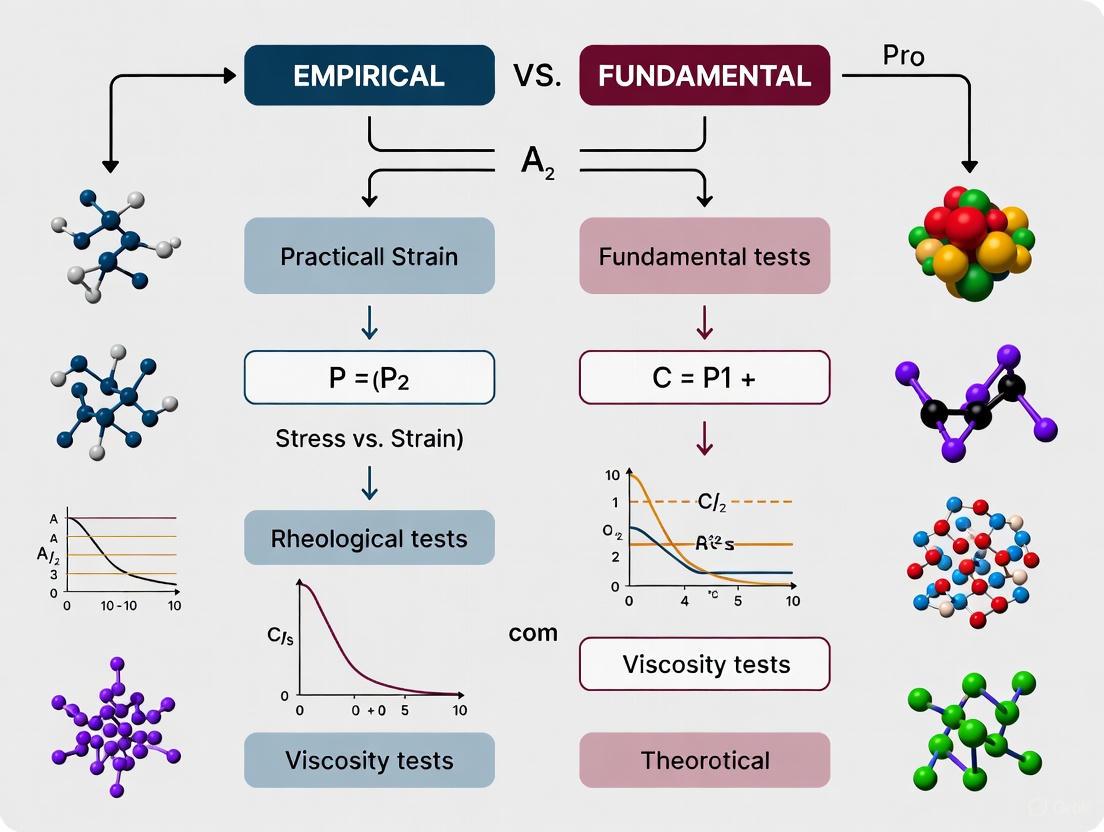
This article provides a comprehensive comparison of empirical and fundamental rheological testing methodologies, tailored for researchers and professionals in drug development.
Empirical vs. Fundamental Rheological Tests: A Comparative Guide for Pharmaceutical Researchers
Abstract
This article provides a comprehensive comparison of empirical and fundamental rheological testing methodologies, tailored for researchers and professionals in drug development. It explores the foundational principles of both approaches, detailing their specific applications in pharmaceutical formulation—from topical creams to injectables. The content delivers practical strategies for troubleshooting quality control issues, optimizing manufacturing processes, and validating methods to ensure batch consistency, patient safety, and regulatory compliance. By synthesizing current research and industry trends, this guide serves as a vital resource for selecting and integrating the appropriate rheological techniques to enhance product efficacy and streamline development pipelines.
Understanding Rheology: Core Principles and Test Philosophies
Defining Rheology: The Science of Deformation and Flow
Rheology is the science that studies the deformation and flow of matter under the action of external forces [1] [2]. It occupies the crucial middle ground between the behavior of ideal elastic solids, which store energy, and ideal viscous liquids, which dissipate it. Most real-world materials, from foods and pharmaceuticals to biological tissues, are viscoelastic, exhibiting a combination of both solid-like and liquid-like characteristics [3] [2]. The formal concept of rheology was first proposed by American physicist E. C. Bingham in 1920, and it has since grown into an interdisciplinary field essential to physics, chemistry, engineering, medicine, and biology [1].
A core objective of rheology is to understand the relationship between the stress (force per unit area) applied to a material and the resulting strain (deformation) or rate of strain (flow) over time, often expressed through mathematical constitutive equations [1]. This study encompasses phenomena like yield stress (the stress required to initiate flow), plastic viscosity, and thixotropy (the time-dependent decrease in viscosity under shear) [1]. Rheological measurements are vital for linking a material's underlying structure to its performance in processing, application, and end-use, making it an indispensable tool for material design and quality control [2].
Table of Contents
- Fundamental versus Empirical Rheological Testing
- Comparative Analysis: Performance and Data
- Experimental Protocols in Rheology
- Essential Research Reagent Solutions
- Conclusion
Fundamental versus Empirical Rheological Testing
Rheological characterization methods are broadly classified into two categories: fundamental and empirical tests. The choice between them depends on the research goals, the need for absolute physical values versus practical benchmarks, and the nature of the material itself.
Fundamental tests apply a well-defined stress or strain to a sample with a controlled geometry and measure the resulting response. The key advantage is that the results are expressed in absolute units (e.g., Pascals for stress, Pascal-seconds for viscosity) and represent intrinsic material properties, independent of the instrument or geometry used [4] [5]. This allows for rigorous scientific interpretation, direct comparison between different studies, and the use of data in predictive models.
Empirical tests, in contrast, simulate a real-world process—such as mixing, stretching, or extruding—under conditions that are complex and not easily defined in fundamental terms [4]. While they are often highly practical and can correlate well with end-use performance, they provide data in arbitrary units [4]. The applied stress and strain states are uncontrolled and non-uniform, making it impossible to define true rheological properties [4].
The following diagram illustrates the logical relationship and primary applications of these two testing approaches.
Comparative Analysis: Performance and Data
The performance of fundamental and empirical rheological tests can be compared by examining their application across different industries and the type of data they generate. The following table summarizes key performance indicators and experimental data for various material types.
Table 1: Comparative Performance of Rheological Testing Methods
| Material / Industry | Test Objective | Empirical Method & Data | Fundamental Method & Data | Comparative Performance Insight |
|---|---|---|---|---|
| Wheat Flour Dough [4] | Predict baking quality & dough strength | Method: Farinograph, Extensograph, Alveograph.Data: Water Absorption (%), Stability (min), Extensibility (mm), Resistance (BU). | Method: Large Amplitude Oscillatory Shear (LAOS), Lubricated Squeezing Flow.Data: Shear Stress (Pa), Normal Force (N), Elastic Modulus G' (Pa). | Fundamental LAOS differentiates between functionally different flours under large, process-relevant deformations, whereas small-strain tests often cannot. Empirical tests provide established but arbitrary indices for quality control. |
| Pharmaceutical Topical Cream [6] | Balance structural stability & user spreadability | Method: Texture Analyzer (penetration test).Data: Firmness (g), Hardness (g). | Method: Oscillatory Rheometry (Amplitude Sweep).Data: Yield Stress (Pa), Storage/Loss Modulus G', G" (Pa). | Fundamental analysis quantifies yield stress for stability and modulus for structure, enabling precise formulation. Empirical tests give a comparative measure of "stiffness" but lack fundamental insight. |
| Biological Soft Tissue (Liver) [7] [8] | Characterize viscoelasticity for disease diagnosis | Method: Manual Palpation.Data: Subjective "soft" or "stiff" assessment. | Method: Shear Wave Elastography & Stress Relaxation.Data: Shear Wave Speed (m/s), Complex Shear Modulus G* (kPa), Relaxation Modulus (kPa). | Fundamental models (e.g., Kelvin-Voigt Fractional Derivative) provide >96% accurate, quantitative biomarkers (elasticity, viscosity) from wave dispersion and relaxation data, surpassing subjective empirical palpation. |
| Food Emulsion (Mayonnaise) [5] | Assess stability and texture under shear | Method: Flow Cup.Data: Efflux Time (seconds). | Method: Rotational Rheometry (Flow Curve).Data: Viscosity (Pa·s) vs. Shear Rate (1/s). | Fundamental flow curves reveal shear-thinning behavior and yield stress, directly predicting stability and in-mouth texture. Empirical efflux time only gives a single-point viscosity under ill-defined flow conditions. |
Experimental Protocols in Rheology
To ensure reproducibility and accuracy in rheological characterization, standardized experimental protocols are essential. Below are detailed methodologies for key tests cited in the comparative analysis.
Protocol for Fundamental Analysis: Stress Relaxation of Soft Tissues
This protocol is used to characterize the time-dependent viscoelastic behavior of materials like bovine liver, as employed in studies evaluating rheological models for elastography [7] [8].
- Sample Preparation: Obtain fresh ex vivo bovine liver. Cut cylindrical samples (e.g., 20mm diameter, 15mm height) using a coring tool and surgical blade. Immerse samples in isotonic saline solution (0.9% sodium chloride) to prevent dehydration.
- Instrument Setup: Use a controlled-strain rheometer equipped with a parallel plate geometry. Set the test temperature to a physiologically relevant level (e.g., 25°C or 37°C). Bring the upper plate to a defined gap position, lightly compressing the sample to ensure full contact and prevent slip (textured plates may be used).
- Strain Application (Ramp-and-Hold): Apply a strain function in two successive steps as defined by Equation 5 in the research [7]:
- Ramp Phase (
t < T0): Deform the sample with a linear ramp strainε(t) = (ε0/T0)*tuntil the desired final strain levelε0is achieved. A typicalT0is 0.1 seconds. - Hold Phase (
t ≥ T0): Maintain the constant strainε0for a prolonged period (e.g., 100 seconds).
- Ramp Phase (
- Data Acquisition: Measure the resulting normal force or shear stress
σ(t)throughout the entire experiment. The decay of stress during the hold phase is the stress relaxation response. - Data Analysis: Fit the time-domain stress relaxation data to a rheological model (e.g., the Kelvin-Voigt Fractional Derivative model) to extract parameters such as the relaxation modulus and fractional derivative exponent [7] [8].
Protocol for Empirical Testing: Farinograph of Wheat Flour Dough
This protocol outlines the standard empirical method for assessing the mixing properties and water absorption of wheat flour dough [4].
- Sample Preparation: Weigh a predefined amount of wheat flour (typically 50g or 300g, depending on the instrument bowl size) according to the standard method.
- Instrument Setup: Use a Farinograph equipped with a mixing bowl and Z-blade mixers. Set the instrument temperature to a constant value (e.g., 30°C).
- Water Titration: While the mixer is running, titrate water from a burette into the flour. The goal is to achieve a specific consistency, defined as a torque of 500 Brabender Units (BU). The amount of water required is recorded as the Water Absorption.
- Data Acquisition: Continue mixing the dough for a set time (e.g., 12-20 minutes) after water addition. The instrument records torque (in BU) versus time.
- Data Analysis: From the resulting curve (see workflow below), key empirical parameters are extracted:
- Arrival Time: Time for the curve to first reach the 500 BU line.
- Dough Development Time: Time from first water addition to the peak consistency.
- Stability: The difference in time between the point where the top of the curve first and last intersects the 500 BU line.
- Softening: The difference in BU between the peak consistency and the consistency at a specified time after the peak.
The following workflow diagrams the steps for both the fundamental and empirical protocols.
Essential Research Reagent Solutions
A successful rheological analysis relies on both sophisticated instrumentation and specific reagent solutions. The following table details key materials and their functions in various experimental contexts.
Table 2: Essential Reagents and Materials for Rheological Research
| Item | Function / Description | Example Application Context |
|---|---|---|
| Cytoskeletal Proteins (Actin, Tubulin) [3] | Purified proteins that form biopolymer networks in vitro to model the intracellular cytoskeleton. Used to study fundamental gelation mechanics. | Investigating the viscoelastic transition of the cytoplasm and the role of cross-linking proteins in cell mechanics [3]. |
| Actin Cross-linking Proteins (e.g., Filamin) [3] | Proteins that introduce molecular bridges between actin filaments, transforming a viscous suspension into an elastic gel. | Used in titration experiments to quantitatively assess how cross-linker concentration controls network elasticity and yield stress [3]. |
| Superplasticizer (SP) [1] | A high-range water-reducing admixture used to modify the rheology of cementitious suspensions without affecting the water content. | Studying the workability and flow of recycled concrete aggregates; the effectiveness of SP can be hindered by certain aggregates [1]. |
| Isotonic Saline Solution (0.9% NaCl) [8] | An aqueous solution of sodium chloride that matches the osmotic pressure of biological tissues. Used to preserve sample integrity. | Maintaining hydration and preventing structural changes in ex vivo soft tissue samples (e.g., bovine liver) during mechanical testing [8]. |
| Xanthan Gum & Other Hydrocolloids [5] | Polysaccharides used as thickeners and stabilizers to control the rheology of fluid and semi-solid materials. | Modifying the viscosity, yield stress, and thixotropy of food emulsions like mayonnaise and salad dressings [5]. |
The comparison between empirical and fundamental rheological tests reveals a clear, complementary relationship. Empirical methods provide invaluable, rapid benchmarks for quality control and performance prediction in industrial settings, leveraging their strong correlation to specific process or product outcomes. Conversely, fundamental methods deliver absolute, model-ready material properties that are essential for research and development, enabling deep scientific understanding, precise formulation optimization, and predictive modeling across the widest range of conditions.
The choice of methodology should be guided by the specific problem: empirical tests for solving a known, practical issue quickly, and fundamental tests for generating new knowledge, developing new materials, or troubleshooting complex structural failures. As the field advances, particularly in areas like biological rheology and complex soft materials, the integration of both approaches—using fundamental principles to explain empirical observations—will continue to be the most powerful strategy for innovation.
Rheology, the study of the deformation and flow of matter, is crucial for predicting material behavior in industrial processes ranging from drug development to food manufacturing [9]. Within this field, two complementary approaches are used: empirical rheology and fundamental rheology. Empirical rheological techniques simulate practical process conditions using equipment that replicates real-world deformations, such as mixing, extrusion, or spreading, providing data that has historically been correlated with end-product quality [10]. In contrast, fundamental rheology characterizes intrinsic material properties under well-defined, controlled deformation fields, yielding absolute scientific units like shear stress (Pa) and viscosity (Pa·s) [10] [9]. This guide objectively compares the performance of these two methodologies, underscoring their respective roles in research and development, particularly for pharmaceutical scientists and researchers framing their work within the broader thesis of empirical versus fundamental testing.
The core distinction lies in their design and output. Empirical methods, utilizing instruments like the Farinograph, Alveograph, or slump test, subject materials to complex, simultaneous deformations (shear, compression, extension) that mimic industrial processing [10] [11]. While invaluable for quality control, a significant limitation is that they provide data in arbitrary units, making fundamental interpretation of results challenging [10]. Fundamental methods, performed with rheometers, apply a single, well-defined type of deformation, allowing for the precise calculation of rheological parameters and direct comparison of data across different studies and laboratories [10].
Comparative Performance Analysis
Key Characteristics and Applications
Table 1: Comparison of Empirical and Fundamental Rheological Methods
| Feature | Empirical Rheology | Fundamental Rheology |
|---|---|---|
| Data Output | Arbitrary, instrument-specific units [10] | Absolute units (e.g., Pa, Pa·s) [10] |
| Deformation Field | Complex, uncontrolled, and non-uniform [10] | Simple, well-defined, and controlled [10] |
| Primary Use Case | Quality control, direct prediction of process performance [12] | Fundamental material characterization, research & development [13] |
| Correlation to Practice | High, as it directly simulates process conditions [14] | Requires modeling to connect to complex processes [10] |
| Sample Consumption | Typically larger | Can be very small [10] |
| Example Instruments | Farinograph, Alveograph, Slump Test [10] [11] | Controlled-stress/strain rheometer (e.g., TA Instruments Discovery Core) [6] |
Quantitative Data from Comparative Studies
Direct comparisons in scientific literature highlight the synergistic relationship between these two approaches.
Table 2: Experimental Data Comparing Rheological Approaches in Different Fields
| Material / Field | Empirical Parameters | Fundamental Parameters | Observed Correlation & Findings |
|---|---|---|---|
| Wheat Flour Dough [14] | Alveograph parameters (Tenacity, Extensibility), Water Absorption | Storage Modulus (G'), Loss Modulus (G"), Viscosity | "High correlation" was found between empirical and fundamental parameters, allowing for the prediction of alveograph data of bran-enriched dough from fundamental tests. |
| Concrete [11] | Slump (mm) | Yield Stress (Pa), Plastic Viscosity (Pa·s) | The single-point slump test only measures yield stress approximately. Two concretes with the same slump can behave differently due to variations in plastic viscosity, which only a two-point fundamental test can capture. |
| Topical Creams [13] | (Sensory properties like spreadability) | Yield Point, Thixotropic Area, Storage/Loss Modulus | Fundamental parameters like oscillatory yield point and thixotropic relative area are highly discriminatory and can be scientifically linked to sensory attributes and stability. |
Experimental Protocols for Rheological Testing
Protocol for Empirical Dough Testing with an Alveograph
The Alveograph test measures the biaxial extensibility of dough, simulating the inflation of a dough bubble during proofing [10].
- Sample Preparation: A standardized dough is prepared from wheat flour and salted water. The water absorption can be fixed or adjusted to a target consistency.
- Dough Resting: The prepared dough is allowed to rest for a predetermined period (e.g., 20 minutes) to allow for hydration and gluten development.
- Sheet Formation: The dough is rolled into a standardized sheet using the instrument's rollers.
- Specimen Cutting: Multiple dough disks are cut from the sheet.
- Testing: A dough disk is clamped over a circular hole and inflated into a bubble by air pressure until it ruptures.
- Data Acquisition: The instrument records the pressure curve over time. Key parameters extracted include:
- P (Tenacity): The overpressure required to blow the bubble, related to dough resistance.
- L (Extensibility): The abscissa at the bubble rupture, representing the bubble's volume.
- W (Baking Strength): The deformation energy, calculated as the area under the curve.
Protocol for Fundamental Analysis via Flow Curve Viscosity
This rotational test measures the shear-dependent viscosity of a material, critical for processes like pumping, spraying, or mixing [6] [9].
- Instrument and Geometry Selection: A controlled-stress or controlled-rate rheometer (e.g., TA Instruments Discovery Core) is used with a geometry suited to the sample, such as a cone-plate or parallel plate system. Textured plates are often used for semi-solids to prevent wall slip [6].
- Sample Loading: The sample is loaded onto the bottom plate, and the upper geometry is lowered to the defined measuring gap, ensuring no air bubbles are entrapped.
- Temperature Equilibration: The sample is equilibrated to the precise test temperature (e.g., 25°C for storage, 37°C for skin application) using the instrument's Peltier system [6].
- Shear Profile Application: A shear rate ramp is applied, typically starting from a low rate (e.g., 0.01 s⁻¹) to a high rate (e.g., 1000 s⁻¹), to simulate different process conditions from settling to application.
- Data Analysis: The rheometer software records the shear stress (τ) and calculates viscosity (η) at each shear rate. The data is plotted as a flow curve (viscosity vs. shear rate) and often fitted to a rheological model (e.g., Power-Law, Herschel-Bulkley) to quantify shear-thinning behavior and yield stress.
Workflow for Correlating Rheological Methods
The following diagram illustrates a logical workflow for integrating empirical and fundamental rheology to predict final product quality, a methodology demonstrated in wheat flour and pharmaceutical cream studies [14] [13].
The Scientist's Toolkit: Essential Research Reagent Solutions
Table 3: Key Instruments and Materials for Rheological Analysis
| Item | Function / Application |
|---|---|
| TA Instruments Discovery Core Rheometer | A high-performance, user-friendly rheometer for fundamental testing of pharmaceuticals. It provides precise temperature control and automated workflows for tests like viscosity curves and creep-recovery [6]. |
| Farinograph | An empirical mixer that measures torque during dough mixing, providing data on water absorption, dough development time, and stability, which are critical for baking quality [10]. |
| Alveograph | An empirical tester that measures the biaxial extensional properties of dough by inflating it into a bubble, simulating the stress during oven rise [14] [10]. |
| Cone-Plate Measuring System | A fundamental rheometry geometry (ISO 3219) that provides a constant shear rate across the sample gap, ideal for homogeneous fluids and pastes [9]. |
| Textured Parallel Plates | A fundamental rheometry geometry with roughened surfaces to prevent wall slip when testing semi-solid materials like creams and concentrated suspensions [6]. |
| Herschel-Bulkley Model | A mathematical model used to fit flow curve data, defining yield stress, consistency, and flow index. It is superior to the Bingham model for many complex fluids like drilling muds and creams [15]. |
In the characterization of material flow and deformation, a central dichotomy exists between empirical tests and fundamental rheometry. Empirical methods provide relative, device-specific measurements that are often simple to perform but difficult to correlate across different instruments or laboratories [9]. In contrast, fundamental rheology aims to measure absolute material properties—such as viscosity, yield stress, and viscoelastic moduli—which are intrinsic to the material itself and independent of the specific measuring device or geometry used [9] [16]. This guide objectively compares the performance of a modern discovery core rheometer against traditional empirical methods and single-point viscometers, providing supporting experimental data within the context of pharmaceutical and material science research.
Comparative Experimental Data: Rheometer vs. Alternative Methods
The capability of different instruments to characterize complex fluids is demonstrated through comparative testing on a range of materials. The data below summarize the performance of a fundamental rheometer against a rotational viscometer and an empirical flow cup.
Table 1: Capability Comparison of Rheological Measurement Instruments
| Measurement Attribute | Fundamental Rheometer | Rotational Viscometer | Empirical Flow Cup |
|---|---|---|---|
| Measured Parameters | Shear stress (τ), Shear rate ( $\dot{\gamma}$ ), Viscosity (η), Yield Stress (τyield), Viscoelastic Moduli (G′, G″) | Apparent Viscosity | Efflux time (seconds) |
| Output | Flow curves, viscosity curves, viscoelastic spectra | Single-point or multi-speed viscosity | Single time measurement |
| Shear Rate Control | Wide, controlled range (e.g., 0.001 to 1000 s⁻¹) | Limited or fixed range | Uncontrolled, dependent on fluid level |
| Data Reproducibility | High (Absolute measuring systems) [9] | Moderate to Low | Very Low (Relative measuring system) [9] |
| Sample Insight | Fundamental, absolute properties; microstructure | Bulk flow resistance | Relative flow behavior |
| Example: Shampoo (η at 50 s⁻¹) | 2.1 Pa·s | 2.0 Pa·s | Not Applicable |
| Example: Syrup (η at 50 s⁻¹) | 5.8 Pa·s | 5.9 Pa·s | Not Applicable |
| Yield Stress (τyield) Detection | Yes (via amplitude sweep or flow ramp) [16] | No | No |
Table 2: Experimental Viscosity Data Across Shear Rates for a Topical Ointment
| Shear Rate (s⁻¹) | Viscosity (Pa·s) from Rheometer | Viscosity (Pa·s) from Viscometer |
|---|---|---|
| 0.001 | 850.0 | Not Attainable |
| 0.1 | 820.5 | Not Attainable |
| 1 | 105.3 | 102.0 |
| 10 | 15.2 | 15.5 |
| 50 | 4.1 | 4.0 |
| 100 | 2.3 | 2.3 |
| 1000 | 0.5 | 0.5 |
The data in Table 2 highlights a critical limitation of viscometers: their inability to measure viscosity at very low shear rates, which is essential for understanding material behavior at rest (e.g., shelf stability, particle settling) [16]. The rheometer provides a complete viscosity profile, revealing the shear-thinning nature of the ointment.
Table 3: Thixotropic Loop Test Data for Two Paints
| Paint Sample | Thixotropic Area (Pa/s) | Upward Curve Peak Viscosity (Pa·s) | Downward Curve Peak Viscosity (Pa·s) |
|---|---|---|---|
| Paint A | 50,000 | 12.5 | 9.8 |
| Paint B | 500 | 5.1 | 5.0 |
As shown in Table 3, the rheometer can quantify thixotropy—a reversible, time-dependent shear thinning. Paint A has a thixotropic area a hundred times larger than Paint B, indicating it recovers its structure much more slowly after shearing. This has direct implications for application properties; low thixotropy can lead to brush marks, while high thixotropy may cause sagging [16].
Detailed Experimental Protocols
Protocol 1: Flow Sweep for Viscosity Profile and Yield Stress
This protocol establishes the steady-state flow curve and identifies the yield stress, the critical stress required to initiate flow [16] [13].
- Instrument Setup: Use a Discovery Core Rheometer equipped with a 40 mm cross-hatched parallel plate geometry. The cross-hatching helps mitigate wall slip, which is common in structured fluids like creams and pastes [16].
- Loading and Gap Setting: Load the sample (e.g., topical ointment) onto the lower plate and bring the upper plate to a defined gap (e.g., 1.0 mm). Trim excess sample and allow a 5-minute rest period for sample relaxation and temperature equilibration to 25°C.
- Shear Rate Ramp: Program a controlled shear rate (CSR) ramp from 0.001 s⁻¹ to 1000 s⁻¹, using a logarithmic progression.
- Equilibration Criteria: To ensure data points are collected at steady state, set the maximum equilibration time per point based on a prior constant shear rate test at the lowest rate (0.001 s⁻¹). This may require 10 minutes or more per point at the lowest rates to avoid artifacts [16].
- Data Acquisition: Measure the resulting shear stress (τ) at each shear rate ( $\dot{\gamma}$ ). Viscosity (η) is calculated as η = τ / $\dot{\gamma}$ [9].
- Yield Stress Analysis: Fit the low-shear-rate data to appropriate rheological models (e.g., Herschel-Bulkley) to extrapolate the yield stress (τyield) [17].
Protocol 2: Oscillatory Amplitude Sweep for Linear Viscoelastic Region (LVER) and Structural Strength
This protocol characterizes the viscoelastic structure without causing irreversible breakdown, determining the critical strain limit and structural modulus [13].
- Instrument Setup: Use the same rheometer and geometry as in Protocol 1.
- Loading and Rest: Identical to steps 1 and 2 of Protocol 1.
- Frequency Setting: Set a constant angular frequency (e.g., 10 rad/s) within the linear viscoelastic region.
- Strain Ramp: Program an oscillatory strain amplitude ramp from 0.01% to 1000%, using a logarithmic progression.
- Data Acquisition: Measure the Storage Modulus (G′, elastic response) and Loss Modulus (G″, viscous response) as a function of applied strain.
- Analysis: Identify the end of the Linear Viscoelastic Region (LVER) as the point where G′ deviates by a set percentage (e.g., 5-10%) from its plateau value. The oscillatory yield point is often defined as the stress or strain where G′ = G″ (the crossover point) [13].
The Scientist's Toolkit: Essential Research Reagent Solutions
Table 4: Key Materials and Instruments for Fundamental Rheology
| Item | Function/Description | Example Use Case |
|---|---|---|
| Discovery Core Rheometer | Instrument for applying controlled shear stress or shear rate and measuring the material's response. Enables measurement of absolute rheological properties [16]. | Comprehensive characterization of viscosity, yield stress, and viscoelasticity. |
| Absolute Measuring Geometries | Cone-plate, parallel plate (smooth or cross-hatched), and concentric cylinder systems defined by standards like ISO 3219. Ensure absolute, comparable viscosity data [9]. | Cone-plate for uniform shear; parallel plates for pastes & suspensions; concentric cylinders for low-viscosity fluids [9]. |
| Viscosity Reference Standard | A fluid with a known, temperature-dependent viscosity. Used for qualifying and verifying the calibration of the rheometer [13]. | Routine instrument performance verification (e.g., RT5000 standard). |
| Hydrocolloid Model System (e.g., 0.5% Basil Seed Gum) | A non-Newtonian, shear-thinning model fluid for method development and validation [17]. | Testing and comparing rheological models (Power Law, Herschel-Bulkley). |
| Topical Semisolid Formulation (e.g., 1% Hydrocortisone Cream) | A complex, multiphase model system representative of pharmaceutical products [13]. | Studying microstructure, stability, and bioequivalence through rheology. |
In the realm of pharmaceutical sciences, rheology—the study of the flow and deformation of matter—transcends mere texture analysis to become a fundamental predictor of product efficacy, stability, and manufacturability. The rheological characterization of drug products hinges on two complementary philosophical approaches: empirical rheology and fundamental rheology. Empirical methods, such as those using an alveograph for dough or simple viscometers, measure properties under conditions mimicking process or application use, but the results are dependent on the specific instrument and geometry used [14]. In contrast, fundamental rheology measures intrinsic material properties, such as absolute viscosity, yield stress, and viscoelastic moduli (G′ and G″), which are independent of the instrument [18] [19]. For pharmaceutical researchers and drug development professionals, the choice between these approaches is critical. While empirical tests can offer rapid, product-specific insights, fundamental rheology provides universally comparable data that can predict stability, control drug release rates, and ensure batch-to-batch consistency, ultimately forming the scientific bedrock for regulatory submissions and quality control protocols [18] [19] [6].
This guide provides a comparative analysis of these methodologies, focusing on the core parameters of viscosity, yield stress, viscoelasticity, and thixotropy, and their indispensable role in formulating modern pharmaceuticals.
Comparative Analysis of Rheological Parameters and Methods
The following section synthesizes the purpose, measurement techniques, and pharmaceutical significance of the four key parameters, providing a direct comparison between empirical and fundamental approaches.
Table 1: Comparison of Key Rheological Parameters in Pharmaceuticals
| Parameter | Fundamental Definition | Common Empirical Tests | Common Fundamental Tests | Pharmaceutical Significance |
|---|---|---|---|---|
| Viscosity | A fluid's internal resistance to flow [18]. | Single-point viscosity measurement with a viscometer [18] [20]. | Flow curve (viscosity vs. shear rate) performed with a rheometer [18] [6]. | Determines ease of injection, syringability, and flow behavior during manufacturing (e.g., mixing and pumping) [18] [6]. |
| Yield Stress | The minimum stress required to initiate flow, transitioning from solid-like to fluid-like behavior [18] [21]. | Penetrometry, slump tests [21]. | Herschel-Bulkley model fit from flow curves; stress at which G′ drops in an amplitude sweep [21] [22]. | Prevents ingredient sedimentation in suspensions and ensures topical creams maintain structure in the package [18] [6]. |
| Viscoelasticity | The simultaneous display of viscous (energy-loss) and elastic (energy-storage) properties [19] [23]. | Texture Profile Analysis (TPA), spreadability tests [23]. | Oscillatory amplitude and frequency sweeps to measure storage (G′) and loss (G″) moduli [19] [23] [24]. | Controls the "spreadability" and "stand-up" of creams/gels; critical for mucoadhesive retention in buccal or nasal formulations [19] [6]. |
| Thixotropy | A time-dependent, reversible decrease in viscosity under shear, followed by a gradual recovery when the stress is removed [18] [23]. | Qualitative assessment of recovery after stirring. | Quantitative recovery measured via thixotropy loop tests or 3-interval thixotropy tests [24] [22]. | Ensures nasal sprays spray easily but gel in the nasal cavity; allows creams to spread easily then thicken on the skin [18]. |
Empirical vs. Fundamental Rheology: A Detailed Comparison
Table 2: Direct Comparison of Empirical and Fundamental Rheological Approaches
| Aspect | Empirical Rheology | Fundamental Rheology |
|---|---|---|
| Measured Properties | Instrument-dependent, comparative values (e.g., "Bostwick consistency") [14]. | Intrinsic material properties (e.g., absolute viscosity in Pa·s, Elastic Modulus G′ in Pa) [14] [19]. |
| Primary Instrumentation | Viscometers, alveographs, texture analyzers [14] [20]. | Rotational and oscillatory rheometers [18] [6]. |
| Data Output | Often a single data point under specific conditions [18]. | Rich, multi-point data across a range of conditions (shear rates, temperatures, strains) [18] [6]. |
| Correlation to Performance | Directly correlates to a specific process or application step [14]. | Fundamentally linked to microstructure and composition; can predict performance across multiple scenarios [14] [19]. |
| Primary Application | Rapid quality control (QC) for established products, product-specific benchmarking [14] [20]. | Research & Development (R&D), formulation optimization, root-cause analysis, and building scientific understanding [18] [6]. |
| Limitations | Data cannot be used for predictive modeling outside the specific test condition; results from different empirical methods are often incomparable [14]. | Requires more sophisticated instrumentation and operator expertise [6]. |
A key study on wheat flour dough perfectly illustrates the synergy between the two approaches. It found that empirical and fundamental rheology are highly correlated, allowing researchers to use fundamental measurements to predict empirical parameters like alveograph results, even for complex, bran-enriched doughs that are difficult to test with standard empirical methods alone [14]. This coupling is equally powerful in pharmaceuticals, where fundamental rheology can predict a drug's performance, such as the release rate of an API from a hydrogel based on its viscoelastic properties [19].
Experimental Protocols for Fundamental Rheological Characterization
This section details standard operating procedures for fundamental rheology tests, which are critical for robust formulation development.
Amplitude Sweep: Determining the Linear Viscoelastic Region (LVR) and Yield Point
Purpose: To identify the Linear Viscoelastic Region (LVR) and determine the yield stress/strain, which is crucial for understanding structural stability at rest [19] [22].
- Instrumentation: A rotational rheometer equipped with a Peltier temperature control system and parallel plate geometry is used [22]. Textured plates or serrated geometries are recommended for semi-solids to prevent sample slip [6].
- Method: An oscillatory test is performed at a constant frequency (e.g., 1 Hz) while the strain or stress amplitude is progressively increased [19] [24].
- Data Analysis: The storage modulus (G′) remains constant in the LVR. The yield point is identified as the point where G′ drops significantly, indicating structural failure. The stress or strain at this point is reported as the yield stress or yield strain [21] [22]. The crossover point where G′ = G″ can also be used as a yield criterion, though it typically gives a higher value [21].
Frequency Sweep: Characterizing Viscoelastic Character
Purpose: To characterize the time-dependent viscoelastic nature of a material and identify its gel point or dominant behavior [19].
- Instrumentation: Same as for the amplitude sweep.
- Method: An oscillatory test is performed within the previously determined LVR (constant strain) while the oscillation frequency is varied over a wide range (e.g., 0.1 to 100 rad/s) [19].
- Data Analysis: The response of G′ and G″ across the frequency spectrum reveals the material's character. A gel-like or solid-like material is dominated by elasticity (G′ > G″ across the range). A liquid-like material is dominated by viscosity (G″ > G′ at low frequencies). The crossover frequency where G′ = G″ indicates the sol-gel transition time scale [19].
Flow Curve and Thixotropy: Quantifying Viscosity and Recovery
Purpose: To measure viscosity as a function of shear rate (flow curve) and quantify time-dependent structural recovery (thixotropy) [18] [24].
- Instrumentation: A rotational rheometer with precise temperature control.
- Method - Flow Curve: A controlled shear rate (CSR) or controlled shear stress (CSS) test is performed, where the shear rate is increased from a low to a high value, then decreased back. This identifies shear-thinning behavior and any hysteresis [6] [24].
- Method - Thixotropy: A three-interval thixotropy test (3ITT) is ideal. Interval 1: Low shear to measure viscosity at rest. Interval 2: High shear to break down the structure. Interval 3: Immediate return to low shear to monitor the time-dependent recovery of viscosity [22]. The area of the hysteresis loop in a flow curve can also give an indication of thixotropy [24].
Visualization of Rheological Testing Workflows
The following diagrams map the logical workflows for selecting and interpreting key rheological tests.
Diagram 1: Experimental Workflow for Key Rheological Tests. This chart outlines the standard procedural steps for conducting three fundamental rheological tests that characterize structure, viscoelasticity, and time-dependent flow.
Diagram 2: Interpreting Viscoelastic Moduli (G′ and G″). This decision chart guides the interpretation of storage (G′) and loss (G″) moduli to determine the dominant physical character of a material.
The Scientist's Toolkit: Essential Reagents and Materials
Table 3: Key Research Reagent Solutions in Rheological Studies
| Material/Reagent | Function in Rheological Studies | Example Applications |
|---|---|---|
| Gelling Polymers (Hyaluronic Acid, Alginate, Carbopol) | Form viscoelastic hydrogel networks. Used to model and tune the rheological properties of formulations [19] [21]. | Ophthalmic visco-surgery, intra-articular injections, topical drug delivery gels [19]. |
| Structured Emulsions | Model systems for semi-solid creams and lotions. Their biphasic nature creates yield stress and thixotropy [18] [22]. | Dermatological creams, antibiotic ointments [18] [6]. |
| Oral Suspensions (e.g., Infant Ibuprofen) | Model systems for studying suspension rheology, sedimentation, and redispersion [18] [6]. | Pediatric and geriatric liquid medicines [18] [6]. |
| Carbopol Gel | A classic, well-behaved ("simple") yield-stress fluid used for method calibration and fundamental studies of yielding behavior [21]. | Used as a reference material in rheology labs to validate yield stress measurement protocols [21]. |
The strategic application of both empirical and fundamental rheology is paramount for successful drug development. While empirical methods offer speed and direct correlation for quality control, fundamental rheology provides the deep, predictive understanding required for innovative formulation and robust process design. As the pharmaceutical industry advances with more complex drug delivery systems—from personalized biologics to smart hydrogels—the precise quantification of viscosity, yield stress, viscoelasticity, and thixotropy will become even more critical. The experimental protocols and comparative data outlined in this guide provide a foundation for researchers to select the appropriate rheological toolkit, ensuring that drug products are not only stable and manufacturable but also deliver the intended therapeutic performance reliably to the patient.
Rheology, the study of how materials deform and flow, is fundamental to the development and quality control of pharmaceutical products. From topical creams to oral suspensions, a drug's efficacy often depends on its precise flow behavior under stress [18]. The two-plates model serves as the foundational conceptual framework for understanding and quantifying the key rheological parameters of shear stress and shear rate [9]. This model provides the theoretical basis for distinguishing between empirical tests, which correlate with observed properties, and fundamental tests, which determine true physical properties based on known physics concepts and equations [5].
In pharmaceutical research, the choice between empirical and fundamental testing approaches carries significant implications for product development. Empirical methods offer practical correlations but are often device-specific and not universally comparable. Fundamental methods, grounded in the two-plates model, provide absolute values that are independent of measuring system size and can be reliably compared across different laboratories and instruments [9]. This distinction is particularly crucial when establishing lot release protocols required by regulatory agencies like the FDA, where consistent and reproducible measurements directly impact patient safety and drug effectiveness [18].
Theoretical Foundation of the Two-Plates Model
The two-plates model provides a simplified but scientifically rigorous method for defining the fundamental rheological parameters. In this conceptualization, a sample is sandwiched between two parallel plates, with the lower plate stationary and the upper plate moving parallel to it [9]. This setup creates uniform, laminar flow conditions essential for precise measurement.
Defining Key Parameters
- Shear Stress ($\tau$): Defined as the ratio of the applied shear force (F) to the shear area (A), expressed in pascals (Pa): $\tau = F / A$ [9]. In a rheometer, this is measured indirectly through the torque at each measuring point.
- Shear Rate ($\dot \gamma$): Defined as the ratio of the velocity (v) between the plates to the shear gap (h), expressed in reciprocal seconds (s⁻¹): $\dot \gamma = v / h$ [9]. This represents the rate at which a material is being deformed.
- Viscosity ($\eta$): Defined as the ratio of shear stress to shear rate, expressed in pascal-seconds (Pa·s): $\eta = \tau / \dot \gamma$ [9]. This represents a material's resistance to flow.
Table 1: Fundamental Rheological Parameters in the Two-Plates Model
| Parameter | Symbol | Definition | Unit |
|---|---|---|---|
| Shear Stress | $\tau$ | $\tau = F / A$ | Pa (N/m²) |
| Shear Rate | $\dot \gamma$ | $\dot \gamma = v / h$ | s⁻¹ |
| Viscosity | $\eta$ | $\eta = \tau / \dot \gamma$ | Pa·s |
Experimental Approaches: Empirical vs. Fundamental Testing
Rheological characterization in pharmaceutical research follows two distinct methodological pathways: empirical and fundamental testing. Each approach offers different advantages and limitations for drug development applications.
Fundamental Testing Methods
Fundamental rheological tests are characterized by their ability to determine true physical properties based on established physics concepts and equations [5]. These methods account for the magnitude and direction of forces and deformations, requiring specific sample shapes and compositions to generate absolute values such as viscosity that are independent of the measuring system size [9]. Fundamental tests typically utilize standardized measuring geometries including:
- Cone-Plate: Features a conical rotor and flat plate with a constant shear rate across the sample.
- Parallel-Plate (or Plate-Plate): Consists of two parallel plates with variable gap settings, allowing for testing of samples containing particles or fillers.
- Concentric Cylinders: Comprises an inner and outer cylinder (bob and cup) suitable for low-viscosity fluids [9].
These systems form the basis for both rotational tests, which measure materials under continuous shear, and oscillatory tests, which apply alternating deformation to study viscoelastic properties [9] [18].
Empirical Testing Methods
Empirical methods measure rheological behavior under conditions that cannot be defined in terms of fundamental stress-strain relationships [5]. While these methods don't provide absolute values, they offer practical correlations with product performance and are often used when sample composition or geometry is too complex for fundamental analysis. Examples include flow cups, falling-ball viscometers, and other relative measuring systems that produce device-dependent results [9]. These methods remain valuable for quality control when they correlate with a specific property of interest, such as the spreadability of a topical cream or the pourability of a suspension [5].
Comparative Experimental Data: Method Performance Analysis
The selection between empirical and fundamental testing approaches involves careful consideration of measurement accuracy, applicability to specific formulations, and regulatory requirements.
Table 2: Comparison of Empirical vs. Fundamental Rheological Tests
| Parameter | Empirical Tests | Fundamental Tests |
|---|---|---|
| Theoretical Basis | Correlative relationships; device-specific | First principles physics; universally defined parameters |
| Measurement Output | Relative values; not comparable across devices | Absolute values (e.g., viscosity in Pa·s) |
| Sample Requirements | Flexible; accommodates complex geometries | Specific sample shapes and compositions required |
| Pharmaceutical Applications | Quick quality checks; spreadability tests | Formulation development; regulatory submission |
| Instrument Examples | Flow cups, falling-ball viscometers | Rotational rheometers with cone-plate, parallel-plate geometries |
| Data Interpretation | Correlation with observed properties | Determination of true material properties |
Advanced Fundamental Techniques: Tomo-Rheoscopy
Recent advancements in fundamental testing combine traditional rheometry with advanced imaging techniques. For instance, researchers have developed tomo-rheoscopy, which integrates shear rheometry with time-resolved X-ray micro-tomography [25]. This innovative approach addresses a significant limitation of standard rheometers, which provide only global macroscopic quantities without capturing heterogeneous flow at the mesoscopic scale.
In practice, tomo-rheoscopy has been applied to study liquid foams as model soft jammed materials, simultaneously capturing bubble-scale topological changes and stress distributions while measuring global shear stress [25]. This technique reveals how local stress build-up and relaxation associated with topological rearrangements (T1 events) follows universal scaling behavior, demonstrating how macroscopic elastoplastic behavior emerges from microstructural rearrangements [25]. Such advanced fundamental methods provide unprecedented insights into material behavior but require sophisticated instrumentation and analysis capabilities.
Experimental Protocols for Fundamental Rheological Analysis
Standard Rotational Test Protocol
Fundamental rotational tests using a rheometer typically follow one of two operation modes: Controlled Shear Rate (CSR) or Controlled Shear Stress (CSS) [9]. The selection depends on the simulated application, with CSR mimicking processes dependent on flow velocity and CSS simulating force-dependent applications.
A typical protocol involves:
- Geometry Selection: Choose appropriate measuring geometry (cone-plate, parallel-plate, or concentric cylinders) based on sample characteristics.
- Sample Loading: Apply sample to the measuring system, ensuring proper filling and elimination of air bubbles.
- Conditioning: Subject the sample to a pre-shear procedure to ensure consistent initial state and erase previous deformation history [25].
- Test Execution: Apply either a shear rate ramp (CSR) or shear stress ramp (CSS), typically ascending or descending in steps.
- Data Collection: Maintain each measuring point for at least one to two seconds to allow sample adaptation to each shear step [9].
Specialized Pharmaceutical Testing Protocol
For pharmaceutical hydrogels and topical treatments, oscillation tests provide crucial information about viscoelastic properties:
- Amplitude Sweep: At constant frequency and temperature, gradually increase deformation amplitude to determine the linear viscoelastic range and yield point.
- Frequency Sweep: At constant amplitude and temperature, vary frequency to characterize time-dependent behavior.
- Temperature Ramp: At constant frequency and amplitude, vary temperature to assess thermal stability [18].
These protocols help ensure that topical drugs maintain high viscosity at rest to prevent ingredient separation (sedimentation) while exhibiting shear-thinning behavior during application for easy spreadability [18].
Research Workflow: From Theory to Application
The following diagram illustrates the logical relationship between theoretical models, experimental approaches, and pharmaceutical applications in rheological testing:
The Scientist's Toolkit: Essential Research Reagents and Materials
Table 3: Essential Research Materials for Rheological Studies
| Item | Function/Application | Examples in Pharmaceutical Research |
|---|---|---|
| Rotational Rheometer | Measures fundamental rheological parameters under controlled stress or strain | Discovery Core Rheometer for pharmaceutical QC [18] |
| Standardized Geometries (Cone-Plate, Parallel-Plate, Concentric Cylinders) | Provide defined shear conditions for fundamental measurements | ISO 3219 standardized systems for absolute viscosity [9] |
| Organic Rheology Modifiers | Modify flow properties; often biodegradable | Cellulose derivatives in personal care products [26] |
| Inorganic Rheology Modifiers | Provide thixotropic and shear-thinning properties | Clays and silica in paints and coatings [26] |
| Temperature Control Systems | Maintain consistent temperature during testing | Peltier systems for pharmaceutical testing [18] |
| X-ray Micro-Tomography | Visualize internal structural changes during deformation | Tomo-rheoscopy for bubble-scale stress analysis [25] |
The two-plates model provides the essential theoretical foundation for quantifying shear stress and shear rate in pharmaceutical rheology. While empirical testing methods offer practical correlations for specific quality control applications, fundamental testing approaches grounded in this model provide the absolute values and true material properties necessary for robust formulation development and regulatory compliance. The choice between these approaches ultimately depends on the specific requirements of each pharmaceutical application, with fundamental methods offering superior scientific rigor for characterizing complex rheological behaviors such as shear-thinning, yield stress, and thixotropy in drug formulations. As pharmaceutical products grow more sophisticated, advanced techniques like tomo-rheoscopy that combine fundamental rheological measurements with microstructural analysis will continue to enhance our understanding of the relationship between a drug's microscopic structure and its macroscopic flow properties.
Applied Rheological Testing in Pharmaceutical Development and QC
Empirical Techniques for Rapid Screening and Formulation
In scientific research and development, particularly in fields like pharmaceuticals and material science, the approach to characterization and screening is often divided between empirical and fundamental methodologies. Empirical techniques provide practical, high-throughput data based on observable phenomena without requiring a complete understanding of the underlying mechanisms. In contrast, fundamental techniques seek to understand the basic principles and properties governing system behavior. This guide provides a comprehensive comparison of these approaches, focusing on their application in rapid screening and formulation processes, with specific examples from drug discovery and rheological testing.
The history of drug discovery reveals the enduring value of empirical approaches. As noted in screening methodologies for drug discovery, "about 62% of first-in-class small molecules New Molecular Entities (NMEs) registered by the FDA during 1999 to 2008 had their origin in a phenotypic [empirical] approach compared to 38% in a target-based drug discovery" [27]. This demonstrates the continued importance of empirical methods in generating breakthrough therapies, even as fundamental approaches have advanced significantly.
Comparative Framework: Empirical vs. Fundamental Techniques
Table 1: Core Characteristics of Empirical vs. Fundamental Approaches
| Feature | Empirical Techniques | Fundamental Techniques |
|---|---|---|
| Primary Focus | Observable outcomes and functional effects [27] | Underlying mechanisms and molecular interactions [27] |
| Throughput Capacity | High to ultra-high throughput [28] | Low to medium throughput |
| Data Output | Direct performance metrics (IC50, MIC, inhibition zones) [27] | Molecular properties, binding affinities, structural information [14] |
| Resource Requirements | Moderate, suitable for large compound libraries [27] | High, often requiring specialized equipment and expertise [14] |
| Typical Applications | Initial screening, formulation optimization, quality control [27] | Mechanism elucidation, lead optimization, formulation understanding [14] |
Methodological Comparison in Drug Discovery Screening
Phenotypic (Empirical) Screening Methods
Phenotypic screening represents a classical empirical approach that assesses compound effects on whole cells or organisms without predetermined molecular targets. This method has recently evolved into more sophisticated forms, including high-throughput pharmacotranscriptomics [28].
Experimental Protocol: Agar Disk-Diffusion for Antimicrobial Screening [27]:
- Prepare agar medium plates inoculated with the test microorganism
- Impregnate filter paper discs with test compounds or extracts
- Place impregnated discs on the inoculated agar surface
- Incubate plates at appropriate conditions for microbial growth
- Measure diameters of inhibition growth zones around discs
- Categorize results as susceptible, intermediate, or resistant based on zone size
This method's advantages include simplicity, low cost, and ability to test large numbers of compounds and microorganisms simultaneously. A significant limitation is the inability to distinguish between bactericidal and bacteriostatic effects, as growth inhibition does not necessarily indicate microbial death [27].
Target-Based (Fundamental) Screening Methods
Target-based screening begins with identifying specific molecular targets involved in disease pathways, then screening compounds for interactions with these targets. Fundamental approaches have been revolutionized by computational drug discovery methods that leverage massive chemical libraries and advanced modeling [29].
Experimental Protocol: Structure-Based Virtual Screening [29]:
- Select protein target and obtain 3D structure (X-ray crystallography, cryo-EM, or homology modeling)
- Prepare protein structure (add hydrogens, optimize side chains, define binding site)
- Screen ultra-large virtual libraries (billions of compounds) using molecular docking
- Rank compounds by predicted binding affinity and complementary interactions
- Select top candidates for synthesis and experimental validation
- Iteratively refine screening based on initial results
The fundamental shift in this area is the scale of screening possible. Recent advances enable "virtual screening of gigascale chemical spaces" with libraries containing billions of compounds, dramatically increasing the potential for identifying novel chemotypes [29].
Rheological Testing: A Case Study in Method Integration
The comparison between empirical and fundamental approaches extends beyond drug discovery into formulation science, as demonstrated by rheological testing of wheat flour dough.
Table 2: Empirical vs. Fundamental Rheology in Dough Characterization [14]
| Parameter | Empirical Rheology | Fundamental Rheology |
|---|---|---|
| Measurement Approach | Macroscopic deformation mimicking processing conditions | Basic rheological parameters under controlled deformation |
| Key Metrics | Dough development time, stability, extensibility [14] | Elastic modulus (G'), viscous modulus (G"), tan delta [14] |
| Equipment | Mixolab, alveograph, farinograph [14] | Dynamic shear rheometer [14] |
| Data Interpretation | Correlated with end-use performance | Based on first principles of material science |
| Flour Extraction Correlation | Higher extraction rate requires more water, longer development time [14] | Direct correlation between extraction rate and dough consistency [14] |
The research demonstrates that "empirical and fundamental rheology can be coupled for wheat dough characterization" and that these methods "are highly correlated" [14]. This integration is particularly valuable for complex formulations like bran-enriched dough that cannot be fully characterized by empirical methods alone.
Diagram 1: Integrated Empirical-Fundamental Rheology Workflow. This workflow shows how empirical and fundamental data are combined to optimize formulations.
High-Throughput Screening Technologies
Advanced Empirical Screening Platforms
Modern empirical screening has evolved beyond simple phenotypic observations to incorporate sophisticated omics technologies. Pharmacotranscriptomics-based drug screening (PTDS) represents a new class of screening that "can detect gene expression changes following drug perturbation in cells on a large scale" [28]. This approach occupies a middle ground between purely empirical phenotypic screening and target-based fundamental screening.
Table 3: Pharmacotranscriptomics Screening Modalities [28]
| Technology | Throughput | Data Output | Analysis Methods |
|---|---|---|---|
| Microarray | High | Genome-wide expression patterns | Ranking methods, enrichment analysis |
| Targeted Transcriptomics | Ultra-high | Focused gene panels | Unsupervised learning, pathway mapping |
| RNA-seq | Medium-high | Complete transcriptome | Supervised learning, AI-driven pattern recognition |
Statistical Analysis for Experimental Comparison
Regardless of the screening method employed, robust statistical analysis is essential for comparing experimental conditions. For quantitative data comparison between two experimental conditions, several statistical approaches are available:
Experimental Protocol: Statistical Comparison of Two Conditions [30] [31]:
- Formulate null hypothesis (H0: no difference between conditions) and alternative hypothesis (H1: significant difference exists)
- Select significance level (typically α = 0.05)
- Perform F-test to compare variances between datasets
- Based on variance comparison, select appropriate t-test (equal or unequal variances)
- Calculate t-statistic and compare to critical value
- Reject null hypothesis if |t-statistic| > critical value or if p-value < α
The essential components of this analysis include calculating the means, standard deviations, and sample sizes for both conditions, then applying the appropriate t-test formula:
[ t = \frac{\bar{X}1 - \bar{X}2}{sp \sqrt{\frac{1}{n1} + \frac{1}{n_2}}} ]
where ( s_p ) is the pooled standard deviation, ( \bar{X} ) represents sample means, and n represents sample sizes [30].
Essential Research Reagents and Materials
Table 4: Key Research Reagent Solutions for Screening and Formulation
| Reagent/Material | Function | Application Examples |
|---|---|---|
| FCF Brilliant Blue | Spectrophotometric standard | Quantitative analysis, standard curve generation [30] |
| Pasco Spectrometer | Absorbance measurement | Concentration determination, reaction monitoring [30] |
| Culture Media & Agar | Microbial growth support | Antimicrobial screening, disk-diffusion assays [27] |
| Reference Strains | Assay standardization | Quality control, method validation [27] |
| Volumetric Flasks | Precise solution preparation | Standard solution preparation, dilution series [30] |
| Cuvettes | Sample containment for spectroscopy | Spectrophotometric measurements [30] |
Comparative Performance Data
Table 5: Quantitative Comparison of Screening Method Performance
| Screening Method | Time Requirement | Cost per Compound | Hit Rate | False Positive Rate |
|---|---|---|---|---|
| Empirical Phenotypic | Medium-high | Medium | 0.1-1% | 5-15% |
| Target-Based HTS | High | High | 0.01-0.1% | 10-20% |
| Virtual Screening | Low | Very low | 1-10% | 20-40% [29] |
| Pharmacotranscriptomics | Medium | Medium-high | 0.5-2% | 5-10% [28] |
Diagram 2: Screening Method Selection Algorithm. This decision tree guides selection of appropriate screening methods based on library size, target information, and available resources.
The comparison between empirical and fundamental techniques for rapid screening and formulation reveals complementary strengths rather than competing methodologies. Empirical techniques provide rapid, functionally relevant data at scale, while fundamental approaches deliver mechanistic understanding and molecular insights. The most effective research strategies intelligently integrate both approaches, using empirical methods for initial screening and fundamental techniques for lead optimization and mechanism elucidation.
Recent advances demonstrate that "empirical and fundamental rheology are highly correlated" and that their combination is particularly valuable for characterizing complex formulations that cannot be adequately assessed by either method alone [14]. Similarly, in drug discovery, the emergence of pharmacotranscriptomics represents a hybrid approach that bridges the gap between purely empirical phenotypic screening and target-based fundamental approaches [28].
The future of screening and formulation lies in continued methodological integration, leveraging the scalability of empirical techniques with the mechanistic depth of fundamental approaches, accelerated by artificial intelligence and computational modeling. This synergistic relationship will continue to drive innovation in both pharmaceutical development and formulation science.
Rheology, the science of deformation and flow of matter, is a critical tool for researchers and drug development professionals seeking to understand material performance [32]. Rheological characterization is broadly divided into two paradigms: empirical and fundamental methods. Empirical tests, such as those performed with a Farinograph or Mixograph, simulate process conditions but yield results in arbitrary, instrument-specific units, making fundamental interpretation challenging [4]. In contrast, fundamental tests apply well-defined stresses and strains to a material, enabling the calculation of rheological properties with scientific units such as Pascals (Pa) for modulus [4]. This allows for direct comparison of data across different laboratories and instruments, providing deeper insight into a material's microstructure and intrinsic properties.
Among fundamental techniques, oscillatory shear testing is paramount for characterizing the viscoelastic behavior of complex fluids like polymer solutions, biopharmaceutical formulations, and hydrogels [33]. This method is uniquely powerful because it can probe the internal structure of a material without significant destruction, differentiating between solid-like (elastic) and liquid-like (viscous) responses. For drug development, this translates into the ability to predict and optimize a product's behavior during processing, storage, and delivery [34]. This guide provides a objective comparison of oscillatory rheometry, detailing its principles, experimental protocols, and advantages over alternative rheological methods.
Theoretical Foundations of Oscillatory Rheometry
Defining G' and G" and the Concept of Viscoelasticity
In an oscillatory test, the rheometer applies a sinusoidal shear strain to the sample and measures the resulting stress response. For a perfectly elastic solid (obeying Hooke's law), the stress is perfectly in phase with the applied strain. For a purely viscous liquid (obeying Newton's law), the stress is 90 degrees out of phase with the strain. Viscoelastic materials, which exhibit characteristics of both solids and liquids, display a phase shift (δ) between stress and strain that is between 0 and 90 degrees [33].
This phase difference allows for the calculation of two key moduli:
- The Storage Modulus (G') quantifies the elastic component of the material. It represents the energy stored and recovered during each deformation cycle, characterizing the solid-like behavior.
- The Loss Modulus (G") quantifies the viscous component. It represents the energy dissipated as heat during each cycle, characterizing the liquid-like behavior.
The mathematical relationship is defined as:
Tan(δ) = G" / G' [33]
This ratio, the loss tangent, indicates the dominant character of the material: a predominantly elastic material has tan(δ) < 1 (G' > G"), while a predominantly viscous material has tan(δ) > 1 (G" > G').
The Linear Viscoelastic Region (LVR)
A foundational principle of oscillatory testing is the concept of the Linear Viscoelastic Region (LVR). Within this region of low deformation, the modulus is independent of the applied strain, meaning the material's microstructure remains intact during measurement [4]. Determining the LVR is a critical first step for any oscillatory test sequence, as it ensures the data collected reflects the inherent structure of the material and not the damage inflicted by the test itself. This is typically done through an amplitude sweep test, where the strain is increased at a constant frequency while G' and G" are monitored.
Experimental Protocols for Oscillatory Testing
Workflow for a Comprehensive Characterization
The following diagram illustrates a standard experimental workflow for a full oscillatory characterization of a material, such as a biopharmaceutical hydrogel or a polymer solution.
Key Oscillatory Test Types and Their Significance
The table below details the core oscillatory tests, their parameters, and the critical information they provide for material scientists.
Table 1: Core Oscillatory Test Protocols and Their Applications
| Test Type | Controlled Parameter | Measured Output | Key Information Obtained | Industry Application Example |
|---|---|---|---|---|
| Amplitude Sweep | Varying strain (γ) at constant frequency (ω) and temperature (T) | G', G" as a function of strain | Linear Viscoelastic Region (LVR), critical strain (γc) where structure breaks down, yield stress. | Determining the maximum handling stress for an injectable drug to avoid syringing damage. |
| Frequency Sweep | Varying frequency (ω) at constant strain (within LVR) and T | G', G", complex viscosity (η*) as a function of frequency | Mechanical spectrum, long-term stability (low ω), relaxation behavior. | Predicting the shelf-life stability of a lotion or suspension (e.g., sedimentation resistance). |
| Temperature Sweep | Varying temperature (T) at constant strain and frequency | G', G" as a function of temperature | Thermal transitions (melting, gelation, glass transition), thermal stability. | Optimizing the curing process of a polymer scaffold or the gelation point of a hydrogel. |
| Time Sweep | Constant strain, frequency, and temperature over time | G', G" as a function of time | Kinetics of structure formation (curing, gelation) or breakdown (aging, degradation). | Monitoring the cross-linking rate of an in-situ forming implant or a dental resin. |
Comparative Analysis: Oscillatory Tests vs. Alternative Methods
Quantitative Comparison of Rheological Techniques
To objectively position oscillatory testing within the rheologist's toolkit, the following table compares it against other common rheological methods, both fundamental and empirical.
Table 2: Objective Comparison of Rheological Testing Methods
| Method Type | Test Method | Measured Parameters | Units | Key Advantages | Key Limitations |
|---|---|---|---|---|---|
| Fundamental (Oscillatory) | Small Amplitude Oscillatory Shear (SAOS) | G' (Storage Modulus), G" (Loss Modulus), tan(δ), Complex Viscosity | Pascals (Pa), dimensionless | Non-destructive; probes microstructure in LVR; defines solid/liquid character; absolute units [4]. | Limited relevance for large deformation processes (e.g., mixing, pumping) [4]. |
| Fundamental (Steady-State) | Rotational (Flow) Tests | Shear stress (τ), Viscosity (η) | Pascals (Pa), Pa·s | Directly measures flow behavior under continuous shear; relevant for processes like pumping or coating [32]. | Destructive to microstructure; cannot easily separate elastic and viscous components. |
| Fundamental (Transient) | Creep/Recovery, Stress Relaxation | Compliance (J), Relaxation Modulus G(t) | Pa⁻¹, Pa | Reveals time-dependent behavior; useful for characterizing gel points and long-term stability [33]. | Can be time-consuming; data interpretation can be complex. |
| Empirical | Mixograph, Farinograph, Flow Cups | Development Time, Stability, "Consistency" | Arbitrary Units (Brabender Units, etc.), seconds | Intuitively linked to process performance; well-established in some industries (e.g., food) [14] [4]. | Results are instrument-specific; difficult to correlate fundamentally; complex, uncontrolled deformation [4]. |
Data Correlation Between Methodologies
A growing body of research demonstrates that while empirical and fundamental methods operate on different principles, their data can be highly correlated. A 2022 study on wheat dough found that empirical and fundamental rheology are highly correlated, allowing researchers to use fundamental parameters to predict empirical results, even for complex, bran-enriched doughs [14]. This synergy is powerful; fundamental tests provide the "why" (microstructural interpretation), while empirical tests often describe the "how" (process performance). For drug development, this means oscillatory tests can provide the foundational data to predict a formulation's behavior in an injector (empirical) or during manufacturing.
The Scientist's Toolkit: Essential Research Reagents and Materials
Successful oscillatory testing requires careful selection of both instrumentation and consumables. The choice of measuring geometry is particularly critical, as it must be matched to the sample properties to ensure accurate data.
Table 3: Essential Research Reagents and Materials for Oscillatory Rheometry
| Item Category | Specific Examples | Function and Selection Criteria |
|---|---|---|
| Measuring Geometries | Parallel Plates, Cone and Plate, Cup and Bob [35] | Parallel Plates: Versatile, easy loading, gap adjustable for particulate samples. Cone and Plate: Constant shear rate, absolute viscosity, requires small samples. Cup and Bob: Ideal for low-viscosity or volatile fluids; larger surface area increases sensitivity. |
| Geometry Materials & Finishes | Stainless Steel, PEEK (Polyether Ether Ketone), Acrylic; Smooth, Roughened (Sandblasted), Serrated [35] | Material: Stainless steel for general use; PEEK or acrylic for corrosive/acidic samples. Finish: Smooth for standard fluids; roughened or serrated to prevent wall slip in emulsions, pastes, and soft solids. |
| Calibration Standards | Certified Viscosity Oils, Standard Newtonian Fluids | Verifying the torque, normal force, and temperature calibration of the rheometer to ensure data integrity and compliance with standards. |
| Sample Loading Tools | Spatulas, Syringes, Sample Encapsulation Kits | To load the sample onto the rheometer consistently and with minimal pre-shear or incorporation of air bubbles, which can affect results. |
| Solvent Traps | Universal Solvent Trap Accessories | Preventing solvent evaporation from the sample during prolonged tests, especially at elevated temperatures, which would otherwise lead to erroneous data. |
Selecting the Correct Measuring Geometry
The logic for selecting the appropriate measuring geometry based on sample properties can be visualized as a decision tree. This is crucial, as an incorrect choice can lead to artifacts like slip, particle jamming, or evaporation.
Advanced Applications in Research and Drug Development
Oscillatory rheometry is indispensable in modern pharmaceutical and biomedical research. Its ability to non-destructively probe structure makes it ideal for a range of critical applications:
- Biomaterial Characterization: The rheological assessment of nanocomposite hydrogels (NCHs) is a standard practice to determine network parameters such as crosslinking density and molecular weight between crosslinks [33]. Frequency sweep tests confirm the formation of a solid-like gel network (G' > G" independent of frequency), while temperature sweeps monitor gelation points and thermal stability.
- Tissue Mimetics and Elastography: In medical diagnostics, rheological models are used to interpret data from techniques like Shear Wave Elastography (SWE). Research on bovine liver tissue has shown that advanced models like the Kelvin-Voigt Fractional Derivative (KVFD) model, parameterized using oscillatory and other tests, provide the most accurate prediction of tissue viscoelastic behavior across a wide frequency range (1 Hz – 1 kHz) [7].
- Formulation Optimization and QC: Rheology is critical for optimizing processing conditions and predicting product performance [34]. For topical pharmaceuticals (creams, gels), oscillatory tests are used to ensure generic products have equivalent flow and spreading characteristics to the originals, which is often required for regulatory approval [34].
- Novel Diagnostic Technologies: At the forefront of research, scientists are using the principles of viscoelasticity in microfluidic devices to improve diagnostic efficiency. For example, using non-Newtonian fluids can enhance the encapsulation efficiency of single cells for liquid biopsy analysis, improving the odds of identifying rare circulating tumor cells from 5% to 40% [36].
Fundamental oscillatory rheometry, with its core analysis of G' and G", provides an unparalleled window into the microstructure and viscoelastic nature of complex materials. While empirical methods retain value for specific process correlations, the objective, scientifically grounded data from oscillatory tests make them the gold standard for fundamental material characterization. As the data shows, the ability to differentiate materials based on their elastic and viscous moduli, to predict stability, and to optimize formulations is critical across sectors—from designing the next targeted biologic to ensuring the consistent quality of consumer products. For the researcher and drug development professional, mastering oscillatory tests is not merely an analytical skill but a essential competency for innovation and quality assurance in an increasingly complex material world.
In the development of topical pharmaceuticals and cosmeceuticals, achieving optimal spreadability and stability is paramount for both therapeutic efficacy and patient compliance. These attributes are deeply rooted in a formulation's rheological profile—its deformation and flow under stress [18]. This case study objectively compares the performance of different topical formulations by examining the relationship between their physicochemical properties, rheological behavior, and functional performance. Framed within a broader investigation of empirical versus fundamental rheological tests, this analysis demonstrates how an integrated analytical approach is essential for profiling sophisticated semisolid dosage forms like creams, gels, and emulgels. For researchers and drug development professionals, understanding these correlations is critical for rational formulation design, ensuring product stability, and predicting in-use performance.
Comparative Performance of Topical Formulations
A direct comparison of three commercially developed topical gel-cream formulations highlights how composition dictates performance. The products, designated Acne Control Cleanser (ACC), Acne Face Cream (AFC), and Gentle Cream Cleanser Serum Control, Regenerating, Hydrating, Calming (IRC), were evaluated using a multidisciplinary analytical approach [37].
Table 1: Physicochemical and Functional Properties of Gel-Cream Formulations
| Formulation | Density (g/cm³) | pH | Spreadability (Diameter @ 232.35g force) | Oxidative Stability (Induction Period, min) | Key Performance Characteristics |
|---|---|---|---|---|---|
| ACC | 0.62 ± 0.02 | 6.02 ± 0.03 | Low | 28.54 | Faster absorption, ideal for oily/acne-prone skin |
| AFC | 0.99 ± 0.03 | 5.81 ± 0.02 | Medium | 64.38 | Highest oxidative stability & antioxidant activity |
| IRC | 0.73 ± 0.01 | 5.05 ± 0.02 | High | 0.40 | Superior spreadability & cosmetic efficacy; suitable for dry skin |
The data reveals a clear formulation-performance relationship. ACC's lower density and spreadability are consistent with its design as a cleanser requiring faster absorption. In contrast, AFC's higher density and compact texture contribute to its superior oxidative stability. IRC, designed for hydration and barrier function, exhibits the highest spreadability, enabling broader surface coverage, though at the cost of oxidative resistance due to its complex blend of active ingredients [37]. All formulations exhibited a slightly acidic pH, falling within the physiological range of human skin (4.5–6.5), which is favourable for maintaining skin barrier integrity and minimizing irritation [37].
Experimental Protocols for Rheological Profiling
A comprehensive characterization of topical formulations relies on standardized and validated experimental protocols. The following methodologies are critical for generating reliable and comparable data.
Spreadability Assessment by Extensiometric Method
The spreadability of semisolids is typically evaluated using an extensiometric method. The protocol involves placing a standard amount of the formulation between two horizontal plates. A range of predefined weights (e.g., from 182.35 g to 682.35 g) is applied to the top plate. After a fixed time, the diameter of the spread formulation is measured. Larger diameters indicate greater spreadability. This method directly simulates the shear stress applied during product application and provides empirical data on how the formulation will behave in use [37].
Oxidative Stability Testing
Oxidative stability is a key indicator of a product's shelf life. This is assessed using accelerated oxidation tests, such as with an Oxipres apparatus. The sample is subjected to elevated temperature and pressure, and the oxygen consumption is monitored. The pressure decrease over time is recorded, producing a curve. The Induction Period (IP), determined from the inflection point of this curve, is a quantitative measure of resistance to lipid peroxidation. A longer IP signifies superior oxidative stability and a longer potential shelf life [37].
Fundamental Rheological Analysis
Fundamental rheology provides deep insights into the microstructure and viscoelastic properties of topical formulations. According to Analytical Quality by Design (AQbD) principles, key parameters must be controlled [38].
- Rotational Tests: Measure viscosity as a function of shear rate, confirming shear-thinning (pseudoplastic) behavior, which is essential for easy application [37] [38].
- Oscillatory Tests: Characterize the viscoelastic modulus (G' = elastic/storage modulus, G" = viscous/loss modulus). This identifies if the material is more solid-like (G' > G") or liquid-like (G" > G') at rest, which correlates to physical stability [38].
- Creep-Recovery Tests: Evaluate the material's ability to recover its structure after deformation, which relates to thixotropy and sensory feel post-application [38]. Critical Method Variables (CMVs) such as sample application technique, temperature control, and sample rest time must be rigorously controlled to ensure method robustness and reproducibility [38].
Empirical vs. Fundamental Rheology: An Integrated Workflow
The comparison of empirical and fundamental rheology is not a question of choosing one over the other, but rather of strategically integrating both to gain a complete understanding of formulation behavior. Empirical tests (e.g., spreadability, penetrometry) provide practical, product-specific data that often correlate well with sensory attributes. Fundamental rheology, on the other hand, delivers absolute material properties that are independent of instrument geometry, providing insight into the internal microstructure of the formulation [14].
Studies have shown strong correlations between these two approaches. For instance, in complex systems like wheat dough, empirical parameters from alveograph tests were highly correlated with fundamental viscoelastic moduli, allowing for the prediction of material behavior [14]. This combined approach is particularly powerful for characterizing challenging formulations, such as those with high bran content, which are difficult to assess by empirical methods alone [14].
The following workflow diagrams the integrated use of empirical and fundamental tests in the development and quality control of topical creams.
Integrated Rheology Testing Workflow
This integrated methodology allows researchers to build predictive models that link fundamental material properties (e.g., yield stress, complex modulus) to empirical performance metrics like spreadability and stability. For example, a higher complex modulus (G*) often indicates a more rigid microstructure that resists deformation, potentially leading to lower spreadability and slower drug release rates [39]. Conversely, formulations with a lower yield stress will be easier to squeeze from a package but may be more prone to phase separation during storage [40] [18].
The Scientist's Toolkit: Essential Research Reagents and Materials
The development and characterization of topical creams require a suite of specialized materials and instruments. The following table details key items and their functions in related experiments.
Table 2: Key Research Reagent Solutions and Essential Materials
| Item | Function in Formulation & Analysis | Experimental Relevance |
|---|---|---|
| Sepineo P600 | A self-gelling and emulsifying copolymer. | Used as a gelling agent in emulgels; imparts shear-thinning behavior, stabilizes droplets, and influences drug release profile [39]. |
| Coco-Glucoside | A non-ionic, biodegradable surfactant derived from coconut and glucose. | Acts as an emulsifier in stable emulgel systems, improving texture and compatibility with probiotics [41]. |
| Gelling Agents (HPMC, HEC, Carbopol) | Polymers that create a 3D network, providing structure and thickness. | Critical for modifying rheological properties (viscosity, viscoelasticity) and controlling drug diffusion [38] [39]. |
| Medium-Chain Triglycerides (MCT) | An oil phase component in emulsions and emulgels. | Serves as a solvent for lipophilic active ingredients; influences droplet size and texture [39]. |
| Clobetasol Propionate | A high-potency corticosteroid active pharmaceutical ingredient (API). | Model drug used in formulation performance and rheology method validation studies [38]. |
| Lidocaine | A local anesthetic API. | Model drug used to study the relationship between formulation rheology, drug release, and skin permeation [39]. |
| N-Acetylcysteine (NAC) | A bioactive ingredient with antioxidant and anti-inflammatory properties. | Used in cosmeceutical creams to challenge formulation stability and assess compatibility of multifunctional actives [42]. |
| Rotational Rheometer | Instrument for measuring viscosity and viscoelastic properties under controlled stress and strain. | Essential for fundamental rheology profiling, including yield stress, thixotropy, and viscoelastic moduli [38] [40] [18]. |
This case study demonstrates that the spreadability and stability of topical creams are not independent attributes but are intrinsically linked through the formulation's rheological design. The comparative data shows that a formulation's composition directly dictates its physicochemical and functional performance, creating a clear formulation-performance relationship [37]. The synergy between empirical and fundamental rheology is a cornerstone of modern pharmaceutical development. While empirical tests offer practical, application-relevant data, fundamental rheology provides unparalleled insight into the microstructure that governs stability, drug release, and sensory perception [14] [38] [39]. For researchers aiming to develop robust, patient-centric topical products, adopting this integrated, quality-by-design approach is not just advantageous—it is essential for ensuring efficacy, stability, and ultimate therapeutic success.
Injectable hydrogels represent a advanced class of biomaterials capable of minimally invasive administration and controlled therapeutic release, making them indispensable for modern drug delivery and tissue engineering applications [43] [44]. Their clinical performance hinges on two critical and often interrelated characteristics: injectability, which ensures practical deployment through fine needles, and controlled drug release, which maintains therapeutic efficacy over desired durations [43] [45]. Accurately predicting and optimizing these properties requires robust rheological characterization, which is primarily approached through two methodological frameworks: empirical tests, which simulate practical processing conditions, and fundamental rheology, which provides absolute material properties under well-defined deformations [14] [46]. This case study objectively compares the performance of different hydrogel systems—specifically polysaccharide-reinforced and peptide-based hydrogels—by analyzing experimental data on their injectability and release profiles, while detailing the rheological protocols that enable this analysis within the context of a broader thesis on empirical versus fundamental testing methodologies.
Comparative Performance of Hydrogel Systems
The injectability and drug release kinetics of hydrogels are directly governed by their composition and crosslinking mechanisms. The table below summarizes quantitative data for different hydrogel systems, highlighting how material choice influences key performance metrics.
Table 1: Comparative Performance of Injectable Hydrogel Systems
| Hydrogel System | Key Composition | Mechanical & Rheological Properties | Drug Release Profile | Key Application Findings |
|---|---|---|---|---|
| Polysaccharide-Reinforced PEG/SA [47] | Polyethylene glycol/Sodium Acrylate matrix with Cellulose Nanofibers (CNFs) or Chitosan | • Shear-thinning and rapid self-healing.• Post-strain recovery confirms injectability.• Chitosan composites: Higher swelling ratio (600%). | • CNFs-composite: pH-dependent release (>89.6% at pH 9 over 21 days).• Chitosan-composite: More consistent release (75% over 21 days). | Enhanced mechanical strength, biocompatibility, and tunable, sustained release for wound healing. |
| Peptide-Based Hydrogel [48] | Self-assembling hexamer peptides (e.g., H-FEFQFK-NH₂) | • Shear-thinning behavior enables injectability.• Stable network formed via β-sheet entanglement.• Biocompatible and fully degradable. | • Sustained release of protein therapeutics (e.g., Erwinase).• Release governed by hydrogel stability, cargo mobility, and network-cargo interaction. | Successful in vivo sustained release of active asparaginase, improving therapeutic potential. |
| Biopolymer-Based (General) [44] | Alginate, Chitosan, Hyaluronic Acid, Gelatin, Collagen | • Ionic/thermal crosslinking for in situ gelation.• Tunable viscoelasticity and degradation.• High water content mimics native ECM. | • Controlled release via diffusion and degradation.• Release profiles can be modulated via network density and porosity. | Versatile platform for targeted drug delivery and tissue regeneration; limitations in mechanical strength. |
Experimental Protocols for Rheological and Release Characterization
Protocol 1: Fundamental Rheological Analysis for Injectability
This protocol characterizes the viscoelastic properties critical for injectability and structural recovery, using a controlled shear rheometer [47] [49] [46].
- 1. Sample Preparation: Hydrogels are synthesized and loaded onto the rheometer plate. A solvent trap is used to prevent dehydration during testing.
- 2. Linear Viscoelastic Region (LVR) Determination: A stress or strain sweep is performed at a constant frequency to identify the LVR, where the microstructure remains intact.
- 3. Oscillatory Frequency Sweep: Within the LVR, the frequency is varied (e.g., 0.1 to 100 rad/s) to measure the storage modulus (G′), loss modulus (G″), and complex viscosity (η*). A G′ > G″ indicates a solid-like gel network.
- 4. Shear-Thinning Behavior Assessment: A steady-state or flow sweep measures viscosity (η) over a range of shear rates (e.g., 0.1 to 100 s⁻¹). A decrease in viscosity with increasing shear rate confirms shear-thinning, essential for injectability.
- 5. Recovery/Self-Healing Test: A three-interval thixotropy test is used:
- Interval 1 (Low shear): Low shear stress within LVR to establish baseline G′ and G″.
- Interval 2 (High shear): High shear stress to simulate injection and break down the structure.
- Interval 3 (Low shear): Immediate return to low shear to monitor the recovery of G′ and G″ over time, quantifying self-healing capability [47] [46].
Protocol 2: In Vitro Drug Release Kinetics
This protocol evaluates the controlled release capability of hydrogels under physiological conditions [47] [48].
- 1. Hydrogel Loading: The drug or model compound (e.g., rhodamine B, a protein) is incorporated into the hydrogel during or after gelation.
- 2. Incubation in Release Medium: The loaded hydrogel is immersed in a release buffer (e.g., phosphate-buffered saline, PBS) at a specific volume and maintained at 37°C under gentle agitation.
- 3. Sampling and Analysis: At predetermined time points, aliquots of the release medium are withdrawn and replaced with fresh buffer to maintain sink conditions.
- For small molecules, the concentration is measured via UV-Vis spectroscopy.
- For proteins, activity assays (e.g., enzymatic activity for asparaginase) or HPLC analysis are used to quantify the released amount [48].
- 4. Data Modeling: The cumulative release data is fitted to mathematical models (e.g., Higuchi, Korsmeyer-Peppas) to determine the underlying release mechanism (e.g., Fickian diffusion, polymer relaxation).
Empirical Rheology and Its Correlation to Fundamental Tests
Empirical rheological techniques, such as texture analysis for firmness or extrusion force measurement, provide practical data that correlates with fundamental properties. For instance, a higher storage modulus (G′) from fundamental tests often correlates with greater firmness measured empirically [14]. This combination is powerful: fundamental rheology defines the intrinsic properties, while empirical tests predict material behavior in real-world processing, such as extrusion through a syringe [14] [46]. The synergy between these approaches allows researchers to fully characterize hydrogel performance from laboratory to application.
Visualizing the Hydrogel Design and Characterization Workflow
The following diagram illustrates the logical workflow and key structure-property relationships involved in engineering and evaluating injectable, controlled-release hydrogels.
Diagram 1: Hydrogel Design-Property-Performance Relationship. This workflow outlines the progression from material design and crosslinking strategy through comprehensive characterization to final functional performance, highlighting the predictive role of both fundamental and empirical tests.
The Scientist's Toolkit: Essential Research Reagents and Materials
The design and evaluation of advanced hydrogels rely on a specific set of materials and analytical tools. The following table details key components and their functions in experimental workflows.
Table 2: Essential Research Reagents and Materials for Hydrogel Development
| Category/Item | Function in Hydrogel Research | Specific Examples & Notes |
|---|---|---|
| Polymer Matrix | Forms the primary, crosslinkable network of the hydrogel. | Polyethylene glycol (PEG) [47], Sodium Acrylate (SA) [47], Self-assembling peptides [48]. |
| Reinforcing Agents | Enhances mechanical strength and can impart stimuli-responsiveness. | Cellulose Nanofibers (CNFs) for physical reinforcement [47]; Chitosan for chemical crosslinking and pH-response [47]. |
| Crosslinkers | Forms the 3D network via covalent or physical bonds. | Calcium chloride (CaCl₂) for ionic crosslinking [47]; Enzymes or light for selective chemical crosslinking [44]. |
| Therapeutic Cargo | The active molecule to be delivered; its properties dictate release. | Small molecules (Rhodamine B) [47]; Protein therapeutics (Erwinase) [48]; Cells [50]. |
| Characterization Tools | Measures viscoelastic properties, injectability, and release profiles. | Controlled-stress/strain rheometer [47] [46]; UV-Vis Spectrophotometer/HPLC [47] [48]; Texture Analyzer [14]. |
Implementing Rheology in Lot Release Protocols and FDA Compliance
Rheology, the science of deformation and flow behavior of materials, plays a critical role in ensuring the quality, performance, and consistency of pharmaceutical products, particularly semisolid dosage forms such as creams, ointments, and gels [9] [51]. Within the framework of regulatory compliance, rheological characterization provides essential data that may meaningfully affect product manufacturing, appearance, packaging, long-term stability, dispensing, sensory properties, and in vivo performance [13]. For drug development professionals and researchers implementing rheology in lot release protocols, understanding the distinction between empirical and fundamental rheological methods is crucial for developing robust quality control strategies that meet U.S. Food and Drug Administration (FDA) expectations.
The FDA requires manufacturers of biological products regulated by the Center for Biologics Evaluation and Research (CBER) to submit lot release protocols in electronic format, ensuring consistent quality assessment across production batches [52]. While specific FDA rheology guidelines for topical products are less proscriptive than European Medicines Agency (EMA) standards, regulatory submissions increasingly require comprehensive rheological profiles to demonstrate product sameness and equivalence, particularly for generic topical products [13]. This guide provides a detailed comparison of empirical versus fundamental rheological testing approaches within the context of FDA-compliant lot release protocols, enabling scientists to select the most appropriate methodology for their specific regulatory and product characterization needs.
Empirical vs. Fundamental Rheology: Core Principles and Regulatory Relevance
Empirical Rheology: Industry-Standard Practical Assessment
Empirical rheological methods simulate processing conditions that materials experience during manufacturing, handling, and application. These methods include instruments such as the Farinograph, Mixograph, Extensograph, Alveograph, and Kieffer dough and gluten extensibility rig [4]. While originally developed for food industry applications like wheat flour quality assessment [4], these principles translate directly to pharmaceutical applications, particularly for topical formulations.
The primary advantage of empirical methods lies in their ability to predict product performance under conditions resembling actual use. For example, they can evaluate how a cream spreads during application or how a gel maintains structure during packaging. However, these methods have the significant disadvantage of providing data in arbitrary units rather than scientifically defined parameters, making fundamental interpretation of results difficult [4]. In these methods, shear, compression, and extension occur simultaneously under uncontrolled, complex, and non-uniform stress and strain states with poorly defined geometry, making it impossible to define rheological properties through parameters in scientific units [4].
Fundamental Rheology: Scientifically Rigorous Characterization
Fundamental rheological testing employs scientific instruments specifically designed to deliver results expressed in standardized terms such as stress, shear rate, strain, modulus, and viscosity [4]. Unlike empirical testing, fundamental methods apply only one type of deformation during a measurement, enabling precise quantification of material properties. The advantages of fundamental rheological methods include easy computation of related physical properties, accurate comparison and interpretation of obtained data, and the small number of samples required for testing [4].
Fundamental rheology can be divided into two primary approaches based on deformation magnitude:
- Small Amplitude Oscillatory Shear (SAOS): Analyzes the linear viscoelastic response by observing the strain and frequency dependence of the elastic modulus (G′) and viscous modulus (G″) at small strains without disturbing the 3D structure of the material [4]. While valuable for understanding molecular interactions and microstructure, SAOS shows little relationship with end-use performance as measurements are conducted under deformation conditions inappropriate for most pharmaceutical processing operations [4].
- Large Deformation Testing: Includes methods such as lubricated squeezing flow, stress relaxation, stress growth, creep and creep recovery, and large amplitude oscillatory shear tests [4]. These approaches characterize the viscoelastic properties of materials under conditions that closely mimic real-world processing and application, making them particularly valuable for predicting product performance.
Table 1: Comparison of Empirical and Fundamental Rheological Methods
| Characteristic | Empirical Methods | Fundamental Methods |
|---|---|---|
| Measurement Units | Arbitrary units [4] | Scientific units (Pa, Pa·s, etc.) [4] |
| Deformation Type | Combined shear, compression, extension [4] | Single, well-defined deformation type [4] |
| Geometry | Poorly defined [4] | Well-defined [4] |
| Data Interpretation | Difficult fundamental interpretation [4] | Direct fundamental interpretation [4] |
| Correlation to Process | Direct simulation of process conditions [4] | Requires mapping to process conditions [4] |
| Regulatory Acceptance | Established in some industries | Increasingly required for Q3 characterization [13] |
| Sample Requirements | Often larger sample volumes | Small sample volumes possible [51] |
Rheological Methodologies: Experimental Protocols and Technical Specifications
Fundamental Rheology Experimental Workflows
Implementing fundamental rheology for lot release protocols requires standardized methodologies to ensure reproducibility and regulatory compliance. The following experimental protocols represent key characterization approaches recommended for comprehensive product understanding.
Protocol 1: Complete Flow Curve Analysis
- Objective: Characterize viscosity and shear stress across the entire relevant shear rate range to identify non-Newtonian behavior.
- Method: Rotational test using controlled shear rate (CSR) or controlled shear stress (CSS) mode [9].
- Parameters: Shear rate range from 0.001 s⁻¹ to 1000 s⁻¹ (or wider as process-relevant) [53].
- Data Analysis: Fit data to Power Law or Herschel-Bulkley models to quantify flow behavior [54].
- Key Parameters: Zero-shear viscosity, upper-shear thinning viscosity, lower-shear thinning viscosity, infinite-shear viscosity, yield stress [13].
Protocol 2: Oscillatory Stress Sweep
- Objective: Determine the linear viscoelastic region (LVR) and identify yield points.
- Method: Oscillatory test with increasing stress amplitude at constant frequency [13].
- Parameters: Stress range from 0.1 Pa to 1000 Pa (material-dependent), frequency 1 Hz.
- Data Analysis: Identify stress value where G′ decreases by 10% from plateau as oscillatory yield point [13].
- Key Parameters: Linear viscoelastic region, oscillatory yield point, flow point [13].
Protocol 3: Thixotropic Behavior Assessment
- Objective: Quantify time-dependent recovery and breakdown behavior.
- Method: Three-interval thixotropy test with low-high-low shear rate steps [53] [13].
- Parameters: Step 1: Low shear (0.1 s⁻¹), Step 2: High shear (100 s⁻¹), Step 3: Low shear (0.1 s⁻¹).
- Data Analysis: Calculate thixotropic relative area from hysteresis loop [13].
- Key Parameters: Thixotropic relative area, recovery time, structural breakdown index.
The relationship between these fundamental tests and their corresponding material parameters can be visualized through the following experimental workflow:
Experimental Workflow for Rheological Characterization
Advanced Characterization Protocols
Protocol 4: Temperature Ramp Testing
- Objective: Evaluate thermal sensitivity and stability under processing and storage conditions.
- Method: Temperature sweep at constant shear rate or oscillation parameters.
- Parameters: Temperature range relevant to processing and storage (e.g., 5°C to 50°C), rate of 1°C/min.
- Data Analysis: Identify viscosity changes, transition temperatures, and thermal degradation points.
- Applications: Filling process optimization, storage stability prediction [54] [13].
Protocol 5: Creep and Recovery Testing
- Objective: Characterize viscoelastic balance and structural recovery.
- Method: Application of constant stress followed by complete stress removal.
- Parameters: Stress within linear viscoelastic region, application time sufficient to reach steady-state flow.
- Data Analysis: Calculate zero-shear viscosity, compliance parameters, and recovery percentage.
- Regulatory Relevance: Quantification of material spre adability and structure retention [4] [13].
Table 2: Key Rheological Parameters for Regulatory Submissions
| Parameter | Definition | Significance in Lot Release | EMA Requirement | FDA Expectation |
|---|---|---|---|---|
| Flow Curve | Shear stress (or viscosity) vs. shear rate [13] | Characterizes flow behavior under process-relevant conditions | Mandatory [13] | Expected |
| Yield Point | Stress required to initiate flow [13] | Predicts suspension stability, dispensing force | Mandatory [13] | Expected |
| Linear Viscoelastic Region | Strain/stress range where structure remains intact [13] | Indicates microstructure stability | Mandatory [13] | Recommended |
| Storage/Loss Modulus | Elastic (G′) and viscous (G″) components [13] | Quantifies viscoelastic character | Mandatory [13] | Recommended |
| Thixotropic Relative Area | Hysteresis area in ramp tests [13] | Measures time-dependent recovery | Mandatory [13] | Context-dependent |
| Zero-Shear Viscosity | Viscosity at minimal shear [54] | Predicts settling/sagging behavior | Recommended | Context-dependent |
Regulatory Framework: Rheology in FDA Submission and Compliance
Lot Release Protocol Requirements
The FDA's Center for Biologics Evaluation and Research (CBER) requires manufacturers of biological products to submit lot release protocols in electronic format through the FDA's Electronic Submissions Gateway (ESG) [52]. While specific rheological parameters are not explicitly detailed in the CBER guidance document, the overall requirement for comprehensive product characterization implies the need for robust rheological data, particularly for complex semisolid dosage forms.
Current regulatory trends show increasing expectations for rheological characterization as part of the Q3 microstructure equivalence for topical products [13]. The EMA has explicitly stated requirements for specific rheological endpoints, including complete flow curves, yield point values, linear viscoelastic response, storage and loss modulus versus frequency/stress, and thixotropic relative area [13]. While the FDA's list is less exhaustive, agency reviewers increasingly expect similar characterization, particularly for abbreviated new drug applications (ANDAs) where demonstrating pharmaceutical equivalence to a reference product is essential.
Method Validation and Equipment Qualification
Implementing rheology in lot release protocols requires rigorous method validation and equipment qualification. The approach should follow Analytical Quality by Design (aQbD) principles, including risk assessment to rank the impact of critical method variables over critical analytical attributes [13]. Key validation parameters include:
- Precision: Repeatability and intermediate precision of parameters like yield stress, viscosity, and moduli
- Discriminatory Power: Ability to detect meaningful differences between batches
- Robustness: Sensitivity to minor methodological changes (geometry, temperature, application mode)
- Rheometer Qualification: Regular calibration against traceable standards, IQ/OQ documentation, and 21 CFR Part 11 compliance for software systems [55] [13]
The selection of critical method variables should be based on their potential impact on rheological endpoints. Studies have shown that geometry, temperature, and application mode significantly affect parameters such as rotational yield point, thixotropic relative area, linear viscoelastic region, and oscillatory yield point [13].
The Scientist's Toolkit: Essential Research Reagent Solutions
Table 3: Essential Research Reagent Solutions for Rheological Characterization
| Item | Function | Application in Rheology |
|---|---|---|
| Rheometer with Peltier Temperature Control | Precise temperature control during measurements [13] | Essential for temperature-sensitive materials and standardized testing |
| Cone-Plate Measuring System | Defined shear gap with constant shear rate [9] | Standard geometry for homogeneous materials and absolute viscosity |
| Plate-Plate Measuring System | Adjustable gap for heterogeneous materials [9] | Suitable for suspensions with larger particles |
| Viscosity Reference Standards | Instrument qualification and calibration [13] | Verification of measurement accuracy and precision |
| Herschel-Bulkley Model Parameters | Yield stress, consistency index, flow index [54] | Quantification of yield stress and shear thinning behavior |
| Small Sample Adapters | Testing of costly or limited availability materials [51] | Essential for drug development candidates available in small quantities |
| Solvent Trap Accessories | Prevention of solvent evaporation [13] | Critical for accurate measurements of volatile systems |
| Non-Volatile Silicone Oil | Density-matching for particle suspensions | Prevention of settling during measurement |
Comparative Analysis: Selecting the Right Rheological Approach
Strategic Implementation in Quality Systems
The choice between empirical and fundamental rheological methods for lot release protocols depends on multiple factors, including product critical quality attributes, manufacturing process requirements, and regulatory strategy. Empirical methods often provide simpler, more direct correlation to process performance but lack the fundamental characterization needed for complete microstructure understanding. Fundamental methods offer scientific rigor and regulatory defensibility but may require more sophisticated instrumentation and technical expertise.
For comprehensive quality control systems, a combined approach leveraging both methodologies provides the most robust framework. Empirical methods can be used for routine lot release testing due to their simplicity and direct process correlation, while fundamental methods serve as orthogonal tests for investigation of deviations, manufacturing changes, and comprehensive product characterization [14] [4]. This hybrid approach is particularly valuable when developing design space and control strategies under QbD principles, where both practical performance and fundamental understanding are essential.
Correlation Between Methodologies
Research has demonstrated significant correlations between empirical and fundamental rheological parameters, enabling development of predictive models for product performance. Studies on complex materials like wheat flour dough have shown that empirical and fundamental rheology are highly correlated, allowing estimation of empirical parameters from fundamental measurements [14]. Similar approaches can be applied to pharmaceutical systems, where fundamental parameters like storage modulus (G′) and loss modulus (G″) can be correlated to empirical properties like spreadability, suspension stability, and application feel.
The relationship between testing methodologies and their pharmaceutical applications can be visualized as follows:
Pharmaceutical Applications of Rheological Testing Methods
Implementing rheology in lot release protocols requires careful consideration of both scientific principles and regulatory expectations. While empirical methods offer practical process simulation, fundamental rheology provides the comprehensive characterization increasingly expected by regulatory agencies for complex dosage forms. A strategic approach combining both methodologies, validated under aQbD principles and supported by proper equipment qualification, offers the most robust framework for FDA compliance.
As regulatory guidance evolves, particularly for topical products, the requirement for sophisticated rheological characterization will likely increase. Drug development professionals should establish standardized rheological profiles early in product development, validate methods for precision and discriminatory power, and maintain comprehensive documentation of all critical parameters. This proactive approach to rheological implementation not only ensures lot-to-lot consistency but also provides compelling data to demonstrate product sameness and equivalence throughout the product lifecycle.
Solving Common Rheological Challenges in Drug Manufacturing
Identifying and Correcting Batch-to-Batch Variation
In the development and manufacturing of products where material properties are critical, from pharmaceuticals to advanced cell therapies, controlling batch-to-batch variation is a primary determinant of final product quality, safety, and efficacy. This variation often originates from technical inconsistencies across production batches and can confound the ability to measure true product performance. Rheological characterization, the science of studying material deformation and flow, serves as a powerful tool for identifying and quantifying these variations. The approaches to rheological testing are broadly divided into two methodologies: empirical tests, which simulate process conditions and report data in arbitrary units, and fundamental tests, which apply well-defined deformations to measure intrinsic material properties in absolute scientific units. [14] [4] This guide provides an objective comparison of these methodologies, framing them within the essential workflow of identifying and correcting batch-to-batch variation.
Empirical vs. Fundamental Rheology: A Comparative Analysis
Empirical rheological techniques, such as those performed with a Farinograph or Alveograph, have been industry staples for quality control. They monitor dough behavior during operations like mixing and fermentation, providing data that has been correlated to final product quality. However, a key limitation is that they subject the material to complex, non-uniform stress states, yielding results in arbitrary units that are difficult to interpret fundamentally. [4]
In contrast, fundamental rheometry utilizes instruments like rheometers to apply a single, well-defined type of deformation (e.g., shear or oscillation). This allows for the calculation of intrinsic material properties like elastic modulus (G') and viscous modulus (G") in standard units (Pascals), enabling direct comparison and a deeper understanding of material structure. [4]
The table below summarizes the core differences between these two approaches.
Table 1: Comparative analysis of empirical and fundamental rheological methods.
| Feature | Empirical Rheology | Fundamental Rheology |
|---|---|---|
| Data Output | Arbitrary units (e.g., Brabender Units) [4] | Scientific units (e.g., Pascals, Pa·s) [4] |
| Deformation Applied | Complex, uncontrolled, and non-uniform [4] | Single, well-defined, and controlled [4] |
| Primary Strength | Direct correlation to specific process performance [14] [4] | Fundamental interpretation of results and material structure [4] |
| Key Limitation | Difficult to interpret fundamentally [4] | May require correlation to end-use performance [4] |
| Example Instruments | Farinograph, Mixograph, Alveograph [4] | Strain-controlled rheometer, Discovery Core Rheometer [56] [18] |
Experimental Protocols for Batch Variation Analysis
The following protocols detail how both empirical and fundamental rheology can be applied to characterize materials and identify batch-to-batch differences.
Protocol 1: Empirical Dough Strength and Extensibility
This protocol uses an Alveograph to characterize wheat flour dough, a common application in the food industry that is analogous to testing semi-solid pharmaceutical formulations. [14] [4]
- Sample Preparation: Mix wheat flour with water and salt to a standardized consistency using a farinograph. Allow the mixed dough to rest.
- Instrument Setup: Prepare the Alveograph according to manufacturer specifications, ensuring the diaphragm and pressure recorder are calibrated.
- Loading and Test: Shape the dough into a disk and clamp it over the instrument's diaphragm. The test initiates as air pressure inflates the diaphragm, forming a bubble until it ruptures.
- Data Collection: The instrument records a curve from which key parameters are derived:
- Tenacity (P): The pressure required to inflate the bubble, indicating dough resistance.
- Extensibility (L): The volume of air required to rupture the bubble, indicating dough stretching capability.
- Strength (W): The total work done to inflate and rupture the bubble, calculated from the area under the curve. [14] [4]
Protocol 2: Fundamental Setting Time via Oscillatory Rheology
This method is a fundamental alternative to indentation tests (e.g., Gillmore needle) for determining the setting time of dental cements and can be directly applied to pharmaceutical gels and hydrogels. [56]
- Sample Preparation: Mix the cement or gel according to the manufacturer's instructions.
- Rheometer Setup: Load the freshly mixed material onto the Peltier plate of a strain-controlled rheometer. Select a parallel plate or cone-and-plate geometry with a defined gap (e.g., 1 mm). Set the environmental chamber to a controlled temperature (e.g., 37°C).
- Test Parameters Configuration: Apply a small-amplitude oscillatory shear strain (e.g., 0.01%) at a fixed frequency (e.g., 1 rad·s⁻¹). This small strain ensures the test does not disrupt the material's setting process.
- Data Acquisition and Analysis: Monitor the elastic modulus (G') over time. The setting time is defined as the time taken for G' to reach a specific threshold of its final plateau value, typically 90%. This provides an objective, quantitative measure of the setting endpoint. [56]
Protocol 3: Characterizing Viscoelastic Properties for Hydrogels
For viscoelastic formulations like hydrogels used in drug delivery, oscillatory rheology is used to characterize gel strength and mechanical behavior. [19]
- Amplitude Sweep: Determine the Linear Viscoelastic Region (LVR) by measuring G' and G" as a function of increasing strain. All subsequent tests must use a strain within the LVR to avoid structural damage.
- Frequency Sweep: At a fixed strain within the LVR, oscillate over a range of frequencies (e.g., 0.1 to 100 rad/s). This simulates different time scales of deformation.
- Data Interpretation: The resulting curves reveal the material's character. A gel-like (solid-like) material will have G' greater than G" across a wide frequency range, indicating a stable network. A sol-gel transition is identified by the crossover point (G' = G"). [19]
Workflow for Identifying and Correcting Batch Variation
The following diagram illustrates a generalized workflow for using rheology to identify and manage batch-to-batch variation, integrating both testing and correction strategies.
Diagram 1: Batch variation management workflow.
The workflow begins with the production of multiple batches. Each batch undergoes rheological characterization (as per the protocols in Section 3) to measure key quality attributes. If the data from a batch falls within the pre-defined acceptable range, it is approved for release. If not, the process moves to root cause analysis. [18]
Identifying Root Causes
A primary source of variation is inconsistency in raw materials, such as the molecular weight of polymers like hyaluronic acid, which directly affects viscosity and elastic modulus. [19] Furthermore, critical process parameters during manufacturing—such as the shear rate during mixing, temperature profiles, and the quality of ingredients—can significantly alter rheological properties. For instance, over-mixing a shear-thinning topical cream can reduce its viscosity, compromising its texture and application. [18]
Implementing Corrective Actions
Corrective actions can be implemented at the production level. Laboratory mitigation strategies include standardizing protocols, using the same reagent lots across batches, and employing the same equipment and personnel. [57] For data already affected by batch effects, computational batch correction methods like Harmony, Mutual Nearest Neighbors (MNN), and Seurat Integration can be applied to remove technical variation, although their performance varies. [57] [58] Finally, establishing a robust quality control (QC) protocol using instruments like rheometers on the factory floor is essential for high-throughput testing and ensuring every lot meets release specifications before reaching the consumer. [18] [59]
The Scientist's Toolkit: Essential Research Reagents and Materials
The table below lists key materials and instruments essential for conducting the experiments described in this guide.
Table 2: Key reagents and instruments for rheological analysis.
| Item Name | Function / Description |
|---|---|
| Hyaluronic Acid (HA) | A linear glycosaminoglycan used as a gelling agent; its molecular weight and concentration directly influence the viscosity and elastic modulus of formulations. [19] |
| Strain-Controlled Rheometer | An instrument that applies a defined oscillatory strain to characterize viscoelastic properties (G', G") and determine setting times. [56] |
| Alveograph | An empirical rheological instrument that measures the biaxial extensional properties of dough by inflating it into a bubble until rupture. [4] |
| Black Pearl Rheometer | An economical alternative to research-grade rheometers, capable of measuring flow curves and yield stress for quality control. [59] |
| Discovery Core Rheometer | A rheometer designed for pharmaceutical QC, offering high throughput and user-friendly operation for GMP environments. [18] |
Effectively identifying and correcting batch-to-batch variation is a multi-faceted challenge requiring a strategic combination of rheological techniques. Empirical methods provide a direct, practical link to process performance, while fundamental methods offer unparalleled insight into intrinsic material properties and root causes of variation. The experimental protocols and workflow presented herein provide a clear framework for researchers and drug development professionals. By integrating these approaches into a rigorous quality-by-design framework, manufacturers can move from simply detecting variation to proactively controlling it, thereby ensuring the consistent quality, safety, and efficacy of every batch released to the market.
Addressing Sedimentation and Separation in Oral Suspensions
Sedimentation and separation pose significant challenges in the development of stable oral suspensions, directly impacting drug delivery accuracy, therapeutic efficacy, and patient safety. For researchers and formulation scientists, predicting and controlling these phenomena requires a robust understanding of both empirical stability tests and fundamental rheological principles. While empirical methods provide practical, rapid screening tools, fundamental rheology delivers deep insights into the microstructural properties governing physical stability [14]. This guide examines the comparative application of these approaches, leveraging recent stability studies to equip drug development professionals with methodologies for optimizing suspension formulations.
Empirical versus Fundamental Stability Assessment
The stability of pharmaceutical suspensions is holistically defined by the retention of their physical, chemical, and microbiological properties over time [60]. A dual-pronged assessment strategy is typically employed:
- Empirical Stability Tests: These are direct, often qualitative or semi-quantitative, physical tests. They are invaluable for rapid screening and assigning beyond-use dates (BUDs) for extemporaneous preparations. Key parameters include visual inspection, pH monitoring, sedimentation volume, and redispersion time [60].
- Fundamental Rheological Tests: These techniques probe the intrinsic viscoelastic properties of a suspension by applying controlled stresses or strains. Measurements of storage modulus (G'), loss modulus (G"), and yield stress provide a scientific basis for understanding the microstructure of the suspension network, enabling a mechanistic prediction of long-term stability [61] [23].
The synergy between these methods is clear: empirical tests offer a real-world stability snapshot, while fundamental rheology explains the underlying reasons for that behavior, allowing for more targeted formulation improvements.
Comparative Analysis: An Experimental Case Study with Furosemide
A 2025 stability study on extemporaneous furosemide oral suspensions provides a robust dataset to compare the effectiveness of different suspending vehicles and the tests used to evaluate them [60]. The study compared four vehicles—Ora-Plus, Ora-Sweet, Dextrose 50%, and Dextrose 70%—over 60 days under refrigeration (4°C).
Experimental Protocols
1. Formulation Preparation: Extemporaneous suspensions (2 mg/mL) were compounded by crushing commercial furosemide tablets and suspending the powder in the four different vehicles using a standard compounding method. The suspensions were stored in amber containers at 4°C and sampled for analysis at defined intervals (0, 7, 14, 30, and 60 days) [60].
2. Empirical Stability Testing:
- Sedimentation Volume: The volume of settled solids was measured in graduated cylinders after a defined standing period. The sedimentation volume ratio (F) was calculated as F = Vu/Vo, where Vu is the volume of the sediment layer and Vo is the total initial volume. A value closer to 1 indicates better stability [60].
- Redispersion Time: The time required to fully redisperse the settled sediment by manual shaking (a defined number of inversions) was recorded. This measures the propensity for cake formation [60].
- pH Monitoring: The pH of each suspension was tracked using a calibrated pH meter to detect chemical degradation, as furosemide is susceptible to acid-catalyzed hydrolysis [60].
- Visual Inspection: Samples were inspected for changes in color, odor, gas formation, and ease of re-suspension [60].
3. Fundamental Rheological Testing:
- Viscoelastic Moduli: Using a controlled-stress rheometer, oscillatory (dynamic) tests were performed. The storage modulus (G'), which represents the solid-like, elastic component of the suspension, and the loss modulus (G"), which represents the liquid-like, viscous component, were measured. A dominant G' indicates a stable, structured network [23].
- Steady Shear Viscosity: The viscosity of the suspensions was measured as a function of increasing shear rate to determine if the suspensions were shear-thinning, a common property of stable structured suspensions [62].
Quantitative Data Comparison
The data from the furosemide study clearly distinguishes the performance of the different vehicles.
Table 1: Empirical Stability Parameters of Furosemide Suspensions Over 60 Days at 4°C [60]
| Vehicle | Stable Sedimentation Volume (F) | Redispersion Time | pH Stability | Visual Stability | Maximum Recommended Shelf-Life |
|---|---|---|---|---|---|
| Ora-Plus | Maintained ~0.9 | < 30 seconds | Stable (~4.7) | No changes; white & odorless | 60 days |
| Ora-Sweet | Maintained ~0.8 | < 60 seconds | Minor fluctuations | No significant changes; pale yellow | 30 days |
| Dextrose 50% | Dropped to <0.7 by day 7 | > 120 seconds (poor) | Fluctuated (4.11 to 4.68) | Early sedimentation | 7 days |
| Dextrose 70% | Dropped to <0.6 by day 7 | > 180 seconds (very poor) | Fluctuated | Thick, foam-like appearance by day 7 | 14 days |
Table 2: Correlation of Fundamental Rheology with Empirical Stability [60]
| Vehicle | Fundamental Rheology Profile | Correlation with Empirical Stability |
|---|---|---|
| Ora-Plus | High, stable G' & G" values; strong shear-thinning | Excellent agreement. High elastic modulus predicts low sedimentation and easy redispersion. |
| Ora-Sweet | Moderate G' & G"; maintained viscoelastic structure | Good agreement. Moderate structure predicts acceptable but time-limited stability. |
| Dextrose 50% | Low G' & G"; weak internal structure | Excellent agreement. Weak network predicts rapid sedimentation and difficult caking. |
| Dextrose 70% | Rapidly declining G'; structural collapse | Excellent agreement. Loss of structure predicts severe instability and organoleptic changes. |
The Scientist's Toolkit: Key Research Reagent Solutions
Selecting the appropriate excipients is critical for developing a stable oral suspension. The following table details key materials used in the featured studies and their functional roles.
Table 3: Essential Materials for Oral Suspension Research
| Material | Function & Rationale |
|---|---|
| Ora-Plus/Ora-Sweet | Commercial suspending vehicles. Contain viscosity-enhancing polymers and stabilizers to suspend particles and control sedimentation [60]. |
| Polysorbate 20 | Surfactant/stabilizer. Adsorbs to particle surfaces, reducing interfacial tension and preventing aggregation via steric or electrostatic stabilization [63]. |
| Dextrose Solutions | Simple syrup-based vehicles. Lack polymers, offering poor suspending capacity; useful as a negative control in stability studies [60]. |
| Cellulose Nanocrystals (CNCs) | Rheology modifier. Imparts thixotropy and enhances yield stress, creating a "gel" network that prevents sedimentation [62]. |
| Mannitol | Tonicity agent & cryoprotectant. Can improve physical stability during thermal cycling (e.g., freezing and thawing) [63]. |
| Buffer Solutions | pH control. Critical for drugs like furosemide that undergo pH-dependent degradation. Buffer type and ionic strength can also impact colloidal stability [60] [62]. |
Visualizing Stability Assessment Workflows
The following diagrams illustrate the logical relationship between the testing methodologies and the sequential workflow for a comprehensive stability assessment.
The comparative analysis of furosemide suspensions underscores a critical paradigm in pharmaceutical development: empirical and fundamental methods are not mutually exclusive but are highly complementary [14]. Empirical tests provide the essential, practical benchmarks for regulatory compliance and shelf-life determination. Meanwhile, fundamental rheology delivers the deep, mechanistic understanding required for rational formulation design, effectively explaining why a formulation like Ora-Plus succeeds where simple dextrose vehicles fail.
For researchers aiming to develop robust, stable oral suspensions, an integrated approach is paramount. Beginning with fundamental rheology to build a stable microstructure and validating with empirical tests ensures formulations are both scientifically sound and practically viable. This dual strategy accelerates development, enhances product quality, and ultimately ensures the reliable delivery of medicine to patients.
Optimizing Shear-Thinning for Manufacturing and Patient Application
In the development of pharmaceutical products, from topical creams to injectable biologics, the rheological behavior of formulations is a critical quality attribute. Shear-thinning, a property where a fluid's viscosity decreases under applied stress, is particularly desirable. It facilitates efficient manufacturing processes like pumping and coating while ensuring pleasant patient application and proper performance on the skin or in the body. Accurately characterizing this behavior is paramount, and the choice between empirical and fundamental rheological tests represents a key methodological crossroad for scientists. This guide objectively compares these approaches, providing experimental data and protocols to inform optimal selection for drug development.
Empirical vs. Fundamental Rheology: A Conceptual Comparison
Rheology, the study of flow and deformation, is investigated through two primary methodologies: empirical and fundamental.
Empirical Rheology measures responses under conditions that simulate real-world processes but yield parameters that are instrument-specific and dependent on the test geometry. Examples include measuring the hardness of a cream or the extensibility of a gel [14] [64]. These tests are excellent for predicting product performance in application but do not provide intrinsic material properties.
Fundamental Rheology measures properties that are independent of instrument geometry and are defined by material structure, such as absolute viscosity, yield stress, and storage (G') and loss (G") moduli [64]. This approach provides insights into the internal structure of a formulation, enabling better understanding and control of stability and drug release mechanisms.
A critical distinction lies in handling sample heterogeneity. Rheometers, used for fundamental tests, typically require homogeneous samples to ensure uniform stress distribution. In contrast, Texture Analysers, used for empirical tests, can handle heterogeneous samples (e.g., creams with beads or suspensions) as they measure macroscopic properties that reflect consumer interaction [64].
Table 1: Core Differences Between Empirical and Fundamental Rheology
| Feature | Empirical Rheology | Fundamental Rheology |
|---|---|---|
| Measured Parameters | Hardness, chewiness, extensibility, firmness [64] | Viscosity (η), Yield Stress (τ₀), Storage/Loss Moduli (G', G") [64] [65] |
| Data Interpretation | Instrument-specific; comparative | Absolute, intrinsic material properties |
| Sample Requirements | Handles heterogeneous and composite structures well [64] | Requires homogeneous structure for reliable measurement [64] |
| Primary Goal | Simulate consumer experience & mechanical handling [64] | Understand internal structure & flow behavior [64] |
| Typical Equipment | Texture Analyser | Rheometer |
Experimental Comparison: Characterizing a Topical Formulation
To illustrate the complementary nature of these methods, consider the development of a topical cream containing ultradeformable liposomes (UDL) for drug delivery [65].
Experimental Protocols
1. Protocol for Fundamental Rheology Analysis [65]
- Equipment: Controlled-stress rheometer (e.g., TA Instruments AR-G2) with a cone-and-plate geometry (40 mm diameter, 2° angle).
- Sample Preparation: Incorporate UDL into the base vehicle (e.g., a gel or cream) by gentle convective mixing with a spatula for 1 minute at a defined ratio (e.g., 100 µL UDL per 500 mg vehicle).
- Flow Analysis:
- Procedure: Subject the sample to a controlled increase in shear rate and measure the resulting shear stress.
- Data Fitting: Fit the flow curve to the Herschel-Bulkley model (τ = τ₀ + Kγ̇ⁿ) to determine yield stress (τ₀), consistency coefficient (K), and flow behavior index (n) [65].
- Viscoelastic Analysis:
- Procedure: Perform an oscillatory test first identifying the Linear Viscoelastic Region (LVR) via a stress sweep, followed by a frequency sweep at a stress within the LVR.
- Data Analysis: Record the elastic (or storage) modulus (G') and viscous (or loss) modulus (G") across a frequency range.
2. Protocol for Empirical Texture Analysis [64]
- Equipment: Texture Analyser equipped with a cylindrical probe.
- Sample Preparation: Pour the formulation into a container, ensuring a flat, uniform surface.
- Penetration Test:
- Procedure: Compress the sample with the probe at a constant speed. Measure the peak force required to achieve a defined penetration depth; this indicates "hardness."
- Spreadability Test:
- Procedure: Use a compression plate to spread the sample between two surfaces and measure the force versus distance profile.
Data from Comparative Studies
Table 2: Fundamental Rheology Data for UDL-Loaded Formulations [65]
| Formulation | Herschel-Bulkley Parameters | Viscoelastic Properties |
|---|---|---|
| Base Gel | τ₀ = X Pa, K = Y Pa·sⁿ, n = Z | G' > G" (Predominantly solid-like) |
| Base Gel + UDL | τ₀ = X₁ Pa, K = Y₁ Pa·sⁿ, n = Z₁ | G' > G" (Elastic behavior maintained) |
| Base Cream | τ₀ = A Pa, K = B Pa·sⁿ, n = C | G' > G" (Predominantly solid-like) |
| Base Cream + UDL | τ₀ = A₁ Pa, K = B₁ Pa·sⁿ, n = C₁ | G' > G" (Elastic behavior maintained) |
Table 3: Comparison of Model Fitting for a Shear-Thinning Gum [17]
| Rheological Model | Mean r-value | Mean Sum of Squared Error (SSE) | Best For |
|---|---|---|---|
| Power Law | 0.942 | 5.265 | Modeling shear-thinning without yield stress [17] |
| Herschel-Bulkley | >0.9032 | <0.7165 | Modeling materials with a yield stress and shear-thinning [65] [17] |
| Casson | Data not fit best | Data not fit best | Yield stress materials |
| Bingham | Data not fit best | Data not fit best | Ideal plastic fluids |
Optimizing Manufacturing & Application
The data from both methods guides optimization across the product lifecycle.
Manufacturing (Pumpability & Coating): Fundamental rheology provides parameters for designing pumping systems and coating lines. The Herschel-Bulkley yield stress (τ₀) indicates the pressure needed to initiate flow, while the consistency coefficient (K) and flow index (n) characterize flow during transport. A lower K and n < 1 (shear-thinning) reduce energy consumption [65] [66]. For electrode slurry coating in battery manufacturing, optimizing viscosity and thixotropy (time-dependent shear recovery) is critical for uniformity, a key application of fundamental rheology [66].
Patient Application (Spreadability & Stability): Empirical tests directly predict sensory attributes. A texture analyser measuring "hardness" correlates with the effort required to scoop a cream from a jar, while "spreadability" tests simulate application on the skin [64]. Simultaneously, fundamental tests ensure stability; a dominant G' (elastic modulus) indicates a stable, solid-like network that prevents syneresis (water separation) and settling of active particles during storage [65].
Research Toolkit: Essential Reagents & Equipment
Table 4: Key Research Reagent Solutions for Rheological Studies
| Item | Function/Description | Example in Context |
|---|---|---|
| Ultradeformable Liposomes (UDL) | Nanocarriers for enhanced skin penetration of drugs [65] | Composed of soybean phosphatidylcholine and sodium cholate [65] |
| Base Vehicles (Gels/Creams) | The formulation matrix for the active ingredient. | Base Gel with Essence (BGE) or Base Cream (BC) with defined INCI compositions [65] |
| Shear-Thinning Model Fluids | Well-characterized fluids for method validation. | Squalane or polymer solutions like Carbopol/ Natrosol [67] [68] |
| Controlled-Stress Rheometer | Instrument for fundamental property measurement. | Discovery Hybrid Rheometer for advanced research; Discovery Core for routine QA/QC [66] |
| Texture Analyser | Instrument for empirical property measurement. | Simulates biting, compressing, and spreading to quantify texture [64] |
Integrated Workflow for Formulation Development
The following diagram maps the synergistic use of empirical and fundamental rheology in a drug development process.
Integrated Rheology Workflow
Empirical and fundamental rheology are not competing but complementary tools in the pharmaceutical scientist's toolkit. Fundamental rheology provides deep, mechanistic insights into material structure, enabling precise control over stability and manufacturing. Empirical rheology offers a direct link to the consumer experience and product performance, crucial for patient adherence and satisfaction. By integrating both approaches, as demonstrated in the workflow and data tables, developers can efficiently navigate the complex trade-offs between processability and performance, ultimately accelerating the delivery of advanced, patient-centric drug products.
Preventing Overmixing and Undermixing in Emulsion Production
In pharmaceutical development, emulsion production presents a fundamental challenge: achieving the precise mixing conditions that determine product stability, efficacy, and quality. Both overmixing and undermixing can trigger a cascade of physical instabilities that compromise drug delivery systems. Under the framework of comparing empirical and fundamental rheological tests, this guide examines how these analytical approaches objectively detect and prevent mixing-related failures. Emulsions, being thermodynamically unstable systems by nature, rely on controlled energy input during processing to create optimal droplet size and interface structures that resist separation over the product shelf life [69]. For pharmaceutical scientists, the balancing act involves applying sufficient shear to reduce droplet size for stability without introducing excessive energy that causes droplet recoalescence, over-processing of emulsifiers, or shear-induced degradation of active ingredients.
The implications of improper mixing extend beyond laboratory curiosities to direct business impacts. Industry reports indicate that mixing-related defects can increase customer return rates by 300-500% for affected products and trigger quality control rejection rates of 15-25% of production volume, with annual rework costs reaching $50,000-$200,000 or more [70]. In regulatory contexts, the draft guideline on quality and equivalence of topical products from EMA emphasizes microstructure characterization as a cornerstone for bioequivalence assessment, placing greater importance on understanding mixing effects through rheological profiling [13]. This guide systematically compares empirical and fundamental rheological methodologies for detecting mixing imperfections, providing drug development professionals with experimental protocols and data-driven insights to optimize emulsion manufacturing processes.
Emulsion Instability Mechanisms: Linking Mixing to Failure Modes
Inadequate mixing conditions directly manifest through specific physical instability mechanisms in emulsions. Undermixing typically results in insufficient droplet breakup, producing large droplet sizes that accelerate gravitational separation. According to Stokes' law, the creaming velocity increases with the square of droplet radius, meaning halving droplet diameter reduces separation rate by four-fold [71]. Undermixed emulsions often exhibit incomplete emulsifier distribution, leading to weak interfacial films that cannot prevent droplet coalescence during storage.
Conversely, overmixing introduces excessive shear energy that can damage emulsifier structural integrity, particularly with protein-based stabilizers, and create temperature fluctuations that alter partition coefficients of emulsifying agents [72]. Surprisingly, overmixing may also trigger flocculation by increasing droplet collision frequency beyond what stabilizers can handle and promote Ostwald ripening by generating extremely small droplets that dissolve into larger ones [69]. The table below summarizes how specific mixing defects correlate with identifiable instability mechanisms:
Table 1: Mixing Defects and Resulting Emulsion Instabilities
| Mixing Defect | Primary Instability Mechanisms | Observable Consequences |
|---|---|---|
| Undermixing | Creaming/sedimentation, Coalescence, Phase separation | Oil layer on surface, Variable texture, Inconsistent dosing |
| Overmixing | Flocculation, Ostwald ripening, Emulsifier degradation, Temperature-induced breakdown | Grittiness, Viscosity changes, Chemical degradation |
| Inconsistent Mixing | Combined mechanisms, Localized instability zones | Batch-to-batch variation, Non-uniform container distribution |
The detection of these instability mechanisms requires different analytical approaches. Empirical methods typically identify gross physical changes like phase separation, while fundamental rheological tests can detect subtle structural alterations in the emulsion microstructure before visible separation occurs [13].
Rheological Approaches: Empirical vs. Fundamental Characterization
Empirical Rheological Tests
Empirical rheological techniques measure emulsion properties under conditions that simulate manufacturing, filling, or application processes, but without precisely defined stress or strain fields. These methods provide practical, operationally-relevant data that often correlate with product performance but lack fundamental scientific parameters. Key empirical tests include:
- Stirring Torque Measurements: Monitoring resistance to mixing during production
- Flow Cup Tests: Measuring time for emulsion to flow through standardized orifice
- Penetrometry: Determining depth of probe penetration under specified force
- Spreadability Tests: Assessing area covered when weight spreads emulsion between plates
These methods offer advantages of rapid implementation, minimal training requirements, and direct correlation with process conditions. However, they suffer from poorly defined flow fields, instrument-dependent results, and limited sensitivity to microstructural changes [14]. For pharmaceutical applications, empirical methods primarily serve as quality verification tools rather than predictive analytical instruments.
Fundamental Rheological Tests
Fundamental rheological techniques measure well-defined material properties under controlled stress/strain conditions, providing absolute rheological parameters that are instrument-independent and reflect microstructure. These methods include:
- Flow Curve Analysis: Measures viscosity versus shear rate to characterize shear-thinning behavior
- Oscillatory Testing: Determines storage (G') and loss (G") moduli to quantify viscoelasticity
- Yield Stress Measurement: Identifies stress required to initiate flow
- Creep-Recovery Testing: Evaluates structural rebuild after stress removal
Fundamental methods provide greater sensitivity to microstructural changes, earlier detection of instability, and better prediction of long-term stability [6] [13]. The TA Instruments Discovery Core Rheometer exemplifies modern fundamental rheometry, offering controlled shear rates, temperature regulation, and automated analysis workflows specifically designed for pharmaceutical applications [6].
Correlation Between Approaches
Research demonstrates significant correlations between empirical and fundamental rheological measurements. Studies on wheat flour dough (a complex multiphase system analogous to emulsions) found high correlations between empirical alveograph parameters and fundamental viscoelastic moduli [14]. This relationship enables formulators to connect practical process measurements with fundamental material science, creating opportunities for using fundamental rheology as a process analytical technology (PAT) during manufacturing [13].
Experimental Comparison: Detecting Mixing Defects
Experimental Protocols for Mixing Optimization
Protocol 1: Shear Rate Optimization for Droplet Size Control
Objective: Determine optimal shear conditions for target droplet size (typically 2-8μm for pharmaceutical emulsions) [70].
Materials: 80 v% oil-in-water emulsion with 0.5wt% polysorbate surfactant; high-shear mixer (e.g., Ultra-Turrax); laser diffraction particle size analyzer; discovery core rheometer [73].
Procedure:
- Prepare emulsion batches at varying shear rates (2,000-25,000 s⁻¹) with constant mixing time (5 minutes)
- Measure initial droplet size distribution using laser diffraction
- Age samples under accelerated stability conditions (40°C for 28 days)
- Monitor droplet size changes weekly
- Correlate initial shear rate with stability outcomes
Key Measurements: D[3,2] surface-weighted mean diameter; Span value (distribution width); viscosity profile; creaming index [71].
Protocol 2: Mixing Energy Input Optimization
Objective: Establish relationship between specific energy input and emulsion stability.
Materials: Capillary suspension system (solid particles in biphasic liquid); dissolver stirrer with torque measurement; ball mill for additional mixing; confocal microscopy; controlled-stress rheometer [74].
Procedure:
- Prepare samples at constant composition with varying mixing speeds (100-1000 rpm) and times (1-30 minutes)
- Calculate specific energy input (E = M×ω×Δt)
- Characterize rheological properties: yield stress, viscoelastic moduli, flow curves
- Image microstructure using confocal microscopy
- Correlate energy input with rheological parameters and microstructure
Key Measurements: Yield stress; storage modulus (G'); droplet cluster size distribution; network homogeneity [74].
Protocol 3: Emulsification Method Comparison
Objective: Evaluate different emulsification methods for final product quality.
Materials: Paraffin oil/water system with non-ionic surfactants (Ethylan series); Rushton turbine mixer; rheometer; phase separation monitoring system [75].
Procedure:
- Prepare emulsions using three methods: direct emulsification, catastrophic phase inversion, catastrophic phase inversion in droplets
- Maintain constant composition (75:20:5 water/oil/surfactant)
- Characterize rheological behavior and droplet size distribution
- Monitor phase separation over 30 days
- Compare method efficiency and final product stability
Key Measurements: Complex viscosity; mean droplet diameter; emulsion type (O/W or W/O); separation percentage [75].
Comparative Data: Empirical vs. Fundamental Detection of Mixing Defects
The following table summarizes experimental data demonstrating how different rheological approaches detect mixing-related issues in emulsions:
Table 2: Detection of Mixing Defects by Rheological Methods
| Mixing Condition | Empirical Test Results | Fundamental Rheology Results | Stability Outcome |
|---|---|---|---|
| Undermixing(Low shear, 2,000 s⁻¹) | - Creaming within 7 days- Gritty texture- Poor spreadability | - High zero-shear viscosity- Low yield stress (25 Pa)- Broad relaxation spectrum | - Phase separation in 14 days- 85% creaming index |
| Optimal Mixing(Moderate shear, 8,000-15,000 s⁻¹) | - No creaming after 30 days- Smooth texture- Consistent viscosity | - Optimal yield stress (120-150 Pa)- Balanced G'/G"- Controlled shear-thinning | - Stable after 6 months- <5% creaming index |
| Overmixing(High shear, 25,000 s⁻¹) | - Oily surface appearance |
- Decreased yield stress (65 Pa)- Structural breakdown in creep tests- Higher loss tangent | - Coalescence after 21 days- 40% oil separation |
Advanced Detection Methods
Beyond basic rheological characterization, advanced techniques provide additional insight into mixing effects:
- Creep-Recovery Testing: Quantifies structural regeneration after mixing-induced damage; overmixed emulsions show incomplete recovery [6]
- Amplitude Sweeps: Identify linear viscoelastic region (LVR) boundaries; undermined emulsions typically exhibit shorter LVR [13]
- Thixotropic Area Analysis: Measures structural breakdown and rebuild; optimal mixing shows balanced thixotropy [13]
- Interfacial Rheometry: Directly characterizes emulsifier film strength at oil-water interface [69]
The Scientist's Toolkit: Essential Research Reagents and Equipment
Table 3: Research Reagent Solutions for Emulsion Mixing Studies
| Category | Specific Examples | Function in Mixing Studies |
|---|---|---|
| Surfactant Systems | - Ethylan 1005 (HLB: 11.6)- Ethylan 1008 (HLB: 14.0)- Polysorbates- SDS | - Vary interfacial tension- Study HLB effects- Modify droplet interface rigidity [75] |
| Rheology Modifiers | - Xanthan gum (0.005-0.5 wt%)- Polyethylene oxide (PEO)- Hydroxyethyl cellulose (HEC) | - Alter continuous phase viscosity- Modify shear-thinning behavior- Enhance stability [73] |
| Particle Stabilizers | - Silica nanoparticles- Protein/polysaccharide complexes- Lipid crystals | - Create Pickering emulsions- Study capillary suspensions- Enhance interfacial layer strength [69] [74] |
| Analytical Instruments | - Discovery Core Rheometer- Laser diffraction particle analyzer- Confocal microscopy | - Fundamental rheological characterization- Droplet size distribution- Microstructural visualization [6] [71] |
Decision Framework for Method Selection
The following workflow illustrates the integrated approach for selecting and applying rheological methods to optimize mixing parameters in emulsion production:
Diagram 1: Integrated Rheological Approach to Mixing Optimization
Regulatory and Industrial Implications
The systematic approach to mixing optimization using rheological characterization aligns with regulatory expectations for pharmaceutical development. The EMA draft guideline on quality and equivalence of topical products specifically requires comprehensive rheological profiling, including complete flow curves, yield point values, linear viscoelastic response, and thixotropic relative area [13]. Implementing fundamental rheology within a Quality by Design (QbD) framework enables manufacturers to establish a design space for mixing parameters that ensures consistent product quality.
From an industrial perspective, optimized mixing control directly impacts manufacturing efficiency and cost. Studies indicate that scale-up failures due to inadequate mixing understanding can delay new product launches by 3-6 months and increase development costs by $100,000-$500,000 per product [70]. Furthermore, mixing-induced quality defects can trigger retailer chargebacks of $25,000-$100,000 per incident, emphasizing the financial imperative for precise mixing control [70].
Preventing overmixing and undermixing in emulsion production requires an integrated approach that combines both empirical and fundamental rheological methodologies. Empirical tests provide rapid screening tools with direct process correlation, while fundamental rheology delivers deep microstructural insight with predictive capabilities for long-term stability. Experimental data demonstrates that optimal shear rates typically fall between 8,000-15,000 s⁻¹ for many pharmaceutical emulsions, yielding droplet sizes of 2-8μm with yield stresses of 120-150 Pa that indicate stable structures.
For drug development professionals, the strategic implementation of both rheological approaches throughout development provides robust mixing parameter definition, enhanced scale-up success, and stronger regulatory justification of manufacturing controls. As the pharmaceutical industry advances toward more complex emulsion-based delivery systems, including Pickering emulsions and capillary suspensions, the fundamental understanding of mixing effects through sophisticated rheological characterization will become increasingly critical to product success.
Rheology, the study of the deformation and flow of matter, is essential for characterizing materials across pharmaceuticals, food science, and industrial manufacturing. Two primary approaches guide this characterization: empirical rheology, which uses instrument-dependent measurements to compare samples under arbitrary conditions, and fundamental rheology, which determines intrinsic material properties based on well-defined stress, strain, and shear rate parameters [76] [5]. The choice between a viscometer and a rheometer is fundamentally a choice between these two philosophies. Viscometers, ideal for routine quality control (QC), provide rapid, empirical measurements of a single parameter—viscosity [77]. In contrast, rheometers, indispensable for research and development (R&D), deliver comprehensive, fundamental insights into a material's structure and behavior by measuring a suite of properties under varied, controlled conditions [78] [79]. This guide objectively compares the performance of these instruments to inform selection based on application needs.
Core Instrument Capabilities and Comparison
Theoretical Distinction and Measurement Principles
The core difference lies in the complexity of the flow properties they can measure. A viscometer is designed to measure viscosity, the resistance of a fluid to flow. For a Newtonian fluid like water or honey, viscosity is constant regardless of the applied force [78] [80]. However, most complex fluids in industry are non-Newtonian, meaning their viscosity changes with the shear rate [78]. A significant limitation of many viscometers is that they often measure viscosity at only a single shear rate, providing an incomplete and potentially misleading picture for these materials [78] [79].
A rheometer extends these capabilities significantly. It can measure viscosity across a wide range of shear rates, revealing critical behaviors like shear-thinning (decrease in viscosity with increased shear) [78]. Furthermore, rheometers can quantify viscoelasticity—a key attribute of complex fluids like gels, emulsions, and polymer solutions. This allows researchers to measure both viscous (flow) and elastic (recovery) properties, providing insights into a material's microstructure, stability, and end-use performance that a viscometer cannot access [78] [79].
Direct Instrument Comparison
The table below summarizes the key performance and operational differences between typical industrial viscometers and research-grade rheometers.
Table 1: Performance and Operational Comparison between Viscometers and Rheometers
| Feature | Viscometer | Rheometer |
|---|---|---|
| Primary Function | Measures single-point viscosity [78] | Measures flow and viscoelastic properties [78] |
| Data Output | Single viscosity value [78] | Flow curves, viscoelastic moduli (G', G"), yield stress, thixotropy [78] [79] |
| Shear Rate Range | Narrow, often a single rate [78] | Wide range (e.g., 0.001 to 1000 s⁻¹) [78] |
| Fluid Type | Best for Newtonian fluids [80] | Newtonian and non-Newtonian fluids [78] |
| Typical Use Case | Quality control, pass/fail checks [77] | R&D, fundamental material characterization, problem-solving [78] [77] |
| Measurement Modes | Steady shear (rotation) [80] | Steady shear, oscillation, creep, extensional flow [79] |
| Sample Volume | Often millilitres [81] | Typically 100 µL to 1 mL [79] |
| Cost & Complexity | Lower cost, simpler operation [77] | Higher cost, requires expert training [77] |
Experimental Data and Performance Comparison
The following table synthesizes quantitative data from various application scenarios, highlighting how the choice of instrument impacts the conclusions that can be drawn.
Table 2: Experimental Data and Performance in Application Scenarios
| Application/ Material | Measured Parameter | Viscometer Data | Rheometer Data | Experimental Insight |
|---|---|---|---|---|
| Mayonnaise vs. Honey [79] | Viscosity (Pa·s) | Single, similar value at one unspecified shear rate | Full viscosity curve across shear rates | Rheometer reveals mayonnaise is more viscous at low shear, but shear-thins to become less viscous than honey at high shear [79]. |
| Liquid Emulsion Adhesives [78] | Zero-Shear Viscosity | Not accessible | Competitor: 8x higher zero-shear viscosity | Higher zero-shear viscosity in the competitor product prevented flow after deposition, explaining its superior performance and lack of voids [78]. |
| Cosmetic Face Cream [78] | Viscosity at different shear rates | Only central portion of the curve | Full profile from low to high shear | Rheometer identifies stability at rest (low-shear viscosity), and application feel (mid-to-high-shear viscosity) [78]. |
| Wheat Flour Dough [14] | Viscoelastic Properties (G', G") | Not measurable | Fundamental moduli show solid-like behavior (G' > G") | Coupling empirical tests with fundamental rheology effectively characterized complex, bran-enriched doughs that empirical methods alone could not fully describe [14]. |
Experimental Protocols for Fundamental Characterization
Protocol 1: Flow Curve and Viscosity Profiling
This protocol is fundamental for characterizing how a material flows under different processing and application conditions.
- Objective: To measure the steady-shear viscosity (η) as a function of shear rate and identify non-Newtonian behaviors like shear-thinning or yield stress.
- Instrumentation: Research rheometer equipped with a cone-plate or parallel plate measuring system and a Peltier temperature controller [78] [5].
- Methodology:
- Loading: Load the sample (e.g., cosmetic cream, adhesive) onto the bottom plate of the pre-temperature-controlled measuring system. Bring the upper geometry to the required gap, trimming excess sample.
- Equilibration: Allow the sample to thermally equilibrate and relax any residual stresses induced during loading.
- Shear Ramp: Program the rheometer to perform a controlled rate or controlled stress sweep. Logically increase the shear rate from a very low value (e.g., 0.001 s⁻¹) to a high value (e.g., 1000 s⁻¹), measuring the resulting shear stress at each point [78].
- Data Analysis: Plot shear stress (τ) versus shear rate (ȳ) and viscosity (η) versus shear rate (ȳ). Fit the flow curve to appropriate rheological models (e.g., Power Law, Herschel-Bulkley, Bingham) to extract parameters like yield stress, consistency index, and flow behavior index [76].
Protocol 2: Oscillation Amplitude Sweep
This test probes the viscoelastic structure of a material without destroying it, crucial for understanding stability and texture.
- Objective: To determine the linear viscoelastic region (LVR) and identify the yield point where the material's structure breaks down.
- Instrumentation: Research rheometer with oscillatory capability, typically using a parallel plate geometry [5].
- Methodology:
- Loading & Equilibration: Load the sample as in Protocol 1.
- Oscillation Mode: Apply a small, constant oscillatory frequency (e.g., 1 Hz) to the sample.
- Amplitude Sweep: Gradually increase the oscillatory strain (or stress) amplitude from a very low value (e.g., 0.01%) to a high value (e.g., 100%).
- Measurement: Record the elastic (storage) modulus (G') and the viscous (loss) modulus (G") throughout the sweep.
- Data Analysis: Plot G' and G" as a function of strain/stress. The LVR is the range where G' and G" remain constant. The point where G' begins to decrease significantly is the critical strain or yield stress, indicating the onset of structural failure [5].
Visualization of Selection Workflows and Relationships
Decision Pathway for Instrument Selection
The following diagram outlines a logical workflow for selecting between a viscometer and a rheometer based on project goals and material behavior.
Diagram 1: Instrument Selection Workflow
Relationship Between Empirical and Fundamental Tests
This diagram conceptualizes how empirical and fundamental rheological tests relate to each other and to the information they provide about a material.
Diagram 2: Empirical vs. Fundamental Rheology Relationship
Essential Research Reagent and Material Solutions
The table below details key materials and tools essential for conducting the rheological experiments described in this guide.
Table 3: Essential Reagents and Materials for Rheological Testing
| Item | Function/Description | Application Example |
|---|---|---|
| Standard Reference Fluids | Calibrate rheometers and viscometers; verify instrument accuracy over a range of viscosities. | Quality assurance for all measurements. |
| Peltier Temperature Control Systems | Provide precise and rapid heating/cooling of the sample during measurement [78]. | Simulating process temperatures; studying thermal stability. |
| Cone-Plate Measuring Geometry | A fundamental geometry for rheometers providing a constant shear rate across the entire sample gap [5]. | Flow curve and viscoelastic measurements on homogeneous fluids. |
| Parallel-Plate Measuring Geometry | A versatile rheometer geometry with an adjustable gap, suitable for suspensions and pastes [5]. | Testing samples with particles or studying gelation. |
| Solvent Trap Accessory | A sealed chamber that prevents solvent evaporation from the sample during extended tests. | Characterizing polymer solutions or formulations with volatile components. |
| Non-Newtonian Model Fluids (e.g., Xanthan Gum solutions, Carbopol gels) | Well-characterized materials with known shear-thinning or yield stress behavior for method validation. | Benchmarking and training. |
Bridging the Gap: Correlating Empirical and Fundamental Data
Establishing Correlation Models Between Test Methods
Rheology, the science of deformation and flow of matter, is a critical discipline for researchers and scientists involved in the development and characterization of complex materials, from foods and polymers to pharmaceuticals [5]. The rheological characterization of these materials relies on two fundamentally different approaches: empirical methods and fundamental methods. Empirical rheological techniques simulate process conditions, such as mixing or extrusion, and provide measurements in arbitrary, instrument-specific units. In contrast, fundamental rheological methods apply well-defined stresses and strains to determine intrinsic material properties with defined scientific units, such as Pascals for modulus or Pascal-seconds for viscosity [4] [5]. For researchers in drug development, selecting the appropriate test method is crucial for predicting product performance, optimizing formulations, and ensuring batch-to-batch consistency.
While fundamental tests provide absolute, scientifically rigorous data, the equipment and expertise required can be prohibitive, and the simplified deformation modes may not fully capture behavior under complex processing conditions. Empirical tests, though less rigorous, are often simpler, faster, and have a long history of correlation with practical performance in specific applications. Consequently, a significant challenge and opportunity in the field is to establish robust correlation models between these two testing philosophies. This guide objectively compares these methods and provides a framework for linking their data, enabling professionals to leverage the strengths of both approaches for more efficient and predictive material characterization.
Comparative Analysis of Empirical and Fundamental Rheology
The following table summarizes the core characteristics, advantages, and limitations of empirical and fundamental rheological test methods.
Table 1: Core Characteristics of Empirical vs. Fundamental Rheological Tests
| Feature | Empirical Rheology | Fundamental Rheology |
|---|---|---|
| Definition | Measures response under complex, imitated process conditions [4]. | Applies a single, well-defined deformation type to determine intrinsic properties [4]. |
| Output Units | Arbitrary units (e.g., Brabender Units, Farinograph Units) [4]. | Scientific units (e.g., Pascals, Pa·s) [4] [5]. |
| Data Interpretation | Difficult to interpret fundamentally; relies on correlation with end-use performance [4]. | Directly interpretable; based on established physical laws and material functions [5]. |
| Deformation Field | Complex, uncontrolled, and non-uniform [4]. | Simple, controlled, and mathematically defined (e.g., simple shear) [4]. |
| Primary Application | Quality control, rapid screening, and historical performance databases. | Research & development, fundamental understanding of structure-property relationships. |
| Key Advantage | Directly related to specific process performance in established systems [14]. | Results are absolute and transferable, independent of the specific instrument or geometry [4]. |
| Key Limitation | Data cannot be used for predictive modeling outside of correlated conditions [4]. | May not capture all nuances of behavior under complex, real-world processing flows. |
Establishing Correlation: Experimental Protocols and Data
Establishing a quantitative relationship between empirical and fundamental tests requires a structured experimental approach. The following case studies and protocols illustrate how this can be achieved.
Case Study 1: Correlating Dough Rheology with Flour Extraction Rate
A study on wheat flours with different extraction rates provides a clear protocol for coupling empirical and fundamental tests [14].
Experimental Protocol:
- Material Preparation: Prepare a series of wheat flour doughs from refined to whole grain flours, with varying levels of protein and fiber content.
- Empirical Testing:
- Instrument: Farinograph (for water absorption, dough development time) and Alveograph (for tenacity, extensibility).
- Method: Conduct tests according to standard, approved methods (e.g., AACC International methods). Record parameters such as the time required for optimal dough hydration and the resistance to extension.
- Fundamental Testing:
- Instrument: Rotational rheometer with parallel plate or serrated geometry to prevent slippage.
- Method: Perform oscillatory shear tests within the linear viscoelastic region to determine the elastic (G′) and viscous (G″) moduli. Additionally, conduct lubricated squeezing flow tests to characterize behavior under large, non-linear deformations more relevant to baking.
- Data Correlation: Apply statistical analysis (e.g., linear regression) to identify relationships between fundamental parameters (like G′ or consistency from squeezing flow) and empirical parameters (like Alveograph tenacity). The established model can then be used to predict the empirical parameters of new flour blends from fundamental rheological measurements [14].
Table 2: Exemplary Correlation Data for Wheat Flour Dough [14]
| Flour Extraction Rate | Empirical: Water Absorption (%) | Empirical: Dough Development Time (min) | Fundamental: Elastic Modulus (G′), Pa | Observed Textural Property |
|---|---|---|---|---|
| Low (Refined) | Lower | Shorter | Lower | Softer, more deformable |
| Medium | Medium | Medium | Medium | Intermediate |
| High (Whole Grain) | Higher | Longer | Higher | Firmer, less deformable, more elastic recovery |
Case Study 2: Characterizing the Concrete Lubrication Layer
Research on concrete pumpability highlights the challenges and methodologies of correlating different test systems, even within a fundamental testing framework [82].
Experimental Protocol:
- Material Preparation: Prepare multiple concrete mixes (e.g., Conventional Vibrated, Self-Compacting) with varied parameters like superplasticizer dosage and sand ratio [82].
- Multi-Method Rheological Testing:
- Tribometer: A device with a smooth inner cylinder that rotates within the concrete, simulating the formation and shearing of a lubrication layer at the wall interface. The resulting torque and rotational speed are used to calculate the layer's yield stress and viscosity [82].
- Mortar Rheometer: Wet-screen the mortar (the constitutive fluid phase) from the fresh concrete and test it in a standard rotational rheometer to obtain its fundamental yield stress and viscosity [82].
- Sliper (Sliding Pipe Rheometer): A device where the outer pipe slides over a column of stationary concrete, directly measuring the relationship between pressure and sliding velocity to derive lubrication layer properties [82].
- Data Correlation and Comparison: Analyze the results from all three methods against the workability and rheological properties of the bulk concrete. Studies have shown that results from the tribometer and mortar rheometer are well-correlated with a linear relationship, whereas the Sliper showed higher accidental error and poorer correlation due to additional friction [82].
This case underscores that the choice of measurement method itself introduces systematic deviations, and correlation models must account for the specific instruments used.
Visualizing the Correlation Workflow
The following diagram illustrates the logical pathway and key decision points for establishing a correlation model between empirical and fundamental test methods.
The Scientist's Toolkit: Key Research Reagents and Equipment
A successful correlation study requires appropriate selection of instruments and materials. The table below details essential items for such research.
Table 3: Research Reagent Solutions for Rheological Correlation Studies
| Item Name | Function/Description | Application Context |
|---|---|---|
| Rotational Rheometer | Instrument for applying controlled shear stress or strain to measure fundamental properties like viscosity and viscoelastic moduli [4] [5]. | Universal tool for fundamental characterization of fluids, semi-solids, and gels. |
| Parallel Plate & Cone-Plate Geometries | Interchangeable measuring systems for rotational rheometers that ensure a homogeneous shear field for accurate fundamental measurements [4] [5]. | Testing a wide range of material viscosities; cone-plate is ideal for homogeneous shear, parallel plates can handle suspensions with particles. |
| Farinograph / Mixograph | Empirical mixer that measures torque resistance of dough during mixing, providing parameters like water absorption and stability [4]. | Standard in cereal science and wheat quality control for predicting baking performance. |
| Alveograph / Extensograph | Empirical tester that stretches a dough sheet or bubble to measure resistance to extension (Tenacity) and stretchability (Extensibility) [14] [4]. | Correlating dough strength and extensibility with end-product quality (e.g., loaf volume, tortilla pliability). |
| Tribometer | A rheometer with a smooth surface that measures the properties of a lubrication layer formed at the interface between a material and a wall [82]. | Predicting pumpability of complex suspensions like concrete or pharmaceutical slurries. |
| Non-Linear Viscoelastic Tests | A suite of fundamental tests (e.g., Large Amplitude Oscillatory Shear - LAOS) that probe material structure under large deformations [4]. | Bridging the gap between small-strain fundamental data and large-strain process conditions. |
The establishment of correlation models between empirical and fundamental rheological tests represents a powerful strategy for enhancing efficiency and predictive power in research and industrial development. As demonstrated, empirical methods offer invaluable, performance-linked data for quality control, while fundamental methods provide deep, transferable insights into material structure and behavior. A multi-method approach, leveraging the strengths of both, is often the most effective path forward [14] [82]. The experimental protocols and toolkit outlined in this guide provide a foundation for researchers to build robust, data-driven bridges between these two worlds, ultimately enabling more rational design and optimization of products across the food, materials, and pharmaceutical industries. Future research will continue to refine these models and explore new frontiers, such as the role of flow-induced microstructural changes in complex fluids, further solidifying the critical role of rheology in applied science [83] [84].
Statistical Validation and Ensuring Data Credibility
In the field of rheology, particularly within drug development, the credibility of research data is paramount. Statistical validation serves as the foundation for ensuring that experimental results accurately represent the material properties being measured, thereby supporting robust scientific conclusions and regulatory decisions. Rheological research primarily utilizes two methodological approaches: empirical tests, which provide practical, often product-specific measurements under simulated usage conditions, and fundamental tests, which yield absolute material parameters independent of instrument geometry [23]. Within the context of drug development, where rheological properties can influence everything from manufacturing processes to drug product performance and stability, ensuring the validity and reliability of this data is non-negotiable [85] [86].
The concepts of reliability and validity are central to this endeavor. Reliability refers to the consistency and reproducibility of a measurement, while validity concerns its accuracy—whether the method truly measures what it intends to measure [87]. A measurement can be reliable without being valid, but a valid measurement must be reliable. For researchers and scientists, understanding this distinction is critical when designing experiments, selecting rheological tests, and interpreting data, especially when comparing the performance of different drug formulations or delivery systems [23].
Core Principles: Reliability and Validity
To build a solid foundation for data credibility, one must clearly distinguish between reliability and validity, both of which are essential for high-quality research.
Reliability is the degree to which a method produces stable and consistent results across repeated measurements under unchanged conditions [87]. In rheological terms, this could mean obtaining the same viscosity reading for a gel when the test is repeated on the same sample using the same instrument and settings. Key types of reliability include:
- Test-retest reliability: The consistency of results when the measurement is repeated over time.
- Interrater reliability: The degree of agreement between different analysts or instruments measuring the same sample.
- Internal consistency: The extent to which different parts of a measurement (e.g., multiple data points in a flow curve) yield similar results.
Validity, on the other hand, assesses whether a measurement technique actually captures the rheological property it is supposed to measure [87]. For instance, does a single-point viscosity measurement validly represent the complex flow behavior of a non-Newtonian topical cream? Types of validity include:
- Construct validity: The extent to which a test corresponds with theoretical concepts and known properties.
- Content validity: How well the measurement covers all relevant aspects of the rheological property.
- Criterion validity: The correlation between the test results and those from another, well-established method.
A key principle is that reliability is a prerequisite for validity; a measurement that yields inconsistent results cannot possibly be accurate. However, high reliability does not guarantee validity [87]. A rheometer might consistently give erroneous readings due to a calibration drift, producing reliable yet invalid data. Therefore, a comprehensive validation strategy must address both dimensions.
Empirical vs. Fundamental Rheological Tests
Rheological testing strategies can be broadly categorized into empirical and fundamental methods, each with distinct advantages, limitations, and appropriate contexts for use in pharmaceutical research.
Empirical Rheological Tests
Empirical tests are designed to simulate practical conditions a product might encounter during manufacturing, filling, or patient use. These methods provide comparative data rather than absolute material properties.
- Principle and Context of Use: Empirical measurements correlate with product performance under specific, often application-based, conditions [23]. The results are dependent on the instrument geometry and test parameters used, making them most valuable for quality control and comparative screening of formulations.
- Common Examples in Pharma:
- Simple Viscosity Curves: Measuring viscosity at a single shear rate, commonly used for quality control of liquid formulations.
- Texture Profile Analysis (TPA): A double-compression test that provides parameters such as hardness, cohesiveness, and adhesiveness, highly relevant for semisolid dosage forms like creams and ointments [23].
- Thixotropy Loop Tests: Assessing the reversible, time-dependent decrease in viscosity under shear and its subsequent recovery, crucial for evaluating the structural stability of gels and lotions.
Fundamental Rheological Tests
Fundamental tests measure absolute material properties that are independent of the instrument or specific test conditions. These methods are grounded in continuum mechanics and provide data that can be used for quantitative modeling and in-depth structural analysis.
- Principle and Context of Use: These tests apply well-defined stress or strain and measure the resulting material response to determine intrinsic properties like complex modulus and yield stress [23]. They are essential for fundamental research, formulation optimization, and building predictive models of product behavior.
- Common Examples in Pharma:
- Oscillatory (Dynamic) Rheology: This is the primary tool for characterizing the viscoelastic properties of semisolids without disrupting their structure. It involves applying a small oscillating stress or strain and measuring the resulting strain or stress.
- Storage Modulus (G'): Quantifies the elastic (solid-like) component of the material, representing energy stored and recovered per cycle.
- Loss Modulus (G"): Quantifies the viscous (liquid-like) component, representing energy dissipated as heat per cycle.
- Steady-State Shear Flow Curves: Measuring viscosity over a wide range of precisely controlled shear rates to model flow during production (e.g., pumping, mixing) and application.
- Yield Stress Measurement: Determining the critical stress required to initiate flow, a key property for ensuring the physical stability of suspensions and creams during storage.
- Oscillatory (Dynamic) Rheology: This is the primary tool for characterizing the viscoelastic properties of semisolids without disrupting their structure. It involves applying a small oscillating stress or strain and measuring the resulting strain or stress.
The following table provides a structured comparison of these two approaches:
| Feature | Empirical Tests | Fundamental Tests |
|---|---|---|
| Measured Properties | Relative, instrument-dependent values (e.g., consistency index, firmness) | Absolute material properties (e.g., $G'$, $G"$, yield stress $τ_y$) |
| Primary Context of Use | Quality control, rapid screening, simulating use conditions | Research & development, mechanistic understanding, modeling |
| Data Interpretation | Simple, direct comparison | Requires deeper rheological expertise |
| Throughput | Typically high | Typically lower |
| Cost | Generally lower | Generally higher |
| Key Advantage | Practical relevance, speed | Scientific rigor, predictive power |
Experimental Protocols for Rheological Analysis
To ensure data credibility, standardized and detailed experimental protocols are essential. Below are methodologies for key rheological tests relevant to pharmaceutical systems.
Protocol: Oscillatory Amplitude Sweep
Purpose: To determine the linear viscoelastic region (LVR) and characterize the mechanical strength and yield point of a structured sample, such as a hydrogel or cream.
- Sample Preparation: Load the sample (e.g., a topical gel) onto the rheometer plate, ensuring no air bubbles are entrapped. Trim excess sample and allow a resting period for stress relaxation.
- Instrument Setup: Use a cone-plate or parallel plate geometry with a defined gap. Maintain a constant temperature (e.g., 25°C or 32°C to simulate skin temperature) using a Peltier system.
- Test Parameters:
- Deformation Mode: Controlled strain ($γ$).
- Strain Range: Log sweep from 0.01% to 100%.
- Constant Frequency: 1 Hz (or 6.28 rad/s).
- Data Acquisition: Measure $G'$ (storage modulus) and $G"$ (loss modulus) as a function of applied strain.
- Key Outputs:
- LVR: The strain range where $G'$ and $G"$ remain constant.
- Yield Strain/Stress: The point where $G'$ shows a significant decrease (often defined as a 10% drop from its plateau value), indicating structural failure.
Protocol: Flow Curve Analysis
Purpose: To characterize the viscosity profile and shear-thinning behavior of a fluid, such as a syrup or suspension, which is critical for predicting its behavior during processing and administration.
- Sample Preparation: As in Protocol 4.1.
- Instrument Setup: Select an appropriate geometry (e.g., concentric cylinders for low-viscosity fluids, parallel plates for suspensions with particulates).
- Test Parameters:
- Shear Rate Ramp: Log sweep from 0.1 $s^{-1}$ (to simulate quiescent storage) to 1000 $s^{-1}$ (to simulate high-shear processes like pumping or spraying).
- Equilibrium Condition: Set a maximum time or tolerance for torque equilibrium at each shear rate point.
- Data Acquisition: Record the shear stress ($τ$) and calculate the apparent viscosity ($η$) at each shear rate ($\dotγ$).
- Model Fitting: Fit the flow curve to appropriate rheological models, such as the Power Law (Ostwald-de Waele) or Herschel-Bulkley model, to quantify shear-thinning index and yield stress.
Protocol: Texture Profile Analysis (TPA)
Purpose: To empirically evaluate the textural properties of a semi-solid dosage form, providing metrics related to sensory perception.
- Instrument Setup: A texture analyzer equipped with a cylindrical probe.
- Sample Preparation: Fill a container with the sample, ensuring a flat, uniform surface.
- Test Parameters:
- Test Mode: Two-cycle compression.
- Target Mode: Strain (e.g., compress to 50% of original height).
- Test Speed: Defined rate (e.g., 1 mm/s).
- Delay Between Cycles: 5 seconds.
- Data Acquisition: Record the force-time curve during the two compressions.
- Key Outputs:
- Firmness: Peak force of the first compression.
- Cohesiveness: Ratio of the area under the second compression curve to the area under the first compression curve.
- Adhesiveness: The negative force area representing the work required to pull the probe away from the sample.
A Framework for Statistical Validation
Ensuring data credibility extends beyond running tests to rigorous statistical validation of the entire data lifecycle, from experimental design to analysis.
Ensuring Validity in Research
- Choose Appropriate Methods: The selection of a rheological test must be grounded in established theory and the specific research question. For example, using oscillatory rheology to characterize gel strength is a valid approach because it directly probes the viscoelastic network without causing catastrophic failure, unlike large-strain empirical tests [23]. The method must be "fit for purpose."
- Control Confounding Variables: Numerous factors can threaten validity. These include temperature fluctuations, sample evaporation during testing, and loading history. These confounders must be controlled by standardizing protocols, using environmental control systems, and specifying sample loading and pre-shear history [88].
- Validate with Orthogonal Methods: Corroborating results using a fundamentally different technique increases confidence. For instance, the yield stress identified in an amplitude sweep can be cross-validated with a controlled stress ramp test [89]. This process of triangulation strengthens construct validity.
Ensuring Reliability in Research
- Apply Methods Consistently: Standardized Operating Procedures (SOPs) for sample preparation, instrument calibration, and data acquisition are critical for minimizing operator-induced variability and ensuring results are reproducible across time and different analysts [88].
- Standardize Research Conditions: To achieve high inter-rater and test-retest reliability, all environmental and instrumental conditions must be standardized and meticulously documented. This includes controlling temperature, humidity, and the specific model and geometry of the rheometer used [87].
- Replicate Experiments: A cornerstone of reliability is replication. Rheological measurements should include multiple replicates (n ≥ 3) from independently prepared sample batches to account for biological and technical variability. The results should be reported as a mean with a measure of dispersion, such as standard deviation.
The following diagram illustrates the interconnected workflow for ensuring data credibility, from experimental design to final validation:
The Scientist's Toolkit: Essential Reagents and Materials
A selection of key reagents, materials, and instruments critical for conducting credible rheological research in drug development is provided below.
| Tool/Reagent | Function/Description | Relevance to Pharma Rheology |
|---|---|---|
| Stress-Control Rheometer | Instrument capable of applying precise rotational and oscillatory stresses/strains. | Essential for fundamental tests (oscillatory, yield stress) on structured dosage forms like gels and creams. |
| Texture Analyzer | Instrument for empirical mechanical testing via compression/extension. | Used for Texture Profile Analysis (TPA) to quantify firmness, spreadability, and adhesiveness of semi-solids. |
| Standard Reference Fluids | Fluids with certified and traceable viscosity values. | Critical for periodic calibration of rheometers to ensure measurement validity across time and instruments. |
| Peltier Temperature System | Integrated device for precise temperature control of the sample during measurement. | Vital for mimicking physiological conditions (e.g., skin temperature) and studying temperature-sensitive gels. |
| Excipients (e.g., Polymers) | Materials like Carbomers, HPMC, Xanthan Gum that structure formulations. | The primary building blocks for creating desired rheological profiles (e.g., viscosity, gel strength) in drug products. |
The rigorous comparison of empirical and fundamental rheological tests underscores a central thesis: robust scientific and regulatory decisions in drug development are built upon a foundation of statistically validated and credible data. While empirical methods offer speed and practical relevance for quality control, fundamental tests provide the deep, absolute material properties necessary for mechanistic understanding and predictive modeling. The strategic application of both approaches, governed by the core principles of reliability and validity and supported by stringent experimental protocols, is key to navigating the complex rheological landscape of modern pharmaceuticals. As the field advances, this disciplined framework for ensuring data credibility will remain indispensable for delivering safe, effective, and high-quality drug products to patients.
Rheology, the science of deformation and flow of matter, is a critical discipline for characterizing materials across industries from pharmaceuticals and food to construction [51]. Rheological tests are broadly categorized into two distinct methodologies: empirical tests and fundamental tests. Empirical methods measure material properties under conditions that simulate real-world usage but provide arbitrary, dimensionless values specific to the instrument and procedure. In contrast, fundamental methods measure well-defined rheological properties, such as yield stress and viscosity, based on established physical laws, providing absolute values that are independent of the apparatus [14] [11]. The choice between these approaches significantly impacts the interpretation and applicability of data in research and development, particularly in drug development where properties like stability, spreadability, and syringeability are paramount [6]. This guide provides a direct comparison of these two philosophies, outlining their respective advantages, limitations, and ideal applications to inform scientists and researchers.
Fundamental Principles and Measured Parameters
Core Rheological Concepts
The flow behavior of materials is governed by a few key parameters. Shear stress (τ) represents the force applied per unit area to induce flow, while the shear rate (ẏ) is the velocity gradient generated within the material [23] [11]. For simple liquids, the relationship between these two parameters is linear, defining a Newtonian fluid. However, most complex materials, including pharmaceutical creams, yogurts, and concrete, are non-Newtonian, meaning their viscosity changes with the applied shear rate or stress [90] [6] [23].
These non-Newtonian fluids often exhibit behaviors such as:
- Shear-thinning: Viscosity decreases with increasing shear rate (e.g., ketchup, lotions).
- Shear-thickening: Viscosity increases with increasing shear rate.
- Thixotropy: A time-dependent shear-thinning behavior where the material's structure breaks down under shear and recovers over time once the stress is removed [23].
- Yield stress (τ₀): The minimum stress required to initiate flow, a critical property for materials that must maintain structure at rest but flow during application [6] [11].
Many materials also display viscoelasticity, simultaneously possessing solid-like (elastic) and liquid-like (viscous) characteristics. This is measured through oscillatory tests, which quantify the storage modulus (G'), representing the elastic energy stored, and the loss modulus (G"), representing the viscous energy dissipated [6] [23].
Mathematical Rheological Models
To describe the flow behavior of non-Newtonian fluids, several mathematical models are used. The most common for viscoplastic materials (those with a yield stress) is the Bingham model:
τ = τ₀ + μ_p ⋅ ẏ
where τ₀ is the yield stress and μ_p is the plastic viscosity [90] [11]. While simple, this model does not capture shear-thinning or shear-thickening behavior. More advanced models like the Herschel-Bulkley and Modified Bingham models provide a more accurate fit for complex fluids by accounting for these behaviors [90].
Direct Comparison: Empirical vs. Fundamental Rheology
The table below summarizes the core characteristics of empirical and fundamental rheological approaches.
Table 1: Core Characteristics of Empirical and Fundamental Rheological Methods
| Feature | Empirical Rheology | Fundamental Rheology |
|---|---|---|
| Measured Parameters | Arbitrary, instrument-specific units (e.g., slump in mm, Bostwick consistency in cm/s) | Absolute, well-defined physical properties (e.g., Yield Stress in Pa, Viscosity in Pa·s, G' and G" in Pa) [14] [11] |
| Theoretical Basis | Limited or no theoretical foundation; simulates process or application conditions | Based on fundamental physics of fluid mechanics and rheological equations [14] |
| Data Interpretation | Qualitative or semi-quantitative; requires correlation with real-world performance | Quantitative and directly comparable across different laboratories and instruments |
| Primary Application | Rapid quality control (QC), formulation screening, and process control | In-depth research & development (R&D), material characterization, and predictive modeling [6] [91] |
| Cost & Training | Generally lower equipment cost and minimal operator training | Higher equipment investment and requires significant operator expertise [90] |
| Example Methods | Slump test, Bostwick consistometer, penetrometer, L-box test [90] [11] | Rotational rheometry (controlled shear rate/stress), oscillatory rheometry [6] [92] |
Advantages and Limitations in Detail
Empirical Rheology
Advantages
- Simplicity and Speed: Empirical tests are typically fast and easy to perform, enabling high-throughput screening of formulations during development [91]. For example, a slump test for concrete can be completed in minutes with minimal setup [90].
- Low Cost: The equipment required for empirical testing is generally inexpensive compared to sophisticated fundamental rheometers, making it accessible for field use and routine quality control [90] [11].
- Direct Practical Relevance: These tests often mimic a specific process condition, such as the flow of concrete through reinforcement (L-box test) or the spread of a sauce from a bottle, providing an intuitive, practical assessment [90].
Limitations
- Lack of Absolute Values: Results are device-specific and cannot be used for fundamental material characterization or direct comparison with data from other empirical devices [11].
- Limited Insight: They provide a single-point measurement that fails to fully describe the complex, multi-parameter-dependent flow behavior of a material. For instance, two concrete mixtures with the same slump value can behave very differently during placement [11].
- Inability to Predict Behavior: Empirical tests are poorly suited for extrapolating material behavior to conditions beyond the specific test parameters, limiting their use in predictive modeling [11].
Fundamental Rheology
Advantages
- Absolute Material Properties: Provides intrinsic properties like yield stress, plastic viscosity, and viscoelastic moduli, which are independent of the measuring device and can be universally applied [14] [11].
- Comprehensive Characterization: Capable of mapping a material's behavior across a wide range of conditions (shear rates, temperatures, time), revealing phenomena like thixotropy, yield stress, and gelation points that are invisible to empirical methods [6] [23].
- Predictive Power: The fundamental parameters obtained are essential for designing industrial processes (e.g., pumping, mixing, extrusion) and for computational fluid dynamics (CFD) simulations to predict flow in complex geometries [92] [51].
Limitations
- High Cost and Complexity: Instrumentation is capital-intensive, and operation requires a high level of expertise to avoid artifacts and misinterpret data [90] [92].
- Measurement Artifacts: Results can be compromised by issues such as wall slip, sample drying, edge failure, and thermal effects due to exothermic reactions, requiring careful experimental design to mitigate [90] [92].
- Limited Portability: Fundamental rheometers are typically bench-top instruments not suited for field or at-line quality control in a production environment [90].
Experimental Protocols and Data Comparison
Typical Experimental Workflows
The following diagrams illustrate the general workflows for conducting both types of rheological analysis.
Case Study: Pharmaceutical Topical Cream
Fundamental rheology can characterize a topical cream's key performance attributes. A typical protocol on a discovery-grade rheometer would involve:
- Geometry: Textured parallel plates (e.g., 25mm diameter) to prevent wall slip [6].
- Flow Curve Measurement: A controlled shear rate ramp from 0.1 to 100 s⁻¹ at 25°C to quantify shear-thinning behavior and model viscosity for pump dispensing.
- Oscillation Stress Sweep: A controlled stress amplitude sweep at a fixed frequency to determine the yield stress (point where G' drops) and viscoelastic moduli (G', G"), indicating structural stability at rest [6].
- Creep-Recovery Test: Application of a constant shear stress for a set time (creep), followed by its removal (recovery) to measure the material's ability to regain its structure after application, which relates to spreadability and "hold" on the skin [6].
Table 2: Quantitative Data Comparison for a Hypothetical Topical Cream
| Test Method | Measured Parameter | Result | Correlation to Product Performance |
|---|---|---|---|
| Empirical | Bostwick Consistometer (5s flow) | 4.5 cm | Semi-quantitative measure of "thickness" or flow under gravity. |
| Fundamental | Yield Stress (τ₀) | 255 Pa | Quantifies the force needed to start flow from the tube. |
| Fundamental | Viscosity at 10 s⁻¹ | 25 Pa·s | Predicts spreadability during rubbing. |
| Fundamental | Viscosity at 0.1 s⁻¹ | 1250 Pa·s | Ensures no sagging or dripping on the skin after application. |
| Fundamental | Elastic Recovery after Creep | 78% | Indicates how well the cream regains structure post-application. |
Case Study: Concrete Workability
The limitations of single-point empirical tests are starkly evident in concrete technology. The ubiquitous slump test only measures yield stress and cannot assess plastic viscosity, leading to potential misclassification of concrete quality [90] [11]. A two-point test using a fundamental rheometer with a vane or impeller geometry can independently measure both yield stress (τ₀) and plastic viscosity (μ_p) according to the Bingham model, providing a complete picture of flow and deformation resistance [90] [11]. This is critical for predicting concrete behavior in complex processes like pumping, where low plastic viscosity is needed to reduce pressure, while adequate yield stress prevents segregation [11].
The Scientist's Toolkit: Essential Research Reagents and Materials
Table 3: Key Equipment and Materials for Rheological Testing
| Item | Function | Common Examples / Specifications |
|---|---|---|
| Rotational Rheometer | The primary instrument for fundamental testing; applies controlled stress or strain to a sample. | Discovery Core Rheometer (TA Instruments), MCR302 (Anton Paar), RSX series (AMETEK Brookfield) [6] [92] [51] |
| Test Geometries | Define the shear field and accommodate different sample types. | Parallel Plates (for semi-solids), Cone-Plate (for homogeneous fluids), Coaxial Cylinders (for low-viscosity fluids), Vane (for yield stress with slip prevention) [6] [92] [11] |
| Temperature Control Unit | Precisely controls sample temperature, a critical parameter for rheological properties. | Peltier System (bottom plate), Environmental Test Chambers (for temperature/humidity) [6] [92] |
| Empirical Test Apparatus | For quick, application-specific quality control tests. | Slump Cone & Flow Table (concrete), L-Box & V-Funnel (self-compacting concrete), Bostwick Consistometer (foods), Penetrometer (soft solids) [90] [11] |
| Standard Reference Fluids | Used for calibration and validation of rheometer torque and viscosity measurements. | Certified viscosity standards (e.g., Newtonian oils with known viscosity at specific temperatures) |
| Textured Measuring Surfaces | Prevent wall slip, a common artifact when testing structured fluids and semi-solids. | Sandblasted or Serrated Parallel Plates [6] [11] |
The decision between empirical and fundamental rheology is not a matter of choosing the superior method, but rather of selecting the right tool for the specific question at hand. A powerful strategy is to use them in concert. Empirical methods are ideal for rapid, high-throughput screening during initial formulation development and for routine quality control on the production floor [91]. Fundamental methods are indispensable for deep material understanding, root-cause analysis of production issues, and generating data for predictive modeling [6] [51].
Research has demonstrated that data from these two approaches can be highly correlated, enabling the development of models that predict fundamental properties from rapid empirical tests [14]. This integrated methodology provides a comprehensive framework for efficient and effective material characterization. For researchers and drug development professionals, leveraging the speed of empirical tests for screening while utilizing the power of fundamental rheology for critical formulation optimization and troubleshooting represents the most robust path to developing high-quality, high-performance products.
Integrated Strategies for Complex Formulations (e.g., Bran-Enriched Dough Analogues)
The development of complex formulations, such as bran-enriched dough, sits at the intersection of nutritional enhancement and technological challenge. Incorporating fibrous ingredients like oat or wheat bran into a gluten-starch matrix fundamentally alters the physicochemical environment, leading to often detrimental effects on dough rheology and final product quality [93] [94]. A central thesis in modern food rheology research is that effectively characterizing and mitigating these challenges requires an integrated strategy, combining both empirical and fundamental rheological insights. This guide objectively compares the performance of different intervention strategies—pre-hydration, enzymatic modification, and bran fractionation—based on experimental data, providing a framework for researchers and scientists to select and optimize approaches for their specific formulations.
Comparative Analysis of Strategic Interventions
The primary obstacle in bran-enriched systems is water competition. Bran's high water-binding capacity, primarily due to its insoluble dietary fiber, restricts water availability for gluten hydration and starch gelatinization [93]. This leads to a disrupted gluten network, impaired gas retention, and a final product with decreased volume, increased hardness, and undesirable texture [93] [94]. The following strategies aim to manage this water competition and its consequences.
Table 1: Comparison of Strategic Interventions for Bran-Enriched Formulations
| Strategy | Mechanism of Action | Key Experimental Findings | Impact on Dough Rheology & Final Product |
|---|---|---|---|
| Pre-Hydration / Pre-Saturation [93] | Pre-emptively hydrates bran to near-saturation, reducing its competition for water during dough mixing. | Optimal water activity (aw) for oat bran: 0.9979. Bread with 20% pre-saturated oat bran achieved specific loaf volume and textural properties (hardness, springiness) comparable to control white bread [93]. | Ensures sufficient water for gluten development. Reduces water absorbency of bran, leading to improved dough structure, higher loaf volume, and superior crumb texture. |
| Enzymatic Modification [94] | Enzymes (e.g., xylanase, cellulase) break down bran fiber structure, reducing its water-holding capacity and disrupting effect on gluten. | Noodles with 8% enzymatic fine wheat bran (EFWB) + 10% enzymatic coarse wheat bran (ECWB) showed maximum hardness and chewiness. Promoted β-turn to β-sheet transitions in gluten, enhancing stability [94]. | Alters the secondary structure of gluten proteins, stabilizes the gluten matrix, and leads to a more ordered network. Improves dough rheological properties and final product texture. |
| Bran Fractionation & Ultrafine Grinding [95] | Physical modification of bran particle size to reduce its physical disruption of the continuous gluten network. | Use of ultrafine grinding allowed bran incorporation levels of up to 30% while maintaining acceptable bread quality. Minimized negative impact on bread elasticity and color [95]. | Reduces steric hindrance. Smaller particles interfere less with gluten development, improving dough extensibility and the quality of the final baked product. |
Experimental Protocols for Key Strategies
Protocol for Pre-Saturation of Oat Bran
This methodology is adapted from a study developing oat bran-enriched bread [93].
- Materials: Oat bran (e.g., 9.1% moisture, 17.5% total dietary fiber), white all-purpose flour, and standard bread-making ingredients (yeast, sugar, salt, shortening).
- Pre-Hydration Procedure: Oat bran is ground to a mean particle size of ~160 µm. The bran is hydrated with varying amounts of deionized water to achieve a range of water contents (e.g., from 44.4% to 65.52%). The precise water-to-dry bran ratios used in the cited study were 0.8, 1.2, 1.3, 1.5, 1.6, 1.7, 1.8, and 1.9 [93].
- Equilibration & Water Activity Measurement: Hydrated bran samples are sealed and incubated for 2 hours to reach equilibrium. The water activity (aw) of each sample is then measured using a calibrated water activity meter (e.g., Aqualab 4T).
- Dough Preparation and Baking: A control white bread formula is used. A portion of the white flour (20%) is replaced with the pre-hydrated oat bran. Water in the main dough is adjusted based on farinograph absorption data to achieve a standard dough consistency (e.g., 500 Brabender Units).
- Quality Assessment: The final bread is evaluated for specific loaf volume, crumb texture via texture profile analysis (TPA), and crumb microstructure.
Protocol for Enzymatic Modification of Wheat Bran
This protocol is derived from research on enhancing wheat bran-enriched noodles [94].
- Materials: Coarse wheat bran (CWB) and fine wheat bran (FWB) obtained from the milling process, cellulase, xylanase, and wheat flour.
- Enzymatic Treatment: CWB and FWB are separately hydrolyzed using solutions of cellulase and xylanase. The specific enzyme concentration, hydrolysis temperature, duration, and pH should be optimized for the particular bran and enzyme preparation.
- Preparation of Composite Flours: The enzymatically modified bran (EWB) is added to wheat flour at designated ratios. The cited study investigated combinations such as 8% EFWB + 10% ECWB [94].
- Dough and Product Testing: Dough is prepared and analyzed for:
- Rheological Properties: Using farinograph and extensograph.
- Protein Structure: Fourier-Transform Infrared (FTIR) spectroscopy to monitor changes in protein secondary structure (e.g., β-sheet content).
- Sulfhydryl Group Content: To assess gluten polymerization.
- End-Product Quality: Noodles are evaluated for cooking loss, water absorption, and texture (hardness, chewiness).
The Rheologist's Toolkit: Empirical vs. Fundamental Approaches
Characterizing the performance of these strategies necessitates a robust rheological workflow. A combined approach using both empirical and fundamental tests is most effective, as they are highly correlated and provide complementary data [14].
Diagram 1: Integrated rheological analysis workflow for complex dough.
Table 2: Research Reagent and Equipment Solutions for Dough Rheology
| Item | Function / Rationale | Example Use-Case |
|---|---|---|
| Farinograph / Mixolab | Empirical test measuring water absorption, dough development time, and stability under mixing. | Determining optimal water addition for a novel bran-enriched flour blend [93] [14]. |
| Alveograph / Extensograph | Empirical test measuring dough resistance to extension (tenacity) and stretchability (extensibility). | Evaluating how enzymatic bran modification improves dough strength and gas retention capability [14] [94]. |
| Oscillatory Rheometer | Fundamental test quantifying viscoelasticity via storage (G') and loss (G") moduli without destroying structure. | Characterizing the gel network strength of dough and identifying the gel point; assessing the solid-like vs. liquid-like behavior of bran-enriched dough [14]. |
| Xylanase & Cellulase Enzymes | Biological modifiers that hydrolyze non-starch polysaccharides in bran, reducing water binding and steric hindrance. | Modifying wheat bran to lessen its disruptive impact on the gluten network, thereby improving loaf volume and crumb softness [94]. |
| Texture Profile Analyzer (TPA) | Instrument simulating mastication to quantify textural parameters like hardness, springiness, and cohesiveness. | Objectively comparing the crumb texture of bread made with pre-saturated bran versus untreated bran [93]. |
The integration of empirical and fundamental rheology provides a powerful framework for developing successful bran-enriched formulations. As demonstrated by the experimental data, strategies like pre-saturation, enzymatic modification, and particle size control are highly effective at mitigating the inherent challenges of fiber enrichment. The choice of strategy involves a trade-off between simplicity, cost, and the desired level of nutritional and sensory improvement. Pre-saturation offers a direct, physical solution, while enzymatic modification and bran processing can enable higher incorporation levels and deliver enhanced functionality. Ultimately, the synergistic use of complementary rheological techniques is crucial for elucidating the underlying mechanisms of these strategies and rationally designing high-quality, complex food and pharmaceutical formulations.
In the realm of 3D bioprinting, bioinks represent the fundamental building blocks for fabricating anatomically precise, cell-laden constructs that replicate native tissue architecture. These specialized materials must fulfill a dual mission: providing structural support during and after the printing process while simultaneously sustaining cellular viability, proliferation, and differentiation functions critical for regenerative medicine and personalized therapies [96] [97]. The science of rheology—which studies the deformation and flow of matter—stands at the very center of achieving this balance, as the rheological properties of bioinks directly dictate their performance throughout the bioprinting workflow [96].
A persistent challenge that limits clinical translation of bioprinted tissues lies in reconciling the conflicting demands of rheological properties essential for printability and the biological functionality necessary for tissue maturation [96] [97]. This review explores how rheological principles are guiding the development of next-generation bioinks, with particular emphasis on the critical comparison between empirical and fundamental testing methodologies. By examining current advancements and future trajectories through the lens of rheology, we aim to provide researchers and drug development professionals with a comprehensive framework for selecting appropriate characterization strategies that align with their specific bioink development goals, particularly as the field increasingly embraces sustainability principles in material design.
Rheological Properties in Bioink Design and Performance
Fundamental Rheological Parameters in Bioink Functionality
The rheological behavior of bioinks plays a determining role in their performance during extrusion-based 3D bioprinting, directly influencing printability, structural fidelity, and biological functionality [96] [98]. Several key parameters must be carefully optimized to ensure successful tissue fabrication:
Viscosity: This fundamental measure of a material's resistance to flow under applied shear stress governs both printability and post-printing shape retention [96] [97]. In bioink formulation, viscosity must be balanced to allow processability through printing nozzles while preserving structural integrity after extrusion. Excessive viscosity can impede material flow and increase extrusion pressures to levels that may damage encapsulated cells, while insufficient viscosity compromises shape fidelity and structural stability of printed constructs [96].
Shear-Thinning Behavior: Also known as pseudoplastic behavior, this phenomenon describes materials whose viscosity decreases with increasing shear rate [96]. This property is particularly advantageous in bioink applications as it facilitates smooth material flow through printing nozzles under high shear conditions during extrusion, while allowing rapid recovery of structural integrity at low shear rates following deposition [96]. The mechanism involves structural reorganization of polymeric networks where chain entanglements and molecular interactions are disrupted under shear stress, reducing flow resistance [96].
Viscoelasticity: Bioinks typically exhibit both viscous and elastic characteristics when undergoing deformation. This dual nature is quantified through storage modulus (G′), which represents the elastic component, and loss modulus (G″), representing the viscous component [99]. The viscoelastic behavior results from conformational changes within the polymeric structure aiming to reach an equilibrium state [99]. These properties significantly influence how bioinks respond to the various stresses encountered during printing and in their final application.
Gelation Kinetics: The bioink must possess gelation kinetics that enable rapid solidification or crosslinking upon printing, stabilizing the printed construct and preventing deformation or collapse before tissue maturation [96]. Depending on the specific application, crosslinking may be achieved through chemical, thermal, ionic, or enzymatic processes, each influencing the bioink's mechanical strength and cellular environment [96].
The Central Trade-Off: Rheology Versus Biological Function
A significant challenge in bioink development lies in the inherent trade-off between rheological properties and biological functionality, where optimizing one feature often compromises the other [96] [97]. For instance, increasing polymer concentration to enhance viscosity and mechanical strength may negatively impact cell viability by reducing nutrient diffusion or creating a suboptimal microenvironment for cellular activities [96]. Similarly, incorporating certain bioactive molecules to improve biological performance may alter the bioink's rheological behavior, making it difficult to print with precision [96].
This trade-off necessitates a careful and iterative approach to bioink design where specific requirements of the target tissue and application guide the optimization process [96]. Research indicates that the shear stress experienced by cells during the bioprinting process significantly affects cell viability, with different cell types exhibiting varying tolerance thresholds [98]. Understanding these relationships through rigorous rheological characterization is essential for advancing the field toward clinically viable tissue constructs.
Table 1: Key Rheological Parameters and Their Impact on Bioink Performance
| Rheological Parameter | Impact on Printability | Impact on Biological Function | Optimal Characteristics |
|---|---|---|---|
| Viscosity | High viscosity improves shape fidelity but may hinder extrusion; low viscosity enables easy extrusion but causes spreading [96] | Excessive viscosity requires higher extrusion pressure, potentially damaging cells; insufficient viscosity may not provide structural support for cell organization [98] | Balanced for smooth extrusion through nozzles while maintaining structure post-deposition [96] |
| Shear-Thinning | Enables smooth flow during extrusion and rapid recovery of viscosity after deposition [96] | Reduces shear stress on cells during extrusion, improving viability [98] | Pronounced decrease in viscosity under shear, rapid recovery post-deposition [96] |
| Viscoelasticity (G′, G″) | Appropriate elastic modulus helps maintain printed structure; viscous component facilitates flow [99] | Mimics mechanical properties of native tissues, influencing cell differentiation and function [99] | Tissue-specific balance between elastic and viscous moduli [99] |
| Gelation Kinetics | Rapid gelation prevents deformation of printed layers; controlled kinetics allows proper layer fusion [96] | Crosslinking method and speed can affect cell viability and function [96] | Fast enough to maintain structure but compatible with cell viability requirements [96] |
Methodological Approaches: Empirical vs. Fundamental Rheological Tests
Empirical Rheological Testing Methods
Empirical rheological methods have traditionally been used in industry and research to relate material properties to processing performance and end-use quality [4]. These methods are characterized by their ability to simulate complex processing conditions similar to those encountered in actual manufacturing environments. In the context of bioink development, empirical approaches provide valuable insights into material behavior under conditions that closely mimic the bioprinting process:
Farinograph and Mixograph: These instruments measure dough consistency during mixing, providing information on water absorption, development time, and stability [4]. While originally developed for flour quality assessment, the principles have been adapted for bioink characterization to understand mixing behavior and structural development.
Extensograph and Alveograph: These tools measure resistance to extension and extensibility, providing data on material strength and stretching properties [4]. For bioinks, this information correlates with performance during extrusion and the ability to form continuous filaments.
Rheofermentometer: This equipment monitors gas production and retention capacity, which is particularly relevant for bioinks designed to contain porous structures for nutrient transport or vascularization [4].
Although empirical methods have demonstrated usefulness in relating rheological behavior to processing performance, they have the significant disadvantage of providing data in arbitrary units, which makes fundamental interpretation of results difficult [4]. In these methods, shear, compression, and extension often occur simultaneously under uncontrolled, complex, and non-uniform stress and strain states, using geometries that are not well-defined [4].
Fundamental Rheological Testing Methods
Fundamental rheological testing methods are conducted using scientific instruments specifically designed so that results can be expressed in absolute terms such as stress, shear rate, strain, modulus, and viscosity [4]. These methods apply only one type of deformation during a measurement, allowing for precise quantification of material properties:
Small Amplitude Oscillatory Shear (SAOS): This test analyzes the linear viscoelastic response by observing the strain and frequency dependence of the elastic modulus (G′) and viscous modulus (G″) at small strains without disturbing the 3D structure of the material [4]. While valuable for understanding molecular interactions and microstructure, SAOS tests show little relationship with end-use performance as they are generally conducted under deformation conditions inappropriate for actual bioprinting processes [4].
Large Amplitude Oscillatory Shear (LAOS): This method extends oscillatory testing into the non-linear viscoelastic region, providing information about material behavior under large deformations similar to those experienced during bioprinting processes [4].
Capillary Rheometry: This technique measures flow properties through capillaries of specific dimensions, directly simulating the extrusion process through printing nozzles and providing valuable data for predicting printability [4].
Lubricated Squeezing Flow: This test applies biaxial extension, which mimics the deformation experienced during certain bioprinting processes and provides information on material behavior under large strains [4].
Stress Relaxation and Creep Tests: These methods characterize the time-dependent viscoelastic response of materials, providing insights into structural stability and recovery after deformation [4].
The advantages of fundamental rheological methods include easy computation of related physical properties, accurate comparison and interpretation of data, and the small number of samples required for testing [4]. Furthermore, fundamental methods allow for the establishment of clear relationships between rheological properties and molecular structure, enabling more targeted bioink design.
Table 2: Comparison of Empirical and Fundamental Rheological Testing Methods
| Characteristic | Empirical Methods | Fundamental Methods |
|---|---|---|
| Measurement Principles | Complex, uncontrolled deformation fields; multiple deformation types simultaneously [4] | Well-defined, controlled deformation; single type of deformation per test [4] |
| Data Output | Arbitrary units specific to instrument and test conditions [4] | Absolute units (Pascals, seconds, etc.) with physical meaning [4] |
| Relation to Process Conditions | Direct simulation of complex processing environments [4] | Isolated deformation modes under controlled conditions [4] |
| Interpretation of Results | Based on correlation with performance; difficult to relate to material structure [4] | Direct relation to material structure and properties; scientifically interpretable [4] |
| Application in Bioink Development | Quick assessment of printability under realistic conditions [4] | Fundamental understanding of structure-property relationships [4] |
| Limitations | Results cannot be used for predictive modeling; instrument-dependent data [4] | May oversimplify complex real-world processing conditions [4] |
Experimental Approaches in Rheological Characterization of Bioinks
Protocol for Assessing Bioink Printability and Cell Viability
A comprehensive approach to bioink characterization must integrate both rheological assessment and biological performance evaluation. The following protocol, adapted from current research, provides a methodology for correlating rheological properties with printing outcomes and cell viability [98]:
Bioink Formulation: Prepare bioink using hybrid hydrogel compositions, such as alginate supplemented with carboxymethyl cellulose (CMC) to enhance rheological properties. Alginate concentrations typically range from 3-5% (w/v), with CMC additions of 1-3% (w/v) to modify viscosity and shear-thinning behavior [98].
Rheological Characterization:
- Conduct steady shear rate tests using a rotational rheometer with parallel plate geometry to determine viscosity profiles across shear rates relevant to printing (0.1-100 s⁻¹).
- Perform oscillatory amplitude sweeps to determine the linear viscoelastic region and yield stress.
- Conduct frequency sweeps within the linear region to characterize viscoelastic moduli (G′ and G″).
- Implement thixotropy tests to evaluate structural recovery after high-shear application.
Analytical Shear Stress Calculation: Calculate the shear stress experienced by cells during extrusion using the following relationship, which considers material viscosity, applied pressure, and nozzle diameter [98]: [ \tau = \frac{\Delta P \cdot D}{4L} ] where (\tau) is the shear stress, (\Delta P) is the pressure drop across the nozzle, (D) is the nozzle diameter, and (L) is the nozzle length.
Printability Assessment: Extrude bioink through nozzles of varying diameters (100-400 μm) under systematically controlled pressures. Quantify shape fidelity by measuring filament diameter consistency, spreading ratio, and ability to form complex structures.
Cell Viability Analysis: Encapsulate relevant cell lines (e.g., Human Embryonic Kidney (HEK 293), BxPC3, or prostate cancer cells) in the bioink at concentrations appropriate for the application (typically 1-10 million cells/mL). After printing, assess cell viability using live-dead assays immediately after printing and at regular intervals (days 1, 3, 7, and 15) to monitor long-term viability and functionality [98].
This integrated approach enables researchers to establish correlations between rheological parameters, printing parameters, and biological outcomes, facilitating the optimization of bioinks for specific applications.
Sustainable Material Formulation Protocol
The development of sustainable bioinks represents a growing focus in the field, with research exploring eco-friendly materials that reduce environmental impact while maintaining performance. The following protocol details the formulation of agar-based gels in glycerol/water mixtures as sustainable alternatives to conventional materials [100]:
Material Preparation:
- Prepare agar solutions in mixed glycerol/water solvents with glycerol content ranging from 0-80% (w/w). Agar concentrations typically vary from 1-5% (w/w) depending on the target mechanical properties.
- Heat the mixture to 90-95°C under constant stirring until the agar is completely dissolved.
Gelation Kinetics Analysis:
- Use time-sweep oscillatory rheology at a constant temperature (below the gelation temperature) and fixed frequency (e.g., 1 Hz) to monitor the evolution of G′ and G″ during gel formation.
- Determine the gelation time as the point where G′ surpasses G″.
Mechanical Characterization:
- Perform uniaxial compression tests on cylindrical gel specimens to determine Young's modulus, fracture stress, and extensibility.
- Conduct cyclic compression tests to evaluate energy dissipation and recovery properties.
Swelling Behavior Assessment:
- Immerse gels in different environments (water, glycerol, and open air) while monitoring dimensional changes and mass variation over time.
- Calculate equilibrium swelling ratios and characterize network structure based on swelling behavior.
Aging and Stability Studies:
- Monitor dimensional and mechanical properties of gels aged in open atmosphere at room temperature over extended periods (weeks to months).
- Evaluate the hygroscopic character of glycerol and its ability to retain water, maintaining the physical network over time.
This protocol enables the development of stable, compostable materials that can potentially replace synthetic polymers in various applications, contributing to more sustainable practices in bioprinting and tissue engineering [100].
Visualization of Rheological Principles and Experimental Workflows
Bioink Optimization Pathway
Diagram 1: Bioink Development and Optimization Workflow. This flowchart illustrates the iterative process of bioink development, integrating rheological characterization, printing process optimization, and performance evaluation to achieve an optimized bioink formulation.
Rheological Trade-Offs in Bioink Design
Diagram 2: Rheological-Biological Trade-Offs in Bioink Design. This diagram illustrates the fundamental conflicts and balancing points between rheological requirements for printability and biological requirements for tissue formation that must be addressed in bioink development.
Essential Research Reagents and Materials for Rheological Studies
The following table details key reagents, materials, and instruments essential for conducting comprehensive rheological characterization of bioinks, compiled from current research methodologies:
Table 3: Essential Research Reagents and Materials for Bioink Rheological Studies
| Category | Specific Examples | Function in Research | Application Context |
|---|---|---|---|
| Natural Polymers | Alginate, Collagen, Gelatin, Hyaluronic Acid, Chitosan, Agar [96] [99] [101] | Provide biocompatibility, cell adhesion motifs, and tunable rheological properties; form hydrogel networks through various crosslinking mechanisms | Base materials for bioink formulation; alginate widely used for its rapid ionotropic gelation [96] [100] |
| Synthetic Polymers | Polyethylene glycol (PEG), Polycaprolactone (PCL), Polyvinyl alcohol (PVA), Polyacrylamide [96] [99] [101] | Offer tunable mechanical properties, enhanced structural integrity, and reproducible characteristics; often used in composite bioinks | Structural reinforcement; PCL provides mechanical strength for load-bearing applications [96] [101] |
| Crosslinking Agents | Calcium chloride (for alginate), Photoinitiators (Irgacure 2959, LAP), Enzymatic crosslinkers (e.g., transglutaminase) [96] [99] [101] | Enable hydrogel formation and stabilization through ionic, covalent, or physical interactions | Rapid gelation post-printing to maintain structural fidelity; UV-initiated crosslinking for spatial control [96] [101] |
| Viscosity Modifiers | Carboxymethyl cellulose (CMC), Methylcellulose, Glycerol [98] [100] | Adjust rheological properties to enhance printability and shape fidelity without compromising biological function | CMC addition to alginate improves shear-thinning and shape retention [98]; glycerol in agar gels improves mechanical properties [100] |
| Rheological Instruments | Rotational rheometers (cone-plate, parallel plate), Capillary rheometers, Dynamic Mechanical Analyzers [4] | Characterize fundamental rheological properties including viscosity, viscoelastic moduli, yield stress, and gelation kinetics | Fundamental rheological testing to establish structure-property relationships [4] |
| Empirical Testers | Farinograph, Extensograph, Alveograph, Texture Analyzers [4] | Simulate processing conditions and provide empirical data related to manufacturing performance | Quick assessment of bioink behavior under processing conditions [4] |
Future Directions and Concluding Perspectives
Emerging Trends and Future Research Trajectories
The field of bioink development is rapidly evolving, with several emerging trends poised to address current limitations in rheological optimization and sustainable formulation:
AI-Driven Bioink Development: Artificial intelligence is increasingly being applied to predict optimal bioink formulations by analyzing complex relationships between material composition, rheological properties, and printing outcomes [102]. Machine learning algorithms can significantly reduce the trial-and-error experimentation traditionally required, accelerating the development of sustainable bioinks with tailored properties [102].
Sustainable Material Solutions: Research is increasingly focused on developing eco-friendly bioinks from renewable resources, with emphasis on compostable materials that reduce environmental impact [100]. Agar-based systems in glycerol/water mixtures represent one promising approach, offering stable mechanical properties and compostability while maintaining functionality [100].
Multi-Material and Graded Bioinks: Advanced bioprinting systems are enabling the deposition of multiple bioinks within a single construct, creating tissue-mimetic gradients in both composition and mechanical properties [103]. This approach requires sophisticated understanding of how different materials interact rheologically during co-printing and post-processing.
Stimuli-Responsive Bioinks: The development of "smart" bioinks that respond to environmental cues (temperature, pH, light) offers new opportunities for creating dynamic tissue constructs that evolve after printing [101]. These materials present unique rheological challenges related to their changing properties during and after the printing process.
Concluding Remarks on Methodological Integration
The successful advancement of bio-printed tissues and sustainable formulations hinges on the thoughtful integration of both empirical and fundamental rheological approaches. While fundamental methods provide scientifically rigorous data that enables prediction and modeling, empirical tests offer valuable insights into performance under realistic processing conditions [4]. The future of rheological characterization in bioink development lies not in choosing one approach over the other, but in strategically combining both methodologies to leverage their respective strengths.
As the field progresses toward more complex tissue constructs and clinically applicable solutions, rheology will continue to serve as the critical link between material design, processing parameters, and biological performance. Researchers and drug development professionals must maintain a comprehensive understanding of both fundamental principles and practical rheological assessment techniques to drive innovation in this rapidly evolving field. Through continued refinement of rheological characterization methods and their intelligent application to bioink development, the vision of functional, clinically relevant bioprinted tissues continues to move closer to reality.
Conclusion
The synergistic application of empirical and fundamental rheological tests provides a powerful framework for pharmaceutical development. While empirical methods offer rapid, practical insights aligned with process conditions, fundamental rheology delivers deep, quantitative understanding of material structure and viscoelasticity. For researchers, the key takeaway is that neither approach is superior in isolation; their correlation offers the most robust path to optimizing product performance, ensuring manufacturing consistency, and meeting stringent regulatory standards. Future advancements will likely focus on integrating these techniques to tackle emerging challenges in personalized medicine, complex drug delivery systems, and the development of novel biomaterials, solidifying rheology's role as a cornerstone of pharmaceutical innovation.
References
- 1. Rheology - an overview [https://www.sciencedirect.com/topics/materials-science/rheology]
- 2. Rheology Theory and Applications [https://www.tainstruments.com/rheology-theory-and-applications-blog/]
- 3. Rheology in the Biological Sciences - PMC [https://pmc.ncbi.nlm.nih.gov/articles/PMC12262017/]
- 4. Wheat Flour Quality Assessment by Fundamental Non ... [https://pmc.ncbi.nlm.nih.gov/articles/PMC10527890/]
- 5. Rheology for the food industry [https://www.sciencedirect.com/science/article/abs/pii/S0260877404003401]
- 6. Precision Rheology for Drug Development [https://www.tainstruments.com/precision-rheology-for-drug-development-why-pharmaceutical-scientists-trust-the-discovery-core-rheometer-blog/]
- 7. Comprehensive experimental assessments of rheological ... [https://pmc.ncbi.nlm.nih.gov/articles/PMC9335515/]
- 8. Comprehensive experimental assessments of rheological ... [https://www.sciencedirect.com/science/article/abs/pii/S1742706122002665]
- 9. Basics of rheology [https://wiki.anton-paar.com/us-en/basics-of-rheology/]
- 10. Wheat Flour Quality Assessment by Fundamental Non ... [https://www.mdpi.com/2304-8158/12/18/3353]
- 11. Rheological Properties of Concrete [https://www.structuremag.org/article/rheological-properties-of-concrete/]
- 12. Fundamental and empirical rheological behaviour of wheat ... [https://research.rug.nl/en/publications/fundamental-and-empirical-rheological-behaviour-of-wheat-flour-do/]
- 13. Rheology by Design: A Regulatory Tutorial for Analytical ... [https://pmc.ncbi.nlm.nih.gov/articles/PMC7558587/]
- 14. Combination of empirical and fundamental rheology for the ... [https://www.sciencedirect.com/science/article/pii/S0268005X2300992X]
- 15. Experimental Study and Rheological Modeling of Water ... [https://www.mdpi.com/1996-1073/18/17/4687]
- 16. Core Rheometry: Yield Stress, Time-dependency, and ... [https://www.tainstruments.com/applications-notes/core-rheometry-yield-stress-time-dependency-and-rheometry-tips-rh146/]
- 17. Comparison of four rheological models for estimating ... [https://www.nature.com/articles/s41598-024-66690-x]
- 18. Rheology in the Pharmaceutical Industry [https://www.tainstruments.com/how-rheology-ensures-effective-quality-control-in-the-pharmaceutical-industry-blog/]
- 19. Rheological Considerations of Pharmaceutical Formulations [https://pmc.ncbi.nlm.nih.gov/articles/PMC10298452/]
- 20. Rheometers and Viscometers Applications [https://www.thermofisher.com/us/en/home/life-science/lab-equipment/rheometry-viscometry/applications.html]
- 21. On different ways of measuring “the” yield stress [https://www.sciencedirect.com/science/article/abs/pii/S0377025716302774]
- 22. Rheological investigation of cosmetics and pharmaceuticals [https://wiki.anton-paar.com/us-en/basics-of-rheology/rheological-investigation-of-cosmetics-and-pharmaceuticals/]
- 23. A Review of Processing Techniques and Rheological ... [https://pmc.ncbi.nlm.nih.gov/articles/PMC11798767/]
- 24. Toothpaste Rheology Methods and Approaches [https://www.rheologylab.com/articles/cosmetic-personal-care/toothpaste-rheology/]
- 25. Multiscale stress dynamics in sheared liquid foams ... [https://www.nature.com/articles/s41467-025-64412-z]
- 26. Rheology Modifier Market Report | Global Forecast From ... [https://dataintelo.com/report/global-rheology-modifier-market]
- 27. Current Screening Methodologies in Drug Discovery for ... [https://pmc.ncbi.nlm.nih.gov/articles/PMC6117650/]
- 28. Advances in high-throughput drug screening based on ... [https://www.sciencedirect.com/science/article/pii/S2090123225006897]
- 29. Computational approaches streamlining drug discovery [https://www.nature.com/articles/s41586-023-05905-z]
- 30. A Quick Comparison of Experimental Results [https://www.chemedx.org/blog/quick-comparison-experimental-results]
- 31. Comparing experimental conditions using modern statistics [https://link.springer.com/article/10.3758/s13428-020-01471-8]
- 32. Basics of rheology | Anton Paar Wiki [https://wiki.anton-paar.com/en/basics-of-rheology/]
- 33. Rheological Test - an overview [https://www.sciencedirect.com/topics/engineering/rheological-test]
- 34. How to Accelerate Successful Product Development with ... [https://www.tainstruments.com/how-to-accelerate-successful-product-development-with-rheology-blog/]
- 35. Rheology – How to Select the Appropriate Measuring Geometry [https://analyzing-testing.netzsch.com/en-US/know-how/tips-tricks/rheology/rheology-how-to-select-the-appropriate-measuring-geometry]
- 36. The Science of Flow: How Rheology Is Changing Medicine ... [https://www.thechemicalengineer.com/features/the-science-of-flow-how-rheology-is-changing-medicine-manufacturing-and-more/]
- 37. Comparative Physicochemical and Pharmacotechnical ... [https://pmc.ncbi.nlm.nih.gov/articles/PMC12295134/]
- 38. Rheology of Complex Topical Formulations: An Analytical ... [https://pmc.ncbi.nlm.nih.gov/articles/PMC10385475/]
- 39. Topical drug delivery by Sepineo P600 emulgel [https://www.sciencedirect.com/science/article/abs/pii/S0378517324004447]
- 40. Rheology Profiling for Topical Pharmaceuticals [https://www.rheologylab.com/articles/pharmaceutical-rheology/rheology-profiling-for-topical-pharmaceuticals/]
- 41. A stable and effective synbiotics delivery system for skin care [https://www.sciencedirect.com/science/article/abs/pii/S037851732500907X]
- 42. Multi-Active Cosmeceutical Formulations: Stability, Sensory ... [https://www.mdpi.com/2079-9284/12/5/195]
- 43. Recent advances and challenges of injectable hydrogels in ... [https://www.sciencedirect.com/science/article/abs/pii/S016836592500642X]
- 44. Injectable Biopolymer-Based Hydrogels: A Next-Generation ... [https://pmc.ncbi.nlm.nih.gov/articles/PMC12192118/]
- 45. Injectable Hydrogel Systems for Targeted Drug Delivery [https://www.mdpi.com/2076-3417/15/21/11599]
- 46. From rheological concepts to additive manufacturing ... [https://pubs.rsc.org/en/content/articlehtml/2025/ma/d5ma00019j]
- 47. Comparative study of injectable and stimuli-responsive ... [https://www.sciencedirect.com/science/article/abs/pii/S1385894725112254]
- 48. Peptide hydrogels as slow-release formulations of protein ... [https://pubs.rsc.org/en/content/articlehtml/2025/bm/d5bm00138b]
- 49. Rheological and physicochemical optimization of ... [https://www.sciencedirect.com/science/article/pii/S0928098725001551]
- 50. Hydrogel Conjugation: Engineering of Hydrogels for Drug ... [https://pmc.ncbi.nlm.nih.gov/articles/PMC12300585/]
- 51. Why perform Rheology Testing? Advantages of ... [https://www.brookfieldengineering.com/resourcelibrary/why-perform-rheology-testing]
- 52. Providing Lot Release Protocol Submissions to CBER ... [https://www.fda.gov/regulatory-information/search-fda-guidance-documents/providing-lot-release-protocol-submissions-center-biologics-evaluation-and-research-cber-electronic]
- 53. Comprehensive Rheometry Guide [https://www.byk-instruments.com/en/t/knowledge/rheometry-guide]
- 54. Viscosity testing for process design [https://www.rheologylab.com/articles/viscosity-testing-for-process-design/]
- 55. Submission-Ready Rheology for Topical Generics [https://www.rheologylab.com/submission-ready-rheology-for-topical-generics/]
- 56. Rheological Characterization as an Alternative Method to ... [https://pmc.ncbi.nlm.nih.gov/articles/PMC5744386/]
- 57. Batch Effect Correction [https://www.10xgenomics.com/analysis-guides/introduction-batch-effect-correction]
- 58. Batch correction methods used in single-cell RNA sequencing ... [https://pmc.ncbi.nlm.nih.gov/articles/PMC12315870/]
- 59. An Economical Alternative to Rheological Characterization [https://www.americanlaboratory.com/914-Application-Notes/166014-An-Economical-Alternative-to-Rheological-Characterization/]
- 60. Stability Assessment of Furosemide Oral Suspension in ... [https://pmc.ncbi.nlm.nih.gov/articles/PMC12299591/]
- 61. Rheology of concentrated crystal suspensions: sucrose ... [https://www.frontiersin.org/journals/soft-matter/articles/10.3389/frsfm.2025.1527707/full]
- 62. Influence of buffer on colloidal stability, microstructure, and ... [https://www.sciencedirect.com/science/article/pii/S0021979724020538]
- 63. Long-term versus short-term stress physical stability ... [https://www.sciencedirect.com/science/article/pii/S0378517325004831]
- 64. Rheology vs. texture: Understanding the differences and ... [https://www.stablemicrosystems.com/blog/2025/rheology-vs-texture-understanding-the-differences-and-their-importance/]
- 65. Rheological and Viscoelastic Analysis of Hybrid Formulations ... [https://pmc.ncbi.nlm.nih.gov/articles/PMC10610526/]
- 66. Choosing the Right Rheometer for Battery Material Testing [https://www.tainstruments.com/battery-rheology-selecting-the-best-rheometer-for-battery-material-testing-blog/]
- 67. Radial flow of shear-thinning fluids: theoretical results ... [https://www.cambridge.org/core/journals/journal-of-fluid-mechanics/article/radial-flow-of-shearthinning-fluids-theoretical-results-simulations-and-comparison-with-experiments/5B7436CB70E87BDF5D7A7430BCFA927C]
- 68. Evaluation of Various Shear-Thinning Models for Squalane ... [https://www.mdpi.com/2075-4442/11/4/178]
- 69. Advances in emulsion stability: A review on mechanisms ... [https://pmc.ncbi.nlm.nih.gov/articles/PMC12311586/]
- 70. Solving Emulsion and Texture Challenges in Sauce & ... [https://www.mxdprocess.com/sauce-and-dressing-manufacturing-emulsion-challenges]
- 71. Techniques and methods to study functional characteristics ... [https://pmc.ncbi.nlm.nih.gov/articles/PMC9333426/]
- 72. Inprocess quality control of emulsions | PPTX [https://www.slideshare.net/slideshow/inprocess-quality-control-of-emulsions/63372815]
- 73. Rheology of emulsions with polymer solutions as the ... [https://www.sciencedirect.com/science/article/pii/S0377025722001574]
- 74. Influence of mixing conditions on the rheological properties ... [https://pmc.ncbi.nlm.nih.gov/articles/PMC5302188/]
- 75. Experimental Investigation of Stability of Emulsions ... [https://www.mdpi.com/2504-5377/9/1/6]
- 76. Measurement of the Rheological Properties of High ... [https://pmc.ncbi.nlm.nih.gov/articles/PMC4878862/]
- 77. Rheometer vs Viscometer: The Right Business Choice [https://www.torontech.com/articles/rheometer-vs-viscometer/]
- 78. Viscometer vs Rheometer: Discover Why a ... [https://www.tainstruments.com/viscometer-vs-rheometer-discover-why-a-rheometer-offers-more-than-just-viscosity-measurement-blog/]
- 79. Compare Rheometer & Viscometer [https://www.rheologytestingservices.com/compare-rheometer-and-viscometer]
- 80. Rheometer vs Viscometer - RheoSense Blog [https://blog.rheosense.com/rheometer-vs-viscometer]
- 81. Selecting the Right Viscometer for Your Applications [https://blog.rheosense.com/selecting-the-right-viscometer]
- 82. Comparative Study of Different Measurement Methods for ... [https://pmc.ncbi.nlm.nih.gov/articles/PMC8272051/]
- 83. Society of Rheology Announces Winners of 2025 Journal of ... [https://publishing.aip.org/about/news/2025-journal-of-rheology-publication-award/]
- 84. UCSB Team Wins 2025 Journal of Rheology Publication Award [https://chemengr.ucsb.edu/news/Rheology-Award]
- 85. Research in the Field of Drug Design and Development - PMC [https://pmc.ncbi.nlm.nih.gov/articles/PMC10536713/]
- 86. Preclinical Studies in Drug Development [https://www.ppd.com/what-is-a-cro/preclinical-studies-in-drug-development/]
- 87. Reliability vs. Validity in Research | Difference, Types and ... [https://www.scribbr.com/methodology/reliability-vs-validity/]
- 88. How to Ensure Data Validity in Experiments [https://www.linkedin.com/advice/1/what-methods-can-you-use-ensure-data-validity-experiments-yvfrf]
- 89. Re-evaluating experimental validation in the Big Data Era [https://pmc.ncbi.nlm.nih.gov/articles/PMC7903713/]
- 90. A critical review of rheological testing methods for fresh ... [https://www.sciencedirect.com/science/article/abs/pii/S2352710225003328]
- 91. General aspects of powder rheology applied to ... [https://pubmed.ncbi.nlm.nih.gov/38580163/]
- 92. Rheological Analysis and Evaluation of Measurement ... [https://pmc.ncbi.nlm.nih.gov/articles/PMC11235098/]
- 93. Pre-Saturation of Bran as a Strategy for Developing Oat Bran ... [https://pmc.ncbi.nlm.nih.gov/articles/PMC12192202/]
- 94. Enhancing the quality of wheat bran-enriched noodles [https://www.sciencedirect.com/science/article/abs/pii/S0141813025084909]
- 95. COMPARATIVE STUDIES OF THE PROPERTIES ... [http://chemistry.dnu.dp.ua/article/view/330240]
- 96. Rheological, Structural, and Biological Trade-Offs in Bioink ... [https://pmc.ncbi.nlm.nih.gov/articles/PMC12385449/]
- 97. Rheological, Structural, and Biological Trade-Offs in Bioink ... [https://www.mdpi.com/2310-2861/11/8/659]
- 98. Rheological analysis of bio-ink for 3D bio-printing processes [https://www.sciencedirect.com/science/article/abs/pii/S1526612522001475]
- 99. Exploring the Rheological Properties of 3D Bioprinted ... [https://pmc.ncbi.nlm.nih.gov/articles/PMC12383426/]
- 100. Formulation of Sustainable Materials from Agar/Glycerol/Water ... [https://pmc.ncbi.nlm.nih.gov/articles/PMC12564599/]
- 101. Recent Trends and Future Directions in 3D Printing of ... [https://www.mdpi.com/2504-4494/9/4/129]
- 102. Advancing sustainability in bioprinting through artificial ... [https://accscience.com/journal/IJB/articles/online_first/5194]
- 103. Advancements in tissue and organ 3D bioprinting [https://www.sciencedirect.com/science/article/pii/S0264127524002260]