DNA-Based Methods for Food Allergen Analysis: A Comprehensive Guide for Research and Development
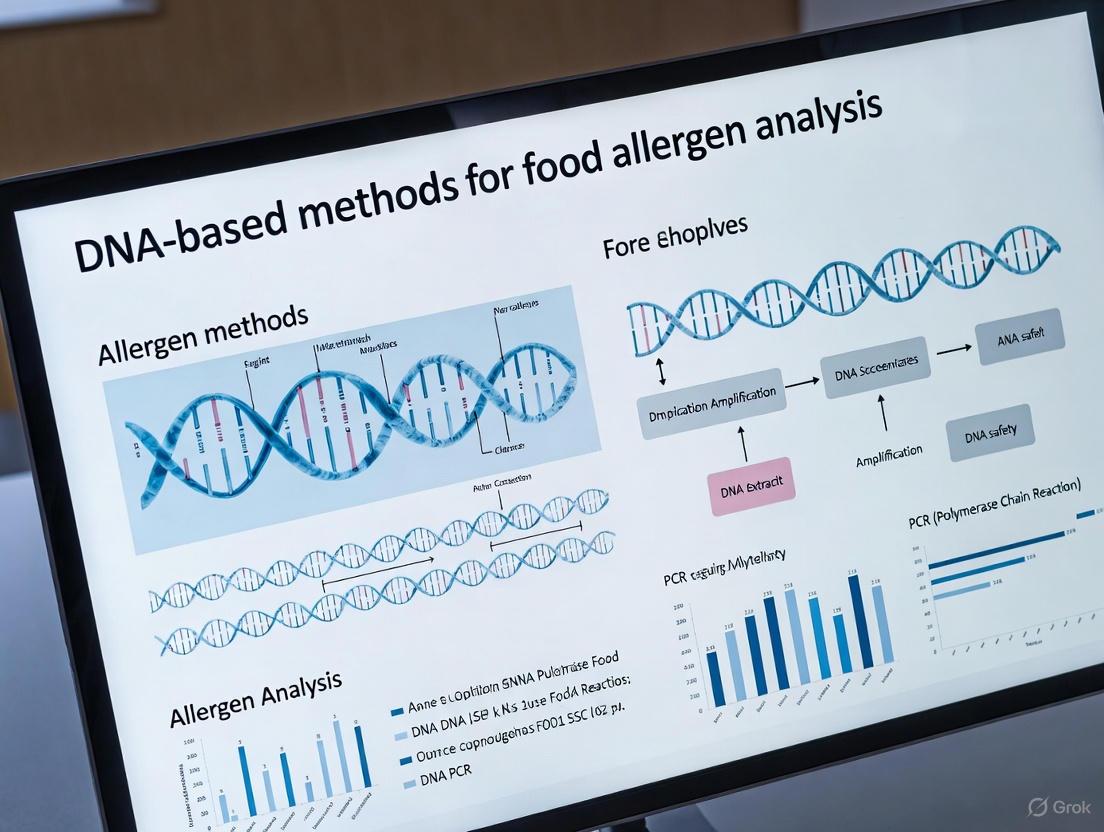
This article provides a detailed examination of DNA-based techniques for food allergen detection, tailored for researchers, scientists, and drug development professionals.
DNA-Based Methods for Food Allergen Analysis: A Comprehensive Guide for Research and Development
Abstract
This article provides a detailed examination of DNA-based techniques for food allergen detection, tailored for researchers, scientists, and drug development professionals. It covers the fundamental principles of targeting allergen-specific DNA, with a focus on qPCR methodologies and their application across diverse food matrices. The scope extends to troubleshooting common challenges like matrix effects and quantification, a comparative analysis with protein-based methods such as ELISA and MS, and an exploration of emerging trends including biosensors, AI integration, and the use of curated bioinformatics databases like COMPARE for enhanced allergen prediction and risk assessment.
The Genetic Blueprint: Core Principles and Scope of DNA-Based Allergen Detection
The accurate detection of food allergens is a critical component of public health strategies and regulatory compliance, aimed at protecting sensitized individuals from accidental exposure. The fundamental choice in analytical methodology hinges on the target of detection: either the allergenic proteins themselves, which directly elicit the immune response, or the DNA from the allergenic source, which serves as an indirect marker for its potential presence [1] [2]. This distinction forms the core of two predominant technological approaches: protein-based methods like the enzyme-linked immunosorbent assay (ELISA) and DNA-based methods, primarily the polymerase chain reaction (PCR) [3].
The selection between these targets is not trivial and is influenced by multiple factors, including the nature of the food matrix, the processing conditions the food has undergone, and the specific analytical question being asked—whether it is about quantifying a known allergenic protein or simply confirming the presence of a biological species from an allergenic source [1] [3]. This guide provides an in-depth technical comparison of these two principles, detailing their methodologies, applications, and limitations within the context of modern food allergen analysis research.
DNA-Based Detection: Principles and Protocols
DNA-based detection methods for food allergens do not identify the allergenic molecule itself but rather target specific sequences of DNA from the allergenic source organism. The primary technique employed is the polymerase chain reaction (PCR), which operates as a "molecular photocopier" to amplify trace amounts of target DNA to detectable levels [3].
Fundamental Principle
The underlying principle is that the genetic blueprint (DNA) of an allergenic source (e.g., peanut, soy, or shellfish) is unique and can be identified with high specificity [3]. Even in highly processed foods where proteins may be denatured and fragmented, the DNA is often more stable, surviving heat, pressure, and pH changes [2] [3]. PCR uses short, synthetic DNA fragments called primers that are designed to bind exclusively to a pre-defined, species-specific DNA sequence. If this sequence is present in the sample, the PCR process amplifies it exponentially, generating millions of copies that can be easily detected [3]. This makes PCR a powerful tool for identifying the biological source of an allergen, though it does not directly measure the protein that causes the allergic reaction.
Detailed Experimental Protocol: Real-Time PCR
Real-time PCR (qPCR) is a gold-standard DNA-based method that allows for the detection and semi-quantification of allergen-source DNA [4]. The following protocol outlines the key steps for detecting a specific allergen, such as peanut, using a chloroplast DNA marker.
- Step 1: DNA Extraction: The first critical step involves isolating total DNA from the food sample. Commercial kits are commonly used, employing buffers to lyse cells and release DNA, followed by purification steps to remove potential inhibitors like fats, polyphenols, and proteins. The quality and quantity of the extracted DNA should be assessed via spectrophotometry [4].
- Step 2: Primer and Probe Design: Design primers and a fluorescently-labeled probe (e.g., TaqMan) that are specific to a target gene. For peanut detection, chloroplast markers such as
matK,rpl16, andtrnH-psbAhave been used. Research indicates that thematKmarker can provide high sensitivity and efficiency [4]. - Step 3: qPCR Reaction Setup and Amplification: Prepare the qPCR reaction mix containing the extracted DNA template, forward and reverse primers, the TaqMan probe, and a master mix containing DNA polymerase, dNTPs, and buffer. The amplification is typically performed under the following cycling conditions [4]:
- Initial Denaturation: 95°C for 10 minutes.
- 40-50 Cycles of:
- Denaturation: 95°C for 15 seconds.
- Annealing/Extension: 60°C for 1 minute (during which the fluorescence is measured).
- Step 4: Data Analysis: The point at which the fluorescence signal crosses a predetermined threshold is called the cycle threshold (Ct). The Ct value is inversely proportional to the amount of target DNA in the original sample. Quantification is achieved by comparing the Ct values of unknown samples to a standard curve generated from samples with known amounts of the target DNA [4].
Advanced DNA-Based Methodologies
Beyond qPCR, other DNA-based techniques are emerging:
- Loop-Mediated Isothermal Amplification (LAMP): This method amplifies DNA at a constant temperature (e.g., 65°C), simplifying the equipment needed. It can be combined with a lateral flow dipstick (LFD) for visual detection, providing a sensitivity for soybean detection comparable to qPCR (down to 10 mg/kg in complex matrices) [4].
- DNA Microarrays: These platforms allow for the simultaneous detection of multiple allergenic species in a single test by hybridizing sample DNA to many species-specific probes immobilized on a chip [4].
Protein-Based Detection: Principles and Protocols
Protein-based methods directly target the allergenic molecules—the proteins or peptides that immunoglobulin E (IgE) antibodies recognize in sensitized individuals [5] [1]. The most established technique in this category is the enzyme-linked immunosorbent assay (ELISA) [3].
Fundamental Principle
The core principle relies on the specific binding of an antibody to its target allergenic protein. In the most common format, the sandwich ELISA, two antibodies are used that bind to different sites on the same protein [3]. The first antibody (capture antibody) is immobilized on a solid surface. If the target allergen is present in the sample, it is captured by this antibody. A second antibody (detection antibody), which is linked to an enzyme, is then added and binds to the captured allergen, forming a "sandwich." After washing away unbound material, a substrate is added. The enzyme converts the substrate into a colored product, and the intensity of the color is directly proportional to the concentration of the allergenic protein in the sample [3]. This method directly measures the causative agent of the allergic reaction.
Detailed Experimental Protocol: Sandwich ELISA
The following protocol details the steps for a typical sandwich ELISA used for quantifying a specific allergen, such as Ara h 1 from peanut or Bos d 5 from milk [6] [3].
- Step 1: Protein Extraction: Efficient extraction of proteins from the complex food matrix is arguably the most critical and challenging step. The choice of extraction buffer must be optimized for the specific matrix and allergen. A recent study identified that buffers such as 50 mM carbonate bicarbonate with 10% fish gelatine or PBS with 2% Tween, 1 M NaCl, 10% fish gelatine, and 1% Polyvinylpyrrolidone (PVP) provided optimized recovery (50-150%) for multiple allergens from challenging matrices like chocolate dessert and baked biscuits [6]. The extraction typically involves incubating the sample in the buffer at a 1:10 ratio (e.g., 1 g sample per 10 mL buffer) with vortexing and orbital shaking (e.g., 60°C, 175 rpm for 15 minutes), followed by centrifugation to collect the supernatant [6].
- Step 2: Assay Procedure:
- Coating: A capture antibody specific to the target protein is adsorbed onto the wells of a microtiter plate.
- Blocking: The wells are treated with a blocking agent (e.g., fish gelatine or bovine serum albumin) to cover any remaining protein-binding sites and prevent non-specific binding.
- Sample Incubation: The extracted protein sample or standard is added to the wells. If the target allergen is present, it binds to the capture antibody. The plate is incubated and then washed to remove unbound proteins.
- Detection Antibody Incubation: An enzyme-conjugated detection antibody, specific to a different epitope on the same allergen, is added. It binds to the captured allergen, forming the antibody-allergen-antibody sandwich. The plate is washed again.
- Signal Development: A substrate solution for the enzyme is added. For the enzyme horseradish peroxidase (HRP), a common substrate is Tetramethylbenzidine (TMB), which produces a blue color.
- Reaction Stop and Measurement: The enzyme reaction is stopped with an acid, which changes the color to yellow. The absorbance of each well is measured at 450 nm using a microplate reader [3].
- Step 3: Data Analysis: The absorbance values of the standards are used to generate a standard curve. The concentration of the allergen in the unknown samples is then interpolated from this curve [6].
Advanced Protein-Based Methodologies
- Multiplex Immunoassays: Technologies like xMAP (Luminex) allow for the simultaneous quantification of multiple specific allergens in a single test. For instance, the "MARIA for Foods" multiplex array can measure Ara h 3, Ara h 6, Bos d 5, and others concurrently, using antibody-coated magnetic beads and a fluorescent reporter [6].
- Mass Spectrometry (LC-MS/MS): This is a highly specific and sensitive technique that does not rely on antibodies. Proteins are extracted, digested into peptides with an enzyme like trypsin, and the resulting peptides are separated and identified by liquid chromatography coupled with tandem mass spectrometry (LC-MS/MS). It provides unambiguous identification based on peptide mass and fragmentation patterns and is particularly useful for complex matrices and for detecting multiple allergens simultaneously [4] [3].
Comparative Analysis: DNA vs. Protein Detection
The choice between DNA- and protein-based methods depends on the analytical requirements. The table below summarizes the core characteristics of each approach.
Table 1: Core comparison of PCR and ELISA methods for allergen analysis
| Attribute | PCR Allergen Testing | ELISA Allergen Testing |
|---|---|---|
| Detection Target | Species-specific DNA from allergenic ingredients [3] | Specific allergenic proteins (e.g., Ara h 1, Bos d 5) [6] [3] |
| Fundamental Principle | Amplification of target DNA sequences using primers [3] | Immunological recognition of protein epitopes by antibodies [3] |
| Sensitivity | Very high (capable of detecting trace DNA) [3] | High (sensitive to low protein levels) [3] |
| Quantification | Generally qualitative or semi-quantitative [3] | Quantitative (measures allergen concentration) [6] [3] |
| Effect of Food Processing | DNA can be more stable, surviving heat and pH changes; however, fragmentation can reduce amplificability [1] [3] | Proteins can be denatured, aggregated, or modified, which may hide epitopes and reduce detectability [5] [1] |
| Key Challenge | Detects DNA, not the protein that causes allergy; potential for false positives from non-allergenic tissues [2] | Antibody cross-reactivity; protein extractability from complex matrices [1] [6] |
Table 2: Comparison of advanced and emerging detection methodologies
| Methodology | Target | Key Advantage | Best Suited For |
|---|---|---|---|
| LAMP-LFD [4] | DNA (multicopy genes) | Simplicity, speed, and low-tech detection; suitable for field use | Rapid, specific screening where qPCR equipment is unavailable |
| Multiplex Immunoassay (e.g., xMAP) [6] | Multiple specific proteins | Simultaneous multi-allergen quantification in a single well | High-throughput analysis of samples for several known allergens |
| Liquid Chromatography-Tandem Mass Spectrometry (LC-MS/MS) [4] [3] | Allergen-specific peptide biomarkers | High specificity and sensitivity; does not require antibodies; capable of multiplexing | Confirmation of results, complex matrices, and novel allergen detection |
The Scientist's Toolkit: Essential Research Reagents and Materials
Successful allergen detection requires carefully selected reagents and materials. The following table details key solutions used in the featured experiments.
Table 3: Essential research reagents and materials for allergen detection protocols
| Research Reagent / Material | Function in Experiment | Exemplary Use Case |
|---|---|---|
| Capture & Detection Antibodies [3] | Specifically bind to target allergenic protein epitopes for recognition and quantification. | Monoclonal/polyclonal antibodies used in sandwich ELISA to detect Bos d 5 (β-lactoglobulin) in milk [6]. |
| Protein Extraction Buffers [6] | Solubilize and recover allergenic proteins from complex food matrices while minimizing interference. | PBS with 1 M NaCl, 2% Tween-20, and 10% Fish Gelatine to optimize recovery from baked biscuits [6]. |
| Species-Specific Primers & Probes [4] | Bind to and enable amplification of unique DNA sequences from the allergenic source. | Primers and TaqMan probe for the chloroplast matK gene for highly sensitive peanut detection via qPCR [4]. |
| PCR Master Mix | Contains enzymes (DNA polymerase), dNTPs, and buffers necessary for DNA amplification. | A commercial mix used in real-time PCR for the detection of sesame, pistachio, and macadamia nut DNA [4]. |
| Trypsin [4] [3] | Proteolytic enzyme that digests proteins into smaller peptides for mass spectrometric analysis. | Used in LC-MS/MS workflows to generate peptide biomarkers for seafood allergens like tropomyosin [4]. |
| Magnetic Beads Coupled with Antibodies [6] | Solid phase for capturing specific allergens in a multiplex, bead-based immunoassay. | Beads coated with anti-Ara h 3/anti-Jug r 1 used in the MARIA for Foods multiplex array [6]. |
Experimental Workflow and Signaling Pathways
The following diagrams illustrate the core workflows for the primary DNA-based and protein-based detection methods.
DNA-Based Allergen Detection Workflow
Protein-Based Allergen Detection (Sandwich ELISA) Workflow
The fundamental principles of detecting allergen-source DNA versus allergenic proteins offer complementary strengths for ensuring food safety. Protein-based methods like ELISA are indispensable when the analytical requirement is to directly measure the concentration of the causative allergenic protein, providing a more direct assessment of potential risk for sensitized individuals [6] [3]. In contrast, DNA-based methods like PCR provide a highly sensitive and specific tool for verifying the presence of a biological species from an allergenic source, particularly in complex or processed matrices where proteins may be difficult to detect [2] [3].
The ongoing evolution in this field is geared towards multiplexing and hyphenated techniques that combine the strengths of different platforms. Multiplex immunoassays and DNA microarrays allow for high-throughput screening of multiple allergens [6], while LC-MS/MS offers unparalleled specificity and the ability to confirm findings without antibody dependency [4]. For researchers, the choice between DNA and protein targets must be guided by a clear understanding of the food matrix, the impact of processing, and the ultimate goal of the analysis—whether it is species identification or specific allergen quantification. The future of food allergen detection lies in the intelligent application and integration of these fundamental principles to provide robust, reliable, and actionable data for risk assessment and regulatory compliance.
The analysis of food allergens presents a significant challenge in processed food matrices, where protein integrity is often compromised. This whitepaper examines the fundamental advantages of DNA stability over protein integrity in such environments, positioning DNA-based methods as a robust solution for allergen detection in modern food research. While immunological techniques target allergenic proteins directly, their susceptibility to denaturation and epitope modification during thermal and chemical processing creates critical detection vulnerabilities. DNA, with its inherent molecular stability, provides a reliable target even in extensively processed foods where protein-based methods may fail. We present a comprehensive technical analysis of method performance, detailed experimental protocols, and emerging research directions, providing scientists with the foundational knowledge to implement DNA-based approaches in allergen detection research and development.
Food allergies represent a growing global public health concern, affecting an estimated 1-10% of the population, with prevalence rising in both developed and developing nations [7]. Effective management primarily relies on the strict avoidance of offending allergens, making accurate food labeling and contamination detection critical scientific and regulatory challenges [8]. The detection of allergens in food products is predominantly accomplished through three methodological approaches: immunological assays (e.g., ELISA, lateral flow devices), DNA-based methods (primarily PCR), and mass spectrometry-based techniques [1] [9].
Each method presents distinct advantages and limitations, but a fundamental challenge unites them: the impact of food processing on target molecule integrity. Food processing—encompassing thermal treatments (pasteurization, sterilization, roasting), non-thermal interventions (high-pressure, cold plasma, fermentation), and chemical modifications—induces profound changes in food matrices and biomolecular structures [5] [7]. Proteins are particularly vulnerable, undergoing denaturation, aggregation, fragmentation, and Maillard reactions that alter their immunoreactivity and detectability [1]. These modifications can mask epitopes recognized by antibodies in immunoassays, leading to false-negative results and potentially serious public health consequences [5].
In this context, DNA emerges as a remarkably stable target molecule. Its double-stranded structure and chemical composition confer greater resistance to degradation compared to the three-dimensional conformational epitopes of proteins. DNA-based methods, particularly polymerase chain reaction (PCR), leverage this stability to detect allergen-specific genetic sequences even in extensively processed foods where protein integrity is compromised [9]. This whitepaper explores the technical foundations of this advantage, providing researchers with a comprehensive framework for evaluating and implementing DNA-based allergen detection strategies in complex food matrices.
Molecular Stability: DNA vs. Protein in Processed Foods
Differential Impact of Processing on Target Molecules
Food processing deliberately alters food components to ensure safety, extend shelf life, and modify sensory properties. These processes, however, differentially affect DNA and protein molecules, creating distinct advantages and limitations for their detection.
Protein Degradation Pathways: Allergenic proteins are susceptible to multiple forms of processing-induced damage:
- Denaturation: Heat, high pressure, and extreme pH cause unfolding of tertiary and secondary structures, destroying conformational epitopes recognized by antibodies [1].
- Covalent Modification: Maillard reactions between proteins and reducing sugars, lipid oxidation products, and disulfide bond rearrangement create neo-epitopes or mask existing ones [1].
- Fragmentation: Proteolytic enzymes and intense shear forces can cleave protein chains, destroying linear epitopes [7].
- Aggregation: Denatured proteins often form insoluble aggregates that resist extraction, effectively removing them from detection [1].
DNA Stability Characteristics: DNA molecules demonstrate superior resilience under identical processing conditions:
- Structural Integrity: The DNA double helix maintains its fundamental structure under moderate thermal processing, with degradation typically requiring more extreme conditions than protein denaturation [9].
- Target Persistence: While fragmentation may occur, short, species-specific DNA sequences (100-200 bp) remain amplifiable and detectable via PCR even in highly processed matrices [10].
- Extraction Efficiency: DNA remains soluble and extractable from many processed foods where proteins have become insoluble aggregates [9].
Table 1: Comparative Impact of Food Processing Techniques on Allergen Detection Targets
| Processing Method | Impact on Proteins | Impact on DNA | Detection Implications |
|---|---|---|---|
| Thermal Processing | Denaturation, epitope loss, aggregation | Moderate fragmentation, preservation of sequence | Protein: Potential false negativesDNA: Target sequences remain amplifiable |
| High-Pressure Processing | Conformational changes, partial denaturation | Minimal effect on sequence integrity | Protein: Altered immunoreactivityDNA: Unaffected detection |
| Fermentation | Enzymatic hydrolysis, epitope destruction | Possible nuclease degradation | Protein: Significant detection challengesDNA: Short targets remain stable |
| Chemical Modification | Maillard reaction, oxidation, cross-linking | Minimal sequence alteration | Protein: Epitope masking/alterationDNA: Sequence unchanged |
| Mechanical Processing | Structural disruption, aggregation | Shearing into fragments | Protein: Altered solubilityDNA: Fragment size reduction manageable |
Methodological Implications for Allergen Detection
The differential stability of proteins and DNA directly impacts the reliability of detection methods. Immunoassays suffer from several processing-induced limitations:
- Reduced Extractability: Insoluble protein aggregates cannot be extracted in aqueous buffers, preventing antibody recognition [1].
- Epitope Destruction: Thermal and chemical processing destroys both conformational and linear epitopes, reducing antibody binding affinity [5].
- Matrix Interference: Processed food matrices often contain interfering substances that affect antibody-antigen interactions [8].
Conversely, DNA-based methods benefit from:
- Amplification Power: PCR can theoretically detect a single copy of target DNA, providing exceptional sensitivity even when the target is heavily degraded [9].
- Fragment Tolerance: Carefully designed primers can amplify short, well-preserved DNA fragments (100-200 bp) that remain intact even after extensive processing [10].
- Matrix Resilience: DNA extraction methods effectively purify nucleic acids from complex, processed matrices, reducing interference [10].
Technical Comparison of Allergen Detection Methods
Performance Characteristics in Processed Foods
Researchers selecting allergen detection methods must consider multiple performance parameters, particularly when analyzing processed foods. The following comparison highlights the relative advantages of DNA-based methods in challenging matrices.
Table 2: Method Comparison for Allergen Detection in Processed Foods
| Parameter | Immunoassays (ELISA/LFA) | DNA-Based Methods (PCR) | Mass Spectrometry |
|---|---|---|---|
| Target Molecule | Protein epitopes | Species-specific DNA sequences | Protein peptides |
| Detection Limit | 1-10 ppm (highly variable) | 10-50 ppm (consistent) | 10-100 ppm (method dependent) |
| Quantification | Excellent with appropriate standards | Semi-quantitative (good) | Excellent with appropriate standards |
| Processing Tolerance | Low (epitope degradation) | High (short target stability) | Moderate (peptide stability) |
| Matrix Effects | High (interference common) | Moderate (removable via extraction) | High (ion suppression) |
| Multiplex Capacity | Limited (typically 1-2 allergens) | High (multiple targets) | High (multiple allergens) |
| Method Development | Complex (antibody production) | Straightforward (primer design) | Complex (method optimization) |
| Best Applications | Unprocessed/minimally processed foods, quantitative analysis | Highly processed foods, complex matrices, qualitative screening | Certified reference methods, novel allergen discovery |
Advantageous Applications of DNA-Based Methods
DNA-based detection demonstrates particular utility in specific challenging scenarios:
- Highly Processed Foods: In baked goods, hydrolyzed products, and fermented foods where proteins are extensively denatured, PCR maintains reliable detection [9].
- Complex Matrices: For products with multiple ingredients where cross-reactivity may plague immunoassays, PCR's specificity provides accurate identification [10].
- Species Identification: DNA barcoding allows precise species identification in cases where immunological cross-reactivity occurs between related species [10].
- Environmental Monitoring: DNA-based detection of allergens in environmental swabs from food production facilities provides effective sanitation verification [9].
Experimental Framework: DNA-Based Allergen Detection
DNA Extraction and Quality Assessment
Protocol Objective: Obtain high-quality DNA from processed food matrices for subsequent PCR analysis.
Materials & Reagents:
- Sample Homogenization: Liquid nitrogen, mortar and pestle, or mechanical homogenizer
- Lysis Buffer: CTAB buffer (cetyltrimethylammonium bromide) or commercial kit lysis buffers
- Decontamination Solution: Sorbitol Washing Buffer (for removing PCR inhibitors)
- Purification Reagents: Phenol-chloroform-isoamyl alcohol (25:24:1), RNase A (10 mg/mL)
- Precipitation Solutions: Isopropanol, ethanol (70%), 5M NaCl
- Quality Assessment: Spectrophotometer (NanoDrop), agarose gel electrophoresis equipment
Detailed Protocol:
- Sample Preparation: Homogenize 100-200 mg of food sample using liquid nitrogen and mortar/pestle or mechanical homogenizer [10].
- Pre-Wash (for phenolic-rich matrices): Wash sample twice with Sorbitol Washing Buffer to remove PCR inhibitors [10].
- Cell Lysis: Incubate sample with 1 mL CTAB buffer at 65°C for 20 minutes with agitation at 600 rpm [10].
- RNA Removal: Add 5 μL RNase A (10 mg/mL) and incubate at room temperature for 15 minutes [10].
- Protein Removal: Add 700 μL phenol-chloroform-isoamyl alcohol, vortex vigorously, and centrifuge at 10,000 × g for 15 minutes at 4°C [10].
- DNA Precipitation: Transfer aqueous phase, add 0.5 volumes 5M NaCl and 3 volumes ethanol, incubate at -20°C for 1 hour [10].
- DNA Pellet Formation: Centrifuge at 12,000 × g for 15 minutes, wash pellet with 70% ethanol, and air dry [10].
- DNA Resuspension: Resuspend DNA in TE buffer or nuclease-free water [10].
- Quality Control: Measure DNA concentration and purity (A260/A280 ratio of 1.8-2.0), confirm integrity via agarose gel electrophoresis [10].
PCR Amplification and Detection
Protocol Objective: Amplify species-specific DNA sequences for allergen identification.
Materials & Reagents:
- PCR Reagents: Thermostable DNA polymerase (Taq), dNTPs, reaction buffer, magnesium chloride
- Oligonucleotides: Forward and reverse primers specific to target allergen sequences
- Equipment: Thermal cycler, real-time PCR system (for quantitative analysis)
- Detection System: Gel electrophoresis equipment or real-time PCR detection chemistry (SYBR Green, TaqMan probes)
Detailed Protocol:
- Primer Design: Design primers targeting species-specific sequences (70-150 bp) from genomic databases [9].
- Reaction Setup: Prepare 25 μL reactions containing: 1× reaction buffer, 1.5-2.5 mM MgCl₂, 200 μM each dNTP, 0.2-0.5 μM each primer, 0.5-1 U DNA polymerase, and 50-100 ng template DNA [9].
- Thermal Cycling:
- Initial Denaturation: 95°C for 5 minutes
- Amplification (35-40 cycles): 95°C for 30 seconds (denaturation), 55-65°C for 30 seconds (annealing), 72°C for 30-60 seconds (extension)
- Final Extension: 72°C for 7 minutes [9]
- Product Detection:
- Qualitative: Analyze PCR products by agarose gel electrophoresis with ethidium bromide staining
- Quantitative: Use real-time PCR with SYBR Green or TaqMan chemistry for quantification [9]
- Data Interpretation: Compare amplification patterns to positive and negative controls, confirm product identity by sequencing if necessary [9].
The following workflow diagram illustrates the complete DNA-based allergen detection process:
Diagram 1: DNA-Based Allergen Detection Workflow. This flowchart illustrates the complete experimental process from sample preparation to result interpretation, highlighting the quality control feedback loop.
The Researcher's Toolkit: Essential Reagents and Materials
Successful implementation of DNA-based allergen detection requires specific reagents and equipment. The following table details essential components for establishing this methodology in research settings.
Table 3: Essential Research Reagents for DNA-Based Allergen Detection
| Reagent/Material | Function | Technical Specifications | Research Considerations |
|---|---|---|---|
| CTAB Extraction Buffer | Cell lysis, protein denaturation, polysaccharide complexation | 2% CTAB, 100 mM Tris-HCl, 20 mM EDTA, 1.4 M NaCl, pH 8.0 | More effective for polysaccharide-rich matrices than commercial kits |
| Sorbitol Washing Buffer | Removal of PCR inhibitors (polyphenols, polysaccharides) | 0.1 M Tris-HCl, 0.5 M Sorbitol, 10 mM EDTA, pH 7.5 | Critical for plant-derived matrices with high polyphenol content |
| Proteinase K | Enzymatic digestion of nucleases and cellular proteins | 20 mg/mL stock solution, activity >30 U/mg | Improves DNA yield and quality from animal-derived products |
| RNase A | Degradation of contaminating RNA | 10 mg/mL, heat-treated to destroy DNases | Essential for accurate DNA quantification and PCR performance |
| Species-Specific Primers | Target sequence amplification | 18-25 nucleotides, Tm 55-65°C, GC content 40-60% | Must target multi-copy genes or allergen-coding sequences |
| Taq DNA Polymerase | DNA amplification | Thermostable enzyme with proofreading activity for longer targets | High-temperature tolerance critical for specific amplification |
| dNTP Mix | Nucleotide substrates for DNA synthesis | 10 mM each dNTP (dATP, dCTP, dGTP, dTTP), pH 8.0 | Quality affects amplification efficiency and error rate |
| Agarose | Matrix for electrophoretic separation | Low EEO (electroendosmosis) grade, 1.5-3.0% concentration | Enables size verification of extracted DNA and PCR products |
Research Implications and Future Directions
The stability of DNA in processed foods presents significant opportunities for advancing food safety research. Several emerging areas merit particular attention from the research community:
Integrated Methodologies: Combining DNA-based and protein-based approaches creates synergistic advantages. DNA methods provide reliable screening for allergen presence, while mass spectrometry confirms the presence and integrity of the allergenic proteins themselves [9]. This approach is particularly valuable for verifying that processing has not only removed detectable DNA but also denatured the proteins of concern.
Biodiversity and Authenticity Applications: DNA barcoding techniques, which identify species via standardized genetic regions (e.g., rbcL, ITS), provide powerful tools for verifying food authenticity and detecting unauthorized substitutions [10]. This application benefits directly from DNA's stability in processed matrices where morphological identification is impossible.
Standardization and Quality Assurance: Implementation of robust quality control systems—including standardized reference materials, inter-laboratory validation studies, and standardized extraction protocols—will enhance reproducibility across research settings [7]. The foodomics approach, integrating multiple analytical platforms, represents a promising framework for comprehensive allergen assessment.
Emerging Detection Technologies: Novel biosensor platforms incorporating DNA-based recognition elements offer potential for rapid, on-site allergen detection [8]. These systems leverage DNA's stability while providing the convenience of antibody-based lateral flow devices.
DNA stability represents a fundamental advantage for allergen detection in processed foods, where protein degradation compromises immunological methods. The technical comparison presented in this whitepaper demonstrates that DNA-based methods, particularly PCR, provide reliable detection in thermally processed, fermented, and chemically modified food matrices that challenge protein-based detection. While immunological methods remain valuable for quantifying intact proteins in minimally processed foods, DNA-based approaches offer superior resilience to processing-induced modifications.
For researchers developing allergen detection strategies, we recommend considering the processing history of target foods when selecting analytical methods. DNA-based detection should be prioritized for highly processed products, complex matrices, and applications requiring species-specific identification. The experimental protocols and technical resources provided herein offer a foundation for implementing these methods in research settings. As food processing technologies continue to evolve, the stability of DNA as a detection target will maintain its relevance for ensuring food safety and protecting allergic consumers.
Food allergies represent a significant global public health concern, with prevalence rates impacting millions of individuals worldwide [5]. For sensitive individuals, strict avoidance of allergenic foods remains the primary preventive strategy, making accurate food labeling and allergen detection critical for consumer protection [11] [12]. While immunoassay methods like ELISA have traditionally dominated food allergen testing, DNA-based detection techniques offer distinct advantages for specific allergen targets and processing conditions [11]. This technical guide examines the scientific and practical rationale for applying DNA-based methods to key legislated allergens, with particular focus on celery and mustard, which present unique challenges for protein-based detection approaches.
The fundamental principle underlying DNA-based allergen detection lies in identifying species-specific DNA sequences rather than the allergenic proteins themselves [13]. While DNA is not the molecule that triggers allergic reactions, its presence serves as a reliable indicator of potential allergen contamination, especially in complex food matrices where protein integrity may be compromised [11]. This review systematically evaluates the technical considerations, experimental protocols, and performance characteristics of DNA-based methods for detecting legislated allergens, providing researchers and food safety professionals with a comprehensive framework for method selection and implementation.
Allergen Targets for DNA-Based Detection
Legislated Allergens and Detection Challenges
Globally, regulatory frameworks have established lists of major food allergens requiring mandatory declaration on food labels. In the European Union, Regulation (EU) No 1169/2011 identifies 14 major allergens, including celery, mustard, and soybeans [5]. The United States, through the Food Allergen Labeling and Consumer Protection Act (FALCPA) and the more recent FASTER Act, recognizes nine major food allergens: milk, eggs, fish, Crustacean shellfish, tree nuts, peanuts, wheat, soybeans, and sesame [12].
The selection of appropriate detection methods depends on several factors, including the stability of the target analyte, food matrix effects, and processing conditions. Protein-based detection methods face limitations when allergenic proteins are denatured, fragmented, or otherwise modified during food processing, which can alter antibody recognition epitopes and lead to false-negative results [11]. In contrast, DNA molecules generally demonstrate greater stability under harsh processing conditions, maintaining their molecular integrity when proteins may be degraded [11].
Celery, Mustard, and Other Targets Suited for DNA Methods
Certain allergens present particular challenges for immunoassays due to cross-reactivity issues or protein instability. Celery represents a prime example where DNA-based detection offers significant advantages, as there has been a historical lack of reliable ELISA methods for this allergen [13]. Mustard and soybeans also demonstrate excellent suitability for PCR-based detection, with several commercially available validated methods [13] [14].
Table 1: Key Allergen Targets Suited for DNA-Based Detection Methods
| Allergen | Scientific Name | Key Allergenic Proteins | Advantages of DNA Methods |
|---|---|---|---|
| Celery | Apium graveolens | Api g 1, Api g 4, Api g 5 | Avoids lack of reliable ELISA; stable DNA target in processed foods |
| Mustard | Brassica spp., Sinapis spp. | Bra j 1, Sin a 1 | Specific detection without cross-reactivity to related species |
| Soya | Glycine max | Gly m 4, Gly m 5, Gly m 6 | Reduces cross-reactivity with other legumes; stable detection target |
| Tree Nuts | Various species | Cor a 1 (hazelnut), Jug r 1 (walnut) | Species-specific identification in complex mixtures |
| Peanuts | Arachis hypogaea | Ara h 1, Ara h 2, Ara h 3 | Highly specific detection even in highly processed foods |
The selection of celery, mustard, and soy as primary targets for DNA-based methods is supported by both scientific literature and commercial testing applications. Eurofins, a leading food testing laboratory, has specifically introduced PCR allergen testing for these three allergens, noting "improved specificity and help to reduce cross-reactivity issues which can sometimes be seen with ELISA-based testing, especially in complex food matrices" [13].
DNA-Based Methodologies: Principles and Protocols
Polymerase Chain Reaction (PCR) and Real-Time PCR
The polymerase chain reaction (PCR) represents the foundational DNA-based technology for allergen detection. This method amplifies species-specific DNA sequences through thermal cycling, enabling detection of trace amounts of allergen DNA. Real-time PCR (qPCR) provides quantitative capabilities through fluorescence monitoring during amplification, with multiplex formats allowing simultaneous detection of multiple allergens in a single reaction [14].
Commercial real-time PCR systems, such as the SureFood ALLERGEN 4plex Soya/Celery/Mustard + IAC, demonstrate the practical application of this technology for the simultaneous detection of three key allergens [14]. These systems typically incorporate Internal Amplification Controls (IAC) to distinguish true negative results from PCR inhibition, a critical quality control measure for reliable testing [14].
Table 2: Performance Characteristics of Commercial DNA-Based Allergen Detection Kits
| Test Kit/Technology | Target Allergens | Limit of Detection (LOD) | Sample Matrices Validated | Key Features |
|---|---|---|---|---|
| SureFood ALLERGEN 4plex | Soya, Celery, Mustard + IAC | ≤ 0.4 mg/kg using recommended prep | Various food matrices | Multiplex real-time PCR with internal control |
| Commercial DNA Kits (General) | Celery | 1 ppm spiked protein in five product groups | Meat products, snacks, sauces, dried herbs, smoothies | Quantitative or qualitative formats available |
| Dual-Color Blending LAMP | Walnut, Hazelnut, Peanut | Comparable to real-time LAMP | Rice flour, processed foods | Visual detection without instrumentation |
Loop-Mediated Isothermal Amplification (LAMP)
Loop-mediated isothermal amplification (LAMP) offers an alternative nucleic acid amplification technique that operates at a constant temperature, eliminating the need for thermal cycling equipment [15]. This method utilizes 4-6 specifically designed primers that recognize distinct regions of the target DNA, providing high specificity and efficiency [15]. Recent advancements in LAMP technology have incorporated colorimetric detection using pH-sensitive dyes (e.g., Cresol Red) or metal ion indicators (e.g., Hydroxynaphthol Blue), enabling visual result interpretation without specialized instrumentation [15].
The dual-color blending approach described by researchers combines Cresol Red and Hydroxynaphthol Blue to create a wider color variation window (purple-to-green) with enhanced contrast for naked-eye observation [15]. This innovation addresses a key limitation of traditional LAMP detection methods, which often have low color contrast and narrow color variation ranges.
DNA Extraction and Sample Preparation Considerations
Effective DNA extraction represents a critical first step in all DNA-based allergen detection methods. The efficiency of DNA recovery varies significantly across different food matrices, with high-fat, high-protein, or highly processed foods presenting particular challenges [16]. Commercial DNA extraction kits, such as the SureFood PREP Advanced or Plant Genomic DNA Kit, provide standardized protocols for consistent DNA recovery [15] [14].
Research comparing commercial DNA kits for celery detection across five product groups (representing different sectors of the AOAC food-matrix triangle) demonstrated that while these kits could detect celery DNA down to 1 ppm spiked protein, "a clear matrix effect was observed" [16]. This highlights the importance of matrix-specific validation and the use of appropriate controls when implementing DNA-based allergen detection methods.
Experimental Design and Workflow
The successful implementation of DNA-based allergen detection requires careful experimental design and execution. The following workflow diagram illustrates the key decision points and processes in a comprehensive allergen testing strategy:
Detailed PCR Protocol for Celery, Mustard, and Soya Detection
Based on commercial kit specifications and published protocols, the following standardized procedure enables reliable detection of celery, mustard, and soya allergens:
Sample Preparation and DNA Extraction:
- Homogenize 5g of test sample with 20mL of extraction buffer using a stomacher or vortex mixer.
- Incubate at 70°C for 15 minutes with continuous shaking.
- Centrifuge at 3000 × g for 5 minutes to pellet particulate matter.
- Transfer supernatant to a new tube and purify DNA using a commercial kit (e.g., SureFood PREP Advanced, Art. No. S1053).
- Quantify DNA concentration and purity using spectrophotometry (A260/A280 ratio of 1.7-1.9 indicates acceptable purity).
Real-Time PCR Amplification:
- Prepare master mix containing:
- 12.5μL of 2× PCR buffer
- 1.0μL of primer/probe mix (celery: FAM, mustard: HEX/VIC, soya: ROX)
- 0.5μL of IAC probe (Cy5 channel)
- 2.0μL of nuclease-free water
- Add 4.0μL of template DNA to each reaction well.
- Run amplification on real-time PCR instrument with the following cycling conditions:
- Initial denaturation: 95°C for 10 minutes
- 45 cycles of:
- Denaturation: 95°C for 15 seconds
- Annealing/Extension: 60°C for 60 seconds (with fluorescence acquisition)
- Analyze amplification curves and determine Cq values for each target.
Result Interpretation:
- Positive result: Cq ≤ 40 with characteristic amplification curve
- Negative result: No amplification or Cq > 40 for target with valid IAC amplification
- Invalid result: No amplification for target and IAC - requires retesting
Research Reagent Solutions
Table 3: Essential Research Reagents for DNA-Based Allergen Detection
| Reagent/Material | Function | Example Products | Application Notes |
|---|---|---|---|
| DNA Extraction Kits | Isolation of high-quality DNA from complex matrices | SureFood PREP Advanced, Plant Genomic DNA Kit | Critical for removing PCR inhibitors; optimize for specific matrix |
| Real-Time PCR Master Mix | Provides enzymes, dNTPs, buffer for amplification | Various commercial master mixes | Select multiplex-compatible formulations for simultaneous detection |
| Species-Specific Primers/Probes | Target recognition and amplification | SureFood ALLERGEN 4plex primers | Design to unique allergen genome sequences to ensure specificity |
| Internal Amplification Control (IAC) | Distinguishes true negatives from PCR inhibition | Non-competitive synthetic DNA with separate probe | Essential for reliable negative result reporting |
| Positive Control DNA | Verifies assay performance | Genomic DNA from authentic allergen | Confirm specificity and sensitivity for each assay run |
Performance Comparison and Validation
Sensitivity and Specificity
DNA-based methods demonstrate high sensitivity for allergen detection, with commercially available real-time PCR assays achieving limits of detection (LOD) of ≤0.4 mg/kg for celery, mustard, and soya targets [14]. This sensitivity adequately addresses the regulatory requirements for allergen detection, as evidenced by international thresholds such as Japan's defined food allergen threshold of 10 μg/g [11].
The specificity of DNA-based methods is particularly advantageous for distinguishing between closely related species. For mustard detection, PCR assays can differentiate between Brassica carinata, Brassica juncea, Brassica nigra, Sinapis alba, and Sinapis arvensis without cross-reactivity to non-target species [14]. This level of discrimination surpasses what is typically achievable with antibody-based methods.
Matrix Effects and Quantification Challenges
While DNA-based methods offer excellent specificity and sensitivity, they face challenges related to matrix effects and quantification accuracy. Research comparing commercial DNA kits for celery detection observed "a clear influence of the matrix on the detection ability," with quantitative performance proving challenging across all tested food product groups [16].
A significant limitation of DNA-based quantification is the variable relationship between DNA content and allergenic protein concentration, which is influenced by factors such as tissue type, processing conditions, and varietal differences. This can lead to overestimation of allergen content when using DNA-based methods [16]. Consequently, DNA-based methods are generally recommended for qualitative screening rather than precise quantification unless extensively validated for specific applications.
DNA-based detection methods represent a powerful approach for identifying key allergen targets, particularly celery, mustard, and soya, in complex food matrices. The stability of DNA through various food processing conditions, combined with the high specificity of PCR-based amplification, makes these methods invaluable complements to traditional protein-based detection approaches.
Future developments in DNA-based allergen detection will likely focus on multiplexing capabilities, rapid screening formats, and standardization across platforms. Isothermal amplification methods like LAMP show particular promise for point-of-care testing and resource-limited settings, with ongoing research addressing current limitations in quantification accuracy through improved calibration methods and matrix-specific correction factors.
As regulatory frameworks evolve to establish threshold levels for major food allergens, the role of DNA-based methods in allergen risk management will continue to expand. Their unique advantages for specific allergen targets ensure they will remain essential components of comprehensive allergen control programs, providing reliable detection where traditional immunoassays face limitations.
Food allergy is an significant global public health issue, with an estimated 5-8% of children and 1-2% of adults affected worldwide [17]. For these individuals, strict avoidance of allergenic foods is the primary management strategy, as there is no cure. This reality has driven regulatory bodies around the world to implement mandatory labeling laws for major food allergens. In the United States, the Food Allergen Labeling and Consumer Protection Act of 2004 (FALCPA) and the more recent Food Allergy Safety, Treatment, Education, and Research (FASTER) Act of 2021 define the current list of nine major food allergens: milk, eggs, fish, Crustacean shellfish, tree nuts, peanuts, wheat, soybeans, and sesame [12] [18]. Similarly, the European Union mandates the labeling of 14 allergen categories, including celery, mustard, sesame, lupin, and molluscs alongside the common allergens [19].
The fundamental goal of these regulations is to ensure that consumers can accurately identify allergens in packaged foods. Compliance and enforcement, however, rely on robust, accurate, and sensitive analytical methods to detect allergenic substances in complex food matrices. The analytical landscape is divided into two primary methodological approaches: those that detect allergenic proteins directly (e.g., immunoassays, mass spectrometry) and those that detect allergen-specific DNA sequences (e.g., Polymerase Chain Reaction or PCR). While protein-based methods are often considered the gold standard as they detect the causative agent of the allergic reaction, DNA-based testing has carved out a critical and complementary niche within the global regulatory framework, particularly in situations where protein detection falls short.
The Scientific and Regulatory Basis for Allergen Detection
The Nature of Food Allergens and the Rationale for DNA Testing
Food allergens are typically naturally occurring proteins or glycoproteins that trigger an immunoglobulin E (IgE)-mediated immune response in sensitive individuals. The primary analytical target is therefore the protein itself. However, food processing techniques—such as high-temperature treatment, fermentation, or hydrolysis—can denature proteins, altering their three-dimensional structure and destroying the conformational epitopes recognized by antibodies used in immunoassays [11]. This can lead to false-negative results.
In contrast, DNA is remarkably stable and retains its molecular integrity through many food processes. Although DNA is not the allergenic molecule, it serves as an excellent indirect marker for the presence of an allergenic ingredient. The core hypothesis is that the presence of a species-specific DNA sequence reliably indicates the presence of the allergenic material from that species. This is particularly useful for:
- Highly processed foods where proteins may be denatured.
- Multi-ingredient products where specific identification is challenging.
- Verifying the presence of allergenic species that are difficult to distinguish with protein assays due to cross-reactivity.
Global Regulatory Frameworks and Analytical Requirements
Regulatory frameworks for allergen labeling are established in many jurisdictions, but they typically do not prescribe specific analytical methods for enforcement. Instead, they set the legal requirement for accurate labeling, and the choice of method is left to food businesses and control authorities.
- United States: The FDA provides guidance on food allergen labeling and evaluates the public health importance of non-listed allergens [12] [18]. The focus is on the presence of the allergenic protein, but the FDA does not establish threshold levels for any allergens, acknowledging the complexity of such an endeavor [12].
- European Union: EU law requires that any of the 14 listed allergens present in a prepacked food must be emphasized in the ingredients list, for example, by using a different font or background color [19]. The regulation is outcome-focused, not method-prescriptive.
- International Standards: The Codex Alimentarius provides a global reference. Some countries, like Japan, have defined a specific action level of 10 mg/kg (ppm) for allergens, creating a clear benchmark for analytical methods to target [17] [11].
A key development in harmonizing risk assessment is the work by the FAO/WHO Expert Committee, which has established reference doses (in mg of total protein from the allergen source) for global priority allergens. These doses, such as 2.0 mg for peanut and egg, are intended to guide action levels for precautionary allergen labeling [17]. This protein-based benchmark inherently favors protein-detection methods. However, DNA methods remain vital for qualitative screening and confirmation, especially when correlated with these protein thresholds.
DNA-Based Methodologies: Principles and Protocols
The most common and well-validated DNA-based method for allergen detection is the Polymerase Chain Reaction (PCR) and its quantitative variant, real-time PCR (qPCR).
Core Principle of PCR and qPCR
PCR is a molecular biology technique that amplifies a specific, short region of DNA across multiple orders of magnitude. The process involves repeated cycles of heating and cooling to facilitate:
- Denaturation: Separation of the double-stranded DNA template.
- Annealing: Binding of specific primers to complementary sequences flanking the target region.
- Extension: Synthesis of new DNA strands by a thermostable DNA polymerase.
In qPCR, the amplification is monitored in real-time using fluorescent reporters (e.g., SYBR Green or sequence-specific TaqMan probes). The cycle at which the fluorescence crosses a predefined threshold (Ct value) is inversely proportional to the amount of target DNA in the original sample, allowing for quantification.
Detailed Experimental Protocol: Real-Time PCR for Allergen Detection
The following protocol details the standard workflow for detecting a food allergen via qPCR, as referenced in studies analyzing allergenic foods like shrimp, cashew, and buckwheat [11].
Workflow: Real-Time PCR for Allergen Detection
Step 1: Sample Preparation and DNA Extraction
- Objective: To obtain high-quality, inhibitor-free genomic DNA from a representative sample.
- Protocol:
- Homogenization: Grind the food sample to a fine, homogeneous powder using a laboratory mill. This is critical for obtaining a representative sub-sample.
- Lysis: Incubate ~100 mg of the powdered sample with a lysis buffer (e.g., CTAB buffer or a proprietary lysis solution from a commercial kit) and Proteinase K at 56-65°C for 1-3 hours to break down cells and inactivate nucleases.
- Purification: Purify the DNA using a series of organic extractions (phenol-chloroform) or, more commonly, with silica-membrane spin columns (e.g., from DNeasy or similar kits). This step removes proteins, lipids, and other PCR inhibitors.
- Elution: Elute the purified DNA in a low-ionic-strength buffer like TE or nuclease-free water.
- Critical Parameters: The 260/280 absorbance ratio (measured by spectrophotometry) should be ~1.8 to indicate pure DNA. The 260/230 ratio should be >2.0 to detect potential contamination from chaotropic salts or organic solvents.
Step 2: Real-Time PCR Assay Design and Setup
- Objective: To specifically amplify a DNA sequence unique to the allergenic source.
- Primer and Probe Design:
- Target a species-specific gene sequence. Common targets include mitochondrial genes (e.g., COX1) or single-copy nuclear genes.
- For a peanut assay, target a sequence from the Ara h gene family; for shrimp, target the tropomyosin gene.
- Probe-based assays (TaqMan) are preferred for specificity. The probe is labeled with a 5' fluorescent reporter (e.g., FAM) and a 3' quencher (e.g., TAMRA or MGB-NFQ).
- Reaction Setup:
- Prepare a master mix containing: Thermostable DNA polymerase (e.g., Hot Start Taq), dNTPs, MgCl₂, forward and reverse primers (typically 100-500 nM each), and the probe (50-250 nM).
- Add a defined volume of template DNA (e.g., 2-5 µL of 10-50 ng/µL stock) to the reaction.
- Run reactions in triplicate to ensure reproducibility. Include a standard curve with known concentrations of the target DNA and negative controls (no-template and non-target food matrices).
Step 3: Amplification and Data Analysis
- Thermocycling Conditions:
- Initial Denaturation: 95°C for 5-10 min.
- 40-50 Cycles of:
- Denaturation: 95°C for 15 sec.
- Annealing/Extension: 60°C for 1 min (temperature is primer-specific).
- Data Analysis:
- The qPCR software generates an amplification plot and assigns a Ct (Threshold Cycle) value to each reaction.
- Quantification is achieved by comparing the Ct value of the unknown sample to the standard curve. The result is often expressed as genome equivalents or picograms of target DNA per gram of food.
- A sample is considered positive if it produces a Ct value below a validated cut-off and shows a characteristic logarithmic amplification curve.
Advanced DNA-Based Techniques
Beyond standard qPCR, other nucleic acid-based methods are emerging:
- Loop-Mediated Isothermal Amplification (LAMP): An isothermal nucleic acid amplification technique that is faster and requires less sophisticated equipment than PCR, making it suitable for on-site testing [11].
- Digital PCR (dPCR): A novel method for the absolute quantification of nucleic acids without the need for a standard curve. It partitions a sample into thousands of nanoreactions, which is highly beneficial for detecting very low levels of allergens in complex backgrounds.
- Aptamer-Based Biosensors: While not strictly DNA-"testing," aptamers are single-stranded DNA or RNA oligonucleotides selected for their high affinity to specific targets (proteins, cells). They can be integrated into biosensors for allergen detection, offering high specificity and stability [20].
Comparative Analysis of Allergen Detection Methods
The choice between DNA-based and protein-based methods depends on the specific application, the food matrix, and the regulatory question. The following table provides a comparative overview of the key analytical techniques.
Table 1: Comparison of Major Food Allergen Detection Methods
| Method | Principle | Detection Target | Advantages | Limitations | Suitable for Quantification? |
|---|---|---|---|---|---|
| ELISA [17] [11] | Antigen-antibody binding | Protein (allergen) | High throughput, high sensitivity, cost-effective, well-standardized | Antibody cross-reactivity, affected by food processing, cannot differentiate closely related species | Yes, considered the gold standard for protein quantification |
| DNA-based (PCR/qPCR) [17] [11] | Amplification of species-specific DNA sequences | DNA | Highly specific and sensitive, robust for processed foods, can differentiate species | Does not detect the allergenic protein itself, results can be affected by food matrix (inhibitors) | Yes (qPCR), but result is in DNA units, not protein |
| Mass Spectrometry (MS) [17] [20] | Detection of signature peptides | Protein (allergen) | High specificity and multiplexing capability, can detect multiple allergens simultaneously, not reliant on antibodies | High cost, complex data analysis, requires expert operation, limited standardized methods | Yes, emerging as a reference method |
| Lateral Flow Devices (LFD) | Antigen-antibody binding | Protein (allergen) | Rapid, user-friendly, low cost, ideal for on-site screening | Qualitative/semi-quantitative, lower sensitivity and specificity than ELISA | Semi-quantitative |
Table 2: Performance Characteristics of DNA-Based Methods for Specific Allergens
| Allergen | Target Gene | Method | Reported Sensitivity | Key Application |
|---|---|---|---|---|
| Shrimp [11] | Tropomyosin / Mitochondrial COX1 | Real-time PCR | Not Specified | Detection of crustacean shellfish allergen in complex foods |
| Peanut & Almond [11] | Allergen coding sequences | Duplex LAMP | ~10-100 pg DNA | Rapid, simultaneous detection of two nuts |
| Buckwheat [11] | Fag e 1 allergen gene | Ultrafast PCR | Not Specified | Rapid detection in processed foods |
| Lobster [11] | Species-specific DNA | Real-time PCR | 0.0005-0.005% (w/w) | Specific detection in complex food matrices |
| Cashew [11] | Allergen coding sequence | Saltatory Rolling Circle Amplification | 10 ppm (in model food) | Visual, rapid detection in foods |
The Scientist's Toolkit: Key Reagents and Materials
Successful implementation of DNA testing for allergens requires a suite of specific reagents and instruments.
Table 3: Essential Research Reagents and Materials for DNA-Based Allergen Detection
| Item | Function/Description | Example Products/Targets |
|---|---|---|
| DNA Extraction Kit | Purifies genomic DNA from complex food matrices; critical for removing PCR inhibitors. | DNeasy Mericon Food Kit (Qiagen), Wizard Genomic DNA Purification Kit (Promega) |
| qPCR Master Mix | Pre-mixed solution containing DNA polymerase, dNTPs, Mg²⁺, and optimized buffer for real-time PCR. | TaqMan Universal PCR Master Mix (Applied Biosystems), PowerUp SYBR Green Master Mix (Thermo Fisher) |
| Species-Specific Primers & Probes | Short, synthetic oligonucleotides that define the specificity of the assay. | TaqMan probes for Peanut (Ara h 2 or 3), Shrimp (Tropomyosin), Hazelnut (Cor a 1) |
| Standard Reference Materials | Certified reference materials containing a known amount of the target allergen, used for calibration. | IRMM-481 (gluten), NIST SRM 2387 (peanut butter) - used for method validation |
| Thermal Cycler (qPCR instrument) | Instrument that performs precise temperature cycling and measures fluorescence in real-time. | Applied Biosystems QuantStudio, Bio-Rad CFX96, Roche LightCycler 480 |
| Inhibitor Testing Kit | Assesses the quality of extracted DNA and detects the presence of PCR inhibitors. | Internal Amplification Control (IAC) assays |
DNA testing, particularly real-time PCR, has established itself as an indispensable tool within the global food allergen regulatory framework. It does not replace protein-based detection but serves as a powerful complementary technique, offering superior specificity and resilience in the face of food processing that can denature proteins. Its primary strength lies in the qualitative confirmation of the presence of an allergenic species, a function that is critical for enforcing labeling regulations, investigating incidents of accidental contamination, and validating cleaning protocols in food manufacturing facilities.
The future of DNA testing in this field is being shaped by several technological and regulatory trends. There is a strong push towards multiplexing—the simultaneous detection of multiple allergens in a single reaction—which increases efficiency and reduces costs [21]. Techniques like digital PCR offer the promise of absolute quantification with unparalleled sensitivity, potentially bridging the gap between DNA copy number and allergenic protein content [11]. Furthermore, the integration of DNA-based assays with biosensors and microfluidic devices paves the way for rapid, on-site testing, moving allergen analysis from the central laboratory to the production line [20] [11].
The ultimate challenge and goal for the research community remain the correlation of DNA markers with clinically relevant protein levels. As global regulations move towards establishing risk-based reference doses, the development of reliable conversion factors or coupled DNA-protein assays will be essential. DNA testing will continue to be a cornerstone of allergen management, evolving to provide the precise, reliable, and actionable data that regulators, the food industry, and, most importantly, allergic consumers depend on for safety.
DNA-based detection methods have become established tools for identifying the presence of allergenic foods in complex products. While these techniques offer exceptional sensitivity and specificity for tracing allergenic ingredients, they provide indirect evidence of potential contamination and do not directly measure allergenic risk. This technical review examines the fundamental principles, limitations, and appropriate applications of DNA-based methods in food allergen analysis. We explore the mechanistic disconnect between DNA detection and protein allergenicity, evaluate methodological constraints across different food processing conditions, and position DNA analysis within an integrated allergen risk assessment framework. The analysis concludes that DNA methods serve as powerful screening tools but must be complemented with protein-based detection for comprehensive allergenicity assessment, particularly in evaluating the public health implications for sensitized individuals.
Food allergies represent a significant global public health concern, with prevalence rates increasing annually across developed and developing countries [5]. The accurate detection and management of allergenic foods is paramount, as the primary preventive strategy for sensitized individuals remains strict avoidance of specific allergens [11]. Within this context, DNA-based detection methods have emerged as valuable analytical tools for identifying the presence of allergenic ingredients in food products [22]. However, a critical distinction must be made between detecting the presence of an allergenic food source and directly determining its potential to elicit an allergic reaction.
The fundamental limitation of DNA-based methods stems from their operational principle: they target genetic material rather than the proteins that directly cause allergic responses. Food allergies are triggered by specific proteins within foods that stimulate immunoglobulin E (IgE)-mediated immune responses in sensitized individuals [23]. The detection of DNA, while indicating the presence of a potentially allergenic food, does not directly correlate with the presence, concentration, or structural integrity of the allergenic proteins themselves [24]. This review systematically examines the technical foundations of this limitation, exploring the disconnect between DNA detection and protein allergenicity across varied food processing conditions and analytical contexts.
Fundamental Principles of Allergenicity and Detection Methods
Mechanisms of Food Allergy
Food allergies occur when the body's immune system mounts an abnormal response to specific proteins in foods. In IgE-mediated allergies, which constitute the majority of significant food allergic reactions, the immune pathway follows a well-defined sequence [23]:
Sensitization Phase: Upon initial exposure, allergenic proteins cross the intestinal epithelial barrier and are captured by antigen-presenting cells (APCs). This triggers differentiation of naive T cells into type 2 helper T (Th2) cells, which promote B cell class switching to produce allergen-specific IgE antibodies. These IgE antibodies subsequently bind to high-affinity IgE receptors (FcεRI) on the surface of mast cells and basophils.
Effector Phase: Upon re-exposure, the allergen cross-links IgE antibodies on sensitized mast cells and basophils, triggering degranulation and release of inflammatory mediators (e.g., histamine, leukotrienes, prostaglandins) that cause clinical symptoms ranging from urticaria and angioedema to life-threatening anaphylaxis [23].
The proteins that trigger these responses contain specific allergenic epitopes - regions recognized by the immune system. These epitopes can be linear (sequential amino acids) or conformational (discontinuous amino acids brought together by protein folding) [23]. The structural integrity of these epitopes is essential for allergenicity, and food processing methods that denature proteins may destroy conformational epitopes while leaving linear epitopes intact.
Analytical Landscape for Allergen Detection
The current analytical framework for allergen detection encompasses three primary methodological approaches, each with distinct targets and applications:
Table 1: Comparison of Major Allergen Detection Methodologies
| Method Category | Specific Techniques | Target Molecule | Advantages | Limitations |
|---|---|---|---|---|
| Protein-Based | ELISA, Lateral Flow, Mass Spectrometry | Allergenic proteins | Directly measures allergenic principle; Quantitative capabilities | Protein denaturation during processing may affect detection |
| DNA-Based | PCR, Real-time PCR, LAMP, Microarrays | Species-specific DNA sequences | High specificity; Resistant to thermal processing; Sensitive | Does not detect proteins; Cannot quantify allergenicity |
| Biosensors | Aptamer-based, Immunosensor, Cell-based | Proteins or DNA | Rapid; Potential for on-site detection; High sensitivity | Still emerging; Require further validation |
As illustrated in Table 1, each method category operates on different fundamental principles with corresponding strengths and limitations. DNA-based methods, particularly polymerase chain reaction (PCR) and its variants, have gained prominence as reliable techniques for detecting allergenic foods, especially in processed matrices where protein integrity may be compromised [11] [22].
DNA-Based Detection Methods: Principles and Applications
Methodological Fundamentals
DNA-based detection methods operate on the principle of amplifying and detecting species-specific DNA sequences to infer the presence of an allergenic food source. The most established technique is polymerase chain reaction (PCR), which utilizes thermal cycling to exponentially amplify target DNA sequences using specific primers [11]. Real-time PCR (qPCR) further quantifies the amplified DNA during the reaction, providing semi-quantitative data about the target concentration [22].
More recent advancements include loop-mediated isothermal amplification (LAMP), which amplifies DNA at a constant temperature with high specificity, and DNA microarrays that enable simultaneous detection of multiple allergens [11]. These methods typically target multi-copy genes (e.g., chloroplast markers matK, rpl16), allergen gene sequences themselves (e.g., Ara h 1 for peanut, Cor a 9 for hazelnut), or other species-specific genomic regions to maximize sensitivity [22].
The following workflow illustrates the generalized process for DNA-based allergen detection and highlights where it diverges from actual allergenicity assessment:
Experimental Protocols and Research Reagents
Standard protocols for DNA-based allergen detection involve multiple critical steps, each requiring specific reagent systems and quality controls to ensure accurate results. The following table outlines essential research reagents and their functions in typical DNA-based detection workflows:
Table 2: Research Reagent Solutions for DNA-Based Allergen Detection
| Reagent Category | Specific Examples | Function in Experimental Protocol |
|---|---|---|
| DNA Extraction Kits | DNeasy Plant Mini Kit, CTAB methods | Isolate and purify DNA from complex food matrices; remove PCR inhibitors |
| PCR Master Mixes | TaqMan Master Mix, SYBR Green mixes | Provide optimized buffer, enzymes, nucleotides for amplification |
| Species-Specific Primers/Probes | MatK for peanut, Pis v 1 for pistachio | Specifically bind and amplify target allergen sequences |
| Positive Controls | Certified reference materials, cloned plasmids | Verify assay performance and provide quantification standards |
| Inhibition Controls | Internal amplification controls | Detect PCR inhibitors that may cause false negatives |
Detailed PCR Protocol for Allergen Detection:
- DNA Extraction: Homogenize 200mg of food sample and extract DNA using commercial kits or CTAB methods. Include controls for cross-contamination.
- Primer/Probe Design: Design systems to target species-specific sequences (e.g., chloroplast genes, allergen genes). Validate specificity against related species.
- Amplification Reaction: Prepare reactions with 10-100ng DNA, 1X Master Mix, 300nM primers, and 200nM probes (for qPCR). Thermal cycling conditions typically include: 95°C for 10min (enzyme activation), followed by 40 cycles of 95°C for 15s and 60°C for 1min.
- Data Analysis: For qPCR, generate standard curves using serial dilutions of target DNA. Calculate copy numbers or relative quantities based on threshold cycles (Ct).
Advanced applications have demonstrated that DNA-based methods can achieve remarkable sensitivity, with detection limits as low as 0.004% for specific allergens like pistachio and 0.005% for sesame [22]. These methodologies perform particularly well with certain processed foods where ELISA may fail due to protein denaturation [24].
The Critical Disconnect: DNA Detection Versus Protein Allergenicity
Fundamental Limitations of DNA-Based Methods
The principal limitation of DNA-based detection methods lies in their indirect approach to allergen assessment. Since food allergies are triggered by proteins, not DNA, the presence of genetic material merely suggests the potential presence of allergens without confirming their existence, concentration, or structural integrity. This disconnect manifests in several critical aspects:
Non-Correlation with Allergenic Protein Levels: The amount of DNA detected does not necessarily correlate with the amount of allergenic protein present. Factors such as varietal differences, agricultural practices, and tissue-specific expression patterns can create significant disparities between DNA content and protein concentration [24].
Inability to Assess Protein Integrity: DNA is remarkably stable under various food processing conditions, while protein structures are more labile. Processing methods like heating, fermentation, or enzymatic treatment can denature allergenic proteins, destroying conformational epitopes and reducing allergenicity while leaving DNA intact and detectable [5] [22]. For example, one study demonstrated that instant controlled pressure drop treatment reduced protein detectability in tree nuts while DNA remained amplifiable [22].
Lack of Direct Functional Assessment: DNA-based methods provide no information about the potential of a protein to bind IgE antibodies or trigger immune responses in sensitized individuals. They cannot distinguish between intact allergens with full IgE-binding capacity and denatured proteins with reduced allergenicity [23].
Impact of Food Processing on Detection Disparities
Food processing techniques differentially affect DNA and proteins, creating significant disparities between DNA detection signals and actual allergenicity. The following diagram illustrates how different processing methods create diverging outcomes for DNA detection versus protein allergenicity:
As illustrated, processing methods that effectively reduce protein allergenicity may have minimal impact on DNA detection. For instance, thermal processing can denature labile allergens like ovalbumin in eggs, while more stable allergens like ovomucoid remain immunoreactive [24]. DNA detection cannot differentiate between these scenarios, potentially leading to overestimation of risk when DNA is detected from processed foods containing denatured proteins.
Methodological and Interpretation Challenges
Beyond the fundamental disconnect, DNA-based methods face additional technical limitations that affect their utility for allergen risk assessment:
Matrix Effects: Complex food matrices can inhibit DNA amplification, leading to false negatives. While extraction methods aim to remove inhibitors, effectiveness varies across different food types [11].
Quantification Limitations: While real-time PCR provides semi-quantitative data, converting DNA copy numbers to meaningful allergen risk assessments remains challenging due to variable gene copy numbers and the DNA-protein concentration disconnect [22].
Specificity Issues: Cross-reactivity with closely related species can occur if primer systems are not carefully designed and validated. For example, detecting pistachio without cross-reacting with cashew requires highly specific probes [22].
Inability to Detect Allergens from DNA-Free Ingredients: Some highly refined ingredients (e.g., oils, starches, lecithins) may contain allergenic proteins but little to no detectable DNA, leading to false negatives [11].
These limitations collectively underscore that while DNA methods excel at confirming the presence of specific biological material, they provide incomplete information for allergen risk assessment, particularly in processed foods where protein integrity may be compromised.
Integrated Approaches to Comprehensive Allergen Assessment
Complementary Methodologies in Allergen Risk Management
Given the limitations of DNA-based methods, comprehensive allergen assessment requires an integrated approach that combines multiple analytical techniques. Protein-based methods such as ELISA and mass spectrometry provide essential complementary data by directly targeting the molecules responsible for allergic reactions [11] [24].
Mass spectrometry (MS) has emerged as a particularly powerful technique for allergen detection due to its ability to identify unique peptide sequences with high specificity. MS can detect multiple allergens simultaneously in complex matrices and can quantify specific allergenic proteins, providing more direct information about potential allergenicity [22]. However, MS methods require further refinement to match ELISA's sensitivity and need broader validation across diverse food types [24].
Biosensor technologies represent another promising approach, with the potential for rapid, on-site detection of allergens. These systems can be designed to target either proteins or DNA, offering flexibility in detection strategies [11]. Recent advancements include aptamer-based sensors for tropomyosin detection and electrochemical immunosensors for milk allergens [11].
Framework for Allergen Detection Strategy Selection
Selecting appropriate detection methods requires careful consideration of the specific analytical question, food matrix, and processing methods. The following integrated approach is recommended:
Initial Screening: DNA-based methods (particularly PCR) serve as excellent screening tools for verifying ingredient declaration and identifying unknown contaminants due to their high specificity and resistance to processing effects [24].
Allergen Confirmation: When allergenicity assessment is required, protein-based methods (ELISA, MS) should be employed to confirm the presence and quantity of intact allergenic proteins [11].
Comprehensive Analysis: For highest confidence, particularly with processed foods or complex matrices, orthogonal approaches combining both DNA and protein detection provide the most complete picture of potential allergen risk [22].
This integrated framework acknowledges the distinct strengths of each methodological approach while mitigating their individual limitations, resulting in a more robust allergen risk assessment strategy.
DNA-based detection methods represent powerful analytical tools with specific applications in food allergen analysis. Their exceptional sensitivity, specificity, and resistance to food processing effects make them invaluable for verifying ingredient presence and tracing contamination sources. However, the fundamental disconnect between DNA detection and protein allergenicity imposes critical limitations on their utility for direct allergen risk assessment. The stability of DNA under processing conditions that denature proteins, the lack of correlation between DNA quantity and allergenic protein levels, and the inability to assess IgE-binding capacity collectively preclude DNA methods from providing direct information about allergenic potential.
Rather than standing alone, DNA-based techniques are most effectively deployed as part of an integrated detection strategy that includes protein-based methods such as ELISA and mass spectrometry. This complementary approach leverages the respective strengths of each methodology while mitigating their individual limitations. For researchers and food safety professionals, the selection of detection methods must be guided by the specific analytical question, with DNA methods excelling at answering "Is this allergenic ingredient present?" while protein methods better address "Could this product trigger an allergic reaction?"
Future directions in allergen detection research should focus on developing multi-allergen platforms, validating methods across diverse food matrices, establishing clearer correlations between detection results and clinical risk, and creating standardized reference materials. Through continued methodological refinement and appropriate application contextualization, the food safety community can enhance protection for allergic consumers while supporting industry in providing accurate allergen information and effective risk management.
From Sample to Signal: qPCR Workflows and Application in Complex Food Matrices
In the field of food safety, protecting consumers with food allergies is a critical public health priority. Food allergies occur when the body's immune system reacts to certain proteins in food, triggering responses that can range from mild symptoms to severe, life-threatening anaphylaxis [12]. While the "Big 9" major food allergens—milk, eggs, fish, Crustacean shellfish, tree nuts, peanuts, wheat, soybeans, and sesame—account for the majority of serious reactions, more than 160 foods have been identified to cause food allergies in sensitive individuals [12] [25].
Robust analytical methods are essential for verifying allergen labeling and detecting unintended allergen presence in food products. DNA-based detection methods, particularly Polymerase Chain Reaction (PCR), provide a powerful tool for identifying allergenic ingredients by targeting specific DNA sequences unique to each allergen source [26] [27]. Unlike protein-based detection methods that target allergenic proteins directly, PCR methods detect the genetic material of the allergenic species, offering high specificity and sensitivity even in processed foods where proteins may be denatured or altered [28] [27].
The reliability of DNA-based allergen analysis fundamentally depends on the initial sample preparation stages: homogenization, DNA extraction, and purification. This technical guide provides an in-depth examination of standardized workflows for these critical preliminary steps, framed within the context of food allergen analysis research.
Core Principles of Food Allergen Analysis
Protein vs. DNA Detection Methods
Food allergen analysis employs two primary analytical approaches: protein detection and DNA detection. Each method has distinct advantages, limitations, and appropriate applications as summarized in the table below.
Table 1: Comparison of Primary Food Allergen Detection Methods
| Method | Principle | Target | Advantages | Limitations |
|---|---|---|---|---|
| ELISA (Enzyme-Linked Immunosorbent Assay) [26] [27] | Antibody-antigen binding coupled with enzyme-mediated colorimetric detection | Specific allergenic proteins | High specificity and sensitivity for target proteins; quantitative results; well-established and standardized | May not detect allergenic proteins that have been denatured by processing; potential for cross-reactivity |
| PCR (Polymerase Chain Reaction) [26] [28] [27] | Amplification of species-specific DNA sequences | DNA from allergenic species | Highly specific and sensitive; detects even highly processed ingredients where proteins may be denatured; can be multiplexed | Does not detect the allergenic protein directly; cannot assess allergenicity; may be affected by DNA degradation |
| LC-MS/MS (Liquid Chromatography-Tandem Mass Spectrometry) [29] [5] [28] | Detection of signature peptides from allergenic proteins | Specific peptide markers from allergenic proteins | High specificity and multiplexing capability; can detect multiple allergens simultaneously; does not rely on antibodies | Complex sample preparation; requires sophisticated instrumentation and expertise; higher cost |
Applications of DNA-Based Detection in Allergen Analysis
PCR is particularly valuable in several food allergen testing scenarios [26]:
- Verification of allergen labeling: Confirming the presence of declared allergenic ingredients.
- Detection of cross-contamination: Identifying unintended allergen presence at low levels.
- Analysis of processed foods: Where proteins may be denatured but DNA markers remain detectable.
- Complementary testing: Used alongside ELISA to verify or clarify ambiguous results.
However, a significant limitation of DNA-based methods is that they detect genetic material rather than the allergenic proteins themselves, and therefore cannot directly assess the immunogenic potential of a food sample [26] [27].
Standardized Workflow for Sample Preparation
The following workflow outlines the standardized procedures for sample homogenization, DNA extraction, and purification optimized for food allergen analysis.
Sample Homogenization
Proper homogenization is the critical first step to ensure a representative analytical sample and efficient DNA extraction.
- Sample Collection: Implement a risk-based sampling plan that considers the potential uneven distribution of allergens, especially for cross-contamination scenarios. Avoid composite samples as they may dilute allergen concentrations and produce false negatives [26].
- Homogenization Technique: Use mechanical homogenizers (e.g., bead beaters, blade homogenizers) appropriate for the food matrix. The homogenization buffer should be optimized to preserve DNA integrity while effectively disrupting the food matrix.
- Matrix Considerations: Different food matrices present unique challenges. Chocolate, spices, and thermally processed foods may require specialized homogenization conditions to liberate DNA effectively [26].
DNA Extraction and Purification
The DNA extraction process must yield high-quality, amplifiable DNA free from PCR inhibitors commonly found in food matrices.
- Lysis Conditions: Employ optimized lysis buffers containing detergents (e.g., SDS) and proteinases to effectively disrupt cells and release DNA while inactivating nucleases [28].
- Inhibitor Removal: Food matrices often contain compounds that inhibit PCR, including polyphenols (in chocolate, fruits), polysaccharides, lipids, and salts [26] [28]. The purification process must effectively remove these contaminants.
- Purification Methods: Silica-based membrane columns or magnetic bead systems efficiently bind DNA while removing contaminants. These methods provide consistent yields of high-purity DNA suitable for PCR amplification [28].
- Quality Assessment: Verify DNA quality and quantity using spectrophotometric (A260/A280 ratio) or fluorometric methods before proceeding to PCR analysis.
The complete workflow from sample preparation to detection can be visualized as follows:
Figure 1: DNA-Based Allergen Detection Workflow
Research Reagent Solutions and Materials
Successful implementation of the standardized workflow requires specific reagents and materials optimized for DNA extraction from food matrices.
Table 2: Essential Reagents for DNA Extraction and Purification
| Reagent/Material | Function | Technical Considerations |
|---|---|---|
| Lysis Buffer (with SDS/proteinase K) [28] | Cell membrane disruption and DNA release | Must be optimized for different food matrices; should include nuclease inhibitors |
| Binding Buffer | Condition DNA for adsorption to silica | Contains chaotropic salts that disrupt hydrogen bonding and promote DNA binding |
| Silica-Based Columns/Magnetic Beads [28] | Selective DNA binding and purification | Enable efficient washing and elution; compatible with various sample volumes |
| Wash Buffers | Remove contaminants and inhibitors | Typically ethanol-based; must effectively remove polyphenols, polysaccharides, and other PCR inhibitors |
| Elution Buffer (TE buffer or nuclease-free water) | Dissolve purified DNA | Low ionic strength solution; must preserve DNA integrity for downstream applications |
| Inhibitor Removal Additives (e.g., PVP) [6] | Bind and remove PCR inhibitors | Particularly important for polyphenol-rich matrices like chocolate and certain fruits |
| Proteinase K | Digest proteins and nucleases | Essential for efficient cell lysis and prevention of DNA degradation during extraction |
Methodological Considerations for Challenging Matrices
Matrix-Specific Optimization
Food matrices vary considerably in their composition and physical characteristics, requiring tailored approaches for effective DNA extraction:
- Chocolate and Polyphenol-Rich Foods: These matrices contain compounds that can co-purify with DNA and inhibit PCR. Adding polyvinylpyrrolidone (PVP) to the extraction buffer can improve DNA quality by binding polyphenols [6] [26].
- High-Fat Matrices: Lipid-rich foods may require additional wash steps or specialized detergents to ensure complete cell lysis and prevent carryover of inhibitory substances.
- Thermally Processed Foods: DNA fragmentation in extensively processed foods may require adjustment of PCR target sizes or use of specialized polymerase systems designed to amplify degraded DNA.
Quality Control Measures
Implementing rigorous quality controls throughout the sample preparation process is essential for reliable results:
- Inhibition Testing: Include internal controls in PCR reactions to detect the presence of residual inhibitors that may cause false negatives.
- Extraction Efficiency Controls: Use exogenous DNA spikes to monitor and validate DNA recovery through the extraction process.
- Negative Controls: Process reagent-only blanks to detect contamination during sample preparation.
Future Perspectives in Allergen Analysis
The field of food allergen analysis continues to evolve with emerging technologies and methodologies:
- Multiplex Detection Systems: Advanced platforms capable of simultaneously detecting multiple allergens in a single analysis are being developed to increase testing efficiency [6] [28].
- Reference Materials and Standardization: Efforts to develop standardized reference materials and harmonized protocols will improve result comparability across laboratories [29] [6].
- Integrated Approaches: Combining DNA-based and protein-based methods provides complementary information for comprehensive allergen risk assessment [26].
Standardized workflows for sample homogenization, DNA extraction, and purification form the foundation of reliable DNA-based food allergen analysis. The effectiveness of PCR detection depends fundamentally on the quality of these preliminary steps, particularly when analyzing complex and challenging food matrices. By implementing optimized, matrix-specific protocols and rigorous quality control measures, researchers can ensure the accuracy and reliability of allergen detection results. As the field advances, continued refinement of these fundamental techniques will support the development of more sensitive, specific, and efficient allergen detection methods, ultimately contributing to improved food safety and consumer protection.
Food allergy is a significant global public health challenge, affecting an estimated 2–10% of the world's population [30]. For individuals with food allergies, strict avoidance of allergenic foods remains the only effective prevention strategy, making accurate food labeling essential [11] [17]. Quantitative polymerase chain reaction (qPCR) has emerged as a powerful DNA-based method for detecting allergenic foods, offering high sensitivity, specificity, and the ability to detect allergens even in processed food matrices where proteins may become denatured [31] [32]. This technical guide provides an in-depth examination of qPCR methodologies for allergen detection, focusing on the critical aspects of primer and probe design, optimization of amplification conditions, and accurate data analysis, framed within the context of advancing research on DNA-based methods for food allergen analysis.
The fundamental principle underlying qPCR for allergen detection is the targeting of species-specific DNA sequences, particularly genes encoding allergenic proteins [31]. Compared to protein-based detection methods like ELISA, qPCR offers advantages for detecting allergens in processed foods due to the greater stability of DNA under harsh processing conditions [30] [11]. This guide delves into the technical specifications and procedural details that researchers must master to develop robust, reliable qPCR assays for allergen detection in complex food matrices.
Primer and Probe Design Strategies
Target Gene Selection
The foundation of a successful qPCR assay lies in selecting appropriate target genes. For allergen detection, the ideal targets are genes that encode known allergenic proteins or species-specific DNA sequences.
- Allergen-Encoding Genes: Target the specific genes that code for major allergenic proteins. For wheat detection, target genes include those encoding high-molecular-weight glutenin subunit (HMW-GS) and low-molecular-weight glutenin subunit (LMW-GS). For maize, target genes include Zea m 14, Zea m 8, and zein [30] [33].
- Species-Specific Regions: Target genetically unique regions such as the Internal Transcribed Spacer (ITS) region, which has been successfully used for detecting various nuts including peanut, hazelnut, pistachio, almond, cashew, macadamia, walnut, and pecan [34].
- Multi-Copy Genes: Consider targeting multi-copy genes to enhance assay sensitivity, as increased gene copy number can improve PCR sensitivity [33].
- Amplicon Length Considerations: For processed foods, design amplicons between 90-200 bp [31] or ideally below 200-300 bp [30] [33] to accommodate DNA fragmentation during food processing.
Bioinformatics and In Silico Analysis
Comprehensive in silico analysis is crucial before experimental validation. The design process should include screening of allergen and protein databases (UniProt, Allergome), GenBank sequence analysis, and specificity verification through BLAST searches to ensure primers and probes are species-specific [30] [31]. This process should also identify a highly specific DNA region within the allergen-encoding gene for targeting [31].
Table 1: Target Genes for Allergen Detection
| Allergen Source | Target Genes/Regions | Amplicon Size Range | Application Notes |
|---|---|---|---|
| Wheat | HMW-GS, LMW-GS | ~200-300 bp | Processed foods require shorter amplicons |
| Maize | Zea m 14, Zea m 8, zein | ~200-300 bp | Detected after baking at 220°C for 40min |
| Various Nuts | ITS region | 90-200 bp | Enables detection limit of 0.1 mg/kg |
| Soy | Specific soy gene | ~100 bp | Used with Cox housekeeping gene as control |
Probe Design for Hydrolysis Probes
For TaqMan qPCR assays, probe design requires specific considerations. Use dual-labeled hydrolysis probes with a reporter fluorophore (e.g., 6-carboxyfluorescein, FAM) at the 5' end and a quencher fluorophore (e.g., Blackberry, BBQ) at the 3' end [34]. The probe should be located between the forward and reverse primer binding sites and have a melting temperature (Tm) 5-10°C higher than the primers. Incorporate modified bases like locked nucleic acids (LNAs) to enhance binding affinity and specificity, and avoid guanine residues at the 5' end to prevent reporter quenching.
Experimental Workflow and Protocol Optimization
The development of a validated qPCR method involves multiple critical steps from initial design to final application. The diagram below illustrates the comprehensive workflow from assay design to data analysis.
DNA Extraction and Quality Assessment
Proper DNA extraction is fundamental to qPCR success. The protocol should use 100 mg of sample material with CTAB-based extraction methods or commercial plant DNA extraction kits [30] [35]. Include RNase A treatment to remove contaminating RNA and assess DNA concentration and purity using UV-Vis spectrophotometry (A260/A280 ratio of ~1.8-2.0 indicates pure DNA) [30]. Evaluate DNA integrity through agarose gel electrophoresis, particularly for processed food samples where DNA fragmentation may occur [30] [33].
For difficult matrices, optimize extraction buffers to improve allergenic protein solubility [17] and consider incorporating an internal control, such as a housekeeping gene (e.g., cytochrome oxidase for plants), to monitor extraction efficiency and detect potential false negatives [35].
Amplification Conditions and Thermal Cycling
Optimal amplification conditions must be determined empirically for each primer-probe set. The reaction typically uses an isothermal mastermix with final primer concentrations of 200-900 nM and probe concentrations of 100-250 nM [31] [35]. The thermal profile includes an initial denaturation at 95°C for 5-10 minutes, followed by 40-50 cycles of denaturation at 95°C for 10-15 seconds and annealing/extension at 60-65°C for 30-60 seconds [34] [31]. For assays targeting processed foods, optimize conditions to accommodate partially degraded DNA by using shorter amplicons and potentially adjusting annealing temperatures.
Table 2: Research Reagent Solutions for qPCR Allergen Detection
| Reagent/Equipment | Function/Application | Specifications |
|---|---|---|
| CTAB-based extraction buffer | DNA extraction from plant-based food matrices | Includes proteinase K, RNase A, chloroform extraction [30] |
| ISO-004 Isothermal Mastermix | LAMP amplification for alternative detection | Isothermal amplification at 60-65°C [35] |
| Diagenode Universal Mastermix | qPCR amplification | Compatible with hydrolysis probes [35] |
| Hydrolysis Probes (TaqMan) | Sequence-specific detection in real-time PCR | Dual-labeled with reporter (FAM) and quencher (BBQ) [34] |
| NanoDrop UV-Vis Spectrophotometer | Nucleic acid quantification and purity assessment | Measures A260/A280 and A260/A230 ratios [30] |
| DNeasy Plant Mini Kit | Commercial DNA extraction | Column-based purification for plant tissues [35] |
| Milenia HybriDetect 2T kit | Lateral flow detection of LAMP products | Visual readout of amplification products [35] |
Controls and Calibrators
Incorappropriate controls are essential for assay validation. Prepare calibrators using model foods containing known amounts of the allergenic ingredient to create standard curves [31]. Include negative controls (non-target species) to verify specificity and positive controls (target DNA) to confirm assay performance. Use internal amplification controls to identify PCR inhibition, which can be particularly problematic in complex food matrices [31] [35].
Data Analysis and Interpretation
Quantification Approaches
qPCR data analysis for allergen detection primarily utilizes the standard curve method for absolute quantification. Prepare a dilution series of the target DNA with known concentrations to generate a standard curve, which plots Ct (threshold cycle) values against the logarithm of the initial DNA concentration [31]. The amplification efficiency should be 90-110% (slope of -3.1 to -3.6), with a correlation coefficient (R²) >0.985 indicating a strong linear relationship [31]. For qualitative detection, establish a threshold Ct value above which samples are considered negative for the allergen.
Method Validation Parameters
Comprehensive validation is essential for reliable allergen detection methods. Determine the Limit of Detection (LOD) as the lowest DNA concentration that can be reliably detected with 95% confidence. For allergen qPCR, LODs as low as 0.1 mg/kg (ppm) have been reported for nut allergens [34] and 5 pg DNA input for soy detection [35]. Establish the Limit of Quantification (LOQ) as the lowest DNA concentration that can be quantified with acceptable precision and accuracy (typically <25% CV) [31] [36]. Assess specificity by testing against a panel of related and unrelated species to ensure no cross-reactivity. Evaluate precision through repeatability (intra-assay) and reproducibility (inter-assay) studies, with CV values typically <10% for Ct values [31].
Troubleshooting Common Issues
Several common issues may arise during qPCR analysis. PCR inhibition, often indicated by delayed Ct values or complete amplification failure, can be addressed by diluting samples or using inhibitor-resistant polymerases [31]. High variation in replicate samples may result from inefficient DNA extraction or pipetting errors, requiring optimization of extraction protocols and careful technique. Poor amplification efficiency, reflected in suboptimal standard curve slopes, typically requires redesign of primers or probes [31].
Advanced Applications and Future Perspectives
qPCR technology continues to evolve with applications in multiplex allergen detection, digital PCR for absolute quantification without standard curves, and integration with rapid detection platforms. Loop-mediated isothermal amplification (LAMP) combined with lateral flow devices (LFD) presents an alternative for rapid, on-site allergen detection with sensitivity comparable to qPCR [35]. The development of commercial qPCR kits for various allergens, including almond, celery, fish, hazelnut, molluscs, mustard, oat, peanut, sesame, and soy, demonstrates the maturity of this technology for routine allergen testing [37].
Future directions in qPCR allergen detection include the integration of artificial intelligence for data analysis and pattern recognition [32], development of portable devices for on-site testing, and standardization of methods across laboratories to support regulatory compliance. As the FAO/WHO expert consultations continue to refine reference doses for priority allergens [17], qPCR methods will play an increasingly important role in supporting evidence-based risk assessment and allergen management in the food industry.
This technical guide has provided a comprehensive overview of qPCR protocols for food allergen detection, emphasizing the critical aspects of primer and probe design, experimental optimization, and data analysis. The robustness of qPCR for detecting allergens in processed foods, coupled with its high sensitivity and specificity, makes it an invaluable tool for food safety testing and regulatory compliance. By following the detailed methodologies outlined in this guide, researchers can develop reliable qPCR assays that contribute to the protection of allergic consumers through accurate food allergen detection. The continued refinement of qPCR technologies promises to further enhance their application in food allergen analysis, supporting the food industry's efforts to provide safe, accurately labeled products for allergic consumers.
Food allergy is a significant and growing public health concern worldwide, for which avoidance of allergenic foods remains the most effective preventive measure [11]. For individuals with food allergies, accurate detection of allergenic ingredients is not just a matter of regulatory compliance but a critical necessity for health and safety. The detection of food allergens relies on various analytical techniques, which can be broadly categorized into protein-based methods (e.g., ELISA) that target the allergenic proteins themselves, and nucleic acid-based methods (e.g., PCR) that target species-specific DNA sequences [38] [11]. Commercially available test kits based on these principles are available in both quantitative and qualitative formats, each with distinct advantages, limitations, and optimal applications. This technical guide provides a comparative analysis of these platforms, with a specific focus on DNA-based methods within the context of food allergen analysis research.
Fundamental Principles of Detection Platforms
Protein-Based Detection (Immunoassays)
Immunoassays, particularly the Enzyme-Linked Immunosorbent Assay (ELISA), function on the principle of antigen-antibody interaction. These assays use antibodies specifically generated to bind to epitopes on allergenic proteins. In a typical quantitative sandwich ELISA, a capture antibody is immobilized on a solid surface to bind the target allergen from the prepared sample. A second detection antibody, conjugated to an enzyme such as horseradish peroxidase (HRP), is then added. The subsequent addition of an enzyme substrate produces a colorimetric, chemiluminescent, or fluorescent signal whose intensity is proportional to the amount of allergen present, allowing for quantification [38] [9].
- Quantitative ELISA: Provides numerical data on allergen concentration, which is crucial for risk assessment and relating results back to clinical reference doses [38] [39]. It requires the generation of a standard curve for calibration.
- Qualitative ELISA: Determines the presence or absence of an allergen above a certain cutoff point, offering a simple "yes/no" result suitable for high-throughput screening [39].
DNA-Based Detection (Polymerase Chain Reaction)
The Polymerase Chain Reaction (PCR), especially in its quantitative real-time format (qPCR), is a molecular technique that amplifies specific DNA sequences unique to the food containing the allergen. The process begins with the extraction of DNA from the food matrix. In qPCR, target DNA sequences are amplified in the presence of primers, nucleotides, and a probe (e.g., a TaqMan probe) that emits a fluorescent signal. The cycle threshold (Ct) at which the fluorescence crosses a predetermined threshold is inversely proportional to the amount of target DNA in the sample, enabling quantification [40] [9].
A key distinction is that PCR detects the genetic material of the allergenic source rather than the protein that causes the allergic reaction. This is an important consideration, as the presence of DNA does not always directly correlate with the presence of allergenic protein [38].
Comparative Performance Analysis
The selection between quantitative and qualitative platforms, and between protein versus DNA-based methods, depends heavily on the specific application requirements, including the need for numerical data, the nature of the food matrix, and the effects of food processing.
Table 1: Comparison of Quantitative vs. Qualitative ELISA Platforms
| Feature | Quantitative ELISA | Qualitative ELISA |
|---|---|---|
| Data Output | Numerical concentration values [39] | Positive/Negative or Present/Absent result [39] |
| Standard Curve | Required [39] | Not required |
| Complexity & Cost | Higher complexity and cost [39] | Simpler and more cost-effective [39] |
| Throughput | Lower, due to calibration needs | Higher, suitable for rapid screening [39] |
| Ideal Application | Therapeutic drug monitoring, protein expression studies, risk assessment requiring reference doses [38] [39] | Disease diagnosis (e.g., HIV, autoimmune diseases), initial screening of raw materials [39] |
Table 2: Comparison of Protein-Based (ELISA) and DNA-Based (PCR) Detection Methods
| Feature | ELISA (Protein-Based) | PCR (DNA-Based) |
|---|---|---|
| Target Molecule | Allergenic protein (clinically relevant) [38] | Species-specific DNA sequence [38] |
| Quantification | Directly quantifies protein [38] | Quantifies DNA; conversion to protein is challenging and can lead to overestimation [40] [38] |
| Stability in Processing | Proteins can be denatured or altered by heat/processing, affecting detection [38] [11] | DNA is more stable in thermally processed foods [40] [11] |
| Specificity & Cross-Reactivity | Can cross-react with structurally similar proteins (e.g., mustard with rapeseed) [40] [38] | Can discriminate between closely related species (e.g., celery and carrot) [40] |
| Matrix Interference | Susceptible to interference from complex food matrices [38] | Also subject to matrix effects, which can impact detection ability [40] |
| Ideal Use Case | Gluten analysis, egg, milk; when quantification of protein is critical [38] [9] | Celery, fish; highly processed foods; when protein assays are unavailable or unreliable [40] [9] |
Detailed Experimental Protocol: A Case Study in qPCR
The following methodology is adapted from a 2024 comparative study of commercial DNA kits for detecting celery (Apium graveolens) allergen in various food products [40].
Sample Preparation and DNA Extraction
- Food Matrices: Select five food product groups representing different segments of the AOAC food-matrix triangle: (plant-based) meat products, snacks, sauces, dried herbs and spices, and smoothies.
- Controls: For each group, include blank samples (confirmed to not contain celery) and incurred samples (labelled to contain celery).
- Spiking: Spike the blank food products with low levels (e.g., down to 1 ppm protein) of characterized celery material (stem, root, greens, or seeds) that has been freeze-dried and ground.
- DNA Extraction: Extract DNA from ~30 mg of sample material using a commercial kit (e.g., Maxwell RSC PureFood GMO and Authentication Kit, Promega).
- Incubate the sample with CTAB buffer, proteinase K, and RNase for 90 minutes at 65°C.
- Centrifuge and transfer the supernatant to a purification cartridge.
- Use an automated instrument (e.g., Maxwell RSC 48) for purification.
- Elute DNA in 100 μL of elution buffer.
- DNA Quantification and Quality Assessment: Determine DNA concentration and purity using a spectrophotometer (e.g., Nanodrop 1000). Dilute samples to a standardized concentration (e.g., 10 ng/μL) for downstream analysis.
Quantitative Real-Time PCR (qPCR) Analysis
- Reaction Setup: For each sample, prepare a 25 μL reaction mix containing:
- 5 μL of template DNA (10 ng/μL)
- 20 μL of master mix, including TaqMan Universal Master Mix, and primers and probe at final concentrations of 300 nM and 200 nM, respectively. The primers and probe (e.g., Cel-MDH-iF, Cel-MDH-iR, Cel-MDH-probe) must be specific for a target gene in celery [40].
- Amplification Protocol: Run the qPCR on a thermocycler (e.g., CFX-96, Bio-Rad) using the following cycling conditions:
- Hold stage: 2 min at 50°C, followed by 10 min at 95°C.
- Cycling stage (45 cycles): 15 sec at 95°C (denaturation), 1 min at 60°C (annealing/extension).
- Data Analysis: Analyze the amplification curves and determine the Ct value for each sample. Use a standard curve generated from known concentrations of celery DNA for absolute quantification.
Workflow Visualization
The following diagram illustrates the key steps and decision points in the DNA-based allergen detection workflow:
Method Selection and Validation Strategies
Navigating the Choice of Detection Method
The decision to use a particular platform should be guided by the analytical question and the sample properties. The following flowchart summarizes the key decision-making process for selecting an appropriate allergen detection method:
Essential Validation Procedures
Regardless of the chosen method, rigorous validation is critical to ensure reliability and avoid false results.
- Spike Recovery Tests: A known quantity of the allergen is added to a blank sample matrix. After analysis, the measured result is compared to the known amount. This validates that the method can accurately detect the allergen in that specific matrix and identifies interference issues [38].
- Cross-Reactivity Checks: The assay is tested against ingredients that are biologically similar to the target allergen to ensure the method does not produce false positives. For example, a walnut PCR test should be checked against pecan, and a mustard ELISA should be checked against rapeseed [38].
- Positive Control Testing: A sample known to contain the allergen (e.g., a product where it is a deliberate ingredient) is analyzed to confirm the test can detect the allergen when it is present. This is particularly important for processed allergens, like cooked egg, whose protein structure may be altered and not detected by some ELISA kits [38].
The Scientist's Toolkit: Key Research Reagent Solutions
Table 3: Essential Materials and Reagents for DNA-Based Allergen Detection
| Item | Function/Description |
|---|---|
| CTAB Buffer | (Cetyltrimethylammonium bromide) Used in DNA extraction to lyse cells and separate DNA from polysaccharides and proteins [40]. |
| Proteinase K | A broad-spectrum serine protease used to digest contaminating proteins and nucleases during DNA extraction [40]. |
| RNase | An enzyme that degrades RNA to prevent it from interfering with downstream DNA analysis [40]. |
| Primers & Probe | Short, single-stranded DNA sequences (primers) that flank the target DNA region for amplification, and a fluorescently-labeled probe that specifically binds within the amplicon, enabling real-time detection in qPCR [40]. |
| TaqMan Universal Master Mix | A pre-mixed, optimized solution containing DNA polymerase, dNTPs, buffers, and other components necessary for efficient qPCR amplification [40]. |
| Commercial DNA Extraction Kits | (e.g., Maxwell RSC PureFood Kit) Automated or manual systems providing reagents and protocols for consistent and high-quality DNA purification from complex food matrices [40]. |
Both quantitative and qualitative commercial test kits are indispensable tools in food allergen analysis. The choice between them, and between protein and DNA-based platforms, is not a matter of superiority but of suitability for the specific analytical challenge. Quantitative ELISA remains the gold standard when clinical relevance and precise protein quantification are paramount. In contrast, DNA-based qPCR methods offer a powerful, specific, and robust alternative, particularly for complex, processed foods where proteins may be denatured or for allergens like celery where protein-based kits may suffer from cross-reactivity. A thorough understanding of the principles, performance characteristics, and limitations of each platform, combined with rigorous validation practices, enables researchers and food safety professionals to make informed decisions, ensuring the accurate detection of allergens and the protection of public health.
The application of DNA-based methods for food allergen detection in complex matrices like meats, sauces, spices, snacks, and beverages presents both significant challenges and compelling advantages for modern food safety laboratories. While immunoassays have traditionally dominated food allergen testing, polymerase chain reaction (PCR)-based technologies are growing rapidly due to their high specificity and ability to detect multiple allergens simultaneously [41] [42]. The global food allergen testing market, valued at approximately USD 970 million in 2025, reflects this transition, with PCR-based methods holding a leading 35.4% share of the technology segment [41]. This technical guide examines the experimental protocols, performance characteristics, and implementation considerations for DNA-based allergen detection across challenging food matrices, providing researchers and scientists with a comprehensive framework for method validation and application.
DNA-based detection methods, primarily utilizing polymerase chain reaction (PCR) technology, identify the presence of allergenic foods by targeting species-specific DNA sequences rather than protein markers. This approach offers several distinct advantages for allergen analysis, particularly high specificity and the ability to detect processed allergens where protein structures may have been denatured. The technology is particularly valuable for detecting allergens in complex, processed food matrices where protein epitopes may be masked or altered through manufacturing processes [42].
The market for food allergen testing continues to expand, driven by increasing regulatory scrutiny and growing consumer awareness. Within this landscape, PCR-based methods are experiencing significant growth with a projected CAGR of 8.28% through 2030, outpacing many other detection technologies [42]. This growth reflects the increasing adoption of DNA-based methods by food manufacturers, testing laboratories, and regulatory bodies seeking reliable solutions for allergen verification across diverse product categories.
Experimental Protocols and Methodologies
Sample Preparation and DNA Extraction
The critical first step in DNA-based allergen detection involves efficient extraction of amplifiable DNA from the food matrix. The diverse chemical composition of different food categories necessitates optimized extraction protocols to ensure accurate detection and quantification.
Universal DNA Extraction Protocol:
- Homogenization: Reduce particle size by grinding 200 mg of sample to a fine powder under liquid nitrogen to prevent DNA degradation.
- Lysis: Digest sample with proteinase K in appropriate buffer (e.g., CTAB buffer for high-fat matrices) at 56°C for 3 hours with continuous agitation.
- DNA Purification: Use commercial silica-membrane kits or magnetic bead-based systems specifically validated for food applications.
- DNA Quantification: Measure DNA concentration and quality using spectrophotometric methods (A260/A280 ratio of 1.7-2.0 indicates acceptable purity).
- Storage: Preserve extracted DNA at -20°C until PCR analysis.
Matrix-specific modifications to this protocol include:
- High-fat matrices (meats, sauces): Add additional chloroform-isoamyl alcohol wash steps to remove lipid interference.
- Polyphenol-rich foods (spices, chocolate): Include polyvinylpyrrolidone (PVP) in extraction buffer to bind inhibitory compounds [6].
- Dry matrices (spices, snacks): Increase hydration time and utilize extended lysis duration (up to 6 hours).
Real-Time PCR (qPCR) Detection
Real-time PCR represents the gold standard for DNA-based allergen detection, providing both qualitative identification and quantitative capabilities through fluorescence monitoring during amplification.
Standard qPCR Protocol:
- Reaction Setup: Prepare 20-25μL reactions containing:
- 1X PCR buffer
- 3-5mM MgCl₂
- 200μM each dNTP
- 0.2-0.5μM each forward and reverse primer
- 0.1-0.2μM species-specific probe (FAM/TAMRA labeled)
- 0.5-1.0 U DNA polymerase
- 2-5μL template DNA
Thermal Cycling Conditions:
- Initial denaturation: 95°C for 10 minutes
- 40-45 cycles of:
- Denaturation: 95°C for 15 seconds
- Annealing: 60°C for 30 seconds (primer-specific)
- Extension: 72°C for 30 seconds
- Final extension: 72°C for 5 minutes
Data Analysis: Calculate results using standard curve method with serial dilutions of target DNA (10-10⁶ copies) or comparative Ct method with reference genes.
Multiplex PCR Approaches
Advanced DNA-based detection systems now incorporate multiplex PCR protocols capable of simultaneously detecting multiple allergens in a single reaction, significantly improving testing efficiency for products with complex ingredient profiles.
Implementation Considerations:
- Primer and probe design must minimize cross-reactivity through rigorous in silico specificity testing.
- Fluorescent labels with non-overlapping emission spectra enable discrimination of multiple targets.
- Optimization requires balancing primer concentrations to ensure equivalent amplification efficiency across targets.
Quantitative Performance Across Food Matrices
Recent comparative studies of commercial DNA-based allergen detection kits reveal significant variations in performance across different food matrix categories. Understanding these matrix effects is essential for appropriate method selection and results interpretation.
Table 1: Detection Limits of DNA-Based Methods Across Food Matrices
| Matrix Category | Representative Products | Achievable Detection Limit | Quantification Reliability | Key Interfering Compounds |
|---|---|---|---|---|
| Meat Products | Sausages, plant-based meats | 1-10 ppm celery DNA | Moderate | High fat content, collagen |
| Sauces | Dressings, gravies, condiments | 1-10 ppm celery DNA | Challenging | Polysaccharides, emulsifiers |
| Spices | Seasoning blends, herb mixes | 1-10 ppm celery DNA | Challenging | Polyphenols, essential oils |
| Snacks | Crackers, baked goods | 1-10 ppm celery DNA | Challenging | Starch, fiber, processing effects |
| Beverages | Smoothies, plant-based drinks | 1-10 ppm celery DNA | Challenging | Tannins, pigments, acidity |
Data adapted from a 2024 study comparing commercial DNA kits for celery detection across food matrices representing different sectors of the AOAC food-matrix triangle [16].
The performance data demonstrates that while DNA-based methods can achieve sensitive detection across all matrix categories, reliable quantification remains challenging, particularly in complex, processed foods. This limitation necessitates careful consideration when implementing DNA-based methods for compliance testing or risk assessment purposes.
Table 2: Method Performance Characteristics by Technology Type
| Technology | Detection Limit | Quantification Ability | Matrix Tolerance | Multiplexing Capacity |
|---|---|---|---|---|
| PCR-based | 1-10 ppm | Moderate | Moderate | High |
| ELISA | 0.1-5 ppm protein | Good | Variable | Low |
| Lateral Flow | 1-10 ppm protein | Semi-quantitative | Low | None |
| Mass Spectrometry | 0.1-1 ppm protein | Excellent | High | Moderate |
Market analysis indicates PCR-based methods hold a 35.4% share of the food allergen testing technology segment, reflecting their established position in the analytical landscape [41].
Matrix-Specific Challenges and Solutions
Meats and Processed Meat Products
The high protein and fat content in meat matrices presents unique challenges for DNA-based allergen detection, primarily through inhibition of the PCR reaction and competition during DNA extraction.
Specific Challenges:
- PCR inhibition from myoglobin, hemoglobin, and collagen
- DNA extraction efficiency reduced by high lipid content
- Potential cross-reactivity with mammalian DNA in animal tissue samples
Optimization Strategies:
- Implement dilution schemes to overcome PCR inhibition
- Incorporate additional purification steps (e.g., column washing)
- Validate method specificity against background matrix DNA
- Use inhibitor-resistant DNA polymerases
Sauces and Dressings
The complex emulsified nature of sauces and dressings creates multiple interference points for DNA-based detection methods, particularly in acidic or oil-based formulations.
Specific Challenges:
- Emulsifiers and stabilizers co-extract with DNA
- Acidic conditions promote DNA fragmentation
- High oil content partitions DNA during extraction
- Presence of multiple potential allergens creates competition
Optimization Strategies:
- Adjust extraction buffer pH to match matrix characteristics
- Include detergent-based separation for oil-water emulsions
- Implement larger sample sizes to compensate for low DNA yield
- Validate recovery using incurred samples rather than spikes
Spices and Seasonings
The high concentration of secondary metabolites in spices creates significant challenges for DNA-based detection through potent PCR inhibition and DNA degradation.
Specific Challenges:
- Polyphenols and polysaccharides co-purify with DNA
- Essential oils inhibit DNA polymerases
- Grinding processes generate heat that degrades DNA
- Dense pigmentation interferes with spectrophotometric quantification
Optimization Strategies:
- Incorporate PVP or activated charcoal in extraction buffers
- Implement extensive dilution of extract before PCR
- Use silica-based purification with multiple wash steps
- Apply pre-wash steps to remove inhibitory compounds
Snacks and Baked Goods
The thermal processing involved in snack and baked good production significantly impacts DNA quality and availability, while complex carbohydrate matrices hinder extraction efficiency.
Specific Challenges:
- Thermal processing fragments DNA
- Maillard reaction products inhibit PCR
- Starch and fiber reduce extraction efficiency
- Low moisture content limits cell lysis
Optimization Strategies:
- Extend extraction incubation times
- Incorporate thermostable polymerases resistant to inhibitors
- Validate against processed reference materials
- Use smaller amplicon sizes (<100 bp) for degraded DNA
Beverages
Liquid matrices present unique challenges through dilution effects, preservatives, and varied pH levels that impact DNA stability and extraction efficiency.
Specific Challenges:
- Dilute analyte concentration in high-water-content products
- DNA degradation in acidic beverages
- Preservatives (e.g., sulfites) damage DNA
- Clarification processes remove particulate matter containing DNA
Optimization Strategies:
- Concentrate samples through centrifugation or filtration
- Neutralize pH before extraction
- Use larger sample volumes
- Include carrier DNA to improve extraction efficiency
Research Reagent Solutions
Successful implementation of DNA-based allergen detection methods requires carefully selected reagents and materials optimized for challenging food matrices.
Table 3: Essential Research Reagents for DNA-Based Allergen Detection
| Reagent/Material | Function | Application Notes |
|---|---|---|
| Commercial DNA Extraction Kits | Isolation and purification of DNA from complex matrices | Select kits validated for food applications; prefer those with demonstrated inhibitor removal |
| PCR Inhibitor Removal Reagents | Neutralize compounds that impede DNA amplification | PVP for polyphenols, BSA for proteases, additional wash buffers for polysaccharides |
| Species-Specific Primers/Probes | Target amplification and detection | Design targeting allergen source-specific genes; validate for cross-reactivity |
| DNA Polymerase Systems | Enzymatic amplification of target sequences | Select inhibitor-resistant formulations for complex matrices |
| Quantitative Standards | Calibration and reference materials | Use certified reference materials when available; otherwise, prepare and characterize in-house |
| Buffer Systems | Optimal environment for extraction and amplification | Composition varies by matrix; may require customization with additives like fish gelatine [6] |
Technological Workflow and Implementation
The complete workflow for DNA-based allergen detection encompasses multiple stages from sample preparation to data analysis, each requiring careful execution to ensure reliable results.
DNA-Based Allergen Detection Workflow
This standardized workflow illustrates the sequential process for DNA-based allergen detection, highlighting the critical stages where matrix-specific modifications may be required to optimize performance.
Data Interpretation and Quantification Challenges
A significant limitation of DNA-based methods involves the conversion of DNA measurements to meaningful protein concentrations for risk assessment purposes. Recent research demonstrates that DNA quantification results frequently overestimate actual protein content, creating potential misinterpretation in risk management decisions [16]. This discrepancy stems from several factors:
- Variable DNA-to-protein ratios across different tissues and developmental stages
- Differential DNA degradation during food processing compared to proteins
- Presence of non-viable material containing DNA but not allergenic proteins
- Species-specific genomic characteristics affecting copy number to protein mass correlations
For accurate risk assessment, researchers should:
- Establish matrix-specific correlation factors between DNA and protein
- Use complementary protein-based methods for confirmation when needed
- Report results with clear explanation of limitations
- Consider purpose of testing when selecting quantification approach
Future Directions and Innovation
The field of DNA-based allergen detection continues to evolve, with several emerging technologies poised to address current limitations:
- Digital PCR: Offering absolute quantification without standard curves, potentially improving accuracy across diverse matrices
- Next-Generation Sequencing: Providing untargeted approaches for novel allergen discovery and multiplex detection
- CRISPR-Based Systems: Enabling rapid, sensitive detection with minimal instrumentation
- Integrated Systems: Combining DNA and protein detection for comprehensive risk assessment
Market analysis projects steady growth in the food allergen testing sector, with the global market expected to increase from USD 970.3 million in 2025 to USD 2,062.6 million by 2035, reflecting a CAGR of 7.8% [41]. This growth will likely accelerate technological innovation and method refinement in DNA-based approaches.
DNA-based methods represent a powerful toolset for detecting allergenic foods across diverse matrix categories including meats, sauces, spices, snacks, and beverages. While challenges remain in quantification accuracy and matrix effects, the technology offers compelling advantages in specificity, multiplexing capability, and detection of processed ingredients. Successful implementation requires careful method validation using incurred samples, matrix-specific protocol optimization, and understanding of technological limitations. As the field advances, DNA-based methods will continue to play an increasingly important role in comprehensive allergen management programs, working alongside protein-based detection technologies to protect allergic consumers through accurate, reliable allergen detection.
In the field of food allergen analysis, the limitations of traditional quantitative polymerase chain reaction (qPCR) have prompted the exploration of more advanced DNA-based techniques. While qPCR remains a reliable workhorse for detecting specific, known allergen sequences, it struggles with degraded DNA in processed foods and offers limited capability for discovering unknown or unexpected adulterants [30] [43]. DNA barcoding has emerged as a powerful complementary technology that addresses these gaps. This method uses short, standardized genomic regions to identify species, functioning as a unique "genetic fingerprint" for biological material [44] [45]. For food allergen research, this technique provides a robust framework for authenticating ingredients, detecting mislabeling, and ensuring that undeclared allergenic species are identified, thereby protecting consumer health and upholding regulatory standards [10] [45].
DNA Barcoding: Principles and Workflow
Core Genetic Markers
DNA barcoding relies on specific gene regions that exhibit sufficient variability to distinguish between species but are flanked by conserved sequences that allow for universal amplification. The choice of barcode region is critical and depends on the biological kingdom of the source material [44] [45]:
- For Animals: The mitochondrial Cytochrome c Oxidase Subunit I (COI) gene is the established universal barcode. It provides high interspecies divergence while maintaining low intraspecies variation, enabling reliable identification of meat, fish, and other animal products [45].
- For Plants: No single universal barcode exists; a combination of regions is typically used. Common choices include:
- rbcL: Encodes the large subunit of ribulose-1,5-bisphosphate carboxylase/oxygenase. It is highly conserved and offers robust amplification across plants [10] [45].
- matK: A faster-evolving coding region located within the trnK intron, useful for providing species-level discrimination [45].
- Internal Transcribed Spacer (ITS): Located in the nuclear ribosomal DNA, the ITS region is non-coding and highly variable, making it particularly effective for distinguishing between closely related plant species [10].
- psbA-trnH: An intergenic spacer in the chloroplast genome. A 2025 study identified it as the optimal barcode for distinguishing 11 common tree nut species, demonstrating superior discriminatory power compared to rbcL and trnL [46].
The DNA Barcoding Workflow
The standard DNA barcoding procedure involves a sequential process from sample preparation to species identification. The following diagram illustrates this workflow:
Diagram 1: DNA Barcoding Workflow
DNA Extraction and Purification
Effective DNA extraction is a critical first step, especially for processed foods where DNA may be fragmented or degraded. The cetyltrimethyl ammonium bromide (CTAB)-based method is widely used for plant-based foods. This protocol involves lysing the sample with CTAB buffer, followed by purification steps to remove polysaccharides, proteins, and other inhibitors [10] [30]. To mitigate the effects of food processing, samples are often pre-washed with a Sorbitol Washing Buffer to remove phenolic compounds and other PCR inhibitors [10]. The quality and quantity of the extracted DNA should be verified using spectrophotometry (e.g., A260/A280 and A260/A230 ratios) and agarose gel electrophoresis [30].
PCR Amplification and Sequencing
The target barcode region is amplified using universal or group-specific primers. Given that processing can fragment DNA, it is crucial to target shorter amplicons, typically 200-300 base pairs, for reliable detection in processed foods [30]. For instance, a study on wheat and maize allergen detection successfully identified allergen genes even after baking at 220°C for 60 minutes by optimizing primers for shorter fragments [30]. Following amplification, the PCR products are sequenced using Sanger sequencing or, for complex mixtures, Next-Generation Sequencing (NGS). NGS is particularly powerful as it allows for the simultaneous identification of multiple species from a single sample, making it ideal for multi-ingredient products [44].
Bioinformatic Analysis
The generated DNA sequences are processed and compared against curated reference databases. Key steps include:
- Sequence Alignment: Tools like BLAST are used to align the unknown sequence against reference libraries.
- Genetic Distance Calculation: Software such as MEGA 11 is used to compute interspecies and intraspecies genetic distances [46].
- Phylogenetic Analysis: Neighbor-joining or other tree-building methods are employed to visualize the genetic relationship between the sample and known species, providing a statistical basis for identification [46]. The most comprehensive reference databases include the Barcode of Life Data System (BOLD) and the National Center for Biotechnology Information's GenBank [44].
Experimental Protocols and Research Reagents
Key Research Reagent Solutions
The following table summarizes essential reagents and materials required for implementing DNA barcoding in a research setting.
Table 1: Essential Research Reagents for DNA Barcoding
| Reagent/Material | Function | Specific Examples & Notes |
|---|---|---|
| CTAB Extraction Buffer | Cell lysis and DNA stabilization during extraction from plant tissues. | Contains CTAB, NaCl, EDTA, Tris-HCl, and β-mercaptoethanol to denature proteins and separate DNA [10] [30]. |
| Proteinase K | Degrades contaminating proteins and nucleases. | Used during the cell lysis step at 55–65 °C to improve DNA yield and purity [30]. |
| Silica Column Kits | Purification of DNA from crude extracts. | Commercial kits provide a rapid method for obtaining PCR-ready DNA [10]. |
| Barcode-Specific Primers | Amplification of the target barcode region. | Examples: ITS2 and rbcL for plants; COI for animals. Primers should be designed for short amplicons (~200-300 bp) for processed foods [10] [30] [46]. |
| High-Fidelity DNA Polymerase | Accurate amplification of the target DNA barcode. | Essential for minimizing PCR errors prior to sequencing [30]. |
| Sanger/NGS Sequencing Kits | Determining the nucleotide sequence of the amplified barcode. | NGS platforms (e.g., Illumina) enable multi-species detection in complex samples [44]. |
Protocol for Plant-Based Food Analysis
A proof-of-concept study within the BioValue Horizon Project provides a robust protocol for biodiversity assessment in plant-based products, which is directly applicable to allergen detection [10].
- Sample Homogenization: Grind dried products (e.g., legumes, seeds, pasta) to a fine powder using a laboratory grinder. For frozen or canned products, use a mortar and pestle with liquid nitrogen.
- DNA Extraction:
- Use 100-200 mg of homogenized sample.
- Employ a CTAB-based method with a pre-wash step using Sorbitol Washing Buffer.
- Include an RNase A treatment step to remove residual RNA.
- Purify DNA using phenol-chloroform-isoamyl alcohol extraction and precipitate with isopropanol.
- PCR Amplification:
- Set up parallel PCR reactions for at least two barcode regions (e.g., ITS and rbcL) to increase reliability.
- Use primers that generate fragments within the 200-300 bp range.
- PCR conditions: Initial denaturation at 95°C for 5 min; followed by 35-40 cycles of 95°C for 30 s, 50-58°C (primer-dependent) for 30 s, and 72°C for 45 s; final extension at 72°C for 7 min.
- Sequencing and Data Analysis:
- Purify PCR products and submit for Sanger or NGS sequencing.
- Compare resulting sequences against the BOLD and GenBank databases.
- Use heat map analysis to visually compare detected genera with labeled ingredients, highlighting discrepancies such as undeclared species or absent labeled taxa.
Comparative Analysis of DNA-Based Techniques
DNA Barcoding vs. qPCR and Other Methods
The landscape of DNA-based allergen and species identification encompasses several technologies, each with distinct advantages and limitations. The following diagram illustrates the complementary relationship between targeted and discovery-oriented methods:
Diagram 2: Analytical Approaches
The table below provides a detailed comparison of key analytical methods.
Table 2: Comparison of Food Allergen and Species Identification Methods
| Method | Principle | Key Advantages | Key Limitations | Ideal Use Case |
|---|---|---|---|---|
| qPCR [30] [43] | Amplifies and quantifies a specific, known DNA sequence. | High sensitivity and specificity for known targets; quantitative. | Limited to predefined targets; cannot detect unknown adulterants. | Routine verification of a specific allergen (e.g., peanut) in a controlled production line. |
| DNA Barcoding (Sanger) [10] [45] | Sequences a standard gene region to identify species. | Can identify any species in reference database; high accuracy for pure samples. | Lower throughput; struggles with complex mixtures without cloning. | Authenticating a single-ingredient product (e.g., fish fillet, whole nut). |
| Next-Generation Sequencing (NGS) [44] | Massively parallel sequencing of all DNA in a sample. | Multiplexing: Can identify dozens of species simultaneously; powerful for complex foods. | Higher cost and complex data analysis; requires bioinformatics expertise. | Full compositional analysis of multi-ingredient or highly processed products (e.g., spices, frozen meals). |
| ELISA [47] [43] | Antibody-based detection of specific protein allergens. | Detects the allergenic protein itself; rapid and established. | Susceptible to cross-reactivity; protein denaturation during processing can affect results. | Rapid, on-site screening for protein contamination on production equipment. |
| LC-MS/MS [47] [43] | Mass spectrometry detection of specific allergen-derived peptides. | Directly detects and quantifies allergenic proteins; high specificity and multiplex potential. | High equipment cost; requires skilled technicians; complex sample preparation. | Highly precise and definitive quantification of multiple specific allergenic proteins. |
Quantitative Performance Data
Recent studies have generated robust data on the performance of DNA-based detection in challenging food matrices.
Table 3: Performance of DNA-Based Methods in Processed Foods
| Study Focus | Processing Conditions | Target/Gene | Key Finding |
|---|---|---|---|
| Detection of Wheat & Maize Allergens [30] | Baking at 180°C & 220°C for 10-60 min. | HMW-GS, LMW-GS (wheat); Zea m 14, Zea m 8, zein (maize). | With optimized primers, allergens were detectable after 60 min at 220°C, despite genomic DNA degradation. Shorter amplicon size was critical for success. |
| Identification of Plant Species [10] | Various commercial products (dried, frozen, canned). | ITS, rbcL. | A strong correlation between ITS and rbcL markers was confirmed. The method verified label claims in most cases, but also detected undeclared species and absent labeled taxa. |
| Discrimination of Tree Nuts [46] | Analysis of 15 practical food samples. | psbA-trnH, trnL, rbcL. | The psbA-trnH barcode showed the highest average interspecies genetic distance (0.5273) and enabled accurate identification of 11 nut species, outperforming rbcL and trnL. |
Future Directions and Integrated Technologies
The future of species identification and allergen detection lies in the integration of DNA barcoding with other cutting-edge technologies. Portable DNA sequencers, such as those from Oxford Nanopore Technologies, are moving DNA barcoding from centralized laboratories to the field, allowing for on-site authentication at receiving docks or by customs officials [44]. Furthermore, combining DNA barcoding with blockchain technology creates an immutable record of a product's journey and verification status, ensuring end-to-end traceability and transparency from farm to fork [44].
Beyond DNA-based methods, the field is seeing rapid advancement in other domains. Aptamer-based biosensors are emerging as promising alternatives to antibody-based assays (e.g., ELISA), offering high specificity, lower production costs, and enhanced stability [20]. These biosensors can be integrated into portable analytical devices like lateral flow assays and microfluidic chips, enabling rapid, on-site screening of allergens [47] [48]. Additionally, mass spectrometry techniques, particularly MALDI-TOF-MS and affinity bead-assisted variations, are being developed for high-throughput, sensitive allergen protein detection, complementing DNA-based approaches by directly targeting the allergenic molecule itself [21] [43]. The convergence of these technologies—DNA barcoding, biosensors, and mass spectrometry—will provide a multi-layered, robust defense against food allergen risks and food fraud, ensuring greater safety for consumers worldwide.
Overcoming Analytical Hurdles: Matrix Effects, Quantification, and Data Interpretation
In the pursuit of accurate food allergen analysis, the food matrix itself presents a formidable analytical challenge. Matrix effects refer to the influence of a food's complex chemical composition on the accurate detection and quantification of target analytes. For researchers employing DNA-based methods and other analytical techniques, components such as polyphenols, fats, and salts can significantly compromise assay performance through a variety of interference mechanisms. These effects are particularly problematic in the context of food allergen detection, where false negatives pose serious public health risks while false positives create unnecessary economic burdens and product waste.
The fundamental challenge lies in the fact that food allergens are rarely ingested in pure form but are instead consumed as part of complex food matrices with variable and sundry components [49]. These matrices are neither homogeneously dispersed nor present in free form, but exist as part of complex microstructures that interact with allergenic proteins and detection systems [49]. Within the framework of DNA-based allergen analysis, these interactions become particularly critical as they can inhibit enzymatic reactions, interfere with amplification, and ultimately lead to inaccurate assessment of allergen presence. Understanding and mitigating these effects is therefore paramount for developing reliable detection methods that can protect allergic consumers effectively.
Mechanisms of Matrix Interference
Polyphenol-Protein Interactions
Polyphenols represent one of the most significant sources of matrix interference in food allergen analysis. These compounds, abundant in ingredients such as cocoa, fruits, nuts, and certain spices, interact with both proteins and DNA detection systems through multiple mechanisms. Polyphenols can form complexes with allergenic proteins through hydrogen bonding, hydrophobic interactions, and covalent binding, effectively masking epitopes and reducing protein solubility [50] [51]. This complex formation directly impacts antibody-based detection methods and may also alter protein extraction efficiency, a critical preliminary step in many analytical workflows.
The implications for DNA-based detection are equally significant. Polyphenols can inhibit polymerase activity in PCR-based methods by binding to the enzyme or co-precipitating with DNA during extraction [52]. Furthermore, the oxidative nature of many polyphenols leads to DNA degradation, reducing the available template for amplification. Studies have demonstrated that matrices rich in polyphenols, such as chocolate and certain spices, consistently yield lower allergen recovery rates, with one study reporting maximum recovery values of only 20% from chocolate matrices [50]. This interference extends to various detection platforms, including ELISA, PCR, and emerging mass spectrometry-based methods, though the specific mechanisms and magnitudes of interference vary by analytical technique.
Lipid-Based Interference
Lipids and fats interfere with allergen detection through both physicochemical and analytical pathways. Their hydrophobic nature enables interactions with the non-polar regions of allergenic proteins, potentially altering protein conformation and masking epitopes recognized by detection antibodies [49]. This is particularly problematic for conformational epitopes, where three-dimensional structure is essential for antibody recognition.
From an analytical perspective, lipids can create physical barriers that impede the extraction of both proteins and DNA from complex food matrices [49]. During DNA extraction, lipids often co-purify with nucleic acids, leading to inhibition of downstream enzymatic reactions including PCR amplification. In liquid chromatography-mass spectrometry (LC-MS) methods, lipids can cause ion suppression, reducing the detection signal for target allergen peptides [52]. The impact is especially pronounced in high-fat products like chocolate, nut butters, and processed meats, where efficient delipidation steps must be incorporated into the analytical workflow to ensure accurate results.
Salt-Induced Effects
High salt content presents a multifaceted challenge to allergen detection systems. From a protein perspective, salts can alter protein solubility and conformational stability through ionic strength effects, potentially exposing or burying epitopes and affecting antibody binding in immunoassays [50]. The resulting signal reduction can lead to underestimation of allergen content, creating dangerous false negatives for allergic consumers.
In DNA-based detection methods, high salt concentrations can disrupt enzymatic processes critical to amplification. DNA polymerases used in PCR are particularly sensitive to ionic strength, with deviations from optimal salt conditions leading to reduced processivity, primer-template mismatches, and overall amplification inefficiency [50]. Additionally, high salt content can interfere with DNA extraction efficiency and purity, further compromising the analytical workflow. These effects are especially relevant in analyzing processed foods such as sauces, canned goods, and baked products, where salt content can vary considerably.
Experimental Approaches for Characterizing Matrix Effects
Extraction Buffer Optimization Studies
The optimization of extraction buffers represents a fundamental strategy for mitigating matrix effects in allergen analysis. A comprehensive approach involves systematic testing of buffer compositions to identify formulations that maximize the recovery of both proteins and DNA from challenging matrices. The following table summarizes key buffer components and their specific roles in countering matrix effects:
Table 1: Key Components of Optimized Extraction Buffers for Mitigating Matrix Effects
| Buffer Component | Concentration/Type | Mechanism of Action | Target Matrix Effect |
|---|---|---|---|
| Detergents | 2% Tween-20 | Disrupts lipid-protein interactions, improves solubility | Fats, hydrophobic interactions |
| Salts | 1 M NaCl | Increases ionic strength, disrupts non-covalent bonds | Polyphenol-protein complexes |
| Polymer Additives | 1% PVP (Polyvinylpyrrolidone) | Binds polyphenols, prevents enzyme inhibition | Polyphenol interference |
| Protein Additives | 10% Fish Gelatine | Blocks non-specific binding, stabilizes proteins | Non-specific interactions |
| Buffer Bases | PBS, Carbonate-Bicarbonate, Tris | Controls pH, maintains protein/DNA stability | pH-dependent interactions |
Recent studies have demonstrated that optimized buffer systems incorporating these components can significantly improve allergen recovery from complex matrices. For instance, research has shown that buffers containing 50 mM carbonate bicarbonate with 10% fish gelatine, or PBS with 2% Tween-20, 1 M NaCl, 10% fish gelatine, and 1% PVP provided 50-150% recovery for 14 different food allergens from incurred food matrices [50]. The inclusion of PVP was particularly effective for matrices rich in polyphenols, such as chocolate, as it competitively binds polyphenols that would otherwise interfere with detection assays.
Model System Development
Well-characterized model systems are essential for systematically evaluating matrix effects under controlled conditions. The development of incurred food materials with precisely defined allergen concentrations allows for accurate assessment of extraction efficiency and detection accuracy across different matrix types. A robust experimental approach involves:
Matrix Selection: Choose representative matrices covering a range of interference types:
- Polyphenol-rich: Chocolate dessert, spices, fruit products
- High-fat: Biscuits, nut-based products, dairy matrices
- High-salt: Sauces, processed meats, canned soups
Incurring Protocol: Introduce allergen source materials (flours, powders) at defined concentrations (e.g., 10, 100, and 1000 ppm total allergenic protein) to placebo matrices [50]. This approach ensures homogeneous distribution and represents real-world contamination scenarios more accurately than spiked samples.
Processing Variations: Subject samples to relevant processing conditions (e.g., thermal treatment at 185°C for 15 minutes for baked goods) to evaluate how processing-induced matrix changes affect detection [50].
Multi-platform Analysis: Analyze extracts using multiple detection platforms (PCR, ELISA, LC-MS/MS) to characterize platform-specific matrix effects [50] [52].
This systematic approach enables researchers to identify matrix-specific challenges and develop tailored mitigation strategies for different food categories and processing conditions.
Figure 1: Experimental Workflow for Characterizing Matrix Effects
Advanced Detection Method Comparisons
Evaluating matrix effects across different detection platforms provides critical insights for method selection and development. The following experimental protocol enables systematic comparison:
Sample Preparation: Prepare identical sets of incurred reference materials across target matrices. Include samples with varying allergen concentrations (including trace levels near detection limits) and appropriate negative controls.
Parallel Extraction: Extract allergens using both platform-specific optimized protocols and universal extraction approaches. For DNA-based methods, incorporate delipidation and polyphenol-binding steps during nucleic acid extraction.
Multi-Analyte Detection: Analyze samples using:
- DNA-based methods: Real-time PCR, digital PCR, DNA hybridization
- Immunoassays: ELISA, lateral flow devices, multiplex arrays
- Mass spectrometry: LC-MS/MS with targeted allergen peptide detection [52]
Data Analysis: Calculate key performance metrics including recovery rates (%), limits of detection, precision, and accuracy for each method-matrix combination. Statistical analysis should identify significant matrix-induced biases.
Recent studies highlight the particular advantages of LC-MS/MS for complex matrices, as it can overcome cross-reactivity issues that plague antibody-based methods and directly target proteotypic peptides rather than relying on DNA markers that may be separated from allergenic proteins during processing [52]. Nevertheless, DNA-based methods remain valuable for certain applications, particularly when optimized extraction protocols effectively counter matrix effects.
Analytical Techniques for Overcoming Matrix Effects
DNA-Based Method Innovations
While DNA-based detection methods offer high specificity and sensitivity for allergen identification, they remain vulnerable to matrix effects that impact DNA extraction, purification, and amplification. Strategic innovations have emerged to address these challenges:
Improved Extraction Protocols: Incorporating polyphenol-binding agents such as PVP (polyvinylpyrrolidone) during DNA extraction effectively sequesters polyphenols that would otherwise co-purify with DNA and inhibit downstream PCR amplification [50]. For high-fat matrices, additional delipidation steps using organic solvents or detergent-based treatments improve DNA purity and recovery.
Inhibition-Resistant PCR Formulations: The development of specialized PCR master mixes containing competitor proteins (e.g., bovine serum albumin) and engineered DNA polymerases with enhanced resistance to common inhibitors addresses amplification bottlenecks. These formulations maintain activity despite residual matrix components that escape extraction cleanup.
Digital PCR Platforms: The emergence of digital PCR (dPCR) technology provides superior performance for challenging matrices by partitioning reactions into thousands of nanodroplets or wells, effectively diluting out inhibitors and enabling absolute quantification without standard curves [52]. This approach demonstrates particular utility for high-fat and polyphenol-rich matrices where traditional real-time PCR suffers from inhibition.
Multiplex PCR Assays: Designing multi-target detection systems that amplify several genomic regions simultaneously provides internal controls for inhibition and improves reliability. The incorporation of internal amplification controls directly monitors reaction efficiency in each sample, identifying false negatives resulting from matrix interference [52].
Despite these advances, a fundamental limitation of DNA-based methods persists: during food processing, DNA and allergenic proteins may become physically separated or degrade at different rates, potentially leading to discrepancies between DNA detection and actual allergen presence [52]. This challenge necessitates careful method validation and, in some cases, complementary protein-based detection.
Table 2: Research Reagent Solutions for Matrix Effect Mitigation
| Reagent Category | Specific Examples | Function & Application |
|---|---|---|
| Polyphenol-Binding Agents | Polyvinylpyrrolidone (PVP), PVPP | Bind and precipitate polyphenols during extraction |
| Detergents/Surfactants | Tween-20, SDS, CHAPS | Improve protein solubility, disrupt lipid interactions |
| Protein Stabilizers | Fish Gelatine, BSA, Non-Fat Dry Milk | Prevent non-specific binding, stabilize proteins |
| Enzyme Stabilizers | Trehalose, Glycerol | Protect DNA polymerases from inhibition |
| Salt Solutions | High-salt buffers (1M NaCl) | Disrupt ionic interactions, improve extraction |
| Protease Inhibitors | PMSF, Complete Protease Inhibitor Cocktail | Prevent allergen degradation during extraction |
Protein Mass Spectrometry Approaches
Liquid chromatography-tandem mass spectrometry (LC-MS/MS) has emerged as a powerful alternative for allergen detection in complex matrices, offering several advantages for overcoming matrix effects:
Targeted Peptide Detection: LC-MS/MS methods focus on proteotypic peptides - unique peptide sequences that reliably identify specific allergenic proteins [52]. This approach bypasses issues of antibody cross-reactivity that plague immunoassays and provides direct measurement of the proteins of clinical relevance.
Reduced Matrix Interference: Mass spectrometry detection is generally less susceptible to biochemical interference from polyphenols, lipids, and salts compared to both immunoassays and DNA-based methods. While ion suppression can occur, efficient chromatographic separation and optimized sample preparation effectively mitigate these effects.
Multiplexing Capability: Modern LC-MS/MS platforms can simultaneously monitor dozens of allergen-specific peptides in a single run, providing comprehensive allergen profiling without the need for multiple analyses [52]. This capability is particularly valuable for products with complex ingredient lists or high risk of cross-contact.
Absolute Quantification: Using stable isotope-labeled internal standards, LC-MS/MS enables precise quantification of specific allergens, overcoming calibration challenges that affect other methods [52]. These standards are added at the beginning of extraction, correcting for variable recovery and matrix effects.
Method development research has demonstrated successful application of LC-MS/MS for challenging matrices, including discrimination between closely related species (e.g., pistachio and cashew) in complex products like chocolate, sauces, and baked goods with screening detection limits of 1 mg/kg [52]. The specificity of this approach makes it particularly valuable for verifying cleaning validation and investigating cross-contact incidents in manufacturing environments.
Integrated Workflow Solutions
A comprehensive approach to matrix effect mitigation combines strategic sample preparation with advanced detection technologies:
Figure 2: Integrated Workflow for Matrix Effect Management
This integrated workflow emphasizes complementary method validation, where results from DNA-based and protein-based methods are compared to verify accuracy, particularly for complex or controversial samples. The approach also incorporates matrix-matched calibration using incurred reference materials that closely replicate the composition of test samples, correcting for matrix-specific effects on quantification.
For routine testing applications, method harmonization across platforms ensures consistent results. This involves establishing standardized extraction protocols, quality control materials, and reporting criteria that enable reliable data comparison regardless of the specific detection technology employed. The ongoing development of reference materials with well-characterized matrix effects will further improve method validation and harmonization efforts across the field.
Matrix effects arising from polyphenols, fats, and salts present significant challenges for accurate food allergen detection, particularly in the context of DNA-based methods where these interferents can compromise every stage of the analytical process. Through systematic characterization of these effects and the development of targeted mitigation strategies, researchers can significantly improve method reliability and accuracy. The continued advancement of extraction protocols, DNA polymerase engineering, and complementary mass spectrometry approaches provides a robust toolkit for overcoming matrix-related limitations. As the field progresses, integrated approaches that combine optimized sample preparation with platform-specific solutions will deliver the sensitivity, specificity, and reliability required to protect allergic consumers effectively while supporting efficient food manufacturing practices. Future research should focus on developing more comprehensive reference materials, establishing method harmonization protocols, and exploring emerging technologies such as digital PCR and next-generation mass spectrometry platforms to further enhance our capabilities for accurate allergen detection in complex food matrices.
In the field of food allergen analysis, the reliability of analytical data is paramount. Spiking and recovery experiments represent a fundamental procedure used to establish and validate the accuracy of analytical methods, ensuring that detected quantities accurately reflect true analyte levels within complex sample matrices. These experiments are particularly crucial for validating methods like Enzyme-Linked Immunosorbent Assay (ELISA), which remains the gold standard for routine allergen screening due to its cost-effectiveness and accuracy [53]. Within the context of DNA-based methods for food allergen analysis, spiking and recovery studies take on additional significance as they help researchers account for matrix effects that can interfere with detection accuracy.
The core principle of spiking and recovery involves introducing a known quantity of the target analyte ("spiking") into a representative sample matrix and then measuring the amount successfully detected ("recovery") through the analytical method [54] [55]. This process directly tests whether the sample matrix affects the assay's ability to accurately quantify the analyte. For food allergen analysis specifically, these experiments validate that processing techniques, matrix composition, and other factors do not compromise the reliability of results, which is essential for both food safety regulation and consumer protection [56] [53].
Core Principles and Scientific Basis
Fundamental Concepts
Spike and recovery experiments systematically evaluate the accuracy of an analytical method by measuring its performance in a specific sample matrix. In food allergen testing, every sample matrix presents unique challenges—components like high fat, tannins, polyphenols, or varying pH levels can bind to allergenic proteins or otherwise interfere with their detection [54]. These matrix effects can lead to either under-recovery (false negatives) or over-recovery (false positives) of the target allergen, both of which present significant risks in food safety contexts.
The relationship between spiking and recovery validation and other methodological parameters is crucial for comprehensive method validation. As illustrated below, spiking and recovery interacts with several key analytical concepts that collectively ensure method reliability:
Critical Distinction: Spiked Samples vs. Incurred Samples
A critical understanding in food allergen method validation is the distinction between spiked samples and incurred samples:
Spiked samples are created by adding a known amount of allergen to a sample matrix after processing [54]. While more accessible and controllable for initial validation, this approach may not accurately represent real-world scenarios where allergens undergo processing alongside the food matrix.
Incurred samples incorporate the allergen during the manufacturing process, subjecting it to all processing steps (e.g., heating, mixing, fermentation) that the food normally undergoes [54] [56]. These samples more accurately mimic real-world contamination but are more complex and resource-intensive to create.
This distinction is particularly important because processing can significantly alter protein structures through conformational changes, aggregation, or formation of covalent bonds with matrix components (e.g., disulfide bonds) [56]. These alterations can affect epitope recognition by antibodies in ELISA methods or target sequences in DNA-based methods, ultimately impacting detectability. Consequently, validation using incurred samples provides a more realistic assessment of method performance for processed foods [56].
Experimental Design and Protocol
Sample Preparation and Spiking Strategy
Proper experimental design begins with careful consideration of sample preparation and spiking strategy:
Matrix Selection: Select representative food matrices that reflect the typical samples to be analyzed. Challenging matrices like chocolate (high in tannins and polyphenols) or processed foods may require special extraction protocols [54].
Spiking Concentrations: Spike samples at multiple concentration levels covering the analytical range of the assay. AOAC guidelines recommend low, medium, and high spike levels [54]:
- Low spike: Near the Lower Limit of Quantitation (LLOQ) or Limit of Detection (LOD)
- Medium spike: Mid-point of the calibration curve
- High spike: Near the Upper Limit of Quantitation (ULOQ)
Spiking Material: Use well-characterized reference materials that match the target analyte. For DNA-based allergen detection, this would involve using certified reference materials containing the specific DNA sequences targeted by the assay.
Step-by-Step Experimental Workflow
The following workflow outlines the key procedural stages for conducting spiking and recovery experiments:
Detailed Procedural Steps:
Sample Preparation: Prepare the sample matrix as it would normally be processed for analysis. This may involve homogenization, initial extraction, or other preparatory steps specific to the analytical method.
Matrix Characterization: Analyze unspiked samples to determine baseline levels of the target analyte (endogenous levels) [57]. This establishes the "time zero" measurement before spiking.
Spike Preparation: Prepare spike solutions at appropriate concentrations to achieve the desired low, medium, and high spike levels when added to the sample matrix.
Extraction & Analysis: Spike the known amounts of analyte into the sample matrix, then process through the complete analytical method (extraction, purification, and detection) [54] [55]. In parallel, prepare the same spike concentrations in the standard diluent (without matrix) to create a reference curve.
Data Calculation: Calculate recovery percentages using the formula: Recovery % = [(Measured concentration - Endogenous concentration) / Spiked concentration] × 100 [57]
Acceptance Criteria and Guidelines
Establishing appropriate acceptance criteria is essential for interpreting recovery results. Different regulatory bodies provide guidance on acceptable recovery ranges:
Table 1: Acceptance Criteria for Recovery Experiments
| Organization/Method | Acceptable Recovery Range | Applicable Context |
|---|---|---|
| AOAC International [54] | 50% - 150% | Food allergen ELISA methods, provided consistent |
| ICH/FDA/EMA Guidelines [57] | 75% - 125% | Pharmaceutical impurity testing (HCP ELISA) |
| Ideal Target [54] | 80% - 120% | Optimal performance for quantitative methods |
These criteria acknowledge that perfect 100% recovery is often not achievable with complex food matrices, while establishing boundaries beyond which method accuracy becomes unacceptable.
Data Analysis and Interpretation
Calculation Methods and Examples
Accurate calculation of recovery percentages requires careful accounting for endogenous analyte levels present in the sample matrix before spiking. The following example illustrates this calculation process:
Table 2: Example Spike Recovery Data and Calculation
| Sample Condition | Spike Concentration (ng/mL) | Total HCP Measured (ng/mL) | Calculation | Recovery % |
|---|---|---|---|---|
| Unspiked sample (endogenous) | 0 | 6 | N/A | N/A |
| Spiked sample | 20 | 25 | [(25 - 6) / 20] × 100 | 95% |
In this example, the 95% recovery falls within the acceptable range of 75%-125%, indicating minimal matrix interference and validating the method for this sample type [57].
Comprehensive Data Presentation
Reporting spike and recovery data should include multiple spike levels and replicates to demonstrate consistency across the analytical range:
Table 3: Comprehensive Spike Recovery Data for Allergen Detection
| Sample Matrix | Spike Level | Expected Concentration (ppm) | Measured Concentration (ppm) | Recovery % | Acceptance Met? |
|---|---|---|---|---|---|
| Chocolate (Almond) | Low (5 ppm) | 5.0 | 4.0 - 6.0 [54] | 80% - 120% | Yes [54] |
| Medium | To be determined by method | To be determined by method | 85% - 115% | Yes | |
| High | To be determined by method | To be determined by method | 90% - 110% | Yes | |
| Baked Goods (Gluten) | Low | To be determined by method | To be determined by method | 70% - 130% | Requires evaluation |
| Medium | To be determined by method | To be determined by method | 75% - 125% | Requires evaluation | |
| High | To be determined by method | To be determined by method | 80% - 120% | Requires evaluation |
Applications in Food Allergen Detection
Method Validation for Food Matrices
Spiking and recovery experiments are particularly valuable in food allergen detection due to the immense diversity of food matrices. Each matrix presents unique challenges that can affect allergen detection:
High-polyphenol matrices (e.g., chocolate, berries): Polyphenols can bind to allergenic proteins, forming insoluble complexes that reduce extraction efficiency [54]. Adding competitive binding agents like fish gelatin or milk powder to the extraction buffer can improve recovery by binding the polyphenols and making allergens available for detection [54].
Heat-processed foods: Thermal processing can cause structural changes to proteins through aggregation or formation of disulfide bonds with matrix components, reducing detectability by antibodies or DNA probes [56]. The use of specialized extraction cocktails containing reducing agents can help break these bonds and improve recovery [56].
Fermented or hydrolyzed foods: These processes can break down proteins into smaller fragments that may not be detected by methods targeting intact proteins. DNA-based methods or methods targeting stable peptide markers may be more appropriate for such matrices.
Relationship to Regulatory Frameworks
Spiking and recovery validation directly supports compliance with food safety regulations by ensuring analytical methods can accurately detect allergens at levels relevant to public health. Reference doses established through scientific consensus, such as those in the VITAL Program, provide risk-based action levels for allergen management [58]. For example, the ED05 reference dose (the dose predicted to produce objective symptoms in 5% of the allergic population) for peanut is 2.1 mg of peanut protein, which corresponds to approximately 2.1 ppm [58]. Validated methods must reliably detect and quantify allergens at these threshold levels to support appropriate precautionary allergen labeling decisions.
Troubleshooting and Method Optimization
Addressing Common Recovery Issues
Poor recovery results indicate matrix interference that must be addressed before the method can be considered valid. Common issues and solutions include:
Under-recovery (low recovery percentages): Often caused by the analyte binding to matrix components, inefficient extraction, or protein aggregation [54] [56].
Over-recovery (high recovery percentages): May result from non-specific binding, interference with antibody binding, or cross-reactivity with similar matrix components [57].
- Solutions: Increase wash stringency, optimize blocking conditions, modify sample dilution, or use more specific detection antibodies [55].
Variable recovery across spike levels: Suggests non-linear effects or saturation of detection systems.
- Solutions: Ensure samples are within the quantitative range of the assay, check for hook effects at high concentrations, verify antibody excess conditions, or further dilute samples [57].
Optimization Strategies
When initial recovery results fall outside acceptable ranges, systematic optimization is required:
- Adjust standard diluent: Use a standard diluent whose composition more closely matches the final sample matrix [55].
- Modify sample matrix: Dilute samples in standard diluent or add carrier proteins (e.g., BSA) to stabilize the analyte and reduce matrix effects [55].
- Optimize extraction conditions: Adjust pH, salt concentration, detergent type, or extraction time to improve extraction efficiency [54] [56].
- Establish Minimum Required Dilution (MRD): Conduct dilution linearity studies to determine the optimal dilution that minimizes matrix effects while maintaining detectable analyte levels [57].
Essential Research Reagent Solutions
Successful spiking and recovery experiments require specific reagents and materials tailored to the analytical method and sample type:
Table 4: Key Research Reagent Solutions for Spiking and Recovery Experiments
| Reagent/Material | Function/Purpose | Application Notes |
|---|---|---|
| Certified Reference Materials | Provides known quantity of pure analyte for spiking; ensures traceability | Essential for creating accurate spike solutions; should match target analyte (protein vs. DNA) |
| Matrix-Matched Standards | Standard curves prepared in similar matrix to samples; corrects for matrix effects | Improves accuracy by matching standard and sample backgrounds |
| Specialized Extraction Buffers | Extracts allergen from food matrix while maintaining detectability | May include additives like fish gelatin [54] or reducing agents [56] for challenging matrices |
| Competitive Binding Agents | Binds interfering compounds in matrix (e.g., polyphenols) | Fish gelatin or non-fat milk powder can improve recovery in high-polyphenol matrices [54] |
| Reducing Agents (DTT, β-ME) | Breaks disulfide bonds between allergen and matrix | Improves extraction from heated/processed foods [56] |
| Protein Stabilizers | Prevents adsorption to surfaces and maintains protein integrity | BSA or other inert proteins can improve recovery in dilute solutions [55] |
Spiking and recovery experiments represent an indispensable component of method validation for food allergen analysis. These experiments provide critical data on method accuracy by quantifying the effects of complex food matrices on analyte detection, whether targeting proteins or DNA markers. Through careful experimental design incorporating appropriate spike levels, matrix considerations, and acceptance criteria, researchers can establish robust, reliable methods capable of supporting food safety objectives and regulatory compliance.
The distinction between spiked samples and incurred samples remains particularly important, with incurred samples providing superior representation of real-world conditions where allergens undergo processing alongside the food matrix. As food processing techniques continue to evolve and DNA-based methods gain prominence in allergen detection, spiking and recovery validation will maintain its essential role in ensuring analytical methods deliver accurate, meaningful results that protect consumer health and inform appropriate risk management decisions.
For researchers managing food safety and developing detection assays, a central challenge persists: translating a quantitative DNA result into a meaningful prediction of allergenic protein content. Since it is the protein, not the DNA, that triggers an immune response in sensitized individuals, this conversion is critical for accurate risk assessment. DNA-based methods, primarily the Polymerase Chain Reaction (PCR), are highly effective for detecting the presence of allergenic ingredients due to DNA's stability under harsh processing conditions [11] [9]. However, they are inherently indirect. The relationship between the number of DNA copies and the concentration of allergenic protein is not constant; it is influenced by a multitude of biological and technological variables. This whitepaper details the core challenges in this quantification process and outlines advanced methodological approaches to bridge this data gap, providing a framework for robust research and development.
Core Challenges in DNA-to-Protein Quantification
The central obstacle in utilizing DNA data for allergen risk assessment lies in the non-fixed relationship between the target DNA and the allergenic protein. This relationship can be disrupted at multiple points, from the biological source to the final processed food matrix. The major challenges are:
- Biological Variability: The fundamental ratio of DNA to protein differs between species (e.g., peanut vs. milk), between cultivars of the same species, and even between different tissues within a single organism [59]. Gene expression levels, which dictate protein abundance, are dynamic and influenced by growing conditions and plant physiology.
- Ingredient-Dependent Gene Copy Number: The number of genomic DNA copies present in a sample is highly dependent on the specific tissue used. For instance, an ingredient made from a high-oil nut kernel (with fewer cells per unit weight) will present a different DNA-to-protein ratio than an ingredient made from a leafy green [9].
- Impact of Food Processing: Food processing techniques profoundly affect the reliability of quantification. While DNA is relatively stable, proteins can be denatured, fragmented, or chemically modified by heat, pressure, and pH changes during manufacturing [11] [9]. This means that a DNA signal may remain detectable even when the corresponding protein's structure and allergenicity have been altered. Consequently, a DNA-based method may overestimate the actual allergenic risk in a highly processed product.
- Technical Limitations of PCR: Quantitative PCR (qPCR) is exceptionally sensitive for detecting specific DNA sequences. However, it cannot distinguish between DNA from a highly allergenic source material and DNA from a less allergenic one. Furthermore, it provides no information on the expression level of the allergenic proteins or their structural integrity post-processing [9]. The method is also susceptible to inhibition by components in complex food matrices, which can lead to false negatives or inaccurate quantification if not properly controlled [11].
Table 1: Core Challenges in Converting DNA Results to Allergenic Risk
| Challenge Category | Specific Factor | Impact on Quantification |
|---|---|---|
| Biological Factors | Species & cultivar genetics | Alters the fundamental DNA-to-protein ratio |
| Tissue type used as ingredient (e.g., kernel vs. leaf) | Changes the number of DNA copies per unit weight | |
| Processing Effects | Thermal treatment (e.g., baking, roasting) | Denatures proteins; DNA remains detectable, leading to risk overestimation |
| Fermentation & Hydrolysis | Can degrade proteins; DNA is more stable [9] | |
| Technical Limitations | PCR inhibition from food matrices | Can cause false negatives or under-quantification |
| Inability to measure protein expression/allergenicity | DNA result is an indirect, not direct, measure of risk |
Methodological Approaches: From DNA Detection to Protein Inference
To navigate these challenges, researchers must employ rigorous and well-designed experimental protocols. The following sections detail key methodologies for developing and validating DNA-based assays and for correlating their results with protein-based data.
DNA-Based Detection and Quantification via qPCR
The standard methodology for the sensitive and specific detection of allergen DNA is quantitative Polymerase Chain Reaction (qPCR), also known as real-time PCR.
Experimental Protocol:
- Sample Homogenization and DNA Extraction: The food sample is first homogenized. DNA is then extracted and purified to remove inhibitors like fats, polyphenols, and proteins that can interfere with the amplification process [27] [9]. The efficiency of DNA extraction is a critical and variable step that must be optimized for each matrix.
- Amplification with Specific Primers: The extracted DNA is mixed with primers—short, single-stranded DNA sequences designed to hybridize specifically to a unique DNA sequence of the allergenic source. The mixture is placed in a thermal cycler, which undergoes repeated cycles of heating and cooling to denature the DNA, anneal the primers, and synthesize new DNA strands, exponentially amplifying the target sequence [9].
- Detection and Quantification (Real-Time PCR): The amplification is monitored in "real-time" using fluorescent dyes or probes. The cycle at which the fluorescence crosses a threshold (Ct value) is proportional to the initial amount of target DNA. By comparing the Ct value of the sample to a standard curve generated from known concentrations of the target DNA, the quantity of the target sequence in the sample can be estimated [9].
The Correlation Approach: Integrating DNA and Protein Data
Given that DNA data alone is insufficient for risk assessment, the most common research strategy is to correlate DNA findings with protein-based methods.
Experimental Protocol:
- Analysis of Incurred Materials: Researchers create controlled "incurred" food samples by spiking a known amount of the allergenic ingredient (e.g., peanut flour) into a non-allergenic food matrix. These samples are then processed (e.g., baked) to mimic real-world conditions [60].
- Parallel Testing: The same set of incurred samples is analyzed using both qPCR (for DNA content) and a protein-based method, most commonly Enzyme-Linked Immunosorbent Assay (ELISA). ELISA works by using antibodies that specifically bind to the allergenic protein, providing a direct quantitative measure of the protein concentration [27] [61].
- Modeling the Relationship: The resulting data pairs (DNA quantity vs. protein quantity) are then used to build a correlation model. This model can be a simple linear regression or a more complex function, depending on the data. It is crucial to note that this correlation is highly specific to the particular ingredient, food matrix, and processing conditions used in the experiment. A model developed for raw peanut in chocolate will not necessarily be applicable to roasted peanut in a baked good [60].
The following diagram illustrates this multi-faceted research workflow, from sample preparation to data correlation, highlighting the parallel paths of DNA and protein analysis.
Advanced and Emerging Techniques
To overcome the limitations of standalone DNA or immunoassays, the field is moving towards more direct and sophisticated protein-based technologies.
- Mass Spectrometry (MS): MS is emerging as a powerful solution for the direct detection and quantification of allergenic proteins [11] [60]. It operates by detecting signature peptide markers derived from the allergenic proteins, which serves as a direct proxy for the allergen itself.
- Experimental Protocol: Proteins are extracted from the food sample and digested with an enzyme like trypsin. The resulting peptide mixture is separated by liquid chromatography and analyzed by mass spectrometry (e.g., Q-TOF or triple quadrupole). By monitoring specific peptide fragments in Multiple Reaction Monitoring (MRM) mode and comparing them to internal standard peptides, researchers can achieve highly sensitive and multiplexed absolute quantification of multiple allergens simultaneously [60]. This method can achieve limits of detection (LOD) as low as 0.11 to 0.31 mg/kg for nut allergens in complex bakery matrices [60].
- Biosensors and Non-Destructive Methods: There is growing research into biosensors that combine specific biorecognition elements (e.g., antibodies, aptamers) with transducers to create rapid, on-site detection tools. When merged with AI and machine learning, these systems show promise for the future development of rapid, quantitative, and on-site allergen detection systems [11] [59].
Table 2: Comparison of Key Allergen Detection Methodologies
| Method | Target | Key Advantage | Primary Limitation | Suitability for Quantification |
|---|---|---|---|---|
| qPCR | DNA (genes) | Highly sensitive; works in processed foods where proteins are denatured [9] | Indirect; does not measure allergenic protein or risk | Qualitative / Semi-Quantitative (inference required) |
| ELISA | Protein | Directly measures allergenic protein; high specificity and sensitivity [11] [61] | Susceptible to antibody cross-reactivity; processing can affect detection | Excellent (Gold Standard for protein quantification) |
| Lateral Flow (LFA) | Protein | Rapid, on-site use; minimal equipment [61] | Typically qualitative or semi-quantitative; less sensitive | Screening / Semi-Quantitative |
| Mass Spectrometry | Protein (Peptides) | Direct, multiplexed, and highly accurate quantification; unambiguous identification [60] | High cost, requires specialized expertise and equipment | Excellent (Emerging Gold Standard) |
The Scientist's Toolkit: Essential Research Reagents and Materials
The following table details key reagents and materials essential for conducting the experiments described in this whitepaper.
Table 3: Essential Research Reagents and Materials for Allergen Detection
| Research Reagent / Material | Function in Experimental Protocol |
|---|---|
| Specific Primers | Short, single-stranded DNA sequences designed to bind to and amplify a unique DNA sequence of the allergenic source in qPCR [9]. |
| Monoclonal Antibodies | Immunoglobulin proteins with high specificity that bind to a single epitope on the target allergenic protein, used in ELISA to minimize cross-reactivity [61]. |
| Signature Peptide Markers | Unique peptide sequences derived from the target allergenic protein via enzymatic digestion; serve as definitive proxies for detection and quantification in Mass Spectrometry [60]. |
| Incurred Reference Materials | Food samples with a known, controlled concentration of the allergenic ingredient, spiked prior to processing. Critical for developing and validating correlation models and calibration curves [60]. |
| Stable Isotope-Labeled Peptides | Internal standards used in MS-based quantification (e.g., AQUA). They are chemically identical to the target peptide but heavier, allowing for precise absolute quantification by compensating for sample loss and ionization variability [11] [60]. |
The challenge of converting DNA results into accurate amounts of allergenic food is non-trivial, rooted in the complex and variable biology of food ingredients and the transformative effects of processing. While DNA-based PCR is an excellent tool for sensitive and specific screening, its value in direct risk assessment is limited because it quantifies genetic material, not the allergenic trigger. For researchers, the most robust path forward involves using DNA data as part of a correlated framework, validated against protein-centric methods like ELISA and, increasingly, Mass Spectrometry. The future of accurate allergen quantification lies in the continued development and adoption of these direct, multiplexed, and highly specific protein detection technologies, which are essential for protecting public health and advancing drug development related to food allergies.
In food safety research, particularly in allergen analysis, the accuracy of DNA-based detection methods is fundamentally dependent on the quality and quantity of DNA extracted from complex food matrices. Difficult matrices—such as processed foods, high-fat content materials, and plant-based products rich in secondary metabolites—present significant challenges for efficient DNA recovery. The CTAB (cetyltrimethylammonium bromide) buffer and Proteinase K enzyme have emerged as critical tools in overcoming these obstacles, enabling reliable downstream molecular analyses like PCR, which is officially recognized for food allergen detection in several countries [11] [52]. This technical guide details optimized protocols for their use within a research framework focused on advancing DNA-based methods for food allergen analysis.
The increasing global prevalence of food allergies has intensified the need for precise allergen detection. International regulations now mandate the labeling of major allergens, creating a demand for robust analytical methods. While protein-based detection methods like ELISA are widely used, DNA-based methods such as PCR offer distinct advantages, especially for processed foods where protein structures may be denatured but DNA fragments remain amplifiable [11]. However, the effectiveness of these DNA methods hinges on the initial extraction step, where inhibitors must be removed and sufficient DNA yield obtained from challenging sample types.
Theoretical Foundations: Mechanisms of CTAB and Proteinase K
CTAB Buffer: Composition and Mechanism of Action
CTAB is a cationic surfactant that plays a dual role in nucleic acid extraction. Its primary function is to disrupt plant cell walls and membranes by forming complexes with polysaccharides, proteins, and other cellular components. In secondary metabolite-rich samples, CTAB selectively precipitates polysaccharides and polyphenols while keeping DNA in solution, a crucial action for preventing co-precipitation of common PCR inhibitors [62] [63]. The effectiveness of CTAB is highly dependent on the buffer environment, typically requiring slightly basic pH conditions and elevated temperatures (65°C) for optimal performance.
The standard CTAB buffer includes several key components working synergistically:
- CTAB: Disrupts membranes and complexes polysaccharides.
- Sodium Chloride (NaCl): Helps remove CTAB-based complexes through precipitation.
- EDTA: Chelates divalent cations, destabilizing membranes and inhibiting DNases.
- Tris-HCl: Maintains stable pH, typically around 8.0.
- PVP (Polyvinylpyrrolidone): Binds to and removes polyphenols, crucial for plant tissues.
Proteinase K: Enzymatic Protein Degradation
Proteinase K is a broad-spectrum serine protease characterized by its remarkable stability and activity under demanding conditions, including in the presence of SDS and at elevated temperatures. Its primary role in DNA extraction is the digestion of nucleases that would otherwise degrade DNA, while simultaneously breaking down structural proteins to facilitate DNA release [64] [65]. This enzyme remains active across a wide pH range (4.0-12.0) with optimal activity between pH 8.0-9.0, making it highly compatible with CTAB-based extraction protocols [64].
A key advantage of Proteinase K is its ability to maintain functionality in the presence of denaturing agents that would inactivate most other proteases. This property allows for simultaneous sample lysis and protein digestion, streamlining the extraction process. The enzyme's broad specificity ensures comprehensive degradation of cellular proteins, resulting in higher purity DNA extracts suitable for sensitive downstream applications like real-time PCR used in allergen detection [11].
Experimental Protocols for Diverse Matrices
Comprehensive CTAB- Proteinase K Protocol for Fungal and Plant Materials
This combined protocol, adapted from the Fungal CTAB DNA Extraction method, is particularly effective for difficult matrices rich in polysaccharides and polyphenols, such as plant-based ingredients commonly assessed in allergen research [62].
Table 1: Buffer Compositions for CTAB Extraction
| Buffer Component | Final Concentration | Function |
|---|---|---|
| CTAB | 2% (w/v) | Membrane disruption, polysaccharide complexation |
| Tris-HCl (pH 9.0) | 0.1-0.2 M | pH stabilization |
| NaCl | 1.4 M | Ionic strength for complex precipitation |
| EDTA | 20 mM | DNase inhibition via cation chelation |
| PVP | 1-2% (w/v) | Polyphenol binding |
| Sorbitol | 0.35 M | Osmotic stabilization |
Step-by-Step Procedure:
- Lysis Buffer Preparation: Combine 650 µL Buffer A (0.35 M sorbitol, 0.1 M Tris-HCl pH 9, 5 mM EDTA), 650 µL Buffer B (0.2 M Tris-HCl pH 9, 50 mM EDTA, 2 M NaCl, 2% CTAB), 260 µL Buffer C (5% Sarkosyl), 175 µL 1% PVP, and 10 µL Proteinase K (20 mg/mL) per sample. Split equally into two 2 mL tubes [62].
Tissue Disruption: Grind 100 mg of sample tissue in liquid nitrogen using a pre-cooled mortar and pestle. Add the powdered tissue to the prepared lysis buffer.
Incubation and Digestion: Incubate at 65°C for 30 minutes, mixing by inversion every 2-5 minutes. This critical step allows simultaneous action of CTAB and Proteinase K.
Precipitation of Inhibitors: Add 280 µL of 5M potassium acetate, mix, and incubate on ice for 5 minutes to precipitate polysaccharides and other contaminants.
Organic Extraction:
- Add an equal volume of Phenol:Chloroform:Isoamyl alcohol (25:24:1), mix thoroughly by inversion for 5 minutes.
- Centrifuge at 6000 × g for 10 minutes. Transfer the upper aqueous phase to a new tube.
- Add an equal volume of Chloroform:Isoamyl alcohol (24:1), mix by inversion for 5 minutes.
- Centrifuge again at 6000 × g for 10 minutes and transfer the aqueous phase.
RNAse Treatment and DNA Precipitation: Add 2.5 µL RNAse A (10 mg/mL) and incubate at 37°C for 1.5-2 hours. Add 1/10 volume of 3M sodium acetate (pH 5.2) and 1 volume of isopropanol. Mix gently by inversion; DNA threads should become visible. Centrifuge at 3000 × g for 2 minutes to pellet DNA.
Wash and Resuspension: Wash the pellet with 1 mL of cold 70% ethanol, centrifuge at 3000 × g for 2 minutes, and carefully remove the ethanol. Air-dry the pellet for 10-15 minutes at room temperature. Resuspend in 50-100 µL TE buffer (pH 9) at 65°C [62].
Optimized Parameters for Proteinase K Digestion
The effectiveness of Proteinase K varies significantly based on extraction conditions. The following table summarizes optimal parameters for different sample types relevant to food allergen research:
Table 2: Proteinase K Optimization Parameters for Various Matrices
| Sample Type | Recommended Concentration | Temperature | Incubation Time | Key Considerations |
|---|---|---|---|---|
| Plant Tissues | 50-100 µg/mL | 65°C | 30-60 minutes | PVP essential for polyphenol-rich samples |
| Fungal Matrices | 50-100 µg/mL | 65°C | 30-120 minutes | Extended incubation improves yield from chitinous cell walls |
| Processed Foods | 100-200 µg/mL | 55-65°C | 1-3 hours | Higher enzyme concentrations counteract processing effects |
| FFPE Samples | 100-200 µg/mL | 55-56°C | Several hours to overnight | Extended digestion reverses formalin cross-linking |
| Bacterial Cells | 50-100 µg/mL | 55°C | 1-3 hours | Lysozyme pretreatment often beneficial |
Optimization Strategies for Challenging Matrices
Addressing Common Challenges in Food Allergen Research
Inhibitor-Rich Matrices: Food matrices often contain polysaccharides, polyphenols, and other compounds that inhibit downstream PCR applications essential for allergen gene detection. To address this:
- Increase CTAB concentration to 3% for high-polysaccharide samples like grains.
- Implement multiple PVP treatments (1-2%) for polyphenol-rich materials like chestnut rose products [63].
- Add a potassium acetate precipitation step (final concentration 1-1.5M) to remove co-precipitating impurities [62].
Processed Food Matrices: Food processing techniques including thermal treatment, high-pressure processing, and enzymatic treatments can significantly degrade DNA and alter protein structures. For these challenging samples:
- Increase Proteinase K concentrations to 200 µg/mL and extend digestion time to 2-3 hours [65].
- Incorporate a pre-digestion soak in EDTA-containing buffer to chelate metals that stabilize nucleases.
- For highly processed foods like juices and beverages, a combination approach using commercial kits after CTAB pre-treatment may yield optimal results [63].
Troubleshooting Common Extraction Issues
Low DNA Yield:
- Verify Proteinase K activity by testing with a control substrate.
- Ensure incubation temperature remains at 65°C throughout the lysis step.
- Increase initial sample mass while maintaining buffer-to-sample ratios.
- Extend Proteinase K digestion time, particularly for fibrous matrices.
Poor DNA Quality/Purity:
- Increase the number of chloroform:isoamyl alcohol washes (step 5 in protocol).
- Implement an additional RNAse treatment step (2.5 µL RNAse A, 37°C for 1 hour).
- Ensure complete removal of all organic phases during extraction.
- Use fresh PVP and prepare buffers immediately before use.
Inhibition in Downstream PCR:
- Perform a 1:10 dilution of DNA template to dilute potential inhibitors.
- Add BSA (0.1-0.4 µg/µL) to PCR reactions to compete for non-specific binding sites.
- Use internal amplification controls to detect inhibition.
- Implement a column-based clean-up step after CTAB extraction.
Integration with Food Allergen Detection Methods
The optimized DNA extraction methods described herein serve as the critical first step in DNA-based allergen detection workflows. In food allergen research, the extracted DNA enables the use of PCR and real-time PCR methods for detecting allergen-coding sequences, which Germany and Japan have officially adopted as analytical tools [11]. These methods are particularly valuable for detecting allergens in processed foods where protein integrity may be compromised but DNA markers remain stable [11].
Mass spectrometry-based protein detection has emerged as a powerful complementary technique to DNA-based methods, directly detecting allergenic proteins rather than relying on genetic markers. However, DNA-based methods retain distinct advantages for certain applications, including:
- Higher stability of DNA in some processed foods compared to proteins.
- Greater sensitivity for detecting specific species in complex mixtures.
- Ability to differentiate between closely related species when appropriate genetic markers are available.
The following workflow diagram illustrates the integrated role of CTAB-Proteinase K extraction within a comprehensive food allergen detection framework:
Diagram 1: Food Allergen Detection Workflow. The CTAB-Proteinase K extraction represents a foundational step in DNA-based allergen detection methodologies.
The Researcher's Toolkit: Essential Reagent Solutions
Table 3: Research Reagent Solutions for CTAB-Proteinase K Extraction
| Reagent | Function | Optimization Notes |
|---|---|---|
| Proteinase K (20 mg/mL) | Digests nucleases and structural proteins | Maintain activity: store at -20°C; avoid repeated freeze-thaw cycles [64] |
| CTAB Buffer (2%) | Cell membrane disruption; polysaccharide complexation | Prepare fresh; heat to 65°C before use to prevent precipitation [62] |
| PVP (1-2%) | Binds and removes polyphenols | Essential for plant materials; use fresh solution as it oxidizes [62] |
| Potassium Acetate (5M) | Precipitates polysaccharides and contaminants | Critical for clean DNA from inhibitor-rich matrices [62] |
| Sarkosyl (N-lauroylsarcosine) | Anionic detergent enhancing cell lysis | Use in combination with CTAB for complete membrane disruption [62] |
| EDTA (50 mM) | Chelates Mg2+ ions; inhibits DNases | Include in all pre-lysis buffers for nuclease protection [64] |
| RNase A (10 mg/mL) | Degrades RNA contaminants | Required for pure DNA; use after organic extraction steps [62] |
| Phenol:Chloroform:Isoamyl Alcohol (25:24:1) | Organic extraction of proteins and lipids | Handle in fume hood; use glass or resistant plastic tubes [62] |
The strategic combination of CTAB buffer and Proteinase K represents a powerful approach for DNA extraction from challenging matrices relevant to food allergen research. This optimized methodology effectively addresses common obstacles including polysaccharide co-precipitation, nuclease degradation, and PCR inhibition, thereby generating high-quality DNA suitable for sensitive downstream detection methods. As DNA-based analyses continue to play a crucial role in food allergen detection and regulatory compliance, the reliability of these foundational extraction protocols becomes increasingly important. Future methodological developments will likely focus on further streamlining these processes, enhancing compatibility with rapid detection platforms, and adapting to novel matrix challenges presented by evolving food production technologies.
In the realm of food allergen analysis, DNA-based methods like polymerase chain reaction (PCR) and quantitative PCR (qPCR) offer high specificity and sensitivity for detecting allergenic ingredients. However, the accuracy of these methods is critically dependent on effectively managing PCR inhibition and determining optimal spike levels for validation and quantification. PCR inhibitors, ubiquitous in complex food matrices, can lead to false negatives or inaccurate quantification, undermining food safety protocols. This technical guide delves into the mechanisms of PCR inhibition, provides robust strategies for its mitigation, and establishes a framework for the use of spiked controls to ensure data reliability. By integrating advanced molecular techniques and practical troubleshooting protocols, this review provides researchers and drug development professionals with the tools necessary to navigate the challenges of inhibitor-prone samples, thereby enhancing the rigor of food allergen analysis.
The detection of food allergens via DNA-based methods is a cornerstone of modern food safety research. Techniques such as qPCR and digital PCR (dPCR) are prized for their ability to identify and quantify specific DNA sequences from allergenic foods like celery, sesame, and mustard, even after processing [36] [40]. However, the fundamental enzymatic nature of PCR makes it susceptible to interference from a wide array of substances collectively known as PCR inhibitors. These inhibitors can originate from the sample itself (e.g., polysaccharides in plants, humic acids in soil on produce, fats in food matrices) or from reagents used during nucleic acid extraction (e.g., phenol, EDTA, or alcohols) [66] [67]. The consequences of inhibition range from reduced sensitivity and underestimation of target DNA to complete amplification failure, which poses a significant risk for false-negative results in allergen detection [67] [68].
Managing this inhibition is not merely a procedural step but a critical factor in ensuring the validity of quantitative data, particularly when establishing thresholds for precautionary allergen labelling. Furthermore, the process of determining optimal spike levels for internal controls or for creating calibration curves is intimately linked to understanding inhibition. An improperly spiked control may not accurately reflect the extent of inhibition in a sample, leading to erroneous conclusions. This guide frames the management of PCR inhibitors and the use of spike-ins within the essential practice of developing robust, reliable DNA-based methods for food allergen research.
Understanding the specific mechanisms by which substances inhibit PCR is crucial for selecting the most effective countermeasures. Inhibition is not a singular phenomenon but a collection of interferences at different stages of the PCR process and detection system.
Biochemical Mechanisms of Inhibition
The efficiency of in vitro DNA polymerization can be compromised through several distinct mechanisms:
- Enzyme Interference: Many inhibitors directly affect the DNA polymerase. Some substances, such as humic acid, collagen, and tannic acid, bind to the enzyme and suppress its activity [67] [68]. Others, like proteases in fecal samples or ionic detergents (e.g., SDS), can degrade or denature the polymerase [67].
- Coffactor Depletion: The DNA polymerase requires magnesium ions (Mg²⁺) as an essential cofactor. Compounds like EDTA, humic substances, and tannic acids chelate or bind Mg²⁺, making it unavailable for the enzymatic reaction [67] [68].
- Nucleic Acid Interaction: Some inhibitors bind directly to the nucleic acids, preventing denaturation and primer annealing. Polysaccharides can mimic DNA structure and disrupt the enzymatic process, while melanin and humic acids form complexes with the DNA template [67] [68].
- Fluorescence Quenching: In real-time qPCR and dPCR, detection relies on fluorescence. Certain inhibitors, including humic acid, can quench the fluorescence of the probes or dyes used, leading to a distorted or suppressed signal that does not accurately reflect the amount of amplicon generated [68]. This can occur via collisional quenching (where the quencher collides with the excited fluorophore) or static quenching (where a non-fluorescent complex is formed) [68].
The following diagram illustrates these primary inhibition mechanisms within the context of a PCR workflow.
Diagram: Pathways of PCR Inhibition from Source to Effect.
Common Inhibitors in Food Samples
Food matrices are complex and introduce a variety of potential inhibitors [67]:
- Plant-Based Foods: High levels of polysaccharides (e.g., in berries) and polyphenols (e.g., in tomatoes, berries) are common. These can co-precipitate with DNA and inhibit polymerase activity.
- Herbs and Spices: Dried herbs and spices, such as those containing celery, can have concentrated levels of inhibitory compounds [40].
- Dairy and Meat Products: Milk contains calcium, which can competitively bind to polymerase instead of magnesium, and the enzyme plasmin which can degrade Taq polymerase [67]. Fats and proteins in meat products can also interfere.
- Processed Foods: Components like fats, proteins, and polyphenols from various ingredients are concentrated or modified during processing, increasing their inhibitory potential [40].
Strategies for Coping with PCR Inhibition
A multi-faceted approach is the most effective way to manage PCR inhibition. The strategy can be broken down into pre-PCR, during-PCR, and post-PCR solutions.
Sample Collection and Nucleic Acid Extraction
The first line of defense is to minimize the co-extraction of inhibitors with the target DNA.
- Sample Washing: Simple physical washing of plant material can remove soil contaminants that contain potent inhibitors like humic acids [66].
- Robust Extraction Kits: Using DNA extraction kits specifically designed for challenging matrices is crucial. Many commercial kits, such as those from Qiagen with Inhibitor Removal Technology (IRT) or Promega's Maxwell RSC kits, are optimized to remove humic acids, polyphenols, and other common inhibitors [66] [40]. Methods utilizing paramagnetic beads or a two-stage DNA separation process have proven effective for concentrating DNA while reducing inhibitors [66].
- Post-Extraction Cleanup: If inhibition is still suspected, dedicated DNA cleanup kits or paramagnetic beads (e.g., AMPure XP) can be used to further purify the DNA extract [66].
PCR Reaction Optimization
Adjusting the composition of the PCR reaction itself can significantly enhance tolerance to inhibitors.
- DNA Polymerase Selection: The choice of polymerase is paramount. Standard Taq polymerase is highly susceptible to inhibition. More robust alternatives include polymerases from Thermus thermophilus (rTth) or Thermus flavus (Tfl), and engineered mutant versions of Taq with higher affinity for primer-template complexes and greater resistance to inhibitors found in blood and soil [67] [68].
- PCR Enhancers and Master Mixes: The addition of specific compounds to the master mix can counteract inhibitors.
- Proteins: Bovine Serum Albumin (BSA) acts as a "decoy" protein, binding to phenolics, humic acids, and other inhibitors, thereby protecting the DNA polymerase [66] [67].
- Non-Ionic Detergents: Tween 20 and Triton X-100 can stimulate Taq polymerase activity and reduce false terminations [67].
- Organic Solvents: Dimethyl Sulfoxide (DMSO) can help improve specificity and assist in the amplification of inhibitor-prone samples by influencing the thermal stability of nucleic acids [67].
- Sample Dilution: A simple tenfold dilution of the DNA template can dilute inhibitors to a sub-inhibitory concentration. The major drawback is the concurrent dilution of the target DNA, which may push low-level targets below the detection limit [66] [67].
The table below summarizes key solutions and their applications.
Table: Strategic Overview for Managing PCR Inhibition
| Strategy | Specific Method / Reagent | Mechanism of Action | Considerations |
|---|---|---|---|
| Nucleic Acid Extraction | Silica columns with IRT (e.g., Qiagen kits) [66] | Selective binding of DNA; chemical removal of humic acids etc. | High cost; potential DNA loss. |
| Paramagnetic beads (e.g., AMPure XP, Maxwell RSC) [66] [40] | Magnetic separation of DNA from inhibitors. | Amenable to automation; efficient for many matrices. | |
| Polymerase & Master Mix | Inhibitor-tolerant polymerases (e.g., rTth, Tfl, engineered Taq) [67] [68] | Higher enzyme stability and affinity; resistant to degradation. | May be more expensive than standard Taq. |
| Enhanced Master Mixes (e.g., Environmental Master Mix 2.0) [66] | Formulated with enhancers to tolerate high inhibitor levels. | Kit-specific; performance must be validated. | |
| PCR Enhancers | Bovine Serum Albumin (BSA) [66] [67] | Binds to and neutralizes a wide range of inhibitors. | Inexpensive and widely effective. |
| Dimethyl Sulfoxide (DMSO) [67] | Reduces secondary structure; improves amplification efficiency. | Concentration must be optimized to avoid inhibition. | |
| Template Modification | Template Dilution (e.g., 1:10) [66] [67] | Dilutes inhibitors below an effective concentration. | Also dilutes the target; risk of reduced sensitivity. |
The Scientist's Toolkit: Essential Research Reagents
The following table catalogues key reagents and kits instrumental in overcoming PCR inhibition in food allergen research.
Table: Essential Reagents for Managing PCR Inhibition
| Reagent / Kit Name | Function / Purpose | Specific Example or Target |
|---|---|---|
| Maxwell RSC PureFood GMO and Authentication Kit [40] | Automated DNA extraction using paramagnetic beads for purifying DNA from complex food matrices. | Used for DNA extraction from celery parts (stem, root, greens, seeds) in allergen testing [40]. |
| Inhibitor-Tolerant DNA Polymerase (e.g., Phusion Flash) [68] | A robust DNA polymerase engineered for resistance to a wide spectrum of PCR inhibitors, enabling direct PCR. | Facilitated direct DNA profiling from forensic samples, reducing processing time [68]. |
| Bovine Serum Albumin (BSA) [66] [67] | PCR enhancer that binds to inhibitory compounds, preventing them from interfering with the polymerase. | Mitigates inhibition from humic acid, phenolics, and tannic acid [67]. |
| TaqMan Environmental Master Mix 2.0 [66] | A master mix specially formulated to tolerate high levels of common environmental inhibitors like humic acid. | Used for real-time PCR detection of pathogens in soil and other inhibitor-rich samples [66]. |
| AMPure XP Beads [66] | Paramagnetic beads for post-extraction cleanup of DNA samples to remove salts, primers, and other inhibitors. | Used for purifying PCR products or nucleic acid extracts before downstream applications [66]. |
Detection and Troubleshooting of Inhibition
Before conclusions can be drawn from PCR data, it is essential to test for the presence of inhibitors.
Internal Controls for Inhibition Monitoring
The most reliable way to detect inhibition is through the use of internal controls.
- Exogenous Internal Control (Spike-In): This involves adding a fixed, known quantity of non-target DNA (e.g., a synthetic gene fragment, plasmid, or DNA from an organism absent in the sample) to the DNA extract prior to PCR. A separate assay specific to this spike is then run alongside the target assay. A significant delay (higher Ct value) in the spike's amplification compared to when it is run alone indicates the presence of PCR inhibitors in the sample [66].
- Endogenous Internal Control: This is a gene sequence that is naturally present in all samples being tested, such as a plant reference gene in a plant-based food matrix. Deviations in the expected Ct value for this control can signal the presence of inhibitors or issues with DNA quality [66].
Practical Troubleshooting Workflow
The following diagram outlines a logical workflow for diagnosing and addressing suspected PCR inhibition.
Diagram: A Practical Workflow for Troubleshooting PCR Inhibition.
Determining Optimal Spike Levels and Advanced Quantification
The use of spiked controls is integral to both detecting inhibition and enabling accurate quantification.
Spike-In Controls and Optimal Spiking
Spike-in controls are used to monitor extraction efficiency and PCR inhibition. Determining the optimal spiking level is critical:
- Concentration Range: The spike should be added at a concentration that is within the dynamic range of the assay but does not compete excessively with the target DNA. A concentration that yields a Ct value in the mid-log phase of amplification (e.g., Ct ~20-30) is often a good starting point.
- Characterization of Spiking Material: As demonstrated in a study on celery detection, different parts of the plant (root, stem, greens, seeds) can have varying DNA and protein content, recovery, and amplifiability [40]. It is essential to characterize the spiking material thoroughly. If no certified reference material is available, in-house characterized material (e.g., freeze-dried and ground) should be used, with its protein and DNA content precisely determined [40].
- Matrix-Matched Spiking: When creating a standard curve for absolute quantification, the calibration standards should be spiked into a matrix that is as similar as possible to the test samples (e.g., a blank food product) to account for matrix-specific extraction efficiency and inhibition [40].
Digital PCR for Enhanced Quantification
Digital PCR (dPCR) is emerging as a powerful alternative to qPCR, particularly for applications requiring high sensitivity and robustness against inhibitors.
- Principle and Advantage: dPCR partitions a PCR reaction into thousands of nanoliter-sized reactions, so that each contains either zero or one or a few target molecules. After end-point amplification, the number of positive partitions is counted to provide absolute quantification without the need for a standard curve [69].
- Superior Inhibitor Tolerance: Studies have shown that dPCR is less affected by PCR inhibitors than qPCR. This is because the partitioning of inhibitors is also stochastic; many partitions will contain no inhibitor, allowing amplification to proceed normally. Furthermore, dPCR relies on end-point detection, making it less susceptible to inhibitors that affect amplification kinetics (which skews Ct values in qPCR) [68] [69].
- Application in Allergen Detection: A 2024 study developed a nanoplate dPCR (ndPCR) method for detecting sesame. The method achieved a sensitivity of 0.1 mg/kg in baked biscuits, an order of magnitude more sensitive than the compared qPCR assay. The study also noted that food matrix and processing did not affect the performance of the dPCR assay, highlighting its robustness [69].
Table: Comparison of qPCR and dPCR in Context of Inhibition and Spiking
| Feature | Quantitative PCR (qPCR) | Digital PCR (dPCR) |
|---|---|---|
| Quantification Basis | Relative to standard curve (Cq value). | Absolute count of positive partitions. |
| Effect of Inhibitors | Skews Cq values, leading to inaccurate quantification; highly susceptible [68]. | More tolerant; provides more accurate quantification in presence of inhibitors [68] [69]. |
| Sensitivity | High, but can be compromised by inhibitors. | Can be superior, as demonstrated by detection of 0.1 mg/kg sesame [69]. |
| Role of Spike-Ins | Essential for creating standard curves and monitoring inhibition. | Can be used for absolute quantification without a curve; still useful for process control. |
| Throughput & Cost | High throughput, well-established, lower cost per reaction. | Evolving throughput, higher cost, but no standard curve needed. |
Experimental Protocol: Detection of Celery in a Complex Food Matrix
The following detailed methodology is adapted from a recent comparative study of commercial DNA kits for celery allergen detection [40].
DNA Extraction using a Paramagnetic Bead System
- Sample Preparation: Weigh ~30 mg of homogenized food sample (e.g., sauce, spiced meat, or dried herb) into a 2 mL tube.
- Lysis: Add 1 mL of CTAB buffer, 40 μL of proteinase K (20 mg/mL), and 5 μL of RNase A (100 mg/mL). Vortex thoroughly and incubate at 65°C for 90 minutes with occasional mixing.
- Clarification: Centrifuge the lysate at 16,000 × g for 10 minutes. Transfer 300 μL of the supernatant to a well of a Maxwell RSC cartridge.
- Automated Extraction: Place the cartridge into the Maxwell RSC 48 instrument. Run the "PureFood GMO and Authentication" method. DNA is eluted in 100 μL of elution buffer.
- Quality Control: Quantify DNA using a spectrophotometer (e.g., Nanodrop). Store at 4°C for immediate use or -20°C for long-term storage.
qPCR Assay with Inhibition Control
- Primers and Probe: Use a celery-specific assay, such as one targeting the mannitol dehydrogenase (Cel-MDH) gene [40].
- Forward Primer (Cel-MDH-iF):
CGATGAGCGTGTACTGAGTC - Reverse Primer (Cel-MDH-iR):
AATAGGAACTAACATTAATCATACCAAAC - Probe (Cel-MDH-probe):
FAM-AACAGATAACGCTGACTCATCACACCG-BBQ
- Forward Primer (Cel-MDH-iF):
- qPCR Reaction Setup: For a 25 μL reaction, combine:
- 12.5 μL of 2x TaqMan Universal Master Mix
- Forward and Reverse Primers (final concentration 300 nM each)
- Probe (final concentration 200 nM)
- 5 μL of template DNA (~10 ng/μL diluted if necessary)
- Nuclease-free water to 25 μL.
- Inhibition Control: In separate wells, run the sample DNA both with and without a known amount of exogenous spike (e.g., a synthetic control DNA). Compare the Ct value of the spike in the sample to the Ct value of the spike alone.
- Amplification Protocol: Run on a real-time PCR instrument with the following cycling conditions: 2 min at 50°C, 10 min at 95°C, followed by 45 cycles of 15 s at 95°C and 1 min at 60°C. Acquire fluorescence at the end of each 60°C step.
The accurate detection and quantification of food allergens using DNA-based methods are non-negotiable for consumer safety and regulatory compliance. As this guide has detailed, the path to reliable data is paved with a thorough understanding and proactive management of PCR inhibitors. From sample preparation to the final amplification, a strategic combination of robust DNA extraction, inhibitor-tolerant enzymes, and chemical enhancers forms the primary defense. The critical practice of using internal spike-in controls provides the necessary vigilance to detect inhibition, while emerging technologies like digital PCR offer a more inherently robust platform for quantification. Determining optimal spike levels through careful characterization of materials and matrix-matching is fundamental to this process. By integrating these protocols and principles, researchers can ensure their methods are not only sensitive and specific but also resilient, thereby generating the trustworthy data required for effective food allergen risk management.
Positioning DNA Methods: Comparative Analysis with ELISA, MS, and Biosensors
The accurate detection of food allergens is a critical public health priority, driven by the increasing global prevalence of food allergies. This in-depth technical guide provides researchers and scientists with a comprehensive analysis of two fundamental methodological approaches for allergen detection: protein-based immunoassays (ELISA and Lateral Flow) and DNA-based molecular techniques. By comparing their fundamental principles, performance metrics, and applications within complex food matrices, this review aims to inform strategic method selection and experimental design for food safety research and compliance, framing this discussion within the broader context of advancing DNA-based methods for allergen analysis.
Food allergy has become a significant worldwide public health problem, for which strict avoidance of allergenic foods is the most effective preventive measure [11] [1]. This necessitates robust, sensitive, and specific analytical methods to verify the absence of allergenic substances in food products. The detection landscape is primarily divided into methods that target allergenic proteins directly and those that target the DNA of the allergenic source [70] [9].
Protein-based methods, including Enzyme-Linked Immunosorbent Assay (ELISA) and Lateral Flow Devices (LFDs), detect the very molecules responsible for eliciting an allergic response. In contrast, DNA-based methods, primarily Polymerase Chain Reaction (PCR), detect species-specific genetic markers that indicate the presence of an allergenic ingredient [70]. The choice between these paradigms depends on multiple factors, including the food matrix, the degree of food processing, the required sensitivity, and the fundamental question of whether the goal is to detect the potential allergenicity (proteins) or the presence (DNA) of an allergenic source [9] [27]. This guide provides a head-to-head comparison of these technologies to equip researchers with the knowledge needed for their application in allergen analysis.
Fundamental Principles and Methodologies
Protein-Based Detection Technologies
2.1.1 Enzyme-Linked Immunosorbent Assay (ELISA) ELISA is a widely used, quantitative immunological method that leverages the specificity of antigen-antibody binding. The process involves several key steps. First, a food sample undergoes protein extraction to solubilize the target allergenic proteins [70] [1]. These extracts are then added to a microplate coated with capture antibodies specific to the allergen of interest. If the target protein is present, it binds to these antibodies. Following a washing step, a secondary antibody, conjugated to an enzyme (e.g., horseradish peroxidase), is added, which binds to the captured allergen, forming a "sandwich" complex [70] [9]. After another wash, a substrate solution is added. The enzyme catalyzes a reaction with the substrate, producing a measurable color change. The intensity of this color, quantified using a spectrophotometer, is proportional to the amount of allergen present in the sample [9] [27]. The two most common ELISA formats for gluten detection are the Sandwich ELISA, effective for intact proteins, and the Competitive ELISA, which is better suited for detecting small protein fragments, such as those found in hydrolyzed or fermented foods [70].
2.1.2 Lateral Flow Devices (LFDs) Lateral Flow Devices are qualitative or semi-quantitative immunoassays designed for rapid, on-site testing. Their operation is based on capillary action. A prepared liquid sample is applied to a sample pad, and it migrates along a nitrocellulose strip. As the sample moves, it rehydrates colored particles (e.g., gold nanoparticles) conjugated to detector antibodies in the conjugate pad. If the target allergen is present, it binds to these antibodies. The complex continues to flow along the strip until it reaches the test line, which contains immobilized capture antibodies. A positive result is indicated by the formation of a visible colored line due to the accumulation of the labeled complex. A control line confirms the test has functioned correctly [70]. LFDs are comparatively inexpensive, easy to use, and provide results in minutes without the need for specialized laboratory equipment, making them ideal for rapid screening and sanitation verification [70] [9].
DNA-Based Detection Technology
2.2.1 Polymerase Chain Reaction (PCR) PCR is a molecular biology technique that amplifies specific DNA sequences to detectable levels. The process begins with the extraction and purification of DNA from the food sample. Specific primers—short, single-stranded DNA sequences designed to be complementary to a unique DNA region of the allergenic source—are mixed with the extracted DNA and other reagents [9] [71]. The mixture undergoes thermal cycling in a specialized instrument. Each cycle typically involves denaturation (separating the DNA strands), annealing (where the primers bind to their complementary sequences), and elongation (where a DNA polymerase enzyme synthesizes new DNA strands). This process is repeated 30-40 times, resulting in an exponential amplification of the target DNA segment [70]. In real-time PCR (qPCR), the accumulation of amplified DNA is monitored each cycle using fluorescent dyes, allowing for detection and, in some cases, quantification. PCR is particularly useful for detecting allergens in highly processed foods where proteins may be denatured, as DNA is a more stable molecule [70] [9].
Head-to-Head Technical Comparison
The core differences between protein and DNA-based detection methods are summarized in the following tables, which detail their fundamental characteristics and performance metrics.
Table 1: Fundamental Characteristics of Allergen Detection Methods
| Characteristic | Lateral Flow (LFD) | ELISA | PCR |
|---|---|---|---|
| Target Molecule | Allergenic Protein [70] | Allergenic Protein [70] [9] | Species-Specific DNA [70] [9] |
| Principle | Immunochromatography [9] | Immunoassay (Antigen-Antibody) [9] | DNA Amplification [70] |
| Result Type | Qualitative / Semi-Quantitative [70] | Quantitative [70] [9] | Primarily Qualitative [70] [9] |
| Throughput | Low (Single test) | Medium to High (Multi-well plates) [70] | Medium to High (Multi-well plates) [9] |
| Key Equipment | None (Visual read) | Spectrophotometer, Washer, Incubator [70] | Thermal Cycler (qPCR machine) [70] [9] |
Table 2: Performance and Application Metrics
| Metric | Lateral Flow (LFD) | ELISA | PCR |
|---|---|---|---|
| Sensitivity | Varies; generally high but less than ELISA [70] | High (e.g., official method for gluten at 20 mg/kg) [11] | Very High (can detect few DNA copies) [71] |
| Time to Result | Minutes (e.g., 10-15 min) [70] [9] | Hours (2-4 hours) [70] | 1.5 - 3 hours [70] [71] |
| Cost per Test | Low [70] | Higher (requires controls and reagents) [70] | Higher (requires specialized equipment and reagents) [70] |
| Best For | Rapid screening, on-site testing, environmental swabs [70] [9] | Regulatory compliance, quantitative analysis of proteins [70] [11] [9] | Processed foods, complex matrices, low-protein allergens (e.g., celery) [70] [11] [9] |
| Major Limitation | Qualitative result, limited sensitivity | Protein denaturation can affect detection [1] | Does not detect allergenic protein directly; not for allergens like oils, milk [70] |
Experimental Protocols for Key Methodologies
Protocol: Sandwich ELISA for Allergen Detection
This protocol is adapted from established methods for detecting allergens such as gluten, peanut, and milk [70] [9] [27].
- Coating: Coat a 96-well microplate with 50-100 µL/well of a capture antibody specific to the target allergen diluted in a coating buffer (e.g., carbonate-bicarbonate buffer, pH 9.6). Incubate overnight at 4°C or for 1-2 hours at 37°C.
- Washing and Blocking: Empty the plate and wash 3-5 times with a wash buffer (e.g., PBS containing 0.05% Tween-20, PBST). Add 200-300 µL/well of a blocking buffer (e.g., PBS with 1% BSA or 5% non-fat dry milk) and incubate for 1-2 hours at room temperature to block non-specific binding sites. Wash again.
- Sample and Standard Addition: Prepare a standard curve using known concentrations of the purified allergen. Add 50-100 µL of standards and prepared sample extracts (in duplicate) to the wells. Incubate for 1-2 hours at room temperature to allow the allergen to bind to the capture antibody. Wash thoroughly.
- Detection Antibody Incubation: Add 50-100 µL/well of an enzyme-conjugated detection antibody (specific to a different epitope on the allergen) diluted in blocking or assay buffer. Incubate for 1-1.5 hours at room temperature. Wash extensively.
- Substrate Reaction and Stop: Add 50-100 µL/well of a colorimetric enzyme substrate (e.g., TMB for HRP). Incubate in the dark for 15-30 minutes. Stop the reaction by adding 50 µL/well of a stop solution (e.g., 1N H₂SO₄ for TMB).
- Measurement and Analysis: Immediately measure the optical density (OD) at the appropriate wavelength (e.g., 450 nm for TMB) using a microplate reader. Generate a standard curve and interpolate the allergen concentration in the unknown samples.
Protocol: Real-Time PCR (qPCR) for Allergen Detection
This protocol is used for detecting allergenic ingredients like celery, fish, or crustaceans in processed foods [11] [9] [71].
- DNA Extraction: Homogenize the food sample. Extract genomic DNA using a commercial kit suitable for the specific food matrix. The extraction process is critical to remove PCR inhibitors such as polyphenols, tannins, and fats. Quantify and assess the purity of the extracted DNA using a spectrophotometer (e.g., A260/A280 ratio).
- Primer/Probe Design: Design and synthesize primers and, for probe-based assays, a fluorescently-labeled probe (e.g., TaqMan) that are highly specific to a target gene sequence of the allergenic species (e.g., Pen a 1 for crustaceans [71]).
- qPCR Reaction Setup: Prepare a master mix containing a DNA polymerase (e.g., Taq polymerase), dNTPs, primers, probe (if applicable), MgCl₂, and reaction buffer. Aliquot the master mix into PCR tubes or plates and add a defined amount (e.g., 50-100 ng) of the extracted template DNA. Include negative controls (no-template control) and positive controls (DNA from the target species).
- Amplification and Detection: Place the plate in a real-time PCR instrument. Run the thermocycling program, which typically includes an initial denaturation (e.g., 95°C for 5-10 min), followed by 40-45 cycles of denaturation (e.g., 95°C for 15 sec), annealing (primer-specific temperature for 30-60 sec), and extension (e.g., 72°C for 30 sec). The instrument measures the fluorescence signal during each cycle.
- Data Analysis: Determine the Cycle Threshold (Ct) value for each sample, which is the cycle number at which the fluorescence crosses a predefined threshold. A sample is considered positive if its Ct value is less than a validated cut-off. The Ct value can be used for relative quantification against the standard curve.
Visualizing Method Workflows
The core experimental workflows for protein-based and DNA-based allergen detection are illustrated below, highlighting the key steps and decision points in each process.
The Scientist's Toolkit: Essential Research Reagents
Successful implementation of these detection methods relies on a suite of specific, high-quality reagents. The following table details key solutions and their critical functions in the experimental workflow.
Table 3: Essential Research Reagent Solutions
| Research Reagent | Function in Experiment |
|---|---|
| Allergen-Specific Antibodies (Monoclonal/Polyclonal) | Core component of immunoassays (ELISA/LFD); provides specificity by binding exclusively to the target allergenic protein epitope. The choice of antibody (e.g., R5 for gluten) is critical for assay performance [70]. |
| Species-Specific Primers and Probes | Short, synthetic DNA sequences that define the specificity of PCR assays. Primers initiate DNA amplification by binding to complementary sequences of the allergenic species' DNA, while fluorescent probes enable real-time detection [9] [71]. |
| Protein & DNA Extraction Kits | Designed to efficiently and reproducibly isolate the target molecule (protein or DNA) from complex food matrices while removing interfering substances like fats, polyphenols, and polysaccharides that can inhibit subsequent assays [1] [9]. |
| Enzyme Conjugates & Substrates | Key for signal generation in ELISA. An enzyme (e.g., Horseradish Peroxidase) is linked to the detection antibody. Its reaction with a substrate (e.g., TMB) produces a measurable colorimetric, chemiluminescent, or fluorescent signal proportional to the analyte concentration [70] [9]. |
| Blocking Buffers (e.g., BSA, Casein) | Proteins or mixtures used to coat all unsaturated binding sites on ELISA plates or LFD membranes after antibody coating. This step is essential to prevent non-specific binding of other proteins, thereby reducing background noise and improving assay accuracy [72]. |
The choice between DNA and protein-based detection methods is not a matter of one being universally superior to the other. Instead, it is a strategic decision based on the specific analytical question. Protein-detection methods like ELISA and LFD directly measure the causative agent of an allergic reaction, making them indispensable for quantitative risk assessment and regulatory compliance, especially for allergens like gluten, milk, and eggs [70] [11] [9]. Conversely, DNA-based PCR methods offer a powerful, highly sensitive alternative for challenging scenarios, such as analyzing highly processed foods or low-protein allergens like celery, where protein structures may be altered or difficult to extract [70] [11].
The future of food allergen testing lies in understanding the complementary strengths of these techniques. An integrated approach, using LFDs for rapid screening and PCR/ELISA for confirmatory, quantitative analysis, provides a comprehensive strategy for managing allergen risk [9]. Furthermore, emerging technologies like mass spectrometry and biosensors are advancing the field towards greater precision, multiplexing, and the ability to track specific allergenic peptides [11] [21]. For researchers, a deep understanding of the principles, advantages, and limitations of both DNA and protein detection paradigms is fundamental to designing robust experiments, ensuring food safety, and protecting public health.
Food allergen analysis presents a complex challenge for researchers and food safety professionals, requiring a strategic approach to method selection. DNA-based and protein-based methods are not merely alternatives but complementary tools in the analytical arsenal. This technical guide examines the integrated role of polymerase chain reaction (PCR) and liquid chromatography-tandem mass spectrometry (LC-MS/MS) within a comprehensive allergen detection strategy. PCR provides sensitive screening and initial inference of allergen presence, while LC-MS/MS delivers confirmatory protein-level identification and quantification. Understanding the strengths, limitations, and optimal application scenarios for each technique is fundamental to advancing food safety research and protecting allergic consumers through accurate allergen detection and labeling.
The Analytical Challenge in Food Allergen Detection
The accurate detection and quantification of food allergens is critical for public health, as food allergies affect an estimated 150 million people worldwide and prevalence continues to increase [73]. Food allergies trigger immune responses ranging from mild symptoms to severe, life-threatening anaphylaxis, with no available cure beyond strict avoidance of trigger foods [12]. This necessitates precise allergen labeling and effective detection methods throughout the food production chain.
The fundamental analytical challenge stems from several factors: the proteinaceous nature of most allergens, the effects of food processing on allergen structure and detectability, matrix interference from complex food compositions, and the need to detect trace amounts that could provoke reactions in sensitive individuals [73] [5]. Food processing techniques—including thermal treatments, high-pressure processing, and fermentation—can alter protein structures, modify epitopes, and affect solubility, consequently influencing method performance [1] [74]. These variables complicate the selection of appropriate analytical methods and underscore why no single technique adequately addresses all scenarios.
Methodological Fundamentals: Principles and Protocols
DNA-Based Methods (PCR)
Principle: DNA-based methods, primarily polymerase chain reaction (PCR), indirectly detect the presence of allergens by amplifying and identifying species-specific DNA sequences. The underlying premise is that detecting DNA from an allergenic source suggests the potential presence of allergenic proteins [11].
Protocol Overview:
- DNA Extraction: Isolate DNA from homogenized food samples using commercial kits, often incorporating steps to remove PCR inhibitors common in food matrices.
- Primer Design: Develop oligonucleotide primers targeting species-specific DNA sequences, often from allergen-encoding genes or other unique genomic regions.
- Amplification: Perform PCR amplification using thermal cycling to exponentially copy target sequences.
- Detection: Analyze amplification products through gel electrophoresis, real-time fluorescence (qPCR), or digital PCR for quantification [11] [75].
Strengths and Limitations: PCR offers exceptional sensitivity, capable of detecting trace amounts of allergen DNA. It is highly specific, less affected by food processing than some protein-based methods, and effective for identifying allergenic ingredients from multiple species in a single analysis [11]. However, as an indirect method, it does not detect the allergenic proteins themselves, creating the potential for false positives (detecting DNA without protein present) and false negatives (when processing degrades DNA but proteins persist) [1] [75]. Crucially, PCR is unsuitable for detecting allergens in foods where DNA is absent or minimal, such as egg whites or highly refined oils [73] [76].
Protein Confirmation via LC-MS/MS
Principle: LC-MS/MS directly detects and quantifies allergenic proteins by analyzing unique peptide markers generated through enzymatic digestion. This targeted proteomics approach provides definitive confirmation of allergen presence at the molecular level [77] [75].
Protocol Overview:
- Protein Extraction: Extract proteins from homogenized food samples using buffers (e.g., ammonium bicarbonate/urea) with reducing agents like dithiothreitol to break disulfide bonds [76].
- Reduction and Alkylation: Reduce cysteine residues with dithiothreitol and alkylate with iodoacetamide to prevent reformation of disulfide bonds.
- Enzymatic Digestion: Digest proteins into peptides using trypsin (typically overnight incubation), which cleaves proteins at lysine and arginine residues.
- Solid-Phase Extraction: Clean up peptide mixtures using SPE cartridges (e.g., Strata-X) to remove matrix interferents and concentrate analytes [76].
- LC-MS/MS Analysis:
- Chromatography: Separate peptides using reverse-phase LC with acetonitrile/water gradients.
- Mass Spectrometry: Analyze eluting peptides using tandem MS with selected reaction monitoring (SRM) or multiple reaction monitoring (MRM). Precursor ions are selected in Q1, fragmented in Q2, and signature product ions are detected in Q3 [77] [75].
- Data Analysis: Identify allergens based on retention time, precursor ion mass, and fragment ion patterns compared against reference standards.
Strengths and Limitations: LC-MS/MS provides high specificity through multiple identification points (mass, retention time, fragmentation pattern), enables multiplexed detection of multiple allergens in a single run, and offers accurate quantification [73] [77]. It directly measures allergenic proteins, is less susceptible to antibody cross-reactivity issues, and can be more robust for processed foods compared to immunological methods [75]. Limitations include higher instrumentation costs, requirement for specialized expertise, longer sample preparation times, and challenges with absolute quantification due to matrix effects and variable peptide recovery [77] [74].
Integrated Workflow: Strategic Complementarity
The most effective allergen detection strategy leverages the complementary strengths of both PCR and LC-MS/MS in a coordinated workflow. The following diagram illustrates this integrated approach:
This complementary approach maximizes efficiency by using PCR as a sensitive screening tool to identify potential allergen presence, followed by LC-MS/MS for definitive confirmation when PCR results are positive. This workflow is particularly valuable for complex investigations, regulatory compliance testing, and method validation.
Comparative Method Performance: Quantitative Analysis
The selection between DNA-based inference and protein confirmation depends on multiple factors, which are quantified in the following tables:
Table 1: Performance Characteristics of Allergen Detection Methods
| Parameter | PCR (DNA-Based) | LC-MS/MS (Protein-Based) | ELISA (Reference) |
|---|---|---|---|
| Detection Limit | 0.1-5 mg/kg [77] | 0.1-5 mg/kg [77] | 0.1-5 mg/kg [77] |
| Multiplexing Capacity | Moderate (multiple targets) [73] | High (dozens of peptides) [73] | Low (typically single-analyte) [75] |
| Impact of Food Processing | DNA degradation may cause false negatives [76] | Protein modifications may affect peptide detection [74] | Epitope damage may cause false negatives [77] |
| Quantification Accuracy | Semi-quantitative, indirect [76] | Highly quantitative with proper standardization [77] | Quantitative, but varies by antibody [77] |
| Analysis Time | 4-8 hours [11] | 24-48 hours (including digestion) [76] | 2-4 hours [11] |
| Cost per Sample | Low to moderate | High | Moderate |
Table 2: Application-Based Method Selection Guide
| Scenario | Preferred Method | Rationale |
|---|---|---|
| High-Throughput Screening | PCR | Rapid, cost-effective for multiple samples [11] |
| Regulatory Compliance | LC-MS/MS | Definitive confirmation, high specificity [75] |
| Highly Processed Foods | LC-MS/MS | More robust to protein modifications than ELISA [77] |
| Egg/Milk Detection | LC-MS/MS | PCR unsuitable (no DNA in egg white, identical DNA in milk/meat) [76] |
| Distinguishing Cross-Reactive Species | LC-MS/MS | Can differentiate cashew vs. pistachio where ELISA fails [75] |
| Supply Chain Monitoring | PCR | Efficient for raw ingredient screening [11] |
The Scientist's Toolkit: Essential Research Reagents and Materials
Table 3: Key Reagents and Materials for Allergen Detection
| Reagent/Material | Application | Function | Technical Notes |
|---|---|---|---|
| Trypsin, Sequencing Grade | LC-MS/MS Sample Prep | Proteolytic enzyme cleaves proteins at lysine/arginine for peptide analysis | Essential for generating reproducible peptide maps; requires optimized digestion conditions [76] |
| Stable Isotope-Labeled Peptides | LC-MS/MS Quantification | Internal standards for precise quantification | Correct for matrix effects and recovery variations; AQUA peptides recommended for absolute quantification [77] |
| Allergen-Specific Primers | PCR | Amplify species-specific DNA sequences | Critical for method specificity; must be validated against non-target species [11] |
| DNA Polymerase (Taq) | PCR | Enzymatic amplification of target DNA sequences | Robust enzymes with minimal inhibition by food matrices preferred [11] |
| Solid-Phase Extraction Cartridges | LC-MS/MS Sample Cleanup | Remove matrix interferents, concentrate peptides | Strata-X, C18, or similar reverse-phase materials; improves sensitivity and reproducibility [76] |
| Reducing/Alkylating Agents | LC-MS/MS Sample Prep | Denature proteins, prevent disulfide bond reformation | Dithiothreitol (DTT) and iodoacetamide standard; critical for complete protein extraction [76] |
| Reference Allergen Standards | Both Methods | Positive controls, calibration curves | Certified reference materials essential for method validation and quantification [77] |
Advanced Applications and Case Studies
Discrimination of Cross-Reactive Tree Nuts
A compelling application of the complementary approach involves distinguishing between cashew and pistachio allergens, which share high sequence homology in both DNA and proteins. Traditional ELISA methods often cross-react, unable to differentiate these species. A 2025 study demonstrated that while PCR and ELISA showed cross-reactivity, LC-MS/MS successfully discriminated between them by targeting unique peptide markers, achieving a screening detection limit of 1 mg/kg [75]. This case exemplifies how LC-MS/MS resolves ambiguities from other methods.
Monitoring Processing-Induced Modifications
Thermal processing significantly impacts allergen detection. Research demonstrates that baking can reduce LC-MS/MS signals of certain marker peptides by up to 83% after 45 minutes of simulated baking [74]. This effect varies by peptide, with some markers showing greater stability. This underscores the importance of selecting stable, process-resistant peptide markers and understanding that different peptides from the same protein may show varying detection kinetics after processing.
Future Perspectives and Research Directions
The field of allergen detection continues evolving with several promising developments. Multiplex allergen microarray-based immunoassays represent an emerging technology that enables simultaneous detection of numerous IgE-binding proteins with a single test [1]. Additionally, international regulatory bodies are working toward standardizing thresholds and testing methodologies, with ongoing consultations by FAO/WHO to establish evidence-based guidelines [78].
Future methodological improvements will likely focus on simplifying LC-MS/MS workflows, reducing analysis times through accelerated digestion protocols, and developing more sensitive instrumentation. For PCR, advancements in digital PCR may improve quantification accuracy. The integration of biosensors and rapid screening methods with confirmatory LC-MS/MS analysis presents a promising direction for comprehensive allergen control programs.
DNA-based inference and LC-MS/MS protein confirmation serve distinct but complementary roles in comprehensive food allergen analysis. PCR provides sensitive, cost-effective screening for initial detection, while LC-MS/MS delivers definitive confirmation through direct protein identification and precise quantification. The strategic integration of both methods, leveraging their respective strengths while acknowledging their limitations, provides the most robust approach for allergen detection in complex food matrices. As food allergen prevalence continues to rise globally, this complementary framework will prove increasingly vital for protecting consumer health, ensuring regulatory compliance, and advancing food safety research.
In the field of food safety and public health, accurately identifying the presence of allergenic species in food products is crucial for protecting sensitized individuals. Among the available analytical techniques, DNA-based methods have emerged as powerful tools for detecting potentially allergenic foods, particularly when assessing cross-reactivity among related species. The principle underpinning these methods is that each species possesses unique DNA sequences, or genetic signatures, that can be exploited for identification purposes. Unlike protein-based detection, which targets the molecules that directly cause allergic reactions, DNA-based analysis provides an indirect approach by identifying the genetic material of the allergenic source. This technical guide examines the mechanisms by which DNA methods differentiate allergenic from non-allergenic related species, exploring the experimental protocols, bioinformatics frameworks, and analytical strengths that make these techniques particularly valuable for cross-reactivity assessment within food allergen research.
Table 1: Core DNA-Based Methodologies for Allergen Detection
| Method Type | Primary Target | Detection Principle | Key Advantage for Cross-Reactivity |
|---|---|---|---|
| PCR (Polymerase Chain Reaction) | Species-specific DNA sequences | Amplification of target DNA fragment using specific primers | High specificity for taxonomic discrimination |
| Real-time PCR (qPCR) | Species-specific DNA sequences | Quantification of amplified DNA during PCR cycles | Detects trace amounts with defined thresholds |
| Next-Generation Sequencing (NGS) | Multiple genomic regions | High-throughput sequencing of DNA fragments | Comprehensive profiling of complex mixtures without prior knowledge of components |
| LAMP (Loop-Mediated Isothermal Amplification) | Species-specific DNA sequences | Isothermal amplification with multiple primers | Rapid, field-deployable discrimination between related species |
Theoretical Foundation: Molecular Basis for Discrimination
Genetic Divergence in Related Species
The discriminatory power of DNA-based methods rests on the fundamental biological principle that genetic sequences diverge during speciation and evolution. While related species share substantial portions of their genomes due to common ancestry, specific regions accumulate mutations at different rates. Hypervariable regions within genomic DNA, particularly in non-coding sequences, provide ideal targets for developing assays that can distinguish between even closely related species [79]. For example, the genetic divergence between peanut (Arachis hypogaea) and other legumes, though phylogenetically related, is sufficient to design primers that specifically recognize peanut DNA without cross-reacting with soy or pea DNA [11].
The discrimination process relies on the precise matching of short oligonucleotide primers (typically 18-25 bases) to unique sequences in the target organism's genome. During the polymerase chain reaction (PCR), these primers only initiate DNA amplification if they perfectly or near-perfectly complement the target sequence at the annealing temperature used. Even single-nucleotide polymorphisms (SNPs) between related species can prevent primer binding and amplification, thereby providing the molecular basis for discrimination [11] [38].
Bioinformatics and Allergen Databases
Robust discrimination between allergenic and non-allergenic species depends on comprehensive allergen databases that catalog genetic information for known allergenic proteins and their sources. Several curated databases support this research:
- COMPARE database: A publicly accessible allergen sequence resource developed following FAO/WHO and CODEX Alimentarius guidelines, which facilitates the identification of potential cross-reactive proteins through sequence comparison [80]
- Structural Database of Allergenic Proteins (SDAP): Provides information on over 800 allergens with tools for sequence and epitope comparison [81]
- AllergenOnline: Maintained by the University of Nebraska Food Allergy Research and Resource Program (FARRP), containing allergenic sequences with annual curation and updates [80]
These databases enable researchers to identify unique genetic signatures for allergenic species and design specific assays that minimize cross-reactivity with non-allergenic relatives. The COMPARE database implementation, for instance, uses a high-throughput, automated sequence sorting algorithm and manual curation of annotated sequence entries retrieved from public protein sequence databases to maintain current and relevant information [80].
Experimental Protocols for Discrimination Studies
Primer and Probe Design for Species Discrimination
The critical first step in developing DNA-based methods that discriminate between allergenic and non-allergenic related species is the careful design of species-specific primers and probes.
Protocol Steps:
- Sequence Retrieval: Obtain DNA sequences of target allergens and related non-allergenic species from curated databases (e.g., COMPARE, SDAP, GenBank) [80]
- Multiple Sequence Alignment: Use bioinformatics tools (Clustal Omega, MUSCLE) to identify variable regions with sufficient divergence between species
- Conserved Region Identification: Locate conserved flanking sequences to ensure amplification efficiency
- Specificity Validation In Silico: Perform BLAST analysis against entire nucleotide databases to verify minimal cross-reactivity with non-target species
- Experimental Validation: Test primers against DNA from target allergenic species and related non-allergenic species to confirm specificity
For real-time PCR applications, TaqMan probes are designed to bind specifically to unique sequences within the amplified region, providing an additional layer of specificity through dual recognition (primers + probe) [11].
DNA Extraction and Purification from Complex Matrices
Reliable discrimination requires high-quality DNA free from PCR inhibitors commonly found in food matrices.
Protocol Steps:
- Sample Homogenization: Process 100-200 mg of food sample to fine powder under liquid nitrogen
- Cell Lysis: Use CTAB (cetyltrimethylammonium bromide) or commercial kit lysis buffers with proteinase K (20 mg/mL) at 56°C for 2-12 hours
- DNA Purification: Purify using silica-based columns or magnetic beads to remove polysaccharides, polyphenols, and other PCR inhibitors
- DNA Quantification: Measure DNA concentration using spectrophotometry (A260/A280 ratio of 1.8-2.0 indicates pure DNA)
- DNA Integrity Check: Verify high molecular weight DNA using agarose gel electrophoresis (0.8-1.0%)
This protocol is adapted for various food matrices, including highly processed foods where DNA may be fragmented [11].
Specific PCR Amplification and Detection
Standard PCR Protocol:
- Reaction Setup:
- Template DNA: 50-100 ng
- Forward and reverse primers: 0.2-0.5 μM each
- dNTPs: 200 μM each
- PCR buffer: 1X with 1.5-2.5 mM MgCl₂
- DNA polymerase: 1.25 units
- Total volume: 25 μL
Thermal Cycling Conditions:
- Initial denaturation: 95°C for 5 minutes
- 35-40 cycles of:
- Denaturation: 95°C for 30 seconds
- Annealing: 60-65°C (optimized for specific primer set) for 30 seconds
- Extension: 72°C for 30-60 seconds
- Final extension: 72°C for 7 minutes
Product Analysis:
- Agarose gel electrophoresis (2-3%) with ethidium bromide staining
- Expected single band of specific size only for allergenic target species
Real-time PCR Protocol:
- Reaction Setup:
- Include species-specific TaqMan probe (0.1-0.3 μM) labeled with FAM fluorophore
- Use ROX or similar as passive reference dye
Thermal Cycling Conditions:
- Initial denaturation: 95°C for 10 minutes
- 40-45 cycles of:
- Denaturation: 95°C for 15 seconds
- Annealing/Extension: 60°C for 60 seconds with fluorescence acquisition
Data Analysis:
- Calculate Cq (quantification cycle) values
- Establish quantification standard curve using serial dilutions of target DNA
- Determine detection limit and dynamic range for the assay [11]
Table 2: Performance Characteristics of DNA-Based Detection Methods
| Method | Sensitivity | Time to Result | Quantification Capability | Multiplexing Capacity |
|---|---|---|---|---|
| Conventional PCR | 10-100 copies | 2-4 hours | No (endpoint detection) | Limited |
| Real-time PCR | 1-10 copies | 1-2 hours | Yes (with standard curve) | Moderate (3-5 targets) |
| Digital PCR | 1-5 copies | 3-4 hours | Absolute quantification without standard curve | Limited |
| LAMP | 10-50 copies | 30-60 minutes | Semi-quantitative | Limited |
| NGS | Varies with sequencing depth | 1-3 days | Relative quantification | High (unlimited targets) |
Discrimination Workflow and Bioinformatics Analysis
Research Toolkit: Essential Reagents and Materials
Table 3: Research Reagent Solutions for DNA-Based Allergen Discrimination
| Reagent/Material | Function | Specification Notes |
|---|---|---|
| DNA Extraction Kits | Isolation of high-quality DNA from complex food matrices | CTAB-based methods often preferred for processed foods; includes proteinase K for efficient lysis |
| Species-Specific Primers | Target amplification of unique genetic sequences | Typically 18-25 nucleotides with Tm 58-62°C; designed against divergent regions of allergen genes |
| TaqMan Probes | Specific detection in real-time PCR | FAM-labeled with BHQ quencher; targets internal sequence for enhanced specificity |
| DNA Polymerase | Enzymatic amplification of target sequences | Hot-start varieties preferred to prevent non-specific amplification; proofreading activity for accuracy |
| dNTP Mix | Building blocks for DNA synthesis | Purified solutions free of PCR inhibitors; concentration typically 10mM each nucleotide |
| Real-time PCR Master Mix | Optimized buffer system for quantification | Contains reference dye (ROX), MgCl₂, and stabilizers for consistent performance |
| Agarose | Gel matrix for electrophoretic separation | High-resolution grades (2-3%) for discrimination of closely sized amplicons |
| DNA Size Markers | Molecular weight reference for gel analysis | Multiple bands in 50-500 bp range critical for verifying expected amplicon size |
| Positive Control DNA | Assay validation and performance monitoring | Certified reference materials from target allergenic species and related non-allergenic species |
| Bioinformatics Software | Sequence analysis and primer design | BLAST, Clustal Omega, Primer-BLAST, and commercial allergen database access |
Advantages and Limitations in Cross-Reactivity Assessment
Strengths in Discriminating Related Species
DNA-based methods offer several distinct advantages for discriminating between allergenic and non-allergenic related species:
Thermostability of Target: DNA is more resistant to food processing conditions (heat, pressure, pH changes) compared to proteins, maintaining its detectability and integrity even in extensively processed foods where protein structures may be denatured or altered beyond recognition [11]. This is particularly valuable when assessing cross-reactivity in cooked, baked, or sterilized food products.
Species Specificity: The ability to design primers and probes that target unique genetic sequences enables highly specific discrimination between closely related species. For example, methods have been developed to distinguish peanut (allergenic) from other legumes (potentially non-allergenic) by targeting the Ara h gene family sequences [11].
Signal Amplification Capability: PCR-based methods can theoretically detect a single copy of target DNA, providing exceptional sensitivity that enables detection of trace amounts of allergenic species that might be missed by protein-based methods [21] [11].
Multiplexing Potential: DNA-based platforms, particularly real-time PCR and NGS, can simultaneously detect multiple allergenic species in a single reaction, efficiently screening for cross-reactivity patterns across multiple related species [79].
Limitations and Considerations
Despite their strengths, DNA-based methods have certain limitations that must be considered in cross-reactivity assessment:
Indirect Detection: DNA methods detect genetic material rather than the actual allergenic proteins, creating a potential disconnect between detection and clinical relevance. A positive DNA signal does not necessarily indicate the presence of allergenic protein, particularly in highly processed foods where proteins may have been denatured or removed [11] [38].
DNA-Protein Content Disparity: The ratio of DNA to allergenic protein can vary between different tissues of the same species and across different developmental stages, complicating efforts to correlate DNA detection with potential allergenicity [38].
Extraction Challenges: Complex food matrices, particularly those high in fats, polyphenols, or polysaccharides, can inhibit DNA extraction and amplification, potentially leading to false negatives if not properly addressed [11].
Inability to Detect Allergenicity: DNA methods cannot determine whether a detected species actually contains allergenic proteins or whether an individual will react to those proteins—they can only identify the presence of genetic material from a species known to potentially produce allergens [11].
DNA-based methods provide powerful technical approaches for discriminating between allergenic and non-allergenic related species in food products. Their strengths lie in exceptional specificity, sensitivity, and robustness across processed food matrices. The continuing development of comprehensive allergen databases and refined bioinformatics tools further enhances the discriminatory power of these methods. While limitations exist, particularly regarding the indirect nature of detection, DNA-based approaches remain indispensable tools for researchers investigating cross-reactivity patterns among related species. As sequencing technologies advance and allergen databases expand, the precision and scope of DNA-based discrimination will continue to improve, supporting more accurate risk assessment and ultimately enhancing public health protection for individuals with food allergies.
Food allergy is a significant global public health issue, estimated to affect 1-10% of the general population, with prevalence increasing worldwide [82] [33]. For susceptible individuals, strict avoidance of allergenic foods is the primary management strategy, creating an urgent need for accurate, sensitive, and reliable detection methods to ensure proper food labeling and consumer safety [11]. DNA-based detection methods, particularly polymerase chain reaction (PCR) and its advanced derivatives, have emerged as powerful analytical techniques for identifying allergenic food ingredients in complex food matrices [11] [33].
These methods target species-specific DNA sequences rather than protein allergens directly, offering distinct advantages for detecting allergens in processed foods where proteins may become denatured or altered [11]. The performance, reliability, and applicability of these DNA-based methods are quantitatively assessed through three fundamental analytical metrics: Sensitivity (often defined through Limit of Detection or LOD), Specificity, and Reproducibility [83]. This technical guide examines these critical performance parameters within the context of DNA-based food allergen analysis, providing researchers with experimental frameworks for method validation and performance assessment.
Core Performance Metrics: Theoretical Foundations
Sensitivity and Limit of Detection (LOD)
Sensitivity in analytical chemistry refers to the ability of a method to detect minute quantities of the target analyte. For quantitative DNA-based methods, sensitivity is typically expressed as the Limit of Detection (LOD), defined as the lowest concentration of target DNA that can be reliably distinguished from background noise [83]. The LOD is particularly crucial for food allergen analysis due to the potentially severe health consequences of even trace-level exposures for sensitized individuals.
The theoretical foundation of sensitivity in DNA-based methods depends on several interrelated factors: primer binding efficiency, polymerase fidelity, amplicon length, and detection system capabilities. Shorter amplicon lengths (typically 200-300 base pairs) significantly enhance detection sensitivity in processed foods where DNA fragmentation occurs during thermal treatment and mechanical processing [33]. Research demonstrates that DNA degradation correlates directly with increasing processing temperature and duration, making amplicon length optimization a critical sensitivity determinant [33].
Specificity
Specificity refers to the method's ability to exclusively detect the target allergen source without cross-reacting with non-target species or food components. In DNA-based methods, specificity is primarily determined by primer design – selecting unique nucleotide sequences within the target species' genome that lack significant homology with non-target organisms [33].
The theoretical basis for specificity lies in the thermodynamic properties of primer-template interactions and the precision of DNA polymerase activity. Factors influencing specificity include primer annealing temperature, primer length, GC content, and reaction chemistry. High specificity is essential for avoiding false positives in complex food matrices containing multiple ingredients, which is particularly challenging given that many allergenic foods belong to related botanical families with genetic similarities [33].
Reproducibility
Reproducibility encompasses both repeatability (intra-laboratory precision under identical conditions) and reproducibility (inter-laboratory precision across different instruments, operators, and locations) [83]. This metric quantifies the method's reliability and robustness across variations in experimental conditions, reagents, and operators.
The foundation of reproducibility in DNA-based methods depends on reaction optimization, standardization of protocols, and quality control measures. Key factors affecting reproducibility include DNA extraction efficiency, amplification efficiency, inhibitor resistance, and quantification method consistency. Proper validation requires demonstrating that the method produces consistent results across the expected range of food matrices and processing conditions [83].
Experimental Protocols for Metric Evaluation
Determining Limit of Detection (LOD)
Protocol Title: LOD Determination for Allergen Detection PCR Assays
Principle: Serial dilutions of target DNA are analyzed to establish the minimum detectable concentration with statistical reliability [33].
Materials and Reagents:
- Purified genomic DNA from target species
- DNA quantification standard (e.g., spectrophotometer, fluorometer)
- PCR master mix (polymerase, dNTPs, buffer, MgCl₂)
- Species-specific primers and probes (if using qPCR)
- Negative control matrix (non-allergenic food material)
- Real-time PCR instrument or gel electrophoresis system
Procedure:
- DNA Extraction and Quantification: Extract genomic DNA from pure reference material. Precisely quantify DNA concentration using UV spectrophotometry (A260/A280) and verify quality via gel electrophoresis [33].
- Matrix-Enhanced Dilution Series: Prepare a serial dilution of target DNA (e.g., 1 ng/μL to 0.1 fg/μL) in negative control matrix extracts to simulate real food analysis conditions [83].
- Amplification Reactions: Perform PCR amplification in triplicate for each dilution level. Include negative controls (no template) with each run.
- Data Collection: For qPCR, record cycle threshold (Ct) values. For end-point PCR, document electrophoresis band intensity.
- Statistical Analysis: The LOD is experimentally defined as the lowest concentration where ≥95% of positive replicates are detected. Probit analysis is often employed for statistical validation [83].
Assessing Specificity
Protocol Title: Cross-Reactivity Evaluation for Allergen Detection Methods
Principle: Challenge the assay with non-target species to verify exclusive detection of the intended allergen source [33].
Materials and Reagents:
- Genomic DNA from taxonomically related species (e.g., for walnut detection, include pecan, hazelnut)
- DNA from common food matrix ingredients
- Positive control (target allergen DNA)
- Negative control (no template)
Procedure:
- DNA Panel Preparation: Extract and quantify DNA from all target and non-target species using standardized methods [33].
- Cross-Reactivity Testing: Amplify each DNA sample (target and non-target) using the optimized PCR protocol. Use consistent DNA concentrations (e.g., 10 ng/reaction).
- Data Analysis: Evaluate amplification signals. True specificity requires:
- Positive detection of all target species samples
- No detection of non-target species samples
- Clear discrimination even from closely related species [33]
Establishing Reproducibility
Protocol Title: Inter-laboratory and Intra-laboratory Reproducibility Assessment
Principle: Compare results generated across multiple replicates, operators, instruments, and laboratories to quantify method variability [83].
Materials:
- Uniform reference materials or incurred samples
- Standardized protocols and reagent batches
- Multiple instrumentation platforms (if applicable)
- Participating laboratories
Procedure:
- Sample Preparation: Prepare homogeneous, stable reference materials with known allergen content. Distribute identical aliquots to all participating operators/laboratories [83].
- Blinded Analysis: Conduct analyses following the standardized protocol without result communication between participants.
- Data Collection: Record all quantitative results (Ct values, copy numbers, or qualitative outcomes).
- Statistical Evaluation:
- Calculate coefficient of variation (CV) for quantitative results
- For qualitative results, calculate percent agreement between replicates and operators
- Target CV values should typically be <25% for quantitative PCR applications [83]
Performance Data and Comparative Analysis
Quantitative Performance Metrics for DNA-Based Allergen Detection
Table 1: Typical performance metrics for DNA-based allergen detection methods across various allergen targets
| Allergen Target | Method | LOD | Specificity | Reproducibility (CV%) | Key Influencing Factors |
|---|---|---|---|---|---|
| Wheat (Glutenin) | PCR | ~10 ppm | High for HMW-GS, LMW-GS genes | 15-20% | DNA degradation during baking (>220°C), hexaploid genome complexity [33] |
| Maize (Zea m 14) | PCR | ~10 ppm | High for Zea m 14, Zea m 8, zein genes | 15-20% | Processing temperature, amplicon length, gene copy number [33] |
| Peanut | qPCR | 1-5 ppm | High with Ara h specific primers | 10-15% | DNA extraction efficiency, food matrix effects [11] |
| Multiple Allergens | Multiplex PCR | Varies by target | Potential cross-reactivity requires careful optimization | 15-25% | Primer compatibility, reaction optimization [11] |
Factors Influencing Method Performance
Table 2: Critical factors affecting key performance metrics in DNA-based allergen detection
| Performance Metric | Primary Influencing Factors | Optimization Strategies |
|---|---|---|
| Sensitivity (LOD) | DNA quality/extraction efficiency, target gene copy number, amplicon length, food processing conditions, PCR inhibition | Short amplicon design (<300 bp), efficient DNA extraction, inhibitor-resistant polymerases, optimized primer concentrations [33] |
| Specificity | Primer design quality, genetic similarity between species, annealing temperature, reaction magnesium concentration | BLAST validation of primer specificity, touchdown PCR protocols, probe-based detection (qPCR), careful temperature optimization [33] |
| Reproducibility | DNA extraction consistency, reagent quality control, instrument calibration, operator technique, sample homogeneity | Standardized protocols, reference materials, personnel training, equipment maintenance, internal controls [83] |
Methodological Workflows and Signaling Pathways
DNA-Based Allergen Detection Workflow
Performance Metric Interrelationships
Research Reagent Solutions and Essential Materials
Table 3: Essential research reagents and materials for DNA-based allergen detection methods
| Reagent/Material | Function/Purpose | Application Notes |
|---|---|---|
| CTAB Extraction Buffer | DNA extraction from complex food matrices | Effective for polysaccharide-rich samples; critical for obtaining high-quality DNA from processed foods [33] |
| Proteinase K | Protein digestion during DNA extraction | Enhances DNA yield by degrading nucleases; particularly important for protein-rich allergen sources [33] |
| Species-Specific Primers | Target DNA amplification | Must be validated for specificity; designed for short amplicons (200-300 bp) for processed foods [33] |
| Hot-Start DNA Polymerase | PCR amplification | Reduces non-specific amplification; improves specificity and sensitivity, especially in multiplex assays [33] |
| dNTP Mix | DNA synthesis building blocks | Quality directly impacts sensitivity and reproducibility; must be nuclease-free [33] |
| PCR Buffer with MgCl₂ | Reaction environment optimization | Mg²⁺ concentration critically affects specificity; requires optimization for each primer-template system [33] |
| DNA Molecular Weight Marker | Amplicon size verification | Essential for validating target amplification and detecting non-specific products in gel electrophoresis [33] |
| SYBR Green or TaqMan Probes | Real-time PCR detection | SYBR Green is cost-effective; TaqMan probes offer superior specificity for complex matrices [11] |
| Inhibitor-Resistant Polymerase Blends | Overcoming PCR inhibition | Critical for challenging matrices (e.g., chocolate, spices); enhances reproducibility across sample types [83] |
DNA-based methods represent a powerful approach for detecting food allergens, particularly in processed products where protein integrity may be compromised. The analytical performance of these methods—characterized by sensitivity (LOD), specificity, and reproducibility—depends critically on multiple interconnected factors including primer design, DNA quality, amplicon characteristics, and food processing conditions. As research advances, emerging technologies including digital PCR, isothermal amplification, and next-generation sequencing offer potential for enhanced sensitivity and multiplexing capabilities. However, rigorous validation of these key performance metrics remains essential for developing reliable DNA-based detection methods that protect allergic consumers and support regulatory compliance across the global food supply chain.
The persistent global rise in food allergies represents a significant public health challenge, driving an urgent need for advanced analytical solutions [5]. For researchers and drug development professionals, the limitations of conventional DNA-based and immunoassay methods—including their lack of portability, relatively slow throughput, and inability to provide real-time data—have created a pressing demand for integrated technological platforms [47] [84]. The future landscape of food allergen analysis is being reshaped by the convergence of biosensing technologies, miniaturized portable devices, and artificial intelligence (AI)-driven data analysis. This integration facilitates a paradigm shift from laboratory-centric, delayed-result analyses to on-site, rapid, and intelligent diagnostic systems [47] [85]. This whitepaper examines the core technical principles of these emerging platforms, their synergy with existing DNA-based methods, and the experimental frameworks guiding their development, providing a strategic overview for scientists engaged in food safety research and diagnostic innovation.
Technical Foundations of Emerging Biosensing Platforms
Biosensors function as analytical devices that combine a biological recognition element with a physicochemical transducer to produce a measurable signal proportional to the target analyte's concentration [47]. The critical advancement in modern biosensors lies in their evolution from single-analyte tools to multiplexed, highly sensitive platforms capable of quantifying specific allergenic proteins even within complex food matrices [21].
Recognition Elements and Transduction Mechanisms
The specificity of a biosensor is determined by its bio-recognition element. While antibodies remain widely used, the field is rapidly adopting alternative elements that offer enhanced stability and flexibility for portable form factors.
- Aptamers: Single-stranded DNA or RNA oligonucleotides that bind to targets with high affinity and specificity. They are more stable than antibodies under varying conditions and can be selected in vitro via SELEX (Systematic Evolution of Ligands by EXponential enrichment) [47].
- Nucleic Acid Probes: Used in genosensors, these are complementary DNA sequences that hybridize with specific allergen-coding genes, bridging DNA-based analysis with electrochemical or optical detection [86].
- Molecularly Imprinted Polymers (MIPs): Synthetic polymers that create tailor-made binding cavities for specific allergen proteins, offering excellent physical and chemical stability [47] [86].
The transduction mechanism defines how the biological recognition event is converted into a quantifiable signal. Key emerging modalities include:
- Electrochemical Biosensing: Measures changes in electrical properties (e.g., current, potential, impedance) due to the antigen-antibody or aptamer-target binding. This mode is highly suited for miniaturization and portability, offering high sensitivity with detection limits as low as 0.1 ng/mL for some allergens [47] [86].
- Optical Biosensing: Includes colorimetric (visible signal), fluorescence (light emission), and Surface Plasmon Resonance (SPR, refractive index change) techniques. These methods are easily adaptable for visual readouts or high-sensitivity instrumental detection [47].
- SERS Biosensing: Utilizes the dramatic enhancement of Raman signal on nanoscale metallic structures, providing a unique vibrational "fingerprint" for the target molecule. It is particularly powerful for multiplexed detection due to its narrow spectral bands [47].
The Integration with Portable Analytical Devices
The true potential of advanced biosensors is unlocked through their integration with portable analytical devices, which transition these technologies from the laboratory to the field, processing plant, or point-of-care [47] [84].
Device Platforms and Their Function
Portable devices provide the micro-engineering framework that enables rapid, on-site analysis with minimal sample and reagent consumption.
- Lateral Flow Assays (LFAs): While the principles are well-established, next-generation LFAs are incorporating fluorescent or electrochemical tags instead of traditional gold nanoparticles, enabling quantitative rather than just qualitative analysis [47].
- Microfluidic Chips (Lab-on-a-Chip): These devices precisely manipulate small fluid volumes (10^-6 to 10^-15 L) through micro-channels, integrating sample preparation, separation, and detection onto a single chip [87]. Materials like Polydimethylsiloxane (PDMS) and Polymethylmethacrylate (PMMA) are favored for their optical transparency, biocompatibility, and ease of fabrication [87].
- Paper-based Microfluidic Devices (μPADs): Utilizing capillary action in patterned paper channels, these devices are exceptionally low-cost, disposable, and require no external power for fluid transport, making them ideal for resource-limited settings [47] [87].
The workflow below illustrates the integrated process within a typical microfluidic biosensor for allergen detection.
Comparative Analysis of Allergen Detection Platforms
The table below summarizes the key performance characteristics of conventional methods against emerging integrated platforms, highlighting the transformative potential of the latter.
Table 1: Comparative Analysis of Food Allergen Detection Methods
| Methodology | Detection Principle | Key Advantage | Key Limitation | Approx. Detection Limit |
|---|---|---|---|---|
| ELISA [5] [86] | Immunoassay, enzymatic color change | High sensitivity, well-established | Time-consuming, lab-bound, limited multiplexing | 1–25 ppm |
| DNA-PCR [84] [86] | Amplification of allergen DNA | High specificity, good for processed foods | Does not detect proteins directly, complex prep | Varies by target |
| LC-MS/MS [5] [47] | Mass spectrometry of allergenic peptides | High specificity and accuracy | Costly equipment, requires skilled operators | Low ppm to ppb range |
| Electrochemical Biosensor [47] [86] | Electrical signal from binding event | Excellent for portability/miniaturization, rapid | Sensor fouling in complex matrices | As low as 0.1 ng/mL |
| SERS Biosensor [47] | Enhanced Raman scattering | Molecular fingerprinting, multiplexing | Signal uniformity challenges | Can achieve single-molecule |
| AI-Enhanced FTIR/HSI [84] [85] | Spectral analysis with ML | Non-destructive, real-time | Requires large training datasets | Varies by application |
The Role of AI and Machine Learning in Data Analysis and Prediction
Artificial intelligence, particularly machine learning (ML) and deep learning, serves as the cognitive core of the next-generation allergen detection ecosystem, adding layers of predictive power and analytical precision [85].
AI Applications in Spectral Data Interpretation
Non-destructive spectroscopic methods like Fourier Transform Infrared (FTIR) and Hyperspectral Imaging (HSI) generate vast, complex datasets. AI models are trained to identify subtle patterns in this spectral data that correlate with the presence and concentration of specific allergenic proteins [84] [85]. A deep learning algorithm can, for instance, differentiate the spectral signature of Ara h 1 in peanut dust from other food particulates on a processing surface, enabling real-time monitoring and predictive risk management [21] [85].
Predictive Allergenicity Assessment
Beyond detection, AI is being leveraged to predict the potential allergenicity of novel protein ingredients or those derived from new food sources (e.g., insects, algae) before they enter the supply chain. By analyzing protein sequences and structural features against databases of known allergens, machine learning models can flag high-risk candidates, thereby informing safer product formulation and accelerating the drug discovery process for allergy therapeutics [21] [85].
Experimental Protocols and Research Reagent Solutions
The development and validation of integrated biosensor platforms require meticulously designed experiments. Below is a generalized protocol for constructing an electrochemical aptasensor for a specific allergen (e.g., β-lactoglobulin from milk).
Detailed Protocol: Fabrication of an Electrochemical Allergen Aptasensor
Electrode Pretreatment:
- Polish the working electrode (e.g., glassy carbon or gold) with alumina slurry (0.05 µm) and rinse thoroughly with deionized water.
- Electrochemically clean the electrode in a 0.5 M H₂SO₄ solution via cyclic voltammetry (CV) scanning until a stable CV profile is obtained.
Nanomaterial Modification (for Signal Amplification):
- Deposit a suspension of graphene oxide or carbon nanotubes onto the electrode surface.
- Allow to dry, forming a conductive nanolayer that increases the electroactive surface area.
Aptamer Immobilization:
- Incubate the modified electrode with a solution of the thiol- or amino-modified DNA aptamer specific to the target allergen.
- For gold electrodes, thiol-aptamers will form self-assembled monolayers (SAMs). Use a coupling agent like EDC/NHS for covalent binding to carbon-based surfaces.
- Block non-specific binding sites by incubating with a solution of Bovine Serum Albumin (BSA) or ethanolamine.
Electrochemical Measurement and Detection:
- Use a portable potentiostat for all measurements.
- Perform electrochemical impedance spectroscopy (EIS) or differential pulse voltammetry (DPV) in a solution containing a redox probe (e.g., [Fe(CN)₆]³⁻/⁴⁻).
- Incubate the sensor with the sample extract.
- Re-measure the electrochemical signal. The binding of the allergen to the aptamer will cause a measurable change in charge transfer resistance (in EIS) or current (in DPV).
Calibration and Quantification:
- Generate a calibration curve by plotting the signal change against the logarithm of known allergen concentrations.
- Use this curve to interpolate the concentration of the allergen in unknown samples.
The Scientist's Toolkit: Essential Research Reagents and Materials
The table below catalogs key reagents and materials essential for developing the biosensing platforms discussed.
Table 2: Key Research Reagent Solutions for Allergen Biosensor Development
| Reagent / Material | Function / Explanation | Example Application |
|---|---|---|
| Specific IgE Antibodies | Biological recognition element; binds selectively to allergenic epitopes. | Immunosensors for detecting IgE-reactive proteins in patient samples or food extracts [86]. |
| DNA/RNA Aptamers | Synthetic oligonucleotide recognition elements; selected for high affinity to target proteins. | Stable and modifiable probes in aptasensors for thermal-processed allergens [47]. |
| Molecularly Imprinted Polymers (MIPs) | Synthetic polymer with cavities complementary to the target allergen in shape and size. | Robust, antibody-free recognition layer in sensors for harsh environments [47] [86]. |
| Carbon Nanotubes / Graphene | Nanomaterial signal amplifiers; enhance electrical conductivity and surface area. | Modifying electrodes in electrochemical biosensors to lower the limit of detection [86]. |
| Gold Nanoparticles | Nanomaterial for signal amplification and labeling; excellent for optical and electrochemical systems. | Tags in LFAs and SERS biosensors for visual or spectroscopic signal enhancement [47]. |
| EDC/NHS Crosslinker | Chemistry for covalent immobilization of biomolecules (e.g., aptamers, antibodies) onto sensor surfaces. | Creating stable biorecognition layers on carboxylated surfaces (e.g., graphene oxide) [87]. |
| PDMS / PMMA | Polymers for fabricating microfluidic chips; offer optical clarity and ease of molding. | Constructing the micro-channels and reaction chambers in portable Lab-on-a-Chip devices [87]. |
The integration of sophisticated biosensors, portable microfluidic devices, and AI-driven analytics is unequivocally defining the future of food allergen analysis. This convergence directly addresses critical gaps in current DNA-based and immunological methods by delivering rapid, on-site, quantitative, and intelligent diagnostic capabilities [47] [85]. For the research and pharmaceutical development community, this integrated landscape offers powerful new tools for monitoring environmental allergen contamination, validating the efficacy of novel therapeutic compounds like oral immunotherapy products, and conducting sophisticated risk assessments.
The trajectory points toward increasingly autonomous and predictive systems. Future developments will likely see the seamless integration of these detection platforms with cloud-based data management systems, enabling real-time allergen mapping across production facilities and global supply chains [21]. Furthermore, the push for personalized nutrition will drive the creation of consumer-facing devices that empower individuals to manage their allergen exposure proactively [84]. While challenges remain—particularly in standardizing methods, validating these new platforms against traditional assays, and managing implementation costs—the synergistic potential of biosensors, portable devices, and AI is poised to fundamentally transform how we ensure food safety and manage allergic diseases.
Conclusion
DNA-based methods, particularly qPCR, are established as a robust, sensitive, and specific tool for detecting the presence of allergenic foods, especially in processed matrices where proteins may be denatured. Their strength lies in discriminating between closely related species and indicating potential contamination. However, a key takeaway is that these methods are complementary to, not a replacement for, protein-based techniques like ELISA and MS for assessing immunoreactive risk. Future directions point toward greater integration, leveraging AI and machine learning for predictive allergenicity of novel proteins, the development of multiplexed and portable devices for on-site testing, and the refined use of bioinformatics databases to keep pace with the discovery of new allergens. For biomedical research, this synergy enables more precise risk assessments and supports the development of safer food products and informed therapeutic strategies.
References
- 1. Detection of Allergenic Proteins in Foodstuffs: Advantages ... [https://pmc.ncbi.nlm.nih.gov/articles/PMC8949930/]
- 2. Protein or No Protein? Opportunities for DNA-Based ... [https://pubmed.ncbi.nlm.nih.gov/30180550/]
- 3. PCR & ELISA Allergen Testing: How Manufacturers Detect ... [https://certified-laboratories.com/blog/pcr-elisa-allergen-testing-how-manufacturers-detect-hidden-risks/]
- 4. New Research in Food Allergen Detection [https://www.mdpi.com/2304-8158/11/10/1520]
- 5. Advances in Food Processing Techniques for Allergenicity ... [https://pmc.ncbi.nlm.nih.gov/articles/PMC12651889/]
- 6. Optimising Extraction of Specific Food Allergens from ... [https://www.mdpi.com/2304-8158/14/20/3501]
- 7. Foodomic investigations of food allergies [https://www.sciencedirect.com/science/article/abs/pii/S2214799315000843]
- 8. Rapid and accurate electrochemical sensor for food ... [https://www.nature.com/articles/s41598-021-00241-6]
- 9. Food allergen testing: should you use ELISA, PCR, or LFA ... [https://blog.invitek.com/articles/foodsafetyintegrity/food-allergen-testing-should-you-use-elisa-pcr-or-lfa-methods]
- 10. DNA Barcoding for Tracing Biodiversity in Mixed Crop Food ... [https://pmc.ncbi.nlm.nih.gov/articles/PMC12469653/]
- 11. Research progress on detection methods for food allergens [https://www.sciencedirect.com/science/article/abs/pii/S0889157524009402]
- 12. Food Allergies [https://www.fda.gov/food/nutrition-food-labeling-and-critical-foods/food-allergies]
- 13. NEW | PCR Allergen Testing for Celery, Soya & Mustard [https://www.eurofins.co.uk/food-testing/news-and-events/news/allergen-pcr-testing-soya-mustard-celery-news/]
- 14. SureFood® ALLERGEN 4plex Soya / Celery / Mustard + IAC [https://food.r-biopharm.com/products/surefood-allergen-4plex-soyacelerymustardiac/]
- 15. Dual-color blending based visual LAMP for food allergen ... [https://pmc.ncbi.nlm.nih.gov/articles/PMC9039889/]
- 16. Comparison of commercial DNA kits for allergen detection ... [https://www.sciencedirect.com/science/article/pii/S2405844024128551]
- 17. Analytical Methods for Allergen Control in Food Processing [https://pmc.ncbi.nlm.nih.gov/articles/PMC10093617/]
- 18. Questions and Answers Regarding Food Allergens ... [https://www.federalregister.gov/documents/2025/01/07/2024-31533/questions-and-answers-regarding-food-allergens-including-the-food-allergen-labeling-requirements-of]
- 19. Food labelling - general EU rules - Your Europe [https://europa.eu/youreurope/business/product-requirements/food-labelling/general-rules/index_en.htm]
- 20. Unraveling the mysteries of food allergens: aptamer-driven ... [https://www.sciencedirect.com/science/article/abs/pii/S0963996925013596]
- 21. Innovations shaping the future of food allergen testing [https://allergenbureau.net/innovations-shaping-the-future-of-food-allergen-testing/]
- 22. New Research in Food Allergen Detection - PMC [https://pmc.ncbi.nlm.nih.gov/articles/PMC9141938/]
- 23. Food Allergenicity Evaluation Methods: Classification, ... [https://www.mdpi.com/2304-8158/14/12/2005]
- 24. UK FSA's review of main allergen detection methods [https://allergenbureau.net/uk-fsas-review-of-main-allergen-detection-methods/]
- 25. From Big 8 to Big 9 and Beyond: Ensuring Food Safety ... [https://www.eurofinsus.com/food-testing/resources/food-allergens-the-big-8-is-now-the-big-9/]
- 26. Food Allergen Analysis [https://allergenbureau.net/food-allergens/food-allergen-analysis/]
- 27. Food Allergen Testing: Advanced Techniques for Safer ... [https://foodgrads.com/2025/02/09/safeguarding-our-plates-cutting-edge-techniques-in-food-allergen-testing/]
- 28. Development of a rapid and reliable method to ... [https://pmc.ncbi.nlm.nih.gov/articles/PMC11231652/]
- 29. Optimization of a sample preparation workflow based on ... [https://www.sciencedirect.com/science/article/abs/pii/S0956713522004492]
- 30. Development of PCR Methods for Detecting Wheat and Maize ... [https://pmc.ncbi.nlm.nih.gov/articles/PMC12551070/]
- 31. Quantitative Real-Time PCR for the Detection of Allergenic ... [https://pubmed.ncbi.nlm.nih.gov/37608105/]
- 32. The Magnitude and Impact of Food Allergens ... [https://www.mdpi.com/2304-8158/13/7/994]
- 33. Development of PCR Methods for Detecting Wheat and ... [https://www.mdpi.com/2673-6284/14/4/78]
- 34. Detection of Food Allergens by Taqman Real-Time PCR ... [https://pubmed.ncbi.nlm.nih.gov/28315214/]
- 35. Reference Gene-Assisted LAMP–LFD for Sensitive and ... [https://pmc.ncbi.nlm.nih.gov/articles/PMC12063182/]
- 36. Review of allergen analytical testing methodologies [https://www.food.gov.uk/research/review-of-allergen-analytical-testing-methodologies-allergen-detection-methods-unbiased-literature-search]
- 37. Launch of DNAllergen real-time PCR kits for the reliable ... [https://www.goldstandarddiagnostics.com/news-event/post/launch-of-dnallergen-real-time-pcr-kits-for-the-reliable-detection-of-target-allergen-sequences]
- 38. Food allergen detection choosing the right testing method [https://www.rssl.com/insights/food-consumer-goods/food-allergen-detection-choosing-the-right-testing-method/]
- 39. ELISA: Qualitative vs. Quantitative [https://www.mybiosource.com/learn/qualitative-vs-quantitative-elisa/]
- 40. Comparison of commercial DNA kits for allergen detection ... [https://pmc.ncbi.nlm.nih.gov/articles/PMC11419853/]
- 41. Food Allergen Testing Market [https://www.futuremarketinsights.com/reports/food-allergen-testing-market]
- 42. Food Allergen Testing Market - Share, Size & Outlook [https://www.mordorintelligence.com/industry-reports/food-allergen-testing-market]
- 43. Food allergen analysis: A review of current gaps and the ... [https://pubmed.ncbi.nlm.nih.gov/37530543/]
- 44. DNA Barcoding and Food Authenticity: Cutting-Edge ... [https://primority.com/2025/10/02/dna-barcoding-and-food-authenticity-cutting-edge-verification-methods/]
- 45. Application of DNA barcoding for ensuring food safety and ... [https://pmc.ncbi.nlm.nih.gov/articles/PMC9433498/]
- 46. "Component identification of plant-derived allergens in food ... [https://www.ifoodmm.cn/journal/vol41/iss10/3]
- 47. Recent progresses on emerging biosensing technologies ... [https://www.sciencedirect.com/science/article/abs/pii/S0924224424001614]
- 48. The Growing Importance of Rapid Allergen Testing in Foods [https://www.rapidmicrobiology.com/news/the-growing-importance-of-rapid-allergen-testing-in-foods]
- 49. How does food matrix components affect food allergies ... [https://www.sciencedirect.com/science/article/abs/pii/S0924224422002989]
- 50. Optimising Extraction of Specific Food Allergens from ... [https://pmc.ncbi.nlm.nih.gov/articles/PMC12563046/]
- 51. Impact of food matrix components on nutritional and ... [https://www.sciencedirect.com/science/article/abs/pii/S2214799318300298]
- 52. Allergens in Food: Analytical LC-MS/MS Method for the ... [https://www.mdpi.com/2304-8158/14/17/3031]
- 53. The Growing Importance of Allergen Testing: How Certified ... [https://fsns.com/the-growing-importance-of-allergen-testing-how-certified-group-ensures-food-safety-with-elisa/]
- 54. Challenges in Allergen Testing - Spiking and Recoveries [https://www.romerlabs.com/en/library/knowledge/detail/challenges-in-allergen-testing-spiking-and-recoveries]
- 55. Spike and Recovery and Linearity of Dilution Assessment [https://www.thermofisher.com/us/en/home/life-science/protein-biology/protein-biology-learning-center/protein-biology-resource-library/pierce-protein-methods/overview-elisa/spike-recovery-linearity-assessment.html]
- 56. Use of incurred samples to determine the performance ... [https://allergenbureau.net/use-of-incurred-samples-to-determine-the-performance-of-allergen-detection-methods/]
- 57. Spike and Recovery: How to Generate Reliable Data [https://www.cygnustechnologies.com/generating-spike-recovery-analysis-data?srsltid=AfmBOoqB3fEDlYBZRkm6ye4iAvaFyOM4uty7QsFo89JgG3Uc8inpAtFL]
- 58. VITAL Science - Voluntary Incidental Trace Allergen Labelling [https://vital.allergenbureau.net/vital-science/]
- 59. The Magnitude and Impact of Food Allergens and the Potential of AI-Based Non-Destructive Testing Methods in Their Detection and Quantification - PubMed [https://pubmed.ncbi.nlm.nih.gov/38611300/]
- 60. Comprehensive characterization and detection of nut ... [https://www.bioinfor.com/comprehensive-characterization-and-detection-of-nut-allergens-in-bakery-foods-using-q-tof-mass-spectrometry-and-bioinformatics/]
- 61. The Science of Allergen Detection: Lateral Flow and ELISA ... [https://www.prognosis-biotech.com/news-events/the-science-of-allergen-detection-lateral-flow-and-elisa-explained/]
- 62. Fungal CTAB DNA Extraction [https://www.protocols.io/view/fungal-ctab-dna-extraction-bhx8j7rw.html]
- 63. Comparative evaluation of various DNA extraction methods ... [https://bmcbiotechnol.biomedcentral.com/articles/10.1186/s12896-024-00933-7]
- 64. Guide on How to Use Proteinase K in Different Procedures [https://www.sigmaaldrich.com/US/en/technical-documents/technical-article/genomics/dna-and-rna-purification/guide-to-use-proteinase-k-procedures?srsltid=AfmBOoqci6uSkSYz2o_NR4srDpVmYb-FkEbuc92eNLKOphJKsbW1ffoT]
- 65. 5 Important Proteinase K Protocol Tips [https://www.goldbio.com/blogs/articles/5-important-proteinase-k-protocol-tips?srsltid=AfmBOoq2ast_jvBY4uabyPcP8bmjA6ZuUW6HWtuY1gC97KSNY_oZVenX]
- 66. Tips for coping with PCR inhibitors [https://www.npdn.org/newsletter/2020/12/article/3]
- 67. Inhibit inhibition: PCR inhibition and how to prevent it [https://www.bioecho.com/blog/inhibit-inhibition-pcr-inhibition-and-how-to-prevent-it]
- 68. PCR inhibition in qPCR, dPCR and MPS—mechanisms and ... [https://pmc.ncbi.nlm.nih.gov/articles/PMC7072044/]
- 69. First nanoplate digital PCR method to trace allergenic foods [https://www.sciencedirect.com/science/article/pii/S030881462400298X]
- 70. What's the difference between LFD , ELISA and PCR testing? [https://emportllc.com/lfd-elisa-pcr-testing/]
- 71. Development of DNA sensor crustacean allergen analysis ... [https://pmc.ncbi.nlm.nih.gov/articles/PMC3354141/]
- 72. A comparison of ELISA with two batches of a lateral-flow test [https://pmc.ncbi.nlm.nih.gov/articles/PMC8339571/]
- 73. Food Allergen Analysis Using LC–MS–MS [https://www.chromatographyonline.com/view/food-allergen-analysis-using-lc-ms-ms]
- 74. Determination of food allergens by LC-MS [https://pubmed.ncbi.nlm.nih.gov/30408562/]
- 75. Allergens in Food: Analytical LC-MS/MS Method for the ... [https://pmc.ncbi.nlm.nih.gov/articles/PMC12428185/]
- 76. Advanced Analysis of Allergens in Foods: LC–MS ... [https://www.spectroscopyonline.com/view/advanced-analysis-allergens-foods-lc-ms-ms-methodologies-and-future-insights]
- 77. Food allergen detection by mass spectrometry: the role of ... [https://www.nature.com/articles/npjsba201622]
- 78. Call for data: Ad hoc Joint FAO/WHO Expert Consultation ... [https://www.who.int/news-room/articles-detail/call-for-data-ad-hoc-joint-fao-who-expert-consultation-on-risk-assessment-of-food-allergens-guidance-for-qualitative-risk-assessment]
- 79. The future of NGS (Next Generation Sequencing) analysis ... [https://www.sciencedirect.com/science/article/pii/S0956713519300581]
- 80. The COMPARE Database: A Public Resource for Allergen ... [https://www.frontiersin.org/journals/allergy/articles/10.3389/falgy.2021.700533/full]
- 81. Bioinformatics Approaches to Classifying Allergens and ... [https://pmc.ncbi.nlm.nih.gov/articles/PMC1941676/]
- 82. Allergen Component Testing for Food Allergy [https://pmc.ncbi.nlm.nih.gov/articles/PMC4276333/]
- 83. Review of allergen analytical testing methodologies [https://www.food.gov.uk/research/review-of-allergen-analytical-testing-methodologies-evidence-gaps-in-allergen-management-and-testing]
- 84. The Magnitude and Impact of Food Allergens ... [https://pmc.ncbi.nlm.nih.gov/articles/PMC11011628/]
- 85. How can AI Help With Food Allergen Detection and ... [https://allergenbureau.net/how-can-ai-help-with-food-allergen-detection-and-quantification/]
- 86. Recent Advances in Electrochemical Sensing Strategies ... [https://pmc.ncbi.nlm.nih.gov/articles/PMC9313194/]
- 87. a promising analytical tool for on-site detection of mycotoxins [https://www.nature.com/articles/s41538-025-00444-5]