Decoding Flavor: Molecular Mechanisms, Advanced Analytics, and Clinical Applications in Sensory Perception
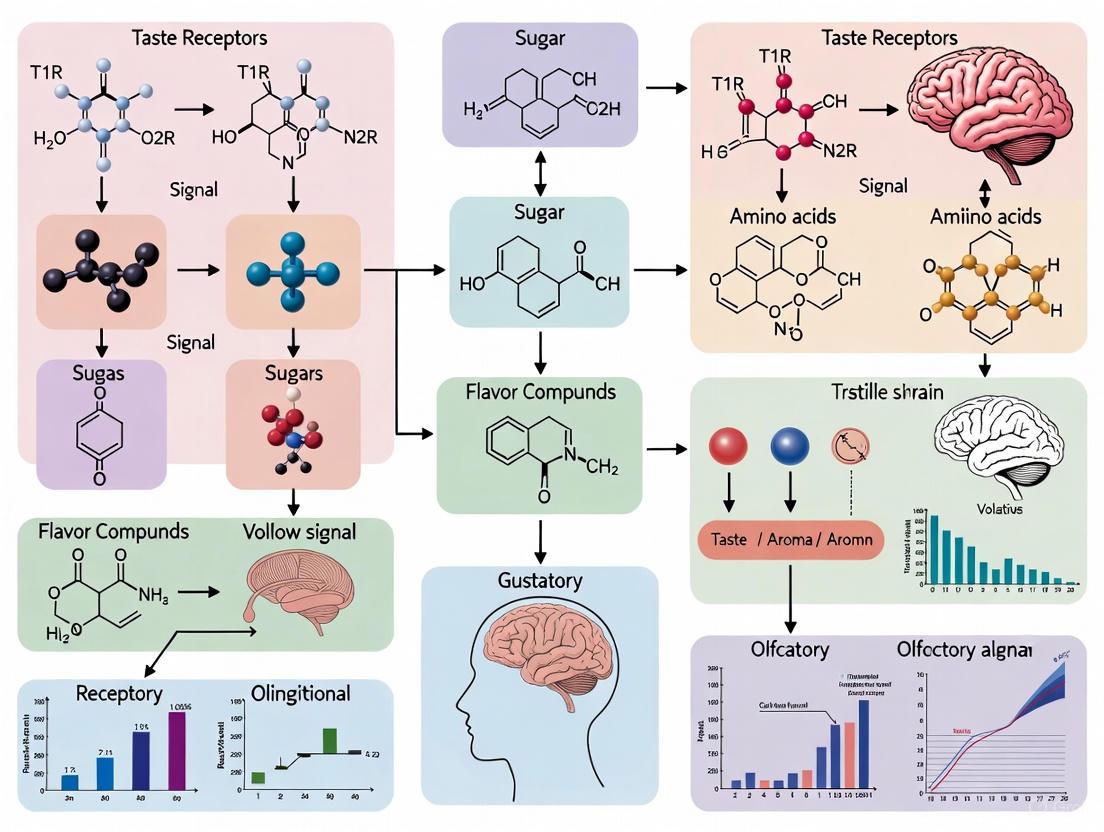
This article provides a comprehensive analysis of the molecular basis of food sensory perception and flavor, tailored for researchers and drug development professionals.
Decoding Flavor: Molecular Mechanisms, Advanced Analytics, and Clinical Applications in Sensory Perception
Abstract
This article provides a comprehensive analysis of the molecular basis of food sensory perception and flavor, tailored for researchers and drug development professionals. It explores the fundamental biological pathways of taste and smell, from receptor-level interactions to complex neural processing. The scope encompasses modern flavoromics approaches that integrate advanced analytical techniques like GC-MS, LC-HRMS, and NMR with sensory evaluation. The content addresses methodological challenges in flavor analysis, compares traditional and novel sensory assessment tools, and examines applications in medicinal taste masking and personalized nutrition. By synthesizing current research from chemistry, biology, and sensory science, this review aims to bridge fundamental discovery with translational applications in pharmaceuticals and clinical research.
From Molecules to Sensation: Unraveling the Biological Pathways of Flavor Perception
The perception of taste is a fundamental biological process that enables organisms to assess the nutritional value and potential toxicity of food. For decades, taste was categorized into four primary qualities: sweet, sour, salty, and bitter. The discovery of umami, the savory taste of glutamate, established it as the fifth basic taste [1]. Research into the molecular basis of taste perception has revealed complex receptor systems and signal transduction pathways that convert chemical stimuli into neural signals. This whitepaper examines the receptor-level mechanisms and signal transduction processes for each of the five basic tastes, providing a technical resource for researchers investigating the molecular foundations of sensory perception. Understanding these mechanisms is crucial for advancing fields ranging from food science to neuropharmacology, particularly in the context of a broader thesis on the molecular basis of food sensory perception and flavor research.
Taste Receptor Families and Signal Transduction Mechanisms
The human gustatory system employs distinct receptor families and signaling mechanisms to detect the five basic tastes. Table 1 summarizes the receptor types, key molecular components, and cellular responses for each taste quality.
Table 1: Receptor Mechanisms and Signal Transduction Pathways for the Five Basic Tastes
| Taste Quality | Receptor Type/Channel | Key Molecular Components | Signal Transduction Mechanism | Taste Cell Type | Primary Signal Output |
|---|---|---|---|---|---|
| Sweet | Class C GPCR (heterodimer) | T1R2, T1R3, Gα-gustducin, PLCβ2, IP₃R, TRPM5 [2] | G protein activation → PLCβ2 → IP₃ → Ca²⁺ release → TRPM5 opening → depolarization [2] | Type II | ATP release [3] |
| Umami | Class C GPCR (heterodimer & others) | T1R1, T1R3, mGluR4 (truncated), Gα-gustducin, PLCβ2, IP₃R, TRPM5 [2] [4] | G protein activation → PLCβ2 → IP₃ → Ca²⁺ release → TRPM5 opening → depolarization [2] [4] | Type II | ATP release [3] |
| Bitter | Class A GPCR (family) | ~25 T2Rs, Gα-gustducin, PLCβ2, IP₃R, TRPM5 [3] | G protein activation → PLCβ2 → IP₃ → Ca²⁺ release → TRPM5 opening → depolarization [3] | Type II | ATP release [3] |
| Salty | Ion Channel | ENaC (low [Na⁺]), other channels (high [Na⁺]) [3] | Na⁺ influx through cation channels → direct depolarization [3] | Type III | Serotonin release [3] |
| Sour | Ion Channel | OTOP1, PKD2L1 [3] | H⁺ influx → channel blockade or direct gating → depolarization [3] | Type III | Serotonin release [3] |
Diagram: Common Signal Transduction Pathway for Sweet, Umami, and Bitter Tastes
The following diagram illustrates the shared G-protein coupled receptor pathway used by sweet, umami, and bitter tastes.
Detailed Mechanisms by Taste Quality
Sweet Taste
Sweet taste is primarily mediated by the T1R2/T1R3 heterodimer, a Class C G-protein coupled receptor (GPCR) [2]. This receptor responds to a diverse range of sweet-tasting compounds, including sugars, artificial sweeteners, and sweet proteins [2]. The Venus flytrap domain in the large N-terminal region of the T1R subunits contains the primary binding site for most natural sugars, while other sweeteners may bind to the transmembrane domain or cysteine-rich region [2].
Key experimental approaches for studying sweet taste include:
- Calcium imaging in heterologous systems: HEK-293 cells transfected with T1R2 and T1R3 genes show intracellular Ca²⁺ increases when stimulated with sweet compounds, confirming receptor functionality [2].
- Knockout mouse models: Mice lacking the Tas1r3 or Tas1r2 genes show markedly diminished behavioral and nerve responses to sweet substances [2].
- Electrophysiological recordings: Chorda tympani nerve recordings measure integrated responses from taste buds to sweet stimuli [2].
Umami Taste
Umami taste represents a complex case of taste coding, with multiple receptors potentially contributing to the perception of L-glutamate and ribonucleotides. The primary receptor is believed to be the T1R1/T1R3 heterodimer, which displays synergistic enhancement when glutamate is combined with 5'-ribonucleotides such as inosine monophosphate (IMP) or guanosine monophosphate (GMP) [2] [4]. However, evidence suggests additional receptors may be involved, including truncated forms of metabotropic glutamate receptors (mGluR4 and mGluR1) [4].
Unlike the truncated mGluR4 receptor, which responds specifically to glutamate, the T1R1/T1R3 receptor exhibits a broader amino acid sensitivity and shows pronounced synergy with nucleotides [4]. This synergism is a hallmark of umami taste, where the presence of IMP or GMP can enhance the perceived intensity of glutamate by up to 20-fold [2].
Critical experimental findings on umami taste include:
- Knockout studies show partial responses: Mice lacking the Tas1r1 or Tas1r3 genes show depressed but not eliminated neural and behavioral responses to umami stimuli, suggesting multiple receptor mechanisms [4].
- mGluR4 knockout increases preference: Mice lacking mGluR4 show significantly increased preference for MSG, indicating this receptor may normally exert an inhibitory influence on umami responses [4].
- L-AP4 taste similarity: In conditioned taste aversion assays, rats generalize the tastes of glutamate and L-AP4 (an mGluR4 agonist), supporting its role as a functional umami receptor [4].
Bitter Taste
Bitterness is detected by a family of approximately 25 T2R receptors (in humans) belonging to the Class A GPCR family [3]. This receptor diversity enables the detection of a wide range of structurally diverse bitter compounds, which often signal potential toxins in food [3]. Individual taste receptor cells typically express multiple T2R receptors, allowing for a broad response spectrum to various bitter compounds [3].
The signal transduction pathway for bitter taste shares the same downstream components (Gα-gustducin, PLCβ2, IP₃R, TRPM5) as sweet and umami tastes [3]. This convergence explains why these three qualitatively distinct tastes share a common output pathway from Type II taste cells.
Sour Taste
Sour taste detection mechanisms have been more elusive, but recent research has identified OTOP1 as a proton channel that is essential for sour perception [3]. This ion channel is gated by extracellular protons (H⁺), allowing cation influx that leads to membrane depolarization in Type III taste cells [3].
Earlier candidates for sour receptors included:
- PKD2L1: Expressed in Type III taste cells and implicated in sour responses [3].
- Other channels: ASIC, HCN, KCNK, and KIR2.1 channels have been proposed to contribute to acid sensing [3].
Salty Taste
Salty taste transduction mechanisms are the least well-characterized among the basic tastes. Low concentrations of sodium chloride are thought to be detected primarily by the epithelial sodium channel (ENaC), which allows Na⁺ influx leading to direct depolarization [3]. The mechanisms for detecting high salt concentrations and the specific cell types involved remain areas of active investigation [3].
The following diagram provides an integrated overview of how different taste qualities are detected and transmitted.
The Scientist's Toolkit: Key Research Reagents and Methods
Table 2 provides a comprehensive list of essential research tools, reagents, and their applications for studying taste mechanisms.
Table 2: Key Research Reagents and Methodologies for Taste Research
| Reagent/Method | Category | Specific Application | Key Function in Research |
|---|---|---|---|
| HEK-293T Cells | Cellular Model | Heterologous expression system | Express cloned taste receptors for deorphanization and screening assays [2] |
| Calcium-Sensitive Dyes (e.g., Fura-2) | Fluorescent Indicator | Live-cell calcium imaging | Measure intracellular Ca²⁺ changes in response to taste stimuli in vitro or in taste buds [2] |
| T1R3-Knockout Mice | Animal Model | Sweet and umami taste studies | Determine necessity of T1R3 for sweet/umami responses; reveal alternate pathways [4] |
| Gustducin Antibodies | Immunological Reagent | Tissue localization | Identify taste receptor cells (Type II) in taste buds via immunohistochemistry [4] |
| L-AP4 (mGluR4 Agonist) | Pharmacological Tool | Umami receptor studies | Probe the role of mGluR4 in umami taste in behavioral and neural assays [4] |
| Lactisole | TASTE RECEPTOR ANTAGONIST | Sweet and umami taste studies | Inhibits human T1R3, used to dissect T1R-dependent vs. T1R-independent pathways [2] |
| Chorda Tympani Nerve Recording | Electrophysiology | Integrated taste response measurement | Record whole-nerve activity in response to taste stimuli in vivo [4] |
| Two-Bottle Preference Test | Behavioral Assay | Taste perception and preference | Measure relative preference for a taste solution vs. water in rodents [4] |
| Conditioned Taste Aversion | Behavioral Assay | Taste quality assessment | Test if animals generalize a conditioned aversion between stimuli to determine perceptual similarity [4] |
| Electronic Tongue (E-tongue) | Analytical Instrument | Taste compound screening | Objectively measure and predict taste profiles of chemical compounds or food samples [5] |
Advanced Research Applications and Future Directions
Research on basic taste mechanisms continues to evolve with implications for food science, nutrition, and medicine. Artificial intelligence (AI) and machine learning are now being applied to predict sensory qualities from chemical data, creating digital models of taste perception [5]. Electronic tongues (E-tongues) equipped with multisensor arrays can detect taste substances and, when combined with AI, predict human sensory perceptions with increasing accuracy [5] [6].
The discovery of extra-oral taste receptors in the gastrointestinal tract, respiratory system, and other tissues suggests broader physiological roles for taste receptors beyond conscious perception, including nutrient sensing and regulation of metabolic processes [3]. Furthermore, understanding taste receptor mechanisms has significant clinical implications, as evidenced by research on taste disorders (dysgeusia), which can arise from various causes including viral infections such as SARS-CoV-2 [3].
The molecular dissection of taste perception continues to provide insights not only into gustatory processing but also into broader principles of sensory coding and receptor function, offering multiple avenues for future scientific exploration and therapeutic development.
The perception of flavor, a cornerstone of food sensory science, is a multisensory experience heavily dependent on the olfactory system's ability to detect and decode a vast array of volatile organic compounds (VOCs). These VOCs, released from food, constitute the chemical basis of aroma and are detected by a large family of specialized proteins known as odorant receptors (ORs) [7] [8]. This complex interaction between volatiles and receptors is the molecular foundation of smell, which, when integrated with taste and other senses, creates the unified perception of flavor [7]. Understanding the mechanisms of volatile detection and the nature of OR families is therefore critical for advancing research in food chemistry, sensory evaluation, and the development of novel flavors and aroma-based products. This whitepaper provides an in-depth technical guide to the core components of olfactory detection, focusing on the properties of volatile compounds, the structure and function of odorant receptor families, and the experimental methodologies driving this field forward.
Volatile Organic Compounds: The Chemical Landscape of Smell
Volatile organic compounds are low molecular weight organic chemicals that readily evaporate at ambient temperatures, allowing them to travel through the air and reach the olfactory system [9]. In the context of food, VOCs are paramount to aroma and flavor perception. The terrestrial vegetation, which includes most food sources, produces an amazing diversity of VOCs derived from several key metabolic pathways, including the mevalonic acid (MVA) and methylerythritol phosphate (MEP) pathways for isoprenoids, the lipoxygenase (LOX) pathway for fatty acid derivatives, and the shikimic acid pathway for benzenoids and phenylpropanoids [9].
The specific profile of VOCs emitted is highly dynamic and depends on the plant species, tissue type, and environmental conditions, such as stress or herbivory [9]. For example, in sweet basil (Ocimum basilicum L.), distinct sensory profiles are chemically characterized by different volatile compounds. The anise aroma and flavor are closely associated with methyl chavicol, while a clove aroma is linked to eugenol [10]. Advanced analytical techniques like gas chromatography coupled with mass spectrometry (GC-MS) and electronic noses (E-Nose) are essential tools for identifying and quantifying these compounds in complex food matrices [8].
Table 1: Key Classes of Volatile Organic Compounds in Food and Their Sensory Attributes
| Compound Class | Example Compounds | Common Food Sources | Sensory Attributes |
|---|---|---|---|
| Terpenes | Limonene, Pinene, Caryophyllene [8] [9] | Citrus fruits, herbs, spices [9] | Citrus, pine, floral, woody |
| Benzenoids/Phenylpropanoids | Eugenol, Methyl chavicol [10] [9] | Basil, cloves, anise [10] | Clove, anise, spicy |
| Fatty Acid Derivatives | (E)-2-Hexenal, Hexanal [11] [9] | Green leaves, cut grass [9] | Green, grassy |
| Amino Acid Derivatives | Sulfur compounds, Indole [8] [9] | Passion fruit wine, fermented foods [8] | Tropical fruit, sulfurous |
Odorant Receptor Families: Molecular Gatekeepers of Olfaction
Odorant receptors are G protein-coupled receptors (GPCRs) that serve as the primary molecular gatekeepers of the olfactory system [12] [13]. They are located on the cilia of olfactory sensory neurons (OSNs) within the olfactory epithelium. The OR gene family is the largest in the animal genome, comprising approximately 1000 genes in mice and rats, which represents about 1% of the genome [12] [13]. In humans, the family includes roughly 400 functional receptors [14].
A foundational principle of olfactory coding is combinatorial reception. A single odorant molecule can bind to multiple ORs, and a single OR can be activated by multiple odorants [12]. The identity of an odor is thus encoded by a unique combination of activated ORs, creating a combinatorial code that allows a limited number of receptors to discern a vast universe of smells.
The origin of the OR gene family in insects has been a subject of significant research. Evidence indicates that ORs were present in the ancestor of all insects but are absent from non-insect hexapod lineages, suggesting that the origin of this gene family coincided with the evolution of insects, possibly as an adaptation to terrestriality [15]. A key innovation in insect olfaction was the evolution of a universal, highly conserved co-receptor (Orco). All ORs form a heteromeric complex with Orco, which is essential for the receptor's function and trafficking to the cell membrane [15]. The OR/Orco system is found in most insects, with the exception of some ancestrally wingless lineages like Archaeognatha (bristletails) [15].
Table 2: Key Features of Vertebrate and Insect Odorant Receptor Families
| Feature | Vertebrates | Insects |
|---|---|---|
| Receptor Type | G Protein-Coupled Receptors (GPCRs) [13] | GPCRs (divergent from vertebrates) [15] |
| Gene Family Size | ~1000 in mouse/rat; ~400 in humans [14] [12] | Varies by species (e.g., 43 in Thermobia domestica) [15] |
| Co-receptor | Not applicable | Orco (universal co-receptor) [15] |
| Expression Pattern | One receptor per neuron (typically) [12] | One receptor per neuron (typically) [12] |
| Signal Transduction | Golf protein, cAMP pathway [16] | Orco-dependent, non-selective cation channel [15] |
A major resource for researchers is GPCRdb, which in its 2024/2025 release has incorporated all approximately 400 human odorant receptors and their orthologs in major model organisms [14]. This database provides reference data, analysis, and visualization tools for these receptors, allowing scientists to study their sequences, genetic relationships, and structural models. GPCRdb also includes updated inactive- and active-state models of human GPCRs, including ORs, built using advanced computational methods like AlphaFold-Multistate and RoseTTAFold, which are invaluable for structure-based research and ligand screening [14].
From Odorant Binding to Neural Perception
The journey from a volatile compound in the environment to a perceived smell involves a sophisticated signal transduction pathway and subsequent neural processing. The following diagram illustrates the core signaling pathway from odorant binding to initial signal transmission to the brain.
Diagram 1: Olfactory Signal Transduction Pathway. This diagram outlines the key steps in the vertebrate olfactory pathway, from odorant binding to the generation of an action potential that is transmitted to the olfactory bulb for further processing [16] [12].
The process begins when an odorant molecule enters the nasal cavity and binds to a specific OR on the cilia of an OSN [16]. This binding event activates the OR, which in turn activates a G protein (Golf). The activated G protein stimulates adenylyl cyclase to produce the second messenger cyclic adenosine monophosphate (cAMP). The rise in cAMP levels opens cyclic nucleotide-gated (CNG) ion channels, allowing an influx of calcium and sodium ions into the cell. This influx depolarizes the neuron, generating an action potential that travels along the axon of the OSN to the olfactory bulb [16] [12].
In the olfactory bulb, axons from OSNs expressing the same OR converge onto discrete structures called glomeruli [12]. This creates a spatial map of olfactory information, where each glomerulus corresponds to a specific odorant receptor type. The signal is then processed by mitral and tufted cells, the primary output neurons of the olfactory bulb, which project directly to higher olfactory areas like the piriform cortex, forming the perception of smell [16]. The olfactory cortex is integral to pattern recognition and associating smells with memories and emotions [16].
Experimental Protocols and Methodologies
Surface Plasmon Resonance Imaging (SPRi) for VOC Detection
Objective: To develop highly sensitive olfactory biosensors for the detection and quantification of volatile organic compounds (VOCs) using immobilized odorant binding proteins (OBPs) and SPRi technology [11].
Detailed Protocol:
Sensor Chip Functionalization:
- Prepare a gold-coated glass chip for chemical modification.
- Immobilize three customized derivatives of rat OBP3 (odorant binding protein 3) as sensing elements onto the chip surface. Ensure immobilization conditions are optimized to preserve the binding properties of the proteins [11].
Sample Introduction and Binding Analysis:
- Use a microfluidic system to flow solutions containing target VOCs (e.g., β-ionone, hexanal) over the functionalized sensor chip.
- The SPRi instrument directs a polarized light beam at the chip surface, generating surface plasmon waves. As VOCs bind to the OBPs, the local refractive index at the chip surface changes [11].
Real-Time Monitoring and Data Acquisition:
- Monitor changes in the reflected light angle or intensity in real-time using a CCD camera. This change is directly proportional to the mass of molecules bound to the sensor surface, allowing for the quantification of binding events [11].
Regeneration and Reusability:
- After each measurement cycle, apply an optimized regeneration solution (e.g., a mild acid or buffer) to dissociate the bound VOC from the OBP without denaturing the protein. This step is critical for achieving repeatable measurements and extending the biosensor's lifespan, which can be up to two months [11].
Key Performance Metrics from this Protocol [11]:
- Limit of Detection (LOD): 200 pM for β-ionone.
- Molecular Weight Range: Capable of detecting VOCs with molecular weights as low as 100 g/mol (e.g., hexanal).
- Selectivity: High selectivity, especially at low VOC concentrations.
- Repeatability: Excellent measurement-to-measurement and chip-to-chip repeatability.
Gas Chromatography-Olfactometry (GC-O) for Aroma Compound Identification
Objective: To separate the volatile compounds of a food sample and directly evaluate their sensory impact by a human assessor, identifying the key odor-active compounds [8].
Detailed Protocol:
Sample Preparation and Volatile Extraction:
- Extract VOCs from the food matrix using techniques such as Headspace-Solid Phase Microextraction (HS-SPME), which concentrates volatiles onto a fused silica fiber [8].
Compound Separation:
- Inject the extracted volatiles into a Gas Chromatograph (GC). The compounds are separated as they travel through the GC column based on their differential partitioning between a mobile gas phase and a stationary liquid phase [8].
Splitting and Simultaneous Detection:
- At the end of the GC column, the effluent is split into two streams.
- One stream is directed to a physical detector (e.g., a Mass Spectrometer, MS) for chemical identification of each separated compound.
- The second stream is directed to an "olfactometry port," a heated outlet where a trained human assessor sniffs the effluent [8].
Sensory Evaluation and Data Correlation:
- The assessor records the perceived aroma, its intensity, and duration for each eluting compound.
- The data from the MS detector (chemical identity) and the assessor's notes (sensory attribute) are correlated to determine which chemicals are responsible for specific aroma notes in the food sample [8].
The following diagram illustrates the workflow of a combined GC-O and GC-MS system.
Diagram 2: GC-Olfactometry Workflow. This diagram shows the parallel chemical and sensory analysis used to identify key aroma-active compounds in a sample [8].
The Scientist's Toolkit: Essential Research Reagents and Materials
Table 3: Key Research Reagent Solutions for Olfactory Studies
| Reagent/Material | Function/Application | Example Use Case |
|---|---|---|
| Odorant Binding Proteins (OBPs) | Sensing element in biosensors; binds specific VOCs with high affinity [11]. | Immobilized on SPRi chips for highly sensitive VOC detection [11]. |
| Heterologous Cell Systems (e.g., HEK293) | Cell lines used to functionally express odorant receptors for in vitro ligand screening [12]. | Co-expressing an OR and Orco to test activation by candidate odorants [12]. |
| SPRi Sensor Chips (Gold-coated) | Platform for immobilizing biological sensing elements (e.g., OBPs, ORs) and monitoring biomolecular interactions in real-time [11]. | Developing olfactory biosensors for trace detection of VOCs in solution [11]. |
| Solid-Phase Microextraction (SPME) Fibers | Extracts and concentrates volatile compounds from liquid or headspace samples for analytical analysis [8]. | Pre-concentrating volatiles from a wine sample prior to GC-MS analysis [8]. |
| GC-MS and GC-Orbitrap-MS Systems | High-resolution analytical instruments for separating, identifying, and quantifying volatile compounds in complex mixtures [8]. | Characterizing the full volatile profile of a food product like passion fruit wine [8]. |
| GPCRdb Database | Online resource providing curated data, structures, and analysis tools for G protein-coupled receptors, including odorant receptors [14]. | Retrieving sequence alignments, phylogenetic trees, and AlphaFold models for a specific human OR [14]. |
The intricate interplay between volatile organic compounds and odorant receptor families forms the basis of olfactory perception, a critical component of flavor. The advancements in analytical techniques, such as SPRi-based biosensors and GC-O, coupled with the expansion of genomic and structural databases like GPCRdb, have dramatically enhanced our ability to dissect this complexity at a molecular level. A deep understanding of these mechanisms provides a powerful framework for researchers in food science, flavor chemistry, and neurobiology to objectively decode sensory perception, paving the way for innovative applications in product development, quality control, and a fundamental understanding of sensory experience.
While taste and smell dominate the sensory evaluation of food, the somatosensory system provides the critical physical and chemical context that completes the flavor experience. This whitepaper details the molecular mechanisms of somatosensation and chemesthesis—the tactile, thermal, and chemical-irritant sensations mediated primarily by Transient Receptor Potential (TRP) and Acid-Sensing Ion Channels (ASICs). We provide a technical framework for researchers investigating the neural basis of flavor, including standardized experimental protocols for assessing trigeminal sensitivity, quantitative data on stimulus-response relationships, and visualization of key signaling pathways. The integration of these chemosensory signals offers novel targets for modulating flavor perception in food design and therapeutic interventions.
Flavor perception represents a complex synthesis of gustatory, olfactory, and somatosensory inputs. Somatosensation encompasses the physical sensations of texture, temperature, and touch mediated by mechanoreceptors and thermoreceptors. Chemesthesis refers to the chemical sensitivity of mucosal surfaces and skin, producing sensations such as the burn of capsaicin, the coolness of menthol, or the tingle of carbonation [17]. These signals converge primarily through the trigeminal nerve (Cranial Nerve V), which innervates the oral, nasal, and ocular surfaces.
Understanding the molecular basis of these systems is paramount for:
- Food Science: Designing controlled flavor release profiles and novel sensory experiences.
- Pharmaceutical Development: Optimizing drug palatability and creating non-opioid analgesics that target peripheral sensory pathways.
- Basic Research: Decoding the integrated neural circuits that translate chemical stimuli into conscious perception.
Molecular Mechanisms and Signaling Pathways
The perception of chemesthetic and somatosensory stimuli is mediated by a suite of ion channels expressed on sensory neurons.
Key Receptor Families
| Receptor Family | Primary Agonists | Resultant Sensation | Cellular Location |
|---|---|---|---|
| TRPV1 | Capsaicin, Heat (>43°C), Acids | Burning, Pain | C-fibers, Aδ-fibers |
| TRPM8 | Menthol, Icilin, Cold (<28°C) | Cooling | C-fibers |
| TRPA1 | Allyl Isothiocyanate (Mustard), Cinnamaldehyde, Cold (<17°C) | Pungency, Stinging | C-fibers |
| ASICs | Protons (Low pH) | Sourness, Sharpness | Sensory Neuron Terminals |
Integrated Signaling Pathway
The following diagram illustrates the core signaling pathway from stimulus application to neural signaling and perceived sensation.
Quantitative Data and Psychophysical Relationships
Effective experimental design requires an understanding of the quantitative relationships between stimulus concentration and perceived intensity. The following table summarizes threshold and saturation data for common chemesthetic agents.
Table 2: Psychophysical Parameters of Common Chemesthetic Stimuli
| Stimulus | Target Receptor | Detection Threshold (Human, Oral) | Half-Maximal Efficacy (EC₅₀) | Perceptual Quality |
|---|---|---|---|---|
| Capsaicin | TRPV1 | 0.1 - 1.0 µM | ~0.3 µM | Burning, Pungent |
| Menthol | TRPM8 | 10 - 50 µM | ~60 µM | Cooling |
| Allyl Isothiocyanate | TRPA1 | 1 - 5 µM | ~8 µM | Sharp, Pungent |
| Carbonation | ASICs/Carbonic Anhydrase | 1.5 - 2.0 atm CO₂ | N/A | Tingling, Sharp |
| Ethanol | TRPV1/TRPA1 | 2-5% v/v | N/A | Burning, Warmth |
Experimental Protocols and Methodologies
Robust experimentation requires standardized protocols to ensure reproducibility and valid cross-study comparisons.
Cell-Based Calcium Imaging for Receptor Activation
This protocol is used to characterize receptor responses and screen for agonists/antagonists.
Workflow Diagram:
Detailed Procedure:
- Cell Preparation: Culture HEK293T cells or dissociate trigeminal ganglion neurons from animal models (e.g., mouse, rat).
- Receptor Expression: For HEK293T cells, transiently transfect with plasmid DNA encoding the target human receptor (e.g., TRPV1) using a standard method like lipofection.
- Dye Loading: Incubate cells with 1-5 µM cell-permeant calcium indicator (e.g., Fluo-4 AM) in a physiological buffer (e.g., HBSS) for 30-60 minutes at 37°C. Protect from light.
- Baseline Acquisition: Wash cells and place in a clear, isotonic solution. Using a fluorescent microscope or plate reader, acquire baseline fluorescence (F₀) for 1-2 minutes.
- Stimulus Application: Apply the chemesthetic agent (e.g., capsaicin) in a series of increasing concentrations. Include a positive control (e.g., ionomycin) and vehicle control.
- Signal Capture: Continuously monitor fluorescence (F) for 3-5 minutes post-application. Calculate the relative fluorescence change (ΔF/F₀ = (F - F₀)/F₀).
- Data Analysis: Plot ΔF/F₀ against time and agonist concentration. Fit the concentration-response data with a sigmoidal curve (e.g., using a four-parameter logistic equation) to determine EC₅₀ values.
Human Psychophysical Evaluation: Two-Alternative Forced Choice (2-AFC)
This sensory test determines detection thresholds in human participants.
Detailed Procedure:
- Solution Preparation: Prepare a series of solutions with the target stimulus (e.g., capsaicin) in a neutral vehicle (e.g., mineral oil, water with 5% ethanol) using a logarithmic concentration scale.
- Trial Structure: In each trial, present the participant with two samples: one containing the stimulus and one vehicle control. The order is randomized.
- Participant Task: Instruct the participant to identify which sample contains the stimulus.
- Threshold Calculation: Use a staircase or ascending forced-choice method. The detection threshold is defined as the concentration at which the participant correctly identifies the stimulus at a statistically significant level (e.g., 75% correct), corrected for chance.
The Scientist's Toolkit: Essential Reagents and Materials
Successful research in this field relies on a specific set of high-quality reagents and tools.
Table 3: Key Research Reagent Solutions
| Item | Function & Utility | Example Specification |
|---|---|---|
| TRP Channel Agonists/Antagonists | Pharmacological tools to activate or block specific receptors for mechanism studies. | Capsaicin (TRPV1 agonist, >98% purity), AMG-517 (TRPV1 antagonist) |
| Calcium-Sensitive Fluorescent Dyes | To visually quantify receptor activation and cellular signaling in real-time. | Fluo-4 AM (cell-permeant), Fura-2 (rationetric) |
| Cell Lines for Heterologous Expression | A controlled system for studying recombinant human receptors without endogenous background. | HEK293T (high transfection efficiency), CHO-K1 |
| Primary Sensory Neurons | For physiologically relevant studies in native cells expressing the full complement of receptors. | Isolated rat or mouse Trigeminal Ganglion (TG) neurons |
| Animal Models | In vivo studies of behavior, neural coding, and genetics of chemesthesis. | Wild-type C57BL/6 mice; TRPV1-KO, TRPM8-KO strains |
| Psychophysical Testing Equipment | To deliver precise stimuli and collect human sensory data. | Glass sniff bottles, filter paper strips for taste strips, olfactometers |
The molecular dissection of somatosensation and chemesthesis has transformed our understanding of flavor from a simple combination of taste and smell to a complex, integrated sensory experience mediated by specific ion channels. The experimental frameworks and data presented here provide a foundation for advancing research in this field. Future efforts should focus on:
- Elucidating the complex interactions and cross-desensitization between different TRP channels.
- Exploring the genetic polymorphisms in these receptors that underlie individual differences in flavor perception and food preference.
- Developing high-throughput screening assays to discover novel flavor modulators and analgesics from natural and synthetic libraries.
Mastering this "third pathway" of flavor opens new frontiers for creating tailored food experiences and targeted therapeutic agents that operate at the fundamental interface between chemistry and sensation.
Flavor perception is a quintessentially multisensory experience, constructed by the brain's integration of distinct sensory cues from gustatory (taste), retronasal olfactory (smell), and somatosensory (texture, temperature) systems [18] [19]. Contrary to popular belief, what we perceive as "taste" is largely a synthesis of these separate inputs. Cognitive neuroscience has revealed that the brain does not process these signals in isolation; instead, it employs sophisticated neural mechanisms to bind them into a unified flavor percept [20]. This integration is not a simple summation but a complex, reliability-dependent computation performed primarily within the gustatory cortex (GC) and involving a network of other brain regions [18]. Understanding these processes at a molecular and systems level is critical for advancing fundamental knowledge in sensory neuroscience and has direct applications in the development of novel foods, flavor enhancers, and therapeutic strategies for sensory impairments.
Core Neural Mechanisms and Computations
The brain's integration of multisensory flavor signals follows specific computational principles, with the gustatory cortex acting as a central hub.
Reliability-Dependent Integration in the Gustatory Cortex
Recent research establishes that GC neurons perform a weighted integration of taste and smell inputs, where the weight assigned to each modality is dynamically calibrated based on its reliability [18]. Reliability in this context is defined by the noisiness or variability of the sensory input. A more reliable sensory signal—characterized by less variable neural responses—contributes more strongly to the final neural representation of the flavor mixture.
The underlying computation can be conceptualized as a weighted average, where the hedonic judgment (palatability) of a taste-smell mixture is determined by the formula: Judgmentmixture = (Weighttaste × Judgmenttaste) + (Weightsmell × Judgmentsmell). The weights are not fixed but are a function of the relative reliability of each component [18]. This reliability-dependent weighting allows the brain to form a robust and accurate percept of a food's flavor value, even when individual sensory channels are noisy.
The Neural Correlates of Flavor Binding
The mechanistic basis for this computation is observed in the electrophysiological properties of GC neurons. Extracellular recordings of single-neuron spiking and local field potential (LFP) activity in animal models reveal two key neural correlates:
- Response Variability: Unreliable sensory inputs are associated with more variable neural responses, quantified by a higher Fano factor (a measure of trial-to-trial variability in spike counts) [18].
- Network Synchronization: Reliable inputs correlate with stronger network-level synchronization in the gamma band of LFP activity [18]. Gamma synchronization is thought to facilitate effective communication between neuronal groups, thereby allowing a more reliable signal to exert a greater influence on the network's output.
This neural code ensures that the most trustworthy sensory information dominates the percept that guides feeding behavior.
A Distributed Flavor Network
While the GC is a critical site for integration, flavor perception involves a distributed network. Neuroimaging studies in humans show that the insula and orbitofrontal cortex (OFC) are deeply involved [19] [20]. The insula is a primary taste cortex, receiving direct taste inputs, while the OFC is heavily implicated in encoding the hedonic value (liking/disliking) of flavors [20]. The ventromedial prefrontal cortex has also been shown to correlate with behavioral preferences for familiar drinks, highlighting the role of higher-order cognitive and reward areas [19]. This network processes not only the sensory-discriminative aspects of flavor ("what" it is) but also the affective-motivational aspects ("how much" it is liked) [19].
Quantitative Experimental Data
Key findings from recent studies provide quantitative evidence for the neural principles of flavor integration. The following table summarizes data from an investigation into reliability-dependent integration in the gustatory cortex [18].
Table 1: Quantitative Summary of Key Neural and Behavioral Findings from Gustatory Cortex Studies
| Parameter | Experimental Finding | Experimental Method | Implication for Flavor Perception |
|---|---|---|---|
| Behavioral Hedonic Judgment | A weighted average of component judgments; weights shifted with manipulated reliability. | Two-bottle preference test (rats) | Hedonic assessment of flavor is a flexible computation, not a fixed property. |
| Neural Decoding Accuracy | GC population activity more accurately decoded flavor identity when inputs were integrated based on reliability. | Extracellular recording & decoding analysis | Reliability-dependent integration enhances the discriminability of flavors in the neural code. |
| Response Variability (Fano Factor) | Less reliable inputs elicited higher Fano factor (more variable spiking) in GC neurons. | Single-neuron spiking analysis | Input reliability is neurally encoded as response variability at the single-cell level. |
| Gamma Synchronization | More reliable sensory inputs were associated with stronger gamma-band LFP synchronization. | Local field potential (LFP) analysis | Network-level oscillations provide a mechanism for weighting sensory inputs. |
Detailed Experimental Protocols
To investigate the neural integration of flavor, researchers employ rigorous protocols combining behavioral assays with state-of-the-art neurophysiological techniques.
Protocol 1: Behavioral Assay for Hedonic Flavor Judgments
This protocol assesses how animals form hedonic judgments of multisensory flavor stimuli based on cue reliability [18].
- Objective: To determine if hedonic judgments of taste-smell mixtures follow a reliability-dependent weighted average model.
- Materials:
- Subjects: Rodent models (e.g., rats).
- Stimuli: Aqueous solutions of pure tastants (e.g., sucrose, quinine), odorants, and their mixtures.
- Apparatus: Two-bottle testing chamber, automated lick detectors.
- Procedure:
- Pre-training: Habituate animals to the testing chamber and establish baseline preference for unmixed taste and smell solutions.
- Reliability Manipulation: Alter the perceptual reliability of a taste or smell cue. This can be achieved by presenting a diluted (less intense) version of a stimulus, making it a less reliable indicator of identity or value.
- Two-Bottle Preference Test: For each trial, present the animal with two bottles: one containing a taste-smell mixture and the other containing a control solution (e.g., water). The relative position of the bottles is switched randomly.
- Data Collection: Record the number of licks and the time spent drinking from each bottle over a set period (e.g., 10 minutes). The preference ratio (licks to mixture / total licks) serves as the quantitative measure of hedonic judgment.
- Analysis: Fit the behavioral preference data to a weighted average model to determine the relative weights assigned to the taste and smell components under different reliability conditions.
Protocol 2: Neurophysiological Recording in the Gustatory Cortex
This protocol characterizes the neural activity in GC during the presentation of multisensory flavor stimuli [18].
- Objective: To identify neural correlates of reliability-dependent integration in the gustatory cortex.
- Materials:
- Subjects: Rodent models implanted with chronic recording electrodes.
- Stimuli: As in Protocol 1.
- Apparatus: Stereotaxic apparatus for electrode implantation, multichannel extracellular recording system, microinfusion pump for precise stimulus delivery to the tongue.
- Procedure:
- Surgery: Implant a multielectrode array or bundle of tetrodes into the gustatory cortex under anesthesia using stereotaxic coordinates.
- Stimulus Presentation: Awake, head-fixed animals receive controlled intra-oral infusions of taste, smell, and mixture stimuli while neural activity is recorded.
- Neural Data Acquisition: Simultaneously record:
- Single-Unit Activity: Action potentials from individual neurons.
- Local Field Potential (LFP): Low-frequency population signals from the electrode.
- Analysis:
- Spike Sorting: Isolate single-neuron spike waveforms from the recorded signals.
- Fano Factor Calculation: Compute the Fano factor (variance/mean of spike counts) across trials for each neuron and stimulus condition.
- Spectral Analysis of LFP: Perform a time-frequency analysis (e.g., wavelet transform) on the LFP to quantify power in the gamma band (e.g., 30-100 Hz).
- Population Decoding: Use machine learning classifiers (e.g., linear discriminant analysis) to decode stimulus identity from the population neural activity and assess decoding accuracy.
Signaling Pathways and Experimental Workflows
The following diagrams, generated using Graphviz, illustrate the core concepts of neural flavor integration and the experimental workflow used to study it.
Neural Pathway of Multisensory Flavor Integration
Experimental Workflow for Flavor Neuroscience
The Scientist's Toolkit: Key Research Reagents & Materials
Research in the molecular basis of multisensory flavor perception relies on a specific toolkit of reagents, technologies, and analytical methods.
Table 2: Essential Research Reagents and Technologies for Flavor Neuroscience
| Tool/Reagent | Function/Application | Specific Examples & Notes |
|---|---|---|
| Multichannel Electrophysiology Systems | Record single-neuron and population (LFP) activity from the brain in awake, behaving animals. | Chronic implant microdrives/electrode arrays (e.g., tetrodes) targeting the Gustatory Cortex, Insula, or OFC [18]. |
| Controlled Stimulus Delivery Devices | Precisely administer taste and smell stimuli with accurate timing and concentration. | Gustometers for intra-oral fluid delivery; Olfactometers for retronasal odorant delivery [21]. |
| Pure Chemical Tastants & Odorants | Serve as standardized sensory stimuli to probe specific receptor pathways and neural responses. | Tastants: Sucrose (sweet), Quinine HCl (bitter), Sodium Chloride (salty). Odorants: Ethyl butyrate (fruity), Hexanal (green) [18] [22]. |
| Data Analysis Software | Process and model complex neurophysiological and behavioral datasets. | Custom scripts (Python, MATLAB) for spike sorting, LFP spectral analysis, and machine learning-based decoding [18]. |
| Electronic Nose (E-nose) | Objectively analyze volatile flavor profiles, correlating chemical signatures with sensory data. | Sensor arrays that detect key volatiles (e.g., aldehydes, sulfides); used with machine learning for classification [23] [22]. |
| Gas Chromatography-Mass Spectrometry (GC-MS) | Identify and quantify specific volatile organic compounds that contribute to a food's aroma and flavor. | Used to pinpoint key flavor compounds (e.g., dimethyl trisulfide in ham) and validate E-nose findings [23] [22]. |
| Functional Magnetic Resonance Imaging (fMRI) | Non-invasively map brain activity in humans during flavor perception to identify involved networks. | Locates active regions (e.g., OFC, insula) in response to flavor stimuli, linking perception to neural structures [23] [19]. |
Sensory receptors function as the primary interface between an organism and its chemical environment, playing a critical role in detecting nutrients, avoiding toxins, and guiding food preferences [24]. The study of genetic variations in these receptors provides a mechanistic understanding of why individuals experience the sensory world differently, particularly in the context of food perception and flavor evaluation. Genetic polymorphisms in sensory receptor genes contribute substantially to individualized sensory systems, affecting receptor function, expression levels, and ultimately, perceptual experiences [25] [26]. These variations are not random; they are shaped by evolutionary forces that reflect species adaptations to their chemical environments and feeding ecology [24]. For researchers in food science and pharmaceutical development, understanding these genetic determinants offers pathways to personalized nutrition and sensory-targeted product design.
The mechanisms through which genetic variation influences sensory perception are multifaceted. Nonsynonymous single nucleotide polymorphisms (SNPs) can alter receptor protein structure, changing its binding affinity for specific ligands [27]. Promoter region variations can affect the level of receptor gene expression, ultimately influencing the abundance of specific sensory neuron subtypes [25]. Furthermore, gene duplications and deletions can expand or contract entire receptor families, creating population-level differences in sensory capabilities [24] [28]. This technical guide explores the key genetic variations in chemosensory receptors, their functional consequences, and the methodological approaches for their investigation within the context of food sensory perception and flavor research.
Genetic Variation in Taste Receptors
Taste Receptor Families and Their Functions
The human taste system detects five basic qualities—sweet, umami, bitter, salty, and sour—through specialized receptors and transduction pathways. Sweet, umami, and bitter tastes are mediated by G protein-coupled receptors (GPCRs), while salty and sour tastes are transduced primarily through ion channels [26]. The T1R family of taste receptors includes three members: T1R1, T1R2, and T1R3, which function as heterodimers. The T1R2+T1R3 heterodimer acts as the sweet receptor, responding to sugars, artificial sweeteners, and sweet-tasting proteins, while the T1R1+T1R3 heterodimer functions as the umami receptor, responding to L-amino acids such as glutamate [24]. In contrast, the T2R family comprises approximately 25 functionally diverse bitter receptors that detect a wide array of toxic and aversive compounds [26].
Table 1: Major Taste Receptor Families and Their Genetic Attributes
| Receptor Family | Taste Quality | Gene Symbols | Number of Genes | Chromosomal Location | Key Genetic Variations |
|---|---|---|---|---|---|
| T1R | Sweet, Umami | TAS1R1, TAS1R2, TAS1R3 | 3 in humans | 1p36 | Multiple SNPs in coding and non-coding regions affecting sweet and umami perception [26] |
| T2R | Bitter | TAS2Rs | >25 in humans | 7p21, 12p13 | Extensive polymorphisms; TAS2R38 PAV/AVI haplotypes strongly linked to PTC/PROP bitterness [27] [26] |
| ENaC | Salty | SCNN family | Multiple subunits | Multiple locations | Less influenced by genetic variation; strongly affected by environmental factors [26] |
Documented Functional polymorphisms in Taste Receptors
Genetic variation in taste receptor genes contributes significantly to individual differences in taste sensitivity and food preferences. The TAS2R38 gene represents one of the most thoroughly studied examples, with three common haplotypes defined by SNPs at positions 49, 262, and 296: PAV (proline-alanine-valine) and AVI (alanine-valine-isoleucine) being the most frequent [27]. Functional expression studies demonstrate that these haplotypes code for operatively distinct receptors, with the PAV haplotype conferring high sensitivity to the bitter compounds phenylthiocarbamide (PTC) and propylthiouracil (PROP), while the AVI haplotype produces an insensate receptor [27]. This polymorphism divides populations into "supertasters," "medium tasters," and "nontasters" of these thiourea compounds, which has implications for the perception of bitter foods like brassica vegetables, green tea, and soya [26].
Variation in sweet and umami perception is linked to polymorphisms in the TAS1R gene family. The TAS1R3 subunit, common to both sweet and umami receptors, contains non-coding SNPs that affect promoter activity and contribute to individual variability in sucrose perception [26]. Recent studies have identified associations between SNPs in sweet, fat, umami, and salt taste receptor genes and psychophysical measures of taste detection threshold, suprathreshold sensitivity, and preference [29]. These genetically determined differences in taste perception may influence dietary choices and nutrient intake patterns, potentially contributing to long-term health outcomes.
Genetic Variation in Olfactory Receptors
Olfactory Receptor Diversity and Regulation
The olfactory system exhibits remarkable diversity, with humans possessing approximately 400 functional olfactory receptor (OR) genes. Each olfactory sensory neuron (OSN) expresses typically a single OR gene in a monoallelic fashion, creating a highly heterogeneous neuronal repertoire [25]. The distribution of OSN subtypes is stereotyped in genetically identical individuals but varies extensively between different strains, with cis-acting genetic variation representing the greatest component influencing OSN composition [25]. This variation is independent of OR protein function and occurs primarily within regulatory elements of OR genes.
Recent research has demonstrated that olfactory stimulation with specific odorants can modulate the abundance of dozens of OSN subtypes in a subtle but reproducible, specific, and time-dependent manner [25]. This environmental modulation interacts with genetic predispositions to generate a highly individualized olfactory sensory system. One well-characterized example involves the OR7D4 receptor, where genotypic variation (specifically the RT versus WM variants) predicts sensitivity to androstenone and influences the sensory perception of cooked pork containing this compound [30]. Individuals with two copies of the functional OR7D4 RT variant are more sensitive to androstenone and tend to rate androstenone-tainted meat less favorably than those carrying the non-functional WM variant [30].
Orthonasal vs. Retronasal Olfaction in Flavor Perception
In the context of food flavor research, it is crucial to distinguish between orthonasal (sniffing) and retronasal (mouth-level) olfaction. While both processes involve the same olfactory receptors, they provide distinct perceptual experiences and are differentially affected by genetic variation. Retronasal olfaction, which combines with taste and texture to create flavor perception, is particularly relevant to food science. Genetic variations in odorant receptors like OR7D4 can directly impact flavor perception and food preferences by altering the intensity and hedonics of food aromas [30].
Evolutionary Perspectives on Sensory Receptor Variation
Sensory receptors exhibit distinct evolutionary patterns across animal taxa. Mechanoreceptors, thermoreceptors, and photoreceptors often constitute part of the ancestral sensory toolkit of animals, frequently predating the evolution of multicellularity and nervous systems [28]. In contrast, chemoreceptors display a dynamic history of lineage-specific expansions and contractions correlated with the disparate complexity of chemical environments [28]. The T2R bitter receptor family, for instance, has undergone significant species-specific diversification, reflecting adaptations to different dietary niches and toxin exposures [24] [26].
Evolutionary analyses reveal that sensory receptors serve as hotspots for adaptive evolution. Polymorphisms in sensory receptors are maintained through balancing selection in some cases, while in others, directional selection drives the fixation of alleles advantageous in specific ecological contexts [24]. The high degree of polymorphism in bitter receptor genes compared to most other genes suggests ongoing evolutionary arms races between plants producing defensive compounds and animals evolving detection mechanisms [26]. Understanding these evolutionary dynamics provides valuable context for interpreting functional genetic studies and developing evolutionary-informed hypotheses in sensory research.
Experimental Approaches and Methodologies
Genotyping and Phenotyping Protocols
TAS2R38 Haplotyping and Phenotyping: The determination of TAS2R38 genotype status represents a well-established protocol in sensory genetics research. The methodology involves:
- DNA Extraction: Collect buccal cells or blood samples using standard DNA extraction kits.
- Genotype Analysis: Amplify the TAS2R38 gene region containing the SNP positions 49, 262, and 296 using PCR with specific primers: Forward: 5'-GCACTTCATAATCGCAGTCC-3', Reverse: 5'-CAGGGCAAGAGAATGGAAGA-3'.
- Haplotype Determination: Perform restriction fragment length polymorphism (RFLP) analysis or direct sequencing to identify the three key SNPs that define the major haplotypes (PAV, AVI).
- Phenotype Verification: Conduct psychophysical testing using filter paper strips impregnated with 0.0001 mol/L PROP solution or prepared PTC solutions. Participants rate intensity on a generalized Labeled Magnitude Scale (gLMS) to classify them as nontasters, medium tasters, or supertasters [27].
Olfactory Receptor Functional Assays: For olfactory receptors like OR7D4, functional characterization involves:
- In vitro Receptor Activation Assay: Clone variant OR7D4 alleles into expression vectors and transfect into HEK-293 cells.
- Calcium Imaging: Load cells with calcium-sensitive dyes and measure fluorescence changes upon stimulation with androstenone solutions (typically 1-100 µM).
- Dose-Response Analysis: Calculate EC50 values for each receptor variant to determine functional differences between genotypes [30].
- Sensory Evaluation: Conduct controlled sensory tests using cooked meat samples with varying androstenone concentrations (0.1-1.0 ppm). Participants rate intensity and pleasantness using visual analog scales while controlling for environmental variables [30].
Quantitative Assessment of Neuronal Populations
Advanced RNA-sequencing techniques enable comprehensive mapping of olfactory sensory neuron diversity:
- Tissue Collection: Dissect main olfactory epithelium from model organisms immediately after euthanasia.
- RNA Extraction and Library Preparation: Use standardized kits to extract high-quality RNA and prepare sequencing libraries.
- Sequencing and Analysis: Perform high-throughput sequencing (minimum 30 million reads per sample) and map reads to extended olfactory receptor gene annotations.
- Validation: Verify RNAseq findings with in situ hybridization for selected receptors to confirm correlation between mRNA levels and actual OSN counts [25].
Genetic Variation to Behavior Pathway
Research Reagent Solutions Toolkit
Table 2: Essential Research Reagents for Sensory Genetics Studies
| Reagent/Category | Specific Examples | Research Application | Function/Purpose |
|---|---|---|---|
| Genetic Analysis Kits | DNA extraction kits (e.g., Qiagen DNeasy), TaqMan SNP Genotyping Assays, PCR reagents | Genotyping of TAS2R38, TAS1R, and OR gene variants | DNA isolation and specific polymorphism detection for candidate gene studies [27] [29] |
| Psychophysical Testing Stimuli | PROP (propylthiouracil) solutions (0.0001-0.0032 M), PTC papers, gLMS scales | Phenotypic assessment of taste sensitivity | Determination of taster status and intensity ratings for correlation with genotype [26] |
| Cell-Based Assay Systems | HEK-293T cells, calcium-sensitive dyes (e.g., Fluo-4), expression vectors | In vitro functional characterization of receptor variants | Assessment of receptor activation and dose-response relationships for variant receptors [30] |
| RNA Sequencing Tools | RNA extraction kits, library preparation kits, sequencing platforms | Comprehensive analysis of olfactory receptor expression | Quantification of OSN subtype abundance and repertoire composition [25] |
| Odorant/Tastant Stimuli | Androstenone, monosodium glutamate, nicotine, bitter compounds (PTC/PROP) | Controlled sensory evaluation studies | Standardized stimuli for psychophysical testing and correlation with genetic variation [30] [31] |
Implications for Food Science and Pharmaceutical Development
Understanding genetic variation in sensory receptors has profound implications for product development in both food and pharmaceutical industries. Bitter receptor polymorphisms significantly influence medication compliance, as genetic variation in TAS2R38 affects the perception of bitter-tasting pharmaceuticals [27]. Pharmacogenetic approaches that account for this variation can guide the development of better-tasting oral medications or bitter blockers to improve patient acceptance [24] [31].
In food science, genetic variation in taste and smell receptors explains why individuals differ in their preferences for specific foods, including vegetables, sweet substances, and fatty foods [26] [29]. This knowledge enables the development of personalized nutrition strategies and products tailored to different genetic profiles. Furthermore, identifying enhancers of sweet and umami taste through receptor-based screening can facilitate the creation of healthier products with reduced sugar and sodium content without sacrificing palatability [24].
Taste Signal Transduction Pathway
Genetic variation in sensory receptors represents a fundamental biological factor underlying individual differences in sensory perception, with far-reaching implications for food preference, dietary behavior, and pharmaceutical acceptance. The functional polymorphisms identified in taste and olfactory receptor genes demonstrate how sequence variations translate to perceptual differences through effects on receptor function and neuronal representation. For researchers in sensory science, flavor chemistry, and product development, incorporating genetic perspectives offers a more comprehensive understanding of consumer variability and creates opportunities for personalized approaches. Future research directions should focus on elucidating gene-environment interactions, developing high-throughput screening methods for receptor variants, and translating basic genetic findings into practical applications for tailored nutrition and medicine.
Flavor represents a critical multisensory attribute of food, resulting from the complex integration of taste, aroma, and texture perceptions. The sensation of flavor occurs through simultaneous stimulation of our chemical senses, primarily triggered by volatile and non-volatile chemicals present in or generated during food processing [32]. From a physiological perspective, flavor perception initiates when signals from taste buds, olfactory receptors, and somatosensory cells converge in the brain's gustatory cortex and orbitofrontal cortex for integration into a unified experience [32]. The molecular mechanisms underlying odor-taste interactions that collectively form flavor perception remain an active area of scientific investigation, though it is established that flavor compounds interact with specific receptors triggering neural responses that are interpreted as distinctive flavor profiles [32].
The field of flavor research has evolved significantly from traditional sensory-guided techniques to comprehensive flavoromics approaches. Flavoromics combines advanced analytical chemistry, sensory evaluation, and data science to systematically understand relationships between chemical composition and flavor characteristics in food [33]. This interdisciplinary field employs untargeted chemical analysis using instruments including gas chromatography–mass spectrometry (GC–MS) and liquid chromatography–high-resolution mass spectrometry (LC–HRMS) to characterize a broad spectrum of compounds, including previously unknown molecules that influence flavor formation and regulation [33]. This review examines key flavor compounds across the spectrum from natural products to processed foods, with emphasis on their chemical properties, analytical methodologies, and industrial applications within the theoretical framework of food sensory perception.
Key Flavor Compounds in Natural Products
Aromatic Volatile Compounds in Essential Oils
Aromatic volatile compounds of essential oils (ACEO) constitute a significant bioactive fraction derived from various plant species, primarily comprising monoterpenes, sesquiterpenes, and aromatic compounds [34]. These compounds are defined as the principal odorous components responsible for the characteristic scents of aromatic plants. From a structural perspective, aromatic volatile compounds are classified based on their chemical structures and reactive functional groups, dividing them into hydrocarbons, oxygenated hydrocarbons, acids, esters, and sulfur/nitrogen-containing compounds [34].
Table 1: Key Aromatic Volatile Compounds in Essential Oils and Their Sources
| Aromatic Compound | Primary Natural Source | Plant Organ | Concentration | Characteristic Aroma |
|---|---|---|---|---|
| Eugenol | Clove (Syzygium aromaticum) | Flower buds | 60-90% [34] | Spicy, clove-like |
| Thymol | Thyme (Thymus vulgaris) | Herb | Up to 39.5% [34] | Medicinal, herbal |
| Methyl salicylate | Wintergreen (Gaultheria procumbens) | Leaves | Major constituent [34] | Sweet, wintergreen |
| Anethole | Anise (Pimpinella anisum) | Seeds | Major constituent [34] | Sweet, licorice-like |
| Myristicin | Nutmeg (Myristica fragrans) | Seeds | Varies [34] | Spicy, warm |
These aromatic compounds are distributed across specific plant families including Lamiaceae, Myrtaceae, and Apiaceae [34]. Their proportional distribution in aromatic plants is generally lower compared to aliphatic constituents, though they play a crucial role in the odorant properties of these plants. In certain species, single aromatic compounds dominate the essential oil profile; for example, methyl salicylate comprises the majority of American wintergreen oil, while eugenol can constitute 60-90% of clove oil [34]. Beyond their sensory properties, these compounds exhibit significant biological activities, with traditional and modern applications leveraging their antimicrobial, anti-inflammatory, and therapeutic properties [34].
Flavor Compounds in Fruits and Agricultural Commodities
In fresh fruits, flavor development involves complex biochemical pathways producing both volatile aroma compounds and non-volatile taste components. Sugars and organic acids represent significant chemical components contributing to balanced sweetness and sourness in fruits [33]. The ratio of total soluble solids to titratable acidity (TSS/TA) serves as a common indicator for assessing flavor quality and ripeness, though recent research emphasizes measuring individual sugars and organic acids due to their different taste activity values [33].
Advanced analytical approaches have identified numerous key flavor compounds in fruits:
Strawberries: Recent research unexpectedly identified ethyl vanillin in strawberries, marking the first observation of this compound in a natural food source [33]. The presence was confirmed through multiple analytical techniques including GC–MS/MS, LC–HRMS, and LC–MS/MS with isotope-labeled ethyl vanillin.
Cherries: Studies on Prunus pseudocerasus identified glucose, fructose, and maltose as key indicators of cherry flavor, leading to proposed new grading criteria based on these specific sugar profiles [33].
Pears: Widely targeted metabolomics approaches have annotated nearly 1000 metabolites in pears, with statistical correlation network analysis revealing relationships between metabolites and sensory attributes [33].
The flavor profile development in fruits involves metabolic pathways converting precursors into characteristic volatile compounds. In peppers, for instance, specific fatty acids and amino acids highly correlate with the formation of characteristic aroma volatiles [33]. Understanding these precursor relationships and biosynthetic pathways represents a crucial aspect of flavor chemistry research in natural products.
Analytical Methodologies in Flavor Research
Experimental Workflows and Instrumental Techniques
Flavor research employs sophisticated analytical workflows to identify and quantify compounds responsible for sensory properties. The field has evolved from sensory-guided techniques targeting individual compounds to comprehensive flavoromics approaches that examine the complete chemical profile [35]. Traditional methods focus on identifying character-impact compounds through techniques such as gas chromatography-olfactometry (GC-O) and aroma extract dilution analysis (AEDA) [35]. These approaches have successfully identified hundreds of aroma-active compounds from the over 12,000 volatile compounds detected in foods to date.
Table 2: Key Analytical Techniques in Flavor Compound Identification
| Analytical Technique | Application in Flavor Research | Key Advantages | Representative Examples |
|---|---|---|---|
| GC-MS (Gas Chromatography-Mass Spectrometry) | Volatile compound separation and identification | High sensitivity, compound identification capability | Aroma profiling in roasted beef [33] |
| LC-HRMS (Liquid Chromatography-High Resolution Mass Spectrometry) | Non-volatile compound analysis | High resolution, accurate mass measurement | Identification of bitter-masking compounds in allspice [33] |
| GC-IMS (Gas Chromatography-Ion Mobility Spectrometry) | Rapid volatile compound detection | Fast analysis, high sensitivity | Characterization of steamed beef with rice flour [36] |
| Electronic Nose/Tongue | Overall flavor profile assessment | Rapid screening, pattern recognition | Quality assessment of honeys [36] |
| NMR (Nuclear Magnetic Resonance) | Structural elucidation of unknown compounds | Detailed structural information | Compound identification in novel flavor molecules [33] |
Modern flavoromics employs untargeted analysis using GC×GC–QTOF–MS (two-dimensional gas chromatography coupled to quadrupole-time-of-flight mass spectrometry) to comprehensively characterize odorants. For example, a recent study of Chinese black teas identified 190 volatiles, with 23 confirmed as key odorants contributing to regional distinctions [33]. This approach enables researchers to address challenges including distinguishing similar food products and ensuring authenticity through chemical fingerprinting [36].
Experimental Protocol: Flavor Compound Analysis in Food Matrices
Protocol Title: Comprehensive Flavor Profiling of Natural Products Using Gas Chromatography-Mass Spectrometry and Sensory Evaluation
Principle: This protocol describes the simultaneous application of instrumental analysis and sensory evaluation to characterize key flavor compounds in natural products, enabling correlation of chemical data with sensory attributes.
Materials and Reagents:
- Sample Material: Fresh or processed food product (e.g., fruits, spices, processed foods)
- Extraction Solvents: Dichloromethane, diethyl ether, pentane-ethyl acetate mixture (high purity grade)
- Internal Standards: Deuterated compounds (e.g., d₃-2-acetyl-1-pyrroline for aromas)
- Derivatization Agents: MSTFA (N-Methyl-N-(trimethylsilyl)trifluoroacetamide) for polar compounds
- Solid Phase Microextraction (SPME) Fibers: Divinylbenzene/Carboxen/Polydimethylsiloxane (DVB/CAR/PDMS) for volatile collection
Equipment:
- Gas Chromatograph coupled with Mass Spectrometer (GC-MS) with electron impact (EI) source
- GC-Olfactometry (GC-O) port with humidified air supply
- Solid Phase Microextraction (SPME) injector
- Electronic nose and electronic tongue instruments
- Sensory evaluation facilities with standardized testing booths
Procedure:
- Sample Preparation:
- Homogenize representative sample under controlled conditions (temperature, time)
- For volatile analysis: Weigh 2g sample into 20mL SPME vial, add internal standards
- For non-volatile taste compounds: Extract with appropriate solvent (methanol/water), concentrate under nitrogen
Volatile Compound Extraction:
- Condition SPME fiber according to manufacturer specifications
- Incubate sample at 40°C for 10min, then expose fiber to headspace for 30min at same temperature
- Desorb fiber in GC injector at 250°C for 5min in splitless mode
GC-MS Analysis:
- Use capillary column (e.g., DB-5MS, 30m × 0.25mm × 0.25μm)
- Employ temperature program: 40°C (hold 2min), ramp 5°C/min to 240°C (hold 10min)
- Set MS transfer line temperature to 250°C, ion source to 230°C
- Acquire mass spectra in full scan mode (m/z 35-350)
GC-Olfactometry:
- Split column effluent between MS detector and olfactory port (typically 1:1 ratio)
- Train sensory panelists to detect and describe odors at specific retention times
- Use aroma extract dilution analysis (AEDA) to determine potency of odorants
Data Analysis:
- Identify compounds by comparing mass spectra with databases (NIST, Wiley) and linear retention indices
- Quantify using internal standard method and calibration curves
- Correlate compound concentrations with sensory evaluation results
Safety Considerations: Perform all extractions with appropriate ventilation; handle organic solvents with chemical-resistant gloves; follow electrical safety guidelines for instrumentation.
This methodology enables comprehensive characterization of flavor compounds, from volatile aromas to non-volatile taste components, facilitating understanding of the molecular basis of food sensory perception.
Figure 1: Experimental workflow for comprehensive flavor analysis, integrating instrumental techniques and sensory evaluation to identify key flavor compounds.
The Scientist's Toolkit: Key Research Reagent Solutions
Table 3: Essential Research Reagents and Materials for Flavor Analysis
| Reagent/Material | Function in Flavor Research | Application Examples |
|---|---|---|
| SPME Fibers (DVB/CAR/PDMS) | Adsorption and concentration of volatile compounds | Headspace sampling of fruits, spices, and processed foods [33] |
| Deuterated Internal Standards | Quantification reference for mass spectrometry | d₃-2-acetyl-1-pyrroline for aroma compound quantification [35] |
| MSTFA Derivatization Agent | Enhancement of volatility for polar compounds | Analysis of sugars, organic acids in fruits [33] |
| Reference Aroma Compounds | Sensory calibration and identification | Linalool, hexanal, vanillin for GC-O training [35] |
| Stable Isotope Labeled Compounds | Validation of novel compound identification | Isotope-labeled ethyl vanillin in strawberry study [33] |
Flavor Compounds in Processed Foods
Flavor Transformation During Processing
Food processing induces complex chemical reactions that dramatically alter flavor profiles through thermal degradation, Maillard reactions, and lipid oxidation [33]. These transformations generate numerous volatile and non-volatile compounds that define the sensory characteristics of processed foods. Recent research has extensively characterized these changes across various food matrices:
In meat products, thermal processing generates characteristic aroma compounds through Maillard reactions and lipid degradation. Studies on marinated and stewed beef have identified key odorants associated with warmed-over flavor development after refrigeration and reheating, using sensomics approaches combining sensory evaluation with GC–IMS/MS analysis [33]. The application of gas chromatography-ion mobility spectrometry (GC-IMS) combined with electronic nose and tongue has provided valuable insights into industrial-scale production and flavor regulation of products like steamed beef with rice flour [36].
In fermented foods, microbial activity profoundly influences flavor development. Research on fermented sausages demonstrates that starter cultures (e.g., L. plantarum with S. simulans) enhance flavor by generating high levels of umami taste-related compounds [33]. Similarly, studies on sauerkraut have tracked dynamic changes in flavor compounds throughout the fermentation process [33].
The development of plant-based alternatives represents a growing application area for flavor chemistry. Research has utilized soybean by-products as additives for plant-based patties, resulting in improved texture profiles and reduced levels of undesirable flavor volatiles including benzaldehyde, nonanal, and 2-heptanone compared to control patties [33].
Market Applications and Industrial Perspectives
The global flavor compounds market reflects the commercial significance of these ingredients, projected to grow from USD 29.7 billion in 2025 to USD 52.7 billion by 2035, representing a compound annual growth rate (CAGR) of 5.9% [37]. Flavor compounds constitute approximately 18% of the overall food additives market, underscoring their essential role in processed food formulation [37].
Market segmentation reveals distinctive application patterns:
- The salty flavor segment dominates with approximately 28.5% market share, driven by snack manufacturing and processed foods where salt-based compounds enhance palatability [37].
- The protein bars segment leads application categories with 37.2% share, propelled by global health and wellness trends where flavor compounds mask the natural bitterness of protein ingredients [37].
Regionally, China and India exhibit the strongest growth at 8.0% and 7.4% CAGRs respectively, reflecting expanding manufacturing capabilities and rising consumer demand [37]. Developed markets including Germany (6.8%) and the United States (5.0%) maintain steady utilization under stringent food safety standards [37].
Future Perspectives and Research Directions
The field of flavor research continues to evolve with emerging trends shaping future investigations. Clean-label and natural formulations represent a significant consumer-driven trend, with demand moving toward naturally functional ingredients rather than artificially fortified products [38]. This aligns with findings that 72% of consumers are more likely to purchase products mentioning health benefits on packaging, rising to 87% among those aged 18-24 [38].
Technological innovations are expanding flavor research capabilities. Microencapsulation and novel extraction methods offer promising tools to improve flavor stability and sensory acceptance, addressing challenges such as low bioavailability of certain natural flavor compounds [32]. Advanced extraction techniques including supercritical fluid extraction (SFE), microwave-assisted extraction (MAE), and ultrasonic-assisted extraction (UAE) demonstrate higher yields compared to conventional methods while aligning with sustainability principles through reduced energy consumption and organic solvent use [39].
The growing field of personalized nutrition presents new research directions, with 79% of consumers believing their genetic makeup affects nutritional needs [38]. Flavoromics integrated with genomics could enable tailored dietary recommendations based on individual genetic profiles and flavor preferences [36]. Research suggests potential applications in medicine for improving medication palatability and developing functional foods targeting specific health conditions [36].
Regulatory science faces ongoing challenges in flavor compound oversight. Current frameworks relying on voluntary GRAS (Generally Recognized As Safe) designation raise concerns about transparency and comprehensive safety evaluation [40]. Future regulatory developments may address emerging scientific concerns about chronic exposure to complex flavor mixtures and cumulative effects of multiple food additives [40].
As flavor research advances, interdisciplinary approaches combining analytical chemistry, sensory science, molecular biology, and data science will continue to unravel the complex relationships between chemical composition and sensory perception, ultimately enhancing food quality, safety, and consumer satisfaction across the global food system.
Advanced Analytical Techniques and Flavoromics in Research and Development
Flavoromics is an emerging interdisciplinary field that combines advanced analytical chemistry, sensory science, and chemometrics to comprehensively understand the chemical basis of flavor formation and perception [41]. This data-driven approach represents a paradigm shift from traditional targeted analysis of known flavor compounds to an untargeted, holistic investigation of the entire chemical profile of food materials [42] [43]. The primary objective of flavoromics is to elucidate the complex relationships between chemical composition and sensory properties throughout food processing, storage, and consumption [44].
The field has evolved significantly from traditional flavor research methods, which primarily relied on sensory-guided chromatography techniques to identify individual aroma-active or taste-active compounds [45]. While these approaches successfully identified hundreds of flavor-impacting compounds among the over 12,000 volatiles identified in foods, they face limitations in capturing the complex interactions between chemical stimuli and perceptual synergy or antagonism [45] [42]. Flavoromics addresses these challenges through non-prejudiced analysis of both volatile and non-volatile compounds, coupled with multivariate statistical analysis to identify key drivers of sensory perception [46] [44].
The interdisciplinary nature of flavoromics integrates principles from metabolomics, analytical chemistry, sensory science, and data science [42] [43]. This integration enables researchers to tackle fundamental questions in food flavor chemistry, including the identification of novel flavor-active compounds, understanding synergistic interactions, mapping flavor formation pathways, and correlating chemical profiles with consumer acceptance [42] [47]. By leveraging high-throughput analytical platforms and sophisticated data mining techniques, flavoromics provides a powerful framework for advancing sensory science and food innovation across academic research and industrial applications [41] [36].
Fundamental Principles and Definitions
Conceptual Framework
Flavoromics operates on the principle that flavor perception emerges from the complex interaction of numerous chemical stimuli rather than isolated flavor compounds [42] [43]. This framework acknowledges that significant synergy exists between various aroma compounds, between taste and aroma, and between the food matrix and sensory perception [42]. The conceptual foundation of flavoromics therefore requires moving beyond the evaluation of individual sensory stimuli to investigating compounds within their complete chemical context and accounting for potential modulators, antagonists, and sub-threshold activities [45].
The field is derived from chemometrics and metabolomics, employing a non-targeted approach to rapidly gather extensive data on diverse sample sets, then mining this data to understand complex problems [42]. Data streams can originate from volatile analysis, non-volatile analysis, nuclear magnetic resonance (NMR) spectroscopy, sensory data, manufacturing specifications, and other relevant sources [41] [42]. This comprehensive data collection enables researchers to address previously intractable questions in flavor science, such as identifying age-associated markers in food products, uncovering new flavor-active materials, and formulating flavor systems that account for perceptual synergism and antagonism [42].
Key Terminology and Scope
Flavoromics represents "an untargeted, data-driven approach to study the chemical basis of flavour, using analytical chemistry, sensory and data sciences to generate new insights" [43]. It systematically investigates the relationships between the chemical composition of foods (including both identified and unidentified compounds) and their sensory properties [46] [44].
Sensory evaluation forms a critical component of flavoromics, defined as "the scientific discipline dedicated to assessing the eating quality of food by systematically measuring human responses to its sensory attributes, including aroma, appearance, texture and flavor" [41]. This field employs both qualitative and quantitative methods to capture how consumers perceive and interact with food products [41].
Chemometrics provides the mathematical and statistical foundation for flavoromics, enabling the extraction of meaningful information from complex chemical data [46] [47]. This includes multivariate statistical analysis, pattern recognition, variable selection, and predictive modeling techniques that identify correlations between chemical markers and sensory attributes [46] [48].
The scope of flavoromics extends beyond traditional flavor chemistry to include comprehensive chemical profiling of flavor-impacting metabolites combined with chemometrics to study product quality and authenticity [46]. This approach brings chemical profiling closer to sensory science by dealing with large datasets through advanced data treatment procedures, multivariate statistics, and data mining techniques [46].
Core Analytical Methodologies
Instrumental Analysis Techniques
Flavoromics employs a suite of advanced analytical techniques to characterize the complex chemical profiles that define food flavor, aroma, and texture. These methods enable precise identification and quantification of both volatile and non-volatile compounds, providing a detailed understanding of the molecular components that contribute to sensory perception [41].
Table 1: Core Analytical Techniques in Flavoromics Research
| Technique Category | Specific Technologies | Applications in Flavoromics | Key Advantages |
|---|---|---|---|
| Separation Science | Gas Chromatography (GC), Liquid Chromatography (LC) | Separation of complex mixtures of volatile and non-volatile compounds | High resolution, compatibility with multiple detection systems |
| Mass Spectrometry | GC-MS, LC-MS, GC-IMS, HS-SPME-GC-MS | Identification and quantification of flavor compounds | High sensitivity, specificity, and structural elucidation capabilities |
| Spectroscopy | NMR Spectroscopy, Ion Mobility Spectrometry (IMS) | Structural analysis and rapid fingerprinting | Non-destructive, provides structural information |
| Sensor Systems | Electronic Nose (E-nose), Electronic Tongue (E-tongue) | Rapid sensory profiling and pattern recognition | High-throughput, objective measurement of sensory attributes |
Chromatographic Techniques form the backbone of flavor separation and analysis. Gas chromatography (GC) is particularly valuable for volatile aroma compounds, often coupled with mass spectrometry (GC-MS) or ion mobility spectrometry (GC-IMS) for enhanced detection capabilities [41] [47]. Liquid chromatography (LC) is preferred for non-volatile taste compounds, with high-resolution systems (LC-HRMS) enabling comprehensive metabolomic profiling [33]. These techniques have been successfully applied in diverse studies, including the characterization of volatile organic compounds in Fritillaria varieties [41] and the analysis of non-volatile/volatile compounds in Zheng'an Bai tea [41].
Mass Spectrometry provides the detection power for compound identification and quantification. The combination of GC-MS with olfactometry (GC-MS-O) enables simultaneous chemical and sensory analysis, allowing researchers to correlate specific compounds with aroma attributes [44]. Recent advances in two-dimensional GC (GC×GC) coupled with high-resolution mass spectrometry further enhance separation power and compound identification capabilities, as demonstrated in studies of black tea aroma [33].
Spectroscopic Methods including nuclear magnetic resonance (NMR) spectroscopy and ion mobility spectrometry (IMS) offer complementary approaches for structural elucidation and rapid fingerprinting [41] [47]. NMR provides detailed structural information for unknown compound identification [48], while IMS enables rapid separation of isomers and provides additional collision cross-section data for compound characterization [47].
Sensory Evaluation Methods
Sensory evaluation in flavoromics integrates both human sensory assessment and intelligent sensor systems to comprehensively capture sensory perception [47]. Descriptive analysis with trained panels provides detailed quantification of specific sensory attributes, while consumer testing measures acceptance and preference [41]. These human sensory methods are complemented by electronic nose (E-nose) and electronic tongue (E-tongue) technologies, which simulate human olfactory and gustatory systems to provide rapid, objective measurements of sensory properties [47].
The integration of instrumental and sensory data is a hallmark of flavoromics, enabling correlation of chemical profiles with sensory attributes [47]. For example, in studies of orange juice, sensory evaluation revealed that dietitians preferred bright juices with vibrant orange hues, while packaging influenced choices regardless of content [41]. Similarly, research on honey demonstrated consumer preference for the taste of pasteurized honeys over raw varieties [41].
Data Analysis and Chemometric Integration
Multivariate Statistical Methods
Chemometrics forms the analytical core of flavoromics, providing the mathematical framework to extract meaningful patterns from complex, high-dimensional data [46]. Multivariate statistical methods enable researchers to identify correlations between chemical compounds and sensory attributes, revealing the key drivers of flavor perception [48].
Table 2: Chemometric Techniques in Flavoromics Data Analysis
| Method Category | Specific Techniques | Applications | Key Strengths |
|---|---|---|---|
| Unsupervised Learning | Principal Component Analysis (PCA), Linear Discriminant Analysis (LDA) | Exploratory data analysis, pattern recognition, sample classification | Identifies natural clustering without prior knowledge of sample groups |
| Supervised Learning | Partial Least Squares (PLS), Random Forest (RF), Support Vector Machines (SVM) | Building predictive models, identifying key markers, classification | Utilizes known sample information to build predictive models |
| Variable Selection | Variable Importance in Projection (VIP), Feature Selection Algorithms | Identifying statistically significant features, reducing data dimensionality | Focuses analysis on most relevant compounds, improves model interpretability |
| Classification Models | Artificial Neural Networks (ANN), Deep Learning (DL) | Complex pattern recognition, prediction of sensory attributes from chemical data | Handles highly non-linear relationships, suitable for large datasets |
Unsupervised learning techniques, particularly Principal Component Analysis (PCA), are widely used for exploratory data analysis and visualization of inherent patterns in flavoromic datasets [47]. These methods help identify natural groupings of samples based on their chemical profiles without prior knowledge of sample classifications [47]. For example, PCA has been employed to discriminate between different varieties of tea based on near-infrared spectroscopy data [47].
Supervised learning methods, including Partial Least Squares (PLS) and Random Forest (RF), utilize known sample information to build predictive models [48] [47]. These techniques are particularly valuable for identifying chemical markers correlated with specific sensory attributes or product quality parameters [48]. In one study, both PLS-DA and Random Forest were used to model flavor changes in citrus fruits related to aging, leading to the identification of novel flavor-modulating compounds [48].
Machine Learning and Artificial Intelligence
Advanced machine learning (ML) and artificial intelligence (AI) algorithms represent the cutting edge of flavoromics data analysis [47]. These approaches enable researchers to model complex, non-linear relationships between chemical composition and sensory perception that may not be captured by traditional statistical methods [47].
Traditional machine learning algorithms, including support vector machines and random forests, are well-established in flavor prediction and classification tasks [47]. For instance, these methods have been successfully applied to predict bitterness and sweetness based on compound structures and to classify foods according to their flavor profiles [47].
Deep learning (DL) techniques, a subset of machine learning characterized by multiple processing layers, show particular promise for modeling complex flavor perception mechanisms [47]. Their powerful computational capabilities make them suitable for challenging tasks such as flavor receptor determination and predicting synergistic interactions between compounds [47]. The integration of multiple ML algorithms in a hybrid approach represents a future direction for systematic flavor research [47].
Figure 1: Flavoromics Data Analysis Workflow
Experimental Design and Protocols
Comprehensive Flavoromics Workflow
A standardized flavoromics workflow integrates sample preparation, instrumental analysis, sensory evaluation, and data processing to ensure comprehensive and reproducible results. The hierarchical conduction of flavoromics typically follows a structured approach that can be adapted to various research objectives and sample types [44].
The initial experimental design phase must carefully consider sample selection, replication strategies, and control samples to account for biological and technical variability. For agricultural products, this includes documenting cultivation conditions, harvest timing, and post-harvest treatments, while processed foods require detailed recording of manufacturing parameters and storage conditions [44]. The experimental design should facilitate subsequent statistical analysis and model validation.
Sample preparation protocols vary depending on the analytical techniques employed but generally aim to comprehensively extract both volatile and non-volatile compounds while minimizing artifact formation. For volatile analysis, techniques such as Headspace Solid-Phase Microextraction (HS-SPME), Dynamic Headspace (DHS), and Solvent-Assisted Flavor Evaporation (SAFE) are commonly employed [44]. For non-volatile compounds, liquid extraction with solvents of varying polarities provides broad coverage of taste-active components [33].
Figure 2: Hierarchical Flavoromics Experimental Workflow
Targeted Experimental Protocols
Protocol 1: Untargeted Volatile Profiling Using HS-SPME-GC-MS
This protocol describes comprehensive volatile compound analysis applicable to various solid and liquid food matrices [44].
- Sample Preparation: Homogenize 5 g of sample with 10 mL of saturated NaCl solution in a 20 mL headspace vial. Add internal standards (e.g., 2-octanol for semi-quantification).
- HS-SPME Extraction: Condition SPME fiber (recommended: Divinylbenzene/Carboxen/Polydimethylsiloxane coating) according to manufacturer specifications. Incubate sample at 60°C for 10 min with agitation. Expose fiber to sample headspace for 40 min at 60°C with continuous agitation.
- GC-MS Analysis: Desorb fiber in GC injector at 250°C for 5 min in splitless mode. Use DB-WAX or equivalent polar column (60 m × 0.25 mm i.d., 0.25 μm film thickness). Employ temperature program: 40°C (hold 5 min), ramp to 240°C at 4°C/min, hold 10 min. Set MS transfer line temperature to 250°C, ion source to 230°C, and acquisition range to m/z 35-350.
- Data Processing: Perform peak picking, deconvolution, and alignment using software such as AMDIS or MS-DIAL. Identify compounds by matching mass spectra against commercial libraries (NIST, Wiley) and calculating retention indices compared to n-alkane standards.
Protocol 2: Sensomics Approach for Key Aroma Compound Identification
This protocol combines instrumental analysis with sensory techniques to identify character-impact aroma compounds [33].
- Sensory Evaluation: Conduct descriptive analysis with trained panel (8-12 assessors) to define key aroma attributes. Use quantitative descriptive analysis with 15-point intensity scales.
- Extract Preparation: Prepare representative aroma extract using SAFE or simultaneous distillation-extraction. Concentrate extract carefully under nitrogen stream to approximately 200 μL.
- GC-Olfactometry: Perform GC-O using same chromatographic conditions as GC-MS analysis. Employ 3-4 experienced assessors to evaluate effluent from GC column, recording aroma attributes and intensities. Use detection frequency method or aroma extract dilution analysis (AEDA) to determine odor-active regions.
- Compound Quantification: Quantify key odorants using stable isotope dilution analysis or standard addition methods. Prepare calibration curves using authentic standards.
- Recombination and Omission Tests: Reconstruct overall aroma by combining identified odorants in their natural concentrations. Systematically omit individual compounds to confirm their sensory impact.
Applications in Food and Beverage Analysis
Food Quality and Authenticity Assessment
Flavoromics has demonstrated significant utility in addressing challenges related to food quality evaluation and authenticity verification [46]. The approach enables comprehensive characterization of flavor profiles that serve as chemical fingerprints for product authentication and quality grading.
In studies of honey, flavoromics approaches combining sensory evaluation with instrumental analysis revealed consumer preference for the taste of pasteurized honeys over raw varieties, providing valuable insights for product development and quality optimization [41]. For tea products, targeted metabolomics and SPME-GC-MS analysis revealed the quality characteristics of non-volatile and volatile compounds in Zheng'an Bai tea, establishing a foundation for processing improvements and quality control [41].
The application of flavoromics to Fritillaria species demonstrated the potential for rapid authentication using gas chromatography-ion mobility spectrometry, which identified 67 volatile organic compounds that could distinguish between different varieties [41]. Similarly, research on rhubarb processing optimized traditional methods by combining flavor analysis with anthraquinone content determination, showing that steaming and sun-drying cycles could be reduced from nine to six without compromising quality [41].
Process Optimization and Flavor Development
Flavoromics provides powerful tools for understanding and optimizing food processing techniques to enhance flavor quality and consistency. By correlating chemical changes with sensory outcomes throughout production processes, researchers can identify critical control points and optimize parameters for superior flavor development.
In the malting industry, flavoromics approaches have been applied to understand aroma formation during malting processes and optimize conditions for desirable flavor development [44]. Studies have employed untargeted volatile analysis combined with multivariate statistics to identify key aroma compounds formed during different germination and kilning conditions, enabling process adjustments to enhance preferred malt characteristics [44].
Research on steamed beef with rice flour (SBD) characterized the flavor profile using gas chromatography-ion mobility spectrometry combined with electronic nose and tongue, providing valuable insights for industrial-scale production and flavor regulation [41]. Similarly, studies investigating the effect of Saskatoon berry powder on sensory attributes and volatile components of low-fat frozen yogurt demonstrated the potential for developing fortified dairy products with optimized flavor profiles [41].
Table 3: Research Reagent Solutions for Flavoromics Experiments
| Reagent/Material | Function/Application | Technical Specifications | Example Use Cases |
|---|---|---|---|
| HS-SPME Fibers | Volatile compound extraction | Various coatings (DVB/CAR/PDMS, PA, PDMS) | Broad-range aroma extraction from solid and liquid samples |
| Stable Isotope Standards | Quantitative analysis | ¹³C or ²H labeled analogs of target compounds | Stable isotope dilution analysis for accurate quantification |
| Retention Index Markers | Compound identification | n-Alkane series (C6-C30) | Calculation of retention indices for GC-based identification |
| SPE Cartridges | Sample cleanup and fractionation | Various sorbents (C18, Silica, Florisil) | Fractionation of complex extracts, removal of interferents |
| Internal Standards | Data normalization | Compounds not naturally present in samples | Correction for analytical variation, semi-quantification |
Pharmaceutical and Medical Applications
Medication Palatability and Compliance
Flavoromics offers significant potential in pharmaceutical applications, particularly in enhancing the palatability of medications to improve patient compliance [41]. This approach is especially valuable for pediatric formulations, geriatric medications, and other populations with swallowing difficulties or heightened sensitivity to taste [41].
The application of flavoromics in pharmaceutical development involves identifying and masking undesirable tastes while enhancing or introducing pleasant flavor notes. Research on salty peptides from tilapia by-products exemplifies this approach, where 16 novel salty peptides were identified from hydrolysates using batch molecular docking [41]. These peptides, predominantly salty with thresholds of 0.256–0.379 mmol/L and some sourness and astringency, offer potential as salt substitutes or flavor modulators in pharmaceutical formulations [41]. The peptide HLDDALR demonstrated the highest salty intensity, representing a promising candidate for further development [41].
Beyond taste masking, flavoromics can also identify compounds that actively modify sensory perception. For example, the discovery of a novel bitter-masking compound in allspice (Pimenta dioica) through sensory-guided isolation demonstrates how flavoromics approaches can identify natural compounds that suppress undesirable tastes [33]. Molecular docking analysis indicated that this compound acts as an antagonist of the bitter receptor TAS2R14, providing a mechanistic understanding of its activity [33].
Personalized Nutrition and Functional Foods
The integration of flavoromics with nutritional science enables the development of personalized nutrition strategies based on individual genetic makeup and flavor preferences [41]. This approach can lead to tailored dietary recommendations that enhance health outcomes and prevent disease by aligning nutritional interventions with sensory preferences [41].
Flavoromics research also contributes to the development of functional foods designed to prevent or manage chronic conditions such as cardiovascular disease, diabetes, and obesity [41]. By understanding how specific flavor compounds influence biological systems like metabolism and blood sugar regulation, researchers can develop appealing, nutritious foods that inspire better dietary habits [41]. For example, studies on the interaction between flavor compounds and metabolic pathways can inform the formulation of foods with enhanced satiety signals or improved nutrient bioavailability.
The combination of flavoromics with genomics presents opportunities for precision nutrition approaches that consider individual variations in taste perception and nutrient metabolism [41]. Understanding how genetic polymorphisms in taste receptors influence flavor perception and food preferences can inform the development of personalized dietary recommendations and functional food products optimized for specific consumer segments.
Emerging Trends and Technologies
The future of flavoromics will be shaped by several emerging technologies and methodological advancements that enhance analytical capabilities, data integration, and application scope.
Advanced Sensor Technologies including improved electronic nose and electronic tongue systems with enhanced sensitivity and selectivity will enable more accurate and comprehensive sensory profiling [47]. The integration of multiple sensor technologies in hybrid systems will provide complementary data streams for more robust flavor assessment and prediction [47].
Artificial Intelligence and Machine Learning will play an increasingly central role in flavoromics, particularly deep learning approaches that can model complex, non-linear relationships in large, multi-dimensional datasets [47]. These techniques will enhance pattern recognition, predictive modeling, and the discovery of novel interactions between chemical compounds and sensory perception [47].
Multi-Omics Integration represents another significant direction, combining flavoromics with other omics approaches such as transcriptomics, proteomics, and genomics to develop comprehensive understanding of flavor development and perception across different biological levels [33]. This integration will enable researchers to connect genetic factors with biochemical pathways and ultimately with sensory properties, providing unprecedented insights into the molecular basis of flavor.
Challenges and Opportunities
Despite significant advances, flavoromics faces several challenges that represent opportunities for future methodological development and application.
Standardization and Reproducibility remain concerns, particularly regarding analytical protocols, data processing workflows, and reporting standards. Developing community-accepted standards and reference materials will enhance comparability across studies and laboratories [44].
Data Integration Complexity increases as multiple analytical platforms and data types are combined. Advanced data fusion techniques and computational infrastructure will be required to effectively integrate and interpret diverse datasets from chemical analyses, sensory evaluations, and other relevant measures [47].
Biological Interpretation of flavoromics data requires continued development of databases and annotation tools to facilitate compound identification and functional interpretation [44]. Enhancing capabilities to distinguish flavor-active compounds from non-active components in complex chemical profiles remains a priority.
In conclusion, flavoromics represents a powerful, interdisciplinary framework that integrates advanced analytical chemistry, sensory science, and chemometrics to comprehensively investigate the chemical basis of flavor. By adopting a holistic, data-driven approach, flavoromics enables researchers to address complex challenges in food quality, authenticity, product development, and even pharmaceutical applications. As analytical technologies continue to advance and computational methods become more sophisticated, flavoromics will play an increasingly important role in understanding and optimizing sensory properties across diverse product categories, ultimately bridging the gap between chemical composition and human sensory perception.
Flavoromics represents an emerging interdisciplinary field that combines advanced chemometrics with progressive analytical techniques to decode the complex molecular foundation of food flavor and sensory perception. Flavor itself is a multisensory phenomenon, arising from the integration of taste, olfactory, and somatosensory information into a unified perceptual experience [36] [7]. This synthesis begins with the complementarity of tastes and odors in identifying suitable foods; while basic taste preferences are largely preset as an adaptive mechanism, odor preferences are primarily learned through experience, creating enormous biological significance in their combination [7]. The chemical composition of food plays a crucial role in determining its characteristics and properties, with volatile compounds particularly influencing odor and flavor—two main factors driving consumer choices and commercial success [8].
The analytical challenge in flavor research lies in comprehensively capturing both volatile organic compounds (VOCs), typically responsible for aroma, and non-volatile compounds that contribute primarily to taste. Gas Chromatography-Mass Spectrometry (GC-MS) has long been the workhorse for volatile compound analysis, while Liquid Chromatography-High Resolution Mass Spectrometry (LC-HRMS) has emerged as a powerful technique for non-volatile compound profiling. These techniques enable precise identification and quantification of the molecular components that define the sensory perception of food, providing a critical bridge between chemical composition and human sensory experience [8] [36]. By understanding these intricate processes, researchers can optimize product quality, enhance sensory appeal, and ensure consistency in food production and pharmaceutical development.
Fundamental Principles of GC-MS and LC-HRMS
Gas Chromatography-Mass Spectrometry (GC-MS) for Volatile Profiling
GC-MS is a powerful analytical technique that combines the exceptional separation power of gas chromatography with the identification capabilities of mass spectrometry, making it particularly suitable for analyzing volatile and semi-volatile organic compounds [49]. The fundamental principle involves the separation of vaporized compounds through a long column using an inert gas as the mobile phase, followed by ionization and mass analysis of the separated components. This technique excels in resolving complex mixtures of volatile compounds, which are often responsible for the aroma characteristics of foods and fragrances.
The strength of GC-MS lies in its ability to provide excellent separation of compounds that have sufficient volatility and thermal stability. When coupled with high-resolution mass spectrometry (HRMS), GC-HRMS offers improved identification capabilities based on accurate mass measurement, designating it as a first-choice technique for identifying and elucidating structures of unknown volatile and semi-volatile organic compounds [49]. This accurate mass capability allows for confident compound identification and is especially valuable in non-targeted screening approaches where the chemical composition of samples is unknown.
Liquid Chromatography-High Resolution Mass Spectrometry (LC-HRMS) for Non-Volatile Profiling
LC-HRMS combines the separation power of liquid chromatography with the accurate mass measurement capabilities of high-resolution mass spectrometry, making it ideally suited for analyzing non-volatile, thermally labile, and polar compounds that are not amenable to GC-MS analysis [50] [51]. The technique separates compounds dissolved in a liquid mobile phase that is pumped under high pressure through a column packed with solid particles, followed by ionization (typically via electrospray ionization) and high-resolution mass analysis.
The major advantage of HRMS systems is their ability to record a theoretically unlimited number of compounds in full-scan mode while providing additional structural information through the use of hybrid instruments [51]. Techniques such as Time-of-Flight (ToF) and Orbitrap mass analyzers offer high mass accuracy and resolution, enabling the discrimination of analytes from isobaric co-eluting sample matrix compounds. Acquired data can be processed using targeted analysis, suspect screening, and non-targeted screening approaches, with the added benefit of retrospective data analysis without sample re-injection [50] [51]. This versatility makes LC-HRMS particularly valuable for comprehensive flavoromic studies where both known and unknown compounds contribute to sensory properties.
Table 1: Comparison of GC-MS and LC-HRMS Technical Characteristics
| Parameter | GC-MS | LC-HRMS |
|---|---|---|
| Analyte Type | Volatile and semi-volatile compounds | Non-volatile, polar, and thermally labile compounds |
| Separation Mechanism | Volatility and polarity of stationary phase | Polarity, hydrophobicity, ion exchange |
| Ionization Source | Electron Impact (EI), Chemical Ionization (CI) | Electrospray Ionization (ESI), Atmospheric Pressure Chemical Ionization (APCI) |
| Mass Analyzers | Quadrupole, ToF, Sector | Quadrupole, ToF, Orbitrap |
| Mass Resolution | Unit mass resolution (LRMS) to high resolution | Typically high resolution (>25,000) |
| Identification Basis | Retention index, mass spectrum, library match | Accurate mass, isotopic pattern, fragmentation pattern |
| Key Applications | Aroma compounds, essential oils, fragrances | Peptides, sugars, polyphenols, lipids |
Methodological Approaches and Experimental Protocols
Sample Preparation Techniques for Flavor Analysis
Proper sample preparation is critical for successful flavor analysis, as the complex matrices of food and biological samples can interfere with accurate compound detection and quantification. The choice of preparation method depends on the analyte properties, matrix composition, and subsequent analytical technique.
For volatile compound analysis using GC-MS, headspace techniques are widely employed. Static headspace sampling involves equilibrating the sample in a sealed vial and injecting the vapor phase, suitable for highly volatile compounds. Solid-Phase Microextraction (SPME) has gained popularity for its ability to concentrate trace volatiles; it utilizes a fiber coated with stationary phase exposed to the sample headspace or directly immersed in liquid samples [8] [52]. Thermal desorption techniques directly transfer volatiles from solid samples to the GC system without solvents, providing high sensitivity [53]. For example, in tobacco flavor analysis, direct thermal desorption coupled with GC-QTOF MS enabled the profiling of volatile substances without significant discrimination of flavor chemicals [53].
For non-volatile compound analysis using LC-HRMS, liquid extraction methods are predominant. Pressurized Liquid Extraction (PLE) utilizes elevated temperatures and pressures to achieve efficient and rapid extraction with reduced solvent consumption [52]. Solid-Phase Extraction (SPE) provides both extraction and cleanup capabilities through selective retention on sorbent materials, with various phases available for different compound classes [52]. In the analysis of salty peptides from tilapia by-products, enzymatic hydrolysis followed by appropriate cleanup procedures enabled the identification of 16 novel salty peptides with thresholds of 0.256–0.379 mmol/L [8].
Instrumental Parameters and Analytical Conditions
Optimizing instrumental parameters is essential for achieving maximum separation, sensitivity, and compound identification in both GC-MS and LC-HRMS analyses.
For GC-MS analysis, typical conditions include:
- Injector: PTV inlet with cryogenic cooling capability, temperature programming from 15°C to 270°C at 12°C/s [53]
- Column: Mid-polarity stationary phases (e.g., HP-5MS, 30 m × 250 μm × 0.25 μm) [53]
- Oven Program: 45°C (hold 2 min) to 210°C at 4°C/min, then to 300°C at 10°C/min (hold 5 min) [53]
- Carrier Gas: Helium at constant flow (1 mL/min) [53]
- MS Interface: Transfer line temperature 300°C [53]
- Ionization: Electron Impact (EI) at 70 eV, with possible reduction to 25 eV for dominant compounds like nicotine to prevent detector saturation [53]
- Mass Detection: Range m/z 45-450 at 5 Hz in extended dynamic range mode [53]
For LC-HRMS analysis, common conditions include:
- Column: Reversed-phase C18 columns (e.g., 100 × 2.1 mm, 1.7-1.8 μm) for general applications
- Mobile Phase: Water/acetonitrile or water/methanol with modifiers (formic acid, ammonium formate)
- Gradient: Typically 5-95% organic modifier over 10-30 minutes
- Flow Rate: 0.2-0.4 mL/min for UHPLC systems
- Ionization: ESI in positive and/or negative mode with optimized voltages, gas flows, and temperatures
- Mass Analysis: Full scan MS (m/z 100-1500) at resolution >25,000, with data-dependent MS/MS for identification
Diagram 1: Comprehensive Workflow for Flavor Compound Analysis
Advanced Integrated Approaches: GC-Olfactometry-MS
Gas Chromatography-Olfactometry-Mass Spectrometry (GC-O-MS) represents a powerful hybrid technique that combines the separation capabilities of GC with simultaneous mass spectrometric detection and human sensory evaluation [54]. This integration allows researchers to directly correlate specific chemical compounds with sensory perception by having trained assessors describe the aroma characteristics of compounds as they elute from the GC column.
The operational principle of GC-O-MS involves splitting the column effluent between the mass spectrometer and an olfactometry port, where human assessors sniff and describe the aromas in real-time [54]. This approach enables the quick mapping of aroma-active compounds, identification of key aroma-active compounds, cluster analysis based on aroma-active compounds, and clarification of the relationship between odorants and sensory properties [54]. In combination with the "molecular sensory science" concept (sensory-directed flavor analysis), GC-O-MS provides deep insights into the chemical basis of aroma perception, helping identify which compounds among hundreds in complex food samples actually contribute to the overall flavor experience.
Applications in Food Flavor Research and Sensory Perception
Volatile Flavor Compound Analysis in Food Products
GC-MS has been extensively applied to characterize the volatile profiles of various food products, providing critical insights into the chemical basis of their aroma characteristics. In a comprehensive study on Lentinula edodes (shiitake mushroom), researchers used GC-MS to explore tissue-specific variations in volatile flavor profiles across different fruiting body tissues (pileus skin, context, gill, and stipe) of two widely cultivated strains [8]. The study demonstrated that prediction accuracy for different strains and tissues based on volatile profiles could reach 100% when analyzed with machine learning algorithms, highlighting the distinct strain- and tissue-derived volatile variations essential for product development with specific flavor characteristics.
The analysis of passion fruit wines using GC-quadrupole MS and GC-Orbitrap-MS identified 78 volatiles, with 44 significantly contributing to the overall wine aroma [8]. Electronic nose (E-nose) analysis confirmed distinct aromatic features, while partial least squares regression revealed correlations between sulfides, esters, and terpenes with specific fruit aromas. Importantly, GC-Orbitrap-MS detected 17 sulfur compounds that significantly influenced the wine's aroma, providing valuable insights for quality control and highlighting the advantage of high-resolution detection for comprehensive flavor profiling.
Table 2: Key Volatile Compound Classes in Food Flavor Analysis
| Compound Class | Sensory Attributes | Example Compounds | Food Examples |
|---|---|---|---|
| Terpenes | Herbal, citrus, pine | Limonene, pinene, linalool | Citrus fruits, herbs, spices |
| Esters | Fruity, sweet | Ethyl acetate, ethyl butanoate | Fruits, wines, fermented products |
| Aldehydes | Green, fatty | Hexanal, (E)-2-nonenal | Leafy vegetables, fats, oils |
| Ketones | Buttery, creamy | Diacetyl, 2-heptanone | Dairy products, heated foods |
| Sulfur Compounds | Pungent, savory | Dimethyl sulfide, methional | Alliaceae vegetables, tropical fruits |
| Pyrazines | Roasted, nutty | 2,3,5-Trimethylpyrazine | Coffee, roasted nuts, cooked meats |
Non-Volatile Taste Compound Profiling
LC-HRMS has revolutionized the analysis of non-volatile taste-active compounds, enabling the identification and quantification of compounds responsible for basic tastes (sweet, bitter, umami, sour, salty) and taste-modifying properties. In a study on tilapia by-products, researchers used LC-HRMS combined with batch molecular docking to identify 16 novel salty peptides from hydrolysates, predominantly salty with some sourness and astringency, with HLDDALR showing the highest salty intensity [8]. This approach demonstrates how modern analytical techniques can identify taste-active compounds that could potentially serve as salt substitutes in healthier food formulations.
The integration of multiple analytical approaches was showcased in research comparing Marselan and Cabernet Sauvignon dry red wines using GC-MS and high-performance liquid chromatography-triple quadrupole mass spectrometry (HPLC-QqQ-MS/MS) [8]. The comprehensive analysis provided insights into chemical and sensory distinctions between the wines, highlighting critical compounds that influence aroma, color, and tannin quality. Such multi-analytical approaches reveal detailed information on flavor characteristics that would be impossible with single-technique analysis.
Flavor Changes During Processing and Storage
Chromatographic and mass spectrometric techniques are invaluable for monitoring flavor changes during food processing and storage. A study on cookies containing xylitol as a sucrose alternative used GC-MS with SPME and quantitative descriptive analysis to track storage-related changes in volatile profiles and sensory properties over a 12-month shelf life [8]. The research revealed similar volatile compound profiles in both xylitol and sucrose biscuits, particularly regarding markers of the Maillard reaction and unwanted compounds. Xylitol contributed to improved pH, water activity stability, and sensory attributes, but the results suggested a maximum shelf life of 9 months for these cookies, demonstrating how analytical techniques can provide practical guidance for product development and shelf-life determination.
Diagram 2: Flavor Perception Pathway from Stimulus to Consumer Response
The Scientist's Toolkit: Essential Research Reagents and Materials
Successful flavor analysis requires carefully selected reagents, reference standards, and materials to ensure accurate and reproducible results. The following table summarizes key research solutions essential for chromatography and mass spectrometry-based flavor research.
Table 3: Essential Research Reagent Solutions for Flavor Analysis
| Reagent/Material | Function/Application | Technical Specifications |
|---|---|---|
| SPME Fibers | Extraction and concentration of volatile compounds | Various coatings (CAR/PDMS, DVB/CAR/PDMS, PDMS); suitable for automated sampling |
| Solid-Phase Extraction Cartridges | Extraction and cleanup of non-volatile compounds | Various sorbents (C18, HLB, ion exchange); different bed weights and cartridge sizes |
| Isotopically Labeled Standards | Internal standards for quantification | Deuterated or 13C-labeled analogs of target analytes; purity >95% |
| Retention Index Markers | GC retention time standardization | n-Alkane series (C7-C30 or similar) in appropriate solvent |
| Mass Calibration Solutions | MS mass accuracy calibration | Vendor-specific solutions (e.g., ESI-L Low Concentration Tuning Mix for LC-MS) |
| UHPLC Columns | Separation of non-volatile compounds | C18, HILIC, or other specialized phases; sub-2μm particles; 100-150mm length |
| GC Columns | Separation of volatile compounds | Mid-polarity stationary phases (5%-phenyl equivalent); 30-60m length; 0.25-0.32mm ID |
| Quality Control Materials | Method validation and QC | Reference materials, in-house quality control pools, proficiency test materials |
Emerging Trends and Future Perspectives
The field of flavor analysis continues to evolve with technological advancements and interdisciplinary approaches. Flavoromics represents one of the most significant trends, combining advanced analytical techniques with multivariate statistical analysis and machine learning to comprehensively study flavor as a system rather than focusing on individual compounds [36]. This approach has promising applications not only in food science but also in medicine, particularly for enhancing the sensory experience of functional foods and improving medication palatability.
Cell-based biosensors are emerging as a revolutionary technology for flavor evaluation, utilizing living taste and olfactory cells as sensitive elements to detect taste and odor compounds with high specificity [55]. These systems overcome limitations of traditional sensory methods by providing enhanced reproducibility while maintaining biological relevance. Recent advancements include microelectrode array systems with taste receptor cells for real-time detection of bitter, sweet, and umami substances, along with improved cell immobilization technologies for detecting complex odorant profiles [55]. While challenges such as signal stability, selective detection, cell cultivation, and scalability persist, the integration of artificial intelligence and portable technologies could broaden their applications significantly.
The integration of artificial intelligence and machine learning with chromatographic and mass spectrometric data is transforming flavor research. In one study, machine learning analysis demonstrated that prediction accuracy for different mushroom strains and tissues based on volatile profiles could reach 100% [8]. Another research team employed the extreme gradient boosting (XGBoost) method to predict twenty-two sensory attribute scores in wine from five sensory stimuli using absorbance-transmission and fluorescence excitation-emission matrix (A-TEEM) spectra from grape extracts [8]. Such approaches showcase the potential for predicting sensory attributes based on chemical profiles, with significant implications for quality control and product development.
The future of chromatography and mass spectrometry in flavor research will likely see increased automation, miniaturization, and integration of multiple analytical platforms, along with enhanced data processing capabilities through artificial intelligence. These advancements will continue to bridge the gap between chemical composition and sensory perception, ultimately leading to better understanding of the molecular basis of flavor and more targeted development of food products and pharmaceutical formulations with optimized sensory properties.
In the study of the molecular basis of food sensory perception, electronic noses (e-noses) and electronic tongues (e-tongues) have emerged as powerful analytical tools that objectively decode flavor profiles. These sensor-based systems mimic mammalian chemoreception: e-noses detect volatile aroma compounds, while e-tongues analyze dissolved, non-volatile taste substances. Together, they provide a comprehensive assessment of food flavor by measuring the chemical stimuli that trigger human sensory perception. Unlike human sensory panels which are subject to variability, fatigue, and subjectivity, e-senses offer rapid, reproducible, and quantitative analyses that correlate strongly with human sensory data [56]. The field of flavoromics leverages these technologies, combining chemometrics with progressive analytical techniques to understand the complex processes behind flavor formation in foods [36]. This technical guide explores the operational principles, methodologies, and applications of e-noses and e-tongues, positioning them as indispensable tools for researchers investigating the molecular foundations of sensory perception.
Fundamental Principles and Technologies
Electronic Nose (E-Nose) Technology
Electronic noses are designed to mimic the mammalian olfactory system through an array of non-specific chemical sensors coupled with pattern recognition algorithms. The modern e-nose, pioneered by Persaud and Dodd (1982), discriminates between various volatile compounds without using highly specialized peripheral receptors [56]. Advanced systems like the Heracles II e-nose (Alpha MOS) function as ultra-fast gas chromatography systems, comprising three core components: (1) a rapid gas chromatograph for odor separation, (2) a hydrogen ion flame detector for volatile compound detection, and (3) powerful data treatment software for correlation with sensory panels [56]. Alternative systems like the PEN3/PEN3.5 (Airsense) utilize metal oxide semiconductor (MOS) sensors that exhibit both cross-sensitivity and selectivity, generating response signals to different volatile compounds [56]. These instruments detect subtle changes in food aroma profiles that may elude human perception, making them exceptionally valuable for quality control and authenticity verification [56] [36].
Electronic Tongue (E-Tongue) Technology
Electronic tongues replicate the human gustatory system by employing an array of liquid chemical sensors with global selectivity. The TS-5000Z system (Insent Inc.), for instance, uses artificial lipid membrane sensors that interact with various taste materials via electrostatic and hydrophobic interactions, generating potential changes detected by a computer system [57]. These sensors are designed to respond consistently to basic tastes similarly to the human tongue. The most common e-tongue sensors operate on potentiometry, voltammetry, and impedance spectroscopy principles [56]. Commercial potentiometric e-tongues like the Alpha MOS α-ASTREE II or INSENT SA402B consist of an autosampler system, a sensor array with a reference electrode, an electronic unit for capturing sensor responses, and computer software for fingerprint-like analysis using methods such as Principal Component Analysis (PCA) or Partial Least Squares Regression (PLSR) [56]. These systems measure differences in voltages between the sensor membrane and reference electrode, transmitting electric signals for computational analysis that translates chemical composition into taste perception data.
Table 1: Core Sensor Technologies in E-Noses and E-Tongues
| Technology Type | Working Principle | Key Manufacturers/Models | Measurable Parameters |
|---|---|---|---|
| Electronic Nose (E-Nose) | Metal Oxide Semiconductors (MOS), Ultra-fast Gas Chromatography | Heracles II (Alpha MOS), PEN3/PEN3.5 (Airsense) | Volatile organic compounds (VOCs), aroma profiles, off-odors |
| Electronic Tongue (E-Tongue) | Potentiometry, Voltammetry, Impedance Spectroscopy | α-ASTREE II (Alpha MOS), TS-5000Z (Insent), SA402B (INSENT) | Sourness, umami, saltiness, bitterness, astringency, aftertastes |
Experimental Protocols and Methodologies
Sample Preparation Protocols
Proper sample preparation is critical for obtaining reliable data from e-nose and e-tongue analyses. For e-tongue analysis, samples must typically be in liquid form. The study by Hou et al. (2021) on shiitake mushrooms provides a representative methodology: samples were mixed with distilled water (50g sample with 30mL water) and centrifuged (4,000 rpm, 15 minutes) to obtain a supernatant for analysis [56]. For solid foods like beef, Zhang et al. (2015) detailed a protocol where longissimus lumborum muscle was minced twice through a 5mm plate after removing connective tissue and subcutaneous fat, with 50g of raw ground meat weighed for direct e-tongue measurement [57]. For e-nose analysis, sample preparation varies based on matrix. Dai et al. utilized gas chromatography-ion mobility spectrometry (GC-IMS) for Fritillaria detection, identifying 67 volatile organic compounds without extensive sample preparation, highlighting the method's sensitivity [36]. Wang et al. characterized the flavor profile of steamed beef with rice flour using GC-IMS combined with e-nose and e-tongue, demonstrating integrated preparation approaches for complex matrices [36].
Instrument Operation and Data Acquisition
Standardized instrument operation procedures ensure data consistency across experiments. For e-tongue systems, the TS-5000Z protocol involves sensor calibration with reference solutions, sample measurement in randomized order to prevent carry-over effects, and thorough sensor cleaning between samples [57]. Measurement cycles typically last 120 seconds to capture both immediate taste and aftertaste sensations. The system outputs numerical values for sourness, umami, saltiness, bitterness, astringency, aftertaste-astringency, aftertaste-bitterness, and aftertaste-umami [57]. For e-nose systems, the Heracles II employs a controlled injection volume (typically 1-5mL of headspace) with a fixed incubation temperature and time to ensure consistent volatile compound release [56]. Data acquisition generates chromatograms and sensor response patterns that are digitized for multivariate analysis. Both systems require environmental controls to prevent contamination from ambient odors or temperature fluctuations that could affect sensor stability.
Data Analysis and Interpretation
Multivariate Statistical Analysis
E-nose and e-tongue data interpretation relies heavily on multivariate statistical methods that can handle complex, multi-dimensional datasets. Principal Component Analysis (PCA) is the most widely employed technique for exploratory data analysis, visualizing sample clustering and identifying natural patterns in the data. Zhang et al. effectively utilized PCA to achieve "easily visible separation between different breeds of cattle" using the TS-5000Z e-tongue, demonstrating its application for rapid identification and classification [57]. Partial Least Squares (PLS) and Partial Least Squares-Discriminant Analysis (PLS-DA) are implemented for regression and classification tasks, establishing relationships between sensory data and chemical compositions [58]. Random Forest (RF) algorithms rank feature importance based on mean decrease accuracy, complementing PLS-DA for identifying marker compounds critical for flavor perception [58]. These machine learning techniques are integral to flavoromics, where they help transform complex instrumental data into actionable insights about sensory properties [58] [36].
Correlation with Human Sensory Panels
A critical validation step involves establishing correlations between e-sense data and human sensory evaluation. Hou et al. (2021) conducted Pearson's correlation analysis between e-tongue taste attributes and human panel aroma assessments, finding that "umami and saltiness negatively correlated with raw mushroom-like attributes, and a positive correlation with sweaty, roasted, and seasoning-like aromas" [56]. Similarly, Gutiérrez-Capitán et al. (2019) used PLSR to demonstrate significant relationships between potentiometric e-tongue data and human taste panel evaluations of drinking water, suggesting e-tongues could effectively replace human panels for certain classification tasks [56]. These correlations are vital for establishing predictive models where instrumental measurements can forecast human sensory responses, reducing the need for extensive and costly human panel testing while maintaining relevance to actual consumer perception.
Table 2: Key Multivariate Analysis Methods in Flavor Data Interpretation
| Method | Primary Function | Application in Flavor Research | Key Outputs |
|---|---|---|---|
| Principal Component Analysis (PCA) | Exploratory Data Analysis | Sample classification, pattern recognition, outlier detection | PCA score plots showing sample clustering |
| Partial Least Squares (PLS) | Regression Modeling | Predicting sensory scores from instrumental data, identifying key compounds | Regression coefficients, Variable Importance in Projection (VIP) scores |
| Random Forest (RF) | Feature Importance Analysis | Ranking compounds by sensory contribution, classification | Mean Decrease Accuracy (MDA) values for feature ranking |
Research Applications and Case Studies
Food Quality Assessment and Authentication
E-noses and e-tongues have been successfully deployed across diverse food matrices for quality evaluation and authenticity verification. Research has demonstrated their efficacy in:
- Meat Quality Assessment: Zhang et al. showed that the TS-5000Z e-tongue could discriminate between Wagyu, Angus, and Simmental cattle breeds based on flavor profiles and predict chemical composition including fat, protein, and taurine content [57].
- Beverage Analysis: Studies have applied e-senses to differentiate coffees, classify wines, and evaluate teas. Ouyang et al. employed comprehensive two-dimensional gas chromatography with olfactometry to characterize 190 volatiles in black tea, identifying 23 key odorants that contribute to regional distinctiveness [33].
- Fermented Products: Shao et al. explored how different starter cultures affect microbial communities and flavor compounds in fermented sausages, demonstrating that a mixed starter culture enhanced umami taste-related compounds [33].
- Authenticity Verification: Dai et al. achieved rapid detection of Fritillaria varieties using GC-IMS, identifying 67 volatile organic compounds that serve as fingerprints for authenticity determination [36].
Pharmaceutical and Nutraceutical Applications
Beyond food science, e-senses show growing promise in pharmaceutical and nutraceutical contexts. Flavoromics principles are being applied to "improve the taste of medicines, particularly liquid medications or those intended for children or people with swallowing difficulties" with the goal of enhancing patient compliance [36]. Research into bitter-masking compounds exemplifies this application: one research group discovered a novel bitter-masking compound in allspice (Pimenta dioica) using sensory-guided isolation, with structural determination via NMR and LC-HRMS, and validation through sensory evaluation and molecular docking analysis with bitter receptor TAS2R14 [33]. This intersection of flavor science and pharmacology represents a growing application frontier for e-sense technologies.
The Scientist's Toolkit: Essential Research Reagents and Materials
Table 3: Essential Research Materials for E-Nose and E-Tongue Experiments
| Item | Function/Application | Example Use Cases |
|---|---|---|
| Potentiometric E-Tongue | Quantitative taste assessment of liquid samples | Taste profiling of beverages, bitterness evaluation of pharmaceuticals |
| GC-IMS E-Nose | Volatile compound separation and detection | Food authenticity testing, spoilage detection, origin verification |
| Reference Standards | Sensor calibration and quantification | Creating taste calibration curves (e.g., umami with MSG, sweetness with sucrose) |
| Headspace Vials | Controlled volatile compound analysis | Consistent sample presentation for e-nose analysis |
| Chemical Standards | Compound identification and method validation | GC-MS compound verification, retention time calibration |
Integrated Workflows and Signaling Pathways
The integration of e-nose and e-tongue data within a flavoromics framework follows a systematic workflow that transforms raw samples into sensory insights. The diagram below illustrates this comprehensive analytical pipeline:
Flavoromics Analytical Workflow
This integrated workflow demonstrates how instrumental data from e-senses and human sensory evaluation converge through multivariate analysis to generate predictive models and sensory insights. The process begins with standardized sample preparation, progresses through instrumental data acquisition via e-noses and e-tongues, then applies computational analyses including PCA, PLS, and Random Forest algorithms. The critical integration point occurs when instrumental data is correlated with human sensory panel results to build predictive models that can translate chemical analyses into meaningful sensory insights applicable to product development and quality control.
Electronic noses and tongues represent transformative technologies in flavor research, enabling rapid, objective assessment of sensory properties while correlating strongly with human perception. Their integration within the flavoromics paradigm—combining advanced analytical capabilities with multivariate statistical analysis and machine learning—provides researchers with powerful tools to decipher the molecular basis of sensory perception. As these technologies continue to evolve, their applications expand across food science, pharmaceutical development, and personalized nutrition. The experimental protocols and data interpretation frameworks outlined in this technical guide provide researchers with methodological foundations for deploying these instruments in both basic and applied research settings, advancing our understanding of the complex relationships between chemical composition and sensory experience.
Nuclear Magnetic Resonance (NMR) Spectroscopy in Molecular Structure Elucidation
Nuclear Magnetic Resonance (NMR) spectroscopy has emerged as a powerful analytical technique for molecular structure elucidation, offering unparalleled insights into the complex molecular interactions that govern food sensory perception and flavor. This technical guide explores the fundamental principles, advanced methodologies, and practical applications of NMR spectroscopy within the context of flavor research. By providing detailed atomic-level information about molecular structures and dynamics, NMR enables researchers to decipher the molecular basis of sensory attributes, authenticate flavor compounds, and optimize food processing techniques. The non-destructive nature and quantitative capabilities of NMR make it particularly valuable for analyzing complex food matrices, where it helps bridge the gap between molecular composition and sensory experience.
NMR spectroscopy detects the magnetic properties of atomic nuclei, such as ¹H, ¹³C, and ³¹P, when placed in a strong magnetic field. The core principles governing NMR applications in flavor research include:
- Chemical Shift (δ, ppm): Reflects the electronic environment of nuclei, enabling identification of functional groups in flavor compounds. This parameter is crucial for distinguishing between similar molecules that may impart different sensory characteristics [59].
- Spin-Spin Coupling (J, Hz): Provides information about connectivity between atoms through bond interactions, allowing researchers to map molecular structures of complex flavor compounds [59].
- Relaxation Times (T₁, T₂): Inform on molecular mobility and interactions in complex food matrices, providing insights into how flavor compounds interact with other food components [59].
- Multidimensional NMR: Techniques like COSY, HSQC, and NOESY resolve overlapping signals in intricate food spectra, enabling the identification of subtle flavor components that would otherwise remain obscured [59].
The non-destructive nature of NMR, combined with its minimal sample preparation requirements, makes it particularly suitable for analyzing labile flavor compounds that may be altered by extensive processing [59]. Furthermore, NMR's quantitative capabilities allow for precise concentration measurements of flavor-active compounds without requiring calibration curves, facilitating correlation between compound concentration and sensory impact [59].
NMR Applications in Food Composition and Flavor Analysis
Compositional Analysis of Flavor Compounds
NMR spectroscopy provides comprehensive profiling of flavor-related components in food matrices, enabling researchers to understand the molecular basis of sensory perception:
Table 1: NMR Analysis of Key Flavor-Related Food Components
| Food Component | NMR Technique | Structural Information Obtained | Relevance to Sensory Perception |
|---|---|---|---|
| Lipids | ¹H NMR | Quantification of saturated/unsaturated fatty acids; detection of oxidation products (aldehydes, hydroperoxides) | Mouthfeel, rancidity indicators, flavor carriers [59] |
| Carbohydrates | ¹³C NMR | Distinction of structurally similar sugars (glucose, fructose, sucrose); authentication of sweeteners | Sweetness profile, texture modification [59] |
| Volatile Pyrazines | LC-NMR | Identification of regio-isomers (e.g., 2-ethyl-3,5-dimethylpyrazine vs. 2-ethyl-3,6-dimethylpyrazine) | Nutty, roasted flavor notes [60] |
| Polyphenols | Multidimensional NMR | Detailed structural elucidation of flavonoids and tannins | Astringency, bitterness, antioxidant properties [59] |
| Maillard Reaction Products | ¹H NMR | Identification of thermal processing markers including acrylamide | Roasted, cooked flavors; safety assessment [59] |
Authenticity and Adulteration Detection
NMR spectroscopy serves as a powerful tool for verifying the authenticity of premium flavor ingredients and detecting economically motivated adulteration:
- Geographical Origin Authentication: NMR-based metabolomics distinguishes food products based on their geographical origin through unique chemical fingerprints. For example, olive oils from different regions (Italy vs. Spain) can be differentiated based on terpene and phenolic profiles, which contribute to their distinct flavor characteristics [59].
- Adulterant Identification: NMR rapidly detects unauthorized additions to food products, including:
- Flavor Compound Authentication: LC-NMR enables direct identification of isomeric flavor compounds that are indistinguishable by mass spectrometry alone, as demonstrated in the analysis of ethyldimethylpyrazine regio-isomers in food flavoring agents [60].
Experimental Protocols for Flavor Compound Analysis
LC-NMR for Flavor Isomer Separation and Identification
Objective: To separate and identify structurally similar flavor isomers that cannot be distinguished by chromatographic or mass spectrometric methods alone [60].
Methodology:
- Sample Preparation: Commercial flavor mixture dissolved in appropriate deuterated solvent for NMR compatibility.
- Chromatographic Separation:
- Utilize reversed-phase HPLC with water/acetonitrile gradient
- Maintain non-deuterated solvents with minimal modifier concentration
- Split flow post-detector (majority to NMR, minor fraction to MS)
- NMR Analysis:
- On-flow mode: Continuous flow of eluent through NMR probe for real-time monitoring
- Stopped-flow/loop storage: Capture chromatographic peaks for extended NMR experiments
- Data Acquisition:
- ¹H NMR spectra acquired at 500-800 MHz
- NOE suppression for solvent signals
- COSY, TOCSY for through-bond correlations
- Structural Elucidation:
- Compare chemical shifts of isomers
- Analyze coupling patterns for substitution patterns
- Integrate peak areas for quantitative composition
Applications: Identification of 2-ethyl-3,5-dimethylpyrazine and 2-ethyl-3,6-dimethylpyrazine regio-isomers in commercial food flavoring agents [60].
Quantitative ¹H NMR for Flavor Compound Profiling
Objective: Simultaneous identification and quantification of multiple flavor compounds in complex food matrices without compound-specific calibration [59].
Methodology:
- Sample Preparation:
- Homogenize food sample
- Extract with deuterated solvents (CD₃OD, D₂O, CDCl₃ based on polarity)
- Add internal standard (e.g., TSP, TMSP) for chemical shift reference and quantification
- Data Acquisition:
- Sufficient relaxation delay (≥5×T₁)
- Number of transients: 64-256 depending on concentration
- Temperature control: 25-30°C
- Processing Parameters:
- Fourier transformation with exponential line broadening (0.3-1.0 Hz)
- Phase and baseline correction
- Referencing to internal standard
- Quantification:
- Integrate target compound peaks
- Calculate concentration using equation: Where: I=integral, N=number of nuclei, M=molecular weight, C=concentration
- Validation:
- Precision: Repeat analysis (n=5)
- Accuracy: Spike recovery studies
- Limit of quantification: Signal-to-noise ≥10:1
Advanced NMR Techniques for Sensory Research
High-Resolution Magic Angle Spinning (HR-MAS) NMR
HR-MAS NMR enables direct analysis of semi-solid or intact food samples without extensive extraction, preserving the native molecular environment of flavor compounds [59]. This technique is particularly valuable for:
- Analyzing water and lipid distribution in complex tissues like meat, fish, and dairy products
- Studying lipid oxidation processes and water mobility in situ
- Authenticating food products based on microstructural chemical signatures
- Investigating the binding and release of flavor compounds in their native matrix
Hyphenated NMR Techniques
The combination of separation techniques with NMR significantly enhances its capability to resolve complex flavor mixtures:
- LC-NMR-MS: Integrates the separation power of liquid chromatography with the structural elucidation capacity of NMR and mass accuracy of MS [62] [59]. This platform is particularly effective for:
- Identifying unknown flavor compounds in complex mixtures
- Structural characterization of labile aroma compounds
- Comprehensive metabolic profiling of flavor precursors
- LC-NMR Operational Modes:
- On-flow: Continuous real-time analysis of chromatographic separation
- Stopped-flow: Extended NMR experiments on trapped chromatographic peaks
- Loop collection: Storage of fractions for later offline NMR analysis
The Scientist's Toolkit: Essential NMR Reagents and Materials
Table 2: Key Research Reagent Solutions for NMR-Based Flavor Analysis
| Reagent/Material | Function | Application Examples |
|---|---|---|
| Deuterated Solvents (CDCl₃, D₂O, CD₃OD) | Field-frequency lock; solvent signal suppression | Creating NMR-compatible sample environments; variable solvent selection based on analyte polarity [59] |
| Internal Standards (TSP, TMSP) | Chemical shift reference; quantitative calibration | Referencing spectra to 0 ppm; quantifying flavor compound concentrations [59] |
| NMR Tubes (5mm, 3mm) | Sample containment with precise dimensional tolerance | High-resolution studies requiring homogeneous magnetic field [59] |
| Magic Angle Spinning (MAS) Probeheads | Orientation averaging for anisotropic line narrowing | HR-MAS NMR of semi-solid samples (fruits, cheese, tissues) [59] |
| Cryoprobes | Sensitivity enhancement through noise reduction | Detection of trace flavor compounds and metabolites [62] |
| LC-NMR Interfaces | Coupling chromatography with NMR detection | Online separation and identification of complex flavor mixtures [60] [62] |
Data Processing and Analysis Workflows
Modern NMR data processing employs sophisticated algorithms and software tools to extract meaningful structural information from complex spectra:
- Spectral Processing: Standard operations include Fourier transformation, phase correction, baseline correction, and chemical shift referencing [63]. Advanced processing may involve:
- Apodization: Application of window functions (exponential, Gaussian) to enhance signal-to-noise or resolution
- Zero-filling: Improving digital resolution in the frequency domain
- Linear prediction: Extending the time-domain data to improve resolution
- Multivariate Statistical Analysis: Chemometric techniques such as Principal Component Analysis (PCA) and Partial Least Squares Discriminant Analysis (PLS-DA) are employed to identify patterns in NMR data that correlate with sensory attributes [62]. This approach enables:
- Discrimination of foods based on geographical origin, processing methods, or quality grades
- Identification of biomarker compounds responsible for sensory characteristics
- Prediction of sensory properties from NMR spectral data
- Quantitative Analysis: Integration of specific spectral regions provides concentration data for flavor compounds, enabling dose-response relationships to be established [63].
NMR to Sensory Correlation Workflow
Case Study: NMR Analysis of Flavor Pyrazines
A representative application of NMR in flavor compound elucidation involves the analysis of ethyldimethylpyrazine isomers in commercial food flavoring agents [60]. This case study demonstrates the unique capability of NMR to address analytical challenges where conventional techniques fail:
Challenge: Commercial ethyldimethylpyrazine flavoring is a mixture of two regio-isomers (2-ethyl-3,5-dimethylpyrazine and 2-ethyl-3,6-dimethylpyrazine) that yield identical molecular ions and fragmentation patterns in MS analysis, making their distinction impossible by LC-MS or GC-MS alone [60].
NMR Solution:
- LC-NMR Analysis: Combined chromatographic separation with structural elucidation capabilities of NMR
- On-flow and Stopped-flow Modes: Enabled real-time monitoring and extended analysis of individual isomers
- Structural Differentiation: Achieved through comparison of chemical shifts and coupling patterns in the aromatic pyrazine region
- Quantitative Composition: Determined through integration of characteristic proton signals
Impact: The methodology enabled rapid identification and quantification of the isomeric composition without need for laborious isolation procedures, providing crucial information for quality control and sensory standardization of flavoring agents [60].
Molecular Basis of Flavor Perception
NMR spectroscopy represents a cornerstone technique in molecular structure elucidation with profound implications for understanding the molecular basis of food sensory perception and flavor. Its ability to provide detailed atomic-level information non-destructively makes it uniquely positioned to bridge the gap between chemical composition and sensory experience. As NMR technologies continue to advance, with developments in hyperpolarization techniques, portable systems, and enhanced data analysis algorithms, the applications in flavor research are expected to expand significantly. The integration of NMR with other analytical platforms, coupled with multivariate statistical methods, provides a powerful framework for deciphering the complex relationship between molecular structure and sensory perception, ultimately enabling the development of superior food products with optimized flavor profiles.
Sensory evaluation is a scientific discipline used to measure, analyze, and interpret reactions to product characteristics as they are perceived by the senses of sight, smell, taste, touch, and hearing [64]. This field plays a vital role in understanding the molecular basis of food sensory perception and flavor formation, bridging the gap between product attributes and consumer expectations [64] [36]. In flavor research, sensory evaluation provides crucial insights into how chemical compounds responsible for flavor and aroma are perceived by human sensory systems, complementing instrumental analytical techniques [36].
The fundamental premise of sensory science holds that humans, as the ultimate consumers, effectively assess food traits [65]. However, traditional human-centric methods face challenges related to subjectivity, cost, and time requirements [65] [66]. This has driven the development of innovative technologies, including biometric measurements and artificial sensory tools, that aim to enhance objectivity and reliability while retaining hedonic insights [65]. This technical guide comprehensively examines the evolution of sensory evaluation methodologies from traditional panel-based approaches to cutting-edge biometric measurements, with particular emphasis on their application in decoding the molecular basis of sensory perception.
Traditional Sensory Evaluation Methods
Traditional sensory evaluation methods rely on human assessors to measure and interpret sensory properties of products. These methods have evolved significantly since their initial development, with the first standardized tests emerging in the 1940s and 1950s [66]. The triangle test was introduced in 1946, followed by the hedonic scale in 1949, which revolutionized the measurement of consumer acceptance [64]. Traditional methods can be broadly categorized into discriminative, descriptive, and hedonic tests [65] [66].
Descriptive Analysis Techniques
Descriptive analysis forms the cornerstone of traditional sensory profiling, providing both qualitative and quantitative characterization of a product's sensory attributes [66]. These methods require trained panelists who can identify and quantify sensory characteristics using standardized intensity scales [66].
Quantitative Descriptive Analysis (QDA) developed in 1974, involves trained panels developing a consensus vocabulary to describe sensory attributes which are then quantified using appropriate intensity scales [66] [64]. In a study characterizing watermelon varieties, panelists first developed a list of attributes through discussion, then calibrated their perceptions using chemical reference standards before evaluating samples for attributes including wateriness, refreshing, crispness, sweetness, mealiness, freshness, ripe, and melon [66].
Free Choice Profiling (FCP) omits the training phase, allowing assessors to choose their own attributes freely, making it faster and less time-consuming than QDA [66]. The resulting data requires specialized multivariate analysis using Generalized Procrustes Analysis to align individual assessor perceptions [66].
Flash Profiling (FP) combines elements of FCP with comparative assessment, asking panelists to rank products based on their own descriptive terms [66]. A modified version incorporating napping methodology with subsequent attribute generation has proven effective for discriminating complex products like wine [66].
Rapid Profiling Methods
In response to the time and resource constraints of traditional descriptive analysis, numerous rapid characterization methodologies emerged in the early 2000s [65]. These methods generate sensory maps similar to traditional descriptive analysis but with reduced time requirements and greater flexibility [65].
Projective Mapping (PM) requires panelists to position products on a two-dimensional plane based on their perceived similarities and differences [66]. This technique has been successfully implemented across various beverage categories including herbal tea infusions, chocolate-flavored milk, wines, and soy-free protein drinks [66]. Variations include affective approaches (based on consumer preferences), intensity approaches (assessing different intensity levels), and hedonic frames (grouping based on liking reasons) [66].
Check-All-That-Apply (CATA) questions present panelists with a list of attributes which they select as applicable to each product [65]. This method provides both frequency and intensity information through rapid binary assessments.
Table 1: Comparison of Traditional Sensory Evaluation Methods
| Method Type | Method Name | Panel Requirements | Key Applications | Output Data |
|---|---|---|---|---|
| Descriptive Analysis | Quantitative Descriptive Analysis (QDA) | Trained panelists | Developing sensory lexicon, product optimization | Quantitative intensity scores |
| Descriptive Analysis | Free Choice Profiling (FCP) | Familiar with product category | Rapid product characterization | Multidimensional product maps |
| Descriptive Analysis | Flash Profiling (FP) | Untrained or trained panelists | Product discrimination, sensory positioning | Ranked attribute lists |
| Rapid Method | Projective Mapping | Various (naïve to experienced) | Product categorization, similarity assessment | 2D product maps |
| Rapid Method | Check-All-That-Apply (CATA) | Various | Attribute identification, consumer perception | Attribute frequency counts |
| Rapid Method | Temporal Dominance of Sensations (TDS) | Trained panelists | Dynamic sensory perception | Sequence of dominant attributes |
Experimental Protocol for Quantitative Descriptive Analysis
Objective: To quantitatively characterize the sensory profile of food products using a trained sensory panel.
Panel Recruitment and Screening:
- Select panelists (typically 8-12) based on sensitivity to basic tastes and specific product attributes
- Exclude individuals with allergies, dentures, color blindness, or strong product biases [64]
- Ensure availability and commitment to complete training and evaluation sessions
Training Protocol:
- Conduct 8-12 training sessions (60-90 minutes each)
- Develop standardized lexicon through group consensus
- Establish reference standards for each attribute (e.g., chemical solutions for basic tastes, commercial products for complex attributes)
- Practice intensity scaling using universal scales (e.g., 15-point intensity scale)
- Validate panel performance through reproducibility tests [66]
Sample Presentation:
- Serve samples in controlled environment with individual booths, neutral lighting, and minimal distractions
- Use standardized serving vessels and temperatures
- Employ balanced serving order with randomized presentation
- Provide palate cleansers (unsalted crackers, water, apple slices) between samples
Data Collection:
- Assessors evaluate samples in duplicate or triplicate
- Rate intensity of each attribute using structured scales
- Include blind controls and reference samples
- Collect data electronically using specialized sensory software
Statistical Analysis:
- Analyze data using Analysis of Variance (ANOVA) with assessors, samples, and replicates as factors
- Conduct post-hoc tests (e.g., Tukey's HSD) to identify significant differences between samples
- Perform multivariate analysis (PCA) to visualize sample relationships [67]
Emerging Methods in Sensory Evaluation
The limitations of human-focused sensory methods have driven the development of innovative technological approaches that offer enhanced objectivity, faster data collection, and comprehensive sensory capture [65]. These emerging methods include artificial senses, biometric measurements, and advanced instrumental techniques that collectively represent a paradigm shift in sensory science [65] [36].
Artificial Senses: Electronic Noses and Tongues
Artificial senses mimic human sensory capabilities through technological systems that detect and analyze chemical compounds responsible for sensory attributes [65].
Electronic Noses (e-noses) utilize sensor arrays to detect and identify volatile organic compounds responsible for aroma profiles [65] [64]. These systems typically consist of multiple non-specific chemical sensors with partial specificity, combined with pattern recognition algorithms [65]. In flavoromics research, e-noses have been applied to characterize the flavor profile of steamed beef with rice flour, identify varieties of Fritillaria, and analyze volatile components in Saskatoon berry fortified yogurt [36].
Electronic Tongues (e-tongues) measure taste attributes by detecting ion concentrations in liquid samples using electrochemical sensors [64]. These systems have been employed to identify novel salty peptides from hydrolysates of tilapia byproducts, with research confirming 16 novel salty peptides predominately salty with thresholds of 0.256–0.379 mmol/L, some with accompanying sourness and astringency [36].
Biometric Measurements
Biometric approaches capture subconscious consumer responses through physiological and behavioral measurements, providing objective data that complements traditional self-reported measures [65] [68].
Facial Expression Analysis uses web cameras or specialized hardware to track micro-expressions that correspond to emotional responses [68]. Software such as iMotions, Noldus, and MorphCast can automatically code these expressions into emotional categories (joy, surprise, anger, disgust) [68]. In beer evaluation studies, happiness scores derived from facial expressions positively correlated with foamability liking and negatively correlated with foam drainage [68].
Physiological Measures include heart rate, skin conductance, and body temperature monitoring, which reflect autonomic nervous system responses to sensory stimuli [65] [68]. Remote photoplethysmography (rPPG) can extract heart rate data from standard video recordings, enabling non-contact physiological monitoring [68].
Eye Tracking records visual attention patterns including gaze direction, fixation duration, and pupil dilation, providing insights into visual perception processes [65]. This approach has proven valuable in understanding how consumers initially perceive products, particularly through visual assessment of foam characteristics in beers [68].
Table 2: Emerging Technological Methods in Sensory Evaluation
| Technology Category | Specific Methods | Measured Parameters | Applications in Flavor Research |
|---|---|---|---|
| Artificial Senses | Electronic Nose (e-nose) | Volatile organic compounds | Food authenticity, flavor profiling, quality control |
| Artificial Senses | Electronic Tongue (e-tongue) | Taste-active compounds | Bitterness prediction, umami enhancement, salt reduction |
| Biometrics | Facial Expression Analysis | Emotional responses (joy, disgust, surprise) | Product acceptance, emotional profiling |
| Biometrics | Physiological Monitoring | Heart rate, skin conductance, body temperature | Subconscious arousal, stress response |
| Biometrics | Eye Tracking | Gaze patterns, fixation duration, pupil dilation | Visual attention, packaging effectiveness |
| Instrumental Techniques | Spectroscopy (NIR, FTIR, Raman) | Molecular vibrations, chemical composition | Prediction of sensory traits, composition analysis |
| Instrumental Techniques | Hyperspectral Imaging | Spatial and spectral information | Intramuscular fat distribution, bruise detection |
| Instrumental Techniques | Gas Chromatography-Mass Spectrometry | Volatile compound separation and identification | Flavor compound discovery, authenticity verification |
Advanced Analytical Techniques in Flavoromics
Flavoromics combines chemometrics with progressive analytical techniques to understand complex flavor formation processes in foods [36]. This interdisciplinary field leverages advanced instrumental methods to identify and quantify chemical compounds responsible for sensory attributes.
Chromatography and Mass Spectrometry techniques, particularly gas chromatography-mass spectrometry (GC-MS) and solid-phase microextraction GC-MS (SPME-GC-MS), enable precise identification and quantification of volatile and non-volatile flavor compounds [36]. These methods have been applied to characterize quality characteristics of Zheng'an Bai tea, identify volatile organic compounds in Fritillaria, and analyze the flavor profile of steamed beef with rice flour [36].
Spectroscopy Methods including visible and near-infrared spectroscopy, Fourier-transform infrared spectroscopy, and Raman spectroscopy provide rapid, non-destructive analysis of food composition [65]. These techniques have been successfully correlated with sensory traits in various products including dairy, honey, meat, seafood, cereals, vegetable oils, and coffee [65]. Nuclear magnetic resonance (NMR) spectroscopy has proven particularly effective in analyzing milk and milk products, characterizing geographic origin and feeding diet effects [65].
Hyperspectral Imaging combines spectroscopy and digital imaging to determine composition parameters such as moisture and protein content [65]. This method has successfully characterized intramuscular fat distribution in beef and pork, classified beef marbling with high accuracy, detected fat content in salmon and grass carp, and predicted bruise susceptibility in apples [65].
Integration of Traditional and Emerging Methods
The most advanced sensory evaluation programs integrate traditional panel-based methods with emerging technological approaches, creating comprehensive understanding of sensory perception across multiple dimensions [65] [68]. This integration leverages the strengths of each method while mitigating their individual limitations.
Experimental Protocol for Multi-Method Sensory Study
Objective: To comprehensively evaluate product sensory characteristics using integrated traditional and biometric approaches.
Study Design:
- Employ within-subjects design where all participants evaluate all products
- Counterbalance presentation order to minimize carryover effects
- Include both positive and negative control stimuli (e.g., GAPED images) to calibrate emotional responses [68]
- Conduct sessions in controlled environment with standardized lighting, temperature, and noise levels
Traditional Sensory Data Collection:
- Recruit 60+ consumers representing target demographic
- Conduct descriptive analysis with trained panel (QDA) for detailed sensory profiling
- Implement consumer acceptance testing using 9-point hedonic scale
- Include Check-All-That-Apply (CATA) for rapid attribute identification
Biometric Data Collection:
- Record facial expressions using standard web cameras (1080p resolution, 30 fps)
- Measure physiological responses (heart rate, skin conductance) using wearable sensors or remote photoplethysmography
- Track eye movements using infrared eye-tracking systems
- Ensure synchronization of all biometric data streams with stimulus presentation
Stimulus Presentation:
- Present samples in randomized order with appropriate inter-stimulus intervals
- For visual evaluation alone, use high-quality videos showing product pouring or preparation [68]
- For full sensory evaluation, standardize sample preparation and presentation
- Include appropriate washout periods between samples
Data Integration and Analysis:
- Preprocess biometric data to extract features (facial action units, heart rate variability, fixation counts)
- Conduct statistical analysis to identify correlations between traditional and biometric measures
- Apply machine learning algorithms to predict consumer acceptance from biometric data
- Create multivariate models to visualize relationships between instrumental, sensory, and biometric data
Diagram 1: Integrated Sensory Evaluation Workflow
Research Reagent Solutions for Sensory Studies
Table 3: Essential Research Reagents and Materials for Sensory Evaluation
| Category | Specific Reagents/Materials | Application in Sensory Research |
|---|---|---|
| Reference Standards | Chemical solutions (sucrose, NaCl, caffeine, citric acid, glutamates) | Calibrating taste perception, establishing intensity scales |
| Reference Standards | Commercial food products with distinct sensory profiles | Anchor points for descriptive analysis, panel training |
| Reference Standards | Odor reference kits (e.g., Le Nez du Vin) | Aroma recognition training, lexicon development |
| Sample Preparation | Food-grade solvents (ethanol, propylene glycol) | Extraction of flavor compounds, preparation of odor references |
| Sample Preparation | Mineral water, unsalted crackers, apple slices | Palate cleansers between sample evaluations |
| Biometric Sensors | RGB cameras with facial recognition software | Facial expression analysis, emotion detection |
| Biometric Sensors | Infrared eye-tracking systems | Visual attention measurement, pupil dilation response |
| Biometric Sensors | Galvanic skin response sensors, PPG sensors | Physiological arousal monitoring |
| Instrumental Analysis | SPME fibers, GC columns, mass spectrometers | Volatile compound identification and quantification |
| Instrumental Analysis | NMR spectrometers, NIR spectrometers | Molecular structure analysis, composition prediction |
Sensory evaluation has evolved significantly from its origins in traditional panel-based methods to incorporate sophisticated technological approaches including artificial senses and biometric measurements. This evolution reflects the growing understanding of the molecular basis of sensory perception and the need for more objective, comprehensive assessment tools. Traditional methods like Quantitative Descriptive Analysis and Projective Mapping provide crucial insights into conscious consumer perceptions, while emerging technologies such as electronic noses, facial expression analysis, and spectroscopy offer complementary objective data on chemical composition and subconscious responses. The integration of these approaches provides a powerful framework for advancing sensory science and food innovation, particularly in the context of flavoromics research that seeks to understand the complex relationships between chemical compounds and sensory perception. As these methods continue to evolve, they will further unravel the molecular mechanisms underlying sensory perception, enabling development of products that better meet consumer preferences and nutritional needs.
The molecular basis of food sensory perception represents a complex challenge at the intersection of analytical chemistry, sensory science, and data analytics. Flavoromics, an emerging field that combines chemometrics and advanced analytical techniques, aims to decode the intricate processes behind flavor formation in foods [36]. This discipline addresses fundamental challenges in distinguishing similar food products and ensuring authenticity while providing a deeper understanding of the chemical compounds responsible for flavor. The perception of flavor involves the integration of multiple stimuli, including aroma, taste, and trigeminal sensations, which activate specialized chemoreceptors in the oral and nasal cavities [69]. Before receptor binding occurs, flavor compounds undergo perireceptor events—molecular interactions with biological fluids and tissues that significantly modulate both the quantity and quality of flavor compounds reaching chemosensory receptors [69]. These events include noncovalent interactions with binding proteins and metabolization by enzymes present in saliva and nasal mucus, creating a dynamic interface between food chemistry and human physiology that fundamentally influences sensory perception.
Analytical Instrumentation for Flavor Compound Characterization
Advanced Chromatographic and Spectroscopic Techniques
Modern flavor research employs sophisticated instrumental techniques to identify and quantify the chemical constituents responsible for sensory attributes. Two-dimensional gas chromatography-olfactometry-mass spectrometry (GC×GC-O-MS) represents a powerful approach for comprehensive characterization of odor-active compounds, as demonstrated in studies of Yunnan white tea varieties that identified 154 volatile compounds, including 133 successfully recognized through the National Institute of Standards and Technology (NIST) library [70]. This technique enables researchers to separate complex mixtures of volatiles while simultaneously obtaining structural information and sensory relevance through olfactometry. Complementary approaches include gas chromatography-ion mobility spectrometry (GC-IMS), applied for rapid detection of volatile organic compounds in food authentication studies [36], and nuclear magnetic resonance (NMR) spectroscopy, which provides detailed structural information on both volatile and non-volatile compounds [36]. These instrumental methodologies generate complex, high-dimensional data that require advanced chemometric tools for meaningful interpretation in the context of sensory perception [71].
Electronic Sensing Technologies
Beyond conventional analytical instruments, bioelectronic sensing platforms have emerged as valuable tools for rapid flavor assessment. The electronic nose (e-nose) and electronic tongue (e-tongue) systems attempt to mimic human sensory responses by using sensor arrays that respond to volatile and non-volatile compounds, respectively [36]. These instruments generate composite response patterns rather than quantifying specific chemical entities, making them particularly useful for quality control applications and rapid sample classification. When combined with chromatographic techniques, these electronic systems provide valuable insights into industrial-scale production and flavor regulation, as evidenced in studies characterizing the flavor profile of steamed beef with rice flour [36]. The integration of multiple instrumental approaches provides a more comprehensive understanding of flavor chemistry, enabling researchers to bridge the gap between discrete chemical measurements and holistic sensory perception.
Table 1: Key Analytical Techniques in Flavoromics
| Technique | Applications | Key Information Obtained |
|---|---|---|
| GC×GC-O-MS | Characterization of odor-active compounds in tea, dairy products | Volatile compound identification, odor activity values (OAV), sensory relevance [70] |
| GC-IMS | Rapid detection of VOCs in Fritillaria, food authentication | Volatile organic compound profiling, fingerprinting for authenticity determination [36] |
| NMR Spectroscopy | Analysis of non-volatile compounds, metabolic profiling | Molecular structure, quantitative analysis of metabolites, compound identification [36] |
| Electronic Nose/Tongue | Quality control, sample classification, process monitoring | Composite response patterns, rapid sample differentiation, quality assessment [36] |
| SPME-GC-MS | Quality characteristics of volatile compounds in tea | Volatile compound identification and quantification, quality assessment [36] |
Chemometric Methods for Data Integration and Modeling
Multivariate Statistical Approaches
Chemometrics provides the mathematical foundation for correlating complex instrumental data with sensory perception, employing multivariate statistical methods to extract meaningful patterns from high-dimensional datasets. Orthogonal partial least squares discriminant analysis (OPLS-DA) has demonstrated strong validity and stability in discriminating between different processed varieties of Yunnan white tea based on their volatile profiles, effectively highlighting significant variations in volatile contents between shaken and unshaken tea varieties [70]. This technique is particularly valuable for maximizing separation between predefined sample classes while removing unrelated systematic variation. Additional pattern recognition methods such as principal component analysis (PCA) and hierarchical cluster analysis (HCA) facilitate exploratory data analysis and visualization of natural groupings within complex datasets, enabling researchers to identify key drivers of sensory differences between products [71]. These unsupervised approaches help reveal underlying structures in the data without prior knowledge of sample classifications, serving as a critical first step in data analysis before applying supervised modeling techniques.
Correlation and Predictive Modeling
Establishing quantitative relationships between instrumental measurements and sensory attributes requires specialized correlation approaches that account for the complex, multi-dimensional nature of flavor perception. Multiple linear regression (MLR) and partial least squares (PLS) regression represent workhorse techniques for building predictive models that link specific chemical compounds to sensory attributes [70]. These methods are particularly valuable when dealing with datasets where the number of variables exceeds the number of observations or when predictors exhibit strong collinearity. The calculation of relative odor active values (r-OAVs) provides a quantitative foundation for these models by relating compound concentrations to their sensory detection thresholds, helping prioritize compounds that likely contribute most significantly to perceived aroma [70]. More advanced machine learning methods are increasingly being applied to model non-linear relationships in sensory-instrumental data, though these approaches require careful validation to ensure robustness and predictive power [71].
Sensory-Instrumental Correlation Workflow: This diagram illustrates the integrated experimental and computational approach for correlating instrumental data with sensory perception, highlighting key stages from sample analysis to model validation.
Experimental Design and Methodological Considerations
Sensory Evaluation Protocols
Robust sensory evaluation represents the foundation for establishing meaningful correlations with instrumental data, requiring carefully designed protocols that generate objective, quantitative measurements of human perception. Contrary to common misconceptions, professional sensory science employs extensive, rigorous, product-focused training of panelists, with constant monitoring of individual and panel performance to ensure data reliability [72]. Descriptive sensory analysis provides detailed quantitative profiles of products' sensory attributes, enabling statistical correlation with instrumental measurements [70]. These protocols must account for the physiological and cognitive aspects of perception, including perireceptor events that significantly modify flavor compounds before they reach chemosensory receptors [69]. In studies of white tea varieties, descriptive sensory evaluation combined with electronic nose analysis has successfully characterized the impact of different processing methods on aroma profiles, demonstrating the value of integrated methodological approaches [70]. The design of sensory tests must align with specific research objectives, whether directional for product development, comparative against competitor products, or for quality control during production, with each application demanding appropriate methodological considerations [72].
Validation and Fit-for-Purpose Framework
Establishing valid correlation models requires rigorous validation based on clearly defined criteria for fitness for purpose, considering the specific decisions that need to be informed by the analytical results [72]. Both sensory and instrumental methods must demonstrate accuracy, precision, sensitivity, and specificity appropriate to their application context, with understanding that the true accuracy of any measurement cannot be absolutely known [72]. A critical consideration involves determining whether the analytical question relates to determining the causal basis of perception (requiring chemical analysis of compounds that activate chemoreceptors) or predicting human perceptual responses (requiring correlation with sensory data) [72]. This distinction determines the appropriate methodological approach and validation criteria. For commercial applications in new product development, considerations of sample throughput, analysis costs, and business impact become additional factors in method selection, often favoring rapid electronic sensing technologies over more comprehensive chromatographic approaches for routine quality control [72].
Table 2: Key Research Reagents and Materials in Flavoromics
| Reagent/Material | Function | Application Examples |
|---|---|---|
| SPME Fibers | Extraction and concentration of volatile compounds | Headspace sampling for GC-MS analysis of tea volatiles [36] |
| Internal Standards | Quantification and correction of analytical variation | Stable isotope-labeled compounds for accurate quantification [70] |
| Reference Compounds | Identification and sensory calibration | Authentic chemical standards for compound identification via NIST library [70] |
| Sensory References | Panel calibration and attribute alignment | Physical references for specific sensory attributes during panel training [72] |
| Biological Buffers | Simulation of oral conditions | Artificial saliva for in vitro release studies [69] |
| Enzyme Inhibitors | Study of perireceptor metabolism | Compounds to inhibit specific metabolic enzymes in saliva/mucus [69] |
Case Studies and Applications
Food Product Characterization
The integration of instrumental and sensory approaches has yielded significant insights across various food product categories. In studies of Yunnan white tea, GC×GC-O-MS analysis combined with sensory evaluation and chemometrics revealed how different processing methods (shaken, unshaken, steam-cooked, and compressed) significantly impact aroma profiles through alterations in volatile compound composition [70]. Specific compound classes including aldehydes (hexanal, heptanal) and alcohols (2-heptanol, 3-hexen-1-ol) were identified as key contributors to green, fresh, and floral odor notes, with their relative abundance varying significantly between processing methods [70]. Similarly, research on dairy products has demonstrated the complex interactions between volatile compounds and the food matrix, highlighting challenges in establishing direct correlations between instrumental measurements and sensory perception in these complex systems [72]. Additional applications include the identification of sixteen novel salty peptides from hydrolysates of tilapia byproducts, discovered through batch molecular docking and sensory validation, with potential implications for salt reduction in foods [36]. These case studies illustrate the power of integrated approaches to decode the molecular basis of sensory properties across diverse food matrices.
Authentication and Quality Control
Flavoromics approaches have proven particularly valuable for food authentication and quality control, where rapid and objective methods are needed to verify product authenticity and detect adulteration. Studies on Fritillaria varieties employed gas chromatography-ion mobility spectrometry to identify 67 volatile organic compounds that could serve as markers for identification and authenticity determination [36]. Similarly, research on raw and pasteurized honeys combined sensory profiles with consumer preference data, revealing that consumers generally preferred the taste of pasteurized honeys despite sensory professionals potentially distinguishing other quality parameters [36]. These applications demonstrate the importance of selecting appropriate analytical methods based on specific quality questions, with simpler, faster techniques often preferred for routine quality control despite their potentially lower resolution compared to comprehensive chromatographic methods [72] [71]. The combination of instrumental techniques with chemometric analysis provides a powerful framework for developing objective quality standards and authentication protocols based on the molecular composition of food products.
Challenges and Future Perspectives
Methodological and Interpretation Challenges
Despite significant advances, several challenges persist in correlating instrumental data with sensory perception. The complexity of food matrices presents substantial analytical hurdles, particularly in products like dairy with high fat content and varied formats (liquid, gel, solid), where extraction and detection of flavor compounds may be compromised [72]. Additionally, individual physiological differences in perireceptor events, such as variations in salivary protein composition or nasal metabolic enzyme activity, introduce significant variability in sensory perception that may not be captured by standard instrumental measurements [69]. Method validation remains another critical challenge, with many studies failing to adequately establish fit-for-purpose linkages between chemical measurements and sensory relevance, often due to insufficient sample size, lack of appropriate validation sets, or overreliance on correlation without demonstrated causality [72]. There is also frequent confusion between the precision of instrumental measurements (reproducibility) and their accuracy in predicting sensory perception (closeness to the true sensory response), leading to potentially misleading conclusions about method applicability [72].
Emerging Technologies and Approaches
Future developments in flavoromics will likely be driven by advances in several technological domains. Artificial intelligence and machine learning are increasingly being applied to model the complex, non-linear relationships between chemical composition and sensory perception, potentially revealing patterns that escape traditional statistical approaches [36]. The growing understanding of perireceptor events is prompting development of more physiologically relevant in vitro systems that incorporate metabolic enzymes and binding proteins when studying flavor release and perception [69]. Personalized nutrition applications may leverage insights from flavoromics combined with genomics to tailor dietary recommendations based on individual genetic variations in chemosensory receptors and metabolic enzymes [36]. Additionally, real-time monitoring techniques are being developed to capture the dynamics of flavor release and perception during actual consumption, moving beyond static measurements to better reflect the temporal aspects of sensory experience [69]. These emerging approaches promise to enhance our ability to decode the molecular basis of sensory perception, with applications spanning food science, therapeutic development, and personalized nutrition.
Perireceptor Events in Flavor Perception: This diagram outlines the molecular events affecting flavor compounds before receptor binding, including interactions with salivary/nasal proteins and enzymatic conversion, which significantly modulate sensory perception.
Molecular Docking and Bioinformatics in Taste Receptor Research
Taste perception, one of the fundamental chemical senses, begins with the molecular interaction between taste substances and specific protein receptors located on taste bud cells in the oral cavity. The five basic tastes—sweet, bitter, umami, salty, and sour—serve critical biological functions, from identifying energy-rich nutrients to avoiding potential toxins [73]. Molecular docking and bioinformatics have emerged as transformative computational approaches that enable researchers to decipher these intricate molecular recognition events at an atomic level of detail. These methodologies provide a powerful framework for understanding the structural basis of taste perception, allowing scientists to investigate binding mechanisms, predict taste properties of novel compounds, and explore the fundamental principles of chemosensation [74] [75].
The integration of these computational techniques within the broader context of food sensory science has created new opportunities for rational flavor design and optimization. By bridging the gap between chemical structure and sensory perception, molecular docking and bioinformatics offer unprecedented insights into the molecular basis of food flavor, supporting advancements in food science, nutritional research, and therapeutic development [6] [76]. This technical guide explores the fundamental methodologies, applications, and emerging trends that define contemporary taste receptor research, providing researchers with both theoretical foundations and practical protocols for investigating taste perception at the molecular level.
Fundamental Concepts and Mechanisms
Taste Receptor Families and Signaling Pathways
The human gustatory system employs distinct receptor families to detect the five basic tastes. Sweet, umami, and bitter tastes are mediated by G-protein coupled receptors (GPCRs), specifically the T1R and T2R families, while salty and sour tastes are primarily detected by ion channels such as the Epithelial Sodium Channel (ENaC) and other ion-transport proteins [73] [75]. The T2R bitter taste receptor family, for example, comprises approximately 25 members in humans that recognize a diverse array of bitter compounds, serving as a warning system against potential toxins [74].
Table 1: Major Taste Receptor Families and Their Characteristics
| Receptor Family | Taste Modality | Receptor Type | Representative Receptors | Key Features |
|---|---|---|---|---|
| T1R | Sweet, Umami | Class C GPCR | T1R2/T1R3 (sweet), T1R1/T1R3 (umami) | Form heterodimers; large extracellular Venus flytrap domains |
| T2R | Bitter | Class C GPCR | T2R1, T2R4, T2R14, T2R38 | Recognize diverse bitter compounds; structural diversity |
| ENaC | Salty | Ion channel | SCNN1A, SCNN1B, SCNN1G | Amiloride-sensitive; trimeric structure; sodium-specific |
| TRP | Salty, Sour | Ion channel | TRPV1, TRPM5 | Cation-nonspecific; respond to various ions |
| Other | Sour | Ion channel | TMC4, PKD2L1 | Proton-sensitive; recently identified receptors |
The signaling mechanisms vary significantly between receptor types. For GPCR-mediated tastes (sweet, umami, bitter), ligand binding triggers intracellular signaling cascades involving G-proteins (primarily gustducin), phospholipase Cβ2, inositol trisphosphate (IP3), and ultimately the release of calcium from intracellular stores, leading to neurotransmitter release [75]. For ion channel-mediated tastes (salty, sour), ligand binding directly facilitates ion flux across the membrane, leading to cellular depolarization and neurotransmitter release.
Figure 1: Taste Receptor Signaling Pathways. GPCR-mediated and ion channel-mediated tastes utilize distinct signaling mechanisms to convert chemical stimuli into neural signals.
Molecular Basis of Taste Recognition
The molecular recognition of taste compounds follows well-defined principles rooted in structural complementarity and intermolecular forces. Bitter taste receptors, for instance, recognize their ligands through specific hydrogen bonding patterns and hydrophobic interactions within the receptor's binding pocket [74]. Research on bitter peptides in sufu (fermented bean curd) has demonstrated that these peptides form stable hydrogen bonds with bitter receptors, with the proportion of hydrophobic side-chain groups playing a significant role in binding affinity and taste perception [74].
For salty tastes, the recognition mechanism differs substantially, as salty peptides interact with ion channels like ENaC through electrostatic interactions and binding to specific residues. Studies on mushroom-derived salty peptides have revealed that receptor extracellular arginine, glutamate, aspartate, and lysine residues serve as critical amino acid residues for recognizing and binding salty peptides [75]. The binding stability (with complexes stable around 0.3 nm) and multisite binding enable the ENaC receptor to effectively sense salty peptides and mediate their taste effects [75].
Methodological Approaches
Computational Workflow for Taste Receptor Research
The investigation of taste receptors through molecular docking and bioinformatics follows a systematic workflow that integrates multiple computational approaches. This structured methodology enables researchers to move from receptor modeling to binding analysis and functional prediction.
Figure 2: Computational Workflow for Taste Receptor-Ligand Investigation. The standard research pipeline progresses from structure preparation through simulation to prediction validation.
Experimental Protocols and Methodologies
Homology Modeling of Taste Receptors
For taste receptors with unknown crystal structures (which includes most taste GPCRs), homology modeling provides a crucial approach for generating three-dimensional structural models.
Protocol 1: Homology Modeling of Bitter Taste Receptors
Template Identification: Search the Protein Data Bank (PDB) for suitable templates using sequence similarity tools like BLAST or HHblits. Class C GPCR structures (e.g., metabotropic glutamate receptors) often serve as suitable templates for T2R bitter receptors.
Sequence Alignment: Perform multiple sequence alignment between the target taste receptor and template structures using algorithms such as ClustalOmega or MUSCLE, paying particular attention to conserved transmembrane domains and binding site residues.
Model Building: Generate 3D models using homology modeling software such as MODELLER, SWISS-MODEL, or I-TASSER. The SWISS-MODEL server was successfully employed in the study of sufu bitter peptides to model the T2R1 bitter receptor [74].
Model Optimization: Refine the initial models through energy minimization using molecular mechanics force fields (e.g., CHARMM, AMBER) to correct stereochemical irregularities and optimize side-chain conformations.
Model Validation: Assess model quality using validation servers such as SAVES (Structure Analysis and Verification Server), checking Ramachandran plots, verify3D, and QMEAN scores to ensure structural reliability.
Molecular Docking and Interaction Analysis
Molecular docking simulations predict the preferred orientation and binding affinity of a ligand within a receptor binding site.
Protocol 2: Molecular Docking of Taste Ligands
Receptor Preparation:
- Obtain the 3D structure of the taste receptor (experimental or homology model)
- Add hydrogen atoms and optimize protonation states using tools like PDB2PQR or the Protein Preparation Wizard in Maestro
- Define binding sites based on experimental data or computational prediction
Ligand Preparation:
- Generate 3D structures of taste compounds from SMILES strings or other chemical representations
- Perform energy minimization using molecular mechanics force fields
- Generate possible tautomers and stereoisomers at physiological pH
Docking Simulation:
- Select appropriate docking software (AutoDock Vina, Glide, GOLD, or Surflex-Dock)
- Define the search space (grid box) encompassing the predicted binding site
- Run multiple docking simulations to sample diverse binding modes
- Apply scoring functions to rank binding poses by predicted affinity
Interaction Analysis:
- Analyze hydrogen bonds, hydrophobic interactions, and π-effects
- Calculate binding energies for each complex
- Identify key residues involved in ligand recognition
In the study of sufu bitter peptides, molecular docking selected 14 peptides that bind to the T2R1 bitter receptor, with peptides showing binding energy of -6.7 kcal mol⁻¹ selected for further validation [74]. For salty peptides from mushrooms, docking revealed that spatial resistance determines binding mode, with shorter peptides (e.g., octapeptides) binding to receptor pockets and longer peptides (e.g., undecapeptides) preferentially binding to surface residues [75].
Molecular Dynamics Simulations
Molecular dynamics (MD) simulations provide insights into the dynamic behavior and stability of taste receptor-ligand complexes.
Protocol 3: Molecular Dynamics of Taste Receptor Complexes
System Preparation:
- Embed the receptor-ligand complex in a lipid bilayer mimicking the cell membrane
- Solvate the system with explicit water molecules (e.g., TIP3P water model)
- Add ions to neutralize the system and achieve physiological salt concentration
Equilibration:
- Gradually relax the system through stepwise equilibration protocols
- Apply position restraints to protein heavy atoms initially, then gradually release them
- Ensure proper equilibration of box dimensions, density, and potential energy
Production Simulation:
- Run unrestrained MD simulations for sufficient time (typically 100 ns to 1 μs)
- Maintain constant temperature (310 K) and pressure (1 atm) using thermostats and barostats
- Employ periodic boundary conditions and particle mesh Ewald for long-range electrostatics
Trajectory Analysis:
- Calculate root mean square deviation (RMSD) to assess stability
- Analyze root mean square fluctuation (RMSF) to identify flexible regions
- Monitor hydrogen bonding patterns and interaction distances over time
- Perform principal component analysis to identify dominant motions
Research on ENaC receptor interactions with salty peptides utilized MD simulations to confirm that salty peptide-ENaC receptor binding complexes remained stable around 0.3 nm, with tight multisite binding identified as the primary mechanism for salty taste perception [75].
Thermodynamic Interaction Analysis
Isothermal titration calorimetry (ITC) provides experimental validation of computational predictions by directly measuring the thermodynamic parameters of molecular interactions.
Protocol 4: Thermodynamic Analysis of Taste Receptor Interactions
Sample Preparation:
- Purify taste receptor proteins or use cell membranes expressing the receptors
- Prepare taste compounds in the same buffer as the receptor (ensure exact matching)
- Remove air bubbles and degas samples to prevent artifacts
Instrument Calibration:
- Perform reference power calibration and feedback control calibration
- Verify instrument performance with standard reference reactions
Titration Experiment:
- Load the taste receptor solution into the sample cell
- Fill the syringe with the taste compound solution
- Set appropriate temperature (typically 25°C or 37°C)
- Program titration parameters (number of injections, volume, spacing)
Data Analysis:
- Integrate raw heat data to obtain binding isotherms
- Fit data to appropriate binding models (one-site, two-site, sequential)
- Extract thermodynamic parameters (KD, ΔH, ΔS, n, ΔG)
Studies on mushroom salty peptides revealed distinct thermodynamic interaction patterns: binding to the SCNN1α receptor was entropy-driven (ΔH > 0, ΔS > 0), while binding to SCNN1β and SCNN1γ receptors was enthalpy-driven (ΔH < 0, ΔS < 0) [75]. These differences reflect distinct binding mechanisms and interaction forces for the same peptides with different receptor subunits.
Advanced Applications and Integration with Bioinformatics
Machine Learning in Taste Prediction
The integration of molecular docking with machine learning approaches has revolutionized the prediction of taste properties from chemical structures. Recent advancements have produced multi-class predictors capable of classifying compounds across multiple taste modalities.
Table 2: Machine Learning Models for Molecular Taste Prediction
| Model Name | Prediction Type | Algorithm | Key Features | Performance |
|---|---|---|---|---|
| VirtuousMultiTaste | Multi-class (bitter, sweet, umami, other) | Random Forest | 15 molecular descriptors | Balanced multi-class performance |
| FART (Flavor Analysis and Recognition Transformer) | Multi-class (sweet, bitter, sour, umami) | Transformer Architecture | SMILES string input; 15,025 compounds | >91% accuracy for parallel taste prediction |
| BitterPredict | Binary (bitter/non-bitter) | Machine Learning | Molecular fingerprints | Specialized bitter prediction |
| BitterSweetForest | Binary (bitter/sweet) | Random Forest | Molecular descriptors | Distinguishes bitter vs sweet |
The FART model represents a significant advancement as a chemical language model using transformer architecture trained on 15,025 compounds—the largest public dataset of molecular tastants to date [77]. Unlike previous models limited to binary classification, FART performs parallel predictions across four taste categories (sweet, bitter, sour, and umami) and outperforms specialized binary classifiers in their respective domains [77].
Machine learning models for taste prediction typically utilize molecular descriptors such as ATSC0c, ATSC0se, AATS0i, and other topological, geometrical, and electronic parameters that capture essential features governing taste receptor interactions [73]. The SHAP (SHapley Additive exPlanations) value analysis of the VirtuousMultiTaste model identified 15 critical molecular descriptors that drive taste predictions, providing interpretability to the machine learning model [73].
Integration with Omics Technologies
Bioinformatics approaches extend beyond molecular docking to integrate multi-omics data, including genomics, transcriptomics, and metabolomics, providing a systems-level understanding of taste perception. Studies of inter-species differences in taste receptors have revealed significant genetic variations that contribute to divergent taste perceptions across organisms [78].
Research examining 20 vertebrate organisms (18 mammalian, 1 Aves, and 1 amphibian) analyzed 20 Type-1 (sweet) and 189 Type-2 (bitter) taste receptor sequences, finding that among 10 primates, 8 including humans were very close based on genomics of taste receptors, while rodent organisms (rat and mouse) were phylogenetically distant [78]. This quantitative analysis of genomic data helps explain differences in taste perception and preferences across species and suggests that ligand binding affinity of sweet/bitter taste molecules in the taste receptors of any proximal pair of organisms would be similar [78].
Essential Research Reagents and Computational Tools
Successful taste receptor research requires both wet-lab reagents and computational resources. The following table summarizes key solutions and their applications in experimental protocols.
Table 3: Research Reagent Solutions for Taste Receptor Studies
| Research Reagent | Function/Application | Example Use Cases |
|---|---|---|
| Synthetic Peptides | Sensory validation of predicted tastants | Solid-phase synthesized bitter peptides from sufu for sensory evaluation [74] |
| Taste Receptor-Expressing Cell Lines | In vitro binding and functional assays | HEK293 cells expressing T2R receptors for bitter compound screening |
| Electronic Tongue (E-tongue) | Objective taste assessment without human panels | Verification of synthesized bitter and umami peptides [74] |
| Electronic Nose (E-nose) | Volatile compound detection for flavor analysis | Flavor profiling of steamed beef with rice flour [36] |
| GC-IMS (Gas Chromatography-Ion Mobility Spectrometry) | Volatile organic compound identification | Detection of 67 VOCs for Fritillaria identification and authentication [36] |
| Molecular Docking Software (AutoDock Vina, GOLD, Glide) | Prediction of ligand-receptor binding modes | Screening bitter peptides binding to T2R1 receptor [74] |
| Homology Modeling Servers (SWISS-MODEL, I-TASSER) | 3D structure prediction of taste receptors | T2R1 bitter receptor modeling for sufu peptide docking [74] |
| Molecular Dynamics Software (GROMACS, AMBER, NAMD) | Simulation of dynamic receptor-ligand interactions | ENaC receptor-salty peptide complex stability analysis [75] |
| Taste Compound Databases (FooDB, FlavorDB, BitterDB) | Source of taste-active compounds for analysis | FooDB screening (69,309 molecules): 14,693 predicted bitter, 5,375 sweet [73] |
Specialized Databases for Taste Research
The growth of taste research has been accompanied by the development of specialized databases that compile taste-active compounds and their properties:
- FooDB: The most extensive resource on food constituents, containing over 70,000 compounds with taste annotations [73]
- FlavorDB: Contains information on 2,599 flavor molecules with natural ligand associations [73]
- BitterDB: Specialized database of bitter compounds and their receptor associations
- SuperSweet: Resource on natural and artificial sweetening agents [76]
- PhenolExplorer: Comprehensive database of polyphenols in foods, with 489 compounds having taste relevance [73]
These databases provide valuable data sources for training machine learning models, validating computational predictions, and identifying novel taste-active compounds.
Emerging Trends and Future Perspectives
The field of taste receptor research is rapidly evolving, with several emerging trends shaping its future direction. Artificial intelligence is playing an increasingly prominent role, with AI algorithms enabling scientifically-driven improvement of product formulations and customized meals [76]. The integration of olfactory perception mechanisms into flavor research represents another significant advancement, recognizing that olfaction accounts for up to 80-90% of flavor experiences [6].
Future developments will likely focus on improving the accuracy of multi-taste predictions, understanding synergistic and antagonistic effects between taste compounds, and integrating receptor-level data with sensory perception across diverse populations. As these computational methods become more sophisticated and accessible, they will continue to transform our understanding of the molecular basis of taste and enable more rational design of foods, flavors, and therapeutic compounds.
The combination of molecular docking, bioinformatics, and machine learning represents a powerful paradigm for advancing taste research, offering unprecedented insights into the fundamental mechanisms of chemosensation and creating new opportunities for innovation in food science, nutrition, and medicine.
Addressing Research Challenges and Optimizing Flavor Analysis Protocols
Managing Variability in Sensory Panel Responses and Environmental Factors
Sensory evaluation serves as a critical bridge between the molecular composition of food and human perceptual experience. In flavor research, understanding the biological mechanisms of chemoreception—how taste and odor molecules interact with sensory receptors—is paramount. However, even with precise control over stimulus chemistry, inherent variability in human panel responses and environmental influences can obscure these fundamental relationships. This technical guide provides researchers and scientists with evidence-based methodologies to identify, quantify, and mitigate sources of variability in sensory data, thereby enhancing the signal-to-noise ratio in studies investigating the molecular basis of sensory perception.
The reliability of data connecting specific flavor compounds to perceptual outcomes depends heavily on controlling for both physiological differences among panelists and environmental confounding factors. Research indicates that effective panel management can reduce measurement error by more than 50%, making these controls particularly crucial in studies examining structure-activity relationships of flavor molecules, cross-modal interactions, and genetic variations in sensory reception [79].
Physiological and Psychological Factors
Human sensory perception is influenced by numerous biological and cognitive factors that introduce variability into experimental data, particularly in studies examining responses to specific flavor molecules:
- Genetic Variation: Polymorphisms in taste and olfactory receptor genes (e.g., TAS2R bitter taste receptors) create fundamental differences in sensitivity to specific compounds like PROP (6-n-propylthiouracil) or specific aroma molecules [80].
- Age-Related Decline: Sensory acuity, particularly in smell and taste, frequently diminishes with age due to receptor cell turnover changes and cumulative epithelial damage, affecting detection thresholds for key flavor compounds [80].
- Cognitive Biases: Expectations based on prior experiences can alter perceptual responses to sensory stimuli. The halo effect, where perception of one attribute influences another, can significantly impact multidimensional flavor assessment [80].
- Physiological State: Fatigue, both mental and physical, can dull sensory perception, while mood variations (e.g., stress, anxiety) have been shown to modulate olfactory sensitivity and taste perception [80].
Environmental Factors
External testing conditions introduce variability that can mask true product differences or molecular-perceptual relationships:
- Lighting Conditions: Both intensity and color temperature can alter visual assessment of samples, potentially influencing expectations about flavor and aroma through cross-modal interactions [80].
- Temperature Controls: Ambient temperature affects vapor pressure of volatile compounds, altering orthonasal and retronasal aroma perception. Sample temperature directly influences taste receptor function and flavor release [80].
- Environmental Odors: Airborne contaminants can adapt olfactory receptors or create interfering perceptions, particularly problematic when testing subtle aroma compounds [81].
- Relative Humidity: High humidity levels can reduce the perceived intensity of certain aromas by limiting volatile compound release, while also potentially affecting texture perception [80].
Panel Selection and Training to Minimize Variability
Strategic Panelist Selection
Selecting panelists with appropriate sensory capabilities forms the foundation of reliable data collection in flavor research:
- Sensory Acuity Screening: Implement threshold tests for basic tastes and specific odorants relevant to your research (e.g., aldehydes in rancidity, sulfur compounds in fermentation). Include suprathreshold intensity scaling exercises to identify individuals with appropriate dynamic range [81] [80].
- Availability and Commitment: Select panelists who can commit to the entire study duration to maintain calibration, particularly important in longitudinal studies examining flavor stability or carry-over effects [81].
- Demographic Considerations: While trained panels differ from consumer panels, consider age ranges that align with research objectives, noting that individuals aged 25-50 typically show most stable sensory acuity [80].
- Psychological Screening: Identify candidates who can follow protocols precisely, provide detailed descriptions, and resist cognitive biases during evaluation [80].
Comprehensive Training Protocols
Effective training reduces inter-panelist variability and enhances sensitivity to product differences:
- Reference Standard Training: Use purified chemical references to calibrate panelists to specific sensory attributes (e.g., citral for lemon flavor, diacetyl for butter). This establishes a common sensory lexicon grounded in specific molecular stimuli [81].
- Discrimination Testing: Regular practice with triangle, duo-trio, or tetrad tests maintains panelists' sensitivity to differences, particularly important when studying subtle modifications to flavor formulations [81] [79].
- Descriptive Analysis Training: Train panelists to recognize and quantify specific attributes using structured scales, focusing on separating different sensory modalities (aroma, taste, chemical feel) that may be influenced by the same stimulus compound [81].
- Calibration Sessions: Conduct frequent recalibration using control samples to maintain panel consistency, especially when testing spans multiple sessions or weeks [81].
Table 1: Panel Performance Monitoring Metrics and Targets
| Performance Metric | Calculation Method | Target Range | Application in Flavor Research |
|---|---|---|---|
| Panel Consistency | ANOVA between-panelist F-value | F-value < 2.0 for homogeneous products | Ensures uniform perception of flavor standards |
| Discrimination Power | Correct identification in difference tests | >70% for trained panels | Validates sensitivity to formula modifications |
| Repeatability | Within-panelist standard deviation | CV < 15% for intensity scales | Confirms reliability of dose-response measurements |
| Reproducibility | Between-session correlation | r > 0.85 | Maintains calibration across experimental timeline |
Statistical Approaches for Managing Variability
Data Collection Design Strategies
Appropriate experimental design represents the most effective pre-emptive control for variability:
- Blocking Designs: Arrange tasting order to account for carryover effects, particularly important when testing compounds with lingering sensory effects like capsaicin or menthol.
- Replication: Include sufficient replicates to account for within-panelist variation; typically 2-3 replicates per product per panelist provides stable estimates [79].
- Randomization: Present samples in randomized sequences to mitigate order effects and first-position bias, especially critical when testing multiple concentrations of flavor compounds.
- Control Samples: Include blind control samples (e.g., neutral media, solvent controls) in each session to monitor panel drift and identify adaptation effects.
Data Analysis Techniques
Advanced statistical methods can separate biological signal from experimental noise:
- Panelist Performance Monitoring: Regular statistical checks identify outliers or panelists showing deterioration in performance. Tools like p-plot charts or p-MSE plots can visualize individual panelist reliability [79].
- Data Transformation: For time-intensity studies or progressive flavor release measurements, curve alignment techniques can correct for differences in temporal perception while preserving shape characteristics.
- Mixed Model ANOVA: Includes both fixed effects (product differences) and random effects (panelist, session) to properly attribute sources of variation [79].
- Panelist Calibration Correction: Apply mean-centering to correct for individual scaling differences while preserving product discrimination. The correction process follows these essential steps [79]:
Title: Panelist calibration correction workflow
Optimizing Testing Environments for Sensory Research
Controlled Environmental Parameters
Standardized testing conditions minimize external influences on sensory perception:
- Isolated Booths: Utilize individual sensory booths with positive airflow and carbon filtration to prevent odor contamination and cross-panelist influence [81] [82].
- Standardized Lighting: Install D65 standard lighting (6500K color temperature) for visual assessment consistency, with capability to mask visual differences using red lighting or uniform lighting when visual cues may bias flavor perception [81].
- Climate Control: Maintain consistent temperature (21-22°C) and relative humidity (45-55%) to prevent variations in aroma volatility and sample temperature drift [81].
- Sound Masking: Use white noise or ambient sound control to minimize auditory distractions that may influence concentration and perceptual sensitivity.
Table 2: Environmental Control Specifications for Sensory Research
| Environmental Factor | Optimal Range | Monitoring Method | Impact on Sensory Data |
|---|---|---|---|
| Ambient Temperature | 21°C ± 1°C | Digital thermometer with data logging | Affects volatility of aroma compounds |
| Relative Humidity | 50% ± 5% | Calibrated hygrometer | Influences sample drying and aroma perception |
| Air Exchange Rate | 10-15 volumes/hour | Air flow meter | Prevents odor accumulation and adaptation |
| Background Noise | <45 dB | Sound level meter | Minimizes distraction and concentration loss |
| Light Intensity | 750-1000 lux | Digital light meter | Standardizes visual sample assessment |
Sample Presentation Protocols
Standardized sample handling and presentation prevent introduction of unwanted variation:
- Sample Coding: Use random 3-digit codes that are balanced for position bias and have no semantic associations that could influence perception.
- Serving Temperature: Control precisely using calibrated heating blocks or water baths, as temperature variations as small as 2°C can significantly alter flavor release and perception.
- Serving Order: Counterbalance presentation sequences using Williams Latin Square designs to distribute position effects evenly across products.
- Carryover Control: Implement appropriate inter-stimulus intervals (typically 60-90 seconds) and provide neutral rinses (filtered water, unsalted crackers, plain pectin solution) appropriate to the stimuli being tested.
The Researcher's Toolkit: Essential Methods and Reagents
Implementing robust sensory research requires specific methodological approaches and reference materials:
Table 3: Essential Research Reagents and Methods for Sensory Variability Control
| Tool/Reagent | Specification | Application in Flavor Research | Variability Control Function |
|---|---|---|---|
| Basic Taste References | Food-grade quinine (bitter), sucrose (sweet), citric acid (sour), sodium chloride (salty), MSG (umami) | Panel calibration and threshold screening | Standardizes perceptual scales across panelists and sessions |
| Odorant Reference Set | USP/FAO grade key aroma compounds relevant to study (e.g., hexanal, limonene, diacetyl, eugenol) | Lexicon development and panel training | Establishes consistent aroma attribute references |
| Neutral Carriers | Odorless diacetyl-free butter, filtered water, unsalted crackers, vegetable oil, cellulose | Sample preparation and palate cleansing | Provides consistent medium for stimulus delivery and inter-stimulus cleansing |
| Visual Control Systems | Red lighting, opaque containers, color-masking glasses | Masking visual differences when irrelevant to study | Prevents visual bias in flavor and aroma assessment |
| Electronic Data Collection | Tablet-based sensory software with direct data capture | Real-time response collection | Eliminates transcription errors and standardizes data collection |
Effective management of sensory panel variability and environmental factors is not merely a quality control measure but a fundamental requirement for rigorous research into the molecular basis of food sensory perception. By implementing the comprehensive strategies outlined in this guide—including careful panel selection, systematic training, controlled environments, and appropriate statistical controls—researchers can significantly enhance the reliability and sensitivity of their sensory data. These methodologies enable more precise connections between chemical stimuli and perceptual responses, advancing our understanding of the biological mechanisms underlying flavor perception. As sensory science continues to integrate with neuroscience, genetics, and metabolomics, maintaining these rigorous approaches to variability control will remain essential for generating meaningful, reproducible data in chemosensory research.
Overcoming Technical Limitations in Capturing Transient Flavor Compounds
Flavor perception is a complex, multimodal experience central to food acceptance and preference. Its molecular basis lies in a diverse array of chemical compounds that interact with human sensory receptors. However, capturing the complete flavor profile of food presents significant technical challenges due to the chemical complexity and transient nature of key flavor compounds. A single food can contain 300 to 500 volatile compounds, each varying widely in molecular properties including structure, polarity, and boiling point [83]. These compounds exist at extremely low concentrations—often at parts per billion or even parts per trillion levels—pushing the detection limits of analytical techniques [83]. Furthermore, flavor compounds are often highly reactive and can interact with the complex food matrix, making their isolation and analysis particularly difficult [83]. This technical guide examines the limitations in current methodologies and presents advanced approaches for capturing these elusive flavor molecules, framed within the broader context of molecular sensory perception research.
Fundamental Technical Challenges in Flavor Capture
Chemical Complexity and Matrix Effects
The analysis of flavor compounds is complicated by several intrinsic factors. First, the sheer number of volatile compounds present in foods creates complex analytical situations where isolating impactful compounds from non-impactful ones is challenging [83]. As Professor Sheryl Barringer notes, the goal is to identify "the important flavor compounds, not just the list of chemicals in a food" [83]. Second, flavor compounds interact with each other and with the food matrix, which can hide or modify flavors [83]. For instance, sulfur compounds that are undesirable at high concentrations may contribute desirable flavors at lower levels in specific combinations, as seen in blue cheese [83]. Third, the reactivity of flavor compounds presents extraction difficulties, as compounds may react with metals in detection systems or degrade during analysis [83].
Concentration Extremes and Detection Limitations
Many impactful flavor compounds are perceptible to the human senses at concentrations that challenge instrumental detection methods. The human nose can be much more sensitive for some compounds than GC-MS may identify [83]. Environmental contamination further complicates analysis, as parts per trillion of some volatiles can originate merely from laboratory air [83]. Quantitative analysis is also hampered by the lack of available chemical standards for many flavor components, which are either unavailable or prohibitively expensive [83].
Table 1: Key Technical Challenges in Capturing Transient Flavor Compounds
| Challenge Category | Specific Limitations | Impact on Analysis |
|---|---|---|
| Chemical Complexity | 300-500 volatile compounds per food sample; Wide variation in molecular properties | Difficult to extract full range using a single technique; Complex separation requirements |
| Matrix Effects | Interactions between flavor components and food matrix; Binding to proteins/fats | Reduced extraction efficiency; Compound masking; Altered release profiles |
| Concentration Extremes | Active compounds at ppb/ppt levels; Environmental contamination | Pushes detection limits; Background interference; Standardization difficulties |
| Compound Reactivity | Thermal degradation during extraction; Oxidation; Interaction with analytical systems | Formation of artifacts; Loss of target compounds; Inaccurate profiling |
Advanced Extraction Methodologies for Volatile Compounds
Isolation and Extraction Techniques
Effective flavor analysis requires specialized extraction techniques capable of isolating volatile compounds without causing degradation or artifact formation. The selection of appropriate extraction methods is critical, as no single technique can comprehensively capture the full range of flavor components [83].
Headspace Solid-Phase Microextraction (HS-SPME) has emerged as a popular approach due to its minimal sample preparation requirements and ability to analyze a variety of flavors in a single run [83]. This technique concentrates volatile compounds onto a coated fiber, which is then thermally desorbed in the GC injector. However, HS-SPME may not extract the full range of flavor components equally, particularly for compounds with varying polarities or molecular weights [83].
Simultaneous Distillation Extraction coupled with Solvent-Assisted Flavor Evaporation (SDE-SAFE) provides an alternative for more comprehensive extraction, though comparative studies have shown neither technique is truly superior to the other across all applications [83]. The selection depends on the specific analytical goals and compound targets.
Recent research focuses on developing specific flavor-isolation techniques for particular groups of flavor compounds, which could yield more reliable and accurate results by accounting for their specific chemical properties [83].
Table 2: Comparison of Flavor Compound Extraction Techniques
| Extraction Method | Principles | Advantages | Limitations | Ideal Applications |
|---|---|---|---|---|
| Headspace SPME | Adsorption onto coated fiber; Thermal desorption | Minimal sample prep; Solvent-free; Fast analysis | Fiber selectivity bias; Limited quantitative accuracy | Rapid screening; Volatile profiling |
| SDE-SAFE | Combined distillation and solvent extraction; Evaporation | Broad compound range; Effective for semivolatiles | Thermal degradation risk; Longer processing time | Comprehensive flavor isolation |
| Purge and Trap | Inert gas stripping; Adsorbent trapping | High sensitivity; Excellent for highly volatiles | Complex apparatus; Potential artifact formation | Trace-level volatile analysis |
| SBSE (Stir Bar Sorptive Extraction) | Magnetic stir bar with polymer coating; Large sorbent volume | High capacity; Improved sensitivity | Limited commercial phases; Longer equilibrium times | Low-abundance compounds |
Experimental Protocol: HS-SPME for Flavor Volatiles
Materials and Equipment:
- SPME fiber assembly (recommended: Divinylbenzene/Carboxen/Polydimethylsiloxane (DVB/CAR/PDMS) for broad volatility range)
- Gas Chromatograph with Mass Spectrometer detector
- Stable isotope internal standards (where available)
- Sample vials with PTFE/silicone septa
Procedure:
- Sample Preparation: Homogenize food sample without introducing heat. For solid foods, use cryogenic grinding with liquid nitrogen to prevent volatile loss.
- Equilibration: Transfer 2-5g of sample to 20ml headspace vial. Add internal standards. Equilibrate at 40°C for 10 minutes with agitation.
- Extraction: Expose SPME fiber to sample headspace for 30-40 minutes at 40°C with continuous agitation.
- Desorption: Transfer fiber to GC injector port; desorb at 250°C for 5 minutes in splitless mode.
- Chromatographic Separation: Use temperature-programmed GC with appropriate column (e.g., DB-WAX for polar compounds).
- Mass Spectrometric Detection: Acquire data in full scan mode (m/z 35-350) with electron ionization at 70eV.
Critical Considerations:
- Fiber conditioning between analyses to prevent carryover
- Strict control of time, temperature, and agitation conditions
- Use of matrix-matched calibration standards when available
- Blank runs to monitor background contamination
Analytical Instrumentation and Detection Strategies
Separation and Detection Platforms
Comprehensive flavor analysis requires multidimensional separation approaches to address the complexity of flavor compounds. Gas Chromatography-Mass Spectrometry (GC-MS) remains the workhorse for volatile compound analysis, providing excellent separation efficiency and compound identification capabilities [84]. However, not all flavor compounds are volatile enough to pass through a GC, necessitating complementary approaches like High-Performance Liquid Chromatography (HPLC) for non-volatile taste-active compounds such as certain organic acids [83].
Advanced detection strategies employ multiple mass spectrometry detectors (MS, MS/MS, TOF-MS, IMS) alongside specialized detectors including flame ionization detector (FID), electron capture detector (ECD), nitrogen-phosphorus detector (NPD), and flame photometric detector (FPD) to enhance sensitivity for specific compound classes [85]. For sulfur compounds—which play important roles in many food aromas but are difficult to identify and quantify—specialized detection systems like pulse flame ionization detectors with specific sulfur filters may be required [83].
The emerging field of flavoromics employs untargeted chemical analysis using analytical techniques such as gas chromatography–ion mobility spectrometry (GC–IMS), gas chromatography–mass spectrometry (GC–MS) and liquid chromatography–high-resolution mass spectrometry (LC–HRMS) to comprehensively understand the relationships between chemical compositions and flavor traits in food [33].
Experimental Protocol: LC-MS for Non-Volatile Taste Compounds
Materials and Equipment:
- UHPLC system with C18 column (e.g., Waters AccQ-Tag, 100 mm, 2.1 µm)
- High-resolution mass spectrometer (QTOF preferred)
- Mobile phases: (A) Water + 0.1% formic acid; (B) Acetonitrile + 0.1% formic acid
- Internal standards: diclofenac, prednisolone, mycophenolic acid
Procedure:
- Sample Preparation: Add 900 µL methanol to 200 µL of homogenized food sample to precipitate proteins. Mix and centrifuge. Transfer supernatant and dry under nitrogen at 43°C. Reconstitute in 25 µL MilliQ water and 25 µL acetonitrile containing internal standards [84].
- Chromatographic Separation: Apply 15-minute gradient from 5% to 95% mobile phase B at flow rate of 0.4 mL/min. Maintain column temperature at 60°C [84].
- Mass Spectrometric Analysis: Conduct analysis in positive and negative ESI modes with mass range 100-1200 m/z. Use collision energy of 5V for MS1 scanning.
- Data Processing: Convert raw data files using MSconvert (ProteoWizard toolkit). Process using XCMS for feature detection and alignment. Perform manual inspection and filtering to remove isotopes and background features [84].
Flavoromics Workflow: Integrated Approach
Data Integration and Sensory Correlation
Flavoromics and Sensomics Approaches
The complexity of flavor chemistry necessitates advanced data analysis strategies that can link chemical profiles to sensory perception. Flavoromics aims to elucidate the molecules contributing to flavor perception by collecting comprehensive chemical information and adapting concepts from metabolomics [86]. This approach employs untargeted chemical analysis followed by sophisticated data processing to reduce the number of variables and identify key markers [86].
A closely related approach, sensomics, uses a combination of sensory evaluation and instrumental analysis, concentrating on the identification and quantification of aroma-active compounds at the molecular level, assisted by experiments such as aroma extract dilution analysis (AEDA) and aroma recombination and omission [33]. This methodology was effectively demonstrated in a study on tomato soups, where LC-MS and GC-MS profiling of 27 samples enhanced with yeast-derived flavor products was used to build prediction models for 26 different sensory attributes using partial least squares analysis [84]. The research identified driving separation factors between the tomato soups and metabolites predicting different flavors, with many high-impact sensory markers being putatively identified as dipeptides and sulfur-containing modified amino acids [84].
Experimental Protocol: Sensory-Instrumental Correlation
Materials and Equipment:
- Trained sensory panel (8-12 assessors minimum)
- Sensory evaluation booths with controlled environment
- EyeQuestion or equivalent sensory software
- Chemical data from GC-MS and LC-MS analyses
Procedure:
- Sensory Training: Train panelists using reference standards for specific attributes. Conduct minimum 10 sessions for attribute alignment.
- Quantitative Descriptive Analysis: Present samples in balanced, randomized design. Score each attribute on 0-100 scale using specialized software [84].
- Chemical and Sensory Data Alignment: Compile chemical features from instrumental analysis and mean sensory ratings for each attribute.
- Multivariate Modeling: Perform Partial Least Squares Regression (PLSR) using chemical data as X-matrix and sensory attributes as Y-matrix.
- Model Validation: Use leave-one-out cross-validation and external validation sets to assess model predictability.
- Marker Identification: Identify features with high Variable Importance in Projection (VIP) scores (>1.5) as potential sensory markers.
Critical Considerations:
- Panel monitoring for consistency and reproducibility
- Appropriate scaling of chemical and sensory data
- Validation of marker compounds using authentic standards
- Reconstitution and omission tests to confirm contribution of identified markers
The Scientist's Toolkit: Essential Research Reagents and Materials
Table 3: Key Research Reagent Solutions for Flavor Analysis
| Reagent/Material | Function/Application | Technical Specifications | Considerations |
|---|---|---|---|
| SPME Fibers | Volatile compound extraction | Various coatings (DVB/CAR/PDMS, PDMS, PA) | Coating selection critical for compound classes; Limited lifetime |
| Stable Isotope Standards | Quantitative accuracy; Internal standards | 13C, 2H-labeled analogs of target compounds | Expense; Limited availability for novel compounds |
| GC Columns | Compound separation | Stationary phases (WAX, 5-MS, 1701); Dimensions (30-60m x 0.25mm) | Polarity matching to analytes; Resolution requirements |
| LC Columns | Non-volatile separation | C18, HILIC, chiral phases; sub-2μm particles | Compatibility with MS detection; pH stability |
| Sensory References | Panel calibration; Attribute definition | Food-grade chemicals; Natural extracts | Purity; Consistency across sessions |
| SPME Fiber (DVB/CAR/PDMS) | Broad-range volatile extraction | 50/30μm DVB/CAR/PDMS, 1-2cm fiber | Highest sensitivity for most volatiles; Maximum temperature ~270°C |
| Internal Standard Mix | Quantification calibration | Deuterated alkyl pyrazines, ketones, sulfurs | Cover relevant retention time range; Chemical similarity to targets |
The field of flavor compound analysis continues to evolve with several promising directions. First, researchers are working to shorten both extraction and analysis times while improving instrument sensitivity [83]. Second, there is growing interest in exploring volatile compounds in more natural conditions—the way people actually experience food when eating [83]. Techniques like selected-ion flow-tube mass spectrometry (SIFT-MS) analysis of exhaled breath after chewing provide insights into what chemicals are actually released during consumption [83].
Third, the integration of artificial intelligence for chromatographic analysis and characteristic databases could significantly improve the qualitative analysis efficiency and accuracy of aroma analysis [85]. AI approaches are particularly promising for handling the large datasets generated by flavoromics approaches and for predicting flavor perception based on chemical composition.
Fourth, real-time monitoring of aroma release and perception represents an important developing trend in understanding flavor perception [85]. Such approaches could bridge the gap between instrumental analysis and human sensory experience.
Finally, the combination of multi-omics approaches—integrating metabolomics with transcriptomics and proteomics—represents an emerging trend to understand in-depth biochemical mechanisms and regulatory processes behind the flavor phenotypes of food across different biological layers [33].
Current Limitations and Future Solutions
In conclusion, overcoming the technical limitations in capturing transient flavor compounds requires a multifaceted approach combining advanced extraction methodologies, sophisticated instrumentation, and innovative data analysis strategies. The integration of flavoromics and sensomics approaches provides a powerful framework for linking chemical composition to sensory perception, enabling more targeted and efficient flavor development. As these technologies continue to evolve, they will deepen our understanding of the molecular basis of food sensory perception and open new possibilities for controlling and designing flavor experiences.
Sensory evaluation is a scientific discipline used to measure, analyze, and interpret human responses to products as perceived through the senses of sight, smell, taste, touch, and hearing. Within the context of molecular food sensory perception and flavor research, standardized methodologies are paramount for generating reproducible, reliable, and comparable data across different laboratories and studies. These standards provide the critical framework that connects molecular-level chemical analyses with human perceptual experiences, enabling researchers to establish valid structure-activity relationships between chemical compounds and sensory attributes. The International Organization for Standardization (ISO) and ASTM International are two principal bodies that develop and maintain these essential protocols, offering researchers a common language and methodological foundation for exploring the molecular basis of flavor.
The complexity of flavor perception—a multisensory integration of taste, odor, and chemesthetic sensations—demands rigorous standardization to disentangle the contributions of individual molecular entities to the overall perceptual experience. As noted in recent flavor research, "Flavor is a critical quality attribute in food and is a primary driver for consumer acceptance and food purchasing decisions. The sensation of flavor results from simultaneous stimulation of our chemical senses, mainly odor and taste, triggered by chemicals originally present in raw food material or generated during food processing and storage" [33]. Without standardized protocols, research on the molecular basis of these sensations would lack the interoperability required for cumulative scientific advancement and practical application in food and pharmaceutical development.
Core Standards and Their Methodological Frameworks
Foundational ISO Sensory Methodology Standards
ISO standards provide the fundamental principles and general guidance for conducting sensory analysis across various product categories, including food and beverages. These standards establish the baseline methodologies that ensure consistency in sensory testing procedures, data collection, and interpretation across international boundaries.
ISO 6658:2017 - Sensory Analysis — Methodology — General Guidance: This standard offers comprehensive general guidance on the use of sensory analysis, describing tests for the examination of foods and other products. It outlines the basic techniques to be employed when statistical analysis of results is required. While primarily intended for objective sensory analysis, it also indicates when tests can be used for determining preference in hedonic tests, which aim to determine product acceptability and preferences among two or more products by a specified consumer population [87].
ISO 8588:2017 - Sensory Analysis — Methodology — "A" - "not A" Test: This standard specifies a procedure for determining whether a perceptible sensory difference exists between samples of two products. The method applies whether a difference exists in a single sensory attribute or in several. This test is particularly valuable for evaluating samples with variations in appearance (where obtaining strictly identical repeat samples is difficult) or in aftertaste (where direct comparison is challenging). It can be used as a difference test, recognition test, or perception test, but is not appropriate for assessing if two products are sufficiently similar to be used interchangeably [88].
ISO 5492 - Terminology Standard: This standard provides the rigorous definitions necessary to disambiguate sensory research. It establishes precise definitions for key terms including taste ("sensations perceived by the taste organ when stimulated by certain soluble substances"), odor ("sensation perceived by means of the olfactory organ in sniffing certain volatile substances"), flavor ("complex combination of the olfactory, gustatory and trigeminal sensations perceived during tasting"), and texture ("all of the mechanical, geometrical, surface and body attributes of a product perceptible by means of kinaesthesis and somesthesis receptors") [89].
ASTM International Sensory Evaluation Standards
ASTM International provides a more extensive portfolio of sensory evaluation standards, offering highly specific test methods and practices tailored to particular product categories and sensory modalities. These standards are instrumental in the assessment of consumer products by using human senses and are widely employed in both academic research and industrial applications.
Table: ASTM Sensory Evaluation Standards by Application Category
| Category | Standard Number | Title | Application Scope |
|---|---|---|---|
| Food & Beverage | E1879-22 | Standard Guide for Sensory Evaluation of Beverages Containing Alcohol | Evaluation of alcoholic beverages |
| E1627-25 | Standard Practice for Sensory Evaluation of Edible Oils and Fats | Assessment of oils and fats | |
| E1871-25 | Standard Guide for Serving Protocol for Sensory Evaluation | Standardized serving procedures | |
| Fundamental Methods | E679-19 | Determination of Odor and Taste Thresholds | Threshold measurement via forced-choice method |
| E3009-24 | Sensory Analysis—Tetrad Test | Difference testing using tetrad method | |
| E2263-25 | Paired Preference Test | Consumer preference assessment | |
| E1885-25 | Sensory Analysis—Triangle Test | Difference testing using triangular method | |
| Personal Care & Household | E1490-19 | Two Sensory Descriptive Analysis Approaches for Skin Creams | Evaluation of skincare products |
| E1207-14(2022) | Sensory Evaluation of Axillary Deodorancy | Deodorant efficacy testing | |
| E2346-15(2022) | Evaluation of Household Hard Surface-Cleaning Products | Cleaning product assessment |
ASTM's sensory evaluation standards facilitate the systematic assessment of consumer products through the use of human senses, wherein test results are recorded based on panelist responses to products under controlled conditions. Statistical analysis is then employed to generate inferences and insights regarding product characteristics. These standards help researchers and product developers evaluate goods to ensure product quality, consumer satisfaction, and marketing success [90].
Experimental Protocols for Key Sensory Methods
Difference Testing Protocols
Difference testing forms the foundational layer of sensory evaluation, determining whether perceptible differences exist between products. These methods are essential in molecular flavor research for establishing whether structural modifications to molecules or changes in formulation produce detectable perceptual changes.
Triangle Test (ASTM E1885-25): This method involves presenting assessors with three coded samples, two of which are identical and one that is different. Assessors must identify the odd sample. The test is particularly useful when differences are subtle but perceptible. In molecular research, this method can determine if alternative ingredients or processes result in detectable flavor changes. The statistical analysis typically uses the binomial distribution to determine if the number of correct selections exceeds chance expectation (1/3 probability by chance).
Duo-Trio Test (ASTM E2610-25): In this protocol, assessors are first presented with a reference sample, followed by two coded samples, one of which matches the reference. The assessor must identify which coded sample matches the reference. This test is especially suitable for products with strong lingering effects where direct comparison is challenging. The chance probability for this test is 1/2.
"A" - "Not A" Test (ISO 8588:2017): This method trains assessors to recognize a reference product "A" before presenting them with a series of samples, some of which are "A" and others that are "not A." For each sample, assessors must categorize it as "A" or "not A." This method is particularly valuable for molecular flavor research when evaluating ingredients that produce variations in aftertaste or when products have inherent appearance variations that make identical matching difficult [88].
Descriptive Analysis and Sensory Profiling
Descriptive analysis methods provide quantitative characterization of sensory attributes, enabling researchers to create comprehensive sensory profiles of products. These methods are indispensable for mapping the multidimensional sensory space of complex flavor systems and correlating specific molecular entities with particular sensory attributes.
Sensory Attribute Scaling (ASTM E3041-17(2025)): This guide provides methodologies for selecting and using scales for sensory evaluation, including category scales, line scales, and magnitude estimation scales. Proper scale selection is crucial for generating interval-level data suitable for sophisticated statistical analyses, including correlation with instrumental and molecular data.
Time-Intensity Evaluation (ASTM E1909-24): This guide details procedures for tracking changes in the perceived intensity of specific sensory attributes over time. This is particularly relevant for flavor research involving molecules with different temporal release profiles or lingering characteristics, such as sweeteners, bitter compounds, or cooling agents. The method involves continuous measurement of attribute intensity from initial perception through aftertaste dissipation.
Two Sensory Descriptive Analysis Approaches for Skin Creams (ASTM E1490-19): While developed for skincare products, the methodological principles of this standard are applicable to food texture evaluation. It provides guidelines for quantitative descriptive analysis and spectrum method approaches, which can be adapted for profiling the textural properties of food products, a critical aspect often influenced by molecular interactions in the food matrix.
Threshold Determination Methods
Threshold measurements are fundamental to understanding the potency and impact of flavor molecules, providing critical data for dose-response relationships in sensory perception.
- Determination of Odor and Taste Thresholds (ASTM E679-19): This practice describes a forced-choice ascending concentration series method of limits for determining thresholds. Assessors are presented with ascending concentrations of stimuli in a series of trials, each containing blanks and samples. The method generates individual thresholds that can be aggregated to determine group thresholds. This approach is particularly valuable in molecular flavor research for establishing the minimum detectable levels of specific compounds and structure-activity relationships for sensory potency.
The following diagram illustrates the workflow for sensory threshold determination according to ASTM E679-19:
Molecular Basis of Flavor Perception and Connections to Standardized Methods
Taste and Odor Perception Mechanisms
At the molecular level, taste perception involves the interaction of sapid molecules with specific taste receptors on the tongue corresponding to the five basic tastes: sweet, sour, bitter, salty, and umami [89]. These receptor interactions follow lock-and-key mechanisms where molecular structure determines binding affinity and subsequent signal transduction. Standardized sensory methods, particularly threshold testing and descriptive analysis, provide the perceptual data that correlates with these molecular interactions.
Odor perception presents greater complexity due to the vast diversity of odorant molecules and receptor combinations. As noted in recent research, "Our sense of smell can be described as a measurement of molecular properties, but the specific properties being measured are ill-defined. As such, in measuring odors, we often must rely on a variety of subjective descriptions such as 'earth, fruity, sweet,' among others" [89]. This molecular complexity necessitates standardized lexicons and reference standards to ensure consistent characterization across studies and laboratories.
The emerging field of flavoromics addresses these challenges by combining analytical chemistry, sensory evaluation, and data science to comprehensively understand the relationships between chemical compositions and flavor traits in food [33]. This approach depends heavily on standardized sensory methods to generate reliable perceptual data that can be correlated with comprehensive chemical analyses.
Texture Perception Mechanisms
Texture perception involves the mechanical, geometrical, and surface properties of foods detected through touch, kinesthesis, and sometimes auditory receptors. At the molecular level, texture is influenced by structural organization and interactions between macromolecules such as proteins, polysaccharides, and lipids. Standardized texture profile analysis (TPA) provides quantitative measures of textural properties including hardness, cohesiveness, viscosity, springiness, and adhesiveness, with well-defined reference foods for different points on the measurement scales [89].
Table: Molecular Correlates of Standardized Sensory Attributes
| Sensory Modality | Standardized Method | Molecular Correlates | Research Applications |
|---|---|---|---|
| Taste | ASTM E679-19 Threshold Test | Specific receptor-ligand interactions (e.g., TAS2R bitter receptors) | Structure-activity relationships for sweeteners, bitter blockers |
| Odor | ASTM E1909-24 Time-Intensity | Molecular structure-volatility-receptor activation patterns | Odant design, off-flavor mitigation |
| Flavor | ASTM E1879-22 Beverage Evaluation | Complex mixture interactions, flavor release kinetics | Flavor encapsulation, delivery systems |
| Texture | Texture Profile Analysis | Polymer entanglement, cross-linking, phase behavior | Fat reduction, protein substitution, clean label reformulation |
The Scientist's Toolkit: Essential Reagents and Materials
Implementation of standardized sensory methods requires specific materials and references to ensure consistency and reproducibility across studies. The following toolkit encompasses essential items for conducting compliant sensory research.
Table: Essential Research Reagents and Materials for Standardized Sensory Evaluation
| Item Category | Specific Examples | Function in Sensory Research | Relevant Standards |
|---|---|---|---|
| Reference Standards | USP reference compounds (sucrose, caffeine, sodium chloride, etc.) | Establishing basic taste references and calibration | ASTM E679-19, ASTM E3041-17(2025) |
| Chemical Reagents | Food-grade solvents, purified water, mineral salts | Sample preparation, dilution media, blank controls | Multiple ASTM food evaluation standards |
| Sensory Lexicons | Published flavor wheels, aroma reference kits | Standardized vocabulary for descriptive analysis | ASTM E1490-19, ASTM E1879-22 |
| Sample Presentation | Food-approved containers, odor-free serving vessels, red lighting | Controlling for visual bias, ensuring consistent presentation | ASTM E1871-25, ISO 6658:2017 |
| Data Collection | Computerized sensory software, ballots, scales | Systematic data recording, minimizing collection bias | ASTM E3041-17(2025), ISO 6658:2017 |
Integrated Workflow for Molecular Sensory Research
The following diagram illustrates how standardized sensory methods integrate with molecular-level analyses in modern flavor research, creating a comprehensive workflow from molecular design to sensory validation:
This integrated approach enables researchers to establish quantitative relationships between molecular structures and sensory perceptions, facilitating the rational design of flavor molecules and optimized food formulations. As noted in recent research, "Machine learning models, including graph neural networks and deep learning methods, have shown promise in identifying taste and odor compounds" [89]. These computational approaches depend fundamentally on standardized sensory data for training and validation.
Standardized ISO and ASTM protocols provide the essential infrastructure for advancing research on the molecular basis of food sensory perception and flavor. These standards ensure that sensory data collected across different laboratories, studies, and timepoints maintains the reliability, reproducibility, and interoperability necessary for cumulative scientific progress. As flavor research evolves toward more systemic approaches like flavoromics, which comprehensively examines "flavor-related chemicals, including the measurement of compounds that are tasteless and odorless but impact flavor perception (e.g., flavor enhancers) and compounds that interact with other molecules to modify flavor profile" [33], the importance of these standardized methods only increases.
For researchers investigating the molecular mechanisms underlying sensory perception, these standards offer validated methodological pathways for connecting chemical structures with perceptual phenomena. The continued development and refinement of sensory standards will be crucial for addressing emerging challenges in food science, including the development of novel sweeteners, bitterness masking technologies, sustainable alternative proteins, and personalized nutrition solutions—all areas where understanding the molecular basis of sensory perception is paramount to success.
Understanding the molecular basis of food sensory perception represents one of the most complex challenges in modern food science. Flavor perception is a multimodal experience involving the integration of aroma, taste, and trigeminal stimuli, activated by chemical compounds that interact with specialized chemoreceptors in the oral and nasal cavities [69]. Recent research has illuminated that perireceptor events—molecular events surrounding the receptors including metabolization by enzymes in biological fluids and non-covalent interactions with binding proteins—critically modulate flavor perception by affecting the quantity and quality of flavor compounds in the environment of chemoreceptors [69]. Investigating these sophisticated mechanisms requires the integration of multiple data types, including sensory evaluations, genomic information, and metabolomic profiles. However, the heterogeneous nature of these datasets, varying in scale, dimensionality, and biological context, presents significant methodological challenges that must be overcome to advance flavor research and development.
Core Data Integration Challenges in Multi-Omics Flavor Research
Technical and Methodological Heterogeneity
The integration of sensory, genomic, and metabolomic data is fundamentally complicated by the technical diversity of the platforms used for measurement. Each domain produces data with distinct characteristics that complicate unified analysis:
- Dimensionality Disparity: Genomic data is typically high-dimensional (e.g., millions of genetic variants), while metabolomic data, though still complex, is often lower-dimensional but highly variable [91]. Sensory data adds another dimension of complexity with subjective human perception metrics that must be quantified and standardized.
- Data Quality and Batch Effects: In metabolomics, especially when using liquid chromatography-mass spectrometry (LC-HRMS), technical variations arise from differing instrument conditions, column ages, and contamination levels, leading to measurement-based differences that require sophisticated normalization [92]. Without rigorous preprocessing, these technical artifacts can obscure true biological signals and lead to spurious correlations.
- Temporal Dynamics: The metabolome is highly dynamic and responsive to both environmental stimuli and biological regulatory mechanisms, providing a snapshot of physiological state, while genomic information remains largely static [93]. This temporal mismatch complicates the establishment of causal relationships rather than mere correlations.
Biological Interpretation Complexity
Beyond technical challenges, researchers face significant obstacles in biologically interpreting integrated datasets:
- Sparse Domain Knowledge: Effective biological interpretation requires extensive biochemical domain knowledge of gene, protein, and metabolite interactions [93]. When this knowledge is incomplete—particularly for novel metabolites or poorly characterized metabolic pathways—interpretations become fragmented and disconnected from physiological reality.
- Perireceptor Complexity: Flavor compounds undergo significant modification before receptor binding, including enzymatic transformation in saliva and nasal mucus, and interaction with binding proteins [69]. These perireceptor events create a disconnect between measured compound concentrations and actual receptor activation, adding a layer of complexity to data interpretation.
- Multilevel Regulation: Biological systems exhibit complex regulation across multiple levels, including organismal versus tissue versus cellular metabolism, epigenetics, and post-translational modifications [93]. Disentangling these layered regulatory mechanisms requires sophisticated modeling approaches that can account for interactions across biological scales.
Methodological Frameworks for Multi-Omics Data Integration
Pathway and Biochemical Ontology-Based Integration
Pathway-based integration methods leverage existing biochemical knowledge to interpret multi-omics data in the context of predefined metabolic pathways and biological processes:
Table 1: Pathway-Based Data Integration Tools
| Tool Name | Key Features | Input Data Supported | Access | Complexity |
|---|---|---|---|---|
| IMPALA | Integrated pathway-level analysis | Gene/protein expression, metabolomics | Web-based | Low |
| iPEAP | Pathway enrichment across multiple platforms | Transcriptomics, proteomics, metabolomics, GWAS | Java desktop | Moderate |
| MetaboAnalyst | Comprehensive analysis including joint pathway analysis | Transcriptomic, metabolomic | Web-based | Low |
| Joint Pathway Analysis | Integrated pathway analysis of metabolomics and gene expression | Metabolomics, gene expression | Web-based (MetaboAnalyst) | Low |
These methods work by testing for the overrepresentation of experimentally altered molecules within predefined biochemical pathways. For instance, Joint Pathway Analysis in MetaboAnalyst enables researchers to identify metabolic pathways that show coordinated changes in both gene expression and metabolite abundance, potentially revealing regulatory hotspots in flavor-relevant biochemical pathways [94]. However, these approaches are limited by the completeness and accuracy of the underlying pathway databases, which may not fully capture the complexity of biological systems, potentially introducing bias into the analysis [93].
Biological Network-Based Integration
Network-based approaches move beyond predefined pathways to reconstruct molecular relationships de novo from experimental data:
Table 2: Network-Based Data Integration Tools
| Tool Name | Key Features | Input Data Supported | Access | Complexity |
|---|---|---|---|---|
| SAMNetWeb | Generates biological networks representing changes in expression | Transcriptomics, proteomics | Web-based | Moderate |
| pwOmics | Computes consensus networks; time-series data analysis | Transcriptomic, proteomic | R package | High |
| MetScape | Gene, enzyme, metabolite networks with pathway context | Gene expression, metabolite | Cytoscape plugin | Moderate |
| Grinn | Graph database integration of metabolite-protein-gene-pathway | Genomic, proteomic, metabolomic | R package | High |
These network-based methods enable the identification of altered graph neighborhoods that don't depend on predefined biochemical pathways. For example, Grinn implements a Neo4j graph database to dynamically integrate gene, protein, and metabolite data using both biological network information and empirical correlations [93]. This approach is particularly valuable for flavor research when studying novel compounds or relationships not yet captured in standard pathway databases. The main limitation of network methods is their dependence on sufficient domain knowledge of molecular interactions, which can be incomplete for specialized flavor compounds.
Empirical Correlation and Multivariate Analysis
Correlation-based methods identify statistical relationships between entities across different data types without requiring prior biological knowledge:
- Weighted Gene Correlation Network Analysis (WGCNA): Extends correlation analysis to include measures of graph topology, identifying clusters (modules) of highly connected genes that can be related to metabolomic data and sensory phenotypes [93].
- mixOmics: Provides multivariate methods like regularized sparse principal component analysis (sPCA), canonical correlation analysis (rCCA), and sparse PLS discriminant analysis (sPLS-DA) to identify correlated variables across two heterogeneous datasets [93].
- DiffCorr: Specifically designed to compare changes in correlation patterns between two experimental conditions, potentially identifying flavor-relevant interactions that change during food processing or consumption [93].
These approaches are particularly valuable when investigating new flavor compounds with unknown biological context, as they can suggest novel relationships for further experimental validation.
Case Study: Integrated Flavor Breeding in Blackberries
Experimental Design and Workflow
A comprehensive research project funded by the USDA National Institute of Food and Agriculture exemplifies the practical application of multi-omics integration in flavor research. The project aims to breed blackberries with improved flavor by integrating sensory, genomic, and metabolomic data [95]. The experimental workflow encompasses three primary objectives:
- Assess drivers of consumer preference by measuring composition, acids, sugars, volatiles, and conducting consumer sensory evaluations.
- Conduct genome-wide association mapping to identify genomic regions controlling flavor-related compounds.
- Compare genomic and metabolomic selection models for predicting consumer sensory ratings.
Figure 1: Integrated Blackberry Flavor Breeding Workflow
Integrated Analytical Protocols
Consumer Sensory Evaluation Protocol:
- Sample Preparation: 224 fresh-market blackberry samples harvested, slightly thawed, and pureed using a Magic Bullet blender within 24 hours prior to evaluation [95].
- Panel Design: Augmented randomized complete block design with 100 consumers per weekly panel evaluating overall liking, aroma, flavor, sweetness, and sourness on a 9-point hedonic scale and 5-point Just-About-Right (JAR) scale [95].
- Reference Standards: All panels include 'Ouachita' and 'Sweet-Ark Ponca' checks collected on the same harvest date to control for panel variation.
Metabolomic Profiling Protocol:
- Volatile Analysis: 200g aliquots of pureed sample analyzed using Shimadzu Gas Chromatography Mass Spectrometry GCMS-TQ8050 with AOC-6000 [95].
- Targeted Quantification: Key volatiles selected to represent different chemical classes, with analytical standards purchased to confirm identity and develop quantitative methods expressed as µg volatile/kg blackberry [95].
- Sugar and Acid Profiling: 200g aliquots analyzed using high performance liquid chromatography (HPLC) with external standard calibration based on peak height estimation with baseline integration [95].
Genomic Analysis Protocol:
- Genotyping: 245 breeding selections and cultivars genotyped using RAPiD Genomics Capture-Seq technology with a custom set of 35,054 biotinylated 120-mer probes [95].
- GWAS: Genome-wide association analysis performed in GWASpoly using additive, simplex dominant, duplex dominant, and diploidized additive models specific to biallelic SNPs in tetraploids [95].
- Population Structure: Discriminant analysis of principal components (DAPC) technique used to generate Q-matrix representing fixed effects of subpopulations as covariates [95].
Data Integration and Modeling Approach
The project employs sophisticated statistical approaches to integrate the diverse data types:
- Partial Least Squares (PLS) Analysis: Used to determine major biochemical determinants of sensory ratings, with all variables centered and scaled and 10-fold cross-validation [95].
- Variance Partitioning: Estimates percent variance explained by sugars, acids, and volatile chemical classes for the nine sensory attributes evaluated by consumers [95].
- Genomic Selection: Uses Capture-Seq genotype information to calculate the realized relationship matrix using the R package AGHmatrix for predicting flavor and consumer preference [95].
Emerging Technologies and Advanced Computational Approaches
Artificial Intelligence in Chromatographic Data Processing
Recent advances in artificial intelligence (AI) and machine learning (ML) are transforming how complex chromatographic data is processed and interpreted:
- Pattern Recognition and Computer Vision: In comprehensive two-dimensional gas chromatography (GC×GC), image pattern recognition enables effective tracking of features across multiple samples despite temporal misalignments from temperature instability or carrier flow inconsistencies [96]. Computer vision exploits the full data array of chromatographic images to highlight compositional differences even with unresolved mixtures.
- AI Smelling Systems: Sensomics-based expert systems (SEBES) can predict key aroma signatures of food without human olfaction by capturing key food odorant patterns through accurate quantification, effectively translating chemical patterns into olfactory qualities [96]. GC×GC serves as the core analytical platform by efficiently separating odorants from interfering volatiles with sensitivity to achieve sub-ppb levels for potent aroma compounds.
- Three-Dimensional Bucketing: The BOULS (bucketing of untargeted LCMS spectra) approach enables analysis of data from different devices and timepoints by using a central spectrum for retention time alignment and dividing spectra into three-dimensional buckets (retention time, m/z, intensity) [92]. This facilitates continuous learning classification models without reprocessing entire datasets.
Enhanced Data Visualization and Interpretation
Effective visualization is critical for interpreting integrated multi-omics datasets:
- Interactive Visualization: Modern approaches incorporate tooltips, filters, and drilling capabilities to transform static visuals into dynamic, user-driven experiences [97].
- Accessibility Considerations: Implementing high-contrast color schemes and avoiding red-green combinations ensures visualizations are accessible to users with color vision deficiencies [97].
- Contextual Storytelling: The most effective visualizations present metrics in comparison with dynamic thresholds and provide context to help viewers better interpret numbers and understand where action is required [97].
Research Reagents and Computational Tools
Table 3: Essential Research Reagents and Computational Solutions
| Category | Specific Tool/Reagent | Function in Flavor Research |
|---|---|---|
| Analytical Platforms | Shimadzu GCMS-TQ8050 with AOC-6000 | Targeted analysis of volatile aroma attributes in food matrices |
| Thermo Scientific Q Exactive Hybrid Quadrupole-Orbitrap | High-resolution mass spectrometry for untargeted metabolomics | |
| HPLC with refractive index/UV detection | Quantification of individual sugars and organic acids | |
| Bioinformatics Tools | MetaboAnalyst 6.0 | Comprehensive metabolomics data analysis, including joint pathway analysis with genomic data |
| WGCNA R package | Weighted correlation network analysis to identify co-expression modules | |
| mixOmics R package | Multivariate analysis for integration of two heterogeneous datasets | |
| GWASpoly | Genome-wide association analysis for polyploid organisms like blackberry | |
| Specialized Reagents | Custom volatile analytical standards | Quantification of key aroma-active compounds in food samples |
| Sorbic acid mobile phase additive | Internal standard for normalization in LC-HRMS analyses | |
| Capture-Seq probes (35,054 biotinylated 120-mers) | Targeted genotyping for genomic selection in breeding programs |
The integration of sensory, genomic, and metabolomic datasets represents both a formidable challenge and tremendous opportunity in flavor research. While significant obstacles exist—including technical heterogeneity, biological interpretation complexity, and methodological limitations—the continuing development of sophisticated computational approaches, AI-enhanced data processing, and standardized experimental protocols is steadily overcoming these barriers. The successful application of these integrated approaches, as demonstrated in the blackberry breeding case study, holds great promise for unlocking the molecular basis of food sensory perception. This will ultimately enable more targeted breeding strategies, optimized food processing techniques, and enhanced culinary experiences that align with consumer preferences. As data integration methodologies continue to mature, they will undoubtedly catalyze further advances in our understanding of the complex molecular interactions that underlie flavor perception.
Optimizing Sample Preparation for Different Food and Pharmaceutical Matrices
Sample preparation is a critical, yet often overlooked, stage in the analytical process that directly influences the accuracy, reliability, and reproducibility of results in both food and pharmaceutical analysis. The primary goal of sample preparation is to extract and enrich target analytes from complex sample matrices into a clean, compatible format for subsequent instrumental analysis, while minimizing interferences [98]. In the context of food science, particularly flavor research, the integrity of sample preparation dictates the fidelity with which the molecular basis of sensory perception—such as the interaction of sweet molecules with T1R2–T1R3 taste receptors—can be elucidated [99] [100]. Similarly, in pharmaceutical development, robust sample preparation is paramount for ensuring the accurate quantitation of active pharmaceutical ingredients (APIs) and impurities, which is essential for guaranteeing drug safety and efficacy [98].
This technical guide provides an in-depth examination of optimized sample preparation strategies tailored to distinct matrices. It bridges the scientific disciplines by framing food analysis within the context of sensory perception pathways and juxtaposing these methodologies with the rigorous, regulated protocols of pharmaceutical testing.
The Molecular Basis of Food Sensory Perception and Its Analytical Implications
The perception of flavor is a complex neurobiological process initiated by the interaction of taste-active molecules with specialized receptors on the tongue. Key taste modalities such as sweetness, bitterness, and umami are mediated by G protein-coupled receptors (GPCRs) [100]. For instance, the heterodimeric T1R2–T1R3 receptor is responsible for recognizing sweet compounds, ranging from simple sugars to high-potency sweeteners like thaumatin [99] [101]. Conversely, the T2R receptor family detects bitter compounds, which often include alkaloids and phenolic substances [100].
The molecular interaction is highly dependent on the structural characteristics of the tastant, including hydrogen bonding and hydrophobic interactions [99]. This fundamental understanding has significant analytical implications:
- Analyte Lability: Many flavor-active compounds are volatile (e.g., aldehydes, esters) or unstable (e.g., certain terpenes). Sample preparation must be designed to prevent loss or degradation, often requiring solvent-free or low-temperature techniques [102].
- Matrix Complexity: Foods are composite matrices containing proteins, fats, carbohydrates, and minerals that can bind or mask taste-active molecules. Effective extraction must liberate these analytes without co-extracting excessive interferents [100].
- Concentration Range: Potent sweeteners and bitter compounds can be active at very low concentrations, necessitating highly sensitive and selective sample preparation methods for their accurate quantification [101].
The following diagram illustrates the signal transduction pathway from tastant-receptor binding to neural perception, a process that analytical methods aim to deconstruct molecularly.
Sample Preparation for Food Matrices
The core challenge in food analysis is the efficient extraction of target analytes from diverse, complex matrices. The choice of technique depends on the physicochemical properties of the analyte (e.g., volatility, polarity) and the nature of the matrix (e.g., solid, liquid, fat content).
Extraction Techniques for Food Matrices
A range of techniques, from traditional to modern, is employed.
Table 1: Common Extraction Techniques for Food Analysis
| Technique | Principle | Best For | Advantages | Limitations |
|---|---|---|---|---|
| Solid-Phase Microextraction (SPME) [102] | Adsorption of volatiles onto a coated fiber exposed to sample headspace. | Volatile Organic Compounds (VOCs) for flavor/aroma profiling. | Solvent-free, simple, combines extraction and concentration. | Fiber fragility, potential carryover. |
| QuEChERS [102] [103] | Quick, Easy, Cheap, Effective, Rugged, and Safe. A salting-out assisted liquid extraction followed by dispersive-SPE clean-up. | Multi-residue pesticide analysis in fruits, vegetables. | High-throughput, effective for complex matrices. | May require optimization for new analyte/matrix pairs. |
| Pressurized Liquid Extraction (PLE) [104] [105] | Uses solvents at elevated temperatures and pressures. | Plant-based bioactive chemicals, lipids. | Fast, reduced solvent consumption, high efficiency. | Higher equipment cost. |
| Supercritical Fluid Extraction (SFE) [104] [105] | Uses supercritical CO₂ as the extraction fluid. | Delicate thermolabile compounds (e.g., flavors, pigments). | Tunable selectivity, low environmental impact. | High capital cost, not ideal for polar compounds. |
| Ultrasound-Assisted Extraction (UAE) [105] [103] | Uses ultrasonic waves to disrupt cell walls via cavitation. | Bioactive compounds from plant tissues. | Simple equipment, rapid, good efficiency. | May generate heat, requiring temperature control. |
| Microwave-Assisted Extraction (MAE) [105] [103] | Uses microwave energy to heat the solvent and sample rapidly. | Essential oils, phytochemicals. | Very fast, even heating. | Not suitable for volatile analytes, safety concerns. |
Case Study: Sample Preparation for Sweetener Analysis
The analysis of sweeteners, such as the high-potency protein thaumatin, exemplifies the need for tailored sample preparation. A validated HPLC-UV method for thaumatin in food involves:
- Weighing: Precisely weigh the homogenized food sample.
- Extraction: Add a suitable aqueous buffer or diluent to extract the protein from the food matrix.
- Filtration: Pass the extract through a 0.45 μm syringe filter to remove particulate matter. The first ~0.5 mL of filtrate is typically discarded to equilibrate the filter [98].
- Analysis: Inject the clarified filtrate into the HPLC system. Method validation demonstrates good linearity (5–200 mg/L, r² ≥ 0.9995), with LOD and LOQ of 1.28–2.00 mg/L and 3.89–6.07 mg/L, respectively [101].
This protocol highlights the "dilute and shoot" or "extract and filter" approach common for analytes in simpler food matrices, ensuring the protein sweetener is solubilized and free of interferents before chromatographic separation.
Sample Preparation for Pharmaceutical Matrices
Pharmaceutical sample preparation is governed by the need for extreme precision and adherence to strict regulatory guidelines. The processes differ significantly between drug substances (DS, the pure API) and drug products (DP, the final dosage form).
Sample Preparation for Drug Substances (API)
The process for DS is often a direct "dilute and shoot" approach, but requires meticulous execution [98].
- Weighing: Accurately weigh 25–50 mg of the DS powder using a five-place analytical balance (±0.1 mg). For potent compounds, a microbalance and glove box may be required. For hygroscopic or refrigerated APIs, allow samples to reach room temperature in a closed container to prevent moisture condensation [98].
- Solubilization: Transfer the powder quantitatively to a Class A volumetric flask. The diluent is critical and is determined during method development. For low-solubility APIs, an organic solvent (e.g., acetonitrile, DMSO) may be used for initial dissolution, followed by dilution with aqueous buffer [98].
- Dissolution: Achieve complete dissolution using optimized techniques:
- Final Preparation: An aliquot (e.g., 1.5 mL) of the final solution is transferred to an HPLC vial using a disposable pipette. Filtration is discouraged for DS solutions, as regulatory agencies expect no particulate matter in the pure substance [98].
Sample Preparation for Drug Products (Solid Dosage Forms)
For tablets and capsules, a "grind, extract, and filter" approach is standard to liberate the API from excipients [98]. The workflow is summarized in the diagram below.
Detailed Steps for Drug Products:
- Particle Size Reduction (Grinding):
- Tablets: 10-20 units are crushed in a porcelain mortar and pestle for potency testing. For content uniformity, a single tablet is wrapped in weighing paper and crushed with a hammering action [98].
- Capsules: Most are designed to disintegrate and can be dropped directly into the flask. Extended-release formulations may require more elaborate extraction [98].
- Extraction:
- The powder is transferred to a volumetric flask, and the diluent is added. The nature of the diluent is optimized during method validation to ensure complete API extraction [98] [106].
- Extraction is performed via sonication (with controlled time/temperature) or shaking with a wrist-action or orbital shaker for better reproducibility [98].
- Filtration:
The Scientist's Toolkit: Essential Reagents and Materials
Successful sample preparation relies on a suite of specialized reagents and materials.
Table 2: Key Research Reagent Solutions for Sample Preparation
| Item | Function | Application Examples |
|---|---|---|
| C18 Sorbents [103] | Reversed-phase solid-phase extraction (SPE) media; retains non-polar analytes. | Clean-up of pesticide extracts (QuEChERS), purification of plant-based chemicals. |
| Deep Eutectic Solvents (DES) [104] | Novel, biodegradable solvents; tunable polarity for extraction. | Green alternative for extracting bioactive compounds from foods and plants. |
| PTFE/Nylon Syringe Filters (0.45 μm, 0.2 μm) [98] | Removal of particulate matter from liquid samples prior to HPLC/UPLC analysis. | Clarification of drug product extracts and final analyte solutions. |
| QuEChERS Kits [102] [103] | Pre-packaged salts and sorbents for standardized sample preparation. | High-throughput, multi-residue analysis of pesticides and contaminants in food. |
| SPME Fibers (e.g., PDMS, DVB) [102] | Solvent-free extraction and pre-concentration of volatile compounds. | Headspace sampling of flavors, fragrances, and VOCs in food and packaging. |
| Class A Volumetric Flasks [98] | Precise volumetric measurements for quantitative preparation of standard and sample solutions. | Critical for accurate dilution in pharmaceutical "dilute and shoot" and "grind, extract" methods. |
Optimizing sample preparation is a matrix- and analyte-specific endeavor that forms the bedrock of reliable analytical data. In food science, advanced techniques like SPME and PLE are unlocking a deeper understanding of the molecular interactions that underpin sensory perception. In the pharmaceutical industry, meticulously controlled and validated procedures like "dilute and shoot" and "grind, extract, and filter" are non-negotiable for ensuring product quality and patient safety. The ongoing trends of automation, miniaturization, and green chemistry are poised to further enhance the efficiency, sensitivity, and sustainability of sample preparation across both fields. By applying the principles and protocols outlined in this guide, researchers and analysts can significantly improve the precision and accuracy of their work, from decoding the complexities of flavor to delivering life-saving medicines.
Cost-Benefit Analysis of Sensory Methods versus Instrumental Approaches
In the scientific exploration of the molecular basis of food sensory perception, researchers are fundamentally tasked with quantifying the subjective human experience of food quality—encompassing appearance, aroma, flavor, and texture—using objective, reliable, and actionable data. This endeavor employs two primary, complementary methodological paradigms: human sensory evaluation and instrumental analysis [107]. Sensory evaluation is a scientific discipline that uses human subjects to evoke, measure, analyze, and interpret responses to product characteristics as perceived by the senses of sight, smell, taste, touch, and hearing [108]. In contrast, instrumental analysis employs sophisticated laboratory instruments to obtain quantitative, objective data on the chemical composition and physical properties of food that underpin these sensory perceptions [107] [109].
Framed within a broader thesis on the molecular basis of flavor research, this analysis is not merely a comparison of techniques but an investigation into how these methods synergistically decode the complex interplay between chemical stimuli and human perception. The ultimate goal for food scientists and product developers is to build robust predictive models that can accurately forecast human sensory responses based on instrumental measurements, thereby accelerating product development and ensuring quality while maintaining a crucial understanding of the human consumer [110]. This guide provides an in-depth technical cost-benefit analysis of these approaches, offering structured data and experimental protocols to inform strategic decision-making in research and development.
Comparative Analysis: Sensory and Instrumental Methods
Sensory Evaluation: The Human Instrument
Sensory evaluation methods are traditionally categorized into analytical tests (conducted by trained panels) and hedonic tests (conducted by consumers) [107] [108]. The former provides detailed, objective profiles of a product's sensory attributes, while the latter gauges acceptance, preference, and commercial viability.
- Key Methodologies and Protocols:
- Descriptive Analysis: A highly trained panel (typically 8-12 individuals) develops a consensus lexicon to describe and quantitatively rate the intensity of a product's sensory attributes using structured scales [108]. Protocols require extensive panel training (often 60-120 hours), controlled environmental booths with neutral lighting and ventilation, and standardized serving procedures to minimize bias [111].
- Discrimination Tests (e.g., Triangle, Duo-Trio): These tests determine whether a perceptible difference exists between two products. In a Triangle test, panelists receive three coded samples (two identical, one different) and are tasked to identify the odd sample. Statistical analysis of correct identifications (using binomial distribution) determines if a significant difference exists [108].
- Temporal Dominance of Sensations (TDS): Panelists evaluate a product over time, selecting the dominant sensory attribute from a predefined list at each moment. The protocol results in a curve showing the dominance rate of each attribute throughout the consumption experience [112].
- Affective/Hedonic Testing: Untrained consumers, representative of the target market, rate their degree of liking for a product on a 9-point hedonic scale (from "dislike extremely" to "like extremely") or indicate their preference between samples [108] [111].
Instrumental Analysis: The Machine Sensor
Instrumental methods aim to quantify the physicochemical properties that drive sensory perception. These tools offer high precision and reproducibility but require correlation to human perception to be meaningful in a sensory context [107] [109].
- Key Technologies and Operational Principles:
- Gas Chromatography-Olfactometry (GC-O): This technique combines the separation power of gas chromatography with human detection. Volatile compounds from a food sample are separated by the GC column, and the effluent is split between a chemical detector (e.g., FID or MS) and a smelling port where a trained human sniffer describes the aroma quality and intensity of each eluting compound [35] [113]. This allows researchers to pinpoint which volatiles, from a complex mixture, are actually aroma-active.
- Electronic Nose (E-Nose): This system uses an array of non-specific chemical sensors (e.g., Metal Oxide Semiconductors (MOS), Conducting Polymers) that respond to broad classes of volatile organic compounds (VOCs). The resulting "fingerprint" or "aroma pattern" is analyzed by pattern recognition algorithms (e.g., PCA, LDA) to classify samples or predict sensory attributes [107] [113].
- Texture Analyzer: This instrument measures mechanical properties by applying controlled forces to a food sample, simulating actions like biting or chewing. It generates quantitative data on parameters such as hardness, cohesiveness, springiness, and adhesiveness, which can be correlated to sensory texture profiles [110] [107].
- Flavoromics: A more recent approach that employs untargeted or comprehensive chemical profiling (e.g., via GC-MS or LC-MS) coupled with multivariate statistical analysis to identify a wide range of compounds whose combined presence and concentration correlate with specific sensory perceptions or consumer acceptance, moving beyond the identification of single key odorants [35].
Table 1: Key Research Reagent Solutions for Sensory and Instrumental Analysis
| Research Tool | Primary Function | Key Technical Specifications / Components |
|---|---|---|
| Trained Sensory Panel | To provide quantitative descriptive profiles of sensory attributes. | 8-12 screened and trained individuals; 60-120 hours of training; standardized lexicons and intensity scales. |
| Gas Chromatography-Olfactometry (GC-O) | To separate volatile compounds and identify those with aroma activity. | GC column, chemical detector (MS/FID), olfactometry port, data acquisition software. |
| Electronic Nose (E-Nose) | To provide a rapid, holistic VOC fingerprint for sample classification. | Array of non-specific sensors (MOS, CP, QCM); pattern recognition software (PCA, LDA, ANN). |
| Texture Analyzer | To quantify mechanical properties related to sensory texture. | Load cell, various probes/attachments (e.g., Warner-Bratzler blade), software for calculating texture profile parameters. |
| HPLC-MS Systems | To identify and quantify non-volatile taste compounds (e.g., bitter peptides, phenolic compounds). | HPLC system, mass spectrometer, various columns (C18, HILIC), data processing software. |
Cost-Benefit Analysis: A Structured Comparison
A comprehensive cost-benefit analysis must extend beyond simple financial outlay to encompass data quality, operational efficiency, and strategic value in research and development.
Table 2: Comprehensive Cost-Benefit Analysis of Sensory vs. Instrumental Methods
| Aspect | Sensory Evaluation | Instrumental Analysis |
|---|---|---|
| Data Type & Value | Direct measure of human perception; provides hedonic (liking) and qualitative data; essential for understanding consumer acceptance [112] [107]. | Indirect, objective measure of physicochemical properties; provides quantitative, reproducible data on specific compounds or physical properties [107]. |
| Primary Advantages | - Captures integrated, holistic perception [107].- Direct link to consumer preference and market success [111].- Can detect complex interactions (masking, synergy) [35]. | - High precision, accuracy, and reproducibility [107].- Not subject to physiological or psychological bias.- High-throughput potential for quality control [113]. |
| Key Limitations & Costs | - High operational cost and time: Panel recruitment, training, and facilities are expensive and time-consuming [110] [107].- Subjectivity and variability: Human perception is influenced by genetics, culture, mood, and adaptation [107].- Low throughput: Limited number of samples per session due to sensory fatigue [107]. | - High initial capital investment for equipment [113].- Indirect relationship to perception: Requires correlation with sensory data to be meaningful [110] [107].- May miss key drivers: Can overlook sub-threshold compounds or complex sensory interactions [35]. |
| Operational & Hidden Costs | - Panel recruitment, training, and retention.- Sensory facility maintenance (booths, controlled environment).- Participant incentives.- Statistical consulting for complex data analysis. | - Equipment purchase, maintenance, and calibration [113].- Consumables (columns, solvents, gases).- Skilled technician or chemist salaries.- Data science expertise for multivariate analysis. |
Integrated Experimental Design and Protocols
The most powerful research strategy is an integrated one, where instrumental and sensory methods are used synergistically. A standard workflow for linking molecular composition to sensory perception is outlined below, followed by a detailed protocol for a correlation study.
Diagram 1: Integrated Sensory-Instrumental Research Workflow
Detailed Protocol: Correlating Instrumental Texture with Sensory Perception
Aim: To develop a predictive model for the sensory tenderness of poultry meat using instrumental shear force measurements.
Materials:
- Samples: Poultry pectoralis major muscles from different processing treatments (e.g., varying post-deboning aging times: 2h, 24h, 48h, 72h) [110].
- Instrumentation: Texture Analyzer equipped with a Meullenet-Owens Razor Shear (MORS) blade or a Warner-Bratzler blade [110].
- Sensory Panel: A trained descriptive analysis panel (minimum 8 panelists).
Experimental Procedure:
Sample Preparation:
- Cook all muscle samples to a standardized internal temperature (e.g., 75°C) using a water bath or convection oven.
- Cool to room temperature and core samples to consistent dimensions (e.g., 1.5 cm x 1.5 cm x 2.5 cm) for both instrumental and sensory analysis.
Instrumental Measurement (MORS Method):
- Mount the MORS blade on the texture analyzer.
- Set test parameters: Test speed = 3.3 mm/s, deformation distance = 25 mm.
- Place a cored sample on the base plate, ensuring the muscle fibers are aligned perpendicular to the blade.
- Execute the test. The instrument records the force-time curve.
- Calculate the primary output parameter: Razor Shear Force (N) or Razor Shear Energy (N×mm), defined as the peak force or area under the curve, respectively [110].
- Perform a minimum of 10 replicates per treatment group.
Sensory Evaluation (Descriptive Analysis):
- Panel Training: Train panelists over multiple sessions to identify and scale the intensity of "Tenderness" (the ease of fragmentation during chewing) and potentially related attributes like "Hardness" and "Chewiness" using a 15-point universal intensity scale.
- Testing: Serve cooked samples (cored to same size as instrumental) monadically in a randomized, balanced order to panelists in individual sensory booths.
- Data Collection: Panelists rate the intensity of "Tenderness" for each sample on a computerized system.
Data Analysis and Correlation:
- Calculate mean sensory tenderness scores and mean instrumental shear values for each sample treatment.
- Perform Pearson or Spearman correlation analysis between the mean sensory tenderness scores and the mean instrumental razor shear force/energy values. A strong negative correlation is expected (higher shear force = lower tenderness) [110].
- Develop a simple or multiple linear regression model with instrumental measurements as the predictor variable(s) and sensory tenderness as the response variable. The resulting equation can then be used to predict sensory tenderness from future instrumental measurements.
The choice between sensory and instrumental methods is not a binary one but a strategic decision based on the research or development objective.
Table 3: Strategic Application Guide for Different Objectives
| Research & Development Objective | Recommended Primary Approach | Rationale and Complementary Method |
|---|---|---|
| New Product Development &\nConsumer Acceptance Testing | Sensory Evaluation (Hedonic Testing) | Essential for direct measurement of liking and purchase intent. Instrumental data can later help understand the physicochemical drivers of preference [112] [111]. |
| Quality Control &\nRapid Raw Material Screening | Instrumental Analysis (E-nose, E-tongue, NIR) | Provides the speed, objectivity, and low cost-per-analysis required for high-throughput industrial settings once correlations to key sensory attributes are established [113]. |
| Fundamental Flavor Research &\nIdentifying Key Aroma Compounds | Integrated Approach (GC-O + Sensory) | GC-O pinpoints aroma-active compounds from hundreds of volatiles, while sensory panels confirm their perceptual impact and intensity, providing a complete molecular-to-perceptual picture [35]. |
| Product Improvement &\nTroubleshooting (e.g., reducing bitterness) | Integrated Approach (Sensory Descriptive + HPLC-MS) | The sensory panel quantifies the perceived defect, and instrumental analysis identifies the causative compounds (e.g., bitter peptides, phenolic compounds), guiding targeted mitigation strategies [114]. |
A rigorous cost-benefit analysis reveals that sensory and instrumental methods are not adversaries but essential partners in food sensory research. Sensory evaluation is irreplaceable for its direct link to the human experience, making it the ultimate tool for validating consumer acceptance and guiding product optimization in later stages of development. Instrumental analysis is powerful for its precision, reproducibility, and efficiency, making it ideal for fundamental research, routine quality control, and high-throughput screening, especially in early-stage R&D.
The most effective and insightful research strategy is an integrated approach, diagrammed above, which leverages the strengths of both paradigms. By systematically correlating objective instrumental data with subjective human perception, researchers can build predictive models that not only decode the molecular basis of sensory quality but also enable faster, more cost-effective, and more successful product innovation. The future of flavor research lies in strengthening this correlation through advanced data fusion techniques and flavoromics, creating a more profound and predictive understanding of the chemical drivers of sensory pleasure.
Validating Sensory Methods and Comparing Analytical Approaches
Sensory evaluation is a scientific discipline used to evoke, measure, analyze, and interpret responses to products as perceived through the senses of sight, smell, taste, touch, and hearing [108]. This field has evolved significantly from its origins in basic difference testing to incorporating sophisticated technologies that probe the neurophysiological underpinnings of perception. Within the broader thesis on the molecular basis of food sensory perception and flavor research, assessing the reliability and precision of different methodological approaches becomes paramount. Understanding the strengths and limitations of both traditional and innovative sensory techniques enables researchers to select appropriate tools for investigating the complex journey of flavor molecules from food matrix to conscious perception, including critical perireceptor events in oral and nasal cavities that modulate signal transduction [69].
This technical guide provides a comprehensive comparison of traditional and novel sensory characterization methods, focusing on their respective reliabilities, precision metrics, and applications in fundamental flavor research. It further details experimental protocols and provides visualization of key methodological workflows to assist researchers in implementing these techniques.
Traditional Sensory Methods: Established Frameworks
Traditional sensory methods provide standardized, well-validated approaches for quantifying human perception. These methods are broadly categorized into discriminative, descriptive, and affective (hedonic) tests [66] [108].
Methodological Classifications and Protocols
Discrimination Tests determine whether perceptible sensory differences exist between products. Common standardized protocols include [115] [108]:
- Triangle Test: Assessors receive three coded samples (two identical, one different) and must identify the odd sample. This test is statistically powerful for detecting minor differences.
- Duo-Trio Test: Assessors receive a reference sample followed by two coded samples (one matching the reference). They must identify which coded sample matches the reference.
- Paired Comparison Test: Assessors receive two samples and are asked to evaluate them based on a specific directional difference (e.g., "Which sample is sweeter?").
Descriptive Analysis provides quantitative profiles of a product's sensory attributes. Key methodologies include [66]:
- Quantitative Descriptive Analysis (QDA): A highly trained panel (typically 10-12 participants) develops a consensus lexicon to describe sensory attributes and then quantifies their intensity using unstructured line scales. Data analysis employs Analysis of Variance (ANOVA).
- Flavor Profile Method: A trained panel (4-6 participants) characterizes aroma, flavor, and mouthfeel in terms of quality, intensity (on a 5-point category scale), order of perception, and aftertaste, often reaching a consensus score.
- Texture Profile Method: Focuses on mechanical, geometric, and fat/moisture characteristics of food, evaluated from first bite through complete mastication.
Affective Tests measure consumer acceptance, liking, or preference using untrained assessors, typically via 9-point hedonic scales ranging from "dislike extremely" to "like extremely" [108].
Assessment of Reliability and Precision
Traditional methods are valued for their well-understood statistical frameworks and direct connection to human perception. However, they face several challenges concerning reliability and precision [115]:
- Cognitive and Psychological Biases: Factors like expectation bias (where panelists' pre-conceived ideas influence ratings) and carryover effects (where one sample influences the perception of the next) can distort results.
- Sensitivity to External Cues: Product perception can be influenced by non-sensory factors like packaging color, health claims, or eating sounds, which may not reflect the actual product properties [115].
- Scalability and Throughput: Traditional descriptive methods are resource-intensive, requiring extensive panel training and time, limiting sample throughput.
Table 1: Summary of Traditional Sensory Evaluation Methods
| Method Category | Key Examples | Panelist Requirement | Primary Output | Key Limitations |
|---|---|---|---|---|
| Discrimination | Triangle Test, Duo-Trio Test | Trained or Semi-Trained | Difference / No Difference | Does not quantify the size or nature of difference |
| Descriptive | QDA, Flavor Profile | Highly Trained | Quantitative Sensory Profile | Time-consuming, expensive, potential panelist fatigue |
| Affective | 9-point Hedonic Scale | Untrained Consumers | Acceptance, Liking, Preference | Subjective, does not provide diagnostic product insights |
Innovative Sensory Methods: Emerging Paradigms
Innovative methods leverage technology to overcome the limitations of traditional approaches, offering deeper insights into the physiological and subconscious drivers of perception.
Advanced Instrumental Techniques
E-Sensors and Artificial Senses:
- Electronic Nose (E-Nose) and Electronic Tongue (E-Tongue): These systems use sensor arrays and pattern recognition to mimic human smell and taste. They provide rapid, objective analysis of taste and aroma profiles without panelist fatigue [115].
- Smart Sensors in Contextual Environments: Integration with IoT platforms enables real-time data collection and advanced analytics for predictive maintenance and continuous monitoring [116].
Biometric Measurements capture unconscious physiological responses to sensory stimuli, providing insights that complement self-reported data [115]:
- Facial Expression Analysis: Software decodes spontaneous facial expressions (e.g., of disgust or pleasure) in response to samples using computer vision.
- Eye-Tracking: Monitors gaze patterns to understand visual attention towards product attributes or packaging elements.
- Autonomic Nervous System Responses: Measures include heart rate, skin conductance (galvanic skin response), and body temperature, which correlate with emotional arousal.
Virtual and Augmented Reality (VR/AR) creates controlled, immersive environments for testing, allowing researchers to study the impact of contextual cues (e.g., virtual café vs. lab booth) on sensory perception in a repeatable manner [115].
Data Processing and Analysis Innovations
Machine Learning (ML) and Artificial Intelligence (AI) are revolutionizing sensory data analysis. Algorithms can now automatically identify features, detect changes between surveys, and flag potential issues without manual review [116]. In taste prediction, multi-objective ML models like VirtuousMultiTaste can classify chemical compounds as bitter, sweet, umami, or "other" based solely on their molecular structure and physicochemical properties, achieving high accuracy [117]. These models help identify critical molecular descriptors associated with each basic taste, paving the way for the rational design of foods and diets [117].
Table 2: Summary of Innovative Sensory Evaluation Techniques
| Technique Category | Key Technologies | Measured Parameters | Key Advantages |
|---|---|---|---|
| Instrumental Sensors | E-Nose, E-Tongue | Composition of volatile/non-volatile compounds | Objective, high-throughput, non-invasive |
| Biometric Measures | Facial Coding, Eye-Tracking, Heart Rate, Skin Conductance | Unconscious physiological and emotional responses | Bypasses cognitive bias, provides continuous data |
| Contextual Tech | Virtual Reality (VR), Augmented Reality (AR) | Hedonic and emotional responses in simulated real-world contexts | Enhances ecological validity of consumer tests |
| Advanced Analytics | Machine Learning, AI | Pattern recognition, predictive modeling of taste/smell | Handles complex, multi-dimensional data; enables prediction from structure |
Comparative Analysis: Reliability and Precision
The choice between traditional and innovative methods involves trade-offs between the holistic, perceptually-grounded data of the former and the objective, granular, and efficient data of the latter.
Precision in traditional methods is tied to panel training and protocol standardization, with results being highly reproducible within a specific human context. In contrast, precision in innovative methods is defined by instrumental accuracy (e.g., an E-Nose's detection threshold) and algorithmic performance [115]. Machine learning models for taste prediction, for instance, derive their precision from the quality and size of the chemical dataset used for training and the optimization of the classification algorithm [117].
Reliability for traditional methods can be affected by panelist consistency and sensitivity to psychological biases. Innovative methods generally offer higher reliability in terms of repeatability and robustness, as they are not subject to day-to-day human variability [115].
Table 3: Qualitative Comparison of Reliability and Precision Aspects
| Aspect | Traditional Methods | Innovative Methods |
|---|---|---|
| Precision Basis | Human acuity & panel consensus | Sensor sensitivity & algorithm accuracy |
| Reliability (Repeatability) | Moderate (subject to human variance) | High (instrument/algorithm dependent) |
| Data Type | Conscious, subjective perception | Subconscious, objective, physiological |
| Throughput | Low to Moderate | High to Very High |
| Diagnostic Capability | High for conscious drivers | High for subconscious & emotional drivers |
Experimental Protocols for Method Assessment
Protocol for a Traditional Descriptive Analysis (QDA)
Objective: To develop a quantitative sensory profile for a set of beverage samples.
- Panel Recruitment and Screening: Recruit 10-12 participants screened for sensory acuity and availability. Exclude individuals with allergies or aversions to the test products.
- Lexicon Development: Over several training sessions, present the panel with a wide range of samples. Facilitate group discussions to generate, define, and agree upon a set of sensory attributes (e.g., sweetness, sourness, bitterness, fruity aroma, viscosity).
- Reference Standardization: Establish physical reference standards for each attribute to anchor intensity scales (e.g., 5% sucrose solution for "moderate sweetness").
- Panel Training: Train panelists to consistently identify and quantify each attribute using the references and unstructured line scales (typically 0-100 mm). Training continues until panelist reproducibility and consensus are achieved.
- Sample Evaluation: In isolated sensory booths under controlled lighting and temperature, present samples to panelists in a randomized, monadic order. Use three-digit blinding codes. Panelists evaluate each attribute intensity by marking the line scale.
- Data Analysis: Collect data and perform Analysis of Variance (ANOVA) to identify significant differences between samples for each attribute. Use multivariate statistics like Principal Component Analysis (PCA) to visualize the overall sensory space of the products.
Protocol for a Biometric Study (Facial Expression Analysis)
Objective: To measure implicit emotional responses to different tastants.
- Stimuli Selection: Prepare solutions of basic tastants (e.g., sucrose, caffeine, citric acid, NaCl, glutamic acid) at suprathreshold concentrations.
- Participant Recruitment: Recruit a larger cohort (n=50-100) of naive participants.
- Setup and Calibration: Position participants in front of a high-resolution webcam. Use facial expression analysis software (e.g., FaceReader, Noldus). Calibrate the system for the individual's neutral face.
- Sample Presentation: Present samples in randomized order using a sip-and-spit procedure. Rinse with purified water between samples. The entire tasting sequence is recorded.
- Data Collection: The software automatically analyzes the video recording frame-by-frame, coding for the intensity of basic emotions (happiness, sadness, anger, surprise, disgust, fear, neutral) based on Action Units (AUs) defined in the Facial Action Coding System (FACS).
- Data Analysis: For each sample, aggregate emotion intensity data across all participants and time. Use statistical tests (e.g., ANOVA) to compare peak intensities and temporal patterns of specific emotions (e.g., "disgust" in response to a bitter compound) across different tastants.
The Scientist's Toolkit: Key Reagents and Materials
Table 4: Essential Research Reagent Solutions for Sensory and Flavor Research
| Item Name | Function/Application | Specific Examples / Notes |
|---|---|---|
| Basic Tastant Solutions | Calibration of taste perception; stimuli in discrimination/training. | Sucrose (sweet), Caffeine/Quinine HCl (bitter), NaCl (salty), Citric Acid (sour), MSG (umami). Prepared in purified water. |
| Odorant Reference Standards | Lexicon development and panel training for descriptive analysis. | Food-grade chemicals representing specific aroma notes (e.g., isoamyl acetate for banana, limonene for citrus). |
| Purified Water | Neutral rinse between samples; solvent for tastants. | Deodorized, filtered water to prevent cross-contamination of flavors. |
| Spittoons | Safe disposal of samples in sip-and-spit tests. | Standard in sensory booths to maintain hygiene and prevent ingestion. |
| Nose Clips | Temporarily block retronasal aroma to isolate taste. | Used in studies investigating the taste-aroma interaction. |
| Electronic Nose (E-Nose) | Objective, rapid fingerprinting of volatile profiles. | Comprises a sensor array (e.g., metal oxide, conducting polymer) and pattern recognition software. |
| Electronic Tongue (E-Tongue) | Objective, rapid analysis of liquid sample taste profiles. | Uses lipid polymer membrane sensors or potentiometric sensors to detect tastants. |
| VR Headset & Software | Creation of immersive contexts for consumer testing. | Used to study the effect of environment (e.g., a virtual bar) on product perception and acceptance. |
Visualizing Methodological Frameworks
Workflow for an Integrated Sensory Study
This diagram illustrates a modern research workflow that combines traditional and innovative methods for a holistic understanding.
Framework for Precision and Reliability Assessment
This diagram outlines the key factors that contribute to the assessment of reliability and precision across different sensory methods.
Validation Frameworks for Electronic Sensors Against Human Sensory Panels
The objective analysis of food sensory properties presents a significant challenge in food science, pharmaceutical development, and flavor research. Traditionally, human sensory panels have been the gold standard for assessing taste, aroma, and flavor profiles. However, these panels face limitations including subjectivity, sensory fatigue, high costs, and time-consuming protocols [56]. The emergence of electronic sensing technologies—electronic tongues (e-tongues) and electronic noses (e-noses)—offers promising alternatives that can provide objective, rapid, and consistent measurements [56] [118]. Validation frameworks establishing correlation between electronic sensors and human sensory panels are therefore critical for adopting these technologies, particularly within research focused on the molecular basis of sensory perception.
This technical guide outlines comprehensive validation frameworks, detailing experimental protocols, statistical correlation methodologies, and implementation considerations for establishing electronic sensors as reliable predictors of human sensory response.
Fundamental Concepts: Defining Taste, Aroma, and Flavor
Understanding the biological basis of sensory perception is essential for developing effective validation frameworks.
- Taste (Gustation): A specialized sense associated with the tongue, where chemicals in food stimulate gustatory receptor cells within taste buds. The five basic tastes are salty, sour, sweet, bitter, and umami, each with distinct transduction mechanisms [119].
- Aroma (Olfaction): Sensed by olfactory receptors in the nasal cavity when volatile compounds bind to these receptors. Aroma contributes significantly to the overall flavor experience [120].
- Flavor: A multimodal sensory experience integrating olfactory, gustatory, and trigeminal sensations (e.g., texture, temperature, chemesthesis) during tasting. The International Organization for Standardization defines flavor as a "complex combination of the olfactory, gustatory, and trigeminal sensations perceived during tasting" [120].
- Neurogastronomy: An emerging field proposing that flavor is not merely in the food itself but is created by the brain through the integration of multiple sensory, motor, and central behavioral systems [120].
Electronic Sensing Technologies: Principles and Capabilities
Electronic sensors mimic biological sensory systems using arrays of cross-sensitive sensors coupled with pattern recognition software.
Electronic Tongues (E-Tongues)
E-tongues analyze taste-related compounds in liquid samples [56].
- Working Principle: Most commercial e-tongues use potentiometry, measuring voltage differences between a sensor membrane and a reference electrode. Other technologies include voltammetry and impedance spectroscopy [56].
- Commercial Systems: Alpha MOS α-ASTREE II and INSENT SA402B are widely used potentiometric systems that provide multidimensional taste profiles [56].
- Output: Typically provides quantitative indexes for basic tastes (umami, saltiness, bitterness, sourness, astringency) and aftertastes [56].
Electronic Noses (E-Noses)
E-noses detect and analyze volatile organic compounds to characterize aroma profiles [56] [118].
- Working Principle: Systems like the Heracles II e-nose use ultra-fast gas chromatography with hydrogen ion flame detectors, while PEN3 systems employ metal oxide semiconductor (MOS) sensors [56].
- Applications: Successfully discriminates between coffee origins, detects rancidity in oils, and evaluates aroma changes during storage [56] [118].
Table 1: Comparison of Commercial Electronic Sensing Technologies
| Technology | Manufacturer | Principle | Measured Attributes | Reported Accuracy |
|---|---|---|---|---|
| Heracles E-Nose | Alpha MOS | Ultra-fast gas chromatography | Aroma profiles, roasting characteristics | 98% (coffee type discrimination) [118] |
| Scout3 E-Nose | Not Specified | Metal Oxide Semiconductor (MOS) sensors | Aroma profiles, body parameters | 92% (coffee type identification) [118] |
| Astree E-Tongue | Alpha MOS | Potentiometry | Taste profiles, acidity | 70% (coffee discrimination), 84% (acidity detection) [118] |
| INSENT SA402B | Intelligent Sensor Technology | Potentiometry | Umami, astringency, saltiness, bitterness, richness, sourness, aftertastes | Correlates with human sensory data [56] |
Validation Framework: Correlating Instrumental and Human Data
A robust validation framework requires systematic comparison between instrumental outputs and human sensory data.
Experimental Design and Protocols
Sample Preparation and Presentation
- Select samples representing expected variation in the product category (e.g., different coffee types, varying processing methods) [118].
- For e-tongue analysis, prepare liquid extracts using standardized procedures (e.g., centrifugation at 4,000 rpm for 15 minutes to obtain supernatant) [56].
- Present samples to both electronic sensors and human panels using balanced presentation orders to avoid sequence effects.
- For solid foods, develop standardized comminution and extraction protocols to ensure reproducibility.
Human Sensory Panel Management
- Panel Selection and Training: Recruit panelists with demonstrated sensory acuity. Train using reference standards until consistent performance is achieved [121].
- Sensory Methodology:
- Descriptive Analysis: Trained panels evaluate products using predefined intensity scales for specific attributes (e.g., 0-10 point scales for aroma attributes) [56].
- Monitoring Panel Performance: Use techniques like Gravity Center Area/Perimeter (GCAP) and Compare Ranks with Random Numbers (CRRN) to assess individual panelist consistency and reliability [121].
Electronic Sensor Operation
- Follow manufacturer protocols for sensor calibration, conditioning, and maintenance.
- For each sample, collect sufficient replicate measurements to account for instrumental variability.
- Ensure consistent environmental conditions (temperature, humidity) during analysis.
Statistical Correlation Methods
Table 2: Statistical Methods for Validating Electronic Sensors Against Human Panels
| Statistical Method | Application in Validation | Interpretation |
|---|---|---|
| Principal Component Analysis (PCA) | Exploratory data analysis to visualize natural clustering of samples based on sensor data and human ratings | Overlapping clusters between e-sensor and human data indicates concordance [56] |
| Pearson's Correlation Coefficient | Quantifying linear relationships between specific e-sensor outputs and human sensory attributes | Significant correlations (e.g., p<0.05) suggest predictive relationships [56] |
| Partial Least Squares Regression (PLSR) | Modeling relationships between multiple e-sensor variables and multiple human sensory attributes | High R² values indicate strong predictive capability [56] [121] |
| Linear Discriminant Analysis (LDA) | Classifying samples based on sensory categories defined by human panels | High classification accuracy supports replacement of human panels for quality grading [121] |
| Support Vector Machine (SVM) | Non-linear modeling of complex relationships between sensor data and sensory attributes | Effective for predicting human sensory data from e-sensor outputs [121] |
Case Study: Shiitake Mushroom Taste-Aroma Correlation A study investigating drying techniques on shiitake mushrooms demonstrated the validation process. Researchers found significant Pearson correlations between e-tongue taste attributes and human panel aroma assessments. Specifically, umami and saltiness negatively correlated with raw mushroom-like aroma, while showing positive correlations with sweaty, roasted, and seasoning-like aromas [56]. This illustrates that e-tongues can predict not only taste qualities but also aroma characteristics as perceived by humans.
Advanced Flavor Research: From Sensory-Guided to Flavoromics Approaches
Traditional sensory-guided techniques focus on identifying individual compounds responsible for aroma or taste activity. However, this approach can overlook complex interactions among stimuli, sub-threshold activity, and perceptual modulation [35].
Flavoromics represents an advanced paradigm that employs comprehensive chemical profiling coupled with multivariate data analysis to understand the complex relationship between chemical composition and sensory perception [35]. This approach is particularly valuable for:
- Identifying compounds that suppress or enhance specific sensory attributes
- Understanding synergistic effects between multiple chemical constituents
- Predicting consumer acceptance based on chemical profiles
Flavoromics methods align with neurogastronomy principles that view flavor as a complex brain construct rather than a simple stimulus-response phenomenon [120].
The Researcher's Toolkit: Essential Reagents and Materials
Table 3: Essential Research Reagents and Materials for Sensory Validation Studies
| Item | Function/Application | Example Use Cases |
|---|---|---|
| Standard Reference Materials | Calibrating instruments and training sensory panels | Nespresso capsules as global standards [118], chemical reference compounds for basic tastes |
| Sample Preparation Equipment | Extracting and preparing samples for analysis | Centrifuge (e.g., 4,000 rpm), filtration systems, volumetric equipment [56] |
| Chemical Standards for Basic Tastes | Validating taste sensor responses | Sodium chloride (salty), citric acid (sour), caffeine (bitter), MSG (umami), sucrose (sweet) |
| Aztreonam-Treated Bacteria | Dissociating mechanical/chemical signals from metabolic food value in taste studies | Studying internal metabolic signaling in dwelling/roaming behavior [122] |
| Data Analysis Software | Statistical analysis and pattern recognition | PCA, PLSR, SVM algorithms for correlating sensor and human data [56] [121] |
Visualization of Experimental Workflows and Biological Pathways
Sensory Validation Experimental Workflow
Sensory Validation Experimental Workflow
Molecular Basis of Flavor Perception Pathway
Molecular Basis of Flavor Perception Pathway
Validation frameworks for electronic sensors against human sensory panels represent a critical methodology in advancing the scientific understanding of food sensory perception. Through rigorous experimental design, appropriate statistical correlation methods, and standardized protocols, electronic tongues and noses can provide reliable, efficient, and objective measures that complement or, in specific applications, replace human sensory evaluation. The integration of these technologies with emerging approaches like flavoromics promises to accelerate research into the molecular basis of flavor, ultimately benefiting food science, pharmaceutical development, and consumer product innovation.
Flavor perception is a complex, multisensory process that arises from the integration of taste, aroma, and chemesthetic sensations. At its core, flavor is defined as a "complex combination of the olfactory, gustatory and trigeminal sensations perceived during tasting" [89]. Understanding the molecular basis of these sensory experiences requires disentangling the distinct contributions of each component. Taste, perceived by the taste organ, encompasses the five basic sensations: sweet, sour, bitter, salty, and umami [89]. Odor, responsible for up to 80-90% of flavor experience, involves the detection of volatile substances by the olfactory organ [89] [6]. The emerging field of flavoromics combines advanced analytical techniques and chemometrics to decode the complex chemical profiles that define the flavor and aroma of food products, providing a powerful framework for food innovation [36].
This technical guide provides a comparative analysis of flavor analysis methodologies across three critical product categories: fruits, beverages, and plant-based alternatives. By examining the molecular determinants of flavor in each category and detailing advanced evaluation protocols, this work aims to equip researchers with the tools necessary to advance sensory science and product development within a structured analytical framework.
Comparative Flavor Profiles and Analytical Focus
The molecular determinants of flavor vary significantly across product categories, necessitating tailored analytical approaches. The table below summarizes the key flavor attributes and associated chemical compounds characteristic of fruits, beverages, and plant-based alternatives.
Table 1: Comparative Flavor Profiles and Key Molecular Targets
| Product Category | Key Flavor Attributes | Characteristic Chemical Compounds/Challenges | Primary Analytical Focus |
|---|---|---|---|
| Fruits | Sweetness, sourness, fruity aromas (e.g., esters, aldehydes) | Sucrose, fructose, organic acids (citric, malic), volatile esters | Volatile profile identification, sugar-acid balance, bruise and freshness detection [65] [36] |
| Beverages | Sweetness, bitterness, astringency, carbonation mouthfeel, complex aromatic profiles | Sugars, caffeine, polyphenols, tannins, hop iso-α-acids (beer), volatile aromatic compounds | Aroma complexity, tactile sensations (astringency, carbonation), flavor stability [123] [89] [36] |
| Plant-Based Alternatives | Umami, savory notes, "beany" or "earthy" off-notes, mouthfeel replication | Glutamates, nucleotides, saponins, aldehydes, ketones; plant protein-flavor binding | Off-flavor masking, umami enhancement, texture replication, color matching [124] [125] |
Advanced Analytical Techniques and Instrumentation
Modern flavor analysis leverages a suite of instrumental techniques to deconstruct the chemical basis of sensory perception. These methods can be categorized into those that identify and quantify chemical compounds and those that mimic human sensory response.
Primary Analytical Instrumentation
Table 2: Core Analytical Techniques in Flavoromics
| Technique | Function | Application Examples |
|---|---|---|
| Gas Chromatography-Mass Spectrometry (GC-MS) | Separates and identifies volatile organic compounds (VOCs) | Profiling aroma compounds in steamed beef [36], orange juice [36], and tea [36]. |
| Gas Chromatography-Ion Mobility Spectrometry (GC-IMS) | Rapid VOC detection and fingerprinting; ideal for non-lab settings | Rapid detection of 67 VOCs for authenticity testing of Fritillaria [36] and flavor profile of steamed beef [36]. |
| Liquid Chromatography-Mass Spectrometry (LC-MS) | Analyzes non-volatile, polar, and thermally labile compounds | Identifying salty peptides in tilapia hydrolysates [36] and quality control in herbs [36]. |
| Nuclear Magnetic Resonance (NMR) Spectroscopy | Provides structural elucidation and quantitative analysis of compounds in complex mixtures | Geographic origin and feeding diet characterization of milk [65], analysis of meat and edible oils [65]. |
| Electronic Nose (E-Nose) | Mimics mammalian olfactory system; provides aroma fingerprint | Used alongside GC-IMS to characterize flavor profile of steamed beef with rice flour [36]. |
| Electronic Tongue (E-Tongue) | Array of sensors for taste perception (umami, sour, bitter, etc.) | Combined with E-nose for holistic flavor assessment of complex food systems [6] [36]. |
| Hyperspectral Imaging (HSI) | Rapid, non-destructive spatial mapping of composition and quality | Predicting intramuscular fat in beef, pork, and lamb [89] [65]; detecting bruise susceptibility in apples [65]. |
Data Integration and AI-Driven Analysis
The high-dimensional data generated by these instruments are increasingly analyzed with artificial intelligence (AI) and machine learning (ML). AI models, particularly graph neural networks (GNNs) and deep learning, have shown promise in identifying taste compounds and achieving human-like performance in odorant identification [89]. These models integrate instrumental data with sensory panel results to predict sensory attributes from chemical data, enabling a more cost-effective and high-throughput approach to product development [89] [6]. AI also helps model complex "structure-odor" relationships and decode olfactory mechanisms by simulating the interaction between flavor molecules and olfactory receptors (ORs) [6].
Detailed Experimental Protocols
This section outlines standardized protocols for comprehensive flavor analysis, applicable across the three product categories with specific modifications.
Protocol 1: Comprehensive Volatile and Non-Volatile Profiling
Objective: To comprehensively identify and quantify the volatile aroma and non-volatile taste compounds in a food sample.
Workflow Diagram:
Materials:
- Solid Phase Micro-Extraction (SPME) Fiber: For headspace sampling of volatile compounds [36].
- GC-IMS or GC-MS System: For separation and identification of volatiles [36].
- LC-MS System: For analysis of non-volatile taste compounds (e.g., sugars, acids, peptides, bitter compounds) [36].
- Solvents: High-purity methanol, ethanol, water for extraction.
- Internal Standards: Deuterated compounds for quantitative accuracy.
Procedure:
- Sample Preparation: Homogenize the sample under controlled conditions. For volatile analysis, transfer a precise weight to a headspace vial. For non-volatile analysis, perform a solid-liquid extraction using appropriate solvents.
- Volatile Compound Analysis (via GC-IMS/GC-MS):
- Incubate the headspace vial at a defined temperature and time to allow volatile compounds to equilibrate.
- Expose the SPME fiber to the sample headspace to adsorb VOCs.
- Desorb the trapped compounds into the hot GC injector.
- Separate compounds on the GC column. IMS will separate ions based on mobility in a drift tube, while MS will separate based on mass-to-charge ratio.
- Non-Volatile Compound Analysis (via LC-MS):
- Centrifuge the extract and filter the supernatant.
- Inject the filtrate into the LC-MS system.
- Separate compounds using a reverse-phase LC column.
- Detect and identify compounds using the mass spectrometer.
- Data Processing: Use specialized software (e.g., ChromaTOF, LAV) to process raw data. Identify compounds by comparing mass spectra and retention indices against standard databases (e.g., NIST, Fiehn). Perform peak alignment and normalization for multivariate statistical analysis.
Protocol 2: Rapid Sensory Prediction Using AI-Enhanced Instrumentation
Objective: To rapidly predict a product's sensory profile by combining E-Nose/E-Tongue data with AI modeling.
Workflow Diagram:
Materials:
- Electronic Nose: Equipped with a metal oxide semiconductor (MOS) or electrochemical sensor array.
- Electronic Tongue: Equipped with lipid/polymer membrane taste sensors.
- AI/ML Software Platform: e.g., Python with scikit-learn, TensorFlow, or proprietary sensory software.
- Reference Samples: For sensor calibration.
Procedure:
- Reference Data Collection: For a training set of samples, collect simultaneous data from the E-Nose, E-Tongue, and a trained human sensory panel using descriptive analysis [6] [65].
- Model Training: Use ML algorithms (e.g., Random Forest, Support Vector Machines, or Graph Neural Networks) to train a model that maps the instrumental sensor data to the human sensory panel scores [89] [6]. The model learns the complex, non-linear relationships between chemical signals and sensory perception.
- Model Validation: Validate the model's predictive performance using a separate set of samples not included in the training set.
- Prediction: For new, unknown samples, run the E-Nose/E-Tongue analysis and feed the sensor data into the trained AI model to predict its sensory profile without convening a human panel.
The Scientist's Toolkit: Essential Research Reagents and Materials
Successful flavor analysis requires a suite of specialized reagents and materials. The following table details key items and their functions in experimental workflows.
Table 3: Essential Research Reagents and Materials for Flavor Analysis
| Item | Function/Application | Technical Notes |
|---|---|---|
| SPME Fibers | Adsorbs volatile compounds from sample headspace for GC analysis. | Various fiber coatings (e.g., DVB/CAR/PDMS) target different volatile compound classes; selection is critical [36]. |
| Chemical Standards | Qualitative and quantitative reference for compound identification (GC-MS, LC-MS). | Includes volatile flavor compounds (esters, aldehydes), basic taste compounds (sugars, acids, glutamates), and internal standards. |
| Olfactory Receptor (OR) Assays | In-vitro testing of ligand-OR interactions to decode odor perception mechanisms. | Utilizes techniques like molecular docking and kinetic simulation to predict "structure-odor" relationships [6]. |
| Deodorized Colorants | Provides visual appeal to plant-based products without impacting flavor. | Derived from fruits, vegetables, and botanicals (e.g., beet juice red, paprika extract); advanced extraction removes sugars and proteins to prevent flavor interference [125]. |
| Flavor Modulators | Mask undesirable off-notes (e.g., beany, bitter) in plant-based proteins. | Savory flavors and modulation technology are used to block or balance negative sensory impressions, crucial for consumer acceptance [125]. |
The molecular analysis of flavor in fruits, beverages, and plant-based alternatives is a rapidly advancing field moving from experience-driven to data-driven paradigms. While the core analytical techniques—such as GC-MS and sensory panels—remain foundational, the integration of AI and ML with high-throughput instrumental methods like GC-IMS and E-Nose/E-Tongue systems is revolutionizing the speed and objectivity of sensory evaluation. The key challenge remains accurately modeling the synergistic and antagonistic interactions between countless compounds in a complex food matrix and their subsequent perception by the human brain. Future progress will depend on creating more extensive, high-quality datasets, improving model explainability, and deeper integration of olfactory and taste receptor-level data [89] [6]. By adopting the detailed methodologies and comparative framework outlined in this guide, researchers can effectively navigate the complexities of flavoromics to drive innovation across the food and beverage industry.
Within the dynamic field of food sensory perception and flavor research, the validation of sensory data represents a critical bridge between subjective human experience and objective, data-driven conclusions. The molecular basis of flavor perception—a complex interplay of aroma, taste, and trigeminal sensations—generates multifaceted datasets that require robust statistical analysis to decipher [126] [69]. Statistical validation transforms complex sensory perceptions into quantifiable and reliable metrics, enabling researchers to make definitive claims about product differences, consumer preferences, and the physiological impact of flavor compounds. This process is fundamental not only for product development and quality control but also for advanced research aiming to link specific molecular structures to perceptible sensory experiences [127] [128]. Methods such as correlation and multivariate analysis are particularly powerful for untangling the intricate relationships between the chemical composition of food and the resulting sensory perception as integrated by the human brain [126].
Foundational Correlation Methods
Correlation analysis measures the strength and direction of the linear relationship between two variables, serving as a foundational tool for exploring potential relationships within sensory datasets before embarking on more complex modeling [127].
Core Concepts and Calculation
The Pearson correlation coefficient ((r)) is the most common statistic for this purpose, quantifying the degree to which two variables are linearly related. Its value ranges from -1 to +1, where +1 indicates a perfect positive linear relationship, -1 a perfect perfect negative linear relationship, and 0 indicates no linear relationship [127]. The formula for the Pearson correlation coefficient for a sample is:
[ r{xy} = \frac{\sum{i=1}^{n} (xi - \bar{x})(yi - \bar{y})}{\sqrt{\sum{i=1}^{n} (xi - \bar{x})^2 \sum{i=1}^{n} (yi - \bar{y})^2}} ]
where (xi) and (yi) are the individual sample points, and (\bar{x}) and (\bar{y}) are the sample means. It is critical to remember that correlation does not imply causation; a observed correlation may be due to the influence of a third, unmeasured variable or sheer coincidence [127].
Application in Sensory and Flavor Research
In practice, correlation analysis finds extensive application in linking instrumental measurements with sensory perceptions. For instance, researchers might calculate the correlation between:
- The concentration of a specific volatile aroma compound (e.g., measured via Proton-Transfer-Reaction Mass Spectrometry (PTR-MS)) and the perceived intensity of a corresponding aroma attribute (e.g., "fruity") [126].
- Physicochemical properties of a food matrix (e.g., viscosity) and the temporal dominance of a taste sensation (e.g., "sweetness") [126].
- The level of a metabolite generated by perireceptor events in saliva and the reported duration of a flavor perception (persistence) [69].
Table 1: Interpretation of Pearson's Correlation Coefficient (r)
| Value of r | Strength of Relationship | Sensory Example |
|---|---|---|
| ±0.9 to ±1.0 | Very strong | Instrumental measure of sweetness intensity vs. panel's "sweetness" score. |
| ±0.7 to ±0.9 | Strong | Concentration of a key odorant vs. its perceived aroma intensity. |
| ±0.5 to ±0.7 | Moderate | Protein content in a food matrix vs. perceived "thickness". |
| ±0.3 to ±0.5 | Weak | |
| 0 to ±0.3 | Little to none |
Experimental Protocol: Conducting a Correlation Analysis
Aim: To determine if a statistically significant relationship exists between the quantitative measurement of a key aroma compound released in-vivo and the sensory perception of its corresponding attribute.
Data Collection:
- Instrumental Data (Variable X): Using Direct Injection Mass Spectrometry (DIMS) techniques like PTR-MS, measure the maximum concentration (or area under the curve) of a target aroma compound (e.g., vanillin) in the nosespace of human subjects during consumption [126]. Use a minimum of (n = 30) data points for initial analysis.
- Sensory Data (Variable Y): Using a trained panel, obtain intensity ratings for the corresponding sensory attribute (e.g., "vanilla aroma") on a continuous scale (e.g., 0-100) for the same product and under the same consumption conditions. Ensure the evaluations are conducted simultaneously with instrumental measurement to minimize variability [126].
Data Analysis:
- Input the paired data (X, Y) into statistical software (e.g., R, Python, SPSS).
- Calculate Pearson's correlation coefficient ((r)) and the associated p-value.
- Set the significance level ((\alpha)) to 0.05. A p-value less than 0.05 suggests that the observed correlation is statistically significant.
Interpretation:
- Report both the (r) value and the p-value. For example: "A strong, positive correlation was found between nosespace vanillin concentration and perceived vanilla aroma intensity, (r(28) = 0.82, p < .001)."
Multivariate Analysis Techniques
Sensory perception is inherently multidimensional. Multivariate analysis (MVA) techniques are therefore indispensable, as they allow for the simultaneous analysis of multiple variables (e.g., numerous sensory attributes, chemical compounds) to uncover hidden patterns, reduce data dimensionality, and classify samples.
Principal Component Analysis (PCA)
PCA is an unsupervised technique used to reduce the dimensionality of a dataset while retaining most of the variation present. It does this by transforming the original variables into a new set of uncorrelated variables, the Principal Components (PCs), which are linear combinations of the original variables [127].
- Key Concepts: The first principal component (PC1) accounts for the largest possible variance in the data. The second component (PC2) is orthogonal to PC1 and accounts for the next largest variance, and so on [127]. A scree plot is used to visualize the proportion of variance explained by each component and helps decide how many components to retain.
- Sensory Application: PCA is extensively used to create a "map" of products based on their sensory profiles. Products that are close together on the PCA plot are sensorially similar, while those far apart are different. It helps answer questions like: "How do different reformulations of a gluten-free brownie cluster based on texture and flavor attributes?" [129].
Cluster Analysis
Cluster Analysis is an unsupervised learning method used to group objects (e.g., consumers, products) into clusters such that objects within the same cluster are more similar to each other than to those in other clusters [127].
- Key Concepts:
- Hierarchical Clustering: Builds a tree-like structure (a dendrogram) that shows the hierarchical relationships between clusters. It can be agglomerative (bottom-up) or divisive (top-down) [127].
- K-means Clustering: Partitions the data into a pre-specified number of clusters ((k)) by iteratively minimizing the distance between points and their cluster centroids [127].
- Sensory Application: This technique is vital for consumer segmentation. For example, it can identify groups of consumers with similar preference patterns or usage behaviors, which is crucial for targeted product development [127].
Experimental Protocol: Conducting a PCA
Aim: To visualize the sensory differences and similarities between multiple product formulations (e.g., different gluten-free brownies) and identify the key sensory attributes driving those differences [129].
Data Collection:
- Panel: A trained descriptive analysis panel (e.g., 20 panelists).
- Products: Multiple product formulations (e.g., 4-5 different brownie recipes).
- Attributes: Panelists score each product for a wide range of sensory attributes (e.g., chocolate aroma, sweetness, bitterness, hardness, chewiness, moistness) on a continuous scale.
Data Preparation:
- Arrange the data in a matrix where rows represent the products (samples) and columns represent the mean intensity scores for each sensory attribute (variables).
- Standardize the data (e.g., to unit variance) if the attributes are on different scales to prevent variables with larger scales from dominating the analysis.
Data Analysis:
- Input the data matrix into statistical software.
- Perform PCA to extract the principal components.
- Retain the first 2-3 components if they explain a sufficient amount (e.g., >70%) of the total variance.
Interpretation:
- Score Plot: Examine the plot of PC1 vs. PC2 to see the grouping of products.
- Loading Plot: Superimpose or create a separate plot for the variables (sensory attributes). Attributes that are close to each other and far from the origin are highly correlated and are the main drivers of the pattern seen in the score plot.
- Biplot: A combined plot showing both samples and variables is often the most interpretable output.
Table 2: Key Multivariate Analysis Methods for Sensory Data Validation
| Method | Type | Primary Function | Key Outputs | Application in Flavor Research |
|---|---|---|---|---|
| Principal Component Analysis (PCA) | Unsupervised | Dimensionality reduction; Exploratory data analysis | Score plot, Loading plot, Biplot | Mapping products based on sensory profile; Identifying key flavor/aroma drivers [127] [129]. |
| Cluster Analysis | Unsupervised | Grouping of similar objects | Dendrogram, Cluster memberships | Identifying consumer segments with similar flavor preferences [127]. |
| Partial Least Squares Regression (PLSR) | Supervised | Modeling relationship between two data matrices (X and Y) | Regression coefficients, VIP scores | Linking instrumental data (X-matrix, e.g., GC-MS) directly to sensory data (Y-matrix) [128]. |
Integrating Molecular Flavor Perception
Advanced sensory validation cannot be divorced from the underlying molecular biology of perception. The dynamic process of flavor perception involves perireceptor events—molecular interactions in the saliva and nasal mucus that occur before a flavor compound even reaches a sensory receptor [69]. These events significantly modulate the flavor signal that ultimately reaches the brain.
Perireceptor Events: These include:
- Noncovalent Interactions: Binding of flavor compounds to proteins like Odorant-Binding Proteins (OBP2A) in nasal mucus or proline-rich proteins (PRPs) and mucins in saliva. This can temporarily scavenge compounds, delaying release and contributing to aroma persistence [69].
- Enzymatic Metabolization: Enzymes present in saliva (e.g., carbonic anhydrase) and the olfactory epithelium (e.g., glutathione transferases, UDP-glucuronosyl transferases UGTs) can rapidly convert flavor compounds into metabolites. This alters both the quality (by creating new active molecules) and quantity of the original stimulus [69]. A notable finding is the correlation between a specific locus for UGT2A1/UGT2A2 enzymes and COVID-19-related loss of smell, underscoring the critical role of metabolism in human olfaction [69].
Linking Dynamics with Statistics: The temporal nature of release and perception necessitates dynamic sensory methods (e.g., Temporal Check-All-That-Apply (TCATA), Temporal Dominance of Sensations (TDS)) and real-time instrumental measurements (e.g., APCI-MS, PTR-MS) [126]. The resulting complex, time-dependent datasets are prime candidates for the multivariate techniques described above, allowing researchers to model how molecular changes during consumption influence the evolving sensory experience.
The Scientist's Toolkit: Essential Reagents and Materials
Table 3: Key Research Reagent Solutions for Sensory and Flavor Studies
| Reagent / Material | Function / Application | Technical Notes |
|---|---|---|
| Trained Sensory Panel | Provides quantitative descriptive data on product attributes using standardized methodologies. | Panelists are screened and extensively trained to ensure consistent and reliable evaluation of specific sensory attributes [129]. |
| Direct Injection Mass Spectrometry (DIMS) | Enables real-time, in-vivo monitoring of volatile aroma compounds in exhaled breath (nosespace) during consumption [126]. | Techniques include Proton-Transfer-Reaction (PTR-MS) and Atmospheric Pressure Chemical Ionization (APCI-MS). Crucial for linking chemical release to perception. |
| Standardized Sensory References | Anchors used during panel training and evaluation to ensure consistent interpretation of sensory attributes (e.g., specific concentrations of sucrose for "sweetness", caffeine for "bitterness"). | Reduces panelist drift and improves data reproducibility. |
| Saliva Collection Kits | For gathering biological samples to study perireceptor events, such as enzymatic activity or binding protein levels in saliva [69]. | Allows for ex-vivo investigation of how saliva composition modulates flavor compound release and metabolism. |
| Electronic Data Capture Systems | Software and hardware for collecting dynamic sensory data (e.g., Time-Intensity, TDS, TCATA) and consumer responses (e.g., CATA, JAR scales) [126] [129]. | Improves accuracy and temporal resolution of sensory data compared to paper ballots. |
| Statistical Software (R, Python, SPSS) | Performs correlation, multivariate (PCA, Cluster, PLSR), and other statistical analyses for data validation and interpretation. | Open-source platforms like R and Python are widely used due to their powerful packages for sensory data analysis (e.g., SensMineR, ggplot2, scikit-learn). |
The comprehensive analysis of food flavor represents a significant analytical challenge, requiring the separation and identification of a vast array of volatile aroma compounds and non-volatile tastants that collectively define the sensory experience. Flavor perception is an integrated response to hundreds of chemical stimuli from odorants (detected orthonasally and retronasally) and tastants (detected in the oral cavity) [130]. The complex molecular basis of food sensory perception demands sophisticated analytical platforms that can address the diverse chemical nature and wide concentration range of these compounds. Gas Chromatography coupled to Ion Mobility Spectrometry (GC-IMS), Comprehensive Two-Dimensional Gas Chromatography coupled to Olfactometry and Quadrupole Time-of-Flight Mass Spectrometry (GC×GC-O-QTOF-MS), and Liquid Chromatography tandem Mass Spectrometry (LC-MS/MS) represent three advanced technological approaches with complementary strengths for deconstructing food flavor chemistry. This review provides a systematic technical comparison of these platforms, focusing on their operational principles, analytical performance, and specific applications within food flavor research to guide scientists in selecting appropriate methodologies for their specific research questions in sensory science and product development.
Technical Fundamentals and Performance Comparison
Platform Operational Principles
GC-IMS combines the high separation power of gas chromatography with the fast response and high sensitivity of ion mobility spectrometry. In GC-IMS, neutral sample molecules are vaporized, separated by GC, then ionized (typically by a tritium source) before entering the drift tube. Ions are separated based on their size, shape, and charge as they migrate through an inert gas under a weak electric field, characterized by their drift time, which can be converted to a collision cross-section (CCS) value—a reproducible physicochemical identifier independent of chromatographic conditions [131]. The technique generates three-dimensional data (retention time, drift time, and intensity) and is particularly valued for its rapid detection, easy operation, portability, and operation at atmospheric pressure [131].
GC×GC-O-QTOF-MS represents a more comprehensive approach that adds orthogonality to separation and integrates human sensory evaluation. The system employs two serially connected GC columns with different stationary phases (e.g., a polar SolGel-Wax column in the first dimension coupled with a mid-polar OV1701 column in the second dimension) [132]. A thermal modulator focuses and reinjects effluent from the first column onto the second column, achieving superior peak capacity and resolution. The separated compounds are then split to a high-resolution QTOF mass spectrometer for accurate mass determination and to an olfactometry port where a trained human assessor records sensory attributes (aroma quality, intensity, duration) in real-time [132] [54]. Tandem ionization sources providing variable-energy electron ionization (e.g., 70 eV and 12 eV) can enhance compound identification [132].
LC-MS/MS utilizes liquid chromatography for compound separation followed by tandem mass spectrometry detection. Unlike GC-based techniques, LC-MS/MS employs a liquid mobile phase to move the sample through the column, making it ideal for non-volatile, thermally labile, and polar compounds [133]. The mass spectrometer typically uses electrospray ionization (ESI) or atmospheric pressure chemical ionization (APCI) to ionize compounds, which are then identified based on their mass-to-charge ratio (m/z) and fragmentation patterns in MS/MS experiments [130]. Ultrahigh-performance LC-MS (UHPLC-MS) further enhances resolution and throughput. A key advantage is its ability to analyze a broad range of compounds without derivatization, including tastants, pigments, and polyphenols [134] [130].
Analytical Performance Comparison
Table 1: Analytical Performance Figures of Merit for Flavor Analysis Platforms
| Performance Parameter | GC-IMS | GC×GC-O-QTOF-MS | LC-MS/MS |
|---|---|---|---|
| Separation Mechanism | 1D GC + IMS | 2D GC + Olfactometry + MS | 1D/2D LC + Tandem MS |
| Ionization Source | Tritium or Corona Discharge | Electron Ionization (EI) | Electrospray (ESI), APCI |
| Analyte Type | Volatile compounds | Volatile, semi-volatile compounds | Non-volatile, polar, thermally labile compounds |
| Detection Sensitivity | High (ppt-ppb) | Very High (ppq-ppt) | Very High (ppq-ppt) |
| Identification Power | Moderate (RI, CCS) | High (RI, MS, Sensory) | High (RT, MS/MS, MRM) |
| Throughput | High (Rapid Analysis) | Moderate (Long Run Times) | High to Moderate |
| Quantitation | Semi-Quantitative | Excellent | Excellent |
| Key Data Outputs | Retention Time, Drift Time, CCS | 1D/2D RT, Mass Spectrum, Odor Descriptor | Retention Time, Mass Spectrum, Fragmentation |
| Portability | Possible (Benchtop/Portable) | Laboratory-bound | Laboratory-bound |
Table 2: Compound Classes Detectable by Each Platform in Food Analysis
| Compound Class | GC-IMS | GC×GC-O-QTOF-MS | LC-MS/MS |
|---|---|---|---|
| Aldehydes, Ketones | Excellent [131] | Excellent [132] | Limited |
| Esters, Alcohols | Excellent [135] | Excellent [132] | Limited |
| Terpenes | Good | Excellent [132] | Limited |
| Sulfur Compounds | Good | Good | Limited |
| Fatty Acids | Limited (Derivatization) | Limited (Derivatization) | Excellent |
| Amino Acids | Not Suitable | Not Suitable | Excellent [134] |
| Peptides | Not Suitable | Not Suitable | Excellent [134] |
| Polyphenols | Not Suitable | Not Suitable | Excellent [134] |
| Sugars, Sweeteners | Not Suitable | Not Suitable | Excellent [130] |
| Key Aroma Compounds | Good (e.g., 2-acetylpyrrole, hexanal) [135] | Excellent (Aroma-active mapping) [132] [54] | Limited to non-volatiles |
Experimental Protocols and Workflows
Across all platforms, appropriate sample preparation is critical for meaningful flavor analysis. Headspace Solid-Phase Microextraction (HS-SPME) is widely used for GC-based techniques to concentrate volatile compounds. A typical protocol involves placing 500 mg of solid food sample (e.g., ground cocoa) or 100 mg of oil sample in a 20 mL headspace vial [132]. A DVB/CAR/PDMS (divinylbenzene/carboxen/polydimethylsiloxane) fiber is exposed to the sample headspace at 40-50°C for 30-60 minutes to adsorb volatile compounds, which are then thermally desorbed in the GC injector at 250°C for 5 minutes [132]. For LC-MS/MS analysis of tastants, samples often require liquid extraction. A documented method for simultaneous odorant and tastant analysis uses 20.0 g of sour meat homogenized with 200 mL of deionized water, followed by centrifugation at 2,265× g for 10 minutes at 4°C to obtain a clear supernatant for analysis [135] [130].
GC-IMS Analysis Protocol
- Instrumentation: Flavorspec GC-IMS (G.A.S. Instrument) with an MXT-WAX capillary column (30 m × 0.53 mm × 1 μm) [135].
- Sample Introduction: 0.25 g of sample is weighed into a 20 mL headspace vial, incubated at 50°C for 10 minutes, and 100 μL of headspace is automatically injected (splitless mode) using a syringe heated to 65°C [135].
- Chromatography: The column is maintained at 60°C with a programmed nitrogen carrier gas flow: 2 mL/min for 5 min, 10 mL/min for 10 min, 15 mL/min for 5 min, 50 mL/min for 10 min, and 100 mL/min for 10 min [135].
- IMS Conditions: Drift tube temperature 45°C; drift gas flow 150 mL/min [135].
- Identification: Volatile compounds are identified by comparing their retention index (RI) and drift time against external references (n-ketones C4–C9) [135].
GC×GC-O-QTOF-MS Analysis Protocol
- Instrumentation: Agilent 7890B GC system coupled with Bench TOF-Select (Markes International) featuring tandem ionization and an olfactometry port [132].
- GC×GC Configuration: 1D SolGel-Wax column (30 m × 0.25 mm dc, 0.25-μm df) coupled with 2D OV1701 column (2 m × 0.1 mm dc, 0.10-μm df) [132].
- Modulation: Two-stage KT 2004 loop thermal modulator with liquid nitrogen cooling; modulation period of 3.5-4 s; hot jet pulse time 250 ms [132].
- Temperature Program: Oven temperature from 40°C (2 min hold) to 240°C at 3.5°C/min (10 min hold) [132].
- Mass Spectrometry: Electron ionization energies of 70 and 12 eV; mass range 40-300 m/z; acquisition frequency 50 Hz [132].
- Olfactometry: Effluent split between MS and sniffing port; trained assessors record odor perception with descriptors, intensity, and duration.
LC-MS/MS Analysis Protocol
- Instrumentation: UHPLC system (e.g., Agilent 1290 Infinity II) coupled with triple quadrupole or QTOF mass spectrometer [136] [130].
- Chromatography: Poroshell 120 EC-C18 column (50 mm × 2.1 mm, 1.9-µm); column temperature 50°C; flow rate 400 µL/min [136].
- Mobile Phase: Typically, (A) 2.5 mM ammonium acetate in water-methanol (95:5) and (B) 2.5 mM ammonium acetate in methanol-water (95:5) [136].
- Gradient Program: Varied based on application; example: 25% B to 75% B in 3 min, to 100% B at 8 min, hold until 12 min [136].
- Mass Spectrometry: ESI or APCI ionization in positive/negative mode; data-independent (DIA) or data-dependent (DDA) acquisition for MS/MS; multiple reaction monitoring (MRM) for quantitation.
Diagram 1: Comparative experimental workflows for GC-IMS, GC×GC-O-QTOF-MS, and LC-MS/MS platforms in food flavor analysis, highlighting the distinct sample preparation, separation, detection, and data output pathways.
Applications in Food Flavor Research
Food Authentication and Origin Verification
GC×GC-O-QTOF-MS has demonstrated exceptional capability in verifying the geographical origin of high-value food products. In studies of premium cocoa from different origins (Mexico, Ecuador, Venezuela, Colombia, Java, Trinidad, and Sao Tomè), the technique successfully established unique chemical fingerprints or "aroma blueprints" that differentiated samples based on their origin-specific volatile distributions [132]. The untargeted/targeted (UT) fingerprinting approach with template matching enabled both comprehensive volatile profiling and targeted analysis of key aroma-active compounds, providing a powerful tool for protecting geographical indications and preventing food fraud [132].
GC-IMS has been effectively applied to distinguish different grades and sources of olive oil, including identification of desirable volatile compounds for quality assessment [131]. The technique has also successfully differentiated feed-fed and acorn-fed Iberian hams, products with substantial price and quality differences, based on their volatile profiles [131]. In honey authentication, GC-IMS provided a more robust and rapid method for origin verification compared to NMR-based techniques, showing potential for preventing fraudulent trading practices [131].
Flavor Development and Process Monitoring
GC-IMS has been valuable for monitoring flavor development during fermentation processes. The technique can quantify characteristic flavors to determine optimal termination points for fermentation, particularly in beer production and cheese ripening [131]. By identifying volatile metabolites produced by lactic acid bacteria, GC-IMS enables the selection of specific bacterial strains that positively influence cheese flavor profiles [131]. In sour meat fermentation, GC-IMS successfully characterized 94 volatile compounds and differentiated flavor profiles between pork and goose meat, revealing distinct compound distributions such as higher levels of hexyl acetate, sotolon, and hexanal in pork, while goose showed higher levels of 4-methyl-3-penten-2-one, n-butyl lactate, and (E)-2-nonenal [135].
GC×GC-O-QTOF-MS provides unparalleled insights into the impact of processing parameters on flavor quality. Studies on cocoa roasting demonstrated how time and temperature protocols (100-130°C for 20-40 minutes) influence the development of key aroma compounds, allowing manufacturers to optimize processing conditions for desirable flavor outcomes [132]. The combination of chemical data with sensory evaluation enables correlation of specific compounds with sensory attributes, guiding product development and quality improvement.
Freshness Assessment and Off-Flavor Detection
GC-IMS shows particular utility in freshness assessment and off-flavor detection. The technique can quantify polyamines and monoamines that serve as indicators of food freshness, as these compounds are formed by the degradation of amino acids during storage [131]. Additionally, GC-IMS effectively detects and quantifies products of lipid oxidation that produce undesirable off-flavors in foods, even at concentrations undetectable by human smell, enabling early detection of quality deterioration [131].
LC-MS/MS contributes to freshness and quality assessment through analysis of non-volatile compounds. While less focused on aroma, it can detect compounds associated with spoilage, enzymatic activity, and degradation processes that indirectly affect flavor perception and food safety [134] [130].
The Scientist's Toolkit: Essential Research Reagents and Materials
Table 3: Key Research Reagent Solutions for Flavor Analysis
| Reagent/Material | Function | Application Examples |
|---|---|---|
| DVB/CAR/PDMS SPME Fiber | Adsorption of volatile compounds from headspace | HS-SPME sampling for GC-IMS and GC×GC-MS [132] |
| n-Alkane Standards (C4-C9, C9-C25) | Retention index calibration | Compound identification in GC-based methods [132] |
| MXT-WAX GC Column | Polar stationary phase for compound separation | Primary separation column in GC-IMS [135] |
| SolGel-Wax & OV1701 GC Columns | Orthogonal stationary phases for comprehensive 2D separation | GC×GC column set for enhanced resolution [132] |
| Ammonium Acetate Solution | Mobile phase additive for LC-MS | Improves ionization in LC-MS/MS analysis [136] |
| QuEChERS Extraction Kits | Sample clean-up and extraction | Removal of matrix interferents in complex food samples [137] |
| Reference Standards | Target compound identification and quantification | Method validation and quantitative analysis across platforms |
Platform Selection Guidelines
Choosing the appropriate analytical platform depends on specific research questions, target compounds, and available resources. The following diagram illustrates the decision-making process for platform selection based on analytical needs:
Diagram 2: Platform selection guide for flavor analysis applications based on target analyte type and required information level, highlighting the complementary strengths of each technique.
GC-IMS is optimal for high-throughput volatile compound screening where rapid analysis and cost-effectiveness are priorities. Its strengths include monitoring fermentation processes, freshness assessment, and quality control in production environments. The technique is particularly valuable when sample portability is desired or when establishing simple fingerprinting methods for authentication [131].
GC×GC-O-QTOF-MS represents the premium choice for comprehensive aroma characterization, particularly when investigating aroma-active compounds and their contribution to sensory perception. It is ideally suited for fundamental research, method development, and solving complex flavor problems where understanding the relationship between chemical composition and sensory properties is essential [132] [54]. The technique's superior separation power makes it invaluable for analyzing complex samples like cocoa, coffee, spices, and essential oils.
LC-MS/MS is indispensable when analysis extends beyond volatile compounds to include tastants, pigments, polyphenols, and other non-volatile flavor-modulating compounds. It excels in targeted quantification, biomarker discovery, and metabolomic studies where sensitivity, specificity, and broad compound coverage are required [134] [130]. The platform is particularly valuable for studying taste perception, umami compounds, sweeteners, and bitter tastants.
GC-IMS, GC×GC-O-QTOF-MS, and LC-MS/MS represent complementary rather than competing platforms in food flavor research, each with distinct strengths and optimal application domains. GC-IMS offers rapid, sensitive analysis of volatile patterns ideal for quality control and authentication. GC×GC-O-QTOF-MS provides unparalleled resolution and sensory correlation for fundamental aroma research. LC-MS/MS delivers comprehensive coverage of non-volatile tastants and metabolites crucial for understanding complete flavor profiles. The future of food flavor analysis lies in strategic integration of these platforms, leveraging their complementary data to build complete molecular pictures of sensory perception. Such integrated approaches will accelerate advances in food authentication, quality optimization, and the development of novel flavor systems tailored to consumer preferences.
Benchmarking AI-Powered Flavor Prediction Against Experimental Results
Flavor perception is a complex, multimodal experience arising from the integration of taste, smell, and tactile cues [138]. At its molecular core, flavor is governed by the interaction between chemical compounds in food and the human sensory system. Taste, defined as "sensations perceived by the taste organ when stimulated by certain soluble substances," encompasses the five basic tastes: sweet, sour, bitter, salty, and umami [89]. In contrast, flavor represents a "complex combination of the olfactory, gustatory and trigeminal sensations perceived during tasting," with olfactory cues contributing up to 80-90% of the overall experience [89] [6]. This molecular interaction begins when flavor compounds bind to specific receptors—taste receptors on the tongue and olfactory receptors (ORs) in the nasal epithelium—initiating neural signals that are integrated into conscious perception in the orbitofrontal cortex [138].
The emergence of artificial intelligence (AI) has revolutionized the study of these molecular interactions, enabling researchers to move from traditional experimental methods to computational prediction frameworks. AI models can now decode the intricate "structure-odor" relationships and predict sensory properties from molecular structures alone [6]. This technical guide provides a comprehensive benchmarking analysis of these AI-powered flavor prediction approaches against established experimental results, offering researchers in both food science and drug development a rigorous assessment of current capabilities and limitations in sensory prediction technologies.
Current Landscape of AI Flavor Prediction Models
Model Architectures and Performance Benchmarks
The field has seen rapid advancement from traditional machine learning to sophisticated deep learning architectures. Graph Neural Networks (GNNs) have demonstrated particular strength in identifying bitter chemicals and achieving human-like performance in odorant identification by directly modeling molecular structures as graphs [89]. Denoising Diffusion Probabilistic Models (DDPMs), as implemented in frameworks like FlavorDiffusion, enhance food-chemical interaction modeling by refining node relationships in food graphs and addressing biased node sampling issues [139]. For neuroimaging-based approaches, Least-Squares Boosted Trees (LSBoost) have achieved high predictive accuracy (MAE < 0.75 on a 0-10 scale) for coffee sensory attributes using EEG-derived features [138].
The table below summarizes the quantitative performance benchmarks of current AI models for flavor prediction:
Table 1: Performance Benchmarks of AI Models for Flavor Prediction
| Model Type | Application | Performance Metrics | Dataset Characteristics | Reference |
|---|---|---|---|---|
| Graph Neural Networks (GNN) | Bitter chemical identification | Superior performance vs. traditional methods | Not specified | [89] |
| Graph Neural Networks (GNN) | Odorant identification | Human-like performance | Not specified | [89] |
| FlavorDiffusion (DDPM) | Food-chemical interaction modeling | Improved structural information embedding | 25-200 nodes per subgraph; 256,000 training samples | [139] |
| LSBoost Regression | Coffee sensory attribute prediction from EEG | MAE < 0.75 (0-10 scale); Cohen's d > 0.6 | 15 professional tasters; EEG features | [138] |
| Random Forests + Genetic Algorithm | Multi-objective taste classifier | Effective classification of sweet, bitter, umami | Not specified | [89] |
| CNN with spatiotemporal augmentation | Basic taste discrimination from EEG | 99.5% accuracy | 20 subjects; basic solutions | [138] |
| LSTM-RNN with temporal/spectral features | Basic taste discrimination from EEG | 97.16% accuracy | 46 subjects; basic solutions | [138] |
Experimental Protocols for AI Model Validation
FlavorDiffusion Framework Implementation
The FlavorDiffusion framework employs a rigorous methodology for graph-based flavor prediction [139]:
- Dataset Construction: Extends FlavorGraph with structured subgraph sampling using different seeds for training (seed 1), validation (seed 2), and testing (seed 3)
- Subgraph Sampling: Implemented in
make_dataset.pywith varying node sizes (25, 50, 100, 200) and corresponding dataset sizes (256,000, 128,000, 64,000, 32,000 training samples) - Architecture Components: Incorporates a Chemical Structure Prediction (CSP) Layer to enhance embedding robustness through molecular property constraints
- Training Protocol: Uses specialized training scripts for different node sizes (e.g.,
run_train_100.shfor 100-node subgraphs)
EEG-Based Flavor Prediction Methodology
The EEG-based prediction approach follows a detailed experimental protocol [138]:
- Subject Selection: 15 professional coffee tasters (9 females, age 24-59) grouped by experience level (trained: <3 years, expert: >3 years)
- Stimulus Presentation: Both reference solutions and coffee samples presented in randomized or Williams-balanced sequences to mitigate psychological biases
- EEG Recording: Spectral and temporal features extracted during tasting tasks, with adequate rests/rinses between samples
- Feature Extraction: Spectral powers and Hjorth's parameters within parietal, central, and frontal regions identified as most predictive
- Model Training: Multiple LSBoost regressors trained with hyperparameters optimized through 100-step Bayesian approach using Leave-One-Subject-Out (LOSO) scheme
Molecular Pathways of Flavor Perception
The biological pathway of flavor perception involves sophisticated signal transduction mechanisms that can be modeled computationally. The following diagram illustrates the complete pathway from molecular interaction to conscious perception:
Diagram 1: Molecular to Neural Flavor Perception Pathway
This signaling pathway reveals why flavor prediction presents unique computational challenges. The combinatorial coding of olfactory receptors means that a single OR can recognize multiple volatile compounds, and individual compounds can activate multiple ORs [6]. This nonlinear relationship between molecular structure and perceptual experience necessitates sophisticated AI approaches that can model these complex, high-dimensional mappings.
Benchmarking AI Against Traditional Methods
Comparative Performance Analysis
Traditional flavor analysis methods include both human sensory evaluation and instrumental analysis. Descriptive Sensory Analysis (DSA) employs expert panels to assign numerical scores to standardized sensory attributes but suffers from physiological and psychological biases including sensory adaptation, expectation effects, and habituation [138]. Instrumental methods such as gas chromatography-mass spectrometry (GC-MS), electronic nose (E-nose), and electronic tongue (E-tongue) provide objective measurements but face limitations in flux bottleneck, insufficient interpretation of perceptual mechanisms, and complex operation [6].
The table below provides a direct comparison between traditional methods and AI-based approaches across key performance metrics:
Table 2: AI vs. Traditional Flavor Assessment Methods
| Assessment Method | Key Advantages | Limitations | Applications |
|---|---|---|---|
| Descriptive Sensory Analysis (DSA) | Direct human perception measurement; Established standardized protocols (ISO 13299, ISO 11132) | Subjective biases; Assessor fatigue; Low throughput; High cost; Physiological adaptation | Quality control; Product development; Market research [138] |
| Instrumental Analysis (GC-MS, LC-MS) | High precision; Objectivity; Compound identification and quantification | Limited perceptual relevance; Complex operation; Flux bottleneck; High equipment costs | Flavor compound identification; Quality verification [6] |
| Electronic Nose/Tongue | Rapid analysis; Objectivity; Portability | Limited sensitivity; Calibration drift; Poor generalization across products | Quality control; Freshness monitoring; Authenticity testing [6] |
| AI-GNN Models | High accuracy (human-like); Molecular insight; High throughput | Limited explainability; Data hunger; Computational intensity | Bitter compound identification; Odor prediction [89] |
| AI-Diffusion Models | Graph structure learning; Handles complex interactions; Robust embeddings | Computational intensity; Complex training; Hyperparameter sensitivity | Food-chemical interaction modeling; Novel pairing prediction [139] |
| AI-EEG Models | Direct neural correlation; Real-time prediction; Minimizes subjective bias | Specialized equipment needed; Small sample sizes; Individual variability | Coffee sensory prediction; Consumer neuroscience [138] |
Validation Frameworks and Experimental Design
Rigorous benchmarking of AI models requires standardized validation frameworks that incorporate both chemical and sensory data:
- Multimodal Data Integration: Combining GC-MS data for volatile compound identification, electronic tongue/tongue measurements for taste profiles, and human sensory scores for ground truth validation [6]
- Cross-Modal Validation: Correlating model predictions with neurophysiological measurements (EEG) to establish biological plausibility [138]
- Transfer Learning Applications: Using knowledge from seemingly unrelated domains (e.g., vision) to analyze food flavors when sensory data is limited [6]
The Scientist's Toolkit: Essential Research Reagents and Platforms
Table 3: Essential Research Reagents and Platforms for AI Flavor Prediction
| Tool/Platform | Type | Function/Application | Example Implementation |
|---|---|---|---|
| FlavorDiffusion | Software Framework | Diffusion-based graph restoration for food-chemical interaction modeling | GitHub repository: Giventicket/FlavorDiffusion [139] |
| Graph Neural Networks (GNN) | Algorithm Class | Molecular graph analysis for structure-activity relationships | Bitter chemical identification; Odor prediction [89] |
| Electronic Nose (E-nose) | Hardware Sensor | Volatile compound detection and pattern recognition | Food quality control; Authenticity testing [6] |
| Electronic Tongue (E-tongue) | Hardware Sensor | Taste compound detection and quantification | Basic taste discrimination; Bitterness prediction [6] |
| Gas Chromatography-Mass Spectrometry (GC-MS) | Analytical Instrument | Volatile compound separation, identification, and quantification | Flavor compound profiling in complex foods [6] |
| LC-MS | Analytical Instrument | Non-volatile compound analysis and quantification | Taste-active compound identification [6] |
| EEG with LSBoost Regression | Neuroimaging + ML | Direct neural correlate measurement for sensory attribute prediction | Coffee sensory attribute prediction [138] |
| Molecular Docking | Computational Method | Prediction of ligand-receptor binding interactions | Olfactory receptor-ligand screening [6] |
| Texture Profile Analysis (TPA) | Physical Measurement | Quantitative texture measurement (hardness, cohesiveness, etc.) | Texture prediction validation [89] |
Integrated Workflow for AI Flavor Prediction
A comprehensive AI flavor prediction system integrates multiple data streams and modeling approaches. The following diagram illustrates a complete workflow from experimental data collection to AI model deployment:
Diagram 2: Integrated AI Flavor Prediction Workflow
Challenges and Future Directions
Despite significant advances, AI-powered flavor prediction faces several formidable challenges that require continued research:
- Data Heterogeneity: Multimodal sensory data often suffer from spatial and temporal heterogeneity, requiring high computing power for effective feature fusion [6]
- Explainability: The "black box" nature of many AI models limits mechanistic insight into flavor-receptor interactions, though explainable AI (XAI) approaches are emerging to address this limitation [140]
- Synergistic Effects: Flavor arises from various volatile compounds with synergistic/antagonistic interactions, making single-component prediction ineffective for complex food systems [6]
- Standardization Gap: Sensory data face issues with subjective bias, assessor fatigue, and non-standardized procedures across studies [6]
The future of AI-powered flavor prediction will likely focus on several key areas: creating more extensive and high-quality datasets; improving model explainability; integrating receptor-level binding data; and developing energy-efficient AI hardware to address the substantial computational demands [89] [141]. As these challenges are addressed, AI-powered flavor prediction will become an increasingly indispensable tool not only for food science but also for pharmaceutical development, where flavor optimization directly impacts medication compliance and therapeutic outcomes [36].
Conclusion
The molecular understanding of sensory perception represents a rapidly advancing frontier with significant implications for both food science and biomedical applications. The integration of flavoromics approaches with advanced analytical technologies provides unprecedented insights into the complex relationship between chemical composition and sensory experience. For drug development, these advances offer promising pathways for improving medication palatability, enhancing compliance, and developing personalized nutrition strategies based on genetic taste profiles. Future research should focus on elucidating the molecular mechanisms behind odor-taste interactions, validating flavor delivery techniques through human trials, and exploring the therapeutic potential of flavor compounds. The convergence of sensory science with genomics and neurobiology will continue to unlock new opportunities for clinical interventions and precision medicine approaches to nutrition and pharmaceutical development.
References
- 1. Umami Taste Signaling from the Taste Bud to Cortex | SpringerLink [https://link.springer.com/chapter/10.1007/978-3-031-32692-9_3]
- 2. Umami - an overview | ScienceDirect Topics [https://www.sciencedirect.com/topics/nursing-and-health-professions/umami]
- 3. 型冠状病毒感染中 新 觉障碍及防治 - PMC 味 [https://pmc.ncbi.nlm.nih.gov/articles/PMC10409153/]
- 4. Taste receptors for umami: the case for multiple receptors1 - PMC [https://pmc.ncbi.nlm.nih.gov/articles/PMC3136002/]
- 5. Application of artificial intelligence in the advancement of sensory evaluation of food products - ScienceDirect [https://www.sciencedirect.com/science/article/abs/pii/S0924224425004194]
- 6. Artificial intelligence for flavor perception: Integrating olfactory mechanisms into food group sensory evaluation - ScienceDirect [https://www.sciencedirect.com/science/article/abs/pii/S0924224425004698]
- 7. Multisensory processes in flavour perception and their influence on food choice - ScienceDirect [https://www.sciencedirect.com/science/article/abs/pii/S221479931500048X]
- 8. Food Flavor Chemistry and Sensory Evaluation - PMC [https://pmc.ncbi.nlm.nih.gov/articles/PMC10931035/]
- 9. From Plant Volatiles to Natural Olfactory Scenes [https://www.frontiersin.org/journals/physiology/articles/10.3389/fphys.2019.00972/full]
- 10. Relationship between sensory perceptions and volatile and phenolic compounds of fresh basil (Ocimum basilicum L.) evaluated by multivariate statistics - PubMed [https://pubmed.ncbi.nlm.nih.gov/40205794/]
- 11. Highly sensitive olfactory biosensors for the detection of volatile ... [https://pubmed.ncbi.nlm.nih.gov/30201334/]
- 12. Genes and ligands for odorant , vomeronasal and taste receptors [https://www.nature.com/articles/nrn1365?error=cookies_not_supported&code=0769c679-6892-4064-b059-173ae8127a17]
- 13. Seven-transmembrane proteins as odorant and chemosensory... [https://pubmed.ncbi.nlm.nih.gov/10531047/]
- 14. GPCRdb in 2025: adding odorant receptors, data mapper, structure similarity search and models of physiological ligand complexes - PMC [https://pmc.ncbi.nlm.nih.gov/articles/PMC11701689/]
- 15. The origin of the odorant gene receptor in insects | eLife family [https://elifesciences.org/articles/38340]
- 16. System Essentials Olfactory [https://www.numberanalytics.com/blog/ultimate-guide-olfactory-system-foundations-neurobiology]
- 17. Understanding Non-text Contrast [https://w3c.github.io/wcag21/understanding/21/non-text-contrast.html]
- 18. Gustatory cortex neurons perform reliability-dependent integration of... [https://pubmed.ncbi.nlm.nih.gov/39798562/]
- 19. : A cognitive neuroscience perspective... Multisensory flavor perception [https://scispace.com/papers/multisensory-flavor-perception-a-cognitive-neuroscience-41sgu97xdd]
- 20. Multisensory Flavor Perception | ScienceDirect [https://www.sciencedirect.com/book/9780081003503/multisensory-flavor-perception]
- 21. Frontiers | Multisensory as per Technological Advances... Integration [https://www.frontiersin.org/journals/neuroscience/articles/10.3389/fnins.2021.652611/full]
- 22. The establishment of ham grade, sensory scores and key flavor substances prediction models for Jinhua ham via E-nose combined with machine learning - ScienceDirect [https://www.sciencedirect.com/science/article/abs/pii/S0308814625000974]
- 23. Advances in food flavor analysis and sensory evaluation techniques and applications: Traditional vs emerging - ScienceDirect [https://www.sciencedirect.com/science/article/abs/pii/S0308814625034879]
- 24. Genetics of Taste Receptors - PMC [https://pmc.ncbi.nlm.nih.gov/articles/PMC4764331/]
- 25. Variation in olfactory neuron repertoires is genetically controlled and environmentally modulated | eLife [https://elifesciences.org/articles/21476]
- 26. Genetic variation in taste perception: does it have a role in healthy eating? | Proceedings of the Nutrition Society | Cambridge Core [https://www.cambridge.org/core/journals/proceedings-of-the-nutrition-society/article/genetic-variation-in-taste-perception-does-it-have-a-role-in-healthy-eating/7D77DB56A2B196DACFFD4B3840691BB8]
- 27. The molecular of basis in... individual differences [https://pubmed.ncbi.nlm.nih.gov/15723792/]
- 28. Evolution of Sensory Receptors - PMC [https://pmc.ncbi.nlm.nih.gov/articles/PMC11526382/]
- 29. Single nucleotide polymorphisms in sweet, fat, umami, salt, bitter and sour taste receptor genes are associated with gustatory function and taste preferences in young adults - ScienceDirect [https://www.sciencedirect.com/science/article/pii/S0271531720305893]
- 30. Genetic variation of an odorant receptor OR7D4 and sensory perception of cooked meat containing androstenone - PubMed [https://pubmed.ncbi.nlm.nih.gov/22567099/]
- 31. Pharmacogenetics: A Tool for Identifying Genetic Factors in Drug ... [https://pmc.ncbi.nlm.nih.gov/articles/PMC3120126/]
- 32. and Well‐Being: A Comprehensive Review of Flavor Choices... Food [https://pmc.ncbi.nlm.nih.gov/articles/PMC12082435/]
- 33. Progress in flavor research in food: Flavor chemistry in food quality, safety, and sensory properties - PMC [https://pmc.ncbi.nlm.nih.gov/articles/PMC11699343/]
- 34. Aromatic Volatile Compounds of Essential Oils: Distribution, Chemical Perspective, Biological Activity, and Clinical Applications - PMC [https://pmc.ncbi.nlm.nih.gov/articles/PMC12378133/]
- 35. Analytical approaches to flavor research and discovery: from sensory-guided techniques to flavoromics methods | Food Science and Biotechnology [https://link.springer.com/article/10.1007/s10068-024-01765-z]
- 36. Frontiers | Editorial: Novel technologies applied to flavoromics and... [https://www.frontiersin.org/journals/nutrition/articles/10.3389/fnut.2024.1544709/full]
- 37. Market | Global Market Analysis Report - 2035 Flavor Compounds [https://www.futuremarketinsights.com/reports/flavor-compounds-market]
- 38. and drink trends 2025 food [https://www.foodmanufacture.co.uk/Article/2025/01/08/2025-food-and-drink-trends/]
- 39. Unlocking Essential Oils’ Potential as Sustainable Food Additives: Current State and Future Perspectives for Industrial Applications [https://www.mdpi.com/2071-1050/17/5/2053]
- 40. Beyond the Label: The Truth Behind " Natural " Flavors [https://lairdsuperfood.com/blogs/news/beyond-the-label-the-truth-behind-natural-flavors]
- 41. Editorial: Novel technologies applied to flavoromics and sensory... [https://pmc.ncbi.nlm.nih.gov/articles/PMC11772159/]
- 42. What is Flavoromics ? | FREC [https://frec.osu.edu/whatisflavoromics]
- 43. : a new approach to understanding kiwifruit flavour, colour... Flavoromics [https://www.ishs.org/ishs-article/1431_11]
- 44. Application of flavoromics approach to evaluate aroma characteristics in malts: Current trends and future outlooks - ScienceDirect [https://www.sciencedirect.com/science/article/abs/pii/S0924224425000147]
- 45. Analytical approaches to flavor research and discovery: from sensory-guided techniques to flavoromics methods - PubMed [https://pubmed.ncbi.nlm.nih.gov/39758716/]
- 46. Molecules | Special Issue : Flavoromics for the Quality and Authenticity of Foods and Beverages [https://www.mdpi.com/journal/molecules/special_issues/Flavoromics]
- 47. Machine learning and flavoromics-based research strategies for determining the characteristic flavor of food: A review - ScienceDirect [https://www.sciencedirect.com/science/article/abs/pii/S0924224424004709]
- 48. Identification and Validation of Sensory-Active Compounds from Data-Driven Research: A Flavoromics Approach - PubMed [https://pubmed.ncbi.nlm.nih.gov/28525713/]
- 49. Recent applications of gas with chromatography - high ... resolution [https://pubmed.ncbi.nlm.nih.gov/29111584/]
- 50. The current role of high-resolution mass spectrometry in food analysis - PubMed [https://pubmed.ncbi.nlm.nih.gov/22179491/]
- 51. Suitability of High-Resolution Mass Spectrometry for Routine Analysis of Small Molecules in Food, Feed and Water for Safety and Authenticity Purposes: A Review - PMC [https://pmc.ncbi.nlm.nih.gov/articles/PMC7998992/]
- 52. and Gas ... | SpringerLink Chromatography Mass Spectroscopy [https://link.springer.com/chapter/10.1007/978-3-030-68636-9_9]
- 53. of Profiling substances by direct thermal desorption volatile ... gas [https://link.springer.com/article/10.1007/s00216-021-03175-0]
- 54. GC-O-MS technique and its applications in food flavor analysis [https://pubmed.ncbi.nlm.nih.gov/30361015/]
- 55. Advances in cell-based biosensors: Transforming food ... flavor [https://pmc.ncbi.nlm.nih.gov/articles/PMC11923814/]
- 56. Recent Applications of Potentiometric Electronic and... Tongue [https://pmc.ncbi.nlm.nih.gov/articles/PMC9843717/]
- 57. Evaluation of Beef by Electronic System TS-5000Z: Tongue ... Flavor [https://journals.plos.org/plosone/article?id=10.1371/journal.pone.0137807]
- 58. Demystifying food flavor: Flavor data interpretation through machine learning - ScienceDirect [https://www.sciencedirect.com/science/article/abs/pii/S0308814625012518]
- 59. How NMR Spectroscopy Helps in Food ? Analysis [https://www.creative-biostructure.com/resource-nmr-spectroscopy-food-analysis.htm]
- 60. of liquid chromatography- Application ... nuclear magnetic resonance [https://pubmed.ncbi.nlm.nih.gov/17118867/]
- 61. in NMR Safety Maintenance Spectroscopy Food [https://www.news-medical.net/whitepaper/20160916/NMR-Spectroscopy-in-Food-Safety-Maintenance.aspx]
- 62. Spectroscopy in Nuclear Magnetic Resonance Food Analysis [https://link.springer.com/chapter/10.1007/978-3-030-68636-9_7]
- 63. Processing and Analysis - File Exchange - MATLAB Central NMR Data [https://www.mathworks.com/matlabcentral/fileexchange/168886-nmr-data-processing-and-analysis]
- 64. Methods and Quality Characteristics of Sensory Analysis Foods [https://www.intechopen.com/online-first/1221223]
- 65. Emerging Methods for the Evaluation of Sensory Quality of Food: Technology at Service | Current Food Science and Technology Reports [https://link.springer.com/article/10.1007/s43555-024-00019-7]
- 66. An Overview of Sensory Characterization Techniques: From Classical Descriptive Analysis to the Emergence of Novel Profiling Methods - PMC [https://pmc.ncbi.nlm.nih.gov/articles/PMC8834440/]
- 67. Visualization of sensory profiling data for performance monitoring - ScienceDirect [https://www.sciencedirect.com/science/article/abs/pii/S0023643805002239]
- 68. Remote sensory assessment of beer quality based on visual perception of foamability and biometrics compared to standard emotional responses from affective images - ScienceDirect [https://www.sciencedirect.com/science/article/abs/pii/S0963996922003982]
- 69. Frontiers | The role of perireceptor events in flavor perception [https://www.frontiersin.org/journals/food-science-and-technology/articles/10.3389/frfst.2022.989291/full]
- 70. Comprehensive Characterization of the Odor-Active Compounds in... [https://pubmed.ncbi.nlm.nih.gov/39856937/]
- 71. | Special Issue : Foods and Instrumental ... Chemometric [https://www.mdpi.com/journal/foods/special_issues/3WS04U0739]
- 72. Chemical instrumental analysis versus human evaluation to measure sensory properties of dairy products: What is fit for purpose? - ScienceDirect [https://www.sciencedirect.com/science/article/abs/pii/S0958694621001266]
- 73. Predicting multiple taste sensations with a multiobjective machine learning method | npj Science of Food [https://www.nature.com/articles/s41538-024-00287-6]
- 74. Identification of bitter peptides in sufu via homology modeling and... [https://pubmed.ncbi.nlm.nih.gov/40783775/]
- 75. The ENaC taste ’s perceived mechanism of mushroom salty... receptor [https://www.nature.com/articles/s41538-025-00380-4?error=cookies_not_supported&code=5d1572dd-db5b-412c-a584-90274aa09680]
- 76. Artificial intelligence and food flavor: How AI models are shaping the future and revolutionary technologies for flavor food development - PubMed [https://pubmed.ncbi.nlm.nih.gov/39783879/]
- 77. A chemical language model for molecular taste prediction | npj Science of Food [https://www.nature.com/articles/s41538-025-00474-z]
- 78. Possible functional proximity of various organisms based on the bioinformatics analysis of their taste receptors - PubMed [https://pubmed.ncbi.nlm.nih.gov/36240892/]
- 79. : Set-up, management and reducing bias | PDF Sensory panels [https://www.slideshare.net/Agamemnon/sensory-panel-management-v3]
- 80. Selection and Performance of Sensory Panelists: A Comprehensive... [https://auctoresonline.org/article/selection-and-performance-of-sensory-panelists-a-comprehensive-review-of-factors-influencing-sensory-evaluation-outcomes]
- 81. Mastering Sensory Management Panel [https://www.numberanalytics.com/blog/ultimate-guide-sensory-panel-management-experimental-foods]
- 82. How Food Services Works — In One Simple Flow ( Sensory ) 2025 [https://www.linkedin.com/pulse/how-food-sensory-services-works-one-simple-flow-2025-querymint-z0ore/]
- 83. The Challenges of Analyzing Flavors in Foods | Lab Manager [https://www.labmanager.com/the-challenges-of-analyzing-flavors-in-foods-2458]
- 84. Using Comprehensive Flavor Analysis... Profiling Mass Spectrometry [https://pmc.ncbi.nlm.nih.gov/articles/PMC9788410/]
- 85. Advances in Food Aroma Analysis: Extraction, Separation, and... [https://pmc.ncbi.nlm.nih.gov/articles/PMC12027130/]
- 86. for determining Flavoromics of cooked and fermented markers ... flavor [https://experts.umn.edu/en/publications/flavoromics-for-determining-markers-of-cooked-and-fermented-flavo]
- 87. ISO 6658:2017 - Sensory analysis — Methodology — General guidance [https://www.iso.org/standard/65519.html]
- 88. ISO 8588:2017 - Sensory analysis — Methodology — "A" - "not A" test [https://www.iso.org/standard/63403.html]
- 89. A systematic review of data and models for predicting food flavor and texture - PMC [https://pmc.ncbi.nlm.nih.gov/articles/PMC12274706/]
- 90. Evaluation Standards - Standards Products - Standards... Sensory [https://store.astm.org/products-services/standards-and-publications/standards/sensory-evaluation-standards.html]
- 91. How to integrate and genomics ? metabolomics data [https://synapse.patsnap.com/article/how-to-integrate-genomics-and-metabolomics-data]
- 92. Application of untargeted liquid chromatography-mass spectrometry to routine analysis of food using three-dimensional bucketing and machine learning | Scientific Reports [https://www.nature.com/articles/s41598-024-67459-y]
- 93. , Proteomic, and Genomic Strategies... Metabolomic Data Integration [https://pmc.ncbi.nlm.nih.gov/articles/PMC4562606/]
- 94. MetaboAnalyst [https://www.metaboanalyst.ca/MetaboAnalyst/ModuleView.xhtml]
- 95. , Integrating , and Sensory to Breed... Genomic Metabolomic Data [https://portal.nifa.usda.gov/web/crisprojectpages/1030321-integrating-sensory-genomic-and-metabolomic-data-to-breed-blackberries-for-improved-flavor.html]
- 96. Advances in Chromatography Using Artificial Intelligence and Machine Learning [https://www.chromatographyonline.com/view/advances-in-chromatography-using-artificial-intelligence-and-machine-learning]
- 97. Top 10 Proven Data Visualization Best Practices | GoodData [https://www.gooddata.com/blog/5-data-visualization-best-practices/]
- 98. Sample Preparation of Drug Substances and Products in ... [https://www.chromatographyonline.com/view/sample-preparation-of-drug-substances-and-products-in-regulated-testing-a-primer]
- 99. Molecular basis and detection technologies of sweetness [https://www.sciencedirect.com/science/article/abs/pii/S0963996925013031]
- 100. Bioactive compounds, sensory attributes, and flavor ... [https://pmc.ncbi.nlm.nih.gov/articles/PMC11417018/]
- 101. Optimization, validation, and measurement uncertainty of ... [https://pubmed.ncbi.nlm.nih.gov/40196329/]
- 102. Comprehensive Strategy for Sample Preparation for the ... [https://pmc.ncbi.nlm.nih.gov/articles/PMC8535889/]
- 103. Sample Preparation Techniques for Precision in Analysis [https://www.phenomenex.com/knowledge-center/spe-knowledge-center/sample-preparation-techniques-for-precision-in-analysis?srsltid=AfmBOoqvp8xYFJ4yV2pf_0DddaPenGjkQ2wG1QwXiJdXnNhisjzuD46v]
- 104. Innovative sample preparation techniques in food analysis [https://www.sciencedirect.com/science/article/pii/S2772582025000440]
- 105. Advanced sample preparation and chromatographic ... [https://www.sciencedirect.com/science/article/pii/S2772391724000185]
- 106. Sample preparation Reviews 2025 [https://www.sciencedirect.com/journal/advances-in-sample-preparation/special-issue/10Q49PMZJ3J]
- 107. Instrumental Analysis or Human Evaluation to Measure the Appearance, Smell, Flavor, and Physical Properties of Food - PMC [https://pmc.ncbi.nlm.nih.gov/articles/PMC10527616/]
- 108. Sensory Evaluation - an overview | ScienceDirect Topics [https://www.sciencedirect.com/topics/agricultural-and-biological-sciences/sensory-evaluation]
- 109. Instrumental Assessment of Food Sensory Quality | ScienceDirect [https://www.sciencedirect.com/book/9780857094391/instrumental-assessment-of-food-sensory-quality]
- 110. QUALITY EVALUATION OF FOOD PRODUCTS BY SENSORY AND INSTRUMENTAL ANALYSIS - UNIVERSITY OF ARKANSAS [https://portal.nifa.usda.gov/web/crisprojectpages/0176554-quality-evaluation-of-food-products-by-sensory-and-instrumental-analysis.html]
- 111. Evaluation of Sensory : Methods & Characteristics - FICSI Food [https://www.ficsi.in/blog/unlocking-the-secrets-of-food-the-fascinating-world-of-sensory-evaluation/]
- 112. Sensory Analysis and Consumer Research in New Product Development - PMC [https://pmc.ncbi.nlm.nih.gov/articles/PMC8001375/]
- 113. Technological tools for the measurement of sensory characteristics in... [https://pmc.ncbi.nlm.nih.gov/articles/PMC10844804/]
- 114. Strategies to Overcome Molecular Challenges in Alternative... Sensory [https://link.springer.com/article/10.1007/s11947-025-03898-3]
- 115. New methods to assess sensory responses: a brief review of innovative techniques in sensory evaluation - ScienceDirect [https://www.sciencedirect.com/science/article/abs/pii/S2214799322001801]
- 116. Drone Surveys vs Surveying: Cost and Accuracy... | Medium Traditional [https://altersquare.medium.com/drone-surveys-vs-traditional-surveying-cost-and-accuracy-comparison-2025-349bc2577bac]
- 117. Predicting multiple taste sensations with a multiobjective machine... [https://www.nature.com/articles/s41538-024-00287-6?error=cookies_not_supported&code=116c156e-56c8-4093-98ef-da83891f6938]
- 118. How Electronic Technology is Reshaping Coffee Analysis Sensing [https://www.baristamagazine.com/how-electronic-sensing-technology-is-reshaping-the-future-of-coffee-analysis/]
- 119. : Taste and Olfaction | Anatomy and Physiology I Sensory Perception [https://courses.lumenlearning.com/suny-ap1/chapter/sensory-perception/]
- 120. The Chemistry of Flavor: The Flavor Researchers of USDA's Western Regional Research Center | National Agricultural Library [https://www.nal.usda.gov/collections/stories/chemistry-of-flavor]
- 121. (PDF) Comparison of novel sensory performance evaluation... panel [https://www.academia.edu/35243232/Comparison_of_novel_sensory_panel_performance_evaluation_techniques_with_e_nose_analysis_integration]
- 122. and Molecular of a Sensory Related... | PLOS One Basis Food [https://journals.plos.org/plosone/article?id=10.1371/journal.pone.0007584]
- 123. Food and 2025 Trends Report | T. Hasegawa Beverage [https://www.thasegawa.com/flavor-trends-2025/]
- 124. Vegan Flavor Market Size, Trends & Forecast 2025 to 2035 [https://www.futuremarketinsights.com/reports/vegan-flavors-market]
- 125. ADM's 2025 and Color Trends: " Flavor - Plant Foods Can Be..." Based [https://vegconomist.com/interviews/adm-2025-flavor-color-trends-plant-based-vehicle-flavor-culinary-innovation/]
- 126. Dynamic Instrumental and Sensory Methods Used to Link Aroma... [https://pmc.ncbi.nlm.nih.gov/articles/PMC10489873/]
- 127. Statistical analysis of sensory | Principles of data ... | Fiveable Food [https://fiveable.me/principles-food-science/unit-12/statistical-analysis-sensory-data/study-guide/3U0Ymf5KHxitrGyO]
- 128. Similarity Testing in Experimental Foods [https://www.numberanalytics.com/blog/ultimate-guide-similarity-testing-experimental-foods]
- 129. Consumers' Sensory of Perception Attributes: Identifying the... Food [https://pubmed.ncbi.nlm.nih.gov/31665555/]
- 130. Improving Food Quality Control Using UHPLC–MS [https://www.chromatographyonline.com/view/improving-food-quality-control-using-uhplc-ms]
- 131. Gas Chromatography–Ion Mobility Spectrometry for Food Flavor... [https://www.news-medical.net/life-sciences/Gas-chromatographye28093ion-mobility-spectrometry-for-Food-Flavor-Analysis-A-New-Frontier.aspx]
- 132. GC×GC–TOF-MS and Comprehensive Fingerprinting of Volatiles in Food: Capturing the Signature of Quality [https://www.spectroscopyonline.com/view/gc-gc-tof-ms-and-comprehensive-fingerprinting-volatiles-food-capturing-signature-quality-2]
- 133. The Difference Between GC / MS and LC / MS Systems [https://conquerscientific.com/the-difference-between-gc-ms-and-lc-ms-systems/]
- 134. Emerging LC-MS/MS-based molecular networking strategy facilitates foodomics to assess the function, safety, and quality of foods: recent trends and future perspectives - ScienceDirect [https://www.sciencedirect.com/science/article/abs/pii/S0924224423002212]
- 135. Characterization of Flavor Profile of “Nanx Wudl” Sour Meat Fermented... [https://pmc.ncbi.nlm.nih.gov/articles/PMC10252875/]
- 136. Addressing PFAS Challenges with Modern High Resolution IMS - MS ... [https://www.chromatographyonline.com/view/addressing-pfas-challenges-with-modern-high-resolution-ims-ms-methods]
- 137. Approaches for GC -HRMS Screening of Organic Microcontaminants... [https://pmc.ncbi.nlm.nih.gov/articles/PMC12129252/]
- 138. Frontiers | Tuning into flavor : predicting coffee sensory attributes from... [https://www.frontiersin.org/journals/human-neuroscience/articles/10.3389/fnhum.2025.1661214/full]
- 139. GitHub - Giventicket/FlavorDiffusion: diffusion based flavor graph [https://github.com/Giventicket/FlavorDiffusion]
- 140. Machine learning for food flavor prediction and regulation: models, data integration, and future perspectives - ScienceDirect [https://www.sciencedirect.com/science/article/pii/S209012322500815X]
- 141. : 9 Key Trends Shaping the Future of AI 2025 Predictions AI [https://sambanova.ai/blog/9-predictions-for-ai-in-2025]