CRISPR-Based Allergen Detection: Mechanisms, Applications, and Technical Validation for Biomedical Research
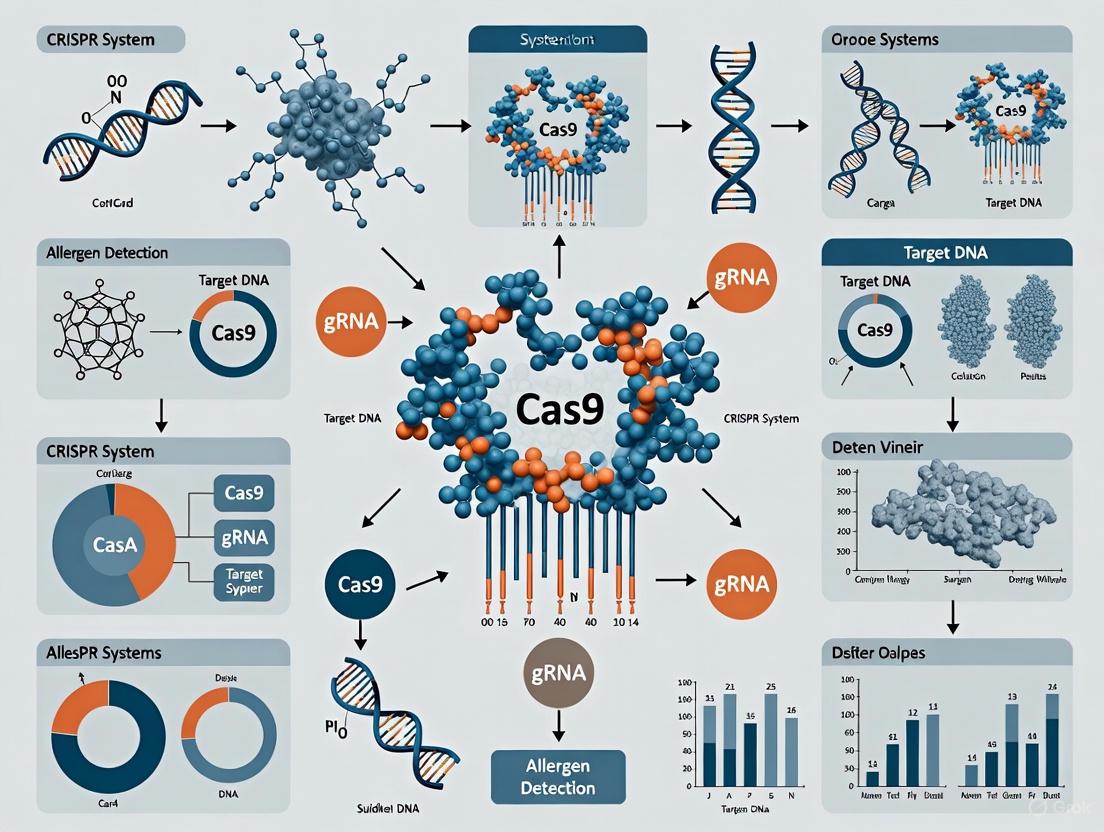
This article provides a comprehensive analysis of CRISPR technology's application in allergen detection, tailored for researchers, scientists, and drug development professionals.
CRISPR-Based Allergen Detection: Mechanisms, Applications, and Technical Validation for Biomedical Research
Abstract
This article provides a comprehensive analysis of CRISPR technology's application in allergen detection, tailored for researchers, scientists, and drug development professionals. It explores the foundational mechanisms of CRISPR-Cas systems, detailing how Cas12 and Cas13 proteins enable precise nucleic acid identification. The content covers methodological implementations for detecting food allergens like peanut and hazelnut, troubleshooting strategies for common technical challenges, and rigorous validation through comparative performance analysis against established methods like ELISA and PCR. By synthesizing current research and development trends, this resource serves as a technical reference for advancing diagnostic innovation in food safety and clinical allergy management.
The Molecular Machinery: How CRISPR-Cas Systems Identify Allergen Genes
Clustered Regularly Interspaced Short Palindromic Repeats (CRISPR) and CRISPR-associated (Cas) proteins form an adaptive immune system in bacteria and archaea that has been repurposed as a revolutionary tool for genome editing and molecular detection [1]. In the specific field of allergen detection, these systems offer unprecedented specificity and sensitivity for identifying trace amounts of allergenic substances in food and environmental samples [2]. The core functionality of CRISPR-based detection relies on two fundamental components: the Cas proteins that execute nucleic acid cleavage and the guide RNAs that confer sequence specificity [3]. This technical guide examines the molecular architecture and mechanistic basis of these core components, focusing on their application in allergen detection research for scientific and drug development professionals.
The natural diversity of CRISPR-Cas systems is remarkable, with current classification encompassing 2 classes, 7 types, and 46 subtypes based on their effector complex composition and mechanistic features [4]. Class 1 systems (Types I, III, IV, and VII) utilize multi-protein effector complexes, while Class 2 systems (Types II, V, and VI) employ single effector proteins, making them particularly suitable for biotechnology applications [3] [4]. For allergen detection, Class 2 systems—especially DNA-targeting Cas9 and Cas12a, and RNA-targeting Cas13—have shown the greatest utility due to their simplicity and programmable nature [2].
Molecular Architecture of Core Components
Guide RNA: The Targeting Module
The guide RNA (gRNA) serves as the programmable targeting component of CRISPR systems, determining sequence specificity through Watson-Crick base pairing. In engineered systems, the gRNA is typically a single chimeric molecule (sgRNA) that combines the functions of the natural crRNA and tracrRNA [1].
The sgRNA consists of approximately 100 nucleotides with two critical functional domains [5]:
- Target-specific sequence (17-20 nucleotides): A user-defined spacer region that determines DNA binding specificity through complementarity to the target DNA sequence.
- Cas protein-binding scaffold: A conserved structural element that interacts with the Cas protein to form the ribonucleoprotein (RNP) complex [6].
For allergen detection applications, gRNAs are designed to recognize unique sequences within allergen-encoding genes. For instance, in peanut allergen detection, gRNAs can be programmed to target specific regions of the Ara h1, Ara h2, or Ara h3 genes [2] [7]. The target recognition process requires the presence of a Protospacer Adjacent Motif (PAM) immediately adjacent to the target sequence, which varies depending on the specific Cas protein employed [1].
Cas Proteins: The Execution Modules
Cas proteins are RNA-guided DNA or RNA endonucleases that provide the catalytic activity in CRISPR systems. Different Cas proteins have distinct structural features and functional mechanisms that make them suitable for various applications in allergen research.
Table 1: Key Cas Proteins and Their Characteristics in Allergen Detection
| Cas Protein | Natural Source | Class/Type | Target | PAM Requirement | Application in Allergen Detection |
|---|---|---|---|---|---|
| Cas9 | Streptococcus pyogenes | Class 2, Type II | DNA | 5'-NGG-3' | DNA binding; limited direct detection use |
| Cas12a (Cpfl) | Francisella novicida | Class 2, Type V | DNA | 5'-TTTN-3' | DNA detection with collateral cleavage |
| Cas13a (C2c2) | Leptotrichia shahii | Class 2, Type VI | RNA | Protospacer Flanking Site | RNA detection with collateral cleavage |
Cas9 contains two nuclease domains: the HNH domain that cleaves the DNA strand complementary to the gRNA, and the RuvC domain that cleaves the non-complementary strand [6]. This results in blunt-ended double-strand breaks (DSBs) in the target DNA. While Cas9 itself is primarily used for gene editing rather than detection, its engineered catalytically dead variant (dCas9) serves as a programmable DNA-binding platform for diagnostic applications [3].
Cas12 and Cas13 proteins exhibit a particularly valuable feature for diagnostic applications: collateral cleavage activity. After recognizing and cleaving their specific target nucleic acids, they become promiscuous nucleases that non-specifically degrade single-stranded DNA (ssDNA) or RNA molecules in the vicinity [2]. This collateral cleavage effect enables significant signal amplification in detection assays, forming the basis for sensitive allergen detection platforms like DETECTR (DNA Endonuclease Targeted CRISPR Trans Reporter) [2].
Mechanism of Target Recognition and Cleavage
The target recognition process follows a precise molecular mechanism that can be visualized through the following workflow:
Diagram 1: CRISPR Target Recognition and Signal Activation
Protospacer Adjacent Motif (PAM) Recognition
The target recognition process initiates with PAM identification, a critical step that differentiates self from non-self DNA in natural CRISPR systems [1]. The Cas protein first surveys DNA molecules for the presence of its specific PAM sequence, which varies among different Cas proteins:
- Cas9: Requires a 5'-NGG-3' PAM sequence immediately downstream of the target site [1]
- Cas12a: Recognizes a 5'-TTTN-3' PAM sequence [2]
- Cas13: Utilizes Protospacer Flanking Sites (PFS) rather than traditional PAMs [3]
PAM recognition triggers a conformational change in the Cas protein that facilitates DNA unwinding and subsequent gRNA-target DNA hybridization [6].
DNA Hybridization and Cleavage Activation
Following PAM recognition, the Cas protein promotes local DNA melting, allowing the gRNA to form complementary base pairs with the target DNA strand. This hybridization proceeds directionally from the PAM-distal to PAM-proximal end [1]. Complete complementarity between the gRNA and target DNA activates the nuclease domains of the Cas protein, resulting in precise cleavage of the target nucleic acids.
For Cas12 and Cas13 proteins, target recognition and cleavage activate the collateral cleavage activity that non-specifically degrades reporter molecules in the reaction mixture [2]. This collateral activity enables real-time detection of allergen-specific DNA or RNA sequences with attomolar sensitivity, making it particularly valuable for detecting trace allergens in complex food matrices [2].
Experimental Protocol for Allergen Detection Using CRISPR-Cas
This section provides a detailed methodology for detecting peanut allergens using the CRISPR-Cas12a system, based on established protocols with modifications for allergen detection [2].
Sample Preparation and DNA Amplification
Materials Required:
- Food samples suspected of containing peanut residues
- DNA extraction kit (commercial)
- Recombinase Polymerase Amplification (RPA) primers specific for Ara h1 gene
- RPA reaction kit (commercial)
Procedure:
- DNA Extraction: Extract total DNA from 100 mg of homogenized food sample using a commercial DNA extraction kit according to manufacturer's instructions. Elute DNA in 50 μL of elution buffer.
- Isothermal Amplification: Prepare RPA reaction mixture containing:
- 29.4 μL of rehydration buffer
- 2.4 μL of forward primer (10 μM)
- 2.4 μL of reverse primer (10 μM)
- 12.2 μL of nuclease-free water
- 2.0 μL of extracted DNA template
- 1.0 μL of RPA enzyme mix
- Incubate the RPA reaction at 37°C for 15-20 minutes to amplify the target Ara h1 gene sequence.
CRISPR-Cas12a Detection System
Materials Required:
- Cas12a enzyme (commercial source)
- crRNA designed against amplified Ara h1 sequence
- Fluorescent ssDNA reporter (e.g., FAM-TTATT-BHQ1)
- Lateral flow strips or fluorometer for detection
Procedure:
- Prepare CRISPR Reaction Mix: Combine the following components:
- 5.0 μL of Cas12a buffer (commercial)
- 1.0 μL of Cas12a enzyme (10 μM)
- 1.5 μL of crRNA (10 μM)
- 1.0 μL of ssDNA reporter (10 μM)
- 6.5 μL of nuclease-free water
- Initiate Detection: Add 15.0 μL of the RPA amplification product to the CRISPR reaction mix.
- Incubate: Maintain the reaction at 37°C for 10-30 minutes.
- Signal Detection:
- For fluorescent detection: Measure fluorescence intensity using a plate reader or portable fluorometer.
- For lateral flow detection: Apply 10-20 μL of reaction mixture to the sample pad and observe test line development.
Table 2: Key Experimental Parameters for CRISPR-Based Allergen Detection
| Parameter | Optimal Condition | Range | Impact on Assay Performance |
|---|---|---|---|
| Reaction Temperature | 37°C | 25-45°C | Higher temperatures may reduce activity |
| Incubation Time | 15 min | 5-60 min | Longer incubation increases sensitivity |
| Cas12a Concentration | 10 nM | 5-50 nM | Higher concentrations may increase background |
| crRNA Concentration | 15 nM | 5-30 nM | Must be optimized for each target |
| Sample Input Volume | 2 μL | 1-5 μL | Larger volumes may inhibit reaction |
Data Interpretation and Validation
Positive Result: Significant increase in fluorescence intensity or appearance of test line on lateral flow strip indicates presence of peanut allergen DNA.
Negative Result: No fluorescence increase or absence of test line indicates no detectable peanut allergen DNA.
Controls: Always include:
- No-template control (NTC) to detect contamination
- Positive control with known peanut DNA
- Internal amplification control to validate negative results
Validation should be performed against standard methods such as ELISA or PCR to establish correlation and determine the limit of detection (LOD) for the assay [2].
Research Reagent Solutions for Allergen Detection
Table 3: Essential Research Reagents for CRISPR-Based Allergen Detection
| Reagent Category | Specific Examples | Function | Commercial Sources |
|---|---|---|---|
| Cas Enzymes | Cas12a, Cas13a, Cas9 | Nucleic acid cleavage; signal generation | Various biotechnology companies |
| Guide RNA | crRNA for Ara h1, Ara h2 | Target recognition and specificity | Custom synthesis services |
| Amplification Systems | RPA, LAMP kits | Isothermal amplification of target sequences | Commercial molecular biology suppliers |
| Reporters | FAM-TTATT-BHQ1, Biotin-labeled DNA | Signal generation via collateral cleavage | Fluorescent probe manufacturers |
| Detection Platforms | Lateral flow strips, Fluorometers | Readout of detection signal | Diagnostic equipment suppliers |
| Controls | Synthetic peanut allergen genes | Assay validation and quality control | Custom gene synthesis services |
Technical Considerations and Optimization Strategies
Successful implementation of CRISPR-based allergen detection requires careful optimization of several parameters:
gRNA Design Considerations:
- Target unique regions within allergen genes to ensure specificity
- Avoid secondary structures that may impair gRNA function
- Consider SNP positions that might affect binding
- Validate using bioinformatics tools to minimize off-target effects
Reaction Condition Optimization:
- Magnesium concentration significantly affects Cas enzyme activity
- Buffer composition can influence cleavage efficiency
- Temperature must be maintained within optimal range for the specific Cas enzyme
- Additives like DTT or BSA may stabilize enzyme activity
Sensitivity and Specificity Enhancements:
- Use high-fidelity Cas variants to reduce non-specific cleavage
- Implement multiple gRNAs for enhanced detection sensitivity
- Incorporate pre-amplification steps to detect low-abundance targets
- Utilize chemical modifications to improve gRNA stability
The exceptional specificity of CRISPR systems stems from the requirement for extended sequence complementarity between the gRNA and target DNA, making single-nucleotide discrimination possible under optimized conditions [2]. This high specificity is particularly valuable for distinguishing between closely related allergen genes or detecting specific isoforms known to cause allergic reactions.
The core components of CRISPR-Cas systems—guide RNAs and Cas proteins—provide a powerful framework for developing sensitive and specific allergen detection platforms. The programmability of gRNAs enables researchers to target virtually any allergen gene sequence, while the diverse activities of Cas proteins offer multiple mechanisms for signal generation and amplification. As CRISPR technology continues to evolve, with new Cas variants offering improved specificity and novel functionalities, these systems are poised to transform how allergens are detected and quantified in food safety and clinical diagnostics. The experimental protocols and technical considerations outlined in this guide provide researchers with a foundation for implementing CRISPR-based detection in allergen research, contributing to improved food safety and public health outcomes.
The rising global prevalence of allergic diseases has intensified the need for precise diagnostic tools and fundamental research technologies. CRISPR systems have emerged as transformative tools in this field, offering unprecedented capabilities for both the detection of allergens and the investigation of allergic disease mechanisms. Unlike traditional methods such as ELISA or PCR, CRISPR-based diagnostics provide exceptional specificity, portability, and the potential for rapid, on-site testing [2] [8]. Beyond detection, CRISPR gene editing enables the direct modification of allergen genes in source materials and the functional study of genes critical to allergic responses [9] [5]. Among the various CRISPR systems, the Class 2 single-effector proteins—particularly the DNA-targeting Cas12 and the RNA-targeting Cas13—have become prominent due to their operational simplicity and adaptability for diagnostic applications [10] [11]. This guide provides a technical comparison of the Cas12 and Cas13 mechanisms, with a specific focus on their application in allergen detection and related research, providing methodologies and resources for scientists and drug development professionals.
Core Mechanisms: A Comparative Analysis
DNA-Targeting by Cas12
Cas12a (also known as Cpf1) is a Type V CRISPR system that targets and cleaves double-stranded DNA (dsDNA). Its activity is initiated upon recognizing a specific T-rich Protospacer Adjacent Motif (PAM) sequence (e.g., TTTV) located upstream of the target DNA sequence [11]. Guided by a single CRISPR RNA (crRNA), Cas12a forms an R-loop structure with the target DNA, unmasks its RuvC nuclease domain, and makes a staggered cut in the dsDNA, creating single-stranded overhangs [11] [12]. A defining characteristic of Cas12a, crucial for its diagnostic utility, is its collateral cleavage activity. After specific target recognition and cleavage (in cis), the Cas12a enzyme becomes activated to non-specifically degrade any nearby single-stranded DNA (ssDNA) (in trans) [11]. This collateral activity enables highly sensitive signal amplification in biosensing.
RNA-Targeting by Cas13
Cas13 is a Type VI CRISPR system that exclusively targets and cleaves single-stranded RNA (ssRNA). It does not require a PAM sequence but instead recognizes specific RNA protospacer flanking sites [13]. Similar to Cas12, upon binding to its target RNA sequence via its crRNA, the Cas13 enzyme undergoes a conformational change that activates its two Higher Eukaryotes and Prokaryotes Nucleotide (HEPN) domains [13]. This activation triggers potent collateral cleavage of non-target ssRNA molecules in the vicinity. This trans-cleavage activity is the cornerstone of Cas13's application in RNA detection and manipulation [13] [12]. By programming the crRNA, researchers can direct Cas13 to degrade specific viral RNAs or messenger RNAs (mRNAs), offering a powerful platform for both antiviral therapeutic development and diagnostic detection of RNA targets [13].
Table 1: Comparative Properties of Cas12 and Cas13 for Allergen Detection
| Feature | Cas12 (Type V) | Cas13 (Type VI) |
|---|---|---|
| Primary Target | Double-stranded DNA (dsDNA) [11] [12] | Single-stranded RNA (ssRNA) [13] [12] |
| Key PAM/PFS Requirement | T-rich PAM (e.g., TTTV) upstream of target [11] | Specific protospacer flanking site (PFS) for some subtypes [13] |
| Cleavage Output | Staggered cuts in dsDNA; collateral cleavage of ssDNA [11] [12] | Cleavage of target ssRNA; collateral cleavage of non-target ssRNA [13] |
| Primary Allergen Application | Detection of allergen-encoding genes in food matrices [2] [8] | Detection of viral RNA; potential for monitoring allergen-related gene expression [13] |
| Key Diagnostic System | DNA Endonuclease-Targeted CRISPR Trans Reporter (DETECTR) [2] [11] | Specific High-sensitivity Enzymatic Reporter unLOCKing (SHERLOCK) [13] |
| Reported Sensitivity | Up to 10 attomolar (aM) for DNA targets [2] | Single-molecule level detection for RNA targets [13] |
Experimental Workflows for Allergen Detection
Cas12-Based DNA Detection of Peanut Allergen (Ara h1)
The following protocol details a method for detecting the presence of the major peanut allergen gene, Ara h1, using a Cas12a-based system, as proposed in research by high school students [2]. This workflow is designed to be rapid and suitable for field use.
Title: Cas12 Ara h1 Detection Workflow
Step-by-Step Protocol:
- Sample Preparation and DNA Extraction: Begin by homogenizing a food sample. Use a commercial DNA extraction kit to purify total genomic DNA. The quality and fineness of the crushed sample significantly impact DNA yield and subsequent detection efficiency [2].
- Isothermal Amplification (RPA):
- Principle: Recombinase Polymerase Amplification (RPA) rapidly amplifies the target Ara h1 gene sequence at a constant low temperature (37-42°C), eliminating the need for a thermocycler [2] [8].
- Procedure: Prepare a RPA reaction mix containing the extracted DNA, specific forward and reverse primers targeting a conserved region of the Ara h1 gene, recombinase enzymes, single-stranded binding proteins, strand-displacing DNA polymerase, and reaction buffer. Incubate the tube at 37°C for 15-20 minutes [2].
- CRISPR-Cas12a Detection:
- Principle: The amplified Ara h1 DNA is recognized by a Cas12a-crRNA complex. Upon binding, Cas12a's collateral cleavage activity is activated, degrading a reporter molecule [2] [11].
- Procedure: Directly add the Cas12a enzyme, a crRNA designed to be complementary to the internal sequence of the amplified Ara h1 target, and a single-stranded DNA (ssDNA) reporter to the RPA amplification product. The ssDNA reporter is typically linked to a chromoprotein (like amilCP, which produces a blue color) and a quencher. Incubate the combined reaction at 37°C for an additional 10-15 minutes [2].
- Signal Readout: Activation of Cas12a cleaves the ssDNA reporter, separating the chromoprotein from the quencher and producing a visible color change (e.g., blue). This readout can be observed visually or further integrated into a lateral flow biosensor strip for a more user-friendly yes/no result [2] [11].
Cas13-Based RNA Detection Workflow
While Cas13 is prominently used for viral RNA detection [13] [12], its principle can be adapted for detecting RNA biomarkers associated with allergic responses or for validating the success of CRISPR knockouts of allergen genes in research models. The SHERLOCK (Specific High-sensitivity Enzymatic Reporter unLOCKing) platform is the canonical method for Cas13-based detection [13].
Title: Cas13 RNA Detection Workflow
Step-by-Step Protocol:
- RNA Extraction: Isolate total RNA from the sample (e.g., cell culture, tissue) using a standard RNA extraction kit, ensuring RNase-free conditions to prevent degradation.
- Target Amplification and Conversion:
- Reverse Transcription RPA (RT-RPA): Perform an RT-RPA reaction. This step simultaneously reverses transcribes the target RNA into complementary DNA (cDNA) and then amplifies the cDNA isothermally [13].
- Optional In Vitro Transcription (IVT): For maximum sensitivity, the RPA-amplified DNA product can be used as a template for T7 polymerase-driven in vitro transcription. This generates a large number of RNA amplicons, which are the optimal substrate for Cas13 [13].
- CRISPR-Cas13 Detection:
- Principle: The amplified RNA (from IVT) or the original RNA target is recognized by the Cas13-crRNA complex. Target binding activates Cas13's collateral RNase activity [13].
- Procedure: Combine the Cas13 enzyme, a specific crRNA, and a ssRNA reporter probe into the reaction. The reporter probe is typically a short RNA molecule labeled with a fluorophore at one end and a quencher at the other. Activated Cas13 will cleave this probe, resulting in fluorescence [13].
- Signal Readout: Fluorescence can be measured using a plate reader or a portable fluorometer. Alternatively, the reaction can be adapted for lateral flow readouts by using modified probes that produce a visible line on a test strip [13].
Table 2: Key Reagent Solutions for CRISPR-Based Allergen Detection
| Reagent / Material | Function | Example & Notes |
|---|---|---|
| Cas Enzyme | Effector nuclease that performs targeted and collateral cleavage. | Cas12a (Cpf1) for DNA targets; Cas13a (C2c2) for RNA targets. Selection depends on the target nucleic acid [11] [13]. |
| crRNA | Guide RNA that confers specificity by binding to the target sequence. | A ~20-nt sequence complementary to the target (e.g., a region of the Ara h1 gene). Can be chemically synthesized. Modified crRNAs can enhance stability against nucleases [11]. |
| Isothermal Amplification Kit | Amplifies target nucleic acid to detectable levels without complex equipment. | Recombinase Polymerase Amplification (RPA) kits are common for both DNA (Cas12) and RNA (via RT-RPA for Cas13) [2] [8]. |
| Reporter Molecule | Provides a detectable signal upon collateral cleavage. | For Cas12: ssDNA labeled with Fluorophore/Quencher (FQ) or biotin/fam for lateral flow. For Cas13: ssRNA-FQ reporter. Chromoproteins (e.g., amilCP) enable visual detection [2] [11]. |
| Lateral Flow Strip | Provides a simple, portable, and equipment-free visual readout. | Nitrocellulose strips that capture labeled cleavage products. A positive result is indicated by the appearance of a test line [2] [8]. |
Research Context and Future Directions
The application of Cas12 and Cas13 in allergen detection forms a critical component of the broader CRISPR toolkit for allergy research. Beyond diagnostics, CRISPR-Cas9 is being used to precisely edit and knock out major allergen genes in their source organisms, such as the cat allergen Fel d 1, with the goal of creating hypoallergenic variants [9]. Furthermore, CRISPR screening is instrumental in identifying and validating novel genes involved in allergic disease pathophysiology. For instance, CRISPR-Cas9-mediated knockout of CYP11A1 in human T-cell lines confirmed its role in regulating IL-13 production, a key cytokine in peanut allergy [5].
Future directions in CRISPR-based allergen detection will likely focus on multiplexing—the simultaneous detection of multiple allergens in a single reaction. The inherent programmability of Cas12 and Cas13 makes them ideal for this application [14] [8]. Innovations will also aim to enhance portability and integration, such as through microfluidic chips that combine sample preparation, amplification, and CRISPR detection into a single, automated device [2] [11]. Addressing challenges like the inhibition of reactions by complex food matrices and ensuring the stability of reagents, particularly crRNAs, outside the laboratory will be crucial for the widespread commercial adoption of these tests [8]. As these technologies mature, they hold the promise of empowering consumers, improving food labeling accuracy, and advancing fundamental research into allergic diseases.
The clustered regularly interspaced short palindromic repeats (CRISPR) system, derived from bacterial adaptive immune mechanisms, has emerged as a revolutionary tool not only for genome editing but also for molecular diagnostics. Beyond its gene-editing capabilities, certain CRISPR-associated (Cas) proteins exhibit a unique enzymatic property known as collateral cleavage or trans-cleavage activity that enables highly sensitive detection of specific molecular targets [15]. This activity has been particularly valuable in diagnostic applications, including the detection of food allergens, where it provides the foundation for rapid, specific, and sensitive identification of target nucleic acids [16] [2].
When applied to allergen detection research, CRISPR-based systems offer significant advantages over traditional methods like ELISA or PCR. They combine high specificity with the potential for simple, visual readouts that don't require sophisticated laboratory equipment [2] [17]. The core principle hinges on the ability of Cas proteins such as Cas12 and Cas13 to become activated upon recognition of their target sequences and subsequently cleave nearby reporter molecules indiscriminately, generating a detectable signal that amplifies the initial recognition event [15] [18].
Molecular Mechanisms of Collateral Cleavage
Cas Protein Families and Their Activities
The collateral cleavage effect is primarily exhibited by two classes of Cas proteins: Cas12 (targeting DNA) and Cas13 (targeting RNA). These proteins share a common functional principle: they remain in an inactive state until they form a complex with their guide RNA and recognize a specific target sequence that complements the guide RNA spacer region [15].
Cas12a Molecular Architecture and Function: Cas12a (previously known as Cpf1) is approximately 150 kDa with a bilobed structure containing a single RuvC DNA-cleaving domain [15]. For double-stranded DNA (dsDNA) targets, Cas12a requires a protospacer adjacent motif (PAM) - typically "TTTV" for LbCas12a, AsCas12a, and FnCas12a - located adjacent to the target sequence [15]. Target binding begins with PAM recognition, followed by DNA unwinding and hybridization between the target strand and the crRNA spacer. This binding allosterically activates the RuvC domain, which first cleaves both strands of the target DNA (cis-cleavage) and then indiscriminately cleaves nearby single-stranded DNA (trans-cleavage) [15] [18].
Cas13a Molecular Architecture and Function: Cas13a (previously known as C2c2) functions as a ribonuclease that processes its own crRNA and becomes activated by target single-stranded RNA (ssRNA) [15]. LbuCas13a (138 kDa) contains two higher eukaryotes and prokaryotes nucleotide-binding (HEPN) domains that form the catalytic site. Upon target RNA recognition and binding, Cas13a undergoes a significant conformational change that brings the HEPN domains together, activating the enzyme for collateral cleavage of any nearby single-stranded RNA molecules [15].
Signal Amplification Mechanism
The collateral cleavage activity provides powerful signal amplification because a single target recognition event can lead to the cleavage of thousands of reporter molecules per hour [15]. This amplification occurs because the activated Cas complex remains catalytically active and can turnover multiple reporter molecules without being consumed in the process. The kinetics of this reaction generally follow the Michaelis-Menten model, where the enzyme is the ternary complex of Cas-crRNA-activator [15]. The efficiency of this amplification is quantified by the turnover number (kcat), which represents the maximum number of reporter molecules cleaved per active site per second. Corrected kinetic analyses have established a turnover number of approximately 17 s⁻¹ for LbCas12a, though earlier reports had significantly overestimated this value [15].
Figure 1: CRISPR-Cas Collateral Cleavage Signaling Pathway. This diagram illustrates the molecular mechanism by which target recognition triggers signal amplification through non-specific cleavage of reporter molecules.
Quantitative Analysis of Collateral Cleavage
Kinetic Parameters of Cas Proteins
The performance of CRISPR-based detection systems depends critically on the kinetic parameters of the Cas proteins employed. Accurate measurement of these parameters is essential for predicting detection sensitivity and optimizing assay conditions [15].
Table 1: Kinetic Parameters of Cas Proteins with Collateral Cleavage Activity
| Cas Protein | Target | Collateral Substrate | Reported kcat (s⁻¹) | Activation Requirements |
|---|---|---|---|---|
| Cas12a (LbCas12a) | dsDNA, ssDNA | ssDNA | 17 (corrected) | PAM sequence (TTTV) for dsDNA |
| Cas12b (AacCas12b) | dsDNA, ssDNA | ssDNA | Temperature-tolerant (∼60°C) | Thermostable, works with LAMP |
| Cas13a (LwaCas13a) | ssRNA | ssRNA | Varies by homolog | Target RNA binding |
| Cas13a (LbuCas13a) | ssRNA | ssRNA | Varies by homolog | Target RNA binding |
| Cas14a | ssDNA | ssDNA | Compact size (∼70 kDa) | No PAM requirement |
Factors Influencing Cleavage Efficiency
Multiple factors significantly impact the efficiency and kinetics of the collateral cleavage activity:
- Cas homologs: Different natural variants of the same Cas protein family exhibit varying catalytic efficiencies and temperature optima [15]
- Guide RNA design: The sequence and structure of the crRNA spacer region affect target binding affinity and activation kinetics [15]
- Reporter substrates: The sequence, length, and secondary structure of reporter molecules influence cleavage rates [15]
- Reaction conditions: Cofactors (especially Mg²⁺ concentration), pH, temperature, and buffer composition all modulate enzymatic activity [15]
- Target accessibility: For DNA targets, the presence of secondary structure or protein binding can affect activation [15]
Optimizing these parameters can enhance detection sensitivity by up to 100-fold, making it possible to achieve attomolar (10⁻¹⁸ M) sensitivity in some configured assays [16].
Experimental Design and Protocols
Research Reagent Solutions
Table 2: Essential Reagents for CRISPR-Based Detection Experiments
| Reagent Category | Specific Examples | Function in Assay | Considerations for Allergen Detection |
|---|---|---|---|
| Cas Proteins | LbCas12a, AsCas12a, AapCas12b, LwaCas13a | Recognition and cleavage of target nucleic acids | Choose based on target (DNA/RNA) and required temperature |
| Guide RNAs | crRNAs targeting allergen genes (Ara h1, Corylus avellana 2S albumin) | Sequence-specific targeting | Design spacers complementary to unique allergen sequences |
| Reporter Molecules | FAM-quenched ssDNA reporters (for Cas12), RNA reporters (for Cas13) | Signal generation through cleavage | Optimize length (typically 4-8 nt) and quencher-fluorophore pairs |
| Amplification Enzymes | Recombinase Polymerase Amplification (RPA), Loop-Mediated Isothermal Amplification (LAMP) | Pre-amplification of target sequences | Isothermal methods enable field-deployable allergen detection |
| Buffer Components | rCutSmart Buffer, Mg²⁺, ATP, dNTPs | Optimal enzymatic activity | Maintain pH and cofactor concentrations for maximum sensitivity |
Protocol: Cas12a-Based Allergen Detection
This protocol adapts the established CRISPR/Cas12a methodology for detecting allergen genes, such as the hazelnut Corylus avellana 2S albumin gene or peanut Ara h1 gene [17] [2].
Sample Preparation and DNA Extraction
- Extract genomic DNA from food samples using commercial kits (e.g., Takara Mini Best Genome Extraction Kit)
- Quantify DNA concentration using spectrophotometry and dilute to working concentrations
- For processed foods, verify DNA integrity through conventional PCR if necessary
Target Amplification via RPA
- Prepare RPA reaction mix containing:
- 29.5 μL of rehydration buffer
- 2.4 μL of forward primer (10 μM)
- 2.4 μL of reverse primer (10 μM)
- 5 μL of extracted DNA template
- 10.7 μL of nuclease-free water
- Add 2.5 μL of magnesium acetate (280 mM) to start the reaction
- Incubate at 37-42°C for 15-20 minutes for isothermal amplification
CRISPR/Cas12a Detection
- Prepare Cas12a detection mixture:
- 2 μL of 10× rCutSmart Buffer
- 0.4 μL of LbCas12a (1 μM)
- 0.4 μL of allergen-specific crRNA (1 μM)
- 4 μL of FAM-labeled ssDNA reporter (1 μM)
- 13.2 μL of nuclease-free water
- Combine 20 μL of detection mixture with 5 μL of RPA amplicon
- Incubate at 37°C for 10-30 minutes
- Measure fluorescence at excitation/emission of 485/535 nm
Results Interpretation
- Positive signal: Significant increase in fluorescence compared to negative controls
- Quantitative analysis: Use standard curves with known allergen concentrations for quantification
- Specificity controls: Include non-target allergens to verify specificity
Figure 2: Workflow for CRISPR-Based Allergen Detection. This diagram outlines the key experimental steps from sample preparation to result interpretation.
Protocol Validation and Optimization
To ensure reliable results, implement the following validation procedures:
- Specificity testing: Validate against closely related species to confirm no cross-reactivity
- Sensitivity determination: Establish limit of detection (LOD) using serial dilutions of target allergen DNA
- Reproducibility assessment: Perform replicate measurements (n≥3) to determine coefficient of variation
- Inhibition testing: Spike samples with known targets to identify matrix interference
For hazelnut detection, the Crinac (CRISPR-based nucleic acid test) method has demonstrated sensitivity to detect 1% hazelnut in mixtures, completing the process within 60 minutes [17]. Similar approaches for peanut allergen detection targeting Ara h1 have achieved attomolar sensitivity [2].
Applications in Allergen Detection Research
The collateral cleavage effect has been successfully implemented in various allergen detection platforms:
Food Allergen Monitoring
CRISPR-based detection systems have been developed for major food allergens including:
- Hazelnut: Targeting the Corylus avellana 2S albumin gene with Cas12a [17]
- Peanut: Targeting Ara h1 DNA sequences using Cas12a with visual readout [2]
- Multiple tree nuts: Cas12 systems can be adapted for almond, walnut, and other common allergens
These applications leverage the key advantages of CRISPR technology: specificity (distinguishing closely related species), sensitivity (detecting trace contamination), and rapidity (results in hours instead of days) [16] [17].
Signal Readout Modalities
Various detection modalities have been integrated with collateral cleavage activity:
- Fluorescent readouts: Most common approach using fluorophore-quencher reporter pairs [18] [17]
- Lateral flow assays: Paper-based strips for visual detection without instrumentation [2]
- Chromoprotein systems: Visual color change using proteins like amilCP (blue color) [2]
- Electrochemical sensors: Converting cleavage events to electrical signals for quantitation
The choice of readout method depends on the application context - laboratory settings may utilize fluorescent measurements, while field-deployable tests benefit from lateral flow or colorimetric approaches [2].
Technical Considerations and Limitations
While CRISPR-based detection offers significant advantages, several technical challenges must be addressed:
- Matrix effects: Complex food matrices may contain inhibitors that affect Cas enzyme activity [8]
- Quantification challenges: Most systems provide qualitative or semi-quantitative results without digital partitioning approaches [16]
- Temperature optimization: Cas enzymes have different temperature optima requiring precise thermal control [15]
- Guide RNA design: Not all guide RNAs perform equally; empirical testing is often necessary [15]
Recent advancements address these limitations through:
- Digital CRISPR (dCRISPR): Sample partitioning enables absolute quantification of target molecules [16]
- Thermostable Cas variants: Proteins like Cas12b function at higher temperatures compatible with LAMP [15]
- Multiplexing approaches: Simultaneous detection of multiple allergens using different Cas proteins or reporter systems [8]
The collateral cleavage activity of Cas proteins represents a powerful signal amplification mechanism that has been successfully harnessed for sensitive allergen detection. The core principle - converting specific target recognition into nonspecific nuclease activity - provides the foundation for diagnostic platforms that combine the sensitivity of nucleic acid amplification with the specificity of CRISPR-guided recognition. As research advances, further optimization of Cas proteins, guide RNA design, and detection modalities will continue to enhance the performance of these systems for allergen monitoring and other diagnostic applications.
The integration of collateral cleavage-based detection with point-of-care platforms holds particular promise for food safety applications, enabling rapid screening for allergen contamination in various settings from manufacturing facilities to food service establishments. This technology therefore represents a significant advancement in the toolkit for allergen detection research and application.
Protospacer Adjacent Motif (PAM) Requirements and Sequence Design
The Protospacer Adjacent Motif (PAM) is a critical short DNA sequence, typically 2-6 base pairs in length, that follows the DNA region targeted for cleavage by the CRISPR system [19]. This sequence is an absolute requirement for most CRISPR-associated (Cas) nucleases to recognize and bind to target DNA. In the context of bacterial adaptive immunity—the natural origin of CRISPR systems—the PAM serves as a vital "self" versus "non-self" discrimination mechanism [19] [20]. It allows the Cas nuclease to differentiate between an invading viral genome (which contains the PAM) and the bacterium's own CRISPR array (which lacks the PAM), thus preventing autoimmunity [19].
The biological process begins when Cas effector complexes scan foreign DNA for PAM sequences [20]. Upon identifying a PAM, the Cas protein complex unwinds the adjacent DNA double helix, allowing the CRISPR RNA (crRNA) to attempt base pairing with the target protospacer sequence [20]. Successful complementarity, particularly in the "seed sequence" near the PAM, leads to full R-loop formation and subsequent DNA cleavage [20]. This fundamental mechanism has been harnessed for technological applications, where the PAM requirement dictates where in a genome researchers can target CRISPR systems for editing, detection, or other interventions.
PAM Sequence Requirements for Different Cas Proteins
Diversity of PAM Sequences
The specific PAM sequence recognized by a CRISPR system varies considerably depending on the Cas nuclease and its bacterial source [19]. This diversity provides researchers with a toolkit of CRISPR systems, each with different targeting capabilities. The most commonly used nuclease, Cas9 from Streptococcus pyogenes (SpCas9), recognizes a simple 5'-NGG-3' PAM, where "N" can be any nucleotide base [19] [21]. This PAM is located directly downstream (3') of the target sequence in the genomic DNA [21]. However, this requirement can be limiting if the target genomic locus lacks this specific sequence motif nearby.
Fortunately, numerous alternative Cas nucleases with distinct PAM requirements have been characterized, significantly expanding the potential target space for CRISPR applications [19]. The table below summarizes the PAM sequences for various CRISPR nucleases used in experimental settings.
Table 1: PAM Sequences for Different CRISPR Nucleases
| CRISPR Nuclease | Organism Isolated From | PAM Sequence (5' to 3') |
|---|---|---|
| SpCas9 | Streptococcus pyogenes | NGG [19] [21] |
| hfCas12Max | Engineered from Cas12i | TN and/or TNN [19] |
| SaCas9 | Staphylococcus aureus | NNGRRT or NNGRRN [19] |
| NmeCas9 | Neisseria meningitidis | NNNNGATT [19] |
| CjCas9 | Campylobacter jejuni | NNNNRYAC [19] |
| LbCpf1 (Cas12a) | Lachnospiraceae bacterium | TTTV [19] |
| AacCas12b | Alicyclobacillus acidiphilus | TTN [19] |
| BhCas12b v4 | Bacillus hisashii | ATTN, TTTN and GTTN [19] |
PAM Recognition Mechanisms
The molecular mechanisms of PAM recognition differ across CRISPR-Cas systems. For Cas9, PAM binding occurs through a protein domain known as the PAM-interacting motif [20]. Recognition of the correct PAM sequence induces conformational changes in the Cas protein that facilitate DNA melting and enable the crRNA to interrogate the adjacent sequence for complementarity [21] [20].
This initial PAM recognition step is crucial for the function of Class 2 CRISPR systems (which include the widely used Cas9 and Cas12 proteins), as it triggers the unwinding of double-stranded DNA to allow for RNA-DNA hybridization [20]. The requirement for a specific PAM sequence is a key factor limiting off-target effects, as DNA sequences perfectly complementary to the guide RNA but lacking the correct adjacent PAM will generally not be cleaved.
Experimental Methods for PAM Identification
PAM-SCANR: An In Vivo Screening Method
Several high-throughput experimental methods have been developed to identify functional PAM sequences for characterized and novel CRISPR systems. PAM-SCANR (PAM Screen Achieved by NOT-gate Repression) is an in vivo, positive selection screen that identifies functional PAMs based on gene repression [22]. This method utilizes catalytically inactive Cas proteins (dCas9 for Type II systems) converted into programmable transcriptional repressors.
The experimental workflow involves a genetic circuit designed as a NOT gate [22]. In this system, the CRISPR-Cas system is targeted to the promoter region of the lacI gene. Successful binding to a functional PAM sequence represses LacI production, which in turn de-represses a green fluorescent protein (GFP) reporter gene [22]. Fluorescent cells, indicating functional PAMs, can then be isolated using fluorescence-activated cell sorting (FACS), and the associated PAM sequences are identified through sequencing [22]. A key advantage of PAM-SCANR is its tunability; by using intermediate concentrations of IPTG to titrate LacI activity, researchers can detect even weak functional PAMs [22].
Diagram 1: PAM-SCANR Workflow for PAM Identification
Alternative PAM Identification Methods
Besides PAM-SCANR, several other approaches exist for PAM identification:
Bioinformatics Analysis: Early PAM identification relied on alignments of protospacers from phage and plasmid sequences that matched spacers in bacterial CRISPR arrays [22] [20]. While this method is straightforward, it is limited by the availability of matching sequences in databases and cannot distinguish between functional PAMs and mutated escape sequences [22].
Plasmid Depletion Assays: These screens transform a plasmid library containing randomized PAM sequences into bacteria with an active CRISPR-Cas system [20]. Plasmids with functional PAMs are depleted from the population, and the remaining plasmids (with non-functional PAMs) are sequenced to identify depleted sequences [20]. This approach requires high library coverage and indirectly measures PAM function through escape [22].
In Vitro Cleavage Assays: These methods use purified Cas protein complexes to cleave target DNA libraries with randomized PAM sequences [20]. Cleavage products are sequenced to identify functional PAMs. While allowing control over reaction conditions, these assays require purified, active effector complexes and may not fully recapitulate in vivo conditions [22] [20].
PAM Sequence Visualization and Analysis Tools
Advanced Visualization Techniques
Effectively communicating the results of PAM screens requires specialized visualization tools. Traditional sequence logos show nucleotide conservation but can obscure complex sequence-activity relationships. The PAM Wheel is an interactive visualization scheme that conveys individual PAM sequences and their relative activities [22]. This radial visualization allows researchers to quickly identify both dominant and minor PAM sequences, as well as nucleotide preferences at each position.
Table 2: Software Tools for CRISPR Analysis and Visualization
| Tool Name | Primary Function | Key Features |
|---|---|---|
| CRISPRStudio | CRISPR typing and visualization | Color-coded spacer comparison, clustering based on similarity, SVG output [23] |
| CrisprVi | Visualization of CRISPR sequences | Interactive GUI, statistical analysis, consensus sequence finding [24] |
| CRISPRviz | Web-based CRISPR visualization | Converts spacer sequences to colored shapes for comparison [23] |
| PAM Wheel | PAM sequence visualization | Radial display of individual PAM sequences and activities [22] |
CRISPR Typing and Analysis Software
Specialized software tools have been developed to facilitate CRISPR array analysis and visualization. CRISPRStudio is a command-line tool that accelerates CRISPR analysis by automatically comparing spacer sequences and clustering them based on user-defined similarity thresholds [23]. It generates publication-ready figures where spacers are represented as colored shapes, enabling intuitive visualization of similarities across different microbial strains [23].
CrisprVi provides a graphic user interface for visualizing and analyzing CRISPR sequences of prokaryotes [24]. It presents information on direct repeats and spacers, including their genomic coordinates and sequences, and offers interactive operations for displaying, labeling, and aligning CRISPR arrays [24]. These tools are particularly valuable for tracking spacer acquisition and understanding the evolutionary history of bacterial strains based on their CRISPR profiles.
PAM Engineering and Modified Systems
Engineered Cas Variants
The constraint of PAM requirements has motivated efforts to engineer Cas proteins with altered or relaxed PAM specificities. Using techniques such as directed evolution, researchers have successfully created SpCas9 variants that recognize PAM sequences other than the canonical NGG [19]. Notable examples include xCas9 and SpCas9-NG, which recognize NG PAMs, significantly expanding the targetable genomic space [19].
Similarly, engineered high-fidelity variants like hfCas12Max recognize simplified PAM sequences (TN and/or TNN) compared to their wild-type counterparts [19]. These engineered nucleases maintain high on-target activity while offering greater targeting flexibility, making them particularly valuable for applications requiring precise editing at specific genomic loci that may not contain canonical PAM sequences.
PAM Recognition in Different CRISPR Types
CRISPR-Cas systems are divided into two classes (Class 1 with multi-subunit effector complexes and Class 2 with single-protein effectors) and further categorized into six types and numerous subtypes [20]. Each grouping employs distinct PAM recognition strategies:
- Type I Systems: These use a multi-subunit complex (Cascade) for target recognition and require a PAM for both interference and spacer acquisition [20].
- Type II Systems: These utilize a single Cas9 protein that recognizes a PAM sequence located on the 3' end of the protospacer [22] [20].
- Type V Systems: Effector proteins like Cas12a (Cpf1) recognize a PAM (TTTV for LbCas12a) located on the 5' end of the protospacer and produce staggered DNA cuts [22] [20].
- Type III Systems: Unlike other types, these systems typically do not require a PAM sequence for target recognition, instead relying on different mechanisms for self/non-self discrimination [20].
This diversity of PAM recognition mechanisms reflects the evolutionary arms race between bacteria and their pathogens, where varying PAM requirements may help circumvent viral anti-CRISPR measures that target PAM recognition [20].
PAM Sequence in Guide RNA Design
Standard Guide RNA Design Principles
In conventional CRISPR genome editing experiments, the PAM sequence is explicitly excluded from the guide RNA design [19]. The 20-nucleotide guide sequence is designed to be complementary to the target DNA immediately adjacent to the PAM, but the PAM itself is not included in the transcribed guide RNA [19]. This design principle mimics the natural CRISPR system in bacteria, where the absence of PAM sequences in the host's own CRISPR array prevents self-targeting [19].
When designing guide RNAs, researchers must first identify potential target sites that contain the appropriate PAM sequence for their chosen Cas nuclease. For SpCas9, this means searching for 5'-NGG-3' sequences in the target region, then designing guide RNAs complementary to the 20 bases immediately upstream of this PAM. Bioinformatics tools are commonly used to identify potential off-target sites with similar sequences and adjacent PAMs to ensure specificity.
Specialized Applications: Homing Guide RNAs
While standard practice excludes PAM sequences from guide RNA design, specialized applications intentionally incorporate them. Homing guide RNAs (hgRNAs) include the PAM sequence within their encoding DNA, enabling them to target their own genomic locus for continuous editing [19]. This approach generates diverse mutation patterns valuable for Lineage tracing and cellular barcoding applications, as the accumulating mutations create unique heritable signatures that allow researchers to track cell divisions and differentiation events [19].
Application in Allergen Detection and Modification
CRISPR-Based Allergen Gene Editing
CRISPR technology offers unique potential for unequivocally deleting allergen genes at their source, with applications demonstrated in food crops and animal models [9] [25]. The precision of CRISPR editing represents a substantial improvement over conventional breeding methods for developing hypoallergenic varieties [9] [25].
Key advancements in this field include:
- Peanut Allergens: CRISPR has been used to deactivate genes encoding major peanut allergens Ara h 1, Ara h 2, and Ara h 3, potentially creating safer peanut varieties [25].
- Wheat Gluten: Researchers used CRISPR to target immunogenic gluten epitopes in wheat, significantly reducing proteins responsible for celiac disease and baker's asthma [25].
- Feline Allergen: Studies have explored targeting the major cat allergen Fel d 1, which accounts for 60-90% of human allergic responses to cats [9].
In all these applications, proper PAM selection is essential for designing effective guide RNAs to target allergen genes. The PAM requirement directly influences which regions of an allergen gene can be targeted and which Cas nuclease is most appropriate for the experiment.
Diagram 2: PAM-Centric Workflow for Allergen Gene Editing
PAM Considerations in Allergen Detection
Beyond gene editing, CRISPR-based diagnostic platforms (such as those utilizing Cas12 or Cas13) can be adapted for allergen detection [26]. While most CRISPR diagnostics target pathogen nucleic acids, the same principles could be applied to detect specific allergen genes or variants in food products or environmental samples. In these applications, PAM requirements influence the design of detection probes and the choice of Cas protein, affecting the assay's sensitivity and specificity.
Research Reagent Solutions
Table 3: Essential Research Reagents for PAM and CRISPR Studies
| Reagent/Tool Category | Specific Examples | Function in PAM/CRISPR Research |
|---|---|---|
| Cas Nucleases | SpCas9, SaCas9, LbCas12a, engineered variants [19] | Protein effectors with specific PAM requirements for target recognition and cleavage |
| PAM Screening Systems | PAM-SCANR genetic circuit [22] | Identifies functional PAM sequences for characterized and novel CRISPR systems |
| Guide RNA Design Tools | CRISPRstudio, CrisprVi, CRISPRviz [23] [24] | Software for designing and visualizing gRNAs while considering PAM constraints |
| Validation Assays | T7 Endonuclease I (T7E1), NGS analysis [9] | Confirms CRISPR editing efficiency and identifies potential off-target effects |
| Specialized gRNA Systems | Homing gRNA constructs, CRISPRainbow [19] [27] | Advanced applications requiring specialized PAM considerations |
The Protospacer Adjacent Motif represents a fundamental component of CRISPR biology with direct implications for technical implementation across diverse applications, including allergen research. Understanding PAM requirements—both the specific sequences for different Cas proteins and their role in target recognition—is essential for designing effective CRISPR experiments. The continued discovery of novel Cas nucleases with diverse PAM specificities, coupled with engineering approaches to modify PAM recognition, will further expand the targeting range and precision of CRISPR technologies. For allergen detection and modification research, strategic selection of CRISPR systems based on PAM requirements enables precise targeting of allergen genes, offering promising pathways for developing novel therapeutic and diagnostic interventions for allergic diseases.
From Theory to Practice: Implementing CRISPR Detection for Food Allergens
Sample Processing and DNA Extraction from Complex Food Matrices
The accurate detection of food allergens is a critical component of food safety, directly impacting the health of sensitive individuals. In recent years, CRISPR-based biosensors have emerged as a powerful tool for allergen detection due to their high specificity, sensitivity, and potential for rapid, on-site application [17]. The core principle involves using CRISPR-associated proteins (e.g., Cas12a, Cas9) to precisely identify and signal the presence of allergen-specific DNA sequences [28]. However, the efficacy of any CRISPR detection system is fundamentally constrained by the quality and purity of the input DNA. This guide details the technical challenges and optimized protocols for obtaining amplifiable DNA from complex food matrices, a prerequisite for reliable integration with CRISPR allergen diagnostics.
Impact of Food Processing on DNA Quality
The journey of DNA from raw ingredient to final food product is marked by significant degradation, which presents a formidable challenge for detection.
- Mechanical and Thermal Stress: Processing steps such as grinding, homogenization, and various heat treatments (e.g., pasteurization, sterilization, canning) cause fragmentation of DNA strands [29]. The integrity of sample DNA is notably influenced by the intricacy of processing methods [29].
- Chemical and Enzymatic Degradation: The presence of organic acids (e.g., ascorbic, citric, malic acid) in many fruits and their juice products accelerates acid-catalyzed hydrolytic destruction of DNA, especially when combined with thermal procedures [29]. Furthermore, enzymatic processes used in manufacturing can also contribute to DNA breakdown.
Consequently, DNA extracted from processed foods is often comprised of short, damaged fragments, and co-extracted with PCR inhibitors such as polysaccharides, polyphenols, and proteins [29]. These factors can severely inhibit the enzymatic reactions (both amplification and CRISPR activation) that are central to the detection workflow.
DNA Extraction Methodologies: A Comparative Analysis
Selecting an appropriate DNA extraction method is paramount. The table below summarizes the performance of various techniques when applied to complex food matrices.
Table 1: Comparative Evaluation of DNA Extraction Methods for Complex Food Matrices
| Method | Key Principle | Best For | DNA Yield & Quality | Throughput & Cost |
|---|---|---|---|---|
| Lysis Buffer + Magnetic Nanoparticles [30] | Lysis buffer (e.g., Guanidine HCl) disrupts cells; Fe₃O₄@Al³⁺ particles adsorb DNA for magnetic separation. | Rapid, integrated systems; point-of-care testing. | High sensitivity; suitable for downstream RPA/CRISPR. | Very rapid (<1 hr); cost-effective. |
| Combination Methods [29] | Integrates multiple principles (e.g., CTAB with column purification). | Highly processed foods with severe degradation/inhibitors. | Highest performance in purity and amplifiability. | Time-consuming; higher cost. |
| Commercial Kit (Column-Based) [29] | Silica-membrane column purification following lysis. | Routine lab analysis of moderately processed foods. | Good purity and consistency. | Medium throughput; moderate cost. |
| Modified CTAB [29] | Traditional CTAB protocol with precipitating agents. | Resource-limited settings; high polysaccharide/polyphenol samples. | High concentration but potentially lower purity. | Low cost; requires expertise. |
Detailed Experimental Protocols
Protocol A: Rapid DNA Extraction Using Magnetic Nanoparticles
This protocol is optimized for speed and integration with rapid amplification methods like Recombinase Polymerase Amplification (RPA) [30].
- Lysis: Mix 1 mL of liquid food sample or 1 g of homogenized solid sample with 500 µL of optimized lysis buffer (e.g., containing 0.5 mol/L Guanidine Hydrochloride, 0.15% Sodium Deoxycholate, and 5.0 mmol/L Tris-HCl) [30]. Vortex thoroughly and incubate at 65°C for 10 minutes.
- DNA Binding: Add 50 µL of synthesized Fe₃O₄@Al³⁺ magnetic nanoparticles to the lysate. The Al³⁺ ions chelate with phosphate groups on the DNA backbone, facilitating adsorption [30]. Mix by inversion and incubate at room temperature for 5 minutes.
- Magnetic Separation: Place the tube on a magnetic stand for 2 minutes until the solution clears. Carefully aspirate and discard the supernatant.
- Washing: Resuspend the pellet in 500 µL of 70% ethanol while on the magnet. Incubate for 1 minute and discard the supernatant. Repeat this wash step once.
- Elution: Air-dry the magnetic pellet for 5-10 minutes to evaporate residual ethanol. Elute the purified DNA in 50-100 µL of nuclease-free water or TE buffer.
The entire procedure, from sample lysis to elution, can be completed within 1 hour [30].
Protocol B: High-Quality DNA Extraction Using a Combination Method
For the most challenging processed samples where ultimate DNA purity is required for sensitive detection, a combination method is recommended [29].
- Initial Lysis: Begin with a non-commercial modified CTAB-based extraction to efficiently lyse cells and precipitate contaminants. Incubate the sample with CTAB buffer and perform an initial chloroform:isoamyl alcohol extraction.
- Precipitation and Re-purification: Precipitate the nucleic acids from the aqueous phase using isopropanol. After centrifugation and washing, dissolve the DNA pellet.
- Column Purification: Pass the dissolved DNA through a silica-membrane-based commercial kit (e.g., Plant Genomic DNA Kit) according to the manufacturer's instructions. This step removes any remaining impurities and inhibitors [29].
- Elution: Elute the high-purity DNA in the provided elution buffer.
While this method is more time-consuming and costly, it provides DNA of superior quality for the most demanding downstream CRISPR applications [29].
DNA Extraction Workflow from Complex Food Samples
Integration with CRISPR-Based Allergen Detection
The purified DNA serves as the template for the subsequent CRISPR detection assay. The workflow for detecting an allergen, such as hazelnut, is as follows [17]:
- Target Amplification: The DNA is first amplified using PCR or isothermal methods (e.g., RPA) with primers specific to a target allergen gene (e.g., the Corylus avellana 2S albumin gene for hazelnut) [17].
- CRISPR Activation: The amplicon is incubated with the CRISPR-Cas12a system and a guide RNA (gRNA) designed to be complementary to the target sequence. Upon recognition and binding, the Cas12a enzyme is activated.
- Signal Generation: Activated Cas12a exhibits collateral "trans-cleavage" activity, indiscriminately cutting nearby single-stranded DNA (ssDNA) reporters. The cleavage of a fluorescently-quenched ssDNA reporter generates a detectable signal, confirming the presence of the allergen [17].
This integrated method, combining robust DNA extraction with the specificity of CRISPR, enables the detection of low-abundance allergens in processed foods, completing the process in some cases within 60 minutes [17].
CRISPR-Cas12a Allergen Detection Workflow
The Scientist's Toolkit: Essential Reagents and Materials
Table 2: Key Research Reagents and Materials for DNA Extraction and CRISPR Detection
| Item | Function/Application | Examples / Notes |
|---|---|---|
| LbCas12a Protein | Core nuclease in CRISPR detection; provides specificity and signal generation via trans-cleavage [17]. | Purchased from commercial suppliers (e.g., Tolobio) [17]. |
| Fe₃O₄@Al³⁺ Nanoparticles | Magnetic beads for rapid, column-free DNA purification via magnetic separation [30]. | Synthesized in-lab; Al³⁺ chelates with DNA phosphates [30]. |
| Guanidine Hydrochloride | Powerful chaotropic agent in lysis buffer; denatures proteins and facilitates DNA release [30]. | Used at optimized concentration (e.g., 0.5 mol/L) [30]. |
| Guide RNA (gRNA) | Directs the Cas protein to the specific allergen DNA target sequence [28]. | Designed to be complementary to the allergen gene (e.g., hazelnut 2S albumin) [17]. |
| CTAB Buffer | Cetyltrimethylammonium bromide-based lysis buffer; effective for plant-based foods high in polysaccharides and polyphenols [29]. | Part of non-commercial or modified extraction protocols [29]. |
| Silica-Membrane Kits | Standardized column-based DNA purification for consistent yield and purity [29]. | e.g., Plant Genomic DNA Kit [29]. |
The successful implementation of CRISPR-based diagnostics for food allergen detection is critically dependent on the initial sample processing and DNA extraction steps. As detailed in this guide, the selection of an extraction protocol must be informed by the nature of the food matrix and its processing history. While magnetic nanoparticle-based methods offer unparalleled speed for potential point-of-care use, combination methods provide the high purity required for detecting trace allergens in the most complex and heavily processed foods. By providing a robust and pure DNA template, these optimized extraction protocols ensure that the high inherent specificity and sensitivity of CRISPR systems can be fully leveraged, paving the way for more reliable and accessible food safety monitoring.
The detection of allergens represents a significant challenge in food safety and clinical diagnostics. CRISPR-based biosensing has emerged as a powerful tool for precise allergen detection, addressing limitations of conventional methods like ELISA and PCR, which can be time-consuming and equipment-intensive [2]. Within this field, the integration of isothermal amplification techniques, specifically Recombinase Polymerase Amplification (RPA), with CRISPR systems and Lateral Flow Assays (LFA) enables the development of highly sensitive, specific, and portable diagnostic platforms. This technical guide details the principles, components, and methodologies of RPA-LFA-CRISPR integration, providing a comprehensive resource for researchers and development professionals working on advanced allergen detection systems.
Core Principles of RPA and CRISPR-Cas12a
Recombinase Polymerase Amplification (RPA)
RPA is an isothermal nucleic acid amplification technology that operates at a constant temperature of 37–42°C, completing amplification in 15–30 minutes [31]. The reaction relies on three core enzymes: a recombinase that forms a complex with primers and invades double-stranded DNA, single-stranded DNA-binding proteins (SSB) that stabilize displaced strands, and a strand-displacing DNA polymerase that extends the primers [31]. This synergy allows for exponential amplification of target sequences without the need for thermal denaturation cycles, making it ideal for point-of-care and resource-limited settings.
Table 1: Comparison of Nucleic Acid Amplification Techniques
| Technique | Reaction Temperature | Reaction Time | Key Equipment Needed | Primary Application Context |
|---|---|---|---|---|
| RPA | 37–42°C | 15–30 minutes | Constant temperature block | Field-deployable, point-of-care testing |
| LAMP | 60–65°C | 15–60 minutes | Constant temperature block | Laboratory and point-of-care testing |
| PCR | Multiple cycles (denaturation, annealing, extension) | 1–2 hours | Thermal cycler | Centralized laboratory testing |
CRISPR-Cas12a System
CRISPR-Cas12a, a type V CRISPR-associated nuclease, is guided by a short CRISPR RNA (crRNA) to recognize and cleave specific DNA sequences adjacent to a Protospacer Adjacent Motif (PAM) [31]. A defining characteristic of Cas12a is its trans-cleavage activity; upon target recognition and binding, the enzyme becomes activated and non-specifically cleaves surrounding single-stranded DNA (ssDNA) molecules [31]. This collateral cleavage activity is the cornerstone of its utility in diagnostic applications, as it can be harnessed to degrade a reporter molecule, generating a detectable signal.
Synergy in the RPA-CRISPR-LFA Workflow
The combination of RPA and CRISPR-Cas12a creates a powerful, coupled assay. RPA first amplifies the target allergen gene to detectable levels under isothermal conditions. The amplified product is then recognized by the Cas12a-crRNA complex, which activates the trans-cleavage activity of Cas12a. This activated nuclease cleaves a reporter molecule, producing a signal that is often read visually via a Lateral Flow Assay (LFA) strip [2] [31]. This integrated approach marries the sensitivity of isothermal amplification with the high specificity of CRISPR, resulting in a rapid, equipment-free test.
Experimental Design and Workflow
This section outlines a generalized protocol for detecting a major peanut allergen, Ara h 1, using the RPA-CRISPR-Cas12a-LFA platform [2].
The entire process, from sample to result, can be completed in less than 60 minutes. The flowchart below illustrates the key experimental stages.
Detailed Experimental Protocols
Target Selection and crRNA Design
- Target Gene Selection: The Ara h 1 gene, a major and heat-stable peanut allergen, is selected as the detection target. It is crucial to choose a conserved region of the gene that remains detectable even in processed foods [2].
- crRNA Design: Design a ~20 nucleotide crRNA sequence that is complementary to a specific region within the amplified Ara h 1 DNA segment. The target site must be adjacent to a TTTV PAM sequence required for Cas12a recognition [31].
RPA Amplification
- Prepare RPA Reaction Mixture:
- Template DNA (extracted from food sample)
- Forward and Reverse primers (specific to the Ara h 1 target sequence), 0.4 µM each
- RPA rehydration buffer
- Recombinase enzyme
- Single-stranded DNA-binding protein
- Strand-displacing DNA polymerase
- dNTPs, ATP, and necessary cofactors [2]
- Incubate: Transfer the mixture to a sterile microcentrifuge tube and incubate at 37°C for 20 minutes to allow for isothermal amplification [2].
CRISPR-Cas12a Detection and Visual Readout
- Prepare CRISPR Reaction: To the RPA-amplified product, add:
- Cas12a enzyme
- Designed crRNA
- Fluorescent or biotin-labeled ssDNA reporter probe (e.g., FAM-biotin or FAM-6-carboxyfluorescein and Biotin) [2]
- Incubate for Collateral Cleavage: Incubate the combined reaction at 37°C for 10-15 minutes. If the target Ara h 1 amplicon is present, Cas12a is activated and cleaves the reporter probe.
- Lateral Flow Assay Readout:
- Apply the reaction mixture to the sample pad of an LFA strip.
- As the solution migrates, the cleaved reporter fragments will not be captured at the test line.
- A positive result is indicated by the absence of a test line (only the control line visible), signifying successful cleavage. Alternatively, if using a different reporter configuration, a visible test line may indicate a positive result [2]. The result can be interpreted visually within 5-10 minutes.
Research Reagent Solutions
Table 2: Essential Reagents for RPA-CRISPR-LFA Allergen Detection
| Reagent / Material | Function / Role in Assay | Specific Example / Note |
|---|---|---|
| RPA Primers | Targets the specific DNA sequence of the allergen for amplification. | Designed against a conserved region of the Ara h 1 gene [2]. |
| Recombinase Enzyme | Binds to primers and facilitates strand invasion into double-stranded DNA. | A key component of the RPA reaction mix [31]. |
| Strand-displacing Polymerase | Extends the primer after strand invasion, synthesizing new DNA. | Works isothermally (e.g., Bst DNA polymerase) [2]. |
| Cas12a Nuclease | The core effector protein that provides specific target recognition and trans-cleavage activity. | Can be derived from Lachnospiraceae bacterium ND2006 [31]. |
| crRNA | Guides the Cas12a protein to the specific target DNA sequence. | A 20-nt sequence designed to be complementary to the amplified Ara h 1 region [2]. |
| ssDNA Reporter | A labeled oligonucleotide that, when cleaved, generates a detectable signal. | Often dual-labeled (e.g., FAM and Biotin) for detection on an LFA strip [2]. |
| Lateral Flow Strip | A membrane-based device for the visual readout of the assay result. | Contains a control line and a test line to capture labeled complexes [2]. |
Performance and Validation
Analytical Sensitivity and Specificity
The RPA-CRISPR/Cas12a platform demonstrates high analytical sensitivity. In application to fungal pathogen detection, the RPA-CRISPR/Cas12a assay demonstrated a sensitivity of 0.1 ng/μL genomic DNA, which is 10 times more sensitive than conventional PCR [32]. This level of sensitivity is critical for detecting trace amounts of allergens in complex food matrices. The specificity of the assay is conferred by two sequential recognition events: the initial primer binding during RPA and the crRNA-guided target binding by Cas12a. This dual-layer specificity minimizes false-positive results, allowing the assay to distinguish between closely related species or allergens [32] [31].
Comparative Performance with Other Methods
Table 3: Comparative Analysis of Allergen/Pathogen Detection Methods
| Method | Detection Limit (Sensitivity) | Time to Result | Equipment Needs | Key Advantage |
|---|---|---|---|---|
| RPA-CRISPR/Cas12a + LFA | 0.1 ng/μL (or down to 10 aM) [2] [32] | ~30-45 min [32] | Minimal (isothermal block) | Speed, portability, and visual readout |
| Conventional PCR | 1.0 ng/μL [32] | 1-2 hours + gel electrophoresis | Thermal cycler, gel doc | Established, standardized technique |
| Real-time PCR | 0.1 ng/μL [32] | 1-2 hours | Real-time PCR machine | Quantification and high sensitivity |
| LAMP | 0.01 ng/μL [32] | ~60 min [32] | Isothermal block | High sensitivity and speed |
| ELISA | Protein-dependent | 2-4 hours | Plate reader | Detects native proteins, no amplification needed |
The integration of RPA with CRISPR-Cas12a and LFA represents a paradigm shift in point-of-care allergen detection. This guide has detailed the technical foundations and practical protocols for this powerful combination, which offers a compelling solution to the need for rapid, sensitive, and equipment-free diagnostics. For researchers, the future of this technology lies in optimizing device integration—such as through microfluidic chips—and expanding its application to create a multiplexed platform capable of simultaneously detecting a panel of major food allergens, thereby significantly enhancing food safety for allergic individuals.
The accurate detection of food allergens is a critical public health priority, and CRISPR-based diagnostic systems represent a transformative advancement in this field. Unlike therapeutic CRISPR applications that edit genomes within cells, diagnostic CRISPR systems leverage the programmable nature of Cas proteins to recognize and signal the presence of specific pathogen or allergen DNA sequences in vitro [17] [33]. Among these, the Cas12a enzyme is particularly valuable for diagnostic applications due to its dual enzymatic activities: upon recognizing its target DNA sequence, it cleaves the target itself (cis-cleavage) and subsequently exhibits nonspecific "collateral cleavage" of nearby single-stranded DNA (ssDNA) reporters [34] [33]. This collateral activity enables the conversion of a specific DNA identification event into an easily detectable signal, such as fluorescence, forming the basis for highly sensitive and specific detection platforms [17] [35].
The Crinac (CRISPR-based nucleic acid test) method for hazelnut detection exemplifies this technology's application to food safety. It addresses a significant limitation of traditional protein-based detection methods like ELISA (Enzyme-Linked Immunosorbent Assay), which can struggle to detect denatured proteins in processed foods [17] [36]. In contrast, DNA is more stable under high-temperature processing, making it a reliable biomarker. By combining the amplification power of PCR with the precise targeting and signal amplification of CRISPR-Cas12a, the Crinac method achieves a sensitive, specific, and rapid detection system suitable for complex food matrices [17] [37].
The Core Mechanism: How CRISPR-Cas12a Functions In Vitro
The Cas12a protein, an RNA-guided endonuclease, is central to the Crinac method. Its activity is directed by a guide RNA (gRNA), which is programmed to be complementary to a specific region of the hazelnut (Corylus avellana) genome, such as the 2S albumin gene [17]. A critical targeting requirement is the presence of a short Protospacer Adjacent Motif (PAM), typically "TTTV" (where V is A, C, or G), located immediately adjacent to the target DNA sequence [38] [39]. The PAM sequence is essential for initial Cas12a recognition and binding.
Once the Cas12a-gRNA complex binds to its target DNA, it undergoes a conformational change that activates its nonspecific trans-cleavage activity. This "collateral effect" drives the diagnostic signal: the activated complex cleaves any surrounding ssDNA molecules. In the Crinac assay, these ssDNA molecules are fluorescent reporters—short oligonucleotides labeled with a fluorophore and a quencher. When intact, the quencher suppresses the fluorophore's signal. Upon cleavage by Cas12a, the fluorophore and quencher separate, resulting in a measurable fluorescent signal [17] [34]. This mechanism allows for the highly specific detection of hazelnut DNA, as fluorescence is generated only when the target sequence is present.
Table 1: Key Components of the CRISPR-Cas12a Diagnostic System
| Component | Type/Function | Role in Hazelnut Detection (Crinac) |
|---|---|---|
| Cas12a Protein | RNA-guided endonuclease | Executes target DNA cleavage and collateral ssDNA reporter cleavage. |
| Guide RNA (gRNA) | Specific RNA sequence | Directs Cas12a to the unique hazelnut Corylus avellana 2S albumin gene. |
| Target DNA | Amplified hazelnut DNA | The specific sequence identified by the gRNA-Cas12a complex. |
| ssDNA Reporter | Fluorescently-quenched oligonucleotide | Generates fluorescence signal when cleaved by activated Cas12a. |
| PAM Sequence | Short motif (e.g., TTTV) | Essential for initial Cas12a recognition and binding to target DNA. |
Figure 1: CRISPR-Cas12a Detection Mechanism. The Cas12a-gRNA complex binds target DNA adjacent to a PAM site, activating collateral cleavage of a ssDNA reporter to generate a fluorescence signal.
The Crinac Method: A Detailed Workflow for Hazelnut Detection
The Crinac method is a two-step process that integrates target amplification with CRISPR-based detection, optimizing both sensitivity and specificity [17].
Sample Preparation and DNA Amplification
The first step involves extracting DNA from a food sample. Given the potential for low abundance of hazelnut DNA in complex, processed food matrices, a pre-amplification step is crucial. The Crinac method uses polymerase chain reaction (PCR) with primers specific to a hazelnut gene, such as the 2S albumin gene, to amplify the target region. This amplification ensures that even trace amounts of hazelnut DNA are brought to a detectable concentration [17]. The use of PCR, a well-established and robust technology, provides a high degree of initial specificity and prepares the amplicons for the subsequent CRISPR step.
CRISPR-Cas12a Detection and Readout
Following amplification, the PCR products are transferred to the CRISPR reaction mixture. This mixture contains the LbCas12a enzyme, a gRNA designed to be specific to the internal sequence of the hazelnut amplicon, and the fluorescent ssDNA reporter [17].
If the hazelnut-specific amplicon is present, the following occurs:
- The Cas12a-gRNA complex binds to its target sequence, facilitated by the correct PAM.
- The Cas12a enzyme becomes activated.
- The activated Cas12a cleaves the surrounding quenched ssDNA reporters.
- The cumulative cleavage events release a fluorescent signal that can be measured using a standard fluorometer or a real-time PCR machine.
A significant advantage of this system is that the final fluorescence readout is an end-point measurement, eliminating the need for costly real-time fluorescence PCR instrumentation or time-consuming gel electrophoresis to confirm the presence of amplicons [17] [37]. The entire detection process, from amplified DNA to result, can be completed within 60 minutes [17].
Figure 2: Crinac Method Workflow. The two-step process involves DNA extraction from food, PCR amplification of the hazelnut target, and subsequent CRISPR-Cas12a-mediated fluorescence detection.
Experimental Validation & Performance Data
The Crinac method's performance has been rigorously validated for key analytical metrics: sensitivity, specificity, and accuracy in complex samples.
Sensitivity and Specificity
The assay demonstrates high sensitivity, capable of detecting hazelnut DNA present at a level of 1% in a mixture [17] [37]. This low limit of detection (LOD) is vital for identifying trace allergen contamination that could trigger allergic reactions in susceptible individuals. The method's specificity is ensured by dual recognition: first by the PCR primers and second by the gRNA. This dual-check effectively excludes closely related non-target species, preventing false positives [17]. The high specificity is attributed to the precise requirement for both correct gRNA binding and the presence of the cognate PAM site, which is often unique to the target species [33].
Application in Processed Foods
A critical test for any allergen detection method is its performance in processed foods, where ingredients may be subjected to high temperatures that degrade proteins and complex chemical environments. The Crinac method successfully identified hazelnut in processed food samples, proving its robustness and practical applicability for real-world quality control and safety monitoring [17].
Table 2: Performance Metrics of the Crinac Method for Hazelnut Detection
| Performance Metric | Result | Experimental Detail / Significance |
|---|---|---|
| Detection Sensitivity | 1% hazelnut in a mixture | Relevant for identifying low-level, cross-contamination events. |
| Assay Time | ~60 minutes total | Faster than traditional methods requiring gel electrophoresis or lengthy protocols. |
| Specificity | High (no cross-reactivity with related species) | Achieved via dual recognition from PCR primers and gRNA. |
| Signal Measurement | End-point fluorescence | Eliminates need for costly real-time PCR instruments. |
| Sample Applicability | Effective in processed foods | Demonstrates utility for real-world, complex food matrices. |
Research Reagent Solutions
Implementing the Crinac method requires a specific set of core reagents, each fulfilling a distinct function in the detection cascade.
Table 3: Essential Research Reagents for CRISPR-Cas12a Allergen Detection
| Reagent / Material | Function in the Assay | Example from Hazelnut Study |
|---|---|---|
| Cas12a Nuclease | The effector enzyme that executes target and reporter cleavage. | LbCas12a (from Lachnospiraceae bacterium) [17]. |
| Species-specific gRNA | Confers specificity by guiding Cas12a to the unique allergen gene sequence. | gRNA designed against the Corylus avellana 2S albumin gene [17]. |
| ssDNA Fluorescent Reporter | Generates the detectable signal upon collateral cleavage. | FAM-labeled ssDNA with a BHQ quencher [34] [35]. |
| Target-specific PCR Primers | Amplifies the target DNA region from the sample to detectable levels. | Primers for the hazelnut 2S albumin gene [17]. |
| DNA Polymerase & Master Mix | Enzymatically amplifies the target DNA segment via PCR. | Premix Ex Taq Hot Start Version [17]. |
| DNA Extraction Kit | Isols pure genomic DNA from complex food matrices. | Takara Mini Best Genome Extraction Kit [17]. |
Discussion and Future Perspectives
The Crinac method showcases how CRISPR-Cas12a technology can be leveraged to address persistent challenges in food allergen detection. Its primary advantages over traditional methods like ELISA or standard PCR include superior specificity through dual recognition, resilience in processed foods by targeting stable DNA, and instrumentational simplicity by using an end-point fluorescence readout [17] [36]. This makes it a promising tool for food authenticity testing and safety control labs.
Future trends in CRISPR-based diagnostics point toward further simplification and field-deployment. Isothermal amplification methods, such as Recombinase Polymerase Amplification (RPA), can replace PCR, enabling rapid detection at a constant temperature without the need for thermal cyclers [2] [34] [40]. Furthermore, integrating the CRISPR reaction with lateral flow dipsticks allows for a simple, visual "yes/no" readout, similar to a pregnancy test, which would be ideal for point-of-care testing in restaurants or home kitchens [2] [34]. The development of "one-pot" assays, where amplification and CRISPR detection occur in a single tube, streamlines the workflow, reduces contamination risk, and shortens the time-to-result [40]. As these innovations mature, CRISPR-based allergen detection is poised to become faster, more accessible, and an integral part of a robust food safety ecosystem.
The DETECTR (DNA Endonuclease-Targeted CRISPR Trans Reporter) platform represents a revolutionary approach to food allergen detection, leveraging the precision of CRISPR-Cas systems to identify specific allergenic biomarkers. This technical guide provides an in-depth analysis of applying DETECTR for detecting Ara h1, a major peanut allergen responsible for severe, life-threatening reactions in sensitized individuals. We examine the underlying molecular mechanisms, detail a proposed experimental protocol for Ara h1 detection, and position this methodology within the broader context of CRISPR-based diagnostics. For researchers and drug development professionals, this technology offers a paradigm shift from conventional immunoassays toward nucleic acid-based detection with superior specificity, sensitivity, and potential for point-of-care application.
Peanut allergies constitute a significant global public health concern, affecting approximately 6.2 million individuals in the United States alone and often triggering the most severe and fatal food-sensitive reactions [41] [2]. The major peanut allergen Ara h1 accounts for 35-95% of allergic reactions in peanut-sensitive patients, making it a critical biomarker for detection and prevention strategies [41]. Despite stringent labeling requirements for pre-packaged foods, risks persist from cross-contamination during manufacturing, mislabeled products, and food preparation in restaurants, where over half of food allergy reactions occur despite staff notification [41] [2].
Traditional methods for peanut allergen detection primarily target proteins using immunoassay techniques such as the enzyme-linked immunosorbent assay (ELISA) and lateral flow immunoassays (LFIAs). These methods have demonstrated sensitivity in the nanogram per milliliter range (e.g., 10 ng/mL for sELISA, 500 ng/mL for LFIA) [42]. Similarly, electrochemical aptasensors have been developed with detection limits of approximately 1.66 nM for Ara h1 [41]. While these protein-based methods provide reliable detection, they face limitations including the potential for antibody cross-reactivity, susceptibility to protein denaturation during food processing, and requirements for specialized equipment and trained personnel [2] [43].
CRISPR-based diagnostics offer a transformative alternative by targeting allergen-encoding genes rather than proteins directly. This approach capitalizes on the stability of DNA biomarkers, which often remain detectable even after thermal processing that denatures proteins [2]. The DETECTR platform, initially developed for viral pathogen detection [44] [45], has recently been adapted for food allergen detection, including peanut Ara h1 [2].
CRISPR Systems: Fundamental Mechanisms for Detection Applications
Core CRISPR-Cas Machinery
CRISPR (Clustered Regularly Interspaced Short Palindromic Repeats) and CRISPR-associated (Cas) proteins function as an adaptive immune system in bacteria and archaea, protecting against invading viral and plasmid DNA [9]. When harnessed for diagnostic purposes, this system provides unprecedented specificity in recognizing target nucleic acid sequences. The fundamental components include:
- Guide RNA (gRNA/gRNA): A short, synthetically designed RNA sequence complementary to the target DNA region.
- Cas Proteins: Enzymes that recognize and cleave nucleic acids upon gRNA-directed binding to target sequences.
For detection applications, the CRISPR system's ability to function as a programmable search engine for specific genetic sequences is paramount. Upon recognizing its target, the activated Cas protein exhibits collateral cleavage activity, indiscriminately degrading nearby reporter molecules to generate a detectable signal [46].
CRISPR-Cas Proteins for Diagnostic Applications
Table 1: Comparison of CRISPR-Cas Systems for Diagnostic Applications
| Effector Protein | Target Type | PAM Requirement | Detection Platform | Key Features |
|---|---|---|---|---|
| Cas9 (Type II) | DNA | Yes (5'-NGG-3') | CAS-EXPAR, FISH | High fidelity but complex gRNA structure; primarily used for editing |
| Cas12 (Type V) | DNA | Yes (5'-TTTV-3') | DETECTR, HOLMES | ssDNA trans-cleavage; ideal for DNA target detection |
| Cas13 (Type VI) | RNA | No (requires protospacer flanking site) | SHERLOCK | RNA trans-cleavage; requires DNA→RNA transcription step |
| Cas14 (Type II) | ssDNA | No | DETECTR-Cas14 | Small size; effective for ssDNA targets without PAM requirement |
The DETECTR platform predominantly utilizes Cas12a (a type V CRISPR system), which offers distinct advantages for allergen gene detection. Upon recognition and binding to its target double-stranded DNA (guided by a CRISPR RNA [crRNA]), Cas12a exhibits nonspecific collateral cleavage activity toward single-stranded DNA (ssDNA) reporters [45]. This activated trans-cleavage degradation of reporter molecules generates a fluorescent or colorimetric signal that confirms target presence, enabling sensitive detection at attomolar (10⁻¹⁸ M) concentrations [2] [45].
DETECTR Platform for Ara h1 Detection: Experimental Design
Target Selection and Rationale
For peanut detection, the Ara h1 gene provides an ideal target due to its:
- High abundance in peanut cultivars
- Heat stability, remaining detectable after food processing
- Specificity to peanuts, minimizing cross-reactivity with other legumes [2]
Unlike protein-based detection, which may be affected by conformational changes during food processing, DNA-based detection targets conserved genomic sequences that remain stable under various conditions [2]. The experimental workflow involves sample preparation, nucleic acid extraction, isothermal amplification, and CRISPR-mediated detection.
Proposed Experimental Protocol
Step 1: Sample Preparation and DNA Extraction
- Crush food samples using manual grinders or mini-blenders to homogenize specimens
- Extract DNA using commercial kits or simplified lysis buffers
- For processed foods, additional purification steps may be necessary to remove inhibitors
Step 2: Recombinase Polymerase Amplification (RPA)
- Prepare RPA master mix containing:
- Primers specific to conserved regions of the Ara h1 gene
- Recombinase enzyme (facilitates primer invasion into dsDNA)
- Single-stranded binding protein (stabilizes displaced strands)
- Strand-displacing DNA polymerase
- Reaction buffer with ATP and necessary cofactors
- Incubate at 37°C for 15-20 minutes for isothermal amplification
- RPA efficiently amplifies target sequences without thermal cycling, making it ideal for point-of-care applications [2]
Step 3: CRISPR-Cas12a Detection
- Prepare Cas12a detection mix containing:
- Cas12a enzyme (purified)
- crRNA designed to target amplified Ara h1 sequence
- ssDNA reporter linked to a chromoprotein (e.g., amilCP) and quencher
- Combine RPA product with detection mix
- Incubate at 37°C for 10-15 minutes
- Target recognition activates Cas12a collateral cleavage, separating chromoprotein from quencher
Step 4: Signal Detection and Readout
- Visual color change: Cleavage releases amilCP chromoprotein, producing vivid blue color
- Lateral flow biosensor: Incorporate reaction onto test strips for line appearance
- Fluorescence measurement: For quantitative analysis using fluorometer
Diagram 1: DETECTR Workflow for Ara h1 Detection. This illustrates the complete experimental process from sample preparation to signal detection.
The Scientist's Toolkit: Essential Research Reagents
Table 2: Key Research Reagents for DETECTR-Based Ara h1 Detection
| Reagent Category | Specific Examples | Function in Protocol | Considerations for Optimization |
|---|---|---|---|
| Nucleic Acid Extraction | Commercial DNA kits, CTAB buffer, lysis enzymes | Isolation of high-quality DNA from complex food matrices | Yield and purity critical for amplification efficiency; remove PCR inhibitors |
| Amplification Components | Ara h1-specific primers, recombinase, SSB, strand-displacing polymerase | Isothermal amplification of target sequence | Primer design targeting conserved Ara h1 regions; optimize temperature and time |
| CRISPR Components | Cas12a nuclease, Ara h1-specific crRNA | Sequence-specific target recognition and reporter cleavage | crRNA design to minimize off-target effects; Cas12a concentration optimization |
| Reporter Systems | ssDNA-amilCP-quencher construct, FQ-reporters | Visual or fluorescent signal generation upon cleavage | Chromoprotein selection for visual detection; quencher efficiency |
| Detection Platforms | Lateral flow strips, microplate readers, smartphone detectors | Result readout and interpretation | Integration method (microfluidic vs. lateral flow); user-friendly interface |
Performance Analysis and Comparison to Existing Methods
Analytical Performance Metrics
Studies of DETECTR-based systems have reported sensitivity down to 10 attomolar (aM) concentrations with specificity above 95% for target DNA recognition [2]. This exceptional sensitivity enables detection of trace-level peanut contamination, potentially surpassing conventional ELISA methods. The DETECTR platform achieves results in approximately 30-60 minutes, significantly faster than traditional PCR (4-6 hours) or ELISA protocols (2-3 hours) [2] [44].
Comparative Method Analysis
Table 3: Performance Comparison of Peanut Allergen Detection Methods
| Detection Method | Target | Limit of Detection | Time to Result | Equipment Needs | Key Advantages |
|---|---|---|---|---|---|
| DETECTR (Cas12a) | Ara h1 DNA | ~10 aM [2] | 30-60 min | Minimal (isothermal) | High sensitivity, rapid, portable potential |
| ELISA | Ara h1 protein | 10 ng/mL [42] | 2-3 hours | Plate reader | Well-established, quantitative |
| Lateral Flow Immunoassay | Ara h1 protein | 500 ng/mL [42] | 10-15 min | None | Rapid, user-friendly, low cost |
| Electrochemical Aptasensor | Ara h1 protein | 1.66 nM [41] | ~1 hour | Potentiostat | Good sensitivity, reusable electrodes |
| qPCR | Ara h1 DNA | Varies by protocol | 2-4 hours | Thermocycler | Gold standard for DNA detection |
The DETECTR platform offers a balanced combination of sensitivity, speed, and simplicity, positioning it as a promising alternative to existing methods. Its minimal equipment requirements make it particularly suitable for point-of-care testing in restaurants, schools, or home use [2].
Discussion: Implications for Allergen Detection Research
Advantages of CRISPR-Based Detection
The application of DETECTR for Ara h1 detection demonstrates several transformative advantages for allergen research and food safety:
- Unprecedented Specificity: CRISPR-Cas systems can distinguish single-nucleotide polymorphisms, minimizing false positives from cross-reactive species [45].
- Minimal Equipment Requirements: Isothermal amplification eliminates need for thermal cyclers, enabling field deployment.
- Rapid Results: The 30-60 minute workflow supports real-time decision making for allergic consumers.
- Multiplexing Potential: Using multiple crRNAs enables simultaneous detection of several allergens (e.g., Ara h1, Ara h2, Ara h3).
- Stability: DNA targets remain detectable in processed foods where proteins may be denatured.
Technical Considerations and Limitations
Despite its promise, several challenges require attention for widespread adoption:
- Sample Preparation: Efficient DNA extraction from complex food matrices remains challenging; inhibitors may affect amplification.
- crRNA Design: Optimal target sequences within the Ara h1 gene must be identified and validated.
- Quantification: Current implementations primarily provide qualitative yes/no results; quantitative approaches need development.
- Regulatory Approval: CRISPR-based food testing requires validation and standardization for regulatory acceptance.
- Cost Considerations: While potentially low-cost at scale, initial reagent costs may be prohibitive for some applications.
Future Research Directions
The DETECTR platform for Ara h1 detection opens several promising research avenues:
- Multiplex Detection Systems: Developing crRNA panels for simultaneous detection of multiple peanut allergens or different food allergens.
- Quantitative Readouts: Engineering reporter systems for proportional signal intensity relative to target concentration.
- Device Integration: Creating integrated, portable devices combining sample preparation, amplification, and detection.
- Expanded Applications: Adapting the platform for other major allergens (e.g., soy, milk, shellfish) using appropriate genetic markers.
- Process Validation: Conducting comprehensive validation studies across various food matrices and processing conditions.
The DETECTR platform represents a significant advancement in food allergen detection, leveraging the precision of CRISPR-Cas12a to identify Ara h1 with exceptional sensitivity and specificity. This case study demonstrates how nucleic acid-based detection overcome limitations of traditional protein-based methods, particularly for processed foods where DNA stability provides an advantage. While technical challenges remain in sample preparation and device integration, the methodology offers a promising pathway toward rapid, accessible allergen testing that could profoundly impact food safety for millions of allergic consumers. As research progresses, CRISPR-based detection systems are poised to become indispensable tools for food manufacturers, regulatory agencies, and ultimately consumers managing food allergies.
The integration of Clustered Regularly Interspaced Short Palindromic Repeats (CRISPR) technology with biosensing has revolutionized molecular diagnostics, offering unprecedented specificity and sensitivity for detecting nucleic acid targets. For allergen detection research, the ability to accurately identify trace amounts of allergen-encoding genes or associated biomarkers is paramount. CRISPR-based diagnostics leverage the programmable nature of CRISPR-associated (Cas) proteins, which, upon recognizing a specific target sequence, activate collateral cleavage activities that can be transduced into detectable signals. The readout system—whether fluorescence, colorimetric, or lateral flow—serves as the critical interface between molecular recognition and actionable data, determining the assay's sensitivity, ease of use, and suitability for field deployment.
The core principle underlying these readout systems is the trans-cleavage activity exhibited by certain Cas effectors such as Cas12a, Cas13a, and Cas14a. Once these enzymes form a complex with their guide RNA and recognize the target nucleic acid, they undergo conformational changes that activate nonspecific cleavage of surrounding reporter molecules [47] [48]. This collateral cleavage activity enables significant signal amplification, as a single activated Cas complex can process thousands of reporter molecules, forming the foundation for highly sensitive detection platforms crucial for identifying low-abundance allergens in complex matrices.
Fluorescence-Based Readout Systems
Fundamental Mechanisms and Reporter Design
Fluorescence-based readouts represent the most widely employed signal detection method in CRISPR diagnostics due to their high sensitivity and compatibility with quantitative analysis. The fundamental mechanism relies on the collateral cleavage of nucleic acid reporters labeled with a fluorophore-quencher (FQ) pair. In their intact state, the proximity of the quencher to the fluorophore prevents fluorescence emission through Förster resonance energy transfer (FRET). Upon Cas protein activation, the reporter is cleaved, physically separating the fluorophore from the quencher and resulting in a measurable fluorescent signal [48] [49].
The design of these fluorescent reporters significantly impacts assay performance. Traditional single-stranded DNA or RNA reporters labeled with a single FQ pair follow a "one-to-one" signal generation model, where each cleavage event liberates one fluorophore. While effective, this approach limits signal amplification potential. Recent innovations have introduced "one-to-more" signal amplification strategies using aggregation-induced emission luminogens (AIEgens) [49]. These systems utilize double-stranded DNA scaffolds labeled with quenchers at both ends and loaded with multiple AIEgen molecules. Cleavage of the dsDNA reporter releases numerous AIEgens, which then aggregate and emit strong fluorescence, achieving up to 80-270-fold improvement in sensitivity compared to conventional FQ reporters [49].
Experimental Protocol for Fluorescence Detection
Materials Required:
- Purified target DNA/RNA sample
- Cas effector (Cas12a, Cas13a, or Cas14a)
- Target-specific crRNA
- Fluorescent reporter (e.g., ssDNA-FQ for Cas12a, ssRNA-FQ for Cas13a)
- Reaction buffer (typically containing HEPES, MgCl₂, DTT, etc.)
- Fluorescence plate reader or real-time PCR instrument
Procedure:
- Prepare Reaction Mixture: Combine 1-5 µL of target nucleic acid with 10-100 nM Cas protein, 10-100 nM crRNA, and 100-500 nM fluorescent reporter in an appropriate reaction buffer.
- Incubate: Conduct the reaction at a constant temperature (37°C for most Cas effectors) for 15-60 minutes. For real-time monitoring, place the reaction in a fluorescence-compatible instrument with periodic measurement.
- Signal Detection: Measure fluorescence emission at the appropriate wavelength (e.g., FAM: λex/λem = 485/535 nm; HEX: λex/λem = 535/556 nm).
- Data Analysis: Calculate the rate of fluorescence increase or endpoint fluorescence intensity relative to negative controls [48].
Table 1: Performance Comparison of Fluorescence Readout Methods
| Method | LOD | Reaction Time | Key Advantages | Applications |
|---|---|---|---|---|
| Standard FQ Reporters | aM-fM | 20-60 min | Simple design, commercially available | Viral detection, SNP genotyping |
| AIEgen-Based | 80-270x improvement over FQ | 30-45 min | Enhanced signal amplification, superior photostability | Norovirus, SARS-CoV-2 detection |
| Real-Time Monitoring | fM | 10-30 min | Kinetic measurements, quantitative results | Pathogen quantification |
| Digital CRISPR | zM-aM | 60-120 min | Single-molecule sensitivity, absolute quantification | Rare mutation detection |
Figure 1: Fluorescence Readout Mechanism for CRISPR-Based Detection
Advanced Fluorescence Strategies
Beyond conventional approaches, several advanced fluorescence strategies enhance detection capabilities. Digital CRISPR methodologies partition reactions into thousands of nanoliter droplets, enabling single-molecule detection with attomolar to zeptomolar sensitivity through Poisson statistics [50]. Multiplexed detection employs Cas13 variants with orthogonal crRNAs and spectrally distinct fluorophores (FAM, TEX, Cy5, HEX) to simultaneously detect multiple targets in a single reaction [48]. Furthermore, Csm6 engineering creates signal amplification cascades where primary Cas13 activation cleaves secondary reporters that activate Csm6 ribonucleases, providing additional signal enhancement for low-abundance targets [48].
Colorimetric Readout Systems
Principles and Implementation Approaches
Colorimetric readout systems translate CRISPR detection events into visible color changes detectable by the naked eye, eliminating the need for sophisticated instrumentation and making them ideal for point-of-care applications. These systems employ various mechanisms to generate visual signals, including noble metal nanoparticle aggregation, enzyme-based chromogenic reactions, and pH-indicator color transitions [51].
Gold nanoparticles (AuNPs) represent one of the most prominent colorimetric reporters due to their unique surface plasmon resonance properties. In their dispersed state, AuNPs appear red, but when aggregated through Cas-mediated cleavage of stabilizing nucleic acid structures, they undergo a visible color change to blue [51]. Enzyme-based systems typically leverage horseradish peroxidase (HRP) or alkaline phosphatase (AP) conjugated to nucleic acid reporters; when cleaved by activated Cas proteins, the enzymes are released and catalyze the conversion of colorless substrates (e.g., TMB) to colored products [51].
Experimental Protocol for AuNP-Based Colorimetric Detection
Materials Required:
- Cas12a or Cas13a protein complexed with target-specific crRNA
- Single-stranded DNA reporter with thiol modification
- 10-20 nm colloidal gold nanoparticles
- Salt solution (typically NaCl or MgCl₂)
- Buffer components (Tris-HCl, EDTA, etc.)
Procedure:
- Functionalize AuNPs: Incubate thiol-modified ssDNA reporters with AuNPs for 2-4 hours to allow conjugation through gold-thiol bonds.
- Stabilize Conjugates: Add buffer to stabilize DNA-AuNP conjugates and prevent nonspecific aggregation.
- Set Up Reaction: Combine target nucleic acid with pre-assembled Cas-crRNA complex in an appropriate buffer.
- Initiate Detection: Add functionalized AuNPs to the reaction mixture and incubate at 37°C for 30-45 minutes.
- Add Salt Challenge: Introduce salt solution to induce aggregation of unprotected AuNPs.
- Visual Readout: Observe color change—red indicates negative result (reporters cleaved, AuNPs aggregate), blue indicates positive result (reporters intact, AuNPs dispersed) [51].
Table 2: Colorimetric Readout Strategies for CRISPR Detection
| Method | Mechanism | Visual Change | LOD | Advantages | Limitations |
|---|---|---|---|---|---|
| AuNP Aggregation | Salt-induced aggregation of unprotected AuNPs | Red → Blue | pM-nM | Instrument-free, rapid | Subject to salt concentration effects |
| Enzyme-Based (HRP/TMB) | Enzyme release catalyzes chromogen formation | Colorless → Blue | fM-pM | High sensitivity, signal amplification | Multiple steps, higher cost |
| UV/Blue Light | Fluorescence visualization under portable light | No glow → Green glow | fM-pM | Simple equipment, sensitive | Requires external light source |
| pH-Sensitive Dyes | Cas cleavage releases protons | Color change based on pH | nM | Extremely simple | Limited sensitivity, buffer dependent |
Figure 2: Colorimetric Readout Using Gold Nanoparticle Aggregation
Enhanced Colorimetric Platforms
Recent advancements have addressed limitations in traditional colorimetric methods. Nanozyme-based systems utilize nanomaterials with peroxidase-like activity that catalyze chromogenic reactions without the instability associated with natural enzymes [52]. Portable smartphone integration enables quantitative analysis of colorimetric signals through image processing algorithms, combining the simplicity of visual readouts with the precision of digital quantification [52]. Additionally, dual-mode systems that combine colorimetric with fluorescent or electrochemical readouts provide built-in verification mechanisms, enhancing result reliability for critical applications such as allergen screening in food products [53] [51].
Lateral Flow Assay Readout Systems
Fundamentals of Lateral Flow Detection
Lateral flow assays (LFAs) represent one of the most accessible and user-friendly readout formats for CRISPR-based detection, particularly suited for resource-limited settings and point-of-care testing. These paper-based platforms utilize capillary action to transport samples across zones containing immobilized capture reagents, generating visual lines to indicate results [47] [52]. The integration of CRISPR detection with LFA readouts typically employs biotin- and FAM-labeled reporters that produce visible bands when captured at test and control lines.
The standard LFA design for CRISPR detection incorporates a test line coated with anti-FAM antibodies and a control line with streptavidin. When activated Cas proteins cleave the dual-labeled reporter (FAM-biotin), the FAM-labeled fragments are captured at the test line, while intact reporters or biotin-labeled fragments are captured at the control line [47]. This configuration ensures that a positive result generates two visible lines (test and control), while a negative result produces only the control line, providing built-in verification of assay functionality.
Experimental Protocol for Lateral Flow Detection
Materials Required:
- Cas12a/crRNA complex specific to target sequence
- FAM- and biotin-labeled ssDNA reporter
- Lateral flow strips with anti-FAM test line and streptavidin control line
- Running buffer (typically PBS with Tween-20)
- CRISPR reaction components (buffer, nucleotides if including amplification)
Procedure:
- Perform CRISPR Reaction: Incubate the target sample with Cas-crRNA complex and dual-labeled reporter at 37°C for 20-40 minutes to allow collateral cleavage.
- Prepare Lateral Flow Strip: Place the strip in a suitable container and add running buffer to the sample well.
- Apply Sample: Transfer the completed CRISPR reaction to the sample pad of the lateral flow strip.
- Capillary Flow: Allow the sample to migrate along the strip via capillary action (typically 5-15 minutes).
- Result Interpretation:
Table 3: Lateral Flow Assay Performance Characteristics
| Parameter | Characteristics | Considerations |
|---|---|---|
| Visual LOD | ~aM with pre-amplification, ~pM without | Dependent on nanoparticle label size and composition |
| Time to Result | 5-20 minutes after CRISPR reaction | Faster flow with more porous membranes |
| Multiplexing Capacity | Limited, typically 1-3 targets | Multiple test lines with different capture antibodies |
| Quantification | Semi-quantitative via line intensity | Smartphone imaging improves quantification |
| Stability | Long shelf life (12-24 months) | Sensitive to humidity and temperature extremes |
Advanced Lateral Flow Technologies
Contemporary research has significantly enhanced traditional LFA capabilities through innovative materials and detection methodologies. Nanozyme-based LFAs incorporate peroxidase-mimic nanomaterials (e.g., PtNPs, Fe₃O₄) that catalyze chromogenic reactions at the test line, amplifying signals and improving sensitivity up to 100-fold compared to conventional gold nanoparticles [52]. Fluorescent LFAs utilize fluorescent labels (e.g., quantum dots, europium chelates) detected by portable readers, offering quantitative results with sensitivity approaching laboratory-based methods [52]. Machine learning integration represents a particularly promising advancement, where convolutional neural networks (CNNs) and support vector machines (SVMs) analyze LFA images to correct for background interference, interpret faint bands, and provide quantitative results, dramatically reducing subjective interpretation [52].
Figure 3: Lateral Flow Assay Readout Mechanism
The Scientist's Toolkit: Research Reagent Solutions
Table 4: Essential Research Reagents for CRISPR Readout System Development
| Reagent Category | Specific Examples | Function | Application Notes |
|---|---|---|---|
| Cas Effectors | Cas12a (LbCas12a, AsCas12a), Cas13a (LwaCas13a), Cas14 | Target recognition and collateral cleavage activation | Cas12a for DNA targets, Cas13a for RNA targets, Cas14 for ssDNA targets |
| Fluorescent Reporters | ssDNA-FQ (FAM-TTATT-BHQ1), ssRNA-FQ (FAM-UUUU-BHQ1), AIEgen-dsDNA | Signal generation through cleavage-induced fluorescence | Customizable sequence length; AIEgens offer enhanced sensitivity |
| Colorimetric Reporters | Thiol-modified ssDNA, Gold nanoparticles (10-40nm), HRP-conjugated DNA, TMB substrate | Visual signal generation through aggregation or enzymatic activity | AuNP size affects color intensity and aggregation kinetics |
| Lateral Flow Components | FAM/Biotin-dual labeled reporters, Nitrocellulose membranes, Anti-FAM antibodies, Streptavidin | Point-of-care detection with visual readout | Membrane pore size affects flow rate and sensitivity |
| Amplification Reagents | RPA, LAMP, PCR kits | Pre-amplification to enhance sensitivity | Isothermal methods (RPA, LAMP) preferred for field deployment |
| Signal Enhancement | Csm6 ribonucleases, Nanozymes (PtNPs, Fe₃O₄), Cationic polymers | Signal amplification for lower detection limits | Csm6 extends Cas13 activation; nanozymes replace natural enzymes |
The evolution of readout systems for CRISPR-based detection continues to expand the technology's applications in allergen detection research. Fluorescence methods offer unparalleled sensitivity and quantification capabilities, colorimetric strategies provide instrument-free simplicity, and lateral flow assays deliver rapid, field-deployable solutions. The ongoing development of enhanced reporter molecules like AIEgens, improved Cas effectors with higher catalytic efficiency, and intelligent analysis platforms incorporating machine learning algorithms will further advance the performance and accessibility of these detection systems.
For allergen detection specifically, future research directions include the development of multiplexed platforms capable of simultaneously detecting multiple allergen-encoding genes, integration with portable microfluidic systems for automated sample processing, and implementation of quantitative smartphone-based readers for precise result interpretation outside laboratory settings. As these technologies mature, CRISPR-based readout systems will play an increasingly vital role in ensuring food safety, diagnosing allergic sensitivities, and protecting public health through rapid, accurate, and accessible detection of allergenic threats.
Technical Challenges and Optimization Strategies for Reliable Assays
The Clustered Regularly Interspaced Short Palindromic Repeats (CRISPR)-Cas system has revolutionized genetic engineering, offering unprecedented precision in genome editing. In allergic disease research, this technology has enabled groundbreaking investigations into disease pathophysiology and the development of novel therapeutic strategies, such as modifying common allergens to reduce their allergenicity [5] and creating hypoallergenic food sources [25]. Despite these advances, the potential for off-target effects—unintended modifications at genomic sites with sequence similarity to the target site—remains a significant concern for therapeutic applications and basic research [54] [55]. These off-target effects occur when the Cas nuclease cleaves DNA at untargeted locations, potentially leading to adverse genomic consequences that could confound experimental results or compromise therapeutic safety [54]. This technical guide provides a comprehensive overview of strategies to minimize off-target effects through optimized gRNA design and the use of high-fidelity Cas variants, with specific consideration for applications in allergen detection and allergic disease research.
gRNA Design Principles for Enhanced Specificity
The single-guide RNA (sgRNA) is a critical determinant of CRISPR-Cas9 specificity, as it directs the Cas nuclease to the intended genomic target through complementary base pairing. Meticulous gRNA design significantly reduces the likelihood of off-target activity while maintaining robust on-target editing efficiency.
Key gRNA Design Parameters
Several factors influence gRNA specificity and should be carefully considered during the design process:
- GC Content: Optimal GC content for gRNAs typically falls between 40-60%. gRNAs with excessively high GC content may exhibit increased off-target activity due to enhanced stability, while those with low GC content may have reduced on-target efficiency [54].
- Seed Sequence: The 10-12 base pairs proximal to the Protospacer Adjacent Motif (PAM) constitute the seed region, which is critical for target recognition and cleavage. This region should have minimal sequence similarity to non-target genomic sites to enhance specificity [54].
- Specificity-Checking: gRNA sequences must be rigorously screened against the entire genome to identify potential off-target sites with sequence similarity, particularly those tolerating up to 3 mismatches, especially in the seed region [54].
- Avoidance of Repetitive Regions: gRNAs targeting repetitive genomic elements or regions with high sequence homology to other genomic loci should be avoided, as they are more prone to off-target effects [54].
- Poly-T Tracts: Sequences containing four or more consecutive thymine (T) bases should be avoided, as they can act as premature termination signals for RNA Polymerase III [54].
In Silico Prediction Tools for gRNA Design
Computational tools are essential for nominating potential off-target sites and selecting optimal gRNAs with high specificity. These tools employ various algorithms to predict and score potential off-target effects based on gRNA sequence characteristics.
Table 1: Comparison of In Silico gRNA Design and Off-Target Prediction Tools
| Tool Name | Algorithm Type | Key Features | Advantages | Disadvantages |
|---|---|---|---|---|
| CasOT [54] | Alignment-based | Adjustable PAM sequence and mismatch number (up to 6) | Convenient internet accessibility | Biased toward sgRNA-dependent off-target effects; requires experimental validation |
| Cas-OFFinder [54] | Alignment-based | Adjustable sgRNA length, PAM type, and number of mismatches or bulges | High tolerance for various parameters | Does not consider epigenetic factors |
| FlashFry [54] | Scoring-based | Provides GC content information and on/off-target scores | High-throughput capability suitable for large-scale screens | Limited by the quality of reference genome |
| CCTop [54] | Scoring-based | Based on distance of mismatches to PAM | User-friendly interface | Prediction accuracy varies across genomic contexts |
| DeepCRISPR [54] | Machine Learning | Incorporates both sequence and epigenetic features | Comprehensive consideration of multiple factors | Requires computational expertise for implementation |
These computational methods primarily focus on sgRNA-dependent off-target effects and may not fully account for the complex intranuclear microenvironment, including epigenetic states and chromatin organization [54]. Therefore, predictions from these tools should be considered starting points that require experimental validation.
High-Fidelity Cas Variants
Significant efforts have been directed toward engineering enhanced specificity Cas9 variants that maintain high on-target activity while minimizing off-target effects. These high-fidelity variants typically incorporate mutations that reduce non-specific interactions with DNA or increase the stringency of gRNA:DNA complementarity requirements.
Characterized High-Fidelity Cas9 Variants
Several engineered Cas9 variants demonstrate improved specificity profiles compared to wild-type SpCas9:
- eSpCas9(1.1): Engineered through rational mutagenesis to reduce non-specific interactions with the DNA backbone, resulting in decreased off-target editing while maintaining robust on-target activity [54].
- SpCas9-HF1: Contains alterations that disrupt Cas9's interactions with the DNA phosphate backbone, enforcing stricter reliance on correct sgRNA:DNA hybridization for activation [54].
- HypaCas9: Incorporates mutations that enhance proofreading capability through allosteric regulation, requiring more precise target recognition before catalytic activation [54].
- Sniper-Cas9: Developed through directed evolution, this variant offers improved specificity while maintaining high on-target efficiency across diverse target sites [54].
- xCas9: Engineered through phage-assisted continuous evolution, xCas9 exhibits broadened PAM compatibility alongside reduced off-target effects [54].
Orthogonal Cas9 Orthologs
Beyond engineered SpCas9 variants, Cas9 orthologs from different bacterial species offer inherent specificity advantages and expanded targeting ranges due to their distinct PAM requirements:
- Streptococcus pyogenes (Sp) Cas9: Requires a 5'-NGG-3' PAM sequence and is the most widely used Cas9 variant [56].
- Neisseria meningitidis (Nm) Cas9: Recognizes a 5'-NNNNGATT-3' PAM sequence, providing alternative targeting specificity [56].
- Streptococcus thermophilus (St1) Cas9: Utilizes a 5'-NNAGAAW-3' PAM sequence, further expanding the targetable genomic space [56].
These orthogonal systems can be employed simultaneously for multicolor labeling of chromosomal loci or parallel editing of multiple targets without cross-talk, as demonstrated in studies visualizing genomic organization in allergic disease models [56].
Table 2: Comparison of Cas9 Variants and Orthologs for Specific Applications
| Cas Variant | PAM Requirement | Specificity Profile | Best Applications in Allergy Research |
|---|---|---|---|
| Wild-type SpCas9 | 5'-NGG-3' | Moderate | Initial proof-of-concept studies; cell line engineering |
| eSpCas9(1.1) | 5'-NGG-3' | High | Therapeutic development; disease modeling |
| SpCas9-HF1 | 5'-NGG-3' | High | Validation of allergen gene function |
| NmCas9 | 5'-NNNNGATT-3' | High | Multiplexed editing with SpCas9; expanded targeting |
| St1Cas9 | 5'-NNAGAAW-3' | High | Chromatin visualization studies; complex genomic regions |
| Cas12a (Cpf1) | 5'-TTTN-3' | High | AT-rich allergen gene targets; minimal crRNA designs |
Experimental Detection and Validation of Off-Target Effects
While computational prediction and engineered Cas variants reduce off-target potential, empirical validation remains essential, particularly for therapeutic applications. Multiple experimental methods have been developed to detect and quantify off-target effects.
Cell-Free Detection Methods
Cell-free approaches offer highly sensitive detection of potential off-target sites without the constraints of cellular environments:
- Digenome-seq: Purified genomic DNA is digested with Cas9-sgRNA ribonucleoprotein (RNP) complexes followed by whole-genome sequencing to identify cleavage sites. This method provides high sensitivity but requires substantial sequencing coverage and a reference genome [54].
- CIRCLE-seq: Genomic DNA is circularized, sheared, incubated with Cas9-sgRNA RNP complexes, and linearized DNA fragments are sequenced. This approach offers high sensitivity and can detect off-target sites with low false-positive rates [54].
- SITE-seq: A biochemical method utilizing selective biotinylation and enrichment of fragments after Cas9-gRNA digestion. This method requires minimal read depth and eliminates background noise without needing a reference genome [54].
Cell-Based Detection Methods
Cell-based methods assess off-target effects in more physiologically relevant contexts:
- GUIDE-seq: Double-stranded oligodeoxynucleotides (dsODNs) are integrated into double-strand breaks (DSBs) during repair, allowing amplification and sequencing of off-target sites. This method is highly sensitive with low false-positive rates but limited by transfection efficiency [54].
- BLISS: Directly captures DSBs in situ using dsODNs with a T7 promoter sequence. This method requires low input and can detect off-target sites at the time of detection [54].
- DISCOVER-seq: Utilizes the DNA repair protein MRE11 as bait to perform ChIP-seq, offering high sensitivity and precision in detecting off-target effects in cells [54].
- Whole Genome Sequencing (WGS): Sequences the entire genome before and after gene editing to comprehensively identify all modifications. While thorough, this approach is expensive and typically limited to analyzing a small number of clones [54].
Application to Allergen Detection and Research
The precision of CRISPR-Cas systems has profound implications for allergen research, enabling both the development of hypoallergenic foods and advanced detection methodologies.
Gene Editing for Allergen Amelioration
CRISPR-Cas9 technology has been successfully applied to reduce or eliminate allergenic proteins in various crops and organisms:
- Peanuts: CRISPR has been used to target major peanut allergen genes including Ara h 1, Ara h 2, and Ara h 3, potentially creating hypoallergenic peanut varieties [25]. The identification of CYP11A1 as a regulator in peanut allergy development further highlights potential therapeutic targets [5].
- Wheat: The α-amylase/trypsin inhibitors (ATIs) responsible for baker's asthma have been successfully knocked down using CRISPR, significantly reducing allergen expression [25].
- Cats: Researchers have generated Fel d 1 chain 2 genome-edited cats using CRISPR-Cas9, resulting in dramatically reduced levels of the major cat allergen [57].
- Soybean: CRISPR-mediated down-regulation of Gly m 5 and Gly m 6 allergen genes shows promise for developing hypoallergenic soy varieties [25].
The generalized workflow for allergen gene editing begins with the identification of target allergen genes, followed by gRNA design and optimization, delivery of CRISPR components into cells or embryos, molecular validation of edits, and finally assessment of allergenicity reduction [25] [57].
CRISPR-Based Allergen Detection
Beyond therapeutic applications, CRISPR technology has been adapted for sensitive allergen detection:
- DETECTR System: This approach combines recombinase polymerase amplification (RPA) with CRISPR-Cas12a to detect peanut allergen DNA sequences. When Cas12a recognizes the target Ara h1 sequence, it activates collateral cleavage of a single-stranded DNA reporter linked to a chromoprotein, producing a visible color change [2].
- Lateral Flow Integration: The CRISPR reaction can be incorporated into lateral flow biosensors, creating portable, user-friendly tests for rapid allergen detection in food products [2].
The Scientist's Toolkit: Essential Reagents and Methods
Successful implementation of CRISPR technologies for allergy research requires specific reagents and methodologies tailored to minimize off-target effects while achieving research objectives.
Table 3: Essential Research Reagent Solutions for CRISPR Allergy Research
| Reagent/Method | Function | Application Examples | Specificity Considerations |
|---|---|---|---|
| High-Fidelity Cas Variants (e.g., SpCas9-HF1, HypaCas9) | Engineered nucleases with reduced off-target activity | Validation of allergen gene function; therapeutic development | Enforce stricter complementarity requirements; reduce non-specific DNA binding |
| CRISPR Ribonucleoproteins (RNPs) | Pre-complexed Cas9 protein and sgRNA | Direct delivery to reduce off-target effects; allergen gene editing | Shorter cellular exposure time decreases off-target potential |
| ICE Analysis Tool [58] | CRISPR editing analysis from Sanger sequencing | Quantitative assessment of editing efficiency; indel characterization | Enables precise measurement of on-target efficiency and identification of editing profiles |
| T7 Endonuclease 1 Assay [57] | Detection of mismatched DNA heteroduplexes | Initial screening for genome editing in allergen genes | Confirms on-target activity but has limited sensitivity for off-target detection |
| ChIP-seq for dCas9 [54] | Genome-wide mapping of Cas9 binding sites | Identification of potential off-target binding sites | Provides comprehensive binding profile but may not correlate with cleavage activity |
| Lateral Flow Biosensors [2] | Point-of-care detection of target sequences | Rapid allergen detection in food products | Combines CRISPR specificity with portable readout for field applications |
Minimizing off-target effects in CRISPR-Cas applications requires a multifaceted approach combining computational gRNA design, high-fidelity Cas variants, and rigorous experimental validation. In allergen research, where precision is paramount for both therapeutic development and detection methodologies, these strategies enable researchers to harness the full potential of CRISPR technology while mitigating risks associated with unintended genomic alterations. As the field advances, continued refinement of these approaches will further enhance the safety and efficacy of CRISPR-based interventions for allergic diseases.
Addressing Matrix Interference in Processed Food Products
Matrix interference represents a significant challenge in the accurate detection and quantification of analytes in complex processed food samples. In the context of food authenticity and allergen detection, the term "matrix" refers to all components of a sample other than the target analyte [59]. These co-extracted components can interact with the target molecule or with the detection system itself, leading to either suppression or enhancement of the analytical signal, thereby compromising the reliability of the results [59] [60]. For researchers utilizing CRISPR-based systems for allergen detection, understanding and mitigating matrix effects is paramount for developing robust diagnostic assays.
The composition of processed foods introduces particularly complex matrices that can interfere with analytical techniques. Components such as fats, proteins, carbohydrates, pigments, and minerals may co-extract with the target DNA or proteins and inhibit enzymatic reactions, bind to detection reagents, or generate false-positive signals [60]. In immunoassays, fatty acid molecules have been shown to non-specifically bind to antibodies or interact with targets through hydrogen bonds or hydrophobic bonds, thereby hindering proper antibody-target recognition [60]. The impact of matrix effects can be substantial, with studies reporting signal suppression or enhancement exceeding 30-40% in certain food commodities [59].
CRISPR-Based Allergen Detection: Mechanisms and Workflows
Clustered Regularly Interspaced Short Palindromic Repeats (CRISPR) technology has emerged as a powerful tool for precise nucleic acid detection in complex samples. For allergen detection, CRISPR-based systems leverage the sequence-specific recognition capabilities of Cas proteins coupled with their collateral activity upon target binding.
Core Detection Mechanism
The CRISPR-Cas12a system for allergen detection operates through a dual recognition process that ensures high specificity [2] [17]. The mechanism begins with the amplification of allergen-specific DNA barcodes using techniques such as Recombinase Polymerase Amplification (RPA) or PCR [2] [17]. Following amplification, the Cas12a enzyme complexed with a guide RNA (gRNA) specific to the target allergen gene (such as Ara h1 for peanut or Corylus avellana 2S albumin for hazelnut) binds to the complementary sequence [2] [17]. This binding activates the collateral cleavage activity of Cas12a, triggering non-specific cutting of nearby single-stranded DNA (ssDNA) reporters [2]. The cleavage of these reporter molecules generates a detectable signal through fluorescence, colorimetry, or lateral flow readouts, confirming the presence of the allergen [2] [17].
CRISPR Workflow for Allergen Detection
The following workflow illustrates the step-by-step process for CRISPR-based allergen detection in food samples:
Matrix Effects in CRISPR-Based Detection Systems
The performance of CRISPR-based detection systems can be significantly impacted by matrix effects originating from processed food components. These effects manifest primarily during the sample preparation and amplification stages, potentially leading to false negatives or inaccurate quantification.
Food Components Causing Matrix Interference
Recent research has systematically evaluated matrix effects across various food commodities. A comprehensive study analyzing 26 different food matrices identified fat content as a major contributor to matrix interference in lateral flow assays, with a significant correlation (r = 0.7206) between fat content and total dilution ratios required for accurate detection [60]. The study found that high-fat samples such as peanuts, sesame, and walnuts exhibited the strongest matrix effects, necessitating substantial sample dilution to achieve accurate results [60].
Table 1: Matrix Effects Across Different Food Types
| Food Matrix | Fat Content (%) | Matrix Effect Level | Primary Interfering Components |
|---|---|---|---|
| Peanut | 46.1 | High | Lipids, proteins |
| Sesame | 52.3 | High | Lipids, sesamin compounds |
| Walnut | 62.3 | High | Lipids, polyphenols |
| Soybean | 18.3 | Medium | Proteins, phytic acid |
| Corn | 2.6 | Low | Starch, carotenoids |
| Rice | 1.2 | Low | Starch, silica |
Impact on CRISPR Detection Performance
Matrix components can interfere with CRISPR-based detection at multiple points in the workflow. Polysaccharides and polyphenols can inhibit DNA extraction efficiency, leading to reduced target DNA yield [17]. Lipids and fatty acids may interfere with the enzymatic reactions during RPA or PCR amplification, potentially reducing amplification efficiency [60]. Additionally, certain food components may directly inhibit the Cas12a enzyme activity or interfere with the reporter system, affecting the final signal intensity [2] [17].
The impact of these interferences can be quantified using the matrix effect (ME) factor, calculated as follows [59]:
- ME (%) = (B/A - 1) × 100 Where A is the peak response of the analyte in solvent standard and B is the peak response of the analyte in the matrix-matched standard [59]. According to best practice guidelines, matrix effects exceeding ±20% require compensatory measures to ensure accurate quantification [59].
Strategies to Overcome Matrix Interference
Sample Preparation and Extraction Modifications
Effective sample preparation is crucial for minimizing matrix effects in CRISPR-based allergen detection. The following approaches have demonstrated success in reducing interference:
Deep Eutectic Solvents (DES) represent an innovative approach to mitigate fat-induced matrix interference. These solvents, composed of hydrogen bond donors (HBDs) and hydrogen bond acceptors (HBAs), can be precisely tailored through polarity control to selectively extract target analytes while leaving interfering compounds behind [60]. Studies have shown that DES with molecular polarity index (MPI) and dipole moment (μ) similar to the target analyte but different from major fatty acids can significantly reduce matrix effects [60]. In one application, DES extraction reduced the limit of detection (LOD) for aflatoxin B1 in high-fat samples from 2.01-4.30 μg/kg to 0.75-1.71 μg/kg compared to conventional acetonitrile/water extraction [60].
Dilution methods remain a straightforward approach to reduce matrix effects, though excessive dilution may compromise sensitivity. The optimal dilution factor must be determined empirically for each food matrix [59] [60]. Solid-phase extraction (SPE) and modified QuEChERS (Quick, Easy, Cheap, Effective, Rugged, Safe) methods can also effectively remove interfering compounds through selective binding and partitioning [59].
CRISPR Protocol Optimization
Several technical adaptations can enhance the robustness of CRISPR assays against matrix interference:
Additive incorporation including bovine serum albumin (BSA), polyvinylpyrrolidone (PVP), or single-stranded DNA carriers can reduce non-specific binding and improve enzyme stability in complex matrices [2]. Enhanced reporter systems utilizing chromoproteins like amilCP provide vivid color changes detectable by the naked eye, reducing dependence on precise instrumentation that might be affected by matrix components [2]. Internal controls such as synthetic DNA spikes enable monitoring of inhibition effects and facilitate data normalization [17].
Table 2: Research Reagent Solutions for Matrix Interference Mitigation
| Reagent Category | Specific Examples | Function in Mitigating Matrix Effects |
|---|---|---|
| Extraction Solvents | Deep Eutectic Solvents (DES) [60] | Selective extraction of targets while leaving interfering fats |
| Enzyme Stabilizers | BSA, PVP [2] | Protect Cas enzymes from inhibition by matrix components |
| Signal Reporters | amilCP chromoprotein [2] | Provide robust visual detection less susceptible to interference |
| Amplification Aids | Betaine, trehalose [17] | Enhance RPA/PCR efficiency in complex matrices |
| Clean-up Agents | QuEChERS salts [59] | Remove proteins, lipids, and other interferents during extraction |
Experimental Protocols for Matrix Effect Assessment
Determining Matrix Effects in Food Samples
Researchers should systematically evaluate matrix effects when developing CRISPR-based detection methods for new food commodities. The following protocol adapted from established methodologies [59] provides a standardized approach:
Post-Extraction Addition Method:
- Prepare a minimum of five replicates of the blank food matrix (allergen-free)
- Extract samples according to the standard protocol
- Spike with a known concentration of target DNA post-extraction
- Prepare solvent standards at identical concentrations
- Analyze all samples under identical conditions in a single analytical run
- Calculate matrix effect using the formula: ME (%) = (B/A - 1) × 100 where A = peak response in solvent standard, B = peak response in matrix
Calibration Curve Method:
- Prepare calibration series in both solvent and matrix extract
- Ensure identical concentrations and solvent composition in both sets
- Analyze under the same acquisition parameters
- Plot calibration curves for both sets
- Calculate matrix effect: ME (%) = (mB/mA - 1) × 100 where mA = slope of solvent curve, mB = slope of matrix curve
Matrix effects exceeding ±20% indicate significant interference requiring protocol modification [59].
CRISPR-Based Allergen Detection with Matrix Compensation
For hazelnut detection in processed foods, the following CRISPR-Cas12a protocol has demonstrated effectiveness while accounting for matrix effects [17]:
Sample Preparation:
- Homogenize 100 mg food sample using a mechanical grinder or blender
- Extract DNA using a commercial kit with additional PVP (1-2%) to remove polyphenols
- Assess DNA quality and quantity using spectrophotometry
RPA Amplification:
- Prepare RPA reaction mix (50 μL total volume):
- 25 μL RPA buffer
- 5 μL template DNA
- 2.5 μL forward primer (10 μM)
- 2.5 μL reverse primer (10 μM)
- 10 μL rehydration buffer
- 5 μL nuclease-free water
- Incubate at 37°C for 20-30 minutes
CRISPR-Cas12a Detection:
- Prepare detection mix (20 μL total volume):
- 2 μL Cas12a enzyme (1 μM)
- 2.5 μL gRNA (2 μM)
- 2.5 μL ssDNA reporter (5 μM)
- 8 μL RPA product
- 5 μL nuclease-free water
- Incubate at 37°C for 10-15 minutes
- Visualize results via lateral flow strip or fluorescence measurement
This method has demonstrated sensitivity down to 1% hazelnut in food mixtures and completed detection within 60 minutes [17].
Matrix interference presents a significant challenge for CRISPR-based allergen detection in processed foods, primarily driven by fat content and other food components. Through strategic sample preparation methods including DES extraction and optimized CRISPR protocols with appropriate controls, researchers can effectively mitigate these effects. The systematic assessment of matrix interference using standardized protocols should be an integral component of assay development and validation. As CRISPR technologies continue to evolve, their integration with advanced matrix mitigation strategies will enhance the accuracy and reliability of allergen detection in increasingly complex food matrices, ultimately improving food safety for sensitive individuals.
Optimizing Delivery Methods and Reaction Conditions to Reduce Toxicity
CRISPR systems have emerged as powerful tools for allergen detection, offering high specificity and sensitivity for identifying allergenic components in food and environmental samples. The core of this technology relies on CRISPR-associated (Cas) proteins, which are RNA-guided nucleases that can be programmed to target specific DNA or RNA sequences. For allergen detection, this typically involves Cas12 or Cas13 systems that exhibit collateral cleavage activity, enabling amplified signal detection. However, the practical application of these systems in diagnostic settings is heavily dependent on two critical factors: the efficient delivery of CRISPR components into the reaction environment and the optimization of reaction conditions to minimize toxic effects while maximizing detection efficacy. This technical guide examines current strategies for optimizing these parameters within the context of allergen detection research, providing researchers with practical methodologies for implementing robust, reliable CRISPR-based detection systems.
CRISPR Mechanisms in Allergen Detection
Fundamental Principles
CRISPR systems function as adaptive immune mechanisms in bacteria and archaea, defending against invasive nucleic acids from viruses and plasmids [61]. These systems have been repurposed for molecular diagnostics through their programmable nucleic acid recognition capabilities. In allergen detection, CRISPR systems are designed to recognize and bind to specific DNA sequences unique to allergenic sources, such as peanut (Ara h1 gene), hazelnut (Corylus avellana 2S albumin gene), or soybean (GmP34 gene) [2] [62] [17]. The binding event triggers collateral cleavage activity that produces a detectable signal, indicating the presence of the allergen.
The type II CRISPR-Cas9 system was the first to be characterized and repurposed for gene editing. It consists of the Cas9 nuclease and a single guide RNA (sgRNA) that directs Cas9 to complementary DNA sequences adjacent to a protospacer adjacent motif (PAM) [61]. Upon binding, the Cas9 HNH domain cleaves the complementary DNA strand while the RuvC domain cleaves the non-complementary strand, creating a double-strand break [61]. While valuable for therapeutic applications, Cas9 has limitations for diagnostic use, leading to the adoption of alternative Cas proteins.
For allergen detection, Cas12 and Cas13 systems have proven more suitable. Cas12a (formerly Cpf1) is a type V CRISPR system that recognizes DNA targets with a T-rich PAM and possesses both cis-cleavage (target-specific) and trans-cleavage (non-specific) activities [63]. When activated by target DNA recognition, Cas12a indiscriminately cleaves single-stranded DNA molecules in the vicinity, enabling signal amplification through the cleavage of reporter molecules [2] [63]. This collateral cleavage activity forms the basis for highly sensitive detection platforms like DETECTR (DNA Endonuclease Targeted CRISPR Trans Reporter) that can be applied to allergen detection.
Workflow for Allergen Detection
The typical workflow for CRISPR-based allergen detection begins with sample processing to extract nucleic acids from food or environmental samples. For processed foods, DNA has advantages over protein-based detection methods due to its greater stability under high-temperature processing [17]. The target DNA is then amplified using techniques such as recombinase polymerase amplification (RPA) or PCR to increase detection sensitivity. Following amplification, the CRISPR-Cas system is activated in the presence of the target sequence, leading to collateral cleavage of a reporter molecule that generates a detectable signal through fluorescence, colorimetry, or lateral flow readout [2] [17].
Figure 1: CRISPR-based allergen detection workflow showing key steps from sample collection to result interpretation.
Delivery Methods for CRISPR Components
Delivery Formats and Their Applications
CRISPR components can be delivered in various formats, each with distinct advantages and limitations for allergen detection applications. The three primary formats are plasmid DNA, mRNA, and ribonucleoprotein (RNP) complexes. Plasmid DNA systems encode both Cas protein and guide RNA on the same vector, offering stability and ease of production but potentially lower efficiency and higher off-target effects [61] [64]. mRNA delivery involves introducing in vitro transcribed Cas mRNA along with synthetic guide RNA, resulting in transient expression with reduced off-target risks compared to plasmid DNA. RNP delivery, comprising preassembled Cas protein and guide RNA complexes, provides the most rapid activity onset, lowest off-target effects, and highest safety profile, making it particularly suitable for diagnostic applications [64].
The choice of delivery format significantly impacts key performance parameters including editing efficiency, toxicity, off-target effects, and reaction speed. For in vitro allergen detection systems where cellular delivery is not required, RNPs are generally preferred due to their immediate activity, minimal non-specific effects, and reduced toxicity concerns. The precomplexing of Cas protein with guide RNA before introduction to the reaction mixture ensures precise targeting and controlled activity duration [64].
Non-Viral Delivery Systems
Non-viral delivery systems offer significant advantages for CRISPR-based diagnostics, including improved safety profiles, reduced immunogenicity, and easier manufacturing compared to viral vectors. Lipid nanoparticles (LNPs) have emerged as particularly promising vehicles, capable of encapsulating and protecting CRISPR components while facilitating efficient delivery into target environments [64] [65]. LNPs composed of ionizable lipids, phospholipids, cholesterol, and lipid-anchored polyethylene glycol have demonstrated high efficiency in delivering both mRNA and RNP formats while minimizing cytotoxic effects.
Polymeric nanoparticles represent another important category of non-viral delivery systems. Cationic polymers such as polyethyleneimine (PEI), poly(β-amino esters), and chitosan can form stable complexes with negatively charged nucleic acids through electrostatic interactions, protecting them from degradation and facilitating delivery [64]. These polymers can be engineered with degradable linkages to reduce potential toxicity while maintaining high delivery efficiency. Additional non-viral approaches include gold nanoparticles, cell-penetrating peptides, and extracellular vesicles, each offering unique benefits for specific application requirements [65] [66].
Table 1: Comparison of CRISPR Component Delivery Formats
| Delivery Format | Key Advantages | Limitations | Toxicity Concerns | Suitable for In Vitro Detection |
|---|---|---|---|---|
| Plasmid DNA | Stable, cost-effective production, long-term expression potential | Lower efficiency, higher off-target effects, delayed activation | Potential insertional mutagenesis, immune activation | Limited due to delayed activation and complexity |
| mRNA | Transient expression, reduced off-target effects compared to plasmids, rapid activation | Requires protection from nucleases, moderate stability | Moderate immune activation potential | Moderate suitability |
| Ribonucleoprotein (RNP) | Immediate activity, lowest off-target effects, precise control, high specificity | More complex production, shorter shelf life | Minimal toxicity and immunogenicity | Excellent suitability |
| Viral Vectors (AAV, Lentivirus) | High delivery efficiency, long-term expression | Limited cargo capacity, immunogenicity, insertional mutagenesis risk | Significant safety concerns including immunogenicity and genotoxicity | Not recommended |
Optimizing Delivery to Reduce Toxicity
Toxicity reduction in CRISPR delivery systems focuses on minimizing non-specific interactions, controlling exposure duration, and enhancing targeting specificity. For RNP-based delivery, purification methods that remove endotoxins and aggregates are critical for reducing non-specific immune activation and maintaining component functionality [64]. The incorporation of chemical modifications in guide RNAs, such as 2'-O-methyl analogs and phosphorothioate linkages, enhances nuclease resistance and reduces off-target binding while maintaining high on-target activity [63].
The surface functionalization of delivery vehicles with targeting ligands can significantly improve specificity and reduce required doses. Polyethylene glycol (PEG) conjugation creates a hydrophilic layer that minimizes non-specific interactions with non-target components, while specific binding motifs can direct CRISPR components more precisely to their intended targets [64] [65]. For in vitro detection systems, immobilization of CRISPR components on solid supports or within microfluidic devices provides spatial control that limits non-specific activity and reduces reagent requirements [2].
Optimization of the cargo-to-carrier ratio represents another critical parameter for reducing toxicity. Excessive positive charge in cationic delivery systems can cause significant cytotoxicity through membrane disruption and non-specific binding to non-target molecules. Balancing efficient packaging with minimal surface charge helps maintain cell viability and detection accuracy while reducing adverse effects [64] [65].
Reaction Condition Optimization
Buffer Composition and Reaction Parameters
The optimization of reaction buffer components is crucial for maximizing CRISPR system performance while minimizing non-specific activity and toxicity. Divalent cations play a fundamental role in Cas enzyme function, with magnesium (Mg²⁺) serving as an essential cofactor for the RuvC domain in Cas12 systems [63]. However, recent studies have demonstrated that manganese (Mn²⁺) can substitute for magnesium in some Cas12a systems, producing fluorescence signals 3.4–13.6-fold higher than Mg²⁺-containing buffers under specific conditions [63]. The optimal concentration range for divalent cations typically falls between 5-15 mM, with deviations from this range potentially reducing activity or increasing non-specific cleavage.
Buffer pH significantly influences Cas12a trans-cleavage activity, with studies indicating optimal performance in weakly alkaline conditions (pH 8.5-9.0) [63]. The ionic strength of the reaction buffer, commonly adjusted using NaCl or KCl in the 50-100 mM range, affects both Cas enzyme activity and guide RNA-target binding specificity. Additives including bovine serum albumin (BSA), polyethylene glycol (PEG), glycerol, and L-proline can stabilize enzyme structure, reduce surface adsorption, and enhance overall reaction efficiency [63]. BSA at concentrations of 100 μg/mL improves sensitivity by preventing non-specific binding, while PEG (4-5%) enhances molecular crowding effects that promote Cas12a activity.
Table 2: Optimized Reaction Buffer Components for CRISPR-Cas12 Systems
| Buffer Component | Optimal Concentration | Function | Impact on Toxicity/Performance |
|---|---|---|---|
| Mg²⁺/Mn²⁺ | 5-15 mM | Essential cofactor for RuvC nuclease domain | Mg²⁺ standard, Mn²⁺ can enhance signal but may increase background |
| NaCl/KCl | 50-100 mM | Controls ionic strength, affects binding specificity | Higher concentrations can reduce non-specific binding |
| BSA | 50-100 μg/mL | Stabilizes enzymes, reduces surface adsorption | Decreases non-specific interactions, improves signal-to-noise |
| PEG | 4-5% | Molecular crowding agent enhances collision frequency | Significantly improves sensitivity and reaction rate |
| DTT | 1-5 mM | Reducing agent maintains enzyme activity | Prevents oxidation-related activity loss |
| Triton X-100 | 0.001-0.01% | Surfactant reduces surface tension | Minimizes adsorption to reaction vessels |
| L-Proline | 100-500 mM | Osmoprotectant, protein stabilizer | Protects Cas enzymes from denaturation in suboptimal conditions |
| pH Buffer | Tris-HCl, pH 8.5-9.0 | Maintains optimal pH environment | Critical for maximal trans-cleavage activity |
Guide RNA Engineering for Enhanced Specificity
The design and modification of guide RNAs play a pivotal role in optimizing CRISPR system performance while reducing off-target effects. crRNA engineering strategies include sequence extension, chemical modification, and DNA incorporation to enhance stability and binding specificity. Extending the 3' or 5' ends of crRNA with specific sequences can significantly improve sensitivity; UA-rich 7-nt or 13-nt 3' end extensions have been shown to enhance detection capability without increasing background signal [63]. Alternatively, 5' end extensions of approximately 9 nucleotides may improve sensitivity but often come with elevated background fluorescence.
Chemical modifications including 2'-O-methyl RNA bases, 2'-fluoro bases, and phosphorothioate linkages enhance crRNA stability against nucleases while maintaining or even improving targeting specificity [63]. These modifications are particularly valuable in complex sample matrices where nuclease activity might degrade unmodified RNAs. The incorporation of DNA bases into crRNA represents another engineering approach, with crRNAs containing two or four DNA base substitutions demonstrating significantly improved sensitivity in some systems [63]. However, optimization is required as the effects of specific modifications can vary between different Cas12 orthologs.
The guide RNA sequence itself must be carefully designed to maximize on-target binding while minimizing off-target recognition. Bioinformatics tools that analyze potential off-target sites across the relevant genome help select guide sequences with maximal specificity. For allergen detection, guide RNAs are designed to recognize unique sequences within allergen-encoding genes that distinguish target allergens from similar non-allergenic components [2] [17].
Temperature and Incubation Conditions
Temperature optimization is critical for balancing reaction speed, specificity, and stability in CRISPR detection systems. Most Cas12 enzymes exhibit optimal activity in the 37-42°C range, with significant reductions in performance at higher temperatures due to protein denaturation and reduced guide RNA binding fidelity [63]. Isothermal amplification methods like RPA typically operate at 37-42°C, enabling seamless integration with CRISPR detection in a single-temperature workflow [2]. This represents a significant advantage over PCR-based methods that require thermal cycling, simplifying instrumentation requirements and reducing energy consumption.
Incubation time must be optimized to ensure sufficient signal development while preventing excessive background accumulation from non-specific activity. For Cas12-based detection, the typical incubation period ranges from 10-30 minutes following target amplification, with longer incubations increasing sensitivity but potentially reducing specificity [2] [17]. The sequential versus simultaneous addition of reaction components also impacts performance; adding Cas12 RNPs after target amplification but before reporter introduction often provides better control over reaction kinetics and reduced background signal compared to single-pot reactions where all components are present simultaneously.
Experimental Protocols for Optimization
Protocol 1: Buffer Optimization for Cas12a-based Detection
This protocol describes a systematic approach for optimizing reaction buffer conditions to maximize detection sensitivity while minimizing non-specific signal in Cas12a-based allergen detection systems.
Materials:
- Purified LbCas12a or AsCas12a protein (commercially available)
- Synthetic crRNA targeting allergen gene sequence
- Target DNA template (allergen gene sequence)
- Fluorescent ssDNA reporter (e.g., FAM-TTATT-BHQ1)
- Buffer components: Tris-HCl, MgCl₂, MnSO₄, NaCl, KCl, BSA, PEG, DTT, L-proline
- Real-time PCR instrument or plate reader for fluorescence detection
Method:
- Prepare a series of candidate reaction buffers with systematic variation in key components:
- Divalent cations: Test Mg²⁺ (5-15 mM) vs. Mn²⁺ (5-15 mM)
- Ionic strength: Vary NaCl/KCl concentration (0-150 mM)
- pH: Test range from 7.5 to 9.0 using Tris-HCl buffer
- Additives: Include BSA (0-200 μg/mL), PEG (0-8%), L-proline (0-500 mM)
Assemble 25 μL reactions containing:
- 1× candidate reaction buffer
- 50 nM Cas12a protein
- 50 nM crRNA
- 100 nM fluorescent ssDNA reporter
- 1 nM target DNA (for positive reactions) or nuclease-free water (for negative controls)
Incubate reactions at 37°C for 30 minutes in a real-time PCR instrument or plate reader with fluorescence monitoring every minute.
Calculate performance metrics for each buffer condition:
- Signal-to-background ratio: (Final fluorescence of positive reaction)/(Final fluorescence of negative control)
- Time to threshold: Time required to reach 50% of maximum fluorescence
- Maximum reaction rate: Maximum slope of fluorescence versus time curve
Select the buffer condition providing the highest signal-to-background ratio with acceptable reaction speed for further assay development.
Protocol 2: RNP Complex Assembly and Delivery Optimization
This protocol details the preparation and optimization of Cas12-gRNA ribonucleoprotein complexes for allergen detection, focusing on stability and delivery efficiency.
Materials:
- Purified Cas12 protein
- Synthetic crRNA (unmodified or chemically modified)
- Target DNA template
- Fluorescent ssDNA reporter
- Lipofection reagents (e.g., Lipofectamine CRISPRMAX)
- Polymer-based transfection reagents
- Microfluidic device (if applicable)
Method:
- RNP Complex Assembly:
- Combine Cas12 protein and crRNA at molar ratios ranging from 1:1 to 1:2 (protein:RNA) in nuclease-free buffer
- Incubate at 25°C for 10-20 minutes to allow complex formation
- Verify complex formation using native gel electrophoresis or dynamic light scattering
Delivery Optimization:
- For lipid-based delivery: Complex RNPs with lipofection reagents according to manufacturer's instructions, varying the weight ratio of lipid to RNP
- For polymer-based delivery: Mix RNPs with polymeric nanoparticles at varying N:P ratios (amine to phosphate)
- Include controls: Naked RNPs, protein alone, and crRNA alone
Activity Assessment:
- Combine RNP complexes with target DNA and fluorescent reporter in optimized reaction buffer
- Monitor fluorescence development over time
- Compare delivery efficiency based on time to threshold and final fluorescence intensity
Stability Testing:
- Store assembled RNP complexes at 4°C, -20°C, and -80°C
- Assess activity retention at 0, 7, 14, and 30 days using standardized target detection assays
- Identify optimal storage conditions that maintain >90% activity for at least 30 days
Figure 2: Optimization strategy relationships showing the systematic approach to developing CRISPR-based detection systems with iterative refinement based on performance validation.
The Scientist's Toolkit: Essential Research Reagents
Table 3: Essential Research Reagents for CRISPR-Based Allergen Detection Development
| Reagent Category | Specific Examples | Function in Detection System | Key Considerations |
|---|---|---|---|
| Cas Proteins | LbCas12a, AsCas12a, Cas12b, Cas13a | Core detection enzyme with collateral cleavage activity | PAM requirements, temperature stability, reaction kinetics |
| Guide RNAs | crRNA for Cas12, crRNA for Cas13 | Target recognition and Cas enzyme activation | Specificity, stability, potential for modifications |
| Reporter Molecules | FAM-TTATT-BHQ1 (fluorescence), Biotin-ssDNA-FAM (lateral flow) | Signal generation through collateral cleavage | Cleavage efficiency, background signal, detection modality |
| Amplification Reagents | RPA kits, LAMP kits, PCR reagents | Target nucleic acid amplification for enhanced sensitivity | Compatibility with CRISPR detection, isothermal vs. thermal cycling |
| Buffer Components | Tris-HCl, HEPES, MgCl₂, MnSO₄, KCl, NaCl | Reaction environment optimization | pH sensitivity, cation requirements, additive effects |
| Stabilizing Additives | BSA, PEG, glycerol, L-proline, DTT | Enhanced enzyme stability and activity | Effects on reaction kinetics, potential for background increase |
| Delivery Vehicles | Lipid nanoparticles, polymeric nanoparticles, cell-penetrating peptides | Component protection and efficient delivery | Toxicity, loading efficiency, stability, release kinetics |
| Detection Substrates | Lateral flow strips, microtiter plates, electrode surfaces | Signal capture and readout | Compatibility with reporter molecules, sensitivity, ease of use |
The optimization of delivery methods and reaction conditions represents a critical frontier in advancing CRISPR-based systems for allergen detection. Through careful selection of delivery formats, particularly ribonucleoprotein complexes, and systematic optimization of buffer composition, guide RNA design, and reaction parameters, researchers can develop detection systems with enhanced sensitivity and specificity while minimizing potential toxicity. The experimental protocols and optimization strategies presented in this technical guide provide a foundation for developing robust, reliable CRISPR detection platforms that can be deployed for accurate allergen screening in various settings. As these technologies continue to evolve, further advances in reagent engineering and delivery system design will undoubtedly expand the applications and improve the performance of CRISPR-based allergen detection systems, contributing to enhanced food safety and public health protection.
The Clustered Regularly Interspaced Short Palindromic Repeats (CRISPR) system has revolutionized biological research and therapeutic development by enabling precise genome editing. However, the potential for off-target effects—unintended edits at genomic sites with sufficient homology to the guide RNA—remains a significant concern for research and clinical applications [9]. In the context of allergen research, where the goal is to unequivocally delete or modify allergen genes to understand their function and reduce allergenic potential, off-target effects can compromise experimental validity and therapeutic safety [9] [5]. While standard CRISPR-Cas9 offers substantial improvements in editing precision over previous technologies like ZFNs and TALENs, its off-target potential necessitates the development of more precise editing tools [9].
The emergence of high-specificity CRISPR systems including Cas9 nickases, base editors, and prime editors addresses this critical need for precision. These advanced systems minimize off-target effects while maintaining efficient on-target activity, making them particularly valuable for allergen research applications such as creating hypoallergenic food crops, generating allergen-free animal models, and elucidating the biological functions of allergenic proteins [9] [5] [62]. This technical guide explores the mechanisms, applications, and experimental implementation of these precision CRISPR systems within the framework of allergen detection and modification research.
Core Principles of CRISPR Specificity
Fundamentals of CRISPR-Cas Systems and Specificity Challenges
CRISPR systems function as adaptive immune mechanisms in bacteria and archaea, utilizing guide RNAs (gRNAs) to direct CRISPR-associated (Cas) proteins to specific DNA sequences for cleavage [9]. The well-characterized Cas9 nuclease creates double-strand breaks (DSBs) at genomic sites complementary to the gRNA and adjacent to a Protospacer Adjacent Motif (PAM) sequence [9] [5]. These breaks are typically repaired through either error-prone non-homologous end joining (NHEJ), which often introduces insertions or deletions (indels) that disrupt gene function, or the more precise homology-directed repair (HDR) pathway [9] [5].
The primary challenge to CRISPR specificity stems from the inherent tolerance of the CRISPR system to mismatches between the gRNA and target DNA, particularly in the PAM-distal region [9]. This flexibility enables Cas9 to cleave off-target sites with sufficient sequence similarity, potentially leading to unintended genetic modifications with consequences for both basic research and therapeutic applications [9]. In allergen research, where studies often aim to knockout specific allergenic proteins like the major cat allergen Fel d 1 or soybean allergen GmP34, off-target edits could confound experimental results or raise safety concerns for therapeutic development [9] [62].
Detection and Quantification of Off-Target Effects
Robust assessment of CRISPR editing specificity requires sensitive methods to detect and quantify off-target activity, including:
- Bioinformatics Prediction: Publicly available platforms predict potential off-target sites by comparing gRNA sequences against the whole genome of the target species [9].
- Enzymatic Mismatch Detection: Assays using mismatch-specific enzymes (e.g., T7 endonuclease I) recognize and cleave heteroduplex DNA formed by annealing control and CRISPR-edited DNA fragments, with cleavage products visualized by gel electrophoresis [9].
- GUIDE-seq: An unbiased method that detects genome-wide double-strand breaks by capturing integration events of a double-stranded oligodeoxynucleotide tag [9].
- In Vitro Profiling: Approaches including CIRCLE-seq and Digenome-seq provide genome-wide off-target profiling in vitro and can account for population genetic variability [9].
- Next-Generation Sequencing: Targeted sequencing enables precise quantification of indel frequencies at both on-target and predicted off-target sites, offering the most comprehensive assessment of editing specificity [9] [67].
Table 1: Methods for Assessing CRISPR Off-Target Effects
| Method | Principle | Sensitivity | Throughput | Key Applications |
|---|---|---|---|---|
| Bioinformatics Prediction | Computational matching of gRNA to genome sequences | Variable (dependent on algorithm) | High | Initial gRNA screening and design |
| T7 Endonuclease I Assay | Enzymatic cleavage of DNA heteroduplexes with mismatches | Moderate | Medium | Rapid validation of editing efficiency |
| GUIDE-seq | Experimental capture of DSB sites via tag integration | High | Medium | Comprehensive identification of off-target sites |
| CIRCLE-seq | In vitro sequencing of Cas9-cleaved genomic DNA | High | High | Genome-wide off-target profiling |
| Targeted NGS | Deep sequencing of specific genomic regions | Very High | Medium to High | Quantitative assessment of indel frequencies |
High-Specificity CRISPR Systems: Mechanisms and Applications
Cas9 Nickases for Enhanced Specificity
Cas9 nickases represent a strategic engineering of the standard Cas9 system to reduce off-target effects while maintaining editing capability. These modified Cas9 variants contain a single active-site mutation (e.g., D10A in Cas9) that converts the enzyme from a double-strand cleaving nuclease to a single-strand nicking enzyme [9]. This fundamental change in DNA interaction dramatically increases specificity requirements for productive editing.
The enhanced specificity of nickase systems derives from their operational mechanism. Instead of creating a double-strand break with a single gRNA binding event, nickase systems typically employ paired gRNAs that target opposite strands of the DNA at nearby sites [9]. Only when both gRNAs successfully bind to their cognate targets in close proximity do two opposing nicks occur, generating a double-strand break with overhangs. This paired recognition system significantly increases the sequence specificity required for efficient editing, as off-target sites are unlikely to contain both complementary sequences in the proper orientation and spacing.
In allergen research, nickase systems offer particular value for applications requiring precise gene knockouts, such as eliminating multiple allergen genes simultaneously. For example, researchers have successfully used multiplex CRISPR editing to target the major soybean allergen GmP34 along with its homologs GmP34h1 and GmP34h2 to develop hypoallergenic soybean varieties [62]. The paired nicking approach reduces the likelihood of unintended edits in genes with sequence similarity to the target allergens, ensuring that observed reductions in allergenicity can be confidently attributed to the intended genetic modifications.
Base Editing Systems for Precision Point Mutations
Base editors represent a revolutionary advance in CRISPR technology that enables direct chemical conversion of one DNA base to another without creating double-strand breaks or requiring donor DNA templates [5]. These systems combine a catalytically impaired Cas9 variant (nCas9) that nicks the non-edited DNA strand with a deaminase enzyme that catalyzes the base conversion on the opposite strand [5]. By completely avoiding double-strand breaks, base editors significantly reduce off-target effects compared to standard CRISPR-Cas9 systems while enabling highly efficient point mutations.
Two major classes of base editors have been developed, each with distinct conversion capabilities and molecular components:
- Cytidine Base Editors (CBEs): Convert cytidine to thymidine (C→T) through the action of cytidine deaminase enzymes fused to nCas9. These editors recognize and modify cytidine bases within a specific window of the target sequence, creating C•G to T•A base pair transitions [5].
- Adenine Base Editors (ABEs): Convert adenine to guanine (A→G) through the use of engineered adenine deaminases fused to nCas9. These editors facilitate A•T to G•C base pair transitions with high efficiency and specificity [5].
Base editors offer exceptional utility in allergen research for introducing precise point mutations that disrupt IgE-binding epitopes in allergenic proteins without completely eliminating the protein structure. This approach can reduce allergenicity while potentially preserving the functional properties of proteins in food crops. For instance, strategic point mutations in the conserved allergenic peptide motifs of soybean GmP34 homologs could diminish their IgE-binding capacity while maintaining any essential biological functions [62]. Additionally, base editors provide a powerful tool for studying the structure-function relationships of allergenic proteins by systematically introducing mutations in suspected epitope regions and assessing the impact on antibody binding and immune activation.
Table 2: Comparison of Base Editing Systems
| Characteristic | Cytidine Base Editors (CBEs) | Adenine Base Editors (ABEs) |
|---|---|---|
| Base Conversion | C→T (C•G to T•A) | A→G (A•T to G•C) |
| Core Enzyme | Cytidine deaminase fused to nCas9 | Engineered adenine deaminase fused to nCas9 |
| Editing Window | ~5 nucleotide window within target site | ~5 nucleotide window within target site |
| Primary Applications | Introduce stop codons (CAA, CAG, CGA → TAA, TAG, TGA); disrupt protein function | Alter amino acid codons; create targeted missense mutations |
| Advantages for Allergen Research | Premature termination of allergen protein translation; epitope disruption | Subtle alteration of allergenic epitopes; functional studies |
| Limitations | Cannot introduce transversions; restricted to C within editing window | Cannot introduce transversions; restricted to A within editing window |
Prime Editing for Versatile Precision Editing
Prime editing represents a groundbreaking "search-and-replace" genome editing technology that expands the capabilities of precision editing beyond the limitations of base editors [5]. This versatile system can mediate all 12 possible base-to-base conversions, as well as small insertions and deletions, without requiring double-strand breaks or donor DNA templates [5]. The precision and versatility of prime editing make it particularly valuable for allergen research applications that require specific, customized modifications to allergenic proteins.
The prime editing system consists of two core components: (1) a prime editing guide RNA (pegRNA) that both specifies the target site and encodes the desired edit, and (2) a fusion protein comprising a Cas9 nickase fused to a reverse transcriptase enzyme [5]. The pegRNA contains a primer binding site that hybridizes to the nicked DNA strand and serves as a primer for reverse transcription, plus a template region encoding the desired genetic modification. The mechanism proceeds through a series of coordinated steps: the Cas9 nickase component creates a single-strand break in the target DNA, the pegRNA's primer binding site hybridizes to the nicked strand, the reverse transcriptase synthesizes new DNA containing the edited sequence, and cellular repair mechanisms resolve the resulting DNA structures to incorporate the edit into the genome.
For allergen research, prime editing offers unprecedented capability to precisely modify allergenic epitopes in complex proteins. Researchers can use prime editing to systematically alter key residues in IgE-binding sites of major allergens like Fel d 1 (the dominant cat allergen) or Gly m 5/Gly m 6 (soybean storage protein allergens) to study the structural determinants of allergenicity [9] [62]. This approach enables the creation of modified allergens with reduced immunogenicity that could serve as tools for immunotherapy or templates for developing hypoallergenic food crops. Additionally, prime editing can introduce specific mutations in regulatory regions to modulate allergen gene expression, providing insights into the developmental regulation of allergenic proteins in seeds or other tissues.
Experimental Design and Workflow for High-Specificity CRISPR in Allergen Research
Target Selection and gRNA Design for Precision Editing
The foundation of successful high-specificity CRISPR editing lies in careful target selection and guide RNA design. For allergen gene targeting, begin by identifying specific genomic sequences encoding key allergenic epitopes or functional domains within the target allergen genes [62]. Bioinformatics tools should be employed to analyze sequence conservation across allergen homologs and identify unique target sites to minimize off-target potential.
For Cas9 nickases, design paired gRNAs with spacing of approximately 10-30 base pairs between nick sites on opposite DNA strands, ensuring each gRNA has minimal predicted off-target activity [9]. For base editors, select target sites with the desired base conversion within the optimal editing window (typically positions 4-8 within the protospacer) [5]. For prime editing, design pegRNAs with primer binding sites of 10-15 nucleotides and template sequences that encode the desired edit with sufficient flanking homology for stable hybridization.
When targeting multiple allergen genes or homologs—such as in the simultaneous targeting of GmP34, GmP34h1, and GmP34h2 in soybean—select conserved regions to enable multiplex editing with minimal gRNAs, while verifying the uniqueness of these sequences against the entire genome to prevent unintended editing of non-target genes [62].
Delivery Methods and Validation for Allergen Gene Editing
Effective delivery of CRISPR components is essential for successful editing, with method selection dependent on the target cell type and application:
- Lipid Nanoparticles: Suitable for delivering ribonucleoprotein (RNP) complexes of Cas proteins and gRNAs to primary cells and cell lines, offering transient activity that reduces off-target potential [9] [5].
- Viral Vectors: Adeno-associated viruses (AAVs) provide efficient delivery for in vivo applications but have limited cargo capacity that may constrain larger editing systems [9] [5].
- Electroporation: Effective for delivering RNP complexes to hematopoietic stem cells and other hard-to-transfect cell types relevant to immune cell studies in allergy research [9].
- Agrobacterium-Mediated Transformation: The method of choice for plant systems, widely used for editing allergen genes in crops like soybean [62].
Following delivery, comprehensive validation of editing outcomes and specificity is crucial:
- On-Target Efficiency Assessment: Use targeted PCR amplification followed by Sanger sequencing and decomposition analysis to quantify editing efficiency [9]. Alternatively, employ T7 endonuclease I assays or next-generation sequencing for more sensitive quantification [9] [67].
- Off-Target Analysis: Perform GUIDE-seq or CIRCLE-seq for unbiased genome-wide off-target detection, or focus on predicted off-target sites using targeted sequencing [9].
- Protein-Level Validation: Confirm reduction or elimination of allergenic proteins through western blot analysis, particularly important when targeting major allergens like GmP34 in soybean [62].
- Functional Validation: Assess the functional consequences of editing through IgE-binding assays, basophil activation tests, or other relevant immunological assays to confirm reduced allergenicity [62].
The Scientist's Toolkit: Essential Reagents for High-Specificity CRISPR
Successful implementation of high-specificity CRISPR editing requires carefully selected reagents and tools. The following table outlines essential components for designing and executing precision editing experiments in allergen research.
Table 3: Research Reagent Solutions for High-Specificity CRISPR Applications
| Reagent/Tool | Function | Application Notes |
|---|---|---|
| Cas9 Nickase Expression Plasmids | Expresses Cas9 D10A or other nickase mutants | Enables paired nicking strategy; available from Addgene and other repositories |
| Base Editor Expression Systems | Expresses nCas9-deaminase fusion proteins | Enables C→T or A→G conversions without DSBs; codon-optimized versions available for different species |
| Prime Editor Constructs | Expresses nCas9-reverse transcriptase fusions | Facilitates search-and-replace editing; requires specialized pegRNA design |
| pegRNA Design Tools | Computational design of prime editing guides | Optimizes primer binding site and edit template design; web-based tools available |
| Off-Target Prediction Software | Bioinformatics prediction of off-target sites | Informs gRNA selection; incorporates specificity scoring algorithms |
| CRISPR Delivery Vectors | Viral or plasmid vectors for component delivery | AAV vectors suitable for in vivo work; plant binary vectors for crop editing |
| T7 Endonuclease I Kit | Detection of editing-induced mismatches | Rapid assessment of editing efficiency; moderate sensitivity |
| NGS Validation Services | Deep sequencing of target regions | Gold standard for quantifying editing efficiency and specificity |
The development of Cas9 nickases, base editors, and prime editing systems represents a significant advancement in CRISPR technology, addressing the critical challenge of off-target effects while expanding the capabilities of precision genome editing. For allergen research, these high-specificity tools enable unprecedented precision in modifying allergenic proteins to reduce allergenicity, studying structure-function relationships, and developing novel therapeutic approaches. As these technologies continue to evolve, their integration with allergen research will accelerate the development of safer food crops, improved animal models, and innovative immunotherapies for allergic diseases. The experimental frameworks and methodologies outlined in this technical guide provide researchers with the foundational knowledge to implement these precision editing systems in their allergen research programs.
CRISPR-Cas9 systems have revolutionized functional genomics and therapeutic development, including emerging applications in allergen research. These technologies enable precise gene editing for allergen gene knockout, facilitating the creation of hypoallergenic food crops and animal models. The validation of editing efficiency represents a critical step in these workflows, ensuring accurate interpretation of experimental outcomes and reliable translation to clinical applications. This technical guide examines two fundamental validation methodologies—the T7 Endonuclease 1 (T7E1) assay and targeted Next-Generation Sequencing (NGS)—within the context of allergen detection and amelioration research. We provide comprehensive protocols, comparative analysis, and practical implementation guidelines for research scientists and drug development professionals working in this advancing field.
T7 Endonuclease I (T7E1) Assay
Principle and Mechanism
The T7 Endonuclease I (T7E1) assay is a mismatch detection method widely used for initial screening of CRISPR-Cas9 editing efficiency. This enzyme recognizes and cleaves DNA heteroduplexes at sites of structural distortion caused by insertions or deletions (indels) [68] [69]. Following CRISPR editing, the targeted genomic region is amplified by PCR. During denaturation and reannealing, wild-type and indel-containing strands form heteroduplexes with mismatched bases. T7E1 cleaves these mismatches, producing DNA fragments of predictable sizes that can be separated and quantified via gel electrophoresis [70] [69].
Detailed Experimental Protocol
Genomic DNA Preparation and Primer Design
- Genomic DNA Extraction: Harvest transfected cells 3-4 days post-transfection. Extract genomic DNA using commercial kits (e.g., Epicentre QuickExtract or Qiagen DNeasy) and dilute to approximately 40 ng/μL [70] [71].
- Primer Design Guidelines:
PCR Amplification
Reaction Setup:
Component Volume gDNA (40 ng/μL) 2.5 μL 10 μM Forward/Reverse Primer Mix 1.0 μL 2X AmpliTaq Gold 360 Master Mix 25.0 μL Nuclease-free Water 21.5 μL Total Volume 50.0 μL Thermocycling Conditions:
Stage Temperature Time Cycles Enzyme Activation 95°C 10 min 1X Denaturation 95°C 30 sec 40X Annealing 55°C (or primer Tm) 30 sec 40X Extension 72°C 30 sec 40X Final Extension 72°C 7 min 1X Verify PCR success by resolving 3 μL of product on a 1.5-2% agarose gel [70].
Heteroduplex Formation and T7E1 Digestion
Hybridization Reaction:
- Combine 200 ng of purified PCR product with 2 μL of 10X NEB Buffer 2
- Adjust total volume to 19 μL with nuclease-free water
- Denature and reanneal using controlled cooling:
- 95°C for 5 minutes
- Ramp from 95°C to 85°C at -2°C/second
- Ramp from 85°C to 25°C at -0.1°C/second
- Hold at 4°C [70]
T7E1 Digestion:
Analysis and Quantification
- Resolve digestion products on a 2% agarose or 10-20% TBE polyacrylamide gel
- Visualize with ethidium bromide or SYBR Safe staining
- Calculate indel frequency using densitometry:
Applications in Allergen Research
The T7E1 assay provides a rapid, cost-effective method for initial screening of CRISPR efficiency in allergen gene editing. Research applications include:
- Validation of guide RNA efficacy for targeting major allergen genes (e.g., Fel d 1 in cats, Ara h genes in peanuts) [9] [25]
- Preliminary assessment of editing efficiency before proceeding to clonal isolation
- Quality control during the development of hypoallergenic plant and animal models [25]
Targeted Next-Generation Sequencing (NGS)
Principle and Workflow
Targeted NGS provides a comprehensive, high-resolution approach for quantifying CRISPR editing efficiency by directly sequencing the amplified target regions and identifying indel sequences and frequencies through bioinformatic analysis [68] [72]. This method detects all mutation types with single-base resolution, enabling precise characterization of editing outcomes.
Library Preparation Methods
Hybrid Capture-Based Enrichment
- Utilizes biotinylated oligonucleotide probes complementary to regions of interest
- Probes hybridize to genomic DNA fragments, which are then captured using streptavidin beads
- Advantages: Tolerates probe mismatches, suitable for large target regions, reduces allele dropout [72]
Amplicon-Based Enrichment
- Employs target-specific PCR primers to amplify regions of interest
- Advantages: Higher sensitivity for low-input samples, cost-effective for smaller target panels
- Considerations: Potential for PCR bias, particularly with small amplicons [68] [72]
Sequencing and Bioinformatics Analysis
- Sequencing Parameters: Typically 2 × 250 bp paired-end sequencing on platforms such as Illumina MiSeq [68]
- Bioinformatic Processing:
Applications in Allergen Research
Targeted NGS enables comprehensive characterization of CRISPR editing in allergen genes:
- Precise quantification of editing efficiency in pooled populations and clonal isolates [68]
- Identification of specific indel sequences and their potential impact on allergen protein structure
- Detection of rare off-target effects in known allergen paralogs [9] [25]
Comparative Analysis of Validation Methods
Performance Characteristics
| Parameter | T7E1 Assay | Targeted NGS |
|---|---|---|
| Detection Principle | Heteroduplex cleavage | Direct sequencing |
| Information Obtained | Overall indel frequency | Exact indel sequences and frequencies |
| Dynamic Range | Limited (underestimates high efficiency) [68] | Broad (accurately quantifies 0-100%) [68] |
| Sensitivity | Low (misses <10% indels) [68] | High (detects rare variants <1%) [72] |
| Throughput | Moderate (individual samples) | High (multiplexed libraries) |
| Cost per Sample | Low | Moderate to High |
| Technical Complexity | Low | High |
| Detection of Single Nucleotide Variants | No [69] | Yes [72] |
| Best Applications | Initial screening, rapid validation | Comprehensive characterization, clonal validation |
Quantitative Performance Comparison
Research directly comparing these methods reveals significant discrepancies in editing efficiency estimation. In one comprehensive study analyzing 19 sgRNAs in human and mouse cells:
- T7E1 reported average editing efficiency of 22% across all targets
- NGS revealed substantially higher average efficiency of 68% for the same samples
- sgRNAs with apparently similar activity by T7E1 (~28%) showed dramatically different efficiencies by NGS (40% vs. 92%) [68]
These findings highlight the limited dynamic range and potential for inaccurate efficiency assessment with T7E1, particularly for highly active guides.
Research Reagent Solutions
| Reagent Category | Specific Examples | Function in Validation Workflow |
|---|---|---|
| Nucleases | T7 Endonuclease I (NEB M0302) | Recognizes and cleaves DNA heteroduplexes in T7E1 assay [70] [71] |
| Polymerases | Herculase II Fusion DNA Polymerase, AmpliTaq Gold 360 | Amplifies target genomic regions for both T7E1 and NGS [70] [71] |
| Library Prep Kits | Illumina Nextera XT, Swift Accel Amplicon | Prepares sequencing libraries for targeted NGS [72] |
| Cell Culture Media | Defined E8 Medium | Maintains pluripotent stem cells during CRISPR editing [71] |
| Transfection Reagents | Lipofectamine RNAiMAX | Delivers sgRNAs to cells for CRISPR editing [71] |
| Nucleic Acid Extraction | DNeasy Blood & Tissue Kit, Epicentre QuickExtract | Isolates high-quality genomic DNA for downstream analysis [70] [71] |
CRISPR Workflow and Validation Placement
Applications in Allergen Detection Research
CRISPR validation techniques support critical advancements in allergen research through multiple applications:
Development of Hypoallergenic Organisms
- Animal Models: CRISPR editing of the major cat allergen gene Fel d 1 with validation by T7E1 and NGS [9]. Successful editing demonstrated potential for generating hypoallergenic cats.
- Food Crops: Targeted knockout of allergenic proteins in peanuts (Ara h genes), wheat (α-amylase/trypsin inhibitors), soybean (Gly m allergens), and brown mustard (Bra j 1) [25]. Validation ensures complete knockout or significant reduction of allergen expression.
Functional Studies of Allergen Genes
- Determination of specific epitopes responsible for IgE binding through precise gene editing
- Investigation of biological functions of allergen proteins in their host organisms [9]
- Study of structure-function relationships in allergen proteins through targeted mutagenesis
Quality Control for Therapeutic Development
- Validation of CRISPR editing efficiency in cell lines used for allergen sensitization studies
- Monitoring of off-target effects in genes with homology to allergen targets
- Ensuring reproducibility across experimental batches in long-term studies [68] [9]
The selection of appropriate validation techniques is paramount for accurate assessment of CRISPR editing efficiency in allergen research. The T7E1 assay offers a rapid, cost-effective method for initial screening, while targeted NGS provides comprehensive characterization with superior accuracy and dynamic range. As CRISPR applications advance toward clinical translation for allergic disease, robust validation methodologies will ensure the reliability and safety of emerging therapies. The integration of these techniques supports the development of novel approaches for allergen amelioration, from hypoallergenic food crops to modified animal models, ultimately contributing to improved outcomes for allergic individuals.
Performance Benchmarking: CRISPR Versus Traditional Detection Methods
Food allergies represent a significant global health concern, with accurate allergen detection being paramount for protecting sensitized individuals. Traditional protein-based methods like the Enzyme-Linked Immunosorbent Assay (ELISA) and DNA-based methods like the Polymerase Chain Reaction (PCR) have long been the standard tools for allergen detection in food products [73] [74]. However, the evolving landscape of food processing and safety demands has highlighted limitations in these technologies, particularly regarding sensitivity, speed, and applicability in complex matrices.
The recent adaptation of Clustered Regularly Interspaced Short Palindromic Repeats (CRISPR) technology for diagnostic purposes has introduced a new paradigm for allergen detection [2] [9]. This whitepaper provides a technical comparison of the sensitivity and operational characteristics of CRISPR-based methods against established ELISA and PCR platforms. The analysis is framed within the broader thesis that CRISPR systems offer a transformative approach to allergen detection research by combining nucleic acid amplification with sequence-specific recognition and signal amplification, thereby achieving superior detection capabilities crucial for safeguarding public health.
Methodological Principles and Workflows
Understanding the fundamental principles and experimental protocols of each technology is essential for evaluating their performance in allergen detection.
CRISPR-Based Allergen Detection
CRISPR-based detection leverages the collateral activity of Cas proteins, such as Cas12a, which is activated upon recognition of a specific target DNA sequence and subsequently cleaves nearby reporter molecules [2] [17]. The workflow often integrates an initial amplification step to enhance sensitivity.
A typical protocol for detecting a peanut allergen via CRISPR-Cas12a (DETECTR) involves the following steps [2]:
- DNA Extraction: Isolate DNA from the food sample.
- Isothermal Amplification: Amplify the target allergen gene (e.g.,
Ara h1for peanut) using Recombinase Polymerase Amplification (RPA). The reaction mixture includes the DNA sample, specific primers, recombinase enzyme, single-stranded binding protein, strand-displacing DNA polymerase, and buffer. This is incubated at 37°C for 15-20 minutes. - CRISPR-Cas12a Detection: The RPA amplicon is added to a reaction containing the Cas12a enzyme, a guide RNA (crRNA) designed to be complementary to the target
Ara h1sequence, and a single-stranded DNA (ssDNA) reporter molecule linked to a fluorophore and quencher. - Signal Generation: If the target DNA is present, the Cas12a-crRNA complex binds to it, activating its non-specific ssDNase activity. This collateral cleavage severs the reporter molecule, separating the fluorophore from the quencher and producing a fluorescent signal. This reaction can be incorporated into a lateral flow biosensor for a visible color change, using a chromoprotein like amilCP instead of a fluorophore [2].
The following diagram illustrates the core mechanism of the CRISPR-Cas12a detection system:
ELISA-Based Allergen Detection
ELISA is an immunological method that detects allergenic proteins based on antigen-antibody interaction [75] [76]. The standard protocol is as follows:
- Protein Extraction: Extract proteins from the food sample using a suitable buffer.
- Plate Coating: Coat the wells of a microtiter plate with a capture antibody specific to the target allergenic protein.
- Sample Incubation: Add the protein extract to the wells. If the target allergen is present, it binds to the capture antibody.
- Detection Antibody Incubation: Add a second, enzyme-conjugated antibody that also recognizes the target allergen, forming an antibody-allergen-antibody "sandwich."
- Signal Development: Add an enzyme substrate that produces a measurable color change. The intensity of the color, measured with a spectrophotometer, is proportional to the amount of allergen present [75].
PCR-Based Allergen Detection
PCR is a molecular technique that amplifies specific DNA sequences unique to the allergenic source [77] [75]. A typical real-time PCR (qPCR) protocol includes:
- DNA Extraction: Isolate DNA from the food sample.
- Reaction Setup: Prepare a mixture containing the DNA template, sequence-specific primers, fluorescent probes (e.g., TaqMan), and a PCR master mix.
- Amplification: Run the reaction in a thermal cycler. The amplification process is monitored in real-time by measuring the fluorescence emitted by the probes with each cycle.
- Quantification: The cycle threshold (Ct) at which fluorescence exceeds the background is used to determine the initial amount of target DNA [77] [74].
Comparative Performance Analysis
Sensitivity and Detection Limits
Sensitivity is a critical parameter, defining the lowest concentration of an allergen that a method can reliably detect. The following table summarizes comparative sensitivity data from recent studies:
Table 1: Comparative Sensitivity of Allergen Detection Methods
| Detection Method | Target Allergen | Reported Sensitivity | Experimental Context | Source |
|---|---|---|---|---|
| CRISPR-Cas12a | Hazelnut | 1% (w/w) in mixture | PCR-coupled CRISPR assay in processed food | [17] |
| CRISPR-DETECTR | Peanut | ~10 aM (attomolar) | RPA-coupled Cas12a targeting Ara h1 |
[2] |
| Real-time PCR (qPCR) | Shrimp, Crab, Lobster | 0.1 - 106 mg/kg | Broad dynamic range in complex matrices | [77] |
| Real-time PCR (qPCR) | Sesame, Pistachio, Macadamia | 0.004% - 0.006% | Specific primer/probe systems | [74] |
| ELISA | Crustacean (Total Protein) | 200 - 4000 mg/kg | Commercial kits, matrix interference observed | [77] |
| ELISA | Gluten | 20 mg/kg | Official Codex Alimentarius method | [73] |
The data indicates that CRISPR-based methods can achieve exceptionally high sensitivity, down to the attomolar level for peanut DNA, surpassing traditional ELISA [2]. PCR also demonstrates a broad and low limit of detection, often outperforming ELISA, particularly in complex food matrices where ELISA can suffer from interference [77]. CRISPR and PCR leverage the stability of DNA, which often remains amplifiable even in processed foods where proteins can be denatured.
Technical and Operational Characteristics
Beyond sensitivity, the practical application of a method depends on a balance of speed, specificity, cost, and equipment needs.
Table 2: Operational Comparison of Allergen Detection Methods
| Characteristic | CRISPR-Based | ELISA | PCR-Based |
|---|---|---|---|
| Target Molecule | DNA | Protein | DNA |
| Specificity | Very High (Dual recognition: primer + gRNA) [17] | High (Antibody-antigen) [76] | High (Primer-probe) [74] |
| Assay Time | ~60 minutes (including amplification) [17] | 2 - 3 hours [75] | 1.5 - 3 hours [75] |
| Throughput | Moderate | High | High |
| Equipment Needs | Tube scanner, fluorometer, or lateral flow strip reader [2] [17] | Spectrophotometer (plate reader) [75] | Thermal cycler (real-time PCR machine) [75] |
| Ease of Use | Moderate (protocol integration needed) | Established, requires technical skill | Established, requires technical skill |
| Cost | Moderate (recombinant enzymes) | Low to Moderate | Moderate (patented probes, enzymes) |
| Key Advantage | Ultra-sensitive, rapid, potential for portable use | Directly measures allergenic protein, quantitative | Highly specific, robust for processed foods |
| Key Limitation | New technology, requires DNA extraction | Protein denaturation in processed foods, cross-reactivity | Does not directly measure protein, inhibitory substances |
The workflow for CRISPR-based methods integrates the key steps from multiple technologies, as shown below:
The Scientist's Toolkit: Essential Research Reagents
The implementation of these detection methods, particularly novel CRISPR assays, requires a specific set of research-grade reagents and tools.
Table 3: Key Research Reagent Solutions for CRISPR-Based Allergen Detection
| Reagent / Material | Function | Example in Protocol |
|---|---|---|
| Cas12a (e.g., LbCas12a) Protein | The effector enzyme that provides collateral cleavage activity upon target recognition. | Purchased from commercial suppliers (e.g., Tolobio) [17]. |
| Guide RNA (crRNA) | A short, synthetic RNA that directs Cas12a to the specific target DNA sequence. | Designed to be complementary to a region of the target allergen gene (e.g., Ara h1 or hazelnut 2S albumin) [2] [17]. |
| ssDNA Fluorescent Reporter | A molecule cleaved by activated Cas12a, producing a measurable signal (e.g., fluorescence). | A short ssDNA oligonucleotide labeled with a fluorophore (F) and a quencher (Q) [2]. |
| Isothermal Amplification Reagents (RPA) | Amplifies target DNA at a constant temperature, enabling high sensitivity without complex equipment. | Includes recombinase enzymes, primers, and buffer for amplifying the target sequence at 37°C [2]. |
| Lateral Flow Strip | Provides a simple, visual readout without the need for instruments, ideal for point-of-use. | The CRISPR reaction mixture is applied to the strip; a visible test line appears for a positive result [2]. |
| Chromoprotein-Quencher System (e.g., amilCP) | An alternative visual reporter that produces a color change visible to the naked eye. | Replaces the fluorescent reporter; cleavage separates a chromoprotein from a quencher, revealing a blue color [2]. |
The comparative analysis presented in this whitepaper underscores a shifting paradigm in allergen detection research. While ELISA remains the gold standard for direct protein quantification and is entrenched in regulatory frameworks, its limitations in sensitivity and susceptibility to matrix effects in processed foods are notable [77] [76]. PCR provides a robust, highly specific, and sensitive alternative that is often more effective for detecting allergens in processed food matrices due to the stability of DNA [77] [75].
However, CRISPR-based technology emerges as a formidable new platform, combining the sensitivity of nucleic acid amplification with the precision of sequence-specific recognition and a versatile, often rapid, signal output [2] [17]. Its ability to achieve attomolar sensitivity and potential for integration into portable, point-of-use devices positions it to address critical gaps in current food safety monitoring, from manufacturing facilities to restaurant kitchens. For the research and drug development community, the precision and programmability of CRISPR open new avenues for developing highly specific diagnostics and exploring therapeutic interventions for allergic diseases [9]. As the technology matures and standard protocols are established, CRISPR is poised to become an indispensable tool in the ongoing effort to improve food safety and public health.
Dynamic Range Analysis Across Different Food Matrices
The application of Clustered Regularly Interspaced Short Palindromic Repeats (CRISPR) technology for allergen detection represents a paradigm shift in food safety analysis, offering unprecedented precision in identifying trace allergenic components. Unlike traditional methods, CRISPR-based diagnostics leverage the programmable nature of CRISPR-associated (Cas) proteins to achieve exceptional specificity and sensitivity in detecting allergen-derived nucleic acid sequences, even within complex food matrices [8] [17]. This technical guide explores the dynamic range—the span between the lowest and highest detectable concentrations—of CRISPR systems when deployed for allergen detection across diverse food products, addressing a critical need in food authenticity and safety monitoring.
The fundamental principle involves using CRISPR-Cas systems as programmable nucleic acid detection tools. When configured for diagnostics, Cas proteins such as Cas12a can be activated upon recognizing specific target DNA sequences, triggering collateral cleavage of reporter molecules that generates a detectable signal [78]. This mechanism allows for the precise identification of allergenic ingredients, such as hazelnut, at concentrations relevant to consumer protection, with some assays demonstrating detection limits as low as 1% hazelnut in processed foods [17]. The dynamic range of these assays determines their practical utility, spanning from trace detection to quantitative analysis across various food processing conditions.
Core Principles of CRISPR-Cas Systems in Diagnostics
Classification and Mechanisms of CRISPR-Cas Systems
CRISPR-Cas systems are broadly categorized into two classes based on their effector complex architecture. Class 1 systems (including types I, III, and IV) utilize multi-protein complexes for nucleic acid interference, while Class 2 systems (including types II, V, and VI) employ single effector proteins, making them particularly suitable for diagnostic applications [78]. For allergen detection, Type V effector proteins (particularly Cas12a) have demonstrated significant utility due to their unique enzymatic properties.
The Cas12a protein, derived from Type V systems, offers distinct advantages for food allergen detection. Unlike Cas9, which requires two RNA components, Cas12a operates with a single CRISPR RNA (crRNA) and recognizes thymine-rich protospacer adjacent motifs (PAM sequences: 5'-TTTN-3'), making it particularly suitable for targeting specific allergen genes [78]. Upon recognizing its target DNA sequence, Cas12a exhibits both sequence-specific cis-cleavage activity and non-specific trans-cleavage activity, enabling robust signal amplification in detection assays.
Signaling Mechanisms and Readout Modalities
The collateral activity of Cas12a forms the basis for sensitive detection in allergen diagnostics. When activated by target recognition, Cas12a indiscriminately cleaves single-stranded DNA reporters, which can be engineered with fluorophore-quencher pairs to generate fluorescent signals upon cleavage [78]. Alternative readout methods include colorimetric lateral flow assays, electrochemical detection, and spectrophotometric analysis, each offering different advantages in terms of sensitivity, quantification capability, and field-deployment suitability.
The dynamic range of CRISPR-based allergen detection is fundamentally determined by the efficiency of target recognition, collateral activity, and signal detection. Optimal assay design ensures that the signal intensity correlates linearly with target concentration across a wide range, enabling both qualitative detection and quantitative analysis. The lower limit of detection (LOD) is typically constrained by the binding affinity of the Cas protein-crRNA complex and the background signal noise, while the upper limit is determined by signal saturation effects [17] [78].
Food Matrix Effects on CRISPR Assay Performance
Composition-Dependent Interference
The performance of CRISPR-based allergen detection assays varies significantly across different food matrices due to their distinct biochemical compositions. Complex food matrices often contain substances that can inhibit or interfere with the CRISPR reaction, including fats, proteins, polysaccharides, polyphenols, and various processing additives [8]. These components may reduce reaction efficiency by interacting with Cas proteins, masking target sequences, or impeding nucleic acid amplification prior to CRISPR detection.
The impact of matrix effects follows a general pattern based on food category. The table below summarizes the dynamic range variations observed across different food types in CRISPR-based allergen detection:
Table 1: Dynamic Range Performance Across Food Matrices
| Food Matrix Type | Key Interfering Components | Impact on Dynamic Range | Sensitivity Shift | Recommended Mitigation Strategies |
|---|---|---|---|---|
| High-Fat Matrices (chocolate, nut butters) | Lipids, fatty acids | 1-2 log reduction in upper detection limit | 10-100x decrease | Additional purification, surfactant addition |
| High-Protein Matrices (processed meats, dairy) | Proteins, peptides | Moderate compression at upper range | 5-10x decrease | Proteinase K treatment, dilution |
| Complex Carbohydrate Matrices (baked goods, cereals) | Polysaccharides, fibers | Significant impact on lower detection limit | 10-50x decrease | Centrifugation, specialized extraction |
| Acidic/Processed Foods (sauces, beverages) | Polyphenols, tannins, preservatives | Broad dynamic range compression | 10-100x decrease | pH adjustment, charcoal purification |
Matrix-Specific Optimization Requirements
The variation in dynamic range across food matrices necessitates customized approach optimization for each application. For instance, the Crinac (CRISPR-based nucleic acid test) method developed for hazelnut detection demonstrated consistent performance across various processed foods but required matrix-specific validation to maintain its advertised sensitivity of 1% hazelnut detection [17]. The method successfully identified hazelnut components in complex products like cookies, cereals, and snack bars, though with varying signal intensities at equivalent allergen concentrations.
The compression of dynamic range in challenging matrices primarily affects the assay's lower detection limit, potentially raising the threshold for reliable detection above clinically relevant levels. For example, the lower observed adverse effect level for hazelnuts is approximately 1 mg, requiring detection methods to maintain sensitivity in the parts-per-million range despite matrix effects [17]. Effective sample preparation and target enrichment strategies are therefore critical for preserving the intrinsic dynamic range of the CRISPR detection chemistry.
Quantitative Analysis of Dynamic Range Performance
Comparative Performance Metrics
Rigorous evaluation of dynamic range across food matrices requires standardized reporting of key performance indicators. The following table synthesizes quantitative data from published studies on CRISPR-based detection systems, highlighting their dynamic range characteristics in various matrices:
Table 2: Quantitative Dynamic Range Performance of CRISPR-Based Detection
| Target Allergen | CRISPR System | Sample Matrix | Linear Dynamic Range | Limit of Detection | Assay Time | Reference |
|---|---|---|---|---|---|---|
| Hazelnut (Corylus avellana 2S albumin) | Cas12a (Crinac method) | Processed food models | 0.1%-10% (w/w) | 1% (w/w) in mixtures | <60 minutes | [17] |
| Foodborne Pathogens (Salmonella, E. coli, Listeria) | Cas12/Cas13 systems | Diverse food matrices | 10^1-10^6 CFU/mL | 10-100 CFU/mL | 30-90 minutes | [8] |
| Hazelnut (Food authenticity) | Cas12a with PCR amplification | Chocolate, cookies, cereals | 1-100,000 copies/μL | 1 copy/μL | ~60 minutes | [17] |
| SARS-CoV-2 (Viral detection benchmark) | Cas12 (DETECTR) | Clinical samples | 10-10^5 copies/μL | 10 copies/μL | ~30 minutes | [79] |
Amplification-Enhanced Dynamic Range
The integration of nucleic acid amplification techniques significantly expands the dynamic range of CRISPR-based detection systems. Pre-amplification of target sequences using methods like polymerase chain reaction (PCR) or isothermal amplification (RPA, LAMP) can enhance sensitivity by several orders of magnitude, effectively shifting the dynamic range to lower concentrations [8] [17]. This approach was successfully implemented in the Crinac method, where PCR amplification prior to CRISPR detection enabled identification of low-abundance hazelnut targets in complex processed foods.
The combination of amplification and CRISPR detection creates a biphasic dynamic range: the amplification step establishes the upper and lower limits, while the CRISPR detection provides specificity and secondary signal amplification. This synergistic relationship allows the system to maintain a linear response across concentration ranges spanning 5-6 orders of magnitude, significantly exceeding the dynamic range of amplification or CRISPR detection alone [8] [17]. Proper optimization must balance the amplification efficiency with CRISPR detection to prevent saturation at high target concentrations while maintaining sensitivity at low concentrations.
Experimental Protocols for Dynamic Range Assessment
Standardized Workflow for Matrix Evaluation
A systematic approach to evaluating dynamic range across food matrices begins with comprehensive sample preparation. The sample homogenization process must ensure uniform distribution of the target allergen throughout the matrix, typically using mechanical disruption with pestle and mortar or commercial homogenizers. For quantitative spiking experiments, the target allergen (e.g., hazelnut flour) is incorporated into the food matrix at defined concentrations (e.g., 0.01%, 0.1%, 1%, 10% w/w) and allowed to equilibrate [17]. For naturally contaminated samples, reference materials with certified allergen content should be used when available.
Nucleic acid extraction follows matrix-specific protocols to maximize yield and purity. The cetyltrimethylammonium bromide (CTAB) method is often employed for plant-derived allergens, while commercial kits like the Takara Mini Best Genome Extraction Kit have demonstrated efficacy across diverse matrices [17]. Extraction quality should be verified through spectrophotometric (A260/A280 ratio) or fluorometric methods, with acceptable purity thresholds established for each matrix type.
CRISPR Reaction Optimization for Matrix Compatibility
The core CRISPR detection reaction requires careful optimization to maintain dynamic range across matrices. A standardized protocol derived from published methods includes the following components assembled in nuclease-free tubes: Cas12a enzyme (e.g., LbCas12a from Tolobio), crRNA specific to the target allergen gene (e.g., Corylus avellana 2S albumin), single-stranded DNA fluorescent reporter (e.g., FAM-TTATT-BHQ1), and target DNA (amplified or extracted) [17]. The reaction typically proceeds for 30-60 minutes at 37°C, with fluorescence measurements at regular intervals.
For dynamic range characterization, reactions should contain target DNA at concentrations spanning at least 6 orders of magnitude (e.g., 10^0 to 10^6 copies/μL). Negative controls without target DNA and matrix blanks (containing nucleic acid extract from allergen-free matrix) must be included to establish background signals. The output fluorescence versus time data is used to determine reaction kinetics, with the linear dynamic range identified as the concentration region where signal intensity correlates linearly (R^2 > 0.98) with target concentration [17].
The Scientist's Toolkit: Essential Research Reagents
Table 3: Core Reagent Solutions for CRISPR-Based Allergen Detection
| Reagent Category | Specific Examples | Function in Assay | Considerations for Matrix Applications |
|---|---|---|---|
| Cas Proteins | LbCas12a, AsCas12a, AapCas12b | Sequence-specific nucleic acid recognition and trans-cleavage activity | Thermostability varies; Cas12b operates optimally at 48°C, limiting field applications [78] |
| crRNA Guides | Custom synthetic crRNAs targeting allergen genes (e.g., Cory av 1, Gly m 5) | Target sequence recognition and Cas protein activation | Requires species-specific DNA barcodes; must be designed to avoid cross-reactivity with related species [17] |
| Reporter Molecules | FAM-TTATT-BHQ1, FQ-ssDNA reporters, lateral flow reporters | Signal generation through collateral cleavage | Fluorescence reporters offer quantitative capability; lateral flow enables point-of-care applications [78] |
| Amplification Reagents | PCR/RPA/LAMP primers, DNA polymerases, dNTPs | Pre-amplification of target sequences to enhance sensitivity | RPA/LAMP enable isothermal amplification suitable for field use; PCR offers higher specificity [8] |
| Extraction Kits | Takara Mini Best Genome Extraction Kit, CTAB-based methods | Nucleic acid isolation from complex matrices | Matrix-specific modifications often required; CTAB effective for plant tissues with polysaccharides [17] |
| Signal Detection Platforms | Real-time PCR instruments, plate readers, lateral flow strips | Signal quantification and result interpretation | Fluorescence detection offers widest dynamic range; lateral flow provides binary yes/no results [78] [79] |
Advanced Applications and Future Directions
Multiplexed Allergen Detection Systems
Emerging CRISPR platforms enable simultaneous detection of multiple allergens within a single reaction, expanding the effective dynamic range for comprehensive food safety screening. By utilizing multiple crRNAs targeting different allergen genes or incorporating Cas proteins with distinct PAM requirements, these systems can identify several allergenic components (e.g., hazelnut, peanut, soybean) in parallel [8] [62]. The dynamic range for each target in multiplexed formats must be individually characterized, as competitive effects may alter performance compared to single-plex reactions.
Recent advances in CRISPR-based biosensors integrate sample preparation, amplification, and detection into automated systems, minimizing matrix interference through standardized processing. These lab-on-a-chip platforms incorporate microfluidic components to precisely control reaction conditions, improving reproducibility across diverse food matrices [78]. The miniaturization of these systems further enhances their suitability for point-of-use testing in production facilities and quality control laboratories.
Integration with Artificial Intelligence and Machine Learning
The application of artificial intelligence (AI) and machine learning (ML) algorithms represents a promising approach for dynamic range optimization across matrices. AI-driven tools can predict optimal crRNA designs for specific target sequences, enhancing sensitivity and specificity while minimizing off-target effects [8] [79]. Machine learning models trained on performance data across multiple matrices can further recommend matrix-specific protocol adjustments to maintain dynamic range, creating adaptive detection systems that automatically compensate for interference effects.
Future developments will likely focus on universal CRISPR platforms capable of detecting broad allergen categories with consistent dynamic range performance. These systems may incorporate reference normalization strategies using synthetic internal standards to correct for matrix effects, similar to approaches used in quantitative PCR [8]. Additionally, the discovery of novel Cas proteins with enhanced collateral activity or altered PAM requirements may further expand the dynamic range and matrix compatibility of CRISPR-based allergen detection systems.
The detection of food allergens is a critical public health issue, with effective treatment largely dependent on complete avoidance of the allergenic substance [9] [80]. The precision of allergen detection methods is paramount, as false positives from cross-reactivity with non-target allergens can lead to unnecessary dietary restrictions, while false negatives pose significant health risks [80]. CRISPR-based biosensors have emerged as powerful tools for allergen detection due to their programmable specificity and high sensitivity [80] [28]. This technical guide examines the principles and methodologies for assessing cross-reactivity within CRISPR-enabled allergen detection systems, providing researchers with frameworks to validate assay specificity against non-target allergens.
The fundamental challenge in allergen detection lies in the complex food matrix and the potential for homologous protein structures across different allergen sources to cause cross-reactivity [80]. CRISPR biosensors address this through dual recognition mechanisms: the initial specific binding by a recognition element (e.g., aptamer) followed by the sequence-specific targeting of the CRISPR system itself [80]. This layered specificity must be rigorously validated to ensure reliable performance in real-world applications where multiple potential allergens may be present.
Technical Basis of CRISPR Specificity
CRISPR systems recognize targets through RNA-DNA complementarity, providing a programmable interface for precise molecular detection. The most commonly utilized systems for allergen detection include Cas9, Cas12a, and Cas13, each with distinct recognition properties and cleavage activities [9] [28].
Cas12a (Cpf1) has gained prominence in biosensing applications due to its dual cleavage capabilities. Upon recognition and binding to its target DNA sequence guided by crRNA, Cas12a exhibits both specific cis-cleavage (cutting the target DNA itself) and non-specific trans-cleavage activity (indiscriminately cleaving surrounding single-stranded DNA) [80] [28]. While trans-cleavage has been widely leveraged for signal amplification in diagnostic applications, cis-cleavage offers advantages for specificity as it exclusively cleaves the intended DNA target, eliminating the need for supplemental fluorescent probes and reducing potential interference between substances [80].
The recognition fidelity is determined by the protospacer adjacent motif (PAM) requirement and the complementarity between the crRNA and target DNA. Cas12a recognizes T-rich PAM sequences (5'-TTN-3') located at the 5'-end of the target, while Cas9 recognizes G-rich PAM sequences (3'-NGG-5') [28]. This PAM requirement provides an additional layer of specificity, ensuring that only sequences with the correct adjacent motifs are targeted.
Table 1: Comparison of CRISPR Systems Used in Allergen Detection
| CRISPR System | PAM Requirement | Cleavage Activity | Primary Application in Allergen Detection |
|---|---|---|---|
| Cas9 | 3'-NGG-5' | Blunt ends | Gene editing of allergen genes in crops [25] [62] |
| Cas12a (Cpf1) | 5'-TTN-3' | Staggered ends, cis- and trans-cleavage | Direct detection of allergens via biosensors [80] [28] |
| Cas13 | Non-specific | RNA targeting | RNA detection, potential for allergen mRNA detection |
For allergen detection applications, CRISPR systems are typically paired with recognition elements such as aptamers. Aptamers are single-stranded DNA or RNA oligonucleotides selected through Systematic Evolution of Ligands by EXponential enrichment (SELEX) to bind specific molecular targets with high affinity and specificity [80]. The integration of aptamer recognition with CRISPR detection creates a robust system where the aptamer provides target binding specificity and the CRISPR system provides signal amplification and readout specificity.
Experimental Approaches for Assessing Cross-Reactivity
In Silico Specificity Analysis
Before experimental validation, comprehensive in silico analysis should be performed to predict potential cross-reactivity:
Homology Assessment: Compare the target sequence against databases of non-target allergens using BLAST or similar tools to identify sequences with significant homology that might cause cross-reactivity [62]. For CRISPR-based systems, this includes analyzing both the allergen gene sequence and the designed crRNA recognition sites.
crRNA Off-target Prediction: Use bioinformatics platforms specifically designed for CRISPR guide RNA design to predict potential off-target binding sites across the relevant genome or allergen repertoire [9]. These tools identify genomic locations with sufficient homology to the guide sequence that might be unintentionally targeted.
Binding Site Mapping: For aptamer-based systems, computational simulations can pinpoint key binding sites between the aptamer and target allergen, guiding the rational design of complementary DNA (cDNA) and crRNA sequences to maximize specificity [80].
Laboratory Validation of Specificity
Laboratory testing must evaluate cross-reactivity against a panel of non-target allergens that represent likely sources of interference:
Table 2: Essential Cross-Reactivity Testing Parameters
| Testing Parameter | Recommended Approach | Acceptance Criteria |
|---|---|---|
| Non-target Allergen Panel | Include phylogenetically related allergens, common food matrix components, and allergens with structural homology to the target | No significant signal generation above negative control |
| Concentration Range | Test at concentrations 10-100x higher than the target allergen's limit of detection | Signal should remain at baseline levels despite high concentrations of non-targets |
| Matrix Effects | Test in relevant food matrices (e.g., processed foods, complex ingredients) spiked with non-target allergens | No significant interference from matrix components |
| Cut-off Determination | Statistical analysis of negative controls + 3 standard deviations | Clear differentiation between true positives and cross-reactive signals |
The experimental workflow for specificity validation involves systematic testing against potential interferents:
Specificity Validation Workflow
Quantitative Specificity Assessment
Specificity must be quantified using appropriate statistical measures. Calculate the false positive rate when testing non-target allergens and the false negative rate for target allergens across multiple replicates. The limit of detection (LOD) should be established for the target allergen while demonstrating that even high concentrations of non-target allergens do not approach this detection threshold [80] [28].
For CRISPR-based systems, the key advantage is that even closely related non-target sequences with single nucleotide polymorphisms (SNPs) can be distinguished due to the requirement for precise crRNA complementarity. Research has demonstrated that Cas12a can differentiate between targets with single-base resolution, making it particularly suitable for distinguishing between highly homologous allergen variants [80].
Case Study: CRISPR/Cas12a-Assisted Detection of Lysozyme
A recent study developed a fluorescent aptasensor for lysozyme (LYS), a common food allergen, utilizing CRISPR/Cas12a cis-cleavage activity [80]. This case study illustrates a comprehensive approach to specificity assessment.
Experimental Design and Methodology
The biosensor design employed a competitive binding strategy between complementary DNA (cDNA) and the LYS target for the LYS-80 aptamer. The cDNA was modified with fluorophore (FAM) and quencher (BHQ1) at opposing terminals, serving as both recognition element and fluorescence probe [80]. Key methodological steps included:
Aptamer-cDNA Hybridization: The LYS-80 aptamer was initially hybridized with cDNA, maintaining the cDNA in a double-stranded state that positioned FAM and BHQ1 in close proximity, quenching fluorescence.
Competitive Target Binding: Introduction of LYS triggered competitive binding with the aptamer, displacing cDNA and releasing single-stranded cDNA.
CRISPR Activation: The crRNA guided Cas12a to recognize and bind the single-stranded cDNA, activating cis-cleavage activity that cut the cDNA.
Signal Detection: Cis-cleavage separated FAM from BHQ1, generating a fluorescence signal proportional to LYS concentration.
Specificity Testing Protocol
The researchers implemented a rigorous specificity assessment:
Non-target Panel: Tested against ovalbumin, ovomucoid, bovine serum albumin (BSA), and casein at concentrations of 160 nM (significantly higher than the target detection range) [80].
Experimental Conditions: All assays were conducted in 1× CRISPR/Cas12a cleavage buffer (20 mM HEPES, 100 mM NaCl, 5 mM MgCl₂, 5% glycerol, pH 6.8) at 37°C with 60 nM Cas12a, 60 nM crRNA, and 120 nM cDNA-aptamer complex [80].
Signal Measurement: Fluorescence was measured using a microplate reader with excitation at 480 nm and emission at 520 nm, with relative fluorescence units (RFU) recorded after 60 minutes of reaction time.
Results and Performance Metrics
The assay demonstrated exceptional specificity with the following quantitative outcomes:
Table 3: Specificity Performance of Cas12a Lysozyme Aptasensor
| Tested Substance | Concentration | Signal Response (RFU) | Cross-Reactivity Percentage |
|---|---|---|---|
| Lysozyme (Target) | 160 nM | 125,600 ± 8,450 | 100% (Reference) |
| Ovalbumin | 160 nM | 2,150 ± 380 | 1.71% |
| Ovomucoid | 160 nM | 1,980 ± 310 | 1.58% |
| BSA | 160 nM | 2,430 ± 420 | 1.93% |
| Casein | 160 nM | 2,110 ± 350 | 1.68% |
| Negative Control | N/A | 1,890 ± 270 | 1.50% |
The minimal signal generation from non-target allergens, statistically indistinguishable from the negative control, confirmed high specificity with cross-reactivity below 2% for all tested potential interferents [80]. The assay achieved a remarkable limit of detection of 6.10 pM for lysozyme with a dynamic detection range of 10 pM-320 pM, demonstrating both high sensitivity and specificity [80].
Research Reagent Solutions
The successful implementation of CRISPR-based allergen detection requires specific reagents and materials. The following table details essential components and their functions based on validated protocols:
Table 4: Essential Research Reagents for CRISPR Allergen Detection
| Reagent/Material | Specification/Example | Function in Assay |
|---|---|---|
| Cas Protein | Cas12a (Cpf1) | Target recognition and cis-cleavage of cDNA probe [80] |
| Guide RNA | crRNA specific to cDNA sequence | Guides Cas protein to target DNA with high specificity [80] [28] |
| Aptamer | LYS-80 for lysozyme detection | High-affinity recognition and binding to target allergen [80] |
| Complementary DNA (cDNA) | FAM and BHQ1 modified, 16 nt | Serves as competitive binding element and fluorescent probe [80] |
| Reaction Buffer | 20 mM HEPES, 100 mM NaCl, 5 mM MgCl₂, 5% glycerol, pH 6.8 | Optimal enzyme activity and reaction conditions [80] |
| DNA Extraction Kit | Plant genomic DNA kit | Isolation of high-quality DNA from food matrices [28] |
| PCR Reagents | Taq polymerase, dNTPs, buffers | Amplification of target sequences when required [28] |
| Fluorescence Detector | Microplate reader or real-time PCR system | Quantification of fluorescence signal output [80] |
The cDNA design is particularly critical, as it must serve dual functions: complementarity to the aptamer for competitive binding, and recognition sequences for Cas12a/crRNA binding and cleavage. In the lysozyme case study, computer simulations identified key binding sites between LYS-80 and LYS to guide rational cDNA and crRNA design [80].
Robust assessment of cross-reactivity with non-target allergens is essential for developing reliable CRISPR-based detection systems. The layered specificity provided by the combination of aptamer recognition and CRISPR targeting offers significant advantages over traditional immunoassays, particularly in distinguishing between highly homologous allergens. The case study with lysozyme detection demonstrates that properly validated CRISPR/Cas12a systems can achieve cross-reactivity rates below 2% while maintaining exceptional sensitivity down to pico molar levels.
Future directions for enhancing specificity include the development of more sophisticated bioinformatics tools for predicting cross-reactivity, engineering novel Cas variants with improved discrimination capabilities, and creating standardized allergen panels for systematic specificity validation across different detection platforms. As CRISPR biosensing technology continues to evolve, rigorous specificity assessment will remain fundamental to its successful translation into clinical and food safety applications.
For researchers and drug development professionals working on food safety, the turnaround time from sample to readout is a critical performance metric in diagnostic development. CRISPR-based biosensors have emerged as a transformative technology, offering the potential to drastically reduce detection times compared to traditional methods like enzyme-linked immunosorbent assay (ELISA) or polymerase chain reaction (PCR). In the specific context of allergen detection, where accidental exposure can trigger rapid, severe physiological responses, speed and accuracy are equally paramount. This technical guide examines the processing timeline of CRISPR-based allergen detection systems, using peanut allergen detection as a primary model, and provides a detailed framework for optimizing workflow efficiency from initial sample preparation to final readout.
The limitations of conventional methods create a compelling case for CRISPR-based approaches. Traditional ELISA and PCR assays, while sensitive, are often time-consuming, require specialized laboratory equipment, and are unsuitable for point-of-use testing in field settings such as restaurants or food manufacturing facilities [2]. CRISPR technology addresses these gaps by combining isothermal amplification techniques with programmable nucleic acid recognition, enabling rapid, specific detection with minimal equipment. This guide breaks down the temporal components of this process, providing researchers with quantitative data, optimized protocols, and visual workflows to accelerate their own development efforts.
Quantitative Analysis of CRISPR Detection Timelines
The total processing time for a CRISPR-based allergen detection assay is the sum of several discrete but interconnected steps. The following table summarizes the typical time investment for each critical phase in the workflow, with data consolidated from published protocols and research studies [2] [50].
Table 1: Typical Time Allocation in a CRISPR-Based Allergen Detection Workflow
| Processing Stage | Estimated Time Range | Key Influencing Factors |
|---|---|---|
| Sample Preparation & Nucleic Acid Extraction | 10–20 minutes | Food matrix complexity, extraction method efficiency |
| Isothermal Amplification (RPA) | 15–20 minutes at 37–42°C | Target abundance, amplification efficiency |
| CRISPR-Cas12a Detection & Collateral Cleavage | 5–15 minutes | Cas12a catalytic efficiency, target concentration |
| Signal Readout (Lateral Flow or Colorimetric) | 2–5 minutes | Reporter system sensitivity |
| Total Time (without sample prep) | 20–40 minutes | Assay integration and optimization |
| Total Time (with sample prep) | 30–60 minutes | Overall workflow efficiency |
A key performance metric, the Figure of Merit (FOM), quantitatively encapsulates the relationship between speed and sensitivity. Defined as the product of the limit of detection (LOD) and the CRISPR reaction time (T), a lower FOM indicates an assay that can detect smaller target quantities more rapidly [50]. The fundamental trade-off between LOD and reaction time can be modeled as:
FOM = LOD × T
This relationship demonstrates that for a given CRISPR system, attempting to push the LOD lower typically requires a longer reaction time, and vice-versa [50]. This trade-off is central to assay optimization.
Detailed Experimental Protocol for Rapid Peanut Allergen Detection
The following step-by-step protocol details a specific method for detecting the major peanut allergen Ara h 1, leveraging the DETECTR (DNA Endonuclease-Targeted CRISPR Trans Reporter) system. This protocol is designed for speed and is adaptable for point-of-need testing [2].
Stage 1: Recombinase Polymerase Amplification (RPA)
Objective: To rapidly amplify the target Ara h 1 DNA sequence under isothermal conditions, eliminating the need for a thermocycler.
Materials:
- Template DNA: Extracted from a food sample.
- Primers: Specifically designed for a conserved, stable region of the Ara h 1 gene.
- RPA Reagents: Commercially available RPA kit (e.g., TwistDx Basic RPA Kit), typically containing recombinase enzymes, single-stranded binding proteins, strand-displacing DNA polymerase, reaction buffer, and nucleotides [2].
Procedure:
- Prepare RPA Master Mix: In a sterile microcentrifuge tube, combine the following on ice:
- 29.5 μL of rehydration buffer (from the kit)
- 2.4 μL of forward primer (10 μM)
- 2.4 μL of reverse primer (10 μM)
- 5 μL of extracted template DNA
- 10.7 μL of nuclease-free water to a final volume of 50 μL
- Initiate Amplification: Add the provided magnesium acetate solution to the tube to start the reaction. Incubate the tube at 37–42°C for 15–20 minutes [2].
Stage 2: CRISPR-Cas12a Detection
Objective: To specifically identify the amplified Ara h 1 DNA and generate a visible signal via Cas12a's collateral cleavage activity.
Materials:
- Cas12a Enzyme: Purified LbCas12a or AsCas12a protein.
- crRNA: Designed to be complementary to the target sequence within the amplified Ara h 1 amplicon.
- ssDNA Reporter: A single-stranded DNA oligonucleotide labeled with a chromoprotein (e.g., amilCP, which produces a blue color) and a quencher, or a reporter labeled with FAM and biotin for lateral flow detection [2].
Procedure:
- Prepare CRISPR Reaction Mix: In a new tube, combine:
- 5 μL of the RPA amplification product
- 1 μL of Cas12a enzyme (e.g., 100 nM final concentration)
- 1 μL of crRNA (e.g., 50 nM final concentration)
- 1 μL of ssDNA reporter (e.g., 500 nM final concentration)
- 2 μL of reaction buffer
- 10 μL of nuclease-free water (Total volume: 20 μL)
- Incubate for Detection: Incubate the reaction mix at 37°C for 5–15 minutes. Positive samples will activate Cas12a, leading to collateral cleavage of the reporter and a visible color change (e.g., blue from amilCP) [2].
Stage 3: Readout via Lateral Flow Biosensor
Objective: To provide a simple, equipment-free, and user-friendly yes/no readout.
Procedure:
- Apply Sample: Apply 20–50 μL of the completed CRISPR reaction directly to the sample pad of a lateral flow strip (e.g., Milenia HybriDetect strip).
- Wait for Development: Place the strip in a buffer tube and wait 2–5 minutes for the buffer to migrate.
- Interpret Results:
- Positive: Both control and test lines appear.
- Negative: Only the control line appears [81].
Diagram 1: CRISPR allergen detection workflow with processing times.
The Scientist's Toolkit: Essential Reagents and Materials
Successful and rapid CRISPR-based allergen detection relies on a set of core reagents. The following table outlines these essential components and their functions.
Table 2: Key Research Reagent Solutions for CRISPR Allergen Detection
| Reagent / Material | Function / Role in Assay | Specific Examples & Notes |
|---|---|---|
| Cas Enzyme | Target recognition and collateral cleavage; the core nuclease of the system. | Cas12a (Cpf1): Preferred for DNA target recognition and trans-cleavage of ssDNA reporters. Recognizes TTTV PAM sequences [2]. |
| Guide RNA | Confers specificity by binding to the target DNA sequence and directing the Cas enzyme. | crRNA for Cas12a: A single RNA molecule designed to be complementary to a conserved region of the allergen gene (e.g., Ara h 1) [2]. |
| Isothermal Amplification Kit | Amplifies target DNA to detectable levels at a constant temperature, enabling rapid, field-deployable testing. | RPA Kit (TwistDx): Typically includes recombinase, polymerase, and proteins for rapid amplification in 15-20 minutes [2]. |
| Reporter Molecule | Generates the detectable signal upon collateral cleavage, enabling readout. | ssDNA Reporter: For colorimetry: linked to amilCP chromoprotein. For lateral flow: labeled with FAM/Biotin [2]. |
| Lateral Flow Strip | Provides a simple, portable, and visual readout; ideal for point-of-use applications. | Milenia HybriDetect 1: Common commercial strip for detecting FAM/Biotin-labeled reporters [81]. |
Strategies for Optimizing and Accelerating Time-to-Result
Researchers can employ several advanced strategies to further push the boundaries of speed and sensitivity in their CRISPR assays.
- Implement One-Pot Protocols: Combining the RPA amplification and CRISPR detection into a single tube eliminates the need for manual transfer of the amplicon, reducing hands-on time and the risk of aerosol contamination. This integration can significantly shorten the total assay time [50].
- Utilize Digital CRISPR Platforms: For applications requiring ultimate sensitivity without sacrificing speed, digital CRISPR assays partition the reaction into thousands of nanodroplets or microwells. This allows for absolute quantification and can achieve remarkably low FOM values, making it the most promising amplification-free method for achieving femtromolar (fM) sensitivity in minutes [50].
- Enhance Catalytic Efficiency: Selecting Cas enzymes with higher inherent catalytic rates (kcat) directly improves the speed of the reporter cleavage reaction. Engineering novel Cas variants or using naturally occurring orthologs with superior kinetics can lower the FOM by reducing the required reaction time (T) for a given LOD [50].
- Employ Sensitive Readout Systems: The minimum detectable concentration of the cleaved product (Cmin) is a key variable in the FOM equation. Using more sensitive detection systems, such as fluorescent readers or optimized chromogenic substrates, lowers the Cmin, which in turn allows for a shorter reaction time to achieve the same LOD, thus improving the overall FOM [50].
Diagram 2: Performance optimization via Figure of Merit (FOM).
CRISPR-based systems represent a paradigm shift in allergen detection, offering a compelling combination of speed, specificity, and portability. The workflow from sample to readout, potentially as short as 30 minutes, positions this technology as a powerful tool for researchers and drug developers aiming to create next-generation diagnostic solutions. The quantitative framework of the Figure of Merit (FOM) provides a rigorous scientific basis for optimizing these assays, guiding decisions from enzyme selection to readout method. As innovations in enzyme engineering, reagent formulation, and assay integration continue to mature, the processing times for CRISPR-based allergen detection are expected to decrease further, enhancing their utility in safeguarding food safety and public health.
Equipment Requirements and Field-Deployability Advantages
Clustered Regularly Interspaced Short Palindromic Repeats (CRISPR)-based technologies have revolutionized biological research and diagnostics, offering unprecedented precision in genetic manipulation and molecular detection. In the context of allergen research, these systems provide powerful tools for both understanding the molecular basis of allergic diseases and developing novel diagnostic and therapeutic strategies [5] [9]. This technical guide examines the core equipment requirements and field-deployability advantages of CRISPR systems, with a specific focus on their application in allergen detection and allergy research.
The fundamental CRISPR-Cas system consists of two key components: a Cas nuclease and a guide RNA (gRNA) that directs the nuclease to a specific target sequence [5] [82]. While early applications primarily focused on gene editing in research settings, the discovery of collateral cleavage activity in certain Cas proteins (such as Cas12a and Cas13a) has enabled the development of highly sensitive diagnostic platforms [83] [84]. These platforms are particularly valuable for allergen detection, where they offer the potential for rapid, on-site identification of allergenic contaminants in food and environmental samples [2] [17].
Table 1: Core CRISPR Systems and Their Applications in Allergy Research
| CRISPR System | Key Function | Primary Application in Allergy Research | Target Molecule |
|---|---|---|---|
| CRISPR-Cas9 | Gene editing via double-stranded DNA breaks | Functional studies of allergic disease genes; developing hypoallergenic crops [5] [62] | DNA |
| CRISPR-Cas12a (Cpf1) | DNA detection via collateral cleavage | Food allergen detection (e.g., peanut, hazelnut) [2] [17] | DNA |
| CRISPR-Cas13a | RNA detection via collateral cleavage | Viral detection; potential for allergen mRNA detection [83] [84] | RNA |
Equipment Requirements for CRISPR-Based Applications
The equipment requirements for CRISPR-based applications vary significantly depending on the specific application (gene editing versus diagnostics) and the desired workflow (laboratory-based versus field-deployable).
Laboratory-Based Gene Editing Systems
CRISPR-Cas9 gene editing systems used for functional studies of allergic disease mechanisms or developing hypoallergenic food sources typically require standard molecular biology laboratory equipment [5] [62]. For instance, research identifying CYP11A1 as a critical regulator in peanut allergy utilized CRISPR-Cas9 to modify the gene in human CD4+ T cells, requiring cell culture facilities and standard laboratory instrumentation [5].
Table 2: Equipment Requirements for Laboratory-Based CRISPR Applications
| Equipment Category | Specific Instruments | Application Examples |
|---|---|---|
| Nucleic Acid Preparation | Thermal cyclers, centrifuges, spectrophotometers | Amplification of target genes, gRNA preparation [5] |
| Gene Delivery | Electroporation systems, lipid-based transfection reagents | Delivery of CRISPR components to feline cells for Fel d 1 knockout [57] |
| Analysis & Validation | DNA sequencers, gel electrophoresis systems, western blot equipment, ELISA readers | Validation of GmP34 knockout in soybean [62], Fel d 1 quantification in cats [57] |
| Cell Culture | Biosafety cabinets, CO₂ incubators, microscopes | Maintenance of T-cell lines for allergy pathway studies [5] [82] |
Diagnostic Systems for Allergen Detection
CRISPR-based allergen detection systems have significantly less demanding equipment requirements compared to traditional methods like ELISA or PCR, particularly when designed for field deployment. These systems typically leverage isothermal amplification methods rather than thermal cycling, eliminating the need for expensive thermocyclers [2] [17] [84].
For hazelnut allergen detection, a CRISPR-Cas12-based PCR method demonstrated the ability to complete detection within 60 minutes while eliminating the need for costly real-time fluorescence PCR instruments [17]. Similarly, a proposed peanut detection system using CRISPR-Cas12a coupled with recombinase polymerase amplification (RPA) operates at a single temperature (37°C) without requiring thermocyclers [2].
Field-Deployable CRISPR Platforms
Field-deployable CRISPR platforms represent a significant advancement in allergen detection technology, offering rapid, equipment-light alternatives to laboratory-based methods. These systems integrate nucleic acid amplification with CRISPR-based detection in formats suitable for non-laboratory settings.
Technical Advantages of Field-Deployable Systems
The field-deployability of modern CRISPR detection platforms stems from several key technical advantages:
- Isothermal Amplification: Methods like RPA and LAMP operate at constant temperatures (37-42°C), eliminating the need for thermal cyclers [2] [84]. This enables amplification using simple heating blocks or even body heat.
- Minimal Instrumentation: CRISPR-based detection with lateral flow readouts requires no specialized equipment, with results visible to the naked eye [83] [2].
- Rapid Results: Field-deployable systems significantly reduce detection times. For example, the SHERLOCK platform can detect dengue virus directly from patient saliva in under 2 hours [83], while a one-tube Cas13a assay detects SARS-CoV-2 in 40 minutes [84].
- Robust Sample Preparation: Methods like HUDSON (Heating Unextracted Diagnostic Samples to Obliterate Nucleases) enable direct detection from bodily fluids without complex nucleic acid extraction [83].
Implementation Workflows
The workflow for field-deployable CRISPR detection involves sample preparation, nucleic acid amplification, CRISPR detection, and result interpretation. The following diagram illustrates a generalized workflow for allergen detection:
Comparative Analysis of Deployment Formats
Table 3: Field-Deployable vs. Laboratory-Based CRISPR Detection Systems
| Parameter | Field-Deployable Systems | Laboratory-Based Systems |
|---|---|---|
| Amplification Method | Isothermal (RPA, LAMP) [2] [84] | PCR (requires thermal cycling) [17] |
| Detection Readout | Lateral flow, colorimetric [83] [2] | Fluorescence, electrophoresis [17] |
| Sample Preparation | Minimal (e.g., HUDSON) [83] | Complex extraction protocols |
| Equipment Needs | Simple heating blocks [2] | Thermal cyclers, real-time PCR systems [17] |
| Assay Time | <2 hours [83], often 40-60 minutes [84] | Several hours including extraction |
| Portability | High - suitable for point-of-care [2] | Low - requires laboratory setting |
| Sensitivity | High (single copy/μL for viruses) [83] | High (1% hazelnut in mixtures) [17] |
| Throughput | Low to moderate | High |
Experimental Protocols
CRISPR-Cas9 Gene Editing for Allergy Pathway Analysis
The following protocol outlines the methodology for using CRISPR-Cas9 to investigate genes involved in allergic pathways, based on research identifying CYP11A1's role in peanut allergy [5] and studies at the Stanford Sean N. Parker Center [82]:
Guide RNA Design: Design sgRNAs complementary to the target gene (e.g., CYP11A1) using bioinformatics tools like CHOPCHOP or CRISPR RGEN tools [57]. Select guides with minimal off-target potential.
CRISPR Component Delivery: Introduce Cas9 protein and sgRNAs into target cells (e.g., primary human T-cells or cell lines) via electroporation or lipid-based transfection [5] [82].
Validation of Editing: Confirm gene editing through:
Functional Assessment: Evaluate edited cells for changes in:
CRISPR-Based Allergen Detection in Food
This protocol adapts the Crinac (CRISPR-based nucleic acid test) method for hazelnut detection [17] and the DETECTR platform for peanut detection [2]:
Sample Preparation:
Target Amplification:
CRISPR Detection:
Result Visualization:
The following diagram illustrates the molecular mechanism of CRISPR-Cas12a detection used in allergen detection platforms:
The Scientist's Toolkit
Table 4: Essential Research Reagent Solutions for CRISPR-Based Allergy Research
| Reagent/Material | Function | Application Examples | Technical Notes |
|---|---|---|---|
| Cas Proteins | Nucleases that cleave target nucleic acids | Cas9 for gene editing; Cas12a/Cas13a for detection [5] [17] | Cas12a targets DNA; Cas13a targets RNA [83] [84] |
| Guide RNAs | Sequence-specific targeting components | Direct Cas proteins to allergen genes or detection targets [5] [17] | Designed using bioinformatics tools (e.g., CHOPCHOP) [57] |
| Isothermal Amplification Kits | Amplify target sequences at constant temperature | RPA for field-based allergen detection [2] [84] | Operate at 37-42°C; faster than PCR [2] |
| Lateral Flow Strips | Visual readout of detection events | Display results for allergen presence/absence [83] [2] | No equipment needed; suitable for point-of-care [2] |
| Chromoprotein Reporters | Visual signal generation | amilCP produces blue color upon cleavage [2] | Preferred over fluorophores in low-resource settings [2] |
CRISPR-based systems offer a versatile technological platform with applications spanning from basic research into allergic disease mechanisms to field-deployable allergen detection. The equipment requirements for these applications vary significantly, with laboratory-based gene editing requiring standard molecular biology infrastructure, while diagnostic implementations prioritize minimal equipment needs and rapid, visual readouts.
The field-deployability advantages of CRISPR detection systems are particularly valuable for allergen monitoring, where they enable rapid, sensitive detection of allergenic contaminants in food and environmental samples without specialized laboratory facilities. As these technologies continue to evolve, they hold promise for transforming allergy research and clinical practice through improved understanding of allergic disease pathways and enhanced capabilities for allergen avoidance.
Conclusion
CRISPR-based allergen detection represents a paradigm shift in diagnostic technology, offering researchers and pharmaceutical professionals unprecedented precision, sensitivity, and field-deployability. The foundational mechanisms of Cas12/Cas13 systems provide a versatile platform for identifying allergen genes with collateral cleavage enabling robust signal amplification. Methodologically, integration with isothermal amplification and lateral flow assays has demonstrated practical success in detecting hazelnut, peanut, and other common allergens. While challenges around off-target effects and matrix interference require careful optimization through improved gRNA design and Cas variants, performance validation confirms CRISPR's advantages over traditional ELISA and PCR methods in sensitivity, dynamic range, and speed. Future directions should focus on developing multiplexed platforms for simultaneous allergen detection, AI-enhanced gRNA design, standardized regulatory frameworks, and clinical translation for point-of-care diagnostics. These advancements position CRISPR technology to fundamentally transform allergen monitoring in food safety and pave the way for novel therapeutic applications in allergic disease management.
References
- 1. Exploring CRISPR-Cas: The transformative impact of gene ... [https://pmc.ncbi.nlm.nih.gov/articles/PMC12506487/]
- 2. CRISPR-based peanut allergen detection: Targeting Ara h1 ... [https://biotreks.org/e202539/]
- 3. -based Technologies: Impact of CRISPR - RNA Systems - PMC targeting [https://pmc.ncbi.nlm.nih.gov/articles/PMC6239212/]
- 4. An updated evolutionary classification of CRISPR–Cas ... [https://www.nature.com/articles/s41564-025-02180-8]
- 5. Gene Editing in Allergic Diseases: Identification of Novel ... [https://pmc.ncbi.nlm.nih.gov/articles/PMC11227406/]
- 6. Expanding the CRISPR/Cas toolkit: applications in ... [https://www.frontiersin.org/journals/bioengineering-and-biotechnology/articles/10.3389/fbioe.2025.1713700/full]
- 7. Application of epigenetics for allergen-free peanut production [https://www.maxapress.com/article/id/6822951afa6c584f3dca327d]
- 8. CRISPR revolution: Unleashing precision pathogen ... [https://www.sciencedirect.com/science/article/pii/S104620232500115X]
- 9. New Frontiers: Precise Editing of Allergen Genes Using ... [https://pmc.ncbi.nlm.nih.gov/articles/PMC8974684/]
- 10. Classy CRISPR: Differences between Class 1 and Class 2 ... [https://www.synthego.com/blog/crispr-systems/]
- 11. CRISPR/Cas12a-Based Biosensing: Advances in ... [https://www.mdpi.com/2079-6374/15/6/360]
- 12. Choosing the Right CRISPR-Cas System: Cas9 vs Cas12 ... [https://synapse.patsnap.com/article/choosing-the-right-crispr-cas-system-cas9-vs-cas12-vs-cas13]
- 13. CRISPR/Cas13-Based Anti-RNA Viral Approaches [https://www.mdpi.com/2073-4425/16/8/875]
- 14. Unleashing the Potential of CRISPR Multiplexing [https://pmc.ncbi.nlm.nih.gov/articles/PMC10685911/]
- 15. Signal Amplification by the trans-Cleavage Activity of CRISPR ... [https://pmc.ncbi.nlm.nih.gov/articles/PMC9835055/]
- 16. Detection and absolute quantification biosensing tools for ... [https://www.sciencedirect.com/science/article/abs/pii/S0924224424000256]
- 17. Development and validation of sensitive and rapid CRISPR ... [https://www.sciencedirect.com/science/article/abs/pii/S0308814623025700]
- 18. CRISPR/Cas12a Collateral Cleavage Activity for Sensitive 3 [https://www.mdpi.com/2079-6374/13/11/963?]
- 19. Importance of the PAM Sequence in CRISPR Experiments [https://www.synthego.com/guide/how-to-use-crispr/pam-sequence/]
- 20. PAM identification by CRISPR-Cas effector complexes [https://pmc.ncbi.nlm.nih.gov/articles/PMC6546366/]
- 21. What Is the PAM Sequence for CRISPR and Where Is It? [https://eu.idtdna.com/pages/support/faqs/what-is-a-pam-sequence-and-where-is-it-located]
- 22. Identifying and visualizing functional PAM diversity across ... [https://pmc.ncbi.nlm.nih.gov/articles/PMC4826307/]
- 23. A User-Friendly Software for Rapid CRISPR Array ... [https://pmc.ncbi.nlm.nih.gov/articles/PMC6267562/]
- 24. CrisprVi: a software for visualizing and analyzing CRISPR ... [https://bmcbioinformatics.biomedcentral.com/articles/10.1186/s12859-022-04716-9]
- 25. Gene editing for allergen amelioration in plants – A review [https://www.sciencedirect.com/science/article/abs/pii/S2352407324000313]
- 26. CRISPR-powered quantitative keyword search engine in ... [https://www.nature.com/articles/s41467-024-46767-x]
- 27. CRISPRainbow and Genome Visualization [https://blog.addgene.org/crisprainbow-and-genome-visualization]
- 28. Qualitative and Quantitative Detection of CRISPR ... [https://www.mdpi.com/2304-8158/12/19/3681]
- 29. Comparative evaluation of various DNA extraction methods ... [https://bmcbiotechnol.biomedcentral.com/articles/10.1186/s12896-024-00933-7]
- 30. Convenient DNA extraction integrated with dual RPA-LFA ... [https://www.sciencedirect.com/science/article/abs/pii/S2212429225021509]
- 31. Frontiers | Research progress on the application of RPA-CRISPR/Cas12a in the rapid visual detection of pathogenic microorganisms [https://www.frontiersin.org/journals/cellular-and-infection-microbiology/articles/10.3389/fcimb.2025.1640938/full]
- 32. Comparative Evaluation of PCR-Based, LAMP and RPA ... [https://pubmed.ncbi.nlm.nih.gov/38891961/]
- 33. Bar-cas12a, a novel and rapid method for plant species ... [https://www.nature.com/articles/s41598-021-00006-1]
- 34. ERA-CRISPR/Cas12a system: a rapid, highly sensitive and ... [https://pmc.ncbi.nlm.nih.gov/articles/PMC11371737/]
- 35. DNA-assisted CRISPR-Cas12a enhanced fluorescent ... [https://pmc.ncbi.nlm.nih.gov/articles/PMC12006969/]
- 36. Current Progress and Future Trends of Genomics-Based ... [https://www.mdpi.com/2304-8158/14/7/1116]
- 37. Development and validation of sensitive and rapid CRISPR ... [https://pubmed.ncbi.nlm.nih.gov/38007952/]
- 38. CRISPR workflow for genome editing | IDT [https://www.idtdna.com/pages/technology/crispr/crispr-workflow]
- 39. An in vitro CRISPR-Cas12a-mediated protocol for direct ... [https://pmc.ncbi.nlm.nih.gov/articles/PMC10362190/]
- 40. Sensitive pathogen DNA detection by a multi-guide RNA ... [https://www.nature.com/articles/s41467-025-63094-x]
- 41. Ara H1 peanut allergen detection using a labelled electrochemical aptasensor based on GO-COOH@bimetallic composite platform - ScienceDirect [https://www.sciencedirect.com/science/article/abs/pii/S0308814622020362]
- 42. Sensitive and selective detection of peanut allergen Ara h 1 by ELISA and lateral flow immunoassay - ScienceDirect [https://www.sciencedirect.com/science/article/pii/S0308814622016193]
- 43. Advances in Food Processing Techniques for Allergenicity ... [https://pmc.ncbi.nlm.nih.gov/articles/PMC12651889/]
- 44. Coronavirus Detection Using CRISPR Diagnostics [https://www.synthego.com/blog/crispr-coronavirus-detection/]
- 45. CRISPR-cas technology: A key approach for SARS-CoV-2 ... [https://pmc.ncbi.nlm.nih.gov/articles/PMC10198440/]
- 46. Diagnostics [https://mammoth.bio/diagnostics/]
- 47. CRISPR-Cas12 Application for the Detection of ... [https://www.mdpi.com/1422-0067/26/17/8732]
- 48. Fluorescence Signal-Readout of CRISPR/Cas Biosensors for ... [https://pmc.ncbi.nlm.nih.gov/articles/PMC9599699/]
- 49. CRISPR/Cas-mediated “one to more” lighting-up nucleic ... [https://www.nature.com/articles/s41467-024-52931-0]
- 50. The Figure of Merit for CRISPR-Based Nucleic Acid ... [https://pmc.ncbi.nlm.nih.gov/articles/PMC9191621/]
- 51. CRISPR-Cas-based colorimetric strategies for nucleic ... [https://www.sciencedirect.com/science/article/abs/pii/S0165993624005417]
- 52. Machine learning-integrated lateral flow assays: Unlocking ... [https://www.sciencedirect.com/science/article/abs/pii/S0165993625003462]
- 53. Recent progresses on emerging biosensing technologies ... [https://www.sciencedirect.com/science/article/abs/pii/S0924224424001614]
- 54. Off-target effects in CRISPR/Cas9 gene editing - PMC [https://pmc.ncbi.nlm.nih.gov/articles/PMC10034092/]
- 55. Off-target effects in CRISPR-Cas genome editing for ... [https://www.sciencedirect.com/science/article/pii/S2162253125001908]
- 56. Multicolor CRISPR labeling of chromosomal loci in human cells [https://pmc.ncbi.nlm.nih.gov/articles/PMC4364232/]
- 57. Generation of Fel d 1 chain 2 genome-edited cats by ... [https://www.nature.com/articles/s41598-024-55464-0]
- 58. How To Use ICE: A Detailed Guide for Analyzing CRISPR ... [https://www.synthego.com/guide/how-to-use-crispr/ice-analysis-guide/]
- 59. Determining Matrix Effects in Complex Food Samples [https://www.waters.com/blog/understanding-sample-complexity-determining-matrix-effects-in-complex-food-samples/?srsltid=AfmBOooMxt1XF6XwAMAaKwhnlaEbuyt9Q9KpjUsrsKoa3Ncb5Hxcs9X1]
- 60. The mechanism of weakening fat-induced matrix ... [https://www.sciencedirect.com/science/article/abs/pii/S0308814625031371]
- 61. Delivery Strategies of the CRISPR-Cas9 Gene-Editing ... [https://pmc.ncbi.nlm.nih.gov/articles/PMC5723556/]
- 62. CRISPR/Cas9-mediated simultaneous targeting of GmP34 ... [https://www.frontiersin.org/journals/plant-science/articles/10.3389/fpls.2025.1612747/full]
- 63. Improved Strategies for CRISPR-Cas12-based Nucleic Acids ... [https://pmc.ncbi.nlm.nih.gov/articles/PMC8883004/]
- 64. Delivery strategies for CRISPR/Cas genome editing tool for ... [https://pmc.ncbi.nlm.nih.gov/articles/PMC9614410/]
- 65. CRISPR/Cas9 systems: Delivery technologies and ... [https://www.sciencedirect.com/science/article/pii/S1818087623000818]
- 66. Overcoming the Delivery Challenges in CRISPR/Cas9 ... [https://www.medsci.org/v22p3625.htm]
- 67. Comparison of CRISPR-Cas9, CRISPR-Cas12f1, and ... [https://pmc.ncbi.nlm.nih.gov/articles/PMC12131857/]
- 68. A Survey of Validation Strategies for CRISPR-Cas9 Editing | Scientific Reports [https://www.nature.com/articles/s41598-018-19441-8]
- 69. Genome Editing Validation using T7 Endonuclease I – GoldBio [https://goldbio.com/articles/article/Genome-Editing-Validation-using-T7-Endonuclease]
- 70. T7 Endonuclease I (T7E1) Assay Protocol for CRISPR/Cas9 gRNA validation | GeneMedi [https://www.genemedi.net/i/t7-endonuclease-assay]
- 71. CRISPR/Cas9-Mediated Mutagenesis of Human Pluripotent Stem Cells in Defined Xeno-free E8 Medium - PMC [https://pmc.ncbi.nlm.nih.gov/articles/PMC5554712/]
- 72. Guidelines for Validation of Next-Generation Sequencing– ... [https://pmc.ncbi.nlm.nih.gov/articles/PMC6941185/]
- 73. Research progress on detection methods for food allergens [https://www.sciencedirect.com/science/article/abs/pii/S0889157524009402]
- 74. New Research in Food Allergen Detection - PMC [https://pmc.ncbi.nlm.nih.gov/articles/PMC9141938/]
- 75. Food allergen testing: should you use ELISA, PCR, or LFA ... [https://blog.invitek.com/articles/foodsafetyintegrity/food-allergen-testing-should-you-use-elisa-pcr-or-lfa-methods]
- 76. The Growing Importance of Allergen Testing: How Certified ... [https://fsns.com/the-growing-importance-of-allergen-testing-how-certified-group-ensures-food-safety-with-elisa/]
- 77. Comparison of real-time PCR and ELISA for the detection ... [https://pubmed.ncbi.nlm.nih.gov/33617420/]
- 78. Recent Advances in CRISPR/Cas System-Based ... [https://www.mdpi.com/2072-666X/15/11/1329]
- 79. Recent developments and future directions in point-of-care ... [https://pmc.ncbi.nlm.nih.gov/articles/PMC11717804/]
- 80. A sensitive CRISPR/Cas12a-assisted fluorescent ... [https://www.sciencedirect.com/science/article/abs/pii/S0141813024042491]
- 81. CRISPR/Cas9-Based Lateral Flow and Fluorescence ... [https://www.mdpi.com/2306-5354/8/2/23]
- 82. Using CRISPR for Allergy and Asthma - Stanford Medicine [https://med.stanford.edu/allergyandasthma/news/news-from-our-center/crispr.html]
- 83. Field-deployable viral diagnostics using CRISPR-Cas13 [https://pmc.ncbi.nlm.nih.gov/articles/PMC6197056/]
- 84. Field-deployable assay based on CRISPR-Cas13a ... [https://www.sciencedirect.com/science/article/abs/pii/S0304389423013602]