Contaminants and Allergens in Plant-Based Milk Alternatives: A Comprehensive Scientific Review for Biomedical Research
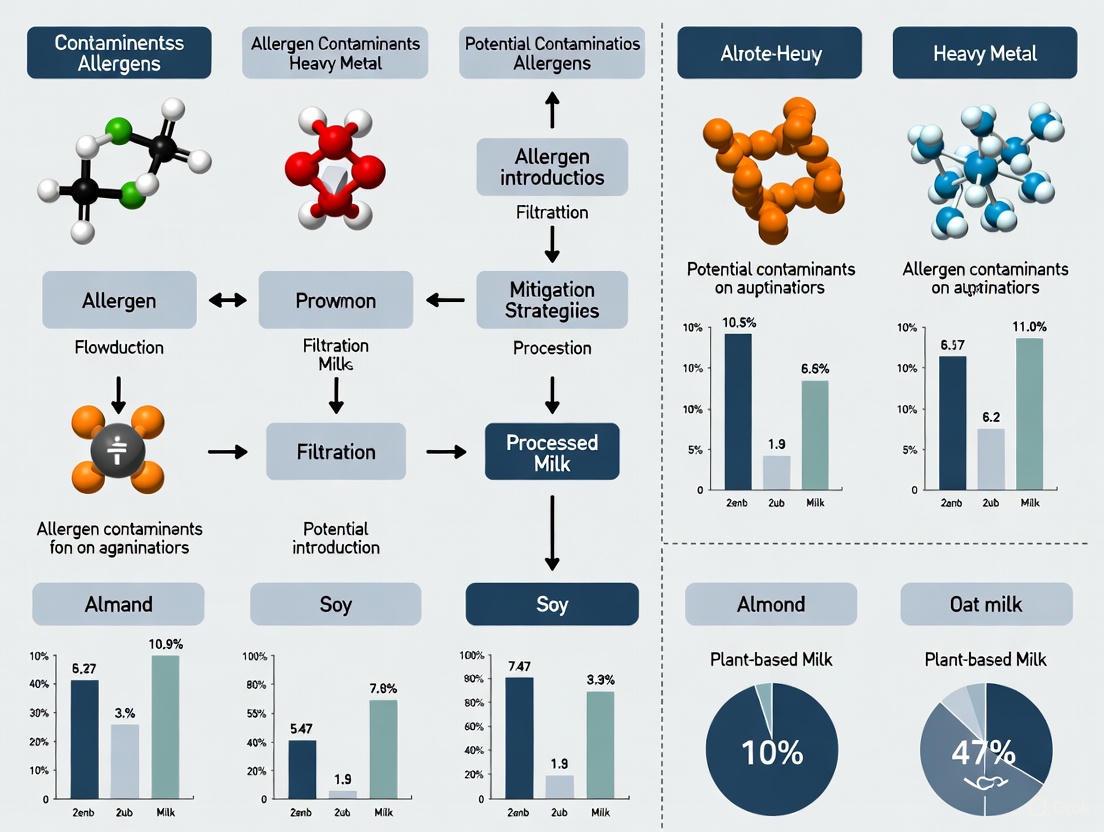
This article provides a systematic review of the safety landscape of plant-based milk alternatives (PBMAs), addressing critical concerns for researchers and food scientists.
Contaminants and Allergens in Plant-Based Milk Alternatives: A Comprehensive Scientific Review for Biomedical Research
Abstract
This article provides a systematic review of the safety landscape of plant-based milk alternatives (PBMAs), addressing critical concerns for researchers and food scientists. It explores the spectrum of biological, chemical, and allergenic hazards—from mycotoxins and heavy metals to unintended allergen cross-contact—identified in popular products like soy, oat, and almond beverages. The review critically evaluates conventional and emerging analytical methodologies for contaminant detection, including chromatography, immunoassays, and novel biosensor systems. It further examines persistent challenges in method optimization, regulatory validation, and the significant research gaps that must be addressed to ensure product safety and integrity, offering a vital resource for professionals in food science, safety, and drug development.
Identifying the Contaminant and Allergen Spectrum in Plant-Based Milk Matrices
The shift towards plant-based milk alternatives (PBMAs) represents a significant trend in global consumer markets, driven by dietary preferences, lactose intolerance, and environmental concerns. While these products offer sustainable nutrition, their production chains introduce specific biological contamination risks from raw materials. This technical guide provides an in-depth analysis of microbiological hazards, their sources in agricultural commodities, and advanced detection methodologies relevant to PBMA manufacturing. Within the broader context of contaminant research in alternative foods, understanding these microbiological risks is crucial for ensuring product safety, quality, and consumer trust. We synthesize current scientific findings on pathogen occurrence, present standardized detection protocols, and outline emerging technologies for monitoring and controlling these hazards throughout the production pipeline.
Plant-based milk alternatives have experienced remarkable market growth, with estimates suggesting this sector could exceed $38 billion in revenue by 2024 [1]. This expansion has intensified scrutiny on the safety profiles of products derived from soy, oat, rice, almond, and other raw materials. Unlike dairy milk, which has well-characterized pasteurization protocols and risk profiles, PBMAs present unique challenges as they originate from agricultural commodities susceptible to field-level contamination and possess distinct physicochemical properties that can influence microbial survival and growth [2].
Microbiological contamination in PBMAs can originate from multiple sources: soil, irrigation water, improper handling during harvest, storage conditions promoting microbial growth, and cross-contamination during processing. While chemical contaminants like heavy metals and pesticides have been more extensively studied, biological hazards present equally significant concerns for consumer safety and product stability [3]. Recent surveys indicate that despite the implementation of sanitary practices, contamination risks persist, necessitating robust detection and control strategies tailored to these novel food matrices [1] [4].
Contamination Profiles and Prevalence Data
Comprehensive monitoring studies have revealed specific microbiological threats associated with different plant-based raw materials. The table below summarizes documented contamination findings from recent market surveys:
Table 1: Documented Biological Contaminants in Plant-Based Milk Alternatives
| Raw Material | Contaminant Type | Specific Contaminants Identified | Prevalence/Levels | Study |
|---|---|---|---|---|
| Soy-based drinks | Microbial contamination | Bacillus cereus | Detected in specific samples [3] | Italian Market Study |
| Oat-based drinks | Mycotoxins | T2+HT2-toxin, Deoxynivalenol | Up to 2.1 μg/L and 5.5 μg/L respectively [4] | German Market Survey |
| Almond-based drinks | Mycotoxins | Aflatoxin B1 (AFB1), Sterigmatocystin | Up to 130 ng/L and 70 ng/L respectively [4] | German Market Survey |
| Various PBMAs | Multiple | Mycotoxins (general) | Not detected in 42 analyzed samples [3] | Italian Market Study |
| Commercial PBMAs | General microbial spoilage | Pathogenic microorganisms | Rare in products from retail markets [4] | German Market Survey |
Mycotoxins represent a particularly insidious category of biological contaminants, as they are secondary metabolites produced by fungi that can persist through processing stages. As evidenced by market surveys, oat-based drinks frequently contain detectable levels of T2+HT2-toxin and deoxynivalenol, while almond-based drinks are particularly susceptible to aflatoxin B1 contamination, with one study reporting levels up to 130 ng/L [4]. Interestingly, some regional studies have found an absence of mycotoxins in analyzed samples, suggesting that geographical and supply chain factors significantly influence contamination profiles [3].
From a microbiological perspective, Bacillus cereus has been identified in soy-based beverages, posing both spoilage and food safety risks due to its spore-forming capability and toxin production [3]. Fortunately, most commercial PBMAs undergo processing that renders them commercially sterile, with retail market surveys indicating that pathogenic microorganisms are rarely detected in properly manufactured products [4].
Experimental Protocols for Detection and Analysis
Microbiological Contamination Assessment
Protocol: Detection and Enumeration of Bacillus cereus in Plant-Based Beverages
Principle: This method utilizes selective media and morphological characterization to isolate and identify Bacillus cereus, a potential microbiological contaminant in plant-based drinks [3].
Materials and Reagents:
- Mannitol Egg Yolk Polymyxin (MYP) Agar
- Brain Heart Infusion (BHI) Broth
- Nutrient Agar
- Polymyxin B Solution
- Phosphate-Buffered Saline (PBS)
- Sterile dilution blanks
- Incubator (30°C and 35°C)
Procedure:
- Sample Preparation: Aseptically transfer 25 mL of the plant-based beverage into 225 mL of sterile PBS, creating a 1:10 dilution. Mix thoroughly.
- Plating: Spread plate appropriate dilutions (10⁻¹ to 10⁻³) onto MYP agar plates in duplicate.
- Incubation: Invert plates and incubate at 30°C for 24-48 hours.
- Examination: After incubation, examine plates for presumptive B. cereus colonies (typically pink-red surrounded by a zone of precipitate).
- Confirmation: Select at least five typical colonies and subculture onto nutrient agar. Confirm through:
- Gram staining (Gram-positive rods with endospores)
- Biochemical tests (catalase-positive, motility, nitrate reduction)
- Enumeration: Count confirmed colonies and calculate CFU/mL based on dilution factor.
Quality Control: Include positive (B. cereus reference strain) and negative controls with each batch of samples.
Mycotoxin Detection via Liquid Chromatography-Mass Spectrometry
Principle: This protocol details the detection and quantification of multiple mycotoxins in plant-based drinks using solid-phase extraction clean-up followed by LC-MS/MS analysis [4].
Materials and Reagents:
- Acetonitrile (HPLC grade)
- Methanol (HPLC grade)
- Formic acid
- Ammonium acetate
- Mycotoxin standards (aflatoxins, ochratoxin A, deoxynivalenol, T-2/HT-2 toxins)
- Immunoaffinity columns (mycotoxin-specific)
- Ultra-high performance liquid chromatography system coupled to tandem mass spectrometer (UPLC-MS/MS)
- C18 reversed-phase analytical column
Procedure:
- Extraction: Homogenize 10 g of sample with 40 mL of acetonitrile/water (84:16, v/v) containing 1% formic acid for 3 minutes. Centrifuge at 4000 × g for 10 minutes.
- Clean-up: Pass 8 mL of supernatant through immunoaffinity columns at a flow rate of 1-2 mL/min. Wash with 10 mL of water. Elute mycotoxins with 1.5 mL of methanol.
- Concentration: Evaporate eluate to dryness under gentle nitrogen stream at 60°C. Reconstitute in 200 μL of methanol/water (30:70, v/v).
- LC-MS/MS Analysis:
- Chromatography: Inject 10 μL onto C18 column maintained at 40°C. Use gradient elution with mobile phase A (water with 5 mM ammonium acetate) and B (methanol with 5 mM ammonium acetate) at 0.4 mL/min.
- Mass Spectrometry: Operate ESI in positive mode. Use Multiple Reaction Monitoring (MRM) for specific transitions for each mycotoxin.
- Quantification: Use matrix-matched calibration curves with internal standards for accurate quantification.
Method Performance: Limit of detection (LOD) for various mycotoxins typically ranges from 0.01-0.5 μg/kg, with recovery rates of 70-120% for most analytes.
Detection Technologies and Research Toolkit
Advanced Detection Methodologies
The analysis of biological contaminants in complex matrices like PBMAs requires sophisticated analytical approaches. Emerging technologies are complementing conventional methods to improve detection capabilities [2].
Table 2: Analytical Methods for Detecting Biological Contaminants in PBMAs
| Technology Category | Specific Methods | Target Contaminants | Advantages | Limitations |
|---|---|---|---|---|
| Chromatography | LC-MS/MS, GC-MS | Mycotoxins, microbial metabolites | High sensitivity and specificity | Expensive instrumentation, requires skilled operators |
| Molecular Biology | PCR, qPCR, DNA barcoding | Pathogenic bacteria, allergen DNA | High specificity, rapid | DNA extraction efficiency, inhibition issues |
| Immunoassays | ELISA, Lateral Flow | Mycotoxins, specific allergens | Rapid, cost-effective, field-deployable | Limited multiplexing capability |
| Emerging Technologies | Biosensors, CRISPR-based | Various pathogens and toxins | Potential for rapid, on-site testing | Mostly in research phase, validation needed |
DNA-based methods have shown particular promise for speciating biological contaminants. Recent advances in DNA barcoding contamination screening (DBCscreen) pipelines enable rapid detection of contamination across a broad range of organisms by leveraging large DNA barcode databases like Barcode of Life Data Systems (BOLD) [5]. This approach can identify parasitic and symbiotic relationships through contamination patterns in genomic data.
Biosensor systems and CRISPR-based technologies represent the next frontier in detection methodologies, offering potential for rapid, precise analysis with portable form factors suitable for quality control checkpoints throughout the production chain [2]. The integration of artificial intelligence with spectroscopic methods further enhances detection capabilities while moving toward greener analytical approaches with reduced solvent consumption [2].
The Scientist's Toolkit: Essential Research Reagents
Table 3: Key Research Reagent Solutions for Contaminant Analysis
| Reagent/Kit | Function | Application Example | Key Features |
|---|---|---|---|
| Immunoaffinity Columns | Selective clean-up and concentration | Mycotoxin extraction from plant-based drinks | High specificity, compatible with LC-MS |
| PCR Master Mixes | DNA amplification | Detection of pathogen DNA | Includes polymerase, dNTPs, buffer |
| ELISA Kits | Quantitative detection | Allergen and mycotoxin screening | High throughput, no specialized equipment |
| Selective Culture Media | Microbial isolation | Bacillus cereus enumeration | Differential and selective properties |
| DNA Extraction Kits | Nucleic acid purification | DNA barcoding of contaminants | Optimized for complex food matrices |
| LC-MS/MS Matrix-Matched Standards | Quantification | Mycotoxin analysis | Compensates for matrix effects |
Process Mapping and Visual Workflows
Contamination Pathways in PBMA Production
The following diagram visualizes the primary pathways for biological contamination throughout the plant-based milk production chain, from agricultural inputs to final products:
Integrated Contaminant Detection Workflow
This diagram outlines a comprehensive experimental workflow for detecting biological contaminants in plant-based milk alternatives, integrating multiple analytical techniques:
Biological contaminants represent a significant concern in the production of plant-based milk alternatives, with risks manifesting at various stages of the supply chain. While current manufacturing practices generally produce commercially sterile products, the persistence of heat-stable toxins like mycotoxins and the potential for spore-forming bacteria necessitate vigilant monitoring and control measures. The contamination profiles vary considerably across different raw materials, with oat-based drinks showing susceptibility to mycotoxins like T2+HT2-toxin and deoxynivalenol, almond-based drinks to aflatoxins, and soy-based products to bacterial contaminants like Bacillus cereus.
Future research directions should focus on closing existing knowledge gaps, particularly in detecting viral contaminants and processing-induced contaminants specific to PBMA matrices. The development of rapid, cost-effective, and portable detection tools will be crucial for enhancing industry compliance and consumer confidence. Furthermore, the integration of green analytical methods, including solvent-free extraction and AI-driven spectroscopy, presents promising avenues for more sustainable safety assessment practices. As the PBMA market continues to expand, a proactive approach to understanding and mitigating biological contamination risks will be essential for ensuring the long-term safety and sustainability of these alternative food products.
Plant-based milk alternatives (PBMAs) have seen a consistent increase in global market share, driven by consumer preferences related to health, lactose intolerance, environmental concerns, and ethical reasons [3] [6]. However, these products are not immune to chemical contamination, which can occur at various stages of the production chain, from raw agricultural materials to processed beverages [7]. This whitepaper provides an in-depth technical overview of the occurrence of three primary classes of chemical hazards—mycotoxins, heavy metals, and pesticides—in PBMAs. It synthesizes the most current research findings, details standardized analytical methodologies for detection and quantification, and presents a risk assessment framework tailored for researchers and food safety professionals. The objective is to furnish a scientific basis for ongoing monitoring, regulatory development, and further research into the safety of these products.
Occurrence and Quantitative Data of Chemical Hazards
Mycotoxins
Mycotoxins are toxic secondary metabolites produced by filamentous fungi, such as Aspergillus, Fusarium, and Alternaria, and can contaminate raw materials like cereals, nuts, and legumes [7]. Chronic exposure to these compounds poses significant health risks, including carcinogenicity, nephrotoxicity, immunotoxicity, and endocrine disruption [7].
Recent occurrence studies demonstrate a high prevalence of mycotoxins in PBMAs. An analysis of 96 commercial plant-based beverages from the Italian market found that 100% of the samples were contaminated with at least one mycotoxin, with many containing up to six co-occurring mycotoxins [8]. The study reported a contamination range from 0.02 μg L⁻¹ for Beauvericin (BEA) to 4.61 μg L⁻¹ for Deoxynivalenol (DON) [8]. Similarly, a study of 72 beverages from Latvia and Lithuania found that 64% of samples were positive for one to sixteen mycotoxins [6]. The most frequently detected mycotoxins were emerging Fusarium toxins, such as enniatins (ENNs), BEA, and Alternaria toxins (e.g., AOH, AME), as well as regulated mycotoxins like DON and T-2/HT-2 toxins [8] [6].
Table 1: Occurrence of Mycotoxins in Plant-Based Beverages
| Mycotoxin Class | Specific Mycotoxins | Frequency of Occurrence | Concentration Range (μg L⁻¹) | Primary Commodities Affected |
|---|---|---|---|---|
| Emerging Fusarium | Enniatins (ENNA, ENNA1, ENNB, ENNB1) | High | Up to 109 (in almond drinks) [6] | Oat, almond-based beverages [8] [6] |
| Beauvericin (BEA) | High | 0.02 - 109 [8] [6] | Oat, almond-based beverages [8] [6] | |
| Alternaria Toxins | Alternariol (AOH), Alternariol Monomethyl Ether (AME), Tentoxin (TEN) | High | Up to 98 (Tentoxin) [6] | Nut and oat-based beverages [8] |
| Regulated Trichothecenes | Deoxynivalenol (DON) | Moderate | Up to 4.61 [8] | Oat-based beverages [8] [6] |
| T-2 & HT-2 Toxin | Moderate | Frequently detected [6] | Oat-based beverages [8] [6] | |
| Others | Zearalenone (ZEA), Ochratoxin A (OTA), Aflatoxins (AFs) | Low to Not Detected | Below detection limits in some studies [3] [6] | Varies |
It is crucial to note that findings can vary. One study of 42 samples from the Italian market did not detect mycotoxins in any of the analyzed soy, oat, rice, or almond beverages, highlighting the influence of raw material sourcing and processing [3]. A significant regulatory challenge is the absence of specific maximum levels for mycotoxins in PBMAs, as current European Commission regulations do not explicitly cover these novel matrices [6].
Heavy Metals and Essential Elements
Plant-based beverages can also be a source of toxic and essential elements, the levels of which depend on the agricultural soil, environmental conditions, and processing methods.
Table 2: Occurrence of Elements in Plant-Based Dairy Alternatives
| Element | Category | Key Findings in PBMAs | Implied Health Concern |
|---|---|---|---|
| Calcium (Ca) | Essential | Critically deficient in non-fortified products; median content 25x lower than cow's milk [9]. | Nutritional inadequacy for bone health. |
| Nickel (Ni) | Essential/Toxic | Quantified in all samples; higher concentrations in soy-based drinks [3]. | Potential for allergic reactions and toxicity. |
| Chromium (Cr) | Essential/Toxic | Detected in all samples [3]. | |
| Lead (Pb) | Toxic | Quantified in some soy, almond, and oat-based samples [3]. | Neurotoxicity, cumulative exposure. |
| Cadmium (Cd) | Toxic | Detected in one rice and seven soy-based samples [3]. | Carcinogenicity, nephrotoxicity. |
| Arsenic (As) | Toxic | Detected in all analyzed rice-based beverages [3]. | Carcinogenicity. |
| Aluminum (Al) | Toxic | Showed the highest average concentration across most product types in a dairy-focused study [10]. | Potential neurotoxicity. |
A comparative analysis in Pakistan confirmed the presence of heavy metals in plant-based milk, with oat milk showing the lowest overall concentration [11]. The study also noted that heat-treated dairy milk generally had lower heavy metal concentrations than raw milk [11]. A critical finding is the low calcium-to-phosphorus ratio in non-fortified PBMAs, which is suboptimal for bone health. In a worst-case scenario, consuming three servings of such PBMAs would provide only about 10 mg of calcium [9].
Pesticides
Information on pesticide residues in PBMAs is less prevalent in the current literature. The available data suggests that pesticide contamination may not be a pervasive issue. A specific study that assessed the occurrence of pesticides in 42 soy, oat, almond, and rice beverages from the Italian market reported that no pesticides were detected in any of the analyzed samples [3]. This indicates that processing steps or agricultural practices for the raw materials used in these samples may effectively remove or minimize pesticide residues. However, given the limited number of studies, continuous monitoring is recommended.
Advanced Analytical Methodologies for Detection
Robust and sensitive analytical methods are paramount for accurately monitoring contaminant levels in the complex matrices of PBMAs.
Mycotoxin Analysis
The multi-residue analysis of mycotoxins typically employs liquid chromatography coupled with tandem mass spectrometry (LC-MS/MS) due to its high sensitivity and selectivity.
Sample Preparation: Two main extraction techniques are optimized for PBMA matrices:
- SALLE (Salting-out Assisted Liquid-Liquid Extraction): This method was developed for the simultaneous determination of 19 mycotoxins. It offers satisfactory performance with recovery values >70% and precision (RSD) <20% [8].
- QuEChERS (Quick, Easy, Cheap, Effective, Rugged, and Safe): A comparison between QuEChERS and solid-phase extraction (SPE) demonstrated that QuEChERS provided higher extraction efficiency for most mycotoxins, except for HT-2 toxin and fumonisin B1 [6]. However, fumonisins and ochratoxin A can be irreversibly adsorbed by the primary secondary amine (PSA) sorbent commonly used in QuEChERS, requiring methodological adjustments [6].
Detection and Quantification: The final extract is analyzed using UHPLC-MS/MS. Methods are validated to achieve low limits of detection and quantification (LODs and LOQs), often in the sub-μg L⁻¹ range, ensuring the detection of mycotoxins even at trace levels [8] [6].
Heavy Metal Analysis
Inductively Coupled Plasma Mass Spectrometry (ICP-MS) is the gold standard for multi-element analysis at trace levels.
- Sample Preparation: Liquid samples are typically subjected to microwave-assisted acid digestion using a mixture of nitric acid (HNO₃) and hydrogen peroxide (H₂O₂) to completely break down the organic matrix and liberate the metals into solution [10].
- Detection and Quantification: The digested samples are diluted and introduced into the ICP-MS. The instrument provides excellent sensitivity and a wide linear dynamic range for simultaneous quantification of multiple elements. Quality control is ensured using certified reference materials (CRMs) and spike recovery tests [9] [10].
Analysis of Other Contaminants
- Heterocyclic Aromatic Amines (HAAs): These thermal processing contaminants can be determined in PBMAs using micro-solid phase extraction (µSPE) combined with UHPLC-MS/MS. Method optimization using chemometric tools allows for low detection limits (0.01–0.04 µg L⁻¹) and high enrichment factors [12].
- Pesticides: While not detected in the cited study [3], multi-residue analysis for pesticides would typically involve LC-MS/MS or GC-MS, often with a QuEChERS-based sample preparation protocol.
The Scientist's Toolkit: Essential Research Reagents and Materials
Table 3: Key Reagents and Materials for Contaminant Analysis in PBMAs
| Item | Function/Application | Specific Examples & Notes |
|---|---|---|
| UHPLC-MS/MS System | High-resolution separation and sensitive detection of organic contaminants (mycotoxins, pesticides, HAAs). | Essential for multi-residue analysis. Requires electrospray ionization (ESI) source [8] [12]. |
| ICP-MS System | Highly sensitive, multi-element analysis of metals and trace elements. | Operates in standard (No Gas) and collision/reaction cell (KED) modes to overcome polyatomic interferences [10]. |
| Microwave Digestion System | Closed-vessel digestion of samples for elemental analysis, ensuring complete decomposition and preventing loss of volatile elements. | Uses HNO₃ and H₂O₂ [10]. |
| Certified Reference Materials (CRMs) | Quality control and method validation; verifies accuracy and precision of analytical results. | e.g., INCT-TL-1 Tea Leaves, NIST 1570a Spinach Leaves [9]. |
| QuEChERS Extraction Kits | Standardized sample preparation for mycotoxins and pesticides. Involves extraction and a dispersive-SPE (d-SPE) clean-up step. | Selection of sorbents (e.g., PSA, C18) is critical to avoid loss of specific analytes like OTA or fumonisins [6]. |
| SALLE Reagents | Alternative extraction method for mycotoxins using water-miscible solvent separated by salt addition. | Optimized for simultaneous extraction of 19 mycotoxins with high recovery [8]. |
| Poly(MAA-co-EDMA) Monolith | µSPE sorbent for extracting Heterocyclic Aromatic Amines (HAAs) from PBMAs. | A novel, selective sorbent for sample clean-up and pre-concentration [12]. |
| Isotopically Labeled Internal Standards | Used in MS-based quantification to correct for matrix effects and losses during sample preparation. | Improves data accuracy and reliability [8] [12]. |
Risk Assessment and Implications for Safety
Exposure and Risk Characterization
- Mycotoxins: Acute exposure studies modeling the replacement of dairy milk with PBMAs in the Latvian population suggested that, based on the observed contamination levels, the beverages may be relatively safe. However, the contribution of emerging mycotoxins (ENNs, BEA) to overall exposure requires further consideration, especially given the lack of regulatory thresholds and full toxicological characterization [6].
- Heavy Metals: For toxic elements like Pb and Cd, concentrations in PBMAs are generally reported to be very low, with the exception of specific matrices such as rice-based drinks (for As) and homemade poppy seed milk (for Cd) [3] [9]. Risk assessments often calculate the Estimated Daily Intake (EDI) and compare it to toxicological reference values like the Tolerable Daily Intake (TDI). The non-carcinogenic risk is evaluated using the Target Hazard Quotient (THQ) and Hazard Index (HI) [10].
- Heterocyclic Aromatic Amines (HAAs): A health risk assessment for HAAs in PBMAs calculated the Incremental Lifetime Cancer Risk (ILCR). While the cumulative ILCR values were below the unacceptable risk threshold (10⁻⁴), some scenarios for frequent consumers approached a moderate risk level (10⁻⁵), indicating a need for attention [12].
Research Gaps and Future Directions
Current research gaps include the need for more extensive surveys of pesticide residues, a comprehensive toxicological evaluation of emerging mycotoxins and their combined effects, and the optimization of sample preparation protocols for complex PBMA matrices [2]. Furthermore, the development of rapid, portable, and green analytical methods, such as those based on biosensors, CRISPR, and AI-driven spectroscopy, is crucial for enhancing industry compliance and consumer confidence [2] [13].
Plant-based milk alternatives are susceptible to chemical contamination, primarily by mycotoxins and certain toxic elements, while current data suggests pesticide levels may be low. The high incidence of emerging mycotoxins like enniatins and beauvericin is a key finding that warrants further investigation. Advanced analytical techniques, particularly LC-MS/MS and ICP-MS, are essential tools for monitoring these hazards. From a food safety perspective, there is a clear need for the development of specific regulatory guidelines for PBMAs, increased monitoring of emerging contaminants, and consumer education on the nutritional aspects, particularly regarding calcium in non-fortified products. Ensuring the safety and quality of PBMAs is integral to maintaining public trust and supporting the sustainable growth of this market segment.
The shift towards plant-based milk alternatives represents a significant trend in global food consumption, driven by dietary preferences, environmental concerns, and health considerations. However, this transition introduces complex allergen safety challenges that require thorough scientific examination. This technical guide provides an in-depth analysis of two primary allergen risk categories in plant-based milk alternatives: (1) inherent plant allergens from novel protein sources such as legumes, nuts, and seeds, and (2) cross-contamination with major food allergens during manufacturing in shared facilities. As the plant-based food market expands—projected to reach US$290 billion by 2035—understanding these allergen profiles becomes crucial for product safety, regulatory compliance, and consumer protection [14].
Inherent Allergens in Plant-Based Ingredients
Plant-based milk alternatives utilize diverse protein sources, many containing allergenic proteins belonging to a limited number of protein families. Research indicates that 79% of known plant food allergens belong to just 12 protein families, with the protease inhibitor/seed storage/LTP family (Pfam PF00234) and the Cupin-1 family (Pfam PF00190) being the most predominant [15].
Table 1: Major Allergen Protein Families in Plant-Based Milk Ingredients
| Protein Family | Pfam ID | Allergen Examples | Common Food Sources | Stability Properties |
|---|---|---|---|---|
| Nonspecific Lipid Transfer Proteins (NsLTP) | PF00234 | Pru p 3 (peach), Ara h 9 (peanut) | Tree nuts, peanuts, cereals | Resistant to heat and proteolytic digestion, stable at low pH |
| Cupin (7S vicilin and 11S legumin) | PF00190 | Ara h 1 (peanut), Gly m 5 (soy) | Legumes (soy, pea, lentil, peanut) | Varies; some stable to heat and processing |
| Prolamin (2S albumin) | PF00234 | Ara h 2, 6, 7 (peanut), Ber e 1 (Brazil nut) | Tree nuts, peanuts, mustard | Highly stable due to disulfide bonds, protease-resistant |
| Profilin | PF00235 | Ara h 5 (peanut), Gly m 3 (soy) | Various plant foods | Susceptible to heat and proteolysis, often causes oral allergy syndrome |
| Bet v 1-related | PF00407 | Gly m 4 (soy), Pru av 1 (cherry) | Soy, apple, cherry | Labile to heat and gastric digestion |
Emerging Allergen Concerns in Alternative Proteins
Legume-derived proteins, particularly from pea and lentil, are increasingly used in plant-based milk formulations but present emerging allergen concerns. The French government listed pea and lentils as emerging allergens in 2015, and UK patient organizations have warned about pea as an important emerging allergen [16]. Pea protein can cross-react with other legumes, including peanut, posing potential risks for consumers with peanut allergy [16].
Novel protein sources under development for next-generation plant-based milics, including edible insects, single-cell proteins, and seaweed, present additional allergen challenges. These proteins may cause primary sensitization or cross-react with known allergens, though standardized assessment methods for evaluating this risk are currently lacking [14].
Cross-Contamination Risks in Shared Facilities
Cross-contamination in manufacturing facilities represents a significant risk for unintended allergen presence in plant-based milk alternatives. Despite consumer perceptions, vegan products do not guarantee absence of animal allergens such as milk, egg, fish, crustaceans, or molluscs [16] [17].
Prevalence and Regulatory Status
A study by the German Allergy and Asthma Association (DAAB) found that 23% of vegan products contained significant amounts of milk, though most carried appropriate labeling [16]. The absence of legal definitions for "vegan" or "plant-based" in Europe further complicates this issue, as regulations do not specify whether these products may contain traces of animal allergens [16].
Table 2: Cross-Contamination Risks and Prevention in Plant-Based Milk Production
| Risk Factor | Description | Preventive Measures |
|---|---|---|
| Shared Equipment | Use of same processing equipment for dairy and plant-based products | Dedicated production lines, thorough cleaning validation |
| Airborne Particles | Airflow carrying allergenic powders in facilities | Separate ventilation systems, physical barriers |
| Storage Practices | Bulk ingredient storage in shared silos or areas | Segregated storage with color-coded containers |
| Staff Practices | Inadequate training on allergen handling | Comprehensive training programs, clear procedures |
| Supply Chain | Allergen contamination in raw ingredients | Supplier verification, ingredient testing protocols |
Certification and Labeling Considerations
Various certification programs address cross-contamination with differing approaches. The BRCGS Plant-Based Global Standard involves certification audits that assess prevention of cross-contamination with animal ingredients [16]. In contrast, the Vegan Society's Vegan Seal of Approval and the European Vegetarian Union's V-label permit cross-contamination with animal allergens, with the V-label applying a maximum limit of 0.1% (1000 ppm) for all animal contaminants combined [16].
The Food & Drink Federation (FDF) in England emphasizes that allergic consumers should not base product choices solely on vegan logos, as these claims differ from allergen-free claims [16].
Analytical Methods for Allergen Detection
Accurate allergen detection is essential for verifying labeling accuracy and controlling cross-contamination in plant-based milk production. The choice of analytical method depends on the specific allergen, food matrix, and processing conditions.
Protein-Based Detection Methods
Enzyme-linked immunosorbent assay (ELISA) remains the gold standard for allergen detection due to its high sensitivity, specificity, and commercial availability. The Codex Alimentarius Commission has adopted ELISA as the official test for gluten allergens, with a threshold of 20 mg/kg [18]. However, ELISA performance can be compromised in processed foods where allergen proteins undergo structural changes.
Mass spectrometry (MS) has emerged as a powerful alternative, particularly for detecting multiple allergens simultaneously and analyzing hydrolyzed proteins. MS methods can identify specific peptide markers that survive food processing, making them valuable for verifying allergen presence in complex matrices [19]. Immunoaffinity enrichment coupled with MS can enhance sensitivity for challenging allergens [19].
Nucleic Acid-Based and Biosensor Methods
Polymerase chain reaction (PCR) methods detect allergen-specific DNA sequences rather than proteins, offering advantages for highly processed foods where protein structure may be altered but DNA remains detectable. PCR has been adopted as an official analytical tool for food allergen detection in Germany and Japan, with Japan setting a food allergen threshold of 10 μg/g [18].
Biosensors represent emerging technology for rapid, on-site allergen detection. These systems can be integrated with microfluidics for portable analysis and offer potential for real-time monitoring in production facilities [18]. Electrochemical immunosensors for simultaneous detection of multiple allergens in food matrices have demonstrated improved detectability in processed foods [19].
Table 3: Comparison of Major Allergen Detection Methodologies
| Method | Detection Principle | Sensitivity | Advantages | Limitations |
|---|---|---|---|---|
| ELISA | Antigen-antibody binding | High (ppm-ppb) | High throughput, standardized | Affected by food processing, antibody quality varies |
| Mass Spectrometry | Detection of signature peptides | Moderate to high | Multi-allergen detection, specific | Complex sample preparation, requires expertise |
| PCR | Amplification of DNA sequences | High | Effective for processed foods, specific | Indirect (does not detect protein itself) |
| Lateral Flow Immunoassay | Antigen-antibody binding with visual readout | Moderate | Rapid, user-friendly, on-site use | Semi-quantitative, lower sensitivity |
| Biosensors | Biorecognition elements with transducers | Moderate to high | Rapid, potential for portability | Still in development, limited commercial availability |
Experimental Protocols for Allergen Assessment
ELISA for Quantification of Allergenic Proteins
Principle: This protocol describes the quantification of specific allergenic proteins (e.g., peanut Ara h 1) in plant-based milk samples using a sandwich ELISA approach [18].
Reagents and Materials:
- Microtiter plates coated with capture antibody
- Allergen standards (purified native or recombinant protein)
- Sample extraction buffer (PBS containing Tween-20 and blocking agents)
- Detection antibody (enzyme-conjugated)
- Enzyme substrate (TMB for colorimetric detection)
- Stop solution (acid)
- Washing buffer
Procedure:
- Sample Preparation: Homogenize plant-based milk sample and extract proteins using appropriate buffer. Centrifuge to remove insoluble material.
- Standard Preparation: Prepare serial dilutions of allergen standard in extraction buffer.
- Plate Setup: Add standards and samples to coated microtiter wells. Incubate 1-2 hours at room temperature.
- Washing: Wash plate 3-5 times with washing buffer.
- Detection: Add enzyme-conjugated detection antibody. Incubate 1 hour at room temperature.
- Washing: Repeat washing step.
- Substrate Addition: Add enzyme substrate solution. Incubate 15-30 minutes for color development.
- Signal Measurement: Add stop solution and measure absorbance at 450 nm.
- Quantification: Generate standard curve and calculate allergen concentration in samples.
Validation: Include positive and negative controls. Assess recovery by spiking known amounts of allergen into negative matrix.
Real-Time PCR for Detection of Allergen Source DNA
Principle: This protocol detects and quantifies DNA from allergenic sources (e.g., walnut) in plant-based milk products, useful when protein detection is compromised by processing [19].
Reagents and Materials:
- DNA extraction kit (validated for food matrices)
- Species-specific primers and probes
- Real-time PCR master mix
- DNA standards (for quantification)
- Real-time PCR instrument
Procedure:
- DNA Extraction: Extract genomic DNA from plant-based milk sample using appropriate method.
- DNA Quantification: Measure DNA concentration and quality.
- Primer/Probe Design: Design oligonucleotides targeting species-specific DNA sequences (e.g., walnut Jug r 4 gene).
- PCR Setup: Prepare reactions with master mix, primers/probe, and sample DNA.
- Amplification: Run real-time PCR with appropriate cycling conditions.
- Data Analysis: Determine quantification cycle (Cq) values. Compare to standard curve for quantification.
Validation: Establish limit of detection (LOD) and limit of quantification (LOQ). Verify specificity against related species.
The Scientist's Toolkit: Research Reagent Solutions
Table 4: Essential Research Reagents for Allergen Analysis
| Reagent/Category | Specific Examples | Research Application | Key Function |
|---|---|---|---|
| Monoclonal Antibodies | Anti-Ara h 1, Anti-Gly m 5, Anti-Bos d 5 | ELISA, immunosensors, Western blot | Specific recognition of target allergen epitopes |
| Recombinant Allergens | rAra h 1-13, rGly m 4-8, rCor a 1/8/9 | Assay standards, IgE binding studies, in vitro models | Defined molecular tools free from natural extract variability |
| DNA Primers/Probes | Jug r 4 (walnut), Cor a 1 (hazelnut), Gly m 1 (soy) | Real-time PCR, DNA-based detection | Specific amplification of allergen source DNA |
| Mass Spec Standards | Isotopically labeled peptide analogs | LC-MS/MS quantification | Internal standards for precise protein quantification |
| Cell-Based Assays | Basophil activation test, RBL cell lines | Allergenicity assessment, cross-reactivity studies | Functional assessment of immune response to allergens |
Allergen Risk Assessment and Management Framework
Effective allergen management in plant-based milk production requires a comprehensive approach integrating assessment, monitoring, and control strategies.
Risk Assessment Framework
The European Food Safety Authority (EFSA) recommends a weight-of-evidence approach for allergenicity assessment of novel proteins, including [14]:
- Source of gene: Assessment of donor organism's allergenic potential
- Sequence homology: Comparison with known allergens using bioinformatics tools
- IgE binding: In vitro tests with sera from allergic individuals
- Protein stability: Resistance to pepsin digestion and processing
- Existing data: Consideration of clinical and epidemiological information
For cross-contamination risk assessment, the FAO/WHO expert panel has established reference doses for priority allergens, including 2.0 mg total protein for peanut and milk, and 1.0 mg for tree nuts [19].
Allergen Management in Manufacturing
Preventing cross-contamination requires structured programs including:
- Facility design with physical separation and dedicated production lines
- Scheduling to produce allergen-free products first
- Cleaning validation using appropriate detection methods to verify removal
- Supplier management to ensure ingredient safety
- Employee training on allergen handling procedures
The Vegan Society's Trademark program specifies requirements for segregation in storage, preparation, and cooking areas, along with staff training and cleaning procedures [20].
Visualizing Allergen Risk Assessment Pathways
Allergenicity Assessment Pathway for Novel Plant Proteins
Cross-Contamination Control in Shared Facilities
The allergen profile of plant-based milk alternatives encompasses both inherent allergens from novel protein sources and potential cross-contamination during manufacturing. Effective management requires integrated approaches combining thorough risk assessment, appropriate detection methodologies, and controlled manufacturing practices. As the plant-based food market continues to expand, ongoing research is needed to better understand the allergenic potential of emerging protein sources and to develop more sensitive, reliable detection methods. Regulatory harmonization and clear labeling remain essential for protecting allergic consumers while supporting innovation in this rapidly evolving sector.
The market for plant-based milk alternatives (PBMAs) has experienced consistent global growth, driven by consumer preferences related to health, sustainability, ethics, and lactose intolerance [3] [21]. This rapid expansion has introduced complex challenges in ensuring product integrity, safety, and authenticity. Adulteration practices—the deliberate and economically motivated substitution, addition, or misrepresentation of food ingredients—pose significant economic and safety concerns, particularly through the introduction of undeclared components [22] [23]. Within the context of contaminants and allergens in PBMA research, understanding these adulteration practices is critical for protecting consumer health, ensuring fair market practices, and guiding analytical method development.
Economically motivated adulteration affects an estimated 1% of the global food industry, with economic impacts ranging from $10-$40 billion annually [23]. Beyond financial harm, these practices introduce serious health risks, including allergic reactions to substituted ingredients, exposure to toxic substances, and nutritional deficiencies [23]. This technical review examines adulteration practices within PBMA matrices, analyzes detection methodologies, and discusses emerging approaches for ensuring product authenticity and safety within this rapidly evolving category.
Adulteration Practices in Plant-Based Milk Alternatives
Forms and Economic Drivers of Adulteration
The complex supply chains and varying raw material costs associated with PBMA production create vulnerabilities to specific forms of adulteration. Primary forms documented in plant-based proteins include:
- Ingredient substitution: Replacement of high-cost ingredients with lower-cost alternatives (e.g., substituting premium rice varieties with common rice, or chickpea flour with grass pea flour) [22]
- Undisclosed dilution/downward standardization: Addition of water or cheaper liquid bases to extend volume
- Concealment of quality: Masking of spoiled or low-quality ingredients through processing or blending with fresh batches [23]
- Mislabeling: False claims regarding ingredient composition, geographical origin, or organic status [22]
These practices are economically driven by significant cost disparities between raw materials and production processes. For instance, sophisticated extraction methods involving enzymatic hydrolysis, ultrasound, or high-pressure techniques create opportunities for adulteration with less expensive alternatives that bypass these costly processes [22].
Safety Implications of Undeclared Ingredients
The introduction of undeclared ingredients through adulteration practices poses multifaceted safety concerns:
Allergen Risks: Undeclared allergens represent a primary safety concern, with soy and tree nuts being common allergens frequently used in PBMA formulations [24]. Cross-contamination during manufacturing and deliberate substitution without proper labeling can trigger severe allergic reactions in sensitive individuals.
Chemical Contaminants: Adulterated ingredients may introduce chemical hazards including:
- Mycotoxins: Plant raw materials used in PBMAs can contain mycotoxins, with research indicating that replacing dairy milk with plant-based alternatives may significantly increase mycotoxin exposure [24]
- Heavy metals: Studies have detected quantifiable levels of toxic trace elements in PBMAs, with arsenic present in all rice-based beverages, and lead, cadmium, chromium, and nickel detected across various PBMA types [3]
- Tropane alkaloids: Atropine has been detected in soy-based beverages, indicating potential raw material contamination [3]
- Industrial dyes: Historical incidents in other food categories have involved illegal dyes like Sudan Red in palm oil, which could potentially affect colored PBMA ingredients [23]
Nutritional Impacts: Undisclosed substitution can alter nutritional profiles, potentially reducing protein quality and micronutrient content that consumers rely upon for nutritional needs [25].
Table 1: Documented Contaminants in Plant-Based Milk Alternatives
| Contaminant Category | Specific Compounds | PBMA Types Affected | Potential Health Impacts |
|---|---|---|---|
| Heavy Metals | Arsenic | Rice-based beverages [3] | Toxicity, carcinogenicity |
| Lead, Cadmium | Soy-based, almond-based, oat-based [3] | Neurological, renal toxicity | |
| Nickel, Chromium | All analyzed samples [3] | Allergic reactions, toxicity | |
| Tropane Alkaloids | Atropine | Soy-based beverages [3] | Anticholinergic toxicity |
| Biological Contaminants | Bacillus cereus | Potential microbiological contamination [3] | Food poisoning |
| Allergens | Soy, tree nuts | Various PBMAs [24] | Allergic reactions |
Analytical Methodologies for Detection
Conventional Detection Techniques
Chromatography-Based Methods: Liquid and gas chromatography techniques coupled with various detectors (MS, UV) represent the gold standard for contaminant identification and quantification. These methods offer high sensitivity and specificity for detecting mycotoxins, pesticide residues, and other chemical contaminants [2] [22]. For instance, UHPLC-MS/MS has been successfully employed for controlling emerging mycotoxins like enniatins and beauvericin in PBMAs [13].
DNA-Based Techniques: Polymerase chain reaction (PCR) and DNA barcoding are powerful tools for species identification and authentication, particularly for detecting substitution of plant sources [22]. These methods face challenges in processed PBMAs where DNA degradation may occur, requiring optimized extraction protocols [2] [13].
Immunoassays: Enzyme-linked immunosorbent assays (ELISA) provide rapid, cost-effective detection of specific protein allergens and contaminants [13]. While useful for screening, they may have limitations in multiplexing and specificity in complex matrices [22].
Spectroscopy and Imaging Approaches: Vibrational spectroscopy (NIR, Raman), NMR, and hyperspectral imaging offer non-destructive analysis capabilities suitable for high-throughput screening [22]. These methods increasingly incorporate machine learning algorithms for pattern recognition of adulteration [2].
Emerging and Portable Methods
Recent technological advances have introduced novel detection platforms:
Biosensors: Various biosensor platforms utilizing electrochemical, optical, or piezoelectric transducers offer rapid, on-site detection capabilities with minimal sample preparation [2].
CRISPR-Based Systems: Emerging CRISPR-Cas technologies provide highly specific nucleic acid detection with potential for field-deployable adulteration testing [2] [13].
Portable Spectroscopy: Miniaturized spectroscopic devices enabled by advances in photonics allow for point-of-use screening of PBMA authenticity [2].
Table 2: Analytical Techniques for Detecting Adulteration and Contaminants
| Technique Category | Specific Methods | Applications in PBMAs | Limitations |
|---|---|---|---|
| Chromatography | LC-MS/MS, GC-MS, HPLC | Mycotoxins, pesticide residues, chemical contaminants [2] [22] | Costly equipment, required expertise, sample preparation |
| DNA-Based | PCR, DNA barcoding, qPCR | Species identification, plant source authentication [22] | DNA degradation in processed samples [2] |
| Immunoassays | ELISA, lateral flow assays | Allergen detection, rapid screening [13] | Limited multiplexing, matrix effects |
| Spectroscopy | NIR, Raman, NMR | Non-destructive screening, compositional analysis [22] | Model development required, sensitivity limitations |
| Emerging Technologies | Biosensors, CRISPR-based systems | Rapid, on-site testing [2] | Early development stages, validation required |
Experimental Workflows and Methodologies
Integrated Adulteration Detection Workflow
The following workflow represents a comprehensive approach to detecting adulteration in PBMAs, synthesizing multiple methodological approaches:
Detailed Methodological Protocols
Chromatographic Analysis of Chemical Contaminants
Sample Preparation Protocol:
- Liquid-Liquid Extraction: Combine 2g homogenized PBMA sample with 10mL acetonitrile:water (84:16 v/v) in centrifuge tube
- Shaking and Centrifugation: Vortex for 1 minute, shake vigorously for 10 minutes, then centrifuge at 4500×g for 10 minutes at 4°C
- Clean-up: Transfer supernatant through SPE cartridge (C18 or multifunctional)
- Concentration: Evaporate eluent to dryness under nitrogen stream at 40°C
- Reconstitution: Reconstitute in 1mL mobile phase initial conditions, filter through 0.22μm membrane [2] [13]
LC-MS/MS Parameters:
- Column: C18 (100mm × 2.1mm, 1.8μm)
- Mobile Phase: (A) 5mM ammonium acetate in water; (B) 5mM ammonium acetate in methanol
- Gradient: 10% B to 95% B over 12 minutes, hold 3 minutes
- Flow Rate: 0.3mL/min
- Injection Volume: 5μL
- Ionization: ESI positive/negative switching mode
- Detection: MRM mode with compound-specific transitions [2]
DNA-Based Authentication Protocol
DNA Extraction from PBMAs:
- Cell Lysis: Incubate 2mL PBMA with CTAB buffer (2% CTAB, 1.4M NaCl, 20mM EDTA, 100mM Tris-HCl, pH 8.0) and proteinase K at 65°C for 90 minutes
- Purification: Add chloroform:isoamyl alcohol (24:1), mix, centrifuge at 12,000×g for 10 minutes
- Precipitation: Transfer aqueous phase, add 0.7 volumes isopropanol, incubate at -20°C for 30 minutes
- Washing: Centrifuge at 12,000×g for 10 minutes, wash pellet with 70% ethanol
- Resuspension: Air dry and resuspend in TE buffer [22]
PCR Amplification:
- Primers: Plant-specific ITS2 region primers (ITS2-F: 5'-ATGCGATACTTGGTGTGAAT-3'; ITS2-R: 5'-GACGCTTCTCCAGACTACAAT-3')
- Reaction Mix: 1× PCR buffer, 1.5mM MgCl₂, 0.2mM dNTPs, 0.5μM each primer, 1.25U Taq polymerase, 2μL template DNA
- Cycling Conditions: 95°C for 5min; 35 cycles of 95°C/30s, 55°C/30s, 72°C/45s; final extension 72°C/7min [22]
Sequence Analysis: Purify PCR products and sequence. Compare sequences to reference databases (GenBank, BOLD) for species identification.
The Scientist's Toolkit: Research Reagent Solutions
Table 3: Essential Research Reagents for PBMA Adulteration Analysis
| Reagent/Category | Specific Examples | Function/Application | Technical Notes |
|---|---|---|---|
| Extraction Solvents | Acetonitrile:water (84:16), Methanol, CTAB buffer | Sample preparation, analyte extraction | Acetonitrile:water optimal for mycotoxins; CTAB for DNA extraction [2] [22] |
| Solid-Phase Extraction | C18 cartridges, Multifunctional cartridges (MycoSep), Ion-exchange resins | Sample clean-up, interference removal | Multifunctional cartridges effective for multiple contaminant classes [2] |
| PCR Reagents | Plant-specific primers (ITS2, rbcL), dNTPs, Taq polymerase, DNA size markers | DNA amplification, species authentication | Multi-locus approach recommended for authentication [22] |
| Immunoassay Kits | ELISA kits for soy, almond, peanut allergens; Lateral flow devices | Rapid allergen screening, on-site testing | Validate for processed matrices; potential cross-reactivity [13] [24] |
| Chromatography Standards | Mycotoxin standards (aflatoxins, ochratoxin), pesticide mixes, heavy metal standards | Quantification, method calibration | Use isotopically labeled internal standards for accurate quantification [2] [3] |
| Culture Media | B. cereus selective media (MYP, PEMBA) | Microbiological contamination assessment | Incubate at 30°C for 24-48 hours [3] |
Adulteration practices in plant-based milk alternatives present significant economic and safety challenges that require sophisticated analytical approaches for detection and prevention. The integration of screening methods with confirmatory techniques provides the most robust framework for ensuring PBMA authenticity and safety. Emerging technologies, including biosensors, CRISPR-based systems, and portable spectroscopy, show promise for rapid, on-site detection but require further validation and standardization.
Future research directions should focus on:
- Developing optimized sample preparation protocols specifically tailored to PBMA matrices
- Validating rapid methods for emerging contaminants and adulteration practices
- Establishing standardized reference materials for method validation
- Implementing data integration platforms that combine multiple analytical approaches
- Advancing green analytical methods that reduce environmental impact while maintaining efficacy [2]
As the PBMA market continues to evolve, maintaining scientific vigilance through advanced analytical capabilities will be essential for protecting consumer interests and ensuring the continued integrity of these products within the global food supply.
Plant-based milk alternatives (PBMAs) have seen a consistent global growth in market share, driven by evolving consumer preferences, veganism, environmental concerns, and issues like lactose intolerance [26]. This shift in consumption patterns necessitates rigorous monitoring to ensure product safety. Market surveillance plays a critical role in identifying and quantifying chemical and microbiological contaminants in these beverages, providing essential data for risk assessment and public health protection. This review synthesizes recent findings from regional studies on the occurrence of contaminants in PBMAs, framing them within the broader research on food safety and quality.
Regional Contamination Profiles in Plant-Based Milks
Recent market surveillance studies from various regions have employed advanced analytical techniques to profile the occurrence of inorganic, organic, and biological contaminants in PBMAs.
Chemical Contaminants
Inorganic Elements: Multiple studies have detected toxic trace elements in PBMAs. An analysis of 42 soy, oat, rice, and almond beverages from the Italian market found that all samples contained quantifiable concentrations of chromium and nickel, with the latter being significantly higher in soy-based drinks [3]. Lead was quantified in 3 soy-based, 3 almond-based, and one oat-based sample. Cadmium was detected in one rice and seven soy-based samples. A particularly notable finding was the presence of quantifiable levels of arsenic in all analyzed rice-based beverages, highlighting a potential commodity-specific concern [3].
A study on the Turkish market that compared animal-derived milk and PBMAs reported that all PBMA and cow's milk samples were below the European Union (EU) limit for lead (20 μg/kg). Cadmium concentrations above 10 μg/kg were found in 10.3% of cow milk samples, while mercury was undetectable in some samples and remained below 5 μg/kg in all others. Arsenic levels were consistently below 10 μg/kg [27]. Another study on the Czech market found that toxic elements like lead and cadmium were generally very low in non-fortified PBMAs, with a notable exception being homemade poppy seed milk, which exhibited an elevated cadmium level (0.052 ± 0.04 mg/kg) [9].
Table 1: Occurrence of Toxic Trace Elements in Plant-Based Milk Alternatives from Regional Studies
| Element | Regional Study | Key Findings by PBMA Type | Regulatory Context |
|---|---|---|---|
| Arsenic (As) | Italy [3] | Detected in all rice-based beverages | - |
| Turkey [27] | Levels consistently < 10 μg/kg | - | |
| Cadmium (Cd) | Italy [3] | Detected in 1 rice & 7 soy-based samples | - |
| Turkey [27] | >10 μg/kg in 10.3% of cow milk samples; PBMAs lower | - | |
| Czech Republic [9] | Generally low; 0.052 mg/kg in homemade poppy seed milk | - | |
| Lead (Pb) | Italy [3] | Quantified in soy, almond, and oat-based samples | - |
| Turkey [27] | All PBMAs below EU limit (20 μg/kg) | EU Limit: 20 μg/kg | |
| Nickel (Ni) | Italy [3] | All samples contained Ni; higher in soy beverages | - |
Organic Contaminants: The Italian survey assessed the occurrence of pesticides, mycotoxins, and tropane alkaloids. Reassuringly, pesticides and mycotoxins were not detected in any of the 42 analyzed samples [3]. However, atropine, a tropane alkaloid, was detected in three soy-based samples, indicating potential contamination from certain plant species during sourcing [3]. A study from Turkey also quantified melamine, a compound used in plastics, in the majority of both animal-derived milk and PBMAs. While most samples had low levels, two PBMAs—a coconut-based and a soy-based product—exceeded 50 μg/kg [27].
Table 2: Occurrence of Organic Contaminants and Allergens in Plant-Based Milk Alternatives
| Contaminant/Allergen | Regional Study | Key Findings | Detection Method |
|---|---|---|---|
| Pesticides | Italy [3] | Not detected in any of the 42 samples | Chromatography |
| Mycotoxins | Italy [3] | Not detected in any of the 42 samples | Chromatography |
| Tropane Alkaloids (Atropine) | Italy [3] | Detected in 3 soy-based samples | Chromatography |
| Melamine | Turkey [27] | Detected in most samples; 2 PBMAs exceeded 50 μg/kg | LC-MS/MS |
| Inherent Allergens | Global Review [2] | Soy, nuts are common allergens; risk of cross-contamination | PCR, Immunoassays |
Microbiological Contaminants
The Italian study tested for the presence of Bacillus cereus as an indicator of microbiological contamination, although the specific findings for this organism were not detailed in the highlighted abstract [3]. A separate, major incident involving infant formula, while not a plant-based product, underscores the critical importance of microbiological surveillance. A large-scale recall of ByHeart infant formula was initiated after Clostridium botulinum was identified in both opened and unopened cans, leading to numerous cases of infant botulism [28]. This incident highlights that powdered formulations, which can include some plant-based products, are susceptible to contamination by spore-forming bacteria that can survive pasteurization.
Analytical Methodologies for Contaminant Detection
The accurate identification and quantification of contaminants in PBMAs rely on sophisticated and validated experimental protocols. The following section details key methodologies cited in recent surveillance studies.
Protocol for Elemental Analysis via ICP-MS
A study comparing melamine and inorganic contaminants in Turkey utilized Inductively Coupled Plasma Mass Spectrometry (ICP-MS), a highly sensitive technique for multi-element analysis [27].
- Sample Preparation: Milk samples are typically subjected to acid digestion to break down the organic matrix and release the target elements into a solution suitable for analysis.
- Digestion and Analysis: Contaminant levels were quantified using ICP-MS. The technique works by atomizing and ionizing the sample in a high-temperature argon plasma. The resulting ions are then separated and quantified based on their mass-to-charge ratio [27].
- Quantification: The concentration of elements like lead (Pb), cadmium (Cd), mercury (Hg), and arsenic (As) is determined by comparing the instrument's response to that of calibration standards with known concentrations.
Protocol for Elemental Analysis via High-Resolution Continuum Source AAS
An analysis of essential and toxic elements in PBDAs from the Czech market employed High-Resolution Continuum Source Atomic Absorption Spectrometry (HR-CS AAS) [9].
- Sample Digestion: Samples (up to 1 g or 1 mL) were weighed into Teflon vessels. A mixture of 5 mL of high-purity nitric acid (HNO₃) and 1 mL of hydrogen peroxide (H₂O₂) was added for pre-reaction over one hour. The capped vessels then underwent microwave-assisted digestion (e.g., using a Multiwave Go plus system) with a programmed temperature ramp to 180°C held for 10 minutes. After cooling, the clear digestates were diluted to a final volume of 10 mL [9].
- Elemental Determination: Element levels in the digests were determined by HR-CS AAS. Electrothermal AAS (ETAAS), which uses a graphite furnace for atomization, was employed for most elements due to its high sensitivity. Flame AAS (FAAS) was used for the determination of calcium. A palladium-based chemical modifier was used for the analysis of Cd, P, Pb, and Zn to improve accuracy [9].
- Quality Control: The accuracy of the method was validated using Certified Reference Materials (CRMs) such as INCT-TL-1 Tea Leaves and NIST 1570a Spinach Leaves. Spike recovery tests were also performed, with reported recoveries ranging from 94% to 110%, confirming the method's reliability [9].
Advanced and Emerging Detection Technologies
A critical review of conventional and emerging technologies highlights several methods for detecting contaminants, allergens, and adulterants in PBMAs [2].
- Chromatography and Spectroscopy: Techniques like liquid or gas chromatography (LC/GC), often coupled with mass spectrometry (MS), are widely used for detecting pesticides, mycotoxins, and other organic contaminants. Spectroscopy methods are also employed for analysis [2].
- Immunoassays and PCR: These are standard tools for detecting specific allergens and for species identification to verify labeling and detect adulteration [2].
- Emerging Methods: Recent advancements include portable biosensors and detection systems based on CRISPR technology, which offer new opportunities for rapid, on-site analysis. Furthermore, there is a growing trend toward green analytical methods, such as solvent-free extraction and AI-driven spectroscopy, to make safety testing more eco-friendly and efficient [2].
The workflow for contaminant analysis, from sample preparation to final detection, can be visualized as follows:
The Scientist's Toolkit: Key Research Reagent Solutions
The experimental protocols for contaminant analysis rely on a suite of specific reagents and materials. The following table details key solutions used in the featured studies.
Table 3: Essential Research Reagents and Materials for Contaminant Analysis
| Reagent/Material | Function in Analysis | Example Use Case |
|---|---|---|
| High-Purity Nitric Acid (HNO₃) | Primary digestion acid for breaking down organic matrices in samples to release trace elements. | Microwave-assisted digestion of PBMA samples for elemental analysis [9]. |
| Hydrogen Peroxide (H₂O₂) | Oxidizing agent used in combination with HNO₃ to enhance the digestion of complex organic materials. | Added to samples during digestion to ensure complete breakdown of fats and proteins [9]. |
| Certified Reference Materials (CRMs) | Matrix-matched standards used to validate the accuracy and precision of the entire analytical method. | INCT-TL-1 Tea Leaves and NIST 1570a Spinach Leaves used for quality control in HR-CS AAS [9]. |
| Palladium-Based Modifier | A chemical matrix modifier used in graphite furnace AAS to stabilize volatile elements during the heating process. | Used in the determination of Cd, Pb, and Zn to prevent premature volatilization and improve accuracy [9]. |
| Calibration Standards | Solutions with known, certified concentrations of target analytes used to calibrate instrumentation. | Used in ICP-MS and AAS to create a calibration curve for quantifying elements like As, Cd, and Pb [27] [9]. |
Recent market surveillance data from regional studies confirm that plant-based milk alternatives are susceptible to chemical contamination, with profiles that vary by plant source and geographic origin. Key concerns identified include arsenic in rice-based drinks, nickel and cadmium in soy-based beverages, and sporadic contamination with tropane alkaloids and melamine. The absence of pesticides and mycotoxins in some studies is a positive finding, though continued monitoring is essential. The application of robust and advanced analytical methodologies, such as ICP-MS and HR-CS AAS, is critical for generating reliable surveillance data. Future efforts should focus on standardizing methods, closing research gaps on viral and processing-related contaminants, and integrating rapid, portable detection technologies to ensure the ongoing safety and quality of these increasingly popular food products.
Analytical Techniques for Detection and Quantification: From Benchtop to Portable
The global market for plant-based milk alternatives (PBMAs) has experienced unprecedented growth, with sales currently estimated at $12.1 billion and projected to reach $29.5 billion by 2031 [29]. This surge in consumer demand, driven by factors including lactose intolerance, dietary preferences, and environmental concerns, has necessitated parallel advancements in analytical techniques to ensure product safety and authenticity [2] [29]. PBMAs are susceptible to a wide range of contaminants and adulterants, from biological hazards like pathogenic bacteria and mycotoxins to chemical hazards such as pesticides, heavy metals, and undeclared allergens [2] [29] [3]. This technical guide examines the three primary analytical methodologies—chromatography, spectroscopy, and immunoassays—that serve as the foundational pillars for detecting these hazards, framing their capabilities within the broader context of PBMA safety research.
Chromatographic Techniques: The Gold Standard for Separation and Quantification
Liquid Chromatography-Mass Spectrometry (LC-MS/MS)
Liquid chromatography coupled with tandem mass spectrometry (LC-MS/MS) represents the benchmark for sensitive, multi-analyte quantification in complex food matrices like PBMAs. Its principle involves the separation of compounds via liquid chromatography followed by ionization and mass-based detection in the mass spectrometer, which filters and detects specific precursor and product ions for highly selective quantification [30].
Key Applications in PBMA Analysis:
- Mycotoxin Detection: LC-MS/MS is the method of choice for multi-mycotoxin screening. A study analyzing 72 plant-based beverages found that 64% were positive for 1 to 16 different mycotoxins, including enniatins, beauvericin, deoxynivalenol, and T-2/HT-2 toxins [6]. Sample preparation often employs QuEChERS (Quick, Easy, Cheap, Effective, Rugged, and Safe) for efficient extraction and clean-up, providing high recovery rates for a broad spectrum of mycotoxins [6].
- Allergen Detection: LC-MS/MS enables the precise quantification of trace meat and other allergenic proteins. A developed method for livestock and poultry meat allergens achieved impressive limits of detection (LOD) of 2.0–5.0 mg/kg and limits of quantification (LOQ) of 5.0–10.0 mg/kg, with recoveries between 80.2% and 101.5% [31]. The workflow involves protein extraction, enzymatic digestion into signature peptides, and subsequent LC-MS/MS analysis using selected reaction monitoring (SRM) [30].
- Chemical Contaminants: LC-MS/MS is also applicable for pesticides, tropane alkaloids (e.g., atropine), and other process-related contaminants [3].
Table 1: Performance Metrics of LC-MS/MS for Contaminant Detection in PBMAs
| Target Analyte | Specific Technique | Limit of Detection (LOD) | Limit of Quantification (LOQ) | Key Performance Metrics | Reference |
|---|---|---|---|---|---|
| Multiple Mycotoxins | UHPLC-MS/MS with QuEChERS | Varies by compound | Varies by compound | Detected 1-16 mycotoxins in 64% of 72 samples | [6] |
| Meat Allergens | LC-MS/MS (targeted peptides) | 2.0 - 5.0 mg/kg | 5.0 - 10.0 mg/kg | Apparent recoveries: 80.2% - 101.5%; Precision RSD < 13.8% | [31] |
Experimental Protocol: LC-MS/MS for Mycotoxins in PBMAs
A typical protocol for multi-mycotoxin analysis, as detailed by researchers, is as follows [6]:
- Extraction: Homogenize 10 mL of PBMA sample with 10 mL of acetonitrile containing 1% formic acid.
- Partitioning: Use a commercial QuEChERS salt mixture (e.g., 4 g MgSO₄, 1 g NaCl, 1 g trisodium citrate dihydrate, 0.5 g disodium hydrogen citrate sesquihydrate) to induce liquid-liquid partitioning. Shake vigorously for 1 minute and centrifuge.
- Clean-up: Transfer the upper acetonitrile layer for analysis. Note that dispersive SPE with Primary Secondary Amine (PSA) is often omitted to prevent loss of acidic mycotoxins like fumonisins and ochratoxin A.
- Analysis: Inject the extract into the UHPLC-MS/MS system. The analytical column is typically a reverse-phase C18 column maintained at 40°C. A binary gradient with mobile phases A (water with 0.1% formic acid) and B (acetonitrile with 0.1% formic acid) is used for chromatographic separation.
- Detection & Quantification: Operate the mass spectrometer in multiple reaction monitoring (MRM) mode. Quantify target mycotoxins using matrix-matched calibration curves to correct for ionization suppression or enhancement effects.
Spectroscopic Techniques: Rapid and Non-Destructive Screening
Vibrational Spectroscopy
Vibrational spectroscopy, encompassing Infrared (IR) and Raman techniques, probes molecular vibrations to create a chemical fingerprint of a sample. Its key advantage is rapid, non-destructive analysis with minimal sample preparation [32].
Key Applications in PBMA Analysis:
- Product Authentication and Classification: Attenuated Total Reflectance-Fourier Transform Infrared (ATR-FTIR) spectroscopy combined with chemometrics (e.g., Principal Component Analysis - PCA) can effectively differentiate between PBMA types (almond, oat, rice, soy) based on their unique spectral signatures in the Amide I and II regions [33]. This is crucial for detecting mislabeling and compositional variability.
- Contaminant Screening: When integrated with machine learning algorithms, vibrational spectroscopy is emerging as a powerful tool for screening contaminants like mycotoxins, pesticide residues, and heavy metals. Machine learning models can identify subtle spectral patterns associated with contamination that are indiscernible to the human eye [32].
Table 2: Applications of Vibrational Spectroscopy in PBMA Analysis
| Technique | Principle | Primary Application in PBMAs | Typical Sample Preparation | Advantages |
|---|---|---|---|---|
| Mid-Infrared (MIR)/ ATR-FTIR | Measures absorption of light due to fundamental molecular vibrations | Product classification, detection of adulteration, compositional analysis | Minimal; often direct liquid analysis via ATR crystal | Fast, cost-effective, non-destructive, portable options available |
| Raman Spectroscopy | Measures inelastic scattering of light from molecular vibrations | Similar to MIR; can be better for aqueous samples | Minimal | Weak water signal, good for analyzing aqueous matrices like PBMAs |
| Near-Infrared (NIR) | Measures overtone and combination vibrations | Quantitative analysis of major constituents (e.g., protein, fat) | Minimal | Rapid (~10 seconds), high penetration depth |
Experimental Protocol: ATR-FTIR for Classifying PBMAs
A standard workflow for classifying PBMAs using ATR-FTIR is outlined below [33]:
- Sample Presentation: A small volume (e.g., 1-2 mL) of a well-homogenized PBMA sample is placed directly onto the crystal of the ATR-FTIR spectrometer.
- Spectral Acquisition: The infrared spectrum is collected across a defined wavenumber range (e.g., 4000–400 cm⁻¹). Multiple scans are averaged to improve the signal-to-noise ratio. This step is repeated for all samples in the dataset.
- Data Preprocessing: The collected spectra are preprocessed to remove artifacts and enhance relevant features. Common steps include:
- Baseline Correction: Removes sloping baselines.
- Standard Normal Variate (SNV) or Derivative Treatments: Reduces scatter effects and enhances spectral resolution.
- Chemometric Analysis: The preprocessed spectral data is subjected to multivariate analysis:
- Principal Component Analysis (PCA): An unsupervised method used to reduce dimensionality and visualize natural clustering of samples (e.g., oat, soy, almond) based on their spectral differences.
- Hierarchical Cluster Analysis (HCA): Groups similar samples into clusters, visually representing their spectral similarities and differences in a dendrogram.
- Model Validation: The classification model's performance is validated using a separate set of samples not used in the model building (test set) to ensure its predictive accuracy and robustness.
Immunoassays: High-Throughput and Sensitive Recognition
Enzyme-Linked Immunosorbent Assay (ELISA)
ELISA is a widely used biochemical assay that leverages the specificity of antigen-antibody binding. The target protein is captured by a specific antibody immobilized on a microplate, and an enzyme-linked secondary antibody produces a colorimetric signal proportional to the analyte concentration [30].
Key Applications in PBMA Analysis:
- Allergen Detection: ELISA kits are commercially available for major allergens like peanut, soy, and gluten. They are extensively used for compliance testing to detect cross-contamination with undeclared allergens [30].
- Mycotoxin Screening: ELISA-based rapid tests are commonly employed for the initial screening of regulated mycotoxins such as aflatoxins and ochratoxin A due to their high throughput and relatively low cost [2].
Advantages and Limitations: The primary strengths of ELISA are its high sensitivity (detection limits of ~0.1–5 mg/kg), suitability for high-throughput analysis, and not requiring highly specialized equipment [30]. However, it can suffer from cross-reactivity with structurally similar proteins, leading to false positives, and the antibodies may have reduced affinity for proteins that have been denatured during thermal processing of PBMAs [30]. Results can also vary significantly between different ELISA kits due to differences in antibody specificity and calibration standards [30].
The Scientist's Toolkit: Essential Research Reagent Solutions
Table 3: Key Research Reagents and Materials for PBMA Contaminant Analysis
| Reagent/Material | Function/Application | Specific Examples |
|---|---|---|
| QuEChERS Kits | Sample extraction and clean-up for chromatographic analysis (LC-MS/MS) of pesticides, mycotoxins. | Kits containing MgSO₄ for dehydration and salts for partitioning; often used without PSA for mycotoxins. [6] |
| Stable Isotope-Labeled Peptides | Internal standards for LC-MS/MS allergen quantification. | Correct for matrix effects and losses during sample preparation; e.g., ^13^C/^15^N-labeled peptides for meat allergens. [31] |
| Trypsin (Sequencing Grade) | Enzymatic digestion of proteins into peptides for LC-MS/MS analysis. | Cleaves proteins C-terminal to lysine and arginine to generate measurable signature peptides. [31] [30] |
| Mycotoxin & Allergen CRM | Calibration and method validation. | Certified Reference Materials (CRMs) for accurate quantification and ensuring analytical quality control. |
| Specific Antibodies | Core component of immunoassays (ELISA) for allergen and toxin detection. | Monoclonal or polyclonal antibodies immobilized on plates to capture specific target analytes. [30] |
Integrated Workflow and Technological Synergy
The analysis of contaminants in PBMAs often benefits from a synergistic approach that integrates multiple techniques. The following diagram illustrates a generalized analytical decision-making workflow.
Chromatography, spectroscopy, and immunoassays collectively form an indispensable toolkit for addressing the complex safety challenges presented by plant-based milk alternatives. While LC-MS/MS offers unrivalled sensitivity and multi-analyte quantification for confirmatory analysis, spectroscopic techniques provide rapid, non-destructive screening capabilities, and immunoassays deliver high-throughput, sensitive detection for specific targets. The future of PBMA safety lies in the intelligent integration of these conventional workhorses with emerging technologies like biosensors and CRISPR-based methods, enhanced by portable instrumentation, machine learning, and sustainable "green" analytical principles [2] [32]. This multi-faceted approach is paramount for protecting consumer health, ensuring regulatory compliance, and fostering trust in the rapidly expanding plant-based food sector.
The rapid growth of the plant-based milk alternatives (PBMAs) market, projected to reach USD 29.5 billion by 2031, has intensified the need for robust safety and authentication measures to ensure product integrity and protect consumer health [29]. Within the framework of contaminants and allergens research in PBMAs, DNA-based methods, particularly Polymerase Chain Reaction (PCR), have emerged as powerful tools for detecting biological contaminants, identifying allergenic ingredients, and authenticating plant sources to combat food fraud [2] [34]. These techniques leverage the stability and specificity of DNA sequences to identify contaminants and allergens even in complex processed matrices, providing critical advantages over protein-based detection methods in many applications [34] [35].
Despite their significant potential, DNA-based methods face substantial challenges when applied to processed plant-based matrices, where extensive manufacturing treatments can degrade DNA and introduce complex inhibitors that compromise detection accuracy [2] [34]. This technical review examines the current applications of PCR technologies within the PBMA sector, details the specific limitations encountered in processed matrices, and explores emerging solutions and methodological adaptations designed to overcome these challenges, thereby providing researchers and industry professionals with a comprehensive scientific reference.
PCR operates on the principle of enzymatic amplification of specific DNA fragments using thermal cycling, allowing for the detection of target sequences from allergenic ingredients, microbial contaminants, or adulterant species even at trace levels [34] [35]. The fundamental process involves repeated cycles of denaturation (separating DNA strands), annealing (binding of sequence-specific primers to target DNA), and extension (synthesis of new DNA strands), resulting in exponential amplification of the target sequence [35]. This core technology has evolved into several advanced formats that offer enhanced capabilities for PBMA analysis.
Table 1: Core PCR Technologies Used in PBMA Analysis
| Technology | Principle | Key Advantage | Primary Application in PBMAs |
|---|---|---|---|
| Conventional PCR | End-point detection of amplified DNA via gel electrophoresis | Cost-effectiveness; result simplicity | Qualitative detection of major allergens and adulterants [34] |
| Real-time PCR (qPCR) | Monitoring of amplification in real-time using fluorescent probes/dyes | Quantification capability; higher sensitivity; reduced contamination risk | Quantification of allergen cross-contact; GMO screening [34] [36] |
| Digital PCR (dPCR) | Partitioning of sample into thousands of nano-reactions for individual amplification | Absolute quantification without standard curves; superior resistance to inhibitors | Detection of low-level adulteration in complex matrices [34] |
| Loop-Mediated Isothermal Amplification (LAMP) | Isothermal amplification using multiple primers | Equipment simplicity; rapid results; suitability for point-of-care | Rapid screening in production environments [34] |
Experimental Protocol: DNA Extraction and Real-Time PCR Analysis
Sample Preparation: Commence with 200 mg of homogenized PBMA sample. For liquid matrices, centrifugation at 15,000 × g for 10 minutes may be required to pellet particulate matter. Complex, lipid-rich samples may benefit from an additional defatting step using hexane or petroleum ether (2:1 solvent-to-sample ratio) with vigorous vortexing followed by centrifugation and careful removal of the organic layer [34].
DNA Extraction: Utilize a commercial plant DNA extraction kit following manufacturer protocols with modifications for processed matrices. Incorporate an extended incubation period (2-4 hours) with proteinase K (20 mg/mL) at 56°C to enhance lysis efficiency. Include an RNase A treatment step (10 μg/mL, 5 minutes at room temperature) to remove potential interfering RNA. Purify DNA using silica-based columns and elute in 50-100 μL of elution buffer [34] [35].
DNA Quantification and Quality Assessment: Measure DNA concentration using UV spectrophotometry (A260/A280 ratio). Acceptable purity ranges are 1.8-2.0. Evaluate DNA integrity via gel electrophoresis (1% agarose) to confirm high molecular weight bands are present, though degradation may be evident in highly processed samples [34].
Real-Time PCR Amplification: Prepare reactions containing 1X master mix, 0.2-0.5 μM of each primer, 0.1-0.2 μM of probe (if using probe-based chemistry), and 2-5 μL of template DNA (10-50 ng total) in a total volume of 20-25 μL. Include negative controls (no template) and positive controls (known target DNA) in each run. Use the following cycling parameters: initial denaturation at 95°C for 10 minutes; 40-45 cycles of 95°C for 15 seconds and 60°C for 1 minute (annealing/extension); with fluorescence acquisition during the annealing/extension step [34] [35].
Data Analysis: Determine cycle threshold (Ct) values using the instrument software. For quantitative analysis, generate a standard curve using serial dilutions of target DNA of known concentration. Apply correction factors for haploid genome equivalents when quantifying specific plant or microbial species [34].
Research Reagent Solutions for PCR-Based PBMA Analysis
Table 2: Essential Research Reagents for PCR Analysis of PBMAs
| Reagent/Category | Function | Specific Examples & Applications |
|---|---|---|
| DNA Extraction Kits | Isolation of high-quality DNA from complex matrices | Silica-membrane columns; CTAB-based protocols for polyphenol-rich plants; magnetic bead systems for high-throughput processing [34] |
| Proteinase K | Enzymatic digestion of contaminating proteins | Extended incubation for processed samples; enhanced lysis efficiency in lipid-rich matrices [34] [35] |
| Inhibition-Resistant Polymerases | DNA amplification in challenging samples | Polymerases with enhanced resistance to polyphenols, polysaccharides, and lipids common in plant extracts [34] |
| Species-Specific Primers/Probes | Target sequence recognition | Primer sets for major allergens (soy, almond, peanut); adulteration markers (chickpea/grass pea); microbial contaminants (Salmonella, Listeria) [34] [22] |
| Internal Amplification Controls | Detection of PCR inhibition | Non-target DNA sequences co-amplified with sample to validate negative results and identify inhibition [34] |
Applications in PBMA Contaminant and Allergen Detection
PCR technologies serve critical functions in multiple domains of PBMA safety and authentication, each with distinct methodological considerations and implementation protocols.
Allergen Detection and Labeling Verification
The nine major allergens identified by the FDA (milk, eggs, fish, Crustacean shellfish, tree nuts, peanuts, wheat, soybeans, and sesame) represent significant concerns in PBMA production facilities where cross-contact may occur [37]. PCR applications in this domain focus primarily on verifying labeling accuracy and detecting unintended allergen presence that may result from shared processing equipment or insufficient sanitation protocols [34] [35]. For instance, specific primer sets can distinguish between different tree nuts (almonds, walnuts, pistachios) to validate product claims and identify potential contamination [37] [34]. The exceptional sensitivity of real-time PCR enables detection of trace allergen DNA, providing an essential tool for both compliance testing and preventive allergen control programs [36] [35].
Authentication and Adulteration Detection
Economic incentives for adulterating premium plant ingredients with lower-cost alternatives present significant fraud vulnerabilities in the PBMA sector [22] [38]. DNA-based methods, particularly DNA barcoding and species-specific PCR, provide robust solutions for authenticating plant sources and detecting adulteration [34] [22]. Documented instances include adulteration of chickpea flour with grass pea flour and premium rice varieties with common rice, practices which can be detected through carefully designed PCR assays targeting species-discriminating DNA regions [22] [38]. Metabarcoding approaches, which combine DNA barcoding with high-throughput sequencing, enable simultaneous detection of multiple plant species in complex PBMA formulations, offering comprehensive authentication capabilities [34].
Microbial Contaminant Identification
While PBMAs undergo thermal processing to eliminate pathogens, contamination risks persist from thermophilic spore-forming microorganisms and post-processing contamination [2] [29]. PCR-based methods provide rapid identification and quantification of both spoilage and pathogenic bacteria, including Salmonella, Listeria, and Bacillus species [29]. Recent research indicates that certain pathogens, including Listeria and Salmonella, may demonstrate enhanced growth potential in PBMAs compared to bovine milk under specific temperature conditions, highlighting the importance of sensitive detection methods [29]. Culture-independent PCR approaches enable significantly faster detection times compared to traditional microbiological methods, facilitating more responsive quality control decision-making [2] [29].
Limitations in Processed PBMA Matrices
The application of PCR methods to processed PBMAs confronts several significant technical challenges that impact method reliability and analytical performance.
DNA Degradation During Processing
PBMA manufacturing typically involves multiple processing steps including soaking, milling, high-temperature treatment (UHT at 138-145°C), homogenization, and fermentation in some products [29]. These processes, particularly thermal treatments and mechanical homogenization, progressively fragment DNA into smaller segments, potentially compromising primer binding sites and reducing amplification efficiency [34]. The degree of degradation correlates with processing intensity, with highly processed matrices (e.g., UHT-treated, fermented, or high-pressure homogenized products) exhibiting the most significant DNA fragmentation [34]. This degradation poses particular challenges for assays targeting longer DNA amplicons, potentially resulting in false negatives or quantitative inaccuracies [34].
PCR Inhibition from Matrix Components
Plant-derived matrices contain numerous compounds that can inhibit PCR amplification, including polysaccharides, polyphenols, lipids, and various processing additives [34]. These inhibitors may co-purify with DNA during extraction and interfere with polymerase activity, leading to reduced sensitivity or false negative results [34] [35]. The composition and concentration of inhibitory compounds varies significantly across different plant sources (e.g., high polyphenols in legumes, high polysaccharides in cereals, high lipids in nuts), necessitating customized extraction and purification protocols for different PBMA types [34]. The complex, multi-component nature of many commercial PBMAs further compounds this challenge by introducing multiple potential inhibitor sources within a single product [34].
Table 3: Limitations of PCR in Processed PBMA Matrices and Potential Mitigation Strategies
| Limitation | Impact on Analysis | Current Mitigation Approaches |
|---|---|---|
| DNA Degradation | Reduced amplification efficiency; potential false negatives | Design of shorter amplicons (<100 bp); target multi-copy genes; isothermal amplification methods [34] |
| PCR Inhibition | Reduced sensitivity; quantitative inaccuracies; false negatives | Improved DNA purification protocols; sample dilution; inhibitor-resistant polymerases; internal amplification controls [34] [35] |
| Quantification Challenges | Difficulty correlating DNA content with allergen concentration | Standardized reference materials; multi-target approaches; digital PCR for absolute quantification [34] |
| Inability to Assess Allergenicity | Detection of allergen DNA does not confirm protein allergenicity | Complementary protein-based methods (e.g., ELISA, mass spectrometry) for complete risk assessment [39] [35] |
Emerging Methods and Future Directions
Innovative approaches are actively being developed to address the limitations of conventional PCR methods in processed PBMA matrices, offering promising avenues for enhanced detection capabilities.
Digital PCR and Isothermal Amplification
Digital PCR (dPCR), which partitions samples into thousands of individual reactions, demonstrates superior resistance to PCR inhibitors and enables absolute quantification without standard curves, addressing significant challenges in PBMA analysis [34]. Isothermal amplification methods, such as LAMP (Loop-Mediated Isothermal Amplification) and RPA (Recombinase Polymerase Amplification), offer simplified instrumentation requirements and greater tolerance to sample impurities while maintaining high sensitivity [34]. These technologies show particular promise for rapid, on-site testing applications in production environments where simplified workflows and rapid results provide operational advantages [34].
CRISPR-Cas Integration and Advanced Biosensors
The integration of CRISPR-Cas systems with nucleic acid amplification represents a cutting-edge development in detection technology [2] [39]. These systems utilize Cas enzymes (e.g., Cas12, Cas13) programmed to recognize specific DNA or RNA sequences, upon which collateral cleavage activity generates detectable signals [2]. When coupled with preliminary amplification steps, CRISPR-Cas systems can provide exceptional specificity and sensitivity, potentially exceeding conventional PCR approaches [2]. Additionally, biosensor platforms incorporating DNA-based recognition elements are emerging as potential solutions for rapid, portable allergen and contaminant detection, though these technologies remain primarily in research and development phases for PBMA applications [2] [39].
DNA-based PCR methods constitute essential analytical tools for ensuring the safety, authenticity, and regulatory compliance of plant-based milk alternatives. Their capabilities for sensitive detection of allergens, verification of plant source authenticity, and identification of microbial contaminants address critical needs within the rapidly expanding PBMA sector. Nevertheless, significant technical challenges persist when applying these methods to processed matrices, where DNA degradation and PCR inhibition can compromise analytical performance. Ongoing methodological advancements, including digital PCR, isothermal amplification, and CRISPR-based detection systems, offer promising pathways to overcome these limitations. For comprehensive safety assessment, DNA-based methods should be viewed as complementary to rather than replacement for protein-based detection approaches, with the integration of multiple analytical strategies providing the most robust framework for protecting consumer health and maintaining product integrity in the evolving PBMA marketplace.
The plant-based milk alternative (PBMA) market is experiencing rapid global growth, with projections indicating the market will expand from USD 21.9 billion in 2025 to USD 52.3 billion by 2035 [40]. This surge is driven by increasing diagnoses of lactose intolerance, environmental concerns, and shifting dietary preferences toward plant-based products [41] [40]. However, this growth brings heightened responsibility for ensuring product safety, as PBMAs are susceptible to various biological and chemical contaminants, inherent allergens, and economically-motivated adulteration [2].
Traditional laboratory methods for detecting these hazards—including chromatography, immunoassays, and PCR—though sensitive and reliable, are often time-consuming, costly, and confined to centralized laboratories [2] [42]. This creates critical gaps in real-time food safety monitoring across complex supply chains. Emerging portable technologies, particularly CRISPR-based systems and advanced biosensors, are poised to revolutionize this landscape by enabling rapid, specific, and on-site detection of allergens and contaminants, thereby protecting consumer health and bolstering confidence in PBMA products [2] [42].
CRISPR-Cas Systems for Allergen and Contaminant Detection
The Clustered Regularly Interspaced Short Palindromic Repeats (CRISPR) and CRISPR-associated (Cas) system, renowned for its genome-editing capabilities, has been repurposed as a highly specific and sensitive tool for molecular diagnostics. Its core components include a Cas enzyme and a guide RNA (gRNA) programmed to recognize a specific nucleic acid sequence [43].
Fundamental Mechanisms
CRISPR-Cas systems function as programmable nucleic acid detectors. The Cas enzyme, directed by the gRNA, binds to its target DNA or RNA sequence, triggering a catalytic activity that results in a detectable signal [43]. The system's specificity is determined by the gRNA and requires the presence of a Protospacer Adjacent Motif (PAM), a short DNA sequence adjacent to the target site essential for Cas enzyme activation [43].
Two primary DNA repair mechanisms are engaged after Cas-mediated cleavage:
- Non-Homologous End Joining (NHEJ): An error-prone repair pathway often used to achieve gene knockouts by creating random insertions or deletions, leading to frameshifts [43].
- Homology-Directed Repair (HDR): A precise repair mechanism utilized when specific sequence alterations are introduced, using a donor DNA template with homology arms [43].
Beyond the standard Cas9 system, advanced derivatives have been developed:
- Base Editors: Enable direct, precise conversion of one DNA base to another (C to T or A to G) without causing double-strand breaks [43].
- Prime Editors: Function as "search-and-replace" systems, capable of introducing all possible base-to-base conversions, as well as small insertions and deletions, without requiring donor DNA templates [43].
Experimental Protocol: CRISPR-Cas9 Detection of Allergen-Encoding Genes
The following protocol outlines the steps for detecting a specific allergen gene, such as the soybean allergen GmP34, using the CRISPR-Cas12a system, which exhibits collateral cleavage activity upon target recognition [44].
1. Sample Preparation and DNA Extraction:
- Sample Collection: Obtain a representative sample of the plant-based milk product (e.g., 1 mL of liquid soy milk).
- DNA Extraction: Purify genomic DNA using a commercial kit. Quantify DNA concentration and purity using a spectrophotometer (e.g., Nanodrop). A minimum of 10 ng/µL DNA is recommended for optimal amplification [44].
2. Target Amplification (Recombinase Polymerase Amplification - RPA):
- Due to the typically low abundance of target DNA in complex food matrices, an isothermal pre-amplification step is crucial.
- Prepare a 50 µL RPA reaction mixture:
- 10 µL of extracted DNA template
- 29.5 µL of rehydration buffer
- 2.1 µL of forward primer (10 µM)
- 2.1 µL of reverse primer (10 µM)
- 5 µL of magnesium acetate (280 mM)
- Incubate the reaction at 37–42°C for 15–20 minutes. No thermal cycling is required [44].
3. CRISPR-Cas12a Detection Assay:
- Prepare the CRISPR detection reaction in a total volume of 20 µL:
- 100 nM Cas12a enzyme
- 120 nM gRNA (designed to be complementary to a unique region of the GmP34 gene)
- 1X NEBuffer 2.1
- 500 nM fluorescent reporter probe (e.g., FAM-TTATTATT-BHQ1)
- 5 µL of the RPA amplicon
- Incubate the reaction at 37°C for 10–30 minutes. Fluorescence can be measured in real-time using a portable fluorimeter or visualized with a handheld UV lamp [44].
4. Result Interpretation:
- A positive detection event is confirmed by a significant increase in fluorescence signal compared to a non-target control. The cleavage of the reporter probe by activated Cas12a releases the fluorescent signal, indicating the presence of the target allergen gene.
Diagram 1: CRISPR-Cas12a detection workflow for allergen genes in plant-based milk alternatives.
Application in Plant-Based Milk Safety
CRISPR technology demonstrates significant potential for enhancing PBMA safety. Research has successfully utilized multiplex CRISPR-Cas9 to simultaneously target major allergenic genes in soybean, including GmP34 and its homologs GmP34h1 and GmP34h2, to develop hypoallergenic soybean varieties [44]. Beyond allergen detection in final products, CRISPR is instrumental in creating hypoallergenic raw materials. Furthermore, CRISPR systems can be designed to detect microbial contaminant genes, such as fungal genes responsible for mycotoxin production, providing a versatile tool for comprehensive PBMA safety assessment [2].
Biosensor Platforms for On-Site Detection
Biosensors are analytical devices that integrate a biological recognition element with a physicochemical transducer to produce a measurable signal proportional to the target analyte concentration. Their portability, speed, and ease of use make them ideal for deployment at various points in the food supply chain [42] [45].
Fundamental Components and Mechanisms
A typical biosensor consists of three primary components:
1. Biorecognition Element: This component confers specificity by binding the target analyte. Common elements include:
- Antibodies: Provide high specificity but can be fragile and expensive [42].
- Aptamers: Single-stranded DNA or RNA oligonucleotides selected for high-affinity target binding; they are more stable and cost-effective than antibodies [42].
- Molecularly Imprinted Polymers (MIPs): Synthetic polymers with cavities complementary to the target molecule in shape, size, and functional groups; highly durable and resistant to heat and denaturation [42].
- Enzymes: Catalyze a reaction involving the target, producing a detectable product [45].
2. Transducer: Converts the biological binding event into a quantifiable signal. Primary transducer types include:
- Electrochemical Transducers: Measure changes in electrical properties (current, potential, impedance) upon target binding. They are highly sensitive and well-suited for miniaturization [42] [45].
- Optical Transducers: Detect changes in light properties, such as absorption, fluorescence, or surface plasmon resonance. Many leverage smartphone cameras for colorimetric or fluorescent signal detection [42] [45].
3. Signal Processing and Readout: Embedded microprocessors or smartphone applications amplify the transducer signal, filter noise, and present the output in a user-friendly format [42].
Experimental Protocol: Developing an Electrochemical Biosensor for Soy Allergen Detection
This protocol details the construction of an electrochemical aptamer-based biosensor for detecting the soy allergen Gly m 4 in a plant-based milk sample.
1. Biosensor Fabrication:
- Electrode Preparation: Use a screen-printed carbon electrode (SPCE) as the platform.
- Electrode Modification: Drop-cast 5 µL of a graphene oxide/gold nanoparticle (GO-AuNP) composite suspension onto the SPCE working electrode and dry under infrared light. This nanocomposite enhances surface area and electron transfer efficiency.
- Aptamer Immobilization: Incubate the modified electrode with 5 µL of a 1 µM thiolated aptamer solution specific to Gly m 4 for 1 hour. The thiol group forms a self-assembled monolayer on the AuNP surface. Rinse with buffer to remove unbound aptamers [45].
2. Sample Preparation and Assay:
- Sample Pretreatment: Dilute the plant-based milk sample 1:10 in phosphate buffer (pH 7.4) and centrifuge to remove particulate matter.
- Measurement: Deposit 5 µL of the prepared sample onto the biosensor. Incubate for 5-10 minutes at room temperature to allow allergen-aptamer binding.
- Electrochemical Detection: Perform electrochemical impedance spectroscopy (EIS) in a solution containing 5 mM K₃[Fe(CN)₆]/K₄[Fe(CN)₆] and 0.1 M KCl. Apply a frequency range from 0.1 Hz to 100 kHz at a formal potential. The binding of the target allergen increases electron transfer resistance (Rₑₜ), which is directly measurable [45].
3. Calibration and Quantification:
- Generate a calibration curve by measuring the Rₑₜ shift for a series of standard Gly m 4 solutions of known concentration.
- Interpolate the Rₑₜ value from the unknown sample against this curve to determine the allergen concentration.
4. Regeneration (Optional):
- For reusable biosensors, a mild regeneration solution (e.g., 10 mM glycine-HCl, pH 2.0) can be applied to dissociate the antigen-aptamer complex, allowing the sensor to be reused [45].
Diagram 2: Core components and signal transduction mechanism of a biosensor.
Application in Plant-Based Milk Safety
Portable biosensors are being developed for a wide range of PBMA safety applications. For instance, the Allergy Amulet platform, which uses MIP-based electrochemical sensors, has demonstrated reliable detection of soy in complex food matrices by targeting the chemical marker genistein [42]. Biosensors utilizing nanomaterials like graphene and gold nanoparticles achieve exceptional sensitivity, detecting contaminants at parts-per-billion (ppb) levels, which is crucial for identifying trace allergens or mycotoxins [45]. Multiplexed biosensor platforms, equipped with arrays of different recognition elements, can simultaneously screen for multiple hazards, such as peanuts, milk, and eggs, in a single PBMA sample [42].
Comparative Analysis of Portable Detection Technologies
The table below summarizes the key characteristics of emerging portable technologies alongside conventional methods for detecting contaminants and allergens in PBMAs.
Table 1: Comparison of Detection Technologies for Plant-Based Milk Alternative Safety
| Technology | Detection Principle | Key Applications in PBMAs | Limit of Detection (LOD) | Analysis Time | Key Advantages | Key Limitations |
|---|---|---|---|---|---|---|
| CRISPR-Cas | Nucleic acid hybridization & collateral cleavage | Allergen gene (e.g., GmP34), microbial pathogens [2] [44] | Attomolar (aM) for DNA/RNA [2] | 30-60 minutes [2] | High specificity, multiplex potential, room temperature operation | Requires target amplification, complex sample prep |
| Electrochemical Biosensors | Antibody/aptamer binding & electrical signal change | Allergens (e.g., Gly m 4), mycotoxins, antibiotics [42] [45] | ppm to ppb levels [42] [45] | < 15 minutes [42] | High sensitivity, portability, low cost, quantitative | Bioreceptor stability, matrix interference |
| Optical Biosensors (Colorimetric) | Antibody/aptamer binding & color change | Allergens, microbial contamination [42] [45] | ppm levels [42] | 5-15 minutes [42] | Simple visual readout, smartphone integration | Less sensitive, semi-quantitative |
| ATR-FTIR Spectroscopy | Molecular vibration & infrared absorption | Product authentication, adulteration, compositional analysis [33] | N/A (Pattern-based) [33] | < 5 minutes [33] | Rapid, non-destructive, no reagents | Indirect measurement, requires chemometric models |
| Conventional ELISA | Antibody-antigen binding & enzyme reaction | Allergens, mycotoxins [2] [42] | ppb levels [2] | 2-4 hours [42] | High sensitivity, standardized | Long time, lab-bound, denatured protein issues |
| Conventional PCR | DNA amplification & electrophoresis | Allergen source, GMO, microbial pathogens [2] [42] | pg-ng of DNA [2] | 2-4 hours [42] | High specificity and sensitivity | Long time, lab-bound, cannot detect non-DNA allergens |
The Scientist's Toolkit: Essential Research Reagents and Materials
Successful development and deployment of CRISPR and biosensor platforms require specific reagents and materials. The following table details essential components for research in this field.
Table 2: Key Research Reagent Solutions for Portable Detection Development
| Reagent/Material | Function | Specific Examples & Notes |
|---|---|---|
| Cas Enzymes | Target recognition and cleavage/nicking. | Cas12a, Cas13a, Cas9. Chosen for target (DNA/RNA) and collateral activity [43]. |
| Guide RNA (gRNA) | Programmable sequence conferring specificity to the target nucleic acid. | Designed with a 17-20 nt guide sequence complementary to the target allergen or contaminant gene [43] [44]. |
| Isothermal Amplification Kits | Rapid, low-temperature amplification of target nucleic acids for CRISPR assays. | Recombinase Polymerase Amplification (RPA) or Loop-Mediated Isothermal Amplification (LAMP) kits [2]. |
| Synthetic Oligonucleotides | gRNA templates, reporter probes, aptamers, and PCR/RPA primers. | DNA/RNA reporters (e.g., FAM-TTATTATT-BHQ1) for CRISPR; synthetic aptamers for biosensors [42] [44]. |
| Nanomaterial Composites | Enhance transducer surface area and signal amplification. | Graphene oxide, gold nanoparticles, carbon nanotubes used in electrochemical biosensors [45]. |
| Biorecognition Elements | Provide specific binding to the target analyte. | Monoclonal antibodies, DNA/RNA aptamers (selected via SELEX), Molecularly Imprinted Polymers (MIPs) [42]. |
| Screen-Printed Electrodes (SPE) | Disposable, miniaturized platform for electrochemical biosensors. | Carbon, gold, or platinum working electrodes; often used as a three-electrode system [45]. |
| Smartphone-Based Detectors | Portable, powerful platforms for optical signal capture and processing. | Used as a fluorescence reader, colorimeter, or data processor with custom apps [42] [45]. |
The convergence of CRISPR-Cas systems and biosensor platforms represents a paradigm shift in ensuring the safety of plant-based milk alternatives. These technologies move detection from centralized laboratories directly to processing facilities, distribution centers, and even point-of-consumption, enabling unprecedented real-time monitoring. While challenges related to cost, regulatory standardization, and sample preparation complexity remain, the trajectory of innovation is clear [2] [42]. The integration of artificial intelligence for data analysis, the development of more robust and stable biorecognition elements, and the creation of multi-analyte detection systems will further enhance the utility of these tools. For researchers and industry professionals, the adoption and refinement of these portable technologies are critical steps toward building a safer, more transparent, and trustworthy food system for the rapidly expanding PBMA market.
The global market for plant-based milk alternatives (PBMAs) has experienced unprecedented growth, driven by factors including lactose intolerance, environmental concerns, and shifting consumer lifestyles [46] [47]. This rapid expansion necessitates robust analytical frameworks to ensure product safety, authenticity, and quality by detecting contaminants, allergens, and adulterants [13] [48]. However, conventional analytical methods often involve lengthy procedures, significant solvent consumption, and complex laboratory setups, which are at odds with the sustainability ethos of the plant-based sector and the need for rapid industry compliance.
Green Analytical Chemistry (GAC) principles offer a solution, aiming to minimize the environmental impact of analytical processes. This technical guide explores the integration of two pivotal green approaches: solvent-free extraction and AI-driven spectroscopy within the context of PBMA research. These methodologies not only enhance sustainability but also offer rapid, cost-effective, and precise analysis, enabling the development of portable tools for in-situ authentication and safety monitoring [13] [33] [49]. This whitepaper provides an in-depth examination of their operational principles, experimental protocols, and applications, serving as a resource for researchers and professionals dedicated to advancing the integrity and safety of sustainable food systems.
Solvent-Free Extraction Techniques
Sample preparation is a critical step in the analysis of complex food matrices like PBMAs. Traditional solvent-based extraction methods, such as liquid-liquid extraction, can be wasteful, using large volumes of often hazardous organic solvents. Solvent-free techniques present a sustainable alternative, reducing environmental impact, operational costs, and exposure to toxic chemicals.
Principles and Methods
Solvent-free extraction operates on the principle of isolating target analytes without using liquid solvents. Key techniques include:
- Headspace Analysis: This approach analyzes volatile compounds released from a sample into the surrounding gas phase (headspace). It is ideal for detecting volatile organic compounds, mycotoxins, or off-flavors in PBMAs. The sample is placed in a sealed vial and heated to a controlled temperature to drive volatile compounds into the headspace, which is then injected directly into a gas chromatograph [13].
- Solid-Phase Microextraction (SPME): A versatile, non-exhaustive technique where a fused-silica fiber coated with a stationary phase is exposed to the sample headspace (or directly immersed in the liquid sample). Analytes adsorb onto the fiber coating, which is then thermally desorbed directly into the inlet of a gas chromatograph, concentrating the analytes and eliminating solvent use [13].
- Other Emerging Approaches: Techniques such as pressurized hot water extraction and microwave-assisted extraction can be optimized to use little to no organic solvents, leveraging water under subcritical conditions or microwave energy to enhance extraction efficiency from plant matrices [13] [48].
Detailed Experimental Protocol: Headspace-SPME for Mycotoxin Analysis
The following protocol outlines the steps for using Headspace-SPME to screen for volatile emerging mycotoxins (e.g., enniatins) in oat-based milk alternatives, as adapted from recent research [13] [48].
1. Sample Preparation:
- Pipette 5 mL of a homogenized oat milk sample into a 20 mL glass headspace vial.
- Add 1.5 g of sodium chloride to salt out the analytes and improve volatility.
- Seal the vial immediately with a PTFE/silicone septum cap.
2. Equipment and Fiber Selection:
- SPME Holder: Automated or manual SPME assembly.
- Fiber: Use a 1 cm fiber coated with 50/30 μm Divinylbenzene/Carboxen/Polydimethylsiloxane (DVB/CAR/PDMS), suitable for a broad range of volatiles and semi-volatiles.
3. Extraction Process:
- Place the vial in a heated agitator and condition at 60°C for 10 minutes with constant agitation at 250 rpm.
- Expose the SPME fiber to the sample headspace for 30 minutes at 60°C.
4. Desorption and Analysis:
- Retract the fiber and immediately introduce it into the injection port of a Gas Chromatograph (GC) or thermal desorption unit coupled to a Mass Spectrometer (MS).
- Desorb the analytes at 250°C for 5 minutes in splitless mode.
5. Data Collection:
- Analyze using GC-MS with the following typical settings:
- Column: Mid-polarity capillary column (e.g., 5% diphenyl / 95% dimethyl polysiloxane), 30 m length, 0.25 mm i.d., 0.25 μm film thickness.
- Oven Program: 40°C (hold 2 min), ramp to 300°C at 10°C/min, hold for 5 min.
- Ionization: Electron Impact (EI) at 70 eV.
- Detection: Selected Ion Monitoring (SIM) mode for target mycotoxins.
6. Green Metric Assessment:
- Calculate the Analytical Eco-Scale to quantify the greenness of the method. This protocol, using no organic solvents, would score highly compared to conventional liquid extraction methods [48].
Table 1: Comparison of Solvent-Free Extraction Techniques for PBMA Analysis
| Technique | Mechanism | Primary Applications in PBMAs | Advantages | Limitations |
|---|---|---|---|---|
| Headspace Analysis | Equilibrium partitioning of volatiles into gas phase | Analysis of volatile contaminants, off-flavors, fermentation by-products | Simple setup, no fiber cost, low carryover | Limited to volatile compounds |
| Solid-Phase Microextraction (SPME) | Adsorption/absorption onto a coated fiber | Broad-range screening of semi-volatiles (pesticides, mycotoxins) & volatiles | Solvent-free, integrates sampling & concentration, amenable to automation | Fiber cost and fragility, possible fiber degradation |
| Pressurized Hot Water Extraction | Use of subcritical water as extraction solvent | Extraction of bioactive compounds, pesticides from solid plant matrices | Uses water (non-toxic), high extraction efficiency | Requires specialized equipment, optimization for heat-labile compounds |
AI-Driven Spectroscopy for Rapid Analysis
Spectroscopic techniques, when coupled with advanced machine learning (ML) and artificial intelligence (AI), form powerful tools for the non-destructive, rapid, and green analysis of PBMAs. These methods can authenticate biological origin, quantify components, and detect adulteration with minimal sample preparation.
Core Spectroscopic Technologies
Vibrational Spectroscopy: These techniques probe the molecular fingerprint of a sample by measuring how it interacts with infrared or laser light.
- Fourier-Transform Infrared (FTIR) Spectroscopy: Specifically, Attenuated Total Reflectance (ATR-FTIR) is widely used. It measures the absorption of infrared light by the sample in direct contact with an ATR crystal, providing a detailed spectrum of functional groups (e.g., amides, lipids, carbohydrates) [50] [33]. The Amide I and II bands (around 1600-1700 cm⁻¹ and 1480-1570 cm⁻¹, respectively) are particularly useful for classifying PBMAs based on protein profiles [50].
- Raman Spectroscopy: This technique measures the inelastic scattering of monochromatic light, typically from a laser. It provides complementary information to FTIR and is highly effective for portable and on-site applications due to the minimal interference from water in samples [49].
Hyperspectral Imaging (HSI): HSI combines spectroscopy and digital imaging, capturing a full spectrum for each pixel in an image. This allows for the spatial mapping of components, which can be used to identify particulate contaminants or uneven adulteration.
The Role of AI and Chemometrics
Raw spectral data is complex and multivariate. AI and chemometrics are essential for extracting meaningful information:
- Dimensionality Reduction: Techniques like Principal Component Analysis (PCA) are used to reduce the number of variables in the spectral data while preserving its variance. This helps in visualizing natural clustering of samples (e.g., oat vs. soy drinks) and identifying outliers [50] [33].
- Supervised Machine Learning: Algorithms are trained on labeled spectral data (e.g., "soy," "almond," "adulterated") to create classification and regression models.
- Deep Learning: More complex neural networks can model non-linear relationships in spectral data, potentially uncovering subtle patterns indicative of low-level contamination or adulteration that simpler models might miss [52].
Detailed Experimental Protocol: ATR-FTIR with PCA for PBMA Authentication
This protocol details the use of ATR-FTIR spectroscopy combined with PCA to authenticate and classify different types of plant-based milk (e.g., almond, oat, soy) [50] [33].
1. Sample Presentation:
- Ensure all liquid samples are at room temperature and homogeneously mixed prior to analysis.
- No further sample preparation (e.g., dilution, drying) is required.
2. Instrumentation and Data Acquisition:
- Spectrometer: FTIR spectrometer equipped with a diamond ATR crystal.
- Spectral Range: 4000 - 400 cm⁻¹.
- Resolution: 4 cm⁻¹.
- Number of Scans: 32 scans per spectrum to achieve a high signal-to-noise ratio.
- Background Correction: Collect a background spectrum of the clean, dry ATR crystal before each sample or set of samples.
3. Data Pre-processing:
- Collect spectra for all samples (e.g., 40 samples across 4 types) [33].
- Pre-process the raw spectral data to remove artifacts and enhance relevant features:
- Vector Normalization: Scale each spectrum to account for path length differences.
- Savitzky-Golay Derivative (e.g., 2nd order, 11 points): To resolve overlapping peaks and remove baseline drift.
4. Chemometric Model Development (PCA):
- Software: Use chemometric software (e.g., PLS_Toolbox, The Unscrambler) or Python/R libraries.
- Spectral Region Selection: Focus the model on the information-rich region, such as 1800-900 cm⁻¹, which includes the Amide I and II bands and carbohydrate vibrations [50].
- Model Training: Input the pre-processed spectra from the training set into the PCA algorithm. The output will be scores and loadings plots.
5. Interpretation:
- Scores Plot: Visualizes the clustering of samples based on their first two or three principal components (PCs). Distinct clusters for oat, soy, and rice drinks are typically observed, while almond drinks may show higher variability due to formulation differences [50] [33].
- Loadings Plot: Identifies the specific wavenumbers (chemical bonds) that contribute most to the separation seen in the scores plot, providing chemical interpretability.
The following workflow diagram illustrates the complete experimental and analytical process.
Synergistic Applications in PBMA Analysis
The combination of solvent-free extraction and AI-driven spectroscopy creates a powerful, green analytical toolkit for addressing key challenges in the PBMA industry.
Authentication and Adulteration Detection
A primary application is verifying the biological origin of the PBMA and detecting economic adulteration. For instance, almond-based drinks are known to sometimes contain significant amounts of lower-cost ingredients like rice or soy [33]. ATR-FTIR spectroscopy combined with PCA can reveal this variability and less-defined clustering for almond products, signaling potential adulteration or formulation differences [50] [33]. Portable Raman spectrometers paired with Random Forest models have achieved identification accuracies exceeding 94% for processed PBMAs, enabling rapid, on-site screening at manufacturing or point-of-sale within minutes [49].
Contaminant and Allergen Monitoring
These methods are also effective for safety monitoring. Headspace-GC-MS can screen for volatile contaminants like certain mycotoxins [48]. Furthermore, AI-driven spectroscopic models can be trained to detect the unintended presence of major allergens (e.g., peanut, soy, or gluten proteins) in products where they are not declared, providing a rapid alternative to traditional ELISA or PCR methods [13].
Nutritional and Quality Control
The compositional variability of PBMAs, such as protein and fat content, can be rapidly assessed using these techniques. MIR and NIR spectroscopy are established for quantifying major components (fat, protein, lactose) in dairy milk, and similar models are being developed for PBMAs [51]. This allows for real-time quality control during production, ensuring product consistency and nutritional accuracy relative to labeling.
Table 2: Performance of AI-Driven Spectroscopy Techniques for PBMA Analysis
| Analytical Challenge | Technique | AI/Chemometric Model | Reported Performance | Reference |
|---|---|---|---|---|
| Authentication of Plant Source | Portable Raman Spectroscopy | Random Forest (RF) | 94.4% accuracy for processed PBMAs | [49] |
| Classification by Type (Almond, Oat, Soy, Rice) | ATR-FTIR Spectroscopy | Principal Component Analysis (PCA) | Distinct clustering for oat, rice, soy; high variability for almond | [50] [33] |
| Prediction of Component Concentration | Near-Infrared (NIR) Spectroscopy | Support Vector Machine (SVM) / Partial Least Squares (PLS) | High correlation (R² > 0.9) for fat, protein, carbohydrates in dairy (methods under development for PBMAs) | [51] |
The Scientist's Toolkit: Essential Research Reagents and Materials
Table 3: Key Research Reagent Solutions for Green Analysis of PBMAs
| Item | Function/Application | Technical Notes |
|---|---|---|
| DVB/CAR/PDMS SPME Fiber | Solvent-free extraction of semi-volatile and volatile organic compounds (e.g., pesticides, mycotoxins, flavor compounds). | 50/30 μm coating thickness; ensure compatibility with GC inlet liners for thermal desorption. |
| ATR-FTIR Spectrometer | Rapid fingerprinting of PBMA composition via functional group analysis (proteins, fats, carbs). | Diamond ATR crystal is robust for liquid samples; requires regular cleaning with solvents (e.g., ethanol) and gentle wiping. |
| Portable Raman Spectrometer | Non-destructive, on-site authentication and adulteration screening of PBMAs. | Laser wavelengths of 785 nm or 1064 nm are often used to minimize fluorescence from food samples. |
| Chemometric Software (e.g., PLS_Toolbox, SIMCA, Python scikit-learn) | Development of PCA, PLS, and machine learning models for spectral data analysis. | Critical for translating raw spectra into actionable classification and quantification models. |
| Reference Materials (e.g., pure plant powders, analyte standards) | Calibration and validation of analytical models; essential for ensuring model accuracy and traceability. | Purity should be well-characterized; used to create training sets for supervised machine learning. |
The integration of solvent-free extraction and AI-driven spectroscopy represents a paradigm shift in the analytical chemistry of plant-based milk alternatives. These green analytical methods align with the sustainable principles of the industry while addressing the critical needs for speed, cost-effectiveness, and accuracy in safety and authentication protocols [13] [48]. The movement towards portable devices, as demonstrated by handheld Raman and IR spectrometers, promises to decentralize quality control, empowering regulators and industry actors alike [33] [49].
Future advancements will be driven by several key trends. The concept of self-driving laboratories, which integrate AI-driven experimental design, robotic automation, and real-time analysis, could automate the entire method development and optimization process [52]. Furthermore, the push for greenness-by-design in analytical methods will encourage the development of new, sustainable materials, such as bio-based SPME coatings, and the reduction of overall energy consumption [48]. Finally, the development of explainable AI (XAI) will be crucial for building trust in complex machine learning models by providing transparent, interpretable insights into the chemical basis for their decisions, which is vital for regulatory acceptance and fundamental research [52].
By adopting these advanced green analytical methods, the scientific community and the food industry can ensure the continued integrity, safety, and consumer trust in plant-based milk alternatives, supporting a more transparent and sustainable food future.
This guide provides researchers and scientists with a technical framework for establishing Limits of Detection (LOD) and Quantitation (LOQ) specific to plant-based milk alternatives (PBMAs). Accurate determination of these parameters is fundamental for reliable identification and measurement of contaminants and allergens, ensuring the safety and integrity of these increasingly popular food products.
Foundations of Detection and Quantitation
In analytical chemistry, the Limit of Blank (LoB), Limit of Detection (LoD), and Limit of Quantitation (LoQ) define the smallest concentration of an analyte that can be reliably measured by an analytical procedure [53]. They form a hierarchy of sensitivity. The LoB is the highest apparent analyte concentration expected to be found when replicates of a blank sample (containing no analyte) are tested. It represents the "noise" of the method [53]. The LoD is the lowest analyte concentration that can be reliably distinguished from the LoB, marking the point where detection is feasible, though not necessarily with acceptable precision or accuracy [53]. The LoQ is the lowest concentration at which the analyte can not only be detected but also quantified with acceptable precision (imprecision) and trueness (bias), meeting predefined performance goals [53].
For PBMAs, these concepts are critically applied to detect trace levels of chemical contaminants (e.g., mycotoxins, pesticides, heterocyclic aromatic amines), allergens, and adulterants within complex and variable plant matrices [2] [13] [54]. The diverse ingredients—cereals, legumes, nuts, and seeds—each contribute unique matrix interferences that can suppress or enhance analytical signals, making accurate LOD/LOQ determination both challenging and essential [55] [3].
Calculation Methodologies and Experimental Protocols
Statistical Definitions and Formulas
The established clinical and laboratory standards provide clear statistical definitions for these limits, assuming a Gaussian distribution of results [53].
Limit of Blank (LoB): Calculated from replicates of a blank sample.
LoB = mean~blank~ + 1.645(SD~blank~) [53] This formula establishes the threshold where only 5% of blank measurements (α-error, false positive) would exceed this value [53].
Limit of Detection (LoD): Determined using both the LoB and replicates of a sample containing a low concentration of the analyte.
LoD = LoB + 1.645(SD~low concentration sample~) [53] This ensures that 95% of measurements from a sample at the LoD concentration will exceed the LoB, limiting false negatives (β-error) to 5% [53].
Limit of Quantitation (LoQ): Defined as the lowest concentration where the analyte can be quantified with predefined precision and trueness. It is always greater than or equal to the LoD (LoQ ≥ LoD) [53]. The International Council for Harmonisation (ICH) Q2(R1) guideline offers a common approach for instrumental methods based on the standard deviation of the response and the slope of the calibration curve:
LOD = 3.3 * σ / S LOQ = 10 * σ / S Where
σis the standard deviation of the response, andSis the slope of the calibration curve [56].
Experimental Protocols for Determination
The Clinical and Laboratory Standards Institute (CLSI) guideline EP17 provides a standardized protocol for determining these limits [53].
1. Sample Type and Replication:
- LoB: Use a blank sample containing no analyte (e.g., a commutable zero-level calibrator). A manufacturer should establish this with 60 replicates, while a verifying laboratory may use 20 replicates [53].
- LoD/LoQ: Use samples with a low concentration of the analyte. The same replication numbers apply (60 for establishment, 20 for verification) [53].
2. Data Analysis Workflow: The process involves sequential determination, where each level builds upon the previous one, as shown in the following workflow:
3. Verification: Once a provisional LoD is established, it must be confirmed by testing samples at that concentration. No more than 5% of the values (about 1 in 20) should fall below the LoB. If this fails, the LoD must be re-estimated at a higher concentration [53].
Analytical Techniques and Representative LOD/LOQ Data in PBMA Analysis
A variety of analytical techniques are employed for contaminant detection in PBMAs, each with different performance characteristics. The following table summarizes the Limits of Detection (LOD) and Quantitation (LOQ) reported in recent research for various contaminants in PBMAs.
| Contaminant Class | Specific Analyte | Analytical Technique | LOD | LOQ | Reference Matrix |
|---|---|---|---|---|---|
| Heterocyclic Aromatic Amines (HAAs) | 10 HAAs (e.g., IQ, MeIQ, PhIP) | µSPE–UHPLC–MS/MS | 0.01–0.04 µg L⁻¹ | 0.01–0.05 µg L⁻¹ | Almond, soy, cashew, peanut milks [54] |
| Mycotoxins | Aflatoxin B1 (AFB1) | Enzyme Immunoassay (EIA) | 0.4 µg/L | Not specified | Various PBMAs (post 1:8 dilution) [55] |
| Mycotoxins | Ochratoxin A (OTA) | Enzyme Immunoassay (EIA) | 0.08 µg/L | Not specified | Various PBMAs (post 1:8 dilution) [55] |
| Mycotoxins | T-2/HT-2 Toxin | Enzyme Immunoassay (EIA) | 0.4 µg/L | Not specified | Various PBMAs (post 1:8 dilution) [55] |
Key Research Reagent Solutions
The following reagents and materials are essential for conducting these sensitive analyses, particularly in the complex PBMA matrix.
| Reagent / Material | Function in Analysis | Application Example |
|---|---|---|
| Immunoaffinity Columns (IAC) | Sample cleanup and preconcentration; contain antibodies that selectively bind target analytes to reduce matrix interference. | AflaTest WB SR+ columns for aflatoxins and sterigmatocystin [55]. |
| 13C-labelled Internal Standards | Isotope-labelled versions of target analytes; added to correct for analyte loss during sample preparation and matrix effects during ionization in MS. | Quantification of AFB1, STC, and OTA via LC-MS/MS [55]. |
| Poly(MAA-co-EDMA) Monolithic Sorbent | A synthetic polymer used in micro-solid-phase extraction (µSPE) to selectively retain and enrich target analytes from complex samples. | Extraction of heterocyclic aromatic amines from PBMAs [54]. |
| Phosphate Buffered Saline (PBS) / EIA Buffer | A stable, pH-controlled solution used to dilute samples and prepare standards in immunoassays, ensuring optimal antibody-antigen binding. | Dilution of PBMA samples to mitigate matrix interference in mycotoxin EIA [55]. |
Addressing Matrix Challenges in PBMA Analysis
The diverse and complex nature of PBMA matrices—composed of proteins, carbohydrates, fats, and fibers from various plants—poses a significant challenge for LOD/LOQ determination. This complexity can cause matrix effects, where co-extracted components alter the analytical signal, leading to suppression or enhancement [55].
A prominent example is the application of Enzyme Immunoassays (EIA) for mycotoxin detection. One study found that the PBMA matrix negatively affected the EIA to varying degrees, making a dilution of at least 1:8 necessary to overcome matrix interference [55]. However, this dilution directly conflicts with the need for low detection limits, as it raises the practical LOD. For instance, after a 1:8 dilution, the calculated LOD for Aflatoxin B1 was 0.4 µg/L, which might be insufficient for detecting trace-level contaminants [55]. This highlights a critical trade-off: excessive sample cleanup or dilution reduces interference but worsens (increases) the LOD and LOQ. Therefore, method development must optimize this balance, often requiring sophisticated cleanup techniques like immunoaffinity columns or µSPE to achieve both low interference and high sensitivity [55] [54].
Emerging Technologies and Future Directions
The field is advancing with emerging technologies that promise to lower LODs and improve the practicality of analysis. Portable detection methods based on CRISPR and biosensor systems are being developed for rapid, on-site screening [2] [13]. Furthermore, the integration of chemometric tools and Artificial Neural Networks (ANN) helps optimize methodological parameters, reducing the number of experiments needed while maximizing information gain [54].
A growing emphasis on green analytical chemistry is pushing the development of more sustainable methods. This includes solvent-free extraction, AI-driven spectroscopy, and sustainable sample preparation techniques that aim to reduce environmental impact while maintaining or improving analytical performance for PBMA safety testing [2] [13].
Addressing Critical Gaps and Challenges in PBMA Safety Assurance
Within the expanding field of plant-based milk alternatives (PBMAs) research, the accurate detection of contaminants, allergens, and adulterants is foundational to ensuring food safety and consumer trust. However, the analytical process is fraught with a primary, upstream challenge: effective sample preparation. Complex plant matrices, characterized by diverse compositions of proteins, fats, carbohydrates, and polyphenols, significantly interfere with the extraction and quantification of target analytes [2]. The integrity of any subsequent analysis, whether via immunoassay, chromatography, or mass spectrometry, is contingent upon the initial steps of sample preparation [57]. This technical guide examines the principal hurdles in optimizing these protocols and details advanced methodologies designed to overcome them, thereby ensuring accurate risk assessment within the broader context of PBMA safety.
Key Challenges in Plant Matrix Sample Preparation
Matrix Interference and Component Complexity
Plant matrices are inherently complex. Ingredients such as cocoa and cereals contain high levels of polyphenols, tannins, and pigments that can bind to proteins, forming complexes that precipitate during extraction and lead to significant underestimation of allergen content [58]. Furthermore, the high lipid and polysaccharide content in many PBMAs can obstruct analytical detection systems, while the significant variation in protein solubility and stability across different plant sources complicates the development of a universal extraction protocol [2].
Impact of Food Processing
Food processing techniques, including thermal treatment (e.g., baking, pasteurization) and high-pressure processing, alter the native structure of proteins. This can lead to denaturation, aggregation, or Maillard reactions with reducing sugars, which modify protein epitopes [58]. The consequence is often reduced solubility and, critically, the masking or destruction of the antibody-binding sites recognized by ELISA kits, potentially resulting in false negatives and a dangerous underestimation of allergen presence [2] [58].
Optimized Extraction Methodologies
Overcoming these challenges requires a deliberate and optimized approach to sample extraction. The core strategy involves using extraction buffers with specific compositions designed to disrupt matrix interactions, solubilize target proteins, and prevent the re-binding of liberated analytes.
Extraction Buffer Composition and Optimization
The efficacy of an extraction buffer is determined by its components, each playing a specific role in maximizing protein recovery. A comparative analysis of key buffer formulations reveals the importance of specific additives.
Table 1: Key Components of Efficient Extraction Buffers and Their Functions
| Buffer Component | Function | Example Concentrations |
|---|---|---|
| Buffering Salts (e.g., PBS, Carbonate-Bicarbonate) | Maintain stable pH to preserve protein integrity and optimize antibody binding. | 0.05 - 0.1 M [58] |
| Detergents (e.g., Tween-20, SDS) | Solubilize hydrophobic proteins and disrupt lipid-protein interactions. | 0.5% - 2% [58] |
| Chaotropic Salts (e.g., NaCl) | Increase ionic strength to disrupt hydrogen bonding and protein-matrix interactions. | 0.2 - 1 M [58] |
| Protein Blockers (e.g., Fish Gelatine, BSA, NFDM) | Occupy non-specific binding sites on the matrix, reducing analyte loss. | 0.25% - 10% [58] |
| Polyphenol Blockers (e.g., PVP) | Bind to and sequester polyphenols, preventing them from complexing with proteins. | 1% [58] |
| Reducing Agents (e.g., Sodium Sulphite) | Break disulfide bonds to disrupt protein aggregates. | 0.1 M [58] |
Recent research has demonstrated that an optimized extraction method leveraging these principles can achieve consistently high protein extraction efficiency of at least 80% across diverse and challenging food matrices [57]. This high efficiency is directly correlated with improved reproducibility in protein identification and more accurate quantification of allergenic proteins, which is vital for credible food allergy risk assessments [57].
Standardized Extraction Protocols
A generalized, yet highly effective, extraction workflow derived from recent studies can be applied to PBMA matrices. The following diagram visualizes this optimized protocol.
Diagram 1: Optimized protein extraction workflow for complex plant matrices.
Adhering to this protocol, particularly the optimized incubation temperature and duration, is critical. For instance, one study achieved optimized recovery of 14 specific food allergens from complex incurred matrices using two primary buffers:
- Buffer D: 50 mM carbonate bicarbonate with 10% fish gelatine (pH 9.6) [58].
- Buffer J: PBS with 2% Tween-20, 1 M NaCl, 10% fish gelatine, and 1% PVP (pH 7.4) [58].
In most cases, these optimized buffers provided a recovery rate of 50–150% from incurred foods. However, matrices containing chocolate or subjected to intense thermal processing consistently showed lower recoveries, underscoring their status as particularly challenging [58].
The Scientist's Toolkit: Essential Research Reagents
Successful sample preparation requires a curated set of laboratory reagents. The following table details essential solutions and their critical functions for extracting analytes from complex plant matrices.
Table 2: Research Reagent Solutions for Allergen and Contaminant Extraction
| Reagent Solution | Function in Protocol |
|---|---|
| Extraction Buffers (PBS, Tris, Carbonate-Bicarbonate) | Provides a stable ionic strength and pH environment for protein solubilization and stability [58]. |
| Chaotropic Agents (Urea, Guanidine HCl) | Denatures proteins and disrupts non-covalent interactions within the matrix, aiding in the liberation of tightly bound allergens [57]. |
| Detergents (Tween-20, SDS, CHAPS) | Solubilizes membrane proteins and disrupts lipid-based matrices, preventing protein aggregation [58]. |
| Reducing Agents (DTT, β-Mercaptoethanol, Sodium Sulphite) | Breaks disulfide bonds to denature proteins and dissolve protein aggregates formed during processing [58]. |
| Blocking Additives (Fish Gelatine, BSA, NFDM) | Competes for non-specific binding sites on the food matrix and plasticware, reducing analyte loss and improving recovery [58]. |
| Polyphenol Scavengers (PVP, PVPP) | Binds and precipitates interfering polyphenols and tannins, which is crucial for chocolate- or fruit-containing matrices [58]. |
| Organic Solvents (Acetonitrile, Methanol) | Used for the extraction of chemical contaminants and pesticides; often employed in multi-analyte methods [2]. |
The path to reliable quantification of contaminants and allergens in plant-based milk alternatives is paved during sample preparation. The complex, variable, and often processed nature of PBMA matrices presents significant hurdles that can only be overcome with meticulously optimized protocols. As this guide has detailed, this involves the strategic use of tailored extraction buffers with specific additives like fish gelatine and PVP, combined with standardized mechanical and thermal extraction processes. Future advancements will likely focus on the development of green analytical methods, universal extraction protocols suitable for high-throughput multiplex detection, and techniques that more effectively account for the profound impact of food processing on analyte detectability [2]. By prioritizing and refining these initial critical steps, researchers can ensure the analytical data governing food safety and public health decisions is both accurate and actionable.
The rapid growth of the plant-based food market, driven by health, environmental, and ethical concerns, has introduced complex food safety challenges that intersect with labeling practices. While plant-based milk alternatives (PBMAs) offer solutions for those with lactose intolerance or dairy allergies, they simultaneously present emerging risks from chemical contaminants and potential allergen cross-contact. This technical review examines the scientific evidence documenting the discrepancy between "vegan" claims and the actual allergen and contaminant profile of PBMAs, focusing on analytical methodologies for detection and quantification. Within the broader thesis research on contaminants and allergens in plant-based milk alternatives, this analysis reveals significant gaps in current regulatory frameworks and quality control processes that warrant urgent attention from the scientific community and food safety authorities.
Contaminant Profiles in Plant-Based Milk Alternatives
Chemical Contaminants
Mycotoxins, toxic secondary metabolites of fungi, represent a significant chemical hazard in PBMAs due to their potential transfer from raw materials to final products. A comprehensive risk ranking study of mycotoxins in plant-based meat and dairy alternatives identified aflatoxins (sum AF and AFB1) and Alternaria toxins (AME, AOH) as the highest risk mycotoxins, particularly in soy-based meat alternatives [59]. Hazard quotients (HQs) for children reached 121.3 for sum aflatoxins and 66.8 for alternariol monomethyl ether in meat alternatives, while milk substitution models showed HQs of 4.9 for sum aflatoxins and 1.4 for AFB1, indicating potential food safety concerns [59].
Recent analytical studies confirm the prevalence of mycotoxins in commercial PBMAs. An occurrence study analyzing 72 plant-based beverages from Latvian and Lithuanian markets found that 64% of samples were positive for one to sixteen mycotoxins [6]. Deoxynivalenol, beauvericin, and enniatins A, B, B1, T-2, and HT-2 toxins were detected most frequently. Notably, almond- and oat-based beverages showed the highest contamination levels, with tentoxin concentrations reaching 15-98 µg/L and enniatin B concentrations reaching 10-109 µg/L in almond-based drinks [6].
Table 1: Mycotoxin Occurrence in Plant-Based Beverages (Selected Studies)
| Mycotoxin Class | Specific Mycotoxins | Prevalence | Maximum Levels | Highest Risk Matrix | Study |
|---|---|---|---|---|---|
| Aflatoxins | Sum AF, AFB1 | Variable | Not specified | Soy-based meat alternatives, almond and oat drinks | [59] |
| Emerging Mycotoxins | Enniatins (ENNA, ENNA1, ENNB, ENNB1), Beauvericin | High (64% of samples) | ENNB: 109 µg/L | Almond-based beverages | [6] |
| Trichothecenes | Deoxynivalenol, T-2, HT-2 toxins | Frequent | Not specified | Oat beverages | [6] |
| Alternaria Toxins | AME, AOH | Identified as high risk | Not specified | Soy-based meat alternatives | [59] |
Conversely, some regional studies have reported non-detectable levels of certain contaminants. An analysis of 42 plant-based beverages from the Italian market found no detectable pesticides or mycotoxins, though multiple trace elements (lead, cadmium, arsenic, chromium, nickel) were quantified across samples, with soy-based beverages showing the highest contamination levels [3]. This geographical variation in contaminant profiles highlights the importance of regional monitoring and the influence of agricultural practices on final product safety.
Allergen Cross-Contamination
The presence of undeclared allergens, particularly milk proteins, in products labeled as "vegan" represents a critical public health concern. Dairy milk is one of the most frequent causes of food allergies in children, with caseins and β-lactoglobulin being the main allergens [60]. Between 2018 and 2021, the Rapid Alert System for Food and Feed (RASFF) documented 844 notifications of undeclared food allergens, with milk being the most frequently cited allergen (20.5% of notifications) [60]. Alarmingly, 4.4% of these notifications pertained to products labeled as "vegan," with milk involved in 56.8% of these cases [60].
A case study demonstrating this risk documented a 3.5-year-old boy with a confirmed milk allergy who experienced anaphylaxis after consuming a "vegan" Easter egg [60]. Subsequent analysis via SDS-PAGE and ELISA techniques confirmed the presence of milk proteins at 3034 ± 115 mg/kg in the product, directly explaining the severe clinical reaction [60]. This case underscores the critical need for rigorous allergen control throughout the production chain, even for products marketed as free from animal ingredients.
Table 2: Documented Allergen Cross-Contamination Incidents in Plant-Based Products
| Product Type | Allergen Detected | Detection Method | Concentration | Health Impact | Study |
|---|---|---|---|---|---|
| Vegan Easter egg | Milk proteins | SDS-PAGE, ELISA | 3034 ± 115 mg/kg | Anaphylaxis in 3.5-year-old | [60] |
| Dark chocolate | Milk/dairy | FDA survey | Up to 3400 ppm | Risk to allergic individuals | [60] |
| Various vegan products | Milk | RASFF notifications (2018-2021) | Not specified | Public health risk | [60] |
Analytical Methodologies for Contaminant Detection
Mycotoxin Detection Protocols
Advanced analytical techniques are essential for accurately monitoring contaminant levels in PBMAs. Liquid chromatography coupled with tandem mass spectrometry (LC-MS/MS) has emerged as the method of choice for multi-mycotoxin analysis due to its sensitivity and specificity.
Sample Preparation: QuEChERS vs. SPE A comparative study evaluated two sample preparation methodologies: the "quick, easy, cheap, effective, rugged, and safe" (QuEChERS) approach and C18 column-based solid phase extraction (SPE) [6]. Extraction efficiency was higher using QuEChERS for most mycotoxins, except HT-2 toxin and fumonisin B1, which showed better recovery with SPE [6]. The QuEChERS method demonstrated limitations for beauvericin and enniatins due to inefficient extraction to the organic layer, while fumonisins and ochratoxin A were irreversibly adsorbed using PSA because of strong ionic affinity between the primary/secondary amines in the PSA carrier and the carboxyl groups present in these mycotoxins [6].
UHPLC-MS/MS Analysis The optimized protocol employs ultra-high-performance liquid chromatography with tandem mass spectrometry detection (UHPLC-MS/MS) for the analysis of 22 mycotoxins in plant-based milk substitutes [6]. The method was validated for specificity, linearity, accuracy, precision, and sensitivity, achieving low quantification levels suitable for this matrix. This approach enables the simultaneous detection of regulated mycotoxins (aflatoxins, ochratoxin A, deoxynivalenol, zearalenone, fumonisins) and emerging mycotoxins (enniatins, beauvericin, alternaria toxins) in a single run, providing comprehensive contaminant profiling.
Allergen Detection Techniques
Electrophoretic and Immunoassay Methods The confirmation of milk protein contamination in vegan products typically employs a combination of electrophoretic and immunoenzymatic techniques. SDS-PAGE provides initial indication of milk protein presence, while ELISA offers specific quantification [60]. In the documented case of the contaminated vegan Easter egg, sample preparation involved melting chocolate aliquots at 65°C, mixing with sample buffer (0.125 M Tris-HCl at pH 6.8, 3.75% glycerol, 1% SDS, and 2.5% β-mercaptoethanol), stirring for 2 hours, and centrifuging at 15,000× g for 2 minutes at room temperature before analysis [60].
Emerging Detection Technologies Recent technological advances offer promising alternatives for rapid and precise allergen detection. Portable methods based on novel technologies such as CRISPR and biosensor systems provide opportunities for in-situ analysis [13] [29]. Furthermore, green analytical methods—including solvent-free extraction, AI-driven spectroscopy, and sustainable sample preparation techniques—pave the way toward eco-friendly and efficient safety testing of PBMAs [13]. These innovations are particularly valuable for screening purposes and supply chain monitoring.
The Scientist's Toolkit: Research Reagent Solutions
Table 3: Essential Reagents and Materials for Contaminant Analysis in PBMAs
| Reagent/Material | Application | Function | Technical Notes |
|---|---|---|---|
| C18 extraction columns | Sample preparation (SPE) | Mycotoxin extraction and clean-up | Better for HT-2 toxin and fumonisin B1 [6] |
| QuEChERS kits | Sample preparation | Multi-mycotoxin extraction | More efficient for most mycotoxins [6] |
| LC-MS/MS systems | Mycotoxin detection | Separation, identification, and quantification of contaminants | Enables multi-mycotoxin analysis [6] |
| SDS-PAGE reagents | Allergen detection | Separation of proteins by molecular weight | Initial screening for milk proteins [60] |
| ELISA kits | Allergen detection | Specific quantification of milk proteins | Commercial kits available for casein and whey proteins [60] |
| PCR reagents | Authentication | Detection of plant and animal species | DNA-based methods for adulteration [13] |
| CRISPR-based systems | Emerging detection | Rapid, specific detection of contaminants | Portable, highly specific detection [13] [29] |
Experimental Workflow for Comprehensive Safety Assessment
The following diagram illustrates a integrated experimental approach for assessing both allergen and contaminant profiles in plant-based milk alternatives:
Integrated Safety Assessment Workflow for Plant-Based Milk Alternatives
Regulatory Gaps and Future Directions
The current regulatory landscape presents significant challenges for ensuring the safety of PBMAs. The European Commission has not established specific maximum levels for mycotoxins in plant-based beverages, nor has the European Food Safety Authority conducted a comprehensive risk assessment for these products [6]. This regulatory gap creates inconsistency in safety standards and leaves consumers potentially exposed to variable contaminant levels.
Future research priorities should include:
- Establishing science-based maximum levels for contaminants in PBMAs
- Developing standardized detection protocols for emerging allergens
- Implementing advanced traceability systems throughout the supply chain
- Validating rapid detection methods for industry use
- Conducting comprehensive exposure assessments for vulnerable populations
The integration of multiple detection strategies and the development of rapid, cost-effective analytical tools are critical steps toward enhancing both industry compliance and consumer confidence in plant-based products [13].
The discrepancy between vegan claims and actual product safety profiles represents a significant challenge in the rapidly expanding plant-based milk alternative market. Scientific evidence confirms the presence of chemical contaminants, particularly mycotoxins in certain product types, and the risk of allergen cross-contact, especially with milk proteins. Advanced analytical methodologies, including LC-MS/MS for contaminant profiling and electrophoretic/immunoassay techniques for allergen detection, provide robust tools for safety assessment. However, regulatory frameworks must evolve to address the specific challenges posed by these products, incorporating scientific evidence into standardized safety requirements. As the plant-based market continues to grow, ensuring transparent labeling and rigorous safety controls will be essential for protecting consumer health, particularly for vulnerable populations with food allergies or intolerances.
The rapid growth of the plant-based milk alternatives (PBMAs) market necessitates robust safety and authentication measures to protect consumer health and ensure product integrity [2]. DNA-based detection methods provide powerful tools for identifying contaminants, allergens, and adulterants in these complex food matrices [34]. However, the efficiency of these molecular techniques is fundamentally constrained by a critical preliminary step: the extraction of high-quality DNA from processed products [61].
Food processing techniques—including mechanical disruption, thermal treatment, chemical preservation, and enzymatic digestion—induce severe DNA degradation, resulting in fragmented nucleic acids with modified chemical structures [61]. Additionally, PBMAs contain numerous compounds that inhibit downstream molecular analyses, such as polysaccharides, polyphenols, tannins, alkaloids, and proteins [61]. These inhibitors persist through DNA isolation procedures and interfere with polymerase chain reaction (PCR) amplification, leading to false-negative results and compromising detection accuracy [62]. This technical guide examines the limitations of conventional DNA extraction methods for processed PBMAs and provides detailed protocols for improving DNA yield, purity, and amplificability to support reliable contaminant and allergen monitoring.
Core Challenges in DNA Extraction from PBMAs
Impact of Food Processing on DNA Integrity
Processing methods induce extensive DNA fragmentation through several mechanisms. Thermal treatments, including pasteurization and ultra-high temperature processing, accelerate hydrolytic destruction of DNA, particularly in acidic matrices common to fruit-based PBMAs [61]. One study on chestnut rose juices demonstrated that DNA integrity is significantly compromised by the cumulative effect of multiple processing steps, with longer amplicons failing to amplify while shorter fragments remained detectable [61]. Mechanical homogenization further shears DNA into smaller fragments, reducing the availability of intact target sequences for molecular detection.
PCR Inhibitors in Plant-Based Matrices
PBMAs present a complex challenge for DNA purification due to their diverse composition and inherent inhibitors:
- Polysaccharides co-precipitate with DNA, creating viscous solutions that inhibit polymerase activity [62].
- Polyphenols and tannins oxidize during extraction to form covalent complexes with nucleic acids, rendering them insoluble and unsuitable for amplification [61].
- Organic acids in fruit-based alternatives accelerate DNA depurination and strand cleavage [61].
- Proteins and lipids from plant tissues interfere with DNA binding to purification matrices, reducing yield [63].
These inhibitors persist in DNA extracts despite conventional purification methods, necessitating specialized approaches for their removal.
Comparative Analysis of DNA Extraction Methods
Methodologies and Performance Metrics
Researchers conducted a systematic comparison of four DNA extraction techniques for processed plant-based beverages: two commercial kits (silica-membrane based and magnetic bead-based), one non-commercial CTAB protocol, and a combined approach [61]. The evaluation assessed DNA concentration using spectrophotometry (NanoDrop), quality through gel electrophoresis, and amplificability via real-time PCR with species-specific primers targeting the internal transcribed spacer 2 region.
Table 1: Performance Comparison of DNA Extraction Methods for Plant-Based Beverages
| Extraction Method | DNA Concentration | DNA Purity (A260/A280) | PCR Amplificability | Hands-on Time | Cost per Sample |
|---|---|---|---|---|---|
| Silica-Membrane Column | Medium | High (1.8-2.0) | High | Low | Medium |
| Magnetic Bead-Based | Medium | High (1.8-2.0) | High | Low | Medium-High |
| CTAB-Based | High | Low (<1.7) | Low | High | Low |
| Combination Approach | High | High (1.8-2.0) | Highest | High | High |
Quantitative Analysis of DNA Degradation
To assess DNA degradation in processed beverages, researchers employed a TaqMan real-time PCR system with primers generating amplicons of different sizes (100bp, 200bp, 300bp) [61]. The cycle threshold values significantly increased with larger amplicon sizes, confirming substantial DNA fragmentation. This correlation between processing intensity and DNA degradation highlights the necessity of targeting short DNA regions (<200bp) for reliable detection in highly processed PBMAs.
Table 2: Impact of Processing on DNA Amplificability in Plant-Based Beverages
| Sample Type | Short Amplicon Success (100-150bp) | Long Amplicon Success (>300bp) | Inhibitor Presence |
|---|---|---|---|
| Raw Plant Material | 100% | 100% | Low |
| Minimally Processed | 100% | 85% | Medium |
| High-Temperature Treated | 95% | 45% | High |
| Acidic Formulation | 90% | 30% | High |
Advanced Extraction Protocols
Optimized Combination Method for Difficult Matrices
The combination approach, identified as the most effective in comparative studies, integrates multiple purification principles to address diverse inhibitor classes [61]. The following protocol is optimized for challenging PBMA matrices:
Reagents and Solutions:
- Lysis buffer: 2% CTAB, 100mM Tris-HCl (pH 8.0), 20mM EDTA, 1.4M NaCl
- Binding buffer: 6M guanidine hydrochloride, 10mM Tris-HCl (pH 6.6), 20% ethanol
- Wash buffer: 10mM Tris-HCl (pH 7.5), 80% ethanol, 100mM potassium acetate
- Elution buffer: 10mM Tris-HCl (pH 8.5), 0.1mM EDTA
- RNase A (10mg/mL)
- Proteinase K (20mg/mL)
- Silica membrane columns or magnetic beads
Procedure:
- Sample Preparation: Centrifuge 15mL of PBMA at 4,000 × g for 10 minutes. Discard supernatant and use the pellet for extraction.
- Cellular Lysis: Resuspend pellet in 800μL lysis buffer. Add 20μL Proteinase K and incubate at 65°C for 60 minutes with occasional mixing.
- Inhibitor Removal: Add 200μL of 5M potassium acetate and incubate on ice for 30 minutes. Centrifuge at 15,000 × g for 10 minutes and transfer supernatant to a new tube.
- DNA Binding: Mix supernatant with 1.5 volumes of binding buffer. Transfer to silica membrane column or add magnetic beads. Incubate for 10 minutes at room temperature.
- Washing: Centrifuge or magnetically separate and discard flow-through. Wash with 700μL wash buffer. Repeat with 500μL wash buffer. Centrifuge empty column for 2 minutes to dry.
- Elution: Add 50-100μL elution buffer preheated to 65°C. Incubate for 5 minutes then centrifuge to collect DNA.
- RNA Removal: Add 2μL RNase A and incubate at 37°C for 15 minutes.
This protocol significantly improves DNA quality by sequentially addressing different inhibitor classes through chemical precipitation, silica binding, and enzymatic digestion.
Specialized Techniques for Specific Challenges
For Polysaccharide-Rich Matrices:
- High salt concentration in the initial lysis buffer (up to 3M sodium chloride) prevents polysaccharide co-precipitation.
- Inclusion of 1% polyvinylpyrrolidone in the extraction buffer complexes with polysaccharides, improving removal.
For Polyphenol-Rich Matrices:
- Addition of 1-2% β-mercaptoethanol to the lysis buffer prevents polyphenol oxidation.
- Use of polyvinylpolypyrrolidone (PVPP) spin columns effectively binds and removes polyphenols.
For Acidic Products:
- Neutralization of samples with alkaline Tris buffer (pH 9.0) before extraction minimizes acid-induced DNA degradation.
- Implementation of rapid processing to reduce exposure to acidic conditions.
Emerging Technologies and Future Directions
Novel Detection Platforms
Emerging detection technologies are creating new opportunities for rapid analysis of PBMAs. CRISPR-based systems offer exceptional specificity for allergen and contaminant detection, while biosensor platforms enable real-time monitoring without extensive sample preparation [2]. Portable detection methods based on these technologies are particularly promising for industry applications requiring rapid screening at production facilities [2] [13].
Green Analytical Methods
Sustainable approaches are gaining traction in food safety testing. Green analytical methods include solvent-free extraction techniques, AI-driven spectroscopy for rapid screening, and sustainable sample preparation methods that reduce environmental impact while maintaining analytical performance [2].
The Scientist's Toolkit: Essential Research Reagents
Table 3: Key Research Reagents for DNA Extraction from Processed Foods
| Reagent/Chemical | Function | Considerations for PBMA Analysis |
|---|---|---|
| CTAB (Cetyltrimethylammonium bromide) | Selective precipitation of polysaccharides, denatures proteins | Essential for starchy matrices (oat, rice); concentration optimization required |
| Guanidine Hydrochloride | Chaotropic salt for cell lysis and DNA binding to silica | Effective concentration 4-6M; enhances inhibitor removal |
| Proteinase K | Broad-spectrum serine protease for cell wall and protein digestion | Incubation at 56-65°C critical for tough plant tissues |
| Silica Membranes/Magnetic Beads | Solid-phase DNA binding matrix | Magnetic beads preferred for automation; membranes for manual protocols |
| Polyvinylpyrrolidone (PVP) | Polyphenol binding and inhibitor removal | Particularly important for nut-based PBMAs (almond, hazelnut) |
| RNase A | RNA digestion to prevent RNA contamination | Essential for accurate DNA quantification in spectrophotometry |
| β-Mercaptoethanol | Antioxidant preventing polyphenol oxidation | Can be substituted with safer alternatives for environmental concerns |
Effective DNA extraction from processed plant-based milk alternatives remains challenging but essential for accurate allergen, contaminant, and adulterant detection. The combination approach integrating chemical precipitation with silica-based purification consistently outperforms single-method approaches, particularly for highly processed matrices. Successful DNA-based analysis requires careful method selection based on the specific PBMA matrix, processing history, and target application. Future advancements in green chemistry, microfluidic systems, and CRISPR-based detection will further enhance our ability to ensure PBMA safety and authenticity.
The rapid expansion of the plant-based milk alternatives (PBMAs) market has outpaced comprehensive safety research, leaving critical data gaps in understanding viral and processing-induced contaminants. While conventional detection methods for biological and chemical hazards are well-established, emerging challenges require innovative analytical approaches. This whitepaper identifies key research needs and provides technical guidance for addressing these knowledge gaps through advanced methodologies including LC-MS/MS, CRISPR-based systems, and specialized biosensors. The integration of multiple detection strategies and development of rapid, cost-effective analytical tools represent crucial steps toward ensuring PBMA safety and maintaining consumer confidence in this rapidly evolving sector.
Plant-based milk alternatives represent one of the fastest-growing segments in the food industry, with the market value projected to reach $30.79 billion by 2031 [47]. This expansion has been driven by multiple factors including lactose intolerance concerns, perceived health benefits, and environmental sustainability considerations [21]. However, the complex processing involved in PBMA production and diverse raw material sources introduce unique safety challenges that remain inadequately characterized.
The current regulatory and research framework has primarily focused on conventional contaminants and allergens, creating significant knowledge gaps regarding viral contaminants and processing-induced chemical markers [2]. These gaps are particularly concerning given that PBMAs are often highly processed products that may carry a significant "processing history" affecting protein quality and safety [64]. This technical review examines these underexplored hazards, summarizes current quantitative data, and provides detailed methodological approaches for closing critical research gaps.
Current State of Knowledge: Identified Contaminants and Detection Methods
Conventional Contaminants in PBMAs
Extensive research has established the presence of various biological and chemical contaminants in PBMAs, with detection methodologies ranging from conventional techniques to advanced systems.
Table 1: Conventional Contaminant Classes in Plant-Based Milk Alternatives
| Contaminant Class | Specific Examples | Common Detection Methods | Research Status |
|---|---|---|---|
| Biological Hazards | Listeria monocytogenes, Salmonella spp. [46] | Culture methods, PCR | Well-established |
| Chemical Contaminants | Pesticide residues [46] | Chromatography (LC-MS/MS) | Moderately characterized |
| Allergens | Native proteins from soy, nuts [65] | ELISA, Western blot, PCR | Well-documented |
| Mycotoxins | Aflatoxins, ochratoxins [2] | Immunoassays, chromatography | Partially characterized |
Established Analytical Techniques for Contaminant Detection
Various advanced and conventional methods are currently employed for detecting contaminants in PBMAs, each with distinct advantages and limitations.
Table 2: Analytical Techniques for PBMA Contaminant Detection
| Method Category | Specific Techniques | Limit of Detection/Quantification | Applications in PBMAs |
|---|---|---|---|
| Chromatography | LC-MS/MS, HPLC [2] [64] | Variable by analyte (e.g., CML: 0.1-2.5 mg/100 g protein) [64] | Processing markers, pesticides, mycotoxins |
| Immunoassays | ELISA, Western blot [2] [65] | Variable by target (e.g., allergen detection at ppm levels) | Allergen detection, microbial contaminants |
| Molecular Methods | PCR, DNA-based methods [2] | Species-dependent | Authentication, allergen detection |
| Spectroscopy | FTIR, NMR [2] | Structure-dependent | Protein structural changes |
| Emerging Platforms | Biosensors, CRISPR systems [2] | Under optimization | Rapid detection, point-of-care testing |
Critical Data Gap 1: Viral Contaminants in PBMAs
Current Knowledge Status and Research Needs
Despite the established presence of viral pathogens in dairy milk [66], research on viral contamination in PBMAs remains notably limited. Current literature identifies this as a significant research gap, particularly regarding the fate of viruses during PBMA processing and storage [2]. The complex composition of PBMAs - including proteins, lipids, and carbohydrates - may potentially stabilize viral particles and protect them from inactivation.
The primary research needs include:
- Systematic surveillance of enteric viruses (e.g., Hepatitis A, Hepatitis E, norovirus) in PBMA raw materials and finished products
- Determination of viral survival through PBMA processing conditions, particularly novel thermal and non-thermal technologies
- Development of efficient viral concentration and detection methods tailored to PBMA matrices
- Risk assessment studies evaluating the public health impact of potential viral contamination
Proposed Experimental Protocol for Viral Detection
Objective: Detect and quantify enveloped and non-enveloped viruses in PBMA matrices and evaluate their inactivation through processing treatments.
Materials and Reagents:
- Cell lines: Appropriate per target virus (e.g., FRhK-4 for HAV, HepG2 for HEV)
- Molecular standards: Synthetic RNA/DNA controls for PCR quantification
- Enzymes: Proteinase K, RNase inhibitors, reverse transcriptase
- Consumables: Immunomagnetic beads for concentration, RNA/DNA extraction kits
Methodology:
- Sample Preparation: Concentrate viruses from 100mL PBMA samples using polyethylene glycol precipitation or immunomagnetic separation
- Nucleic Acid Extraction: Extract viral RNA/DNA using commercial kits with appropriate modifications for PBMA matrix inhibition
- Molecular Detection:
- Perform reverse transcription quantitative PCR (RT-qPCR) using virus-specific primers and probes
- Include internal process controls to account for extraction efficiency and inhibition
- Validate infectious versus non-infectious particles via integrated cell culture-PCR methods
- Inactivation Studies:
- Spike known titers of candidate viruses (e.g., murine norovirus as surrogate) into PBMAs
- Apply various processing conditions (thermal, high-pressure, UV)
- Quantify residual infectivity through plaque assays or TCID50
Critical Data Gap 2: Processing-Induced Contaminants
Nature and Significance of Processing-Induced Markers
Processing-induced contaminants represent a particularly concerning gap in PBMA safety assessment. These compounds form during thermal and alkaline processing treatments and include:
Maillard Reaction Products:
- N-ε-(carboxymethyl)lysine (CML)
- N-ε-(carboxyethyl)lysine (CEL)
- Furosine (early stage Maillard marker)
DHA Pathway Cross-links:
- Lysinoalanine (LAL)
- Lanthionine (LAN)
- Histidinoalanine (HAL)
Recent research has confirmed the presence of these processing markers in commercial PBDs, with oat-based drinks showing particularly high variability [64]. The protein-bound nature of these compounds allows them to persist through digestion, potentially exerting biological effects, yet their health implications in PBMAs remain largely uncharacterized.
Quantitative Data on Processing-Induced Markers
Table 3: Documented Processing-Induced Markers in Commercial Plant-Based Drinks
| Marker Type | Specific Compound | Concentration Range | Plant Source Variability |
|---|---|---|---|
| Maillard Early Stage | Furosine | 12-50 mg/100 g protein [64] | Highest in oat-based drinks with added sugar |
| Maillard Advanced Stage | CML (N-ε-(carboxymethyl)lysine) | 0.5-5.5 mg/100 g protein [64] | Correlates with sugar content and heat treatment |
| Maillard Advanced Stage | CEL (N-ε-(carboxyethyl)lysine) | 0.1-2.5 mg/100 g protein [64] | Varies by protein composition |
| DHA Pathway | LAL (Lysinoalanine) | 15-220 mg/100 g protein [64] | Highest in high-protein bases (soy, pea) |
| DHA Pathway | LAN (Lanthionine) | 5-45 mg/100 g protein [64] | Dependent on cysteine content |
Proposed Experimental Protocol for Processing Marker Quantification
Objective: Quantitate Maillard reaction and DHA pathway markers in PBMAs using advanced mass spectrometry techniques.
Materials and Reagents:
- Analytical standards: Deuterated internal standards for CML, CEL, LAL, LAN, furosine
- Enzymes: Pronase, prolidase, peptidase for complete protein hydrolysis
- Chromatography: UHPLC system with C18 column (2.1 × 100 mm, 1.7 μm)
- Mass spectrometry: Triple quadrupole mass spectrometer with ESI source
- Chemicals: HPLC-grade solvents, derivatization agents
Methodology:
- Sample Preparation:
- Extract proteins from PBMAs by precipitation with 24% TCA
- Wash precipitate with acetone and dry under nitrogen
- Hydrolyze proteins using acid hydrolysis (6M HCl, 110°C, 15h) for furosine
- Use enzymatic hydrolysis (pronase, prolidase, peptidase) for advanced markers
LC-MS/MS Analysis:
- Employ reverse-phase chromatography with aqueous formic acid and acetonitrile gradient
- Utilize multiple reaction monitoring (MRM) for specific transitions:
- CML: m/z 205→84, 205→130
- CEL: m/z 219→84, 219→130
- LAL: m/z 234→84, 234→130
- Quantify against deuterated internal standard calibration curves
Data Analysis:
- Express results as mg/100 g protein or mmol/mol lysine
- Correlate marker concentrations with processing parameters and composition
Advanced Detection Technologies and Research Tools
The Scientist's Toolkit: Essential Research Reagents and Platforms
Table 4: Essential Research Reagents and Platforms for PBMA Contaminant Analysis
| Reagent/Platform | Specific Examples | Application Function | Technical Considerations |
|---|---|---|---|
| LC-MS/MS Systems | Triple quadrupole with ESI [64] | Absolute quantification of processing markers | Requires stable isotope internal standards |
| CRISPR Systems | Cas12a, Cas13a [2] | Viral detection with isothermal amplification | High sensitivity, field-deployable potential |
| Biosensors | Immunosensors, aptasensors [2] | Rapid allergen detection | Matrix effects require validation |
| Immunoassays | ELISA kits for specific allergens [65] | High-throughput screening | Possible cross-reactivity in complex matrices |
| PCR Reagents | Allergen-specific primers/probes [2] | Species authentication | DNA extraction efficiency critical |
| Reference Materials | Certified allergen standards, processing markers [64] | Method calibration | Limited availability for novel contaminants |
Integrated Workflow for Comprehensive Safety Assessment
A comprehensive safety assessment requires the integration of multiple analytical approaches to address both conventional and emerging contaminants in PBMAs.
The safety assessment of plant-based milk alternatives requires urgent attention to the critical data gaps in viral and processing-induced contaminants. While conventional hazards are relatively well-characterized, emerging challenges demand innovative approaches and specialized methodologies. Future research priorities should include:
- Comprehensive Surveillance Studies: Systematically mapping viral and processing-induced contaminants across PBMA categories and production methods
- Method Validation: Establishing standardized protocols for detecting novel contaminants in complex PBMA matrices
- Health Impact Assessment: Determining the biological significance of processing-induced markers at concentrations found in PBMAs
- Technology Development: Creating rapid, cost-effective detection platforms suitable for industry implementation
Addressing these research needs will require collaborative efforts between academia, industry, and regulatory bodies to ensure the continued safety and quality of plant-based milk alternatives as this market segment continues its rapid expansion. The methodologies and frameworks presented in this review provide a foundation for these essential investigations.
Within the framework of contaminants and allergens research in plant-based milk alternatives (PBMAs), controlling cross-contact represents a critical challenge for both food safety and public health. Cross-contact occurs when an allergen or contaminant is inadvertently transferred from one food or surface to another, potentially rendering a product unsafe for sensitive individuals [67]. Unlike microbial cross-contamination that often involves pathogen proliferation, allergen cross-contact can trigger reactions from minute, often invisible, amounts of protein [68]. For manufacturers of PBMAs—which frequently process various nuts, seeds, and legumes in shared facilities—implementing robust Good Manufacturing Practice (GMP) frameworks is not merely a regulatory obligation but a fundamental ethical responsibility to protect consumers.
The Food Safety Modernization Act (FSMA) has significantly elevated the focus on "allergen cross contact," referencing it 37 times in 21 CFR Part 117, compared to its complete absence in the previous Good Manufacturing Practices (GMPs) of 21 CFR Part 110 [68]. This regulatory evolution reflects growing recognition of the severe health risks posed by undeclared allergens, which consistently represent the leading cause of food recalls [68]. For researchers and industry professionals developing plant-based milk alternatives, understanding and implementing these controls is essential, as the complex ingredient profiles and shared processing environments create multiple potential pathways for unintended allergen transfer that must be systematically addressed through GMP and risk management principles.
GMP Fundamentals for Cross-Contact Prevention
Good Manufacturing Practices (GMP), also referred to as current Good Manufacturing Practices (cGMP), form the essential quality assurance framework that ensures products are consistently produced and controlled according to established quality standards [69] [70]. In the context of allergen management, GMP provides the foundational system of controls covering every aspect of the manufacturing process—from raw material sourcing to final product distribution.
The 5 Ps of GMP and Their Role in Allergen Control
The "5 Ps of GMP" (People, Premises, Processes, Products, and Procedures) offer a structured approach to implementing allergen control measures [69]:
- People: All personnel must receive comprehensive training in GMP principles, allergen awareness, and their specific roles in preventing cross-contact. Strict personal hygiene protocols and health checks are necessary to prevent contamination [69].
- Premises: Facilities must be designed to minimize contamination risks through adequate segregation, proper airflow controls, and enable proper cleaning and maintenance. Environmental conditions (temperature, humidity, cleanliness) must be maintained to prevent allergen proliferation [69].
- Processes: Manufacturing processes must be scientifically validated to ensure they consistently prevent cross-contact. This includes defined production scheduling (running allergen-containing products in dedicated cycles) and rigorous monitoring systems [69].
- Products: All raw materials and finished products must have clear specifications and undergo thorough testing. Quality control measures must verify that products meet allergen labeling requirements and are free from unintended allergens [69].
- Procedures: Documented Standard Operating Procedures (SOPs) must govern every stage of manufacturing, from sanitation protocols to changeover procedures between different product runs [69].
Core GMP Elements Directly Impacting Cross-Contact
Several of the 10 key elements of GMP play particularly crucial roles in cross-contact prevention [69]:
- Sanitation and Hygiene: Detailed cleaning protocols for equipment, facilities, and personnel are essential. This includes validated cleaning procedures between production runs of different products, pest control measures, and proper waste management to avoid cross-contamination [69].
- Materials Management: Implementing strict supplier qualification processes, proper storage conditions with clear segregation of allergenic materials, and inventory control systems (FIFO/FEFO) prevents mix-ups and unintended contact [69].
- Documentation: Complete and accurate records, including SOPs, batch records, and cleaning logs, ensure traceability and provide evidence of control measures during regulatory inspections [69].
- Quality Control: Rigorous testing of raw materials, in-process materials, and finished products using validated methods detects potential cross-contact before products reach consumers [69].
Systematic Risk Assessment for Cross-Contamination
A cross-contamination risk assessment is a systematic evaluation of potential sources and pathways of contamination within a production process [71]. For plant-based milk alternative facilities handling multiple allergenic ingredients, this structured approach is indispensable for identifying, evaluating, and mitigating risks associated with the unintended transfer of allergens.
Risk Assessment Methodology
The risk assessment process typically involves these critical steps [71]:
- Scope Definition: Define the products, processes, and areas to be evaluated. Determine the specific allergens of concern based on the product portfolio and regulatory requirements (e.g., the FDA's "Big 9" allergens) [71] [68].
- Identification of Potential Contaminants: Identify all potential sources of allergens within the production process, including raw materials, rework, equipment, personnel, and environmental factors [71].
- Assessment of Likelihood and Severity: Evaluate the probability of cross-contact occurring and the potential impact on consumer safety. Consider factors such as the potency of the allergen, susceptibility of the consumer population, and previous incident history [71].
- Evaluation of Existing Control Measures: Review current controls to prevent or mitigate cross-contact risks, including sanitation procedures, equipment design, personnel training, and segregation methods [71].
- Identification of Critical Control Points (CCPs): Identify points in the process where controls can be applied to prevent, eliminate, or reduce cross-contact risks to acceptable levels [71].
- Risk Ranking and Prioritization: Rank risks based on likelihood, severity, and effectiveness of existing controls to focus resources on the most significant hazards [71].
- Development of Mitigation Strategies: Implement additional controls where necessary, such as engineering modifications, procedural changes, or enhanced verification activities [71].
- Monitoring and Verification: Establish procedures to regularly check that control measures remain effective, including environmental monitoring, product testing, and documentation review [71].
- Documentation and Review: Maintain thorough records of the risk assessment process and outcomes. Regularly review and update the assessment to reflect changes in processes, products, or regulations [71].
The following workflow diagram visualizes this systematic risk assessment process:
Practical Risk Assessment Considerations for PBMA Facilities
When conducting risk assessments specifically for plant-based milk alternative production, several unique factors require consideration:
- Multiple Allergen Handling: Facilities often process numerous allergenic ingredients (e.g., almonds, cashews, soy, oats) in close proximity, creating complex risk scenarios that demand careful sequencing and segregation [68].
- Liquid Processing Environments: The wet processing nature of PBMA production creates different contamination dynamics compared to dry powder handling, including potential for aerosolization and biofilm formation in processing equipment [2].
- Supplier-Derived Risks: Many PBMAs incorporate multiple ingredient streams from various suppliers, each with their own allergen control practices. Rigorous supplier audits and ingredient testing are essential to manage this risk [68].
- Rework Challenges: The management of rework (reprocessing of non-conforming product) presents significant cross-contact risks if not properly controlled with clear labeling and tracking systems [68].
Detection Technologies and Analytical Methods
Monitoring and verification are essential components of an effective cross-contact prevention program. Researchers and quality control professionals employ a range of analytical technologies to detect and quantify allergens in ingredients, environmental samples, and finished products.
Conventional and Emerging Detection Methods
The table below summarizes the key analytical methods used for allergen detection in plant-based milk alternatives:
Table 1: Allergen Detection Methods for Plant-Based Milk Alternatives
| Method | Principle | Detection Capability | Advantages | Limitations |
|---|---|---|---|---|
| Lateral Flow Immunoassay | Antibody-based detection of specific allergen proteins | Qualitative (presence/absence) or semi-quantitative | Rapid (minutes), easy to use, suitable for production environments | Limited multiplexing, may detect denatured proteins |
| ELISA (Enzyme-Linked Immunosorbent Assay) | Antibody-based detection with enzymatic signal amplification | Quantitative with high sensitivity (ppm-ppb) | High specificity and sensitivity, well-established validation protocols | May detect denatured proteins, requires laboratory setting |
| PCR (Polymerase Chain Reaction) | DNA amplification of allergen-specific genetic markers | Qualitative or quantitative DNA detection | Detects heat-processed allergens, high specificity | Cannot distinguish between specific protein types, does not detect proteins directly |
| Biosensors | Bio-recognition elements coupled to transducers | Quantitative, real-time monitoring potential | Potential for rapid, on-line monitoring, high sensitivity | Still emerging for allergen detection, requires validation |
| Mass Spectrometry | Detection and quantification of signature peptides | Quantitative with high specificity | High specificity, multiplexing capability, detects multiple allergens simultaneously | Complex sample preparation, expensive equipment, requires expertise |
The selection of an appropriate detection method depends on several factors, including the specific allergen of concern, the required sensitivity, the matrix complexity, and whether qualitative screening or quantitative results are needed. For changeover validation in PBMA production, lateral flow devices are commonly used for their speed and simplicity, while ELISA methods provide quantitative data for compliance documentation [68].
Experimental Protocol: Allergen Changeover Validation
A critical experimental protocol for cross-contact prevention is allergen changeover validation, which verifies the effectiveness of cleaning procedures between production runs of different products on shared equipment [68]. The following diagram illustrates the workflow for this essential validation process:
Detailed Methodology:
- Pre-operational Inspection: Visually inspect equipment for any residue or buildup before cleaning. Document initial conditions with photographs if necessary [68].
- Execute Cleaning Protocol: Perform the established cleaning procedure exactly as defined in the SOP. This may include dry cleaning steps (scraping, vacuuming) followed by wet cleaning (detergent solutions, rinsing) and sanitizing [68].
- Environmental Sampling: Use appropriate sampling methods to collect potential allergen residues from equipment surfaces. This typically involves:
- Allergen Testing: Analyze samples using validated methods:
- First-Run Product Testing: After successful equipment testing, produce the first batch of the next product and retain it for testing before distribution. Test this product for the previous allergen using appropriate quantitative methods [68].
- Decision Point: Evaluate results against predetermined acceptance criteria (e.g., allergen levels below established threshold limits). If criteria are met, release equipment for production; if not, implement corrective actions [68].
- Corrective Actions: If testing indicates inadequate cleaning:
- Investigate root causes (equipment design, procedure effectiveness, operator technique)
- Re-clean equipment using modified approach if necessary
- Re-test to verify effectiveness [68]
- Documentation: Record all steps, results, and conclusions in the changeover validation report. Include any deviations and corrective actions taken [68].
This protocol should be conducted initially for validation and then periodically to verify ongoing effectiveness, especially when there are changes to equipment, procedures, or product formulations.
The Scientist's Toolkit: Key Reagent Solutions for Allergen Detection
Table 2: Essential Research Reagents for Allergen Detection and Analysis
| Reagent/Material | Function | Application Examples |
|---|---|---|
| Allergen-Specific Antibodies | Recognition and binding to target allergen proteins | ELISA test development, lateral flow devices, immunoaffinity columns |
| Protein Extraction Buffers | Efficient recovery of allergen proteins from complex matrices | Sample preparation for immunoassays, optimizing detection in processed foods |
| DNA Primers and Probes | Specific amplification and detection of allergen genetic markers | PCR-based methods for identifying allergenic ingredients |
| Reference Allergen Materials | Quantification standards and method validation | Calibration curves for ELISA, positive controls for all detection methods |
| Enzyme Substrates | Signal generation in enzyme-based detection systems | Colorimetric, chemiluminescent, or fluorescent detection in ELISA |
| Sample Collection Swabs | Environmental monitoring of allergen residues | Equipment surface sampling after cleaning validation |
| Lateral Flow Strips | Rapid, on-site detection of specific allergens | Production line monitoring, quick verification of cleaning effectiveness |
Implementation Framework and Compliance Strategy
Successful implementation of GMP and risk management for cross-contact prevention requires a systematic approach that integrates people, processes, and technology. Based on industry best practices, the following framework provides a roadmap for manufacturers of plant-based milk alternatives.
Building a Comprehensive Allergen Control Program
An effective allergen control program should encompass these critical elements [69] [68]:
- Management Commitment and Quality Culture: Leadership must actively champion GMP initiatives and allocate appropriate resources. Foster a quality-first culture where every employee feels responsible for and empowered to ensure product safety [69].
- Comprehensive Training Programs: Implement ongoing, role-specific training on GMP regulations, allergen awareness, and company-specific procedures. Use practical assessments to verify competency and reinforce knowledge [69] [68].
- Facility and Process Design: Design facilities to enable logical material flow and segregation of allergenic materials. Implement engineering controls such as dedicated equipment, closed systems, and physical barriers where feasible [68].
- Robust SOPs and Documentation: Develop clear, detailed procedures for all aspects of allergen management, including:
- Production scheduling to group allergen-containing runs [68]
- Sanitation protocols with defined methods, frequencies, and verification steps [69]
- Material handling procedures for receipt, storage, and use of allergenic ingredients [68]
- Rework management with clear labeling and usage restrictions [68]
- Supplier Management Program: Conduct rigorous supplier audits (both internal and third-party) to verify their allergen control practices. Review and approve ingredient specifications, and implement testing protocols for incoming materials [68].
- Validation and Verification Activities:
- Emergency Preparedness and Recall Planning: Establish procedures for handling deviations, including containment and disposition of potentially affected product. Maintain accurate records to enable effective traceability and rapid recall if necessary [69].
Regulatory Compliance and Inspection Preparedness
For manufacturers operating in regulated markets, GMP compliance is not optional. The FDA enforces cGMP through inspections, which can be routine, "for-cause" (triggered by complaints), or pre-approval inspections for new products [69] [72]. To maintain inspection readiness:
- Conduct regular internal audits against GMP standards and regulatory requirements [69]
- Perform mock FDA inspections to identify and address gaps proactively [69]
- Maintain complete and organized documentation, including batch records, cleaning logs, training records, and deviation reports [69] [73]
- Establish a culture of transparency where issues are promptly reported and addressed [69]
The WHO GMP provisions have been incorporated into the national medicines laws of over 100 countries, making them a globally recognized standard for quality assurance [70]. For companies distributing internationally, understanding and complying with both local and international GMP expectations is essential for market access.
In the rapidly expanding category of plant-based milk alternatives, implementing robust GMP and risk management systems to prevent cross-contact is both a technical challenge and a business imperative. The complex allergen profiles of ingredients, shared processing environments, and severe consequences of failures demand a systematic, science-based approach. By integrating the fundamental principles of GMP—addressing People, Premises, Processes, Products, and Procedures—with structured risk assessment methodologies and modern detection technologies, manufacturers can effectively protect consumer health and maintain brand integrity. As research continues to advance detection capabilities and our understanding of allergenicity, the industry must remain committed to continuous improvement in its cross-contact prevention strategies, ensuring that product innovation never compromises consumer safety.
Evaluating Regulatory Frameworks, Nutritional Trade-offs, and Clinical Impacts
The rapid growth of the plant-based food market, particularly plant-based milk alternatives (PBMAs), has necessitated parallel evolution in global regulatory frameworks to ensure product safety, authenticity, and transparent consumer information. This whitepaper examines the current regulatory landscape governing these products through the lens of two pivotal entities: the U.S. Food and Drug Administration (FDA) and the Codex Alimentarius Commission. For researchers and scientists focused on contaminants and allergens in PBMAs, understanding these frameworks is crucial for directing analytical research, informing risk assessments, and developing safety protocols. The following sections provide a technical analysis of binding regulations, emerging guidance, and the analytical methodologies that underpin safety and compliance in this rapidly advancing field.
FDA Regulatory Framework for Plant-Based Foods
The FDA has adopted a segmented approach to regulating plant-based alternatives, issuing distinct guidances for different product categories. These documents, while non-binding recommendations, represent the agency's current thinking on ensuring labeling is truthful and non-misleading.
Draft Guidance for Plant-Based Alternatives (Excluding Milk)
In January 2025, the FDA released a draft guidance titled "Labeling of Plant-Based Alternatives to Animal-Derived Foods" [74] [75]. This document outlines best practices for naming and labeling plant-based alternatives to eggs, seafood, poultry, meat, and dairy—specifically excluding plant-based milk alternatives, which are addressed separately [76] [77]. The scope is limited to products under FDA jurisdiction [74].
- Naming Principles: The guidance acknowledges that many plant-based alternatives lack a common or usual name. It recommends that the statement of identity clearly disclose the plant source(s) of the product, particularly when using names associated with animal-derived foods (e.g., "chickpea-based tuna style spread" or "dairy-free soy-based cheddar cheese") [76] [78]. This enables consumers to distinguish between products from different plant sources, such as soy-based versus almond-based yogurts [76].
- Preventing Consumer Confusion: Labeling should not suggest that animal-derived ingredients are present. The FDA recommends that for multi-source products, plant sources be listed in descending order by predominance [78]. The objective is to provide consumers with clear information on product nature and composition for informed purchasing decisions [74] [75].
- Status and Comment Period: As a draft guidance, it is not legally enforceable and contains recommendations subject to change. The comment period for this draft guidance closes on May 7, 2025 [75] [78].
Separate Guidance for Plant-Based Milk Alternatives (PBMA)
Plant-based milk alternatives are being addressed through a separate, distinct regulatory process. The FDA has issued different guidance recognizing that terms like "soy milk" and "almond milk" have become established by common usage [76].
- Voluntary Nutrient Statements: A key recommendation is that PBMAs using the term "milk" in their name and having a nutrient profile different from animal milk should include a voluntary nutrient statement comparing the product to milk based on USDA Fluid Milk Substitutes nutrient criteria [76].
- Consumer Understanding: FDA research indicates that consumers generally understand PBMAs do not contain milk. However, many may not be aware of the nutritional differences between these products and animal milk, with some consumers expecting similar nutritional content when "milk" is used in the name [76].
FDA Food Allergen Guidance
In tandem with product-specific guidances, the FDA has updated its food allergen labeling requirements. The "Final Guidance for Industry: Questions and Answers Regarding Food Allergens" (Edition 5) was released in January 2025 [77]. This document addresses labeling requirements for the nine major food allergens (milk, eggs, fish, Crustacean shellfish, tree nuts, peanuts, wheat, soybeans, and sesame) and provides clarification on issues such as incidental additives and highly refined oils [77]. This guidance is particularly relevant for PBMAs, which often contain common allergens like tree nuts, soy, and sesame.
Codex Alimentarius Standards
The Codex Alimentarius Commission, jointly operated by the Food and Agriculture Organization (FAO) and the World Health Organization (WHO), develops international food standards, guidelines, and codes of practice to protect consumer health and ensure fair trade practices [79] [80]. While not binding, Codex standards frequently serve as benchmarks for national legislation and are recognized in World Trade Organization agreements.
Recent Codex Standard Updates
The 48th Session of the Codex Alimentarius Commission in November 2025 adopted several new and updated standards relevant to food safety and quality [79]:
- Updates to the General Standard for Food Additives (GSFA): More than 500 food additive provisions were reviewed, with particular attention to color usage. Certain provisions were revoked (e.g., annatto extracts in fermented milks), while others were newly adopted (e.g., annatto extracts in canned fruit) [79].
- Revised Code of Practice for Aflatoxin Contamination: The code for preventing and reducing aflatoxin contamination in peanuts (CXC 55-2004) was updated to include new information, such as a table on optimal peanut harvesting stages and a section on the effect of roasting in reducing aflatoxin levels [79].
- Maximum Levels for Lead: The Commission adopted maximum levels (MLs) for lead in spices and culinary herbs: 2.5 mg/kg for dried bark (cinnamon) and 2.0 mg/kg for dried culinary herbs [79].
- Reference Material Guidelines: New guidelines were adopted for monitoring the purity and stability of pesticide reference materials (RMs) during prolonged storage, allowing extended use of RMs beyond their expiry date under defined conditions [79].
Food Labelling and Allergen Management
The Codex Committee on Food Labelling (CCFL) has made significant progress on allergen-related labeling issues:
- Updated Global Priority Allergen List: The General Standard for the Labelling of Prepackaged Foods (GSLPF) has been updated to include a revised global priority allergen list, now adding sesame and removing soy [81].
- Precautionary Allergen Labelling (PAL): Draft guidelines for PAL have advanced to Step 5 of the Codex approval process. Key agreements include restricting PAL to situations where unintended allergen presence cannot be prevented, requiring PAL to be based on risk assessment, and standardizing PAL statements to begin with "May contain" [81].
- E-commerce and Technology Guidelines: New guidelines were adopted for providing food information for pre-packaged foods sold via e-commerce and for using technology to provide food information on labels [81].
Analytical Methods for Contaminant and Allergen Detection
Ensuring the safety of plant-based milk alternatives requires sophisticated analytical methodologies to detect and quantify contaminants, allergens, and adulterants. Recent technological advances have expanded the capabilities for PBMA safety testing.
Conventional Detection Methods
Established techniques form the current foundation for safety compliance and routine monitoring in PBMA analysis.
- Chromatography Techniques: Liquid chromatography (LC) and gas chromatography (GC), particularly when coupled with mass spectrometry (MS), are widely used for separating, identifying, and quantifying chemical contaminants. Ultra-high performance liquid chromatography-tandem mass spectrometry (UHPLC-MS/MS) has been specifically applied to detect emerging mycotoxins like enniatins and beauvericin in plant-based milks [2] [13].
- Immunoassays: Enzyme-linked immunosorbent assays (ELISA) are commonly used for allergen detection due to their high throughput, sensitivity, and relatively low cost. However, they may be affected by food processing and matrix effects [2] [13].
- DNA-Based Methods: Polymerase chain reaction (PCR) and real-time PCR are employed for species identification and allergen detection, offering high specificity. Challenges remain in optimizing sample preparation and improving efficiency for processed matrices where DNA may be degraded [2] [13].
- Spectroscopy: Both near-infrared (NIR) and mid-infrared (MIR) spectroscopy, combined with chemometrics, offer rapid, non-destructive screening for contaminants and adulteration [2].
The table below summarizes the key characteristics, advantages, and limitations of these conventional methods:
Table 1: Performance Comparison of Conventional Analytical Methods for PBMA Safety
| Method Category | Specific Techniques | Typical Limits of Detection | Key Advantages | Major Limitations |
|---|---|---|---|---|
| Chromatography | HPLC, UHPLC-MS/MS, GC-MS | Low ppm to ppb range | High sensitivity and specificity; multi-analyte capability; quantitative | Expensive instrumentation; requires skilled operators; complex sample preparation |
| Immunoassays | ELISA, Lateral Flow Devices | Low ppm range | High throughput; cost-effective; relatively easy to use | May cross-react; affected by food matrix and processing |
| DNA-Based Methods | PCR, Real-time PCR | Varies by target (e.g., 0.1-10 mg/kg for allergenic ingredients) | High specificity; detects undeclared species | DNA degradation in processed foods; does not indicate protein presence |
| Spectroscopy | NIR, MIR, Raman | Varies by analyte and instrument | Rapid; non-destructive; minimal sample preparation | Requires extensive calibration; lower sensitivity for trace contaminants |
Emerging and Portable Technologies
Innovative detection systems are addressing the need for rapid, on-site, and highly sensitive analysis with reduced environmental impact.
- Biosensors: These devices combine a biological recognition element with a physicochemical transducer, offering potential for real-time, high-sensitivity detection of allergens and contaminants with minimal sample preparation [2] [13].
- CRISPR-Based Systems: Clustered Regularly Interspaced Short Palindromic Repeats technology is being adapted for food safety applications, providing high specificity and sensitivity for detecting nucleic acids of contaminants or allergens, potentially in portable formats [2] [13].
- Green Analytical Methods: The field is moving toward more sustainable practices, including solvent-free extraction, AI-driven spectroscopy, and sustainable sample preparation techniques to reduce environmental impact while maintaining analytical efficacy [2].
- Portable Detection Platforms: Advances in microfluidics, sensor technology, and miniaturization are enabling the development of portable devices for rapid, on-site screening of PBMAs, which can be particularly valuable for supply chain monitoring [2].
Research Reagents and Materials Toolkit
For scientists developing and validating methods for detecting contaminants and allergens in PBMAs, specific research reagents and reference materials are essential. The following table details key components of the researcher's toolkit.
Table 2: Essential Research Reagents and Materials for PBMA Contaminant and Allergen Analysis
| Reagent/Material | Function/Application | Technical Specifications | Example Use Cases |
|---|---|---|---|
| Certified Reference Materials (CRMs) | Method validation, calibration, quality control | Matrix-matched (e.g., almond-based milk) with certified concentrations of target analytes (e.g., mycotoxins, allergens) | Quantifying aflatoxin M1 in rice-based milk alternatives |
| Antibodies for Allergen Detection | Recognition elements in immunoassays | High specificity and affinity for target allergen proteins (e.g., almond Pru du 6, soy Gly m 5) | Developing ELISA kits for undeclared nut allergens in oat milk |
| DNA Primers and Probes | Amplification and detection of specific DNA sequences | Target species-specific genes (e.g., actin); optimized for real-time PCR efficiency | Detecting soy adulteration in certified soy-free coconut milk |
| Sample Preparation Kits | Extraction, purification, and concentration of analytes | Solid-phase extraction (SPE); immunoaffinity columns (IAC) for specific cleanup | Purifying ochratoxin A from complex PBMA matrices prior to LC-MS |
| Pesticide Reference Standards | Identification and quantification of pesticide residues | High-purity chemical standards for LC-MS/MS and GC-MS analysis | Multi-residue screening of 300+ pesticides in hemp seed milk |
| Enzymes for DNA Analysis | DNA extraction and amplification | Polymerases (e.g., Taq), restriction enzymes, DNases | Extracting viable DNA from high-temperature processed UHT milk alternatives |
| Cell-Based Assay Kits | Toxicity screening and functional assessment | Reporter gene assays; cell lines sensitive to specific contaminants | Assessing biological activity of suspected cytotoxic contaminants |
Experimental Workflow for Comprehensive PBMA Safety Assessment
A systematic approach to evaluating plant-based milk alternatives for contaminants and allergens involves multiple analytical stages. The following diagram maps the logical workflow from problem identification through method selection and implementation.
Diagram 1: Analytical workflow for PBMA contaminant and allergen analysis illustrating the sequential process from sample preparation to final reporting, with branching logic for screening versus confirmatory testing pathways.
The global regulatory framework for plant-based milk alternatives is evolving rapidly, with both the FDA and Codex Alimentarius Commission actively updating their approaches to labeling, contaminant control, and allergen management. For researchers in this field, understanding these regulatory developments is essential for directing analytical efforts toward the most pressing food safety challenges. The convergence of advanced detection technologies—from portable biosensors to green analytical methods—with increasingly harmonized international standards creates a dynamic research environment. Success in ensuring PBMA safety will depend on continued collaboration between regulatory scientists, analytical chemists, and food technologists to develop robust, efficient, and sustainable methods for detecting contaminants and allergens in these complex food matrices.
Within the context of research on contaminants and allergens in plant-based milk alternatives (PBMAs), the reliability of analytical data is paramount. Method validation provides documented evidence that an analytical procedure is suitable for its intended purpose, ensuring the accurate detection of substances like mycotoxins, pesticide residues, and undeclared allergenic proteins [13]. This technical guide provides an in-depth comparison of three core validation parameters—Specificity, Sensitivity, and Ruggedness—offering researchers a structured framework for establishing robust analytical methods in this rapidly growing field [47].
Core Principles and Definitions
Specificity
Specificity is the ability of an analytical method to assess unequivocally the analyte in the presence of other components that may be expected to be present in the sample matrix, such as impurities, degradants, or the complex sample background itself [82] [83]. In practice, a specific method yields results for the target analyte only, free from interference. For chromatographic methods, this is typically demonstrated by the resolution of the two most closely eluted compounds and confirmed using peak purity tests with Photodiode-Array (PDA) or Mass Spectrometry (MS) detection [83].
Sensitivity
Sensitivity is often defined through two key metrics: the Limit of Detection (LOD) and the Limit of Quantitation (LOQ). The LOD is the lowest concentration of an analyte that can be detected, but not necessarily quantified, under the stated experimental conditions. The LOQ is the lowest concentration that can be quantified with acceptable levels of precision and accuracy [83]. A method is considered sensitive if it can generate a precise and accurate response at the lowest desired concentrations, distinguishing the signal from method noise [82].
Ruggedness
Ruggedness is a measure of the reproducibility of test results under a variety of normal, but variable, conditions. These conditions can include different laboratories, different analysts, different instruments, different reagent lots, and different days [83]. While the term "ruggedness" is sometimes incorporated under the broader concept of "intermediate precision" in certain guidelines like the ICH, it remains a critical practical consideration for ensuring a method's reliability during transfer between laboratories or over time [83].
Table 1: Summary of Key Validation Parameters
| Parameter | Primary Objective | Key Metrics/Tests |
|---|---|---|
| Specificity | To confirm that the method measures only the intended analyte without interference. | Resolution, Peak Purity (via PDA/MS), Spiking/Recovery in sample matrix [83]. |
| Sensitivity | To define the lowest levels of detection and reliable quantification. | LOD, LOQ, Signal-to-Noise Ratio (typically 3:1 for LOD, 10:1 for LOQ) [83]. |
| Ruggedness | To demonstrate method reliability when conditions change. | Statistical comparison (e.g., %RSD, t-test) of results from different analysts, instruments, days, or labs [83]. |
Experimental Protocols and Methodologies
Protocol for Establishing Specificity
For the analysis of allergens or contaminants in a plant-based milk matrix, the following experimental approach is recommended:
- Sample Preparation: Prepare a blank matrix of the PBMA (for example, soy or oat base) that is confirmed to be free of the target analyte.
- Spiking: Spike the blank matrix with the target analyte (e.g., a specific allergen protein or mycotoxin) at a known concentration.
- Chromatographic Analysis: Analyze the following samples using the chromatographic method (e.g., HPLC or LC-MS):
- The blank matrix.
- The spiked matrix.
- A standard solution of the pure analyte.
- Data Interpretation: The method is considered specific if:
- The chromatogram of the blank matrix shows no interfering peaks at the retention time of the analyte.
- The analyte peak in the spiked matrix and standard solution is pure, as confirmed by PDA or MS spectral analysis [83].
- For impurity or allergen detection, the method should demonstrate resolution between the major component and closely eluting potential interferents [83].
Protocol for Determining LOD and LOQ
Two common approaches for determining LOD and LOQ are:
a) Signal-to-Noise Ratio (S/N): This is applicable primarily to chromatographic methods.
- Procedure: Analyze a series of samples with known low concentrations of the analyte. The LOD is the concentration at which the S/N is approximately 3:1. The LOQ is the concentration at which the S/N is approximately 10:1 [83].
b) Standard Deviation of the Response and Slope: This method is based on the calibration curve and is more general.
- Procedure: Prepare and analyze a minimum of five calibration standards across the expected range. The LOD and LOQ can be calculated as:
LOD = 3.3 * (SD / S)LOQ = 10 * (SD / S)- Where SD is the standard deviation of the response (y-intercept) and S is the slope of the calibration curve [83].
- Validation: Once calculated, the LOD and LOQ must be validated by analyzing a minimum of six independent samples at these concentrations to confirm that the method produces reliable detection and quantification with acceptable precision [83].
Protocol for Assessing Ruggedness
A ruggedness test is typically designed as an intermediated precision study.
- Experimental Design: Have two different analysts perform the analysis on different days, using different HPLC systems and/or different batches of reagents. Each analyst should prepare their own standards and sample preparations and analyze a minimum of six replicates at 100% of the test concentration, or multiple concentrations across the range [83].
- Data Analysis: Calculate the Relative Standard Deviation (%RSD) for the results from each analyst and for the pooled data from both analysts. The difference in the mean values obtained by the two analysts can be subjected to a statistical test (e.g., Student's t-test) to determine if there is a significant difference [83].
- Acceptance: The method is considered rugged if the overall %RSD meets pre-defined acceptance criteria and no statistically significant difference is found between the results obtained under the varied conditions.
Application in Plant-Based Milk Alternative Research
The validation of methods for PBMA analysis is critical due to the complex and varied matrices involved, which can include sources like cereals, legumes, nuts, and seeds [47]. Each matrix presents unique challenges for detecting contaminants, allergens, and adulterants. For instance, validating the specificity of a method to detect a specific allergen like soy in a complex nut-based milk is essential to avoid false positives or negatives [13]. Emerging technologies, including biosensors, CRISPR-based assays, and portable methods, are being developed for rapid detection, but they equally require rigorous validation of their specificity, sensitivity, and ruggedness to be deployed effectively in quality control laboratories [13].
Table 2: Comparison of Analytical Techniques for PBMA Contaminant Detection
| Technique | Application in PBMAs | Considerations for Specificity | Typical Sensitivity (LOD) |
|---|---|---|---|
| Chromatography (e.g., LC-MS/MS) | Multi-residue analysis of mycotoxins, pesticides [13]. | High specificity through mass spectral confirmation and separation [83]. | Very high (e.g., low ng/g or pg/g levels) [13]. |
| Immunoassays (e.g., ELISA) | Detection of specific allergens or single contaminants [13]. | Dependent on antibody cross-reactivity; potential for matrix interference. | High (e.g., ng/g to μg/g levels). |
| PCR (DNA-based methods) | Detection of species-specific allergens (e.g., peanut, soy) for authentication [13]. | High specificity to target DNA sequence; requires efficient DNA extraction. | High (e.g., a few target DNA copies). |
| Biosensors & Portable Methods | Rapid, on-site screening for contaminants [13]. | Specificity depends on the biorecognition element (e.g., antibody, aptamer). | Varies; generally lower than lab-based techniques but improving. |
The Scientist's Toolkit: Essential Research Reagents and Materials
The following table details key reagents and materials essential for conducting method validation studies in the analysis of PBMAs.
Table 3: Key Research Reagent Solutions for Method Validation
| Item | Function in Validation |
|---|---|
| Certified Reference Materials (CRMs) | Serves as the accepted reference value for establishing method accuracy and for preparing calibration standards for linearity and sensitivity studies [83]. |
| Analyte-Free Matrix Blanks | Critical for testing method specificity by confirming the absence of signal interference from the sample matrix itself [82]. |
| Chromatographic Columns & Phases | Used in robustness testing to evaluate the method's capacity to remain unaffected by small, deliberate variations in a critical parameter [82]. |
| Stable Isotope-Labeled Internal Standards | Used in MS-based assays to improve accuracy, precision, and ruggedness by correcting for matrix effects and losses during sample preparation. |
| Specific Antibodies or Aptamers | Biorecognition elements used in immunoassays and biosensors; their quality and specificity are fundamental to the performance of these methods [13]. |
Workflow and Relationship Diagrams
Experimental Validation Workflow
This diagram illustrates the sequential and parallel pathways for validating the three key parameters, highlighting the critical decision points at each stage.
Specificity Challenge in PBMAs
This diagram conceptualizes the challenge of specificity in PBMA analysis, where the method must successfully isolate and measure the target analyte against a background of complex matrix components and other potential interferents.
Plant-based milk alternatives (PBMAs) represent one of the most dynamic and rapidly growing sectors in the food industry, driven by consumer concerns regarding health, lactose intolerance, environmental sustainability, and animal welfare. The global market value for PBMAs is projected to reach USD 29.5 billion by 2031, with a compound annual growth rate of 10.18% from 2020 to 2024 [29]. However, as these products transition from niche to mainstream, ensuring their safety and nutritional adequacy presents a complex challenge for researchers, food scientists, and regulatory bodies. This technical guide provides an in-depth analysis of the dual challenges of contaminant risks and micronutrient fortification within the context of PBMA production. It examines the biological and chemical hazards that can compromise product safety, details advanced analytical methods for their detection, evaluates the nutritional gaps that arise when replacing dairy milk, and explores innovative processing technologies designed to mitigate these issues. The aim is to provide a comprehensive scientific resource that supports the development of PBMAs that are not only safe and stable but also nutritionally sufficient to serve as legitimate alternatives to dairy milk.
Contaminant and Allergen Risks in PBMAs
The safety of Plant-Based Milk Alternatives (PBMAs) is contingent on effectively managing a spectrum of biological, chemical, and allergenic hazards that can originate from raw materials, be introduced during processing, or result from cross-contact. Understanding these risks is fundamental to developing robust safety assurance protocols.
Biological and Chemical Contaminants
PBMAs are susceptible to a range of microbial contaminants. Although commercial sterilization via Ultra-High Temperature (UHT) processing (138–145°C for 1–10 seconds) is designed to eradicate pathogenic and spoilage microorganisms, it can be insufficient against highly heat-resistant spores of thermophilic spore-forming bacteria [29]. Post-processing contamination, particularly by fungi, is also a concern due to the ability of airborne spores to colonize the product in processing environments. A comparative study on the growth rates of pathogens in PBMAs versus bovine milk revealed that Listeria (at 8°C and 20°C) and Salmonella (at 20°C) proliferated more readily in PBMAs, indicating a potentially higher risk of listeriosis and salmonellosis if thermal treatment fails or post-processing contamination occurs [29]. Furthermore, while the risk of antibiotic residues is lower than in animal products, plants such as cereals (wheat, rice, oats) can absorb these compounds from the environment, leading to their potential accumulation in final PBMA products [29].
Chemical contaminants constitute another significant risk category. Mycotoxins, such as aflatoxins and ochratoxin A, can be present in the raw plant materials (e.g., nuts, grains) used for PBMA production [2]. Other chemical hazards include pesticide residues and toxic elements that may be present in the starting agricultural commodities [29].
Allergens and Adulteration
Undeclared allergens represent a critical public health risk. The primary concerns are:
- Cross-Contamination with Animal Allergens: A significant and alarming risk is the unintended presence of cow's milk proteins in products labeled as "vegan." A case study documented a 3.5-year-old boy with a confirmed cow's milk allergy who experienced anaphylaxis after consuming a "vegan" Easter egg. Subsequent analysis via SDS-PAGE and ELISA confirmed the presence of milk proteins at a concentration of 3034 ± 115 mg/kg [60]. This finding is consistent with data from the European Rapid Alert System for Food and Feed (RASFF), which reported that from 2018 to 2021, 20.5% of all undeclared allergen notifications were for milk, and 56.8% of allergen notifications for products labeled as "vegan" involved milk [60]. A separate survey in Quebec found that 5.7% of products with "vegan" or "plant-based" claims contained detectable milk proteins [84].
- Inherent Plant Allergens: PBMAs can contain potent plant allergens, such as those from soy, tree nuts (e.g., almond, cashew), and lupin [2] [84]. The presence of these allergens must be clearly declared on labels to protect sensitized individuals.
- Intentional Adulteration: Food fraud for economic gain, such as the adulteration of high-value nut-based milks with cheaper ingredients, remains a persistent threat to product authenticity and consumer trust [29].
Table 1: Major Contaminant and Allergen Classes in PBMAs
| Category | Specific Examples | Primary Sources | Potential Health Impact |
|---|---|---|---|
| Biological Contaminants | Listeria, Salmonella, Bacillus spp. | Raw materials, post-processing contamination | Foodborne illness, spoilage |
| Mycotoxin-producing fungi | Contaminated grains, nuts | Toxic, carcinogenic effects | |
| Chemical Contaminants | Mycotoxins (e.g., Aflatoxins) | Contaminated raw materials | Toxic, carcinogenic effects |
| Pesticides, Antibiotic residues | Agricultural practices, environment | Toxicological effects | |
| Allergens | Cow's milk proteins (undeclared) | Cross-contact during manufacturing | Severe anaphylaxis in allergic individuals |
| Soy, tree nut proteins | Inherent plant ingredients | Allergic reactions in sensitized individuals |
Analytical Methods for Detection and Quantification
Ensuring the safety and authenticity of PBMAs relies on a suite of analytical techniques, ranging from conventional methods to emerging, portable technologies.
Conventional and Established Methods
- Chromatography and Spectroscopy: Techniques like High-Performance Liquid Chromatography (HPLC) and Mass Spectrometry (MS) are considered gold standards for the sensitive and accurate detection and quantification of chemical contaminants, including mycotoxins, pesticide residues, and antibiotics [2] [13].
- Immunoassays: Enzyme-Linked Immunosorbent Assays (ELISA) are widely used for allergen detection due to their high specificity, sensitivity, and suitability for high-throughput analysis. The case study of the contaminated vegan chocolate successfully used a commercial ELISA kit to quantify milk proteins [60]. These kits are also routinely employed in market surveys to screen for the presence of undeclared allergens [84].
- DNA-Based Methods: Polymerase Chain Reaction (PCR) and related techniques are powerful tools for authenticating species origin in PBMAs, thereby detecting adulteration with cheaper ingredients [2] [13]. However, challenges remain in optimizing sample preparation and DNA extraction efficiency from processed matrices [29].
- Electrophoretic Techniques: SDS-Polyacrylamide Gel Electrophoresis (SDS-PAGE) is used for the initial characterization of protein profiles. It was effectively used to indicate the presence of unexpected milk proteins in the vegan chocolate sample by comparing their migration patterns to known standards [60].
Emerging and Portable Methods
The field is moving toward the development of rapid, on-site detection tools.
- Biosensors: These devices combine a biological recognition element with a physicochemical transducer, offering the potential for highly sensitive, rapid, and portable detection of contaminants and allergens [2] [29].
- CRISPR-Based Systems: The CRISPR-Cas technology is being explored for its application in food safety, providing new opportunities for highly specific and sensitive nucleic acid-based detection of microbial pathogens and species authentication [2] [13].
- Green Analytical Methods: There is a growing emphasis on developing eco-friendly analytical methods, including solvent-free extraction, AI-driven spectroscopy, and sustainable sample preparation techniques, to reduce the environmental impact of food safety testing [2] [29].
The Scientist's Toolkit: Key Research Reagents and Materials
Table 2: Essential Reagents and Kits for PBMA Safety Analysis
| Reagent/Kit | Primary Function | Example Application |
|---|---|---|
| RIDASCREEN FAST Milk/Egg ELISA | Immunoassay for quantifying milk/egg proteins | Detecting undeclared allergen cross-contact in "vegan" products [84]. |
| SDS-PAGE Reagents | Protein separation by molecular weight | Initial profiling of protein components and detecting foreign proteins [60]. |
| PCR Master Mixes & Species-Specific Primers | Amplification of target DNA sequences | Authenticating ingredients and detecting adulteration in nut-based milks [2] [13]. |
| CRISPR-Cas Reagents (e.g., Cas protein, gRNA) | Nucleic acid detection with high specificity | Developing rapid, portable tests for pathogen detection [2] [29]. |
| Immunoaffinity Columns | Selective clean-up and concentration of analytes | Pre-concentration of mycotoxins prior to LC-MS/MS analysis [2]. |
Nutritional Profile and the Imperative of Fortification
While PBMAs offer a viable option for those avoiding dairy, their inherent nutritional profile is often significantly different, necessitating strategic fortification to ensure they serve as nutritionally adequate replacements.
Macro- and Micronutrient Gaps
A systematic study of PBMAs in the UK revealed that, compared to dairy milk, they generally have a lower energy content and most (except coconut) have lower saturated fat. However, a significant finding was that dairy milk provides more protein, carbohydrate, total sugar, and salt, while PBMAs provide more fiber and total vitamin D (due to fortification) [25]. A critical concern is the low natural abundance of several key micronutrients in plant sources.
- Iodine: This is a primary nutrient of concern. In the UK, cow's milk is a major dietary source of iodine, largely due to fortified cattle feed and sanitizing practices during milking, providing about 85 µg per 200mL glass. Unfortified PBMAs, by comparison, provide only about 2% of the iodine in cow's milk. Even when fortified, the iodine content in PBMAs usually ranges from 43% to 50% of that in cow's milk, with only a few products matching it [85]. This has serious public health implications, particularly for young women, among whom mild iodine deficiency is already prevalent. Exclusive consumption of unfortified PBMAs can exacerbate this deficiency, which during pregnancy is the leading cause of preventable infant brain damage [85].
- Other Micronutrients: The UK study found that 87% of non-organic PBMAs were fortified with calcium, 79% with vitamin B12, 56% with vitamin B2, but only 34% with iodine [25]. This indicates a significant gap in the fortification of a critical micronutrient.
The Ultra-Processed Nature of PBMAs
The same UK study classified 97% of non-organic PBMAs as "ultra-processed" according to the NOVA criteria [25]. This is relevant to the safety and nutrition debate, as the long-term health impacts of high consumption of ultra-processed foods are an active area of scientific inquiry. Furthermore, these products often contain a low percentage of the "main ingredient" (e.g., oats, almonds), ranging from 2% to 16.5%, highlighting that they are primarily water-based emulsions with added ingredients [25].
Table 3: Nutritional Comparison of Dairy Milk and Representative PBMAs (per 100mL)
| Nutrient | Semi-Skimmed Dairy Milk | Soy Milk (Fortified) | Almond Milk (Fortified) | Oat Milk (Fortified) |
|---|---|---|---|---|
| Energy (kcal) | 49 | 35-45 | 20-30 | 45-55 |
| Protein (g) | 3.6 | 2.5-3.5 | 0.4-0.6 | 0.8-1.5 |
| Calcium (mg) | 124 | ~120 (fortified) | ~120 (fortified) | ~120 (fortified) |
| Iodine (µg) | ~42.5 | Highly Variable (0-25) | Highly Variable (0-25) | Highly Variable (0-25) |
| Vitamin B12 (µg) | 0.4 | ~0.38 (fortified) | ~0.38 (fortified) | ~0.38 (fortified) |
| Vitamin D (µg) | Trace | ~0.75 (fortified) | ~0.75 (fortified) | ~0.75 (fortified) |
Note: Data is representative and compiled from multiple sources [21] [25] [85]. Actual values vary by brand and region.
Technological Solutions for Safety and Quality Enhancement
Innovative processing technologies are being leveraged to address multiple challenges simultaneously, including microbial safety, antinutrient reduction, and sensory improvement.
- High-Pressure Homogenization (HPH): This non-thermal technology, particularly at ultra-high pressures (100–600 MPa), improves the physical stability and creaminess of PBMAs by reducing particle size. This enhances mouthfeel and minimizes sedimentation, reducing the need for stabilizers [41].
- Pulsed Electric Field (PEF): PEF is a non-thermal preservation technique that inactivates microbes and enzymes in products like almond milk with minimal impact on antioxidants and vitamins. It also improves shelf life and stability [41].
- Ultrasonication: This technique uses sound waves to modify the functional and structural properties of PBMAs. It can improve emulsion stability, inactivate spoilage microorganisms, and enhance the extraction of bioactive compounds [41].
- Enzyme-Assisted Extraction and Fermentation: These biological processes are highly effective in reducing antinutritional factors (e.g., phytates, trypsin inhibitors) and undesirable off-flavors, while simultaneously improving protein digestibility and generating bioactive peptides [41].
The journey of PBMAs from alternative to mainstream staple hinges on the scientific community's ability to rigorously balance safety and nutrition. This overview delineates a clear path forward: the application of sophisticated, often portable, detection methods is non-negotiable for managing the risks posed by contaminants and undeclared allergens, particularly milk proteins in products labeled as "vegan." Concurrently, the systematic fortification of PBMAs, with an urgent focus on iodine, is a public health imperative to prevent nutritional deficiencies, especially in vulnerable groups. Emerging processing technologies present promising tools to holistically address safety, stability, and nutritional quality. Future research must prioritize the establishment of standardized fortification protocols, comprehensive studies on the long-term health impacts of consuming PBMAs, and the continued development of rapid, green analytical methods. By integrating robust safety protocols with evidence-based nutritional enhancement, the industry can fulfill the promise of PBMAs as safe, sustainable, and nutritionally adequate components of the global diet.
The global shift towards plant-based diets has positioned plant-based milk alternatives (PBMAs) as mainstream nutritional products, with market projections estimating growth from US$25.1 billion in 2025 to US$67.9 billion by 2032 [86]. While this transition offers potential environmental and health benefits, it introduces unique clinical and public health challenges, particularly for vulnerable populations. These groups—including infants, children, pregnant women, the elderly, and immunocompromised individuals—face heightened risks from dietary exposure to chemical contaminants, allergens, and adulterants that may be present in PBMAs.
Recent research has identified significant gaps in safety monitoring and regulatory frameworks for these products [2]. Contaminants including heavy metals, mycotoxins, pesticide residues, tropane alkaloids, and microbiological hazards have been detected in various PBMA formulations [3]. This comprehensive review synthesizes current evidence on contamination patterns, analytical methodologies for detection, and processing technologies that can mitigate risks, with particular emphasis on implications for vulnerable populations and essential tools for ongoing research and safety assurance.
Contaminant Profiles in Plant-Based Milk Alternatives
Chemical Contaminants
Table 1: Heavy Metal Contamination Profiles Across PBMA Types
| Heavy Metal | Soy-Based Samples | Almond-Based Samples | Oat-Based Samples | Rice-Based Samples | Public Health Implications |
|---|---|---|---|---|---|
| Lead | Quantified in 3 samples [3] | Quantified in 3 samples [3] | Quantified in 1 sample [3] | Not specified | Neurodevelopmental effects in children; cardiovascular effects in adults |
| Cadmium | Detected in 7 samples [3] | Not detected | Not detected | Detected in 1 sample [3] | Renal dysfunction; bone demineralization |
| Arsenic | Not detected | Not detected | Not detected | Detected in all samples [3] | Skin lesions; cardiovascular disease; cancer |
| Chromium | Detected in all samples [3] | Detected in all samples [3] | Detected in all samples [3] | Detected in all samples [3] | Allergic dermatitis; potential carcinogenicity |
| Nickel | Higher concentrations compared to other types [3] | Lower concentrations | Lower concentrations | Lower concentrations | Dermatitis; respiratory effects |
| Overall Contamination Level | Highest among PBMA types [3] | Moderate | Lowest (0.02 mg L⁻¹) [87] [11] | High, especially for arsenic [3] |
Table 2: Additional Chemical Contaminants in PBMAs
| Contaminant Category | Specific Compounds | Detection Frequency | Primary Sources | Health Concerns |
|---|---|---|---|---|
| Tropane Alkaloids | Atropine | Detected in 3 soy-based samples [3] | Contaminated raw materials | Neurological effects; cardiovascular toxicity |
| Mycotoxins | Aflatoxins; Ochratoxin A | Not detected in tested samples [3] | Fungal contamination of raw materials | Hepatotoxicity; carcinogenic effects |
| Pesticides | Various | Not detected in tested samples [3] | Agricultural practices | Endocrine disruption; developmental effects |
| Allergens | Native plant proteins | Varies by source material [41] | Primary ingredients | Anaphylaxis; allergic responses |
Chemical contaminant profiles vary significantly across PBMA types, with soy-based beverages demonstrating the highest incidence of multiple contaminants [3]. Rice-based beverages consistently show arsenic contamination, reflecting the known propensity of rice to accumulate this toxic element [3]. Notably, a study of 42 PBMAs from the Italian market found quantifiable levels of multiple trace elements across all samples, with nickel concentrations particularly elevated in soy-based products [3]. These findings highlight the importance of source-specific risk assessments, especially for vulnerable populations with reduced detoxification capacity.
Microbiological Contaminants
Table 3: Microbiological Contaminants in PBMA Raw Materials
| Microbial Parameter | Oat Raw Materials | Almond Raw Materials | Pea Raw Materials | Rice Raw Materials | Health Significance |
|---|---|---|---|---|---|
| Mesophilic Viable Cell Count (mVCC) | Up to 8.5 log10 CFU/g [88] | Up to 8.5 log10 CFU/g [88] | Up to 8.5 log10 CFU/g [88] | Up to 8.5 log10 CFU/g [88] | Indicator of overall microbial quality |
| Thermophilic Viable Cell Count (tVCC) | Variable | Variable | Variable | Variable | Indicator of heat-resistant microorganisms |
| Mesophilic Spore Count (mSC) | High proportion of spores in VCC [88] | High proportion of spores in VCC [88] | High proportion of spores in VCC [88] | High proportion of spores in VCC [88] | Potential for spore germination post-processing |
| Thermophilic Spore Count (tSC) | 1 to 4 log10 CFU/g (even in UHT-treated syrups) [88] | 1 to 4 log10 CFU/g (even in UHT-treated syrups) [88] | 1 to 4 log10 CFU/g (even in UHT-treated syrups) [88] | 1 to 4 log10 CFU/g (even in UHT-treated syrups) [88] | Resistance to thermal processing |
| Predominant Species | B. licheniformis, B. subtilis, B. tequilensis [88] | B. licheniformis, B. subtilis, B. tequilensis [88] | B. licheniformis, B. subtilis, B. tequilensis [88] | B. licheniformis, B. subtilis, B. tequilensis [88] | Variable pathogenicity; spoilage potential |
| Pathogenic Species Detected | B. cereus [88] | B. cereus [88] | B. cereus [88] | B. cereus [88] | Foodborne illness; particularly risky for immunocompromised |
Plant-based raw materials used for PBMA production harbor diverse microbial communities, with spore-forming bacteria presenting particular challenges [88]. These spores survive thermal processing and may germinate post-processing, posing quality and safety concerns. The high prevalence of Bacillus species across all raw material types is significant, as some strains produce emetic or diarrheal toxins [88]. For vulnerable populations with compromised immune systems, these microbiological hazards present substantial risks that necessitate rigorous monitoring and control measures.
Analytical Methodologies for Contaminant Detection
Conventional Detection Technologies
Table 4: Analytical Techniques for PBMA Contaminant Detection
| Technique Category | Specific Methods | Primary Applications | Limit of Detection | Throughput | Suitability for Vulnerable Population Risk Assessment |
|---|---|---|---|---|---|
| Chromatography | HPLC; GC; ICP-MS [3] [87] | Heavy metals; mycotoxins; pesticides | Low ppm to ppb range [2] | Moderate to Low | High (reference method) |
| Spectroscopy | Atomic absorption; NMR; MS [2] | Elemental analysis; structural identification | ppm range | Moderate | Moderate (screening) |
| Immunoassays | ELISA; Lateral Flow [2] | Allergens; mycotoxins; specific contaminants | ppb range | High | High (rapid screening) |
| PCR Methods | qPCR; Digital PCR [2] | Allergen detection; species authentication | Copy number detection | Moderate | High (specificity) |
| Biosensors | CRISPR-based; Electrochemical [2] | Multiple contaminant classes | ppb to ppt range | High | Emerging potential |
Established analytical techniques form the cornerstone of PBMA safety assessment. Chromatographic methods, particularly when coupled with mass spectrometry, provide sensitive and specific quantification of heavy metals and organic contaminants [3]. ICP-MS has been successfully employed for multi-element analysis in comparative studies of dairy and plant-based milks, demonstrating robust performance across diverse sample matrices [87]. While these conventional methods offer high sensitivity and reproducibility, they often require sophisticated instrumentation, specialized training, and extensive sample preparation, limiting their utility for rapid screening applications [2].
Emerging and Portable Detection Methods
Recent technological advances have enabled the development of innovative detection platforms that address limitations of conventional methods. CRISPR-based biosensors show particular promise for field-deployable contaminant screening, offering high specificity and sensitivity without requiring complex instrumentation [2]. Similarly, portable spectroscopy devices coupled with artificial intelligence algorithms enable rapid authentication and adulteration detection at various points in the supply chain [2]. These emerging technologies have significant implications for public health protection, particularly through enhanced monitoring capabilities that can prevent contaminated products from reaching vulnerable consumers.
Green Analytical Methods
The environmental impact of analytical methodologies has received increasing attention, with movement toward "green analytical methods" that minimize hazardous solvent use and energy consumption [2]. Solvent-free extraction techniques, AI-driven spectroscopy, and sustainable sample preparation methods represent promising approaches to reducing the ecological footprint of PBMA safety testing [2]. These advancements align with the broader sustainability values associated with plant-based diets and offer co-benefits for public health through reduced environmental contamination.
Research Reagent Solutions
Table 5: Essential Research Reagents for PBMA Safety Assessment
| Reagent Category | Specific Examples | Primary Applications | Function in Analysis |
|---|---|---|---|
| Extraction Solvents | Acetonitrile; Methanol; Water [2] | Sample preparation | Solubilization and extraction of analytes |
| Cleanup Sorbents | C18; Primary Secondary Amine (PSA); Graphitized Carbon Black [2] | Sample preparation | Matrix component removal; analyte purification |
| Chromatographic Columns | C18 reverse-phase; HILIC; Ion-exchange [2] | Separation | Compound separation prior to detection |
| Mass Spectrometry Standards | Isotopically-labeled internal standards [3] | Quantification | Calibration; compensation for matrix effects |
| PCR Reagents | Primers; Probes; DNA polymerases [2] | Molecular analysis | Target sequence amplification |
| Immunoassay Components | Antibodies; Enzymes; Substrates [2] | Biosensors; ELISA | Molecular recognition; signal generation |
| CRISPR Components | Cas enzymes; gRNA; Reporters [2] | Emerging detection | Sequence-specific detection; signal amplification |
| Reference Materials | Certified reference materials [3] | Quality control | Method validation; accuracy verification |
The reliability of PBMA safety assessment depends critically on the quality and appropriateness of research reagents. Isotopically-labeled internal standards are particularly valuable for mass spectrometric quantification of contaminants, as they compensate for matrix effects and extraction efficiency variations [3]. For molecular detection methods, sequence-specific primers and probes enable precise identification of allergen sources or species authentication in potentially adulterated products [2]. The selection of appropriate sample cleanup sorbents must be matrix-specific, as the diverse composition of different PBMA types (nut-based versus grain-based) presents distinct analytical challenges.
Processing Technologies for Risk Mitigation
Innovative processing technologies play a crucial role in mitigating dietary risks associated with PBMAs. Non-thermal technologies such as ultra-high-pressure homogenization (UHPH) enhance physical stability and creaminess while reducing particle size and improving mouthfeel [41]. Pulsed electric field (PEF) technology has been successfully applied to almond milk to inactivate microbes and enzymes while preserving antioxidants and vitamins, simultaneously improving shelf life and stability [41]. Combined approaches, such as microwave and thermosonication treatment, have demonstrated efficacy in improving soymilk's nutritional quality by increasing protein availability and viscosity while reducing trypsin inhibitors and lipoxygenase activity [41].
These technological interventions offer significant public health benefits through reduction of antinutritional factors, minimization of off-flavors, enhancement of nutritional profiles, and improvement of microbial safety [41]. The application of these technologies must be optimized for specific PBMA matrices, as processing efficacy varies considerably across different plant sources. For vulnerable populations, such optimization is particularly important to ensure that processing effectively reduces potential hazards without introducing undesirable changes to nutritional quality.
Public Health Implications and Future Directions
The rising consumption of PBMAs necessitates strengthened regulatory frameworks and enhanced monitoring systems specifically designed to protect vulnerable populations. Current research gaps include limited data on viral contaminants, processing-related contaminants, and cumulative exposure assessments [2]. Future research priorities should include:
- Development of validated analytical methods for emerging contaminants in PBMA matrices
- Epidemiological studies examining health outcomes in vulnerable populations consuming PBMAs
- Processing optimization to maximize contaminant reduction while preserving nutritional quality
- International standardization of testing protocols and regulatory limits specific to PBMAs
The integration of multiple detection strategies and the development of rapid, cost-effective analytical tools are critical steps toward enhancing both industry compliance and consumer confidence [2]. Furthermore, targeted clinical guidance is needed for healthcare providers working with vulnerable populations who incorporate PBMAs into their diets, particularly regarding product selection criteria and appropriate nutritional monitoring.
Plant-based milk alternatives present a complex public health challenge characterized by diverse contamination profiles, varying nutritional adequacy, and distinct risks for vulnerable populations. A comprehensive approach combining advanced detection methodologies, innovative processing technologies, evidence-based regulatory standards, and clinical monitoring is essential to ensure the safety of these products. As the PBMA market continues to expand, protecting vulnerable populations from dietary risks requires multidisciplinary collaboration among food scientists, analytical chemists, clinical researchers, and public health professionals. Future research should prioritize the development of tailored risk assessment frameworks that address the unique exposure patterns and susceptibility factors of vulnerable subpopulations consuming these products.
The global market for plant-based milk alternatives (PBMAs) has experienced unprecedented growth, driven by consumer trends toward vegan, flexitarian, and lactose-free diets [1] [21]. This rapid expansion necessitates equally advanced safety monitoring frameworks to address the complex contaminant profile and allergen risks associated with these products. Traditional single-method detection approaches often prove insufficient for comprehensive risk assessment, creating an urgent need for integrated strategies that leverage multiple analytical techniques [2] [32].
This technical guide examines the current landscape of contamination risks in PBMAs and explores how the strategic integration of conventional and emerging detection technologies can create robust, future-proof safety assurance systems. By synthesizing recent research findings and technological advances, we provide a framework for developing multi-layered detection approaches that enhance both safety compliance and consumer confidence in plant-based dairy products.
Contaminant Landscape in Plant-Based Milk Alternatives
Plant-based milk alternatives present a unique and complex safety profile, with contamination risks arising from multiple sources throughout the production chain. Understanding this landscape is fundamental to developing effective detection strategies.
Chemical Contaminants
Chemical contaminants in PBMAs encompass a range of potentially hazardous substances. Recent studies have detected toxic trace elements including lead, cadmium, arsenic, chromium, and nickel in various plant-based beverages [3] [9]. For instance, arsenic has been detected in all analyzed rice-based beverages, while soy-based drinks frequently contain quantifiable levels of multiple trace elements [3]. Mycotoxins such as aflatoxins and ochratoxin A represent another significant concern, particularly originating from raw materials like grains, nuts, and seeds that have been exposed to high humidity conditions [32]. Additional chemical hazards include pesticide residues, tropane alkaloids such as atropine detected in some soy-based samples, and processing-induced contaminants like acrylamide and furanic compounds formed during thermal processing [3] [32].
Biological Contaminants
Biological hazards in PBMAs include both allergens and microbiological contaminants. Many plant-based ingredients, particularly soy, nuts, and oats, constitute common allergens that can trigger IgE-mediated reactions [65]. Additionally, cross-contamination during processing may introduce unexpected allergenic proteins. Microbiological risks are equally concerning, as plant-based beverages can support pathogen growth, with studies noting potential contamination by Listeria monocytogenes, Salmonella spp., and Bacillus cereus [3] [46]. Proper sanitary practices, including pasteurization, are therefore equally critical for PBMAs as for conventional dairy products [46].
Table 1: Primary Contaminants in Plant-Based Milk Alternatives
| Contaminant Category | Specific Examples | Primary Sources | Detection Methods |
|---|---|---|---|
| Toxic Elements | Lead, Cadmium, Arsenic, Nickel | Raw materials, processing equipment | HR-CS AAS, ICP-MS |
| Mycotoxins | Aflatoxins, Ochratoxin A | Contaminated grains, nuts, seeds | LC-MS/MS, ELISA |
| Allergens | Soy proteins, Tree nut proteins | Primary ingredients, cross-contamination | ELISA, PCR, Western blot |
| Microbiological | Bacillus cereus, Listeria | Improper processing, storage | Culture methods, PCR |
| Processing Contaminants | Acrylamide, Furanic compounds | Thermal processing | LC-MS/MS, GC-MS |
| Pesticides & Alkaloids | Atropine, various pesticides | Agricultural practices | LC-MS/MS, GC-MS |
Conventional and Emerging Detection Technologies
Effective safety monitoring requires a diverse toolkit of analytical methods, each with distinct advantages and limitations for detecting specific contaminant classes.
Conventional Analytical Methods
Chromatographic techniques, particularly liquid chromatography-tandem mass spectrometry (LC-MS/MS) and gas chromatography-mass spectrometry (GC-MS), remain gold standards for precise quantification of mycotoxins, pesticides, and processing contaminants [32]. These methods offer high sensitivity and specificity but require complex sample preparation, sophisticated instrumentation, and skilled operators [2]. Immunoassays, such as enzyme-linked immunosorbent assays (ELISA), provide rapid, cost-effective detection of allergens and specific protein contaminants, making them suitable for high-throughput screening [2] [65]. DNA-based methods including PCR are invaluable for species identification and authentication, helping to verify ingredient claims and detect adulteration [2]. Atomic spectroscopy techniques, particularly high-resolution continuum source atomic absorption spectrometry (HR-CS AAS), offer precise quantification of toxic elements at trace levels [9].
Emerging Detection Platforms
Recent technological advances have introduced powerful new options for contaminant detection. Vibrational spectroscopy, including near-infrared (NIR), mid-infrared (MIR), and Raman spectroscopy, provides rapid, non-destructive analysis with minimal sample preparation [32]. When combined with machine learning algorithms, these techniques enable high-throughput screening and can identify multiple contaminant classes simultaneously [32]. Biosensors and CRISPR-based systems represent the cutting edge of rapid, portable detection, offering high sensitivity and specificity for field-deployable analysis [2]. These emerging platforms are particularly valuable for routine monitoring and rapid risk assessment throughout the production chain.
Table 2: Comparison of Detection Methods for PBMA Contaminants
| Method Category | Limit of Detection | Analysis Time | Key Advantages | Key Limitations |
|---|---|---|---|---|
| LC-MS/MS | ppt-ppb range | Hours | High sensitivity, multi-analyte | Costly, requires expertise |
| ELISA | ppb range | 1-2 hours | High throughput, cost-effective | Limited multiplexing |
| PCR | 0.1-1% adulteration | 2-4 hours | Specific species identification | Does not detect all contaminants |
| HR-CS AAS | ppb range | Minutes per element | Excellent for trace elements | Single element analysis |
| NIR/MIR Spectroscopy | Compound-dependent | Seconds | Rapid, non-destructive | Requires calibration models |
| Biosensors/CRISPR | Varies by target | Minutes | Portable, highly specific | Limited commercialization |
Integrated Multi-Method Detection Strategies
The complex contaminant profile of plant-based milk alternatives necessitates integrated approaches that combine multiple analytical techniques in complementary workflows.
The Synergistic Approach
Integrated multi-method strategies leverage the strengths of individual technologies while mitigating their limitations. A comprehensive framework might combine rapid screening methods like vibrational spectroscopy or biosensors for initial risk assessment with confirmatory techniques such as LC-MS/MS for definitive identification and quantification [2] [32]. This synergistic approach enables efficient resource allocation, with high-throughput methods filtering large sample sets for more intensive analysis of suspect samples. The integration of portable devices with cloud computing platforms further enhances this strategy by enabling real-time data sharing and collective intelligence across production facilities [32].
Implementation Framework
Successful implementation of integrated detection strategies requires careful methodological planning. The workflow typically begins with non-destructive screening using vibrational spectroscopy to identify potential contamination hotspots [32]. Suspect samples then undergo targeted analysis using immunoassays or elemental analysis for specific contaminant classes [9]. Finally, confirmatory testing with chromatographic or DNA-based methods provides definitive identification and precise quantification [2]. This tiered approach optimizes the balance between screening efficiency and analytical precision, creating a comprehensive safety net against diverse contamination risks.
Figure 1: Integrated Multi-Method Detection Workflow for PBMA Safety Assessment
Advanced Experimental Protocols
Implementing effective detection strategies requires standardized, robust methodological protocols for analyzing contaminants in plant-based milk matrices.
Elemental Analysis Protocol
The quantification of essential and toxic elements in PBMAs follows a meticulous analytical procedure based on high-resolution continuum source atomic absorption spectrometry (HR-CS AAS) [9].
Sample Preparation:
- Precisely weigh 1 g (liquid samples) or 1 g (solid samples) into Teflon microwave vessels
- Add 5 mL high-purity nitric acid (Analpure grade) and 1 mL hydrogen peroxide (p.a.+ grade)
- Allow pre-reaction for 1 hour at room temperature
- Perform microwave digestion using a standardized program: 20-minute ramp to 180°C, maintain for 10 minutes
- Cool vessels, transfer digestates to volumetric flasks, and dilute to 10 mL final volume
Instrumental Analysis:
- Utilize HR-CS AAS (ContrAA 800G or ContrAA 300, Analytik Jena)
- Employ electrothermal atomization (HR-CS ETAAS) for Cd, Pb, Zn, P with palladium-based matrix modifier
- Use flame atomization (HR-CS FAAS) for calcium determination
- Add cesium chloride and 5-sulfosalicylic acid to samples for calcium analysis to minimize interference
- Validate method accuracy using certified reference materials (INCT-TL-1 Tea Leaves, NIST 1570a Spinach Leaves) and spike recovery tests (acceptable range: 94-110%)
Mycotoxin and Allergen Detection Protocol
For simultaneous detection of multiple contaminant classes, liquid chromatography-tandem mass spectrometry (LC-MS/MS) provides the necessary sensitivity and specificity [32].
Sample Extraction:
- Homogenize PBMA samples by vigorous shaking
- Weigh 2 g ± 0.1 g of sample into 50 mL polypropylene centrifuge tubes
- Add 10 mL extraction solvent (acetonitrile:water:acetic acid, 79:20:1, v/v/v)
- Shake vigorously for 60 minutes on horizontal shaker at 250 rpm
- Centrifuge at 4000 × g for 10 minutes at 4°C
- Dilute supernatant 1:5 with injection solvent (water:methanol, 90:10, v/v) containing 5 mM ammonium acetate
- Filter through 0.22 μm PVDF syringe filter prior to LC-MS/MS analysis
LC-MS/MS Parameters:
- Column: C18 reverse-phase (100 mm × 2.1 mm, 1.8 μm)
- Mobile phase: (A) water with 5 mM ammonium acetate, (B) methanol with 5 mM ammonium acetate
- Gradient: 0 min (10% B), 1 min (10% B), 8 min (90% B), 10 min (90% B), 10.1 min (10% B), 13 min (10% B)
- Flow rate: 0.3 mL/min, injection volume: 5 μL
- Mass spectrometer: Triple quadrupole operated in multiple reaction monitoring (MRM) mode
- Ionization: Electrospray ionization (ESI) positive and negative mode switching
The Scientist's Toolkit: Essential Research Reagents and Solutions
Table 3: Key Research Reagent Solutions for PBMA Contaminant Analysis
| Reagent/Kit | Manufacturer/Example | Primary Function | Application Notes |
|---|---|---|---|
| High-Purity HNO₃ | Analytika (Analpure) | Sample digestion for elemental analysis | Minimal trace element background |
| Palladium Modifier | Analytika (1 g/L Pd in 0.6 g/L Mg(NO₃)₂) | Matrix modification for ETAAS | Redizes volatility losses for Cd, Pb |
| Certified Reference Materials | INCT-TL-1 Tea Leaves, NIST 1570a Spinach | Method validation and quality control | Verify accuracy of elemental analysis |
| Mycotoxin Standards | Merck | LC-MS/MS calibration and identification | Include aflatoxins, ochratoxin A, enniatins |
| Allergen ELISA Kits | Various manufacturers | Quantification of specific allergenic proteins | Soy, nut, gluten proteins |
| PCR Master Mix | Various manufacturers | DNA amplification for species authentication | Includes primers for target species |
| Immunoaffinity Columns | Various manufacturers | Sample clean-up for mycotoxin analysis | Specific binding of target analytes |
Future Directions and Implementation Challenges
The field of contaminant detection in plant-based milk alternatives is evolving rapidly, with several promising trends and persistent challenges shaping its trajectory.
Emerging Technological Trends
Artificial intelligence and machine learning are revolutionizing contaminant detection, particularly when combined with vibrational spectroscopy [32]. These systems can identify complex patterns in spectral data that might escape human detection, enabling earlier identification of emerging contamination risks. The miniaturization of analytical devices and development of portable biosensors are making rapid, on-site testing increasingly accessible, potentially shifting quality control closer to production lines [2] [32]. CRISPR-based detection systems represent another frontier, offering unprecedented specificity and potential for multiplexed analysis of biological contaminants and allergens [2]. Additionally, green analytical methods focusing on solvent-free extraction, reduced energy consumption, and sustainable sample preparation are gaining prominence, aligning with the environmental values of many PBMA consumers [2].
Persistent Implementation Challenges
Despite technological advances, significant hurdles remain in optimizing sample preparation protocols for diverse PBMA matrices, which vary considerably in composition, viscosity, and interfering compounds [2]. The efficiency of DNA-based methods can be compromised by processing techniques that degrade genetic material, limiting their effectiveness for certain applications [2]. There is also a critical need for standardized reference materials specific to plant-based milk matrices to enable method validation and inter-laboratory comparison [9]. Finally, the successful integration of multiple detection platforms requires sophisticated data integration frameworks and standardized reporting formats to ensure cohesive risk assessment across different analytical domains.
Figure 2: Technology Transition Pathway from Current to Future Detection Systems
The safety assurance of plant-based milk alternatives demands a sophisticated, multi-layered approach that integrates conventional and emerging detection technologies. No single method can adequately address the diverse contaminant profile of these complex matrices, necessitating strategic partnerships between complementary analytical platforms. The future of PBMA safety lies in intelligent integration of screening and confirmatory methods, leveraging the respective strengths of spectroscopy, chromatography, immunoassays, DNA-based methods, and biosensors.
As the plant-based food sector continues to evolve, detection strategies must similarly advance through incorporation of artificial intelligence, miniaturized devices, and sustainable practices. The development of standardized protocols, reference materials, and data integration frameworks will be crucial for ensuring consistent safety assessment across the industry. By adopting these integrated multi-method approaches, researchers, manufacturers, and regulatory bodies can collectively future-proof the safety of plant-based milk alternatives, supporting continued consumer confidence and sustainable market growth.
Conclusion
The safety of plant-based milk alternatives is a multifaceted challenge requiring continuous scientific and regulatory vigilance. This review synthesizes evidence confirming that PBMAs are susceptible to a range of contaminants and allergens, necessitating robust, multi-target detection strategies. While conventional analytical methods provide a solid foundation, emerging technologies like biosensors and CRISPR-based systems offer promising pathways for rapid, on-site analysis. Critical gaps remain, particularly in standardized sample preparation, understanding the impact of ultra-processing, and assessing long-term health effects of low-level contaminant exposure. Future research must prioritize the development of validated, cost-effective, and green analytical tools. For the biomedical and clinical research community, these efforts are paramount to closing current knowledge gaps, informing evidence-based regulations, and ultimately ensuring that the growing popularity of PBMAs is matched by an unwavering commitment to public health safety.
References
- 1. Soy, Rice and Oat Drinks: Investigating Chemical ... [https://pmc.ncbi.nlm.nih.gov/articles/PMC10221834/]
- 2. A critical review of conventional and emerging ... [https://www.sciencedirect.com/science/article/pii/S266592712500098X]
- 3. Plant-based milk alternatives: Assessing the occurrence of ... [https://www.sciencedirect.com/science/article/pii/S0956713524007229]
- 4. Comprehensive investigation of undesired substances and ... [https://www.sciencedirect.com/science/article/pii/S0956713524003165]
- 5. DNA Barcode Contamination Screen (DBCscreen) [https://www.mdpi.com/1424-2818/17/3/186]
- 6. An Occurrence Study of Mycotoxins in Plant-Based ... [https://www.mdpi.com/2072-6651/16/1/53]
- 7. New Insights into Mycotoxin Contamination, Detection, and ... [https://pmc.ncbi.nlm.nih.gov/articles/PMC12567597/]
- 8. Regulated and emerging mycotoxins occurrence in plant- ... [https://www.sciencedirect.com/science/article/pii/S0956713524007680]
- 9. Essential and toxic elements in plant-based dairy alternatives [https://link.springer.com/article/10.1007/s00217-025-04775-1]
- 10. Occurrence of Potentially Toxic Metals Detected in Milk and ... [https://pmc.ncbi.nlm.nih.gov/articles/PMC12346412/]
- 11. Comparative Analysis of Heavy Metals and Minerals in ... [https://ui.adsabs.harvard.edu/abs/2025BTER..203.5432U/abstract]
- 12. Quantitative Analysis and Health Risk Assessment of ... [https://pmc.ncbi.nlm.nih.gov/articles/PMC12523737/]
- 13. A critical review of conventional and emerging ... [https://pubmed.ncbi.nlm.nih.gov/40485902/]
- 14. Sustainable Nutrition and Food Allergy: A State-of-the-Art ... [https://pmc.ncbi.nlm.nih.gov/articles/PMC12348080/]
- 15. Food Allergens of Plant Origin - PMC [https://pmc.ncbi.nlm.nih.gov/articles/PMC10252803/]
- 16. Allergen risks in vegan and plant-based products| Allergenen Consultancy [https://www.allergenenconsultancy.nl/en/nieuws/allergenenrisico-bij-vegan-en-plant-based-producten]
- 17. Mythbuster: Are vegan products safe for those with milk ... [https://foodallergycanada.ca/mythbuster-are-vegan-products-safe-for-those-with-milk-and-or-egg-allergy/]
- 18. Research progress on detection methods for food allergens [https://www.sciencedirect.com/science/article/abs/pii/S0889157524009402]
- 19. Analytical Methods for Allergen Control in Food Processing [https://pmc.ncbi.nlm.nih.gov/articles/PMC10093617/]
- 20. How the Vegan Trademark checks cross contamination [https://www.vegansociety.com/news/blog/how-vegan-trademark-checks-cross-contamination]
- 21. Dairy and Plant-Based Milks: Implications for Nutrition and ... [https://pmc.ncbi.nlm.nih.gov/articles/PMC10504201/]
- 22. Food Fraud in Plant-Based Proteins: Analytical Strategies ... [https://pmc.ncbi.nlm.nih.gov/articles/PMC12071692/]
- 23. Economically Motivated Adulteration (Food Fraud) [https://www.fda.gov/food/compliance-enforcement-food/economically-motivated-adulteration-food-fraud]
- 24. Plant-based milk alternatives: Nutritional value, food safety ... [https://affidiajournal.com/en/plant-based-milk-alternatives-nutritional-value-food-safety-issues]
- 25. Exploring the Nutritional Profile and Cost of Plant-Based ... [https://www.sciencedirect.com/science/article/pii/S2475299125028963]
- 26. Current research on plant-based milk alternatives and ... [https://pubmed.ncbi.nlm.nih.gov/40940086/?utm_source=FeedFetcher&utm_medium=rss&utm_campaign=None&utm_content=1B58S7LeoI5Be6LOyg0oRzYPd0ow-na2MGONw0KJgsqE4kDcKy&fc=None&ff=20251105034021&v=2.18.0.post22+67771e2]
- 27. Comparison of melamine and inorganic contaminant levels ... [https://pubmed.ncbi.nlm.nih.gov/41267225/]
- 28. Infant formula recall: Investigators race to find the cause of ... [https://www.cnn.com/2025/11/25/health/infant-formula-recall-botulism-investigation]
- 29. PMC - PubMed Central [https://pmc.ncbi.nlm.nih.gov/articles/PMC12141547/]
- 30. Food allergen detection by mass spectrometry: the role of ... [https://www.nature.com/articles/npjsba201622]
- 31. Development and validation of an LC-MS/MS method for a ... [https://www.sciencedirect.com/science/article/abs/pii/S0308814625032169]
- 32. Sources, advances, and future prospects of screening food ... [https://www.sciencedirect.com/science/article/abs/pii/S0924224425001530]
- 33. Infrared Spectroscopy Emerges as Key Tool for Identifying ... [https://www.spectroscopyonline.com/view/infrared-spectroscopy-emerges-as-key-tool-for-identifying-plant-based-milk-alternatives]
- 34. DNA-based techniques to check quality and authenticity of ... [https://www.sciencedirect.com/science/article/pii/S0924224424002449]
- 35. Food Allergen Testing: Advanced Techniques for Safer ... [https://foodgrads.com/2025/02/09/safeguarding-our-plates-cutting-edge-techniques-in-food-allergen-testing/]
- 36. How US Food Allergen Testing Works — In One Simple ... [https://www.linkedin.com/pulse/how-us-food-allergen-testing-works-one-simple-flow-r8dme/]
- 37. Food Allergies [https://www.fda.gov/food/nutrition-food-labeling-and-critical-foods/food-allergies]
- 38. Food Fraud in Plant-Based Proteins: Analytical Strategies ... [https://www.mdpi.com/2304-8158/14/9/1548]
- 39. Innovations shaping the future of food allergen testing [https://allergenbureau.net/innovations-shaping-the-future-of-food-allergen-testing/]
- 40. Plant-Based Milk Market Insights 2025–2035 [https://www.futuremarketinsights.com/reports/plant-based-milk-market]
- 41. Advancing plant-based milk alternatives: Challenges ... [https://www.sciencedirect.com/science/article/abs/pii/S0956713525005407]
- 42. Instant Allergen Detection: Portable Food Sensors Explained [https://www.azosensors.com/article.aspx?ArticleID=3215]
- 43. Gene Editing in Allergic Diseases: Identification of Novel ... [https://pmc.ncbi.nlm.nih.gov/articles/PMC11227406/]
- 44. CRISPR/Cas9-mediated simultaneous targeting of GmP34 ... [https://www.frontiersin.org/journals/plant-science/articles/10.3389/fpls.2025.1612747/full]
- 45. Biosensor to detect and analyze food quality: Integrating ... [https://www.sciencedirect.com/science/article/abs/pii/S092422442500473X]
- 46. Soy, Rice and Oat Drinks: Investigating Chemical ... [https://www.mdpi.com/2072-6643/15/10/2258]
- 47. Plant-based milk substitutes: sources, production, and ... [https://www.frontiersin.org/journals/food-science-and-technology/articles/10.3389/frfst.2025.1593870/full]
- 48. A critical review of conventional and emerging ... [https://cran-test-dspace.koha-ptfs.co.uk/items/8037b5cd-efab-42a5-bdf7-6711b9c7cce8/full]
- 49. Rapid Authentication of Plant-Based Milk Alternatives ... [https://pubmed.ncbi.nlm.nih.gov/40073253/]
- 50. Analysis of plant-based commercial milk substitutes using ... [https://www.sciencedirect.com/science/article/pii/S0889157525006015]
- 51. Spectroscopy-Based Methods and Supervised Machine ... [https://www.mdpi.com/2227-9040/12/12/263]
- 52. AI for Sustainable Food Futures: From Data to Dinner [https://arxiv.org/html/2509.21556v1]
- 53. Limit of Blank, Limit of Detection and Limit of Quantitation [https://pmc.ncbi.nlm.nih.gov/articles/PMC2556583/]
- 54. Quantitative Analysis and Health Risk Assessment of ... [https://www.mdpi.com/2304-8158/14/19/3295]
- 55. Enzyme immunoassays for the detection of mycotoxins in ... [https://pmc.ncbi.nlm.nih.gov/articles/PMC9587108/]
- 56. What is meant by the limit of detection and quantification (LOD ... [https://mpl.loesungsfabrik.de/en/english-blog/method-validation/limit-of-detection-quantifcation]
- 57. Efficient protein extraction for assessing food allergy risk in ... [https://www.sciencedirect.com/science/article/pii/S0308814624028711]
- 58. Optimising Extraction of Specific Food Allergens from ... [https://pmc.ncbi.nlm.nih.gov/articles/PMC12563046/]
- 59. Risk ranking of mycotoxins in plant-based meat and dairy ... [https://www.sciencedirect.com/science/article/pii/S0963996924014923]
- 60. Unexpected Cow's Milk Proteins in a “Vegan” Easter Egg ... [https://pmc.ncbi.nlm.nih.gov/articles/PMC12110987/]
- 61. Comparative evaluation of various DNA extraction methods ... [https://pmc.ncbi.nlm.nih.gov/articles/PMC11748555/]
- 62. A comparison of DNA extraction methods for food analysis [https://www.sciencedirect.com/science/article/abs/pii/S0956713505001878]
- 63. DNA Purification | DNA Extraction Methods [https://www.promega.com/resources/guides/nucleic-acid-analysis/dna-purification/]
- 64. Processing-Induced Markers in Proteins of Commercial ... [https://www.mdpi.com/2304-8158/12/17/3282]
- 65. Advances in Food Processing Techniques for Allergenicity ... [https://pmc.ncbi.nlm.nih.gov/articles/PMC12651889/]
- 66. Milk-borne infections. An analysis of their potential effect on ... [https://pmc.ncbi.nlm.nih.gov/articles/PMC3882853/]
- 67. Avoiding Cross-Contact [https://www.foodallergy.org/resources/avoiding-cross-contact]
- 68. How to Avoid Allergen Cross Contact in Food Manufacturing [https://certified-laboratories.com/blog/food-allergen-testing-avoiding-allergen-cross-contact/]
- 69. Comprehensive Guide to GMP: Key Elements, Process ... [https://cgmpconsulting.com/comprehensive-guide-to-gmp/]
- 70. Good Manufacturing Practice (GMP) standards [https://www.who.int/teams/health-product-policy-and-standards/standards-and-specifications/norms-and-standards/gmp]
- 71. Cross Contamination Risk Assessments Guide [https://cgmpconsulting.com/cross-contamination-risk-assessments/]
- 72. Current Good Manufacturing Practice (CGMP) Regulations [https://www.fda.gov/drugs/pharmaceutical-quality-resources/current-good-manufacturing-practice-cgmp-regulations]
- 73. What is GMP | Good Manufacturing Practices [https://safetyculture.com/topics/gmp]
- 74. Guidance: Labeling of Plant-Based Alternatives to Animal ... [https://www.fda.gov/regulatory-information/search-fda-guidance-documents/draft-guidance-industry-labeling-plant-based-alternatives-animal-derived-foods]
- 75. Labeling of Plant-Based Alternatives to Animal-Derived ... [https://www.federalregister.gov/documents/2025/01/07/2024-31535/labeling-of-plant-based-alternatives-to-animal-derived-foods-draft-guidance-for-industry]
- 76. Plant-Based Milk and Animal Food Alternatives [https://www.fda.gov/food/nutrition-food-labeling-and-critical-foods/plant-based-milk-and-animal-food-alternatives]
- 77. FDA Releases Allergen, Food Safety, and Plant-Based ... [https://www.fda.gov/food/hfp-constituent-updates/fda-releases-allergen-food-safety-and-plant-based-alternative-labeling-guidances]
- 78. FDA Recommends Disclosure of Plant Source in Draft ... [https://www.thefdalawblog.com/2025/01/fda-recommends-disclosure-of-plant-source-in-draft-guidance-on-labeling-plant-based-alternatives/]
- 79. FAO-WHO 48th Session of the Codex Alimentarius ... [https://www.fao.org/newsroom/detail/fao-who-48th-session-of-the-codex-alimentarius-commission-adopts-new-standards/en]
- 80. Home | CODEXALIMENTARIUS FAO-WHO [https://www.fao.org/fao-who-codexalimentarius]
- 81. Codex Committee on Food Labelling Update [https://foodallergycanada.ca/codex-updates/]
- 82. The 6 Key Aspects of Analytical Method Validation [https://www.elementlabsolutions.com/uk/chromatography-blog/post/6-key-aspects-of-analytical-method-validation]
- 83. Analytical Method Validation: Back to Basics, Part II [https://www.chromatographyonline.com/view/analytical-method-validation-back-basics-part-ii]
- 84. “Vegan” and “plant-based” claims: risk implications for milk [https://aacijournal.biomedcentral.com/articles/10.1186/s13223-023-00836-w]
- 85. Iodine fortification urged as plant-based milk rise in popularity [https://www.news-medical.net/news/20250620/Iodine-fortification-urged-as-plant-based-milk-rise-in-popularity.aspx]
- 86. Plant-based Milk Trends and Forecast Report 2025-2032 [https://finance.yahoo.com/news/plant-based-milk-trends-forecast-130800833.html]
- 87. Comparative Analysis of Heavy Metals and Minerals in ... [https://link.springer.com/article/10.1007/s12011-025-04553-w]
- 88. Prevalence of spore-forming bacteria in plant-based raw ... [https://pubmed.ncbi.nlm.nih.gov/40378488/]