Beyond Viscosity: Decoding the Rheology-Sensory Thickness Link for Advanced Drug Formulations
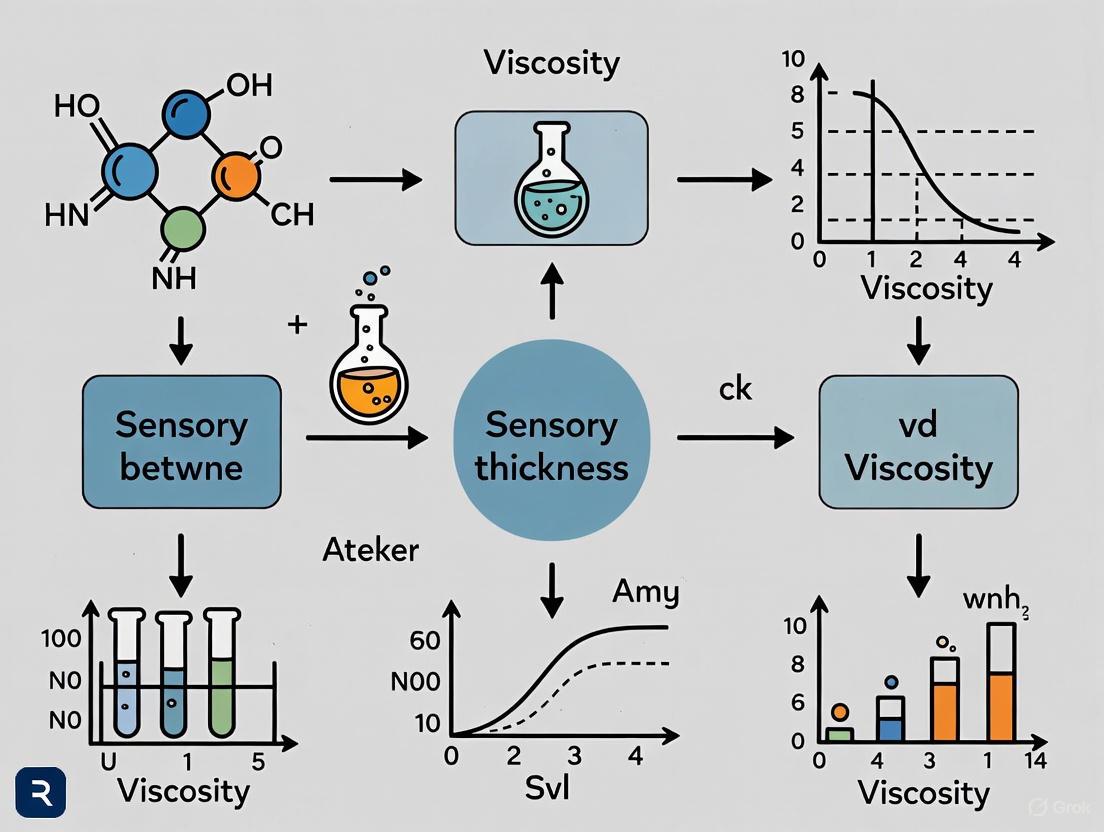
This article synthesizes current research on the correlation between instrumental viscosity measurements and the sensory perception of thickness, with a specific focus on implications for pharmaceutical development.
Beyond Viscosity: Decoding the Rheology-Sensory Thickness Link for Advanced Drug Formulations
Abstract
This article synthesizes current research on the correlation between instrumental viscosity measurements and the sensory perception of thickness, with a specific focus on implications for pharmaceutical development. It explores the foundational rheological principles governing sensory thickness, evaluates methodologies for reliable measurement and prediction, addresses challenges in formulation optimization for patient acceptability, and validates approaches through comparative analysis. Aimed at researchers and drug development professionals, this review provides a comprehensive framework for leveraging rheological data to design more palatable and compliant oral dosage forms, particularly for vulnerable populations such as pediatric and geriatric patients.
The Science of Sensation: Unraveling the Rheological Foundations of Sensory Thickness
For researchers and drug development professionals, the success of an oral pharmaceutical product hinges not only on its therapeutic efficacy but also on its patient acceptability. Palatability—the overall appreciation of a medicine based on its smell, taste, aftertaste, and texture (mouthfeel)—is a critical determinant of medication compliance, especially in paediatric populations [1]. It is a multifaceted concept where sensory thickness and mouthfeel play an integral role. Mouthfeel is a complex, multidimensional sensory experience involving the physical, tactile, and textural sensations perceived in the oral cavity [2]. It is distinct from taste and aroma, yet it profoundly influences the overall flavour perception and, by extension, patient acceptance [2] [3]. Within this framework, sensory thickness is a key mouthfeel attribute, often described as the perceived resistance to flow, which is fundamentally linked to a product's rheological properties [4]. This guide objectively compares these key concepts and explores the critical correlation between viscosity and sensory thickness, providing researchers with the experimental data and methodologies needed to optimize pharmaceutical formulations.
Defining the Key Concepts
Sensory Thickness
Sensory thickness is a primary mouthfeel attribute described as the subjective perception of a fluid's resistance to flow or deformation in the mouth. It is largely driven by a product's viscous properties [4]. Research has shown that the relationship between physical viscosity and perceived thickness follows a psychophysical law. Recent studies modelling the squeeze flow between the tongue and palate indicate that the perceived intensity of "thickness" is logarithmically related to the viscosity, aligning with the Weber-Fechner law (S = k ⋅ log(I)) [4]. This means that our tongues function as logarithmic measuring instruments, where a tenfold increase in physical viscosity is perceived as a roughly constant step-up in thickness [4].
Mouthfeel
Mouthfeel extends far beyond a single attribute like thickness. It encompasses the complex tactile sensations triggered by a product's texture, viscosity, and other mechanical properties, detected by chemosensory and somatosensory receptors in the oral cavity and primarily transmitted by the trigeminal nerve [2]. It is multidimensional and can include attributes such as:
- Smoothness/Grittiness: Related to particle size and distribution [2] [1].
- Astringency: A drying, puckering sensation [2].
- Mouthcoating: The feeling of residue left in the oral cavity after swallowing [5].
- Cooling/Warming: Thermal sensations [2].
The role of saliva is critical, as it acts as a medium for dissolving compounds and modulating these textural sensations [2].
Palatability
Palatability is defined as the overall pleasantness and acceptability of a product for consumption. In a pharmaceutical context, the European Medicines Agency (EMA) links it to the overall ability and willingness of the patient to use the medicine as intended [1]. It is a subjective measure influenced by a confluence of factors [3] [6]:
- Sensory Factors: Taste, flavour, mouthfeel, and appearance.
- Individual Factors: Age, genetics, culture, and health status.
- Product Factors: Physical form (e.g., solution, multiparticulate), additives, and colorants.
Poor palatability, often driven by aversive mouthfeel or taste, is a major reason for medication refusal in children, potentially leading to treatment failure and compromised therapeutic outcomes [1] [3].
Physiological Pathways of Perception
The perception of mouthfeel and taste involves an integrated signal from multiple sensory systems. The diagram below illustrates the key physiological pathways.
Quantitative Data: Correlating Instrumental Measurements with Sensory Perception
A critical task in formulation science is to objectively predict subjective sensory perceptions. The following tables consolidate experimental data from research linking rheological measurements to sensory outcomes.
Table 1: Correlation of Rheological Parameters with Mouthfeel Perceptions in Thickened Solutions [5]
| Sensory Perception | Primary Correlate | Improved Prediction Model | Key Finding |
|---|---|---|---|
| Thickness | Low-shear viscosity (ηlow) |
Model including high-shear viscosity (ηhigh) |
No single rheological parameter perfectly predicts all perceptions. |
| Stickiness | Low-shear viscosity (ηlow) |
Model combining ηlow and extensional viscosity (ηE) |
ηE was a better correlate than ηlow alone. |
| Mouthcoating | Low-shear viscosity (ηlow) |
Model combining ηlow and extensional viscosity (ηE) |
A multi-parameter model has higher predictive power. |
Table 2: Sensory Thickness Scores and Fitted Rheology Parameters for Liquid Bouillons [4]
| Sample # | Thickness Score (0-15) | Consistency Coefficient, κ (Pa·sn) | Flow Behaviour Index, n |
|---|---|---|---|
| 1 | 2.09 ± 0.17 | 0.026 | 0.55 |
| 2 | 2.92 ± 0.25 | 0.025 | 0.60 |
| 9 | 2.89 ± 0.21 | 0.057 | 0.48 |
| 10 | 4.41 ± 0.22 | 0.198 | 0.44 |
| 14 | 5.04 ± 0.17 | 0.270 | 0.42 |
Note: Data extracted from [4]. Rheology fitted to the power-law model: σ = κ ⋅ γ̇^n, where σ is shear stress and γ̇ is shear rate. The decrease in the flow behaviour index n indicates increased shear-thinning in thicker samples.
Table 3: Impact of Administration Media Viscosity on Sensory Attributes of Multiparticulates [7]
| Formulation Attribute | Administration in Water | Administration in XG Hydrogel (0.5% w/v) | Administration in CMC Hydrogel (1.0% w/v) |
|---|---|---|---|
| Ease of Swallowing | Baseline | Improved by ~0.5 points | Improved by ~0.5 points |
| Oral Grittiness | Baseline | Improved by ~1.0 point | Improved by ~1.0 point |
| Mouthfeel | Baseline | Improved by ~0.5 points | Improved by ~0.5 points |
| Residue in Mouth | Baseline | Improved by ~0.5 points | Improved by ~0.5 points |
Experimental Protocols for Sensory and Rheological Characterization
To generate data comparable to that presented above, researchers can employ the following standardized protocols.
Protocol 1: Linking Rheology to Sensory Thickness
This protocol is adapted from foundational research on liquid bouillons and thickened solutions [5] [4].
- Objective: To establish a quantitative model between the non-Newtonian rheology of a liquid formulation and its perceived sensory thickness.
- Materials:
- Test formulations (e.g., placebos with varying polymer concentrations).
- Controlled-stress rheometer with parallel plate or cone-and-plate geometry.
- Trained sensory panel (n=10-15+).
- Methodology:
- Rheological Analysis:
- Perform a steady-state flow sweep to measure shear stress (
σ) across a range of shear rates (γ̇), e.g., 0.1 to 1000 s-1. - Fit the resulting flow curve to the Power-Law (Ostwald-de Waele) model:
σ = κ ⋅ γ̇^n. - Extract the consistency coefficient (
κ) and the flow behaviour index (n).
- Perform a steady-state flow sweep to measure shear stress (
- Sensory Evaluation:
- Train panelists to recognize and scale the "thickness" attribute using reference samples.
- Present samples in a randomized, blinded order.
- Use a structured scale (e.g., 0-15) to rate the perceived thickness.
- Data Analysis:
- Perform regression analysis (linear or logarithmic) to correlate the sensory thickness score with the rheological parameters
κandn.
- Perform regression analysis (linear or logarithmic) to correlate the sensory thickness score with the rheological parameters
- Rheological Analysis:
- Workflow Diagram:
Protocol 2: Comprehensive Palatability Assessment
This protocol aligns with best practices for sensory analysis in pharmaceutical development [1] [8].
- Objective: To holistically evaluate the palatability of a pharmaceutical formulation, integrating mouthfeel with other sensory attributes.
- Materials:
- Final formulation (API-containing) and comparators.
- Ethical approval and informed consent forms.
- Target population cohort (healthy volunteers or patient group, n≥30 for statistical power).
- Standardized sensory booths.
- Methodology:
- Study Design: Randomized, single-blind study.
- Sample Presentation: Small volumes/doses served at controlled temperature in neutral containers.
- Data Collection: Utilize 5-point category scales or visual analogue scales (VAS) to assess:
- Overall Liking (Hedonic): From "Dislike Extremely" to "Like Extremely".
- Attribute-Specific Intensity: Sweetness, bitterness, etc.
- Mouthfeel Attributes: Thickness, grittiness, mouthcoating, ease of swallowing.
- Just-About-Right (JAR) Scales: For key attributes like thickness.
- Data Analysis:
- Descriptive statistics (mean, SEM).
- Analysis of Variance (ANOVA) to identify significant differences.
- Penalty analysis on JAR data to identify drivers of disliking.
- Workflow Diagram:
The Scientist's Toolkit: Essential Research Reagents and Materials
Table 4: Essential Materials for Sensory and Rheological Research
| Item | Function/Application | Example in Context |
|---|---|---|
| Controlled-Stress Rheometer | Measures flow and deformation of materials. Essential for characterizing viscosity and viscoelasticity. | Used to obtain Power-Law parameters (κ, n) for liquid formulations [5] [4]. |
| Hydrocolloids (Xanthan Gum, CMC) | Modify the viscosity and texture of liquid and semi-solid formulations. | Used to create administration media for multiparticulates or to structure liquid placebos [5] [7]. |
| Electronic Tongue | Multi-sensor array system providing a semi-selective "fingerprint" for basic tastes. | Screening tool for predicting bitterness intensity of APIs and evaluating taste-masking efficacy [1]. |
| Artificial Saliva | Simulates the chemical composition and rheology of human saliva for in vitro tests. | Used in dissolution testing to predict API release and potential aversive taste in the mouth [1]. |
| Sensory Rating Scales | Standardized tools for human subjects to quantify sensory perceptions. | 5-point category scales for ease of swallowing; 9-point hedonic scale for overall liking; VAS for intensity [7] [8]. |
For pharmaceutical scientists, mastering the concepts of sensory thickness, mouthfeel, and palatability is no longer a peripheral concern but a central aspect of patient-centric drug development. As the experimental data demonstrates, robust, quantitative relationships exist between a formulation's physical properties, like its non-Newtonian viscosity, and the resulting sensory perception. By employing the detailed experimental protocols and leveraging the essential research tools outlined in this guide, researchers can systematically optimize these sensory attributes. A deep understanding of the correlation between viscosity and sensory thickness enables the rational design of more acceptable and compliant pharmaceutical products, ultimately improving therapeutic outcomes for patients of all ages.
Fundamental Principles and Fluid Classification
Fluid rheology is the science that studies the deformation and flow of matter. The classification of fluids into Newtonian and Non-Newtonian categories is fundamental for researchers and formulators working with liquid formulations, as their flow behavior directly impacts processing, stability, and sensory perception [9] [10].
Newtonian fluids exhibit a constant viscosity regardless of the applied shear stress or shear rate. This means their resistance to flow remains unchanged under different processing conditions or during oral processing. They follow a simple, linear relationship where shear stress is directly proportional to shear rate [9] [11]. Common examples include water, mineral oil, alcohol, and gasoline [9] [10].
In contrast, Non-Newtonian fluids display a variable viscosity that changes when subjected to different shear stresses or shear rates [9]. This complex behavior is prevalent in formulated products like pharmaceuticals, foods, and personal care items. Non-Newtonian fluids are further categorized based on their specific responses to shear forces [9] [10]:
- Shear-thinning (Pseudoplastic): Viscosity decreases as shear rate increases (e.g., ketchup, paint, cosmetics)
- Shear-thickening (Dilatant): Viscosity increases as shear rate increases (e.g., cornstarch-water mixtures, silly putty)
- Thixotropic: Viscosity decreases over time under constant shear stress (e.g., gels, asphalt, glues)
- Rheopectic: Viscosity increases over time under constant shear stress (e.g., gypsum paste, cream)
Table 1: Comparative Characteristics of Newtonian and Non-Newtonian Fluids
| Characteristic | Newtonian Fluids | Non-Newtonian Fluids |
|---|---|---|
| Viscosity | Constant regardless of shear rate | Variable, depends on shear conditions |
| Shear Stress vs. Shear Rate Relationship | Linear | Non-linear |
| Flow Behavior | Predictable and consistent | Complex and dependent on flow conditions |
| Modeling Complexity | Simple mathematical models | Requires advanced rheological analysis |
| Common Examples | Water, air, gasoline, mineral oil | Ketchup, toothpaste, paint, cosmetics, blood |
Rheology-Sensory Perception Correlation: Experimental Data
The relationship between a fluid's rheological properties and its sensory perception, particularly "thickness," is a critical research area in formulation science. For pharmaceutical and food researchers, understanding this correlation is essential for designing products that meet specific sensory expectations while maintaining functional performance.
Recent research has demonstrated that the subjectively perceived "thickness" of liquid foods can be directly related to their non-Newtonian rheology [4] [12]. This perceived thickness corresponds to the force needed to make the sample flow or deform in the mouth. Studies utilizing liquid bouillons with viscosities ranging from approximately 1 mPa·s to 1 Pa·s have established that sensory perception follows the Weber-Fechner law, which predicts a logarithmic relationship between stimulus amplitude and perceived strength [4] [12]. This means our tongues function as logarithmic measuring instruments for viscosity perception.
For non-Newtonian fluids, predicting sensory perception requires accounting for their shear-thinning behavior under oral conditions. Research indicates that no single rheological parameter perfectly correlates with all mouthfeel perceptions [5]. While 'thickness' correlates well with both low-shear and high-shear viscosity, attributes like 'stickiness' and 'mouthcoating' show improved prediction when extensional viscosity measurements are included in the model [5].
Table 2: Correlation Between Rheological Parameters and Sensory Perceptions
| Sensory Attribute | Best Correlated Rheological Parameters | Correlation Strength & Notes |
|---|---|---|
| Thickness | Low-shear viscosity, High-shear viscosity | Strong correlation; model improved by including both parameters [5] |
| Stickiness | Extensional viscosity, Low-shear viscosity | Best predicted by model combining both parameters [5] |
| Mouthcoating | Extensional viscosity, Low-shear viscosity | Improved prediction with combined parameters [5] |
| Viscosity Discrimination | Apparent viscosity at 50/s | Healthy adults can detect ~0.67-fold viscosity increase [13] |
Advanced modeling approaches now enable more accurate prediction of sensory perception from fundamental rheological measurements. A physical model that captures the fluid mechanics of liquid foods squeezed between the tongue and palate can predict how a sensory panel perceives "thickness" [12]. This modeling incorporates the power law relationship between shear stress (σ) and shear rate (γ̇): σ = Kγ̇ⁿ, where K is the consistency index and n is the flow behavior index [12].
Furthermore, innovative machine learning strategies employing sensory-biased autoencoder neural networks can decode the complex, non-linear relationships between non-Newtonian rheological attributes and perceived texture [14]. This approach successfully predicts sensory scores from rheological data, even when the same perceived texture corresponds to multiple rheological profiles [14].
Experimental Protocols and Research Methodologies
Rheological Characterization Protocol
Objective: To quantitatively characterize the flow behavior of liquid formulations and obtain parameters for predicting sensory perception.
Equipment: Controlled-stress or controlled-rate rheometer with parallel plate or cone-and-plate geometry [4] [12].
Procedure:
- Sample Preparation: Prepare samples under controlled temperature conditions. For powders or concentrates, use standard dissolution protocols [4].
- Loading: Carefully load sample onto rheometer plate, avoiding air bubbles.
- Temperature Equilibrium: Allow sample to equilibrate at test temperature (typically 20°C or 37°C to simulate oral conditions).
- Flow Curve Measurement: Program the rheometer to apply a range of shear rates (typically 0.1-1000 s⁻¹) relevant to processing and oral manipulation.
- Data Analysis: Fit the resulting shear stress vs. shear rate data to appropriate rheological models:
- Power Law Model: σ = Kγ̇ⁿ (for shear-thinning fluids) [12]
- Record consistency index (K) and flow behavior index (n)
- Viscoelastic Assessment (optional): For oscillatory measurements, determine storage (G') and loss (G") moduli as functions of frequency.
Data Interpretation: The flow behavior index (n) indicates the degree of shear-thinning (n < 1) or shear-thickening (n > 1). The consistency index (K) represents the viscosity at a shear rate of 1 s⁻¹ [12].
Sensory Evaluation Protocol for Thickness Perception
Objective: To obtain quantitative human sensory data on perceived thickness for correlation with rheological measurements.
Panel Selection: Recruit 10-20 trained panelists screened for sensory acuity. Obtain ethical approval and informed consent [15] [13].
Sample Presentation:
- Serving Protocol: Present 5-10 mL samples in food-grade containers at consistent temperature [13].
- Testing Design: Use balanced serving orders with adequate rinsing between samples.
- Scale Training: Train panelists to use a structured scale (e.g., 0-15) for thickness intensity [4] [12].
Evaluation Procedure:
- Oral Processing: Instruct panelists to place sample in mouth, move tongue against palate once, and evaluate thickness.
- Scale Rating: Panelists assign a numerical rating for perceived thickness.
- Rinsing: Use purified water between samples to prevent cross-over effects.
Data Analysis: Calculate mean thickness scores across panelists for each formulation. Perform statistical analysis (ANOVA) to identify significant differences between samples.
Discrimination Testing Protocol
Objective: To determine the minimum detectable difference in viscosity that panelists can perceive.
Method: Use a triangle test paradigm where panelists receive three samples (two identical, one different) and identify the odd sample [13].
Analysis: Calculate the minimum difference in concentration or viscosity that can be detected at better than chance levels (typically >33% correct identification) [13].
Research Workflow and Data Interpretation
Research Workflow Diagram
Essential Research Reagents and Materials
Table 3: Essential Research Materials for Rheology-Sensory Studies
| Material/Equipment | Function/Role in Research |
|---|---|
| Rheometer | Fundamental instrument for quantifying flow properties and viscosity under controlled shear conditions [16] |
| Xanthan Gum | Common polysaccharide thickener used to create non-Newtonian, shear-thinning model systems for research [4] [12] |
| Starch (Potato, Corn) | Food-grade thickener often used in combination with gums to modify rheological properties [4] |
| Electronic Tongue | Screening tool for approximating taste intensity and potential aversiveness of formulations before human testing [15] |
| Controlled Stress/Strain Fixtures | Parallel plate and cone-and-plate geometries for measuring flow curves of non-Newtonian fluids [16] |
| Artificial Saliva | Dissolution medium simulating oral conditions for in vitro release testing of active ingredients [15] |
The quantitative prediction of sensory perception from physical measurements is a central challenge in psychophysics, the scientific field that investigates the relationship between physical stimuli and the sensations they evoke [17]. For researchers and drug development professionals, understanding these relationships is crucial when designing oral formulations, such as liquid medications, where mouthfeel attributes like thickness can significantly impact patient compliance and product efficacy. Two foundational psychophysical laws—the Weber-Fechner Law and Stevens' Power Law—provide competing frameworks for modeling how humans perceive stimulus intensity [18]. This guide objectively compares the application of these two models to the perception of thickness in liquid foods and formulations, supported by experimental data and detailed methodologies from contemporary research.
The perception of "thickness"—subjectively defined as the force needed to make a sample flow or deform in the mouth—is one of the most important sensory attributes of liquid foods and, by extension, oral pharmaceutical formulations [4]. Within the context of viscosity and sensory thickness research, the physical stimulus (I) is typically a rheological property (e.g., viscosity), while the perceived magnitude (S) is the subjective sensation of thickness reported by human subjects. The debate over whether this relationship follows a logarithmic function (Weber-Fechner) or a power function (Stevens) has practical implications for how scientists model, predict, and optimize sensory perception based on instrumental measurements.
Theoretical Framework: A Comparative Analysis
Foundational Principles and Mathematical Formulations
The Weber-Fechner Law and Stevens' Power Law propose fundamentally different relationships between physical stimulus intensity and perceived sensation. Their core principles are summarized in the table below.
Table 1: Comparison of Core Psychophysical Laws
| Aspect | Weber-Fechner Law | Stevens' Power Law |
|---|---|---|
| Fundamental Principle | The perceived change in a stimulus is proportional to the relative change of the original stimulus [19]. | The perceived magnitude of a stimulus is proportional to the physical intensity raised to a power [18]. |
| Mathematical Form | ( S = k \cdot \log(I) ) | ( S = k \cdot I^n ) |
| Key Variables | S: Sensation; k: Constant; I: Stimulus Intensity [19]. |
S: Sensation; k: Constant; I: Stimulus Intensity; n: Exponent [18]. |
| Theoretical Basis | Built upon Weber's Law of the Just-Noticeable Difference (JND) [17]. | An empirical model derived from direct scaling methods like magnitude estimation [18]. |
| Predicted Perception | Compressive: Perceived intensity increases more slowly than physical intensity [19]. | Varies with Exponent n: Compressive (n<1), Linear (n=1), or Expansive (n>1) [20]. |
The Just-Noticeable Difference (JND) and Weber's Law
A critical concept underlying the Weber-Fechner Law is the Just-Noticeable Difference (JND), or difference threshold. This is the smallest detectable difference between two stimuli [17]. Weber's Law states that the JND is a constant fraction (known as the Weber fraction) of the original stimulus intensity [20]. This can be expressed as:
[
\frac{\Delta I}{I} = C
]
where ΔI is the JND, I is the original stimulus intensity, and C is the Weber fraction. For example, if the Weber fraction for weight is 5%, one would need to add 5g to a 100g weight, or 10g to a 200g weight, to notice a difference [20]. Fechner later integrated this principle to derive the logarithmic relationship between stimulus and sensation [19].
Experimental Data in Thickness Perception
Empirical Support for Psychophysical Laws
Recent research on the mouthfeel of liquid foods provides quantitative data for evaluating the two psychophysical laws. The following table summarizes key findings from studies that measured the perception of viscosity and thickness.
Table 2: Experimental Data on Viscosity and Thickness Perception
| Study & Focus | Key Physical Stimulus (I) | Key Perceptual Response (S) | Supported Law & Parameters |
|---|---|---|---|
| Lv et al. (2017)Shear vs. Extensional Viscosity [21] | Shear ViscosityExtensional Viscosity | Magnitude Estimation of perceived viscosity | Stevens' Power Law(Power law relationship found for both) |
| Devereux et al. (2021)Thickness of Liquid Bouillons [4] | Non-Newtonian Viscosity (modeled via squeeze flow) | Sensory panel thickness score | Weber-Fechner Law(Logarithmic relationship found) |
| Jesteadt et al. (1977)Pure Tone Discrimination [22] | Sound Intensity | Discrimination probability (71% correct) | Violation of Weber's Law("Near miss" with power law decay) |
The data reveals that the applicability of a specific law can depend on the sensory modality and the specific physical property being measured. For instance, a 2021 study on liquid bouillons and high-viscous xanthan gum solutions concluded that "our tongues, just like our eyes and ears, are logarithmic measuring instruments in agreement with the Weber-Fechner law" [4]. The perceived thickness was directly proportional to the logarithm of the viscosity derived from a physical model of squeeze flow between the tongue and palate.
Conversely, a 2017 study focusing on the human capability to perceive different types of viscosity found that the perception of both shear and extensional viscosity followed Steven's power law [21]. The same study also provided key discrimination thresholds, finding that the JND for shear viscosity was 9.33%, whereas the JND for extensional viscosity was lower, at only 6.20%. This indicates that humans have a finer discriminatory capacity for perceiving changes in extensional viscosity compared to shear viscosity [21].
Experimental Protocols and Methodologies
Standard Psychophysical Methods
Researchers use well-established psychophysical methods to collect the data used to test these laws. The three classical methods for measuring thresholds are:
- Method of Limits: The experimenter presents stimuli of gradually increasing or decreasing intensity until the observer reports a change in perception. The threshold is calculated from the crossover points [20].
- Method of Adjustment: The participant controls the stimulus intensity and adjusts it until it is just perceivable. This is quicker but less accurate than other methods [20].
- Method of Constant Stimuli: The experimenter presents many stimuli of different intensities in a randomized order. The stimulus intensity detected 50% of the time is taken as the threshold. This is the most reliable but also the most time-consuming method [20].
For studies investigating perceived intensity above the threshold, the primary method is:
- Magnitude Estimation: Participants are asked to assign numbers to stimuli to reflect their perceived intensity relative to a reference stimulus (modulus) or freely chosen standard [18]. This method directly generates the ratio-scale data needed to test Stevens' Power Law.
A Representative Workflow: Relating Rheology to Thickness Perception
The following diagram illustrates a generalized experimental workflow for a study aiming to predict sensory thickness from rheological properties, integrating elements from the cited studies [5] [21] [4].
The Scientist's Toolkit: Key Research Reagents and Materials
The following table details essential materials and their functions as derived from the experimental protocols in the search results [5] [21] [4].
Table 3: Essential Research Reagents and Materials for Thickness Perception Studies
| Item | Function in Research | Exemplary Use Case |
|---|---|---|
| Food-Grade Thickeners(e.g., Xanthan Gum, Guar Gum, Starch) | To create fluid samples with systematically varied and controllable rheological properties. | Preparing a series of liquid bouillons or model solutions with viscosities ranging over several orders of magnitude [4]. |
| Rheometer(Shear & Extensional) | To perform instrumental rheological analysis, quantifying the physical stimulus (e.g., shear-thinning profile, extensional viscosity). | Characterizing the flow curves of samples to obtain parameters like consistency index (κ) and flow behavior index (n) [21] [4]. |
| Trained Sensory Panel | To provide the perceptual data (psychological response) for the physical stimuli. Participants are trained to evaluate specific attributes. | Performing magnitude estimation of "thickness" or discrimination tasks to determine JNDs for viscosity [21] [4]. |
| Statistical & Modeling Software | To fit psychophysical models (logarithmic and power functions) to the data and perform statistical comparisons of model adequacy. | Testing whether Steven's Power Law or the Weber-Fechner Law provides a better fit for perceived thickness vs. viscosity data [4]. |
The application of Weber-Fechner and Stevens' laws to thickness perception demonstrates that the "correct" psychophysical model is not universal but is context-dependent. Current research on liquid foods provides compelling, albeit competing, evidence. The finding that thickness perception in soups follows a logarithmic scale strongly supports the Weber-Fechner law for that specific modality and stimulus range [4]. Simultaneously, the power law relationship found for the perception of shear and extensional viscosity underscores the continued relevance of Stevens' approach [21].
For researchers and drug development professionals, this implies that predicting sensory perception from instrumental measurements requires empirical validation. The choice between models should be guided by the specific sensory attribute (e.g., thickness vs. stickiness), the type of physical deformation (shear vs. extension), and the stimulus range relevant to the final product. The experimental protocols and data summarized in this guide provide a foundational framework for conducting such essential validation studies, ultimately enabling the more effective design of products where sensory perception is critical to success.
In both industrial applications and scientific research, viscosity has traditionally served as a fundamental parameter for characterizing fluid behavior. However, for a substantial class of fluids known as non-Newtonian fluids, the common practice of measuring viscosity at a single shear rate provides a dangerously incomplete picture. Shear-thinning—the phenomenon where a fluid's viscosity decreases under increasing shear strain—is the most prevalent type of non-Newtonian behavior, observed in products ranging from pharmaceuticals and paints to foods and personal care products [23]. Relying on a single viscosity value can lead to catastrophic failures in product performance, manufacturing processes, and even clinical outcomes, as the actual flow behavior under application-relevant conditions remains unknown. This guide objectively compares the limitations of single-point viscosity measurements against robust rheological characterization, providing researchers and drug development professionals with the experimental protocols and data interpretation frameworks necessary to fully capture critical shear-thinning behavior.
The Science of Shear-Thinning: Mechanisms and Models
Fundamental Mechanisms
Shear thinning arises from microstructural rearrangements within a fluid that facilitate flow under applied stress. In polymer solutions and melts, which include many drug formulations, the mechanism involves the disentanglement of randomly oriented polymer chains. At rest, these high molecular weight polymers are heavily entangled, creating significant resistance to flow. When subjected to shear, these anisotropic chains begin to disentangle and align along the direction of the shear force, reducing intermolecular interactions and creating more free space, thereby decreasing viscosity [23]. In colloidal systems such as suspensions and emulsions, phase separation during flow leads to shear-thinning behavior [23]. This structural reorganization is often reversible, with the fluid returning to its original state once the shear force is removed.
Mathematical Modeling of Non-Newtonian Flow
To accurately describe and predict shear-thinning behavior, several mathematical models have been developed, each with specific applications and limitations.
Table 1: Key Rheological Models for Shear-Thinning Fluids
| Model Name | Mathematical Form | Key Parameters | Typical Applications |
|---|---|---|---|
| Power Law [23] | (\tau = K \cdot \dot{\gamma}^n) | (K): Consistency index(n): Flow behavior index | Polymer solutions, molten polymers |
| Herschel-Bulkley [23] | (\tau = \tau_y + K \cdot \dot{\gamma}^n) | (\tau_y): Yield stress(K, n): Power law parameters | Viscoplastic fluids (e.g., pharmaceutical creams, drilling fluids) |
| Carreau-Yasuda [24] | (\frac{\eta-\eta\infty}{\eta0-\eta_\infty} = [1+(\lambda \cdot \dot{\gamma})^a]^{\frac{n-1}{a}}) | (\eta0): Zero-shear viscosity(\eta\infty): Infinite-shear viscosity(\lambda): Relaxation time(a, n): Fitting parameters | Polymer melts, solutions over wide shear rate ranges |
| Cross Model [24] | (\eta = \eta\infty + \frac{\eta0 - \eta_\infty}{1+(\lambda \cdot \dot{\gamma})^n}) | (\eta0, \eta\infty, \lambda, n): As above | Fluids with pronounced low-shear-rate Newtonian plateau |
The Power Law model (or Ostwald-de Waele equation) is the simplest and most widely used model, describing the relationship between shear stress ((\tau)) and shear rate ((\dot{\gamma})) using a consistency index (K) and a flow behavior index (n). For shear-thinning fluids, (n < 1), with smaller values indicating more pronounced thinning [23]. The Herschel-Bulkley model extends the Power Law by incorporating a yield stress ((\tau_y)), representing the critical stress that must be exceeded for flow to initiate, which is essential for characterizing materials like creams and gels [23].
Figure 1: Shear-Thinning Mechanism. Schematic representation of microstructural changes in polymers under different shear conditions, leading to viscosity reduction.
Experimental Evidence: The Perception-Viscosity Disconnect
Case Study: Dysphagia Management
The critical limitation of single-point viscosity measurement is starkly demonstrated in clinical management of dysphagia (swallowing impairment), where thickened liquids are used to prevent aspiration. The National Dysphagia Diet (NDD) originally defined liquid consistencies based on viscosity measured at a single shear rate of 50 s⁻¹, with nectar-like at 51-350 cP and honey-like at 351-1750 cP [25]. However, research has revealed significant shortcomings in this approach.
A pivotal study exposed the problematic assumption that identical viscosities at 50 s⁻¹ guarantee similar sensory perception. When cornstarch and xanthan gum thickeners were prepared to have similar apparent viscosities at 50 s⁻¹, trained sensory panels perceived them as having significantly different thicknesses [25]. Specifically, cornstarch-thickened samples were perceived as thicker than xanthan gum samples despite nearly identical instrumental viscosity measurements. This disconnect arises because the two thickeners exhibit different shear-thinning profiles across the range of shear rates experienced during swallowing—from low shear in the mouth to high shear during pharyngeal transit.
Table 2: Sensory vs. Instrumental Viscosity in Dysphagia Liquids [25]
| Thickener Type | Apparent Viscosity at 50 s⁻¹ (Pa·s) | Perceived Viscosity (Sensory) | Key Sensory Attributes |
|---|---|---|---|
| Cornstarch-based | ~0.5 Pa·s | Higher | Graininess, Chalkiness |
| Xanthan Gum-based | ~0.5 Pa·s | Lower | Slipperiness |
| Barium Sulfate Mixture (Cornstarch) | Higher than XG | Similar to XG | Altered texture profile |
| Barium Sulfate Mixture (Xanthan Gum) | Lower than CS | Similar to CS | Altered texture profile |
This perceptual difference has direct clinical implications. During videofluoroscopic swallowing studies (the gold standard assessment), liquids are mixed with barium sulfate to make them radiopaque. The study found that adding barium sulfate differently affected the viscosity of various thickeners, potentially leading clinicians to recommend a consistency level that doesn't match what the patient actually consumes daily [25]. This evidence strongly suggests that single-point viscosity measurement is inadequate for predicting actual swallowing performance and safety.
Sensory-Rheological Correlation in Cosmetics
The perception-viscosity disconnect extends to consumer products. Research on cosmetic creams established quantitative correlations between rheological parameters and sensory attributes [26]. Shear-thinning behavior directly influenced multiple application stages:
- Pourability (low-shear-rate viscosity)
- Pick-up (firmness and elasticity)
- Rub-out (spreadability and stickiness)
The study demonstrated that oscillatory rheological measurements, including yield stress, amplitude sweep, and frequency sweep tests, provided realistic correlations for these sensory characteristics that single-point viscosity measurements could not capture [26]. This quantitative approach allows for better product development and quality control compared to relying on viscosity at a single shear rate.
Methodological Comparison: Measurement Techniques
Advanced Rheometric Techniques
Rotational Rheometers are the most comprehensive tools for characterizing shear-thinning behavior. These instruments apply controlled shear stress or strain and measure the resultant response, enabling complete flow curve characterization over a wide range of shear rates.
- Cone-Plate Systems: Provide a consistent shear rate across the sample gap, ideal for homogeneous materials [27].
- Parallel Plate Systems: Suitable for materials containing particles or suspensions [27].
- Controlled Stress vs. Controlled Rate: Modern rheometers can operate in either mode—applying a fixed torque and measuring rotation speed, or fixed speed with torque measurement [27].
Capillary Viscometers determine viscosity by measuring the pressure drop required to force a fluid through a capillary of known dimensions at a specified flow rate, based on the Hagen-Poiseuille law [28]. While excellent for Newtonian fluids, they present challenges for characterizing shear-thinning fluids unless multiple flow rates are tested.
Viscometer/Rheometer-On-a-Chip (VROC) technology combines microfluidic and MEMS technologies to measure viscosity over wide dynamic ranges (40–150,000 s⁻¹) with minimal sample volumes (≤100 µL) [28]. This is particularly valuable for precious samples like biopharmaceutical formulations.
Practical Alternative Methods
While rotational rheometry provides the most complete data, simpler methods offer practical alternatives for quality control and clinical settings:
- Bostwick Consistometer: Measures the distance a fluid flows under its own weight over a fixed time [29].
- Line-Spread Test (LST): Quantifies the radial spread of a fixed fluid volume on a flat surface [29].
- IDDSI Flow Test: Uses gravity flow through a syringe to categorize liquids into dysphagia levels based on volume remaining after 10 seconds [25] [29].
These empirical methods show strong correlation with rheological measurements for mid-range viscosities but lack sensitivity at extreme ranges [29].
Figure 2: Experimental Workflow for Shear-Thinning Characterization. Comprehensive approach for obtaining complete rheological profiles.
The Scientist's Toolkit: Essential Research Reagents and Materials
Table 3: Key Research Reagents and Materials for Shear-Thinning Studies
| Category/Item | Function/Application | Research Context |
|---|---|---|
| Xanthan Gum | Polysaccharide thickener; strong shear-thinning | Dysphagia liquids, food products, cosmetic formulations [25] [29] |
| Cornstarch | Modified starch thickener; moderate shear-thinning | Dysphagia management, food products [25] |
| Guar Gum | Galactomannan polysaccharide; viscosity modifier | Food products, dysphagia liquids [29] |
| Maltodextrin | Oligosaccharide; mild thickening agent | Food and pharmaceutical formulations [29] |
| Eudragit L 30 D-55 | Enteric polymer for pharmaceutical coating | Drug delivery systems, controlled release [30] |
| Barium Sulfate | Radiopaque contrast agent | Videofluoroscopic swallowing studies [25] |
| Emulsifying Wax | Stabilizer for oil-in-water emulsions | Cosmetic and pharmaceutical creams [26] |
| Polymer Solutions | Model systems for rheological studies | Fundamental research on shear-thinning mechanisms [23] |
The evidence presented unequivocally demonstrates that single-point viscosity measurements are insufficient for characterizing shear-thinning fluids, with significant implications across research and industrial applications:
In pharmaceutical development, comprehensive rheological profiling ensures consistent drug delivery and patient experience, particularly for topical formulations and orally disintegrating dosage forms.
In clinical practice, understanding the complete flow curve of thickened liquids enables safer dysphagia management by more accurately predicting bolus flow during swallowing.
In product formulation, correlating rheological parameters with sensory attributes allows for more targeted development of consumer products with desired application properties.
Researchers and product developers must transition from single-point viscosity measurements to complete rheological characterization to ensure product efficacy, safety, and performance across the entire range of application-relevant conditions.
The perception of "thickness" is a fundamental sensory attribute of liquid and semi-solid foods, directly influencing product acceptability and quality. Research into the correlation between instrumental viscosity measurements and sensory thickness has established that this perception predominantly arises from the squeeze flow of a food bolus between the tongue and the hard palate [31] [12]. This process involves complex, non-Newtonian fluids undergoing a range of shear and extensional deformations. This guide objectively compares the performance of different rheological models and parameters in predicting sensory thickness, providing a consolidated overview of experimental data and protocols central to this field of food physics.
Comparative Analysis of Rheological Parameters for Predicting Sensory Thickness
The following tables synthesize quantitative data from key studies, comparing the predictive power of various rheological measurements and the performance of different hydrocolloid thickeners.
Table 1: Correlation of Rheological Parameters with Sensory Mouthfeel Perceptions Source: [5] - Predicting sensory perceptions of thickened solutions based on rheological analysis
| Sensory Perception | Best Correlated Rheological Parameter(s) | Correlation Quality & Notes |
|---|---|---|
| Thickness | Low-shear viscosity (η0) & High-shear viscosity | Good correlation with low-shear viscosity; predictive quality improved by including high-shear viscosity. |
| Stickiness | Extensional viscosity & Low-shear viscosity | Better correlated to extensional viscosity than low-shear viscosity alone; a combined model was most predictive. |
| Mouthcoating | Extensional viscosity & Low-shear viscosity | Better correlated to extensional viscosity than low-shear viscosity alone; a combined model was most predictive. |
| Sweetness | Degree of shear thinning | Inversely correlated with the degree of shear-thinning behavior. |
Table 2: Power-Law Rheological Parameters and Sensory Thickness Scores for Model Soups Source: [12] [4] - Predicting thickness perception of liquid food products from their non-Newtonian rheology
| Sample Set | Consistency Coefficient, κ (Pa·sⁿ) | Flow Behaviour Index, n (-) | Sensory Thickness Score (0-15) |
|---|---|---|---|
| Custom Bouillon (Low Viscosity) | 0.025 - 0.068 | 0.55 - 0.60 | 2.09 - 4.25 |
| Custom Bouillon (High Viscosity) | 0.330 - 1.000 | 0.26 - 0.35 | 3.85 - 5.30 |
| Commercial Bouillon | 0.040 - 0.270 | 0.42 - 0.57 | 2.89 - 5.04 |
| Xanthan Gum Solutions | 0.03 - 31.0 | 0.17 - 0.65 | 3.3 - 12.0 |
Table 3: Sensory-Rheological Performance of Common Hydrocolloid Thickeners Sources: [32] [33] - Determination of relationship between sensory viscosity and Challenges to assumptions regarding oral shear rate
| Gum Type | Shear-Thinning Behavior | Key Sensory-Rheological Relationship | Implications for Thickness Perception |
|---|---|---|---|
| Xanthan Gum | Pronounced | Strong exponential relationship between κ and concentration; highly shear-thinning. | Provides high thickness perception at low concentrations; stable sensory rating. |
| Guar Gum | Moderate | Essentially linear relationship between κ and Sensory Viscosity Rating (SVR). | Predictable thickness perception across concentrations. |
| Carboxymethyl Cellulose (CMC) | Moderate | Linear relationship between κ and SVR. | Predictable thickness perception; differs from xanthan in slipperiness at high viscosities. |
| Psyllium Husk | -- | Exponential relationship between κ and concentration (R² 0.87-0.96). | Effective thickener with a strong concentration-viscosity relationship. |
Detailed Experimental Protocols
To ensure reproducibility and provide a clear basis for the data presented, this section outlines the core methodologies employed in the cited studies.
Protocol 1: Correlating Steady and Extensional Rheology to Sensory Mouthfeel
This protocol is derived from the study predicting sensory perceptions of thickened solutions [5].
- 1. Sample Preparation: Solutions are prepared using food-grade thickeners (e.g., xanthan gum, dextran) combined with sweeteners (e.g., sucrose) and flavours (e.g., banana flavour). The experimental design should include groups of samples matched either at a low shear rate or at a high shear rate to decouple the effects of different rheological parameters.
- 2. Rheological Characterization:
- Steady Shear Rheology: Using a rotational rheometer with a parallel plate or cup-and-bob geometry, flow curves are obtained over a wide range of shear rates (e.g., 0.1 to 1000 s⁻¹). Data is often fitted to a power-law model (σ = κṅⁿ) to extract the consistency coefficient (κ) and flow behaviour index (n). Viscosities at specific low (e.g., 10 s⁻¹) and high (e.g., 100 s⁻¹) shear rates are recorded.
- Extensional Rheology: Estimated using a filament thinning experiment (e.g., with a capillary breakup extensional rheometer). The filament thinning dynamics are analyzed to determine the extensional viscosity.
- 3. Sensory Evaluation: A trained sensory panel evaluates the samples in a controlled environment. Panelists score specific mouthfeel attributes (e.g., thickness, stickiness, mouthcoating) on a defined scale (e.g., line scale). Samples are presented in a randomized order to avoid bias.
- 4. Statistical Analysis & Model Building: Sensory scores are correlated with individual rheological parameters using linear or non-linear regression. Multivariate statistical models (e.g., multiple linear regression) are then built, incorporating multiple rheological parameters to improve the predictive power for sensory attributes.
Protocol 2: Predicting Thickness via Squeeze Flow Modeling of Non-Newtonian Fluids
This protocol is based on the study that related thickness perception to non-Newtonian rheology through a physical squeeze flow model [12] [4].
- 1. Sample Preparation: Liquid food products with a wide range of viscosities are selected or formulated (e.g., custom bouillons thickened with xanthan gum and starch, commercial soups). The samples should exhibit shear-thinning behavior.
- 2. Rheological Characterization: The shear stress (σ) is measured as a function of shear rate (ṅ) using a rotational rheometer. The data is fitted to the power-law model (σ = κṅⁿ) to obtain the consistency coefficient (κ) and flow behavior index (n) for each sample.
- 3. Sensory Evaluation of Thickness: A trained panel evaluates the perceived thickness of each sample, typically using a quantitative descriptive analysis method. The scores are recorded on a fixed scale (e.g., 0-15).
- 4. Physical Squeeze Flow Modeling:
- Model Setup: The oral cavity is modeled as two parallel plates (tongue and palate) with an initial gap height, h₀. The tongue moves with a constant velocity, V, compressing the fluid.
- Gap Evolution Equation: The change in gap height, h(t), over time is modeled using a dynamic squeezing equation that accounts for the shear-thinning rheology of the fluid.
- Stress Calculation: The shear stress σ(t) = κ(V/h(t))ⁿ is calculated throughout the compression. The key perceptual variable is postulated to be the maximum stress or a time-averaged stress during the squeeze flow.
- Psychophysical Law: The perceived thickness is finally correlated with the logarithm of the computed stress, following the Weber-Fechner law (S = k·log(I)).
Visualization of the Squeeze Flow Model and Sensory Correlation
The following diagram illustrates the core physical model and the logical pathway from food rheology to sensory perception, as described in the experimental protocols.
The Scientist's Toolkit: Key Research Reagents and Materials
Table 4: Essential Materials for Oral Processing Rheology Studies
| Item | Function in Research | Example Usage in Context |
|---|---|---|
| Power-Law Fluids (Xanthan Gum, Guar Gum, CMC) | Serve as model shear-thinning fluids with controllable rheology (κ, n). | Used to systematically study the effect of consistency and shear-thinning extent on sensory thickness [12] [33]. |
| Rotational Rheometer | Measures fundamental rheological properties (viscosity, shear stress) over a range of shear rates. | Characterizes the flow curve of liquid foods to obtain power-law parameters κ and n [5] [12]. |
| Capillary Breakup Extensional Rheometer (CaBER) | Estimates the extensional viscosity of low-viscosity fluids via filament thinning. | Used to quantify extensional viscosity, which improves prediction of stickiness and mouthcoating [5]. |
| Tongue-Palate Mimicking Setups (e.g., Artificial Tongue) | Provides an in vitro platform for simulating and measuring compression and shear forces. | Used to simulate the squeezing of soft gels and study bolus formation without human subjects [31]. |
| Tongue Pressure Measurement System (e.g., ultrathin sensor) | Measures pressure and force exerted by the tongue against the palate during oral processing in vivo. | Quantifies the work of the tongue during gel compression and links it to food mechanical properties [31]. |
From Lab to Patient: Methodologies for Measuring and Predicting Sensory Thickness
Rotational viscometry serves as a fundamental technique for quantifying the viscosity of fluids, a critical parameter in product development and quality control across numerous industries. Viscosity, defined as a fluid's internal resistance to flow, is scientifically described as the resistance a fluid exhibits when being deformed [34]. In the specific context of sensory thickness research, understanding a substance's viscosity and flow behavior is not merely a physical measurement but a crucial predictor of its perceptual qualities, such as creaminess, thickness, and mouthfeel [35] [36]. Rotational viscometers operate on a straightforward principle: they measure the viscosity of a sample by rotating a spindle (or rotor) immersed in the fluid and measuring the torque required to maintain a specific rotational speed [34] [37]. This torque is directly related to the sample's viscous drag, allowing for the calculation of viscosity.
The significance of this instrumentation in applied research is substantial. It provides a bridge between objective physical measurements and subjective human perception. For researchers and scientists, particularly in drug development and formulation science, rotational viscometers offer a reproducible and quantitative method to optimize product texture, ensuring batch-to-batch consistency and predicting consumer acceptance based on rheological properties [35] [38].
The global viscometers market is robust and growing, reflecting the technique's widespread adoption. The market is projected to be valued at approximately USD 397.9 million in 2025 and is expected to reach USD 775.4 million by 2035, growing at a compound annual growth rate (CAGR) of 6.9% [39]. Rotational viscometers represent the largest product segment, commanding a dominant 37.5% of the market revenue share in 2025 [39]. This leadership is attributed to their versatility in testing a wide spectrum of liquids, from low-viscosity solvents to highly viscous pastes [39].
| Aspect | Detail |
|---|---|
| Projected 2025 Market Size | USD 397.9 million [39] |
| Projected 2035 Market Size | USD 775.4 million [39] |
| Forecast CAGR (2025-2035) | 6.9% [39] |
| Leading Equipment Type (2025) | Rotational Viscometer (37.5% share) [39] |
| Dominant End-User Segment | Industrial (78.0% share) [39] |
| Key Growth Regions | North America, Asia-Pacific [40] [39] |
When selecting a rotational viscometer, the instrument's torque range must be matched to the sample's viscosity to ensure accurate measurements. Manufacturers typically offer models designed for specific viscosity ranges [34]:
- L-model (Low-viscosity): Suited for solvents, oils, and juices. Requires a sensitive spring.
- R-model (Regular/Medium-viscosity): Suited for paints, coatings, adhesives, and dairy products.
- H-model (High-viscosity): Suited for mayonnaise, peanut butter, pastes, and ointments. Requires a robust spring.
The market features several established players, including Anton Paar, Thermo Fisher Scientific, and Brabender, who collectively hold an estimated 35-40% of the market [40]. Key trends influencing instrument development include increasing automation, digitalization with advanced sensors and software, and improved integration with Industry 4.0 systems [40] [41].
Experimental Protocols for Rheology-Sensory Correlation
Establishing a quantitative link between instrumental rheological measurements and sensory attributes requires a structured experimental approach. The following protocols detail the methodology for such correlation studies.
Sample Preparation and Rheological Measurement
The initial phase involves meticulous sample preparation and instrumental characterization.
- Sample Selection and Conditioning: Select formulations with systematic variations (e.g., different fat content or thickener concentrations). In a study on non-dairy coffee creamers, samples with 0%, 10%, 20%, and 30% fat reduction were prepared using a natural fat replacer like cress seed gum (CSG) [35]. Ensure all samples are equilibrated to the same temperature (e.g., 20°C) before testing [38].
- Rheological Characterization using a Rotational Viscometer: a. Equipment Setup: Use a stress-controlled or strain-controlled rotational rheometer. Select an appropriate measuring geometry; coaxial cylinder (cup and bob) systems are common for fluids, as they provide a defined shear gap [34] [38]. b. Flow Curve Measurement: Program the instrument to shear the sample across a defined range of shear rates (e.g., from 8 s⁻¹ to 100 s⁻¹). This measures the sample's viscosity (η) as a function of shear rate (˙γ), revealing whether the fluid is Newtonian or shear-thinning [38]. c. Data Recording: Record the viscosity at a specific, physiologically relevant shear rate (e.g., 50 s⁻¹ is often used to approximate swallowing conditions) and note the flow behavior index for non-Newtonian fluids [38].
Tribological and Textural Analysis
To fully capture sensory attributes like smoothness and spreadability, rheology must be complemented with other instrumental techniques.
- Tribological Measurement (Friction Coefficient): Using a tribometer, measure the coefficient of friction (CoF) of the sample against a synthetic skin or mucosal mimic under controlled conditions. Friction data, particularly in the mixed lubrication regime, is strongly correlated with sensations like smoothness and creaminess [35] [36].
- Textural Profile Analysis (TPA): Use a texture analyzer to perform compression tests. Parameters such as hardness (peak force of first compression) and cohesiveness (how the sample withstands a second deformation relative to the first) are measured. These have been shown to correlate with sensory perceptions of thickness and spreadability [36].
Sensory Evaluation Protocol
Concurrently, a trained expert panel must evaluate the sensory properties of the samples.
- Panel Training: Train panelists to recognize and quantify specific attributes such as creaminess, thickness, mouth coating, and smoothness [35] [36].
- Controlled Sensory Testing: Present samples to panelists in a randomized order under controlled lighting and temperature. Panelists score each attribute using a standardized scale (e.g., a 0-10 or 0-100 point scale).
Data Integration and Model Building
The final step is to statistically correlate the instrumental and sensory data.
- Correlation Analysis: Perform Pearson’s correlation analysis to identify linear relationships between individual instrumental parameters (e.g., viscosity at 50 s⁻¹, friction coefficient, hardness) and each sensory attribute [36].
- Predictive Modeling: Employ machine learning algorithms to build predictive models. Studies have shown that K-Nearest Neighbors (KNN), AdaBoost, and LightGBM can achieve over 95% prediction accuracy for most sensory dimensions by training on a combination of rheological, tribological, and textural data [36].
Diagram 1: Experimental workflow for correlating instrumental data with sensory attributes.
The Scientist's Toolkit: Key Research Reagents and Materials
Successful correlation studies depend on both sophisticated instrumentation and carefully selected materials. The following table details essential components of the research toolkit.
Table 2: Essential Research Reagents and Materials for Rheology-Sensory Studies
| Item | Function & Rationale |
|---|---|
| Stress-/Strain-Controlled Rheometer | The core instrument for applying deformation and measuring material response. Provides fundamental rheological data like viscosity and viscoelastic moduli [38] [36]. |
| Tribometer | Measures the coefficient of friction between a sample and a substrate. Crucial for quantifying surface-related sensory properties like smoothness, slipperiness, and mouthfeel [35] [36]. |
| Texture Analyzer | Applies compression, tension, or penetration forces to measure mechanical properties. Parameters like hardness and adhesiveness correlate with sensory thickness and spreadability [36]. |
| Cress Seed Gum (CSG) | A natural gum used as a model fat replacer/thickener. Research shows it enables up to 30% fat reduction while maintaining sensory properties, making it ideal for structuring low-fat formulations [35]. |
| Xanthan & Guar Gum | Polysaccharide-based thickeners common in food and pharmaceutical formulations. Provide shear-thinning behavior and stability, useful for creating a range of viscosities for testing [38]. |
| Defined Geometry Systems (e.g., Cone-Plate, Coaxial Cylinder) | Provide a defined shear gap for absolute viscosity measurements and accurate shear rate calculation. Essential for reproducible data according to standards like ISO 3219 [34]. |
| Standard Spindle Sets | Interchangeable spindles (e.g., disk, cylindrical, T-bar) that extend the viscosity range of a rotational viscometer. Selection is critical for obtaining torque values within the instrument's optimal range (10-100%) [34]. |
Comparative Data and Application in Sensory Thickness Research
Empirical data from various studies consistently demonstrates a strong link between instrumental readings and human sensory perception.
Table 3: Correlation Between Instrumental Parameters and Sensory Attributes
| Instrumental Parameter | Sensory Attribute | Correlation Finding | Experimental Context |
|---|---|---|---|
| Viscosity | Creaminess, Thickness | Positive correlation; CSG allowed 30% fat reduction while maintaining similar viscosity (0.79 to 0.78) and sensory properties [35]. | Non-dairy coffee creamer with cress seed gum [35]. |
| Friction Coefficient | Smoothness, Mouth Coating | Negative correlation; lower friction is perceived as smoother and less coating. Friction increases with fat reduction in the elastohydrodynamic regime [35]. | Non-dairy coffee creamer; Skin creams [35] [36]. |
| Texture Hardness | Thickness, Spreadability | Strong negative correlation with spreadability (r = -0.912); positive correlation with perceived thickness [36]. | Skin cream sensory analysis [36]. |
| Viscoelastic Modulus (G'/G'') | Spreadability, Shape Retention | The ratio G'/G'' is important for spreading properties; higher stress (σ) from oscillatory tests correlates with shape retention (Rₚ=0.974) [36] [40]. | O/W emulsions and moisturizers [36] [40]. |
The process of building a predictive model for sensory attributes based on instrumental data involves a multi-step analytical process, as visualized in the following diagram.
Diagram 2: Machine learning workflow for predicting sensory attributes from instrumental data.
Rotational viscometry, especially when integrated with tribological and textural analysis, provides a powerful, objective framework for predicting and optimizing the sensory attributes of products. The strong, quantitative correlations between parameters like viscosity, friction coefficient, and sensory thickness enable researchers to streamline development cycles. The adoption of machine learning models, capable of achieving over 95% prediction accuracy for most sensory dimensions, represents a significant advancement beyond traditional qualitative correlations [36]. For researchers in drug development and other fields, this data-driven approach offers a path to develop formulations with precisely tailored sensory profiles, enhancing both product performance and user compliance. Future developments will likely focus on increasing automation, refining in-vitro models that better mimic biological surfaces, and further leveraging AI to untangle the complex, multi-parameter relationships that define human sensory perception.
Dysphagia, or difficulty swallowing, affects an estimated 8% of the global population and is particularly prevalent among older adults and those with neurological conditions [42]. A cornerstone of dysphagia management involves modifying liquid consistency to reduce aspiration risk and improve swallowing safety [29]. While rotational rheometry provides the most accurate viscosity characterization, its complexity, cost, and requirement for technical expertise limit its practical application in clinical and research settings [29] [43].
This has driven the development and adoption of practical empirical methods that are accessible, cost-effective, and simple to implement. Among the most prominent are the International Dysphagia Diet Standardisation Initiative (IDDSI) Flow Test, the Line Spread Test (LST), and the Bostwick Consistometer. Understanding the correlation between these practical tools and fundamental rheological properties is essential for researchers and clinicians aiming to link objective measurements with sensory perception and swallowing dynamics [44]. This guide provides a comparative analysis of these three methods, supported by experimental data and detailed protocols for the research community.
The following table summarizes the core principles, outputs, and classifications of the three empirical methods.
Table 1: Overview of the IDDSI Flow Test, Line Spread Test, and Bostwick Consistometer
| Method | Principle of Operation | Primary Output & Unit | Standard Classification Levels |
|---|---|---|---|
| IDDSI Flow Test | Measures volume of liquid remaining in a syringe after 10 seconds of gravity flow [42]. | Volume remaining (mL) | 0 (Thin): 0 mL remaining1 (Slightly Thick): 1-4 mL2 (Mildly Thick): 4-8 mL3 (Moderately Thick): >8 mL4 (Extremely Thick): No flow [45] [25] |
| Line Spread Test (LST) | Measures the distance a liquid spreads radially on a horizontal surface after a contained volume is released [29] [46]. | Spread distance (cm) | No universal standard levels. Often correlated with other systems (e.g., IDDSI) or used for relative comparison. |
| Bostwick Consistometer | Measures the distance a liquid travels under its own weight along a graduated trough in a set time (typically 30 seconds) [29] [45]. | Flow distance (cm/30s) | Nectar-like: ~14 ±1 cm/30sHoney-like: ~8 ±1 cm/30sPudding-like: ~4 ±1 cm/30s [45] |
Correlation with Rheological Data and Each Other
A critical consideration for researchers is how these empirical measurements correlate with fundamental rheological properties and with each other. The following table synthesizes findings from recent studies.
Table 2: Correlation Data Between Empirical Methods and Rheological Properties
| Comparison | Correlation Findings | Key Limitations & Thickener-Specific Effects |
|---|---|---|
| Empirical Methods vs. Rheometry | Strong correlations observed between rheometer measurements and both the Bostwick Consistometer and LST within IDDSI Levels 2 (Mildly Thick) and 3 (Moderately Thick) [29]. | Sensitivity decreases at extreme viscosities (both very low and very high) [29] [45]. The Bostwick is highly sensitive to liquid density and does not fully capture non-Newtonian behavior [29]. |
| IDDSI Flow Test vs. Bostwick Consistometer | A very strong negative correlation is reported (r = -0.93, p < 0.001), indicating they measure flow rate in a similar manner [47]. | Despite the strong correlation, results from the two tests are not directly interchangeable due to differences in underlying mechanisms [47]. |
| IDDSI Flow Test vs. Consistometry (General) | A strong correlation is confirmed, but the relationship depends on thickener type [45]. | The relationship is linear for starch-based thickeners but quadratic for xanthan gum-based thickeners, highlighting that the thickener type significantly influences the flow-thickness relationship [45]. |
| LST as a Categorization Tool | The LST is useful for the broad categorization of fluids into therapeutically significant groupings [46]. | It cannot be used for highly specific measurements of fluid viscosity and lacks the granularity of other methods [46]. |
Detailed Experimental Protocols
IDDSI Flow Test Protocol
- Equipment: 10 mL BD slip-tip syringe (manufacturer code 301604); stopwatch; container to catch flow [42].
- Procedure:
- Place the syringe tip firmly against a finger or the container to block the opening.
- Fill the syringe with the liquid sample to the 10 mL mark.
- Start the stopwatch and simultaneously release the pressure on the tip to allow flow.
- Allow the liquid to flow for 10 seconds.
- At the 10-second mark, block the tip again to stop the flow.
- Measure the volume of liquid remaining in the syringe to the nearest 0.5 mL.
- Classify the sample according to the IDDSI framework based on the remaining volume [42].
- Note: The test is not recommended for liquids with lumps, residue, or bubbles, as these can block the nozzle [45].
Line Spread Test (LST) Protocol
- Equipment: LST apparatus (a flat surface with concentric circles marked at 1 cm intervals; a cylindrical metal tube, height ~3.5 cm, diameter ~7.75 cm); stopwatch; spatula [29].
- Procedure:
- Place the cylindrical tube in the center of the spread board.
- Fill the tube with the prepared liquid sample, leveling the top with a spatula.
- Simultaneously lift the tube vertically and start the stopwatch.
- After 60 seconds, measure the distance the liquid has spread in four perpendicular directions.
- Calculate the average of the four measurements. The result is expressed in centimeters (cm). A smaller spread indicates a higher viscosity [29].
Bostwick Consistometer Protocol
- Equipment: Bostwick Consistometer (a stainless-steel trough with a graduated scale of 0.5 cm divisions, featuring a spring-loaded gate at one end) [29] [45].
- Procedure:
- Ensure the consistometer is on a level surface.
- Hold the gate closed and fill the chamber at the end of the trough with the sample.
- Release the gate to open the passage to the graduated trough.
- Simultaneously with the gate release, start the stopwatch.
- After 30 seconds, record the distance the liquid has traveled along the scale to the nearest 0.1 cm. This value is the Bostwick reading, where a shorter distance indicates a thicker liquid [29] [45].
Linking Empirical Measurement to Sensory Perception
For researchers in drug development and food science, linking objective measurements to patient experience is crucial. Sensory studies reveal that:
- Perception Varies by Age: Healthy younger adults are better at distinguishing small viscosity differences compared to older adults. Furthermore, older groups tend to prefer higher viscosity liquids than younger groups [44].
- Thickener Type Influences Sensory Characteristics: Even at similar apparent viscosities, liquids thickened with different agents are perceived differently.
- Xanthan gum-based thickeners are associated with a "slippery" sensation [25].
- Starch-based thickeners are often described as "grainy" or "chalky" [25].
- Liquids thickened with cornstarch can be perceived as thicker than those with xanthan gum, even when their instrumental viscosities are matched [25].
- Flavor and Acceptability: The overall acceptability of thickened liquids is not determined by viscosity alone. Taste and flavor attributes generally decrease in intensity as thickener concentration increases, impacting palatability and compliance [44] [25].
Essential Research Reagent Solutions
The following table details key materials and their functions for researchers designing experiments in this field.
Table 3: Key Research Reagents and Materials for Dysphagia Fluid Studies
| Item | Function/Role in Research | Examples & Notes |
|---|---|---|
| Thickening Agents | To modify the viscosity and flow properties of base liquids. The type of thickener significantly impacts rheological and sensory outcomes. | Xanthan Gum: Provides stable viscosity, shear-thinning [29] [45].Starch-Based (e.g., maltodextrin): Less stable, susceptible to salivary amylase [29] [25].Commercial Blends: Often contain gum/starch mixtures (e.g., Nutricia Nutilis Clear) [29]. |
| Base Liquids | The medium to be thickened. Its composition (pH, ions, macronutrients) can interact with thickeners, affecting final consistency. | Water, milk, juice, coffee, tea, sports drinks [44] [48]. Nutritional content (fat, sodium) can significantly influence viscosity [48]. |
| Rheometer | The gold-standard instrument for quantifying fundamental rheological properties like apparent viscosity and shear-thinning behavior. | Used for validation and to establish correlation with empirical methods [29]. Measurements are typically conducted at a shear rate of 50 s⁻¹ to simulate swallowing [29] [25]. |
| Barium Sulfate | A radiopaque contrast agent added to liquids for videofluoroscopic swallowing studies (VFSS), the gold-standard clinical assessment. | Alters the texture and sensory properties of thickened liquids (e.g., increases grittiness, density), which must be considered when correlating VFSS results with meal-time liquids [25]. |
The IDDSI Flow Test, Line Spread Test, and Bostwick Consistometer each offer practical, accessible solutions for quantifying liquid consistency in dysphagia research. The IDDSI Framework provides a universal language for categorization, the Bostwick offers fine-grained quantitative flow measurement, and the LST serves as a quick tool for broad categorization.
For researchers, the choice of method depends on the specific goals of the study. If the aim is to classify liquids according to the international standard for clinical translation, the IDDSI Flow Test is essential. If the goal is to obtain a more precise, continuous measure of flow for product development, the Bostwick Consistometer is highly valuable. The LST remains a useful, rapid screening tool. Critically, studies must account for the type of thickener used, as it is a major confounding variable affecting both rheological behavior and sensory perception. Future research should continue to strengthen the correlation between these empirical tools, fundamental rheology, and clinical swallowing outcomes to further optimize dysphagia management.
In the development of products ranging from pharmaceuticals to foods and cosmetics, a central challenge persists: how to accurately predict subjective human sensory experiences using objective instrumental data. The multifaceted nature of sensory perceptions—encompassing texture, mouthfeel, thickness, and aftertaste—makes this endeavor particularly complex. Establishing robust correlations between quantitative instrument readings and qualitative sensory assessments enables researchers to streamline development processes, reduce reliance on costly human panels for routine testing, and maintain consistent product quality. This guide examines the current methodologies, instruments, and analytical frameworks for building reliable bridges between the measurable and the perceived, with particular emphasis on viscosity and sensory thickness research.
The critical importance of this correlation is perhaps most evident in pharmaceutical development, where treatment compliance is directly linked to product acceptability, especially in paediatric populations. Poor sensory characteristics, particularly taste and mouthfeel, are frequently cited reasons for medication refusal [15] [49]. Similarly, in food science and cosmetic development, sensory attributes significantly influence consumer preference and product success. This guide systematically compares the instrumental approaches, experimental designs, and data analysis methods that form the foundation of robust human perception studies, providing researchers with a practical framework for implementing these strategies in their own work.
Instrumental Methods for Sensory Prediction
Multiple instrumental techniques provide complementary data streams for predicting sensory attributes. The most effective correlation strategies often combine several methodologies to capture the multifaceted nature of human perception.
Rheological Measurements
Rheology, the study of material flow and deformation, provides fundamental parameters for predicting texture-related sensory attributes. Rotational rheometry offers precise viscosity characterization under controlled shear conditions, simulating the stresses experienced during product application or consumption [29]. Key rheological parameters include:
- Shear Viscosity: Measured across a range of shear rates (e.g., 8-100 s⁻¹) to account for non-Newtonian behaviors like shear thinning, which is particularly relevant for simulating swallowing in dysphagia management or spreadability in cosmetics [29].
- Viscoelastic Moduli: The storage modulus (G′) and loss modulus (G″) quantify the solid-like and liquid-like characteristics of materials, respectively. The G′/G″ ratio has demonstrated particular importance for predicting spreading properties in creams [50].
- Extensional Viscosity: Assessed through filament thinning experiments, this parameter has shown superior correlation with certain mouthfeel attributes like stickiness and mouthcoating compared to shear viscosity alone [5].
For clinical or quality control settings where sophisticated rheometry is impractical, empirical methods like the Bostwick consistometer, Line-Spread Test (LST), and Ford cup offer accessible alternatives. These methods show strong correlation with rheometer measurements within specific viscosity ranges, such as the International Dysphagia Diet Standardisation Initiative (IDDSI) Levels 2-3, though they may lack sensitivity at extreme viscosities [29].
Tribological and Textural Analysis
Beyond rheology, additional instrumental approaches capture other dimensions of sensory experience:
- Tribometry: Measures the coefficient of friction (CoF) between surfaces, quantifying sensations like smoothness, lubricity, and absorption on skin or oral surfaces [50]. Studies have found that small, irregularly-shaped powder particles in cosmetic suspensions can enhance lubrication and produce preferred sensory attributes like silkiness [50].
- Texture Analysis: Utilizes specialized equipment to measure mechanical properties under compression, tension, or shear. Parameters such as hardness, cohesiveness, and adhesiveness have shown strong correlations with sensory attributes like thickness, spreadability, and pick-up properties [50]. For instance, softness during application has demonstrated correlation coefficients of 0.909 with texture hardness and 0.745 with cohesiveness in foundation creams [50].
Table 1: Correlation Strength Between Instrumental Parameters and Sensory Attributes
| Sensory Attribute | Best-Predicting Instrumental Parameter | Correlation Strength/Notes |
|---|---|---|
| Thickness | Low-shear viscosity; Complex viscosity at 100 rad/s | High correlation; Improved prediction with high-shear viscosity [5] |
| Stickiness/Mouthcoating | Extensional viscosity | Better correlation than low-shear viscosity alone; Best prediction with combined model [5] |
| Spreadability | G′/G″ ratio; Texture hardness | Significantly negatively correlated with texture hardness (r = -0.512) [50] |
| Softness (Skin Feel) | Texture hardness and cohesiveness | Strong correlation (r = 0.909 and 0.745 respectively) [50] |
| Product Pick-up | Texture hardness, peak pressure, viscosity | Significant negative correlation (r = -0.783 to -0.865) [50] |
Experimental Design for Correlation Studies
Robust correlation studies require meticulous experimental design to ensure data quality and statistical significance.
Sample Preparation and Instrumental Protocols
Standardized sample preparation is foundational for reproducible results. For thickened liquids in dysphagia management, this involves precise mixing of thickening agents (e.g., xanthan gum, guar gum, maltodextrin) with distilled water using controlled methods (e.g., blender for two minutes) [29]. Similarly, cosmetic studies employ commercially available or precisely formulated creams with varied compositions [50].
Instrumental measurements should simulate application conditions:
- Temporal Stability: Measure viscosity at scheduled intervals (0, 2, 4, 6, 24 hours) after preparation to account for changes over time [29].
- Temperature Dependence: Conduct measurements across relevant temperature ranges (e.g., 5-35°C) to simulate usage conditions [29].
- Flow Behavior Characterization: Record viscosity across a spectrum of shear rates (8-100 s⁻¹) to capture non-Newtonian behaviors [29].
Diagram 1: Experimental workflow for correlation studies
Sensory Panel Design and Execution
Well-designed sensory evaluation is critical for establishing meaningful correlations. Key considerations include:
- Panelist Selection and Training: Utilize trained expert evaluators who can consistently score specific sensory attributes. For pharmaceutical studies, appropriate ethical considerations and risk assessments are mandatory, especially for paediatric products [15].
- Attribute Scaling: Employ structured scales (e.g., 0-10 or 0-100) for quantifying sensory perceptions such as thickness, stickiness, spreadability, and mouthcoating [5] [50].
- Experimental Controls: Include control products or references in each testing session to calibrate panelist responses and account for inter-session variability [51].
- Contextual Framing: Present samples in a controlled environment with appropriate cleansing protocols between samples to minimize cross-over effects.
Data Analysis and Model Building
Translating instrumental and sensory data into predictive models requires sophisticated statistical approaches.
Correlation Analysis and Machine Learning
Initial correlation analysis identifies linear relationships between individual instrumental parameters and sensory attributes. Pearson's correlation analysis has revealed, for instance, that softness of skin sensation strongly correlates with texture hardness (r = 0.909) and cohesiveness (r = 0.745) [50].
For multivariate prediction, machine learning algorithms demonstrate superior performance:
- Algorithm Selection: Studies comparing multiple supervised learning algorithms found K-Nearest Neighbors, AdaBoost, and LightGBM to deliver the best performance for most sensory attributes, with some models achieving over 95% prediction accuracy for 80% of sensory dimensions [50].
- Model Validation: Crucial steps include using separate training and testing datasets, with validation on samples not included in model building to assess generalizability [50].
- Overfitting Mitigation: Address model complexity through techniques that balance model flexibility with generalizability, as overfitting remains a significant challenge in sensory prediction models [50].
Table 2: Comparison of Data Analysis Methods for Sensory-Instrumental Correlation
| Method | Key Function | Applications | Advantages | Limitations |
|---|---|---|---|---|
| Pearson's Correlation | Identifies linear relationships between single variables | Initial screening of parameter relationships [50] | Simple interpretation; Identifies strongest predictors | Only captures linear relationships; No multivariate prediction |
| Principal Component Analysis (PCA) | Reduces data dimensionality; Identifies latent variables | Exploring relationships between multiple sensory and instrumental parameters [50] | Handles collinearity; Visualizes complex datasets | Does not establish causal correlations; Limited to describing nonlinear correlations |
| Partial Least Squares Regression (PLSR) | Models relationships between independent and dependent variables | Modeling all objects or test-control paired differences [51] | Handles collinearity; Good for prediction | Can be sensitive to outliers; Complex interpretation |
| Machine Learning (KNN, AdaBoost, LightGBM) | Multivariate predictive modeling | Building comprehensive sensory prediction models [50] | High accuracy; Handles complex nonlinear relationships | Risk of overfitting; Requires large datasets; "Black box" limitations |
The Researcher's Toolkit: Essential Methods and Materials
Successful correlation studies require specific reagents, instruments, and analytical tools.
Research Reagent Solutions
- Thickening Agents: Xanthan gum, guar gum, maltodextrin, and commercial thickeners (e.g., Nutricia Nutilis Clear) for creating model systems with varied rheological properties [29].
- Reference Materials: Glycerine solutions at different concentrations for sensor calibration [52].
- Skin Cream Formulations: Commercially available creams with varied formulations (e.g., different polymer contents, particle sizes) to provide sensory diversity [50].
Essential Instrumentation
- Rheometers: Stress-controlled rheometers (e.g., MCR 301, Anton Paar) with appropriate geometries (coaxial cylinder, cone-plate) for viscosity and viscoelasticity measurement [29].
- Texture Analyzers: Instruments for measuring mechanical properties under compression, tension, or shear [50].
- Tribometers: Equipment for measuring coefficient of friction on skin or mucosal surfaces [50].
- Empirical Tools: Bostwick consistometers, Line-Spread Test apparatus, and Ford cups for practical viscosity assessment in non-laboratory settings [29].
Diagram 2: Data modeling pathway for sensory prediction
The correlation between instrumental data and sensory perceptions continues to evolve with advancements in both measurement technologies and analytical methodologies. The most successful approaches combine multiple instrumental parameters—rheological, textural, and tribological—to capture the multidimensional nature of sensory experience. Current research demonstrates that while individual parameters may correlate well with specific attributes, composite models incorporating both shear and extensional rheological parameters exhibit higher predictive power for complex mouthfeel perceptions [5].
Future progress will likely come from enhanced machine learning applications that can handle the complex, nonlinear relationships between instrumental measures and human perception. Additionally, standardized protocols across research institutions would facilitate more meaningful comparisons between studies and accelerate methodological advancements. As instrumental techniques become more sophisticated and modeling approaches more refined, the ability to accurately predict sensory experiences from analytical data will continue to improve, offering significant benefits for product development across pharmaceutical, food, and cosmetic industries.
The integration of these approaches enables researchers to build robust predictive models that can reduce development timelines, optimize product acceptability, and ultimately enhance patient compliance and consumer satisfaction through better-aligned sensory properties.
The perception of sensory attributes, such as thickness and mouthfeel, is a critical determinant of product acceptance in industries ranging from food and beverages to pharmaceuticals and cosmetics. A growing body of research has established that these subjective sensory experiences can be quantitatively predicted by analyzing fundamental rheological properties, particularly for non-Newtonian fluids that exhibit shear-dependent viscosity. Central to this predictive modeling approach are two key rheological parameters: the consistency coefficient (K) and the power-law index (n).
The power-law model, often called the Ostwald–de Waele relationship, describes the shear stress (τ) of a fluid as τ=K(∂u/∂y)^n, where ∂u/∂y is the shear rate [53]. The consistency coefficient (K) represents the fluid's apparent viscosity at a shear rate of 1 s⁻¹, effectively serving as an indicator of the product's overall thickness or resistance to flow. The power-law index (n) quantifies the degree of a fluid's deviation from Newtonian behavior, classifying fluids as shear-thinning (pseudoplastic, n < 1), Newtonian (n = 1), or shear-thickening (dilatant, n > 1) [53]. For most complex fluids like thickened beverages, cosmetic formulations, and pharmaceutical suspensions, n is less than 1, indicating shear-thinning behavior where viscosity decreases under applied stress [5] [12] [53].
This guide examines how these parameters enable researchers to build predictive models for sensory perception, objectively comparing modeling approaches across different applications and providing the experimental protocols necessary for implementation.
Key Rheological Parameters and Sensory Perception
Fundamental Principles and Definitions
The relationship between rheological measurements and sensory perception is founded in psychophysics, which explores how physical stimuli translate into subjective experiences. For fluid foods and beverages, perceived "thickness" is primarily linked to the force required to make the sample flow or deform in the mouth [12]. Research indicates that our tongues function as logarithmic measuring instruments, following the Weber-Fechner law that predicts a logarithmic relationship between stimulus amplitude and perceived intensity [12].
The power-law model provides a mathematically simple yet effective way to characterize the rheological behavior of non-Newtonian fluids during oral processing. The two parameters of this model capture distinct aspects of flow behavior:
- Consistency Coefficient (K): This parameter correlates with the overall perceived thickness or body of a product. Fluids with higher K values generally feel thicker or more viscous [12].
- Power-Law Index (n): This dimensionless parameter indicates the degree of shear-thinning. Lower n values indicate more pronounced shear-thinning, which significantly influences mouthfeel attributes like stickiness, mouthcoating, and clean-up [5] [54].
For shear-thinning fluids (n < 1), the apparent viscosity decreases as shear rate increases, which accurately represents what occurs during oral processing as products are sheared between the tongue and palate [53].
Research Applications Across Industries
Table 1: Applications of Power-Law Parameters in Predictive Sensory Modeling
| Industry/Application | Key Sensory Attributes | Role of Consistency Coefficient (K) | Role of Power-Law Index (n) | Primary Research Findings |
|---|---|---|---|---|
| Food & Beverages (Liquid Bouillons) | Thickness, Stickiness, Mouthcoating [5] [12] | Correlates with overall perceived thickness [12] | Predicts stickiness and mouthcoating; inversely correlates with sweetness perception [5] | Thickness perception follows logarithmic relationship with viscosity; combined shear-extensional models improve prediction [5] [12] |
| Dysphagia Management (Thickened Beverages) | Thickness, Acceptance, Swallowing Safety [55] | Determines beverage thickness level for safe swallowing | Affects taste and flavor release; influences patient compliance [55] | Thickener type and concentration impact taste; critical overlap concentration doesn't reliably predict sensory suppression [55] |
| Cosmetics (Formulations) | Spreadability, Thickness, Softness, Adhesiveness, Stickiness [56] | Contributes to thickness and adhesiveness perception | Influences spreadability and stickiness during application | Machine learning models with LAOS and extensional rheology parameters show highest prediction accuracy [56] |
| Biomedical (Blood Flow) | Not applicable (hemodynamic parameters) | Represents average viscosity for flow resistance [57] | Measures deviation from Newtonian behavior; affects flow dynamics [57] | Power-law model predicts blood flow through stenosed arteries; parameters influence pressure and velocity profiles [57] |
Experimental Protocols and Methodologies
Rheological Characterization of Power-Law Fluids
Objective: To determine the consistency coefficient (K) and power-law index (n) of test fluids and correlate these parameters with sensory perceptions.
Materials and Equipment:
- Rheometer (rotational or capillary) with temperature control
- Test samples (various thickened liquids, cosmetic formulations, or other non-Newtonian fluids)
- Standard reference fluids for calibration
- Temperature-controlled water bath (if rheometer lacks integrated temperature control)
Procedure:
- Sample Preparation: Prepare test samples according to standardized formulations. For food products, this may involve combining thickeners (xanthan gum, starch), sweeteners, and flavorants in precise concentrations [5]. For cosmetics, combine polyol, oil, silicone, thickener, emulsifier, and water in varying proportions [56].
- Rheological Testing:
- Load sample between measuring geometries (parallel plate, cone-plate, or concentric cylinder)
- Conduct steady shear tests across a relevant shear rate range (typically 0.1-1000 s⁻¹ for oral processing)
- Record shear stress (τ) values at corresponding shear rates (∂u/∂y)
- Maintain constant temperature relevant to application (e.g., 20-25°C for cosmetics, 37°C for biomedical applications)
- Data Analysis:
- Plot log(τ) versus log(∂u/∂y)
- Perform linear regression on the log-transformed data
- Calculate n from the slope of the regression line
- Calculate K from the antilog of the y-intercept
Quality Control: Include standard reference materials with known rheological properties to validate measurement accuracy. Perform replicate measurements (typically n≥3) to ensure reproducibility.
Sensory Evaluation Protocols
Objective: To obtain quantitative sensory ratings of test products from trained panelists.
Materials and Equipment:
- Controlled sensory evaluation room (temperature, humidity, and lighting per ISO 8589:2007) [56]
- Sample presentation containers coded with random 3-digit numbers
- Reference samples with predetermined sensory scores
- Structured scoring sheets or electronic data capture systems
Procedure:
- Panelist Selection and Training: Recruit panelists (typically 8-12) and train them using reference products and standardized attribute definitions [56]. Training should continue until panelists demonstrate consistent scoring patterns.
- Attribute Definition: Clearly define each sensory attribute to be assessed:
- Thickness: "The perceived degree to which the rolled sample presented a certain height between the skin and the finger" [56] or "the force needed to make the sample flow or deform in the mouth" [12]
- Stickiness: "The perceived degree to which a finger would adhere to the product's residue on the skin surface after using a sample" [56]
- Spreadability: "The perceived degree of the spread strength or the spread area within the test spot while the sample covers over the skin" [56]
- Sample Evaluation:
- Present samples in randomized order following a Latin square design to minimize order effects [56]
- For cosmetic products, dispense precise volumes (e.g., 50 μL) using a micropipette [56]
- Instruct panelists to evaluate samples using standardized motions (e.g., rubbing at 120 beats per minute for cosmetics) [56]
- Have panelists rate each attribute on a structured scale (e.g., 0-150 line scale) relative to reference samples
- Data Collection: Collect scores from all panelists for subsequent statistical analysis.
Advanced Rheological Measurements
Beyond steady shear measurements, advanced rheological techniques can improve sensory prediction accuracy:
Extensional Rheology:
- Conduct filament thinning experiments using a capillary breakup extensional rheometer (CaBER)
- Calculate extensional viscosity and relaxation time
- Particularly relevant for predicting stickiness and mouthcoating attributes [5]
Large Amplitude Oscillatory Shear (LAOS):
- Perform oscillatory measurements at strain amplitudes beyond the linear viscoelastic region
- Analyze results using Sequence of Physical Processes (SPP) framework
- Parameters from LAOS-SPP better mimic real-world application conditions like rubbing [56]
Predictive Modeling Approaches
Correlation Analysis and Model Development
Table 2: Comparison of Predictive Modeling Approaches for Sensory Attributes
| Modeling Approach | Required Data Inputs | Sensory Attributes Predicted | Prediction Accuracy | Limitations |
|---|---|---|---|---|
| Traditional Regression Models | Steady shear parameters (K, n) [5] | Thickness, Stickiness | Moderate (R² ~ 0.6-0.8) [5] | Limited to linear or simple nonlinear relationships; less accurate for complex sensory attributes |
| Extended Rheological Models | Shear viscosity + extensional viscosity [5] | Stickiness, Mouthcoating | Improved over shear-only models [5] | Requires specialized equipment for extensional measurements |
| Physical-Based Models | Power-law parameters + oral cavity geometry + tongue force and speed [12] | Thickness | High for liquid foods (R² > 0.9) [12] | Model requires accurate physiological parameters; complex implementation |
| Machine Learning (Random Forest) | Multiple conventional, LAOS, and extensional parameters [56] | Spreadability, Thickness, Softness, Adhesiveness, Stickiness | High for multiple attributes (R² ~ 0.8-0.9) [56] | Requires large datasets (>100 samples); computationally intensive |
Implementation of Physical-Based Thickness Model
For predicting thickness perception of liquid foods, a physical model can be developed based on the oral processing mechanics [12]:
Model Assumptions:
- The oral cavity is approximated as two parallel plates (tongue and palate)
- The tongue applies a normal force (F_N) and lateral movement at constant speed (V)
- The gap between tongue and palate (h) changes dynamically during evaluation
- Perceived thickness is proportional to the shear stress at the tongue surface
Model Equations: The evolution of the gap height h(t) between tongue and palate is given by:
dh/dt = -2Vh/w + (2h/3ηeff)(ΔP/L)
Where w is the width of the contact, η_eff is the effective viscosity, and ΔP is the pressure difference.
For a power-law fluid, the shear stress σ can be expressed as:
σ = κ(V/h)^n
Where κ and n are the consistency coefficient and power-law index, respectively.
The total perceived thickness is then modeled as being proportional to this stress, following a logarithmic relationship in accordance with the Weber-Fechner law [12]:
S = k · log(σ) = k · log(κ(V/h)^n)
Where S is the perceived thickness intensity and k is a proportionality constant.
Research Reagent Solutions and Materials
Table 3: Essential Research Materials for Rheological-Sensory Studies
| Material/Reagent | Function in Research | Application Examples | Technical Considerations |
|---|---|---|---|
| Xanthan Gum | Polysaccharide thickener; produces shear-thinning solutions with weak viscoelasticity [5] [12] | Liquid bouillons, dysphagia beverages, cosmetic formulations [5] [56] | Concentration typically 0.04-6.24%; contributes to shear-thinning (n < 1) and affects extensional viscosity [5] [56] |
| Starch (Potato, Corn) | Food-grade thickener; often used in combination with gums [12] | Thickened soups, beverages | Concentration-dependent viscosity; different botanical sources provide varying rheological profiles |
| Dextran | Polysaccharide used to modify rheological properties [5] | Model food systems, thickening studies | Used in experimental systems to create controlled viscosity variations |
| Polyols | Humectants and viscosity modifiers [56] | Cosmetic formulations, personal care products | Concentration range ~10-37% in cosmetic formulations; affects spreadability and skin feel [56] |
| Silicones | Provide specific spread characteristics and lubricity [56] | Cosmetic creams, lotions, topical pharmaceuticals | Concentration range 0-33% in emulsification formulations; influences lubricity during application [56] |
| Emulsifiers | Stabilize oil-water interfaces in emulsion systems [56] | Creams, lotions, emulsion-based foods | Concentration typically 0-3.5%; affects product stability and sensory characteristics |
Workflow and Signaling Pathways
The following diagram illustrates the comprehensive workflow for developing predictive models that link fundamental rheological parameters to sensory perception:
The strategic integration of consistency coefficients and power-law indices provides a powerful foundation for predicting sensory attributes across multiple industries. The research demonstrates that while simple correlation models using basic power-law parameters offer reasonable predictions for fundamental attributes like thickness, more sophisticated approaches incorporating extensional rheology and machine learning deliver superior accuracy for complex sensory experiences. The experimental protocols outlined in this guide provide researchers with standardized methodologies for generating comparable data across different laboratories and product categories. As predictive modeling continues to evolve, the combination of fundamental rheological parameters with advanced computational approaches will further enhance our ability to design products with precisely controlled sensory profiles, ultimately leading to improved consumer satisfaction and product efficacy.
Managing dysphagia, a swallowing disorder affecting an estimated 8% of the global population, relies heavily on modifying liquid consistency to prevent aspiration and choking [42] [58]. A critical challenge in this field lies in bridging the gap between the objective rheological properties of thickened liquids and their subjective sensory perception, often termed "mouthfeel" or "thickness" [2]. This case study investigates the correlation between instrumental viscosity measurements and sensory thickness perception, examining experimental data and methodologies essential for developing safe, effective, and palatable dysphagia formulations. The ability to accurately predict sensory thickness from rheological data is paramount for patient compliance, as poor acceptability of thickened beverages is a leading cause of dehydration and malnutrition [55].
Methodologies for Characterizing Thickened Liquids
Fundamental Rheological Measurements
Fundamental rheology provides the most precise characterization of a fluid's mechanical properties. Rotational rheometry is the gold standard, allowing researchers to perform both steady flow sweeps to measure shear viscosity and dynamic oscillatory tests to determine viscoelastic behavior [58]. For dysphagia research, viscosity is typically measured at a shear rate of 50 s⁻¹, approximating conditions in the mouth during swallowing [38] [29]. Most thickened liquids exhibit shear-thinning behavior (viscosity decreases with increasing shear rate), characterized by power-law models where shear stress (σ) relates to shear rate (γ̇) through a consistency index (κ) and flow behavior index (n): σ = κγ̇ⁿ [12]. This non-Newtonian behavior necessitates sophisticated modeling to accurately predict oral perception.
Empirical and Practical Measurement Tools
While rotational rheometry offers precision, its cost and complexity limit widespread use. Consequently, several empirical methods have been developed for clinical and quality control settings:
- Line Spread Test (LST): Measures the distance (in cm) a fluid spreads across a flat surface with concentric circles in a fixed time (typically 60 seconds). A smaller spread indicates higher viscosity [38] [58].
- Bostwick Consistometer: Measures the distance a fluid travels under its own weight along a graduated trough in 30 seconds. Greater travel distance indicates lower viscosity [38] [58].
- IDDSI Flow Test: Uses a 10-mL syringe to measure the volume of liquid remaining after 10 seconds of flow. This method directly corresponds to the International Dysphagia Diet Standardisation Initiative (IDDSI) framework levels (0-4) for drink thickness [44] [42].
These simple methods show strong correlation with rheometer measurements for IDDSI Levels 2 (mildly thick) and 3 (moderately thick), though they face limitations at extreme viscosity ranges [38] [29].
Table 1: Comparison of Viscosity Measurement Methods for Dysphagia Liquids
| Method | Principle | Output | Application Context | Advantages/Limitations |
|---|---|---|---|---|
| Rotational Rheometry | Measures resistance to applied shear | Viscosity (Pa·s), viscoelastic moduli | Research & development | Advantages: High precision, characterizes non-Newtonian behaviorLimitations: Expensive, requires technical expertise |
| Line Spread Test (LST) | Gravitational flow on flat surface | Spread distance (cm) | Clinical, food service | Advantages: Simple, inexpensive, rapidLimitations: Limited sensitivity at extreme viscosities |
| Bostwick Consistometer | Flow in inclined trough | Flow distance (cm/30s) | Food industry, quality control | Advantages: Practical, standardizedLimitations: Does not capture full flow dynamics |
| IDDSI Syringe Test | Gravity flow through nozzle | Remaining volume (mL) | Clinical, caregiver use | Advantages: Directly links to IDDSI framework, very accessibleLimitations: Semi-quantitative |
Sensory Evaluation Protocols
Sensory analysis is crucial for linking instrumental measurements to human perception. Protocols typically involve trained panels evaluating attributes like thickness, smoothness, and mouth-coating using structured scales. Special consideration is given to demographic differences; for instance, studies show older adults prefer higher viscosity liquids compared to younger adults when evaluating overall acceptability [44]. Sensory tests often employ both unflavored bases (e.g., water) and flavored systems (e.g., pomegranate juice) to assess the impact of flavor on thickness perception [44].
Experimental Data: Correlating Instrumental and Sensory Measurements
Performance of Different Thickening Agents
The choice of thickening agent significantly impacts both rheological properties and sensory characteristics. Research comparing gum-based (xanthan, guar) and starch-based thickeners reveals distinct performance profiles.
Table 2: Performance Comparison of Common Thickening Agents
| Thickener Type | Rheological Properties | Sensory & Stability Characteristics | Clinical Considerations |
|---|---|---|---|
| Xanthan Gum | Strong shear-thinning, high yield stress, stable viscosity across temperatures | Smooth mouthfeel, minimal flavor suppression | High stability, resistant to salivary amylase [38] [29] |
| Guar Gum | Less pronounced shear-thinning, time-dependent stability | Slight slimy mouthfeel at high concentrations | Less stable over time, susceptible to enzymatic breakdown [38] |
| Starch-Based | Moderate shear-thinning, thermal degradation | Chalky or grainy mouthfeel, significant taste/flavor suppression | Prone to rapid breakdown by salivary amylase, increasing aspiration risk [55] [38] |
| Maltodextrin | Low thickening efficiency, requires high concentrations | Sweet taste, may alter flavor profile | Primarily provides caloric density rather than viscosity [38] |
Gum-based thickeners generally offer superior stability and sensory properties compared to traditional starch-based options. Starch-based thickeners are particularly problematic as they are prone to enzymatic breakdown by salivary amylase, leading to a rapid decrease in viscosity after ingestion and potentially increasing aspiration risk [38] [29]. Xanthan gum exhibits pronounced shear-thinning behavior, meaning it appears thick at rest but flows easily when swallowed, making it particularly effective for dysphagia management [12].
Correlation Between Instrumental and Sensory Measurements
Recent research has established quantitative relationships between instrumental measurements and sensory perception. The line spread test shows a strong negative correlation with perceived thickness, with LST values decreasing as sensory thickness increases [44]. Furthermore, fundamental research has revealed that human perception of thickness follows a logarithmic relationship with viscosity, consistent with the Weber-Fechner law of psychophysics [12]. This means that progressively larger changes in absolute viscosity are required to produce the same perceived change in thickness as the base viscosity increases.
Advanced modeling that incorporates the shear-thinning rheology of liquids and the biomechanics of oral processing (squeeze flow between the tongue and palate) successfully predicts subjective thickness ratings across a wide viscosity range (1 mPa·s to ~1 Pa·s) [12]. This represents a significant advancement over simpler models that assumed a single characteristic shear rate in the oral cavity.
The Scientist's Toolkit: Essential Reagents and Materials
Table 3: Key Research Reagent Solutions for Dysphagia Formulation Studies
| Item | Function/Application | Research Context |
|---|---|---|
| Xanthan Gum | Polysaccharide thickener; creates shear-thinning, stable viscosities | Model system for studying gum-based rheology [38] [29] |
| Guar Gum | Galactomannan polysaccharide thickener | Comparing texture properties and stability with other gums [38] [29] |
| Commercial Thickener (e.g., Nutilis Clear) | Maltodextrin-based with gums; reference product | Benchmarking against clinically used products [38] [29] |
| Sucrose & Xylitol | Sweeteners; modulate texture and study taste-texture interactions | Investigating texture-sweetness interplay in protein gels [59] |
| Soy Protein Isolate (SPI) | Protein source for forming soft solid gels | Model for texture-modified dysphagia foods [59] |
| Papain | Proteolytic enzyme; softens solid textures while maintaining structure | Meat-softening studies for multi-texture meals [60] |
| IDDSI Testing Kit | Syringe, ruler, etc.; standardized practical consistency checks | Classifying formulations according to international framework [42] |
Advanced Modeling and Taste-Texture Interactions
Physical Model of Thickness Perception
A significant breakthrough in predicting thickness perception comes from modeling the fluid mechanics of the oral cavity. This model conceptualizes the tongue and palate as two parallel plates separated by a liquid film [12]. The perceived thickness is proportional to the shear stress at the tongue's surface as it moves, squeezing the liquid. This stress depends on the liquid's rheological parameters (κ and n) and the dynamics of the gap (h(t)) between the tongue and palate according to the relationship: σ = κ(V/h(t))ⁿ, where V is the tongue speed [12]. This model successfully predicts that thickness perception follows a logarithmic relationship with viscosity, aligning with psychophysical principles.
Taste-Texture Interactions and Sweetener Release
Beyond thickness, taste perception is critically modulated by texture. In gel-based dysphagia foods, textural properties control the release kinetics of sweeteners like sucrose and xylitol [59]. Softer gels with higher fragmentation degrees exhibit faster sweetener release and greater perceived sweetness. Conversely, sweeteners themselves influence protein gel structure—initially strengthening the network by enhancing hydrophobic interactions and hydrogen bonding up to a certain concentration (e.g., 5%), beyond which they can inhibit proper gelation by raising the protein denaturation temperature excessively [59]. This creates a bidirectional relationship where sweeteners modulate texture, and texture, in turn, regulates sweetener release.
Implications for Product Development and Clinical Practice
Formulation Strategies for Improved Compliance
The integration of rheological and sensory data enables more strategic formulation of dysphagia products. Key considerations include:
- Thickener Selection: Gum-based thickeners (particularly xanthan gum) provide superior stability and swallowing safety compared to starch-based thickeners, alongside better sensory properties [38] [29].
- Age-Specific Formulation: Accounting for demographic differences in sensory preference is crucial, as older adults consistently prefer higher viscosity liquids compared to younger adults [44].
- Texture-Taste Co-Design: Optimizing texture to ensure safe swallowing while allowing sufficient flavor release improves palatability. Weaker gels or those designed to fragment efficiently in the mouth can enhance taste perception without compromising safety [59].
Standardization and Safety Frameworks
The IDDSI framework provides essential standardization for classifying texture-modified foods and thickened liquids across eight levels (0-7) [42]. This framework employs practical testing methods (e.g., syringe flow test, fork drip test) accessible to clinicians, caregivers, and patients. This standardization is critical for patient safety, as inconsistent terminology and preparation have historically led to adverse events, including fatalities from inappropriate food textures [42].
This case study demonstrates that predicting the thickness perception of dysphagia-friendly liquids requires an integrated approach combining fundamental rheology, practical measurement tools, and sensory science. Key findings confirm that:
- Simple empirical methods like the Line Spread Test and Bostwick consistometer correlate well with sophisticated rheometry for intermediate thickness ranges, making them valuable for clinical screening [38] [29].
- Physical models that account for non-Newtonian rheology and oral cavity biomechanics can successfully predict subjective thickness perception according to psychophysical laws [12].
- Complex taste-texture interactions significantly influence product acceptability, requiring co-design of texture and flavor release profiles [55] [59].
These insights provide a scientific foundation for developing next-generation dysphagia products that optimize both swallowing safety and sensory acceptability, ultimately improving patient compliance and nutritional outcomes. Future research should focus on personalizing viscosity levels based on individual pathophysiology and sensory preferences, and developing more sophisticated models that incorporate additional oral processing parameters.
Solving Sensory Challenges: Troubleshooting and Optimizing Formulation Thickness
Patient non-compliance with medication regimens presents a significant challenge in healthcare, leading to treatment failure, increased morbidity, and heightened healthcare costs. For pediatric populations, palatability—defined as the overall appreciation of a medicinal product concerning its smell, taste, aftertaste, and texture (mouthfeel)—serves as a critical determinant of medication adherence [61]. The rejection of unpalatable oral dosage forms, particularly liquid antibiotics, can directly undermine therapeutic efficacy, potentially resulting in disease recurrence and contributing to antimicrobial resistance [61] [6]. With antibiotics representing one of the most commonly prescribed therapeutic categories for children, optimizing their palatability becomes paramount for successful treatment outcomes.
This review examines the impact of drug palatability on compliance, focusing specifically on the role of viscosity and sensory thickness perception as key organoleptic properties influencing patient acceptance. While clinical guidelines and availability traditionally drive prescribing decisions, healthcare providers frequently deviate from preferred regimens due to documented palatability issues, creating a tension between optimal therapeutic selection and practical administration challenges [61]. By exploring the intersection of rheological science, sensory perception, and clinical practice, this analysis provides evidence-based insights for researchers, scientists, and drug development professionals seeking to enhance medication acceptability through optimized formulation characteristics.
The Palatability-Compliance Nexus: Clinical Evidence
The correlation between poor palatability and medication non-adherence is strongly supported by clinical observations. A recent survey of 244 general practitioners and pharmacists revealed that 76.9% of GP respondents identified ensuring adherence as the most common reason for deviating from prescribing guidelines, directly implicating palatability concerns in therapeutic decision-making [61]. Furthermore, 52% of pharmacist respondents reported advising parents and caregivers to manipulate antibiotic doses to improve acceptability—a practice raising concerns about dosing accuracy and potential underdosing [61].
Problematic Antibiotics and Palatability Rankings
Clinical assessments have identified specific antibiotics with particularly challenging palatability profiles. The same survey found flucloxacillin (identified by 16% of GPs and 18% of pharmacists) and clarithromycin (identified by 17% of each profession) as the least palatable oral liquid antibiotics [61]. Conversely, amoxicillin and cefaclor were noted as having superior palatability characteristics [61]. These findings demonstrate that palatability issues are not uniformly distributed across therapeutic options but cluster around specific formulations, creating discrete challenges for clinical management.
Table 1: Palatability Ranking of Common Pediatric Antibiotics Based on Healthcare Provider Reports
| Antibiotic | GP Ranking as Least Palatable | Pharmacist Ranking as Least Palatable | Reported Palatability Characteristics |
|---|---|---|---|
| Flucloxacillin | 16% | 18% | Consistently identified as least palatable |
| Clarithromycin | 17% | 17% | Frequently cited for poor acceptability |
| Amoxicillin | Not listed among least palatable | Not listed among least palatable | Noted as one of the most palatable options |
| Cefaclor | Not listed among least palatable | Not listed among least palatable | Recognized for good palatability |
Assessment Methodologies for Pediatric Palatability
Evaluating palatability in young children presents unique methodological challenges. Current assessment techniques include visual analog scales, facial hedonic scales, electronic tongues, and emerging facial recognition software [6]. However, no universally accepted "gold standard" for pediatric palatability assessment has been established, creating variability in evaluation protocols across research and development settings [6]. The subjective nature of palatability, influenced by individual factors including age, genetics, culture, and health status, further complicates standardized assessment, particularly in children whose cognitive and communicative capacities are still developing.
Rheology and Sensory Perception: The Viscosity-Thickness Connection
The perception of "thickness" in liquid medications represents a crucial sensory attribute influencing palatability and acceptability. Recent research has established that subjectively perceived thickness correlates strongly with objective rheological properties, particularly for non-Newtonian fluids like medicated suspensions [4]. The human perception of thickness follows psychophysical principles described by the Weber-Fechner law, which posits a logarithmic relationship between stimulus intensity and perceived strength [4]. This means that perceived thickness is proportional to the logarithm of viscosity rather than its absolute value, explaining why equivalent absolute differences in viscosity are more easily detected at lower viscosity ranges than at higher ones [4].
Extensional Versus Shear Viscosity in Thickness Perception
The rheological determinants of thickness perception extend beyond simple shear viscosity to include extensional viscosity, which governs how fluids deform under stretching forces. Research on guar gum dispersions as model colloidal systems has demonstrated that perceived thickness scales with the decimal logarithm of extensional viscosity [62]. This relationship suggests that bolus elongation during swallowing contributes more significantly to thickness perception than shear deformation, particularly at lower concentrations [62]. At higher concentrations, both shear and extensional viscosities become important regulators of oral flow perception [62].
Table 2: Correlation Between Rheological Properties and Sensory Perception in Liquid Systems
| Rheological Property | Sensory Correlation | Mathematical Relationship | Clinical Significance |
|---|---|---|---|
| Extensional Viscosity | Perceived Thickness | Logarithmic scaling [62] | Dominant factor at lower concentrations |
| Shear Viscosity | Perceived Thickness | Becomes important at higher concentrations [62] | Secondary role in initial perception |
| Trouton's Ratio | Easiness to Swallow | Scales with logarithm of extensional viscosity [62] | Predicts swallowing difficulty |
| Non-Newtonian Flow Index | Mouthfeel Complexity | Dependent on shear-thinning behavior [4] | Affects oral processing experience |
Mouthfeel as a Multidimensional Sensory Experience
Mouthfeel encompasses a complex array of tactile and textural sensations experienced during oral processing of foods and medications. This multidimensional perception involves physical, chemical, and thermal sensations detected by somatosensory receptors, primarily mediated by the trigeminal nerve [2]. Unlike taste, which involves the interaction of chemical compounds with specific taste receptors, mouthfeel relates to mechanical properties including viscosity, particle size, smoothness, and astringency [2]. The integration of these signals from multiple sensory pathways creates the overall experience of mouthfeel, which plays a critical role in product acceptability and adherence [2].
Experimental Approaches and Methodologies
Rheological Measurement Techniques
Quantifying the rheological properties predictive of sensory thickness requires both sophisticated instrumental analysis and practical empirical methods. Rotational rheometry provides precise characterization of shear-thinning behavior under controlled conditions, typically measuring viscosity across a range of shear rates (e.g., 8-100 s⁻¹) to simulate oral processing [29]. Extensional rheometry, while more technically challenging, offers valuable insights into stretch-based deformation relevant to swallowing [62]. For clinical or quality control settings where specialized equipment is unavailable, empirical methods including the Bostwick consistometer, Line-Spread Test (LST), and IDDSI (International Dysphagia Diet Standardisation Initiative) Flow Test provide practical alternatives with demonstrated correlations to rheological measurements [29].
Sensory Evaluation Protocols
Sensory assessment of medicinal products typically employs trained panels using structured scales to quantify perceived attributes including thickness, smoothness, aftertaste, and overall acceptability. Panelists evaluate products under controlled conditions, often using visual analog scales or category scales to rate specific attributes [4] [62]. Recent research has improved the precision of these assessments by linking sensory ratings directly to instrumental measurements, enabling prediction of sensory responses from rheological data [4]. For pediatric populations, adaptations including facial hedonic scales and facial recognition software have been employed to overcome verbal communication limitations [6].
The following workflow diagram illustrates the integrated experimental approach for evaluating viscosity-perception relationships in medication development:
The Scientist's Toolkit: Key Reagents and Materials
Table 3: Essential Research Materials for Palatability and Viscosity Studies
| Material/Reagent | Function/Application | Research Significance |
|---|---|---|
| Guar Gum | Model thickening agent | Exhibits concentration-dependent extensional viscosity; useful for establishing thickness-perception relationships [62] [29] |
| Xanthan Gum | Shear-thinning polymer | Provides non-Newtonian flow characteristics relevant to oral processing [4] [29] |
| Rotational Rheometer | Instrumental viscosity measurement | Quantifies shear viscosity across clinically relevant shear rates (8-100 s⁻¹) [29] |
| Capillary Breakup Elongational Rheometer | Extensional viscosity measurement | Characterizes stretch-based deformation properties predictive of thickness perception [62] |
| Bostwick Consistometer | Empirical consistency assessment | Provides practical viscosity screening correlated with rheological data [29] |
| Line-Spread Test (LST) | Rapid viscosity approximation | Offers simple alternative for clinical settings with demonstrated correlation to rheometry [29] |
| Electronic Tongue | Taste compound detection | Objectively evaluates taste components without panel variability [6] |
The relationship between drug palatability and medication adherence represents a critical interface between pharmaceutical science, sensory research, and clinical practice. Evidence clearly demonstrates that poor palatability, particularly involving unfavorable mouthfeel characteristics, directly contributes to treatment non-compliance, especially in pediatric populations [61] [6]. The established correlation between rheological properties—especially extensional viscosity—and perceived thickness provides a scientific foundation for optimizing medication acceptability through targeted formulation approaches [4] [62].
Future directions in palatability research should focus on developing standardized assessment methodologies, establishing clear correlations between instrumental measurements and sensory perceptions across diverse patient populations, and creating formulation strategies that balance therapeutic efficacy with optimal sensory characteristics. By integrating principles from rheology, sensory science, and clinical pharmacology, drug development professionals can address the significant challenge of medication non-adherence at its sensory roots, ultimately improving treatment outcomes across patient populations.
In the development of oral pharmaceuticals, particularly for patients with dysphagia, the selection of thickening agents is critical for ensuring both the safety and efficacy of liquid formulations. Dysphagia, a swallowing disorder that affects a significant portion of the elderly and individuals with neurological conditions, necessitates the modification of liquid viscosity to prevent aspiration and ensure successful delivery of active pharmaceutical ingredients [63] [55]. Thickeners for clinical use are primarily classified into two categories: starch-based thickeners and gum-based thickeners, each with distinct functional properties that influence their performance in drug formulations [63]. Understanding the rheological behavior, stability, and sensory implications of these excipients is fundamental to formulating products that are not only therapeutically effective but also acceptable to patients.
This guide objectively compares the performance of starch-based and gum-based thickeners within the context of ongoing research into the correlation between viscosity and sensory thickness perception. For researchers and drug development professionals, selecting the appropriate thickener extends beyond achieving target viscosity; it requires consideration of temporal stability, interaction with API and taste components, and behavior under physiological conditions such as oral processing.
Comparative Performance Analysis of Thickener Classes
Rheological Properties and Concentration Dependence
The relationship between thickener concentration and viscosity is fundamental to formulation design. Experimental data reveals fundamentally different behaviors between starch-based and gum-based thickeners.
Table 1: Concentration-Viscosity Relationship by Thickener Type
| Thickener Type | Concentration-Viscosity Profile | Model Parameters (Power Law) | Achievable Textures |
|---|---|---|---|
| Gum-Based | Linear increase with concentration [63] | Consistency index (κ) and power law index (n) vary by gum type [12] | Nectar and honey-like textures with less quantity of thickener [63] |
| Starch-Based | Exponential increase; very thick textures reached rapidly [63] | Not specified in search results | Easily reaches pudding-like viscosity [63] |
| Starch-Gum Blend | Rapidly reaches very thick textures [63] | Optimal 8:2/9:1 guar-xanthan ratio shows high consistency coefficient [64] | All standard textures (nectar, honey, pudding) |
Temporal Stability of Viscosity
The stability of a thickened liquid's viscosity over time is a critical parameter, especially when formulations are prepared in advance. Comparative studies analyzing viscosity changes 6 hours after preparation show significant differences.
Table 2: Temporal Stability of Thickened Liquids Over 6 Hours
| Thickener Type | Viscosity Increase After 6 Hours | Stability Classification | Key Findings |
|---|---|---|---|
| Gum-Based | Maximum of 6.5% [63] | High stability | Predictable viscosity over time; suitable for pre-preparation |
| Starch-Based | Up to 43% [63] | Low stability | Continued thickening post-preparation; unpredictable viscosity |
| Starch-Gum Blend | Up to 43% (dominated by starch behavior) [63] | Low to moderate stability | Properties depend on starch-gum ratio |
Impact on Sensory Perception and Taste
Patient compliance is severely impacted by the sensory properties of thickened medications. Research indicates that thickeners significantly alter taste perception, which is a crucial consideration for palatability.
Table 3: Sensory Implications of Thickener Excipients
| Sensory Parameter | Gum-Based Thickener Impact | Starch-Based Thickener Impact | Research Findings |
|---|---|---|---|
| Taste Intensity | Significant decrease in sweetness, sourness, and saltiness [65] | Not explicitly studied, but presumed similar or worse due to higher viscosities | Reduction driven by thickener-tastant interactions, not just viscosity [65] |
| Mouthfeel/Texture | Smoother texture; better acceptance [63] | Less smooth texture [63] | "Stickiness" and "Mouthcoating" correlate with extensional viscosity [5] |
| Thickness Perception | Correlates with non-Newtonian rheology and shear stress [12] | Presumed similar correlation, but unpredictable due to instability | Tongues function as logarithmic measuring instruments for viscosity [12] |
Experimental Protocols for Thickener Evaluation
Standardized Sample Preparation Protocol
For consistent and reproducible results in thickener evaluation, a standardized preparation methodology is essential. The following protocol is adapted from published research [63]:
- Materials: Commercial mineral water (standardized composition, e.g., Fontvella with calcium ~43.2 mg/L, magnesium ~11.5 mg/L) is recommended to minimize variability. Thickeners should be used as provided from commercial sources or purified in-house.
- Weighing: Samples are weighed on a precision electronic scale (e.g., Nahita Blue Series 5173).
- Mixing: Water and thickeners are combined in a shaker specifically designed for dissolving thickeners (16 cm height, 22 cm diameter, 400 mL capacity). The mixture is shaken 15 times with an arc of approximately 50 cm to simulate real-world preparation conditions.
- Concentration Ranges: Testing should span concentrations from below to above the intended use level. For gum-based thickeners, this typically ranges from 0.5% to 4-5% (w/v). For starch-based thickeners, testing often starts at 2.4% due to low viscosity at lower concentrations and goes up to 9% [63].
- Equilibration: Following preparation, samples are allowed to settle for 10 minutes before analysis to ensure full hydration and structure development.
Rheological Analysis Protocol
Quantifying rheological properties requires controlled conditions to generate comparable data [63] [29]:
- Instrumentation: Use a stress-controlled rheometer (e.g., MCR 301, Anton Paar Physica) equipped with a coaxial cylinder geometry (e.g., CC17 with internal cylinder diameter: 16.7 mm, length: 25 mm; external cylinder diameter: 18.1 mm).
- Flow Curve Measurement: Draw flow curves by measuring shear stress and viscosity across a shear rate range of 0.01 to 200 s⁻¹.
- Viscosity Reporting: Report viscosity at a shear rate of 50 s⁻¹, as this is a common reference point that approximates conditions in the mouth during swallowing [63] [29].
- Model Fitting: Fit the flow curve data to the Ostwald-De Waele power law model:
σ = K * γ̇^n, where σ is shear stress, K is the consistency coefficient, γ̇ is the shear rate, and n is the flow behavior index [63] [12]. - Stability Testing: Measure viscosity of prepared samples immediately after equilibration and again at set intervals (e.g., 2, 4, 6, 24 hours) while stored under controlled conditions.
Sensory Correlation Analysis Protocol
Linking instrumental measurements to human perception is complex. The following approach, derived from recent studies, provides a framework [5] [12]:
- Panel Selection: Use a trained sensory panel (minimum n=50-60 participants) screened for sensory acuity.
- Attribute Definition: Define specific sensory attributes (e.g., "thickness," "stickiness," "smoothness") using reference standards.
- Sample Presentation: Present randomized, coded samples to panelists in controlled conditions.
- Data Collection: Use standardized scales (e.g., Line Scales, Temporal Check-All-That-Apply/TCATA) for intensity ratings of specific attributes [65].
- Psychophysical Modeling: Correlate sensory intensity scores (S) with rheological parameters. The Weber-Fechner law (
S = k * log(I), where I is viscosity) can be tested as a model for thickness perception [12]. Advanced modeling may include multiple rheological parameters (shear and extensional viscosity) to better predict attributes like stickiness [5].
Visualization of Thickener Properties and Selection Logic
The Scientist's Toolkit: Key Research Reagents & Materials
Table 4: Essential Materials for Thickener Evaluation Experiments
| Item Name | Specifications / Example | Primary Function in Research |
|---|---|---|
| Stress-Controlled Rheometer | MCR 301 (Anton Paar) with coaxial cylinder geometry (e.g., CC17) [63] [29] | Precisely measures shear stress, viscosity, and flow behavior under controlled shear rates. |
| Precision Electronic Balance | Nahita Blue Series 5173 [63] | Accurately weighs thickener powders and solvents to ensure precise concentration preparation. |
| Standardized Water | Commercial mineral water with known ionic composition (e.g., Fontvella) [63] | Provides a consistent solvent medium to eliminate water composition as a variable. |
| Gum-Based Thickeners | Guar Gum, Xanthan Gum, purified Sesbania Gum [66] [29] [64] | Serve as test articles for high-stability, linearly-performing thickeners. |
| Starch-Based Thickeners | Modified corn starch (e.g., Resource ThickenUp) [63] | Serve as test articles for high-viscosity, exponentially-performing thickeners. |
| Bostwick Consistometer | Standardized consistometer with graduated channel [29] | Provides a simple, empirical measure of consistency and flow distance as a correlate to viscosity. |
| IDDSI Syringe & Test Kit | Standard 10 mL slip-tip syringe [29] [64] | Allows classification of thickened liquids according to the International Dysphagia Diet Standardisation Initiative framework. |
The selection between gum-based and starch-based thickeners is a multi-faceted decision that significantly impacts the performance, stability, and patient acceptability of pharmaceutical formulations. Experimental evidence clearly demonstrates that gum-based thickeners, including guar, xanthan, and emerging options like Sesbania gum, offer superior control due to their linear concentration-viscosity relationship and high temporal stability. This makes them particularly suitable for formulations requiring precise dosing and predictable performance over time. In contrast, starch-based thickeners, while effective for rapidly achieving high viscosities like pudding texture, suffer from significant instability and unpredictable thickening, posing challenges for standardized formulation.
The broader thesis on the correlation between viscosity and sensory perception underscores that rheological measurements are necessary but not sufficient for optimal excipient selection. The significant reduction in taste intensity caused by thickeners and the complex relationship between extensional viscosity and mouthfeel attributes like stickiness highlight the need for integrated sensory-rheological testing during development. For researchers, the path forward involves leveraging gum-based systems and their optimized blends, which provide a more reliable and tunable platform for creating dysphagia-friendly medications that ensure both patient safety and compliance.
In pharmaceutical development, particularly for oral formulations, critical sensory attributes such as thickness, stickiness, and mouthcoating significantly influence patient compliance and product perception. These sensory experiences are not independent phenomena but are intrinsically linked to the fundamental physical properties of the formulation. A growing body of research demonstrates a compelling correlation between quantifiable rheological measurements and human sensory perception, providing a scientific foundation for optimizing patient-centric drug products [67]. For researchers and drug development professionals, understanding these relationships is paramount for designing formulations that achieve the delicate balance between therapeutic performance and sensory acceptability.
The challenge lies in navigating the inherent trade-offs: increasing viscosity to create a desirable thickness or fullness may inadvertently enhance stickiness and prolong mouthcoating—attributes typically associated with negative consumer experiences. A comparative study on topical creams revealed that a starch-based Pickering cream was perceived as less greasy, sticky, slippery, and soft than traditional surfactant-based creams, demonstrating how excipient selection directly modulates this sensory balance [67]. This article provides a comparative guide to the experimental methodologies and analytical tools that enable researchers to objectively measure, quantify, and optimize these crucial sensory parameters within the context of viscosity and sensory thickness research.
Key Sensory Attributes and Their Interrelationships
Defining the Sensory Triad
- Thickness: Perceived as the viscosity or resistance to flow during oral manipulation. In sensory evaluation, it relates to the density or robustness of a formulation in the mouth. Physically, it correlates with parameters like storage modulus (G') and complex viscosity.
- Stickiness/Adhesiveness: The force required to overcome attractive forces between the formulation and oral surfaces [68]. It is often perceived as a negative attribute, described as the adhesive quality that makes the tongue feel like it's sticking to the palate.
- Mouthcoating: The residual film left on oral mucosal surfaces after swallowing. This afterfeel attribute is characterized by the persistence of sensation and is quantitatively related to tactile friction measurements, where higher friction coefficients correlate with lower perceptions of residual coating [67].
The Interplay and Trade-offs
The relationship between these attributes is often non-linear and involves significant trade-offs. A study on topical creams established that sensorial attributes related to the application phase (like initial thickness) can be predicted with rheology, while afterfeel attributes (like mouthcoating and residual stickiness) are better predicted with tactile friction studies [67]. This suggests that while thickness and initial stickiness are dominated by bulk rheological properties, the persistence of mouthcoating involves more complex surface interactions between the formulation and mucosal tissue.
Experimental Protocols for Sensory-Physical Correlation
Instrumental Texture Analysis for Adhesiveness
Texture Analyzers are specialized instruments that apply controlled forces or distances to measure the stickiness or adhesiveness of products, providing essential data for product development and quality control [68].
Detailed Protocol for Mucoadhesive Measurement:
- Sample Preparation: Condition formulations to a standardized temperature (e.g., 32°C to simulate oral cavity temperature).
- Probe Selection: Use cylindrical, hemispherical, or spherical probes. For buccal mucosa testing, specialized rigs like the Mucoadhesion Test Rig are employed [68] [69].
- Test Setup:
- Contact Force: Apply a defined force (e.g., 0.5 N) to ensure intimate contact between the probe and sample [69].
- Contact Time: Maintain contact for a specified duration (e.g., 600 seconds) to allow bond formation [69].
- Probe Speed: Set withdrawal speed (e.g., 1 mm/s) to simulate the separation rate in the mouth [69].
- Data Acquisition: Collect force-time data at a high acquisition rate (e.g., 2000 points per second) to accurately capture the peak adhesive force (Fmax) and work of adhesion (Wmuc) [68] [69].
- Analysis: Extract parameters including peak adhesive force (Fmax), work of adhesion (Wmuc) (area under the force-time curve during withdrawal), and cohesiveness (indicated by the negative force region upon probe separation) [68].
Table 1: Key Parameters from Texture Analysis of Adhesiveness
| Parameter | Definition | Sensory Correlation | Optimal Range for Oral Formulations |
|---|---|---|---|
| Peak Adhesive Force (Fmax) | Maximum force required to separate the probe from the sample. | Directly correlates with perceived stickiness. | Lower values typically preferred. |
| Work of Adhesion (Wmuc) | Total energy required for separation (area under curve). | Related to the overall effort to clear the formulation from the mouth. | Lower values typically preferred. |
| Cohesiveness | Extent to which the material stretches before breaking (stringiness). | Predicts stringing or thread-forming tendency. | Moderate values avoid breakage and excessive stringing. |
Rheological Profiling for Thickness Perception
Rheometry quantifies the flow and deformation of materials under stress, providing direct links to sensory thickness.
Detailed Protocol for Rotational Rheometry:
- Geometry Selection: Choose parallel plate or cone-and-plate geometries suitable for semi-solid formulations.
- Flow Curve Measurement:
- Subject the sample to a shear rate sweep (e.g., 0.1 to 100 s⁻¹).
- Record the viscosity (η) as a function of shear rate.
- The viscosity at low shear rates (e.g., 10 s⁻¹) correlates with initial thickness perception.
- Oscillatory Testing:
- Perform a stress or strain sweep to determine the Linear Viscoelastic Region (LVR).
- Conduct a frequency sweep within the LVR to measure storage modulus (G') and loss modulus (G").
- A dominant storage modulus (G') indicates solid-like behavior and strong correlation with perceived thickness.
- Compliance with Standards: Adhere to pharmacopeial methods such as USP General Chapter <912> for Rotational Rheometer Methods [70] [71].
Tribological and Tactile Friction for Mouthcoating
Tactile friction measurements predict afterfeel attributes that rheology cannot fully capture [67].
Detailed Protocol:
- Surface Selection: Use artificial skin models or ex vivo mucosal tissue (e.g., porcine buccal tissue) as the substrate.
- Test Configuration: A Texture Analyzer or tribometer with a skin-mimicking probe is moved across the formulated surface.
- Measurement: The friction coefficient (μ) is calculated as the ratio of friction force (F) to applied load (L) [67].
- Correlation: A higher friction coefficient on the residual film correlates with a lower perception of slipperiness and residual coating, as demonstrated in studies comparing starch-particle stabilized creams to surfactant-based creams [67].
Comparative Data: Formulation Impact on Sensory Properties
Table 2: Comparative Sensory and Physical Data of Model Formulations
| Formulation Type | Viscosity (cP) | Peak Adhesive Force (N) | Tactile Friction Coefficient | Sensory Thickness (Scale 0-10) | Sensory Stickiness (Scale 0-10) | Mouthcoating Duration (s) |
|---|---|---|---|---|---|---|
| Surfactant-Based Cream (with Carbomer) | High (~15,000) | 0.45 | 0.35 | 8.2 | 7.5 | >60 |
| Surfactant-Based Cream (without Thickener) | Low (~5,000) | 0.25 | 0.28 | 4.5 | 3.8 | ~30 |
| Starch-Based Pickering Cream | Medium (~10,000) | 0.20 | 0.65 | 6.0 | 2.5 | <20 |
| Oil-Rich Ointment | Very High (>20,000) | 0.60 | 0.25 | 9.0 | 8.5 | >90 |
Key Insights from Comparative Data:
- The Starch-Based Pickering Cream demonstrates an ideal profile for patient acceptability, with significantly lower stickiness and shorter mouthcoating duration despite its medium thickness, achieved through particle-stabilization that creates a different residual film structure [67].
- Traditional Surfactant-Based Creams with Carbomer thickeners achieve high viscosity but at the cost of high stickiness and prolonged mouthcoating.
- The Oil-Rich Ointment, while providing high thickness, scores highest on undesirable sticky and mouthcoating attributes, highlighting a significant sensory trade-off.
The Researcher's Toolkit: Essential Materials and Methods
Table 3: Research Reagent Solutions for Sensory-Physical Correlation Studies
| Item / Reagent | Function in Research | Application Note |
|---|---|---|
| Texture Analyzer | Measures peak adhesive force (Fmax) and work of adhesion (Wmuc) via probe withdrawal tests. | Use Exponent Connect software for high-speed data acquisition (2000 pts/s); equipped with Mucoadhesion Test Rig for buccal studies [68] [69]. |
| Rotational Rheometer | Characterizes viscosity (η), storage (G') and loss (G") moduli to predict thickness perception. | Complies with USP <912>; essential for establishing correlation between rheology and sensory thickness [70] [71]. |
| Artificial Mucosal Substrate | Provides a standardized surface for adhesion and friction testing. | Porcine buccal tissue is a validated model; artificial skins offer reproducibility for tribological studies [69]. |
| Carbomer Polymers | Synthetic thickeners used to modulate viscosity and investigate its effect on stickiness. | Example: Carbopol polymers; create high viscosity but can increase adhesiveness—a key variable in trade-off studies [72]. |
| Starch Particles | Natural alternative excipient for stabilizing emulsions (Pickering emulsions). | Demonstrates how excipient choice can break the stickiness-thickness correlation, reducing negative afterfeel [67]. |
Visualizing the Research Workflow
The following diagram illustrates the integrated experimental workflow for correlating physical measurements with sensory attributes, guiding researchers in navigating the key trade-offs.
Diagram 1: Sensory-Physical Correlation Workflow.
Navigating the sensory trade-offs between thickness, stickiness, and mouthcoating requires a methodical, data-driven approach that integrates robust physical measurements with controlled sensory evaluation. The comparative data presented in this guide clearly demonstrates that excipient selection is a critical lever for controlling these trade-offs, with innovative solutions like starch-based Pickering systems offering promising avenues for dissociating desirable thickness from undesirable stickiness [67].
For researchers in drug development, the strategic application of texture analysis, rheology, and tribology provides a powerful toolkit for de-risking formulation development and optimizing for patient acceptability. The correlation between instrumental measurements and human perception is not merely academic; it is a practical foundation for designing next-generation pharmaceutical products that ensure both therapeutic efficacy and superior sensory experiences, ultimately enhancing patient compliance and treatment outcomes.
In the development of products ranging from dysphagia management tools to pharmaceuticals, viscosity is a critical parameter that directly influences safety, efficacy, and user compliance. However, the relationship between physical viscosity and sensory perception is not uniform across all populations. Significant age-related differences in sensory perception can cause the same product to be perceived and accepted differently by young versus elderly adults. For researchers and drug development professionals, accounting for these demographic considerations is not merely beneficial—it is essential for creating products that are both effective and acceptable to target populations, particularly the growing geriatric demographic. This guide synthesizes current research on age-related sensory differences. It provides comparative experimental data and methodologies to inform the development of products where sensory perception, particularly of viscosity, plays a critical role in product performance.
Demographic Comparisons in Sensory Perception and Acceptability
Research consistently demonstrates that sensory perception and product acceptability vary significantly with age. The following table summarizes key findings from comparative studies involving young and older adult populations.
Table 1: Age-Related Differences in Sensory Perception and Acceptability
| Study Focus | Young Adult Cohort Findings | Older Adult Cohort Findings | Research Context |
|---|---|---|---|
| Preference for Liquid Viscosity | Preferred lower viscosity liquids [44]. | Showed a marked preference for higher viscosity liquids [44]. | Dysphagia management: Sensory evaluation of thickened liquids (water/pomegranate juice). |
| Ability to Discern Viscosity | More accurately distinguished small differences between viscosity levels [44]. | Had greater difficulty distinguishing between consecutive viscosity stages [44]. | Dysphagia management: Classification of liquids into standardized texture grades. |
| Perception of Pleasant Odorants | N/A | Showed degraded behavioral and neural responses to some, but not all, attractive odorants [73]. | Mouse model study on age-related changes in hedonic perception of attractive odorants. |
| Overall Product Acceptability | Overall acceptability was higher for less viscous products [44]. | Overall acceptability was significantly influenced by a preference for higher viscosity [44]. | Correlation between rheological properties and overall liking. |
These findings highlight a critical principle for product development: a "one-size-fits-all" approach to sensory properties like viscosity is often inadequate. Formulations deemed optimal in studies with young adults may be poorly accepted by older users, potentially leading to non-compliance in clinical settings [44].
Experimental Protocols for Demographic Sensory Research
To generate reliable data on demographic sensory differences, robust and standardized experimental protocols are required. Below are detailed methodologies from key studies.
Protocol for Sensory Evaluation of Thickened Liquids
This protocol, adapted from research on dysphagia, provides a framework for comparing sensory perception across age groups [44].
Sample Preparation:
- Prepare a series of unflavored (UTL) and flavored (FTLP) thickened liquids. For instance, use a starch-based thickener (e.g., Thick and Easy) mixed with tap water and pomegranate juice, respectively.
- Create a range of at least 10 distinct viscosity levels by varying thickener concentration (e.g., 1% to 10% w/v).
- Confirm the apparent viscosity of all samples using a rheometer at a shear rate of 50 s⁻¹ to ensure target viscosities are met.
Rheological Property Characterization:
- Syringe Flow Test: Perform the IDDSI (International Dysphagia Diet Standardisation Initiative) flow test by measuring the volume remaining in a 10 mL syringe after 10 seconds of free flow [44].
- Line Spread Test (LST): Employ a simple LST by placing a fixed volume of sample in a cylindrical ring on a flat surface, lifting the ring, and measuring the spread diameter after a set time [44] [29].
Sensory Perception and Acceptability Assessment:
- Participant Recruitment: Recruit two distinct groups: healthy young adults (e.g., 20-35 years) and healthy older adults (e.g., >65 years). Ensure participants provide informed consent.
- Sensory Evaluation: Present samples to participants in a randomized order. For each sample, participants evaluate sensory attributes (e.g., thickness, smoothness) using a structured scale.
- Overall Acceptability: Participants rate overall liking or acceptability using a 9-point hedonic scale or a similar validated metric.
Data Analysis:
- Use statistical analysis (e.g., ANOVA) to identify significant differences in sensory ratings and acceptability between the young and old groups.
- Employ multivariate analysis, such as Principal Component Analysis (PCA) and k-means cluster analysis, to explore correlations between rheological properties, sensory perception, and acceptability, and to group products based on these characteristics [44].
Protocol for Correlating Simple and Complex Viscosity Methods
For research settings where access to advanced rheology is limited, this protocol validates simpler methods [29].
Sample Preparation: Prepare thickened liquids using various agents (e.g., guar gum, xanthan gum, maltodextrin, commercial thickeners) across a range of concentrations.
Rheological Measurement:
- Reference Method: Measure viscosity using a rotational rheometer (e.g., MCR 301, Anton Paar) with a coaxial cylinder geometry at 20°C and a shear rate of 50 s⁻¹ [29].
- Empirical Methods:
- Bostwick Consistometer: Measure the distance a sample flows under its own weight in a specific time (e.g., 30 seconds).
- Line Spread Test (LST): As described in section 3.1.
- Ford Cup: Measure the time for a specific sample volume to flow through a standardized orifice.
Correlation Analysis:
- Perform linear regression analysis to correlate the results from empirical methods (Bostwick distance, LST spread, flow time) against the viscosity values obtained from the rotational rheometer.
- Determine the coefficient of determination (R²) to establish the strength of the correlation for different viscosity ranges, particularly those relevant to standards like IDDSI Levels 2 and 3 [29].
The Scientist's Toolkit: Key Research Reagent Solutions
Selecting appropriate materials and instruments is fundamental to research in this field. The following table outlines essential tools and their functions.
Table 2: Key Reagents and Instruments for Sensory and Viscosity Research
| Item Name/Type | Function in Research | Example Use Case |
|---|---|---|
| Starch-Based Thickener | Increases the viscosity of liquids to modify their flow characteristics. | Creating model thickened liquids for dysphagia management studies [44]. |
| Gum-Based Thickeners (Xanthan, Guar) | Provides viscosity and often exhibits shear-thinning behavior; more stable against enzymatic breakdown than starch. | Studying the stability and sensory perception of different thickener chemistries [29]. |
| Rotational Rheometer | Precisely measures viscosity and flow behavior (rheology) under controlled shear conditions. | Generating reference viscosity data for correlating with sensory perception or simpler tests [44] [28] [29]. |
| IDDSI Syringe & Line Spread Test (LST) | Simple, low-cost empirical methods to assess liquid consistency in clinical or field settings. | Rapid screening of viscosity for compliance with dysphagia diet guidelines [44] [29]. |
| Microfluidic Viscometer (e.g., VROC) | Measures viscosity over a wide shear range using very small sample volumes (≤100 µL). | Characterizing the viscosity of precious or low-volume samples, such as biopharmaceutical formulations [28] [74]. |
| Bostwick Consistometer | An empirical instrument that measures the flow of a product under its own weight over a fixed time. | Quick assessment of consistency, highly correlated with rheometer data for mid-range viscosities [29]. |
Visualizing Age-Related Sensory Pathways and Experimental Workflows
Understanding the physiological basis of sensory differences and the workflow for its study is crucial. The following diagrams, generated using Graphviz, illustrate these concepts.
Age-Related Changes in Sensory Perception Pathway
Diagram 1: Sensory Perception Aging Pathway
Experimental Workflow for Demographic Sensory Studies
Diagram 2: Sensory Study Workflow
Integrating demographic considerations, particularly age-related differences in sensory perception, is a fundamental component of robust research and development in fields where product-sensory interaction is critical. Experimental data clearly shows that older adults perceive and prefer different sensory properties, such as higher viscosity, compared to younger adults. Successfully accounting for these differences requires a multidisciplinary approach: employing validated experimental protocols to gather reliable data, using appropriate tools to characterize both physical and sensory properties, and understanding the underlying physiological changes that drive perceptual differences. By adopting these practices, scientists and drug development professionals can enhance the efficacy, safety, and user compliance of their products, ensuring they meet the needs of an increasingly aging global population.
For researchers and drug development professionals, ensuring the stability of a product's sensory properties, particularly its perceived thickness, throughout its shelf life is a significant challenge. These time-dependent effects are not merely cosmetic; they can influence patient compliance, dosing accuracy, and overall product performance. The core thesis of this research is that a strong, predictable correlation exists between instrumental viscosity measurements and sensory thickness, providing a powerful framework for monitoring and predicting sensory stability. Viscosity, a fluid's internal resistance to flow, serves as a key physical proxy for the complex human perception of thickness [28] [2]. Establishing and maintaining this correlation over time is fundamental to product development. Sensory properties are inherently multidimensional, but thickness remains a primary tactile attribute, especially for semi-solid foods and liquid pharmaceuticals [75]. During storage, factors such as chemical degradation, polymer relaxation, or changes in emulsion stability can alter a product's rheological profile. These instrumental changes, if significant, can disrupt the critical viscosity-thickness relationship, leading to a final product that feels different to the consumer or patient compared to when it was first manufactured. This guide objectively compares methodologies for tracking these changes and provides the experimental protocols necessary to ensure consistent sensory properties from production to expiration.
Experimental Protocols for Monitoring Sensory-Thickness Correlation Over Time
To systematically investigate the stability of the sensory-thickness relationship, a longitudinal study design is essential. The following protocols detail the methodologies for both instrumental and sensory evaluation, enabling a direct correlation analysis throughout a product's shelf life.
Instrumental Viscosity Measurement Protocol
Principle: This method quantifies the viscosity of a product sample under controlled shear conditions to simulate the shear forces experienced during oral processing or application [28]. The protocol should be repeated at predetermined time points (e.g., T=0, 1, 3, 6, 12, and 24 months) under identical conditions to track changes.
Key Equipment:
- Rotational Rheometer: A instrument with a cone-and-plate or parallel plate geometry is recommended for its ability to control shear rate and provide precise viscosity data [28].
- Temperature Control Bath: To maintain samples at a constant temperature (e.g., 25°C or 37°C to simulate skin/body temperature) during measurement.
Procedure:
- Sample Preparation: Condition all samples to the standard measurement temperature (e.g., 25°C). For each time point, use a fresh, unopened container from the same batch to avoid confounding factors.
- Instrument Calibration: Calibrate the rheometer using standard viscosity fluids traceable to national standards, as accuracy is critical for longitudinal comparison [76].
- Loading: Carefully load the sample onto the rheometer's plate, ensuring no air bubbles are entrapped.
- Measurement: Program the rheometer to perform a flow sweep, measuring the viscosity (in centipoise, cP) over a shear rate range relevant to the product's use (e.g., 10 s⁻¹ to 1000 s⁻¹). A resting period may be required for thixotropic materials.
- Data Recording: Record the viscosity at a specified, physiologically relevant shear rate (e.g., 50 s⁻¹) for direct comparison across time points. Document the full flow curve for more advanced modeling.
Sensory Descriptive Analysis Protocol for Thickness
Principle: A trained human panel quantitatively evaluates the perceived intensity of thickness (and other relevant attributes) using a structured scale [75] [77]. This method transforms subjective perception into objective data.
Key Materials:
- Trained Sensory Panel: A panel of 8-12 individuals screened for sensory acuity and trained to recognize and scale the attribute "thickness" [75] [77].
- Reference Standards: A set of physical references with known viscosity (e.g., sucrose solutions or commercial products) to anchor the scale ends and ensure panel consistency over time [28] [77].
Procedure:
- Panel Training: Conduct refreshment training sessions before each evaluation time point to maintain panel calibration. Panelists practice evaluating references and prototypes to align their scoring.
- Sample Presentation: At each stability time point, present blinded, coded samples to panelists in a randomized order under controlled lighting and neutral conditions. Use a monadic sequential presentation.
- Evaluation: Panelists evaluate the intensity of "thickness" and other relevant mouthfeel attributes (e.g., smoothness, slipperiness) on a 15-point intensity scale [75]. For non-oral products, "spreadability" or "richness" may be analogous attributes.
- Data Collection: Collect individual ratings using specialized sensory software or paper ballots.
Data Correlation and Stability Modeling
Principle: The data from instrumental and sensory tests are statistically analyzed to establish and monitor the correlation model over time.
Procedure:
- Correlation Analysis: For each time point, perform Pearson's correlation analysis between the instrumental viscosity values and the mean sensory thickness scores to calculate the correlation coefficient (r) [75] [78].
- Regression Modeling: Establish a simple linear regression model at T=0 (e.g., Sensory Thickness = a × Viscosity + b). A strong initial model (e.g., R² > 0.85) indicates a predictable relationship.
- Stability Monitoring: At subsequent time points, plot the new viscosity-thickness data points against the initial regression model. Significant deviations of data points from the T=0 prediction band indicate a breakdown in the sensory-instrumental correlation, signaling a potential stability failure even if the viscosity alone has not changed beyond specification limits.
- Advanced Modeling: Machine learning techniques (e.g., K-Nearest Neighbors, AdaBoost) can be employed for more complex, multi-attribute predictions, as demonstrated in skincare research, where over 95% prediction accuracy for most sensory dimensions was achieved [78].
Comparative Data: Instrumental Techniques and Sensory Correlation
Selecting the appropriate instrumental technique is crucial for generating reliable data that can be effectively correlated with sensory perception. The table below compares common viscosity measurement methods used in stability studies.
Table 1: Comparison of Viscosity Measurement Techniques for Stability Monitoring
| Technique | Measurement Principle | Sample Volume | Shear Rate Range | Key Advantages for Stability Studies | Limitations |
|---|---|---|---|---|---|
| Rotational Rheometer [28] | Measures torque required to rotate a spindle (cone/plate) in fluid. | >500 µL | Wide range (e.g., up to 1875 s⁻¹) | High precision; can characterize Newtonian and non-Newtonian fluids; full flow curve analysis. | Requires more sample preparation; operator skill dependent. |
| Automated Capillary Viscometer [28] | Measures pressure drop across a capillary (Hagen-Poiseuille law). | ~100 µL | High (e.g., >5000 s⁻¹ for low-viscosity samples) | High throughput; automated operation minimizes human error. | Not recommended for low-viscosity samples at low shear rates; can be less precise for non-Newtonians. |
| VROC (Viscometer/Rheometer-On-a-Chip) [28] | MEMS-based chip measures pressure drop in a microfluidic channel. | ≤100 µL | 40 – 150,000 s⁻¹ | Very low sample volume; wide dynamic range; customizable protocols. | Higher initial cost for specialized chips. |
The success of a stability program hinges on the strength of the sensory-instrumental correlation. The following table summarizes findings from various fields, demonstrating the universal importance of this relationship.
Table 2: Correlation Between Instrumental Measurements and Sensory Thickness/Texture Attributes
| Product Category | Instrumental Parameter | Sensory Attribute | Correlation Finding | Reference |
|---|---|---|---|---|
| Semi-Solid Foods (Senior-Friendly) [75] | Hardness (Back Extrusion Test) | Sensory Hardness | Positive correlation observed. | Sensory & Instrumental |
| Skin Creams [78] | Rheological & Textural Parameters | Sensory Thickness, Spreadability | Machine learning models achieved >95% prediction accuracy for most sensory attributes. | Sensory & Instrumental |
| Foundation Creams [78] | Texture Hardness | Softness, Spreadability | Strong negative correlation with spreadability (r = -0.512). | Sensory & Instrumental |
| Oil-in-Water (O/W) Creams [78] | Viscosity, Viscoelastic Modulus | Melting Sensation | Lower viscosity correlated with stronger melting sensation. | Sensory & Instrumental |
Research Workflow and Data Correlation Pathway
A robust stability monitoring program requires a structured workflow that integrates both instrumental and sensory tracks. The following diagram visualizes the experimental pathway and the critical process of correlating data to assess stability.
The Scientist's Toolkit: Essential Research Reagents and Materials
To execute the experimental protocols outlined above, researchers require access to specific instruments and materials. The following table details key solutions and their functions in stability and sensory correlation research.
Table 3: Essential Research Reagents and Materials for Sensory-Thickness Stability Studies
| Item | Function in Research | Application Example |
|---|---|---|
| Rotational Rheometer [28] | Precisely measures viscosity and other rheological properties (elastic modulus, yield stress) under controlled shear and temperature. | Tracking changes in viscosity and viscoelasticity of a syrup formulation over 12 months to predict sensory thickening or thinning. |
| Standard Sucrose Solutions [28] | Well-characterized, Newtonian fluids used for instrument calibration and as sensory reference standards for specific viscosity/thickness levels. | Calibrating a rheometer before each stability time point measurement to ensure data comparability; used as an "anchor" for panelist training. |
| Texture Analyzer [75] [78] | Measures mechanical properties like hardness, cohesiveness, and adhesiveness via compression or extrusion tests, complementing rheology data. | Correlating "firmness" of a semi-solid drug gel with instrumental hardness parameters in a back extrusion test [75]. |
| Trained Sensory Panel [75] [77] | Provides quantitative human data on perceived sensory attributes, serving as the ground truth for correlation models. | Generating mean intensity scores for "thickness" and "smoothness" of a liquid suspension at each stability interval. |
| Tribometer [78] [2] | Measures the coefficient of friction between surfaces, quantifying lubricity, which is linked to sensory attributes like smoothness and slipperiness. | Predicting the in-mouth slip" of a skin cream during application, an attribute that may change with emulsion stability over time. |
Validating the Link: Comparative Analysis of Predictive Models and Formulation Performance
Rheology, the study of the flow and deformation of matter, is a critical discipline in the development of products across pharmaceuticals, foods, and consumer goods. Within these fields, hydrocolloid thickeners such as xanthan gum, guar gum, and maltodextrin are fundamental ingredients for modifying the viscosity and texture of liquid formulations. Understanding their distinct rheological behaviors under various conditions is essential for formulators seeking to achieve specific product performance characteristics. This comparative guide analyzes the fundamental rheological properties of these three common thickening agents, with particular emphasis on their performance in relation to sensory thickness perception—a crucial factor in product acceptability and functionality, especially in dysphagia management.
The correlation between instrumental rheological measurements and human sensory perception represents a significant challenge in product development. While rheometers provide precise quantitative data on material properties, the human experience of "thickness" or "smoothness" is multisensory and complex. Sensory thickness refers to the human perceptual experience of a fluid's consistency, which is influenced by multiple rheological parameters beyond simple viscosity. This guide synthesizes current research to bridge the gap between quantitative rheological measurements and qualitative sensory experiences, providing researchers with a comprehensive framework for selecting thickening agents based on both technical and perceptual requirements.
Material Properties and Thickening Mechanisms
Molecular Structures and Functional Mechanisms
Each thickening agent possesses distinct molecular characteristics that dictate its functional mechanism and resulting rheological profile.
Xanthan Gum: This high molecular weight extracellular polysaccharide is produced by the bacterium Xanthomonas campestris. Its structure consists of a cellulose backbone with trisaccharide side chains containing glucuronic acid and mannose, which confer remarkable stability against pH, temperature, and enzymatic degradation [79]. Xanthan gum solutions form a weak gel-like structure at rest characterized by a yield stress—a minimum stress required to initiate flow. This structure breaks down under shear, resulting in pronounced shear-thinning behavior [80]. The rigid molecular structure of xanthan gum contributes to its stability across varying pH levels and temperatures.
Guar Gum: Derived from the endosperm of Cyamopsis tetragonoloba seeds, guar gum is a galactomannan consisting of a linear backbone of β(1→4)-linked mannose units with α(1→6)-linked galactose side branches [81]. The mannose to galactose ratio is approximately 1.8:1, with even distribution of galactose units along the chain. This structure allows for extensive hydrogen bonding with water molecules, leading to rapid viscosity development at relatively low concentrations. Unlike xanthan gum, guar gum solutions typically exhibit less pronounced yield stress and more viscous-dominated behavior.
Maltodextrin: Produced through the partial hydrolysis of starch, maltodextrin consists of D-glucose units connected by α(1→4) glycosidic linkages. With a dextrose equivalent (DE) typically below 20, maltodextrin is characterized by shorter polymer chains compared to gum thickeners. Rather than forming entangled networks through molecular interactions, maltodextrin functions primarily through molecular crowding and water immobilization. This mechanism results in more Newtonian-like flow behavior with minimal shear-thinning characteristics [29].
Key Rheological Parameters and Their Sensory Correlates
The relationship between instrumental measurements and sensory perception can be understood through several key rheological parameters:
- Shear Thinning Index: The extent to which viscosity decreases with increasing shear rate, correlating with ease of swallowing and oral manipulation [80] [82].
- Yield Stress: The minimum stress required to initiate flow, associated with bolus cohesiveness and suspension stability [80].
- Consistency Coefficient (K): A power-law parameter indicating overall thickening power, closely related to perceived thickness [32].
- Lubrication Properties: Measured through tribology, these correlate with sensations of smoothness, slipperiness, or chalkiness in the mouth [82].
Table 1: Fundamental Properties of Thickening Agents
| Property | Xanthan Gum | Guar Gum | Maltodextrin |
|---|---|---|---|
| Molecular Structure | High MW polysaccharide with trisaccharide side chains | Galactomannan with even galactose distribution | Short-chain glucose polymer (DE < 20) |
| Primary Thickening Mechanism | Weak gel network formation through chain association | Chain entanglement and hydrogen bonding | Molecular crowding and water immobilization |
| Shear Thinning Behavior | Pronounced | Moderate | Minimal |
| Yield Stress | Significant | Minimal to none | None |
| pH Stability | Excellent | Good | Excellent |
| Enzyme Resistance | High (resistant to amylase) | Moderate (partially broken by amylase) | Low (broken down by amylase) |
| Mouthfeel Quality | Slippery, cohesive [25] [79] | Less slippery, more viscous [82] | Chalky, drying [82] |
Experimental Protocols for Rheological Characterization
Sample Preparation and Hydration
Standardized sample preparation is essential for obtaining reproducible rheological data. The following protocol applies to all three thickeners:
- Dispersion: Gradually sprinkle the thickening agent into distilled water at room temperature while mixing at 800 rpm using a mechanical stirrer with a standard propeller blade [82]. Avoid adding powder too quickly to prevent lump formation.
- Hydration: Continue mixing for 30 minutes to ensure complete hydration and polymer dissolution [82]. For guar gum and maltodextrin, gentle heating (40-50°C) may accelerate hydration.
- Deaeration: Allow samples to stand for 15 minutes or use centrifugation to remove entrapped air bubbles that could interfere with rheological measurements.
- Equilibration: Bring all samples to standard measurement temperature (20°C or 25°C) before testing. For time-dependent studies, measure immediately after preparation (t=0) and at regular intervals (2, 4, 6, and 24 hours) [29].
Table 2: Standard Preparation Concentrations for Comparative Studies
| Thickener | Concentration Range (% w/v) | IDDSI Level Equivalents |
|---|---|---|
| Xanthan Gum | 0.1 - 0.7% [32] | Level 1 (Slightly Thick) to Level 4 (Extremely Thick) |
| Guar Gum | 0.07 - 0.6% [32] | Level 1 (Slightly Thick) to Level 3 (Moderately Thick) |
| Maltodextrin | 10 - 50% [29] | Level 1 (Slightly Thick) to Level 2 (Mildly Thick) |
| Commercial Xanthan-based Thickener | 0.88 - 11.5% [82] | Level 1 (Slightly Thick) to Level 4 (Extremely Thick) |
Rheological Measurement Techniques
Steady Shear Flow Measurements
Steady shear measurements characterize viscosity as a function of shear rate, mimicking the shear conditions experienced during swallowing (typically 10-1000 s⁻¹) [80].
- Instrument Setup: Use a stress-controlled or strain-controlled rheometer with cone-plate (for homogeneous samples) or concentric cylinder (for heterogeneous samples) geometries. Maintain temperature at 20°C or 37°C using a Peltier temperature control system [29].
- Shear Rate Ramp: Apply a logarithmic shear rate ramp from 0.1 to 1000 s⁻¹, with measurement points distributed evenly across the range [80] [82].
- Data Modeling: Fit flow curves to the Power Law model: τ = Kγⁿ, where τ is shear stress, K is the consistency coefficient, γ is shear rate, and n is the flow behavior index [32].
- Key Measurements: Record apparent viscosity at specific shear rates relevant to swallowing: 10 s⁻¹ (oral cohesiveness), 50 s⁻¹ (swallowing effort), and 100 s⁻¹ (oral residue) [80].
Dynamic Oscillatory Measurements
Oscillatory measurements characterize the viscoelastic properties without destroying the sample structure.
- Amplitude Sweep: At constant frequency (1 Hz), apply increasing strain (0.01-100%) to determine the linear viscoelastic region and yield point.
- Frequency Sweep: Within the linear region, measure storage modulus (G') and loss modulus (G") across a frequency range of 0.1-100 rad/s.
- Critical Parameters: Identify the crossover point where G' = G" (indicating gel point) and note the relative magnitudes of G' and G" at swallowing-relevant frequencies (50 rad/s) [82].
Tribological Measurements
Tribology assesses the lubricating properties of thickened fluids, which correlate with sensory attributes like smoothness and chalkiness [82].
- Instrument Setup: Use a tribometer with polydimethylsiloxane (PDMS) surfaces to simulate tongue-palate contact.
- Test Conditions: Measure coefficient of friction across a entrainment speed range of 0.1-1000 mm/s under constant load (1-5 N).
- Data Analysis: Plot Stribeck curves (friction coefficient vs. speed) to identify boundary, mixed, and hydrodynamic lubrication regimes.
Sensory Evaluation Protocols
Linking rheological data to human perception requires controlled sensory evaluation.
- Panel Training: Train panelists (n=8-12) using reference standards to recognize and quantify specific attributes: perceived viscosity, oral cohesiveness, swallowing effort, stickiness, and oral residue [80].
- Testing Protocol: Use a randomized presentation order with palate cleansing between samples. Assess attributes using line scales or labeled magnitude scales.
- Data Correlation: Use multiple linear regression to establish relationships between instrumental measurements and sensory scores.
Comparative Rheological Performance
Shear-Dependent Viscosity Profiles
Each thickener exhibits distinct flow behavior across the shear rate spectrum relevant to oral processing and swallowing (1-1000 s⁻¹).
Xanthan Gum demonstrates the most pronounced shear-thinning behavior, with viscosity decreasing rapidly as shear rate increases. This property derives from its alignment under shear and the disruption of its weak gel network. At rest, xanthan solutions exhibit high apparent viscosity and significant yield stress, contributing to excellent particle suspension. When subjected to the high shear rates of swallowing (50-100 s⁻¹), its viscosity decreases substantially, potentially reducing swallowing effort [80]. The consistency coefficient (K) of xanthan gum increases exponentially with concentration (R² = 0.87-0.96), while its flow behavior index (n) decreases, indicating increased pseudoplasticity [32].
Guar Gum displays moderate shear-thinning behavior, with viscosity decreasing less dramatically than xanthan gum across the same shear rate range. Its flow profile is characterized by higher viscosity at intermediate shear rates (10-50 s⁻¹) compared to xanthan at equivalent concentrations. The consistency coefficient of guar gum also increases exponentially with concentration, though it generally provides lower apparent viscosity than xanthan at the same concentration [32]. Guar gum's viscosity profile is more affected by pH and ionic strength compared to xanthan gum.
Maltodextrin shows minimal shear-thinning, approaching Newtonian flow behavior, especially at lower concentrations. Its viscosity remains relatively constant across the shear rate spectrum, which can result in different sensory perceptions during oral processing compared to gum-based thickeners. Maltodextrin requires significantly higher concentrations (typically 10-50% w/v) to achieve viscosity equivalent to gum-based thickeners at 0.5-2% concentrations [29]. This high solids content can influence flavor perception and nutritional profile.
Table 3: Power-Law Parameters at Equivalent Viscosity (≈0.5 Pa·s at 50 s⁻¹)
| Parameter | Xanthan Gum | Guar Gum | Maltodextrin |
|---|---|---|---|
| Concentration | 0.3% | 1.0% | 30% |
| Consistency Coefficient (K) [Pa·sⁿ] | 2.5-3.5 | 1.5-2.0 | 0.5-0.6 |
| Flow Behavior Index (n) | 0.2-0.3 | 0.4-0.5 | 0.9-1.0 |
| Apparent Viscosity at 10 s⁻¹ [Pa·s] | 8.5-12.0 | 3.5-4.5 | 0.5-0.6 |
| Apparent Viscosity at 50 s⁻¹ [Pa·s] | 0.4-0.6 | 0.4-0.6 | 0.4-0.6 |
| Apparent Viscosity at 100 s⁻¹ [Pa·s] | 0.2-0.3 | 0.3-0.4 | 0.4-0.5 |
Viscoelastic Properties
The balance between viscous (liquid-like) and elastic (solid-like) properties significantly influences sensory perception and functional performance.
Xanthan Gum solutions typically exhibit dominant elastic behavior (G' > G") at low frequencies, transitioning to more viscous behavior at higher frequencies. This viscoelastic profile contributes to its superior suspension capabilities and cohesive bolus formation. The weak gel structure of xanthan gum is responsible for its distinct "slippery" mouthfeel, which sensory panels often rate higher in acceptability compared to starch-based thickeners [79].
Guar Gum generally shows viscous-dominated behavior (G" > G') across most frequencies, with minimal elastic character. This results in less cohesive bolus properties but may contribute to better lubrication in the oral cavity. The viscoelastic profile of guar gum is more concentration-dependent than xanthan gum, requiring higher concentrations to develop significant elastic modulus.
Maltodextrin solutions are predominantly viscous with negligible elasticity, behaving essentially as simple viscous fluids. This lack of elastic component may contribute to the "chalky" or "drying" mouthfeel often associated with maltodextrin-thickened solutions, particularly at high concentrations [82].
Time-Dependent and Environmental Stability
The stability of thickened liquids under varying environmental conditions is crucial for practical applications.
Xanthan Gum demonstrates exceptional stability across a wide range of pH (3-9), temperatures (from freezing to 80°C), and over extended time periods. Its viscosity remains stable for up to 24 hours after preparation, with minimal syneresis [29]. Xanthan gum is also highly resistant to enzymatic degradation by salivary amylase, maintaining consistent viscosity during oral processing [79].
Guar Gum offers good stability across neutral pH ranges but may experience viscosity reduction under acidic conditions (pH < 4). Its viscosity is generally stable over time, though it may exhibit slight thinning after 24 hours. Guar gum is partially susceptible to enzymatic breakdown by salivary amylase, which can lead to decreased viscosity during prolonged oral processing [82].
Maltodextrin provides excellent pH stability but is highly susceptible to enzymatic degradation by salivary amylase, which can rapidly reduce viscosity in the mouth [29]. This instability poses a significant challenge for dysphagia management, where maintained viscosity is essential for swallowing safety. Temperature stability is generally good, though high temperatures during processing can cause caramelization at high concentrations.
Correlation Between Rheology and Sensory Perception
Understanding the relationship between instrumental measurements and human sensory perception enables more targeted product development.
Sensory-Rheological Relationships
Trained sensory panels have established strong correlations between specific rheological parameters and sensory attributes:
- Oral Cohesiveness (the perceived ability of a bolus to hold together) shows very strong positive correlation (r = 0.97) with viscosity at low shear rate (10 s⁻¹) [80]. This relationship is critical for patients with oral control impairments, where bolus integrity reduces aspiration risk.
- Swallowing Effort correlates strongly (r = 0.97) with viscosity at 50 s⁻¹, representing the shear rate during pharyngeal transit [80]. Lower viscosity at this shear rate reduces perceived swallowing effort.
- Stickiness and Oral Residue show strong positive correlations (r = 0.78-0.80) with viscosity at higher shear rates (100 s⁻¹) [80]. Higher viscosity at this shear rate increases perceived residue after swallowing.
- Lubrication Properties, measured through tribology, correlate with sensations of smoothness versus chalkiness. Xanthan gum typically provides superior lubrication compared to guar gum and maltodextrin at equivalent viscosities [82].
Thickener-Specific Sensory Properties
Each thickener imparts distinct sensory characteristics beyond thickness perception:
Xanthan Gum is frequently described as "slippery," "smooth," and "cohesive" by sensory panels [25]. These attributes generally result in higher acceptability ratings compared to other thickeners. The weak gel structure of xanthan gum may suppress flavor release slightly, though to a lesser extent than starch-based thickeners [55].
Guar Gum is perceived as less slippery than xanthan gum, with a more viscous mouthfeel. At higher concentrations, it may develop slight "graininess" or "chalkiness" [82]. Flavor release is generally less affected compared to xanthan gum.
Maltodextrin is consistently associated with "chalky," "drying," and "starchy" sensory attributes, particularly at the high concentrations required for significant thickening [82]. These negative sensory characteristics, combined with its caloric contribution, limit its application in products where sensory quality is prioritized.
Table 4: Sensory Profile Comparison at Equivalent Thickness (IDDSI Level 2)
| Sensory Attribute | Xanthan Gum | Guar Gum | Maltodextrin |
|---|---|---|---|
| Perceived Thickness | Medium | Medium-High | Medium |
| Smoothness/Slipperiness | High | Medium | Low |
| Chalkiness | Low | Medium | High |
| Swallowing Effort | Low | Medium | Medium-High |
| Oral Residue | Low | Medium | High |
| Flavor Clearness | Medium-High | High | Low |
Research Reagent Solutions and Methodologies
The Scientist's Toolkit
The following table outlines essential materials and methodologies for comparative rheological studies of thickening agents:
Table 5: Essential Research Materials and Methods for Thickener Analysis
| Item Category | Specific Examples | Research Function | Key Considerations |
|---|---|---|---|
| Rheometers | Stress-controlled rheometers (e.g., Anton Paar MCR series, TA Instruments AR-G2) | Precise quantification of viscosity, yield stress, viscoelastic properties | Cone-plate geometry for homogeneous samples; concentric cylinders for heterogeneous systems |
| Tribometers | PDMS-on-PDMS contact configurations | Measurement of lubrication properties correlating with mouthfeel | Surface roughness, load, and speed range must simulate oral conditions |
| Thickening Agents | Food-grade xanthan gum (KELTROL), guar gum, maltodextrin (DE 10-20) | Test materials for comparative studies | Standardize supplier and grade for reproducibility; note compositional variations |
| Sensory Analysis Tools | Visual analog scales, labeled magnitude scales, reference standards | Quantification of perceptual attributes | Panel training is critical for reliable data; minimum 8 trained panelists |
| Empirical Tests | IDDSI syringe test, Bostwick consistometer, Line Spread Test | Rapid screening methods correlating with rheological data | Strong correlation with rheometry at IDDSI Levels 2-3; limited at extremes [29] |
Xanthan gum, guar gum, and maltodextrin present distinct rheological profiles that recommend them for different applications. Xanthan gum excels where strong shear-thinning, suspension stability, and sensory acceptability are prioritized, though at a higher cost. Guar gum offers an intermediate option with good thickening efficiency but less pronounced shear-thinning. Maltodextrin, while cost-effective, requires high concentrations, provides minimal shear-thinning, and imparts negative sensory attributes.
The correlation between specific rheological parameters and sensory perceptions enables more targeted thickener selection. Viscosity at 10 s⁻¹ predicts oral cohesiveness, viscosity at 50 s⁻¹ correlates with swallowing effort, and viscosity at 100 s⁻¹ influences oral residue. These relationships remain consistent across thickener types, though each imparts distinct mouthfeel characteristics.
For researchers developing products requiring specific textural and sensory properties, this comparative analysis provides a framework for evidence-based thickener selection. The experimental protocols outlined enable systematic characterization of thickener functionality, while the correlation between instrumental and sensory data bridges the gap between technical specifications and human experience.
The ability to accurately predict sensory experiences from instrumental rheological data is a paramount objective in fields ranging from food science to pharmaceutical development. Sensory attributes like thickness, smoothness, or stickiness are key drivers of product acceptability and compliance, yet their assessment traditionally relies on costly and time-consuming human panels [83]. Establishing robust statistical correlations between measurable physical properties and human perceptual responses enables researchers to develop predictive models that can streamline product development, enhance quality control, and deepen understanding of sensory perception mechanisms. This guide objectively compares the performance of various modeling approaches and experimental protocols used to bridge this critical gap between instrumental measurements and sensory reality, framing the discussion within the broader context of viscosity and sensory thickness research.
Fundamental Relationships Between Rheology and Sensory Perception
Rheology, the study of material deformation and flow, provides quantifiable metrics such as viscosity, elastic modulus (G'), and viscous modulus (G''). These properties directly influence the tactile sensations perceived during product application and consumption [84]. For instance, a lotion's yield stress—the stress required to initiate flow—can determine how easily it is squeezed from a container, while its shear-thinning behavior dictates how it spreads under gentle pressure [67] [85].
Sensory perception, in contrast, is a multidimensional human experience encompassing attributes like greasiness, stickiness, smoothness, and thickness. These perceptions arise from complex interactions between a product's physical properties and the human somatosensory system, particularly the trigeminal nerve [2]. The core challenge in predictive modeling lies in the fact that these relationships are rarely one-to-one; a single rheological property may influence multiple sensory attributes, and conversely, a single sensory attribute often depends on several physical properties [84].
Experimental Protocols for Data Generation
Rheological Characterization Methods
Accurate rheological measurement is the foundation of any predictive model. Standard protocols involve the following key steps:
- Instrumentation: Use a controlled-stress or controlled-strain rheometer (e.g., ARES rheometer, MCR 301) with appropriate geometries (cone-and-plate or coaxial cylinder) [84] [29].
- Oscillatory Testing: Perform dynamic frequency sweeps (typically 1-100 rad/s) within the linear viscoelastic region (LVR) to determine storage modulus (G'), loss modulus (G''), and tan δ (G''/G') without disrupting sample structure [84].
- Steady Shear Testing: Conduct steady rate sweeps (e.g., 1-100 s⁻¹) to characterize flow behavior and viscosity profiles, including shear-thinning properties. Apply pre-shear to account for thixotropy if necessary [84] [29].
- Yield Stress Determination: Employ stress ramp protocols to identify the yield stress, or use alternative definitions based on step-shear and oscillatory strain sweeps [85].
- Condition Variations: Measure properties under relevant conditions, including different temperatures (5-35°C) and time points after preparation (0-24 hours) to simulate usage scenarios [29].
Sensory Evaluation Techniques
Human sensory assessment requires standardized methodologies to generate reliable, quantitative data:
- Panel Selection and Training: Recruit participants (typically 10 or more) who can detect small differences and describe them verbally. Train intensively with reference stimuli to align attribute concepts and scale usage [44] [84].
- Lexicon Development: Facilitate panel development of a standardized vocabulary (lexicon) to describe relevant sensory attributes. Define each attribute operationally with concrete references [84].
- Quantitative Descriptive Analysis (QDA): Use trained panels to rate products on intensity scales for various attributes. Assessments are performed independently and blindly in triplicate to ensure statistical reliability [83] [84].
- Sensory Constructs: Evaluate attributes across multiple phases: appearance (e.g., integrity of shape), pickup (initial contact), and rub-out/afterfeel (residual perception) [85].
- Control of Variables: Standardize preparation methods, serving temperatures, and presentation order to minimize non-product influences on sensory responses [44].
Predictive Modeling Approaches: Performance Comparison
Various statistical and machine learning approaches have been employed to correlate rheological and sensory data, each with distinct strengths and limitations.
Table 1: Comparison of Predictive Modeling Approaches for Rheological-Sensory Correlation
| Modeling Approach | Underlying Principle | Reported Performance Metrics | Key Advantages | Common Limitations |
|---|---|---|---|---|
| Multiple Factor Analysis (MFA) | Multivariate technique that segments variance by attribute groups (e.g., sensory vs. rheological) | Identifies correlations between G", K and stickiness, rubberiness attributes [84] | Handles multiple data blocks simultaneously; visualizes complex relationships | Does not generate direct prediction equations |
| Random Forest (RF) | Ensemble method using multiple decision trees | Chosen as final predictive model for all 12 beer sensory responses due to superior performance [86] | Handles imbalanced data; identifies important features; robust to outliers | Less interpretable than linear models; computationally intensive |
| Partial Least Squares (PLS) Regression | Projects predicted and observable variables to a latent space | Used to predict sensorial attributes from tactile friction and rheology [67] | Effective with multicollinear predictors; works with more variables than observations | Requires careful validation to avoid overfitting |
| Principal Component Analysis (PCA) | Linear transformation of data to orthogonal components | Used to explore correlations between variables and classify thickened liquids [44] | Redimensionality reduction; identifies underlying patterns | Limited to linear relationships; not a predictive model per se |
| Support Vector Machines (SVM) | Finds optimal hyperplane to separate classes in high-dimensional space | Demonstrated potential in sensory evaluation studies [86] | Effective in high-dimensional spaces; memory efficient | Difficult interpretation; sensitive to kernel choice |
| Naïve Bayes (NB) | Applies Bayes' theorem with strong feature independence assumptions | Evaluated for predicting sensory panel assessments [86] | Simple, fast, works well with small datasets | Poor performance with correlated features |
Key Performance Insights from Comparative Studies
- Random Forest Superiority: In a comprehensive study predicting 12 sensory attributes of beer from 48 input features, RF consistently outperformed NB, C5.0, SVM, and XGBoost across various classification metrics, leading to its selection as the final predictive model [86].
- Rheological Predictors: Specific rheological parameters show consistent correlations with sensory attributes. The consistency coefficient (K) and loss modulus (G") have been identified as strong predictors for stickiness and rubberiness, while the G'/G" ratio is significant for rub-out attributes [85] [84].
- Attribute-Specific Performance: Predictive accuracy varies considerably across different sensory attributes. In topical creams, appearance attributes like "integrity of shape" were better predicted by imitative tests (e.g., slump tests) than fundamental rheology, while afterfeel attributes correlated well with tactile friction measurements [85].
Case Studies and Quantitative Correlations
Topical Creams and Lotions
A study of 33 commercial lotions identified significant correlations between rheological measurements and sensory perceptions. Instantaneous Viscosity Maximum (IVM) emerged as the best overall predictor for most attributes, while the G'/G" ratio was particularly significant for rub-out attributes [85]. The research demonstrated that sensory attributes related to the application phase could be predicted with rheology, while afterfeel attributes were better predicted by tactile friction studies [67].
Table 2: Documented Correlations Between Rheological Parameters and Sensory Attributes in Topical Products
| Rheological Parameter | Sensory Attribute | Correlation Strength | Study Context |
|---|---|---|---|
| Consistency Coefficient (K) | Stickiness, Rubberiness, Peaking | Significant correlation [84] | OTC vaginal products |
| Loss Modulus (G") | Stickiness, Rubberiness, Uniform Thickness | Significant correlation [84] | OTC vaginal products |
| Instantaneous Viscosity Maximum (IVM) | Multiple pickup and rub-out attributes | Best overall predictor [85] | Commercial lotions |
| G'/G" Ratio | Rub-out attributes | Significant predictor [85] | Commercial lotions |
| Storage Modulus (G') | Selected sensory attributes | Moderate correlation [84] | OTC vaginal products |
| Yield Stress | Product structure and stability | Related to sensory perception [85] | Commercial lotions |
Food and Beverage Applications
In dysphagia management, rheological measurements directly influence sensory perception and acceptability. Studies on thickened liquids reveal that apparent viscosity significantly affects texture perception, with different age groups showing distinct preferences. Older individuals preferred higher viscosity liquids compared to younger groups, demonstrating the importance of demographic considerations in predictive models [44].
For beer sensory profiles, machine learning models successfully predicted complex flavor attributes (smoky, earthy, woody, spicy) from composition data, with random forest algorithms providing the most accurate predictions across multiple sensory responses [86]. This approach highlights the potential for AI to complement traditional sensory panels in product development.
Research Workflow and Validation Framework
The process of developing and validating predictive models for rheological-sensory correlation follows a systematic workflow to ensure robustness and reliability.
Critical Validation Procedures
Model validation is essential to ensure predictive accuracy beyond the original dataset. Key procedures include:
- Cross-Validation: Partition data into training and validation sets to estimate how the model will generalize to unseen data [87].
- Bootstrap Methods: Draw random sets from observed data to assess model stability and performance variability [87].
- Shrinkage Estimation: Quantify the expected reduction in predictive validity when moving from derivation samples to new datasets, addressing both stochastic and generalizability shrinkage [87].
- Automatic Validation Systems: Implement systematic, objective procedures that validate models against large experimental datasets to avoid biased assessments and extract comprehensive insights about model behavior [88].
Without proper validation, models are susceptible to overfitting, where they perform well on training data but poorly on new samples. Studies show that predictive validity can shrink dramatically—sometimes to nearly zero—when models developed on one dataset are applied to another [87].
The Scientist's Toolkit: Essential Research Reagents and Materials
Table 3: Essential Reagents and Materials for Rheological-Sensory Correlation Studies
| Item Category | Specific Examples | Function/Application |
|---|---|---|
| Rheometers | ARES rheometer (TA Instruments), MCR 301 (Anton Paar) | Precise measurement of viscosity, viscoelastic properties, yield stress under controlled conditions [84] [29] |
| Thickening Agents | Guar gum, Xanthan gum, Maltodextrin, Commercial thickeners (e.g., Nutricia Nutilis Clear) | Modify product consistency to create samples across viscosity ranges for sensory testing [44] [29] |
| Sensory References | Mineral oil, Lanolin, Standardized food/beverage samples | Anchor sensory scales and align panelists to attribute concepts during training [84] |
| Statistical Software | R packages (SensoMineR, FactoMineR), Python scikit-learn | Perform multivariate analysis, machine learning modeling, and validation procedures [86] [84] |
| Empirical Test Tools | Bostwick consistometer, Line Spread Test (LST) apparatus, IDDSI flow test syringes | Simple, rapid consistency assessment complementary to rheometry [44] [29] |
The validation of predictive models for correlating rheological and sensory data represents a critical intersection of materials science, sensory evaluation, and statistical modeling. Through comparative analysis, we observe that random forest algorithms frequently outperform other methods for classification tasks, while multivariate techniques like MFA effectively reveal complex relationships between instrumental and perceptual measures. The consistency coefficient (K), loss modulus (G"), and instantaneous viscosity maximum emerge as particularly informative rheological predictors across multiple product categories.
Successful model development requires rigorous experimental design, comprehensive validation against independent datasets, and careful consideration of attribute-specific predictive approaches. As the field advances, automated validation systems and intelligent sensory technologies promise to enhance the objectivity, efficiency, and comprehensiveness of these predictive models, ultimately strengthening the crucial bridge between measurable material properties and human sensory experience.
In the competitive landscape of product development, particularly within the pharmaceutical, food, and cosmetic industries, achieving the optimal sensory profile of a formulation is paramount to consumer acceptance. Sensory analysis traditionally relies on human panels, but this approach is often hampered by subjectivity, biological variability, high costs, and time-intensive protocols [89] [26]. Technological advancements have catalyzed the development of non-human sensory tools, notably the electronic tongue (e-tongue), which emulate human senses to provide objective, quantitative, and high-throughput analysis of complex mixtures. These instruments are particularly valuable in the context of foundational research exploring the correlation between a formulation's physical properties, such as viscosity, and its perceived sensory characteristics, like thickness [90] [26].
This guide provides a comparative analysis of e-tongues and alternative instrumental techniques for formulation screening. It details their operational principles, utility in connecting rheological parameters to sensory perception, and inherent limitations, providing development scientists with a framework for selecting appropriate tools for their specific application needs.
Tool Comparison: Capabilities and Performance
Electronic tongues mimic the human taste system using an array of semi-selective sensors coupled with advanced pattern recognition software to distinguish and quantify tastants in complex liquids [89] [91]. Their utility is often enhanced when used in conjunction with other analytical tools. The table below compares the core technologies used in formulation screening and sensory analysis.
Table 1: Comparison of Analytical Tools for Formulation Sensory Screening
| Tool | Primary Function | Key Measurable Parameters | Typical Applications | Throughput |
|---|---|---|---|---|
| Electronic Tongue (E-Tongue) | Taste fingerprinting and discrimination | Overall taste profile, bitterness, umami, sourness, saltiness, sweetness [92] [91] | Drug bitterness masking, taste shelf-life stability, food quality control [91] | High |
| Electronic Nose (E-Nose) | Aroma and volatile compound profiling | Volatile organic compounds (VOCs), aromatic fingerprints [89] | Origin authentication, spoilage detection, flavor quality [93] [89] | High |
| Rheometer | Quantitative measurement of mechanical flow and deformation | Viscosity, yield stress, elastic (G') and viscous (G") moduli [26] | Prediction of texture, spreadability, firmness, and stickiness [26] | Medium |
| Gas Chromatography-Mass Spectrometry (GC-MS) | Separation, identification, and quantification of volatiles | Specific volatile compound identities and concentrations [93] [89] | Precise flavor and aroma analysis, contaminant identification [93] [89] | Low |
The performance of these tools, particularly e-tongues, is highly dependent on the data processing techniques employed. A recent systematic review highlighted that Principal Component Analysis (PCA) is the most widely used technique for distinguishing samples based on e-tongue data, with studies reporting high sensitivity values, sometimes reaching up to 100% in specific applications [91]. This demonstrates the technology's potent capability for discrimination and classification in formulation screening.
Experimental Data and Correlation with Sensory Attributes
The integration of data from e-tongues and rheometers provides a powerful, objective method for linking a formulation's physical properties to its sensory perception. The following table summarizes key experimental findings from various studies, illustrating this quantitative relationship.
Table 2: Experimental Data Linking Instrumental Measurements to Sensory Perception
| Formulation Type | Instrumental Measurement | Sensory Attribute Correlated | Correlation Finding | Source Study |
|---|---|---|---|---|
| Skim Milk | E-tongue PCA & Sensory Evaluation | Optimal taste (milk flavor, butter, aroma) | Preheating at 50°C for 30 min yielded optimal sensor response and human panel scores [93] | Sensory & E-tongue Analysis [93] |
| Cosmetic Creams | Yield Stress (Rheometry) | Pourability, Spreadability | Higher yield stress correlated with decreased pourability and spreadability [26] | Cosmetic Formulations [26] |
| Cosmetic Creams | Elastic Modulus, G' (Rheometry) | Firmness, Elasticity | A longer Linear Viscoelastic Region (LVR) and higher G' indicated greater firmness [26] | Cosmetic Formulations [26] |
| Soft-Boiled Chicken | E-tongue, E-nose & Texture Analysis | Umami, Sweetness, Aroma | Addition of chicken skin (affecting lubrication) masked umami and sweet e-tongue signals but enhanced e-nose aromatic signals [92] | Oral Processing Study [92] |
| Sucrose Apple Juice | Computational Fluid Model | Sweetness Intensity | A 6% decrease in perceived sweetness was predicted with increased viscosity (~0.09 Pa·s), matching human panel data [90] | Pulsation & Viscosity Study [90] |
Detailed Experimental Protocol: Skim Milk Profile Analysis
The study on skim milk provides a robust methodology for using an e-tongue in formulation optimization [93].
- Objective: To determine the optimal preheating conditions (temperature and time) for skim milk prior to defatting to maximize favorable taste attributes.
- Sample Preparation: Raw milk was preheated at different temperatures (30°C, 40°C, 50°C, 60°C) for 30 minutes, and at the optimal temperature (50°C) for different times (10, 20, 30, 40, 50 min), followed by defatting.
- E-Tongue Analysis: All milk samples, including a control and raw milk reference, were analyzed using a commercial e-tongue system. The relative voltage responses from the sensor array were recorded.
- Data Processing: Principal Component Analysis (PCA) and Cluster Analysis (CA) were performed on the e-tongue sensor data to visualize distinctions and similarities between samples.
- Sensory Validation: A trained human panel evaluated the samples for attributes like aftertaste, milk flavor, butter, sweetness, and off-flavor.
- Key Outcome: The e-tongue's PCA analysis successfully clustered the sample preheated at 50°C for 30 minutes most closely with the raw milk reference. This finding was confirmed by the human panel, which gave this sample significantly higher scores for "milk flavor" and "butter," validating the e-tongue's predictive capability [93].
The Scientist's Toolkit: Key Research Reagent Solutions
The following table details essential materials and tools commonly used in the field of electronic taste sensing and sensory-rheological correlation.
Table 3: Essential Reagents and Tools for Sensory Formulation Research
| Item | Function / Description | Example Application |
|---|---|---|
| Sensor Array Systems | Core of e-tongue; composed of lipid/polymer membranes or metal electrodes with cross-sensitivity. | Generating a unique "fingerprint" response pattern for a complex tastant mixture [89] [91]. |
| Standardized Taste Solutions | Solutions of pure reference compounds (e.g., sucrose, quinine, NaCl, glutamic acid). | Calibrating the e-tongue sensor array for the five basic tastes before sample measurement [91]. |
| Rheometer with Peltier Plate | Instrument that applies controlled stress or strain to a sample to measure flow and viscoelastic properties. | Quantifying yield stress (for pourability) and viscoelastic moduli G'/G" (for firmness/texture) [26]. |
| Principal Component Analysis (PCA) | A multivariate statistical technique for reducing the dimensionality of complex data sets. | Identifying the main directions of variance in e-tongue or e-nose data to visually cluster similar samples [93] [91]. |
Technological Limitations and Challenges
Despite their utility, e-tongues and related methodologies face several significant limitations that researchers must acknowledge.
- Limited Bio-Relevance: While e-tongues excel at discrimination, they do not fully replicate the complex human taste system, which involves temporal dynamics, cross-modal interactions (e.g., with smell), and cognitive factors [90] [89]. A computational model of the human tongue highlighted that perceived taste intensity is affected by pulsatile stimulation and viscosity, factors not always accounted for by standard e-tongues [90].
- Calibration and Drift: Sensors can experience signal drift over time, requiring frequent recalibration with standard solutions to maintain accuracy [94] [91]. This is a common challenge for many in vivo and in vitro chemical sensors.
- Cost and Expertise: The acquisition cost for commercial e-tongue systems can be high. Furthermore, operating these instruments and interpreting the complex data they generate (e.g., via PCA or other machine learning techniques) requires specialized expertise [89].
- Correlation, Not Direct Measurement: Instrumental measurements like rheology provide data on physical properties, not direct sensory perceptions. Establishing a predictive model requires building a robust correlation database with human sensory panels, which remains a resource-intensive step [26].
Electronic tongues and associated non-human sensors have established themselves as indispensable tools in the modern formulator's arsenal. Their ability to provide rapid, objective, and quantitative data on taste and texture profiles addresses critical limitations of human panels. The synergistic use of an e-tongue for taste fingerprinting and a rheometer for textural analysis is particularly powerful for deconstructing the complex relationship between a formulation's physical properties and its sensory perception. While challenges regarding bio-relevance and operational complexity persist, the continued advancement in sensor technology and data analytics promises to further enhance the utility of these tools, enabling more efficient and targeted development of superior products.
Texture-modified foods and beverages are a cornerstone of dietary management for the estimated 15-40% of the elderly and millions of individuals worldwide living with oropharyngeal dysphagia, a swallowing disorder that can lead to dehydration, malnutrition, and aspiration pneumonia [55] [95]. The primary clinical intervention involves using commercial thickeners to increase the viscosity of liquids, thereby slowing bolus flow and improving swallowing safety [55] [96]. The International Dysphagia Diet Standardization Initiative (IDDSI) framework provides standardized consistency levels for these products, ranging from thin (Level 0) to extremely thick (Level 4) [95].
However, a significant clinical challenge persists: patient compliance remains low, primarily driven by poor sensory acceptance of thickened beverages [55] [65]. These products often demonstrate substantial taste-texture interactions, where the addition of thickeners significantly suppresses taste and flavor perception, making them unpalatable [65] [96]. This case study provides a comprehensive comparison between traditional commercial thickened liquids and emerging custom-modeled alternatives, examining their sensory profiles, the underlying mechanisms affecting perception, and the advanced methodologies being developed to optimize both safety and acceptability.
Sensory Characteristics of Commercial Thickened Liquids
Commercial thickeners, typically based on cornstarch or xanthan gum, achieve target viscosities but introduce distinct and often undesirable sensory attributes that vary by formulation.
Taste and Flavor Suppression
A fundamental issue with commercial thickeners is their pronounced suppressive effect on basic taste perception. A 2025 study systematically quantified this effect using a xanthan gum-based thickener (Nestle ThickenUp Clear) at IDDSI levels 1-3, revealing significant reductions in taste intensity [65].
Table 1: Taste Intensity Reduction by Thickener Type and Concentration
| Tastant | Thickener Concentration | Reduction Coefficient (β) | Statistical Significance |
|---|---|---|---|
| Sucrose (Sweet) | Xanthan Gum | β = -3.43 | p < 0.001 |
| Citric Acid (Sour) | Xanthan Gum | β = -3.29 | p < 0.001 |
| Sodium Chloride (Salty) | Xanthan Gum | β = -4.16 | p < 0.001 |
| All Tastes | Cornstarch (Increasing IDDSI Level) | Progressive Decrease | Descriptive Analysis [96] |
This taste suppression is not merely a function of viscosity. The 2025 study found that physical rheological measures like viscosity and viscoelasticity did not directly explain the decrease in taste ratings [65]. Instead, the reduction is driven by unique thickener-tastant interactions, potentially involving hydrocolloid chains hindering the access of taste molecules to receptors [65]. Furthermore, the Critical Overlap Concentration (c*), once thought to be a key predictor of taste suppression, has been shown to be an unreliable indicator on its own [55].
Textural and Mouthfeel Attributes
Beyond taste, commercial thickeners impart distinct textural properties that strongly influence consumer rejection. Trained descriptive analysis panels characterize these attributes, which differ markedly between thickener types [96].
- Cornstarch-based thickeners are frequently associated with graininess and chalkiness [96]. These sensations are often described as unpleasant and are a primary driver of low palatability.
- Xanthan gum-based thickeners are characterized by slipperiness and a slimy mouthfeel [96]. While less "grainy," this slick texture is also often found to be undesirable by consumers.
These "thickener-specific" attributes are present regardless of the liquid matrix (water, juice, etc.) and contribute to a sensory profile that is distinctly different from unthickened beverages [96]. Interestingly, the perceived viscosity of cornstarch and xanthan gum samples with similar apparent viscosities at 50 s⁻¹ can differ, highlighting a disconnect between instrumental measurements and human sensory perception [96].
Advanced Modeling and Customization Approaches
To overcome the limitations of commercial products, researchers are developing sophisticated custom-modeling approaches that leverage novel technologies to design improved sensory experiences.
Machine Learning for Texture Prediction
A groundbreaking approach from Purdue University uses artificial intelligence (AI) to predict mouthfeel based on measurable physical properties [97]. The research team developed a sensory-based autoencoder—a type of neural network—that learns how humans perceive texture. This model can accurately predict textural perception from limited data, allowing for the reverse-engineering of foods with specific textural properties [97]. This is particularly valuable for dysphagia, where texture is a critical safety factor. This tool enables the design of custom-modeled liquids that can achieve optimal swallowing safety without compromising sensory appeal, a balance difficult to strike with conventional commercial thickeners [97].
Integration of Physicochemical and Sensory Data
Another powerful custom-modeling framework, developed for cacao-based products, integrates heterogeneous data sources to predict sensory outcomes [98]. The MAR-CCGP (Multi-Annotator Regression with Correlated Chained Gaussian Processes) model is designed to handle the noisy, subjective, and often inconsistent data from sensory panels. This model unifies physicochemical data (e.g., pH, viscosity, compound concentration) with sensory annotations from multiple experts [98]. By modeling the reliability of each annotator, the system can infer the underlying "ground truth" of sensory perception, providing a robust, data-driven foundation for formulating products with precisely defined sensory profiles. This methodology can be directly applied to the development of thickened liquids, allowing for the targeted optimization of both texture and taste.
3D Food Printing for Personalized Nutrition
Three-dimensional Food Printing (3DFP) is emerging as a promising technology to transform unappealing, texture-modified diets into visually appealing and acceptable meals for dysphagia patients [99]. This custom-modeling approach allows for the creation of intricate, appetizing structures from pureed food sources. The process relies on the incorporation of hydrocolloids like xanthan gum during pre-processing to enhance the printability of nutrient-dense foods like fruits, vegetables, and legumes [99]. Xanthan gum is particularly favored due to its superior rheological properties, which provide the necessary consistency and structural stability for both printing and safe swallowing according to IDDSI standards [99]. This technology enables a high degree of personalization, catering to individual nutritional needs and sensory preferences.
Direct Comparison: Commercial vs. Custom-Modeled Approaches
The following table provides a consolidated summary of the key differences between the two approaches examined in this case study.
Table 2: Comprehensive Comparison of Commercial vs. Custom-Modeled Thickened Liquids
| Aspect | Commercial Thickened Liquids | Custom-Modeled Alternatives |
|---|---|---|
| Primary Objective | Achieve target viscosity for safe swallowing [55] | Optimize for both safety and sensory acceptability [97] [99] |
| Sensory Profile | Generic; often associated with off-textures (graininess, slipperiness) and suppressed taste [65] [96] | Tailored; designed to minimize off-textures and enhance taste perception [97] [99] |
| Taste & Flavor | Significant suppression of sweetness, saltiness, and sourness [65] | Targeted formulation to improve tastant release and perception [98] |
| Formulation Process | Standardized, one-size-fits-all | Data-driven and personalized using AI/ML and 3D printing [97] [99] [98] |
| Key Differentiator | Relies on established thickener functionality | Leverages predictive models and advanced manufacturing to overcome intrinsic sensory drawbacks [97] [98] |
The relationship between the core challenges and the advanced solutions is illustrated in the following research workflow.
Research and Development Workflow
The Scientist's Toolkit: Key Reagents and Instruments
This section details essential materials and methods referenced in the featured research for analyzing and developing thickened liquids.
Table 3: Essential Research Reagents and Instruments
| Item Name | Function/Application | Relevant Study/Context |
|---|---|---|
| Nestle ThickenUp Clear (TUC) | Xanthan gum-based commercial thickener; used to study tastant-thickener interactions at IDDSI levels. | [65] |
| IDDSI Syringe Test Kit | Standardized method for classifying liquid thickness based on gravity flow through a 10mL syringe. | [95] [96] |
| Back-Extrusion Test (BET) | Instrumental texture analysis method using a texture analyzer to quantify firmness, adhesiveness, and cohesiveness in semi-solid foods. | [95] |
| Rheometer | Measures fundamental rheological properties (e.g., viscosity, viscoelasticity) of non-Newtonian fluids like thickened liquids. | [65] [100] |
| Tribometer | Measures lubricity and frictional properties (coefficient of friction) of samples, simulating mouthfeel aspects like smoothness and astringency. | [100] |
| Temporal Check-All-That-Apply (TCATA) | Sensory evaluation method where participants dynamically track attribute perception over time. | [65] |
| Biomimetic Molar Probes | Custom texture analyzer probes that mimic human molar geometry to better correlate instrumental data with sensory fracturability/hardness. | [101] |
This case study demonstrates a clear paradigm shift in the development of thickened liquids for dysphagia management. While commercial thickeners effectively modify viscosity for safety, they consistently introduce undesirable sensory properties, such as taste suppression and unpleasant mouthfeels like graininess or slipperiness, which contribute to low patient compliance [55] [65] [96].
The emerging field of custom-modeled solutions offers a promising future. Leveraging machine learning to predict texture perception, integrating physicochemical and sensory data for targeted formulation, and employing 3D food printing for personalized, appetizing meals represent a multi-faceted approach to this complex problem [97] [99] [98]. The key differentiator is the move from a one-size-fits-all approach to a data-driven, patient-centric methodology.
Future success in this field hinges on collaboration among food scientists, clinical dysphagia professionals, and data scientists [99]. The established correlation between viscosity and sensory thickness provides a foundation, but the next frontier is to decode and engineer the more complex taste-texture interactions. By doing so, the field can move beyond merely providing safe nutrition to delivering a dignified and enjoyable eating experience for individuals with dysphagia.
The management of dysphagia relies critically on the precise modification of food and liquid textures to ensure patient safety and adequate nutritional intake. For years, the National Dysphagia Diet (NDD) served as the primary framework in the United States, establishing standardized terminology for texture-modified foods and thickened liquids [102]. However, the lack of a globally unified system led to potential confusion and risks for patients. The International Dysphagia Diet Standardisation Initiative (IDDSI) emerged in response to this need, creating a comprehensive framework with a common terminology designed for use across all ages, care settings, and cultures [103]. This guide provides a detailed comparison of these two systems, contextualized within research on the correlation between instrumental viscosity measurements and sensory thickness perception—a relationship critical for developing safer, more effective dysphagia management strategies.
The National Dysphagia Diet (NDD)
The NDD, published in 2002, was a project of the American Dietetic Association (now the Academy of Nutrition and Dietetics) [102]. It categorized thickened liquids into four distinct levels based on their apparent viscosity (ηa,50), measured in milliPascal-seconds (mPa·s) at a shear rate of 50 s⁻¹, which is thought to approximate the shear rate in the oral cavity during swallowing [104] [105]. The levels were:
- NDD Thin (Level 1): 1-50 mPa·s
- NDD Nectar-like (Level 2): 51-350 mPa·s
- NDD Honey-like (Level 3): 351-1,750 mPa·s
- NDD Pudding-like (Level 4): >1,750 mPa·s [104]
The International Dysphagia Diet Standardisation Initiative (IDDSI)
The IDDSI framework, established in 2016 and revised in 2019, introduced a continuum of 8 levels (0-7), where drinks are classified from Levels 0-4, and foods from Levels 3-7 [103]. A key innovation of IDDSI is its practical testing methodology, which utilizes simple, accessible tools like a 10-mL syringe for the IDDSI Flow Test rather than requiring expensive rheological equipment [104] [102]. The liquid levels are:
- Level 0 (Thin): <1 mL residue in flow test
- Level 1 (Slightly Thick): 1-4 mL residue
- Level 2 (Mildly Thick): 4-8 mL residue
- Level 3 (Moderately Thick): >8 mL residue (but still flows)
- Level 4 (Extremely Thick): No flow; requires fork drip test for characterization [104]
Table 1: Direct Comparison of Liquid Classification in NDD and IDDSI
| NDD Level (Name) | NDD Viscosity Range (mPa·s) | IDDSI Level (Name) | IDDSI Flow Test (mL residue) | Corresponding Viscosity Cutoffs (mPa·s) |
|---|---|---|---|---|
| Thin (Level 1) | 1 - 50 | Level 0 (Thin) | < 1 | < 72.0 [48] |
| No Equivalent | N/A | Level 1 (Slightly Thick) | 1 - 4 | 72.0 - 112.0 [48] |
| Nectar-like (Level 2) | 51 - 350 | Level 2 (Mildly Thick) | 4 - 8 | 112.0 - 303.0 [48] |
| Honey-like (Level 3) | 351 - 1,750 | Level 3 (Moderately Thick) | > 8 | > 303.0 [48] |
| Pudding-like (Level 4) | > 1,750 | Level 4 (Extremely Thick) | 10 (Fork Drip Test) | > 1,750 [104] |
Experimental Data and Comparative Analysis
Discrepancies in Thickener Concentration Requirements
Research directly comparing the two systems reveals that the thickener concentration required to achieve a given level differs significantly between NDD and IDDSI, and is greatly influenced by the base beverage type. A 2023 study using a xanthan gum-based thickener demonstrated that the concentration range to achieve, for instance, NDD Level 2 (Nectar-like) was 0.2-1.0%, whereas the range for its corresponding IDDSI Level 2 (Mildly Thick) was 0.7-1.2% [105]. Furthermore, the study found that the thickener concentration needed for any given level increased in the following order: milk < orange juice < water [104] [105]. This underscores that drink composition—including fat, protein, and acidity—significantly impacts the final viscosity and texture, a variable more readily captured by IDDSI's practical tests.
Correlation Between Viscosity and Sensory Perception
The core thesis linking viscosity to sensory thickness is a critical area of research for validating both frameworks. Studies consistently seek to establish a quantitative relationship between instrumental measurements and human sensory evaluation.
- Instrumental-Sensory Correlation: A 2023 study on 3D-printed protein-fortified purees found statistically significant correlations (p < 0.05) between instrumental texture analysis (measuring firmness, consistency) and sensory evaluations of attributes like firmness and thickness [106]. This demonstrates that instrumental data can predict key sensory perceptions.
- Biomimetic Probes: Research using biomimetic molar probes to test hazelnuts achieved a very high correlation between instrumental hardness and sensory hardness (rs = 0.8857) when using a specific probe and test speed [101]. This highlights the importance of mimicking oral processing conditions in instrumental design to improve predictive power for sensory outcomes.
- Machine Learning Models: Beyond linear correlations, recent studies use machine learning to predict sensory attributes from instrumental data. One model using rheological, tribological, and textural parameters achieved over 95% prediction accuracy for 80% of the sensory dimensions tested [107].
Table 2: Key Experimental Protocols in Viscosity and Sensory Research
| Experimental Method | Key Instrumentation | Primary Measured Parameters | Relation to Sensory/Clinical Use |
|---|---|---|---|
| Rheological Measurement | Rheometer (e.g., Haake RheoStress 1) | Apparent viscosity (ηa,50), Consistency Index (K), Flow behavior index (n) [104] | Foundation for NDD levels; provides fundamental fluid mechanical properties. |
| IDDSI Flow Test | 10-mL Luer-Lok syringe [104] | Volume (mL) of liquid remaining after 10 seconds [108] | Practical classification for IDDSI levels; simulates flow under gravity. |
| Fork Drip Test | Standard disposable plastic fork [104] | Visual assessment of sample drip and retention [104] | Determines IDDSI Level 4 (Extremely Thick). |
| Quantitative Descriptive Analysis (QDA) | Trained human panelists [106] | Scores for attributes like thickness, smoothness, difficulty swallowing [106] | Provides human perceptual data for correlation with instrumental measures. |
| Texture Profile Analysis | Texture Analyzer (e.g., TA.XT Plus) [106] | Firmness, Consistency, Cohesiveness, Index of Viscosity [106] | Quantifies material properties related to oral processing. |
The Scientist's Toolkit: Essential Research Reagents and Materials
Table 3: Key Materials and Reagents for Dysphagia Diet Research
| Item | Function/Application | Example from Literature |
|---|---|---|
| Xanthan Gum-Based Thickener | A common polysaccharide used to modify the viscosity of liquids for dysphagia. | Visco-up (Rheosfood Inc.), a powder containing xanthan gum, guar gum, and dextrin [104]. |
| Commercial Oral Nutritional Supplements (ONS) | Pre-formulated, nutritionally complete liquids used to assess real-world products. | Products from Abbott, Nestle Health Science, Nutricia, etc. [108] |
| 10-mL Luer-Lok Syringe | Essential tool for conducting the IDDSI Flow Test to categorize liquid thickness. | Becton Dickinson Medical Pte. Ltd. syringe [104]. |
| Rheometer | Advanced instrument for precise measurement of viscosity and other flow properties. | Haake RheoStress 1 rheometer with parallel plate geometry [104]. |
| Biomimetic Probes | Texture analyzer probes designed to mimic human molar anatomy for better correlation with sensory data. | M1 and M2 molar probes [101]. |
| Standardized Beverages | Base liquids with varying compositions (pH, fat, protein) to study thickener interaction. | Water, orange juice, milk, green tea, coffee [104] [48]. |
Visualizing the Research Workflow
The following diagram illustrates the logical workflow for benchmarking dysphagia diets, integrating both instrumental and sensory evaluation methods as discussed in the research.
The transition from the NDD to the IDDSI framework represents a significant advancement in the global standardization of dysphagia management. While the NDD provided a valuable foundation with its viscosity-based approach, the IDDSI framework offers a more practical, accessible, and internationally consistent system. Research confirms a general correspondence between the systems—NDD Nectar-like to IDDSI Mildly Thick, NDD Honey-like to IDDSI Moderately Thick, and NDD Pudding-like to IDDSI Extremely Thick [104] [102]. However, the relationship is not perfectly 1:1, as the required thickener concentration for a given level can differ based on the system used and the base beverage [105].
Future research will continue to strengthen the evidence base by further elucidating the correlation between instrumental measurements and sensory perception, leveraging advanced tools like biomimetic probes [101] and machine learning models [107]. This work is crucial for ensuring that dietary frameworks are not only standardized and practical but also firmly grounded in the sensory experiences of individuals with dysphagia, ultimately leading to safer and more acceptable texture-modified foods and liquids.
Conclusion
The correlation between instrumental viscosity and sensory thickness is robust yet complex, extending beyond a single viscosity value to encompass non-Newtonian flow properties, extensional viscosity, and the dynamics of oral processing. Successful formulation requires an integrated approach that combines advanced rheological characterization with validated sensory panels. For biomedical research, these principles are paramount for developing patient-centric medications, especially for populations with specific swallowing difficulties or taste sensitivities. Future directions should focus on developing more sophisticated in vitro-in vivo correlation (IVIVC) models, standardizing sensory testing protocols for pharmaceuticals, and exploring the impact of novel excipients and taste-masking technologies on overall mouthfeel and patient compliance.
References
- 1. A Guide to Best Practice in Sensory Analysis of ... [https://www.mdpi.com/1999-4923/15/9/2319]
- 2. Mouthfeel of Food and Beverages: A Comprehensive Review ... [https://pmc.ncbi.nlm.nih.gov/articles/PMC12235588/]
- 3. Evaluating palatability in young children: a mini-review ... [https://pmc.ncbi.nlm.nih.gov/articles/PMC10881860/]
- 4. Predicting thickness perception of liquid food products from ... [https://pmc.ncbi.nlm.nih.gov/articles/PMC8566491/]
- 5. Predicting sensory perceptions of thickened solutions ... [https://www.sciencedirect.com/science/article/pii/S0268005X16302077]
- 6. Evaluating palatability in young children: a mini-review of ... [https://www.frontiersin.org/journals/pediatrics/articles/10.3389/fped.2024.1350662/full]
- 7. The effect of administration media on palatability and ease ... [https://www.sciencedirect.com/science/article/pii/S0378517318305982]
- 8. Ultimate Guide to Sensory Testing Methods [https://peekage.com/blog/sensory-testing]
- 9. Newtonian vs. Non-Newtonian Fluids: Why It Matters for ... [https://www.professionalpump.com/blog/newtonian-vs.-non-newtonian-fluids-why-it-matters-for-your-pump-selection]
- 10. Newtonian vs Non-Newtonian Fluids: Differences & ... [https://www.csidesigns.com/blog/articles/newtonian-and-non-newtonian-fluids?srsltid=AfmBOoo6r0G8zFfnbgYNlKtymasvz6EzAUNwkgJ25rA9AkTr-CAV9h9W]
- 11. Difference Between Newtonian and Non-Newtonian Fluid [https://www.neetchennai.com/difference-between-newtonian-and-non-newtonian-fluid/]
- 12. Predicting thickness perception of liquid food products from ... [https://www.nature.com/articles/s41467-021-26687-w]
- 13. Oral Perceptual Discrimination of Viscosity Differences for ... [https://pmc.ncbi.nlm.nih.gov/articles/PMC4062812/]
- 14. Sensory-biased autoencoder enables prediction of texture ... [https://www.sciencedirect.com/science/article/abs/pii/S0963996925003448]
- 15. A Guide to Best Practice in Sensory Analysis ... [https://pmc.ncbi.nlm.nih.gov/articles/PMC10535428/]
- 16. Biotech, Medical Device and Pharmaceutical Rheology ... [https://www.rheologylab.com/articles/pharmaceutical-rheology/]
- 17. Psychophysics [https://en.wikipedia.org/wiki/Psychophysics]
- 18. Stevens's power law [https://en.wikipedia.org/wiki/Stevens%27s_power_law]
- 19. Unveiling the Weber-Fechner Law: How Our Senses Measure ... [https://psychotricks.com/weber-fechner-law/]
- 20. 1.3 Psychophysical Methods – Sensation and Perception [https://pressbooks.cuny.edu/sensationandperception/chapter/psychophysical-methods/]
- 21. Human Capability in the Perception of Extensional and ... [https://pubmed.ncbi.nlm.nih.gov/28967223/]
- 22. Weber's Law as the emergent phenomenon of choices ... [https://www.frontiersin.org/journals/neuroscience/articles/10.3389/fnins.2025.1532069/full]
- 23. - Wikipedia Shear thinning [https://en.wikipedia.org/wiki/Shear_thinning]
- 24. 25.1.4 Viscosity [http://abaqusdocs.eait.uq.edu.au/v6.11/books/usb/pt05ch25s01abm53.html]
- 25. Sensory characteristics of liquids thickened with commercial ... [https://pmc.ncbi.nlm.nih.gov/articles/PMC5962271/]
- 26. Quantitative Sensory Interpretation of Rheological ... [https://www.mdpi.com/2079-9284/7/1/2]
- 27. Rheology 101 – Learning the Basics [https://www.azom.com/article.aspx?ArticleID=16985]
- 28. Comparing Techniques for Viscosity Measurement of ... [https://www.bioprocessintl.com/formulation/comparing-techniques-for-viscosity-measurement-of-biopharmaceutical-products]
- 29. Measuring Viscosity and Consistency in Thickened Liquids ... [https://www.mdpi.com/2304-8158/14/13/2384]
- 30. How to measure coating thickness of tablets: Method ... [https://www.sciencedirect.com/science/article/abs/pii/S0939641119303583]
- 31. Tongue-palate squeezing of soft gels in food oral processing [https://www.sciencedirect.com/science/article/abs/pii/S0924224419306442]
- 32. Determination of relationship between sensory viscosity ... [https://pmc.ncbi.nlm.nih.gov/articles/PMC4926926/]
- 33. Challenges to assumptions regarding oral shear rate ... [https://pmc.ncbi.nlm.nih.gov/articles/PMC6367734/]
- 34. | Anton Paar Wiki Rotational viscometry [https://wiki.anton-paar.com/en/rotational-viscometry/]
- 35. Comprehensive analysis of rheological, tribological, and ... [https://www.sciencedirect.com/science/article/pii/S0023643825001999]
- 36. Construction of a model for predicting sensory attributes... [https://www.degruyterbrill.com/document/doi/10.1515/arh-2025-0044/html?srsltid=AfmBOopX8IGZfHakEnNQXrT5LoGrqnAAy3RWxRTHwUO30V_FgChIdv-p]
- 37. sciencedirect.com/topics/engineering/ rotational -viscometer [https://www.sciencedirect.com/topics/engineering/rotational-viscometer]
- 38. Measuring Viscosity and Consistency in Thickened Liquids ... [https://pmc.ncbi.nlm.nih.gov/articles/PMC12248840/]
- 39. Viscometers Market | Global Market Analysis Report - 2035 [https://www.futuremarketinsights.com/reports/viscometers-market]
- 40. Challenges to Overcome in Rotational Viscometers ... [https://www.marketreportanalytics.com/reports/rotational-viscometers-38469]
- 41. Top Multifunctional Rotational Viscometer Companies & How to... [https://www.linkedin.com/pulse/top-multifunctional-rotational-viscometer-companies-gtyrc]
- 42. The IDDSI Framework | Dysphagia [https://link.springer.com/article/10.1007/s00455-016-9758-y]
- 43. On the art and science of recommending liquid ... [https://dysphagiacafe.com/on-the-art-and-science-of-recommending-liquid-consistencies-for-people-with-dysphagia/]
- 44. Relationship between rheological properties, sensory ... [https://www.sciencedirect.com/science/article/abs/pii/S0963996924005817]
- 45. An Examination of Thickened Liquids Prepared Using Starch ... [https://pmc.ncbi.nlm.nih.gov/articles/PMC11991679/]
- 46. The Usefulness of the Line Spread Test as a Measure ... [https://www.semanticscholar.org/paper/The-Usefulness-of-the-Line-Spread-Test-as-a-Measure-Nicosia-Robbins/5f2774c65bdada69f0708fc34ebe45147b8453d7]
- 47. The Bostwick consistometer and the IDDSI Flow Test. Are ... [https://pubmed.ncbi.nlm.nih.gov/30370530/]
- 48. Characterization of Beverage Viscosity Based on the ... [https://pmc.ncbi.nlm.nih.gov/articles/PMC11944815/]
- 49. A Guide to Best Practice in Sensory Analysis ... [https://www.pharmaexcipients.com/news/guide-sensory-analysis/]
- 50. Construction of a model for predicting sensory attributes... [https://www.degruyterbrill.com/document/doi/10.1515/arh-2025-0044/html?srsltid=AfmBOoqOCobotubZ_kPtydxrjfRz_Bn_xw9Ortkpn8p7A2U5SjJJX3dI]
- 51. Exploring the relationship between sensory and ... [https://secure.compusense.com/research/exploring-the-relationship-between-sensory-and-instrumental-data-with-component-based-methods/]
- 52. Viscosity sensor with temperature measurement function ... [https://www.sciencedirect.com/science/article/abs/pii/S0924424720318331]
- 53. Power-law fluid [https://en.wikipedia.org/wiki/Power-law_fluid]
- 54. Power Law Index - an overview [https://www.sciencedirect.com/topics/engineering/power-law-index]
- 55. Sensory implications of thickened beverages for Dysphagia [https://www.sciencedirect.com/science/article/pii/S002364382500564X]
- 56. Prediction of sensory textures of cosmetics using large a... [https://www.degruyterbrill.com/document/doi/10.1515/arh-2024-0016/html?lang=en&srsltid=AfmBOorkRfQ4yYpvoWa89vNCn05cYFOvEJevCNtYql2TfcjDsk_OjAsN]
- 57. Influence of consistency coefficient and behavior index ... [https://link.springer.com/article/10.1007/s10973-025-14365-8]
- 58. Exploring Tools for Designing Dysphagia-Friendly Foods [https://www.mdpi.com/2304-8158/10/6/1334]
- 59. Texture-sweetness Co-design of dysphagia Foods ... [https://www.sciencedirect.com/science/article/abs/pii/S0268005X25008355]
- 60. Development of Texture-Modified Meat and Thickened Soup ... [https://pmc.ncbi.nlm.nih.gov/articles/PMC12294358/]
- 61. The impact of drug palatability on prescribing and ... [https://pmc.ncbi.nlm.nih.gov/articles/PMC11636568/]
- 62. Sensory perception of guar gum-induced thickening [https://www.sciencedirect.com/science/article/abs/pii/S0268005X20308079]
- 63. Rheological Properties and Stability of Thickeners for ... [https://pmc.ncbi.nlm.nih.gov/articles/PMC9460253/]
- 64. Improvement in rheological and tribology properties of ... [https://www.sciencedirect.com/science/article/abs/pii/S0308814625031784]
- 65. Texture‐Taste Interactions: Exploring the Effect of ... [https://pmc.ncbi.nlm.nih.gov/articles/PMC12450616/]
- 66. Comparative evaluation of Sesbania gum as a thickening ... [https://www.sciencedirect.com/science/article/pii/S0023643825009855]
- 67. A comparative study on effects of excipients [https://www.sciencedirect.com/science/article/pii/S0378517321011765]
- 68. Measure stickiness/adhesiveness | Texture Analyser test [https://www.stablemicrosystems.com/properties/stickiness-adhesiveness/]
- 69. Analysis of Key Factors for Evaluating Mucosal Adhesion ... [https://pubmed.ncbi.nlm.nih.gov/38657756/]
- 70. General Chapter <911> Viscosity Reference Corrections in ... [https://www.uspnf.com/notices/general-chapter-viscosity-reference-corrections-monographs]
- 71. USP Issues Change to Viscosity Reference in Monographs [https://www.biopharminternational.com/view/usp-issues-change-viscosity-reference-monographs]
- 72. Topical Excipients as Pharmaceutical Excipients [https://www.pharmaexcipients.com/topical-excipients-as-pharmaceutical-excipients/]
- 73. Age-related differences in perception and coding of ... [https://www.sciencedirect.com/science/article/pii/S0197458024000320]
- 74. Microfluidic Rheology: An Innovative Method for Viscosity ... [https://pmc.ncbi.nlm.nih.gov/articles/PMC11275386/]
- 75. Texture characterization of semi-solid foods for older adults [https://www.sciencedirect.com/science/article/pii/S002364382500266X]
- 76. The Accuracy of Measurements of Viscosity of Liquids - PMC [https://pmc.ncbi.nlm.nih.gov/articles/PMC6716017/]
- 77. An Overview of Sensory Characterization Techniques [https://pmc.ncbi.nlm.nih.gov/articles/PMC8834440/]
- 78. Construction of a model for predicting sensory attributes... [https://www.degruyterbrill.com/document/doi/10.1515/arh-2025-0044/html?srsltid=AfmBOoqW0S8Z7Nq04dnWndOolplq-b1QzonvkpWJfCtGxqaUwCzutaOM]
- 79. The safety and efficacy of xanthan gum-based thickeners ... [https://www.sciencedirect.com/science/article/pii/S2667025921000303]
- 80. Relationships between shear rheology and sensory ... [https://www.sciencedirect.com/science/article/abs/pii/S0260877419302481]
- 81. Changes in Structural and Rheological Properties of Guar ... [https://pmc.ncbi.nlm.nih.gov/articles/PMC8750080/]
- 82. Rheology and soft tribology of thickened dispersions ... [https://pmc.ncbi.nlm.nih.gov/articles/PMC7473376/]
- 83. From Traditional to Intelligent, A Review of Application and ... [https://pmc.ncbi.nlm.nih.gov/articles/PMC11225692/]
- 84. Relationships between Perceptual Attributes and Rheology ... [https://pmc.ncbi.nlm.nih.gov/articles/PMC4154878/]
- 85. Rheological predictions of sensory attributes of lotions [https://pubmed.ncbi.nlm.nih.gov/30908636/]
- 86. Predictive Modeling using Artificial Intelligence for Sensory ... [https://www.sciencedirect.com/science/article/abs/pii/S1878450X25002124]
- 87. The Importance of Prediction Model Validation and ... [https://pmc.ncbi.nlm.nih.gov/articles/PMC4826636/]
- 88. Automatic validation and analysis of predictive models by ... [https://www.sciencedirect.com/science/article/abs/pii/S1385894722056297]
- 89. Technological tools for the measurement of sensory ... - PMC [https://pmc.ncbi.nlm.nih.gov/articles/PMC10844804/]
- 90. Impact of pulsation rate and viscosity on taste perception [https://pmc.ncbi.nlm.nih.gov/articles/PMC8263469/]
- 91. A Systematic Review of the Use of Electronic Nose and ... [https://www.mdpi.com/2227-9040/13/7/262]
- 92. Investigation on taste characteristics and sensory ... [https://www.sciencedirect.com/science/article/pii/S2213453023001404]
- 93. Comparison of Sensory and Electronic Tongue Analysis ... [https://www.mdpi.com/1420-3049/24/9/1650]
- 94. In Vivo Chemical Sensors: Role of Biocompatibility on ... [https://pmc.ncbi.nlm.nih.gov/articles/PMC6773264/]
- 95. Textural Classification of Commercial Foodstuffs for ... [https://www.mdpi.com/2304-8158/14/21/3741]
- 96. Sensory characteristics of liquids thickened with ... [https://www.sciencedirect.com/science/article/abs/pii/S0268005X17315084]
- 97. From lab to table: Purdue Food Science research predicts ... [https://ag.purdue.edu/news/2025/05/from-lab-to-table-purdue-food-science-research-predicts-texture-with-machine-learning.html]
- 98. Integrating Cacao Physicochemical-Sensory Profiles via ... [https://pmc.ncbi.nlm.nih.gov/articles/PMC12428075/]
- 99. Food sources, processing techniques, printability, nutrition ... [https://www.sciencedirect.com/science/article/pii/S0963996924017009]
- 100. Construction of a model for predicting sensory attributes... [https://www.degruyterbrill.com/document/doi/10.1515/arh-2025-0044/html?srsltid=AfmBOooA3gtaEK-lZOfOVI47qoIxMleF-b0RFKx1If5yEyVfVticAeRI]
- 101. Correlating instrumental textural properties to human ... [https://www.sciencedirect.com/science/article/pii/S2665927125002023]
- 102. Dysphagia Diets: IDDSI Replaces NDD - SwallowStudy.com [https://swallowstudy.com/dysphagia-diets-iddsi-replaces-ndd/]
- 103. The IDDSI Standard [https://www.iddsi.org/standards/framework]
- 104. Comparison of National Dysphagia Diet and International ... [https://pmc.ncbi.nlm.nih.gov/articles/PMC10103603/]
- 105. Comparison of National Dysphagia Diet and International ... [https://www.pnfs.or.kr/journal/view.html?doi=10.3746/pnf.2023.28.1.83]
- 106. Study the correlation between the instrumental and ... [https://link.springer.com/article/10.1007/s00217-023-04246-5]
- 107. Construction of a model for predicting sensory attributes... [https://www.degruyterbrill.com/document/doi/10.1515/arh-2025-0044/html?srsltid=AfmBOoq3OEOB4Yvew6S8uRQ-WsZHkqG5paSHZNQyZbQCLdKVtqM8IFKA]
- 108. Determination of the international dysphagia diet ... [https://www.sciencedirect.com/science/article/pii/S2405457725001147]