Advancing Macronutrient Assessment: Innovative Tools and Validation Strategies for Precision Nutrition Research
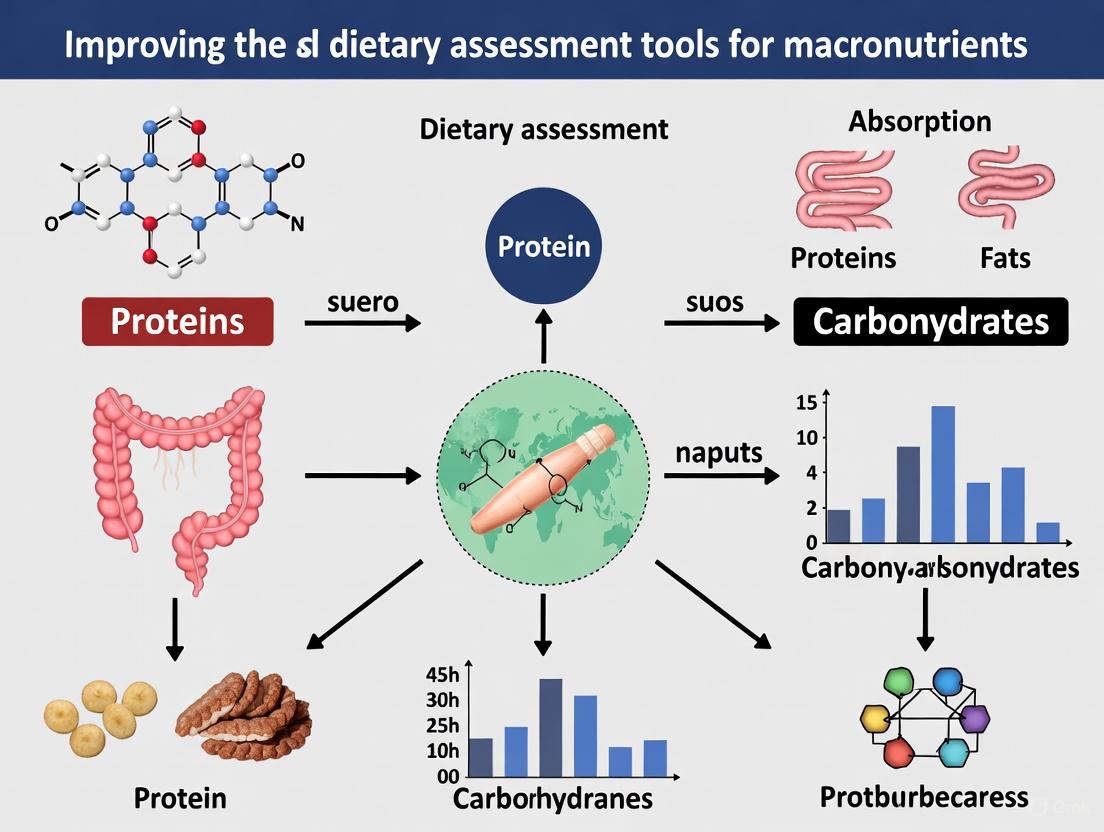
Accurate dietary assessment is fundamental for understanding the links between nutrition, chronic disease, and therapeutic outcomes, yet traditional self-report methods for macronutrients are plagued by significant measurement error.
Advancing Macronutrient Assessment: Innovative Tools and Validation Strategies for Precision Nutrition Research
Abstract
Accurate dietary assessment is fundamental for understanding the links between nutrition, chronic disease, and therapeutic outcomes, yet traditional self-report methods for macronutrients are plagued by significant measurement error. This article synthesizes the latest scientific advancements aimed at improving the accuracy of macronutrient assessment tools, with a specific focus on the needs of researchers and drug development professionals. We explore the foundational limitations of conventional methods, evaluate the application and methodological rigor of emerging artificial intelligence (AI) and technology-driven tools, address key challenges in optimization, and present a framework for robust validation and comparative analysis. By integrating evidence from recent validation studies, systematic reviews, and novel AI frameworks, this resource provides a comprehensive guide for selecting, implementing, and validating next-generation dietary assessment methodologies to enhance data reliability in clinical and biomedical research.
The Fundamental Challenge: Understanding Limitations in Traditional Macronutrient Assessment
Systematic and Random Errors in Self-Reported Methods (FFQs, 24HR, Food Records)
Understanding Measurement Errors in Dietary Assessment
Accurate dietary assessment is fundamental to nutrition research, yet all self-reported methods are susceptible to measurement errors that can compromise data quality. Understanding these errors—both random and systematic—is crucial for selecting appropriate methods and implementing strategies to mitigate bias in your research on macronutrients [1] [2].
Random errors affect precision and create "noise" in your data, potentially obscuring true diet-disease relationships. These can be reduced by repeated measurements and standardized protocols [1]. Systematic errors (bias) affect accuracy and consistently distort data in a particular direction, such as the well-documented underreporting of energy intake [1] [3].
The table below summarizes the prevalence of underreporting identified through recovery biomarker validation studies:
| Assessment Method | Energy Underreporting Prevalence | Primary Error Type | Key Characteristics |
|---|---|---|---|
| Food-Frequency Questionnaire (FFQ) | 29-34% [3] | Systematic [2] | Long-term recall; groups similar foods; high participant burden [2] |
| 24-Hour Recall (24HR) | 15-17% [3] | Random [2] | Short-term recall; detailed quantitative data; multiple passes reduce forgetting [1] |
| Food Record | 18-21% [3] | Random [2] | Real-time recording; literate/motivated participants; potential for reactivity [2] |
Frequently Asked Questions
What is the most significant systematic error in self-reported dietary data, and how can I account for it?
Energy underreporting is the most pervasive systematic error, affecting all self-report methods but to varying degrees [2] [3]. It is more prevalent among individuals with obesity and can lead to severe miscalculations of energy and nutrient intakes.
Mitigation Strategies:
- Internal Reference: Include a biological reference measure within your study design. Doubly labeled water (DLW) is the gold standard for validating energy intake, while 24-hour urinary nitrogen can be used for protein intake [1] [3].
- Statistical Adjustment: Use the data from your validation subsample to statistically adjust the reported intakes of the entire cohort for this systematic bias [1].
How many repeated 24-hour recalls or food records are needed to estimate usual intake for my population?
The required number of repeats depends on your nutrient of interest and the within-person variability in your population.
General Guidance:
- For nutrients with high day-to-day variability (e.g., vitamin A, cholesterol), more repeated measures are needed [2].
- In low-income countries with less dietary variety, fewer repeats may be sufficient compared to diverse Western diets [1].
- Minimum Protocol: Collect at least 2 non-consecutive days for group-level estimates. For robust estimation of usual intake distribution, a subset of your population (≥30-40 individuals per stratum) should provide repeated measures [1].
My study has a large sample size and a limited budget. What is the best dietary assessment tool to use?
For large epidemiological studies where cost is a primary concern, FFQs are often the most feasible tool. However, be aware of their significant limitations.
Recommendations for FFQ Use:
- Acknowledge Error: Recognize that FFQs introduce substantial systematic error, especially for absolute energy intake [3].
- Ranking vs. Absolute Intake: Use FFQs primarily to rank individuals by their intake rather than to measure absolute intake levels [2].
- Energy Adjustment: Calculate nutrient densities (e.g., percent of energy from fat) to improve accuracy for some nutrients, though this is not effective for all (e.g., potassium) [3].
- Validate Your Tool: If possible, validate your FFQ against multiple 24-hour recalls or biomarkers in a representative subsample of your study population.
How does participant reactivity affect food records, and how can I minimize it?
Reactivity is a specific systematic error for food records, where participants change their usual diet because they are actively recording it—often by choosing foods that are easier to record or perceived as more socially desirable [2].
Minimization Strategies:
- Thorough Training: Train participants thoroughly on how to record everything accurately and emphasize the importance of maintaining their usual habits.
- "Run-in" Period: Consider using a short, practice recording period to allow participants to habituate to the process before the official data collection begins.
- Blinding: If ethically feasible, avoid giving participants specific hypotheses about which dietary components you are studying.
Troubleshooting Common Experimental Problems
Problem: High Within-Person Variation Skewing Usual Intake Estimates
- Symptoms: Large day-to-day differences in nutrient intake for individuals, making it difficult to determine habitual intake.
- Solution:
- Increase Repeats: Collect more repeated 24-hour recalls or food records on non-consecutive days.
- Statistical Modeling: Use specialized software (e.g., the National Cancer Institute's method) to adjust for within-person variation and estimate the distribution of usual intake [1] [2].
- Subsampling: If repeated measures for all subjects are not feasible, collect replicates only from a random subsample to calculate the within-person variance component [1].
Problem: Suspected Widespread Underreporting in My Dataset
- Symptoms: Mean reported energy intakes that are implausibly low for the study population's characteristics.
- Solution:
- Compare to Basal Metabolic Rate (BMR): Calculate the ratio of reported energy intake to estimated BMR. A ratio below 1.2 for sedentary populations suggests underreporting.
- Use Biomarker Data: If available, use data from DLW or urinary nitrogen to create calibration equations for your sample [3].
- Analyze Macronutrient Density: Examine the proportions of energy from protein, fat, and carbohydrates. Underreporters often show a higher percent of energy from protein, as protein intake is generally underreported less than total energy [3].
Problem: Inconsistent or Imprecise Portion Size Estimation Across Interviewers
- Symptoms: High variability in reported portion sizes for similar foods, potentially introducing random error.
- Solution:
- Standardize Protocol: Implement a standardized, multi-pass 24-hour recall method (e.g., USDA Automated Multiple-Pass Method) for all interviewers [1].
- Intensive Training: Ensure all interviewers are trained to use the same probing techniques and portion size visual aids (e.g., glasses, bowls, ruler for food thickness).
- Quality Control: Record interviews and conduct regular reviews to ensure protocol adherence and consistency across the data collection team.
Experimental Protocols for Method Validation
Protocol 1: Validating Self-Reported Intake Against Recovery Biomarkers
This protocol uses objective biomarkers to quantify the measurement error inherent in self-reported methods [3].
Research Reagent Solutions:
| Reagent | Function in Validation |
|---|---|
| Doubly Labeled Water (DLW) | Gold-standard recovery biomarker for total energy expenditure; used to validate reported energy intake [3]. |
| 24-Hour Urine Collection | Provides recovery biomarkers for protein (via urinary nitrogen), sodium, and potassium intake [1] [3]. |
| Para-Aminobenzoic Acid (PABA) | Tablet taken to check completeness of 24-hour urine collection [3]. |
Methodology:
- Recruitment: Recruit a subsample of 50-100 participants representative of your main study cohort.
- Biomarker Administration:
- Administer DLW and collect urine samples over the subsequent 10-14 days to measure energy expenditure [3].
- Conduct two separate 24-hour urine collections to measure nitrogen, sodium, and potassium excretion. Provide PABA tablets to monitor collection compliance.
- Self-Report Data Collection: During the biomarker assessment period, collect dietary data using the methods under validation (e.g., multiple ASA24s, 4-day food records, or an FFQ).
- Data Analysis:
- Calculate mean differences (self-report minus biomarker) for energy, protein, potassium, and sodium.
- Determine the prevalence of under- and overreporting (e.g., defining underreporting as reported energy < 77% of DLW-measured expenditure).
Protocol 2: Comparing Self-Reported Methods Against Weighed Food Records
In settings where biomarkers are not feasible, same-day weighed records can serve as a reference [1].
Methodology:
- Study Design: A sub-study where participants are visited by a trained researcher for one full day.
- Reference Method: The researcher weighs and records all foods and beverages consumed by the participant before and after consumption. This is the "weighed record" (WR).
- Test Method: At the end of the same 24-hour period, a different researcher, blinded to the WR, administers a 24-hour recall to the participant.
- Data Analysis:
- Compare mean intakes of energy and macronutrients between the 24HR and WR using paired t-tests.
- Use Bland-Altman plots to assess the bias and limits of agreement between the two methods at both group and individual levels [1].
Workflow and Error Pathways
Systematic and Random Errors in Dietary Assessment
Strategies to Mitigate Dietary Assessment Errors
Frequently Asked Questions
Q1: What are recall bias and social desirability bias, and how do they differentially affect dietary data? Recall bias is an error in memory where participants in a study may forget to report certain foods, misremember details, or even report foods not consumed [4]. Social desirability bias is a systematic tendency to under-report or over-report dietary intake to present oneself in a socially favorable light [5] [6]. While recall bias often leads to random omissions (e.g., forgetting condiments or ingredients in complex dishes), social desirability bias typically causes a systematic downward bias in reporting energy and fat intake, as these are often viewed negatively [5] [4].
Q2: Which dietary assessment method is least susceptible to these biases? No self-report method is immune, but short-term methods like multiple 24-hour recalls are generally less susceptible to social desirability bias than Food Frequency Questionnaires (FFQs) [5] [6]. This is because 24-hour recalls ask about recent, specific intake rather than requiring judgments about "usual" intake over a long period. The use of multiple-pass interviewing techniques in 24-hour recalls, which include probing questions and memory aids, is specifically designed to minimize recall errors [4].
Q3: Does social desirability bias affect all population groups equally? No, the effect of social desirability bias can vary by demographic factors. Research indicates that its impact on the reporting of macronutrients and total energy is often more pronounced in women and individuals with higher levels of education [5] [6]. The effect also appears to be larger in individuals who have higher actual intakes of fat and total energy [5].
Q4: Can digital tools help reduce these biases? Digital tools like automated self-administered 24-hour recalls (e.g., ASA24, Intake24) can reduce some errors by automating coding and using standardized probes to improve recall [7] [8] [4]. However, they do not fully eliminate core issues like misreporting, recall bias, or the Hawthorne effect (where participants change their behavior because they are being studied) [8]. The inherent biases related to self-presentation remain a challenge.
Q5: What are the practical consequences of these biases for my research? In epidemiological studies, these measurement errors can distort observed associations between diet and disease, potentially leading to false conclusions [4]. In intervention research, bias can mask the true effect of the intervention, especially if the error is different between the intervention and control groups [4]. For monitoring and surveillance, bias can lead to incorrect estimates of the proportion of a population with inadequate or excessive intakes [4].
Troubleshooting Guides
Problem: Suspected systematic under-reporting of energy and fat in your dataset. This is a common issue often linked to social desirability bias.
- Step 1: Identify High-Risk Groups. Check if under-reporting is more prevalent in specific subgroups, such as women, individuals with higher BMI, or those with higher education levels [5] [6].
- Step 2: Incorporate a Social Desirability Scale. Administer a scale like the Marlowe-Crowne Social Desirability Scale to participants [6]. This provides a quantitative measure that can be used as a covariate in statistical models to adjust for this bias.
- Step 3: Use Biomarkers Where Possible. For validation, use objective biomarkers like doubly labeled water for total energy expenditure or urinary nitrogen for protein intake. These are not subject to self-report biases and serve as a gold standard for comparison [4].
- Step 4: Statistical Adjustment. Use statistical techniques, such as regression calibration, that can correct risk estimates for the bias introduced by measurement error, provided you have validation data [5].
Problem: High rate of omitted foods in 24-hour recall data. This indicates significant recall bias.
- Step 1: Implement a Multiple-Pass Method. Ensure your 24-hour recall protocol uses a multiple-pass approach. This involves several distinct stages: a quick list, detailed probing about forgotten foods (like additions and condiments), and a final review to minimize omissions [4].
- Step 2: Minimize Retention Interval. Conduct the recall as close to the consumption period as possible. Shorter intervals between eating and recall significantly improve accuracy [4].
- Step 3: Use Memory Aids. Provide visual aids such as food models, photographs, or household measures to help participants estimate portion sizes more accurately and trigger memory [7] [4].
Problem: Selecting the best dietary assessment method for a new study to minimize bias. This is a fundamental design choice.
- Step 1: Define Your Study's Goal. The choice of method depends on whether you need to estimate habitual intake (long-term) or actual intake (short-term). FFQs are designed for habitual intake but are more vulnerable to social desirability bias, while multiple 24-hour recalls provide a better measure of actual intake and are less susceptible to this bias [5] [7].
- Step 2: Consult a Dietary Assessment Toolkit. Use freely available online toolkits like the National Cancer Institute's Dietary Assessment Primer or the Diet, Anthropometry and Physical Activity Measurement Toolkit (DAPA) to compare the properties of different methods and select the most appropriate one for your context [7].
- Step 3: Pilot and Validate. Always pilot your chosen method in your specific study population. If possible, conduct a validation sub-study using a more precise method (e.g., biomarkers or weighed records) to quantify the measurement error in your data [7] [4].
Quantitative Data on Bias Effects
Table 1: Documented Effects of Social Desirability Bias on Macronutrient Intake Estimates
| Study & Population | Assessment Method Compared to 24HR | Effect of Social Desirability Trait | Key Findings |
|---|---|---|---|
| Hebert et al., 1995 (General Adult Population) [5] | Two 7-day diet recalls (7DDR) | Per 1-point increase on Social Desirability Scale | • Total Energy: Downward bias of ~50 kcal/point (≈450 kcal over interquartile range).• Bias Magnitude: ~2x larger in women vs. men.• Intake Level: Largest bias in individuals with highest fat & energy intake. |
| Field et al., 2001 (Female Health Center Employees) [6] | Food Frequency Questionnaire (FFQ) | Per 1-point increase on Marlowe-Crowne Scale | • Total Energy (College-Educated Women): Under-reporting of 23.6 kcal/day/point.• Effect Modifier: Significant bias observed in college-educated women but not in less-educated women. |
Table 2: Common Omissions Due to Recall Bias in 24-Hour Recalls (Based on Validation Studies) [4]
| Frequently Omitted Food Item | Example Context for Omission |
|---|---|
| Tomatoes, Lettuce, Cucumber | Often omitted as ingredients in mixed dishes like salads and sandwiches. |
| Cheese, Mayonnaise, Mustard | Common additions to sandwiches and burgers that are easily forgotten. |
| Green/Red Peppers | Typical ingredients in complex meals, not reported as separate items. |
Experimental Protocols
Protocol 1: Validating a Dietary Assessment Tool Against a Biomarker
This protocol outlines a method to quantify systematic error, including that caused by social desirability.
- Objective: To determine the validity of a self-report dietary assessment tool (e.g., an FFQ or 24HR) for measuring total energy intake by comparing it to energy expenditure measured by doubly labeled water.
- Participants: Recruit a representative sub-sample from your main study cohort.
- Procedure:
- Administer the self-report dietary tool (the test method).
- Concurrently, measure total energy expenditure using the doubly labeled water technique (the reference method).
- Administer a social desirability scale (e.g., Marlowe-Crowne).
- Data Analysis:
- Calculate the mean difference between reported energy intake and measured energy expenditure (a measure of systematic error/under-reporting).
- Use regression models to test if the level of under-reporting is correlated with the social desirability score.
Protocol 2: Assessing the Impact of a Multiple-Pass Interview Technique on Recall Completeness
This protocol tests a method to reduce random error from recall bias.
- Objective: To evaluate whether a multiple-pass 24-hour recall method reduces food omissions compared to a single-pass recall.
- Study Design: Randomized crossover study.
- Participants: Individuals from the target population.
- Procedure:
- Condition A: Conduct a single-pass 24-hour recall (simple listing of foods).
- Condition B: Conduct a multiple-pass 24-hour recall (quick list, detailed probing, forgotten foods list, final review).
- The order of conditions should be randomized and administered on different days.
- Data Analysis:
- Compare the mean number of food items reported per eating occasion between the two conditions.
- Specifically, compare the reporting of commonly forgotten foods (see Table 2) between methods.
The Scientist's Toolkit
Table 3: Essential Reagents and Tools for Dietary Assessment Research
| Tool or Reagent | Function in Dietary Research |
|---|---|
| Marlowe-Crowne Social Desirability Scale | A validated psychometric questionnaire to quantify a participant's tendency to give socially desirable responses. Used to statistically adjust for this bias [6]. |
| Automated Self-Administered 24-Hour Dietary Assessment Tool (ASA24) | A freely available, web-based tool that automates the multiple-pass 24-hour recall method. It reduces interviewer burden and coding errors, standardizing data collection [7] [4]. |
| GloboDiet (formerly EPIC-SOFT) | A standardized, interviewer-led 24-hour recall software program. It is highly standardized for international studies and uses detailed probing to improve accuracy [4]. |
| Doubly Labeled Water (DLW) | A biomarker for total energy expenditure. It is considered a gold standard for validating the accuracy of self-reported energy intake data, as it is not subject to cognitive biases [4]. |
| National Cancer Institute (NCI) Dietary Assessment Primer | An online toolkit that provides foundational knowledge about dietary assessment, including the sources and effects of measurement error, to guide researchers in method selection and data analysis [7]. |
Methodological Workflow for Bias Mitigation
The following diagram outlines a strategic workflow for researchers to identify and mitigate the effects of recall and social desirability bias in dietary studies.
Cognitive Processes in Dietary Self-Reporting
The diagram below visualizes the cognitive pathway a participant undergoes during dietary recall, highlighting where key biases are introduced.
Frequently Asked Questions
What is the single largest source of error in self-reported dietary assessment? Inaccurate estimation of portion sizes is widely recognized as a major cause of measurement error in dietary assessment research [9] [10]. This error directly impacts the accuracy of calculated macronutrient and energy intakes.
Which is more accurate for portion size estimation: text-based descriptions or food photographs? A 2021 controlled study found that text-based portion size estimation (TB-PSE), which uses household measures and standard portions, was significantly more accurate than image-based estimation (IB-PSE) [9]. When comparing portion sizes within 10% of the true intake, TB-PSE achieved 31% accuracy versus 13% for IB-PSE [9].
How does the type of food affect estimation accuracy? The accuracy of portion size estimation is highly dependent on food type [9]. Single-unit foods (e.g., a slice of bread) are typically reported more accurately than amorphous foods (e.g., pasta, rice) or liquids [9]. Research also shows that large portions are often underestimated, and small portions overestimated, a phenomenon known as the 'flat-slope phenomenon' [9].
What is the real-world error rate when using portion size photographs? A 2018 study in a real-life lunch setting found that the use of food photographs led to a mean difference of 17% between estimated and actual food weight, with a broad range of 1% to 111% inaccuracy [11]. Only 42% of all estimations were correct, and smaller portions were more accurately identified than larger ones [11].
Troubleshooting Guides
Guide: Improving Portion Size Estimation in Dietary Records
Problem: Reported data on macronutrient intake (fat, protein, carbohydrates) is inconsistent and likely inaccurate due to poor portion size reporting.
Solution:
- Implement Text-Based Aids: For web-based or app-based tools, prioritize clear, textual descriptions of portion sizes using standard household measures (e.g., "1 cup," "1 tablespoon") and standard portions (e.g., "small," "medium") [9]. Ensure all descriptions are unambiguous.
- Train Your Participants: Provide specific training on how to use the chosen Portion Size Estimation Aid (PSEA), especially if using household measures. This is crucial for individuals not frequently involved in meal preparation [2].
- Select the Right Tool for the Food: Understand that no single method works perfectly for all food types. A combination of methods may be necessary, with text-based approaches showing an overall advantage [9].
- Mitigate Memory Decay: While one study found no significant difference in accuracy between recalls at 2 hours and 24 hours post-consumption, collecting data as close to the eating occasion as possible is still a recommended best practice [9].
Guide: Addressing Systematic Overestimation and Unders estimation
Problem: Data analysis reveals a systematic bias where certain food groups are consistently over- or under-estimated, skewing macronutrient calculations.
Solution: Refer to the following table which quantifies estimation errors for specific food groups, based on a controlled feeding study [10]. Use this data to identify and correct for predictable biases in your research data.
| Food Group / Subgroup | Direction of Error | Magnitude of Error (%) |
|---|---|---|
| Pasta | Overestimation | +156% |
| Nuts | Overestimation | Significant |
| Meats | Overestimation | Significant |
| Mixed Dishes | Overestimation | Significant |
| Condiments | Underestimation | -43% |
| Juices | Underestimation | Significant |
| Bread | Underestimation | Significant |
Macronutrient Impact: The overestimation of food groups like meats, nuts, and pasta leads to the largest relative overestimation of protein and fat intakes [10]. When estimated portion sizes are used to calculate the macronutrient content of a diet, protein intake can show an error as high as 29% [11].
Experimental Data & Protocols
The table below synthesizes key quantitative findings from controlled studies comparing portion size estimation methods.
| Study Focus / Key Metric | Text-Based PSEA (TB-PSE) | Image-Based PSEA (IB-PSE) |
|---|---|---|
| Overall Median Relative Error (2021 Study) | 0% | 6% |
| Reports within 10% of True Intake (2021 Study) | 31% | 13% |
| Reports within 25% of True Intake (2021 Study) | 50% | 35% |
| Real-World Mean Error vs. Weighed Food (2018 Study) | — | 17% (range: 1-111%) |
Detailed Protocol: Controlled Feeding Validation Study
This methodology is used to ascertain the true accuracy of different Portion Size Estimation Aids (PSEAs) [9].
1. Objective: To compare the accuracy of text-based (TB-PSE) and image-based (IB-PSE) portion size estimation against true, weighed intake.
2. Participant Recruitment:
- Sample Size: 40 participants.
- Stratification: Stratify by sex and age to ensure an equal distribution.
- Exclusion Criteria: Visually impaired, employees in the nutrition field, or participation in another dietary intervention.
3. Study Meal & True Intake Ascertainment:
- Offer a variety of commonly consumed food types (amorphous, liquids, single-units, spreads) in pre-weighed, ad libitum amounts [9].
- Use calibrated weighing scales (e.g., 'Sartorius Signum 1').
- Weigh plate waste after the meal.
- Calculate true intake:
True intake (g) = Pre-weighed food item (g) - Plate waste (g)[9].
4. Portion Size Reporting:
- Develop separate questionnaires for TB-PSE and IB-PSE in a platform like Qualtrics.
- TB-PSE Tool: Use a combination of estimation in grams/millilitres, standard portion sizes, and household measures [9].
- IB-PSE Tool: Use a standardized picture book (e.g., the ASA24 picture book from the National Cancer Institute) with 3-8 portion size images per food item [9].
- Use a cross-over design where groups report intake at 2 hours and 24 hours post-meal using each method in a random order.
5. Data Analysis:
- Use Wilcoxon's tests to compare mean true intakes to reported intakes.
- Calculate the proportion of reported portion sizes within 10% and 25% of the true intake.
- Use an adapted Bland-Altman approach to assess agreement between true and reported portion sizes.
- Conduct analyses for all foods combined and for each predetermined food type.
The Scientist's Toolkit
Essential Research Reagent Solutions
The following table details key materials and their functions for conducting validation studies on dietary assessment tools.
| Item / Reagent | Function in Research |
|---|---|
| Calibrated Weighing Scales (e.g., Sartorius Signum 1) | Serves as the gold standard for measuring the true weight of food provided and plate waste, enabling the calculation of actual intake [9]. |
| Standardized Food Image Sets (e.g., ASA24 Picture Book) | Provides a validated, consistent visual aid for image-based portion size estimation (IB-PSE) across different study participants and sites [9]. |
| Digital Dietary Assessment Platform (e.g., Qualtrics, ASA24) | Hosts and administers dietary questionnaires, ensuring consistent delivery of text-based or image-based prompts and streamlining data collection [9] [2]. |
| Text-Based PSEA Framework (e.g., Compl-eat model) | Provides a structured combination of household measures, standard portion sizes, and gram estimates for developing accurate text-based portion size questions [9]. |
Method Selection Workflow
The following diagram outlines a logical workflow for selecting a portion size estimation method based on research objectives and constraints.
Cognitive Demands and Participant Burden in Conventional Tools
Frequently Asked Questions (FAQs) for Researchers
FAQ 1: What are the primary cognitive demands placed on participants when using conventional dietary assessment tools?
The primary cognitive demands include memory, visual attention, executive functioning, and numeracy. Accurate dietary recall requires participants to encode, retain, and retrieve memories of consumed foods, a process heavily reliant on visual attention during the eating occasion [12]. Furthermore, tools often require individuals to estimate portion sizes, a task involving numeracy and spatial skills, and to navigate the assessment interface, which demands cognitive flexibility to switch between different food items and portion estimation methods [13] [12]. One study found that poorer performance on the Trail Making Test (a measure of visual attention and executive function) was significantly associated with greater error in energy intake estimation for two digital 24-hour recalls [12].
FAQ 2: How does participant cognitive function directly impact the accuracy of collected dietary data?
Variation in cognitive function is a direct source of measurement error. Research shows that individuals with weaker visual attention and executive function tend to have larger errors in their self-reported energy intake [12]. Specifically, longer completion times on the Trail Making Test were associated with a 0.10% to 0.13% increase in absolute percentage error for every additional second spent on the task in digital 24-hour recalls [12]. In populations with pre-existing cognitive impairments, such as those studied in dementia research, these challenges are exacerbated, further compromising data integrity and potentially obscuring true diet-disease relationships [14] [15].
FAQ 3: What design features can help reduce the cognitive burden and participant burden in dietary assessment tools?
Design features that reduce burden focus on simplifying the user interface and minimizing cognitive load.
- Icon-Based Interfaces & Portion Aids: Using intuitive, non-text-based icons and common objects (e.g., a deck of cards or a golf ball) for portion size estimation can aid individuals with low literacy and numeracy skills [13].
- Linear Navigation: A clear, step-by-step pathway through tasks reduces cognitive load, especially for users who are not technically savvy [13].
- Real-Time Feedback: Providing immediate feedback on nutrient intake allows participants to engage with the process without waiting for later consultation, supporting self-monitoring [13].
- Usability Enhancements: Features like spell checkers, auto-fill options, and "mouse hover" help functions were shown to significantly improve completion times and user perception of a tool's ease of use [16].
FAQ 4: For how many days should participants typically complete a food record to balance data quality and burden?
While there is no universal standard, 3–4 days of recording is often used. Beyond this, participant burden generally increases, causing a decline in the quality of information recorded as motivation decreases [2]. It is crucial to align the number of recording days with the specific research question, the nutrients of interest, and the characteristics of the study population [2].
FAQ 5: How can I select the most appropriate dietary assessment tool to minimize burden and error in my specific study?
A structured approach is recommended. The DIET@NET Best Practice Guidelines propose a four-stage process [17]:
- Define the Measurement: Clearly outline what you need to measure (e.g., total diet vs. specific components), the target population, and the time frame.
- Investigate Tool Types: Understand the strengths and weaknesses of different methods (e.g., 24HR, FFQ, Food Record) for your study design.
- Evaluate Existing Tools: Critically appraise published validation studies for tools you are considering.
- Implement and Mitigate Bias: Plan the practical implementation of the chosen tool and consider sources of potential bias, including cognitive burden and low adherence.
Troubleshooting Common Experimental Issues
Problem: High rates of non-completion and drop-out in your dietary clinical trial.
- Potential Cause: Excessive participant burden due to complex tool interfaces, lengthy completion times, or high cognitive demands [18] [16].
- Solution:
- Pilot Test the Tool: Conduct a feasibility study with a small sample from your target population to identify usability barriers [13] [16].
- Simplify the Protocol: Choose a tool with high usability scores. The System Usability Scale (SUS) can be a useful metric; a score above 70 is considered "good" [16].
- Provide Training: Offer brief training sessions to enhance participant familiarity and accuracy with the tool, which is particularly important for food records [2].
Problem: Suspected systematic under-reporting of energy or specific macronutrients.
- Potential Cause: Social desirability bias, reactivity (changing diet for the study), or the cognitive difficulty of estimating certain foods and portion sizes [2] [15] [12].
- Solution:
- Use Recovery Biomarkers: Where possible, validate self-reported data against objective biomarkers. Recovery biomarkers exist for energy (doubly labeled water), protein (urinary nitrogen), sodium, and potassium [2].
- Choose Less Reactive Methods: 24-hour recalls, collected on random days after food consumption, are less likely to alter habitual intake compared to prospective food records [2].
- Leverage Technology: Consider image-assisted recalls or tools that use multiple passes to probe for forgotten items, which can enhance completeness [2] [12].
Problem: Low adherence and inaccurate tracking in populations with lower literacy or numeracy skills.
- Potential Cause: Text-heavy interfaces and a lack of intuitive portion size estimation aids [13].
- Solution:
- Adopt Visual Tools: Implement mobile applications that use icon-based interfaces and portion estimation aids like comparative objects (e.g., a golf ball for a small fruit) [13].
- Ensure Real-Time Feedback: Tools that provide immediate, visual feedback on progress (e.g., nutrient levels) can improve engagement and self-regulation in diverse populations [13].
Experimental Protocols for Key Cited Studies
Protocol 1: Controlled Feeding Study to Assess Cognitive Factors and 24HR Error
This protocol is adapted from a study investigating how neurocognitive processes affect dietary reporting error [12].
- Objective: To determine whether variation in neurocognitive processes predicts variation in measurement error of self-reported energy and macronutrient intake.
- Design: A crossover study where all participants complete multiple dietary assessment methods.
- Participants: ~150 adults, with equal numbers of men and women. Exclusion criteria include serious illness, pregnancy, or special dietary restrictions.
- Procedures:
- Cognitive Assessment: Prior to dietary intervention, participants complete a battery of computerized cognitive tasks online:
- Trail Making Test: Measures visual attention and executive function. Outcome: time to completion.
- Wisconsin Card Sorting Test: Measures cognitive flexibility. Outcome: percentage of accurate trials.
- Visual Digit Span: Measures working memory. Outcome: longest correct digit span.
- Vividness of Visual Imagery Questionnaire: Measures strength of visual imagery.
- Controlled Feeding: Participants attend the research facility for three separate feeding days (one per week). They consume all meals provided, and the exact type and weight of all foods and beverages are recorded by researchers to establish "true" intake.
- Dietary Self-Reporting: On the day following each feeding day, participants complete a different technology-assisted 24-hour recall (24HR) tool (e.g., ASA24, Intake24, an interviewer-administered recall) in a randomized order to report the previous day's intake.
- Cognitive Assessment: Prior to dietary intervention, participants complete a battery of computerized cognitive tasks online:
- Data Analysis:
- Calculate the percentage error between reported and true intakes for energy and macronutrients.
- Use linear regression to assess the association between cognitive task scores and the absolute percentage error in estimated intake.
Protocol 2: Usability and Feasibility Testing of a Mobile Dietary Application
This protocol is based on the development and evaluation of the DIMA-P app for hemodialysis patients [13].
- Objective: To evaluate the usability, feasibility, and impact of a mobile application on dietary self-monitoring in a target population with potential literacy challenges.
- Design: A 6-week in situ pilot study.
- Participants: A small group (e.g., n=8) from the target population (e.g., patients with a chronic condition requiring strict diet management).
- Procedures:
- App Development: Develop the application using a user-centered design process, incorporating iterative feedback from health professionals and target users. Key features should include:
- Icon-based interface and portion size estimation module.
- Linear navigation style.
- Real-time, personalized nutritional feedback.
- Intervention: Participants use the application to record and monitor their diet and fluid intake daily for 6 weeks.
- Data Collection:
- Usage Metrics: Application usage patterns and engagement in self-monitoring.
- Usability Questionnaires: Standardized scales to rate comprehensibility, user-friendliness, and satisfaction.
- Skill Assessment: Tests of portion estimation skills and dietary self-regulation self-efficacy administered before and after the study.
- Health Outcomes: Relevant clinical outcomes (e.g., interdialytic weight gain for hemodialysis patients) are collected to assess impact.
- App Development: Develop the application using a user-centered design process, incorporating iterative feedback from health professionals and target users. Key features should include:
- Data Analysis:
- Quantitative: Analyze usage patterns, pre-post changes in self-efficacy and skills tests, and trends in clinical outcomes.
- Qualitative: Thematic analysis of user feedback to identify usability issues and perceived benefits.
Data Presentation
Table 1: Cognitive Demands and Participant Burden of Conventional Dietary Assessment Tools
| Tool | Primary Cognitive Demands | Typical Completion Time | Key Strengths | Key Limitations & Sources of Error |
|---|---|---|---|---|
| 24-Hour Recall (24HR) | Specific memory, visual attention, executive function, numeracy for portion size [2] [12] | 20-30 minutes per recall [2] | Low reactivity; does not require literacy; captures wide variety of foods [2] | Relies on memory; within-person variation; requires multiple administrations; interviewer-administered versions can be costly [2] |
| Food Record | Prospective memory, attention to detail, high cognitive effort for real-time recording, numeracy [2] | High (ongoing for recording period) | Captures current intake in detail; considered gold standard for short-term intake [2] [19] | High reactivity (may change diet); high participant burden; requires literate and motivated population [2] |
| Food Frequency Questionnaire (FFQ) | Generic long-term memory, conceptualization of "usual intake" [2] | >20 minutes (varies by length) [2] | Cost-effective for large samples; aims to capture habitual diet [2] | Limited food list; not precise for absolute intakes; prone to systematic error [2] |
| Digital/Screener Tools | Varies by design; can include all of the above [13] [19] | <15 minutes to >20 minutes [2] [16] | Can reduce burden via auto-fill, spell-check, images [16]; real-time feedback [13] | Quality varies; may require tech competence; can still be prone to misreporting [19] [16] |
Table 2: The Researcher's Toolkit: Reagents and Materials for Dietary Assessment Studies
| Item | Function/Application in Research | Example/Notes |
|---|---|---|
| Automated Self-Administered 24HR (ASA24) | A freely available, web-based tool for conducting self-administered 24-hour recalls. Allows for automated coding of dietary data [2] [12]. | Used in controlled feeding studies to validate reporting error against true intake [12]. |
| Recovery Biomarkers | Objective biochemical measures used to validate the accuracy of self-reported intake for specific nutrients. They "recover" what is consumed and excreted [2]. | Examples: Doubly labeled water for energy intake; urinary nitrogen for protein intake; urinary sodium and potassium [2]. |
| Food Atlas Images | Standardized food photographs used to aid participants in estimating portion sizes during dietary recalls or records. | The Young Person's Food Atlas is used in tools like myfood24 to improve portion size estimation [16]. |
| System Usability Scale (SUS) | A standardized questionnaire used to quickly assess the perceived usability of a tool or system. Provides a score from 0-100 [16]. | A score of 66 is considered "OK," and 74 is "good." Used to evaluate digital dietary tools like myfood24 [16]. |
| Cognitive Task Battery | A set of standardized computer-based tests used to quantify individual differences in specific neurocognitive functions. | Includes Trail Making Test (visual attention/executive function), Wisconsin Card Sorting Test (cognitive flexibility), and Visual Digit Span (working memory) [12]. |
Method Selection and Error Analysis Diagrams
Diagram 1: Workflow for Selecting a Dietary Assessment Tool
Diagram 2: Relationship Between Cognitive Processes and Reporting Error
Limitations of Food Composition Databases and Automated Coding
Frequently Asked Questions (FAQs)
Table 1: Common Technical Issues and Initial Troubleshooting Steps
| Question Category | Specific FAQ | Brief Solution & Reference |
|---|---|---|
| Data Quality & Coverage | Why does my analysis show unexpected nutrient values for a common food? | Natural variation in food composition; check for regional varieties, processing methods, and source data [20]. |
| Why is a specific food or nutrient I'm researching missing from the database? | Limited coverage is a known limitation; consult multiple databases or seek primary analytical data [21] [20]. | |
| Automated Coding & Interlinkage | Why are entries from different databases (e.g., environmental and nutritional) failing to link correctly? | Inconsistent food classification and metadata are major hurdles; ensure use of common descriptors like LanguaL [22]. |
| My AI food recognition tool is inaccurate for mixed dishes. How can I improve it? | Complex meals with occlusions are a key challenge; train models on more diverse, culturally representative datasets [23] [24]. | |
| Methodology & Standardization | How can I reduce coding errors when processing diet records? | Implement a rigorous quality control protocol with trained staff and random re-coding checks [25]. |
| What is the best way to handle brand-name or reformulated products? | Rely on manufacturer data where possible and update database codes frequently, as recipes change [25] [20]. |
Troubleshooting Guides
Issue 1: Inaccurate or Incomplete Data in Food Composition Databases (FCDBs)
Problem: Research results are skewed due to missing foods, limited nutrients, or values that do not reflect the actual foods consumed.
Diagnosis Steps:
- Identify Data Source: Determine if your FCDB uses primary (analyzed) or secondary (compiled from other sources) data. Databases relying heavily on secondary data can have greater variability and lower accuracy for specific items [21].
- Check Metadata: Verify the availability of high-resolution metadata for the food entry, including details on origin, processing, and analytical methods. Inadequate metadata is a primary cause of poor reusability and interoperability [21] [26].
- Assess Coverage: Note that only one-third of FCDBs report data on more than 100 food components, and biodiversity in diets is often poorly represented [21] [26].
Solutions:
- Supplement with Primary Data: For critical or region-specific foods, commission chemical analysis to obtain primary composition data [21].
- Use Multiple Databases: Cross-reference values across several FCDBs to identify outliers and improve estimate reliability.
- Verify FAIR Compliance: Prioritize using databases that adhere to FAIR Data Principles, which are more likely to be Interoperable and Reusable. Current aggregated FAIR scores for FCDBs are low (Accessibility: 30%, Reusability: 43%), indicating a need for careful selection [21].
Issue 2: Errors in Automated Coding and Database Interlinkage
Problem: Automated systems fail to correctly match food entries from different sources (e.g., life cycle inventory and nutritional databases), or AI-driven dietary assessment tools misidentify foods.
Diagnosis Steps:
- Check Classification Systems: Determine if the databases use a common, standardized food classification system (e.g., LanguaL). Inconsistent classification is a primary barrier to interlinkage [22].
- Review Meta Data Availability: Assess whether sufficient metadata (e.g., food name, specification, processing, production type) is available for automated matching. A lack of consistent metadata leads to failures [22].
- Validate AI Model Training Data: For food recognition tools, investigate if the underlying model has been trained on a limited dataset that lacks cultural diversity or complex meal types, leading to errors in portion size estimation and food identification [23] [24].
Solutions:
- Standardize Inputs: Advocate for and use common classification principles and database formats to facilitate smoother data interlinkage [22].
- Implement Semi-Automated Validation: Use a semi-automatic interlinkage approach with a manual validation step. One study showed that automated descriptor tagging still required manual checks to correct incorrectly assigned entries [22].
- Enhance AI Training: Improve the accuracy of AI dietary assessment tools by training models on more comprehensive and diverse food image datasets that include various portion sizes and mixed dishes [23] [24].
Issue 3: High Variability in Coded Nutrient Values
Problem: Different coders, or the same coder at different times, assign different nutrient values to the same food record, introducing significant random error into the study data.
Diagnosis Steps:
- Audit Coder Training: Review the training and certification procedures for staff coding diet records. Without centralized, standardized training, coding errors are frequent and impactful [25].
- Perform Quality Control (QC) Checks: Institute a process where a senior nutritionist re-codes a random sample (e.g., 10%) of diet records blind. In the INTERMAP study, initial coder errors led to significant variations in daily energy and nutrient estimates [25].
Solutions:
- Develop a Detailed Codebook: Create and maintain a rule-based codebook that specifies descriptions, included food items, and portion size information for each food code to prevent subjective coder decisions [25].
- Establish a QC Protocol: Implement a ongoing quality control system where batches of coded records are routinely re-checked. The INTERMAP study used a pass/fail criterion of ≤6% line errors, with failed batches requiring recoding [25].
Experimental Protocols for Key Methodologies
Protocol 1: Standardized Quality Control for Manual Diet Record Coding
This protocol is adapted from the rigorous methods used in the INTERMAP study to minimize coding errors [25].
Objective: To ensure high uniformity and accuracy in the manual coding of diet records into nutrient estimates.
Materials:
- Completed diet records
- A comprehensive, updated food composition database
- A detailed, rule-based codebook
- "New Food Request" forms for unmatched items
Procedure:
- Coder Training and Certification:
- Train all staff centrally on collection and coding procedures.
- Require coders to successfully code a set of standard diet records (e.g., 5 standard records + 5 self-collected records).
- Compare trainee coding against a "gold standard" version coded by a senior nutritionist.
- Establish a pass threshold (e.g., ≤6% line errors). Only certified coders may process study data.
Local Quality Control During Fieldwork:
- After a coder completes a batch of records (e.g., 10), a site nutritionist randomly selects one (10%) to re-code blind.
- If the selected record contains more than the allowable error threshold (e.g., >6% line errors), the entire batch is returned to the initial coder for recoding.
- This process repeats until a randomly selected record passes QC.
Centralized Quality Control:
- Batches that pass local QC (e.g., in batches of 30) are reviewed by a country nutritionist.
- The nutritionist randomly selects a sub-set (e.g., 3 records) to re-code blind.
- If the error threshold is exceeded, the entire batch is recoded by the local site.
Troubleshooting: The use of "New Food Request" forms ensures consistent handling of foods not found in the initial codebook, preventing arbitrary coding decisions [25].
Protocol 2: Semi-Automated Interlinkage of Food Databases
This protocol outlines an approach for connecting entries from different types of food databases, such as environmental and nutritional databases [22].
Objective: To reliably link food entries across disparate databases to enable combined analyses (e.g., nutritional LCA).
Materials:
- Source databases (e.g., Life Cycle Inventory - LCI, and Food Composition Databases - FCDB)
- Food classification system (e.g., LanguaL)
- Computational script for automated descriptor tagging
Procedure:
- Data Attribute Analysis: Analyze the structure and metadata availability of the source databases (e.g., Agribalyse and EuroFIR).
- Harmonization: Gather and harmonize food names and descriptors from a standardized food classification system (e.g., LanguaL codes).
- Automated Tagging: Use these harmonized descriptors to automatically tag database entries.
- Manual Validation: Manually validate a sample of the interlinked entries. The reference study found that 2 out of 54 sample entries were incorrectly assigned, highlighting the necessity of this step [22].
- Iterative Refinement: Use the results of the manual validation to refine the automated tagging rules and improve accuracy.
Troubleshooting: Challenges include data gaps, inconsistencies, and incompatible data formats. Success depends on agreeing on common classification systems and improving metadata availability [22].
Quantitative Data on FCDB Limitations
Table 2: Key Findings on the State of Global Food Composition Databases
| Evaluated Attribute | Key Finding | Research Implication |
|---|---|---|
| Scope of Components | Only one-third of FCDBs report data on more than 100 food components [21]. | Critical bioactive compounds or novel nutrients may be missing, limiting research scope. |
| FAIR Compliance Score | Aggregated scores for 101 FCDBs: Findability: 100%, Accessibility: 30%, Interoperability: 69%, Reusability: 43% [21]. | Major hurdles exist in accessing and reusing data, especially across different systems. |
| Data Source & Update Frequency | FCDBs with the most foods/components rely on secondary data. Update frequency is generally low, with web-based interfaces updated more than static tables [21]. | Data may not be current, especially for reformulated processed foods, risking inaccuracy [20]. |
| Representation Bias | National databases (e.g., USDA FDC) often have sparse coverage of regionally distinct, culturally significant foods [26]. | Dietary assessments for populations consuming these foods are less accurate, impacting health outcome studies. |
The Scientist's Toolkit: Research Reagent Solutions
Table 3: Essential Resources for Dietary Assessment and Coding Research
| Tool / Resource | Function / Description | Example Use Case |
|---|---|---|
| LanguaL (Langue Alimentaire) | A standardized, automated food description and classification system. | Provides common descriptors to interlink food entries from environmental and nutritional databases [22]. |
| FAIR Data Principles | A set of guiding principles to make data Findable, Accessible, Interoperable, and Reusable. | A framework for evaluating and selecting the most reliable and usable FCDBs for research [21] [26]. |
| Recovery Biomarkers | Objective biomarkers (e.g., for energy, protein, sodium) where intake is proportional to excretion. | The most rigorous method for validating the accuracy of self-reported dietary intake data [2]. |
| goFOOD / goFOODLITE | AI-powered dietary assessment tools using computer vision for food recognition and portion estimation. | Used in research to automate dietary intake tracking and reduce burdens associated with self-reporting [23] [24]. |
| Standardized Codebook | A rule-based document specifying food descriptions, portion sizes, and coding rules. | Critical for minimizing subjective decisions and errors during the manual coding of diet records [25]. |
Workflow Diagram: Food Data from Collection to Research Application
The diagram below visualizes the pathway from dietary data collection to its application in research, highlighting key stages and potential limitations.
Food Data Workflow and Limitations: This chart illustrates the journey of dietary data from collection to application, highlighting critical stages where inaccuracies can be introduced, including self-reporting biases, coding errors, and inherent limitations of Food Composition Databases (FCDBs).
Next-Generation Tools: Methodological Advances in AI and Technology-Driven Assessment
FAQs and Troubleshooting Guides
This section addresses common technical and methodological challenges researchers face when developing or implementing Image-Based Dietary Assessment (IBDA) systems.
FAQ 1: What are the primary sources of error in IBDA systems, and how can we mitigate them?
IBDA systems are sensitive to errors at multiple stages, from image capture to nutrient estimation. The table below summarizes common issues and proposed mitigation strategies based on published research.
Table 1: Common Error Sources and Mitigation Strategies in IBDA
| Error Source | Impact on Assessment | Recommended Mitigation Strategy |
|---|---|---|
| Suboptimal Image Quality [23] | Poor lighting, motion blur, or occlusion prevents accurate food identification and volume estimation. | Standardize imaging protocols: ensure consistent lighting, capture from a 45-degree angle, and include a fiducial marker for scale [27]. |
| Complex/Mixed Meals [28] [23] | Systems struggle to segment and identify individual ingredients in composite dishes like stews or salads. | Utilize deep learning models trained on diverse, culturally relevant food datasets [28] [29]. For highly mixed foods, consider a "best-fit" food code from a standard database [30]. |
| Portion Size Estimation [27] | This is the most significant challenge; 2D images provide limited depth information, leading to volume inaccuracies. | Implement 3D reconstruction techniques or use depth-sensing cameras. As a pragmatic alternative, use standardized portion size descriptors (e.g., "1 cup," "1 medium banana") from databases like FNDDS [30]. |
| Limited Food Database [23] [29] | Models fail to recognize regional, cultural, or homemade foods not represented in training data. | Employ a Retrieval-Augmented Generation (RAG) framework that grounds visual recognition in authoritative, extensible nutrition databases like FNDDS, allowing for easier updates [30]. |
| Low User Adherence [31] | Participants forget to capture images, leading to missing data and biased intake estimates. | Implement tailored prompting via text message, sent 15 minutes before a participant's typical meal times, which has been shown to significantly improve adherence [31]. |
FAQ 2: Our model performs well on validation datasets but poorly in real-world trials. What could be the cause?
This "reality gap" often stems from a mismatch between controlled training data and real-world conditions. To close this gap:
- Expand Training Data Diversity: Ensure your training images reflect the variability in real-world lighting, plateware, food presentation, and background clutter [23] [29].
- Incorporate User Feedback Loops: Design the system to allow users to confirm or correct food identifications. This improves accuracy for that entry and can be used as new training data [23].
- Validate with Ground Truth: Conduct controlled validation studies where IBDA estimates are compared against weighed food or dietitian-analyzed records to identify specific failure points [32].
FAQ 3: How can we estimate a comprehensive nutrient profile, rather than just calories and macronutrients?
Most commercial systems are limited to basic macronutrients. To estimate a wider array of micronutrients:
- Leverage Standardized Databases: Move beyond proprietary nutrient databases. Integrate with comprehensive, research-grade databases like the Food and Nutrient Database for Dietary Studies (FNDDS), which provides up to 65 distinct nutrients and food components for thousands of foods [30].
- Adopt a Framework like DietAI24: This framework uses a Multimodal Large Language Model (MLLM) for food recognition and a RAG system to retrieve precise nutritional data from FNDDS, enabling "zero-shot" estimation of a full nutrient profile without retraining the model for each new nutrient [30].
Experimental Protocols for Key IBDA Tasks
This section provides detailed methodologies for core experiments in IBDA development and validation, designed to be reproducible in a research setting.
Protocol: Validating Food Recognition and Classification Models
Objective: To evaluate the accuracy of a deep learning model in identifying food items from images against a ground-truth standard.
Materials:
- A curated dataset of food images with expert-validated labels.
- The trained food classification model (e.g., a Convolutional Neural Network).
- Computing hardware with adequate GPU support.
Methodology:
- Dataset Splitting: Randomly split the labeled dataset into three subsets: training (70%), validation (15%), and test (15%). Ensure no data leakage between sets.
- Model Training: Train the model on the training set. Use the validation set for hyperparameter tuning and to prevent overfitting.
- Performance Evaluation: Test the final model on the held-out test set. Calculate standard performance metrics, including:
- Top-1 Accuracy: The percentage of correct predictions.
- Top-5 Accuracy: The percentage where the correct label is among the model's top 5 predictions (useful for fine-grained classification).
- Precision, Recall, and F1-Score: Particularly important for multi-label classification (meals with multiple foods).
Expected Outcomes: A model achieving high Top-5 accuracy (>90% on benchmark datasets like Food-101) is considered state-of-the-art for food recognition, though performance on mixed dishes will be lower [33] [29].
Protocol: Comparing IBDA to the Gold Standard in a Clinical Population
Objective: To assess the validity of an IBDA system for estimating energy and macronutrient intake in patients with Type 2 Diabetes against doubly labeled water (DLW) and dietitian-analysis of written food records.
Materials:
- Participant cohort (e.g., adults with Type 2 Diabetes).
- IBDA system (smartphone app with backend server).
- Doubly labeled water kits for total energy expenditure (TEE) measurement.
- Dietitian-administered 24-hour dietary recall or analyzed 3-day weighed food records.
Methodology:
- Study Design: A cross-over or parallel-group study where participants use the IBDA system while simultaneously having their intake assessed by a dietitian.
- Data Collection:
- IBDA Group: Participants capture images of all food and beverages for 3-7 days. The system automatically estimates energy and macronutrients.
- Reference Group: Participants complete dietitian-supervised 24-hour recalls or weighed food records over the same period. A subgroup undergoes DLW measurement to determine TEE as an objective measure of energy requirement.
- Statistical Analysis:
- Use paired t-tests or Bland-Altman analysis to assess the agreement between IBDA-derived intake and dietitian-analysis.
- Compare energy intake from both methods to TEE from DLW to evaluate under- or over-reporting bias.
Expected Outcomes: A valid IBDA system should show no significant mean difference from dietitian analysis and a small bias relative to TEE. Underreporting is common in all dietary assessment methods, but a well-designed IBDA may reduce it compared to traditional recalls [32] [34].
Performance Data and System Comparisons
This section provides quantitative comparisons of different methodologies and systems to inform research design choices.
Table 2: Comparison of IBDA System Performance on Key Tasks
| Method / System | Reported Performance Metric | Key Findings & Advantages | Limitations & Constraints |
|---|---|---|---|
| Traditional Computer Vision (e.g., SVMs, Handcrafted Features) [29] | Lower accuracy (~70-80%) on complex food image datasets. | Computationally less intensive; requires less data. | Poor generalization; struggles with varied food presentations and lighting. |
| Deep Learning (CNN-based) [28] [29] | High accuracy (>90% Top-5 on datasets like Food-101). | Excellent at feature extraction; robust to variations in appearance. | Requires large, labeled datasets for training; computationally intensive. |
| Multimodal LLM with RAG (DietAI24) [30] | 63% reduction in Mean Absolute Error (MAE) for weight and nutrient estimation vs. baselines. | Estimates 65+ nutrients; does not require task-specific training ("zero-shot"); high accuracy. | Relies on external database quality; computational cost of large models. |
| Commercial Apps (e.g., MyFitnessPal, FatSecret) [27] [34] | Accuracy varies widely; often fails on mixed dishes and portion size. | High usability and user familiarity; widely available. | Limited to basic macronutrients; "closed" systems with proprietary databases. |
Core Workflows and System Architecture
The following diagrams illustrate the standard workflow for automated IBDA and the advanced architecture of a state-of-the-art system.
Core IBDA Workflow
DietAI24 Advanced Architecture
The Scientist's Toolkit: Research Reagent Solutions
This table details essential software, data, and methodological "reagents" required for building and validating IBDA systems.
Table 3: Essential Research Reagents for IBDA Development
| Reagent / Resource | Type | Function in IBDA Research | Example / Source |
|---|---|---|---|
| Public Food Image Datasets | Data | Provides standardized benchmarks for training and evaluating food recognition models. | Food-101, UEC-Food256, Nutrition5k [33] [29] [34] |
| Authoritative Nutrient Database | Data | Serves as the ground truth for converting identified foods and portions into nutrient data. | Food and Nutrient Database for Dietary Studies (FNDDS) [30] |
| Pre-trained Vision Models | Software | Provides a foundational model for transfer learning, reducing the need for massive datasets and compute resources. | CNN architectures (ResNet, EfficientNet) or Vision Transformers (ViT) from TensorFlow Hub, PyTorch Hub [28] [29] |
| Multimodal LLM Framework | Software | Enables advanced understanding of visual food data and integration with textual knowledge bases. | GPT-4V, LLaVA; Integrated via APIs into systems like DietAI24 [30] |
| RAG Pipeline Tools | Software | Connects the visual recognition system to the authoritative nutrient database to prevent "hallucination" of nutrient values. | LangChain, vector databases (e.g., Chroma, Pinecone) [30] |
| Validation Standard | Methodology | Provides an objective, unbiased measure of energy intake to assess the validity of the IBDA system against a physiological gold standard. | Doubly Labeled Water (DLW) technique [32] |
Multimodal Large Language Models (MLLMs) and Retrieval-Augmented Generation (RAG) for Nutrition
Frequently Asked Questions (FAQs)
Q1: What is the primary advantage of using a RAG framework over a standard MLLM for nutrition estimation? The primary advantage is a significant increase in accuracy. Standard MLLMs often "hallucinate" or generate unreliable nutritional values because they lack access to authoritative data during inference. A RAG framework grounds the MLLM's analysis in validated nutritional databases, transforming guesswork into precise retrieval. For example, the DietAI24 framework, which uses RAG, achieved a 63% reduction in Mean Absolute Error (MAE) for food weight and nutrient estimation compared to existing methods [30].
Q2: My model inaccurately estimates electrolytes like potassium and phosphorus. How can I fix this? This is a common issue with standard LLMs. The solution is to integrate your system with a specialized nutritional database that contains detailed micronutrient profiles [35]. For instance, the Food and Nutrient Database for Dietary Studies (FNDDS) provides values for 65 distinct nutrients and food components [30]. By using RAG, you can query this database directly based on the food items identified by the MLLM, ensuring accurate electrolyte values instead of unreliable model-generated estimates.
Q3: What are the essential components for building a RAG-based nutrition analysis system? A functional system requires several key components, often referred to as "research reagents". The table below outlines these essential materials and their functions.
Table: Essential Research Reagent Solutions for MLLM-RAG Nutrition Systems
| Component | Function | Example |
|---|---|---|
| Multimodal LLM (MLLM) | Analyzes food images to identify food items and estimate portion sizes [30]. | GPT-4 Vision [30] |
| Authoritative Nutrition Database | Serves as the ground-truth source for retrieving accurate nutrient values [30]. | FNDDS [30], NCC Food Database [36] |
| Vector Database | Enables efficient similarity-based retrieval of relevant food information from the knowledge base [30]. | Indexed FNDDS embeddings [30] |
| Embedding Model | Transforms text descriptions into numerical vectors for the retrieval step [30]. | OpenAI's text-embedding-3-large [30] |
| Retrieval-Augmented Generation (RAG) Framework | Orchestrates the process, using the MLLM's output to query the database and generate accurate nutrition reports [30] [36]. | DietAI24 [30], NutriRAG [36] |
Q4: How can I handle the analysis of complex, mixed dishes instead of single food items? The RAG framework is particularly suited for this. The MLLM first performs food recognition as a multi-label classification task, identifying all individual components in a mixed dish [30]. It then estimates a portion size for each item. Finally, the RAG system retrieves the nutritional data for each constituent food and aggregates them to provide a comprehensive analysis of the entire meal [30].
Q5: What is the standard method to evaluate the performance of my nutrition estimation model? The standard metric used in research is Mean Absolute Error (MAE), which measures the average magnitude of errors between the estimated and actual values. Performance is evaluated on key tasks:
- Food weight estimation [30]
- Macronutrient estimation (calories, protein, carbohydrates, fat) [30]
- Micronutrient estimation (potassium, phosphorus, sodium, etc.) [35] [30] Your model's MAE should be compared against established baselines and commercial platforms to demonstrate improvement [30].
Troubleshooting Guides
Issue: High Error in Nutrient Content Estimation
Problem: Your model's estimates for calories, macronutrients, and/or electrolytes consistently deviate from known values.
Solution: Implement a RAG framework to replace the model's internal knowledge with verified data.
Experimental Protocol:
- Index the Database: Use an embedding model to transform the descriptions of food items from an authoritative database (like FNDDS) into vectors and store them in a vector database [30].
- Retrieve Relevant Information: For a given input food image, use the MLLM to generate a descriptive query. Use this query to retrieve the most relevant food items and their nutritional data from the vector database [30].
- Generate Grounded Estimation: Feed the retrieved nutritional information along with the original query to the MLLM and instruct it to generate its final analysis based solely on the provided, validated data [30].
This workflow ensures that the final nutrient estimates are pulled directly from the scientific database, drastically reducing hallucination and error.
Issue: Poor Performance on Uncommon or Regional Foods
Problem: The system fails to correctly identify or find nutritional information for foods not well-represented in standard Western databases.
Solution: Expand the knowledge base and employ a few-shot retrieval strategy.
Experimental Protocol:
- Database Augmentation: Incorporate specialized or regional food databases into your vector knowledge base. The system's architecture allows for swapping or combining databases without retraining the core MLLM [30] [36].
- Implement Few-Shot Learning: Use the NutriRAG approach, which retrieves the top-K most similar examples from a validation dataset to provide context to the LLM. This helps the model understand the classification task for niche items based on just a few examples [36].
- Formula: The similarity between a user query
q_iand an examplee_iis calculated using cosine similarity:sim(q_i, e_i) = (E(q_i) · E(e_i)) / (||E(q_i)|| * ||E(e_i)||), whereEis the embedding vector [36].
- Formula: The similarity between a user query
Issue: Inaccurate Portion Size Estimation
Problem: The model correctly identifies the food but is inaccurate in estimating its amount, leading to incorrect nutrient calculations.
Solution: Frame portion size estimation as a multiclass classification problem against standardized options.
Experimental Protocol:
- Leverage Standardized Measures: Instead of regression, train or guide your model to select from a set of standardized portion descriptors (e.g., "1 cup", "1 medium piece", "100 grams") as defined in databases like FNDDS [30].
- Multimodal Analysis: Rely on the MLLM's visual understanding capabilities to compare the food in the image to these standardized measures. The RAG context can provide the model with a list of possible portion options for the identified food item.
Experimental Data & Performance
The following table summarizes quantitative performance data from key studies, providing a benchmark for your own experiments.
Table: Performance Comparison of Nutrition Analysis Methods
| Model / Framework | Key Innovation | Primary Dataset | Performance Metric & Result |
|---|---|---|---|
| DietAI24 [30] | MLLM + RAG with FNDDS | ASA24, Nutrition5k | 63% reduction in MAE for food weight & 4 key nutrients vs. existing methods [30]. |
| ChatGPT-4 (Standalone) [35] | LLM for recipe generation & analysis | Custom (CKD-focused recipes) | Underestimated calories by 36% and potassium by 49% compared to USDA data [35]. |
| NutriRAG [36] | RAG-LLM for text-based food classification | myCircadianClock app logs | Achieved a Micro F1 score of 82.24 for food item classification into 51 categories [36]. |
Frequently Asked Questions (FAQs) for Researchers
Q1: What types of sensor data are used to detect eating occasions, and what dietary metrics do they provide? Sensor-based wearable devices primarily utilize motion sensors and acoustic sensors to passively detect eating activity. The data from these sensors, when processed with AI algorithms, can provide key dietary metrics for research [37] [38].
Table 1: Dietary Metrics from Sensor Data
| Sensor Type | Primary Data Captured | Derived Dietary Metrics for Research |
|---|---|---|
| Motion Sensors (e.g., Accelerometer, Gyroscope) [37] [38] | Wrist/arm movement patterns (hand-to-mouth gestures), jaw motion [37] | Eating episode timing and duration, number of bites, eating rate [38] |
| Acoustic Sensors (e.g., Microphone) [37] [38] | Sounds of chewing and swallowing [37] | Chewing frequency, identification of swallowing events, meal microstructure analysis [38] |
| Multi-Sensor Fusion (Combining motion and sound) [38] | A combination of the above data streams | Improved accuracy for eating event detection, distinction between eating and non-eating activities (e.g., talking) [38] |
Q2: How does the performance of sensor-based methods compare to traditional dietary assessment in research settings? Sensor-based methods offer a objective and passive alternative to traditional self-report methods like 24-hour recalls, which are prone to recall bias and under-reporting [37] [39]. While performance varies by algorithm and device, these tools show promise in detecting the timing and duration of eating episodes with high accuracy in field studies [38]. However, accurately estimating the exact food type and portion size—which is critical for macronutrient research—often requires additional tools, such as wearable cameras, to complement the motion and sound data [39] [40].
Q3: What are the common hardware-related challenges when deploying these devices in field studies? Researchers often encounter several hardware limitations that can impact data quality and participant compliance [41].
Table 2: Common Hardware Challenges and Research Impacts
| Hardware Challenge | Impact on Research Data | Suggested Mitigation for Researchers |
|---|---|---|
| Limited Battery Life [42] | Incomplete data collection; missing eating episodes during charging. | Pre-test battery duration; provide portable chargers; use devices with low-power modes. |
| Inaccurate Sensor Readings [42] | Erroneous detection of eating events (false positives/negatives). | Ensure proper sensor calibration pre-study; instruct participants on correct wear position [42]. |
| Connectivity Issues (e.g., Bluetooth) [42] | Loss of data synchronization or transmission to companion devices. | Check connectivity range in pilot tests; ensure robust pairing protocols. |
| Fixed Camera Orientation (for camera-assisted devices) [41] | Cropped or missed food images, leading to portion size estimation errors. | Select devices with adjustable camera mounts to adapt to different user anatomies [41]. |
Troubleshooting Guides
Issue 1: Poor Detection Accuracy or High False Positives
Problem: The device is detecting non-eating activities (e.g., talking, hand gestures) as eating occasions, or is missing genuine eating events.
Solution:
- Verify Sensor Placement: Incorrect placement on the body is a primary cause of inaccuracy. Confirm that the device is worn as per the study protocol (e.g., snug on the wrist for watches, proper alignment for eyeglass-mounted devices) [42].
- Check for Sensor Interference: Environmental factors like strong electromagnetic interference or low lighting for cameras can affect sensor function. Ensure participants are briefed to avoid known sources of interference where possible [43].
- Review and Adjust Algorithm Sensitivity: If your research setup allows, examine the sensitivity settings of the detection algorithm. A study's context (e.g., detecting slow eating in a lab vs. rapid eating in a cafeteria) may require different sensitivity levels [43].
- Re-calibrate Sensors: Follow the manufacturer's or your pre-defined research protocol for sensor calibration. This is crucial after device updates or if a device is reassigned to a new participant [42].
Issue 2: Rapid Battery Drain During Field Deployment
Problem: The device's battery depletes faster than expected, cutting short data collection periods and risking data loss.
Solution:
- Optimize Data Collection Settings: Reduce the frequency of data sampling (e.g., image capture rate, motion sampling rate) to the minimum required for your research objectives [41].
- Disable Unnecessary Features: Turn off power-intensive sensors (e.g., constant GPS, high-resolution video) that are not essential for capturing motion and sound related to eating.
- Use Manufacturer-Recommended Chargers: Incompatible chargers can lead to inefficient charging and potential battery damage. Provide participants with approved chargers and clear instructions [42].
Issue 3: Unstable Data Connectivity or Synchronization
Problem: The wearable device fails to sync data reliably with a paired smartphone or research hub, leading to data gaps.
Solution:
- Check Proximity and Environment: Ensure the companion device (e.g., smartphone) is within the recommended range. Thick walls and metal structures can weaken signals. Reposition the devices to improve connectivity [43].
- Restart and Re-pair Devices: A simple restart of both the wearable and the companion device can resolve transient software glitches. If problems persist, unpair and then re-pair the Bluetooth connection [42].
- Update Firmware: Ensure both the wearable device and the companion application are running the latest firmware/software versions, as updates often include connectivity fixes [43].
Experimental Protocols for Validation
Protocol 1: Validating Eating Event Detection in a Controlled Lab Setting
This protocol is designed to establish the baseline accuracy of a sensor-based device for detecting the start and end of an eating occasion.
1. Objective: To determine the sensitivity and specificity of the wearable device in detecting eating events compared to direct observation.
2. Materials:
- Sensor-based wearable device (e.g., smartwatch, dedicated device).
- Video recording equipment (as ground truth).
- Data logging software.
- Standardized meal.
3. Methodology:
- Participant Preparation: Fit the participant with the wearable device, ensuring correct placement and operation.
- Experimental Procedure: Participants are served a standardized meal in a lab setting. Simultaneously, start video recording to capture all eating activities. Participants are instructed to eat normally.
- Data Collection: The wearable device records motion and acoustic data throughout the session. The video recording serves as the ground truth for the exact timing of eating events (first bite to last swallow).
- Data Analysis:
- Annotate the video to mark the true start and end of the eating episode.
- Extract the timestamps of eating events predicted by the device's algorithm.
- Calculate performance metrics by comparing the device's output to the video ground truth.
4. Key Performance Metrics:
- Accuracy: Proportion of correctly classified events (both eating and non-eating).
- Sensitivity (Recall): Proportion of true eating events correctly identified.
- Specificity: Proportion of non-eating time correctly identified.
- F1-Score: The harmonic mean of precision and recall [38].
Protocol 2: Field Validation Against a Camera-Assisted 24-Hour Recall
This protocol assesses the device's performance in a free-living environment and its utility in improving the accuracy of macronutrient intake estimation.
1. Objective: To evaluate the ability of the wearable device to capture eating occasions and dietary intake in a real-world setting, compared to a camera-assisted 24-hour recall.
2. Materials:
- Sensor-based wearable device.
- Wearable camera (e.g., Narrative Clip, eButton) [39] [40].
- Data analysis software for sensor data and images.
3. Methodology:
- Participant Preparation: Participants are equipped with both the sensor device and a wearable camera on the same day.
- Experimental Procedure: Participants go about their normal daily activities while wearing both devices. The following day, a researcher conducts a standard 24-hour dietary recall interview [39].
- Camera-Assisted Recall: The participant then reviews the images from the wearable camera with the researcher. This step helps identify any forgotten foods, condiments, or snacks, creating a more accurate, camera-assisted recall record [39].
- Data Analysis:
- The sensor data is analyzed to identify timestamps of potential eating episodes.
- These detected events are compared to the timestamps of eating occasions confirmed by the wearable camera.
- The nutrient intake from the final, camera-assisted recall is used as a benchmark to assess the dietary intake data inferred from the sensor streams.
4. Key Performance Metrics:
- Mean Absolute Error (MAE) for eating event timing.
- Percentage Agreement for the number of eating events per day.
- Correlation for estimated energy and macronutrient intake between methods [39] [40].
The Scientist's Toolkit: Essential Research Reagents & Materials
Table 3: Key Materials for Experimental Research
| Item | Specific Examples | Function in Research |
|---|---|---|
| Wearable Sensor Devices | AIM (Automatic Ingestion Monitor), eButton, Commercial Smartwatches [40] [38] | The primary data collection tool for capturing motion (inertial sensors) and acoustic data in free-living or lab settings. |
| Wearable Cameras | Narrative Clip, Autographer [39] | Provides a passive, objective visual record (ground truth) for validating eating events, food type, and context. |
| Egocentric Vision Pipelines | EgoDiet (including SegNet, 3DNet modules) [40] | AI-based software for automated food identification, segmentation, and portion size estimation from wearable camera images. |
| Standardized Food Databases | FNDDS (USDA), Local/Regional Food Composition Tables [23] | Converts identified foods and their estimated portion sizes into nutrient and energy intake data (macronutrients). |
| Data Processing & Analysis Platforms | Custom Python/R scripts, SPSS, Cloud-based AI platforms [37] [23] | Used for data cleaning, algorithm development, signal processing, and statistical analysis of sensor data. |
Experimental Workflow and Data Integration
The following diagram illustrates the workflow for using sensor and camera data to improve dietary assessment accuracy.
Troubleshooting Guides and FAQs
Frequently Asked Questions (FAQs)
Q1: What is the core innovation of the DietAI24 framework? A1: DietAI24 integrates Multimodal Large Language Models (MLLMs) with Retrieval-Augmented Generation (RAG) technology. This grounds the model's visual recognition in the authoritative Food and Nutrient Database for Dietary Studies (FNDDS) instead of relying on its internal knowledge, enabling accurate estimation of 65 distinct nutrients from food images without extensive model training [30] [44].
Q2: How does DietAI24 address the problem of nutrient value hallucination in MLLMs? A2: The framework uses RAG to query the FNDDS database directly. After the MLLM identifies a food item from an image, RAG retrieves the precise nutritional values for that specific food code and portion size from the database, preventing the MLLM from generating incorrect or "hallucinated" data [30] [45].
Q3: Which standardized nutrition database does DietAI24 use, and can it be adapted? A3: The presented implementation uses the U.S. Food and Nutrient Database for Dietary Studies (FNDDS) 2019-2020, which contains standardized data for 5,624 foods and over 23,000 portion sizes [30]. The framework is designed to be scalable and can be adapted to different regional food databases and nutritional standards [44].
Q4: What was the key quantitative outcome of the DietAI24 performance evaluation? A4: When tested on real-world mixed dishes, DietAI24 achieved a 63% reduction in Mean Absolute Error (MAE) for food weight estimation and four key nutrients and food components compared to existing methods (p < 0.05) [30] [46].
Q5: What are the three main subtasks DietAI24 performs for nutrient estimation? A5: The framework breaks down the problem into three interdependent steps:
- Food Recognition: Identifying all food items in an image as a set of standardized food codes.
- Portion Size Estimation: Estimating the portion size for each recognized food item using FNDDS-standardized descriptors (e.g., 1 cup, 2 slices).
- Nutrient Content Estimation: Calculating the total amount of 65 nutrients and food components based on the recognized foods and their estimated portion sizes [30] [44].
Troubleshooting Common Experimental Issues
Issue 1: Low Accuracy in Portion Size Estimation
- Potential Cause: Inconsistent lighting, angle, or lack of a reference object in the food image, making it difficult for the MLLM to judge scale.
- Solution: Standardize image capture protocols. Ensure photos are taken from a consistent angle (e.g., 45 degrees) with adequate lighting. Where possible, include a standard reference object (e.g., a fork or a card of known size) in the frame to calibrate portion size estimation.
Issue 2: Misidentification of Mixed Dishes or Obscured Ingredients
- Potential Cause: The MLLM's visual analysis may be confused by complex dishes where ingredients are not clearly visible.
- Solution: The RAG component is key here. The initial food item description generated by the MLLM is used to retrieve the most relevant matches from the FNDDS. Researchers can refine this process by ensuring the FNDDS descriptions are chunked effectively and by optimizing the retrieval prompts to better handle ambiguous queries [30].
Issue 3: Handling Foods Not Present in the FNDDS Database
- Potential Cause: The framework's knowledge is limited to the contents of its linked authoritative database.
- Solution: This is a inherent limitation of the database-dependent approach. For research involving regional or uncommon foods not in the FNDDS, the framework must be adapted by integrating a more comprehensive or specialized regional nutrition database [44].
Experimental Protocols & Performance Data
DietAI24 Workflow and Architecture
The following diagram illustrates the three-stage workflow of the DietAI24 framework for estimating nutrient content from a food image.
Detailed Methodology for Key Experiments
The evaluation of DietAI24 followed a rigorous protocol to benchmark its performance against existing commercial platforms and computer vision baselines [30] [44].
Datasets: The framework was evaluated using two public food image datasets:
Baselines for Comparison: DietAI24's performance was compared against existing commercial food image recognition platforms and established computer vision methods.
Performance Metrics:
Experimental Setup:
- The FNDDS (version 2019-2020) was used as the authoritative nutrition database. It contains 5,624 unique food items and values for 65 nutrients and food components [30].
- The GPT Vision model was employed as the MLLM for all image-to-text reasoning [30].
- LangChain was utilized for efficient retrieval in the RAG pipeline [30] [44].
Quantitative Performance Results
The following table summarizes the key quantitative findings from the DietAI24 evaluation study.
| Performance Metric | DietAI24 Result | Comparison to Existing Methods | Statistical Significance |
|---|---|---|---|
| Mean Absolute Error (MAE) | 63% reduction in MAE | Significantly outperformed commercial platforms & computer vision baselines | p < 0.05 [30] [46] |
| Nutrient Coverage | Estimates 65 distinct nutrients and food components [30] | Far exceeds basic macronutrient profiles of existing solutions [30] | Not Applicable |
| Food Recognition | Covers 5,624 unique food items from FNDDS [30] | Enables fine-grained identification beyond broad categories [30] | Not Applicable |
The Scientist's Toolkit: Research Reagent Solutions
The following table details the key components and their functions required to implement or understand the DietAI24 experimental framework.
| Research Component | Function & Role in the Experiment |
|---|---|
| Multimodal LLM (GPT Vision) | Performs visual understanding of food images; recognizes food items and generates descriptive queries for the retrieval system [30] [44]. |
| RAG (Retrieval-Augmented Generation) | Augments the MLLM by grounding its output in the FNDDS; retrieves authoritative nutrition data to prevent hallucination of nutrient values [30] [45]. |
| FNDDS Database | Authoritative knowledge source; provides standardized nutrient values for 5,624 foods and 23,000+ portion sizes, enabling comprehensive and accurate analysis [30]. |
| Text Embedding Model (OpenAI text-embedding-3-large) | Converts textual food descriptions from the FNDDS into numerical vector representations, enabling efficient similarity-based retrieval [30]. |
| Vector Database | Stores the embedded food descriptions; allows the RAG system to quickly find the most nutritionally relevant food codes based on the MLLM's query [30]. |
| LangChain Framework | Orchestrates the retrieval pipeline; facilitates the efficient chaining of components between the MLLM, vector database, and the FNDDS [30] [44]. |
| ASA24 & Nutrition5k Datasets | Serve as benchmark datasets for evaluating the framework's performance against established methods and in real-world conditions [30]. |
Troubleshooting Guide and FAQs
This technical support resource is designed for researchers and professionals using AI-assisted dietary assessment tools to improve the accuracy of macronutrient research. The following guides address common technical and methodological challenges.
Frequently Asked Questions
Q1: Our AI tool consistently misclassifies mixed dishes. What steps can we take to improve accuracy?
A: Misclassification of complex foods is a common challenge. We recommend a multi-step approach to isolate and resolve the issue:
- Verify Input Quality: Ensure that the image submitted to the application is clear, well-lit, and captures the entire meal from a top-down angle (around 45 degrees is often optimal). Blurry or poorly lit images are a primary cause of failure [48].
- Augment with Context: If your application supports it, provide supplemental non-visual information. Research shows that providing standardized descriptors or ingredient lists alongside the image can significantly improve the system's ability to correctly identify components of a mixed dish [48].
- Consult the Database: Confirm that the food items in your test dish are present in the nutritional database that powers your AI tool. Systems that use Retrieval-Augmented Generation (RAG) are dependent on their underlying database; if a food code is missing, the system cannot retrieve its nutritional data [30].
Q2: The estimated portion sizes from our image-based tool show high variability. How can we validate and improve portion size estimation?
A: Accurate portion size estimation is critical for valid macronutrient data. To address variability:
- Use a Reference Object: During the image capture protocol, include a standard reference object (e.g., a checkerboard pattern, a coin, or a utensil of known size) in the frame. This provides a scale that the AI can use to calibrate its volume and weight estimations [48].
- Implement a Standardized Protocol: Establish a strict imaging protocol for all study participants. This should specify camera angle, distance from the food, and lighting conditions to minimize variables that affect portion size algorithms [40].
- Validate Against Weighed Food: Conduct a validation sub-study. For a subset of meals, compare the AI's portion size output against measurements taken with a standardized digital food scale. This will help you quantify the tool's Mean Absolute Percentage Error (MAPE) for your specific use case [40].
Q3: Our dietary assessment application is experiencing high user dropout rates. How can we improve the user experience for study participants?
A: User burden is a major factor in the success of dietary assessment tools. To enhance adherence:
- Optimize for Mobile: Ensure the application has a user-friendly mobile interface. A streamlined process for capturing, reviewing, and submitting food images is essential for long-term compliance [49].
- Minimize Active Tasks: Evaluate if passive data capture is suitable for your research. Wearable cameras that automatically capture eating episodes can reduce participant burden and eliminate the need for manual photo logging, though they introduce other privacy and data management considerations [40].
- Provide Instant Feedback: Integrate features that offer immediate, useful feedback to the user, such as instant calorie or macronutrient estimates. This can increase engagement and motivation to continue using the app [50].
Experimental Validation Protocols
To ensure the reliability of data collected via mobile and web applications for macronutrient research, the following experimental validation protocols are recommended.
Protocol 1: Validating Energy and Macronutrient Estimation Accuracy
This protocol outlines a method for benchmarking an AI-based dietary assessment tool against traditional methods.
1. Objective: To determine the validity and accuracy of an AI-Dietary Intake Assessment (AI-DIA) tool in estimating energy (kcal) and macronutrients (protein, carbohydrates, lipids) compared to weighed food records.
2. Materials and Reagents:
- AI-DIA mobile or web application.
- Control: Standardized digital food scales.
- Nutritional analysis software (e.g., FNDDS database) for ground truth calculation [30].
- A diverse set of test meals, including single-ingredient foods, mixed dishes, and beverages.
3. Methodology:
- Meal Preparation: Prepare a series of test meals in a laboratory setting. Weigh each ingredient to the nearest 0.1 gram using a digital scale to establish the "ground truth" nutrient content.
- Image Capture: For each test meal, capture images using the application according to its specified protocol (e.g., with/without a reference object, from a specified angle).
- Data Processing: Submit the images to the AI-DIA tool for analysis. Record the estimated energy and macronutrient values provided by the tool.
- Statistical Analysis: Compare the AI-derived estimates to the ground truth values. Calculate correlation coefficients, Mean Absolute Error (MAE), and Root Mean Square Error (RMSE) for calories and each macronutrient [51] [48].
Diagram 1: Workflow for Validating AI-Based Nutrient Estimation.
Protocol 2: Comparative Evaluation in a Real-World Setting
This protocol is designed for testing the tool's performance against established dietary recall methods in a free-living population.
1. Objective: To compare the performance of a passive, wearable camera system with the 24-Hour Dietary Recall (24HR) method for dietary assessment.
2. Materials and Reagents:
- Passive wearable camera (e.g., eButton, AIM) [40].
- Software pipeline for egocentric dietary assessment (e.g., EgoDiet:SegNet, EgoDiet:PortionNet) [40].
- Trained dietitians to conduct 24HR interviews.
3. Methodology:
- Participant Recruitment: Recruit study participants representing the target population.
- Parallel Data Collection: Participants wear the passive camera during waking hours for one or more days. Subsequently, a trained dietitian conducts a 24HR interview for the same period.
- Data Analysis: Process the camera data through the AI pipeline to obtain food intake and portion size estimates. Compare these results with the data from the 24HR.
- Outcome Measures: The primary outcome is the Mean Absolute Percentage Error (MAPE) for portion size estimation between the two methods. A lower MAPE for the AI system indicates superior accuracy [40].
The following tables summarize quantitative performance data for various AI-based dietary assessment methods, as reported in the literature.
Table 1: Accuracy of AI-Based Nutrient Estimation from Food Images
| AI Tool / Framework | Primary Technology | Key Performance Metrics | Context Provided |
|---|---|---|---|
| DietAI24 [30] | Multimodal LLM + RAG on FNDDS | 63% reduction in MAE for food weight & 4 key nutrients vs. baselines. Estimates 65 nutrients. | Image only (Zero-shot) |
| ChatGPT-5 [48] | Vision-Language Model (VLM) | MAE for kCal improved as context increased from Case 1 (image only) to Case 3 (image + ingredients). | Image, Descriptors, Ingredients |
| Diet Engine [50] | CNN (295-layer) + YOLOv8 | 86% classification accuracy on food datasets. | Image only |
| EgoDiet (Passive Camera) [40] | Mask R-CNN & Depth Estimation | MAPE of 28.0% for portion size, outperforming 24HR (MAPE 32.5%). | Passive video footage |
Table 2: Impact of Context on VLM Estimation Error (Example: ChatGPT-5) [48]
| Evaluation Scenario | Input Modality | Mean Absolute Error (MAE) for kCal | Trend |
|---|---|---|---|
| Case 1 | Image only | Highest MAE | Baseline |
| Case 2 | Image + Standardized Descriptors | MAE decreases from Case 1 | Improvement |
| Case 3 | Image + Detailed Ingredient List | Lowest MAE | Significant Improvement |
| Case 4 | Detailed Ingredient List only (No Image) | MAE increases from Case 3 | Accuracy decline |
Diagram 2: Core Data Processing Workflow in an AI Dietary Tool.
The Scientist's Toolkit: Research Reagent Solutions
This table details key computational tools and databases essential for developing and validating AI-driven dietary assessment systems.
Table 3: Essential Research Reagents for AI-Based Dietary Assessment
| Reagent / Solution | Type | Primary Function in Research | Example |
|---|---|---|---|
| Standardized Food Database | Database | Serves as the authoritative source of food codes, portion sizes, and nutrient values for training AI models and grounding estimations. | Food and Nutrient Database for Dietary Studies (FNDDS) [30] |
| Multimodal Large Language Model (MLLM) | Algorithm | Understands and reasons about visual content (food images) to perform tasks like food recognition and portion size description. | GPT-4V, GPT Vision [30] [48] |
| Retrieval-Augmented Generation (RAG) | Framework/Technique | Enhances MLLM reliability by retrieving information from authoritative databases (like FNDDS) instead of relying on the model's internal knowledge, reducing "hallucination" of incorrect nutrient values [30]. | LangChain [30] |
| Convolutional Neural Network (CNN) | Algorithm | A type of deep learning model particularly effective for image analysis tasks, such as food classification, segmentation, and object detection within a food image [50]. | YOLOv8, 295-layer CNN [50] |
| Egocentric Vision Pipeline | Software Pipeline | A set of algorithms designed specifically to analyze video from wearable (egocentric) cameras, handling challenges like variable camera angle and automatic food intake detection [40]. | EgoDiet (SegNet, 3DNet, PortionNet) [40] |
Optimizing for Real-World Use: Tackling Practical Challenges and Improving Accuracy
Enhancing Portion Size Estimation with Reference Objects and Image Analysis
Researchers have developed several advanced methodologies to improve the accuracy of portion size estimation, which is a fundamental challenge in dietary assessment for macronutrient research. The core approaches can be categorized into three main technological frameworks: 3D model-based estimation, Multimodal Large Language Model (MLLM) with retrieval-augmented generation, and traditional portion size estimation aids (PSEAs). The table below summarizes the performance characteristics of these methods based on recent validation studies.
Table 1: Performance Comparison of Portion Estimation Methods
| Method Category | Specific Model/Framework | Reported Performance Metric | Key Strengths | Key Limitations |
|---|---|---|---|---|
| 3D Model-Based | Food Portion via 3D Estimation [52] | 17.67% error for energy (kCal) on SimpleFood45 dataset | Exploits real 3D geometry; explainable process | Requires 3D food models and pose estimation |
| MLLM with RAG | DietAI24 [30] | 63% reduction in MAE vs. baselines | Estimates 65 nutrients; no food-specific training | Performance depends on retrieval accuracy |
| General-Purpose MLLMs | ChatGPT-4o [53] | 36.3% MAPE (weight), 35.8% MAPE (energy) | Accessible; requires no specialized training | Systematic underestimation of large portions |
| General-Purpose MLLMs | Claude 3.5 Sonnet [53] | 37.3% MAPE (weight) | Comparable to traditional self-report methods | High variability in macronutrient estimation |
| Text-Based PSEA | TB-PSE (Household Measures) [9] | 50% of estimates within 25% of true intake | Clear descriptions; lower cognitive load | Relies on user familiarity with measures |
| Image-Based PSEA | IB-PSE (Food Images) [9] | 35% of estimates within 25% of true intake | Visual reference | Less accurate for amorphous foods/liquids |
Experimental Protocols & Workflows
Protocol for 3D Food Volume Estimation
This protocol outlines the procedure for estimating food volume from a single 2D image using 3D models, as validated in recent studies [52].
Research Reagents & Materials:
- SimpleFood45 Dataset: A public dataset containing 2D images of 45 food items with ground-truth annotations for volume (mL), weight (g), and energy (kCal). It includes a physical checkerboard reference and images captured from various camera poses to simulate real eating occasions [52].
- 3D Food Model Database: A collection of 3D models of food items, obtained by scanning real foods using a 3D scanner [52].
- Pre-trained Neural Network Models: Models for food classification and segmentation (e.g., to generate a segmentation mask of the food item in the input image) [52].
- Pose Estimation Software: Tools to estimate the position and orientation (pose) of both the camera and the food object in the 3D world coordinates from the 2D image [52].
- Rendering Engine: Software capable of rendering an image of a 3D model given a set of camera and object poses [52].
- Authoritative Nutrition Database: A standardized database such as the USDA Food and Nutrient Database for Dietary Studies (FNDDS) to convert estimated volume into energy and macronutrient values [52].
Step-by-Step Workflow:
- Image Acquisition: Capture a single 2D image of the food, ensuring a physical reference object (e.g., a checkerboard of known size) is visible in the frame to facilitate later pose estimation [52].
- Food Recognition & Segmentation: Process the input image using the pre-trained neural network to (a) classify the food type and (b) generate a precise segmentation mask, isolating the pixels belonging to the food item [52].
- Pose Estimation: Analyze the input image to estimate the 3D poses of the camera and the food object [52].
- 3D Model Retrieval & Rendering: Retrieve the corresponding 3D model of the identified food from the database. Use the estimated poses to render an image of this 3D model from the same viewpoint as the original photo [52].
- Area Ratio Calculation & Volume Scaling: Calculate the area (in pixels) of the food from the input image's segmentation mask ((A{input})) and from the segmentation mask of the rendered 3D model image ((A{rendered})). Compute the scaling factor (s = A{input} / A{rendered}). The estimated volume is then calculated as (V{estimated} = V{model} \times s), where (V_{model}) is the known volume of the 3D model [52].
- Nutrient Estimation: Use the estimated volume and a database like FNDDS to calculate the energy and macronutrient content of the food portion [52].
The following diagram illustrates this multi-step computational pipeline.
Protocol for MLLM with RAG for Nutrition Estimation
This protocol details the use of Multimodal Large Language Models (MLLMs) grounded in authoritative nutrition databases for comprehensive nutrient analysis from a food image [30].
Research Reagents & Materials:
- Multimodal LLM: A model capable of understanding both images and text (e.g., GPT-4V). Its primary role is visual recognition of food items and estimation of portion sizes using qualitative descriptors (e.g., "1 cup," "2 slices") [30].
- Authoritative Nutrition Database: The Food and Nutrient Database for Dietary Studies (FNDDS) or an equivalent region-specific database. This provides the ground truth for nutrient values [30].
- Embedding Model & Vector Database: A text embedding model (e.g., OpenAI's text-embedding-3-large) and a vector database (e.g., used in LangChain) to index the nutrition database for efficient retrieval [30].
- Retrieval-Augmented Generation (RAG) Pipeline: Software that integrates the MLLM with the vector database, forcing the model to base its nutrient calculations on retrieved data rather than internal knowledge [30].
Step-by-Step Workflow:
- Database Indexing: Segment the authoritative nutrition database (FNDDS) into concise, text-based descriptions for each food item (including details on form and preparation). Transform these descriptions into numerical vectors (embeddings) and store them in a vector database for fast similarity search [30].
- Image Query & Food Recognition: Input the food image into the MLLM. The MLLM acts as a visual expert, generating a textual description of the foods it recognizes and estimating their portion sizes using standard measures [30].
- Relevant Information Retrieval: Use the MLLM-generated food description as a query to the vector database. The system retrieves the most relevant food descriptions and their associated nutrient data from the FNDDS [30].
- Grounded Nutrient Estimation: The MLLM is prompted again, this time with the retrieved food and nutrient data. It uses this information to perform the final calculation of the nutrient content for the estimated portion sizes, outputting a comprehensive nutrient profile [30].
The diagram below visualizes this RAG-based framework for dietary assessment.
Troubleshooting Guides & FAQs
FAQ 1: Our model systematically underestimates the size of large food portions. What could be the cause and how can we mitigate this?
- Problem: This is a known issue called the "flat-slope phenomenon," where large portions are underestimated and small portions are overestimated. It has been observed in both traditional image-based methods and state-of-the-art Large Language Models (LLMs) [9] [53].
- Solution:
- Incorporate a Physical Reference: Include an object of known size (e.g., a checkerboard, a standard fork, or a specific coin) in every image. The model can use this reference to calibrate its spatial understanding and derive an absolute scale, significantly improving weight and volume estimation accuracy [52] [53].
- Model Retraining/Calibration: If using a machine learning model, fine-tune it on a dataset that is specifically enriched with large-portion examples. For LLMs, explicitly prompt the model to pay attention to the reference object in the image [53].
- Leverage 3D Information: Methods that use 3D models or depth information are less susceptible to this 2D perspective bias and should be considered for critical applications [52].
FAQ 2: We are getting high variability in macronutrient estimates for amorphous foods (e.g., pasta, salads) and liquids. How can we improve consistency?
- Problem: Amorphous foods and liquids lack a defined shape, making their volume difficult to conceptualize and estimate from a 2D image. This leads to high inter-model and intra-model variability [9].
- Solution:
- Use Text-Based Descriptions (TB-PSE): Research shows that for these food types, using textual descriptions of portion sizes (e.g., "half a cup," "one tablespoon") can be significantly more accurate than using image-based aids (IB-PSE). Ensure your tool uses clear, well-defined household measures [9].
- Implement a Multi-Strategy Approach: Allow the estimation system to choose the best method based on food type. For single-unit foods (e.g., a slice of bread), image-based methods may suffice. For amorphous foods, defaulting to a text-based or volumetric (cup/spoon) selection can yield better results [9].
- Ground LLMs with Databases: If using an LLM, do not rely on its internal knowledge of nutrient content. Use a RAG framework to force it to retrieve values from an authoritative database like FNDDS, which has standardized entries for various forms of these foods [30].
FAQ 3: The AI recognizes the food correctly but provides inaccurate nutritional values. How can we fix this disconnect?
- Problem: This is a classic "hallucination" problem in LLMs, where the model correctly identifies an object but generates plausible but incorrect facts (like nutrient values) from its internal training data [30].
- Solution:
- Adopt a Retrieval-Augmented Generation (RAG) Architecture: This is the most robust solution. Decouple the visual recognition task from the nutrient lookup task. Use the MLLM only for what it does best—recognizing food and estimating portions. Then, use its output to query a structured nutrition database (e.g., FNDDS) directly to obtain the values. This grounds the output in verified data [30].
- Validate with Standardized Datasets: Benchmark your system's nutritional output against standardized datasets like Nutrition5k or SimpleFood45, which have paired images and ground-truth nutrition data [30] [52].
The Scientist's Toolkit: Essential Research Reagents
Table 2: Key Research Reagents for Portion Estimation Experiments
| Reagent / Material | Function in Research | Specific Examples / Notes |
|---|---|---|
| Reference Datasets | Provides ground-truthed images for training and benchmarking models. | SimpleFood45: For 3D/model-based method validation; includes volume/weight/energy [52]. ASA24 & Nutrition5k: For validating 2D image analysis and MLLM performance [30]. Food Portion Benchmark (FPB): A diverse dataset with 14k images and measured weights for 138 classes [54]. |
| Authoritative Nutrition Databases | Serves as the source of truth for converting identified foods and portions into nutrient data. | FNDDS (Food and Nutrient Database for Dietary Studies): Provides standardized nutrient profiles for thousands of foods [30]. Taiwan Food Composition Database: Example of a region-specific database used for validation studies [55]. |
| 3D Food Models | Enables volume estimation by providing a known 3D geometry that can be scaled to match the 2D image. | NutritionVerse3D: A dataset of 3D food representations [52]. Researcher-Created Models: Can be generated by 3D scanning real food items [52]. |
| Pre-trained Models | Provides foundational capabilities for food detection, classification, and segmentation, accelerating pipeline development. | YOLOv12: Used for high-accuracy food detection (mAP50 of 0.978) [54]. Segmentation Networks: Used to isolate food items from the background and reference objects [52]. |
| Multimodal LLMs (MLLMs) | Acts as a powerful visual recognizer and natural language interpreter to identify food items and estimate portions from images. | GPT-4o, Claude 3.5 Sonnet: Show relatively better accuracy for weight and energy estimation [53]. Gemini 1.5 Pro: May exhibit higher error rates based on comparative studies [53]. |
What is recipe disaggregation and why is it critical for macronutrient research?
Recipe disaggregation is the process of breaking down composite dishes or mixed meals into their individual ingredients and quantifying their respective weights [56]. In dietary assessment for macronutrient research, this process is fundamental because non-disaggregated recipes can lead to significant inaccuracies in estimating the intake of proteins, fats, and carbohydrates. When a recipe like a "cheese sandwich" is logged as a single item, the distinct nutritional contributions of the bread, cheese, and condiments are lost, preventing precise macronutrient analysis. Consequently, this can distort the observed associations between diet and health outcomes in research studies [56] [4].
The European Food Safety Authority (EFSA) recommends recipe disaggregation in the EU-Menu methodology for national dietary studies, underscoring its importance for data accuracy and international harmonization [56].
Experimental Protocols & Methodologies
A Standardized Nine-Step Protocol for Recipe Disaggregation
A simple and pragmatic nine-step methodology was developed for the national dietary survey in Saint Kitts and Nevis, providing a replicable protocol for researchers [56].
Detailed Methodology:
- Recipe Identification: Systematically identify all composite dishes and mixed meals within the dietary dataset that were reported as a single entity [56].
- Ingredient Enumeration: List every constituent ingredient within the identified recipe. This may require consulting standardized recipe databases or, where feasible, contacting the respondent for clarification [56].
- Quantity Determination: Record the quantity of each ingredient used in the total prepared recipe. This should use the most precise measurement available (e.g., grams, milliliters, or standardized household measures) [56].
- Mass Conversion: Convert all ingredient quantities into a uniform mass unit (grams) using established conversion factors [56].
- Total Recipe Weight Calculation: Sum the masses of all ingredients to establish the total weight of the prepared recipe [56].
- Consumed Portion Identification: Determine the weight of the portion consumed by the study participant. This is often estimated from the total prepared amount and the number of people served [56].
- Proportion Calculation: For each ingredient, calculate its proportion relative to the total recipe weight:
(Ingredient Weight / Total Recipe Weight) * 100[56]. - Consumed Ingredient Weight Calculation: Apply the ingredient proportion to the weight of the consumed portion to determine the exact amount of each ingredient the participant ate:
Ingredient Proportion * Consumed Portion Weight[56]. - Data Finalization: Incorporate the final, disaggregated ingredient weights into the food consumption dataset for subsequent nutritional analysis [56].
Integration with Dietary Data Collection Tools
This disaggregation protocol can be applied to data collected via various methods, with the 24-hour dietary recall being a common source for complex meal data.
Best Practices for 24-Hour Recalls:
- Use Multiple Passes: Employ an automated multiple-pass method (e.g., USDA's AMPM) to minimize omissions through repeated probing [2] [4].
- Leverage Technology: Utilize software like
myfood24,ASA24, orGloboDietthat include recipe builders and local food databases to facilitate initial disaggregation during data collection [56] [2] [8]. - Shorten Retention Interval: Administer recalls for the prior 24-hour period, not a previous calendar day, to reduce memory lapses [4].
- Systematic Probing: Use standardized prompts to elicit details on often-forgotten items like condiments, oils, and additions to main dishes [2] [4].
Data Presentation: The Impact of Disaggregation
Effect on Food Group Consumption Frequency
The quantitative impact of recipe disaggregation is profound. The table below summarizes data from the Saint Kitts and Nevis survey, demonstrating how disaggregation significantly alters the perceived consumption frequency of various food groups, which is foundational for accurate macronutrient estimation [56].
Table 1: Percentage of Consumers by Food Group Before and After Recipe Disaggregation
| Food Group | Consumers Before Disaggregation | Consumers After Disaggregation | P-value |
|---|---|---|---|
| Cereals and their products | 81.3% | 94.7% | < 0.01 |
| Vegetables and their products | 49.9% | 76.6% | < 0.01 |
| Spices and condiments | 34.0% | 68.5% | < 0.01 |
| Pulses, seeds, nuts and their products | 18.6% | 49.2% | < 0.01 |
| Fats and oils | 6.9% | 44.5% | < 0.01 |
| Milk and milk products | 30.4% | 46.1% | < 0.01 |
| Meat and meat products | 59.7% | 71.4% | < 0.01 |
| Fish, shellfish and their products | 26.7% | 38.5% | < 0.01 |
| Eggs and their products | 21.7% | 34.6% | < 0.01 |
Data adapted from the national dietary survey in Saint Kitts and Nevis (n=1,004 individuals, 442 recipes) [56].
Data Transformation Workflow
The following diagram illustrates how a single food record is transformed into granular, analysis-ready data through the disaggregation process.
The Scientist's Toolkit: Research Reagent Solutions
Table 2: Essential Resources for Dietary Assessment and Recipe Disaggregation
| Tool / Resource | Function in Research | Example Software / Database |
|---|---|---|
| Automated Dietary Recall Software | Standardizes 24-hour recall data collection, reduces interviewer burden, and often includes built-in recipe builders. | myfood24 [56], ASA24 [2] [4], GloboDiet [4], Intake24 [4] |
| Food Composition Database | Provides the nutritional content (macronutrients, micronutrients) for individual food items and ingredients. | INFOODS guidelines [56], USDA FoodData Central, local/national databases |
| Standardized Recipe Database | Offers pre-defined, nutritionally analyzed composite dishes, serving as a reference for disaggregation. | Often integrated into recall software; can be developed in-house for local cuisines. |
| Quantification Aids | Assists participants and researchers in converting portion sizes from household measures to grams. | Food Portion Quantification Manuals [56], photographic atlases, digital imagery. |
Frequently Asked Questions (FAQs) & Troubleshooting
FAQ 1: We use Food Frequency Questionnaires (FFQs). Is recipe disaggregation still relevant?
Yes, but the approach differs. While the detailed 9-step protocol is designed for recall-based methods, the principle of disaggregation remains critical for FFQs. For accurate macronutrient research, FFQ food lists should be constructed with composite dishes that are pre-disaggregated into their ingredients during the nutrient calculation phase. This ensures that the frequency of consumption is more accurately linked to the nutrient profiles of the underlying components, rather than a generic "mixed dish" [2].
FAQ 2: What are the most common ingredients omitted in recalls that we should pay special attention to during disaggregation?
Research consistently shows that additions and condiments are most frequently forgotten. Key items to probe for include [4]:
- Fats and oils used in cooking or as spreads (e.g., butter, oil, mayonnaise)
- Salad dressings and condiments (e.g., ketchup, mustard)
- Vegetables used as ingredients within sandwiches, salads, and mixed dishes (e.g., lettuce, tomatoes, onions)
- Cheese added to dishes Systematic probing for these items during data collection and ensuring they are included in the disaggregation process is crucial for accurate fat and total energy intake assessment [4].
FAQ 3: How does recipe disaggregation help mitigate measurement error in research?
Measurement error is a major challenge in dietary assessment [4]. Disaggregation addresses this by:
- Reducing Systematic Bias: Non-disaggregation introduces a systematic error that leads to underestimation of intake from ingredients "hidden" in composite dishes. Disaggregation corrects for this bias, as shown in Table 1 [56].
- Improving Precision: By breaking down meals into ingredients, researchers can use more precise food composition data for each component, leading to more accurate estimates of macronutrient intake than using a single value for a complex meal [56] [4].
- Enabling Data Harmonization: Ingredient-level data is more standardized and comparable across different studies and populations than composite dish categories, which can vary widely [56] [57].
FAQ 4: Our study involves a large population. Is manual recipe disaggregation feasible?
Manual disaggregation for a very large sample can be resource-intensive. A strategic approach is recommended:
- Prioritize: Focus disaggregation efforts on the most commonly consumed composite dishes in your study population.
- Automate: Leverage dietary assessment tools with integrated recipe builder functions (
myfood24,ASA24) to collect disaggregated data from the start [56] [8]. - Create a Standard Library: Develop a study-specific recipe database. Once a common recipe (e.g., "regional stew") is disaggregated, apply its standard formulation to all instances, checking for any participant-reported variations [56]. This balances feasibility with data accuracy.
Frequently Asked Questions (FAQs)
Q1: Why is contextual information like ingredient lists critical for AI in dietary assessment? Contextual information is crucial because artificial intelligence (AI) models, particularly Multimodal Large Language Models (MLLMs), are highly skilled at recognizing food from images but often lack the specific, validated data needed to accurately estimate nutrient content. Providing detailed descriptions, ingredient lists, and preparation methods grounds the AI's analysis in authoritative nutrition databases, transforming it from a general visual recognizer into a specialized dietary assessment tool. This process, known as Retrieval-Augmented Generation (RAG), significantly reduces nutrient estimation errors by ensuring the model retrieves facts rather than generating guesses from its internal knowledge [30].
Q2: What specific performance improvements can be expected from using Retrieval-Augmented Generation (RAG)? Integrating MLLMs with RAG and authoritative databases has been shown to drastically improve accuracy. One framework, DietAI24, demonstrated a 63% reduction in Mean Absolute Error (MAE) for food weight and key nutrient estimation compared to existing methods when tested on real-world mixed dishes [30]. Furthermore, models leveraging this approach can estimate a comprehensive profile of 65 distinct nutrients and food components, far exceeding the basic macronutrient profiles (e.g., calories, protein, carbs, fat) provided by most existing solutions [30].
Q3: How does the performance of general-purpose LLMs compare to specialized systems for nutrition estimation? While general-purpose Large Language Models (LLMs) show promise, their accuracy is not yet suitable for clinical applications requiring precise quantification. A recent evaluation of three leading LLMs found that even the best-performing models, ChatGPT and Claude, achieved Mean Absolute Percentage Error (MAPE) values of approximately 35-37% for weight and energy estimation, with systematic underestimation that worsened with larger portion sizes [53]. Gemini showed even higher errors, with MAPE ranging from 64.2% to 109.9% [53]. These figures highlight the necessity of augmenting these models with domain-specific knowledge.
Q4: What are the most common sources of error when using AI for dietary assessment, and how can they be mitigated? Common errors include:
- Systematic Underestimation: All models tend to underestimate the content of larger portions [53].
- Mitigation: Implement rigorous portion size training for the AI, using standardized visual aids or reference objects in images.
- Inaccurate Macronutrient Estimation: Variability in macronutrient estimates is high without specialized knowledge [53].
- Mitigation: Use the RAG framework to ground estimations in specific food codes from validated databases like FNDDS [30].
- Confounding Bias: This is a frequently observed bias in AI-based dietary intake assessment studies [51].
- Mitigation: Ensure experimental designs control for variables such as food type, preparation method, and lighting conditions.
Q5: Which traditional dietary assessment method is the current gold standard that AI seeks to emulate? The 24-hour dietary recall (24HR) is considered the gold standard in major health initiatives like the US National Health and Nutrition Examination Survey (NHANES) [30]. However, it is retrospective, relies on memory, and is resource-intensive. AI aims to provide a prospective, real-time alternative that reduces participant burden and memory-related errors [30].
Troubleshooting Guides
Problem: AI Model Generates Inaccurate or "Hallucinated" Nutrient Values
- Possible Cause: The model is relying solely on its pre-trained internal knowledge, which is not sufficient for precise nutritional science.
- Solution:
- Implement a RAG Pipeline: Integrate your model with a authoritative nutrition database (e.g., FNDDS, which contains 5,624 unique food items) [30].
- Index the Database: Segment the database into concise, machine-readable food descriptions and store them in a vector database for efficient retrieval [30].
- Ground the Model's Output: Use the AI's visual recognition to query the vector database and force the model to base its final nutrient calculations on the retrieved, validated information [30].
Problem: High Error Rates in Portion Size Estimation
- Possible Cause: The model is treating portion size as a regression problem or lacks standardized reference data.
- Solution:
- Reframe as Classification: Treat portion size estimation as a multiclass classification problem, where the model selects from a set of FNDDS-standardized qualitative descriptors (e.g., "1 cup," "2 slices," "10 pieces") [30].
- Provide Visual Cues: In your study protocol, instruct users to include a reference object (e.g., a fork, standard plate) in the food image to give the AI a scale reference [53].
- Calibrate for Bias: Account for the model's tendency to underestimate larger portions in your final data analysis [53].
Problem: System Struggles with Real-World Food Images (Mixed Dishes, Poor Lighting)
- Possible Cause: The AI was trained on idealized food images and cannot generalize to complex, real-life scenarios.
- Solution:
- Leverage Advanced MLLMs: Utilize state-of-the-art Multimodal LLMs like GPT-4V, which have superior visual recognition capabilities for complex scenes [30].
- Enhance Descriptions: Train researchers or users to provide rich, textual descriptions of mixed dishes alongside the image, which the RAG system can use for more accurate database retrieval [30].
Experimental Protocols & Data
Protocol 1: Validating an AI Dietary Assessment Tool Using RAG
Objective: To evaluate the accuracy of a RAG-enhanced MLLM framework for estimating food weights and macronutrients against a reference method.
- Dataset Curation: Collect a set of food images (e.g., from ASA24 or Nutrition5k datasets) representing individual items and mixed meals [30].
- Reference Standard: Establish ground truth using direct weighing of foods and nutritional analysis via a trusted database like Dietist NET or FNDDS [53].
- AI Analysis: Process each image through the RAG-enhanced framework (e.g., DietAI24 architecture).
- Statistical Comparison: Compare AI estimates against reference values using Mean Absolute Error (MAE), Mean Absolute Percentage Error (MAPE), and Pearson correlations [30] [53].
Protocol 2: Comparing General-Purpose LLMs for Nutritional Estimation
Objective: To benchmark the performance of leading LLMs (e.g., ChatGPT-4o, Claude 3.5 Sonnet, Gemini 1.5 Pro) on a standardized set of food images.
- Sample Preparation: Photograph foods (n=52) in three distinct portion sizes (small, medium, large) with a size reference object in the frame [53].
- Prompting: Use a standardized prompt to query each model, asking it to identify food components and estimate weight, energy, and macronutrients using the reference object [53].
- Bias Analysis: Use Bland-Altman plots to analyze systematic bias and the relationship between estimation error and portion size [53].
The table below summarizes quantitative data on AI performance for dietary assessment, highlighting the significant advantage of specialized frameworks.
Table 1: Performance Comparison of AI Methods for Dietary Assessment
| AI Method / Model | Key Metric | Performance Result | Nutrients Assessed | Source |
|---|---|---|---|---|
| DietAI24 (MLLM + RAG) | Mean Absolute Error (MAE) | 63% reduction vs. existing methods | 65 nutrients & components | [30] |
| ChatGPT-4o | Mean Absolute Percentage Error (MAPE) | 36.3% (Weight), 35.8% (Energy) | Energy, Macronutrients | [53] |
| Claude 3.5 Sonnet | Mean Absolute Percentage Error (MAPE) | 37.3% (Weight), 37.4% (Energy) | Energy, Macronutrients | [53] |
| Gemini 1.5 Pro | Mean Absolute Percentage Error (MAPE) | 64.2% - 109.9% | Energy, Macronutrients | [53] |
| Various AI-DIA Methods | Correlation Coefficient (r) | > 0.7 for calories & macronutrients in 6 studies | Calories, Macronutrients | [51] |
Visualizing the Workflow
The following diagram illustrates the logical workflow of the DietAI24 framework, which integrates MLLMs with RAG to boost performance using contextual information from nutrition databases.
AI Nutrition Analysis with RAG
The Scientist's Toolkit: Research Reagent Solutions
Table 2: Essential Materials for AI Dietary Assessment Experiments
| Item / Resource | Function in Research | Example / Source |
|---|---|---|
| Food and Nutrient Database for Dietary Studies (FNDDS) | Provides standardized nutrient values for thousands of foods; serves as the authoritative knowledge base for RAG systems. | USDA FNDDS (v 2019-2020) [30] |
| Standardized Food Image Datasets | Serves as a benchmark for training and validating AI models on food recognition and nutrition estimation tasks. | ASA24, Nutrition5k [30] |
| Multimodal Large Language Model (MLLM) | Performs the core visual recognition task, identifying food items and components within an image. | GPT-4V, Claude 3.5 Sonnet [30] [53] |
| Retrieval-Augmented Generation (RAG) Framework | Augments the MLLM by retrieving relevant, validated information from a database to improve answer accuracy and reduce hallucinations. | Implemented using LangChain [30] |
| Automated Dietary Assessment Tools | Provides a free, standardized platform for collecting 24-hour recall data, useful for validation studies. | ASA24 (NCI) [58] |
| Dietary Assessment Toolkits & Primers | Offers guidance on best practices, method selection, and understanding measurement error in dietary assessment. | NCI Dietary Assessment Primer [7] [58] |
Addressing Reactivity and Ensuring Long-Term User Adherence
Troubleshooting Guides and FAQs
Frequently Asked Questions
Q1: What is reactivity in the context of dietary assessment, and why is it a problem for macronutrient research?
Reactivity occurs when research participants change their usual dietary behaviors because they are aware their intake is being measured. This can involve eating different types or amounts of foods than typically consumed, often to simplify the reporting process or to comply with socially desirable norms (e.g., reporting a "healthier" diet) [59]. For macronutrient research, this is particularly problematic because the data collected, while potentially accurate for the reporting period, does not reflect true habitual intake, thereby compromising the validity of findings on energy, protein, fat, and carbohydrate consumption [2] [59].
Q2: Which dietary assessment methods are most susceptible to reactivity?
Food records are highly susceptible to reactivity because participants record their intake concurrently with consumption, and they know in advance that their diet will be monitored [2] [59]. Pre-scheduled 24-hour dietary recalls (24HRs) are also subject to reactivity for the same reason [59]. In contrast, unannounced 24HRs and Food Frequency Questionnaires (FFQs) that query intake over a long past period are not considered subject to reactivity, though they are prone to other forms of misreporting, such as recall bias [59].
Q3: What quantitative evidence exists for reactivity in dietary checklists?
Research using multi-day food checklists has demonstrated measurable reactivity, though the effects are generally small. The table below summarizes findings from two key studies on how reported consumption changes across reporting days [60].
| Study | Instrument Duration | Sample Size | Key Finding: Change in Reporting Across Days |
|---|---|---|---|
| ReOPEN Study | 7-day checklist | 297 participants | Reported frequency of consumption declined by -2.0% per day for males and -1.7% per day for females for total items [60]. |
| America’s Menu Study | 30-day checklist | 530 participants | Smaller declines across days were observed for some of the 22 food groups, but the effect was less pronounced than with the shorter 7-day checklist [60]. |
Q4: What strategies can reduce unintentional non-adherence in long-term studies?
Unintentional non-adherence is unplanned and often stems from forgetfulness, misunderstanding, or practical barriers [61]. Effective strategies to mitigate it include:
- Reminder Systems: Implementing electronic reminders, such as text messages, has been shown to significantly improve adherence. A meta-analysis found that text messaging doubled the odds of adherence in adults with chronic disease [61].
- Simplifying Regimens: Reducing the complexity of the reporting task itself can improve adherence [61].
- Using Technology: Electronic pill monitors (adapted for dietary assessment, this could be automated dietary apps) can remind participants and alert researchers to missed entries [62].
Q5: How can we address intentional non-adherence, where participants actively disengage?
Intentional non-adherence is an active decision by the participant, often influenced by beliefs about the study, perceived burden, or concerns about data use [61]. Addressing it requires a different approach:
- Patient-Centered Communication: Use a collaborative communication style. Start with open questions ("How are you finding the food logging?") and follow up with specific probes ("Many people find it hard to keep up after the first week – have you missed any entries?") to normalize non-adherence and encourage disclosure [61].
- Shared Decision-Making: Involve participants in the process and explain the importance of their consistent engagement for the research outcomes [61].
- Motivational Interviewing: This counseling technique reinforces positive intentions and addresses negative beliefs that may lead to disengagement [61].
Experimental Protocols for Monitoring and Mitigating Adherence Issues
Protocol 1: Quantifying Reactivity in a Multi-Day Food Record Study
- Objective: To measure the magnitude and pattern of reactivity over a 7-day food recording period in a cohort study focused on macronutrient intake.
- Materials: Food record booklet or digital app, kitchen scales, portion size estimation aids, participant instruction sheet.
- Methodology:
- Recruit a representative sample of participants and collect baseline characteristics (e.g., BMI, age, gender).
- Train participants thoroughly on how to complete the food record accurately, emphasizing the importance of not changing their usual diet.
- Instruct participants to complete a detailed food record for 7 consecutive days.
- Data Analysis: Use statistical models (e.g., Zero-inflated Poisson regression) to assess the effect of reporting day (Day 1 to Day 7) on the number of food items reported and total estimated energy/macronutrient intake, while controlling for covariates like weekday/weekend [60]. A significant negative trend (decline in reporting) indicates reactivity.
- Interpretation: A steady decline in reported intake across days suggests participants are simplifying their diet or reducing reporting effort due to burden. This reactivity bias must be accounted for in analysis.
Protocol 2: Evaluating the Efficacy of Text Message Reminders on Adherence
- Objective: To determine if automated text message reminders improve the completion rate of daily dietary assessments in a month-long study.
- Materials: Dietary assessment platform (e.g., ASA24, Intake24), automated text messaging system, participant mobile phones.
- Methodology:
- Design a randomized controlled trial. Randomly assign participants to an intervention group (receiving daily text reminders to complete their dietary log) or a control group (no reminders).
- The intervention group receives a standardized, neutral text message (e.g., "A friendly reminder to complete your daily food log when convenient.") at a pre-specified time.
- Monitor and record the daily submission rate for both groups over the 30-day study period.
- Data Analysis: Compare the adherence rates (proportion of days with submitted logs) between the intervention and control groups using statistical tests like chi-square. Calculate the odds ratio for adherence associated with receiving reminders [61].
- Interpretation: A statistically significant higher adherence rate in the intervention group supports the use of text messaging as a low-cost method to reduce unintentional non-adherence.
Visualizing Reactivity and Adherence Strategies
The diagram below outlines the relationship between dietary assessment methods, their susceptibility to reactivity, and corresponding mitigation strategies.
The Researcher's Toolkit: Reagents and Digital Solutions
The following table details key tools and methodologies for implementing modern dietary assessment protocols with minimal reactivity and high adherence.
| Tool/Solution | Function in Dietary Assessment | Key Characteristics for Research |
|---|---|---|
| Automated Self-Administered 24HR (ASA24) | A web-based tool that automates the 24-hour recall process, reducing interviewer burden and cost [2] [63]. | Allows for multiple, unannounced recalls to estimate usual intake; less biased for energy estimation than FFQs [2]. |
| Image-Assisted & AI Methods (mFR, DietAI24) | Uses food images and artificial intelligence (AI) for food identification and portion size estimation [51] [63] [30]. | Prospective, real-time capture reduces memory error. Frameworks like DietAI24 use Multimodal LLMs with authoritative databases (e.g., FNDDS) for comprehensive nutrient estimation [30]. |
| Text Messaging Systems | Automated reminder systems to prompt participants to complete dietary logs [61]. | A low-cost, scalable intervention proven to improve adherence; personalization is not always necessary for effect [61]. |
| Food Frequency Questionnaire (FFQ) | Assesses habitual intake over a long period (e.g., past year) by querying the frequency of consumption of a fixed list of foods [2]. | Not subject to reactivity due to its retrospective nature. Best for ranking individuals by intake rather than measuring absolute intakes [2] [59]. |
| Electronic Monitoring Devices | Digital tools that record the timing of dietary entries or medication ingestion, often with reminder functions [61] [62]. | Provides objective adherence data. For example, smart inhalers with monitors increased adherence by over 50% in a 6-month asthma study [61]. |
➠ Troubleshooting Guides and FAQs
This technical support center addresses common experimental challenges in developing accurate, cross-cultural dietary assessment tools for macronutrients research.
▸ Database Development and Curation
Problem: My food database has poor performance when analyzing non-Western cuisines. How can I improve its cross-cultural accuracy?
- Diagnosis: This indicates a representation bias in your training data. Models trained predominantly on Western food datasets (e.g., from Europe or North America) will fail to recognize ingredients, dishes, and preparation methods common in other cultures [64] [65].
- Solution:
- Curate Multicultural Datasets: Actively source data from diverse culinary traditions. The proposed approach in cross-modal recipe retrieval involves using newly curated multilingual multicultural cuisine datasets for training and validation [64].
- Incorporate Structured Context: Enhance image-based models with structured, non-visual data. A study on ChatGPT-5 showed that providing ingredient lists and standardized descriptors alongside images significantly improved the accuracy of energy and macronutrient estimates across diverse food sources [48].
- Leverage and Expand Specialized Databases: Utilize existing resources like the SNAPMe database and expand them with culturally specific items. The "Home-prepared, weighed meals" source used in recent research can serve as a model for creating high-fidelity, culturally diverse data [48].
Problem: My tool provides culturally inappropriate or insensitive recommendations.
- Diagnosis: This is often caused by a failure to account for cross-cultural and cross-social dimensions in algorithm design. Food is deeply tied to identity, religious beliefs, and tradition [65].
- Solution:
- Annotate for Cultural Context: Tag database items with metadata for religious dietary laws (e.g., Halal, Kosher), traditional meal structures, and symbolic meanings of food.
- Implement Bias Audits: Conduct systematic reviews of your algorithm's outputs across different demographic groups to check for systematic marginalization of certain cuisines or recommendations that conflict with cultural norms [65].
- Engage Diverse Teams: Involve cultural anthropologists, sociologists, and community representatives from target populations in the tool design process to integrate qualitative insights [65].
▸ Algorithmic and Measurement Bias
Problem: My image-based assessment tool ignores recipe-specific details that are not visually apparent (e.g., spices, cooking method).
- Diagnosis: This is a cross-modal representation bias. The model bridges the modality gap between images and recipes by focusing on dominant visual elements, overlooking subtle but crucial details like specific ingredients and cooking methods [64].
- Solution: Implement a Causal Intervention.
- Predict Overlooked Elements: Use a model to predict culinary elements (e.g., subtle spices, cooking techniques like steaming vs. frying) that are present in the recipe text but may be missed from the image analysis.
- Inject Elements into Learning: Explicitly inject these predicted elements back into the cross-modal representation learning process. This causal approach has been shown to mitigate bias and improve retrieval performance on both monolingual and multicultural datasets [64].
Problem: The tool consistently underestimates energy and micronutrient intake.
- Diagnosis: This is a common issue rooted in systematic measurement error, often exacerbated by incomplete food composition databases and user reporting errors [2] [66].
- Solution: Employ a Rigorous Data Modification Process.
- Manual Data Cleaning (Stage 1): Have trained analysts review entries to correct errors in food code selection, portion size estimates, and identify missing items (e.g., condiments, cooking oils) [66]. One study found a 12% error rate at this stage.
- Reanalyze Prepackaged Foods (Stage 2): Identify and reanalyze food codes with missing micronutrient information. One validation study found 32% of food codes had missing micronutrients. Reanalysis significantly improved the accuracy of micronutrient intake levels [66].
▸ User Interaction and Reporting Bias
Problem: User self-reporting is unreliable, with high recall bias and under-reporting of unhealthy foods.
- Diagnosis: Traditional methods like 24-hour recalls and Food Frequency Questionnaires (FFQs) rely on memory and are subject to reactivity (changing behavior when observed) [2] [8].
- Solution:
- Use Image-Assisted Real-Time Recording: Implement mobile apps that use food images captured at the moment of consumption to reduce memory reliance and increase objectivity [32] [66].
- Minimize Subjective Averaging: Design tools that ask "what did you eat yesterday?" rather than for broad averages over time. The GARD nutritional screener uses this method to avoid biases related to estimating habitual intake [67].
- Passive Data Capture: Explore motion-sensor-based wearable devices that detect eating occasions through wrist movement, jaw motion, or swallowing sounds, providing objective data without active user input [32].
➠ Experimental Protocols for Validation
▸ Protocol 1: Validating Cross-Cultural Food Recognition
Objective: To evaluate the accuracy of an image-based dietary assessment tool across diverse cuisines.
Methodology:
- Dataset Compilation: Assemble a composite dataset of food images from multiple sources [48]:
- Allrecipes.com: Provides recipe-based images from diverse gastronomic traditions.
- SNAPMe dataset: Contains photographs with portion sizes and nutritional values, often including a reference object.
- Home-prepared, weighed meals: Dietitian-weighed meals provide high-fidelity ground truth data.
- Contextual Scenarios: Test the model under escalating context scenarios [48]:
- Case 1: Image only.
- Case 2: Image plus standardized non-visual descriptors (e.g., "creamy soup," "grilled chicken").
- Case 3: Image plus detailed ingredient lists with amounts.
- Case 4: Detailed ingredient lists only (image omitted).
- Analysis: Calculate Mean Absolute Error (MAE), Median Absolute Error (MedAE), and Root Mean Square Error (RMSE) with 95% confidence intervals for energy (kcal) and macronutrients. Compare performance across scenarios and data sources [48].
▸ Protocol 2: Quantifying a Universal Cognitive Bias
Objective: To test for the high-calorie spatial memory bias across different cultural groups.
Methodology (based on a cross-cultural online experiment) [68]:
- Participants: Recruit diverse, stratified samples from different countries (e.g., USA, Japan, Netherlands).
- Spatial Memory Task: Use a computer-based task where participants are shown a screen with images of high-calorie and low-calorie foods placed in specific locations. After a distraction task, they must recall the location of each food item.
- Controls: Measure and control for potential confounders like hedonic preferences, familiarity with the foods, and encoding times.
- Analysis: Compare pointing errors for high-calorie vs. low-calorie food locations. A consistently lower error for high-calorie foods across all cultural groups demonstrates the universal nature of this bias [68].
➠ Workflow and System Diagrams
▸ Bias-Mitigation Workflow in Image-to-Recipe Retrieval
▸ Error Mitigation in Mobile Dietary Assessment
➠ Performance Metrics and Data
▸ Table 1: Error Metrics for AI-Based Nutrient Estimation Across Context Scenarios
This table summarizes the performance of a vision-language model (ChatGPT-5) in estimating dietary energy and macronutrients, demonstrating how accuracy improves with added contextual information. Values are derived from a composite dataset of 195 dishes [48].
| Scenario | Input Description | Energy (kcal) MAE* | Carbohydrates (g) MAE* | Protein (g) MAE* | Lipids (g) MAE* |
|---|---|---|---|---|---|
| Case 1 | Image only | Highest | Highest | Highest | Highest |
| Case 2 | Image + standardized descriptors | Improved | Improved | Improved | Improved |
| Case 3 | Image + detailed ingredient list | Lowest | Lowest | Lowest | Lowest |
| Case 4 | Detailed ingredient list only (no image) | Higher than Case 3 | Higher than Case 3 | Higher than Case 3 | Higher than Case 3 |
*MAE: Mean Absolute Error. Lower values indicate better accuracy. Specific error values were reported to decrease significantly from Case 1 to Case 3, with the decline in Case 4 highlighting the importance of visual data [48].
▸ Table 2: Common Dietary Assessment Tools and Their Biases
A comparison of traditional methods used in research, highlighting their inherent strengths and limitations related to bias [2].
| Tool | Time Frame | Main Strengths | Primary Biases and Limitations |
|---|---|---|---|
| 24-Hour Recall | Short-term | Captures wide variety of foods; reduces reactivity. | Relies on memory (recall bias); high within-person variation; expensive. |
| Food Record | Short-term | High detail for current intake; weighed data is accurate. | High participant burden; reactivity (changes behavior). |
| Food Frequency Questionnaire (FFQ) | Long-term | Cost-effective for large samples; ranks nutrient intake. | Limited food list; relies on generic memory; less precise for absolute intake. |
| Screening Tools | Varies | Rapid and cost-effective for specific components. | Narrow focus; not for total diet assessment. |
| AI/Image-Based Tools | Real-time | Objective; reduces memory burden; user-friendly. | Cultural representation bias in training data; struggles with hidden ingredients. |
➠ The Scientist's Toolkit: Research Reagent Solutions
▸ Key Databases and Computational Models
| Item Name | Function in Research | Key Features / Application |
|---|---|---|
| Multicultural Recipe Datasets | Training and validating cross-cultural food recognition and retrieval models. | Curated datasets encompassing multiple cuisines and languages are essential to mitigate representation bias [64]. |
| SNAPMe Database | A standardized database of food photographs for training and validating image-based assessment tools. | Includes portion sizes, nutritional values, and often a reference object to aid volume estimation [48] [64]. |
| Vision-Language Models (e.g., ChatGPT-5) | Multimodal AI for estimating nutrients from food images and text. | Can fuse visual cues with contextual data (ingredients, descriptors) to improve estimation accuracy; highly accessible [48]. |
| Causal Representation Learning Framework | A novel approach to mitigate cross-modal bias in image-to-recipe tasks. | Uses causal intervention to predict and inject overlooked culinary elements, improving sensitivity to subtle details [64]. |
| Assembly Theory-based Screener (GARD) | A bias-mitigating dietary assessment tool that quantifies food and food behavior complexity. | Scores based on objective complexity rather than subjective guidelines; minimizes bias by asking about previous day only [67]. |
| Formosa FoodApp | An example of an image-assisted, multilanguage academic nutrition app. | Tailored for Asian dishes; used in validation studies to identify and correct common mobile assessment errors [66]. |
Establishing Scientific Rigor: Validation Frameworks and Comparative Performance Metrics
Troubleshooting Guides
Guide 1: Addressing Systematic Underreporting in Dietary Assessment
Problem: Self-reported dietary data from Food Frequency Questionnaires (FFQs) consistently underestimates true intake for energy and protein.
- Underreporting Range: Energy intake is underestimated by approximately 28% to 35%, and protein intake by 9% to 31%, when compared to recovery biomarker data [69].
- Affected Groups: Underreporting of energy is more common in individuals with a higher body mass index (BMI) [69].
- Impact on Research: This systematic error (bias) can lead to incorrect conclusions about diet-disease relationships [2] [69].
Solutions:
- Use Recovery Biomarkers for Calibration: In study designs, use recovery biomarkers (e.g., Doubly Labeled Water for energy) on a sub-sample of your population to statistically correct for the systematic error found in the FFQs used across the entire cohort [69].
- Employ Multiple 24-Hour Recalls: For a more accurate estimate, consider using multiple, non-consecutive 24-hour recalls. While also subject to some error, the 24-hour recall is a less biased estimator of energy intake than FFQs [2].
- Energy Adjustment: Apply energy adjustment techniques to nutrient data. This can help mitigate misestimation, as it has been shown to reduce the significance of underreporting for protein [69].
- Consider Novel Tools: Emerging methods like smartphone-based 2-hour recalls show promise, with biomarker comparisons indicating they may be less prone to underestimation of protein and potassium intake than traditional 24-hour recalls [70].
Guide 2: Managing High Participant Burden in Recovery Biomarker Studies
Problem: The high cost and complexity of recovery biomarkers like Doubly Labeled Water (DLW) and 24-hour urine collection limit their use in large-scale epidemiological studies [69].
Solutions:
- Nested Sub-study Design: Apply recovery biomarkers within a carefully selected sub-sample of your larger study population. The data from this sub-group can then be used to calibrate the self-reported dietary data from the entire cohort [69].
- Optimize Urine Collection: For urinary biomarkers (nitrogen, potassium, sodium), ensure proper participant instruction and use para-aminobenzoic acid (PABA) tablets to check the completeness of 24-hour urine collections [70].
- Leverage Technology: Use automated, self-administered 24-hour recall systems (e.g., ASA-24) to reduce interviewer costs and burden, making multiple dietary assessments more feasible [2].
Frequently Asked Questions (FAQs)
FAQ 1: What are recovery biomarkers and which macronutrients can they validate?
Recovery biomarkers are objective biochemical measures where the intake of a dietary component is reflected in a biological sample in a relatively constant and known manner. They provide unbiased estimates of true intake [69]. The table below details the established recovery biomarkers.
Table 1: Recovery Biomarkers for Dietary Intake Validation
| Biomarker | Validates | Method | Key Characteristic |
|---|---|---|---|
| Doubly Labeled Water (DLW) [69] | Energy Intake [69] | Analysis of stable isotopes in body water over time [69] | Considered the gold standard for total energy expenditure (a proxy for intake) [69] |
| Urinary Nitrogen [69] | Protein Intake [69] | 24-hour urine collection [69] | Over 90% of nitrogen ingested from protein is excreted in urine [69] |
| Urinary Potassium [69] | Potassium Intake [69] | 24-hour urine collection [69] | About 77-90% of ingested potassium is excreted in urine [69] |
| Urinary Sodium [69] | Sodium Intake [69] | 24-hour urine collection [69] | Most ingested sodium is excreted renally [69] |
FAQ 2: How does the accuracy of FFQs compare to 24-hour recalls when validated with biomarkers?
Food Frequency Questionnaires (FFQs) are prone to significant systematic error, leading to substantial underreporting of energy and protein [69]. In contrast, multiple 24-hour recalls are generally a less biased estimator of energy intake [2]. A direct comparison study showed that while a smartphone-based 2-hour recall method reported slightly higher intakes for energy and protein than 24-hour recalls, its results were closer to biomarker values for protein (-14% vs. -18%) and potassium (-11% vs. -16%) [70].
FAQ 3: What is the difference between random and systematic error in dietary assessment?
- Random Error: An unpredictable error that increases variability and imprecision but does not consistently skew results in one direction. Multiple 24-hour recalls are particularly affected by day-to-day variation in intake [2] [69].
- Systematic Error (Bias): A consistent and predictable error that causes measurements to consistently depart from the true value. FFQs are highly susceptible to this type of error due to limitations like incomplete food lists and the cognitive complexity of reporting habitual intake [2] [69].
This workflow illustrates the decision process for validating dietary assessment tools using recovery biomarkers.
FAQ 4: Are there recovery biomarkers for micronutrients or specific types of fat?
No, currently there are no known recovery biomarkers for micronutrients (like vitamins) or for specific types of fat (like saturated or unsaturated fatty acids). Recovery biomarkers are only established for energy, protein, potassium, and sodium [69]. For other nutrients, research must rely on concentration biomarkers or self-report instruments, which have greater uncertainty.
The Scientist's Toolkit: Research Reagents & Materials
Table 2: Essential Materials for Recovery Biomarker Validation Studies
| Item | Function / Application |
|---|---|
| Doubly Labeled Water (DLW) | A dose of water containing stable, non-radioactive isotopes of hydrogen (²H) and oxygen (¹⁸O) is administered. The differential elimination rates of these isotopes from body water via urine, saliva, or blood samples over 1-2 weeks are used to calculate total carbon dioxide production and thus total energy expenditure [69]. |
| Para-aminobenzoic acid (PABA) | Tablets are given to participants during 24-hour urine collections. PABA recovery in the urine is measured to verify the completeness of the collection, which is critical for the accuracy of urinary nitrogen, potassium, and sodium measurements [70]. |
| Automated Self-Administered 24-HR (ASA-24) | A web-based tool developed by the National Cancer Institute (NCI) that automates the 24-hour recall process. It reduces interviewer burden and cost, allows participants to complete recalls at their own pace, and is freely available to researchers [2]. |
| Stable Isotope Analyzer | Specialized laboratory equipment (e.g., Isotope Ratio Mass Spectrometer) required to precisely measure the ratio of stable isotopes (²H and ¹⁸O) in biological samples for DLW analysis [69]. |
| Food Frequency Questionnaire (FFQ) | A self-report instrument listing specific food items. Participants report their usual frequency of consumption over a defined period (e.g., past year). It is designed to capture habitual intake and rank individuals by their consumption levels, making it suitable for large epidemiological studies despite its systematic error [2] [69]. |
FAQs and Troubleshooting Guides
FAQ 1: What are the key accuracy metrics for AI-based dietary assessment tools when estimating macronutrients, and how do they compare to traditional methods?
AI-based dietary assessment (AI-DIA) methods show promising accuracy for macronutrient estimation. A systematic review of 13 studies found that six studies reported correlation coefficients exceeding 0.7 for calorie estimation between AI and traditional methods, and a similar number achieved this for macronutrients [51]. Specific AI applications demonstrate strong performance; for example, an AI-powered dietary proportion assessment for a balanced meal plate model showed significantly lower mean absolute error (MAE) compared to estimates by both dietetics students and registered dietitians for certain dishes [71].
When evaluating a general-purpose vision-language model (ChatGPT-5) across different contexts, accuracy improved as more contextual information was provided. The table below summarizes the error metrics for energy (kcal) estimation across different scenarios [48]:
Table 1: Error Metrics for AI-Based Energy (kcal) Estimation Across Different Context Scenarios
| Scenario Description | Mean Absolute Error (MAE) | Median Absolute Error (MedAE) | Root Mean Square Error (RMSE) |
|---|---|---|---|
| Case 1: Image only | 108.8 kcal | 71.1 kcal | 153.7 kcal |
| Case 2: Image + standardized descriptors | 85.6 kcal | 56.4 kcal | 122.9 kcal |
| Case 3: Image + ingredient lists with amounts | 60.6 kcal | 31.8 kcal | 90.4 kcal |
| Case 4: Ingredient lists only (no image) | 78.9 kcal | 48.3 kcal | 113.8 kcal |
Troubleshooting Tip: If your AI model's accuracy for calorie estimation is lower than expected, ensure you are providing structured non-visual information, such as ingredient lists, in addition to the food image. The data shows that moving from "Image only" to "Image + ingredient lists" can reduce the Mean Absolute Error by over 44% [48].
FAQ 2: How do traditional dietary assessment methods (FFQ, 24HR, Food Records) compare in terms of their scope, error, and practicality?
Each traditional method has distinct strengths, limitations, and optimal use cases, largely defined by the time frame of dietary intake they capture and their susceptibility to different types of measurement error [2].
Table 2: Comparative Overview of Traditional Dietary Assessment Methods
| Characteristic | 24-Hour Recall (24HR) | Food Record | Food Frequency Questionnaire (FFQ) |
|---|---|---|---|
| Time Frame | Short-term | Short-term | Long-term |
| Main Type of Error | Random | Systematic | Systematic |
| Potential for Reactivity | Low | High | Low |
| Time to Complete | >20 minutes | >20 minutes | >20 minutes |
| Memory Requirements | Specific | None | Generic |
| Cognitive Difficulty | High | High | Low |
| Suitable Study Designs | Cross-sectional, Intervention | Prospective, Intervention | Cross-sectional, Retrospective, Prospective |
Troubleshooting Tip: To mitigate the "high" reactivity bias inherent in Food Records, where participants may change their diet because they are recording it, consider using a 24-hour recall method, which has low reactivity as it assesses intake after it has occurred [2].
FAQ 3: What experimental protocols are used to validate the accuracy of new digital dietary assessment tools?
Validation studies typically compare the new tool against an established reference method, often over a period of time, and incorporate both quantitative and qualitative assessments.
Protocol Example: Validation of the Traqq App among Adolescents A mixed-methods study protocol was designed to evaluate the Traqq app, which uses repeated short recalls (2-hour and 4-hour recalls) [72].
- Phase 1 (Quantitative Evaluation): Participants used the Traqq app on 4 random days over 4 weeks. The accuracy of the app's 2-hour and 4-hour recalls was assessed against two interviewer-administered 24-hour recalls and a food frequency questionnaire. Usability was measured using the System Usability Scale (SUS) and an experience questionnaire [72].
- Phase 2 (Qualitative Evaluation): Semi-structured interviews were conducted with a sub-sample of participants to gather in-depth user perspectives on the app's experience [72].
- Phase 3 (Co-creation): This future phase will use insights from the first two phases to inform app customization through co-creation sessions with users [72].
Protocol Example: Validation of a Web-Based 24HR Tool (Foodbook24) To ensure a tool is suitable for diverse populations, a comparative analysis protocol can be used:
- Expansion: Review national survey data and literature to add commonly consumed food items and translate the tool into relevant languages [73].
- Acceptability Study: Use a qualitative approach where participants list consumed foods to verify the updated food list's comprehensiveness [73].
- Comparison Study: Participants complete one self-administered recall using the digital tool and one interviewer-led recall on the same day, repeated after a period. Data are analyzed using Spearman rank correlations, Mann-Whitney U tests, and κ coefficients to assess agreement [73].
FAQ 4: What are the primary sources of measurement error in self-reported dietary data, and how can they be addressed?
The main challenges in self-reported dietary data include [2] [72]:
- Portion size estimation: Difficulty in accurately estimating the volume or weight of food consumed.
- Food identification: Inability to correctly name or describe mixed dishes or uncommon foods.
- Memory-related bias: Forgetting foods consumed, especially with longer recall periods.
- Social desirability bias: Reporting intakes that are perceived as more socially acceptable.
- Reactivity: Changing usual eating habits because one is being observed or is recording their diet.
Troubleshooting Guide: Addressing Common Measurement Errors
| Issue | Potential Solution | Supporting Technology/Method |
|---|---|---|
| Inaccurate portion size estimation | Implement image-based assessment with reference objects. | AI models like ChatGPT-5 can analyze food images. Providing reference objects (e.g., in SNAPMe database) improves volume estimation [48]. |
| Participant memory lapses | Shorten the recall period and use repeated prompts. | Ecological Momentary Assessment (EMA) principles, as used in the Traqq app with 2-hour and 4-hour recalls, reduce reliance on memory [72]. |
| Low participant compliance & engagement | Simplify the user interface and tailor the food database to the target population. | The EaT app improved compliance by simplifying food names and including common takeaway foods. Gamification and motivational messages are also suggested for adolescents [72]. |
| Systematic under-reporting | Use statistical adjustments or recovery biomarkers where possible. | The 24-hour recall is considered the least biased estimator of energy intake among self-report methods. Recovery biomarkers (for energy, protein, etc.) provide a rigorous accuracy check [2]. |
Experimental Workflows
The following diagram illustrates a generalized workflow for validating a new dietary assessment tool against traditional methods, incorporating elements from the reviewed protocols.
The Scientist's Toolkit: Key Research Reagents & Materials
Table 3: Essential Resources for Dietary Assessment Research
| Item / Resource | Function / Description | Example(s) |
|---|---|---|
| Validated Food Frequency Questionnaire (FFQ) | Assesses long-term habitual intake by querying the frequency of consumption for a fixed list of foods. | Diet History Questionnaire (DHQ) [74], PERSIAN Cohort FFQ [75] |
| 24-Hour Recall Tool | Captures detailed intake over the previous 24 hours, suitable for short-term assessment and estimating group-level means. | Automated Self-Administered 24-hr (ASA24) [58], Foodbook24 [73] |
| Biomarkers | Provides an objective, non-self-report measure of intake for specific nutrients to validate self-reported data. | Recovery biomarkers (for energy, protein, potassium, sodium); serum/urine biomarkers (e.g., serum folate, urinary nitrogen) [75] [2] |
| Image Databases | Serves as a ground-truthed dataset for training and evaluating AI-based food recognition and nutrient estimation models. | SNAPMe database [48], Nutrition5k [48], Food2K [76] |
| Usability & Experience Questionnaires | Quantifies user acceptance, perceived ease of use, and identifies practical barriers to tool adoption. | System Usability Scale (SUS) [72] |
| Nutrient Composition Databases | Provides the underlying data to convert reported food consumption into estimated nutrient intakes. | UK Composition of Food Integrated Database (CoFID) [73], USDA Food and Nutrient Database |
| Portion Size Estimation Aids | Helps participants or algorithms estimate the volume or weight of consumed foods more accurately. | Food image albums, standard household measures, reference objects in photographs [75] [48] |
FAQ: Troubleshooting Guide for Analytical Metrics in Dietary Assessment Research
FAQ 1: What do Correlation Coefficients, MAE, and Bland-Altman Analysis each tell me about my dietary assessment tool's performance? These metrics evaluate different aspects of performance. Correlation coefficients (like Pearson r) measure the strength and direction of the linear relationship between your tool and a reference method [77]. A high correlation indicates that as values from one method increase, values from the other tend to increase (or decrease) consistently. However, correlation alone cannot determine agreement.
Mean Absolute Error (MAE) quantifies the average magnitude of the errors between the two methods, providing a direct measure of accuracy [30]. For example, an MAE of 10 grams for fat means that, on average, the tool's estimates are within 10 grams of the true value.
Bland-Altman analysis assesses the agreement between the two methods [77]. It helps you identify systematic bias (e.g., whether one method consistently over- or under-estimates values) and see if the amount of error is consistent across the measurement range.
FAQ 2: My tool shows a strong correlation but a high MAE. How should I interpret this? This is a common scenario. A strong correlation indicates your tool is good at ranking individuals correctly by their nutrient intake (e.g., identifying who consumes more or less fat) [2]. This is often sufficient for epidemiological studies looking for associations between diet and health outcomes.
However, a high MAE means the tool is not accurate at estimating the absolute value of intake [30]. This is a critical limitation for clinical applications where precise nutrient amounts are needed for individual dietary prescriptions. You should report both metrics and clarify that the tool is suitable for ranking subjects but not for determining exact intake levels.
FAQ 3: In a Bland-Altman plot, my data points show a funnel pattern where the difference between methods increases as the average value increases. What does this mean and how can I address it? This "proportional bias" means the error of your dietary assessment tool is not constant; it gets larger for higher levels of intake. This was observed for cholesterol in a validation study of MyFitnessPal [77].
To address this:
- Report it transparently: Do not just report the overall mean bias. Clearly state that the tool's error is dependent on the level of intake.
- Consider data transformation: Applying a mathematical transformation (e.g., logarithmic) to the data before analysis can sometimes stabilize the variance.
- Segment your analysis: Report performance metrics separately for different ranges of intake (e.g., low, medium, and high consumers) to provide a more nuanced view of the tool's accuracy.
FAQ 4: What are considered "good" values for these metrics in macronutrient research? While universal benchmarks are difficult to define, validation studies provide practical benchmarks. The table below summarizes performance metrics from recent research on dietary assessment tools.
Table 1: Performance Metrics from Dietary Tool Validation Studies
| Tool / Study | Nutrient / Component | Correlation Coefficient (r) | Mean Absolute Error (MAE) | Bland-Altman Finding |
|---|---|---|---|---|
| MyFitnessPal (Cleaned Data) [77] | Energy, Carbohydrates, Fat, Protein | ~0.90 (Strong) | Not Reported | No significant bias for energy and macronutrients |
| MyFitnessPal (Cleaned Data) [77] | Fiber | 0.80 | Not Reported | Fixed bias (consistent over/under-estimation) |
| MyFitnessPal (Cleaned Data) [77] | Sodium, Cholesterol | ~0.51-0.53 (Weak) | Not Reported | Proportional bias for cholesterol |
| DietAI24 (vs. existing methods) [30] | Food Weight & 4 Key Nutrients | Not Reported | 63% reduction | Not Reported |
Experimental Protocols for Key Validation Studies
Protocol 1: Validating a Digital Dietary Tool Against a National Food Composition Database
This protocol is based on a study comparing the MyFitnessPal app to the Belgian Nubel database [77].
- Participant Recruitment & Training: Recruit a sufficient sample size (e.g., n=50) and provide them with detailed, illustrated instructions on using the digital tool. This includes selecting items, indicating portion sizes (preferring weighted measures), and registering homemade recipes [77].
- Dietary Record Collection: Participants complete multiple 4-day dietary records using the digital tool at different time points (e.g., T1 and T2, one month apart) to account for intra-individual variation [77].
- Data Extraction & Cleaning:
- Extract nutrient values directly from the digital tool's database.
- Manually calculate "true" nutrient values using the reference food composition database. For items not in the reference database, use standardized cookbooks or food label information [77].
- Develop a data-cleaning algorithm to remove extreme, likely erroneous values. Using one dataset (T1) as a training set, define upper intake limits per food portion for each nutrient that maximizes the correlation between the tool and the reference method. Apply these limits to the validation dataset (T2) [77].
- Statistical Analysis:
- Test data for normality using the Shapiro-Wilk test or visual inspection of histograms.
- Calculate correlation coefficients (Pearson for normally distributed data, Spearman otherwise) between the cleaned digital tool data and the reference values [77].
- Perform Bland-Altman analysis to plot the differences between the two methods against their averages, calculating limits of agreement and checking for fixed and proportional bias [77].
- Use paired t-tests or Wilcoxon signed-rank tests to assess significant differences.
Protocol 2: Evaluating an AI-Based System for Nutrient Estimation from Images
This protocol is derived from the validation of the DietAI24 framework [30].
- Dataset Preparation: Use established, ground-truthed datasets for evaluation, such as the ASA24 (Automated Self-Administered 24-hour Recall) or Nutrition5k datasets. These datasets contain food images with known nutrient information [30].
- Framework Setup: Implement the AI framework (e.g., DietAI24), which integrates a Multimodal Large Language Model (MLLM) for food recognition with a Retrieval-Augmented Generation (RAG) system grounded in an authoritative nutrition database like the Food and Nutrient Database for Dietary Studies (FNDDS) [30].
- Performance Tasks:
- Food Recognition: Task the model with identifying all food items in an image, outputting standardized food codes from the ontology.
- Portion Size Estimation: For each recognized food, the model estimates its portion size using standardized qualitative descriptors (e.g., "1 cup," "2 slices").
- Nutrient Content Estimation: The system integrates food codes and portion sizes to retrieve and calculate the values for a comprehensive set of nutrients from the database [30].
- Performance Calculation: For nutrient content and food weight estimation, calculate the Mean Absolute Error (MAE) by comparing the AI's estimates against the ground-truth values from the dataset. Compare the MAE against existing methods or computer vision baselines to determine the percentage improvement [30].
Workflow Visualization
Experimental Workflow for Dietary Tool Validation
The Scientist's Toolkit: Essential Reagents & Materials
Table 2: Key Research Reagent Solutions for Dietary Assessment Validation
| Item | Function / Explanation |
|---|---|
| Reference Food Composition Database (e.g., FNDDS, Nubel) | Authoritative source of nutrient values for foods, serving as the "gold standard" against which new tools are validated. Critical for calculating reference nutrient intakes [30] [77]. |
| Validated Dietary Assessment Tool (e.g., 24HR, Food Record) | An established method like multiple 24-hour recalls (24HR) or weighed food records acts as a benchmark in studies without a direct database comparison. It is the traditional gold standard for intake assessment [2] [30]. |
| Standardized Food Image Datasets (e.g., ASA24, Nutrition5k) | Ground-truthed datasets containing food images with known nutrient information and portion sizes. Essential for benchmarking the performance of AI and image-based dietary assessment systems [30]. |
| Statistical Software (e.g., R, SAS) | Software capable of performing correlation analysis, calculating MAE, and generating Bland-Altman plots. These are indispensable for the quantitative evaluation of tool performance [77]. |
| Data Cleaning Algorithm | A predefined procedure (e.g., using Monte Carlo simulations) to identify and remove physiologically implausible or erroneous intake values from user-generated data, which improves the reliability of the analysis [77]. |
DietAI24 is a novel framework for automated nutrition estimation that addresses critical limitations in traditional dietary assessment methods. It integrates Multimodal Large Language Models (MLLMs) with Retrieval-Augmented Generation (RAG) technology to ground visual recognition in authoritative nutrition databases rather than relying on the model's internal knowledge [44]. This approach enables accurate nutrient estimation without extensive data collection or model training.
The system was developed to overcome challenges in existing computer vision approaches, which struggle with real-world food images and typically analyze only basic macronutrients, thereby limiting their utility for comprehensive nutritional research [44]. By using the Food and Nutrient Database for Dietary Studies (FNDDS) as its authoritative knowledge source, DietAI24 can recognize foods, estimate portion sizes, and compute comprehensive nutritional profiles from food images [44].
Core Technical Architecture
The framework operates through three interdependent subtasks [44]:
- Food Recognition: Identifying all food items present in an image as standardized food codes
- Portion Size Estimation: Estimating portion sizes using FNDDS-standardized qualitative descriptors
- Nutrient Content Estimation: Calculating comprehensive nutrient profiles based on recognized foods and portions
Quantitative Performance Results
Key Performance Metrics
| Performance Metric | DietAI24 Result | Comparison to Existing Methods | Statistical Significance |
|---|---|---|---|
| Mean Absolute Error (MAE) Reduction | 63% reduction | Significantly outperforms commercial platforms and computer vision baselines | p < 0.05 [44] |
| Nutrients and Food Components | 65 distinct nutrients | Far exceeds basic macronutrient profiles of existing solutions | Comprehensive coverage [44] |
| Evaluation Datasets | ASA24 and Nutrition5k datasets | Robust testing across standardized platforms | Validated performance [44] |
| Food Weight Estimation | Significant improvement | 63% MAE reduction for food weight and four key nutrients | Enhanced accuracy [44] |
Comparative Accuracy in Dietary Assessment
Recent systematic reviews of AI-based dietary assessment methods further contextualize DietAI24's performance. Multiple studies have reported correlation coefficients exceeding 0.7 for calorie estimation between AI and traditional assessment methods, with six studies achieving this correlation for macronutrients and four studies for micronutrients [51]. DietAI24's 63% MAE reduction demonstrates substantial advancement beyond these established benchmarks.
Experimental Protocols and Methodologies
DietAI24 Implementation Workflow
Database Integration Protocol
The FNDDS integration process follows these critical steps [44]:
Database Indexing: The FNDDS database containing 5,624 unique food items (4,982 foods and 642 beverages) is segmented into concise, MLLM-readable chunks with detailed textual descriptions including form, preparation, and source.
Embedding Generation: Each food description is transformed into embeddings using OpenAI's text embedding model to enable efficient similarity matching.
Retrieval Optimization: The LangChain framework facilitates efficient retrieval of relevant food information based on MLLM-generated queries from input images.
Nutrient Estimation Methodology
The nutrient estimation process implements these key operations [44]:
Multimodal Analysis: GPT Vision model processes input images to identify food items and generate queries.
Structured Retrieval: RAG system queries the indexed FNDDS database to retrieve accurate nutritional information.
Composition Calculation: System calculates final nutrient vectors by combining recognized food items with estimated portion sizes using FNDDS standardized values.
Technical Support Center
Troubleshooting Guides
Issue 1: Poor Food Recognition Accuracy
Problem: The system fails to accurately recognize food items in uploaded images.
Solution:
- Ensure images are taken with adequate lighting and minimal occlusion
- Capture multiple angles of complex dishes
- Verify image quality meets minimum resolution requirements (≥1024x768 pixels)
- Check that food items are within the supported FNDDS database scope
- Utilize the prompt templates provided in Supplementary Figures 4-5 of the original implementation [44]
Issue 2: Inaccurate Portion Size Estimation
Problem: Estimated portion sizes deviate significantly from actual values.
Solution:
- Include reference objects in images for scale calibration
- Utilize standardized portion descriptors from FNDDS (cups, pieces, slices)
- Implement the multiclass classification approach for portion size matching as defined in the methodology [44]
- Validate against the set of over 23,000 portion sizes in the FNDDS database
Issue 3: Database Retrieval Failures
Problem: System fails to retrieve relevant nutritional information from FNDDS.
Solution:
- Verify the database indexing process completed successfully
- Check embedding generation for all food descriptions
- Validate RAG retrieval parameters and similarity thresholds
- Ensure LangChain integration is properly configured [44]
Frequently Asked Questions
Q: What specific nutrients and food components can DietAI24 estimate? A: DietAI24 estimates 65 distinct nutrients and food components as defined in the FNDDS database, including comprehensive micronutrient profiles such as vitamin D, iron, and folate, far exceeding the basic macronutrient profiles of existing solutions [44].
Q: How does the RAG integration improve accuracy compared to standard MLLMs? A: RAG addresses the critical "hallucination problem" in MLLMs by grounding nutrient value generation in the authoritative FNDDS database rather than relying on the model's internal knowledge, transforming unreliable nutrient generation into structured retrieval from validated sources [44].
Q: What evaluation datasets were used to validate performance? A: The system was rigorously evaluated against commercial platforms and computer vision baselines using the ASA24 and Nutrition5k datasets, demonstrating consistent 63% MAE reduction across diverse food types [44].
Q: Can the framework be adapted to different regional food databases? A: Yes, the architecture is designed to be scalable and adaptable to different regional food databases and nutritional standards, as the RAG integration can be reconfigured for alternative authoritative nutrition databases [44].
Q: What are the computational requirements for implementing DietAI24? A: The framework requires MLLM capabilities (GPT Vision), embedding generation infrastructure, and database management systems, but notably enables accurate nutrient estimation without extensive food-specific model training [44].
Research Reagent Solutions
| Research Component | Function | Implementation Details |
|---|---|---|
| FNDDS Database | Authoritative nutrient knowledge base | Provides standardized nutrient values for 5,624 foods and 65 nutritional components [44] |
| GPT Vision Model | Multimodal image understanding | Processes food images to recognize items and generate database queries [44] |
| RAG Technology | Knowledge grounding system | Augments MLLM with external database to prevent hallucination [44] |
| LangChain Framework | Retrieval optimization | Enables efficient similarity matching and database querying [44] |
| ASA24 Dataset | Performance validation | Standardized dietary assessment dataset for benchmarking [44] |
| OpenAI Embeddings | Text representation | Transforms food descriptions into numerical vectors for retrieval [44] |
Experimental Validation Framework
Validation Protocol Diagram
Implementation Considerations for Researchers
When implementing DietAI24 for macronutrients research, consider these critical factors:
Database Customization: While the framework uses FNDDS, researchers can adapt it to specialized nutritional databases for specific research contexts, such as clinical diets or cultural food patterns.
Portion Size Standardization: The multiclass classification approach for portion sizes aligns with FNDDS standardized descriptors, ensuring consistency but potentially requiring calibration for non-standard food presentations.
Validation Protocols: Implement the same rigorous validation methodology using established datasets (ASA24, Nutrition5k) and statistical measures (MAE) to ensure comparable results in new research contexts.
The DietAI24 framework represents a significant advancement in automated dietary assessment, providing researchers with a robust tool for comprehensive nutritional analysis with substantially improved accuracy over existing methods.
Frequently Asked Questions (FAQs)
Q1: What does a correlation coefficient of 0.7 or above mean in the context of AI-DIA methods? A correlation coefficient (e.g., Pearson's r) exceeding 0.7 between an AI-based dietary assessment (AI-DIA) method and a traditional reference method generally indicates a strong positive association [51]. This means the AI method reliably tracks with the results of established methods for estimating dietary components. In systematic reviews, this threshold has been used to demonstrate satisfactory validity for calorie estimation (reported in 6 studies), macronutrient estimation (6 studies), and micronutrient estimation (4 studies) [51].
Q2: My AI-DIA validation study showed a moderate risk of bias. What are the most common sources of this bias? The most frequently observed source of bias in AI-DIA studies is confounding bias [51]. A systematic review found that 61.5% (8 out of 13) of analyzed studies had a moderate risk of bias, with confounding being a primary contributor [51]. Other potential sources of bias specific to AI studies include the use of non-representative food image databases for training the AI and how the "ground truth" (the reference value) is defined and measured [78].
Q3: What is considered an acceptable relative error for fully automated AI estimation of energy (calories)? While context-dependent, relative errors for fully automated AI estimation of calories against ground truth have been reported in a range from 0.10% to 38.3% [78]. The lower end of this range suggests performance that is highly aligned with ground truth, while the upper end indicates significant error. Performance is typically better for images containing single or simple foods compared to complex, multi-ingredient meals [78].
Q4: How do I choose a traditional method as a reference for validating my AI-DIA tool? The choice depends on your study design and the dietary components you are assessing. Common reference methods include [51] [7]:
- Weighed Food Records: Often considered a more accurate "ground truth" for validation studies [78].
- 24-hour Dietary Recalls: Frequently used in comparative validation studies [51].
- Food Frequency Questionnaires (FFQs): Used to assess habitual intake.
- Doubly Labeled Water: A high-quality biomarker sometimes used to validate energy intake estimation [32].
Troubleshooting Guides
Issue: Low Correlation with Reference Method for Macronutrients
Problem: The correlation coefficients between your AI-DIA tool and the traditional method for macronutrients (protein, fat, carbohydrates) are below 0.7.
Solution:
- Verify Ground Truth Accuracy: Ensure the reference method was implemented with high quality. For food records, check for detailed portion size reporting; for 24-hour recalls, confirm they were conducted by trained interviewers using a multiple-pass method [7].
- Analyze Error by Food Type: Disaggregate your results to see if the low correlation is driven by specific food categories (e.g., mixed dishes, beverages, foods with high water content). AI performance can vary significantly across food types [78].
- Check Food Composition Database Alignment: Ensure that the nutrient conversion database used by your AI tool is the same as, or highly comparable to, the one used for the traditional method. Discrepancies here can cause systematic bias [7].
- Review Image Quality and Context: Assess whether the training and test images sufficiently represent the variety of food presentations, lighting conditions, and plate types encountered in the validation study [78].
Issue: High Risk of Bias in Study Design
Problem: Your systematic review or experimental design is flagged for a moderate or high risk of bias, particularly confounding bias.
Solution:
- Pre-register Your Protocol: publicly register your study protocol, including hypotheses, analytical methods, and inclusion criteria, before commencing the research. This reduces selective reporting bias [51].
- Control for Key Confounders: Identify and statistically adjust for potential confounding variables. In AI-DIA studies, these can include participant characteristics (e.g., age, BMI), meal context (e.g., home vs. restaurant), and the type of food being assessed [51].
- Use Appropriate and Consistent Ground Truth: Select a robust reference method and apply it consistently. Using weighed food records or biomarkers like doubly labeled water where possible can strengthen the validity of your ground truth [78] [32].
- Ensure a Representative Sample: Use a sample size that is adequately powered and representative of the population you intend to study to improve the generalizability of your findings [51].
- Report Transparently: Clearly document all steps, including data preprocessing, AI model architecture, training procedures, and statistical analyses, to allow for critical appraisal and replication [78].
Table 1: Performance of AI-DIA Methods as Reported in Systematic Reviews
| Dietary Component | Number of Studies with Correlation >0.7 | Typical Relative Error Range | Common Reference Methods |
|---|---|---|---|
| Calories (Energy) | 6 out of 13 studies [51] | 0.10% - 38.3% [78] | 3-day food diary, weighed records, doubly labeled water [51] [32] |
| Macronutrients | 6 out of 13 studies [51] | Information Missing | Food records, 24-hour recall [51] |
| Micronutrients | 4 out of 13 studies [51] | Information Missing | Food records, 24-hour recall [51] |
| Food Volume | Information Missing | 0.09% - 33% [78] | Weighed food, direct measurement [78] |
Table 2: Key Considerations for Interpreting AI-DIA Validation Studies
| Factor | Consideration | Impact on Interpretation |
|---|---|---|
| Study Setting | Pre-clinical (controlled lab) vs. Clinical (free-living) | 61.5% of reviewed studies were pre-clinical; results may not generalize to real-world settings [51]. |
| AI Technique | Deep Learning (46.2%) vs. Machine Learning (15.3%) [51] | The type of AI used can influence performance; DL is currently more prevalent. |
| Food Complexity | Single food vs. Mixed dishes | Performance is generally higher for single/simple foods [78]. |
| Risk of Bias | Low vs. Moderate/Severe | 61.5% of studies had a moderate risk of bias, with confounding being most common [51]. |
Experimental Protocols
Protocol 1: Validating an AI-DIA Tool Against a Traditional Dietary Assessment Method
Objective: To assess the relative validity of a novel AI-DIA tool for estimating energy and macronutrient intake by comparing it against a standardized traditional method.
Materials:
- AI-DIA tool (e.g., mobile application with backend server)
- Standardized reference method materials (e.g., food scales, digital voice recorder for 24-hr recalls)
- Participant information sheets and consent forms
- Food composition database
- Data analysis software (e.g., R, SPSS)
Procedure:
- Recruitment: Recruit a participant sample representative of your target population.
- Randomization: Randomize the order of method administration (AI-DIA vs. traditional) to avoid order effects.
- Data Collection: a. AI-DIA Method: Instruct participants to use the AI-DIA tool (e.g., capture images of all foods and beverages before and after consumption) over a specified period (e.g., 1-3 days). b. Traditional Method: For the same period, have participants complete a detailed weighed food record [7] or undergo an unannounced 24-hour dietary recall conducted by a trained professional using a multiple-pass method [7].
- Data Processing: a. Process the AI-DIA data to generate estimates of energy and macronutrients. b. Code and process the traditional method data using the same food composition database as the AI tool to generate equivalent nutrient estimates.
- Statistical Analysis: a. Calculate correlation coefficients (Pearson or Intraclass) between the two methods for energy and each macronutrient. b. Perform tests for systematic bias, such as paired t-tests or Bland-Altman analysis.
Protocol 2: Assessing the Fully Automated Accuracy of an AI System Using Ground Truth
Objective: To evaluate the accuracy of a fully automated AI system in estimating food volume and energy content from digital images against a measured ground truth.
Materials:
- Food items of known weight and nutrient composition
- Kitchen scale (high precision)
- Standardized backdrop and lighting setup
- Image capture device (e.g., smartphone)
- AI system for food recognition, volume, and nutrient estimation
Procedure:
- Food Preparation: Select a variety of foods. Precisely weigh each food item (ground truth weight).
- Image Capture: Place the food on a plate against a standardized backdrop. Capture images from multiple angles as required by the AI system.
- AI Analysis: Input the images into the fully automated AI system. Record the system's output for estimated volume and energy.
- Ground Truth Calculation: Calculate the ground truth energy content using the measured weight and a standard food composition database.
- Accuracy Calculation: For each food item, calculate the relative error:
|(Ground Truth Value - AI Estimated Value)| / Ground Truth Value * 100[78]. - Analysis: Report the mean and range of relative errors across all tested food items.
Visualizations
AI-DIA Validation Workflow
AI Performance Evaluation Logic
The Scientist's Toolkit: Research Reagent Solutions
Table 3: Essential Materials for AI-DIA Experiments
| Item | Function in Experiment |
|---|---|
| Standardized Food Image Databases | Used for training and benchmarking AI models for food recognition and classification. Critical for ensuring model generalizability [78]. |
| Food Composition Database | A lookup table that converts identified foods and their estimated volumes into nutrient values (energy, macronutrients, micronutrients). Consistency between the AI and reference method's database is crucial [7]. |
| Precision Kitchen Scale | Provides the "ground truth" weight of foods in validation studies, against which the AI's volume/weight estimation is compared [78]. |
| Doubly Labeled Water | A biomarker used to validate total energy expenditure (TEE), serving as an objective reference to assess the accuracy of energy intake reporting in longer-term studies [32]. |
| Risk of Bias Assessment Tool (e.g., ROBINS-I) | A structured framework used in systematic reviews to evaluate the potential for bias in individual studies, with domains for confounding, participant selection, and measurement of outcomes [51]. |
Conclusion
The pursuit of accurate macronutrient assessment is rapidly transitioning from reliance on error-prone, self-reported methods toward sophisticated, technology-integrated tools. The integration of Artificial Intelligence, particularly Multimodal LLMs grounded in authoritative databases via RAG, and sensor-based wearables, demonstrates a clear path to substantially reducing measurement error, as evidenced by performance metrics like significant reductions in Mean Absolute Error. For researchers and drug development professionals, this evolution is critical. Reliable dietary data is the bedrock for robust nutritional epidemiology, accurate monitoring of intervention efficacy, and the development of targeted therapies. Future efforts must focus on the widespread validation of these novel tools across diverse populations and clinical conditions, the standardization of performance metrics to enable direct comparison, and the seamless integration of these tools into large-scale biomedical research and clinical trials to fully realize the potential of precision nutrition.
References
- 1. Measurement Errors in Dietary Assessment Using Self- ... [https://pmc.ncbi.nlm.nih.gov/articles/PMC5683000/]
- 2. Overview of Dietary Assessment Methods for Measuring ... [https://pmc.ncbi.nlm.nih.gov/articles/PMC8338737/]
- 3. Comparison of self-reported dietary intakes from the ... [https://www.sciencedirect.com/science/article/pii/S0002916522027459]
- 4. Measurement Error in Dietary assessment [https://nutritionalassessment.org/errors/]
- 5. Social desirability bias in dietary self-report may ... [https://pubmed.ncbi.nlm.nih.gov/7635601/]
- 6. The Effect of Social Desirability Trait on Self-reported ... [https://www.sciencedirect.com/science/article/abs/pii/S1047279701002125]
- 7. Dietary assessment toolkits: an overview - PMC [https://pmc.ncbi.nlm.nih.gov/articles/PMC6368251/]
- 8. Improving dietary data collection tools for better nutritional ... [https://www.sciencedirect.com/science/article/pii/S2666990022000180]
- 9. The accuracy of portion size estimation using food images and ... [https://pmc.ncbi.nlm.nih.gov/articles/PMC9291996/]
- 10. Portion Size Estimation:: A Source of Error in Diet ... [https://www.sciencedirect.com/science/article/pii/S000282239500422X]
- 11. Accuracy of food photographs for quantifying food servings ... [https://pubmed.ncbi.nlm.nih.gov/28656744/]
- 12. The association of cognitive task scores with energy intake ... [https://pmc.ncbi.nlm.nih.gov/articles/PMC12169953/]
- 13. The Usability and Feasibility of a Dietary Intake Self ... [https://pmc.ncbi.nlm.nih.gov/articles/PMC11432908/]
- 14. Considerations in selection of diet assessment methods for ... [https://www.sciencedirect.com/science/article/pii/S1279770723014021]
- 15. EVIDENCE-BASED TOOLS FOR DIETARY ... [https://www.jpreventionalzheimer.com/5610-evidence-based-tools-for-dietary-assessments-in-nutrition-epidemiology-studies-for-dementia-prevention.html]
- 16. a UK online dietary assessments tool | BMC Nutrition [https://bmcnutr.biomedcentral.com/articles/10.1186/s40795-015-0016-8]
- 17. DIET@NET: Best Practice Guidelines for dietary assessment ... [https://bmcmedicine.biomedcentral.com/articles/10.1186/s12916-017-0962-x]
- 18. Common Limitations and Challenges of Dietary Clinical ... [https://pmc.ncbi.nlm.nih.gov/articles/PMC8453651/]
- 19. Evaluation of the Scientific Quality and Usability of Digital ... [https://www.mdpi.com/2674-0311/3/2/13]
- 20. Chapter 11 Guidelines for the use of food composition data [https://www.fao.org/4/y4705e/y4705e16.htm]
- 21. The state of food composition databases: data attributes ... [https://pubmed.ncbi.nlm.nih.gov/40196020/]
- 22. Interlinking environmental and food composition databases [https://www.sciencedirect.com/science/article/pii/S0959652624026477]
- 23. Artificial Intelligence in Nutrition and Dietetics - PubMed Central [https://pmc.ncbi.nlm.nih.gov/articles/PMC12563881/]
- 24. Investigation and Assessment of AI's Role in Nutrition—An ... [https://www.mdpi.com/2072-6643/17/1/190]
- 25. Standardised coding of diet records - PubMed Central [https://pmc.ncbi.nlm.nih.gov/articles/PMC6660142/]
- 26. The state of food composition databases: data attributes ... [https://www.frontiersin.org/journals/nutrition/articles/10.3389/fnut.2025.1552367/full]
- 27. Image-Based Dietary Assessments [https://www.todaysdietitian.com/image-based-dietary-assessments/]
- 28. Image-Based Food Classification and Volume Estimation ... [https://pubmed.ncbi.nlm.nih.gov/32365038/]
- 29. Applying Image-Based Food-Recognition Systems on ... [https://www.sciencedirect.com/science/article/pii/S2161831323000935]
- 30. DietAI24 as a framework for comprehensive nutrition ... [https://www.nature.com/articles/s43856-025-01159-0]
- 31. Tailored Prompting to Improve Adherence to Image-Based ... [https://pmc.ncbi.nlm.nih.gov/articles/PMC11034420/]
- 32. Navigating next-gen nutrition care using artificial ... [https://www.frontiersin.org/journals/nutrition/articles/10.3389/fnut.2025.1518466/full]
- 33. A Comprehensive Survey of Image-Based Food ... [https://arxiv.org/abs/2106.11776]
- 34. Image-based food monitoring and dietary management for ... [https://www.frontiersin.org/journals/nutrition/articles/10.3389/fnut.2025.1501946/full]
- 35. From bytes to bites: application of large language models ... [https://pmc.ncbi.nlm.nih.gov/articles/PMC11992566/]
- 36. NutriRAG: Unleashing the Power of Large Language ... [https://www.medrxiv.org/content/10.1101/2025.03.19.25324268v1.full-text]
- 37. Navigating next-gen nutrition care using artificial ... [https://pubmed.ncbi.nlm.nih.gov/39917741/]
- 38. Automatic, wearable-based, in-field eating detection ... [https://www.nature.com/articles/s41746-020-0246-2]
- 39. Feasibility of wearable camera use to improve the accuracy ... [https://pmc.ncbi.nlm.nih.gov/articles/PMC9554419/]
- 40. AI-enabled wearable cameras for assisting dietary ... [https://www.nature.com/articles/s41746-024-01346-8]
- 41. Improved Wearable Devices for Dietary Assessment Using a ... [https://pmc.ncbi.nlm.nih.gov/articles/PMC9609969/]
- 42. What are the most common hardware issues with wearable ... [https://www.linkedin.com/advice/0/what-most-common-hardware-issues-wearable-technology-uaxgc]
- 43. Motion Sensor troubleshooting – Help Center [https://support.disruptive-technologies.com/hc/en-us/articles/20164782640668-Motion-Sensor-troubleshooting]
- 44. DietAI24 as a framework for comprehensive nutrition ... [https://pmc.ncbi.nlm.nih.gov/articles/PMC12589391/]
- 45. DietAI24 as a framework for comprehensive nutrition ... [https://pubmed.ncbi.nlm.nih.gov/41193610/]
- 46. DietAI24 as a framework for comprehensive nutrition estimation ... [https://read.qxmd.com/read/41193610/dietai24-as-a-framework-for-comprehensive-nutrition-estimation-using-multimodal-large-language-models]
- 47. ASA24® Publications | EGRP/DCCPS/NCI/NIH [https://epi.grants.cancer.gov/asa24/resources/publications.html]
- 48. Image-Based Dietary Energy and Macronutrients ... [https://www.mdpi.com/2072-6643/17/22/3613]
- 49. Navigating next-gen nutrition care using artificial ... [https://pmc.ncbi.nlm.nih.gov/articles/PMC11798783/]
- 50. Diet Engine: A real-time food nutrition assistant system for ... [https://www.sciencedirect.com/science/article/pii/S2772753X25000942]
- 51. Validity and accuracy of artificial intelligence-based dietary ... [https://pmc.ncbi.nlm.nih.gov/articles/PMC12229984/]
- 52. Food Portion via 3D Estimation Scaling Object [https://arxiv.org/html/2404.12257v2]
- 53. Performance Evaluation of 3 Large Language Models for ... [https://www.sciencedirect.com/science/article/pii/S2475299125030185]
- 54. ISSAI - Institute of Smart Systems and Artificial Intelligence [https://issai.nu.edu.kz/2025/09/05/a-multitask-deep-learning-model-for-food-scene-recognition-and-portion-estimation-the-food-portion-benchmark-fpb-dataset/]
- 55. Comparison of Accuracy in the Evaluation of Nutritional ... [https://pmc.ncbi.nlm.nih.gov/articles/PMC12526241/]
- 56. The influence of recipe disaggregation in dietary assessment [https://pmc.ncbi.nlm.nih.gov/articles/PMC11410685/]
- 57. Google Logo 4 Colors #4285f4, #ea4335, #fbbc05, #34a853 [https://colorswall.com/palette/170959]
- 58. Nutrition and Dietetic Resources: Dietary Assessment Tools [https://libguides.mssm.edu/nutrition-dietetic-resources/dietary-assessment-tools]
- 59. Learn More about Reactivity [https://dietassessmentprimer.cancer.gov/learn/reactivity.html]
- 60. Reactivity and its association with body mass index across ... [https://pmc.ncbi.nlm.nih.gov/articles/PMC3269781/]
- 61. Encouraging adherence to long-term medication - PMC [https://pmc.ncbi.nlm.nih.gov/articles/PMC5601964/]
- 62. CDC Grand Rounds: Improving Medication Adherence for ... [https://www.cdc.gov/mmwr/volumes/66/wr/mm6645a2.htm]
- 63. Accuracy of energy and nutrient intake estimation versus ... [https://www.sciencedirect.com/science/article/pii/S0002916524004568]
- 64. [2510.20393] Mitigating Cross-modal Representation Bias ... [https://arxiv.org/abs/2510.20393]
- 65. Transparency and Bias in AI Food Recommendation Systems [https://prism.sustainability-directory.com/scenario/transparency-and-bias-in-ai-food-recommendation-systems/]
- 66. Mitigating errors in mobile-based dietary assessments [https://www.sciencedirect.com/science/article/abs/pii/S089990072300240X]
- 67. Diet to Data: Validation of a Bias-Mitigating Nutritional ... [https://pubmed.ncbi.nlm.nih.gov/40806044/]
- 68. Human spatial memory is biased towards high-calorie foods [https://ijbnpa.biomedcentral.com/articles/10.1186/s12966-022-01252-w]
- 69. Validation [https://dietassessmentprimer.cancer.gov/profiles/questionnaire/validation.html]
- 70. Validation of the smartphone-based dietary assessment ... [https://www.sciencedirect.com/science/article/pii/S0002916523468372]
- 71. AI powered dietary proportion assessment for improving ... [https://www.nature.com/articles/s41598-025-29631-w]
- 72. Protocol for a Mixed Methods Study [https://www.researchprotocols.org/2025/1/e70194]
- 73. Expansion and Assessment of a Web-Based 24-Hour Dietary ... [https://ojphi.jmir.org/2025/1/e52380/]
- 74. Diet History Questionnaire II FAQs | EGRP/DCCPS/NCI/NIH [https://epi.grants.cancer.gov/dhq2/help/faqs.html]
- 75. Comparisons to 24-Hour Dietary Recalls and Selected ... [https://pmc.ncbi.nlm.nih.gov/articles/PMC12569992/]
- 76. Enhancing food recognition accuracy using hybrid ... [https://www.nature.com/articles/s41598-025-90244-4]
- 77. Accuracy of Nutrient Calculations Using the Consumer- ... [https://pmc.ncbi.nlm.nih.gov/articles/PMC7641788/]
- 78. -based digital image dietary assessment methods compared to... AI [https://pmc.ncbi.nlm.nih.gov/articles/PMC10836267/]