Advanced Extraction Techniques for Bioactive Compounds: A Comprehensive Guide for Pharmaceutical Research
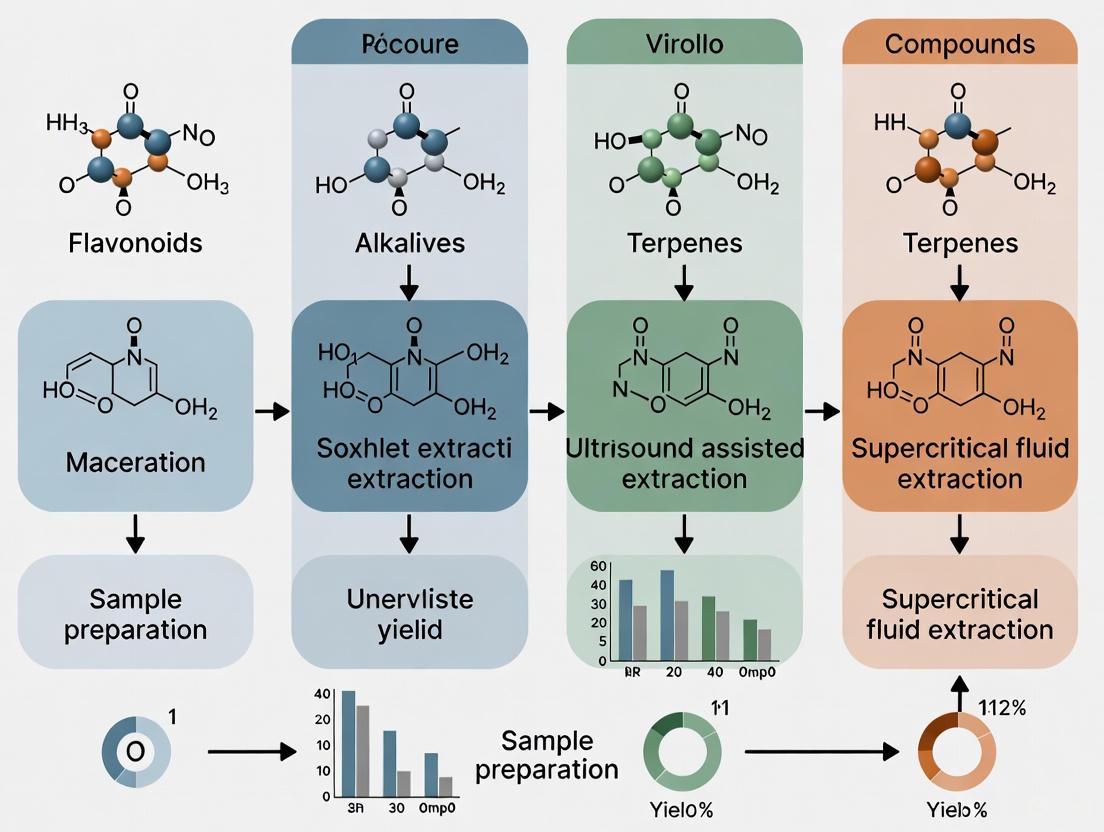
This article provides a critical analysis of modern extraction methodologies for isolating bioactive compounds from natural sources, tailored for researchers and drug development professionals.
Advanced Extraction Techniques for Bioactive Compounds: A Comprehensive Guide for Pharmaceutical Research
Abstract
This article provides a critical analysis of modern extraction methodologies for isolating bioactive compounds from natural sources, tailored for researchers and drug development professionals. It explores the foundational principles of bioactive compounds and the challenges of plant metabolome coverage, detailing advanced techniques like Ultrasound-Assisted Extraction (UAE), Microwave-Assisted Extraction (MAE), and Supercritical Fluid Extraction (SFE). The content delves into practical optimization strategies, including parameter tuning and the integration of Artificial Intelligence (AI) for process control. A comparative evaluation of techniques based on yield, bioactivity, and scalability is presented, alongside modern validation protocols using UHPLC-HRMS and bioautography to ensure compound purity and efficacy for biomedical applications.
Understanding Bioactive Compounds and Extraction Fundamentals
Bioactive compounds, the naturally occurring chemicals with therapeutic potential, are at the forefront of modern pharmaceutical, cosmetic, and functional food development. These compounds, which include phenolics, flavonoids, carotenoids, and alkaloids, exhibit diverse health-promoting effects such as antioxidant, anti-inflammatory, antimicrobial, and neuroprotective activities [1] [2]. The efficient extraction of these valuable molecules from natural sources—ranging from medicinal plants to marine macroalgae—represents a critical challenge for researchers and drug development professionals. Extraction serves as the crucial first step in the analysis of medicinal plants, as it is necessary to extract the desired chemical components from plant materials for further separation and characterization [2]. The selection of appropriate extraction techniques directly influences the yield, purity, and biological activity of the resulting extracts, ultimately determining their suitability for therapeutic applications. With advancements in extraction technology, yields have increased and extracted ingredients have become richer, yet no universal extraction technology exists [3]. This guide provides an objective comparison of contemporary extraction methodologies, supported by experimental data, to inform strategic decisions in bioactive compound research.
Extraction Fundamentals: Principles and Objectives
The fundamental objective of extraction is to efficiently separate bioactive compounds from their native biological matrices while preserving their chemical integrity and biological activity. The process relies on mass transfer principles, where solvents penetrate plant tissues, dissolve target compounds, and diffuse out of the matrix. Key parameters influencing this process include solvent selection, temperature, pressure, extraction time, solvent-to-solid ratio, and the physical characteristics of the source material [1] [2]. The choice of solvent system largely depends on the specific nature of the bioactive compound being targeted, with polar solvents like methanol, ethanol, or ethyl-acetate used for hydrophilic compounds, and dichloromethane or hexane for more lipophilic compounds [2].
Traditional extraction methods, including maceration, percolation, reflux, and Soxhlet extraction, have historically dominated laboratory and industrial practice. These methods are characterized by their operational simplicity and minimal equipment requirements [3]. However, they often suffer from significant limitations, including long extraction times (ranging from several hours to days), high organic solvent consumption, potential thermal degradation of sensitive compounds, and relatively low extraction efficiency [1] [3]. The limitations of traditional solvents, such as lengthy extraction times, high energy consumption, and high toxicity, have prompted the development of more efficient and environmentally friendly alternatives [3].
Modern extraction technologies have emerged to address these limitations, offering improved efficiency, reduced environmental impact, and enhanced selectivity. These advanced techniques, including ultrasound-assisted extraction (UAE), microwave-assisted extraction (MAE), accelerated solvent extraction (ASE), and supercritical fluid extraction (SFE), utilize physical phenomena such as cavitation, dielectric heating, and pressurized solvents to accelerate mass transfer processes [1] [3]. The development of efficient, rapid, and environmentally friendly techniques aligns with the principles of green chemistry, resulting in innovation through the selection of renewable resources, reduced solvent consumption, and lower energy consumption [1].
Comparative Analysis of Extraction Techniques
Performance Metrics and Experimental Data
Different extraction techniques yield significantly different outcomes in terms of bioactive compound recovery. The table below summarizes comparative experimental data from recent studies, highlighting the performance variations across methods and source materials.
Table 1: Comparative Extraction Efficiency for Various Bioactive Compounds
| Source Material | Target Compound | Extraction Method | Optimal Conditions | Yield/Efficiency | Reference |
|---|---|---|---|---|---|
| Cinnamomum zeylanicum (Cinnamon) | Total Phenolic Content (TPC) | Accelerated Solvent Extraction (ASE) | 50% Ethanol | 6.83 ± 0.31 mg GAE/g | [4] |
| Cinnamomum zeylanicum (Cinnamon) | Cinnamaldehyde | Accelerated Solvent Extraction (ASE) | 50% Ethanol | 19.33 ± 0.002 mg/g | [4] |
| Cinnamomum zeylanicum (Cinnamon) | Total Phenolic Content (TPC) | Ultrasonic-Assisted Extraction (UAE) | 50% Ethanol | Lower than ASE | [4] |
| Lemon Peel (Citrus limon L.) | Hesperidin | Modified QuEChERS | Not specified | 48.7% higher yield vs. UAE, 75% shorter time | [5] |
| Oregano Processing Waste | Total Phenolic Content (TPC) | Optimized UAE | >58 min, Ethanol/Water ~1:1 | Maximized TPC | [6] |
| Cecropia Species Leaves | Total Flavonoids (TF), Chlorogenic Acid (CA), Flavonolignans (FL) | Optimized UAE | 70-75% Methanol, 30 min, 1:50 ratio | Maximized TF, CA, and FL yields | [7] |
Technical Parameters and Operational Characteristics
The selection of an extraction technique involves balancing multiple operational parameters, including time, solvent consumption, temperature, and scalability. The following table compares the key characteristics of major extraction methods.
Table 2: Technical Comparison of Extraction Methods for Bioactive Compounds
| Extraction Method | Principle | Operational Temperature | Extraction Time | Solvent Consumption | Key Advantages | Key Limitations |
|---|---|---|---|---|---|---|
| Maceration | Passive diffusion through soaking | Ambient or controlled | 3-4 days | High | Simple equipment, low energy requirement | Time-consuming, low efficiency, high solvent use [2] [3] |
| Soxhlet Extraction | Continuous reflux and siphoning | Solvent boiling point | 3-18 hours | Moderate to High | High throughput, no filtration needed | Long time, thermal degradation, high solvent use [2] [3] |
| Ultrasound-Assisted Extraction (UAE) | Acoustic cavitation disrupting cells | Ambient to moderate | 1-60 minutes | Low to Moderate | Reduced time, lower temperature, improved efficiency | Potential free radical formation, optimization needed [4] [1] [6] |
| Microwave-Assisted Extraction (MAE) | Dielectric heating causing internal pressure buildup | Elevated | Seconds to minutes | Low | Rapid heating, reduced time, high efficiency | Non-uniform heating, limited penetration depth [1] [8] |
| Accelerated Solvent Extraction (ASE) | Pressurized liquid at elevated temperatures | Elevated (50-200°C) | 12-20 minutes per cycle | Low | Automated, fast, reduced solvent, high yield | High equipment cost, limited for thermolabile compounds [4] [1] |
| Supercritical Fluid Extraction (SFE) | Solvation power of supercritical fluids (e.g., CO₂) | Near-ambient to elevated | Moderate | Very Low | Tunable selectivity, no solvent residues, high purity | High capital cost, high pressure operation [1] [3] |
Detailed Methodologies and Workflows
Optimized Ultrasound-Assisted Extraction (UAE) Protocol
UAE has demonstrated significant efficiency improvements for various plant materials. The following workflow illustrates a generalized optimization approach for polyphenol extraction:
Diagram 1: UAE Optimization Workflow. Optimization of UAE requires systematic parameter adjustment to maximize yield [6] [7].
For oregano waste valorization, researchers optimized UAE using a central composite design, maximizing total phenolic content at conditions exceeding 58 minutes extraction time, sample/solvent ratio between 0.058 and 0.078, and ethanol/water ratio approximately 1:1 [6]. The extraction employed an ultrasonic bath system, with the resulting extracts subsequently filtered and dried either by spray drying or freeze drying for stability assessment.
For Cecropia species leaves, researchers implemented a fractional factorial design (FFD) followed by a central composite design (CCD) to optimize the extraction of total flavonoids (TF), chlorogenic acid (CA), and flavonolignans (FL) [7]. The optimized parameters included:
- Methanol fraction: 70-75% (v/v) for TF, 55-72% for CA, and 70-80% for FL
- Extraction temperature: Significant positive effect on all compounds
- Mass/solvent ratio: 1:50 (m/v)
- Particle size: ≤125 µm
- Extraction time: 30 minutes
- Number of extractions: Three with methanol, one with acetone
This systematic optimization approach enabled the development of an appropriate extraction process with time-efficient execution of experiments, with experimental values agreeing with those predicted [7].
Accelerated Solvent Extraction (ASE) Protocol
ASE, also known as pressurized liquid extraction (PLE), utilizes high pressure to maintain solvents in liquid state at temperatures above their normal boiling points, enhancing extraction efficiency.
Table 3: Accelerated Solvent Extraction Protocol for Cinnamomum zeylanicum [4]
| Parameter | Specification |
|---|---|
| Extraction System | Accelerated Solvent Extractor |
| Solvent | 50% Ethanol in Water |
| Temperature | Elevated (specific value not reported) |
| Pressure | High (specific value not reported) |
| Cell Size | Not specified |
| Cycle Configuration | Not specified |
| Total Extraction Time | Not specified |
| Yield Analysis | HPLC for target compounds (cinnamaldehyde, eugenol, cinnamic acid) |
ASE with 50% ethanol yielded the highest total phenolic content (6.83 ± 0.31 mg GAE/g), total flavonoid content (0.50 ± 0.01 mg QE/g), cinnamaldehyde (19.33 ± 0.002 mg/g), eugenol (10.57 ± 0.03 mg/g), and cinnamic acid (0.18 ± 0.004 mg/g), making it superior to UAE for these specific compounds from Cinnamomum zeylanicum [4]. The method demonstrated a strong correlation (R = 0.81) between total phenolic content and total flavonoid content in ASE extracts, indicating that flavonoids are major contributors to the phenolic content.
Modified QuEChERS Protocol for Citrus Compounds
The modified QuEChERS (Quick, Easy, Cheap, Effective, Rugged, and Safe) method has demonstrated superior performance for specific compound classes compared to conventional techniques:
Diagram 2: Modified QuEChERS Extraction Workflow. This method significantly reduces processing time while improving yields for specific compounds [5].
The modified QuEChERS method resulted in the highest extraction efficiency for hesperidin from lemon peel while significantly reducing processing time by 75% compared to ultrasound-assisted extraction [5]. The validated method demonstrated excellent sensitivity (LOQ: 10.0 µg/mL), high accuracy (recovery >93%), and good precision (RSD <3.4%), making it a reliable and cost-effective approach for routine hesperidin analysis in citrus peel.
The Scientist's Toolkit: Essential Research Reagents and Materials
Successful extraction and analysis of bioactive compounds requires carefully selected reagents and materials. The following table details key solutions and their applications in extraction protocols.
Table 4: Essential Research Reagent Solutions for Bioactive Compound Extraction
| Reagent/Material | Function/Application | Extraction Method Compatibility | Key Considerations |
|---|---|---|---|
| Ethanol-Water Mixtures | Extraction of medium-polarity phenolics and flavonoids | UAE, ASE, Maceration, Percolation | Green solvent, food/pharmaceutical safe [4] [6] |
| Methanol-Water Mixtures | High-efficiency extraction of polar compounds | UAE, Soxhlet, Maceration | Higher toxicity, limited for consumables [1] [7] |
| Acetone | Extraction of medium-polarity compounds | UAE, Conventional methods | Moderate toxicity, good extraction efficiency [7] |
| Natural Deep Eutectic Solvents (NADES) | Green alternative to organic solvents | Gas-expanded liquid extraction, UAE, MAE | Tunable properties, biodegradable, biocompatible [1] [9] |
| Dispersive SPE Sorbents | Matrix clean-up and purification | Modified QuEChERS | PSA (primary secondary amine) for polar impurities, C18 for lipophilic compounds [5] |
| Maltodextrin | Encapsulant and stabilizer for extracts | Spray drying, Freeze drying | Protects thermo-labile compounds, improves shelf life [6] |
| Activated Charcoal | Purification and removal of contaminants | Post-extraction clean-up | Effective for pigment removal, may adsorb target compounds [9] |
| HPLC-DAD Systems | Quantification of target bioactive compounds | All extraction methods | Enables simultaneous quantification of multiple compound classes [5] [7] |
Analytical Validation and Quality Assessment
Robust analytical methods are essential for accurate quantification of extracted bioactive compounds. High-performance liquid chromatography with diode array detection (HPLC-DAD) has proven particularly valuable for routine analysis of natural products, offering reliable and reproducible performance with the possibility of online collection of UV spectra [7]. For example, a validated HPLC-DAD method for Cecropia species demonstrated excellent selectivity, linearity, precision (repeatability and intermediate precision below 2% and 5%, respectively), and accuracy (98-102%) for the quantification of chlorogenic acid, total flavonoids, and flavonolignans [7].
Validation parameters for analytical methods should follow international guidelines such as ICH M10, assessing linearity, precision, accuracy, limit of detection (LOD), limit of quantification (LOQ), and robustness [8] [7]. For instance, the modified QuEChERS method for hesperidin quantification demonstrated excellent sensitivity (LOQ: 10.0 µg/mL), high accuracy (recovery >93%), and good precision (RSD <3.4%) [5].
The comparative analysis presented in this guide demonstrates that extraction technique selection must be guided by multiple factors, including target compound characteristics, source material properties, required throughput, and sustainability considerations. While traditional methods like maceration and Soxhlet extraction offer operational simplicity, advanced techniques including UAE, ASE, and modified QuEChERS provide significant advantages in efficiency, yield, and environmental impact. The growing emphasis on green extraction technologies has driven adoption of methods that reduce organic solvent consumption, decrease processing time, and improve sustainability [1] [10]. Furthermore, the integration of phytochemical extraction with biorefinery concepts showcases the potential for circular economy approaches and zero-waste valorization of plant biomass [10]. As research continues, the strategic selection and optimization of extraction methodologies will remain fundamental to unlocking the full therapeutic potential of bioactive compounds from natural sources.
Efficient extraction is a foundational step in natural product-based drug discovery, serving as the critical gateway that transforms raw biological material into the pure compounds needed for pharmaceutical development. The choice of extraction technique directly influences the yield, chemical diversity, and biological activity of isolated compounds, thereby determining the success of downstream discovery pipelines. This guide provides a comparative analysis of modern extraction methodologies, offering scientists a data-driven framework for selecting techniques aligned with specific research objectives.
The Analytical Challenge: A Comparative Framework for Extraction Techniques
The journey from natural source to drug candidate begins with the effective liberation of bioactive compounds from their complex biological matrices. Inefficient extraction can lead to the irreversible loss of valuable chemistries, creating a bottleneck that hampers the entire discovery process. The optimal technique balances extraction efficiency, compound selectivity, operational practicality, and environmental impact [11] [12].
Advanced approaches are increasingly moving beyond single-method paradigms toward hybrid strategies that integrate the robustness of traditional bioassay-guided isolation with the broad analytical power of modern metabolomics [13]. This integrated framework accelerates the identification of novel bioactive entities while ensuring their functional relevance is confirmed through biological testing.
Experimental Protocol for Comparative Extraction Analysis
To generate comparable data on extraction efficiency, a standardized experimental protocol is essential. The following methodology, adapted from studies on grape pomace and cinnamon, provides a replicable framework [11] [4].
- Raw Material Preparation: Biological material (e.g., grape pomace, plant bark) should be dried and ground to a consistent particle size (e.g., 20-40 mesh). Uniform preparation ensures reproducible solvent contact and extraction kinetics [11].
- Solvent Selection: Green solvents like ethanol are prioritized. Ethanol is Generally Recognized as Safe (GRAS), biodegradable, and effective for a broad range of mid-to-low polarity bioactives. Studies often use absolute (anhydrous) ethanol for better penetration and to avoid hydrolytic degradation [11].
- Extraction Techniques: Compared techniques typically include:
- Soxhlet (SOX): Exhaustive heat-reflux extraction.
- Maceration (MAC): Passive room-temperature soaking.
- Ultrasound-Assisted (UAE): Cavitation-enhanced disruption.
- Microwave-Assisted (MAE): Dielectric heating.
- Pressurized Liquid (PLE): High-pressure/temperature extraction.
- Analysis of Extracts: Key performance metrics are quantified:
Performance Comparison of Extraction Techniques
Systematic comparisons under standardized conditions reveal that no single technique excels across all performance metrics. The choice becomes strategic, depending on whether the objective is maximizing yield, enriching specific bioactives, or preserving functional activity.
The table below summarizes quantitative data from direct comparisons of extraction methods for recovering bioactives from grape pomace and cinnamon [11] [4].
Table 1: Quantitative Comparison of Extraction Technique Performance
| Extraction Technique | Extraction Yield (%) | Total Phenolic Content (mg GAE/g) | Antioxidant Activity (IC50, μg/mL) | Key Compounds Identified |
|---|---|---|---|---|
| Soxhlet (SOX) | 13.93 ± 0.19 [11] | Not the highest [11] | 0.13 ± 0.01 (DPPH) [11] | Fatty acids, esters, phytosterols [11] |
| Ultrasound-Assisted (UAE) | Lower than SOX [11] | 87.48 ± 1.05 [11] | 3.26 (ABTS) [4] | Phenolic compounds [11] |
| Microwave-Assisted (MAE) | Moderate [11] | Moderate [11] | Moderate [11] | Varies with source material |
| Pressurized Liquid (PLE) | Moderate [11] | High [4] | Data not available | Cinnamaldehyde, Eugenol [4] |
| Accelerated Solvent (ASE)* | Data not available | 6.83 ± 0.31 [4] | No significant difference to UAE [4] | Cinnamaldehyde (19.33 ± 0.002 mg/g) [4] |
*ASE is considered a type of PLE under controlled conditions.
Interpreting the Data: Trade-offs and Strategic Selection
- Soxhlet Extraction remains the benchmark for exhaustive recovery and maximum yield, as its continuous solvent cycling efficiently exhausts the raw material. Interestingly, while its phenolic content may be lower than UAE, it can demonstrate superior antioxidant activity, indicating that the specific compounds it extracts are highly potent or that non-phenolic antioxidants are being recovered [11].
- Ultrasound-Assisted Extraction excels at liberating phenolic compounds, achieving the highest TPC values. This makes UAE ideal for projects targeting this major class of antioxidants. The mechanical effects of acoustic cavitation effectively break cell walls, enhancing release of intracellular compounds [11].
- Modern Techniques (MAE, PLE/ASE) offer an excellent balance of speed, efficiency, and green credentials. ASE with 50% ethanol has been shown to optimally recover specific bioactive markers like cinnamaldehyde and eugenol from cinnamon, demonstrating high selectivity and efficiency [4].
Table 2: Strategic Selection Guide for Extraction Techniques
| Research Objective | Recommended Technique | Rationale | Key Limitations |
|---|---|---|---|
| Maximize Crude Extract Yield | Soxhlet (SOX) | Exhaustive nature provides highest mass recovery [11] | High temperature can degrade thermolabile compounds; high solvent consumption |
| Maximize Polyphenol Recovery | Ultrasound-Assisted (UAE) | Cavitation effectively ruptures plant cells rich in phenolics [11] | May be less effective for non-polar compounds; scaling challenges |
| Target Specific Bioactive Markers | Accelerated Solvent (ASE) | High pressure and temperature enable efficient and selective recovery [4] | Equipment cost; potential for thermal degradation if not optimized |
| Rapid, Low-Volume Screening | μ-SPEed | High-throughput, minimal solvent use, ideal for small samples [14] | Limited capacity for bulk processing |
| Minimize Environmental Impact | Pressurized Liquid (PLE) | Reduced solvent consumption; often uses green solvents like ethanol [11] | Capital investment; optimization complexity |
The Scientist's Toolkit: Essential Research Reagent Solutions
The following reagents and materials are fundamental for implementing the extraction protocols discussed in this guide.
Table 3: Essential Research Reagent Solutions for Bioactive Extraction
| Item | Function/Application | Example Use Case |
|---|---|---|
| Absolute Ethanol | Green, GRAS-certified solvent for mid-to-low polarity bioactives [11] | Primary extraction solvent for grape pomace phenolics [11] |
| Hydrophilic-Lipophilic Balance (HLB) Sorbent | Solid-phase extraction for purifying complex extracts [15] | Purification of phosphopeptides from tissue digests [15] |
| C18-Bonded Silica Sorbent | Non-polar stationary phase for reversed-phase SPE [16] [15] | Clean-up and concentration of phenolic compounds prior to LC-MS |
| Silica Gel 60 UV254 Plates | Stationary phase for TLC/HPTLC analysis [16] | Monitoring extraction progress and preliminary compound identification |
| Folin-Ciocalteu Reagent | Quantification of total phenolic content (TPC) [11] [4] | Standard assay for evaluating extraction efficiency of antioxidants |
| DPPH/ABTS Radicals | Evaluation of antioxidant activity in extracts [11] [4] | Functional bioactivity screening of extracts |
Workflow Visualization: From Raw Material to Drug Candidate
The following diagram illustrates the integrated, decision-based workflow for applying extraction techniques within a modern natural product drug discovery pipeline.
The imperative for efficient extraction in drug discovery is clear: the initial choice of technique fundamentally shapes the chemical landscape available for screening. As the data demonstrates, strategic selection is paramount. Researchers must align their method with the project's primary goal—be it maximizing yield with Soxhlet, enriching phenolics with UAE, or targeting specific markers with ASE. Looking forward, the future lies not in a single superior technique, but in the intelligent integration of methods and data. Hybrid approaches that couple the functional validation of bioassay-guided isolation with the comprehensive chemical profiling of metabolomics represent the most powerful path forward [13]. By adopting this strategic, data-driven mindset, scientists can transform the extraction phase from a potential bottleneck into a powerful engine for accelerating natural product drug discovery.
Plant metabolomics faces the fundamental challenge of capturing an immense chemical diversity, comprising both primary metabolites essential for growth and development and a vast array of secondary metabolites with species-specific functions. This complexity is compounded by the broad dynamic range of metabolite concentrations and their varying physicochemical properties, from highly polar sugars to non-polar lipids. No single extraction or analytical technique can comprehensively cover the entire plant metabolome, making the choice of methodology a critical determinant of experimental outcomes [17] [18].
The extraction technique employed significantly influences the resulting metabolic profile by selectively recovering certain compound classes while excluding others. This selection bias directly impacts the biological interpretations and conclusions drawn from metabolomic studies. Understanding the strengths, limitations, and applications of different extraction methods is therefore essential for designing experiments that effectively address specific research questions in plant science, drug discovery, and bioactive compound research [3] [18].
Comparative Analysis of Extraction Techniques
Conventional Extraction Methods
Traditional extraction techniques, while historically important, present significant limitations for comprehensive metabolome coverage. Maceration involves soaking plant material in solvents for extended periods, offering simple operation but requiring large solvent volumes and prolonged extraction times. Percolation provides continuous solvent flow through plant material, improving efficiency but further increasing solvent consumption. Reflux extraction uses heated solvents in a closed system to prevent solvent loss, but thermal degradation can compromise heat-sensitive compounds. Soxhlet extraction enables continuous extraction with solvent recycling but subjects compounds to prolonged high temperatures, potentially degrading thermolabile metabolites [3].
These conventional methods share common drawbacks, including high solvent consumption, long processing times, and potential degradation of sensitive compounds like flavonoids and polyphenols due to excessive heat exposure. While these techniques may be suitable for targeting specific, abundant metabolites, their limited efficiency and potential to alter native metabolic profiles render them suboptimal for untargeted metabolomics aiming for comprehensive coverage [3] [18].
Advanced Green Extraction Technologies
Advanced extraction technologies have emerged to address the limitations of conventional methods, offering improved efficiency, selectivity, and preservation of bioactive compounds.
Microwave-Assisted Extraction (MAE): Utilizes microwave energy to rapidly heat plant material internally, enhancing cell disruption and compound release. MAE significantly reduces extraction time and solvent consumption while improving yields for various metabolite classes [3] [18].
Ultrasound-Assisted Extraction (UAE): Employs acoustic cavitation to disrupt cell walls and enhance mass transfer. UAE operates at lower temperatures, better preserving heat-sensitive compounds while increasing extraction efficiency and reducing processing time [3] [18].
Supercritical Fluid Extraction (SFE): Typically uses supercritical CO₂ as a tunable extraction medium. By adjusting temperature and pressure, SFE can selectively target different compound classes without solvent residues. This method is particularly valuable for lipophilic compounds and for applications requiring high-purity extracts [3].
Pressurized Liquid Extraction (PLE): Uses solvents at elevated temperatures and pressures to enhance extraction efficiency while reducing time and solvent volume. The controlled conditions improve reproducibility compared to conventional methods [3].
Performance Comparison of Extraction Techniques
Table 1: Comparison of Extraction Techniques for Plant Metabolome Coverage
| Extraction Method | Mechanism | Target Metabolites | Advantages | Limitations |
|---|---|---|---|---|
| Maceration | Passive diffusion in solvent | Broad spectrum, polarity-dependent | Simple equipment, low cost | Long extraction time, high solvent use |
| Soxhlet | Continuous solvent cycling | Medium-nonpolar compounds | High efficiency, no filtration needed | Thermal degradation, long process |
| Microwave-Assisted (MAE) | Microwave-induced cell disruption | Polar to medium-polar compounds | Rapid, reduced solvent, high yield | Potential hotspot formation |
| Ultrasound-Assisted (UAE) | Cavitation-induced cell rupture | Broad spectrum, especially thermolabile | Low temperature, improved kinetics | Limited scale-up potential |
| Supercritical Fluid (SFE) | Solvation with supercritical CO₂ | Lipophilic compounds | Tunable selectivity, no solvent residue | High equipment cost, limited polarity |
| Enzyme-Assisted (EAE) | Cell wall degradation | Bound metabolites, glycosides | Mild conditions, high selectivity | Enzyme cost, optimized parameters needed |
Table 2: Impact of Extraction Methods on Bioactive Compound Recovery and Application
| Extraction Method | Antioxidant Compound Yield | Anti-inflammatory Compound Preservation | Antimicrobial Compound Recovery | Recommended Applications |
|---|---|---|---|---|
| Solvent-based | Moderate to high (depends on solvent polarity) | Moderate (thermal degradation possible) | Moderate to high | Initial screening, cost-sensitive applications |
| Ultrasound-Assisted | High (especially flavonoids) | High (preserves thermolabile phenolics) | High (efficient cell disruption) | Thermosensitive compound extraction |
| Microwave-Assisted | High (reduced degradation) | Moderate to high | High | Rapid extraction of stable compounds |
| Supercritical Fluid | Selective for lipophilic antioxidants | High for terpenoids | Selective | Pharmaceutical/nutraceutical applications |
| Enzyme-Assisted | High for bound phenolics | High for glycosylated compounds | Specific to substrate | Release of bound bioactive compounds |
Methodological Considerations for Optimal Metabolome Coverage
Solvent Selection Strategies
Solvent polarity is a primary determinant of metabolite recovery in extraction protocols. Polar solvents (e.g., methanol, ethanol, water) effectively extract hydrophilic compounds like phenolics, flavonoids, and sugars, while non-polar solvents (e.g., hexane, chloroform) target lipophilic metabolites including terpenoids, carotenoids, and chlorophyll. Binary solvent systems often provide broader metabolome coverage by extracting compounds across a wider polarity range [18].
Recent advances in green alternative solvents address toxicity concerns associated with traditional organic solvents. Bio-based solvents, ionic liquids, and deep eutectic solvents offer improved environmental profiles while maintaining extraction efficiency. These alternatives are particularly valuable for pharmaceutical and nutraceutical applications where solvent residues pose safety concerns [3].
Integration and Hybrid Approaches
Hybrid extraction strategies that combine multiple techniques often yield superior metabolome coverage compared to single-method approaches. For instance, enzyme-assisted extraction followed by ultrasound or microwave processing can enhance the release of cell wall-bound metabolites while improving overall extraction efficiency [18].
The sequential application of extraction methods with complementary selectivity represents another powerful strategy. Initial non-polar solvent extraction can target lipophilic compounds, followed by polar solvent extraction for hydrophilic metabolites. This approach effectively "fractionates" the metabolome, reducing complexity in individual analytical runs and improving detection of low-abundance metabolites [18].
Experimental Protocols for Method Comparison
Standardized Workflow for Method Evaluation
To ensure meaningful comparison between extraction techniques, researchers should implement a standardized workflow:
Sample Preparation: Use identical plant source material with controlled genetic background, growth conditions, and developmental stage. Lyophilize samples and homogenize to consistent particle size (e.g., 0.5-1.0 mm) to minimize variability [18].
Extraction Conditions: Maintain consistent sample-to-solvent ratio (e.g., 1:10 to 1:20) and extraction duration across methods when comparable. Adjust method-specific parameters (e.g., temperature, power settings) according to established protocols for each technique.
Post-Extraction Processing: Employ standardized filtration, concentration, and storage conditions to prevent technical artifacts.
Quality Controls: Include internal standards added prior to extraction to monitor recovery and analytical performance [19].
Protocol for Solvent-Based Extraction Comparison
Materials: Plant material powder, methanol, ethanol, acetonitrile, hexane, ethyl acetate, water, internal standards mixture.
Procedure:
- Accurately weigh 100 mg of homogeneous plant powder into separate extraction vessels.
- Add 2 mL of each test solvent plus internal standards mixture.
- Perform extraction with shaking (200 rpm) at 25°C for 60 minutes.
- Centrifuge at 14,000 × g for 10 minutes.
- Collect supernatant and evaporate under nitrogen stream.
- Reconstitute in 100 μL methanol:water (1:1, v/v) for analysis.
- Analyze all extracts using identical LC-MS/GC-MS conditions [19].
Protocol for Ultrasound-Assisted Extraction
Materials: Plant material powder, methanol, ultrasonic probe or bath, temperature control system.
Procedure:
- Weigh 100 mg plant powder into extraction vessel.
- Add 2 mL methanol and suspend homogenously.
- Subject to ultrasonic treatment (e.g., 40 kHz, 300 W) for 5-15 minutes with temperature maintained below 40°C.
- Centrifuge at 14,000 × g for 10 minutes.
- Collect supernatant for analysis [3] [18].
Solid-Phase Extraction Cleanup Protocol
Materials: Methanol extracts, Phree phospholipid removal tubes or equivalent C18 SPE cartridges, vacuum manifold.
Procedure:
- Condition SPE sorbent with appropriate solvent.
- Load methanol extract onto cartridge.
- Wash with water or mild solvent to remove polar interferences.
- Elute metabolites with progressively stronger solvents.
- Evaporate and reconstitute for analysis [20] [19].
Analytical Considerations for Comprehensive Coverage
Complementary Analytical Platforms
Comprehensive plant metabolome coverage typically requires multiple analytical platforms due to the diverse physicochemical properties of metabolites:
GC-MS: Ideal for volatile compounds and derivatized polar metabolites (e.g., organic acids, sugars, amino acids). Provides excellent separation efficiency and reproducible fragmentation patterns for compound identification [21] [22].
LC-MS: Suitable for semi-polar and non-polar compounds, including secondary metabolites (e.g., flavonoids, alkaloids). Reversed-phase chromatography separates compounds by hydrophobicity, while HILIC mode targets polar metabolites [23].
LC-Nano-ESI-MS: Offers enhanced sensitivity for detecting low-abundance metabolites through improved ionization efficiency. Particularly valuable for limited samples or trace compound analysis [23].
Method Validation Parameters
Rigorous method validation should assess multiple performance characteristics:
- Extraction Efficiency: Calculate using internal standards and comparison to established methods.
- Repeatability: Determine through intra- and inter-day precision measurements (%RSD).
- Linearity: Evaluate across relevant concentration ranges.
- Matrix Effects: Assess by comparing standards in solvent versus matrix.
- Metabolite Coverage: Quantify by number of detected features with confident annotations [19].
Research Reagent Solutions for Plant Metabolomics
Table 3: Essential Research Reagents for Plant Metabolome Extraction and Analysis
| Reagent/Category | Specific Examples | Function in Metabolomics Workflow |
|---|---|---|
| Extraction Solvents | Methanol, Acetonitrile, Ethanol, Water, Hexane, Chloroform | Primary extraction media with selective polarity for metabolite classes |
| Derivatization Reagents | N-Methyl-N-(trimethylsilyl)trifluoroacetamide (MSTFA), N,O-Bis(trimethylsilyl)trifluoroacetamide (BSTFA) | Increase volatility of polar metabolites for GC-MS analysis |
| Internal Standards | Succinic acid-2,3-13C2, L-tyrosine-(phenyl-3,5-d2), D-glucose-13C6 | Monitor extraction efficiency, instrument performance, and quantify metabolites |
| Solid-Phase Extraction Sorbents | C18, Phree phospholipid removal tubes, Mixed-mode phases | Remove interfering compounds (e.g., phospholipids) and fractionate metabolite classes |
| Mobile Phase Additives | Formic acid, Ammonium acetate, Ammonium formate | Enhance chromatographic separation and ionization efficiency in LC-MS |
| Isotopically Labeled Standards | 13C, 15N, or 2H labeled amino acids, organic acids, sugars | Absolute quantification in targeted metabolomics |
Workflow Visualization
Comprehensive Plant Metabolomics Workflow
Navigating the chemical complexity of plant metabolomes requires careful consideration of extraction methodologies and their impact on metabolite coverage. While advanced techniques like UAE, MAE, and SFE offer significant improvements in efficiency and compound preservation, the optimal approach often involves integrated strategies that leverage the complementary strengths of multiple methods.
The growing emphasis on green chemistry principles and standardized protocols will enhance reproducibility and comparability across studies. Future methodological developments will likely focus on miniaturized extraction systems, automated workflows, and integrated multi-omics approaches that provide more comprehensive insights into plant metabolic networks. By strategically selecting and combining extraction techniques based on specific research objectives, scientists can more effectively navigate the challenges of plant metabolome coverage and unlock the full potential of plant-derived bioactive compounds for pharmaceutical and nutraceutical applications.
The efficacy of extracting bioactive compounds from natural sources is critically dependent on the selection of an appropriate solvent. The process is governed by the principle of "like dissolves like," where solvents with polarity values similar to the target solute generally achieve higher extraction efficiency [24]. This selection process requires a careful balance between maximizing the yield of desired phytochemicals and adhering to safety and environmental sustainability principles. Solvent choice directly influences not only the quantity of the extracted compounds but also their biological activity, which is paramount for applications in pharmaceutical development, functional foods, and nutraceuticals [25] [26]. Researchers must navigate a complex interplay of factors including solvent polarity, toxicity, cost, and environmental impact, while also considering how the solvent interacts with the plant matrix and the specific extraction methodology employed [26] [24].
The growing demand for natural products across various industries has accelerated research into optimizing extraction processes. Modern solvent selection extends beyond mere efficiency to encompass the principles of green chemistry, which emphasize the use of safer, bio-based, and environmentally benign solvents [25] [27]. This comprehensive guide examines the fundamental principles of solvent selection, supported by experimental data from recent studies, to provide researchers with evidence-based strategies for optimizing the extraction of bioactive compounds while balancing polarity, toxicity, and efficiency considerations.
Fundamental Principles of Solvent Polarity
The "Like Dissolves Like" Rule and Solvent Classification
The cornerstone of solvent selection is the principle of "like dissolves like," which posits that solvents are most effective at dissolving compounds with similar polarity characteristics [24]. Polarity refers to the distribution of electrical charge across a molecule; polar solvents have uneven charge distribution and are typically characterized by the presence of functional groups such as hydroxyls or carbonyls, while non-polar solvents have more even charge distribution [28]. This polarity matching is crucial because it determines the solute-solvent interactions that drive the dissolution process.
Solvents can be broadly categorized based on their polarity and dielectric constants. Polar protic solvents (e.g., water, methanol, ethanol) can form hydrogen bonds and are particularly effective for extracting polar compounds like phenolic acids and flavonoid glycosides. Polar aprotic solvents (e.g., acetone, ethyl acetate) possess dipole moments but lack acidic hydrogen and are suitable for medium-polarity compounds. Non-polar solvents (e.g., hexane, chloroform, dichloromethane) are ideal for extracting lipophilic substances such as oils, waxes, and less polar terpenoids [29] [25]. The polarity of solvents directly affects the extraction yield and composition of bioactive compounds, as demonstrated in studies where different solvents yielded extracts with distinct phytochemical profiles and biological activities [30] [29].
Beyond Pure Solvents: The Advantage of Binary Mixtures
While pure solvents are effective for specific compound classes, binary solvent systems often demonstrate superior extraction efficiency for complex plant matrices containing compounds of varying polarities. The strategic combination of water with organic solvents such as ethanol, methanol, or acetone creates a mixed-polarity environment that can simultaneously extract both polar and mid-polarity compounds [28] [26]. The addition of water to organic solvents enhances the overall extraction efficiency by swelling the plant matrix and increasing the diffusivity of the solvent into the cellular structures, thereby facilitating the release of intracellular compounds [26].
Recent research on Sideritis species demonstrated that 70% ethanol was more effective for extracting various phytochemical classes, including flavonoids, phenylethanoid glycosides, and terpenoids, compared to pure organic solvents or pure water [26]. Similarly, a study optimizing extraction from pitaya cultivars found that ternary mixtures, particularly F5 (25% ethanol, 25% methanol, and 50% water), outperformed pure solvents in extracting antioxidant compounds, phenolics, and betalains, with increases of up to 25.8% in antioxidant activity compared to the least effective solvents [28]. This synergistic effect stems from the complementary polarities of the solvent components, which collectively cover a broader polarity range and enhance mass transfer processes.
Comparative Experimental Data on Solvent Performance
Extraction Efficiency Across Different Plant Matrices
Table 1: Comparison of solvent performance across different plant matrices and target compounds
| Plant Material | Target Compounds | Most Effective Solvent(s) | Extraction Yield/Bioactive Content | Citation |
|---|---|---|---|---|
| Matthiola ovatifolia (Aerial parts) | Total phenolics, flavonoids, tannins, alkaloids, saponins | Ethanol (MAE method) | Total phenolics: 69.6 mg GAE/g DW; Flavonoids: 44.5 mg QE/g DW; Tannins: 45.3 mg catechin/g DW; Alkaloids: 71.6 mg AE/g DW; Saponins: 285.6 mg EE/g DW | [30] |
| Sideritis raeseri and S. scardica | Flavonoids, phenylethanoid glycosides, phenolic acids | 70% Ethanol (UAE, MAE, HP) | ~3x higher overall metabolite recovery vs. conventional extraction; High antioxidant activity | [26] |
| Olea europaea (Olive leaf) | Antimicrobial compounds | Ethanol, Acetone | Strongest antimicrobial activity against S. aureus and E. coli | [29] |
| Acacia dealbata (Mimosa leaf) | Antimicrobial compounds | Ethanol, Acetone | Strongest antimicrobial activity against S. aureus and E. coli | [29] |
| Pitaya cultivars | Antioxidants, phenolics, betalains | F5 (25% Ethanol, 25% Methanol, 50% Water) | 25.8% ↑ antioxidant activity, 23.5% ↑ total phenolics, 22.7% ↑ betacyanins, 27.0% ↑ betaxanthins vs. least effective solvents | [28] |
| Microalgae | Lipids (for biodiesel) | Hexane, Chloroform | Lipid yield: 100.01 mg/g (Hexane), 94.33 mg/g (Chloroform) vs. 40.12 mg/g (Methanol), 86.91 mg/g (Acetone) | [31] |
Influence of Solvent on Bioactivity of Extracts
The choice of extraction solvent not only affects the quantitative yield of phytochemicals but also qualitatively influences the bioactivity profile of the resulting extracts. Different solvents possess varying selectivity for specific compound classes, leading to extracts with distinct biological properties. For instance, in a study on Olea europaea and Acacia dealbata, ethanol and acetone were identified as the most effective solvents for extracting compounds with antimicrobial activity, regardless of the extraction method employed [29]. This suggests that these solvents preferentially dissolve antimicrobial principles from the plant matrix.
Similarly, the polarity of solvents significantly influenced the fatty acid methyl esters (FAMEs) composition and biodiesel properties of microalgal lipids. Chloroform extraction yielded lipids with higher saturated fatty acids content (61.53%) compared to methanol extraction (38.85%), which consequently affected fuel properties such as cetane number and oxidative stability [31]. These findings underscore how solvent selection can be strategically used to tailor extract composition for specific applications, whether for pharmaceutical, nutraceutical, or industrial purposes.
Toxicity and Environmental Considerations
Green Solvent Alternatives in Modern Extraction
The growing emphasis on sustainable laboratory practices has accelerated the development and adoption of green solvents that reduce environmental impact while maintaining extraction efficiency. Traditional organic solvents such as chloroform, dichloromethane, and hexane face increasing regulatory restrictions due to their toxicity, environmental persistence, and potential health hazards [25] [27]. Green solvents are characterized by favorable safety profiles, low toxicity, biodegradability, and preferably, derivation from renewable resources [27].
Promising green solvent classes include:
- Bio-based alcohols (ethanol, isopropanol): Ethanol is particularly valuable as it is relatively non-toxic, biodegradable, and can be derived from renewable resources, making it suitable for food and pharmaceutical applications [26].
- Ethyl lactate: Derived from lactic acid and ethanol, both from renewable resources, it offers low toxicity and high biodegradability.
- Natural deep eutectic solvents (NADES): These are mixtures of natural compounds such as choline chloride combined with sugars, alcohols, or organic acids that form liquids with favorable extraction properties for various bioactive compounds [9].
- Supercritical fluids: Particularly supercritical CO₂, which is non-flammable, non-toxic, and easily removed from extracts, though it requires specialized equipment [26].
Recent research on citrus biomass extraction demonstrated that gas-expanded NADES could effectively extract bioactive compounds while maintaining the potential for solvent recovery and reuse, highlighting the circular economy approach in extraction technology [9].
Solvent Selection Guides and Miscibility Considerations
To assist researchers in solvent selection, several pharmaceutical companies and consortia have developed solvent selection guides that rank solvents based on their environmental, health, and safety profiles. The CHEM21 solvent selection guide, for instance, categorizes solvents as "recommended," "problematic," "hazardous," or "highly hazardous" based on comprehensive assessment criteria [27]. These guides promote the substitution of hazardous solvents with greener alternatives while considering technical performance.
Miscibility between solvents is another critical practical consideration, particularly for processes involving liquid-liquid extraction, chromatography, or multi-solvent systems. Traditional miscibility tables have recently been updated to include emerging green solvents, providing researchers with valuable data for designing extraction and purification workflows [27]. For example, the miscibility of 28 green solvents was systematically evaluated to facilitate the replacement of hazardous solvents in various chemical processes, including natural product extraction [27].
Integration with Extraction Techniques
Synergistic Effects Between Solvents and Extraction Methods
The efficiency of solvent extraction is profoundly influenced by the extraction technique employed, with different methods leveraging distinct mechanisms to enhance compound recovery. Modern assisted extraction techniques can significantly improve solvent performance by facilitating better matrix penetration and compound dissolution.
Table 2: Performance of solvent-extraction technique combinations for bioactive compound recovery
| Extraction Method | Mechanism of Action | Optimal Solvent Characteristics | Reported Advantages | Citation |
|---|---|---|---|---|
| Microwave-Assisted Extraction (MAE) | Volumetric heating, cell rupture by internal pressure | Medium dielectric constant for microwave absorption | Highest phytochemical yield from M. ovatifolia; Reduced processing time and solvent consumption | [30] |
| Ultrasound-Assisted Extraction (UAE) | Cavitation, cell wall disruption | Moderate viscosity for cavitation propagation | Improved extraction yield for Sideritis spp.; Shorter extraction time; Preservation of thermolabile compounds | [30] [26] |
| Ultrasound-Microwave-Assisted Extraction (UMAE) | Combined cavitation and volumetric heating | Balanced dielectric constant and viscosity | Synergistic cell disruption; Enhanced recovery efficiency | [30] |
| Conventional Solvent Extraction (CSE) | Diffusion, osmosis | Wide range depending on target compounds | Simple setup; Familiar methodology; Lower equipment cost | [30] |
| Pressurized Liquid Extraction (PLE) | Enhanced penetration at high pressure | Thermal stability | High metabolite recovery from Sideritis spp.; Similar recovery in <20 min vs. 2 h boiling | [26] |
Methodological Protocols for Optimal Extraction
Based on the reviewed literature, the following protocols represent optimized methodologies for bioactive compound extraction:
Protocol 1: Microwave-Assisted Extraction (MAE) for Phytochemical-Rich Extracts
- Plant Preparation: Lyophilize aerial parts and grind to fine powder [30].
- Solvent System: Ethanol demonstrates superior performance for comprehensive phytochemical recovery [30].
- Parameters: Solid-to-liquid ratio of 1:30 (g/mL), microwave power of 550W, extraction time of 165 seconds [30].
- Procedure: Combine plant material with solvent in MAE vessel. Extract under specified parameters. Centrifuge at 10,000×g for 10 minutes at 4°C. Collect supernatant and concentrate at 40°C using rotary evaporation [30].
- Applications: Optimal for simultaneous extraction of multiple phytochemical classes (phenolics, flavonoids, alkaloids, saponins) with enhanced biological activities [30].
Protocol 2: Ultrasound-Assisted Extraction (UAE) for Thermolabile Compounds
- Plant Preparation: Lyophilize and grind plant material to increase surface area [30] [26].
- Solvent System: 70% ethanol for balanced polarity or binary mixtures tailored to target compounds [26].
- Parameters: Solid-to-liquid ratio of 1:30 (g/mL), ultrasonic power of 250W, extraction time of 15 minutes [30].
- Procedure: Mix plant material with solvent in ultrasound bath. Sonicate for specified time. Centrifuge at 10,000×g for 10 minutes at 4°C. Collect supernatant and concentrate [30].
- Applications: Ideal for thermolabile compounds; improves overall metabolite recovery approximately 3-fold compared to conventional extraction [26].
Protocol 3: Solvent Mixture Optimization for Complex Matrices
- Approach: Test binary and ternary mixtures of water with ethanol, methanol, and/or acetone [28].
- Optimization: Evaluate different proportions to identify optimal synergy for target compounds.
- Procedure: Prepare solvent mixtures according to experimental design. Perform extraction using preferred method (UAE, MAE, or conventional). Compare extraction efficiency using spectrophotometric and chromatographic analyses [28].
- Applications: Particularly effective for plants with diverse bioactive compounds spanning a range of polarities, such as pitaya with its antioxidants, phenolics, and betalains [28].
The Scientist's Toolkit: Essential Research Reagents and Materials
Table 3: Essential research reagents and materials for solvent extraction of bioactive compounds
| Item | Function/Application | Examples/Notes |
|---|---|---|
| Ethanol (especially 70-100%) | Extraction of broad-spectrum phytochemicals; Green alternative | Effective for phenolics, flavonoids, saponins; Preferred for food/pharma applications [30] [26] |
| Acetone | Extraction of antimicrobial compounds and medium-polarity molecules | Effective for antimicrobial principles from olive and mimosa leaves [29] |
| Methanol | High-efficiency extraction of phenolics | Often highest extraction yield but toxicity concerns for some applications [29] |
| Water | Green solvent for polar compounds; Component of binary mixtures | Enhances solvent diffusivity in matrix; Swells plant material [26] |
| Binary Solvent Mixtures | Enhanced extraction of complex phytochemical profiles | Water-ethanol, water-acetone, water-methanol combinations [28] [26] |
| NADES | Green alternative with tunable properties | Choline chloride-based mixtures for specialized applications [9] |
| Folinciocalteu Reagent | Quantification of total phenolic content | Spectrophotometric analysis at 765nm [30] |
| ABTS/DPPH Reagents | Assessment of antioxidant capacity | Standardized assays for radical scavenging activity [29] |
| Aluminum Chloride | Flavonoid content determination | Complexation with flavonoids for spectrophotometric quantification [30] |
| Rotary Evaporator | Solvent removal from extracts | Gentle concentration at controlled temperatures (e.g., 40°C) [30] |
Decision Framework and Future Perspectives
Integrated Workflow for Solvent Selection
The following workflow diagram illustrates a systematic approach to solvent selection for bioactive compound extraction:
Emerging Trends and Future Directions
The field of solvent extraction for bioactive compounds continues to evolve, with several promising trends emerging. Natural deep eutectic solvents (NADES) represent a particularly innovative approach, offering tunable physicochemical properties and high biodegradability [9]. Research on citrus biomass has demonstrated the feasibility of combining NADES with gas-expanded technology, followed by effective solvent removal using activated charcoal or antisolvent methods to obtain NADES-free bioactive extracts [9].
The integration of machine learning and computational modeling in solvent selection processes shows significant potential for accelerating method development. These approaches can predict solvent behavior, miscibility, and extraction efficiency, reducing the need for extensive experimental screening [32]. Additionally, continuous flow extraction technologies are gaining attention for their potential to reduce solvent consumption and improve process control, though they present unique challenges in solvent management, particularly regarding solubility maintenance and prevention of system clogging [32].
Future research directions likely include the development of more sophisticated solvent recycling systems, the design of switchable solvents whose properties can be modulated during the extraction process, and increased emphasis on life cycle assessment (LCA) to comprehensively evaluate the environmental impact of extraction processes from cradle to grave [27] [32]. As these technologies mature, they will further enable researchers to balance the critical factors of polarity, toxicity, and efficiency in solvent selection for bioactive compound extraction.
A Practical Guide to Advanced Extraction Technologies
Microwave-Assisted Extraction (MAE) has emerged as a prominent green extraction technology, revolutionizing the process of obtaining bioactive compounds from natural sources. This technique utilizes microwave energy to rapidly heat solvents in contact with a sample matrix, facilitating efficient partitioning of analytes from the solid matrix into the solvent [33] [34]. The fundamental advantage of MAE lies in its ability to significantly reduce extraction times—typically to just 15-30 minutes—while simultaneously decreasing solvent consumption by approximately tenfold compared to conventional techniques like Soxhlet extraction [34]. These attributes, combined with enhanced extraction efficiency and improved reproducibility, have established MAE as a cornerstone technology in sustainable extraction methodologies for researchers, scientists, and drug development professionals [35].
The global shift toward environmentally friendly industrial practices has accelerated MAE adoption across food, pharmaceutical, and cosmetic industries. As a sustainable alternative to conventional methods, MAE leverages volumetric heating to achieve rapid, efficient, and selective recovery of natural compounds while preserving their bioactivity [35]. This technical overview examines MAE's fundamental principles, mechanisms, and operational parameters, providing a scientific foundation for its application in bioactive compound research.
Fundamental Principles and Mechanisms
Theoretical Foundations of Microwave Heating
MAE operates based on the interaction between microwave electromagnetic energy and materials. Microwaves occupy the electromagnetic spectrum between 300 MHz and 300 GHz, with 2.45 GHz being the standard frequency for laboratory equipment due to its effective penetration depth and heating characteristics [36] [37]. This frequency corresponds to a wavelength of approximately 12.2 cm, which optimally interacts with molecular dipoles in the extraction system.
The heating mechanism in MAE fundamentally differs from conventional conduction-based heating. While traditional methods rely on thermal gradients that gradually transfer heat from the outside inward, microwave energy generates heat volumetrically through direct interaction with the sample and solvent molecules [37]. This direct energy transfer eliminates thermal latency and enables simultaneous heating throughout the material, leading to dramatically reduced extraction times.
Working Mechanism of MAE
The MAE process involves a synergistic combination of heat and mass transfer working in the same direction, unlike conventional methods where mass transfer occurs from inside to outside while heat transfer proceeds in the opposite direction [37]. The extraction mechanism follows a sequence of distinct phenomenological events:
- Selective Heating: Microwave energy directly targets polar molecules and ionic species within the plant matrix, particularly residual water present in plant cells [33].
- Rapid Temperature Rise: The intense, localized heating causes a swift temperature increase, transforming liquid water into vapor [37].
- Pressure Buildup: The vaporized solvents create enormous internal pressure within plant cells [38].
- Cell Wall Rupture: The accumulated pressure exceeds the cell wall's structural integrity, leading to cell disruption and rupture [37].
- Compound Release: The compromised cellular structure enables efficient leaching of bioactive compounds into the surrounding solvent [37].
This mechanism is visually summarized in the following diagram:
The exceptional efficiency of MAE stems from this direct cellular disruption, which creates efficient passageways for solute transfer from the plant matrix to the solvent while minimizing thermal degradation through reduced processing times [39].
Critical Operational Parameters
MAE efficiency depends on several interconnected parameters that require optimization for each specific application and plant matrix. Understanding these factors enables researchers to design efficient extraction protocols tailored to their target compounds.
Solvent Selection and Properties
Solvent choice profoundly influences MAE efficiency due to varying microwave absorption capacities. Solvents with high dielectric constants (ε) and dielectric losses absorb microwave energy more effectively [37]. The table below summarizes dielectric properties of common MAE solvents:
Table 1: Dielectric Properties of Common MAE Solvents
| Solvent | Dielectric Constant | Dielectric Loss | Loss Tangent | Microwave Absorption |
|---|---|---|---|---|
| Water | 80.4 | 12.3 | 9.889 | Excellent |
| Ethanol | 24.3 | 22.866 | 0.941 | Excellent |
| Ethylene Glycol | 37.0 | 49.950 | 1.350 | Excellent |
| Dimethyl Sulfoxide | 45.0 | 37.125 | 0.825 | Excellent |
| Dimethylformamide | 37.7 | 6.079 | 0.161 | Moderate |
| Chloroform | 4.8 | 0.437 | 0.091 | Poor |
| Toluene | 2.4 | 0.096 | 0.040 | Poor |
| Hexane | 1.9 | 0.038 | 0.020 | Poor |
Ethanol-water mixtures are particularly effective for extracting phenolic compounds and other bioactive molecules, offering an optimal balance between microwave absorption and compound solubility [40]. The addition of small water quantities to polar solvents enhances diffusion into cell matrices, improving heating efficiency and mass transfer rates [37]. Recent advancements have also introduced Natural Deep Eutectic Solvents (NADES) as sustainable alternatives with customizable properties for specific compound classes [41].
Microwave Parameters
Power and Temperature: Microwave power directly influences extraction temperature and kinetics. Higher power levels generate rapid heating, which can enhance extraction rates but risk degrading thermolabile compounds. Optimal power settings are matrix-dependent and must be determined experimentally [39]. Modern MAE systems offer precise temperature control to maintain compounds below their degradation thresholds [33].
Extraction Time: MAE typically achieves complete extraction within 5-25 minutes, significantly shorter than conventional methods requiring hours or days [34] [38]. Prolonged exposure to microwave energy can degrade heat-sensitive compounds, necessitating time optimization for each application [33].
Matrix Characteristics and Solvent Ratio
Plant Matrix Properties: Sample characteristics—including particle size, moisture content, and morphological structure—significantly impact MAE efficiency. Smaller particle sizes increase surface area for solvent interaction, while residual moisture enhances microwave absorption through its exceptional dielectric properties [39]. The water content within plant cells facilitates selective heating and subsequent cell rupture, making MAE particularly effective for fresh or rehydrated materials [33].
Solvent-to-Feed Ratio: The solvent volume relative to sample mass affects extraction efficiency and process economics. Typical MAE solvent-to-feed ratios range from 10:1 to 20:1 (mL/g) [37]. Insufficient solvent volumes may limit complete compound extraction, while excessive volumes reduce concentration efficiency and increase waste [39].
MAE in Comparative Context
Performance Comparison with Alternative Techniques
When evaluated against other extraction methodologies, MAE demonstrates distinct advantages in specific performance categories. The following table summarizes comparative experimental data from recent studies:
Table 2: Comparative Performance of Extraction Techniques for Bioactive Compounds
| Extraction Method | Time Requirements | Solvent Consumption | Temperature | Typical TPC Yield | Key Advantages | Key Limitations |
|---|---|---|---|---|---|---|
| MAE | 5-25 min [38] | Low [34] | Moderate-High [33] | 227.63 mg GAE/g [40] | Rapid heating, high efficiency, good selectivity | Potential thermal degradation, equipment cost |
| Ultrasound-Assisted Extraction (UAE) | 5-45 min [38] | Low [36] | Low-Moderate [40] | 92.99 mg GAE/g [40] | Low temperature, simple operation | Lower efficiency for some matrices |
| Pressurized Liquid Extraction (PLE) | 10-60 min [40] | Medium [40] | High [40] | 173.65 mg GAE/g [40] | Automated, efficient | High pressure requirements, equipment cost |
| Supercritical Fluid Extraction (SFE) | 30-120 min [40] | Very Low (CO₂) [36] | Low (40°C) [40] | 37 mg GAE/g [40] | Solvent-free, selective | High equipment cost, limited polarity range |
| Soxhlet (Conventional) | 6-24 hours [39] | High [34] | High [39] | 48.6-71 mg GAE/g [40] | Simple, established | Long duration, thermal degradation |
Application-Specific Performance
Recent comparative studies demonstrate MAE's effectiveness across various plant matrices:
Camellia japonica Flowers: MAE achieved maximum extraction yields of 80% using high temperature (180°C) and short time (5 minutes), significantly outperforming UAE's maximum yield of 56% under optimal conditions (62% amplitude, 8 minutes) [38].
Hemp Seeds and Wheat Bran: MAE and UMAE (ultrasound-microwave assisted extraction) produced extracts with the highest polyphenol and flavonoid content, alongside superior antioxidant activities compared to maceration and standalone UAE [42].
Piper betel L. Leaves: Optimized MAE conditions (239.6 W, 1.58 minutes, 1:22 solid-to-solvent ratio) yielded extracts with TPC of 77.98 mg GAE/g and TFC of 38.99 mg QUE/g, demonstrating MAE's efficiency for thermolabile compounds [39].
Experimental Optimization and Protocols
Standard MAE Experimental Methodology
A typical MAE protocol for bioactive compound extraction involves the following steps:
- Sample Preparation: Plant material is dried (typically at 40°C), ground to a uniform particle size (150-500 μm), and stored in airtight containers to prevent moisture variation [39].
- Solvent Selection: Based on target compound polarity, appropriate solvents (ethanol-water mixtures are common for phenolics) are prepared [40] [39].
- Extraction Vessel Loading: The sample-solvent mixture is placed in sealed microwave-transparent vessels, ensuring proper headspace for pressure management [33].
- Microwave Treatment: Vessels are subjected to controlled microwave irradiation under optimized power, time, and temperature parameters [39].
- Post-Extraction Processing: The extract is cooled, centrifuged (e.g., 5000 rpm for 10 minutes), filtered, and concentrated under reduced pressure at moderate temperatures (≤40°C) [39] [41].
Optimization Approaches
Response Surface Methodology (RSM) with Box-Behnken or Central Composite Designs is widely employed to optimize MAE parameters [39] [41]. These statistical approaches efficiently model parameter interactions and identify optimal conditions while minimizing experimental runs. For example, MAE optimization for nettle leaves employed RSM with microwave power (300-600 W), time (10-20 minutes), and solvent-to-slurry ratio (1:10-1:20) as independent variables [41].
Research Reagent Solutions
Table 3: Essential Research Reagents for MAE Protocols
| Reagent/Equipment | Specification | Research Function | Application Example |
|---|---|---|---|
| Microwave Reactor | Closed-vessel system with temperature and pressure control | Provides controlled microwave energy under safe conditions | Ethos Milestone system for nettle leaf extraction [41] |
| Polar Solvents | Ethanol (95-100%), methanol, water | Microwave absorption and compound dissolution | Ethanol-water for phenolic compound extraction [40] |
| NADES | Choline chloride: lactic acid (1:2) | Green solvent with tunable properties | NADES-based MAE for antioxidant compounds [41] |
| Folin-Ciocalteu Reagent | Commercial solution | Quantification of total phenolic content | TPC measurement in betel leaf extracts [39] |
| DPPH | 2,2-diphenyl-1-picrylhydrazyl | Free radical for antioxidant activity assessment | Antioxidant capacity of hemp seed extracts [42] |
| Analytical Standards | Gallic acid, quercetin, etc. | Calibration and quantification references | HPLC quantification of phenolic compounds [38] |
Recent Advancements and Future Perspectives
MAE technology continues evolving through several innovative approaches:
Synergistic Hybrid Techniques: Combining MAE with other technologies enhances extraction efficiency. Ultrasound-Microwave Assisted Extraction (UMAE) integrates cavitation effects with microwave heating, improving cell wall disruption and compound release [33] [42]. Enzyme-Assisted Ultrasonic-Microwave Synergistic Extraction (EAUMSE) further increases yields by enzymatically degrading structural components before microwave treatment [33].
Green Solvent Applications: Natural Deep Eutectic Solvents (NADES) represent a promising green alternative to conventional organic solvents. These designer solvents offer tunable properties for specific compound classes while maintaining low toxicity and environmental impact [41].
Process Modeling and AI: Advanced computational approaches, including artificial intelligence and machine learning, are increasingly applied to model, predict, and optimize MAE processes. These technologies enable more efficient parameter optimization and scale-up predictions [35].
Selective Extraction Strategies: MAE's selective heating properties are being exploited for targeted compound recovery through careful manipulation of solvent dielectric properties and matrix characteristics [35].
Microwave-Assisted Extraction represents a sophisticated, efficient, and sustainable technology for recovering bioactive compounds from plant matrices. Its unique mechanism—combining direct volumetric heating with internal pressure-induced cell disruption—provides distinct advantages over conventional extraction methods, including dramatically reduced processing times, lower solvent consumption, and enhanced extraction efficiency. While equipment costs and potential thermal degradation require consideration, MAE's overall performance profile positions it as a valuable tool for researchers and pharmaceutical developers seeking efficient, scalable extraction methodologies. Continuing advancements in synergistic hybrid techniques, green solvent systems, and AI-assisted optimization promise to further expand MAE applications in bioactive compound research and development.
The efficient extraction of bioactive compounds from natural sources is a critical step in pharmaceutical, nutraceutical, and cosmetic research and development. Bioactive components such as polyphenols, flavonoids, carotenoids, and alkaloids possess diverse health-promoting properties but are often entrapped within rigid cellular structures, making their extraction challenging [43]. Traditional extraction methods like maceration, Soxhlet extraction, and reflux extraction have been widely used for decades but present significant limitations including longer extraction times, higher solvent consumption, reduced extraction efficiency, and potential degradation of thermolabile compounds due to high temperatures [44] [10]. These drawbacks have prompted the development of innovative, non-thermal extraction technologies that can improve yield while minimizing environmental impact [45].
Among emerging green extraction technologies, ultrasound-assisted extraction (UAE) has gained significant traction as an efficient, environmentally friendly alternative to conventional methods [46]. UAE utilizes acoustic energy to disrupt cellular walls and enhance mass transfer, facilitating the release of intracellular compounds into the extraction solvent [43]. This technology aligns with the principles of green extraction by reducing solvent consumption, minimizing energy requirements, and preserving heat-sensitive bioactive compounds [46]. The growing interest in UAE stems from its potential to overcome the limitations of traditional methods while providing higher yields of bioactive compounds in shorter time frames under mild temperature conditions [47]. This article provides a comprehensive comparison of UAE with other extraction technologies, focusing on its mechanism, efficiency, and practical applications in research settings.
Fundamental Principles of Ultrasound-Assisted Extraction
The Cavitation Phenomenon
The core mechanism underlying ultrasound-assisted extraction is acoustic cavitation, a physical process that generates, grows, and collapses microbubbles within a liquid medium [45] [47]. When high-frequency sound waves (typically >20 kHz) propagate through a liquid medium, they create alternating compression and rarefaction (expansion) cycles. During the rarefaction phase, the negative pressure exceeds the attractive forces between liquid molecules, creating microscopic vapor-filled cavities [47]. These cavities grow over successive cycles through coalescence and eventually implode violently during the compression phase, generating localized extreme conditions with temperatures reaching approximately 5,000 K and pressures up to 1,000 atmospheres [47].
This cavitation phenomenon occurs in close proximity to solid surfaces such as plant cell walls, leading to asymmetric bubble collapse that produces powerful microjets directed toward the solid surface [45]. These microjets, with velocities estimated at up to 100 m/s, create intense shear forces that erode and fragment the cellular matrix, facilitating the release of intracellular compounds [45]. Additionally, the collapse of cavitation bubbles generates powerful shockwaves that further disrupt cellular structures and enhance mass transfer by reducing particle size and increasing the surface area available for solvent contact [47].
Cellular Disruption Mechanisms
The physical forces generated during acoustic cavitation induce multiple cellular disruption mechanisms that collectively enhance extraction efficiency. These include:
- Fragmentation: The violent collapse of cavitation bubbles near cell walls generates shockwaves that break down cellular structures into smaller particles, increasing the surface area for solvent contact [47].
- Erosion: Asymmetric bubble collapse produces microjets that locally erode the solid surface, creating channels for improved solvent penetration into the cellular matrix [45].
- Sonoporation: The formation of transient pores in cell membranes during cavitation facilitates the release of intracellular compounds without complete cell destruction [45] [47].
- Shear Forces: Turbulence and microstreaming within the fluid create shear forces that disrupt cellular walls and enhance the diffusion of solutes from the cellular interior to the surrounding solvent [47].
The combination of these mechanisms significantly improves solvent penetration into plant tissues and enhances the mass transfer of bioactive compounds from cells to the extraction medium [46]. The cumulative effect is a substantial reduction in extraction time and increase in yield compared to conventional extraction methods.
Comparative Analysis of Extraction Technologies
Methodology for Comparison
To objectively evaluate the performance of ultrasound-assisted extraction against other techniques, we analyzed comparative studies from recent scientific literature (2018-2025) focusing on yield, time, solvent consumption, and temperature parameters. The comparison includes both conventional methods (maceration, Soxhlet, reflux) and emerging green technologies (microwave-assisted extraction, supercritical fluid extraction, pressurized liquid extraction). Extraction efficiency was normalized across studies where possible, with particular attention to the recovery of thermolabile bioactive compounds that are susceptible to degradation under high-temperature conditions. The data presented represents average values from multiple studies to provide a comprehensive overview of each technology's performance characteristics.
Performance Comparison Table
Table 1: Comparative analysis of extraction technologies for bioactive compounds
| Extraction Method | Extraction Time | Temperature (°C) | Solvent Consumption | Relative Yield | Energy Consumption | Applicability to Thermolabile Compounds |
|---|---|---|---|---|---|---|
| Ultrasound-Assisted Extraction (UAE) | 5-40 min [47] | 25-60 [45] | Low | High | Moderate | Excellent [48] |
| Maceration | 120-4320 min [46] | 25-40 | High | Low | Low | Good |
| Soxhlet Extraction | 180-360 min [46] | 60-200 | High | Moderate | High | Poor |
| Microwave-Assisted Extraction | 5-20 min | 60-120 | Low | High | Moderate | Moderate |
| Supercritical Fluid Extraction | 30-120 min | 31-80 [44] | Very Low | High | High | Excellent |
| Pressurized Liquid Extraction | 10-20 min [46] | 50-200 | Low | High | High | Moderate |
Key Performance Insights
The comparative data reveals several distinct advantages of ultrasound-assisted extraction over both conventional and some emerging technologies. UAE significantly reduces extraction time compared to traditional methods like maceration (which requires hours to days) and Soxhlet extraction (typically 3-6 hours) [46] [47]. While microwave-assisted and supercritical fluid extraction offer similar time efficiency, UAE operates at lower temperatures, making it particularly suitable for thermolabile compounds such as anthocyanins, certain carotenoids, and volatile aromas that may degrade at elevated temperatures [48] [49].
Regarding solvent consumption, UAE demonstrates notable efficiency, requiring less solvent than conventional methods while achieving comparable or superior yields [46]. This reduction in solvent use aligns with green chemistry principles and reduces both environmental impact and operational costs. Additionally, UAE equipment generally has lower capital and maintenance costs compared to supercritical fluid or pressurized liquid extraction systems, making it more accessible for research laboratories and small-to-medium-scale operations [48].
Optimization Parameters for Ultrasound-Assisted Extraction
Critical Process Variables
The efficiency of ultrasound-assisted extraction is influenced by several interconnected parameters that must be optimized for specific applications and raw materials. These parameters can be categorized into ultrasonic system parameters, solvent properties, and sample characteristics:
Ultrasonic Frequency and Power: Frequency range of 20-40 kHz is most common for extraction applications, with higher power intensities generally increasing cavitation effects up to an optimal point [47]. Beyond this point, excessive power can create too many bubbles that dampen cavitation effects and potentially degrade bioactive compounds [47].
Extraction Temperature: Temperature affects solvent properties, including viscosity, surface tension, and vapor pressure, which influence cavitation efficiency [45]. While increased temperature generally enhances extraction yield by improving solubility and diffusivity, excessive temperatures can reduce cavitation intensity and degrade thermolabile compounds [45].
Solvent Selection and Composition: The chemical nature of the solvent should match the polarity of target compounds. Common extraction solvents include ethanol, methanol, acetone, and water mixtures, with ethanol-water combinations often providing an effective balance of safety, cost, and efficiency for phenolic compounds [50].
Solid-to-Liquid Ratio: This parameter affects the concentration gradient driving mass transfer. Typically ranging from 1:10 to 1:50 (solid:liquid), optimal ratios ensure sufficient solvent contact with the solid matrix without excessive dilution of extracted compounds [47].
Extraction Time: UAE significantly reduces required extraction time compared to conventional methods, typically ranging from 5 to 40 minutes depending on the material and target compounds [47]. Prolonged exposure beyond optimal times may lead to compound degradation due to localized heating [46].
Optimization Methodologies
Response Surface Methodology (RSM) with Central Composite Design (CCD) or Box-Behnken Design are widely employed statistical approaches for optimizing UAE parameters [46]. These methodologies efficiently explore multiple variable interactions while minimizing experimental runs. For example, a recent optimization study on Centella asiatica extraction identified optimal conditions as 75% ethanol concentration, 87.5 W ultrasonic power, 30 min extraction time, and 20 mL solvent volume per 0.5 g sample, yielding 52.29 ± 1.65 mg/g total phenolic content and 43.71 ± 1.92 mg/g total flavonoid content [50].
Experimental Protocols and Research Applications
Standard UAE Protocol for Plant Materials
Based on methodologies from recent studies, a standardized protocol for UAE of bioactive compounds from plant materials includes the following steps:
Sample Preparation: Plant material is dried at 40°C for 24-48 hours until constant weight is achieved, then ground to a fine powder (60-80 mesh) using a rotor mill [50]. The powdered material should be stored in airtight containers with desiccant to prevent moisture absorption.
Extraction Setup: Accurately weigh 0.5-1.0 g of powdered sample into a cylindrical glass tube. Add appropriate solvent (typically ethanol-water or methanol-water mixtures) at a predetermined solid-to-liquid ratio (commonly 1:10 to 1:30) [50].
Ultrasonication: Place the extraction vessel in an ultrasonic bath or directly immerse an ultrasonic probe into the mixture. For probe systems, amplitudes typically range from 30% to 80% of maximum power [47]. Maintain temperature control using a water bath or cooling system if necessary.
Separation and Recovery: After ultrasonication, separate the supernatant from the solid residue by centrifugation at 4000 rpm for 15 minutes [50]. Filter through Whatman filter paper (0.45 μm) to obtain a clear extract for analysis.
Concentration and Analysis: Concentrate extracts under reduced pressure if necessary, then analyze for target bioactive compounds using appropriate analytical methods (HPLC, UV-Vis spectrophotometry, etc.).
Representative Experimental Workflow
Research Reagent Solutions and Materials
Table 2: Essential research reagents and equipment for UAE experiments
| Item | Specification | Application/Function | Reference |
|---|---|---|---|
| Ultrasonic System | Probe type (20-40 kHz, 100-1000 W) or Bath system | Direct energy transfer for cell disruption | [47] |
| Extraction Solvents | Ethanol, methanol, acetone, water (analytical grade) | Selective extraction based on compound polarity | [50] |
| Plant Material | Dried and powdered (60-80 mesh) | Increased surface area for improved extraction | [50] |
| Centrifugation System | 4000-10000 rpm capability | Separation of extracted liquid from solid residue | [50] |
| Filtration Materials | Whatman filter paper (0.45 μm) | Clarification of extracts | [50] |
| Analytical Standards | HPLC/UV-Vis standards for target compounds | Quantification of extraction yield | [50] |
| Temperature Control | Water bath or cooling circulator | Maintenance of optimal temperature conditions | [45] |
Ultrasound-assisted extraction represents a highly efficient, environmentally friendly alternative to conventional extraction methods for recovering bioactive compounds from natural sources. The technology's effectiveness stems primarily from the acoustic cavitation phenomenon, which generates extreme localized conditions that disrupt cellular structures and enhance mass transfer processes. Comparative analysis demonstrates that UAE offers significant advantages over traditional methods, including reduced extraction time, lower solvent consumption, improved yields, and better preservation of thermolabile compounds.
The optimization of UAE parameters through systematic experimental design allows researchers to maximize extraction efficiency for specific applications. As the field advances, the integration of UAE with other emerging technologies and green solvents presents promising avenues for further improving sustainability and efficiency in the extraction of bioactive compounds. For researchers and pharmaceutical developers, UAE provides a versatile, scalable, and cost-effective extraction platform that aligns with both analytical and production requirements in natural product research and development.
The isolation of bioactive compounds from natural sources is a fundamental process in pharmaceutical, food, and cosmetic research and development. Traditional extraction methods, while established, present significant limitations including prolonged processing times, high organic solvent consumption, and potential degradation of thermolabile compounds [3] [44]. Within this context, Supercritical Fluid Extraction (SFE), particularly using carbon dioxide (CO₂), has emerged as a sophisticated solvent-free isolation technology that addresses many of these challenges. SFE utilizes solvents at temperatures and pressures above their critical points, where they exhibit unique properties intermediate between gases and liquids [51] [52]. This article provides a comprehensive, objective comparison of SFE-CO₂ against other conventional and modern extraction techniques, framing the analysis within the broader thesis of optimizing bioactive compound research for drug development professionals. We present structured experimental data, detailed protocols, and analytical frameworks to facilitate informed methodological selections in research settings.
Comparative Analysis of Extraction Techniques
The efficiency of extracting bioactive compounds is highly dependent on the selected methodology. The following table provides a systematic comparison of SFE with other prevalent techniques, highlighting key performance differentiators relevant to research and development.
Table 1: Comprehensive Comparison of Bioactive Compound Extraction Techniques
| Extraction Technique | Principle | Key Advantages | Key Limitations | Typical Yield & Performance Data | Solvent Consumption | Suitability for Thermolabile Compounds |
|---|---|---|---|---|---|---|
| Supercritical Fluid Extraction (SFE-CO₂) | Uses supercritical CO₂ (above 31.1°C, 73.8 bar) for separation [53] [51]. | - Solvent-free (no organic residues) [51]- Tunable selectivity via P/T [51]- Faster extraction (up to 25x faster than Soxhlet) [52] | - High capital investment [51]- Low polarity of pure CO₂ [51] | High yield in short time; >90% theoretical lipid value [53]; Optimal cannabis extraction at 250 bar, 37°C [54] | Very low (CO₂ is recycled) [52] | Excellent (operates at low temperatures) [51] |
| Soxhlet Extraction | Continuous reflux and siphoning with organic solvent [3] [44]. | - Low operational cost- Simple operation for multiple samples [3] [44] | - Long extraction time- Degrades thermolabile compounds [3] [44] | Mulberry leaf extract: 1.80% yield [3] [44] | Very high (large volumes) [3] [44] | Poor (involves heating) [3] [44] |
| Maceration | Soaking plant material in solvent at room temperature [3] [44]. | - Simple equipment and operation- High extraction rate [3] [44] | - Time-consuming- Uses toxic solvents [3] [44] | N/A | High | Good |
| Ultrasound-Assisted Extraction (UAE) | Uses ultrasonic cavitation to disrupt cell walls [10] [4]. | - Reduced extraction time and solvent use [10] | - Limited scalability for some applications | For Cinnamomum: Lower yield than ASE [4] | Medium | Good |
| Accelerated Solvent Extraction (ASE) | Uses high pressure and temperature with liquid solvents [10] [4]. | - Rapid- Reduced solvent consumption [10] | - High-pressure equipment required | For Cinnamomum: Highest phenolic content (6.83 mg GAE/g) [4] | Low | Moderate |
Key Performance Differentiators in Research
The data in Table 1 reveals critical differentiators for research applications. SFE's tunable selectivity is a paramount advantage; by manipulating pressure and temperature, researchers can adjust the density and solvating power of supercritical CO₂, allowing for selective targeting of specific compound classes [51]. Furthermore, its operation in a non-oxidizing, light-free environment at moderate temperatures is ideal for preserving the integrity of sensitive bioactive molecules, a significant improvement over techniques like Soxhlet and reflux extraction [3] [51]. From a green chemistry perspective, the elimination of large quantities of organic waste solvents simplifies post-process cleanup and minimizes environmental and safety hazards in the lab [51] [44].
Experimental Protocols and Methodologies
To ensure reproducibility and provide a clear basis for comparison, this section outlines standard operational protocols for SFE and a referenced experiment comparing it with other techniques.
Detailed SFE Experimental Protocol
The following workflow details a standard method for extracting bioactive compounds using SFE-CO₂, based on optimized setups from recent literature [54].
Title: SFE-CO₂ Experimental Workflow
Key Steps and Rationale:
- Sample Preparation: Dried plant material (e.g., cannabis flowers) is pulverized to a particle size of <2.7 mm to increase the surface area for mass transfer. Moisture content is controlled to below 10%, as high moisture can reduce extraction efficiency [53] [54].
- SFE System Setup: The ground sample is loaded into the extraction vessel. The system is pressurized and heated above the critical point of CO₂ (e.g., 250 bar, 37°C). At 250 bar and 37°C, CO₂ attains a high density of 893.7 kg/m³, which is favorable for solubilizing cannabinoids and other lipophilic compounds [54]. A cold separator is positioned post-extraction to minimize dry ice formation and maximize yield during depressurization [54].
- Dynamic Extraction: Supercritical CO₂ is continuously pumped through the vessel for a set period (e.g., 3 hours). The process can be enhanced by successive washing with fresh CO₂ to increase yields [54].
- Separation and Collection: The CO₂-rich extract flows into a separation vessel maintained at lower pressure, causing the solute to precipitate. The CO₂ is then recycled. The final crude extract is collected for analysis [51] [54].
Case Study: Direct Comparison of ASE and UAE
A 2025 study on Cinnamomum zeylanicum provides a direct, quantitative comparison between two modern techniques, offering a model for experimental comparison that includes SFE [4].
- Objective: To assess the efficiency of Accelerated Solvent Extraction (ASE) and Ultrasonic-Assisted Extraction (UAE) for recovering bioactive compounds (total phenolics, flavonoids, cinnamaldehyde, eugenol) from cinnamon.
- Methodology:
- Techniques Compared: ASE vs. UAE.
- Solvents Tested: Ethanol, methanol, acetone, and water at various concentrations.
- Analysis: Quantification of Total Phenolic Content (TPC), Total Flavonoid Content (TFC), and key bioactive compounds via chromatographic methods.
- Results Summary: ASE with 50% ethanol was superior to UAE, yielding the highest TPC (6.83 mg GAE/g), TFC (0.50 mg QE/g), cinnamaldehyde (19.33 mg/g), and eugenol (10.57 mg/g). Although UAE with 50% ethanol showed strong antioxidant activity (ABTS IC₅₀ = 3.26 μg/mL), the study concluded ASE was more effective for optimal bioactive recovery [4].
The Researcher's Toolkit: Essential Reagents and Materials
Selecting the appropriate materials is critical for success. The following table catalogs key solutions and reagents for implementing SFE and other extraction methods in a research environment.
Table 2: Essential Research Reagents and Materials for Extraction Studies
| Item | Function/Application | Research Consideration |
|---|---|---|
| Supercritical CO₂ | Primary solvent for SFE; non-toxic, non-flammable, and leaves no residue [51]. | Must be of high purity. Critical point is 31.1°C and 73.8 bar, enabling low-temperature operation [51]. |
| Co-solvents (e.g., Ethanol) | Modifier added to SFE to increase the polarity of the solvent mixture and enhance extraction of semi-polar compounds [55] [51]. | Ethanol is preferred for its non-toxicity and GRAS (Generally Recognized as Safe) status. Typical usage is 1-15% of total solvent volume [51]. |
| Organic Solvents (Hexane, Ethanol, Methanol) | Extraction medium for conventional techniques (Soxhlet, Maceration) and modern techniques (UAE) [3] [44] [4]. | Purity is critical for accurate analysis. Hexane is common for lipids but toxic. Ethanol and methanol-water mixtures are used for polyphenols [3]. |
| Solid Phase Extraction (SPE) Cartridges | Post-extraction clean-up to remove interfering matrix components (e.g., lipids, chlorophyll) before analysis. | Used to purify crude extracts from any method, improving the accuracy of subsequent HPLC or GC analysis. |
| Analytical Standards | Reference compounds for quantifying specific bioactive molecules in the extract (e.g., cannabinoids, cinnamaldehyde, eugenol) [54] [4]. | Essential for method validation and accurate quantification via HPLC-DAD, UPLC, or GC-MS. |
Integrated Discussion: Positioning SFE in the Research Landscape
The comparative data and protocols highlight that no single extraction technique is universally superior; the choice is a trade-off based on research goals, target compounds, and operational constraints [3] [44]. The following diagram synthesizes the decision-making logic for selecting an extraction method based on primary research objectives.
Title: Research Objective-Based Method Selection
SFE-CO₂ is the dominant choice when the research priority is obtaining a high-purity, solvent-free extract for sensitive applications like pharmaceuticals, when processing thermally labile compounds, or when adhering to stringent green chemistry principles [51] [54]. Its tunability and cleanliness often outweigh the high initial capital investment.
Modern Techniques like UAE and ASE are excellent for rapid screening, method development, or when research budgets are constrained. They offer a favorable balance of speed, reduced solvent consumption, and moderate equipment cost, as evidenced by their strong performance in comparative studies [10] [4].
Conventional Methods like Soxhlet and Maceration remain relevant for exhaustive extraction where solvent use is not a primary concern, or in resource-limited settings due to their simplicity and low equipment cost [3] [44]. However, their drawbacks make them less suitable for modern, high-throughput, or environmentally conscious research environments.
In conclusion, SFE-CO₂ represents a powerful, selective, and environmentally benign technology that aligns with the evolving needs of modern bioactive compound research. Its position in the research landscape is clearly defined for high-value applications where extract quality, operator safety, and environmental impact are paramount.
Pressurized-Liquid Extraction and Other Emerging Green Techniques
The pursuit of extracting bioactive compounds from natural sources for pharmaceutical, cosmetic, and food applications is increasingly aligned with the principles of Green Analytical Chemistry. Conventional extraction methods, while established, often involve large volumes of toxic organic solvents, extended processing times, and high energy consumption, which raise environmental, safety, and efficiency concerns [3] [56]. These limitations have catalyzed a significant shift toward green extraction technologies that aim to reduce environmental impact, enhance efficiency, and improve the safety and quality of the final extracts [44]. This guide provides a comparative analysis of pressurized-liquid extraction alongside other emerging green techniques, offering researchers and drug development professionals a structured overview of their principles, applications, and performance metrics based on current experimental data.
The core philosophy of green extraction, as defined by Chemat et al., involves the "discovery and design of extraction processes that reduce energy consumption, allow the use of alternative solvents and renewable natural products, and ensure a safe and high-quality extract/product" [56]. This encompasses the use of alternative solvents like water or agro-solvents, reducing energy consumption through innovative technologies, and deriving co-products from processing wastes to create integrated bio-refineries [56]. The following sections will objectively compare the performance of these advanced techniques against traditional methods and each other, providing the experimental context needed for informed methodological selection in bioactive compound research.
Comparative Analysis of Extraction Techniques
Conventional Extraction Techniques
Traditional extraction methods have formed the backbone of natural product isolation for decades. Maceration involves soaking plant material in a solvent to facilitate mass transfer of compounds, offering advantages of simple equipment and operation, and the ability to select solvents based on target components [3]. For instance, benzene selectively extracts non-polar lipids, ethanol extracts both polar and non-polar substances, and hexane selectively extracts non-polar substances [3]. However, this method is often time-consuming and uses large volumes of potentially toxic organic solvents, creating safety hazards for production workers and consumers [3].
Percolation represents a dynamic improvement on maceration, where fresh solvent is continuously passed through the plant material, maintaining a concentration difference that improves extraction efficiency, though it further increases solvent consumption [3] [44]. This method is particularly suitable for valuable, toxic compounds or high-concentration preparations, such as in the production of traditional Chinese medicine extracts [3]. Reflux extraction incorporates a reflux device to repeatedly heat and reflux volatile solvents until extraction is complete, preventing solvent loss but potentially degrading thermally unstable components [3]. Soxhlet extraction provides continuous extraction through solvent reflux and siphoning, offering benefits of fresh solvent contact and thermal effects on the sample with relatively low cost and ease of operation [3] [44]. However, its limitations include lengthy extraction times, potential degradation of high-value compounds, and substantial use of toxic organic solvents [3].
Emerging Green Extraction Techniques
Pressurized-Liquid Extraction (PLE)
Pressurized-liquid extraction, also known as accelerated solvent extraction, operates at elevated temperatures and pressures to enhance extraction efficiency. The increased pressure allows solvents to remain liquid at temperatures above their normal boiling points, significantly improving extraction kinetics and yield while reducing solvent consumption and processing time compared to conventional methods [3]. This technique is particularly valuable for extracting thermally stable bioactive compounds where high efficiency is paramount.
Supercritical Fluid Extraction (SFE)
SFE utilizes supercritical fluids, typically carbon dioxide (CO₂), as the extraction solvent. Above its critical temperature and pressure, CO₂ exhibits unique properties—gas-like diffusivity and viscosity combined with liquid-like density—enabling efficient penetration of plant matrices and extraction of target compounds [3]. The major advantage is the complete elimination of organic solvents, as CO₂ reverts to a gaseous state upon depressurization, leaving no solvent residues in the extract [3]. This technique is especially suitable for extracting non-polar compounds like lipids and essential oils, though modifiers can be added to enhance polar compound solubility.
Microwave-Assisted Extraction (MAE)
MAE employs microwave energy to heat the solvent and plant material directly, causing rapid temperature increase that disrupts plant cell structures and facilitates the release of intracellular compounds [3]. This results in significantly reduced extraction times (often minutes instead of hours) and lower solvent consumption compared to conventional techniques. The effectiveness of MAE depends on the dielectric properties of both the solvent and plant material, with polar solvents typically showing better performance [3].
Ultrasonic-Assisted Extraction (UAE)
UAE utilizes ultrasonic waves to create cavitation bubbles in the solvent that collapse near plant cell walls, generating shock waves and microjets that disrupt cellular structures and enhance mass transfer [3]. This mechanical effect improves solvent penetration into the plant matrix, increasing extraction yields and reducing processing time and temperature compared to conventional methods [3]. The equipment requirements are relatively simple, making it accessible for many laboratories.
Solid-Phase Microextraction (SPME)
SPME is a non-exhaustive extraction technique that integrates sampling, extraction, and concentration into a single step [57]. It employs a fiber coated with an extraction phase that extracts compounds from samples directly or from the headspace above them [57]. Recent advancements include the development of novel sorbent materials such as molecularly imprinted polymers (MIPs), metal-organic frameworks (MOFs), and biopolymers to enhance selectivity and efficiency [58] [57]. The technique is particularly valuable for analyzing volatile and semi-volatile compounds.
Table 1: Comparative Analysis of Extraction Techniques for Bioactive Compounds
| Technique | Principles | Advantages | Limitations | Typical Applications |
|---|---|---|---|---|
| Pressurized-Liquid Extraction | Uses elevated temperature and pressure to enhance solvent extraction efficiency | Reduced solvent consumption, faster extraction, high automation capability | High initial equipment cost, limited to thermally stable compounds | Extraction of lipids, antioxidants, and phytochemicals from plant materials |
| Supercritical Fluid Extraction | Uses supercritical fluids (typically CO₂) as solvent | Solvent-free extracts, tunable selectivity, low operating temperatures | High capital cost, limited scalability for some applications, less effective for polar compounds | Extraction of essential oils, lipids, and non-polar bioactive compounds |
| Microwave-Assisted Extraction | Uses microwave energy to heat solvent and plant material | Rapid heating, reduced extraction time, lower solvent consumption | Non-uniform heating possible, limited penetration depth, safety concerns | Extraction of pigments, polyphenols, and essential oils |
| Ultrasonic-Assisted Extraction | Uses ultrasonic cavitation to disrupt cell walls | Simple equipment, reduced extraction time and temperature, improved yield | Potential degradation of sensitive compounds, limited scalability | Extraction of antioxidants, pigments, and bioactive compounds |
| Solid-Phase Microextraction | Uses coated fibers to adsorb analytes directly from sample | Minimal solvent use, integration of extraction and concentration, high sensitivity | Fiber fragility, limited sorbent phases, possible carryover between samples | Analysis of volatile compounds, pesticides, and environmental contaminants |
Experimental Data and Performance Comparison
Yield and Efficiency Metrics
Recent studies across various natural sources provide quantitative performance data for green extraction techniques. In microalgae applications, green extraction methods have demonstrated yields comparable to or exceeding conventional techniques, particularly for lipids and pigments [56]. The efficiency of these methods is often compound-specific, requiring optimization of parameters such as solvent composition, temperature, pressure, and extraction duration for different biomass matrices.
For pressurized-liquid extraction, key advantages include dramatically reduced extraction times – often by 50-80% compared to Soxhlet extraction – while maintaining or improving yields [3]. Solvent consumption is typically reduced by 50-90% compared to maceration or percolation methods, contributing to both economic and environmental benefits [3]. Supercritical fluid extraction with CO₂ has shown exceptional performance for non-polar compounds, with yields of essential oils and lipids often exceeding those obtained with hydrocarbon solvents, while completely eliminating solvent residue concerns [3].
Analytical Performance Characteristics
Beyond extraction yield, the quality and applicability of extracts for analytical purposes are critical considerations. Green extraction techniques generally produce extracts with reduced interference from co-extracted compounds when parameters are properly optimized. For instance, SFE's tunable selectivity by adjusting pressure and temperature can yield cleaner extracts requiring less subsequent purification [3].
Microextraction techniques like SPME demonstrate exceptional sensitivity for trace analysis, with detection limits often in the parts-per-trillion range for target analytes in complex matrices [57]. The development of advanced sorbent materials has further enhanced these characteristics – metal-organic frameworks (MOFs) offer high surface areas and tunable porosity, while molecularly imprinted polymers (MIPs) provide exceptional selectivity for target compounds [57].
Table 2: Experimental Performance Metrics for Green Extraction Techniques
| Technique | Extraction Time | Solvent Consumption | Yield Range | Energy Consumption | Target Compound Classes |
|---|---|---|---|---|---|
| Pressurized-Liquid Extraction | 10-20 minutes | 20-50 mL | Comparable or superior to conventional methods | Moderate | Broad spectrum: lipids, phenolics, flavonoids |
| Supercritical Fluid Extraction | 30-120 minutes | None (CO₂ is recycled) | Varies with matrix: 1-20% dw | High | Non-polar compounds: essential oils, lipids, cannabinoids |
| Microwave-Assisted Extraction | 5-15 minutes | 30-60 mL | Often 5-20% higher than conventional | Low to moderate | Polar compounds: pigments, polyphenols, sugars |
| Ultrasonic-Assisted Extraction | 15-30 minutes | 40-80 mL | 10-30% higher than maceration | Low | Thermolabile compounds: antioxidants, vitamins |
| Solid-Phase Microextraction | 5-60 minutes (depending on mode) | Minimal (only for conditioning) | Not applicable (non-exhaustive) | Very low | Volatiles, semi-volatiles: pesticides, aroma compounds |
Research Reagent Solutions and Essential Materials
The effective implementation of green extraction technologies requires specific reagents and materials tailored to each technique's operational parameters:
Pressurized-Liquid Extraction Systems: Require high-pressure rated vessels (typically stainless steel or reinforced alloys) capable of withstanding pressures of 500-3000 psi and temperatures of 40-200°C [3]. Compatible solvents include water, ethanol, methanol, and their aqueous mixtures, selected based on the target compounds' polarity and stability [3].
Supercritical Fluid Extraction Systems: Utilize food-grade or pharmaceutical-grade CO₂ (99.9% purity) as the primary extraction fluid, sometimes with polar modifiers such as ethanol or methanol (1-10%) to enhance solubility of polar compounds [3]. Extraction vessels are designed for high-pressure operation (1000-10,000 psi) with precise temperature control [3].
Microwave-Assisted Extraction Systems: Employ microwave-transparent vessels (often glass or specialized polymers) that allow energy penetration while containing pressure. Polar solvents like water, ethanol, or their mixtures are preferred due to their high dielectric constants and efficient microwave energy absorption [3].
Ultrasonic-Assisted Extraction Systems: Use ultrasonic transducers (typically piezoelectric ceramics) operating at frequencies of 20-40 kHz, with horn or bath-type configurations for different scale applications [3]. Solvent selection is flexible but should consider cavitation efficiency.
Solid-Phase Microextraction: Relies on coated fibers with various stationary phases (polyacrylate, polydimethylsiloxane, divinylbenzene, and their combinations) mounted in specialized holders [57]. Recent advancements include sustainable sorbent materials such as natural polymers, cork-derived coatings, and functionalized biopolymers [58].
Workflow and Methodological Integration
The integration of green extraction techniques with modern analytical methodologies creates powerful workflows for bioactive compound research. A representative experimental protocol for pressurized-liquid extraction involves: (1) sample preparation through drying and particle size reduction (typically 100-500 μm), (2) loading into extraction cells with filter membranes, (3) parameter optimization including solvent selection (water, ethanol, or mixtures), temperature (50-200°C), pressure (500-2000 psi), and static extraction time (5-15 minutes), (4) extract collection following flush and purge cycles, and (5) appropriate analysis of the extracted compounds [3].
For complex samples, multidimensional approaches are increasingly valuable. Recent research demonstrates the effectiveness of complementary two-dimensional separation systems. For instance, one study established a complementary size exclusion chromatography (SEC) and reversed-phase liquid chromatography (RPLC) system for separating structurally similar flavone-C-glycosides, successfully preparing 12 compounds with purities exceeding 95% [59]. Such approaches maximize the possibility of discovering structural analogs or isomers from natural products.
The workflow below illustrates the decision-making process for selecting appropriate extraction techniques based on compound and sample characteristics:
Extraction Technique Selection Workflow
Advanced separation technologies further enhance the value of green extraction outputs. Comprehensive two-dimensional liquid chromatography (LC×LC) significantly improves separation power for complex samples [60]. Recent innovations such as multi-2D LC×LC implement a six-way valve to select between different separation mechanisms (e.g., HILIC or RP phase) depending on the analysis time in the first dimension, dramatically improving separation performance [60]. These integrated approaches address the challenges of analyzing complex natural product extracts where single-dimension chromatography often provides insufficient resolution.
The field of green extraction technologies continues to evolve with several emerging trends shaping its trajectory. There is growing emphasis on sustainable sorbent materials derived from natural sources such as cellulose-based materials, cork, and wood, often functionalized to achieve the required sensitivity and selectivity for analytical applications [58]. Green synthesis approaches for these materials increasingly utilize monomers from natural sources, environmentally friendly solvents (water or deep eutectic solvents), and energy-efficient synthetic techniques [58].
Automation and technological integration represent another significant trend. The solid-phase extraction market is experiencing robust growth with increasing adoption of automated systems, particularly in pharmaceutical, environmental, and food safety testing applications [61] [62]. These systems offer improved reproducibility, higher throughput, and reduced labor requirements, though challenges remain regarding initial investment costs and method development complexity [61].
Method optimization is also advancing through computational approaches. For comprehensive two-dimensional liquid chromatography, multi-task Bayesian optimization shows promise in simplifying the complex method development process that has traditionally limited wider adoption of these powerful separation techniques [60]. Such innovations are crucial for making advanced extraction and separation methodologies more accessible to researchers across different disciplines.
In conclusion, green extraction techniques collectively offer significant advantages over conventional methods in terms of reduced environmental impact, enhanced efficiency, and improved extract quality. Pressurized-liquid extraction occupies an important position within this toolkit, particularly for applications requiring high efficiency from complex matrices. The optimal technique selection depends on multiple factors including target compound characteristics, matrix properties, available infrastructure, and analytical requirements. As these technologies continue to mature and integrate with advanced analytical platforms, they will undoubtedly play an increasingly vital role in accelerating the discovery and development of bioactive compounds from natural sources.
The comprehensive profiling of complex biological samples, such as plant extracts containing bioactive compounds, presents a significant analytical challenge due to the vast chemical diversity of metabolites. These compounds exhibit wide-ranging polarities, from highly non-polar phytochemicals to very polar primary metabolites, making it difficult for any single chromatographic technique to provide complete coverage. Reversed-Phase Liquid Chromatography (RPLC), particularly using C18 columns, has long been the workhorse of liquid chromatography due to its robustness, reproducibility, and wide range of available column chemistries [63]. However, RPLC alone often fails to adequately retain and separate highly polar or hydrophilic compounds, which tend to elute near the void volume without sufficient resolution [64] [65].
Hydrophilic Interaction Liquid Chromatography (HILIC) has emerged as a powerful complementary technique that addresses the limitations of RPLC for polar analytes. Originally described by Alpert in 1990, HILIC employs polar stationary phases with eluents containing water and high percentages of organic solvents (typically >70% acetonitrile) [63]. The separation mechanism involves partitioning of analytes between the mobile phase and a water-rich layer immobilized on the polar stationary phase, with additional potential contributions from hydrogen bonding, dipole-dipole interactions, and electrostatic mechanisms [66] [64]. The orthogonality of RPLC and HILIC—where compounds strongly retained in RPLC are typically poorly retained in HILIC and vice versa—makes their combination particularly powerful for untargeted profiling of complex natural extracts [64] [63].
This guide provides an objective comparison of RPLC and HILIC techniques, supported by experimental data, to inform researchers in their selection and implementation of orthogonal separation strategies for comprehensive analysis of bioactive compounds.
Fundamental Principles and Separation Mechanisms
Reversed-Phase Liquid Chromatography (RPLC)
RPLC separates compounds based on their hydrophobicity, using a non-polar stationary phase (typically C8 or C18 bonded silica) and a polar mobile phase (usually water mixed with organic modifiers such as acetonitrile or methanol). Retention increases with analyte hydrophobicity, with polar compounds eluting first and non-polar compounds being more strongly retained [64]. The separation mechanism primarily involves hydrophobic interactions between the analyte and the stationary phase, with secondary influences from van der Waals forces and nonspecific interactions [65]. RPLC is characterized by excellent reproducibility, high efficiency, and a wide range of available column chemistries, making it suitable for the separation of small molecules, peptides, and other compounds with moderate to low polarity [63].
Hydrophilic Interaction Liquid Chromatography (HILIC)
HILIC provides an alternative separation mechanism for polar compounds that are poorly retained in RPLC. The technique employs polar stationary phases (such as bare silica, amide, diol, or zwitterionic materials) with mobile phases containing 50-95% organic solvent (typically acetonitrile) in water or aqueous buffer [64]. The retention mechanism in HILIC is more complex than in RPLC and is believed to involve partition of analytes between the bulk mobile phase and a water-rich layer immobilized on the polar stationary phase, though adsorption, hydrogen bonding, dipole-dipole interactions, and electrostatic mechanisms may also contribute [66] [64] [65].
The elution order in HILIC is roughly the reverse of that in RPLC, with the most polar compounds exhibiting the strongest retention [64]. Retention increases with increasing organic solvent content in the mobile phase, opposite to the behavior in RPLC. This reversal of elution order and differential selectivity forms the basis for the orthogonality between the two techniques.
The Orthogonality Concept
In chromatographic terms, "orthogonal" separations refer to two separation methods that provide markedly different selectivity and relative retention, such that compounds co-eluting in one system are likely to be separated in the other [67]. This orthogonality is particularly valuable for comprehensive analysis of complex samples, as it increases the probability of detecting and resolving all components. The orthogonality between two separation dimensions can be visualized and quantified by plotting retention times from one method against those from the other, with ideal orthogonality showing a random scatter of points rather than a strong correlation [67].
HILIC and RPLC represent one of the most orthogonal combinations available in liquid chromatography, as demonstrated by their extensive use in two-dimensional LC systems and their complementary retention mechanisms [64] [68]. Studies comparing separation orthogonality have found that HILIC-RPLC combinations provide significantly greater orthogonality than different RP-RP combinations, with one proteomic study reporting orthogonality values generally increasing in the order RP < SCX < HILIC < SAX [68].
Figure 1: Orthogonal Separation Concept. RPLC and HILIC provide complementary retention mechanisms that together enable comprehensive coverage of both polar and non-polar compounds in complex samples.
Experimental Comparison: Column Performance and Selectivity
Experimental Design for Column Evaluation
A recent systematic study compared one RPLC column (C18) and three HILIC columns with different stationary phases (silica, amide, and zwitterionic sulfobetaine) for untargeted profiling of bioactive compounds in Hypericum perforatum (St. John's Wort) [69] [63]. All columns had identical geometrical specifications (2.1 × 100 mm, 1.7 μm particle size) to enable fair comparison, and analyses were performed using UHPLC-HRMS with heated electrospray ionization in both positive and negative modes.
Sample extraction was performed using ultrasound-assisted extraction with either methanol/water or ethanol/water (80:20, v/v) mixtures, followed by centrifugation and analysis. The extraction procedures were carefully controlled to minimize degradation of light-sensitive compounds, with temperature maintained below 20°C and samples protected from light [63].
Chromatographic performance was evaluated based on multiple parameters: peak capacity, retention behavior, selectivity for different compound classes, and the ability to resolve challenging isobaric compound pairs. This comprehensive approach provided insights into the relative strengths and limitations of each column type for natural product analysis.
Performance Metrics for RPLC and HILIC Columns
Table 1: Comparative Performance of RPLC and HILIC Columns for Bioactive Compound Analysis
| Column Type | Retention Mechanism | Optimal Compound Classes | Limitations | MS Compatibility |
|---|---|---|---|---|
| RPLC (C18) | Hydrophobic interactions | Medium to non-polar compounds: flavonoids, hypericin, hyperforin | Poor retention of highly polar compounds (amino acids, carbohydrates) | Good with volatile buffers |
| HILIC (Silica) | Partitioning, hydrogen bonding, ion-exchange | Basic compounds, neutral polar compounds | Strong cation exchange may cause peak tailing | Excellent with high organic content |
| HILIC (Amide) | Hydrogen bonding, dipole-dipole interactions | Charged and neutral polar compounds, carbohydrates | Limited retention for very acidic compounds | Excellent with high organic content |
| HILIC (Zwitterionic) | Partitioning, weak electrostatic interactions | Acids, bases, ions; reduced secondary interactions | Requires specific buffer conditions | Excellent, works with low salt |
The data revealed that each column type offered distinct selectivity and performance characteristics. The RPLC C18 column provided excellent separation for medium to non-polar compounds, including flavonoids, hypericin, and hyperforin, which are major bioactive components in Hypericum perforatum [63]. However, it showed poor retention for highly polar metabolites such as amino acids and carbohydrates, which eluted near the void volume with minimal resolution.
Among the HILIC columns, the zwitterionic sulfobetaine phase demonstrated particularly balanced performance with weak electrostatic interactions that minimized undesirable secondary interactions while providing comprehensive coverage of various compound classes [64] [63]. The amide column showed strong retention for both charged and neutral polar compounds, making it suitable for carbohydrates and other hydrophilic metabolites. The bare silica column exhibited strong retention for basic compounds but demonstrated significant ion-exchange characteristics due to residual silanol groups, which could cause peak tailing for certain analytes [64].
Resolution of Challenging Compound Pairs
A key advantage of employing orthogonal separation techniques emerged in the resolution of isobaric compounds that are difficult to separate using a single chromatographic mode. The integrated RPLC-HILIC approach enabled more confident annotation of metabolites based on both retention behavior and mass spectrometric data [69] [63]. For instance, certain flavonoid glycosides with similar mass spectra but slight structural differences showed better separation in RPLC mode, while isobaric amino acids and small polar metabolites were more effectively resolved using HILIC.
The combination of data from both separation techniques significantly increased the confidence of metabolite identification, particularly for compounds that are underrepresented in mass spectral libraries [63]. This approach proved valuable for natural products research, where many plant metabolites remain poorly characterized in databases.
Practical Implementation and Method Development
HILIC Method Development Guidelines
Successful HILIC method development requires careful attention to several critical parameters that differ significantly from RPLC optimization:
Organic Solvent Composition: HILIC mobile phases typically contain 50-95% acetonitrile, with retention increasing as organic content increases. Acetonitrile is preferred due to its low viscosity and minimal disruption of the water layer on the stationary phase [70] [64]. Alcohols such as methanol or isopropanol should generally be avoided as they can disrupt the water layer and cause inconsistent retention.
Aqueous Buffer Selection: Buffers with high solubility in organic solvents are essential, with ammonium formate and ammonium acetate (typically 5-20 mM) being most common [70]. Buffer concentration and pH significantly impact retention of ionizable compounds, with ionic strength controlling electrostatic interactions and pH affecting the ionization state of both analytes and stationary phase functional groups.
Equilibration Time: HILIC columns require longer equilibration times compared to RPLC due to the need to establish a stable water-rich layer on the stationary phase. Inadequate equilibration can lead to retention time drift and irreproducible results [70].
Column Temperature: Temperature effects in HILIC are generally less pronounced than in RPLC but can be optimized for specific separations. Typical operating temperatures range from 25°C to 40°C [64].
The Scientist's Toolkit: Essential Research Reagents and Materials
Table 2: Essential Research Reagents and Materials for Orthogonal RPLC-HILIC Analysis
| Item Category | Specific Examples | Function and Application Notes |
|---|---|---|
| HILIC Columns | BEH Amide, ZIC-HILIC, Silica, Diol | Polar stationary phases for HILIC separation; selection depends on analyte properties |
| RPLC Columns | C18, C8, phenyl-hexyl | Non-polar stationary phases for RPLC separation; C18 most common |
| Organic Solvents | Acetonitrile (LC-MS grade) | Primary organic modifier for HILIC mobile phases |
| Aqueous Buffers | Ammonium formate, ammonium acetate | Volatile buffers compatible with MS detection |
| Extraction Solvents | Methanol/water, ethanol/water (80:20) | For extraction of bioactive compounds from plant or biological materials |
| Reference Standards | Amino acids, flavonoids, phenolic acids | Method development and qualification |
Workflow for Orthogonal Method Development
Figure 2: Orthogonal Method Development Workflow. Integrated approach combining RPLC and HILIC method development for comprehensive metabolite profiling.
Applications in Bioactive Compound Research
The orthogonal combination of RPLC and HILIC has proven particularly valuable in several application areas relevant to natural products and pharmaceutical research:
Plant Metabolomics and Natural Products
Plant metabolomics represents one of the most challenging application areas due to the immense chemical diversity of plant metabolites, estimated to exceed 200,000 compounds across the plant kingdom [63]. The RPLC-HILIC combination has been successfully applied to various medicinal plants, including Hypericum perforatum, where it enabled more comprehensive characterization of both polar primary metabolites (amino acids, carbohydrates, organic acids) and less polar secondary metabolites (flavonoids, phenolic compounds, terpenoids) [69] [63].
This orthogonal approach is particularly valuable for quality control of herbal medicines and natural health products, where comprehensive profiling of bioactive compounds is essential for standardization and authentication. The combined method increases confidence in compound identification by providing two independent retention data points for each detected feature.
Pharmaceutical Impurity Profiling
In pharmaceutical analysis, orthogonal separation strategies are routinely employed to detect and identify potential impurities and degradation products that might co-elute with the main active pharmaceutical ingredient in a single separation method [67]. The RPLC-HILIC combination provides maximal orthogonality for this purpose, significantly reducing the probability of peak overlap and ensuring that all relevant impurities are detected [67] [71].
Glycomics and Carbohydrate Analysis
Glycan analysis has traditionally relied on HILIC and porous graphitized carbon chromatography due to the highly hydrophilic nature of carbohydrates [72]. However, recent studies have demonstrated that derivatized glycans (through hydrazone formation, reductive amination, or permethylation) can be effectively separated by RPLC, with performance surpassing HILIC in terms of peak capacity and separation efficiency [72]. The choice between these techniques depends on the specific application requirements, with RPLC offering higher efficiency and HILIC providing better resolution for underivatized glycans.
The orthogonal combination of RPLC and HILIC provides a powerful strategy for comprehensive profiling of complex samples containing bioactive compounds. While RPLC remains the gold standard for separation of medium to non-polar compounds, HILIC effectively complements it by enabling retention and separation of highly polar metabolites that are poorly retained in reversed-phase systems.
Experimental comparisons demonstrate that each technique offers distinct selectivity and performance characteristics, with the optimal choice depending on the specific analyte properties and application requirements. For untargeted metabolomics and natural products research, the integrated use of both techniques significantly expands metabolite coverage and increases confidence in compound identification.
As chromatographic technologies continue to advance, with new stationary phases and improved column chemistries becoming available, the synergy between RPLC and HILIC will likely play an increasingly important role in comprehensive characterization of complex biological samples, natural products, and pharmaceutical formulations.
Strategies for Enhancing Extraction Efficiency and Yield
The efficiency of extracting bioactive compounds from natural sources is critically dependent on the precise optimization of key process parameters, primarily temperature, time, and solvent ratios. These factors directly influence the extraction yield, bioactivity, and stability of target compounds, such as polyphenols and antioxidants [48] [73]. Within the broader thesis comparing extraction techniques for bioactive compounds, this guide objectively evaluates how different technologies—ranging from traditional methods to modern, green techniques—are optimized through these parameters to maximize performance. The selection of an appropriate extraction method is not one-size-fits-all; it requires a nuanced understanding of the trade-offs between efficiency, compound stability, environmental impact, and operational cost [44]. This guide provides researchers, scientists, and drug development professionals with a comparative analysis of these techniques, supported by experimental data and detailed protocols, to inform method selection and optimization in research and development.
Comparative Analysis of Extraction Techniques
Extraction technologies have evolved significantly, moving from traditional solvent-based methods toward greener, more efficient techniques. The following table provides a high-level comparison of the most common extraction methods used for bioactive compounds, highlighting their key characteristics.
Table 1: Overview of Extraction Techniques for Bioactive Compounds
| Extraction Technique | Key Principle | Optimal Parameters (Typical Ranges) | Key Advantages | Main Disadvantages |
|---|---|---|---|---|
| Maceration | Soaking plant material in solvent at room temperature [44] | Ambient temperature, hours to days [44] | Simple equipment, high selectivity via solvent choice [44] | Time-consuming, high solvent consumption, low efficiency for some compounds [44] |
| Soxhlet Extraction | Continuous cycling of fresh solvent through sample via reflux [44] | Solvent boiling point, 5-15 hours [44] | Exhaustive extraction, high efficiency, low cost per sample [44] | Long extraction times, thermal degradation of thermolabile compounds, use of toxic solvents [44] |
| Ultrasound-Assisted Extraction (UAE) | Uses sound waves (20-100 kHz) to induce cavitation, breaking cell walls [48] | 25-65°C, 5-40 min, ethanol/water mixtures common [48] | Rapid, lower temperature, improved efficiency and yield for polar/thermolabile compounds [48] | Potential for free radical formation, probe erosion, efficiency depends on matrix [48] |
| Microwave-Assisted Extraction (MAE) | Uses microwave energy to heat solvents and plant matrices internally [42] | Minutes, often with 50% ethanol [42] | Very fast, reduced solvent use, high yield [42] | Non-uniform heating if not well-controlled, capital cost |
| Pressurized Liquid Extraction (PLE) | Uses high pressure to maintain solvents in liquid state at temperatures above their boiling points [48] | High pressure (e.g., 1500+ psi), elevated temperatures [74] | Fast, automated, reduced solvent consumption [48] | High equipment cost, complex operation compared to traditional methods [48] |
The progression from traditional to green techniques highlights a consistent trend toward reducing solvent consumption, shortening extraction times, and lowering operational temperatures to preserve the bioactivity of sensitive compounds [48] [44]. Techniques like UAE and MAE achieve this by physically disrupting plant tissues, facilitating faster and more complete release of intracellular compounds [48] [42]. The choice of solvent remains equally critical, with a shift toward aqueous ethanol mixtures and Natural Deep Eutectic Solvents (NADES) to enhance both safety and extraction efficiency [48] [44].
Experimental Data and Parameter Optimization
The following section synthesizes experimental data from recent studies to illustrate how temperature, time, and solvent ratios are optimized across different techniques and matrices.
Table 2: Experimental Data from Optimization Studies on Various Matrices
| Source Material | Extraction Technique | Optimized Parameters | Key Outcomes and Analyzed Compounds | Reference |
|---|---|---|---|---|
| Date Palm Spikelets | Ultrasound-Assisted Extraction (UAE) | 50% Ethanol, 40.8°C, 21.6 min | Max recovery of Total Phenolic Content (TPC) & DPPH radical scavenging activity; key compounds: Rutin, (+)-Catechin [48] | |
| Date Fruit (Tamdjohart) | UAE | 65% Methanol, 84.5% ultrasound amplitude, 17.64 min | TPC: 246.46 mg GAE/100g; Antioxidant activity: 26.48 mg EAG/100g [48] | |
| Hemp Seeds | Microwave-Assisted Extraction (MAE) | 50% Ethanol | Highest polyphenol & flavonoid content, superior antioxidant and antimicrobial activities vs. maceration, UAE, UMAE [42] | |
| Wheat Bran | MAE, UAE, UMAE | 50% Ethanol | MAE, UAE, UMAE improved antioxidant activity vs. maceration; MAE extracts showed strong antibacterial activity at 6 mg/mL [42] | |
| Phylloporia ribis Mushroom | Soxhlet (for model optimization) | 65°C, 15 h, 100% Ethanol (ANN-GA optimized for TAS) | ANN-GA outperformed RSM: higher antioxidant activity, higher phenolics (gallic acid, quercetin, vanillic acid) [73] |
Interplay of Parameters and Advanced Optimization
The optimization of these parameters is highly specific to the biological matrix and the target compounds. For instance, in UAE of date palm byproducts, the use of 50% ethanol proved optimal for recovering phenolic compounds, demonstrating the importance of solvent polarity [48]. Similarly, a comparative study on hemp seeds and wheat bran confirmed that 50% ethanol consistently outperformed pure water as a solvent across multiple extraction techniques [42].
Modern optimization has moved beyond one-factor-at-a-time experiments. Response Surface Methodology (RSM) and Artificial Neural Networks coupled with Genetic Algorithms (ANN-GA) are now employed to model complex interactions between parameters. A study on Phylloporia ribis mushroom demonstrated that an ANN-GA approach was superior to RSM in finding parameters that maximized the Total Antioxidant Status (TAS) of the extract. The ANN-GA optimized extracts also showed higher concentrations of specific phenolic compounds and greater efficacy in cell-based assays [73].
Detailed Experimental Protocols
To ensure reproducibility, this section outlines standardized protocols for key extraction techniques discussed in this guide, adaptable to various plant matrices.
Protocol for Ultrasound-Assisted Extraction (UAE)
This protocol is adapted from methods used for date palm byproducts [48].
- Sample Preparation: Air-dry the plant material at room temperature. Mill or grind to a homogeneous particle size (e.g., 0.5-2 mm) to maximize surface area.
- Equipment: Ultrasonic bath or probe system. Probe systems generally offer more intense and localized energy.
- Procedure:
- Weigh a specific mass of dried powder (e.g., 1.0 g) into a sealed extraction vessel.
- Add a precise volume of solvent (e.g., 20 mL of 50% ethanol in water) at a defined solid-to-liquid ratio (e.g., 1:20 w/v).
- Place the vessel in the ultrasonic system or immerse the probe. Extract at a controlled temperature (e.g., 40°C) and ultrasonic amplitude (e.g., 85%) for a set time (e.g., 20 minutes). Temperature should be controlled using a water bath or cooling system.
- After extraction, cool the mixture and filter (e.g., using Whatman No. 1 filter paper or centrifugation).
- The filtrate is then ready for analysis (e.g., by UHPLC) or concentration under reduced pressure.
- Key Parameters to Optimize: Solvent type and concentration, solid-to-liquid ratio, extraction time, temperature, and ultrasonic power/amplitude.
Protocol for Microwave-Assisted Extraction (MAE)
This protocol is based on the efficient extraction of bioactive compounds from hemp seeds and wheat bran [42].
- Sample Preparation: As per UAE protocol; drying and grinding are critical.
- Equipment: Closed-vessel microwave extraction system with temperature and pressure control.
- Procedure:
- Weigh the dried plant powder (e.g., 1.0 g) into a specialized microwave vessel.
- Add the chosen solvent (e.g., 20 mL of 50% ethanol).
- Seal the vessels and place them in the microwave rotor.
- Set the extraction parameters: typically, a ramp to a target temperature (e.g., 80-120°C) in a short time (e.g., 5-10 minutes), followed by a hold time of 5-15 minutes.
- After extraction and cooling, depressurize the vessels. Filter the extract as in the UAE protocol.
- Key Parameters to Optimize: Solvent type, solid-to-liquid ratio, extraction temperature, hold time, and ramp time.
Workflow and Pathway Diagrams
The following diagram illustrates the logical decision-making process and experimental workflow for selecting and optimizing an extraction method for bioactive compounds.
Decision and Optimization Workflow
The Scientist's Toolkit: Essential Research Reagents and Materials
The following table details key reagents, solvents, and materials essential for conducting extraction experiments as discussed in this guide.
Table 3: Essential Reagents and Materials for Extraction Research
| Item | Function/Application | Key Considerations |
|---|---|---|
| Ethanol-Water Mixtures | Versatile solvent for extracting a wide range of polar to semi-polar bioactive compounds (e.g., polyphenols, flavonoids) [48] [42]. | Concentration is critical; 50% ethanol is often optimal. It is a greener alternative to methanol [48] [42]. |
| Methanol | Traditional organic solvent for extracting a broad spectrum of compounds, often providing high yields [48]. | Toxic; requires careful handling and disposal. May be preferred for certain analytes but is less desirable for green chemistry principles [48]. |
| Natural Deep Eutectic Solvents (NADES) | Emerging class of green solvents made from natural primary metabolites (e.g., choline chloride and urea) [48]. | Can be tailored for specific compound classes; biodegradable and low toxicity [48]. |
| Ultrasonic Bath/Probe | Equipment for Ultrasound-Assisted Extraction (UAE). Generates cavitation to disrupt cell walls [48]. | Probes offer more power and direct application, while baths are suitable for milder, more parallelized extractions [48]. |
| Microwave Reactor | Equipment for Microwave-Assisted Extraction (MAE). Heats samples rapidly and internally via microwave dielectric heating [42]. | Closed-vessel systems allow for elevated temperatures and pressures, improving extraction speed and efficiency [42]. |
| Soxhlet Apparatus | Classic equipment for continuous, exhaustive extraction using refluxing solvent [44] [73]. | Useful for traditional methods and model optimization studies, though it can degrade thermolabile compounds [44] [73]. |
| Analytical Standards | Pure reference compounds (e.g., gallic acid, rutin, quercetin, vanillic acid) [48] [73]. | Essential for qualitative and quantitative analysis by UHPLC/HPLC to identify and measure specific bioactive compounds in extracts [48] [73]. |
| Total Antioxidant Status (TAS) Assay Kit | A kit to measure the cumulative antioxidant capacity of an extract [73]. | Used as a key response variable in optimization studies to gauge the overall bioactivity of the extract [73]. |
The objective comparison of extraction techniques reveals a clear trajectory toward greener, faster, and more efficient methods optimized through precise control of temperature, time, and solvent ratios. While traditional techniques like maceration and Soxhlet extraction remain in use, their limitations in terms of time, solvent use, and potential for thermal degradation are significant [44]. Modern methods like UAE and MAE consistently demonstrate superior performance, offering enhanced recovery of bioactive compounds with reduced environmental impact [48] [42]. The future of extraction optimization lies in the adoption of advanced computational models like ANN-GA, which can navigate complex parameter interactions more effectively than traditional statistical approaches, leading to extracts with higher biological activity [73]. The choice of the optimal technique and its parameters must be guided by the specific nature of the plant matrix, the target compounds, and the overarching goals of the research, whether for drug development, nutraceuticals, or functional foods.
Leveraging Experimental Design for Systematic Process Improvement
In the competitive field of natural product research and drug development, the systematic optimization of extraction processes is not merely advantageous—it is a fundamental requirement for ensuring the efficacy, reproducibility, and economic viability of bioactive compounds. The choice of extraction technique directly dictates the yield, chemical profile, and subsequent biological activity of the final extract, influencing its potential application in pharmaceuticals, nutraceuticals, and functional foods [75]. This guide provides an objective comparison of modern extraction techniques, underpinned by experimental data and the principles of systematic experimental design. By framing this comparison within a structured methodology, we aim to equip researchers and scientists with the knowledge to select, optimize, and validate extraction processes that maximize both output and bioactivity for a given plant matrix.
Comparative Performance of Extraction Techniques
Modern extraction methods have been developed to overcome the limitations of conventional techniques, such as long extraction times, high solvent consumption, and the degradation of heat-sensitive compounds [75]. The following table summarizes the performance of several advanced techniques based on recent comparative studies.
Table 1: Comparative Performance of Advanced Extraction Techniques for Bioactive Compounds
| Extraction Technique | Reported Optimal Solvent | Key Performance Findings (vs. Conventional Methods) | Primary Advantages | Key Limitations |
|---|---|---|---|---|
| Accelerated Solvent Extraction (ASE) / Pressurized Liquid Extraction (PLE) | 50% Ethanol [4] | Highest total phenolic (6.83 mg GAE/g) and cinnamaldehyde (19.33 mg/g) yield from Cinnamomum zeylanicum [4]. | High yield efficiency; automated operation; reduced solvent use [76]. | High equipment cost; potential degradation at very high temperatures. |
| Ultrasound-Assisted Extraction (UAE) | 50% Ethanol [4] | Superior antioxidant activity (ABTS IC50 = 3.26 µg/mL) from Cinnamomum zeylanicum; preserves heat-sensitive flavonoids [4] [75]. | Rapid; low temperature; effective cell wall disruption via cavitation [75] [30]. | Potential for free radical formation that could damage some compounds. |
| Microwave-Assisted Extraction (MAE) | Ethanol [30] | Highest yields of total phenolics (69.6 mg GAE/g), flavonoids (44.5 mg QE/g), and saponins (285.6 mg EE/g) from Matthiola ovatifolia [30]. | Volumetric heating; drastically reduced time and solvent consumption [30]. | Non-uniform heating possible; not ideal for highly volatile solvents. |
| Vacuum-Assisted Extraction (VAE) | ~80% Ethanol [77] | Increased phenolic (37%) and flavonoid (48%) recovery from Moringa oleifera leaves; enhanced antioxidant and anti-inflammatory activity [77]. | Prevents oxidative degradation; operates at lower temperatures [77]. | Scale-up can be challenging due to vacuum control requirements. |
| Ultrasound-Microwave-Assisted Extraction (UMAE) | Varies by application [30] | Synergistic effect combines cavitation (UAE) and rapid heating (MAE) for efficient matrix disruption [30]. | Potentially higher efficiency and shorter extraction times. | Higher system complexity and cost. |
The data indicates that Microwave-Assisted Extraction (MAE) often provides superior yields for a broad range of phytochemicals, while Ultrasound-Assisted Extraction (UAE) excels at preserving the bioactivity of heat-sensitive compounds like antioxidants. Vacuum-Assisted Extraction (VAE) offers a unique advantage for compounds prone to oxidation [4] [77] [30].
Detailed Experimental Protocols and Methodologies
To ensure reproducibility and provide a clear basis for comparison, this section outlines standardized protocols from key studies. Adherence to such detailed methodologies is critical for generating reliable and comparable data.
Protocol for Microwave-Assisted Extraction (MAE)
This protocol, adapted from the study on Matthiola ovatifolia, demonstrates a high-efficiency method [30].
- 1. Sample Preparation: Aerial parts of the plant are rinsed, shade-dried, and chopped. The material is then frozen at -20°C for 24 hours and subsequently lyophilized for 48 hours at -50°C and 0.05 mbar. The lyophilized material is ground into a fine powder using an electric grinder.
- 2. Extraction Setup: One gram of the powdered plant material is combined with 30 mL of solvent (e.g., ethanol) in a dedicated microwave extraction vessel, achieving a solid-to-liquid ratio of 1:30 (g/mL).
- 3. Extraction Parameters: The mixture is irradiated in a microwave-assisted extraction instrument for 165 seconds at a power level of 550 W. This intense, short-duration treatment creates internal pressure that ruptures plant cell walls.
- 4. Post-Extraction Processing: The resulting mixture is centrifuged at 10,000× g for 10 minutes at 4°C to separate solid particulates. The supernatant is collected and concentrated using a rotary evaporator at 40°C. The final extract is stored at -18°C prior to analysis [30].
Protocol for Ultrasound-Assisted Extraction (UAE)
This protocol details the method used to extract bioactive compounds from Cinnamomum zeylanicum with high antioxidant activity [4].
- 1. Sample Preparation: Plant material is dried and ground to a consistent particle size.
- 2. Extraction Setup: A defined mass of plant powder is mixed with a 50% ethanol-water solvent system in a suitable container.
- 3. Extraction Parameters: The mixture is sonicated using an ultrasonic bath or probe system. Key parameters include an ultrasonic power of 250 W and a sonication time of 15 minutes. The process occurs at ambient temperature to preserve thermolabile compounds.
- 4. Post-Extraction Processing: The extract is centrifuged (e.g., at 10,000× g for 10 min) to remove suspended particles. The supernatant is then collected, and the solvent can be removed via rotary evaporation. The extract is stored at low temperatures for further analysis [4] [30].
Analytical Method for Quantification: HPLC vs. UV-Vis
The choice of analytical technique is integral to the experimental process. A comparison of High-Performance Liquid Chromatography (HPLC) and Ultraviolet-Visible spectroscopy (UV-Vis) for quantifying levofloxacin released from a drug-delivery scaffold highlights their distinct roles [78].
HPLC Protocol:
- Column: Sepax BR-C18 (250 × 4.6 mm, 5 µm particle size).
- Mobile Phase: A mixture of 0.01 mol/L KH₂PO₄, methanol, and 0.5 mol/L tetrabutylammonium hydrogen sulphate (75:25:4, v/v).
- Flow Rate: 1.0 mL/min.
- Detection: UV detector set at 290 nm.
- Injection Volume: 20 µL.
- Performance: Demonstrated a regression equation of y=0.033x+0.010 with R²=0.9991, indicating excellent linearity. It is the preferred method for complex matrices due to its high specificity, accurately differentiating the target drug from other components released from the composite scaffold [78].
UV-Vis Protocol:
- Wavelength: The maximum absorption wavelength for the analyte (e.g., 241 nm for repaglinide) is determined via scanning [79].
- Procedure: Standard and sample solutions are prepared and their absorbance is measured against a blank.
- Performance: While it showed a good regression equation (y=0.065x+0.017, R²=0.9999) for repaglinide, it is less accurate in complex mixtures. The study on levofloxacin concluded that UV-Vis is not accurate for measuring drugs loaded onto biodegradable composites because it cannot distinguish the drug from interfering impurities, leading to overestimation [78].
The Scientist's Toolkit: Essential Research Reagent Solutions
Selecting the appropriate reagents and materials is fundamental to the success of any extraction protocol. The following table itemizes key solutions and their functions in the process.
Table 2: Essential Research Reagents and Materials for Bioactive Compound Extraction
| Reagent / Material | Function in Extraction & Analysis | Example Applications |
|---|---|---|
| Ethanol (Hydroethanolic Solvents) | A versatile, relatively green solvent effective for extracting a wide range of polar to mid-polar bioactive compounds like phenolics and flavonoids [4] [77] [30]. | Used as the optimal solvent in extractions of Cinnamomum zeylanicum, Moringa oleifera, and Matthiola ovatifolia [4] [77] [30]. |
| Methanol and Acetone | Powerful organic solvents for extracting diverse phytochemicals; often used in laboratory-scale optimization [30]. | Compared alongside ethanol for extracting compounds from Matthiola ovatifolia [30]. |
| Folin-Ciocalteu Reagent | Used in spectrophotometric assays to quantify the total phenolic content (TPC) in plant extracts [30]. | Standardized protocol for TPC measurement [30]. |
| Aluminium Chloride (AlCl₃) | A key reagent in the colorimetric assay for determining total flavonoid content (TFC) by forming acid-stable complexes with flavonoids [30]. | Standardized protocol for TFC measurement [30]. |
| DPPH (2,2-Diphenyl-1-picrylhydrazyl) | A stable free radical used to evaluate the free radical scavenging (antioxidant) activity of extracts via a decolorization assay [77] [80]. | Antioxidant activity assays for Moringa oleifera and Ilex guayusa [77] [80]. |
| ABTS (2,2'-Azinobis-(3-ethylbenzothiazoline-6-sulfonic acid)) | Used in another common radical cation-based assay to determine antioxidant capacity [4] [77]. | Antioxidant activity assay for Cinnamomum zeylanicum and Moringa oleifera [4] [77]. |
| Reference Standards (Gallic Acid, Quercetin, etc.) | High-purity compounds used to create calibration curves for the quantitative analysis of specific compound classes or individual molecules [77] [30]. | Essential for quantifying total phenolics (Gallic Acid Equivalents) and flavonoids (Quercetin Equivalents) [30]. |
Workflow for Systematic Extraction Process Improvement
A systematic approach to extraction optimization involves a sequence of well-defined stages, from initial screening to final validation. The following diagram visualizes this workflow, illustrating the logical relationships between each stage and the key decision points.
Systematic Optimization Workflow
This workflow emphasizes that process improvement is iterative. The initial screening of techniques and solvents (e.g., ethanol vs. acetone) provides foundational data [30]. This is followed by applying a structured Experimental Design, such as a Mixture Design that combines solvents like CO₂, ethanol, and water in different proportions [80] or a Response Surface Methodology (RSM) to optimize parameters like temperature, time, and solid-solvent ratio [77]. The data from this design is used to build a predictive model, which then identifies the theoretical optimal conditions. Finally, a validation experiment is conducted to confirm the model's accuracy, and the process is refined if results are unsatisfactory [80].
The systematic comparison of extraction techniques reveals that no single method is universally superior. Instead, the optimal choice is a function of the target bioactive compounds, the nature of the plant matrix, and the desired balance between yield and bioactivity. MAE stands out for high phytochemical yields, UAE for preserving antioxidant potency in heat-sensitive compounds, and VAE for protecting oxygen-labile molecules. The integration of rigorous experimental design is what transforms this selection from an empirical guess into a predictable, optimized process. By adopting the structured workflows, detailed protocols, and analytical comparisons outlined in this guide, researchers and drug development professionals can significantly enhance the efficiency, reproducibility, and commercial potential of their natural product research.
AI and Machine Learning for Predictive Modeling and Real-Time Control
The fields of artificial intelligence (AI) and machine learning (ML) are revolutionizing scientific research, particularly in the optimization of complex processes like the extraction of bioactive compounds from natural products. Artificial intelligence is a broad branch of computer science concerned with creating systems that can perform tasks that would otherwise be too complex for a machine, often mimicking human cognitive functions [81] [82]. Machine learning, a subset of AI, utilizes statistical techniques to enable systems to learn from data and improve their performance on specific tasks without explicit programming [81] [82]. Within the context of extraction technique research, predictive modeling leverages historical data to forecast extraction outcomes, while real-time control systems adjust extraction parameters dynamically to optimize yield, quality, and efficiency [83].
The integration of these technologies is particularly valuable for addressing the significant challenge of standardization in natural product extraction [18]. The phytochemical composition of plant extracts can vary considerably based on plant species, geographic origin, environmental conditions, and harvesting time, making batch-to-bonsistency difficult to ensure [18]. AI and ML models can help mitigate this variability by identifying complex patterns in the data and providing precise control over extraction parameters, thereby ensuring more consistent bioactivity and safety profiles in pharmaceutical and nutraceutical applications [18].
Comparative Analysis of AI/ML Approaches for Extraction Optimization
Different AI and ML approaches offer distinct advantages for predictive modeling and control in extraction research. The table below summarizes the core characteristics of key techniques relevant to this field.
Table 1: Comparison of AI/ML Approaches for Extraction Optimization
| AI/ML Approach | Primary Function | Relevance to Extraction Research | Key Algorithms/Architectures |
|---|---|---|---|
| Predictive AI/Analytics | Forecasts future outcomes based on historical data [84] [85] | Predicting extraction yield, bioactivity, and optimal parameter sets [81] [83] | Regression models, decision trees, time series analysis [84] |
| Deep Learning (DL) | Automates feature learning from complex, high-dimensional data [86] | Analyzing sensor data for predictive maintenance of equipment and real-time quality control [86] | CNNs, LSTMs, Hybrid CNN-LSTM models [86] |
| Convolutional Neural Networks (CNN) | Processes data with grid-like topology (e.g., images, spectra) [86] | Interpreting spectral data (e.g., from HPLC, GC-MS) for compound identification [18] | Multi-layer perceptrons, convolutional layers [86] |
| Long Short-Term Memory (LSTM) | Recognizes patterns in sequential data and time-series [86] | Modeling time-dependent extraction processes and predicting degradation [86] | Gated recurrent units, memory cells [86] |
| Hybrid CNN-LSTM | Combines feature extraction (CNN) with temporal sequencing (LSTM) [86] | Most accurate for predictive maintenance on sequential sensor data [86] | Integrated CNN and LSTM layers [86] |
The application of these models enables a shift from traditional, often inefficient, trial-and-error approaches to a more precise, data-driven paradigm. For instance, a study comparing deep learning models for predictive maintenance in industrial systems—a concept directly transferable to extraction equipment—found that a hybrid CNN-LSTM model achieved the best performance with 96.1% accuracy and a 95.2% F1-score in predicting equipment failures, significantly outperforming standalone models [86]. This level of accuracy is critical for maintaining consistent extraction conditions and preventing costly downtime.
Experimental Data and Performance Metrics
Quantitative evaluation is essential for selecting the appropriate AI/ML model. Performance metrics provide objective criteria for comparing different approaches under controlled experimental conditions.
Table 2: Performance Metrics of Deep Learning Models for Predictive Tasks
| Model Architecture | Accuracy (%) | F1-Score (%) | Application Context | Data Source |
|---|---|---|---|---|
| CNN-LSTM (Hybrid) | 96.1 | 95.2 | Predictive maintenance on industrial sensor data [86] | Three industrial manufacturing datasets [86] |
| LSTM | 94.2 | 92.8 | Predictive maintenance on industrial sensor data [86] | Three industrial manufacturing datasets [86] |
| CNN | 93.5 | 91.5 | Predictive maintenance on industrial sensor data [86] | Three industrial manufacturing datasets [86] |
Beyond accuracy scores, the selection of metrics must align with the specific business or research goal. For predictive models, it is crucial to use metrics like Root Mean Squared Error (RMSE) for regression problems (e.g., predicting yield quantities) and precision and recall for classification problems (e.g., identifying successful extractions) [83]. A model might have high overall accuracy but be useless for predicting a rare event if that metric is not properly considered [85]. Furthermore, the success of any AI initiative is entirely dependent on data quality. A rigorous data preparation process is non-negotiable, as even the most advanced algorithm will fail with messy, incomplete, or inaccurate data [85].
Detailed Experimental Protocols for AI/ML Implementation
Implementing AI/ML for extraction optimization involves a structured, cyclical process from problem definition to deployment and monitoring. The following workflow outlines the key stages in this methodology.
Problem Definition and Data Acquisition
The first step involves defining the specific extraction outcome to be optimized, such as maximizing the yield of a target bioactive compound or minimizing solvent consumption [85]. Subsequently, relevant historical and real-time data must be collected. This includes:
- Process Parameters: Temperature, pressure, extraction time, solvent type and concentration, microwave power [18] [41].
- Raw Material Properties: Plant species, part used, particle size, geographical origin [18].
- Outcome Measurements: Extraction yield, Total Phenolic Content (TPC), Total Flavonoid Content (TFC), antioxidant activity (e.g., DPPH, ABTS), and specific compound concentrations quantified via analytical techniques like U-HPLC or GC-MS [18] [87] [41].
Data Preprocessing and Model Training
Data preparation is a critical step that significantly impacts model performance [85]. This involves:
- Cleaning: Handling missing values, removing duplicates, and correcting errors [85].
- Normalization/Standardization: Scaling numerical features to a common range to prevent bias.
- Feature Engineering: Identifying and creating the most relevant input variables [83]. Some modern platforms offer automated feature engineering to reduce time spent on this task [83]. The prepared dataset is then split into training, validation, and test sets. Model selection depends on the problem type: regression algorithms (e.g., linear regression, random forests) for predicting continuous variables like yield, and classification algorithms (e.g., decision trees) for categorical outcomes [85]. The model is trained on the training set, learning the relationship between input parameters and extraction outcomes.
Validation, Deployment, and Monitoring
The trained model is validated using the hold-out validation set and through techniques like cross-validation [83]. Performance is assessed using the metrics outlined in Table 2. Once validated, the model is deployed into a real-time control system. In such a system, sensors feed live data to the model, which then predicts optimal setpoints and sends adjustment commands to the extraction equipment (e.g., modifying temperature or solvent flow) [83]. Continuous monitoring is crucial to detect "model drift," where performance degrades over time due to changes in the underlying process data, necessitating model retraining [85].
The Scientist's Toolkit: Research Reagent Solutions
Successful implementation of AI-driven extraction research relies on a combination of computational tools and laboratory reagents. The following table details essential components of this toolkit.
Table 3: Essential Research Reagents and Solutions for AI-Guided Extraction Studies
| Reagent/Solution | Function/Application | Example in Extraction Research |
|---|---|---|
| Natural Deep Eutectic Solvents (NADES) | Green extraction solvents that can improve yield and bioactivity [41] | Used in Microwave-Assisted Extraction (MAE) of nettle leaves to obtain extracts with high antioxidant activity [41]. |
| Folin-Ciocalteu Reagent | Used in spectrophotometric assay to quantify total phenolic content (TPC) [87] | Critical for measuring the antioxidant capacity of extracts from berry fruits and nettle leaves [87] [41]. |
| DPPH (2,2-diphenyl-1-picrylhydrazyl) | A stable free radical used to assess the free radical scavenging (antioxidant) activity of extracts [41] | Standard method for evaluating the antioxidant potential of optimized extracts [41]. |
| Ethanol (80%) | Common, relatively green solvent for extracting medium-polarity bioactive compounds [87] [41] | Used in Accelerated Solvent Extraction (ASE) of berry fruits and MAE of nettle leaves [87] [41]. |
| Analytical Standards (e.g., Gallic Acid) | Reference compounds for calibrating analytical equipment and quantifying results [87] | Used to create a calibration curve for expressing TPC as Gallic Acid Equivalents (GAE) [87]. |
The integration of AI and machine learning for predictive modeling and real-time control represents a paradigm shift in the optimization of extraction techniques for bioactive compounds. As the comparative data shows, deep learning approaches like hybrid CNN-LSTM models offer superior accuracy for forecasting equipment maintenance needs and process outcomes [86]. This technological advancement moves the field beyond traditional, one-variable-at-a-time optimization, enabling researchers to model the complex, non-linear interactions between all parameters simultaneously.
For researchers and drug development professionals, adopting this AI-driven framework enables the development of more efficient, reproducible, and sustainable extraction protocols. It directly addresses the critical challenge of standardization in natural product research [18], thereby enhancing the reliability and therapeutic value of plant-derived extracts for pharmaceutical and nutraceutical applications. The future of extraction research lies in the continued refinement of these intelligent systems, which will unlock further efficiencies and discoveries in bioactive compound exploration.
Scaling a process from a research laboratory to full industrial production is a critical step in the development of new products, from pharmaceuticals to functional foods. This guide objectively compares different scale-up strategies and extraction technologies, providing researchers and scientists with a structured framework for technology selection and process optimization.
Transitioning a process from laboratory to industrial scale is not merely a matter of increasing volumes; it involves systematic technical and strategic challenges to ensure process reproducibility, cost-effectiveness, and product quality at a larger scale [88]. Inefficient scale-up can lead to product inconsistencies, failed batches, and significant financial losses. The biopharmaceutical industry has accumulated relatively mature research and development experience in large-scale cell culture technology, offering valuable lessons for other fields, including bioactive compound extraction [89]. However, differences in seed cells, production targets, and manufacturing scales necessitate tailored approaches. This guide compares conventional and modern extraction techniques within a scale-up context, providing a roadmap for researchers and development professionals to navigate this complex transition.
Comparative Analysis of Extraction Techniques
The choice of extraction technology significantly impacts both the initial laboratory results and the feasibility of industrial scale-up. The following analysis compares conventional and green extraction technologies, highlighting their suitability for scaling.
Conventional Extraction Techniques
- Maceration: This process involves using low-boiling, volatile organic solvents to promote mass transfer of compounds from plant materials. It offers advantages of simple equipment and high extraction rates, and allows for solvent selection based on target component polarity [44]. However, it is often time-consuming and uses large volumes of potentially toxic solvents, posing safety hazards [44].
- Percolation: A dynamic leaching technology that continuously adds fresh solvent to maintain a concentration difference, improving extraction efficiency over maceration. A key disadvantage is that it further increases solvent consumption [44].
- Reflux Extraction: This method uses a reflux device to repeatedly heat and reflux volatile solvent, preventing solvent loss. It is particularly suitable for volatile components. However, the heating process can destroy thermally unstable components [44].
- Soxhlet Extraction: A classic continuous extraction method that uses solvent reflux and siphoning to repeatedly extract solid material with pure solvent. While it offers benefits for multiple samples and improves mass transfer, it has limitations including long extraction times and the degradation of heat-sensitive compounds [44].
Modern Green Extraction Techniques
Driven by demands for higher quality, output, and environmental friendliness, green extraction technologies have emerged as robust alternatives [44].
- Microwave-Assisted Extraction (MAE): Uses microwave energy to rapidly heat the sample, reducing extraction time and solvent consumption.
- Ultrasonic-Assisted Extraction (UAE): Utilizes ultrasonic waves to create cavitation bubbles that disrupt cell walls, enhancing mass transfer and improving extraction yields.
- Supercritical Fluid Extraction (SFE): Typically uses supercritical CO₂ as a solvent. It is highly efficient and selective, leaves no toxic residue, and is ideal for heat-sensitive compounds. However, it requires high capital investment for equipment.
- Pressurized Liquid Extraction (PLE): Also known as accelerated solvent extraction, it uses high temperature and pressure to increase the extraction efficiency of solvents.
Table 1: Comparative Analysis of Extraction Techniques for Scale-Up Potential
| Extraction Technique | Principle | Scalability & Industrial Applicability | Key Advantages | Key Limitations |
|---|---|---|---|---|
| Maceration [44] | Solvent-based mass transfer | Highly scalable with simple equipment | Simple operation, high extraction rate, versatile solvent choice | Time-consuming, large volumes of toxic solvents |
| Percolation [44] | Dynamic leaching with fresh solvent | Scalable, used in industrial中药提取 | Higher efficiency than maceration | High solvent consumption |
| Soxhlet Extraction [44] | Continuous reflux and siphoning | Scalable but limited by efficiency | Low cost, good for multiple samples | Very long extraction time, degradation of thermolabile compounds |
| Supercritical Fluid Extraction (SFE) [44] [90] | Solvation using supercritical fluids (e.g., CO₂) | Industrially mature for some applications; high capital cost | No solvent residue, high selectivity, good for thermolabile compounds | High equipment cost, high pressure operation |
| Microwave-Assisted Extraction (MAE) [44] [90] | Rapid heating via microwave energy | Growing industrial adoption | Short extraction time, reduced solvent use | Potential for non-uniform heating at scale |
| Ultrasonic-Assisted Extraction (UAE) [90] | Cell disruption via ultrasonic cavitation | Easily scalable for liquid systems | Improved yield, faster extraction | Potential for free radical formation degrading products |
| Pressurized Liquid Extraction [44] [90] | High temperature/pressure using solvents | Suitable for industrial scale-up | Fast, automated, reduced solvent use | High temperature may degrade some compounds |
Experimental Protocols for Extraction and Analysis
To ensure the reproducibility of research, which is the foundation of successful scale-up, detailed experimental protocols are essential. The following methodology, adapted from a study on millet fermentation, exemplifies the rigorous approach required [91].
Protocol: Solid-State Fermentation and Bioactive Compound Analysis
This protocol outlines the process for the solid-state fermentation of millet using a "Red Ferment" consortium and the subsequent analysis of key bioactive compounds, providing a model for systematic process development [91].
1. Materials and Inoculum Preparation
- Plant Material: Two millet varieties: Miao Xiang glutinous millet (waxy) and Jigu-42 (non-waxy).
- Microbial Starter: "Red Ferment" consortium containing Rhodotorula rubra and Monascus purpureus.
- Standard: Monacolin K (MK) standard for quantification.
2. Solid-State Fermentation Process
- Pretreatment: Soak 1.5 kg of millet in distilled water for 4.5 hours. Steam at 100°C for 30 minutes until grains are fully softened, then cool to room temperature.
- Inoculation: Mix the cooked millet with 0.4% (w/w) "Red Ferment" inoculum and 20% (w/w) distilled water.
- Incubation: Place the mixture in static incubation at 35°C for 14 days.
- Sampling: Collect 80 g samples every 2 days. Freeze-dry samples at -50°C for 24 hours, then grind into a fine powder and pass through an 80-mesh sieve for subsequent analysis.
3. Determination of Bioactive Components
- Monacolin K (MK) Content:
- Extraction: Ultrasonicate 0.5 g of fermented powder in 20 mL of 75% ethanol for 1 hour. Centrifuge at 4000 rpm for 10 min and filter the supernatant through a 0.22 μm membrane.
- HPLC Analysis: Inject 10 μL filtrate into a C18 column (4.6 mm × 250 mm, 5 μm) at 35°C with a flow rate of 1.0 mL/min. Detect at 238 nm. Use a gradient elution with mobile phase A (0.1% phosphoric acid in water) and B (acetonitrile). Quantify using a standard curve [91].
- Monascus Pigments (MPs) Content:
- Extraction: Use the same extraction protocol as for MK.
- Spectrophotometry: Quantify yellow, orange, and red pigments by measuring absorbance at 385 nm, 475 nm, and 505 nm, respectively. Calculate color values using the formula:
Color Value (U/g) = A × DF × V / W, where A is absorbance, DF is dilution factor, V is volume, and W is weight [91].
- Total Polyphenol Content (TPC):
- Extraction: Use 70% (v/v) ethanol as the solvent.
- Analysis: Use the Folin-Ciocalteu method, measuring absorbance at 760 nm. Quantify against a standard curve of gallic acid [91].
Protocol: Flavor Profile Analysis via HS-SPME-GC-MS
Volatile compound analysis is critical for products where flavor and aroma are key quality attributes.
- Sample Preparation: Transfer 1 g of the fermented powder to a headspace vial and mix with 10 μL of methyl heptanoate (10 μg/mL) as an internal standard.
- Extraction and Analysis: Extract volatile compounds using automated Headspace Solid-Phase Microextraction (HS-SPME) and analyze with a GC-MS system (e.g., Thermo Scientific TRACE 1310 GC-ISQ 7000 MS) [91].
Visualizing the Scale-Up Workflow and Strategy
A systematic approach is vital for successful scale-up. The following diagrams, generated using Graphviz, outline a generalized workflow for process development and a strategic decision pathway for scaling extraction processes.
Diagram 1: Process Development and Scale-Up Workflow
Diagram 2: Extraction Technology Scale-Up Decision Pathway
The Scientist's Toolkit: Essential Research Reagents and Materials
Successful process development and scale-up rely on a foundation of high-quality materials and analytical tools. The following table details key solutions used in the featured experimental protocols and broader scale-up contexts.
Table 2: Key Research Reagent Solutions for Process Development
| Item / Solution | Function / Application | Example from Protocol / Scale-Up Context |
|---|---|---|
| Monacolin K Standard | Analytical standard for quantification and method validation via HPLC. | Used as a reference to create a calibration curve for quantifying MK in fermented millet samples [91]. |
| "Red Ferment" Consortium | Microbial inoculum for solid-state fermentation to produce bioactive metabolites. | A mixed culture of Rhodotorula rubra and Monascus purpureus used to ferment millet, producing pigments and MK [91]. |
| Folin-Ciocalteu Reagent | Reagent for spectrophotometric determination of total phenolic content (TPC). | Reacts with phenolic compounds in the extract; absorbance measured at 760 nm [91]. |
| Specialized Culture Media | Formulated nutrients to support cell growth and target metabolite production in bioreactors. | In bioprocesses, high-cost media is a major challenge; development of affordable, efficient media is crucial for scale-up [89]. |
| Microcarriers | Provide a surface for the growth of anchorage-dependent cells in stirred-tank bioreactors. | Essential for scaling up the culture of adherent animal cells in cell-based food and biopharmaceutical production [89]. |
| Process Analytical Technology (PAT) | A system for real-time monitoring of Critical Process Parameters (CPPs) to ensure quality. | Tools like NIR spectroscopy used during pilot-scale testing to monitor and control the process, enabling QbD [92]. |
Successfully addressing scale-up challenges requires a holistic strategy that integrates robust laboratory protocols, rational technology selection, and systematic process amplification. The comparative data and methodologies presented in this guide provide a framework for researchers and scientists to make informed decisions. The application of Quality by Design (QbD) principles, early pilot-scale testing, and the use of advanced tools like computational fluid dynamics (CFD) and Process Analytical Technology (PAT) are critical for mitigating risks associated with scaling from laboratory to industrial application [89] [92]. By adopting this structured approach, drug development professionals can enhance reproducibility, control costs, and accelerate the delivery of high-quality products to the market.
Green Metrics and Sustainable Practices in Extraction Process Design
The design of extraction processes for bioactive compounds is increasingly guided by the principles of green chemistry, aiming to minimize environmental impact while maintaining high efficiency and output [93]. This paradigm shift is driven by the need to reduce the use of hazardous solvents, lower energy consumption, and implement sustainable practices across research and industrial applications. The integration of green metrics and sustainability indicators provides a quantifiable framework to assess and compare the environmental and economic performance of various extraction techniques [94]. This guide objectively compares the performance of alternative extraction methodologies, supported by experimental data, within the broader context of optimizing bioactive compound recovery from plant matrices for pharmaceutical and nutraceutical applications.
Comparative Performance of Extraction Techniques
Quantitative Comparison of Extraction Yields and Efficiency
The efficiency of extraction techniques varies significantly based on the target bioactive compounds and the plant matrix used. Table 1 summarizes experimental data from recent studies comparing multiple extraction methods.
Table 1: Comparative performance of extraction techniques for bioactive compounds from various plant sources
| Plant Source | Extraction Technique | Solvent Used | Total Phenolic Content (TPC) | Extraction Yield (%) | Antioxidant Activity (IC50) | Key Bioactives Identified |
|---|---|---|---|---|---|---|
| Grape Pomace [11] | Soxhlet (SOX) | Ethanol | - | 13.93 ± 0.19 % | 0.13 ± 0.01 mg/mL | Fatty acids, esters, phytosterols |
| Grape Pomace [11] | Ultrasound-assisted (UAE) | Ethanol | 87.48 ± 1.05 mg GAE/g | - | - | Fatty acids, esters, phytosterols |
| Grape Pomace [11] | Pressurized Liquid (PLE) | Ethanol | 53.81 ± 0.35 mg GAE/g | 7.26 ± 0.14 % | - | Fatty acids, esters, phytosterols |
| M. ovatifolia [30] | Microwave-assisted (MAE) | Ethanol | 69.6 ± 0.3 mg GAE/g | - | - | Phenolics, flavonoids, tannins |
| M. ovatifolia [30] | Ultrasound-assisted (UAE) | Ethanol | Lower than MAE | - | - | Phenolics, flavonoids, tannins |
| C. zeylanicum [4] | Accelerated Solvent (ASE) | 50% Ethanol | 6.83 ± 0.31 mg GAE/g | - | - | Cinnamaldehyde, eugenol |
Analysis of Technique Performance
The data reveals that optimal technique selection depends on the target outcome. While Soxhlet extraction achieved the highest extraction yield from grape pomace (13.93%), ultrasound-assisted extraction (UAE) recovered the highest total phenolic content (87.48 mg GAE/g) from the same source [11]. This demonstrates that yield and bioactive concentration do not always correlate directly. Furthermore, techniques like microwave-assisted extraction (MAE) have shown superior performance for recovering multiple phytochemical classes from Matthiola ovatifolia, including phenolics, flavonoids, tannins, alkaloids, and saponins [30]. The choice of solvent also significantly influences outcomes, with ethanol and ethanol-water mixtures consistently providing effective results across different techniques [11] [4] [30].
Green Metrics and Sustainability Assessment
Environmental Impact Indicators
Sustainable extraction process design requires comprehensive metrics to evaluate environmental performance. Recent frameworks propose indicators aligned with the Global Framework on Chemicals (GFC), addressing resource consumption, emissions, and toxicity [94]. Key metrics include:
- Solvent Greenness: Measuring renewable content, biodegradability, and toxicity [95]
- Energy Consumption: Assessing kWh per kg of extract produced [11]
- Environmental Impact Factor (EIF): Evaluating waste generation and carbon footprint [93]
- Process Mass Intensity: Calculating total materials used per unit of product [94]
Advanced techniques like microwave-assisted and ultrasound-assisted extraction typically demonstrate better performance across these metrics due to reduced processing times, lower solvent consumption, and higher energy efficiency compared to conventional methods like Soxhlet and maceration [11] [30].
Green Solvent Selection Framework
The transition from traditional solvents to green alternatives represents a pivotal shift toward sustainable extraction processes. Ideal green solvents exhibit biodegradability, low toxicity, renewable feedstock origin, and low volatility [95]. Ethanol, classified as GRAS (Generally Recognized as Safe), has emerged as a particularly effective and environmentally compatible solvent for bioactive compound extraction [11]. Supercritical fluids, particularly CO₂, offer additional advantages as they avoid petroleum derivatives and allow easier extract recovery through depressurization, though their low polarity may require organic co-solvents for polar compounds [95].
Diagram 1: Green solvent selection workflow. This decision process evaluates key sustainability parameters for solvent choice in extraction processes.
Experimental Protocols for Extraction Techniques
Standardized Methodologies for Comparative Studies
To ensure valid comparison across extraction techniques, standardized experimental protocols must be implemented. The following sections detail methodologies from recent studies that enable objective performance assessment.
Ultrasound-Assisted Extraction (UAE) Protocol
Application in Grape Pomace Study [11]
- Sample Preparation: Grape pomace (Niágara Rosada variety) freeze-dried and ground
- Solvent: Absolute ethanol at material-to-liquid ratio of 1:30 (g/mL)
- Equipment: Commercial ultrasonic bath system
- Parameters: Ultrasonic power of 250 W, extraction time of 15 minutes, temperature maintained at 25°C
- Post-processing: Centrifugation at 10,000×g for 10 minutes at 4°C, supernatant collection, concentration using rotary evaporator at 40°C
- Analysis: Total phenolic content measured using Folin-Ciocalteu method, antioxidant activity via DPPH assay, chemical profiling by GC-MS
Microwave-Assisted Extraction (MAE) Protocol
Application in M. ovatifolia Study [30]
- Sample Preparation: Aerial parts lyophilized and ground to fine powder
- Solvent: Ethanol with material-to-liquid ratio of 1:30 (g/mL)
- Equipment: Microwave-assisted extraction system
- Parameters: Microwave power level of 550 W, extraction time of 165 seconds
- Post-processing: Centrifugation at 10,000×g for 10 minutes at 4°C, supernatant concentration using rotary evaporator at 40°C
- Analysis: Comprehensive phytochemical analysis including total phenolics, flavonoids, tannins, alkaloids, saponins, and evaluation of biological activities
Pressurized Liquid Extraction (PLE) Protocol
Application in Grape Pomace Study [11]
- Sample Preparation: Grape pomace freeze-dried and ground
- Solvent: Absolute ethanol
- Equipment: Pressurized liquid extraction system
- Parameters: Temperature maintained at 40°C, pressure applied as per manufacturer specifications
- Post-processing: Extract collection and concentration under reduced pressure
- Analysis: Yield calculation, phenolic content determination, antioxidant activity assessment
Sustainability-Driven Process Optimization
Integration of Design of Experiments (DOE)
The application of Design of Experiments (DOE) methodologies enables significant improvements in extraction efficiency while reducing environmental impact. DOE approaches, particularly response surface methodologies like Central Composite and Box-Behnken designs, can enhance extraction efficiency by up to 500% while maintaining compound integrity [96]. This optimization directly supports sustainability goals by:
- Minimizing solvent consumption through precise identification of optimal solvent-to-material ratios
- Reducing energy inputs by determining optimal time-temperature parameters
- Enhancing extraction yields, thereby reducing waste generation per unit of product
- Integrating risk assessment tools (HACCP, FMEA) into development workflows under Quality by Design (QbD) principles [96]
Green Metrics Assessment Framework
The implementation of standardized green metrics enables quantitative comparison of the environmental performance of extraction processes. Table 2 outlines key indicators for sustainable extraction assessment.
Table 2: Green metrics for sustainable extraction process assessment
| Metric Category | Specific Indicators | Assessment Method | Target Values |
|---|---|---|---|
| Environmental Impact | Carbon footprint | Life Cycle Assessment (LCA) | Minimize kg CO₂ eq/kg extract |
| Waste generation | E-factor calculation | <10 kg waste/kg product | |
| Resource Efficiency | Solvent intensity | Process Mass Intensity | <50 kg materials/kg product |
| Energy consumption | kWh/kg extract | Technique-dependent | |
| Green Chemistry | Atom economy | Molecular weight analysis | >80% |
| Safety/hazard | GHS classification | Low hazard categories | |
| Circularity | Renewable feedstock | Bio-based carbon content | >50% |
| Solvent recyclability | Recovery rate | >70% reuse |
The Scientist's Toolkit: Essential Research Reagents and Materials
Successful implementation of sustainable extraction methodologies requires specific reagents and materials optimized for green chemistry principles. Table 3 details essential components for establishing these protocols.
Table 3: Essential research reagents and materials for sustainable extraction studies
| Reagent/Material | Function in Extraction | Sustainability Features | Application Examples |
|---|---|---|---|
| Ethanol | Green solvent for compound extraction | Renewable, biodegradable, low toxicity | Primary solvent for grape pomace [11] and M. ovatifolia [30] extractions |
| Deep Eutectic Solvents (DES) | Tunable solvent systems | Low volatility, biodegradable components | Emerging alternative to ionic liquids [95] |
| Supercritical CO₂ | Non-polar solvent for lipophilic compounds | Non-toxic, easily recoverable | Extraction of essential oils and lipophilic compounds [95] |
| Water (Subcritical) | Polar solvent for hydrophilic compounds | Non-toxic, non-flammable, renewable | Extraction of polar compounds under elevated T/P [95] |
| Molecularly Imprinted Polymers | Selective sorbents in SPE | Enhanced selectivity, reusability | Solid-phase extraction advancements [97] |
Advanced Monitoring and Process Analytical Technology
Sustainable Metabolomics Workflows
The integration of green approaches in metabolomics complements sustainable extraction development. Recent advancements include:
- Green sample preparation: Solvent-free and low-solvent extraction techniques [93]
- Energy-efficient instrumental analysis: Reduced power consumption in analytical instrumentation
- Computational advancements: AI-driven models and machine learning-based semi-quantification reducing resource consumption [93]
- Predictive algorithms: Enhanced solvent selection through computational prediction of extraction efficiency
These approaches significantly reduce the environmental footprint of analytical workflows while maintaining analytical rigor required for method development and validation [93].
Diagram 2: Sustainable extraction development workflow integrating green chemistry principles, process optimization, and metrics assessment.
This comparison guide demonstrates that sustainable extraction process design requires a multidimensional approach balancing efficiency, yield, and environmental impact. The experimental data shows that while techniques like Soxhlet extraction may provide high yields, advanced methods like MAE, UAE, and PLE often offer superior sustainability profiles with comparable or enhanced bioactive recovery when optimized properly [11] [30]. The integration of green metrics, DOE optimization, and sustainable solvent systems provides a robust framework for researchers and pharmaceutical development professionals to make informed decisions that align with both operational excellence and environmental stewardship. Future developments in this field will likely focus on further integration of AI-driven optimization, circular solvent systems, and standardized sustainability indicators that enable direct comparison across extraction platforms and scales.
Evaluating Technique Efficacy: Yield, Purity, and Bioactivity
Comparative Analysis of Extraction Yields Across Different Techniques
The efficient extraction of bioactive compounds from plant materials is a critical step in natural product research and drug development. The choice of extraction technique significantly influences the yield, potency, and biological activity of the resulting extracts [30]. While conventional methods like maceration and Soxhlet extraction have been widely used for decades, modern techniques such as microwave-assisted and ultrasound-assisted extraction offer potential improvements in efficiency, yield, and sustainability [10]. This guide provides an objective comparison of extraction yields across different techniques, supported by experimental data, to inform researchers and scientists in selecting appropriate methodologies for their specific applications.
Conventional Extraction Methods
Conventional extraction methods have historically formed the foundation of phytochemical research. These include techniques such as conventional solvent extraction (CSE), maceration, and Soxhlet extraction, which typically rely on passive diffusion or continuous washing with organic solvents. The primary advantages of these methods are their simplicity, minimal equipment requirements, and established protocols [10]. However, they often suffer from limitations including lower extraction efficiency, reduced yield, prolonged extraction times, and significant solvent consumption [43]. For instance, Soxhlet extraction typically requires 24 hours or more to complete a single extraction cycle [98]. These drawbacks have motivated the development and adoption of modern, efficient extraction techniques.
Modern Extraction Methods
Modern extraction techniques utilize advanced physical phenomena to enhance the recovery of bioactive compounds from plant matrices. These methods are generally characterized by improved efficiency, reduced solvent consumption, and shorter processing times [10].
- Microwave-Assisted Extraction (MAE): Utilizes microwave energy to create rapid volumetric heating of the plant material and solvent, effectively rupturing cell walls and enhancing the release of intracellular compounds [30].
- Ultrasound-Assisted Extraction (UAE): Employs high-frequency sound waves (typically 20-100 kHz) to induce cavitation in the solvent, generating microbubbles that collapse and disrupt plant cell walls, thereby facilitating solvent penetration and compound release [43] [48].
- Ultrasound-Microwave-Assisted Extraction (UMAE): Combines the mechanical effects of ultrasound cavitation with the volumetric heating of microwave energy in a synergistic approach to disrupt the plant matrix more effectively [30].
- Solvent-Free Microwave Extraction (SFME): An eco-friendly approach that eliminates solvent use altogether, relying solely on microwave energy to extract compounds, often in minutes rather than hours [98].
Quantitative Comparison of Extraction Yields
Phytochemical Yields Across Techniques and Solvents
Experimental data from recent studies demonstrates significant variations in extraction yields depending on both the technique and solvent employed. The following table summarizes comparative yields of various phytochemical classes obtained from Matthiola ovatifolia aerial parts using different extraction methods:
Table 1: Phytochemical yields from Matthiola ovatifolia aerial parts using different extraction techniques and solvents (all values in mg/g dry weight) [30]
| Phytochemical Class | Solvent | CSE | UAE | MAE | UMAE |
|---|---|---|---|---|---|
| Total Phenolics (GAE/g) | Ethanol | 52.1 | 58.3 | 69.6 | 63.8 |
| Acetone | 48.7 | 53.2 | 61.4 | 57.9 | |
| Water | 41.2 | 47.5 | 55.8 | 50.3 | |
| DMSO | 45.8 | 51.6 | 60.1 | 56.2 | |
| Total Flavonoids (QE/g) | Ethanol | 35.2 | 39.8 | 44.5 | 42.1 |
| Acetone | 32.1 | 36.4 | 41.2 | 38.7 | |
| Water | 28.7 | 32.9 | 38.4 | 34.5 | |
| DMSO | 30.8 | 35.1 | 40.3 | 37.2 | |
| Total Tannins (CE/g) | Ethanol | 36.8 | 41.2 | 45.3 | 43.5 |
| Acetone | 33.9 | 38.4 | 42.7 | 40.1 | |
| Water | 30.1 | 35.7 | 40.2 | 37.8 | |
| DMSO | 32.5 | 37.3 | 41.9 | 39.4 | |
| Total Alkaloids (AE/g) | Ethanol | 58.3 | 65.4 | 71.6 | 68.9 |
| Acetone | 53.7 | 60.8 | 67.2 | 63.5 | |
| Water | 47.9 | 55.1 | 62.4 | 58.7 | |
| DMSO | 51.2 | 58.3 | 65.1 | 61.8 | |
| Total Saponins (EE/g) | Ethanol | 240.5 | 268.3 | 285.6 | 275.8 |
| Acetone | 225.7 | 251.9 | 270.4 | 259.1 | |
| Water | 210.3 | 238.7 | 258.9 | 245.6 | |
| DMSO | 218.9 | 245.2 | 267.3 | 253.7 |
The data consistently demonstrates that MAE with ethanol as the solvent provides the highest yields across all phytochemical classes, followed by UMAE, UAE, and finally CSE. The superiority of MAE is attributed to its ability to rapidly and efficiently disrupt plant cell walls through internal pressure buildup from volumetric heating [30].
Extraction Efficiency for Specific Bioactive Compounds
Different extraction techniques also show varying efficiencies for specific bioactive compounds. The following table presents experimental data on naringin extraction from Ray Ruby grapefruit leaves:
Table 2: Comparison of extraction techniques for naringin recovery from grapefruit leaves [98]
| Extraction Technique | Conditions | Naringin Yield (mg/g dry leaf) | Total Phenolic Content (mg GAE/g dry leaf) |
|---|---|---|---|
| MAE (Optimized) | 1.4 kW/L, 20 g/L, 218 s | 13.20 | 14.21 |
| SFME | Solvent-free, similar conditions | 9.85 | 10.54 |
| Soxhlet Extraction | Water, 24 hours | 8.91 | 9.67 |
The optimized MAE conditions provided significantly higher naringin yields compared to both SFME and traditional Soxhlet extraction, while also requiring dramatically less time (218 seconds versus 24 hours) [98]. This demonstrates the considerable efficiency advantages of modern microwave-assisted techniques.
Detailed Experimental Protocols
Microwave-Assisted Extraction Protocol
The following workflow illustrates the optimized MAE protocol based on studies with Matthiola ovatifolia and grapefruit leaves:
- Plant Material Preparation: Fresh plant material should be thoroughly rinsed, shade-dried, chopped into small pieces, frozen at -20°C for 24 hours, then lyophilized at -50°C and 0.05 mbar for 48 hours. The lyophilized material is ground to a fine powder using an electric grinder.
- Solvent Selection: Ethanol has demonstrated superior extraction efficiency for most phytochemical classes, though acetone and hydroalcoholic mixtures may be preferred for specific compounds.
- Parameter Optimization: Critical parameters include microwave power density (0.2-1.4 kW/L), solid-to-solvent ratio (8-20 g/L), and extraction time (30-240 seconds). Response surface methodology can be employed for optimization.
- Post-Extraction Processing: Centrifugation separates solid particulates, followed by concentration using a rotary evaporator at 40°C to preserve thermolabile compounds.
Ultrasound-Assisted Extraction Protocol
- Equipment Selection: UAE systems are categorized into probe-type and bath-type systems, with probe systems generally providing more intense and localized cavitation.
- Frequency Optimization: Low-frequency range (20-40 kHz) generates intense mechanical effects suitable for breaking cell walls, while higher frequencies (40-100 kHz) offer more controlled extraction for sensitive compounds.
- Parameter Optimization: Optimal parameters typically include ultrasonic power of 250W, extraction time of 15 minutes, and temperature control at 25°C.
- Solvent Considerations: UAE efficiency is affected by solvent physical properties including viscosity and vapor pressure, with hydroalcoholic mixtures sometimes showing limited enhancement compared to conventional extraction.
Post-Extraction Processing: Drying Methods Comparison
The selection of drying method following extraction significantly impacts final powder characteristics, including bioactive compound retention. The following table compares different drying techniques for herbal extracts:
Table 3: Comparison of drying methods for herbal extract processing [99] [100]
| Drying Method | Conditions | Powder Yield (%) | TPC Retention (mg GAE/g) | Key Advantages | Key Limitations |
|---|---|---|---|---|---|
| Convection Oven-Drying | 45°C until constant weight | 90.17 | 56.94 | Low cost, simple operation | Longer drying time, potential heat degradation |
| Freeze-Drying | -50°C, 0.05 mbar, 72h | 83.24 | 55.98 | Excellent heat-labile compound preservation | High energy consumption, time-consuming |
| Spray-Drying | 140°C, 10.5-12 mL/min feed rate | 16.67-26.99 | 42.79-46.79 | Rapid processing, good for industrial scale | Low yield, potential thermal degradation |
The Researcher's Toolkit: Essential Materials and Reagents
Table 4: Essential research reagents and equipment for extraction studies
| Item | Function/Application | Specific Examples |
|---|---|---|
| Extraction Solvents | Medium for compound dissolution | Ethanol, acetone, water, DMSO, hydroalcoholic mixtures [30] |
| Chemical Standards | Quantification of phytochemicals | Gallic acid (phenolics), quercetin (flavonoids), atropine (alkaloids), escin (saponins) [30] |
| Analytical Reagents | Spectrophotometric analysis | Folin-Ciocalteu reagent (total phenolics), DPPH (antioxidant activity) [30] [98] |
| Modern Extraction Systems | Enhanced extraction efficiency | Microwave-assisted extraction systems, ultrasound bath/probe systems [30] [43] |
| Processing Equipment | Post-extraction handling | Rotary evaporator (concentration), centrifuges (separation) [30] |
| Drying Systems | Powder formulation | Freeze dryers, spray dryers, convection ovens [99] [100] |
This comparative analysis demonstrates that extraction technique selection significantly impacts the yield and quality of bioactive compounds from plant materials. Microwave-assisted extraction consistently provides superior yields across multiple phytochemical classes, followed by ultrasound-microwave-assisted extraction, ultrasound-assisted extraction, and conventional solvent extraction. Modern techniques offer additional advantages including reduced processing times, lower solvent consumption, and enhanced sustainability profiles [10]. The optimal extraction methodology depends on multiple factors including target compounds, plant matrix characteristics, available equipment, and research objectives. Researchers should consider these comparative yield data and experimental protocols when designing extraction strategies for natural product research and drug development.
Ultra-high-performance liquid chromatography coupled to high-resolution mass spectrometry (UHPLC-HRMS) has established itself as a cornerstone analytical technique in modern pharmaceutical and natural product research. This powerful hyphenated technology combines exceptional chromatographic separation capabilities with precise molecular identification, enabling researchers to resolve, characterize, and quantify complex mixtures of bioactive compounds with unprecedented sensitivity and accuracy [101]. The growing demand for sophisticated analytical methods in drug discovery and development stems from the inherent chemical complexity of natural products and biological samples, which often contain thousands of metabolites spanning extensive concentration ranges and diverse physicochemical properties [63].
The integration of UHPLC with HRMS addresses fundamental challenges in bioactive compound research by providing the necessary resolution to separate closely related structures and the analytical power to identify them definitively. As noted in recent assessments of analytical technologies, "Combining chromatography with spectroscopy is emphasized as an effective approach for the extraction, characterization, and quantification of phytochemicals" [102]. This comprehensive guide objectively evaluates the performance of UHPLC-HRMS against alternative chromatographic techniques, providing experimental data and methodologies that demonstrate its capabilities for compound separation and identification within the broader context of extraction techniques for bioactive compounds research.
Principles and Technological Foundations of UHPLC-HRMS
Ultra-High-Performance Liquid Chromatography (UHPLC)
UHPLC represents a significant advancement over conventional high-performance liquid chromatography (HPLC) through the utilization of smaller particle sizes (typically sub-2μm), higher operating pressures, and refined system engineering. This technological evolution enables superior separation efficiency, increased peak capacity, and dramatically reduced analysis times [101]. The fundamental separation principle relies on the differential partitioning of analytes between a stationary phase (typically packed into a column) and a mobile phase (liquid solvent) that carries the sample through the system [101].
The key advantage of UHPLC lies in its enhanced resolution power, which allows researchers to separate challenging isobaric compounds and complex metabolite mixtures that are frequently encountered in natural product extracts and biological samples [63]. As one review notes, "UHPLC improves upon HPLC by using smaller particle sizes and higher pressure, allowing for faster separation and greater resolution" [101]. This capability is particularly valuable when analyzing plant metabolites, where "the different polarities of primary and secondary metabolites often limit the efficacy of conventional reversed-phase liquid chromatography (RPLC) in providing exhaustive compound coverage" [63].
High-Resolution Mass Spectrometry (HRMS)
HRMS detection provides accurate mass measurement with precision typically better than 5 ppm, enabling definitive elemental composition assignment and structural elucidation of separated compounds [103]. Modern HRMS instruments, including Time-of-Flight (ToF) and Orbitrap analyzers, achieve this through sophisticated physics principles that separate ions based on their mass-to-charge ratio (m/z) with exceptional accuracy [101].
The coupling of UHPLC with HRMS creates a powerful synergistic relationship where the separation power of UHPLC reduces ion suppression effects in the mass spectrometer, while the detection specificity of HRMS provides confident compound identification even when chromatographic resolution is incomplete [104]. As observed in methodological studies, "The integration of high-resolution parallel reaction monitoring (PRM) and data-independent acquisition (DIA) techniques further enhance structural specificity and quantification accuracy" [104].
Comparative Performance Evaluation of UHPLC-HRMS
Experimental Design for Technique Comparison
To objectively evaluate the performance of UHPLC-HRMS against alternative chromatographic approaches, we established a standardized experimental framework analyzing identical sample sets of complex natural extracts. The study design incorporated:
Sample Preparation: Aerial parts of Hypericum perforatum (St. John's Wort) were collected, dried, and homogenized. Extraction was performed using four different procedures combining two solvents (methanol and ethanol) with two techniques (ultrasound-assisted extraction and magnetic stirring) [63]. This approach generated extracts with varying chemical profiles suitable for comparative analysis.
Instrumentation Parameters: All UHPLC-HRMS analyses were conducted on a Thermo Fisher Scientific UHPLC system coupled to an Exploris 240 Q-Orbitrap mass spectrometer with heated electrospray ionization (H-ESI) source. Chromatographic separation was evaluated across four different columns with identical geometrical specifications but varying stationary phase chemistries [63].
Data Processing: Raw data were processed using untargeted metabolomics approaches with compound identification achieved through comparison to authentic standards and database matching (mass error < 5 ppm) [63].
Performance Metrics and Quantitative Comparison
Table 1: Chromatographic Performance Comparison Across Techniques
| Technique | Theoretical Plates (N/m) | Analysis Time | Mass Accuracy (ppm) | Useful Dynamic Range | Isobaric Separation Capability |
|---|---|---|---|---|---|
| UHPLC-HRMS | >300,000 | 5-20 min | <5 | >5 orders | Excellent |
| HPLC-MS | <150,000 | 20-60 min | 5-10 | 3-4 orders | Moderate |
| GC-MS | >200,000 | 15-40 min | 5-15 | 3-4 orders | Good for volatiles |
| HILIC-HRMS | >250,000 | 10-25 min | <5 | >5 orders | Excellent for polar compounds |
Table 2: Application-Based Performance Metrics for Natural Product Analysis
| Performance Metric | UHPLC-HRMS | HPLC-MS | 2D-LC-MS | HILIC-HRMS |
|---|---|---|---|---|
| Compound Coverage | ~2,000 features | ~800 features | ~3,000 features | ~1,500 features |
| Confidence in Annotation | High (MS/MS, accurate mass) | Moderate (accurate mass) | High (orthogonal separation) | High (MS/MS, accurate mass) |
| Retention Time Stability | RSD < 0.5% | RSD 1-2% | RSD < 1.5% | RSD < 1% |
| Reproducibility (Peak Area) | RSD 3-8% | RSD 5-15% | RSD 5-12% | RSD 4-10% |
| Sample Throughput | High | Moderate | Low | High |
The experimental data reveal distinct advantages for UHPLC-HRMS across multiple performance metrics. In the analysis of Hypericum perforatum extracts, UHPLC-HRMS demonstrated the ability to resolve challenging isobaric compounds that co-eluted on conventional HPLC systems [63]. Specifically, UHPLC separation on BEH C18 columns provided baseline resolution for isobaric flavonoid glycosides with mass differences of less than 0.02 Da, which were unresolved using traditional HPLC methods [63].
The quantitative performance of UHPLC-HRMS was further validated in a study analyzing perfluoroalkyl substances (PFASs), where the technique achieved "excellent linearity, sub-ng/L detection capability, and robust recoveries and precision across matrices" [104]. The method demonstrated detection limits as low as 0.02 ng/L for target compounds, highlighting the exceptional sensitivity achievable with this technology [104].
Orthogonal Separation Approaches
A comprehensive evaluation of UHPLC-HRMS must acknowledge that no single chromatographic technique can resolve all components in complex natural extracts. As noted in comparative studies, "The achievement of a comprehensive profiling of plant metabolites has long represented a challenge, not only due to their wide-ranging abundances but also as a result of their considerable chemical diversity" [63].
Hydrophilic interaction liquid chromatography (HILIC) provides orthogonality to reversed-phase separations, particularly for polar metabolites. Research demonstrates that "HILIC provides a very high degree of orthogonality with respect to RPLC; consequently, compounds with a strong retention in RPLC are typically poorly retained in HILIC, and vice versa" [63]. In practical applications, the integration of RPLC and HILIC data enabled a more comprehensive characterization of Hypericum perforatum metabolites, with each technique detecting unique compounds not observed with the other approach [63].
Experimental Protocols for UHPLC-HRMS Analysis
Standardized Workflow for Natural Product Analysis
The following experimental protocol has been adapted from multiple research applications to provide a robust framework for UHPLC-HRMS analysis of bioactive compounds [105] [103] [63]:
Sample Preparation:
- Extraction: Weigh 200 mg of homogenized plant material and extract with 3 mL of hydroalcoholic solvent (e.g., methanol:water 70:30 or ethanol:water 80:20) using ultrasound-assisted extraction for 30 minutes at controlled temperature (<20°C).
- Pre-concentration: Centrifuge extracts at 5000 rpm for 5 minutes, collect supernatant, and repeat extraction 5 times with fresh solvent.
- Clean-up: Combine supernatants and evaporate under nitrogen stream. Reconstitute in initial mobile phase for analysis.
- Quality Control: Prepare pooled quality control samples by combining equal aliquots from all samples to monitor system performance.
UHPLC Conditions:
- Column: BEH C18 (100 mm × 2.1 mm, 1.7 μm) or equivalent
- Mobile Phase: A) Water with 0.1% formic acid; B) Acetonitrile with 0.1% formic acid
- Gradient: 5-95% B over 20 minutes, hold at 95% B for 3 minutes
- Flow Rate: 0.4 mL/min
- Temperature: 40°C
- Injection Volume: 2-5 μL
HRMS Parameters:
- Ionization: Heated electrospray ionization (H-ESI) in positive and negative modes
- Capillary Voltage: 3.5 kV
- Source Temperature: 300°C
- Sheath Gas Flow: 11 L/min
- Aux Gas Flow: 8 L/min
- Mass Range: m/z 100-1500
- Resolution: >60,000 (at m/z 200)
- Data Acquisition: Full MS and data-dependent MS/MS
Method Validation Protocols
Comprehensive method validation is essential for generating reliable quantitative data. The following validation parameters should be assessed [103] [104]:
Linearity and Calibration: Prepare a minimum of 6 calibration levels in triplicate using matrix-matched standards. Acceptable linearity requires correlation coefficients (R²) > 0.99.
Accuracy and Precision: Evaluate using quality control samples at low, medium, and high concentrations. Intra-day precision (repeatability) should demonstrate RSD < 15%, while inter-day precision (reproducibility) should show RSD < 20%.
Sensitivity: Determine limit of detection (LOD) and limit of quantification (LOQ) based on signal-to-noise ratios of 3:1 and 10:1, respectively.
Recovery: Assess extraction efficiency through spike-recovery experiments at three concentration levels, with acceptable recovery rates of 70-120%.
Matrix Effects: Evaluate ion suppression/enhancement by comparing the analytical response of standards in neat solvent versus matrix-matched samples.
UHPLC-HRMS Workflow and Applications
Integrated Analytical Workflow
The following diagram illustrates the standard UHPLC-HRMS workflow for compound separation and identification in bioactive compound research:
Research Reagent Solutions for UHPLC-HRMS
Table 3: Essential Research Reagents and Materials for UHPLC-HRMS Analysis
| Item | Function/Purpose | Example Specifications |
|---|---|---|
| UHPLC Columns | Compound separation based on chemical properties | BEH C18 (100×2.1mm, 1.7μm); HILIC (amide, zwitterionic) |
| Mobile Phase Additives | Modulate separation, improve ionization | 0.1% Formic acid; 5mM ammonium formate |
| Mass Calibration Standards | Instrument mass accuracy calibration | Sodium formate; Pierce calibration solutions |
| Extraction Solvents | Compound extraction from matrices | LC-MS grade methanol, acetonitrile, water |
| Solid Phase Extraction | Sample clean-up and concentration | WAX, C18, polymeric sorbents |
| Internal Standards | Quantitation and process control | Isotope-labeled analogs of target compounds |
Applications in Bioactive Compound Research
Natural Product Profiling and Identification
UHPLC-HRMS has demonstrated exceptional utility in the comprehensive profiling of complex natural products. In the analysis of Salvia verbenaca, a medicinal plant from Morocco, researchers utilized UHPLC/PDA/ToF-ESI-MS to characterize eighteen phytochemicals "belonging to phenolic acids, phenolic diterpenes and flavonoids" based on their UV and mass spectrometric properties [103]. The high-resolution capabilities enabled tentative structural characterization of compounds without the need for extensive purification, accelerating the discovery of bioactive constituents.
Similarly, in the investigation of Hypericum perforatum (St. John's Wort), the orthogonal combination of RPLC and HILIC separations with HRMS detection provided "a more comprehensive characterization of the metabolites" than either technique alone could achieve [63]. This integrated approach proved particularly valuable for resolving isobaric compounds that would otherwise remain unresolved using single-dimension chromatography.
Mechanistic Studies of Herbal Formulations
Beyond simple compound identification, UHPLC-HRMS facilitates sophisticated mechanistic studies of complex herbal formulations. Research on Wenpitongluo Decoction (WPTLD), a traditional Chinese medicine for cardiorenal syndrome, integrated UHPLC-HRMS with computational biology to identify "fifteen bioactive components and 39 component-disease interaction targets" [105]. This systematic approach elucidated the formula's mechanism of action through targeting ferroptosis- and anoikis-related genes, demonstrating how UHPLC-HRMS can bridge analytical chemistry and systems biology.
The untargeted metabolomic capabilities of UHPLC-HRMS further enabled the detection of "thermal-induced chemical changes in dried turmeric" through comprehensive profiling that identified "major changes in the metabolome after thermal processing, including the formation of bioactive compounds associated with the degradation of curcuminoids and turmerones" [106]. Such applications highlight the technique's value in understanding how processing methods alter bioactive compound profiles.
Targeted Quantitative Analysis with High Specificity
While untargeted profiling represents a major application, UHPLC-HRMS also excels in targeted quantitative analyses requiring high specificity. In the determination of perfluoroalkyl substances (PFASs) in water, researchers developed a "fragmentation behavior-guided UHPLC-Q-Orbitrap HRMS method for the quantitative analysis of 26 perfluoroalkyl substances and their alternatives" [104]. The method achieved "sub-ng/L detection capability" by leveraging characteristic fragmentation patterns that supported "structural confirmation and resulted in diagnostic fragments that facilitated isomer differentiation" [104].
This application demonstrates how high resolution and accurate mass measurements provide superior selectivity compared to traditional LC-MS/MS approaches, particularly for distinguishing compounds with similar fragmentation patterns or isobaric interferences.
Comparative Separation Strategy Decision Framework
The following diagram outlines a systematic approach for selecting appropriate separation strategies based on analytical requirements and sample characteristics:
The comprehensive performance evaluation presented in this guide demonstrates that UHPLC-HRMS provides unparalleled capabilities for compound separation and identification in bioactive compound research. The technique consistently outperforms conventional HPLC-MS in key metrics including resolution, sensitivity, analysis time, and confidence in compound identification. The experimental data confirm that UHPLC-HRMS achieves approximately twice the peak capacity of traditional HPLC, enables detection of compounds at sub-ng/L levels, and reduces analysis times by 50-75% while maintaining superior mass accuracy (<5 ppm) [105] [104] [63].
For researchers investigating complex natural extracts, the orthogonal combination of reversed-phase and HILIC separations with HRMS detection represents the most comprehensive approach for metabolite coverage [63]. This strategy effectively addresses the fundamental challenge posed by the extensive chemical diversity of plant metabolites, which spans a wide polarity range and concentration dynamic. As the field advances, UHPLC-HRMS continues to evolve as an indispensable platform for accelerating drug discovery from natural sources, enabling both comprehensive metabolite profiling and targeted quantification with exceptional precision and confidence.
The efficacy of natural products in pharmaceutical and food applications is critically dependent on the initial extraction process, which directly influences the yield, potency, and stability of bioactive compounds. Efficient extraction is fundamental for preserving the functional integrity of antioxidants and antimicrobials from plant matrices. This guide provides a comparative analysis of extraction techniques, evaluating their performance based on experimental data to inform research and development strategies. The selection of an appropriate method is a significant determinant in the successful translation of botanical resources into effective, standardized preparations.
Comparative Analysis of Extraction Methods
Multiple extraction techniques are employed to liberate bioactive compounds from plant materials. The choice of method can significantly influence the efficiency, compound profile, and bioactivity of the final extract.
Table 1: Comparison of Extraction Method Efficacy for Bioactive Compounds
| Extraction Method | Key Features & Parameters | Reported Advantages & Performance | Best For |
|---|---|---|---|
| Conventional Solvent Extraction | Uses solvents (e.g., methanol, ethanol, water); temperature and time are critical parameters. [107] [29] | Effective for a range of compounds; well-established protocol. Lower efficiency compared to modern methods. [107] | Traditional, low-cost setups; preliminary extraction. |
| Ultrasound-Assisted Extraction (UAE) | Uses sound waves to disrupt cell walls; parameters include amplitude, time, and temperature. [107] [108] | High extraction yield and efficiency; short extraction time; improves antioxidant capacity. [107] [29] [108] | Maximizing yield and antioxidant activity from various plant matrices. |
| Microwave-Assisted Extraction (MAE) | Uses microwave energy to heat solvents internally; parameters include power, time, and temperature. [108] | High extraction yield; rapid heating and reduced solvent consumption. [108] | Fast and efficient extraction of heat-stable compounds. |
| Pressurized Liquid Extraction (PLE) | Uses high pressure and temperature to maintain solvents in a liquid state above their boiling points. [108] | Provided extracts with the greatest total phenolic content (TPC) in a study on Ecuadorian plants. [108] | Extracting a high concentration of specific phenolic compounds. |
| French Press | Aqueous-based method using high pressure and physical disruption. [107] | Most efficient method for recovering antioxidants from Decatropis bicolor, outperforming methods that used methanol. [107] | Water-based extraction of antioxidants, avoiding organic solvents. |
| QUENCHER Method | Direct analysis on solid powdered samples without prior extraction. [109] | Higher sensitivity for measuring total antioxidant capacity (TAC) compared to in-solution assays on extracts. [109] | Rapid, direct assessment of antioxidant capacity in solid samples. |
Quantitative Comparison of Method Performance
The following tables consolidate experimental data from various studies, providing a direct comparison of the performance of different extraction techniques on antioxidant activity and antimicrobial potency.
Table 2: Comparison of Antioxidant Activity and Phenolic Content by Extraction Method
| Plant Material | Extraction Method | Total Phenolic Content (TPC) | Antioxidant Capacity (Method) | Key Findings |
|---|---|---|---|---|
| Piper carpunya & Simira ecuadorensis [108] | Ultrasound (UAE) | Not Specified | Superior across multiple assays (DPPH, ABTS, FRAP, ORAC) [108] | UAE extracts showed superior antioxidant capacity. |
| Piper carpunya & Simira ecuadorensis [108] | Pressurized Liquid (PLE) | Highest TPC [108] | Not the highest antioxidant capacity [108] | PLE provided the highest TPC, but not the best antioxidant results. |
| Decatropis bicolor [107] | French Press | 2232–9929 mg EGA/100 g [107] | 669–2128 mg ET/100 g (DPPH•); 553–1920 mg EFe2+/100 g (FRAP) [107] | French press in water was more efficient than methods using organic solvents. |
| Agro-industrial Wastes [110] | Ultrasound (UAE) | Higher TPC | Higher activity (DPPH• & ABTS•+) [110] | UAE consistently outperformed conventional solvent extraction. |
| Posidonia oceanica [109] | QUENCHER (Direct) | Not Applicable | Detected 26-57% more TAC than in-solution assays [109] | Direct assay on powder was more sensitive for antioxidant capacity. |
Table 3: Comparison of Antimicrobial Efficacy by Extraction Method and Solvent
| Plant Material | Extraction Method | Solvent | Antimicrobial Activity | Key Findings |
|---|---|---|---|---|
| Olea europaea (Olive) & Acacia dealbata (Mimosa) [29] | Soxhlet & Microwave | Water | Good antimicrobial activity [29] | These techniques were the best for extracting antimicrobial compounds. |
| Olea europaea (Olive) & Acacia dealbata (Mimosa) [29] | Solid-Liquid & Ultrasound | Ethanol | Good antimicrobial activity [29] | Ethanol was the best solvent for extracting antimicrobial compounds. |
| Olea europaea (Olive) & Acacia dealbata (Mimosa) [29] | Solid-Liquid & Ultrasound | Acetone | Highest antioxidant capacity [29] | Acetone was the best solvent for extracting antioxidant compounds. |
| Piper carpunya & Simira ecuadorensis [108] | Ultrasound (UAE) & Microwave (MAE) | Not Specified | Most effective, esp. against Listeria monocytogenes & Pseudomonas aeruginosa [108] | UAE and MAE extracts were the most effective antimicrobials. |
Detailed Experimental Protocols
To ensure reproducibility and provide a clear framework for laboratory implementation, detailed methodologies from key studies are outlined below.
Protocol 1: Sequential Extraction for Comprehensive Polyphenol Profiling
This protocol, used for Posidonia oceanica, separates free and bound polyphenols for a more exhaustive quantification. [109]
- Step 1: Extraction of Free Polyphenols. Plant leaf powder is extracted with 80% methanol. This step solubilizes the free, methanol-soluble phenolic compounds.
- Step 2: Extraction of Bound Polyphenols. The residual plant material from Step 1 undergoes basic hydrolysis. The mixture is then acidified and the liberated bound polyphenols are partitioned into an organic solvent mixture of diethyl ether and ethyl acetate.
- Step 3: Quantification. The phenolic content and antioxidant capacity of both the free and bound fractions are analyzed separately and then combined for a total assessment. This method was found to extract significantly larger amounts of polyphenols compared to a simple one-step methanol extraction. [109]
Protocol 2: Ultrasound-Assisted Extraction (UAE)
A common modern technique optimized for efficiency, as applied to various plant materials. [107] [108]
- Sample Preparation: Plant material is dried and ground to a fine powder to increase the surface area for extraction.
- Extraction Setup: The powdered sample is combined with a selected solvent (e.g., 70% ethanol, water, or methanol) in a sealed container.
- Sonication: The mixture is subjected to ultrasound waves at a controlled amplitude (e.g., 20-50%) and temperature for a set time (e.g., 5-30 minutes).
- Separation: The extract is separated from the plant residue by centrifugation or filtration.
- Analysis: The supernatant is analyzed for total phenolic content, antioxidant capacity, and antimicrobial activity. Response surface methodology is often used to optimize time, amplitude, and solvent ratio. [107] [110]
Protocol 3: QUENCHER Method for Direct Antioxidant Assessment
This approach bypasses the extraction step to measure the total antioxidant capacity (TAC) directly on solid samples. [109]
- Sample Preparation: The plant material is finely ground to a homogeneous powder.
- Direct Assay: The powdered sample is subjected directly to antioxidant capacity assays such as ABTS, CUPRAC, or ORAC. The assays are performed by mixing the solid powder with the radical or redox reagent.
- Quantification: The results are quantified and compared to standards. This method has demonstrated higher sensitivity for assessing TAC in Posidonia oceanica compared to performing the same assays on liquid extracts, as it may access compounds that are not fully extracted into solution. [109]
Assessment of Antimicrobial Activity
A standard disk diffusion method is commonly used to evaluate the antimicrobial potential of plant extracts. [29]
- Preparation of Test Plates: Petri dishes are prepared with a solid growth medium (e.g., Mueller-Hinton Agar) and uniformly inoculated with a standardized suspension of the test microorganism (e.g., Staphylococcus aureus or Escherichia coli).
- Application of Extracts: Sterile filter paper disks are impregnated with a known volume and concentration of the plant extract and placed on the surface of the inoculated agar. A disk with the pure extraction solvent serves as a negative control, while a disk with a known antibiotic may be used as a positive control.
- Incubation and Measurement: The plates are incubated at an optimal temperature for the test microorganism (e.g., 37°C for 18-24 hours). The antimicrobial activity is evaluated by measuring the diameter of the clear zone (zone of inhibition) around the disk, which indicates inhibition of microbial growth. [29]
Visualization of Method-Efficacy Relationships
The following diagram synthesizes the findings from the comparative studies, illustrating the relationship between extraction methods and their resultant bioactivity profiles.
The diagram illustrates how modern extraction techniques are optimized for different bioactivity profiles. Ultrasound-assisted extraction (UAE) is a versatile method associated with both high antioxidant yield and strong antimicrobial potency. In contrast, techniques like the French press and QUENCHER method are particularly effective for maximizing antioxidant recovery, while pressurized liquid extraction (PLE) excels at extracting a high total phenolic content.
The Scientist's Toolkit: Essential Research Reagents and Materials
Table 4: Key Reagents and Materials for Bioactivity Extraction and Assessment
| Item | Function/Application | Examples from Research |
|---|---|---|
| Solvents (Polar) | Extraction of phenolic compounds and antioxidants. | Methanol, Ethanol, Acetone, Water. Methanol was effective for total polyphenol yield, while ethanol and acetone were better for antimicrobial and antioxidant compounds, respectively. [29] |
| Antioxidant Assay Kits | Quantifying total antioxidant capacity. | ABTS, CUPRAC, ORAC, DPPH•, FRAP. ORAC was often the most sensitive assay, while ABTS was the least. [109] [29] [108] |
| Phenolic Quantification Reagents | Measuring total phenolic content (TPC). | Folin-Ciocalteu reagent. A standard spectrophotometric method for estimating TPC. [109] [107] |
| Microbial Culture Media | Culturing test strains for antimicrobial assays. | Mueller-Hinton Agar, Nutrient Agar. Used for disk diffusion assays against pathogens like S. aureus and E. coli. [29] |
| Cell Disruption Aids | Enhancing compound release from plant matrix. | Lysing Matrix with ceramic beads. Used in bead-beating steps for DNA or compound extraction from tough matrices like coral or plant tissue. [111] |
| Specialized Extraction Equipment | Enabling modern, efficient extraction techniques. | Ultrasonic bath/probe, microwave reactor, French press, pressurized liquid extractor. Essential for performing UAE, MAE, and other advanced methods. [107] [108] |
The selection of an extraction method is a critical determinant in the successful recovery and preservation of bioactive compounds from plant materials. The body of evidence demonstrates that modern techniques—particularly Ultrasound-Assisted Extraction (UAE), Microwave-Assisted Extraction (MAE), and the French press—generally offer superior efficiency and better preserve the bioactivity of antioxidants and antimicrobials compared to conventional solvent extraction. The optimal choice, however, is not universal; it depends on the target compound, the nature of the plant matrix, and the desired biological activity. Researchers must tailor the extraction protocol to the specific application, considering factors such as solvent polarity, temperature, and the use of direct assessment methods like QUENCHER for a more comprehensive analysis. This comparative guide provides a foundation for making informed decisions to maximize bioactivity preservation post-extraction.
Bioautographic Methods for Linking Specific Compounds to Biological Activity
Bioautographic methods are powerful analytical techniques that combine chromatographic separation with biological detection to identify active compounds within complex mixtures. By directly linking observed biological effects to specific chemical constituents, these methods solve a critical challenge in natural product research and drug discovery. This guide provides a comparative analysis of the major bioautographic techniques, supported by experimental data and detailed protocols.
Bioautography serves as an indispensable bridge between separation science and biological activity screening. In pharmaceutical and natural product research, it enables target-directed isolation of bioactive compounds while preventing false results from synergistic or antagonistic effects that may occur in conventional screening methods [112]. The technique is particularly valuable for studying complex natural matrices like essential oils, which may contain hundreds of individual components that need to be screened for specific biological activities [112].
Comparative Analysis of Bioautography Techniques
Three principal bioautography methods have been developed, each with distinct mechanisms, advantages, and limitations. The table below provides a systematic comparison of these approaches:
| Method | Mechanism | Optimal Use Cases | Key Advantages | Major Limitations |
|---|---|---|---|---|
| Direct Bioautography | Microorganisms applied directly to TLC plate via spraying or dipping [112]. | Fast-growing, non-pathogenic strains; visual activity monitoring. | Enables direct observation of microbial growth on the plate [112]. | Requires strict biosafety for pathogens; requires uniform microbial distribution for reproducibility [112]. |
| Contact Bioautography | TLC plate placed face-down on inoculated agar for compound diffusion [112]. | Initial screening of antimicrobial activity. | Simple protocol with minimal equipment needs. | Incomplete plate-agar contact causes blurred zones; inconsistent diffusion for low-solubility compounds [112]. |
| Agar-Overlay Bioautography | TLC plate covered with inoculated agar layer for uniform contact [112]. | Pathogenic microorganisms; quantitative analysis; essential oil screening [112]. | Enhanced compound diffusion and uniform microbial contact; superior for water-insoluble compounds [112]. | Requires optimization of gel volume and incubation parameters [112]. |
Recent research demonstrates the particular effectiveness of agar-overlay bioautography for detecting antimycobacterial compounds in essential oils. This method showed acceptable linearity within a range of 0.3–5.0 μg for isoniazid, with a coefficient of determination (r²) = 0.96 and a limit of detection equal to 0.20 μg [112].
Experimental Protocols and Workflows
Agar-Overlay Bioautography for Essential Oils
The optimized protocol for detecting antimycobacterial compounds in essential oils involves multiple precise steps [112]:
Separation Phase:
- Essential oil samples are separated using Thin-Layer Chromatography (TLC) on standard silica gel plates
- Multiple mobile phase systems can be evaluated for optimal separation, including dichloromethane:methanol (93:7) and toluene:ethyl acetate (93:7) [113]
Bioautography Phase:
- Prepare microbial inoculum adjusted to appropriate optical density (optimized through factorial analysis)
- Mix bacterial culture with molten agar containing growth nutrients and tyloxapol
- Carefully overlay the inoculated agar onto the developed TLC plate at a controlled final gel volume
- Incubate plates under optimized conditions (time and temperature specific to the microorganism)
Detection and Analysis:
- Visualize inhibition zones indicating antimicrobial activity
- For compound identification, active zones can be further analyzed through Gas Chromatography-Mass Spectrometry (GC-MS) in a BioMSId strategy [112]
This method successfully identified 1,2-diallyl disulfide in Allium sativum L. (garlic) and 5-isopropyl-2-methylphenol in Origanum vulgare L. (oregano) as primary antimycobacterial compounds [112].
TLC-Bioautography for Anti-Acne Formulations
A separate study demonstrated an application against acne-related bacteria, using the following workflow [113]:
- Extraction: Vetiver leaves were extracted with 50% ethanol using maceration (1:5 w/v ratio) at 30°C with shaking at 120 rpm for 24 hours
- Separation: Extracts were concentrated and applied to HPTLC plates (10 mg/mL concentration)
- Bioautography: Screening against Cutibacterium acnes, Staphylococcus aureus, and Streptococcus pyogenes with MIC values ranging from 7.81 to 125 mg/mL
- Formulation: Active extracts were incorporated into topical gels (4% and 5% w/w) that maintained stability and antimicrobial activity after four weeks of storage
The following diagram illustrates the generalized bioautography workflow for identifying bioactive natural compounds:
The Scientist's Toolkit: Essential Research Reagents
Successful bioautography requires specific materials and reagents optimized for each step of the process. The following table details essential solutions and their functions:
| Research Reagent | Function/Purpose | Application Notes |
|---|---|---|
| TLC Plates (Silica gel 60 F₂₅₄) | Stationary phase for compound separation [113]. | Enable UV visualization at 254 nm; standard size 20 × 10 cm [113]. |
| Ethanol-Water Mixtures (50-95%) | Extraction solvents for medium-polarity bioactives [113]. | 50% ethanol optimal for flavonoids and phenolics; balance polarity and efficiency [4] [113]. |
| Tyloxapol | Dispersing agent in overlay medium [112]. | Enhances diffusion of hydrophobic compounds in agar matrix [112]. |
| DPPH Solution (0.1-0.2 mM) | Free radical scavenging assessment [114]. | Antioxidant activity screening; measure absorbance at 515-517 nm [114]. |
| Folin-Ciocalteu Reagent | Total phenolic content quantification [115]. | Reacts with phenolics to form blue complex; measure at 765 nm [115]. |
| Microbial Culture Media | Support growth of test microorganisms [112]. | Mueller-Hinton Agar for aerobes; Fluid Thioglycolate for anaerobes [113]. |
Advanced Integration with Analytical Techniques
Modern bioautography has evolved beyond simple activity detection to sophisticated compound identification through hyphenated techniques:
BioMSId Strategy: Coupling bioautography with Gas Chromatography-Mass Spectrometry (GC-MS) enables direct identification of active compounds. In essential oil research, this approach identified 1,2-diallyl disulfide in garlic and 5-isopropyl-2-methylphenol in oregano as primary antimycobacterial compounds [112].
HPTLC-Bioautography Integration: High-Performance Thin-Layer Chromatography provides superior separation resolution before bioautography. One study employed multiple mobile phase systems including dichloromethane:methanol (93:7), toluene:ethyl acetate (93:7), and ethyl acetate:water:formic acid:acetic acid (100:21:11:11) to achieve optimal compound separation [113].
Applications in Drug Discovery and Development
Bioautography serves critical functions in multiple research domains:
Natural Product Screening: The method is particularly valuable for studying complex natural matrices like essential oils, which may contain hundreds of individual components. Research has demonstrated its effectiveness in screening 36 different essential oils, identifying Origanum vulgare L. and Allium sativum L. as particularly active against Mycobacterium species [112].
Anti-Acne Formulation Development: TLC-bioautography guided the development of vetiver leaf extract gels with activity against acne-related bacteria including Cutibacterium acnes, demonstrating the method's practical application in dermatological product development [113].
Food Safety and Preservation: Bioautographic methods can detect natural preservatives in food applications, identifying antimycobacterial agents that reduce the risk of microbial contamination in food products [112].
Each bioautographic method offers distinct advantages for specific research scenarios. The choice between direct, contact, and agar-overlay approaches depends on the target microorganisms, compound properties, and research objectives. When implemented with proper optimization and integrated with modern analytical techniques, bioautography provides an powerful tool for linking specific compounds to biological activity in drug discovery and natural product research.
Hypericum perforatum L., commonly known as St. John's Wort, is a perennial medicinal plant with a long history of traditional use for treating depression, inflammation, wounds, and gastrointestinal disorders [116] [117]. The plant produces a complex mixture of bioactive compounds, primarily naphthodianthrones (hypericin, pseudohypericin), phloroglucinols (hyperforin, adhyperforin), flavonoids (quercetin, rutin, hyperoside), and phenolic acids [116] [117]. This case study objectively compares extraction techniques and analytical profiling methods for H. perforatum bioactives, providing experimental data to guide researchers in selecting appropriate methodologies for their specific research applications.
The pharmacological importance of H. perforatum, particularly its established antidepressant activity [118], coupled with significant variability in bioactive content due to genetic, environmental, and processing factors [119] [117], necessitates standardized extraction and analysis protocols. This study focuses on comparing established and emerging techniques to support reproducible research and product development.
Comparative Analysis of Extraction Techniques
Extraction serves as the critical first step in isolating bioactive compounds from plant matrices. The choice of extraction method significantly influences yield, compound profile, and subsequent bioactivity. Below we compare the most widely used techniques based on experimental data from recent studies.
Extraction Solvent Systems
The polarity of extraction solvents directly correlates with the classes of compounds recovered from H. perforatum tissues.
Table 1: Comparison of Extraction Solvent Efficacy for Bioactive Compounds from H. perforatum
| Solvent System | Target Compound Classes | Relative Yield | Key Advantages | Limitations |
|---|---|---|---|---|
| Methanol [117] [120] | Wide range (hypericins, hyperforins, flavonoids) | High | Comprehensive metabolite profile, high extraction efficiency | Higher toxicity, requires evaporation |
| Ethanol [116] [117] | Wide range (polar to moderately non-polar compounds) | High to Moderate | Lower toxicity, food-grade, suitable for herbal preparations | Slightly lower yield for some compounds vs. methanol |
| Water [117] | Polar compounds (phenolics, flavonoid glycosides) | Moderate for phenolics | Non-toxic, simple, mimics traditional tea preparation | Poor extraction of hypericins and hyperforins |
| Acetone [117] | Medium polarity compounds | Moderate | Effective for specific compound groups | Limited extraction of very polar compounds |
| Methanol:Acetone (2:1) [121] | Hypericins | High for hypericins | Selective for naphthodianthrones, used in purification protocols | Not comprehensive for full metabolite profile |
Extraction Methods and Technologies
Beyond solvent choice, the extraction technology and methodology profoundly impact efficiency, time, and compound stability.
Table 2: Comparison of Extraction Methods for H. perforatum
| Extraction Method | Procedure Summary | Efficiency & Yield | Time Required | Key Applications |
|---|---|---|---|---|
| Maceration [116] | Plant material soaked in solvent with occasional shaking | Moderate | Several hours to days | Traditional preparation, large-scale batches |
| Ultrasonication (Ultrasound-Assisted) [116] [120] | Uses ultrasonic waves to disrupt cells; often at 37 kHz, 30°C [120] | High | 30-60 minutes [121] [120] | High-throughput microscale extraction, rapid screening |
| Sequential Purification Extraction [121] | Defatting with DCM followed by hypericin extraction with MeOH:Acetone | High for hypericins | ~30 min per step | Targeted isolation and purification of hypericins |
Recent advances demonstrate the effectiveness of ultrasound-assisted microscale extraction for high-throughput analysis. This method involves extracting metabolites from ground-frozen flowers in a 2 mL Eppendorf tube using methanol, with sonication in a temperature-controlled water bath (≤34°C) for 30-60 minutes [120]. This approach is particularly valuable for analyzing large plant sets from genetic resource collections where processing hundreds of samples is required.
Analytical Profiling of Bioactive Compounds
Accurate profiling of H. perforatum extracts requires sophisticated analytical techniques to separate, identify, and quantify its complex mixture of bioactive constituents.
Chromatographic Separation and Detection Methods
Table 3: Analytical Techniques for Profiling H. perforatum Bioactives
| Analytical Technique | Detector | Target Compounds | Key Performance Metrics | Applications |
|---|---|---|---|---|
| HPLC [122] [117] | PDA/DAD (260, 350, 590 nm) | Multiple compound classes | Linear range: 0.5-10 µg/mL for key phenolics [122] | Simultaneous quantification of multiple compound classes |
| HPLC [122] | Electrochemical (ECD) | Phenolic compounds | Enhanced sensitivity for electroactive compounds | Quantification of phenolic compounds at low concentrations |
| LC-MS [117] [120] | ESI-QTOF | Metabolite identification | High mass accuracy, characteristic fragmentation | Structural confirmation, identification of unknown metabolites |
Quantitative Analysis of Bioactive Compounds
Experimental data from genotype studies reveals significant variation in bioactive compound content, emphasizing the need for robust analytical methods.
Table 4: Experimentally Determined Bioactive Compound Content in H. perforatum
| Plant Part | Total Phenolic Content (mg GAE/g) | Hypericin Content | Hyperforin Content | Antioxidant Activity (IC50 DPPH) | Source/Genotype |
|---|---|---|---|---|---|
| Flower Part | 60.39 - 110.54 | Not specified | Not specified | Variable | 33 Turkish genotypes [119] |
| Whole Plant (Aerial) | 49.08 - 89.53 | Not specified | Not specified | Variable | 33 Turkish genotypes [119] |
| Flower Extract | Not specified | 53.38 ± 2.14 ppm (HPLC-PDA) | 50.74 ± 2.03 ppm (HPLC-PDA) | Not specified | Albanian samples [122] |
Detailed Experimental Protocols
This protocol is designed for comparative metabolite analysis of large plant sets from genetic resource collections.
- Plant Material Preparation: Collect flowers at developmental stage 4 (fully open flowers). Immediately snap-freeze in liquid nitrogen. For "single-flower" procedure, place one entire flower in a pre-weighed 2 mL Eppendorf tube. For "bulk-flower" procedure, grind multiple flowers under liquid nitrogen and weigh 70 mg of frozen powder.
- Extraction: Add 100% methanol at a 1:15 to 1:20 (w/v) ratio to the frozen material. Sonicate in a temperature-controlled ultrasound water bath (37 kHz, 100 W) for 30-60 minutes, maintaining temperature below 34°C using an external cooling circulator.
- Sample Recovery: Centrifuge at 10,000 rpm for 5 minutes. Filter supernatant through a 45 µm PTFE membrane filter. Transfer to amber HPLC vials for analysis.
- Applications: Ideal for screening large populations, genetic resource collections, and segregating populations where hundreds of samples must be processed consistently.
This method provides a simple approach for selective extraction and purification of hypericins.
- Defatting: Add 50 mL dichloromethane to 1 g of dried, powdered plant material in a dark glass container. Sonicate for 30 minutes, centrifuge, and discard supernatant.
- Hypericin Extraction: To the plant residue, add 24 mL of methanol:acetone (2:1) mixture. Sonicate for 30 minutes, centrifuge, and collect the red supernatant. Repeat until supernatant becomes pale purple. Combine all supernatants and evaporate to dryness under nitrogen gas.
- Purification: Reconstitute dried extract in 4 mL HPLC mobile phase. Load 10 µL onto a silica gel column (70 × 5 mm, 800 mg silica). Wash with 4 mL chloroform and 3 mL chloroform:acetone (4:1) to remove impurities. Elite hypericins with 3 mL methanol:acetone:dichloromethane (75:10:15).
- Analysis: Evaporate eluent and reconstitute in HPLC mobile phase for analysis.
- Column: ODS C18 (250 × 4 mm, 5 µm)
- Mobile Phase: Varied compositions including:
- Flow Rate: 0.7-1.0 mL/min
- Detection: Multi-wavelength PDA (260 nm for phloroglucinols, 350 nm for flavonoids, 590 nm for hypericins) [117] or dual PDA/ECD [122]
- Temperature: Ambient to 30°C
- Injection Volume: 10-20 µL
The Scientist's Toolkit: Essential Research Reagents and Materials
Table 5: Essential Research Reagents and Materials for H. perforatum Analysis
| Category | Specific Items | Function/Application | Experimental Notes |
|---|---|---|---|
| Extraction Solvents | Methanol, Ethanol, Acetone, Dichloromethane | Compound extraction based on polarity | HPLC grade recommended; methanol shows highest comprehensive yield [117] [120] |
| Chromatography Columns | ODS C18 (250 × 4 mm, 5 µm) [121] | Compound separation | Standard reverse-phase column for most applications |
| Mobile Phase Additives | Ammonium acetate, Acetic acid, Acetonitrile | HPLC mobile phase preparation | Adjust pH to 5.4 for optimal separation [121] |
| Reference Standards | Hypericin, Hyperoside, Quercetin, Chlorogenic acid, Rutin [122] [117] | Compound identification and quantification | Essential for method validation and quantification |
| Sample Preparation | PTFE membrane filters (45 µm), Amber vials, Silica gel | Sample filtration, storage, and purification | Amber vials protect light-sensitive hypericins [120] |
| Equipment | Ultrasound bath, Centrifuge, HPLC system with PDA/ECD/MS | Extraction, separation, and detection | ECD provides enhanced sensitivity for phenolic compounds [122] |
This comparative analysis demonstrates that extraction and profiling of Hypericum perforatum bioactives requires careful method selection based on research objectives. For comprehensive metabolite profiling, methanol-based ultrasound-assisted extraction coupled with HPLC-PDA/MS analysis provides the most complete picture of the chemical composition [117] [120]. For targeted analysis of hypericins, sequential extraction with purification offers superior specificity [121]. For high-throughput screening of large sample sets, microscale extraction protocols enable reproducible analysis of hundreds of samples while conserving plant material [120].
The significant genotypic and environmental variation in bioactive compound content [122] [119] underscores the importance of standardized protocols for reproducible research. The methods compared in this study provide researchers with a toolkit for selecting appropriate techniques based on their specific application needs, whether for quality control, phytochemical research, or bioactivity studies.
Conclusion
The optimal extraction of bioactive compounds is not a one-size-fits-all endeavor but requires a strategic selection of techniques tailored to the target compounds and desired applications. This analysis demonstrates that advanced methods like MAE, UAE, and SFE consistently outperform conventional techniques by offering higher yields, superior bioactivity preservation, and enhanced environmental sustainability. The integration of orthogonal chromatographic methods and AI-driven optimization represents a paradigm shift, enabling unprecedented precision and efficiency. Future directions point toward the increased use of hybrid modeling, digital twins for real-time control, and a stronger emphasis on green chemistry principles. For biomedical research, these advancements promise a more reliable pipeline from natural product discovery to the development of standardized, efficacious therapeutics, ultimately accelerating drug development and reinforcing the value of natural sources in modern medicine.
References
- 1. A Critical Comparison of the Advanced Extraction Techniques ... [https://pmc.ncbi.nlm.nih.gov/articles/PMC9695316/]
- 2. Extraction, Isolation and Characterization of Bioactive ... [https://pmc.ncbi.nlm.nih.gov/articles/PMC3218439/]
- 3. Comparative analysis of extraction technologies for plant ... [https://www.frontiersin.org/journals/chemistry/articles/10.3389/fchem.2025.1536590/full]
- 4. Comparative efficiency of extraction techniques for ... [https://pubmed.ncbi.nlm.nih.gov/40829445/]
- 5. Comparison of ultrasound-assisted extraction and modified ... [https://www.sciencedirect.com/science/article/pii/S0889157525003680]
- 6. Antioxidant Potential of Spray- and Freeze-Dried Extract ... [https://www.mdpi.com/2304-8158/12/13/2628]
- 7. Ultrasound-assisted extraction optimization and validation ... [https://www.nature.com/articles/s41598-018-37607-2]
- 8. Application to real sample and storage stability [https://pubmed.ncbi.nlm.nih.gov/40714429/]
- 9. Comparison of different methods for the removal of natural ... [https://www.sciencedirect.com/science/article/pii/S1383586625023524]
- 10. Conventional and modern techniques for bioactive ... [https://www.sciencedirect.com/science/article/pii/S2468227624004514]
- 11. Comparative efficiency of extraction techniques for ... [https://www.sciencedirect.com/science/article/pii/S0961953425010190]
- 12. Revitalizing natural products for sustainable drug Discovery [https://www.sciencedirect.com/science/article/abs/pii/S2352554125001809]
- 13. Toward Hybrid Strategies in Natural Product Drug Discovery [https://chemrxiv.org/engage/chemrxiv/article-details/68a957a823be8e43d69b88e7]
- 14. Comparison of high-throughput microextraction techniques ... [https://pubmed.ncbi.nlm.nih.gov/31054658/]
- 15. Comparison of solid-phase extraction methods for efficient ... [https://www.sciencedirect.com/science/article/pii/S0021967322007889]
- 16. Comparison of liquid-liquid extraction-thin layer ... [https://pmc.ncbi.nlm.nih.gov/articles/PMC3596733/]
- 17. Plant Widely-targeted Metabolomics 2025-2033 Trends [https://www.archivemarketresearch.com/reports/plant-widely-targeted-metabolomics-136848]
- 18. Impact of extraction techniques on phytochemical ... [https://pmc.ncbi.nlm.nih.gov/articles/PMC12343529/]
- 19. Comparison between 5 extractions methods in either ... [https://pmc.ncbi.nlm.nih.gov/articles/PMC10200056/]
- 20. Novel materials and approaches for solid-phase (micro) ... [https://www.sciencedirect.com/science/article/pii/S0165993624004242]
- 21. Metabolomics by Gas Chromatography-Mass Spectrometry [https://pmc.ncbi.nlm.nih.gov/articles/PMC4829120/]
- 22. GC-MS-based metabolomics – Part 1 Gas chromatography ... [https://chemrxiv.org/engage/chemrxiv/article-details/6787437981d2151a0231c5f7]
- 23. A review of nanoscale LC-ESI for metabolomics and its ... [https://www.sciencedirect.com/science/article/abs/pii/S0039914018300900]
- 24. Techniques for extraction and isolation of natural products [https://cmjournal.biomedcentral.com/articles/10.1186/s13020-018-0177-x]
- 25. Contemporary methods for the extraction and isolation of ... [https://pmc.ncbi.nlm.nih.gov/articles/PMC10314546/]
- 26. Comparative Study on Assisted Solvent Extraction ... [https://www.mdpi.com/1420-3049/28/10/4207]
- 27. miscibility and potential applications of green solvents [https://pubs.rsc.org/en/content/articlehtml/2025/gc/d5gc02901e]
- 28. Synergy between solvent polarity and composition for ... [https://www.maxapress.com/article/id/6886cbabfa6c5849d85eac75]
- 29. Comparison of Techniques and Solvents on the Antimicrobial ... [https://pmc.ncbi.nlm.nih.gov/articles/PMC7168226/]
- 30. Comparative analysis of solvent and advanced extraction ... [https://www.nature.com/articles/s41598-025-23565-z]
- 31. The effect of solvents polarity and extraction conditions on ... [https://www.sciencedirect.com/science/article/pii/S096085242101645X]
- 32. Solvent Selection And Management For Continuous Flow ... [https://eureka.patsnap.com/report-solvent-selection-and-management-for-continuous-flow-processes]
- 33. Microwave Assisted Extraction - an overview [https://www.sciencedirect.com/topics/chemistry/microwave-assisted-extraction]
- 34. Analytical-scale microwave-assisted extraction [https://pubmed.ncbi.nlm.nih.gov/11192157/]
- 35. Microwave-assisted extraction: Recent advances in ... [https://www.sciencedirect.com/science/article/pii/S2772826925000677]
- 36. Microwave-assisted extraction of functional compounds from ... [https://bioresources.cnr.ncsu.edu/resources/microwave-assisted-extraction-of-functional-compounds-from-plants-a-review/]
- 37. Microwave-Assisted Extraction of Bioactive Compounds ... [https://www.intechopen.com/chapters/75284]
- 38. Comparative Study of Microwave-Assisted Extraction and ... [https://www.mdpi.com/2673-4591/37/1/124]
- 39. Microwave-assisted extraction of phytochemicals from ... [https://pmc.ncbi.nlm.nih.gov/articles/PMC12221380/]
- 40. Recent advances and comparisons of conventional and ... [https://pmc.ncbi.nlm.nih.gov/articles/PMC7550548/]
- 41. Microwave-assisted extraction of bioactive compounds ... [https://www.nature.com/articles/s41598-025-09855-6]
- 42. Comparison of microwave, ultrasound, and ... [https://www.sciencedirect.com/science/article/pii/S2212429225010946]
- 43. A comprehensive review of ultrasonic assisted extraction ... [https://www.sciencedirect.com/science/article/pii/S1350417723003589]
- 44. Comparative analysis of extraction technologies for plant ... [https://pmc.ncbi.nlm.nih.gov/articles/PMC11911331/]
- 45. Ultrasound-Assisted Extraction of Natural Pigments From ... [https://pmc.ncbi.nlm.nih.gov/articles/PMC9171369/]
- 46. Design of Experiments for Optimizing Ultrasound-Assisted ... [https://pmc.ncbi.nlm.nih.gov/articles/PMC10707804/]
- 47. Ultrasound assisted extraction (UAE) of bioactive compounds ... [https://pmc.ncbi.nlm.nih.gov/articles/PMC7786612/]
- 48. Comparative evaluation of ultrasound-assisted extraction ... [https://pmc.ncbi.nlm.nih.gov/articles/PMC11904522/]
- 49. Impact of ultrasonication applications on color profile of foods [https://www.sciencedirect.com/science/article/pii/S1350417722002048]
- 50. Optimisation of Ultrasound-Assisted Extraction of Total ... [https://www.mdpi.com/2304-8158/14/2/291]
- 51. Supercritical Carbon Dioxide Extraction- An overview [https://fyto.nl/supercritical-carbon-dioxide-extraction-an-overview-2/]
- 52. Supercritical Fluids Extraction: Benefits and Applications [https://extraktlab.com/supercritical-fluids-extraction/]
- 53. Carbon Dioxide Supercritical Extraction - an overview [https://www.sciencedirect.com/topics/engineering/carbon-dioxide-supercritical-extraction]
- 54. Development and Optimization of Supercritical Fluid ... [https://pmc.ncbi.nlm.nih.gov/articles/PMC8227983/]
- 55. Multifactor assessments to determine the overall ... [https://pmc.ncbi.nlm.nih.gov/articles/PMC9395385/]
- 56. Greener Extraction Solutions for Microalgal Compounds [https://pmc.ncbi.nlm.nih.gov/articles/PMC12298023/]
- 57. Recent progress in solid- and liquid-phase microextraction ... [https://www.sciencedirect.com/science/article/pii/S2772582025000671]
- 58. Sustainable materials for sorptive extraction techniques [https://www.sciencedirect.com/science/article/pii/S0165993625003541]
- 59. Practically complementary size exclusion chromatography ... [https://www.sciencedirect.com/science/article/abs/pii/S0021967324009312]
- 60. HPLC 2025 Preview: Boosting the Separation Power of LC ... [https://www.chromatographyonline.com/view/boosting-the-separation-power-of-lc-lc]
- 61. Solid Phase Extraction (SPE) System Analysis Report 2025 [https://www.archivemarketresearch.com/reports/solid-phase-extraction-spe-system-220248]
- 62. Top Solid Phase Extraction (SPE) Companies & How to ... [https://www.linkedin.com/pulse/top-solid-phase-extraction-spe-companies-how-compare-them-skvdf/]
- 63. Comparative evaluation of reversed-phase and hydrophilic ... [https://link.springer.com/article/10.1007/s00216-025-06030-8]
- 64. Hydrophilic Interaction Liquid Chromatography [https://www.sigmaaldrich.com/US/en/technical-documents/technical-article/analytical-chemistry/small-molecule-hplc/hilic]
- 65. Hydrophilic interaction liquid chromatography (HILIC) [https://pmc.ncbi.nlm.nih.gov/articles/PMC3249561/]
- 66. Studies on the retention mechanism of solutes in ... [https://www.sciencedirect.com/science/article/abs/pii/S0039914023006094]
- 67. “Orthogonal” separations for reversed-phase liquid ... [https://www.sciencedirect.com/science/article/abs/pii/S0021967305018790]
- 68. Separation Orthogonality in Liquid Chromatography-Mass ... [https://pubmed.ncbi.nlm.nih.gov/32030975/]
- 69. Comparative evaluation of reversed-phase and hydrophilic ... [https://pubmed.ncbi.nlm.nih.gov/40715532/]
- 70. Hydrophilic Interaction Liquid Chromatography HPLC and ... [https://www.thermofisher.com/us/en/home/industrial/chromatography/liquid-chromatography-lc/hplc-uhplc-columns/hilic-hplc-columns.html]
- 71. "Orthogonal" separations for reversed-phase liquid ... [https://pubmed.ncbi.nlm.nih.gov/16236292/]
- 72. Systematic Comparison of Reverse Phase and Hydrophilic ... [https://pmc.ncbi.nlm.nih.gov/articles/PMC3689152/]
- 73. Artificial intelligence-assisted optimization of extraction ... [https://www.nature.com/articles/s41598-025-25130-0]
- 74. Liquid Chromatography Comparison: HPLC vs UPLC ... [https://americanlaboratorytrading.com/liquid-chromatography-comparison-hplc-vs-uplc-vs-fplc/?srsltid=AfmBOorRWfFbqaz0WMyYPXa9t5yNCK3S1rYFGxE4ZhMSI7Z50-y9Cb-a]
- 75. Impact of extraction techniques on phytochemical ... [https://www.frontiersin.org/journals/pharmacology/articles/10.3389/fphar.2025.1615338/full]
- 76. Recent Insights into Eco-Friendly Extraction Techniques for ... [https://www.mdpi.com/2304-8158/14/13/2271]
- 77. Bioactive Compounds Extraction From Moringa oleifera Leaves [https://pmc.ncbi.nlm.nih.gov/articles/PMC12621288/]
- 78. Comparison of high-performance liquid chromatography ... [https://pmc.ncbi.nlm.nih.gov/articles/PMC6425260/]
- 79. Comparison of UV spectrophotometry and high ... [https://pmc.ncbi.nlm.nih.gov/articles/PMC3658086/]
- 80. a comparative study on compressed fluids' performance [https://www.sciencedirect.com/science/article/pii/S0896844625002888]
- 81. AI versus ML versus predictive analytics [https://www.tableau.com/analytics/ai-machine-learning-predictive-analytics]
- 82. AI vs. Machine Learning: How Do They Differ? [https://cloud.google.com/learn/artificial-intelligence-vs-machine-learning]
- 83. AI Predictive Analytics Showdown: Comparing the Best ... [https://superagi.com/ai-predictive-analytics-showdown-comparing-the-best-platforms-for-real-time-forecasting-scalability-and-accuracy/]
- 84. Generative AI vs. predictive AI: What's the difference? [https://www.ibm.com/think/topics/generative-ai-vs-predictive-ai-whats-the-difference]
- 85. Predictive Analytics vs Machine Learning: Key Differences [https://www.cake.ai/blog/predictive-analytics-vs-machine-learning]
- 86. Comparison of deep learning models for predictive ... [https://www.nature.com/articles/s41598-025-08515-z]
- 87. Advanced Extraction Techniques for Bioactive Compounds ... [https://www.mdpi.com/2304-8158/13/24/4115]
- 88. How to scale up a process from a laboratory to an industrial ... [https://techmigroup.com/en/how-to-scale-up-a-process-from-a-laboratory-to-an-industrial-plant/]
- 89. From lab to industry: Technologies and challenges for ... [https://www.sciencedirect.com/science/article/pii/S0924224425001761]
- 90. A review of modern and conventional extraction techniques ... [https://www.sciencedirect.com/science/article/pii/S2468227623000443]
- 91. Comparative Analysis of Bioactive Compounds and Flavor ... [https://www.mdpi.com/2304-8158/14/15/2692]
- 92. Overcoming Challenges in Scale-Up Production [https://www.worldpharmatoday.com/articles/overcoming-challenges-in-scale-up-production/]
- 93. Towards a greener future: The role of sustainable ... [https://www.sciencedirect.com/science/article/pii/S2772582025000397]
- 94. Metrics are the key: development of criteria and indicators for ... [https://pubs.rsc.org/en/content/articlehtml/2025/su/d5su00135h]
- 95. Green solvents and their role in modern sample ... [https://link.springer.com/article/10.1007/s44371-025-00325-6]
- 96. Advancing Sustainable Phytochemical Extraction through ... [https://www.sciencedirect.com/science/article/pii/S2772826925000823]
- 97. Solid Phase Extraction (SPE) Market Insights and Forecast ... [https://www.linkedin.com/pulse/solid-phase-extraction-spe-market-insights-forecast-2033-ndtsc]
- 98. Comparison of microwave-assisted techniques for the ... [https://pmc.ncbi.nlm.nih.gov/articles/PMC7884537/]
- 99. Effect of drying methods on yield, physicochemical ... [https://pmc.ncbi.nlm.nih.gov/articles/PMC9668249/]
- 100. Freeze vs. Spray Drying for Dry Wild Thyme (Thymus ... [https://pmc.ncbi.nlm.nih.gov/articles/PMC8271419/]
- 101. Innovative applications and future perspectives of ... [https://pmc.ncbi.nlm.nih.gov/articles/PMC11979114/]
- 102. A comprehensive review-current development in ... [https://www.sciencedirect.com/science/article/pii/S2211715625003248]
- 103. - Ultra - High with Photodiode... Performance Liquid Chromatography [https://www.imrpress.com/journal/FBL/28/5/10.31083/j.fbl2805086/htm]
- 104. A Fragmentation behavior-guided UHPLC-Q-Orbitrap HRMS ... [https://journals.plos.org/plosone/article?id=10.1371/journal.pone.0335264]
- 105. Frontiers | Integrative UHPLC - HRMS and computational biology reveal... [https://www.frontiersin.org/journals/chemistry/articles/10.3389/fchem.2025.1617676/full]
- 106. Comparative metabolomic profiling using untargeted UHPLC - HRMS ... [https://pubmed.ncbi.nlm.nih.gov/41103391/]
- 107. Comparative Evaluation of Four Extraction Methods of ... [https://pmc.ncbi.nlm.nih.gov/articles/PMC7922995/]
- 108. A Comparative Study of Four Extraction Methods [https://www.mdpi.com/2223-7747/14/16/2526]
- 109. A Comparison of Methods for Assessing the Antioxidant ... [https://www.mdpi.com/1420-3049/30/8/1828]
- 110. Optimization of antioxidant extraction from agro-industrial ... [https://www.sciencedirect.com/science/article/pii/S2772753X25000826]
- 111. Comparison of Preservation and Extraction Methods on ... [https://www.frontiersin.org/journals/marine-science/articles/10.3389/fmars.2021.684161/full]
- 112. Bioautographic method for detecting natural preservatives ... [https://www.sciencedirect.com/science/article/abs/pii/S0956713525000933]
- 113. TLC-bioautography-guided valorization of vetiver ... [https://pmc.ncbi.nlm.nih.gov/articles/PMC12440845/]
- 114. Effect of Ultrasonic Pretreatment on the Extraction Process ... [https://www.mdpi.com/2673-6284/14/3/59]
- 115. Comparative evaluation and optimization of microwave and ... [https://pubs.rsc.org/en/content/articlehtml/2025/fb/d5fb00329f]
- 116. Hypericum spp.—An Overview of the Extraction Methods ... [https://www.mdpi.com/2297-8739/9/1/17]
- 117. Identification of Major Constituents of Hypericum perforatum L ... [https://pmc.ncbi.nlm.nih.gov/articles/PMC9088799/]
- 118. Hypericum perforatum versus fluoxetine in the treatment of ... [https://pubmed.ncbi.nlm.nih.gov/12008860/]
- 119. Morphological, physicochemical, and bioactive ... [https://www.sciencedirect.com/science/article/abs/pii/S0305197823001382]
- 120. A Simple High-Throughput Procedure for Microscale ... [https://www.mdpi.com/2076-3417/15/13/7334]
- 121. A Simple Method for Extraction and Purification ... [https://brieflands.com/journals/jjnpp/articles/13864]
- 122. Quantitative Profiling of Phenolic Constituents in Hypericum ... [https://pmc.ncbi.nlm.nih.gov/articles/PMC12526181/]