A Practical Guide to HPLC Method Validation for Food Analysis: Protocols, Applications, and ICH Compliance
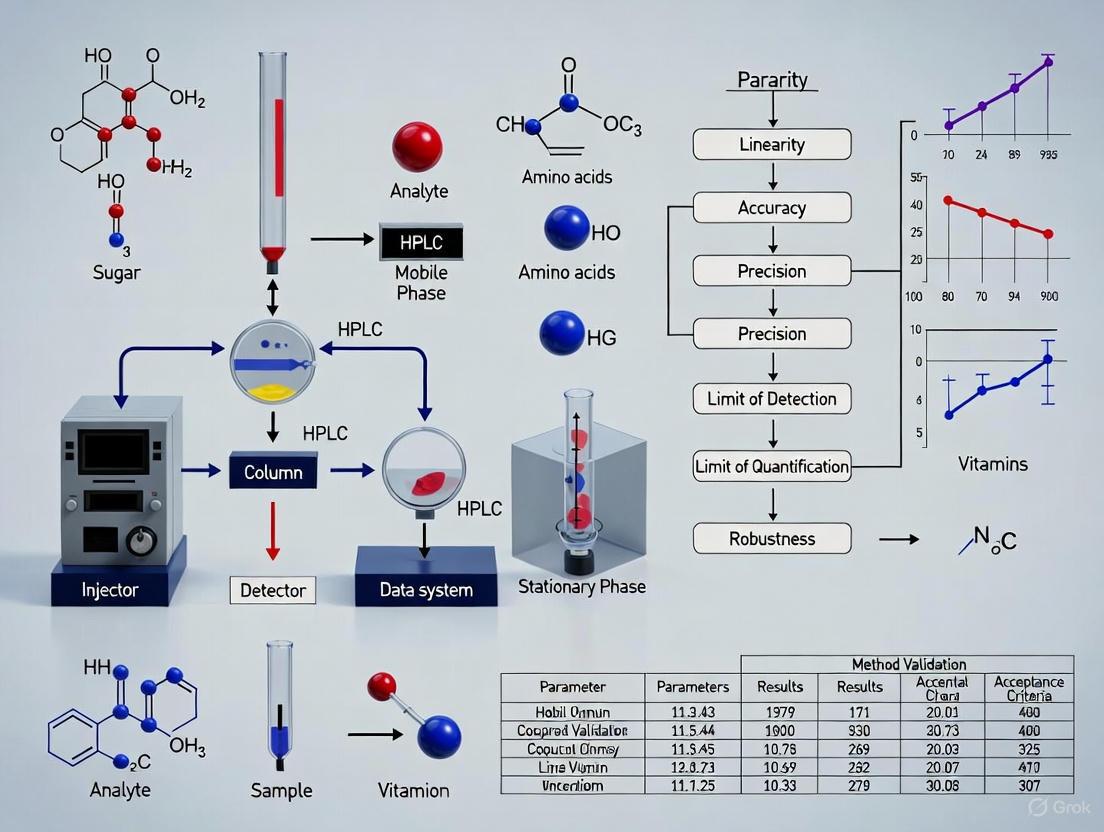
This article provides a comprehensive guide for researchers and scientists on validating High-Performance Liquid Chromatography (HPLC) methods for food analysis.
A Practical Guide to HPLC Method Validation for Food Analysis: Protocols, Applications, and ICH Compliance
Abstract
This article provides a comprehensive guide for researchers and scientists on validating High-Performance Liquid Chromatography (HPLC) methods for food analysis. Covering the entire process from foundational principles to advanced applications, it details the core validation parameters as per the latest ICH Q2(R2) and FDA guidelines. The content explores method development strategies, troubleshooting for complex food matrices, and comparative detector selection. With practical examples from recent studies on analyzing compounds like carvedilol, xylitol, and thiabendazole in various foods, this guide serves as an essential resource for ensuring data reliability, regulatory compliance, and robust quality control in food testing laboratories.
Foundations of HPLC Validation: Understanding ICH Guidelines and Core Principles for Food Labs
The International Council for Harmonisation (ICH) and the U.S. Food and Drug Administration (FDA) provide the foundational global framework for ensuring the reliability and quality of analytical data in pharmaceuticals and related fields [1]. The ICH Q2(R2) guideline, titled "Validation of Analytical Procedures," serves as the primary global standard for validating analytical methods, with the FDA adopting and implementing these harmonized guidelines in the United States [2] [1]. A significant modernization occurred in March 2024 with the finalization of the updated ICH Q2(R2) guideline, which replaces the previous Q2(R1) version [2] [3]. This revision was released simultaneously with the new ICH Q14 guideline on Analytical Procedure Development, representing a strategic shift from a prescriptive approach to a more scientific, risk-based, and lifecycle-oriented model for analytical procedures [1] [3].
For researchers developing HPLC method validation protocols for food analysis, these guidelines provide a rigorous, transferable foundation. The principles, though designed for drug substances and products, are equally applicable to ensuring the reliability, accuracy, and precision of methods used to analyze food constituents and contaminants [4]. The core objective is to build quality into the analytical method from its initial development and demonstrate through validation that it is fit-for-purpose for its intended use, whether for release testing, stability studies, or authenticity assessment of food products [4] [1].
Core Principles of ICH Q2(R2) and FDA Guidelines
The Modernized Lifecycle Approach
The concurrent issuance of ICH Q2(R2) and ICH Q14 signifies a critical evolution in regulatory philosophy. The new framework emphasizes that analytical procedure validation is not a one-time event but a continuous process that begins with method development and continues throughout the method's entire lifecycle [1]. This lifecycle management is supported by two pivotal concepts:
- Analytical Target Profile (ATP): Introduced in ICH Q14, the ATP is a prospective summary that describes the intended purpose of an analytical procedure and its required performance characteristics [1]. Defining the ATP at the start of development ensures the method is designed to be fit-for-purpose from the outset, guiding both development and validation.
- Science- and Risk-Based Decisions: The modernized approach encourages a deeper understanding of the method and its potential variables. This scientific understanding, combined with quality risk management (ICH Q9), facilitates a more flexible post-approval change management process, allowing for justified changes without extensive regulatory filings when supported by sound data [1] [3].
Scope and Application to Food Analysis
While ICH Q2(R2) primarily applies to new or revised analytical procedures used for release and stability testing of commercial drug substances and products, the guideline also states it "can be applied to other analytical procedures used as part of a control strategy following a risk-based approach" [4]. This extension makes it directly relevant to food research, particularly for:
- Quality control of bioactive compounds (e.g., trigonelline in fenugreek) [5]
- Authenticity assessment and fraud detection (e.g., artificial colorants in açaí pulp) [6]
- Safety monitoring of contaminants (e.g., alkylphenols migrating from plastic packaging into milk) [7]
The guideline encompasses the most common analytical procedure purposes, including assay/potency, purity, impurities, identity, and other quantitative or qualitative measurements [4].
Core Validation Parameters
ICH Q2(R2) outlines specific performance characteristics that must be evaluated to demonstrate a method is fit for its intended purpose [1]. The validation parameters required depend on the type of method (e.g., identification, testing for impurities, or assay). The table below summarizes the core validation parameters for quantitative impurity and assay methods.
Table 1: Core Validation Parameters for Quantitative HPLC Methods Based on ICH Q2(R2)
| Parameter | Definition | Typical Acceptance Criteria for HPLC Assay | Application in Food Analysis |
|---|---|---|---|
| Accuracy | Closeness of test results to the true value [1] | Recovery: 95-105% [5] | Demonstrated by spiking a known amount of analyte into the food matrix and measuring recovery [6] [7] |
| Precision (Repeatability) | Degree of agreement under the same operating conditions over a short time [1] | RSD < 2% [5] | Measured by multiple preparations of a homogeneous food sample [7] |
| Specificity | Ability to assess the analyte unequivocally in the presence of other components [1] | No interference from blank, placebo, or known impurities [8] | Critical in complex food matrices to distinguish target analytes from interfering compounds [6] |
| Linearity | Ability to obtain results proportional to analyte concentration [1] | R² > 0.999 [5] | Established using a series of standard solutions across the specified range [5] |
| Range | Interval between upper and lower analyte concentrations with suitable precision, accuracy, and linearity [1] | Dependent on the method purpose (e.g., 80-120% of test concentration for assay) [1] | Defined based on the expected concentrations in the food product [6] |
| Limit of Detection (LOD) | Lowest amount of analyte that can be detected [1] | Signal-to-noise ratio ≥ 3 [6] | For monitoring contaminants or impurities at trace levels [7] |
| Limit of Quantitation (LOQ) | Lowest amount of analyte that can be quantified with acceptable accuracy and precision [1] | Signal-to-noise ratio ≥ 10; RSD < 5% for precision at LOQ [6] | Essential for setting specification limits for undesirable compounds [7] |
| Robustness | Capacity to remain unaffected by small, deliberate variations in method parameters [1] | System suitability criteria are met despite variations [8] | Evaluated by varying parameters like pH, flow rate, or column temperature [8] |
Experimental Protocols for HPLC Method Validation
This section provides detailed methodologies for key experiments in validating an HPLC method, framed within the context of food analysis research.
Protocol for Determining Accuracy and Precision
The following workflow illustrates the experimental process for determining accuracy and precision, fundamental parameters in method validation:
Title: Accuracy and Precision Workflow
Detailed Procedure:
- Sample Preparation: For a food matrix, prepare a blank sample (free of the target analyte) or use a certified reference material. Spike the blank matrix with known quantities of the analyte standard at a minimum of three concentration levels (e.g., 80%, 100%, and 120% of the target test concentration) [1].
- Replicate Analysis: Prepare and analyze a minimum of six replicates at each concentration level. For intermediate precision, repeat the analysis on a different day, with a different analyst, or using a different instrument, as applicable [1].
- Calculation of Accuracy: Calculate the recovery percentage for each spike level using the formula: Recovery (%) = (Measured Concentration / Spiked Concentration) × 100 The mean recovery should be within the predefined acceptance criteria (e.g., 95-105%) [5].
- Calculation of Precision: Calculate the relative standard deviation (RSD) of the measured concentrations for the replicates at each level. The RSD is calculated as: RSD (%) = (Standard Deviation / Mean) × 100 For repeatability, the RSD should typically be less than 2% for an assay [5]. In the alkylphenols in milk study, precision was evaluated at each concentration level for both intra-day and inter-day measurements, with errors maintained within pre-established acceptability limits (±10%) [7].
Protocol for Specificity and Linearity
Specificity Procedure:
- Inject Blanks: Analyze the sample diluent or solvent to identify any interfering peaks at the retention time of the target analyte [8].
- Analyze Placebo/Matrix: If available, analyze a placebo formulation (for drugs) or a blank food matrix (e.g., milk without alkylphenols, açaí pulp without colorants) to ensure no matrix components co-elute with the analyte [6] [7].
- Stress Samples: For stability-indicating methods, analyze samples that have been subjected to stress conditions (e.g., heat, light, acid/base hydrolysis) to demonstrate that the analyte peak is pure and free from interfering degradation products [8].
- Peak Purity Assessment: When using a Diode Array Detector (DAD), use peak purity algorithms to confirm that the analyte peak is homogeneous and not contaminated with co-eluting compounds [8].
Linearity and Range Procedure:
- Standard Preparation: Prepare a series of standard solutions at a minimum of five concentration levels, ideally spanning the entire working range of the method (e.g., from LOQ to 120-150% of the target concentration) [1].
- Analysis and Plotting: Analyze each standard solution in triplicate. Plot the mean peak response (area or height) against the corresponding analyte concentration.
- Statistical Analysis: Perform linear regression analysis on the data to determine the correlation coefficient (R²), slope, and y-intercept. An excellent linear relationship is typically indicated by R² > 0.999 [5]. The residual plot should be random, confirming the model's appropriateness.
The Scientist's Toolkit: Essential Research Reagent Solutions
Successful development and validation of an HPLC method for food analysis requires carefully selected reagents and materials. The following table details key solutions and their critical functions in the analytical process.
Table 2: Essential Research Reagent Solutions for HPLC Method Validation
| Reagent/Material | Function & Importance | Application Example from Research |
|---|---|---|
| HPLC-Grade Solvents (Acetonitrile, Methanol) | Mobile phase components; high purity minimizes UV absorbance background noise and prevents system damage [8]. | Used as the organic modifier in the mobile phase for trigonelline analysis [5] and alkylphenols detection [7]. |
| HPLC-Grade Water (Purified, filtered) | Aqueous component of the mobile phase and sample diluent; must be free of particles and organics [8]. | Used in mobile phase and diluent preparation for all cited studies [5] [6] [7]. |
| Buffer Salts & Additives (e.g., Ammonium formate, Formic acid) | Control pH and ionic strength of the mobile phase to optimize peak shape, retention, and selectivity [8]. | 20 mM ammonium formate buffer, pH 3.7, used for the alkylphenols method to control ionization [7]. |
| Certified Reference Standards | Provide the primary calibrator for quantifying the analyte and confirming identity; purity and traceability are critical [8]. | G-1234 reference standard used for potency and identity in drug analysis [8]; alkylphenol standards with certified purity used for quantification in milk [7]. |
| Column Equivalents (Specified and alternative columns) | Ensures method portability; testing an equivalent column from a different vendor is part of robustness evaluation [8]. | The trigonelline method specified a Dalian Elite Hypersil NH2 column (250 mm × 4.6 mm, 5 µm) [5]. |
| Sample Preparation Sorbents (e.g., SLE, SPE cartridges) | Remove matrix interferents (proteins, lipids) to enhance sensitivity and specificity, and protect the HPLC column [7]. | Chem Elut SLE cartridges used to remove lipids and proteins from milk samples prior to alkylphenols analysis [7]. Carrez I and II reagents used for protein precipitation in açaí pulp analysis [6]. |
Application in Food Analysis: Case Studies
The principles of ICH Q2(R2) are directly applicable to food analysis, as demonstrated by recent research where method validation ensures reliable monitoring of food quality, safety, and authenticity.
Case Study 1: Quantification of Bioactive Compounds
A 2024 study developed and validated an HPLC method for the quantitative analysis of trigonelline, an alkaloid with anti-diabetic and antioxidant effects found in fenugreek seeds [5]. The method was rigorously validated, demonstrating:
- Linearity: An excellent linear range with R² > 0.9999.
- Precision: High precision with RSD < 2%.
- Accuracy: A recovery rate between 95% and 105%. This validated method provides robust technical support for the quality evaluation of trigonelline and related pharmaceutical or nutraceutical products [5].
Case Study 2: Food Authenticity and Adulteration Control
A 2025 study addressed food fraud by developing an HPLC-DAD method to detect eight artificial colorants in açaí pulp, where their use is prohibited by Brazilian regulations [6]. The method was validated according to regulatory guidelines, showing:
- Selectivity: Baseline separation of all eight dyes in a 14-minute gradient.
- Sensitivity: Low detection limits (1.5-6.25 mg.kg⁻¹).
- Accuracy: Acceptable recovery of 92-105%. This application highlights the role of validated methods in regulatory monitoring and food authenticity assessment [6].
Case Study 3: Contaminant and Migrant Analysis
A 2025 study developed a validated HPLC-DAD method to determine alkylphenols in milk, which are endocrine-disrupting chemicals that can migrate from plastic packaging [7]. The method utilized a novel cleanup process and was validated using the strategy of accuracy profiling, which calculates the method's total error (encompassing bias and standard deviation) and uses β-expectation tolerance intervals [7]. The method met pre-established acceptability limits (±10%), proving its suitability for routine monitoring of these contaminants in a complex, fatty food matrix [7].
The ICH Q2(R2) and FDA guidelines provide a comprehensive, modern, and science-based framework for analytical method validation. The integration of ICH Q14's Analytical Target Profile and the emphasis on a lifecycle approach encourage deeper method understanding and more flexible, risk-based management. For scientists developing HPLC validation protocols for food analysis research, adhering to these principles ensures the generation of reliable, accurate, and reproducible data. This is critical not only for regulatory compliance but also for advancing food science, ensuring product quality, protecting consumer safety, and combating food fraud.
The Analytical Target Profile (ATP) represents a fundamental shift in the approach to analytical science, moving from a traditional, prescriptive method to a systematic, risk-based framework. Within food analysis, the ATP serves as a formalized statement that outlines the intended purpose of an analytical procedure and defines the criteria for its required performance. This application note details the integration of the ATP within the Analytical Procedure Lifecycle Management (APLM) framework, specifically for developing and validating High-Performance Liquid Chromatography (HPLC) methods. By defining the ATP at the outset, laboratories can ensure methods are fit-for-purpose, robust, and capable of meeting the rigorous demands of food authenticity, safety, and quality control.
The Analytical Target Profile: A Foundational Concept
The Analytical Target Profile (ATP) is a prospective summary of the intended purpose of an analytical procedure and its required performance characteristics [1]. It is the cornerstone of the modern lifecycle approach to analytical procedures, as championed by new guidelines such as ICH Q14 for Analytical Procedure Development and the draft USP <1220> on Analytical Procedure Lifecycle Management [1] [9].
The traditional view of method validation, guided by ICH Q2(R1), often involved a ritualistic, "check-the-box" approach that could lead to situations where methods were validated for parameters irrelevant to their actual use, such as determining Limits of Detection (LOD) for an assay intended to measure an active component at 90-110% of label claim [9]. The ATP framework eliminates this inefficiency by forcing a critical assessment of the method's purpose from the very beginning.
In essence, the ATP shifts the paradigm from a one-time validation event to a continuous lifecycle management process, ensuring that the analytical method remains fit-for-purpose throughout its operational use [1]. This is particularly critical in food analysis, where methods are used to combat food fraud, ensure regulatory compliance, and guarantee product safety.
The ATP within the Analytical Procedure Lifecycle
The lifecycle of an analytical procedure, as advocated by USP <1220>, consists of three interconnected stages, with the ATP informing every step [9].
Figure 1. The Analytical Procedure Lifecycle. The ATP defines the target for the entire process, with continuous feedback enabling method improvement [9].
Stage 1: Procedure Design and Development
This stage translates the ATP into a working analytical method. Method development activities are planned and executed based on the performance requirements defined in the ATP. A risk assessment is conducted to identify factors that could significantly impact method performance, guiding systematic optimization [10]. For instance, an HPLC method for quantifying artificial colorants in açaí pulp would be developed to achieve the specificity, accuracy, and sensitivity mandated by its ATP [6].
Stage 2: Procedure Performance Qualification
This stage corresponds to the traditional method validation but is now driven by the ATP. The validation parameters tested and the acceptance criteria are directly derived from the ATP's performance requirements [1]. This ensures that the validation demonstrates the method is truly fit-for-purpose.
Stage 3: Procedure Performance Verification
Once the method is in routine use, its performance is continuously monitored through quality control samples and system suitability tests [9]. This ongoing verification ensures the method remains in a state of control and alerts analysts to any performance drift, triggering corrective action or method improvement.
Constructing an ATP for Food Analysis: Core Components
A well-defined ATP is a concise, factual statement that specifies "what" the method must achieve, not "how" it will be achieved. The key components of an ATP for an HPLC method in food analysis are detailed in the table below.
Table 1: Core Components of an Analytical Target Profile for Food Analysis
| ATP Component | Description | Example: HPLC Method for Quantifying Artificial Colorants [6] |
|---|---|---|
| Analyte & Matrix | Clearly defines the target substance(s) and the food matrix in which it will be measured. | Eight artificial dyes (Tartrazine, Bordeaux Red, etc.) in açaí pulp, juçara pulps, and açaí-based sorbets. |
| Analytical Technique | Specifies the primary technique used, allowing for flexibility in the specific instrumentation. | Reversed-Phase High-Performance Liquid Chromatography with Diode Array Detection (RP-HPLC-DAD). |
| Reportable Value | Defines the form and units of the final result. | Concentration in mg/kg (mg.kg⁻¹). |
| Performance Criteria | Quantifies the required method performance, including the following key parameters: | |
| • Target Range | The interval between the upper and lower analyte concentrations for which the method is required to perform suitably. | From the Limit of Quantitation (LOQ) to 200% of the expected maximum level from adulteration. |
| • Accuracy | The closeness of agreement between the accepted reference value and the value found. | Recovery of 92-105%. |
| • Precision | The degree of agreement among individual test results. Expressed as Repeatability and Intermediate Precision (%RSD). | RSD < 2%. |
| • Specificity | The ability to assess the analyte unequivocally in the presence of other components. | Baseline separation of all eight dyes from each other and from matrix interferences in a 14-minute gradient. |
| • Sensitivity (LOQ) | The lowest amount of analyte that can be quantified with acceptable accuracy and precision. | LOQ between 1.5 and 6.25 mg.kg⁻¹ for the different dyes. |
Experimental Protocol: From ATP to Validated HPLC Method
The following protocol outlines the key steps for developing and validating an HPLC method for food analysis, guided by an ATP.
Protocol: ATP-Driven HPLC Method Development and Validation
Objective: To develop and validate a specific, accurate, and robust HPLC method for the quantification of [Insert Target Analyte, e.g., Artificial Colorants] in [Insert Food Matrix, e.g., Açaí Pulp] as defined by a pre-established ATP.
Principle: The method will utilize Reversed-Phase HPLC (RP-HPLC) with optimal chromatographic conditions determined via a risk-based experimental design. The method will be validated per ICH Q2(R2) and ICH Q14 principles to confirm it meets all ATP performance criteria [1] [6].
I. Materials and Reagents
Table 2: Research Reagent Solutions and Essential Materials
| Item | Function / Explanation |
|---|---|
| HPLC System | A system with a quaternary pump, autosampler, column thermostat, and Diode Array Detector (DAD). The DAD is crucial for confirming peak purity and selecting optimal detection wavelengths [6]. |
| Chromatographic Column | The separation engine. A C18 column (e.g., 250 mm x 4.6 mm, 5 µm) is typical for RP-HPLC. Column type is a high-risk factor and should be studied during development [10]. |
| Mobile Phase Components | Acetonitrile/Methanol: Organic modifiers. Buffer Salts (e.g., Disodium hydrogen phosphate): To control pH and improve peak shape. The buffer pH and ratio with organic solvent are critical method parameters [10]. |
| Analytical Standards | High-purity reference standards of the target analytes for calibration, identification, and determining accuracy. |
| Sample Preparation Solvents & Reagents | Carrez I & II reagents: Used for protein precipitation and clarification in complex food matrices like fruit pulps [6]. Dichloromethane: For liquid-liquid extraction to remove lipids. |
II. Procedure
Step 1: Method Scouting and Risk Assessment
- Define the ATP for the method (refer to Table 1 for components).
- Based on the ATP, identify Critical Method Parameters (CMPs) through risk assessment. These typically include column type (X1), mobile phase ratio (X2), and buffer pH (X3) [10].
- Use an experimental design (e.g., d-optimal design) to systematically study the impact of these CMPs on Critical Method Attributes (CMAs) such as retention time (Y1), peak area (Y2), tailing factor (Y3), and theoretical plates (Y4) [10].
Step 2: Method Optimization and MODR Establishment
- Analyze the experimental design data to understand the relationship between CMPs and CMAs.
- Employ software (e.g., MODDE Pro) and Monte Carlo simulations to establish a Method Operable Design Region (MODR). The MODR defines the multidimensional combination of CMPs within which the method meets ATP criteria, ensuring robustness [10].
- Select the final, robust set point from within the MODR.
Step 3: Final Chromatographic Conditions
- The following conditions are illustrative from a published AQbD study [10]:
- Column: Inertsil ODS-3 C18 (250 mm, 4.6 mm, 5 µm).
- Mobile Phase: Acetonitrile: 20 mM disodium hydrogen phosphate buffer, pH 3.1 (18:82, v/v).
- Flow Rate: 1.0 mL/min.
- Temperature: 30 °C.
- Detection: DAD, 323 nm (wavelength to be adjusted for specific analytes).
- Injection Volume: 10 µL.
- Elution Mode: Isocratic.
Step 4: Sample Preparation
- Optimize extraction using a design like a simplex-centroid mixture design [6].
- For complex matrices like açaí pulp, a protocol may include:
Step 5: Method Validation Execute the following validation experiments, with acceptance criteria defined by the ATP.
Table 3: Method Validation Parameters and Protocols [11] [1]
| Validation Parameter | Experimental Protocol | Acceptance Criterion (Example) |
|---|---|---|
| Specificity | Inject blank matrix, standard, and sample. Subject the sample to stress conditions (acid, base, oxidation, heat, light) to demonstrate separation of the analyte from interferents and degradation products. Check peak purity using a DAD. | No interference at the analyte retention time. Resolution > 1.5 between analyte and closest eluting peak. Peak purity index > 990. |
| Linearity & Range | Prepare and analyze a minimum of 5 calibration standards, from LOQ to 200% of the target concentration. Each concentration should be injected once. | Correlation coefficient (r) > 0.999. |
| Accuracy | Analyze replicate samples (n=3) at three concentration levels (80%, 100%, 120%) within the range. Calculate recovery of the spiked amount. | Mean recovery between 98-102%, RSD < 2%. |
| Precision(Repeatability) | Analyze six independent test preparations from a single homogeneous sample batch by the same analyst on the same day. | RSD of content < 2%. |
| Precision(Intermediate Precision) | Repeat the precision study on a different day, with a different analyst, and using a different instrument. Combine all results (n=12). | RSD of all 12 results < 2%. |
| Limit of Quantification (LOQ) | Determine the concentration that yields a signal-to-noise ratio (S/N) of 10:1. Confirm by injecting six preparations at this concentration. | S/N ≥ 10. RSD of the peak area of six injections < 5%. |
| Robustness | Deliberately vary method parameters (e.g., flow rate ±10%, mobile phase ratio ±2%, column temperature ±2°C, columns from different brands). Analyze two sample and two reference solutions at each condition. | RSD of assay results across all variations (n=6 per variation) < 2%. System suitability criteria are met in all conditions. |
The following diagram summarizes the experimental workflow from ATP to a validated method.
Figure 2. ATP-Driven Method Development Workflow. CMPs: Critical Method Parameters; CMAs: Critical Method Attributes; MODR: Method Operable Design Region.
The Analytical Target Profile is more than a document; it is the strategic foundation for modern, robust, and compliant analytical methods in food analysis. By defining the purpose and required performance at the outset, the ATP ensures that subsequent development, validation, and operational use of HPLC methods are efficient, science-based, and fully aligned with their intended use. Adopting this lifecycle approach, as outlined in ICH Q14 and USP <1220>, empowers laboratories to move beyond mere regulatory compliance and toward a paradigm of continuous improvement, ultimately enhancing the reliability of data used to ensure food safety and authenticity.
In high-performance liquid chromatography (HPLC) for food analysis, demonstrating that an analytical method is reliable and fit for purpose is a fundamental requirement for research and quality control. Method validation provides objective evidence that a method consistently meets predefined performance standards, ensuring the accuracy and reliability of data used in food safety assessments, nutritional labeling, and regulatory submissions [12] [13]. The International Council for Harmonisation (ICH) guideline Q2(R1) and other regulatory bodies provide a framework for this process, outlining key validation characteristics [12] [14].
This application note details the core validation parameters—Accuracy, Precision, Specificity, and Linearity—within the context of developing an HPLC method for food analysis. Using a practical example of quantifying organic acids in processed foods, we will define each parameter, describe its experimental protocol, and present acceptance criteria, providing a clear roadmap for researchers to validate their analytical methods effectively [15].
Core Parameters and Experimental Protocols
The following parameters form the foundation of HPLC method validation, confirming that the method produces truthful, reproducible, and selective measurements over a defined range.
Accuracy
Accuracy refers to the closeness of agreement between the value found by the analytical method and the value accepted as either a conventional true value or an accepted reference value. It indicates the method's freedom from systematic error (bias) and is typically expressed as percent recovery [12] [13].
Experimental Protocol for Food Analysis (Spike and Recovery): This standard approach evaluates accuracy by spiking a known amount of the pure analyte into the sample matrix.
- Sample Preparation: Obtain or prepare a representative sample of the food matrix (e.g., a homogenized barley grain or beverage sample) known to be free of the target analyte or with a known background level.
- Spiking: Spike the sample matrix with the analyte (e.g., tocopherols or organic acids) at a minimum of three concentration levels covering the specified range (e.g., 80%, 100%, and 120% of the target concentration) [13]. Each level should be prepared and analyzed in triplicate (n=3), leading to a minimum of nine determinations [12] [13].
- Analysis and Calculation: Analyze the spiked samples and calculate the concentration found using the HPLC method. The percent recovery is calculated as:
- Recovery (%) = (Measured Concentration / Spiked Concentration) × 100
- Interpretation: The mean recovery value at each level should fall within predefined acceptance criteria. For food analysis, recoveries of 80-110% are often considered acceptable, though tighter ranges (e.g., 98-102%) are expected for major components at high concentrations [16] [17] [15].
Precision
Precision expresses the closeness of agreement (degree of scatter) between a series of measurements obtained from multiple sampling of the same homogeneous sample under prescribed conditions. It is a measure of random error and is usually expressed as relative standard deviation (RSD) or coefficient of variation (CV) [12] [13]. Precision has three tiers:
- Repeatability: Precision under the same operating conditions over a short interval (intra-day).
- Intermediate Precision: Precision within the same laboratory on different days, with different analysts, or different equipment.
- Reproducibility: Precision between different laboratories (often assessed during method transfer).
Experimental Protocol for Repeatability (Intra-day Precision):
- Sample Preparation: Prepare a minimum of six independent test samples from a single, homogeneous batch of the food product at 100% of the target concentration [12] [13].
- Analysis: Analyze all six preparations using the same HPLC method, same analyst, and same instrument within one day.
- Calculation: For each injection, calculate the analyte concentration. From the six results, calculate the mean, standard deviation (SD), and relative standard deviation (RSD).
- RSD (%) = (Standard Deviation / Mean) × 100
- Interpretation: The %RSD for assay of the active ingredient should typically be not more than 2.0% [13]. For impurities at lower concentrations, a higher RSD may be acceptable.
Specificity and Selectivity
Specificity is the ability to assess unequivocally the analyte in the presence of components that may be expected to be present, such as impurities, degradation products, and matrix components [12] [13]. In chromatography, specificity is typically demonstrated by the baseline resolution of the analyte peak from all other potential peaks.
Experimental Protocol for Specificity in Food Matrix Analysis:
- Chromatogram Comparison: Inject and analyze the following solutions:
- Blank: The solvent or solution used to prepare the sample.
- Placebo/Matrix Blank: A mock sample containing all excipients or the food matrix without the active ingredient(s).
- Standard Solution: A solution of the reference standard of the target analyte.
- Test Sample: The actual food sample containing the analyte.
- Forced Degradation (Stability-Indicating Property): Stress the sample (e.g., with heat, light, acid, base, oxidation) to generate degradation products. Analyze the stressed sample to demonstrate that the analyte peak is unaffected and that all degradation products are separated from the main peak [14] [13].
- Assessment: The method is specific if there is no interference from the blank or matrix at the retention time of the analyte, and the peak purity of the analyte is confirmed (e.g., using a diode array detector or mass spectrometry) [13].
Linearity and Range
Linearity is the ability of the method to elicit test results that are directly, or through a well-defined mathematical transformation, proportional to the concentration of analyte in samples within a given range. The range is the interval between the upper and lower concentrations of analyte for which it has been demonstrated that the method has suitable levels of accuracy, precision, and linearity [12] [14].
Experimental Protocol for Linearity:
- Standard Preparation: Prepare a series of standard solutions at a minimum of five to six concentration levels over the intended range (e.g., from 50% to 150% of the target concentration) [12] [14]. A linearity study for organic acids, for instance, might use concentrations from 0.05 to 200 mg/L [15].
- Analysis: Analyze each concentration level in triplicate.
- Calibration Curve: Plot the mean peak area (or height) against the corresponding concentration of the standard. Perform linear regression analysis on the data to obtain the correlation coefficient (r), coefficient of determination (R²), y-intercept, and slope of the regression line.
- Interpretation: A correlation coefficient (r) of ≥ 0.999 is generally expected for the assay of active ingredients [12] [14]. The y-intercept should be statistically indistinguishable from zero.
The following table summarizes typical acceptance criteria for the core validation parameters in the context of food analysis, drawing from examples in the search results.
Table 1: Typical Acceptance Criteria for Core HPLC Validation Parameters in Food Analysis
| Parameter | Experimental Approach | Typical Acceptance Criteria | Example from Food Analysis Research |
|---|---|---|---|
| Accuracy | Recovery study using spiked matrix at 3 levels (n=3 each). | Recovery of 98–102% for assay; 80–110% for impurities, depending on level [13]. | Recovery of 89.02–99.30% for quercitrin in pepper extract [16]. Recovery of 85.1–100.8% for organic acids in processed foods [15]. |
| Precision (Repeatability) | Analysis of six individual sample preparations. | RSD ≤ 2.0% for assay; higher for impurities [13]. | RSD of 0.50–5.95% for quercitrin recovery [16]. RSD of 0.62–4.87% for organic acids [15]. |
| Specificity | Chromatographic comparison of blank, standard, and sample. Baseline separation of analyte from closest eluting peak. | No interference at analyte retention time. Resolution (Rs) > 2.0 between critical pairs [14]. | Peak purity confirmed for organic acids with no interference from food matrix [15]. |
| Linearity | Minimum of 5 concentrations analyzed. | Correlation coefficient (r) ≥ 0.998 (R² ≥ 0.996) [14]. | R² > 0.9997 for quercitrin in the range of 2.5–15.0 μg/mL [16]. R² > 0.999 for organic acids in the range of 0.05–200 mg/L [15]. |
Experimental Workflow and Relationship of Parameters
The validation process is a logical sequence of experiments designed to comprehensively characterize method performance. The following workflow diagram illustrates the key steps and how the core parameters interrelate.
The Scientist's Toolkit: Essential Research Reagents and Materials
Successful method development and validation rely on high-quality materials and reagents. The following table lists key items required for the experiments described in this note.
Table 2: Essential Research Reagents and Materials for HPLC Method Validation
| Item | Function/Application | Example from Literature |
|---|---|---|
| High-Purity Analytical Standards | Used to prepare calibration solutions for linearity and as a reference for accuracy studies. Purity should be certified and traceable. | Quercitrin standard (≥98%) for quantifying flavonoid in peppers [16]. Organic acid standards (≥95%) for food additive analysis [15]. |
| Chromatography Column (C18) | The stationary phase where chemical separation occurs. Its selectivity and efficiency are critical for achieving specificity. | CAPCELL PAK C18 UG120 column [16]; Eclipse XDB C18 column [17]; C18 column for organic acid separation [15]. |
| HPLC-Grade Solvents & Reagents | Used for mobile phase and sample preparation. High purity is essential to minimize baseline noise and prevent system damage. | Methanol, water, and formic acid used for pepper extract analysis [16]. Methanol, water, and phosphoric acid for organic acid analysis [15]. |
| Sample Preparation Materials | For consistent and reproducible processing of food matrices. Includes items for extraction, filtration, and dilution. | Ultrasonicator for extracting quercitrin [16]. Matrix Solid-Phase Dispersion (MSPD) with alumina for extracting tocols from barley [17]. 0.45-μm membrane filters [16]. |
Rigorous validation of Accuracy, Precision, Specificity, and Linearity is non-negotiable for establishing reliable HPLC methods in food analysis research. By adhering to the structured experimental protocols and acceptance criteria outlined in this application note, scientists can generate defensible data that meets stringent quality standards. This foundational work ensures that analytical results are trustworthy, supporting critical decisions in food safety, quality control, and regulatory compliance.
Establishing Method Range, LOD, and LOQ for Diverse Food Matrices
High-Performance Liquid Chromatography (HPLC) method validation is a critical process in food analysis research, ensuring that analytical methods produce reliable and accurate results for quality control, authenticity assessment, and regulatory compliance. The establishment of method range, limit of detection (LOD), and limit of quantification (LOQ) represents fundamental parameters that characterize the performance and capability of an analytical method, particularly when dealing with complex and varied food matrices. These parameters define the boundaries within which a method can accurately detect and quantify analytes, from the lowest concentrations traceable with statistical confidence to the upper limits of quantitative measurement. In food analysis, where compounds of interest may be present at vastly different concentration levels across diverse sample types—from major components to trace-level contaminants or adulterants—properly establishing these parameters is essential for generating scientifically defensible data. This application note provides detailed protocols and current methodologies for determining range, LOD, and LOQ specifically tailored to the challenges of food matrix analysis, framed within the comprehensive context of HPLC method validation for food research.
Theoretical Foundations and Regulatory Framework
Definitions and Significance in Food Analysis
In analytical chemistry applied to food matrices, the method range (or linear range) refers to the interval between the upper and lower concentration levels of an analyte for which the method has suitable levels of accuracy, precision, and linearity. This range must encompass the expected concentrations of the analyte in actual samples, from trace amounts to maximum expected levels. The limit of detection (LOD) represents the lowest concentration of an analyte that can be reliably detected but not necessarily quantified under the stated experimental conditions. Conversely, the limit of quantification (LOQ) is the lowest concentration that can be quantitatively determined with acceptable precision and accuracy. These parameters are particularly challenging to establish in food analysis due to matrix complexity, which can significantly influence analytical signals and method performance [18].
The mathematical relationship for LOD and LOQ based on the calibration curve approach follows the formulas recommended by ICH Q2(R1), where LOD = 3.3 × σ/S and LOQ = 10 × σ/S, with σ representing the standard deviation of the response and S being the slope of the calibration curve [19]. This approach leverages the statistical properties of the calibration model to estimate the lowest detectable and quantifiable concentrations.
Regulatory Guidelines and Recommendations
Several international guidelines provide frameworks for determining these crucial method validation parameters, though with varying calculation approaches:
Table 1: Comparison of LOD and LOQ Calculation Methods Across Guidelines
| Guideline/Organization | LOD Calculation | LOQ Calculation | Food Analysis Applicability |
|---|---|---|---|
| IUPAC | Based on blank signal variability | Typically 3.3 × LOD | Well-suited for simple matrices |
| USEPA | Signal-to-noise ratio (3:1) | Signal-to-noise ratio (10:1) | Broad environmental and food applications |
| EURACHEM | Based on calibration curve statistics | Based on calibration curve statistics | Emphasizes measurement uncertainty |
| AOAC | Collaborative study data | Collaborative study data | Food-specific method validation |
| ICH Q2(R1) | 3.3 × σ/S | 10 × σ/S | Pharmaceuticals, adaptable to food |
| European Commission 2002/657/EC | CCα (decision limit) | CCβ (detection capability) | Regulatory focus, contaminants in food |
The calculation of LOD and LOQ constitutes a crucial task during the validation of a method, yet significant discrepancies can occur depending on the selected approach [18]. For food analysis applications, the AOAC guidelines and European Commission protocols often provide the most relevant frameworks, though ICH guidelines offer well-established statistical approaches that can be adapted to food matrices.
Experimental Protocols and Methodologies
Establishing the Method Range
The method range should be established using a minimum of six concentration levels prepared in triplicate, covering the expected concentration range encountered in actual samples. For food analysis, it is essential that calibration standards are prepared in a matrix-matched blank to account for matrix effects [20] [6].
Protocol for Range Establishment:
- Preparation of Matrix-Matched Standards: Identify or create an appropriate blank matrix free of the target analyte. For endogenous compounds where a genuine analyte-free matrix does not exist, use the standard addition method or minimal baseline level samples [18].
- Concentration Levels: Prepare calibration standards at concentrations spanning from below the expected LOQ to above the maximum expected concentration. A typical series includes 25%, 50%, 75%, 100%, 125%, and 150% of the target concentration [20].
- Analysis and Evaluation: Analyze each concentration level in triplicate using the optimized HPLC conditions. Evaluate linearity using correlation coefficient (R²), which should be >0.99 for quantitative methods, and visual inspection of residual plots.
- Accuracy and Precision Verification: For each concentration level, verify that accuracy (expressed as recovery percentage) and precision (relative standard deviation, RSD) meet acceptance criteria, typically 80-120% recovery with RSD <5% for the lower range and <2% for the upper range of the method [13].
For complex food matrices, the range may need to be verified across different sample types (e.g., high-fat vs. high-carbohydrate foods) to ensure consistent performance.
Determining LOD and LOQ
Multiple approaches exist for determining LOD and LOQ, each with specific applications and limitations for food analysis:
3.2.1 Signal-to-Noise Ratio (S/N) Approach This practical approach is particularly useful for chromatographic methods with baseline noise.
- Procedure: Inject a series of low-concentration standards and measure the signal height of the analyte peak compared to the baseline noise height.
- Calculation: LOD is the concentration giving S/N ≥ 3:1; LOQ is the concentration giving S/N ≥ 10:1.
- Application: Best suited for methods with consistent, measurable baseline noise. Particularly appropriate for initial estimation before applying more rigorous statistical approaches [18].
3.2.2 Calibration Curve Approach This statistical approach uses the properties of the calibration curve in the low concentration range.
Protocol for Calibration Curve Approach:
- Prepare calibration standards in the low concentration range, ideally not more than 10 times the presumed detection limit as the highest concentration [19].
- Use a minimum of 5 concentration levels with multiple replicates (at least 3) at each level [19].
- Analyze the standards using the optimized HPLC method.
- Perform regression analysis to determine the slope (S) and the standard deviation of the response (σ).
- Calculate LOD and LOQ using the formulas: LOD = 3.3 × σ/S and LOQ = 10 × σ/S.
The standard deviation (σ) can be determined as either:
- The residual standard deviation of the regression line (SD~Residuals~)
- The standard deviation of the y-intercepts of regression lines (SD~Y-intercept~) [19]
Table 2: Example LOD Calculation Using Calibration Curve Approach
| Experiment | Slope (m) | SD~Y-intercept~ | SD~Residuals~ | LOD (µg/mL) using SD~Y-intercept~ | LOD (µg/mL) using SD~Residuals~ |
|---|---|---|---|---|---|
| 1 | 15878 | 2943 | 3443 | 0.61 | 0.72 |
| 2 | 15814 | 2849 | 3333 | 0.59 | 0.70 |
| 3 | 16562 | 1429 | 1672 | 0.28 | 0.33 |
| 4 | 15844 | 2937 | 3436 | 0.61 | 0.72 |
Note: This constructed example shows how LOD results can vary depending on the standard deviation parameter selected for the calculation [19].
3.2.3 Blank Sample Method This approach uses the standard deviation of blank measurements but requires careful consideration in food analysis.
- Procedure: Analyze multiple replicates (at least 10) of a blank matrix sample and calculate the standard deviation of the response.
- Calculation: LOD = 3.3 × SD~blank~ / S and LOQ = 10 × SD~blank~ / S, where S is the slope of the calibration curve.
- Challenge in Food Analysis: Obtaining a true blank matrix can be difficult, particularly for endogenous compounds. For exogenous compounds (e.g., contaminants, adulterants), a blank matrix may be available or can be simulated [18].
Comprehensive Workflow for Parameter Estimation
The following workflow diagram illustrates a systematic approach for establishing range, LOD, and LOQ in food analysis methods:
Case Studies in Food Matrix Analysis
Analysis of Trigonelline in Fenugreek Seeds
A recent study developed and validated an HPLC method for quantification of trigonelline in fenugreek seeds. The method employed a Dalian Elite Hypersil NH2 chromatographic column (250 mm × 4.6 mm, 5 µm) with a mobile phase of acetonitrile:water (70:30, v/v) at a flow rate of 1.0 mL/min. The column temperature was maintained at 35°C with detection at 264 nm. Sample preparation involved ultrasonic extraction with methanol for 30 minutes. Method validation demonstrated excellent linearity (R² > 0.9999) with high precision (RSD < 2%) and recovery rates between 95% and 105%, meeting quality standards for trigonelline analysis [5].
Determination of Artificial Colorants in Açaí Pulp
Another relevant application involved the development and validation of an HPLC-DAD method for simultaneous determination of eight artificial dyes in açaí pulp and commercial products. The method addressed significant challenges in sample preparation, including lipid removal using liquid-liquid extraction with dichloromethane and protein precipitation using Carrez I and II reagents. Chromatographic conditions were optimized to ensure baseline separation under a 14-minute gradient. Validation according to regulatory guidelines showed suitable selectivity, linearity (R² > 0.98 for most analytes), low detection limits (1.5-6.25 mg·kg⁻¹), and acceptable recovery (92-105%). This method provides a robust tool for regulatory monitoring and authenticity assessment of açaí-based products, demonstrating effective approaches to complex food matrices [6].
The Scientist's Toolkit: Essential Research Reagents and Materials
Table 3: Key Research Reagent Solutions for HPLC Method Validation in Food Analysis
| Reagent/Material | Function/Application | Considerations for Food Matrices |
|---|---|---|
| Matrix-Matched Blank | Serves as analyte-free base for calibration standards | Critical for accurate quantification; for endogenous compounds, use standard addition method |
| Carrez I & II Reagents | Protein precipitation and clarification in sample preparation | Essential for high-protein food matrices like dairy products and legume extracts [6] |
| Dichloromethane | Lipid removal in sample preparation | Important for high-fat food matrices; enables cleaner extracts and reduces matrix effects [6] |
| Reference Standards | Calibration and method qualification | Should be of high purity; matrix-matched calibration recommended for complex food samples |
| HPLC-Grade Solvents | Mobile phase preparation and sample extraction | Essential for reproducible retention times and minimal background noise |
| SPE Cartridges | Sample clean-up and concentration | Select sorbent chemistry based on target analyte properties and matrix composition |
Recommendations for Complex Food Matrices
Food matrices present unique challenges for method validation, particularly regarding matrix effects, interfering compounds, and availability of true blank samples. The following recommendations address these specific concerns:
Matrix Effects Evaluation: Validate methods using representative food matrices that cover the expected sample types. For multi-matrix methods, verify LOD, LOQ, and range in each major matrix category (e.g., high-fat, high-protein, high-carbohydrate) [6].
Blank Sample Generation: For exogenous compounds (e.g., contaminants, adulterants), use naturally free matrices or simulated blanks. For endogenous compounds, the standard addition method may be necessary, or use of a minimally incurred material [18].
Handling of Background Levels: For analytes naturally present in food matrices (endogenous compounds), report the method detection limit (MDL) rather than the instrument detection limit, and clearly distinguish between the two in reporting.
Uncertainty Estimation: Include measurement uncertainty in LOD/LOQ reporting, particularly for regulatory applications where these parameters may inform compliance decisions.
Transparent Reporting: Clearly specify the calculation method used for LOD and LOQ determination, as results can vary significantly between approaches. Document all experimental parameters including number of replicates, concentration levels, and matrix used for calibration [18] [19].
Establishing method range, LOD, and LOQ for diverse food matrices requires careful consideration of matrix effects, appropriate calibration designs, and statistical approaches. The protocols outlined in this application note provide a framework for developing scientifically sound HPLC methods that generate reliable data for food analysis applications. As demonstrated in the case studies, proper validation of these parameters ensures methods are fit-for-purpose in quality control, authenticity assessment, and regulatory monitoring of food products. By adhering to systematic validation protocols and selecting appropriate calculation methods based on the specific analytical requirements and matrix complexities, researchers can generate defensible data that supports food safety, quality, and authenticity initiatives.
The International Council for Harmonisation (ICH) Q14 guideline, officially adopted in November 2023, represents a fundamental shift in analytical science by establishing a systematic, science-based and risk-based framework for analytical procedure development [21] [22] [23]. This guideline encourages the application of Quality by Design (QbD) principles to the analytical method lifecycle, moving beyond the traditional, empirical approach to a more structured paradigm that emphasizes proactive development and robust control strategies [21] [24]. This application note explores the core principles of ICH Q14 and provides detailed protocols for its implementation within the context of developing High-Performance Liquid Chromatography (HPLC) methods for food analysis. By integrating these principles, researchers can achieve more reliable, reproducible, and adaptable methods, facilitating smoother regulatory evaluations and more flexible post-approval change management [23].
The introduction of ICH Q14 marks a significant evolution in regulatory expectations for analytical procedures. It provides harmonized guidance for developing and maintaining methods suitable for assessing the quality of both drug substances and products, a framework that can be directly extrapolated to food components and contaminants [22] [23]. The guideline formally recognizes two approaches: the traditional "minimal" approach and the more systematic "enhanced" approach [21]. The enhanced approach, the focus of this document, is characterized by a structured methodology for developing analytical procedures and a robust framework for Analytical Procedure Lifecycle Management (APLM) [21] [24].
APLM, extrapolated from the concepts in ICH Q12, ensures that analytical methods remain fit-for-purpose throughout their entire operational life, from initial development through commercial use [21]. This is crucial for food analysis, where raw material variations and complex matrices can challenge method performance over time. The lifecycle approach treats method validation not as a one-time event, but as an ongoing process of verification and continuous improvement [21] [13]. This proactive management, supported by established conditions (ECs) and a strong control strategy, minimizes the risk of method failure and enhances the reliability of data used for quality decisions in food research and production [21].
Core Principles of ICH Q14 for Method Development
The Analytical Target Profile (ATP)
The ATP is the cornerstone of the ICH Q14 enhanced approach. It is a predefined objective that summarizes the intended purpose of the analytical procedure [21] [24]. Essentially, the ATP outlines what the method needs to achieve, specifying the analyte(s) to be measured and the required performance criteria the method must meet against specific Critical Quality Attributes (CQAs) [21].
For a food analysis HPLC method targeting a nutritional component or contaminant, the ATP would explicitly define:
- Analyte of Interest: e.g., a specific sugar, vitamin, or mycotoxin.
- Sample Matrix: e.g., herbal extract, dairy product, or grain.
- Required Performance Characteristics: such as the target precision (e.g., %RSD), accuracy (e.g., %Recovery), range, and specific limits of detection (LOD) and quantification (LOQ) suitable for the intended use [25] [13] [24]. The ATP provides a clear target for development and a benchmark for validation, ensuring the final method is scientifically sound and fit-for-purpose [21].
Critical Method Parameters and Design of Experiments (DoE)
A fundamental shift under QbD principles is moving from a univariate (One-Factor-At-a-time) approach to a systematic, multivariate one using Design of Experiments (DoE) [21] [26]. Critical Method Parameters (CMPs)—such as mobile phase composition, column temperature, flow rate, and gradient profile—are identified and their interactive effects on Critical Method Attributes (CMAs)—such as resolution, peak symmetry, and analysis time—are rigorously studied [26].
A case study on developing an HPLC-ELSD method for sugar analysis in botanical extracts exemplifies this approach. Researchers used a fractional factorial design to screen eight potential CMPs, including initial and final mobile phase composition, flow rate, and column temperature, to determine their impact on CMAs like retention time and signal-to-noise ratio [26]. This efficient experimental strategy allows for the establishment of a Method Operable Design Region (MODR), which is the multidimensional combination of CMP ranges within which method performance remains consistent [21]. Operating within the MODR ensures method robustness.
Analytical Control Strategy and Established Conditions
The analytical control strategy is a planned set of controls, derived from current product and process understanding, that ensures method performance [21]. A key component is system suitability testing (SST), which verifies that the analytical system is functioning correctly at the time of testing [21] [13]. SST parameters are directly linked to the ATP and are set to ensure the method meets its required performance criteria for each analysis [13].
Under ICH Q14, Established Conditions (ECs) are the legally binding, validated parameters that are considered critical to assuring product quality [21]. For an HPLC method, ECs may include the principle of the technique (e.g., Reversed-Phase HPLC), performance characteristics, system suitability criteria, and set points or ranges for critical procedure parameters [21]. A major advantage of the enhanced approach is that if a PAR or MODR has been established and approved for an EC, changes within that range may only require notification to regulatory authorities rather than prior approval, granting laboratories greater operational flexibility [21].
Experimental Design and Protocols
Protocol: Defining the Analytical Target Profile (ATP)
Objective: To create a formal ATP document that guides the development and validation of an HPLC method for quantifying a target analyte in a complex food matrix.
Procedure:
- Define the Purpose: Clearly state the method's goal (e.g., "To quantify sucrose content in Astragali Radix extract with precision and accuracy suitable for quality control release").
- Identify the Analyte and Matrix: Specify the analyte(s) (e.g., D-fructose, D-glucose, sucrose) and the specific sample matrix (e.g., herbal extract, fruit juice).
- Select the Analytical Technique: Justify the choice of technique (e.g., HPLC-ELSD for non-chromophoric sugars).
- Establish Performance Requirements: Define the minimum acceptable criteria for each performance characteristic based on regulatory guidelines and product needs [13]. An example for a sugar assay is provided in Table 1.
Table 1: Example ATP Performance Criteria for a Sugar Assay in Herbal Extracts
| Performance Characteristic | Target Requirement | Reference / Justification |
|---|---|---|
| Accuracy (Recovery) | 95–105% | ICH Q2(R1); [13] |
| Precision (Repeatability) | RSD ≤ 2.0% | ICH Q2(R1); [13] |
| Linearity | R² ≥ 0.999 | ICH Q2(R1); [25] |
| Range | 50%–150% of target concentration | ICH Q2(R1); [13] |
| Specificity | Baseline resolution (Resolution ≥ 2.0) from all known impurities and degradants | ICH Q2(R1); [13] |
| LOQ | Sufficient to quantify at reporting threshold (e.g., 0.1 μg/mL) | ICH Q2(R1); [25] |
Protocol: Implementing AQbD using DoE
Objective: To identify CMPs and model their relationship with CMAs to establish a robust MODR for an HPLC-ELSD method for sugar analysis.
Materials and Reagents:
- The Scientist's Toolkit: Key Reagents for HPLC-ELSD Sugar Analysis [26]:
- HPLC-grade acetonitrile and water: Mobile phase components for optimal separation and ELSD compatibility.
- Triethylamine (TEA): Additive to modify mobile phase pH and suppress silanol activity, improving peak shape.
- Reference standards (D-fructose, D-glucose, sucrose): For system calibration and peak identification.
- Astragali Radix and Codonopsis Radix extracts: Representative sample matrices.
- Waters XBridge Amide column (4.6×250 mm, 5 μm): Stationary phase for polar compound separation.
Experimental Workflow:
- Risk Assessment & Parameter Screening: Use an Ishikawa (fishbone) diagram to brainstorm potential factors affecting method performance. Select the most likely CMPs for initial screening (e.g., X1: initial %B, X2: final %B, X3: flow rate, X4: column temperature) [26].
- Screening Design: Execute a two-level fractional factorial design (e.g., Resolution IV) with center points to identify the most significant CMPs impacting key CMAs (e.g., resolution between critical pairs, analysis time, S/N ratio) [26].
- Optimization & Modeling: For the significant CMPs, perform a response surface methodology (RSM) design, such as a Box-Behnken Design, to model the quantitative relationships between CMPs and CMAs.
- Define the MODR: Using statistical software and Monte-Carlo simulations, calculate the probability-based design space—the combination of CMP ranges where the probability of meeting all CMA criteria is acceptably high (e.g., ≥ 95%) [26].
- Verify the MODR: Experimentally verify method performance at multiple points within the MODR, including the edges, to confirm robustness.
Protocol: Method Validation per ICH Q2(R2) and Lifecycle Management
Objective: To validate the HPLC method according to ICH Q2(R2) principles and establish a plan for ongoing lifecycle management [23].
Procedure:
- Specificity: Inject blank (mobile phase), placebo (if applicable), standard, and sample solutions. For stability-indicating methods, analyze stressed samples (e.g., acid/base, thermal, oxidative degradation) to demonstrate separation of the analyte from degradants. Use peak purity tools (PDA or MS) to confirm analyte homogeneity [13].
- Linearity and Range: Prepare a minimum of 5 concentrations spanning the defined range (e.g., from LOQ to 150% of specification). Inject each level in triplicate. Plot mean response versus concentration and perform linear regression. A correlation coefficient (R²) of ≥ 0.999 is typically expected for assays [25] [13].
- Accuracy: Spike the target analyte into the sample matrix at three levels (e.g., 50%, 100%, 150%) with a minimum of three replicates per level. Calculate the percent recovery of the known, added amount. Acceptance criteria are typically 95–105% recovery for the assay of APIs [13].
- Precision:
- Repeatability: Analyze six independent sample preparations at 100% of the test concentration. The RSD of the results should be ≤ 2.0% for the assay [13].
- Intermediate Precision: Have a second analyst repeat the repeatability study on a different day using a different instrument. The combined RSD from both analysts should meet predefined criteria.
- LOQ and LOD: Determine based on signal-to-noise ratio (e.g., S/N ≥ 10 for LOQ and ≥ 3 for LOD) or using the standard deviation of the response and the slope of the calibration curve [25].
- Lifecycle Management: Implement a procedure for continuous monitoring of system suitability test results and method performance indicators over time. Use this data for periodic method reviews. Any proposed changes to ECs must be assessed via a risk-based change management process, potentially using a Post-Approval Change Management Protocol (PACMP) [21].
Workflow and Strategy Visualization
Analytical Procedure Lifecycle Management (APLM) Workflow
The following diagram illustrates the continuous lifecycle of an analytical procedure under ICH Q14, from initial development through post-approval management.
A high-level overview of the Analytical Procedure Lifecycle, showing the interconnected stages from defining requirements to managing post-approval changes.
Analytical Quality by Design (AQbD) Implementation Logic
This diagram details the logical flow and key decision points for implementing the AQbD approach during the method development phase.
The structured process of Analytical Quality by Design, from initial risk assessment to defining a control strategy based on the established design space.
The ICH Q14 guideline provides a powerful, forward-looking framework that elevates analytical procedure development from a minimally documented exercise to a systematic, knowledge-driven endeavor. For researchers in food analysis, adopting the enhanced approach—centered on a clear ATP, QbD principles, DoE, and a proactive control strategy—facilitates the development of more robust, reliable, and adaptable HPLC methods. While the initial investment in resources and expertise may be greater, the long-term benefits of reduced method failures, greater operational flexibility, and enhanced product quality and safety are substantial [21]. Embracing the analytical procedure lifecycle management concept ensures that methods remain fit-for-purpose, supporting the consistent delivery of high-quality and safe food products.
From Theory to Practice: Developing and Applying Robust HPLC Methods in Food Analysis
High-Performance Liquid Chromatography (HPLC) is a pivotal analytical technique in food analysis research, enabling the precise separation, identification, and quantification of components in complex matrices [27]. The reliability of analytical results hinges entirely on a robust method development and validation protocol [28]. This application note provides a detailed, systematic roadmap for developing and executing a validated HPLC method tailored for food research, ensuring data integrity and regulatory compliance.
HPLC Method Development: A Step-by-Step Roadmap
Method development is a systematic process that transforms initial sample information into a optimized and robust analytical procedure.
Step 1: Define Method Objectives and Sample Analysis
The foundation of a successful method is a clear understanding of its purpose and the sample's nature.
- Method Scoping: Determine if the method is for potency testing (quantification of a major component) or purity determination (stability-indicating method for separating multiple analytes and impurities) [29]. This decision influences the choice of template (isocratic vs. gradient) and the required peak capacity [29].
- Sample Characterization: Identify the sample matrix (e.g., powdered drink, milk, yogurt) and its properties [30]. Understand the physicochemical properties of the target analytes, including chemical structure, molecular weight, pKa, log P, solubility, and chromophores [28] [29]. This information is critical for selecting the appropriate HPLC mode, column, and detector.
Step 2: Establish Initial Conditions
Begin with a set of standard, well-understood conditions to obtain the first chromatogram.
- HPLC Mode Selection: Reversed-phase chromatography is the starting point for most food analytes due to its broad applicability [28]. It is suitable for polar, semi-polar, and non-polar molecules.
- Column Selection: Start with a C18 bonded silica column (e.g., 150 mm or 100 mm length, 4.6 mm internal diameter, 3 or 5 µm particle size) for a good balance of efficiency, speed, and pressure [28] [31].
- Detector Selection: A Diode Array Detector (DAD) is preferred for method development as it provides spectral data for peak purity and identity confirmation [31]. For analytes without strong chromophores, consider Mass Spectrometry (MS) for superior selectivity and sensitivity [32].
- Mobile Phase and Scouting Gradient: Use a binary system: Mobile Phase A is a aqueous buffer (e.g., 10-50 mM phosphate or formate); Mobile Phase B is an organic modifier (acetonitrile or methanol) [28] [29]. Perform an initial broad scouting gradient (e.g., 5% to 100% B over 20-30 minutes) to determine the elution window and complexity of the sample [28] [29].
Table 1: Initial Method Scouting Conditions for Reversed-Phase HPLC
| Parameter | Recommended Starting Condition | Alternative Options |
|---|---|---|
| Column | C18 (150 x 4.6 mm, 5 µm) | C8, Phenyl, Cyano |
| Mobile Phase B | Acetonitrile | Methanol |
| Aqueous Buffer | Phosphate (pH 2.5-3.0) or Formate | Acetate, Trifluoroacetic Acid (TFA) |
| Flow Rate | 1.0 mL/min | 0.8 - 1.5 mL/min |
| Column Temperature | 30 °C | 25 - 40 °C |
| Detection | DAD (190-400 nm) | Fluorescence, MS, ELSD |
| Injection Volume | 10-20 µL | <5% of column void volume |
Step 3: Optimize Selectivity and Resolution
This is the most critical and iterative phase, aimed at achieving baseline resolution for all analytes of interest.
- Optimize Mobile Phase Composition: Adjust the pH of the aqueous buffer to manipulate the ionization state of acidic or basic analytes, significantly altering retention and selectivity [28] [31]. Vary the organic modifier ratio (isocratically or via a refined gradient program) to fine-tune elution strength [31].
- Systematic Optimization with DoE: Employ a Box-Behnken Design (BBD) to efficiently optimize multiple factors simultaneously. Key variables often include the initial and final percentage of organic modifier (%B) and the mobile phase pH [31]. Use Response Surface Methodology (RSM) and multi-response Desirability Functions to find the optimal conditions that maximize resolution (Rs > 1.5) and minimize analysis time [31].
- Column Chemistry Screening: If mobile phase optimization is insufficient, screen different column chemistries (e.g., C8, phenyl, cyano, polar-embedded) to exploit different selectivity mechanisms [30] [29].
Step 4: Finalize System Parameters
Once satisfactory selectivity is achieved, fine-tune the method for speed and practicality.
- Adjust Flow Rate and Temperature: Slight increases in flow rate or temperature can reduce analysis time and backpressure without compromising resolution [28].
- Scale to UHPLC: For higher throughput, transfer the method to an Ultra-High-Performance Liquid Chromatography (UHPLC) system using sub-2 µm particles and compatible hardware [33].
The following workflow diagram summarizes the method development process:
Experimental Protocol: Method Optimization Using a Box-Behnken Design
This protocol details the optimization of an HPLC-DAD method for separating seven food additives and caffeine in powdered drinks, as demonstrated in the literature [31].
Materials and Reagents
- Analytical Standards: Acesulfame potassium, benzoic acid, sorbic acid, sodium saccharin, tartrazine, caffeine, sunset yellow, aspartame.
- Solvents: HPLC-grade methanol, potassium dihydrogen phosphate, dipotassium hydrogen phosphate.
- Equipment: HPLC system with binary pump, autosampler, thermostatted column compartment, and DAD. Column: Shim-Pac GIST C18 (150 mm × 4.6 mm, 5 µm) or equivalent.
Experimental Design and Execution
- Factor Selection: Identify the critical factors significantly impacting separation. For this method:
- x1: %Methanol in phosphate buffer at the start of the gradient (e.g., 0-10%).
- x2: %Methanol in phosphate buffer at the end of the gradient (e.g., 60-100%).
- x3: pH of the mobile phase (e.g., 3-7).
- BBD Setup: Construct a BBD with the three factors at three levels each (-1, 0, +1), resulting in 15 experimental runs, including three center points for estimating error.
- Execution: Prepare the mobile phases and standard mixture according to the 15 conditions specified by the BBD. Perform the HPLC analyses, monitoring at 210 nm to observe all peaks.
- Response Measurement: For each chromatogram, record the critical resolution (Rs) between the least-resolved peak pair and the total analysis time.
Data Analysis and Multi-Response Optimization
- Model Fitting: Use RSM to fit a quadratic model for each response (resolution and analysis time).
- Desirability Function: Apply a desirability function (DF) to simultaneously optimize both responses. The goal is to maximize resolution (Rs > 1.5) and minimize analysis time.
- Prediction and Verification: The software will predict the optimal factor settings. Prepare the mobile phase at these predicted conditions (e.g., 8.5% methanol at start, 90% at end, pH 6.7) and perform a verification run to confirm the predicted chromatographic performance.
HPLC Method Validation Protocol
After development, the method must be validated to confirm it is fit for purpose, following ICH Q2(R1) guidelines [27] [12].
Validation Parameters and Acceptance Criteria
Table 2: Key HPLC Method Validation Parameters and Typical Acceptance Criteria for Food Analysis
| Validation Parameter | Definition | Experimental Procedure & Acceptance Criteria |
|---|---|---|
| Specificity/Selectivity | Ability to assess analyte unequivocally in the presence of matrix. | Inject blank matrix and standard. No interference at analyte retention time. Confirm with peak purity tools (DAD/MS) [27]. |
| Linearity & Range | Ability to obtain results proportional to analyte concentration. | Analyze ≥5 concentration levels. Correlation coefficient R² ≥ 0.999. Residuals randomly scattered [5] [12]. |
| Accuracy | Closeness between accepted reference value and found value. | Spike recovery at 80%, 100%, 120% of target level. Mean recovery 98–102% [32] [12]. |
| Precision | Closeness of agreement between a series of measurements. | Repeatability: 6 injections of one preparation, RSD < 1%. Intermediate Precision: Different day/analyst, RSD < 2% [5] [27]. |
| LOD / LOQ | Lowest detectable/quantifiable amount of analyte. | LOD = 3.3 × (SD of response/slope). LOQ = 10 × (SD of response/slope). Or S/N ≥ 3 for LOD, ≥10 for LOQ [27] [12]. |
| Robustness | Capacity to remain unaffected by small, deliberate parameter variations. | Deliberately vary flow rate (±0.1 mL/min), temp (±2°C), mobile phase pH (±0.1). System suitability criteria must still be met [27] [31]. |
System Suitability Testing
Prior to validation runs and daily use, perform system suitability testing to ensure the HPLC system is performing adequately. Parameters include plate count (N), tailing factor (T), repeatability (RSD of peak area), and resolution (Rs) between critical pairs, measured against predefined specifications [27].
The Scientist's Toolkit: Essential Research Reagent Solutions
Table 3: Key Reagents and Materials for HPLC Method Development and Validation in Food Analysis
| Item | Function / Application | Notes for Selection |
|---|---|---|
| C18 Chromatographic Column | Reversed-phase separation of a wide range of food analytes. | The default choice; consider particle size (3-5 µm), pore size (80-120 Å), and endcapping for basic compounds [5] [28]. |
| Solid Phase Extraction (SPE) Cartridges (e.g., C18) | Sample clean-up and pre-concentration; reducing matrix effects in complex foods (yogurt, milk). | Critical for removing proteins and fats. C18 is common for medium to non-polar analytes [32] [7]. |
| Supported Liquid Extraction (SLE) Cartridges | Matrix removal for aqueous samples (e.g., milk, fruit juice). | Prevents emulsion formation, offers high reproducibility and efficient extraction of contaminants like alkylphenols [7]. |
| Acetonitrile & Methanol (HPLC Grade) | Organic modifiers in the mobile phase for reversed-phase HPLC. | Acetonitrile offers lower viscosity and UV cutoff; methanol offers different selectivity and is less expensive [28]. |
| Ammonium Formate/Acetate, Phosphate Salts | Preparation of buffered aqueous mobile phases to control pH and ionic strength. | Volatile buffers (formate/acetate) are required for LC-MS. Phosphate buffers offer wider pH range but are not MS-compatible [32] [31]. |
This application note provides a comprehensive roadmap for developing and validating reliable HPLC methods for food analysis. By adhering to this structured protocol—from careful planning and systematic optimization to rigorous validation—researchers can ensure the generation of accurate, precise, and defensible data. This structured approach is fundamental to advancing research in food safety, quality, and composition, ultimately supporting public health and regulatory compliance.
Sample preparation is a critical step in the analytical process, transforming raw, complex food samples into analysis-ready materials suitable for High-Performance Liquid Chromatography (HPLC) and other analytical techniques [34] [35]. Proper preparation ensures that samples accurately represent the substance being analyzed, free from contamination or background interferences, and is essential for producing high-quality, reliable data in food analysis research [34]. The complexity of food matrices—which may include various biological materials, dry powders, fats, and liquids—presents significant challenges for trace-level contaminant analysis due to the potential for many interferences with the analytes of interest [36]. Foodstuffs are naturally non-homogenous, and when analyzing for trace and ultra-trace levels of known contaminants, ensuring representative sampling becomes paramount [36]. This application note details the primary extraction and clean-up techniques utilized for complex food matrices within the context of HPLC method validation for food analysis research.
Key Sample Preparation Techniques
Solid-Phase Based Extraction Techniques
Solid-Phase Extraction (SPE) is a method to concentrate and purify analytes from complex matrices by passing a liquid sample through a solid adsorbent material [35]. The selectivity of SPE depends on the cartridge chemistry, with common variants including C18 for non-polar to moderately polar compounds, silica for polar compounds, and ion-exchange for charged analytes [35]. The step-by-step process involves conditioning the cartridge with an appropriate solvent, loading the sample, washing away unwanted components, and finally eluting the target analytes with a suitable solvent [35].
Solid-Phase Microextraction (SPME) is a solvent-free technique based on the extraction of analytes from the matrix into a non-miscible extracting phase coated on a solid support [36]. SPME can be used to sample liquids directly or to analyze the headspace above a sample, with the latter being particularly valuable for avoiding non-volatile matrix components [36]. Fiber coatings vary in selectivity, with polydimethylsiloxane (PDMS) being common for non-polar analytes, while polyacrylate and carbowax-divinylbenzene (CW-DVB) are more suitable for polar compounds [36].
Liquid-Phase Extraction Techniques
Liquid-Liquid Extraction (LLE) separates compounds based on their differential solubility in two immiscible liquids, typically an aqueous phase and an organic solvent [35]. The efficiency of LLE depends on solvent choice and the pH of the aqueous phase, which can be adjusted to favor partition of the analyte into the organic layer [35]. While effective, LLE may require multiple extraction steps, can be time-consuming, and often uses significant solvent volumes [35].
QuEChERS (Quick, Easy, Cheap, Effective, Rugged, and Safe) is a streamlined sample preparation technique favored for its simplicity, speed, and cost-effectiveness, making it ideal for high-throughput laboratories analyzing complex matrices like fruits, vegetables, and other food products [34]. The original method involves solvent extraction with acetonitrile followed by a clean-up step using dispersive solid-phase extraction (d-SPE) to remove various matrix interferences.
Advanced Extraction Techniques
Advanced techniques utilize energy or specialized conditions to improve extraction efficiency and reduce solvent consumption [37]:
- Microwave-Assisted Extraction (MAE): Uses microwave energy to rapidly heat the solvent and sample, causing thermal effects that disrupt cell walls and enhance compound release [34].
- Ultrasonic-Assisted Extraction (UAE): Employs high-frequency sound waves to generate cavitation in the liquid, which disrupts the sample matrix and enhances mass transfer [34].
- Pressurized Liquid Extraction (PLE): Also known as accelerated solvent extraction (ASE), uses solvents at elevated temperatures and pressures to improve penetration into the sample matrix and dissolution of analytes [37] [34].
- Supercritical Fluid Extraction (SFE): Utilizes fluids, typically carbon dioxide, at supercritical conditions (above critical temperature and pressure) that exhibit properties of both gases and liquids, enabling efficient diffusion and dissolution of analytes [34].
Table 1: Comparison of Major Sample Preparation Techniques for Food Matrices
| Technique | Principle | Primary Applications | Advantages | Limitations |
|---|---|---|---|---|
| Solid-Phase Extraction (SPE) [35] | Partitioning between solid sorbent and liquid phase | Pre-concentration and clean-up of various analytes | High selectivity; effective clean-up | Can be time-consuming; requires specific cartridges |
| QuEChERS [34] | Solvent extraction followed by d-SPE clean-up | Pesticides, veterinary drugs, mycotoxins in food | Simple, fast, cost-effective; high-throughput | May require optimization for different matrices |
| Solid-Phase Microextraction (SPME) [36] | Sorption onto coated fiber | Volatile and semi-volatile compounds | Solvent-free; combines sampling and extraction | Limited fiber lifetime; equilibrium-based |
| Liquid-Liquid Extraction (LLE) [35] | Partitioning between immiscible liquids | Small organic molecules | Good for separating analytes from complex matrices | Multiple steps; large solvent volumes |
| Pressurized Liquid Extraction (PLE) [37] [34] | Solvent extraction at high pressure/temperature | Environmental pollutants, natural products | Reduced solvent consumption; faster extraction | Higher equipment cost |
| Supported Liquid Extraction (SLE) [7] | Partitioning between aqueous sample and organic solvent on inert support | Alkylphenols, pharmaceuticals in liquid foods | Minimal emulsion; consistent flow | Limited to liquid samples |
Experimental Protocols
Protocol 1: Supported Liquid Extraction for Alkylphenols in Milk
This protocol, adapted from research on alkylphenol analysis, demonstrates a one-step cleanup process suitable for fatty liquid matrices [7].
Materials and Reagents:
- Chem Elut SLE cartridges (synthetic inert porous adsorbent)
- HPLC-grade acetonitrile, dichloromethane, acetic acid
- Analytical standards: 4-tert-octylphenol, 4-n-octylphenol, 4-n-nonylphenol
- Milk samples
Procedure:
- Sample Preparation: Thoroughly mix milk samples by inversion. Weigh 2 g (± 0.1 g) of milk into a glass vial.
- Cartridge Conditioning: Load the milk sample directly onto the Chem Elut SLE cartridge without prior conditioning.
- Equilibration: Allow the sample to absorb onto the synthetic sorbent for 5-10 minutes.
- Elution: Slowly pass 40 mL of dichloromethane through the cartridge, collecting the eluate in a clean glass tube.
- Concentration: Evaporate the eluate to dryness under a gentle nitrogen stream at 40°C.
- Reconstitution: Reconstitute the dry residue in 1 mL of acetonitrile.
- Filtration: Pass the solution through a 0.45 μm PTFE syringe filter prior to HPLC-DAD analysis.
Method Notes: The synthetic inert porous adsorbent in Chem Elut SLE cartridges provides regular particle size for consistent flow and minimal variability between batches and analysts [7].
Protocol 2: Lipid Removal and Protein Precipitation for Synthetic Dyes in Açaí Pulp
This protocol outlines an optimized extraction for synthetic colorants in challenging pigmented matrices [6].
Materials and Reagents:
- Dichloromethane for lipid removal
- Carrez I (potassium ferrocyanide) and Carrez II (zinc acetate) reagents for protein precipitation
- Acetate buffer (pH 6.0)
- Analytical standards: Tartrazine, Bordeaux Red, Ponceau 4R, Sunset Yellow FCF, Allura Red AC, Erythrosine, Indigo Carmine, Brilliant Blue FCF
Procedure:
- Homogenization: Homogenize açaí pulp samples using a blender to ensure uniformity.
- Lipid Removal: Weigh 2 g of homogenized pulp into a centrifuge tube. Add 10 mL of dichloromethane, vortex for 2 minutes, and centrifuge at 4000 × g for 10 minutes. Discard the lower organic layer.
- Protein Precipitation: To the aqueous layer, add 1 mL of Carrez I and 1 mL of Carrez II solutions. Vortex for 1 minute and centrifuge at 4000 × g for 10 minutes.
- Collection: Collect the supernatant and adjust pH to 6.0 using acetate buffer.
- Clean-up: Pass the solution through a C18 SPE cartridge preconditioned with methanol and water.
- Elution: Elute synthetic dyes with 5 mL of methanol:ammonia solution (99:1, v/v).
- Concentration: Evaporate under nitrogen stream and reconstitute in 1 mL of mobile phase for HPLC analysis.
Validation Parameters: The method demonstrated linearity (R² > 0.98 for most analytes), detection limits of 1.5-6.25 mg·kg⁻¹, and acceptable recovery (92-105%) [6].
Protocol 3: QuEChERS for Multi-Class Contaminants in Compound Feed
This protocol provides a generic extraction approach for multiple analyte classes from complex animal feed matrices [38].
Materials and Reagents:
- Acetonitrile with 1% acetic acid
- Magnesium sulfate (anhydrous) and sodium chloride for partitioning
- d-SPE clean-up sorbents: C18, PSA, graphitized carbon black (GCB)
- Multi-analyte standards: mycotoxins, pesticides, veterinary drugs
Procedure:
- Sample Grinding: Grind feed samples to pass through a 1 mm sieve.
- Hydration: Weigh 5 g of sample into a 50 mL centrifuge tube. Add 10 mL of water to dry samples and vortex.
- Extraction: Add 10 mL of acetonitrile with 1% acetic acid, vortex for 1 minute, then shake vigorously for 10 minutes.
- Partitioning: Add 4 g of MgSO₄ and 1 g of NaCl, immediately shake for 1 minute, and centrifuge at 4000 × g for 5 minutes.
- Clean-up: Transfer 6 mL of supernatant to a d-SPE tube containing 900 mg MgSO₄, 150 mg PSA, and 45 mg C18. Shake for 1 minute and centrifuge at 4000 × g for 5 minutes.
- Concentration: Transfer 4 mL of cleaned extract to a vial, evaporate under nitrogen stream to near dryness.
- Reconstitution: Reconstitute in 1 mL of acetonitrile/water/formic acid (49.5/49.5/1, v/v/v) for LC-MS/MS analysis.
Performance Characteristics: Apparent recoveries ranged 60-140% for 51-89% of compounds in single feed materials and 51-72% in complex compound feed, with extraction efficiencies of 70-120% for 84-97% of analytes [38].
Workflow Visualization
Diagram 1: Decision Workflow for Sample Preparation Method Selection in Food Analysis
The Scientist's Toolkit: Essential Research Reagent Solutions
Table 2: Key Research Reagent Solutions for Sample Preparation of Food Matrices
| Reagent/Material | Function | Application Examples |
|---|---|---|
| Chem Elut SLE Cartridges [7] | Supported liquid extraction; prevents emulsion formation | Alkylphenol extraction from milk; liquid food matrices |
| Carrez I & II Reagents [6] | Protein precipitation; clarification of complex extracts | Removal of proteins from fruit pulps, dairy products |
| C18 SPE Sorbents [35] | Reversed-phase extraction; retention of non-polar compounds | Pesticides, lipids, non-polar contaminants |
| QuEChERS Kits [34] [38] | Multi-residue extraction; d-SPE clean-up | Pesticides, mycotoxins, veterinary drugs in various foods |
| PSA (Primary Secondary Amine) [38] | d-SPE clean-up; removal of fatty acids and sugars | Clean-up of food extracts in QuEChERS methodology |
| Diatomaceous Earth [7] | Inert support for liquid-liquid partitioning | Traditional SLE for various food matrices |
| Polydimethylsiloxane (PDMS) Fibers [36] | SPME extraction; non-polar analyte absorption | Volatile organic compounds, fragrances, taints |
| Mixed-Mode SPE Sorbents [35] | Combined reversed-phase and ion-exchange mechanisms | Pharmaceuticals, ionic compounds in complex matrices |
Effective sample preparation for complex food matrices requires careful selection of extraction and clean-up techniques based on the target analytes, matrix composition, and analytical requirements. As demonstrated in the protocols, techniques such as SLE, QuEChERS, and SPE provide robust approaches for handling challenging food matrices like milk, açaí pulp, and compound feed. The growing trend toward green chemistry principles in sample preparation emphasizes reduction of organic solvent use and implementation of more sustainable techniques [37]. For HPLC method validation in food analysis research, characterizing matrix effects and extraction efficiencies remains paramount, particularly for multi-class methods analyzing trace-level contaminants [38]. The protocols and workflows presented herein provide a foundation for developing validated sample preparation methods that ensure accuracy, precision, and reliability in food analysis.
High-Performance Liquid Chromatography (HPLC) is a cornerstone technique in analytical chemistry, playing a critical role in the quality control and safety assessment of food products. The reliability of HPLC analyses for food components, from sugars and vitamins to contaminants, hinges on the development of a robust and validated method. This process requires the systematic optimization of three fundamental chromatographic parameters: the mobile phase, the analytical column, and the temperature. Proper optimization of these conditions is essential to achieve the required separation, sensitivity, and reproducibility for regulatory compliance. This application note provides detailed protocols for optimizing these key parameters within the framework of HPLC method validation for food analysis research.
Theoretical Background
In HPLC, separation occurs due to differential partitioning of analytes between a stationary phase (the column) and a mobile phase (the solvent). The interplay between these phases, along with temperature, dictates the efficiency of the separation.
- Mobile Phase: This is the liquid solvent or mixture that transports the sample through the system. Its composition, pH, and additives are primary tools for controlling analyte retention and selectivity. The mobile phase must solubilize the sample, facilitate interaction with the stationary phase, and be compatible with the detection system [39].
- Chromatographic Column: The column contains the stationary phase, where the actual separation takes place. Selection of the appropriate column chemistry (e.g., C18, Cyano, Amino) and physical parameters (e.g., particle size, length) is critical for achieving the desired resolution [40].
- Temperature: Temperature influences the viscosity of the mobile phase and the kinetics of analyte interaction with the stationary phase. Operating at elevated temperatures can reduce backpressure, shorten analysis times, and, in some cases, improve peak shape. It can also be programmed to mimic solvent gradients [41].
The following workflow outlines a systematic approach to condition optimization:
Optimization Parameters and Protocols
Mobile Phase Optimization
The mobile phase is a substantial contributor to the efficient separation of analytes. Controlling its composition allows for precise manipulation of retention time and efficiency [39].
Key Factors and Optimization Strategies:
- Solvent Selection and Strength: The polarity of the mobile phase should be appropriate for the analytes and the separation mode (reversed-phase is most common). In reversed-phase HPLC, water is mixed with a less polar organic solvent like acetonitrile or methanol. The solvent strength is controlled by the concentration of the organic modifier; increasing its percentage typically reduces analyte retention. A change of 10% in modifier can cause a 2–3-fold change in retention [39] [42].
- pH Control: The pH of the mobile phase is crucial for ionizable analytes, as it affects their ionization state and, consequently, their retention. To impart robustness, a common approach is to adjust the pH well away (typically ±1 unit) from the pKa of the analytes. For mass spectrometry (LC-MS), volatile additives like formic acid or trifluoroacetic acid are preferred [39] [42].
- Additives and Buffers: Buffers (e.g., ammonium formate) are used to resist pH changes and ensure reproducibility. Other additives include:
- Ion-pairing reagents: Enhance retention of charged analytes.
- Salts and acids/bases: Improve ionization and peak shape.
- Metal chelators (e.g., EDTA): Prevent analyte binding to metal surfaces [39].
- Gradient vs. Isocratic Elution: For complex food samples with a wide range of analyte polarities, gradient elution (varying the mobile phase composition during the run) is necessary. It provides constant peak width and higher sensitivity for later-eluting peaks compared to isocratic elution [28].
Table 1: Common Mobile Phase Additives and Their Functions
| Additive Type | Examples | Function | Notes |
|---|---|---|---|
| Buffers | Ammonium formate, ammonium acetate, phosphate | Resist pH changes for reproducible retention | Concentration typically 10-50 mM; must be volatile for LC-MS |
| Acids/Base | Formic acid, Trifluoroacetic acid (TFA), Ammonia | Control ionization of analytes; improve peak shape | TFA is a strong ion-pairing reagent |
| Ion-Pairing Reagents | Alkane sulfonates, Tetraalkylammonium salts | Bind to charged analytes to increase retention in RP-HPLC | Can be difficult to remove from system |
| Metal Chelators | EDTA | Prevent analyte binding to metal surfaces in HPLC system | Improves peak shape for certain analytes |
Experimental Protocol: Scouting a Binary Gradient
- Preparation: Prepare two mobile phases: (A) water with 0.1% formic acid and (B) acetonitrile with 0.1% formic acid.
- Initial Scouting Run: Use a generic C18 column (e.g., 150 mm x 4.6 mm, 5 µm) at 40°C. Set a broad gradient from 5% B to 95% B over 20 minutes, with a flow rate of 1.0 mL/min.
- Analysis: Evaluate the chromatogram. If all peaks of interest elute within a narrow segment (e.g., 40-50% B), an isocratic method may be suitable. If they are spread across the chromatogram, proceed with gradient optimization.
- Fine-Tuning: Adjust the gradient profile (initial %B, ramp rate, final %B) to achieve a baseline resolution (R_s > 1.5) for all critical peak pairs while minimizing the total run time [28].
Column Selection and Optimization
The choice of column is equally critical as the mobile phase. For certain analytes in food, such as carbohydrates, specific column chemistries are required as outlined in USP protocols [43].
Key Factors and Selection Strategies:
- Stationary Phase Chemistry:
- Reversed-Phase (C18, C8): The most common choice for a wide range of analytes; separates based on hydrophobicity [40].
- Ion-Moderated (e.g., USP L19, L34): Essential for carbohydrate analysis in food samples. These polymer-based columns separate sugars using mechanisms like ion exclusion and ligand exchange [43].
- HILIC (Hydrophilic Interaction): Used for polar compounds that are poorly retained in reversed-phase mode. Ideal for sugars, organic acids, and certain vitamins [40].
- Normal Phase (Silica, Diol): Suitable for non-polar analytes and isomer separation [40].
- Particle Size and Pore Size: Smaller particles (e.g., 3 µm vs. 5 µm) increase efficiency but also backpressure. Pore size should be selected based on analyte molecular weight; 10-12 nm is standard for small molecules, while larger pores (e.g., 30 nm) are for biomolecules [43] [40].
- Column Dimensions: Shorter columns (50-150 mm) are recommended for faster method development and shorter run times. Longer columns provide more theoretical plates for separating complex mixtures [43] [28].
Table 2: Guide to HPLC Column Selection for Food Analysis
| Analyte Type | Recommended Column Chemistry | Separation Mode | Example USP Code | Typical Mobile Phase |
|---|---|---|---|---|
| Non-polar to medium polar compounds | C18, C8 | Reversed-Phase | L1, L7 | Water/Acetonitrile or Methanol |
| Carbohydrates, Sugars | Ion-Moderated (Ca²⁺, Pb²⁺ form), NH2 | Ion-Moderated, HILIC | L19, L34, L8 | Water, Water/Acetonitrile |
| Polar Compounds | Amide, Cyano | HILIC | L68, L10 | High % Acetonitrile with buffer |
| Fat-Soluble Vitamins, Steroids | C18, Phenyl | Reversed-Phase | L1, L11 | Water/Acetonitrile or Methanol |
| Organic Acids | Ion-Exclusion, HILIC | Ion-Moderated, HILIC | L17 | Dilute acid (e.g., H₂SO₄) |
Experimental Protocol: Column Screening
- Define Goal: Based on the analyte's chemical properties (polarity, charge, molecular size), select 2-3 different column chemistries for screening (e.g., C18, HILIC Amide, and a phenyl column).
- Fixed Conditions: Use a standardized, shallow gradient and temperature to run the same sample on all columns.
- Evaluation: Compare chromatograms based on critical resolution, peak symmetry, and overall analysis time. The column that provides the best separation of the most critical pair of analytes should be selected for further optimization [28].
Temperature Optimization and Programming
Temperature is a powerful yet often underutilized parameter. Operating at higher temperatures can reduce mobile phase viscosity, allowing for higher flow rates and faster analysis without increasing backpressure [41].
Key Factors and Optimization Strategies:
- Peak Shape and Efficiency: Elevated temperature increases the rate of mass transfer of analytes between the mobile and stationary phases, which can lead to sharper peaks and higher column efficiency [41].
- Retention and Selectivity: Temperature can be used to tune selectivity, particularly for ionizable analytes. A variation of as little as 5°C can profoundly affect selectivity in some cases [42]. In some applications, a temperature gradient can even replace a solvent gradient, enabling isocratic separations with 100% water [41].
- Mobile Phase Preheating: For reproducible results at high temperatures (>60°C), it is critical to preheat the mobile phase before it enters the column to avoid band broadening caused by radial and axial thermal gradients [41].
Experimental Protocol: Temperature Scouting
- Initial Run: Using the optimized mobile phase and column, perform an initial run at a moderate temperature (e.g., 40°C).
- Temperature Ramp: If resolution is inadequate, incrementally increase the column temperature (e.g., in 10°C steps up to the column's temperature limit) and observe the effect on the critical peak pair resolution.
- Isothermal Hold for Critical Pairs: If a critical pair co-elutes, determine their elution temperature and use an isocratic hold at a temperature 10-20°C below this point to improve separation [44].
- Final Setting: Select the temperature that provides the best compromise between resolution, analysis time, and peak shape.
The Scientist's Toolkit: Essential Research Reagents and Materials
Successful method development relies on high-quality materials. The following table lists key reagents and their functions.
Table 3: Essential Research Reagents and Materials for HPLC Method Development
| Item | Function | Notes for Use |
|---|---|---|
| HPLC-Grade Water | Base solvent for aqueous mobile phase | Must be high purity to minimize baseline noise and ghost peaks. |
| HPLC-Grade Acetonitrile and Methanol | Organic modifiers for reversed-phase | Use "LC-MS" grade for sensitive detection and to extend column life. |
| Ammonium Formate / Acetate | Volatile buffers for pH control | Essential for LC-MS compatibility. Prepare fresh regularly. |
| Formic Acid / Trifluoroacetic Acid (TFA) | Ion-pairing reagents and pH modifiers | TFA provides excellent peak shape for bases but can suppress MS signal. |
| C18 Analytical Column | Workhorse column for reversed-phase | A good starting point for most method development projects. |
| Ion-Moderated Column (e.g., USP L19) | Specific for carbohydrate analysis | Required for sugar separation in food samples [43]. |
| Syringe Filters (0.45 µm or 0.22 µm) | Clarification of samples and mobile phases | Prevents column and system clogging. Nylon is a common material. |
| Guard Column | Protects the analytical column | Extends the life of the expensive analytical column by trapping particulates and contaminants. |
Integration with HPLC Method Validation
Once the chromatographic conditions are optimized, the method must be validated to ensure it is fit for its intended purpose, as per ICH and other regulatory guidelines [12] [13]. The optimized parameters directly influence key validation characteristics:
- Specificity: The optimized mobile phase, column, and temperature must demonstrate baseline separation of the analyte from potential interferences like impurities, degradation products, or food matrix components [13].
- Robustness: The method should be tested for its resilience to small, deliberate variations in the optimized conditions, such as mobile phase pH (±0.1 units), temperature (±5°C), and flow rate (±0.1 mL/min) [12].
- Linearity and Range: The method must produce results proportional to the analyte concentration, typically demonstrated from 10% to 150% of the target concentration with a correlation coefficient (R²) of ≥ 0.99 [12].
- Accuracy and Precision: Accuracy (closeness to true value) is shown by spike recovery experiments (98-102%), while precision (repeatability) is demonstrated by a %RSD of <2.0% for multiple injections [12] [13].
The systematic optimization of the mobile phase, column, and temperature is a foundational step in developing a reliable, robust, and validated HPLC method for food analysis. By following the structured protocols and utilizing the guidance on reagent selection outlined in this document, researchers and scientists can efficiently navigate the method development process. A well-optimized method not only ensures high-quality data for food safety and quality control but also facilitates smoother method transfer and long-term regulatory compliance.
The validation of stability-indicating high-performance liquid chromatography (HPLC) methods is a critical requirement in pharmaceutical analysis to ensure the identity, potency, purity, and quality of drug substances and products. This application case study focuses on the validation of an HPLC method for the simultaneous quantification of carvedilol and its impurities, providing a framework that can be adapted for food analysis research. Carvedilol, a widely used cardiovascular drug, presents complex analytical challenges due to its multiple process-related and degradation impurities. The principles demonstrated in this pharmaceutical case study—including specificity, linearity, accuracy, and robustness—are directly transferable to food analysis, where quantifying target analytes amidst complex food matrices is equally important.
Method Development and Optimization
Chromatographic Conditions
The development of a single stability-indicating method capable of separating 19 carvedilol impurities represents a significant advancement over pharmacopeial methods, which require multiple procedures. The optimized chromatographic conditions utilize a Purosphere STAR RP 18-endcapped column (250 × 4 mm, 3 μm) with a gradient elution system [45].
The mobile phase consists of:
- Mobile Phase A: acetonitrile and 20 mM potassium dihydrogen phosphate buffer with triethylamine (pH 2.8±0.05) in a 10:1000 (v/v) ratio
- Mobile Phase B: methanol, acetonitrile, and the same buffer in a 500:400:150 (v/v/v) ratio
A detailed gradient program transitions from 15% B to 80% B over 70 minutes, with the column temperature programmed from 20°C to 40°C and back to 20°C to enhance separation [46]. Detection is performed at dual wavelengths of 226 nm and 240 nm, and the injection volume is 10 μL [45].
Sample Preparation
Sample preparation follows a streamlined protocol compatible with both drug substance (carvedilol API) and drug product (tablets) [45]:
- Standard Solution: 25 mg of carvedilol reference standard dissolved in diluent to make 0.5 mg/mL, then diluted to 0.001 mg/mL
- Sample Solution: Carvedilol or equivalent tablet powder dissolved to obtain 0.5 mg/mL solution in diluent
- Diluent: Water, acetonitrile, and trifluoroacetic acid (780:220:1 v/v/v)
- Preparation: Sonicate for 30 minutes, cool to room temperature, and filter through 0.45 μm PTFE membrane
Validation Protocol and Results
The method validation followed International Council for Harmonisation (ICH) guidelines Q2(R1), assessing all required parameters to demonstrate the method's suitability for its intended purpose [13] [45].
Specificity and Forced Degradation Studies
Specificity was demonstrated through forced degradation studies under various stress conditions to show the method's ability to separate carvedilol from its impurities and degradation products [13]. The studies proved the analytical procedure's stability-indicating capability by effectively resolving the drug substance from impurities and degradation products formed under stress conditions [45].
Table 1: Forced Degradation Conditions and Results for Carvedilol
| Stress Condition | Parameters | Results | Peak Purity |
|---|---|---|---|
| Acid degradation | 1 N HCl, 80°C, 1 h | Significant degradation | Passed |
| Alkaline degradation | 1 N NaOH, 80°C, 1 h | Significant degradation | Passed |
| Oxidative degradation | 3% H₂O₂, room temperature, 3 h | Moderate degradation | Passed |
| Thermal degradation | 80°C, 6 h | Mild degradation | Passed |
| Photolytic degradation | 5000 lx + 90 μW, 24 h | Mild degradation | Passed |
Linearity, Range, and Sensitivity
The method demonstrated excellent linearity across specified ranges for carvedilol and all impurities. Linearity was verified using a minimum of six concentration levels from 5% to 150% of the specification level [45].
Table 2: Linearity and Sensitivity Data for Carvedilol and Impurities
| Analyte | Concentration Range (μg/mL) | Correlation Coefficient (R²) | LOD (μg/mL) | LOQ (μg/mL) |
|---|---|---|---|---|
| Carvedilol | 0.05 - 1.50 | >0.999 | Not specified | Not specified |
| Impurity C | Not specified | >0.999 | Not specified | Not specified |
| N-formyl carvedilol | Not specified | >0.999 | Not specified | Not specified |
| All impurities | 0.05 - 1.50 | >0.999 | Not specified | Not specified |
Similar linearity results were reported in another study with R² values consistently above 0.999 for carvedilol and related impurities [46].
Precision and Accuracy
Method precision was validated through repeatability (system and method precision) and intermediate precision studies. For accuracy, recovery studies were performed by spiking known amounts of impurities into the sample matrix [45].
Table 3: Precision and Accuracy Validation Results
| Validation Parameter | Experimental Design | Acceptance Criteria | Results |
|---|---|---|---|
| System precision | Six replicate injections of standard | RSD ≤ 2.0% | Within range |
| Method precision | Six sample preparations | RSD ≤ 2.0% | Within range |
| Accuracy (recovery) | Spiked samples at three levels (50%, 100%, 150%) | 95-105% | 96.5-101% |
| Intermediate precision | Different analyst, instrument, and day | RSD ≤ 2.0% | Within range |
Another study reported similar results with precision RSD values below 2.0% and recovery rates ranging from 96.5% to 101% [46].
Robustness
Robustness was evaluated by deliberately introducing small variations in method parameters and examining their effects on system suitability criteria [14]. The method was tested under varied conditions including changes in flow rate (±0.1 mL/min), column temperature (±5°C), and mobile phase pH [46]. In all cases, the method maintained satisfactory performance, demonstrating its reliability for routine use in quality control laboratories.
Experimental Protocols
Forced Degradation Studies Protocol
Forced degradation studies are essential for demonstrating method specificity and stability-indicating capability [13].
- Acid Degradation: Place five carvedilol tablets in a 100 mL volumetric flask, add 30 mL diluent, sonicate for 15 minutes. Add 10 mL of 1 N HCl, incubate in an 80°C water bath for 1 hour. Neutralize with 10 mL of 1 N NaOH, dilute to volume with diluent, mix, and filter [46].
- Alkaline Degradation: Follow the same procedure using 1 N NaOH instead of HCl, with neutralization using 1 N HCl.
- Oxidative Degradation: Expose samples to 3% hydrogen peroxide for 3 hours at room temperature.
- Thermal Degradation: Heat solid samples at 80°C for 6 hours.
- Photolytic Degradation: Expose samples to light providing an overall illumination of 5000 lx and near UV energy at 90 μW for 24 hours.
After each treatment, prepare samples appropriately and analyze using the developed HPLC method. Assess peak purity using PDA detection to ensure no co-elution [13].
System Suitability Testing Protocol
System suitability tests verify that the chromatographic system is operating correctly and providing adequate resolution, precision, and sensitivity [14].
- Prepare a system suitability solution containing carvedilol and critical impurity pairs at specification levels.
- Make six replicate injections of the system suitability solution.
- Calculate the following parameters:
- Resolution: ≥2.0 between carvedilol and closest eluting impurity
- Tailing factor: ≤2.0 for carvedilol peak
- Theoretical plates: ≥2000 for carvedilol peak
- RSD of peak areas: ≤2.0% for replicate injections
- Only proceed with sample analysis if all system suitability criteria are met.
Visualization of Workflows
Carvedilol HPLC Method Validation Workflow
Forced Degradation Study Design
The Scientist's Toolkit: Research Reagent Solutions
Table 4: Essential Materials and Reagents for Carvedilol HPLC Analysis
| Item | Specification | Function/Purpose |
|---|---|---|
| HPLC System | Agilent 1260 or Waters Alliance e2695 | Separation and detection |
| Analytical Column | Purosphere STAR RP 18-endcapped (250×4 mm, 3 μm) | Chromatographic separation |
| Mobile Phase Buffer | 20 mM potassium dihydrogen phosphate, pH 2.8 with orthophosphoric acid | Aqueous component of mobile phase |
| Organic Modifiers | Acetonitrile (HPLC grade), Methanol (HPLC grade) | Organic components of mobile phase |
| Modifier | Triethylamine (for chromatography) | Peak symmetry improvement |
| Carvedilol Reference Standard | 99.6% purity (e.g., from NIFDC) | Identification and quantification |
| Impurity Standards | Impurity C, N-formyl carvedilol, etc. | Identification and quantification |
| Diluent | Water:acetonitrile:trifluoroacetic acid (780:220:1 v/v/v) | Sample dissolution medium |
| Filtration | 0.45 μm PTFE membrane syringe filters | Sample clarification |
This application case study demonstrates a comprehensively validated stability-indicating HPLC method for the simultaneous analysis of carvedilol and its 19 impurities. The method fulfills all ICH validation requirements for specificity, linearity, accuracy, precision, and robustness, making it suitable for quality control applications in pharmaceutical analysis. The principles and protocols outlined—particularly the approaches to forced degradation studies, method validation, and system suitability—provide a valuable framework that can be adapted for food analysis research, where quantifying specific analytes amidst complex matrices presents similar analytical challenges. The method represents a significant improvement over pharmacopeial methods by consolidating multiple procedures into a single, robust analytical run capable of comprehensive impurity profiling.
Xylitol, a five-carbon polyol, has gained significant prominence as a common sweetener and sucrose substitute in low-calorie foods [47]. Its metabolism is independent of insulin, making it an ideal sweetener for diabetic patients, and it possesses recognized anti-cariogenic properties that prevent tooth decay [47]. With relatively fewer calories than sucrose and a lower glycemic index, xylitol contributes to its widespread use in the food and pharmaceutical industries [47]. Accurate quantification of xylitol in food products is therefore essential for quality control, regulatory compliance, and nutritional labeling.
Chromatography-based techniques, particularly High-Performance Liquid Chromatography (HPLC), have emerged as the principal method for xylitol analysis due to their simplicity, speed, and accuracy compared to gas chromatography methods that require derivatization [47]. However, the selection of an appropriate detection system is critical, as sugar alcohols like xylitol lack chromophores necessary for direct ultraviolet detection [47]. This application note evaluates an HPLC method with ultraviolet detection (HPLC-UVD) for xylitol quantification, demonstrating its superior sensitivity and applicability across a wide range of food matrices.
Comparative Detector Performance
The selection of an appropriate detection system is paramount in HPLC method development for sugar alcohol analysis. Ultraviolet detection (UVD) following pre-column derivatization, refractive index detection (RID), and evaporative light scattering detection (ELSD) represent three common approaches, each with distinct advantages and limitations [47].
A comprehensive comparison of these three detection methods for xylitol analysis revealed significant performance differences, particularly regarding sensitivity and uncertainty. The derivatization process for UVD enables highly sensitive detection by introducing a chromophore (p-nitrobenzoyl chloride) that absorbs at 260 nm [47]. In contrast, RID and ELSD are often used for direct detection of carbohydrates but generally offer lower sensitivity and present operational constraints such as incompatibility with gradient elution [47].
Table 1: Comparison of HPLC Detection Methods for Xylitol Analysis
| Detection Method | Limit of Detection (LOD) | Limit of Quantification (LOQ) | Relative Expanded Uncertainty | Key Advantages | Key Limitations |
|---|---|---|---|---|---|
| HPLC-UVD (with derivatization) | 0.01 mg/L | 0.04 mg/L | 1.12–3.98% | Highest sensitivity; wide linear range; specific detection | Requires derivatization; more complex sample preparation |
| HPLC-ELSD | Not specified in study | Not specified in study | Higher than UVD | Compatible with gradient elution; universal detection | Non-linear response; lower sensitivity |
| HPLC-RID | Not specified in study | Not specified in study | Higher than UVD | Simple operation; universal detection | Low sensitivity; no gradient elution; temperature sensitivity |
As evidenced in Table 1, HPLC-UVD demonstrated superior analytical performance with the lowest limit of detection (0.01 mg/L) and limit of quantification (0.04 mg/L) among the three methods [47]. Additionally, it exhibited the lowest range of relative expanded uncertainty (1.12–3.98%), indicating higher measurement precision [47]. This enhanced sensitivity enables reliable quantification of trace amounts of xylitol across diverse food matrices, making HPLC-UVD particularly suitable for monitoring low-calorie food products where precise xylitol quantification is critical for product formulation and regulatory compliance.
Materials and Reagents
Chemical Standards and Reagents
- Xylitol standard (100% purity, Sigma-Aldrich, St. Louis, MO, USA) for calibration and quantification [47]
- p-Nitrobenzoyl chloride (PNBC) (98%, Sigma-Aldrich) for derivatization to produce UV-absorbing derivatives [47]
- HPLC-grade water (JT Baker) and acetonitrile (JT Baker) for mobile phase preparation [47]
- Pyridine (99.5%, Samchun Chemical) as catalyst for derivatization reaction [47]
- Extraction solvents: Ethanol (HPLC grade, Thermo Fisher Scientific), chloroform (HPLC grade, Thermo Fisher Scientific) [47]
- Purification solvents: Ethyl acetate (HPLC grade, Thermo Fisher Scientific), n-hexane (HPLC grade, JT Baker) [47]
Equipment and Consumables
- HPLC system: UltiMate 3000 HPLC system (Thermo Fisher Scientific) with ultraviolet detector [47]
- Analytical column: Unison Imtakt US C18 column (4.6 × 250 mm, 5 µm) [47]
- Solid-phase extraction: Silica Sep-Pak cartridges (Waters, Milford, MA, USA) for sample clean-up [47]
- Filtration: 0.45-μm syringe filters for sample filtration prior to injection [47]
- Centrifuge: Capable of achieving 4435×g for sample preparation [47]
- Evaporation system: Nitrogen gas evaporator for sample concentration [47]
Experimental Protocol
Sample Preparation Procedure for HPLC-UVD
Sample Preparation Workflow for Xylitol Analysis using HPLC-UVD
Sample Extraction:
Sample Cleanup:
Derivatization:
Purification:
- Pre-condition silica Sep-Pak cartridge with 10 mL n-hexane followed by 10 mL of 10% ethyl acetate/n-hexane solution [47]
- Load the sample solution onto the cartridge [47]
- Elute with 25 mL of ethyl acetate solution [47]
- Concentrate the eluate using rotary evaporator [47]
- Dissolve the residue in 10 mL of acetonitrile [47]
- Filter through 0.45-μm syringe filter prior to HPLC analysis [47]
HPLC-UVD Analytical Conditions
- Column: Unison Imtakt US C18 (4.6 × 250 mm, 5 µm) maintained at 40°C [47]
- Mobile phase: Acetonitrile:water (77:23, v/v) under isocratic conditions [47]
- Flow rate: 1.0 mL/min [47]
- Detection: UV detection at 260 nm [47]
- Injection volume: 10 µL [47]
- Run time: 40 minutes [47]
Method Validation
Method validation is essential to demonstrate that an analytical procedure is suitable for its intended purpose, providing confidence in the results generated [12]. For HPLC methods, key validation parameters include specificity, linearity, accuracy, precision, limit of detection (LOD), limit of quantification (LOQ), and robustness [12] [13]. The International Council for Harmonisation (ICH) guideline Q2(R1) provides a comprehensive framework for HPLC method validation [12].
Specificity
Specificity is the ability of a method to unequivocally assess the analyte in the presence of components that may be expected to be present, such as impurities, degradation products, and matrix components [48]. For the HPLC-UVD method, specificity is achieved through the derivatization process that selectively targets xylitol and the chromatographic separation that resolves the derivatized xylitol from other food matrix components [47]. Peak purity assessment can be performed using diode array detection to confirm the absence of co-eluting peaks [13].
Linearity and Range
Linearity is determined by preparing xylitol standards at a minimum of five concentration levels across the expected range [12] [48]. The method demonstrates a directly proportional, linear relationship between peak area and xylitol concentration [48]. The range of the method is established by demonstrating acceptable precision, accuracy, and linearity between the upper and lower concentration levels [48].
Table 2: Method Validation Parameters for HPLC-UVD Analysis of Xylitol
| Validation Parameter | Results | Acceptance Criteria |
|---|---|---|
| Limit of Detection (LOD) | 0.01 mg/L | Signal-to-noise ratio ≥ 3:1 [47] |
| Limit of Quantification (LOQ) | 0.04 mg/L | Signal-to-noise ratio ≥ 10:1 [47] |
| Precision (Repeatability) | %RSD < 2% | Typically %RSD ≤ 2% for HPLC methods [13] |
| Accuracy (Recovery) | Not specified in study | 98-102% for API; sliding scale for impurities [13] |
| Measurement Uncertainty | 1.12–3.98% | Method-specific; lower values indicate higher precision [47] |
Accuracy and Precision
Accuracy is determined by spiking known amounts of xylitol into sample matrices and calculating the percent recovery [12]. For quantitative impurity tests, accuracy should be assessed using a minimum of nine determinations over a minimum of three concentration levels covering the specified range [13]. Precision is evaluated at both repeatability (same analyst, same instrument, same day) and intermediate precision (different days, different analysts, different instruments) levels [12] [13]. System repeatability is demonstrated by multiple injections of the same reference solution, with an acceptable relative standard deviation (RSD) typically below 2.0% for peak area precision [13].
Application to Food Analysis
The validated HPLC-UVD method was successfully applied to quantify xylitol in 160 food items commercially distributed in Korea [47]. The comprehensive monitoring study included various food categories where xylitol incorporation is common:
- Chewing gum (n = 50 samples) [47]
- Candy (n = 45 samples) [47]
- Beverage (n = 21 samples) [47]
- Tea (n = 20 samples) [47]
- Other processed products (n = 14 samples) [47]
- Beverage base (n = 10 samples) [47]
All samples were analyzed with three replicates using the proposed HPLC-UVD method, demonstrating its practical applicability across diverse food matrices [47]. The method's high sensitivity (LOD: 0.01 mg/L) enabled reliable quantification of even trace amounts of xylitol in complex food matrices [47]. This comprehensive application underscores the method's robustness for routine analysis and monitoring of xylitol in low-calorie food products.
The HPLC-UVD method with pre-column derivatization using p-nitrobenzoyl chloride provides a highly sensitive, precise, and reliable approach for quantifying xylitol in low-calorie foods. The method demonstrates superior performance characteristics compared to alternative detection techniques such as ELSD and RID, particularly in terms of detection sensitivity (LOD: 0.01 mg/L) and measurement uncertainty (1.12–3.98%) [47].
The detailed experimental protocol, including sample preparation, derivatization conditions, and chromatographic parameters, enables successful application across diverse food matrices. The method validation confirms compliance with ICH Q2(R1) guidelines, establishing fitness for purpose in quality control and regulatory compliance settings [12].
For researchers and analytical laboratories involved in food analysis, this HPLC-UVD method represents a robust solution for xylitol quantification, supporting the growing demand for accurate analytical methods in the development and monitoring of low-calorie food products.
Troubleshooting HPLC Methods: Overcoming Matrix Interference and Optimizing Performance
In High-Performance Liquid Chromatography (HPLC) method validation for food analysis, data integrity is paramount. Peak tailing, poor resolution, and baseline noise represent three of the most prevalent challenges that compromise data quality, potentially leading to inaccurate quantification, misidentification, and regulatory non-compliance. Within food analysis, complex matrices such as milk, fats, and plant extracts introduce additional complexities that exacerbate these chromatographic issues [7]. Understanding their root causes and implementing systematic mitigation protocols is essential for developing robust, reproducible methods that ensure accurate monitoring of food contaminants, nutrients, and active compounds.
This application note provides a structured framework for identifying, troubleshooting, and resolving these common HPLC problems, with specific consideration for food matrices. The protocols and workflows outlined herein are designed to support the stringent demands of method validation in food research and development.
Peak Tailing: Causes and Mitigation
Peak tailing is characterized by an asymmetry factor (As) greater than 1.2-1.5, where the trailing edge of the peak is broader than its leading edge [49]. This distortion directly impacts integration accuracy and resolution.
Primary Causes and Experimental Protocols
The most common cause of tailing for basic analytes in reversed-phase HPLC is secondary interaction with ionized residual silanol groups (-SiOH) on the silica support surface [49] [50]. Other causes include column mass overload, a mismatch between sample solvent and mobile phase, or physical damage to the column such as a void at the inlet [49] [50].
Protocol 1: Diagnosing the Cause of Peak Tailing
- Assess Specificity: Determine if tailing affects all peaks or only specific analytes. Tailing specific to basic compounds strongly suggests silanol effects [49].
- Perform Sample Dilution: Dilute the sample 10-fold and reinject. If tailing decreases, mass overload is the likely cause [49].
- Check Injection Solvent: Ensure the sample is dissolved in a solvent that is weaker than or similar in strength to the initial mobile phase. A strong injection solvent can cause peak distortion [50].
- Evaluate Column Integrity: Substitute the column with a new one from the same lot. If tailing disappears, the original column may be damaged or contaminated [49] [50].
Mitigation Strategies and Reagent Solutions
Mitigation strategies focus on minimizing the unwanted interactions that cause tailing.
Table 1: Strategies to Mitigate Peak Tailing
| Strategy | Mechanism of Action | Recommended Protocol | Key Reagent Solutions |
|---|---|---|---|
| Operate at Low pH (e.g., pH < 3) | Protonates residual silanols, reducing ionic interaction with basic analytes [49]. | Use a low-pH buffer (e.g., phosphate). For silica-based columns, ensure the phase is rated for low-pH use (e.g., Agilent ZORBAX Stable Bond) to prevent dissolution [49]. | Low-pH Buffers: Phosphate, trifluoroacetic acid (TFA). Stable Phases: Agilent ZORBAX SB columns. |
| Use Highly Deactivated Columns | End-capping reduces the population of accessible silanol groups [49]. | Select columns marketed for low silanol activity. Agilent ZORBAX Eclipse Plus C18 is highly deactivated and recommended for method development [49]. | End-capped Columns: Agilent ZORBAX Eclipse Plus, Waters XBridge Shield. |
| Optimize Mobile Phase Buffer | Adequate buffer capacity maintains pH control, minimizing ionization changes that affect interaction [51]. | Use 10-50 mM buffer concentration. For basic analytes, consider buffers like ammonium formate or acetate which can mask silanols [51]. | Volatile Buffers: Ammonium formate, ammonium acetate. |
| Reduce Sample Load | Prevents overloading of high-energy retention sites on the stationary phase, which have slower absorption/desorption kinetics [49] [50]. | Sequentially dilute the sample until tailing factor stabilizes. Use this as the maximum acceptable injection concentration [49]. |
The following workflow provides a systematic approach to diagnosing and correcting peak tailing.
Poor Resolution: Causes and Mitigation
Chromatographic resolution (Rs) quantitatively measures the separation between two adjacent peaks. Poor resolution (Rs < 1.5) risks co-elution and inaccurate quantification [52]. The resolution equation, Rs = (1/4)√N * [(α-1)/α] * [k'/(1+k')], shows that resolution is governed by three factors: column efficiency (N), selectivity (α), and retention (k') [53] [52].
Primary Causes and Experimental Protocols
Poor resolution can stem from issues in any of the three terms of the resolution equation.
Protocol 2: Systematic Optimization for Poor Resolution
- Assess Retention (k'): If peaks elute too early (k' < 2), retention is insufficient. Gradually decrease the strength of the mobile phase (e.g., reduce % acetonitrile from 50% to 45% in reversed-phase) to increase k' [53] [52].
- Optimize Selectivity (α): If peaks are retained but still co-elute, alter the chemical environment to change their relative retention [53].
- Change Organic Modifier: Switch from acetonitrile to methanol or tetrahydrofuran using solvent strength charts to approximate equivalent elution strength [53].
- Adjust pH: For ionizable compounds, a small pH change (e.g., ±0.5 units) can significantly alter ionization state and selectivity. Ensure buffer capacity is sufficient [51] [52].
- Change Stationary Phase: Switch to a different column chemistry (e.g., from C18 to phenyl or cyano) to exploit different interaction mechanisms [53] [52].
- Increase Efficiency (N): If peaks are sharp but poorly resolved, increase the number of theoretical plates.
- Use Smaller Particles: Transition from 5µm to sub-2µm or core-shell particles for higher efficiency [53] [52].
- Increase Column Length: Use a longer column (e.g., 150 mm → 250 mm), accepting the trade-off of longer run times and higher backpressure [53].
- Optimize Flow Rate: Run at or below the optimal flow rate of the van Deemter curve for the particle size used [51].
Mitigation Strategies and Reagent Solutions
A systematic approach to optimizing the factors controlling resolution is key.
Table 2: Strategies to Improve Chromatographic Resolution
| Factor | Optimization Strategy | Experimental Protocol | Key Reagent Solutions |
|---|---|---|---|
| Retention (k') | Adjust mobile phase strength [52]. | In reversed-phase, decrease % organic to increase k'. Aim for k' between 2 and 10 [53]. | Acetonitrile, Methanol, Water. |
| Selectivity (α) | Change mobile phase pH [51] [52]. | For acids, use low pH; for bases, use high pH. Use columns stable at the desired pH (e.g., ZORBAX Extend for high pH) [49] [51]. | pH Buffers: Phosphate, Acetate, Ammonium bicarbonate. Extended pH Columns: Agilent ZORBAX Extend. |
| Selectivity (α) | Change organic solvent type [53]. | Replace acetonitrile with methanol or THF. Use solvent strength tables to estimate starting % [53]. | Methanol, Tetrahydrofuran (stabilized). |
| Selectivity (α) | Change stationary phase chemistry [53] [52]. | Switch from C18 to phenyl, cyano, or pentafluorophenyl (PFP) phases to alter selectivity via π-π or dipole interactions [52]. | Alternative Phases: Phenyl-Hexyl, Cyano, PFP. |
| Efficiency (N) | Use column with smaller particles [53]. | Use sub-2µm fully porous or core-shell particles. Ensure HPLC system can handle resulting backpressure. | UHPLC Columns: ACQUITY UPLC (Waters), Hypersil GOLD (Thermo). |
| Efficiency (N) | Adjust temperature or flow rate [53]. | Increase temperature (e.g., 40-60°C) to improve mass transfer and efficiency. Optimize flow rate via van Deemter plot. |
The decision pathway below guides the optimization process for achieving baseline resolution.
Baseline Noise and Drift: Causes and Mitigation
Baseline disturbances, including high-frequency noise and low-frequency drift, obscure peak detection and integration, particularly for low-abundance analytes critical in food contaminant analysis [54] [55].
Primary Causes and Experimental Protocols
Baseline issues often originate from the mobile phase, dissolved gases, or system components.
Protocol 3: Diagnosing and Rectifying Baseline Noise and Drift
- Identify Noise vs. Drift:
- Conduct a Blank Run: Perform a gradient run without injection. If noise/drift persists, the issue is with the mobile phase or system, not the sample [55] [50].
- Degas Mobile Phase: Ensure mobile phases are thoroughly degassed using helium sparging or an in-line degasser to prevent bubble formation in the flow cell [54] [55].
- Check for Contamination: Replace mobile phases with fresh, high-quality solvents. Clean or replace solvent inlet frits. Flush the system with a strong solvent if contamination is suspected [54] [55] [50].
- Inspect System for Leaks: Check all fittings for leaks, which can introduce air and cause baseline instability [54].
Mitigation Strategies and Reagent Solutions
Proactive maintenance and careful mobile phase preparation are the most effective strategies.
Table 3: Strategies to Mitigate Baseline Noise and Drift
| Issue Type | Root Cause | Mitigation Protocol | Key Reagent Solutions |
|---|---|---|---|
| Drift (Gradient) | Changing UV absorbance of mobile phase during gradient [55]. | Use UV-transparent additives. Pre-mix additives (e.g., TFA) into both A and B reservoirs to better match absorbance [55]. | UV-Transparent Additives: Formic Acid. High-Purity Solvents: HPLC-Grade ACN, MeOH. |
| Drift (General) | Temperature mismatch between column eluent and detector [55]. | Use a heat exchanger before the detector. Operate the detector in a temperature-stable environment [55]. | |
| Noise (Bubbles) | Air bubbles in the detector flow cell [54] [55]. | Degas solvents thoroughly with helium sparging or in-line degasser. Add a backpressure restrictor after the detector [55]. | Degassing Equipment: In-line degasser, helium tank. |
| Noise (Contamination) | Contaminated mobile phase, column, or system components [54] [50]. | Prepare fresh mobile daily. Use high-purity solvents and salts. Filter samples. Flush system regularly [55] [50]. | Filtration: 0.22µm or 0.45µm Nylon/PVDF filters. |
| Noise (Pump) | Worn pump seals or malfunctioning check valves [54] [55]. | Perform routine pump maintenance. Replace worn seals and check valves. Ceramic check valves can offer longer life [55]. | Maintenance Kits: Pump seal and check valve kits. |
The Scientist's Toolkit: Essential Research Reagents and Materials
The following table catalogues key reagents and materials cited in these protocols that are essential for effective HPLC troubleshooting in food analysis.
Table 4: Essential Research Reagent Solutions for HPLC Troubleshooting
| Item | Function / Purpose | Application Example |
|---|---|---|
| Agilent ZORBAX Eclipse Plus C18 | Highly end-capped, deactivated stationary phase to minimize silanol interactions and reduce peak tailing for basic compounds [49]. | Analysis of basic drug compounds (e.g., ephedrine, amphetamine) in fortified foods or supplements [49]. |
| Agilent ZORBAX Extend C18 | Extended pH range column (pH 2-11.5) allowing optimization of selectivity for ionizable analytes at high pH without silica dissolution [49]. | Separation of alkaline contaminants or nutrients where high pH mobile phase is required for selectivity or peak shape. |
| Chem Elut S (SLE) Cartridges | Supported liquid extraction cartridge for efficient sample clean-up; removes matrix interferents (e.g., lipids, proteins) from complex food samples like milk [7]. | Sample preparation for alkylphenol analysis in milk to reduce matrix-related baseline noise and protect the analytical column [7]. |
| Trifluoroacetic Acid (TFA) | A common ion-pairing reagent and mobile phase additive for controlling retention and peak shape of ionizable analytes, particularly proteins and peptides [53]. | Gradient elution of peptides or proteins; however, can contribute to baseline rise due to UV absorption [55]. |
| Ammonium Formate/Acetate | Volatile buffers compatible with LC-MS. Provide pH control and ionic strength for separating ionizable compounds without damaging the mass spectrometer [51]. | LC-MS/MS analysis of pesticide residues or mycotoxins in food commodities. |
| In-line Degasser | Removes dissolved gases from the mobile phase to prevent bubble formation in the pump and detector flow cell, which cause baseline noise and spikes [55]. | Essential for all gradient methods and low-wavelength UV detection to maintain a stable baseline. |
| In-line Filter / Guard Column | Protects the analytical column from particulate matter and contaminants from the sample or mobile phase, extending column life and performance [49] [50]. | Should be used routinely, especially when injecting extracts from complex food matrices. |
Successful HPLC method validation for food analysis demands a systematic approach to troubleshooting. As detailed in this note, peak tailing, poor resolution, and baseline instability have defined causes and remedies. The integrated use of high-purity reagents, appropriate column chemistries, and robust sample preparation—as outlined in the Scientist's Toolkit—is fundamental to success. By applying these structured diagnostic workflows and mitigation protocols, scientists can enhance method robustness, ensure data integrity, and accelerate the development of reliable HPLC methods for food quality and safety assessment.
Strategies for Managing Complex Food Matrix Effects
In the field of food analysis, the sample matrix encompasses all components of a sample other than the target analytes, which can include lipids, proteins, carbohydrates, salts, and other natural constituents [56] [30]. These matrix components can significantly interfere with the detection and quantification of analytes, leading to a phenomenon known as the matrix effect, which poses a substantial challenge in high-performance liquid chromatography (HPLC) method development and validation [56] [30]. Matrix effects manifest as either ion suppression or ion enhancement in mass spectrometry-based detection, particularly with electrospray ionization (ESI) sources, and can also occur as interfering peaks in UV or fluorescence detection [56] [57]. In complex food samples such as milk, fruits, vegetables, and fatty products, these effects can compromise method accuracy, precision, sensitivity, and robustness, ultimately affecting the reliability of analytical results [56] [7] [58].
Understanding and controlling matrix effects is particularly crucial for regulatory compliance and food safety monitoring, where accurate quantification of contaminants, additives, or natural compounds is essential [7] [58]. The complexity of food matrices varies significantly, from acidic tomatoes to fatty edible oils and protein-rich milk, each presenting unique challenges for analytical method development [56]. This application note provides comprehensive strategies for assessing, managing, and mitigating matrix effects in HPLC analysis of food products, supported by experimental protocols and practical recommendations for implementation in quality control and research laboratories.
Assessment and Quantification of Matrix Effects
Experimental Protocols for Matrix Effect Evaluation
Before implementing strategies to manage matrix effects, it is crucial to properly assess and quantify their impact. Several well-established experimental approaches exist for this purpose, each providing different but complementary information about matrix effects [57].
Post-Column Infusion Method: This qualitative approach identifies retention time zones most susceptible to ion enhancement or suppression [57]. The procedure involves: (1) injecting a blank sample extract through the LC-MS system; (2) continuously infusing a standard solution of the target analyte post-column via a T-piece; (3) monitoring the signal response throughout the chromatographic run. Signal suppression or enhancement appears as decreases or increases in the baseline signal, indicating regions where matrix components co-elute with analytes [57]. While this method provides excellent qualitative information about problematic retention time windows, it does not yield quantitative data on the magnitude of matrix effects [57].
Post-Extraction Spiking Method: This quantitative approach compares analyte response in pure solvent versus matrix-matched samples [56]. The protocol involves: (1) preparing a blank sample extract from the food matrix of interest; (2) spiking a known concentration of analyte into the blank extract (post-extraction); (3) preparing an identical concentration of the analyte in pure solvent; (4) analyzing both samples and comparing peak responses. The matrix effect (ME) is calculated using the formula: ME (%) = (B/A - 1) × 100, where A is the peak response in solvent standard and B is the peak response in matrix-matched standard [56]. A result less than zero indicates signal suppression, while a value greater than zero indicates signal enhancement [56].
Slope Ratio Analysis: This semi-quantitative method extends the post-extraction spiking approach across a concentration range [57]. The procedure involves: (1) preparing calibration curves in both solvent and matrix extracts across the analytical range; (2) comparing the slopes of the two calibration curves using the formula: ME (%) = (mB/mA - 1) × 100, where mA is the slope of the solvent-based calibration curve and mB is the slope of the matrix-based calibration curve [56]. This approach provides information about matrix effects across the entire analytical range rather than at a single concentration level [57].
Interpretation Guidelines
According to best practice guidelines, matrix effects exceeding ±20% generally require corrective action to ensure accurate quantification [56]. The following table summarizes the classification of matrix effects based on their magnitude:
Table 1: Classification and Interpretation of Matrix Effects
| Matrix Effect Range | Classification | Recommended Action | |
|---|---|---|---|
| < | -20% | Significant suppression | Required |
| -20% to +20% | Acceptable | None | |
| > | +20% | Significant enhancement | Required |
Strategic Approaches for Managing Matrix Effects
Sample Preparation Techniques
Effective sample preparation is the first line of defense against matrix effects, aiming to remove interfering components while maintaining adequate recovery of target analytes [30].
Supported Liquid Extraction (SLE): This technique has been successfully applied for analyzing alkylphenols in milk, effectively removing matrix effects caused by lipids and proteins [7]. SLE utilizes a synthetic inert porous adsorbent with regular particle size that ensures consistent flow and uniformity across batches, minimizing variability [7]. The procedure involves: (1) loading the sample onto the SLE cartridge; (2) applying an immiscible organic solvent to elute target analytes while retaining interfering matrix components; (3) collecting the eluent for analysis [7].
QuEChERS (Quick, Easy, Cheap, Effective, Rugged, and Safe): This methodology is particularly valuable for pesticide analysis in fruits and vegetables [7] [59]. The standard protocol includes: (1) homogenizing the sample; (2) extracting with acetonitrile; (3) partitioning salts addition (MgSO4, NaCl); (4) cleanup using dispersive solid-phase extraction (d-SPE) with primary secondary amine (PSA), C18, or graphitized carbon black [7].
Protein Precipitation and Lipid Removal: For fatty matrices like milk or açai pulp, additional steps are necessary [7] [6]. The protocol for analyzing artificial colorants in açai pulp includes: (1) liquid-liquid extraction with dichloromethane for lipid removal; (2) protein precipitation using Carrez I and II reagents [6]. This approach effectively reduces matrix complexity and improves chromatographic performance.
Solid Phase Extraction (SPE): SPE provides selective separation and purification of target analytes using a sorbent stationary phase [30]. The choice of sorbent chemistry (e.g., C18, ion-exchange, mixed-mode) can be tailored to retain specific analytes while excluding matrix interferents [30].
Chromatographic Optimization
Chromatographic separation parameters can be optimized to separate analytes from co-eluting matrix components, thereby reducing matrix effects [30] [57].
Improved Selectivity: Enhancing chromatographic selectivity through column chemistry or mobile phase composition can effectively separate analytes from interfering matrix components [57] [59]. For trigonelline analysis in fenugreek seeds, excellent separation was achieved using a Dalian Elite Hypersil NH2 chromatographic column (250 mm × 4.6 mm, 5 µm) with a mobile phase of acetonitrile:water (70:30, v/v) [5].
Analytical Quality by Design (AQbD): Implementing AQbD principles systematically identifies factors significantly impacting method performance and establishes a method operable design region (MODR) [10]. In the development of an RP-HPLC method for favipiravir, AQbD identified three high-level risk factors: ratio of solvent, pH of the buffer, and column type [10]. This approach ensures robust method performance even in the presence of matrix variability.
Column Chemistry Selection: Different stationary phases exhibit varying susceptibility to matrix effects. Automated column switching technology facilitates screening of multiple column chemistries to identify the most suitable phase for specific analyte-matrix combinations [30].
Dilution Approach
Sample dilution is a straightforward and effective strategy to reduce matrix effects when method sensitivity permits [59]. The dilution approach decreases the concentration of matrix components relative to the analyte, thereby reducing their interfering effects [59].
Table 2: Effectiveness of Dilution in Reducing Matrix Effects
| Dilution Factor | Matrix Effect Reduction | Application Example |
|---|---|---|
| 1:5 | Moderate reduction | Initial screening |
| 1:10 | Significant reduction | Pesticides in fruits and vegetables [59] |
| 1:15 | Elimination of most matrix effects | Multiresidue analysis in orange, tomato, and leek [59] |
A study evaluating 53 pesticides in three different matrices (orange, tomato, and leek) demonstrated that a dilution factor of 15 was sufficient to eliminate most matrix effects, enabling quantification with solvent-based standards in the majority of cases [59]. For analytes where sensitivity remains adequate after dilution, this approach offers a simple, cost-effective solution to matrix effects.
Advanced Calibration Strategies
When matrix effects cannot be sufficiently eliminated through sample preparation or chromatographic optimization, specialized calibration strategies can compensate for residual effects [57].
Matrix-Matched Calibration: This approach involves preparing calibration standards in blank matrix extracts that are free of the target analytes [57]. The procedure includes: (1) obtaining or preparing blank matrix samples; (2) extracting these samples using the same protocol as test samples; (3) spiking known concentrations of analytes into the blank extracts to create calibration standards; (4) constructing a calibration curve using these matrix-matched standards [57]. This method compensates for both suppression and enhancement effects by ensuring that calibration standards experience similar matrix effects as actual samples [57].
Stable Isotope-Labeled Internal Standards (SIL-IS): Considered the gold standard for compensating matrix effects in mass spectrometry, SIL-IS are chemically identical to target analytes but differ in mass due to isotopic labeling (e.g., deuterium, 13C, 15N) [57] [59]. These standards are added to all samples, calibrators, and quality control materials before sample preparation. Since SIL-IS co-elute with target analytes and experience nearly identical matrix effects, they effectively correct for suppression or enhancement during ionization [57].
Standard Addition Method: This technique involves spiking samples with known increments of analyte and extrapolating the response back to the original concentration [30]. While effective, standard addition requires multiple injections per sample and is therefore time-consuming for large sample sets [30].
The following workflow diagram illustrates the strategic decision process for selecting appropriate matrix effect management strategies:
Application Case Studies
Analysis of Alkylphenols in Milk
Milk represents a challenging matrix due to its high lipid and protein content, which can cause significant matrix effects [7]. A validated method for determining alkylphenols (4-tert-octylphenol, 4-n-octylphenol mono-ethoxylate, 4-n-octylphenol, and 4-n-nonylphenol) in milk utilized supported liquid extraction (SLE) with Chem Elut S cartridges to eliminate matrix effects [7]. The sample preparation effectively removed interfering lipids and proteins, enabling analysis by HPLC-DAD with satisfactory accuracy and precision [7]. The method was validated using accuracy profiling based on β-expectation tolerance intervals, with total error encompassing both bias and standard deviation [7]. This approach demonstrated that effective sample preparation can successfully mitigate matrix effects even in complex biological matrices, enabling the use of less sensitive detection systems like DAD instead of more expensive MS instrumentation [7].
Aflatoxin Analysis in Soil and Food Matrices
A simple and reliable method for quantifying aflatoxins in both soil and food matrices utilized ultrasonication extraction with an acetonitrile/water mixture (84:16, v/v) without extensive cleanup procedures [58]. For food matrices, extracts were defatted with n-hexane to reduce matrix complexity [58]. The method demonstrated that with optimized chromatographic conditions, it was possible to achieve minimal matrix effects without time-consuming cleanup steps [58]. Matrix effects in terms of signal suppression/enhancement for HPLC-FLD were within ±20% for all matrices tested, while LC–MS exhibited more variable results [58]. This case study highlights that appropriate extraction techniques coupled with matrix-compatible chromatography can effectively manage matrix effects for trace-level analysis of contaminants [58].
Pesticide Multiresidue Analysis in Fruits and Vegetables
A comprehensive study evaluating matrix effects for 53 pesticides in orange, tomato, and leek matrices demonstrated the effectiveness of the dilution approach [59]. By testing various dilution factors (1:1, 1:5, 1:10, 1:15), the researchers found that a 15-fold dilution was sufficient to eliminate most matrix effects, enabling quantification with solvent-based standards in the majority of cases [59]. For pesticides that still exhibited significant signal suppression after dilution, the use of stable isotope-labeled internal standards was recommended [59]. This study highlights the practical application of dilution as a primary strategy for managing matrix effects in multiresidue methods, particularly given the increasing sensitivity of modern LC-MS/MS instrumentation [59].
The Scientist's Toolkit: Essential Research Reagents and Materials
Table 3: Key Research Reagent Solutions for Managing Matrix Effects
| Reagent/Material | Function/Application | Examples/Specifications |
|---|---|---|
| Supported Liquid Extraction (SLE) Cartridges | Removes matrix interferents from liquid samples | Chem Elut S cartridges with synthetic inert porous adsorbent [7] |
| QuEChERS Extraction Kits | Efficient extraction and cleanup for pesticide residues | Contains MgSO4, NaCl, PSA, C18, graphitized carbon black [7] |
| Carrez I and II Reagents | Protein precipitation in complex food matrices | Potassium hexacyanoferrate(II) and zinc sulfate [6] |
| Stable Isotope-Labeled Internal Standards | Compensates for matrix effects in mass spectrometry | Deuterated, 13C, or 15N-labeled analogs of target analytes [57] [59] |
| Chromatographic Columns | Stationary phases for selective separation | C18, NH2, specialized phases for specific separations [5] [10] [30] |
| Solid Phase Extraction (SPE) Sorbents | Selective purification and concentration of analytes | C18, ion-exchange, mixed-mode chemistries [30] [7] |
Managing matrix effects in HPLC analysis of complex food matrices requires a systematic approach beginning with thorough assessment using post-column infusion or post-extraction spiking methods. Based on the magnitude of observed effects, appropriate strategies can be implemented, including optimized sample preparation techniques, chromatographic separation improvements, sample dilution, or advanced calibration methods. The case studies presented demonstrate that successful management of matrix effects is achievable even for challenging food matrices, enabling reliable quantification of analytes at relevant concentrations. By implementing these evidence-based strategies, analytical scientists can develop robust, reproducible methods that generate accurate data for food safety assessment, regulatory compliance, and quality control.
In the field of food analysis research, the reliability of analytical data is paramount. Robustness testing serves as a critical component of high-performance liquid chromatography (HPLC) method validation, providing a measure of an analytical method's capacity to remain unaffected by small, deliberate variations in method parameters [60]. According to the International Conference on Harmonization (ICH) guidelines, robustness is defined as "a measure of its capacity to remain unaffected by small but deliberate variations in method parameters and provides an indication of its reliability during normal usage" [61]. For researchers and scientists developing HPLC methods for food analysis, robustness testing offers predictive insight into how a method will perform when transferred between laboratories, instruments, or analysts, thereby ensuring the generation of consistent and reliable results essential for regulatory compliance and food safety assessments [62].
The importance of robustness testing has evolved significantly over time. Initially performed at the end of the validation process prior to interlaboratory studies, robustness testing is now recommended during method optimization to identify potential sources of variability before significant resources are invested in full method validation [60] [61]. This proactive approach allows method developers to establish system suitability test (SST) limits based on experimental evidence rather than arbitrary experience, enhancing the method's reliability during routine application in food testing laboratories [60] [61].
Systematic Approach to Robustness Testing
Key Parameters and Factor Selection
A systematic approach to robustness testing begins with identifying critical parameters that may influence analytical results. These parameters are typically derived from the method description and can be categorized as operational or environmental factors [61]. For HPLC methods in food analysis, the most commonly evaluated parameters include:
- Mobile phase composition: Volume fraction of organic solvent (%B), buffer concentration, and pH [63] [61]
- Chromatographic conditions: Flow rate, column temperature, and detection wavelength [60] [61]
- Sample preparation variables: Extraction time, solvent composition, and purification techniques [7]
- Instrumental factors: Different columns (batch or manufacturer), injector variations, and detector settings [60] [61]
When selecting factors for robustness testing, it is crucial to choose parameters that are most likely to affect the results and for which normal variations can be expected during routine use of the method in different laboratories [61]. For each selected factor, appropriate levels must be defined that represent the maximum variability expected during method transfer. These levels are typically symmetrical around the nominal value described in the method procedure [60]. For example, when testing mobile phase composition, a variation of ±1% in the organic modifier may be appropriate, considering the potential error in mobile phase preparation using standard laboratory equipment [63].
Experimental Design Strategies
Robustness testing typically employs two-level screening designs that allow efficient examination of multiple factors with a minimal number of experiments [60] [61]. The most commonly used designs include:
- Plackett-Burman designs: These are particularly useful when the number of experiments (N) is a multiple of four, allowing examination of up to N-1 factors [60] [61]
- Fractional factorial designs: These designs, where the number of experiments is a power of two, are efficient for estimating main effects while requiring fewer runs than full factorial designs [61]
The selection of an appropriate experimental design depends on the number of factors to be investigated. For instance, examining 7 factors might utilize a Plackett-Burman design with 8 or 12 experiments, or a fractional factorial design with 16 experiments [60]. These screening designs allow the estimation of main effects for each factor, which is typically the primary focus in robustness testing [61].
Table 1: Example Experimental Design for Robustness Testing of 8 Factors Using a Plackett-Burman Approach
| Experiment | Factor A | Factor B | Factor C | Factor D | Factor E | Factor F | Factor G | Factor H |
|---|---|---|---|---|---|---|---|---|
| 1 | +1 | +1 | +1 | -1 | +1 | -1 | -1 | -1 |
| 2 | -1 | +1 | +1 | +1 | -1 | +1 | -1 | -1 |
| 3 | -1 | -1 | +1 | +1 | +1 | -1 | +1 | -1 |
| 4 | -1 | -1 | -1 | +1 | +1 | +1 | -1 | +1 |
| 5 | +1 | -1 | -1 | -1 | +1 | +1 | +1 | -1 |
| 6 | -1 | +1 | -1 | -1 | -1 | +1 | +1 | +1 |
| 7 | +1 | -1 | +1 | -1 | -1 | -1 | +1 | +1 |
| 8 | +1 | +1 | -1 | +1 | -1 | -1 | -1 | +1 |
| 9 | +1 | +1 | +1 | -1 | +1 | +1 | +1 | +1 |
| 10 | -1 | +1 | +1 | +1 | -1 | +1 | +1 | +1 |
| 11 | -1 | -1 | +1 | +1 | +1 | -1 | +1 | +1 |
| 12 | -1 | -1 | -1 | +1 | +1 | +1 | -1 | +1 |
Response Selection and Evaluation
In robustness testing, both quantitative assay responses and system suitability parameters should be monitored [60] [61]. For food analysis methods, key responses typically include:
- Assay responses: Content determinations, recovery rates, and peak areas/heights for target analytes [5] [7]
- System suitability parameters: Retention times, resolution between critical pairs, peak asymmetry factors, and theoretical plate numbers [60] [61]
The effect of each factor on the selected responses is calculated using the formula:
[ EX = \frac{\sum Y{(+)}}{N/2} - \frac{\sum Y_{(-)}}{N/2} ]
where (EX) is the effect of factor X on response Y, (\sum Y{(+)}) is the sum of responses when factor X is at its high level, (\sum Y_{(-)}) is the sum of responses when factor X is at its low level, and N is the total number of experiments [60] [61].
These effects can be analyzed statistically using graphical methods such as normal probability plots or half-normal probability plots, or by comparing the calculated effects to critical effects derived from dummy factors or statistical algorithms [60].
Experimental Protocol for Robustness Testing
Preparation and Preliminary Steps
Before initiating robustness testing, ensure that the HPLC method has been adequately developed and optimized. The following preparatory steps are essential:
Method Finalization: Complete initial method development and optimization phases, establishing nominal conditions for all parameters [30]. For food analysis methods, this includes selecting appropriate sample preparation techniques, chromatographic conditions, and detection parameters specific to the target analytes and matrix [7] [6].
Factor and Level Selection: Identify critical parameters to be tested and define their extreme levels based on expected variations during routine use [61]. Consider the specific challenges of food matrices, such as lipid content in milk or pigment interference in fruit pulps [7] [6].
Experimental Design Selection: Choose an appropriate experimental design based on the number of factors to be investigated [60] [61]. For most HPLC methods, Plackett-Burman or fractional factorial designs provide sufficient information with a practical number of experimental runs.
Sample Preparation: Prepare sufficient quantities of homogeneous test samples and standards to be used throughout all experiments [61]. For food matrices, this may include implementing sample preparation techniques such as supported liquid extraction (SLE) for fatty foods [7], liquid-liquid extraction for pigment removal [6], or protein precipitation for dairy products [7].
System Qualification: Ensure the HPLC system is properly qualified and maintained, with documentation of performance verification prior to initiating robustness testing [62].
Execution of Robustness Experiments
The following protocol outlines a systematic approach to executing robustness testing for an HPLC method:
Table 2: Example Robustness Testing Protocol for an HPLC Method in Food Analysis
| Step | Activity | Details and Considerations |
|---|---|---|
| 1 | Experimental Sequence | Execute experiments in randomized order to minimize bias from uncontrolled variables. If drift is expected, use an anti-drift sequence or include regular reference measurements at nominal conditions [60]. |
| 2 | System Equilibration | For each experimental condition, allow sufficient system equilibration time (typically 5-10 column volumes) before injecting samples [8]. |
| 3 | Sample Analysis | Inject appropriate samples including blanks, system suitability standards, and test samples at each experimental condition [61]. For food methods, include matrix-matched standards to account for potential matrix effects [7] [30]. |
| 4 | Data Collection | Record all relevant chromatographic data including retention times, peak areas, peak symmetry, resolution, and theoretical plates [60] [61]. |
| 5 | Response Calculation | Calculate assay responses (content, recovery) and system suitability parameters for each experimental condition [61]. |
| 6 | Effect Estimation | Compute the effect of each factor on every response using the appropriate formula for the experimental design [60] [61]. |
| 7 | Statistical Analysis | Analyze effects using graphical methods or statistical significance tests to identify influential factors [60]. |
| 8 | Documentation | Thoroughly document all experimental conditions, results, and observations throughout the testing process [62]. |
Data Analysis and Interpretation
Once all robustness experiments are completed, data analysis proceeds as follows:
Calculate Factor Effects: For each response variable, calculate the effect of each factor using the formula provided in Section 2.3 [60] [61].
Statistical Evaluation: Evaluate the significance of calculated effects using appropriate statistical methods. Two common approaches include:
- Graphical Analysis: Plot effects on normal or half-normal probability paper; effects that deviate from the straight line formed by negligible effects are considered significant [60] [61]
- Critical Effect Values: Compare calculated effects to critical effects derived from dummy factors or using statistical algorithms such as the algorithm of Dong [60]
Interpret Results: Identify factors that significantly affect method responses. A method is considered robust when no significant effects are observed on quantitative assay responses, though system suitability parameters may be affected by certain factors [60].
Establish System Suitability Test Limits: Based on the robustness test results, define appropriate system suitability test limits that will ensure method validity during routine use [60] [61]. These limits should be set to detect when the method is operating outside the proven robust ranges.
Define Control Strategies: For factors identified as significant, establish control measures to ensure they remain within acceptable ranges during routine method application [62].
Case Studies and Applications in Food Analysis
Robustness Testing in Method Validation Studies
Recent applications of robustness testing in food analysis HPLC methods demonstrate its critical role in ensuring method reliability:
Trigonelline Analysis in Fenugreek Seeds: A developed HPLC method was validated with robustness testing examining factors including mobile phase ratio, flow rate, and column temperature. The method demonstrated excellent precision (RSD < 2%) and recovery rates (95-105%), confirming its suitability for quality evaluation of herbal products [5].
Alkylphenols Determination in Milk: A method for quantifying endocrine-disrupting alkylphenols in milk employed robustness testing as part of a comprehensive validation using accuracy profiling. The method demonstrated reliability across intra-day and inter-day measurements with errors within pre-established acceptability limits (±10%), making it suitable for routine monitoring of these contaminants in fatty food matrices [7].
Artificial Colorants in Açaí Pulp: An HPLC-DAD method for detecting unauthorized artificial dyes in açaí pulp was validated with robustness testing. The method showed appropriate linearity (R² > 0.98 for most analytes), recovery (92-105%), and detection limits (1.5-6.25 mg·kg⁻¹), providing a reliable tool for detecting food fraud in these popular health products [6].
The Scientist's Toolkit: Essential Research Reagent Solutions
Table 3: Key Research Reagent Solutions for HPLC Robustness Testing in Food Analysis
| Reagent/ Material | Function in Robustness Testing | Application Examples |
|---|---|---|
| HPLC-grade solvents | Mobile phase components; evaluating composition effects | Acetonitrile, methanol, water for reversed-phase chromatography [5] [7] |
| Buffer salts | pH control; evaluating mobile phase pH effects | Ammonium formate, ammonium acetate, phosphate salts [7] [8] |
| Stationary phases | Column selectivity; evaluating column-to-column variability | C18, phenyl, cyano, amino columns with different dimensions and particle sizes [5] [64] |
| Extraction sorbents | Sample cleanup; evaluating sample preparation variability | Chem Elut SLE cartridges, solid-phase extraction materials [7] |
| Reference standards | System suitability; quantifying analytical responses | Certified reference materials for target analytes [5] [7] [6] |
| Protein precipitation reagents | Matrix interference removal; evaluating sample preparation effects | Carrez I and II reagents, acids, organic solvents [7] [6] |
| pH adjustment solutions | Mobile phase modification; evaluating pH effects | Formic acid, acetic acid, phosphoric acid, ammonia solutions [7] [8] |
Workflow Visualization
Diagram 1: Robustness Testing Workflow for HPLC Methods
Robustness testing represents an essential element in the validation of HPLC methods for food analysis, providing critical information about method performance under variations in normal operating conditions. Through systematic experimental design and careful evaluation of factor effects, researchers can identify potential sources of variability before method implementation, thereby ensuring reliable performance in routine analysis. The experimental protocols and case studies presented demonstrate that adequately robust methods can withstand minor variations in parameters such as mobile phase composition, temperature, and pH while maintaining accuracy, precision, and selectivity. For food analysis laboratories operating under regulatory frameworks, incorporating thorough robustness testing during method development and validation provides scientific evidence of method reliability and facilitates successful method transfer between laboratories and instruments. As food matrices present unique challenges including complex compositions and potential interferents, robustness testing remains indispensable for developing HPLC methods that generate consistent, reliable data to support food safety and authenticity assessments.
Implementing an Analytical Quality by Design (AQbD) Approach for Eco-Friendly Methods
The integration of an Analytical Quality by Design (AQbD) framework into the development of eco-friendly analytical methods represents a paradigm shift in modern pharmaceutical and food analysis. This approach moves away from traditional, empirical method development toward a systematic, risk-based, and scientifically rigorous process. Driven by regulatory guidance such as ICH Q14 on analytical procedure development and ICH Q2(R2) on validation, AQbD ensures that method robustness and performance are built in from the outset [2]. Concurrently, the principles of Green Analytical Chemistry (GAC) address the pressing need to minimize the environmental impact of analytical laboratories by reducing hazardous solvent consumption and waste generation [65] [66]. The fusion of AQbD with GAC enables the creation of methods that are not only reliable and compliant but also sustainable and safe, forming the core of contemporary white analytical chemistry (WAC) which balances analytical efficacy (red), practicality and cost (blue), and ecological impact (green) [67] [68].
This application note provides a detailed protocol for implementing an AQbD approach to develop and validate eco-friendly HPLC methods, with a specific focus on applications within food analysis research.
The AQbD Framework and Green Chemistry Principles
The Analytical Quality by Design (AQbD) Workflow
The AQbD process is a structured, systematic approach to analytical method development. Its core components and workflow are illustrated in the following diagram and detailed thereafter.
Core Principles of Green Analytical Chemistry
Integrating green principles into the AQbD workflow is essential for developing sustainable methods. Key strategies include:
- Solvent Replacement: A primary strategy involves replacing toxic solvents like acetonitrile and methanol with greener alternatives. Ethanol is a preferred substitute due to its lower toxicity, favorable environmental and health safety (EHS) profile, and lower cost [65]. Its chromatographic properties are similar to methanol, often allowing for direct substitution in method development [65].
- Solvent and Waste Reduction: Techniques such as Ultrasound-Assisted Extraction (UAE) for sample preparation can reduce solvent consumption, extraction time, and improve yield [67] [69]. Using columns with smaller internal diameters or sub-2µm particles can also significantly lower mobile phase consumption [65].
- Holistic Greenness Assessment: The environmental profile of the developed method must be quantitatively evaluated using multiple modern metrics, which provides a comprehensive view of its sustainability [70] [66].
Experimental Protocols and Application Notes
Protocol 1: AQbD-Based Development of a Green RP-HPLC Method
This protocol outlines the key stages for developing a robust and eco-friendly HPLC method using an AQbD approach, as demonstrated in the workflow.
Step 1: Define the Analytical Target Profile (ATP) The ATP is a formal statement of the method's required performance characteristics. For a method quantifying an artificial sweetener in a beverage, the ATP may include:
- Analytical Objective: Quantify acesulfame K and saccharin Na in commercial food samples.
- Measurement Requirements: Linearity (R² > 0.995), accuracy (95–105%), precision (RSD < 2%), and a target retention factor (k) between 2 and 10 [68].
- Eco-Targets: Utilize ethanol-based mobile phase and minimize total run time to reduce solvent consumption.
Step 2: Identify Critical Method Attributes (CMAs) and Parameters (CMPs)
- CMAs are the performance outputs critical to the method's success. Common CMAs include resolution (Rs), tailing factor (Tf), retention time (tᵣ), and theoretical plates (N) [10] [71].
- CMPs are the input variables that significantly impact the CMAs. These are identified via risk assessment (e.g., Ishikawa diagram) and typically include mobile phase composition/pH, type of organic modifier, column temperature, and flow rate [10] [72].
Step 3: Screen and Optimize CMPs using Experimental Design (DOE)
- Screening: Use a fractional factorial or Plackett-Burman design to identify high-impact CMPs from a larger list.
- Optimization: Employ a response surface methodology (RSM) like Central Composite Design (CCD) or Box-Behnken Design (BBD) to model the relationship between CMPs and CMAs and find the optimal robust zone [67] [72] [71].
- Example: A CCD to optimize a method for a five-drug combination might study the factors % of ethanol (X1), pH of the aqueous phase (X2), and flow rate (X3). The responses would be the CMA's, such as resolution between two critical peaks (Y1) and total run time (Y2) [70].
Step 4: Establish the Method Operable Design Region (MODR) The MODR is the multi-dimensional combination of CMPs within which method performance remains consistent and meets the ATP criteria. Operating within the MODR ensures method robustness despite minor, intentional adjustments [10]. Monte Carlo simulations can be used to verify the MODR's boundaries probabilistically [10].
Step 5: Validate the Method and Implement a Control Strategy Validate the method at the chosen set point within the MODR according to ICH Q2(R2) guidelines [2]. The control strategy should define the system suitability tests (SSTs) that serve as a checkpoint to ensure the method remains in a state of control during routine use.
Protocol 2: Green Ultrasound-Assisted Extraction (UAE) for Food Samples
This sample preparation technique aligns with GAC principles by improving efficiency and reducing environmental impact [67] [69].
- Homogenization: Accurately weigh and homogenize the solid food sample (e.g., 1.0 g). For liquid samples, a measured volume (e.g., 10 mL) can be used directly.
- Extraction: Transfer the sample into a sealed extraction vessel. Add a suitable volume (e.g., 10 mL) of a green extraction solvent, such as ethanol-water mixture.
- Sonication: Place the vessel in an ultrasonic bath. Process for a defined period (e.g., 10–20 minutes) at a controlled temperature (e.g., 30°C). The optimal time and temperature should be determined experimentally for the specific analyte-matrix combination.
- Centrifugation and Filtration: After sonication, centrifuge the extract at ~4000 rpm for 10 minutes to separate solid particulates. Pass the supernatant through a 0.22 µm or 0.45 µm membrane filter before HPLC analysis.
Protocol 3: Assessing Method Greenness, Blueness, and Whiteness
A comprehensive sustainability assessment extends beyond just environmental impact.
Greenness (Environmental) Assessment:
- AGREE (Analytical GREEnness):
- Procedure: Use available AGREE software, inputting data on the method's energy consumption, waste amount, reagent toxicity, and other parameters related to the 12 GAC principles. The tool outputs a score from 0 to 1 and a circular pictogram [70] [66].
- Interpretation: A score closer to 1 indicates a greener method. The pictogram provides an at-a-glance view of performance across all principles.
- Analytical Eco-Scale:
- AGREE (Analytical GREEnness):
Blueness (Practicality & Cost) Assessment:
Whiteness (Overall Balance) Assessment:
- RGB 12 Algorithm:
- Procedure: This tool synthesizes the scores from the red (analytical performance), green (environmental), and blue (practicality) assessments into a unified whiteness score [67] [68].
- Interpretation: A high whiteness score signifies a well-balanced method that excels in all three dimensions without compromising any single aspect.
- RGB 12 Algorithm:
Data Presentation: Case Studies and Green Assessments
Table 1: Exemplary Applications of AQbD for Eco-Friendly HPLC Methods
| Analytical Target (Matrix) | AQbD Approach / Green Strategy | Optimized Chromatographic Conditions | Key Reported Outcomes | Ref. |
|---|---|---|---|---|
| Sunset Yellow (Food samples) | rCCD; Green UAE; Ethanol mobile phase | Col: C18 (250 x 4.6 mm, 5 µm); MP: Ethanol:Acetate Buffer (34:66), 1.1 mL/min | Ret Time: 2.13 min; Validated; High greenness/whiteness scores | [67] |
| Favipiravir (Pharmaceutical) | D-optimal design; Risk assessment; MODR | Col: C18 (250 x 4.6 mm, 5 µm); MP: ACN:Phosphate Buffer (18:82), pH 3.1, 1 mL/min | Robustness confirmed; Analytical Eco-Scale > 75 (Excellent) | [10] |
| Five-Drug Combination (Pharmaceutical) | AQbD; Ethanol as green solvent | Col: C18 (250 x 4.6 mm, 5 µm); MP: Ethanol:0.1% Formic Acid (46.5:53.5), 1 mL/min | All 5 analytes separated in <12 min; Validated; Superior greenness profile | [70] |
| Artificial Sweeteners (Food samples) | rCCD; UAE; GAC & WAC principles | Col: C18 (150 x 4.6 mm, 5 µm); MP: Ethanol:1% Acetic Acid (50:50), 1 mL/min | Ret Times: 1.13 & 2.13 min; High greenness, blueness, and whiteness | [68] |
Comparison of Greenness Assessment Tools
Table 2: Key Metrics for Evaluating the Environmental Impact of Analytical Methods
| Assessment Tool | Type of Output | Scope of Assessment | Strengths | Weaknesses | |
|---|---|---|---|---|---|
| NEMI (National Environmental Methods Index) | Pictogram (Pass/Fail 4 criteria) | General | Simple, intuitive | Binary; lacks granularity; limited scope | [66] |
| Analytical Eco-Scale | Numerical score (0-100) | General | Quantitative; allows method comparison | Relies on expert judgment for penalties | [10] [66] |
| GAPI (Green Analytical Procedure Index) | Color-coded pictogram (15 criteria) | Entire analytical procedure | Comprehensive; pinpoints problematic steps | No overall score; some subjectivity in coloring | [67] [66] |
| AGREE (Analytical GREEnness) | Pictogram & numerical score (0-1) | Entire procedure based on 12 GAC principles | User-friendly; comprehensive; facilitates comparison | Does not fully cover pre-analytical processes | [70] [66] |
| AGSA (Analytical Green Star Analysis) | Star diagram & numerical score | Holistic, multi-criteria | Intuitive visualization; integrated scoring | Relatively new tool | [66] |
The Scientist's Toolkit: Essential Reagents and Materials
Table 3: Key Research Reagent Solutions for AQbD Green HPLC Development
| Item / Reagent | Function / Application | Green & Practical Considerations | |
|---|---|---|---|
| Ethanol (HPLC Grade) | Green organic modifier in mobile phase. Primary replacement for acetonitrile and methanol. | Less toxic, biodegradable, readily available, and cost-effective. Ideal for GAC. | [67] [65] |
| Acetate & Phosphate Buffers | Aqueous buffer components to control pH and ionic strength of the mobile phase. | Enable optimal separation of ionizable analytes. Phosphate has a higher UV cut-off than acetate. | [67] [10] |
| C18 Reversed-Phase Column | Stationary phase for the chromatographic separation. The most common type for RP-HPLC. | Columns with 150 mm length or smaller internal diameters reduce solvent consumption and waste. | [70] [68] |
| Ultrasonic Bath | Apparatus for Green Extraction. Used in Ultrasound-Assisted Extraction (UAE) of solid samples. | Reduces solvent volume, shortens extraction time, and improves yield compared to classical methods. | [67] [69] |
| Design of Experiments (DOE) Software | Tool for AQbD Implementation. Used for statistical screening and optimization of CMPs. | Critical for efficiently defining the MODR and understanding factor interactions. (e.g., MODDE, Design-Expert) | [10] [70] |
Forced Degradation Studies to Demonstrate Specificity and Stability-Indicating Properties
Forced degradation, also referred to as stress testing, is an indispensable process in the development of analytical methods, particularly for High-Performance Liquid Chromatography (HPLC). It involves the intentional degradation of a drug substance or product under conditions more severe than accelerated storage conditions [73]. Within the context of food analysis research, this practice is crucial for demonstrating that an HPLC method is stability-indicating—capable of accurately measuring the active ingredient without interference from degradation products, process impurities, or food matrix components [13] [74].
The primary goal is to identify likely degradation products, elucidate degradation pathways, and determine the intrinsic stability of the molecule [73]. This information is vital for developing robust formulations, selecting appropriate packaging and storage conditions, and ultimately, for ensuring the safety and efficacy of the product by characterizing potential impurities [75] [74]. This document provides detailed application notes and protocols for conducting forced degradation studies to validate the specificity and stability-indicating properties of HPLC methods.
Objectives of Forced Degradation Studies
Forced degradation studies are designed to achieve several key objectives:
- To establish the degradation pathways of the active pharmaceutical ingredient (API) and understand its chemical behavior [73].
- To elucidate the structure of degradation products and differentiate them from impurities originating from the synthesis process or food matrix [73].
- To determine the intrinsic stability of the molecule, which informs the selection of formulation components, packaging, and storage conditions [73] [74].
- To generate representative degradation samples that are used to develop and validate the stability-indicating nature of the analytical method [73] [13]. A method is considered stability-indicating if it can accurately quantify the API while resolving it from its degradation products.
Experimental Design and Strategy
When to Perform Forced Degradation
Forced degradation should be initiated early in the development process, ideally during preclinical studies or Phase I clinical trials [73]. This provides sufficient time to identify degradation products, elucidate their structures, and refine the analytical method. Early stress testing also offers timely recommendations for improving the manufacturing process and selecting the most appropriate stability-indicating procedures [73].
Extent of Degradation
A critical consideration in forced degradation is the target extent of degradation. A degradation of the drug substance between 5% and 20% is generally accepted as reasonable for validating chromatographic methods [73]. A commonly sought target is approximately 10% degradation [73]. Over-stressing the sample (e.g., >20% degradation) may lead to the formation of secondary degradation products not observed in real-time stability studies, while under-stressing may not generate sufficient quantities of degradants to challenge the analytical method effectively [73] [74]. Studies may be terminated if no degradation is observed after exposure to conditions more severe than accelerated stability protocols, as this itself indicates molecule stability [73].
Selection of Stress Conditions
The choice of stress conditions should mimic potential decomposition scenarios under normal manufacturing, storage, and use. A minimal set of stress factors must include hydrolysis (acid and base), thermal degradation, photolysis, and oxidation [73] [74]. Typical conditions are summarized in the table below.
Table 1: Typical Stress Conditions for Forced Degradation Studies
| Stress Condition | Commonly Used Conditions | Typical Duration & Temperature |
|---|---|---|
| Acid Hydrolysis | 0.1 M – 1.0 M HCl [73] [74] | 40–80 °C; several hours to 7 days [73] [74] |
| Base Hydrolysis | 0.1 M – 1.0 M NaOH [73] [74] | 40–80 °C; several hours to 7 days [73] [74] |
| Oxidation | 3% – 30% Hydrogen Peroxide (H₂O₂) [73] [74] | Room temperature or elevated temperatures; up to 24 hours [73] |
| Thermal | Solid or solution state at elevated temperatures (e.g., 60°C, 80°C) [73] | 40–80 °C; up to 7 days [73] [74] |
| Photolysis | Exposure to UV (320–400 nm) and visible light per ICH Q1B [73] [74] | Not less than 1.2 million Lux hours [74] |
| Humidity | 75% Relative Humidity (RH) at elevated temperatures (e.g., 40°C) [74] | Up to 7 days [74] |
Concentration and Sample Preparation
While regulatory guidance does not specify a concentration, it is recommended to initiate studies at a concentration of 1 mg/mL [73]. This concentration generally allows for the detection of even minor degradation products. Some studies should also be performed at the concentration expected in the final formulation, as degradation pathways can sometimes be concentration-dependent [73].
Figure 1: Logical workflow for optimizing stress conditions to achieve desired degradation levels.
Detailed Experimental Protocols
Acid and Base Hydrolysis
- Objective: To assess susceptibility to hydrolysis, particularly for compounds with functional groups like esters, amides, or lactones [74].
- Protocol:
- Prepare a stock solution of the API (e.g., 1 mg/mL) in a suitable solvent.
- For acid hydrolysis, add 1 mL of stock solution to 1 mL of 0.1 M HCl in a sealed vial [73] [74].
- For base hydrolysis, add 1 mL of stock solution to 1 mL of 0.1 M NaOH in a sealed vial [73] [74].
- Heat the solutions at a defined temperature (e.g., 40°C, 60°C, or 70°C) for a period ranging from 24 hours to 7 days [73].
- Neutralize the solutions after the stress period (e.g., with base for acid hydrolysis and vice versa) and dilute to the required concentration with mobile phase or a compatible solvent before HPLC analysis [73].
- Include a control sample (API in solvent without acid or base) stored under the same conditions.
Oxidative Degradation
- Objective: To evaluate the compound's sensitivity to oxidation, especially for molecules containing phenols, thiols, or amines [74].
- Protocol:
- Prepare a stock solution of the API.
- Add an equal volume of 3% hydrogen peroxide (H₂O₂) to the stock solution in a sealed vial [73].
- Expose the solution to room temperature or elevated temperatures (e.g., 40°C) for up to 24 hours or until sufficient degradation is observed [73] [74].
- Dilute the stressed sample with mobile phase before HPLC analysis.
- Include a control sample (API without oxidant) and a peroxide control (oxidant without API).
Thermal Degradation
- Objective: To study the effect of temperature on the solid-state API and identify thermally generated degradation products [74].
- Protocol:
- For solid-state stress: Spread a thin layer of the API powder in a petri dish and store it in an oven at elevated temperatures (e.g., 60°C or 80°C) for up to 7 days, potentially with controlled humidity (e.g., 75% RH) [73] [74].
- For solution-state stress: Prepare a solution of the API in an inert solvent and heat it in a sealed vial at defined temperatures (e.g., 60°C or 80°C) for up to 7 days [73].
- After the stress period, prepare samples for HPLC analysis by dissolving or diluting the stressed material with mobile phase.
- Include a control sample stored at room temperature.
Photolytic Degradation
- Objective: To determine the photosensitivity of the drug substance as per ICH Q1B guidelines [73] [74].
- Protocol:
- Spread a thin layer of the solid API uniformly in a transparent quartz or glass petri dish.
- Expose the sample to a light source providing both UV (320–400 nm) and visible light output for a total exposure of not less than 1.2 million Lux hours and 200 Watt-hours/m² [74].
- For solution photostability, prepare a solution of the API and expose it similarly.
- After exposure, prepare samples for HPLC analysis.
- Include a control sample wrapped in aluminum foil and placed alongside the photolytic sample.
Analytical Methodology and Specificity Assessment
The core of demonstrating that an HPLC method is stability-indicating lies in proving its specificity—the ability to unequivocally assess the analyte in the presence of components that may be expected to be present, such as impurities, degradation products, or matrix components [13].
Chromatographic Analysis
- The stressed samples are analyzed using the developed HPLC method. The method should ideally be a reversed-phase gradient method with UV detection, capable of separating the API from all generated degradation products [13].
- The chromatograms of stressed samples are compared to those of unstressed controls and placebo (if a formulation is being tested) to identify degradation peaks [13].
Peak Purity Assessment
- This is a critical test for specificity. Using a photodiode array (PDA) detector, the UV spectrum at the apex, upslope, and downslope of the main peak (API) is compared.
- A peak purity index greater than 0.995 (or as per validated procedure) confirms that no co-eluting impurities or degradants are contributing to the main peak, proving that the method can accurately quantify the API despite the presence of degradation products [74].
Mass Balance
- Mass balance is the process of adding the measured amount of degradation products and the remaining amount of active substance, then comparing it to the original sample amount [74].
- It is calculated as follows:
% Assay of degraded sample + % Sum of all degradation products. - A mass balance close to 100% (typically 90-110%) provides confidence that all major degradation products have been detected and accounted for by the analytical method [74]. A significant shortfall may indicate the presence of undetected degradants (e.g., non-chromophoric compounds) or the formation of volatile products.
The Scientist's Toolkit: Essential Reagents and Materials
Table 2: Key Research Reagents and Materials for Forced Degradation Studies
| Reagent/Material | Function in Forced Degradation |
|---|---|
| Hydrochloric Acid (HCl) | Used for acid hydrolysis studies to simulate acid-catalyzed degradation [73] [74]. |
| Sodium Hydroxide (NaOH) | Used for base hydrolysis studies to simulate base-catalyzed degradation [73] [74]. |
| Hydrogen Peroxide (H₂O₂) | The most common reagent for oxidative stress testing [73] [74]. |
| Photostability Chamber | Equipment that provides controlled exposure to UV and visible light as per ICH Q1B guidelines [74]. |
| Stability Chamber/Oven | Provides controlled temperature and humidity for thermal and humidity stress studies [73] [74]. |
| Photodiode Array (PDA) Detector | A detector used with HPLC to acquire UV spectra for each peak, enabling peak purity analysis [13] [75]. |
| Mass Spectrometer (MS) | Coupled with HPLC (LC-MS) for the identification and structural elucidation of unknown degradation products [74]. |
Data Interpretation and Reporting
Key Data to Report
A comprehensive forced degradation study report should include:
- A summary of the conditions used and the % degradation observed for each condition.
- Chromatograms of unstressed, control, and all stressed samples.
- Peak purity plots for the main peak in all stress conditions.
- Mass balance calculations for each stress condition.
- Proposals for the structures of major degradation products, if identified using LC-MS [74].
- Justification for the stability-indicating nature of the method based on the data.
Figure 2: Data analysis and interpretation workflow to confirm method specificity.
Forced degradation studies are a scientific and regulatory necessity that forms the bedrock of a reliable, stability-indicating HPLC method. By systematically stressing the drug substance under a variety of conditions and demonstrating that the analytical method can successfully separate and quantify the API from its degradation products, researchers can ensure the method's specificity. The protocols outlined herein provide a structured framework for conducting these critical studies, ultimately contributing to the development of safe, stable, and high-quality pharmaceutical products and food ingredients. The data generated not only validates the analytical method but also provides deep insights into the stability characteristics of the molecule itself.
Ensuring Data Integrity: A Deep Dive into Validation Protocols and Detector Comparison
High-Performance Liquid Chromatography (HPLC) method validation is a critical process in analytical chemistry that establishes documented evidence a method is fit for its intended purpose [76]. For food analysis research, a rigorously validated HPLC protocol ensures the reliability, accuracy, and reproducibility of quantitative data, which is fundamental for assessing food quality, safety, and authenticity. This protocol outlines a comprehensive validation framework aligned with International Council for Harmonisation (ICH) guidelines [11] [76], detailing the experimental procedures for assessing key performance characteristics including linearity, precision, accuracy, and uncertainty. The structured approach provides researchers and scientists with a clear pathway to demonstrate method competency, crucial for generating defensible data in both research and regulatory contexts.
Core Validation Parameters & Experimental Protocols
Specificity and Selectivity
Objective: To demonstrate the method's ability to unequivocally identify and quantify the target analyte(s) in the presence of other components that may be expected to be present in the food sample matrix [77].
Protocol:
- Sample Preparation:
- Prepare the analyte standard in the sample solvent.
- Prepare a blank sample (the food matrix without the analyte).
- Prepare a matrix-matched standard (the blank sample spiked with the target analyte at the expected concentration).
- Subject the analyte to forced degradation conditions (e.g., acid, base, oxidative, thermal, and photolytic stress) to generate degradation products [11].
- Analysis: Inject all prepared samples into the HPLC system using the developed method.
- Data Analysis:
- Assess chromatograms for interference from the blank matrix at the retention time of the analyte. The method is specific if no such interference is observed.
- For stressed samples, ensure the analyte peak is pure and baseline-resolved from any degradation peaks. Peak purity should be confirmed using a Photodiode Array (PDA) detector or Mass Spectrometry (MS) [76].
- Note: The term specificity is often used for methods that detect a single analyte, while selectivity refers to the ability to differentiate multiple analytes in a mixture [77].
Linearity and Range
Objective: To verify that the analytical method provides test results directly proportional to the concentration of the analyte within a specified range [76].
Protocol:
- Preparation of Standard Solutions: Prepare a minimum of five concentrations of the analyte standard solution across the specified range (e.g., 50%, 80%, 100%, 120%, 150% of the target concentration) [11] [76]. Concentrations should be prepared by dilution from a single stock solution.
- Analysis: Inject each concentration in triplicate.
- Data Analysis: Plot the mean peak area (or height) against the corresponding concentration for each level.
Table 1: Example of Linearity Study Results for a Hypothetical Compound
| Concentration (µg/mL) | Mean Peak Area | Standard Deviation |
|---|---|---|
| 25 | 125,050 | 1,150 |
| 50 | 250,100 | 2,200 |
| 100 | 500,500 | 4,500 |
| 150 | 750,750 | 6,800 |
| 200 | 1,000,200 | 9,100 |
| Regression Parameter | Value | |
| Slope | 5,002.5 | |
| Intercept | -125.5 | |
| R² | 0.9998 |
Accuracy
Objective: To determine the closeness of agreement between the value found and the value accepted as a true or reference value [79] [76].
Protocol (Spiked Recovery for Food Matrices):
- Sample Preparation: Prepare the blank food matrix (e.g., powdered, homogenized) spiked with known quantities of the analyte. Prepare a minimum of nine determinations over a minimum of three concentration levels (e.g., 80%, 100%, 120% of the test concentration), with three replicates at each level [11] [79].
- Analysis: Analyze the spiked samples using the validated method.
- Data Analysis: Calculate the percent recovery for each spike level.
Precision
Objective: To express the closeness of agreement between a series of measurements obtained from multiple sampling of the same homogeneous sample [76].
Protocol:
- Repeatability (Intra-assay Precision):
- A single analyst prepares and analyzes six independent samples from the same homogeneous batch at 100% of the test concentration in one day using the same equipment [11] [76].
- Data Analysis: Calculate the %RSD of the content (e.g., concentration) for the six results. Acceptance criterion is typically %RSD < 2% [11].
- Intermediate Precision (Ruggedness):
- To assess the impact of random events within the same laboratory.
- A second analyst repeats the repeatability study on a different day, using a different HPLC system and freshly prepared standards and reagents [11] [76].
- Data Analysis: The %RSD is calculated for all 12 results (from both analysts). Acceptance criterion is typically %RSD < 2% [11].
Table 2: Precision Study Acceptance Criteria Summary
| Precision Type | Experimental Design | Acceptance Criteria |
|---|---|---|
| Repeatability | Six replicate injections of a single preparation | %RSD < 2% [11] |
| Intermediate Precision | Two analysts, different days, different instruments | Combined %RSD < 2% [11] |
Sensitivity: Limit of Detection (LOD) and Limit of Quantification (LOQ)
Objective: To determine the lowest concentration of an analyte that can be detected (LOD) and quantified (LOQ) with acceptable precision and accuracy [11] [76].
Protocol (Signal-to-Noise Ratio Method):
- Analysis: Inject a blank sample and a low concentration of the analyte standard.
- Data Analysis:
- Measure the baseline noise (N) over a range where the analyte peak is expected.
- Measure the height of the analyte peak (S).
- LOD: The concentration at which S/N ≥ 3 [11] [76].
- LOQ: The concentration at which S/N ≥ 10. The LOQ must be validated by injecting six replicates at that concentration, with an acceptance criterion of %RSD for peak area < 2-5% [11].
Robustness
Objective: To evaluate the method's capacity to remain unaffected by small, deliberate variations in method parameters [11].
Protocol:
- Experimental Design: Vary one parameter at a time while keeping others constant. Analyze two sample solutions and two reference solutions for each varied condition [11].
- HPLC Columns: Test columns from three different brands or different batches.
- Mobile Phase Ratio: Vary the lower component by ±5%.
- Flow Rate: Vary by ±10%.
- Temperature: Vary the column temperature by ±2°C.
- pH: Vary the pH of the aqueous mobile phase component by ±0.2 units.
- Data Analysis: The Relative Standard Deviation (RSD) of the assay results across all robustness conditions (n=6 per condition) should be <2% [11].
Uncertainty Estimation
Objective: To provide a quantitative estimate of the doubt associated with a measurement result, encompassing various precision and accuracy components [80].
Protocol (A Practical Approach): While a full uncertainty budget requires complex statistical analysis, a practical estimate can be derived from validation data.
- Data Collection: Use the results from the intermediate precision study.
- Calculation:
- Calculate the standard deviation (s) of the results from the intermediate precision study.
- The expanded uncertainty (U) can be estimated as U = k × s, where k is a coverage factor (typically k=2, which corresponds to a confidence level of approximately 95%).
- The measurement result is expressed as: Result ± U.
The Scientist's Toolkit: Research Reagent Solutions
Table 3: Essential Materials and Reagents for HPLC Method Validation
| Item | Function / Explanation |
|---|---|
| HPLC Grade Solvents | High-purity solvents (water, acetonitrile, methanol) used for mobile phase and sample preparation to minimize baseline noise and ghost peaks. |
| Buffer Salts | High-purity salts (e.g., potassium phosphate, ammonium acetate) for preparing mobile phases to control pH and ionic strength, critical for reproducible separation. |
| Reference Standards | Highly characterized, pure substances of the target analyte(s) used to prepare calibration standards for accuracy, linearity, and quantification. |
| Characterized Impurities | When available, these are used to challenge method specificity and demonstrate resolution from the main analyte. |
| HPLC Columns | Columns from multiple brands/lots are used during robustness testing to ensure method performance is not column-specific [11]. |
| PDA/Mass Spectrometer | A Photodiode Array detector is essential for confirming peak purity, while a Mass Spectrometer provides unequivocal identification [76]. |
Workflow and Relationship Diagrams
HPLC Method Validation Parameter Relationships
The following diagram illustrates the logical relationships and dependencies between the key parameters in an HPLC method validation protocol.
Experimental Workflow for Validation
This workflow outlines the sequential process for executing a comprehensive HPLC method validation.
The selection of an appropriate detector is a critical step in developing high-performance liquid chromatography (HPLC) methods for food analysis. This application note provides a comparative evaluation of three common HPLC detectors—Ultraviolet Detector (UVD), Evaporative Light Scattering Detector (ELSD), and Refractive Index Detector (RID)—for the analysis of food compounds, using xylitol as a model analyte. The performance of each detector was assessed based on sensitivity, linearity, precision, and applicability to complex food matrices. Among the compared detectors, HPLC-UVD demonstrated superior sensitivity with the lowest limits of detection and quantification, along with a low range of relative expanded uncertainty (1.12–3.98%), making it particularly suitable for quantifying trace amounts of xylitol in a wide range of food samples. The findings provide a validated framework for researchers and scientists to select appropriate detection methods based on their specific analytical requirements in food analysis and drug development.
High-performance liquid chromatography (HPLC) serves as a cornerstone technique in analytical chemistry for the separation, identification, and quantification of compounds in complex matrices. In food analysis, the detection of compounds without strong chromophores—such as sugars, sugar alcohols, and certain polymers—presents particular challenges, necessitating the use of specialized detectors. Each detector type offers distinct advantages and limitations based on its underlying detection principles and the physicochemical properties of the target analytes [47] [81].
Xylitol, a five-carbon polyol widely used as a sucrose substitute in low-calorie foods, exemplifies a compound that requires careful detector selection due to its lack of a native chromophore [47]. While chromatography-based techniques including HPLC have become the main method for xylitol analysis, the choice of detection approach significantly impacts method performance. This study systematically compares three representative detection approaches: UVD (with derivatization), ELSD, and RID, providing a validated protocol for their application in food analysis research within a broader thesis on HPLC method validation [47].
The fundamental principles of these detectors dictate their applicability. UVD measures the ultraviolet absorbance of chromophoric compounds, offering high sensitivity and selectivity for compounds with UV-absorbing moieties [81]. For non-chromophoric compounds like xylitol, pre-column derivatization with agents such as p-nitrobenzoyl chloride (PNBC) can introduce chromophores enabling sensitive UVD detection at 260 nm [47]. ELSD detects non-volatile analytes through a process of nebulization, solvent evaporation, and light scattering measurement, providing universal response for compounds less volatile than the mobile phase [47] [82]. RID measures changes in the refractive index between the sample and mobile phase, offering universal detection but with limitations in sensitivity and gradient elution compatibility [47] [81].
Comparative Performance Data
Quantitative Comparison of Detector Performance
Table 1 summarizes the key performance characteristics of the three detectors based on the analysis of xylitol in food matrices. The validation parameters include limits of detection (LOD), limits of quantification (LOQ), linearity, precision, and measurement uncertainty.
Table 1: Performance comparison of HPLC detectors for xylitol analysis in foods
| Performance Parameter | HPLC-UVD | HPLC-ELSD | HPLC-RID |
|---|---|---|---|
| Limit of Detection (LOD) | 0.01 mg/L | 10.2-17.4 mg/L* | Higher than UVD and ELSD |
| Limit of Quantification (LOQ) | 0.04 mg/L | Not specified | Not specified |
| Linear Range | Not specified | 25-3000 mg/L* | Not specified |
| Relative Expanded Uncertainty | 1.12-3.98% | Not specified | Not specified |
| Gradient Elution Compatibility | Excellent | Excellent | Not compatible |
| Precision (Intra-day RSD) | Not specified | <3.2%* | Not specified |
| Sample Preparation Complexity | High (requires derivatization) | Low | Low |
| Applicability to Trace Analysis | Excellent | Moderate | Limited |
*Data from general ELSD performance for sugars [82]
Detector Selection Guidelines
Based on the performance data and operational characteristics, Table 2 provides guidance on detector selection for different analytical scenarios in food compound analysis.
Table 2: Detector selection guide for food compound analysis
| Analytical Requirement | Recommended Detector | Rationale |
|---|---|---|
| Trace analysis | UVD (with derivatization) | Superior sensitivity with LOD of 0.01 mg/L |
| High-throughput analysis | ELSD or RID | Simplified sample preparation |
| Gradient elution methods | UVD or ELSD | Compatibility with gradient mobile phases |
| Universal detection without derivatization | ELSD | Broad applicability to non-chromophoric compounds |
| Budget-constrained laboratories | RID | Lower instrument cost and operational expenses |
| Regulated pharmaceutical applications | UVD | High precision (<0.2% RSD) and compliance with ICH guidelines |
| Unknown compound screening | ELSD | Response independent of chemical structure |
Experimental Protocols
Materials and Reagents
Research Reagent Solutions
Table 3: Essential reagents and materials for HPLC analysis of food compounds
| Reagent/Material | Function/Application | Specifications |
|---|---|---|
| Xylitol reference standard | Analytical standard for quantification | ≥99% purity (e.g., Sigma-Aldrich) |
| p-Nitrobenzoyl chloride (PNBC) | Derivatization agent for UVD detection | 98% purity (e.g., Sigma-Aldrich) |
| HPLC-grade acetonitrile | Mobile phase component | JT Baker HPLC grade or equivalent |
| HPLC-grade water | Mobile phase component | JT Baker HPLC grade or equivalent |
| Pyridine | Reaction medium for derivatization | 99.5% purity (e.g., Samchun Chemical) |
| Chloroform | Solvent for derivative dissolution | HPLC grade |
| Ethyl acetate | Elution solvent for cleanup | HPLC grade |
| n-Hexane | Cartridge activation | HPLC grade |
| Ethanol | Extraction solvent | HPLC grade |
| Silica Sep-Pak cartridges | Sample cleanup | Waters or equivalent |
Sample Preparation Protocols
HPLC-UVD Sample Preparation
- Extraction: Weigh approximately 2 g of homogenized sample and add to 30 mL of 30% ethanol. Sonicate for 10 min and dilute to 50 mL with 30% ethanol.
- Centrifugation: Centrifuge the extract at 4435×g for 10 min. Collect the supernatant and appropriately dilute with 30% ethanol.
- Derivatization:
- Transfer 1 mL of diluted solution to a reaction vessel and concentrate under a nitrogen gas evaporator.
- Add 2 mL of 10% PNBC solution and react at 50°C for 60 min.
- Stop the reaction by adding 5-6 drops of methanol.
- Concentrate again under nitrogen and dissolve in 5 mL of chloroform.
- Cleanup:
- Pre-condition a silica Sep-Pak cartridge with 10 mL n-hexane followed by 10 mL of 10% ethyl acetate/n-hexane.
- Load the sample and elute with 25 mL of ethyl acetate.
- Concentrate the eluate using a rotary evaporator and reconstitute in 10 mL of acetonitrile.
- Filtration: Filter through a 0.45-μm syringe filter prior to HPLC analysis [47].
HPLC-ELSD and HPLC-RID Sample Preparation
- Extraction: Weigh approximately 2.5 g (for ELSD) or 5 g (for RID) of homogenized sample and dissolve in 30 mL water.
- Sonication: Sonicate for 10 min and adjust to 50 mL with water.
- Centrifugation: Centrifuge at 4435×g for 10 min.
- Filtration: Pass the supernatant through a 0.45-μm syringe filter and suitably dilute with water for HPLC analysis [47].
Instrumental Parameters
HPLC-UVD Conditions
- System: UltiMate 3000 HPLC system (Thermo Fisher Scientific)
- Column: Unison US C18 column (4.6 × 250 mm, 5 µm) at 40°C
- Mobile Phase: Acetonitrile:water (77:23, v/v), isocratic
- Flow Rate: 1 mL/min
- Injection Volume: 10 µL
- Run Time: 40 min
- Detection: 260 nm [47]
HPLC-ELSD Conditions
- System: Agilent 1100 Series (Agilent Technologies)
- Column: Shodex Asahipak NH2P-50 4E (4.6 × 250 mm, 5 µm) at 30°C
- Mobile Phase: Acetonitrile:water (78:22, v/v), isocratic
- Flow Rate: 0.8 mL/min
- Injection Volume: 10 µL
- ELSD Parameters: Drift tube temperature 85°C, nitrogen flow rate 2.5 mL/min [47]
HPLC-RID Conditions
- System: UltiMate 3000 HPLC
- Column: Shodex Asahipak NH2P-50 4E (4.6 × 250 mm, 5 µm) at 30°C
- Mobile Phase: Acetonitrile:water (78:22, v/v), isocratic
- Flow Rate: 0.8 mL/min
- Injection Volume: 10 µL
- RID Temperature: 30°C [47]
Method Validation Protocol
For regulatory compliance in food analysis research, the following validation parameters should be assessed:
- Linearity: Prepare calibration standards at minimum five concentration levels. Calculate correlation coefficient (R²) and residual plots.
- Accuracy: Perform recovery studies using spiked samples at three concentration levels (e.g., 80%, 100%, 120% of target). Acceptable recovery: 90-110%.
- Precision: Evaluate repeatability (intra-day) and intermediate precision (inter-day) using six replicates at 100% concentration. RSD should be <2% for assay, <5% for impurities.
- Specificity: Verify no interference from blank matrix at the retention time of the analyte.
- LOD and LOQ: Determine based on signal-to-noise ratio of 3:1 for LOD and 10:1 for LOQ, or using residual standard deviation of the regression line.
- Robustness: Assess method resilience to deliberate variations in critical parameters (e.g., mobile phase composition ±2%, temperature ±2°C, flow rate ±10%) [47] [8].
Detector Selection Workflow
The following workflow diagram illustrates the decision-making process for selecting an appropriate HPLC detector based on analytical requirements:
Detector Selection Workflow: A decision tree for selecting the most appropriate HPLC detector based on analyte properties and analytical requirements.
Application in Food Analysis
The validated HPLC-UVD method was successfully applied to analyze xylitol in 160 food items, including chewing gum, candy, beverage, tea, and other processed products distributed in Korea [47]. The method demonstrated robust performance across this wide range of sample matrices, confirming its applicability for routine monitoring of xylitol in food products.
For complex matrices, additional sample cleanup steps may be necessary to minimize matrix effects. The use of supported liquid extraction (SLE) cartridges, such as Chem Elut S, has shown effectiveness in eliminating matrix effects in food analysis, particularly for fatty matrices [7]. The regular particle size of synthetic inert porous adsorbents in these cartridges ensures consistent flow and uniformity across batches, minimizing analytical variability.
This comprehensive comparison of HPLC detectors for food compound analysis demonstrates that the optimal detector selection depends on the specific analytical requirements. HPLC-UVD with pre-column derivatization provides superior sensitivity for trace analysis of non-chromophoric compounds like xylitol, with LOD of 0.01 mg/L and LOQ of 0.04 mg/L. HPLC-ELSD offers a balanced approach with simpler sample preparation and good sensitivity for routine analysis. HPLC-RID remains a viable option for applications where sensitivity requirements are less stringent and budget constraints exist.
The detailed protocols and validation parameters provided in this application note serve as a guideline for researchers developing HPLC methods for food analysis within the framework of method validation protocols. The workflow diagram offers a systematic approach to detector selection, ensuring appropriate method development based on analyte characteristics and analytical needs.
High-Performance Liquid Chromatography (HPLC) method validation is a critical process in analytical chemistry that ensures the reliability, accuracy, and reproducibility of analytical results, particularly in pharmaceutical and food safety industries where data integrity and regulatory compliance are paramount [83] [84]. Among the various validation parameters, precision stands as a cornerstone, demonstrating the degree of scatter between a series of measurements obtained from multiple sampling of the same homogeneous sample under the prescribed conditions [76].
Precision evaluation occurs at three distinct levels: repeatability (intra-assay precision), intermediate precision (inter-day/inter-analyst precision), and reproducibility (inter-laboratory precision) [76] [83]. In the context of food analysis, establishing method precision is especially challenging due to complex matrices containing proteins, lipids, and other natural compounds that can interfere with analysis [83]. This application note provides detailed protocols and frameworks for evaluating all three levels of precision within HPLC method validation for food research, supported by experimental data and practical implementation guidelines.
Precision Hierachy and Experimental Design
Theoretical Framework of Precision
The precision of an analytical method is defined as the closeness of agreement among individual test results from repeated analyses of a homogeneous sample [76]. The hierarchy of precision assessment is structured to evaluate variability under increasingly diverse conditions, providing a comprehensive understanding of method reliability [85].
Repeatability refers to the ability of the method to generate the same results over a short time interval under identical conditions (intra-assay precision), demonstrated through a minimum of nine determinations covering the specified range of the procedure (three levels/concentrations, three repetitions each) or a minimum of six determinations at 100% of the test concentration [76].
Intermediate precision refers to the agreement between results from within-laboratory variations due to random events that might occur when using the method, such as different days, analysts, or equipment [76]. An experimental design should be used so that the effects of the individual variables can be monitored, typically generated by two analysts who prepare and analyze replicate sample preparations using different HPLC systems [76].
Reproducibility refers to the results of collaborative studies among different laboratories and represents the highest level of precision assessment [76]. Documentation in support of reproducibility studies should include the standard deviation, the relative standard deviation (coefficient of variation), and the confidence interval [76].
Experimental Workflow for Precision Assessment
The following diagram illustrates the comprehensive workflow for assessing all three levels of precision in HPLC method validation:
Application Note: Precision Evaluation in Food Analysis
Case Studies from Recent Research
Recent applications of precision evaluation in food analysis HPLC methods demonstrate the practical implementation and acceptance criteria across different food matrices:
Analysis of Alkylphenols in Milk: A 2025 study developed and validated an HPLC-DAD method for quantifying alkylphenols in milk, addressing significant challenges related to matrix effects from lipids and proteins [7]. The method validation demonstrated excellent precision at each concentration level for both intra-day and inter-day measurements, with errors estimated within pre-established acceptability limits (±10%) [7]. The supported liquid extraction (SLE) cleanup procedure using Chem Elut S cartridges proved essential for achieving reproducible results by eliminating matrix effects.
Determination of Artificial Colorants in Açaí Pulp: Another 2025 study developed an HPLC-DAD method for simultaneous determination of eight artificial dyes in açaí and juçara pulps [6]. The optimized extraction included liquid-liquid extraction with dichloromethane for lipid removal and protein precipitation using Carrez I and II reagents. The validated method showed acceptable recovery (92-105%) and was successfully applied to commercial samples to identify compliant and potentially adulterated products [6].
Quantification of Trigonelline in Fenugreek Seeds: A 2025 study developed and validated an HPLC method for quantitative analysis of trigonelline in fenugreek seed extracts prepared via ultrasonic extraction with methanol [5]. The method utilized a Dalian Elite Hypersil NH2 chromatographic column (250 mm × 4.6 mm, 5 µm) with a mobile phase of acetonitrile:water (70:30, v/v) and demonstrated high precision with RSD < 2% [5].
Quantitative Precision Data from Recent Studies
Table 1: Precision Performance Metrics from Recent HPLC Food Analysis Methods
| Analytical Target | Matrix | Precision Level | RSD (%) | Assessment Conditions |
|---|---|---|---|---|
| Trigonelline [5] | Fenugreek seeds | Repeatability | < 2 | Single analyst, multiple injections, 30-min extraction |
| Artificial colorants [6] | Açaí pulp | Intermediate precision | Not specified | Multiple concentration levels, validated per guidelines |
| Alkylphenols [7] | Milk | Intra-day & Inter-day | Within ±10% total error | Multiple days, accuracy profiling strategy |
| Favipiravir [10] | Pharmaceutical tablets | Intermediate precision | < 2 | Different analysts, equipment, days |
| DPPC, Palmitic acid, Cholesterol [86] | Bovine pulmonary surfactant | Repeatability & Intermediate precision | Low %RSD | Multiple analysts, different days |
Table 2: System Suitability Parameters for Precision Assessment in HPLC
| Parameter | Acceptance Criteria | Importance for Precision |
|---|---|---|
| Retention time reproducibility | RSD ≤ 1% [85] | Ensures consistent elution patterns |
| Peak area reproducibility | RSD ≤ 2% for quantitative analyses [85] | Directly impacts quantification precision |
| Tailing factor | Typically ≤ 2.0 [8] | Affects integration consistency and accuracy |
| Theoretical plates | As per method requirements [10] | Indicates column performance and separation efficiency |
| Resolution | ≥ 1.5 between critical pairs [76] | Ensures complete separation for accurate quantification |
Experimental Protocols
Protocol for Repeatability Assessment
Scope: This protocol describes the procedure for determining repeatability (intra-assay precision) of an HPLC method for analysis of compounds in food matrices.
Materials and Equipment:
- HPLC system with appropriate detection (DAD, UV-Vis, or RI)
- Analytical balance capable of measuring to 0.01 mg
- Appropriate HPLC column as specified in the method
- Class A volumetric glassware
- Syringe filters (0.45 μm or 0.22 μm, appropriate material)
- Chemical standards and reagents of appropriate purity [8]
Procedure:
- Prepare a homogeneous sample of the food matrix at 100% of the target test concentration.
- Process the sample through the entire analytical procedure, including extraction, cleanup, and preparation for HPLC analysis.
- Inject the prepared sample six times consecutively under identical conditions [76].
- Alternatively, prepare six independent sample preparations from the same homogeneous sample and inject each once [76].
- Record the peak areas and retention times for each injection.
- Calculate the mean, standard deviation, and relative standard deviation (RSD) for the peak areas.
Calculation:
Where x_i represents individual measurement results and n is the number of measurements.
Acceptance Criteria: RSD should typically be ≤ 2% for the active ingredient assay in drug analysis [76], though specific criteria may vary based on matrix complexity and analyte concentration in food analysis.
Protocol for Intermediate Precision
Scope: This protocol establishes the procedure for evaluating intermediate precision of an HPLC method under within-laboratory variations.
Experimental Design:
- Two different analysts
- Two different HPLC systems (same manufacturer and model)
- Two different days [76]
Procedure:
- Analyst 1 prepares six independent sample preparations at 100% test concentration on Day 1 using HPLC System A.
- Analyst 1 analyzes all six preparations according to the validated method.
- On a different day (Day 2), Analyst 2 prepares six independent sample preparations from the same homogeneous sample at 100% test concentration.
- Analyst 2 analyzes these preparations using HPLC System B.
- Both analysts use their own standards and solutions.
- Record peak areas and retention times for all analyses.
Statistical Analysis:
- Calculate the mean and RSD for each analyst's results.
- Perform a Student's t-test to determine if there is a statistically significant difference between the two sets of results.
- The % difference in the mean values between the two analysts should be within specified limits [76].
Acceptance Criteria: The RSD for the combined data from both analysts should be within specified limits (typically < 2%), and no statistically significant difference should be observed between the results from different analysts, instruments, and days.
Protocol for Reproducibility
Scope: This protocol outlines the procedure for establishing reproducibility through collaborative inter-laboratory studies.
Procedure:
- Select a minimum of three independent laboratories with appropriate capabilities.
- Provide all participating laboratories with identical test protocols, reference standards, and samples from the same homogeneous batch.
- Each laboratory performs the analysis with six independent sample preparations at 100% test concentration.
- Each laboratory follows the identical analytical method but uses their own equipment, reagents, and analysts.
- All laboratories report raw data including peak areas, retention times, and system suitability parameters.
Statistical Analysis:
- Collect data from all participating laboratories.
- Calculate the overall mean, standard deviation, and RSD for the combined data set.
- Perform one-way ANOVA to determine between-laboratory variance.
- Calculate confidence intervals for the overall mean.
Acceptance Criteria: The RSD for the collaborative study should meet pre-defined acceptance criteria, and there should be no statistically significant difference between the results from different laboratories.
The Scientist's Toolkit: Essential Research Reagents and Materials
Table 3: Essential Research Reagent Solutions for HPLC Precision Studies
| Reagent/Material | Specification | Function in Precision Assessment |
|---|---|---|
| HPLC-grade solvents [8] | Acetonitrile, methanol, water ≥ 99.9% purity | Mobile phase components; purity ensures reproducible retention times and peak shapes |
| Buffer salts [8] | HPLC-grade, ≥ 99% purity | Mobile phase modifiers for pH control; critical for reproducibility of ionizable compounds |
| Chemical standards [7] | Certified reference materials with documented purity | System calibration and accuracy verification; essential for meaningful precision data |
| SLE cartridges [7] | Chem Elut S or equivalent | Matrix cleanup; reduces interference and improves precision in complex food matrices |
| Syringe filters [8] | 0.45 μm or 0.22 μm nylon, PVDF, or PTFE | Sample clarification; prevents column contamination and maintains retention time stability |
| HPLC columns [5] [10] | C18, NH2, or other specified phases | Analytical separation; column-to-column consistency is crucial for intermediate precision |
| Carrez reagents [6] | Carrez I and II solutions | Protein precipitation in food matrices; essential for reproducible extraction efficiency |
Advanced Statistical Analysis for Precision Data
ANOVA for Precision Assessment
Analysis of Variance (ANOVA) is a powerful statistical tool for distinguishing between different sources of variability in multi-factor experimental designs for precision assessment [85]. A nested ANOVA design is particularly useful for intermediate precision studies to partition variance components between different sources (e.g., between-analyst, between-day, between-instrument).
The mathematical model for nested ANOVA in intermediate precision assessment can be represented as:
Where Yijk is the individual measurement, μ is the overall mean, Ai is the effect of the i-th analyst, Bj(i) is the effect of the j-th day nested within the i-th analyst, and εk(ij) is the residual error.
Control Charts for Ongoing Precision Monitoring
Control chart methodologies are valuable tools for continuous monitoring of method precision during routine use [85]. Shewhart charts plot individual results or means over time with control limits typically set at ±2SD (warning limits) and ±3SD (action limits). The following diagram illustrates the structure of a precision control system:
CUSUM (Cumulative Sum) charts and EWMA (Exponentially Weighted Moving Average) charts provide more sensitivity to small shifts in method performance and are particularly useful for detecting gradual precision deterioration [85].
Measurement Uncertainty Estimation
Precision data from validation studies form the basis for estimating measurement uncertainty, which provides a quantitative indication of the reliability of results [85]. The standard uncertainty u(x) can be estimated from the method reproducibility data:
Where s_R is the standard deviation under reproducibility conditions. For intermediate precision, the standard uncertainty can be estimated as:
Where sr is the repeatability standard deviation and sI represents the standard deviation of laboratory-specific components (between-day, between-analyst variations).
Comprehensive evaluation of method precision at repeatability, intermediate precision, and reproducibility levels is fundamental to establishing reliable HPLC methods for food analysis. The protocols outlined in this application note provide a systematic framework for precision assessment, incorporating current regulatory expectations and practical considerations for dealing with complex food matrices. Proper experimental design, statistical analysis, and ongoing monitoring through control charts ensure that method precision remains within acceptable limits throughout the method lifecycle, ultimately supporting data integrity and regulatory compliance in food analysis research.
Accuracy Assessment through Spike-and-Recovery Experiments in Food Samples
Within the comprehensive framework of HPLC method validation for food analysis, demonstrating the accuracy of an analytical method is paramount. Accuracy confirms that the method reliably measures the true concentration of an analyte in a specific sample matrix. Among the various techniques available, the spike-and-recovery experiment is a fundamental and widely accepted procedure for this purpose. It directly assesses whether the complex components of a food sample—such as fats, proteins, carbohydrates, and salts—interfere with the quantification of the target compound. This application note provides a detailed protocol for designing, executing, and interpreting spike-and-recovery experiments to validate HPLC methods in food research, ensuring data integrity for regulatory compliance and scientific publication.
Theoretical Foundation of Spike-and-Recovery
Core Principle and Definitions
A spike-and-recovery experiment evaluates the accuracy of an analytical method by determining its ability to measure a known quantity of a target analyte that has been added to a representative sample matrix [87] [88].
- Spike: The process of introducing a known amount of a pure analytic standard into a blank or native sample matrix.
- Recovery: The proportion of the spiked analyte that the method successfully detects and quantifies, calculated by comparing the measured concentration to the expected concentration [87].
- Matrix Effect: The phenomenon where components in the sample alter the analytical response of the analyte, leading to either suppression or enhancement of the signal [89]. The primary goal of a spike-and-recovery test is to identify and quantify these effects.
The Role of Spike-and-Recovery in HPLC Method Validation
In the context of a full HPLC method validation, spike-and-recovery data provides direct evidence for the key parameter of accuracy. It is intrinsically linked to other validation parameters:
- Specificity: The ability to unequivocally assess the analyte in the presence of matrix components.
- Precision: The degree of scatter in the recovery results across multiple replicates.
- Linearity: The ability of the method to obtain test results that are directly proportional to the concentration of the analyte, which can also be assessed through dilution linearity studies [87] [90].
Experimental Design and Protocol
A robust spike-and-recovery study requires careful planning of the sample matrix, spike levels, and experimental controls.
Preliminary Requirements
Before commencing, ensure the following are available:
- A well-characterized and homogenous representative sample matrix. For food analysis, this could be the raw ingredient, a processed intermediate, or the final product.
- A certified analytic reference standard of known high purity.
- A qualified HPLC system with a developed and optimized chromatographic method (e.g., column, mobile phase, detection wavelength).
Sample Preparation Workflow
The following diagram illustrates the core workflow for preparing samples in a spike-and-recovery experiment.
Detailed Procedural Steps
Matrix Selection and Preparation: Obtain a sample matrix as free of the target analyte as possible ("blank" matrix). If a true blank is unavailable, use a native sample and accurately determine its endogenous analyte level. Homogenize the matrix thoroughly to ensure consistency [91].
Spike Level Selection: Spike the analyte at a minimum of three concentration levels—low, medium, and high—across the calibrated range of the method [92] [91].
- The low spike should be near the Limit of Quantitation (LOQ) or the expected lower end of the reporting range [88] [92].
- The medium spike should be in the middle of the calibration curve.
- The high spike should be near the Upper Limit of Quantitation (ULOQ) [92].
- For multi-analyte methods, select levels that are appropriate for each compound.
Spiking and Extraction:
- For each spike level, prepare a minimum of three replicates to assess precision.
- Accurately add a known volume of the analyte standard solution to the weighed matrix aliquots.
- Allow the spiked samples to equilibrate, if necessary, to mimic the extraction of native analytes.
- Carry out the sample extraction and cleanup procedure exactly as defined in the HPLC method protocol.
Crucial Control Samples:
- Post-spike Control (Post-extraction Spike): Extract a blank matrix, then spike the analyte into the purified extract. This represents 100% recovery and helps isolate the matrix effect from the extraction efficiency [89].
- Neat Solvent Standard: Prepare analyte standards in pure mobile phase or solvent. Comparing these to the post-spike controls quantifies the absolute matrix effect (signal suppression/enhancement) [89].
- Unspiked Sample Matrix: Analyze the original matrix to determine the background level of the analyte, which must be subtracted from the spiked sample results.
Data Analysis and Interpretation
Recovery Calculation
The percentage recovery for each spiked sample is calculated as follows [87] [90]:
% Recovery = (Measured Concentration - Endogenous Concentration) / Spiked Concentration × 100
Where:
- Measured Concentration: The concentration determined by the HPLC method in the spiked sample.
- Endogenous Concentration: The concentration found in the unspiked sample.
- Spiked Concentration: The known amount of analyte added to the sample.
Acceptance Criteria
The acceptability of recovery rates depends on the analyte, matrix complexity, and intended use of the method. General guidelines are provided in the table below.
Table 1: Typical Acceptance Criteria for Recovery in Food Analysis
| Matrix / Analytic Type | Acceptable Recovery Range | Reference / Authority |
|---|---|---|
| General Guideline | 80% - 120% | Common in method validation [90] |
| Food Allergens (ELISA) | 50% - 150%* | Association of Analytical Communities (AOAC) [92] |
| Host Cell Proteins (Bio-pharm) | 75% - 125% | ICH, FDA, EMA Guidelines [88] |
| Artificial Colorants in Açaí Pulp (HPLC) | 92% - 105% | Research Application [6] |
| NMN in Pet Food (HPLC) | 97.3% - 109% | Research Application [93] |
*While a wider range is acceptable for challenging matrices, results must be consistent.
Interpreting Results and Troubleshooting
The following decision pathway helps diagnose and address common issues revealed by recovery experiments.
Application in Food Analysis: Case Studies
Spike-and-recovery is applied across diverse areas of food analysis to ensure method reliability.
Table 2: Examples of Spike-and-Recovery in Validated HPLC Methods for Food
| Analytic | Food Matrix | Sample Cleanup | HPLC Method Details | Reported Recovery | Reference |
|---|---|---|---|---|---|
| Trigonelline | Fenugreek Seeds | Ultrasonic Extraction (Methanol) | NH2 Column, ACN:Water (70:30), 264 nm | 95% - 105% | [5] |
| NMN | Pet Food (Capsules, Tablets) | Centrifugation, Dilution | HILIC Column, 0.1% Formic Acid:MeOH (15:85), 235 nm | 97.3% - 109% | [93] |
| Alkylphenols | Milk | Supported Liquid Extraction (SLE) | C18 Column, DAD Detection | Meeting pre-set ±10% error limits | [7] |
| Artificial Colorants | Açaí Pulp & Sorbets | Liquid-Liquid Extraction, Carrez Clarification | C18 Column, Gradient Elution, DAD | 92% - 105% | [6] |
The Scientist's Toolkit: Essential Research Reagents and Materials
Table 3: Key Reagents and Materials for Spike-and-Recovery Experiments
| Item | Function in the Experiment | Example / Note |
|---|---|---|
| Certified Analytic Standard | Provides the known quantity of analyte for spiking; the benchmark for accuracy. | Purity should be ≥ 95% (e.g., NMN standard ≥ 98% [93]). |
| Blank or Native Sample Matrix | Represents the real-world sample to test for matrix effects. | Should be homogenous; e.g., powdered pet food passed through a 40-mesh sieve [93]. |
| Appropriate HPLC Column | Separates the analyte from matrix interferences. | Choice depends on analyte; C18 for colorants [6], HILIC for NMN [93], NH2 for trigonelline [5]. |
| Sample Preparation Materials | For extraction, purification, and injection. | Centrifuge tubes, 0.22 µm membrane filters, SLE cartridges for complex matrices like milk [7]. |
| Matrix Modifiers | To counteract specific interferences and improve recovery. | Fish gelatine or milk powder to block polyphenols in chocolate [92]; Carrez reagents for protein precipitation [6]. |
Integrating a rigorously designed spike-and-recovery experiment into an HPLC method validation protocol is non-negotiable for generating accurate and reliable data in food analysis. By systematically spiking the target analyte at multiple levels into the relevant food matrix and following a structured workflow for preparation and analysis, researchers can confidently quantify method accuracy, identify matrix effects, and troubleshoot potential issues. This process ultimately ensures that the analytical method is fit-for-purpose, supporting robust quality control, credible scientific research, and compliance with regulatory standards in the food industry.
Thiabendazole (TBZ) is a systemic fungicide and anthelmintic agent widely used in agriculture for pre- and post-harvest treatment of various fruits to prevent decay and extend storage life [94]. As a benzimidazole compound, it effectively controls fungal pathogens but poses potential health risks, including thyroid hormone disruption and possible carcinogenicity at high exposure levels [94]. Regulatory agencies worldwide have established maximum residue limits (MRLs) for TBZ in food products—for instance, 3 mg/kg in bananas and 10 mg/kg in citrus fruits in Korea, and 6 mg/kg in bananas in the European Union [95] [94]. These regulations necessitate reliable analytical methods for monitoring TBZ residues to ensure food safety and regulatory compliance.
High-Performance Liquid Chromatography coupled with Photodiode Array detection (HPLC-PDA) has emerged as a robust, accessible, and cost-effective technique for TBZ determination in complex food matrices [95]. This application note details the development and validation of an HPLC-PDA method for quantifying TBZ in fruits, within the broader context of a thesis on HPLC method validation protocols for food analysis. The protocol emphasizes validation parameters—specificity, linearity, accuracy, precision, limits of detection and quantification (LOD and LOQ)—as per International Council for Harmonisation (ICH) guidelines, providing researchers and analytical scientists with a structured framework for method validation [95].
Critical Validation Parameters & Experimental Protocols
Method validation confirms the suitability of an analytical procedure for its intended purpose by scientifically verifying that the method has an acceptable probability of judgement error [95]. The following parameters were evaluated using optimized experimental protocols.
Specificity
Protocol: Inject individual prepared solutions of the blank matrix (fruit extract without TBZ), the standard solution of TBZ in solvent, and the fortified sample (blank matrix spiked with TBZ). Use the established chromatographic conditions to separate and detect TBZ. Compare the chromatograms to ensure that the TBZ peak in the fortified sample is pure, has a consistent retention time with the standard, and shows no interference from co-extracted matrix components at the same retention time in the blank matrix.
Acceptance Criterion: The chromatographic peak for TBZ in fortified samples should be pure, with a consistent retention time matching the standard, and show no interference from matrix components at the same retention time [95] [96].
Linearity and Calibration Curve
Protocol: Prepare a minimum of five standard solutions of TBZ at different concentration levels across the expected range (e.g., 0.31–20.00 μg/mL) [95]. Inject each solution in triplicate and plot the average peak area against the corresponding concentration. Perform linear regression analysis to obtain the calibration curve and the coefficient of determination (R²).
Acceptance Criterion: The method demonstrates excellent linearity with a coefficient of determination (R²) of 0.999 or better [95] [96].
Accuracy (Recovery)
Protocol: Prepare a blank sample of the fruit matrix (e.g., banana or citrus). Fortify (spike) replicate samples (n ≥ 5) with known quantities of TBZ at three concentration levels covering the range of interest (e.g., low, medium, and high). Process these fortified samples through the entire analytical method. Calculate the recovery percentage for each sample by comparing the measured concentration to the known spiked concentration.
Acceptance Criterion: Mean recovery values should fall within the range of 93.61% to 98.08%, indicating minimal systematic error and high method accuracy [95].
Precision
Protocol:
- Intra-day Precision: Analyze multiple replicates (n ≥ 5) of the fortified samples at each concentration level within a single day and under the same operating conditions. Calculate the Relative Standard Deviation (RSD) of the measured concentrations.
- Inter-day Precision: Analyze the same fortified samples over three different days. Calculate the RSD of the results across these days.
Acceptance Criterion: The precision, expressed as RSD, should be less than 1.33% for both intra-day and inter-day measurements, demonstrating high repeatability and intermediate precision [95].
Limits of Detection (LOD) and Quantification (LOQ)
Protocol: The LOD and LOQ can be determined based on the standard deviation of the response (σ) and the slope (S) of the calibration curve at low concentrations. Typically, LOD = 3.3σ/S and LOQ = 10σ/S. This is supported by analyzing samples with known low concentrations of the analyte and establishing the minimum level at which the analyte can be reliably detected or quantified [95].
Acceptance Criterion: For TBZ in fruit matrices, the LOD and LOQ are typically in the range of 0.009–0.017 μg/mL and 0.028–0.052 μg/mL, respectively, confirming high method sensitivity [95].
Table 1: Summary of Validation Parameters for an HPLC-PDA Method for Thiabendazole in Fruits
| Validation Parameter | Experimental Protocol Summary | Result / Acceptance Criterion |
|---|---|---|
| Specificity | Compare chromatograms of blank, standard, and spiked samples. | No interference from matrix; pure TBZ peak [95]. |
| Linearity | Analyze TBZ standards in range 0.31–20.00 μg/mL; plot peak area vs. concentration. | R² ≥ 0.999 [95] |
| Accuracy (Recovery) | Analyze replicates (n≥5) of samples spiked at 3 concentration levels. | Recovery: 93.61 – 98.08% [95] |
| Precision (Repeatability) | Analyze spiked samples in multiple replicates (n≥5) within one day. | RSD < 1.33% [95] |
| Limit of Detection (LOD) | Determine from calibration curve (LOD=3.3σ/S). | 0.009 – 0.017 μg/mL [95] |
| Limit of Quantification (LOQ) | Determine from calibration curve (LOQ=10σ/S). | 0.028 – 0.052 μg/mL [95] |
Detailed Experimental Methodology
Reagents, Standards, and Materials
Table 2: Research Reagent Solutions and Essential Materials
| Item | Function / Application | Specifications / Notes |
|---|---|---|
| Thiabendazole Standard | Analytical standard for calibration and quantification. | Purity ≥98.6% (e.g., from Sigma-Aldrich) [95]. |
| Acetonitrile & Methanol | HPLC-grade mobile phase components and extraction solvents. | Low UV absorbance; high purity [95] [97]. |
| Water | HPLC-grade water for mobile phase. | Purified (e.g., 18 MΩ·cm resistivity) [97]. |
| Phosphoric Acid Salts | For preparation of phosphate buffer for mobile phase. | e.g., Sodium phosphate monobasic and dibasic [95]. |
| Primary-Secondary Amine (PSA) | Clean-up sorbent for sample preparation to remove impurities. | Used in dispersive solid-phase extraction (d-SPE) [98]. |
| C18 Chromatographic Column | Stationary phase for analytical separation. | 250 mm × 4.6 mm, 5 μm particle size [95]. |
Sample Preparation and Extraction Workflow
A robust sample preparation protocol is critical for accurate TBZ quantification. The following workflow, adaptable from methods used for citrus fruits and pequi pulp, ensures efficient extraction and clean-up [98] [97].
Optimized HPLC-PDA Instrumental Conditions
The following conditions, adapted from published methods, provide optimal separation and detection of TBZ in fruit matrices [95]:
- Chromatograph: HPLC system with isocratic pump and autosampler.
- Column: C18 column (e.g., Shiseido Capcell Pak, 250 mm × 4.6 mm, 5.0 μm).
- Column Oven Temperature: 40 °C.
- Mobile Phase: Phosphate buffer (pH 7.0):acetonitrile:methanol in ratio 7:2:1 (v/v/v).
- Flow Rate: 1.0 mL/min.
- Injection Volume: 20 μL.
- PDA Detection: 285 nm (for quantification).
- Run Time: 30 minutes.
The pH 7.0 phosphate buffer is crucial as it inhibits the ionization of TBZ (pKa ~4.7), leading to sharper, more symmetrical peaks and improved chromatography [95].
Data Analysis and Interpretation Workflow
Following data acquisition, a systematic approach is required to process results, assess method performance, and ensure the reliability of the reported concentrations.
Application in Food Safety Research
The validated HPLC-PDA method was successfully applied to screen TBZ in 20 commercial food products containing banana and citrus fruits purchased from local markets [95]. The method demonstrated its practical utility for routine monitoring, ensuring that TBZ residues comply with established MRLs. Furthermore, the approach can be adapted for analyzing other benzimidazole-type pesticides or for different fruit and vegetable matrices by re-validating specific parameters such as selectivity and accuracy for the new analyte or matrix [97] [99].
This detailed protocol provides a template for validating analytical methods within food safety research, underscoring the importance of a systematic, parameter-based approach to generate reliable, defensible, and accurate data for regulatory decision-making and quality control.
Conclusion
The rigorous validation of HPLC methods is not merely a regulatory hurdle but a critical foundation for generating reliable and defensible data in food analysis. By adopting the modern, lifecycle-oriented approach outlined in ICH Q2(R2) and Q14, laboratories can move beyond a check-box mentality to build quality directly into their analytical procedures. The future of HPLC validation in food science points toward greater integration of risk-based and science-based principles, the increased use of AQbD for more robust and sustainable methods, and the application of these protocols to emerging contaminants and novel food matrices. Embracing these strategies will empower researchers and quality control professionals to not only meet compliance standards but also to advance food safety and quality assurance through analytically sound and scientifically rigorous practices.
References
- 1. ICH and FDA Guidelines for Analytical Method Validation [https://www.labmanager.com/ich-and-fda-guidelines-for-analytical-method-validation-34252]
- 2. Q2(R2) Validation of Analytical Procedures March 2024 [https://www.fda.gov/regulatory-information/search-fda-guidance-documents/q2r2-validation-analytical-procedures]
- 3. Q2(R2) Validation of Analytical Procedures and Q14 ... [https://www.federalregister.gov/documents/2024/03/07/2024-04834/q2r2-validation-of-analytical-procedures-and-q14-analytical-procedure-development-international]
- 4. ICH Q2(R2) Validation of analytical procedures [https://www.ema.europa.eu/en/ich-q2r2-validation-analytical-procedures-scientific-guideline]
- 5. Development and validation of an HPLC method for ... [https://www.sciencedirect.com/science/article/pii/S1872204025000404]
- 6. Development and validation of an HPLC-DAD method for ... [https://pubmed.ncbi.nlm.nih.gov/41185355/]
- 7. Development and Validation of an HPLC-DAD Method to ... [https://www.mdpi.com/2306-5710/11/3/59]
- 8. A Well-Written Analytical Procedure for Regulated HPLC ... [https://www.chromatographyonline.com/view/a-well-written-analytical-procedure-for-regulated-hplc-testing]
- 9. Understanding the Lifecycle Approach for Analytical ... [https://www.chromatographyonline.com/view/understanding-lifecycle-approach-analytical-procedures]
- 10. Development and validation of a novel isocratic RP-HPLC ... [https://www.sciencedirect.com/science/article/pii/S092809872500274X]
- 11. HPLC Content Determination Method Validation [https://www.welch-us.com/blogs/knowleage-base/hplc-content-determination-method-validation-a-comprehensive-guide]
- 12. : Ensuring Accuracy and Regulatory... HPLC Method Validation [https://www.mastelf.com/hplc-method-validation-ensuring-accuracy-and-regulatory-compliance/]
- 13. Validation of Stability-Indicating HPLC Methods for ... [https://www.chromatographyonline.com/view/validation-of-stability-indicating-hplc-methods-for-pharmaceuticals-overview-methodologies-and-case-studies]
- 14. Creating an Effective HPLC Validation Protocol With a Step ... [https://altabrisagroup.com/hplc-validation-protocol-example/]
- 15. Validation, measurement uncertainty, and application of ... [https://www.sciencedirect.com/science/article/abs/pii/S0889157525001498]
- 16. Validation of the High-Performance Liquid ... [https://pmc.ncbi.nlm.nih.gov/articles/PMC11699575/]
- 17. RP- Validated for Simultaneous Determination of... HPLC Method [https://pure.au.dk/portal/en/publications/validated-rp-hplc-method-for-simultaneous-determination-of-tocoph]
- 18. A tutorial for computing limits of detection and ... [https://www.sciencedirect.com/science/article/abs/pii/S0003267021011685]
- 19. How to determine the LOD using the calibration curve? [https://mpl.loesungsfabrik.de/en/english-blog/method-validation/calibration-line-procedure]
- 20. Data on validation using accuracy profile of HPLC-UV ... [https://www.sciencedirect.com/science/article/pii/S2352340919302288]
- 21. Challenges in Developing Analytical Procedures with the ... [https://www.pharmoutsourcing.com/Featured-Articles/621016-Challenges-in-Developing-Analytical-Procedures-with-the-New-ICH-Q14-Guideline/]
- 22. ICH Q14 Analytical procedure development - Scientific guideline [https://www.ema.europa.eu/en/ich-q14-analytical-procedure-development-scientific-guideline]
- 23. Q14 Analytical Procedure Development March 2024 [https://www.fda.gov/regulatory-information/search-fda-guidance-documents/q14-analytical-procedure-development]
- 24. Mastering ICH Q14: What You Need To Know [https://www.registech.com/news/analytical-development/mastering-ich-q14-what-you-need-to-know/]
- 25. Validation of the HPLC Analytical Method for ... [https://pmc.ncbi.nlm.nih.gov/articles/PMC10171759/]
- 26. A case study of sugar content analysis [https://pmc.ncbi.nlm.nih.gov/articles/PMC5993237/]
- 27. : A Comprehensive Guide HPLC Method Validation Parameters [https://www.linkedin.com/pulse/hplc-method-validation-parameters-comprehensive-guide-pharcell-udcjc]
- 28. HPLC Method Development and Validation for ... [https://www.pharmtech.com/view/hplc-method-development-and-validation-pharmaceutical-analysis]
- 29. A Three-Pronged Template Approach for Rapid HPLC ... [https://www.chromatographyonline.com/view/three-pronged-template-approach-rapid-hplc-method-development-0]
- 30. HPLC Method Development Steps [https://www.thermofisher.com/us/en/home/industrial/chromatography/chromatography-learning-center/liquid-chromatography-information/hplc-method-development-steps.html]
- 31. Development and Validation of HPLC-DAD Method for ... [https://pmc.ncbi.nlm.nih.gov/articles/PMC7466259/]
- 32. Optimization and validation of an analytical method for the ... [https://www.sciencedirect.com/science/article/pii/S0026265X25001572]
- 33. High Performance Liquid Chromatographs (HPLC) [https://www.hitachi-hightech.com/global/en/knowledge/applications/analytical-systems/hplc/]
- 34. Sample Preparation Techniques for Precision in Analysis [https://www.phenomenex.com/knowledge-center/spe-knowledge-center/sample-preparation-techniques-for-precision-in-analysis?srsltid=AfmBOoqGItXj_uGePx49riYhrV6JX7l5HIzdSdR3Qmt8NHT4UL6OiUH2]
- 35. HPLC Sample Preparation [https://www.organomation.com/hplc-sample-preparation]
- 36. Sample Preparation for Food Contaminant Analysis [https://www.chromatographyonline.com/view/sample-preparation-food-contaminant-analysis]
- 37. Green chemistry methods for food analysis: Overview of ... [https://www.sciencedirect.com/science/article/pii/S2772582023000037]
- 38. Evaluation of Matrix Effects and Extraction Efficiencies ... [https://pmc.ncbi.nlm.nih.gov/articles/PMC7205385/]
- 39. Mobile Phase Optimization: A Critical Factor in HPLC [https://www.phenomenex.com/knowledge-center/hplc-knowledge-center/mobile-phase-in-chromatography?srsltid=AfmBOoqOe9MRc-p8j3HZnRdHvzypFNPaDoqVVq5QMPHa4WSQgQWk1QAq]
- 40. HPLC Columns & LC Columns | Types, How to ... - GL Sciences [https://www.glsciencesinc.com/hplc-columns?srsltid=AfmBOopV3rdGsxHq4PEFYy3DlBSUWVXFBvoq8EaHLkWNrPaXrI7y1Wmn]
- 41. Using High Temperature HPLC for Improved Analysis [https://www.pharmtech.com/view/using-high-temperature-hplc-improved-analysis]
- 42. Mobile-Phase Optimization Strategies in Reversed- ... [https://www.chromatographyonline.com/view/mobile-phase-optimization-strategies-reversed-phase-hplc-0]
- 43. Selecting the Best HPLC Column for Carbohydrate ... [https://www.chromatographyonline.com/view/selecting-best-hplc-column-carbohydrate-analysis-food-samples-0]
- 44. The Secrets of Successful Temperature Programming [https://www.chromatographyonline.com/view/secrets-successful-temperature-programming]
- 45. RP-HPLC | Method Validation | Stability-indicating | Tablets [https://www.ijpsonline.com/articles/development-and-validation-of-stabilityindicating-highperformance-liquid-chromatography-method-for-estimation-of-organic-impuritie-5067.html?view=mobile]
- 46. Optimization and Validation of an HPLC Method ... [https://pmc.ncbi.nlm.nih.gov/articles/PMC12409534/]
- 47. Comparison of three HPLC analytical methods: ELSD, RID ... [https://pmc.ncbi.nlm.nih.gov/articles/PMC11364729/]
- 48. 3 Critical Parameters to Examine During HPLC Validation ... [https://www.aaps.ca/blog/3-critical-parameters-to-examine-during-hplc-validation-in-pharmaceutical-school]
- 49. Peak Tailing in HPLC [https://www.elementlabsolutions.com/uk/chromatography-blog/post/peak-tailing-in-hplc]
- 50. LC Troubleshooting Essentials: A Guide to Common ... [https://www.chromatographyonline.com/view/lc-troubleshooting-essentials-a-guide-to-common-problems-and-solutions-for-peak-tailing-ghost-peaks-and-pressure-spikes]
- 51. Causes Of Poor Resolution in High-Performance Liquid ... [https://www.alwsci.com/news/causes-of-poor-resolution-in-high-performance-85306834.html]
- 52. How To Improve Resolution In HPLC: 5 Simple Tips [https://pharmaguru.co/resolution-in-hplc/]
- 53. Methods for Changing Peak Resolution in HPLC [https://www.chromatographyonline.com/view/methods-changing-peak-resolution-hplc-advantages-and-limitations]
- 54. Causes and solutions to baseline noise in liquid ... [https://www.linkedin.com/pulse/causes-solutions-baseline-noise-liquid-chromatography-lyon-jin-uup2c]
- 55. Why Your HPLC Baseline Drifts—And How to Stop It [https://www.sepscience.com/why-your-hplc-baseline-drifts-and-how-to-stop-it-11018]
- 56. Determining Matrix Effects in Complex Food Samples [https://www.waters.com/blog/understanding-sample-complexity-determining-matrix-effects-in-complex-food-samples/?srsltid=AfmBOor5O_J4TyoNs__CRrRKW73fFSA__QDIkWXLjXqOUzPkeVpnOnc0]
- 57. Compensate for or Minimize Matrix Effects? Strategies ... [https://pmc.ncbi.nlm.nih.gov/articles/PMC7412464/]
- 58. Validation of a Simple and Reliable Method for ... [https://pmc.ncbi.nlm.nih.gov/articles/PMC8319938/]
- 59. Overcoming matrix effects using the dilution approach in ... [https://www.sciencedirect.com/science/article/abs/pii/S0021967311010235]
- 60. Robustness Tests | LCGC International [https://www.chromatographyonline.com/view/robustness-tests]
- 61. Guidance for robustness/ruggedness tests in method ... [https://www.sciencedirect.com/science/article/abs/pii/S073170850000529X]
- 62. What Is HPLC Method Robustness Assessment and Its ... [https://altabrisagroup.com/hplc-method-robustness-assessment/]
- 63. Implementing Robustness Testing for HPLC Methods [https://www.sepscience.com/implementing-robustness-testing-for-hplc-methods-6978]
- 64. The Validation of a Simple, Robust, Stability-Indicating RP ... [https://pmc.ncbi.nlm.nih.gov/articles/PMC8837449/]
- 65. Greening Reversed-Phase Liquid Chromatography ... [https://pmc.ncbi.nlm.nih.gov/articles/PMC6100308/]
- 66. Assessing the Environmental Impact of Analytical Methods [https://www.chromatographyonline.com/view/the-green-component-assessing-the-environmental-impact-of-analytical-methods]
- 67. Analytical quality by design aided RP-HPLC method for the ... [https://www.sciencedirect.com/science/article/pii/S2772577424000922]
- 68. Analytical Quality by Design-Assisted Eco-Friendly RP ... [https://pubmed.ncbi.nlm.nih.gov/39514010/]
- 69. Environmentally sustainable analytical quality by design .. ... [https://www.degruyterbrill.com/document/doi/10.1515/gps-2023-0178/html?lang=en&srsltid=AfmBOorNPN441MdNb9H3GOZLqQhwdWyZCpL4EGw-Yw3rJi2COd4a0Llu]
- 70. Ecofriendly analytical quality by design-based HPLC ... [https://www.sciencedirect.com/science/article/abs/pii/S0026265X25033648]
- 71. Analytical quality by design (AQbD) methodology for ... [https://link.springer.com/article/10.1007/s44371-024-00067-x]
- 72. Analytical quality by design (AQbD) assisted RP-HPLC ... [https://fjps.springeropen.com/articles/10.1186/s43094-025-00885-5]
- 73. Development of forced degradation and stability indicating ... [https://pmc.ncbi.nlm.nih.gov/articles/PMC5761119/]
- 74. A practical guide to forced degradation and stability studies ... [https://onyxipca.com/news/a-practical-guide-to-forced-degradation-and-stability-studies-for-drug-substances/]
- 75. Development and Validation of a Stability-Indicating HPLC ... [https://pmc.ncbi.nlm.nih.gov/articles/PMC8605923/]
- 76. Analytical Method Validation: Back to Basics, Part II [https://www.chromatographyonline.com/view/analytical-method-validation-back-basics-part-ii]
- 77. What is the difference between specificity and selectivity? [https://mpl.loesungsfabrik.de/en/english-blog/method-validation/specificity-selectivity]
- 78. Validation of HPLC method for quantitative determination ... [https://www.sciencedirect.com/science/article/pii/S2666831925000086]
- 79. HOW TO PERFORM ACCURACY DURING METHOD ... [https://www.linkedin.com/pulse/how-perform-accuracy-during-method-validation-bhaskar-napte]
- 80. Uncertainty Estimates of Purity Measurements Based on ... [https://pmc.ncbi.nlm.nih.gov/articles/PMC3497960/]
- 81. Ultraviolet Detectors: Perspectives, Principles, and Practices [https://www.chromatographyonline.com/view/ultraviolet-detectors-perspectives-principles-and-practices]
- 82. Comparison of two evaporative universal detectors for the ... [https://www.sciencedirect.com/science/article/abs/pii/S0026265X13001343]
- 83. Introduction to Analytical Method Development and ... [https://www.labmanager.com/introduction-to-analytical-method-development-and-validation-33922]
- 84. Comprehensive Overview of HPLC Method Validation [https://www.linkedin.com/pulse/article-91-comprehensive-overview-hplc-method-validation-rachel-zhang-wkdlc]
- 85. Quantifying Precision in HPLC: Statistical Methods [https://eureka.patsnap.com/report-quantifying-precision-in-hplc-statistical-methods]
- 86. Development and Validation of an HPLC-RI Method for the ... [https://pubmed.ncbi.nlm.nih.gov/40537926/]
- 87. Spike and Recovery and Linearity of Dilution Assessment [https://www.thermofisher.com/us/en/home/life-science/protein-biology/protein-biology-learning-center/protein-biology-resource-library/pierce-protein-methods/overview-elisa/spike-recovery-linearity-assessment.html]
- 88. Spike and Recovery: How to Generate Reliable Data [https://www.cygnustechnologies.com/generating-spike-recovery-analysis-data?srsltid=AfmBOorpdR3aH6ZvecZlXkEB0INmuHpAHN8YhlGT7yhacTKpKDLFe9T9]
- 89. How to determine recovery and matrix effects for your ... [https://www.biotage.com/blog/how-to-determine-recovery-and-matrix-effects-for-your-analytical-assay]
- 90. Assay Linearity and Spike-Recovery Assessment in ... [https://biomedgrid.com/fulltext/volume3/assay-linearity-and-spike-recovery-assessment.000657.php]
- 91. general rule for spiked amount during recovery test [http://www.chromforum.org/viewtopic.php?t=8903]
- 92. Challenges in Allergen Testing - Spiking and Recoveries [https://www.romerlabs.com/en/library/knowledge/detail/challenges-in-allergen-testing-spiking-and-recoveries]
- 93. Development and Validation of an HPLC-PDA Method for ... [https://www.mdpi.com/2076-3417/15/19/10797]
- 94. Review of Characteristics and Analytical Methods for ... [https://pmc.ncbi.nlm.nih.gov/articles/PMC10179875/]
- 95. Validation of an Analytical Method for the Determination ... [https://www.mdpi.com/2297-8739/9/6/135]
- 96. Development and Validation of an HPLC–PDA Method for ... [https://pmc.ncbi.nlm.nih.gov/articles/PMC12030021/]
- 97. Factorial Optimization and Validation of Solid–Liquid ... [https://pmc.ncbi.nlm.nih.gov/articles/PMC12059918/]
- 98. Determination of thiabendazole residues in citrus fruits ... [https://www.sciencedirect.com/science/article/abs/pii/S0003267005016971]
- 99. Integrated UHPLC-PDA and GC-ECD approaches for ... [https://www.sciencedirect.com/science/article/pii/S0889157525005307]